EP4221864B1 - Filtration device having a latch mechanism - Google Patents
Filtration device having a latch mechanism Download PDFInfo
- Publication number
- EP4221864B1 EP4221864B1 EP21783104.9A EP21783104A EP4221864B1 EP 4221864 B1 EP4221864 B1 EP 4221864B1 EP 21783104 A EP21783104 A EP 21783104A EP 4221864 B1 EP4221864 B1 EP 4221864B1
- Authority
- EP
- European Patent Office
- Prior art keywords
- casing
- filter element
- flange
- housing
- filtration device
- Prior art date
- Legal status (The legal status is an assumption and is not a legal conclusion. Google has not performed a legal analysis and makes no representation as to the accuracy of the status listed.)
- Active
Links
Images





Classifications
-
- F—MECHANICAL ENGINEERING; LIGHTING; HEATING; WEAPONS; BLASTING
- F02—COMBUSTION ENGINES; HOT-GAS OR COMBUSTION-PRODUCT ENGINE PLANTS
- F02M—SUPPLYING COMBUSTION ENGINES IN GENERAL WITH COMBUSTIBLE MIXTURES OR CONSTITUENTS THEREOF
- F02M35/00—Combustion-air cleaners, air intakes, intake silencers, or induction systems specially adapted for, or arranged on, internal-combustion engines
- F02M35/02—Air cleaners
- F02M35/024—Air cleaners using filters, e.g. moistened
- F02M35/02416—Fixing, mounting, supporting or arranging filter elements; Filter element cartridges
-
- B—PERFORMING OPERATIONS; TRANSPORTING
- B01—PHYSICAL OR CHEMICAL PROCESSES OR APPARATUS IN GENERAL
- B01D—SEPARATION
- B01D46/00—Filters or filtering processes specially modified for separating dispersed particles from gases or vapours
- B01D46/0002—Casings; Housings; Frame constructions
- B01D46/0005—Mounting of filtering elements within casings, housings or frames
-
- B—PERFORMING OPERATIONS; TRANSPORTING
- B01—PHYSICAL OR CHEMICAL PROCESSES OR APPARATUS IN GENERAL
- B01D—SEPARATION
- B01D46/00—Filters or filtering processes specially modified for separating dispersed particles from gases or vapours
- B01D46/24—Particle separators, e.g. dust precipitators, using rigid hollow filter bodies
- B01D46/2403—Particle separators, e.g. dust precipitators, using rigid hollow filter bodies characterised by the physical shape or structure of the filtering element
- B01D46/2411—Filter cartridges
-
- B—PERFORMING OPERATIONS; TRANSPORTING
- B01—PHYSICAL OR CHEMICAL PROCESSES OR APPARATUS IN GENERAL
- B01D—SEPARATION
- B01D2265/00—Casings, housings or mounting for filters specially adapted for separating dispersed particles from gases or vapours
- B01D2265/02—Non-permanent measures for connecting different parts of the filter
- B01D2265/024—Mounting aids
- B01D2265/025—Mounting aids making use of ramps or cams
-
- B—PERFORMING OPERATIONS; TRANSPORTING
- B01—PHYSICAL OR CHEMICAL PROCESSES OR APPARATUS IN GENERAL
- B01D—SEPARATION
- B01D2265/00—Casings, housings or mounting for filters specially adapted for separating dispersed particles from gases or vapours
- B01D2265/02—Non-permanent measures for connecting different parts of the filter
- B01D2265/027—Quick closing means for, e.g. filter heads, caps, maintenance openings
-
- B—PERFORMING OPERATIONS; TRANSPORTING
- B01—PHYSICAL OR CHEMICAL PROCESSES OR APPARATUS IN GENERAL
- B01D—SEPARATION
- B01D2265/00—Casings, housings or mounting for filters specially adapted for separating dispersed particles from gases or vapours
- B01D2265/02—Non-permanent measures for connecting different parts of the filter
- B01D2265/028—Snap, latch or clip connecting means
-
- B—PERFORMING OPERATIONS; TRANSPORTING
- B01—PHYSICAL OR CHEMICAL PROCESSES OR APPARATUS IN GENERAL
- B01D—SEPARATION
- B01D2271/00—Sealings for filters specially adapted for separating dispersed particles from gases or vapours
- B01D2271/02—Gaskets, sealings
-
- B—PERFORMING OPERATIONS; TRANSPORTING
- B01—PHYSICAL OR CHEMICAL PROCESSES OR APPARATUS IN GENERAL
- B01D—SEPARATION
- B01D46/00—Filters or filtering processes specially modified for separating dispersed particles from gases or vapours
- B01D46/0002—Casings; Housings; Frame constructions
-
- B—PERFORMING OPERATIONS; TRANSPORTING
- B01—PHYSICAL OR CHEMICAL PROCESSES OR APPARATUS IN GENERAL
- B01D—SEPARATION
- B01D46/00—Filters or filtering processes specially modified for separating dispersed particles from gases or vapours
- B01D46/10—Particle separators, e.g. dust precipitators, using filter plates, sheets or pads having plane surfaces
-
- B—PERFORMING OPERATIONS; TRANSPORTING
- B01—PHYSICAL OR CHEMICAL PROCESSES OR APPARATUS IN GENERAL
- B01D—SEPARATION
- B01D46/00—Filters or filtering processes specially modified for separating dispersed particles from gases or vapours
- B01D46/52—Particle separators, e.g. dust precipitators, using filters embodying folded corrugated or wound sheet material
- B01D46/521—Particle separators, e.g. dust precipitators, using filters embodying folded corrugated or wound sheet material using folded, pleated material
- B01D46/525—Particle separators, e.g. dust precipitators, using filters embodying folded corrugated or wound sheet material using folded, pleated material which comprises flutes
Definitions
- the present disclosure relates generally to a filtration device and, for example, to a filter element and a housing of the filtration device.
- the engine In order for an engine to convert chemical energy stored in fuel into mechanical work, the engine utilizes air from the surrounding environment to cause the fuel to combust.
- debris particles e.g., dust, sand, or other particles
- the air may need to be filtered prior to entering the engine.
- some engine-driven machines e.g., vehicles, generators, or other types of machines
- the one or more filtration devices may include latch mechanisms which removably secure the filter media therein.
- latch mechanisms may limit a size and/or quantity of the filtration devices within the air cleaner assembly, may complicate replacement of the filter media, and/or have other drawbacks.
- the mechanism comprises a projection, a deformable piece, a hook portion, a guide portion, and a holding portion.
- the projection is formed on an outer side surface of the first case part.
- the deformable piece is integrally formed with an outer side surface of the second case part and has a folded back curved portion at a midpoint in a longitudinal direction.
- the hook portion is formed at a distal portion of the deformable piece and is engageable with the projection.
- the guide portion is formed on the projection.
- the guide portion guides a claw portion formed in the hook portion in such a direction that the claw portion engages with the projection.
- the holding projection is formed on the projection to maintain the engaged state between the claw portion and the projection.
- the filtration device of the present disclosure solves one or more of the problems set forth above and/or other problems in the art.
- a filter element comprises a casing and a flange.
- the casing has an outer surface that defines an outer perimeter of the casing.
- the flange is connected to the outer surface and extends around the outer perimeter of the casing.
- the flange comprises a plurality of snap members that are configured to resiliently engage one or more ramp members of a housing to connect the filter element with the housing.
- a snap member, of the plurality of snap members includes a fulcrum and a lever. The fulcrum projects radially from the flange, and the lever is mounted on the fulcrum and extends in a direction that is substantially perpendicular to the fulcrum.
- the lever comprises a latch portion at a first end of the lever and a handle portion at a second end of the lever, wherein the first end is opposite to the second end, and the fulcrum is located between the latch portion and the handle portion of the lever.
- the latch portion comprises a lower surface that faces the flange and is configured to slide over an angled surface of the one or more ramp members as the filter element is inserted into the housing; and an aperture that is configured to receive the one or more ramp members of the housing when the filter element and the housing are in a latched state.
- the filtration device has universal applicability to any device and/or system involved in filtering air.
- the filtration device may be part of an air cleaner assembly that fluidly communicates with a power system, a fuel system, and/or the like.
- the device and/or system may be implemented in a machine associated with an industry, such as mining, construction, farming, transportation, or another type of industry.
- Fig. 1 is a diagram of an example machine 100 that includes an air cleaner assembly 102.
- the machine 100 is powered by an engine that utilizes an air intake system to convert chemical energy stored in fuel into mechanical work.
- the machine 100 may be a ground-borne vehicle, such as a mining truck (shown in Fig. 1 ), a tractor, a backhoe loader, a dozer, an excavator, a grader, or another type of vehicle.
- the machine 100 may be a stationary machine, such as a generator, a pump, or another type of machine.
- the air cleaner assembly 102 is a device that is configured to filter air from an environment to prevent debris particles within the air (e.g., dust, sand, or other types of particles) from entering the air intake system associated with the engine.
- the air cleaner assembly 102 may include a pre-cleaner 104, which provides a first stage of air filtration, and a cabinet 106, which provides a second stage of air filtration.
- the air cleaner assembly 102 is mounted to the machine 100 to fluidly communicate with the air intake system associated with the engine.
- the air may enter the air intake system of the machine 100 by flowing into a plurality of inlet ports 108 of the pre-cleaner 104 and out of a plurality of outlet ports 110 of the cabinet 106.
- Fig. 1 is provided as an example. Other examples may differ from what is described with regard to Fig. 1 .
- the number and arrangement of air cleaner assemblies 102 may differ from that shown in Fig. 1 .
- Figs. 2-3 are diagrams of the air cleaner assembly 102.
- Fig. 2 is an isometric view of the air cleaner assembly 102.
- Fig. 3 is a cross-sectional view of the air cleaner assembly 102.
- the pre-cleaner 104 includes a pair of doors 202 that are hingedly attached to the cabinet 106 to move between a closed position and an open position.
- Each door 202 includes a subset of the plurality of inlet ports 108, which are configured to cause the air passing therethrough to spin.
- the air may eject a majority of the debris particles within the air into a pair of collection pipes 204 for collection and/or removal. In such a way, the pre-cleaner 104 may provide the first stage of air filtration.
- the cabinet 106 includes a platform 206 mounted therein to divide an interior of the cabinet 106 into a front interior space 208 and a rear interior space 302 (shown in Fig. 3 ).
- the front interior space 208 is configured to be covered by the pre-cleaner 104 to receive the air passing therethrough
- the rear interior space 302 is configured to fluidly communicate with the plurality of outlet ports 110 to allow the air to exit the air cleaner assembly 102.
- the platform 206 includes a plurality of filtration devices 210, alternatives of which will be described below in connection with Figs. 5-8 . In such a way, the cabinet 106 may provide the second stage of air filtration.
- Figs. 2-3 are provided as an example. Other examples may differ from what is described with regard to Figs. 2-3 .
- the number and arrangement of components e.g., the plurality of inlet ports 108, the plurality of outlet ports 110, the pair of doors 202, the pair of collection pipes 204, and/or the plurality of filtration devices 210) may differ from that shown in Figs. 2-3 .
- Fig. 4 is a front view of the plurality of filtration devices 210 secured within the cabinet 106. As shown in Fig. 4 , the plurality of filtration devices 210 are compactly arranged within the cabinet 106 to maximize filtration capability for a given size of the cabinet 106. The plurality of filtration devices 210 are substantially identical and interchangeable. Each filtration device 210 includes a mounting mechanism 402 that secures the respective filtration device 210 to the platform 206.
- Each mounting mechanism 402 includes a plurality of mounting tabs 404, which extend radially and fixedly from the respective filtration device 210, and a plurality of fasteners 406 (e.g., screws, bolts, and/or another type of fastener), which are configured to extend through the plurality of mounting tabs 404 and into the platform 206.
- the plurality of mounting tabs 404 may be spaced apart and offset from one another.
- a mounting tab 404 of one filtration device 210 may be received in a space between two mounting tabs 404 of an adjacent filtration device 210.
- each of the plurality of filtration devices 210 may have a length in a range of approximately 457.2mm (18 inches) to approximately 558.8mm (22 inches), a width in a range of approximately 254mm (10 inches) to approximately 355.6mm (14 inches), and a depth in a range of approximately 203.2mm (8 inches) to approximately 304.8mm (12 inches).
- the length may be approximately 508mm (20 inches)
- the width may be approximately 304.8mm (12 inches)
- the depth may be approximately 254mm (10 inches).
- each of the plurality of mounting tabs 404 may have a radial length in a range of approximately 12.7mm (0.5 inches) to approximately 38.1mm (1.5 inches).
- the radial length may be approximately 22.89mm (0.9 inches). Other dimensions are possible.
- Fig. 4 is provided as an example. Other examples may differ from what is described with regard to Fig. 4 .
- the number and arrangement of components e.g., the plurality of filtration devices 210, the plurality of mounting tabs 404, and/or the plurality of fasteners 406) may differ from that shown in Fig. 4 .
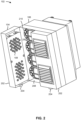
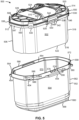
- Figs. 5-6 are diagrams of a filtration device 500, according to one or more aspects of the present disclosure.
- Fig. 5 is an isometric view of the filtration device 500 in an unlatched state.
- Fig. 6 is an isometric view of the filtration device 500 in a latched state. It should be understood that the filtration device 500 may correspond to one or more of the plurality of filtration devices 210 of Figs. 2-4 .
- the filtration device 500 includes a filter element 502 and a housing 504 that is configured to receive the filter element 502.
- the filter element 502 includes a casing 506, a filter media 508, a grip 510, and a flange 512.
- the casing 506 includes a first end 514, a second end 516, and an outer surface 518 that defines an outer perimeter of the casing 506 and connects the first end 514 to the second end 516.
- the first end 514 defines a first opening 520
- the second end 516 defines a second opening 522 that communicates with the first opening 520 to form a hollow interior 524 of the casing 506.
- the filter media 508 which may be a fluted and/or pleated material such as, for example, paper and/or cotton, is disposed within the hollow interior 524 and is configured to filter the air flowing through the filtration device 500.
- the filter media 508 may be configured to capture debris particles within the hollow interior 524 of the casing 506 as the air travels from the first opening 520 and through the second opening 522.
- the grip 510 is fixedly connected to the first end 514 of the casing 506 and extends across the first opening 520 from a first side edge 526 of the first opening 520 to a second side edge 528 of the first opening 520.
- the grip 510 is structured and arranged to facilitate handling of the filtration device 500 (e.g., during installation and/or removal of the filtration device 500).
- the grip 510 may be substantially H-shaped (as shown in Figs. 5-6 ), I-shaped, or have another similar shape.
- the flange 512 is connected to the outer surface 518 of the casing 506 and extends around the outer perimeter of the casing 506.
- the flange 512 includes a plurality of snap members 530 that each form part of a latch mechanism that connects the filter element 502 with the housing 504 when the filtration device 500 is in the latched state (as shown in Fig. 4 ).
- Each snap member 530 includes a fulcrum 532 and a lever 534 mounted on the fulcrum 532.
- the fulcrum 532 projects radially from an upper end portion 536 of the flange 512, and the lever 534 extends in a direction that is substantially perpendicular to the fulcrum 532.
- the lever 534 which is substantially planar and has a substantially rectangular shape, includes a latch portion 538 and a handle portion 540.
- the latch portion 538 is located at a first end 542 of the lever 534
- the handle portion 540 is located at a second end 544 of the lever 534 that is opposite to the first end 542, and the fulcrum 532 is substantially centered therebetween.
- the latch portion 538 includes a lower inner surface 546 that faces a lower end portion 547 of the flange 512 and a substantially rectangular aperture 548.
- the handle portion 540 is configured to be depressed in a direction that is substantially parallel to the fulcrum 532 to disengage the latch mechanism.
- the handle portion 540 may include a bent section 550.
- each of the fulcrums 532 of the plurality of snap members 530 may have a length that is less than the radial length of each of the plurality of mounting tabs 404.
- the length of each fulcrum 532 may be less than approximately 38.1mm (1.5 inches).
- the length may be approximately 5.08mm (0.2 inches). Other dimensions are possible.
- the housing 504 includes a shell 552, a seal member 554, a plurality of ramp members 556, and the plurality of mounting tabs 404.
- the shell 552 includes a first end 558, a second end 560, an outer surface 562 that connects the first end 558 to the second end 560, and an inner surface 564 that is opposed to the outer surface 562.
- the first end 558 defines a first opening 566
- the second end 560 defines a second opening 568 that communicates with the first opening 566 to form a hollow interior 570 of the shell 552.
- the outer surface 562 defines an outer perimeter of the shell 552, and the inner surface 564 defines an inner perimeter of the shell 552.
- the inner surface 564 includes a ledge 572 that extends around the inner perimeter of the shell 552 and is positioned a first distance from the first end 558 of the shell 552.
- the ledge 572 supports the seal member 554, which is an elongated strip of material (e.g., plastic) that is configured to compress the lower end portion 547 of the flange 512 of the filter element 502 when the filtration device 500 is in the latched state.
- the plurality of ramp members 556 are fixedly connected to the outer surface 562 of the shell 552 and positioned a second distance from the first end 558 of the shell 552 that is less than the first distance. In other words, the plurality of ramp members 556 are arranged on the shell 552 at a vertical position between the first end 558 of the shell 552 and the ledge 572 of the shell 552.
- the plurality of ramp members 556 may be arranged in subsets (e.g., of two ramp members, of four ramp members) around the outer perimeter of the shell 552.
- Each ramp member 556 forms a corresponding part of the latch mechanism and is thus configured to engage one of the plurality of snap members 530.
- Each ramp member 556 includes an angled surface 574, a first side surface 576, a second side surface 578, and a bottom surface 580.
- the angled surface 574 extends from the outer surface 562 of the shell 552 at an acute angle relative to the outer surface 562. A vertex of the acute angle is closer to the first end 558 of the shell 552 than to the second end 560 of the shell 552.
- the angled surface 574 which is substantially rectangular, includes a first edge 582 opposing a second edge 584 and a third edge 586 opposing a fourth edge 588.
- the first side surface 576 and the second side surface 578 which are substantially triangular, are respectively connected to the first edge 582 of the angled surface 574 and the second edge 584 of the angled surface 574.
- the bottom surface 580 which is substantially rectangular, is connected to the fourth edge 588 of the angled surface 574.
- the plurality of mounting tabs 404 which form part of the mounting mechanism 402 described above in connection with Fig. 4 , are fixedly connected to the outer surface 562 of the shell 552.
- the plurality of mounting tabs 404 are positioned at a distance relative to the first end 558 of the shell 552 that is substantially equal to the first distance.
- the casing 506, the grip 510, and/or the plurality of snap members 530 of the filter element 502, to withstand environmental conditions, may be made of a durable material, such as acrylonitrile butadiene styrene (ABS) plastic or another type of plastic.
- ABS acrylonitrile butadiene styrene
- the flange 512, in order to support the plurality of snap members 530 while forming a seal with the housing 504, may be made of multiple materials.
- the upper end portion 536 of the flange 512, which supports the plurality of snap members 530 may be integral with the plurality of snap members 530 and/or made of a durable material, such as ABS plastic.
- the lower end portion 547 of the flange 512 in order to be compressible, may be formed of urethane or another type of resilient material.
- the shell 552 of the housing 504 to likewise withstand environment conditions, may be made of a material such as glass-filled nylon. Other materials are possible.
- a user may hold the grip 510 and insert the filter element 502 into the hollow interior 570 of the shell 552.
- a bottom surface 590 of the lower end portion 547 is compressed by the seal member 554, thereby forming the seal.
- the lower inner surfaces 546 of the latch portions 538 slide over the angled surfaces 574 of the plurality of ramp members 556, causing the handle portions 540 of the levers 534 to tilt towards the casing 506 of the filter element 502.
- the plurality of snap members 530 automatically snap onto and engage the plurality of ramp members 556.
- the user may place the filtration device 500 into the latched state without directly contacting the latch mechanism.
- the user may depress the handle portions 540 of plurality of snap members 530 and pull the grip 510 in a direction away from the housing 504.
- the handle portions 540 By depressing the handle portions 540, the user causes the levers 534 to pivot about the fulcrums 532, which disengages the apertures 548 from the plurality of ramp members 556. Due to the resiliency of the plurality of snap members 530, the latch mechanism is capable of being repeatedly latched and unlatched.
- Figs. 5-6 are provided as an example. Other examples may differ from what is described with regard to Figs. 5-6 .
- the number and arrangement of components e.g., the plurality of snap members and/or the plurality of ramp members
- Figs. 7-8 are diagrams of a filtration device 700, which is not covered by the claims.
- Fig. 7 is an isometric view of the filtration device 700 in an unlatched state.
- Fig. 8 is an isometric view of the filtration device 700 in a latched state.
- the filtration device 700 may correspond to one or more of the plurality of filtration devices 210 of Figs. 2-4 .
- the filtration device 700 shares features with the filtration device 500. The description below will focus on the differences in structure.
- the filtration device 700 includes an adapter 702, a filter element 704, and a housing 706.
- the adapter 702 includes a collar 708, a plurality of locking tabs 710, the plurality of snap members 530, and a plurality of clamping tabs 712.
- the collar 708 has an upper rim 714, a lower rim 716, and a wall 718 connecting the upper rim 714 to the lower rim 716.
- the upper rim 714 extends radially inward from the wall 718, and the lower rim 716 extends radially outward from the wall 718.
- the plurality of locking tabs 710 extend downwardly from the upper rim 714 and are configured to connect the adapter 702 to the filter element 704.
- Each of the locking tabs 710 includes a body portion 720 and a tooth 722.
- the body portion 720 extends from the upper rim 714 and is spaced inwardly from the wall 718, and the tooth 722 projects inwardly from a free end 724 of the body portion 720.
- the plurality of snap members 530 described above in connection with Figs. 5-6 , extend radially outward from the lower rim 716 and are configured to connect the adapter 702 to the housing 706.
- the plurality of clamping tabs 712 which may assist the plurality of snap members 530 in connecting the adapter 702 to the housing 706, likewise extend radially outward from the lower rim 716.
- the adapter 702 may be formed of a single, integral piece of material.
- the material may be ABS plastic, nylon, or a similar material. Other materials are possible.
- the filter element 70 in addition to having the casing 506, the filter media 508, and the grip 510 of the filter element 502, includes a flange 726 and a plurality of receptacles 728.
- the flange 726 is connected to the outer surface 518 of the casing 506 and extends around the outer perimeter of the casing 506.
- the flange 726 includes an upper surface 730, a lower surface 732, and an outer surface 734 that connects the upper surface 730 to the lower surface 732.
- the upper surface 730 of the flange 726 is configured to support the lower rim 716 of the adapter 702 when the adapter 702 is secured to the filter element 704.
- the lower surface 732 of the flange 726 is configured to form a seal with the housing 706 when the filtration device 700 is in the latched state.
- the plurality of receptacles 728 are fixedly connected to the outer surface 518 of the casing 506 and extend between the first end 514 of the casing 506 and the upper surface 730 of the flange 726. In order to engage the plurality of locking tabs 710, the plurality of receptacles 728 are arranged around the outer perimeter of the casing 506. Each receptacle 728 includes an angled surface 736 and an opening 738.
- the angled surface 736 extends from the outer surface 518 of the casing 506 at an acute angle relative to the outer surface 518. A vertex of the acute angle is closer to the first end 514 of the casing 506 than to the second end 516 of the casing 506.
- the opening 738 is positioned between the angled surface 736 and the outer surface 518 and is configured to receive a tooth 722 of a respective locking tab 710 when the adapter 702 and the filter element 704 are in an attached state.
- the flange 726 of the filter element 704 may be formed of a resilient material such as be urethane.
- the plurality of receptacles 728 of the filter element 704 may be integral with the casing 506 and thus formed of the same durable material as the casing 506, such as ABS plastic or another type of plastic. Other materials are possible.
- the plurality of clamps 740 which are configured to engage the plurality of clamping tabs 712 on the adapter 702, are pivotably mounted to the outer surface 562 of the shell 552.
- the plurality of clamps 740 similar to the plurality of mounting tabs 404, are positioned at a distance relative to the first end 558 of the shell 552 that is substantially equal to the first distance. Because the plurality of clamps 740 are arranged at beveled corner portions of the outer surface 562, the plurality of clamps 740 do not interfere with the spacing within the cabinet 106, as described above in connection with Fig. 4 .
- a user may press the collar 708 onto the flange 726 of the filter element 704.
- the teeth 722 of the plurality of locking tabs 710 slide over the angled surfaces 736 of the plurality of receptacles 728, causing the body portions 720 to bend toward the wall 718 of the collar 708.
- the teeth 722 automatically snap into and engage with the openings 738 of the plurality of receptacles 728.
- the user may place the adapter 702 and the filter element 704 into the attached state without directly contacting the plurality of locking tabs 710.
- the user may connect the filter element 704 to the housing 706 using substantially the same steps as described above in connection with Figs. 5-6 . Likewise, if so desired, the user may disconnect the filter element 704 from the housing 706 using substantially the same steps as described above. It should be understood, however, that the described order of assembly is provided merely as an example. In practice, the filter element 704 may be inserted into the housing 706 prior to attachment of the adapter 702.
- Figs. 7-8 are provided as an example. Other examples may differ from what is described with regard to Figs. 7-8 .
- the number and arrangement of components e.g., the plurality of snap members 530, the plurality of locking tabs 710, the plurality of clamping tab 712, the plurality of ramp members 556, the plurality of receptacles 728, and/or the plurality of clamps 740
- the number and arrangement of components may differ from that shown in Figs. 7-8 .
- the filtration device 700 has been described as including the plurality of clamps 740 and the plurality of clamping tabs 712, it should be understood that such attachment mechanisms are provided merely as an example. In practice, other types of attachment mechanisms may be used in place of, or in addition to, the plurality of clamps 740 and the plurality of clamping tabs 712.
- the filtration device 700 may include only the plurality of snap members 530 and the plurality of ramp members 556.
- the filtration device 700 may include, in place of the plurality of clamps 740 and the plurality of clamping tabs 712, one or more different types of attachment mechanisms, such as screws, buckles, C-clamps, or other fasteners.
- the filtration device 500, 700 of the present disclosure is particularly applicable within the cabinet 106 of the air cleaner assembly 102.
- the air cleaner assembly 102 may be configured to communicate with an air intake system associated with an engine.
- the engine may utilize air in the environment to convert chemical energy stored in fuel into mechanical work.
- the engine may propel a ground-borne vehicle, such as a mining truck (shown in Fig. 1 ), a tractor, a backhoe loader, a dozer, an excavator, a grader, or another type of vehicle.
- the engine may supply power to a stationary machine, such as a generator, a pump, or another type of machine.
- the filtration devices 210, 500, 700 of the present disclosure may be arranged more compactly within the cabinet 106.
- the air cleaner assembly 102 may more efficiently filter debris particles out of the air.
- the adapter 702 allows the filter element 704 and/or the housing 706 to be used modularly (e.g., within other types and/or sizes of cabinets and/or with other types of attachment devices).
- the filtration device 700 may have the added benefit of cost reduction associated with production and/or storage of inventory.
- a As used herein, "a,” “an,” and a “set” are intended to include one or more items, and may be used interchangeably with “one or more.” Further, as used herein, the article “the” is intended to include one or more items referenced in connection with the article “the” and may be used interchangeably with “the one or more.” Further, the phrase “based on” is intended to mean “based, at least in part, on” unless explicitly stated otherwise. Also, as used herein, the term “or” is intended to be inclusive when used in a series and may be used interchangeably with “and/or,” unless explicitly stated otherwise (e.g., if used in combination with "either” or “only one of').
- spatially relative terms such as “below,” “lower,” “above,” “upper,” and the like, may be used herein for ease of description to describe one element or feature's relationship to another element(s) or feature(s) as illustrated in the figures.
- the spatially relative terms are intended to encompass different orientations of the apparatus, device, and/or element in use or operation in addition to the orientation depicted in the figures.
- the apparatus may be otherwise oriented (rotated 90 degrees or at other orientations) and the spatially relative descriptors used herein may likewise be interpreted accordingly.
Landscapes
- Chemical & Material Sciences (AREA)
- Chemical Kinetics & Catalysis (AREA)
- Engineering & Computer Science (AREA)
- Combustion & Propulsion (AREA)
- Mechanical Engineering (AREA)
- General Engineering & Computer Science (AREA)
- Physics & Mathematics (AREA)
- Geometry (AREA)
- Filtering Of Dispersed Particles In Gases (AREA)
- Electrical Discharge Machining, Electrochemical Machining, And Combined Machining (AREA)
- Pharmaceuticals Containing Other Organic And Inorganic Compounds (AREA)
- Sink And Installation For Waste Water (AREA)
Description
- The present disclosure relates generally to a filtration device and, for example, to a filter element and a housing of the filtration device.
- In order for an engine to convert chemical energy stored in fuel into mechanical work, the engine utilizes air from the surrounding environment to cause the fuel to combust. However, because the air in the surrounding environment is often laden with debris particles (e.g., dust, sand, or other particles), which may damage components of the engine and/or obstruct the fuel, the air may need to be filtered prior to entering the engine. As a result, some engine-driven machines (e.g., vehicles, generators, or other types of machines) may include an air cleaner assembly having one or more filtration devices that selectively capture the debris particles while permitting clean air to pass therethrough.
- As filter media within the one or more filtration devices becomes filled with the debris particles, the pressure differential across the one or more filtration devices tends to increase, which may in turn decrease the efficiency of the engine. Thus, the filter media may need to be periodically removed from the air cleaner assembly for replacement and/or cleaning. To allow removal of the filter media, the one or more filtration devices may include latch mechanisms which removably secure the filter media therein. However, due to space constraints in the machine, inclusion of the latch mechanisms may limit a size and/or quantity of the filtration devices within the air cleaner assembly, may complicate replacement of the filter media, and/or have other drawbacks.
-
U.S. Patent No. 8,245,868, which issued to Ikeda et al. on August 21, 2012 , discloses a case locking mechanism located between a first case part and a second case part. The mechanism comprises a projection, a deformable piece, a hook portion, a guide portion, and a holding portion. The projection is formed on an outer side surface of the first case part. The deformable piece is integrally formed with an outer side surface of the second case part and has a folded back curved portion at a midpoint in a longitudinal direction. The hook portion is formed at a distal portion of the deformable piece and is engageable with the projection. The guide portion is formed on the projection. When the case parts are closed, the guide portion guides a claw portion formed in the hook portion in such a direction that the claw portion engages with the projection. The holding projection is formed on the projection to maintain the engaged state between the claw portion and the projection. Further examples for filter elements including latches are disclosed inDE102015003297 ,US2016/280045 ,US2005/081497 ,US2010/162673 andUS2013/180222 . - The filtration device of the present disclosure solves one or more of the problems set forth above and/or other problems in the art.
- According to the disclosure, there is provided a filter element comprises a casing and a flange. The casing has an outer surface that defines an outer perimeter of the casing. The flange is connected to the outer surface and extends around the outer perimeter of the casing. The flange comprises a plurality of snap members that are configured to resiliently engage one or more ramp members of a housing to connect the filter element with the housing. A snap member, of the plurality of snap members, includes a fulcrum and a lever. The fulcrum projects radially from the flange, and the lever is mounted on the fulcrum and extends in a direction that is substantially perpendicular to the fulcrum. The lever comprises a latch portion at a first end of the lever and a handle portion at a second end of the lever, wherein the first end is opposite to the second end, and the fulcrum is located between the latch portion and the handle portion of the lever. The latch portion comprises a lower surface that faces the flange and is configured to slide over an angled surface of the one or more ramp members as the filter element is inserted into the housing; and an aperture that is configured to receive the one or more ramp members of the housing when the filter element and the housing are in a latched state.
-
-
Fig. 1 is a diagram of an example machine that includes an air cleaning assembly. -
Figs. 2-3 are diagrams of the air cleaning assembly ofFig. 1 , which has a plurality of filtration devices therein. -
Fig. 4 is a diagram of the plurality of filtration devices ofFigs. 2-3 . -
Figs. 5-6 are diagrams of a filtration device, according to one or more aspects of the present disclosure. -
Figs. 7-8 are diagrams of a filtration device, which is not covered by the claims. - This disclosure relates to a filtration device having a latch mechanism. The filtration device has universal applicability to any device and/or system involved in filtering air. For example, the filtration device may be part of an air cleaner assembly that fluidly communicates with a power system, a fuel system, and/or the like. The device and/or system may be implemented in a machine associated with an industry, such as mining, construction, farming, transportation, or another type of industry.
- To simplify the explanation below, the same reference numbers may be used to denote like features. The drawings may not be to scale.
-
Fig. 1 is a diagram of anexample machine 100 that includes anair cleaner assembly 102. Themachine 100 is powered by an engine that utilizes an air intake system to convert chemical energy stored in fuel into mechanical work. For example, themachine 100 may be a ground-borne vehicle, such as a mining truck (shown inFig. 1 ), a tractor, a backhoe loader, a dozer, an excavator, a grader, or another type of vehicle. As another example, themachine 100 may be a stationary machine, such as a generator, a pump, or another type of machine. - The
air cleaner assembly 102 is a device that is configured to filter air from an environment to prevent debris particles within the air (e.g., dust, sand, or other types of particles) from entering the air intake system associated with the engine. For example, as shown inFig. 1 , theair cleaner assembly 102 may include a pre-cleaner 104, which provides a first stage of air filtration, and acabinet 106, which provides a second stage of air filtration. In use, theair cleaner assembly 102 is mounted to themachine 100 to fluidly communicate with the air intake system associated with the engine. For example, as will be described below in connection withFigs. 2-3 , the air may enter the air intake system of themachine 100 by flowing into a plurality ofinlet ports 108 of the pre-cleaner 104 and out of a plurality ofoutlet ports 110 of thecabinet 106. - As indicated above,
Fig. 1 is provided as an example. Other examples may differ from what is described with regard toFig. 1 . For example, the number and arrangement ofair cleaner assemblies 102 may differ from that shown inFig. 1 . Thus, there may be additional air cleaner assemblies, fewer air cleaner assemblies, different air cleaner assemblies, and/or differently arranged air cleaner assemblies than those shown inFig. 1 . -
Figs. 2-3 are diagrams of theair cleaner assembly 102.Fig. 2 is an isometric view of theair cleaner assembly 102.Fig. 3 is a cross-sectional view of theair cleaner assembly 102. - As shown in
Figs. 2-3 , the pre-cleaner 104 includes a pair ofdoors 202 that are hingedly attached to thecabinet 106 to move between a closed position and an open position. Eachdoor 202 includes a subset of the plurality ofinlet ports 108, which are configured to cause the air passing therethrough to spin. As the air travels along the plurality ofinlet ports 108 to enter thecabinet 106, the air may eject a majority of the debris particles within the air into a pair ofcollection pipes 204 for collection and/or removal. In such a way, the pre-cleaner 104 may provide the first stage of air filtration. - The
cabinet 106 includes aplatform 206 mounted therein to divide an interior of thecabinet 106 into a frontinterior space 208 and a rear interior space 302 (shown inFig. 3 ). Thefront interior space 208 is configured to be covered by the pre-cleaner 104 to receive the air passing therethrough, and therear interior space 302 is configured to fluidly communicate with the plurality ofoutlet ports 110 to allow the air to exit theair cleaner assembly 102. To selectively filter a remaining amount of the debris particles within the air while permitting the air to travel from the frontinterior space 208 to the rearinterior space 302, theplatform 206 includes a plurality offiltration devices 210, alternatives of which will be described below in connection withFigs. 5-8 . In such a way, thecabinet 106 may provide the second stage of air filtration. - As indicated above,
Figs. 2-3 are provided as an example. Other examples may differ from what is described with regard toFigs. 2-3 . For example, the number and arrangement of components (e.g., the plurality ofinlet ports 108, the plurality ofoutlet ports 110, the pair ofdoors 202, the pair ofcollection pipes 204, and/or the plurality of filtration devices 210) may differ from that shown inFigs. 2-3 . Thus, there may be additional components, fewer components, different components, and/or differently arranged components than those shown inFigs. 2-3 . -
Fig. 4 is a front view of the plurality offiltration devices 210 secured within thecabinet 106. As shown inFig. 4 , the plurality offiltration devices 210 are compactly arranged within thecabinet 106 to maximize filtration capability for a given size of thecabinet 106. The plurality offiltration devices 210 are substantially identical and interchangeable. Eachfiltration device 210 includes amounting mechanism 402 that secures therespective filtration device 210 to theplatform 206. Each mountingmechanism 402 includes a plurality of mountingtabs 404, which extend radially and fixedly from therespective filtration device 210, and a plurality of fasteners 406 (e.g., screws, bolts, and/or another type of fastener), which are configured to extend through the plurality of mountingtabs 404 and into theplatform 206. To minimize spacing between the plurality offiltration devices 210, the plurality of mountingtabs 404 may be spaced apart and offset from one another. Thus, when the plurality offiltration devices 210 are secured to theplatform 206, as shown inFig. 4 , a mountingtab 404 of onefiltration device 210 may be received in a space between two mountingtabs 404 of anadjacent filtration device 210. - To adequately filter the air entering the intake system of the
machine 100, each of the plurality offiltration devices 210 may have a length in a range of approximately 457.2mm (18 inches) to approximately 558.8mm (22 inches), a width in a range of approximately 254mm (10 inches) to approximately 355.6mm (14 inches), and a depth in a range of approximately 203.2mm (8 inches) to approximately 304.8mm (12 inches). For example, the length may be approximately 508mm (20 inches), the width may be approximately 304.8mm (12 inches), and the depth may be approximately 254mm (10 inches). Furthermore, in order to minimize spacing between the plurality offiltration devices 210, each of the plurality of mountingtabs 404 may have a radial length in a range of approximately 12.7mm (0.5 inches) to approximately 38.1mm (1.5 inches). For example, the radial length may be approximately 22.89mm (0.9 inches). Other dimensions are possible. - As indicated above,
Fig. 4 is provided as an example. Other examples may differ from what is described with regard toFig. 4 . For example, the number and arrangement of components (e.g., the plurality offiltration devices 210, the plurality of mountingtabs 404, and/or the plurality of fasteners 406) may differ from that shown inFig. 4 . Thus, there may be additional components, fewer components, different components, differently shaped components, and/or differently arranged components than those shown inFig. 4 . -
Figs. 5-6 are diagrams of afiltration device 500, according to one or more aspects of the present disclosure.Fig. 5 is an isometric view of thefiltration device 500 in an unlatched state.Fig. 6 is an isometric view of thefiltration device 500 in a latched state. It should be understood that thefiltration device 500 may correspond to one or more of the plurality offiltration devices 210 ofFigs. 2-4 . - As shown in
Figs. 5-6 , thefiltration device 500 includes afilter element 502 and ahousing 504 that is configured to receive thefilter element 502. Thefilter element 502 includes acasing 506, afilter media 508, agrip 510, and aflange 512. Thecasing 506 includes afirst end 514, asecond end 516, and anouter surface 518 that defines an outer perimeter of thecasing 506 and connects thefirst end 514 to thesecond end 516. Thefirst end 514 defines afirst opening 520, and thesecond end 516 defines asecond opening 522 that communicates with thefirst opening 520 to form ahollow interior 524 of thecasing 506. Thefilter media 508, which may be a fluted and/or pleated material such as, for example, paper and/or cotton, is disposed within thehollow interior 524 and is configured to filter the air flowing through thefiltration device 500. For example, thefilter media 508 may be configured to capture debris particles within thehollow interior 524 of thecasing 506 as the air travels from thefirst opening 520 and through thesecond opening 522. - The
grip 510 is fixedly connected to thefirst end 514 of thecasing 506 and extends across thefirst opening 520 from afirst side edge 526 of thefirst opening 520 to asecond side edge 528 of thefirst opening 520. Thegrip 510 is structured and arranged to facilitate handling of the filtration device 500 (e.g., during installation and/or removal of the filtration device 500). For example, thegrip 510 may be substantially H-shaped (as shown inFigs. 5-6 ), I-shaped, or have another similar shape. - The
flange 512 is connected to theouter surface 518 of thecasing 506 and extends around the outer perimeter of thecasing 506. Theflange 512 includes a plurality ofsnap members 530 that each form part of a latch mechanism that connects thefilter element 502 with thehousing 504 when thefiltration device 500 is in the latched state (as shown inFig. 4 ). Eachsnap member 530 includes afulcrum 532 and alever 534 mounted on thefulcrum 532. Thefulcrum 532 projects radially from anupper end portion 536 of theflange 512, and thelever 534 extends in a direction that is substantially perpendicular to thefulcrum 532. Thelever 534, which is substantially planar and has a substantially rectangular shape, includes alatch portion 538 and ahandle portion 540. Thelatch portion 538 is located at afirst end 542 of thelever 534, thehandle portion 540 is located at asecond end 544 of thelever 534 that is opposite to thefirst end 542, and thefulcrum 532 is substantially centered therebetween. Thelatch portion 538 includes a lower inner surface 546 that faces alower end portion 547 of theflange 512 and a substantiallyrectangular aperture 548. Thehandle portion 540 is configured to be depressed in a direction that is substantially parallel to thefulcrum 532 to disengage the latch mechanism. To facilitate depressing thehandle portion 540, thehandle portion 540 may include abent section 550. - So as to not interfere with the spacing within the
cabinet 106, as described above in connection withFig. 4 , each of thefulcrums 532 of the plurality ofsnap members 530 may have a length that is less than the radial length of each of the plurality of mountingtabs 404. Thus, the length of eachfulcrum 532 may be less than approximately 38.1mm (1.5 inches). For example, the length may be approximately 5.08mm (0.2 inches). Other dimensions are possible. - The
housing 504 includes ashell 552, aseal member 554, a plurality oframp members 556, and the plurality of mountingtabs 404. Theshell 552 includes afirst end 558, asecond end 560, anouter surface 562 that connects thefirst end 558 to thesecond end 560, and aninner surface 564 that is opposed to theouter surface 562. Thefirst end 558 defines afirst opening 566, and thesecond end 560 defines asecond opening 568 that communicates with thefirst opening 566 to form ahollow interior 570 of theshell 552. Theouter surface 562 defines an outer perimeter of theshell 552, and theinner surface 564 defines an inner perimeter of theshell 552. Theinner surface 564 includes aledge 572 that extends around the inner perimeter of theshell 552 and is positioned a first distance from thefirst end 558 of theshell 552. Theledge 572 supports theseal member 554, which is an elongated strip of material (e.g., plastic) that is configured to compress thelower end portion 547 of theflange 512 of thefilter element 502 when thefiltration device 500 is in the latched state. - The plurality of
ramp members 556 are fixedly connected to theouter surface 562 of theshell 552 and positioned a second distance from thefirst end 558 of theshell 552 that is less than the first distance. In other words, the plurality oframp members 556 are arranged on theshell 552 at a vertical position between thefirst end 558 of theshell 552 and theledge 572 of theshell 552. The plurality oframp members 556 may be arranged in subsets (e.g., of two ramp members, of four ramp members) around the outer perimeter of theshell 552. Eachramp member 556 forms a corresponding part of the latch mechanism and is thus configured to engage one of the plurality ofsnap members 530. Eachramp member 556 includes anangled surface 574, afirst side surface 576, asecond side surface 578, and abottom surface 580. Theangled surface 574 extends from theouter surface 562 of theshell 552 at an acute angle relative to theouter surface 562. A vertex of the acute angle is closer to thefirst end 558 of theshell 552 than to thesecond end 560 of theshell 552. Theangled surface 574, which is substantially rectangular, includes afirst edge 582 opposing asecond edge 584 and athird edge 586 opposing afourth edge 588. Thefirst side surface 576 and thesecond side surface 578, which are substantially triangular, are respectively connected to thefirst edge 582 of theangled surface 574 and thesecond edge 584 of theangled surface 574. Thebottom surface 580, which is substantially rectangular, is connected to thefourth edge 588 of theangled surface 574. - The plurality of mounting
tabs 404, which form part of the mountingmechanism 402 described above in connection withFig. 4 , are fixedly connected to theouter surface 562 of theshell 552. The plurality of mountingtabs 404 are positioned at a distance relative to thefirst end 558 of theshell 552 that is substantially equal to the first distance. - The
casing 506, thegrip 510, and/or the plurality ofsnap members 530 of thefilter element 502, to withstand environmental conditions, may be made of a durable material, such as acrylonitrile butadiene styrene (ABS) plastic or another type of plastic. Theflange 512, in order to support the plurality ofsnap members 530 while forming a seal with thehousing 504, may be made of multiple materials. For example, theupper end portion 536 of theflange 512, which supports the plurality ofsnap members 530, may be integral with the plurality ofsnap members 530 and/or made of a durable material, such as ABS plastic. Thelower end portion 547 of theflange 512, in order to be compressible, may be formed of urethane or another type of resilient material. Theshell 552 of thehousing 504, to likewise withstand environment conditions, may be made of a material such as glass-filled nylon. Other materials are possible. - To connect the
filter element 502 to thehousing 504, a user may hold thegrip 510 and insert thefilter element 502 into thehollow interior 570 of theshell 552. As theflange 512 of thefilter element 502 enters thehollow interior 570, abottom surface 590 of thelower end portion 547 is compressed by theseal member 554, thereby forming the seal. Once thefiltration device 500 is installed within thecabinet 106, the seal may prevent air from passing through thecabinet 106 without first passing through thefilter media 508. As thelower end portion 547 of theflange 512 is increasingly compressed by theseal member 554, the lower inner surfaces 546 of thelatch portions 538 slide over theangled surfaces 574 of the plurality oframp members 556, causing thehandle portions 540 of thelevers 534 to tilt towards the casing 506 of thefilter element 502. Once theapertures 548 of thelatch portions 538 contact the bottom surfaces 580 of the plurality oframp members 556, the plurality ofsnap members 530 automatically snap onto and engage the plurality oframp members 556. Thus, the user may place thefiltration device 500 into the latched state without directly contacting the latch mechanism. - Conversely, to disconnect the
filter element 502 from thehousing 504, the user may depress thehandle portions 540 of plurality ofsnap members 530 and pull thegrip 510 in a direction away from thehousing 504. By depressing thehandle portions 540, the user causes thelevers 534 to pivot about thefulcrums 532, which disengages theapertures 548 from the plurality oframp members 556. Due to the resiliency of the plurality ofsnap members 530, the latch mechanism is capable of being repeatedly latched and unlatched. - As indicated above,
Figs. 5-6 are provided as an example. Other examples may differ from what is described with regard toFigs. 5-6 . For example, the number and arrangement of components (e.g., the plurality of snap members and/or the plurality of ramp members) may differ from that shown inFigs. 5-6 . Thus, there may be additional components, fewer components, different components, differently shaped components, and/or differently arranged components than those shown inFigs. 5-6 . -
Figs. 7-8 are diagrams of afiltration device 700, which is not covered by the claims.Fig. 7 is an isometric view of thefiltration device 700 in an unlatched state.Fig. 8 is an isometric view of thefiltration device 700 in a latched state. It should be understood that thefiltration device 700 may correspond to one or more of the plurality offiltration devices 210 ofFigs. 2-4 . Furthermore, it should be understood that thefiltration device 700 shares features with thefiltration device 500. The description below will focus on the differences in structure. - As shown in
Figs. 7-8 , thefiltration device 700 includes anadapter 702, afilter element 704, and ahousing 706. Theadapter 702 includes acollar 708, a plurality of lockingtabs 710, the plurality ofsnap members 530, and a plurality of clampingtabs 712. Thecollar 708 has anupper rim 714, alower rim 716, and awall 718 connecting theupper rim 714 to thelower rim 716. Theupper rim 714 extends radially inward from thewall 718, and thelower rim 716 extends radially outward from thewall 718. The plurality of lockingtabs 710 extend downwardly from theupper rim 714 and are configured to connect theadapter 702 to thefilter element 704. Each of the lockingtabs 710 includes abody portion 720 and atooth 722. Thebody portion 720 extends from theupper rim 714 and is spaced inwardly from thewall 718, and thetooth 722 projects inwardly from afree end 724 of thebody portion 720. The plurality ofsnap members 530, described above in connection withFigs. 5-6 , extend radially outward from thelower rim 716 and are configured to connect theadapter 702 to thehousing 706. The plurality of clampingtabs 712, which may assist the plurality ofsnap members 530 in connecting theadapter 702 to thehousing 706, likewise extend radially outward from thelower rim 716. - The
adapter 702 may be formed of a single, integral piece of material. For example, to allow the plurality of locking tabs and the plurality of snap members to form resilient connections, the material may be ABS plastic, nylon, or a similar material. Other materials are possible. - The
filter element 704, in addition to having thecasing 506, thefilter media 508, and thegrip 510 of thefilter element 502, includes aflange 726 and a plurality ofreceptacles 728. Theflange 726 is connected to theouter surface 518 of thecasing 506 and extends around the outer perimeter of thecasing 506. Theflange 726 includes anupper surface 730, alower surface 732, and anouter surface 734 that connects theupper surface 730 to thelower surface 732. Theupper surface 730 of theflange 726 is configured to support thelower rim 716 of theadapter 702 when theadapter 702 is secured to thefilter element 704. Thelower surface 732 of theflange 726 is configured to form a seal with thehousing 706 when thefiltration device 700 is in the latched state. - The plurality of
receptacles 728 are fixedly connected to theouter surface 518 of thecasing 506 and extend between thefirst end 514 of thecasing 506 and theupper surface 730 of theflange 726. In order to engage the plurality of lockingtabs 710, the plurality ofreceptacles 728 are arranged around the outer perimeter of thecasing 506. Eachreceptacle 728 includes anangled surface 736 and anopening 738. Theangled surface 736 extends from theouter surface 518 of thecasing 506 at an acute angle relative to theouter surface 518. A vertex of the acute angle is closer to thefirst end 514 of thecasing 506 than to thesecond end 516 of thecasing 506. Theopening 738 is positioned between theangled surface 736 and theouter surface 518 and is configured to receive atooth 722 of arespective locking tab 710 when theadapter 702 and thefilter element 704 are in an attached state. - The
flange 726 of thefilter element 704 may be formed of a resilient material such as be urethane. The plurality ofreceptacles 728 of thefilter element 704 may be integral with thecasing 506 and thus formed of the same durable material as thecasing 506, such as ABS plastic or another type of plastic. Other materials are possible. - The
housing 706, in addition to having theshell 552, theseal member 554, the plurality oframp members 556, and the plurality of mountingtabs 404, includes a plurality ofclamps 740. The plurality ofclamps 740, which are configured to engage the plurality of clampingtabs 712 on theadapter 702, are pivotably mounted to theouter surface 562 of theshell 552. The plurality ofclamps 740, similar to the plurality of mountingtabs 404, are positioned at a distance relative to thefirst end 558 of theshell 552 that is substantially equal to the first distance. Because the plurality ofclamps 740 are arranged at beveled corner portions of theouter surface 562, the plurality ofclamps 740 do not interfere with the spacing within thecabinet 106, as described above in connection withFig. 4 . - To attach the
adapter 702 to thefilter element 704, a user may press thecollar 708 onto theflange 726 of thefilter element 704. As theadapter 702 is pressed onto thefilter element 704, theteeth 722 of the plurality of lockingtabs 710 slide over theangled surfaces 736 of the plurality ofreceptacles 728, causing thebody portions 720 to bend toward thewall 718 of thecollar 708. Once the free ends 724 of thebody portions 720 contact theupper surface 730 of theflange 726, theteeth 722 automatically snap into and engage with theopenings 738 of the plurality ofreceptacles 728. Thus, the user may place theadapter 702 and thefilter element 704 into the attached state without directly contacting the plurality of lockingtabs 710. - Once the
adapter 702 and thefilter element 704 are in the attached state, the user may connect thefilter element 704 to thehousing 706 using substantially the same steps as described above in connection withFigs. 5-6 . Likewise, if so desired, the user may disconnect thefilter element 704 from thehousing 706 using substantially the same steps as described above. It should be understood, however, that the described order of assembly is provided merely as an example. In practice, thefilter element 704 may be inserted into thehousing 706 prior to attachment of theadapter 702. - As indicated above,
Figs. 7-8 are provided as an example. Other examples may differ from what is described with regard toFigs. 7-8 . For example, the number and arrangement of components (e.g., the plurality ofsnap members 530, the plurality of lockingtabs 710, the plurality ofclamping tab 712, the plurality oframp members 556, the plurality ofreceptacles 728, and/or the plurality of clamps 740) may differ from that shown inFigs. 7-8 . Thus, there may be additional components, fewer components, different components, differently shaped components, and/or differently arranged components than those shown inFigs. 7-8 . - While the
filtration device 700 has been described as including the plurality ofclamps 740 and the plurality of clampingtabs 712, it should be understood that such attachment mechanisms are provided merely as an example. In practice, other types of attachment mechanisms may be used in place of, or in addition to, the plurality ofclamps 740 and the plurality of clampingtabs 712. For example, as shown and described in connection withFigs. 5-6 , thefiltration device 700 may include only the plurality ofsnap members 530 and the plurality oframp members 556. As another example, thefiltration device 700 may include, in place of the plurality ofclamps 740 and the plurality of clampingtabs 712, one or more different types of attachment mechanisms, such as screws, buckles, C-clamps, or other fasteners. - The
filtration device cabinet 106 of theair cleaner assembly 102. As indicated above, theair cleaner assembly 102 may be configured to communicate with an air intake system associated with an engine. The engine may utilize air in the environment to convert chemical energy stored in fuel into mechanical work. For example, the engine may propel a ground-borne vehicle, such as a mining truck (shown inFig. 1 ), a tractor, a backhoe loader, a dozer, an excavator, a grader, or another type of vehicle. As another example, the engine may supply power to a stationary machine, such as a generator, a pump, or another type of machine. - Because the plurality of
snap members 530 and the plurality oframp members 556 have relatively narrow profiles and are configured to engage one another without being directly contacted by a user, thefiltration devices cabinet 106. As a result, theair cleaner assembly 102 may more efficiently filter debris particles out of the air. Additionally, with respect to thefiltration device 700, theadapter 702 allows thefilter element 704 and/or thehousing 706 to be used modularly (e.g., within other types and/or sizes of cabinets and/or with other types of attachment devices). Thus, thefiltration device 700 may have the added benefit of cost reduction associated with production and/or storage of inventory. - The foregoing disclosure provides illustration and description, but is not intended to be exhaustive or to limit the implementations to the precise form disclosed. Modifications and variations may be made in light of the above disclosure or may be acquired from practice of the implementations. Furthermore, any of the implementations described herein may be combined unless the foregoing disclosure expressly provides a reason that one or more implementations cannot be combined. Even though particular combinations of features are recited in the claims and/or disclosed in the specification, these combinations are not intended to limit the disclosure of various implementations. Although each dependent claim listed below may directly depend on only one claim, the disclosure of various implementations includes each dependent claim in combination with every other claim in the claim set.
- As used herein, "a," "an," and a "set" are intended to include one or more items, and may be used interchangeably with "one or more." Further, as used herein, the article "the" is intended to include one or more items referenced in connection with the article "the" and may be used interchangeably with "the one or more." Further, the phrase "based on" is intended to mean "based, at least in part, on" unless explicitly stated otherwise. Also, as used herein, the term "or" is intended to be inclusive when used in a series and may be used interchangeably with "and/or," unless explicitly stated otherwise (e.g., if used in combination with "either" or "only one of'). Further, spatially relative terms, such as "below," "lower," "above," "upper," and the like, may be used herein for ease of description to describe one element or feature's relationship to another element(s) or feature(s) as illustrated in the figures. The spatially relative terms are intended to encompass different orientations of the apparatus, device, and/or element in use or operation in addition to the orientation depicted in the figures. The apparatus may be otherwise oriented (rotated 90 degrees or at other orientations) and the spatially relative descriptors used herein may likewise be interpreted accordingly.
Claims (3)
- A filter element (502) comprising:a casing (506) having an outer surface (518) that defines an outer perimeter of the casing (506); anda flange (512) connected to the outer surface (518) and extending around the outer perimeter of the casing (506), the flange (512) comprising:characterised in that the lever (534) comprises:
a plurality of snap members (530) that are configured to resiliently engage one or more ramp members (556) of a housing (504) to connect the filter element (502) with the housing (504), wherein a snap member (530), of the plurality of snap members (530), includes:a fulcrum (532) projecting radially from the flange (512); anda lever (534) mounted on the fulcrum (532) and extending in a direction that is substantially perpendicular to the fulcrum (532);a latch portion (538) at a first end (542) of the lever (534); anda handle portion (540) at a second end (544) of the lever (534),wherein the first end (542) is opposite to the second end (544), andthe fulcrum (532) is located between the latch portion (538) and the handle portion (540) of the lever (534); andwherein the latch portion (538) comprises:a lower surface (546) that faces the flange (512) and is configured to slide over an angled surface (574) of the one or more ramp members (556) as the filter element (502) is inserted into the housing (504); andan aperture (548) that is configured to receive the one or more ramp members (556) of the housing (504) when the filter element (502) and the housing (504) are in a latched state. - The filter element (502) of claim 1, whereinthe outer surface (518) of the casing (506) connects a first end (514) of the casing (506) to a second end (516) of the casing (506),the first end (514) defining a first opening (520), andthe second end (516) defining a second opening (522) that communicates with the first opening (520) to form a hollow interior (524) of the casing (506); andthe filter element (502) further comprises:
a filter media (508) that is disposed within the hollow interior (524) of the casing (506) and is configured to filter air flowing from the first opening (520) through the second opening (522) of the casing (506). - The filter element (502) of claim 1 or claim 2, wherein the flange (512) is made of multiple materials.
Applications Claiming Priority (2)
| Application Number | Priority Date | Filing Date | Title |
|---|---|---|---|
| US17/039,385 US11572854B2 (en) | 2020-09-30 | 2020-09-30 | Filtration device having a latch mechanism |
| PCT/US2021/048649 WO2022072109A1 (en) | 2020-09-30 | 2021-09-01 | Filtration device having a latch mechanism |
Publications (2)
| Publication Number | Publication Date |
|---|---|
| EP4221864A1 EP4221864A1 (en) | 2023-08-09 |
| EP4221864B1 true EP4221864B1 (en) | 2024-08-07 |
Family
ID=78000794
Family Applications (1)
| Application Number | Title | Priority Date | Filing Date |
|---|---|---|---|
| EP21783104.9A Active EP4221864B1 (en) | 2020-09-30 | 2021-09-01 | Filtration device having a latch mechanism |
Country Status (9)
| Country | Link |
|---|---|
| US (1) | US11572854B2 (en) |
| EP (1) | EP4221864B1 (en) |
| JP (1) | JP7791183B2 (en) |
| CN (1) | CN116419793A (en) |
| AU (1) | AU2021353781B2 (en) |
| CA (1) | CA3193712A1 (en) |
| MX (1) | MX2023003541A (en) |
| WO (1) | WO2022072109A1 (en) |
| ZA (1) | ZA202304720B (en) |
Families Citing this family (3)
| Publication number | Priority date | Publication date | Assignee | Title |
|---|---|---|---|---|
| DE112020006491B4 (en) * | 2020-01-09 | 2024-07-25 | Mann+Hummel Gmbh | Filter housing of a filter for a fluid and filter |
| US11666844B2 (en) * | 2020-09-30 | 2023-06-06 | Caterpillar Inc. | Filtration device having a latch mechanism adapter |
| IT202200014281A1 (en) * | 2022-07-06 | 2024-01-06 | Denso Thermal Systems Spa | Filter cover with rounded hooks |
Family Cites Families (16)
| Publication number | Priority date | Publication date | Assignee | Title |
|---|---|---|---|---|
| JPS60188624U (en) * | 1984-05-25 | 1985-12-13 | 株式会社ボッシュオートモーティブ システム | Filter components for automotive air conditioners |
| US7063730B2 (en) * | 2003-10-21 | 2006-06-20 | Fleetguard, Inc. | Filter with end cap base retainer |
| US7294161B2 (en) * | 2003-10-21 | 2007-11-13 | Fleetguard, Inc. | Filter with rotational end cap base retention |
| JP2005337064A (en) | 2004-05-25 | 2005-12-08 | Toyota Motor Corp | In-vehicle case closing structure and in-vehicle case provided with the closing structure |
| EP1838414B1 (en) | 2005-01-13 | 2012-03-07 | Donaldson Company, Inc. | Air filter arrangement |
| DE602006015503D1 (en) | 2005-10-12 | 2010-08-26 | Kohler Co | Luftreinigeranordnung |
| DE202007012690U1 (en) | 2007-09-11 | 2009-02-05 | Mann+Hummel Gmbh | filtering device |
| JP5012634B2 (en) | 2008-04-18 | 2012-08-29 | トヨタ紡織株式会社 | Case closure retention mechanism |
| WO2012046309A1 (en) * | 2010-10-06 | 2012-04-12 | Necディスプレイソリューションズ株式会社 | Dust-removing device |
| DE102011011595A1 (en) | 2011-02-17 | 2012-08-23 | Mann + Hummel Gmbh | filter element |
| DE102013020382A1 (en) | 2013-12-10 | 2015-06-11 | Mann + Hummel Gmbh | Cabin filter and filter arrangement |
| US10532310B2 (en) | 2014-12-27 | 2020-01-14 | Donaldson Company, Inc. | Filter cartridges; air cleaner assemblies; housings; features; components; and, methods |
| DE102015003297A1 (en) | 2015-03-14 | 2016-09-15 | Daimler Ag | Filter device and filter element, in particular for a motor vehicle |
| US10682597B2 (en) * | 2016-04-14 | 2020-06-16 | Baldwin Filters, Inc. | Filter system |
| EP3717102B1 (en) * | 2017-11-27 | 2025-11-05 | Donaldson Company, Inc. | Air cleaner assemblies and methods of use |
| CN210440133U (en) | 2019-08-08 | 2020-05-01 | 恒勃控股股份有限公司 | Empty filter of side cap joint revolution mechanic |
-
2020
- 2020-09-30 US US17/039,385 patent/US11572854B2/en active Active
-
2021
- 2021-09-01 CA CA3193712A patent/CA3193712A1/en active Pending
- 2021-09-01 EP EP21783104.9A patent/EP4221864B1/en active Active
- 2021-09-01 WO PCT/US2021/048649 patent/WO2022072109A1/en not_active Ceased
- 2021-09-01 CN CN202180065899.3A patent/CN116419793A/en active Pending
- 2021-09-01 JP JP2023519253A patent/JP7791183B2/en active Active
- 2021-09-01 AU AU2021353781A patent/AU2021353781B2/en active Active
- 2021-09-01 MX MX2023003541A patent/MX2023003541A/en unknown
-
2023
- 2023-04-24 ZA ZA2023/04720A patent/ZA202304720B/en unknown
Also Published As
| Publication number | Publication date |
|---|---|
| CN116419793A (en) | 2023-07-11 |
| US20220099054A1 (en) | 2022-03-31 |
| ZA202304720B (en) | 2024-09-25 |
| MX2023003541A (en) | 2023-04-21 |
| EP4221864A1 (en) | 2023-08-09 |
| CA3193712A1 (en) | 2022-04-07 |
| WO2022072109A1 (en) | 2022-04-07 |
| AU2021353781B2 (en) | 2024-10-03 |
| JP2023544013A (en) | 2023-10-19 |
| AU2021353781A9 (en) | 2024-06-20 |
| AU2021353781A1 (en) | 2023-05-18 |
| JP7791183B2 (en) | 2025-12-23 |
| US11572854B2 (en) | 2023-02-07 |
Similar Documents
| Publication | Publication Date | Title |
|---|---|---|
| EP4221864B1 (en) | Filtration device having a latch mechanism | |
| AU2025200359A1 (en) | Filtration device having a latch mechanism adapter | |
| US12214307B2 (en) | Air cleaner assemblies and methods of use | |
| KR102803633B1 (en) | Air Cleaner Assembly and Instructions for Use | |
| JP4488368B2 (en) | Air cleaner device, filter element capable of inspection and maintenance, and assembling method | |
| CN101260849B (en) | Air cleaner | |
| US11591993B2 (en) | Filter element and air cleaner assembly | |
| CN108602004B (en) | Filter housing and filter | |
| CN108602005A (en) | Filtering bellows, filter housing and the filter of filter cell, the element frame of filter cell, filter cell | |
| US9500164B2 (en) | Air filter element and filter housing | |
| KR101448484B1 (en) | Air cleaner for vehicles | |
| BR112023005547B1 (en) | ADAPTER AND FILTER ELEMENT | |
| KR20190129177A (en) | Air cleaner for vehicle | |
| KR20190128785A (en) | Air cleaner for vehicle | |
| BR122024005350A2 (en) | AIR PURIFIER ASSEMBLY, LOCKING MECHANISM FOR ATTACHING AN AIR FILTER CARTRIDGE WITHIN AN AIR PURIFIER HOUSING, AND METHOD FOR PROVIDING AN AIR PURIFIER |
Legal Events
| Date | Code | Title | Description |
|---|---|---|---|
| STAA | Information on the status of an ep patent application or granted ep patent |
Free format text: STATUS: UNKNOWN |
|
| STAA | Information on the status of an ep patent application or granted ep patent |
Free format text: STATUS: THE INTERNATIONAL PUBLICATION HAS BEEN MADE |
|
| PUAI | Public reference made under article 153(3) epc to a published international application that has entered the european phase |
Free format text: ORIGINAL CODE: 0009012 |
|
| STAA | Information on the status of an ep patent application or granted ep patent |
Free format text: STATUS: REQUEST FOR EXAMINATION WAS MADE |
|
| 17P | Request for examination filed |
Effective date: 20230301 |
|
| AK | Designated contracting states |
Kind code of ref document: A1 Designated state(s): AL AT BE BG CH CY CZ DE DK EE ES FI FR GB GR HR HU IE IS IT LI LT LU LV MC MK MT NL NO PL PT RO RS SE SI SK SM TR |
|
| DAV | Request for validation of the european patent (deleted) | ||
| DAX | Request for extension of the european patent (deleted) | ||
| GRAP | Despatch of communication of intention to grant a patent |
Free format text: ORIGINAL CODE: EPIDOSNIGR1 |
|
| STAA | Information on the status of an ep patent application or granted ep patent |
Free format text: STATUS: GRANT OF PATENT IS INTENDED |
|
| INTG | Intention to grant announced |
Effective date: 20240229 |
|
| GRAS | Grant fee paid |
Free format text: ORIGINAL CODE: EPIDOSNIGR3 |
|
| GRAA | (expected) grant |
Free format text: ORIGINAL CODE: 0009210 |
|
| STAA | Information on the status of an ep patent application or granted ep patent |
Free format text: STATUS: THE PATENT HAS BEEN GRANTED |
|
| AK | Designated contracting states |
Kind code of ref document: B1 Designated state(s): AL AT BE BG CH CY CZ DE DK EE ES FI FR GB GR HR HU IE IS IT LI LT LU LV MC MK MT NL NO PL PT RO RS SE SI SK SM TR |
|
| P01 | Opt-out of the competence of the unified patent court (upc) registered |
Free format text: CASE NUMBER: APP_39577/2024 Effective date: 20240703 |
|
| REG | Reference to a national code |
Ref country code: GB Ref legal event code: FG4D |
|
| REG | Reference to a national code |
Ref country code: CH Ref legal event code: EP |
|
| REG | Reference to a national code |
Ref country code: IE Ref legal event code: FG4D |
|
| REG | Reference to a national code |
Ref country code: DE Ref legal event code: R096 Ref document number: 602021016963 Country of ref document: DE |
|
| REG | Reference to a national code |
Ref country code: LT Ref legal event code: MG9D |
|
| REG | Reference to a national code |
Ref country code: NL Ref legal event code: MP Effective date: 20240807 |
|
| PG25 | Lapsed in a contracting state [announced via postgrant information from national office to epo] |
Ref country code: NO Free format text: LAPSE BECAUSE OF FAILURE TO SUBMIT A TRANSLATION OF THE DESCRIPTION OR TO PAY THE FEE WITHIN THE PRESCRIBED TIME-LIMIT Effective date: 20241107 |
|
| REG | Reference to a national code |
Ref country code: AT Ref legal event code: MK05 Ref document number: 1710328 Country of ref document: AT Kind code of ref document: T Effective date: 20240807 |
|
| PG25 | Lapsed in a contracting state [announced via postgrant information from national office to epo] |
Ref country code: PT Free format text: LAPSE BECAUSE OF FAILURE TO SUBMIT A TRANSLATION OF THE DESCRIPTION OR TO PAY THE FEE WITHIN THE PRESCRIBED TIME-LIMIT Effective date: 20241209 Ref country code: GR Free format text: LAPSE BECAUSE OF FAILURE TO SUBMIT A TRANSLATION OF THE DESCRIPTION OR TO PAY THE FEE WITHIN THE PRESCRIBED TIME-LIMIT Effective date: 20241108 Ref country code: FI Free format text: LAPSE BECAUSE OF FAILURE TO SUBMIT A TRANSLATION OF THE DESCRIPTION OR TO PAY THE FEE WITHIN THE PRESCRIBED TIME-LIMIT Effective date: 20240807 Ref country code: PL Free format text: LAPSE BECAUSE OF FAILURE TO SUBMIT A TRANSLATION OF THE DESCRIPTION OR TO PAY THE FEE WITHIN THE PRESCRIBED TIME-LIMIT Effective date: 20240807 Ref country code: NL Free format text: LAPSE BECAUSE OF FAILURE TO SUBMIT A TRANSLATION OF THE DESCRIPTION OR TO PAY THE FEE WITHIN THE PRESCRIBED TIME-LIMIT Effective date: 20240807 |
|
| PG25 | Lapsed in a contracting state [announced via postgrant information from national office to epo] |
Ref country code: BG Free format text: LAPSE BECAUSE OF FAILURE TO SUBMIT A TRANSLATION OF THE DESCRIPTION OR TO PAY THE FEE WITHIN THE PRESCRIBED TIME-LIMIT Effective date: 20240807 |
|
| PG25 | Lapsed in a contracting state [announced via postgrant information from national office to epo] |
Ref country code: LV Free format text: LAPSE BECAUSE OF FAILURE TO SUBMIT A TRANSLATION OF THE DESCRIPTION OR TO PAY THE FEE WITHIN THE PRESCRIBED TIME-LIMIT Effective date: 20240807 |
|
| PG25 | Lapsed in a contracting state [announced via postgrant information from national office to epo] |
Ref country code: AT Free format text: LAPSE BECAUSE OF FAILURE TO SUBMIT A TRANSLATION OF THE DESCRIPTION OR TO PAY THE FEE WITHIN THE PRESCRIBED TIME-LIMIT Effective date: 20240807 Ref country code: IS Free format text: LAPSE BECAUSE OF FAILURE TO SUBMIT A TRANSLATION OF THE DESCRIPTION OR TO PAY THE FEE WITHIN THE PRESCRIBED TIME-LIMIT Effective date: 20241207 |
|
| PG25 | Lapsed in a contracting state [announced via postgrant information from national office to epo] |
Ref country code: HR Free format text: LAPSE BECAUSE OF FAILURE TO SUBMIT A TRANSLATION OF THE DESCRIPTION OR TO PAY THE FEE WITHIN THE PRESCRIBED TIME-LIMIT Effective date: 20240807 |
|
| PG25 | Lapsed in a contracting state [announced via postgrant information from national office to epo] |
Ref country code: RS Free format text: LAPSE BECAUSE OF FAILURE TO SUBMIT A TRANSLATION OF THE DESCRIPTION OR TO PAY THE FEE WITHIN THE PRESCRIBED TIME-LIMIT Effective date: 20241107 Ref country code: ES Free format text: LAPSE BECAUSE OF FAILURE TO SUBMIT A TRANSLATION OF THE DESCRIPTION OR TO PAY THE FEE WITHIN THE PRESCRIBED TIME-LIMIT Effective date: 20240807 |
|
| PG25 | Lapsed in a contracting state [announced via postgrant information from national office to epo] |
Ref country code: RS Free format text: LAPSE BECAUSE OF FAILURE TO SUBMIT A TRANSLATION OF THE DESCRIPTION OR TO PAY THE FEE WITHIN THE PRESCRIBED TIME-LIMIT Effective date: 20241107 Ref country code: PT Free format text: LAPSE BECAUSE OF FAILURE TO SUBMIT A TRANSLATION OF THE DESCRIPTION OR TO PAY THE FEE WITHIN THE PRESCRIBED TIME-LIMIT Effective date: 20241209 Ref country code: PL Free format text: LAPSE BECAUSE OF FAILURE TO SUBMIT A TRANSLATION OF THE DESCRIPTION OR TO PAY THE FEE WITHIN THE PRESCRIBED TIME-LIMIT Effective date: 20240807 Ref country code: NO Free format text: LAPSE BECAUSE OF FAILURE TO SUBMIT A TRANSLATION OF THE DESCRIPTION OR TO PAY THE FEE WITHIN THE PRESCRIBED TIME-LIMIT Effective date: 20241107 Ref country code: NL Free format text: LAPSE BECAUSE OF FAILURE TO SUBMIT A TRANSLATION OF THE DESCRIPTION OR TO PAY THE FEE WITHIN THE PRESCRIBED TIME-LIMIT Effective date: 20240807 Ref country code: LV Free format text: LAPSE BECAUSE OF FAILURE TO SUBMIT A TRANSLATION OF THE DESCRIPTION OR TO PAY THE FEE WITHIN THE PRESCRIBED TIME-LIMIT Effective date: 20240807 Ref country code: IS Free format text: LAPSE BECAUSE OF FAILURE TO SUBMIT A TRANSLATION OF THE DESCRIPTION OR TO PAY THE FEE WITHIN THE PRESCRIBED TIME-LIMIT Effective date: 20241207 Ref country code: HR Free format text: LAPSE BECAUSE OF FAILURE TO SUBMIT A TRANSLATION OF THE DESCRIPTION OR TO PAY THE FEE WITHIN THE PRESCRIBED TIME-LIMIT Effective date: 20240807 Ref country code: GR Free format text: LAPSE BECAUSE OF FAILURE TO SUBMIT A TRANSLATION OF THE DESCRIPTION OR TO PAY THE FEE WITHIN THE PRESCRIBED TIME-LIMIT Effective date: 20241108 Ref country code: FI Free format text: LAPSE BECAUSE OF FAILURE TO SUBMIT A TRANSLATION OF THE DESCRIPTION OR TO PAY THE FEE WITHIN THE PRESCRIBED TIME-LIMIT Effective date: 20240807 Ref country code: ES Free format text: LAPSE BECAUSE OF FAILURE TO SUBMIT A TRANSLATION OF THE DESCRIPTION OR TO PAY THE FEE WITHIN THE PRESCRIBED TIME-LIMIT Effective date: 20240807 Ref country code: BG Free format text: LAPSE BECAUSE OF FAILURE TO SUBMIT A TRANSLATION OF THE DESCRIPTION OR TO PAY THE FEE WITHIN THE PRESCRIBED TIME-LIMIT Effective date: 20240807 Ref country code: AT Free format text: LAPSE BECAUSE OF FAILURE TO SUBMIT A TRANSLATION OF THE DESCRIPTION OR TO PAY THE FEE WITHIN THE PRESCRIBED TIME-LIMIT Effective date: 20240807 |
|
| PG25 | Lapsed in a contracting state [announced via postgrant information from national office to epo] |
Ref country code: DK Free format text: LAPSE BECAUSE OF FAILURE TO SUBMIT A TRANSLATION OF THE DESCRIPTION OR TO PAY THE FEE WITHIN THE PRESCRIBED TIME-LIMIT Effective date: 20240807 Ref country code: SM Free format text: LAPSE BECAUSE OF FAILURE TO SUBMIT A TRANSLATION OF THE DESCRIPTION OR TO PAY THE FEE WITHIN THE PRESCRIBED TIME-LIMIT Effective date: 20240807 |
|
| PG25 | Lapsed in a contracting state [announced via postgrant information from national office to epo] |
Ref country code: EE Free format text: LAPSE BECAUSE OF FAILURE TO SUBMIT A TRANSLATION OF THE DESCRIPTION OR TO PAY THE FEE WITHIN THE PRESCRIBED TIME-LIMIT Effective date: 20240807 |
|
| PG25 | Lapsed in a contracting state [announced via postgrant information from national office to epo] |
Ref country code: CZ Free format text: LAPSE BECAUSE OF FAILURE TO SUBMIT A TRANSLATION OF THE DESCRIPTION OR TO PAY THE FEE WITHIN THE PRESCRIBED TIME-LIMIT Effective date: 20240807 |
|
| PG25 | Lapsed in a contracting state [announced via postgrant information from national office to epo] |
Ref country code: SK Free format text: LAPSE BECAUSE OF FAILURE TO SUBMIT A TRANSLATION OF THE DESCRIPTION OR TO PAY THE FEE WITHIN THE PRESCRIBED TIME-LIMIT Effective date: 20240807 |
|
| REG | Reference to a national code |
Ref country code: CH Ref legal event code: PL |
|
| REG | Reference to a national code |
Ref country code: DE Ref legal event code: R097 Ref document number: 602021016963 Country of ref document: DE |
|
| PG25 | Lapsed in a contracting state [announced via postgrant information from national office to epo] |
Ref country code: LU Free format text: LAPSE BECAUSE OF NON-PAYMENT OF DUE FEES Effective date: 20240901 |
|
| PLBE | No opposition filed within time limit |
Free format text: ORIGINAL CODE: 0009261 |
|
| STAA | Information on the status of an ep patent application or granted ep patent |
Free format text: STATUS: NO OPPOSITION FILED WITHIN TIME LIMIT |
|
| PG25 | Lapsed in a contracting state [announced via postgrant information from national office to epo] |
Ref country code: MC Free format text: LAPSE BECAUSE OF FAILURE TO SUBMIT A TRANSLATION OF THE DESCRIPTION OR TO PAY THE FEE WITHIN THE PRESCRIBED TIME-LIMIT Effective date: 20240807 |
|
| REG | Reference to a national code |
Ref country code: BE Ref legal event code: MM Effective date: 20240930 |
|
| PG25 | Lapsed in a contracting state [announced via postgrant information from national office to epo] |
Ref country code: BE Free format text: LAPSE BECAUSE OF NON-PAYMENT OF DUE FEES Effective date: 20240930 |
|
| 26N | No opposition filed |
Effective date: 20250508 |
|
| PG25 | Lapsed in a contracting state [announced via postgrant information from national office to epo] |
Ref country code: CH Free format text: LAPSE BECAUSE OF NON-PAYMENT OF DUE FEES Effective date: 20240930 |
|
| PG25 | Lapsed in a contracting state [announced via postgrant information from national office to epo] |
Ref country code: IE Free format text: LAPSE BECAUSE OF NON-PAYMENT OF DUE FEES Effective date: 20240901 |
|
| PG25 | Lapsed in a contracting state [announced via postgrant information from national office to epo] |
Ref country code: SE Free format text: LAPSE BECAUSE OF FAILURE TO SUBMIT A TRANSLATION OF THE DESCRIPTION OR TO PAY THE FEE WITHIN THE PRESCRIBED TIME-LIMIT Effective date: 20240807 |
|
| PGFP | Annual fee paid to national office [announced via postgrant information from national office to epo] |
Ref country code: DE Payment date: 20250820 Year of fee payment: 5 |
|
| PGFP | Annual fee paid to national office [announced via postgrant information from national office to epo] |
Ref country code: GB Payment date: 20250820 Year of fee payment: 5 |
|
| PGFP | Annual fee paid to national office [announced via postgrant information from national office to epo] |
Ref country code: FR Payment date: 20250820 Year of fee payment: 5 |
|
| PG25 | Lapsed in a contracting state [announced via postgrant information from national office to epo] |
Ref country code: RO Free format text: LAPSE BECAUSE OF FAILURE TO SUBMIT A TRANSLATION OF THE DESCRIPTION OR TO PAY THE FEE WITHIN THE PRESCRIBED TIME-LIMIT Effective date: 20240807 |
|
| PG25 | Lapsed in a contracting state [announced via postgrant information from national office to epo] |
Ref country code: IT Free format text: LAPSE BECAUSE OF NON-PAYMENT OF DUE FEES Effective date: 20240901 |
|
| PG25 | Lapsed in a contracting state [announced via postgrant information from national office to epo] |
Ref country code: CY Free format text: LAPSE BECAUSE OF FAILURE TO SUBMIT A TRANSLATION OF THE DESCRIPTION OR TO PAY THE FEE WITHIN THE PRESCRIBED TIME-LIMIT; INVALID AB INITIO Effective date: 20210901 |
|
| PG25 | Lapsed in a contracting state [announced via postgrant information from national office to epo] |
Ref country code: HU Free format text: LAPSE BECAUSE OF FAILURE TO SUBMIT A TRANSLATION OF THE DESCRIPTION OR TO PAY THE FEE WITHIN THE PRESCRIBED TIME-LIMIT; INVALID AB INITIO Effective date: 20210901 |
|
| PG25 | Lapsed in a contracting state [announced via postgrant information from national office to epo] |
Ref country code: IT Free format text: LAPSE BECAUSE OF NON-PAYMENT OF DUE FEES Effective date: 20240901 |
|
| PGFP | Annual fee paid to national office [announced via postgrant information from national office to epo] |
Ref country code: IT Payment date: 20250820 Year of fee payment: 5 |
|
| PGRI | Patent reinstated in contracting state [announced from national office to epo] |
Ref country code: IT Effective date: 20240930 |