EP4219632A2 - Polymerizable absorbers of uv and high energy visible light - Google Patents
Polymerizable absorbers of uv and high energy visible light Download PDFInfo
- Publication number
- EP4219632A2 EP4219632A2 EP23156522.7A EP23156522A EP4219632A2 EP 4219632 A2 EP4219632 A2 EP 4219632A2 EP 23156522 A EP23156522 A EP 23156522A EP 4219632 A2 EP4219632 A2 EP 4219632A2
- Authority
- EP
- European Patent Office
- Prior art keywords
- ylidene
- formula
- cyano
- compounds
- compound
- Prior art date
- Legal status (The legal status is an assumption and is not a legal conclusion. Google has not performed a legal analysis and makes no representation as to the accuracy of the status listed.)
- Pending
Links
Images






Classifications
-
- A—HUMAN NECESSITIES
- A61—MEDICAL OR VETERINARY SCIENCE; HYGIENE
- A61L—METHODS OR APPARATUS FOR STERILISING MATERIALS OR OBJECTS IN GENERAL; DISINFECTION, STERILISATION OR DEODORISATION OF AIR; CHEMICAL ASPECTS OF BANDAGES, DRESSINGS, ABSORBENT PADS OR SURGICAL ARTICLES; MATERIALS FOR BANDAGES, DRESSINGS, ABSORBENT PADS OR SURGICAL ARTICLES
- A61L27/00—Materials for grafts or prostheses or for coating grafts or prostheses
- A61L27/14—Macromolecular materials
- A61L27/16—Macromolecular materials obtained by reactions only involving carbon-to-carbon unsaturated bonds
-
- C—CHEMISTRY; METALLURGY
- C07—ORGANIC CHEMISTRY
- C07D—HETEROCYCLIC COMPOUNDS
- C07D335/00—Heterocyclic compounds containing six-membered rings having one sulfur atom as the only ring hetero atom
- C07D335/04—Heterocyclic compounds containing six-membered rings having one sulfur atom as the only ring hetero atom condensed with carbocyclic rings or ring systems
- C07D335/10—Dibenzothiopyrans; Hydrogenated dibenzothiopyrans
- C07D335/12—Thioxanthenes
-
- A—HUMAN NECESSITIES
- A61—MEDICAL OR VETERINARY SCIENCE; HYGIENE
- A61F—FILTERS IMPLANTABLE INTO BLOOD VESSELS; PROSTHESES; DEVICES PROVIDING PATENCY TO, OR PREVENTING COLLAPSING OF, TUBULAR STRUCTURES OF THE BODY, e.g. STENTS; ORTHOPAEDIC, NURSING OR CONTRACEPTIVE DEVICES; FOMENTATION; TREATMENT OR PROTECTION OF EYES OR EARS; BANDAGES, DRESSINGS OR ABSORBENT PADS; FIRST-AID KITS
- A61F2/00—Filters implantable into blood vessels; Prostheses, i.e. artificial substitutes or replacements for parts of the body; Appliances for connecting them with the body; Devices providing patency to, or preventing collapsing of, tubular structures of the body, e.g. stents
- A61F2/02—Prostheses implantable into the body
- A61F2/14—Eye parts, e.g. lenses or corneal implants; Artificial eyes
- A61F2/16—Intraocular lenses
-
- A—HUMAN NECESSITIES
- A61—MEDICAL OR VETERINARY SCIENCE; HYGIENE
- A61L—METHODS OR APPARATUS FOR STERILISING MATERIALS OR OBJECTS IN GENERAL; DISINFECTION, STERILISATION OR DEODORISATION OF AIR; CHEMICAL ASPECTS OF BANDAGES, DRESSINGS, ABSORBENT PADS OR SURGICAL ARTICLES; MATERIALS FOR BANDAGES, DRESSINGS, ABSORBENT PADS OR SURGICAL ARTICLES
- A61L27/00—Materials for grafts or prostheses or for coating grafts or prostheses
-
- A—HUMAN NECESSITIES
- A61—MEDICAL OR VETERINARY SCIENCE; HYGIENE
- A61L—METHODS OR APPARATUS FOR STERILISING MATERIALS OR OBJECTS IN GENERAL; DISINFECTION, STERILISATION OR DEODORISATION OF AIR; CHEMICAL ASPECTS OF BANDAGES, DRESSINGS, ABSORBENT PADS OR SURGICAL ARTICLES; MATERIALS FOR BANDAGES, DRESSINGS, ABSORBENT PADS OR SURGICAL ARTICLES
- A61L27/00—Materials for grafts or prostheses or for coating grafts or prostheses
- A61L27/14—Macromolecular materials
- A61L27/26—Mixtures of macromolecular compounds
-
- A—HUMAN NECESSITIES
- A61—MEDICAL OR VETERINARY SCIENCE; HYGIENE
- A61L—METHODS OR APPARATUS FOR STERILISING MATERIALS OR OBJECTS IN GENERAL; DISINFECTION, STERILISATION OR DEODORISATION OF AIR; CHEMICAL ASPECTS OF BANDAGES, DRESSINGS, ABSORBENT PADS OR SURGICAL ARTICLES; MATERIALS FOR BANDAGES, DRESSINGS, ABSORBENT PADS OR SURGICAL ARTICLES
- A61L27/00—Materials for grafts or prostheses or for coating grafts or prostheses
- A61L27/50—Materials characterised by their function or physical properties, e.g. injectable or lubricating compositions, shape-memory materials, surface modified materials
- A61L27/52—Hydrogels or hydrocolloids
-
- A—HUMAN NECESSITIES
- A61—MEDICAL OR VETERINARY SCIENCE; HYGIENE
- A61L—METHODS OR APPARATUS FOR STERILISING MATERIALS OR OBJECTS IN GENERAL; DISINFECTION, STERILISATION OR DEODORISATION OF AIR; CHEMICAL ASPECTS OF BANDAGES, DRESSINGS, ABSORBENT PADS OR SURGICAL ARTICLES; MATERIALS FOR BANDAGES, DRESSINGS, ABSORBENT PADS OR SURGICAL ARTICLES
- A61L31/00—Materials for other surgical articles, e.g. stents, stent-grafts, shunts, surgical drapes, guide wires, materials for adhesion prevention, occluding devices, surgical gloves, tissue fixation devices
- A61L31/04—Macromolecular materials
- A61L31/041—Mixtures of macromolecular compounds
-
- A—HUMAN NECESSITIES
- A61—MEDICAL OR VETERINARY SCIENCE; HYGIENE
- A61L—METHODS OR APPARATUS FOR STERILISING MATERIALS OR OBJECTS IN GENERAL; DISINFECTION, STERILISATION OR DEODORISATION OF AIR; CHEMICAL ASPECTS OF BANDAGES, DRESSINGS, ABSORBENT PADS OR SURGICAL ARTICLES; MATERIALS FOR BANDAGES, DRESSINGS, ABSORBENT PADS OR SURGICAL ARTICLES
- A61L31/00—Materials for other surgical articles, e.g. stents, stent-grafts, shunts, surgical drapes, guide wires, materials for adhesion prevention, occluding devices, surgical gloves, tissue fixation devices
- A61L31/04—Macromolecular materials
- A61L31/048—Macromolecular materials obtained by reactions only involving carbon-to-carbon unsaturated bonds
-
- A—HUMAN NECESSITIES
- A61—MEDICAL OR VETERINARY SCIENCE; HYGIENE
- A61L—METHODS OR APPARATUS FOR STERILISING MATERIALS OR OBJECTS IN GENERAL; DISINFECTION, STERILISATION OR DEODORISATION OF AIR; CHEMICAL ASPECTS OF BANDAGES, DRESSINGS, ABSORBENT PADS OR SURGICAL ARTICLES; MATERIALS FOR BANDAGES, DRESSINGS, ABSORBENT PADS OR SURGICAL ARTICLES
- A61L31/00—Materials for other surgical articles, e.g. stents, stent-grafts, shunts, surgical drapes, guide wires, materials for adhesion prevention, occluding devices, surgical gloves, tissue fixation devices
- A61L31/14—Materials characterised by their function or physical properties, e.g. injectable or lubricating compositions, shape-memory materials, surface modified materials
- A61L31/145—Hydrogels or hydrocolloids
-
- C—CHEMISTRY; METALLURGY
- C07—ORGANIC CHEMISTRY
- C07D—HETEROCYCLIC COMPOUNDS
- C07D219/00—Heterocyclic compounds containing acridine or hydrogenated acridine ring systems
- C07D219/02—Heterocyclic compounds containing acridine or hydrogenated acridine ring systems with only hydrogen, hydrocarbon or substituted hydrocarbon radicals, directly attached to carbon atoms of the ring system
-
- C—CHEMISTRY; METALLURGY
- C07—ORGANIC CHEMISTRY
- C07D—HETEROCYCLIC COMPOUNDS
- C07D219/00—Heterocyclic compounds containing acridine or hydrogenated acridine ring systems
- C07D219/04—Heterocyclic compounds containing acridine or hydrogenated acridine ring systems with hetero atoms or with carbon atoms having three bonds to hetero atoms with at the most one bond to halogen, e.g. ester or nitrile radicals, directly attached to carbon atoms of the ring system
- C07D219/06—Oxygen atoms
-
- C—CHEMISTRY; METALLURGY
- C07—ORGANIC CHEMISTRY
- C07D—HETEROCYCLIC COMPOUNDS
- C07D311/00—Heterocyclic compounds containing six-membered rings having one oxygen atom as the only hetero atom, condensed with other rings
- C07D311/02—Heterocyclic compounds containing six-membered rings having one oxygen atom as the only hetero atom, condensed with other rings ortho- or peri-condensed with carbocyclic rings or ring systems
- C07D311/78—Ring systems having three or more relevant rings
-
- C—CHEMISTRY; METALLURGY
- C07—ORGANIC CHEMISTRY
- C07D—HETEROCYCLIC COMPOUNDS
- C07D311/00—Heterocyclic compounds containing six-membered rings having one oxygen atom as the only hetero atom, condensed with other rings
- C07D311/02—Heterocyclic compounds containing six-membered rings having one oxygen atom as the only hetero atom, condensed with other rings ortho- or peri-condensed with carbocyclic rings or ring systems
- C07D311/78—Ring systems having three or more relevant rings
- C07D311/80—Dibenzopyrans; Hydrogenated dibenzopyrans
- C07D311/82—Xanthenes
-
- C—CHEMISTRY; METALLURGY
- C07—ORGANIC CHEMISTRY
- C07D—HETEROCYCLIC COMPOUNDS
- C07D311/00—Heterocyclic compounds containing six-membered rings having one oxygen atom as the only hetero atom, condensed with other rings
- C07D311/02—Heterocyclic compounds containing six-membered rings having one oxygen atom as the only hetero atom, condensed with other rings ortho- or peri-condensed with carbocyclic rings or ring systems
- C07D311/78—Ring systems having three or more relevant rings
- C07D311/80—Dibenzopyrans; Hydrogenated dibenzopyrans
- C07D311/82—Xanthenes
- C07D311/90—Xanthenes with hydrocarbon radicals, substituted by amino radicals, directly attached in position 9
-
- C—CHEMISTRY; METALLURGY
- C07—ORGANIC CHEMISTRY
- C07D—HETEROCYCLIC COMPOUNDS
- C07D335/00—Heterocyclic compounds containing six-membered rings having one sulfur atom as the only ring hetero atom
- C07D335/04—Heterocyclic compounds containing six-membered rings having one sulfur atom as the only ring hetero atom condensed with carbocyclic rings or ring systems
- C07D335/10—Dibenzothiopyrans; Hydrogenated dibenzothiopyrans
- C07D335/12—Thioxanthenes
- C07D335/20—Thioxanthenes with hydrocarbon radicals, substituted by amino radicals, directly attached in position 9
-
- C—CHEMISTRY; METALLURGY
- C08—ORGANIC MACROMOLECULAR COMPOUNDS; THEIR PREPARATION OR CHEMICAL WORKING-UP; COMPOSITIONS BASED THEREON
- C08F—MACROMOLECULAR COMPOUNDS OBTAINED BY REACTIONS ONLY INVOLVING CARBON-TO-CARBON UNSATURATED BONDS
- C08F2/00—Processes of polymerisation
- C08F2/46—Polymerisation initiated by wave energy or particle radiation
- C08F2/48—Polymerisation initiated by wave energy or particle radiation by ultraviolet or visible light
-
- C—CHEMISTRY; METALLURGY
- C08—ORGANIC MACROMOLECULAR COMPOUNDS; THEIR PREPARATION OR CHEMICAL WORKING-UP; COMPOSITIONS BASED THEREON
- C08F—MACROMOLECULAR COMPOUNDS OBTAINED BY REACTIONS ONLY INVOLVING CARBON-TO-CARBON UNSATURATED BONDS
- C08F220/00—Copolymers of compounds having one or more unsaturated aliphatic radicals, each having only one carbon-to-carbon double bond, and only one being terminated by only one carboxyl radical or a salt, anhydride ester, amide, imide or nitrile thereof
- C08F220/02—Monocarboxylic acids having less than ten carbon atoms; Derivatives thereof
- C08F220/10—Esters
- C08F220/34—Esters containing nitrogen, e.g. N,N-dimethylaminoethyl (meth)acrylate
- C08F220/36—Esters containing nitrogen, e.g. N,N-dimethylaminoethyl (meth)acrylate containing oxygen in addition to the carboxy oxygen, e.g. 2-N-morpholinoethyl (meth)acrylate or 2-isocyanatoethyl (meth)acrylate
-
- C—CHEMISTRY; METALLURGY
- C08—ORGANIC MACROMOLECULAR COMPOUNDS; THEIR PREPARATION OR CHEMICAL WORKING-UP; COMPOSITIONS BASED THEREON
- C08F—MACROMOLECULAR COMPOUNDS OBTAINED BY REACTIONS ONLY INVOLVING CARBON-TO-CARBON UNSATURATED BONDS
- C08F220/00—Copolymers of compounds having one or more unsaturated aliphatic radicals, each having only one carbon-to-carbon double bond, and only one being terminated by only one carboxyl radical or a salt, anhydride ester, amide, imide or nitrile thereof
- C08F220/02—Monocarboxylic acids having less than ten carbon atoms; Derivatives thereof
- C08F220/10—Esters
- C08F220/38—Esters containing sulfur
- C08F220/387—Esters containing sulfur and containing nitrogen and oxygen
-
- C—CHEMISTRY; METALLURGY
- C08—ORGANIC MACROMOLECULAR COMPOUNDS; THEIR PREPARATION OR CHEMICAL WORKING-UP; COMPOSITIONS BASED THEREON
- C08F—MACROMOLECULAR COMPOUNDS OBTAINED BY REACTIONS ONLY INVOLVING CARBON-TO-CARBON UNSATURATED BONDS
- C08F220/00—Copolymers of compounds having one or more unsaturated aliphatic radicals, each having only one carbon-to-carbon double bond, and only one being terminated by only one carboxyl radical or a salt, anhydride ester, amide, imide or nitrile thereof
- C08F220/02—Monocarboxylic acids having less than ten carbon atoms; Derivatives thereof
- C08F220/52—Amides or imides
- C08F220/54—Amides, e.g. N,N-dimethylacrylamide or N-isopropylacrylamide
- C08F220/60—Amides, e.g. N,N-dimethylacrylamide or N-isopropylacrylamide containing nitrogen in addition to the carbonamido nitrogen
- C08F220/603—Amides, e.g. N,N-dimethylacrylamide or N-isopropylacrylamide containing nitrogen in addition to the carbonamido nitrogen and containing oxygen in addition to the carbonamido oxygen and nitrogen
-
- C—CHEMISTRY; METALLURGY
- C08—ORGANIC MACROMOLECULAR COMPOUNDS; THEIR PREPARATION OR CHEMICAL WORKING-UP; COMPOSITIONS BASED THEREON
- C08F—MACROMOLECULAR COMPOUNDS OBTAINED BY REACTIONS ONLY INVOLVING CARBON-TO-CARBON UNSATURATED BONDS
- C08F220/00—Copolymers of compounds having one or more unsaturated aliphatic radicals, each having only one carbon-to-carbon double bond, and only one being terminated by only one carboxyl radical or a salt, anhydride ester, amide, imide or nitrile thereof
- C08F220/02—Monocarboxylic acids having less than ten carbon atoms; Derivatives thereof
- C08F220/52—Amides or imides
- C08F220/54—Amides, e.g. N,N-dimethylacrylamide or N-isopropylacrylamide
- C08F220/60—Amides, e.g. N,N-dimethylacrylamide or N-isopropylacrylamide containing nitrogen in addition to the carbonamido nitrogen
- C08F220/606—Amides, e.g. N,N-dimethylacrylamide or N-isopropylacrylamide containing nitrogen in addition to the carbonamido nitrogen and containing other heteroatoms
-
- C—CHEMISTRY; METALLURGY
- C08—ORGANIC MACROMOLECULAR COMPOUNDS; THEIR PREPARATION OR CHEMICAL WORKING-UP; COMPOSITIONS BASED THEREON
- C08F—MACROMOLECULAR COMPOUNDS OBTAINED BY REACTIONS ONLY INVOLVING CARBON-TO-CARBON UNSATURATED BONDS
- C08F230/00—Copolymers of compounds having one or more unsaturated aliphatic radicals, each having only one carbon-to-carbon double bond, and containing phosphorus, selenium, tellurium or a metal
- C08F230/04—Copolymers of compounds having one or more unsaturated aliphatic radicals, each having only one carbon-to-carbon double bond, and containing phosphorus, selenium, tellurium or a metal containing a metal
- C08F230/08—Copolymers of compounds having one or more unsaturated aliphatic radicals, each having only one carbon-to-carbon double bond, and containing phosphorus, selenium, tellurium or a metal containing a metal containing silicon
-
- C—CHEMISTRY; METALLURGY
- C08—ORGANIC MACROMOLECULAR COMPOUNDS; THEIR PREPARATION OR CHEMICAL WORKING-UP; COMPOSITIONS BASED THEREON
- C08F—MACROMOLECULAR COMPOUNDS OBTAINED BY REACTIONS ONLY INVOLVING CARBON-TO-CARBON UNSATURATED BONDS
- C08F271/00—Macromolecular compounds obtained by polymerising monomers on to polymers of nitrogen-containing monomers as defined in group C08F26/00
- C08F271/02—Macromolecular compounds obtained by polymerising monomers on to polymers of nitrogen-containing monomers as defined in group C08F26/00 on to polymers of monomers containing heterocyclic nitrogen
-
- C—CHEMISTRY; METALLURGY
- C08—ORGANIC MACROMOLECULAR COMPOUNDS; THEIR PREPARATION OR CHEMICAL WORKING-UP; COMPOSITIONS BASED THEREON
- C08F—MACROMOLECULAR COMPOUNDS OBTAINED BY REACTIONS ONLY INVOLVING CARBON-TO-CARBON UNSATURATED BONDS
- C08F283/00—Macromolecular compounds obtained by polymerising monomers on to polymers provided for in subclass C08G
- C08F283/04—Macromolecular compounds obtained by polymerising monomers on to polymers provided for in subclass C08G on to polycarbonamides, polyesteramides or polyimides
-
- C—CHEMISTRY; METALLURGY
- C08—ORGANIC MACROMOLECULAR COMPOUNDS; THEIR PREPARATION OR CHEMICAL WORKING-UP; COMPOSITIONS BASED THEREON
- C08F—MACROMOLECULAR COMPOUNDS OBTAINED BY REACTIONS ONLY INVOLVING CARBON-TO-CARBON UNSATURATED BONDS
- C08F283/00—Macromolecular compounds obtained by polymerising monomers on to polymers provided for in subclass C08G
- C08F283/12—Macromolecular compounds obtained by polymerising monomers on to polymers provided for in subclass C08G on to polysiloxanes
-
- C—CHEMISTRY; METALLURGY
- C08—ORGANIC MACROMOLECULAR COMPOUNDS; THEIR PREPARATION OR CHEMICAL WORKING-UP; COMPOSITIONS BASED THEREON
- C08F—MACROMOLECULAR COMPOUNDS OBTAINED BY REACTIONS ONLY INVOLVING CARBON-TO-CARBON UNSATURATED BONDS
- C08F283/00—Macromolecular compounds obtained by polymerising monomers on to polymers provided for in subclass C08G
- C08F283/12—Macromolecular compounds obtained by polymerising monomers on to polymers provided for in subclass C08G on to polysiloxanes
- C08F283/124—Macromolecular compounds obtained by polymerising monomers on to polymers provided for in subclass C08G on to polysiloxanes on to polysiloxanes having carbon-to-carbon double bonds
-
- C—CHEMISTRY; METALLURGY
- C08—ORGANIC MACROMOLECULAR COMPOUNDS; THEIR PREPARATION OR CHEMICAL WORKING-UP; COMPOSITIONS BASED THEREON
- C08K—Use of inorganic or non-macromolecular organic substances as compounding ingredients
- C08K5/00—Use of organic ingredients
- C08K5/0008—Organic ingredients according to more than one of the "one dot" groups of C08K5/01 - C08K5/59
- C08K5/0041—Optical brightening agents, organic pigments
-
- C—CHEMISTRY; METALLURGY
- C08—ORGANIC MACROMOLECULAR COMPOUNDS; THEIR PREPARATION OR CHEMICAL WORKING-UP; COMPOSITIONS BASED THEREON
- C08K—Use of inorganic or non-macromolecular organic substances as compounding ingredients
- C08K5/00—Use of organic ingredients
- C08K5/04—Oxygen-containing compounds
- C08K5/15—Heterocyclic compounds having oxygen in the ring
- C08K5/151—Heterocyclic compounds having oxygen in the ring having one oxygen atom in the ring
- C08K5/1545—Six-membered rings
-
- C—CHEMISTRY; METALLURGY
- C08—ORGANIC MACROMOLECULAR COMPOUNDS; THEIR PREPARATION OR CHEMICAL WORKING-UP; COMPOSITIONS BASED THEREON
- C08K—Use of inorganic or non-macromolecular organic substances as compounding ingredients
- C08K5/00—Use of organic ingredients
- C08K5/16—Nitrogen-containing compounds
- C08K5/34—Heterocyclic compounds having nitrogen in the ring
- C08K5/3467—Heterocyclic compounds having nitrogen in the ring having more than two nitrogen atoms in the ring
- C08K5/3472—Five-membered rings
- C08K5/3475—Five-membered rings condensed with carbocyclic rings
-
- C—CHEMISTRY; METALLURGY
- C08—ORGANIC MACROMOLECULAR COMPOUNDS; THEIR PREPARATION OR CHEMICAL WORKING-UP; COMPOSITIONS BASED THEREON
- C08K—Use of inorganic or non-macromolecular organic substances as compounding ingredients
- C08K5/00—Use of organic ingredients
- C08K5/36—Sulfur-, selenium-, or tellurium-containing compounds
- C08K5/45—Heterocyclic compounds having sulfur in the ring
-
- C—CHEMISTRY; METALLURGY
- C08—ORGANIC MACROMOLECULAR COMPOUNDS; THEIR PREPARATION OR CHEMICAL WORKING-UP; COMPOSITIONS BASED THEREON
- C08L—COMPOSITIONS OF MACROMOLECULAR COMPOUNDS
- C08L77/00—Compositions of polyamides obtained by reactions forming a carboxylic amide link in the main chain; Compositions of derivatives of such polymers
-
- C—CHEMISTRY; METALLURGY
- C08—ORGANIC MACROMOLECULAR COMPOUNDS; THEIR PREPARATION OR CHEMICAL WORKING-UP; COMPOSITIONS BASED THEREON
- C08L—COMPOSITIONS OF MACROMOLECULAR COMPOUNDS
- C08L83/00—Compositions of macromolecular compounds obtained by reactions forming in the main chain of the macromolecule a linkage containing silicon with or without sulfur, nitrogen, oxygen or carbon only; Compositions of derivatives of such polymers
- C08L83/04—Polysiloxanes
-
- C—CHEMISTRY; METALLURGY
- C09—DYES; PAINTS; POLISHES; NATURAL RESINS; ADHESIVES; COMPOSITIONS NOT OTHERWISE PROVIDED FOR; APPLICATIONS OF MATERIALS NOT OTHERWISE PROVIDED FOR
- C09B—ORGANIC DYES OR CLOSELY-RELATED COMPOUNDS FOR PRODUCING DYES, e.g. PIGMENTS; MORDANTS; LAKES
- C09B62/00—Reactive dyes, i.e. dyes which form covalent bonds with the substrates or which polymerise with themselves
- C09B62/44—Reactive dyes, i.e. dyes which form covalent bonds with the substrates or which polymerise with themselves with the reactive group not directly attached to a heterocyclic ring
- C09B62/465—Reactive dyes, i.e. dyes which form covalent bonds with the substrates or which polymerise with themselves with the reactive group not directly attached to a heterocyclic ring the reactive group being an acryloyl group, a quaternised or non-quaternised aminoalkyl carbonyl group or a (—N)n—CO—A—O—X or (—N)n—CO—A—Hal group, wherein A is an alkylene or alkylidene group, X is hydrogen or an acyl radical of an organic or inorganic acid, Hal is a halogen atom, and n is 0 or 1
-
- G—PHYSICS
- G02—OPTICS
- G02B—OPTICAL ELEMENTS, SYSTEMS OR APPARATUS
- G02B1/00—Optical elements characterised by the material of which they are made; Optical coatings for optical elements
- G02B1/04—Optical elements characterised by the material of which they are made; Optical coatings for optical elements made of organic materials, e.g. plastics
-
- G—PHYSICS
- G02—OPTICS
- G02B—OPTICAL ELEMENTS, SYSTEMS OR APPARATUS
- G02B1/00—Optical elements characterised by the material of which they are made; Optical coatings for optical elements
- G02B1/04—Optical elements characterised by the material of which they are made; Optical coatings for optical elements made of organic materials, e.g. plastics
- G02B1/041—Lenses
- G02B1/043—Contact lenses
-
- G—PHYSICS
- G02—OPTICS
- G02C—SPECTACLES; SUNGLASSES OR GOGGLES INSOFAR AS THEY HAVE THE SAME FEATURES AS SPECTACLES; CONTACT LENSES
- G02C7/00—Optical parts
- G02C7/02—Lenses; Lens systems ; Methods of designing lenses
- G02C7/04—Contact lenses for the eyes
-
- G—PHYSICS
- G02—OPTICS
- G02C—SPECTACLES; SUNGLASSES OR GOGGLES INSOFAR AS THEY HAVE THE SAME FEATURES AS SPECTACLES; CONTACT LENSES
- G02C7/00—Optical parts
- G02C7/10—Filters, e.g. for facilitating adaptation of the eyes to the dark; Sunglasses
-
- A—HUMAN NECESSITIES
- A61—MEDICAL OR VETERINARY SCIENCE; HYGIENE
- A61F—FILTERS IMPLANTABLE INTO BLOOD VESSELS; PROSTHESES; DEVICES PROVIDING PATENCY TO, OR PREVENTING COLLAPSING OF, TUBULAR STRUCTURES OF THE BODY, e.g. STENTS; ORTHOPAEDIC, NURSING OR CONTRACEPTIVE DEVICES; FOMENTATION; TREATMENT OR PROTECTION OF EYES OR EARS; BANDAGES, DRESSINGS OR ABSORBENT PADS; FIRST-AID KITS
- A61F2/00—Filters implantable into blood vessels; Prostheses, i.e. artificial substitutes or replacements for parts of the body; Appliances for connecting them with the body; Devices providing patency to, or preventing collapsing of, tubular structures of the body, e.g. stents
- A61F2/02—Prostheses implantable into the body
- A61F2/14—Eye parts, e.g. lenses or corneal implants; Artificial eyes
- A61F2/16—Intraocular lenses
- A61F2002/16965—Lens includes ultraviolet absorber
-
- A—HUMAN NECESSITIES
- A61—MEDICAL OR VETERINARY SCIENCE; HYGIENE
- A61L—METHODS OR APPARATUS FOR STERILISING MATERIALS OR OBJECTS IN GENERAL; DISINFECTION, STERILISATION OR DEODORISATION OF AIR; CHEMICAL ASPECTS OF BANDAGES, DRESSINGS, ABSORBENT PADS OR SURGICAL ARTICLES; MATERIALS FOR BANDAGES, DRESSINGS, ABSORBENT PADS OR SURGICAL ARTICLES
- A61L2430/00—Materials or treatment for tissue regeneration
- A61L2430/16—Materials or treatment for tissue regeneration for reconstruction of eye parts, e.g. intraocular lens, cornea
Definitions
- the invention relates to UV and high energy visible light absorbers. More particularly, the invention relates to compounds with polymerizable functionality that absorb various wavelengths of UV and/or high energy visible light, and yet are visibly transparent when incorporated in an article.
- the compounds may be used in polymeric articles, including biomedical devices, such as ophthalmic devices.
- High energy light from the sun such as UV light and high-energy visible light
- UV light and high-energy visible light is known to be responsible for cellular damage. While most of the radiation below 280 nm in wavelength is absorbed by the earth's atmosphere, photons possessing wavelengths ranging between 280 and 400 nm have been associated with several ocular disorders including corneal degenerative changes, and age-related cataract and macular degeneration.
- the human cornea absorbs some radiation up to 320 nm in wavelength (30% transmission) ( Doutch, J.J., Quantock, A.J., Joyce, N.C., Meek, K.M, Biophys. J, 2012, 102, 1258-1264 ), but is inefficient in protecting the back of the eye from radiation ranging from 320 to 400 nm in wavelength.
- UV radiation wavelength at 380 nm The current Class I UV absorbing criteria defined by the American Optometric Association require > 99% of the radiation between 280 and 315 nm (UV B) and > 90% of the 316 to 380 nm (UV A) radiation to be absorbed by the contact lens. While the criteria effectively address protection of the cornea ( ⁇ 1% UV B transmittance), there is little attention paid to the lower energy UV radiation (> 380 ⁇ 400 nm) associated with retinal damage ( Ham, W.T, Mueller, H. A., Sliney, D. H. Nature 1976; 260(5547): 153-5 ) or to high energy visible radiation.
- High energy-visible (HEV) radiation may cause visual discomfort or circadian rhythm disruption.
- computer and electronic device screens, flat screen televisions, energy efficient lights, and LED lights are known to generate HEV light. Prolonged exposure to such sources of HEV light may cause eye strain. Viewing HEV light emitting devices at night is also postulated to disrupt the natural circadian rhythm leading, for example, to inadequate sleep.
- the invention relates to high energy light absorbing compounds that absorb UV and/or high energy visible (HEV) light while substantially transmitting (e.g., greater than 80% transmission) at wavelengths longer than about 450 nm.
- the compounds are therefore effective at providing targeted absorption of high energy light, such as UV (UVA and UVB), low energy UV light (385 nm to 400 nm), or HEV light (e.g., 400 to 450 nm).
- the compounds are also polymerizable and are generally compatible with other raw materials, as well as the polymerization and processing conditions that are typically used for making ophthalmic devices such as soft contact lenses.
- the compounds can therefore be readily covalently incorporated into the final product without the need for significant modification of existing manufacturing processes and equipment.
- the invention provides a compound of formula I: wherein:
- the invention provides an ophthalmic device that is a free radical reaction product of a reactive mixture comprising: one or more monomers suitable for making the ophthalmic device; and a polymerizable high energy light absorbing compound comprising a compound of formula I as described herein.
- the invention provides a method for making an ophthalmic device.
- the method comprises: (a) providing a reactive mixture containing a compound of formula I as described herein, one or more device forming monomers, and a radical initiator; and (b) polymerizing the reactive mixture to form the ophthalmic device.
- the invention provides an ophthalmic device that is a reaction product of a reactive mixture comprising: a polymerizable high energy light absorbing compound; and one or more monomers suitable for making an ophthalmic device, wherein the ophthalmic device transmits: 45 percent or less of light having a wavelength of 280 to 399 nm; from 1 percent to 70 percent of light having a wavelength of 400 to 409 nm; and at least 80 percent of light having a wavelength of 450 to 800 nm.
- the invention provides an ophthalmic device that is a polymerized reaction product of a reactive mixture comprising one or more reactive components (such as a hydrophilic component and a silicone containing compound), wherein the polymerized reaction product contains, as covalently bound substituents, one or more chromophores of formula IV: wherein m, n, X, R 1 , R 2 , R 5 , and EWG are as defined herein.
- the invention provides UV/HEV absorbing compounds.
- the compounds contain polymerizable functionality. It has been discovered that ophthalmic devices that absorb substantial amounts of UV light as well as some amounts of HEV light can be readily prepared as described herein.
- light absorbing compounds can be selected to provide targeted absorption of UV and/or high energy visible light (e.g., increased UV absorption and less HEV absorption, or increased HEV absorption, etc.).
- targeted absorption of UV and/or high energy visible light e.g., increased UV absorption and less HEV absorption, or increased HEV absorption, etc.
- Such targeting may be achieved, for example, with compounds of formula I, which contain a hetero tricyclic core chromophore.
- compounds of formula I where the heteroatom (X in formula I) is sulfur may absorb HEV light.
- compounds of formula I where the heteroatom is oxygen (X is O) may absorb less HEV light, but more UV light.
- the compounds may be used to absorb select regions of UV and/or HEV light or they may be mixed together or with other absorbing compounds to provide broad spectrum protection (e.g., UV and HEV light).
- the compounds exhibit a transmission cut-off (e.g., they absorb 20 percent or less) at visible wavelengths of 450 nm or longer.
- compounds of formula I are substantially photostable, meaning that the compounds, when incorporated in an ophthalmic device, do not undergo significant degradation over time when exposed to lighting, such as indoor or outdoor lighting.
- photostability can be determined by measuring the UV/Vis transmission spectrum of the ophthalmic device over a test period, such as 21 weeks. Significant changes in the spectrum over the test period are indicative of a lack of photostability.
- ophthalmic devices such as contact lenses
- ophthalmic devices when exposed to indoor office lighting over a 21 week period at room temperature, exhibit 5 % or less, preferable 2 % or less, more preferably 0.5 % or less, even more preferably 0.4 % or less of change in their average transmission over a wavelength range of 380 to 700 nm.
- ophthalmic devices when exposed to indoor office lighting over a 21 week period at room temperature, exhibit 5 % or less, preferable 2 % or less, more preferably 1 % or less, even more preferably 0.7 % or less of change in their average transmission over a wavelength range of 400 to 500 nm.
- Such changes may be calculated as the absolute value of the difference between the average transmission (over the indicated wavelength range) at time 21 weeks and at time zero.
- compounds of the invention may successfully absorb UV (UVA, UVB), and/or HEV, while transmitting in the visible spectrum.
- UV UVA
- UVB UVB
- HEV HEV
- the compounds are suitable for incorporation in a variety of products, including biomedical devices and ophthalmic devices.
- (meth) designates optional methyl substitution.
- a term such as “(meth)acrylates” denotes both methacrylates and acrylates.
- the term "individual” includes humans and vertebrates.
- biomedical device refers to any article that is designed to be used while either in or on mammalian tissues or fluids, and preferably in or on human tissue or fluids. Examples of these devices include but are not limited to wound dressings, sealants, tissue fillers, drug delivery systems, coatings, adhesion prevention barriers, catheters, implants, stents, and ophthalmic devices such as intraocular lenses and contact lenses.
- the biomedical devices may be ophthalmic devices, particularly contact lenses, most particularly contact lenses made from silicone hydrogels or conventional hydrogels.
- optical surface includes the surface and glandular epithelia of the cornea, conjunctiva, lacrimal gland, accessory lacrimal glands, nasolacrimal duct and meibomian gland, and their apical and basal matrices, puncta and adjacent or related structures, including eyelids linked as a functional system by both continuity of epithelia, by innervation, and the endocrine and immune systems.
- ophthalmic device refers to any device which resides in or on the eye or any part of the eye, including the ocular surface. These devices can provide optical correction, cosmetic enhancement, vision enhancement, therapeutic benefit (for example as bandages) or delivery of active components such as pharmaceutical and nutraceutical components, or a combination of any of the foregoing. Examples of ophthalmic devices include but are not limited to lenses, optical and ocular inserts, including but not limited to punctal plugs, and the like. "Lenses" include soft contact lenses, hard contact lenses, hybrid contact lenses, intraocular lenses, and overlay lenses. The ophthalmic device may comprise a contact lens.
- contact lens refers to an ophthalmic device that can be placed on the cornea of an individual's eye.
- the contact lens may provide corrective, cosmetic, or therapeutic benefit, including wound healing, the delivery of drugs or nutraceuticals, diagnostic evaluation or monitoring, ultraviolet light absorbing, visible light or glare reduction, or any combination thereof.
- a contact lens can be of any appropriate material known in the art and can be a soft lens, a hard lens, or a hybrid lens containing at least two distinct portions with different physical, mechanical, or optical properties, such as modulus, water content, light transmission, or combinations thereof.
- the biomedical devices, ophthalmic devices, and lenses of the present invention may be comprised of silicone hydrogels or conventional hydrogels.
- Silicone hydrogels typically contain at least one hydrophilic monomer and at least one silicone-containing component that are covalently bound to one another in the cured device.
- Target macromolecule means the macromolecule being synthesized from the reactive monomer mixture comprising monomers, macromers, prepolymers, cross-linkers, initiators, additives, diluents, and the like.
- polymerizable compound means a compound containing one or more polymerizable groups.
- the term encompasses, for instance, monomers, macromers, oligomers, prepolymers, cross-linkers, and the like.
- Polymerizable groups are groups that can undergo chain growth polymerization, such as free radical and/or cationic polymerization, for example a carbon-carbon double bond which can polymerize when subjected to radical polymerization initiation conditions.
- free radical polymerizable groups include (meth)acrylates, styrenes, vinyl ethers, (meth)acrylamides, N -vinyllactams, N -vinylamides, O-vinylcarbamates, O-vinylcarbonates, and other vinyl groups.
- the free radical polymerizable groups comprise (meth)acrylate, (meth)acrylamide, N-vinyl lactam, N-vinylamide, and styryl functional groups, and mixtures of any of the foregoing. More preferably, the free radical polymerizable groups comprise (meth)acrylates, (meth)acrylamides, and mixtures thereof.
- the polymerizable group may be unsubstituted or substituted. For instance, the nitrogen atom in (meth)acrylamide may be bonded to a hydrogen, or the hydrogen may be replaced with alkyl or cycloalkyl (which themselves may be further substituted).
- Any type of free radical polymerization may be used including but not limited to bulk, solution, suspension, and emulsion as well as any of the controlled radical polymerization methods such as stable free radical polymerization, nitroxide-mediated living polymerization, atom transfer radical polymerization, reversible addition fragmentation chain transfer polymerization, organotellurium mediated living radical polymerization, and the like.
- a “monomer” is a mono-functional molecule which can undergo chain growth polymerization, and in particular, free radical polymerization, thereby creating a repeating unit in the chemical structure of the target macromolecule. Some monomers have di-functional impurities that can act as cross-linking agents.
- a “hydrophilic monomer” is also a monomer which yields a clear single phase solution when mixed with deionized water at 25°C at a concentration of 5 weight percent.
- a “hydrophilic component” is a monomer, macromer, prepolymer, initiator, cross-linker, additive, or polymer which yields a clear single phase solution when mixed with deionized water at 25°C at a concentration of 5 weight percent.
- a “hydrophobic component” is a monomer, macromer, prepolymer, initiator, cross-linker, additive, or polymer which is slightly soluble or insoluble in deionized water at 25°C.
- a “macromolecule” is an organic compound having a number average molecular weight of greater than 1500, and may be reactive or non-reactive.
- a “macromonomer” or “macromer” is a macromolecule that has one group that can undergo chain growth polymerization, and in particular, free radical polymerization, thereby creating a repeating unit in the chemical structure of the target macromolecule.
- the chemical structure of the macromer is different than the chemical structure of the target macromolecule, that is, the repeating unit of the macromer's pendent group is different than the repeating unit of the target macromolecule or its mainchain.
- the difference between a monomer and a macromer is merely one of chemical structure, molecular weight, and molecular weight distribution of the pendent group.
- monomers as polymerizable compounds having relatively low molecular weights of about 1,500 Daltons or less, which inherently includes some macromers.
- a "silicone-containing component” is a monomer, macromer, prepolymer, cross-linker, initiator, additive, or polymer in the reactive mixture with at least one silicon-oxygen bond, typically in the form of siloxy groups, siloxane groups, carbosiloxane groups, and mixtures thereof.
- silicone-containing components which are useful in this invention may be found in U.S. Patent Nos. 3,808,178 , 4,120,570 , 4,136,250 , 4,153,641 , 4,740,533 , 5,034,461 , 5,070,215 , 5,244,981 , 5,314,960 , 5,331,067 , 5,371,147 , 5,760,100 , 5,849,811 , 5,962,548 , 5,965,631 , 5,998,498 , 6,367,929 , 6,822,016 , 6,943,203 , 6,951,894 , 7,052,131 , 7,247,692 , 7,396,890 , 7,461,937 , 7,468,398 , 7,538,146 , 7,553,880 , 7,572,841 , 7,666,921 , 7,691,916 , 7,786,185 , 7,825,170 , 7,915,323 , 7,994,356
- a "polymer” is a target macromolecule composed of the repeating units of the monomers used during polymerization.
- a “homopolymer” is a polymer made from one monomer; a “copolymer” is a polymer made from two or more monomers; a “terpolymer” is a polymer made from three monomers.
- a “block copolymer” is composed of compositionally different blocks or segments. Diblock copolymers have two blocks. Triblock copolymers have three blocks. "Comb or graft copolymers” are made from at least one macromer.
- a “repeating unit” is the smallest group of atoms in a polymer that corresponds to the polymerization of a specific monomer or macromer.
- an “initiator” is a molecule that can decompose into radicals which can subsequently react with a monomer to initiate a free radical polymerization reaction.
- a thermal initiator decomposes at a certain rate depending on the temperature; typical examples are azo compounds such as 1,1'-azobisisobutyronitrile and 4,4'-azobis(4-cyanovaleric acid), peroxides such as benzoyl peroxide, tert-butyl peroxide, tert-butyl hydroperoxide, tert-butyl peroxybenzoate, dicumyl peroxide, and lauroyl peroxide, peracids such as peracetic acid and potassium persulfate as well as various redox systems.
- a photo-initiator decomposes by a photochemical process; typical examples are derivatives of benzil, benzoin, acetophenone, benzophenone, camphorquinone, and mixtures thereof as well as various monoacyl and bisacyl phosphine oxides and combinations thereof.
- a "cross-linking agent” is a di-functional or multi-functional monomer or macromer which can undergo free radical polymerization at two or more locations on the molecule, thereby creating branch points and a polymeric network.
- Common examples are ethylene glycol dimethacrylate, tetraethylene glycol dimethacrylate, trimethylolpropane trimethacrylate, methylene bisacrylamide, triallyl cyanurate, and the like.
- a "prepolymer” is a reaction product of monomers which contains remaining polymerizable groups capable of undergoing further reaction to form a polymer.
- a “polymeric network” is a cross-linked macromolecule that can swell but cannot dissolve in solvents.
- “Hydrogels” are polymeric networks that swell in water or aqueous solutions, typically absorbing at least 10 weight percent water.
- “Silicone hydrogels” are hydrogels that are made from at least one silicone-containing component with at least one hydrophilic component. Hydrophilic components may also include non-reactive polymers.
- Conventional hydrogels refer to polymeric networks made from components without any siloxy, siloxane or carbosiloxane groups.
- Conventional hydrogels are prepared from reactive mixtures comprising hydrophilic monomers. Examples include 2-hydroxyethyl methacrylate (“HEMA”), N-vinyl pyrrolidone (“NVP”), N, N-dimethylacrylamide (“DMA”) or vinyl acetate.
- HEMA 2-hydroxyethyl methacrylate
- NDP N-vinyl pyrrolidone
- DMA N-dimethylacrylamide
- Silicone hydrogels refer to polymeric networks made from at least one hydrophilic component and at least one silicone-containing component.
- silicone hydrogels include acquafilcon, asmofilcon, balafilcon, comfilcon, delefilcon, enfilcon, fanfilcon, formofilcon, galyfilcon, lotrafilcon, narafilcon, riofilcon, samfilcon, senofilcon, somofilcon, and stenfilcon, including all of their variants, as well as silicone hydrogels as prepared in US Patent Nos.
- An “interpenetrating polymeric network” comprises two or more networks which are at least partially interlaced on the molecular scale but not covalently bonded to each other and which cannot be separated without braking chemical bonds.
- a “semi-interpenetrating polymeric network” comprises one or more networks and one or more polymers characterized by some mixing on the molecular level between at least one network and at least one polymer. A mixture of different polymers is a "polymer blend.”
- a semi-interpenetrating network is technically a polymer blend, but in some cases, the polymers are so entangled that they cannot be readily removed.
- reactive mixture and “reactive monomer mixture” refer to the mixture of components (both reactive and non-reactive) which are mixed together and, when subjected to polymerization conditions, form the conventional or silicone hydrogels of the present invention as well as biomedical devices, ophthalmic devices, and contact lenses made therefrom.
- the reactive monomer mixture may comprise reactive components such as the monomers, macromers, prepolymers, cross-linkers, and initiators, additives such as wetting agents, polymers, dyes, light absorbing compounds such as UV absorbers, pigments, dyes and photochromic compounds, any of which may be reactive or non-reactive but are capable of being retained within the resulting biomedical device, as well as pharmaceutical and nutraceutical compounds, and any diluents.
- Concentrations of components of the reactive mixture are expressed as weight percentages of all components in the reactive mixture, excluding diluent. When diluents are used, their concentrations are expressed as weight percentages based upon the amount of all components in the reactive mixture and the diluent.
- Reactive components are the components in the reactive mixture which become part of the chemical structure of the polymeric network of the resulting hydrogel by covalent bonding, hydrogen bonding, electrostatic interactions, the formation of interpenetrating polymeric networks, or any other means.
- silicon hydrogel contact lens refers to a hydrogel contact lens that is made from at least one silicone-containing compound. Silicone hydrogel contact lenses generally have increased oxygen permeability compared to conventional hydrogels. Silicone hydrogel contact lenses use both their water and polymer content to transmit oxygen to the eye.
- multi-functional refers to a component having two or more polymerizable groups.
- mono-functional refers to a component having one polymerizable group.
- halogen or halo indicate fluorine, chlorine, bromine, and iodine.
- Alkyl refers to an optionally substituted linear or branched alkyl group containing the indicated number of carbon atoms. If no number is indicated, then alkyl (including any optional substituents on alkyl) may contain 1 to 16 carbon atoms. Preferably, the alkyl group contains 1 to 10 carbon atoms, alternatively 1 to 8 carbon atoms, alternatively 1 to 6 carbon atoms, or alternatively 1 to 4 carbon atoms. Examples of alkyl include methyl, ethyl, propyl, isopropyl, butyl, iso-, sec- and tert-butyl, pentyl, hexyl, heptyl, 3-ethylbutyl, and the like.
- alkyl examples include 1, 2, or 3 groups independently selected from hydroxy, amino, amido, oxa, carboxy, alkyl carboxy, carbonyl, alkoxy, thioalkyl, carbamate, carbonate, halogen, phenyl, benzyl, and combinations thereof.
- Alkylene means a divalent alkyl group, such as - CH 2 -, -CH 2 CH 2 -, -CH 2 CH 2 CH 2 -, -CH 2 CH(CH 3 )CH 2 -, and -CH 2 CH 2 CH 2 CH 2 -.
- Haloalkyl refers to an alkyl group as defined above substituted with one or more halogen atoms, where each halogen is independently F, Cl, Br or I. A preferred halogen is F. Preferred haloalkyl groups contain 1-6 carbons, more preferably 1-4 carbons, and still more preferably 1-2 carbons. "Haloalkyl” includes perhaloalkyl groups, such as -CF 3 - or -CF 2 CF 3 -. “Haloalkylene” means a divalent haloalkyl group, such as -CH 2 CF 2 -.
- Cycloalkyl refers to an optionally substituted cyclic hydrocarbon containing the indicated number of ring carbon atoms. If no number is indicated, then cycloalkyl may contain 3 to 12 ring carbon atoms. Preferred are C 3 -C 8 cycloalkyl groups, C 3 -C 7 cycloalkyl, more preferably C 4 -C 7 cycloalkyl, and still more preferably C 5 -C 6 cycloalkyl. Examples of cycloalkyl include cyclopropyl, cyclobutyl, cyclopentyl, cyclohexyl, cycloheptyl and cyclooctyl.
- substituents on cycloalkyl include 1, 2, or 3 groups independently selected from alkyl, hydroxy, amino, amido, oxa, carbonyl, alkoxy, thioalkyl, amido, carbamate, carbonate, halo, phenyl, benzyl, and combinations thereof.
- Cycloalkylene means a divalent cycloalkyl group, such as 1,2-cyclohexylene, 1,3- cyclohexylene, or 1,4- cyclohexylene.
- Heterocycloalkyl refers to a cycloalkyl ring or ring system as defined above in which at least one ring carbon has been replaced with a heteroatom selected from nitrogen, oxygen, and sulfur.
- the heterocycloalkyl ring is optionally fused to or otherwise attached to other heterocycloalkyl rings and/or non-aromatic hydrocarbon rings and/or phenyl rings.
- Preferred heterocycloalkyl groups have from 5 to 7 members. More preferred heterocycloalkyl groups have 5 or 6 members.
- Heterocycloalkylene means a divalent heterocycloalkyl group.
- Aryl refers to an optionally substituted aromatic hydrocarbon ring system containing at least one aromatic ring.
- the aryl group contains the indicated number of ring carbon atoms. If no number is indicated, then aryl may contain 6 to 14 ring carbon atoms.
- the aromatic ring may optionally be fused or otherwise attached to other aromatic hydrocarbon rings or non-aromatic hydrocarbon rings. Examples of aryl groups include phenyl, naphthyl, and biphenyl. Preferred examples of aryl groups include phenyl.
- substituents on aryl include 1, 2, or 3 groups independently selected from alkyl, hydroxy, amino, amido, oxa, carboxy, alkyl carboxy, carbonyl, alkoxy, thioalkyl, carbamate, carbonate, halo, phenyl, benzyl, and combinations thereof.
- “Arylene” means a divalent aryl group, for example 1,2-phenylene, 1,3-phenylene, or 1,4-phenylene.
- Heteroaryl refers to an aryl ring or ring system, as defined above, in which at least one ring carbon atom has been replaced with a heteroatom selected from nitrogen, oxygen, and sulfur.
- the heteroaryl ring may be fused or otherwise attached to one or more heteroaryl rings, aromatic or nonaromatic hydrocarbon rings or heterocycloalkyl rings. Examples of heteroaryl groups include pyridyl, furyl, and thienyl.
- Heteroarylene means a divalent heteroaryl group.
- Alkoxy refers to an alkyl group attached to the parent molecular moiety through an oxygen bridge. Examples of alkoxy groups include, for instance, methoxy, ethoxy, propoxy and isopropoxy.
- Thioalkyl means an alkyl group attached to the parent molecule through a sulfur bridge. Examples of thioalkyl groups include, for instance, methylthio, ethylthio, n-propylthio and iso-propylthio.
- Aryloxy refers to an aryl group attached to a parent molecular moiety through an oxygen bridge. Examples include phenoxy.
- Cyclic alkoxy means a cycloalkyl group attached to the parent moiety through an oxygen bridge.
- Alkylamine refers to an alkyl group attached to the parent molecular moiety through an -NH bridge.
- Alkyleneamine means a divalent alkylamine group, such as -CH 2 CH 2 NH-.
- siloxanyl refers to a structure having at least one Si-O-Si bond.
- siloxanyl group means a group having at least one Si-O-Si group (i.e. a siloxane group)
- siloxanyl compound means a compound having at least one Si-O-Si group.
- Siloxanyl encompasses monomeric (e.g., Si-O-Si) as well as oligomeric/polymeric structures (e.g., -[Si-O] n -, where n is 2 or more). Each silicon atom in the siloxanyl group is substituted with independently selected R A groups (where R A is as defined in formula A options (b)-(i)) to complete their valence.
- silyl refers to a structure of formula R 3 Si- and "siloxy” refers to a structure of formula R 3 Si-O-, where each R in silyl or siloxy is independently selected from trimethylsiloxy, Ci-Cs alkyl (preferably C 1 -C 3 alkyl, more preferably ethyl or methyl), and C 3 -C 8 cycloalkyl.
- Alkyleneoxy refers to groups of the general formula -(alkylene-O) p - or -(O-alkylene) p -, wherein alkylene is as defined above, and p is from 1 to 200, or from 1 to 100, or from 1 to 50, or from 1 to 25, or from 1 to 20, or from 1 to 10, wherein each alkylene is independently optionally substituted with one or more groups independently selected from hydroxyl, halo (e.g., fluoro), amino, amido, ether, carbonyl, carboxyl, and combinations thereof. If p is greater than 1, then each alkylene may be the same or different and the alkyleneoxy may be in block or random configuration.
- alkyleneoxy forms a terminal group in a molecule
- the terminal end of the alkyleneoxy may, for instance, be a hydroxy or alkoxy (e.g., HO-[CH 2 CH 2 O] p - or CH 3 O-[CH 2 CH 2 O] p -).
- alkyleneoxy include polyethyleneoxy, polypropyleneoxy, polybutyleneoxy, and poly(ethyleneoxy-co-propyleneoxy).
- Oxaalkylene refers to an alkylene group as defined above where one or more non-adjacent CH 2 groups have been substituted with an oxygen atom, such as -CH 2 CH 2 OCH(CH 3 )CH 2 -.
- Thiaalkylene refers to an alkylene group as defined above where one or more non-adjacent CH 2 groups have been substituted with a sulfur atom, such as -CH 2 CH 2 SCH(CH 3 )CH 2 -.
- linking group refers to a moiety that links a polymerizable group to the parent molecule.
- the linking group may be any moiety that is compatible with the compound of which it is a part, and that does not undesirably interfere with the polymerization of the compound , is stable under the polymerization conditions as well as the conditions for the processing and storage of the final product.
- the linking group may be a bond, or it may comprise one or more alkylene, haloalkylene, amide, amine, alkyleneamine, carbamate, ester (-CO 2 -), arylene, heteroarylene, cycloalkylene, heterocycloalkylene, alkyleneoxy, oxaalkylene, thiaalkylene, haloalkyleneoxy (alkyleneoxy substituted with one or more halo groups, e.g., - OCF 2 -, -OCF 2 CF 2 -, -OCF 2 CH 2 -), siloxanyl, alkylenesiloxanyl, or combinations thereof.
- the linking group may optionally be substituted with 1 or more substituent groups.
- Suitable substituent groups may include those independently selected from alkyl, halo (e.g., fluoro), hydroxyl, HO-alkyleneoxy, MeO-alkyleneoxy, siloxanyl, siloxy, siloxy-alkyleneoxy-, siloxy-alkylene-alkyleneoxy- (where more than one alkyleneoxy groups may be present and wherein each methylene in alkylene and alkyleneoxy is independently optionally substituted with hydroxyl), ether, amine, carbonyl, carbamate, and combinations thereof.
- the linking group may also be substituted with a polymerizable group, such as (meth)acrylate (in addition to the polymerizable group to which the linking group is linked).
- Preferred linking groups include Ci-Cs alkylene (preferably C 2 -C 6 alkylene) and Ci-Cs oxaalkylene (preferably C 2 -C 6 oxaalkylene), each of which is optionally substituted with 1 or 2 groups independently selected from hydroxyl and siloxy.
- Preferred linking groups also include carboxylate, amide, Ci-Cs alkylene-carboxylate-Ci-Cs alkylene, or Ci-Cs alkylene-amide-Ci-Cs alkylene.
- the moieties may be present in any order.
- L is indicated as being -alkylene-cycloalkylene-
- Rg-L may be either Rg-alkylene-cycloalkylene-, or Rg-cycloalkylene-alkylene-.
- the listing order represents the preferred order in which the moieties appear in the compound starting from the terminal polymerizable group (Rg or Pg) to which the linking group is attached.
- Rg-L is preferably Rg-alkylene-cycloalkylene- and -L 2 -Rg is preferably -cycloalkylene-alkylene-Rg.
- EWG electron withdrawing group
- high energy radiation absorber refers to chemical materials that absorb various wavelengths of ultraviolet light, high energy visible light, or both.
- a material's ability to absorb certain wavelengths of light can be determined by measuring its UV Nis transmission spectrum. Compounds that exhibit no absorption at a particular wavelength will exhibit substantially 100 percent transmission at that wavelength. Conversely, compounds that completely absorb at a particular wavelength will exhibit substantially 0 % transmission at that wavelength. If the amount of a material's transmission is indicated as a percentage for a particular wavelength range, it is to be understood that the material exhibits the percent transmission at all wavelengths within that range.
- ratios, percentages, parts, and the like are by weight.
- numeric ranges for instance as in “from 2 to 10,” are inclusive of the numbers defining the range (e.g., 2 and 10).
- the invention provides an ophthalmic device that is a reaction product of a reactive mixture comprising: one or more polymerizable high energy light absorbing compounds and one or more monomers suitable for making an ophthalmic device, wherein the ophthalmic device transmits: 45 percent or less of light having a wavelength of 280 to 399 nm; at least 1 percent and up to 70 percent of light having a wavelength of 400 to 409 nm; and at least 80 percent of light having a wavelength of 450 to 800 nm.
- the ophthalmic device also transmits at least 10 percent and up to 95 percent of light having a wavelength of 410 to 424 nm.
- the ophthalmic device transmits at least 50 percent of light having a wavelength of 425 to 449 nm. Further preferably, the ophthalmic device transmits 10 percent or less of light having a wavelength of 200 to 279 nm.
- the transmission of the ophthalmic device at 200 to 279 nm is 5 percent or less or 1 percent or less. Or preferably it is less than 1 percent.
- the transmission of the ophthalmic device at 280 to 399 nm is 35 percent or less, or 25 percent or less, or 20 percent or less, or 10 percent or less, or 5 percent or less, or 1 percent or less.
- the transmission of the ophthalmic device at 400 to 409 nm is at least 2 percent, at least 3 percent, or at least 4 percent. Also preferably, the transmission of the ophthalmic device at 400 to 409 nm is up to 60 percent, or up to 50 percent, or up to 40 percent, or up to 30 percent, or up 20 percent.
- the transmission of the ophthalmic device at 410 to 424 nm is at least 15 percent. Also preferably, the transmission of the ophthalmic device at 410 to 424 nm is up to 85 percent, up to 75 percent, or up 65 percent.
- the transmission of the ophthalmic device at 425 to 449 nm is at least 60 percent.
- the transmission of the ophthalmic device at 450 to 800 nm is at least 85 percent.
- Preferred ophthalmic devices are contact lenses, more preferably soft hydrogel contact lenses.
- the foregoing transmission wavelengths and percentages may be measured on various thicknesses of lenses.
- the center thickness may be from 80 to 100 microns, or from 90 to 100 microns or from 90 to 95 microns.
- concentrations of the one or more polymerizable high energy light absorbing compounds may be used to achieve the foregoing results.
- the concentration may be in the range of at least 0.1 percent or at least 2 percent; and up to 10 percent or up to 5 percent, based on the weight percentages of all components in the reactive mixture, excluding diluent.
- a typical concentration may be in the range of 1 to 5 percent.
- the invention also provides UV/HEV absorbing compounds of formula I: wherein:
- Compounds of formula I preferably contain one or two Y-P g groups. More preferably, the compounds contain one Y-P g group.
- Compounds of formula I may include compounds of formula I-1, which are compounds of formula I wherein X is S.
- Preferred compounds of formula I include compounds of formula II: wherein:
- Compounds of formula II may include compounds of formula II-1, which are compounds of formula II wherein X is S.
- Preferred compounds of formula I and formula II include compounds of formula III: wherein:
- Compounds of formula III may include compounds of formula III-1, which are compounds of formula III wherein X is S.
- Examples of compounds of formula I include, but are not limited to, the compounds shown in Table 1.
- Table 1 2-(2-cyano-2-(9H-thioxanthen-9-ylidene)acetamido)ethyl methacrylate 2-(2-cyano-2-(9H-thioxanthen-9-ylidene)acetamido)ethyl acrylate N-(2-(2-cyano-2-(9H-thioxanthen-9-ylidene)acetamido)ethyl)methacrylamide N-(2-(2-cyano-2-(9H-thioxanthen-9-ylidene)acetamido)ethyl)acrylamide 2-(2-cyano-N-methyl-2-(9H-thioxanthen-9-ylidene)acetamido)ethyl methacrylate 2-cyano-2-(9H-thioxanthen-9-ylidene)-N-(2-(N-vinylacetamido
- Compounds of the invention can be selected to provide targeted absorption of UV and/or high energy visible light. Such targeting may be achieved, for example, through selection of the hetero atom of the core tricyclic structure (X in formula I). For instance, compounds of formula I-1 (the heteroatom is sulfur) may absorb HEV light. On the other hands, compounds of formula I-2 (the heteroatom is oxygen) may absorb UV light and some HEV light although to a lesser extent than formula 1-1 compounds.
- Additional tuning of the absorption characteristics for a given X in the compounds of formula I may be provided by adding or varying the substituents R 1 and R 2 to, for instance, obtain bathochromic or hypsochromic shifts.
- Electron donating substituents may, for example, may cause red shifts to the UV-VIS absorption spectrum, while electron withdrawing groups may cause blue shifts; the magnitude of these shifts may depend on the electron donating or withdrawing ability, and the position, of the substituent.
- an alkoxy substituent may result in a smaller red shift than, for instance, an amino or thioalkyl group at the same carbon center.
- Preferred X groups in the compounds of the invention are S, O, and NR, more preferably S and O.
- additional oxidation states of sulfur such as sulfoxide and sulfone may also provide a means to modify UV-VIS spectra of the compounds.
- Sulfoxide and sulfone have reduced electron density on the sulfur atom and may be used to create hypsochromic (blue) shifted spectra.
- compositions may comprise a compound of formula I-1 (X is S) and a second compound that absorbs UV.
- the second compound may, for example, also be a compound of formula I that absorbs in the UV region (such as compounds of formula I-2 (X is O)), or it may be another UV absorbing compound.
- Suitable UV absorbing compounds are known in the art, and fall into several classes which include, but are not limited to, benzophenones, benzotriazoles, triazines, substituted acrylonitriles, salicyclic acid derivatives, benzoic acid derivatives, cinnamic acid derivatives, chalcone derivatives, dypnone derivatives, crotonic acid derivatives, or any mixtures thereof.
- a preferred class of UV absorbing compound is benzotriazoles, such as Norbloc (2-(2'-hydroxy-5-methacrylyloxyethylphenyl)-2H-benzotriazole).
- a particularly preferred composition comprises 2-(2-cyano-2-(9H-thioxanthen-9-ylidene)acetamido)ethyl methacrylate and 2-(2-cyano-2-(9H-xanthen-9-ylidene)acetamido)ethyl methacrylate.
- Another preferred composition comprises 2-(2-cyano-2-(9H-thioxanthen-9-ylidene)acetamido)ethyl methacrylate and 2-(2'-hydroxy-5-methacrylyloxyethylphenyl)-2H-benzotriazole.
- a further preferred composition comprises N-(2-(2-cyano-2-(10-methylacridin-9(10H)ylidene)acetamido)ethyl) methacrylamide.
- Scheme 1 shows a method for preparing exemplary compounds of the invention.
- the carbonyl moiety of the starting material is converted to a reactive dihalide intermediate, which is further reacted with the active methylene compound without further purification or isolation.
- the reaction mixture is protected from air and moisture until completion of the reaction with the cyanomethyl amide derivative.
- Other compounds of the invention may be prepared by those skilled in the art using analogous procedures to those shown in Scheme 1 with appropriate substitution of reagents.
- High energy light absorbing compounds such as the compounds of formula I, may be included in reactive mixtures to form various products, including biomedical devices and ophthalmic devices.
- the high energy light absorbing compounds can be present in any amount up to the limit of their solubility.
- the compounds may be present in an amount in the range of about 0.1 % to about 10 % by weight, or from about 0.5 to about 5% by weight, or from about 0.75% to about 4% by weight.
- the upper limit is typically determined by the solubility of the compound with other co-monomers and or diluents in the reactive monomer mix.
- the high energy light absorbing compounds of the invention are included in ophthalmic devices.
- ophthalmic devices may be prepared, including hard contact lenses, soft contact lenses, corneal onlays, corneal inlays, intraocular lenses, or overlay lenses.
- the ophthalmic device is a soft contact lens, which may be made from conventional or silicone hydrogel formulations.
- Ophthalmic devices of the invention comprise a free radical reaction product of a reactive mixture containing one or more polymerizable high energy light absorbing compounds, such as compounds of formula I, one or more monomers suitable for making the desired ophthalmic device (also referred to herein as device forming monomers or hydrogel forming monomers), and optional components.
- the reactive mixture may, for example, include, in addition to a polymerizable high energy light absorbing compound as described above, one or more of: hydrophilic components, hydrophobic components, silicone-containing components, wetting agents such as polyamides, crosslinking agents, and further components such as diluents and initiators.
- hydrophilic monomers examples include (meth)acrylates, styrenes, vinyl ethers, (meth)acrylamides, N-vinyl lactams, N-vinyl amides, N-vinyl imides, N-vinyl ureas, O-vinyl carbamates, O-vinyl carbonates, other hydrophilic vinyl compounds, and mixtures thereof.
- Non-limiting examples of hydrophilic (meth)acrylate and (meth)acrylamide monomers include: acrylamide, N-isopropyl acrylamide, N,N-dimethylaminopropyl (meth)acrylamide, N,N-dimethyl acrylamide (DMA), 2-hydroxyethyl methacrylate (HEMA), 2-hydroxypropyl (meth)acrylate, 3-hydroxypropyl (meth)acrylate, 2,3-dihydroxypropyl (meth)acrylate, 2-hydroxybutyl (meth)acrylate, 3-hydroxybutyl (meth)acrylate, 4-hydroxybutyl (meth)acrylate, N-(2-hydroxyethyl) (meth)acrylamide, N,N-bis(2-hydroxyethyl) (meth)acrylamide, N-(2-hydroxypropyl) (meth)acrylamide, N,N-bis(2-hydroxypropyl) (meth)acrylamide, N-(3-hydroxypropyl) (meth)acrylamide, N
- Hydrophilic monomers may also be ionic, including anionic, cationic, zwitterions, betaines, and mixtures thereof.
- charged monomers include (meth)acrylic acid, N-[(ethenyloxy)carbonyl]- ⁇ -alanine (VINAL), 3-acrylamidopropanoic acid (ACA1), 5-acrylamidopentanoic acid (ACA2), 3-acrylamido-3-methylbutanoic acid (AMBA), 2-(methacryloyloxy)ethyl trimethylammonium chloride (Q Salt or METAC), 2-acrylamido-2-methylpropane sulfonic acid (AMPS), 1-propanaminium, N-(2-carboxyethyl)-N,N-dimethyl-3-[(1-oxo-2-propen-1-yl)amino]-, inner salt (CBT), 1-propanaminium, N,N-dimethyl-N-[3-[(1-oxo
- Non-limiting examples of hydrophilic N-vinyl lactam and N-vinyl amide monomers include: N-vinyl pyrrolidone (NVP), N-vinyl-2-piperidone, N-vinyl-2-caprolactam, N-vinyl-3-methyl-2-caprolactam, N-vinyl-3-methyl-2-piperidone, N-vinyl-4-methyl-2-piperidone, N-vinyl-4-methyl-2-caprolactam, N-vinyl-3-ethyl-2- pyrrolidone, N-vinyl-4,5-dimethyl-2-pyrrolidone, N-vinyl acetamide (NVA), N-vinyl-N-methylacetamide (VMA), N-vinyl-N-ethyl acetamide, N-vinyl-N-ethyl formamide, N-vinyl formamide, N-vinyl-N-methylpropionamide, N-vinyl-N-methyl
- Non-limiting examples of hydrophilic O-vinyl carbamates and O-vinyl carbonates monomers include N-2-hydroxyethyl vinyl carbamate and N-carboxy- ⁇ -alanine N-vinyl ester. Further examples of hydrophilic vinyl carbonate or vinyl carbamate monomers are disclosed in U.S. Patent No. 5,070,215 . Hydrophilic oxazolone monomers are disclosed in U.S. Patent No. 4,910,277 .
- hydrophilic vinyl compounds include ethylene glycol vinyl ether (EGVE), di(ethylene glycol) vinyl ether (DEGVE), allyl alcohol, and 2-ethyl oxazoline.
- the hydrophilic monomers may also be macromers or prepolymers of linear or branched poly(ethylene glycol), polypropylene glycol), or statistically random or block copolymers of ethylene oxide and propylene oxide, having polymerizable moieties such as (meth)acrylates, styrenes, vinyl ethers, (meth)acrylamides, N-vinylamides, and the like.
- the macromers of these polyethers have one polymerizable group; the prepolymers may have two or more polymerizable groups.
- the preferred hydrophilic monomers of the present invention are DMA, NVP, HEMA, VMA, NVA, and mixtures thereof.
- Preferred hydrophilic monomers include mixtures of DMA and HEMA.
- Other suitable hydrophilic monomers will be apparent to one skilled in the art.
- the amount of the hydrophilic monomer present in the reactive monomer mixture may be selected based upon the desired characteristics of the resulting hydrogel, including water content, clarity, wettability, protein uptake, and the like. Wettability may be measured by contact angle, and desirable contact angles are less than about 100°, less than about 80°, and less than about 60°.
- the hydrophilic monomer may be present in an amount in the range of, for instance, about 0.1 to about 100 weight percent, alternatively in the range of about 1 to about 80 weight percent, alternatively about 5 to about 65 weight percent, alternatively in the range of about 40 to about 60 weight percent, or alternatively about 55 to about 60 weight percent, based on the total weight of the reactive components in the reactive monomer mixture.
- Silicone-containing components suitable for use in the invention comprise one or more polymerizable compounds, where each compound independently comprises at least one polymerizable group, at least one siloxane group, and one or more linking groups connecting the polymerizable group(s) to the siloxane group(s).
- the silicone-containing components may, for instance, contain from 1 to 220 siloxane repeat units, such as the groups defined below.
- the silicone-containing component may also contain at least one fluorine atom.
- the silicone-containing component may comprise: one or more polymerizable groups as defined above; one or more optionally repeating siloxane units; and one or more linking groups connecting the polymerizable groups to the siloxane units.
- the silicone-containing component may comprise: one or more polymerizable groups that are independently a (meth)acrylate, a styryl, a vinyl ether, a (meth)acrylamide, an N-vinyl lactam, an N-vinylamide, an O-vinylcarbamate, an O-vinylcarbonate, a vinyl group, or mixtures of the foregoing; one or more optionally repeating siloxane units; and one or more linking groups connecting the polymerizable groups to the siloxane units.
- the silicone-containing component may comprise: one or more polymerizable groups that are independently a (meth)acrylate, a (meth)acrylamide, an N-vinyl lactam, an N-vinylamide, a styryl, or mixtures of the foregoing; one or more optionally repeating siloxane units; and one or more linking groups connecting the polymerizable groups to the siloxane units.
- the silicone-containing component may comprise: one or more polymerizable groups that are independently a (meth)acrylate, a (meth)acrylamide, or mixtures of the foregoing; one or more optionally repeating siloxane units; and one or more linking groups connecting the polymerizable groups to the siloxane units.
- the silicone-containing component may comprise one or more polymerizable compounds of Formula A: wherein:
- three R A may each comprise a polymerizable group, alternatively two R A may each comprise a polymerizable group, or alternatively one R A may comprise a polymerizable group.
- the silicone-containing component of formula A may be a mono-functional polymerizable compound of formula B: wherein:
- Compounds of formula B may include compounds of formula B-1, which are compounds of formula B wherein j1 is zero and j2 is from 1 to 220, or j2 is from 1 to 100, or j2 is from 1 to 50, or j2 is from 1 to 20, or j2 is from 1 to 5, or j2 is 1.
- Silicone-containing components of formulae A, B, B-1, B-2, B-3, B-4, B-5, B-6, B-7, B-8, B-9, B-10, B-11, B-12, B-13, B-14, B-15, B-18, and B-21 may include compounds of formula C, which are compounds of formula A, B, B-1, B-2, B-3, B-4, B-5, B-6, B-7, B-8, B-9, B-10, B-11, B-12, B-13, B-14, B-15, B-18, or B-21 having the structure: wherein
- Compounds of formula C may include (meth)acrylates of formula C-1, which are compounds of formula C wherein Z is O.
- the silicone-containing component for use in the invention may comprise a multi-functional silicone-containing component.
- the silicone-containing component of formula A may comprise a bifunctional material of formula E: wherein
- silicone-containing components suitable for use in the invention include, but are not limited to, compounds listed in Table 2. Where the compounds in Table 2 contain polysiloxane groups, the number of SiO repeat units in such compounds, unless otherwise indicated, is preferably from 3 to 100, more preferably from 3 to 40, or still more preferably from 3 to 20.
- Table 2 1 mono-methacryloxypropyl terminated mono-n-butyl terminated polydimethylsiloxanes (mPDMS) (preferably containing from 3 to 15 SiO repeating units) 2 mono-acryloxypropyl terminated mono-n-butyl terminated polydimethylsiloxane 3 mono(meth)acryloxypropyl terminated mono-n-methyl terminated polydimethylsiloxane 4 mono(meth)acryloxypropyl terminated mono-n-butyl terminated polydiethylsiloxane 5 mono(meth)acryloxypropyl terminated mono-n-methyl terminated polydiethylsiloxane 6 mono(meth)acrylamidoalkylpolydialkylsiloxanes 7 mono(meth)acryloxyalkyl terminated mono-alkyl polydiarylsiloxanes 8 3-methacryloxypropyltris(trimethylsiloxy)silane (TRIS) 9 3-methacryloxypropy
- j2 where applicable is preferably from 1 to 100, more preferably from 3 to 40, or still more preferably from 3 to 15.
- the sum of j1 and j2 is preferably from 2 to 100, more preferably from 3 to 40, or still more preferably from 3 to 15.
- Table 3 25 26 p is 1 to 10 27 p is 5-10 28 29 30 1,3-bis[4-(vinyloxycarbonyloxy)but-1-yl]tetramethyl-disiloxane 31 3-(vinyloxycarbonylthio) propyl-[tris (trimethylsiloxy)silane] 32 3-[tris(trimethylsiloxy)silyl] propyl allyl carbamate 33 3-[tris(trimethylsiloxy)silyl] propyl vinyl carbamate 34 tris(trimethylsiloxy)silylstyrene (Styryl-TRIS) 35 36 37 38 39 40 41
- suitable mixtures may include, but are not limited to: a mixture of mono-(2-hydroxy-3-methacryloxypropyloxy)-propyl terminated mono-n-butyl terminated polydimethylsiloxane (OH-mPDMS) having different molecular weights, such as a mixture of OH-mPDMS containing 4 and 15 SiO repeat units; a mixture of OH-mPDMS with different molecular weights (e.g., containing 4 and 15 repeat SiO repeat units) together with a silicone based crosslinker, such as bis-3-acryloxy-2-hydroxypropyloxypropyl polydimethylsiloxane (ac-PDMS); a mixture of 2-hydroxy-3-[3-methyl-3,3-di(trimethylsiloxy)silylpropoxy]-propyl methacrylate (SiMAA) and mono-methacryloxypropyl terminated mono-n-butyl terminated polyd
- Silicone-containing components for use in the invention may have an average molecular weight of from about 400 to about 4000 daltons.
- the silicone containing component(s) may be present in amounts up to about 95 weight %, or from about 10 to about 80 weight %, or from about 20 to about 70 weight %, based upon all reactive components of the reactive mixture (excluding diluents).
- the reactive mixture may include at least one polyamide.
- polyamide refers to polymers and copolymers comprising repeating units containing amide groups.
- the polyamide may comprise cyclic amide groups, acyclic amide groups and combinations thereof and may be any polyamide known to those of skill in the art.
- Acyclic polyamides comprise pendant acyclic amide groups and are capable of association with hydroxyl groups.
- Cyclic polyamides comprise cyclic amide groups and are capable of association with hydroxyl groups.
- Suitable acyclic polyamides include polymers and copolymers comprising repeating units of Formulae G1 and G2: wherein X is a direct bond, -(CO)-, or -(CONHR 44 )-, wherein R 44 is a C 1 to C 3 alkyl group; R 40 is selected from H, straight or branched, substituted or unsubstituted C 1 to C 4 alkyl groups; R 41 is selected from H, straight or branched, substituted or unsubstituted C 1 to C 4 alkyl groups, amino groups having up to two carbon atoms, amide groups having up to four carbon atoms, and alkoxy groups having up to two carbon groups; R 42 is selected from H, straight or branched, substituted or unsubstituted C 1 to C 4 alkyl groups; or methyl, ethoxy, hydroxyethyl, and hydroxymethyl; R 43 is selected from H, straight or branched, substituted or unsubstituted C 1 to C
- substituted alkyl groups include alkyl groups substituted with an amine, amide, ether, hydroxyl, carbonyl or carboxy groups or combinations thereof.
- R 40 and R 41 may be independently selected from H, substituted or unsubstituted C 1 to C 2 alkyl groups.
- X may be a direct bond, and R 40 and R 41 may be independently selected from H, substituted or unsubstituted C 1 to C 2 alkyl groups.
- R 42 and R 43 can be independently selected from H, substituted or unsubstituted C 1 to C 2 alkyl groups, methyl, ethoxy, hydroxyethyl, and hydroxymethyl.
- the acyclic polyamides of the present invention may comprise a majority of the repeating units of Formula LV or Formula LVI, or the acyclic polyamides can comprise at least 50 mole percent of the repeating unit of Formula G or Formula G1, including at least 70 mole percent, and at least 80 mole percent.
- repeating units of Formula G and Formula G1 include repeating units derived from N-vinyl-N-methylacetamide, N-vinylacetamide, N-vinyl-N-methylpropionamide, N-vinyl-N-methyl-2-methylpropionamide, N-vinyl-2-methyl-propionamide, N-vinyl-N,N'-dimethylurea, N, N-dimethylacrylamide, methacrylamide, and acyclic amides of Formulae G2 and G3:
- Suitable cyclic amides that can be used to form the cyclic polyamides of include ⁇ -lactam, ⁇ -lactam, ⁇ -lactam, ⁇ -lactam, and ⁇ -lactam.
- suitable cyclic polyamides include polymers and copolymers comprising repeating units of Formula G4: wherein Ras is a hydrogen atom or methyl group; wherein f is a number from 1 to 10; wherein X is a direct bond, -(CO)-, or -(CONHR 46 )-, wherein R 46 is a C 1 to C 3 alkyl group.
- f may be 8 or less, including 7, 6, 5, 4, 3, 2, or 1.
- f may be 6 or less, including 5, 4, 3, 2, or 1. In Formula G4, f may be from 2 to 8, including 2, 3, 4, 5, 6, 7, or 8. In Formula LIX, f may be 2 or 3. When X is a direct bond, f may be 2. In such instances, the cyclic polyamide may be polyvinylpyrrolidone (PVP).
- PVP polyvinylpyrrolidone
- the cyclic polyamides of the present invention may comprise 50 mole percent or more of the repeating unit of Formula G4, or the cyclic polyamides can comprise at least 50 mole percent of the repeating unit of Formula G4, including at least 70 mole percent, and at least 80 mole percent.
- the polyamides may also be copolymers comprising repeating units of both cyclic and acyclic amides. Additional repeating units may be formed from monomers selected from hydroxyalkyl(meth)acrylates, alkyl(meth)acrylates, other hydrophilic monomers and siloxane substituted (meth)acrylates. Any of the monomers listed as suitable hydrophilic monomers may be used as co-monomers to form the additional repeating units.
- additional monomers which may be used to form polyamides include 2-hydroxyethyl (meth)acrylate, vinyl acetate, acrylonitrile, hydroxypropyl (meth)acrylate, methyl (meth)acrylate and hydroxybutyl (meth)acrylate, dihydroxypropyl (meth)acrylate, polyethylene glycol mono(meth)acrylate, and the like and mixtures thereof. Ionic monomers may also be included.
- ionic monomers include (meth)acrylic acid, N-[(ethenyloxy)carbonyl]- ⁇ -alanine (VINAL, CAS #148969-96-4 ), 3-acrylamidopropanoic acid (ACA1), 5-acrylamidopentanoic acid (ACA2), 3-acrylamido-3-methylbutanoic acid (AMBA), 2-(methacryloyloxy)ethyl trimethylammonium chloride (Q Salt or METAC), 2-acrylamido-2-methylpropane sulfonic acid (AMPS), 1-propanaminium, N-(2-carboxyethyl)-N,N-dimethyl-3-[(1-oxo-2-propen-1-yl)amino]-, inner salt (CBT, carboxybetaine; CAS 79704-35-1 ), 1-propanaminium, N,N-dimethyl-N-[3-[(1-oxo-2-propen-1-yl)
- the reactive monomer mixture may comprise both an acyclic polyamide and a cyclic polyamide or copolymers thereof.
- the acyclic polyamide can be any of those acyclic polyamides described herein or copolymers thereof, and the cyclic polyamide can be any of those cyclic polyamides described herein or copolymers thereof.
- the polyamide may be selected from the group polyvinylpyrrolidone (PVP), polyvinylmethyacetamide (PVMA), polydimethylacrylamide (PDMA), polyvinylacetamide (PNVA), poly(hydroxyethyl(meth)acrylamide), polyacrylamide, and copolymers and mixtures thereof.
- the polyamide may be a mixture of PVP (e.g., PVP K90) and PVMA (e.g., having a M w of about 570 KDa).
- the total amount of all polyamides in the reactive mixture may be in the range of between 1 weight percent and about 35 weight percent, including in the range of about 1 weight percent to about 15 weight percent, and in the range of about 5 weight percent to about 15 weight percent, in all cases, based on the total weight of the reactive components of the reactive monomer mixture.
- the polyamide when used with a silicone hydrogel, the polyamide functions as an internal wetting agent.
- the polyamides of the present invention may be non-polymerizable, and in this case, are incorporated into the silicone hydrogels as semi-interpenetrating networks. The polyamides are entrapped or physically retained within the silicone hydrogels.
- the polyamides of the present invention may be polymerizable, for example as polyamide macromers or prepolymers, and in this case, are covalently incorporated into the silicone hydrogels. Mixtures of polymerizable and non-polymerizable polyamides may also be used.
- the polyamides When the polyamides are incorporated into the reactive monomer mixture they may have a weight average molecular weight of at least 100,000 daltons; greater than about 150,000; between about 150,000 to about 2,000,000 daltons; between about 300,000 to about 1,800,000 daltons. Higher molecular weight polyamides may be used if they are compatible with the reactive monomer mixture.
- cross-linking agents also referred to as cross-linking monomers, multi-functional macromers, and prepolymers
- the cross-linking agents may be selected from bifunctional crosslinkers, trifunctional crosslinkers, tetrafunctional crosslinkers, and mixtures thereof, including silicone-containing and non-silicone containing cross-linking agents.
- Non-silicone-containing cross-linking agents include ethylene glycol dimethacrylate (EGDMA), tetraethylene glycol dimethacrylate (TEGDMA), trimethylolpropane trimethacrylate (TMPTMA), triallyl cyanurate (TAC), glycerol trimethacrylate, methacryloxyethyl vinylcarbonate (HEMAVc), allylmethacrylate, methylene bisacrylamide (MBA), and polyethylene glycol dimethacrylate wherein the polyethylene glycol has a molecular weight up to about 5000 Daltons.
- cross-linking agents are used in the usual amounts, e.g., from about 0.000415 to about 0.0156 mole per 100 grams of reactive Formulas in the reactive mixture.
- hydrophilic monomers and/or the silicone-containing components are multifunctional by molecular design or because of impurities, the addition of a cross-linking agent to the reactive mixture is optional.
- hydrophilic monomers and macromers which can act as the cross-linking agents and when present do not require the addition of an additional cross-linking agent to the reactive mixture include (meth)acrylate and (meth)acrylamide endcapped polyethers.
- Other cross-linking agents will be known to one skilled in the art and may be used to make the silicone hydrogel of the present invention.
- crosslinking agents may be desirable to select crosslinking agents with similar reactivity to one or more of the other reactive components in the formulation. In some cases, it may be desirable to select a mixture of crosslinking agents with different reactivity in order to control some physical, mechanical or biological property of the resulting silicone hydrogel.
- the structure and morphology of the silicone hydrogel may also be influenced by the diluent(s) and cure conditions used.
- Multifunctional silicone-containing components including macromers, cross-linking agents, and prepolymers, may also be included to further increase the modulus and retain tensile strength.
- the silicone containing cross-linking agents may be used alone or in combination with other cross-linking agents.
- An example of a silicone containing component which can act as a cross-linking agent and, when present, does not require the addition of a crosslinking monomer to the reactive mixture includes ⁇ , ⁇ -bismethacryloxypropyl polydimethylsiloxane.
- Another example is bis-3-acryloxy-2-hydroxypropyloxypropyl polydimethylsiloxane (ac-PDMS).
- Cross-linking agents that have rigid chemical structures and polymerizable groups that undergo free radical polymerization may also be used.
- suitable rigid structures include cross-linking agents comprising phenyl and benzyl ring, such are 1,4-phenylene diacrylate, 1,4-phenylene dimethacrylate, 2,2-bis(4-methacryloxyphenyl)-propane, 2,2-bis[4-(2-acryloxyethoxy)phenyl]propane, 2,2-bis[4-(2-hydroxy-3-methacryloxypropoxy)-phenyl]propane, and 4-vinylbenzyl methacrylate, and combinations thereof.
- Rigid crosslinking agents may be included in amounts between about 0.5 and about 15, or 2-10, 3-7 based upon the total weight of all of the reactive components.
- the physical and mechanical properties of the silicone hydrogels of the present invention may be optimized for a particular use by adjusting the components in the reactive mixture.
- Non-limiting examples of silicone cross-linking agents also include the multi-functional silicone-containing components described above, such as compounds of Formula E (and its sub-formulae) and the multi-functional compounds shown in Table 3.
- the reactive mixture may contain additional components such as, but not limited to, diluents, initiators, UV absorbers, visible light absorbers, photochromic compounds, pharmaceuticals, nutraceuticals, antimicrobial substances, tints, pigments, copolymerizable dyes, nonpolymerizable dyes, release agents, and combinations thereof.
- additional components such as, but not limited to, diluents, initiators, UV absorbers, visible light absorbers, photochromic compounds, pharmaceuticals, nutraceuticals, antimicrobial substances, tints, pigments, copolymerizable dyes, nonpolymerizable dyes, release agents, and combinations thereof.
- Classes of suitable diluents for silicone hydrogel reactive mixtures include alcohols having 2 to 20 carbon atoms, amides having 10 to 20 carbon atoms derived from primary amines and carboxylic acids having 8 to 20 carbon atoms.
- the diluents may be primary, secondary, and tertiary alcohols.
- Suitable diluents are known in the art.
- suitable diluents are disclosed in WO 03/022321 and US 6020445 , the disclosure of which is incorporated herein by reference.
- Classes of suitable diluents for silicone hydrogel reactive mixtures include alcohols having 2 to 20 carbons, amides having 10 to 20 carbon atoms derived from primary amines, and carboxylic acids having 8 to 20 carbon atoms.
- Primary and tertiary alcohols may be used.
- Preferred classes include alcohols having 5 to 20 carbons and carboxylic acids having 10 to 20 carbon atoms.
- diluents which may be used include 1-ethoxy-2-propanol, diisopropylaminoethanol, isopropanol, 3,7-dimethyl-3-octanol, 1-decanol, 1-dodecanol, 1-octanol, 1-pentanol, 2-pentanol, 1-hexanol, 2-hexanol, 2-octanol, 3-methyl-3-pentanol, tert-amyl alcohol, tert-butanol, 2-butanol, 1-butanol, 2-methyl-2-pentanol, 2-propanol, 1-propanol, ethanol, 2-ethyl-1-butanol, (3-acetoxy-2-hydroxypropyloxy)-propylbis(trimethylsiloxy) methylsilane, 1-tert-butoxy-2-propanol, 3,3-dimethyl-2-butanol, tert-butoxyethanol,
- Preferred diluents include 3,7-dimethyl-3-octanol, 1-dodecanol, 1-decanol, 1-octanol, 1-pentanol, 1-hexanol, 2-hexanol, 2-octanol, 3-methyl-3-pentanol, 2-pentanol, t-amyl alcohol, tert-butanol, 2-butanol, 1-butanol, 2-methyl-2-pentanol, 2-ethyl-1-butanol, ethanol, 3,3-dimethyl-2-butanol, 2-octyl-1-dodecanol, decanoic acid, octanoic acid, dodecanoic acid, mixtures thereof and the like.
- More preferred diluents include 3,7-dimethyl-3-octanol, 1-dodecanol, 1-decanol, 1-octanol, 1-pentanol, 1-hexanol, 2-hexanol, 2-octanol, 1-dodecanol, 3-methyl-3-pentanol, 1-pentanol, 2-pentanol, t-amyl alcohol, tert-butanol, 2-butanol, 1-butanol, 2-methyl-2-pentanol, 2-ethyl-1-butanol, 3,3-dimethyl-2-butanol, 2-octyl-1-dodecanol, mixtures thereof and the like.
- a diluent is present, generally there are no particular restrictions with respect to the amount of diluent present.
- the diluent may be present in an amount in the range of about 2 to about 70 weight percent, including in the range of about 5 to about 50 weight percent, and in the range of about 15 to about 40 weight percent, based on the total weight of the reactive mixtures (including reactive and nonreactive Formulas). Mixtures of diluents may be used.
- a polymerization initiator may be used in the reactive mixture.
- the polymerization initiator may include, for instance, at least one of lauroyl peroxide, benzoyl peroxide, iso- propyl percarbonate, azobisisobutyronitrile, and the like, that generate free radicals at moderately elevated temperatures, and photoinitiator systems such as aromatic alpha-hydroxy ketones, alkoxyoxybenzoins, acetophenones, acylphosphine oxides, bisacylphosphine oxides, and a tertiary amine plus a diketone, mixtures thereof and the like.
- Photoinitiators are 1-hydroxycyclohexyl phenyl ketone, 2-hydroxy-2-methyl-1-phenyl-propan-1-one, bis(2,6-dimethoxybenzoyl)-2,4-4-trimethylpentyl phosphine oxide (DMBAPO), bis(2,4,6-trimethylbenzoyl)-phenyl phosphine eoxide (Irgacure 819), 2,4,6-trimethylbenzyldiphenyl phosphine oxide and 2,4,6-trimethylbenzoyl diphenylphosphine oxide, benzoin methyl ester and a combination of cam- phorquinone and ethyl 4-(N,N-dimethylamino)benzoate.
- DMBAPO bis(2,6-dimethoxybenzoyl)-2,4-4-trimethylpentyl phosphine oxide
- Irgacure 819 bis(2,4,6-trimethylbenzoyl)-
- visible light initiator systems include Irgacure ® 819, Irgacure ® 1700, Irgacure ® 1800, Irgacure ® 819, Irgacure ® 1850 and Goalin ® TPO initiator.
- UV photoinitiators include Darocur ® 1173 and Darocur ® 2959. These and other photoinitiators which may be used are disclosed in Volume III, Photoinitiators for Free Radical Cationic & Anionic Photopolymerization, 2nd Edition by J. V. Crivello & K. Dietliker; edited by G.
- the initiator is used in the reactive mixture in effective amounts to initiate photopolymerization of the reactive mixture, e.g., from about 0.1 to about 2 parts by weight per 100 parts of reactive monomer mixture.
- Polymerization of the reactive mixture can be initiated using the appropriate choice of heat or visible or ultraviolet light or other means depending on the polymerization initiator used. Alternatively, initiation can be conducted using e-beam without a photoinitiator.
- the preferred initiators are bisacylphosphine oxides, such as bis(2,4,6-tri-methylbenzoyl)-phenyl phosphine oxide (Irgacure ® 819) or a combination of 1-hydroxycyclohexyl phenyl ketone and bis(2,6-dimethoxybenzoyl)-2,4-4-trimethylpentyl phosphine oxide (DMBAPO).
- bisacylphosphine oxides such as bis(2,4,6-tri-methylbenzoyl)-phenyl phosphine oxide (Irgacure ® 819) or a combination of 1-hydroxycyclohexyl phenyl ketone and bis(2,6-dimethoxybenzoyl)-2,4-4-trimethylpentyl phosphine oxide (DMBAPO).
- the reactive mixture for making the ophthalmic devices of the invention may comprise, in addition to a high energy light absorbing compound, any of the polymerizable compounds and optional components described above.
- Preferred reactive mixtures may comprise: a high energy light absorbing compound, such as a formula I compound, and a hydrophilic component.
- Preferred reactive mixtures may comprise: a high energy light absorbing compound, such as a formula I compound, and a hydrophilic component selected from DMA, NVP, HEMA, VMA, NVA, methacrylic acid, and mixtures thereof. Preferred are mixtures of HEMA and methacrylic acid.
- Preferred reactive mixtures may comprise: a high energy light absorbing compound, such as a formula I compound, a hydrophilic component, and a silicone-containing component.
- Preferred reactive mixtures may comprise: a high energy light absorbing compound, such as a formula I compound, a hydrophilic component, and a silicone-containing component comprising a compound of formula D (or its sub-formulae, such as D-1, D-2, etc.).
- a high energy light absorbing compound such as a formula I compound
- a hydrophilic component such as a hydrophilic component
- a silicone-containing component comprising a compound of formula D (or its sub-formulae, such as D-1, D-2, etc.).
- Preferred reactive mixtures may comprise: a high energy light absorbing compound, such as a formula I compound, a hydrophilic component selected from DMA, NVP, HEMA, VMA, NVA, and mixtures thereof; a silicone-containing component comprising a compound of formula D (or its sub-formulae, such as D-1, D-2, etc.); and an internal wetting agent.
- a high energy light absorbing compound such as a formula I compound
- a hydrophilic component selected from DMA, NVP, HEMA, VMA, NVA, and mixtures thereof
- a silicone-containing component comprising a compound of formula D (or its sub-formulae, such as D-1, D-2, etc.)
- an internal wetting agent such as D-1, D-2, etc.
- Preferred reactive mixtures may comprise: a high energy light absorbing compound, such as a formula I compound, a hydrophilic component selected from DMA, HEMA and mixtures thereof; a silicone-containing component selected from 2-hydroxy-3-[3-methyl-3,3-di(trimethylsiloxy)silylpropoxy]-propyl methacrylate (SiMAA), mono-methacryloxypropyl terminated mono-n-butyl terminated polydimethylsiloxane (mPDMS), mono-(2-hydroxy-3-methacryloxypropyl)-propyl ether terminated mono-n-butyl terminated polydimethylsiloxane (OH-mPDMS), and mixtures thereof; and a wetting agent (preferably PVP or PVMA).
- a high energy light absorbing compound such as a formula I compound
- a hydrophilic component selected from DMA, HEMA and mixtures thereof
- silicone-containing component selected from 2-hydroxy-3-[3-methyl-3,3-di(trimethyl
- Preferred reactive mixtures may comprise: a high energy light absorbing compound, such as a formula I compound, a hydrophilic component comprising a mixture of DMA and HEMA; a silicone-containing component comprising a mixture of OH-mPDMS having from 2 to 20 repeat units (preferably a mixture of 4 and 15 repeat units).
- the reactive mixture further comprises a silicone-containing crosslinker, such as ac-PDMS.
- the reactive mixture contains a wetting agent (preferably DMA, PVP, PVMA or mixtures thereof).
- Preferred reactive mixtures may comprise: a high energy light absorbing compound, such as a formula I compound; between about 1 and about 15 wt% at least one polyamide (e.g., an acyclic polyamide, a cyclic polyamide, or mixtures thereof); at least one first mono-functional, hydroxyl substituted poly(disubstituted siloxane) having 4 to 8 siloxane repeating units (e.g, OH-mPDMS where n is 4 to 8, preferably n is 4); at least one second hydroxyl substituted poly(disubstituted siloxane) that is a mono-functional hydroxyl substituted poly(disubstituted siloxane)s having 10 to 200 or 10-100 or 10-50 or 10-20 siloxane repeating units (e.g., OH-mPDMS where n is 10 to 200 or 10-100 or 10-50 or 10-20, preferably n is 15); about 5 to about 35 wt% of at least one hydrophilic monomer
- the first mono-functional, hydroxyl substituted poly(disubstituted siloxane) and the second hydroxyl substituted poly(disubstituted siloxane) are present in concentrations to provide a ratio of weight percent of the first mono-functional, hydroxyl substituted poly(disubstituted siloxane) to weight percent of the second hydroxyl substituted poly(disubstituted siloxane) of 0.4-1.3, or 0.4-1.0.
- the foregoing reactive mixtures may contain optional ingredients such as, but not limited to, one or more initiators, internal wetting agents, crosslinkers, other UV or HEV absorbers, and diluents.
- Compounds of formula I when copolymerized with other reactive components, provide polymerized products that contain chromophoric substituents.
- Such chromophoric substituents can provide the product with desirable light absorbing properties as described above.
- ophthalmic devices such as a contact lenses, that contain the chromophoric substituent, may block undesirable high energy light, as described in detail above.
- the invention encompasses ophthalmic devices that are polymerized reaction products of a reactive mixture (comprising, for instance, a hydrophilic component, and a silicone containing compound), wherein the polymerized reaction product contains, as covalently bound substituents, one or more chromophores of formula IV: wherein m and n are independently 0, 1, 2, 3, or 4; X is O, S, NR, SO, or SO 2 ; R at each occurrence is independently H, C 1 -C 6 alkyl, cycloalkyl, heterocycloalkyl, aryl, heteroaryl, or a link to the polymerized reaction product; R 1 and R 2 , when present, are independently at each occurrence C 1 -C 6 alkyl, C 1 -C 6 alkoxy, C 1 -C 6 thioalkyl, C 3 -C 7 cycloalkyl, aryl, halo, hydroxy, amino, NR 3 R4, or benzyl, wherein R 3
- X is preferably O or S.
- the link to the polymerized reaction product preferably comprises the residue of a polymerizable group and one or more of an alkylene group, a cycloalkylene group, a heterocycloalkylene group, an arylene group, a heteroarylene group, an oxaalkylene group, an alkylene-amide-alkylene group, or an alkylene-amine-alkylene group.
- Preferred polymerizable groups include styryl, vinyl carbonate, vinyl ether, vinyl carbamate, N-vinyl lactam, N-vinylamide, (meth)acrylate, or (meth)acrylamide.
- Preferred polymerized reaction products may further comprise one or more covalently attached UV absorbing chromophores, in addition to the chromophore of formula IV.
- Preferred UV absorbing chromophores include the residue of a benzophenone, a benzotriazole, a triazine, a substituted acrylonitrile, a salicyclic acid derivative, a benzoic acid derivative, a cinnamic acid derivative, a chalcone derivative, a dypnone derivative, a crotonic acid derivative, or mixtures thereof.
- the reactive mixtures may be formed by any of the methods known in the art, such as shaking or stirring, and used to form polymeric articles or devices by known methods.
- the reactive components are mixed together either with or without a diluent to form the reactive mixture.
- ophthalmic devices may be prepared by mixing reactive components, and, optionally, diluent(s), with a polymerization initiator and curing by appropriate conditions to form a product that can be subsequently formed into the appropriate shape by lathing, cutting, and the like.
- the reactive mixture may be placed in a mold and subsequently cured into the appropriate article.
- a method of making a molded ophthalmic device may comprise: preparing a reactive monomer mixture; transferring the reactive monomer mixture onto a first mold; placing a second mold on top the first mold filled with the reactive monomer mixture; and curing the reactive monomer mixture by free radical copolymerization to form the silicone hydrogel in the shape of a contact lens.
- the reactive mixture may be cured via any known process for molding the reactive mixture in the production of contact lenses, including spincasting and static casting. Spincasting methods are disclosed in U.S. Patents Nos. 3,408,429 and 3,660,545 , and static casting methods are disclosed in U.S. Patents Nos. 4,113,224 and 4,197,266 .
- the contact lenses of this invention may be formed by the direct molding of the silicone hydrogels, which is economical, and enables precise control over the final shape of the hydrated lens. For this method, the reactive mixture is placed in a mold having the shape of the final desired silicone hydrogel and the reactive mixture is subjected to conditions whereby the monomers polymerize, thereby producing a polymer in the approximate shape of the final desired product.
- the lens may be subjected to extraction to remove unreacted components and release the lens from the lens mold.
- the extraction may be done using conventional extraction fluids, such organic solvents, such as alcohols or may be extracted using aqueous solutions.
- Aqueous solutions are solutions which comprise water.
- the aqueous solutions of the present invention may comprise at least about 20 weight percent water, or at least about 50 weight percent water, or at least about 70 weight percent water, or at least about 95 weight percent water.
- Aqueous solutions may also include additional water soluble Formulas such as inorganic salts or release agents, wetting agents, slip agents, pharmaceutical and nutraceutical Formulas, combinations thereof and the like.
- Release agents are compounds or mixtures of compounds which, when combined with water, decrease the time required to release a contact lens from a mold, as compared to the time required to release such a lens using an aqueous solution that does not comprise the release agent.
- the aqueous solutions may not require special handling, such as purification, recycling or special disposal procedures.
- Extraction may be accomplished, for example, via immersion of the lens in an aqueous solution or exposing the lens to a flow of an aqueous solution. Extraction may also include, for example, one or more of: heating the aqueous solution; stirring the aqueous solution; increasing the level of release aid in the aqueous solution to a level sufficient to cause release of the lens; mechanical or ultrasonic agitation of the lens; and incorporating at least one leaching or extraction aid in the aqueous solution to a level sufficient to facilitate adequate removal of unreacted components from the lens.
- the foregoing may be conducted in batch or continuous processes, with or without the addition of heat, agitation or both.
- the lens mold part to which a lens is adhered can be vibrated or caused to move back and forth within an aqueous solution.
- Other methods may include ultrasonic waves through the aqueous solution.
- the lenses may be sterilized by known means such as, but not limited to, autoclaving.
- preferred ophthalmic devices are contact lenses, more preferably soft hydrogel contact lenses.
- the transmission wavelengths and percentages described herein may be measured on various thicknesses of lenses using, for instance, the methodologies described in the Examples.
- a preferred center thickness for measuring transmission spectra in a soft contact lens may be from 80 to 100 microns, or from 90 to 100 microns or from 90 to 95 microns.
- the measurement may be made at the center of the lens using, for instance, a 4 nm instrument slit width.
- concentrations of the one or more polymerizable high energy light absorbing compounds may be used to achieve the transmission characteristics described above.
- the concentration may be in the range of at least 1 percent, or at least 2 percent; and up to 10 percent, or up to 5 percent, based on the weight percentages of all components in the reactive mixture, excluding diluent.
- a typical concentration may be in the range of 3 to 5 percent.
- Silicone hydrogel ophthalmic devices e.g., contact lenses
- Silicone hydrogel ophthalmic devices e.g., contact lenses
- All values are prefaced by "about,” and the devices may have any combination of the listed properties.
- the properties may be determined by methods known to those skilled in the art, for instance as described in United States pre-grant publication US20180037690 , which is incorporated herein by reference.
- ionic silicon hydrogels For ionic silicon hydrogels, the following properties may also be preferred (in addition to those recited above):
- Ultraviolet-visible spectra of compounds in solution were measured on a Perkin Elmer Lambda 45 or an Agilent Cary 6000i UV/VIS scanning spectrometer. The instrument was thermally equilibrated for at least thirty minutes prior to use.
- the scan range was 200-800 nm; the scan speed was 960 nm per minute; the slit width was 4 nm; the mode was set on transmission or absorbance; and baseline correction was selected.
- the scan range was 200-800 nm; the scan speed was 600 nm/min; the slit width was 2 nm; the mode was transmission or absorbance; and baseline correction was selected. A baseline correction was performed before samples were analyzed using the autozero function.
- Ultraviolet-visible spectra of contact lenses formed in part from the claimed compositions were measured on a Perkin Elmer Lambda 45 UV/VIS or an Agilent Cary 6000i UV/VIS scanning spectrometer using packing solution. The instrument was thermally equilibrated for at least thirty minutes prior to use. For the Perkin Elmer instrument, the scan range was 200-800 nm; the scan speed was 960 nm per minute; the slit width was 4 nm; the mode was set on transmission; and baseline correction was selected. Baseline correction was performed using cuvettes containing plastic two-piece lens holders and the same solvents. These two-piece contact lens holders were designed to hold the sample in the quartz cuvette in the location through which the incident light beam traverses.
- the reference cuvette also contained a two-piece holder. To ensure that the thickness of the samples is constant, all lenses were made using identical molds. The center thickness of the contact lens was measured using an electronic thickness gauge. Reported center thickness and percent transmission spectra are obtained by averaging three individual lens data.
- Methyl cyanoacetate 40 grams, 0.4037 mole
- 25 mL of dichloromethane 25 mL
- 2-aminoethanol 23.8 grams, 0.3897 mole, -0.97 eq.
- 2-aminoethanol was added to the solution via an addition funnel, after which the temperature rose and the methylene chloride began to reflux.
- external heat was applied to continue a gentle reflux for a total of two hours, after which no ethanolamine was observed by thin layer chromatography.
- the reaction may also be conducted at room temperature and is complete within a few hours.
- the mixture was cooled to room temperature and all the methylene chloride was evaporated at reduced pressure.
- the residual oil was washed three times with 50 mL of ethyl acetate to remove unreacted starting material and non-polar impurities.
- the residual ethyl acetate was then removed under reduced pressure, and the resulting oil was used for acylation without any further purification.
- the crude N-2-hydroxyethylacetamide derivative was dissolved in 150 mL of dichloromethane containing 40 grams of pyridine ( ⁇ 0.5 mole) in a three-neck round bottom flask equipped with a reflux condenser, an addition funnel, and a magnetic stirring bar.
- the flask was immersed in an ice bath and allowed to cool down to around 0°C.
- Methacryloyl chloride 45.76 grams, -0.44 mole was added dropwise from the addition funnel, and the resulting reaction mixture was allowed to warm up to room temperature while constantly stirring the system.
- Methanol (20 mL) was the added to the flask to quench any unreacted methacryloyl chloride.
- 2-(2-cyano-2-(10-methylacridin-9(10H)-ylidene)acetamido)ethyl methacrylate (D) may be isolated by known methods, for instance after passing through a short silica gel column.
- 2-aminoethyl cyanoacetamide (12.7 g, 0.1 mole) and 12.0 grams of sodium carbonate are stirred in 150 mL of methanol while being chilled in an ice bath.
- Methacryloyl chloride (11.5 g, 1.1 eq.) is added to the suspension in a dropwise manner, while maintaining the reaction temperature below 30°C at all times. Once the reaction is complete, evaporate all volatiles under reduced pressure, redissolve the product in acetonitrile and filter the solution to remove all the salts present.
- N-(2-Aminoethyl)-2-cyanoacetamide (2) Compound 1 (30 g, 303 mmol, 1.0 equiv) was added to a solution of ethylene diamine (54.5 g, 909 mol, 3 equiv) in dichloromethane (600 mL) at -20 oC over 30 minutes. The reaction was warmed to room temperature over 2 hours and stirred for 3 hours, at which point LC-MS indicated the reaction was complete. The resulting precipitate was filtered and washed with dichloromethane (2 x 100 mL) to give compound 2 (25 g, 66% yield, >95% purity) as a white solid.
- N-(2-(2-Cyanoacetamido)ethyl)methacrylamide (3) A solution of methylacrylic anhydride (41 g, 264 mmol, 1.3 equiv) and triethylamine (40 mL, 287 mmol, 1.3 equiv) in dichloromethane (300 mL) was stirred at room temperature for 1 hour. The reaction was cooled to 0 °C and compound 2 (28 g, 220 mmol, 1.0 equiv) was added portionwise to the reaction mixture at 0 °C. The reaction was warmed to room temperature and stirred for 5 hours, at which point LC-MS indicated the reaction was complete. The resulting precipitate was filtered and washed with dichloromethane (2 x 100 mL) to give compound 3 (25.1 g, 60% yield, >95% purity) as a white solid.
- 2-(2-Cyanoacetamido)ethyl acrylamide (I) was prepared by the same methodology as used for 2-(2-cyanoacetamido)ethyl methacrylate (F).
- 2-aminoethyl cyanoacetamide (12.7 g, 0.1 mole) and 12.0 grams of sodium carbonate are stirred in 150 mL of methanol while being chilled in an ice bath.
- Acryloyl chloride (9.9 g, 1.1 eq.) is added to the suspension in a dropwise manner, while maintaining the reaction temperature below 30°C at all times. Once the reaction is complete, evaporate all volatiles under reduced pressure, redissolve the product in acetonitrile and filter the solution to remove all the salts present.
- Example 8 Synthesis of 2-(2-cyanoacetoxy)ethyl methacrylate (K) and 2-(2-cyano-2-(9H-thioxanthen-9-ylidene)acetoxy)ethyl methacrylate (L) as shown in Scheme 9
- 2-(2-Cyanoacetoxy)ethyl methacrylate (K) was prepared by coupling cyanoacetic acid with 2-hydroxyethyl methacrylate as follows.
- Cyanoacetic acid (9 g, 0.106 mole) and 13g of 2-hydroxyethyl methacrylate (HEMA, are stirred in 250 mL of dichloromethane, and ethyl dimethylaminopropyl carbodiimide hydrochloride (EDC) is added to the suspension in 4 batches of 5 grams each (20 g, 0.104 mole). The mixture gradually becomes more homogenous as the less polar derivative is formed and volatiles are evaporated under reduced pressure after completion of the reaction. The product is redissolved in a 25:75 mixture of ethyl acetate and hexanes by weight and extracted several times with deionized water to remove any residual salts and unreacted HEMA.
- EDC ethyl dimethylaminopropyl carbodiimide hydrochloride
- Reactive monomer mixtures were prepared composed of 77 weight percent of the formulations listed in Table 4 and 23 weight percent of the diluent D3O.
- the reactive monomer mixtures were individually filtered through a 3 ⁇ m filter using a stainless-steel syringe under pressure.
- Formulations 9A-9D were degassed at ambient temperature by applying vacuum (40 torr) for 45 minutes. Then, in a glove box with a nitrogen gas atmosphere and less than about 0.1-0.2 percent oxygen gas, about 75 ⁇ L of the reactive mixture were dosed using an Eppendorf pipet at room temperature into the FC made of 90: 10 (w/w) Zeonor/TT blend. The BC made of 90:10 (w/w) Z:TT blend was then placed onto the FC. The molds were equilibrated for a minimum of twelve hours in the glove box prior to dosing.
- Pallets containing eight mold assemblies each were transferred into an adjacent glove box maintained at 65°C, and the lenses were cured from the top and the bottom for 15 minutes using 435 nm LED lights having an intensity of about 2 mW/cm 2 at the tray's location.
- the lenses were manually de-molded with most lenses adhering to the FC and released by suspending the lenses in about one liter of 70 percent IPA for about one hour, followed by soaking two more times with fresh 70 percent IPA for 30 minutes; then two times with fresh DIW for 15 minutes; then two time with packing solution for 30 minutes.
- the lenses were equilibrated and stored in borate buffered packaging solution.
- a person of ordinary skill recognizes that the exact lens release process can be varied depending on the lens formulation and mold materials, regarding the concentrations of the aqueous isopropanol solutions, the number of washings with each solvent, and the duration of each step.
- the purpose of the lens release process is to release all of the lenses without defects and transition from diluent swollen networks to the packaging solution swollen hydrogels.
- Figures 3-5 show the UV-VIS spectra of the lenses made from Formulations 9A-9D demonstrating that compound (B) or combinations of compound (B) and Norbloc ® may provide complete or nearly complete absorption between 300 nm and 400 nm with some absorption in the high energy visible region between 400 nm and 450 nm.
- Reactive monomer mixtures were prepared composed of 77 weight percent of the formulations listed in Table 5 and 23 weight percent of the diluent D3O.
- the reactive monomer mixtures were individually filtered through a 3 ⁇ m filter using a stainless-steel syringe under pressure.
- Formulations 10A-10D were degassed at ambient temperature by applying vacuum (40 torr) for 45 minutes. Then, in a glove box with a nitrogen gas atmosphere and less than about 0.1-0.2 percent oxygen gas, about 75 ⁇ L of the reactive mixture were dosed using an Eppendorf pipet at room temperature into the FC made of 90:10 (w/w) Zeonor/TT blend. The BC made of 90:10 (w/w) Z:TT blend was then placed onto the FC. The molds were equilibrated for a minimum of twelve hours in the glove box prior to dosing.
- Pallets containing eight mold assemblies each were transferred into an adjacent glove box maintained at 65°C, and the lenses were cured from the top and the bottom for 15 minutes using 435 nm LED lights having an intensity of about 2 mW/cm 2 at the tray's location.
- the lenses were manually de-molded with most lenses adhering to the FC and released by suspending the lenses in about one liter of 70 percent IPA for about one hour, followed by soaking two more times with fresh 70 percent IPA for 30 minutes; then two times with fresh DIW for 15 minutes; then two time with packing solution for 30 minutes.
- the lenses were equilibrated and stored in borate buffered packaging solution.
- a person of ordinary skill recognizes that the exact lens release process can be varied depending on the lens formulation and mold materials, regarding the concentrations of the aqueous isopropanol solutions, the number of washings with each solvent, and the duration of each step.
- the purpose of the lens release process is to release all of the lenses without defects and transition from diluent swollen networks to the packaging solution swollen hydrogels.
- Figures 6-8 show the UV-VIS spectra of the lenses made from Formulations 10A-10D demonstrating that combinations of compounds (B) and (C) may provide complete or nearly complete absorption between 300 nm and 400 nm with some absorption in the high energy visible region between 400 nm and 450 nm. The figures also demonstrate that compound (C) alone provides absorption at various wavelength ranges.
- Lenses were made using the reactive monomer mixture comprising the components listed as 9D in Table 4 and same curing and hydration steps except that the oxygen gas concentration in the glove box was less than 0.5%. Lenses were packaged in glass vials containing PS and then placed either on a window sill with direct sunlight (11A) or on top of a cabinet without exposure to direct sunlight, only indoor lighting (11B). Controls were stored in the dark. After 3, 5, 9, 15, and 21 weeks of exposure, UV-Visible transmission spectra of the lenses were measured as shown in FIG. 9 and FIG. 10 .
- UV-VIS transmission spectra did not change more than about 2% or 3% between 450 nm and 700 nm over the duration of the study.
- the title compound can be synthesized by analogous procedures to those described above, starting from 3-hydroxyacridone ( CAS reg. no. 20168-55-2 ).
- the title compound can be synthesized by analogous procedures to those described above, starting from 3,6-dihydroxyacridone (122105-95-7).
- the title compound can be synthesized by analogous procedures to those described above, starting from 3-methoxyxanthone (3722-52-9).
- the title compound can be synthesized by analogous procedures to those described above, starting from 3,6-dihydroxyxanthone (1214-24-0).
- the title compound can be synthesized by analogous procedures to those described above, starting from 2-methylxanthone (2680-45-1).
- the title compound can be synthesized by analogous procedures to those described above, starting from 2,4-dichlorothioxanthone.
- the title compound can be synthesized by analogous procedures to those described above, starting from 2-chlorothioxanthone.
- Example 22 (E)-2-(2-cyano-2-(2-isopropyl-9H-thioxanthen-9-ylidene)acetamido)ethyl methacrylate and (E)-2-(2-cyano-2-(4-isopropyl-9H-thioxanthen-9-ylidene)acetamido)ethyl methacrylate
- the title compounds can be synthesized as a mixture by analogous procedures to those described above, starting from a mixture of 2 and 4-isopropyl thioxanthone.
Landscapes
- Chemical & Material Sciences (AREA)
- Organic Chemistry (AREA)
- Health & Medical Sciences (AREA)
- Medicinal Chemistry (AREA)
- Chemical Kinetics & Catalysis (AREA)
- Physics & Mathematics (AREA)
- Polymers & Plastics (AREA)
- General Health & Medical Sciences (AREA)
- Ophthalmology & Optometry (AREA)
- General Physics & Mathematics (AREA)
- Optics & Photonics (AREA)
- Animal Behavior & Ethology (AREA)
- Public Health (AREA)
- Veterinary Medicine (AREA)
- Life Sciences & Earth Sciences (AREA)
- Epidemiology (AREA)
- Oral & Maxillofacial Surgery (AREA)
- Transplantation (AREA)
- Dermatology (AREA)
- Vascular Medicine (AREA)
- Heart & Thoracic Surgery (AREA)
- Dispersion Chemistry (AREA)
- Surgery (AREA)
- Cardiology (AREA)
- Engineering & Computer Science (AREA)
- Biomedical Technology (AREA)
- Addition Polymer Or Copolymer, Post-Treatments, Or Chemical Modifications (AREA)
- Eyeglasses (AREA)
- Materials For Medical Uses (AREA)
- Emergency Medicine (AREA)
- Pyrane Compounds (AREA)
Abstract
Description
- This application claims priority to
U.S. Patent Application Serial No. 16/268,897, filed on February 6, 2019 U.S. Provisional Patent Application Serial No. 62/691,112, filed June 28, 2018 U.S. Provisional Patent Application Serial No. 62/637,505, filed March 2, 2018 - The invention relates to UV and high energy visible light absorbers. More particularly, the invention relates to compounds with polymerizable functionality that absorb various wavelengths of UV and/or high energy visible light, and yet are visibly transparent when incorporated in an article. Thus, the compounds may be used in polymeric articles, including biomedical devices, such as ophthalmic devices.
- High energy light from the sun, such as UV light and high-energy visible light, is known to be responsible for cellular damage. While most of the radiation below 280 nm in wavelength is absorbed by the earth's atmosphere, photons possessing wavelengths ranging between 280 and 400 nm have been associated with several ocular disorders including corneal degenerative changes, and age-related cataract and macular degeneration. (See Statement on Ocular Ultraviolet Radiation Hazards in Sunlight, American Optometric Association, November 10, 1993). The human cornea absorbs some radiation up to 320 nm in wavelength (30% transmission) (Doutch, J.J., Quantock, A.J., Joyce, N.C., Meek, K.M, Biophys. J, 2012, 102, 1258-1264), but is inefficient in protecting the back of the eye from radiation ranging from 320 to 400 nm in wavelength.
- Contact lens standards define the upper UV radiation wavelength at 380 nm. The current Class I UV absorbing criteria defined by the American Optometric Association require > 99% of the radiation between 280 and 315 nm (UV B) and > 90% of the 316 to 380 nm (UV A) radiation to be absorbed by the contact lens. While the criteria effectively address protection of the cornea (<1% UV B transmittance), there is little attention paid to the lower energy UV radiation (> 380 < 400 nm) associated with retinal damage (Ham, W.T, Mueller, H. A., Sliney, D. H. Nature 1976; 260(5547): 153-5) or to high energy visible radiation.
- High energy-visible (HEV) radiation may cause visual discomfort or circadian rhythm disruption. For example, computer and electronic device screens, flat screen televisions, energy efficient lights, and LED lights are known to generate HEV light. Prolonged exposure to such sources of HEV light may cause eye strain. Viewing HEV light emitting devices at night is also postulated to disrupt the natural circadian rhythm leading, for example, to inadequate sleep.
- Absorption of high energy light radiation before it reaches the eye continues to be a desirable goal in the ophthalmics field. However, the extent to which a particular wavelength range is absorbed is also important. For instance, in the UV A and UV B ranges, it may be desirable to absorb as much radiation as possible. On the other hand, since HEV light forms a part of the visible spectrum, complete absorption of HEV light may negatively affect vision. With HEV light, therefore, partial absorption may be more desirable.
- There is a need for materials that provide targeted absorption of undesirable wavelengths of high energy radiation, and that are processable into functional products. Compounds that absorb or attenuate high energy radiation, when used in ophthalmic devices, can help protect the cornea, as well as the interior cells in the ocular environment, from degradation, strain, and/or circadian rhythm disruption.
- The invention relates to high energy light absorbing compounds that absorb UV and/or high energy visible (HEV) light while substantially transmitting (e.g., greater than 80% transmission) at wavelengths longer than about 450 nm. The compounds are therefore effective at providing targeted absorption of high energy light, such as UV (UVA and UVB), low energy UV light (385 nm to 400 nm), or HEV light (e.g., 400 to 450 nm).
- The compounds are also polymerizable and are generally compatible with other raw materials, as well as the polymerization and processing conditions that are typically used for making ophthalmic devices such as soft contact lenses. The compounds can therefore be readily covalently incorporated into the final product without the need for significant modification of existing manufacturing processes and equipment.
- Accordingly, in one aspect the invention provides a compound of formula I:

- m and n are independently 0, 1, 2, 3, or 4;
- T is a bond, O, or NR;
- X is O, S, NR, SO, or SO2;
- Y is a linking group;
- Pg is a polymerizable group;
- R at each occurrence is independently H, C1-C6 alkyl, cycloalkyl, heterocycloalkyl, aryl, heteroaryl, or Y-Pg;
- R1 and R2, when present, are independently at each occurrence C1-C6 alkyl, C1-C6 alkoxy, C1-C6 thioalkyl, C3-C7 cycloalkyl, aryl, halo, hydroxy, amino, NR3R4, or benzyl, wherein R3 and R4 are independently H or C1-C6 alkyl, or two adjacent R1 or R2 groups, together with the carbon atoms to which they are attached, combine to form a cycloalkyl or aryl ring; and
- EWG is an electron withdrawing group, such as cyano, amide, ester, keto, or aldehyde (preferably cyano).
- In another aspect, the invention provides an ophthalmic device that is a free radical reaction product of a reactive mixture comprising: one or more monomers suitable for making the ophthalmic device; and a polymerizable high energy light absorbing compound comprising a compound of formula I as described herein.
- In a further aspect, the invention provides a method for making an ophthalmic device. The method comprises: (a) providing a reactive mixture containing a compound of formula I as described herein, one or more device forming monomers, and a radical initiator; and (b) polymerizing the reactive mixture to form the ophthalmic device.
- In a still further aspect, the invention provides an ophthalmic device that is a reaction product of a reactive mixture comprising: a polymerizable high energy light absorbing compound; and one or more monomers suitable for making an ophthalmic device, wherein the ophthalmic device transmits: 45 percent or less of light having a wavelength of 280 to 399 nm; from 1 percent to 70 percent of light having a wavelength of 400 to 409 nm; and at least 80 percent of light having a wavelength of 450 to 800 nm.
- In a yet further aspect, the invention provides an ophthalmic device that is a polymerized reaction product of a reactive mixture comprising one or more reactive components (such as a hydrophilic component and a silicone containing compound), wherein the polymerized reaction product contains, as covalently bound substituents, one or more chromophores of formula IV:
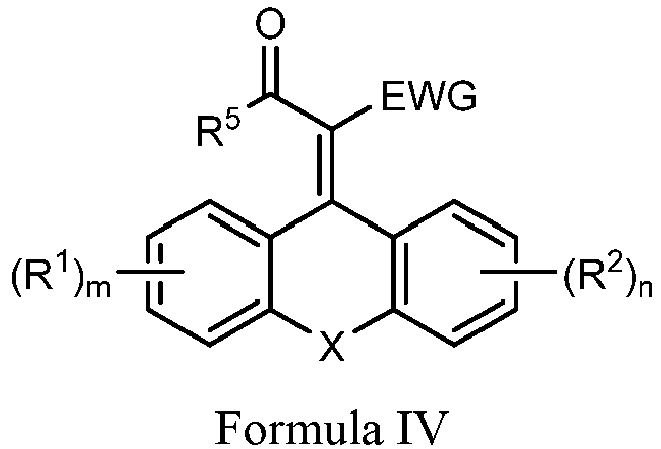
-
-
FIG. 1 shows UV-VIS Transmission Spectra of 0.2 mM solutions of exemplary Compounds (B), (C), and (E) in methanol. -
FIG. 2 shows UV-VIS Transmission Spectra of 0.2 mM solutions of Compounds (G), (H), and (J) in methanol and of Compound (L) in dichloromethane -
FIG. 3 shows UV-VIS Transmission Spectrum of exemplary SiliconeHydrogel Contact Lenses -
FIG. 4 shows UV-VIS Transmission Spectrum of exemplary SiliconeHydrogel Contact Lenses -
FIG. 5 shows UV-VIS Transmission Spectrum of exemplary SiliconeHydrogel Contact Lenses -
FIG. 6 shows UV-VIS Transmission Spectrum of exemplary SiliconeHydrogel Contact Lenses -
FIG. 7 shows UV-VIS Transmission Spectrum of exemplary SiliconeHydrogel Contact Lenses -
FIG. 8 shows UV-VIS Transmission Spectrum of exemplary SiliconeHydrogel Contact Lenses -
FIG. 9 shows UV-VIS Transmission Spectra of Silicone Hydrogel Contact Lenses (11A) comprising Compound (B) after exposure to direct sunlight -
FIG. 10 shows UV-VIS Transmission Spectra of Silicone Hydrogel Contact Lenses (11B) comprising Compound (B) after exposure to indoor lighting - It is to be understood that the invention is not limited to the details of construction or process steps set forth in the following description. The invention is capable of other embodiments and of being practiced or being carried out in various ways using the teaching herein.
- As noted above, in one aspect, the invention provides UV/HEV absorbing compounds. The compounds contain polymerizable functionality. It has been discovered that ophthalmic devices that absorb substantial amounts of UV light as well as some amounts of HEV light can be readily prepared as described herein.
- It has also been discovered that light absorbing compounds can be selected to provide targeted absorption of UV and/or high energy visible light (e.g., increased UV absorption and less HEV absorption, or increased HEV absorption, etc.). Such targeting may be achieved, for example, with compounds of formula I, which contain a hetero tricyclic core chromophore. For instance, as described in more detail below, compounds of formula I where the heteroatom (X in formula I) is sulfur, may absorb HEV light. On the other hand, compounds of formula I where the heteroatom is oxygen (X is O) may absorb less HEV light, but more UV light. Thus, the compounds may be used to absorb select regions of UV and/or HEV light or they may be mixed together or with other absorbing compounds to provide broad spectrum protection (e.g., UV and HEV light). Advantageously, the compounds exhibit a transmission cut-off (e.g., they absorb 20 percent or less) at visible wavelengths of 450 nm or longer.
- It has further been discovered that compounds of formula I are substantially photostable, meaning that the compounds, when incorporated in an ophthalmic device, do not undergo significant degradation over time when exposed to lighting, such as indoor or outdoor lighting. Such photostability can be determined by measuring the UV/Vis transmission spectrum of the ophthalmic device over a test period, such as 21 weeks. Significant changes in the spectrum over the test period are indicative of a lack of photostability. By way of example, ophthalmic devices (such as contact lenses) containing compounds of the invention, when exposed to indoor office lighting over a 21 week period at room temperature, exhibit 5 % or less, preferable 2 % or less, more preferably 0.5 % or less, even more preferably 0.4 % or less of change in their average transmission over a wavelength range of 380 to 700 nm. By way of further example, ophthalmic devices (such as contact lenses) containing compounds of the invention, when exposed to indoor office lighting over a 21 week period at room temperature, exhibit 5 % or less, preferable 2 % or less, more preferably 1 % or less, even more preferably 0.7 % or less of change in their average transmission over a wavelength range of 400 to 500 nm. Such changes may be calculated as the absolute value of the difference between the average transmission (over the indicated wavelength range) at
time 21 weeks and at time zero. - Thus, compounds of the invention may successfully absorb UV (UVA, UVB), and/or HEV, while transmitting in the visible spectrum. The compounds are suitable for incorporation in a variety of products, including biomedical devices and ophthalmic devices.
- With respect to the terms used in this disclosure, the following definitions are provided.
- Unless defined otherwise, all technical and scientific terms used herein have the same meaning as commonly understood by one of ordinary skill in the art to which the invention belongs. The polymer definitions are consistent with those disclosed in the Compendium of Polymer Terminology and Nomenclature, IUPAC Recommendations 2008, edited by: Richard G. Jones, Jaroslav Kahovec, Robert Stepto, Edward S. Wilks, Michael Hess, Tatsuki Kitayama, and W. Val Metanomski. All publications, patent applications, patents, and other references mentioned herein are incorporated by reference.
- As used herein, the term "(meth)" designates optional methyl substitution. Thus, a term such as "(meth)acrylates" denotes both methacrylates and acrylates.
- Wherever chemical structures are given, it should be appreciated that alternatives disclosed for the substituents on the structure may be combined in any combination. Thus, if a structure contained substituents R* and R**, each of which contained three lists of potential groups, 9 combinations are disclosed. The same applies for combinations of properties.
- When a subscript, such as "n" in the generic formula [∗∗∗]n, is used to depict the number of repeating units in a polymer's chemical formula, the formula should be interpreted to represent the number average molecular weight of the macromolecule.
- The term "individual" includes humans and vertebrates.
- The term "biomedical device" refers to any article that is designed to be used while either in or on mammalian tissues or fluids, and preferably in or on human tissue or fluids. Examples of these devices include but are not limited to wound dressings, sealants, tissue fillers, drug delivery systems, coatings, adhesion prevention barriers, catheters, implants, stents, and ophthalmic devices such as intraocular lenses and contact lenses. The biomedical devices may be ophthalmic devices, particularly contact lenses, most particularly contact lenses made from silicone hydrogels or conventional hydrogels.
- The term "ocular surface" includes the surface and glandular epithelia of the cornea, conjunctiva, lacrimal gland, accessory lacrimal glands, nasolacrimal duct and meibomian gland, and their apical and basal matrices, puncta and adjacent or related structures, including eyelids linked as a functional system by both continuity of epithelia, by innervation, and the endocrine and immune systems.
- The term "ophthalmic device" refers to any device which resides in or on the eye or any part of the eye, including the ocular surface. These devices can provide optical correction, cosmetic enhancement, vision enhancement, therapeutic benefit (for example as bandages) or delivery of active components such as pharmaceutical and nutraceutical components, or a combination of any of the foregoing. Examples of ophthalmic devices include but are not limited to lenses, optical and ocular inserts, including but not limited to punctal plugs, and the like. "Lenses" include soft contact lenses, hard contact lenses, hybrid contact lenses, intraocular lenses, and overlay lenses. The ophthalmic device may comprise a contact lens.
- The term "contact lens" refers to an ophthalmic device that can be placed on the cornea of an individual's eye. The contact lens may provide corrective, cosmetic, or therapeutic benefit, including wound healing, the delivery of drugs or nutraceuticals, diagnostic evaluation or monitoring, ultraviolet light absorbing, visible light or glare reduction, or any combination thereof. A contact lens can be of any appropriate material known in the art and can be a soft lens, a hard lens, or a hybrid lens containing at least two distinct portions with different physical, mechanical, or optical properties, such as modulus, water content, light transmission, or combinations thereof.
- The biomedical devices, ophthalmic devices, and lenses of the present invention may be comprised of silicone hydrogels or conventional hydrogels. Silicone hydrogels typically contain at least one hydrophilic monomer and at least one silicone-containing component that are covalently bound to one another in the cured device.
- "Target macromolecule" means the macromolecule being synthesized from the reactive monomer mixture comprising monomers, macromers, prepolymers, cross-linkers, initiators, additives, diluents, and the like.
- The term "polymerizable compound" means a compound containing one or more polymerizable groups. The term encompasses, for instance, monomers, macromers, oligomers, prepolymers, cross-linkers, and the like.
- "Polymerizable groups" are groups that can undergo chain growth polymerization, such as free radical and/or cationic polymerization, for example a carbon-carbon double bond which can polymerize when subjected to radical polymerization initiation conditions. Non-limiting examples of free radical polymerizable groups include (meth)acrylates, styrenes, vinyl ethers, (meth)acrylamides, N-vinyllactams, N-vinylamides, O-vinylcarbamates, O-vinylcarbonates, and other vinyl groups. Preferably, the free radical polymerizable groups comprise (meth)acrylate, (meth)acrylamide, N-vinyl lactam, N-vinylamide, and styryl functional groups, and mixtures of any of the foregoing. More preferably, the free radical polymerizable groups comprise (meth)acrylates, (meth)acrylamides, and mixtures thereof. The polymerizable group may be unsubstituted or substituted. For instance, the nitrogen atom in (meth)acrylamide may be bonded to a hydrogen, or the hydrogen may be replaced with alkyl or cycloalkyl (which themselves may be further substituted).
- Any type of free radical polymerization may be used including but not limited to bulk, solution, suspension, and emulsion as well as any of the controlled radical polymerization methods such as stable free radical polymerization, nitroxide-mediated living polymerization, atom transfer radical polymerization, reversible addition fragmentation chain transfer polymerization, organotellurium mediated living radical polymerization, and the like.
- A "monomer" is a mono-functional molecule which can undergo chain growth polymerization, and in particular, free radical polymerization, thereby creating a repeating unit in the chemical structure of the target macromolecule. Some monomers have di-functional impurities that can act as cross-linking agents. A "hydrophilic monomer" is also a monomer which yields a clear single phase solution when mixed with deionized water at 25°C at a concentration of 5 weight percent. A "hydrophilic component" is a monomer, macromer, prepolymer, initiator, cross-linker, additive, or polymer which yields a clear single phase solution when mixed with deionized water at 25°C at a concentration of 5 weight percent. A "hydrophobic component" is a monomer, macromer, prepolymer, initiator, cross-linker, additive, or polymer which is slightly soluble or insoluble in deionized water at 25°C.
- A "macromolecule" is an organic compound having a number average molecular weight of greater than 1500, and may be reactive or non-reactive.
- A "macromonomer" or "macromer" is a macromolecule that has one group that can undergo chain growth polymerization, and in particular, free radical polymerization, thereby creating a repeating unit in the chemical structure of the target macromolecule. Typically, the chemical structure of the macromer is different than the chemical structure of the target macromolecule, that is, the repeating unit of the macromer's pendent group is different than the repeating unit of the target macromolecule or its mainchain. The difference between a monomer and a macromer is merely one of chemical structure, molecular weight, and molecular weight distribution of the pendent group. As a result, and as used herein, the patent literature occasionally defines monomers as polymerizable compounds having relatively low molecular weights of about 1,500 Daltons or less, which inherently includes some macromers. In particular, monomethacryloxypropyl terminated mono-n-butyl terminated polydimethylsiloxane (molecular weight = 500-1500 g/mol) (mPDMS) and mono-(2-hydroxy-3-methacryloxypropyl)-propyl ether terminated mono-n-butyl terminated polydimethylsiloxane (molecular weight = 500-1500 g/mol) (OH-mPDMS) may be referred to as monomers or macromers. Furthermore, the patent literature occasionally defines macromers as having one or more polymerizable groups, essentially broadening the common definition of macromer to include prepolymers. As a result and as used herein, di-functional and multi-functional macromers, prepolymers, and crosslinkers may be used interchangeably.
- A "silicone-containing component" is a monomer, macromer, prepolymer, cross-linker, initiator, additive, or polymer in the reactive mixture with at least one silicon-oxygen bond, typically in the form of siloxy groups, siloxane groups, carbosiloxane groups, and mixtures thereof.
- Examples of silicone-containing components which are useful in this invention may be found in
U.S. Patent Nos. 3,808,178 ,4,120,570 ,4,136,250 ,4,153,641 ,4,740,533 ,5,034,461 ,5,070,215 ,5,244,981 ,5,314,960 ,5,331,067 ,5,371,147 ,5,760,100 ,5,849,811 ,5,962,548 ,5,965,631 ,5,998,498 ,6,367,929 ,6,822,016 ,6,943,203 ,6,951,894 ,7,052,131 ,7,247,692 ,7,396,890 ,7,461,937 ,7,468,398 ,7,538,146 ,7,553,880 ,7,572,841 ,7,666,921 ,7,691,916 ,7,786,185 ,7,825,170 ,7,915,323 ,7,994,356 ,8,022,158 ,8,163,206 ,8,273,802 ,8,399,538 ,8,415,404 ,8,420,711 ,8,450,387 ,8,487,058 ,8,568,626 ,8,937,110 ,8,937,111 ,8,940,812 ,8,980,972 ,9,056,878 9,125,808 9,140,825 9,156,934 9,170,349 9,217,813 9,244,196 9,244,197 9,260,544 9,297,928 9,297,929 European Patent No. 080539 - A "polymer" is a target macromolecule composed of the repeating units of the monomers used during polymerization.
- A "homopolymer" is a polymer made from one monomer; a "copolymer" is a polymer made from two or more monomers; a "terpolymer" is a polymer made from three monomers. A "block copolymer" is composed of compositionally different blocks or segments. Diblock copolymers have two blocks. Triblock copolymers have three blocks. "Comb or graft copolymers" are made from at least one macromer.
- A "repeating unit" is the smallest group of atoms in a polymer that corresponds to the polymerization of a specific monomer or macromer.
- An "initiator" is a molecule that can decompose into radicals which can subsequently react with a monomer to initiate a free radical polymerization reaction. A thermal initiator decomposes at a certain rate depending on the temperature; typical examples are azo compounds such as 1,1'-azobisisobutyronitrile and 4,4'-azobis(4-cyanovaleric acid), peroxides such as benzoyl peroxide, tert-butyl peroxide, tert-butyl hydroperoxide, tert-butyl peroxybenzoate, dicumyl peroxide, and lauroyl peroxide, peracids such as peracetic acid and potassium persulfate as well as various redox systems. A photo-initiator decomposes by a photochemical process; typical examples are derivatives of benzil, benzoin, acetophenone, benzophenone, camphorquinone, and mixtures thereof as well as various monoacyl and bisacyl phosphine oxides and combinations thereof.
- A "cross-linking agent" is a di-functional or multi-functional monomer or macromer which can undergo free radical polymerization at two or more locations on the molecule, thereby creating branch points and a polymeric network. Common examples are ethylene glycol dimethacrylate, tetraethylene glycol dimethacrylate, trimethylolpropane trimethacrylate, methylene bisacrylamide, triallyl cyanurate, and the like.
- A "prepolymer" is a reaction product of monomers which contains remaining polymerizable groups capable of undergoing further reaction to form a polymer.
- A "polymeric network" is a cross-linked macromolecule that can swell but cannot dissolve in solvents. "Hydrogels" are polymeric networks that swell in water or aqueous solutions, typically absorbing at least 10 weight percent water. "Silicone hydrogels" are hydrogels that are made from at least one silicone-containing component with at least one hydrophilic component. Hydrophilic components may also include non-reactive polymers.
- "Conventional hydrogels" refer to polymeric networks made from components without any siloxy, siloxane or carbosiloxane groups. Conventional hydrogels are prepared from reactive mixtures comprising hydrophilic monomers. Examples include 2-hydroxyethyl methacrylate ("HEMA"), N-vinyl pyrrolidone ("NVP"), N, N-dimethylacrylamide ("DMA") or vinyl acetate.
U.S. Patent Nos. 4,436,887 ,4,495,313 ,4,889,664 ,5,006,622 ,5,039459 ,5,236,969 ,5,270,418 ,5,298,533 ,5,824,719 ,6,420,453 ,6,423,761 ,6,767,979 ,7,934,830 ,8,138,290 , and8,389,597 disclose the formation of conventional hydrogels. Commercially available conventional hydrogels include, but are not limited to, etafilcon, genfilcon, hilafilcon, lenefilcon, nesofilcon, omafilcon, polymacon, and vifilcon, including all of their variants. - "Silicone hydrogels" refer to polymeric networks made from at least one hydrophilic component and at least one silicone-containing component. Examples of silicone hydrogels include acquafilcon, asmofilcon, balafilcon, comfilcon, delefilcon, enfilcon, fanfilcon, formofilcon, galyfilcon, lotrafilcon, narafilcon, riofilcon, samfilcon, senofilcon, somofilcon, and stenfilcon, including all of their variants, as well as silicone hydrogels as prepared in
US Patent Nos. 4,659,782 ,4,659,783 ,5,244,981 ,5,314,960 ,5,331,067 ,5,371,147 ,5,998,498 ,6,087,415 ,5,760,100 ,5,776,999 ,5,789,461 ,5,849,811 ,5,965,631 ,6,367,929 ,6,822,016 ,6,867,245 ,6,943,203 ,7,247,692 ,7,249,848 ,7,553,880 ,7,666,921 ,7,786,185 ,7,956,131 ,8,022,158 ,8,273,802 ,8,399,538 ,8,470,906 ,8,450,387 ,8,487,058 ,8,507,577 ,8,637,621 ,8,703,891 ,8,937,110 ,8,937,111 ,8,940,812 ,9,056,878 9,057,821 9,125,808 9,140,825 9156,934 9,170,349 9,244,196 9,244,197 9,260,544 9,297,928 9,297,929 WO 03/22321 WO 2008/061992 , andUS 2010/0048847 . These patents are hereby incorporated by reference in their entireties. - An "interpenetrating polymeric network" comprises two or more networks which are at least partially interlaced on the molecular scale but not covalently bonded to each other and which cannot be separated without braking chemical bonds. A "semi-interpenetrating polymeric network" comprises one or more networks and one or more polymers characterized by some mixing on the molecular level between at least one network and at least one polymer. A mixture of different polymers is a "polymer blend." A semi-interpenetrating network is technically a polymer blend, but in some cases, the polymers are so entangled that they cannot be readily removed.
- The terms "reactive mixture" and "reactive monomer mixture" refer to the mixture of components (both reactive and non-reactive) which are mixed together and, when subjected to polymerization conditions, form the conventional or silicone hydrogels of the present invention as well as biomedical devices, ophthalmic devices, and contact lenses made therefrom. The reactive monomer mixture may comprise reactive components such as the monomers, macromers, prepolymers, cross-linkers, and initiators, additives such as wetting agents, polymers, dyes, light absorbing compounds such as UV absorbers, pigments, dyes and photochromic compounds, any of which may be reactive or non-reactive but are capable of being retained within the resulting biomedical device, as well as pharmaceutical and nutraceutical compounds, and any diluents. It will be appreciated that a wide range of additives may be added based upon the biomedical device which is made and its intended use. Concentrations of components of the reactive mixture are expressed as weight percentages of all components in the reactive mixture, excluding diluent. When diluents are used, their concentrations are expressed as weight percentages based upon the amount of all components in the reactive mixture and the diluent.
- "Reactive components" are the components in the reactive mixture which become part of the chemical structure of the polymeric network of the resulting hydrogel by covalent bonding, hydrogen bonding, electrostatic interactions, the formation of interpenetrating polymeric networks, or any other means.
- The term "silicone hydrogel contact lens" refers to a hydrogel contact lens that is made from at least one silicone-containing compound. Silicone hydrogel contact lenses generally have increased oxygen permeability compared to conventional hydrogels. Silicone hydrogel contact lenses use both their water and polymer content to transmit oxygen to the eye.
- The term "multi-functional" refers to a component having two or more polymerizable groups. The term "mono-functional" refers to a component having one polymerizable group.
- The terms "halogen" or "halo" indicate fluorine, chlorine, bromine, and iodine.
- "Alkyl" refers to an optionally substituted linear or branched alkyl group containing the indicated number of carbon atoms. If no number is indicated, then alkyl (including any optional substituents on alkyl) may contain 1 to 16 carbon atoms. Preferably, the alkyl group contains 1 to 10 carbon atoms, alternatively 1 to 8 carbon atoms, alternatively 1 to 6 carbon atoms, or alternatively 1 to 4 carbon atoms. Examples of alkyl include methyl, ethyl, propyl, isopropyl, butyl, iso-, sec- and tert-butyl, pentyl, hexyl, heptyl, 3-ethylbutyl, and the like. Examples of substituents on alkyl include 1, 2, or 3 groups independently selected from hydroxy, amino, amido, oxa, carboxy, alkyl carboxy, carbonyl, alkoxy, thioalkyl, carbamate, carbonate, halogen, phenyl, benzyl, and combinations thereof. "Alkylene" means a divalent alkyl group, such as - CH2-, -CH2CH2-, -CH2CH2CH2-, -CH2CH(CH3)CH2-, and -CH2CH2CH2CH2-.
- "Haloalkyl" refers to an alkyl group as defined above substituted with one or more halogen atoms, where each halogen is independently F, Cl, Br or I. A preferred halogen is F. Preferred haloalkyl groups contain 1-6 carbons, more preferably 1-4 carbons, and still more preferably 1-2 carbons. "Haloalkyl" includes perhaloalkyl groups, such as -CF3- or -CF2CF3-. "Haloalkylene" means a divalent haloalkyl group, such as -CH2CF2-.
- "Cycloalkyl" refers to an optionally substituted cyclic hydrocarbon containing the indicated number of ring carbon atoms. If no number is indicated, then cycloalkyl may contain 3 to 12 ring carbon atoms. Preferred are C3-C8 cycloalkyl groups, C3-C7 cycloalkyl, more preferably C4-C7 cycloalkyl, and still more preferably C5-C6 cycloalkyl. Examples of cycloalkyl include cyclopropyl, cyclobutyl, cyclopentyl, cyclohexyl, cycloheptyl and cyclooctyl. Examples of substituents on cycloalkyl include 1, 2, or 3 groups independently selected from alkyl, hydroxy, amino, amido, oxa, carbonyl, alkoxy, thioalkyl, amido, carbamate, carbonate, halo, phenyl, benzyl, and combinations thereof. "Cycloalkylene" means a divalent cycloalkyl group, such as 1,2-cyclohexylene, 1,3- cyclohexylene, or 1,4- cyclohexylene.
- "Heterocycloalkyl" refers to a cycloalkyl ring or ring system as defined above in which at least one ring carbon has been replaced with a heteroatom selected from nitrogen, oxygen, and sulfur. The heterocycloalkyl ring is optionally fused to or otherwise attached to other heterocycloalkyl rings and/or non-aromatic hydrocarbon rings and/or phenyl rings. Preferred heterocycloalkyl groups have from 5 to 7 members. More preferred heterocycloalkyl groups have 5 or 6 members. Heterocycloalkylene means a divalent heterocycloalkyl group.
- "Aryl" refers to an optionally substituted aromatic hydrocarbon ring system containing at least one aromatic ring. The aryl group contains the indicated number of ring carbon atoms. If no number is indicated, then aryl may contain 6 to 14 ring carbon atoms. The aromatic ring may optionally be fused or otherwise attached to other aromatic hydrocarbon rings or non-aromatic hydrocarbon rings. Examples of aryl groups include phenyl, naphthyl, and biphenyl. Preferred examples of aryl groups include phenyl. Examples of substituents on aryl include 1, 2, or 3 groups independently selected from alkyl, hydroxy, amino, amido, oxa, carboxy, alkyl carboxy, carbonyl, alkoxy, thioalkyl, carbamate, carbonate, halo, phenyl, benzyl, and combinations thereof. "Arylene" means a divalent aryl group, for example 1,2-phenylene, 1,3-phenylene, or 1,4-phenylene.
- "Heteroaryl" refers to an aryl ring or ring system, as defined above, in which at least one ring carbon atom has been replaced with a heteroatom selected from nitrogen, oxygen, and sulfur. The heteroaryl ring may be fused or otherwise attached to one or more heteroaryl rings, aromatic or nonaromatic hydrocarbon rings or heterocycloalkyl rings. Examples of heteroaryl groups include pyridyl, furyl, and thienyl. "Heteroarylene" means a divalent heteroaryl group.
- "Alkoxy" refers to an alkyl group attached to the parent molecular moiety through an oxygen bridge. Examples of alkoxy groups include, for instance, methoxy, ethoxy, propoxy and isopropoxy. "Thioalkyl" means an alkyl group attached to the parent molecule through a sulfur bridge. Examples of thioalkyl groups include, for instance, methylthio, ethylthio, n-propylthio and iso-propylthio. "Aryloxy" refers to an aryl group attached to a parent molecular moiety through an oxygen bridge. Examples include phenoxy. "Cyclic alkoxy" means a cycloalkyl group attached to the parent moiety through an oxygen bridge.
- "Alkylamine" refers to an alkyl group attached to the parent molecular moiety through an -NH bridge. Alkyleneamine means a divalent alkylamine group, such as -CH2CH2NH-.
- "Siloxanyl" refers to a structure having at least one Si-O-Si bond. Thus, for example, siloxanyl group means a group having at least one Si-O-Si group (i.e. a siloxane group), and siloxanyl compound means a compound having at least one Si-O-Si group. "Siloxanyl" encompasses monomeric (e.g., Si-O-Si) as well as oligomeric/polymeric structures (e.g., -[Si-O]n-, where n is 2 or more). Each silicon atom in the siloxanyl group is substituted with independently selected RA groups (where RA is as defined in formula A options (b)-(i)) to complete their valence.
- "Silyl" refers to a structure of formula R3Si- and "siloxy" refers to a structure of formula R3Si-O-, where each R in silyl or siloxy is independently selected from trimethylsiloxy, Ci-Cs alkyl (preferably C1-C3 alkyl, more preferably ethyl or methyl), and C3-C8 cycloalkyl.
- "Alkyleneoxy" refers to groups of the general formula -(alkylene-O)p- or -(O-alkylene)p-, wherein alkylene is as defined above, and p is from 1 to 200, or from 1 to 100, or from 1 to 50, or from 1 to 25, or from 1 to 20, or from 1 to 10, wherein each alkylene is independently optionally substituted with one or more groups independently selected from hydroxyl, halo (e.g., fluoro), amino, amido, ether, carbonyl, carboxyl, and combinations thereof. If p is greater than 1, then each alkylene may be the same or different and the alkyleneoxy may be in block or random configuration. When alkyleneoxy forms a terminal group in a molecule, the terminal end of the alkyleneoxy may, for instance, be a hydroxy or alkoxy (e.g., HO-[CH2CH2O]p- or CH3O-[CH2CH2O]p-). Examples of alkyleneoxy include polyethyleneoxy, polypropyleneoxy, polybutyleneoxy, and poly(ethyleneoxy-co-propyleneoxy).
- "Oxaalkylene" refers to an alkylene group as defined above where one or more non-adjacent CH2 groups have been substituted with an oxygen atom, such as -CH2CH2OCH(CH3)CH2-. "Thiaalkylene" refers to an alkylene group as defined above where one or more non-adjacent CH2 groups have been substituted with a sulfur atom, such as -CH2CH2SCH(CH3)CH2-.
- The term "linking group" refers to a moiety that links a polymerizable group to the parent molecule. The linking group may be any moiety that is compatible with the compound of which it is a part, and that does not undesirably interfere with the polymerization of the compound , is stable under the polymerization conditions as well as the conditions for the processing and storage of the final product. For instance, the linking group may be a bond, or it may comprise one or more alkylene, haloalkylene, amide, amine, alkyleneamine, carbamate, ester (-CO2-), arylene, heteroarylene, cycloalkylene, heterocycloalkylene, alkyleneoxy, oxaalkylene, thiaalkylene, haloalkyleneoxy (alkyleneoxy substituted with one or more halo groups, e.g., - OCF2-, -OCF2CF2-, -OCF2CH2-), siloxanyl, alkylenesiloxanyl, or combinations thereof. The linking group may optionally be substituted with 1 or more substituent groups. Suitable substituent groups may include those independently selected from alkyl, halo (e.g., fluoro), hydroxyl, HO-alkyleneoxy, MeO-alkyleneoxy, siloxanyl, siloxy, siloxy-alkyleneoxy-, siloxy-alkylene-alkyleneoxy- (where more than one alkyleneoxy groups may be present and wherein each methylene in alkylene and alkyleneoxy is independently optionally substituted with hydroxyl), ether, amine, carbonyl, carbamate, and combinations thereof. The linking group may also be substituted with a polymerizable group, such as (meth)acrylate (in addition to the polymerizable group to which the linking group is linked).
- Preferred linking groups include Ci-Cs alkylene (preferably C2-C6 alkylene) and Ci-Cs oxaalkylene (preferably C2-C6 oxaalkylene), each of which is optionally substituted with 1 or 2 groups independently selected from hydroxyl and siloxy. Preferred linking groups also include carboxylate, amide, Ci-Cs alkylene-carboxylate-Ci-Cs alkylene, or Ci-Cs alkylene-amide-Ci-Cs alkylene.
- When the linking group is comprised of combinations of moieties as described above (e.g., alkylene and cycloalkylene), the moieties may be present in any order. For instance, if in Formula E below, L is indicated as being -alkylene-cycloalkylene-, then Rg-L may be either Rg-alkylene-cycloalkylene-, or Rg-cycloalkylene-alkylene-. Notwithstanding this, the listing order represents the preferred order in which the moieties appear in the compound starting from the terminal polymerizable group (Rg or Pg) to which the linking group is attached. For example, if in Formula E, L and L2 are indicated as both being alkylene-cycloalkylene, then Rg-L is preferably Rg-alkylene-cycloalkylene- and -L2-Rg is preferably -cycloalkylene-alkylene-Rg.
- The term "electron withdrawing group" (EWG) refers to a chemical group which withdraws electron density from the atom or group of atoms to which the electron withdrawing group is attached. Examples of EWGs include, but are not limited to, cyano, amide, ester, keto, or aldehyde. A preferred EWG is cyano (CN).
- The terms "high energy radiation absorber," "UV/HEV absorber," or "high energy light absorbing compound" refer to chemical materials that absorb various wavelengths of ultraviolet light, high energy visible light, or both. A material's ability to absorb certain wavelengths of light can be determined by measuring its UV Nis transmission spectrum. Compounds that exhibit no absorption at a particular wavelength will exhibit substantially 100 percent transmission at that wavelength. Conversely, compounds that completely absorb at a particular wavelength will exhibit substantially 0 % transmission at that wavelength. If the amount of a material's transmission is indicated as a percentage for a particular wavelength range, it is to be understood that the material exhibits the percent transmission at all wavelengths within that range.
- Unless otherwise indicated, ratios, percentages, parts, and the like are by weight.
- Unless otherwise indicated, numeric ranges, for instance as in "from 2 to 10," are inclusive of the numbers defining the range (e.g., 2 and 10).
- As noted above, one aspect the invention provides an ophthalmic device that is a reaction product of a reactive mixture comprising: one or more polymerizable high energy light absorbing compounds and one or more monomers suitable for making an ophthalmic device, wherein the ophthalmic device transmits: 45 percent or less of light having a wavelength of 280 to 399 nm; at least 1 percent and up to 70 percent of light having a wavelength of 400 to 409 nm; and at least 80 percent of light having a wavelength of 450 to 800 nm. Preferably the ophthalmic device also transmits at least 10 percent and up to 95 percent of light having a wavelength of 410 to 424 nm. Also preferably, the ophthalmic device transmits at least 50 percent of light having a wavelength of 425 to 449 nm. Further preferably, the ophthalmic device transmits 10 percent or less of light having a wavelength of 200 to 279 nm.
- Preferably, the transmission of the ophthalmic device at 200 to 279 nm is 5 percent or less or 1 percent or less. Or preferably it is less than 1 percent.
- Preferably, the transmission of the ophthalmic device at 280 to 399 nm is 35 percent or less, or 25 percent or less, or 20 percent or less, or 10 percent or less, or 5 percent or less, or 1 percent or less.
- Preferably, the transmission of the ophthalmic device at 400 to 409 nm is at least 2 percent, at least 3 percent, or at least 4 percent. Also preferably, the transmission of the ophthalmic device at 400 to 409 nm is up to 60 percent, or up to 50 percent, or up to 40 percent, or up to 30 percent, or up 20 percent.
- Preferably, the transmission of the ophthalmic device at 410 to 424 nm is at least 15 percent. Also preferably, the transmission of the ophthalmic device at 410 to 424 nm is up to 85 percent, up to 75 percent, or up 65 percent.
- Preferably, the transmission of the ophthalmic device at 425 to 449 nm is at least 60 percent.
- Preferably, the transmission of the ophthalmic device at 450 to 800 nm is at least 85 percent.
- Preferred ophthalmic devices are contact lenses, more preferably soft hydrogel contact lenses. The foregoing transmission wavelengths and percentages may be measured on various thicknesses of lenses. For example, the center thickness may be from 80 to 100 microns, or from 90 to 100 microns or from 90 to 95 microns. Various concentrations of the one or more polymerizable high energy light absorbing compounds may be used to achieve the foregoing results. For instance, the concentration may be in the range of at least 0.1 percent or at least 2 percent; and up to 10 percent or up to 5 percent, based on the weight percentages of all components in the reactive mixture, excluding diluent. A typical concentration may be in the range of 1 to 5 percent.
- The invention also provides UV/HEV absorbing compounds of formula I:

- m and n are independently 0, 1, 2, 3, or 4;
- T is a bond, O, or NR;
- X is O, S, NR, SO, or SO2;
- Y is a linking group;
- Pg is a polymerizable group;
- R at each occurrence is independently H, C1-C6 alkyl, cycloalkyl, heterocycloalkyl, aryl, heteroaryl, or Y-Pg;
- R1 and R2, when present, are independently at each occurrence C1-C6 alkyl, C1-C6 alkoxy, C1-C6 thioalkyl, C3-C7 cycloalkyl, aryl (preferably unsubstituted phenyl or phenyl substituted with alkyl or halo), halo, hydroxy, amino, NR3R4, or benzyl, wherein R3 and R4 are independently H or C1-C6 alkyl, or two adjacent R1 or R2 groups, together with the carbon atoms to which they are attached, combine to form a cycloalkyl or aryl ring; and
- EWG is an electron withdrawing group.
- Compounds of formula I preferably contain one or two Y-Pg groups. More preferably, the compounds contain one Y-Pg group.
- Formula 1-1. Compounds of formula I may include compounds of formula I-1, which are compounds of formula I wherein X is S.
- 1-2. Compounds of formula I may include compounds of formula I-2, which are compounds of formula I wherein X is O.
- 1-3. Compounds of formula I may include compounds of formula I-3, which are compounds of formula I wherein X is NR, preferably NH or N-alkyl.
- 1-4. Compounds of formula I may include compounds of formula I-4, which are compounds of formula I wherein X is SO.
- 1-5. Compounds of formula I may include compounds of formula I-5, which are compounds of formula I wherein X is SO2.
- 1-6. Compounds of formulae I, I-1, I-2, I-3, I-4, and I-5 may include compounds of formula I-6, which are compounds of formula I, I-1, I-2, I-3, I-4, or I-5 wherein m and n are independently 0 or 1, or alternatively both are 0.
- 1-7. Compounds of formulae I, I-1, I-2, I-3, I-4, and I-5 may include compounds of formula I-7, which are compounds of formula I, I-1, I-2, I-3, I-4, or I-5 wherein m is 1 and R1 is C1-C6 alkyl, preferably ethyl or methyl.
- 1-8. Compounds of formulae I, I-1, I-2, I-3, I-4, I-5, and I-7 may include compounds of formula I-8, which are compounds of formula I, I-1, I-2, I-3, I-4, I-5, or I-7 wherein n is 1 and R2 is C1-C6 alkyl, preferably ethyl or methyl.
- 1-9. Compounds of formulae I, I-1, I-2, I-3, I-4, I-5, I-6, I-7 and I-8 may include compounds of formula I-9, which are compounds of formula I, I-1, I-2, I-3, I-4, I-5, I-6, I-7 or I-8 wherein R is H, or C1-C6 alkyl. Preferably, R in the group T is H.
- 1-10. Compounds of formulae I, I-1, I-2, I-3, I-4, I-5, I-6, I-7, I-8, and I-9 may include compounds of formula I-10, which are compounds of formula I, I-1, I-2, I-3, I-4, I-5, I-6, I-7, I-8, or I-9 wherein Pg (a polymerizable group) at each occurrence independently comprises styryl, vinyl carbonate, vinyl ether, vinyl carbamate, N-vinyl lactam, N-vinylamide, (meth)acrylate, or (meth)acrylamide. The polymerizable group allows the compounds of the invention to form covalent bonds when reacted with monomers, crosslinking agents, and other components generally used in making polymeric devices. The compatibility of the compounds with the reactive mixture can be controlled via the selection of the polymerizable group (and the linking group). Preferred polymerizable groups include (meth)acrylate or (meth)acrylamide. A more preferred polymerizable group is methacrylate.
- 1-11. Compounds of formulae I, I-1, I-2, I-3, I-4, I-5, I-6, I-7, I-8, I-9, and I-10 may include compounds of formula I-11, which are compounds of formula I, I-1, I-2, I-3, I-4, I-5, I-6, I-7, I-8, I-9, or 1-10 wherein Y (a linking group) is alkylene, cycloalkylene, heterocycloalkylene, arylene (e.g., phenylene), heteroarylene, oxaalkylene, alkylene-amide-alkylene, alkylene-amine-alkylene, or combinations of any of the foregoing groups. Preferred linking groups include Ci-Cs alkylene (e.g., ethylene or propylene), Ci-Cs oxaalkylene, C1-C8 alkylene-amide-Ci-Cs alkylene, and Ci-Cs alkylene-amine-Ci-Cs alkylene. Particularly preferred is Ci-Cs alkylene, especially ethylene (-CH2CH2-). When T in the compound of formula I is O, it is preferred that the carbon atom of the linking group to which the O is attached be hindered. For instance, if T is O and Y is alkylene, a preferred alkylene is -C(RH)2(CH2)x-, where RH is independently C1-C6 alkyl (preferably independently methyl or ethyl) and x is from 1 to 5.
- 1-12. Compounds of formulae I, I-1, I-2, I-3, I-4, I-5, I-6, I-7, I-8, I-9, I-10, and I-11 may include compounds of formula I-12, which are compounds of formula I, I-1, I-2, I-3, I-4, I-5, I-6, I-7, I-8, I-9, I-10, or I-11 wherein T is a bond or is NR (preferably NH).
- 1-13. Compounds of formulae I, I-1, I-2, I-3, I-4, I-5, I-6, I-7, I-8, I-9, I-10, I-11, and I-12 may include compounds of formula 1-13, which are compounds of formula I, I-1, I-2, I-3, I-4, I-5, I-6, I-7, I-8, I-9, I-10, I-11, or 1-12 wherein EWG is cyano, amide, ester, keto, or aldehyde. Preferably, EWG is cyano.
- Preferred compounds of formula I include compounds of formula II:

- m and n are independently 0, 1, 2, 3, or 4;
- T is a bond, O, or NR;
- X is O, S, NR, SO, or SO2;
- Y is a linking group;
- Pg is a polymerizable group;
- R at each occurrence is independently H, C1-C6 alkyl, cycloalkyl, heterocycloalkyl, aryl, heteroaryl, or Y-Pg; and
- R1 and R2, when present, are independently at each occurrence C1-C6 alkyl, C1-C6 alkoxy, C1-C6 thioalkyl, C3-C7 cycloalkyl, aryl (preferably unsubstituted phenyl or phenyl substituted with alkyl or halo), halo, hydroxy, amino, NR3R4, or benzyl, wherein R3 and R4 are independently H or C1-C6 alkyl, or two adjacent R1 or R2 groups, together with the carbon atoms to which they are attached, combine to form a cycloalkyl or aryl ring. Compounds of formula I preferably contain one or two Y-Pg groups. More preferably, the compounds contain one Y-Pg group.
- Formula II-1. Compounds of formula II may include compounds of formula II-1, which are compounds of formula II wherein X is S.
- II-2. Compounds of formula II may include compounds of formula II-2, which are compounds of formula II wherein X is O.
- II-3. Compounds of formula II may include compounds of formula II-3, which are compounds of formula II wherein X is NR, preferably NH or N-alkyl.
- II-4. Compounds of formula II may include compounds of formula II-4, which are compounds of formula II wherein X is SO.
- II-5. Compounds of formula II may include compounds of formula II-5, which are compounds of formula II wherein X is SO2.
- II-6. Compounds of formulae II, II-1, II-2, II-3, II-4, and II-5 may include compounds of formula II-6, which are compounds of formula II, II-1, II-2, II-3, II-4, or II-5 wherein m and n are independently 0 or 1, or alternatively both are 0.
- II-7. Compounds of formulae II, II-1, II-2, II-3, II-4, and II-5 may include compounds of formula II-7, which are compounds of formula II, II-1, II-2, II-3, II-4, or II-5 wherein m is 1 and R1 is C1-C6 alkyl, preferably ethyl or methyl.
- II-8. Compounds of formulae II, II-1, II-2, II-3, II-4, II-5, and II-7 may include compounds of formula II-8, which are compounds of formula II, II-1, II-2, II-3, II-4, II-5, or II-7 wherein n is 1 and R2 is C1-C6 alkyl, preferably ethyl or methyl.
- II-9. Compounds of formulae II, II-1, II-2, II-3, II-4, II-5, II-6, II-7 and II-8 may include compounds of formula II-9, which are compounds of formula II, II-1, II-2, II-3, II-4, II-5, II-6, II-7 or II-8 wherein R is H, or C1-C6 alkyl. Preferably, R in the group T is H.
- II-10. Compounds of formulae II, II-1, II-2, II-3, II-4, II-5, II-6, II-7, II-8, and II-9 may include compounds of formula II-10, which are compounds of formula II, II-1, II-2, II-3, II-4, II-5, II-6, II-7, II-8, or II-9 wherein Pg (a polymerizable group) at each occurrence independently comprises styryl, vinyl carbonate, vinyl ether, vinyl carbamate, N-vinyl lactam, N-vinylamide, (meth)acrylate, or (meth)acrylamide. The polymerizable group allows the compounds of the invention to form covalent bonds when reacted with monomers, crosslinking agents, and other components generally used in making polymeric devices. The compatibility of the compounds with the reactive mixture can be controlled via the selection of the polymerizable group (and the linking group). Preferred polymerizable groups include (meth)acrylate or (meth)acrylamide. A more preferred polymerizable group is methacrylate.
- 11-11. Compounds of formulae II, II-1, II-2, II-3, II-4, II-5, II-6, II-7, II-8, II-9, and II-10 may include compounds of formula II-11, which are compounds of formula II, II-1, II-2, II-3, II-4, II-5, II-6, II-7, II-8, II-9, or II-10 wherein Y (a linking group) is alkylene, cycloalkylene, heterocycloalkylene, arylene (e.g., phenylene), heteroarylene, oxaalkylene, alkylene-amide-alkylene, alkylene-amine-alkylene, or combinations of any of the foregoing groups. Preferred linking groups include Ci-Cs alkylene (e.g., ethylene or propylene), Ci-Cs oxaalkylene, Ci-Cs alkylene-amide-Ci-Cs alkylene, and Ci-Cs alkylene-amine-Ci-Cs alkylene. Particularly preferred is Ci-Cs alkylene, especially ethylene (-CH2CH2-). When T in the compound of formula II is O, it is preferred that the carbon atom of the linking group to which the O is attached be hindered. For instance, if T is O and Y is alkylene, a preferred alkylene is -C(RH)2(CH2)x-, where RH is independently C1-C6 alkyl (preferably independently methyl or ethyl) and x is from 1 to 5.
- II-12. Compounds of formulae II, II-1, II-2, II-3, II-4, II-5, II-6, II-7, II-8, II-9, II-10, and II-11 may include compounds of formula II-12, which are compounds of formula II, II-1, II-2, II-3, II-4, II-5, II-6, II-7, II-8, II-9, II-10, or II-11 wherein T is a bond or is NR (preferably NH).
- Preferred compounds of formula I and formula II include compounds of formula III:

- m and n are independently 0, 1, 2, 3, or 4;
- X is O, S, NR, SO, or SO2;
- Y is a linking group;
- Pg is a polymerizable group;
- R at each occurrence is independently H, C1-C6 alkyl, cycloalkyl, heterocycloalkyl, aryl, heteroaryl, or Y-Pg; and
- R1 and R2, when present, are independently at each occurrence C1-C6 alkyl, C1-C6 alkoxy, C1-C6 thioalkyl, C3-C7 cycloalkyl, aryl (preferably unsubstituted phenyl or phenyl substituted with alkyl or halo), halo, hydroxy, amino, NR3R4, or benzyl, wherein R3 and R4 are independently H or C1-C6 alkyl, or two adjacent R1 or R2 groups, together with the carbon atoms to which they are attached, combine to form a cycloalkyl or aryl ring. Compounds of formula II preferably contain one or two Y-Pg groups. More preferably, the compounds contain one Y-Pg group.
- Formula III-1. Compounds of formula III may include compounds of formula III-1, which are compounds of formula III wherein X is S.
- III-2. Compounds of formula III may include compounds of formula III-2, which are compounds of formula III wherein X is O.
- III-3. Compounds of formula III may include compounds of formula III-3, which are compounds of formula III wherein X is NR, preferably NH or N-alkyl.
- III-4. Compounds of formula III may include compounds of formula III-4, which are compounds of formula III wherein X is SO.
- III-5. Compounds of formula III may include compounds of formula III-5, which are compounds of formula III wherein X is SO2.
- III-6. Compounds of formulae III, III-1, III-2, III-3, III-4, and III-5 may include compounds of formula III-6, which are compounds of formula III, III-1, III-2, III-3, III-4, or III-5 wherein m and n are independently 0 or 1, or alternatively both are 0.
- III-7. Compounds of formulae III, III-1, III-2, III-3, III-4, and III-5 may include compounds of formula III-7, which are compounds of formula III, III-1, III-2, III-3, III-4, or III-5 wherein m is 1 and R1 is C1-C6 alkyl, preferably ethyl or methyl.
- III-8. Compounds of formulae III, III-1, III-2, III-3, III-4, III-5, and III-7 may include compounds of formula III-8, which are compounds of formula III, III-1, III-2, III-3, III-4, III-5, or III-7 wherein n is 1 and R2 is C1-C6 alkyl, preferably ethyl or methyl.
- III-9. Compounds of formulae III, III-1, III-2, III-3, III-4, III-5, III-6, III-7 and III-8 may include compounds of formula III-9, which are compounds of formula III, III-1, III-2, III-3, III-4, III-5, III-6, III-7 or III-8 wherein R at each occurrence is independently H, or C1-C6 alkyl. Preferably, R at each occurrence is H. Preferably R in the group T is H
- III-10. Compounds of formulae III, III-1, III-2, III-3, III-4, III-5, III-6, III-7, III-8, and III-9 may include compounds of formula III-10, which are compounds of formula III, III-1, III-2, III-3, III-4, III-5, III-6, III-7, III-8, or III-9 wherein Pg (a polymerizable group) at each occurrence independently comprises styryl, vinyl carbonate, vinyl ether, vinyl carbamate, N-vinyl lactam, N-vinylamide, (meth)acrylate, or (meth)acrylamide. The polymerizable group allows the compounds of the invention to form covalent bonds when reacted with monomers, crosslinking agents, and other components generally used in making polymeric devices. The compatibility of the compounds with the reactive mixture can be controlled via the selection of the polymerizable group (and the linking group). Preferred polymerizable groups include (meth)acrylate or (meth)acrylamide. A more preferred polymerizable group is methacrylate.
- III-11. Compounds of formulae III, III-1, III-2, III-3, III-4, III-5, III-6, III-7, III-8, III-9, and III-10 may include compounds of formula III-11, which are compounds of formula III, III-1, III-2, III-3, III-4, III-5, III-6, III-7, III-8, III-9, or III-10 wherein Y (a linking group) is alkylene, cycloalkylene, heterocycloalkylene, arylene (e.g., phenylene), heteroarylene, oxaalkylene, alkylene-amide-alkylene, alkylene-amine-alkylene, or combinations of any of the foregoing groups. Preferred linking groups include Ci-Cs alkylene (e.g., ethylene or propylene), Ci-Cs oxaalkylene, Ci-Cs alkylene-amide-Ci-Cs alkylene, and Ci-Cs alkylene-amine-Ci-Cs alkylene. Particularly preferred is Ci-Cs alkylene, especially ethylene (-CH2CH2-).
- Specific examples of compounds of formula I include, but are not limited to, the compounds shown in Table 1.
Table 1 


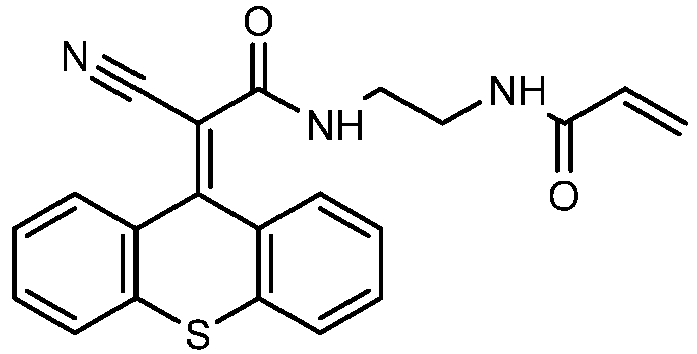


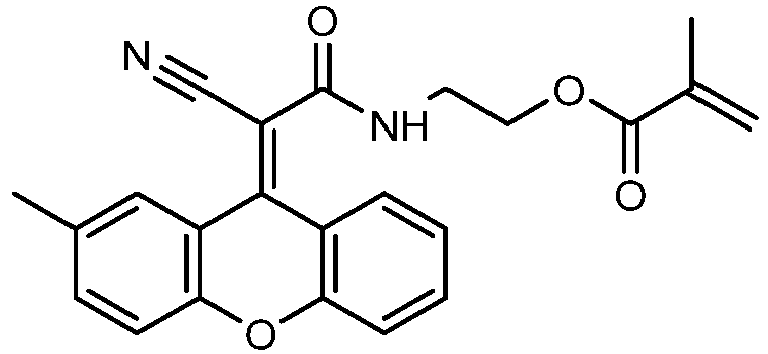


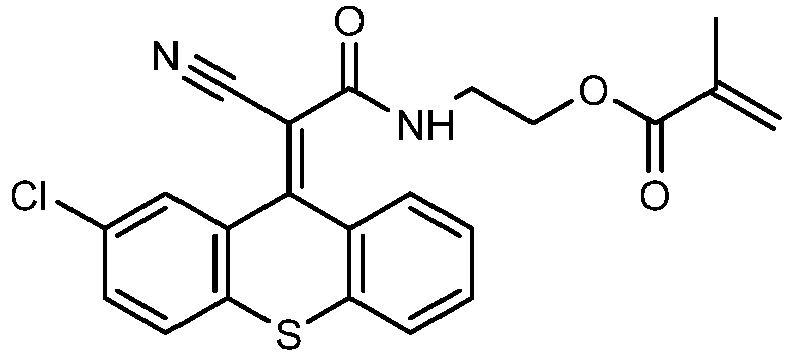


2-(2-cyano-2-(10,10-dioxido-9H-thioxanthen-9-ylidene)acetamido)ethyl methacrylate N-(2-(2-cyano-2-(10-methylacridin-9(10H)ylidene)acetamido)ethyl) methacrylamide 2-(2-cyano-2-(9H-thioxanthen-9-ylidene)acetoxy)ethyl methacrylate - Compounds of the invention can be selected to provide targeted absorption of UV and/or high energy visible light. Such targeting may be achieved, for example, through selection of the hetero atom of the core tricyclic structure (X in formula I). For instance, compounds of formula I-1 (the heteroatom is sulfur) may absorb HEV light. On the other hands, compounds of formula I-2 (the heteroatom is oxygen) may absorb UV light and some HEV light although to a lesser extent than formula 1-1 compounds.
- Additional tuning of the absorption characteristics for a given X in the compounds of formula I may be provided by adding or varying the substituents R1 and R2 to, for instance, obtain bathochromic or hypsochromic shifts. Electron donating substituents may, for example, may cause red shifts to the UV-VIS absorption spectrum, while electron withdrawing groups may cause blue shifts; the magnitude of these shifts may depend on the electron donating or withdrawing ability, and the position, of the substituent. For example, an alkoxy substituent may result in a smaller red shift than, for instance, an amino or thioalkyl group at the same carbon center.
- Preferred X groups in the compounds of the invention are S, O, and NR, more preferably S and O. However, additional oxidation states of sulfur such as sulfoxide and sulfone may also provide a means to modify UV-VIS spectra of the compounds. Sulfoxide and sulfone have reduced electron density on the sulfur atom and may be used to create hypsochromic (blue) shifted spectra.
- Compounds of formula I may be used in combination with other absorbing compounds to provide desirable absorption characteristics. For example, preferred compositions may comprise a compound of formula I-1 (X is S) and a second compound that absorbs UV. The second compound may, for example, also be a compound of formula I that absorbs in the UV region (such as compounds of formula I-2 (X is O)), or it may be another UV absorbing compound. Suitable UV absorbing compounds are known in the art, and fall into several classes which include, but are not limited to, benzophenones, benzotriazoles, triazines, substituted acrylonitriles, salicyclic acid derivatives, benzoic acid derivatives, cinnamic acid derivatives, chalcone derivatives, dypnone derivatives, crotonic acid derivatives, or any mixtures thereof. A preferred class of UV absorbing compound is benzotriazoles, such as Norbloc (2-(2'-hydroxy-5-methacrylyloxyethylphenyl)-2H-benzotriazole).
- A particularly preferred composition comprises 2-(2-cyano-2-(9H-thioxanthen-9-ylidene)acetamido)ethyl methacrylate and 2-(2-cyano-2-(9H-xanthen-9-ylidene)acetamido)ethyl methacrylate. Another preferred composition comprises 2-(2-cyano-2-(9H-thioxanthen-9-ylidene)acetamido)ethyl methacrylate and 2-(2'-hydroxy-5-methacrylyloxyethylphenyl)-2H-benzotriazole. A further preferred composition comprises N-(2-(2-cyano-2-(10-methylacridin-9(10H)ylidene)acetamido)ethyl) methacrylamide.
- Compounds of formula I may be prepared by those skilled in the art using literature methods. By way of example, various compounds of formula I where the EWG is cyano may be prepared as shown in Scheme 1 and the associated description. Exemplary reagents and procedures for these reactions appear in the working examples.

- Scheme 1 shows a method for preparing exemplary compounds of the invention. Thus, the carbonyl moiety of the starting material is converted to a reactive dihalide intermediate, which is further reacted with the active methylene compound without further purification or isolation. The reaction mixture is protected from air and moisture until completion of the reaction with the cyanomethyl amide derivative. Other compounds of the invention may be prepared by those skilled in the art using analogous procedures to those shown in Scheme 1 with appropriate substitution of reagents.
- High energy light absorbing compounds, such as the compounds of formula I, may be included in reactive mixtures to form various products, including biomedical devices and ophthalmic devices. Generally, the high energy light absorbing compounds can be present in any amount up to the limit of their solubility. For instance, the compounds may be present in an amount in the range of about 0.1 % to about 10 % by weight, or from about 0.5 to about 5% by weight, or from about 0.75% to about 4% by weight. The upper limit is typically determined by the solubility of the compound with other co-monomers and or diluents in the reactive monomer mix.
- Preferably, the high energy light absorbing compounds of the invention are included in ophthalmic devices. A variety of ophthalmic devices may be prepared, including hard contact lenses, soft contact lenses, corneal onlays, corneal inlays, intraocular lenses, or overlay lenses. Preferably, the ophthalmic device is a soft contact lens, which may be made from conventional or silicone hydrogel formulations.
- Ophthalmic devices of the invention comprise a free radical reaction product of a reactive mixture containing one or more polymerizable high energy light absorbing compounds, such as compounds of formula I, one or more monomers suitable for making the desired ophthalmic device (also referred to herein as device forming monomers or hydrogel forming monomers), and optional components. Thus, the reactive mixture may, for example, include, in addition to a polymerizable high energy light absorbing compound as described above, one or more of: hydrophilic components, hydrophobic components, silicone-containing components, wetting agents such as polyamides, crosslinking agents, and further components such as diluents and initiators.
- Examples of suitable families of hydrophilic monomers include (meth)acrylates, styrenes, vinyl ethers, (meth)acrylamides, N-vinyl lactams, N-vinyl amides, N-vinyl imides, N-vinyl ureas, O-vinyl carbamates, O-vinyl carbonates, other hydrophilic vinyl compounds, and mixtures thereof.
- Non-limiting examples of hydrophilic (meth)acrylate and (meth)acrylamide monomers include: acrylamide, N-isopropyl acrylamide, N,N-dimethylaminopropyl (meth)acrylamide, N,N-dimethyl acrylamide (DMA), 2-hydroxyethyl methacrylate (HEMA), 2-hydroxypropyl (meth)acrylate, 3-hydroxypropyl (meth)acrylate, 2,3-dihydroxypropyl (meth)acrylate, 2-hydroxybutyl (meth)acrylate, 3-hydroxybutyl (meth)acrylate, 4-hydroxybutyl (meth)acrylate, N-(2-hydroxyethyl) (meth)acrylamide, N,N-bis(2-hydroxyethyl) (meth)acrylamide, N-(2-hydroxypropyl) (meth)acrylamide, N,N-bis(2-hydroxypropyl) (meth)acrylamide, N-(3-hydroxypropyl) (meth)acrylamide, N-(2-hydroxybutyl) (meth)acrylamide, N-(3-hydroxybutyl) (meth)acrylamide, N-(4-hydroxybutyl) (meth)acrylamide, 2-aminoethyl (meth)acrylate, 3-aminopropyl (meth)acrylate, 2-aminopropyl (meth)acrylate, N-2-aminoethyl (meth)acrylamides), N-3-aminopropyl (meth)acrylamide, N-2-aminopropyl (meth)acrylamide, N,N-bis-2-aminoethyl (meth)acrylamides, N,N-bis-3-aminopropyl (meth)acrylamide), N,N-bis-2-aminopropyl (meth)acrylamide, glycerol methacrylate, polyethyleneglycol monomethacrylate, (meth)acrylic acid, vinyl acetate, acrylonitrile, and mixtures thereof.
- Hydrophilic monomers may also be ionic, including anionic, cationic, zwitterions, betaines, and mixtures thereof. Non-limiting examples of such charged monomers include (meth)acrylic acid, N-[(ethenyloxy)carbonyl]-β-alanine (VINAL), 3-acrylamidopropanoic acid (ACA1), 5-acrylamidopentanoic acid (ACA2), 3-acrylamido-3-methylbutanoic acid (AMBA), 2-(methacryloyloxy)ethyl trimethylammonium chloride (Q Salt or METAC), 2-acrylamido-2-methylpropane sulfonic acid (AMPS), 1-propanaminium, N-(2-carboxyethyl)-N,N-dimethyl-3-[(1-oxo-2-propen-1-yl)amino]-, inner salt (CBT), 1-propanaminium, N,N-dimethyl-N-[3-[(1-oxo-2-propen-1-yl)amino]propyl]-3-sulfo-, inner salt (SBT), 3,5-Dioxa-8-aza-4-phosphaundec-10-en-1-aminium, 4-hydroxy-N,N,N-trimethyl-9-oxo-, inner salt, 4-oxide (9CI) (PBT), 2-methacryloyloxyethyl phosphorylcholine, 3-(dimethyl(4-vinylbenzyl)ammonio)propane-1-sulfonate (DMVBAPS), 3-((3-acrylamidopropyl)dimethylammonio)propane-1-sulfonate (AMPDAPS), 3 -((3 -methacrylamidopropyl)dimethylammonio)propane-1 -sulfonate (MAMPDAPS), 3-((3-(acryloyloxy)propyl)dimethylammonio)propane-1-sulfonate (APDAPS), and methacryloyloxy)propyl)dimethylammonio)propane-1-sulfonate (MAPDAPS).
- Non-limiting examples of hydrophilic N-vinyl lactam and N-vinyl amide monomers include: N-vinyl pyrrolidone (NVP), N-vinyl-2-piperidone, N-vinyl-2-caprolactam, N-vinyl-3-methyl-2-caprolactam, N-vinyl-3-methyl-2-piperidone, N-vinyl-4-methyl-2-piperidone, N-vinyl-4-methyl-2-caprolactam, N-vinyl-3-ethyl-2- pyrrolidone, N-vinyl-4,5-dimethyl-2-pyrrolidone, N-vinyl acetamide (NVA), N-vinyl-N-methylacetamide (VMA), N-vinyl-N-ethyl acetamide, N-vinyl-N-ethyl formamide, N-vinyl formamide, N-vinyl-N-methylpropionamide, N-vinyl-N-methyl-2-methylpropionamide, N-vinyl-2-methylpropionamide, N-vinyl-N,N'-dimethylurea, 1-methyl-3-methylene-2-pyrrolidone, 1-methyl-5-methylene-2-pyrrolidone, 5-methyl-3-methylene-2-pyrrolidone; 1-ethyl-5-methylene-2-pyrrolidone, N-methyl-3-methylene-2-pyrrolidone, 5-ethyl-3-methylene-2-pyrrolidone, 1-N-propyl-3-methylene-2-pyrrolidone, 1-N-propyl-5-methylene-2-pyrrolidone, 1-isopropyl-3-methylene-2-pyrrolidone, 1-isopropyl-5-methylene-2-pyrrolidone, N-vinyl-N-ethyl acetamide, N-vinyl-N-ethyl formamide, N-vinyl formamide, N-vinyl isopropylamide, N-vinyl caprolactam, N-vinylimidazole, and mixtures thereof
- Non-limiting examples of hydrophilic O-vinyl carbamates and O-vinyl carbonates monomers include N-2-hydroxyethyl vinyl carbamate and N-carboxy-β-alanine N-vinyl ester. Further examples of hydrophilic vinyl carbonate or vinyl carbamate monomers are disclosed in
U.S. Patent No. 5,070,215 . Hydrophilic oxazolone monomers are disclosed inU.S. Patent No. 4,910,277 . - Other hydrophilic vinyl compounds include ethylene glycol vinyl ether (EGVE), di(ethylene glycol) vinyl ether (DEGVE), allyl alcohol, and 2-ethyl oxazoline.
- The hydrophilic monomers may also be macromers or prepolymers of linear or branched poly(ethylene glycol), polypropylene glycol), or statistically random or block copolymers of ethylene oxide and propylene oxide, having polymerizable moieties such as (meth)acrylates, styrenes, vinyl ethers, (meth)acrylamides, N-vinylamides, and the like. The macromers of these polyethers have one polymerizable group; the prepolymers may have two or more polymerizable groups.
- The preferred hydrophilic monomers of the present invention are DMA, NVP, HEMA, VMA, NVA, and mixtures thereof. Preferred hydrophilic monomers include mixtures of DMA and HEMA. Other suitable hydrophilic monomers will be apparent to one skilled in the art.
- Generally, there are no particular restrictions with respect to the amount of the hydrophilic monomer present in the reactive monomer mixture. The amount of the hydrophilic monomers may be selected based upon the desired characteristics of the resulting hydrogel, including water content, clarity, wettability, protein uptake, and the like. Wettability may be measured by contact angle, and desirable contact angles are less than about 100°, less than about 80°, and less than about 60°. The hydrophilic monomer may be present in an amount in the range of, for instance, about 0.1 to about 100 weight percent, alternatively in the range of about 1 to about 80 weight percent, alternatively about 5 to about 65 weight percent, alternatively in the range of about 40 to about 60 weight percent, or alternatively about 55 to about 60 weight percent, based on the total weight of the reactive components in the reactive monomer mixture.
- Silicone-containing components suitable for use in the invention comprise one or more polymerizable compounds, where each compound independently comprises at least one polymerizable group, at least one siloxane group, and one or more linking groups connecting the polymerizable group(s) to the siloxane group(s). The silicone-containing components may, for instance, contain from 1 to 220 siloxane repeat units, such as the groups defined below. The silicone-containing component may also contain at least one fluorine atom.
- The silicone-containing component may comprise: one or more polymerizable groups as defined above; one or more optionally repeating siloxane units; and one or more linking groups connecting the polymerizable groups to the siloxane units. The silicone-containing component may comprise: one or more polymerizable groups that are independently a (meth)acrylate, a styryl, a vinyl ether, a (meth)acrylamide, an N-vinyl lactam, an N-vinylamide, an O-vinylcarbamate, an O-vinylcarbonate, a vinyl group, or mixtures of the foregoing; one or more optionally repeating siloxane units; and one or more linking groups connecting the polymerizable groups to the siloxane units.
- The silicone-containing component may comprise: one or more polymerizable groups that are independently a (meth)acrylate, a (meth)acrylamide, an N-vinyl lactam, an N-vinylamide, a styryl, or mixtures of the foregoing; one or more optionally repeating siloxane units; and one or more linking groups connecting the polymerizable groups to the siloxane units.
- The silicone-containing component may comprise: one or more polymerizable groups that are independently a (meth)acrylate, a (meth)acrylamide, or mixtures of the foregoing; one or more optionally repeating siloxane units; and one or more linking groups connecting the polymerizable groups to the siloxane units.
- Formula A. The silicone-containing component may comprise one or more polymerizable compounds of Formula A:

- at least one RA is a group of formula Rg-L- wherein Rg is a polymerizable group and L is a linking group, and the remaining RA are each independently:
- (a) Rg-L-,
- (b) C1-C16 alkyl optionally substituted with one or more hydroxy, amino, amido, oxa, carboxy, alkyl carboxy, carbonyl, alkoxy, amido, carbamate, carbonate, halo, phenyl, benzyl, or combinations thereof,
- (c) C3-C12 cycloalkyl optionally substituted with one or more alkyl, hydroxy, amino, amido, oxa, carbonyl, alkoxy, amido, carbamate, carbonate, halo, phenyl, benzyl, or combinations thereof,
- (d) a C6-C14 aryl group optionally substituted with one or more alkyl, hydroxy, amino, amido, oxa, carboxy, alkyl carboxy, carbonyl, alkoxy, amido, carbamate, carbonate, halo, phenyl, benzyl, or combinations thereof,
- (e) halo,
- (f) alkoxy, cyclic alkoxy, or aryloxy,
- (g) siloxy,
- (h) alkyleneoxy-alkyl or alkoxy-alkyleneoxy-alkyl, such as polyethyleneoxyalkyl, polypropyleneoxyalkyl, or poly(ethyleneoxy-co-propyleneoxyalkyl), or
- (i) a monovalent siloxane chain comprising from 1 to 100 siloxane repeat units optionally substituted with alkyl, alkoxy, hydroxy, amino, oxa, carboxy, alkyl carboxy, alkoxy, amido, carbamate, halo or combinations thereof; and
- n is from 0 to 500 or from 0 to 200, or from 0 to 100, or from 0 to 20, where it is understood that when n is other than 0, n is a distribution having a mode equal to a stated value. When n is 2 or more, the SiO units may carry the same or different RA substituents and if different RA substituents are present, the n groups may be in random or block configuration.
- In Formula A, three RA may each comprise a polymerizable group, alternatively two RA may each comprise a polymerizable group, or alternatively one RA may comprise a polymerizable group.
- Formula B. The silicone-containing component of formula A may be a mono-functional polymerizable compound of formula B:

- Rg is a polymerizable group;
- L is a linking group;
- j1 and j2 are each independently whole numbers from 0 to 220, provided that the sum of j1 and j2 is from 1 to 220;
- RA1, RA2, RA3, RA4, RA5, and RA7 are independently at each occurrence C1-C6 alkyl, C3-C12 cycloalkyl, C1-C6 alkoxy, C4-C12 cyclic alkoxy, alkoxy-alkyleneoxy-alkyl, aryl (e.g., phenyl), aryl-alkyl (e.g., benzyl), haloalkyl (e.g., partially or fully fluorinated alkyl), siloxy, fluoro, or combinations thereof, wherein each alkyl in the foregoing groups is optionally substituted with one or more hydroxy, amino, amido, oxa, carboxy, alkyl carboxy, carbonyl, alkoxy, carbamate, carbonate, halo, phenyl, or benzyl, each cycloalkyl is optionally substituted with one or more alkyl, hydroxy, amino, amido, oxa, carbonyl, alkoxy, carbamate, carbonate, halo, phenyl, or benzyl and each aryl is optionally substituted with one or more alkyl, hydroxy, amino, amido, oxa, carboxy, alkyl carboxy, carbonyl, alkoxy, carbamate, carbonate, halo, phenyl, or benzyl; and
- RA6 is siloxy, Ci-Cs alkyl (e.g., C1-C4 alkyl, or butyl, or methyl), or aryl (e.g., phenyl), wherein alkyl and aryl may optionally be substituted with one or more fluorine atoms.
- Formula B-1. Compounds of formula B may include compounds of formula B-1, which are compounds of formula B wherein j1 is zero and j2 is from 1 to 220, or j2 is from 1 to 100, or j2 is from 1 to 50, or j2 is from 1 to 20, or j2 is from 1 to 5, or j2 is 1.
- B-2. Compounds of formula B may include compounds of formula B-2, which are compounds of formula B wherein j1 and j2 are independently from 4 to 100, or from 4 to 20, or from 4 to 10, or from 24 to 100, or from 10 to 100.
- B-3. Compounds of formulae B, B-1, and B-2 may include compounds of formula B-3, which are compounds of formula B, B-1, or B-2 wherein RA1, RA2, RA3, and RA4 are independently at each occurrence C1-C6 alkyl or siloxy. Preferred alkyl are C1-C3 alkyl, or more preferably, methyl. Preferred siloxy is trimethylsiloxy.
- B-4. Compounds of formulae B, B-1, B-2, and B-3 may include compounds of formula B-4, which are compounds of formula B, B-1, B-2, or B-3 wherein RA5 and RA7 are independently alkoxy-alkyleneoxy-alkyl, preferably they are independently a methoxy capped polyethyleneoxyalkyl of formula CH3O-[CH2CH2O]p-CH2CH2CH2, wherein p is a whole number from 1 to 50.
- B-5. Compounds of formulae B, B-1, B-2, and B-3 may include compounds of formula B-5, which are compounds of formula B, B-1, B-2, or B-3 wherein RA5 and RA7 are independently siloxy, such as trimethylsiloxy.
- B-6. Compounds of formulae B, B-1, B-2, and B-3 may include compounds of formula B-6, which are compounds of formula B, B-1, B-2, or B-3 wherein RA5 and RA7 are independently C1-C6 alkyl, alternatively C1-C4 alkyl, or alternatively, butyl or methyl.
- B-7. Compounds of formulae B, B-1, B-2, B-3, B-4, B-5, and B-6 may include compounds of formula B-7, which are compounds of formula B, B-1, B-2, B-3, B-4, B-5, or B-6 wherein RA6 is Ci-Cs alkyl, preferably C1-C6 alkyl, more preferably C1-C4 alkyl (for example methyl, ethyl, n-propyl, or n-butyl). More preferably RA6 is n-butyl.
- B-8. Compounds of formulae B, B-1, B-2, B-3, B-4, B-5, B-6, and B-7, may include compounds of formula B-8, which are compounds of formula B, B-1, B-2, B-3, B-4, B-5, B-6, or B-7 wherein Rg comprises styryl, vinyl carbonate, vinyl ether, vinyl carbamate, N-vinyl lactam, N-vinylamide, (meth)acrylate, or (meth)acrylamide. Preferably, Rg comprises (meth)acrylate, (meth)acrylamide, or styryl. More preferably, Rg comprises (meth)acrylate or (meth)acrylamide. When Rg is (meth)acrylamide, the nitrogen group may be substituted with RA9, wherein RA9 is H, Ci-Cs alkyl (preferably C1-C4 alkyl, such as n-butyl, n-propyl, methyl or ethyl), or C3-C8 cycloalkyl (preferably C5-C6 cycloalkyl), wherein alkyl and cycloalkyl are optionally substituted with one or more groups independently selected from hydroxyl, amide, ether, silyl (e.g., trimethylsilyl), siloxy (e.g., trimethylsiloxy), alkyl-siloxanyl (where alkyl is itself optionally substituted with fluoro), aryl-siloxanyl (where aryl is itself optionally substituted with fluoro), and silyl-oxaalkylene- (where the oxaalkylene is itself optionally substituted with hydroxyl).
- B-9. Compounds of formulae B, B-1, B-2, B-3, B-4, B-5, B-6, B-7, and B-8 may include compounds of formula B-9, which are compounds of formula B, B-1, B-2, B-3, B-4, B-5, B-6, B-7, or B-8 wherein the linking group comprises alkylene (preferably C1-C4 alkylene), cycloalkylene (preferably C5-C6 cycloalkylene), alkyleneoxy (preferably ethyleneoxy), haloalkyleneoxy (preferably haloethyleneoxy), amide, oxaalkylene (preferably containing 3 to 6 carbon atoms), siloxanyl, alkylenesiloxanyl, carbamate, alkyleneamine (preferably C1-C6 alkyleneamine), or combinations of two or more thereof, wherein the linking group is optionally substituted with one or more substituents independently selected from alkyl, hydroxyl, ether, amine, carbonyl, siloxy, and carbamate.
- B-10. Compounds of formulae B, B-1, B-2, B-3, B-4, B-5, B-6, B-7, B-8, and B-9 may include compounds of formula B-10, which are compounds of formula B, B-1, B-2, B-3, B-4, B-5, B-6, B-7, B-8, or B-9 wherein the linking group is alkylene-siloxanyl-alkylene-alkyleneoxy-, or alkylene-siloxanyl-alkylene-[alkyleneoxy-alkylene-siloxanyl]q-alkyleneoxy-, where q is from 1 to 50.
- B-11. Compounds of formulae B, B-1, B-2, B-3, B-4, B-5, B-6, B-7, B-8, and B-9 may include compounds of formula B-11, which are compounds of formula B, B-1, B-2, B-3, B-4, B-5, B-6, B-7, B-8, or B-9 wherein the linking group is C1-C6 alkylene, preferably C1-C3 alkylene, more preferably n-propylene.
- B-12. Compounds of formulae B, B-1, B-2, B-3, B-4, B-5, B-6, B-7, B-8, and B-9 may include compounds of formula B-12, which are compounds of formula B, B-1, B-2, B-3, B-4, B-5, B-6, B-7, B-8, or B-9 wherein the linking group is alkylene-carbamate-oxaalkylene. Preferably, the linking group is CH2CH2N(H)-C(=O)-O-CH2CH2-O-CH2CH2CH2.
- B-13. Compounds of formulae B, B-1, B-2, B-3, B-4, B-5, B-6, B-7, B-8, and B-9 may include compounds of formula B-13, which are compounds of formula B, B-1, B-2, B-3, B-4, B-5, B-6, B-7, B-8, or B-9 wherein the linking group is oxaalkylene. Preferably, the linking group is CH2CH2-O-CH2CH2CH2.
- B-14. Compounds of formulae B, B-1, B-2, B-3, B-4, B-5, B-6, B-7, B-8, and B-9 may include compounds of formula B-14, which are compounds of formula B, B-1, B-2, B-3, B-4, B-5, B-6, B-7, B-8, or B-9 wherein the linking group is alkylene-[siloxanyl-alkylene]q-, where q is from 1 to 50. An example of such a linking group is: -(CH2)3-[Si(CH3)2-O-Si(CH3)2-(CH2)2]q-.
- B-15. Compounds of formulae B, B-1, B-2, B-3, B-4, B-5, B-6, B-7, B-8, and B-9 may include compounds of formula B-15, which are compounds of formula B, B-1, B-2, B-3, B-4, B-5, B-6, B-7, B-8, or B-9 wherein the linking group is alkyleneoxy-carbamate-alkylene-cycloalkylene-carbamate-oxaalkylene, wherein cycloalkylene is optionally substituted with or 1, 2, or 3 independently selected alkyl groups (preferably C1-C3 alkyl, more preferably methyl). An example of such a linking group is -[OCH2CH2]q-OC(=O)-NH-CH2-[1,3-cyclohexylene]-NHC(=O)O-CH2CH2-O-CH2CH2-, wherein the cyclohexylene is substituted at the 1 and 5 positions with 3 methyl groups.
- B-16. Compounds of formulae B, B-1, B-2, B-3, B-4, B-5, B-6, B-7, B-8, and B-9 may include compounds of formula B-16, which are compounds of formula B, B-1, B-2, B-3, B-4, B-5, B-6, B-7, B-8, or B-9 wherein Rg comprises styryl and the linking group is a bond or is alkyleneoxy, wherein each alkylene in alkyleneoxy is independently optionally substituted with hydroxyl. An example of such a linking group is -O-(CH2)3-. Another example of such a linking group is -O-CH2CH(OH)CH2-O-(CH2)3-.
- B-17. Compounds of formulae B, B-1, B-2, B-3, B-4, B-5, B-6, B-7, B-8, and B-9 may include compounds of formula B-17, which are compounds of formula B, B-1, B-2, B-3, B-4, B-5, B-6, B-7, B-8, or B-9 wherein Rg comprises styryl and the linking group is alkyleneamine. An example of such a linking group is -NH-(CH2)3-.
- B-18. Compounds of formulae B, B-1, B-2, B-3, B-4, B-5, B-6, B-7, B-8, and B-9 may include compounds of formula B-18, which are compounds of formula B, B-1, B-2, B-3, B-4, B-5, B-6, B-7, B-8, or B-9 wherein the linking group is oxaalkylene optionally substituted with hydroxyl, siloxy, or silyl-alkyleneoxy (where the alkyleneoxy is itself optionally substituted with hydroxyl). An example of such a linking group is -CH2CH(G)CH2-O-(CH2)3-, wherein G is hydroxyl. In another example, G is FCSiO- wherein two R groups are trimethylsiloxy and the third is Ci-Cs alkyl (preferably C1-C3 alkyl, more preferably methyl) or the third is C3-C8 cycloalkyl. In a further example, G is R3Si-(CH2)3-O-CH2CH(OH)CH2-O-, wherein two R groups are trimethylsiloxy and the third is Ci-Cs alkyl (preferably C1-C3 alkyl, more preferably methyl) or C3-C8 cycloalkyl. In a still further example, G is a polymerizable group, such as (meth)acrylate. Such compounds may function as crosslinkers.
- B-19. Compounds of formulae B, B-1, B-2, B-3, B-4, B-5, B-6, B-7, B-8, and B-9 may include compounds of formula B-19, which are compounds of formula B, B-1, B-2, B-3, B-4, B-5, B-6, B-7, B-8, or B-9 wherein Rg comprises styryl and the linking group is amine-oxaalkylene optionally substituted with hydroxyl. An example of such a linking group is -NH-CH2CH(OH)CH2-O-(CH2)3-.
- B-20. Compounds of formulae B, B-1, B-2, B-3, B-4, B-5, B-6, B-7, B-8, and B-9 may include compounds of formula B-20, which are compounds of formula B, B-1, B-2, B-3, B-4, B-5, B-6, B-7, B-8, or B-9 wherein Rg comprises styryl and the linking group is alkyleneoxy-carbamate-oxaalkylene. An example of such a linking group is -O-(CH2)2-N(H)C(=O)O-(CH2)2-O-(CH2)3-.
- B-21. Compounds of formulae B, B-1, B-2, B-3, B-4, B-5, B-6, B-7, B-8, and B-9 may include compounds of formula B-21, which are compounds of formula B, B-1, B-2, B-3, B-4, B-5, B-6, B-7, B-8, or B-9 wherein the linking group is alkylene-carbamate-oxaalkylene. An example of such a linking group is -(CH2)2-N(H)C(=O)O-(CH2)2-O-(CH2)3-.
- Formula C. Silicone-containing components of formulae A, B, B-1, B-2, B-3, B-4, B-5, B-6, B-7, B-8, B-9, B-10, B-11, B-12, B-13, B-14, B-15, B-18, and B-21 may include compounds of formula C, which are compounds of formula A, B, B-1, B-2, B-3, B-4, B-5, B-6, B-7, B-8, B-9, B-10, B-11, B-12, B-13, B-14, B-15, B-18, or B-21 having the structure:

- RA8 is hydrogen or methyl;
- Z is O, S, or N(RA9); and
- L, j1, j2, RA1, RA2, RA3, RA4, RA5, RA6, RA7, and RA9 are as defined in formula B or its various sub-formulae (e.g., B-1, B-2, etc.).
- C-1. Compounds of formula C may include (meth)acrylates of formula C-1, which are compounds of formula C wherein Z is O.
- C-2. Compounds of formula C may include (meth)acrylamides of formula C-2, which are compounds of formula C wherein Z is N(RA9), and RA9 is H.
- C-3. Compounds of formulae C may include (meth)acrylamides of formula C-3, which are compounds of formula C wherein Z is N(RA9), and RA9 is C1-C8 alkyl that is unsubstituted or is optionally substituted as indicated above. Examples of RA9 include CH3, -CH2CH(OH)CH2(OH), -(CH2)3-siloxanyl, -(CH2)3-SiR3, and -CH2CH(OH)CH2-O-(CH2)3-SiR3 where each R in the foregoing groups is independently selected from trimethylsiloxy, Ci-Cs alkyl (preferably C1-C3 alkyl, more preferably methyl), and C3-C8 cycloalkyl. Further examples of RA9 include: -(CH2)3-Si(Me)(SiMe3)2, and -(CH2)3-Si(Me2)-[O-SiMe2]1-10-CH3.
- Formula D. Compounds of formula C may include compounds of formula D:

- RA8 is hydrogen or methyl;
- Z1 is O or N(RA9);
- L1 is alkylene containing 1 to 8 carbon atoms, or oxaalkylene containing 3 to 10 carbon atoms, wherein L1 is optionally substituted with hydroxyl; and
- j2, RA3, RA4, RA5, RA6, RA7, and RA9 are as defined above in formula B or its various sub-formulae (e.g., B-1, B-2, etc.).
- D-1. Compounds of formula D may include compounds of formula D-1, which are compounds of formula D wherein L1 is C2-C5 alkylene optionally substituted with hydroxyl. Preferably L1 is n-propylene optionally substituted with hydroxyl.
- D-2. Compounds of formula D may include compounds of formula D-2, which are compounds of formula D wherein L1 is oxaalkylene containing 4 to 8 carbon atoms optionally substituted with hydroxyl. Preferably L1 is oxaalkylene containing five or six carbon atoms optionally substituted with hydroxyl. Examples include -(CH2)2-O-(CH2)3-, and -CH2CH(OH)CH2-O-(CH2)3-.
- D-3. Compounds of formulae D, D-1, and D-2 may include compounds of formula D-3, which are compounds of formula D, D-1, or D-2 wherein Z1 is O.
- D-4. Compounds of formulae D, D-1, and D-2 may include compounds of formula D-4, which are compounds of formula D, D-1, or D-2 wherein Z1 is N(RA9), and RA9 is H.
- D-5. Compounds of formulae D, D-1, and D-2 may include compounds of formula D-5, which are compounds of formula D, D-1, or D-2 wherein Z1 is N(RA9), and RA9 is C1-C4 alkyl optionally substituted with 1 or 2 substituents selected from hydroxyl, siloxy, and C1-C6 alkyl-siloxanyl-.
- D-6. Compounds of formulae D, D-1, D-2, D-3, D-4, and D-5 may include compounds of formula D-6, which are compounds of formula D, D-1, D-2, D-3, D-4, or D-5 wherein j2 is 1.
- D-7. Compounds of formulae D, D-1, D-2, D-3, D-4, and D-5 may include compounds of formula D-7, which are compounds of formula D, D-1, D-2, D-3, D-4, or D-5 wherein j2 is from 2 to 220, or from 2 to 100, or from 10 to 100, or from 24 to 100, or from 4 to 20, or from 4 to 10.
- D-8. Compounds of formulae D, D-1, D-2, D-3, D-4, D-5, D-6, and D-7 may include compounds of formula D-8, which are compounds of formula D, D-1, D-2, D-3, D-4, D-5, D-6, or D-7 wherein RA3, RA4, RA5, RA6, and RA7 are independently C1-C6 alkyl or siloxy. Preferably RA3, RA4, RA5, RA6, and RA7 are independently selected from methyl, ethyl, n-propyl, n-butyl, and trimethylsiloxy. More preferably, RA3, RA4, RA5, RA6, and RA7 are independently selected from methyl, n-butyl, and trimethylsiloxy.
- D-9. Compounds of formulae D, D-1, D-2, D-3, D-4, D-5, D-6, and D-7 may include compounds of formula D-9, which are compounds of formula D, D-1, D-2, D-3, D-4, D-5, D-6, or D-7 wherein RA3 and RA4 are independently C1-C6 alkyl (e.g., methyl or ethyl) or siloxy (e.g., trimethylsiloxy), and RA5, RA6, and RA7 are independently C1-C6 alkyl (e.g., methyl, ethyl, n-propyl, or n-butyl).
- Formula E. The silicone-containing component for use in the invention may comprise a multi-functional silicone-containing component. Thus, for example, the silicone-containing component of formula A may comprise a bifunctional material of formula E:

- Rg, L, j1, j2, RA1, RA2, RA3, RA4, RA5, and RA7 are as defined above for formula B or its various sub-formulae (e.g., B-1, B-2, etc.);
- L2 is a linking group; and
- Rg1 is a polymerizable group.
- E-1. Compounds of formula E may include compounds of formula E-1, which are compounds of formula E wherein Rg and Rg1 are each a vinyl carbonate of structure CH2=CHO-C(=O)-O- or structure CH2=C(CH3)-O-C(=O)-O-.
- E-2. Compounds of formula E may include compounds of formula E-2, which are compounds of formula E wherein Rg and Rg1 are each (meth)acrylate.
- E-3. Compounds of formula E may include compounds of formula E-3, which are compounds of formula E wherein Rg and Rg1 are each (meth)acrylamide, wherein the nitrogen group may be substituted with RA9 (wherein RA9 is as defined above).
- E-4. Suitable compounds of formulae E, E-1, E-2, and E-3 include compounds of formula E-4, which are compounds of formula E, E-1, E-2, or E-3 wherein j 1 is zero and j2 is from 1 to 220, or j2 is from 1 to 100, or j2 is from 1 to 50, or j2 is from 1 to 20.
- E-5. Suitable compounds of formulae E, E-1, E-2, and E-3 include compounds of formula E-5, which are compounds of formula E, E-1, E-2, or E-3, wherein j1 and j2 are independently from 4 to 100.
- E-6. Suitable compounds of formulae E, E-1, E-2, E-3, E-4, and E-5 include compounds of formula E-6, which are compounds of formula E, E-1, E-2, E-3, E-4, or E-5 wherein RA1, RA2, RA3, RA4, and RA5 are independently at each occurrence C1-C6 alkyl, preferably they are independently C1-C3 alkyl, or preferably, each is methyl.
- E-7. Suitable compounds of formulae E, E-1, E-2, E-3, E-4, E-5, and E-6 include compounds of formula E-7, which are compounds of formula E, E-1, E-2, E-3, E-4, E-5, or E-6 wherein RA7 is alkoxy-alkyleneoxy-alkyl, preferably it is a methoxy capped polyethyleneoxyalkyl of formula CH3O-[CH2CH2O]p-CH2CH2CH2, wherein p is a whole number from 1 to 50, or from 1 to 30, or from 1 to 10, or from 6 to 10.
- E-8. Suitable compounds of formulae E, E-1, E-2, E-3, E-4, E-5, E-6, and E-7 include compounds of formula E-8, which are compounds of formula E, E-1, E-2, E-3, E-4, E-5, E-6, or E-7 wherein L comprises alkylene, carbamate, siloxanyl, cycloalkylene, amide, haloalkyleneoxy, oxaalkylene, or combinations of two or more thereof, wherein the linking group is optionally substituted with one or more substituents independently selected from alkyl, hydroxyl, ether, amine, carbonyl, and carbamate.
- E-9. Suitable compounds of formulae E, E-1, E-2, E-3, E-4, E-5, E-6, E-7, and E-8 include compounds of formula E-9, which are compounds of formula E, E-1, E-2, E-3, E-4, E-5, E-6, E-7, or E-8 wherein L2 comprises alkylene, carbamate, siloxanyl, cycloalkylene, amide, haloalkyleneoxy, oxaalkylene, or combinations of two or more thereof, wherein the linking group is optionally substituted with one or more substituents independently selected from alkyl, hydroxyl, ether, amine, carbonyl, and carbamate.
- Examples of silicone-containing components suitable for use in the invention include, but are not limited to, compounds listed in Table 2. Where the compounds in Table 2 contain polysiloxane groups, the number of SiO repeat units in such compounds, unless otherwise indicated, is preferably from 3 to 100, more preferably from 3 to 40, or still more preferably from 3 to 20.
Table 2 1 mono-methacryloxypropyl terminated mono-n-butyl terminated polydimethylsiloxanes (mPDMS) (preferably containing from 3 to 15 SiO repeating units) 2 mono-acryloxypropyl terminated mono-n-butyl terminated polydimethylsiloxane 3 mono(meth)acryloxypropyl terminated mono-n-methyl terminated polydimethylsiloxane 4 mono(meth)acryloxypropyl terminated mono-n-butyl terminated polydiethylsiloxane 5 mono(meth)acryloxypropyl terminated mono-n-methyl terminated polydiethylsiloxane 6 mono(meth)acrylamidoalkylpolydialkylsiloxanes 7 mono(meth)acryloxyalkyl terminated mono-alkyl polydiarylsiloxanes 8 3-methacryloxypropyltris(trimethylsiloxy)silane (TRIS) 9 3-methacryloxypropylbis(trimethylsiloxy)methylsilane 10 3-methacryloxypropylpentamethyl disiloxane 11 mono(meth)acrylamidoalkylpolydialkylsiloxanes 12 mono(meth)acrylamidoalkyl polydimethylsiloxanes 13 N-(2,3-dihydroxypropane)-N'-(propyl tetra(dimethylsiloxy) dimethylbutylsilane)acrylamide 14 N-[3-tris(trimethylsiloxy)silyl]-propyl acrylamide (TRIS-Am) 15 2-hydroxy-3-[3-methyl-3,3-di(trimethylsiloxy)silylpropoxy]-propyl methacrylate (SiMAA) 16 2-hydroxy-3-methacryloxypropyloxypropyl-tris(trimethylsiloxy)silane 17 
18 
19 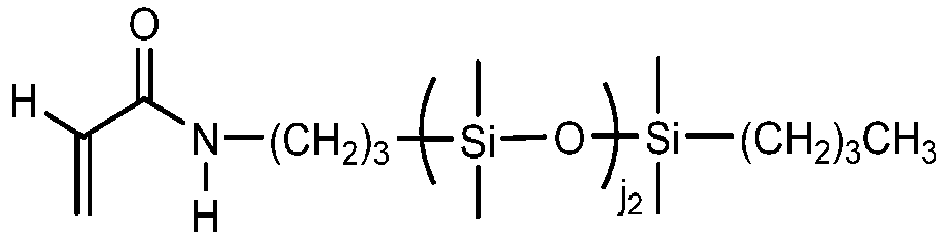
20 
21 
22 
23 
24 
- Additional non-limiting examples of suitable silicone-containing components are listed in Table 3. Unless otherwise indicated, j2 where applicable is preferably from 1 to 100, more preferably from 3 to 40, or still more preferably from 3 to 15. In compounds containing j1 and j2, the sum of j1 and j2 is preferably from 2 to 100, more preferably from 3 to 40, or still more preferably from 3 to 15.
Table 3 25 
26 
27 
28 
29 
30 1,3-bis[4-(vinyloxycarbonyloxy)but-1-yl]tetramethyl-disiloxane 31 3-(vinyloxycarbonylthio) propyl-[tris (trimethylsiloxy)silane] 32 3-[tris(trimethylsiloxy)silyl] propyl allyl carbamate 33 3-[tris(trimethylsiloxy)silyl] propyl vinyl carbamate 34 tris(trimethylsiloxy)silylstyrene (Styryl-TRIS) 35 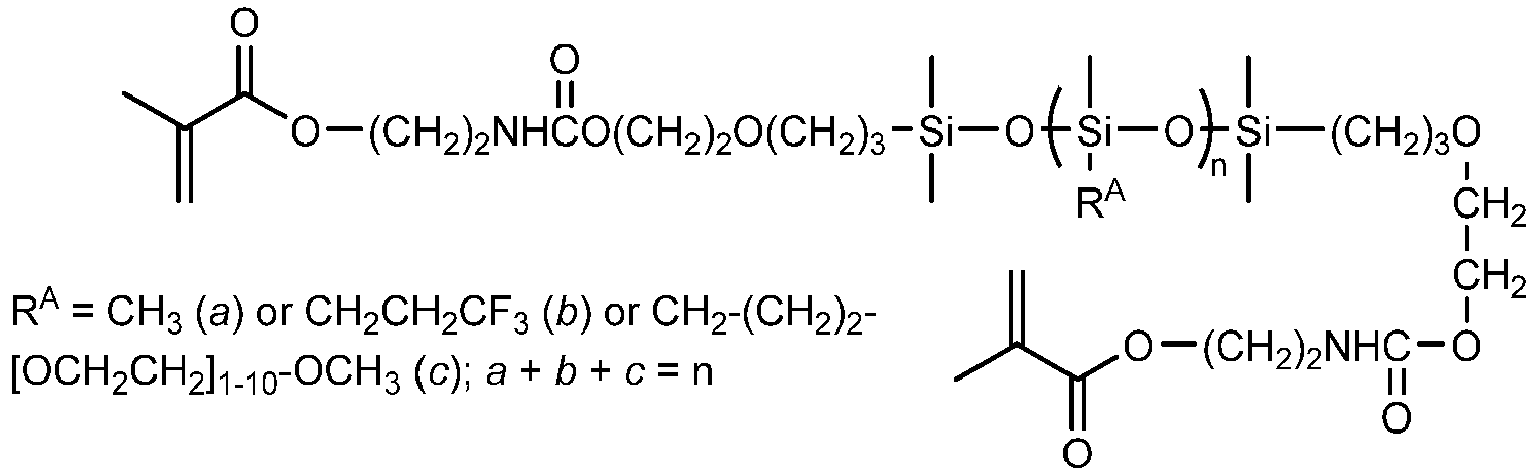
36 
37 
38 
39 
40 
41 
- Mixtures of silicone-containing components may be used. By way of example, suitable mixtures may include, but are not limited to: a mixture of mono-(2-hydroxy-3-methacryloxypropyloxy)-propyl terminated mono-n-butyl terminated polydimethylsiloxane (OH-mPDMS) having different molecular weights, such as a mixture of OH-mPDMS containing 4 and 15 SiO repeat units; a mixture of OH-mPDMS with different molecular weights (e.g., containing 4 and 15 repeat SiO repeat units) together with a silicone based crosslinker, such as bis-3-acryloxy-2-hydroxypropyloxypropyl polydimethylsiloxane (ac-PDMS); a mixture of 2-hydroxy-3-[3-methyl-3,3-di(trimethylsiloxy)silylpropoxy]-propyl methacrylate (SiMAA) and mono-methacryloxypropyl terminated mono-n-butyl terminated polydimethylsiloxane (mPDMS), such as mPDMS 1000.
- Silicone-containing components for use in the invention may have an average molecular weight of from about 400 to about 4000 daltons.
- The silicone containing component(s) may be present in amounts up to about 95 weight %, or from about 10 to about 80 weight %, or from about 20 to about 70 weight %, based upon all reactive components of the reactive mixture (excluding diluents).
- The reactive mixture may include at least one polyamide. As used herein, the term "polyamide" refers to polymers and copolymers comprising repeating units containing amide groups. The polyamide may comprise cyclic amide groups, acyclic amide groups and combinations thereof and may be any polyamide known to those of skill in the art. Acyclic polyamides comprise pendant acyclic amide groups and are capable of association with hydroxyl groups. Cyclic polyamides comprise cyclic amide groups and are capable of association with hydroxyl groups.
- Examples of suitable acyclic polyamides include polymers and copolymers comprising repeating units of Formulae G1 and G2:
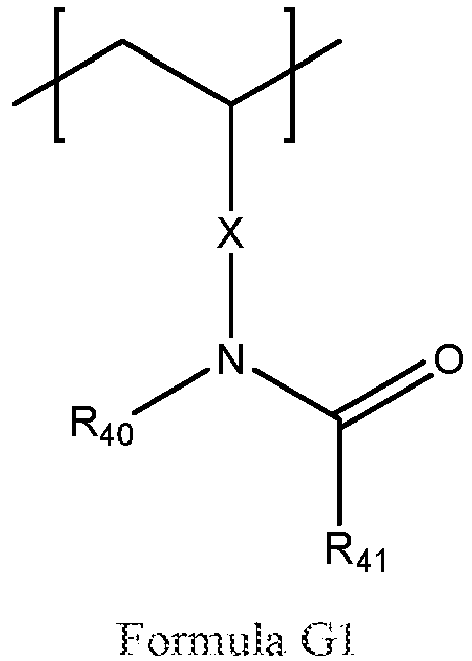

- R40 and R41 may be independently selected from H, substituted or unsubstituted C1 to C2 alkyl groups. X may be a direct bond, and R40 and R41 may be independently selected from H, substituted or unsubstituted C1 to C2 alkyl groups. R42 and R43 can be independently selected from H, substituted or unsubstituted C1 to C2 alkyl groups, methyl, ethoxy, hydroxyethyl, and hydroxymethyl.
- The acyclic polyamides of the present invention may comprise a majority of the repeating units of Formula LV or Formula LVI, or the acyclic polyamides can comprise at least 50 mole percent of the repeating unit of Formula G or Formula G1, including at least 70 mole percent, and at least 80 mole percent. Specific examples of repeating units of Formula G and Formula G1 include repeating units derived from N-vinyl-N-methylacetamide, N-vinylacetamide, N-vinyl-N-methylpropionamide, N-vinyl-N-methyl-2-methylpropionamide, N-vinyl-2-methyl-propionamide, N-vinyl-N,N'-dimethylurea, N, N-dimethylacrylamide, methacrylamide, and acyclic amides of Formulae G2 and G3:


- Examples of suitable cyclic amides that can be used to form the cyclic polyamides of include α-lactam, β-lactam, γ-lactam, δ-lactam, and ε-lactam. Examples of suitable cyclic polyamides include polymers and copolymers comprising repeating units of Formula G4:

- The cyclic polyamides of the present invention may comprise 50 mole percent or more of the repeating unit of Formula G4, or the cyclic polyamides can comprise at least 50 mole percent of the repeating unit of Formula G4, including at least 70 mole percent, and at least 80 mole percent.
- The polyamides may also be copolymers comprising repeating units of both cyclic and acyclic amides. Additional repeating units may be formed from monomers selected from hydroxyalkyl(meth)acrylates, alkyl(meth)acrylates, other hydrophilic monomers and siloxane substituted (meth)acrylates. Any of the monomers listed as suitable hydrophilic monomers may be used as co-monomers to form the additional repeating units. Specific examples of additional monomers which may be used to form polyamides include 2-hydroxyethyl (meth)acrylate, vinyl acetate, acrylonitrile, hydroxypropyl (meth)acrylate, methyl (meth)acrylate and hydroxybutyl (meth)acrylate, dihydroxypropyl (meth)acrylate, polyethylene glycol mono(meth)acrylate, and the like and mixtures thereof. Ionic monomers may also be included. Examples of ionic monomers include (meth)acrylic acid, N-[(ethenyloxy)carbonyl]-β-alanine (VINAL, CAS #148969-96-4), 3-acrylamidopropanoic acid (ACA1), 5-acrylamidopentanoic acid (ACA2), 3-acrylamido-3-methylbutanoic acid (AMBA), 2-(methacryloyloxy)ethyl trimethylammonium chloride (Q Salt or METAC), 2-acrylamido-2-methylpropane sulfonic acid (AMPS), 1-propanaminium, N-(2-carboxyethyl)-N,N-dimethyl-3-[(1-oxo-2-propen-1-yl)amino]-, inner salt (CBT, carboxybetaine; CAS 79704-35-1), 1-propanaminium, N,N-dimethyl-N-[3-[(1-oxo-2-propen-1-yl)amino]propyl]-3-sulfo-, inner salt (SBT, sulfobetaine, CAS 80293-60-3), 3,5-Dioxa-8-aza-4-phosphaundec-10-en-1-aminium, 4-hydroxy-N,N,N-trimethyl-9-oxo-, inner salt, 4-oxide (9CI) (PBT, phosphobetaine, CAS 163674-35-9, 2-methacryloyloxyethyl phosphorylcholine, 3-(dimethyl(4-vinylbenzyl)ammonio)propane-1-sulfonate (DMVBAPS), 3-((3-acrylamidopropyl)dimethylammonio)propane-1-sulfonate (AMPDAPS), 3-((3-methacrylamidopropyl)dimethylammonio)propane-1-sulfonate (MAMPDAPS), 3-((3-(acryloyloxy)propyl)dimethylammonio)propane-1-sulfonate (APDAPS), methacryloyloxy)propyl)dimethylammonio)propane-1-sulfonate (MAPDAPS).
- The reactive monomer mixture may comprise both an acyclic polyamide and a cyclic polyamide or copolymers thereof. The acyclic polyamide can be any of those acyclic polyamides described herein or copolymers thereof, and the cyclic polyamide can be any of those cyclic polyamides described herein or copolymers thereof. The polyamide may be selected from the group polyvinylpyrrolidone (PVP), polyvinylmethyacetamide (PVMA), polydimethylacrylamide (PDMA), polyvinylacetamide (PNVA), poly(hydroxyethyl(meth)acrylamide), polyacrylamide, and copolymers and mixtures thereof. The polyamide may be a mixture of PVP (e.g., PVP K90) and PVMA (e.g., having a Mw of about 570 KDa).
- The total amount of all polyamides in the reactive mixture may be in the range of between 1 weight percent and about 35 weight percent, including in the range of about 1 weight percent to about 15 weight percent, and in the range of about 5 weight percent to about 15 weight percent, in all cases, based on the total weight of the reactive components of the reactive monomer mixture.
- Without intending to be bound by theory, when used with a silicone hydrogel, the polyamide functions as an internal wetting agent. The polyamides of the present invention may be non-polymerizable, and in this case, are incorporated into the silicone hydrogels as semi-interpenetrating networks. The polyamides are entrapped or physically retained within the silicone hydrogels. Alternatively, the polyamides of the present invention may be polymerizable, for example as polyamide macromers or prepolymers, and in this case, are covalently incorporated into the silicone hydrogels. Mixtures of polymerizable and non-polymerizable polyamides may also be used.
- When the polyamides are incorporated into the reactive monomer mixture they may have a weight average molecular weight of at least 100,000 daltons; greater than about 150,000; between about 150,000 to about 2,000,000 daltons; between about 300,000 to about 1,800,000 daltons. Higher molecular weight polyamides may be used if they are compatible with the reactive monomer mixture.
- It is generally desirable to add one or more cross-linking agents, also referred to as cross-linking monomers, multi-functional macromers, and prepolymers, to the reactive mixture. The cross-linking agents may be selected from bifunctional crosslinkers, trifunctional crosslinkers, tetrafunctional crosslinkers, and mixtures thereof, including silicone-containing and non-silicone containing cross-linking agents. Non-silicone-containing cross-linking agents include ethylene glycol dimethacrylate (EGDMA), tetraethylene glycol dimethacrylate (TEGDMA), trimethylolpropane trimethacrylate (TMPTMA), triallyl cyanurate (TAC), glycerol trimethacrylate, methacryloxyethyl vinylcarbonate (HEMAVc), allylmethacrylate, methylene bisacrylamide (MBA), and polyethylene glycol dimethacrylate wherein the polyethylene glycol has a molecular weight up to about 5000 Daltons. The cross-linking agents are used in the usual amounts, e.g., from about 0.000415 to about 0.0156 mole per 100 grams of reactive Formulas in the reactive mixture. Alternatively, if the hydrophilic monomers and/or the silicone-containing components are multifunctional by molecular design or because of impurities, the addition of a cross-linking agent to the reactive mixture is optional. Examples of hydrophilic monomers and macromers which can act as the cross-linking agents and when present do not require the addition of an additional cross-linking agent to the reactive mixture include (meth)acrylate and (meth)acrylamide endcapped polyethers. Other cross-linking agents will be known to one skilled in the art and may be used to make the silicone hydrogel of the present invention.
- It may be desirable to select crosslinking agents with similar reactivity to one or more of the other reactive components in the formulation. In some cases, it may be desirable to select a mixture of crosslinking agents with different reactivity in order to control some physical, mechanical or biological property of the resulting silicone hydrogel. The structure and morphology of the silicone hydrogel may also be influenced by the diluent(s) and cure conditions used.
- Multifunctional silicone-containing components, including macromers, cross-linking agents, and prepolymers, may also be included to further increase the modulus and retain tensile strength. The silicone containing cross-linking agents may be used alone or in combination with other cross-linking agents. An example of a silicone containing component which can act as a cross-linking agent and, when present, does not require the addition of a crosslinking monomer to the reactive mixture includes α, ω-bismethacryloxypropyl polydimethylsiloxane. Another example is bis-3-acryloxy-2-hydroxypropyloxypropyl polydimethylsiloxane (ac-PDMS).
- Cross-linking agents that have rigid chemical structures and polymerizable groups that undergo free radical polymerization may also be used. Non-limiting examples of suitable rigid structures include cross-linking agents comprising phenyl and benzyl ring, such are 1,4-phenylene diacrylate, 1,4-phenylene dimethacrylate, 2,2-bis(4-methacryloxyphenyl)-propane, 2,2-bis[4-(2-acryloxyethoxy)phenyl]propane, 2,2-bis[4-(2-hydroxy-3-methacryloxypropoxy)-phenyl]propane, and 4-vinylbenzyl methacrylate, and combinations thereof. Rigid crosslinking agents may be included in amounts between about 0.5 and about 15, or 2-10, 3-7 based upon the total weight of all of the reactive components. The physical and mechanical properties of the silicone hydrogels of the present invention may be optimized for a particular use by adjusting the components in the reactive mixture.
- Non-limiting examples of silicone cross-linking agents also include the multi-functional silicone-containing components described above, such as compounds of Formula E (and its sub-formulae) and the multi-functional compounds shown in Table 3.
- The reactive mixture may contain additional components such as, but not limited to, diluents, initiators, UV absorbers, visible light absorbers, photochromic compounds, pharmaceuticals, nutraceuticals, antimicrobial substances, tints, pigments, copolymerizable dyes, nonpolymerizable dyes, release agents, and combinations thereof.
- Classes of suitable diluents for silicone hydrogel reactive mixtures include alcohols having 2 to 20 carbon atoms, amides having 10 to 20 carbon atoms derived from primary amines and carboxylic acids having 8 to 20 carbon atoms. The diluents may be primary, secondary, and tertiary alcohols.
- Generally, the reactive components are mixed in a diluent to form a reactive mixture. Suitable diluents are known in the art. For silicone hydrogels, suitable diluents are disclosed in
WO 03/022321 US 6020445 , the disclosure of which is incorporated herein by reference. Classes of suitable diluents for silicone hydrogel reactive mixtures include alcohols having 2 to 20 carbons, amides having 10 to 20 carbon atoms derived from primary amines, and carboxylic acids having 8 to 20 carbon atoms. Primary and tertiary alcohols may be used. Preferred classes include alcohols having 5 to 20 carbons and carboxylic acids having 10 to 20 carbon atoms. Specific diluents which may be used include 1-ethoxy-2-propanol, diisopropylaminoethanol, isopropanol, 3,7-dimethyl-3-octanol, 1-decanol, 1-dodecanol, 1-octanol, 1-pentanol, 2-pentanol, 1-hexanol, 2-hexanol, 2-octanol, 3-methyl-3-pentanol, tert-amyl alcohol, tert-butanol, 2-butanol, 1-butanol, 2-methyl-2-pentanol, 2-propanol, 1-propanol, ethanol, 2-ethyl-1-butanol, (3-acetoxy-2-hydroxypropyloxy)-propylbis(trimethylsiloxy) methylsilane, 1-tert-butoxy-2-propanol, 3,3-dimethyl-2-butanol, tert-butoxyethanol, 2-octyl-1-dodecanol, decanoic acid, octanoic acid, dodecanoic acid, 2-(diisopropylamino)ethanol mixtures thereof and the like. Examples of amide diluents include N,N-dimethyl propionamide and dimethyl acetamide. - Preferred diluents include 3,7-dimethyl-3-octanol, 1-dodecanol, 1-decanol, 1-octanol, 1-pentanol, 1-hexanol, 2-hexanol, 2-octanol, 3-methyl-3-pentanol, 2-pentanol, t-amyl alcohol, tert-butanol, 2-butanol, 1-butanol, 2-methyl-2-pentanol, 2-ethyl-1-butanol, ethanol, 3,3-dimethyl-2-butanol, 2-octyl-1-dodecanol, decanoic acid, octanoic acid, dodecanoic acid, mixtures thereof and the like.
- More preferred diluents include 3,7-dimethyl-3-octanol, 1-dodecanol, 1-decanol, 1-octanol, 1-pentanol, 1-hexanol, 2-hexanol, 2-octanol, 1-dodecanol, 3-methyl-3-pentanol, 1-pentanol, 2-pentanol, t-amyl alcohol, tert-butanol, 2-butanol, 1-butanol, 2-methyl-2-pentanol, 2-ethyl-1-butanol, 3,3-dimethyl-2-butanol, 2-octyl-1-dodecanol, mixtures thereof and the like.
- If a diluent is present, generally there are no particular restrictions with respect to the amount of diluent present. When diluent is used, the diluent may be present in an amount in the range of about 2 to about 70 weight percent, including in the range of about 5 to about 50 weight percent, and in the range of about 15 to about 40 weight percent, based on the total weight of the reactive mixtures (including reactive and nonreactive Formulas). Mixtures of diluents may be used.
- A polymerization initiator may be used in the reactive mixture. The polymerization initiator may include, for instance, at least one of lauroyl peroxide, benzoyl peroxide, iso- propyl percarbonate, azobisisobutyronitrile, and the like, that generate free radicals at moderately elevated temperatures, and photoinitiator systems such as aromatic alpha-hydroxy ketones, alkoxyoxybenzoins, acetophenones, acylphosphine oxides, bisacylphosphine oxides, and a tertiary amine plus a diketone, mixtures thereof and the like. Illustrative examples of photoinitiators are 1-hydroxycyclohexyl phenyl ketone, 2-hydroxy-2-methyl-1-phenyl-propan-1-one, bis(2,6-dimethoxybenzoyl)-2,4-4-trimethylpentyl phosphine oxide (DMBAPO), bis(2,4,6-trimethylbenzoyl)-phenyl phosphine eoxide (Irgacure 819), 2,4,6-trimethylbenzyldiphenyl phosphine oxide and 2,4,6-trimethylbenzoyl diphenylphosphine oxide, benzoin methyl ester and a combination of cam- phorquinone and ethyl 4-(N,N-dimethylamino)benzoate.
- Commercially available (from IGM Resins B.V., The Netherlands) visible light initiator systems include Irgacure® 819, Irgacure® 1700, Irgacure® 1800, Irgacure® 819, Irgacure® 1850 and Lucrin® TPO initiator. Commercially available (from IGM Resins B.V.) UV photoinitiators include Darocur® 1173 and Darocur® 2959. These and other photoinitiators which may be used are disclosed in Volume III, Photoinitiators for Free Radical Cationic & Anionic Photopolymerization, 2nd Edition by J. V. Crivello & K. Dietliker; edited by G. Bradley; John Wiley and Sons; New York; 1998. The initiator is used in the reactive mixture in effective amounts to initiate photopolymerization of the reactive mixture, e.g., from about 0.1 to about 2 parts by weight per 100 parts of reactive monomer mixture. Polymerization of the reactive mixture can be initiated using the appropriate choice of heat or visible or ultraviolet light or other means depending on the polymerization initiator used. Alternatively, initiation can be conducted using e-beam without a photoinitiator. However, when a photoinitiator is used, the preferred initiators are bisacylphosphine oxides, such as bis(2,4,6-tri-methylbenzoyl)-phenyl phosphine oxide (Irgacure® 819) or a combination of 1-hydroxycyclohexyl phenyl ketone and bis(2,6-dimethoxybenzoyl)-2,4-4-trimethylpentyl phosphine oxide (DMBAPO).
- The reactive mixture for making the ophthalmic devices of the invention may comprise, in addition to a high energy light absorbing compound, any of the polymerizable compounds and optional components described above.
- Preferred reactive mixtures may comprise: a high energy light absorbing compound, such as a formula I compound, and a hydrophilic component.
- Preferred reactive mixtures may comprise: a high energy light absorbing compound, such as a formula I compound, and a hydrophilic component selected from DMA, NVP, HEMA, VMA, NVA, methacrylic acid, and mixtures thereof. Preferred are mixtures of HEMA and methacrylic acid.
- Preferred reactive mixtures may comprise: a high energy light absorbing compound, such as a formula I compound, a hydrophilic component, and a silicone-containing component.
- Preferred reactive mixtures may comprise: a high energy light absorbing compound, such as a formula I compound, a hydrophilic component, and a silicone-containing component comprising a compound of formula D (or its sub-formulae, such as D-1, D-2, etc.).
- Preferred reactive mixtures may comprise: a high energy light absorbing compound, such as a formula I compound, a hydrophilic component selected from DMA, NVP, HEMA, VMA, NVA, and mixtures thereof; a silicone-containing component comprising a compound of formula D (or its sub-formulae, such as D-1, D-2, etc.); and an internal wetting agent.
- Preferred reactive mixtures may comprise: a high energy light absorbing compound, such as a formula I compound, a hydrophilic component selected from DMA, HEMA and mixtures thereof; a silicone-containing component selected from 2-hydroxy-3-[3-methyl-3,3-di(trimethylsiloxy)silylpropoxy]-propyl methacrylate (SiMAA), mono-methacryloxypropyl terminated mono-n-butyl terminated polydimethylsiloxane (mPDMS), mono-(2-hydroxy-3-methacryloxypropyl)-propyl ether terminated mono-n-butyl terminated polydimethylsiloxane (OH-mPDMS), and mixtures thereof; and a wetting agent (preferably PVP or PVMA). For the hydrophilic component, mixtures of DMA and HEMA are preferred. For the silicone containing component, mixtures of SiMAA and mPDMS are preferred.
- Preferred reactive mixtures may comprise: a high energy light absorbing compound, such as a formula I compound, a hydrophilic component comprising a mixture of DMA and HEMA; a silicone-containing component comprising a mixture of OH-mPDMS having from 2 to 20 repeat units (preferably a mixture of 4 and 15 repeat units). Preferably, the reactive mixture further comprises a silicone-containing crosslinker, such as ac-PDMS. Also preferably, the reactive mixture contains a wetting agent (preferably DMA, PVP, PVMA or mixtures thereof).
- Preferred reactive mixtures may comprise: a high energy light absorbing compound, such as a formula I compound; between about 1 and about 15 wt% at least one polyamide (e.g., an acyclic polyamide, a cyclic polyamide, or mixtures thereof); at least one first mono-functional, hydroxyl substituted poly(disubstituted siloxane) having 4 to 8 siloxane repeating units (e.g, OH-mPDMS where n is 4 to 8, preferably n is 4); at least one second hydroxyl substituted poly(disubstituted siloxane) that is a mono-functional hydroxyl substituted poly(disubstituted siloxane)s having 10 to 200 or 10-100 or 10-50 or 10-20 siloxane repeating units (e.g., OH-mPDMS where n is 10 to 200 or 10-100 or 10-50 or 10-20, preferably n is 15); about 5 to about 35 wt% of at least one hydrophilic monomer; and optionally a multifunctional hydroxyl substituted poly(disubstituted siloxane)s having 10 to 200, or 10 to 100 siloxane repeating units (e.g., ac-PDMS). Preferably, the first mono-functional, hydroxyl substituted poly(disubstituted siloxane) and the second hydroxyl substituted poly(disubstituted siloxane) are present in concentrations to provide a ratio of weight percent of the first mono-functional, hydroxyl substituted poly(disubstituted siloxane) to weight percent of the second hydroxyl substituted poly(disubstituted siloxane) of 0.4-1.3, or 0.4-1.0.
- The foregoing reactive mixtures may contain optional ingredients such as, but not limited to, one or more initiators, internal wetting agents, crosslinkers, other UV or HEV absorbers, and diluents.
- Compounds of formula I, when copolymerized with other reactive components, provide polymerized products that contain chromophoric substituents. Such chromophoric substituents can provide the product with desirable light absorbing properties as described above. For instance, ophthalmic devices, such as a contact lenses, that contain the chromophoric substituent, may block undesirable high energy light, as described in detail above. Thus, the invention encompasses ophthalmic devices that are polymerized reaction products of a reactive mixture (comprising, for instance, a hydrophilic component, and a silicone containing compound), wherein the polymerized reaction product contains, as covalently bound substituents, one or more chromophores of formula IV:

- In formula IV, X is preferably O or S. In formula IV, the link to the polymerized reaction product preferably comprises the residue of a polymerizable group and one or more of an alkylene group, a cycloalkylene group, a heterocycloalkylene group, an arylene group, a heteroarylene group, an oxaalkylene group, an alkylene-amide-alkylene group, or an alkylene-amine-alkylene group. Preferred polymerizable groups include styryl, vinyl carbonate, vinyl ether, vinyl carbamate, N-vinyl lactam, N-vinylamide, (meth)acrylate, or (meth)acrylamide.
- Preferred polymerized reaction products may further comprise one or more covalently attached UV absorbing chromophores, in addition to the chromophore of formula IV. Preferred UV absorbing chromophores include the residue of a benzophenone, a benzotriazole, a triazine, a substituted acrylonitrile, a salicyclic acid derivative, a benzoic acid derivative, a cinnamic acid derivative, a chalcone derivative, a dypnone derivative, a crotonic acid derivative, or mixtures thereof.
- The reactive mixtures may be formed by any of the methods known in the art, such as shaking or stirring, and used to form polymeric articles or devices by known methods. The reactive components are mixed together either with or without a diluent to form the reactive mixture.
- For example, ophthalmic devices may be prepared by mixing reactive components, and, optionally, diluent(s), with a polymerization initiator and curing by appropriate conditions to form a product that can be subsequently formed into the appropriate shape by lathing, cutting, and the like. Alternatively, the reactive mixture may be placed in a mold and subsequently cured into the appropriate article.
- A method of making a molded ophthalmic device, such as a silicone hydrogel contact lens, may comprise: preparing a reactive monomer mixture; transferring the reactive monomer mixture onto a first mold; placing a second mold on top the first mold filled with the reactive monomer mixture; and curing the reactive monomer mixture by free radical copolymerization to form the silicone hydrogel in the shape of a contact lens.
- The reactive mixture may be cured via any known process for molding the reactive mixture in the production of contact lenses, including spincasting and static casting. Spincasting methods are disclosed in
U.S. Patents Nos. 3,408,429 and3,660,545 , and static casting methods are disclosed inU.S. Patents Nos. 4,113,224 and4,197,266 . The contact lenses of this invention may be formed by the direct molding of the silicone hydrogels, which is economical, and enables precise control over the final shape of the hydrated lens. For this method, the reactive mixture is placed in a mold having the shape of the final desired silicone hydrogel and the reactive mixture is subjected to conditions whereby the monomers polymerize, thereby producing a polymer in the approximate shape of the final desired product. - After curing, the lens may be subjected to extraction to remove unreacted components and release the lens from the lens mold. The extraction may be done using conventional extraction fluids, such organic solvents, such as alcohols or may be extracted using aqueous solutions.
- Aqueous solutions are solutions which comprise water. The aqueous solutions of the present invention may comprise at least about 20 weight percent water, or at least about 50 weight percent water, or at least about 70 weight percent water, or at least about 95 weight percent water. Aqueous solutions may also include additional water soluble Formulas such as inorganic salts or release agents, wetting agents, slip agents, pharmaceutical and nutraceutical Formulas, combinations thereof and the like. Release agents are compounds or mixtures of compounds which, when combined with water, decrease the time required to release a contact lens from a mold, as compared to the time required to release such a lens using an aqueous solution that does not comprise the release agent. The aqueous solutions may not require special handling, such as purification, recycling or special disposal procedures.
- Extraction may be accomplished, for example, via immersion of the lens in an aqueous solution or exposing the lens to a flow of an aqueous solution. Extraction may also include, for example, one or more of: heating the aqueous solution; stirring the aqueous solution; increasing the level of release aid in the aqueous solution to a level sufficient to cause release of the lens; mechanical or ultrasonic agitation of the lens; and incorporating at least one leaching or extraction aid in the aqueous solution to a level sufficient to facilitate adequate removal of unreacted components from the lens. The foregoing may be conducted in batch or continuous processes, with or without the addition of heat, agitation or both.
- Application of physical agitation may be desired to facilitate leach and release. For example, the lens mold part to which a lens is adhered can be vibrated or caused to move back and forth within an aqueous solution. Other methods may include ultrasonic waves through the aqueous solution.
- The lenses may be sterilized by known means such as, but not limited to, autoclaving.
- As indicated above, preferred ophthalmic devices are contact lenses, more preferably soft hydrogel contact lenses. The transmission wavelengths and percentages described herein may be measured on various thicknesses of lenses using, for instance, the methodologies described in the Examples. By way of example, a preferred center thickness for measuring transmission spectra in a soft contact lens may be from 80 to 100 microns, or from 90 to 100 microns or from 90 to 95 microns. Typically, the measurement may be made at the center of the lens using, for instance, a 4 nm instrument slit width. Various concentrations of the one or more polymerizable high energy light absorbing compounds may be used to achieve the transmission characteristics described above. For instance, the concentration may be in the range of at least 1 percent, or at least 2 percent; and up to 10 percent, or up to 5 percent, based on the weight percentages of all components in the reactive mixture, excluding diluent. A typical concentration may be in the range of 3 to 5 percent.
- Silicone hydrogel ophthalmic devices (e.g., contact lenses) according to the invention preferably exhibit the following properties. All values are prefaced by "about," and the devices may have any combination of the listed properties. The properties may be determined by methods known to those skilled in the art, for instance as described in United States pre-grant publication
US20180037690 , which is incorporated herein by reference. - Water concentration %: at least 20 %, or at least 25 % and up to 80 % or up to 70 %
- Haze: 30 % or less, or 10 % or less
- Kruss dynamic contact angle (°): 100° or less, or 50° or less
- Tensile Modulus (psi): 120 or less, or 80 to 120
- Oxygen permeability (Dk, barrers): at least 80, or at least 100, or at least 150, or at least 200
- Elongation to Break: at least 100
- For ionic silicon hydrogels, the following properties may also be preferred (in addition to those recited above):
- Lysozyme uptake (µg/lens): at least 100, or at least 150, or at least 500, or at least 700
- Polyquaternium 1 (PQ1) uptake (%): 15 or less, or 10 or less, or 5 or less
- Some embodiments of the invention will now be described in detail in the following Examples.
- Ultraviolet-visible spectra of compounds in solution were measured on a
Perkin Elmer Lambda 45 or an Agilent Cary 6000i UV/VIS scanning spectrometer. The instrument was thermally equilibrated for at least thirty minutes prior to use. For the Perkin Elmer instrument, the scan range was 200-800 nm; the scan speed was 960 nm per minute; the slit width was 4 nm; the mode was set on transmission or absorbance; and baseline correction was selected. For the Cary instrument, the scan range was 200-800 nm; the scan speed was 600 nm/min; the slit width was 2 nm; the mode was transmission or absorbance; and baseline correction was selected. A baseline correction was performed before samples were analyzed using the autozero function. - Ultraviolet-visible spectra of contact lenses formed in part from the claimed compositions were measured on a
Perkin Elmer Lambda 45 UV/VIS or an Agilent Cary 6000i UV/VIS scanning spectrometer using packing solution. The instrument was thermally equilibrated for at least thirty minutes prior to use. For the Perkin Elmer instrument, the scan range was 200-800 nm; the scan speed was 960 nm per minute; the slit width was 4 nm; the mode was set on transmission; and baseline correction was selected. Baseline correction was performed using cuvettes containing plastic two-piece lens holders and the same solvents. These two-piece contact lens holders were designed to hold the sample in the quartz cuvette in the location through which the incident light beam traverses. The reference cuvette also contained a two-piece holder. To ensure that the thickness of the samples is constant, all lenses were made using identical molds. The center thickness of the contact lens was measured using an electronic thickness gauge. Reported center thickness and percent transmission spectra are obtained by averaging three individual lens data. - It is important to ensure that the outside surfaces of the cuvette are completely clean and dry and that no air bubbles are present in the cuvette. Repeatability of the measurement is improved when the reference cuvette and its lens holder remain constant and when all samples use the same sample cuvette and its lens holder, making sure that both cuvettes are properly inserted into the instrument.
- The following abbreviations will be used throughout the Examples and Figures and have the following meanings:
- BC: back or base curve plastic mold
- FC: front curve plastic mold
- DMA: N, N-dimethylacrylamide (Jarchem)
- HEMA: 2-hydroxyethyl methacrylate (Bimax)
- PVP: poly(N-vinylpyrrolidone) (ISP Ashland)
- PDMA: polydimethylacrylamide
- PVMA: polyvinylmethyacetamide
- EGDMA: ethylene glycol dimethacrylate (Esstech)
- TEGDMA: tetraethylene glycol dimethacrylate (Esstech)
- Irgacure 819: bis(2,4,6-trimethylbenzoyl)-phenylphosphineoxide (BASF or Ciba Specialty Chemicals)
- Irgacure 1870: blend of bis(2,6-dimethoxybenzoyl)-2,4,4-trimethyl-pentylphosphineoxide and 1-hydroxy-cyclohexyl-phenyl-ketone (BASF or Ciba Specialty Chemicals)
- mPDMS: mono-n-butyl terminated monomethacryloxypropyl terminated polydimethylsiloxane (Mn = 800-1000 daltons) (Gelest)
- HO-mPDMS: mono-n-butyl terminated mono-(2-hydroxy-3-methacryloxypropyloxy)-propyl terminated polydimethylsiloxane (Mn = 400-1500 daltons) (Ortec or DSM-Polymer Technology Group)
- ac-PDMS: bis-3-acryloxy-2-hydroxypropyloxypropyl polydimethylsiloxane (Tegomer V-Si 2250 from Evonik)
- Blue HEMA: 1-amino-4-[3-( 4-(2-methacryloyloxy-ethoxy)-6-chlorotriazin-2-ylamino)-4-sulfophenylamino]anthraquinone-2-sulfonic acid, as described in
US Patent No. 5,944,853 - Da: dalton or g/mole
- kDa: kilodalton or an atomic mass unit equal to 1,000 daltons
- SiMAA: 2-propenoic acid, 2-methyl-2-hydroxy-3-[3-[1,3,3,3-tetramethyl-1-[(trimethylsilyl)oxy]disiloxanyl]propoxy]propyl ester (Toray) or 3-(3-(1,1,1,3,5,5,5-heptamethyltrisiloxan-3-yl)propoxy)-2-hydroxypropyl methacrylate
- RB247: 1,4-Bis[2-methacryloxyethylamino]-9,10-anthraquinone
- BHT:- butylated hydroxytoluene
- D3O: 3,7-dimethyl-3-octanol (Vigon)
- DIW: deionized water
- MeOH: methanol
- IPA: isopropyl alcohol
- HCl: hydrochloric acid
- CH2Cl2 or DCM: methylene chloride or dichloromethane
- SOCl2: thionyl chloride
- mCPBA: m-chloroperbenzoic acid
- EtOAc: ethyl acetate
- NH2CH2CH2OH: ethanolamine or 2-aminoethanol
- Norbloc: 2-(2'-hydroxy-5-methacrylyloxyethylphenyl)-2H-benzotriazole (Janssen)
- PP: polypropylene which is the homopolymer of propylene
- TT: Tuftec which is a hydrogenated styrene butadiene block copolymer (Asahi Kasei Chemicals) Z: Zeonor which is a polycycloolefin thermoplastic polymer (Nippon Zeon Co Ltd)
- TL03 lights: Phillips TLK 40W/03 bulbs
- LED: light emitting diode
- 1N NMR: proton nuclear magnetic resonance spectroscopy
- UV-VIS: ultraviolet-visible spectroscopy
- L: liter
- mL: milliliter
- Equiv. or eq.: equivalent
- kg: kilogram
- g: gram
- mol: mole
- mmol: millimole
- min: minute(s)
- nm: nanometer(s)
- TLC: thin layer chromatography
- Borate Buffered Packing Solution: 18.52 grams (300 mmol) of boric acid, 3.7 grams (9.7 mmol) of sodium borate decahydrate, and 28 grams (197 mmol) of sodium sulfate were dissolved in enough deionized water to fill a 2-liter volumetric flask.
-


- Methyl cyanoacetate (40 grams, 0.4037 mole) and 25 mL of dichloromethane were stirred in a 3 neck, 500 mL round bottom flask under equipped with a reflux condenser under a nitrogen environment. 2-aminoethanol (23.8 grams, 0.3897 mole, -0.97 eq.) was added to the solution via an addition funnel, after which the temperature rose and the methylene chloride began to reflux. After the exotherm ceased, external heat was applied to continue a gentle reflux for a total of two hours, after which no ethanolamine was observed by thin layer chromatography.
- The reaction may also be conducted at room temperature and is complete within a few hours.
- The mixture was cooled to room temperature and all the methylene chloride was evaporated at reduced pressure. The residual oil was washed three times with 50 mL of ethyl acetate to remove unreacted starting material and non-polar impurities. The residual ethyl acetate was then removed under reduced pressure, and the resulting oil was used for acylation without any further purification.
- The crude N-2-hydroxyethylacetamide derivative was dissolved in 150 mL of dichloromethane containing 40 grams of pyridine (~ 0.5 mole) in a three-neck round bottom flask equipped with a reflux condenser, an addition funnel, and a magnetic stirring bar. The flask was immersed in an ice bath and allowed to cool down to around 0°C. Methacryloyl chloride (45.76 grams, -0.44 mole) was added dropwise from the addition funnel, and the resulting reaction mixture was allowed to warm up to room temperature while constantly stirring the system. Methanol (20 mL) was the added to the flask to quench any unreacted methacryloyl chloride. The volatile components were removed by rotary evaporation under reduced pressure, and the crude product dissolved in 800 mL of dilute aqueous HCl. The resulting aqueous solution was extracted three times with 100 mL of hexanes in a separatory funnel to remove any non-polar impurities. The organic layers were discarded. Sodium chloride was added to the aqueous layer which was then extracted three times with 300 mL of ethyl acetate. About 50 milligrams of BHT were added to the combined organic fractions as an inhibitor, and the ethyl acetate removed by rotary evaporation under reduced pressure. The crude product crystalized out of solution during solvent removal. When about 100 mL of ethyl acetate was left in the flask, 250 mL of hexanes was added, and the crude product was isolated by vacuum filtration using a fritted glass funnel. Thin layer chromatography indicated the presence of a single compound. The filter cake was washed two times with 150 mL of hexanes and then vacuum dried at 40°C, yielding 53 grams (about 70% yield) of 2-(2-cyanoacetamido)ethyl methacrylate (A). 1H NMR (500 MHz, CDCl3) δ 1.93 (3H, s, CH3), 3.36 (2H, s, CNCH2), 3.60 (2H, dd, CH2NH), 4.26 (2H, t, CH2OC=O), 5.59 (1H, m, vinylic), 6.11 (1H, bs, vinylic), 6.52 (1H, bs, NH).
- A mixture of 9H-thioxanthene-9-one (2.12 grams, 0.01 mole) and thionyl chloride (5 mL, 8.2 grams, -0.07 mole) was refluxed in a 50 mL round bottom flask under a nitrogen atmosphere with constant stirring. After two hours, the red solution was evaporated to dryness ensuring that all unreacted thionyl chloride was removed from the system. 2-(2-Cyanoacetamido)ethyl methacrylate (A) (2.3 grams, 0.0117 mole, -1.17 eq.) and 15 mL of dichloromethane were added, and the resulting reaction mixture was heated to reflux under a nitrogen blanket. The reaction was monitored by thin layer chromatography. After two hours, no changes were observed in the chromatogram, so the reactive mixture was allowed to cool down to room temperature. 2-(2-cyano-2-(9H-thioxanthen-9-ylidene)acetamido)ethyl methacrylate (B) was isolated as yellow crystals (3.2 grams, 82% yield) after passing through a short silica gel column (CH2Cl2, followed by 8 weight % EtOAc in CH2Cl2). The UV-VIS transmission spectrum of a 0.2 mM methanol solution Compound B is shown in
FIG. 1. 1 H NMR (500 MHz, CDCl3) δ 1.84 (3H, s, CH3), 3.47 (2H, m, CH2NH), 4.01 (2H, t, CH2OC=O), 5.55 (1H, m, vinylic), 5.91 (1H, bs, NH), 5.98 (1H, bs, vinylic), 7.24 (1H, t, Ar-H), 7.31 (1H, t, Ar-H), 7.39 (2H, m, Ar-H), 7.49 (1H, d, Ar-H), 7.55 (1H, m, Ar-H), 7.61 (1H, d, Ar-H), 8.04 (1H, m, Ar-H). -

- A mixture of 9H-xanthen-9-one (5.0 grams, 0.0255 mole) and thionyl chloride (10 mL, 16.4 grams, 0.138 mole) was refluxed in a 50 mL round bottom flask under a nitrogen atmosphere with constant stirring. After three hours, the red solution was evaporated to dryness ensuring that all unreacted thionyl chloride was removed from the system. 2-(2-cyanoacetamido)ethyl methacrylate (A) (6.0 grams, 0.0306 mole, ~1.2 eq.) and 20 mL of dichloromethane were added and the resulting reaction mixture was heated to reflux under a nitrogen blanket. The reaction was monitored by thin layer chromatography. The mixture was cooled to room temperature after 2.5 hours and 2-(2-cyano-2-(9H-xanthen-9-ylidene)acetamido)ethyl methacrylate (C) purified after passing through a short silica gel column (CH2Cl2, and ethyl acetate in CH2Cl2). The off-white precipitate formed during rotary evaporation is washed with hexane and dried in a vacuum oven at 40°C overnight. The UV-VIS transmission spectrum of Compound (C) is shown in
FIG. 1 in a 0.2 mM methanol solution. 1H NMR (500 MHz, CDCl3) δ 1.85 (3H, s, CH3), 3.60 (2H, dd, CH2NH), 4.2 (2H, t, CH2OC=O), 5.53 (1H, t, vinylic), 5.99 (1H, bs, vinylic), 6.17 (1H, t, NH), 7.12 (1H, t, Ar-H), 7.29-7.34 (3H, m, Ar-H), 7.45 (1H, ddd, Ar-H), 7.52 (1H, ddd, Ar-H), 7.67 (1H, dd, Ar-H), 8.41 (1H, dd, Ar-H). -

- A mixture of 10-methylacridin-9(10H)-one (2.09 grams, 0.01 mole) and thionyl chloride (5 mL, 8.2 grams, -0.07 mole) is refluxed in a 50 mL round bottom flask under a nitrogen atmosphere with constant stirring. After two hours, the solution is evaporated to dryness ensuring that all unreacted thionyl chloride is removed from the system. 2-(2-cyanoacetamido)ethyl methacrylate (A) (2.3 grams, 0.0117 mole, ~1.17 eq.) and 15 mL of dichloromethane are added and the resulting reaction mixture is heated to reflux under a nitrogen blanket. The reaction is monitored by thin layer chromatography. When no changes are observed in the chromatogram, the reactive mixture is allowed to cool down to room temperature. 2-(2-cyano-2-(10-methylacridin-9(10H)-ylidene)acetamido)ethyl methacrylate (D) may be isolated by known methods, for instance after passing through a short silica gel column.
-

- To a chilled solution of 2-(2-cyano-2-(9H-thioxanthen-9-ylidene)acetamido)ethyl methacrylate (B) (2.0 grams, 5.2 mmol) in dichloromethane, 2.32 grams of m-chloroperbenzoic acid (75% purity, ~ 2 eq., mCPBA) were added. The mixture was stirred cold for one hour and then allowed to warm up to room temperature. The solution lost its yellow color as the reaction proceeded, and a white solid crystallized or precipitated out of solution. The volatiles were evaporated under reduced pressure. The residue was re-dissolved in ethyl acetate and extracted with dilute aqueous base, followed by dilute aqueous saline solutions. The organic layer was separated, and the solvent removed by rotary evaporation under reduced pressure. The residue was washed with hexanes over a fritted glass funnel and vacuum dried. The UV-VIS transmission spectrum of a 0.2 mM methanolic solution of Compound E is shown in
FIG. 1. 1 H NMR (500 MHz, CDCl3) δ 1.85 (3H, s, CH3), 3.35 (1H, m, CH2NH), 3.61 (1H, m, CH2NH), 3.81 (1H, m, CH2OC=O), 4.05 (1H, m, CH2OC=O), 5.55 (1H, m, vinylic), 5.95 (1H, m, vinylic), 6.35 (1H, bs, NH), 7.5-7.75 (5H, m, Ar-H), 8.03 (2H, t, Ar-H), 8.12 (1H, d, Ar-H). -

- Methyl cyanoacetate (22 grams, 0.22 mole) and 250 mL of dichloromethane were stirred in a 3 neck, 500 mL round bottom flask under equipped with a reflux condenser under a nitrogen environment. The solution is cooled in a water bath and 1,2-diaminoethane (12 grams, 0.2 mole, ~0.9 eq.) added to the mixture. As the reaction progresses, the mixture appears more and more heterogenous, with the product crashing out of solution. After four hours of stirring at room temperature, the volatiles are evaporated under reduced pressure and the residue is washed with ethyl acetate over a fritted glass funnel and dried at 50°C prior to further use. 1H NMR (500 MHz, D2O) δ 2.74 (2H, t, CH2NH2), 3.29 (2H, t, CH2NH), 3.38 (2H, s, CH2CN).
- 2-aminoethyl cyanoacetamide (12.7 g, 0.1 mole) and 12.0 grams of sodium carbonate are stirred in 150 mL of methanol while being chilled in an ice bath. Methacryloyl chloride (11.5 g, 1.1 eq.) is added to the suspension in a dropwise manner, while maintaining the reaction temperature below 30°C at all times. Once the reaction is complete, evaporate all volatiles under reduced pressure, redissolve the product in acetonitrile and filter the solution to remove all the salts present. Evaporate the acetonitrile under reduced pressure and wash the resulting solids with ethyl acetate over a fritted glass funnel to obtain the desired 2-(2-cyanoacetamido)ethyl methacrylamide (F). 1H NMR (500 MHz, CDsOD) δ 1.86 (3H, s, CH3), 3.22-3.26 (4H, m, NH, CH2CN), 3.29 (4H, m, CH2NH), 5.31 (1H, m, vinylic), 5.63 (1H, m, vinylic).
- A mixture of thioxanthone (4.24 grams, 0.02 mole) and 8 mL of thionyl chloride (13.12 grams, -0.11 mole) was gently refluxed under a nitrogen atmosphere with constant stirring. After two hours of heating, the solution was evaporated to dryness under reduced pressure, ensuring that all unreacted thionyl chloride was removed. 2-(2-cyanoacetamido)ethyl methacrylamide (F) (4.2 grams, ~1.1 eq.) and 20 mL of degassed methylene chloride were added to the flask, and the mixture was gently refluxed for 3 hours under a nitrogen environment, while monitoring the progress by TLC. The volatiles were evaporated under reduced pressure, and the organics are washed with ethyl acetate. Large quantities of a precipitate enriched with the major product were observed. The suspension was filtered, and the residual solids washed with ethyl acetate prior to drying in a vacuum oven. The UV-VIS transmission spectrum of a 0.2 mM methanolic solution of Compound G is shown in
FIG. 2 .1 H NMR (500 MHz, CDCl3) δ 1.89 (3H, s, CH3), 3.26 (2H, m, CH2NH), 3.32 (2H, m, CH2NH), 5.33 (1H, m, vinylic), 5.68 (1H, m, vinylic), 6.63 (1H, m, NH), 6.49 (1H, m, NH), 7.25 (1H, m, Ar-H), 7.33 (1H, dt, Ar-H), 7.39 (2H, m, Ar-H), 7.51-7.59 (3H, m, Ar-H), 8.05 (1H, m, Ar-H). -

- N-(2-Aminoethyl)-2-cyanoacetamide (2): Compound 1 (30 g, 303 mmol, 1.0 equiv) was added to a solution of ethylene diamine (54.5 g, 909 mol, 3 equiv) in dichloromethane (600 mL) at -20 oC over 30 minutes. The reaction was warmed to room temperature over 2 hours and stirred for 3 hours, at which point LC-MS indicated the reaction was complete. The resulting precipitate was filtered and washed with dichloromethane (2 x 100 mL) to give compound 2 (25 g, 66% yield, >95% purity) as a white solid.
- N-(2-(2-Cyanoacetamido)ethyl)methacrylamide (3): A solution of methylacrylic anhydride (41 g, 264 mmol, 1.3 equiv) and triethylamine (40 mL, 287 mmol, 1.3 equiv) in dichloromethane (300 mL) was stirred at room temperature for 1 hour. The reaction was cooled to 0 °C and compound 2 (28 g, 220 mmol, 1.0 equiv) was added portionwise to the reaction mixture at 0 °C. The reaction was warmed to room temperature and stirred for 5 hours, at which point LC-MS indicated the reaction was complete. The resulting precipitate was filtered and washed with dichloromethane (2 x 100 mL) to give compound 3 (25.1 g, 60% yield, >95% purity) as a white solid.
- 9,9-Dichloro-10-methyl-9,10-dihydroacridine (5): Compound 4 (10 g, 4.85 mmol, 1.0 equiv) in thionyl chloride (200 mL, 2.75 mol, 55 equiv) was stirred at 60 °C for 2 hours, at which point 1H-NMR indicated the reaction was complete. The thionyl chloride was removed under reduced pressure. The residue was azeotroped with toluene (2 x 20 mL) to give
crude compound 5 as a yellow solid (12.5 g), which was used subsequently. - N-(2-(2-Cyano-2-(10-methylacridin-9(10H)-ylidene)acetamido)ethyl) methacryl amide (H): Triethylamine (20 mL, 143 mmol, 3.0 equiv) was added dropwise to a solution of the crude compound 5 (12.5 g, 48.5 mmol, 1.0 equiv) and compound 3 (9.33 g, 48.5 mmol. 1.0 equiv) in 1 to 1 mixture of dichloromethane and acetonitrile (200 mL) at 0 °C over 30 minute. The reaction was warmed to room temperature and stirred for 2 hours, at which point LC-MS indicated the reaction was complete. The mixture was passed through a plug of silica gel (150 g), eluting with dichloromethane (500 mL). The organics were concentrated under reduced pressure. The residue was purified over silica gel (800 g), eluting with ethyl acetate, to give compound (H) as a yellow solid. The solid was triturated with methyl tert-butyl ether (2 x 200 mL) for 2 hours. The solid was collected by filtration and triturated with chloroform (50 mL) for 30 minutes to give the pure compound (H) (11.9 g, 60% yield from two steps, 97.5% purity) as a yellow solid.
- The UV-VIS transmission spectrum of a 0.2 mM methanolic solution of Compound H is shown in
FIG. 2 .1 H NMR (500 MHz, DMSO- d6) δ 1.87 (3H, m, CH3), 3.15-3.20 (4H, m, CH2NH), 3.72 (3H, s, CH3N), 5.36 (1H, s, vinylic), 5.68 (1H, m, vinylic), 7.14 (1H, bt, NH), 7.29 (1H, bt, NH, 7.49-7.65 (4H, m, Ar-H), 8.02 - 8.81 (4H, Ar-H). -
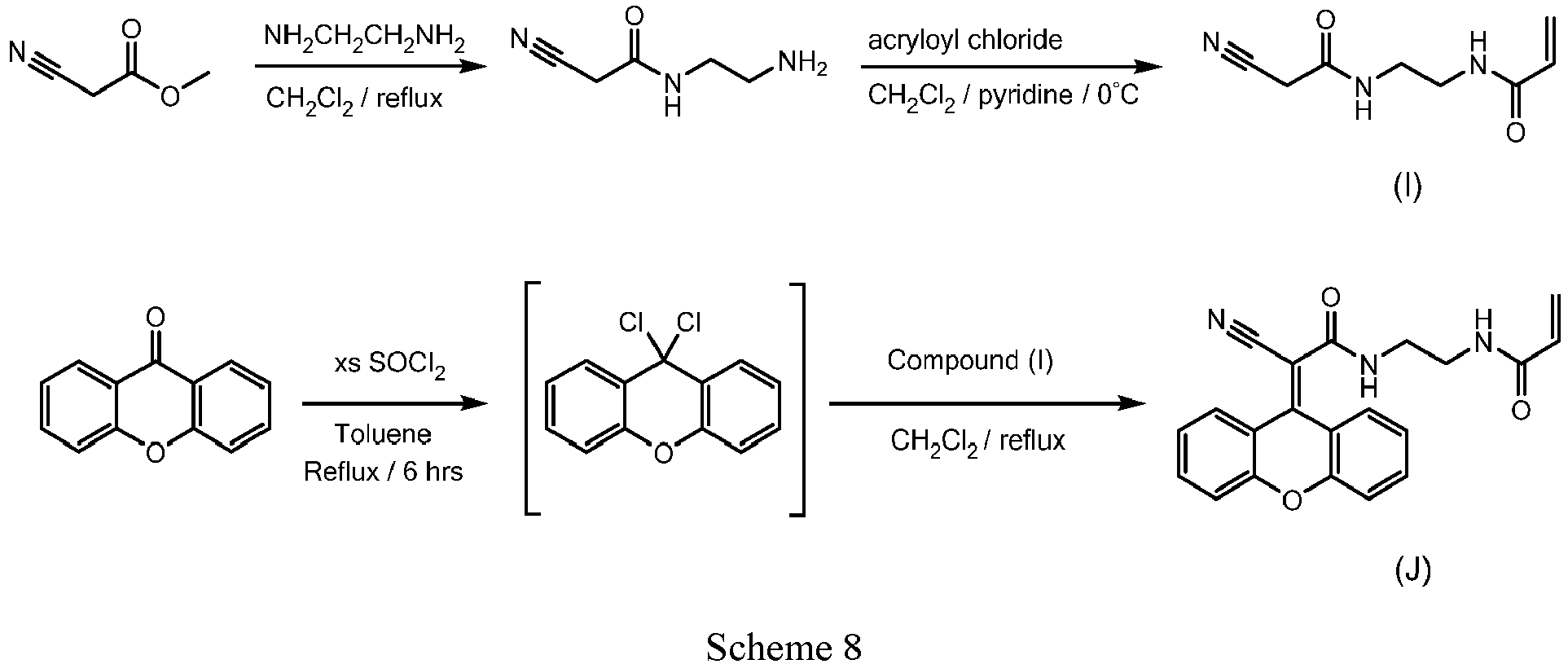
- 2-(2-Cyanoacetamido)ethyl acrylamide (I) was prepared by the same methodology as used for 2-(2-cyanoacetamido)ethyl methacrylate (F). 2-aminoethyl cyanoacetamide (12.7 g, 0.1 mole) and 12.0 grams of sodium carbonate are stirred in 150 mL of methanol while being chilled in an ice bath. Acryloyl chloride (9.9 g, 1.1 eq.) is added to the suspension in a dropwise manner, while maintaining the reaction temperature below 30°C at all times. Once the reaction is complete, evaporate all volatiles under reduced pressure, redissolve the product in acetonitrile and filter the solution to remove all the salts present. Evaporate the acetonitrile under reduced pressure and wash the resulting solids with ethyl acetate over a fritted glass funnel to obtain the desired 2-(2-cyanoacetamido)ethyl acrylamide(I). 1H NMR (500 MHz, CDsOD) δ 3.22-3.31 (8H, m, NH, CH2), 5.59 (1H, dd, vinylic), 6.14 (2H, dd, vinylic).
- A mixture of xanthone (3.92 grams, 0.02 mole) and 5 mL of thionyl chloride (8.2 grams, ~0.07 mole) in 10 mL of toluene was gently refluxed under a nitrogen atmosphere with constant stirring. After six hours of heating, the solution cooled and volatiles were evaporated under reduced pressure, ensuring that all unreacted thionyl chloride was removed from the system. 2-(2-cyanoacetamido)ethyl acrylamide (I) (3.8 grams, -1.05 eq.) and 20 mL of methylene chloride were added to the flask, and the mixture was gently refluxed for 3 hours under a nitrogen environment, while monitoring the progress by TLC. Volatile components were evaporated under reduced pressure. The residue was washed with warm ethyl acetate and filtered over a fritted glass funnel. The filter cake was washed with additional ethyl acetate, followed by water. The light-yellow solid was dried in a vacuum oven. The UV-VIS transmission spectrum of a 0.2 mM methanolic solution of Compound J is shown in
FIG. 2 .1 H NMR (500 MHz, DMSO-d6) δ 3.15-3.25 (4H, m, CH2), 5.62 (1H, dd, vinylic), 6.08-6.23 (2H, m, vinylic), 7.32-7.75 (1H, dt, Ar-H), 7.46-7.72 (6H, Ar-H), 8.17 (1H, bt, NH), 8.34 (1H, dd, Ar-H), 8.88 (1H, bt, NH). - Example 8 - Synthesis of 2-(2-cyanoacetoxy)ethyl methacrylate (K) and 2-(2-cyano-2-(9H-thioxanthen-9-ylidene)acetoxy)ethyl methacrylate (L) as shown in
Scheme 9
- A mixture of thioxanthone (4.24 grams, 0.02 mole) and 8 mL of thionyl chloride (13.12 grams, ~0.11 mole) was gently refluxed under a nitrogen atmosphere with constant stirring. After two hours of heating, the solution was evaporated to dryness under reduced pressure, ensuring that all unreacted thionyl chloride was removed. A solution of 2-(2-cyanoacetoxy)ethyl methacrylate (K) (4.33 grams, ~1.1 eq.) in 20 mL of degassed methylene chloride was added to the flask, and the mixture was gently refluxed for 3 hours under a nitrogen environment, while monitoring the progress by TLC. The residue was washed with methanol to remove most of the unreacted starting thioxanthone, re-concentrated, and the crude product was purified by chromatography over a silica gel plug and vacuum dried overnight. The UV-VIS transmission spectrum of a 0.2 mM solution of Compound L in dichloromethane is shown in
Fig. 2 .1 H NMR (500 MHz, CDCl3) δ 1.92 (3H, s, CH3), 4.36 (2H, m, CH2), 4.44 (2H, m, CH2), 5.59 (1H, m, vinylic), 6.10 (1H, m, vinylic), 7.24-7.62 (7H, m, Ar-H), 8.1 (1H, m, Ar-H). - Reactive monomer mixtures were prepared composed of 77 weight percent of the formulations listed in Table 4 and 23 weight percent of the diluent D3O. The reactive monomer mixtures were individually filtered through a 3 µm filter using a stainless-steel syringe under pressure.
TABLE 4 Component Ex 9A (weight %) Ex 9B (weight %)Ex 9C (weight %)Ex 9D (weight %)mPDMS 1000 30.85 30.7 30.55 30.39 SiMAA 27.61 27.48 27.35 27.2 DMA 23.76 23.6 23.53 23.4 HEMA 5.94 5.91 5.88 5.85 TEGDMA 1.52 1.52 1.51 1.5 PVP K90 6.9 6.9 6.8 6.8 Irgacure 1870 0.35 0.34 0.34 0.34 RB247 0.02 0.02 0.02 0.02 Compound (B) 3.05 3.03 3.02 3 Norbloc ®0 0.5 1 1.5 ∑ Components 100 100 100 100 -
Formulations 9A-9D were degassed at ambient temperature by applying vacuum (40 torr) for 45 minutes. Then, in a glove box with a nitrogen gas atmosphere and less than about 0.1-0.2 percent oxygen gas, about 75 µL of the reactive mixture were dosed using an Eppendorf pipet at room temperature into the FC made of 90: 10 (w/w) Zeonor/TT blend. The BC made of 90:10 (w/w) Z:TT blend was then placed onto the FC. The molds were equilibrated for a minimum of twelve hours in the glove box prior to dosing. Pallets containing eight mold assemblies each were transferred into an adjacent glove box maintained at 65°C, and the lenses were cured from the top and the bottom for 15 minutes using 435 nm LED lights having an intensity of about 2 mW/cm2 at the tray's location. - The lenses were manually de-molded with most lenses adhering to the FC and released by suspending the lenses in about one liter of 70 percent IPA for about one hour, followed by soaking two more times with fresh 70 percent IPA for 30 minutes; then two times with fresh DIW for 15 minutes; then two time with packing solution for 30 minutes. The lenses were equilibrated and stored in borate buffered packaging solution. A person of ordinary skill recognizes that the exact lens release process can be varied depending on the lens formulation and mold materials, regarding the concentrations of the aqueous isopropanol solutions, the number of washings with each solvent, and the duration of each step. The purpose of the lens release process is to release all of the lenses without defects and transition from diluent swollen networks to the packaging solution swollen hydrogels. The average center thickness of each lens set was measured; 9A = 87.7 microns, 9B = 85.3 microns, 9C = 87.3 microns, and 9D = 85.7 microns.
-
Figures 3-5 show the UV-VIS spectra of the lenses made fromFormulations 9A-9D demonstrating that compound (B) or combinations of compound (B) and Norbloc® may provide complete or nearly complete absorption between 300 nm and 400 nm with some absorption in the high energy visible region between 400 nm and 450 nm. - Reactive monomer mixtures were prepared composed of 77 weight percent of the formulations listed in Table 5 and 23 weight percent of the diluent D3O. The reactive monomer mixtures were individually filtered through a 3 µm filter using a stainless-steel syringe under pressure.
TABLE 5 Component Ex 10A (weight %) Ex 10B (weight %)Ex 10C (weight %)Ex 10D (weight %) mPDMS 1000 30.87 30.69 30.51 30.33 SiMAA 27.66 27.5 27.34 27.18 DMA 23.83 23.7 23.57 23.44 HEMA 5.98 5.95 5.92 5.89 TEGDMA 1.5 1.5 1.5 1.5 PVP K90 6.8 6.8 6.8 6.8 Irgacure 1870 0.34 0.34 0.34 0.34 RB247 0.02 0.02 0.02 0.02 Compound (B) 0 3 3 3 Compound (C) 3 0.5 1 1.5 ∑ Components 100 100 100 100 -
Formulations 10A-10D were degassed at ambient temperature by applying vacuum (40 torr) for 45 minutes. Then, in a glove box with a nitrogen gas atmosphere and less than about 0.1-0.2 percent oxygen gas, about 75 µL of the reactive mixture were dosed using an Eppendorf pipet at room temperature into the FC made of 90:10 (w/w) Zeonor/TT blend. The BC made of 90:10 (w/w) Z:TT blend was then placed onto the FC. The molds were equilibrated for a minimum of twelve hours in the glove box prior to dosing. Pallets containing eight mold assemblies each were transferred into an adjacent glove box maintained at 65°C, and the lenses were cured from the top and the bottom for 15 minutes using 435 nm LED lights having an intensity of about 2 mW/cm2 at the tray's location. - The lenses were manually de-molded with most lenses adhering to the FC and released by suspending the lenses in about one liter of 70 percent IPA for about one hour, followed by soaking two more times with fresh 70 percent IPA for 30 minutes; then two times with fresh DIW for 15 minutes; then two time with packing solution for 30 minutes. The lenses were equilibrated and stored in borate buffered packaging solution. A person of ordinary skill recognizes that the exact lens release process can be varied depending on the lens formulation and mold materials, regarding the concentrations of the aqueous isopropanol solutions, the number of washings with each solvent, and the duration of each step. The purpose of the lens release process is to release all of the lenses without defects and transition from diluent swollen networks to the packaging solution swollen hydrogels. The average center thickness of each lens set was measured; 10A = 93.7 microns, 10B = 93.7 microns, 10C = 95.3 microns, and 10D = 92.3 microns.
-
Figures 6-8 show the UV-VIS spectra of the lenses made fromFormulations 10A-10D demonstrating that combinations of compounds (B) and (C) may provide complete or nearly complete absorption between 300 nm and 400 nm with some absorption in the high energy visible region between 400 nm and 450 nm. The figures also demonstrate that compound (C) alone provides absorption at various wavelength ranges. - Lenses were made using the reactive monomer mixture comprising the components listed as 9D in Table 4 and same curing and hydration steps except that the oxygen gas concentration in the glove box was less than 0.5%. Lenses were packaged in glass vials containing PS and then placed either on a window sill with direct sunlight (11A) or on top of a cabinet without exposure to direct sunlight, only indoor lighting (11B). Controls were stored in the dark. After 3, 5, 9, 15, and 21 weeks of exposure, UV-Visible transmission spectra of the lenses were measured as shown in
FIG. 9 andFIG. 10 . - For lenses exposed to direct sunlight, the absorption of high energy visible light between 400 nm and 450 nm did not change over time. There were minor (about 1%) changes in the UV-VIS transmission spectra between 450 nm and 700 nm over the duration of the study.
- For lenses exposed to indoor lighting, the absorption of high energy visible light between 400 nm and 450 nm did not change over time. The UV-VIS transmission spectra did not change more than about 2% or 3% between 450 nm and 700 nm over the duration of the study.
- The title compound can be synthesized by analogous procedures to those described above, starting from 3-hydroxyacridone (CAS reg. no. 20168-55-2).
- The title compound can be synthesized by analogous procedures to those described above, starting from N-methylacridone (719-54-0).
- The title compound can be synthesized by analogous procedures to those described above, starting from 3,6-dihydroxyacridone (122105-95-7).
- The title compound can be synthesized by analogous procedures to those described above, starting from benzo[C]xanthone (63154-69-8).
- The title compound can be synthesized by analogous procedures to those described above, starting from 3-methoxyxanthone (3722-52-9).
- The title compound can be synthesized by analogous procedures to those described above, starting from 3,6-dihydroxyxanthone (1214-24-0).
- The title compound can be synthesized by analogous procedures to those described above, starting from 2-methylxanthone (2680-45-1).
- The title compound can be synthesized by analogous procedures to those described above, starting from 1-hydroxyxanthone (19-41-5).
- The title compound can be synthesized by analogous procedures to those described above, starting from 2,4-dichlorothioxanthone.
- The title compound can be synthesized by analogous procedures to those described above, starting from 2-chlorothioxanthone.
- The title compounds can be synthesized as a mixture by analogous procedures to those described above, starting from a mixture of 2 and 4-isopropyl thioxanthone.
- Contact lenses from the silicone hydrogel formulations shown in Table 6 can be prepared using analogous procedures to those described in Example 6. In these examples, 77 weight percent of the formulations listed in Table 6 are diluted with 23 weight percent of diluent (e.g., D3O).
TABLE 6 Component Ex 23 (weight %) Ex. 24 (weight %) Ex. 25 (weight %) OH-mPDMS (n=15) 28.00 28.50 28.00 OH-mPDMS (n=4) 25.00 25.50 25.00 ac-PDMS 5.00 4.00 5.00 DMA 24.00 20.00 20.00 HEMA 7.98 7.98 7.98 Blue HEMA 0.02 0.02 0.02 PDMA (Mw=740kDa) 5.00 0 0 PVP K90 0 7.00 9.00 PVMA (Mw=570kDa) 0 2.00 0 EGDMA 0.25 0.25 0.25 Compound (B) 3.00 3.00 3.00 Norbloc® or compound (C) 1.50 1.50 1.50 Irgacure 1870 0.25 0.25 0.25 ∑ Components 100 100 100 - Numbered embodiments forming part of the description
- 1. A compound of formula I:

- m and n are independently 0, 1, 2, 3, or 4;
- T is a bond, O, or NR;
- X is O, S, NR, SO, or SO2;
- Y is a linking group;
- Pg is a polymerizable group;
- R at each occurrence is independently H, C1-C6 alkyl, cycloalkyl, heterocycloalkyl, aryl, heteroaryl, or Y-Pg;
- R1 and R2, when present, are independently at each occurrence C1-C6 alkyl, C1-C6 alkoxy, C1-C6 thioalkyl, C3-C7 cycloalkyl, aryl, halo, hydroxy, amino, NR3R4, or benzyl, wherein R3 and R4 are independently H or C1-C6 alkyl, or two adjacent R1 or R2 groups, together with the carbon atoms to which they are attached, combine to form a cycloalkyl or aryl ring; and
- EWG is an electron withdrawing group.
- 2. The compound of embodiment 1 wherein m and n are each independently 0 or 1.
- 3. The compound of any one of embodiments 1 to 2 wherein Y at each occurrence is independently alkylene, cycloalkylene, heterocycloalkylene, arylene, heteroarylene, oxaalkylene, alkylene-amide-alkylene, alkylene-amine-alkylene, or combinations thereof.
- 4. The compound of any one of embodiments 1 to 3 wherein Pg comprises styryl, vinyl carbonate, vinyl ether, vinyl carbamate, N-vinyl lactam, N-vinylamide, (meth)acrylate, or (meth)acrylamide.
- 5. The compound of any one of embodiments 1 to 4 wherein X is O.
- 6. The compound of any one of embodiments 1 to 4 wherein X is S.
- 7. The compound of any one of embodiments 1 to 6 wherein EWG is cyano, amide, ester, keto, or aldehyde.
- 8. The compound of any one of embodiments 1 to 7 wherein EWG is cyano.
- 9. The compound of embodiment 1 that is:
- 2-(2-cyano-2-(9H-thioxanthen-9-ylidene)acetamido)ethyl methacrylate;
- 2-(2-cyano-2-(9H-thioxanthen-9-ylidene)acetamido)ethyl acrylate;
- N-(2-(2-cyano-2-(9H-thioxanthen-9-ylidene)acetamido)ethyl)methacrylamide;
- N-(2-(2-cyano-2-(9H-thioxanthen-9-ylidene)acetamido)ethyl)acrylamide;
- 2-(2-cyano-N-methyl-2-(9H-thioxanthen-9-ylidene)acetamido)ethyl methacrylate;
- 2-cyano-2-(9H-thioxanthen-9-ylidene)-N-(2-(N-vinylacetamido)ethyl)acetamide;
- 2-(2-cyano-2-(9H-xanthen-9-ylidene)acetamido)ethyl methacrylate;
- 2-(2-cyano-2-(9H-xanthen-9-ylidene)acetamido)ethyl acrylate;
- N-(2-(2-cyano-2-(9H-xanthen-9-ylidene)acetamido)ethyl)methacrylamide;
- N-(2-(2-cyano-2-(9H-xanthen-9-ylidene)acetamido)ethyl)acrylamide;
- 2-(2-cyano-N-methyl-2-(9H-xanthen-9-ylidene)acetamido)ethyl methacrylate;
- 2-cyano-N-(2-(N-vinylacetamido)ethyl)-2-(9H-xanthen-9-ylidene)acetamide;
- 2-(2-(acridin-9(10H)-ylidene)-2-cyanoacetamido)ethyl acrylate;
- N-(2-(2-(acridin-9(10H)-ylidene)-2-cyanoacetamido)ethyl)methacrylamide;
- N-(2-(2-(acridin-9(10H)-ylidene)-2-cyanoacetamido)ethyl)acrylamide;
- 2-(2-(acridin-9(10H)-ylidene)-2-cyano-N-methylacetamido)ethyl methacrylate;
- 2-(acridin-9(10H)-ylidene)-2-cyano-N-(2-(N-vinylacetamido)ethyl)acetamide;
- 2-(2-cyano-2-(9H-thioxanthen-9-ylidene)acetamido)-2-methylpropyl methacrylate;
- 2-(2-cyano-2-(9H-xanthen-9-ylidene)acetoxy)-2-methylpropyl acrylate;
- (Z)-2-(2-cyano-2-(3-hydroxyacridin-9(10H)-ylidene)acetamido)ethyl methacrylate;
- 2-(2-cyano-2-(10-methylacridin-9(10H)-ylidene)acetamido)ethyl methacrylate;
- 2-(2-cyano-2-(3,6-dihydroxyacridin-9(10H)-ylidene)acetamido)ethyl methacrylate;
- (E)-2-(2-(7H-benzo[c]xanthen-7-ylidene)-2-cyanoacetamido)ethyl methacrylate;
- (Z)-2-(2-cyano-2-(3-methoxy-9H-xanthen-9-ylidene)acetamido)ethyl methacrylate;
- 2-(2-cyano-2-(3,6-dihydroxy-9H-xanthen-9-ylidene)acetamido)ethyl methacrylate;
- (E)-2-(2-cyano-2-(2-methyl-9H-xanthen-9-ylidene)acetamido)ethyl methacrylate;
- (E)-2-(2-cyano-2-(1-hydroxy-9H-xanthen-9-ylidene)acetamido)ethyl methacrylate;
- (E)-2-(2-cyano-2-(2,4-dichloro-9H-thioxanthen-9-ylidene)acetamido)ethyl methacrylate;
- (E)-2-(2-(2-chloro-9H-thioxanthen-9-ylidene)-2-cyanoacetamido)ethyl methacrylate;
- (E)-2-(2-cyano-2-(2-isopropyl-9H-thioxanthen-9-ylidene)acetamido)ethyl methacrylate;
- (E)-2-(2-cyano-2-(4-isopropyl-9H-thioxanthen-9-ylidene)acetamido)ethyl methacrylate;.
- 2-(3-oxo-2-(9H-thioxanthen-9-ylidene)propanamido)ethyl methacrylate;
- 2-(3-oxo-2-(9H-thioxanthen-9-ylidene)butanamido)ethyl methacrylate;
- 2-(3-methoxy-3-oxo-2-(9H-thioxanthen-9-ylidene)propanamido)ethyl methacrylate;
- 2-(3-amino-3-oxo-2-(9H-thioxanthen-9-ylidene)propanamido)ethyl methacrylate;
- 2-(2-cyano-2-(10,10-dioxido-9H-thioxanthen-9-ylidene)acetamido)ethyl methacrylate;
- N-(2-(2-cyano-2-(10-methylacridin-9(10H)ylidene)acetamido)ethyl) methacrylamide; or
- 2-(2-cyano-2-(9H-thioxanthen-9-ylidene)acetoxy)ethyl methacrylate.
- 10. An ophthalmic device that is a free radical reaction product of a reactive mixture comprising: one or more monomers suitable for making the ophthalmic device; and a polymerizable high energy light absorbing compound comprising a compound of any one of embodiments 1 to 9.
- 11. The ophthalmic device of embodiment 10 further comprising a second polymerizable high energy light absorbing compound.
- 12. The ophthalmic device of embodiment 11 wherein the second polymerizable high energy light absorbing compound is a UV absorbing compound.
- 13. The ophthalmic device of embodiment 12 wherein the UV absorbing compound comprises a compound of formula I, a benzophenone, a benzotriazole, a triazine, a substituted acrylonitrile, a salicyclic acid derivative, a benzoic acid derivative, , a cinnamic acid derivative, a chalcone derivative, a dypnone derivative, a crotonic acid derivative, or mixtures thereof.
- 14. The ophthalmic device of any one of embodiments 10 to 13 wherein the polymerizable high energy light absorbing compound comprises a mixture of a compound of formula I wherein X is S and a compound of formula I wherein X is O.
- 15. The ophthalmic device of any one of embodiments 10 to 13 wherein the polymerizable high energy light absorbing compound comprises a mixture of a compound of formula I wherein X is S and a benzotriazole UV absorbing compound.
- 16. The ophthalmic device of any one of embodiments 10 to 15 wherein the monomer suitable for making the ophthalmic device comprises a hydrophilic component, a silicone-containing component, or mixtures thereof.
- 17. The ophthalmic device of any one of embodiments 10 to 16 that is a contact lens, a corneal onlay, a corneal inlay, an intraocular lens, or an overlay lens.
- 18. The ophthalmic device of any one of embodiments 10 to 17 that is a hydrogel contact lens.
- 19. A method for making an ophthalmic device, the method comprising:
- (a) providing a reactive mixture containing a compound according to any one of embodiments 1 to 9, one or more device forming monomers, and a radical initiator; and (b) polymerizing the reactive mixture to form the ophthalmic device.
- 20. An ophthalmic device that is a reaction product of a reactive mixture comprising:
- a polymerizable high energy light absorbing compound; and
- one or more monomers suitable for making an ophthalmic device,
- 45 percent or less of light having a wavelength of 280 to 399 nm;
- from 1 percent to 70 percent of light having a wavelength of 400 to 409 nm; and at least 80 percent of light having a wavelength of 450 to 800 nm.
- 21. The ophthalmic device of
embodiment 20 that further transmits:- from 10 percent to 95 percent of light having a wavelength of 410 to 424 nm; and
- at least 50 percent of light having a wavelength of 425 to 449 nm.
- 22. The ophthalmic device of
embodiment - 20 percent or less of light having a wavelength of 280 to 399 nm;
- from 3 percent to 70 percent of light having a wavelength of 400 to 409 nm; and
- at least 85 percent of light having a wavelength of 450 to 800 nm.
- 23. The ophthalmic device of
embodiment 20 wherein the polymerizable high energy light absorbing compound comprises a compound of formula I: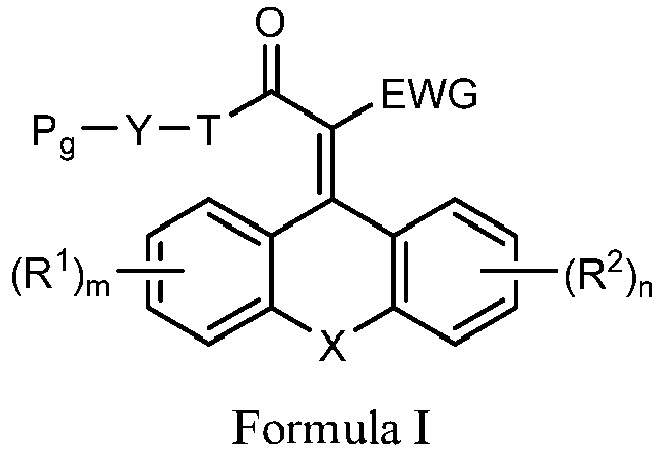
- m and n are independently 0, 1, 2, 3, or 4;
- T is a bond, O, or NR;
- X is O, S, NR, SO, or SO2;
- Y is a linking group;
- Pg is a polymerizable group;
- R at each occurrence is independently H, C1-C6 alkyl, cycloalkyl, heterocycloalkyl, aryl, heteroaryl, or Y-Pg;
- R1 and R2, when present, are independently at each occurrence C1-C6 alkyl, C1-C6 alkoxy, C1-C6 thioalkyl, C3-C7 cycloalkyl, aryl, halo, hydroxy, amino, NR3R4, or benzyl, wherein R3 and R4 are independently H or C1-C6 alkyl, or two adjacent R1 or R2 groups, together with the carbon atoms to which they are attached, combine to form a cycloalkyl or aryl ring; and
- EWG is an electron withdrawing group.
- 24. The ophthalmic device of embodiment 23 further comprising a second polymerizable high energy light absorbing compound.
- 25. The ophthalmic device of embodiment 24 wherein the second polymerizable high energy light absorbing compound is a UV absorbing compound.
- 26. The ophthalmic device of
embodiment 25 wherein the UV absorbing compound comprises a compound of formula I, a benzophenone, a benzotriazole, a triazine, a substituted acrylonitrile, a salicyclic acid derivative, a benzoic acid derivative, a cinnamic acid derivative, a chalcone derivative, a dypnone derivative, a crotonic acid derivative, or mixtures thereof. - 27. The ophthalmic device of any one of embodiments 23 to 26 wherein the polymerizable high energy light absorbing compound comprises a mixture of a compound of formula I wherein X is S and a compound of formula I wherein X is O.
- 28. The ophthalmic device of any one of embodiments 23 to 26 wherein the polymerizable high energy light absorbing compound comprises a mixture of a compound of formula I wherein X is S and a benzotriazole UV absorbing compound.
- 29. The ophthalmic device of any one of embodiments 23 to 28 wherein m and n in the compound of formula I at each occurrence are each 0.
- 30. The ophthalmic device of any one of embodiments 23 to 29 wherein Y in the compound of formula I at each occurrence is independently alkylene, cycloalkylene, heterocycloalkylene, arylene, heteroarylene, oxaalkylene, alkylene-amide-alkylene, alkylene-amine-alkylene, or combinations thereof.
- 31. The ophthalmic device of any one of embodiments 23 to 30 wherein Rg in the compound of formula I at each occurrence independently comprises styryl, vinyl carbonate, vinyl ether, vinyl carbamate, N-vinyl lactam, N-vinylamide, (meth)acrylate, or (meth)acrylamide.
- 32. The ophthalmic device of any one of
embodiments 20 to 31, wherein the ophthalmic device is a silicone hydrogel contact lens, and wherein the silicone hydrogel contact lens has a contact angle of about 70° or less, a water content of at least 25 percent, and an oxygen permeability of at least 80 barrers. - 33. An ophthalmic device that is a polymerized reaction product of a reactive mixture comprising a hydrophilic component, and a silicone containing compound, wherein the polymerized reaction product contains, as covalently bound substituents, one or more chromophores of formula IV:
- m and n are independently 0, 1, 2, 3, or 4;
- X is O, S, NR, SO, or SO2;
- R at each occurrence is independently H, C1-C6 alkyl, cycloalkyl, heterocycloalkyl, aryl, heteroaryl, or a link to the polymerized reaction product;
- R1 and R2, when present, are independently at each occurrence C1-C6 alkyl, C1-C6 alkoxy, C1-C6 thioalkyl, C3-C7 cycloalkyl, aryl, halo, hydroxy, amino, NR3R4, or benzyl, wherein R3 and R4 are independently H or C1-C6 alkyl, or two adjacent R1 or R2 groups, together with the carbon atoms to which they are attached, combine to form a cycloalkyl or aryl ring;
- R5 is a link to the polymerized reaction product; and
- EWG is an electron withdrawing group.
- 34. The ophthalmic device of embodiment 33 wherein X is O.
- 35. The ophthalmic device of embodiment 34 wherein X is S.
- 36. The ophthalmic device of any one of embodiments 33 to 35 wherein the polymerized reaction product further comprises one or more UV absorbing chromophores covalently attached thereto.
- 37. The ophthalmic device of embodiment 36 wherein the UV absorbing chromophore is the residue of a benzophenone, a benzotriazole, a triazine, a substituted acrylonitrile, a salicyclic acid derivative, a benzoic acid derivative, a cinnamic acid derivative, a chalcone derivative, a dypnone derivative, a crotonic acid derivative, or mixtures thereof.
- 38. The ophthalmic device of any one of embodiments 33 to 37 wherein the link to the polymerized reaction product comprises the residue of a polymerizable group and one or more of an alkylene group, a cycloalkylene group, a heterocycloalkylene group, an arylene group, a heteroarylene
group, an oxaalkylene group, an alkylene-amide-alkylene group, or an alkylene-amine-alkylene group. - 39. The ophthalmic device of
embodiment 38 wherein the polymerizable group comprises styryl, vinyl carbonate, vinyl ether, vinyl carbamate, N-vinyl lactam, N-vinylamide, (meth)acrylate, or (meth)acrylamide. - 40. A silicone hydrogel contact lens that is a reaction product of a reactive mixture comprising: a polymerizable high energy light absorbing compound; and one or more monomers suitable for making an ophthalmic device, wherein the contact lens has a contact angle of about 70° or less, a water content of at least 25 percent, and an oxygen permeability of at least 80 barrers, and wherein the contact lens is substantially photostable.
- 41. The silicone hydrogel contact lens of
embodiment 40 wherein the lens transmits: from 1 percent to 70 percent of light having a wavelength of 400 to 409 nm; and at least 80 percent of light having a wavelength of 450 to 800 nm. - 42. The silicone hydrogel contact lens of
embodiment 40 or 41, wherein the polymerizable high energy light absorbing compound is a compound of formula I. - 43. The ophthalmic device of any one of embodiments 23 to 32 wherein EWG is cyano.
- 44. The ophthalmic device of any one of embodiments 33 to 39 wherein EWG is cyano.
- 45. The ophthalmic device of embodiment 42 wherein EWG is cyano.
- 46. A silicone hydrogel formed from a reactive mixture comprising:
- a high energy light absorbing compound;
- between about 1 and about 15 wt% of at least one polyamide;
- at least one first mono-functional, hydroxyl substituted poly(disubstituted siloxane) having 4 to 8 siloxane repeating units;
- at least one second hydroxyl substituted poly(disubstituted siloxane) that is a mono-functional hydroxyl substituted poly(disubstituted siloxane) having 10 to 200 siloxane repeating units; and
- about 5 to about 35 wt% of at least one hydrophilic monomer.
- 47. The silicone hydrogel of embodiment 46 wherein the high energy light absorbing compound is a compound of formula I.
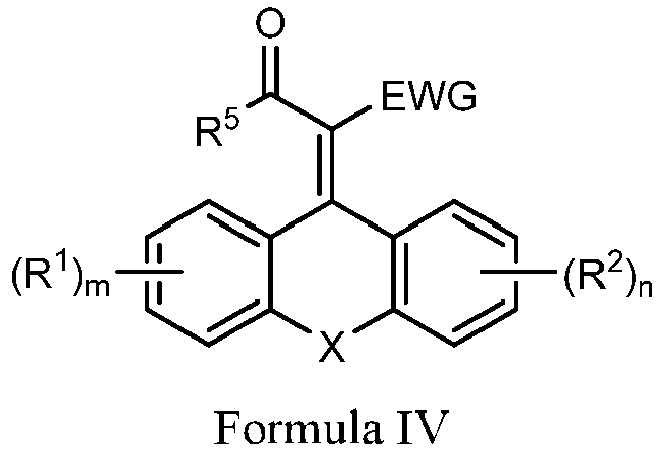
Claims (15)
- A compound of formula I:
 m and n are independently 0, 1, 2, 3, or 4;T is a bond, O, or NR;X is O, S, NR, SO, or SO2;Y is a linking group;Pg is a polymerizable group;R at each occurrence is independently H, C1-C6 alkyl, cycloalkyl, heterocycloalkyl, aryl, heteroaryl, or Y-Pg;R1 and R2, when present, are independently at each occurrence C1-C6 alkyl, C1-C6 alkoxy, C1-C6 thioalkyl, C3-C7 cycloalkyl, aryl, halo, hydroxy, amino, NR3R4, or benzyl, wherein R3 and R4 are independently H or C1-C6 alkyl, or two adjacent R1 or R2 groups, together with the carbon atoms to which they are attached, combine to form a cycloalkyl or aryl ring; andEWG is an electron withdrawing group.
 - The compound of claim 1 that is:2-(2-cyano-2-(9H-thioxanthen-9-ylidene)acetamido)ethyl methacrylate;2-(2-cyano-2-(9H-thioxanthen-9-ylidene)acetamido)ethyl acrylate;N-(2-(2-cyano-2-(9H-thioxanthen-9-ylidene)acetamido)ethyl)methacrylamide;N-(2-(2-cyano-2-(9H-thioxanthen-9-ylidene)acetamido)ethyl)acrylamide;2-(2-cyano-N-methyl-2-(9H-thioxanthen-9-ylidene)acetamido)ethyl methacrylate;2-cyano-2-(9H-thioxanthen-9-ylidene)-N-(2-(N-vinylacetamido)ethyl)acetamide;2-(2-cyano-2-(9H-xanthen-9-ylidene)acetamido)ethyl methacrylate;2-(2-cyano-2-(9H-xanthen-9-ylidene)acetamido)ethyl acrylate;N-(2-(2-cyano-2-(9H-xanthen-9-ylidene)acetamido)ethyl)methacrylamide;N-(2-(2-cyano-2-(9H-xanthen-9-ylidene)acetamido)ethyl)acrylamide;2-(2-cyano-N-methyl-2-(9H-xanthen-9-ylidene)acetamido)ethyl methacrylate;2-cyano-N-(2-(N-vinylacetamido)ethyl)-2-(9H-xanthen-9-ylidene)acetamide;2-(2-(acridin-9(10H)-ylidene)-2-cyanoacetamido)ethyl acrylate;N-(2-(2-(acridin-9(10H)-ylidene)-2-cyanoacetamido)ethyl)methacrylamide;N-(2-(2-(acridin-9(10H)-ylidene)-2-cyanoacetamido)ethyl)acrylamide;2-(2-(acridin-9(10H)-ylidene)-2-cyano-N-methylacetamido)ethyl methacrylate;2-(acridin-9(10H)-ylidene)-2-cyano-N-(2-(N-vinylacetamido)ethyl)acetamide;2-(2-cyano-2-(9H-thioxanthen-9-ylidene)acetamido)-2-methylpropyl methacrylate;2-(2-cyano-2-(9H-xanthen-9-ylidene)acetoxy)-2-methylpropyl acrylate;(Z)-2-(2-cyano-2-(3-hydroxyacridin-9(10H)-ylidene)acetamido)ethyl methacrylate;2-(2-cyano-2-(10-methylacridin-9(10H)-ylidene)acetamido)ethyl methacrylate;2-(2-cyano-2-(3,6-dihydroxyacridin-9(10H)-ylidene)acetamido)ethyl methacrylate;(E)-2-(2-(7H-benzo[c]xanthen-7-ylidene)-2-cyanoacetamido)ethyl methacrylate;(Z)-2-(2-cyano-2-(3-methoxy-9H-xanthen-9-ylidene)acetamido)ethyl methacrylate;2-(2-cyano-2-(3,6-dihydroxy-9H-xanthen-9-ylidene)acetamido)ethyl methacrylate;(E)-2-(2-cyano-2-(2-methyl-9H-xanthen-9-ylidene)acetamido)ethyl methacrylate;(E)-2-(2-cyano-2-(1-hydroxy-9H-xanthen-9-ylidene)acetamido)ethyl methacrylate;(E)-2-(2-cyano-2-(2,4-dichloro-9H-thioxanthen-9-ylidene)acetamido)ethyl methacrylate;(E)-2-(2-(2-chloro-9H-thioxanthen-9-ylidene)-2-cyanoacetamido)ethyl methacrylate;(E)-2-(2-cyano-2-(2-isopropyl-9H-thioxanthen-9-ylidene)acetamido)ethyl methacrylate;(E)-2-(2-cyano-2-(4-isopropyl-9H-thioxanthen-9-ylidene)acetamido)ethyl methacrylate;.2-(3-oxo-2-(9H-thioxanthen-9-ylidene)propanamido)ethyl methacrylate;2-(3-oxo-2-(9H-thioxanthen-9-ylidene)butanamido)ethyl methacrylate;2-(3-methoxy-3-oxo-2-(9H-thioxanthen-9-ylidene)propanamido)ethyl methacrylate;2-(3-amino-3-oxo-2-(9H-thioxanthen-9-ylidene)propanamido)ethyl methacrylate;2-(2-cyano-2-(10,10-dioxido-9H-thioxanthen-9-ylidene)acetamido)ethyl methacrylate;N-(2-(2-cyano-2-(10-methylacridin-9(10H)ylidene)acetamido)ethyl) methacrylamide; or2-(2-cyano-2-(9H-thioxanthen-9-ylidene)acetoxy)ethyl methacrylate.
- An ophthalmic device that is a free radical reaction product of a reactive mixture comprising: one or more monomers suitable for making the ophthalmic device; and a polymerizable high energy light absorbing compound comprising a compound of claims 1 or 2; optionally:i) wherein the monomer suitable for making the ophthalmic device comprises a hydrophilic component, a silicone-containing component, or mixtures thereof; and/orii) wherein the ophthalmic device is a contact lens, a corneal onlay, a corneal inlay, an intraocular lens, or an overlay lens; optionally wherein the ophthalmic device is a hydrogel contact lens.
- A method for making an ophthalmic device, the method comprising:(a) providing a reactive mixture containing a compound according to claims 1 or 2, one or more device forming monomers, and a radical initiator; and(b) polymerizing the reactive mixture to form the ophthalmic device.
- An ophthalmic device that is a reaction product of a reactive mixture comprising:a polymerizable high energy light absorbing compound; andone or more monomers suitable for making an ophthalmic device,wherein the ophthalmic device transmits:45 percent or less of light having a wavelength of 280 to 399 nm;from 1 percent to 70 percent of light having a wavelength of 400 to 409 nm; andat least 80 percent of light having a wavelength of 450 to 800 nm.
- The ophthalmic device of claim 5 wherein the polymerizable high energy light absorbing compound comprises a compound of formula I:
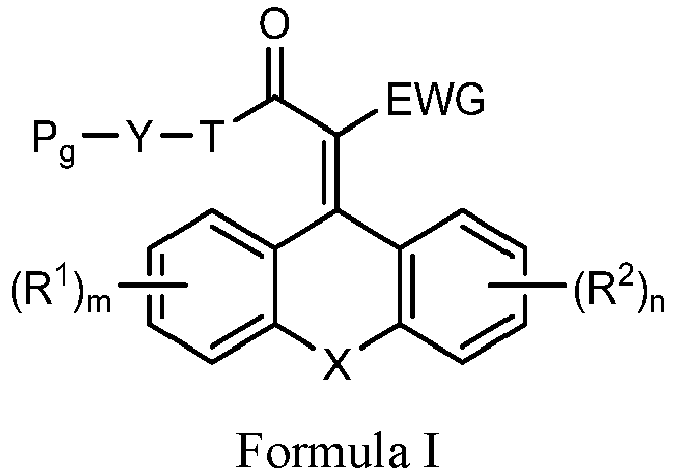 m and n are independently 0, 1, 2, 3, or 4;T is a bond, O, or NR;X is O, S, NR, SO, or SO2;Y is a linking group;Pg is a polymerizable group;R at each occurrence is independently H, C1-C6 alkyl, cycloalkyl, heterocycloalkyl, aryl, heteroaryl, or Y-Pg;R1 and R2, when present, are independently at each occurrence C1-C6 alkyl, C1-C6 alkoxy, C1-C6 thioalkyl, C3-C7 cycloalkyl, aryl, halo, hydroxy, amino, NR3R4, or benzyl, wherein R3 and R4 are independently H or C1-C6 alkyl, or two adjacent R1 or R2 groups, together with the carbon atoms to which they are attached, combine to form a cycloalkyl or aryl ring; andEWG is an electron withdrawing group.
 - The ophthalmic device of claims 3 or 6 further comprising a second polymerizable high energy light absorbing compound;optionally wherein the second polymerizable high energy light absorbing compound is a UV absorbing compound;optionally wherein the UV absorbing compound comprises a compound of formula I, a benzophenone, a benzotriazole, a triazine, a substituted acrylonitrile, a salicyclic acid derivative, a benzoic acid derivative, a cinnamic acid derivative, a chalcone derivative, a dypnone derivative, a crotonic acid derivative, or mixtures thereof.
- The ophthalmic device of claims 3, 6, or 7:i) wherein the polymerizable high energy light absorbing compound comprises a mixture of a compound of formula I wherein X is S and a compound of formula I wherein X is O; orii) wherein the polymerizable high energy light absorbing compound comprises a mixture of a compound of formula I wherein X is S and a benzotriazole UV absorbing compound.
- The ophthalmic device of any one of claims 3 and 6 to 8 wherein:i) m and n in the compound of formula I at each occurrence are each 0; and/orii) Y in the compound of formula I at each occurrence is independently alkylene, cycloalkylene, heterocycloalkylene, arylene, heteroarylene, oxaalkylene, alkylene-amide-alkylene, alkylene-amine-alkylene, or combinations thereof; and/oriii) wherein Pg in the compound of formula I at each occurrence independently comprises styryl, vinyl carbonate, vinyl ether, vinyl carbamate, N-vinyl lactam, N-vinylamide, (meth)acrylate, or (meth)acrylamide.
- An ophthalmic device that is a polymerized reaction product of a reactive mixture comprising a hydrophilic component, and a silicone containing compound, wherein the polymerized reaction product contains, as covalently bound substituents, one or more chromophores of formula IV:
 m and n are independently 0, 1, 2, 3, or 4;X is O, S, NR, SO, or SO2;R at each occurrence is independently H, C1-C6 alkyl, cycloalkyl, heterocycloalkyl, aryl, heteroaryl, or a link to the polymerized reaction product;R1 and R2, when present, are independently at each occurrence C1-C6 alkyl, Ci-C6 alkoxy, C1-C6 thioalkyl, C3-C7 cycloalkyl, aryl, halo, hydroxy, amino, NR3R4, or benzyl, wherein R3 and R4 are independently H or C1-C6 alkyl, or two adjacent R1 or R2 groups, together with the carbon atoms to which they are attached, combine to form a cycloalkyl or aryl ring;R5 is a link to the polymerized reaction product; andEWG is an electron withdrawing group.
 - The compound of claim 1 or the ophthalmic device of claim 10 wherein X is O or wherein X is S.
- The ophthalmic device of claims 10 or 11 wherein:i) the polymerized reaction product further comprises one or more UV absorbing chromophores covalently attached thereto;
optionally wherein the UV absorbing chromophore is the residue of a benzophenone, a benzotriazole, a triazine, a substituted acrylonitrile, a salicyclic acid derivative, a benzoic acid derivative, a cinnamic acid derivative, a chalcone derivative, a dypnone derivative, a crotonic acid derivative, or mixtures thereof; and/orii) the link to the polymerized reaction product comprises the residue of a polymerizable group and one or more of an alkylene group, a cycloalkylene group, a heterocycloalkylene group, an arylene group, a heteroarylene group, an oxaalkylene group, an alkylene-amide-alkylene group, or an alkylene-amine-alkylene group;
optionally wherein the polymerizable group comprises styryl, vinyl carbonate, vinyl ether, vinyl carbamate, N-vinyl lactam, N-vinylamide, (meth)acrylate, or (meth)acrylamide. - A silicone hydrogel contact lens that is a reaction product of a reactive mixture comprising: a polymerizable high energy light absorbing compound; and one or more monomers suitable for making an ophthalmic device, wherein the contact lens has a contact angle of about 70° or less, a water content of at least 25 percent, and an oxygen permeability of at least 80 barrers, and wherein the contact lens is substantially photostable;
optionally whereini) the lens transmits: from 1 percent to 70 percent of light having a wavelength of 400 to 409 nm; and at least 80 percent of light having a wavelength of 450 to 800 nm; and/orii) the polymerizable high energy light absorbing compound is a compound of formula I. - The compound of claims 1 or 11 or the ophthalmic device of any one of claims 3, 6 to 9, 10 to 12, or 13, part ii) wherein EWG is cyano.
- A silicone hydrogel formed from a reactive mixture comprising:a high energy light absorbing compound;between about 1 and about 15 wt% of at least one polyamide;at least one first mono-functional, hydroxyl substituted poly(disubstituted siloxane) having 4 to 8 siloxane repeating units;at least one second hydroxyl substituted poly(disubstituted siloxane) that is a mono-functional hydroxyl substituted poly(disubstituted siloxane) having 10 to 200 siloxane repeating units; andabout 5 to about 35 wt% of at least one hydrophilic monomer;optionally wherein the high energy light absorbing compound is a compound of formula I.
Applications Claiming Priority (5)
| Application Number | Priority Date | Filing Date | Title |
|---|---|---|---|
| US201862637505P | 2018-03-02 | 2018-03-02 | |
| US201862691112P | 2018-06-28 | 2018-06-28 | |
| US16/268,897 US10935695B2 (en) | 2018-03-02 | 2019-02-06 | Polymerizable absorbers of UV and high energy visible light |
| EP19713578.3A EP3759171B9 (en) | 2018-03-02 | 2019-02-27 | An ophthalmic device comprising polymerizable absorbers of uv and high energy visible light |
| PCT/IB2019/051582 WO2019166971A1 (en) | 2018-03-02 | 2019-02-27 | Polymerizable absorbers of uv and high energy visible light |
Related Parent Applications (2)
| Application Number | Title | Priority Date | Filing Date |
|---|---|---|---|
| EP19713578.3A Division EP3759171B9 (en) | 2018-03-02 | 2019-02-27 | An ophthalmic device comprising polymerizable absorbers of uv and high energy visible light |
| EP19713578.3A Division-Into EP3759171B9 (en) | 2018-03-02 | 2019-02-27 | An ophthalmic device comprising polymerizable absorbers of uv and high energy visible light |
Publications (2)
| Publication Number | Publication Date |
|---|---|
| EP4219632A2 true EP4219632A2 (en) | 2023-08-02 |
| EP4219632A3 EP4219632A3 (en) | 2023-11-01 |
Family
ID=67768587
Family Applications (2)
| Application Number | Title | Priority Date | Filing Date |
|---|---|---|---|
| EP19713578.3A Active EP3759171B9 (en) | 2018-03-02 | 2019-02-27 | An ophthalmic device comprising polymerizable absorbers of uv and high energy visible light |
| EP23156522.7A Pending EP4219632A3 (en) | 2018-03-02 | 2019-02-27 | Polymerizable absorbers of uv and high energy visible light |
Family Applications Before (1)
| Application Number | Title | Priority Date | Filing Date |
|---|---|---|---|
| EP19713578.3A Active EP3759171B9 (en) | 2018-03-02 | 2019-02-27 | An ophthalmic device comprising polymerizable absorbers of uv and high energy visible light |
Country Status (9)
| Country | Link |
|---|---|
| US (3) | US10935695B2 (en) |
| EP (2) | EP3759171B9 (en) |
| JP (3) | JP7343514B2 (en) |
| KR (1) | KR102770550B1 (en) |
| CN (2) | CN111801389B (en) |
| AU (2) | AU2019228391B2 (en) |
| HU (1) | HUE061752T2 (en) |
| TW (2) | TWI831608B (en) |
| WO (1) | WO2019166971A1 (en) |
Families Citing this family (39)
| Publication number | Priority date | Publication date | Assignee | Title |
|---|---|---|---|---|
| US12486348B2 (en) | 2019-08-30 | 2025-12-02 | Johnson & Johnson Vision Care, Inc. | Contact lens displaying improved vision attributes |
| US12534623B2 (en) | 2018-03-02 | 2026-01-27 | Johnson & Johnson Vision Care, Inc. | Contact lens with improved tear film optical quality |
| US11543683B2 (en) | 2019-08-30 | 2023-01-03 | Johnson & Johnson Vision Care, Inc. | Multifocal contact lens displaying improved vision attributes |
| US12486403B2 (en) | 2018-03-02 | 2025-12-02 | Johnson & Johnson Vision Care, Inc. | Polymerizable absorbers of UV and high energy visible light |
| US11993037B1 (en) * | 2018-03-02 | 2024-05-28 | Johnson & Johnson Vision Care, Inc. | Contact lens displaying improved vision attributes |
| US12595371B2 (en) | 2018-03-02 | 2026-04-07 | Johnson & Johnson Vision Care, Inc. | Contact lens with improved vision break-up time |
| US12595370B2 (en) | 2018-03-02 | 2026-04-07 | Johnson & Johnson Vision Care, Inc. | Polymerizable absorbers of UV and high energy visible light |
| US10935695B2 (en) | 2018-03-02 | 2021-03-02 | Johnson & Johnson Vision Care, Inc. | Polymerizable absorbers of UV and high energy visible light |
| AU2019304450A1 (en) * | 2018-07-17 | 2021-03-11 | Evonik Operations Gmbh | Method for preparing C-H acidic (meth)acrylates |
| BR112021000684A2 (en) * | 2018-07-17 | 2021-04-13 | Evonik Operations Gmbh | METACRYLIC ACID ESTERS, COPOLYMER OBTAINABLE BY THE POLYMERIZATION OF A MONOMER MIXTURE, WATER DISPERSION AND ITS USE, AS WELL AS, COATING OBTAINABLE BY THE APPLICATION OF WATER DISPERSION |
| KR102894609B1 (en) | 2019-05-03 | 2025-12-04 | 존슨 앤드 존슨 서지컬 비전, 인코포레이티드 | High refractive index, high Abbe composition |
| US11958824B2 (en) * | 2019-06-28 | 2024-04-16 | Johnson & Johnson Vision Care, Inc. | Photostable mimics of macular pigment |
| US12509428B2 (en) | 2019-06-28 | 2025-12-30 | Johnson & Johnson Vision Care, Inc. | Polymerizable fused tricyclic compounds as absorbers of UV and visible light |
| US11360240B2 (en) | 2019-12-19 | 2022-06-14 | Johnson & Johnson Vision Care, Inc. | Contact lens containing photosensitive chromophore and package therefor |
| US12116443B2 (en) | 2020-06-16 | 2024-10-15 | Johnson & Johnson Vision Care, Inc. | Amino acid-based polymerizable compounds and ophthalmic devices prepared therefrom |
| US12180318B2 (en) | 2020-06-16 | 2024-12-31 | Johnson & Johnson Vision Care, Inc. | Imidazolium zwitterion polymerizable compounds and ophthalmic devices incorporating them |
| US20220194944A1 (en) * | 2020-12-18 | 2022-06-23 | Johnson & Johnson Vision Care, Inc. | Photostable mimics of macular pigment |
| US12310474B2 (en) | 2021-10-08 | 2025-05-27 | Johnson & Johnson Vision Care, Inc. | Multi-material lens package |
| CN114085165B (en) * | 2021-11-25 | 2024-01-09 | 湖北中科博宏新材料科技有限公司 | A kind of α-H-containing cyano-modified acrylate resin and its preparation method and application |
| US12517282B2 (en) * | 2021-12-20 | 2026-01-06 | Johnson & Johnson Vision Care, Inc. | Contact lenses containing light absorbing regions and methods for their preparation |
| CN119137169A (en) * | 2022-04-27 | 2024-12-13 | 株式会社目立康 | Additive polymer and silicone hydrogel lens materials |
| US12595368B2 (en) | 2022-05-23 | 2026-04-07 | Alcon Inc. | UV/HEVL-filtering contact lenses |
| WO2023228054A1 (en) | 2022-05-23 | 2023-11-30 | Alcon Inc. | Method for making hevl-filtering contact lenses |
| US20250362432A1 (en) * | 2022-06-16 | 2025-11-27 | Johnson & Johnson Vision Care, Inc. | Ophthalmic devices containing photostable mimics of macular pigment and other visible light filters |
| EP4626495A1 (en) | 2022-12-01 | 2025-10-08 | Johnson & Johnson Surgical Vision, Inc. | Ophthalmic lens materials and devices made thereof |
| WO2024134384A1 (en) | 2022-12-21 | 2024-06-27 | Johnson & Johnson Vision Care, Inc. | Compositions for ophthalmologic devices |
| TW202439974A (en) | 2022-12-21 | 2024-10-16 | 美商壯生和壯生視覺關懷公司 | Compositions for ophthalmic devices |
| WO2024134382A1 (en) | 2022-12-21 | 2024-06-27 | Johnson & Johnson Vision Care, Inc. | Compositions for ophthalmologic devices |
| WO2024134381A1 (en) | 2022-12-21 | 2024-06-27 | Johnson & Johnson Vision Care, Inc. | Compositions for ophthalmologic devices |
| EP4696724A1 (en) | 2023-04-10 | 2026-02-18 | Toray Industries, Inc. | Silicone monomer mixture and silicone monomer composition |
| CN119654577B (en) * | 2023-05-15 | 2026-02-27 | 库博光学国际有限公司 | Radiation blocking agents for contact lenses |
| EP4465097A1 (en) * | 2023-05-15 | 2024-11-20 | CooperVision International Limited | Radiation blockers for contact lenses |
| EP4713721A1 (en) | 2023-05-18 | 2026-03-25 | Alcon Inc. | Uv/hevl-filtering silicone hydrogel contact lenses |
| EP4713720A2 (en) | 2023-05-18 | 2026-03-25 | Alcon Inc. | High-energy-violet-absorbing vinylic monomers |
| CN121443681A (en) | 2023-08-07 | 2026-01-30 | 爱尔康公司 | UV/HEVL Filtering Silicone Hydrogel Contact Lenses |
| US20250361401A1 (en) | 2024-05-22 | 2025-11-27 | Alcon Inc. | Reactive dyes |
| US20250362530A1 (en) | 2024-05-22 | 2025-11-27 | Alcon Inc. | Method for making centrally colored contact lenses |
| WO2025243221A1 (en) | 2024-05-22 | 2025-11-27 | Alcon Inc. | Reactive hevl-absorbing dyes |
| US20260109796A1 (en) | 2024-10-17 | 2026-04-23 | Johnson & Johnson Surgical Vision, Inc. | Materials and methods for light adjustable ophthalmic devices |
Citations (74)
| Publication number | Priority date | Publication date | Assignee | Title |
|---|---|---|---|---|
| US3408429A (en) | 1963-09-11 | 1968-10-29 | Ceskoslovenska Akademie Ved | Method for centrifugal casting a contact lens |
| US3660545A (en) | 1961-12-27 | 1972-05-02 | Ceskoslovenska Akademie Ved | Method of centrifugally casting thin edged corneal contact lenses |
| US3808178A (en) | 1972-06-16 | 1974-04-30 | Polycon Laboratories | Oxygen-permeable contact lens composition,methods and article of manufacture |
| US4113224A (en) | 1975-04-08 | 1978-09-12 | Bausch & Lomb Incorporated | Apparatus for forming optical lenses |
| US4120570A (en) | 1976-06-22 | 1978-10-17 | Syntex (U.S.A.) Inc. | Method for correcting visual defects, compositions and articles of manufacture useful therein |
| US4136250A (en) | 1977-07-20 | 1979-01-23 | Ciba-Geigy Corporation | Polysiloxane hydrogels |
| US4153641A (en) | 1977-07-25 | 1979-05-08 | Bausch & Lomb Incorporated | Polysiloxane composition and contact lens |
| US4197266A (en) | 1974-05-06 | 1980-04-08 | Bausch & Lomb Incorporated | Method for forming optical lenses |
| EP0080539A1 (en) | 1981-11-27 | 1983-06-08 | Tsuetaki, George F. | Polymers primarily for contact lenses, and contact lenses made from them |
| US4436887A (en) | 1981-11-12 | 1984-03-13 | Bausch & Lomb Incorporated | N-Vinyl lactam based biomedical devices |
| US4495313A (en) | 1981-04-30 | 1985-01-22 | Mia Lens Production A/S | Preparation of hydrogel for soft contact lens with water displaceable boric acid ester |
| US4659783A (en) | 1984-07-05 | 1987-04-21 | E. I. Du Pont De Nemours And Company | Acrylic star polymers containing multifunctional monomers in the core |
| US4740533A (en) | 1987-07-28 | 1988-04-26 | Ciba-Geigy Corporation | Wettable, flexible, oxygen permeable, substantially non-swellable contact lens containing block copolymer polysiloxane-polyoxyalkylene backbone units, and use thereof |
| US4889664A (en) | 1988-11-25 | 1989-12-26 | Vistakon, Inc. | Method of forming shaped hydrogel articles including contact lenses |
| US4910277A (en) | 1988-02-09 | 1990-03-20 | Bambury Ronald E | Hydrophilic oxygen permeable polymers |
| US5006622A (en) | 1987-04-02 | 1991-04-09 | Bausch & Lomb Incorporated | Polymer compositions for contact lenses |
| US5034461A (en) | 1989-06-07 | 1991-07-23 | Bausch & Lomb Incorporated | Novel prepolymers useful in biomedical devices |
| US5039459A (en) | 1988-11-25 | 1991-08-13 | Johnson & Johnson Vision Products, Inc. | Method of forming shaped hydrogel articles including contact lenses |
| US5070215A (en) | 1989-05-02 | 1991-12-03 | Bausch & Lomb Incorporated | Novel vinyl carbonate and vinyl carbamate contact lens material monomers |
| US5236969A (en) | 1987-04-02 | 1993-08-17 | Bausch & Lomb Incorporated | Polymer compositions for contact lenses |
| US5244981A (en) | 1990-04-10 | 1993-09-14 | Permeable Technologies, Inc. | Silicone-containing contact lens polymers, oxygen permeable contact lenses and methods for making these lenses and treating patients with visual impairment |
| US5270418A (en) | 1987-04-02 | 1993-12-14 | Bausch & Lomb Incorporated | Polymer compositions for contact lenses |
| US5298533A (en) | 1992-12-02 | 1994-03-29 | Bausch & Lomb Incorporated | Polymer compositions for contact lenses |
| US5314960A (en) | 1990-04-10 | 1994-05-24 | Permeable Technologies, Inc. | Silicone-containing polymers, oxygen permeable hydrophilic contact lenses and methods for making these lenses and treating patients with visual impairment |
| US5371147A (en) | 1990-10-11 | 1994-12-06 | Permeable Technologies, Inc. | Silicone-containing acrylic star polymers, block copolymers and macromonomers |
| US5760100A (en) | 1994-09-06 | 1998-06-02 | Ciba Vision Corporation | Extended wear ophthalmic lens |
| US5776999A (en) | 1994-09-06 | 1998-07-07 | Ciba Vision Corporation | Methods of using and screening extended wear ophthalmic lenses |
| US5824719A (en) | 1995-06-07 | 1998-10-20 | Bausch & Lomb Incorporated | Polymer compositions for contact lenses |
| US5944853A (en) | 1992-10-26 | 1999-08-31 | Johnson & Johnson Vision Products, Inc. | Method for preparing halotriazine dye- and vinyl sulfone dye-monomer compounds |
| US5962548A (en) | 1998-03-02 | 1999-10-05 | Johnson & Johnson Vision Products, Inc. | Silicone hydrogel polymers |
| US5998498A (en) | 1998-03-02 | 1999-12-07 | Johnson & Johnson Vision Products, Inc. | Soft contact lenses |
| US6020445A (en) | 1997-10-09 | 2000-02-01 | Johnson & Johnson Vision Products, Inc. | Silicone hydrogel polymers |
| US6087415A (en) | 1998-06-11 | 2000-07-11 | Johnson & Johnson Vision Care, Inc. | Biomedical devices with hydrophilic coatings |
| US6367929B1 (en) | 1998-03-02 | 2002-04-09 | Johnson & Johnson Vision Care, Inc. | Hydrogel with internal wetting agent |
| US6420453B1 (en) | 1990-10-29 | 2002-07-16 | Biocompatibles Limited | Contact lens material |
| WO2003022321A2 (en) | 2001-09-10 | 2003-03-20 | Johnson & Johnson Vision Care, Inc. | Biomedical devices containing internal wetting agents |
| US6767979B1 (en) | 1998-12-11 | 2004-07-27 | Biocompatibles Uk Limited | Crosslinked polymers and refractive devices formed therefrom |
| US6822016B2 (en) | 2001-09-10 | 2004-11-23 | Johnson & Johnson Vision Care, Inc. | Biomedical devices containing internal wetting agents |
| US6867245B2 (en) | 1999-12-16 | 2005-03-15 | Asahikasei Aime Co., Ltd. | Long wearable soft contact lens |
| US6943203B2 (en) | 1998-03-02 | 2005-09-13 | Johnson & Johnson Vision Care, Inc. | Soft contact lenses |
| US7247692B2 (en) | 2004-09-30 | 2007-07-24 | Johnson & Johnson Vision Care, Inc. | Biomedical devices containing amphiphilic block copolymers |
| US7249848B2 (en) | 2004-09-30 | 2007-07-31 | Johnson & Johnson Vision Care, Inc. | Wettable hydrogels comprising reactive, hydrophilic, polymeric internal wetting agents |
| WO2008061992A2 (en) | 2006-11-22 | 2008-05-29 | Sauflon Cl Limited | Contact lens |
| US7396890B2 (en) | 2004-02-11 | 2008-07-08 | Johnson & Johnson Vision Care, Inc. | (Meth)acrylamide monomers containing hydroxy and silicone functionalities |
| US7461937B2 (en) | 2001-09-10 | 2008-12-09 | Johnson & Johnson Vision Care, Inc. | Soft contact lenses displaying superior on-eye comfort |
| US7468398B2 (en) | 1994-09-06 | 2008-12-23 | Ciba Vision Corporation | Extended wear ophthalmic lens |
| US7572841B2 (en) | 2006-06-15 | 2009-08-11 | Coopervision International Holding Company, Lp | Wettable silicone hydrogel contact lenses and related compositions and methods |
| US7786185B2 (en) | 2004-03-05 | 2010-08-31 | Johnson & Johnson Vision Care, Inc. | Wettable hydrogels comprising acyclic polyamides |
| US7825170B2 (en) | 1998-03-02 | 2010-11-02 | Johnson & Johnson Vision Care, Inc. | Contact lenses |
| US7915323B2 (en) | 2009-07-09 | 2011-03-29 | Bausch & Lamb Incorporated | Mono ethylenically unsaturated polycarbosiloxane monomers |
| US7934830B2 (en) | 2007-12-03 | 2011-05-03 | Bausch & Lomb Incorporated | High water content silicone hydrogels |
| US7956131B2 (en) | 2004-09-30 | 2011-06-07 | Johnson & Johnson Vision Care, Inc. | Lactam polymer derivatives |
| US7994356B2 (en) | 2009-07-09 | 2011-08-09 | Bausch & Lomb Incorporated | Mono ethylenically unsaturated polycarbosiloxane monomers |
| US8138290B2 (en) | 2008-01-25 | 2012-03-20 | Bausch & Lomb Incorporated | High water content ophthalmic devices |
| US8163206B2 (en) | 2008-12-18 | 2012-04-24 | Novartis Ag | Method for making silicone hydrogel contact lenses |
| US8420711B2 (en) | 2009-07-09 | 2013-04-16 | Bausch & Lomb Incorporated | Mono ethylenically unsaturated polymerizable group containing polycarbosiloxane monomers |
| US8470906B2 (en) | 2008-09-30 | 2013-06-25 | Johnson & Johnson Vision Care, Inc. | Ionic silicone hydrogels having improved hydrolytic stability |
| US8487058B2 (en) | 2011-02-28 | 2013-07-16 | Coopervision International Holding Company, Lp | Wettable silicone hydrogel contact lenses |
| US8507577B2 (en) | 2006-10-31 | 2013-08-13 | Johnson & Johnson Vision Care, Inc. | Process for forming clear, wettable silicone hydrogel articles |
| US8937110B2 (en) | 2011-12-23 | 2015-01-20 | Johnson & Johnson Vision Care, Inc. | Silicone hydrogels having a structure formed via controlled reaction kinetics |
| US8937111B2 (en) | 2011-12-23 | 2015-01-20 | Johnson & Johnson Vision Care, Inc. | Silicone hydrogels comprising desirable water content and oxygen permeability |
| US8940812B2 (en) | 2012-01-17 | 2015-01-27 | Johnson & Johnson Vision Care, Inc. | Silicone polymers comprising sulfonic acid groups |
| US8980972B2 (en) | 2011-11-10 | 2015-03-17 | Vertellus Specialties Inc. | Polymerisable material |
| US9056878B2 (en) | 2006-09-29 | 2015-06-16 | Johnson & Johnson Vision Care, Inc. | Hydrolysis-resistant silicone compounds |
| US9057821B2 (en) | 2009-10-12 | 2015-06-16 | Sauflon Cl Limited | Method of making a contact lens |
| US9125808B2 (en) | 2011-12-23 | 2015-09-08 | Johnson & Johnson Vision Care, Inc. | Ionic silicone hydrogels |
| US9140825B2 (en) | 2011-12-23 | 2015-09-22 | Johnson & Johnson Vision Care, Inc. | Ionic silicone hydrogels |
| US9156934B2 (en) | 2011-12-23 | 2015-10-13 | Johnson & Johnson Vision Care, Inc. | Silicone hydrogels comprising n-vinyl amides and hydroxyalkyl (meth)acrylates or (meth)acrylamides |
| US9170349B2 (en) | 2011-05-04 | 2015-10-27 | Johnson & Johnson Vision Care, Inc. | Medical devices having homogeneous charge density and methods for making same |
| US9217813B2 (en) | 2011-02-28 | 2015-12-22 | Coopervision International Holding Company, Lp | Silicone hydrogel contact lenses |
| US9244196B2 (en) | 2012-05-25 | 2016-01-26 | Johnson & Johnson Vision Care, Inc. | Polymers and nanogel materials and methods for making and using the same |
| US9297929B2 (en) | 2012-05-25 | 2016-03-29 | Johnson & Johnson Vision Care, Inc. | Contact lenses comprising water soluble N-(2 hydroxyalkyl) (meth)acrylamide polymers or copolymers |
| US9297928B2 (en) | 2004-11-22 | 2016-03-29 | Johnson & Johnson Vision Care, Inc. | Ophthalmic compositions comprising polyether substituted polymers |
| US20180037690A1 (en) | 2016-08-05 | 2018-02-08 | Johnson & Johnson Vision Care, Inc. | Polymer compositions containing grafted polymeric networks and processes for their preparation and use |
Family Cites Families (154)
| Publication number | Priority date | Publication date | Assignee | Title |
|---|---|---|---|---|
| GB217810A (en) | 1923-09-24 | 1924-06-26 | Fuller S United Electric Works | Improvements in and relating to electro-magnetic sound reporducers |
| US3196150A (en) * | 1963-01-15 | 1965-07-20 | Pfizer & Co C | 2 chloro-9-[13-(4 carbamoyl-1-piperazinyl) propylidene]thioxanthene derivatives |
| DE1293364B (en) | 1965-02-24 | 1969-04-24 | Hoechst Ag | Process for the production of dyes |
| US3394125A (en) | 1965-10-23 | 1968-07-23 | Bristol Myers Co | 2-phenyl-3-tertiary-aminoalkoxy phenyl-and corresponding tertiaryaminoalkyl thio benzfurans substituted in the benzo nucleus with an alkoxy or tertiaryamino alkoxy or alkylthio group |
| NZ208751A (en) | 1983-07-11 | 1987-04-30 | Iolab Corp | 2-hydroxy-5-acrylyloxyalkylphenyl-2h-benzotriazole derivatives and polymers and copolymers thereof and use as uv absorbing additives in polymer compositions |
| US4659763A (en) | 1986-01-06 | 1987-04-21 | General Electric Company | Modified polyphenylene ether-polyamide compositions |
| US4716234A (en) | 1986-12-01 | 1987-12-29 | Iolab Corporation | Ultraviolet absorbing polymers comprising 2-(2'-hydroxy-5'-acryloyloxyalkoxyphenyl)-2H-benzotriazole |
| US4997897A (en) | 1990-04-03 | 1991-03-05 | Bausch & Lomb Incorporated | Polymerizable dye |
| KR100340651B1 (en) | 1993-04-22 | 2002-11-18 | 웨슬리제센코포레이션 | Uv-absorbing benzotriazoles having a styrene group |
| GB9309621D0 (en) | 1993-05-11 | 1993-06-23 | Wellcome Found | Amide derivatives and their therapeutic use |
| JPH0743918A (en) * | 1993-07-26 | 1995-02-14 | Konica Corp | Electrophotographic photoreceptor |
| US5470932A (en) | 1993-10-18 | 1995-11-28 | Alcon Laboratories, Inc. | Polymerizable yellow dyes and their use in opthalmic lenses |
| US5480927A (en) | 1994-05-20 | 1996-01-02 | Ciba Geigy Corporation | Method of increasing the concentration of radiation-absorbing agents in optical and ophthalmic lenses |
| FR2751648B1 (en) | 1996-07-25 | 1998-09-25 | Corning Inc | PHOTOCHROMIC NAPHTHOPYRANS, COMPOSITIONS AND ARTICLES CONTAINING THEM |
| DE19632550A1 (en) | 1996-08-13 | 1998-02-19 | Moeller Plast Gmbh | Wall or building element and process for its manufacture |
| US5977219A (en) | 1997-10-30 | 1999-11-02 | Ciba Specialty Chemicals Corporation | Benzotriazole UV absorbers having enhanced durability |
| US6166218A (en) | 1996-11-07 | 2000-12-26 | Ciba Specialty Chemicals Corporation | Benzotriazole UV absorbers having enhanced durability |
| CH693032A5 (en) | 1996-11-07 | 2003-01-31 | Ciba Sc Holding Ag | Benzotriazole UV absorbent with increased durability. |
| US5916719A (en) | 1996-12-04 | 1999-06-29 | Samsung Display Devices Co., Ltd. | Composition of photoconductive layer for a color display panel |
| ATE270619T1 (en) | 1997-04-02 | 2004-07-15 | Seiko Epson Corp | PAPER ROLL LOADING MECHANISM FOR PRINTER |
| JP2963945B2 (en) | 1997-05-08 | 1999-10-18 | 大塚化学株式会社 | 2,2'-bis (6-benzotriazolylphenol) compound |
| US6158862A (en) | 1997-12-04 | 2000-12-12 | Alcon Laboratories, Inc. | Method of reducing glare associated with multifocal ophthalmic lenses |
| US5945465A (en) | 1998-05-15 | 1999-08-31 | Bausch & Lomb Incorporated | Method for polymerizing contact lenses having UV absorbing properties |
| US6244707B1 (en) | 1998-07-21 | 2001-06-12 | Wesley Jessen Corporation | UV blocking lenses and material containing benzotriazoles and benzophenones |
| US6214499B1 (en) | 1998-09-11 | 2001-04-10 | Eastman Kodak Company | Liquid crystalline filter dyes for imaging elements |
| WO2000029877A1 (en) | 1998-11-16 | 2000-05-25 | Optische Werke G. Rodenstock | Neutral-colored gray photochromic plastic object |
| CA2386247A1 (en) | 1999-10-22 | 2001-05-03 | Wesley Jessen Corporation | Sterile photochromic hydrophilic contact lenses |
| US20020042653A1 (en) | 1999-11-23 | 2002-04-11 | Copeland Victor L. | Blue blocking intraocular lens implant |
| US6451887B1 (en) | 2000-08-03 | 2002-09-17 | Ciba Specialty Chemicals Corporation | Benzotriazoles containing α-cumyl groups substituted by heteroatoms and compositions stabilized therewith |
| US8403478B2 (en) | 2001-11-02 | 2013-03-26 | High Performance Optics, Inc. | Ophthalmic lens to preserve macular integrity |
| US7066596B2 (en) | 2001-11-02 | 2006-06-27 | Andrew Ishak | Rugate lens for glasses |
| US20040070726A1 (en) | 2000-11-03 | 2004-04-15 | Andrew Ishak | Waterman's sunglass lens |
| MXPA03004655A (en) | 2000-11-27 | 2003-09-04 | Ciba Sc Holding Ag | Substituted 5-aryl and 5-heteroaryl-2-(2-hydroxyphenyl)-2h-benzotriazole derivatives as uv absorbers. |
| RU2197907C2 (en) | 2001-03-02 | 2003-02-10 | Государственное учреждение Межотраслевой научно-технический комплекс "Микрохирургия глаза" | Ophthalmological device |
| RU2196557C2 (en) | 2001-03-02 | 2003-01-20 | Государственное учреждение Межотраслевой научно-технический комплекс "Микрохирургия глаза" | Ophthalmological device for marking antiglaucoma operation zone |
| DE60318308T2 (en) | 2002-04-15 | 2009-03-05 | Solvay Advanced Polymers, Llc | POLYSULPHON COMPOSITIONS, WHICH HAVE REDUCED AGGREGATION AND HIGH LIGHT PERMEABILITY, AND OBJECTS MANUFACTURED THEREFROM |
| JP2004243596A (en) | 2003-02-12 | 2004-09-02 | Mitsui Chemicals Inc | Optical recording medium and 3,3-disubstituted-2-cyanoacrylic acid derivative |
| JP2004277581A (en) | 2003-03-17 | 2004-10-07 | Konica Minolta Holdings Inc | Cellulose ester film, polarizer, liquid crystal display device, and manufacturing process of cellulose ester film and polarizer |
| US20050055091A1 (en) | 2003-09-08 | 2005-03-10 | Yu-Chin Lai | Process for making silicone intraocular lens with blue light absorption properties |
| US7276544B2 (en) | 2003-09-08 | 2007-10-02 | Bausch & Lomb Incorporated | Process for manufacturing intraocular lenses with blue light absorption characteristics |
| US6918931B2 (en) | 2003-09-08 | 2005-07-19 | Bausch & Lomb Incorporated | Prepolymers with yellow dye moiety |
| US7033391B2 (en) | 2003-09-08 | 2006-04-25 | Bausch & Lomb Incorporated | High refractive index silicone-containing prepolymers with blue light absorption capability |
| WO2005066694A2 (en) | 2003-12-29 | 2005-07-21 | Advanced Medical Optics, Inc. | Intraocular lenses having a visible light-selective-transmissive-region |
| US7278737B2 (en) | 2004-04-30 | 2007-10-09 | Advanced Medical Optics, Inc. | Ophthalmic devices having a highly selective violet light transmissive filter and related methods |
| US20070159594A9 (en) | 2004-05-13 | 2007-07-12 | Jani Dharmendra M | Photochromic blue light filtering materials and ophthalmic devices |
| RU2294132C2 (en) | 2005-04-07 | 2007-02-27 | Ярослав Олегович Груша | Ophthalmologic device for measuring tissue tension |
| US20060252850A1 (en) | 2005-05-04 | 2006-11-09 | Bausch & Lomb Incorporated | Radiation-absorbing polymeric materials and ophthalmic devices comprising same |
| JP4627009B2 (en) | 2005-05-16 | 2011-02-09 | 株式会社日本触媒 | Method for producing emulsion |
| US20070092830A1 (en) | 2005-10-24 | 2007-04-26 | Bausch & Lomb Incorporated | Polymeric radiation-absorbing materials and ophthalmic devices comprising same |
| US20070092831A1 (en) | 2005-10-24 | 2007-04-26 | Bausch & Lomb Incorporated | Radiation-absorbing polymeric materials and ophthalmic devices comprising same |
| US7659325B2 (en) | 2005-11-03 | 2010-02-09 | Ophtec B.V. | Functionalized dyes and use thereof in ophthalmic lens material |
| US8113651B2 (en) | 2006-03-20 | 2012-02-14 | High Performance Optics, Inc. | High performance corneal inlay |
| US8360574B2 (en) | 2006-03-20 | 2013-01-29 | High Performance Optics, Inc. | High performance selective light wavelength filtering providing improved contrast sensitivity |
| US20120075577A1 (en) | 2006-03-20 | 2012-03-29 | Ishak Andrew W | High performance selective light wavelength filtering providing improved contrast sensitivity |
| US20070216861A1 (en) | 2006-03-20 | 2007-09-20 | Andrew Ishak | Ophthalmic system combining ophthalmic components with blue light wavelength blocking and color-balancing functionalities |
| US7553860B2 (en) | 2006-06-14 | 2009-06-30 | Allergan, Inc. | Substituted gamma lactams as therapeutic agents |
| US7364291B2 (en) | 2006-06-29 | 2008-04-29 | Johnson & Johnson Vision Care, Inc. | Contact lenses with light blocking rings |
| JP2008050463A (en) | 2006-08-24 | 2008-03-06 | Kaneka Corp | Methacrylate polymer with reactive thioxanthene compound used therein, and its resin composition |
| WO2008048880A2 (en) | 2006-10-13 | 2008-04-24 | Alcon, Inc. | Intraocular lenses with unique blue-violet cutoff and blue light transmission characteristics |
| CN101583325B (en) | 2006-12-27 | 2012-01-04 | Hoya株式会社 | multifocal ophthalmic lens |
| JP5390409B2 (en) | 2007-03-05 | 2014-01-15 | ベンズ リサーチ アンド ディベロップメント コーポレーション | Light filters containing natural chromophores and their derivatives |
| JP5396031B2 (en) | 2007-03-09 | 2014-01-22 | 住友化学株式会社 | Metal complex |
| CH704436B1 (en) | 2007-03-26 | 2012-08-15 | Giuseppe Nunzio Caruso | Filter for a filter device, in particular for relieving and preventive eye protection as glasses, sunglasses or lenses, and filter device with at least one such filter. |
| EP2150588A2 (en) | 2007-04-27 | 2010-02-10 | Benz Research and Development Corporation | Polymeric dyes based on polymerizable vinyl-group containig p-nitrophenyl-azo salicylic acid derivatives |
| TWI435915B (en) | 2007-08-09 | 2014-05-01 | Alcon Inc | Ophthalmic lens materials containing chromophores that absorb both uv and short wavelength visible light |
| TW200916531A (en) | 2007-08-09 | 2009-04-16 | Alcon Inc | Ophthalmic lens materials containing chromophores that absorb both UV and short wavelength visible light |
| US7803359B1 (en) | 2008-05-06 | 2010-09-28 | Alcon, Inc. | UV-absorbers for ophthalmic lens materials |
| US8043607B2 (en) | 2008-07-15 | 2011-10-25 | Novartis Ag | UV-absorbers for ophthalmic lens materials |
| US8236053B1 (en) | 2008-10-08 | 2012-08-07 | Novartis Ag | 2-amino benzophenone UV-absorbers for ophthalmic lens materials |
| TWI453199B (en) * | 2008-11-04 | 2014-09-21 | Alcon Inc | Uv/visible light absorbers for ophthalmic lens materials |
| WO2010078001A1 (en) * | 2008-12-30 | 2010-07-08 | Novartis Ag | Tri-functional uv-absorbing compounds and use thereof |
| US20130163490A1 (en) | 2009-02-06 | 2013-06-27 | Anastasios Takis Kyriakides | Voip analog telephone system with connection to home monitoring system |
| US8729203B2 (en) | 2009-05-07 | 2014-05-20 | Timothy Charles Higgs | Polymer composition |
| TWI487690B (en) | 2009-07-06 | 2015-06-11 | Alcon Inc | Visible light absorbers for ophthalmic lens materials |
| TWI464151B (en) | 2009-07-06 | 2014-12-11 | Alcon Inc | Uv/visible light absorbers for ophthalmic lens materials |
| MX2012003140A (en) | 2009-09-15 | 2012-04-20 | Novartis Ag | Prepolymers suitable for making ultra-violet absorbing contact lenses. |
| TWI473629B (en) | 2010-01-18 | 2015-02-21 | Alcon Inc | Visible light absorber for ophthalmic crystal materials |
| JP2011219512A (en) | 2010-04-02 | 2011-11-04 | Menicon Co Ltd | Polymerizable composition, polymer material, ophthalmic lens, and contact lens |
| TWI583673B (en) | 2010-04-02 | 2017-05-21 | 艾爾康股份有限公司 | Adjustable chromophore compounds and materials incorporating such compounds |
| US8697770B2 (en) | 2010-04-13 | 2014-04-15 | Johnson & Johnson Vision Care, Inc. | Pupil-only photochromic contact lenses displaying desirable optics and comfort |
| US9690115B2 (en) | 2010-04-13 | 2017-06-27 | Johnson & Johnson Vision Care, Inc. | Contact lenses displaying reduced indoor glare |
| US8262948B2 (en) | 2010-04-29 | 2012-09-11 | Novartis Ag | Intraocular lenses with combinations of UV absorbers and blue light chromophores |
| US8113655B1 (en) | 2010-07-22 | 2012-02-14 | Albert Tyrin | Training method for accommodative and vergence systems, and multifocal lenses therefor |
| ES2980213T3 (en) | 2010-07-30 | 2024-09-30 | Alcon Inc | Silicone hydrogel lenses with water-rich surfaces |
| US8455572B2 (en) | 2011-01-31 | 2013-06-04 | Key Medical Technologies, Inc. | Method of making ophthalmic devices and components thereof from hydrophobic acrylic (HA) polymers with reduced or eliminated glistenings |
| WO2012142185A2 (en) | 2011-04-15 | 2012-10-18 | Applied Botanics, Inc. Dba Method Seven | Optical glass filter for producing balanced white light from a high pressure sodium lamp source |
| RU2466173C1 (en) | 2011-05-19 | 2012-11-10 | Российская Федерация, от имени которой выступает Министерство образования и науки Российской Федерации (Минобрнауки России) | Light-sensitive composition for light filters for protective and preventive purposes |
| TWI513768B (en) | 2011-06-01 | 2015-12-21 | Novartis Ag | Hydrophobic acrylic intraocular crystal material |
| US8845095B2 (en) | 2011-08-05 | 2014-09-30 | Nitto Denko Corporation | Optical element for correcting color blindness |
| CA2851668C (en) | 2011-10-12 | 2016-08-16 | Novartis Ag | Method for making uv-absorbing ophthalmic lenses by coating |
| EP2602654B1 (en) | 2011-12-08 | 2023-04-19 | Essilor International | Ophthalmic filter |
| WO2013090801A1 (en) | 2011-12-14 | 2013-06-20 | Semprus Biosciences Corp. | Multistep uv process to create surface modified contact lenses |
| EP2793851B1 (en) | 2011-12-21 | 2016-04-27 | Novartis AG | Contact lenses containing carotenoid and method for making same |
| US10209534B2 (en) | 2012-03-27 | 2019-02-19 | Johnson & Johnson Vision Care, Inc. | Increased stiffness center optic in soft contact lenses for astigmatism correction |
| US8585938B1 (en) | 2012-03-30 | 2013-11-19 | Novartis Ag | UV-absorbers for ophthalmic lens materials |
| US8807745B2 (en) | 2012-05-25 | 2014-08-19 | Bausch & Lomb Incorporated | Fully polymerized UV blocking silicone hydrogel lens |
| WO2013188825A1 (en) | 2012-06-15 | 2013-12-19 | The Regents Of The University Of California | Optical filters and methods for reducing glare from glare-producing light |
| ES2606150T3 (en) | 2012-07-10 | 2017-03-22 | Agfa Graphics N.V. | Polymerizable thioxanthones |
| CN104508080B (en) * | 2012-07-23 | 2016-11-09 | 博士伦公司 | Light-absorbing compound for optic polymer |
| WO2014025370A1 (en) | 2012-08-10 | 2014-02-13 | Hallstar Innovations Corp. | Tricyclic energy quencher compounds for reducing singlet oxygen generation |
| US9125829B2 (en) | 2012-08-17 | 2015-09-08 | Hallstar Innovations Corp. | Method of photostabilizing UV absorbers, particularly dibenzyolmethane derivatives, e.g., Avobenzone, with cyano-containing fused tricyclic compounds |
| AU2013299403A1 (en) | 2012-08-10 | 2015-02-05 | HallStar Beauty and Personal Care Innovations Company | Compositions, apparatus, systems, and methods for resolving electronic excited states |
| US9145383B2 (en) | 2012-08-10 | 2015-09-29 | Hallstar Innovations Corp. | Compositions, apparatus, systems, and methods for resolving electronic excited states |
| US20140093661A1 (en) | 2012-10-02 | 2014-04-03 | High Performance Optics, Inc. | Selective Blue Light Filtered Optic |
| HUE031702T2 (en) | 2012-12-17 | 2017-07-28 | Novartis Ag | Method for making improved uv-absorbing ophthalmic lenses |
| KR102282647B1 (en) | 2013-09-10 | 2021-07-28 | 바스프 에스이 | Oxime ester photoinitiators |
| SG11201601187VA (en) | 2013-09-30 | 2016-04-28 | Novartis Ag | Method for making uv-absorbing ophthalmic lenses |
| US9568645B2 (en) | 2013-09-30 | 2017-02-14 | Novartis Ag | Silicone hydrogel lenses with relatively-long thermal stability |
| CN103833872B (en) | 2014-03-18 | 2016-04-06 | 常州强力先端电子材料有限公司 | A kind of two oxime ester lightlike initiating agent and its preparation method and application |
| US20170038605A1 (en) | 2014-04-11 | 2017-02-09 | LEGERTON A Jerome | Ophthalmic eyewear for regulating ocular exposure to high energy electromagnetic radiation |
| US9683102B2 (en) | 2014-05-05 | 2017-06-20 | Frontier Scientific, Inc. | Photo-stable and thermally-stable dye compounds for selective blue light filtered optic |
| CN203965745U (en) | 2014-07-04 | 2014-11-26 | 青岛健睦视力保健有限公司 | A kind of Intelligent Multi-frequency glasses |
| US9733493B2 (en) | 2014-08-29 | 2017-08-15 | Johnson & Johnson Vision Care, Inc. | Lens system for presbyopes with inter-eye vision disparity limits |
| ES2798135T5 (en) | 2014-09-04 | 2023-11-16 | Igm Group B V | Polycyclic photoinitiators |
| EP3200840B1 (en) | 2014-12-16 | 2021-11-17 | Alcon Inc. | Low-water content acrylate-acrylamide copolymers for ophthalmic devices |
| WO2016100457A1 (en) | 2014-12-17 | 2016-06-23 | Novartis Ag | Reusable lens molds and methods of use thereof |
| JP2016133593A (en) | 2015-01-19 | 2016-07-25 | 株式会社メニコン | Manufacturing method of contact lens |
| JP2018509661A (en) | 2015-03-13 | 2018-04-05 | エンクロマ, インコーポレイテッド | Optical filter that affects color vision in a desired manner and its design method by nonlinear optimization |
| KR20160129305A (en) | 2015-04-30 | 2016-11-09 | 재단법인김해시차세대의생명융합산업지원센터 | Manufacturing method for contact lenses blocking blue light and contact lenses blocking blue light made thereof |
| KR102449955B1 (en) | 2015-04-30 | 2022-10-04 | 미요시 유시 가부시끼가이샤 | plastic lens |
| KR20160131782A (en) | 2015-05-08 | 2016-11-16 | (주)고려아이텍 | Soft contact lens for presbyopia and method for thereof |
| CN106366241B (en) | 2015-07-23 | 2019-10-08 | 爱博诺德(北京)医疗科技有限公司 | Ophthalmic materials and application thereof with fluorescent characteristic |
| CN110308570A (en) | 2015-09-15 | 2019-10-08 | 星欧光学股份有限公司 | Contact lens products |
| WO2017073467A1 (en) | 2015-10-27 | 2017-05-04 | 住友化学株式会社 | Magnesium air battery electrode, magnesium air battery, aromatic compound, and metal complex |
| US10359643B2 (en) | 2015-12-18 | 2019-07-23 | Johnson & Johnson Vision Care, Inc. | Methods for incorporating lens features and lenses having such features |
| TWI587034B (en) | 2016-02-04 | 2017-06-11 | 星歐光學股份有限公司 | Contact lens product |
| EP3419966B1 (en) | 2016-02-22 | 2020-03-25 | Alcon Inc. | Uv-absorbing vinylic monomers and uses thereof |
| CA3010570C (en) | 2016-02-22 | 2020-11-03 | Novartis Ag | Uv/visible-absorbing vinylic monomers and uses thereof |
| WO2017160661A1 (en) | 2016-03-14 | 2017-09-21 | Younger Mfg. Co Dba Younger Optics | Photochromic optical lens with selective blue light attenuation |
| EP3282290B1 (en) | 2016-08-09 | 2018-10-17 | Essilor International | Composition for the manufacture of an ophtalmic lens comprising an encapsulated light-absorbing additive |
| CN106349212A (en) | 2016-08-24 | 2017-01-25 | 长春海谱润斯科技有限公司 | Naphtho-thioxanthene derivative as well as preparation method and application thereof |
| JP6633814B2 (en) | 2016-09-02 | 2020-01-22 | アイジーエム グループ ビー.ヴィ. | Polycyclic glyoxylates as photoinitiators |
| US10752720B2 (en) | 2017-06-26 | 2020-08-25 | Johnson & Johnson Vision Care, Inc. | Polymerizable blockers of high energy light |
| US10723732B2 (en) | 2017-06-30 | 2020-07-28 | Johnson & Johnson Vision Care, Inc. | Hydroxyphenyl phenanthrolines as polymerizable blockers of high energy light |
| US10526296B2 (en) | 2017-06-30 | 2020-01-07 | Johnson & Johnson Vision Care, Inc. | Hydroxyphenyl naphthotriazoles as polymerizable blockers of high energy light |
| US11543683B2 (en) | 2019-08-30 | 2023-01-03 | Johnson & Johnson Vision Care, Inc. | Multifocal contact lens displaying improved vision attributes |
| US12486403B2 (en) | 2018-03-02 | 2025-12-02 | Johnson & Johnson Vision Care, Inc. | Polymerizable absorbers of UV and high energy visible light |
| US11993037B1 (en) | 2018-03-02 | 2024-05-28 | Johnson & Johnson Vision Care, Inc. | Contact lens displaying improved vision attributes |
| US10935695B2 (en) | 2018-03-02 | 2021-03-02 | Johnson & Johnson Vision Care, Inc. | Polymerizable absorbers of UV and high energy visible light |
| US12534623B2 (en) | 2018-03-02 | 2026-01-27 | Johnson & Johnson Vision Care, Inc. | Contact lens with improved tear film optical quality |
| US12595371B2 (en) | 2018-03-02 | 2026-04-07 | Johnson & Johnson Vision Care, Inc. | Contact lens with improved vision break-up time |
| US12486348B2 (en) | 2019-08-30 | 2025-12-02 | Johnson & Johnson Vision Care, Inc. | Contact lens displaying improved vision attributes |
| US12595370B2 (en) | 2018-03-02 | 2026-04-07 | Johnson & Johnson Vision Care, Inc. | Polymerizable absorbers of UV and high energy visible light |
| US20190271861A1 (en) | 2018-03-03 | 2019-09-05 | Hose, LLC | Blood trailing eyewear |
| CN108586289B (en) | 2018-05-04 | 2020-12-29 | 西北大学 | Malononitrile-substituted aryl anthracene phenanthrene-based organic electroluminescent material, preparation method and application thereof |
| WO2020177067A1 (en) | 2019-03-05 | 2020-09-10 | Bioardis Llc | Aromatic derivatives, preparation methods, and medical uses thereof |
| US11708440B2 (en) | 2019-05-03 | 2023-07-25 | Johnson & Johnson Surgical Vision, Inc. | High refractive index, high Abbe compositions |
| KR102894609B1 (en) | 2019-05-03 | 2025-12-04 | 존슨 앤드 존슨 서지컬 비전, 인코포레이티드 | High refractive index, high Abbe composition |
| US11578176B2 (en) | 2019-06-24 | 2023-02-14 | Johnson & Johnson Vision Care, Inc. | Silicone hydrogel contact lenses having non-uniform morphology |
| US12509428B2 (en) | 2019-06-28 | 2025-12-30 | Johnson & Johnson Vision Care, Inc. | Polymerizable fused tricyclic compounds as absorbers of UV and visible light |
| US20230117655A1 (en) | 2019-06-28 | 2023-04-20 | Johnson & Johnson Vision Care, Inc. | Polymerizable fused tricyclic compounds as absorbers of uv and visible light |
| US11958824B2 (en) | 2019-06-28 | 2024-04-16 | Johnson & Johnson Vision Care, Inc. | Photostable mimics of macular pigment |
| US20220194944A1 (en) | 2020-12-18 | 2022-06-23 | Johnson & Johnson Vision Care, Inc. | Photostable mimics of macular pigment |
| US12517282B2 (en) | 2021-12-20 | 2026-01-06 | Johnson & Johnson Vision Care, Inc. | Contact lenses containing light absorbing regions and methods for their preparation |
-
2019
- 2019-02-06 US US16/268,897 patent/US10935695B2/en active Active
- 2019-02-26 TW TW112104751A patent/TWI831608B/en active
- 2019-02-26 TW TW108106428A patent/TWI803577B/en active
- 2019-02-27 EP EP19713578.3A patent/EP3759171B9/en active Active
- 2019-02-27 CN CN201980016821.5A patent/CN111801389B/en active Active
- 2019-02-27 WO PCT/IB2019/051582 patent/WO2019166971A1/en not_active Ceased
- 2019-02-27 KR KR1020207025409A patent/KR102770550B1/en active Active
- 2019-02-27 CN CN202310168372.4A patent/CN116355127A/en active Pending
- 2019-02-27 JP JP2020545658A patent/JP7343514B2/en active Active
- 2019-02-27 AU AU2019228391A patent/AU2019228391B2/en active Active
- 2019-02-27 HU HUE19713578A patent/HUE061752T2/en unknown
- 2019-02-27 EP EP23156522.7A patent/EP4219632A3/en active Pending
-
2020
- 2020-12-03 US US17/110,443 patent/US11820899B2/en active Active
-
2023
- 2023-08-31 JP JP2023140855A patent/JP2023155442A/en active Pending
- 2023-10-19 US US18/489,902 patent/US12624214B2/en active Active
-
2024
- 2024-09-19 AU AU2024219892A patent/AU2024219892B2/en active Active
-
2025
- 2025-06-24 JP JP2025106237A patent/JP2025138734A/en active Pending
Patent Citations (102)
| Publication number | Priority date | Publication date | Assignee | Title |
|---|---|---|---|---|
| US3660545A (en) | 1961-12-27 | 1972-05-02 | Ceskoslovenska Akademie Ved | Method of centrifugally casting thin edged corneal contact lenses |
| US3408429A (en) | 1963-09-11 | 1968-10-29 | Ceskoslovenska Akademie Ved | Method for centrifugal casting a contact lens |
| US3808178A (en) | 1972-06-16 | 1974-04-30 | Polycon Laboratories | Oxygen-permeable contact lens composition,methods and article of manufacture |
| US4197266A (en) | 1974-05-06 | 1980-04-08 | Bausch & Lomb Incorporated | Method for forming optical lenses |
| US4113224A (en) | 1975-04-08 | 1978-09-12 | Bausch & Lomb Incorporated | Apparatus for forming optical lenses |
| US4120570A (en) | 1976-06-22 | 1978-10-17 | Syntex (U.S.A.) Inc. | Method for correcting visual defects, compositions and articles of manufacture useful therein |
| US4136250A (en) | 1977-07-20 | 1979-01-23 | Ciba-Geigy Corporation | Polysiloxane hydrogels |
| US4153641A (en) | 1977-07-25 | 1979-05-08 | Bausch & Lomb Incorporated | Polysiloxane composition and contact lens |
| US4495313A (en) | 1981-04-30 | 1985-01-22 | Mia Lens Production A/S | Preparation of hydrogel for soft contact lens with water displaceable boric acid ester |
| US4436887A (en) | 1981-11-12 | 1984-03-13 | Bausch & Lomb Incorporated | N-Vinyl lactam based biomedical devices |
| EP0080539A1 (en) | 1981-11-27 | 1983-06-08 | Tsuetaki, George F. | Polymers primarily for contact lenses, and contact lenses made from them |
| US4659783A (en) | 1984-07-05 | 1987-04-21 | E. I. Du Pont De Nemours And Company | Acrylic star polymers containing multifunctional monomers in the core |
| US4659782A (en) | 1984-07-05 | 1987-04-21 | E. I. Du Pont De Nemours And Company | Acrylic star polymers containing single-and multi-functional monomers in the core |
| US5270418A (en) | 1987-04-02 | 1993-12-14 | Bausch & Lomb Incorporated | Polymer compositions for contact lenses |
| US5236969A (en) | 1987-04-02 | 1993-08-17 | Bausch & Lomb Incorporated | Polymer compositions for contact lenses |
| US5006622A (en) | 1987-04-02 | 1991-04-09 | Bausch & Lomb Incorporated | Polymer compositions for contact lenses |
| US4740533A (en) | 1987-07-28 | 1988-04-26 | Ciba-Geigy Corporation | Wettable, flexible, oxygen permeable, substantially non-swellable contact lens containing block copolymer polysiloxane-polyoxyalkylene backbone units, and use thereof |
| US4910277A (en) | 1988-02-09 | 1990-03-20 | Bambury Ronald E | Hydrophilic oxygen permeable polymers |
| US5039459A (en) | 1988-11-25 | 1991-08-13 | Johnson & Johnson Vision Products, Inc. | Method of forming shaped hydrogel articles including contact lenses |
| US4889664A (en) | 1988-11-25 | 1989-12-26 | Vistakon, Inc. | Method of forming shaped hydrogel articles including contact lenses |
| US5070215A (en) | 1989-05-02 | 1991-12-03 | Bausch & Lomb Incorporated | Novel vinyl carbonate and vinyl carbamate contact lens material monomers |
| US5034461A (en) | 1989-06-07 | 1991-07-23 | Bausch & Lomb Incorporated | Novel prepolymers useful in biomedical devices |
| US5244981A (en) | 1990-04-10 | 1993-09-14 | Permeable Technologies, Inc. | Silicone-containing contact lens polymers, oxygen permeable contact lenses and methods for making these lenses and treating patients with visual impairment |
| US5314960A (en) | 1990-04-10 | 1994-05-24 | Permeable Technologies, Inc. | Silicone-containing polymers, oxygen permeable hydrophilic contact lenses and methods for making these lenses and treating patients with visual impairment |
| US5331067A (en) | 1990-04-10 | 1994-07-19 | Permeable Technologies, Inc. | Silicone-containing contact lens polymers, oxygen permeable contact lenses and methods for making these lenses and treating patients with visual impairment |
| US5371147A (en) | 1990-10-11 | 1994-12-06 | Permeable Technologies, Inc. | Silicone-containing acrylic star polymers, block copolymers and macromonomers |
| US6423761B1 (en) | 1990-10-29 | 2002-07-23 | Biocompatibles Limited | Contact lens material |
| US6420453B1 (en) | 1990-10-29 | 2002-07-16 | Biocompatibles Limited | Contact lens material |
| US5944853A (en) | 1992-10-26 | 1999-08-31 | Johnson & Johnson Vision Products, Inc. | Method for preparing halotriazine dye- and vinyl sulfone dye-monomer compounds |
| US5298533A (en) | 1992-12-02 | 1994-03-29 | Bausch & Lomb Incorporated | Polymer compositions for contact lenses |
| US5760100B1 (en) | 1994-09-06 | 2000-11-14 | Ciba Vision Corp | Extended wear ophthalmic lens |
| US5849811B1 (en) | 1994-09-06 | 2000-11-14 | Ciba Vision Corporatin | Extended wear ophthalmic lens |
| US6951894B1 (en) | 1994-09-06 | 2005-10-04 | Ciba Vision Corporation | Extended wear ophthalmic lens |
| US8568626B2 (en) | 1994-09-06 | 2013-10-29 | Ciba Vision Corporation | Extended wear ophthalmic lens |
| US5965631A (en) | 1994-09-06 | 1999-10-12 | Ciba Vision Corporation | Extended wear ophthalmic lens |
| US8415404B2 (en) | 1994-09-06 | 2013-04-09 | Ciba Vision Corporation | Extended wear ophthalmic lens |
| US7468398B2 (en) | 1994-09-06 | 2008-12-23 | Ciba Vision Corporation | Extended wear ophthalmic lens |
| US7553880B2 (en) | 1994-09-06 | 2009-06-30 | Ciba Vision Corporation | Extended wear ophthalmic lens |
| US5789461A (en) | 1994-09-06 | 1998-08-04 | Ciba Vision Corporation | Methods of forming an extended wear ophthalmic lens having a hydrophilic surface |
| US5849811A (en) | 1994-09-06 | 1998-12-15 | Ciba Vision Corporation | Extended wear ophthalmic lens |
| US5776999B1 (en) | 1994-09-06 | 2000-11-21 | Ciba Vision Corp | Methods of using and screening extended wear opthalmic lenses |
| US5789461B1 (en) | 1994-09-06 | 2000-11-21 | Ciba Vision Corp | Methods of forming an extended wear ophthalmic lens having a hydrophilic surface |
| US7538146B2 (en) | 1994-09-06 | 2009-05-26 | Ciba Vision Corporation | Extended wear ophthalmic lens |
| US5776999A (en) | 1994-09-06 | 1998-07-07 | Ciba Vision Corporation | Methods of using and screening extended wear ophthalmic lenses |
| US5760100A (en) | 1994-09-06 | 1998-06-02 | Ciba Vision Corporation | Extended wear ophthalmic lens |
| US5824719A (en) | 1995-06-07 | 1998-10-20 | Bausch & Lomb Incorporated | Polymer compositions for contact lenses |
| US6020445A (en) | 1997-10-09 | 2000-02-01 | Johnson & Johnson Vision Products, Inc. | Silicone hydrogel polymers |
| US6943203B2 (en) | 1998-03-02 | 2005-09-13 | Johnson & Johnson Vision Care, Inc. | Soft contact lenses |
| US6367929B1 (en) | 1998-03-02 | 2002-04-09 | Johnson & Johnson Vision Care, Inc. | Hydrogel with internal wetting agent |
| US8399538B2 (en) | 1998-03-02 | 2013-03-19 | Johnson & Johnson Vision Care, Inc. | Contact lenses |
| US5998498A (en) | 1998-03-02 | 1999-12-07 | Johnson & Johnson Vision Products, Inc. | Soft contact lenses |
| US5962548A (en) | 1998-03-02 | 1999-10-05 | Johnson & Johnson Vision Products, Inc. | Silicone hydrogel polymers |
| US7825170B2 (en) | 1998-03-02 | 2010-11-02 | Johnson & Johnson Vision Care, Inc. | Contact lenses |
| US6087415A (en) | 1998-06-11 | 2000-07-11 | Johnson & Johnson Vision Care, Inc. | Biomedical devices with hydrophilic coatings |
| US6767979B1 (en) | 1998-12-11 | 2004-07-27 | Biocompatibles Uk Limited | Crosslinked polymers and refractive devices formed therefrom |
| US6867245B2 (en) | 1999-12-16 | 2005-03-15 | Asahikasei Aime Co., Ltd. | Long wearable soft contact lens |
| US8637621B2 (en) | 1999-12-16 | 2014-01-28 | Coopervision International Holding Company, Lp | Long-wearable soft contact lens |
| US8450387B2 (en) | 2001-09-10 | 2013-05-28 | Johnson & Johnson Vision Care, Inc. | Biomedical devices containing internal wetting agents |
| WO2003022321A2 (en) | 2001-09-10 | 2003-03-20 | Johnson & Johnson Vision Care, Inc. | Biomedical devices containing internal wetting agents |
| US6822016B2 (en) | 2001-09-10 | 2004-11-23 | Johnson & Johnson Vision Care, Inc. | Biomedical devices containing internal wetting agents |
| US7461937B2 (en) | 2001-09-10 | 2008-12-09 | Johnson & Johnson Vision Care, Inc. | Soft contact lenses displaying superior on-eye comfort |
| US7666921B2 (en) | 2001-09-10 | 2010-02-23 | Johnson & Johnson Vision Care, Inc. | Biomedical devices containing internal wetting agents |
| US7691916B2 (en) | 2001-09-10 | 2010-04-06 | Johnson & Johnson Vision Care, Inc. | Biomedical devices containing internal wetting agents |
| US7052131B2 (en) | 2001-09-10 | 2006-05-30 | J&J Vision Care, Inc. | Biomedical devices containing internal wetting agents |
| US7396890B2 (en) | 2004-02-11 | 2008-07-08 | Johnson & Johnson Vision Care, Inc. | (Meth)acrylamide monomers containing hydroxy and silicone functionalities |
| US7786185B2 (en) | 2004-03-05 | 2010-08-31 | Johnson & Johnson Vision Care, Inc. | Wettable hydrogels comprising acyclic polyamides |
| US8022158B2 (en) | 2004-03-05 | 2011-09-20 | Johnson & Johnson Vision Care, Inc. | Wettable hydrogels comprising acyclic polyamides |
| US8273802B2 (en) | 2004-09-30 | 2012-09-25 | Johnson & Johnson Vision Care, Inc. | Wettable hydrogels comprising reactive, hydrophilic, polymeric internal wetting agents |
| US7956131B2 (en) | 2004-09-30 | 2011-06-07 | Johnson & Johnson Vision Care, Inc. | Lactam polymer derivatives |
| US7247692B2 (en) | 2004-09-30 | 2007-07-24 | Johnson & Johnson Vision Care, Inc. | Biomedical devices containing amphiphilic block copolymers |
| US7249848B2 (en) | 2004-09-30 | 2007-07-31 | Johnson & Johnson Vision Care, Inc. | Wettable hydrogels comprising reactive, hydrophilic, polymeric internal wetting agents |
| US9297928B2 (en) | 2004-11-22 | 2016-03-29 | Johnson & Johnson Vision Care, Inc. | Ophthalmic compositions comprising polyether substituted polymers |
| US7572841B2 (en) | 2006-06-15 | 2009-08-11 | Coopervision International Holding Company, Lp | Wettable silicone hydrogel contact lenses and related compositions and methods |
| US9056878B2 (en) | 2006-09-29 | 2015-06-16 | Johnson & Johnson Vision Care, Inc. | Hydrolysis-resistant silicone compounds |
| US8507577B2 (en) | 2006-10-31 | 2013-08-13 | Johnson & Johnson Vision Care, Inc. | Process for forming clear, wettable silicone hydrogel articles |
| WO2008061992A2 (en) | 2006-11-22 | 2008-05-29 | Sauflon Cl Limited | Contact lens |
| US8703891B2 (en) | 2006-11-22 | 2014-04-22 | Sauflon Cl Limited | Contact lens |
| US20100048847A1 (en) | 2006-11-22 | 2010-02-25 | Sauflon Cl Limited | Contact Lens |
| US7934830B2 (en) | 2007-12-03 | 2011-05-03 | Bausch & Lomb Incorporated | High water content silicone hydrogels |
| US8389597B2 (en) | 2008-01-25 | 2013-03-05 | Bausch & Lomb Incorporated | High water content ophthalmic devices |
| US8138290B2 (en) | 2008-01-25 | 2012-03-20 | Bausch & Lomb Incorporated | High water content ophthalmic devices |
| US8470906B2 (en) | 2008-09-30 | 2013-06-25 | Johnson & Johnson Vision Care, Inc. | Ionic silicone hydrogels having improved hydrolytic stability |
| US9260544B2 (en) | 2008-09-30 | 2016-02-16 | Johnson & Johnson Vision Care, Inc. | Ionic silicone hydrogels having improved hydrolytic stability |
| US8163206B2 (en) | 2008-12-18 | 2012-04-24 | Novartis Ag | Method for making silicone hydrogel contact lenses |
| US7915323B2 (en) | 2009-07-09 | 2011-03-29 | Bausch & Lamb Incorporated | Mono ethylenically unsaturated polycarbosiloxane monomers |
| US7994356B2 (en) | 2009-07-09 | 2011-08-09 | Bausch & Lomb Incorporated | Mono ethylenically unsaturated polycarbosiloxane monomers |
| US8420711B2 (en) | 2009-07-09 | 2013-04-16 | Bausch & Lomb Incorporated | Mono ethylenically unsaturated polymerizable group containing polycarbosiloxane monomers |
| US9057821B2 (en) | 2009-10-12 | 2015-06-16 | Sauflon Cl Limited | Method of making a contact lens |
| US9217813B2 (en) | 2011-02-28 | 2015-12-22 | Coopervision International Holding Company, Lp | Silicone hydrogel contact lenses |
| US8487058B2 (en) | 2011-02-28 | 2013-07-16 | Coopervision International Holding Company, Lp | Wettable silicone hydrogel contact lenses |
| US9170349B2 (en) | 2011-05-04 | 2015-10-27 | Johnson & Johnson Vision Care, Inc. | Medical devices having homogeneous charge density and methods for making same |
| US8980972B2 (en) | 2011-11-10 | 2015-03-17 | Vertellus Specialties Inc. | Polymerisable material |
| US9125808B2 (en) | 2011-12-23 | 2015-09-08 | Johnson & Johnson Vision Care, Inc. | Ionic silicone hydrogels |
| US9140825B2 (en) | 2011-12-23 | 2015-09-22 | Johnson & Johnson Vision Care, Inc. | Ionic silicone hydrogels |
| US9156934B2 (en) | 2011-12-23 | 2015-10-13 | Johnson & Johnson Vision Care, Inc. | Silicone hydrogels comprising n-vinyl amides and hydroxyalkyl (meth)acrylates or (meth)acrylamides |
| US9244197B2 (en) | 2011-12-23 | 2016-01-26 | Johnson & Johnson Vision Care, Inc. | Silicone hydrogels comprising desirable water content and oxygen permeability |
| US8937111B2 (en) | 2011-12-23 | 2015-01-20 | Johnson & Johnson Vision Care, Inc. | Silicone hydrogels comprising desirable water content and oxygen permeability |
| US8937110B2 (en) | 2011-12-23 | 2015-01-20 | Johnson & Johnson Vision Care, Inc. | Silicone hydrogels having a structure formed via controlled reaction kinetics |
| US8940812B2 (en) | 2012-01-17 | 2015-01-27 | Johnson & Johnson Vision Care, Inc. | Silicone polymers comprising sulfonic acid groups |
| US9244196B2 (en) | 2012-05-25 | 2016-01-26 | Johnson & Johnson Vision Care, Inc. | Polymers and nanogel materials and methods for making and using the same |
| US9297929B2 (en) | 2012-05-25 | 2016-03-29 | Johnson & Johnson Vision Care, Inc. | Contact lenses comprising water soluble N-(2 hydroxyalkyl) (meth)acrylamide polymers or copolymers |
| US20180037690A1 (en) | 2016-08-05 | 2018-02-08 | Johnson & Johnson Vision Care, Inc. | Polymer compositions containing grafted polymeric networks and processes for their preparation and use |
Non-Patent Citations (4)
| Title |
|---|
| CAS, no. 163674-35-9 |
| DOUTCH, J.J.QUANTOCK, A.J.JOYCE, N.C.MEEK, K.M, BIOPHYS. J, vol. 102, 2012, pages 1258 - 1264 |
| HAM, W.TMUELLER, H. A.SLINEY, D. H., NATURE, vol. 260, no. 5547, 1976, pages 153 - 5 |
| J. V. CRIVELLOK. DIETLIKER: "Photoinitiators for Free Radical Cationic & Anionic Photopolymerization", vol. III, 1998, JOHN WILEY AND SONS |
Also Published As
| Publication number | Publication date |
|---|---|
| JP2025138734A (en) | 2025-09-25 |
| US12624214B2 (en) | 2026-05-12 |
| AU2024219892B2 (en) | 2026-05-14 |
| TW201945354A (en) | 2019-12-01 |
| AU2019228391A1 (en) | 2020-08-13 |
| US10935695B2 (en) | 2021-03-02 |
| WO2019166971A1 (en) | 2019-09-06 |
| AU2019228391B2 (en) | 2024-07-18 |
| CN111801389B (en) | 2023-01-20 |
| US20240067825A1 (en) | 2024-02-29 |
| JP7343514B2 (en) | 2023-09-12 |
| RU2020131991A3 (en) | 2022-04-29 |
| JP2021515762A (en) | 2021-06-24 |
| EP3759171A1 (en) | 2021-01-06 |
| KR20200128022A (en) | 2020-11-11 |
| TWI803577B (en) | 2023-06-01 |
| US11820899B2 (en) | 2023-11-21 |
| TW202323250A (en) | 2023-06-16 |
| EP3759171B9 (en) | 2023-05-24 |
| EP3759171B1 (en) | 2023-02-22 |
| RU2020131991A (en) | 2022-04-04 |
| HUE061752T2 (en) | 2023-08-28 |
| JP2023155442A (en) | 2023-10-20 |
| KR102770550B1 (en) | 2025-02-25 |
| CN111801389A (en) | 2020-10-20 |
| TWI831608B (en) | 2024-02-01 |
| CN116355127A (en) | 2023-06-30 |
| US20190271798A1 (en) | 2019-09-05 |
| EP4219632A3 (en) | 2023-11-01 |
| US20210109255A1 (en) | 2021-04-15 |
| AU2024219892A1 (en) | 2024-10-10 |
Similar Documents
| Publication | Publication Date | Title |
|---|---|---|
| US12624214B2 (en) | Polymerizable absorbers of UV and high energy visible light | |
| US12509428B2 (en) | Polymerizable fused tricyclic compounds as absorbers of UV and visible light | |
| US10975040B2 (en) | Hydroxyphenyl naphthotriazoles as polymerizable blockers of high energy light | |
| EP3645517B1 (en) | Polymerizable benzotriazole derivatives as blockers of high energy light | |
| EP3645532B1 (en) | Hydroxyphenyl phenanthrolines as polymerizable blockers of high energy light for preparing ophthalmic devices, such as e.g. contact lenses | |
| EP4022368B1 (en) | Contact lens displaying improved vision attributes | |
| EP3814319B1 (en) | Polymerizable absorbers of uv and high energy visible light | |
| US12595370B2 (en) | Polymerizable absorbers of UV and high energy visible light | |
| AU2020270475A1 (en) | Polymerizable fused tricyclic compounds as absorbers of UV and visible light | |
| HK40101609A (en) | Polymerizable absorbers of uv and high energy visible light | |
| RU2796920C2 (en) | Polymerisable uv and high energy visible blue absorbers | |
| HK40042759A (en) | An ophthalmic device comprising polymerizable absorbers of uv and high energy visible light | |
| HK40042759B (en) | An ophthalmic device comprising polymerizable absorbers of uv and high energy visible light | |
| HK40052421A (en) | Polymerizable absorbers of uv and high energy visible light | |
| HK40052421B (en) | Polymerizable absorbers of uv and high energy visible light | |
| HK40028220B (en) | Hydroxyphenyl phenanthrolines as polymerizable blockers of high energy light for preparing ophthalmic devices, such as e.g. contact lenses | |
| HK40028220A (en) | Hydroxyphenyl phenanthrolines as polymerizable blockers of high energy light for preparing ophthalmic devices, such as e.g. contact lenses |
Legal Events
| Date | Code | Title | Description |
|---|---|---|---|
| PUAI | Public reference made under article 153(3) epc to a published international application that has entered the european phase |
Free format text: ORIGINAL CODE: 0009012 |
|
| STAA | Information on the status of an ep patent application or granted ep patent |
Free format text: STATUS: THE APPLICATION HAS BEEN PUBLISHED |
|
| AC | Divisional application: reference to earlier application |
Ref document number: 3759171 Country of ref document: EP Kind code of ref document: P |
|
| AK | Designated contracting states |
Kind code of ref document: A2 Designated state(s): AL AT BE BG CH CY CZ DE DK EE ES FI FR GB GR HR HU IE IS IT LI LT LU LV MC MK MT NL NO PL PT RO RS SE SI SK SM TR |
|
| PUAL | Search report despatched |
Free format text: ORIGINAL CODE: 0009013 |
|
| AK | Designated contracting states |
Kind code of ref document: A3 Designated state(s): AL AT BE BG CH CY CZ DE DK EE ES FI FR GB GR HR HU IE IS IT LI LT LU LV MC MK MT NL NO PL PT RO RS SE SI SK SM TR |
|
| RIC1 | Information provided on ipc code assigned before grant |
Ipc: G02B 1/04 20060101ALI20230922BHEP Ipc: C08F 220/30 20060101ALI20230922BHEP Ipc: C09B 62/465 20060101ALI20230922BHEP Ipc: G02C 7/04 20060101ALI20230922BHEP Ipc: A61L 27/00 20060101ALI20230922BHEP Ipc: C09B 62/008 20060101AFI20230922BHEP |
|
| STAA | Information on the status of an ep patent application or granted ep patent |
Free format text: STATUS: REQUEST FOR EXAMINATION WAS MADE |
|
| REG | Reference to a national code |
Ref country code: HK Ref legal event code: DE Ref document number: 40101609 Country of ref document: HK |
|
| 17P | Request for examination filed |
Effective date: 20240422 |
|
| RBV | Designated contracting states (corrected) |
Designated state(s): AL AT BE BG CH CY CZ DE DK EE ES FI FR GB GR HR HU IE IS IT LI LT LU LV MC MK MT NL NO PL PT RO RS SE SI SK SM TR |
|
| STAA | Information on the status of an ep patent application or granted ep patent |
Free format text: STATUS: EXAMINATION IS IN PROGRESS |
|
| 17Q | First examination report despatched |
Effective date: 20260226 |