EP4219622A1 - Thermoplastic resin composition - Google Patents
Thermoplastic resin composition Download PDFInfo
- Publication number
- EP4219622A1 EP4219622A1 EP22849783.0A EP22849783A EP4219622A1 EP 4219622 A1 EP4219622 A1 EP 4219622A1 EP 22849783 A EP22849783 A EP 22849783A EP 4219622 A1 EP4219622 A1 EP 4219622A1
- Authority
- EP
- European Patent Office
- Prior art keywords
- based monomer
- monomer unit
- weight
- parts
- polymer
- Prior art date
- Legal status (The legal status is an assumption and is not a legal conclusion. Google has not performed a legal analysis and makes no representation as to the accuracy of the status listed.)
- Pending
Links
- 239000011342 resin composition Substances 0.000 title claims abstract description 52
- 229920005992 thermoplastic resin Polymers 0.000 title claims abstract description 52
- 239000000178 monomer Substances 0.000 claims abstract description 123
- 229920000642 polymer Polymers 0.000 claims abstract description 88
- 229920000578 graft copolymer Polymers 0.000 claims abstract description 84
- 229920001971 elastomer Polymers 0.000 claims abstract description 81
- 239000005060 rubber Substances 0.000 claims abstract description 81
- NIXOWILDQLNWCW-UHFFFAOYSA-M Acrylate Chemical compound [O-]C(=O)C=C NIXOWILDQLNWCW-UHFFFAOYSA-M 0.000 claims abstract description 41
- 229920002554 vinyl polymer Polymers 0.000 claims abstract description 33
- 150000001993 dienes Chemical class 0.000 claims abstract description 22
- 239000002245 particle Substances 0.000 claims description 27
- NLHHRLWOUZZQLW-UHFFFAOYSA-N Acrylonitrile Chemical compound C=CC#N NLHHRLWOUZZQLW-UHFFFAOYSA-N 0.000 claims description 20
- CERQOIWHTDAKMF-UHFFFAOYSA-N Methacrylic acid Chemical compound CC(=C)C(O)=O CERQOIWHTDAKMF-UHFFFAOYSA-N 0.000 claims description 5
- 238000002360 preparation method Methods 0.000 description 46
- 238000006116 polymerization reaction Methods 0.000 description 44
- PPBRXRYQALVLMV-UHFFFAOYSA-N Styrene Chemical compound C=CC1=CC=CC=C1 PPBRXRYQALVLMV-UHFFFAOYSA-N 0.000 description 27
- KAKZBPTYRLMSJV-UHFFFAOYSA-N Butadiene Chemical compound C=CC=C KAKZBPTYRLMSJV-UHFFFAOYSA-N 0.000 description 20
- 239000004816 latex Substances 0.000 description 19
- 229920000126 latex Polymers 0.000 description 19
- VVQNEPGJFQJSBK-UHFFFAOYSA-N Methyl methacrylate Chemical compound COC(=O)C(C)=C VVQNEPGJFQJSBK-UHFFFAOYSA-N 0.000 description 17
- 239000005062 Polybutadiene Substances 0.000 description 15
- MTAZNLWOLGHBHU-UHFFFAOYSA-N butadiene-styrene rubber Chemical compound C=CC=C.C=CC1=CC=CC=C1 MTAZNLWOLGHBHU-UHFFFAOYSA-N 0.000 description 15
- 229920002857 polybutadiene Polymers 0.000 description 15
- 230000000052 comparative effect Effects 0.000 description 13
- 238000006243 chemical reaction Methods 0.000 description 12
- YAJYJWXEWKRTPO-UHFFFAOYSA-N 2,3,3,4,4,5-hexamethylhexane-2-thiol Chemical compound CC(C)C(C)(C)C(C)(C)C(C)(C)S YAJYJWXEWKRTPO-UHFFFAOYSA-N 0.000 description 11
- 239000011790 ferrous sulphate Substances 0.000 description 10
- 235000003891 ferrous sulphate Nutrition 0.000 description 10
- BAUYGSIQEAFULO-UHFFFAOYSA-L iron(2+) sulfate (anhydrous) Chemical compound [Fe+2].[O-]S([O-])(=O)=O BAUYGSIQEAFULO-UHFFFAOYSA-L 0.000 description 10
- 229910000359 iron(II) sulfate Inorganic materials 0.000 description 10
- XLYOFNOQVPJJNP-UHFFFAOYSA-N water Substances O XLYOFNOQVPJJNP-UHFFFAOYSA-N 0.000 description 10
- YXFVVABEGXRONW-UHFFFAOYSA-N Toluene Chemical compound CC1=CC=CC=C1 YXFVVABEGXRONW-UHFFFAOYSA-N 0.000 description 9
- 239000000203 mixture Substances 0.000 description 9
- FQENQNTWSFEDLI-UHFFFAOYSA-J sodium diphosphate Chemical compound [Na+].[Na+].[Na+].[Na+].[O-]P([O-])(=O)OP([O-])([O-])=O FQENQNTWSFEDLI-UHFFFAOYSA-J 0.000 description 9
- 235000019818 tetrasodium diphosphate Nutrition 0.000 description 9
- WQZGKKKJIJFFOK-GASJEMHNSA-N Glucose Natural products OC[C@H]1OC(O)[C@H](O)[C@@H](O)[C@@H]1O WQZGKKKJIJFFOK-GASJEMHNSA-N 0.000 description 8
- ZLMJMSJWJFRBEC-UHFFFAOYSA-N Potassium Chemical compound [K] ZLMJMSJWJFRBEC-UHFFFAOYSA-N 0.000 description 8
- 239000008121 dextrose Substances 0.000 description 8
- 239000007788 liquid Substances 0.000 description 8
- 238000000034 method Methods 0.000 description 8
- 239000011591 potassium Substances 0.000 description 8
- 229910052700 potassium Inorganic materials 0.000 description 8
- 229940096992 potassium oleate Drugs 0.000 description 8
- MLICVSDCCDDWMD-KVVVOXFISA-M potassium;(z)-octadec-9-enoate Chemical compound [K+].CCCCCCCC\C=C/CCCCCCCC([O-])=O MLICVSDCCDDWMD-KVVVOXFISA-M 0.000 description 8
- FRIBMENBGGCKPD-UHFFFAOYSA-N 3-(2,3-dimethoxyphenyl)prop-2-enal Chemical compound COC1=CC=CC(C=CC=O)=C1OC FRIBMENBGGCKPD-UHFFFAOYSA-N 0.000 description 7
- 239000003795 chemical substances by application Substances 0.000 description 7
- 229940048086 sodium pyrophosphate Drugs 0.000 description 7
- 239000001577 tetrasodium phosphonato phosphate Substances 0.000 description 7
- 238000004519 manufacturing process Methods 0.000 description 6
- 239000000843 powder Substances 0.000 description 6
- 239000000126 substance Substances 0.000 description 6
- USHAGKDGDHPEEY-UHFFFAOYSA-L potassium persulfate Chemical compound [K+].[K+].[O-]S(=O)(=O)OOS([O-])(=O)=O USHAGKDGDHPEEY-UHFFFAOYSA-L 0.000 description 5
- UXVMQQNJUSDDNG-UHFFFAOYSA-L Calcium chloride Chemical compound [Cl-].[Cl-].[Ca+2] UXVMQQNJUSDDNG-UHFFFAOYSA-L 0.000 description 4
- BCKXLBQYZLBQEK-KVVVOXFISA-M Sodium oleate Chemical compound [Na+].CCCCCCCC\C=C/CCCCCCCC([O-])=O BCKXLBQYZLBQEK-KVVVOXFISA-M 0.000 description 4
- 239000001110 calcium chloride Substances 0.000 description 4
- 229910001628 calcium chloride Inorganic materials 0.000 description 4
- 230000015556 catabolic process Effects 0.000 description 4
- 238000006731 degradation reaction Methods 0.000 description 4
- 230000000704 physical effect Effects 0.000 description 4
- HSLFISVKRDQEBY-UHFFFAOYSA-N 1,1-bis(tert-butylperoxy)cyclohexane Chemical compound CC(C)(C)OOC1(OOC(C)(C)C)CCCCC1 HSLFISVKRDQEBY-UHFFFAOYSA-N 0.000 description 3
- YMWUJEATGCHHMB-UHFFFAOYSA-N Dichloromethane Chemical compound ClCCl YMWUJEATGCHHMB-UHFFFAOYSA-N 0.000 description 3
- 239000003054 catalyst Substances 0.000 description 3
- 238000002296 dynamic light scattering Methods 0.000 description 3
- 239000003995 emulsifying agent Substances 0.000 description 3
- 239000003999 initiator Substances 0.000 description 3
- 239000000463 material Substances 0.000 description 3
- 239000011159 matrix material Substances 0.000 description 3
- 239000008188 pellet Substances 0.000 description 3
- XWGJFPHUCFXLBL-UHFFFAOYSA-M rongalite Chemical compound [Na+].OCS([O-])=O XWGJFPHUCFXLBL-UHFFFAOYSA-M 0.000 description 3
- 125000000008 (C1-C10) alkyl group Chemical group 0.000 description 2
- OZAIFHULBGXAKX-UHFFFAOYSA-N 2-(2-cyanopropan-2-yldiazenyl)-2-methylpropanenitrile Chemical compound N#CC(C)(C)N=NC(C)(C)C#N OZAIFHULBGXAKX-UHFFFAOYSA-N 0.000 description 2
- KCXVZYZYPLLWCC-UHFFFAOYSA-N EDTA Chemical compound OC(=O)CN(CC(O)=O)CCN(CC(O)=O)CC(O)=O KCXVZYZYPLLWCC-UHFFFAOYSA-N 0.000 description 2
- 238000005033 Fourier transform infrared spectroscopy Methods 0.000 description 2
- VEXZGXHMUGYJMC-UHFFFAOYSA-N Hydrochloric acid Chemical compound Cl VEXZGXHMUGYJMC-UHFFFAOYSA-N 0.000 description 2
- 238000004566 IR spectroscopy Methods 0.000 description 2
- RRHGJUQNOFWUDK-UHFFFAOYSA-N Isoprene Chemical compound CC(=C)C=C RRHGJUQNOFWUDK-UHFFFAOYSA-N 0.000 description 2
- CSNNHWWHGAXBCP-UHFFFAOYSA-L Magnesium sulfate Chemical compound [Mg+2].[O-][S+2]([O-])([O-])[O-] CSNNHWWHGAXBCP-UHFFFAOYSA-L 0.000 description 2
- QAOWNCQODCNURD-UHFFFAOYSA-N Sulfuric acid Chemical compound OS(O)(=O)=O QAOWNCQODCNURD-UHFFFAOYSA-N 0.000 description 2
- 239000002253 acid Substances 0.000 description 2
- 230000032683 aging Effects 0.000 description 2
- ROOXNKNUYICQNP-UHFFFAOYSA-N ammonium persulfate Chemical compound [NH4+].[NH4+].[O-]S(=O)(=O)OOS([O-])(=O)=O ROOXNKNUYICQNP-UHFFFAOYSA-N 0.000 description 2
- 239000007864 aqueous solution Substances 0.000 description 2
- 239000003125 aqueous solvent Substances 0.000 description 2
- WQZGKKKJIJFFOK-VFUOTHLCSA-N beta-D-glucose Chemical compound OC[C@H]1O[C@@H](O)[C@H](O)[C@@H](O)[C@@H]1O WQZGKKKJIJFFOK-VFUOTHLCSA-N 0.000 description 2
- 230000007423 decrease Effects 0.000 description 2
- 238000009826 distribution Methods 0.000 description 2
- AUZONCFQVSMFAP-UHFFFAOYSA-N disulfiram Chemical compound CCN(CC)C(=S)SSC(=S)N(CC)CC AUZONCFQVSMFAP-UHFFFAOYSA-N 0.000 description 2
- 238000007720 emulsion polymerization reaction Methods 0.000 description 2
- 238000011156 evaluation Methods 0.000 description 2
- 230000000977 initiatory effect Effects 0.000 description 2
- 239000006224 matting agent Substances 0.000 description 2
- 229910052751 metal Inorganic materials 0.000 description 2
- 239000002184 metal Substances 0.000 description 2
- BDAGIHXWWSANSR-UHFFFAOYSA-N methanoic acid Natural products OC=O BDAGIHXWWSANSR-UHFFFAOYSA-N 0.000 description 2
- 230000005855 radiation Effects 0.000 description 2
- 150000003839 salts Chemical class 0.000 description 2
- 238000004513 sizing Methods 0.000 description 2
- 239000007787 solid Substances 0.000 description 2
- 239000000243 solution Substances 0.000 description 2
- VZGDMQKNWNREIO-UHFFFAOYSA-N tetrachloromethane Chemical compound ClC(Cl)(Cl)Cl VZGDMQKNWNREIO-UHFFFAOYSA-N 0.000 description 2
- 238000004383 yellowing Methods 0.000 description 2
- PMJHHCWVYXUKFD-SNAWJCMRSA-N (E)-1,3-pentadiene Chemical group C\C=C\C=C PMJHHCWVYXUKFD-SNAWJCMRSA-N 0.000 description 1
- XSZYESUNPWGWFQ-UHFFFAOYSA-N 1-(2-hydroperoxypropan-2-yl)-4-methylcyclohexane Chemical compound CC1CCC(C(C)(C)OO)CC1 XSZYESUNPWGWFQ-UHFFFAOYSA-N 0.000 description 1
- QZLAEIZEPJAELS-UHFFFAOYSA-N 2,4,4-trimethylpentane-2-thiol Chemical compound CC(C)(C)CC(C)(C)S QZLAEIZEPJAELS-UHFFFAOYSA-N 0.000 description 1
- LCPVQAHEFVXVKT-UHFFFAOYSA-N 2-(2,4-difluorophenoxy)pyridin-3-amine Chemical compound NC1=CC=CN=C1OC1=CC=C(F)C=C1F LCPVQAHEFVXVKT-UHFFFAOYSA-N 0.000 description 1
- SMZOUWXMTYCWNB-UHFFFAOYSA-N 2-(2-methoxy-5-methylphenyl)ethanamine Chemical compound COC1=CC=C(C)C=C1CCN SMZOUWXMTYCWNB-UHFFFAOYSA-N 0.000 description 1
- NIXOWILDQLNWCW-UHFFFAOYSA-N 2-Propenoic acid Natural products OC(=O)C=C NIXOWILDQLNWCW-UHFFFAOYSA-N 0.000 description 1
- OYUNTGBISCIYPW-UHFFFAOYSA-N 2-chloroprop-2-enenitrile Chemical compound ClC(=C)C#N OYUNTGBISCIYPW-UHFFFAOYSA-N 0.000 description 1
- -1 2-ethylhexyl Chemical group 0.000 description 1
- RLFXJQPKMZNLMP-UHFFFAOYSA-N 2-phenylprop-2-enenitrile Chemical compound N#CC(=C)C1=CC=CC=C1 RLFXJQPKMZNLMP-UHFFFAOYSA-N 0.000 description 1
- OSWFIVFLDKOXQC-UHFFFAOYSA-N 4-(3-methoxyphenyl)aniline Chemical compound COC1=CC=CC(C=2C=CC(N)=CC=2)=C1 OSWFIVFLDKOXQC-UHFFFAOYSA-N 0.000 description 1
- JLBJTVDPSNHSKJ-UHFFFAOYSA-N 4-Methylstyrene Chemical compound CC1=CC=C(C=C)C=C1 JLBJTVDPSNHSKJ-UHFFFAOYSA-N 0.000 description 1
- 239000004342 Benzoyl peroxide Substances 0.000 description 1
- OMPJBNCRMGITSC-UHFFFAOYSA-N Benzoylperoxide Chemical compound C=1C=CC=CC=1C(=O)OOC(=O)C1=CC=CC=C1 OMPJBNCRMGITSC-UHFFFAOYSA-N 0.000 description 1
- DGAQECJNVWCQMB-PUAWFVPOSA-M Ilexoside XXIX Chemical compound C[C@@H]1CC[C@@]2(CC[C@@]3(C(=CC[C@H]4[C@]3(CC[C@@H]5[C@@]4(CC[C@@H](C5(C)C)OS(=O)(=O)[O-])C)C)[C@@H]2[C@]1(C)O)C)C(=O)O[C@H]6[C@@H]([C@H]([C@@H]([C@H](O6)CO)O)O)O.[Na+] DGAQECJNVWCQMB-PUAWFVPOSA-M 0.000 description 1
- 239000004609 Impact Modifier Substances 0.000 description 1
- CERQOIWHTDAKMF-UHFFFAOYSA-M Methacrylate Chemical compound CC(=C)C([O-])=O CERQOIWHTDAKMF-UHFFFAOYSA-M 0.000 description 1
- GYCMBHHDWRMZGG-UHFFFAOYSA-N Methylacrylonitrile Chemical compound CC(=C)C#N GYCMBHHDWRMZGG-UHFFFAOYSA-N 0.000 description 1
- PMZURENOXWZQFD-UHFFFAOYSA-L Sodium Sulfate Chemical compound [Na+].[Na+].[O-]S([O-])(=O)=O PMZURENOXWZQFD-UHFFFAOYSA-L 0.000 description 1
- DBMJMQXJHONAFJ-UHFFFAOYSA-M Sodium laurylsulphate Chemical compound [Na+].CCCCCCCCCCCCOS([O-])(=O)=O DBMJMQXJHONAFJ-UHFFFAOYSA-M 0.000 description 1
- XYLMUPLGERFSHI-UHFFFAOYSA-N alpha-Methylstyrene Chemical compound CC(=C)C1=CC=CC=C1 XYLMUPLGERFSHI-UHFFFAOYSA-N 0.000 description 1
- DIZPMCHEQGEION-UHFFFAOYSA-H aluminium sulfate (anhydrous) Chemical compound [Al+3].[Al+3].[O-]S([O-])(=O)=O.[O-]S([O-])(=O)=O.[O-]S([O-])(=O)=O DIZPMCHEQGEION-UHFFFAOYSA-H 0.000 description 1
- 229910001870 ammonium persulfate Inorganic materials 0.000 description 1
- 239000003963 antioxidant agent Substances 0.000 description 1
- 230000003078 antioxidant effect Effects 0.000 description 1
- 235000019400 benzoyl peroxide Nutrition 0.000 description 1
- 230000005540 biological transmission Effects 0.000 description 1
- SQHOHKQMTHROSF-UHFFFAOYSA-N but-1-en-2-ylbenzene Chemical compound CCC(=C)C1=CC=CC=C1 SQHOHKQMTHROSF-UHFFFAOYSA-N 0.000 description 1
- 125000000484 butyl group Chemical group [H]C([*])([H])C([H])([H])C([H])([H])C([H])([H])[H] 0.000 description 1
- YACLQRRMGMJLJV-UHFFFAOYSA-N chloroprene Chemical compound ClC(=C)C=C YACLQRRMGMJLJV-UHFFFAOYSA-N 0.000 description 1
- SPTHWAJJMLCAQF-UHFFFAOYSA-M ctk4f8481 Chemical compound [O-]O.CC(C)C1=CC=CC=C1C(C)C SPTHWAJJMLCAQF-UHFFFAOYSA-M 0.000 description 1
- 125000002704 decyl group Chemical group [H]C([H])([H])C([H])([H])C([H])([H])C([H])([H])C([H])([H])C([H])([H])C([H])([H])C([H])([H])C([H])([H])C([H])([H])* 0.000 description 1
- 239000008367 deionised water Substances 0.000 description 1
- 229910021641 deionized water Inorganic materials 0.000 description 1
- FJBFPHVGVWTDIP-UHFFFAOYSA-N dibromomethane Chemical compound BrCBr FJBFPHVGVWTDIP-UHFFFAOYSA-N 0.000 description 1
- 229940096818 dipentamethylenethiuram disulfide Drugs 0.000 description 1
- WNAHIZMDSQCWRP-UHFFFAOYSA-N dodecane-1-thiol Chemical compound CCCCCCCCCCCCS WNAHIZMDSQCWRP-UHFFFAOYSA-N 0.000 description 1
- GVGUFUZHNYFZLC-UHFFFAOYSA-N dodecyl benzenesulfonate;sodium Chemical compound [Na].CCCCCCCCCCCCOS(=O)(=O)C1=CC=CC=C1 GVGUFUZHNYFZLC-UHFFFAOYSA-N 0.000 description 1
- 230000000694 effects Effects 0.000 description 1
- 230000005670 electromagnetic radiation Effects 0.000 description 1
- 238000004049 embossing Methods 0.000 description 1
- 125000001495 ethyl group Chemical group [H]C([H])([H])C([H])([H])* 0.000 description 1
- 235000019253 formic acid Nutrition 0.000 description 1
- 238000010559 graft polymerization reaction Methods 0.000 description 1
- JEGUKCSWCFPDGT-UHFFFAOYSA-N h2o hydrate Chemical compound O.O JEGUKCSWCFPDGT-UHFFFAOYSA-N 0.000 description 1
- 125000003187 heptyl group Chemical group [H]C([*])([H])C([H])([H])C([H])([H])C([H])([H])C([H])([H])C([H])([H])C([H])([H])[H] 0.000 description 1
- 125000004051 hexyl group Chemical group [H]C([H])([H])C([H])([H])C([H])([H])C([H])([H])C([H])([H])C([H])([H])* 0.000 description 1
- 229920001519 homopolymer Polymers 0.000 description 1
- 238000002347 injection Methods 0.000 description 1
- 239000007924 injection Substances 0.000 description 1
- 229910052943 magnesium sulfate Inorganic materials 0.000 description 1
- 235000019341 magnesium sulphate Nutrition 0.000 description 1
- 238000005259 measurement Methods 0.000 description 1
- 125000002496 methyl group Chemical group [H]C([H])([H])* 0.000 description 1
- ZWWQICJTBOCQLA-UHFFFAOYSA-N o-propan-2-yl (propan-2-yloxycarbothioyldisulfanyl)methanethioate Chemical compound CC(C)OC(=S)SSC(=S)OC(C)C ZWWQICJTBOCQLA-UHFFFAOYSA-N 0.000 description 1
- KZCOBXFFBQJQHH-UHFFFAOYSA-N octane-1-thiol Chemical compound CCCCCCCCS KZCOBXFFBQJQHH-UHFFFAOYSA-N 0.000 description 1
- KNBRWWCHBRQLNY-UHFFFAOYSA-N piperidine-1-carbothioylsulfanyl piperidine-1-carbodithioate Chemical compound C1CCCCN1C(=S)SSC(=S)N1CCCCC1 KNBRWWCHBRQLNY-UHFFFAOYSA-N 0.000 description 1
- PMJHHCWVYXUKFD-UHFFFAOYSA-N piperylene Natural products CC=CC=C PMJHHCWVYXUKFD-UHFFFAOYSA-N 0.000 description 1
- ONQDVAFWWYYXHM-UHFFFAOYSA-M potassium lauryl sulfate Chemical compound [K+].CCCCCCCCCCCCOS([O-])(=O)=O ONQDVAFWWYYXHM-UHFFFAOYSA-M 0.000 description 1
- PFMVLFSAAABWQD-UHFFFAOYSA-M potassium;octadecyl sulfate Chemical compound [K+].CCCCCCCCCCCCCCCCCCOS([O-])(=O)=O PFMVLFSAAABWQD-UHFFFAOYSA-M 0.000 description 1
- FZYCEURIEDTWNS-UHFFFAOYSA-N prop-1-en-2-ylbenzene Chemical compound CC(=C)C1=CC=CC=C1.CC(=C)C1=CC=CC=C1 FZYCEURIEDTWNS-UHFFFAOYSA-N 0.000 description 1
- 125000001436 propyl group Chemical group [H]C([*])([H])C([H])([H])C([H])([H])[H] 0.000 description 1
- 239000011734 sodium Substances 0.000 description 1
- 229910052708 sodium Inorganic materials 0.000 description 1
- 229940080264 sodium dodecylbenzenesulfonate Drugs 0.000 description 1
- CHQMHPLRPQMAMX-UHFFFAOYSA-L sodium persulfate Substances [Na+].[Na+].[O-]S(=O)(=O)OOS([O-])(=O)=O CHQMHPLRPQMAMX-UHFFFAOYSA-L 0.000 description 1
- 229910052938 sodium sulfate Inorganic materials 0.000 description 1
- 235000011152 sodium sulphate Nutrition 0.000 description 1
- UELAIMNOXLAYRW-UHFFFAOYSA-M sodium;1,4-dicyclohexyloxy-1,4-dioxobutane-2-sulfonate Chemical compound [Na+].C1CCCCC1OC(=O)C(S(=O)(=O)[O-])CC(=O)OC1CCCCC1 UELAIMNOXLAYRW-UHFFFAOYSA-M 0.000 description 1
- MWZFQMUXPSUDJQ-KVVVOXFISA-M sodium;[(z)-octadec-9-enyl] sulfate Chemical compound [Na+].CCCCCCCC\C=C/CCCCCCCCOS([O-])(=O)=O MWZFQMUXPSUDJQ-KVVVOXFISA-M 0.000 description 1
- NWZBFJYXRGSRGD-UHFFFAOYSA-M sodium;octadecyl sulfate Chemical compound [Na+].CCCCCCCCCCCCCCCCCCOS([O-])(=O)=O NWZBFJYXRGSRGD-UHFFFAOYSA-M 0.000 description 1
- CIHOLLKRGTVIJN-UHFFFAOYSA-N tert‐butyl hydroperoxide Chemical compound CC(C)(C)OO CIHOLLKRGTVIJN-UHFFFAOYSA-N 0.000 description 1
- UEUXEKPTXMALOB-UHFFFAOYSA-J tetrasodium;2-[2-[bis(carboxylatomethyl)amino]ethyl-(carboxylatomethyl)amino]acetate Chemical compound [Na+].[Na+].[Na+].[Na+].[O-]C(=O)CN(CC([O-])=O)CCN(CC([O-])=O)CC([O-])=O UEUXEKPTXMALOB-UHFFFAOYSA-J 0.000 description 1
- 229920001169 thermoplastic Polymers 0.000 description 1
Classifications
-
- C—CHEMISTRY; METALLURGY
- C08—ORGANIC MACROMOLECULAR COMPOUNDS; THEIR PREPARATION OR CHEMICAL WORKING-UP; COMPOSITIONS BASED THEREON
- C08F—MACROMOLECULAR COMPOUNDS OBTAINED BY REACTIONS ONLY INVOLVING CARBON-TO-CARBON UNSATURATED BONDS
- C08F279/00—Macromolecular compounds obtained by polymerising monomers on to polymers of monomers having two or more carbon-to-carbon double bonds as defined in group C08F36/00
- C08F279/02—Macromolecular compounds obtained by polymerising monomers on to polymers of monomers having two or more carbon-to-carbon double bonds as defined in group C08F36/00 on to polymers of conjugated dienes
-
- C—CHEMISTRY; METALLURGY
- C08—ORGANIC MACROMOLECULAR COMPOUNDS; THEIR PREPARATION OR CHEMICAL WORKING-UP; COMPOSITIONS BASED THEREON
- C08L—COMPOSITIONS OF MACROMOLECULAR COMPOUNDS
- C08L51/00—Compositions of graft polymers in which the grafted component is obtained by reactions only involving carbon-to-carbon unsaturated bonds; Compositions of derivatives of such polymers
- C08L51/04—Compositions of graft polymers in which the grafted component is obtained by reactions only involving carbon-to-carbon unsaturated bonds; Compositions of derivatives of such polymers grafted on to rubbers
-
- C—CHEMISTRY; METALLURGY
- C08—ORGANIC MACROMOLECULAR COMPOUNDS; THEIR PREPARATION OR CHEMICAL WORKING-UP; COMPOSITIONS BASED THEREON
- C08F—MACROMOLECULAR COMPOUNDS OBTAINED BY REACTIONS ONLY INVOLVING CARBON-TO-CARBON UNSATURATED BONDS
- C08F120/00—Homopolymers of compounds having one or more unsaturated aliphatic radicals, each having only one carbon-to-carbon double bond, and only one being terminated by only one carboxyl radical or a salt, anhydride, ester, amide, imide or nitrile thereof
- C08F120/02—Monocarboxylic acids having less than ten carbon atoms; Derivatives thereof
- C08F120/10—Esters
- C08F120/12—Esters of monohydric alcohols or phenols
- C08F120/14—Methyl esters, e.g. methyl (meth)acrylate
-
- C—CHEMISTRY; METALLURGY
- C08—ORGANIC MACROMOLECULAR COMPOUNDS; THEIR PREPARATION OR CHEMICAL WORKING-UP; COMPOSITIONS BASED THEREON
- C08F—MACROMOLECULAR COMPOUNDS OBTAINED BY REACTIONS ONLY INVOLVING CARBON-TO-CARBON UNSATURATED BONDS
- C08F212/00—Copolymers of compounds having one or more unsaturated aliphatic radicals, each having only one carbon-to-carbon double bond, and at least one being terminated by an aromatic carbocyclic ring
- C08F212/02—Monomers containing only one unsaturated aliphatic radical
- C08F212/04—Monomers containing only one unsaturated aliphatic radical containing one ring
- C08F212/06—Hydrocarbons
- C08F212/08—Styrene
-
- C—CHEMISTRY; METALLURGY
- C08—ORGANIC MACROMOLECULAR COMPOUNDS; THEIR PREPARATION OR CHEMICAL WORKING-UP; COMPOSITIONS BASED THEREON
- C08F—MACROMOLECULAR COMPOUNDS OBTAINED BY REACTIONS ONLY INVOLVING CARBON-TO-CARBON UNSATURATED BONDS
- C08F220/00—Copolymers of compounds having one or more unsaturated aliphatic radicals, each having only one carbon-to-carbon double bond, and only one being terminated by only one carboxyl radical or a salt, anhydride ester, amide, imide or nitrile thereof
- C08F220/02—Monocarboxylic acids having less than ten carbon atoms; Derivatives thereof
- C08F220/10—Esters
- C08F220/12—Esters of monohydric alcohols or phenols
- C08F220/14—Methyl esters, e.g. methyl (meth)acrylate
-
- C—CHEMISTRY; METALLURGY
- C08—ORGANIC MACROMOLECULAR COMPOUNDS; THEIR PREPARATION OR CHEMICAL WORKING-UP; COMPOSITIONS BASED THEREON
- C08F—MACROMOLECULAR COMPOUNDS OBTAINED BY REACTIONS ONLY INVOLVING CARBON-TO-CARBON UNSATURATED BONDS
- C08F220/00—Copolymers of compounds having one or more unsaturated aliphatic radicals, each having only one carbon-to-carbon double bond, and only one being terminated by only one carboxyl radical or a salt, anhydride ester, amide, imide or nitrile thereof
- C08F220/02—Monocarboxylic acids having less than ten carbon atoms; Derivatives thereof
- C08F220/42—Nitriles
- C08F220/44—Acrylonitrile
-
- C—CHEMISTRY; METALLURGY
- C08—ORGANIC MACROMOLECULAR COMPOUNDS; THEIR PREPARATION OR CHEMICAL WORKING-UP; COMPOSITIONS BASED THEREON
- C08L—COMPOSITIONS OF MACROMOLECULAR COMPOUNDS
- C08L33/00—Compositions of homopolymers or copolymers of compounds having one or more unsaturated aliphatic radicals, each having only one carbon-to-carbon double bond, and only one being terminated by only one carboxyl radical, or of salts, anhydrides, esters, amides, imides or nitriles thereof; Compositions of derivatives of such polymers
- C08L33/04—Homopolymers or copolymers of esters
- C08L33/06—Homopolymers or copolymers of esters of esters containing only carbon, hydrogen and oxygen, which oxygen atoms are present only as part of the carboxyl radical
- C08L33/10—Homopolymers or copolymers of methacrylic acid esters
- C08L33/12—Homopolymers or copolymers of methyl methacrylate
-
- C—CHEMISTRY; METALLURGY
- C08—ORGANIC MACROMOLECULAR COMPOUNDS; THEIR PREPARATION OR CHEMICAL WORKING-UP; COMPOSITIONS BASED THEREON
- C08L—COMPOSITIONS OF MACROMOLECULAR COMPOUNDS
- C08L9/00—Compositions of homopolymers or copolymers of conjugated diene hydrocarbons
- C08L9/06—Copolymers with styrene
-
- C—CHEMISTRY; METALLURGY
- C08—ORGANIC MACROMOLECULAR COMPOUNDS; THEIR PREPARATION OR CHEMICAL WORKING-UP; COMPOSITIONS BASED THEREON
- C08L—COMPOSITIONS OF MACROMOLECULAR COMPOUNDS
- C08L2207/00—Properties characterising the ingredient of the composition
- C08L2207/53—Core-shell polymer
Definitions
- the present invention relates to a thermoplastic resin composition, and specifically, to a thermoplastic resin composition that can realize excellent impact resistance, scratch resistance, matte characteristics, and processability.
- Diene-based rubber polymers are widely used as impact modifiers for various thermoplastic polymers such as graft polymers and the like due to having excellent rubber characteristics.
- Graft polymers can be widely used as materials for electrical products, electronic products, automobile parts, general office supplies, and the like, and can be prepared by graft polymerization of an aromatic vinyl-based monomer and a vinyl cyanide-based monomer to a diene-based rubber polymer.
- Patent Document 1 JP1995-025975B
- the present invention is directed to providing a thermoplastic resin composition that can realize excellent impact resistance, scratch resistance, matte characteristics, and processability.
- thermoplastic resin composition according to the present invention can realize excellent impact resistance, scratch resistance, matte characteristics, and processability.
- a gel content is calculated as follows.
- a rubber polymer latex is coagulated with a diluted acid or metal salt, washed, and dried in a 60 °C vacuum oven for 24 hours to obtain a rubber mass.
- the rubber mass is cut with scissors to prepare a 1 g rubber section, and the rubber section is input into 100 g of toluene and stored in a 23 °C dark room for 48 hours to separate a sol and a gel.
- the weight of the sol and gel is substituted into the following equation to calculate a gel content.
- the type of diluted acid one or more selected from the group consisting of hydrochloric acid, sulfuric acid, formic acid, and the like are preferred.
- a refractive index refers to an absolute refractive index of a material and is recognized as the ratio of the speed of electromagnetic radiation in free space to the speed of the radiation in the material, wherein the radiation may be visible light having a wavelength of 450 nm to 680 nm, specifically, visible light having a wavelength of 589.3 nm.
- a refractive index may be measured by a known method, i.e., by using an Abbe refractometer.
- a refractive index may be measured at 25 °C with visible light having a wavelength of 589.3 nm using an Abbe refractometer after a graft polymer and a non-grafted polymer are unfolded to a thickness of 0.2 mm.
- an average particle diameter may be measured by a dynamic light scattering method, specifically, by using a Nicomp 380 instrument (commercially available from Particle Sizing Systems).
- an average particle diameter may refer to an arithmetic average particle diameter in the particle size distribution as measured by a dynamic light scattering method, that is, an average particle diameter based on a scattering intensity distribution.
- an average particle diameter may be measured using a transmission electron microscope (TEM).
- TEM transmission electron microscope
- the weights of a rubber polymer, a diene-based monomer unit, a (meth)acrylate-based monomer unit, an aromatic vinyl-based monomer unit, and a vinyl cyanide-based monomer unit, which are included in a thermoplastic resin composition may be measured by infrared (IR) spectroscopy.
- IR infrared
- a Nicolet TM iS20 FTIR spectrometer commercially available from Thermo Scientific
- a polymerization conversion rate refers to the degree to which monomers are polymerized to form a polymer and may be calculated by the following equation.
- Polymerization conversion rate % Total weight of monomers added until polymerization is terminated ⁇ Total weight of unreacted monomers at time point when polymerization conversion rate is measured / Total weight of monomers added until polymerization is terminated ⁇ 100
- a diene-based monomer unit may be a unit derived from a diene-based monomer.
- the diene-based monomer may be one or more selected from the group consisting of 1,3-butadiene, isoprene, chloroprene, and piperylene, with 1,3-butadiene being preferred.
- an aromatic vinyl-based monomer unit may be a unit derived from an aromatic vinyl-based monomer.
- the aromatic vinyl-based monomer may be one or more selected from the group consisting of styrene, ⁇ -methyl styrene, ⁇ -ethyl styrene, and p-methyl styrene, with styrene being preferred.
- a (meth)acrylate-based monomer unit may be a unit derived from a (meth)acrylate-based monomer.
- the (meth)acrylate-based monomer may be a term encompassing both an acrylate-based monomer and a methacrylate-based monomer.
- the (meth)acrylate-based monomer may be a C 1 to C 10 alkyl (meth)acrylate-based monomer, and the C 1 to C 10 alkyl (meth)acrylate-based monomer may be one or more selected from the group consisting of methyl (meth)acrylate, ethyl (meth)acrylate, propyl (meth)acrylate, butyl (meth)acrylate, heptyl (meth)acrylate, hexyl (meth)acrylate, 2-ethylhexyl (meth)acrylate, and decyl (meth)acrylate, with methyl methacrylate being preferred.
- a vinyl cyanide-based monomer unit may be a unit derived from a vinyl cyanide-based monomer.
- the vinyl cyanide-based monomer may be one or more selected from the group consisting of acrylonitrile, methacrylonitrile, phenyl acrylonitrile, and ⁇ -chloroacrylonitrile, with acrylonitrile being preferred.
- a (meth)acrylic acid-based monomer unit may be one or more selected from the group consisting of acrylic acid and methacrylic acid.
- an emulsifier may be one or more selected from the group consisting of sodium dicyclohexyl sulfosuccinate, sodium dodecyl sulfate, sodium dodecyl benzene sulfonate, sodium octadecyl sulfate, sodium oleyl sulfate, potassium dodecyl sulfate, potassium octadecyl sulfate, potassium oleate, sodium oleate, potassium rosinate, and sodium rosinate.
- potassium oleate, sodium oleate, and potassium rosinate are preferred.
- an initiator may be one or more selected from the group consisting of potassium persulfate, sodium persulfate, ammonium persulfate, cumene hydroperoxide, diisopropylbenzene hydroperoxide, azobisisobutyronitrile, t-butyl hydroperoxide, p-menthane hydroperoxide, benzoyl peroxide, and 1,1-bis(t-butylperoxy)cyclohexane.
- potassium persulfate sodium persulfate, ammonium persulfate
- cumene hydroperoxide diisopropylbenzene hydroperoxide
- azobisisobutyronitrile t-butyl hydroperoxide
- p-menthane hydroperoxide azobisisobutyronitrile
- t-butyl hydroperoxide p-menthane hydroperoxide
- benzoyl peroxide 1,1-bis(t-butylperoxy
- a molecular weight controlling agent may be one or more selected from the group consisting of an ⁇ -methyl styrene dimer, t-dodecyl mercaptan, n-dodecyl mercaptan, t-octyl mercaptan, n-octyl mercaptan, carbon tetrachloride, methylene chloride, methylene bromide, tetraethylthiuram disulfide, dipentamethylenethiuram disulfide, and diisopropyl xanthogen disulfide.
- t-dodecyl mercaptan is preferred.
- a redox-based catalyst may be one or more selected from the group consisting of sodium formaldehyde sulfoxylate, sodium ethylenediaminetetraacetate, ferrous sulfate, dextrose, tetrasodium pyrophosphate, anhydrous sodium pyrophosphate, and sodium sulfate.
- ferrous sulfate, dextrose, and tetrasodium pyrophosphate are preferred.
- an aqueous solvent may be ion-exchanged water or deionized water.
- thermoplastic resin composition includes: a graft polymer including a rubber polymer having a gel content of 0 to 10 wt% and including an aromatic vinyl-based monomer unit and a diene-based monomer unit; and a shell including a (meth)acrylate-based monomer unit and an aromatic vinyl-based monomer unit, which are grafted to the rubber polymer; and a non-grafted polymer including 90 wt% or more of a (meth)acrylate-based monomer unit.
- the refractive indices of the graft polymer and non-grafted polymer included in the thermoplastic resin composition according to the present invention may differ by 0.0350 or more, preferably, 0.0400 or more.
- the thermoplastic resin composition can have opaqueness.
- the thermoplastic resin composition according to the present invention may include 10.0 to 50.0 wt% of the graft polymer and 50.0 to 90.0 wt% of the non-grafted polymer, preferably 15.0 to 45.0 wt% of the graft polymer and 55.0 to 85.0 wt% of the non-grafted polymer , and more preferably 15.0 to 35.0 wt% of the graft polymer and 65.0 to 85.0 wt% of the non-grafted polymer.
- the thermoplastic resin composition can realize excellent impact resistance and processability.
- thermoplastic resin composition according to the present invention may include 5.0 to 25.0 wt% of the rubber polymer, preferably, 10.0 to 20.0 wt%. When the above-described condition is satisfied, the thermoplastic resin composition can realize excellent impact resistance.
- thermoplastic resin composition according to the present invention may include 60.0 to 90.0 wt% of the (meth)acrylate-based monomer unit, preferably, 65.0 to 85.0 wt%. When the above-described condition is satisfied, the thermoplastic resin composition can realize excellent impact resistance and scratch resistance.
- thermoplastic resin composition according to the present invention may include 3.0 to 20.0 wt% of the aromatic vinyl-based monomer unit preferably, 8.0 to 15.0 wt%.
- the thermoplastic resin composition can realize excellent processability.
- thermoplastic resin composition according to the present invention may include a vinyl cyanide-based monomer unit.
- the vinyl cyanide-based monomer unit may be included in an amount of 10.0 wt% or less, preferably, 5 wt% or less.
- the graft polymer includes a rubber polymer having a gel content of 0 to 10 wt% and including an aromatic vinyl-based monomer unit and a diene-based monomer unit; and a shell including a (meth)acrylate-based monomer unit and an aromatic vinyl-based monomer unit, which are grafted to the rubber polymer.
- the shell may include a (meth)acrylate-based monomer unit and an aromatic vinyl-based monomer unit, which are not grafted to the rubber polymer.
- the shell may further include a vinyl cyanide-based monomer unit which is grafted or not grafted to the rubber polymer.
- the rubber polymer may have a gel content of 0 to 10 wt%, preferably 0 to 5 wt%, and more preferably 0 to 1 wt%.
- the thermoplastic resin composition can realize excellent matte characteristics and impact resistance.
- the thermoplastic resin composition may not realize matte characteristics, and impact resistance may be substantially degraded.
- the gel content of the rubber polymer may be adjusted by a polymerization temperature and a final polymerization conversion rate
- a rubber polymer satisfying the above-described gel content may be prepared by initiating and performing polymerization of an aromatic vinyl-based monomer unit and a diene-based monomer unit at 0 to 20 °C and terminating the polymerization when a polymerization conversion rate reaches 40 to 60%.
- a rubber polymer satisfying the above-described gel content may be prepared by initiating and performing polymerization of an aromatic vinyl-based monomer unit and a diene-based monomer unit at 5 to 15 °C and terminating the polymerization when a polymerization conversion rate reaches 45 to 55%.
- the polymerization may be emulsion polymerization and may be performed in the presence of one or more selected from the group consisting of an emulsifier, an initiator, a molecular weight controlling agent, a redox-based catalyst, and an aqueous solvent.
- the emulsifier may be used in an amount of 1.0 to 10.0 parts by weight, preferably, 3.0 to 7.0 parts by weight with respect to 100 parts by weight of the total monomers added in preparation of the rubber polymer.
- polymerization stability and latex stability can be improved, and adjustment can be made so that the rubber polymer has a desired average particle diameter.
- the initiator may be used in an amount of 0.1 to 0.5 parts by weight, preferably, 0.1 to 0.3 parts by weight with respect to 100 parts by weight of the total monomers added in preparation of the rubber polymer.
- emulsion polymerization can be stably initiated and performed.
- the molecular weight controlling agent may be used in an amount of 0.1 to 1.7 parts by weight, preferably 0.3 to 1.5 parts by weight, and more preferably 0.5 to 1.3 parts by weight with respect to 100 parts by weight of the total monomers added in preparation of the rubber polymer.
- the gel content of the rubber polymer can be finely adjusted.
- the content of the molecular weight controlling agent increases, a gel content may decrease, and when the content of the molecular weight controlling agent decreases, a gel content may increase.
- the redox-based catalyst may be used in an amount of 0.010 to 0.100 parts by weight, preferably, 0.030 to 0.080 parts by weight with respect to 100 parts by weight of the total monomers added in preparation of the rubber polymer.
- a rubber polymer including only a diene-based monomer unit to prevent or minimize a difference in refractive index between the impact modifying part and matrix part of a thermoplastic resin composition, an excessive amount of a (meth)acrylate-based monomer unit needs to be included in the matrix part.
- the (meth)acrylate-based monomer unit causes a degradation of chemical resistance of a thermoplastic resin composition and an increase in manufacturing costs due to a high unit cost of the (meth)acrylate-based monomer.
- a rubber polymer may not be prepared using only an aromatic vinyl-based monomer.
- the rubber polymer includes not only the diene-based monomer unit but also the aromatic vinyl-based monomer unit, the refractive index of the rubber polymer can be increased, and accordingly, the inclusion of a small amount of a (meth)acrylate-based monomer unit in the matrix part is possible. Therefore, the thermoplastic resin composition according to the present invention can minimize a degradation of chemical resistance and an increase in manufacturing costs, which are caused by the (meth)acrylate-based monomer unit.
- the rubber polymer may include the aromatic vinyl-based monomer unit and the diene-based monomer unit in a weight ratio of 10:90 to 35:65, preferably, 15:85 to 30:70.
- impact resistance can be improved, and a refractive index can be increased, and thus the usage amount of a (meth)acrylate-based monomer unit can be reduced, and a degradation of chemical resistance and an increase in manufacturing costs, which are caused by the (meth)acrylate-based monomer unit, can be minimized.
- the rubber polymer may have a higher refractive index than a rubber polymer consisting of only a diene-based monomer by including the diene-based monomer unit and the aromatic vinyl-based monomer unit in the above-described weight ratio.
- the rubber polymer may have a refractive index of 1.5230 to 1.5420, preferably, 1.5300 to 1.5400.
- the rubber polymer may have an average particle diameter of 20 to 100 nm, preferably, 20 to 80 nm. When the above-described range is satisfied, excellent matte characteristics and impact resistance can be realized.
- the graft polymer may include 30.0 to 65.0 wt% of the rubber polymer, preferably, 35.0 to 60.0 wt%. When the above-described range is satisfied, excellent impact resistance can be realized.
- the graft polymer may include 10.0 to 55.0 wt% of the (meth)acrylate-based monomer unit, preferably, 15.0 to 50.0 wt%. When the above-described range is satisfied, excellent scratch resistance can be realized.
- the graft polymer may include 5.0 to 40.0 wt% of the aromatic vinyl-based monomer unit, preferably, 10.0 to 35.0 wt%. When the above-described range is satisfied, excellent processability can be realized.
- the graft polymer may further include a vinyl cyanide-based monomer unit, and the vinyl cyanide-based monomer unit may be included in an amount of 7.0 wt% or less to realize excellent chemical resistance and minimize yellowing.
- the content of the vinyl cyanide-based monomer unit may mean the content of vinyl cyanide-based monomer units which are grafted or not grafted to the rubber polymer.
- the graft polymer may have a refractive index of 1.5230 to 1.5420, preferably, 1.5300 to 1.5400.
- the refractive index is the same as or similar to the refractive index of the above-described rubber polymer, and thus the transparency of the graft polymer can be improved.
- the non-grafted polymer includes 90 wt% or more of a (meth)acrylate-based monomer unit.
- a (meth)acrylate-based monomer unit When the content of the (meth)acrylate-based monomer unit is less than the above-described range, the scratch resistance and matte characteristics of the thermoplastic resin composition may be degraded.
- the non-grafted polymer may further include one or more comonomers selected from the group consisting of a (meth)acrylic acid-based monomer unit and an aromatic vinyl-based monomer unit.
- the comonomer may be included as a remainder so that the content of monomers in the non-grafted polymer is 100 wt%.
- the non-grafted polymer may have a refractive index of 1.4800 to 1.5000, preferably, 1.4850 to 1.4950.
- autoclave nitrogen-substituted polymerization reactor
- graft polymer latex 50 parts by weight (based on a solid content) of the styrene/butadiene rubber polymer latex was input into a reactor. Then, polymerization was performed while continuously adding the liquid mixture into the reactor at 60 °C for 5 hours. After the continuous addition of the liquid mixture was completed, aging was performed at 60 °C for an hour, and the polymerization was terminated to prepare a graft polymer latex. The entire amount of the graft polymer latex was added to an aqueous solution containing 2 parts by weight of calcium chloride, coagulated, aged, washed, dehydrated, and dried to prepare graft polymer powder (refractive index: 1.5310).
- graft polymer latex 50 parts by weight (based on a solid content) of the styrene/butadiene rubber polymer latex was input into a reactor. Then, polymerization was performed while continuously adding the liquid mixture into the reactor at 60 °C for 5 hours. After the continuous addition of the liquid mixture was completed, aging was performed at 60 °C for an hour, and the polymerization was terminated to prepare a graft polymer latex. The entire amount of the graft polymer latex was added to an aqueous solution containing 2 parts by weight of calcium chloride, coagulated, aged, washed, dehydrated, and dried to prepare graft polymer powder (refractive index: 1.5350).
- Graft polymer powder (refractive index: 1.5350) was prepared in the same manner as in Preparation Example 2, except that the above-described styrene/butadiene rubber polymer latex was used.
- a methyl methacrylate homopolymer (IH830 commercially available from LG MMA Corp., refractive index: 1.4900) was used.
- a liquid mixture including 86 parts by weight of methyl methacrylate, 14 parts by weight of styrene, 3 parts by weight of toluene, 0.01 parts by weight of 1,1-bis(t-butylperoxy)cyclohexane, and 0.4 parts by weight of t-dodecyl mercaptan was prepared.
- Polymerization was performed for an average polymerization time of 3 hours while continuously adding the liquid mixture into a reactor.
- the temperature of the reactor was 148 °C.
- the polymerization solution discharged from the reactor was heated in a preheating bath, and unreacted monomers were volatilized in a volatilization tank to prepare a polymer.
- the polymer was transferred to a polymer transfer pump extruder while maintaining a temperature of 210 °C, thereby preparing a non-grafted polymer pellet (refractive index: 1.5040).
- thermoplastic resin compositions The graft polymers and non-grafted polymers of Preparation Examples were mixed in amounts described in Tables 1 and 2 below to prepare thermoplastic resin compositions.
- thermoplastic resin compositions of Examples and Comparative Examples were measured by a method described below, and results thereof are shown in Tables 1 and 2 below.
- thermoplastic resin composition of Examples and Comparative Examples and 0.2 parts by weight of an antioxidant 100 parts by weight of each thermoplastic resin composition of Examples and Comparative Examples and 0.2 parts by weight of an antioxidant were mixed and extruded to prepare a pellet.
- the pellet was injection-molded to prepare a specimen, physical properties of the specimen were evaluated by methods described below, and results thereof are shown in Tables 1 and 2 below.
- Examples 1 to 4 including graft polymers including rubber polymers having a gel content of 0 to 5 wt% and an average particle diameter of 40 nm realized excellent impact resistance and scratch resistance while realizing matte characteristics.
- Comparative Example 1 including a graft polymer including a rubber polymer having a gel content of 15 wt% and an average particle diameter of 40 nm did not realize matte characteristics.
- Comparative Example 2 including a graft polymer including a rubber polymer having a gel content of 65 wt% and an average particle diameter of 300 nm did not realize matte characteristics, and scratch resistance was degraded.
- the rubber polymer of Comparative Example 2 had a much larger average particle diameter, an equivalent level of impact resistance was exhibited as compared to Examples 1 to 4.
- Comparative Example 3 including a graft polymer including a rubber polymer having a gel content of 90 wt% and an average particle diameter of 90 nm did not realize matte characteristics. Also, although the rubber polymer of Comparative Example 3 had a much larger average particle diameter, impact resistance was degraded as compared to Examples 1 to 4.
- Comparative Example 4 including a non-grafted polymer including a methyl methacrylate monomer unit in an amount of less than 90 wt% exhibited a pencil hardness of HB, and thus scratch resistance was degraded as compared to Examples 1 to 4.
Landscapes
- Chemical & Material Sciences (AREA)
- Health & Medical Sciences (AREA)
- Chemical Kinetics & Catalysis (AREA)
- Medicinal Chemistry (AREA)
- Polymers & Plastics (AREA)
- Organic Chemistry (AREA)
- Graft Or Block Polymers (AREA)
Abstract
Description
- This application claims priority to and the benefit of
, andKorean Patent Application No. 10-2021-0098177, filed on July 26, 2021 , the disclosures of which are incorporated herein by reference in their entireties.Korean Patent Application No. 10-2022-0088170, filed on July 18, 2022 - The present invention relates to a thermoplastic resin composition, and specifically, to a thermoplastic resin composition that can realize excellent impact resistance, scratch resistance, matte characteristics, and processability.
- Diene-based rubber polymers are widely used as impact modifiers for various thermoplastic polymers such as graft polymers and the like due to having excellent rubber characteristics. Graft polymers can be widely used as materials for electrical products, electronic products, automobile parts, general office supplies, and the like, and can be prepared by graft polymerization of an aromatic vinyl-based monomer and a vinyl cyanide-based monomer to a diene-based rubber polymer.
- Meanwhile, since the gel content of a diene-based rubber polymer affects the impact resistance of a graft polymer, an excessive amount of a molecular weight controlling agent needs to be used to adjust the gel content. However, when an excessive amount of a molecular weight controlling agent is used, a polymerization time is increased due to lowering of a polymerization rate, and thus manufacturing efficiency is degraded.
- In addition, as industry has been advanced and life has been diversified in recent years, injection in a complex structure while imparting high functionality such as matte characteristics is required, but it is difficult for graft polymers using diene-based rubber polymers to realize both excellent matte characteristics and processability. Also, the embossing treatment of a mold has been proposed to realize matte characteristics, but there is a limitation in that matte characteristics cannot be realized with a general mold. Also, the use of a matting agent has been proposed to realize matte characteristics, but there are problems such as an increase in manufacturing costs due to the matting agent, degradation of basic properties, and poor matte characteristics.
- Accordingly, a method of improving matte characteristics, scratch resistance, processability, and manufacturing efficiency while improving impact resistance by adjusting a gel content has been studied.
- (Patent Document 1)
JP1995-025975B - The present invention is directed to providing a thermoplastic resin composition that can realize excellent impact resistance, scratch resistance, matte characteristics, and processability.
-
- 1) One aspect of the present invention provides a thermoplastic resin composition which includes: a graft polymer including a rubber polymer having a gel content of 0 to 10 wt% and including an aromatic vinyl-based monomer unit and a diene-based monomer unit; and a shell including a (meth)acrylate-based monomer unit and an aromatic vinyl-based monomer unit, which are grafted to the rubber polymer; and a non-grafted polymer including 90 wt% or more of a (meth)acrylate-based monomer unit.
- 2) According to 1), the present invention provides a thermoplastic resin composition in which the rubber polymer has the gel content of 0 to 5 wt%.
- 3) According to 1) or 2), the present invention provides a thermoplastic resin composition in which the rubber polymer includes the aromatic vinyl-based monomer unit and the diene-based monomer unit in a weight ratio of 10:90 to 35:65.
- 4) According to any one of 1) to 3), the present invention provides a thermoplastic resin composition in which the rubber polymer has an average particle diameter of 20 to 100 nm.
- 5) According to any one of 1) to 4), the present invention provides a thermoplastic resin composition in which the graft polymer includes: 30.0 to 65.0 wt% of the rubber polymer; 10.0 to 55.0 wt% of the (meth)acrylate-based monomer unit; and 5.0 to 40.0 wt% of the aromatic vinyl-based monomer unit.
- 6) According to any one of 1) to 5), the present invention provides a thermoplastic resin composition in which the non-grafted polymer includes one or more selected from the group consisting of a (meth)acrylic acid-based monomer unit and an aromatic vinyl-based monomer unit.
- 7) According to any one of 1) to 6), the present invention provides a thermoplastic resin composition which includes: 10.0 to 50.0 wt% of the graft polymer; and 50.0 to 90.0 wt% of the non-grafted polymer.
- 8) According to any one of 1) to 7), the present invention provides a thermoplastic resin composition in which the shell of the graft polymer includes a vinyl cyanide-based monomer unit grafted to the rubber polymer.
- 9) According to any one of 1) to 8), the present invention provides a thermoplastic resin composition which includes: 5.0 to 25.0 wt% of the rubber polymer; 60.0 to 90.0 wt% of the (meth)acrylate-based monomer unit; and 3.0 to 20.0 wt% of the aromatic vinyl-based monomer unit.
- A thermoplastic resin composition according to the present invention can realize excellent impact resistance, scratch resistance, matte characteristics, and processability.
- Terms and words used in this specification and claims should not be interpreted as being limited to commonly used meanings or meanings in dictionaries, and, based on the principle that the inventors can appropriately define concepts of terms in order to describe their invention in the best way, the terms and words should be interpreted with meanings and concepts which are consistent with the technical spirit of the present invention.
- In the present invention, a gel content is calculated as follows. A rubber polymer latex is coagulated with a diluted acid or metal salt, washed, and dried in a 60 °C vacuum oven for 24 hours to obtain a rubber mass. The rubber mass is cut with scissors to prepare a 1 g rubber section, and the rubber section is input into 100 g of toluene and stored in a 23 °C dark room for 48 hours to separate a sol and a gel. The weight of the sol and gel is substituted into the following equation to calculate a gel content. In this case, although there is no particular limitation on the type of diluted acid, one or more selected from the group consisting of hydrochloric acid, sulfuric acid, formic acid, and the like are preferred. Also, although there is no particular limitation on the type of metal salt, one or more selected from the group consisting of magnesium sulfate, calcium chloride, aluminum sulfate, and the like are preferred.
- In the present invention, a refractive index refers to an absolute refractive index of a material and is recognized as the ratio of the speed of electromagnetic radiation in free space to the speed of the radiation in the material, wherein the radiation may be visible light having a wavelength of 450 nm to 680 nm, specifically, visible light having a wavelength of 589.3 nm. A refractive index may be measured by a known method, i.e., by using an Abbe refractometer.
- In the present invention, a refractive index may be measured at 25 °C with visible light having a wavelength of 589.3 nm using an Abbe refractometer after a graft polymer and a non-grafted polymer are unfolded to a thickness of 0.2 mm.
- In the present invention, an average particle diameter may be measured by a dynamic light scattering method, specifically, by using a Nicomp 380 instrument (commercially available from Particle Sizing Systems). In the present invention, an average particle diameter may refer to an arithmetic average particle diameter in the particle size distribution as measured by a dynamic light scattering method, that is, an average particle diameter based on a scattering intensity distribution.
- In the present invention, an average particle diameter may be measured using a transmission electron microscope (TEM).
- In the present invention, the weights of a rubber polymer, a diene-based monomer unit, a (meth)acrylate-based monomer unit, an aromatic vinyl-based monomer unit, and a vinyl cyanide-based monomer unit, which are included in a thermoplastic resin composition, may be measured by infrared (IR) spectroscopy. In this case, as an IR spectrometer, a Nicolet™ iS20 FTIR spectrometer (commercially available from Thermo Scientific) may be used.
-
- In the present invention, a diene-based monomer unit may be a unit derived from a diene-based monomer. The diene-based monomer may be one or more selected from the group consisting of 1,3-butadiene, isoprene, chloroprene, and piperylene, with 1,3-butadiene being preferred.
- In the present invention, an aromatic vinyl-based monomer unit may be a unit derived from an aromatic vinyl-based monomer. The aromatic vinyl-based monomer may be one or more selected from the group consisting of styrene, α-methyl styrene, α-ethyl styrene, and p-methyl styrene, with styrene being preferred.
- In the present invention, a (meth)acrylate-based monomer unit may be a unit derived from a (meth)acrylate-based monomer. The (meth)acrylate-based monomer may be a term encompassing both an acrylate-based monomer and a methacrylate-based monomer. The (meth)acrylate-based monomer may be a C1 to C10 alkyl (meth)acrylate-based monomer, and the C1 to C10 alkyl (meth)acrylate-based monomer may be one or more selected from the group consisting of methyl (meth)acrylate, ethyl (meth)acrylate, propyl (meth)acrylate, butyl (meth)acrylate, heptyl (meth)acrylate, hexyl (meth)acrylate, 2-ethylhexyl (meth)acrylate, and decyl (meth)acrylate, with methyl methacrylate being preferred.
- In the present invention, a vinyl cyanide-based monomer unit may be a unit derived from a vinyl cyanide-based monomer. The vinyl cyanide-based monomer may be one or more selected from the group consisting of acrylonitrile, methacrylonitrile, phenyl acrylonitrile, and α-chloroacrylonitrile, with acrylonitrile being preferred.
- In the present invention, a (meth)acrylic acid-based monomer unit may be one or more selected from the group consisting of acrylic acid and methacrylic acid.
- In the present invention, an emulsifier may be one or more selected from the group consisting of sodium dicyclohexyl sulfosuccinate, sodium dodecyl sulfate, sodium dodecyl benzene sulfonate, sodium octadecyl sulfate, sodium oleyl sulfate, potassium dodecyl sulfate, potassium octadecyl sulfate, potassium oleate, sodium oleate, potassium rosinate, and sodium rosinate. Among those listed above, one or more selected from the group consisting of potassium oleate, sodium oleate, and potassium rosinate are preferred.
- In the present invention, an initiator may be one or more selected from the group consisting of potassium persulfate, sodium persulfate, ammonium persulfate, cumene hydroperoxide, diisopropylbenzene hydroperoxide, azobisisobutyronitrile, t-butyl hydroperoxide, p-menthane hydroperoxide, benzoyl peroxide, and 1,1-bis(t-butylperoxy)cyclohexane. Among those listed above, one or more selected from the group consisting of potassium persulfate, cumene hydroperoxide, and 1,1-bis(t-butylperoxy)cyclohexane are preferred.
- In the present invention, a molecular weight controlling agent may be one or more selected from the group consisting of an α-methyl styrene dimer, t-dodecyl mercaptan, n-dodecyl mercaptan, t-octyl mercaptan, n-octyl mercaptan, carbon tetrachloride, methylene chloride, methylene bromide, tetraethylthiuram disulfide, dipentamethylenethiuram disulfide, and diisopropyl xanthogen disulfide. Among those listed above, t-dodecyl mercaptan is preferred.
- In the present invention, a redox-based catalyst may be one or more selected from the group consisting of sodium formaldehyde sulfoxylate, sodium ethylenediaminetetraacetate, ferrous sulfate, dextrose, tetrasodium pyrophosphate, anhydrous sodium pyrophosphate, and sodium sulfate. Among those listed above, one or more selected from the group consisting of ferrous sulfate, dextrose, and tetrasodium pyrophosphate are preferred.
- In the present invention, an aqueous solvent may be ion-exchanged water or deionized water.
- A thermoplastic resin composition according to one aspect of the present invention includes: a graft polymer including a rubber polymer having a gel content of 0 to 10 wt% and including an aromatic vinyl-based monomer unit and a diene-based monomer unit; and a shell including a (meth)acrylate-based monomer unit and an aromatic vinyl-based monomer unit, which are grafted to the rubber polymer; and a non-grafted polymer including 90 wt% or more of a (meth)acrylate-based monomer unit.
- The refractive indices of the graft polymer and non-grafted polymer included in the thermoplastic resin composition according to the present invention may differ by 0.0350 or more, preferably, 0.0400 or more. When the above-described condition is satisfied, the thermoplastic resin composition can have opaqueness.
- The thermoplastic resin composition according to the present invention may include 10.0 to 50.0 wt% of the graft polymer and 50.0 to 90.0 wt% of the non-grafted polymer, preferably 15.0 to 45.0 wt% of the graft polymer and 55.0 to 85.0 wt% of the non-grafted polymer , and more preferably 15.0 to 35.0 wt% of the graft polymer and 65.0 to 85.0 wt% of the non-grafted polymer. When the above-described conditions are satisfied, the thermoplastic resin composition can realize excellent impact resistance and processability.
- The thermoplastic resin composition according to the present invention may include 5.0 to 25.0 wt% of the rubber polymer, preferably, 10.0 to 20.0 wt%. When the above-described condition is satisfied, the thermoplastic resin composition can realize excellent impact resistance.
- The thermoplastic resin composition according to the present invention may include 60.0 to 90.0 wt% of the (meth)acrylate-based monomer unit, preferably, 65.0 to 85.0 wt%. When the above-described condition is satisfied, the thermoplastic resin composition can realize excellent impact resistance and scratch resistance.
- In addition, the thermoplastic resin composition according to the present invention may include 3.0 to 20.0 wt% of the aromatic vinyl-based monomer unit preferably, 8.0 to 15.0 wt%. When the above-described condition is satisfied, the thermoplastic resin composition can realize excellent processability.
- Additionally, the thermoplastic resin composition according to the present invention may include a vinyl cyanide-based monomer unit. In this case, the vinyl cyanide-based monomer unit may be included in an amount of 10.0 wt% or less, preferably, 5 wt% or less. When the above-described condition is satisfied, excellent chemical resistance can be realized while minimizing yellowing.
- Hereinafter, the graft polymer and the non-grafted polymer, which are components of the present invention, will be described in detail.
- The graft polymer includes a rubber polymer having a gel content of 0 to 10 wt% and including an aromatic vinyl-based monomer unit and a diene-based monomer unit; and a shell including a (meth)acrylate-based monomer unit and an aromatic vinyl-based monomer unit, which are grafted to the rubber polymer. Also, the shell may include a (meth)acrylate-based monomer unit and an aromatic vinyl-based monomer unit, which are not grafted to the rubber polymer. In order to improve the chemical resistance of the graft polymer, the shell may further include a vinyl cyanide-based monomer unit which is grafted or not grafted to the rubber polymer.
- The rubber polymer may have a gel content of 0 to 10 wt%, preferably 0 to 5 wt%, and more preferably 0 to 1 wt%. When the above-described range is satisfied, the thermoplastic resin composition can realize excellent matte characteristics and impact resistance. However, above the above-described range, the thermoplastic resin composition may not realize matte characteristics, and impact resistance may be substantially degraded.
- Meanwhile, the gel content of the rubber polymer may be adjusted by a polymerization temperature and a final polymerization conversion rate, and a rubber polymer satisfying the above-described gel content may be prepared by initiating and performing polymerization of an aromatic vinyl-based monomer unit and a diene-based monomer unit at 0 to 20 °C and terminating the polymerization when a polymerization conversion rate reaches 40 to 60%. Preferably, a rubber polymer satisfying the above-described gel content may be prepared by initiating and performing polymerization of an aromatic vinyl-based monomer unit and a diene-based monomer unit at 5 to 15 °C and terminating the polymerization when a polymerization conversion rate reaches 45 to 55%.
- When any one of the above-described polymerization temperature and polymerization termination point is not satisfied, it may be difficult to prepare a rubber polymer satisfying the above-described gel content.
- The polymerization may be emulsion polymerization and may be performed in the presence of one or more selected from the group consisting of an emulsifier, an initiator, a molecular weight controlling agent, a redox-based catalyst, and an aqueous solvent.
- The emulsifier may be used in an amount of 1.0 to 10.0 parts by weight, preferably, 3.0 to 7.0 parts by weight with respect to 100 parts by weight of the total monomers added in preparation of the rubber polymer. When the above-described condition is satisfied, polymerization stability and latex stability can be improved, and adjustment can be made so that the rubber polymer has a desired average particle diameter.
- The initiator may be used in an amount of 0.1 to 0.5 parts by weight, preferably, 0.1 to 0.3 parts by weight with respect to 100 parts by weight of the total monomers added in preparation of the rubber polymer. When the above-described condition is satisfied, emulsion polymerization can be stably initiated and performed.
- The molecular weight controlling agent may be used in an amount of 0.1 to 1.7 parts by weight, preferably 0.3 to 1.5 parts by weight, and more preferably 0.5 to 1.3 parts by weight with respect to 100 parts by weight of the total monomers added in preparation of the rubber polymer. When the above-described condition is satisfied, the gel content of the rubber polymer can be finely adjusted. When the content of the molecular weight controlling agent increases, a gel content may decrease, and when the content of the molecular weight controlling agent decreases, a gel content may increase.
- The redox-based catalyst may be used in an amount of 0.010 to 0.100 parts by weight, preferably, 0.030 to 0.080 parts by weight with respect to 100 parts by weight of the total monomers added in preparation of the rubber polymer.
- Meanwhile, in the case of a rubber polymer including only a diene-based monomer unit, to prevent or minimize a difference in refractive index between the impact modifying part and matrix part of a thermoplastic resin composition, an excessive amount of a (meth)acrylate-based monomer unit needs to be included in the matrix part. However, the (meth)acrylate-based monomer unit causes a degradation of chemical resistance of a thermoplastic resin composition and an increase in manufacturing costs due to a high unit cost of the (meth)acrylate-based monomer. Also, a rubber polymer may not be prepared using only an aromatic vinyl-based monomer.
- However, since the rubber polymer includes not only the diene-based monomer unit but also the aromatic vinyl-based monomer unit, the refractive index of the rubber polymer can be increased, and accordingly, the inclusion of a small amount of a (meth)acrylate-based monomer unit in the matrix part is possible. Therefore, the thermoplastic resin composition according to the present invention can minimize a degradation of chemical resistance and an increase in manufacturing costs, which are caused by the (meth)acrylate-based monomer unit.
- The rubber polymer may include the aromatic vinyl-based monomer unit and the diene-based monomer unit in a weight ratio of 10:90 to 35:65, preferably, 15:85 to 30:70. When the above-described condition is satisfied, impact resistance can be improved, and a refractive index can be increased, and thus the usage amount of a (meth)acrylate-based monomer unit can be reduced, and a degradation of chemical resistance and an increase in manufacturing costs, which are caused by the (meth)acrylate-based monomer unit, can be minimized.
- The rubber polymer may have a higher refractive index than a rubber polymer consisting of only a diene-based monomer by including the diene-based monomer unit and the aromatic vinyl-based monomer unit in the above-described weight ratio. As a specific example, the rubber polymer may have a refractive index of 1.5230 to 1.5420, preferably, 1.5300 to 1.5400.
- The rubber polymer may have an average particle diameter of 20 to 100 nm, preferably, 20 to 80 nm. When the above-described range is satisfied, excellent matte characteristics and impact resistance can be realized.
- The graft polymer may include 30.0 to 65.0 wt% of the rubber polymer, preferably, 35.0 to 60.0 wt%. When the above-described range is satisfied, excellent impact resistance can be realized.
- The graft polymer may include 10.0 to 55.0 wt% of the (meth)acrylate-based monomer unit, preferably, 15.0 to 50.0 wt%. When the above-described range is satisfied, excellent scratch resistance can be realized.
- The graft polymer may include 5.0 to 40.0 wt% of the aromatic vinyl-based monomer unit, preferably, 10.0 to 35.0 wt%. When the above-described range is satisfied, excellent processability can be realized.
- The graft polymer may further include a vinyl cyanide-based monomer unit, and the vinyl cyanide-based monomer unit may be included in an amount of 7.0 wt% or less to realize excellent chemical resistance and minimize yellowing. In this case, the content of the vinyl cyanide-based monomer unit may mean the content of vinyl cyanide-based monomer units which are grafted or not grafted to the rubber polymer.
- The graft polymer may have a refractive index of 1.5230 to 1.5420, preferably, 1.5300 to 1.5400. When the above-described range is satisfied, the refractive index is the same as or similar to the refractive index of the above-described rubber polymer, and thus the transparency of the graft polymer can be improved.
- The non-grafted polymer includes 90 wt% or more of a (meth)acrylate-based monomer unit. When the content of the (meth)acrylate-based monomer unit is less than the above-described range, the scratch resistance and matte characteristics of the thermoplastic resin composition may be degraded.
- In order to improve scratch resistance, the non-grafted polymer may further include one or more comonomers selected from the group consisting of a (meth)acrylic acid-based monomer unit and an aromatic vinyl-based monomer unit. The comonomer may be included as a remainder so that the content of monomers in the non-grafted polymer is 100 wt%.
- The non-grafted polymer may have a refractive index of 1.4800 to 1.5000, preferably, 1.4850 to 1.4950.
- Hereinafter, the present invention will be described in detail with reference to embodiments so that those skilled in the art can easily carry out the present invention. However, the present invention may be embodied in several different forms, and therefore, is not limited to embodiments described herein.
- 200 parts by weight of ion-exchanged water, 20 parts by weight of styrene, 80 parts by weight of 1,3-butadiene, 2.0 parts by weight of potassium oleate, 3.0 parts by weight of potassium rosinate, 0.1 parts by weight of cumene hydroperoxide, 1.0 part by weight of t-dodecyl mercaptan, 0.010 parts by weight of sodium pyrophosphate, 0.050 parts by weight of dextrose, and 0.001 parts by weight of ferrous sulfate were batch-added into a nitrogen-substituted polymerization reactor (autoclave) and polymerized at 10 °C. When a polymerization conversion rate reached 50%, the polymerization was terminated to prepare a styrene/butadiene rubber polymer latex (gel content: 0 wt%, average particle diameter: 40 nm, refractive index: 1.5310).
- A liquid mixture including 200 parts by weight of ion-exchanged water, 1.0 part by weight of sodium oleate, 29.6 parts by weight of methyl methacrylate, 20.4 parts by weight of styrene, 0.6 parts by weight of t-dodecyl mercaptan, 0.050 parts by weight of ethylenediamine tetraacetic acid, 0.100 parts by weight of sodium formaldehyde sulfoxylate, 0.001 parts by weight of ferrous sulfate, and 0.2 parts by weight of cumene hydroperoxide was prepared.
- 50 parts by weight (based on a solid content) of the styrene/butadiene rubber polymer latex was input into a reactor. Then, polymerization was performed while continuously adding the liquid mixture into the reactor at 60 °C for 5 hours. After the continuous addition of the liquid mixture was completed, aging was performed at 60 °C for an hour, and the polymerization was terminated to prepare a graft polymer latex. The entire amount of the graft polymer latex was added to an aqueous solution containing 2 parts by weight of calcium chloride, coagulated, aged, washed, dehydrated, and dried to prepare graft polymer powder (refractive index: 1.5310).
- 200 parts by weight of ion-exchanged water, 25 parts by weight of styrene, 75 parts by weight of 1,3-butadiene, 3.0 parts by weight of potassium oleate, 3.0 parts by weight of potassium rosinate, 0.1 parts by weight of cumene hydroperoxide, 0.8 parts by weight of t-dodecyl mercaptan, 0.010 parts by weight of sodium pyrophosphate, 0.050 parts by weight of dextrose, and 0.001 parts by weight of ferrous sulfate were batch-added into a nitrogen-substituted polymerization reactor (autoclave) and polymerized at 10 °C. When a polymerization conversion rate reached 60%, the polymerization was terminated to prepare a styrene/butadiene rubber polymer latex (gel content: 1 wt%, average particle diameter: 40 nm, refractive index: 1.5350).
- A liquid mixture including 200 parts by weight of ion-exchanged water, 1.0 part by weight of sodium oleate, 25.7 parts by weight of methyl methacrylate, 21.8 parts by weight of styrene, 2.5 parts by weight of acrylonitrile, 0.4 parts by weight of t-dodecyl mercaptan, 0.050 parts by weight of ethylenediamine tetraacetic acid, 0.100 parts by weight of sodium formaldehyde sulfoxylate, 0.001 parts by weight of ferrous sulfate, and 0.2 parts by weight of cumene hydroperoxide was prepared.
- 50 parts by weight (based on a solid content) of the styrene/butadiene rubber polymer latex was input into a reactor. Then, polymerization was performed while continuously adding the liquid mixture into the reactor at 60 °C for 5 hours. After the continuous addition of the liquid mixture was completed, aging was performed at 60 °C for an hour, and the polymerization was terminated to prepare a graft polymer latex. The entire amount of the graft polymer latex was added to an aqueous solution containing 2 parts by weight of calcium chloride, coagulated, aged, washed, dehydrated, and dried to prepare graft polymer powder (refractive index: 1.5350).
- 200 parts by weight of ion-exchanged water, 25 parts by weight of styrene, 75 parts by weight of 1,3-butadiene, 3.0 parts by weight of potassium oleate, 3.0 parts by weight of potassium rosinate, 0.1 parts by weight of cumene hydroperoxide, 1.0 part by weight of t-dodecyl mercaptan, 0.010 parts by weight of sodium pyrophosphate, 0.050 parts by weight of dextrose, and 0.001 parts by weight of ferrous sulfate were batch-added into a nitrogen-substituted polymerization reactor (autoclave) and polymerized at 15 °C. When a polymerization conversion rate reached 60%, the polymerization was terminated to prepare a styrene/butadiene rubber polymer latex (gel content: 5 wt%, average particle diameter: 40 nm, refractive index: 1.5350).
- Graft polymer powder (refractive index: 1.5350) was prepared in the same manner as in Preparation Example 2, except that the above-described styrene/butadiene rubber polymer latex was used.
- 200 parts by weight of ion-exchanged water, 25 parts by weight of styrene, 75 parts by weight of 1,3-butadiene, 2.0 parts by weight of potassium oleate, 3.0 parts by weight of potassium rosinate, 0.1 parts by weight of potassium persulfate, 0.8 parts by weight of t-dodecyl mercaptan, 0.010 parts by weight of sodium pyrophosphate, 0.050 parts by weight of dextrose, and 0.001 parts by weight of ferrous sulfate were batch-added into a nitrogen-substituted polymerization reactor (autoclave) and polymerized at 10 °C. When a polymerization conversion rate reached 65%, the polymerization was terminated to prepare a styrene/butadiene rubber polymer latex (gel content: 15 wt%, average particle diameter: 40 nm, refractive index: 1.5350).
- Graft polymer powder (refractive index: 1.5350) was prepared in the same manner as in Preparation Example 2, except that the above-described styrene/butadiene rubber polymer latex was used.
- 200 parts by weight of ion-exchanged water, 25 parts by weight of styrene, 75 parts by weight of 1,3-butadiene, 1.0 part by weight of potassium oleate, 1.0 part by weight of potassium rosinate, 0.2 parts by weight of potassium persulfate, 0.3 parts by weight of t-dodecyl mercaptan, 0.010 parts by weight of sodium pyrophosphate, 0.050 parts by weight of dextrose, and 0.001 parts by weight of ferrous sulfate were batch-added into a nitrogen-substituted polymerization reactor (autoclave) and polymerized at 70 °C. When a polymerization conversion rate reached 93%, the polymerization was terminated to prepare a styrene/butadiene rubber polymer latex (gel content: 65 wt%, average particle diameter: 300 nm, refractive index: 1.5350).
- Graft polymer powder (refractive index: 1.5350) was prepared in the same manner as in Preparation Example 2, except that the above-described styrene/butadiene rubber polymer latex was used.
- 200 parts by weight of ion-exchanged water, 25 parts by weight of styrene, 75 parts by weight of 1,3-butadiene, 2.0 parts by weight of potassium oleate, 1.0 part by weight of potassium rosinate, 0.3 parts by weight of potassium persulfate, 0.3 parts by weight of t-dodecyl mercaptan, 0.010 parts by weight of sodium pyrophosphate, 0.050 parts by weight of dextrose, and 0.001 parts by weight of ferrous sulfate were batch-added into a nitrogen-substituted polymerization reactor (autoclave) and polymerized at 70 °C. When a polymerization conversion rate reached 99%, the polymerization was terminated to prepare a styrene/butadiene rubber polymer latex (gel content: 90 wt%, average particle diameter: 90 nm, refractive index: 1.5350).
- Graft polymer powder (refractive index: 1.5350) was prepared in the same manner as in Preparation Example 2, except that the above-described styrene/butadiene rubber polymer latex was used.
- A methyl methacrylate homopolymer (IH830 commercially available from LG MMA Corp., refractive index: 1.4900) was used.
- A liquid mixture including 86 parts by weight of methyl methacrylate, 14 parts by weight of styrene, 3 parts by weight of toluene, 0.01 parts by weight of 1,1-bis(t-butylperoxy)cyclohexane, and 0.4 parts by weight of t-dodecyl mercaptan was prepared.
- Polymerization was performed for an average polymerization time of 3 hours while continuously adding the liquid mixture into a reactor. In this case, the temperature of the reactor was 148 °C. The polymerization solution discharged from the reactor was heated in a preheating bath, and unreacted monomers were volatilized in a volatilization tank to prepare a polymer. Then, the polymer was transferred to a polymer transfer pump extruder while maintaining a temperature of 210 °C, thereby preparing a non-grafted polymer pellet (refractive index: 1.5040).
- The graft polymers and non-grafted polymers of Preparation Examples were mixed in amounts described in Tables 1 and 2 below to prepare thermoplastic resin compositions.
- Physical properties of the rubber polymers of Preparation Examples were evaluated by methods described below, and results thereof are shown in Tables 1 and 2 below.
- 1) Gel content (wt%): The rubber polymer latex was coagulated with calcium chloride, washed, and dried in a 60 °C vacuum oven for 24 hours to obtain a rubber mass. The rubber mass was cut with scissors to prepare a 1 g rubber section, and the rubber section was input into 100 g of toluene and stored in a 23 °C dark room for 48 hours to separate a sol and a gel. The weight of the sol and gel was substituted into the following equation to calculate a gel content.
- 2) Average particle diameter (nm): measured by a dynamic light scattering method using a Nicomp 380 instrument (commercially available from Particle Sizing Systems).
- 3) Refractive index: measured at 25 °C with visible light having a wavelength of 589.3 nm using an Abbe refractometer after the rubber section prepared in the measurement of a gel content was unfolded to a thickness of 0.2 mm.
- The composition of the thermoplastic resin compositions of Examples and Comparative Examples was measured by a method described below, and results thereof are shown in Tables 1 and 2 below.
- 1) Contents (wt%) of styrene/butadiene rubber polymer, methyl methacrylate monomer unit, styrene monomer unit, and acrylonitrile monomer unit: the contents of the rubber polymer and monomer units in the thermoplastic resin composition were calculated by infrared (IR) spectroscopy using a Nicolet™ iS20 FTIR spectrometer (commercially available from Thermo Scientific).
- 100 parts by weight of each thermoplastic resin composition of Examples and Comparative Examples and 0.2 parts by weight of an antioxidant were mixed and extruded to prepare a pellet. The pellet was injection-molded to prepare a specimen, physical properties of the specimen were evaluated by methods described below, and results thereof are shown in Tables 1 and 2 below.
- 1) Glossiness (45°): The glossiness of the specimen (thickness: 3 mm) was measured at 45° using a gloss meter (VG7000 commercially available from Nippon Denshoku Industries Co., Ltd.). It was determined that, when a glossiness value was 30 or less, matte characteristics were realized, and as a glossiness value is lower, better matte characteristics were exhibited.
- 2) Glossiness (60°): The glossiness of the specimen (thickness: 3 mm) was measured at 60° using a gloss meter (VG7000 commercially available from Nippon Denshoku Industries Co., Ltd.). It was determined that, when a glossiness value was 30 or less, matte characteristics were realized, and as a glossiness value is lower, better matte characteristics were exhibited.
- 3) Impact strength (kgf·cm/cm): The notched IZOD impact strength of the specimen (1/4 inch) was measured at 23 °C in accordance with ASTM D256.
- 4) Pencil hardness: measured in accordance with ASTM D3365.
- Referring to Tables 1 and 2, Examples 1 to 4 including graft polymers including rubber polymers having a gel content of 0 to 5 wt% and an average particle diameter of 40 nm realized excellent impact resistance and scratch resistance while realizing matte characteristics. However, Comparative Example 1 including a graft polymer including a rubber polymer having a gel content of 15 wt% and an average particle diameter of 40 nm did not realize matte characteristics. Also, Comparative Example 2 including a graft polymer including a rubber polymer having a gel content of 65 wt% and an average particle diameter of 300 nm did not realize matte characteristics, and scratch resistance was degraded. Also, although the rubber polymer of Comparative Example 2 had a much larger average particle diameter, an equivalent level of impact resistance was exhibited as compared to Examples 1 to 4.
- In addition, Comparative Example 3 including a graft polymer including a rubber polymer having a gel content of 90 wt% and an average particle diameter of 90 nm did not realize matte characteristics. Also, although the rubber polymer of Comparative Example 3 had a much larger average particle diameter, impact resistance was degraded as compared to Examples 1 to 4.
- Additionally, Comparative Example 4 including a non-grafted polymer including a methyl methacrylate monomer unit in an amount of less than 90 wt% exhibited a pencil hardness of HB, and thus scratch resistance was degraded as compared to Examples 1 to 4.
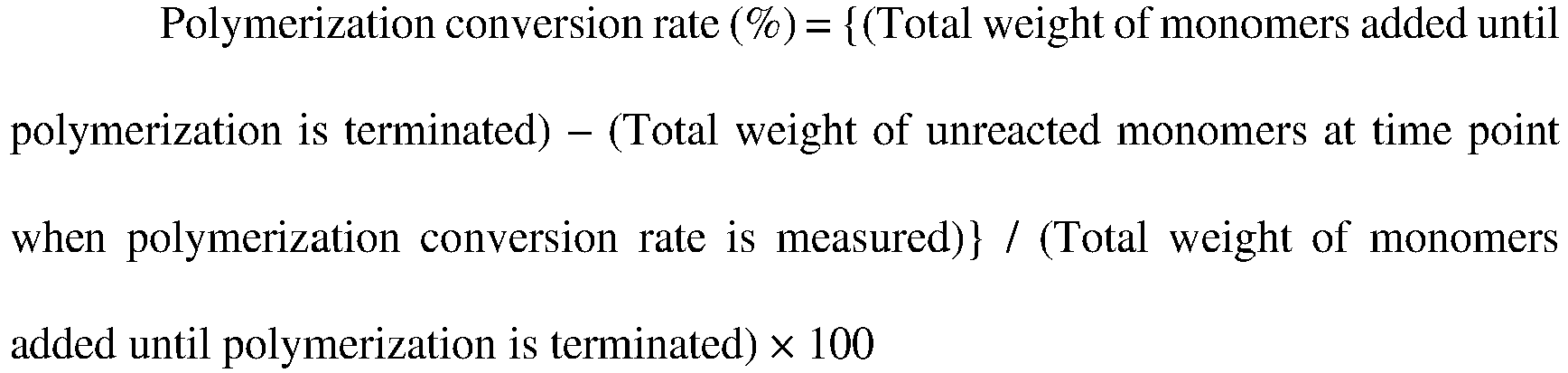
| Classification | Example 1 | Example 2 | Example 3 | Example 4 | ||
| Graft polymer | ||||||
| Type | Preparation Example 1 | Preparation Example 2 | Preparation Example 2 | Preparation Example 3 | ||
| SBR | Monomer (wt%) | S | 20 | 25 | 25 | 25 |
| BD | 80 | 75 | 75 | 75 | ||
| Gel content (wt%) | 0 | 1 | 1 | 5 | ||
| Average particle diameter (nm) | 40 | 40 | 40 | 40 | ||
| Refractive index | 1.5310 | 1.5350 | 1.5350 | 1.5350 | ||
| Others (parts by weight) | SBR | 50.0 | 50.0 | 50.0 | 50.0 | |
| MMA | 29.6 | 25.7 | 25.7 | 25.7 | ||
| S | 20.4 | 21.8 | 21.8 | 21.8 | ||
| AN | 0 | 2.5 | 2.5 | 2.5 | ||
| Refractive index | 1.5310 | 1.5350 | 1.5350 | 1.5350 | ||
| Non-grafted polymer | ||||||
| Type | Preparation Example 5 | Preparation Example 5 | Preparation Example 5 | Preparation Example 5 | ||
| Refractive index | 1.4900 | 1.4900 | 1.4900 | 1.4900 | ||
| Thermoplastic resin composition | ||||||
| Graft polymer (parts by weight) | 30 | 20 | 30 | 30 | ||
| Non-grafted polymer (parts by weight) | 70 | 80 | 70 | 70 | ||
| SBR (wt%) | 15 | 10 | 15 | 15 | ||
| MMA monomer unit (wt%) | 78.88 | 85.14 | 77.71 | 77.71 | ||
| S monomer unit (wt%) | 6.12 | 4.36 | 6.54 | 6.54 | ||
| AN monomer unit (wt%) | 0.0 | 0.5 | 0.75 | 0.75 | ||
| Difference in refractive index between graft polymer and non-grafted polymer | 0.0410 | 0.0450 | 0.0450 | 0.0450 | ||
| Physical property evaluation results | ||||||
| Glossiness (45°) | 14 | 13 | 15 | 17 | ||
| Glossiness (60°) | 15 | 14 | 16 | 18 | ||
| Impact strength (kgf·cm/cm) | 9 | 8 | 11 | 12 | ||
| Pencil hardness | 2H | 3H | 2H | 28 | ||
| SBR: Styrene/butadiene rubber polymer | ||||||
| S: Styrene | ||||||
| BD: 1,3-Butadiene | ||||||
| MMA: Methyl methacrylate | ||||||
| AN: Acrylonitrile | ||||||
| Classification | Comparative Example 1 | Comparative Example 2 | Comparative Example 3 | Comparative Example 4 | ||
| Graft polymer | ||||||
| Type | Preparation Example 4 | Preparation Example 5 | Preparation Example 6 | Preparation Example 3 | ||
| SBR | Monomer (wt%) | S | 25 | 25 | 25 | 25 |
| BD | 75 | 75 | 75 | 75 | ||
| Gel content (wt%) | 15 | 65 | 90 | 5 | ||
| Average particle diameter (nm) | 40 | 300 | 90 | 40 | ||
| Refractive index | 1.5350 | 1.5350 | 1.5350 | 1.5310 | ||
| Others (parts by weight) | SBR | 50.0 | 50.0 | 50.0 | 50.0 | |
| MMA | 25.7 | 25.7 | 25.7 | 25.7 | ||
| S | 21.8 | 21.8 | 21.8 | 21.8 | ||
| AN | 2.5 | 2.5 | 2.5 | 2.5 | ||
| Refractive index | 1.5350 | 1.5350 | 1.5350 | 1.5350 | ||
| Non-grafted polymer | ||||||
| Type | Preparation Example 7 | Preparation Example 7 | Preparation Example 7 | Preparation Example 8 | ||
| Monomer (parts by weight) | MMA | 100 | 100 | 100 | 86 | |
| S | 0 | 0 | 0 | 14 | ||
| Refractive index | 1.4900 | 1.4900 | 1.4900 | 1.5040 | ||
| Thermoplastic resin composition | ||||||
| Graft polymer (parts by weight) | 30 | 30 | 30 | 35 | ||
| Non-grafted polymer (parts by weight) | 70 | 70 | 70 | 65 | ||
| SBR (wt%) | 15 | 15 | 15 | 17.5 | ||
| MMA monomer unit (wt%) | 77.74 | 77.71 | 77.71 | 60.8 | ||
| S monomer unit (wt%) | 6.54 | 6.54 | 6.54 | 21.7 | ||
| AN monomer unit (wt%) | 0.75 | 0.75 | 0.75 | 0.75 | ||
| Difference in refractive index between graft polymer and non-grafted polymer | 0.0450 | 0.0450 | 0.0450 | 0.0310 | ||
| Physical property evaluation results | ||||||
| Glossiness (45°) | 49 | 119 | 125 | 18 | ||
| Glossiness (60°) | 51 | 125 | 131 | 19 | ||
| Impact strength (kgf·cm/cm) | 11 | 11 | 4 | 11 | ||
| Pencil hardness | H | H | 2H | HB | ||
| SBR: Styrene/butadiene rubber polymer | ||||||
| S: Styrene | ||||||
| BD: 1,3-Butadiene | ||||||
| MMA: Methyl methacrylate | ||||||
| AN: Acrylonitrile | ||||||
Claims (9)
- A thermoplastic resin composition comprising:a graft polymer including a rubber polymer having a gel content of 0 to 10 wt% and including an aromatic vinyl-based monomer unit and a diene-based monomer unit; and a shell including a (meth)acrylate-based monomer unit and an aromatic vinyl-based monomer unit, which are grafted to the rubber polymer; anda non-grafted polymer including 90 wt% or more of a (meth)acrylate-based monomer unit.
- The thermoplastic resin composition of claim 1, wherein the rubber polymer has the gel content of 0 to 5 wt%.
- The thermoplastic resin composition of claim 1, wherein the rubber polymer includes the aromatic vinyl-based monomer unit and the diene-based monomer unit in a weight ratio of 10:90 to 35:65.
- The thermoplastic resin composition of claim 1, wherein the rubber polymer has an average particle diameter of 20 to 100 nm.
- The thermoplastic resin composition of claim 1, wherein the graft polymer includes:30.0 to 65.0 wt% of the rubber polymer;10.0 to 55.0 wt% of the (meth)acrylate-based monomer unit; and5.0 to 40.0 wt% of the aromatic vinyl-based monomer unit.
- The thermoplastic resin composition of claim 1, wherein the non-grafted polymer includes one or more selected from the group consisting of a (meth)acrylic acid-based monomer unit and an aromatic vinyl-based monomer unit.
- The thermoplastic resin composition of claim 1, wherein the thermoplastic resin composition includes:10.0 to 50.0 wt% of the graft polymer; and50.0 to 90.0 wt% of the non-grafted polymer.
- The thermoplastic resin composition of claim 1, wherein the shell of the graft polymer includes a vinyl cyanide-based monomer unit grafted to the rubber polymer.
- The thermoplastic resin composition of claim 1, wherein the thermoplastic resin composition includes:5.0 to 25.0 wt% of the rubber polymer;60.0 to 90.0 wt% of the (meth)acrylate-based monomer unit; and3.0 to 20.0 wt% of the aromatic vinyl-based monomer unit.
Applications Claiming Priority (3)
| Application Number | Priority Date | Filing Date | Title |
|---|---|---|---|
| KR20210098177 | 2021-07-26 | ||
| KR1020220088170A KR102846007B1 (en) | 2021-07-26 | 2022-07-18 | Thermoplastic resin composition |
| PCT/KR2022/010528 WO2023008807A1 (en) | 2021-07-26 | 2022-07-19 | Thermoplastic resin composition |
Publications (2)
| Publication Number | Publication Date |
|---|---|
| EP4219622A1 true EP4219622A1 (en) | 2023-08-02 |
| EP4219622A4 EP4219622A4 (en) | 2024-06-12 |
Family
ID=85087081
Family Applications (1)
| Application Number | Title | Priority Date | Filing Date |
|---|---|---|---|
| EP22849783.0A Pending EP4219622A4 (en) | 2021-07-26 | 2022-07-19 | Thermoplastic resin composition |
Country Status (3)
| Country | Link |
|---|---|
| US (1) | US20230399503A1 (en) |
| EP (1) | EP4219622A4 (en) |
| WO (1) | WO2023008807A1 (en) |
Family Cites Families (7)
| Publication number | Priority date | Publication date | Assignee | Title |
|---|---|---|---|---|
| JPH0725975B2 (en) | 1987-06-11 | 1995-03-22 | 東レ株式会社 | Thermoplastic resin composition |
| KR0165577B1 (en) * | 1994-12-30 | 1999-03-20 | 유현식 | Manufacturing method of large particle synthetic rubber latex |
| KR100364232B1 (en) * | 1997-12-22 | 2003-02-19 | 제일모직주식회사 | Manufacturing method of thermoplastic resin excellent in impact resistance and low gloss |
| KR100790425B1 (en) * | 2006-12-29 | 2008-01-03 | 제일모직주식회사 | Acrylonitrile-butadiene-styrene resin composition and plastic molded article |
| JP5709258B2 (en) * | 2011-05-31 | 2015-04-30 | テクノポリマー株式会社 | Thermoplastic resin composition and molded article using the same |
| JP6111770B2 (en) * | 2013-03-21 | 2017-04-12 | 東レ株式会社 | Method for producing transparent styrenic thermoplastic resin composition |
| KR101802021B1 (en) * | 2014-11-07 | 2017-12-28 | 주식회사 엘지화학 | Thermoplastic resin composition, method of preparing the same and molded product using the same |
-
2022
- 2022-07-19 WO PCT/KR2022/010528 patent/WO2023008807A1/en not_active Ceased
- 2022-07-19 EP EP22849783.0A patent/EP4219622A4/en active Pending
- 2022-07-19 US US18/034,253 patent/US20230399503A1/en active Pending
Also Published As
| Publication number | Publication date |
|---|---|
| US20230399503A1 (en) | 2023-12-14 |
| EP4219622A4 (en) | 2024-06-12 |
| WO2023008807A1 (en) | 2023-02-02 |
Similar Documents
| Publication | Publication Date | Title |
|---|---|---|
| EP3290464B1 (en) | Thermoplastic graft copolymer resin, method for preparing same, and thermoplastic resin composition containing same | |
| KR101743326B1 (en) | Transparent Thermoplastic Resin Composition Having Improved Whitening Resistance at Low Temperature and Excellent Impact Strength | |
| CN104136530A (en) | Transparent abs resin composition having superior shock resistance, scratch resistance, and transparency | |
| CN107306496A (en) | Rubber-like polymer, its preparation method, graft copolymer and thermoplastic resin composition | |
| EP2743311B1 (en) | Alkyl (meth)acrylate-based thermoplastic resin composition and thermoplastic resin having adjusted scratch resistance and yellowness | |
| US9683069B2 (en) | Method for preparing weather resistant reinforced acrylate based resin | |
| KR20230016539A (en) | Thermoplastic resion composition | |
| US11434358B2 (en) | Matrix copolymer, graft copolymer, and thermoplastic resin composition | |
| EP4219622A1 (en) | Thermoplastic resin composition | |
| EP4219623A1 (en) | Thermoplastic resin composition | |
| CN116568755B (en) | Thermoplastic resin composition | |
| KR102465134B1 (en) | Method for preparing graft copolymer | |
| JP7780621B2 (en) | Thermoplastic resin composition, its manufacturing method and molded article manufactured therefrom | |
| KR101489558B1 (en) | Rubber reinforced thermoplastic transparent resin composition and thermoplastic high transparent resin | |
| EP3929223B1 (en) | Method for preparing graft polymer | |
| KR102846007B1 (en) | Thermoplastic resin composition | |
| CN116568755A (en) | thermoplastic resin composition | |
| CN116457414A (en) | thermoplastic resin composition | |
| KR102804474B1 (en) | Thermoplastic resin composition | |
| KR102913683B1 (en) | Acryl coagulant and method for preparing graft polymer using the same | |
| KR102844763B1 (en) | Thermoplastic transparent resin composition and molded product therefrom | |
| KR20230016538A (en) | Thermoplastic resion composition | |
| KR100519116B1 (en) | Thermoplastic Resin Composition With Excellent Whitening-Resistance, Transparency and Impact Strength | |
| KR100463301B1 (en) | Thermoplastic Resin Composition with Good Transparent, Impact Strength and Wet-Proof Property | |
| KR20180052333A (en) | Thermoplstic resin composition with good low gloss, weather resistant property and mechanical properties, and extruded articles produced from the same |
Legal Events
| Date | Code | Title | Description |
|---|---|---|---|
| STAA | Information on the status of an ep patent application or granted ep patent |
Free format text: STATUS: THE INTERNATIONAL PUBLICATION HAS BEEN MADE |
|
| PUAI | Public reference made under article 153(3) epc to a published international application that has entered the european phase |
Free format text: ORIGINAL CODE: 0009012 |
|
| STAA | Information on the status of an ep patent application or granted ep patent |
Free format text: STATUS: REQUEST FOR EXAMINATION WAS MADE |
|
| 17P | Request for examination filed |
Effective date: 20230426 |
|
| AK | Designated contracting states |
Kind code of ref document: A1 Designated state(s): AL AT BE BG CH CY CZ DE DK EE ES FI FR GB GR HR HU IE IS IT LI LT LU LV MC MK MT NL NO PL PT RO RS SE SI SK SM TR |
|
| A4 | Supplementary search report drawn up and despatched |
Effective date: 20240514 |
|
| RIC1 | Information provided on ipc code assigned before grant |
Ipc: C08L 25/12 20060101ALI20240507BHEP Ipc: C08L 55/02 20060101ALI20240507BHEP Ipc: C08L 33/20 20060101AFI20240507BHEP |
|
| DAV | Request for validation of the european patent (deleted) | ||
| DAX | Request for extension of the european patent (deleted) |
