EP4213504A1 - Sound signal processing method and sound signal processing device - Google Patents
Sound signal processing method and sound signal processing device Download PDFInfo
- Publication number
- EP4213504A1 EP4213504A1 EP21866536.2A EP21866536A EP4213504A1 EP 4213504 A1 EP4213504 A1 EP 4213504A1 EP 21866536 A EP21866536 A EP 21866536A EP 4213504 A1 EP4213504 A1 EP 4213504A1
- Authority
- EP
- European Patent Office
- Prior art keywords
- audio signal
- processing
- type
- speaker
- virtual
- Prior art date
- Legal status (The legal status is an assumption and is not a legal conclusion. Google has not performed a legal analysis and makes no representation as to the accuracy of the status listed.)
- Pending
Links
Images





Classifications
-
- H—ELECTRICITY
- H04—ELECTRIC COMMUNICATION TECHNIQUE
- H04S—STEREOPHONIC SYSTEMS
- H04S7/00—Indicating arrangements; Control arrangements, e.g. balance control
- H04S7/30—Control circuits for electronic adaptation of the sound field
- H04S7/302—Electronic adaptation of stereophonic sound system to listener position or orientation
- H04S7/303—Tracking of listener position or orientation
-
- H—ELECTRICITY
- H04—ELECTRIC COMMUNICATION TECHNIQUE
- H04R—LOUDSPEAKERS, MICROPHONES, GRAMOPHONE PICK-UPS OR LIKE ACOUSTIC ELECTROMECHANICAL TRANSDUCERS; ELECTRIC HEARING AIDS; PUBLIC ADDRESS SYSTEMS
- H04R27/00—Public address systems
-
- G—PHYSICS
- G06—COMPUTING OR CALCULATING; COUNTING
- G06F—ELECTRIC DIGITAL DATA PROCESSING
- G06F3/00—Input arrangements for transferring data to be processed into a form capable of being handled by the computer; Output arrangements for transferring data from processing unit to output unit, e.g. interface arrangements
- G06F3/16—Sound input; Sound output
- G06F3/162—Interface to dedicated audio devices, e.g. audio drivers, interface to CODECs
-
- G—PHYSICS
- G06—COMPUTING OR CALCULATING; COUNTING
- G06F—ELECTRIC DIGITAL DATA PROCESSING
- G06F3/00—Input arrangements for transferring data to be processed into a form capable of being handled by the computer; Output arrangements for transferring data from processing unit to output unit, e.g. interface arrangements
- G06F3/16—Sound input; Sound output
- G06F3/167—Audio in a user interface, e.g. using voice commands for navigating, audio feedback
-
- G—PHYSICS
- G10—MUSICAL INSTRUMENTS; ACOUSTICS
- G10L—SPEECH ANALYSIS TECHNIQUES OR SPEECH SYNTHESIS; SPEECH RECOGNITION; SPEECH OR VOICE PROCESSING TECHNIQUES; SPEECH OR AUDIO CODING OR DECODING
- G10L15/00—Speech recognition
- G10L15/22—Procedures used during a speech recognition process, e.g. man-machine dialogue
-
- G—PHYSICS
- G10—MUSICAL INSTRUMENTS; ACOUSTICS
- G10L—SPEECH ANALYSIS TECHNIQUES OR SPEECH SYNTHESIS; SPEECH RECOGNITION; SPEECH OR VOICE PROCESSING TECHNIQUES; SPEECH OR AUDIO CODING OR DECODING
- G10L21/00—Speech or voice signal processing techniques to produce another audible or non-audible signal, e.g. visual or tactile, in order to modify its quality or its intelligibility
- G10L21/02—Speech enhancement, e.g. noise reduction or echo cancellation
- G10L21/0272—Voice signal separating
- G10L21/028—Voice signal separating using properties of sound source
-
- G—PHYSICS
- G10—MUSICAL INSTRUMENTS; ACOUSTICS
- G10L—SPEECH ANALYSIS TECHNIQUES OR SPEECH SYNTHESIS; SPEECH RECOGNITION; SPEECH OR VOICE PROCESSING TECHNIQUES; SPEECH OR AUDIO CODING OR DECODING
- G10L25/00—Speech or voice analysis techniques not restricted to a single one of groups G10L15/00 - G10L21/00
- G10L25/48—Speech or voice analysis techniques not restricted to a single one of groups G10L15/00 - G10L21/00 specially adapted for particular use
- G10L25/51—Speech or voice analysis techniques not restricted to a single one of groups G10L15/00 - G10L21/00 specially adapted for particular use for comparison or discrimination
-
- H—ELECTRICITY
- H04—ELECTRIC COMMUNICATION TECHNIQUE
- H04S—STEREOPHONIC SYSTEMS
- H04S3/00—Systems employing more than two channels, e.g. quadraphonic
- H04S3/008—Systems employing more than two channels, e.g. quadraphonic in which the audio signals are in digital form, i.e. employing more than two discrete digital channels
-
- H—ELECTRICITY
- H04—ELECTRIC COMMUNICATION TECHNIQUE
- H04S—STEREOPHONIC SYSTEMS
- H04S7/00—Indicating arrangements; Control arrangements, e.g. balance control
- H04S7/30—Control circuits for electronic adaptation of the sound field
-
- G—PHYSICS
- G10—MUSICAL INSTRUMENTS; ACOUSTICS
- G10L—SPEECH ANALYSIS TECHNIQUES OR SPEECH SYNTHESIS; SPEECH RECOGNITION; SPEECH OR VOICE PROCESSING TECHNIQUES; SPEECH OR AUDIO CODING OR DECODING
- G10L21/00—Speech or voice signal processing techniques to produce another audible or non-audible signal, e.g. visual or tactile, in order to modify its quality or its intelligibility
- G10L21/02—Speech enhancement, e.g. noise reduction or echo cancellation
- G10L21/0272—Voice signal separating
-
- G—PHYSICS
- G10—MUSICAL INSTRUMENTS; ACOUSTICS
- G10L—SPEECH ANALYSIS TECHNIQUES OR SPEECH SYNTHESIS; SPEECH RECOGNITION; SPEECH OR VOICE PROCESSING TECHNIQUES; SPEECH OR AUDIO CODING OR DECODING
- G10L25/00—Speech or voice analysis techniques not restricted to a single one of groups G10L15/00 - G10L21/00
- G10L25/78—Detection of presence or absence of voice signals
- G10L25/84—Detection of presence or absence of voice signals for discriminating voice from noise
-
- H—ELECTRICITY
- H04—ELECTRIC COMMUNICATION TECHNIQUE
- H04R—LOUDSPEAKERS, MICROPHONES, GRAMOPHONE PICK-UPS OR LIKE ACOUSTIC ELECTROMECHANICAL TRANSDUCERS; ELECTRIC HEARING AIDS; PUBLIC ADDRESS SYSTEMS
- H04R5/00—Stereophonic arrangements
- H04R5/02—Spatial or constructional arrangements of loudspeakers
-
- H—ELECTRICITY
- H04—ELECTRIC COMMUNICATION TECHNIQUE
- H04R—LOUDSPEAKERS, MICROPHONES, GRAMOPHONE PICK-UPS OR LIKE ACOUSTIC ELECTROMECHANICAL TRANSDUCERS; ELECTRIC HEARING AIDS; PUBLIC ADDRESS SYSTEMS
- H04R5/00—Stereophonic arrangements
- H04R5/04—Circuit arrangements, e.g. for selective connection of amplifier inputs/outputs to loudspeakers, for loudspeaker detection, or for adaptation of settings to personal preferences or hearing impairments
-
- H—ELECTRICITY
- H04—ELECTRIC COMMUNICATION TECHNIQUE
- H04S—STEREOPHONIC SYSTEMS
- H04S2400/00—Details of stereophonic systems covered by H04S but not provided for in its groups
- H04S2400/01—Multi-channel, i.e. more than two input channels, sound reproduction with two speakers wherein the multi-channel information is substantially preserved
-
- H—ELECTRICITY
- H04—ELECTRIC COMMUNICATION TECHNIQUE
- H04S—STEREOPHONIC SYSTEMS
- H04S2400/00—Details of stereophonic systems covered by H04S but not provided for in its groups
- H04S2400/11—Positioning of individual sound objects, e.g. moving airplane, within a sound field
-
- H—ELECTRICITY
- H04—ELECTRIC COMMUNICATION TECHNIQUE
- H04S—STEREOPHONIC SYSTEMS
- H04S2400/00—Details of stereophonic systems covered by H04S but not provided for in its groups
- H04S2400/15—Aspects of sound capture and related signal processing for recording or reproduction
-
- H—ELECTRICITY
- H04—ELECTRIC COMMUNICATION TECHNIQUE
- H04S—STEREOPHONIC SYSTEMS
- H04S7/00—Indicating arrangements; Control arrangements, e.g. balance control
- H04S7/30—Control circuits for electronic adaptation of the sound field
- H04S7/302—Electronic adaptation of stereophonic sound system to listener position or orientation
Definitions
- the present disclosure relates to an audio signal processing method and an audio signal processing apparatus that process an audio signal.
- Patent Literature 1 discloses an acoustic signal compensation device including a compensation speaker that outputs a compensation sound in order to compensate for that a sound to be reproduced from a speaker is masked by noise, such as background noise, at a venue such as public viewing.
- Patent Literature 1 Japanese Unexamined Patent Application Publication No. 2017-200025
- Placement of a large volume of equipment such as a speaker at a venue improves sound quality and improves a realistic sensation.
- an increase in the volume of equipment requires time and effort of wiring, securing of power sources, securing of manpower, and the like.
- the present disclosure is directed to provide an audio signal processing method and an audio signal processing apparatus that are capable of improving a realistic sensation even with less equipment.
- An audio signal processing method obtains an audio signal, determines a type of the audio signal, sets a plurality of virtual speakers, generates a first audio signal on which localization processing to localize an acoustic image at any one virtual speaker of the plurality of virtual speakers has been performed when the type of a determined audio signal is a first type, generates a second audio signal on which distributed processing to distribute and localize an acoustic image at two or more virtual speakers of the plurality of virtual speakers has been performed when the type of a determined audio signal is a second type, generates an addition signal by adding the first audio signal and the second audio signal, and outputs the addition signal to a plurality of real speakers.
- a user can improve a realistic sensation even with less equipment.
- FIG. 1 is a block diagram showing a configuration of an audio signal processing system 1.
- the audio signal processing system 1 includes a mixer 11, a plurality of information processing terminals 13, and a plurality of speakers of a speaker 14A to a speaker 14G.
- the mixer 11 and the plurality of information processing terminals 13 are separately installed in different places.
- the mixer 11 and the plurality of information processing terminals 13 are connected through the Internet.
- the mixer 11 is connected to the plurality of speakers 14A to the speaker 14G.
- the mixer 11 and the plurality of speakers of the speaker 14A to the speaker 14G are connected through a network cable or an audio cable.
- the mixer 11 is an example of an audio signal processing apparatus of the present disclosure.
- the mixer 11 receives an audio signal from the plurality of information processing terminals 13 through the Internet, performs panning processing and effect processing, and supplies the audio signal to the plurality of speakers of the speaker 14A to the speaker 14G.
- FIG. 2 is a schematic plan view showing an installation mode of the plurality of speakers of the speaker 14A to the speaker 14G.
- the plurality of speakers of the speaker 14A to the speaker 14G are installed along a wall surface of a live music club 70.
- the live music club 70 of this example has a rectangular shape in a plan view.
- a stage 50 is placed in front of the live music club 70. On the stage 50, a performer performs performance such as singing or playing.
- the speaker 14A is installed on the left side of the stage 50, and the speaker 14B is installed on the right side of the stage 50.
- the speaker 14C is installed on the left side in the front and rear center of the live music club 70, and the speaker 14D is installed on the right side in the front and rear center of the live music club 70.
- the speaker 14E is installed on the rear left side of the live music club 70, the speaker 14F is installed in the left and right center behind the live music club 70, and the speaker 14G is installed on the rear right side of the live music club 70.
- a listener L1 is in front of the speaker 14F.
- the listener L1 views and listens to the performance of the performer, and performs cheering, clapping, or calling to the performer.
- the audio signal processing system 1 outputs a sound such as cheering, clapping, or calling of other listeners to inside of the live music club 70 through the speaker 14A to the speaker 14G.
- the sound such as cheering, clapping, or calling of other listeners is inputted from the information processing terminal 13 into the mixer 11.
- the information processing terminal 13 is a portable information processing apparatus such as a personal computer (PC), a tablet computer, or a smartphone.
- a user of the information processing terminal 13 is a listener who remotely views and listens to the performance such as singing or playing in the live music club 70.
- the information processing terminal 13 obtains a sound, such as cheering, clapping, or calling of each listener, through a not-shown microphone.
- the information processing terminal 13 may display an icon image, such as "cheer,” “clap,” “call,” and “babble” on a display device (not shown), and may receive a selection operation to these icon images from the listener.
- the information processing terminal 13, when receiving the selection operation to these icon images, may generate an audio signal corresponding to each icon image, and may obtain the audio signal as a sound such as cheering, clapping, or calling of the listener.
- the information processing terminal 13 sends the sound, such as cheering, clapping, or calling of each listener, to the mixer 11 through the Internet.
- the mixer 11 receives the sound such as cheering, clapping, or calling of each listener.
- the mixer 11 performs panning processing and effect processing on a received sound, and distributes the audio signal to the plurality of speakers of the speaker 14A to the speaker 14G.
- the audio signal processing system 1 is able to send the sound such cheering, clapping, or calling of a large number of listeners, to the live music club 70.
- FIG. 3 is a block diagram showing a hardware configuration of the mixer 11.
- FIG. 4 is a block diagram showing a functional configuration of the mixer 11.
- FIG. 5 is a flow chart showing an operation of the mixer 11.
- the mixer 11 includes a display device 101, a user I/F (interface) 102, an audio I/O (Input/Output) 103, a digital signal processor (DSP) 104, a network I/F 105, a CPU 106, a flash memory 107, and a RAM 108. These components are connected to each other through a bus 171.
- a display device 101 a user I/F (interface) 102, an audio I/O (Input/Output) 103, a digital signal processor (DSP) 104, a network I/F 105, a CPU 106, a flash memory 107, and a RAM 108.
- DSP digital signal processor
- the CPU 106 is a controller that controls the operation of the mixer 11.
- the CPU 106 reads and executes a predetermined program stored in the flash memory 107 being a storage medium to the RAM 108 and performs various types of operations.
- the program that the CPU 106 reads does not need to be stored in the flash memory 107 in the own apparatus.
- the program may be stored in a storage medium of an external apparatus such as a server.
- the CPU 106 may read the program each time from the server to the RAM 108 and may execute the program.
- the digital signal processor 104 includes a DSP for performing various types of signal processing.
- the digital signal processor 104 receives an audio signal according to cheering, clapping, calling, or the like of a listener from the information processing terminal 13 through the network I/F 105.
- the digital signal processor 104 performs panning processing and effect processing to a received audio signal.
- the digital signal processor 104 outputs the audio signal on which the signal processing has been performed, to the speaker 14A to the speaker 14G through the audio I/O 103.
- the CPU 106 and the digital signal processor 104 functionally include an obtaining portion 301, a determining portion 302, a setting portion 303, a localization processing portion 304, a distributed processing portion 305, and an addition portion 306.
- the obtaining portion 301 obtains an audio signal according to cheering, clapping, calling, or the like of a listener from each of a plurality of information processing terminals 13 (S11). Subsequently, the determining portion 302 determines a type of the audio signal (S12).
- the type of the audio signal includes a first type or a second type.
- the first type includes cheering such as "Go for it, " calling of a personal name of a performer, or an exclamation such as "Bravo" from each listener.
- the first type is a sound that is able to be recognized as a voice of an individual listener without being buried in an audience.
- the second type is a sound that is unable to be recognized as a voice of an individual listener and is simultaneously emitted by a large number of listeners, and includes clapping, a chorus, a shout such as "Wow,” or babble, for example.
- the determining portion 302 in a case of recognizing a voice such as "Go for it” or “Bravo” as described above, by voice recognition processing, for example, determines the audio signal as the first type.
- the determining portion 302 determines the audio signal that does not recognize a voice, as the second type.
- the determining portion 302 outputs the audio signal determined as the first type to the localization processing portion 304, and outputs the audio signal determined as the second type to the distributed processing portion 305.
- the localization processing portion 304 and the distributed processing portion 305 set a plurality of virtual speakers (S13).
- FIG. 6 is a schematic plan view of a live music club 70 showing a virtual speaker.
- the localization processing portion 304 and the distributed processing portion 305 set the plurality of virtual speakers of a virtual speaker 14N1 to a virtual speaker 14N16.
- the localization processing portion 304 and the distributed processing portion 305 manage positions of the speaker 14A to the speaker 14G and positions of the virtual speaker 14N1 to the virtual speaker 14N16 in two-dimensional or three-dimensional rectangular coordinates with an origin at a predetermined position (the center of the stage 50, for example) of the live music club.
- the speaker 14A to the speaker 14G are real speakers.
- the coordinates of the speaker 14A to the speaker 14G are previously stored in the flash memory 107 (or a not-shown server or the like) .
- the localization processing portion 304 and the distributed processing portion 305 as shown in FIG. 6 , evenly place the virtual speaker 14N1 to the virtual speaker 14N16 in the entire live music club 70.
- the localization processing portion 304 and the distributed processing portion 305 set the virtual speaker 14N16 also at a position of the outside of the live music club 70.
- processing to set virtual speakers (S13) does not need to be performed after processing to determine the type of an audio signal (S12) .
- the processing to set virtual speakers (S13) may be previously performed before processing to obtain an audio signal (S11) or the processing to determine the type of an audio signal (S12).
- the localization processing portion 304 performs localization processing and generates a first audio signal
- the distributed processing portion 305 performs distributed processing and generates a second audio signal (S14).
- the localization processing is processing to localize an acoustic image at any one of the positions of the virtual speaker 14N1 to the virtual speaker 14N16.
- the position at which an acoustic image is localized is not limited to the virtual speaker 14N1 to the virtual speaker 14N16.
- the localization processing portion 304 in a case in which the position at which an acoustic image is localized in agreement with the position of the speaker 14A to the speaker 14G, outputs an audio signal to any one of the speaker 14A to the speaker 14G.
- the mixer 11 may include a position information receiving portion that receives position information from a listener.
- the listener operates the information processing terminal 13 and designates a localization position of an own voice.
- the information processing terminal 13 displays an image that simulates a plan view, a perspective view, or the like of the live music club 70, and receives the localization position from a user.
- the information processing terminal 13 sends the position information (coordinates) corresponding to a received localization position to the mixer 11.
- the localization processing portion 304 of the mixer 11 sets a virtual speaker to coordinates corresponding to the position information received from the information processing terminal 13 and performs processing to localize an acoustic image at a position of a set virtual speaker.
- the localization processing portion 304 performs panning processing or effect processing in order to localize an acoustic image at the position of the virtual speaker 14N1 to the virtual speaker 14N16.
- the panning processing is processing to localize an acoustic image as a phantom at the position of a virtual speaker by supplying the same audio signal to a plurality of speakers among the speaker 14A to the speaker 14G and controlling the volume of the audio signal. For example, when the same audio signal at the same volume is supplied to the speaker 14A and the speaker 14C, an acoustic image is localized so that a virtual speaker is installed at the center position on a straight line connecting the speaker 14A and the speaker 14C.
- the panning processing is processing to increase the volume of an audio signal to be supplied to a speaker adjacent to the position of a virtual speaker and decrease the volume of an audio signal to be supplied to a speaker far from the position of a virtual speaker.
- the localization processing portion 304 is also able to localize an acoustic image at a virtual speaker at any position on three-dimensional coordinates by supplying the same audio signal to a plurality of speakers installed at different heights.
- the effect processing includes processing to add delay, for example.
- delay When delay is added to an audio signal to be supplied to the real speaker 14A to the speaker 14G, a listener perceives an acoustic image at a position farther than the real speaker. Therefore, the localization processing portion 304, by adding delay to an audio signal, is able to localize the acoustic image at the virtual speaker that is set at the position farther than the real speaker 14A to the speaker 14G.
- the effect processing may include processing to add reverb.
- reverb When reverb is added to an audio signal, a listener perceives an acoustic image at a position farther than the position of a real speaker. Therefore, the localization processing portion 304, by adding reverb to an audio signal, is able to localize the acoustic image at the virtual speaker that is set at the position farther than the real speaker 14A to the speaker 14G.
- the effect processing may include processing to add frequency characteristics by equalizer.
- the listener perceives an acoustic image not only by a difference in volume and time between both ears but also by a difference in frequency characteristics. Therefore, the localization processing portion 304 is able to localize the acoustic image at the position of the set virtual speaker also by adding frequency characteristics according to transmission characteristics from the position of a target virtual speaker to a target listening position (the center of the stage 50, for example).
- the distributed processing is processing to distribute and localize an acoustic image at a plurality of the virtual speaker 14N1 to the virtual speaker 14N16.
- the distributed processing portion 305 in a case in which the position at which the acoustic image is localized is in agreement with the position of the real speaker 14A to the real speaker 14G, outputs an audio signal to any one of the speaker 14A to the speaker 14G.
- the distributed processing portion 305 performs panning processing or effect processing in order to localize an acoustic image at the plurality of positions of the virtual speaker 14N1 to the virtual speaker 14N16.
- the method of localizing each acoustic image at any position of the virtual speaker 14N1 to the virtual speaker 14N16 is the same as the localization processing portion 304.
- the distributed processing portion 305 by distributing and localizing an acoustic image at the plurality of virtual speakers, reproduces a sound such as a cheer, clapping, a chorus, a shout, or babble.
- the distributed processing portion 305 may further perform processing to perceive spatial expansion such as reverb, in addition to the processing to localize an acoustic image at the plurality of virtual speakers.
- the distributed processing portion 305 preferably adjusts output timing of an audio signal to be outputted to the speaker 14A to the speaker 14G and shifts arrival timing at which a sound to be outputted from a plurality of real speakers arrives at the listener.
- the distributed processing portion 305 is able to further distribute the sound, and is able to provide the spatial expansion.
- the addition portion 306 adds the first audio signal on which the localization processing has been performed and the second audio signal on which the distributed processing has been performed, as described above (S15).
- the addition processing is performed by an addition computing device for each speaker.
- the addition portion 306 outputs an addition signal obtained by adding the first audio signal and the second audio signal to each of the plurality of real speakers (S16).
- FIG. 7 is a plan view showing a schematic representation of an output mode of the first audio signal and the second audio signal. As shown in FIG. 7 , a voice such as a "Bravo" is outputted from a specific virtual speaker. In the example of FIG.
- the voice such as "Bravo” is outputted from the virtual speaker 14N3 in the front center of audience seats, the virtual speaker 14N9 and the virtual speaker 14N12 at left and right behind each seat, and the virtual speaker 14N16 at rear outside of the live music club 70.
- the clapping and the shout such as "Wow” are outputted from the plurality of virtual speakers.
- the performer on the stage 50 can also hear a voice, clapping, a shout, or the like of the listener from a place other than the listener L1, and can perform a live performance under an environment full of realistic sensation.
- the listener L1 present in the live music club 70 can also listen to the voice, the clapping, the shout, or the like of the large number of listeners in the same space, and can view and listen to the live performance under the environment full of realistic sensation.
- the audio signal processing method according to the present embodiment is able to emit the voice, the clapping, the shout, or the like of the listener from the larger number of virtual speakers of the virtual speaker 14N1 to the virtual speaker 14N16 than the number of the real speakers of the speaker 14A to the speaker 14G. Therefore, the audio signal processing method according to the present embodiment is able to output the voice, the clapping, the shout, or the like of the listener from various positions even with less equipment, and is able to improve a realistic sensation.
- the audio signal processing method is able to output the voice, the clapping, the shout, or the like of the listener by setting the position of the virtual speaker to a position outside a space in a real venue to simulate the environment of a larger venue than the real space.
- the above embodiment shows an example in which the realistic sensation in the live music club 70 is improved.
- the audio signal processing method according to the present embodiment is also able to improve the realistic sensation of each listener in a remote place in which the information processing terminal 13 is used.
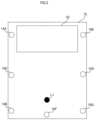
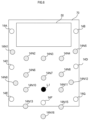
- FIG. 8 , FIG. 9 , and FIG. 10 are plan views schematically showing an audiovisual environment of each listener who uses the information processing terminal 13.
- the speaker 14FL, the speaker 14FR, the speaker 14C, the speaker 14SL, and the speaker 14SR are installed along a wall surface of an indoor room 75.
- the indoor room 75 of this example has a rectangular shape in a plan view.
- the display device 55 is placed in front of the indoor room 75.
- a listener L2 is present in the center of the indoor room. The listener L2 watches performance of a performer displayed on the display device 55.
- the speaker 14FL is installed on the left side of the display device 55, the speaker 14C is installed in front of the display device 55, and the speaker 14FR is installed on the right side of the display device 55.
- the speaker 14SL is installed on the rear left side of the indoor room 75, and the speaker 14SR is installed on the rear right side of the indoor room 75.
- the information processing terminal 13 obtains a video and sound according to the performance of a performer.
- the mixer 11 obtains a sound such as a performance sound or a singing sound of a performer and sends to the information processing terminal 13.
- the speaker 14FL, the speaker 14FR, the speaker 14C, the speaker 14SL, and the speaker 14SR output a sound according to the performance of a performer.
- the information processing terminal 13 obtains an audio signal according to cheering, clapping, calling, or the like of other listeners from other information processing terminals 13.
- the information processing terminal 13, as with the mixer 11, determines the type of an audio signal, and performs localization processing or distributed processing.
- the listener L2 can obtain a realistic sensation even in the indoor room 75 as if being in the center of the live music club 70 and viewing and listening to the performance of a performer together with a large audience.
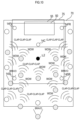
- the information processing terminal 13 may include a seat designation receiving portion that receives designation information on a seat position from a listener. In such a case, the information processing terminal 13 changes content of the panning processing and the effect processing based on the designation information on the seat position. For example, when a listener designates a seat position immediately in front of the stage 50, the information processing terminal 13, as shown in FIG. 10 , sets the listener L2 at a position immediately in front of the stage 50, sets a plurality of virtual speakers, and performs the localization processing and the distributed processing on an audio signal according to the cheering, the clapping, the calling, or the like of other listeners. As a result, the listener L2 can obtain a realistic sensation as if being present immediately in front of the stage 50.
- a provider of the audio signal processing system provides a ticket for a seat position in front of the stage, a seat position beside the stage, a seat position in the center of the live music club, a rear seat position, or the like.
- the user of the information processing terminal 13 purchases a ticket for any seat position among these seat positions.
- the user can select a high-priced seat position in front of the stage with a high realistic sensation or can select a low-priced rear seat position, for example.
- the information processing terminal 13 changes the content of the panning processing and the effect processing according to the seat position selected by the user. As a result, the user can obtain a realistic sensation as if viewing and listening to a performance when being at the seat position purchased by the user.
- the provider of the audio signal processing method can conduct business equivalent to a state in which an event is provided in a real space.
- a plurality of users may designate the same seat position.
- each of the plurality of users may designate a seat position immediately in front of the stage 50.
- the information processing terminal 13 of each user provides a realistic sensation such as being at the seat position immediately in front of the stage 50.
- the plurality of listeners can view and listen to performance of a performer with the same realistic sensation, with respect to one seat. Therefore, the provider of the audio signal processing method can provide service beyond audience capacity of the real space.
- the voice recognition processing is performed on an audio signal
- the type of the audio signal is determined as the first type in a case in which a voice is recognized by the voice recognition processing
- the type of the audio signal is determined as the second type in a case in which a voice is unable to be recognized by the voice recognition processing.
- the audio signal may include a plurality of channels and may include addition information (metadata) indicating the first type or the second type for each channel.
- the information processing terminal 13 receives a selection operation of "cheer,” “clap,” “call,” “babble,” or the like from a listener and generates a corresponding audio signal
- the information processing terminal 13 generates an audio signal of a channel corresponding to a selected sound, attaches addition information, and sends the audio signal to the mixer 11.
- the determining portion 302 of the mixer 11 determines the type of the audio signal based on the addition information, for each channel.
- the audio signal may include a sound source of both of the first type and the second type.
- the mixer 11 (or the information processing terminal 13) performs sound source separation on the audio signal of the first type and the audio signal of the second type.
- the localization processing portion 304 and the distributed processing portion 305 generate a first audio signal and a second audio signal from each separated audio signal.
- the method of the sound source separation may be any method.
- the first type is a speech sound of a specific listener. Therefore, the determining portion 302 separates the audio signal of the first type by using noise reduction that reduces another sound as a noise sound while using the speech sound as a target sound.
Landscapes
- Engineering & Computer Science (AREA)
- Physics & Mathematics (AREA)
- Acoustics & Sound (AREA)
- Multimedia (AREA)
- Signal Processing (AREA)
- Human Computer Interaction (AREA)
- Health & Medical Sciences (AREA)
- Audiology, Speech & Language Pathology (AREA)
- Theoretical Computer Science (AREA)
- Computational Linguistics (AREA)
- General Health & Medical Sciences (AREA)
- General Engineering & Computer Science (AREA)
- General Physics & Mathematics (AREA)
- Quality & Reliability (AREA)
- Stereophonic System (AREA)
- Circuit For Audible Band Transducer (AREA)
- Reverberation, Karaoke And Other Acoustics (AREA)
Abstract
Description
- The present disclosure relates to an audio signal processing method and an audio signal processing apparatus that process an audio signal.
-
Patent Literature 1 discloses an acoustic signal compensation device including a compensation speaker that outputs a compensation sound in order to compensate for that a sound to be reproduced from a speaker is masked by noise, such as background noise, at a venue such as public viewing. - [Patent Literature 1] :
Japanese Unexamined Patent Application Publication No. 2017-200025 - Placement of a large volume of equipment such as a speaker at a venue improves sound quality and improves a realistic sensation. However, an increase in the volume of equipment requires time and effort of wiring, securing of power sources, securing of manpower, and the like.
- In view of the foregoing, the present disclosure is directed to provide an audio signal processing method and an audio signal processing apparatus that are capable of improving a realistic sensation even with less equipment.
- An audio signal processing method obtains an audio signal, determines a type of the audio signal, sets a plurality of virtual speakers, generates a first audio signal on which localization processing to localize an acoustic image at any one virtual speaker of the plurality of virtual speakers has been performed when the type of a determined audio signal is a first type, generates a second audio signal on which distributed processing to distribute and localize an acoustic image at two or more virtual speakers of the plurality of virtual speakers has been performed when the type of a determined audio signal is a second type, generates an addition signal by adding the first audio signal and the second audio signal, and outputs the addition signal to a plurality of real speakers.
- A user can improve a realistic sensation even with less equipment.
-
-
FIG. 1 is a block diagram showing a configuration of an audiosignal processing system 1. -
FIG. 2 is a schematic plan view showing an installation mode of a plurality of speakers of aspeaker 14A to aspeaker 14G. -
FIG. 3 is a block diagram showing a configuration of amixer 11. -
FIG. 4 is a block diagram showing a functional configuration of themixer 11. -
FIG. 5 is a flow chart showing an operation of themixer 11. -
FIG. 6 is a schematic plan view of alive music club 70 showing a virtual speaker. -
FIG. 7 is a plan view showing a schematic representation of an output mode of a first audio signal and a second audio signal. -
FIG. 8 is a plan view schematically showing an audiovisual environment of each listener who uses aninformation processing terminal 13. -
FIG. 9 is a plan view schematically showing an audiovisual environment of each listener who uses theinformation processing terminal 13. -
FIG. 10 is a plan view schematically showing an audiovisual environment of each listener who uses theinformation processing terminal 13. -
FIG. 1 is a block diagram showing a configuration of an audiosignal processing system 1. The audiosignal processing system 1 includes amixer 11, a plurality ofinformation processing terminals 13, and a plurality of speakers of aspeaker 14A to aspeaker 14G. - The
mixer 11 and the plurality ofinformation processing terminals 13 are separately installed in different places. Themixer 11 and the plurality ofinformation processing terminals 13 are connected through the Internet. - The
mixer 11 is connected to the plurality ofspeakers 14A to thespeaker 14G. Themixer 11 and the plurality of speakers of thespeaker 14A to thespeaker 14G are connected through a network cable or an audio cable. - The
mixer 11 is an example of an audio signal processing apparatus of the present disclosure. Themixer 11 receives an audio signal from the plurality ofinformation processing terminals 13 through the Internet, performs panning processing and effect processing, and supplies the audio signal to the plurality of speakers of thespeaker 14A to thespeaker 14G. -
FIG. 2 is a schematic plan view showing an installation mode of the plurality of speakers of thespeaker 14A to thespeaker 14G. The plurality of speakers of thespeaker 14A to thespeaker 14G are installed along a wall surface of alive music club 70. Thelive music club 70 of this example has a rectangular shape in a plan view. Astage 50 is placed in front of thelive music club 70. On thestage 50, a performer performs performance such as singing or playing. - The
speaker 14A is installed on the left side of thestage 50, and thespeaker 14B is installed on the right side of thestage 50. Thespeaker 14C is installed on the left side in the front and rear center of thelive music club 70, and thespeaker 14D is installed on the right side in the front and rear center of thelive music club 70. Thespeaker 14E is installed on the rear left side of thelive music club 70, thespeaker 14F is installed in the left and right center behind thelive music club 70, and thespeaker 14G is installed on the rear right side of thelive music club 70. - A listener L1 is in front of the
speaker 14F. The listener L1 views and listens to the performance of the performer, and performs cheering, clapping, or calling to the performer. The audiosignal processing system 1 outputs a sound such as cheering, clapping, or calling of other listeners to inside of thelive music club 70 through thespeaker 14A to thespeaker 14G. The sound such as cheering, clapping, or calling of other listeners is inputted from theinformation processing terminal 13 into themixer 11. Theinformation processing terminal 13 is a portable information processing apparatus such as a personal computer (PC), a tablet computer, or a smartphone. A user of theinformation processing terminal 13 is a listener who remotely views and listens to the performance such as singing or playing in thelive music club 70. Theinformation processing terminal 13 obtains a sound, such as cheering, clapping, or calling of each listener, through a not-shown microphone. Alternatively, theinformation processing terminal 13 may display an icon image, such as "cheer," "clap," "call," and "babble" on a display device (not shown), and may receive a selection operation to these icon images from the listener. Theinformation processing terminal 13, when receiving the selection operation to these icon images, may generate an audio signal corresponding to each icon image, and may obtain the audio signal as a sound such as cheering, clapping, or calling of the listener. - The
information processing terminal 13 sends the sound, such as cheering, clapping, or calling of each listener, to themixer 11 through the Internet. Themixer 11 receives the sound such as cheering, clapping, or calling of each listener. Themixer 11 performs panning processing and effect processing on a received sound, and distributes the audio signal to the plurality of speakers of thespeaker 14A to thespeaker 14G. As a result, the audiosignal processing system 1 is able to send the sound such cheering, clapping, or calling of a large number of listeners, to thelive music club 70. - Hereinafter, the configuration and operation of the
mixer 11 will be described in detail.FIG. 3 is a block diagram showing a hardware configuration of themixer 11.FIG. 4 is a block diagram showing a functional configuration of themixer 11.FIG. 5 is a flow chart showing an operation of themixer 11. - The
mixer 11 includes adisplay device 101, a user I/F (interface) 102, an audio I/O (Input/Output) 103, a digital signal processor (DSP) 104, a network I/F 105, aCPU 106, aflash memory 107, and aRAM 108. These components are connected to each other through abus 171. - The
CPU 106 is a controller that controls the operation of themixer 11. TheCPU 106 reads and executes a predetermined program stored in theflash memory 107 being a storage medium to theRAM 108 and performs various types of operations. - It is to be noted that the program that the
CPU 106 reads does not need to be stored in theflash memory 107 in the own apparatus. For example, the program may be stored in a storage medium of an external apparatus such as a server. In such a case, theCPU 106 may read the program each time from the server to theRAM 108 and may execute the program. - The
digital signal processor 104 includes a DSP for performing various types of signal processing. Thedigital signal processor 104 receives an audio signal according to cheering, clapping, calling, or the like of a listener from theinformation processing terminal 13 through the network I/F 105. - The
digital signal processor 104 performs panning processing and effect processing to a received audio signal. Thedigital signal processor 104 outputs the audio signal on which the signal processing has been performed, to thespeaker 14A to thespeaker 14G through the audio I/O 103. - As shown in
FIG. 4 , theCPU 106 and thedigital signal processor 104 functionally include an obtainingportion 301, a determiningportion 302, a settingportion 303, alocalization processing portion 304, a distributedprocessing portion 305, and anaddition portion 306. - The obtaining
portion 301 obtains an audio signal according to cheering, clapping, calling, or the like of a listener from each of a plurality of information processing terminals 13 (S11). Subsequently, the determiningportion 302 determines a type of the audio signal (S12). - The type of the audio signal includes a first type or a second type. The first type includes cheering such as "Go for it, " calling of a personal name of a performer, or an exclamation such as "Bravo" from each listener. In other words, the first type is a sound that is able to be recognized as a voice of an individual listener without being buried in an audience. The second type is a sound that is unable to be recognized as a voice of an individual listener and is simultaneously emitted by a large number of listeners, and includes clapping, a chorus, a shout such as "Wow," or babble, for example.
- The determining
portion 302, in a case of recognizing a voice such as "Go for it" or "Bravo" as described above, by voice recognition processing, for example, determines the audio signal as the first type. The determiningportion 302 determines the audio signal that does not recognize a voice, as the second type. - The determining
portion 302 outputs the audio signal determined as the first type to thelocalization processing portion 304, and outputs the audio signal determined as the second type to the distributedprocessing portion 305. Thelocalization processing portion 304 and the distributedprocessing portion 305 set a plurality of virtual speakers (S13). -
FIG. 6 is a schematic plan view of alive music club 70 showing a virtual speaker. As shown inFIG. 6 , thelocalization processing portion 304 and the distributedprocessing portion 305 set the plurality of virtual speakers of a virtual speaker 14N1 to a virtual speaker 14N16. Thelocalization processing portion 304 and the distributedprocessing portion 305 manage positions of thespeaker 14A to thespeaker 14G and positions of the virtual speaker 14N1 to the virtual speaker 14N16 in two-dimensional or three-dimensional rectangular coordinates with an origin at a predetermined position (the center of thestage 50, for example) of the live music club. Thespeaker 14A to thespeaker 14G are real speakers. Therefore, the coordinates of thespeaker 14A to thespeaker 14G are previously stored in the flash memory 107 (or a not-shown server or the like) . Thelocalization processing portion 304 and the distributedprocessing portion 305, as shown inFIG. 6 , evenly place the virtual speaker 14N1 to the virtual speaker 14N16 in the entirelive music club 70. In addition, in the example ofFIG. 6 , thelocalization processing portion 304 and the distributedprocessing portion 305 set the virtual speaker 14N16 also at a position of the outside of thelive music club 70. - It is to be noted that processing to set virtual speakers (S13) does not need to be performed after processing to determine the type of an audio signal (S12) . The processing to set virtual speakers (S13) may be previously performed before processing to obtain an audio signal (S11) or the processing to determine the type of an audio signal (S12).
- Subsequently, the
localization processing portion 304 performs localization processing and generates a first audio signal, and the distributedprocessing portion 305 performs distributed processing and generates a second audio signal (S14). - The localization processing is processing to localize an acoustic image at any one of the positions of the virtual speaker 14N1 to the virtual speaker 14N16. However, the position at which an acoustic image is localized is not limited to the virtual speaker 14N1 to the virtual speaker 14N16. The
localization processing portion 304, in a case in which the position at which an acoustic image is localized in agreement with the position of thespeaker 14A to thespeaker 14G, outputs an audio signal to any one of thespeaker 14A to thespeaker 14G. - It is to be noted that, although a localization position of the audio signal of the first type may be set at random, the
mixer 11 may include a position information receiving portion that receives position information from a listener. The listener operates theinformation processing terminal 13 and designates a localization position of an own voice. For example, theinformation processing terminal 13 displays an image that simulates a plan view, a perspective view, or the like of thelive music club 70, and receives the localization position from a user. Theinformation processing terminal 13 sends the position information (coordinates) corresponding to a received localization position to themixer 11. Thelocalization processing portion 304 of themixer 11 sets a virtual speaker to coordinates corresponding to the position information received from theinformation processing terminal 13 and performs processing to localize an acoustic image at a position of a set virtual speaker. - The
localization processing portion 304 performs panning processing or effect processing in order to localize an acoustic image at the position of the virtual speaker 14N1 to the virtual speaker 14N16. - The panning processing is processing to localize an acoustic image as a phantom at the position of a virtual speaker by supplying the same audio signal to a plurality of speakers among the
speaker 14A to thespeaker 14G and controlling the volume of the audio signal. For example, when the same audio signal at the same volume is supplied to thespeaker 14A and thespeaker 14C, an acoustic image is localized so that a virtual speaker is installed at the center position on a straight line connecting thespeaker 14A and thespeaker 14C. In other words, the panning processing is processing to increase the volume of an audio signal to be supplied to a speaker adjacent to the position of a virtual speaker and decrease the volume of an audio signal to be supplied to a speaker far from the position of a virtual speaker. It is to be noted that, inFIG. 6 , the plurality of virtual speakers of the virtual speaker 14N1 to the virtual speaker 14N16 are set on the same plane. However, thelocalization processing portion 304 is also able to localize an acoustic image at a virtual speaker at any position on three-dimensional coordinates by supplying the same audio signal to a plurality of speakers installed at different heights. - In addition, the effect processing includes processing to add delay, for example. When delay is added to an audio signal to be supplied to the
real speaker 14A to thespeaker 14G, a listener perceives an acoustic image at a position farther than the real speaker. Therefore, thelocalization processing portion 304, by adding delay to an audio signal, is able to localize the acoustic image at the virtual speaker that is set at the position farther than thereal speaker 14A to thespeaker 14G. - In addition, the effect processing may include processing to add reverb. When reverb is added to an audio signal, a listener perceives an acoustic image at a position farther than the position of a real speaker. Therefore, the
localization processing portion 304, by adding reverb to an audio signal, is able to localize the acoustic image at the virtual speaker that is set at the position farther than thereal speaker 14A to thespeaker 14G. - In addition, the effect processing may include processing to add frequency characteristics by equalizer. The listener perceives an acoustic image not only by a difference in volume and time between both ears but also by a difference in frequency characteristics. Therefore, the
localization processing portion 304 is able to localize the acoustic image at the position of the set virtual speaker also by adding frequency characteristics according to transmission characteristics from the position of a target virtual speaker to a target listening position (the center of thestage 50, for example). - In contrast, the distributed processing is processing to distribute and localize an acoustic image at a plurality of the virtual speaker 14N1 to the virtual speaker 14N16. The distributed
processing portion 305, in a case in which the position at which the acoustic image is localized is in agreement with the position of thereal speaker 14A to thereal speaker 14G, outputs an audio signal to any one of thespeaker 14A to thespeaker 14G. - The distributed
processing portion 305 performs panning processing or effect processing in order to localize an acoustic image at the plurality of positions of the virtual speaker 14N1 to the virtual speaker 14N16. The method of localizing each acoustic image at any position of the virtual speaker 14N1 to the virtual speaker 14N16 is the same as thelocalization processing portion 304. The distributedprocessing portion 305, by distributing and localizing an acoustic image at the plurality of virtual speakers, reproduces a sound such as a cheer, clapping, a chorus, a shout, or babble. - It is to be noted that the above description shows an example in which reverb is added to localize the acoustic image at the virtual speaker that is set at the position farther than the
real speaker 14A to thespeaker 14G. However, the reverb is able to allow a listener to perceive spatial expansion of a sound. Therefore, the distributedprocessing portion 305 may further perform processing to perceive spatial expansion such as reverb, in addition to the processing to localize an acoustic image at the plurality of virtual speakers. - In addition, the distributed
processing portion 305 preferably adjusts output timing of an audio signal to be outputted to thespeaker 14A to thespeaker 14G and shifts arrival timing at which a sound to be outputted from a plurality of real speakers arrives at the listener. As a result, the distributedprocessing portion 305 is able to further distribute the sound, and is able to provide the spatial expansion. - The
addition portion 306 adds the first audio signal on which the localization processing has been performed and the second audio signal on which the distributed processing has been performed, as described above (S15). The addition processing is performed by an addition computing device for each speaker. Theaddition portion 306 outputs an addition signal obtained by adding the first audio signal and the second audio signal to each of the plurality of real speakers (S16). - As described above, the first audio signal arrives at a listener with any one of the virtual speaker 14N1 to the virtual speaker 14N16 as a sound source. The second audio signal is distributed from the plurality of virtual speaker 14N1 to the virtual speaker 14N16 and arrives at a listener.
FIG. 7 is a plan view showing a schematic representation of an output mode of the first audio signal and the second audio signal. As shown inFIG. 7 , a voice such as a "Bravo" is outputted from a specific virtual speaker. In the example ofFIG. 7 , the voice such as "Bravo" is outputted from the virtual speaker 14N3 in the front center of audience seats, the virtual speaker 14N9 and the virtual speaker 14N12 at left and right behind each seat, and the virtual speaker 14N16 at rear outside of thelive music club 70. The clapping and the shout such as "Wow" are outputted from the plurality of virtual speakers. - As a result, the performer on the
stage 50 can also hear a voice, clapping, a shout, or the like of the listener from a place other than the listener L1, and can perform a live performance under an environment full of realistic sensation. In addition, the listener L1 present in thelive music club 70 can also listen to the voice, the clapping, the shout, or the like of the large number of listeners in the same space, and can view and listen to the live performance under the environment full of realistic sensation. - In particular, the audio signal processing method according to the present embodiment is able to emit the voice, the clapping, the shout, or the like of the listener from the larger number of virtual speakers of the virtual speaker 14N1 to the virtual speaker 14N16 than the number of the real speakers of the
speaker 14A to thespeaker 14G. Therefore, the audio signal processing method according to the present embodiment is able to output the voice, the clapping, the shout, or the like of the listener from various positions even with less equipment, and is able to improve a realistic sensation. In addition, the audio signal processing method according to the present embodiment is able to output the voice, the clapping, the shout, or the like of the listener by setting the position of the virtual speaker to a position outside a space in a real venue to simulate the environment of a larger venue than the real space. - The above embodiment shows an example in which the realistic sensation in the
live music club 70 is improved. However, the audio signal processing method according to the present embodiment is also able to improve the realistic sensation of each listener in a remote place in which theinformation processing terminal 13 is used. -
FIG. 8 ,FIG. 9 , andFIG. 10 are plan views schematically showing an audiovisual environment of each listener who uses theinformation processing terminal 13. In this example, the speaker 14FL, the speaker 14FR, thespeaker 14C, the speaker 14SL, and the speaker 14SR are installed along a wall surface of anindoor room 75. Theindoor room 75 of this example has a rectangular shape in a plan view. Thedisplay device 55 is placed in front of theindoor room 75. A listener L2 is present in the center of the indoor room. The listener L2 watches performance of a performer displayed on thedisplay device 55. - The speaker 14FL is installed on the left side of the
display device 55, thespeaker 14C is installed in front of thedisplay device 55, and the speaker 14FR is installed on the right side of thedisplay device 55. The speaker 14SL is installed on the rear left side of theindoor room 75, and the speaker 14SR is installed on the rear right side of theindoor room 75. - The
information processing terminal 13 obtains a video and sound according to the performance of a performer. For example, in the example ofFIG. 2 , themixer 11 obtains a sound such as a performance sound or a singing sound of a performer and sends to theinformation processing terminal 13. - The
information processing terminal 13, as with themixer 11, performs signal processing, such as panning processing and effect processing, on an obtained sound, and outputs an audio signal on which the signal processing has been performed, to the speaker 14FL, the speaker 14FR, thespeaker 14C, the speaker 14SL, and the speaker 14SR. The speaker 14FL, the speaker 14FR, thespeaker 14C, the speaker 14SL, and the speaker 14SR output a sound according to the performance of a performer. - Furthermore, the
information processing terminal 13 obtains an audio signal according to cheering, clapping, calling, or the like of other listeners from otherinformation processing terminals 13. Theinformation processing terminal 13, as with themixer 11, determines the type of an audio signal, and performs localization processing or distributed processing. - As a result, as shown in
FIG. 9 , the listener L2 can obtain a realistic sensation even in theindoor room 75 as if being in the center of thelive music club 70 and viewing and listening to the performance of a performer together with a large audience. - The
information processing terminal 13 may include a seat designation receiving portion that receives designation information on a seat position from a listener. In such a case, theinformation processing terminal 13 changes content of the panning processing and the effect processing based on the designation information on the seat position. For example, when a listener designates a seat position immediately in front of thestage 50, theinformation processing terminal 13, as shown inFIG. 10 , sets the listener L2 at a position immediately in front of thestage 50, sets a plurality of virtual speakers, and performs the localization processing and the distributed processing on an audio signal according to the cheering, the clapping, the calling, or the like of other listeners. As a result, the listener L2 can obtain a realistic sensation as if being present immediately in front of thestage 50. - A provider of the audio signal processing system provides a ticket for a seat position in front of the stage, a seat position beside the stage, a seat position in the center of the live music club, a rear seat position, or the like. The user of the
information processing terminal 13 purchases a ticket for any seat position among these seat positions. The user can select a high-priced seat position in front of the stage with a high realistic sensation or can select a low-priced rear seat position, for example. Theinformation processing terminal 13 changes the content of the panning processing and the effect processing according to the seat position selected by the user. As a result, the user can obtain a realistic sensation as if viewing and listening to a performance when being at the seat position purchased by the user. In addition, the provider of the audio signal processing method can conduct business equivalent to a state in which an event is provided in a real space. - Furthermore, in the audio signal processing method according to the present embodiment, a plurality of users may designate the same seat position. For example, each of the plurality of users may designate a seat position immediately in front of the
stage 50. In such a case, theinformation processing terminal 13 of each user provides a realistic sensation such as being at the seat position immediately in front of thestage 50. As a result, the plurality of listeners can view and listen to performance of a performer with the same realistic sensation, with respect to one seat. Therefore, the provider of the audio signal processing method can provide service beyond audience capacity of the real space. - The descriptions of the present embodiments are illustrative in all points and should not be construed to limit the present disclosure. The scope of the present disclosure is defined not by the foregoing embodiments but by the following claims. Further, the scope of the present disclosure is intended to include all modifications within the scopes of the claims and within the meanings and scopes of equivalents.
- For example, in the above embodiment, the voice recognition processing is performed on an audio signal, the type of the audio signal is determined as the first type in a case in which a voice is recognized by the voice recognition processing, and the type of the audio signal is determined as the second type in a case in which a voice is unable to be recognized by the voice recognition processing. However, the audio signal may include a plurality of channels and may include addition information (metadata) indicating the first type or the second type for each channel. For example, in a case in which the
information processing terminal 13 receives a selection operation of "cheer," "clap," "call," "babble," or the like from a listener and generates a corresponding audio signal, theinformation processing terminal 13 generates an audio signal of a channel corresponding to a selected sound, attaches addition information, and sends the audio signal to themixer 11. In such a case, the determiningportion 302 of themixer 11 determines the type of the audio signal based on the addition information, for each channel. - In addition, the audio signal may include a sound source of both of the first type and the second type. In such a case, the mixer 11 (or the information processing terminal 13) performs sound source separation on the audio signal of the first type and the audio signal of the second type. The
localization processing portion 304 and the distributedprocessing portion 305 generate a first audio signal and a second audio signal from each separated audio signal. The method of the sound source separation may be any method. For example, as described above, the first type is a speech sound of a specific listener. Therefore, the determiningportion 302 separates the audio signal of the first type by using noise reduction that reduces another sound as a noise sound while using the speech sound as a target sound. -
- 1 - audio signal processing system
- 11 - mixer
- 13 - information processing terminal
- 14A to 14G - speaker
- 14FL, 14FR, 14C, 14SL, 14SR - speaker
- 14N1 to 14N16 - virtual speaker
- 50 - stage
- 55 - display device
- 70 - live music club
- 75 - indoor room
- 101 - display device
- 102 - user I/F
- 103 - audio I/O
- 104 - digital signal processor
- 105 - network I/F
- 106 - CPU
- 107 - flash memory
- 108 - RAM
- 171 - bus
- 301 - obtaining portion
- 302 - determining portion
- 303 - setting portion
- 304 - localization processing portion
- 305 - distributed processing portion
- 306 - addition portion
Claims (20)
- An audio signal processing method comprising:obtaining an audio signal;determining a type of the audio signal;setting a plurality of virtual speakers;generating a first audio signal on which localization processing to localize an acoustic image at any one virtual speaker of the plurality of virtual speakers has been performed when the type of a determined audio signal is a first type;generating a second audio signal on which distributed processing to distribute and localize an acoustic image at two or more virtual speakers of the plurality of virtual speakers has been performed when the type of a determined audio signal is a second type;generating an addition signal by adding the first audio signal and the second audio signal; andoutputting the addition signal to a plurality of real speakers.
- The audio signal processing method according to claim 1, wherein:the audio signal includes a plurality of channels; andthe type is determined for each channel.
- The audio signal processing method according to claim 1, comprising:performing sound source separation on the audio signal of the first type and the audio signal of the second type, in a case in which the audio signal includes a sound source of both of the first type and the second type, andgenerating the first audio signal and the second audio signal from each separated audio signal.
- The audio signal processing method according to any one of claims 1 to 3, comprising:performing voice recognition processing on the audio signal;determining that the type of the audio signal is the first type in a case in which a voice is recognized by the voice recognition processing; anddetermining that the type of the audio signal is the second type in a case in which a voice is unable to be recognized by the voice recognition processing.
- The audio signal processing method according to any one of claims 1 to 4, wherein the localization processing, in a case in which a position to be localized is in agreement with a certain real speaker, includes processing to output the first audio signal to the real speaker alone.
- The audio signal processing method according to any one of claims 1 to 5, further comprising receiving position information from a user, wherein the localization processing localizes the first audio signal at a position of received position information.
- The audio signal processing method according to any one of claims 1 to 6, wherein the localization processing achieves the virtual speaker by panning processing and effect processing.
- The audio signal processing method according to claim 7, comprising:receiving designation information on a seat position from a user; andchanging content of the panning processing and the effect processing based on the designation information on the seat position.
- The audio signal processing method according to claim 7 or 8, wherein the effect processing includes delay, equalizer, or reverb.
- The audio signal processing method according to any one of claims 1 to 9, wherein the distributed processing includes adjustment of output timing of the second audio signal.
- An audio signal processing apparatus comprising:an obtaining portion that obtains an audio signal;a determining portion that determines a type of the audio signal;a setting portion that sets a plurality of virtual speakers; anda digital signal processor that:generates a first audio signal on which localization processing to localize an acoustic image at any one virtual speaker of the plurality of virtual speakers has been performed when the type of a determined audio signal is a first type,generates a second audio signal on which distributed processing to distribute and localize an acoustic image at two or more virtual speakers of the plurality of virtual speakers has been performed when the type of a determined audio signal is a second type,generates an addition signal by adding the first audio signal and the second audio signal, andoutputs the addition signal to a plurality of real speakers.
- The audio signal processing apparatus according to claim 11, wherein:the audio signal includes a plurality of channels; andthe determining portion determines the type for each channel.
- The audio signal processing apparatus according to claim 11, comprising a sound source separating portion that performs sound source separation on the audio signal of the first type and the audio signal of the second type, in a case in which the audio signal includes a sound source of both of the first type and the second type, wherein the first audio signal and the second audio signal are generated from each separated audio signal.
- The audio signal processing apparatus according to any one of claims 11 to 13, comprising a voice recognition processing portion that performs voice recognition processing on the audio signal, wherein
the determining portion:determines that the type of the audio signal is the first type in a case in which a voice is recognized by the voice recognition processing, anddetermines that the type of the audio signal is the second type in a case in which a voice is unable to be recognized by the voice recognition processing. - The audio signal processing apparatus according to any one of claims 11 to 14, wherein the localization processing, in a case in which a position to be localized is in agreement with a certain real speaker, includes processing to output the first audio signal to the real speaker alone.
- The audio signal processing apparatus according to any one of claims 11 to 15, comprising a position information receiving portion that receives position information from a user, wherein the localization processing localizes the first audio signal at a position of received position information.
- The audio signal processing apparatus according to any one of claims 11 to 16, wherein the localization processing achieves the virtual speaker by panning processing and effect processing.
- The audio signal processing apparatus according to claim 17, comprising a seat designation receiving portion that receives designation information on a seat position from a user, wherein the digital signal processor changes content of the panning processing and the effect processing based on the designation information on the seat position.
- The audio signal processing apparatus according to claim 17 or 18, wherein the effect processing includes delay, equalizer, or reverb.
- The audio signal processing apparatus according to any one of claims 11 to 19, wherein the distributed processing includes adjustment of output timing of the second audio signal.
Applications Claiming Priority (2)
| Application Number | Priority Date | Filing Date | Title |
|---|---|---|---|
| JP2020151211A JP7581714B2 (en) | 2020-09-09 | 2020-09-09 | Sound signal processing method and sound signal processing device |
| PCT/JP2021/031133 WO2022054576A1 (en) | 2020-09-09 | 2021-08-25 | Sound signal processing method and sound signal processing device |
Publications (2)
| Publication Number | Publication Date |
|---|---|
| EP4213504A1 true EP4213504A1 (en) | 2023-07-19 |
| EP4213504A4 EP4213504A4 (en) | 2024-10-09 |
Family
ID=80632330
Family Applications (1)
| Application Number | Title | Priority Date | Filing Date |
|---|---|---|---|
| EP21866536.2A Pending EP4213504A4 (en) | 2020-09-09 | 2021-08-25 | AUDIO SIGNAL PROCESSING METHOD AND AUDIO SIGNAL PROCESSING DEVICE |
Country Status (5)
| Country | Link |
|---|---|
| US (1) | US12363496B2 (en) |
| EP (1) | EP4213504A4 (en) |
| JP (3) | JP7581714B2 (en) |
| CN (1) | CN116034591B (en) |
| WO (1) | WO2022054576A1 (en) |
Family Cites Families (18)
| Publication number | Priority date | Publication date | Assignee | Title |
|---|---|---|---|---|
| JP2000333297A (en) * | 1999-05-14 | 2000-11-30 | Sound Vision:Kk | Stereophonic sound generator, method for generating stereophonic sound, and medium storing stereophonic sound |
| US20030044002A1 (en) * | 2001-08-28 | 2003-03-06 | Yeager David M. | Three dimensional audio telephony |
| JP4602204B2 (en) | 2005-08-31 | 2010-12-22 | ソニー株式会社 | Audio signal processing apparatus and audio signal processing method |
| JP4882757B2 (en) * | 2007-01-18 | 2012-02-22 | ヤマハ株式会社 | Audio conference system |
| EP2154911A1 (en) * | 2008-08-13 | 2010-02-17 | Fraunhofer-Gesellschaft zur Förderung der angewandten Forschung e.V. | An apparatus for determining a spatial output multi-channel audio signal |
| US8124864B2 (en) * | 2009-12-04 | 2012-02-28 | Roland Corporation | User interface apparatus for displaying vocal or instrumental unit signals in an input musical tone signal |
| JP2011130100A (en) * | 2009-12-16 | 2011-06-30 | Panasonic Electric Works Co Ltd | Sound environment generator for onset of sleeping and waking up |
| JP5867672B2 (en) * | 2011-03-30 | 2016-02-24 | ヤマハ株式会社 | Sound image localization controller |
| JP5118267B2 (en) * | 2011-04-22 | 2013-01-16 | パナソニック株式会社 | Audio signal reproduction apparatus and audio signal reproduction method |
| EP2719200B1 (en) * | 2011-06-09 | 2019-12-25 | Sony Ericsson Mobile Communications AB | Reducing head-related transfer function data volume |
| JP2013198065A (en) * | 2012-03-22 | 2013-09-30 | Denso Corp | Sound presentation device |
| US9661436B2 (en) | 2012-08-29 | 2017-05-23 | Sharp Kabushiki Kaisha | Audio signal playback device, method, and recording medium |
| JP6055657B2 (en) * | 2012-11-09 | 2016-12-27 | 任天堂株式会社 | GAME SYSTEM, GAME PROCESSING CONTROL METHOD, GAME DEVICE, AND GAME PROGRAM |
| CA2949479C (en) * | 2014-05-13 | 2019-06-25 | Crutchfield Corporation | Virtual simulation of spatial audio characteristics |
| JP6461850B2 (en) | 2016-03-31 | 2019-01-30 | 株式会社バンダイナムコエンターテインメント | Simulation system and program |
| JP6714424B2 (en) | 2016-04-27 | 2020-06-24 | 日本放送協会 | Acoustic signal compensator and its program |
| WO2017209196A1 (en) | 2016-05-31 | 2017-12-07 | シャープ株式会社 | Speaker system, audio signal rendering apparatus, and program |
| JP6670259B2 (en) | 2017-01-26 | 2020-03-18 | 日本電信電話株式会社 | Sound reproduction device |
-
2020
- 2020-09-09 JP JP2020151211A patent/JP7581714B2/en active Active
-
2021
- 2021-08-25 EP EP21866536.2A patent/EP4213504A4/en active Pending
- 2021-08-25 CN CN202180054332.6A patent/CN116034591B/en active Active
- 2021-08-25 WO PCT/JP2021/031133 patent/WO2022054576A1/en not_active Ceased
-
2023
- 2023-02-21 US US18/172,164 patent/US12363496B2/en active Active
-
2024
- 2024-10-31 JP JP2024191340A patent/JP7768324B2/en active Active
-
2025
- 2025-10-30 JP JP2025183223A patent/JP2026009232A/en active Pending
Also Published As
| Publication number | Publication date |
|---|---|
| CN116034591B (en) | 2025-10-24 |
| JP2026009232A (en) | 2026-01-19 |
| JP2025020054A (en) | 2025-02-07 |
| JP2022045553A (en) | 2022-03-22 |
| US20230199423A1 (en) | 2023-06-22 |
| WO2022054576A1 (en) | 2022-03-17 |
| US12363496B2 (en) | 2025-07-15 |
| JP7581714B2 (en) | 2024-11-13 |
| CN116034591A (en) | 2023-04-28 |
| EP4213504A4 (en) | 2024-10-09 |
| JP7768324B2 (en) | 2025-11-12 |
Similar Documents
| Publication | Publication Date | Title |
|---|---|---|
| CN104871558B (en) | Method and apparatus for image generation in a collaborative sound system | |
| US12342151B2 (en) | Live data distribution method, live data distribution system, and live data distribution apparatus | |
| US12288546B2 (en) | Live data distribution method, live data distribution system, and live data distribution apparatus | |
| US20120263306A1 (en) | Acoustic Spatial Projector | |
| CN111512648A (en) | Enables rendering of spatial audio content for consumption by the user | |
| US20240259751A1 (en) | Audio Signal Processing Method, Apparatus, and Audio Signal Processing System | |
| US20230370801A1 (en) | Information processing device, information processing terminal, information processing method, and program | |
| US12363496B2 (en) | Audio signal processing method and audio signal processing apparatus | |
| JP7678211B1 (en) | Information processing device and information processing method | |
| JP2024173119A (en) | SOUND PROCESSING METHOD, SOUND PROCESSING APPARATUS AND PROGRAM | |
| JP2026055180A (en) | Sound signal processing method and sound signal processing device | |
| WO2024080001A1 (en) | Sound processing method, sound processing device, and sound processing program | |
| CN119521078A (en) | A ring-type phased array speaker control method, system, storage medium and intelligent terminal | |
| CN116880661A (en) | Intelligent video-audio integrated machine | |
| KR20230059283A (en) | Actual Feeling sound processing system to improve immersion in performances and videos | |
| Kim et al. | Rendering an immersive sound field using a virtual height loudspeaker: Effect of height-related room impulse responses |
Legal Events
| Date | Code | Title | Description |
|---|---|---|---|
| STAA | Information on the status of an ep patent application or granted ep patent |
Free format text: STATUS: THE INTERNATIONAL PUBLICATION HAS BEEN MADE |
|
| PUAI | Public reference made under article 153(3) epc to a published international application that has entered the european phase |
Free format text: ORIGINAL CODE: 0009012 |
|
| STAA | Information on the status of an ep patent application or granted ep patent |
Free format text: STATUS: REQUEST FOR EXAMINATION WAS MADE |
|
| 17P | Request for examination filed |
Effective date: 20230303 |
|
| AK | Designated contracting states |
Kind code of ref document: A1 Designated state(s): AL AT BE BG CH CY CZ DE DK EE ES FI FR GB GR HR HU IE IS IT LI LT LU LV MC MK MT NL NO PL PT RO RS SE SI SK SM TR |
|
| DAV | Request for validation of the european patent (deleted) | ||
| DAX | Request for extension of the european patent (deleted) | ||
| A4 | Supplementary search report drawn up and despatched |
Effective date: 20240911 |
|
| RIC1 | Information provided on ipc code assigned before grant |
Ipc: H04S 7/00 20060101ALN20240905BHEP Ipc: H04R 5/04 20060101ALN20240905BHEP Ipc: H04R 5/02 20060101ALN20240905BHEP Ipc: G10L 21/0272 20130101ALN20240905BHEP Ipc: G10L 25/84 20130101ALN20240905BHEP Ipc: G06F 3/16 20060101ALI20240905BHEP Ipc: G10L 21/007 20130101ALI20240905BHEP Ipc: H04R 27/00 20060101ALI20240905BHEP Ipc: H04R 3/04 20060101ALI20240905BHEP Ipc: H04R 3/00 20060101AFI20240905BHEP |
|
| STAA | Information on the status of an ep patent application or granted ep patent |
Free format text: STATUS: EXAMINATION IS IN PROGRESS |
|
| 17Q | First examination report despatched |
Effective date: 20260330 |