EP4212639A1 - Nickel-based alloy and turbine wheel incorportating same - Google Patents
Nickel-based alloy and turbine wheel incorportating same Download PDFInfo
- Publication number
- EP4212639A1 EP4212639A1 EP22202560.3A EP22202560A EP4212639A1 EP 4212639 A1 EP4212639 A1 EP 4212639A1 EP 22202560 A EP22202560 A EP 22202560A EP 4212639 A1 EP4212639 A1 EP 4212639A1
- Authority
- EP
- European Patent Office
- Prior art keywords
- nickel
- based alloy
- amount
- alloy
- turbine wheel
- Prior art date
- Legal status (The legal status is an assumption and is not a legal conclusion. Google has not performed a legal analysis and makes no representation as to the accuracy of the status listed.)
- Granted
Links
Images



Classifications
-
- F—MECHANICAL ENGINEERING; LIGHTING; HEATING; WEAPONS; BLASTING
- F01—MACHINES OR ENGINES IN GENERAL; ENGINE PLANTS IN GENERAL; STEAM ENGINES
- F01D—NON-POSITIVE DISPLACEMENT MACHINES OR ENGINES, e.g. STEAM TURBINES
- F01D5/00—Blades; Blade-carrying members; Heating, heat-insulating, cooling or antivibration means on the blades or the members
- F01D5/02—Blade-carrying members, e.g. rotors
-
- C—CHEMISTRY; METALLURGY
- C22—METALLURGY; FERROUS OR NON-FERROUS ALLOYS; TREATMENT OF ALLOYS OR NON-FERROUS METALS
- C22C—ALLOYS
- C22C19/00—Alloys based on nickel or cobalt
- C22C19/03—Alloys based on nickel or cobalt based on nickel
- C22C19/05—Alloys based on nickel or cobalt based on nickel with chromium
- C22C19/051—Alloys based on nickel or cobalt based on nickel with chromium and Mo or W
- C22C19/056—Alloys based on nickel or cobalt based on nickel with chromium and Mo or W with the maximum Cr content being at least 10% but less than 20%
-
- F—MECHANICAL ENGINEERING; LIGHTING; HEATING; WEAPONS; BLASTING
- F01—MACHINES OR ENGINES IN GENERAL; ENGINE PLANTS IN GENERAL; STEAM ENGINES
- F01D—NON-POSITIVE DISPLACEMENT MACHINES OR ENGINES, e.g. STEAM TURBINES
- F01D25/00—Component parts, details, or accessories, not provided for in, or of interest apart from, other groups
- F01D25/005—Selecting particular materials
-
- F—MECHANICAL ENGINEERING; LIGHTING; HEATING; WEAPONS; BLASTING
- F01—MACHINES OR ENGINES IN GENERAL; ENGINE PLANTS IN GENERAL; STEAM ENGINES
- F01D—NON-POSITIVE DISPLACEMENT MACHINES OR ENGINES, e.g. STEAM TURBINES
- F01D25/00—Component parts, details, or accessories, not provided for in, or of interest apart from, other groups
- F01D25/24—Casings; Casing parts, e.g. diaphragms, casing fastenings
-
- F—MECHANICAL ENGINEERING; LIGHTING; HEATING; WEAPONS; BLASTING
- F01—MACHINES OR ENGINES IN GENERAL; ENGINE PLANTS IN GENERAL; STEAM ENGINES
- F01D—NON-POSITIVE DISPLACEMENT MACHINES OR ENGINES, e.g. STEAM TURBINES
- F01D5/00—Blades; Blade-carrying members; Heating, heat-insulating, cooling or antivibration means on the blades or the members
- F01D5/12—Blades
- F01D5/28—Selecting particular materials; Particular measures relating thereto; Measures against erosion or corrosion
-
- F—MECHANICAL ENGINEERING; LIGHTING; HEATING; WEAPONS; BLASTING
- F05—INDEXING SCHEMES RELATING TO ENGINES OR PUMPS IN VARIOUS SUBCLASSES OF CLASSES F01-F04
- F05D—INDEXING SCHEME FOR ASPECTS RELATING TO NON-POSITIVE-DISPLACEMENT MACHINES OR ENGINES, GAS-TURBINES OR JET-PROPULSION PLANTS
- F05D2220/00—Application
- F05D2220/40—Application in turbochargers
Definitions
- the present disclosure is generally directed to metal alloys with improved high-temperature oxidation and fatigue resistance for use in turbocharger applications. More particularly, the present disclosure is directed to nickel-based alloys and turbine wheels including nickel-based alloys.
- Turbochargers for gasoline and diesel internal combustion engines are devices known in the art that are used for pressurizing or boosting the intake air stream, routed to a combustion chamber of the engine, by using the heat and volumetric flow of exhaust gas exiting the engine.
- the exhaust gas exiting the engine is routed into a turbine housing of a turbocharger in a manner that causes an exhaust gas-driven turbine wheel to spin within the housing.
- the exhaust gas-driven turbine wheel is mounted onto one end of a shaft that is common to a radial air compressor mounted onto an opposite end of the shaft and housed in a compressor housing.
- rotary action of the turbine wheel also causes the air compressor to spin within a compressor housing of the turbocharger that is separate from the turbine housing.
- the spinning action of the air compressor causes intake air to enter the compressor housing and be pressurized or boosted a desired amount before it is mixed with fuel and combusted within the engine combustion chamber.
- the turbine wheel usually a cast nickel-based alloy, used in turbochargers is a highspeed rotating component that is exposed to high temperature combustion gasses between temperatures of about 750°C to about 1050°C, depending upon the application.
- the nickel-based alloy material should be oxidation resistant, creep resistant as well as thermo-mechanical fatigue resistant while rotating in the approximately 100,000 - 300,000 RPM range.
- Existing alloys for such applications all have various deficiencies: For example, the Mar-M-246 nickel-based alloy is relatively expensive, whereas the IN-713C nickel-based alloy exhibits inferior high-temperature properties.
- a nickel-based alloy includes or consists of, on a weight basis of the overall alloy: about 2.00% to about 3.00% cobalt, about 12.0% to about 14.0% chromium, about 5.75% to about 6.85% aluminum, about 5.00% to about 6.00% tungsten, about 2.25% to about 2.75% molybdenum, about 1.25% to about 2.00% titanium, about 0.55% to about 1.50% niobium, about 0.13% to about 0.17% carbon, about 0.03 to about 0.05% zirconium, about 0.01% to about 0.02 boron, and a majority of nickel, with the understanding that there may be inevitable/unavoidable impurities.
- the nickel-based alloy may include or further consist of tantalum in an amount of less than about 0.10%, manganese in an amount of less than about 0.03%, silicon in an amount of less than about 0.03%, iron in an amount of less than about 1.00%, copper in an amount of less than about 0.02%, sulfur in an amount of less than about 10 ppm and phosphorous in an amount of less than about 50 ppm.
- the amount of cobalt may be limited to about 2.25% to about 2.75%; alternatively or additionally, the amount of chromium may be limited to about 12.00% to about 12.80%; alternatively or additionally, the amount of aluminum may be limited to about 6.40% to about 6.80%; alternatively or additionally, the amount of tungsten may be limited to about 5.25% to about 5.75%; alternatively or additionally, the amount of molybdenum may be limited to about 2.40% to about 2.60%; alternatively or additionally, the amount of titanium may be limited to about 1.35% to about 1.65%; alternatively or additionally, the amount of niobium may be limited to about 0.80% to about 1.20%.
- a turbocharger turbine wheel includes or consists of, at least as a part of its overall composition, a nickel-based alloy, wherein the nickel-based alloy includes or consists of, on a weight basis of the overall alloy: about 2.00% to about 3.00% cobalt, about 12.0% to about 14.0% chromium, about 5.75% to about 6.85% aluminum, about 5.00% to about 6.00% tungsten, about 2.25% to about 2.75% molybdenum, about 1.25% to about 2.00% titanium, about 0.55% to about 1.50% niobium, about 0.13% to about 0.17% carbon, about 0.03 to about 0.05% zirconium, about 0.01% to about 0.02 boron, and a majority of nickel, with the understanding that there may be inevitable/unavoidable impurities.
- the nickel-based alloy may include or further consist of tantalum in an amount of less than about 0.10%, manganese in an amount of less than about 0.03%, silicon in an amount of less than about 0.03%, iron in an amount of less than about 1.00%, copper in an amount of less than about 0.02%, sulfur in an amount of less than about 10 ppm, and phosphorous in an amount of less than about 50 ppm.
- tantalum in an amount of less than about 0.10%
- manganese in an amount of less than about 0.03%
- silicon in an amount of less than about 0.03%
- iron in an amount of less than about 1.00% copper in an amount of less than about 0.02%
- sulfur in an amount of less than about 10 ppm
- phosphorous in an amount of less than about 50 ppm.
- Such a turbine wheel may find application for operating at temperatures from 980°C to 1020°C.
- the amount of cobalt may be limited to about 2.25% to about 2.75%; alternatively or additionally, the amount of chromium may be limited to about 12.00% to about 12.80%; alternatively or additionally, the amount of aluminum may be limited to about 6.40% to about 6.80%; alternatively or additionally, the amount of tungsten may be limited to about 5.25% to about 5.75%; alternatively or additionally, the amount of molybdenum may be limited to about 2.40% to about 2.60%; alternatively or additionally, the amount of titanium may be limited to about 1.35% to about 1.65%; alternatively or additionally, the amount of niobium may be limited to about 0.80% to about 1.20%.
- Embodiments of the present disclosure provide an improved nickel-based alloy and turbocharger turbine wheels made with this nickel-based alloy.
- the disclosed embodiments detail an improved nickel-based alloy chemistry that is less expensive than Mar-M-246 yet has better high-temperature properties as compared with IN-713C.
- a turbocharger 101 in accordance with the present disclosure having a radial turbine and that includes a turbocharger housing and a rotor configured to rotate within the turbocharger housing along an axis of rotor rotation 103 on thrust bearings and two sets of journal bearings (one for each respective rotor wheel), or alternatively, other similarly supportive bearings.
- the turbocharger housing includes a turbine housing 105, a compressor housing 107, and a bearing housing 109 ( i.e., a center housing that contains the bearings) that connects the turbine housing 105 to the compressor housing 107.
- the rotor includes a turbine wheel 111 located substantially within the turbine housing 105, a compressor wheel 113 located substantially within the compressor housing 107, and a shaft 115 extending along the axis of rotor rotation 103, through the bearing housing 109, to connect the turbine wheel 111 to the compressor wheel 113.
- the turbine housing 105 and turbine wheel 111 form a turbine configured to circumferentially receive a high-pressure and high-temperature exhaust gas stream 121 from an engine, e.g., from an exhaust manifold 123 of an internal combustion engine 125.
- the turbine wheel 111 (and thus the rotor) is driven in rotation around the axis of rotor rotation 103 by the high-pressure and high-temperature exhaust gas stream 121, which becomes a lower-pressure and lower-temperature exhaust gas stream 127 and is axially released into an exhaust system (not shown).
- the compressor housing 107 and compressor wheel 113 form a compressor stage.
- the compressor wheel 113 being driven in rotation by the exhaust-gas driven turbine wheel 111, is configured to compress axially received input air (e.g., ambient air 131, or already-pressurized air from a previous-stage in a multi-stage compressor) into a pressurized air stream 133 that is ejected circumferentially from the compressor. Due to the compression process, the pressurized air stream is characterized by an increased temperature over that of the input air.
- input air e.g., ambient air 131, or already-pressurized air from a previous-stage in a multi-stage compressor
- the pressurized air stream may be channeled through a convectively cooled charge air cooler 135 configured to dissipate heat from the pressurized air stream 133, increasing its density.
- the resulting cooled and pressurized output air stream 137 is channeled into an intake manifold 139 on the internal combustion engine, or alternatively, into a subsequent-stage, in-series compressor.
- the operation of the system is controlled by an engine control unit (ECU) 151 that connects to the remainder of the system via communication connections 153.
- ECU engine control unit
- an exemplary nickel-based alloy is now provided below with respect to its constituent elements (all percentages being provided on a weight basis of the overall alloy composition, unless otherwise noted).
- elements that are associated with grain boundary cracking and embrittlement should be minimized.
- the content of silicon (Si) is maintained below or equal to about 0.03%.
- the content of phosphorous (P) is maintained below or equal to about 50 ppm.
- the content of sulfur (S) is maintained below or equal to about 10 ppm.
- the master heat alloy that is used to process the alloy to ingot form desirably does not contain any casting revert or scrap having detrimental tramp or trace elements.
- Elements that are associated with grain boundary strengthening, including carbon (C), boron (B), and zirconium (Zr) are melting point depressants which can create hot cracks during solidification in a casting process (hot tearing phenomenon) and welding (solidification cracking) of alloys. Grain boundary liquation during welding of alloys is linked to carbides and borides. Since C (but not B) achieves a "carbon boil" during master alloy refining, embodiments of the nickel-based alloy retain some carbon, likely in the form of carbides (as described below) but not a significant content of borides. Zr or B does not influence the castability when added individually.
- the content of B is maintained in a range of about 0.01% to about 0.02%
- the content of carbon is maintained in a range of about 0.13% to about 0.17%
- the content of zirconium is maintained in a range of about 0.03% to about 0.05%.
- TCP topologically close-packed
- Cr chromium
- Mo molybdenum
- Co cobalt
- W tungsten
- reducing the Cr lower limit is desirably avoided because Cr plays a role in oxidation/sulfidation resistance. Accordingly, in one embodiment, the content of Cr is from 12.0% to about 14.0%. In another embodiment, the content of Cr is from about 12.0% to about 12.8%.
- Co is a solid solution strengthening element, but it can contribute to TCP phase formation. Accordingly, permitting a lower Co content has been discovered to be beneficial from lower risk of TCP formation, lower density and lower cost point of view.
- the content of Co is from about 2.00% to about 3.00%. In another embodiment, the content of Co is from about 2.25% to about 2.75%.
- W is known to be an element that forms carbides, that acts as a solid solution strengthening element, and that forms TCP phases especially in case of high percentage of gamma prime in alloys. W is also a relatively expensive element and increases density of alloys. Accordingly, permitting a lower W content has been discovered to be beneficial.
- the content of W is from about 5.00% to about 6.00%. In another embodiment, the content of W is from about 5.25% to about 5.75%.
- Titanium (Ti) is both a carbide and gamma-prime phase forming element.
- the gamma-prime phase is favorable for high-temperature oxidation resistance.
- Gamma-prime phase volume fraction and its thermal stability at high temperature is key for alloys for higher mechanical properties, creep and thermo-mechanical fatigue resistance during severe thermal-shock loading conditions. Accordingly, in some embodiments, titanium is provided in a range of about 1.25% to about 2.00%. In other embodiments, titanium is provided in a range of about 1.35% to about 1.65%.
- Mo is a solid solution strengthening element and increases the Al partitioning to the gamma-prime phase by reducing the solubility of Al in the ⁇ matrix which increases gamma-prime volume fraction.
- Mo is known to be an element that forms primary MC carbides and that forms detrimental phases like TCP phases or M 6 C carbides, in some instances, the formation of M 6 C is an intragranular Widmanstatten precipitates. Alloy tends to precipitate M6C carbides if the alloy has a sufficiently high molybdenum + tungsten content (Mo + 1 ⁇ 2W ⁇ 6 wt%).
- Mo molybdenum + tungsten content
- Moderate-strength cast alloys such as IN-738 and higher-strength cast alloys such as IN-792 have achieved greatly improved corrosion resistance with low levels of molybdenum and tungsten, and beneficial levels of chromium (12 to 15%).
- the content of Mo is desirably maintained within a range of about 2.25% to about 2.75%. In another embodiment, the content of Mo is maintained with a range of about 2.40% to about 2.60%.
- niobium is known to be an element that forms carbides and a solid solution strengthening element that also partitions to the gamma-prime phase.
- the phase fraction and stability of ⁇ ' increases with niobium content. Allowing a higher content of Nb will favor Nb-rich carbides and make up for the absence of Ti in the gamma-prime phase while contributing to solid solution strengthening.
- Nb is preferred MC carbide former because titanium-rich MC carbides are less stable and introduce deleterious M 6 C reactions. Accordingly, in an embodiment, the content of Nb is from about 0.55% to about 1.50%. In another embodiment, the content of Nb is from about 0.80% to about 1.20%.
- Al as a gamma-prime phase forming element, is also included in the alloy composition of the present disclosure.
- the content of Al is from about 5.75% to about 6.85%. In another embodiment, the content of Al is from about 6.40% to about 6.80%.
- nickel forms a majority of the content (i.e., greater than about 50%) of the described alloy. That is, nickel typically accounts for the balance of the content not otherwise described above, while accounting for inevitable/unavoidable impurities not otherwise set forth above as are commonly understood in the art.
- Table 1 set forth below, provides the elemental content of a nickel-based alloy of the present disclosure in accordance with the description provided above, while also specifying the maximum content of additional detrimental tramp or trace elements commonly encountered in nickel-based alloys.
- Each weight percentage included in Table 1 is understood to be preceded by the term “about.”
- a minimum of zero, signified by “ ⁇ ”, means “low as possible”, not to exceed the maximum. It should be acknowledged that trace amounts of inevitable/unavoidable impurities may be present (in trace amounts), although not explicitly listed in Table 1, as is known in the art.
- the described embodiments provide a high-temperature oxidation and corrosion resistance, creep and thermo-mechanical fatigue resistant and very good castable (due to lower freezing range and density) nickel-based alloy that is achieved, in part, with increased in chromium and aluminum, significantly decreased tungsten and cobalt, addition of niobium, with no tantalum, in comparison to Mar-M-246.
- the resultant alloy has a reduced cost, wherein the raw material is about 15% less than Mar-M-246.
- the novel alloy described herein will have good mechanical properties, better creep and thermo-mechanical fatigue resistance, better oxidation/hot corrosion resistance and better castability with lesser density and cost, and will be a suitable alternative to the prior art options.
- the alloy of the present disclosure can be used to make turbine wheels for applications reaching temperatures from 980°C to 1020°C with lower cost than existing commercial alloys.
- All of the nickel-based alloys described herein may be understood as either: (1) “comprising” the listed elements in their various percentages, in an open-ended context or (2) “consisting of' the listed elements in their various percentages, in a closed-ended context.
- the alloys described herein may be understood as (3) “consisting essentially of' the listed elements in their various percentages, wherein other elements may be present in amounts not effecting the novel/nonobvious characteristics of the alloy.
- the terms “comprising,” “consisting of,” and “consisting essentially of' should be understood as applicable to all of the ranges of alloy compositions disclosed herein.
- FIG. 2 illustrates a partial view of a turbine wheel including blades with cracks formed via hot tearing phenomenon.
- FIG. 3 illustrates an enlarged view of a microstructure examination of a crack formed in one of the blades of the turbine wheel.
- Hot tearing (HTR) phenomenon also referred to as hot cracking or hot shortness, represents the formation of an irreversible failure (crack) in the still semisolid casting during formation via casting of a metal alloy part.
- Hot tearing arises from a complex combination of thermal-mechanical and solidification phenomena, basically being associated with the incomplete liquid feeding and tensile stress generated in coherent regions of mushy zones, more specifically, in areas with a high solid fraction of 0.9 and beyond. It is generally believed that hot tearing occurs above the solidus temperature when the volume fraction of solid is, for example, 85% to 95% and the solid phase is organized in a continuous network of grains and propagates in the interdendritic and/or intergranular liquid film. "Time spend" in mushy zone during solidification is possible to influence by the chemical composition of the alloy.
- FIG. 4 illustrates a partial view of a turbine wheel that failed from fatigue due to a blade that had a pre-existing defect (crack(s)) formed via hot tearing phenomenon.
- the fatigue damage was generated from (1) vibrations produced during operation of the turbine wheel and (2) change of strain distribution due to: (a) stress concentration (e.g., notch or pre-existing defect/crack acts as a stress concentrator) and/or (b) deflection distribution or change of blade movement also referred to as a "Flag effect.”
- Example metal alloys (referred to herein as "MarM246” and “G246UL”) with the following compositions were used in the examples presented below in Table 2 with respect in FIGS. 5-11 .
- “MarM246” represents an existing nickel-based alloy
- “G246UL” represents an improved nickel-based alloy in accordance with some embodiments of the present disclosure.
- FIG. 5 illustrates a graphical representation of freezing ranges of various alloys including Inconel 713C (another existing nickel-based alloy) and MarM246 and G246UL referenced above.
- the freezing range is the solidification temperature range between an alloy's liquidus and solidus phases. This temperature range has impact on HTR occurrence risk and reducing the freezing temperature range is critical for reducing the HTR occurrence risk.
- the HTR occurrence risk is bigger with wider freezing range especially with longer time spend in mushy zone.
- Faster solidification helps decrease HTR risk.
- Freezing range and solidification temperature of remaining liquid is affected by the chemical composition of the alloy.
- ThermoCalc software was used for computation of the freezing range of Mar-M-246, Inconel 713C and G246UL. Precision of computation was reviewed by experimental measurement of Mar-M-246 and Inconel 713C by DSC (Differential scanning calorimetry) equipment. Correlation between computation and experimental measurement was found to be very good.
- G246UL exhibits similar, but slightly lower, computed values of freezing range to Inconel 713C and much lower in comparison to Mar-M-246. Further, it was observed that Inconel 713C castability is better and HTR occurrence is much lower in comparison to Mar-M-246. As such, castability of G246UL is better and HTR occurrence is much lower in comparison to Mar-M-246 and correspondingly improved over Inconel 713C.
- FIG. 6 illustrates a graphical representation of solid and liquid fractions as a function of temperature at a heating/cooling rate of 1°K (e.g., cooling rate as part of a casting process) of Mar-M-246 and G246UL.
- G246UL exhibits tighter freezing range and tighter temperature range "spend" in mushy zone, indicating a much lower probability of HTR occurrence in comparison to Mar-M-246.
- FIGS. 7-8 illustrates a castability analysis of a turbine wheel formed from MarM246 alloy and G246LTL, respectively, showing the probability of occurrence of cracks formed via hot tearing phenomenon.
- the Hot Tear Index scale in FIG. 8 is divided by 2 in comparison to the Hot Tear Index scale in FIG. 7 .
- G246UL gives lower HTR risk (i.e., a much lower probability of HTR occurrence) compared to MarM246 due to differences in chemical compositions.
- the probability of HTR occurrence at various locations (#1-#4) on the blades of the respective turbine wheel is provided in the table (Table 3) below:
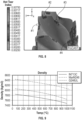
- FIG. 9 illustrates a graphical representation of computed densities as a function of temperature of Inconel 713C, MarM246, and G246UL.
- FIG. 10 illustrates a graphical representation of computed moduli as a function of temperature of Inconel 713C, MarM246, and G246UL. Density and Modulus were computed for G246UL with JMatPro and compared with Mar-M-246 and Inconel 713C experimental data. Computed modulus of G246UL is similar to Mar-M-246 at temperatures above 900°C and higher than Inconel 713C.
- the operating temperature of a turbine wheel is above 900°C and the higher modulus is desirable at operating temperatures because it helps reduce the likelihood of any fatigue damage generated from a change of strain distribution during operation due to, for example, deflection distribution or change of blade movement, also referred to as a "Flag effect.”
- the computed density of G246UL is lower than MM246, which can provide a benefit in the case of turbine wheel inertia and will be beneficial in case of material castability. It is believed that lower density is better for castability.
- FIG. 11 illustrates a graphical representation of gamma prime volume fractions at different temperatures of G246UL and MM246.
- ThermoCalc software was used for computation of phase diagrams of Mar-M-246 and G246UL.
- Gamma prime volume fraction at different temperatures (900°C, 950°C and 1000°C) were taken for materials comparison.
- Gamma prima volume fraction and its thermal stability at high temperatures is important for an alloy's mechanical properties and creep, fatigue, thermo-mechanical fatigue resistance during operation at high temperatures.
- Gamma prima volume fraction of from about 55 to about 75 at high temperatures of 900°C, 950°C and 1000°C are preferred.
- G246UL exhibits higher gamma prime volume fraction, from about 58 to about 68, at high temperatures compared to about 52 to about 64 of Mar-M-246.
Landscapes
- Engineering & Computer Science (AREA)
- Mechanical Engineering (AREA)
- Chemical & Material Sciences (AREA)
- General Engineering & Computer Science (AREA)
- Materials Engineering (AREA)
- Metallurgy (AREA)
- Organic Chemistry (AREA)
- Turbine Rotor Nozzle Sealing (AREA)
- Supercharger (AREA)
Abstract
Description
- This application is related to and claims all available benefit of
Indian Provisional Patent Application IPA: 202211002807 filed January 18, 2022 - The present disclosure is generally directed to metal alloys with improved high-temperature oxidation and fatigue resistance for use in turbocharger applications. More particularly, the present disclosure is directed to nickel-based alloys and turbine wheels including nickel-based alloys.
- Turbochargers for gasoline and diesel internal combustion engines are devices known in the art that are used for pressurizing or boosting the intake air stream, routed to a combustion chamber of the engine, by using the heat and volumetric flow of exhaust gas exiting the engine. Specifically, the exhaust gas exiting the engine is routed into a turbine housing of a turbocharger in a manner that causes an exhaust gas-driven turbine wheel to spin within the housing. The exhaust gas-driven turbine wheel is mounted onto one end of a shaft that is common to a radial air compressor mounted onto an opposite end of the shaft and housed in a compressor housing. Thus, rotary action of the turbine wheel also causes the air compressor to spin within a compressor housing of the turbocharger that is separate from the turbine housing. The spinning action of the air compressor causes intake air to enter the compressor housing and be pressurized or boosted a desired amount before it is mixed with fuel and combusted within the engine combustion chamber.
- The turbine wheel, usually a cast nickel-based alloy, used in turbochargers is a highspeed rotating component that is exposed to high temperature combustion gasses between temperatures of about 750°C to about 1050°C, depending upon the application. To withstand such a high temperature, the nickel-based alloy material should be oxidation resistant, creep resistant as well as thermo-mechanical fatigue resistant while rotating in the approximately 100,000 - 300,000 RPM range. Existing alloys for such applications all have various deficiencies: For example, the Mar-M-246 nickel-based alloy is relatively expensive, whereas the IN-713C nickel-based alloy exhibits inferior high-temperature properties.
- Therefore, it will become apparent to those skilled in the art that there remains a present and continuing need for the provision of improved nickel-based alloys and turbine wheels that include such nickel-based alloys. Particularly, it would be desirable to provide an alloy based on Mar-M-246 but with an improved chemistry that reduces costs significantly while still retaining the desirable high-temperature oxidation and corrosion, creep and thermo-mechanical fatigue resistance, for example, of Mar-M-246. Furthermore, other desirable features and characteristics of the inventive subject matter will become apparent from the subsequent detailed description of the inventive subject matter and the appended claims, taken in conjunction with the accompanying drawings and this background of the disclosure.
- Nickel-based alloys and turbocharger turbine wheels including nickel-based alloys are disclosed herein. In one exemplary embodiment, a nickel-based alloy includes or consists of, on a weight basis of the overall alloy: about 2.00% to about 3.00% cobalt, about 12.0% to about 14.0% chromium, about 5.75% to about 6.85% aluminum, about 5.00% to about 6.00% tungsten, about 2.25% to about 2.75% molybdenum, about 1.25% to about 2.00% titanium, about 0.55% to about 1.50% niobium, about 0.13% to about 0.17% carbon, about 0.03 to about 0.05% zirconium, about 0.01% to about 0.02 boron, and a majority of nickel, with the understanding that there may be inevitable/unavoidable impurities. Additionally, in some examples (although an amount of 0.00% of any of the following elements may be present), the nickel-based alloy may include or further consist of tantalum in an amount of less than about 0.10%, manganese in an amount of less than about 0.03%, silicon in an amount of less than about 0.03%, iron in an amount of less than about 1.00%, copper in an amount of less than about 0.02%, sulfur in an amount of less than about 10 ppm and phosphorous in an amount of less than about 50 ppm.
- With regard to the foregoing alloy embodiments: the amount of cobalt may be limited to about 2.25% to about 2.75%; alternatively or additionally, the amount of chromium may be limited to about 12.00% to about 12.80%; alternatively or additionally, the amount of aluminum may be limited to about 6.40% to about 6.80%; alternatively or additionally, the amount of tungsten may be limited to about 5.25% to about 5.75%; alternatively or additionally, the amount of molybdenum may be limited to about 2.40% to about 2.60%; alternatively or additionally, the amount of titanium may be limited to about 1.35% to about 1.65%; alternatively or additionally, the amount of niobium may be limited to about 0.80% to about 1.20%.
- In another exemplary embodiment, a turbocharger turbine wheel includes or consists of, at least as a part of its overall composition, a nickel-based alloy, wherein the nickel-based alloy includes or consists of, on a weight basis of the overall alloy: about 2.00% to about 3.00% cobalt, about 12.0% to about 14.0% chromium, about 5.75% to about 6.85% aluminum, about 5.00% to about 6.00% tungsten, about 2.25% to about 2.75% molybdenum, about 1.25% to about 2.00% titanium, about 0.55% to about 1.50% niobium, about 0.13% to about 0.17% carbon, about 0.03 to about 0.05% zirconium, about 0.01% to about 0.02 boron, and a majority of nickel, with the understanding that there may be inevitable/unavoidable impurities. Additionally, in some examples (although an amount of 0.00% of any of the following elements may be present), the nickel-based alloy may include or further consist of tantalum in an amount of less than about 0.10%, manganese in an amount of less than about 0.03%, silicon in an amount of less than about 0.03%, iron in an amount of less than about 1.00%, copper in an amount of less than about 0.02%, sulfur in an amount of less than about 10 ppm, and phosphorous in an amount of less than about 50 ppm. Such a turbine wheel may find application for operating at temperatures from 980°C to 1020°C.
- With regard to the foregoing turbine wheel embodiments: the amount of cobalt may be limited to about 2.25% to about 2.75%; alternatively or additionally, the amount of chromium may be limited to about 12.00% to about 12.80%; alternatively or additionally, the amount of aluminum may be limited to about 6.40% to about 6.80%; alternatively or additionally, the amount of tungsten may be limited to about 5.25% to about 5.75%; alternatively or additionally, the amount of molybdenum may be limited to about 2.40% to about 2.60%; alternatively or additionally, the amount of titanium may be limited to about 1.35% to about 1.65%; alternatively or additionally, the amount of niobium may be limited to about 0.80% to about 1.20%.
- This brief summary is provided to introduce a selection of concepts in a simplified form that are further described below in the detailed description and the drawings. This summary is not intended to identify key features or essential features of the claimed subject matter, nor is it intended to be used as an aid in determining the scope of the claimed subject matter.
- The various embodiments will hereinafter be described in conjunction with the following drawing figures, wherein like numerals denote like elements, and wherein:
-
FIG. 1 illustrates a system view of an exemplary internal combustion engine including a turbocharger having a turbine wheel in accordance with some embodiments of the present disclosure; -
FIG. 2 illustrates a partial view of a turbine wheel including blades with cracks formed via hot tearing phenomenon in accordance with some embodiments of the present disclosure; -
FIG. 3 illustrates an enlarged view of a microstructure examination of a crack formed in one of the blades of the turbine wheel depicted inFIG. 2 ; -
FIG. 4 illustrates a partial view of a turbine wheel that failed from fatigue due to a blade that had a pre-existing defect (crack(s)) formed via hot tearing phenomenon in accordance with some embodiments of the present disclosure; -
FIG. 5 illustrates a graphical representation of freezing ranges of various alloys including an improved nickel-based alloy in accordance with some embodiments of the present disclosure; -
FIG. 6 illustrates a graphical representation of solid and liquid fractions as a function of temperature at a heating/cooling rate of 1°K of various alloys including an improved nickel-based alloy in accordance with some embodiments of the present disclosure; -
FIG. 7 illustrates a castability analysis of a turbine wheel formed from MarM246 alloy showing the probability of occurrence of cracks formed via hot tearing phenomenon; -
FIG. 8 illustrates a castability analysis of a turbine wheel formed from an improved nickel-based alloy showing the probability of occurrence of cracks formed via hot tearing phenomenon in accordance with some embodiments of the present disclosure; -
FIG. 9 illustrates a graphical representation of computed densities as a function of temperature of various alloys including an improved nickel-based alloy in accordance with some embodiments of the present disclosure; -
FIG. 10 illustrates a graphical representation of computed moduli as a function of temperature of various alloys including an improved nickel-based alloy in accordance with some embodiments of the present disclosure; and -
FIG. 11 illustrates a graphical representation of gamma prime volume fractions at different temperatures of various alloys including an improved nickel-based alloy in accordance with some embodiments of the present disclosure. - The following detailed description is merely exemplary in nature and is not intended to limit the invention or the application and uses of the invention. As used herein, the word "exemplary" means "serving as an example, instance, or illustration." Thus, any embodiment described herein as "exemplary" is not necessarily to be construed as preferred or advantageous over other embodiments. All of the embodiments described herein are exemplary embodiments provided to enable persons skilled in the art to make or use the invention and not to limit the scope of the invention which is defined by the claims. Furthermore, there is no intention to be bound by any expressed or implied theory presented in the preceding technical field, background, brief summary, or the following detailed description.
- Unless specifically stated or obvious from context, as used herein, the term "about" is understood as within a range of normal tolerance in the art, for example within 2 standard deviations of the mean. "About" can be understood as within 10%, 5%, 1%, 0.5%, 0.1%, 0.05%, or 0.01% of the stated value. "About" can alternatively be understood as implying the exact value stated. Unless otherwise clear from the context, all numerical values provided herein are modified by the term "about."
- Embodiments of the present disclosure provide an improved nickel-based alloy and turbocharger turbine wheels made with this nickel-based alloy. The disclosed embodiments detail an improved nickel-based alloy chemistry that is less expensive than Mar-M-246 yet has better high-temperature properties as compared with IN-713C.
- With reference now to
FIG. 1 , illustrated is aturbocharger 101 in accordance with the present disclosure having a radial turbine and that includes a turbocharger housing and a rotor configured to rotate within the turbocharger housing along an axis ofrotor rotation 103 on thrust bearings and two sets of journal bearings (one for each respective rotor wheel), or alternatively, other similarly supportive bearings. The turbocharger housing includes aturbine housing 105, acompressor housing 107, and a bearing housing 109 (i.e., a center housing that contains the bearings) that connects theturbine housing 105 to thecompressor housing 107. The rotor includes aturbine wheel 111 located substantially within theturbine housing 105, acompressor wheel 113 located substantially within thecompressor housing 107, and ashaft 115 extending along the axis ofrotor rotation 103, through thebearing housing 109, to connect theturbine wheel 111 to thecompressor wheel 113. - The turbine housing 105 and
turbine wheel 111 form a turbine configured to circumferentially receive a high-pressure and high-temperatureexhaust gas stream 121 from an engine, e.g., from anexhaust manifold 123 of aninternal combustion engine 125. The turbine wheel 111 (and thus the rotor) is driven in rotation around the axis ofrotor rotation 103 by the high-pressure and high-temperatureexhaust gas stream 121, which becomes a lower-pressure and lower-temperatureexhaust gas stream 127 and is axially released into an exhaust system (not shown). - The compressor housing 107 and
compressor wheel 113 form a compressor stage. Thecompressor wheel 113, being driven in rotation by the exhaust-gas driventurbine wheel 111, is configured to compress axially received input air (e.g.,ambient air 131, or already-pressurized air from a previous-stage in a multi-stage compressor) into a pressurizedair stream 133 that is ejected circumferentially from the compressor. Due to the compression process, the pressurized air stream is characterized by an increased temperature over that of the input air. - Optionally, the pressurized air stream may be channeled through a convectively cooled
charge air cooler 135 configured to dissipate heat from the pressurizedair stream 133, increasing its density. The resulting cooled and pressurizedoutput air stream 137 is channeled into anintake manifold 139 on the internal combustion engine, or alternatively, into a subsequent-stage, in-series compressor. The operation of the system is controlled by an engine control unit (ECU) 151 that connects to the remainder of the system viacommunication connections 153. - The composition of an exemplary nickel-based alloy is now provided below with respect to its constituent elements (all percentages being provided on a weight basis of the overall alloy composition, unless otherwise noted). In one embodiment, elements that are associated with grain boundary cracking and embrittlement should be minimized. For example, in this embodiment, the content of silicon (Si) is maintained below or equal to about 0.03%. The content of phosphorous (P) is maintained below or equal to about 50 ppm. Further, the content of sulfur (S) is maintained below or equal to about 10 ppm. As an additional matter, to reduce cracking, the master heat alloy that is used to process the alloy to ingot form desirably does not contain any casting revert or scrap having detrimental tramp or trace elements.
- Elements that are associated with grain boundary strengthening, including carbon (C), boron (B), and zirconium (Zr) are melting point depressants which can create hot cracks during solidification in a casting process (hot tearing phenomenon) and welding (solidification cracking) of alloys. Grain boundary liquation during welding of alloys is linked to carbides and borides. Since C (but not B) achieves a "carbon boil" during master alloy refining, embodiments of the nickel-based alloy retain some carbon, likely in the form of carbides (as described below) but not a significant content of borides. Zr or B does not influence the castability when added individually. However, when both Zr and B are present in the alloy, high hot tearing susceptibility was found, the effect being particularly strong if Zr concentration was high. Accordingly, the content of B is maintained in a range of about 0.01% to about 0.02%, the content of carbon is maintained in a range of about 0.13% to about 0.17%, and the content of zirconium is maintained in a range of about 0.03% to about 0.05%.
- With the aforementioned relatively lower C and B content, the undesirable formation of topologically close-packed (TCP) brittle phases requires concomitant lowering of the minimum amounts of several refractory elements known to form TCP phases. For example, chromium (Cr), molybdenum (Mo), cobalt (Co), and tungsten (W) can combine to form TCP phases. Of these, reducing the Cr lower limit is desirably avoided because Cr plays a role in oxidation/sulfidation resistance. Accordingly, in one embodiment, the content of Cr is from 12.0% to about 14.0%. In another embodiment, the content of Cr is from about 12.0% to about 12.8%.
- Co is a solid solution strengthening element, but it can contribute to TCP phase formation. Accordingly, permitting a lower Co content has been discovered to be beneficial from lower risk of TCP formation, lower density and lower cost point of view. Thus, in one embodiment, the content of Co is from about 2.00% to about 3.00%. In another embodiment, the content of Co is from about 2.25% to about 2.75%.
- Furthermore, W is known to be an element that forms carbides, that acts as a solid solution strengthening element, and that forms TCP phases especially in case of high percentage of gamma prime in alloys. W is also a relatively expensive element and increases density of alloys. Accordingly, permitting a lower W content has been discovered to be beneficial. Thus, in one embodiment, the content of W is from about 5.00% to about 6.00%. In another embodiment, the content of W is from about 5.25% to about 5.75%.
- Titanium (Ti) is both a carbide and gamma-prime phase forming element. The gamma-prime phase is favorable for high-temperature oxidation resistance. Gamma-prime phase volume fraction and its thermal stability at high temperature is key for alloys for higher mechanical properties, creep and thermo-mechanical fatigue resistance during severe thermal-shock loading conditions. Accordingly, in some embodiments, titanium is provided in a range of about 1.25% to about 2.00%. In other embodiments, titanium is provided in a range of about 1.35% to about 1.65%.
- Mo is a solid solution strengthening element and increases the Al partitioning to the gamma-prime phase by reducing the solubility of Al in the γ matrix which increases gamma-prime volume fraction. Moreover, Mo is known to be an element that forms primary MC carbides and that forms detrimental phases like TCP phases or M6C carbides, in some instances, the formation of M6C is an intragranular Widmanstatten precipitates. Alloy tends to precipitate M6C carbides if the alloy has a sufficiently high molybdenum + tungsten content (Mo + ½W ≥6 wt%). There is evidence in the art that Mo may be detrimental to hot corrosion or oxidation resistance. Mo oxide volatility may also be a negative factor. Moderate-strength cast alloys such as IN-738 and higher-strength cast alloys such as IN-792 have achieved greatly improved corrosion resistance with low levels of molybdenum and tungsten, and beneficial levels of chromium (12 to 15%). Accordingly, the content of Mo is desirably maintained within a range of about 2.25% to about 2.75%. In another embodiment, the content of Mo is maintained with a range of about 2.40% to about 2.60%.
- Continuing with the description of an exemplary embodiment of the nickel-based alloy, niobium (Nb) is known to be an element that forms carbides and a solid solution strengthening element that also partitions to the gamma-prime phase. The phase fraction and stability of γ' increases with niobium content. Allowing a higher content of Nb will favor Nb-rich carbides and make up for the absence of Ti in the gamma-prime phase while contributing to solid solution strengthening. Moreover, Nb is preferred MC carbide former because titanium-rich MC carbides are less stable and introduce deleterious M6C reactions. Accordingly, in an embodiment, the content of Nb is from about 0.55% to about 1.50%. In another embodiment, the content of Nb is from about 0.80% to about 1.20%.
- Al, as a gamma-prime phase forming element, is also included in the alloy composition of the present disclosure. In one embodiment, the content of Al is from about 5.75% to about 6.85%. In another embodiment, the content of Al is from about 6.40% to about 6.80%.
- Other elements that may be present in small amounts (or possibly 0%) in some embodiments include tantalum (Ta) in an amount of less than about 0.10%, manganese (Mn) in an amount of less than about 0.03%, iron (Fe) in an amount of less than about 1.00%, and copper (Cu) in an amount of less than about 0.02%.
- Moreover, as the described alloys are nickel-based, it will be appreciated that nickel (Ni) forms a majority of the content (i.e., greater than about 50%) of the described alloy. That is, nickel typically accounts for the balance of the content not otherwise described above, while accounting for inevitable/unavoidable impurities not otherwise set forth above as are commonly understood in the art.
- Table 1, set forth below, provides the elemental content of a nickel-based alloy of the present disclosure in accordance with the description provided above, while also specifying the maximum content of additional detrimental tramp or trace elements commonly encountered in nickel-based alloys. Each weight percentage included in Table 1 is understood to be preceded by the term "about." In addition, a minimum of zero, signified by "<", means "low as possible", not to exceed the maximum. It should be acknowledged that trace amounts of inevitable/unavoidable impurities may be present (in trace amounts), although not explicitly listed in Table 1, as is known in the art.
TABLE 1 Application Temperature (C) 980°C-1020°C Chemical Element % Carbon, C 0.13-0.17 Manganese, Mn <0.03 Sulfur, S <10 ppm Silicon, Si <0.03 Chromium, Cr 12.0-14.0 Molybdenum, Mo 2.25-2.75 Tungsten, W 5.00-6.00 Titanium, Ti 1.25-2.00 Boron, B 0.01-0.02 Niobium, Nb 0.55-1.50 Aluminum, Al 5.75-6.85 Zirconium, Zr 0.03-0.05 Cobalt, Co 2.00-3.00 Iron, Fe <1.00 Tantalum, Ta <0.10 Copper, Cu <0.02 Phosphorous, P <50 ppm Nickel, Ni Balance - As such, described herein are embodiments of improved nickel-based alloys and turbocharger turbine wheels made with such nickel-based alloys. The described embodiments provide a high-temperature oxidation and corrosion resistance, creep and thermo-mechanical fatigue resistant and very good castable (due to lower freezing range and density) nickel-based alloy that is achieved, in part, with increased in chromium and aluminum, significantly decreased tungsten and cobalt, addition of niobium, with no tantalum, in comparison to Mar-M-246. The resultant alloy has a reduced cost, wherein the raw material is about 15% less than Mar-M-246. Thus, the novel alloy described herein will have good mechanical properties, better creep and thermo-mechanical fatigue resistance, better oxidation/hot corrosion resistance and better castability with lesser density and cost, and will be a suitable alternative to the prior art options. As such, the alloy of the present disclosure can be used to make turbine wheels for applications reaching temperatures from 980°C to 1020°C with lower cost than existing commercial alloys.
- All of the nickel-based alloys described herein may be understood as either: (1) "comprising" the listed elements in their various percentages, in an open-ended context or (2) "consisting of' the listed elements in their various percentages, in a closed-ended context. Alternatively, the alloys described herein may be understood as (3) "consisting essentially of' the listed elements in their various percentages, wherein other elements may be present in amounts not effecting the novel/nonobvious characteristics of the alloy. Thus, as used herein, the terms "comprising," "consisting of," and "consisting essentially of' should be understood as applicable to all of the ranges of alloy compositions disclosed herein.
- The present disclosure is now illustrated by the following non-limiting examples. It should be noted that various changes and modifications can be applied to the following examples and processes without departing from the scope of this invention, which is defined in the appended claims. Therefore, it should be noted that the following examples should be interpreted as illustrative only and not limiting in any sense.
-
FIG. 2 illustrates a partial view of a turbine wheel including blades with cracks formed via hot tearing phenomenon.FIG. 3 illustrates an enlarged view of a microstructure examination of a crack formed in one of the blades of the turbine wheel. - Hot tearing (HTR) phenomenon, also referred to as hot cracking or hot shortness, represents the formation of an irreversible failure (crack) in the still semisolid casting during formation via casting of a metal alloy part. Hot tearing arises from a complex combination of thermal-mechanical and solidification phenomena, basically being associated with the incomplete liquid feeding and tensile stress generated in coherent regions of mushy zones, more specifically, in areas with a high solid fraction of 0.9 and beyond. It is generally believed that hot tearing occurs above the solidus temperature when the volume fraction of solid is, for example, 85% to 95% and the solid phase is organized in a continuous network of grains and propagates in the interdendritic and/or intergranular liquid film. "Time spend" in mushy zone during solidification is possible to influence by the chemical composition of the alloy.
- As illustrated, due to the complexity of the turbine wheel, particularly the changes of cross-sectional dimensions of the blades, cracks can occur in the blades by casting turbine wheels. There may be multiple factors that could be involved in the formation of cracks at supersolidus temperatures, however a primary cause is inadequate compensation of solidification shrinkage by melt flow in the presence of thermal stresses. These cracks can be difficult to detect visually or by non-destructive analysis (NDA) and, as such, can result in some cast parts being used in the field, which may have a shorted "use life."
-
FIG. 4 illustrates a partial view of a turbine wheel that failed from fatigue due to a blade that had a pre-existing defect (crack(s)) formed via hot tearing phenomenon. The fatigue damage was generated from (1) vibrations produced during operation of the turbine wheel and (2) change of strain distribution due to: (a) stress concentration (e.g., notch or pre-existing defect/crack acts as a stress concentrator) and/or (b) deflection distribution or change of blade movement also referred to as a "Flag effect." - Example metal alloys (referred to herein as "MarM246" and "G246UL") with the following compositions were used in the examples presented below in Table 2 with respect in
FIGS. 5-11 . "MarM246" represents an existing nickel-based alloy and "G246UL" represents an improved nickel-based alloy in accordance with some embodiments of the present disclosure.
-
FIG. 5 illustrates a graphical representation of freezing ranges of variousalloys including Inconel 713C (another existing nickel-based alloy) and MarM246 and G246UL referenced above. Specifically, the freezing range is the solidification temperature range between an alloy's liquidus and solidus phases. This temperature range has impact on HTR occurrence risk and reducing the freezing temperature range is critical for reducing the HTR occurrence risk. The HTR occurrence risk is bigger with wider freezing range especially with longer time spend in mushy zone. Faster solidification helps decrease HTR risk. Freezing range and solidification temperature of remaining liquid is affected by the chemical composition of the alloy. - ThermoCalc software was used for computation of the freezing range of Mar-M-246,
Inconel 713C and G246UL. Precision of computation was reviewed by experimental measurement of Mar-M-246 andInconel 713C by DSC (Differential scanning calorimetry) equipment. Correlation between computation and experimental measurement was found to be very good. - As illustrated, G246UL exhibits similar, but slightly lower, computed values of freezing range to
Inconel 713C and much lower in comparison to Mar-M-246. Further, it was observed thatInconel 713C castability is better and HTR occurrence is much lower in comparison to Mar-M-246. As such, castability of G246UL is better and HTR occurrence is much lower in comparison to Mar-M-246 and correspondingly improved overInconel 713C. -
FIG. 6 illustrates a graphical representation of solid and liquid fractions as a function of temperature at a heating/cooling rate of 1°K (e.g., cooling rate as part of a casting process) of Mar-M-246 and G246UL. As illustrated, G246UL exhibits tighter freezing range and tighter temperature range "spend" in mushy zone, indicating a much lower probability of HTR occurrence in comparison to Mar-M-246. -
FIGS. 7-8 illustrates a castability analysis of a turbine wheel formed from MarM246 alloy and G246LTL, respectively, showing the probability of occurrence of cracks formed via hot tearing phenomenon. Notably the Hot Tear Index scale inFIG. 8 is divided by 2 in comparison to the Hot Tear Index scale inFIG. 7 . As illustrated, G246UL gives lower HTR risk (i.e., a much lower probability of HTR occurrence) compared to MarM246 due to differences in chemical compositions. In particular, the probability of HTR occurrence at various locations (#1-#4) on the blades of the respective turbine wheel is provided in the table (Table 3) below:

-
FIG. 9 illustrates a graphical representation of computed densities as a function of temperature ofInconel 713C, MarM246, and G246UL.FIG. 10 illustrates a graphical representation of computed moduli as a function of temperature ofInconel 713C, MarM246, and G246UL. Density and Modulus were computed for G246UL with JMatPro and compared with Mar-M-246 andInconel 713C experimental data. Computed modulus of G246UL is similar to Mar-M-246 at temperatures above 900°C and higher thanInconel 713C. As previously discussed, the operating temperature of a turbine wheel is above 900°C and the higher modulus is desirable at operating temperatures because it helps reduce the likelihood of any fatigue damage generated from a change of strain distribution during operation due to, for example, deflection distribution or change of blade movement, also referred to as a "Flag effect." - Further, the computed density of G246UL is lower than MM246, which can provide a benefit in the case of turbine wheel inertia and will be beneficial in case of material castability. It is believed that lower density is better for castability.
-
FIG. 11 illustrates a graphical representation of gamma prime volume fractions at different temperatures of G246UL and MM246. In particular, ThermoCalc software was used for computation of phase diagrams of Mar-M-246 and G246UL. Gamma prime volume fraction at different temperatures (900°C, 950°C and 1000°C) were taken for materials comparison. Gamma prima volume fraction and its thermal stability at high temperatures is important for an alloy's mechanical properties and creep, fatigue, thermo-mechanical fatigue resistance during operation at high temperatures. Gamma prima volume fraction of from about 55 to about 75 at high temperatures of 900°C, 950°C and 1000°C are preferred. As illustrated, G246UL exhibits higher gamma prime volume fraction, from about 58 to about 68, at high temperatures compared to about 52 to about 64 of Mar-M-246. - While at least one exemplary embodiment has been presented in the foregoing detailed description of the invention, it should be appreciated that a vast number of variations exist. It should also be appreciated that the exemplary embodiment or exemplary embodiments are only examples, and are not intended to limit the scope, applicability, or configuration of the invention in any way. Rather, the foregoing detailed description will provide those skilled in the art with a convenient road map for implementing an exemplary embodiment of the invention, it being understood that various changes may be made in the function and arrangement of elements described in an exemplary embodiment without departing from the scope as set forth in the appended claims and their legal equivalents.
Claims (10)
- A nickel-based alloy, wherein the nickel-based alloy comprises, on a weight basis of the overall alloy:about 2.00% to about 3.00% cobalt,about 12.0% to about 14.0% chromium,about 5.75% to about 6.85% aluminum,about 5.00% to about 6.00% tungsten,about 2.25% to about 2.75% molybdenum,about 1.25% to about 2.00% titanium,about 0.55% to about 1.50% niobium,about 0.13% to about 0.17% carbon,about 0.03 to about 0.05% zirconium,about 0.01% to about 0.02% boron, anda majority of nickel, with the proviso that inevitable/unavoidable impurities may be present in trace amounts.
- The nickel-based alloy of claim 1, wherein the amount of cobalt is from about 2.25% to about 2.75%.
- The nickel-based alloy of claim 1 or 2, wherein the amount of chromium is from about 12.00% to about 12.80%.
- The nickel-based alloy of any preceding claim, wherein the amount of aluminum is from about 6.40% to about 6.80%.
- The nickel-based alloy of any preceding claim, wherein the amount of tungsten is from about 5.25% to about 5.75%.
- The nickel-based alloy of any preceding claim, wherein the amount of molybdenum is from about 2.40% to about 2.60%.
- The nickel-based alloy of any preceding claim, wherein the amount of titanium is from about 1.35% to about 1.65%.
- The nickel-based alloy of any preceding claim, wherein the amount of niobium is from about 0.80% to about 1.20%.
- A turbocharger turbine wheel comprising, at least as a part of its overall composition, a nickel-based alloy, wherein the nickel-based alloy is the nickel based alloy of any preceding claim.
- The turbocharger turbine wheel of claim 9, wherein the turbocharger turbine wheel is configured for operation at a temperature range of about 980°C to about 1020°C.
Applications Claiming Priority (2)
| Application Number | Priority Date | Filing Date | Title |
|---|---|---|---|
| IN202211002807 | 2022-01-18 | ||
| US17/655,565 US20230227945A1 (en) | 2022-01-18 | 2022-03-21 | Nickel-based alloy and turbine wheel incorportating same |
Publications (2)
| Publication Number | Publication Date |
|---|---|
| EP4212639A1 true EP4212639A1 (en) | 2023-07-19 |
| EP4212639B1 EP4212639B1 (en) | 2025-06-04 |
Family
ID=83899675
Family Applications (1)
| Application Number | Title | Priority Date | Filing Date |
|---|---|---|---|
| EP22202560.3A Active EP4212639B1 (en) | 2022-01-18 | 2022-10-19 | Nickel-based alloy and turbine wheel incorporating same |
Country Status (2)
| Country | Link |
|---|---|
| EP (1) | EP4212639B1 (en) |
| CN (1) | CN116083754A (en) |
Citations (2)
| Publication number | Priority date | Publication date | Assignee | Title |
|---|---|---|---|---|
| US5611670A (en) * | 1993-08-06 | 1997-03-18 | Hitachi, Ltd. | Blade for gas turbine |
| EP2805784A1 (en) * | 2013-05-24 | 2014-11-26 | Rolls-Royce plc | A nickel alloy |
Family Cites Families (4)
| Publication number | Priority date | Publication date | Assignee | Title |
|---|---|---|---|---|
| FR1277658A (en) * | 1961-01-13 | 1961-12-01 | Sierra Metals Corp | Improvements to metal alloys |
| CN109789457A (en) * | 2016-09-30 | 2019-05-21 | 日立金属株式会社 | Ni base superalloy squeezes out the manufacturing method of material and Ni base superalloy squeezes out material |
| GB2554898B (en) * | 2016-10-12 | 2018-10-03 | Univ Oxford Innovation Ltd | A Nickel-based alloy |
| WO2018216067A1 (en) * | 2017-05-22 | 2018-11-29 | 川崎重工業株式会社 | High temperature component and method for producing same |
-
2022
- 2022-10-19 EP EP22202560.3A patent/EP4212639B1/en active Active
-
2023
- 2023-01-10 CN CN202310037422.5A patent/CN116083754A/en active Pending
Patent Citations (2)
| Publication number | Priority date | Publication date | Assignee | Title |
|---|---|---|---|---|
| US5611670A (en) * | 1993-08-06 | 1997-03-18 | Hitachi, Ltd. | Blade for gas turbine |
| EP2805784A1 (en) * | 2013-05-24 | 2014-11-26 | Rolls-Royce plc | A nickel alloy |
Also Published As
| Publication number | Publication date |
|---|---|
| CN116083754A (en) | 2023-05-09 |
| EP4212639B1 (en) | 2025-06-04 |
Similar Documents
| Publication | Publication Date | Title |
|---|---|---|
| US9518310B2 (en) | Superalloys and components formed thereof | |
| EP2128283B1 (en) | Nickel-base casting superalloy and cast component for steam turbine using the same | |
| US9567656B2 (en) | Nickel based alloy for forging | |
| EP2039789A1 (en) | Nickel-based alloy for turbine rotor of steam turbine and turbine rotor of steam turbine | |
| EP3024957B1 (en) | Superalloys and components formed thereof | |
| US11384414B2 (en) | Nickel-based superalloys | |
| JP5165008B2 (en) | Ni-based forged alloy and components for steam turbine plant using it | |
| JP4409409B2 (en) | Ni-Fe base superalloy, method for producing the same, and gas turbine | |
| US20110058977A1 (en) | Ni based casting alloy and turbine casing | |
| JP2004269979A (en) | Heat-resistant cast steel, heat-resistant member made of cast steel, and manufacturing method thereof | |
| JP2004256840A (en) | Composite strengthened Ni-base superalloy and method for producing the same | |
| EP4212639B1 (en) | Nickel-based alloy and turbine wheel incorporating same | |
| US20230227945A1 (en) | Nickel-based alloy and turbine wheel incorportating same | |
| JP5932622B2 (en) | Austenitic heat resistant steel and turbine parts | |
| US8828313B2 (en) | Ni-base alloy for turbine rotor of steam turbine and turbine rotor of steam turbine | |
| US20110256018A1 (en) | Ni-Based Single Crystal Superalloy with Good Creep Property | |
| JP5373147B2 (en) | Steam turbine rotor, Ni-based forged alloy, boiler tube for steam turbine plant | |
| US11739398B2 (en) | Nickel-based superalloy | |
| EP2944704B1 (en) | Nickel alloy composition | |
| EP3243922A1 (en) | Austenite-based heat-resistant steel, and turbine component | |
| TWI918844B (en) | Nickel-based superalloy | |
| Mazalov et al. | Specific features of microstructure formation in Co–Cr–Ni–W–Ta alloys and their mechanical properties | |
| JP2014005528A (en) | Ni-BASED HEAT-RESISTANT ALLOY AND TURBINE COMPONENT | |
| JP6688598B2 (en) | Austenitic steel and cast austenitic steel using the same | |
| JP2015030873A (en) | Austenitic heat resistant steel and turbine parts |
Legal Events
| Date | Code | Title | Description |
|---|---|---|---|
| PUAI | Public reference made under article 153(3) epc to a published international application that has entered the european phase |
Free format text: ORIGINAL CODE: 0009012 |
|
| STAA | Information on the status of an ep patent application or granted ep patent |
Free format text: STATUS: REQUEST FOR EXAMINATION WAS MADE |
|
| 17P | Request for examination filed |
Effective date: 20221019 |
|
| AK | Designated contracting states |
Kind code of ref document: A1 Designated state(s): AL AT BE BG CH CY CZ DE DK EE ES FI FR GB GR HR HU IE IS IT LI LT LU LV MC ME MK MT NL NO PL PT RO RS SE SI SK SM TR |
|
| GRAP | Despatch of communication of intention to grant a patent |
Free format text: ORIGINAL CODE: EPIDOSNIGR1 |
|
| STAA | Information on the status of an ep patent application or granted ep patent |
Free format text: STATUS: GRANT OF PATENT IS INTENDED |
|
| RIC1 | Information provided on ipc code assigned before grant |
Ipc: F01D 25/24 20060101ALI20250226BHEP Ipc: F01D 25/00 20060101ALI20250226BHEP Ipc: F01D 5/28 20060101ALI20250226BHEP Ipc: C22C 19/05 20060101AFI20250226BHEP |
|
| INTG | Intention to grant announced |
Effective date: 20250318 |
|
| GRAS | Grant fee paid |
Free format text: ORIGINAL CODE: EPIDOSNIGR3 |
|
| GRAA | (expected) grant |
Free format text: ORIGINAL CODE: 0009210 |
|
| STAA | Information on the status of an ep patent application or granted ep patent |
Free format text: STATUS: THE PATENT HAS BEEN GRANTED |
|
| AK | Designated contracting states |
Kind code of ref document: B1 Designated state(s): AL AT BE BG CH CY CZ DE DK EE ES FI FR GB GR HR HU IE IS IT LI LT LU LV MC ME MK MT NL NO PL PT RO RS SE SI SK SM TR |
|
| REG | Reference to a national code |
Ref country code: GB Ref legal event code: FG4D |
|
| REG | Reference to a national code |
Ref country code: CH Ref legal event code: EP |
|
| REG | Reference to a national code |
Ref country code: DE Ref legal event code: R096 Ref document number: 602022015422 Country of ref document: DE |
|
| REG | Reference to a national code |
Ref country code: IE Ref legal event code: FG4D |
|
| REG | Reference to a national code |
Ref country code: NL Ref legal event code: MP Effective date: 20250604 |
|
| PG25 | Lapsed in a contracting state [announced via postgrant information from national office to epo] |
Ref country code: FI Free format text: LAPSE BECAUSE OF FAILURE TO SUBMIT A TRANSLATION OF THE DESCRIPTION OR TO PAY THE FEE WITHIN THE PRESCRIBED TIME-LIMIT Effective date: 20250604 Ref country code: ES Free format text: LAPSE BECAUSE OF FAILURE TO SUBMIT A TRANSLATION OF THE DESCRIPTION OR TO PAY THE FEE WITHIN THE PRESCRIBED TIME-LIMIT Effective date: 20250604 |
|
| REG | Reference to a national code |
Ref country code: LT Ref legal event code: MG9D |
|
| PG25 | Lapsed in a contracting state [announced via postgrant information from national office to epo] |
Ref country code: GR Free format text: LAPSE BECAUSE OF FAILURE TO SUBMIT A TRANSLATION OF THE DESCRIPTION OR TO PAY THE FEE WITHIN THE PRESCRIBED TIME-LIMIT Effective date: 20250905 Ref country code: NO Free format text: LAPSE BECAUSE OF FAILURE TO SUBMIT A TRANSLATION OF THE DESCRIPTION OR TO PAY THE FEE WITHIN THE PRESCRIBED TIME-LIMIT Effective date: 20250904 |
|
| PG25 | Lapsed in a contracting state [announced via postgrant information from national office to epo] |
Ref country code: PL Free format text: LAPSE BECAUSE OF FAILURE TO SUBMIT A TRANSLATION OF THE DESCRIPTION OR TO PAY THE FEE WITHIN THE PRESCRIBED TIME-LIMIT Effective date: 20250604 |
|
| PG25 | Lapsed in a contracting state [announced via postgrant information from national office to epo] |
Ref country code: BG Free format text: LAPSE BECAUSE OF FAILURE TO SUBMIT A TRANSLATION OF THE DESCRIPTION OR TO PAY THE FEE WITHIN THE PRESCRIBED TIME-LIMIT Effective date: 20250604 |
|
| PG25 | Lapsed in a contracting state [announced via postgrant information from national office to epo] |
Ref country code: HR Free format text: LAPSE BECAUSE OF FAILURE TO SUBMIT A TRANSLATION OF THE DESCRIPTION OR TO PAY THE FEE WITHIN THE PRESCRIBED TIME-LIMIT Effective date: 20250604 |
|
| PG25 | Lapsed in a contracting state [announced via postgrant information from national office to epo] |
Ref country code: RS Free format text: LAPSE BECAUSE OF FAILURE TO SUBMIT A TRANSLATION OF THE DESCRIPTION OR TO PAY THE FEE WITHIN THE PRESCRIBED TIME-LIMIT Effective date: 20250904 |
|
| PG25 | Lapsed in a contracting state [announced via postgrant information from national office to epo] |
Ref country code: LV Free format text: LAPSE BECAUSE OF FAILURE TO SUBMIT A TRANSLATION OF THE DESCRIPTION OR TO PAY THE FEE WITHIN THE PRESCRIBED TIME-LIMIT Effective date: 20250604 |
|
| PG25 | Lapsed in a contracting state [announced via postgrant information from national office to epo] |
Ref country code: NL Free format text: LAPSE BECAUSE OF FAILURE TO SUBMIT A TRANSLATION OF THE DESCRIPTION OR TO PAY THE FEE WITHIN THE PRESCRIBED TIME-LIMIT Effective date: 20250604 |
|
| PG25 | Lapsed in a contracting state [announced via postgrant information from national office to epo] |
Ref country code: PT Free format text: LAPSE BECAUSE OF FAILURE TO SUBMIT A TRANSLATION OF THE DESCRIPTION OR TO PAY THE FEE WITHIN THE PRESCRIBED TIME-LIMIT Effective date: 20251006 |
|
| REG | Reference to a national code |
Ref country code: AT Ref legal event code: MK05 Ref document number: 1800389 Country of ref document: AT Kind code of ref document: T Effective date: 20250604 |
|
| PG25 | Lapsed in a contracting state [announced via postgrant information from national office to epo] |
Ref country code: IS Free format text: LAPSE BECAUSE OF FAILURE TO SUBMIT A TRANSLATION OF THE DESCRIPTION OR TO PAY THE FEE WITHIN THE PRESCRIBED TIME-LIMIT Effective date: 20251004 |
|
| PGFP | Annual fee paid to national office [announced via postgrant information from national office to epo] |
Ref country code: DE Payment date: 20251028 Year of fee payment: 4 |
|
| PG25 | Lapsed in a contracting state [announced via postgrant information from national office to epo] |
Ref country code: SM Free format text: LAPSE BECAUSE OF FAILURE TO SUBMIT A TRANSLATION OF THE DESCRIPTION OR TO PAY THE FEE WITHIN THE PRESCRIBED TIME-LIMIT Effective date: 20250604 Ref country code: AT Free format text: LAPSE BECAUSE OF FAILURE TO SUBMIT A TRANSLATION OF THE DESCRIPTION OR TO PAY THE FEE WITHIN THE PRESCRIBED TIME-LIMIT Effective date: 20250604 |
|
| PGFP | Annual fee paid to national office [announced via postgrant information from national office to epo] |
Ref country code: FR Payment date: 20251027 Year of fee payment: 4 |
|
| PG25 | Lapsed in a contracting state [announced via postgrant information from national office to epo] |
Ref country code: CZ Free format text: LAPSE BECAUSE OF FAILURE TO SUBMIT A TRANSLATION OF THE DESCRIPTION OR TO PAY THE FEE WITHIN THE PRESCRIBED TIME-LIMIT Effective date: 20250604 |
|
| PG25 | Lapsed in a contracting state [announced via postgrant information from national office to epo] |
Ref country code: EE Free format text: LAPSE BECAUSE OF FAILURE TO SUBMIT A TRANSLATION OF THE DESCRIPTION OR TO PAY THE FEE WITHIN THE PRESCRIBED TIME-LIMIT Effective date: 20250604 |
|
| PG25 | Lapsed in a contracting state [announced via postgrant information from national office to epo] |
Ref country code: SK Free format text: LAPSE BECAUSE OF FAILURE TO SUBMIT A TRANSLATION OF THE DESCRIPTION OR TO PAY THE FEE WITHIN THE PRESCRIBED TIME-LIMIT Effective date: 20250604 |
|
| PG25 | Lapsed in a contracting state [announced via postgrant information from national office to epo] |
Ref country code: IT Free format text: LAPSE BECAUSE OF FAILURE TO SUBMIT A TRANSLATION OF THE DESCRIPTION OR TO PAY THE FEE WITHIN THE PRESCRIBED TIME-LIMIT Effective date: 20250604 |
|
| REG | Reference to a national code |
Ref country code: DE Ref legal event code: R097 Ref document number: 602022015422 Country of ref document: DE |
|
| PG25 | Lapsed in a contracting state [announced via postgrant information from national office to epo] |
Ref country code: RO Free format text: LAPSE BECAUSE OF FAILURE TO SUBMIT A TRANSLATION OF THE DESCRIPTION OR TO PAY THE FEE WITHIN THE PRESCRIBED TIME-LIMIT Effective date: 20250604 |
|
| PLBE | No opposition filed within time limit |
Free format text: ORIGINAL CODE: 0009261 |
|
| STAA | Information on the status of an ep patent application or granted ep patent |
Free format text: STATUS: NO OPPOSITION FILED WITHIN TIME LIMIT |
|
| PG25 | Lapsed in a contracting state [announced via postgrant information from national office to epo] |
Ref country code: DK Free format text: LAPSE BECAUSE OF FAILURE TO SUBMIT A TRANSLATION OF THE DESCRIPTION OR TO PAY THE FEE WITHIN THE PRESCRIBED TIME-LIMIT Effective date: 20250604 |
|
| REG | Reference to a national code |
Ref country code: CH Ref legal event code: L10 Free format text: ST27 STATUS EVENT CODE: U-0-0-L10-L00 (AS PROVIDED BY THE NATIONAL OFFICE) Effective date: 20260416 |
|
| 26N | No opposition filed |
Effective date: 20260305 |