EP4212338A1 - Method for preparing a paper web with a composite paper mesh for use to produce bags, and composite paper mesh - Google Patents
Method for preparing a paper web with a composite paper mesh for use to produce bags, and composite paper mesh Download PDFInfo
- Publication number
- EP4212338A1 EP4212338A1 EP21863761.9A EP21863761A EP4212338A1 EP 4212338 A1 EP4212338 A1 EP 4212338A1 EP 21863761 A EP21863761 A EP 21863761A EP 4212338 A1 EP4212338 A1 EP 4212338A1
- Authority
- EP
- European Patent Office
- Prior art keywords
- paper
- mesh
- composite
- band
- longitudinal strips
- Prior art date
- Legal status (The legal status is an assumption and is not a legal conclusion. Google has not performed a legal analysis and makes no representation as to the accuracy of the status listed.)
- Pending
Links
- 239000002131 composite material Substances 0.000 title claims abstract description 39
- 238000000034 method Methods 0.000 title claims abstract description 33
- 238000004519 manufacturing process Methods 0.000 claims abstract description 21
- 230000008569 process Effects 0.000 claims abstract description 20
- 238000004026 adhesive bonding Methods 0.000 claims abstract description 12
- 238000004806 packaging method and process Methods 0.000 claims description 7
- 229920000742 Cotton Polymers 0.000 claims description 5
- 238000005520 cutting process Methods 0.000 claims description 5
- 239000003292 glue Substances 0.000 claims description 5
- 235000017166 Bambusa arundinacea Nutrition 0.000 claims description 4
- 235000017491 Bambusa tulda Nutrition 0.000 claims description 4
- 241001330002 Bambuseae Species 0.000 claims description 4
- 235000015334 Phyllostachys viridis Nutrition 0.000 claims description 4
- 239000011425 bamboo Substances 0.000 claims description 4
- 239000012634 fragment Substances 0.000 claims description 3
- 238000002360 preparation method Methods 0.000 claims description 3
- 238000013467 fragmentation Methods 0.000 claims 1
- 238000006062 fragmentation reaction Methods 0.000 claims 1
- 239000000463 material Substances 0.000 description 11
- 238000010276 construction Methods 0.000 description 2
- 241001465754 Metazoa Species 0.000 description 1
- 240000002264 Phyllostachys aurea Species 0.000 description 1
- 239000008406 cosmetic ingredient Substances 0.000 description 1
- 230000007613 environmental effect Effects 0.000 description 1
- 230000006872 improvement Effects 0.000 description 1
- 238000007689 inspection Methods 0.000 description 1
- 238000005259 measurement Methods 0.000 description 1
- 230000007246 mechanism Effects 0.000 description 1
- 230000009467 reduction Effects 0.000 description 1
- 230000003014 reinforcing effect Effects 0.000 description 1
- 230000029058 respiratory gaseous exchange Effects 0.000 description 1
- 238000000926 separation method Methods 0.000 description 1
- 238000007493 shaping process Methods 0.000 description 1
- 238000006467 substitution reaction Methods 0.000 description 1
- 239000004753 textile Substances 0.000 description 1
- 238000009423 ventilation Methods 0.000 description 1
- 239000002699 waste material Substances 0.000 description 1
Images



Classifications
-
- B—PERFORMING OPERATIONS; TRANSPORTING
- B32—LAYERED PRODUCTS
- B32B—LAYERED PRODUCTS, i.e. PRODUCTS BUILT-UP OF STRATA OF FLAT OR NON-FLAT, e.g. CELLULAR OR HONEYCOMB, FORM
- B32B29/00—Layered products comprising a layer of paper or cardboard
-
- B—PERFORMING OPERATIONS; TRANSPORTING
- B31—MAKING ARTICLES OF PAPER, CARDBOARD OR MATERIAL WORKED IN A MANNER ANALOGOUS TO PAPER; WORKING PAPER, CARDBOARD OR MATERIAL WORKED IN A MANNER ANALOGOUS TO PAPER
- B31B—MAKING CONTAINERS OF PAPER, CARDBOARD OR MATERIAL WORKED IN A MANNER ANALOGOUS TO PAPER
- B31B70/00—Making flexible containers, e.g. envelopes or bags
- B31B70/74—Auxiliary operations
- B31B70/81—Forming or attaching accessories, e.g. opening devices, closures or tear strings
- B31B70/82—Forming or attaching windows
- B31B70/826—Forming or attaching windows involving applying window patches
-
- B—PERFORMING OPERATIONS; TRANSPORTING
- B31—MAKING ARTICLES OF PAPER, CARDBOARD OR MATERIAL WORKED IN A MANNER ANALOGOUS TO PAPER; WORKING PAPER, CARDBOARD OR MATERIAL WORKED IN A MANNER ANALOGOUS TO PAPER
- B31B—MAKING CONTAINERS OF PAPER, CARDBOARD OR MATERIAL WORKED IN A MANNER ANALOGOUS TO PAPER
- B31B70/00—Making flexible containers, e.g. envelopes or bags
- B31B70/14—Cutting, e.g. perforating, punching, slitting or trimming
- B31B70/16—Cutting webs
-
- B—PERFORMING OPERATIONS; TRANSPORTING
- B31—MAKING ARTICLES OF PAPER, CARDBOARD OR MATERIAL WORKED IN A MANNER ANALOGOUS TO PAPER; WORKING PAPER, CARDBOARD OR MATERIAL WORKED IN A MANNER ANALOGOUS TO PAPER
- B31B—MAKING CONTAINERS OF PAPER, CARDBOARD OR MATERIAL WORKED IN A MANNER ANALOGOUS TO PAPER
- B31B70/00—Making flexible containers, e.g. envelopes or bags
- B31B70/14—Cutting, e.g. perforating, punching, slitting or trimming
- B31B70/16—Cutting webs
- B31B70/18—Cutting webs longitudinally
-
- B—PERFORMING OPERATIONS; TRANSPORTING
- B31—MAKING ARTICLES OF PAPER, CARDBOARD OR MATERIAL WORKED IN A MANNER ANALOGOUS TO PAPER; WORKING PAPER, CARDBOARD OR MATERIAL WORKED IN A MANNER ANALOGOUS TO PAPER
- B31B—MAKING CONTAINERS OF PAPER, CARDBOARD OR MATERIAL WORKED IN A MANNER ANALOGOUS TO PAPER
- B31B70/00—Making flexible containers, e.g. envelopes or bags
- B31B70/60—Uniting opposed surfaces or edges; Taping
- B31B70/62—Uniting opposed surfaces or edges; Taping by adhesives
-
- B—PERFORMING OPERATIONS; TRANSPORTING
- B32—LAYERED PRODUCTS
- B32B—LAYERED PRODUCTS, i.e. PRODUCTS BUILT-UP OF STRATA OF FLAT OR NON-FLAT, e.g. CELLULAR OR HONEYCOMB, FORM
- B32B29/00—Layered products comprising a layer of paper or cardboard
- B32B29/02—Layered products comprising a layer of paper or cardboard next to a fibrous or filamentary layer
-
- B—PERFORMING OPERATIONS; TRANSPORTING
- B32—LAYERED PRODUCTS
- B32B—LAYERED PRODUCTS, i.e. PRODUCTS BUILT-UP OF STRATA OF FLAT OR NON-FLAT, e.g. CELLULAR OR HONEYCOMB, FORM
- B32B3/00—Layered products comprising a layer with external or internal discontinuities or unevennesses, or a layer of non-planar shape; Layered products comprising a layer having particular features of form
- B32B3/10—Layered products comprising a layer with external or internal discontinuities or unevennesses, or a layer of non-planar shape; Layered products comprising a layer having particular features of form characterised by a discontinuous layer, i.e. formed of separate pieces of material
- B32B3/14—Layered products comprising a layer with external or internal discontinuities or unevennesses, or a layer of non-planar shape; Layered products comprising a layer having particular features of form characterised by a discontinuous layer, i.e. formed of separate pieces of material characterised by a face layer formed of separate pieces of material which are juxtaposed side-by-side
-
- B—PERFORMING OPERATIONS; TRANSPORTING
- B32—LAYERED PRODUCTS
- B32B—LAYERED PRODUCTS, i.e. PRODUCTS BUILT-UP OF STRATA OF FLAT OR NON-FLAT, e.g. CELLULAR OR HONEYCOMB, FORM
- B32B5/00—Layered products characterised by the non- homogeneity or physical structure, i.e. comprising a fibrous, filamentary, particulate or foam layer; Layered products characterised by having a layer differing constitutionally or physically in different parts
- B32B5/02—Layered products characterised by the non- homogeneity or physical structure, i.e. comprising a fibrous, filamentary, particulate or foam layer; Layered products characterised by having a layer differing constitutionally or physically in different parts characterised by structural features of a fibrous or filamentary layer
-
- B—PERFORMING OPERATIONS; TRANSPORTING
- B32—LAYERED PRODUCTS
- B32B—LAYERED PRODUCTS, i.e. PRODUCTS BUILT-UP OF STRATA OF FLAT OR NON-FLAT, e.g. CELLULAR OR HONEYCOMB, FORM
- B32B7/00—Layered products characterised by the relation between layers; Layered products characterised by the relative orientation of features between layers, or by the relative values of a measurable parameter between layers, i.e. products comprising layers having different physical, chemical or physicochemical properties; Layered products characterised by the interconnection of layers
- B32B7/04—Interconnection of layers
- B32B7/12—Interconnection of layers using interposed adhesives or interposed materials with bonding properties
-
- B—PERFORMING OPERATIONS; TRANSPORTING
- B65—CONVEYING; PACKING; STORING; HANDLING THIN OR FILAMENTARY MATERIAL
- B65D—CONTAINERS FOR STORAGE OR TRANSPORT OF ARTICLES OR MATERIALS, e.g. BAGS, BARRELS, BOTTLES, BOXES, CANS, CARTONS, CRATES, DRUMS, JARS, TANKS, HOPPERS, FORWARDING CONTAINERS; ACCESSORIES, CLOSURES, OR FITTINGS THEREFOR; PACKAGING ELEMENTS; PACKAGES
- B65D31/00—Bags or like containers made of paper and having structural provision for thickness of contents
-
- B—PERFORMING OPERATIONS; TRANSPORTING
- B65—CONVEYING; PACKING; STORING; HANDLING THIN OR FILAMENTARY MATERIAL
- B65D—CONTAINERS FOR STORAGE OR TRANSPORT OF ARTICLES OR MATERIALS, e.g. BAGS, BARRELS, BOTTLES, BOXES, CANS, CARTONS, CRATES, DRUMS, JARS, TANKS, HOPPERS, FORWARDING CONTAINERS; ACCESSORIES, CLOSURES, OR FITTINGS THEREFOR; PACKAGING ELEMENTS; PACKAGES
- B65D33/00—Details of, or accessories for, sacks or bags
- B65D33/01—Ventilation or drainage of bags
-
- B—PERFORMING OPERATIONS; TRANSPORTING
- B65—CONVEYING; PACKING; STORING; HANDLING THIN OR FILAMENTARY MATERIAL
- B65D—CONTAINERS FOR STORAGE OR TRANSPORT OF ARTICLES OR MATERIALS, e.g. BAGS, BARRELS, BOTTLES, BOXES, CANS, CARTONS, CRATES, DRUMS, JARS, TANKS, HOPPERS, FORWARDING CONTAINERS; ACCESSORIES, CLOSURES, OR FITTINGS THEREFOR; PACKAGING ELEMENTS; PACKAGES
- B65D33/00—Details of, or accessories for, sacks or bags
- B65D33/04—Windows or other apertures, e.g. for viewing contents
-
- B—PERFORMING OPERATIONS; TRANSPORTING
- B65—CONVEYING; PACKING; STORING; HANDLING THIN OR FILAMENTARY MATERIAL
- B65D—CONTAINERS FOR STORAGE OR TRANSPORT OF ARTICLES OR MATERIALS, e.g. BAGS, BARRELS, BOTTLES, BOXES, CANS, CARTONS, CRATES, DRUMS, JARS, TANKS, HOPPERS, FORWARDING CONTAINERS; ACCESSORIES, CLOSURES, OR FITTINGS THEREFOR; PACKAGING ELEMENTS; PACKAGES
- B65D85/00—Containers, packaging elements or packages, specially adapted for particular articles or materials
- B65D85/50—Containers, packaging elements or packages, specially adapted for particular articles or materials for living organisms, articles or materials sensitive to changes of environment or atmospheric conditions, e.g. land animals, birds, fish, water plants, non-aquatic plants, flower bulbs, cut flowers or foliage
-
- D—TEXTILES; PAPER
- D21—PAPER-MAKING; PRODUCTION OF CELLULOSE
- D21F—PAPER-MAKING MACHINES; METHODS OF PRODUCING PAPER THEREON
- D21F11/00—Processes for making continuous lengths of paper, or of cardboard, or of wet web for fibre board production, on paper-making machines
- D21F11/16—Making paper strips for spinning or twisting
-
- B—PERFORMING OPERATIONS; TRANSPORTING
- B31—MAKING ARTICLES OF PAPER, CARDBOARD OR MATERIAL WORKED IN A MANNER ANALOGOUS TO PAPER; WORKING PAPER, CARDBOARD OR MATERIAL WORKED IN A MANNER ANALOGOUS TO PAPER
- B31B—MAKING CONTAINERS OF PAPER, CARDBOARD OR MATERIAL WORKED IN A MANNER ANALOGOUS TO PAPER
- B31B2155/00—Flexible containers made from webs
-
- B—PERFORMING OPERATIONS; TRANSPORTING
- B32—LAYERED PRODUCTS
- B32B—LAYERED PRODUCTS, i.e. PRODUCTS BUILT-UP OF STRATA OF FLAT OR NON-FLAT, e.g. CELLULAR OR HONEYCOMB, FORM
- B32B2255/00—Coating on the layer surface
- B32B2255/12—Coating on the layer surface on paper layer
-
- B—PERFORMING OPERATIONS; TRANSPORTING
- B32—LAYERED PRODUCTS
- B32B—LAYERED PRODUCTS, i.e. PRODUCTS BUILT-UP OF STRATA OF FLAT OR NON-FLAT, e.g. CELLULAR OR HONEYCOMB, FORM
- B32B2262/00—Composition or structural features of fibres which form a fibrous or filamentary layer or are present as additives
- B32B2262/06—Vegetal fibres
- B32B2262/062—Cellulose fibres, e.g. cotton
-
- B—PERFORMING OPERATIONS; TRANSPORTING
- B32—LAYERED PRODUCTS
- B32B—LAYERED PRODUCTS, i.e. PRODUCTS BUILT-UP OF STRATA OF FLAT OR NON-FLAT, e.g. CELLULAR OR HONEYCOMB, FORM
- B32B2262/00—Composition or structural features of fibres which form a fibrous or filamentary layer or are present as additives
- B32B2262/06—Vegetal fibres
- B32B2262/062—Cellulose fibres, e.g. cotton
- B32B2262/065—Lignocellulosic fibres, e.g. jute, sisal, hemp, flax, bamboo
-
- B—PERFORMING OPERATIONS; TRANSPORTING
- B32—LAYERED PRODUCTS
- B32B—LAYERED PRODUCTS, i.e. PRODUCTS BUILT-UP OF STRATA OF FLAT OR NON-FLAT, e.g. CELLULAR OR HONEYCOMB, FORM
- B32B2439/00—Containers; Receptacles
- B32B2439/02—Open containers
- B32B2439/06—Bags, sacks, sachets
-
- Y—GENERAL TAGGING OF NEW TECHNOLOGICAL DEVELOPMENTS; GENERAL TAGGING OF CROSS-SECTIONAL TECHNOLOGIES SPANNING OVER SEVERAL SECTIONS OF THE IPC; TECHNICAL SUBJECTS COVERED BY FORMER USPC CROSS-REFERENCE ART COLLECTIONS [XRACs] AND DIGESTS
- Y02—TECHNOLOGIES OR APPLICATIONS FOR MITIGATION OR ADAPTATION AGAINST CLIMATE CHANGE
- Y02W—CLIMATE CHANGE MITIGATION TECHNOLOGIES RELATED TO WASTEWATER TREATMENT OR WASTE MANAGEMENT
- Y02W90/00—Enabling technologies or technologies with a potential or indirect contribution to greenhouse gas [GHG] emissions mitigation
- Y02W90/10—Bio-packaging, e.g. packing containers made from renewable resources or bio-plastics
Definitions
- the present invention relates to a method for preparing a paper band of those used as a starting base for the manufacture of bags, namely bags typically used for containing and transporting products or articles of any kind, and in a very preferable manner horticultural products, wherein the paper band provided by the invention conventionally includes windows or openings which are protected with a composite mesh innovatively obtained from paper that is twisted with natural fibres added to increase the specific strength of the composite paper mesh, and hence of the bag manufactured from the paper band with the composite mesh incorporated.
- the invention also relates to a composite mesh, manufactured from paper that is twisted with added natural fibres or even, optionally, using only natural fibres (for example, bamboo or cotton), obtained by means of an automated process and intended to be fragmented, also in an automated manner, into a multiplicity of segments of previously established size, for the application of each of these sections to each respective one of the openings which, in a conventional manner, includes the said paper band used in the manufacture of the bags, for the purpose of covering and protecting said openings,
- the technical field in which the present invention falls within is comprised within the industrial sector dedicated to the manufacture of bags for the packaging of products of any kind, and in a more particular manner, as previously announced, for packaging and transporting horticultural products.
- plastic materials are one of the main causes of pollution worldwide due to the extensive use of this material in all productive sectors.
- Plastic is present in a wide variety of processes, because apart from the well-known use in the manufacture of many types of packaging, it also finds application in other industries such as textile production, cosmetic ingredients, construction, the toy industry, and in a multitude of commonly used utensils and objects.
- the bag described in said document takes as its starting point a paper band intended to be fragmented into portions which, when folded on themselves, make it possible to obtain the bags mentioned, with the particularity that the paper band includes openings for breathing and sighting the products which may be contained therein, these openings being closed by means of mesh portions also made of paper, which must be trimmed with dimensions that adapt to the size of the openings, and which for the fixing of each of the mesh portions on a respective opening it is necessary to carry out a series of operations such as prior application of a gluing product on a perimeter stretch surrounding the opening to which the mesh portion is to be applied, applying the previously segmented mesh to the appropriate size on the glued area, and finally applying a paper frame which has also been previously prepared with the aid of a suitable process, the frame of which encloses an internal opening of the size of the same opening to be covered with the mesh, and so that it is attached on the perimeter area of said mesh by virtue of the same gluing product initially applied around the corresponding opening and which is filtered through the holes of
- the present invention has developed a method for the manufacture of a paper band specially intended for the manufacture of bags for the packaging and transport of articles, such as horticultural products for example, so as to allow, with a view to replacing at least in that sector and to the greatest extent, the traditional plastic bags and thus contribute to an improvement of environmental conditions and to the reduction of pollution in general.
- the invention provides a paper band for the manufacture of bags that are sufficiently strong for a user to transport the articles deposited inside the same in complete safety, as has been said preferably, but not exclusively, horticultural products, the band of which is equipped with multiple openings or windows for ventilation and inspection of the articles contained inside the same that can be closed by covering with a suitable paper mesh, but with the particularity that the mesh portions which are applied respectively to the various openings or windows of the paper band are obtained from a mesh with a composite structure, in which each of such mesh portions is supplied already integrated with the respective paper frame thereof which will surround the opening or window and which it reinforces, all this made in such a way that said composite structure is dimensioned in accordance with the width dimensions of the openings or windows and can therefore be fragmented in height with automated means, with the consequent saving of time and human intervention, and therefore with the consequent saving of production costs.
- the composite mesh includes a support base made up of two longitudinal paper strips, arranged parallel to each other and separated by a distance according to the dimensions of the windows to be covered, these two longitudinal paper strips being joined together by means of a multiplicity of paper strips that serve as cross pieces, bonded to the longitudinal strips by gluing, arranged successively along said longitudinal strips keeping a separation distance between adjoining cross pieces also of predetermined magnitude and logically according to the dimensions of the windows or openings to be covered, logically in accordance with the dimensions of the windows or openings to be covered, so as to obtain a support base structure with a grid shape, and on which is then applied, also by automated means, a paper mesh which may eventually include reinforcing fibres, such as natural fibres or even optionally, in some applications, consisting only of natural fibres (e.g.
- the various grids that are made up by the support base and the paper mesh applied on the latter can be cut by means of an automated process, obtaining fragments of the exact size that is required for the covering of the windows or openings included in the paper band for bags being prepared.
- the present invention is intended to provide a paper band with a composite paper mesh for the preparation of a paper band of the type commonly used for the provision of band sections with which to shape unit bags intended for the transport and packaging of products, preferably horticultural products. It should be clarified that the process of shaping the bags from the paper band with composite paper mesh does not in itself form part of the present invention because it is already known, the process of the present invention being therefore intended solely for the provision of said band with composite mesh, with all the advantages of preparation which have been mentioned in the foregoing section and which will be explained in greater detail in what follows.
- FIG. 1 an initial phase of a method for preparing a support base to obtain the composite mesh can be seen.
- Said figure represents a paper reel 1.
- Said reel, with predetermined dimensional characteristics, is subjected in this first phase of the method to longitudinal sectioning to obtain a multiplicity of continuous longitudinal strips 2, 3, 4, 5, of pre-established width. It will be understood that depending on the intended width of the strips 2 - 5, the number of these strips obtained from the paper reel 1 will be variable depending on the width of said paper reel 1.
- the operation of longitudinal cutting of the paper sheet supplied from the paper reel 1 is carried out with the aid of automated means which, although not part of the invention, constitute an essential element for streamlining the process and achieving a high uniformity as far as the width of the longitudinal cut of the continuous strips is concerned.
- the width of the strips 2-5 may be around 2 cm, but this measurement is only illustrative of one of the possible preferred embodiments and may vary within wide ranges depending on the desired characteristics of the final bag.
- Figure 2 schematically shows a second paper reel, identified with the numerical reference 6, intended to provide elements which in the present description have been denominated with the term cross pieces, and which are obtained by transversely sectioning the paper sheet supplied from the reel 6.
- These cross pieces have been indicated with the numerical reference 7, and consist of strips the length of which is determined by the width of the paper sheet of the reel 6, and wherein the width of each cross piece is a previously established parameter according to the strength characteristics to be transferred later to the band for the manufacture of the final bag.
- FIG. 3 This grid support base is schematically represented in Figure 3 , and consists of the bonding of two longitudinal strips, for example those indicated with the references 2, 3 (or any others), and a multiplicity of cross pieces 7 extended between both longitudinal strips 2, 3.
- the dimensional characteristics of the grids are logically determined by the spacing between the longitudinal strips 2, 3 and the distance between each two consecutive cross pieces 7.
- the quadrangular space of each of the grids corresponds to the size of the respective opening or window to which the paper band 11 ( Figure 5 ) is to be applied at another step of the process, as will be described below.
- this support base grid structure is obtained with the aid of automated means that successively incorporate the cross pieces 3 on the longitudinal strips 2, 3 that laterally delimit said support base.
- the bonding between longitudinal strips 2, 3 and cross pieces 7 is performed by gluing the portions of both ends of the cross pieces 7 that overlap on the longitudinal strips 2, 3.
- this gluing operation is also part of the automated process mentioned above.
- a next phase of the method for obtaining the composite mesh is executed, which consists essentially in the application and gluing of a mesh, generally made of paper yarn with incorporated natural fibres or which could eventually possibly consist only of natural fibres (bamboo or cotton), as appropriate, on the support base provided by said grid structure.
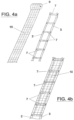
- This phase of the process is shown in Figure 4a , which graphically illustrates the grid structure delimited by both longitudinal strips 2, 3 and made up of a multiplicity of essentially quadrangular grids.
- the paper yarn mesh indicated with the numerical reference 10 continuously supplied from a reel 9, is applied and said paper yarn mesh is bonded by gluing to the components (lateral strips and cross pieces) of the support base.
- the obtaining of the composite mesh for the closing or covering of the windows or openings 12 of a paper band 11 intended for the manufacture of bags is extremely easy and fast due to a particularly suitable conception for the use of automated mechanisms that can be used both in the construction of the composite mesh and in the fractioning and application of the various portions to the respective windows or openings 12 included in the paper band 11 used for the manufacture of the bags.
- the composite mesh provided by the present invention has very advantageous structural characteristics for conferring stability to the openings 12 of the paper band 11, and strength for supporting the weight of the transported products, in addition to allowing, as is usual, that the products contained inside the bags can be ventilated and observed from the outside through the holes in the same mesh 10.
- the invention is particularly applicable in the industrial sector dedicated to the manufacture of paper bags, especially paper bags for packaging and transporting products belonging to the horticultural sector.
Landscapes
- Engineering & Computer Science (AREA)
- Mechanical Engineering (AREA)
- Health & Medical Sciences (AREA)
- Life Sciences & Earth Sciences (AREA)
- Evolutionary Biology (AREA)
- General Health & Medical Sciences (AREA)
- Marine Sciences & Fisheries (AREA)
- Toxicology (AREA)
- Zoology (AREA)
- Making Paper Articles (AREA)
- Wrappers (AREA)
- Package Frames And Binding Bands (AREA)
Abstract
Description
- The present invention relates to a method for preparing a paper band of those used as a starting base for the manufacture of bags, namely bags typically used for containing and transporting products or articles of any kind, and in a very preferable manner horticultural products, wherein the paper band provided by the invention conventionally includes windows or openings which are protected with a composite mesh innovatively obtained from paper that is twisted with natural fibres added to increase the specific strength of the composite paper mesh, and hence of the bag manufactured from the paper band with the composite mesh incorporated.
- The invention also relates to a composite mesh, manufactured from paper that is twisted with added natural fibres or even, optionally, using only natural fibres (for example, bamboo or cotton), obtained by means of an automated process and intended to be fragmented, also in an automated manner, into a multiplicity of segments of previously established size, for the application of each of these sections to each respective one of the openings which, in a conventional manner, includes the said paper band used in the manufacture of the bags, for the purpose of covering and protecting said openings,
- The technical field in which the present invention falls within is comprised within the industrial sector dedicated to the manufacture of bags for the packaging of products of any kind, and in a more particular manner, as previously announced, for packaging and transporting horticultural products.
- As is well known, plastic materials are one of the main causes of pollution worldwide due to the extensive use of this material in all productive sectors. Plastic is present in a wide variety of processes, because apart from the well-known use in the manufacture of many types of packaging, it also finds application in other industries such as textile production, cosmetic ingredients, construction, the toy industry, and in a multitude of commonly used utensils and objects. According to known and published data, during the past year 2019 the global production of plastic reached the figure of 359 million tons, which, once the material has been used and discarded, is mostly dumped into the environment and with the particularity that a significant portion of these discharges reaches rivers and seas, generating pollution in crops, animals, marine environment, etc., such that it can be said that plastic has flooded the seas and also our daily lives. Although some processes have been developed to recycle some plastic materials, the truth is that these processes are insufficient and most of the waste of this material that is dumped in nature, generates pollution that is estimated to take between 150 years to degrade, as would be the case of a common plastic bag, and 1000 years as in the case of a PET bottle.
- Clearly, this is a very important problem that is widespread worldwide, for which it is necessary to find solutions that allow, day by day, said plastic material to be progressively replaced by a more environmentally friendly material that avoids, as far as possible, causing damage to the environment.
- To achieve this objective, one of the materials that finds most applications at the industrial level is paper, either in its simplest conception or in a more elaborate way, such as in the form of cardboard. This is obviously a very slow progression given the considerable range of applications of plastic materials, but that needs to continue uninterruptedly with a view to achieving the substitution of the latter in those circumstances in which it is possible to do so.
- In fact, efforts are being made in some productive sectors to replace, as far as possible, plastic materials with others that are less polluting and therefore less harmful to the environment. As an example, mention can be made of National Patent document
P-202030083 - This solution is considered to be very effective for providing paper bags for predetermined applications, and represents a very considerable contribution to the replacement of the plastic material from which these bags have traditionally been manufactured. However, in spite of the advantages it brings with respect to the prior art, the process of elaboration of the paper band for the manufacture of the bags described in said document can be improved with a view to a saving of time and means for obtaining said band, and therefore with a view to the cheapening and streamlining of the productive process.
- This objective constitutes the object of the present invention, as will be explained below.
- In accordance with the foregoing exposition, the present invention has developed a method for the manufacture of a paper band specially intended for the manufacture of bags for the packaging and transport of articles, such as horticultural products for example, so as to allow, with a view to replacing at least in that sector and to the greatest extent, the traditional plastic bags and thus contribute to an improvement of environmental conditions and to the reduction of pollution in general.
- For this purpose, the invention provides a paper band for the manufacture of bags that are sufficiently strong for a user to transport the articles deposited inside the same in complete safety, as has been said preferably, but not exclusively, horticultural products, the band of which is equipped with multiple openings or windows for ventilation and inspection of the articles contained inside the same that can be closed by covering with a suitable paper mesh, but with the particularity that the mesh portions which are applied respectively to the various openings or windows of the paper band are obtained from a mesh with a composite structure, in which each of such mesh portions is supplied already integrated with the respective paper frame thereof which will surround the opening or window and which it reinforces, all this made in such a way that said composite structure is dimensioned in accordance with the width dimensions of the openings or windows and can therefore be fragmented in height with automated means, with the consequent saving of time and human intervention, and therefore with the consequent saving of production costs.
- The composite mesh includes a support base made up of two longitudinal paper strips, arranged parallel to each other and separated by a distance according to the dimensions of the windows to be covered, these two longitudinal paper strips being joined together by means of a multiplicity of paper strips that serve as cross pieces, bonded to the longitudinal strips by gluing, arranged successively along said longitudinal strips keeping a separation distance between adjoining cross pieces also of predetermined magnitude and logically according to the dimensions of the windows or openings to be covered, logically in accordance with the dimensions of the windows or openings to be covered, so as to obtain a support base structure with a grid shape, and on which is then applied, also by automated means, a paper mesh which may eventually include reinforcing fibres, such as natural fibres or even optionally, in some applications, consisting only of natural fibres (e.g. bamboo or cotton), and which is attached to said support base by gluing to the longitudinal strips and to the transversal strips (also referred to interchangeably as cross pieces). With the composite paper mesh thus obtained, the various grids that are made up by the support base and the paper mesh applied on the latter, can be cut by means of an automated process, obtaining fragments of the exact size that is required for the covering of the windows or openings included in the paper band for bags being prepared.
- These and other features and advantages of the invention will become more apparent from the detailed description of a preferred embodiment thereof that follows, which is given solely by way of illustration and not limitation and refers to the accompanying drawings, wherein:
-
Figure 1 is a schematic view of a group of continuous longitudinal strips obtained in a first step of the process by longitudinal cutting of a paper reel; -
Figure 2 is a schematic view of a paper reel intended to be subjected to a cross-sectioning step for the provision of paper cross pieces; -
Figure 3 is a schematic view of a support base grid structure, obtained by combining the cross pieces ofFigure 2 and the longitudinal strips ofFigure 1 ; -
Figure 4a schematically illustrates a step for applying a paper mesh to the grid structure ofFigure 3 to obtain a composite paper mesh; -
Figure 4b illustrates a schematic view of the composite paper mesh obtained by the process step shown inFigure 4a , and -
Figure 5 is a schematic view of the application of composite paper mesh sections to openings or windows included in a paper band intended for the manufacture of bags. - As mentioned previously, the present invention is intended to provide a paper band with a composite paper mesh for the preparation of a paper band of the type commonly used for the provision of band sections with which to shape unit bags intended for the transport and packaging of products, preferably horticultural products. It should be clarified that the process of shaping the bags from the paper band with composite paper mesh does not in itself form part of the present invention because it is already known, the process of the present invention being therefore intended solely for the provision of said band with composite mesh, with all the advantages of preparation which have been mentioned in the foregoing section and which will be explained in greater detail in what follows.
- For this purpose, the various steps of the process of making the paper band equipped with composite mesh portions have been shown graphically, for illustrative purposes only, in the drawings appended to the present description. Thus, as shown in
Figure 1 , an initial phase of a method for preparing a support base to obtain the composite mesh can be seen. Said figure represents apaper reel 1. Said reel, with predetermined dimensional characteristics, is subjected in this first phase of the method to longitudinal sectioning to obtain a multiplicity of continuouslongitudinal strips paper reel 1 will be variable depending on the width of saidpaper reel 1. - Preferably, the operation of longitudinal cutting of the paper sheet supplied from the
paper reel 1 is carried out with the aid of automated means which, although not part of the invention, constitute an essential element for streamlining the process and achieving a high uniformity as far as the width of the longitudinal cut of the continuous strips is concerned. - In a preferred embodiment, the width of the strips 2-5 may be around 2 cm, but this measurement is only illustrative of one of the possible preferred embodiments and may vary within wide ranges depending on the desired characteristics of the final bag.
-
Figure 2 schematically shows a second paper reel, identified with thenumerical reference 6, intended to provide elements which in the present description have been denominated with the term cross pieces, and which are obtained by transversely sectioning the paper sheet supplied from thereel 6. These cross pieces have been indicated with thenumerical reference 7, and consist of strips the length of which is determined by the width of the paper sheet of thereel 6, and wherein the width of each cross piece is a previously established parameter according to the strength characteristics to be transferred later to the band for the manufacture of the final bag. - From the continuous longitudinal strips in
Figure 1 and the transversal fragments or cross pieces shown inFigure 2 , it is possible to make up a grid structure that will serve as a support base for the composite mesh of the present invention. This grid support base is schematically represented inFigure 3 , and consists of the bonding of two longitudinal strips, for example those indicated with thereferences 2, 3 (or any others), and a multiplicity ofcross pieces 7 extended between bothlongitudinal strips longitudinal strips consecutive cross pieces 7. The quadrangular space of each of the grids corresponds to the size of the respective opening or window to which the paper band 11 (Figure 5 ) is to be applied at another step of the process, as will be described below. - Preferably, the configuration of this support base grid structure is obtained with the aid of automated means that successively incorporate the
cross pieces 3 on thelongitudinal strips longitudinal strips cross pieces 7 is performed by gluing the portions of both ends of thecross pieces 7 that overlap on thelongitudinal strips - Once the grid structure of
Figure 3 has been obtained, a next phase of the method for obtaining the composite mesh is executed, which consists essentially in the application and gluing of a mesh, generally made of paper yarn with incorporated natural fibres or which could eventually possibly consist only of natural fibres (bamboo or cotton), as appropriate, on the support base provided by said grid structure. This phase of the process is shown inFigure 4a , which graphically illustrates the grid structure delimited by bothlongitudinal strips numerical reference 10, continuously supplied from areel 9, is applied and said paper yarn mesh is bonded by gluing to the components (lateral strips and cross pieces) of the support base. This process is also carried out with automated means, and allows obtaining a composite mesh as shown inFigure 4b . Said composite mesh can now be automatically fractionated into portions by cutting through thecross pieces 7 to obtain separate portions which inFigure 5 are shown individually and indicated with the numerical reference 10'. As has been said, the dimensions of each of the grids of the support base of the composite mesh are in accordance with the dimensions of the openings orwindows 12 included in thepaper band 11 provided for the manufacture of the bags, it will therefore suffice to divide said composite paper mesh following the positions of thecross pieces 7 to obtain the aforementioned individual portions 10' of composite mesh and apply them directly on respective windows oropenings 12 included in saidband 11, attaching them as usual with the aid of aperimeter strip 13 of glue. - As will be understood, the obtaining of the composite mesh for the closing or covering of the windows or
openings 12 of apaper band 11 intended for the manufacture of bags is extremely easy and fast due to a particularly suitable conception for the use of automated mechanisms that can be used both in the construction of the composite mesh and in the fractioning and application of the various portions to the respective windows oropenings 12 included in thepaper band 11 used for the manufacture of the bags. - Based on the foregoing, it should be noted that the composite mesh provided by the present invention has very advantageous structural characteristics for conferring stability to the
openings 12 of thepaper band 11, and strength for supporting the weight of the transported products, in addition to allowing, as is usual, that the products contained inside the bags can be ventilated and observed from the outside through the holes in thesame mesh 10. - As is clear from the above description of a preferred embodiment, the invention is particularly applicable in the industrial sector dedicated to the manufacture of paper bags, especially paper bags for packaging and transporting products belonging to the horticultural sector.
- It is not considered necessary to extend the contents of this description for a person skilled in the art to understand its scope and the advantages derived from it, as well as to carry out the practical embodiment of its object. Notwithstanding the foregoing, those skilled in the art will be able to understand and determine that within the essence of the invention, multiple variations in detail may be introduced, which may affect the shapes, dimensions and sizes, without thereby departing from the scope of the invention as defined by the attached claims.
Claims (6)
- A method for preparing a paper band with a composite paper mesh, for use in the manufacture of bags, namely a paper band (11) of those which are used for the manufacture of bags intended for the packaging and transport of products of any kind and, more particularly, products belonging to the horticultural sector, which paper band (11) includes openings or windows (12) that can be covered or closed by means of a mesh portion (10') bonded to the same paper band (11) by means of a glue stretch (13) that surrounds perimetrically the aforementioned opening or window (12), characterised in that it comprises a process of preparing a composite mesh that can be divided into such portions (10') for application to the windows (12) of the paper band (11), wherein said process of preparing the composite mesh comprises:- dividing the sheet of a paper reel (1) into a variable number of continuous longitudinal strips (2, 3, 4, 5) of paper of a width in accordance with the desired final strength and with the aid of automated cutting means;- dividing the sheet of a paper reel (6) into transversal fragments that make up cross pieces (7), with a width in accordance with the desired final strength and with the aid of automated cutting means;- applying the aforementioned cross pieces (7) on two longitudinal strips (2, 3), parallel and separated from each other by the length of the cross pieces (7), occupying positions spaced along such longitudinal strips separated consecutively by distance in accordance with the dimensions of the windows (12) to be covered, and performing, with the aid of automated means, the bonding between the cross pieces (7) and the longitudinal strips (2, 3) by gluing the respective end portions of said cross pieces (7) superimposed on both longitudinal strips (2, 3), so as to obtain a grid structure that makes up a support base;- applying on said support base grid structure a mesh (10) of paper yarn obtained continuously from a reel (9), of a width equivalent to that of said support base grid structure, and bonding said mesh (10) of paper yarn to the grid structure by applying a glue, with the aid of automated means, to obtain a composite mesh;- dividing said composite mesh into portions (10') on the basis of the positions occupied by the respective cross pieces (7), and- finally, applying the portions (10') of composite mesh to each respective one of the windows (12) formed in the band (11), for the covering thereof, the bonding between the portions of composite mesh (10') and the band (11) being performed by virtue of a glue stretch (13) that surrounds perimetrically each of said openings or windows.
- The method according to claim 1, characterised in that in one embodiment, the width of the longitudinal strips (2) of paper is of the order of 2 cm.
- The method according to claims 1 and 2, characterised in that the mesh (10) of paper yarn may consist of paper yarn that is twisted with natural fibres.
- The method according to claims 1 and 2, characterised in that the mesh (10) of paper yarn may be solely made up of natural fibres such as bamboo or cotton.
- A composite paper mesh for use in the preparation of a band (11) intended for the manufacture of paper bags with the execution of a method according to claims 1 to 4, characterised in that it comprises:- a support base of the grid type made from two longitudinal strips (2, 3) of paper, continuously obtained from a reel (1) of paper sheet, which laterally delimit said support base and a multiplicity of cross pieces (7) of paper obtained by transversal fragmentation of a reel (6) of paper sheet with a previously defined width, bonded to both longitudinal strips (2, 3) in longitudinally separated adjoining positions and bonded to the latter by means of gluing, and- a mesh (10) made of paper yarn applied on said support base grid structure and attached to the latter with the application of a glue.
- The composite paper mesh according to claim 5, characterised in that the mesh (10) of paper yarn includes paper yarn with natural fibres or only natural fibres of the bamboo or cotton type.
Applications Claiming Priority (2)
| Application Number | Priority Date | Filing Date | Title |
|---|---|---|---|
| ES202030907A ES2898405B2 (en) | 2020-09-07 | 2020-09-07 | PROCEDURE FOR PREPARING A PAPER BAND WITH A COMPOSITE PAPER MESH, FOR USE IN THE MANUFACTURING OF BAGS, AND COMPOSITE PAPER MESH |
| PCT/ES2021/070567 WO2022049313A1 (en) | 2020-09-07 | 2021-07-27 | Method for preparing a paper web with a composite paper mesh for use to produce bags, and composite paper mesh |
Publications (2)
| Publication Number | Publication Date |
|---|---|
| EP4212338A1 true EP4212338A1 (en) | 2023-07-19 |
| EP4212338A4 EP4212338A4 (en) | 2024-10-09 |
Family
ID=80491642
Family Applications (1)
| Application Number | Title | Priority Date | Filing Date |
|---|---|---|---|
| EP21863761.9A Pending EP4212338A4 (en) | 2020-09-07 | 2021-07-27 | Method for preparing a paper web with a composite paper mesh for use to produce bags, and composite paper mesh |
Country Status (4)
| Country | Link |
|---|---|
| US (1) | US12179959B2 (en) |
| EP (1) | EP4212338A4 (en) |
| ES (1) | ES2898405B2 (en) |
| WO (1) | WO2022049313A1 (en) |
Family Cites Families (8)
| Publication number | Priority date | Publication date | Assignee | Title |
|---|---|---|---|---|
| US3269643A (en) * | 1964-03-04 | 1966-08-30 | Olin Mathieson | Multi-wall bag |
| US3674607A (en) * | 1966-12-12 | 1972-07-04 | Int Paper Co | Apparatus for the preparation of integrated nettings and laminates |
| US4297402A (en) * | 1979-04-21 | 1981-10-27 | Meito Co. Ltd. | Packaging bag |
| DE9217023U1 (en) * | 1992-12-15 | 1993-07-08 | Nord-West Verpackung GmbH, 51789 Lindlar | Packaging bags made of paper or plastic |
| US20050260904A1 (en) * | 2004-05-21 | 2005-11-24 | Chris Shepherd | Laminate having high moisture vapor transmission rate |
| PL402682A1 (en) * | 2013-02-05 | 2014-08-18 | Agrotex International Spółka Z Ograniczoną Odpowiedzialnością | Packaging material, especially for fruits and vegetables |
| ES2534510B2 (en) * | 2013-07-31 | 2016-01-05 | Cristóbal Meseguer, S.A. | Simplified continuous band for the manufacture of bags for fruit and vegetable products and the like |
| WO2018099484A1 (en) | 2016-12-02 | 2018-06-07 | Sino Medical Sciences Technology Inc. | Low profile heart valve and delivery system |
-
2020
- 2020-09-07 ES ES202030907A patent/ES2898405B2/en active Active
-
2021
- 2021-07-27 WO PCT/ES2021/070567 patent/WO2022049313A1/en not_active Ceased
- 2021-07-27 US US18/019,135 patent/US12179959B2/en active Active
- 2021-07-27 EP EP21863761.9A patent/EP4212338A4/en active Pending
Also Published As
| Publication number | Publication date |
|---|---|
| ES2898405B2 (en) | 2022-07-21 |
| US20230278755A1 (en) | 2023-09-07 |
| WO2022049313A1 (en) | 2022-03-10 |
| EP4212338A4 (en) | 2024-10-09 |
| ES2898405A1 (en) | 2022-03-07 |
| US12179959B2 (en) | 2024-12-31 |
Similar Documents
| Publication | Publication Date | Title |
|---|---|---|
| US4374441A (en) | Method of making a book cover and pocket element therefor | |
| EP2004491B1 (en) | Method for manufacturing a package and a packaging machine | |
| EP2070831A1 (en) | Continuous band for producing bags for fruit and vegetable products | |
| RU2013153895A (en) | TURBINE ENGINE SHOVEL WITH BUILT-IN TAIL MADE FROM COMPOSITE MATERIAL | |
| US12179959B2 (en) | Method for preparing a paper web with a composite paper mesh for use to produce bags, and composite paper mesh | |
| EP4095058A1 (en) | Bag for holding and transporting products, especially fruit and vegetable produce | |
| EP3339004A1 (en) | Packaging material for bag-shaped packaging | |
| US9687999B2 (en) | Method for manufacturing sheets from the stem of the banana plant, and sheet produced by such a method | |
| US20040016512A1 (en) | Method of making a single cell window covering | |
| EP2910487A1 (en) | Continuous band of plastic-coated paper for the production of bags for fruit and vegetable produce and similar products | |
| EP3028953A1 (en) | Simplified continuous strip for producing bags for fruit and vegetable products and the like | |
| EP3381675B1 (en) | Extendible polyolefin film that can be produced by joining two or more co-extruded polyolefin layers, and method for the production thereof | |
| US20060213962A1 (en) | Tray for foodstuffs | |
| EP2535285B1 (en) | Roll of flexible strip and mesh bag comprising two pieces of strip. | |
| DE102005035489B4 (en) | Apparatus and method for coating packaging | |
| US4481668A (en) | Shopping bag handle and method of manufacture thereof | |
| ITVR20100091A1 (en) | REINFORCED FOLDABLE ONE-PIECE CASE | |
| WO1994002365A1 (en) | Container and method for manufacturing the same | |
| CS224092A3 (en) | Process for producing cages or other vessels made of plastic by connectingparts from extruded sections | |
| US5425200A (en) | Gathered planting net | |
| DE69403992T2 (en) | Bowl for confectionery, in particular for cakes | |
| CA3013915C (en) | Container assembly having a cell assembly therein and methods for forming | |
| DE202020100312U1 (en) | All-round visible bag | |
| SU1431962A1 (en) | Method of producing containers | |
| EP1440890A1 (en) | Tray, in particular for containing foodstuffs and method for the realisation thereof |
Legal Events
| Date | Code | Title | Description |
|---|---|---|---|
| STAA | Information on the status of an ep patent application or granted ep patent |
Free format text: STATUS: THE INTERNATIONAL PUBLICATION HAS BEEN MADE |
|
| PUAI | Public reference made under article 153(3) epc to a published international application that has entered the european phase |
Free format text: ORIGINAL CODE: 0009012 |
|
| STAA | Information on the status of an ep patent application or granted ep patent |
Free format text: STATUS: REQUEST FOR EXAMINATION WAS MADE |
|
| 17P | Request for examination filed |
Effective date: 20230206 |
|
| AK | Designated contracting states |
Kind code of ref document: A1 Designated state(s): AL AT BE BG CH CY CZ DE DK EE ES FI FR GB GR HR HU IE IS IT LI LT LU LV MC MK MT NL NO PL PT RO RS SE SI SK SM TR |
|
| DAV | Request for validation of the european patent (deleted) | ||
| DAX | Request for extension of the european patent (deleted) | ||
| REG | Reference to a national code |
Ref country code: DE Ref legal event code: R079 Free format text: PREVIOUS MAIN CLASS: B32B0029000000 Ipc: B31B0070820000 |
|
| A4 | Supplementary search report drawn up and despatched |
Effective date: 20240906 |
|
| RIC1 | Information provided on ipc code assigned before grant |
Ipc: B32B 5/02 20060101ALN20240902BHEP Ipc: B32B 29/02 20060101ALI20240902BHEP Ipc: B32B 3/14 20060101ALI20240902BHEP Ipc: B31B 70/18 20170101ALI20240902BHEP Ipc: B31B 70/16 20170101ALI20240902BHEP Ipc: B31B 70/62 20170101ALI20240902BHEP Ipc: B65D 33/04 20060101ALI20240902BHEP Ipc: B65D 33/01 20060101ALI20240902BHEP Ipc: B32B 7/12 20060101ALI20240902BHEP Ipc: B32B 29/00 20060101ALI20240902BHEP Ipc: B31B 70/82 20170101AFI20240902BHEP |