EP4211684B1 - Quantification de paramètres audio spatiaux - Google Patents
Quantification de paramètres audio spatiaux Download PDFInfo
- Publication number
- EP4211684B1 EP4211684B1 EP21866147.8A EP21866147A EP4211684B1 EP 4211684 B1 EP4211684 B1 EP 4211684B1 EP 21866147 A EP21866147 A EP 21866147A EP 4211684 B1 EP4211684 B1 EP 4211684B1
- Authority
- EP
- European Patent Office
- Prior art keywords
- direct
- total energy
- energy ratios
- ratios
- swapping
- Prior art date
- Legal status (The legal status is an assumption and is not a legal conclusion. Google has not performed a legal analysis and makes no representation as to the accuracy of the status listed.)
- Active
Links
Images

Classifications
-
- G—PHYSICS
- G10—MUSICAL INSTRUMENTS; ACOUSTICS
- G10L—SPEECH ANALYSIS TECHNIQUES OR SPEECH SYNTHESIS; SPEECH RECOGNITION; SPEECH OR VOICE PROCESSING TECHNIQUES; SPEECH OR AUDIO CODING OR DECODING
- G10L19/00—Speech or audio signals analysis-synthesis techniques for redundancy reduction, e.g. in vocoders; Coding or decoding of speech or audio signals, using source filter models or psychoacoustic analysis
- G10L19/008—Multichannel audio signal coding or decoding using interchannel correlation to reduce redundancy, e.g. joint-stereo, intensity-coding or matrixing
-
- H—ELECTRICITY
- H04—ELECTRIC COMMUNICATION TECHNIQUE
- H04S—STEREOPHONIC SYSTEMS
- H04S7/00—Indicating arrangements; Control arrangements, e.g. balance control
- H04S7/30—Control circuits for electronic adaptation of the sound field
- H04S7/305—Electronic adaptation of stereophonic audio signals to reverberation of the listening space
Definitions
- the present application relates to apparatus and methods for sound-field related parameter encoding, but not exclusively for time-frequency domain direction related parameter encoding for an audio encoder and decoder.
- Parametric spatial audio processing is a field of audio signal processing where the spatial aspect of the sound is described using a set of parameters.
- parameters such as directions of the sound in frequency bands, and the ratios between the directional and non-directional parts of the captured sound in frequency bands.
- These parameters are known to well describe the perceptual spatial properties of the captured sound at the position of the microphone array.
- These parameters can be utilized in synthesis of the spatial sound accordingly, for headphones binaurally, for loudspeakers, or to other formats, such as Ambisonics.
- the directions and direct-to-total energy ratios in frequency bands are thus a parameterization that is particularly effective for spatial audio capture.
- an apparatus for spatial audio encoding comprising means for: converting two or more energy ratios associated with a time frequency tile of one or more audio signals to a further energy ratio parameter which is related to the two or more energy ratios; quantizing the further energy ratio parameter using a first quantizer; determining a distribution factor of energy ratios dependent on a ratio of a first of the two or more energy ratios to the sum of the two or more energy ratios; selecting a further quantizer from a plurality of further quantizers using the quantized further energy ratio parameter; and quantizing the distribution factor of energy ratios using the selected further quantizer.
- the concept as discussed hereafter is to quantize, the direct-to-total energy ratio for all directions in the form of the diffuse-to-total energy ratio for the TF tile and a ratio based on the direct-to-total energy ratios.
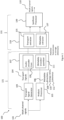
- the input to the system 100 and the 'analysis' part 121 is the multi-channel signals 102.
- a microphone channel signal input is described, however any suitable input (or synthetic multi-channel) format may be implemented in other embodiments.
- the spatial analyser and the spatial analysis may be implemented external to the encoder.
- the spatial metadata associated with the audio signals may be provided to an encoder as a separate bit-stream.
- the spatial metadata may be provided as a set of spatial (direction) index values.
- the transport signal generator 103 is configured to receive the multi-channel signals and generate a suitable transport signal comprising a determined number of channels and output the transport signals 104.
- the transport signal generator 103 may be configured to generate a 2-audio channel downmix of the multi-channel signals.
- the determined number of channels may be any suitable number of channels.
- the transport signal generator in some embodiments is configured to otherwise select or combine, for example, by beamforming techniques the input audio signals to the determined number of channels and output these as transport signals.
- the transport signal generator 103 is optional and the multi-channel signals are passed unprocessed to an encoder 107 in the same manner as the transport signal are in this example.
- the analysis processor 105 may be configured to generate the metadata which may comprise, for each time-frequency analysis interval, direction parameters 108 and energy ratio parameters 110 (comprising a direct-to-total energy ratio per direction and a diffuse-to-total energy ratio) and a coherence parameter 112.
- the direction, energy ratio and coherence parameters may in some embodiments be considered to be spatial audio parameters.
- the spatial audio parameters comprise parameters which aim to characterize the sound-field created/captured by the multi-channel signals (or two or more audio signals in general).
- the parameters generated may differ from frequency band to frequency band.
- band X all of the parameters are generated and transmitted, whereas in band Y only one of the parameters is generated and transmitted, and furthermore in band Z no parameters are generated or transmitted.
- band Z no parameters are generated or transmitted.
- a practical example of this may be that for some frequency bands such as the highest band some of the parameters are not required for perceptual reasons.
- the transport signals 104 and the metadata 106 may be passed to an encoder 107.
- the encoder 107 may comprise an audio encoder core 109 which is configured to receive the transport (for example downmix) signals 104 and generate a suitable encoding of these audio signals.
- the encoder 107 can in some embodiments be a computer (running suitable software stored on memory and on at least one processor), or alternatively a specific device utilizing, for example, FPGAs or ASICs.
- the encoding may be implemented using any suitable scheme.
- the encoder 107 may furthermore comprise a metadata encoder/quantizer 111 which is configured to receive the metadata and output an encoded or compressed form of the information.
- the encoder 107 may further interleave, multiplex to a single data stream or embed the metadata within encoded downmix signals before transmission or storage shown in Figure 1 by the dashed line.
- the multiplexing may be implemented using any suitable scheme.
- the decoded metadata and transport audio signals may be passed to a synthesis processor 139.
- the system 100 'synthesis' part 131 further shows a synthesis processor 139 configured to receive the transport and the metadata and re-creates in any suitable format a synthesized spatial audio in the form of multi-channel signals 110 (these may be multichannel loudspeaker format or in some embodiments any suitable output format such as binaural or Ambisonics signals, depending on the use case) based on the transport signals and the metadata.
- a synthesis processor 139 configured to receive the transport and the metadata and re-creates in any suitable format a synthesized spatial audio in the form of multi-channel signals 110 (these may be multichannel loudspeaker format or in some embodiments any suitable output format such as binaural or Ambisonics signals, depending on the use case) based on the transport signals and the metadata.
- the system (analysis part) is configured to receive multi-channel audio signals.
- the system (analysis part) is configured to generate a suitable transport audio signal (for example by selecting or downmixing some of the audio signal channels) and the spatial audio parameters as metadata.
- the system is then configured to encode for storage/transmission the transport signal and the metadata.
- the system may store/transmit the encoded transport signal and metadata.
- the system may retrieve/receive the encoded transport signal and metadata.
- the system is configured to extract the transport signal and metadata from encoded transport signal and metadata parameters, for example demultiplex and decode the encoded transport signal and metadata parameters.
- the system (synthesis part) is configured to synthesize an output multi-channel audio signal based on extracted transport audio signals and metadata.
- Figures 1 and 2 depict the Metadata encoder/quantizer 111 and the analysis processor 105 as being coupled together. However, it is to be appreciated that some embodiments may not so tightly couple these two respective processing entities such that the analysis processor 105 can exist on a different device from the Metadata encoder/quantizer 111. Consequently, a device comprising the Metadata encoder/quantizer 111 may be presented with the transport signals and metadata streams for processing and encoding independently from the process of capturing and analysing.
- the time-frequency signals 202 may be represented in the time-frequency domain representation by s i (b, n), where b is the frequency bin index and n is the time-frequency block (frame) index and i is the channel index.
- n can be considered as a time index with a lower sampling rate than that of the original time-domain signals.
- Each sub band k has a lowest bin b k,low and a highest bin b k,high , and the subband contains all bins from b k,low to b k,high .
- the widths of the sub bands can approximate any suitable distribution. For example, the Equivalent rectangular bandwidth (ERB) scale or the Bark scale.
- each TF tile would require 64 bits (for one sound source direction per TF tile) and 104 bits (for two sound source directions per TF tile, taking into account parameters which are independent of the sound source direction).
- the spatial analyser 203 may thus be configured to provide at least one azimuth and elevation for each frequency band and temporal time-frequency block within a frame of an audio signal, denoted as azimuth ⁇ ( k, n ), and elevation ⁇ ( k, n ) .
- the direction parameters 108 for the time sub frame may be also be passed to the spatial parameter set encoder 207.
- the spatial analyser 203 may also be configured to determine an energy ratio parameters 110.
- the energy ratio may be considered to be a determination of the energy of the audio signal which can be considered to arrive from a direction.
- the direct-to-total energy ratio r(k,n) can be estimated, e.g., using a stability measure of the directional estimate, or using any correlation measure, or any other suitable method to obtain a ratio parameter.
- Each direct-to-total energy ratio corresponds to a specific spatial direction and describes how much of the energy comes from the specific spatial direction compared to the total energy. This value may also be represented for each time-frequency tile separately.
- the spatial direction parameters and direct-to-total energy ratio describe how much of the total energy for each time-frequency tile is coming from the specific direction.
- a spatial direction parameter can also be thought of as the direction of arrival (DOA).
- audio source may relate to dominant directions of the propagating sound wave, which may encompass the actual direction of the sound source.
- each sub band k and sub frame n may have the following spatial audio parameters associated with it on a per audio source direction basis; at least one azimuth and elevation denoted as azimuth ⁇ ( k, n ) , and elevation ⁇ ( k, n ) , and a spread coherence ( ⁇ ( k, n ) and a direct-to-total-energy ratio parameter r ( k,n ) .
- the collection of spatial audio parameters may also comprise a surrounding coherence ( ⁇ ( k, n )) .
- Parameters may also comprise a diffuse-to-total energy ratio r diff ( k, n ) .
- the diffuse-to-total energy ratio r diff ( k, n ) is the energy ratio of non-directional sound over surrounding directions and there is typically a single diffuse-to-total energy ratio (as well as surrounding coherence ( ⁇ ( k, n )) per TF tile.
- the diffuse-to-total energy ratio may be considered to be the energy ratio remaining once the direct-to-total energy ratios (for each direction) have been subtracted from one. Going forward, the above parameters may be termed a set of spatial audio parameters (or a spatial audio parameter set) for a particular TF tile.
- the spatial parameter set encoder 207 can be arranged to quantize the energy ratio parameters 110 in addition to the direction parameters 108 and coherence parameters 112.
- the energy ratio parameters 110 comprising direct-to-total-energy ratio parameters r ( k,n ) for each direction may be quantised based on the diffuse-to-total energy ratio r diff ( k, n ) and a further parameter.
- the further parameter may comprise a ratio of one of the direct-to-total-energy ratio parameters to the sum of the direct-to-total energy ratios for all directions, the further parameter may be termedr(k, n).
- the direct-to-total-energy ratio parameter of the first direction r 1 ( k, n ) and the direct-to-total-energy ratio parameter of the second direction r 2 ( k, n ) for the TF tile ( k, n ) can be quantized in the form of the diffuse-to-total energy ratio r diff ( k, n ) and dr ( k, n ) for the TF tile.
- the diffuse-to-total energy ratio r diff ( k, n ) may be provided as part of the MASA input metadata, rather than being calculated on the fly as outlined above.
- the spatial parameter set encoder 207 may obtain a further energy ratio parameter (or diffuse-to-total energy ratio) associated with two or more energy ratios of a time frequency tile.
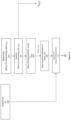
- the step of determining the diffuse-to-total energy ratio r diff ( k, n ) is shown as processing step 301 in Figure 3 .
- r diff ( k, n ) may then be scalar quantized to give r ⁇ diff ( k, n ) . In embodiments this may be performed using a non-uniform scalar quantizer.
- the step of quantizing r diff ( k, n ) is shown as processing step 305 in Figure 3 .
- the value of diffuse-to-total energy ratio parameter r diff ( k, n ) can be used to determine the size of the quantizer to be used subsequently in the process. For instance, if r diff ( k, n ) is above a selection value then a first sized quantizer may be selected, however if r diff ( k, n ) is less that the selection value then a second sized quantizer may be selected. In embodiments this step may be written as
- Q 1 and Q 2 may express the quantizer size in terms of the number of bits.
- N q is found to lie between the values of 0 and 1. For instance one operating point for N q was found to be 0.6.
- the quantised diffuse-to-total energy ratio parameter r ⁇ diff ( k, n ) may be used in the above processing step. This can have the advantage that the quantizer size (Quant_size) is not required to be signalled as part of the bitstream. Instead, the quantizer size may be determined at the decoder by inspecting the value of r ⁇ diff ( k, n).
- the step of determining the size of the quantizer using r ⁇ diff is shown as the processing step 303 in Figure 3 .
- Embodiments may then determine the ratio of the first direct-to-total-energy ratio parameter to the sum of the first and second direct-to-total-energy ratio parameters, in other words a distribution factor of energy ratios
- the step of determining the above ratio dr is depicted as the processing step 307 in Figure 3 .
- the value of the ratio dr ( k, n ) may now be quantized using a scalar quantizer.
- one of a number of quantizers may be selected to quantize dr ( k, n ) .
- the quantizer used to quantize the ratio dr may be selected based on the results of the above processing step 303.
- the processing step 303 may be used to determine the size of the scalar quantizer used to quantize dr ( k,n ) to give dr ⁇ k n .
- the processing step of selecting the quantizer for quantizing dr ( k, n ) is shown as step 309 in Figure 3 .
- dr ( k, n ) can be quantized using a quantizer selected from a number of uniform scalar quantizers.
- dr can be quantized to dr ⁇ k n using one of two uniform scalar quantizers as signified by Quant_size bits.
- Quant_size bits Taking the above particular example of an embodiment either a 2 bit or 3 bit scalar quantizer may be used to quantize dr ( k, n ) .
- the processing step of quantizing dr ( k, n ) is shown as step 311 in Figure 3 .
- the indices corresponding to the two quantized parameters dr(k, n) and r ⁇ diff ( k, n ) may be encoded using either a fixed or variable rate coding scheme.
- the indices corresponding to the two quantized parameters dr ⁇ k n and r ⁇ diff ( k, n ) may be jointly encoded by forming a master index and then use entropy encoding (such as Golomb Rice or Huffman encoding) to encode the master index.
- entropy encoding such as Golomb Rice or Huffman encoding
- the above quantization of the direct-to-total energy ratio parameters may comprise an additional pre-processing step in which for each TF tile it is checked whether there are actually two direct-to-total energy ratios r 1 ( k, n ), r 2 ( k, n ) (associated with the first and second directions). The presence of a second direct-to-total energy ratio would indicate that the TF tile (k,n) has at least two concurrent directions.
- spatial audio parameters associated with each of the two directions may be swapped if the direct-to-total energy ratio r 1 ( k, n ) of the first direction is less than the direct-to-total energy ratio r 2 ( k, n ) of the second direction.
- the spatial audio parameters associated with a particular audio direction may comprise the parameters (from above Table 1) ; direction index, Direct-to-total energy ratio, spread coherence and distance.
- the pre-processing step may have the following form.
- the above procedure effectively orders the directions such that the direction with the larger direct-to-total energy ratio is always the first direction, and the direction with the smaller direct-to-total energy ratio is always the second direction.
- the above pre-processing step can have the advantage of allowing more efficient quantizers, such that dr is always between 0.5 and 1 (in comparison to having the values between 0 and 1 in case the above swapping mechanism is not performed). Hence, the same accuracy may be obtained with roughly half the number of codewords.
- Any further processing undertaken by the spatial parameter set encoder 207 may use the quantized direct-to-total energy ratios obtained from r ⁇ diff and dr ⁇ .
- the metadata encoder/quantizer 111 may also comprise a direction encoder.
- the direction encoder is configured to receive direction parameters (such as the azimuth ⁇ and elevation ⁇ )(and in some embodiments an expected bit allocation) and from this generate a suitable encoded output.
- the encoding is based on an arrangement of spheres forming a spherical grid arranged in rings on a 'surface' sphere which are defined by a look up table defined by the determined quantization resolution.
- the spherical grid uses the idea of covering a sphere with smaller spheres and considering the centres of the smaller spheres as points defining a grid of almost equidistant directions. The smaller spheres therefore define cones or solid angles about the centre point which can be indexed according to any suitable indexing algorithm.
- spherical quantization is described here any suitable quantization, linear or non-linear may be used.
- the metadata encoder/quantizer 111 may also comprise a coherence encoder which is configured to receive the surround coherence values ⁇ and spread coherence values ⁇ and determine a suitable encoding for compressing the surround and spread coherence values.
- the encoded direction, energy ratios and coherence values may be passed to a combiner.
- the combiner may be configured to receive the encoded (or quantized/compressed) directional parameters, energy ratio parameters and coherence parameters and combine these to generate a suitable output (for example a metadata bit stream which may be combined with the transport signal or be separately transmitted or stored from the transport signal).
- the encoded datastream is passed to the decoder/demultiplexer 133.
- the decoder/demultiplexer 133 demultiplexes the encoded the quantized spatial audio parameter sets for the frame and passes them to the metadata extractor 137 and also the decoder/demultiplexer 133 may in some embodiments extract the transport audio signals to the transport extractor for decoding and extracting.
- the metadata extractor 137 may be arranged to extract the indices for dr ⁇ k n and r ⁇ diff ( k, n ) for each TF tile.
- the index associated with r ⁇ d ⁇ ff ( k, n ) can be read to give the corresponding quantized value.
- the value of r ⁇ d ⁇ ff ( k, n ) may then be used to determine the particular quantizer (or quantisation table) (from a plurality of quantizers) which can be used at the decoder to dequantize the value of dr(k, n).
- r ⁇ diff ( k, n ) is used to select the quantization table (from a plurality of quantization tables) at the decoder.
- the value of dr ⁇ k n may then be read from the selected quantization table by using the index associated with dr ⁇ k n .
- the values of the direct-to-total energy ratios may then be determined by using the reverse process to that applied at the encoder.
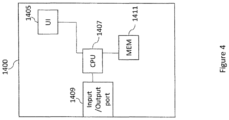
- the device 1400 comprises a memory 1411.
- the at least one processor 1407 is coupled to the memory 1411.
- the memory 1411 can be any suitable storage means.
- the memory 1411 comprises a program code section for storing program codes implementable upon the processor 1407.
- the memory 1411 can further comprise a stored data section for storing data, for example data that has been processed or to be processed in accordance with the embodiments as described herein. The implemented program code stored within the program code section and the data stored within the stored data section can be retrieved by the processor 1407 whenever needed via the memory-processor coupling.
- the device 1400 comprises a user interface 1405.
- the user interface 1405 can be coupled in some embodiments to the processor 1407.
- the processor 1407 can control the operation of the user interface 1405 and receive inputs from the user interface 1405.
- the user interface 1405 can enable a user to input commands to the device 1400, for example via a keypad.
- the user interface 1405 can enable the user to obtain information from the device 1400.
- the user interface 1405 may comprise a display configured to display information from the device 1400 to the user.
- the user interface 1405 can in some embodiments comprise a touch screen or touch interface capable of both enabling information to be entered to the device 1400 and further displaying information to the user of the device 1400.
- the user interface 1405 may be the user interface for communicating with the position determiner as described herein.
- the transceiver input/output port 1409 may be configured to receive the signals and in some embodiments determine the parameters as described herein by using the processor 1407 executing suitable code. Furthermore, the device may generate a suitable downmix signal and parameter output to be transmitted to the synthesis device.
- the device 1400 may be employed as at least part of the synthesis device.
- the input/output port 1409 may be configured to receive the downmix signals and in some embodiments the parameters determined at the capture device or processing device as described herein and generate a suitable audio signal format output by using the processor 1407 executing suitable code.
- the input/output port 1409 may be coupled to any suitable audio output for example to a multichannel speaker system and/or headphones or similar.
- the embodiments of this invention may be implemented by computer software executable by a data processor of the mobile device, such as in the processor entity, or by hardware, or by a combination of software and hardware.
- any blocks of the logic flow as in the Figures may represent program steps, or interconnected logic circuits, blocks and functions, or a combination of program steps and logic circuits, blocks and functions.
- the software may be stored on such physical media as memory chips, or memory blocks implemented within the processor, magnetic media such as hard disk or floppy disks, and optical media such as for example DVD and the data variants thereof, CD.
- the memory may be of any type suitable to the local technical environment and may be implemented using any suitable data storage technology, such as semiconductor-based memory devices, magnetic memory devices and systems, optical memory devices and systems, fixed memory and removable memory.
- the data processors may be of any type suitable to the local technical environment, and may include one or more of general purpose computers, special purpose computers, microprocessors, digital signal processors (DSPs), application specific integrated circuits (ASIC), gate level circuits and processors based on multi-core processor architecture, as non-limiting examples.
- Embodiments of the inventions may be practiced in various components such as integrated circuit modules.
- the design of integrated circuits is by and large a highly automated process.
- Complex and powerful software tools are available for converting a logic level design into a semiconductor circuit design ready to be etched and formed on a semiconductor substrate.
Landscapes
- Engineering & Computer Science (AREA)
- Physics & Mathematics (AREA)
- Multimedia (AREA)
- Acoustics & Sound (AREA)
- Signal Processing (AREA)
- Mathematical Physics (AREA)
- Computational Linguistics (AREA)
- Health & Medical Sciences (AREA)
- Audiology, Speech & Language Pathology (AREA)
- Human Computer Interaction (AREA)
- Compression, Expansion, Code Conversion, And Decoders (AREA)
Claims (15)
- Appareil de codage audio spatial comprenant des moyens pour :convertir deux rapports énergétiques ou plus associés à une tuile de fréquence temporelle d'un ou plusieurs signaux audio en un paramètre de rapport énergétique supplémentaire qui est lié aux deux rapports énergétiques ou plus ;quantifier le paramètre de rapport énergétique supplémentaire en utilisant un premier quantificateur ;déterminer un facteur de distribution de rapports énergétiques dépendant d'un rapport d'un premier des deux rapports énergétiques ou plus sur la somme des deux rapports énergétiques ou plus ;sélectionner un quantificateur supplémentaire dans une pluralité de quantificateurs supplémentaires en utilisant le paramètre de rapport énergétique supplémentaire quantifié ; etquantifier le facteur de distribution de rapports énergétiques en utilisant le quantificateur supplémentaire sélectionné.
- Appareil selon la revendication 1, dans lequel les deux rapports énergétiques ou plus sont deux rapports énergie directe/énergie totale.
- Appareil selon les revendications 1 et 2, dans lequel le paramètre de rapport énergétique supplémentaire est un rapport énergie diffuse/énergie totale.
- Appareil selon la revendication 3, dans lequel le rapport énergie diffuse/énergie totale comprend un moins la somme des deux rapports énergie directe/énergie totale.
- Appareil selon la revendication 2, dans lequel le paramètre de rapport énergétique supplémentaire est la somme des deux rapports énergie directe/énergie totale.
- Appareil selon les revendications 2 à 5, dans lequel le facteur de distribution de rapports énergétiques comprend le rapport d'un premier des deux rapports énergie directe/énergie totale sur la somme des deux rapports énergie directe/énergie totale.
- Appareil selon les revendications 2 à 6, dans lequel les moyens pour sélectionner un quantificateur supplémentaire dans une pluralité de quantificateurs supplémentaires en utilisant le paramètre de rapport énergétique supplémentaire quantifié comprennent des moyens pour :comparer le paramètre de rapport énergétique supplémentaire quantifié à une valeur seuil ; etsélectionner le quantificateur supplémentaire dans une pluralité de quantificateurs supplémentaires sur la base de la comparaison.
- Appareil selon les revendications 2 à 7, dans lequel un premier des deux rapports énergie directe/énergie totale est associé à une première direction d'une onde sonore, et un second des deux rapports énergie directe/énergie est associé à une deuxième direction d'une onde sonore, dans lequel l'appareil comprend en outre des moyens pour :déterminer qu'un second des deux rapports énergie directe/énergie totale est supérieur à un premier des deux rapports énergie directe/énergie totale ;permuter le premier des deux rapports énergie directe/énergie totale pour qu'il soit associé à la deuxième direction ; etpermuter le second des deux rapports énergie directe/énergie totale pour qu'il soit associé à la première direction.
- Appareil selon la revendication 8, dans lequel un premier indice de direction, une première cohérence de répartition et une première distance associée à la tuile de fréquence temporelle sont chacun associés à une première direction de l'onde sonore, et dans lequel un deuxième indice de direction, une deuxième cohérence de répartition et une deuxième distance associée à la tuile de fréquence temporelle sont chacun associés à la deuxième direction de l'onde sonore, dans lequel il est déterminé que le second des deux rapports énergie directe/énergie totale est supérieur au premier des deux rapports énergie directe/énergie totale, l'appareil comprend en outre les moyens pour effectuer au moins l'une des opérations suivantes :permuter le premier indice de direction pour qu'il soit associé à la deuxième direction, et permuter le deuxième indice de direction pour qu'il soit associé à la première direction ;permuter la première distance pour qu'elle soit associée à la deuxième direction, et permuter la deuxième distance pour qu'elle soit associée à la première direction ; etpermuter la première cohérence de répartition pour qu'elle soit associée à la deuxième direction, et permuter la deuxième cohérence de répartition pour qu'elle soit associée à la première direction.
- Procédé de codage audio spatial comprenant les étapes suivantes :convertir deux rapports énergétiques ou plus associés à une tuile de fréquence temporelle d'un ou plusieurs signaux audio en un paramètre de rapport énergétique supplémentaire qui est lié aux deux rapports énergétiques ou plus ;quantifier le paramètre de rapport énergétique supplémentaire en utilisant un premier quantificateur ;déterminer un facteur de distribution de rapports énergétiques dépendant d'un rapport d'un premier des deux rapports énergétiques ou plus sur la somme des deux rapports énergétiques ou plus ;sélectionner un quantificateur supplémentaire dans une pluralité de quantificateurs supplémentaires en utilisant le paramètre de rapport énergétique supplémentaire quantifié ; etquantifier le facteur de distribution de rapports énergétiques en utilisant le quantificateur supplémentaire sélectionné.
- Procédé selon la revendication 10, dans lequel les deux rapports énergétiques ou plus sont deux rapports énergie directe/énergie totale.
- Procédé selon la revendication 11, dans lequel le facteur de distribution de rapports énergétiques comprend le rapport d'un premier des deux rapports énergie directe/énergie totale sur la somme des deux rapports énergie directe/énergie totale.
- Procédé selon les revendications 11 et 12, dans lequel la sélection d'un quantificateur supplémentaire dans une pluralité de quantificateurs supplémentaires en utilisant le paramètre de rapport énergétique supplémentaire quantifié comprend :la comparaison du paramètre de rapport énergétique supplémentaire quantifié à une valeur seuil ; etla sélection du quantificateur supplémentaire dans une pluralité de quantificateurs supplémentaires sur la base de la comparaison.
- Procédé selon les revendications 11 à 13, dans lequel un premier des deux rapports énergie directe/énergie totale est associé à une première direction d'une onde sonore, et un second des deux rapports énergie directe/énergie est associé à une deuxième direction d'une onde sonore, dans lequel le procédé comprend en outre les étapes suivantes :déterminer qu'un second des deux rapports énergie directe/énergie totale est supérieur à un premier des deux rapports énergie directe/énergie totale ;permuter le premier des deux rapports énergie directe/énergie totale pour qu'il soit associé à la deuxième direction ; etpermuter le second des deux rapports énergie directe/énergie totale pour qu'il soit associé à la première direction.
- Procédé selon la revendication 14, dans lequel un premier indice de direction, une première cohérence de répartition et une première distance associée à la tuile de fréquence temporelle sont chacun associés à une première direction de l'onde sonore, et dans lequel un deuxième indice de direction, une deuxième cohérence de répartition et une deuxième distance associée à la tuile de fréquence temporelle sont chacun associés à la deuxième direction de l'onde sonore, dans lequel il est déterminé que le second des deux rapports énergie directe/énergie totale est supérieur au premier des deux rapports énergie directe/énergie totale, le procédé comprend en outre au moins l'une des opérations suivantes :permuter le premier indice de direction pour qu'il soit associé à la deuxième direction, et permuter le deuxième indice de direction pour qu'il soit associé à la première direction ;permuter la première distance pour qu'elle soit associée à la deuxième direction, et permuter la deuxième distance pour qu'elle soit associée à la première direction ; etpermuter la première cohérence de répartition pour qu'elle soit associée à la deuxième direction, et permuter la deuxième cohérence de répartition pour qu'elle soit associée à la première direction.
Applications Claiming Priority (2)
| Application Number | Priority Date | Filing Date | Title |
|---|---|---|---|
| GB2014392.1A GB2598773A (en) | 2020-09-14 | 2020-09-14 | Quantizing spatial audio parameters |
| PCT/FI2021/050557 WO2022053738A1 (fr) | 2020-09-14 | 2021-08-19 | Quantification de paramètres audio spatiaux |
Publications (3)
| Publication Number | Publication Date |
|---|---|
| EP4211684A1 EP4211684A1 (fr) | 2023-07-19 |
| EP4211684A4 EP4211684A4 (fr) | 2024-08-21 |
| EP4211684B1 true EP4211684B1 (fr) | 2025-07-09 |
Family
ID=73149732
Family Applications (1)
| Application Number | Title | Priority Date | Filing Date |
|---|---|---|---|
| EP21866147.8A Active EP4211684B1 (fr) | 2020-09-14 | 2021-08-19 | Quantification de paramètres audio spatiaux |
Country Status (8)
| Country | Link |
|---|---|
| US (1) | US20230335143A1 (fr) |
| EP (1) | EP4211684B1 (fr) |
| KR (1) | KR20230069173A (fr) |
| CN (1) | CN116508098A (fr) |
| ES (1) | ES3037774T3 (fr) |
| GB (1) | GB2598773A (fr) |
| PT (1) | PT4211684T (fr) |
| WO (1) | WO2022053738A1 (fr) |
Families Citing this family (1)
| Publication number | Priority date | Publication date | Assignee | Title |
|---|---|---|---|---|
| GB2627482A (en) * | 2023-02-23 | 2024-08-28 | Nokia Technologies Oy | Diffuse-preserving merging of MASA and ISM metadata |
Family Cites Families (11)
| Publication number | Priority date | Publication date | Assignee | Title |
|---|---|---|---|---|
| US1079851A (en) * | 1911-06-28 | 1913-11-25 | Bernhard Fried | Changeable sign. |
| ATE378675T1 (de) * | 2005-04-19 | 2007-11-15 | Coding Tech Ab | Energieabhängige quantisierung für effiziente kodierung räumlicher audioparameter |
| US8218775B2 (en) * | 2007-09-19 | 2012-07-10 | Telefonaktiebolaget L M Ericsson (Publ) | Joint enhancement of multi-channel audio |
| US8352279B2 (en) * | 2008-09-06 | 2013-01-08 | Huawei Technologies Co., Ltd. | Efficient temporal envelope coding approach by prediction between low band signal and high band signal |
| GB201718341D0 (en) * | 2017-11-06 | 2017-12-20 | Nokia Technologies Oy | Determination of targeted spatial audio parameters and associated spatial audio playback |
| BR112020011035A2 (pt) * | 2017-11-17 | 2020-11-17 | Fraunhofer-Gesellschaft zur Förderung der angewandten Forschung e. V. | aparelho e método para codificar ou decodificar parâmetros de codificação de áudio direcional com o uso de diferentes resoluções de tempo frequência |
| WO2019170955A1 (fr) * | 2018-03-08 | 2019-09-12 | Nokia Technologies Oy | Codage audio |
| GB2572650A (en) * | 2018-04-06 | 2019-10-09 | Nokia Technologies Oy | Spatial audio parameters and associated spatial audio playback |
| GB2572761A (en) * | 2018-04-09 | 2019-10-16 | Nokia Technologies Oy | Quantization of spatial audio parameters |
| GB2575305A (en) * | 2018-07-05 | 2020-01-08 | Nokia Technologies Oy | Determination of spatial audio parameter encoding and associated decoding |
| GB2577698A (en) * | 2018-10-02 | 2020-04-08 | Nokia Technologies Oy | Selection of quantisation schemes for spatial audio parameter encoding |
-
2020
- 2020-09-14 GB GB2014392.1A patent/GB2598773A/en not_active Withdrawn
-
2021
- 2021-08-19 EP EP21866147.8A patent/EP4211684B1/fr active Active
- 2021-08-19 KR KR1020237012556A patent/KR20230069173A/ko active Pending
- 2021-08-19 WO PCT/FI2021/050557 patent/WO2022053738A1/fr not_active Ceased
- 2021-08-19 CN CN202180076948.3A patent/CN116508098A/zh active Pending
- 2021-08-19 US US18/044,666 patent/US20230335143A1/en active Pending
- 2021-08-19 ES ES21866147T patent/ES3037774T3/es active Active
- 2021-08-19 PT PT218661478T patent/PT4211684T/pt unknown
Also Published As
| Publication number | Publication date |
|---|---|
| CN116508098A (zh) | 2023-07-28 |
| ES3037774T3 (en) | 2025-10-07 |
| US20230335143A1 (en) | 2023-10-19 |
| KR20230069173A (ko) | 2023-05-18 |
| GB202014392D0 (en) | 2020-10-28 |
| EP4211684A1 (fr) | 2023-07-19 |
| PT4211684T (pt) | 2025-08-08 |
| GB2598773A (en) | 2022-03-16 |
| WO2022053738A1 (fr) | 2022-03-17 |
| EP4211684A4 (fr) | 2024-08-21 |
Similar Documents
| Publication | Publication Date | Title |
|---|---|---|
| KR102587641B1 (ko) | 공간적 오디오 파라미터 인코딩 및 연관된 디코딩의 결정 | |
| EP3818525B1 (fr) | Détermination d'un codage de paramètre audio spatial et d'un décodage associé | |
| EP4082010B1 (fr) | Combinaison de paramètres audio spatiaux | |
| EP4082009B1 (fr) | Fusion de paramètres audio spatiaux | |
| EP3948861B1 (fr) | Détermination de l'importance des paramètres audio spatiaux et codage associé | |
| US20240185869A1 (en) | Combining spatial audio streams | |
| US12548576B2 (en) | Reduction of spatial audio parameters | |
| US12512104B2 (en) | Quantizing spatial audio parameters | |
| US20230335143A1 (en) | Quantizing spatial audio parameters | |
| EP4278347B1 (fr) | Transformation de paramètres audio spatiaux |
Legal Events
| Date | Code | Title | Description |
|---|---|---|---|
| STAA | Information on the status of an ep patent application or granted ep patent |
Free format text: STATUS: THE INTERNATIONAL PUBLICATION HAS BEEN MADE |
|
| PUAI | Public reference made under article 153(3) epc to a published international application that has entered the european phase |
Free format text: ORIGINAL CODE: 0009012 |
|
| STAA | Information on the status of an ep patent application or granted ep patent |
Free format text: STATUS: REQUEST FOR EXAMINATION WAS MADE |
|
| 17P | Request for examination filed |
Effective date: 20230414 |
|
| AK | Designated contracting states |
Kind code of ref document: A1 Designated state(s): AL AT BE BG CH CY CZ DE DK EE ES FI FR GB GR HR HU IE IS IT LI LT LU LV MC MK MT NL NO PL PT RO RS SE SI SK SM TR |
|
| DAV | Request for validation of the european patent (deleted) | ||
| DAX | Request for extension of the european patent (deleted) | ||
| REG | Reference to a national code |
Ref country code: DE Ref legal event code: R079 Free format text: PREVIOUS MAIN CLASS: G10L0019032000 Ipc: G10L0019008000 Ref document number: 602021033957 Country of ref document: DE |
|
| A4 | Supplementary search report drawn up and despatched |
Effective date: 20240718 |
|
| RIC1 | Information provided on ipc code assigned before grant |
Ipc: H04S 7/00 20060101ALI20240712BHEP Ipc: G10L 19/008 20130101AFI20240712BHEP |
|
| GRAP | Despatch of communication of intention to grant a patent |
Free format text: ORIGINAL CODE: EPIDOSNIGR1 |
|
| STAA | Information on the status of an ep patent application or granted ep patent |
Free format text: STATUS: GRANT OF PATENT IS INTENDED |
|
| INTG | Intention to grant announced |
Effective date: 20250210 |
|
| GRAJ | Information related to disapproval of communication of intention to grant by the applicant or resumption of examination proceedings by the epo deleted |
Free format text: ORIGINAL CODE: EPIDOSDIGR1 |
|
| STAA | Information on the status of an ep patent application or granted ep patent |
Free format text: STATUS: REQUEST FOR EXAMINATION WAS MADE |
|
| GRAP | Despatch of communication of intention to grant a patent |
Free format text: ORIGINAL CODE: EPIDOSNIGR1 |
|
| STAA | Information on the status of an ep patent application or granted ep patent |
Free format text: STATUS: GRANT OF PATENT IS INTENDED |
|
| GRAS | Grant fee paid |
Free format text: ORIGINAL CODE: EPIDOSNIGR3 |
|
| GRAA | (expected) grant |
Free format text: ORIGINAL CODE: 0009210 |
|
| STAA | Information on the status of an ep patent application or granted ep patent |
Free format text: STATUS: THE PATENT HAS BEEN GRANTED |
|
| INTG | Intention to grant announced |
Effective date: 20250512 |
|
| AK | Designated contracting states |
Kind code of ref document: B1 Designated state(s): AL AT BE BG CH CY CZ DE DK EE ES FI FR GB GR HR HU IE IS IT LI LT LU LV MC MK MT NL NO PL PT RO RS SE SI SK SM TR |
|
| REG | Reference to a national code |
Ref country code: GB Ref legal event code: FG4D |
|
| REG | Reference to a national code |
Ref country code: CH Ref legal event code: EP |
|
| REG | Reference to a national code |
Ref country code: IE Ref legal event code: FG4D |
|
| REG | Reference to a national code |
Ref country code: DE Ref legal event code: R096 Ref document number: 602021033957 Country of ref document: DE |
|
| REG | Reference to a national code |
Ref country code: PT Ref legal event code: SC4A Ref document number: 4211684 Country of ref document: PT Date of ref document: 20250808 Kind code of ref document: T Free format text: AVAILABILITY OF NATIONAL TRANSLATION Effective date: 20250804 |
|
| PGFP | Annual fee paid to national office [announced via postgrant information from national office to epo] |
Ref country code: NL Payment date: 20250716 Year of fee payment: 5 |
|
| REG | Reference to a national code |
Ref country code: NL Ref legal event code: FP |
|
| REG | Reference to a national code |
Ref country code: SE Ref legal event code: TRGR |
|
| REG | Reference to a national code |
Ref country code: ES Ref legal event code: FG2A Ref document number: 3037774 Country of ref document: ES Kind code of ref document: T3 Effective date: 20251007 |
|
| PGFP | Annual fee paid to national office [announced via postgrant information from national office to epo] |
Ref country code: ES Payment date: 20250909 Year of fee payment: 5 Ref country code: PT Payment date: 20250812 Year of fee payment: 5 |
|
| PGFP | Annual fee paid to national office [announced via postgrant information from national office to epo] |
Ref country code: DE Payment date: 20250702 Year of fee payment: 5 |
|
| PGFP | Annual fee paid to national office [announced via postgrant information from national office to epo] |
Ref country code: TR Payment date: 20250807 Year of fee payment: 5 |
|
| PGFP | Annual fee paid to national office [announced via postgrant information from national office to epo] |
Ref country code: BE Payment date: 20250703 Year of fee payment: 5 Ref country code: GB Payment date: 20250828 Year of fee payment: 5 |
|
| PGFP | Annual fee paid to national office [announced via postgrant information from national office to epo] |
Ref country code: FR Payment date: 20250703 Year of fee payment: 5 Ref country code: AT Payment date: 20251020 Year of fee payment: 5 |
|
| PGFP | Annual fee paid to national office [announced via postgrant information from national office to epo] |
Ref country code: SE Payment date: 20250702 Year of fee payment: 5 |
|
| REG | Reference to a national code |
Ref country code: AT Ref legal event code: MK05 Ref document number: 1812659 Country of ref document: AT Kind code of ref document: T Effective date: 20250709 |
|
| PG25 | Lapsed in a contracting state [announced via postgrant information from national office to epo] |
Ref country code: IS Free format text: LAPSE BECAUSE OF FAILURE TO SUBMIT A TRANSLATION OF THE DESCRIPTION OR TO PAY THE FEE WITHIN THE PRESCRIBED TIME-LIMIT Effective date: 20251109 |
|
| PG25 | Lapsed in a contracting state [announced via postgrant information from national office to epo] |
Ref country code: NO Free format text: LAPSE BECAUSE OF FAILURE TO SUBMIT A TRANSLATION OF THE DESCRIPTION OR TO PAY THE FEE WITHIN THE PRESCRIBED TIME-LIMIT Effective date: 20251009 |
|
| REG | Reference to a national code |
Ref country code: LT Ref legal event code: MG9D |
|
| PG25 | Lapsed in a contracting state [announced via postgrant information from national office to epo] |
Ref country code: AT Free format text: LAPSE BECAUSE OF FAILURE TO SUBMIT A TRANSLATION OF THE DESCRIPTION OR TO PAY THE FEE WITHIN THE PRESCRIBED TIME-LIMIT Effective date: 20250709 |
|
| PG25 | Lapsed in a contracting state [announced via postgrant information from national office to epo] |
Ref country code: FI Free format text: LAPSE BECAUSE OF FAILURE TO SUBMIT A TRANSLATION OF THE DESCRIPTION OR TO PAY THE FEE WITHIN THE PRESCRIBED TIME-LIMIT Effective date: 20250709 |
|
| PG25 | Lapsed in a contracting state [announced via postgrant information from national office to epo] |
Ref country code: HR Free format text: LAPSE BECAUSE OF FAILURE TO SUBMIT A TRANSLATION OF THE DESCRIPTION OR TO PAY THE FEE WITHIN THE PRESCRIBED TIME-LIMIT Effective date: 20250709 |
|
| PG25 | Lapsed in a contracting state [announced via postgrant information from national office to epo] |
Ref country code: GR Free format text: LAPSE BECAUSE OF FAILURE TO SUBMIT A TRANSLATION OF THE DESCRIPTION OR TO PAY THE FEE WITHIN THE PRESCRIBED TIME-LIMIT Effective date: 20251010 |
|
| PG25 | Lapsed in a contracting state [announced via postgrant information from national office to epo] |
Ref country code: LV Free format text: LAPSE BECAUSE OF FAILURE TO SUBMIT A TRANSLATION OF THE DESCRIPTION OR TO PAY THE FEE WITHIN THE PRESCRIBED TIME-LIMIT Effective date: 20250709 |
|
| PG25 | Lapsed in a contracting state [announced via postgrant information from national office to epo] |
Ref country code: BG Free format text: LAPSE BECAUSE OF FAILURE TO SUBMIT A TRANSLATION OF THE DESCRIPTION OR TO PAY THE FEE WITHIN THE PRESCRIBED TIME-LIMIT Effective date: 20250709 Ref country code: PL Free format text: LAPSE BECAUSE OF FAILURE TO SUBMIT A TRANSLATION OF THE DESCRIPTION OR TO PAY THE FEE WITHIN THE PRESCRIBED TIME-LIMIT Effective date: 20250709 |
|
| PG25 | Lapsed in a contracting state [announced via postgrant information from national office to epo] |
Ref country code: RS Free format text: LAPSE BECAUSE OF FAILURE TO SUBMIT A TRANSLATION OF THE DESCRIPTION OR TO PAY THE FEE WITHIN THE PRESCRIBED TIME-LIMIT Effective date: 20251009 |
|
| PG25 | Lapsed in a contracting state [announced via postgrant information from national office to epo] |
Ref country code: RO Free format text: LAPSE BECAUSE OF FAILURE TO SUBMIT A TRANSLATION OF THE DESCRIPTION OR TO PAY THE FEE WITHIN THE PRESCRIBED TIME-LIMIT Effective date: 20250709 |
|
| REG | Reference to a national code |
Ref country code: CH Ref legal event code: H13 Free format text: ST27 STATUS EVENT CODE: U-0-0-H10-H13 (AS PROVIDED BY THE NATIONAL OFFICE) Effective date: 20260324 |
|
| PG25 | Lapsed in a contracting state [announced via postgrant information from national office to epo] |
Ref country code: SM Free format text: LAPSE BECAUSE OF FAILURE TO SUBMIT A TRANSLATION OF THE DESCRIPTION OR TO PAY THE FEE WITHIN THE PRESCRIBED TIME-LIMIT Effective date: 20250709 |
|
| PG25 | Lapsed in a contracting state [announced via postgrant information from national office to epo] |
Ref country code: DK Free format text: LAPSE BECAUSE OF FAILURE TO SUBMIT A TRANSLATION OF THE DESCRIPTION OR TO PAY THE FEE WITHIN THE PRESCRIBED TIME-LIMIT Effective date: 20250709 |
|
| PG25 | Lapsed in a contracting state [announced via postgrant information from national office to epo] |
Ref country code: LU Free format text: LAPSE BECAUSE OF NON-PAYMENT OF DUE FEES Effective date: 20250819 |
|
| PG25 | Lapsed in a contracting state [announced via postgrant information from national office to epo] |
Ref country code: CZ Free format text: LAPSE BECAUSE OF FAILURE TO SUBMIT A TRANSLATION OF THE DESCRIPTION OR TO PAY THE FEE WITHIN THE PRESCRIBED TIME-LIMIT Effective date: 20250709 Ref country code: CH Free format text: LAPSE BECAUSE OF NON-PAYMENT OF DUE FEES Effective date: 20250831 |
|
| PG25 | Lapsed in a contracting state [announced via postgrant information from national office to epo] |
Ref country code: EE Free format text: LAPSE BECAUSE OF FAILURE TO SUBMIT A TRANSLATION OF THE DESCRIPTION OR TO PAY THE FEE WITHIN THE PRESCRIBED TIME-LIMIT Effective date: 20250709 Ref country code: SK Free format text: LAPSE BECAUSE OF FAILURE TO SUBMIT A TRANSLATION OF THE DESCRIPTION OR TO PAY THE FEE WITHIN THE PRESCRIBED TIME-LIMIT Effective date: 20250709 |
|
| PLBE | No opposition filed within time limit |
Free format text: ORIGINAL CODE: 0009261 |
|
| STAA | Information on the status of an ep patent application or granted ep patent |
Free format text: STATUS: NO OPPOSITION FILED WITHIN TIME LIMIT |