EP4210159A2 - Separator und verfahren zu dessen herstellung - Google Patents
Separator und verfahren zu dessen herstellung Download PDFInfo
- Publication number
- EP4210159A2 EP4210159A2 EP22217021.9A EP22217021A EP4210159A2 EP 4210159 A2 EP4210159 A2 EP 4210159A2 EP 22217021 A EP22217021 A EP 22217021A EP 4210159 A2 EP4210159 A2 EP 4210159A2
- Authority
- EP
- European Patent Office
- Prior art keywords
- separator
- inorganic
- porous substrate
- particle layer
- sheet
- Prior art date
- Legal status (The legal status is an assumption and is not a legal conclusion. Google has not performed a legal analysis and makes no representation as to the accuracy of the status listed.)
- Pending
Links
Images

Classifications
-
- H—ELECTRICITY
- H01—ELECTRIC ELEMENTS
- H01M—PROCESSES OR MEANS, e.g. BATTERIES, FOR THE DIRECT CONVERSION OF CHEMICAL ENERGY INTO ELECTRICAL ENERGY
- H01M50/00—Constructional details or processes of manufacture of the non-active parts of electrochemical cells other than fuel cells, e.g. hybrid cells
- H01M50/40—Separators; Membranes; Diaphragms; Spacing elements inside cells
- H01M50/409—Separators, membranes or diaphragms characterised by the material
- H01M50/431—Inorganic material
-
- H—ELECTRICITY
- H01—ELECTRIC ELEMENTS
- H01M—PROCESSES OR MEANS, e.g. BATTERIES, FOR THE DIRECT CONVERSION OF CHEMICAL ENERGY INTO ELECTRICAL ENERGY
- H01M10/00—Secondary cells; Manufacture thereof
- H01M10/05—Accumulators with non-aqueous electrolyte
- H01M10/052—Li-accumulators
- H01M10/0525—Rocking-chair batteries, i.e. batteries with lithium insertion or intercalation in both electrodes; Lithium-ion batteries
-
- H—ELECTRICITY
- H01—ELECTRIC ELEMENTS
- H01M—PROCESSES OR MEANS, e.g. BATTERIES, FOR THE DIRECT CONVERSION OF CHEMICAL ENERGY INTO ELECTRICAL ENERGY
- H01M10/00—Secondary cells; Manufacture thereof
- H01M10/42—Methods or arrangements for servicing or maintenance of secondary cells or secondary half-cells
- H01M10/4235—Safety or regulating additives or arrangements in electrodes, separators or electrolyte
-
- H—ELECTRICITY
- H01—ELECTRIC ELEMENTS
- H01M—PROCESSES OR MEANS, e.g. BATTERIES, FOR THE DIRECT CONVERSION OF CHEMICAL ENERGY INTO ELECTRICAL ENERGY
- H01M50/00—Constructional details or processes of manufacture of the non-active parts of electrochemical cells other than fuel cells, e.g. hybrid cells
- H01M50/40—Separators; Membranes; Diaphragms; Spacing elements inside cells
- H01M50/403—Manufacturing processes of separators, membranes or diaphragms
-
- H—ELECTRICITY
- H01—ELECTRIC ELEMENTS
- H01M—PROCESSES OR MEANS, e.g. BATTERIES, FOR THE DIRECT CONVERSION OF CHEMICAL ENERGY INTO ELECTRICAL ENERGY
- H01M50/00—Constructional details or processes of manufacture of the non-active parts of electrochemical cells other than fuel cells, e.g. hybrid cells
- H01M50/40—Separators; Membranes; Diaphragms; Spacing elements inside cells
- H01M50/409—Separators, membranes or diaphragms characterised by the material
- H01M50/411—Organic material
- H01M50/414—Synthetic resins, e.g. thermoplastics or thermosetting resins
- H01M50/417—Polyolefins
-
- H—ELECTRICITY
- H01—ELECTRIC ELEMENTS
- H01M—PROCESSES OR MEANS, e.g. BATTERIES, FOR THE DIRECT CONVERSION OF CHEMICAL ENERGY INTO ELECTRICAL ENERGY
- H01M50/00—Constructional details or processes of manufacture of the non-active parts of electrochemical cells other than fuel cells, e.g. hybrid cells
- H01M50/40—Separators; Membranes; Diaphragms; Spacing elements inside cells
- H01M50/409—Separators, membranes or diaphragms characterised by the material
- H01M50/443—Particulate material
-
- H—ELECTRICITY
- H01—ELECTRIC ELEMENTS
- H01M—PROCESSES OR MEANS, e.g. BATTERIES, FOR THE DIRECT CONVERSION OF CHEMICAL ENERGY INTO ELECTRICAL ENERGY
- H01M50/00—Constructional details or processes of manufacture of the non-active parts of electrochemical cells other than fuel cells, e.g. hybrid cells
- H01M50/40—Separators; Membranes; Diaphragms; Spacing elements inside cells
- H01M50/409—Separators, membranes or diaphragms characterised by the material
- H01M50/446—Composite material consisting of a mixture of organic and inorganic materials
-
- H—ELECTRICITY
- H01—ELECTRIC ELEMENTS
- H01M—PROCESSES OR MEANS, e.g. BATTERIES, FOR THE DIRECT CONVERSION OF CHEMICAL ENERGY INTO ELECTRICAL ENERGY
- H01M50/00—Constructional details or processes of manufacture of the non-active parts of electrochemical cells other than fuel cells, e.g. hybrid cells
- H01M50/40—Separators; Membranes; Diaphragms; Spacing elements inside cells
- H01M50/409—Separators, membranes or diaphragms characterised by the material
- H01M50/449—Separators, membranes or diaphragms characterised by the material having a layered structure
-
- H—ELECTRICITY
- H01—ELECTRIC ELEMENTS
- H01M—PROCESSES OR MEANS, e.g. BATTERIES, FOR THE DIRECT CONVERSION OF CHEMICAL ENERGY INTO ELECTRICAL ENERGY
- H01M50/00—Constructional details or processes of manufacture of the non-active parts of electrochemical cells other than fuel cells, e.g. hybrid cells
- H01M50/40—Separators; Membranes; Diaphragms; Spacing elements inside cells
- H01M50/409—Separators, membranes or diaphragms characterised by the material
- H01M50/449—Separators, membranes or diaphragms characterised by the material having a layered structure
- H01M50/451—Separators, membranes or diaphragms characterised by the material having a layered structure comprising layers of only organic material and layers containing inorganic material
-
- H—ELECTRICITY
- H01—ELECTRIC ELEMENTS
- H01M—PROCESSES OR MEANS, e.g. BATTERIES, FOR THE DIRECT CONVERSION OF CHEMICAL ENERGY INTO ELECTRICAL ENERGY
- H01M50/00—Constructional details or processes of manufacture of the non-active parts of electrochemical cells other than fuel cells, e.g. hybrid cells
- H01M50/40—Separators; Membranes; Diaphragms; Spacing elements inside cells
- H01M50/409—Separators, membranes or diaphragms characterised by the material
- H01M50/449—Separators, membranes or diaphragms characterised by the material having a layered structure
- H01M50/457—Separators, membranes or diaphragms characterised by the material having a layered structure comprising three or more layers
-
- H—ELECTRICITY
- H01—ELECTRIC ELEMENTS
- H01M—PROCESSES OR MEANS, e.g. BATTERIES, FOR THE DIRECT CONVERSION OF CHEMICAL ENERGY INTO ELECTRICAL ENERGY
- H01M50/00—Constructional details or processes of manufacture of the non-active parts of electrochemical cells other than fuel cells, e.g. hybrid cells
- H01M50/40—Separators; Membranes; Diaphragms; Spacing elements inside cells
- H01M50/489—Separators, membranes, diaphragms or spacing elements inside the cells, characterised by their physical properties, e.g. swelling degree, hydrophilicity or shut down properties
-
- H—ELECTRICITY
- H01—ELECTRIC ELEMENTS
- H01M—PROCESSES OR MEANS, e.g. BATTERIES, FOR THE DIRECT CONVERSION OF CHEMICAL ENERGY INTO ELECTRICAL ENERGY
- H01M50/00—Constructional details or processes of manufacture of the non-active parts of electrochemical cells other than fuel cells, e.g. hybrid cells
- H01M50/40—Separators; Membranes; Diaphragms; Spacing elements inside cells
- H01M50/489—Separators, membranes, diaphragms or spacing elements inside the cells, characterised by their physical properties, e.g. swelling degree, hydrophilicity or shut down properties
- H01M50/491—Porosity
-
- Y—GENERAL TAGGING OF NEW TECHNOLOGICAL DEVELOPMENTS; GENERAL TAGGING OF CROSS-SECTIONAL TECHNOLOGIES SPANNING OVER SEVERAL SECTIONS OF THE IPC; TECHNICAL SUBJECTS COVERED BY FORMER USPC CROSS-REFERENCE ART COLLECTIONS [XRACs] AND DIGESTS
- Y02—TECHNOLOGIES OR APPLICATIONS FOR MITIGATION OR ADAPTATION AGAINST CLIMATE CHANGE
- Y02E—REDUCTION OF GREENHOUSE GAS [GHG] EMISSIONS, RELATED TO ENERGY GENERATION, TRANSMISSION OR DISTRIBUTION
- Y02E60/00—Enabling technologies; Technologies with a potential or indirect contribution to GHG emissions mitigation
- Y02E60/10—Energy storage using batteries
Definitions
- the following disclosure relates to a separator and a method for producing the same, and more particularly, a separator which may secure battery stability and has characteristics of significantly low heat shrinkage even at a high temperature and minimally increased resistance, and a method for producing the same.
- Battery stability may be secured by, for example, preventing battery ignition which occurs due to a forced internal short circuit by external impact, and the like.
- inorganic particles and an organic binder are introduced to the entire area of a porous substrate made of polyolefin and the like, to form an inorganic particle layer in a form in which the inorganic particles are connected to each other by the organic binder and also are adhered to the porous substrate, thereby securing battery safety.
- Korean Patent Laid-Open Publication No. 10-2014-0147742 discloses a separator for a secondary battery including an inorganic particle layer adhered on a porous substrate by an organic binder, to secure battery stability.
- the separator as such has various problems which deteriorate battery performance, such as, an organic binder being dissolved in an electrolyte and eluted during charge and discharge of a secondary battery and an organic binder being swollen by an electrolyte to close a porous layer in the separator.
- the inventors of the present disclosure found that when specific inorganic particles having a specific shape are mixed with other inorganic particles, the specific inorganic particles act as a binder, so that the inorganic particles may be adhered on a porous substrate with high adhesive strength, and when a separator is produced using the particles, electrical properties, that is, the stability, the charge and discharge characteristics, and the like, of a battery are excellent, thereby completing the present disclosure.
- An embodiment of the present disclosure is directed to providing a separator which may secure battery stability.
- Another embodiment of the present disclosure is directed to providing a separator which is chemically stable even at a high temperature and has excellent electrical properties.
- Still another embodiment of the present disclosure is directed to providing a method for producing a separator, which easily produce a separator capable of securing battery stability.
- a separator in one general aspect, includes: a porous substrate; and an inorganic particle layer positioned on one or both surfaces of the porous substrate, wherein the inorganic particle layer includes inorganic particles and a sheet-shaped inorganic binder.
- the sheet-shaped inorganic binder may be particles made of one or two or more selected from pseudo-boehmite, boehmite, Ga 2 O 3 , SiC, SiC 2 , quartz, NiSi, Ag, Au, Cu, Ag-Ni, ZnS, Al 2 O 3 , TiO 2 , CeO 2 , MgO, NiO, Y 2 O 3 , CaO, SrTiO 3 , SnO 2 , ZnO, and ZrO 2 .
- the sheet-shaped inorganic binder may be pseudo-boehmite particles.
- the pseudo-boehmite particles may have a thickness of 1 to 10 nm and an average diameter of 5 to 200 nm.
- the inorganic particles may have any one or more shapes selected from the group consisting of spherical, prismatic, and amorphous shapes.
- the inorganic particles may be any one or more selected from metal oxides, metal nitrides, metal carbides, metal carbonates, metal hydroxide, and metal carbonitrides.
- the inorganic particles may be boehmite.
- the inorganic particles may have an average diameter of 0.001 to 20 ⁇ m.
- the inorganic particle layer may include 1 to 20 parts by weight of the sheet-shaped inorganic binder with respect to 100 parts by weight of the inorganic particles.
- the porous substrate may include a polyolefin-based resin, and the porous substrate may have an average diameter of pores of 0.01 to 20 ⁇ m and a porosity of 5 to 95%.
- the polyolefin-based resin may be one or more selected from the group consisting of high-density polyethylene, low-density polyethylene, linear low-density polyethylene, ultrahigh molecular weight polyethylene, polypropylene, and copolymers thereof.
- a thickness ratio of the porous substrate : the inorganic particle layer may be 1:1 to 10:1.
- the separator may have a peel strength between the porous substrate and the inorganic particle layer of 40 gf/25 mm or more, as measured in accordance with ASTM D903.
- the separator may have the peel strength between the porous substrate and the inorganic particle layer of 80 gf/25 mm or more, as measured in accordance with ASTM D903.
- the separator may have a heat shrinkage rate at 170°C of 5% or less.
- the separator may have a heat shrinkage rate at 170°C of 3% or less.
- the inorganic particle layer may further include an organic binder.
- the inorganic particle layer may not include the organic binder.
- a polar group may be introduced to the surface of the porous substrate on which the inorganic particle layer is positioned by a surface treatment.
- a method for producing a separator includes: dispersing a sheet-shaped inorganic binder in a solvent to produce a dispersion; adding inorganic particles to the dispersion to produce a coating solution; and coating one or both surfaces of a porous substrate with the coating solution to form an inorganic particle layer.
- the dispersion may further include an organic acid.
- the dispersion may have a hydrogen ion concentration index (pH) of 3 to 6.
- the dispersion may include 0.1 to 10 wt% of the sheet-shaped inorganic binder, 0.05 to 1 wt% of the organic acid, and a remainder of the solvent.
- the coating solution may include 1 to 20 wt% of the inorganic particles, 0.1 to 5 wt% of the sheet-shaped inorganic binder, 0.01 to 1 wt% of the organic acid, and a remainder of the solvent.
- the separator may have a peel strength between the porous substrate and the inorganic particle layer of 40 gf/25 mm or more, as measured in accordance with ASTM D903.
- the separator may have the peel strength between the porous substrate and the inorganic particle layer of 80 gf/25 mm or more, as measured in accordance with ASTM D903.
- the separator may have a heat shrinkage rate at 170° of 3% or less.
- an electrochemical device includes the separator described above.
- the electrochemical device may have the resistance increase rate of 2.5% or less.
- the electrochemical device when a unit process of charge and discharge is repeated 20 times at room temperature (25 ⁇ 5°C), the electrochemical device may have a standard deviation of a resistance value (mQ) measured for each unit process of 30 or less.
- mQ resistance value
- the electrochemical device may have a standard deviation of the resistance value of 20 or less.
- the electrochemical device may have an average of the resistance value of 1500 m ⁇ or less.
- a unit of % or ratio refers to a wt% or a weight ratio and wt% refers to wt% of any one component in a total composition, unless otherwise defined.
- the term “long diameter” may refer to a longest length of a particle
- the term “short diameter” may refer to a longest length in a direction orthogonal to the axis of the long diameter
- the term “diameter” may refer to both a long diameter and a short diameter.
- a long diameter, a short diameter, a diameter, and a thickness are determined from averages of values obtained by measuring 20 particles each arbitrarily selected from five images obtained by a transmission electron microscope (TEM, JEOL Ltd, JEM-2100F).
- a "sheet shape” refers to a particle shape having a thickness smaller than a diameter of a plane part, and may be a plate shape, a thin shape, and the like.
- biehmite in the present specification is represented by the chemical formula AlO(OH), and refers to a sheet structure formed by Al-(O,OH) octahedra being bonded.
- boeudo-boehmite in the present specification is represented by the chemical formula AlO(OH), and refers to a boehmite-like structure of microcrystal due to its high moisture content.
- a separator for a secondary battery includes an inorganic particle layer adhered on a porous substrate by an organic binder, for securing battery stability.
- the separator as such has various problems to deteriorate battery performance, such as, an organic binder being dissolved in an electrolyte and eluted during charge and discharge of a secondary battery and an organic binder being swollen by an electrolyte to close a porous layer in the separator.
- the inventors of the present disclosure found that when specific inorganic particles having a specific shape are mixed with other inorganic particles, the specific inorganic particles act as a binder, so that the inorganic particles may be adhered on a porous substrate with high adhesive strength, and when a separator is produced using the particles, electrical properties, that is, the stability, the charge and discharge characteristics, and the like, of a battery are excellent, thereby completing the present disclosure.
- the separator according to the present disclosure includes: a porous substrate; and an inorganic particle layer positioned on one or both surfaces of the porous substrate, wherein the inorganic particle layer includes inorganic particles and a sheet-shaped inorganic binder.
- the inorganic particles are connected or anchored by the sheet-shaped inorganic binder, so that they may be fixed on the porous substrate with high adhesive strength.
- the separator as such has low heat shrinkage even at a high temperature and minimally increased resistance, so that it is chemically stable and may have excellent electrical properties.
- the separator may provide an inorganic particle layer in which bonding between inorganic particles and bonding between inorganic particles and a porous substrate are stronger than a conventional inorganic particle layer including an organic binder and inorganic particles, and thus, may provide a new separator which has further improved heat resistance and may prevent ignition or rupture due to an abnormal phenomenon such as a rapid temperature rise.
- the separator according to the present disclosure may have all of the effects of excellent heat stability, excellent electrochemical safety, excellent lithium ion conductivity, excellent preventive property against electrolyte solution contamination, and an excellent electrolyte solution impregnation rate.
- the separator according to an exemplary embodiment may further include an organic binder for strengthening adhesive strength between the porous substrate and the inorganic particle layer.
- the organic binder may be included in a smaller amount than a conventional amount. More specifically, the content of the organic binder may be less than 50 wt%, specifically less than 30 wt%, and more specifically, less than 10 wt% with respect to the content of the organic binder used in the inorganic particle layer using only the organic binder.
- the organic binder refers to a binder known in the art other than the inorganic binder of the present disclosure, and may include polymer-based organic binders known in the art such as ester-based polymer, amide-based polymer, imide-based polymer, styrene-based polymer, vinyl alcohol-based polymer, vinylpyrrolidone-based polymer, cellulose-based polymer, fluorine-based polymer, and acryl-based polymer, a crosslinkable compound which is crosslinked to serve as a binder, such as a silane compound having a reactive group, and metal alkoxide or metal alkanoate having a polar group, but is not limited thereto.
- polymer-based organic binders known in the art such as ester-based polymer, amide-based polymer, imide-based polymer, styrene-based polymer, vinyl alcohol-based polymer, vinylpyrrolidone-based polymer, cellulose-based polymer, fluorine-based poly
- the organic binder may be an aqueous binder when the slurry for forming the inorganic particle layer is an aqueous solution slurry, and may be an oil-soluble binder which is dissolved in an organic solvent when it is an organic solution slurry. This is because when the binder is present as particulate, the adhesive effect of the sheet-shaped inorganic binder may be decreased by the particulate binder.
- the ester-based polymer may be selected from polyethylene terephthalate, polyethylene naphthalate (PEN), and the like
- the amide-based polymer may be selected from polyamide-6, polyamide-66, and the like
- the imide-based polymer may be selected from polyimide, polyether imide, polyester imide, and the like
- the acryl-based polymer may be, specifically, for example, selected from polyacrylamide, polymethacrylate, polyethylacrylate, polyacrylate, polybutylacrylate, sodium polyacrylate, acrylic acid-methacrylic acid copolymer, and the like.
- the styrene-based polymer may be, specifically, for example, selected from polystyrene, polyalphamethylstyrene, polybromostyrene, and the like
- the vinylalcohol-based polymer may be, specifically, for example, selected from polyvinyl alcohol, polyvinyl acetate, polyvinyl acetate-polyvinyl alcohol copolymer, and the like
- the vinylpyrrolidone-based polymer may be, specifically, for example, selected from polyvinylpyrrolidone, copolymer including vinylpyrrolidone, and the like.
- the fluorine-based polymer may be, specifically, for example, any one selected from polyvinylidene fluoride, polytetrafluoroethylene, polyhexafluoropropylene, hexafluoropropylene, polyfluoride-hexafluoropropylene, polychlorotrifluoroethylene, and the like, or a mixture or two or more thereof, but is not limited thereto.
- the polymer-based organic binder described above may have a weight average molecular weight range of 5,000 to 3,000,000 g/mol, but is not limited thereto, and may have a glass transition temperature of 100°C to 200°C, but is not limited thereto.
- the polar group may be any one or two or more selected from a hydroxyl group, a carbonyl group, an amine group, and a thiol group, but is not limited thereto.
- An example of the metal alkanoate having a polar group may be aluminum L-lactate, but is not limited thereto.
- an example of a crosslinkable compound which is crosslinked to serve as a binder such as a silane compound having a reactive group may be any one or more selected from ⁇ -glycidoxypropyltrimethoxysilane, ⁇ -glycidoxypropylmethyldiethoxysilane, ⁇ -(3,4-epoxydichlorohexyl)ethyltrimethoxysilane, ⁇ -methacryloxypropyltrimethoxysilane, ⁇ -methacryloxypropylmethyldimethoxyslane, tetraethoxysilane (TEOS), but is not limited thereto.
- TEOS tetraethoxysilane
- the separator according to the present disclosure may not include the organic binder described above, unlike the conventional art.
- the separator as such may have a smaller content of the organic binder than the conventional art or no organic binder, the problems such as pore blockage and swelling caused by the organic binder may be suppressed.
- ion movement is excellent, so that there is no obstacle to movement of ions such as a lithium ion, and electrical properties of a battery such as a charge and discharge capacity and efficiency may be significantly improved.
- the inorganic content may be increased to significantly increase heat resistance and chemical resistance.
- the separator may have a heat shrinkage rate at 170°C of 5% or less, specifically 3% or less, and more specifically 1 to 3% in a TD direction, and a heat shrinkage rate at 150°C and 160°C of 5% or less, specifically 3% or less, and more specifically 1 to 3%.
- the separator may have a ⁇ Gurley permeability of 50 sec/100 cc or less, specifically 40 sec/100 cc or less, and more specifically 10 to 40 sec/100 cc.
- the separator may have a peel strength of 40 gf/25 mm or more, specifically 50 gf/25 mm or more, more specifically 80 gf/25 mm or more, and still more specifically 90 gf/25 mm to 120 gf/25 mm.
- the separator is formed by forming an inorganic particle layer on a porous substrate, and the inorganic particle layer has as porous structure including inorganic particles and a sheet-shaped inorganic binder.
- the separator is a porous structure having pores formed as a whole, in which lithium ions may move smoothly through the pores of the separator and a large amount of the electrolyte solution is filled to have a high impregnation rate, battery performance improvement may be promoted.
- the separator has pores formed therein and may have porosity.
- the size and the porosity of pores formed in the separator may be appropriately adjusted depending on the porosity of the porous substrate and the thickness of the inorganic particle layer.
- the average size of the pores formed in the separator that is, the average diameter of pores may be 0.001 to 10 ⁇ m, and the porosity may be 5 to 95%, 20 to 60%, or 30 to 60%.
- the separator is formed by coating an inorganic particle layer on a porous substrate, and the porous substrate and the inorganic particle layer form certain thicknesses.
- a thickness ratio of the porous substrate : the inorganic particle layer of the separator is not limited as long as the purpose of the present disclosure is achieved, but for example, may be 1:1 to 30:1, specifically 1:1 to 20:1, and more specifically 1:1 to 10:1.
- the separator as such may secure excellent battery stability considering the thickness of the inorganic particle layer, but is not limited thereto.
- the porous substrate of the separator is not limited as long as it is used as the substrate of a conventional separator, but may be any one or more selected from film, sheet, non-woven fabric, and fabric of polymer materials.
- the porous substrate may include a porous substrate made of a polyolefin-based resin.
- the polyolefin-based resin may be one or more selected from the group consisting of high-density polyethylene, low-density polyethylene, linear low-density polyethylene, ultrahigh molecular polyethylene, polypropylene, and copolymers thereof, but is not limited thereto.
- the porous substrate may be in a film form which is produced by a common wet method including extruding and stretching a melt in which a polyolefin-based resin and a pore forming agent are mixed to produce a film and then extracting the pore forming agent by solvent.
- the pore forming agent is not particularly limited, but for example, may be one or a combination of two or more selected from the group consisting of aliphatic or cyclic hydrocarbons such as nonane, decane, decalin, paraffin oil, and paraffin wax, phthalic acid esters such as dibutyl phthalate and dioctyl phthalate, C10-C20 fatty acids such as palmitic acid, stearic acid, oleic acid, linoleic acid, and linolenic acid, and C10-C20 fatty acid alcohols such as alcohol palmitate, alcohol stearic acid, and alcohol oleate.
- aliphatic or cyclic hydrocarbons such as nonane, decane, decalin, paraffin oil, and paraffin wax
- phthalic acid esters such as dibutyl phthalate and dioctyl phthalate
- C10-C20 fatty acids such as palmitic acid, stearic acid,
- a polar group may be introduced to the surface of the porous substrate on which the inorganic particle layer is positioned by a surface treatment.
- the polar group may be, for example, a carboxylic acid group, an aldehyde group, or a hydroxyl group, but is not limited thereto.
- the surface treatment is not limited as to the means, but may be a plasma treatment, a corona discharge treatment, or an electron beam treatment in the presence of one or more selected from oxygen, air, and ozone, and more specifically, the surface treatment may be a corona discharge treatment.
- the separator may have significantly low heat shrinkage even at a high temperature and also minimally increased resistance.
- the above characteristics may be implemented even when an organic binder is not used or an organic binder to be used if necessary is further contained, various problems caused by the organic binder may not arise.
- the size of the pores formed in the porous substrate is not limited as long as lithium ions move well, but the average diameter of 0.01 to 20 ⁇ m, specifically 0.05 to 5 ⁇ m, or 0.05 to 1 ⁇ m may be advantageous for smooth movement of lithium ions and impregnation of the electrolyte solution.
- the porosity may be 5 to 95%, specifically 30 to 60%.
- the porous substrate may form a certain thickness with any one or more selected from a film, a sheet, a non-woven fabric, and a fabric, as described above.
- the thickness of the porous substrate is not particularly limited, but may be 1 to 100 ⁇ m, specifically 5 to 60 ⁇ m, and more specifically 5 to 20 ⁇ m.
- the porous substrate may be in a porous film form, in terms of effectively achieving the physical properties to be desired in the present disclosure.
- the inorganic particle layer is formed on one or both surfaces of the porous substrate, and may have a porous structure in which the inorganic particles are connected to each other to form pores.
- the problems of the conventional separator may be solved by using no organic binder or a smaller amount of the organic binder than the conventional amount in the inorganic particle layer.
- the inorganic particle layer increases the durability of the porous substrate to serve to improve the durability degree of the separator.
- the inorganic particle layer may be formed on 90% or more of the entire area of each surface, and specifically 95% or more, and more specifically 100% except the case in which fine defects occurs, of the entire area of each surface of the porous substrate, for the one or both surfaces of the porous substrate.
- the inorganic particle layer may be formed by uniformly mixing and coating the sheet-shaped inorganic binder and inorganic particles in a form other than a sheet shape.
- the inorganic particles are fixed by an entanglement phenomenon by the sheet-shaped inorganic binder, so that adhesive strength between inorganic particles and between the inorganic particle layer and the porous substrate is significantly improved.
- the physical properties such as Gurley properties, adhesive strength, heat resistance, and electrical properties to be desired in the present disclosure are not all satisfied.
- the heat resistance is significantly decreased, unlike the inorganic particle layer produced by uniformly mixing the sheet-shaped inorganic binder and the inorganic particles.
- the small sheet-shaped inorganic binder blocks the pores of the porous substrate, so that the ⁇ Gurley permeability may be increased.
- the adhesive strength between the porous substrate and the inorganic particles is decreased, and the small sheet-shaped inorganic binder is present in the outermost, so that the ⁇ Gurley permeability may be increased.
- the sheet-shaped inorganic binder is sheet-shaped inorganic particles, and may be particles made of one or two or more selected from pseudo-boehmite, boehmite, Ga 2 O 3 , SiC, SiC2, quartz, NiSi, Ag, Au, Cu, Ag-Ni, ZnS, Al 2 O 3 , TiO 2 , CeO 2 , MgO, NiO, Y 2 O 3 , CaO, SrTiO 3 , SnO 2 , ZnO, and ZrO 2 , but is not limited thereto.
- the sheet-shaped inorganic binder may be sheet-shaped pseudo-boehmite particles.
- the sheet-shaped pseudo-boehmite particles binds the inorganic particles with excellent adhesive strength as an inorganic binder to adhere the inorganic particles on the porous substrate.
- the sheet-shaped inorganic binder such as the sheet-shaped pseudo-boehmite particles is not limited as long as the purpose of the present disclosure is achieved, but for example, may have an average thickness of 1 to 10 nm, specifically 1 to 5 nm and an average diameter of 5 to 200 nm, specifically 5 to 100 nm, and more specifically 5 nm to 50 nm, but is not limited thereto.
- the average diameter may refer to a long diameter and a short diameter, and a long diameter/thickness ratio and a short diameter/thickness ratio may be 5 to 200, specifically 5 to 100, and more specifically 5 to 50.
- the lengths of the long diameter and the short diameter described above may be the same as or different from each other, and the long diameter/thickness ratio and the short diameter/thickness ratio may be the same as or different from each other.
- the ratio between the long diameter and the short diameter is not particularly limited as long as it has a sheet shape, and for example, the long diameter/short diameter ratio may be 1 to 10, 1 to 5, or 1 to 2, but is not limited thereto.
- the inorganic particles may be any one or two or more selected from metal oxides, metal nitrides, metal carbides, metal carbonates, metal hydroxides, metal carbonitrides, and the like, and may be one or more selected from boehmite, Ga 2 O 3 , SiC, SiC 2 , quartz, NiSi, Ag, Au, Cu, Ag-Ni, ZnS, Al 2 O 3 , TiO 2 , CeO 2 , MgO, NiO, Y 2 O 3 , CaO, SrTiO 3 , SnO 2 , ZnO, and ZrO 2 , and the like, but are not necessarily limited thereto unless they are electrochemically unstable to greatly affect battery performance.
- the inorganic particles may be boehmite particles in terms of improving separator stability. Specifically, when the inorganic particles are boehmite particles and the sheet-shaped inorganic binder described above is pseudo-boehmite particles, they are adhered on the porous substrate with a very high binding force to form an inorganic particle layer having excellent durability. Accordingly, a separator having maximized physical durability and heat stability may be provided.
- the inorganic particles are not limited as long as they have shapes other than a sheet shape so that they may form pores when mixed with the sheet-shaped inorganic binder described above.
- the inorganic particles may have any one or more shapes selected from the group consisting of spherical, prismatic, and amorphous shapes.
- the size of the inorganic particles is not limited as long as the purpose of the present disclosure is achieved, and specifically, the size of the inorganic particles, that is, the average diameter may be 0.001 to 20 ⁇ m, specifically 0.01 to 10 ⁇ m.
- the separator may have the porosity in the range described above, but is not necessarily limited thereto.
- the content of the sheet-shaped inorganic binder mixed with the inorganic particles is not limited as long as the inorganic particles are firmly bound.
- the inorganic particle layer may include 1 to 20 parts by weight, 1 to 15 parts by weight, or 2 to 10 parts by weight of the sheet-shaped inorganic binder with respect to 100 parts by weight of the inorganic particles, but is not limited thereto.
- the inorganic particle layer may further include other additives commonly known in the art, in addition to the inorganic particles and the sheet-shaped inorganic binder described above.
- the additive may be a dispersing agent, a lubricant, a defoaming agent, a thickening agent, but is not limited thereto, and the content may be a commonly used degree of content.
- the inorganic particle layer may be formed of the inorganic particles and the sheet-shaped inorganic binder.
- the inorganic particle layer as such is adhered on the porous substrate with excellent adhesive strength without other additives and binders to secure battery stability, and has minimally increased resistance caused by other additives to have excellent electrical properties.
- the separator may have a heat shrinkage rate at 170 °C of 5% or less, specifically 3% or less, and more specifically 1 to 3% in a TD direction, and a heat shrinkage rate at 150°C and 160°C of 5% or less, specifically 3% or less, and more specifically 1 to 3%.
- the separator may have a Gurley permeability calculated by the following Calculation Formula 1 of 50 sec/100 cc or less, specifically 40 sec/100 cc or less, and more specifically 10 to 40 sec/100 cc, in the Gurley permeability measured in accordance with ASTM D726.
- ⁇ Gurley permeability sec / 100 cc P m ⁇ P s wherein P m is a gas permeability of a separator, and Ps is a gas permeability of a porous substrate.
- the separator may have a peel strength of 40 gf/25 mm or more, specifically 50 gf/25 mm or more, more specifically 80 gf/25 mm or more, and still more specifically 90 gf/25 mm to 120 gf/25 mm.
- the method for producing a separator includes: dispersing inorganic particles and a sheet-shaped inorganic binder in a solvent to produce a coating solution which is a dispersion; and coating one or both surfaces of a porous substrate with the coating solution and dried to form an inorganic particle layer.
- the method for producing a separator includes: a) dispersing a sheet-shaped inorganic binder in a solvent to produce a dispersion; b) adding inorganic particles to the dispersion to produce a coating solution; and c) coating one or both surfaces of a porous substrate with the coating solution to form an inorganic particle layer.
- the method for producing a separator as such may produce the separator described above.
- a) is a step of producing a dispersion in which a sheet-shaped inorganic binder is dispersed
- the solvent which is a dispersion medium of a dispersion may include lower alcohols such as water, ethanol, methanol, and propanol, solvents such as dimethylformamide, acetone, tetrahydrofuran, diethylether, methylene chloride, DMF, N-ethyl-2-pyrrolidone, hexane, and cyclohexane, or mixtures thereof, but is not necessarily limited thereto.
- the solid content of the dispersion is not particularly limited, and for example, may be 1 to 50 wt%, 5 to 30 wt%, or 10 to 30 wt%, but is not limited thereto.
- the content of the sheet-shaped inorganic binder dispersed in the dispersion is not limited as long as it may be dispersed in the solvent.
- the sheet-shaped inorganic binder may be included in a range of 0.01 wt% to 20 wt% or 0.1 wt% to 10 wt% with respect to the weight of the entire dispersion.
- the dispersion may further include an organic acid.
- the dispersion including the organic acid may disperse the sheet-shaped inorganic binder (particles) having a more uniform particle size homogeneously to form a high quality inorganic particle layer.
- the organic acid may be any one or a mixture of two or more of acetic acid, propionic acid, butyric acid, lactic acid, oxalic acid, malic acid, tartaric acid, and citric acid, but when any one or more organic acids selected from acetic acid or lactic acid are used, the sheet-shaped inorganic binder having more uniform size and shape may be uniformly dispersed.
- the dispersion as such may have a relatively low hydrogen ion concentration index maintained by the organic acid.
- the dispersion may have a hydrogen ion concentration index (pH) of less than 7, specifically 3 to 6, and more specifically 5 to 6 by the organic acid.
- the sheet-shaped inorganic binder may be uniformly dispersed to obtain a higher quality inorganic particle layer.
- the amount of the organic acid added to the dispersion is not limited as long as the hydrogen ion concentration index of the dispersion is set to the range described above, but the organic acid may be included in a range of 5 wt% or less, specifically 3 wt% or less, and more specifically 0.05 wt% to 1 wt% with respect to the weight of the entire dispersion.
- the dispersion may include 0.1 to 10 wt% of the sheet-shaped inorganic binder, 0.05 to 1 wt% of the organic acid, and a remainder of the solvent. Within the range, the dispersion may maintain excellent dispersibility even after adding the inorganic particles to be added later, and thus, a high-quality inorganic particle layer having no defect may be produced.
- b) is a step of adding inorganic particles to the dispersion to form a coating solution.
- a ball mill, a beads mill, a planetary mixer (pulverization and mixing by revolution/rotation), and the like are used to crush the aggregate of the inorganic particles to form the coating solution.
- a crushing time is not limited as long as the aggregate is sufficiently crushed, and for example, it may be 0.01 to 20 hours, and the particle size of the crushed inorganic particles may be 0.001 to 10 ⁇ m, but they are not necessarily limited thereto.
- the amount of the inorganic particles added to the dispersion may be 1 to 20 parts by weight, specifically 1 to 15 parts by weight, and more specifically 2 to 10 parts by weight of the sheet-shaped inorganic binder with respect to 100 parts by weight of the inorganic particles, but is not limited thereto.
- the coating solution may include 0.1 to 10 parts by weight or 0.5 to 5 parts by weight of the organic acid with respect to 100 parts by weight of the inorganic particles, but is not limited thereto.
- the coating solution may include 1 to 20 wt% of the inorganic particles, 0.1 to 5 wt% of the sheet-shaped inorganic binder, 0.01 to 1 wt% of the organic acid, and a remainder of the solvent, and more specifically, when the solvent is water, may include 5 to 15 wt% of the inorganic particles, 0.1 to 1 wt% of the sheet-shaped inorganic binder, 0.01 to 0.1 wt% of the organic acid, and a remainder of the solvent, but is not limited thereto.
- c) is a step of coating one or both surfaces of a porous substrate with the coating solution to form an inorganic particle layer
- the coating method is not limited, and specifically, for example, may be a common coating method such as bar coating, dip coating, flow coating, knife coating, roll coating, gravure coating, and spray coating.
- the coating solution to be coated may be dried to form an inorganic particle layer.
- the polyolefin-based porous substrate film is coated with the coating solution, and then dried to produce the separator according to an embodiment.
- the separator according to an embodiment may be used as a separator of an electrochemical device, for example, a lithium secondary battery, and the electrochemical device is not particularly limited, but may be a primary battery, a secondary battery, a fuel battery, or a capacitor.
- the separator according to an embodiment When the separator according to an embodiment is commonly used in a battery, its production follows a common production method in which a negative electrode, a separator, and a positive electrode are arranged and assembled, and an electrolyte solution is injected thereto to complete the battery, and thus, the production method will not be described any more in detail.
- the positive electrode is not limited as long as it is a common material used as a positive electrode of a secondary battery, and, for example, may be lithiated magnesium oxide, lithiated cobalt oxide, lithiated nickel oxide, or a composite oxide formed by a combination thereof, and the like.
- the negative electrode active material is not limited as long as it is a common negative electrode active material used as a negative electrode of a secondary battery, and for example, may be a lithium metal, activated carbon, carbon-based materials such as graphite, and the like.
- Each of the positive electrode active material and the negative electrode active material is used by binding the material to a positive electrode current collector or a negative electrode current collector.
- a positive electrode current collector an aluminum foil, a nickel foil, and the like may be used, and the negative electrode current collector may be selected from copper, nickel, and the like, but since any material may be used without limitation as long as it is commonly used, they are not limited thereto.
- electrolyte solution used in the present disclosure is not limited as long as it is used in the art, it will not be described any more in the present specification.
- the electrochemical device produced using the separator of an embodiment, that is, a battery may have a standard deviation of a resistance value (mQ) measured for each unit process of 30 or less, specifically 20 or less, more specifically 10 or less, and still more specifically 0.1 to 10, when a unit process of charge and discharge is repeated 20 times at room temperature (25 ⁇ 5°C).
- mQ a resistance value measured for each unit process of 30 or less, specifically 20 or less, more specifically 10 or less, and still more specifically 0.1 to 10, when a unit process of charge and discharge is repeated 20 times at room temperature (25 ⁇ 5°C).
- the average of the resistance value may be 1500 m ⁇ or less, specifically 1400 m ⁇ or less, and more specifically 1200 to 1400 m ⁇ , but is not limited thereto.
- a tensile measurement device (3343) available from INSTRON was used to measure a peel strength between a porous substrate and an inorganic particle layer by a 180° peel test method (ASTM D903).
- Heat shrinkage rate % in TD direction length before heating ⁇ length after heating / length before heating ⁇ 100
- Each impedance of the batteries produced by each assembly process was measured by the following method using a charge/discharge cycle device.
- the temperature of a chamber having the battery inside was maintained at room temperature (25°C), and the battery was charged with a constant current-constant voltage (CC-CV) of 4.2 V and then discharged down to 2.5 V, as a method of measuring life and resistance at room temperature.
- the charge/discharge was measured by performing 0.5 C charging from 4.2 V to 2.5 V and discharging at 0.5 C 20 times.
- the resistance was the average value of the DC-IR impedance value of each cycle during the charge and discharge process, and the resistance standard deviation was calculated from each value.
- Resistance increase rate % R m ⁇ R s / R s ⁇ 100 wherein R m is resistance of a separator, and R s is resistance of a porous substrate.
- the results of analyzing the inorganic binder produced above with a transmission electron microscope (TEM) are shown in FIG. 1 .
- the lengths of the resulting long diameter and short diameter were determined from the averages of the values measured by arbitrarily selecting 20 particles, respectively from five transmission electron microscope images.
- the binder was confirmed to be pseudo-boehmite having a rectangular sheet shape having a long diameter and a short diameter of 20 nm and 10 nm, respectively, the thickness of the sheet shape was 2 nm or less.
- relatively spherical boehmite D50:180 nm having an average particle diameter of 180 nm was added to the dispersion to produce a coating solution formed of 10 wt% of boehmite (inorganic particles), 0.7 wt% of a sheet-
- the both surfaces of a polyethylene film (porosity: 41%) having a thickness of 9 ⁇ m were bar coated with the coating solution produced above and dried to produce a separator having the inorganic particle layer coated on both surfaces of the polyethylene film.
- the coated thickness of each surface was 1 ⁇ m.
- the average pore and porosity of the produced separator were 0.04 ⁇ m and 45%, respectively, and the porosity of the inorganic particle layer was 56%.
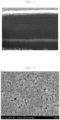
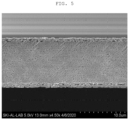
- FIGS. 2 and 3 are scanning electron microscopic images showing the separator according to Example 1.
- FIG. 2 is an SEM photograph of a plane (upper surface) of the separator according to Example 1
- FIG. 3 is an SEM photograph of a cross section of the separator illustrated in FIG. 2 .
- the inorganic particles and the sheet-shaped inorganic binder were entangled with each other to fix the particles on the surface of the inorganic particle layer of the separator according to Example 1.
- both the porous substrate and the inorganic particle layer had pores well formed on the separator according to Example 1.
- the positive electrode, the negative electrode, and the separator produced above were used to assembly a pouch type battery in a stacking manner.
- An ethylene carbonate/ ethyl methyl carbonate/ dimethyl carbonate electrolyte solution (volume ratio of 3:5:2) in which 1 M lithium hexafluorophosphate (LiPF 6 ) was dissolved was injected to the assembled battery to produce a pouch type lithium ion secondary battery having a capacity of 80 mAh.
- the resistance and the resistance increase rate of the produced battery is shown in Table 1.
- Example 1 The process was performed in the same manner as in Example 1, except that a sheet-shaped pseudo-boehmite having a long diameter of 60 nm, a short diameter of 20 nm, and a thickness of 4 nm was used instead of the sheet-shaped inorganic binder used in Example 1. The results are shown in Table 1.
- Example 1 The process was performed in the same manner as in Example 1, except that a sheet-shaped pseudo-boehmite having a long diameter of 30 nm, a short diameter of 20 nm, and a thickness of 2 nm was used instead of the sheet-shaped inorganic binder used in Example 1. The results are shown in Table 1.
- a slurry obtained by adding 100 parts by weight of boehmite having an average particle diameter of 180 nm and 1 part by weight of a surfactant (DISPERBYK-102, BYK) to water and dispersing the materials for 5 minutes with a bead mill was produced.
- An anionic acrylic resin aqueous solution (15%) was added to the slurry so that the anionic acrylic resin (weight average molecular weight: 450,000 g/mol, Aekyung Chemical) is 3 parts by weight with respect to 100 parts by weight of boehmite, and the solution was vigorously stirred by magnetron stirring to produce a water-based slurry having a solid content concentration of 10 wt%.
- the both surfaces of the polyethylene substrate of Example 1 were coated with the slurry and dried to produce a separator on which the inorganic active layer having a coated thickness of each surface of 1.0 ⁇ m was formed.
- FIGS. 4 and 5 are scanning electron microscopic (SEM) images of the separator according to Comparative Example 1. Specifically, FIG. 4 is an SEM photograph of a plane (upper surface) of the separator according to Comparative Example 1, and FIG. 5 is an SEM photograph of a cross section of the separator illustrated in FIG. 4 .
- SEM scanning electron microscopic
- a separator and a battery were produced in the same manner as in Example 1, except that the separator was produced as described later, and the results are shown in Table 1.
- Both surfaces of a polyethylene film (porosity: 41%) having a thickness of 9 ⁇ m was bar coated with the first slurry produced above and dried to form a first coating layer, and then a first coating layer was bar coated with the second slurry and dried to form a second coating layer. That is, a separator having the first coating layer and the second coating layer coated sequentially on both surfaces of a polyethylene film was produced.
- the thicknesses of the first coating layer and the second coating layer were 0.1 ⁇ m and 0.9 ⁇ m, respectively.
- the examples according to an embodiment had a significantly low heat shrinkage rate to have excellent heat resistance, a significantly low ⁇ Gurley permeability as compared with the comparative example, and a very high peel strength, and thus, had very high adhesion.
- Example 4 in which the both surfaces of the porous substrate were corona discharge treated to introduce a polar group to the surface, an effect of a low heat shrinkage rate which was significantly increased as compared with Examples 1 to 3, in particular, a significantly low heat shrinkage rate at a high temperature was shown, a peel strength was the best, and the lowest characteristics in the resistance increase rate was shown, and thus, it was found that excellent mechanical properties, heat resistance, and electrical properties were shown.
- the separator according to the present disclosure may secure battery stability since inorganic particles are adhered on a porous substrate with high adhesive strength.
- the separator according to the present disclosure has significantly low heat shrinkage even at a high temperature and also minimally increased resistance, so that it is chemically stable and has excellent electrical properties.
- the method for producing a separator according to the present disclosure may easily produce the separator having excellent stability and electrical properties.
- the separator according to the present disclosure may have a heat shrinkage rate at 170°C of 5% or less, a ⁇ Gurley permeability of 50 sec/100 cc or less, and a peel strength of 40 gf/25 mm or more.
- the electrochemical device including the separator according to the present disclosure may have excellent electrical properties of a standard deviation of a resistance value (mQ) of 30 or less and a resistance increase rate of 2.5% or less.
Landscapes
- Chemical & Material Sciences (AREA)
- Chemical Kinetics & Catalysis (AREA)
- Electrochemistry (AREA)
- General Chemical & Material Sciences (AREA)
- Engineering & Computer Science (AREA)
- Inorganic Chemistry (AREA)
- Materials Engineering (AREA)
- Manufacturing & Machinery (AREA)
- Composite Materials (AREA)
- Cell Separators (AREA)
Applications Claiming Priority (2)
| Application Number | Priority Date | Filing Date | Title |
|---|---|---|---|
| KR20220002342 | 2022-01-06 | ||
| KR1020220181351A KR102951028B1 (ko) | 2022-01-06 | 2022-12-22 | 분리막 및 이의 제조방법 |
Publications (2)
| Publication Number | Publication Date |
|---|---|
| EP4210159A2 true EP4210159A2 (de) | 2023-07-12 |
| EP4210159A3 EP4210159A3 (de) | 2023-07-26 |
Family
ID=84688448
Family Applications (1)
| Application Number | Title | Priority Date | Filing Date |
|---|---|---|---|
| EP22217021.9A Pending EP4210159A3 (de) | 2022-01-06 | 2022-12-28 | Separator und verfahren zu dessen herstellung |
Country Status (4)
| Country | Link |
|---|---|
| US (1) | US20230216144A1 (de) |
| EP (1) | EP4210159A3 (de) |
| KR (1) | KR20250167528A (de) |
| CN (1) | CN116404360A (de) |
Families Citing this family (1)
| Publication number | Priority date | Publication date | Assignee | Title |
|---|---|---|---|---|
| KR102929852B1 (ko) * | 2023-09-19 | 2026-02-24 | 에스케이이노베이션 주식회사 | 분리막 및 이를 포함하는 전기화학소자 |
Citations (1)
| Publication number | Priority date | Publication date | Assignee | Title |
|---|---|---|---|---|
| KR20140147742A (ko) | 2013-06-19 | 2014-12-30 | 주식회사 엘지화학 | 바인더 수지 조성물, 그를 포함하는 다공성 분리막 및 그를 이용한 전기 화학 소자 |
Family Cites Families (3)
| Publication number | Priority date | Publication date | Assignee | Title |
|---|---|---|---|---|
| US20150056490A1 (en) * | 2012-04-13 | 2015-02-26 | Toray Battery Separator Film Co., Ltd. | Multi-layered porous film, electrical cell separator, and electrical cell |
| KR101837562B1 (ko) * | 2015-11-06 | 2018-03-12 | 삼성에스디아이 주식회사 | 이차 전지용 세퍼레이터 및 이를 포함하는 리튬 이차 전지 |
| WO2021020887A1 (ko) * | 2019-07-30 | 2021-02-04 | 주식회사 엘지화학 | 전기화학소자용 복합 분리막 및 이를 포함하는 전기화학소자 |
-
2022
- 2022-12-27 CN CN202211685021.2A patent/CN116404360A/zh active Pending
- 2022-12-28 EP EP22217021.9A patent/EP4210159A3/de active Pending
-
2023
- 2023-01-04 US US18/092,935 patent/US20230216144A1/en active Pending
-
2025
- 2025-11-12 KR KR1020250170166A patent/KR20250167528A/ko active Pending
Patent Citations (1)
| Publication number | Priority date | Publication date | Assignee | Title |
|---|---|---|---|---|
| KR20140147742A (ko) | 2013-06-19 | 2014-12-30 | 주식회사 엘지화학 | 바인더 수지 조성물, 그를 포함하는 다공성 분리막 및 그를 이용한 전기 화학 소자 |
Also Published As
| Publication number | Publication date |
|---|---|
| KR20250167528A (ko) | 2025-12-01 |
| CN116404360A (zh) | 2023-07-07 |
| US20230216144A1 (en) | 2023-07-06 |
| EP4210159A3 (de) | 2023-07-26 |
Similar Documents
| Publication | Publication Date | Title |
|---|---|---|
| CN101317284B (zh) | 有机/无机复合多孔膜及使用该膜的电化学装置 | |
| KR102951028B1 (ko) | 분리막 및 이의 제조방법 | |
| US20100167124A1 (en) | Organic/Inorganic Composite Electrolyte and Electrochemical Device Prepared Thereby | |
| KR101655278B1 (ko) | 리튬 이차전지 | |
| EP4246700A1 (de) | Separator und elektrochemische vorrichtung damit | |
| KR20220005982A (ko) | 분리막 및 이를 이용한 전기 화학 소자. | |
| EP4064444A1 (de) | Kompositseparator und elektrochemische vorrichtung damit | |
| KR20250167528A (ko) | 분리막 및 이의 제조방법 | |
| KR101899283B1 (ko) | 비수전해액 이차 전지용 세퍼레이터 | |
| KR102886375B1 (ko) | 이차전지용 분리막 및 이의 제조방법 | |
| EP4064445A1 (de) | Kompositseparator und elektrochemische vorrichtung, die denselben verwendet | |
| EP4210160A2 (de) | Separator für eine sekundärbatterie und verfahren zu dessen herstellung | |
| EP4178022A1 (de) | Verbundseparator, verfahren zu seiner herstellung und elektrochemische vorrichtung damit | |
| US12021258B2 (en) | Separator having inorganic composite layer including inorganic particles and one-dimensional inorganic material and electrochemical device using the same | |
| KR101909134B1 (ko) | 비수전해액 이차 전지용 세퍼레이터 | |
| US12394866B2 (en) | Composite separator and electrochemical device using the same | |
| EP4560759A1 (de) | Separator und lithiumsekundärbatterie damit sowie verfahren zur herstellung davon | |
| EP4528902A2 (de) | Separator und elektrochemische vorrichtung damit | |
| KR20230116704A (ko) | 분리막을 포함하는 리튬 이차 전지 | |
| CN113904063A (zh) | 隔膜及利用该隔膜的电化学器件 | |
| CN120359631A (zh) | 锂二次电池用正极活性物质及其制备方法、包括该正极活性物质的锂二次电池 |
Legal Events
| Date | Code | Title | Description |
|---|---|---|---|
| PUAI | Public reference made under article 153(3) epc to a published international application that has entered the european phase |
Free format text: ORIGINAL CODE: 0009012 |
|
| STAA | Information on the status of an ep patent application or granted ep patent |
Free format text: STATUS: REQUEST FOR EXAMINATION WAS MADE |
|
| PUAL | Search report despatched |
Free format text: ORIGINAL CODE: 0009013 |
|
| 17P | Request for examination filed |
Effective date: 20221228 |
|
| AK | Designated contracting states |
Kind code of ref document: A2 Designated state(s): AL AT BE BG CH CY CZ DE DK EE ES FI FR GB GR HR HU IE IS IT LI LT LU LV MC ME MK MT NL NO PL PT RO RS SE SI SK SM TR |
|
| AK | Designated contracting states |
Kind code of ref document: A3 Designated state(s): AL AT BE BG CH CY CZ DE DK EE ES FI FR GB GR HR HU IE IS IT LI LT LU LV MC ME MK MT NL NO PL PT RO RS SE SI SK SM TR |
|
| RIC1 | Information provided on ipc code assigned before grant |
Ipc: H01M 50/451 20210101ALI20230619BHEP Ipc: H01M 50/403 20210101ALI20230619BHEP Ipc: H01M 10/0525 20100101ALI20230619BHEP Ipc: H01M 50/491 20210101ALI20230619BHEP Ipc: H01M 50/489 20210101ALI20230619BHEP Ipc: H01M 50/457 20210101ALI20230619BHEP Ipc: H01M 50/446 20210101ALI20230619BHEP Ipc: H01M 50/443 20210101AFI20230619BHEP |
|
| RBV | Designated contracting states (corrected) |
Designated state(s): AL AT BE BG CH CY CZ DE DK EE ES FI FR GB GR HR HU IE IS IT LI LT LU LV MC ME MK MT NL NO PL PT RO RS SE SI SK SM TR |