EP4209774A1 - Device and method for predicting physical properties of multilayer material - Google Patents
Device and method for predicting physical properties of multilayer material Download PDFInfo
- Publication number
- EP4209774A1 EP4209774A1 EP22873960.3A EP22873960A EP4209774A1 EP 4209774 A1 EP4209774 A1 EP 4209774A1 EP 22873960 A EP22873960 A EP 22873960A EP 4209774 A1 EP4209774 A1 EP 4209774A1
- Authority
- EP
- European Patent Office
- Prior art keywords
- layer
- target
- poisson
- multilayer material
- moduli
- Prior art date
- Legal status (The legal status is an assumption and is not a legal conclusion. Google has not performed a legal analysis and makes no representation as to the accuracy of the status listed.)
- Pending
Links
Images


Classifications
-
- G—PHYSICS
- G06—COMPUTING OR CALCULATING; COUNTING
- G06F—ELECTRIC DIGITAL DATA PROCESSING
- G06F30/00—Computer-aided design [CAD]
- G06F30/20—Design optimisation, verification or simulation
- G06F30/23—Design optimisation, verification or simulation using finite element methods [FEM] or finite difference methods [FDM]
-
- G—PHYSICS
- G16—INFORMATION AND COMMUNICATION TECHNOLOGY [ICT] SPECIALLY ADAPTED FOR SPECIFIC APPLICATION FIELDS
- G16C—COMPUTATIONAL CHEMISTRY; CHEMOINFORMATICS; COMPUTATIONAL MATERIALS SCIENCE
- G16C20/00—Chemoinformatics, i.e. ICT specially adapted for the handling of physicochemical or structural data of chemical particles, elements, compounds or mixtures
- G16C20/30—Prediction of properties of chemical compounds, compositions or mixtures
-
- G—PHYSICS
- G01—MEASURING; TESTING
- G01N—INVESTIGATING OR ANALYSING MATERIALS BY DETERMINING THEIR CHEMICAL OR PHYSICAL PROPERTIES
- G01N33/00—Investigating or analysing materials by specific methods not covered by groups G01N1/00 - G01N31/00
- G01N33/0003—Composite materials
-
- G—PHYSICS
- G16—INFORMATION AND COMMUNICATION TECHNOLOGY [ICT] SPECIALLY ADAPTED FOR SPECIFIC APPLICATION FIELDS
- G16C—COMPUTATIONAL CHEMISTRY; CHEMOINFORMATICS; COMPUTATIONAL MATERIALS SCIENCE
- G16C20/00—Chemoinformatics, i.e. ICT specially adapted for the handling of physicochemical or structural data of chemical particles, elements, compounds or mixtures
- G16C20/60—In silico combinatorial chemistry
-
- G—PHYSICS
- G16—INFORMATION AND COMMUNICATION TECHNOLOGY [ICT] SPECIALLY ADAPTED FOR SPECIFIC APPLICATION FIELDS
- G16C—COMPUTATIONAL CHEMISTRY; CHEMOINFORMATICS; COMPUTATIONAL MATERIALS SCIENCE
- G16C60/00—Computational materials science, i.e. ICT specially adapted for investigating the physical or chemical properties of materials or phenomena associated with their design, synthesis, processing, characterisation or utilisation
-
- G—PHYSICS
- G06—COMPUTING OR CALCULATING; COUNTING
- G06F—ELECTRIC DIGITAL DATA PROCESSING
- G06F2113/00—Details relating to the application field
- G06F2113/24—Sheet material
-
- G—PHYSICS
- G06—COMPUTING OR CALCULATING; COUNTING
- G06F—ELECTRIC DIGITAL DATA PROCESSING
- G06F2113/00—Details relating to the application field
- G06F2113/26—Composites
-
- G—PHYSICS
- G06—COMPUTING OR CALCULATING; COUNTING
- G06F—ELECTRIC DIGITAL DATA PROCESSING
- G06F2119/00—Details relating to the type or aim of the analysis or the optimisation
- G06F2119/14—Force analysis or force optimisation, e.g. static or dynamic forces
Definitions
- the present invention relates to a system and method for predicting the physical properties of a multilayer material.
- a polymer film refers to a non-fibrous flat plastic molded article, which is light, has a property as a good barrier, has high transparency, and is relatively inexpensive, so it is used in many fields such as packaging materials, household goods, electronic devices, automobiles, and aircraft.
- synthetic polymers such as polyethylene (PE), polypropylene (PP), polyvinyl chloride (PVC), and polyethylene terephthalate (PET) are processed into a polymer film and widely used in Korea and abroad, and currently, many synthetic polymers are used as materials for polymer films either alone or by blending.
- PE polyethylene
- PP polypropylene
- PVC polyvinyl chloride
- PET polyethylene terephthalate
- a multilayer film is a composite film in which different types of films are laminated for the purpose of multi-functionality of the film, and various types of multilayer films formed of, for example, the combination of a film having the excellent mechanical properties of polyethylene (PE) and the printing aesthetics of cellophane, and nylon and a vinyl alcohol-ethylene copolymer are used as packaging materials.
- PE polyethylene
- nylon and a vinyl alcohol-ethylene copolymer are used as packaging materials.
- the material has a property in which lateral transformation (transformation in the direction proportional to a load) and longitudinal transformation (transformation in the direction of load) are proportional to each other within the elastic range, and the ratio of these two transformations have a certain value according to a material within the elastic limit and is called the Poisson's ratio.
- materials for a multilayer film are anisotropic in a machine direction (MD) and a transverse direction (TD) during the manufacturing process, for the robust design of materials, it is necessary to receive not only the homogenized stiffness of an entire laminate of a multilayer film but also only one of a physical property value and a thickness of one undetermined film as range values, and extract the other values through an algorithm.
- MD machine direction
- TD transverse direction
- Korean Unexamined Patent Application Publication No. 2005-0112788 does not reset the stiffness matrix, so there is a problem that it is not suitable for the application to the development of a material for a multilayer film like in the present invention.
- the present invention is directed to providing a system and method for predicting the physical properties of a multilayer material, which can predict physical properties such as the elastic moduli, shear moduli, and the Poisson's ratios of the entire laminate, and can extract not only a homogenized stiffness of the entire laminate of the multilayer material but also a physical property value or thickness of an undetermined layer, when a multilayer material having a laminate structure is developed.
- the present invention provides a system for predicting the physical properties of a multilayer material.
- the system of the present invention includes an input unit for inputting (a) any one or more of physical properties such as an elastic modulus, Poisson's ratio, shear modulus, thickness, lamination angle,or a set number of zones of each layer, except for an undetermined layer, and (b) any one or more physical properties of an elastic modulus or a thickness of the undetermined layer;
- the present invention provides a method of predicting the physical properties of a multilayer material.
- the method of predicting the physical properties of a multilayer material in which two or more materials are laminated according to the present invention includes
- the present invention can predict, when a multilayer material having a laminate structure is developed, physical properties such as the elastic moduli, shear moduli, and Poisson's ratios of an entire laminate, and can extract not only a homogenized stiffness of the entire laminate of the multilayer material but also a physical property value or thickness of an undetermined layer.
- the present invention provides a system for predicting the physical properties of a multilayer material.
- the system of the present invention includes an input unit for inputting (a) any one or more physical properties of an elastic modulus, a Poisson's ratio, a shear modulus, a thickness, a lamination angle, or a set number of zones of each layer, except for an undetermined layer, and (b) any one or more physical properties of an elastic modulus or a thickness of the undetermined layer;
- control unit sets compliance matrices for stiffness matrices of the multilayer material, which is an entire laminate, using the input physical properties, calculates physical properties of the multilayer material, which is the entire laminate, using values of the set compliance matrices, and determines whether the calculated physical properties converge to the final target physical properties.
- control unit for the multilayer material in which two or more materials are laminated, receives (a) the elastic modulus, Poisson's ratio, shear modulus, thickness, lamination angle, and a set number of zones of each layer, except for an undetermined layer, and (b) any one or more of the elastic modulus or thickness of the undetermined layer.
- the control unit calculates a stiffness matrix of each layer using the elastic modulus, Poisson's ratio, and shear modulus of each layer, except for the undetermined layer, resets the stiffness matrix of each layer by reflecting the lamination angle of each layer in the obtained stiffness matrix, calculates stiffness matrices of the multilayer material, which is the entire laminate, using a value of the stiffness matrix reset by receiving the thickness information of each layer, sets compliance matrices for the calculated stiffness matrices of the multilayer material, which is the entire laminate, and calculates any one or more of elastic moduli (/E x,y ), Poisson's ratios (/ ⁇ x,y ), or shear moduli (/G x,y ) of the multilayer material, which is the entire laminate, using the total thickness and values of the set compliance matrices of the multilayer material, which is the entire laminate, and determines whether any one or more of the calculated elastic moduli (/E x,y ), Poisson's ratios (/ ⁇ x
- the present invention only one of the physical property value and thickness of the undetermined layer is input as a range value, and the other value may be extracted through an algorithm.
- the present invention can simultaneously input the physical property value and thickness of the undetermined layer as range values, and extract or verify a value within these ranges. Furthermore, when there is no value satisfying the physical property value and thickness ranges of the undetermined layer, it is possible to fix each range value, extract the other value, and present the same to a user.
- the control unit may update the elastic modulus value of the undetermined layer.
- the control unit may update a value of the thickness of the undetermined layer.
- control unit may output any one or more of the elastic modulus, Poisson's ratio, shear modulus, or thickness of the undetermined layer when any one or more of the calculated elastic moduli (/E x,y ), Poisson's ratios (/ ⁇ x,y ), or shear moduli (/G x,y ) of the multilayer material converge to any one or more of the target elastic moduli (target /E x,y ), target Poisson's ratios (target / ⁇ x,y ), or target shear moduli (target /G x,y ) received as the final target physical properties.
- control unit may plot the correlation between the elastic modulus and thickness of the undetermined layer in a graph.
- the present invention provides a method of predicting the physical properties of a multilayer material.
- the method of predicting the physical properties of a multilayer material according to the present invention includes
- the calculating of physical properties of a multilayer material includes
- the inputting as input values includes
- the calculating of physical properties of the multilayer material includes
- the determining whether the calculated properties converge to the final target physical properties includes
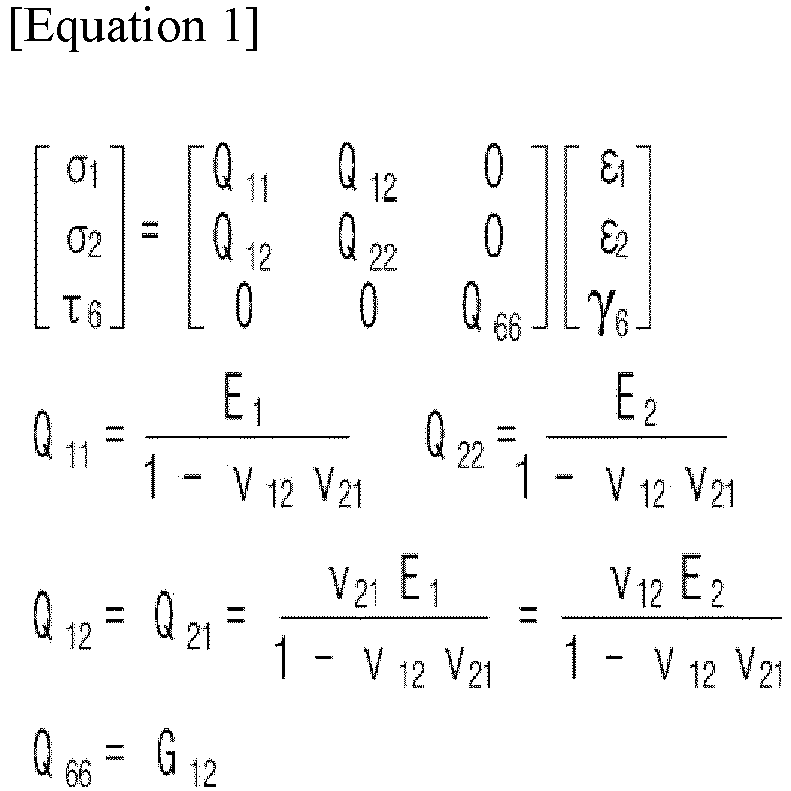
- stiffness matrices ([Q] k 1,2 ) in the machine direction (1) and the transverse direction (2) of each layer (k) can be calculated using elastic moduli (E k 1,2 ), Poisson's ratios ( ⁇ k 1,2 ), and shear moduli (G k 1,2 ) as shown in Equation 1 below.
- stiffness matrices ([Q] k x,y ) of each layer (k) can be reset as shown in Equation 2 below by reflecting the lamination angle ( ⁇ k ) of each layer (k) in the obtained stiffness matrices ([Q] k 1,2 ).
- the fifth step it is possible to calculate stiffness matrices ([A] x,y , [B] x,y , [D] x,y ) of the multilayer material, which is the entire laminate, as shown in Equation (3) below, using the values of the stiffness matrices reset by receiving the thickness information of each layer (k).
- Equation 3 k represents each layer, and the multilayer material is formed of a total of n layers.
- n is an integer of 2 to 10.
- compliance matrices ([a] x,y , [b] x,y , [c] x,y ,[d] x,y ) for the calculated stiffness matrices ([A] x,y , [B] x,y , [D] x,y ) of the multilayer material, which is the entire laminate, can be set as shown in Equation 4 below.
- the seventh step it is possible to calculate elastic moduli (/E x,y ), Poisson's ratios (/ ⁇ x,y ), and shear moduli (/G x,y ) of the multilayer material, which is the entire laminate, using the total thickness (h) and values of the set compliance matrices ([a] x,y , [b] x,y , [c] x,y , [d] x,y ) of the multilayer material, which is the entire laminate, as shown in Equation 5 below.
- the method of the present invention further includes, in the case in which the elastic modulus is selected from the elastic modulus or the thickness of the undetermined layer and input, when the calculated elastic modulus, Poisson's ratio, and shear modulus do not converge to the elastic modulus, Poisson's ratio, and shear modulus received as the final target physical properties, updating the value of the elastic modulus of the undetermined layer.
- the method of the present invention further includes, in the case in which the thickness is selected from the elastic modulus and the thickness of the undetermined layer and input, when the calculated elastic modulus, Poisson's ratio, and shear modulus do not converge to the elastic modulus, Poisson's ratio, and shear modulus received as the final target physical properties, updating the value of the thickness of the undetermined layer.
- the method of the present invention further includes, when the calculated elastic modulus, Poisson's ratio, and shear modulus do not converge to the elastic modulus, Poisson's ratio and shear modulus received as the final target physical properties, outputs an elastic modulus, Poisson's ratio, shear modulus and thickness of an undetermined layer.
- the method of the present invention further includes plotting the correlation between elastic modulus and thickness of the undetermined layer in a graph.
- unit includes a unit implemented using hardware, a unit implemented using software, a unit implemented using both hardware and software, and one unit may be implemented using one or more pieces of hardware or software, and two or more units may be implemented using one piece of hardware or software.
- FIG. 1 is a diagram illustrating a configuration of a system for predicting the physical properties of a multilayer material according to a first embodiment of the present invention.
- the configuration of the system for predicting the physical properties of a multilayer material is composed of an input unit 10 for inputting, by a user, elastic moduli (E k 1,2 ) in the machine direction (1) and transverse direction (2) of each layer (k), Poisson's ratios ( ⁇ k 1,2 ) in the machine direction (1) and transverse direction (2) of each layer (k), shear moduli (G K 1,2 ) in the machine direction (1) and transverse direction (2) of each layer (k), a thickness (Z k ) and a set number of zones (N) of each layer (k), except for an undetermined layer, and elastic moduli (E 1,2 ) or a thickness (z) of the undetermined layer, a control unit 20 which is connected to the input unit 10 and includes an entire laminate physical property calculation unit 21 and an undetermined layer physical property calculation unit 22, a display 30 connected to the control unit 20, and a storage unit 40 connected to the control unit 20.
- the multilayer material refers to a laminate having a structure in which two or more materials are laminated, such as a multilayer film, for example, a polymer.
- the multilayer material may refer to a composite material of different materials such as a fiber reinforced plastic (FRP) and an aluminum pouch.
- FRP fiber reinforced plastic
- the multilayer material may refer to a multilayer film.
- the input unit 10 is for inputting actual physical property values by a user, but the present invention is not necessarily limited thereto.
- the input unit 10 may access a database (DB) in which information to be input to the input unit 10 is stored.
- DB database
- ⁇ 1,2 refers to a Poisson's ratio associated with transformation in the transverse direction (2) when a force is loaded on the material in a machine direction (1)
- ⁇ 2,1 refers to the Poisson's ratio associated with transformation in the machine direction (1) when the material is loaded in the transverse direction (2).
- the angle ( ⁇ k ) may refer to an angle in the counterclockwise direction of each layer with respect to the x-direction of the multilayer material.
- each layer (k) may refer to the information on coordinates from the thickness center of the entire laminate in the multilayer material.
- the display 30 may provide an input screen in which a name input field, a thickness input field, and an angle input field are arranged for each layer, and a machine direction (MD) elastic modulus input field, a transverse direction (TD) elastic modulus input field, a Poisson's ratio input field, a thermal expansion coefficient input field, a sample size (length, width) input field, an X-axis tensile strength input field, a Y-axis tensile strength input field, a shear strength input field, and a temperature change input field are arranged for each layer.
- MD machine direction
- TD transverse direction
- Poisson's ratio input field a thermal expansion coefficient input field
- sample size (length, width) input field an X-axis tensile strength input field
- Y-axis tensile strength input field a shear strength input field
- a temperature change input field are arranged for each layer.
- the display 30 may provide an output screen in which x-axis elastic modulus, y-axis elastic modulus, Poisson's ratio, shear modulus, a volumetric modulus, and a coefficient of thermal expansion are arranged.
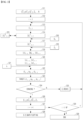
- FIG. 2 is a flowchart of a method of predicting the physical properties of a multilayer material according to a second embodiment of the present invention.
- the method of predicting the physical properties of a multilayer material in which two or more materials are laminated according to a second embodiment of the present invention includes
- the method of predicting the physical properties of a multilayer material includes setting compliance matrices ([S] k 1,2 ) for the calculated stiffness matrices ([Q] k 1,2 ) in the machine direction (1) and transverse direction (2) of each layer (k) (S 15),
- Equation 3 k represents each layer, and the multilayer material is formed of a total of n layers.
- n is an integer of 2 to 10.
- Compliance matrices [a] x,y , [b] x,y , [c] x,y ,[d] x,y ) for the calculated stiffness matrices ([A] x,y , [B] x,y , [D] x,y ) of the multilayer material, which is the entire laminate, are set as shown in Equation 4 below (S20).
- a total thickness (h) of the multilayer material, which is the entire laminate, is calculated and input (S21), and elastic moduli (/E x,y ), Poisson's ratios (/ ⁇ x,y ), and shear moduli (/G x,y ) of the multilayer material, which is the entire laminate, are calculated, as shown in Equation 5 below, using the total thickness (h) and values of the set compliance matrices ([a] x,y , [b] x,y , [c] x,y ,[d] x,y ) of the multilayer material, which is the entire laminate (S22).
- FIG. 3 is a flowchart of a method of predicting the physical properties of a multilayer material according to a third embodiment of the present invention.
- Equation 3 k represents each layer, and the multilayer material is formed of a total of n layers.
- n is an integer of 2 to 10, and specifically, an integer of 3 to 5.
- Compliance matrices [a] x,y , [b] x,y , [c] x,y ,[d] x,y ) for the calculated stiffness matrices ([A] x,y , [B] x,y , [D] x,y ) of the multilayer material, which is the entire laminate, are set as shown in Equation 4 below (S50).
- the entire laminate physical property calculation unit 21 in the control unit 20 automatically calculates shear moduli (G k 1,2 ) using the relation between the elastic modulus (E), the shear modulus (G), and the Poisson's ratio ( ⁇ ) of an isotropic material and then stored in the storage unit 40.
- G E 2 1 + v
- the undetermined layer physical property calculation unit 22 in the control unit 20 sets the variable (i) of the number of zones to 1 (S12, S42).
- the entire laminate physical property calculation unit 21 in the control unit 20 calculates stiffness matrices ([Q] k 1,2 ) in the machine direction (1) and transverse direction (2) of each layer (k) using the elastic moduli (E k 1,2 ), Poisson's ratios ( ⁇ k 1,2 ), and shear moduli (G k 1,2 ) as shown in Equation 1 below (S14, S44).
- the entire laminate physical property calculation unit 21 in the control unit 20 calculates inverse matrices ([S] k 1,2 ) for the calculated stiffness matrix([Q] k 1,2 ) in the machine direction (1) and transverse direction (2) of each layer (k) and sets them as compliance matrices (S15, S45). This is for converting a stiffness matrix, which is a singular matrix, into an invertible matrix having an inverse matrix.
- the entire laminate physical property calculation unit 21 in the control unit 20 resets stiffness matrices ([Q] k x,y ) of each layer (k) in an x or y direction by reflecting the lamination angle ( ⁇ k ) of the multilayer material in the obtained stiffness matrices ([Q] k 1,2 ) of each layer (k) as shown in Equation 2 below (S17, S47).
- a thickness (Z k ) of each layer (k) is inputted (S18, S48).
- the entire laminate physical property calculation unit 21 in the control unit 20 calculates stiffness matrices ([A] x,y , [B] x,y , [D] x,y ) of the multilayer material, which is the entire laminate, using values of the stiffness matrices reset by receiving the thickness information of each layer (k) as shown in Equation 3 below (S19, S49).
- Equation 3 k represents each layer, and the multilayer material is formed of a total of n layers.
- n is an integer of 2 to 10.
- the entire laminate physical property calculation unit 21 in the control unit 20 sets compliance matrices ([a] x,y , [b] x,y , [c] x,y ,[d] x,y ) for the calculated stiffness matrices ([A] x,y , [B] x,y , [D] x,y ) of the multilayer material, which is the entire laminate, as shown in Equation 4 below (S20, S40).
- a total thickness (h) of the multilayer material is calculated from the thickness information of each layer (k) and inputted (S21, S51).
- the entire laminate physical property calculation unit 21 in the control unit 20 calculates elastic moduli (/E x,y ), shear moduli (/G x,y ), and Poisson's ratios (/ ⁇ x,y ) of the multilayer material, which is the entire laminate, using the total thickness (h) and values of the set compliance matrices ([a] x,y , [b] x,y , [c] x,y , [d] x,y ) of the multilayer material, which is the entire laminate, as shown in Equation 5 below (S22, S52).
- the user inputs elastic moduli (/E x,y ), Poisson's ratios (/ ⁇ x,y ), and shear moduli (/G x,y ) as the final target physical properties using the input unit 10 while looking at the input screen of the display 30, and the undetermined layer physical property calculation unit 22 in the control unit 20 reads the same (S23, S53).
- the undetermined layer physical property calculation unit 22 in the control unit 20 determines whether the calculated elastic moduli (/E x,y ), Poisson's ratios (/ ⁇ x,y ), and shear moduli (/G x,y ) converge to the elastic moduli (/E x,y ), Poisson's ratios (/ ⁇ x,y ), and shear moduli (/Gx,y) received as the final target physical properties (S24, S54).
- the undetermined layer physical property calculation unit 22 in the control unit 20 outputs physical property values (elastic moduli (E 1,2 ), Poisson's ratios ( ⁇ k x,y ), and shear moduli (G k x,y )) and a thickness (Z k ) of an undetermined layer (S26, S56).
- the undetermined layer physical property calculation unit 22 in the control unit 20 increases a variable (i) of the number of zones by 1 (S27, S57), and then plots the correlation between elastic moduli (E 1,2 ) and thickness (z) of the undetermined layer in a graph (S28, S58).
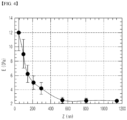
- FIG. 4 is a graph showing the correlation between the elastic moduli (E 1,2 ) and the thickness (z) of an undetermined layer according to the present invention.
- the undetermined layer physical property calculation unit 22 in the control unit 20 determines whether the variable (i) of the number of zones is the set number of zones (N) or less, and in the case of the variable is the set number of zones (N) or less, jumps to S13 and repeats the above-described process until the variable (i) of the number of zones exceeds the set number of zones (N) (S29, S59).
- control unit 10 ends the operation (S30, S60).
- the values input to the input unit when they are not immediately obtained, they may be deduced through a conversion process using other physical property values.
- these values can be calculated using one or more physical property values of a Lame's first parameter ( ⁇ k ), a shear modulus (G k ) or a bulk elastic modulus (K k ). For example, they can be converted into an elastic modulus (E k ) and a Poisson's ratio ( ⁇ k ) using Formulas 1 to 9 below.
Landscapes
- Engineering & Computer Science (AREA)
- Theoretical Computer Science (AREA)
- Life Sciences & Earth Sciences (AREA)
- Chemical & Material Sciences (AREA)
- Computing Systems (AREA)
- Bioinformatics & Cheminformatics (AREA)
- Bioinformatics & Computational Biology (AREA)
- Physics & Mathematics (AREA)
- Health & Medical Sciences (AREA)
- Crystallography & Structural Chemistry (AREA)
- General Physics & Mathematics (AREA)
- Medicinal Chemistry (AREA)
- General Health & Medical Sciences (AREA)
- General Engineering & Computer Science (AREA)
- Geometry (AREA)
- Evolutionary Computation (AREA)
- Computer Hardware Design (AREA)
- Food Science & Technology (AREA)
- Analytical Chemistry (AREA)
- Biochemistry (AREA)
- Immunology (AREA)
- Pathology (AREA)
- Laminated Bodies (AREA)
- Investigating Strength Of Materials By Application Of Mechanical Stress (AREA)
Abstract
Description
- This application claims priority to and the benefit of
Korean Patent Application No. 10-2021-0138914, filed on October 19, 2021 Korean Patent Application No. 10-2021-0138918, filed on October 19, 2021 Korean Patent Application No. 10-2022-0086160, filed on July 13, 2022 - The present invention relates to a system and method for predicting the physical properties of a multilayer material.
- A polymer film refers to a non-fibrous flat plastic molded article, which is light, has a property as a good barrier, has high transparency, and is relatively inexpensive, so it is used in many fields such as packaging materials, household goods, electronic devices, automobiles, and aircraft.
- For example, synthetic polymers such as polyethylene (PE), polypropylene (PP), polyvinyl chloride (PVC), and polyethylene terephthalate (PET) are processed into a polymer film and widely used in Korea and abroad, and currently, many synthetic polymers are used as materials for polymer films either alone or by blending.
- A multilayer film is a composite film in which different types of films are laminated for the purpose of multi-functionality of the film, and various types of multilayer films formed of, for example, the combination of a film having the excellent mechanical properties of polyethylene (PE) and the printing aesthetics of cellophane, and nylon and a vinyl alcohol-ethylene copolymer are used as packaging materials.
- In the case of developing such a multilayer film as a material, it is necessary to predict physical properties such as the elastic moduli, the shear moduli, and the Poisson's ratios of the entire laminate.
- When the elastic modulus is referred to as "E," the shear modulus is referred to as "G," and the Poisson's ratio is referred to as "υ," the relationship between them is as follows:

- The material has a property in which lateral transformation (transformation in the direction proportional to a load) and longitudinal transformation (transformation in the direction of load) are proportional to each other within the elastic range, and the ratio of these two transformations have a certain value according to a material within the elastic limit and is called the Poisson's ratio.
- In addition, when the elastic modulus represents the degree of strains occurring when an elastic material is subjected to stress, and the elastic modulus is referred to as "E," the stress is referred to as "σ," and the strain is referred to as "ε," the relationship between them is as follows.

- Meanwhile, since materials for a multilayer film are anisotropic in a machine direction (MD) and a transverse direction (TD) during the manufacturing process, for the robust design of materials, it is necessary to receive not only the homogenized stiffness of an entire laminate of a multilayer film but also only one of a physical property value and a thickness of one undetermined film as range values, and extract the other values through an algorithm.
- For example, in
Korean Unexamined Patent Application Publication No. 2005-0112788 (published on December 01, 2005 - However, the technology disclosed in
Korean Unexamined Patent Application Publication No. 2005-0112788 - To solve technical problems of the present invention, the present invention is directed to providing a system and method for predicting the physical properties of a multilayer material, which can predict physical properties such as the elastic moduli, shear moduli, and the Poisson's ratios of the entire laminate, and can extract not only a homogenized stiffness of the entire laminate of the multilayer material but also a physical property value or thickness of an undetermined layer, when a multilayer material having a laminate structure is developed.
- As an aspect for achieving the above purposes, the present invention provides a system for predicting the physical properties of a multilayer material.
- In one embodiment, the system of the present invention includes an input unit for inputting (a) any one or more of physical properties such as an elastic modulus, Poisson's ratio, shear modulus, thickness, lamination angle,or a set number of zones of each layer, except for an undetermined layer, and (b) any one or more physical properties of an elastic modulus or a thickness of the undetermined layer;
- a control unit which is connected to the input unit and includes an entire laminate property calculation unit and an undetermined layer property calculation unit;
- a display that is connected to the control unit; and
- a storage unit that is connected to the control unit.
- In another aspect for achieving the above purposes, the present invention provides a method of predicting the physical properties of a multilayer material.
- In one embodiment, the method of predicting the physical properties of a multilayer material in which two or more materials are laminated according to the present invention includes
- inputting any one or more of physical properties of an elastic modulus, a Poisson's ratio, a shear modulus, a thickness, a lamination angle, or a set number of zones of each layer, except for an undetermined layer, and any one or more physical properties of an elastic modulus or a thickness of the undetermined layer as input values;
- calculating the physical properties of the multilayer material, which is an entire laminate, using the input physical properties; and
- determining whether the calculated physical properties converge to final target physical properties.
- The present invention can predict, when a multilayer material having a laminate structure is developed, physical properties such as the elastic moduli, shear moduli, and Poisson's ratios of an entire laminate, and can extract not only a homogenized stiffness of the entire laminate of the multilayer material but also a physical property value or thickness of an undetermined layer.
-
-
FIG. 1 is a diagram illustrating a configuration of a system for predicting the physical properties of a multilayer material according to a first embodiment of the present invention. -
FIG. 2 is a flowchart of a method of predicting the physical properties of a multilayer material according to a second embodiment of the present invention. -
FIG. 3 is a flowchart of a method of predicting the physical properties of a multilayer material according to a third embodiment of the present invention. -
FIG. 4 is a graph showing the correlation between elastic moduli (E1,2) and a thickness (z) of an undetermined layer according to the present invention. - As an aspect for achieving the above purposes, the present invention provides a system for predicting the physical properties of a multilayer material.
- In one embodiment, the system of the present invention includes an input unit for inputting (a) any one or more physical properties of an elastic modulus, a Poisson's ratio, a shear modulus, a thickness, a lamination angle, or a set number of zones of each layer, except for an undetermined layer, and (b) any one or more physical properties of an elastic modulus or a thickness of the undetermined layer;
- a control unit which is connected to the input unit and includes an entire laminate property calculation unit and an undetermined layer property calculation unit;
- a display that is connected to the control unit; and
- a storage unit that is connected to the control unit.
- In an exemplary embodiment, the control unit sets compliance matrices for stiffness matrices of the multilayer material, which is an entire laminate, using the input physical properties, calculates physical properties of the multilayer material, which is the entire laminate, using values of the set compliance matrices, and determines whether the calculated physical properties converge to the final target physical properties.
- In one exemplary embodiment,
- a system of the present invention includes an input unit for inputting (a) an elastic modulus, a Poisson's ratio, a shear modulus, a thickness, a lamination angle, and a set number of zones of each layer, except for an undetermined layer, and (b) any one or more of an elastic modulus or thickness of the undetermined layer;
- a control unit which is connected to the input unit and includes an entire laminate property calculation unit and an undetermined layer property calculation unit;
- a display that is connected to the control unit; and
- a storage unit that is connected to the control unit.
- In another exemplary embodiment, the control unit, for the multilayer material in which two or more materials are laminated, receives (a) the elastic modulus, Poisson's ratio, shear modulus, thickness, lamination angle, and a set number of zones of each layer, except for an undetermined layer, and (b) any one or more of the elastic modulus or thickness of the undetermined layer.
- Here, the control unit calculates a stiffness matrix of each layer using the elastic modulus, Poisson's ratio, and shear modulus of each layer, except for the undetermined layer, resets the stiffness matrix of each layer by reflecting the lamination angle of each layer in the obtained stiffness matrix, calculates stiffness matrices of the multilayer material, which is the entire laminate, using a value of the stiffness matrix reset by receiving the thickness information of each layer, sets compliance matrices for the calculated stiffness matrices of the multilayer material, which is the entire laminate, and calculates any one or more of elastic moduli (/Ex,y), Poisson's ratios (/υx,y), or shear moduli (/Gx,y) of the multilayer material, which is the entire laminate, using the total thickness and values of the set compliance matrices of the multilayer material, which is the entire laminate, and
determines whether any one or more of the calculated elastic moduli (/Ex,y), Poisson's ratios (/υx,y) and shear moduli (/Gx,y) of the multilayer material converge to any one or more of a target elastic moduli (target /Ex,y), target Poisson's ratios (target /υx,y) or a target shear moduli (target /Gx,y) received as the final target physical properties. - In the present invention, only one of the physical property value and thickness of the undetermined layer is input as a range value, and the other value may be extracted through an algorithm. In another example, the present invention can simultaneously input the physical property value and thickness of the undetermined layer as range values, and extract or verify a value within these ranges. Furthermore, when there is no value satisfying the physical property value and thickness ranges of the undetermined layer, it is possible to fix each range value, extract the other value, and present the same to a user.
- In one embodiment,
in the case in which the elastic modulus is selected from the elastic modulus and thickness of the undetermined layer and input, when any one or more of the calculated elastic moduli (/Ex,y), Poisson's ratios (/υx,y), or shear moduli (/Gx,y) of the multilayer material do not converge to any one or more of the target elastic moduli (target /Ex,y), target Poisson's ratios (target /υx,y), or target shear moduli (target /Gx,y) received as the final target physical properties, the control unit may update the elastic modulus value of the undetermined layer. - In another embodiment,
in a case in which the thickness is selected from the elastic modulus and thickness of the undetermined layer and input, when any one or more of the calculated elastic moduli (/Ex,y), Poisson's ratios (/υx,y), or shear moduli (/Gx,y) of the multilayer material do not converge to any one or more of the target elastic moduli (target /Ex,y), target Poisson's ratios (target /υx,y), or target shear moduli (target /Gx,y) received as the final target physical properties, the control unit may update a value of the thickness of the undetermined layer. - In still another embodiment,
the control unit may output any one or more of the elastic modulus, Poisson's ratio, shear modulus, or thickness of the undetermined layer when any one or more of the calculated elastic moduli (/Ex,y), Poisson's ratios (/υx,y), or shear moduli (/Gx,y) of the multilayer material converge to any one or more of the target elastic moduli (target /Ex,y), target Poisson's ratios (target /υx,y), or target shear moduli (target /Gx,y) received as the final target physical properties. - In yet another embodiment, the control unit may plot the correlation between the elastic modulus and thickness of the undetermined layer in a graph.
- As another aspect to achieve the above purposes, the present invention provides a method of predicting the physical properties of a multilayer material.
- In one embodiment,
- the method of predicting the physical properties of a multilayer material in which two or more materials are laminated according to the present invention includes
- inputting any one or more of physical properties of an elastic modulus, a Poisson's ratio, a shear modulus, a thickness, a lamination angle, or a set number of zones of each layer, except for an undetermined layer, and any one or more physical properties of an elastic modulus or a thickness of the undetermined layer as input values;
- calculating physical properties of the multilayer material, which is an entire laminate, using the input physical properties; and
- determining whether the calculated physical properties converge to the final target physical properties.
- In one exemplary embodiment, the method of predicting the physical properties of a multilayer material according to the present invention includes
- inputting any one or more of an elastic modulus, Poisson's ratio, shear modulus, thickness, lamination angle, or set number of zones of each layer, except for an undetermined layer;
- inputting any one or more physical properties of an elastic modulus or thickness of the undetermined layer;
- calculating physical properties of the multilayer material, which is an entire laminate, using the input physical properties; and
- determining whether the calculated physical properties converge to the final target physical properties.
- In an exemplary embodiment, the calculating of physical properties of a multilayer material includes
- setting compliance matrices for stiffness matrices of the multilayer material, which is the entire laminate; and
- calculating physical properties of the multilayer material, which is the entire laminate, using values of the set compliance matrices.
- In one embodiment, the inputting as input values includes
- inputting an elastic modulus, a Poisson's ratio, a shear modulus, a thickness, a lamination angle and a set number of zones of each layer, except for an undetermined layer (first step); and
- inputting any one or more of an elastic modulus or thickness of the undetermined layer (second step).
- In another embodiment, the calculating of physical properties of the multilayer material includes
- calculating a stiffness matrix of each layer, except for an undetermined layer, using the elastic modulus, Poisson's ratio, and shear modulus (third step);
- resetting a stiffness matrix of each layer by reflecting the lamination angle of each layer in the obtained stiffness matrix (fourth step);
- calculating stiffness matrices of the multilayer material, which is the entire laminate, using a value of the stiffness matrix reset by receiving the thickness information of each layer (fifth step);
- setting compliance matrices for the calculated stiffness matrices of the multilayer material, which is the entire laminate (sixth step); and
- calculating elastic moduli, Poisson's ratios, and shear moduli of the multilayer material, which is the entire laminate, using the total thickness and values of the set compliance matrices of the multilayer material, which is the entire laminate (seventh step).
- In still another embodiment, the determining whether the calculated properties converge to the final target physical properties includes
- inputting an elastic modulus, a Poisson's ratio, and a shear modulus as the final target physical properties (eighth step); and
- determining whether the calculated elastic moduli (/Ex,y), Poisson's ratios (/υx,y), and shear moduli (/Gx,y) converge to the target elastic moduli (target /Ex,y), target Poisson's ratios (target /υx,y), and target shear moduli (target /Gx,y) received as the final target physical properties (ninth step).
- In an exemplary embodiment, in the third step, stiffness matrices ([Q]k 1,2) in the machine direction (1) and the transverse direction (2) of each layer (k) can be calculated using elastic moduli (Ek 1,2), Poisson's ratios (υk 1,2), and shear moduli (Gk 1,2) as shown in
Equation 1 below.
- In
Equation 1, for an isotropic material, G = E / 2(1+υ). - In an exemplary embodiment, in the fourth step, stiffness matrices ([Q]k x,y) of each layer (k) can be reset as shown in
Equation 2 below by reflecting the lamination angle (θk) of each layer (k) in the obtained stiffness matrices ([Q]k 1,2).
- In an exemplary embodiment, according to the method of the present invention, in the fifth step, it is possible to calculate stiffness matrices ([A]x,y, [B]x,y, [D]x,y) of the multilayer material, which is the entire laminate, as shown in Equation (3) below, using the values of the stiffness matrices reset by receiving the thickness information of each layer (k).

- In Equation 3, k represents each layer, and the multilayer material is formed of a total of n layers. For example, n is an integer of 2 to 10.
- In an exemplary embodiment, in the sixth step, compliance matrices ([a]x,y, [b]x,y, [c]x,y,[d]x,y) for the calculated stiffness matrices ([A]x,y, [B]x,y, [D]x,y) of the multilayer material, which is the entire laminate, can be set as shown in Equation 4 below.

- In an exemplary embodiment, in the seventh step, it is possible to calculate elastic moduli (/Ex,y), Poisson's ratios (/υx,y), and shear moduli (/Gx,y) of the multilayer material, which is the entire laminate, using the total thickness (h) and values of the set compliance matrices ([a]x,y, [b]x,y, [c]x,y, [d]x,y) of the multilayer material, which is the entire laminate, as shown in Equation 5 below.

- In one embodiment, the method of the present invention further includes, in the case in which the elastic modulus is selected from the elastic modulus or the thickness of the undetermined layer and input, when the calculated elastic modulus, Poisson's ratio, and shear modulus do not converge to the elastic modulus, Poisson's ratio, and shear modulus received as the final target physical properties, updating the value of the elastic modulus of the undetermined layer.
- In another embodiment, the method of the present invention further includes, in the case in which the thickness is selected from the elastic modulus and the thickness of the undetermined layer and input, when the calculated elastic modulus, Poisson's ratio, and shear modulus do not converge to the elastic modulus, Poisson's ratio, and shear modulus received as the final target physical properties, updating the value of the thickness of the undetermined layer.
- In still another embodiment, the method of the present invention further includes, when the calculated elastic modulus, Poisson's ratio, and shear modulus do not converge to the elastic modulus, Poisson's ratio and shear modulus received as the final target physical properties, outputs an elastic modulus, Poisson's ratio, shear modulus and thickness of an undetermined layer.
- In yet another embodiment, the method of the present invention further includes plotting the correlation between elastic modulus and thickness of the undetermined layer in a graph.
- Hereinafter, to describe the present invention in detail so as to be easily implemented by those of ordinary skill in the art to which the present invention belongs, exemplary embodiments of the present invention will be described with reference to the accompanying drawings. Other objects, features, and operational advantages, including the object, action and effect of the present invention will be more apparent by the description of the exemplary embodiments.
- For reference, embodiments disclosed herein are merely presented by selecting the most exemplary embodiments to help the understanding of those of ordinary skill in the art among various possible embodiments, and the technical spirit of the present invention is not necessarily limited only by the presented embodiments. Various changes, additions, and modifications including equivalents or substitutes are possible without departing from the technical spirit of the present invention.
- In addition, terms or words used in in the specification and claims should not be construed as being limited to general or dictionary meanings, and should not be interpreted with the meaning and concept in accordance with the technical idea of the present invention based on the principle that the inventors have appropriately defined the concepts of the terms in order to explain the present invention in the best way. In one example, singular expressions include plural expressions unless clearly indicated otherwise in the context, expressions regarding the direction are set based on the position expressed on the drawings for convenience of description, and the expression "connect" or "access" includes not only direct connection or access, but also connection or access through a different component between two components. In addition, the expression "unit" includes a unit implemented using hardware, a unit implemented using software, a unit implemented using both hardware and software, and one unit may be implemented using one or more pieces of hardware or software, and two or more units may be implemented using one piece of hardware or software.
-
FIG. 1 is a diagram illustrating a configuration of a system for predicting the physical properties of a multilayer material according to a first embodiment of the present invention. - As shown in
FIG. 1 , the configuration of the system for predicting the physical properties of a multilayer material according to the first embodiment of the present invention is composed of aninput unit 10 for inputting, by a user, elastic moduli (Ek 1,2) in the machine direction (1) and transverse direction (2) of each layer (k), Poisson's ratios (υk 1,2) in the machine direction (1) and transverse direction (2) of each layer (k), shear moduli (GK 1,2) in the machine direction (1) and transverse direction (2) of each layer (k), a thickness (Zk) and a set number of zones (N) of each layer (k), except for an undetermined layer, and elastic moduli (E1,2) or a thickness (z) of the undetermined layer, acontrol unit 20 which is connected to theinput unit 10 and includes an entire laminate physicalproperty calculation unit 21 and an undetermined layer physicalproperty calculation unit 22, adisplay 30 connected to thecontrol unit 20, and astorage unit 40 connected to thecontrol unit 20. - In the present invention, the multilayer material refers to a laminate having a structure in which two or more materials are laminated, such as a multilayer film, for example, a polymer. The multilayer material may refer to a composite material of different materials such as a fiber reinforced plastic (FRP) and an aluminum pouch. For example, the multilayer material may refer to a multilayer film.
- Meanwhile, the
input unit 10 is for inputting actual physical property values by a user, but the present invention is not necessarily limited thereto. For example, theinput unit 10 may access a database (DB) in which information to be input to theinput unit 10 is stored. - Moreover, in the Poisson's ratios (υk 1,2) in the machine direction (1) and transverse direction (2) of each layer (k), υ1,2 refers to a Poisson's ratio associated with transformation in the transverse direction (2) when a force is loaded on the material in a machine direction (1), and υ2,1 refers to the Poisson's ratio associated with transformation in the machine direction (1) when the material is loaded in the transverse direction (2). Meanwhile, when the material is an isotropic material, it is possible that υ1,2=υ2,1=υ.
- Meanwhile, the angle (θk) may refer to an angle in the counterclockwise direction of each layer with respect to the x-direction of the multilayer material.
- In addition, the thickness (Zk) of each layer (k) may refer to the information on coordinates from the thickness center of the entire laminate in the multilayer material.
- The
display 30 may provide an input screen in which a name input field, a thickness input field, and an angle input field are arranged for each layer, and a machine direction (MD) elastic modulus input field, a transverse direction (TD) elastic modulus input field, a Poisson's ratio input field, a thermal expansion coefficient input field, a sample size (length, width) input field, an X-axis tensile strength input field, a Y-axis tensile strength input field, a shear strength input field, and a temperature change input field are arranged for each layer. - The
display 30 may provide an output screen in which x-axis elastic modulus, y-axis elastic modulus, Poisson's ratio, shear modulus, a volumetric modulus, and a coefficient of thermal expansion are arranged. -
FIG. 2 is a flowchart of a method of predicting the physical properties of a multilayer material according to a second embodiment of the present invention. - As shown in
FIG. 2 , the method of predicting the physical properties of a multilayer material in which two or more materials are laminated according to a second embodiment of the present invention includes - inputting elastic moduli (Ek 1,2) in the machine direction (1) and transverse direction (2) of each layer (k), Poisson's ratios (υk 1,2) in the machine direction (1) and transverse direction (2) of each layer (k), shear moduli (Gk 1,2) in the machine direction (1) and transverse direction (2) of each layer (k), a thickness (Zk) of each layer (k), and a set number of zones (N), except for an undetermined layer (S11),
- setting a variable (i) of the number of zones to 1 (S12),
- inputting elastic moduli (E1,2) of the undetermined layer (S13), and
- calculating stiffness matrices ([Q]k 1,2) in the machine direction (1) and transverse direction (2) of each layer (k) using the elastic moduli (Ek 1,2), Poisson's ratios (υk 1,2), and shear moduli (Gk 1,2) (S14).
- In
Equation 1, for an isotropic material, G = E / 2(1+υ). - The method of predicting the physical properties of a multilayer material includes setting compliance matrices ([S]k 1,2) for the calculated stiffness matrices ([Q]k 1,2) in the machine direction (1) and transverse direction (2) of each layer (k) (S 15),
- inputting a lamination angle (θk) in the machine direction (1) of each layer (S16), and
- resetting stiffness matrices ([Q]k x,y) of each layer (k) by reflecting the lamination angle (θk) of each layer (k) in the obtained stiffness matrices ([Q]k 1,2) as shown in
Equation 2 below (S 17).
- In addition, inputting a thickness (Zk) of each layer (k) (S 18) and
- calculating the stiffness matrices ([A]x,y, [B]x,y, [D]x,y) of the multilayer material, which is the entire laminate, using the values of the stiffness matrices reset by receiving the thickness information of each layer (k) as shown in Equation 3 (S19) are performed.

- In Equation 3, k represents each layer, and the multilayer material is formed of a total of n layers. For example, n is an integer of 2 to 10.
- Compliance matrices ([a]x,y, [b]x,y, [c]x,y,[d]x,y) for the calculated stiffness matrices ([A]x,y, [B]x,y, [D]x,y) of the multilayer material, which is the entire laminate, are set as shown in Equation 4 below (S20).

- A total thickness (h) of the multilayer material, which is the entire laminate, is calculated and input (S21), and
elastic moduli (/Ex,y), Poisson's ratios (/υx,y), and shear moduli (/Gx,y) of the multilayer material, which is the entire laminate, are calculated, as shown in Equation 5 below, using the total thickness (h) and values of the set compliance matrices ([a]x,y, [b]x,y, [c]x,y,[d]x,y) of the multilayer material, which is the entire laminate (S22).
- Next, inputting the elastic moduli (/Ex,y), Poisson's ratios (/υx,y), and shear moduli (/Gx,y) as the final target physical properties (S23),
- determining whether the calculated elastic moduli (/Ex,y), Poisson's ratios (/υx,y), and shear moduli (/Gx,y) converge to the elastic moduli (/Ex,y), Poisson's ratios (/υx,y), and shear moduli (/Gx,y) received as the final target physical properties (S24),
- when the calculated elastic moduli (/Ex,y), Poisson's ratios (/υx,y), and shear moduli (/Gx,y) do not converge to the elastic moduli (/Ex,y), Poisson's ratios (/υx,y), and shear moduli (/Gx,y) received as the final target physical properties, updating values of elastic moduli (E1,2) of the undetermined layer and then jumping to S13 (S25),
- when the calculated elastic moduli (/Ex,y), Poisson's ratios (/υx,y), and shear moduli (/Gx,y) converge to the elastic moduli (/Ex,y), Poisson's ratios (/υx,y), and shear moduli (/Gx,y) received as the final target physical properties, outputting physical property values (elastic moduli (E1,2), Poisson's ratios (υk x,y) and shear moduli (Gk x,y)) and a thickness (Zk) of the undetermined layer (S26),
- increasing a variable (i) of the number of zones by 1 (S27),
- plotting the correlation between the elastic moduli (E1,2) and thickness (z) of the undetermined layer in a graph (S28),
- determining whether the variable (i) of the number of zones is a set number of zones (N) or less, and when it is set number of zones (N) or less, jumping to S13 (S29), and
- ending the operation when the variable (i) of the number of zones exceeds the set number of zones (N) (S30) are performed.
- In the inputting of elastic moduli (Ek 1,2), Poisson's ratios (υk 1,2), and shear moduli (Gk 1,2) of each layer (k) (S11), generally, measurement of the shear moduli (GK 1,2) of each layer (k) is very difficult, so the layer is assumed to be an isotropic material, and shear moduli (Gk 1,2) are calculated from the elastic moduli (Ek 1,2) and the Poisson's ratios (υk 1,2) by the
control unit 20 using the relation between an elastic modulus (E), a shear modulus (G), and a Poisson's ratio (υ) of the isotropic material (G = E / 2(1+υ)). -
FIG. 3 is a flowchart of a method of predicting the physical properties of a multilayer material according to a third embodiment of the present invention. - As shown in
FIG. 3 , - the method of predicting the physical properties of a multilayer material in which two or more materials are laminated according to the third embodiment of the present invention includes
- inputting elastic moduli (Ek 1,2) in the machine direction (1) and transverse direction (2) of each layer (k), Poisson's ratios (υk 1,2) in the machine direction (1) and transverse direction (2) of each layer (k), shear moduli (Gk 1,2) in the machine direction (1) and transverse direction (2) of each layer (k), a thickness (Zk) of each layer (k), and a set number of zones (N), except for an undetermined layer (S41),
- setting a variable (i) of the number of zones to 1 (S42),
- inputting a thickness (z) of an undetermined layer (S43), and
- calculating the stiffness matrices ([Q]k 1,2) in the machine direction (a) and transverse matrix (2) of each layer (k) using the elastic moduli (Ek 1,2), Poisson's ratios (υk 1,2), and shear moduli (Gk 1,2) as shown in
Equation 1 below (S44).
- In
Equation 1, for an isotropic material, G = E / 2(1+υ). - Resetting compliance matrices (inverse matrices) ([S]k 1,2) for the calculated stiffness matrices ([Q]k 1,2) in the machine direction (a) and transverse matrix (2) of each layer (k) (S45),
- inputting a lamination angle (θk) of the machine direction (1) of each layer (S46), and
- resenting stiffness matrices ([Q]k x,y) of each layer (k) by reflecting the lamination angle (θk) of each layer (k) in the obtained stiffness matrices ([Q]k 1,2), as shown in
Equation 2 below (S47), are performed.
- Inputting a thickness (Zk) of each layer (k) (S48), and
- calculating stiffness matrices ([A]x,y, [B]x,y, [D]x,y) of the multilayer material, which is the entire laminate, using values of the stiffness matrices reset by receiving the thickness information of each layer (k) as shown in Equation 3 below (S49) are performed.

- In Equation 3, k represents each layer, and the multilayer material is formed of a total of n layers. For example, n is an integer of 2 to 10, and specifically, an integer of 3 to 5.
- Compliance matrices ([a]x,y, [b]x,y, [c]x,y,[d]x,y) for the calculated stiffness matrices ([A]x,y, [B]x,y, [D]x,y) of the multilayer material, which is the entire laminate, are set as shown in Equation 4 below (S50).

- In addition, calculating a total thickness (h) of the multilayer material, which is the entire laminate, and inputting the same (S51), and
calculating elastic moduli (/Ex,y), Poisson's ratios (/υx,y), and shear moduli (/Gx,y) of the multilayer material, which is the entire laminate, using the total thickness (h) and values of the set compliance matrices ([a]x,y, [b]x,y, [c]x,y, [d]x,y) of the multilayer material, which is the entire laminate as shown in Equation 5 below (S52) are performed.
- Next, inputting the elastic moduli (/Ex,y), Poisson's ratios (/υx,y) and shear moduli (/Gx,y) as the final target physical properties (S53),
- determining whether the calculated elastic moduli (/Ex,y), Poisson's ratios (/υx,y), and shear moduli (/Gx,y) converge to the elastic moduli (/Ex,y), Poisson's ratios (/υx,y), and shear moduli (/Gx,y) received as the final target physical properties (S54),
- when the calculated elastic moduli (/Ex,y), Poisson's ratios (/υx,y), and shear moduli (/Gx,y) do not converge to the elastic moduli (/Ex,y), Poisson's ratios (/υx,y), and shear moduli (/Gx,y) received as the final target physical properties, updating a value of the thickness (z) of the undetermined layer and then jumping to S13 (S55),
- when the calculated elastic moduli (/Ex,y), Poisson's ratios (/υx,y), and shear moduli (/Gx,y) converge to the elastic moduli (/Ex,y), Poisson's ratios (/υx,y), and shear moduli (/Gx,y) received as the final target physical properties, outputting physical property values (elastic moduli (E1,2), Poisson's ratios (υk x,y), and shear moduli (Gk x,y)) and the thickness (z) of the undetermined layer (S56),
- increasing a variable (i) of the number of zones by 1 (S57),
- plotting the correlation between the elastic moduli (E1,2) and thickness (z) of the undetermined layer in a graph (S58),
- determining whether the variable (i) of the number of zones is a set number of zones (N) or less, and when it is the set number of zones (N) or less, jumping to S13 (S59), and
- terminating the operation when the variable (i) of the number of zones exceeds the set number of zones (N) (S60) are performed.
- In the inputting of elastic moduli (Ek 1,2), Poisson's ratios (υk 1,2), and shear moduli (GK 1,2) of each layer (k) (S41), generally, since measurement of the shear moduli (GK 1,2) of each layer (k) is very difficult, the layers are assumed to be isotropic materials, and shear moduli (Gk 1,2) are calculated from the elastic moduli (Ek 1,2) and the Poisson's ratios (υk 1,2) by the
control unit 20 using the relation between an elastic modulus (E), a shear modulus (G) and a Poisson's ratio (υ) of the isotropic material (G = E / 2(1+υ)). - The actions of the system and method for predicting the physical properties of a multilayer material according to the embodiments of the present invention, which have been configured as above, are as follows.
- To predict the physical properties of a multilayer material, a user inputs elastic moduli (Ek 1,2) in the machine direction (1) and transverse direction (2) of each layer (k, k=1,2,3), Poisson's ratios (υk 1,2) in the machine direction (1) and transverse direction (2) of each layer (k, k=1,2,3), shear moduli (GK 1,2) in the machine direction (1) and transverse direction (2) of each layer (k, k=1,2,3), a thickness (Zk) of each layer (k), and a set number of zones (N) while looking at an input screen on a display 30 (S11, S41).
- In the input screen provided by the
display 30, a name input field, a thickness input field, an angle input field, a machine direction (MD) elastic modulus input field, a transverse direction (TD) elastic modulus input field, a Poisson's ratio input field, a thermal expansion coefficient input field, a sample size (length, width) input field, an X-axis tensile force input field, a Y-axis tensile force input field, a shear force input field, and a temperature change input field are arranged for each layer, and information that is not shown on the input screen is automatically calculated from the information input through theinput unit 10 by thecontrol unit 20, and stored in astorage unit 40. For example, when, through the input screens of theinput unit 10 and thedisplay 30, a machine direction (MD) elastic modulus (Ek 1), a transverse direction (TD) elastic modulus (Ek 2), and Poisson's ratios (υk 1,2) are input for each layer, the entire laminate physicalproperty calculation unit 21 in thecontrol unit 20 automatically calculates shear moduli (Gk 1,2) using the relation between the elastic modulus (E), the shear modulus (G), and the Poisson's ratio (υ) of an isotropic material and then stored in thestorage unit 40.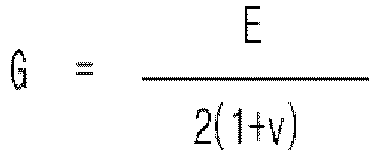
- Next, the undetermined layer physical
property calculation unit 22 in thecontrol unit 20 sets the variable (i) of the number of zones to 1 (S12, S42). - Subsequently, to the undetermined layer physical
property calculation unit 22 in thecontrol unit 20, elastic moduli (E1,2) of the undetermined layer are input (S13), or a thickness (z) of the undetermined layer is input (S43). - Next, the entire laminate physical
property calculation unit 21 in thecontrol unit 20 calculates stiffness matrices ([Q]k 1,2) in the machine direction (1) and transverse direction (2) of each layer (k) using the elastic moduli (Ek 1,2), Poisson's ratios (υk 1,2), and shear moduli (Gk 1,2) as shown inEquation 1 below (S14, S44).
- In
Equation 1, the relation for an isotropic material (G = E / 2(1+υ)) is used. - Subsequently, the entire laminate physical
property calculation unit 21 in thecontrol unit 20 calculates inverse matrices ([S]k 1,2) for the calculated stiffness matrix([Q]k 1,2) in the machine direction (1) and transverse direction (2) of each layer (k) and sets them as compliance matrices (S15, S45). This is for converting a stiffness matrix, which is a singular matrix, into an invertible matrix having an inverse matrix. - Next, to the entire laminate physical
property calculation unit 21 in thecontrol unit 20, a lamination angle (θk) in the machine direction (1) of each layer is input (S16, S46). - Subsequently, the entire laminate physical
property calculation unit 21 in thecontrol unit 20 resets stiffness matrices ([Q]k x,y) of each layer (k) in an x or y direction by reflecting the lamination angle (θk) of the multilayer material in the obtained stiffness matrices ([Q]k 1,2) of each layer (k) as shown inEquation 2 below (S17, S47).
- Subsequently, to the entire laminate physical
property calculation unit 21 in thecontrol unit 20, a thickness (Zk) of each layer (k) is inputted (S18, S48). - Next, the entire laminate physical
property calculation unit 21 in thecontrol unit 20 calculates stiffness matrices ([A]x,y, [B]x,y, [D]x,y) of the multilayer material, which is the entire laminate, using values of the stiffness matrices reset by receiving the thickness information of each layer (k) as shown in Equation 3 below (S19, S49).
- In Equation 3, k represents each layer, and the multilayer material is formed of a total of n layers. For example, n is an integer of 2 to 10.
- Subsequently, the entire laminate physical
property calculation unit 21 in thecontrol unit 20 sets compliance matrices ([a]x,y, [b]x,y, [c]x,y,[d]x,y) for the calculated stiffness matrices ([A]x,y, [B]x,y, [D]x,y) of the multilayer material, which is the entire laminate, as shown in Equation 4 below (S20, S40).
- Next, to the entire laminate physical
property calculation unit 21 in thecontrol unit 20, a total thickness (h) of the multilayer material, which is the entire laminate, is calculated from the thickness information of each layer (k) and inputted (S21, S51). - Subsequently, the entire laminate physical
property calculation unit 21 in thecontrol unit 20 calculates elastic moduli (/Ex,y), shear moduli (/Gx,y), and Poisson's ratios (/υx,y) of the multilayer material, which is the entire laminate, using the total thickness (h) and values of the set compliance matrices ([a]x,y, [b]x,y, [c]x,y, [d]x,y) of the multilayer material, which is the entire laminate, as shown in Equation 5 below (S22, S52).
- Next, the user inputs elastic moduli (/Ex,y), Poisson's ratios (/υx,y), and shear moduli (/Gx,y) as the final target physical properties using the
input unit 10 while looking at the input screen of thedisplay 30, and the undetermined layer physicalproperty calculation unit 22 in thecontrol unit 20 reads the same (S23, S53). - Subsequently, the undetermined layer physical
property calculation unit 22 in thecontrol unit 20 determines whether the calculated elastic moduli (/Ex,y), Poisson's ratios (/υx,y), and shear moduli (/Gx,y) converge to the elastic moduli (/Ex,y), Poisson's ratios (/υx,y), and shear moduli (/Gx,y) received as the final target physical properties (S24, S54). - When the calculated elastic moduli (/Ex,y), Poisson's ratios (/υx,y), and shear moduli (/Gx,y) do not converge to the elastic moduli (/Ex,y), Poisson's ratios (/υx,y), and shear moduli (/Gx,y) received as the final target physical properties,
- (i) in the case in which an elastic modulus is selected from the elastic modulus and thickness of the undetermined layer and inputted, the undetermined layer physical
property calculation unit 22 in thecontrol unit 20 updates values of the elastic moduli (E1,2) of an undetermined layer and jumps to S13 (S25), the process of which is repeated, and - (ii) in the case in which a thickness is selected from the elastic modulus or thickness of the undetermined layer and inputted, the undetermined layer physical
property calculation unit 22 in thecontrol unit 20 updates a value of the thickness (z) of the undetermined layer and jumps to S13, the process of which is repeated. - Unlike this, when the calculated elastic moduli (/Ex,y), Poisson's ratios (/υx,y), and shear moduli (/Gx,y) converge to the elastic moduli (/Ex,y), Poisson's ratios (/υx,y), and shear moduli (/Gx,y) received as the final target physical properties, the undetermined layer physical
property calculation unit 22 in thecontrol unit 20 outputs physical property values (elastic moduli (E1,2), Poisson's ratios (υk x,y), and shear moduli (Gk x,y)) and a thickness (Zk) of an undetermined layer (S26, S56). - Next, the undetermined layer physical
property calculation unit 22 in thecontrol unit 20 increases a variable (i) of the number of zones by 1 (S27, S57), and then plots the correlation between elastic moduli (E1,2) and thickness (z) of the undetermined layer in a graph (S28, S58).FIG. 4 is a graph showing the correlation between the elastic moduli (E1,2) and the thickness (z) of an undetermined layer according to the present invention. - Subsequently, the undetermined layer physical
property calculation unit 22 in thecontrol unit 20 determines whether the variable (i) of the number of zones is the set number of zones (N) or less, and in the case of the variable is the set number of zones (N) or less, jumps to S13 and repeats the above-described process until the variable (i) of the number of zones exceeds the set number of zones (N) (S29, S59). - In the case of the variable (i) of the number of zones is higher than set number of zones (N), the
control unit 10 ends the operation (S30, S60). - In one embodiment of the present invention, when the values input to the input unit are not immediately obtained, they may be deduced through a conversion process using other physical property values.
- In the process of inputting the elastic modulus (Ek) of each layer (k) and the Poisson's ratio (υk) of each layer (k), these values can be calculated using one or more physical property values of a Lame's first parameter (λk), a shear modulus (Gk) or a bulk elastic modulus (Kk). For example, they can be converted into an elastic modulus (Ek) and a Poisson's ratio (υk) using
Formulas 1 to 9 below. - When the available combination is (λk, Gk), it is expressed by
Formula 1 below.
- When the available combination is (λk, Ek), it is expressed by
Formula 2 below.
- When the available combination is (λk, υk), it is expressed by Formula 3 below.

- When the available combination is (λk, Kk), it is expressed by Formula 4 below.

- When the available combination is (Gk, Ek), it is expressed by Formula 5 below.

- When the available combination is (Gk, υk), it is expressed by
Formula 6 below.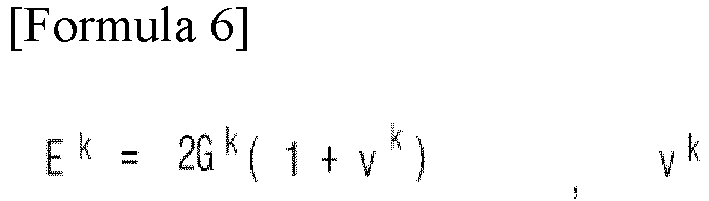
- When the available combination is (Gk, Kk), it is expressed by Formula 7 below.

- When the available combination is (Kk, Ek), it is expressed by Formula 8 below.

- When the available combination is (Kk, υk), it is expressed by Formula 9 below.

- The
Formulas 1 to 9 above are examples, and it is possible to combine two or more formulas as needed. -
- 10: Input unit
- 20: Control unit
- 21: Entire laminate physical property calculation unit
- 22: Undetermined layer physical property calculation unit
- 30: Display
- 40: Storage unit
Claims (17)
- A system for predicting physical properties of a multilayer material, comprising:an input unit for inputting (a) any one or more physical properties of an elastic modulus, a Poisson's ratio, a shear modulus, a thickness, a lamination angle, or a set number of zones of each layer, except for an undetermined layer, and (b) any one or more physical properties of an elastic modulus or a thickness of the undetermined layer;a control unit which is connected to the input unit and comprises an entire laminate property calculation unit and an undetermined layer property calculation unit;a display that is connected to the control unit; anda storage unit that is connected to the control unit.
- The system of claim 1, wherein the control unit is configured to:set compliance matrices for stiffness matrices of the multilayer material, which is an entire laminate, using the input physical properties,calculate the physical properties of the multilayer material, which is the entire laminate, using values of the set compliance matrices, anddetermine whether the calculated physical properties converge to final target physical properties.
- The system of claim 1, wherein the input unit is for inputting(a) an elastic modulus, a Poisson's ratio, a shear modulus, a thickness, a lamination angle, and a set number of zones of each layer, except for an undetermined layer, and(b) any one or more of an elastic modulusor thickness of the undetermined layer.
- The system of claim 1, wherein the control unit, for the multilayer material in which two or more materials are laminated, is configured to:receive (a) the elastic modulus, Poisson's ratio, shear modulus, thickness, lamination angle, and set number of zones of each layer, except for an undetermined layer, and (b) any one or more of the elastic modulus or thickness of the undetermined layer,calculate a stiffness matrix of each layer using the elastic modulus, Poisson's ratio, and shear modulus of each layer, except for the undetermined layer,reset the stiffness matrix of each layer by reflecting the lamination angle of each layer in obtained stiffness matrix, calculates stiffness matrices of the multilayer material, which is the entire laminate, using a value of the stiffness matrix reset by receiving thickness information of each layer, sets compliance matrices for the calculated stiffness matrices of the multilayer material, which is the entire laminate, and calculates any one or more of elastic moduli (/Ex,y), Poisson's ratios (/υx,y), or shear moduli (/Gx,y) of the multilayer material, which is the entire laminate, using the total thickness and values of the set compliance matrices of the multilayer material, which is the entire laminate, anddetermines whether any one or more of the calculated elastic moduli (/Ex,y), Poisson's ratios (/υx,y), or shear moduli (/Gx,y) of the multilayer material converge to any one or more of the target elastic moduli (target /Ex,y), target Poisson's ratios (target /υx,y), or target shear moduli (target /Gx,y) received as the final target physical properties.
- The system of claim 1, wherein,in the case in which the elastic modulus is selected from the elastic modulus or the thickness of the undetermined layer and input,when any one or more of the calculated elastic moduli (/Ex,y), Poisson's ratios (/υx,y), or shear moduli (/Gx,y) of the multilayer material do not converge to any one or more of the target elastic moduli (target /Ex,y), target Poisson's ratios (target /υx,y), or target shear moduli (target /Gx,y) received as final target physical properties,the control unit is configured to update the value of the elastic modulus of the undetermined layer.
- The system of claim 1, wherein,in the case in which the thickness is selected from the elastic modulus and the thickness of the undetermined layer and input,when any one or more of the calculated elastic moduli (/Ex,y), Poisson's ratios (/υx,y), or shear moduli (/Gx,y) of the multilayer material do not converge to any one or more of the target elastic moduli (target /Ex,y), target Poisson's ratios (target /υx,y), or target shear moduli (target /Gx,y) received as final target physical properties,the control unit updates a value of the thickness of the undetermined layer.
- The system of claim 1, wherein, when any one or more of the calculated elastic moduli (/Ex,y), Poisson's ratios (/υx,y), or shear moduli (/Gx,y) of the multilayer material converge to any one or more of the received target elastic moduli (target /Ex,y), target Poisson's ratios (target /υx,y), or target shear moduli (target /Gx,y) as the final target physical properties,
the control unit is configured to output any one or more of the elastic modulus, Poisson's ratio, shear modulus or thickness of the undetermined layer. - A method of predicting the physical properties of a multilayer material in which two or more materials are laminated, comprising:inputting any one or more of physical properties of an elastic modulus, a Poisson's ratio, a shear modulus, a thickness, a lamination angle, or a set number of zones of each layer, except for an undetermined layer, and any one or more physical properties of an elastic modulus or a thickness of the undetermined layer as input values;calculating physical properties of the multilayer material, which is an entire laminate, using the input physical properties; anddetermining whether calculated physical properties converge to final target physical properties.
- The method of claim 8, wherein the calculating of physical properties of a multilayer material comprisessetting compliance matrices for stiffness matrices of the multilayer material, which is the entire laminate; andcalculating physical properties of the multilayer material, which is the entire laminate, using values of the set compliance matrices.
- The method of claim 8, wherein the inputting as input values comprisesinputting an elastic modulus, a Poisson's ratio, a shear modulus, a thickness, a lamination angle, and a set number of zones of each layer, except for an undetermined layer (first step); andinputting any one or more of an elastic modulus or thickness of the undetermined layer (second step).
- The method of claim 8, wherein the calculating of physical properties of the multilayer material comprisescalculating a stiffness matrix of each layer, except for an undetermined layer, using the elastic modulus, Poisson's ratio, and shear modulus (third step);resetting a stiffness matrix of each layer by reflecting the lamination angle of each layer in obtained stiffness matrix (fourth step);calculating stiffness matrices of the multilayer material, which is the entire laminate, using values of the stiffness matrix reset by receiving thickness information of each layer (fifth step);setting compliance matrices for calculated stiffness matrices of the multilayer material, which is the entire laminate (sixth step); andcalculating elastic moduli, Poisson's ratios, and shear moduli of the multilayer material, which is the entire laminate, using a total thickness and values of the set compliance matrices of the multilayer material, which is the entire laminate (seventh step).
- The method of claim 8, wherein the determining whether the calculated properties converge to the final target physical properties comprises:inputting elastic moduli, Poisson's ratios and shear moduli as the final target physical properties (eighth step); anddetermining whether calculated elastic moduli (/Ex,y), Poisson's ratios (/υx,y), and shear moduli (/Gx,y) converge to target elastic moduli (target /Ex,y), target Poisson's ratios (target /υx,y), and target shear moduli (target /Gx,y) input as the final target physical properties (ninth step).
- The method of claim 11, wherein the calculating of the stiffness matrix of each layer (third step) includes
calculating stiffness matrices ([Q]k 1,2) in machine direction (1) and transverse direction (2) of each layer (k) using elastic moduli (Ek 1,2), Poisson's ratios (υk 1,2), and shear moduli (Gk 1,2) as shown in Equation 1 below:
- The method of claim 11, wherein the resetting of the stiffness matrix of each layer (fourth step) includes
resetting stiffness matrices ([Q]k x,y) of each layer (k), as shown in Equation 2 below, by reflecting the lamination angle (θk) of each layer (k) in the obtained stiffness matrices ([Q]k 1,2):
- The method of claim 11, wherein the calculating of stiffness matrices of the multilayer material (fifth step) includes
calculating stiffness matrices ([A]x,y, [B]x,y, [D]x,y) of the multilayer material, which is the entire laminate, as shown in Equation 3 below, using the values of the stiffness matrices reset by receiving the thickness information of each layer (k):
- The method of claim 11, wherein the setting of compliance matrices (sixth step) includes
setting compliance matrices ([a]x,y, [b]x,y, [c]x,y,[d]x,y) for calculated stiffness matrices ([A]x,y, [B]x,y, [D]x,y) of the multilayer material, which is the entire laminate, as shown in Equation 4 below:
- The method of claim 11, wherein the calculating of elastic moduli, Poisson's ratios, and shear moduli of the multilayer material (seventh step) includes
calculating elastic moduli (/Ex,y), Poisson's ratios (/υx,y), and shear moduli (/Gx,y) of the multilayer material, which is the entire laminate, using the total thickness (h) and values of the set compliance matrices ([a]x,y, [b]x,y, [c]x,y, [d]x,y) of the multilayer material, which is the entire laminate as shown in Equation 5 below:
Applications Claiming Priority (4)
| Application Number | Priority Date | Filing Date | Title |
|---|---|---|---|
| KR1020210138918A KR20230055484A (en) | 2021-10-19 | 2021-10-19 | Apparatus and method for predicting physical properties of multilayer films |
| KR20210138914 | 2021-10-19 | ||
| KR1020220086160A KR102941304B1 (en) | 2021-10-19 | 2022-07-13 | Apparatus and method for predicting physical properties of multilayer materials |
| PCT/KR2022/012503 WO2023068520A1 (en) | 2021-10-19 | 2022-08-22 | Device and method for predicting physical properties of multilayer material |
Publications (2)
| Publication Number | Publication Date |
|---|---|
| EP4209774A1 true EP4209774A1 (en) | 2023-07-12 |
| EP4209774A4 EP4209774A4 (en) | 2024-05-08 |
Family
ID=86059368
Family Applications (1)
| Application Number | Title | Priority Date | Filing Date |
|---|---|---|---|
| EP22873960.3A Pending EP4209774A4 (en) | 2021-10-19 | 2022-08-22 | Device and method for predicting physical properties of multilayer material |
Country Status (5)
| Country | Link |
|---|---|
| US (1) | US20240290438A1 (en) |
| EP (1) | EP4209774A4 (en) |
| JP (1) | JP7718763B2 (en) |
| CN (1) | CN116368366B (en) |
| WO (1) | WO2023068520A1 (en) |
Families Citing this family (2)
| Publication number | Priority date | Publication date | Assignee | Title |
|---|---|---|---|---|
| KR20250005899A (en) * | 2023-07-03 | 2025-01-10 | 주식회사 엘지화학 | System and method for reverse engineering strength of multilayer materials |
| CN117341990B (en) * | 2023-11-21 | 2026-01-30 | 北京理工大学 | A composite elastic rod for a deployable film mechanism |
Family Cites Families (13)
| Publication number | Priority date | Publication date | Assignee | Title |
|---|---|---|---|---|
| JP4060066B2 (en) * | 2001-11-30 | 2008-03-12 | 新日鐵化学株式会社 | Material design method for laminated structures |
| KR100612032B1 (en) * | 2004-05-28 | 2006-08-11 | 학교법인 대양학원 | How to Optimize Lamination Angles of Composite Beams |
| KR101200167B1 (en) * | 2011-01-13 | 2012-11-13 | 한국항공우주산업 주식회사 | Analysis system and method for composite materials |
| FR3022668B1 (en) * | 2014-06-19 | 2016-07-15 | Centre Nat Rech Scient | DYNAMIC TOMOGRAPHY SYSTEM DIT "4D" |
| KR101677840B1 (en) * | 2015-04-03 | 2016-11-21 | 연세대학교 산학협력단 | Apparatus and method for assessment of flexible multi-layered thin film |
| EP3180193A4 (en) | 2015-08-11 | 2017-09-13 | SABIC Global Technologies B.V. | Multiple ply layered composite having low areal weight |
| CN106126773B (en) * | 2016-06-12 | 2018-09-25 | 北京航空航天大学 | A kind of intensity prediction method of the composite laminated plate containing uncertain parameter based on the failure of whole layer |
| CN109063280B (en) * | 2018-07-16 | 2022-11-11 | 北京航空航天大学 | A method for calculating the elastic modulus of acupuncture C/C composites |
| CN109084094B (en) * | 2018-08-10 | 2021-03-30 | 临海伟星新型建材有限公司 | Thermal expansion coefficient prediction method for thermoplastic composite pipe |
| KR102145246B1 (en) * | 2018-11-27 | 2020-08-18 | 울산과학기술원 | System and method of predicting damage of carbon fiber composites |
| KR102363140B1 (en) | 2020-05-13 | 2022-02-15 | 한국표준과학연구원 | Design method and storage medium storing computer programs for frequency selective surface filters |
| KR102667923B1 (en) | 2020-05-13 | 2024-05-22 | 현대모비스 주식회사 | Condition diagnosing method of diagnosing status of motor driven power steering system and electronic device thereof |
| KR102533070B1 (en) | 2020-12-16 | 2023-05-15 | 고려대학교 산학협력단 | Method for prioritizing resources based on dependency of web resources, recording medium and device for performing the method |
-
2022
- 2022-08-22 US US18/031,769 patent/US20240290438A1/en active Pending
- 2022-08-22 EP EP22873960.3A patent/EP4209774A4/en active Pending
- 2022-08-22 WO PCT/KR2022/012503 patent/WO2023068520A1/en not_active Ceased
- 2022-08-22 CN CN202280007029.5A patent/CN116368366B/en active Active
- 2022-08-22 JP JP2023523172A patent/JP7718763B2/en active Active
Also Published As
| Publication number | Publication date |
|---|---|
| JP2023550883A (en) | 2023-12-06 |
| US20240290438A1 (en) | 2024-08-29 |
| JP7718763B2 (en) | 2025-08-05 |
| CN116368366B (en) | 2026-05-12 |
| CN116368366A (en) | 2023-06-30 |
| EP4209774A4 (en) | 2024-05-08 |
| WO2023068520A1 (en) | 2023-04-27 |
Similar Documents
| Publication | Publication Date | Title |
|---|---|---|
| KR102941304B1 (en) | Apparatus and method for predicting physical properties of multilayer materials | |
| US20240290438A1 (en) | System And Method For Predicting Physical Properties Of Multilayer Material | |
| KR20230055484A (en) | Apparatus and method for predicting physical properties of multilayer films | |
| KR20230033578A (en) | Apparatus and method for predicting physical properties of multilayer materials | |
| CN105930619B (en) | The state type near field dynamic method of fibre reinforced composites physical nonlinearity simulation | |
| JP2018503884A (en) | Multi-ply laminated composites with low unit area weight | |
| EP4202402A1 (en) | System and method for predicting physical properties of multilayer material | |
| Reguera et al. | Optimal design of composite thin-walled beams using simulated annealing | |
| Din et al. | Ultra-thin composites membrane for deployable structures: XCT driven characterization and FE modeling of folding structure | |
| O'Brien et al. | Modelling the nonlinear shear stress-strain response of composites with metal and non-metal reinforcement | |
| US20130103620A1 (en) | Feature vector classification device and method thereof | |
| US20240427952A1 (en) | System and Method for Predicting Strength of Multi-Layered Material | |
| KR20210112705A (en) | A composite beams design apparatus and beam desing method of using the same | |
| EP4209773A1 (en) | System and method for predicting physical properties of multilayer material | |
| KR20250005899A (en) | System and method for reverse engineering strength of multilayer materials | |
| Ohsaki et al. | A piecewise linear isotropic-kinematic hardening model with semi-implicit rules for cyclic loading and its parameter identification | |
| Narayan Rao et al. | First ply failure analysis of rectangular fiber metal laminated composite plates subjected to uniformly distributed loads | |
| KR20230033577A (en) | Apparatus and method for predicting physical properties of multilayer materials | |
| KR20240009558A (en) | Apparatus and method for predicting physical properties of multilayer materials | |
| Szostkiewicz-Chatain et al. | Numerical and experimental stiffness characterisations applied to soft textile composites for tensile structures | |
| KR20250169861A (en) | Multilayer Material Property Prediction apparatus and Method | |
| KR20250164453A (en) | Apparatus and method for engineering falling weight impact strength of multilayer materials | |
| KR20250166595A (en) | Apparatus and method for engineering falling weight impact strength of multilayer materials | |
| Oddy | Modelling 3D-woven composites on the macroscale: Predicting damage initiation and inelastic phenomena | |
| Zerouali et al. | Micro-and Macro-Mechanical Behavior of Inter-and Intra-Laminar Hybrid Composite Laminates with Natural and Synthetic Fibers: RVE Modeling and Classical Laminate Theory |
Legal Events
| Date | Code | Title | Description |
|---|---|---|---|
| STAA | Information on the status of an ep patent application or granted ep patent |
Free format text: STATUS: UNKNOWN |
|
| STAA | Information on the status of an ep patent application or granted ep patent |
Free format text: STATUS: THE INTERNATIONAL PUBLICATION HAS BEEN MADE |
|
| PUAI | Public reference made under article 153(3) epc to a published international application that has entered the european phase |
Free format text: ORIGINAL CODE: 0009012 |
|
| STAA | Information on the status of an ep patent application or granted ep patent |
Free format text: STATUS: REQUEST FOR EXAMINATION WAS MADE |
|
| 17P | Request for examination filed |
Effective date: 20230406 |
|
| AK | Designated contracting states |
Kind code of ref document: A1 Designated state(s): AL AT BE BG CH CY CZ DE DK EE ES FI FR GB GR HR HU IE IS IT LI LT LU LV MC MK MT NL NO PL PT RO RS SE SI SK SM TR |
|
| REG | Reference to a national code |
Ref country code: DE Ref legal event code: R079 Free format text: PREVIOUS MAIN CLASS: G01N0003000000 Ipc: G16C0060000000 |
|
| A4 | Supplementary search report drawn up and despatched |
Effective date: 20240408 |
|
| RIC1 | Information provided on ipc code assigned before grant |
Ipc: G16C 20/60 20190101ALI20240402BHEP Ipc: G01N 3/60 20060101ALI20240402BHEP Ipc: G01N 3/24 20060101ALI20240402BHEP Ipc: G01N 3/08 20060101ALI20240402BHEP Ipc: G01N 3/06 20060101ALI20240402BHEP Ipc: G01N 3/00 20060101ALI20240402BHEP Ipc: G01N 33/44 20060101ALI20240402BHEP Ipc: G06F 30/23 20200101ALI20240402BHEP Ipc: G16C 60/00 20190101AFI20240402BHEP |
|
| DAV | Request for validation of the european patent (deleted) | ||
| DAX | Request for extension of the european patent (deleted) | ||
| STAA | Information on the status of an ep patent application or granted ep patent |
Free format text: STATUS: EXAMINATION IS IN PROGRESS |
|
| 17Q | First examination report despatched |
Effective date: 20260319 |