EP4209522B1 - Flame retardant group-containing polymer, separator of non-aqueous electrolyte battery comprising the same, and non-aqueous electrolyte battery - Google Patents
Flame retardant group-containing polymer, separator of non-aqueous electrolyte battery comprising the same, and non-aqueous electrolyte battery Download PDFInfo
- Publication number
- EP4209522B1 EP4209522B1 EP21886808.1A EP21886808A EP4209522B1 EP 4209522 B1 EP4209522 B1 EP 4209522B1 EP 21886808 A EP21886808 A EP 21886808A EP 4209522 B1 EP4209522 B1 EP 4209522B1
- Authority
- EP
- European Patent Office
- Prior art keywords
- group
- flame retardant
- separator
- containing polymer
- aqueous electrolyte
- Prior art date
- Legal status (The legal status is an assumption and is not a legal conclusion. Google has not performed a legal analysis and makes no representation as to the accuracy of the status listed.)
- Active
Links
Classifications
-
- H—ELECTRICITY
- H01—ELECTRIC ELEMENTS
- H01M—PROCESSES OR MEANS, e.g. BATTERIES, FOR THE DIRECT CONVERSION OF CHEMICAL ENERGY INTO ELECTRICAL ENERGY
- H01M10/00—Secondary cells; Manufacture thereof
- H01M10/42—Methods or arrangements for servicing or maintenance of secondary cells or secondary half-cells
- H01M10/4235—Safety or regulating additives or arrangements in electrodes, separators or electrolyte
-
- C—CHEMISTRY; METALLURGY
- C08—ORGANIC MACROMOLECULAR COMPOUNDS; THEIR PREPARATION OR CHEMICAL WORKING-UP; COMPOSITIONS BASED THEREON
- C08F—MACROMOLECULAR COMPOUNDS OBTAINED BY REACTIONS ONLY INVOLVING CARBON-TO-CARBON UNSATURATED BONDS
- C08F230/00—Copolymers of compounds having one or more unsaturated aliphatic radicals, each having only one carbon-to-carbon double bond, and containing phosphorus, selenium, tellurium or a metal
- C08F230/02—Copolymers of compounds having one or more unsaturated aliphatic radicals, each having only one carbon-to-carbon double bond, and containing phosphorus, selenium, tellurium or a metal containing phosphorus
-
- H—ELECTRICITY
- H01—ELECTRIC ELEMENTS
- H01M—PROCESSES OR MEANS, e.g. BATTERIES, FOR THE DIRECT CONVERSION OF CHEMICAL ENERGY INTO ELECTRICAL ENERGY
- H01M50/00—Constructional details or processes of manufacture of the non-active parts of electrochemical cells other than fuel cells, e.g. hybrid cells
- H01M50/40—Separators; Membranes; Diaphragms; Spacing elements inside cells
- H01M50/409—Separators, membranes or diaphragms characterised by the material
-
- C—CHEMISTRY; METALLURGY
- C08—ORGANIC MACROMOLECULAR COMPOUNDS; THEIR PREPARATION OR CHEMICAL WORKING-UP; COMPOSITIONS BASED THEREON
- C08F—MACROMOLECULAR COMPOUNDS OBTAINED BY REACTIONS ONLY INVOLVING CARBON-TO-CARBON UNSATURATED BONDS
- C08F210/00—Copolymers of unsaturated aliphatic hydrocarbons having only one carbon-to-carbon double bond
- C08F210/02—Ethene
-
- C—CHEMISTRY; METALLURGY
- C08—ORGANIC MACROMOLECULAR COMPOUNDS; THEIR PREPARATION OR CHEMICAL WORKING-UP; COMPOSITIONS BASED THEREON
- C08F—MACROMOLECULAR COMPOUNDS OBTAINED BY REACTIONS ONLY INVOLVING CARBON-TO-CARBON UNSATURATED BONDS
- C08F218/00—Copolymers of compounds having one or more unsaturated aliphatic radicals, each having only one carbon-to-carbon double bond, and at least one being terminated by an acyloxy radical of a saturated carboxylic acid, of carbonic acid or of a haloformic acid
- C08F218/02—Esters of monocarboxylic acids
- C08F218/04—Vinyl esters
- C08F218/08—Vinyl acetate
-
- C—CHEMISTRY; METALLURGY
- C08—ORGANIC MACROMOLECULAR COMPOUNDS; THEIR PREPARATION OR CHEMICAL WORKING-UP; COMPOSITIONS BASED THEREON
- C08F—MACROMOLECULAR COMPOUNDS OBTAINED BY REACTIONS ONLY INVOLVING CARBON-TO-CARBON UNSATURATED BONDS
- C08F220/00—Copolymers of compounds having one or more unsaturated aliphatic radicals, each having only one carbon-to-carbon double bond, and only one being terminated by only one carboxyl radical or a salt, anhydride ester, amide, imide or nitrile thereof
- C08F220/02—Monocarboxylic acids having less than ten carbon atoms; Derivatives thereof
- C08F220/10—Esters
- C08F220/12—Esters of monohydric alcohols or phenols
- C08F220/16—Esters of monohydric alcohols or phenols of phenols or of alcohols containing two or more carbon atoms
- C08F220/18—Esters of monohydric alcohols or phenols of phenols or of alcohols containing two or more carbon atoms with acrylic or methacrylic acids
-
- C—CHEMISTRY; METALLURGY
- C08—ORGANIC MACROMOLECULAR COMPOUNDS; THEIR PREPARATION OR CHEMICAL WORKING-UP; COMPOSITIONS BASED THEREON
- C08F—MACROMOLECULAR COMPOUNDS OBTAINED BY REACTIONS ONLY INVOLVING CARBON-TO-CARBON UNSATURATED BONDS
- C08F8/00—Chemical modification by after-treatment
- C08F8/40—Introducing phosphorus atoms or phosphorus-containing groups
-
- C—CHEMISTRY; METALLURGY
- C09—DYES; PAINTS; POLISHES; NATURAL RESINS; ADHESIVES; COMPOSITIONS NOT OTHERWISE PROVIDED FOR; APPLICATIONS OF MATERIALS NOT OTHERWISE PROVIDED FOR
- C09D—COATING COMPOSITIONS, e.g. PAINTS, VARNISHES OR LACQUERS; FILLING PASTES; CHEMICAL PAINT OR INK REMOVERS; INKS; CORRECTING FLUIDS; WOODSTAINS; PASTES OR SOLIDS FOR COLOURING OR PRINTING; USE OF MATERIALS THEREFOR
- C09D127/00—Coating compositions based on homopolymers or copolymers of compounds having one or more unsaturated aliphatic radicals, each having only one carbon-to-carbon double bond, and at least one being terminated by a halogen; Coating compositions based on derivatives of such polymers
- C09D127/02—Coating compositions based on homopolymers or copolymers of compounds having one or more unsaturated aliphatic radicals, each having only one carbon-to-carbon double bond, and at least one being terminated by a halogen; Coating compositions based on derivatives of such polymers not modified by chemical after-treatment
- C09D127/12—Coating compositions based on homopolymers or copolymers of compounds having one or more unsaturated aliphatic radicals, each having only one carbon-to-carbon double bond, and at least one being terminated by a halogen; Coating compositions based on derivatives of such polymers not modified by chemical after-treatment containing fluorine atoms
- C09D127/16—Homopolymers or copolymers of vinylidene fluoride
-
- C—CHEMISTRY; METALLURGY
- C09—DYES; PAINTS; POLISHES; NATURAL RESINS; ADHESIVES; COMPOSITIONS NOT OTHERWISE PROVIDED FOR; APPLICATIONS OF MATERIALS NOT OTHERWISE PROVIDED FOR
- C09D—COATING COMPOSITIONS, e.g. PAINTS, VARNISHES OR LACQUERS; FILLING PASTES; CHEMICAL PAINT OR INK REMOVERS; INKS; CORRECTING FLUIDS; WOODSTAINS; PASTES OR SOLIDS FOR COLOURING OR PRINTING; USE OF MATERIALS THEREFOR
- C09D131/00—Coating compositions based on homopolymers or copolymers of compounds having one or more unsaturated aliphatic radicals, each having only one carbon-to-carbon double bond, and at least one being terminated by an acyloxy radical of a saturated carboxylic acid, of carbonic acid, or of a haloformic acid; Coating compositions based on derivatives of such polymers
- C09D131/02—Homopolymers or copolymers of esters of monocarboxylic acids
- C09D131/04—Homopolymers or copolymers of vinyl acetate
-
- H—ELECTRICITY
- H01—ELECTRIC ELEMENTS
- H01M—PROCESSES OR MEANS, e.g. BATTERIES, FOR THE DIRECT CONVERSION OF CHEMICAL ENERGY INTO ELECTRICAL ENERGY
- H01M10/00—Secondary cells; Manufacture thereof
- H01M10/05—Accumulators with non-aqueous electrolyte
- H01M10/052—Li-accumulators
-
- H—ELECTRICITY
- H01—ELECTRIC ELEMENTS
- H01M—PROCESSES OR MEANS, e.g. BATTERIES, FOR THE DIRECT CONVERSION OF CHEMICAL ENERGY INTO ELECTRICAL ENERGY
- H01M50/00—Constructional details or processes of manufacture of the non-active parts of electrochemical cells other than fuel cells, e.g. hybrid cells
- H01M50/30—Arrangements for facilitating escape of gases
- H01M50/383—Flame arresting or ignition-preventing means
-
- H—ELECTRICITY
- H01—ELECTRIC ELEMENTS
- H01M—PROCESSES OR MEANS, e.g. BATTERIES, FOR THE DIRECT CONVERSION OF CHEMICAL ENERGY INTO ELECTRICAL ENERGY
- H01M50/00—Constructional details or processes of manufacture of the non-active parts of electrochemical cells other than fuel cells, e.g. hybrid cells
- H01M50/40—Separators; Membranes; Diaphragms; Spacing elements inside cells
- H01M50/409—Separators, membranes or diaphragms characterised by the material
- H01M50/411—Organic material
- H01M50/414—Synthetic resins, e.g. thermoplastics or thermosetting resins
-
- H—ELECTRICITY
- H01—ELECTRIC ELEMENTS
- H01M—PROCESSES OR MEANS, e.g. BATTERIES, FOR THE DIRECT CONVERSION OF CHEMICAL ENERGY INTO ELECTRICAL ENERGY
- H01M50/00—Constructional details or processes of manufacture of the non-active parts of electrochemical cells other than fuel cells, e.g. hybrid cells
- H01M50/40—Separators; Membranes; Diaphragms; Spacing elements inside cells
- H01M50/409—Separators, membranes or diaphragms characterised by the material
- H01M50/446—Composite material consisting of a mixture of organic and inorganic materials
-
- H—ELECTRICITY
- H01—ELECTRIC ELEMENTS
- H01M—PROCESSES OR MEANS, e.g. BATTERIES, FOR THE DIRECT CONVERSION OF CHEMICAL ENERGY INTO ELECTRICAL ENERGY
- H01M50/00—Constructional details or processes of manufacture of the non-active parts of electrochemical cells other than fuel cells, e.g. hybrid cells
- H01M50/40—Separators; Membranes; Diaphragms; Spacing elements inside cells
- H01M50/409—Separators, membranes or diaphragms characterised by the material
- H01M50/449—Separators, membranes or diaphragms characterised by the material having a layered structure
-
- H—ELECTRICITY
- H01—ELECTRIC ELEMENTS
- H01M—PROCESSES OR MEANS, e.g. BATTERIES, FOR THE DIRECT CONVERSION OF CHEMICAL ENERGY INTO ELECTRICAL ENERGY
- H01M50/00—Constructional details or processes of manufacture of the non-active parts of electrochemical cells other than fuel cells, e.g. hybrid cells
- H01M50/40—Separators; Membranes; Diaphragms; Spacing elements inside cells
- H01M50/409—Separators, membranes or diaphragms characterised by the material
- H01M50/449—Separators, membranes or diaphragms characterised by the material having a layered structure
- H01M50/451—Separators, membranes or diaphragms characterised by the material having a layered structure comprising layers of only organic material and layers containing inorganic material
-
- C—CHEMISTRY; METALLURGY
- C08—ORGANIC MACROMOLECULAR COMPOUNDS; THEIR PREPARATION OR CHEMICAL WORKING-UP; COMPOSITIONS BASED THEREON
- C08K—Use of inorganic or non-macromolecular organic substances as compounding ingredients
- C08K3/00—Use of inorganic substances as compounding ingredients
- C08K3/18—Oxygen-containing compounds, e.g. metal carbonyls
- C08K3/20—Oxides; Hydroxides
- C08K3/22—Oxides; Hydroxides of metals
- C08K2003/2227—Oxides; Hydroxides of metals of aluminium
-
- H—ELECTRICITY
- H01—ELECTRIC ELEMENTS
- H01M—PROCESSES OR MEANS, e.g. BATTERIES, FOR THE DIRECT CONVERSION OF CHEMICAL ENERGY INTO ELECTRICAL ENERGY
- H01M10/00—Secondary cells; Manufacture thereof
- H01M10/05—Accumulators with non-aqueous electrolyte
- H01M10/052—Li-accumulators
- H01M10/0525—Rocking-chair batteries, i.e. batteries with lithium insertion or intercalation in both electrodes; Lithium-ion batteries
-
- Y—GENERAL TAGGING OF NEW TECHNOLOGICAL DEVELOPMENTS; GENERAL TAGGING OF CROSS-SECTIONAL TECHNOLOGIES SPANNING OVER SEVERAL SECTIONS OF THE IPC; TECHNICAL SUBJECTS COVERED BY FORMER USPC CROSS-REFERENCE ART COLLECTIONS [XRACs] AND DIGESTS
- Y02—TECHNOLOGIES OR APPLICATIONS FOR MITIGATION OR ADAPTATION AGAINST CLIMATE CHANGE
- Y02E—REDUCTION OF GREENHOUSE GAS [GHG] EMISSIONS, RELATED TO ENERGY GENERATION, TRANSMISSION OR DISTRIBUTION
- Y02E60/00—Enabling technologies; Technologies with a potential or indirect contribution to GHG emissions mitigation
- Y02E60/10—Energy storage using batteries
Definitions
- a non-aqueous electrolyte battery with high voltage and high energy density in particular a lithium ion secondary battery
- the non-aqueous electrolyte battery typified by a lithium ion secondary battery has high capacity and high energy density so that a large electric current flows at the time of internal short circuit or external short circuit of the battery.
- heat is generated in the battery due to Joule heat caused by short circuit, the battery is swelled due to gas generation accompanied with decomposition of an electrolyte solution, and properties of the battery are deteriorated.
- the heat-resistant porous layer uses an inorganic material and a polymer containing a cyanoethyl group or a flame retardant group as a dispersing agent for evenly dispersing the inorganic material.
- a dispersing agent for evenly dispersing the inorganic material.
- sufficient stability of the separator of the battery may be secured when the dispersant maintains dispersibility at an appropriate level.
- WO2019163839A1 discloses a flame retardant laminate for a battery cell comprising an EVA copolymer, a filler and ammonium polyphosphate as a flame retardant among other ingredient.
- the R32 may include at least one flame retardant group selected from the group consisting of the following Chemical Formulas: wherein, R 1 and R 2 are each independently hydrogen, a monovalent metal cation, an ammonium ion, an alkyl group having 1 to 5 carbon atoms, a phenyl group, or an alkylaryl group having 7 to 10 carbon atoms.
- a ratio of the repeating number of the first repeating unit to the total repeating number of the first to third repeating units i.e., a ratio of the repeating units derived from an alkene-based monomer may be 0.1 to 0.5, the lower limit value thereof may be 0.1 or more, or 0.15 or more, and the upper limit value thereof may be 0.5 or less, or 0.45 or less.
- a ratio of the repeating number of the third repeating unit to the total repeating number of the first to third repeating units i.e., a ratio of the repeating units into which flame retardant groups are introduced may be 0.01 to 0.3, the lower limit value thereof may be 0.01 or more, or more than 0.02, or 0.03 or more, or 0.04 or more, and the upper limit value thereof may be 0.3 or less, or less than 0.3, or 0.25 or less.
- the dispersant composition for a separator of a non-aqueous electrolyte battery may further include an inorganic filler.
- the inorganic filler may comprise one or more selected from the group consisting of inorganic oxides, inorganic nitrides, poorly soluble ionic crystal fine particles, covalently bonded crystals, clay, materials derived from mineral resources, lithium titanium phosphate, and a combination thereof.
- a separator of a non-aqueous electrolyte battery comprising: a porous substrate, and a heat resistant porous layer formed on one surface of the porous substrate, wherein the heat resistant porous layer comprises the dispersant composition for a separator of a non-aqueous electrolyte battery according to claim 8.
- a non-aqueous electrolyte battery comprising: a positive electrode, a negative electrode, the separator of a non-aqueous electrolyte battery, and an electrolyte solution.
- the phosphorus-based flame retardant group refers to a phosphorus atom-containing functional group contained in a compound used as a phosphorus-based flame retardant to impart flame retardancy, and more specifically, it refers to a phosphate group, a phosphonate group, a phosphinate group, a phosphine oxide group, or a phosphazene group.
- the present inventors have confirmed through experiments that, in a flame retardant group-containing polymer used as a dispersant of an inorganic filler in a heat-resistant porous layer of a separator of a non-aqueous electrolyte battery, when a flame retardant group is introduced into the polymer side chain and further a ratio of respective repeating units constituting the polymer, i.e., a degree of introduction of ethylene-based, vinyl acetate-based, and flame-retardant groups, is controlled, the adhesion of the inorganic filler can be enhanced and the dispersibility of the inorganic filler may also be increased, and as a result, heat resistance of the separator may be improved and at the same time, flame retardancy can be imparted to the separator, thereby completing the present disclosure.
- the flame retardant group-containing polymer according to an aspect of the present disclosure acts as a binder to firmly adhere the inorganic filler upon forming a heat-resistant porous layer of a separator, and also plays a role as a dispersant capable of effectively dispersing the inorganic filler, and further flame retardancy is also provided. Therefore, it is possible to realize a separator having remarkably improved adhesion, heat resistance, and flame retardancy, as compared to the prior art.
- the repeating unit represented by Chemical Formula 1 can be deemed to be a repeating unit derived from alpha olefins such as ethylene, propylene, butene, that is, an alkene-based monomer, and these monomers may be specifically represented by the following Chemical Formula 1-1.
- repeating unit represented by Chemical Formula 2 can be deemed to be ii) a repeating unit derived from a vinyl acetate-based monomer, and such a monomer may be specifically represented by the following Chemical Formula 2-1.
- a copolymer in which vinyl acetate or vinyl alcohol-based repeating unit is introduced into an ethylene repeating unit, or a copolymer in which a cyanoethyl group is further introduced therein is commonly used for bonding and dispersing a substrate component and an inorganic filler in a separator of a non-aqueous electrolyte battery.
- the carbonyl group of vinyl acetate can improve the dispersibility of the inorganic filler by interacting with the inorganic filler.
- the repeating unit represented by Chemical Formula 3 can be deemed to be iii) a repeating unit derived from a vinyl-acetate-based monomer into which a flame retardant group is introduced, and such a monomer may be specifically represented by the following Chemical Formula 3-1 or 3-2.
- Chemical Formulas 3-1 and 3-2, R31, R32, and R33 are as defined in Chemical Formula 3 above.
- the flame retardant group represented by R32 may be in the form of being introduced from the beginning into the monomer used for the polymerization, as shown in Chemical Formula 3-1, and it may also be introduced into the carbon adjacent to the CN via an addition reaction after polymerization proceeds using the monomer of Chemical Formula 3-2.
- the flame retardant group may be one or more selected from the group consisting of a phosphate group, a phosphonate group, a phosphinate group, a phosphine oxide group, and a phosphazene group.
- the R32 may include one or more flame retardant groups selected from the group consisting of the following Chemical Formulas. wherein, R 1 and R 2 are each independently hydrogen, a monovalent metal cation, an ammonium ion, an alkyl group having 1 to 5 carbon atoms, a phenyl group, or an alkylaryl group having 7 to 10 carbon atoms.
- the R 1 and R 2 are each independently hydrogen, an ammonium ion, an alkyl group having 1 to 5 carbon atoms, or a phenyl group.
- Such a phosphorus-based flame retardant group may reduce the possibility of a fire due to an electrical defect during charge and discharge of the secondary battery.
- such a phosphorus-based flame retardant group can promote the formation of char by a mechanism such as a transesterification reaction, a dehydration reaction, a dehydrogenation reaction, and a carbonization reaction in the event of a fire.
- This char can physically block heat transfer and access to oxygen due to a fire, thereby preventing a fire.
- the phosphorus-based flame retardant group forms a phosphoric acid radical by thermal decomposition, and such phosphoric acid radical can capture substances such as hydrogen or hydroxy radicals and effectively blocks the propagation of an oxidation reaction or a combustion reaction, thereby preventing a fire from becoming larger.
- the ratio of the repeating number of the first repeating unit to the total repeating number of repeating units of the first to third repeating units may be 0.1 to 0.5, the lower limit value thereof may be 0.1 or more, or 0.15 or more, and the upper limit value thereof may be 0.5 or less, or 0.45 or less.
- the ratio of the repeating number of the first repeating unit that is, the ratio of repeating units derived from an alkene-based monomer
- the adhesion between the separator and the inorganic porous material is weak, which may cause problems such as heat shrinkage of the separator.
- the ratio of the repeating number of the second repeating unit to the total repeating number of repeating units of the first to third repeating units may be about 0.3 to about 0.8, the lower limit value thereof may be 0.3 or more, or about 0.4 or more, or about 0.45 or more, and the upper limit value thereof may be 0.8 or less, or 0.75 or less
- the ratio of the repeating number of the second repeating unit that is, the ratio of repeating units derived from a vinyl acetate-based monomer is too low, dispersion of the inorganic porous material adhered to the separator is not performed well, which may cause the problem of thermal expansion at the local point of the separator.
- the ratio of the repeating number of the third repeating unit to the total repeating number of repeating units of the first to third repeating units may be 0.01 to 0.3, and the lower limit value thereof may be 0.01 or more, or more than 0.02, or about 0.03 or more, or 0.04 or more, and the upper limit value thereof may be 0.3 or less, or less than 0.3, or 0.25 or less.
- the ratio of the repeating number of the third repeating unit that is, the ratio of repeating units into which the flame retardant group is introduced
- the rate of fire increases when a phenomenon such as heat shrinkage of the separator occurs.
- Such a flame retardant group-containing polymer can be prepared by copolymerization of i) alpha olefins such as ethylene, propylene, butene, that is, alkene-based monomers, ii) a vinyl acetate-based monomer, and iii) vinyl acetate-based monomers into which flame retardant groups are introduced.
- polymerization may be performed using a monomer having a flame retardant group introduced into the side branch from the beginning, or polymerization may be performed using a vinyl acetate-based monomer into which a flame retardant group is not introduced, and then a flame retardant group may also be introduced therein through a separate addition reaction.
- a solution polymerization method can be used in which each monomer is added to a solvent to prepare a monomer mixture for polymerization, and the polymerization reaction is performed in the presence of an initiator.
- solvents that do not affect the polymerization reaction of the monomers for example, water, an alcohol-based solvent such as methanol, ethanol, isopropanol, butanol, isobutanol, a ketone solvent such as dimethyl ketone, diethyl ketone, methyl ethyl ketone, and methyl isobutyl ketone, an aromatic solvent such as toluene and xylene can be used without particular limitation.
- an alcohol-based solvent such as methanol, ethanol, isopropanol, butanol, isobutanol
- a ketone solvent such as dimethyl ketone, diethyl ketone, methyl ethyl ketone, and methyl isobutyl ketone
- aromatic solvent such as toluene and xylene
- the solvent is preferably used in an amount of 20 to 300 parts by weight based on 100 parts by weight of the total monomer for smooth progress of the polymerization reaction.
- the polymerization initiator used during polymerization is a radical photopolymerization or thermal polymerization initiator commonly used for the polymerization reaction of the above-mentioned monomers, and the type thereof is not particularly limited. However, it may be preferable to use a thermal polymerization initiator in order to smoothly proceed the polymerization reaction.
- the thermal polymerization initiator may include, for example, azo-based or peroxide-based initiators, such as 2,2'-azobisisobutyronitrile (AIBN), 2,2'-azobis- (2,4-dimethylvaleronitrile), 2,2'-azobis-(4-methoxy-2,4-dimethylvaleronitrile), benzoyl peroxide, lauroyl peroxide, t-butylperoxypivalate and 1,1'-bis-(bis-t-butylperoxy)cyclohexane.
- AIBN 2,2'-azobisisobutyronitrile
- 2,2'-azobis- (2,4-dimethylvaleronitrile) 2,2'-azobis-(4-methoxy-2,4-dimethylvaleronitrile)
- benzoyl peroxide lauroyl peroxide
- t-butylperoxypivalate 1,1'-bis-(bis-t-butylperoxy)
- the initiator may be used in an amount of 0.05 to 5 parts by weight, or about 0.1 to about 3 parts by weight, based on 100 parts by weight of the total monomer
- These initiators can be prepared in a state of being contained in the above-described monomer mixture from the beginning, or it may be added separately after raising the temperature of the previously prepared monomer mixture to an appropriate polymerization temperature.
- the temperature of the polymerization reaction may proceed from room temperature to 100°C, and it may preferably proceed at a temperature of 40°C or more, or 50°C or more, and 90°C or less, or 80°C or less.
- a flame retardant group is introduced into a moiety adjacent to the electron withdrawing group through a separate addition reaction after the polymerization.
- the addition reaction may proceed continuously following the polymerization reaction described above, or may be performed separately.
- the addition reaction can be represented by the following reaction mechanism.
- step 1 a base is charged into the polymer.
- the base removes hydrogen of a moiety adjacent to the CN group to form a carbon anion at the corresponding carbon.
- This carbon anion can maintain stably due to the inductive effect and resonance effect of the adjacent electron withdrawing group.
- R32' is a precursor of the R32 flame-retardant group of Chemical Formula 3 above, and uses a compound containing a carbon-carbon unsaturated bond in the molecule in addition to the flame-retardant group.
- the unshared electron pair of the above-mentioned carbon anion is linked to the carbon-carbon unsaturated bond of R32' via an addition reaction, and a new carbocation is formed at the adjacent carbon, to which hydrogen is supplied from the acid, and the reaction can be completed.
- the weight average molecular weight value of the flame retardant group-containing polymer may be 150,000 to 500,000 g/mol, the lower limit thereof may be 200,000 g/mol or more, or 240,000 g/mol or more, and the upper limit thereof may be 500,000 g/mol or less, or 450,000 g/mol or less, or 350,000 g/mol or less
- the adhesion of the inorganic filler can be improved, and the inorganic filler can be effectively dispersed.
- the weight average molecular weight value may be measured by gel permeation chromatography (GPC) using polystyrene standards.
- a dispersant composition for a separator of a non-aqueous electrolyte battery including a flame retardant group-containing polymer.
- the dispersant composition for a separator of a non-aqueous electrolyte battery may further include an inorganic filler.
- the inorganic filler is not particularly limited as long as it has a melting point of 200°C or more, has high electrical insulation, is electrochemically stable, and is stable in an electrolyte solution or a solvent used for a slurry for forming a heat-resistant porous layer.
- the inorganic filler may include one or more selected from the group consisting of inorganic oxides, inorganic nitrides, poorly soluble ionic crystal fine particles, covalently bonded crystals, clay, materials derived from mineral resources, lithium titanium phosphate, and combinations thereof.
- the inorganic filler may include, for example, fine particles of inorganic oxides such as iron oxide, SiO 2 (silica), Al 2 O 3 (alumina), TiO 2 , BaTiO 3 , ZrO, PB(Mg 3 Nb 2/3 )O 3 -PbTiO 3 (PMN-PT), hafnia (HfO 2 ), SrTiO 3 , SnO 2 , CeO 2 , MgO, NiO, CaO, ZnO, ZrO 2 , Y 2 O 3 , etc.; fine particles of inorganic nitrides such as aluminum nitride, silicon nitride, etc.; fine particles of poorly soluble ionic crystals such as calcium fluoride, barium fluoride, barium sulfate, etc.; fine particles of covalent crystals such as silicone, diamond, etc.; fine particles of clay such as talc, montmorillonite, etc.; a material derived from inorganic
- the particle diameter of the inorganic filler is not particularly limited, but in order to form a heat-resistant porous layer of uniform thickness and at the same time obtain an appropriate porosity, those having an average particle diameter of 5 nm to 5 ⁇ n may be used, preferably, from 0.01 to 1 ⁇ m may be used
- the mean particle diameter herein may be measured by a device based on a laser diffraction scattering method.
- the composition used to form a heat-resistant porous layer in a separator of a non-aqueous electrolyte battery may include the above-described flame retardant group-containing polymer, and if necessary, a resin such as cyanoethyl-containing polymer, ethylene-vinyl acetate copolymer (EVA, containing 20 to 35 mol % of repeating unit derived from vinyl acetate), acrylate copolymer, styrene butadiene rubber (SBR), polyvinyl butyral (PVB), polyvinyl pyrrolidone (PVP), polyurethane, polyvinylidene fluoride-hexafluoropropylene, polyvinylidene fluoride-trichlorethylene, polyvinylidene fluoride-chlorotrifluoroethylene copolymer, cellulose acetate, cellulose acetate butyrate or cellulose acetate propionate.
- a resin such as cyanoeth
- the resin may be mixed in an amount of 10 to 1,000 parts by weight with respect to 100 pars by weight of the flame retardant group-containing polymer.
- a separator of a non-aqueous electrolyte battery comprising: a porous substrate, and a heat resistant porous layer formed on one surface of the porous substrate, wherein the heat resistant porous layer comprises the above-mentioned dispersant composition for a separator of a non-aqueous electrolyte battery.
- the heat-resistant porous layer may further include an inorganic filler.
- the separator of a non-aqueous electrolyte battery of the present disclosure may be a separator including a heat-resistant porous layer including the dispersant composition and an inorganic filler, and a porous substrate, wherein the heat-resistant porous layer may be formed on one surface or both surfaces of the porous substrate, and the inside of the heat-resistant porous layer may have many pores resulting from the voids present among inorganic fillers.
- the heat resistant-porous layer When the heat-resistant porous layer is formed on one surface of the porous substrate, the heat resistant-porous layer may be formed on either a positive electrode side or a negative electrode side surface.
- the heat-resistant porous layer may be formed by dispersing the inorganic filler in the dispersant composition to prepare a slurry, coating the slurry onto the porous substrate, and then drying and removing the solvent.
- the solvent used in the dispersant composition is not particularly limited as long as the above-mentioned flame retardant group-containing polymer is dissolved therein.
- the solvent may include acetone, tetrahydrofuran, cyclohexanone, ethylene glycol monomethyl ether, methyl ethyl ketone, acetonitrile, furfuryl alcohol, tetrahydrofurfuryl alcohol, methyl acetoacetate, nitromethane, N,N-dimethylformamide (DMF), N-methyl-2-pyrrolidone, ⁇ -butyrolactone or propylene carbonate.
- the solvent may be used in an amount of 300 parts by weight to 5,000 parts by weight with respect to 100 parts by weight of the flame retardant group - containing polymer and the resin.
- a known method of using a stirrer, a dispenser or a pulverizer may be employed.
- a ball mill method may be used.
- a relative content ratio between the dispersant composition and the inorganic filler in the slurry is not particularly limited, but it may be adjusted according to the thickness, the average pore diameter, and porosity of the heat-resistant porous layer to be prepared.
- the content of the inorganic filler in the heat-resistant porous layer may be 50% by weight or more, or 95% by weight or less
- the average pore diameter may be measured by using a mercury intrusion porosimeter.
- the porosity may be calculated based on the following Equation, after obtaining true density (d) of an inorganic filler, volume (v) of a heat-resistant porous layer, and weight (m) of a heat-resistant porous layer.
- Porosity % 1 ⁇ m / vd ⁇ 100
- the heat-resistant porous layer having an average pore diameter and a porosity in the above range may be obtained by controlling the particle diameter or the content of the inorganic filler, as described above.
- the porous substrate may include a thermoplastic resin component.
- thermoplastic resin component may melt to close the pores in the porous substrate if the temperature becomes higher than a certain limit, whereby ion movement is blocked, an electric current may stop, and heat generation or ignition may be suppressed.
- the thermoplastic resin used as the porous substrate may include polyolefin resins such as low density polyethylene, high density polyethylene, ultra-high molecular weight polyethylene, polypropylene, etc.; polyester resins such as polyethylene terephthalate, polybutylene terephthalate, etc.; polyacetal resins; polyamide resins; polycarbonate resins; polyimide resins; polyether ether ketone resins; polyether sulfone resins; and any combination thereof.
- polyolefin resins such as low density polyethylene, high density polyethylene, ultra-high molecular weight polyethylene, polypropylene, etc.
- polyester resins such as polyethylene terephthalate, polybutylene terephthalate, etc.
- polyacetal resins such as polyamide resins; polycarbonate resins; polyimide resins; polyether ether ketone resins; polyether sulfone resins; and any combination thereof.
- the porous substrate may be preferably a film.
- the thickness thereof is not particularly limited, it is preferably 2 ⁇ m to 50 ⁇ m When the thickness is too thin, there is a problem that it is difficult to maintain the mechanical properties. When the thickness is too thick, there is a problem that it may function as a resistant layer.
- the average pore diameter and the porosity of the porous substrate are not particularly limited, the average pore diameter may be preferably 0.1 to 30 ⁇ m and the porosity may be preferab 10% to 90%.
- a method of coating the slurry onto the porous substrate may include a coating method commonly used in the art, and is not particularly limited as long as it can achieve a desirable film thickness or a coating area.
- the method may include a gravure coater method, a reverse roll coater method, a transfer roll coater method, a kiss coater method, a dipping coater method, a knife coater method, an air doctor coater method, a blade coater method, a rod coater method, a squeeze coater method, a cast coater method, a die coater method, a screen printing method or a spray coating method.
- the total thickness of the separator of a non-aqueous electrolyte battery thus obtained is not particularly limited and may be adjusted in consideration of application and performance of the battery. It may be preferably in the range of 2 to 55 ⁇ m from the viewpoint of ensuring separation between a positive electrode and a negative electrode.
- the non-aqueous electrolyte battery according to an aspect of the present disclosure may include a positive electrode, a negative electrode, the above-mentioned separator of a non-aqueous electrolyte battery, and an electrolyte solution.
- the separator of a non-aqueous electrolyte battery is disposed between the positive electrode and the negative electrode, and immersed in an electrolyte solution to produce a non-aqueous electrolyte battery.
- the separator of a non-aqueous electrolyte battery in which the heat-resistant porous layer is formed on one surface of the porous substrate is used, the separator may be disposed in such a manner that the surface of the heat-resistant porous layer faces any side of the positive electrode and negative electrode.
- the non-aqueous electrolyte battery of the present disclosure may include, for example, a lithium secondary battery such as a lithium metal secondary battery, a lithium ion secondary battery, a lithium polymer secondary battery or a lithium ion polymer secondary battery.
- a lithium secondary battery such as a lithium metal secondary battery, a lithium ion secondary battery, a lithium polymer secondary battery or a lithium ion polymer secondary battery.
- the positive electrode and the negative electrode may be generally manufactured by coating an electrode current collector with an electrode mixture prepared by dispersing a positive electrode or negative electrode active material and a conductive aid in a binder solution.
- the positive electrode active material may include a lithium-containing transition metal oxide having a layered structure, represented by Chemical Formula of Li 1+x MO 2 (-0.1 ⁇ x ⁇ 0.1, M: Co, Ni, Mn, Al, Mg, Zr, Ti, Sn, etc.); a lithium manganese oxide having a spinel structure such as LiMn 2 O 4 or a composition having part thereof substituted with one or more of the other elements; and an olivine type compound represented by LiMPO 4 (M: Co, Ni, Mn, Fe, etc.).
- a lithium-containing transition metal oxide having a layered structure represented by Chemical Formula of Li 1+x MO 2 (-0.1 ⁇ x ⁇ 0.1, M: Co, Ni, Mn, Al, Mg, Zr, Ti, Sn, etc.)
- a lithium manganese oxide having a spinel structure such as LiMn 2 O 4 or a composition having part thereof substituted with one or more of the other elements
- an olivine type compound represented by LiMPO 4 M: Co, Ni, M
- the lithium-containing transition metal oxide having a layered structure may include, for example, LiCoO 2 or LiNi 1-x Co x-y Al y O 2 (0.1 ⁇ x ⁇ 0.3, 0.01 ⁇ y ⁇ 0.2), and an oxide containing at least Co, Ni, and Mn (LiMn 1/3 Ni 1/3 Co 1/3 O 2 , LiMn 5/12 Ni 5/12 Co 1/6 O 2 , LiNi 3/5 Mn 1/5 Co 1/5 O 2 , etc.).
- the negative electrode active material may include, for example, a lithium metal, a lithium alloy such as lithium aluminum alloy, etc., a carbonaceous material capable of storing and releasing lithium, graphite, cokes such as a phenol resin, a furan resin, etc., carbon fibers, glass-like carbon, pyrolytic carbon or active carbon.
- the positive electrode current collector may include, for example, a thin metal foil made of aluminum, nickel, or a combination thereof.
- the negative electrode current collector may include, for example, a thin metal foil made of copper, gold, nickel, copper alloy, or a combination thereof.
- the conductive aid may include, for example, carbon black such as acetylene black, ketjen black, etc.; metal fibers such as aluminum, nickel, etc.; natural graphite, heat-expanding graphite, carbon fibers, ruthenium oxide, titanium oxide, etc.
- carbon black such as acetylene black, ketjen black, etc.
- metal fibers such as aluminum, nickel, etc.
- acetylene black or ketjen black may be preferably used, as it may provide desired conductivity with addition of a small amount thereof.
- the binder may include various known binders. Examples thereof may include polytetrafluoroethylene, polyvinylidene fluoride, carboxymethyl cellulose, a cross-linked polymer of fluoroolefin copolymers, styrene-butadiene copolymer, polyacrylonitrile or polyvinyl alcohol.
- the binder may include those dissolved in a solvent.
- the solvent may include N-methyl-2-pyrrolidone (NMP).
- a solution in which a lithium salt is dissolved in an organic solvent may be used.
- the lithium salt is not particularly limited as long as it dissociates in a solvent to form Li + ion and does not easily cause a side reaction such as decomposition within the voltage range in which the battery is used.
- an inorganic lithium salt such as LiClO 4 , LiPF 6 , LiBF 4 , LiAsF 6 , LiSbF 6 , etc.
- an organolithium salt such as LiCF 3 SO 3 , LiCF 3 CO 2 , Li 2 C 2 F 4 (SO 3 ) 2 , LiN(CF 3 SO 2 ) 2 , LiC(CF 3 SO 2 ) 3 , LiCnF 2n+1 SO 3 (n ⁇ 2), LiN(RfOSO 2 ) 2 , etc. (wherein Rf represents a fluoroalkyl group)
- Preferred examples of the lithium salt may include LiPF 6 , LiClO 4 , LiAsF 6 , LiBF 4 , LiCF 3 SO 3 , Li(CF 3 SO 2 ) 2 N.
- the organic solvent used for the electrolyte solution is not particularly limited as long as it may dissolve the lithium salt and does not cause a side reaction such as decomposition within the voltage range in which the battery is used.
- cyclic carbonate esters such as propylene carbonate, ethylene carbonate, etc.
- chain carbonate esters such as ethyl methyl carbonate, diethyl carbonate, dimethyl carbonate, dipropyl carbonate or a mixture thereof may be exemplified, but are not limited thereto.
- a volume ratio of the cyclic carbonate ester to the chain carbonate ester is preferably 4:1 to about 1:4 from the viewpoint of optimizing the permittivity and viscosity.
- a shape of the non-aqueous electrolyte battery of the present disclosure may include a prism type or a cylindrical type, in which a steel can or an aluminum can is used as a casing (i.e., can casing). Further, it may be a package battery, in which a metal-deposited laminate film is used as a casing, but is not particularly limited thereto.
- a separator composition for a non-aqueous electrolyte battery of the present disclosure can strongly adhere an inorganic filler upon forming a heat-resistant porous layer of a separator, and can also further improve heat resistance of the separator by effectively dispersing the inorganic filler, and further can prevent a fire occurring under charge and discharge.
- R1 is hydrogen
- R21 is acetate (CH 3 COO-)
- R32 is a flame retardant group represented by the following Chemical Formula, which is introduced from tetraethyl ethyne-1,2-diyldiphosphonate.
- a copolymer of the following Chemical Formula was obtained in the same manner as in Example 1, except that 20 parts by weight of ethenyl-3-oxobutanoate was used instead of 20 parts by weight of vinyl 2-cyanoacetate in the polymerization step.
- R1 is hydrogen
- R21 is acetate (CH 3 COO-)
- R32 is a flame retardant group represented by the following Chemical Formula which is introduced from tetraethyl ethyne-1,2-diyldiphosphonate.
- a copolymer of the following Chemical Formula was obtained in the same manner as in Example 1, except that 150 parts by weight of vinyl acetate and 20 parts by weight of vinyl 2-cyanoacetate were charged into a 2L reactor containing 100 parts by weight of methanol, and 15 parts by weight of ethylene and 0.3 parts by weight of AIBN as an initiator were used.
- R1 is hydrogen
- R21 is acetate (CH 3 COO-)
- R32 is a flame retardant group represented by the following Chemical Formula which is introduced from tetraethyl ethyne-1,2-diyldiphosphonate.
- a copolymer of the following Chemical Formula was obtained in the same manner as in Example 1, except that in the addition step, 10 parts by weight of potassium carbonate, 10 parts by weight of maleic acid, and 15 parts by weight of tetraethyl ethyne-1,2-diyldiphosphonate were used.
- R1 is hydrogen
- R21 is acetate (CH 3 COO-)
- R32 is a flame retardant group represented by the following Chemical Formula which is introduced from tetraethyl ethyne-1,2-diyldiphosphonate.
- a copolymer of the following Chemical Formula was obtained in the same manner as in Example 1, except that t-butanol was used instead of methanol.
- R1 is hydrogen
- R21 is acetate (CH 3 COO-)
- R32 is a flame retardant group represented by the following Chemical Formula which is introduced from tetraethyl ethyne-1,2-diyldiphosphonate.
- a copolymer of the following Chemical Formula was obtained in the same manner as in Example 1, except that in the addition step, ethyne-1,2-diyldiphosphinic acid was used instead of (tetraethyl ethyne-1,2-diyldiphosphonate.
- R1 is hydrogen
- R21 is acetate (CH 3 COO-)
- R32 is a flame retardant group represented by the following Chemical Formula, which is introduced from ethyne-1,2-diyldiphosphinic acid.
- a copolymer was obtained in the same manner as in Example 1, except that in the polymerization step, vinyl propionate was used instead of vinyl-2-cyanoacetate.
- a copolymer was obtained in the same manner as in Example 1, except that in the addition step, diethyl ethyne-1,2-diyldicarboxylate was used instead of tetraethyl ethyne-1,2-diyldiphosphonate.
- the peak area was measured based on hydrogen of the ethylene group: 1.0 to 1.2 ppm; hydrogen of the methyl group of vinyl acetate: 2.0 ppm; hydrogen bonded to the double-bonded carbon in the flame retardant substituent group: 6.1 to 6.4 ppm, and each ratio was calculated.
- a weight average molecular weight was analyzed by GPC with column PLgel Mixed B * 2 and Detector waters RI equipment containing DMF (HPLC) and 0.05M LiBr (0.45 ⁇ m filtered) as solvents, and other measurement conditions are as follows.
- the slurry of the flame-retardant group-containing polymer and inorganic particles prepared above was coated onto one surface of a polyethylene porous substrate using a doctor blade and dried to produce a separator on which a porous coating layer was formed.
- the slurries prepared in Examples and Comparative Example were rotated at 300 rpm using a dispersion stability analyzer (LUMiSizer), and the sedimentation rate of alumina was measured at 25°C, and the results are shown in Table below.
- LiMiSizer dispersion stability analyzer
- Table below For reference, as the dispersibility of the flame retardant group-containing polymer is better, alumina is dispersed well and its sedimentation is slow.
- the separators produced in Examples and Comparative Examples were placed in a heat-resistant oven at 150°C and left for 2 hours.
- the separators were taken out, the lengths in the MD direction and the TD direction were measured, and the rate of decrease (%) was shown as compared with the size before heating.
- Artificial graphite, carbon black, CMC, and a binder were mixed with water at a weight ratio of 96:1:1:2 to prepare a negative electrode slurry.
- the negative electrode slurry was coated onto a copper foil having a thickness of 50 ⁇ m, dried at 80°C for 1 hour or longer, and then pressed to manufacture a negative electrode.
- the negative electrode and the separator were put into lamination equipment and adhered. While this sample was peeled off at a rate of 100 mm/min using UTM equipment, the force required to peel the adhesive surface between the electrode and the separator was measured.
- the separators manufactured using the flame retardant group-containing polymer showed very excellent flame retardancy and also was excellent in the stability against heat.
Landscapes
- Chemical & Material Sciences (AREA)
- Chemical Kinetics & Catalysis (AREA)
- General Chemical & Material Sciences (AREA)
- Electrochemistry (AREA)
- Organic Chemistry (AREA)
- Engineering & Computer Science (AREA)
- Polymers & Plastics (AREA)
- Health & Medical Sciences (AREA)
- Medicinal Chemistry (AREA)
- Materials Engineering (AREA)
- Inorganic Chemistry (AREA)
- Manufacturing & Machinery (AREA)
- Composite Materials (AREA)
- Life Sciences & Earth Sciences (AREA)
- Wood Science & Technology (AREA)
- Cell Separators (AREA)
Description
- The present disclosure relates to a flame retardant group-containing polymer, a separator comprising the same, and a non-aqueous electrolyte battery comprising the separator.
- Recently, as a power source for a mobile terminal such as that of a notebook computer or a cellular phone or as a power source for a hybrid vehicle or an electric vehicle, a non-aqueous electrolyte battery with high voltage and high energy density, in particular a lithium ion secondary battery, is getting the attention. The non-aqueous electrolyte battery typified by a lithium ion secondary battery has high capacity and high energy density so that a large electric current flows at the time of internal short circuit or external short circuit of the battery. Thus, there is a problem that heat is generated in the battery due to Joule heat caused by short circuit, the battery is swelled due to gas generation accompanied with decomposition of an electrolyte solution, and properties of the battery are deteriorated.
- According to a current lithium ion secondary battery, in order to resolve such a problem, a separator comprising a porous substrate having fine pores such as a polypropylene or polyethylene film is interposed between a positive electrode and a negative electrode. When the temperature increases owing to the heat generated by short circuit, the separator comprising the porous substrate melts to block the pores. As a result, movement of ions is inhibited so that the current does not flow and runaway of the battery is suppressed.
- Because of wider use of a lithium ion secondary battery, a battery having higher heat resistance, in particular improved heat resistance at the time of internal short circuit has been currently required. Particularly, when the internal short circuit occurs, it is believed that the temperature increases to 600°C or more at the short circuit region owing to local heat generation. Thus, in a conventional separator comprising a porous substrate having fine pores such as a polyolefin film, the separator is shrunken or melted by heat generated by the short circuit at the short circuit region so that the battery is exposed to dangers of fuming, ignition and explosion.
- As a technology for preventing the short circuit caused by heat shrinkage or heat melting of a separator and improving reliability of a battery, a multilayer separator comprising a heat-resistant porous layer on one or both surfaces (i.e., frond and back surfaces) of a porous substrate having fine pores such as a polyethylene film is suggested.
- In such a separator, the heat-resistant porous layer uses an inorganic material and a polymer containing a cyanoethyl group or a flame retardant group as a dispersing agent for evenly dispersing the inorganic material. However, sufficient stability of the separator of the battery may be secured when the dispersant maintains dispersibility at an appropriate level. When the dispersibility is poor, it is difficult to secure sufficient thermal stability of the separator because the inorganic substance is not evenly dispersed
WO2019163839A1 discloses a flame retardant laminate for a battery cell comprising an EVA copolymer, a filler and ammonium polyphosphate as a flame retardant among other ingredient. - Therefore, there is a need for research on a separator having excellent adhesive strength and dispersibility, and excellent in safety in the event of an accident such as fuming, ignition, or explosion.
- It is one object of the present disclosure to provide a separator of a non-aqueous electrolyte battery, the separator capable of strongly adhering an inorganic filler upon forming a heat-resistant porous layer of the separator, as well as being excellent in flame retardancy and thus excellent in safety in the event of an accident such as fuming, ignition or explosion, while further improving the heat resistance of the separator by effectively dispersing the inorganic filler, and a non-aqueous electrolyte battery,
- Provided herein is a flame retardant group-containing polymer comprising: a first repeating unit represented by the following Chemical Formula 1, a second repeating unit represented by the following Chemical Formula 2, and a third repeating unit represented by the following Chemical Formula 3:


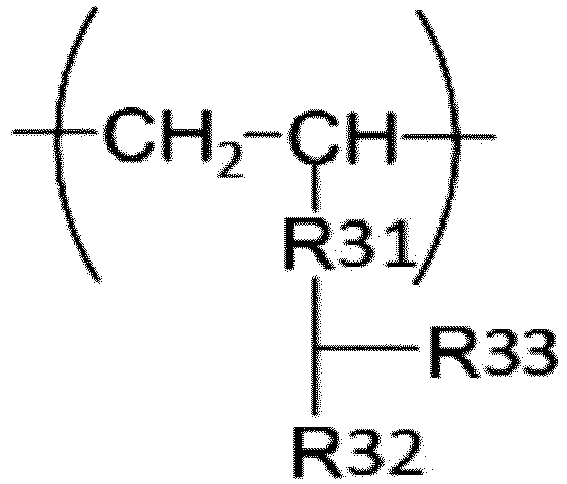
- According to one embodiment of the present disclosure, the R32 may include at least one flame retardant group selected from the group consisting of the following Chemical Formulas:


- And, the R33 may be -CN, -NO2, -CO-R34, -CON-R34, or -COO-R34, wherein R34 is hydrogen, or an alkyl having 1 to 5 carbon atoms.
- At this time, it may be more preferable that the R1 and R2 are each independently hydrogen, an ammonium ion, an alkyl group having 1 to 5 carbon atoms, or a phenyl group.
- In the flame-retardant group-containing polymer, a ratio of the repeating number of the first repeating unit to the total repeating number of the first to third repeating units, i.e., a ratio of the repeating units derived from an alkene-based monomer may be 0.1 to 0.5, the lower limit value thereof may be 0.1 or more, or 0.15 or more, and the upper limit value thereof may be 0.5 or less, or 0.45 or less.
- In the flame-retardant group-containing polymer, a ratio of the repeating number of the second repeating unit to the total repeating number of the first to third repeating units, i.e., a ratio of the repeating units derived from a vinyl acetate-based monomer may be 0.3 to 0.8, the lower limit value thereof may be 0.3 or more, or 0.4 or more, or 0.45 or more, and the upper limit value thereof may be 0.8 or less, or 0.75 or less.
- In the flame-retardant group-containing polymer, a ratio of the repeating number of the third repeating unit to the total repeating number of the first to third repeating units, i.e., a ratio of the repeating units into which flame retardant groups are introduced may be 0.01 to 0.3, the lower limit value thereof may be 0.01 or more, or more than 0.02, or 0.03 or more, or 0.04 or more, and the upper limit value thereof may be 0.3 or less, or less than 0.3, or 0.25 or less.
- According to another embodiment of the present disclosure, the weight average molecular weight value of the flame retardant group-containing polymer may be 100,000 to 500,000 g/mol, the lower limit thereof may be 100,000 g/mol or more, or 150,000 g/mol or more, and the upper limit thereof may be 500,000 g/mol or less, or 400,000 g/mol or less, or 350,000 g/mol or less
- According to another embodiment of the present disclosure, there is provided a dispersant composition for a separator of a non-aqueous electrolyte battery, comprising the flame retardant group-containing polymer.
- The dispersant composition for a separator of a non-aqueous electrolyte battery may further include an inorganic filler.
- At this time, the inorganic filler may comprise one or more selected from the group consisting of inorganic oxides, inorganic nitrides, poorly soluble ionic crystal fine particles, covalently bonded crystals, clay, materials derived from mineral resources, lithium titanium phosphate, and a combination thereof.
- Meanwhile, according to another embodiment of the present disclosure, there is provided a separator of a non-aqueous electrolyte battery, the separator comprising: a porous substrate, and a heat resistant porous layer formed on one surface of the porous substrate, wherein the heat resistant porous layer comprises the dispersant composition for a separator of a non-aqueous electrolyte battery according to claim 8.
- At this time, the porous substrate may comprise one or more resins selected from the group consisting of a polyolefin resin, a polyester resin, a polyacetal resin, a polyamide resin, a polycarbonate resin, a polyimide resin, a polyetheretherketone resin, a polyethersulfone resin, and a combination thereof.
- Meanwhile, according to yet another embodiment of the present disclosure, there is provided a non-aqueous electrolyte battery comprising: a positive electrode, a negative electrode, the separator of a non-aqueous electrolyte battery, and an electrolyte solution.
- The terms "first," "second," etc. are used to explain various elements, and these terms are only used to distinguish one constitutional element from the other constitutional elements.
- The technical terms used herein is for the purpose of describing exemplary embodiments only and is not intended to limit the scope of the invention. The singular forms "a," "an" and "the" are intended to include plural forms, unless the context clearly indicates otherwise. It should be understood that the terms "comprise," "include", "have", etc. are used herein to specify the presence of stated features, integers, steps, components or combinations thereof, but do not preclude the presence or addition of one or more other features, integers, steps, components, or combinations thereof.
- Also, as used herein, in case a layer or an element is mentioned to be formed "on" layers or elements, it means that the layer or element is directly formed on the layers or elements, or it means that other layers or elements may be additionally formed between the layers, on a subject, or on a substrate.
- Although the present disclosure may have various forms and various modifications can be made thereto, specific examples will be exemplified and explained in detail. However, it is not intended to limit the present disclosure to disclosed forms.
- Now, a polymer, a composition, a separator of a non-aqueous electrolyte battery comprising the same, and a non-aqueous electrolyte battery according to specific embodiments of the present disclosure will be described in more detail.
- According to an embodiment of the present disclosure, there is provided a flame retardant group-containing polymer comprising: a first repeating unit represented by the following Chemical Formula 1, a second repeating unit represented by the following Chemical Formula 2, and a third repeating unit represented by the following Chemical Formula 3:


- The phosphorus-based flame retardant group refers to a phosphorus atom-containing functional group contained in a compound used as a phosphorus-based flame retardant to impart flame retardancy, and more specifically, it refers to a phosphate group, a phosphonate group, a phosphinate group, a phosphine oxide group, or a phosphazene group.
- The present inventors have confirmed through experiments that, in a flame retardant group-containing polymer used as a dispersant of an inorganic filler in a heat-resistant porous layer of a separator of a non-aqueous electrolyte battery, when a flame retardant group is introduced into the polymer side chain and further a ratio of respective repeating units constituting the polymer, i.e., a degree of introduction of ethylene-based, vinyl acetate-based, and flame-retardant groups, is controlled, the adhesion of the inorganic filler can be enhanced and the dispersibility of the inorganic filler may also be increased, and as a result, heat resistance of the separator may be improved and at the same time, flame retardancy can be imparted to the separator, thereby completing the present disclosure.
- It is well known that in a separator of a non-aqueous electrolyte battery, a cyanoethyl group-containing polymer or a flame retardant group-containing polymer acts as a binder for firmly adhering the inorganic filler. However, a method of imparting properties such as flame retardancy by introducing a functional group into the side chain of such a polymer is not known in detail.
- The flame retardant group-containing polymer according to an aspect of the present disclosure acts as a binder to firmly adhere the inorganic filler upon forming a heat-resistant porous layer of a separator, and also plays a role as a dispersant capable of effectively dispersing the inorganic filler, and further flame retardancy is also provided. Therefore, it is possible to realize a separator having remarkably improved adhesion, heat resistance, and flame retardancy, as compared to the prior art.
- According to one aspect of the present disclosure, provided is a flame retardant group-containing polymer comprising: a first repeating unit represented by the following Chemical Formula 1, a second repeating unit represented by the following Chemical Formula 2, and a third repeating unit represented by the following Chemical Formula 3:


- In such a flame retardant group-containing polymer, the repeating unit represented by Chemical Formula 1 can be deemed to be a repeating unit derived from alpha olefins such as ethylene, propylene, butene, that is, an alkene-based monomer, and these monomers may be specifically represented by the following Chemical Formula 1-1.
[Chemical Formula 1-1] R1-CH=CH2
in Chemical Formula 1-1, R1 is as defined in Chemical Formula 1 above. - Further, the repeating unit represented by Chemical Formula 2 can be deemed to be ii) a repeating unit derived from a vinyl acetate-based monomer, and such a monomer may be specifically represented by the following Chemical Formula 2-1.
[Chemical Formula 2-1] CH2=CH-R21
in Chemical Formula 2-1, R21 is as defined in Chemical Formula 2 above. - A copolymer in which vinyl acetate or vinyl alcohol-based repeating unit is introduced into an ethylene repeating unit, or a copolymer in which a cyanoethyl group is further introduced therein is commonly used for bonding and dispersing a substrate component and an inorganic filler in a separator of a non-aqueous electrolyte battery. In particular, the carbonyl group of vinyl acetate can improve the dispersibility of the inorganic filler by interacting with the inorganic filler.
- Further, the repeating unit represented by Chemical Formula 3 can be deemed to be iii) a repeating unit derived from a vinyl-acetate-based monomer into which a flame retardant group is introduced, and such a monomer may be specifically represented by the following Chemical Formula 3-1 or 3-2.


- The flame retardant group may be one or more selected from the group consisting of a phosphate group, a phosphonate group, a phosphinate group, a phosphine oxide group, and a phosphazene group.
- According to one embodiment of the present disclosure, the R32 may include one or more flame retardant groups selected from the group consisting of the following Chemical Formulas.


- At this time, it may be more preferable that the R1 and R2 are each independently hydrogen, an ammonium ion, an alkyl group having 1 to 5 carbon atoms, or a phenyl group.
- Further, one or more flame retardant groups selected from the group consisting of the above-described chemical formulas may be linked to the repeating unit of Chemical Formula 3 by an alkylene having 1 to 5 carbon atoms or an alkynylene group having 1 to 5 carbon atoms, wherein one or more flame retardant groups may be introduced into one repeating unit.
- Such a phosphorus-based flame retardant group may reduce the possibility of a fire due to an electrical defect during charge and discharge of the secondary battery.
- Specifically, such a phosphorus-based flame retardant group can promote the formation of char by a mechanism such as a transesterification reaction, a dehydration reaction, a dehydrogenation reaction, and a carbonization reaction in the event of a fire. This char can physically block heat transfer and access to oxygen due to a fire, thereby preventing a fire.
- Further, the phosphorus-based flame retardant group forms a phosphoric acid radical by thermal decomposition, and such phosphoric acid radical can capture substances such as hydrogen or hydroxy radicals and effectively blocks the propagation of an oxidation reaction or a combustion reaction, thereby preventing a fire from becoming larger.
- From this point of view, in the flame retardant group-containing polymer, the ratio of the repeating number of the first repeating unit to the total repeating number of repeating units of the first to third repeating units, that is, the ratio of the repeating units derived from an alkene-based monomer may be 0.1 to 0.5, the lower limit value thereof may be 0.1 or more, or 0.15 or more, and the upper limit value thereof may be 0.5 or less, or 0.45 or less.
- When the ratio of the repeating number of the first repeating unit, that is, the ratio of repeating units derived from an alkene-based monomer is too low, the adhesion between the separator and the inorganic porous material is weak, which may cause problems such as heat shrinkage of the separator.
- Further, in the flame retardant group-containing polymer, the ratio of the repeating number of the second repeating unit to the total repeating number of repeating units of the first to third repeating units, that is, the ratio of the repeating units derived from an vinyl acetate-based monomer may be about 0.3 to about 0.8, the lower limit value thereof may be 0.3 or more, or about 0.4 or more, or about 0.45 or more, and the upper limit value thereof may be 0.8 or less, or 0.75 or less
- When the ratio of the repeating number of the second repeating unit, that is, the ratio of repeating units derived from a vinyl acetate-based monomer is too low, dispersion of the inorganic porous material adhered to the separator is not performed well, which may cause the problem of thermal expansion at the local point of the separator.
- Further, in the flame retardant group-containing polymer, the ratio of the repeating number of the third repeating unit to the total repeating number of repeating units of the first to third repeating units, that is, the ratio of the repeating units into which the flame retardant group is introduced may be 0.01 to 0.3, and the lower limit value thereof may be 0.01 or more, or more than 0.02, or about 0.03 or more, or 0.04 or more, and the upper limit value thereof may be 0.3 or less, or less than 0.3, or 0.25 or less.
- When the ratio of the repeating number of the third repeating unit, that is, the ratio of repeating units into which the flame retardant group is introduced is too low, there may be a problem that the rate of fire increases when a phenomenon such as heat shrinkage of the separator occurs.
- Such a flame retardant group-containing polymer can be prepared by copolymerization of i) alpha olefins such as ethylene, propylene, butene, that is, alkene-based monomers, ii) a vinyl acetate-based monomer, and iii) vinyl acetate-based monomers into which flame retardant groups are introduced.
- In the case of iii) a vinyl acetate-based monomer into which a flame retardant group is introduced, polymerization may be performed using a monomer having a flame retardant group introduced into the side branch from the beginning, or polymerization may be performed using a vinyl acetate-based monomer into which a flame retardant group is not introduced, and then a flame retardant group may also be introduced therein through a separate addition reaction.
- However, from the viewpoint of the stability of the polymerization reaction, after performing polymerization using a vinyl acetate-based monomer into which a flame retardant group is not introduced, it may be preferable to introduce a flame retardant group to a moiety adjacent to the electron withdrawing group through a separate addition.
- At the time of polymerization, a solution polymerization method can be used in which each monomer is added to a solvent to prepare a monomer mixture for polymerization, and the polymerization reaction is performed in the presence of an initiator.
- At this time, as the solvent, solvents that do not affect the polymerization reaction of the monomers, for example, water, an alcohol-based solvent such as methanol, ethanol, isopropanol, butanol, isobutanol, a ketone solvent such as dimethyl ketone, diethyl ketone, methyl ethyl ketone, and methyl isobutyl ketone, an aromatic solvent such as toluene and xylene can be used without particular limitation.
- The solvent is preferably used in an amount of 20 to 300 parts by weight based on 100 parts by weight of the total monomer for smooth progress of the polymerization reaction.
- Further, the polymerization initiator used during polymerization is a radical photopolymerization or thermal polymerization initiator commonly used for the polymerization reaction of the above-mentioned monomers, and the type thereof is not particularly limited. However, it may be preferable to use a thermal polymerization initiator in order to smoothly proceed the polymerization reaction.
- Specifically, the thermal polymerization initiator may include, for example, azo-based or peroxide-based initiators, such as 2,2'-azobisisobutyronitrile (AIBN), 2,2'-azobis- (2,4-dimethylvaleronitrile), 2,2'-azobis-(4-methoxy-2,4-dimethylvaleronitrile), benzoyl peroxide, lauroyl peroxide, t-butylperoxypivalate and 1,1'-bis-(bis-t-butylperoxy)cyclohexane.
- The initiator may be used in an amount of 0.05 to 5 parts by weight, or about 0.1 to about 3 parts by weight, based on 100 parts by weight of the total monomer
- These initiators can be prepared in a state of being contained in the above-described monomer mixture from the beginning, or it may be added separately after raising the temperature of the previously prepared monomer mixture to an appropriate polymerization temperature.
- The temperature of the polymerization reaction may proceed from room temperature to 100°C, and it may preferably proceed at a temperature of 40°C or more, or 50°C or more, and 90°C or less, or 80°C or less.
- When polymerization proceeds using a vinyl acetate-based monomer into which a flame retardant group is not introduced, a flame retardant group is introduced into a moiety adjacent to the electron withdrawing group through a separate addition reaction after the polymerization.
- The addition reaction may proceed continuously following the polymerization reaction described above, or may be performed separately.
- The addition reaction can be represented by the following reaction mechanism.
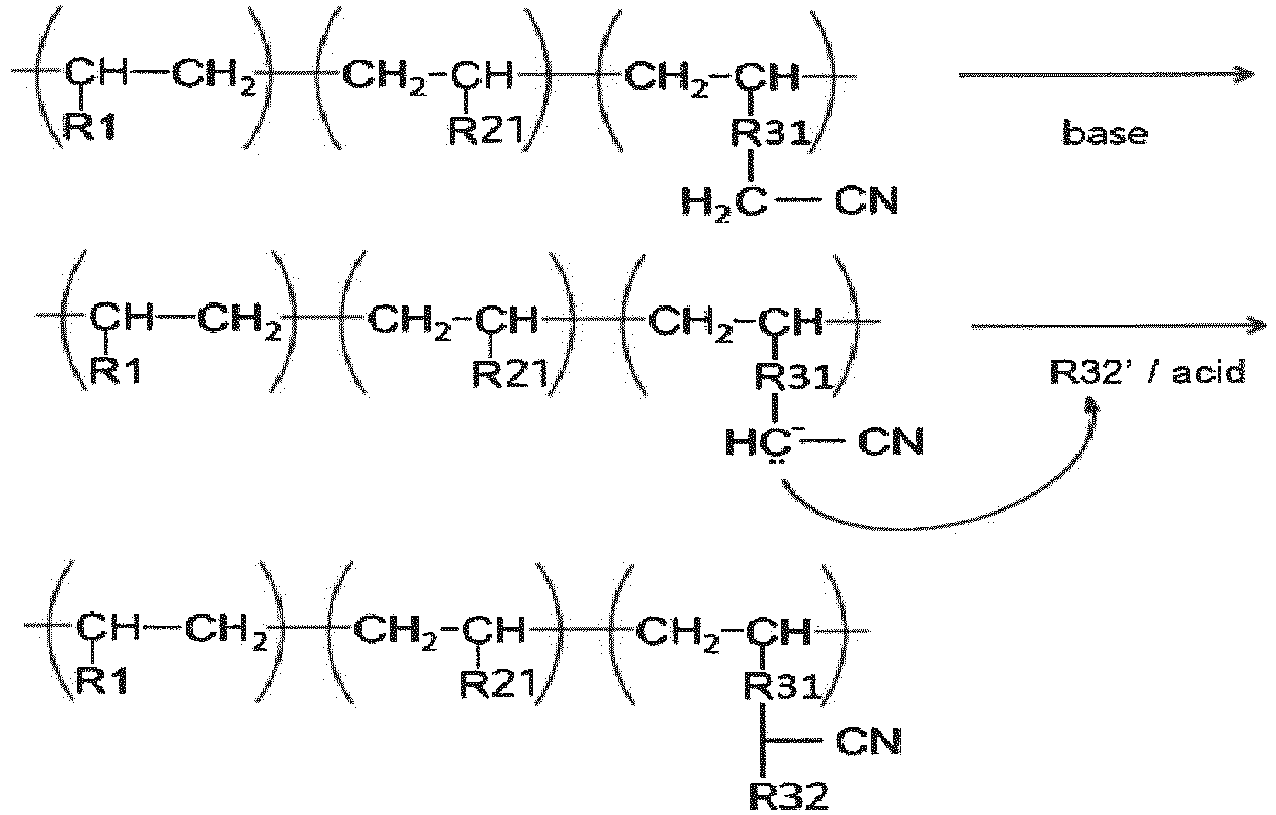
- In step 1, a base is charged into the polymer. The base removes hydrogen of a moiety adjacent to the CN group to form a carbon anion at the corresponding carbon. This carbon anion can maintain stably due to the inductive effect and resonance effect of the adjacent electron withdrawing group.
- The flame retardant compound of R32' is added thereto. R32' is a precursor of the R32 flame-retardant group of Chemical Formula 3 above, and uses a compound containing a carbon-carbon unsaturated bond in the molecule in addition to the flame-retardant group.
- The unshared electron pair of the above-mentioned carbon anion is linked to the carbon-carbon unsaturated bond of R32' via an addition reaction, and a new carbocation is formed at the adjacent carbon, to which hydrogen is supplied from the acid, and the reaction can be completed.
- According to another embodiment of the present disclosure, the weight average molecular weight value of the flame retardant group-containing polymer may be 150,000 to 500,000 g/mol, the lower limit thereof may be 200,000 g/mol or more, or 240,000 g/mol or more, and the upper limit thereof may be 500,000 g/mol or less, or 450,000 g/mol or less, or 350,000 g/mol or less
- Due to the complex factors such as the ratio of each repeating unit or the molecular weight of the polymer, the adhesion of the inorganic filler can be improved, and the inorganic filler can be effectively dispersed.
- In this regard, the weight average molecular weight value may be measured by gel permeation chromatography (GPC) using polystyrene standards.
- Meanwhile, according to another aspect of the present disclosure, there is provided a dispersant composition for a separator of a non-aqueous electrolyte battery, including a flame retardant group-containing polymer.
- The dispersant composition for a separator of a non-aqueous electrolyte battery may further include an inorganic filler.
- The inorganic filler is not particularly limited as long as it has a melting point of 200°C or more, has high electrical insulation, is electrochemically stable, and is stable in an electrolyte solution or a solvent used for a slurry for forming a heat-resistant porous layer.
- The inorganic filler may include one or more selected from the group consisting of inorganic oxides, inorganic nitrides, poorly soluble ionic crystal fine particles, covalently bonded crystals, clay, materials derived from mineral resources, lithium titanium phosphate, and combinations thereof.
- More specifically, the inorganic filler may include, for example, fine particles of inorganic oxides such as iron oxide, SiO2 (silica), Al2O3 (alumina), TiO2, BaTiO3, ZrO, PB(Mg3Nb2/3)O3-PbTiO3(PMN-PT), hafnia (HfO2), SrTiO3, SnO2, CeO2, MgO, NiO, CaO, ZnO, ZrO2, Y2O3, etc.; fine particles of inorganic nitrides such as aluminum nitride, silicon nitride, etc.; fine particles of poorly soluble ionic crystals such as calcium fluoride, barium fluoride, barium sulfate, etc.; fine particles of covalent crystals such as silicone, diamond, etc.; fine particles of clay such as talc, montmorillonite, etc.; a material derived from a mineral such as boehmite, zeolite, apatite, kaolin, mullite, spinel, olivine, sericite, bentonite, etc., or lithium titanium phosphate (LixTiy(PO4)3, wherein x and y are numbers satisfying 0<x<2 and 0<y<3, respectively); and any combination thereof.
- The particle diameter of the inorganic filler is not particularly limited, but in order to form a heat-resistant porous layer of uniform thickness and at the same time obtain an appropriate porosity, those having an average particle diameter of 5 nm to 5 µn may be used, preferably, from 0.01 to 1 µm may be used
- Meanwhile, the mean particle diameter herein may be measured by a device based on a laser diffraction scattering method.
- When the particle diameter of the inorganic filler is too small, there is a problem in that dispersibility is lowered and thus it may be difficult to adjust the physical properties of the separator.
- When the particle diameter of the inorganic filler is too large, there is a problem that strength of the heat-resistant porous layer is lowered and smoothness of the surface tends to get deteriorated. In addition, the heat-resistant porous layer becomes thicker, and thus it is apprehended that the mechanical properties are lowered.
- Further, the composition used to form a heat-resistant porous layer in a separator of a non-aqueous electrolyte battery may include the above-described flame retardant group-containing polymer, and if necessary, a resin such as cyanoethyl-containing polymer, ethylene-vinyl acetate copolymer (EVA, containing 20 to 35 mol % of repeating unit derived from vinyl acetate), acrylate copolymer, styrene butadiene rubber (SBR), polyvinyl butyral (PVB), polyvinyl pyrrolidone (PVP), polyurethane, polyvinylidene fluoride-hexafluoropropylene, polyvinylidene fluoride-trichlorethylene, polyvinylidene fluoride-chlorotrifluoroethylene copolymer, cellulose acetate, cellulose acetate butyrate or cellulose acetate propionate.
- When these resins are further used, the resin may be mixed in an amount of 10 to 1,000 parts by weight with respect to 100 pars by weight of the flame retardant group-containing polymer.
- Meanwhile, according to yet another aspect of the present disclosure, there is provided a separator of a non-aqueous electrolyte battery, the separator comprising: a porous substrate, and a heat resistant porous layer formed on one surface of the porous substrate, wherein the heat resistant porous layer comprises the above-mentioned dispersant composition for a separator of a non-aqueous electrolyte battery.
- The heat-resistant porous layer may further include an inorganic filler.
- Specifically, the separator of a non-aqueous electrolyte battery of the present disclosure may be a separator including a heat-resistant porous layer including the dispersant composition and an inorganic filler, and a porous substrate, wherein the heat-resistant porous layer may be formed on one surface or both surfaces of the porous substrate, and the inside of the heat-resistant porous layer may have many pores resulting from the voids present among inorganic fillers.
- When the heat-resistant porous layer is formed on one surface of the porous substrate, the heat resistant-porous layer may be formed on either a positive electrode side or a negative electrode side surface.
- Meanwhile, a method of forming the heat-resistant porous layer is not particularly limited. For example, the heat-resistant porous layer may be formed by dispersing the inorganic filler in the dispersant composition to prepare a slurry, coating the slurry onto the porous substrate, and then drying and removing the solvent.
- Here, the solvent used in the dispersant composition is not particularly limited as long as the above-mentioned flame retardant group-containing polymer is dissolved therein. Examples of the solvent may include acetone, tetrahydrofuran, cyclohexanone, ethylene glycol monomethyl ether, methyl ethyl ketone, acetonitrile, furfuryl alcohol, tetrahydrofurfuryl alcohol, methyl acetoacetate, nitromethane, N,N-dimethylformamide (DMF), N-methyl-2-pyrrolidone, γ-butyrolactone or propylene carbonate.
- The solvent may be used in an amount of 300 parts by weight to 5,000 parts by weight with respect to 100 parts by weight of the flame retardant group - containing polymer and the resin.
- As for the method of dispersing the inorganic filler in the above-mentioned dispersant composition, a known method of using a stirrer, a dispenser or a pulverizer may be employed. In particular, a ball mill method may be used.
- A relative content ratio between the dispersant composition and the inorganic filler in the slurry is not particularly limited, but it may be adjusted according to the thickness, the average pore diameter, and porosity of the heat-resistant porous layer to be prepared.
- Specifically, the content of the inorganic filler in the heat-resistant porous layer may be 50% by weight or more, or 95% by weight or less
- When the content of the inorganic filler is too low, there is problem that a pore portion in the heat-resistant porous layer becomes small and thus the battery performance may be deteriorated or sufficient heat resistance may not be obtained. When the content of the inorganic filler is too high, there is problem that the heat resistant-porous layer may become brittle and thus it may be difficult to handle.
- Meanwhile, the heat-resistant porous layer may have low resistance because the pores ensure a route for ionic conduction. The average pore diameter is not particularly limited as long as it is large enough for the lithium ions contained in an electrolyte solution described below to pass through. The average pore diameter may be 5 nm to 5 µm, and preferably, 0.1 to 3 µm from the viewpoint of mechanical strength of the heat-resistant porous layer. The porosity may be in the range of 5 to 95%, and preferably, 20 to 70%
- Here, the average pore diameter may be measured by using a mercury intrusion porosimeter. The porosity may be calculated based on the following Equation, after obtaining true density (d) of an inorganic filler, volume (v) of a heat-resistant porous layer, and weight (m) of a heat-resistant porous layer.

- The heat-resistant porous layer having an average pore diameter and a porosity in the above range may be obtained by controlling the particle diameter or the content of the inorganic filler, as described above.
- Meanwhile, the porous substrate may include a thermoplastic resin component.
- The thermoplastic resin component may melt to close the pores in the porous substrate if the temperature becomes higher than a certain limit, whereby ion movement is blocked, an electric current may stop, and heat generation or ignition may be suppressed.
- The thermoplastic resin used as the porous substrate may include polyolefin resins such as low density polyethylene, high density polyethylene, ultra-high molecular weight polyethylene, polypropylene, etc.; polyester resins such as polyethylene terephthalate, polybutylene terephthalate, etc.; polyacetal resins; polyamide resins; polycarbonate resins; polyimide resins; polyether ether ketone resins; polyether sulfone resins; and any combination thereof.
- Meanwhile, the porous substrate may be preferably a film. Although the thickness thereof is not particularly limited, it is preferably 2 µm to 50 µm When the thickness is too thin, there is a problem that it is difficult to maintain the mechanical properties. When the thickness is too thick, there is a problem that it may function as a resistant layer.
- Although the average pore diameter and the porosity of the porous substrate are not particularly limited, the average pore diameter may be preferably 0.1 to 30 µm and the porosity may be preferab 10% to 90%.
- When the pore size is too small or the porosity is too low, there is a problem in that the ion conductivity may deteriorate, and when the average pore diameter is too large or the porosity is too high, there is a problem that mechanical strength may deteriorate, and thus the substrate may not function as a substrate.
- The average pore diameter may be measured in the same manner as that for the heat-resistant porous layer. Meanwhile, the porosity may be calculated based on the following Equation, after obtaining true density (d) of a porous substrate, volume (v) of the porous substrate, and weight (m) of a porous substrate.

- Meanwhile, a method of coating the slurry onto the porous substrate may include a coating method commonly used in the art, and is not particularly limited as long as it can achieve a desirable film thickness or a coating area. Examples of the method may include a gravure coater method, a reverse roll coater method, a transfer roll coater method, a kiss coater method, a dipping coater method, a knife coater method, an air doctor coater method, a blade coater method, a rod coater method, a squeeze coater method, a cast coater method, a die coater method, a screen printing method or a spray coating method.
- The total thickness of the separator of a non-aqueous electrolyte battery thus obtained is not particularly limited and may be adjusted in consideration of application and performance of the battery. It may be preferably in the range of 2 to 55 µm from the viewpoint of ensuring separation between a positive electrode and a negative electrode.
- Meanwhile, the non-aqueous electrolyte battery according to an aspect of the present disclosure may include a positive electrode, a negative electrode, the above-mentioned separator of a non-aqueous electrolyte battery, and an electrolyte solution.
- Specifically, the separator of a non-aqueous electrolyte battery is disposed between the positive electrode and the negative electrode, and immersed in an electrolyte solution to produce a non-aqueous electrolyte battery.
- When the separator of a non-aqueous electrolyte battery in which the heat-resistant porous layer is formed on one surface of the porous substrate is used, the separator may be disposed in such a manner that the surface of the heat-resistant porous layer faces any side of the positive electrode and negative electrode.
- The non-aqueous electrolyte battery of the present disclosure may include, for example, a lithium secondary battery such as a lithium metal secondary battery, a lithium ion secondary battery, a lithium polymer secondary battery or a lithium ion polymer secondary battery.
- Meanwhile, the positive electrode and the negative electrode may be generally manufactured by coating an electrode current collector with an electrode mixture prepared by dispersing a positive electrode or negative electrode active material and a conductive aid in a binder solution.
- The positive electrode active material may include a lithium-containing transition metal oxide having a layered structure, represented by Chemical Formula of Li1+xMO2(-0.1<x<0.1, M: Co, Ni, Mn, Al, Mg, Zr, Ti, Sn, etc.); a lithium manganese oxide having a spinel structure such as LiMn2O4 or a composition having part thereof substituted with one or more of the other elements; and an olivine type compound represented by LiMPO4(M: Co, Ni, Mn, Fe, etc.).
- The lithium-containing transition metal oxide having a layered structure may include, for example, LiCoO2 or LiNi1-xCox-yAlyO2(0.1≤x≤0.3, 0.01≤y≤0.2), and an oxide containing at least Co, Ni, and Mn (LiMn1/3Ni1/3Co1/3O2, LiMn5/12Ni5/12Co1/6O2, LiNi3/5Mn1/5Co1/5O2, etc.).
- Meanwhile, the negative electrode active material may include, for example, a lithium metal, a lithium alloy such as lithium aluminum alloy, etc., a carbonaceous material capable of storing and releasing lithium, graphite, cokes such as a phenol resin, a furan resin, etc., carbon fibers, glass-like carbon, pyrolytic carbon or active carbon.
- Meanwhile, the positive electrode current collector may include, for example, a thin metal foil made of aluminum, nickel, or a combination thereof. The negative electrode current collector may include, for example, a thin metal foil made of copper, gold, nickel, copper alloy, or a combination thereof.
- Meanwhile, the conductive aid may include, for example, carbon black such as acetylene black, ketjen black, etc.; metal fibers such as aluminum, nickel, etc.; natural graphite, heat-expanding graphite, carbon fibers, ruthenium oxide, titanium oxide, etc. Among them, acetylene black or ketjen black may be preferably used, as it may provide desired conductivity with addition of a small amount thereof.
- Meanwhile, the binder may include various known binders. Examples thereof may include polytetrafluoroethylene, polyvinylidene fluoride, carboxymethyl cellulose, a cross-linked polymer of fluoroolefin copolymers, styrene-butadiene copolymer, polyacrylonitrile or polyvinyl alcohol.
- The binder may include those dissolved in a solvent. Examples of the solvent may include N-methyl-2-pyrrolidone (NMP).
- Meanwhile, as for the electrolyte solution, a solution in which a lithium salt is dissolved in an organic solvent may be used. The lithium salt is not particularly limited as long as it dissociates in a solvent to form Li+ ion and does not easily cause a side reaction such as decomposition within the voltage range in which the battery is used.
- For example, an inorganic lithium salt such as LiClO4, LiPF6, LiBF4, LiAsF6, LiSbF6, etc., and an organolithium salt such as LiCF3SO3, LiCF3CO2, Li2C2F4(SO3)2, LiN(CF3SO2)2, LiC(CF3SO2)3, LiCnF2n+1SO3(n≥2), LiN(RfOSO2)2, etc. (wherein Rf represents a fluoroalkyl group) may be used. Preferred examples of the lithium salt may include LiPF6, LiClO4, LiAsF6, LiBF4, LiCF3SO3, Li(CF3SO2)2N.
- Meanwhile, the organic solvent used for the electrolyte solution is not particularly limited as long as it may dissolve the lithium salt and does not cause a side reaction such as decomposition within the voltage range in which the battery is used. For example, cyclic carbonate esters such as propylene carbonate, ethylene carbonate, etc., chain carbonate esters such as ethyl methyl carbonate, diethyl carbonate, dimethyl carbonate, dipropyl carbonate or a mixture thereof may be exemplified, but are not limited thereto.
- When a mixture of the cyclic carbonate ester and the chain carbonate ester is used, a volume ratio of the cyclic carbonate ester to the chain carbonate ester is preferably 4:1 to about 1:4 from the viewpoint of optimizing the permittivity and viscosity.
- Meanwhile, a shape of the non-aqueous electrolyte battery of the present disclosure may include a prism type or a cylindrical type, in which a steel can or an aluminum can is used as a casing (i.e., can casing). Further, it may be a package battery, in which a metal-deposited laminate film is used as a casing, but is not particularly limited thereto.
- A separator composition for a non-aqueous electrolyte battery of the present disclosure can strongly adhere an inorganic filler upon forming a heat-resistant porous layer of a separator, and can also further improve heat resistance of the separator by effectively dispersing the inorganic filler, and further can prevent a fire occurring under charge and discharge.
- Hereinafter, the actions and effects of the present invention will be described in more detail with reference to the specific exemplary embodiments of the present invention. However, these exemplary embodiments are for illustrative purposes only, and the scope of the present invention is not intended to be limited thereby but solely by the appended claims.
- 100 parts by weight of vinyl acetate and 20 parts by weight of vinyl 2-cyanoacetate were charged into a 2L reactor containing 100 parts by weight of methanol, and 20 parts by weight of ethylene was added thereto, and it waited until there was no change in the internal pressure of the reactor.
- After raising the temperature to 70°C, 0.3 parts by weight of AIBN as an initiator was dissolved in 5 parts by weight of methanol, charged into a reactor, stirred at 200 rpm for 6 hours, so that polymerization reaction proceeded. The reactor was cooled to room temperature to obtain a copolymer of the following Chemical Formula.

- As a base component, 5 parts by weight of potassium carbonate was dissolved in 5 parts by weight of methanol, and the mixture was charged into the cooled reactor, and stirred for 1 hour.
- Hereto, 3 parts by weight of maleic acid was dissolved in 5 parts by weight of methanol, and the mixture was further charged into the reactor, and stirred again for 1 hour.
- Then, 5 parts by weight of tetraethyl ethyne-1,2-diyldiphosphonate represented by the following Chemical Formula was charged into the reactor.

- This was stirred for another 1 hour, and the remaining solvent was drained to obtain a copolymer of the following Chemical Formula.


- A copolymer of the following Chemical Formula was obtained in the same manner as in Example 1, except that 20 parts by weight of ethenyl-3-oxobutanoate was used instead of 20 parts by weight of vinyl 2-cyanoacetate in the polymerization step.
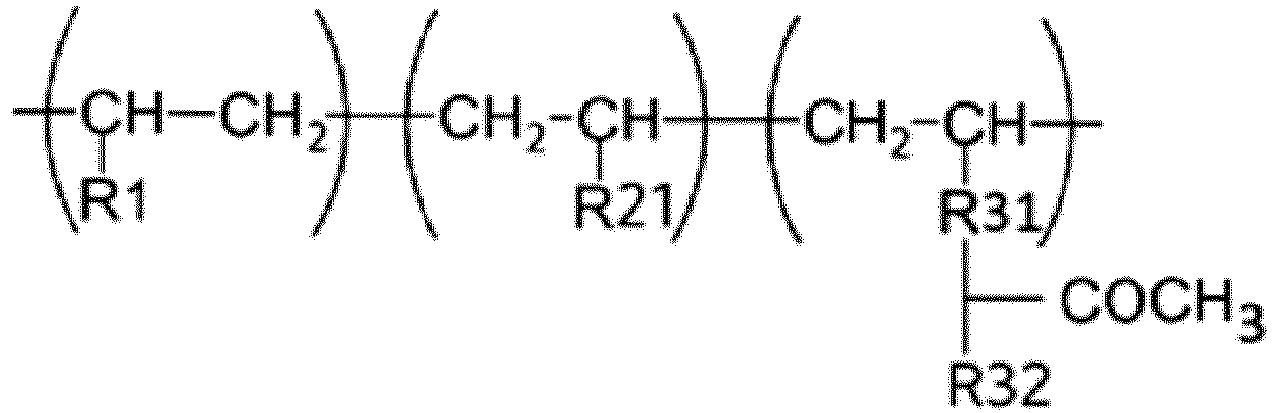
- In Chemical Formula, R1 is hydrogen, R21 is acetate (CH3COO-), R31 is - C(=O)-O-, and R32 is a flame retardant group represented by the following Chemical Formula which is introduced from tetraethyl ethyne-1,2-diyldiphosphonate.

- A copolymer of the following Chemical Formula was obtained in the same manner as in Example 1, except that 150 parts by weight of vinyl acetate and 20 parts by weight of vinyl 2-cyanoacetate were charged into a 2L reactor containing 100 parts by weight of methanol, and 15 parts by weight of ethylene and 0.3 parts by weight of AIBN as an initiator were used.


- A copolymer of the following Chemical Formula was obtained in the same manner as in Example 1, except that in the addition step, 10 parts by weight of potassium carbonate, 10 parts by weight of maleic acid, and 15 parts by weight of tetraethyl ethyne-1,2-diyldiphosphonate were used.


- A copolymer of the following Chemical Formula was obtained in the same manner as in Example 1, except that t-butanol was used instead of methanol.


- A copolymer of the following Chemical Formula was obtained in the same manner as in Example 1, except that in the addition step, ethyne-1,2-diyldiphosphinic acid was used instead of (tetraethyl ethyne-1,2-diyldiphosphonate.


- A copolymer was obtained in the same manner as in Example 1, except that in the polymerization step, vinyl propionate was used instead of vinyl-2-cyanoacetate.
- A copolymer was obtained in the same manner as in Example 1, except that in the addition step, diethyl ethyne-1,2-diyldicarboxylate was used instead of tetraethyl ethyne-1,2-diyldiphosphonate.
- Each repeating unit of the polymer processed using 1H-NMR.
- The peak area was measured based on hydrogen of the ethylene group: 1.0 to 1.2 ppm; hydrogen of the methyl group of vinyl acetate: 2.0 ppm; hydrogen bonded to the double-bonded carbon in the flame retardant substituent group: 6.1 to 6.4 ppm, and each ratio was calculated.
- A weight average molecular weight was analyzed by GPC with column PLgel Mixed B * 2 and Detector waters RI equipment containing DMF (HPLC) and 0.05M LiBr (0.45 µm filtered) as solvents, and other measurement conditions are as follows.
- Apparatus: Gel permeation chromatography GPC (apparatus name: Alliance e2695; manufacturer: WATERS)
- Detector: Differential refractive index detector (apparatus name: W2414; manufacturer: WATERS)
- Column: DMF column
- Flow rate: 1 mL/min
- Column temperature: 65°C
- Injection amount: 0.100 mL (2.0mg/ml in DMSO)
- Standard sample: Polymethyl methacrylate (third correction)
- To 320 parts by weight of acetone, 1 part by weight of each polyvinyl alcohol-based polymer obtained in Examples and Comparative Example, and 7 parts by weight of polyvinylidene fluoride-hexafluoropropylene as a binder were added, and dissolved at 50°C for 12 hr. 72 parts by weight of Al2O3 having a number average particle diameter of 500 nm as inorganic particles was added thereto, and each slurry was prepared using a ball mill method. Particle diameter characteristics and sedimentation rates of the slurries were measured.
- The slurry of the flame-retardant group-containing polymer and inorganic particles prepared above was coated onto one surface of a polyethylene porous substrate using a doctor blade and dried to produce a separator on which a porous coating layer was formed.
- In order to confirm the dispersibility of the binder, the slurries prepared in Examples and Comparative Example were rotated at 300 rpm using a dispersion stability analyzer (LUMiSizer), and the sedimentation rate of alumina was measured at 25°C, and the results are shown in Table below. For reference, as the dispersibility of the flame retardant group-containing polymer is better, alumina is dispersed well and its sedimentation is slow.
- The separators produced in Examples and Comparative Examples were placed in a heat-resistant oven at 150°C and left for 2 hours.
- Then, the separators were taken out, the lengths in the MD direction and the TD direction were measured, and the rate of decrease (%) was shown as compared with the size before heating.
- Artificial graphite, carbon black, CMC, and a binder were mixed with water at a weight ratio of 96:1:1:2 to prepare a negative electrode slurry. The negative electrode slurry was coated onto a copper foil having a thickness of 50 µm, dried at 80°C for 1 hour or longer, and then pressed to manufacture a negative electrode.
- The negative electrode and the separator were put into lamination equipment and adhered. While this sample was peeled off at a rate of 100 mm/min using UTM equipment, the force required to peel the adhesive surface between the electrode and the separator was measured.
- The measurement results are summarized in Table below.
Adhesion (gf/25mm) Sedimentati on rate (µm/s) Flame retardancy Heat shrinkage (MD/TD, %) Weight average molecular weight (100,000) Repeating unit ratio (ethylene, vinyl acetate, flame retardan t group, based on a total of 100) Example 1 150 5 V0 15, 18 2.5 25, 65, 10 Example 2 130 7 V0 18, 20 3.3 17, 73, 10 Example 3 140 10 V1 25, 25 1.8 32, 63, 5 Example 4 145 15 V1 20, 17 2.2 42, 48, 10 Example 5 130 10 V1 15, 18 3.5 35, 60, 5 Example 6 130 8 V1 16, 22 1.9 27, 53, 20 Comparative Example 1 110 20 HB 30, 35 1.4 - Comparative Example 2 120 20 HB 30, 35 1.4 - - Referring to the above table, it can be confirmed that the slurries prepared by using the flame retardant group-containing polymer according to Examples of the present disclosure had similar or superior adhesion or dispersibility to the existing ones.
- In addition, it was clearly confirmed that the separators manufactured using the flame retardant group-containing polymer showed very excellent flame retardancy and also was excellent in the stability against heat.
Claims (13)
- A flame retardant group-containing polymer comprising: a first repeating unit represented by the following Chemical Formula 1, a second repeating unit represented by the following Chemical Formula 2, and a third repeating unit represented by the following Chemical Formula 3:
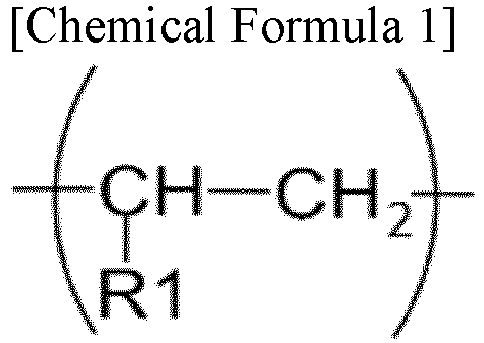


- The flame retardant group-containing polymer according to claim 1, wherein the R32 comprises at least one flame retardant group selected from the group consisting of the following Chemical Formulas:


- The flame retardant group-containing polymer according to claim 2, wherein the R1 and R2 are each independently hydrogen, an ammonium ion, an alkyl group having 1 to 5 carbon atoms, or a phenyl group.
- The flame retardant group-containing polymer according to claim 1, wherein a ratio of the repeating number of the first repeating unit to the total repeating number of the first to third repeating units in the flame-retardant group-containing polymer is 0.1 to 0.5 and wherein the repeating unit ratio is determined by 1H-NMR.
- The flame retardant group-containing polymer according to claim 1, wherein a ratio of the repeating number of the second repeating unit to the total repeating number of the first to third repeating units in the flame-retardant group-containing polymer is 0.3 to 0.8 and wherein the repeating unit ratio is determined by 1H-NMR.
- The flame retardant group-containing polymer according to claim 1, wherein a ratio of the repeating number of the third repeating unit to the total repeating number of the first to third repeating units in the flame-retardant group-containing polymer is 0.01 to 0.3 and wherein the repeating unit ratio is determined by 1H-NMR.
- The flame retardant group-containing polymer according to claim 1, which has a weight average molecular weight of 100,000 to 500,000 g/mol, wherein the weight average molecular weight is determined by the method mentioned in the specification.
- A dispersant composition for a separator of a non-aqueous electrolyte battery, comprising the flame retardant group-containing polymer as set forth in any one of claims 1 to 7.
- The dispersant composition for a separator of a non-aqueous electrolyte battery according to claim 8, further comprising an inorganic filler.
- The dispersant composition for a separator of a non-aqueous electrolyte battery according to claim 9, wherein the inorganic filler comprises one or more selected from the group consisting of inorganic oxides, inorganic nitrides, poorly soluble ionic crystal fine particles, covalently bonded crystals, clay, materials derived from mineral resources, lithium titanium phosphate, and a combination thereof.
- A separator of a non-aqueous electrolyte battery, the separator comprising: a porous substrate, and a heat resistant porous layer formed on one surface of the porous substrate,
wherein the heat resistant porous layer comprises the dispersant composition for a separator of a non-aqueous electrolyte battery as set forth in claim 8. - The separator of a non-aqueous electrolyte battery according to claim 11, wherein the porous substrate comprises one or more resins selected from the group consisting of a polyolefin resin, a polyester resin, a polyacetal resin, a polyamide resin, a polycarbonate resin, a polyimide resin, a polyetheretherketone resin, a polyethersulfone resin, and a combination thereof.
- A non-aqueous electrolyte battery comprising: a positive electrode, a negative electrode, the separator of a non-aqueous electrolyte battery as set forth in claim 11, and an electrolyte solution.
Applications Claiming Priority (2)
| Application Number | Priority Date | Filing Date | Title |
|---|---|---|---|
| KR1020200142299A KR20220057243A (en) | 2020-10-29 | 2020-10-29 | Flame retardant group-containing polymer, separator of non-aqueous electrolyte battery comprising the same, and non-aqueous electrolyte battery |
| PCT/KR2021/015237 WO2022092814A1 (en) | 2020-10-29 | 2021-10-27 | Flame retardant group-containing polymer, non-aqueous electrolyte battery separator comprising same, and non-aqueous electrolyte battery |
Publications (3)
| Publication Number | Publication Date |
|---|---|
| EP4209522A1 EP4209522A1 (en) | 2023-07-12 |
| EP4209522A4 EP4209522A4 (en) | 2024-03-27 |
| EP4209522B1 true EP4209522B1 (en) | 2024-11-27 |
Family
ID=81382929
Family Applications (1)
| Application Number | Title | Priority Date | Filing Date |
|---|---|---|---|
| EP21886808.1A Active EP4209522B1 (en) | 2020-10-29 | 2021-10-27 | Flame retardant group-containing polymer, separator of non-aqueous electrolyte battery comprising the same, and non-aqueous electrolyte battery |
Country Status (7)
| Country | Link |
|---|---|
| US (1) | US12609363B2 (en) |
| EP (1) | EP4209522B1 (en) |
| KR (1) | KR20220057243A (en) |
| CN (1) | CN116323703B (en) |
| ES (1) | ES2999659T3 (en) |
| HU (1) | HUE069653T2 (en) |
| WO (1) | WO2022092814A1 (en) |
Families Citing this family (1)
| Publication number | Priority date | Publication date | Assignee | Title |
|---|---|---|---|---|
| KR102837529B1 (en) * | 2022-12-06 | 2025-07-23 | 한국화학연구원 | Electrolyte for lithium secondary battery and lithium secondary battery including the same |
Family Cites Families (17)
| Publication number | Priority date | Publication date | Assignee | Title |
|---|---|---|---|---|
| US3789092A (en) * | 1971-06-30 | 1974-01-29 | Monsanto Co | Halovinylene-1,2-bis(phosphonic esters) |
| US4847339A (en) * | 1987-02-02 | 1989-07-11 | National Distillers And Chemcial Corporation | Process for preparing interpolymers of ethylene, vinyl acetate, and reactive halogen-containing monomers |
| US20090258300A1 (en) * | 2005-11-14 | 2009-10-15 | The Nippon Synthetic Chemical Industry Co., Ltd. | Ethylene/Vinyl Alcohol-Derived Copolymer Fiber |
| JP5079396B2 (en) | 2007-03-30 | 2012-11-21 | 富士フイルム株式会社 | Conductive substance adsorbing resin film, method for producing conductive substance adsorbing resin film, resin film with metal layer using the same, and method for producing resin film with metal layer |
| JP5753672B2 (en) * | 2010-09-06 | 2015-07-22 | 株式会社Nttファシリティーズ | Non-aqueous electrolyte secondary battery |
| CN102250384A (en) * | 2011-05-13 | 2011-11-23 | 王婷婷 | Preparation and application of flame retardant |
| US9156920B2 (en) * | 2012-09-26 | 2015-10-13 | Wacker Chemical Corporation | Process for the preparation of an aqueous emulsifier-stabilized vinyl acetate-ethylene copolymer dispersion with fine particle size |
| JP6184799B2 (en) * | 2013-08-09 | 2017-08-23 | 株式会社クラレ | Fiber made of modified ethylene-vinyl alcohol copolymer |
| KR20160128725A (en) | 2015-04-29 | 2016-11-08 | 삼성에스디아이 주식회사 | Heat-resistant and nonflammable separator and electrochemical battery |
| KR101915345B1 (en) | 2015-04-30 | 2018-11-05 | 주식회사 엘지화학 | A method of manufacturing separator for electrochemical device and separator for electrochemical device manufactured thereby |
| KR102140121B1 (en) | 2016-07-01 | 2020-07-31 | 주식회사 엘지화학 | Reinforced-Composite Electrolyte Membrane Comprising Porous Polymer Substrate And Manufacturing Method Thereof |
| US10714791B2 (en) | 2016-09-02 | 2020-07-14 | Lg Chem, Ltd. | Gel polymer electrolyte and lithium secondary battery including the same |
| JP6929293B2 (en) * | 2016-09-30 | 2021-09-01 | 株式会社クラレ | Copolymer composition having a phosphonate group |
| KR102029448B1 (en) | 2016-12-27 | 2019-10-07 | 주식회사 엘지화학 | Polymer containing cyanoethyl group and preparation method thereof |
| CN108110073B (en) * | 2017-12-19 | 2020-06-26 | 常州百佳年代薄膜科技股份有限公司 | Flame retardant solar cell module and preparation method thereof |
| TW201945200A (en) | 2018-02-20 | 2019-12-01 | 日商積水化學工業股份有限公司 | Fireproof laminate and battery |
| KR102556801B1 (en) | 2019-01-22 | 2023-07-17 | 주식회사 엘지화학 | Dispersant for separator of non-aqueous electrolyte battery comprising 2-cyanoethyl group-containing polymer |
-
2020
- 2020-10-29 KR KR1020200142299A patent/KR20220057243A/en active Pending
-
2021
- 2021-10-27 HU HUE21886808A patent/HUE069653T2/en unknown
- 2021-10-27 US US18/029,959 patent/US12609363B2/en active Active
- 2021-10-27 CN CN202180068887.6A patent/CN116323703B/en active Active
- 2021-10-27 EP EP21886808.1A patent/EP4209522B1/en active Active
- 2021-10-27 WO PCT/KR2021/015237 patent/WO2022092814A1/en not_active Ceased
- 2021-10-27 ES ES21886808T patent/ES2999659T3/en active Active
Also Published As
| Publication number | Publication date |
|---|---|
| WO2022092814A1 (en) | 2022-05-05 |
| US20230378548A1 (en) | 2023-11-23 |
| ES2999659T3 (en) | 2025-02-26 |
| HUE069653T2 (en) | 2025-04-28 |
| EP4209522A4 (en) | 2024-03-27 |
| CN116323703A (en) | 2023-06-23 |
| KR20220057243A (en) | 2022-05-09 |
| EP4209522A1 (en) | 2023-07-12 |
| US12609363B2 (en) | 2026-04-21 |
| CN116323703B (en) | 2026-01-09 |
Similar Documents
| Publication | Publication Date | Title |
|---|---|---|
| EP2509136B1 (en) | Binder of a separator of non-aquaous electrolyte battery comprising 2-cyanoethyl group-containing polymer and separator and battery using the same | |
| EP2509137B1 (en) | Binder for separator of non-aquaous electrolyte battery comprising 2-cyanoethyl group-containing polymer and separator and battery using the same | |
| EP3002814B1 (en) | Electrolyte, method of preparing the electrolyte, and secondary battery including the electrolyte | |
| EP3761399A1 (en) | Separator, method for manufacturing same, and lithium battery including same | |
| EP3845594B1 (en) | Dispersant for non-aqueous electrolyte battery separator including cyanoethyl group-containing polymer, non-aqueous electrolyte battery separator, and non-aqueous electrolyte battery | |
| KR102556801B1 (en) | Dispersant for separator of non-aqueous electrolyte battery comprising 2-cyanoethyl group-containing polymer | |
| EP4209522B1 (en) | Flame retardant group-containing polymer, separator of non-aqueous electrolyte battery comprising the same, and non-aqueous electrolyte battery | |
| KR102921233B1 (en) | Separator for secondary battery, method for manufacturing the same and lithium secondary battery containing the same. | |
| KR102418588B1 (en) | Dispersant for separator of non-aqueous electrolyte battery comprising 2-cyanoethyl group-containing polymer and separator and battery using the same | |
| KR102660594B1 (en) | Copolymer for separator and secondary battery using thereof | |
| KR102944618B1 (en) | A composition for separator for non-aqueous electrolyte battery, a separator for non-aqueous electrolyte battery,and a non-aqueous electrolyte battery | |
| EP4220843A1 (en) | Composition for separator for non-aqueous electrolyte battery, separator for non-aqueous electrolyte battery, and non-aqueous electrolyte battery | |
| CN116472640A (en) | Composition for nonaqueous electrolyte battery separator, nonaqueous electrolyte battery separator, and nonaqueous electrolyte battery | |
| KR20250117214A (en) | Electrode Assembly | |
| KR20250117304A (en) | Electrode Assembly | |
| KR20250064008A (en) | Copolymer for separator and secondary battery using thereof |
Legal Events
| Date | Code | Title | Description |
|---|---|---|---|
| STAA | Information on the status of an ep patent application or granted ep patent |
Free format text: STATUS: THE INTERNATIONAL PUBLICATION HAS BEEN MADE |
|
| PUAI | Public reference made under article 153(3) epc to a published international application that has entered the european phase |
Free format text: ORIGINAL CODE: 0009012 |
|
| STAA | Information on the status of an ep patent application or granted ep patent |
Free format text: STATUS: REQUEST FOR EXAMINATION WAS MADE |
|
| 17P | Request for examination filed |
Effective date: 20230405 |
|
| AK | Designated contracting states |
Kind code of ref document: A1 Designated state(s): AL AT BE BG CH CY CZ DE DK EE ES FI FR GB GR HR HU IE IS IT LI LT LU LV MC MK MT NL NO PL PT RO RS SE SI SK SM TR |
|
| DAV | Request for validation of the european patent (deleted) | ||
| DAX | Request for extension of the european patent (deleted) | ||
| REG | Reference to a national code |
Ref legal event code: R079 Free format text: PREVIOUS MAIN CLASS: C08F0230020000 Ipc: C08F0210020000 Ref country code: DE Ref legal event code: R079 Ref document number: 602021022646 Country of ref document: DE Free format text: PREVIOUS MAIN CLASS: C08F0230020000 Ipc: C08F0210020000 |
|
| A4 | Supplementary search report drawn up and despatched |
Effective date: 20240223 |
|
| RIC1 | Information provided on ipc code assigned before grant |
Ipc: H01M 10/0525 20100101ALN20240219BHEP Ipc: C08K 3/22 20060101ALI20240219BHEP Ipc: C08F 218/08 20060101ALI20240219BHEP Ipc: H01M 50/451 20210101ALI20240219BHEP Ipc: H01M 50/414 20210101ALI20240219BHEP Ipc: H01M 50/409 20210101ALI20240219BHEP Ipc: H01M 10/052 20100101ALI20240219BHEP Ipc: C09D 131/04 20060101ALI20240219BHEP Ipc: C09D 127/16 20060101ALI20240219BHEP Ipc: C08F 8/40 20060101ALI20240219BHEP Ipc: H01M 50/449 20210101ALI20240219BHEP Ipc: H01M 50/446 20210101ALI20240219BHEP Ipc: C08F 220/18 20060101ALI20240219BHEP Ipc: C08F 210/02 20060101AFI20240219BHEP |
|
| GRAP | Despatch of communication of intention to grant a patent |
Free format text: ORIGINAL CODE: EPIDOSNIGR1 |
|
| STAA | Information on the status of an ep patent application or granted ep patent |
Free format text: STATUS: GRANT OF PATENT IS INTENDED |
|
| RIC1 | Information provided on ipc code assigned before grant |
Ipc: H01M 10/0525 20100101ALN20240528BHEP Ipc: C08K 3/22 20060101ALI20240528BHEP Ipc: C08F 218/08 20060101ALI20240528BHEP Ipc: H01M 50/451 20210101ALI20240528BHEP Ipc: H01M 50/414 20210101ALI20240528BHEP Ipc: H01M 50/409 20210101ALI20240528BHEP Ipc: H01M 10/052 20100101ALI20240528BHEP Ipc: C09D 131/04 20060101ALI20240528BHEP Ipc: C09D 127/16 20060101ALI20240528BHEP Ipc: C08F 8/40 20060101ALI20240528BHEP Ipc: H01M 50/449 20210101ALI20240528BHEP Ipc: H01M 50/446 20210101ALI20240528BHEP Ipc: C08F 220/18 20060101ALI20240528BHEP Ipc: C08F 210/02 20060101AFI20240528BHEP |
|
| INTG | Intention to grant announced |
Effective date: 20240613 |
|
| GRAJ | Information related to disapproval of communication of intention to grant by the applicant or resumption of examination proceedings by the epo deleted |
Free format text: ORIGINAL CODE: EPIDOSDIGR1 |
|
| STAA | Information on the status of an ep patent application or granted ep patent |
Free format text: STATUS: REQUEST FOR EXAMINATION WAS MADE |
|
| INTC | Intention to grant announced (deleted) | ||
| GRAP | Despatch of communication of intention to grant a patent |
Free format text: ORIGINAL CODE: EPIDOSNIGR1 |
|
| STAA | Information on the status of an ep patent application or granted ep patent |
Free format text: STATUS: GRANT OF PATENT IS INTENDED |
|
| RIC1 | Information provided on ipc code assigned before grant |
Ipc: H01M 10/0525 20100101ALN20240813BHEP Ipc: C08K 3/22 20060101ALI20240813BHEP Ipc: C08F 218/08 20060101ALI20240813BHEP Ipc: H01M 50/451 20210101ALI20240813BHEP Ipc: H01M 50/414 20210101ALI20240813BHEP Ipc: H01M 50/409 20210101ALI20240813BHEP Ipc: H01M 10/052 20100101ALI20240813BHEP Ipc: C09D 131/04 20060101ALI20240813BHEP Ipc: C09D 127/16 20060101ALI20240813BHEP Ipc: C08F 8/40 20060101ALI20240813BHEP Ipc: H01M 50/449 20210101ALI20240813BHEP Ipc: H01M 50/446 20210101ALI20240813BHEP Ipc: C08F 220/18 20060101ALI20240813BHEP Ipc: C08F 210/02 20060101AFI20240813BHEP |
|
| GRAS | Grant fee paid |
Free format text: ORIGINAL CODE: EPIDOSNIGR3 |
|
| INTG | Intention to grant announced |
Effective date: 20240910 |
|
| P01 | Opt-out of the competence of the unified patent court (upc) registered |
Free format text: CASE NUMBER: APP_49934/2024 Effective date: 20240903 |
|
| GRAA | (expected) grant |
Free format text: ORIGINAL CODE: 0009210 |
|
| STAA | Information on the status of an ep patent application or granted ep patent |
Free format text: STATUS: THE PATENT HAS BEEN GRANTED |
|
| AK | Designated contracting states |
Kind code of ref document: B1 Designated state(s): AL AT BE BG CH CY CZ DE DK EE ES FI FR GB GR HR HU IE IS IT LI LT LU LV MC MK MT NL NO PL PT RO RS SE SI SK SM TR |
|
| REG | Reference to a national code |
Ref country code: GB Ref legal event code: FG4D |
|
| REG | Reference to a national code |
Ref country code: CH Ref legal event code: EP |
|
| REG | Reference to a national code |
Ref country code: IE Ref legal event code: FG4D |
|
| REG | Reference to a national code |
Ref country code: DE Ref legal event code: R096 Ref document number: 602021022646 Country of ref document: DE |
|
| REG | Reference to a national code |
Ref country code: ES Ref legal event code: FG2A Ref document number: 2999659 Country of ref document: ES Kind code of ref document: T3 Effective date: 20250226 |
|
| REG | Reference to a national code |
Ref country code: LT Ref legal event code: MG9D |
|
| REG | Reference to a national code |
Ref country code: NL Ref legal event code: MP Effective date: 20241127 |
|
| PG25 | Lapsed in a contracting state [announced via postgrant information from national office to epo] |
Ref country code: PT Free format text: LAPSE BECAUSE OF FAILURE TO SUBMIT A TRANSLATION OF THE DESCRIPTION OR TO PAY THE FEE WITHIN THE PRESCRIBED TIME-LIMIT Effective date: 20250327 Ref country code: IS Free format text: LAPSE BECAUSE OF FAILURE TO SUBMIT A TRANSLATION OF THE DESCRIPTION OR TO PAY THE FEE WITHIN THE PRESCRIBED TIME-LIMIT Effective date: 20250327 Ref country code: HR Free format text: LAPSE BECAUSE OF FAILURE TO SUBMIT A TRANSLATION OF THE DESCRIPTION OR TO PAY THE FEE WITHIN THE PRESCRIBED TIME-LIMIT Effective date: 20241127 |
|
| PG25 | Lapsed in a contracting state [announced via postgrant information from national office to epo] |
Ref country code: FI Free format text: LAPSE BECAUSE OF FAILURE TO SUBMIT A TRANSLATION OF THE DESCRIPTION OR TO PAY THE FEE WITHIN THE PRESCRIBED TIME-LIMIT Effective date: 20241127 Ref country code: NL Free format text: LAPSE BECAUSE OF FAILURE TO SUBMIT A TRANSLATION OF THE DESCRIPTION OR TO PAY THE FEE WITHIN THE PRESCRIBED TIME-LIMIT Effective date: 20241127 |
|
| REG | Reference to a national code |
Ref country code: AT Ref legal event code: MK05 Ref document number: 1745657 Country of ref document: AT Kind code of ref document: T Effective date: 20241127 |
|
| PG25 | Lapsed in a contracting state [announced via postgrant information from national office to epo] |
Ref country code: BG Free format text: LAPSE BECAUSE OF FAILURE TO SUBMIT A TRANSLATION OF THE DESCRIPTION OR TO PAY THE FEE WITHIN THE PRESCRIBED TIME-LIMIT Effective date: 20241127 |
|
| PG25 | Lapsed in a contracting state [announced via postgrant information from national office to epo] |
Ref country code: NO Free format text: LAPSE BECAUSE OF FAILURE TO SUBMIT A TRANSLATION OF THE DESCRIPTION OR TO PAY THE FEE WITHIN THE PRESCRIBED TIME-LIMIT Effective date: 20250227 |
|
| PG25 | Lapsed in a contracting state [announced via postgrant information from national office to epo] |
Ref country code: GR Free format text: LAPSE BECAUSE OF FAILURE TO SUBMIT A TRANSLATION OF THE DESCRIPTION OR TO PAY THE FEE WITHIN THE PRESCRIBED TIME-LIMIT Effective date: 20250228 Ref country code: AT Free format text: LAPSE BECAUSE OF FAILURE TO SUBMIT A TRANSLATION OF THE DESCRIPTION OR TO PAY THE FEE WITHIN THE PRESCRIBED TIME-LIMIT Effective date: 20241127 Ref country code: LV Free format text: LAPSE BECAUSE OF FAILURE TO SUBMIT A TRANSLATION OF THE DESCRIPTION OR TO PAY THE FEE WITHIN THE PRESCRIBED TIME-LIMIT Effective date: 20241127 |
|
| PG25 | Lapsed in a contracting state [announced via postgrant information from national office to epo] |
Ref country code: PL Free format text: LAPSE BECAUSE OF FAILURE TO SUBMIT A TRANSLATION OF THE DESCRIPTION OR TO PAY THE FEE WITHIN THE PRESCRIBED TIME-LIMIT Effective date: 20241127 |
|
| REG | Reference to a national code |
Ref country code: HU Ref legal event code: AG4A Ref document number: E069653 Country of ref document: HU |
|
| PG25 | Lapsed in a contracting state [announced via postgrant information from national office to epo] |
Ref country code: RS Free format text: LAPSE BECAUSE OF FAILURE TO SUBMIT A TRANSLATION OF THE DESCRIPTION OR TO PAY THE FEE WITHIN THE PRESCRIBED TIME-LIMIT Effective date: 20250227 |
|
| PG25 | Lapsed in a contracting state [announced via postgrant information from national office to epo] |
Ref country code: SM Free format text: LAPSE BECAUSE OF FAILURE TO SUBMIT A TRANSLATION OF THE DESCRIPTION OR TO PAY THE FEE WITHIN THE PRESCRIBED TIME-LIMIT Effective date: 20241127 |
|
| PG25 | Lapsed in a contracting state [announced via postgrant information from national office to epo] |
Ref country code: DK Free format text: LAPSE BECAUSE OF FAILURE TO SUBMIT A TRANSLATION OF THE DESCRIPTION OR TO PAY THE FEE WITHIN THE PRESCRIBED TIME-LIMIT Effective date: 20241127 |
|
| PGFP | Annual fee paid to national office [announced via postgrant information from national office to epo] |
Ref country code: BE Payment date: 20250520 Year of fee payment: 5 |
|
| PG25 | Lapsed in a contracting state [announced via postgrant information from national office to epo] |
Ref country code: EE Free format text: LAPSE BECAUSE OF FAILURE TO SUBMIT A TRANSLATION OF THE DESCRIPTION OR TO PAY THE FEE WITHIN THE PRESCRIBED TIME-LIMIT Effective date: 20241127 |
|
| PG25 | Lapsed in a contracting state [announced via postgrant information from national office to epo] |
Ref country code: RO Free format text: LAPSE BECAUSE OF FAILURE TO SUBMIT A TRANSLATION OF THE DESCRIPTION OR TO PAY THE FEE WITHIN THE PRESCRIBED TIME-LIMIT Effective date: 20241127 |
|
| PG25 | Lapsed in a contracting state [announced via postgrant information from national office to epo] |
Ref country code: SK Free format text: LAPSE BECAUSE OF FAILURE TO SUBMIT A TRANSLATION OF THE DESCRIPTION OR TO PAY THE FEE WITHIN THE PRESCRIBED TIME-LIMIT Effective date: 20241127 |
|
| PG25 | Lapsed in a contracting state [announced via postgrant information from national office to epo] |
Ref country code: CZ Free format text: LAPSE BECAUSE OF FAILURE TO SUBMIT A TRANSLATION OF THE DESCRIPTION OR TO PAY THE FEE WITHIN THE PRESCRIBED TIME-LIMIT Effective date: 20241127 |
|
| PG25 | Lapsed in a contracting state [announced via postgrant information from national office to epo] |
Ref country code: IT Free format text: LAPSE BECAUSE OF FAILURE TO SUBMIT A TRANSLATION OF THE DESCRIPTION OR TO PAY THE FEE WITHIN THE PRESCRIBED TIME-LIMIT Effective date: 20241127 |
|
| REG | Reference to a national code |
Ref country code: DE Ref legal event code: R097 Ref document number: 602021022646 Country of ref document: DE |
|
| PG25 | Lapsed in a contracting state [announced via postgrant information from national office to epo] |
Ref country code: SE Free format text: LAPSE BECAUSE OF FAILURE TO SUBMIT A TRANSLATION OF THE DESCRIPTION OR TO PAY THE FEE WITHIN THE PRESCRIBED TIME-LIMIT Effective date: 20241127 |
|
| PLBE | No opposition filed within time limit |
Free format text: ORIGINAL CODE: 0009261 |
|
| STAA | Information on the status of an ep patent application or granted ep patent |
Free format text: STATUS: NO OPPOSITION FILED WITHIN TIME LIMIT |
|
| PGFP | Annual fee paid to national office [announced via postgrant information from national office to epo] |
Ref country code: GB Payment date: 20250922 Year of fee payment: 5 |
|
| PGFP | Annual fee paid to national office [announced via postgrant information from national office to epo] |
Ref country code: FR Payment date: 20250925 Year of fee payment: 5 |
|
| 26N | No opposition filed |
Effective date: 20250828 |
|
| PGFP | Annual fee paid to national office [announced via postgrant information from national office to epo] |
Ref country code: HU Payment date: 20251029 Year of fee payment: 5 |
|
| PGFP | Annual fee paid to national office [announced via postgrant information from national office to epo] |
Ref country code: DE Payment date: 20250922 Year of fee payment: 5 |
|
| PGFP | Annual fee paid to national office [announced via postgrant information from national office to epo] |
Ref country code: ES Payment date: 20251117 Year of fee payment: 5 |