EP4209216A1 - Pharmaceutical composition for treating tumors - Google Patents
Pharmaceutical composition for treating tumors Download PDFInfo
- Publication number
- EP4209216A1 EP4209216A1 EP21886203.5A EP21886203A EP4209216A1 EP 4209216 A1 EP4209216 A1 EP 4209216A1 EP 21886203 A EP21886203 A EP 21886203A EP 4209216 A1 EP4209216 A1 EP 4209216A1
- Authority
- EP
- European Patent Office
- Prior art keywords
- cancer
- pharmaceutical composition
- tumor
- administered
- antagonist
- Prior art date
- Legal status (The legal status is an assumption and is not a legal conclusion. Google has not performed a legal analysis and makes no representation as to the accuracy of the status listed.)
- Pending
Links
Images


Classifications
-
- A—HUMAN NECESSITIES
- A61—MEDICAL OR VETERINARY SCIENCE; HYGIENE
- A61K—PREPARATIONS FOR MEDICAL, DENTAL OR TOILETRY PURPOSES
- A61K31/00—Medicinal preparations containing organic active ingredients
- A61K31/33—Heterocyclic compounds
- A61K31/395—Heterocyclic compounds having nitrogen as a ring hetero atom, e.g. guanethidine or rifamycins
- A61K31/435—Heterocyclic compounds having nitrogen as a ring hetero atom, e.g. guanethidine or rifamycins having six-membered rings with one nitrogen as the only ring hetero atom
- A61K31/44—Non condensed pyridines; Hydrogenated derivatives thereof
- A61K31/445—Non condensed piperidines, e.g. piperocaine
- A61K31/4523—Non condensed piperidines, e.g. piperocaine containing further heterocyclic ring systems
- A61K31/4545—Non condensed piperidines, e.g. piperocaine containing further heterocyclic ring systems containing a six-membered ring with nitrogen as a ring hetero atom, e.g. pipamperone, anabasine
-
- A—HUMAN NECESSITIES
- A61—MEDICAL OR VETERINARY SCIENCE; HYGIENE
- A61K—PREPARATIONS FOR MEDICAL, DENTAL OR TOILETRY PURPOSES
- A61K39/00—Medicinal preparations containing antigens or antibodies
- A61K39/395—Antibodies; Immunoglobulins; Immune serum, e.g. antilymphocytic serum
- A61K39/39533—Antibodies; Immunoglobulins; Immune serum, e.g. antilymphocytic serum against materials from animals
- A61K39/3955—Antibodies; Immunoglobulins; Immune serum, e.g. antilymphocytic serum against materials from animals against proteinaceous materials, e.g. enzymes, hormones, lymphokines
-
- A—HUMAN NECESSITIES
- A61—MEDICAL OR VETERINARY SCIENCE; HYGIENE
- A61K—PREPARATIONS FOR MEDICAL, DENTAL OR TOILETRY PURPOSES
- A61K45/00—Medicinal preparations containing active ingredients not provided for in groups A61K31/00 - A61K41/00
- A61K45/06—Mixtures of active ingredients without chemical characterisation, e.g. antiphlogistics and cardiaca
-
- A—HUMAN NECESSITIES
- A61—MEDICAL OR VETERINARY SCIENCE; HYGIENE
- A61P—SPECIFIC THERAPEUTIC ACTIVITY OF CHEMICAL COMPOUNDS OR MEDICINAL PREPARATIONS
- A61P15/00—Drugs for genital or sexual disorders; Contraceptives
-
- A—HUMAN NECESSITIES
- A61—MEDICAL OR VETERINARY SCIENCE; HYGIENE
- A61P—SPECIFIC THERAPEUTIC ACTIVITY OF CHEMICAL COMPOUNDS OR MEDICINAL PREPARATIONS
- A61P35/00—Antineoplastic agents
-
- C—CHEMISTRY; METALLURGY
- C07—ORGANIC CHEMISTRY
- C07K—PEPTIDES
- C07K16/00—Immunoglobulins [IG], e.g. monoclonal or polyclonal antibodies
- C07K16/18—Immunoglobulins [IG], e.g. monoclonal or polyclonal antibodies against material from animals or humans
- C07K16/28—Immunoglobulins [IG], e.g. monoclonal or polyclonal antibodies against material from animals or humans against receptors, cell surface antigens or cell surface determinants
- C07K16/2803—Immunoglobulins [IG], e.g. monoclonal or polyclonal antibodies against material from animals or humans against receptors, cell surface antigens or cell surface determinants against the immunoglobulin superfamily
- C07K16/2818—Immunoglobulins [IG], e.g. monoclonal or polyclonal antibodies against material from animals or humans against receptors, cell surface antigens or cell surface determinants against the immunoglobulin superfamily against CD28 or CD152
-
- A—HUMAN NECESSITIES
- A61—MEDICAL OR VETERINARY SCIENCE; HYGIENE
- A61K—PREPARATIONS FOR MEDICAL, DENTAL OR TOILETRY PURPOSES
- A61K39/00—Medicinal preparations containing antigens or antibodies
- A61K2039/505—Medicinal preparations containing antigens or antibodies comprising antibodies
-
- A—HUMAN NECESSITIES
- A61—MEDICAL OR VETERINARY SCIENCE; HYGIENE
- A61K—PREPARATIONS FOR MEDICAL, DENTAL OR TOILETRY PURPOSES
- A61K39/00—Medicinal preparations containing antigens or antibodies
- A61K2039/545—Medicinal preparations containing antigens or antibodies characterised by the dose, timing or administration schedule
-
- C—CHEMISTRY; METALLURGY
- C07—ORGANIC CHEMISTRY
- C07K—PEPTIDES
- C07K2317/00—Immunoglobulins specific features
- C07K2317/70—Immunoglobulins specific features characterized by effect upon binding to a cell or to an antigen
- C07K2317/73—Inducing cell death, e.g. apoptosis, necrosis or inhibition of cell proliferation
-
- C—CHEMISTRY; METALLURGY
- C07—ORGANIC CHEMISTRY
- C07K—PEPTIDES
- C07K2317/00—Immunoglobulins specific features
- C07K2317/70—Immunoglobulins specific features characterized by effect upon binding to a cell or to an antigen
- C07K2317/76—Antagonist effect on antigen, e.g. neutralization or inhibition of binding
Definitions
- the present invention relates to a pharmaceutical composition for treating tumor which combines the use of a monocyclic pyridine derivative or its pharmaceutically acceptable salt, which acts to inhibit fibroblast growth factor receptor (FGFR), with a PD-1 antagonist. More specifically, it relates to a pharmaceutical composition for treating tumor that comprises 5-((2-(4-(1-(2-hydroxyethyl)piperidin-4-yl)benzamide)pyridin-4-yl)oxy)-6-(2-methoxyethoxy)-N-methyl-1H-indole-1-carboxamide or its pharmaceutically acceptable salt, to be administered in combination with a PD-1 antagonist.
- FGFR fibroblast growth factor receptor
- the compound 5-((2-(4-(1-(2-hydroxyethyl)piperidin-4-yl)benzamide)pyridin-4-yl)oxy)-6-(2-methoxyethoxy)-N-methyl-1H-indole-1-carboxamide, represented by formula (I), is known as an inhibitor against fibroblast growth factor receptors (FGFR) 1, 2 and 3, and has been reported to have a cell growth inhibitory effect against stomach cancer, lung cancer, bladder cancer and endometrial cancer (PTL 1). The compound has also been reported to have a high therapeutic effect for bile duct cancer (PTL 2), breast cancer (PTL 3) and hepatocellular carcinoma (PTL 4).
- Known pharmaceutically acceptable salts of the compound include succinic acid salts and maleic acid salts (PTL 5).
- PD-L1 ligand and PD-L2 ligand that are expressed on tumor cells bind to PD-1 receptor expressed on activated T cells, thereby suppressing the activity of T cells.
- Anti-PD-1 antibody binds to PD-1 receptor to inhibit binding of PD-L1 ligand and PD-L2 ligand to PD-1 receptor, and thus performs a role in maintaining activation of T cells. The ability of T cells to attack tumor cells is thereby maintained. Drugs that carry out this function are known as immune checkpoint inhibitors, and are used as antitumor agents (NPL 1).
- the disclosure provides the following [1] to [93].
- the compound represented by formula (I) and its pharmaceutically acceptable salts according to the disclosure can be produced by the methods described in PTL 1.
- pharmaceutically acceptable salt refers to a salt of an inorganic acid, a salt of an organic acid, or a salt of an acidic amino acid, for example, which are pharmaceutically acceptable salts.
- Solvates of pharmaceutically acceptable salts of the compound of the disclosure, such as anhydrides and hydrates of the pharmaceutically acceptable salts, are also included.
- salts with inorganic acids include salts with hydrochloric acid, hydrobromic acid, sulfuric acid, nitric acid and phosphoric acid.
- salts with organic acids include salts with acetic acid, succinic acid, fumaric acid, maleic acid, tartaric acid, citric acid, lactic acid, stearic acid, benzoic acid, methanesulfonic acid, ethanesulfonic acid and p-toluenesulfonic acid.
- salts with acidic amino acids include salts with aspartic acid and glutamic acid.
- the pharmaceutically acceptable salt is a succinic acid salt or maleic acid salt.
- the pharmaceutically acceptable salt is a succinic acid salt.
- the pharmaceutically acceptable salt is a 1.5 succinate (hereunder, the 1.5 succinate of the compound represented by formula (I) will be referred to as "compound A").
- the compound represented by formula (I) or its pharmaceutically acceptable salt according to the disclosure may be administered by injection (intravenous injection, intraarterial injection or local injection), or by an oral, intranasal, transdermal or transpulmonary route, or by eye drop, and for example, injection may be intravenous injection, subcutaneous injection, intradermal injection or intraarterial injection, or local injection into the target cells or organ.
- the dosage form of the compound represented by formula (I) or its pharmaceutically acceptable salt for oral administration may be a tablet, powder, granules, syrup, capsule or internal liquid drug, for example.
- the dosage form of the compound represented by formula (I) or its pharmaceutically acceptable salt for parenteral administration may also be injection, drip, eye drop, ointment, suppository, suspension, poultice, lotion, aerosol or plaster, or it may be injection or drip, according to one embodiment.
- the compound represented by formula (I) or its pharmaceutically acceptable salt according to the disclosure can be formulated by a method described in Japanese Pharmacopoeia, 17th Edition (JP), U.S. Pharmacopeia (USP) or European Pharmacopeia (EP), for example.
- the dose of the compound represented by formula (I) or pharmaceutically acceptable salt may be appropriately selected according to the severity of symptoms, the age, gender, body weight and sensitivity of the patient, the method of administration, the period of administration, the interval of administration and the type of medical formulation.
- the number of doses and frequency of administration of the pharmaceutical composition of the disclosure may be determined by a person skilled in the art as an appropriate and suitable number of doses and frequency of administration for the conditions under which the immune checkpoint inhibitor is to be administered (the dose interval, number of doses and administration period).
- the dose will generally be 1 mg to 500 mg per day, being 10 mg to 300 mg according to one embodiment, or 20 mg to 200 mg according to another embodiment. It may be administered as 1 to 3 dosages per day.
- the PD-1 antagonist of the disclosure may include any compound or biomolecule that blocks binding of PD-L1 expressed by cancer cells to PD-1 expressed on immunocytes (T cells, B cells or Natural Killer T (NKT) cells), or that blocks binding of PD-L2 expressed by cancer cells to PD-1 expressed on immunocytes.
- the PD-1 antagonist blocks binding of human PD-L1 to human PD-1, and according to one embodiment it blocks binding of both human PD-L1 and PD-L2 to human PD-1.
- the amino acid sequence of human PD-1 can be confirmed at NCBI Locus No.: NP_005009.
- the amino acid sequences of human PD-L1 and PD-L2 can be confirmed as NCBI Locus No.: NP_054862 and NP_079515, respectively.
- the PD-1 antagonist of the disclosure may also include a monoclonal antibody (mAb) that specifically binds to PD-1 or PD-L1, or specifically binds to human PD-1 or human PD-L1, or its antigen-binding fragment.
- the mAb may be a human antibody, humanized antibody or chimeric antibody, and it may also include the human constant region.
- the human constant region is selected from the group consisting of the IgG1, IgG2, IgG3 and IgG4 constant regions, and according to one embodiment the human constant region is the IgG1 or IgG4 constant region.
- the antigen-binding fragment may be selected from the group consisting of Fab, Fab'-SH, F(ab') 2 , scFv and Fv fragments.
- An example of a PD-1 antagonist is anti-PD-1 antibody, and according to one embodiment it is anti-human PD-1 antibody, while according to a more specific embodiment it is anti-human PD-1 monoclonal antibody (anti-human PD-1 mAb).
- anti-human PD-1 mAb examples of mAb that bind to human PD-1 are described in US Patent No. 7488802 , US Patent No. 7521051 , US Patent No. 8008449 , US Patent No. 8354509 , US Patent No. 8168757 , International Patent Publication No. WO2004/004771 , International Patent Publication No. WO2004/072286 , International Patent Publication No. WO2004/056875 and U.S. Patent Application Publication No. 2011/0271358 .
- anti-human PD-1 monoclonal antibody includes Nivolumab, Pembrolizumab, Cemiplimab, Sintilimab and Toripalimab.
- anti-PD-1 antibody further includes Spartalizumab, Tislelizumab, Dostarlimab, Camrelizumab, Genolimzumab, Lodapolimab, Retifanlimab, Balstilimab, Serplulimab, Budigalimab, Prolgolimab, Sasanlimab, Cetrelimab, Zimberelimab, Penpulimab, AMP-514, STI-A1110, ENUM388D4, ENUM244C8, GLS010, CS1003, BAT-1306, AK103, BI754091, LZM009, CMAB819, Sym021, SSI-361, JY034, HX008, ISU106 and CX-188.
- a PD-1 antagonist is anti-PD-L1 antibody, and according to one embodiment it is anti-human PD-L1 antibody, while according to a more specific embodiment it is anti-human PD-L1 monoclonal antibody (anti-human PD-L1 mAb).
- anti-PD-L1 antibody includes Atezolizumab, Avelumab, Durvalumab, Manelimab, Pacmilimab, Envafolimab, Cosibelimab, BMS-936559, STI-1014, KN035, LY33,00054, HLX20, SHR-1316, CS1001, MSB2311, BGB-A333 and KL-A16.
- the PD-1 antagonist of the disclosure may be administered by injection (intravenous injection, intraarterial injection or local injection), or by an oral, intranasal, transdermal or transpulmonary route, or by eye drop, and for example, injection may be intravenous injection, subcutaneous injection, intradermal injection or intraarterial injection, or local injection into the target cells or organ.
- the dosage form of a formulation comprising the PD-1 antagonist for oral administration may be a tablet, powder, granules, syrup, capsule or internal liquid drug, for example.
- the dosage form of a formulation comprising the PD-1 antagonist for parenteral administration may be injection, drip, eye drop, ointment, suppository, suspension, poultice, lotion, aerosol or plaster, or it may be injection or drip, according to one embodiment.
- the PD-1 antagonist of the disclosure can be formulated by a method described in Japanese Pharmacopoeia, 17th Edition (JP ), U.S. Pharmacopeia (USP) or European Pharmacopeia (EP), for example.
- the anti-PD-1 antibody may be provided as a liquid drug, or it may be prepared as a liquid solution of freeze-dried powder in sterile water for injection before use.
- an anti-human PD-1 mAb as a PD-1 antagonist, is to be administered as a single agent to a patient, the dose will differ significantly depending on the type of disease being treated, and the age, gender, body weight and severity of symptoms of the patient.
- the anti-human PD-1 mAb is administered in a dose of 1, 2, 3, 5 or 10 mg/kg (body weight), at intervals of about 14 days ( ⁇ 2 days), about 21 days ( ⁇ 2 days) or about 30 days ( ⁇ 2 days).
- Pembrolizumab When Pembrolizumab is administered as a PD-1 antagonist, it may be intravenously administered in a manner and dosage selected from among 1 mg/kg (body weight) at 2-week intervals, 2 mg/kg (body weight) at 2-week intervals, 3 mg/kg (body weight) at 2-week intervals, 5 mg/kg (body weight) at 2-week intervals, 10 mg (body weight) at 2-week intervals, 1 mg/kg (body weight) at 3-week intervals, 2 mg/kg (body weight) at 3-week intervals, 3 mg/kg (body weight) at 3-week intervals, 5 mg/kg (body weight) at 3-week intervals and 10 mg/kg (body weight) at 3-week intervals.
- Pembrolizumab may be intravenously administered at 200 mg per dose at 3-week intervals or 400 mg per dose at 6-week intervals.
- Pembrolizumab may be administered, for example, as an intravenous infusion of a liquid drug containing Pembrolizumab, L-histidine, L-histidine hydrochloride hydrate, refined sucrose, and polysorbate 80, over a period of about 30 minutes.
- Nivolumab When Nivolumab is administered as a PD-1 antagonist, it may be intravenously administered in a manner and dosage selected from among 1 mg/kg (body weight) at 2-week intervals, 2 mg/kg (body weight) at 2-week intervals, 3 mg/kg (body weight) at 2-week intervals, 4 mg/kg (body weight) at 2-week intervals, 5 mg/kg (body weight) at 2-week intervals, 6 mg/kg (body weight) at 2-week intervals, 1 mg/kg (body weight) at 3-week intervals, 2 mg/kg (body weight) at 3-week intervals, 3 mg/kg (body weight) at 3-week intervals, 4 mg/kg (body weight) at 3-week intervals, 5 mg/kg (body weight) at 3-week intervals, 6 mg/kg (body weight) at 3-week intervals, 8 mg/kg (body weight) at 3-week intervals and 10 mg/kg (body weight) at 3-week intervals.
- Nivolumab may be intravenously administered at 240 mg per dose at 2-week intervals, 360 mg per dose at 3-week intervals or 480 mg per dose at 4-week intervals.
- Nivolumab may be administered, for example as an intravenous infusion of a liquid drug containing Nivolumab, D-mannitol, sodium citrate hydrate, sodium chloride, diethylenetriaminepentaacetic acid, polysorbate 80 and a pH regulator, over a period of 30 minutes or longer.
- Cemiplimab When Cemiplimab is administered as the PD-1 antagonist, it may be intravenously administered, for example, at 350 mg per dose at 3-week intervals.
- the pharmaceutical composition for treating a tumor of the disclosure may be orally administered in the form of a solid formulation such as a tablet, granules, fine granules, powder or capsule, or a liquid drug, jelly or syrup.
- the pharmaceutical composition for treating a tumor of the disclosure may also be parenterally administered in the form of an injection, suppository, ointment or poultice.
- the pharmaceutical composition for treating a tumor of the disclosure can be formulated by a method described in Japanese Pharmacopoeia, 17th Edition (JP ), U.S. Pharmacopeia (USP) or European Pharmacopeia (EP).
- the form of administering the compound represented by formula (I) or its pharmaceutically acceptable salt and the PD-1 antagonist of the disclosure is not particularly restricted, as it is sufficient if the compound represented by formula (I) or its pharmaceutically acceptable salt and the PD-1 antagonist are administered in combination.
- the compound represented by formula (I) or its pharmaceutically acceptable salt and the PD-1 antagonist may each be administered to a patient simultaneously, separately, continuously or at a time difference.
- the term "simultaneously” may mean that each component is administered within the same time period or exactly at the same time, or via the same route of administration.
- the term may also mean that both components are administered without a notable interval so that they can exhibit an additive effect, and preferably a synergistic effect.
- the term “separately” means that the components are administered at different intervals or at different frequencies, or by different routes of administration.
- the term “continuously” means that the components are administered during a fixed period by either the same route or different routes of administration, in any order.
- the phrase “at a time difference” means that the components are administered over different intervals for the respective components, by either the same route or different routes of administration.
- the type of tumor to be treated by the pharmaceutical composition for treating a tumor of the disclosure is not particularly restricted, and may be breast cancer, stomach cancer, non-small-cell lung cancer, bladder cancer, endometrial cancer, hepatocellular carcinoma, bile duct cancer, melanoma, esophageal cancer, colorectal cancer, renal cell carcinoma, head and neck cancer, pleural mesothelioma or Hodgkin's lymphoma, for example.
- the tumor to be treated is breast cancer, stomach cancer, non-small-cell lung cancer, bladder cancer, endometrial cancer, hepatocellular carcinoma or bile duct cancer.
- the tumor to be treated is breast cancer.
- Non-small-cell lung cancer includes lung squamous cell carcinoma.
- Bile duct cancer for the purpose of the present specification, includes intrahepatic cholangiocarcinoma, extrahepatic cholangiocarcinoma, cystic duct cancer, gallbladder cancer and duodenal papilla cancer.
- Hepatocellular carcinoma for the purpose of the present specification, means a benign or malignant tumor developing in liver cells.
- Breast cancer for the purpose of the present specification, means a benign or malignant tumor developing in the mammary glands (lactiferous ducts or lobules). Included in this definition are locally advanced breast cancer, metastatic breast cancer, recurrent breast cancer and unresectable breast cancer.
- the antitumor effect of administering compound A and anti-PD-1 antibody was evaluated in BALB/c mice (BALB/cAnNCrlCrlj, female, Japan Charles River) with 6 mice per group.
- the mouse breast cancer cell line 4T1 (ATCC) was seeded in a 6-well microplate (Falcon), at a cell count of 1.5 ⁇ 10 5 per well.
- the culture medium used was RPMI-1640 medium containing 10% FBS, penicillin, streptomycin and 2-mercaptoethanol (FujiFilm-Wako).
- the seeded cells were cultured overnight using an incubator under conditions of 5% CO 2 , 37°C.
- the culture medium was replaced on the following day.
- Vector pPBcmvIP-mcs was constructed from PB-CMV-MCS-EF1 ⁇ -Puro vector (SBI; Catalog No.: PB510B-1), removing EF1-Puro and substituting IRES-Puro.
- a Luc2/AcGFP fusion gene was then inserted between the pPBcmvIP-mcs CMV promoter and IRES to express Luciferase (Luc) and Green Fluorescent Protein (GFP), to obtain vector pPBcmvIP Luc2-AcGFP.
- Luc Luciferase
- GFP Green Fluorescent Protein
- the medium was exchanged and subculturing was carried out in a T75 flask, after which culturing was continued under conditions of 5% CO 2 , 37°C. After 4 days, culturing was carried out in 2 ⁇ g/mL puromycin-containing medium.
- Cells were selected twice with a flow cytometer, using AcGFP positivity as the marker. A mycoplasma removal reagent was added to the cells and culturing was continued for 8 days.
- Tumor volume mm Long diameter mm ⁇ short diameter mm ⁇ short diameter mm / 2
- Compound A was dissolved in water for injection (Otsuka Pharmaceutical Factory, Inc.) to a concentration of 2.5 mg/mL.
- the anti-mouse PD-1 antibody (BioXcell) was diluted with PBS(-) (FujiFilm-Wako) to a concentration of 1 mg/mL.
- mice in the compound A administration group were given compound A by oral administration at a dose of 25 mg/kg (10 mL/kg), once per day for 14 days.
- Mice in the anti-PD-1 antibody administration group were intraperitoneally administered a dose of 0.2 mg/mouse on day 0, day 4, day 7 and day 11, where the starting day of administration was defined as day 0.
- the mice in the compound A and anti-PD-1 antibody combination group were administered both drugs in the same manner described above.
- Fig. 1 shows the mean measurement results for tumor volume.
- the tumor volume on day 14 was statistically analyzed by a One-way ANOVA statistical test, or if no significant result was found in the test, by the Tukey-Kramer method. The final significance level was as follows.
- the antitumor effect of administering compound A and anti-PD-1 antibody was evaluated in BALB/c mice (BALB/cAnNCrlCrlj, female, Japan Charles River) with 10 mice per group.
- the grafted cells were pre-conditioned in BALB/c mice.
- the mouse renal cell carcinoma cell line RAG ATCC was suspended in HBSS to a concentration of 2 ⁇ 10 8 /mL.
- An equal volume of Matrigel TM matrix (Japan Becton Dickinson) was added to and thoroughly mixed with the suspension.
- the mixture was subcutaneously grafted on the right side of BALB/c mice (BALB/cAnNCrlCrlj, female, Japan Charles River), at 0.1 mL each. After grafting, the formed tumors were extracted and finely cut.
- a Tumor Dissociation Kit, Mouse (Miltenyi Biotec K.K.) was then used for stirring in a GentleMACS (Miltenyi Biotec K.K.) to obtain a monocellular suspension. After passing through a 70 ⁇ m cell strainer, the cells were collected by centrifugation and cultured in medium containing 10% bovine serum.
- the mouse renal cell carcinoma cell line RAG established by this method was suspended in HBSS to a concentration of 2.5 ⁇ 10 7 /mL.
- the mixture was subsequently grafted onto the right side of BALB/c (BALB/cAnNCrlCrlj, female, Japan Charles River) in amounts of 0.1 mL each, and the antitumor effect was evaluated.
- Tumor volume mm Long diameter mm ⁇ short diameter mm ⁇ short diameter mm / 2
- Compound A was dissolved in water for injection (Otsuka Pharmaceutical Factory, Inc.) to a concentration of 2.5 mg/mL.
- the anti-mouse PD-1 antibody (BioXcell) was diluted with physiological saline (Otsuka Pharmaceutical Factory, Inc.) to a concentration of 1 mg/mL.
- mice in the compound A administration group were given compound A by oral administration at a dose of 25 mg/kg (10 mL/kg), once per day for 7 days.
- Mice in the anti-PD-1 antibody administration group were intraperitoneally administered a dose of 200 ⁇ g/mouse (200 ⁇ L/mouse) on day 0 and day 3, where the starting day of administration was defined as day 0.
- the mice in the compound A and anti-PD-1 antibody combination group were administered both drugs in the same manner described above.
- the tumor volume of each mouse was measured on day 3 and day 7.
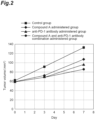
- the mean tumor volumes in each group are shown in Table 2 and Fig. 2 .
- the tumor volumes in the control group and in each group on day 7 were compared in Dunnett's multiple comparison test.
- the final significance level was as follows.
- the antitumor effect of administering compound A and anti-PD-1 antibody was evaluated in BALB/c mice (BALB/cAnNCrlCrlj, female, Japan Charles River) with 10 mice per group.
- the grafted cells were pre-conditioned in BALB/c mice.
- a suspension of the mouse hepatocellular carcinoma cell line BNL 1 ME A.7R.1 (ATCC) was subcutaneously grafted onto the right side of BALB/c mice (BALB/cAnNCrlCrlj, male, Japan Charles River), at 5 ⁇ 10 6 cells per mouse.
- the formed tumors were extracted and finely cut.
- the mixture was then stirred with a GentleMACS (Miltenyi Biotec K.K.) to obtain a monocellular suspension. After passing through a cell strainer, the cells were collected by centrifugation and cultured.
- the mouse hepatocellular carcinoma cell line BNL 1 ME A.7R.1 established by this method was suspended in HBSS to a concentration of 1 ⁇ 10 8 /mL.
- the mixture was subsequently grafted onto the right side of BALB/c (BALB/cAnNCrlCrlj, female, Japan Charles River) in amounts of 0.1 mL each, and the antitumor effect was evaluated.
- Tumor volume mm Long diameter mm ⁇ short diameter mm ⁇ short diameter mm / 2
- Compound A was dissolved in water for injection (Otsuka Pharmaceutical Factory, Inc.) to a concentration of 2.5 mg/mL.
- the anti-mouse PD-1 antibody (BioXcell) was diluted with physiological saline (Otsuka Pharmaceutical Factory, Inc.) to a concentration of 1 mg/mL.
- mice in the compound A administration group were given compound A by oral administration at a dose of 25 mg/kg (10 mL/kg), once per day for 7 days.
- Mice in the anti-PD-1 antibody administration group were intraperitoneally administered a dose of 200 ⁇ g/mouse (200 ⁇ L/mouse) on day 0 and day 3, where the starting day of administration was defined as day 0.
- the mice in the compound A and anti-PD-1 antibody combination group were administered both drugs in the same manner described above.
- the tumor volume of each mouse was measured on day 3 and day 7.
- the mean tumor volumes in each group are shown in Table 3 and Fig. 3 .
Landscapes
- Health & Medical Sciences (AREA)
- Chemical & Material Sciences (AREA)
- Medicinal Chemistry (AREA)
- Life Sciences & Earth Sciences (AREA)
- General Health & Medical Sciences (AREA)
- Animal Behavior & Ethology (AREA)
- Veterinary Medicine (AREA)
- Public Health (AREA)
- Pharmacology & Pharmacy (AREA)
- Organic Chemistry (AREA)
- Epidemiology (AREA)
- Immunology (AREA)
- Nuclear Medicine, Radiotherapy & Molecular Imaging (AREA)
- General Chemical & Material Sciences (AREA)
- Chemical Kinetics & Catalysis (AREA)
- Engineering & Computer Science (AREA)
- Endocrinology (AREA)
- Bioinformatics & Cheminformatics (AREA)
- Genetics & Genomics (AREA)
- Mycology (AREA)
- Biochemistry (AREA)
- Biophysics (AREA)
- Microbiology (AREA)
- Molecular Biology (AREA)
- Proteomics, Peptides & Aminoacids (AREA)
- Reproductive Health (AREA)
- Medicines That Contain Protein Lipid Enzymes And Other Medicines (AREA)
- Medicines Containing Antibodies Or Antigens For Use As Internal Diagnostic Agents (AREA)
- Pharmaceuticals Containing Other Organic And Inorganic Compounds (AREA)
Abstract
Description
- The present invention relates to a pharmaceutical composition for treating tumor which combines the use of a monocyclic pyridine derivative or its pharmaceutically acceptable salt, which acts to inhibit fibroblast growth factor receptor (FGFR), with a PD-1 antagonist. More specifically, it relates to a pharmaceutical composition for treating tumor that comprises 5-((2-(4-(1-(2-hydroxyethyl)piperidin-4-yl)benzamide)pyridin-4-yl)oxy)-6-(2-methoxyethoxy)-N-methyl-1H-indole-1-carboxamide or its pharmaceutically acceptable salt, to be administered in combination with a PD-1 antagonist.
-

- The compound 5-((2-(4-(1-(2-hydroxyethyl)piperidin-4-yl)benzamide)pyridin-4-yl)oxy)-6-(2-methoxyethoxy)-N-methyl-1H-indole-1-carboxamide, represented by formula (I), is known as an inhibitor against fibroblast growth factor receptors (FGFR) 1, 2 and 3, and has been reported to have a cell growth inhibitory effect against stomach cancer, lung cancer, bladder cancer and endometrial cancer (PTL 1). The compound has also been reported to have a high therapeutic effect for bile duct cancer (PTL 2), breast cancer (PTL 3) and hepatocellular carcinoma (PTL 4). Known pharmaceutically acceptable salts of the compound include succinic acid salts and maleic acid salts (PTL 5).
- PD-L1 ligand and PD-L2 ligand that are expressed on tumor cells bind to PD-1 receptor expressed on activated T cells, thereby suppressing the activity of T cells. Anti-PD-1 antibody binds to PD-1 receptor to inhibit binding of PD-L1 ligand and PD-L2 ligand to PD-1 receptor, and thus performs a role in maintaining activation of T cells. The ability of T cells to attack tumor cells is thereby maintained. Drugs that carry out this function are known as immune checkpoint inhibitors, and are used as antitumor agents (NPL 1).
-
- [PTL 1]
U.S. Patent Application Publication No. 2014-235614 - [PTL 2]
U.S. Patent Application Publication No. 2018-0015079 - [PTL 3]
U.S. Patent Application Publication No. 2018-0303817 - [PTL 4]
International Patent Publication No. WO2019/189241 - [PTL 5]
U.S. Patent Application Publication No. 2017-0217935 - [NPL 1] The Journal of Clinical Investigation, Volume 125, Number 9, September 2015
- It is an object of the present invention to provide a pharmaceutical composition for treating tumor to be administered in combination with multiple different drugs.
- As a result of conducting much research in light of the current situation, the present inventors have completed this invention upon finding that the compound represented by formula (I) above exhibits a high therapeutic effect against tumors such as breast cancer when administered in combination with a PD-1 antagonist.
- Specifically, the disclosure provides the following [1] to [93].
- [1] A pharmaceutical composition for treating a tumor, comprising the compound represented by formula (I) or its pharmaceutically acceptable salt, which is to be administered in combination with a PD-1 antagonist.

- [2] A pharmaceutical composition for treating a tumor, comprising a PD-1 antagonist, which is to be administered in combination with the compound represented by formula (I) or its pharmaceutically acceptable salt.

- [3] The pharmaceutical composition according to [1] or [2], wherein the compound represented by formula (I) or its pharmaceutically acceptable salt and the PD-1 antagonist are each administered simultaneously, separately, continuously or at a time difference.
- [4] The pharmaceutical composition according to any one of [1] to [3], wherein the pharmaceutically acceptable salt of the compound represented by formula (I) is a 1.5 succinate.
- [5] The pharmaceutical composition according to [4], wherein the 1.5 succinate of the compound represented by formula (I) is administered at 1 mg to 500 mg per day.
- [6] The pharmaceutical composition according to any one of [1] to [5], wherein the PD-1 antagonist is an anti-PD-1 antibody.
- [7] The pharmaceutical composition according to [6], wherein the anti-PD-1 antibody is selected from the group consisting of Nivolumab, Pembrolizumab, Cemiplimab, Sintilimab, Toripalimab, Spartalizumab, Tislelizumab, Dostarlimab, Camrelizumab, Genolimzumab, Lodapolimab, Retifanlimab, Balstilimab, Serplulimab, Budigalimab, Prolgolimab, Sasanlimab, Cetrelimab, Zimberelimab, Penpulimab, AMP-514, STI-A1110, ENUM388D4, ENUM244C8, GLS010, CS1003, BAT-1306, AK103, BI754091, LZM009, CMAB819, Sym021, SSI-361, JY034, HX008, ISU106 and CX-188.
- [8] The pharmaceutical composition according to [7], wherein the anti-PD-1 antibody is selected from the group consisting of Nivolumab, Pembrolizumab, Cemiplimab, Sintilimab and Toripalimab.
- [9] The pharmaceutical composition according to [8], wherein the anti-PD-1 antibody is Nivolumab.
- [10] The pharmaceutical composition according to [9], wherein the Nivolumab is administered at 3 mg/kg (body weight) per dose at 2-week intervals, 240 mg per dose at 2-week intervals, 360 mg per dose at 3-week intervals or 480 mg per dose at 4-week intervals.
- [11] The pharmaceutical composition according to [8], wherein the anti-PD-1 antibody is Pembrolizumab.
- [12] The pharmaceutical composition according to [11], wherein the Pembrolizumab is administered at 200 mg per dose at 3-week intervals or 400 mg per dose at 6-week intervals.
- [13] The pharmaceutical composition according to any one of [1] to [12], wherein the tumor is breast cancer, stomach cancer, non-small-cell lung cancer, bladder cancer, endometrial cancer, hepatocellular carcinoma, bile duct cancer, melanoma, esophageal cancer, colorectal cancer, renal cell carcinoma, head and neck cancer, pleural mesothelioma or Hodgkin's lymphoma.
- [14] The pharmaceutical composition according to any one of [1] to [12], wherein the tumor is breast cancer, stomach cancer, non-small-cell lung cancer, bladder cancer, endometrial cancer, hepatocellular carcinoma or bile duct cancer.
- [15] The pharmaceutical composition according to any one of [1] to [12], wherein the tumor is breast cancer.
- [16] The pharmaceutical composition according to any one of [13] to [15], wherein the breast cancer is locally advanced breast cancer, metastatic breast cancer or recurrent breast cancer.
- [17] The pharmaceutical composition according to any one of [13] to [16], wherein the breast cancer expresses fibroblast growth factor receptor (FGFR).
- [18] The pharmaceutical composition according to [17], wherein the FGFR is FGFR1, FGFR2 or FGFR3.
- [19] A therapeutic agent for a tumor, comprising the compound represented by formula (I) or its pharmaceutically acceptable salt, which is to be administered in combination with a PD-1 antagonist.

- [20] A therapeutic agent for a tumor, comprising a PD-1 antagonist, which is to be administered in combination with the compound represented by formula (I) or its pharmaceutically acceptable salt.

- [21] The therapeutic agent for a tumor according to [19] or [20], wherein the compound represented by formula (I) or its pharmaceutically acceptable salt and the PD-1 antagonist are each administered simultaneously, separately, continuously or at a time difference.
- [22] The therapeutic agent for a tumor according to any one of [19] to [21], wherein the pharmaceutically acceptable salt of the compound represented by formula (I) is a 1.5 succinate.
- [23] The therapeutic agent for a tumor according to [22], wherein the 1.5 succinate of the compound represented by formula (I) is administered at 1 mg to 500 mg per day.
- [24] The therapeutic agent for a tumor according to any one of [19] to [23], wherein the PD-1 antagonist is an anti-PD-1 antibody.
- [25] The therapeutic agent for a tumor according to [24], wherein the anti-PD-1 antibody is selected from the group consisting of Nivolumab, Pembrolizumab, Cemiplimab, Sintilimab, Toripalimab, Spartalizumab, Tislelizumab, Dostarlimab, Camrelizumab, Genolimzumab, Lodapolimab, Retifanlimab, Balstilimab, Serplulimab, Budigalimab, Prolgolimab, Sasanlimab, Cetrelimab, Zimberelimab, Penpulimab, AMP-514, STI-A1110, ENUM388D4, ENUM244C8, GLS010, CS1003, BAT-1306, AK103, BI754091, LZM009, CMAB819, Sym021, SSI-361, JY034, HX008, ISU106 and CX-188.
- [26] The therapeutic agent for a tumor t according to [25], wherein the anti-PD-1 antibody is selected from the group consisting of Nivolumab, Pembrolizumab, Cemiplimab, Sintilimab and Toripalimab.
- [27] The therapeutic agent for a tumor according to [26], wherein the anti-PD-1 antibody is Nivolumab.
- [28] The therapeutic agent for a tumor according to [27], wherein the Nivolumab is administered at 3 mg/kg (body weight) per dose at 2-week intervals, 240 mg per dose at 2-week intervals, 360 mg per dose at 3-week intervals or 480 mg per dose at 4-week intervals.
- [29] The therapeutic agent for a tumor according to [26], wherein the anti-PD-1 antibody is Pembrolizumab.
- [30] The therapeutic agent for a tumor according to [29], wherein the Pembrolizumab is administered at 200 mg per dose at 3-week intervals or 400 mg per dose at 6-week intervals.
- [31] The therapeutic agent for a tumor according to any one of [19] to [30], wherein the tumor is breast cancer, stomach cancer, non-small-cell lung cancer, bladder cancer, endometrial cancer, hepatocellular carcinoma, bile duct cancer, melanoma, esophageal cancer, colorectal cancer, renal cell carcinoma, head and neck cancer, pleural mesothelioma or Hodgkin's lymphoma.
- [32] The therapeutic agent for a tumor according to any one of [19] to [30], wherein the tumor is breast cancer, stomach cancer, non-small-cell lung cancer, bladder cancer, endometrial cancer, hepatocellular carcinoma or bile duct cancer.
- [33] The therapeutic agent for a tumor according to any one of [19] to [30], wherein the tumor is breast cancer.
- [34] The therapeutic agent for a tumor according to any one of [31] to [33], wherein the breast cancer is locally advanced breast cancer, metastatic breast cancer or recurrent breast cancer.
- [35] The therapeutic agent for a tumor according to any one of [31] to [34], wherein the breast cancer expresses fibroblast growth factor receptor (FGFR).
- [36] The therapeutic agent for a tumor according to [35], wherein the FGFR is FGFR1, FGFR2 or FGFR3.
- [37] A method for treating a tumor, which includes administering a pharmaceutically acceptable salt of the compound represented by formula (I) and a PD-1 antagonist to a patient in need thereof.

- [38] The method according to [37], wherein the pharmaceutically acceptable salt of the compound represented by formula (I) and the PD-1 antagonist are each administered simultaneously, separately, continuously or at a time difference.
- [39] The method according to [37] or [38], wherein the pharmaceutically acceptable salt of the compound represented by formula (I) is a 1.5 succinate.
- [40] The method according to [39], wherein the 1.5 succinate of the compound represented by formula (I) is administered at 1 mg to 500 mg per day.
- [41] The method according to any one of [37] to [40], wherein the PD-1 antagonist is an anti-PD-1 antibody.
- [42] The method according to [41], wherein the anti-PD-1 antibody is selected from the group consisting of Nivolumab, Pembrolizumab, Cemiplimab, Sintilimab, Toripalimab, Spartalizumab, Tislelizumab, Dostarlimab, Camrelizumab, Genolimzumab, Lodapolimab, Retifanlimab, Balstilimab, Serplulimab, Budigalimab, Prolgolimab, Sasanlimab, Cetrelimab, Zimberelimab, Penpulimab, AMP-514, STI-A1110, ENUM388D4, ENUM244C8, GLS010, CS1003, BAT-1306, AK103, BI754091, LZM009, CMAB819, Sym021, SSI-361, JY034, HX008, ISU106 and CX-188.
- [43] The method according to [42], wherein the anti-PD-1 antibody is selected from the group consisting of Nivolumab, Pembrolizumab, Cemiplimab, Sintilimab and Toripalimab.
- [44] The method according to [43], wherein the anti-PD-1 antibody is Nivolumab.
- [45] The method according to [44], wherein the Nivolumab is administered at 3 mg/kg (body weight) per dose at 2-week intervals, 240 mg per dose at 2-week intervals, 360 mg per dose at 3-week intervals or 480 mg per dose at 4-week intervals.
- [46] The method according to [43], wherein the anti-PD-1 antibody is Pembrolizumab.
- [47] The method according to [46], wherein the Pembrolizumab is administered at 200 mg per dose at 3-week intervals or 400 mg per dose at 6-week intervals.
- [48] The method according to any one of [37] to [47], wherein the tumor is breast cancer, stomach cancer, non-small-cell lung cancer, bladder cancer, endometrial cancer, hepatocellular carcinoma, bile duct cancer, melanoma, esophageal cancer, colorectal cancer, renal cell carcinoma, head and neck cancer, pleural mesothelioma or Hodgkin's lymphoma.
- [49] The method according to any one of [37] to [47], wherein the tumor is breast cancer, stomach cancer, non-small-cell lung cancer, bladder cancer, endometrial cancer, hepatocellular carcinoma or bile duct cancer.
- [50] The method according to any one of [37] to [47], wherein the tumor is breast cancer.
- [51] The method according to any one of [48] to [50], wherein the breast cancer is locally advanced breast cancer, metastatic breast cancer or recurrent breast cancer.
- [52] The method according to any one of [48] to [51], wherein the breast cancer expresses fibroblast growth factor receptor (FGFR).
- [53] The method according to [52], wherein the FGFR is FGFR1, FGFR2 or FGFR3.
- [54] The use of the compound represented by formula (I) or its pharmaceutically acceptable salt, in the manufacture of a pharmaceutical composition for treating a tumor which is to be administered in combination with a PD-1 antagonist.

- [55] The use of a PD-1 antagonist in the manufacture of a pharmaceutical composition for tumor treatment which is to be administered in combination with the compound represented by formula (I) or its pharmaceutically acceptable salt.

- [56] The use according to [54] or [55], wherein the compound represented by formula (I) or its pharmaceutically acceptable salt and the PD-1 antagonist are each administered simultaneously, separately, continuously or at a time difference.
- [57] The use according to any one of [54] to [56], wherein the pharmaceutically acceptable salt of the compound represented by formula (I) is a 1.5 succinate.
- [58] The use according to [57], wherein the 1.5 succinate of the compound represented by formula (I) is administered at 1 mg to 500 mg per day.
- [59] The use according to any one of [54] to [58], wherein the PD-1 antagonist is an anti-PD-1 antibody.
- [60] The use according to [59], wherein the anti-PD-1 antibody is selected from the group consisting of Nivolumab, Pembrolizumab, Cemiplimab, Sintilimab, Toripalimab, Spartalizumab, Tislelizumab, Dostarlimab, Camrelizumab, Genolimzumab, Lodapolimab, Retifanlimab, Balstilimab, Serplulimab, Budigalimab, Prolgolimab, Sasanlimab, Cetrelimab, Zimberelimab, Penpulimab, AMP-514, STI-A1110, ENUM388D4, ENUM244C8, GLS010, CS1003, BAT-1306, AK103, BI754091, LZM009, CMAB819, Sym021, SSI-361, JY034, HX008, ISU106 and CX-188.
- [61] The use according to [60], wherein the anti-PD-1 antibody is selected from the group consisting of Nivolumab, Pembrolizumab, Cemiplimab, Sintilimab and Toripalimab.
- [62] The use according to [61], wherein the anti-PD-1 antibody is Nivolumab.
- [63] The use according to [62], wherein the Nivolumab is administered at 3 mg/kg (body weight) per dose at 2-week intervals, 240 mg per dose at 2-week intervals, 360 mg per dose at 3-week intervals or 480 mg per dose at 4-week intervals.
- [64] The use according to [61], wherein the anti-PD-1 antibody is Pembrolizumab.
- [65] The use according to [64], wherein the Pembrolizumab is administered at 200 mg per dose at 3-week intervals or 400 mg per dose at 6-week intervals.
- [66] The use according to any one of [54] to [65], wherein the tumor is breast cancer, stomach cancer, non-small-cell lung cancer, bladder cancer, endometrial cancer, hepatocellular carcinoma, bile duct cancer, melanoma, esophageal cancer, colorectal cancer, renal cell carcinoma, head and neck cancer, pleural mesothelioma or Hodgkin's lymphoma.
- [67] The use according to any one of [54] to [66], wherein the tumor is breast cancer, stomach cancer, non-small-cell lung cancer, bladder cancer, endometrial cancer, hepatocellular carcinoma or bile duct cancer.
- [68] The use according to any one of [54] to [67], wherein the tumor is breast cancer.
- [69] The use according to any one of [66] to [68], wherein the breast cancer is locally advanced breast cancer, metastatic breast cancer or recurrent breast cancer.
- [70] The use according to any one of [66] to [69], wherein the breast cancer expresses fibroblast growth factor receptor (FGFR).
- [71] The use according to [70], wherein the FGFR is FGFR1, FGFR2 or FGFR3.
- [72] The compound represented by formula (I) or its pharmaceutically acceptable salt for use in treating a tumor, which is to be administered in combination with a PD-1 antagonist.

- [73] A PD-1 antagonist for use in treating a tumor, which is to be administered in combination with the compound represented by formula (I) or its pharmaceutically acceptable salt.

- [74] The compound represented by formula (I) or its pharmaceutically acceptable salt or the PD-1 antagonist according to [72] or [73], wherein the compound represented by formula (I) or its pharmaceutically acceptable salt and the PD-1 antagonist are each administered simultaneously, separately, continuously or at a time difference.
- [75] The compound represented by formula (I) or its pharmaceutically acceptable salt or the PD-1 antagonist according to any one of [72] to [74], wherein the pharmaceutically acceptable salt of the compound represented by formula (I) is a 1.5 succinate.
- [76] The compound represented by formula (I) or its pharmaceutically acceptable salt or the PD-1 antagonist according to [75], wherein the 1.5 succinate of the compound represented by formula (I) is administered at 1 mg to 500 mg per day.
- [77] The compound represented by formula (I) or its pharmaceutically acceptable salt or the PD-1 antagonist according to any one of [72] to [76], wherein the PD-1 antagonist is an anti-PD-1 antibody.
- [78] The compound represented by formula (I) or its pharmaceutically acceptable salt or the PD-1 antagonist according to [77], wherein the anti-PD-1 antibody is selected from the group consisting of Nivolumab, Pembrolizumab, Cemiplimab, Sintilimab, Toripalimab, Spartalizumab, Tislelizumab, Dostarlimab, Camrelizumab, Genolimzumab, Lodapolimab, Retifanlimab, Balstilimab, Serplulimab, Budigalimab, Prolgolimab, Sasanlimab, Cetrelimab, Zimberelimab, Penpulimab, AMP-514, STI-A1110, ENUM388D4, ENUM244C8, GLS010, CS1003, BAT-1306, AK103, BI754091, LZM009, CMAB819, Sym021, SSI-361, JY034, HX008, ISU106 and CX-188.
- [79] The compound represented by formula (I) or its pharmaceutically acceptable salt or the PD-1 antagonist according to [78], wherein the anti-PD-1 antibody is selected from the group consisting of Nivolumab, Pembrolizumab, Cemiplimab, Sintilimab and Toripalimab.
- [80] The compound represented by formula (I) or its pharmaceutically acceptable salt or the PD-1 antagonist according to [79], wherein the anti-PD-1 antibody is Nivolumab.
- [81] The compound represented by formula (I) or its pharmaceutically acceptable salt or the PD-1 antagonist according to [80], wherein the Nivolumab is administered at 3 mg/kg (body weight) per dose at 2-week intervals, 240 mg per dose at 2-week intervals, 360 mg per dose at 3-week intervals or 480 mg per dose at 4-week intervals.
- [82] The compound represented by formula (I) or its pharmaceutically acceptable salt or the PD-1 antagonist according to [79], wherein the anti-PD-1 antibody is Pembrolizumab.
- [83] The compound represented by formula (I) or its pharmaceutically acceptable salt or the PD-1 antagonist according to [82], wherein the Pembrolizumab is administered at 200 mg per dose at 3-week intervals or 400 mg per dose at 6-week intervals.
- [84] The compound represented by formula (I) or its pharmaceutically acceptable salt or the PD-1 antagonist according to any one of [72] to [83], wherein the tumor is breast cancer, stomach cancer, non-small-cell lung cancer, bladder cancer, endometrial cancer, hepatocellular carcinoma, bile duct cancer, melanoma, esophageal cancer, colorectal cancer, renal cell carcinoma, head and neck cancer, pleural mesothelioma or Hodgkin's lymphoma.
- [85] Compound represented by formula (I) or its pharmaceutically acceptable salt or the PD-1 antagonist according to any one of [72] to [84], wherein the tumor is breast cancer, stomach cancer, non-small-cell lung cancer, bladder cancer, endometrial cancer, hepatocellular carcinoma or bile duct cancer.
- [86] The compound represented by formula (I) or its pharmaceutically acceptable salt or the PD-1 antagonist according to any one of [72] to [85], wherein the tumor is breast cancer.
- [87] The compound represented by formula (I) or its pharmaceutically acceptable salt or the PD-1 antagonist according to any one of [84] to [86], wherein the breast cancer is locally advanced breast cancer, metastatic breast cancer or recurrent breast cancer.
- [88] The compound represented by formula (I) or its pharmaceutically acceptable salt or the PD-1 antagonist according to any one of [84] to [87], wherein the breast cancer expresses fibroblast growth factor receptor (FGFR).
- [89] The compound represented by formula (I) or its pharmaceutically acceptable salt or the PD-1 antagonist according to [88], wherein the FGFR is FGFR1, FGFR2 or FGFR3.
- [90] A kit for treating a tumor which is provided with a formulation comprising the compound represented by formula (I) or its pharmaceutically acceptable salt, and a formulation comprising a PD-1 antagonist.

- [91] The kit according to [90], wherein the compound represented by formula (I) or its pharmaceutically acceptable salt and the PD-1 antagonist are each administered simultaneously, separately, continuously or at a time difference.
- [92] A combination for treating a tumor that includes the compound represented by formula (I) or its pharmaceutically acceptable salt, and a PD-1 antagonist.

- [93] The combination according to [92], wherein the compound represented by formula (I) or its pharmaceutically acceptable salt and the PD-1 antagonist are each administered simultaneously, separately, continuously or at a time difference.
- By administering a combination of the compound represented by formula (I) and a PD-1 antagonist it is possible to exhibit an effect of reducing tumor volume for tumors such as breast cancer.
-
-
Fig. 1 is a graph showing transition of mean tumor volume of different groups after initiating drug administration, for Example 1. -
Fig. 2 is a graph showing transition of mean tumor volume of different groups after initiating drug administration, for Example 2. -
Fig. 3 is a graph showing transition of mean tumor volume of different groups after initiating drug administration, for Example 3. - The compound represented by formula (I) and its pharmaceutically acceptable salts according to the disclosure can be produced by the methods described in
PTL 1. - As used herein, "pharmaceutically acceptable salt" refers to a salt of an inorganic acid, a salt of an organic acid, or a salt of an acidic amino acid, for example, which are pharmaceutically acceptable salts. Solvates of pharmaceutically acceptable salts of the compound of the disclosure, such as anhydrides and hydrates of the pharmaceutically acceptable salts, are also included.
- Examples of salts with inorganic acids include salts with hydrochloric acid, hydrobromic acid, sulfuric acid, nitric acid and phosphoric acid.
- Examples of salts with organic acids include salts with acetic acid, succinic acid, fumaric acid, maleic acid, tartaric acid, citric acid, lactic acid, stearic acid, benzoic acid, methanesulfonic acid, ethanesulfonic acid and p-toluenesulfonic acid.
- Examples of salts with acidic amino acids include salts with aspartic acid and glutamic acid.
- According to one embodiment, the pharmaceutically acceptable salt is a succinic acid salt or maleic acid salt. According to another embodiment, the pharmaceutically acceptable salt is a succinic acid salt. According to yet another embodiment, the pharmaceutically acceptable salt is a 1.5 succinate (hereunder, the 1.5 succinate of the compound represented by formula (I) will be referred to as "compound A").
- The compound represented by formula (I) or its pharmaceutically acceptable salt according to the disclosure may be administered by injection (intravenous injection, intraarterial injection or local injection), or by an oral, intranasal, transdermal or transpulmonary route, or by eye drop, and for example, injection may be intravenous injection, subcutaneous injection, intradermal injection or intraarterial injection, or local injection into the target cells or organ. The dosage form of the compound represented by formula (I) or its pharmaceutically acceptable salt for oral administration may be a tablet, powder, granules, syrup, capsule or internal liquid drug, for example. The dosage form of the compound represented by formula (I) or its pharmaceutically acceptable salt for parenteral administration may also be injection, drip, eye drop, ointment, suppository, suspension, poultice, lotion, aerosol or plaster, or it may be injection or drip, according to one embodiment. The compound represented by formula (I) or its pharmaceutically acceptable salt according to the disclosure can be formulated by a method described in Japanese Pharmacopoeia, 17th Edition (JP), U.S. Pharmacopeia (USP) or European Pharmacopeia (EP), for example.
- The dose of the compound represented by formula (I) or pharmaceutically acceptable salt may be appropriately selected according to the severity of symptoms, the age, gender, body weight and sensitivity of the patient, the method of administration, the period of administration, the interval of administration and the type of medical formulation. The number of doses and frequency of administration of the pharmaceutical composition of the disclosure may be determined by a person skilled in the art as an appropriate and suitable number of doses and frequency of administration for the conditions under which the immune checkpoint inhibitor is to be administered (the dose interval, number of doses and administration period). For oral administration to an adult (60 kg body weight), the dose will generally be 1 mg to 500 mg per day, being 10 mg to 300 mg according to one embodiment, or 20 mg to 200 mg according to another embodiment. It may be administered as 1 to 3 dosages per day.
- The PD-1 antagonist of the disclosure may include any compound or biomolecule that blocks binding of PD-L1 expressed by cancer cells to PD-1 expressed on immunocytes (T cells, B cells or Natural Killer T (NKT) cells), or that blocks binding of PD-L2 expressed by cancer cells to PD-1 expressed on immunocytes. The PD-1 antagonist blocks binding of human PD-L1 to human PD-1, and according to one embodiment it blocks binding of both human PD-L1 and PD-L2 to human PD-1. The amino acid sequence of human PD-1 can be confirmed at NCBI Locus No.: NP_005009. The amino acid sequences of human PD-L1 and PD-L2 can be confirmed as NCBI Locus No.: NP_054862 and NP_079515, respectively.
- The PD-1 antagonist of the disclosure may also include a monoclonal antibody (mAb) that specifically binds to PD-1 or PD-L1, or specifically binds to human PD-1 or human PD-L1, or its antigen-binding fragment. The mAb may be a human antibody, humanized antibody or chimeric antibody, and it may also include the human constant region. The human constant region is selected from the group consisting of the IgG1, IgG2, IgG3 and IgG4 constant regions, and according to one embodiment the human constant region is the IgG1 or IgG4 constant region. The antigen-binding fragment may be selected from the group consisting of Fab, Fab'-SH, F(ab')2, scFv and Fv fragments.
- An example of a PD-1 antagonist is anti-PD-1 antibody, and according to one embodiment it is anti-human PD-1 antibody, while according to a more specific embodiment it is anti-human PD-1 monoclonal antibody (anti-human PD-1 mAb). Examples of mAb that bind to human PD-1 are described in
US Patent No. 7488802 ,US Patent No. 7521051 ,US Patent No. 8008449 ,US Patent No. 8354509 ,US Patent No. 8168757 ,International Patent Publication No. WO2004/004771 ,International Patent Publication No. WO2004/072286 ,International Patent Publication No. WO2004/056875 andU.S. Patent Application Publication No. 2011/0271358 . When the PD-1 antagonist is an anti-human PD-1 monoclonal antibody, "anti-human PD-1 monoclonal antibody" includes Nivolumab, Pembrolizumab, Cemiplimab, Sintilimab and Toripalimab. When the PD-1 antagonist is an anti-PD-1 antibody, "anti-PD-1 antibody" further includes Spartalizumab, Tislelizumab, Dostarlimab, Camrelizumab, Genolimzumab, Lodapolimab, Retifanlimab, Balstilimab, Serplulimab, Budigalimab, Prolgolimab, Sasanlimab, Cetrelimab, Zimberelimab, Penpulimab, AMP-514, STI-A1110, ENUM388D4, ENUM244C8, GLS010, CS1003, BAT-1306, AK103, BI754091, LZM009, CMAB819, Sym021, SSI-361, JY034, HX008, ISU106 and CX-188. - Another example of a PD-1 antagonist is anti-PD-L1 antibody, and according to one embodiment it is anti-human PD-L1 antibody, while according to a more specific embodiment it is anti-human PD-L1 monoclonal antibody (anti-human PD-L1 mAb). When the PD-1 antagonist is an anti-PD-L1 antibody, "anti-PD-L1 antibody" includes Atezolizumab, Avelumab, Durvalumab, Manelimab, Pacmilimab, Envafolimab, Cosibelimab, BMS-936559, STI-1014, KN035, LY33,00054, HLX20, SHR-1316, CS1001, MSB2311, BGB-A333 and KL-A16.
- The PD-1 antagonist of the disclosure may be administered by injection (intravenous injection, intraarterial injection or local injection), or by an oral, intranasal, transdermal or transpulmonary route, or by eye drop, and for example, injection may be intravenous injection, subcutaneous injection, intradermal injection or intraarterial injection, or local injection into the target cells or organ. The dosage form of a formulation comprising the PD-1 antagonist for oral administration may be a tablet, powder, granules, syrup, capsule or internal liquid drug, for example. The dosage form of a formulation comprising the PD-1 antagonist for parenteral administration may be injection, drip, eye drop, ointment, suppository, suspension, poultice, lotion, aerosol or plaster, or it may be injection or drip, according to one embodiment. The PD-1 antagonist of the disclosure can be formulated by a method described in Japanese Pharmacopoeia, 17th Edition (JP), U.S. Pharmacopeia (USP) or European Pharmacopeia (EP), for example.
- When the PD-1 antagonist is an anti-PD-1 antibody, the anti-PD-1 antibody may be provided as a liquid drug, or it may be prepared as a liquid solution of freeze-dried powder in sterile water for injection before use.
- When an anti-human PD-1 mAb, as a PD-1 antagonist, is to be administered as a single agent to a patient, the dose will differ significantly depending on the type of disease being treated, and the age, gender, body weight and severity of symptoms of the patient. The anti-human PD-1 mAb is administered in a dose of 1, 2, 3, 5 or 10 mg/kg (body weight), at intervals of about 14 days (±2 days), about 21 days (±2 days) or about 30 days (±2 days).
- When Pembrolizumab is administered as a PD-1 antagonist, it may be intravenously administered in a manner and dosage selected from among 1 mg/kg (body weight) at 2-week intervals, 2 mg/kg (body weight) at 2-week intervals, 3 mg/kg (body weight) at 2-week intervals, 5 mg/kg (body weight) at 2-week intervals, 10 mg (body weight) at 2-week intervals, 1 mg/kg (body weight) at 3-week intervals, 2 mg/kg (body weight) at 3-week intervals, 3 mg/kg (body weight) at 3-week intervals, 5 mg/kg (body weight) at 3-week intervals and 10 mg/kg (body weight) at 3-week intervals. According to another aspect, Pembrolizumab may be intravenously administered at 200 mg per dose at 3-week intervals or 400 mg per dose at 6-week intervals. Pembrolizumab may be administered, for example, as an intravenous infusion of a liquid drug containing Pembrolizumab, L-histidine, L-histidine hydrochloride hydrate, refined sucrose, and
polysorbate 80, over a period of about 30 minutes. - When Nivolumab is administered as a PD-1 antagonist, it may be intravenously administered in a manner and dosage selected from among 1 mg/kg (body weight) at 2-week intervals, 2 mg/kg (body weight) at 2-week intervals, 3 mg/kg (body weight) at 2-week intervals, 4 mg/kg (body weight) at 2-week intervals, 5 mg/kg (body weight) at 2-week intervals, 6 mg/kg (body weight) at 2-week intervals, 1 mg/kg (body weight) at 3-week intervals, 2 mg/kg (body weight) at 3-week intervals, 3 mg/kg (body weight) at 3-week intervals, 4 mg/kg (body weight) at 3-week intervals, 5 mg/kg (body weight) at 3-week intervals, 6 mg/kg (body weight) at 3-week intervals, 8 mg/kg (body weight) at 3-week intervals and 10 mg/kg (body weight) at 3-week intervals. According to another aspect, Nivolumab may be intravenously administered at 240 mg per dose at 2-week intervals, 360 mg per dose at 3-week intervals or 480 mg per dose at 4-week intervals. Nivolumab may be administered, for example as an intravenous infusion of a liquid drug containing Nivolumab, D-mannitol, sodium citrate hydrate, sodium chloride, diethylenetriaminepentaacetic acid,
polysorbate 80 and a pH regulator, over a period of 30 minutes or longer. - When Cemiplimab is administered as the PD-1 antagonist, it may be intravenously administered, for example, at 350 mg per dose at 3-week intervals.
- The pharmaceutical composition for treating a tumor of the disclosure may be orally administered in the form of a solid formulation such as a tablet, granules, fine granules, powder or capsule, or a liquid drug, jelly or syrup. The pharmaceutical composition for treating a tumor of the disclosure may also be parenterally administered in the form of an injection, suppository, ointment or poultice. The pharmaceutical composition for treating a tumor of the disclosure can be formulated by a method described in Japanese Pharmacopoeia, 17th Edition (JP), U.S. Pharmacopeia (USP) or European Pharmacopeia (EP).
- The form of administering the compound represented by formula (I) or its pharmaceutically acceptable salt and the PD-1 antagonist of the disclosure is not particularly restricted, as it is sufficient if the compound represented by formula (I) or its pharmaceutically acceptable salt and the PD-1 antagonist are administered in combination. For example, the compound represented by formula (I) or its pharmaceutically acceptable salt and the PD-1 antagonist may each be administered to a patient simultaneously, separately, continuously or at a time difference. The term "simultaneously" may mean that each component is administered within the same time period or exactly at the same time, or via the same route of administration. The term may also mean that both components are administered without a notable interval so that they can exhibit an additive effect, and preferably a synergistic effect. The term "separately" means that the components are administered at different intervals or at different frequencies, or by different routes of administration. The term "continuously" means that the components are administered during a fixed period by either the same route or different routes of administration, in any order. The phrase "at a time difference" means that the components are administered over different intervals for the respective components, by either the same route or different routes of administration. When the PD-1 antagonist is administered during a period of one cycle of administration of the compound represented by formula (I) or its pharmaceutically acceptable salt, or during a period of repeated cycles, this is considered to be administration of both in combination.
- There is no particular restriction on the manner of combination of the compound represented by formula (I) or its pharmaceutically acceptable salt with the PD-1 antagonist, and any method known to those skilled in the art may be used.
- The type of tumor to be treated by the pharmaceutical composition for treating a tumor of the disclosure is not particularly restricted, and may be breast cancer, stomach cancer, non-small-cell lung cancer, bladder cancer, endometrial cancer, hepatocellular carcinoma, bile duct cancer, melanoma, esophageal cancer, colorectal cancer, renal cell carcinoma, head and neck cancer, pleural mesothelioma or Hodgkin's lymphoma, for example. According to one embodiment, the tumor to be treated is breast cancer, stomach cancer, non-small-cell lung cancer, bladder cancer, endometrial cancer, hepatocellular carcinoma or bile duct cancer. According to another embodiment, the tumor to be treated is breast cancer.
- Non-small-cell lung cancer, for the purpose of the present specification, includes lung squamous cell carcinoma. Bile duct cancer, for the purpose of the present specification, includes intrahepatic cholangiocarcinoma, extrahepatic cholangiocarcinoma, cystic duct cancer, gallbladder cancer and duodenal papilla cancer. Hepatocellular carcinoma, for the purpose of the present specification, means a benign or malignant tumor developing in liver cells. Breast cancer, for the purpose of the present specification, means a benign or malignant tumor developing in the mammary glands (lactiferous ducts or lobules). Included in this definition are locally advanced breast cancer, metastatic breast cancer, recurrent breast cancer and unresectable breast cancer.
- The present invention will now be explained in greater detail by the following examples. However, various other embodiments of the present invention may be implemented, and the invention is not to be interpreted as being limited to the Examples described herein.
- The antitumor effect of administering compound A and anti-PD-1 antibody was evaluated in BALB/c mice (BALB/cAnNCrlCrlj, female, Japan Charles River) with 6 mice per group.
- The mouse breast cancer cell line 4T1 (ATCC) was seeded in a 6-well microplate (Falcon), at a cell count of 1.5 × 10⁵ per well. The culture medium used was RPMI-1640 medium containing 10% FBS, penicillin, streptomycin and 2-mercaptoethanol (FujiFilm-Wako). The seeded cells were cultured overnight using an incubator under conditions of 5% CO2, 37°C. The culture medium was replaced on the following day.
- Vector pPBcmvIP-mcs was constructed from PB-CMV-MCS-EF1α-Puro vector (SBI; Catalog No.: PB510B-1), removing EF1-Puro and substituting IRES-Puro. A Luc2/AcGFP fusion gene was then inserted between the pPBcmvIP-mcs CMV promoter and IRES to express Luciferase (Luc) and Green Fluorescent Protein (GFP), to obtain vector pPBcmvIP Luc2-AcGFP. During the process of constructing each vector, insertion of the separated fragments was confirmed by an established method.
- The vector pPBcmvIP Luc2-AcGFP in 10 mM Tris-Cl (pH 8.0) and 1 mM EDTA (pH 8.0) ("TE Buffer") (1.67 µg), Super PiggyBac Transposase Expression Vector (System Biosciences, LLC) in TE Buffer (0.33 µg) and X-treamGene reagent (Roche) (8 µL) were mixed, and the mixture was adjusted to a total amount of 210 µL with Opti-MEM (Thermo Fischer Scientific). The obtained mixture was allowed to stand at room temperature for 15 minutes, and then added to the cultured 4T1 cells. The medium was exchanged and subculturing was carried out in a T75 flask, after which culturing was continued under conditions of 5% CO2, 37°C. After 4 days, culturing was carried out in 2 µg/mL puromycin-containing medium.
- Cells were selected twice with a flow cytometer, using AcGFP positivity as the marker. A mycoplasma removal reagent was added to the cells and culturing was continued for 8 days.
- Cells of the mouse breast cancer cell line 4T1-Luc2 AcGFP established by the method described above were suspended in HBSS (FujiFilm-Wako) to a concentration of 2 × 10⁷/mL. The mixture was grafted into mammary gland fat of BALB/c (BALB/cAnNCrlCrlj, female, Japan Charles River) in amounts of 0.05 mL each, and the antitumor effect was evaluated.
- On the 4th day after grafting, the long and short diameters of the tumors were measured using an electronic digital caliper (Digimatic™ caliper by Mitsutoyo Corp.). The mice were divided into groups in such a manner that the average tumor volumes were the same in each group. The tumor volumes were calculated by the following formula.

- Compound A was dissolved in water for injection (Otsuka Pharmaceutical Factory, Inc.) to a concentration of 2.5 mg/mL. The anti-mouse PD-1 antibody (BioXcell) was diluted with PBS(-) (FujiFilm-Wako) to a concentration of 1 mg/mL.
- Mice in the compound A administration group were given compound A by oral administration at a dose of 25 mg/kg (10 mL/kg), once per day for 14 days. Mice in the anti-PD-1 antibody administration group were intraperitoneally administered a dose of 0.2 mg/mouse on
day 0,day 4,day 7 andday 11, where the starting day of administration was defined asday 0. The mice in the compound A and anti-PD-1 antibody combination group were administered both drugs in the same manner described above. - With the starting day of administration defined as
day 0, the tumor volume of each mouse was measured onday 4,day 7,day 11 andday 14. The mean tumor volumes in each group are shown in Table 1.Fig. 1 shows the mean measurement results for tumor volume. The tumor volume onday 14 was statistically analyzed by a One-way ANOVA statistical test, or if no significant result was found in the test, by the Tukey-Kramer method. The final significance level was as follows. - As a result, a markedly superior antitumor effect was seen in the compound A and anti-PD-1 antibody combination group compared to the control group and the groups administered each agent alone.
[Table 1] Day 0Day 4Day 7Day 11Day 14Control group (mm3) 78.6 221.7 375.1 546.8 741.7 Compound A administered group (mm3) 77.3 139.0 131.2 226.0 314.6 Anti-mouse PD-1 antibody administered group (mm3) 82.1 203.7 310.3 560.9 763.6 Compound A and anti-mouse PD-1 antibody combination administered group (mm3) 78.1 118.3 102.5 130.0 165.9 - The antitumor effect of administering compound A and anti-PD-1 antibody was evaluated in BALB/c mice (BALB/cAnNCrlCrlj, female, Japan Charles River) with 10 mice per group.
- The grafted cells were pre-conditioned in BALB/c mice. The mouse renal cell carcinoma cell line RAG (ATCC) was suspended in HBSS to a concentration of 2 × 10⁸/mL. An equal volume of Matrigel™ matrix (Japan Becton Dickinson) was added to and thoroughly mixed with the suspension. The mixture was subcutaneously grafted on the right side of BALB/c mice (BALB/cAnNCrlCrlj, female, Japan Charles River), at 0.1 mL each. After grafting, the formed tumors were extracted and finely cut. A Tumor Dissociation Kit, Mouse (Miltenyi Biotec K.K.) was then used for stirring in a GentleMACS (Miltenyi Biotec K.K.) to obtain a monocellular suspension. After passing through a 70 µm cell strainer, the cells were collected by centrifugation and cultured in medium containing 10% bovine serum.
- The mouse renal cell carcinoma cell line RAG established by this method was suspended in HBSS to a concentration of 2.5 × 10⁷/mL. The mixture was subsequently grafted onto the right side of BALB/c (BALB/cAnNCrlCrlj, female, Japan Charles River) in amounts of 0.1 mL each, and the antitumor effect was evaluated.
- On the 7th day after grafting, the long and short diameters of the tumors were measured using an electronic digital caliper (Digimatic™ caliper by Mitsutoyo Corp.). The mice were divided into groups in such a manner that the average tumor volumes were the same in each group. The tumor volumes were calculated by the following formula.

- Compound A was dissolved in water for injection (Otsuka Pharmaceutical Factory, Inc.) to a concentration of 2.5 mg/mL. The anti-mouse PD-1 antibody (BioXcell) was diluted with physiological saline (Otsuka Pharmaceutical Factory, Inc.) to a concentration of 1 mg/mL.
- Mice in the compound A administration group were given compound A by oral administration at a dose of 25 mg/kg (10 mL/kg), once per day for 7 days. Mice in the anti-PD-1 antibody administration group were intraperitoneally administered a dose of 200 µg/mouse (200 µL/mouse) on
day 0 andday 3, where the starting day of administration was defined asday 0. The mice in the compound A and anti-PD-1 antibody combination group were administered both drugs in the same manner described above. - With the starting day of administration defined as
day 0, the tumor volume of each mouse was measured onday 3 andday 7. The mean tumor volumes in each group are shown in Table 2 andFig. 2 . - The tumor volumes in the control group and in each group on
day 7 were compared in Dunnett's multiple comparison test. The final significance level was as follows. - No statistically significant difference was found between the control group and the compound A treatment group, or between the control group and the anti-PD-1 antibody treatment group.
- A markedly superior antitumor effect was seen in the compound A and anti-PD-1 antibody combination group compared to the control group.
[Table 2] Day 0Day 3Day 7Control group (mm3) 61.6 91.1 132.8 Compound A administered group (mm3) 58.8 72.5 107.5 Anti-mouse PD-1 antibody administered group (mm3) 58.7 68.8 96.6 Compound A and anti-mouse PD-1 antibody combination administered group (mm3) 58.9 68.6 86.0 - The antitumor effect of administering compound A and anti-PD-1 antibody was evaluated in BALB/c mice (BALB/cAnNCrlCrlj, female, Japan Charles River) with 10 mice per group.
- The grafted cells were pre-conditioned in BALB/c mice. A suspension of the mouse hepatocellular carcinoma
cell line BNL 1 ME A.7R.1 (ATCC) was subcutaneously grafted onto the right side of BALB/c mice (BALB/cAnNCrlCrlj, male, Japan Charles River), at 5 × 10⁶ cells per mouse. After grafting, the formed tumors were extracted and finely cut. The mixture was then stirred with a GentleMACS (Miltenyi Biotec K.K.) to obtain a monocellular suspension. After passing through a cell strainer, the cells were collected by centrifugation and cultured. - The mouse hepatocellular carcinoma
cell line BNL 1 ME A.7R.1 established by this method was suspended in HBSS to a concentration of 1 × 10⁸/mL. The mixture was subsequently grafted onto the right side of BALB/c (BALB/cAnNCrlCrlj, female, Japan Charles River) in amounts of 0.1 mL each, and the antitumor effect was evaluated. - On the 4th day after grafting, the long and short diameters of the tumors were measured using an electronic digital caliper (Digimatic™ caliper by Mitsutoyo Corp.). The mice were divided into groups in such a manner that the average tumor volumes were the same in each group. The tumor volumes were calculated by the following formula.

- Compound A was dissolved in water for injection (Otsuka Pharmaceutical Factory, Inc.) to a concentration of 2.5 mg/mL. The anti-mouse PD-1 antibody (BioXcell) was diluted with physiological saline (Otsuka Pharmaceutical Factory, Inc.) to a concentration of 1 mg/mL.
- Mice in the compound A administration group were given compound A by oral administration at a dose of 25 mg/kg (10 mL/kg), once per day for 7 days. Mice in the anti-PD-1 antibody administration group were intraperitoneally administered a dose of 200 µg/mouse (200 µL/mouse) on
day 0 andday 3, where the starting day of administration was defined asday 0. The mice in the compound A and anti-PD-1 antibody combination group were administered both drugs in the same manner described above. - With the starting day of administration defined as
day 0, the tumor volume of each mouse was measured onday 3 andday 7. The mean tumor volumes in each group are shown in Table 3 andFig. 3 . - The tumor volumes in the control group and in each group on
day 7 were compared in Dunnett's multiple comparison test. The final significance level was as follows. - Control group and combination group comparison: p=0.0024
- No statistically significant difference was found between the control group and the compound A treatment group, or between the control group and the anti-PD-1 antibody treatment group.
- A markedly superior antitumor effect was seen in the compound A and anti-PD-1 antibody combination group compared to the control group.
[Table 3] Day 0Day 3Day 7Control group (mm3) 108.9 246.7 264.4 Compound A administered group (mm3) 109.0 223.6 221.4 Anti-mouse PD-1 antibody administered group (mm3) 109.0 238.9 262.5 Compound A and anti-mouse PD-1 antibody combination administered group (mm3) 109.0 192.3 147.0
Claims (13)
- A pharmaceutical composition for treating a tumor, comprising 5-((2-(4-(1-(2-hydroxyethyl)piperidin-4-yl)benzamide)pyridin-4-yl)oxy)-6-(2-methoxyethoxy)-N-methyl-1H-indole-1-carboxamide represented by formula (I) or its pharmaceutically acceptable salt, which is to be administered in combination with a PD-1 antagonist.

- A pharmaceutical composition for treating a tumor, comprising a PD-1 antagonist, which is to be administered in combination with 5-((2-(4-(1-(2-hydroxyethyl)piperidin-4-yl)benzamide)pyridin-4-yl)oxy)-6-(2-methoxyethoxy)-N-methyl-1H-indole-1-carboxamide represented by formula (I) or its pharmaceutically acceptable salt.

- The pharmaceutical composition according to claim 1 or 2, wherein the 5-((2-(4-(1-(2-hydroxyethyl)piperidin-4-yl)benzamide)pyridin-4-yl)oxy)-6-(2-methoxyethoxy)-N-methyl-1H-indole-1-carboxamide represented by formula (I) or its pharmaceutically acceptable salt and the PD-1 antagonist are each administered simultaneously, separately, continuously or at a time difference.
- The pharmaceutical composition according to any one of claims 1 to 3, wherein the pharmaceutically acceptable salt of 5-((2-(4-(1-(2-hydroxyethyl)piperidin-4-yl)benzamide)pyridin-4-yl)oxy)-6-(2-methoxyethoxy)-N-methyl-1H-indole-1-carboxamide represented by formula (I) is a 1.5 succinate.
- The pharmaceutical composition according to claim 4, wherein the 1.5 succinate of 5-((2-(4-(1-(2-hydroxyethyl)piperidin-4-yl)benzamide)pyridin-4-yl)oxy)-6-(2-methoxyethoxy)-N-methyl-1H-indole-1-carboxamide represented by formula (I) is administered at 1 mg to 500 mg per day.
- The pharmaceutical composition according to any one of claims 1 to 5, wherein the PD-1 antagonist is an anti-PD-1 antibody.
- The pharmaceutical composition according to claim 6, wherein the anti-PD-1 antibody is selected from the group consisting of Nivolumab, Pembrolizumab, Cemiplimab, Sintilimab, Toripalimab, Spartalizumab, Tislelizumab, Dostarlimab, Camrelizumab, Genolimzumab, Lodapolimab, Retifanlimab, Balstilimab, Serplulimab, Budigalimab, Prolgolimab, Sasanlimab, Cetrelimab, Zimberelimab, Penpulimab, AMP-514, STI-A1110, ENUM388D4, ENUM244C8, GLS010, CS1003, BAT-1306, AK103, BI754091, LZM009, CMAB819, Sym021, SSI-361, JY034, HX008, ISU106 and CX-188.
- The pharmaceutical composition according to any one of claims 1 to 7, wherein the tumor is breast cancer, stomach cancer, non-small-cell lung cancer, bladder cancer, endometrial cancer, hepatocellular carcinoma, bile duct cancer, melanoma, esophageal cancer, colorectal cancer, renal cell carcinoma, head and neck cancer, pleural mesothelioma or Hodgkin's lymphoma.
- The pharmaceutical composition according to any one of claims 1 to 7, wherein the tumor is breast cancer, stomach cancer, non-small-cell lung cancer, bladder cancer, endometrial cancer, hepatocellular carcinoma or bile duct cancer.
- The pharmaceutical composition according to any one of claims 1 to 7, wherein the tumor is breast cancer.
- The pharmaceutical composition according to any one of claims 8 to 10, wherein the breast cancer is locally advanced breast cancer, metastatic breast cancer or recurrent breast cancer.
- The pharmaceutical composition according to any one of claims 8 to 11, wherein the breast cancer expresses fibroblast growth factor receptor (FGFR).
- The pharmaceutical composition according to claim 12, wherein the FGFR is FGFR1, FGFR2 or FGFR3.
Applications Claiming Priority (2)
| Application Number | Priority Date | Filing Date | Title |
|---|---|---|---|
| JP2020180455 | 2020-10-28 | ||
| PCT/JP2021/039490 WO2022092085A1 (en) | 2020-10-28 | 2021-10-26 | Pharmaceutical composition for treating tumors |
Publications (2)
| Publication Number | Publication Date |
|---|---|
| EP4209216A1 true EP4209216A1 (en) | 2023-07-12 |
| EP4209216A4 EP4209216A4 (en) | 2024-10-02 |
Family
ID=81381502
Family Applications (1)
| Application Number | Title | Priority Date | Filing Date |
|---|---|---|---|
| EP21886203.5A Pending EP4209216A4 (en) | 2020-10-28 | 2021-10-26 | PHARMACEUTICAL COMPOSITION FOR THE TREATMENT OF TUMORS |
Country Status (6)
| Country | Link |
|---|---|
| US (1) | US20230330081A1 (en) |
| EP (1) | EP4209216A4 (en) |
| JP (1) | JPWO2022092085A1 (en) |
| CN (1) | CN116390757A (en) |
| TW (1) | TW202233185A (en) |
| WO (1) | WO2022092085A1 (en) |
Families Citing this family (3)
| Publication number | Priority date | Publication date | Assignee | Title |
|---|---|---|---|---|
| CN117281902A (en) * | 2023-11-23 | 2023-12-26 | 广州誉衡生物科技有限公司 | Application of pharmaceutical composition in preparation of melanoma treatment products |
| JP2025160816A (en) * | 2024-04-10 | 2025-10-23 | イミューンオンコ バイオファーマシューティカルズ (シャンハイ) インコーポレイテッド | Combination therapy for classical Hodgkin lymphoma |
| CN119534847B (en) * | 2025-01-19 | 2025-05-09 | 湖南德米特仪器有限公司 | Reagents and methods for detecting monoclonal antibodies and anti-monoclonal antibodies |
Family Cites Families (16)
| Publication number | Priority date | Publication date | Assignee | Title |
|---|---|---|---|---|
| PT1537878E (en) | 2002-07-03 | 2010-11-18 | Ono Pharmaceutical Co | IMMUNOPOTENTIAL COMPOSITIONS |
| WO2004056875A1 (en) | 2002-12-23 | 2004-07-08 | Wyeth | Antibodies against pd-1 and uses therefor |
| WO2004072286A1 (en) | 2003-01-23 | 2004-08-26 | Ono Pharmaceutical Co., Ltd. | Substance specific to human pd-1 |
| PL2161336T5 (en) | 2005-05-09 | 2017-10-31 | Ono Pharmaceutical Co | Human monoclonal antibodies to programmed death 1(PD-1) and methods for treating cancer using anti-PD-1 antibodies alone or in combination with other immunotherapeutics |
| KR101586617B1 (en) | 2007-06-18 | 2016-01-20 | 머크 샤프 앤 도메 비.브이. | Antibodies to human programmed death receptor PD-1 |
| US8168757B2 (en) | 2008-03-12 | 2012-05-01 | Merck Sharp & Dohme Corp. | PD-1 binding proteins |
| PL2342226T3 (en) | 2008-09-26 | 2017-01-31 | Dana-Farber Cancer Institute, Inc. | Human anti-pd-1, pd-l1, and pd-l2 antibodies and uses thereof |
| AR094812A1 (en) | 2013-02-20 | 2015-08-26 | Eisai R&D Man Co Ltd | DERIVED FROM MONOCYCLIC PYRIDINE AS AN FGFR INHIBITOR |
| MX369646B (en) | 2014-08-18 | 2019-11-15 | Eisai R&D Man Co Ltd | Salt of monocyclic pyridine derivative and crystal thereof. |
| WO2016134234A1 (en) * | 2015-02-19 | 2016-08-25 | Bioclin Therapeutics, Inc. | Methods, compositions, and kits for treatment of cancer |
| WO2016140717A1 (en) * | 2015-03-04 | 2016-09-09 | Merck Sharp & Dohme Corp. | Combination of a pd-1 antagonist and a vegfr/fgfr/ret tyrosine kinase inhibitor for treating cancer |
| AU2016237222B2 (en) | 2015-03-25 | 2021-04-29 | Eisai R&D Management Co., Ltd. | Therapeutic agent for bile duct cancer |
| RU2745707C2 (en) * | 2015-11-23 | 2021-03-30 | Файв Прайм Терапьютикс, Инк. | Fgfr2 inhibitors separately or in combination with immunostimulating agents in cancer treatment |
| CA3001969C (en) * | 2015-12-17 | 2023-10-03 | Eisai R&D Management Co., Ltd. | Therapeutic agent for breast cancer |
| JPWO2019189241A1 (en) * | 2018-03-28 | 2021-03-18 | エーザイ・アール・アンド・ディー・マネジメント株式会社 | Hepatocellular carcinoma therapeutic agent |
| US20200277387A1 (en) * | 2019-03-01 | 2020-09-03 | Rainier Therapeutics, Inc. | Methods and compositions for treating cancer |
-
2021
- 2021-10-26 US US18/030,207 patent/US20230330081A1/en active Pending
- 2021-10-26 CN CN202180072012.3A patent/CN116390757A/en active Pending
- 2021-10-26 JP JP2022559159A patent/JPWO2022092085A1/ja active Pending
- 2021-10-26 WO PCT/JP2021/039490 patent/WO2022092085A1/en not_active Ceased
- 2021-10-26 TW TW110139617A patent/TW202233185A/en unknown
- 2021-10-26 EP EP21886203.5A patent/EP4209216A4/en active Pending
Also Published As
| Publication number | Publication date |
|---|---|
| CN116390757A (en) | 2023-07-04 |
| US20230330081A1 (en) | 2023-10-19 |
| EP4209216A4 (en) | 2024-10-02 |
| JPWO2022092085A1 (en) | 2022-05-05 |
| TW202233185A (en) | 2022-09-01 |
| WO2022092085A1 (en) | 2022-05-05 |
Similar Documents
| Publication | Publication Date | Title |
|---|---|---|
| JP6727237B2 (en) | Combination therapy for the treatment of hematological cancers and solid tumors | |
| US12268665B2 (en) | Combination of immunotherapies with MDM2 inhibitors | |
| CA2908954C (en) | Combination therapy comprising a tor kinase inhibitor and an imid compound for treating cancer | |
| KR20130045341A (en) | Administration of hypoxia activated prodrugs and antiangiogenic agents for the treatment of cancer | |
| US20230330081A1 (en) | Pharmaceutical composition for treating tumors | |
| KR20190141666A (en) | Combination Therapy with Anti-AXL Antibody-Drug Conjugates | |
| JP7028765B2 (en) | Benzamide and active compound compositions and methods of use | |
| JP2021522298A (en) | Simultaneous inhibition of PD-1 / PD-L1, TGFβ and DNA-PK for cancer treatment | |
| TW201834696A (en) | Method for treating non-small cell lung cancer by administering EGFR-TKI resistance to anti-HER3 antibody-drug complex | |
| CN110494161A (en) | Combination of anti-PD-L1 antibody and DNA-PK inhibitor for the treatment of cancer | |
| CN112292128A (en) | EP4 inhibitors and uses thereof | |
| JP2022543780A (en) | Combination cancer treatment of anti-galectin 9 antibody and chemotherapeutic agent | |
| TWI781405B (en) | Cancer Combination Therapy Using Sulfamides and Immunomodulators | |
| JP2020502094A (en) | Oxabicycloheptane for modulating the immune response | |
| TW201815417A (en) | Combination use of anti-PD-1 antibody and IDO inhibitor in the preparation of a medicament for the treatment of tumor | |
| KR20210066837A (en) | Combination of PD-1 antagonists, ATR inhibitors and platinizing agents for the treatment of cancer | |
| US20210355235A1 (en) | Compositions and Methods For Treating Cancer with Anti-Renalase antibodies and Anti-PD1 antibodies | |
| CN112915203A (en) | Pharmaceutical composition of quinoline derivative and PD-1 monoclonal antibody | |
| US20250049757A1 (en) | Combinatory therapy for cancer using biphenyl compound and immune checkpoint molecule regulator | |
| CN117677398A (en) | Medicines for the treatment and/or prevention of cancer | |
| RU2820817C2 (en) | Combined treatment of malignant neoplasm using sulphonamide compound and immunoregulator | |
| US20250195473A1 (en) | Combination of immunotherapies with mdm2 inhibitors | |
| CN119744176A (en) | Medicine for treating and/or preventing cancer | |
| WO2025228596A1 (en) | Combination of pm14 and a topoisomerase i inhibitor in the treatment of cancer | |
| HK40013795B (en) | Combination of immunotherapies with mdm2 inhibitors |
Legal Events
| Date | Code | Title | Description |
|---|---|---|---|
| STAA | Information on the status of an ep patent application or granted ep patent |
Free format text: STATUS: THE INTERNATIONAL PUBLICATION HAS BEEN MADE |
|
| PUAI | Public reference made under article 153(3) epc to a published international application that has entered the european phase |
Free format text: ORIGINAL CODE: 0009012 |
|
| STAA | Information on the status of an ep patent application or granted ep patent |
Free format text: STATUS: REQUEST FOR EXAMINATION WAS MADE |
|
| 17P | Request for examination filed |
Effective date: 20230405 |
|
| AK | Designated contracting states |
Kind code of ref document: A1 Designated state(s): AL AT BE BG CH CY CZ DE DK EE ES FI FR GB GR HR HU IE IS IT LI LT LU LV MC MK MT NL NO PL PT RO RS SE SI SK SM TR |
|
| RAP3 | Party data changed (applicant data changed or rights of an application transferred) |
Owner name: EISAI R&D MANAGEMENT CO., LTD. |
|
| DAV | Request for validation of the european patent (deleted) | ||
| DAX | Request for extension of the european patent (deleted) | ||
| A4 | Supplementary search report drawn up and despatched |
Effective date: 20240904 |
|
| RIC1 | Information provided on ipc code assigned before grant |
Ipc: A61K 39/00 20060101ALI20240829BHEP Ipc: A61P 43/00 20060101ALI20240829BHEP Ipc: A61P 35/04 20060101ALI20240829BHEP Ipc: A61P 35/00 20060101ALI20240829BHEP Ipc: A61P 15/00 20060101ALI20240829BHEP Ipc: A61K 45/06 20060101ALI20240829BHEP Ipc: A61K 39/395 20060101ALI20240829BHEP Ipc: A61K 31/4545 20060101AFI20240829BHEP |
|
| STAA | Information on the status of an ep patent application or granted ep patent |
Free format text: STATUS: EXAMINATION IS IN PROGRESS |