EP4209083B1 - Durchführung von ressourcenzuordnung eines mehrsende-/empfangspunktbetriebs zwischen zellen - Google Patents
Durchführung von ressourcenzuordnung eines mehrsende-/empfangspunktbetriebs zwischen zellen Download PDFInfo
- Publication number
- EP4209083B1 EP4209083B1 EP20956495.4A EP20956495A EP4209083B1 EP 4209083 B1 EP4209083 B1 EP 4209083B1 EP 20956495 A EP20956495 A EP 20956495A EP 4209083 B1 EP4209083 B1 EP 4209083B1
- Authority
- EP
- European Patent Office
- Prior art keywords
- pdsch
- index
- ssb
- tci state
- wireless communication
- Prior art date
- Legal status (The legal status is an assumption and is not a legal conclusion. Google has not performed a legal analysis and makes no representation as to the accuracy of the status listed.)
- Active
Links
Images


Classifications
-
- H—ELECTRICITY
- H04—ELECTRIC COMMUNICATION TECHNIQUE
- H04L—TRANSMISSION OF DIGITAL INFORMATION, e.g. TELEGRAPHIC COMMUNICATION
- H04L5/00—Arrangements affording multiple use of the transmission path
- H04L5/003—Arrangements for allocating sub-channels of the transmission path
- H04L5/0044—Allocation of payload; Allocation of data channels, e.g. PDSCH or PUSCH
-
- H—ELECTRICITY
- H04—ELECTRIC COMMUNICATION TECHNIQUE
- H04L—TRANSMISSION OF DIGITAL INFORMATION, e.g. TELEGRAPHIC COMMUNICATION
- H04L5/00—Arrangements affording multiple use of the transmission path
- H04L5/003—Arrangements for allocating sub-channels of the transmission path
- H04L5/0048—Allocation of pilot signals, i.e. of signals known to the receiver
- H04L5/0051—Allocation of pilot signals, i.e. of signals known to the receiver of dedicated pilots, i.e. pilots destined for a single user or terminal
-
- H—ELECTRICITY
- H04—ELECTRIC COMMUNICATION TECHNIQUE
- H04W—WIRELESS COMMUNICATION NETWORKS
- H04W24/00—Supervisory, monitoring or testing arrangements
- H04W24/10—Scheduling measurement reports ; Arrangements for measurement reports
-
- H—ELECTRICITY
- H04—ELECTRIC COMMUNICATION TECHNIQUE
- H04W—WIRELESS COMMUNICATION NETWORKS
- H04W56/00—Synchronisation arrangements
- H04W56/001—Synchronization between nodes
-
- H—ELECTRICITY
- H04—ELECTRIC COMMUNICATION TECHNIQUE
- H04W—WIRELESS COMMUNICATION NETWORKS
- H04W72/00—Local resource management
- H04W72/12—Wireless traffic scheduling
- H04W72/1263—Mapping of traffic onto schedule, e.g. scheduled allocation or multiplexing of flows
- H04W72/1268—Mapping of traffic onto schedule, e.g. scheduled allocation or multiplexing of flows of uplink data flows
-
- H—ELECTRICITY
- H04—ELECTRIC COMMUNICATION TECHNIQUE
- H04W—WIRELESS COMMUNICATION NETWORKS
- H04W72/00—Local resource management
- H04W72/12—Wireless traffic scheduling
- H04W72/1263—Mapping of traffic onto schedule, e.g. scheduled allocation or multiplexing of flows
- H04W72/1273—Mapping of traffic onto schedule, e.g. scheduled allocation or multiplexing of flows of downlink data flows
-
- H—ELECTRICITY
- H04—ELECTRIC COMMUNICATION TECHNIQUE
- H04L—TRANSMISSION OF DIGITAL INFORMATION, e.g. TELEGRAPHIC COMMUNICATION
- H04L5/00—Arrangements affording multiple use of the transmission path
- H04L5/0001—Arrangements for dividing the transmission path
- H04L5/0003—Two-dimensional division
- H04L5/0005—Time-frequency
- H04L5/0007—Time-frequency the frequencies being orthogonal, e.g. OFDM(A) or DMT
- H04L5/001—Time-frequency the frequencies being orthogonal, e.g. OFDM(A) or DMT the frequencies being arranged in component carriers
Definitions
- the disclosure relates generally to wireless communications, including but not limited to systems and methods for resource mapping of inter-cell multi-transmission/reception point (TRP) operation.
- TRP inter-cell multi-transmission/reception point
- the standardization organization Third Generation Partnership Project (3GPP) is currently in the process of specifying a new Radio Interface called 5G New Radio (5G NR) as well as a Next Generation Packet Core Network (NG-CN or NGC).
- 5G NR will have three main components: a 5G Access Network (5G-AN), a 5G Core Network (5GC), and a User Equipment (UE).
- 5G-AN 5G Access Network
- 5GC 5G Core Network
- UE User Equipment
- the elements of the 5GC also called Network Functions, have been simplified with some of them being software based so that they could be adapted according to need.
- VIVO "Discussion on multi-beam enhancement" (3GPP DRAFT; R1-2005363 ), NTT DOCOMO ET AL: "Discussion on multi-beam operation” (3GPP DRAFT; R1-2006717 ), and NOKIA ET AL: "Enhancements to enable inter-cell multi-TRP operations" (3GPP DRAFT; R1-2006845) are related prior art.
- At least one aspect is directed to a system, a method, an apparatus, or a computer-readable medium.
- a wireless communication device may determine at least one resource element that is scheduled for a defined communication associated with a first configuration index, and is assigned for use for at least one signal associated with a second configuration index.
- the wireless communication device may perform the defined communication using resource elements other than the determined at least one resource element.
- the defined communication may include reception of a physical downlink shared channel (PDSCH).
- the at least one signal may include a SS/PBCH block (SSB).
- the first configuration index may be same as the second configuration index.
- the first configuration index or the second configuration index may include a transmission configuration indicator (TCI) state index, a physical cell identity (PCI) index, or a control resource set (CORESET) pool index.
- TCI transmission configuration indicator
- PCI physical cell identity
- CORESET control resource set
- the SSB may be used as or associated with a quasi co-location (QCL) source corresponding to the PDSCH.
- QCL quasi co-location
- the SSB may be used for RRM measurement, or may be configured in a higher-layer parameter MeasObjectNR information element (IE).
- IE MeasObjectNR information element
- the SSB may be indicated in a TCI state of a TCI state list configured by radio resource control (RRC) signalling.
- the TCI state list may be associated with a serving cell of the PDSCH.
- the SSB may be indicated in a TCI state of a TCI state list activated by a media access control control element (MAC CE) signalling.
- the TCI state list may be associated with a bandwidth part (BWP) of the PDSCH.
- the SSB may be indicated in a TCI state indicated by a downlink control information (DCI) signalling.
- the TCI state may be associated with the PDSCH.
- the SSB may be used as a QCL source of a tracking reference signal (TRS) or a channel state information reference signal (CSI-RS) for mobility measurement.
- TRS tracking reference signal
- CSI-RS channel state information reference signal
- the TRS or the CSI-RS may include a QCL source of the PDSCH.
- the SSB may be used for positioning.
- the SSB may be used as or associated with a QCL source corresponding to at least one other signal or channel other than the PDSCH.
- the at least one other signal or channel may include another PDSCH, and a configuration index of the another PDSCH may be same as the first configuration index.
- the first configuration index or the second configuration index may include a transmission configuration indicator (TCI) state index, a physical cell identity (PCI) index, or a control resource set (CORESET) pool index.
- TCI transmission configuration indicator
- PCI physical cell identity
- CORESET control resource set
- the SSB may be used as or associated with a quasi co-location (QCL) source corresponding to the PDSCH.
- QCL quasi co-location
- the SSB may be used for RRM measurement, or may be configured in a higher-layer parameter MeasObjectNR information element (IE).
- IE MeasObjectNR information element
- the SSB may be indicated in a TCI state of a TCI state list configured by radio resource control (RRC) signalling.
- the TCI state list may be associated with a serving cell of the PDSCH.
- the SSB may be indicated in a TCI state of a TCI state list activated by a media access control control element (MAC CE) signalling.
- the TCI state list may be associated with a bandwidth part (BWP) of the PDSCH.
- the SSB may be indicated in a TCI state indicated by a downlink control information (DCI) signalling.
- the TCI state may be associated with the PDSCH.
- the SSB may be used as a QCL source of a tracking reference signal (TRS) or a channel state information reference signal (CSI-RS) for mobility measurement.
- TRS or the CSI-RS may include a QCL source of the PDSCH.
- the SSB may be used for positioning.
- the SSB may be used as or associated with a QCL source corresponding to at least one other signal or channel other than the PDSCH.
- the at least one other signal or channel may include another PDSCH, and a configuration index of the another PDSCH is same as the first configuration index.
- the first configuration index or the second configuration index may include a transmission configuration indicator (TCI) state index, a physical cell identity (PCI) index, or a control resource set (CORESET) pool index.
- TCI transmission configuration indicator
- PCI physical cell identity
- CORESET control resource set
- the CSI-RS may be used as or associated with a quasi co-location (QCL) source corresponding to the PDSCH.
- QCL quasi co-location
- the CSI-RS may be used for mobility measurement, or may be configured in a higher-layer parameter MeasObjectNR information element (IE).
- IE MeasObjectNR information element
- the CSI-RS may be indicated in a TCI state of a TCI state list configured by radio resource control (RRC) signalling, the TCI state list associated with a serving cell of the PDSCH.
- RRC radio resource control
- the CSI-RS may be indicated in a TCI state of a TCI state list activated by a media access control control element (MAC CE) signalling.
- the TCI state list may be associated with a bandwidth part (BWP) of the PDSCH.
- the CSI-RS may be indicated in a TCI state indicated by a downlink control information (DCI) signalling.
- the TCI state may be associated with the PDSCH.
- the CSI-RS may be used for positioning, tracking, or computation of layer 1 reference signal received power (L1-RSRP) or layer 1 signal-to-interference ratio (L1-SINR).
- L1-RSRP layer 1 reference signal received power
- L1-SINR layer 1 signal-to-interference ratio
- the CSI-RS maybe used as or associated with a QCL source corresponding to at least one other signal or channel other than the PDSCH.
- the at least one other signal or channel may include another PDSCH, and a configuration index of the another PDSCH is same as the first configuration index.
- the first configuration index or the second configuration index may include a transmission configuration indicator (TCI) state index, a physical cell identity (PCI) index, or a control resource set (CORESET) pool index.
- TCI transmission configuration indicator
- PCI physical cell identity
- CORESET control resource set
- the CSI-RS may be used as or associated with a quasi co-location QCL source corresponding to the PDSCH.
- the SSB may be used for RRM measurement, or may be configured in a higher-layer parameter MeasObjectNR information element (IE).
- IE MeasObjectNR information element
- the CSI-RS may be indicated in a TCI state of a TCI state list configured by radio resource control (RRC) signalling.
- the TCI state list may be associated with a serving cell of the PDSCH.
- the CSI-RS may be indicated in a TCI state of a TCI state list activated by a media access control control element (MAC CE) signalling.
- the TCI state list may be associated with a bandwidth part (BWP) of the PDSCH.
- the CSI-RS may be indicated in a TCI state indicated by a downlink control information (DCI) signalling.
- the TCI state may be associated with the PDSCH.
- the CSI-RS may be used for positioning, tracking, or computation of layer 1 reference signal received power (L1-RSRP) or layer 1 signal-to-interference ratio (L1-SINR).
- L1-RSRP layer 1 reference signal received power
- L1-SINR layer 1 signal-to-interference ratio
- the CSI-RS may be used as or associated with a QCL) source corresponding to at least one other signal or channel other than the PDSCH.
- the at least one other signal or channel may include another PDSCH, and a configuration index of the another PDSCH is same as the first configuration index.
- the defined communication may include reception of a physical downlink shared channel (PDSCH).
- the at least one signal may include another PDSCH.
- the first configuration index may be same as or different from the second configuration index.
- the first configuration index or the second configuration index may include a transmission configuration indicator (TCI) state index, a physical cell identity (PCI) index, or a control resource set (CORESET) pool index.
- TCI transmission configuration indicator
- PCI physical cell identity
- CORESET control resource set
- the defined communication may include transmission of a physical uplink shared channel (PUSCH).
- the at least one signal may include a sounding reference signal (SRS).
- the first configuration index may be same as the second configuration index.
- the SRS may be indicated in spatial relation information (SRI) index configured by radio resource control (RRC) signalling.
- the spatial relation information (SRI) index may be associated with a serving cell of the PUSCH.
- the SRS may be indicated in spatial relation information activated by a media access control control element (MAC CE) signalling.
- the spatial relation information may be associated with a bandwidth part (BWP) of the PUSCH.
- the SRS may be indicated in spatial relation information (SRI) index indicated by a downlink control information (DCI) signalling.
- the spatial relation information may be associated with the PUSCH.
- the SRS may be used for channel sounding, positioning, antenna switching, carrier switching, computation of reference signal received power (RSRP) or signal and interference to noise ratio (SINR), or configuration of one or more transmit power control (TPC) commands.
- RSRP reference signal received power
- SINR signal and interference to noise ratio
- TPC transmit power control
- the SRS may be used as or associated with a QCL source corresponding to at least one other signal or channel other than the PUSCH.
- the at least one other signal or channel may include another PUSCH, and a configuration index of the another PUSCH is same as the first configuration index.
- the defined communication may include transmission of a physical uplink shared channel (PUSCH).
- the at least one signal may include a sounding reference signal (SRS).
- the first configuration index may be different from the second configuration index.
- the first configuration index or the second configuration index may include spatial relation information (SRI) index, a transmission configuration indicator (TCI) state index, a physical cell identity (PCI) index, or a control resource set (CORESET) pool index.
- SRI spatial relation information
- TCI transmission configuration indicator
- PCI physical cell identity
- CORESET control resource set
- the SRS may be used as or associated with a quasi co-location (QCL) source corresponding to the PUSCH.
- QCL quasi co-location
- the SRS may be used for mobility measurement, or may be configured in a higher-layer parameter MeasObjectNR information element (IE).
- IE MeasObjectNR information element
- the SRS may be indicated in spatial relation information configured by radio resource control (RRC) signalling.
- the spatial relation information (SRI) index may be associated with a serving cell of the PUSCH.
- the SRS may be indicated in spatial relation information activated by a media access control control element (MAC CE) signalling.
- the spatial relation information (SRI) index may be associated with a bandwidth part (BWP) of the PUSCH.
- the SRS may be indicated in spatial relation information indicated by a downlink control information (DCI) signalling.
- DCI downlink control information
- the spatial relation information (SRI) index may be associated with the PUSCH.
- the SRS may be used for channel sounding, positioning, antenna switching, carrier switching, computation of reference signal received power (RSRP) or signal and interference to noise ratio (SINR), or configuration of one or more transmit power control (TPC) commands.
- RSRP reference signal received power
- SINR signal and interference to noise ratio
- TPC transmit power control
- the defined communication may include transmission of a physical uplink shared channel (PUSCH).
- the at least one signal may include another PUSCH.
- the first configuration index may be same as or different from the second configuration index.
- the first configuration index or the second configuration index may include spatial relation information (SRI) index, a transmission configuration indicator (TCI) state index, a physical cell identity (PCI) index, or a control resource set (CORESET) pool index.
- SRI spatial relation information
- TCI transmission configuration indicator
- PCI physical cell identity
- CORESET control resource set
- a wireless communication device may receive, from a wireless communication node, an indication that a set of resources is scheduled for a first defined communication and a second defined communication.
- the first defined communication is associated with a first physical cell identity (PCI) value
- the second defined communication is associated with a second PCI value.
- PCI physical cell identity
- the first defined communication may be one of: a downlink reception or an uplink transmission
- the second defined communication is another of: the downlink reception or the uplink transmission.
- the wireless communication device may deter to perform only one of the first defined communication or the second defined communication, using the scheduled set of resources.
- the wireless communication device may determine that the set of resources is configured or indicated for at least one of: the first defined communication or the first PCI value. In some embodiments, the wireless communication device may determine that the second communication would overlap with the first defined communication in at least part of the set of resources. In some embodiments, the wireless communication device may determine, responsive to the determination that the second communication would overlap with the first defined communication, to perform only the first defined communication, using the scheduled set of resources.
- the first defined communication may include a SS/PBCH block (SSB) that is used for radio resource management (RRM) measurement, or is configured in a higher-layer parameter MeasObjectNR information element (IE).
- the first defined communication may include a channel state information reference signal (CSI-RS) that is used as a quasi co-location (QCL) source of another first defined communication associated with the first PCI value.
- SSB SS/PBCH block
- RRM radio resource management
- IE MeasObjectNR information element
- CSI-RS channel state information reference signal
- QCL quasi co-location
- the second defined communication may include a physical downlink shared channel (PDSCH), a physical uplink shared channel (PUSCH), a preamble random access channel (PRACH), or a sounding reference signal (SRS).
- the first defined communication may include a sounding reference signal (SRS) that is used for radio resource management (RRM) measurement, or is configured in a higher-layer parameter MeasObjectNR information element (IE).
- RRM radio resource management
- the second defined communication may include a physical downlink control channel (PDCCH), a physical downlink shared channel (PDSCH), a channel state information reference signal (CSI-RS), or a downlink positioning reference signal (DL-PRS) which is without a measurement gap.
- PDCH physical downlink control channel
- PDSCH physical downlink shared channel
- CSI-RS channel state information reference signal
- DL-PRS downlink positioning reference signal
- At least one of the first defined communication or the second defined communication may include a plurality of downlink receptions within a reception timing window.
- the wireless communication device may determine that a largest time difference between any two of the plurality of downlink receptions exceeds a cyclic prefix (CP).
- CP cyclic prefix
- the wireless communication device may perform only one of the plurality of downlink receptions within the reception timing window. In some embodiments, the one of the plurality of downlink receptions may have a highest priority among the plurality of downlink receptions. In some embodiments, the reception timing window may include a set of symbols or slots. In some embodiments, the wireless communication device may perform only a subset of the plurality of downlink receptions within the reception timing window.
- the subset of the plurality of downlink receptions may be from a same cell or configured with a same physical cell identity (PCI) value. In some embodiments, the subset of the plurality of downlink receptions may be associated with one or more PCI values. In some embodiments, the reception timing window may include a set of symbols or slots.
- PCI physical cell identity
- a wireless communication node may transmit, to a wireless communication device, an indication that a set of resources is scheduled for a first defined communication and a second defined communication.
- the first defined communication may be associated with a first physical cell identity (PCI) value
- the second defined communication may be associated with a second PCI value.
- PCI physical cell identity
- FIG. 1 illustrates an example wireless communication network, and/or system, 100 in which techniques disclosed herein may be implemented, in accordance with an embodiment of the present disclosure.
- the wireless communication network 100 may be any wireless network, such as a cellular network or a narrowband Internet of things (NB-IoT) network, and is herein referred to as "network 100."
- Such an example network 100 includes a base station 102 (hereinafter “BS 102"; also referred to as wireless communication node) and a user equipment device 104 (hereinafter “UE 104"; also referred to as wireless communication device) that can communicate with each other via a communication link 110 (e.g., a wireless communication channel), and a cluster of cells 126, 130, 132, 134, 136, 138 and 140 overlaying a geographical area 101.
- BS 102 also referred to as wireless communication node
- UE 104" user equipment device
- a communication link 110 e.g., a wireless communication channel
- the BS 102 and UE 104 are contained within a respective geographic boundary of cell 126.
- Each of the other cells 130, 132, 134, 136, 138 and 140 may include at least one base station operating at its allocated bandwidth to provide adequate radio coverage to its intended users.
- the BS 102 may operate at an allocated channel transmission bandwidth to provide adequate coverage to the UE 104.
- the BS 102 and the UE 104 may communicate via a downlink radio frame 118, and an uplink radio frame 124 respectively.
- Each radio frame 118/124 may be further divided into sub-frames 120/127 which may include data symbols 122/128.
- the BS 102 and UE 104 are described herein as non-limiting examples of "communication nodes," generally, which can practice the methods disclosed herein. Such communication nodes may be capable of wireless and/or wired communications, in accordance with various embodiments of the present solution.
- FIG. 2 illustrates a block diagram of an example wireless communication system 200 for transmitting and receiving wireless communication signals (e.g., OFDM/OFDMA signals) in accordance with some embodiments of the present solution.
- the system 200 may include components and elements configured to support known or conventional operating features that need not be described in detail herein.
- system 200 can be used to communicate (e.g., transmit and receive) data symbols in a wireless communication environment such as the wireless communication environment 100 of Figure 1 , as described above.
- the System 200 generally includes a base station 202 (hereinafter “BS 202") and a user equipment device 204 (hereinafter “UE 204").
- the BS 202 includes a BS (base station) transceiver module 210, a BS antenna 212, a BS processor module 214, a BS memory module 216, and a network communication module 218, each module being coupled and interconnected with one another as necessary via a data communication bus 220.
- the UE 204 includes a UE (user equipment) transceiver module 230, a UE antenna 232, a UE memory module 234, and a UE processor module 236, each module being coupled and interconnected with one another as necessary via a data communication bus 240.
- the BS 202 communicates with the UE 204 via a communication channel 250, which can be any wireless channel or other medium suitable for transmission of data as described herein.
- system 200 may further include any number of modules other than the modules shown in Figure 2 .
- modules other than the modules shown in Figure 2 .
- Those skilled in the art will understand that the various illustrative blocks, modules, circuits, and processing logic described in connection with the embodiments disclosed herein may be implemented in hardware, computer-readable software, firmware, or any practical combination thereof. To clearly illustrate this interchangeability and compatibility of hardware, firmware, and software, various illustrative components, blocks, modules, circuits, and steps are described generally in terms of their functionality. Whether such functionality is implemented as hardware, firmware, or software can depend upon the particular application and design constraints imposed on the overall system. Those familiar with the concepts described herein may implement such functionality in a suitable manner for each particular application, but such implementation decisions should not be interpreted as limiting the scope of the present disclosure
- the UE transceiver 230 may be referred to herein as an "uplink" transceiver 230 that includes a radio frequency (RF) transmitter and a RF receiver each comprising circuitry that is coupled to the antenna 232.
- a duplex switch (not shown) may alternatively couple the uplink transmitter or receiver to the uplink antenna in time duplex fashion.
- the BS transceiver 210 may be referred to herein as a "downlink" transceiver 210 that includes a RF transmitter and a RF receiver each comprising circuity that is coupled to the antenna 212.
- a downlink duplex switch may alternatively couple the downlink transmitter or receiver to the downlink antenna 212 in time duplex fashion.
- the operations of the two transceiver modules 210 and 230 may be coordinated in time such that the uplink receiver circuitry is coupled to the uplink antenna 232 for reception of transmissions over the wireless transmission link 250 at the same time that the downlink transmitter is coupled to the downlink antenna 212. Conversely, the operations of the two transceivers 210 and 230 may be coordinated in time such that the downlink receiver is coupled to the downlink antenna 212 for reception of transmissions over the wireless transmission link 250 at the same time that the uplink transmitter is coupled to the uplink antenna 232. In some embodiments, there is close time synchronization with a minimal guard time between changes in duplex direction.
- the UE transceiver 230 and the base station transceiver 210 are configured to communicate via the wireless data communication link 250, and cooperate with a suitably configured RF antenna arrangement 212/232 that can support a particular wireless communication protocol and modulation scheme.
- the UE transceiver 210 and the base station transceiver 210 are configured to support industry standards such as the Long Term Evolution (LTE) and emerging 5G standards, and the like. It is understood, however, that the present disclosure is not necessarily limited in application to a particular standard and associated protocols. Rather, the UE transceiver 230 and the base station transceiver 210 may be configured to support alternate, or additional, wireless data communication protocols, including future standards or variations thereof.
- LTE Long Term Evolution
- 5G 5G
- the BS 202 may be an evolved node B (eNB), a serving eNB, a target eNB, a femto station, or a pico station, for example.
- the UE 204 may be embodied in various types of user devices such as a mobile phone, a smart phone, a personal digital assistant (PDA), tablet, laptop computer, wearable computing device, etc.
- PDA personal digital assistant
- the processor modules 214 and 236 may be implemented, or realized, with a general purpose processor, a content addressable memory, a digital signal processor, an application specific integrated circuit, a field programmable gate array, any suitable programmable logic device, discrete gate or transistor logic, discrete hardware components, or any combination thereof, designed to perform the functions described herein.
- a processor may be realized as a microprocessor, a controller, a microcontroller, a state machine, or the like.
- a processor may also be implemented as a combination of computing devices, e.g., a combination of a digital signal processor and a microprocessor, a plurality of microprocessors, one or more microprocessors in conjunction with a digital signal processor core, or any other such configuration.
- the steps of a method or algorithm described in connection with the embodiments disclosed herein may be embodied directly in hardware, in firmware, in a software module executed by processor modules 214 and 236, respectively, or in any practical combination thereof.
- the memory modules 216 and 234 may be realized as RAM memory, flash memory, ROM memory, EPROM memory, EEPROM memory, registers, a hard disk, a removable disk, a CD-ROM, or any other form of storage medium known in the art.
- memory modules 216 and 234 may be coupled to the processor modules 210 and 230, respectively, such that the processors modules 210 and 230 can read information from, and write information to, memory modules 216 and 234, respectively.
- the memory modules 216 and 234 may also be integrated into their respective processor modules 210 and 230.
- the memory modules 216 and 234 may each include a cache memory for storing temporary variables or other intermediate information during execution of instructions to be executed by processor modules 210 and 230, respectively.
- Memory modules 216 and 234 may also each include non-volatile memory for storing instructions to be executed by the processor modules 210 and 230, respectively.
- the network communication module 218 generally represents the hardware, software, firmware, processing logic, and/or other components of the base station 202 that enable bidirectional communication between base station transceiver 210 and other network components and communication nodes configured to communication with the base station 202.
- network communication module 218 may be configured to support internet or WiMAX traffic.
- network communication module 218 provides an 802.3 Ethernet interface such that base station transceiver 210 can communicate with a conventional Ethernet based computer network.
- the network communication module 218 may include a physical interface for connection to the computer network (e.g., Mobile Switching Center (MSC)).
- MSC Mobile Switching Center
- the Open Systems Interconnection (OSI) Model (referred to herein as, "open system interconnection model”) is a conceptual and logical layout that defines network communication used by systems (e.g., wireless communication device, wireless communication node) open to interconnection and communication with other systems.
- the model is broken into seven subcomponents, or layers, each of which represents a conceptual collection of services provided to the layers above and below it.
- the OSI Model also defines a logical network and effectively describes computer packet transfer by using different layer protocols.
- the OSI Model may also be referred to as the seven-layer OSI Model or the seven-layer model.
- a first layer may be a physical layer.
- a second layer may be a Medium Access Control (MAC) layer.
- MAC Medium Access Control
- a third layer may be a Radio Link Control (RLC) layer.
- a fourth layer may be a Packet Data Convergence Protocol (PDCP) layer.
- PDCP Packet Data Convergence Protocol
- a fifth layer may be a Radio Resource Control (RRC) layer.
- a sixth layer may be a Non Access Stratum (NAS) layer or an Internet Protocol (IP) layer, and the seventh layer being the other layer.
- NAS Non Access Stratum
- IP Internet Protocol
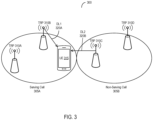
- the system 300 may include at least one serving cell 305A and at least one serving cell 305B.
- the system 300 may include one or more TRPs 310A-D (hereinafter generally referred to as TRPs 310) arranged across the serving cell 305A and the non-serving cell 305B.
- the system 300 may include at least one user equipment (UE) 315 located and supported by the serving cell 305A.
- At least one TRP 310 e.g., the TRP 310B
- the serving cell 305A may have at least one downlink connection (DL1) 320A with the UE 315.
- At least one TRP 310 (e.g., TRP 310C) in the non-serving cell 305B may have at least one downlink connection (DL2) 320B with the UE 315.
- 5G NR may include a number of multiple input, multiple output (MIMO) features that facilitate utilization of a large number of antenna elements at base station for both sub-6GHz and over-6GHz frequency bands.
- MIMO multiple input, multiple output
- One of the MIMO features may support multi-TRP operation. This functionality may collaborate with multiple TRPs 310 which belong to the serving cell 305A to transmit data to the UE 315 to improve transmission performance.
- the UE 315 when the multi-TRP for inter-cell operation is supported, the UE 315 may be able to transmit or receive signals from the serving cell 305A and the non-serving cell 305B at the same time. For example, when the UE 315 is located at the cell-edge, inter-cell multi-TRP operation may be performed to further enhance the reliability and robustness of channel transmission. Many issues may arise for the UE from the inter-cell multi-TRP operations.
- modulation symbols may be mapped to the resource elements in the set of resource blocks assigned by the media access control (MAC) scheduler for user data transmissions, such as a physical downlink shared channel (PDSCH) or a physical uplink shared channel (PUSCH).
- PDSCH physical downlink shared channel
- PUSCH physical uplink shared channel
- the UE 315 can perform PDSCH reception and PUSCH transmission to the non-serving cell 305B as well.
- the resource elements used for such transport channels may consider excluding the part (e.g., resource elements) of the reference signals related to the non-serving cell 305A.
- the UE may perform an uplink/downlink communication, such as a PDSCH reception or PUSCH transmission, that is mapped to a set of resource blocks.
- a part or all of the resource elements corresponding to certain signals related to different configuration index within the scheduled resource blocks may not be available or used for the PDSCH or PUSCH.
- resource mapping may serve one of the purposes to map the modulation symbols to the available resource elements in the set of the corresponding physical resource blocks assigned for PDSCH.
- some or all of the resource elements corresponding or related to some of the signals within the scheduled resource blocks may not be available or used for the PDSCH.
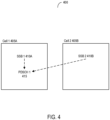
- FIG. 4 depicted is a block diagram of a resource mapping 400 performed by a user equipment (UE) 315 across two cells 405A and 405B (e.g., serving cell 305A or non-serving cell 305B).
- the UE 315 may map a set of synchronization signal/physical broadcast channel (SS/PBCH) blocks (SSB) 410A and 410B to a PDSCH 1 415 (or vice-versa).
- the signals can include a SSB (e.g., synchronization signal/physical broadcast channel (SS/PBCH) block), and the configuration index associated with the SSB may be same as that of the PDSCH.
- SS/PBCH synchronization signal/physical broadcast channel
- the configuration index can be/include/represent a transmission configuration indicator (TCI) state index, PCI (physical cell identity), or a control resource set (CORESET) pool index.
- TCI transmission configuration indicator
- PCI physical cell identity
- CORESET control resource set
- the configuration index of the PDSCH may be the configuration index corresponding to the QCL source of the PDSCH.
- the SSB can be a SSB used as or associated to QCL source corresponding to the PDSCH. In some embodiments, the SSB can be a SSB used for RRM measurement. The SSB can be a SSB configured in the higher-layer parameter MeasObjectNR information element (IE). In some embodiments, the SSB indicated in a TCI state of a TCI state list configured by radio resource control (RRC), the TCI state list may be associated or related to the serving cell of the PDSCH. In some embodiments, the SSB may be indicated in a TCI state of a TCI state list which is activated by MAC-CE. The TCI state list may be associated or related to the BWP of the PDSCH.
- RRC radio resource control
- the index of one or multiple TCI states of TCI state list may correspond to one codepoint in the field of MAC CE.
- the SSB is indicated in a TCI state which is indicated by DCI.
- the TCI state may be associated with or related to the PDSCH.
- the SSB can be a SSB used as quasi-co-location (QCL) source of TRS (such as CSI-RS for tracking), or CSI-RS for mobility.
- the tracking reference signal (TRS) or CSI-RS for mobility measurement can be the QCL source of the PDSCH.
- the TRS or CSI-RS for RRM measurement may be indicated in a TCI state of a TCI state list configured by RRC. The TCI state list may be associated with or related to the serving cell of the other signal or channel.
- the TRS or CSI-RS may be indicated in a TCI state of a TCI state list which is activated by MAC CE, the TCI state list associated with or related to the bandwidth part (BWP) of the other signal or channel. Furthermore, the index of one or multiple TCI states of the TCI state list may correspond to one codepoint in the field of MAC CE. In some embodiments, the TRS or CSI-RS may be indicated in a TCI state which is indicated by DCI. The TCI state may be associated with or related to the other signal/channel.
- the SSB can be a SSB used for positioning.
- the SSB may be indicated in a TCI state of a TCI state list configured by radio resource control (RRC) signalling/configuration (received from a gNB for instance).
- RRC radio resource control
- the TCI state list may be associated with or related to the serving cell of the PDSCH.
- the SSB may be indicated in a TCI state of a TCI state list which is activated by MAC CE (received from a gNB for instance).
- the TCI state list may be associated or related to the BWP of the PDSCH.
- the index of one or multiple TCI states of a TCI state list may correspond to one codepoint in the field of MAC CE.
- the SSB may be indicated in a TCI state which is indicated by DCI (from a gNB for instance).
- the TCI state may be associated with or related to the PDSCH.
- the SSB can be a SSB used as or associated to QCL source corresponding to one or more signals or channels other than the PDSCH.
- the other signal or channel may be another PDSCH.
- the configuration index of the another PDSCH may be same as that of the PDSCH.
- the signals can include a SSB (e.g., SS/PBCH block), and the configuration index associated with the SSB should be different from that of the PDSCH.
- the configuration index can be a TCI state index, PCI (physical cell identity), or CORESET pool index.
- the configuration index of the PDSCH may be the configuration index corresponding to the QCL source of the PDSCH.
- the SSB can be a SSB used as or associated to QCL source corresponding to the PDSCH.
- the SSB can be a SSB used for RRM measurement, or the SSB can be a SSB configured in the higher-layer parameter MeasObjectNR information element (IE).
- IE MeasObjectNR information element
- the SSB may be indicated in a TCI state of a TCI state list configured by RRC signalling/configuration.
- the TCI state list may be associated with or related to the serving cell of the PDSCH.
- the SSB may be indicated in a TCI state of a TCI state list which is activated by MAC CE.
- the TCI state list may be associated or related to the BWP of the PDSCH.
- the index of one or more TCI states of the TCI state list may correspond to one codepoint in the field of MAC CE.
- the SSB is indicated in a TCI state which is indicated by DCI.
- the TCI state may be associated with or related to the PDSCH.
- the TCI state list may be associated or related to the BWP of the PDSCH. Furthermore, the index of one or multiple TCI states of a TCI state list may correspond to one codepoint in the field of MAC CE.
- the TRS or CSI-RS for mobility may be indicated in a TCI state which is indicated by DCI.
- the TCI state may be associated with or related to the PDSCH.
- the SSB can be a SSB used for positioning.
- the SSB may be indicated in a TCI state of a TCI state list configured by RRC configuration/signalling (from a gNB for instance).
- the TCI state list may be associated or related to the serving cell of the PDSCH.
- the SSB may be indicated in a TCI state of a TCI state list which can be activated by MAC CE.
- the TCI state list may be associated or related to the BWP of the PDSCH.
- the index of one or multiple TCI states of TCI state list may correspond to one codepoint in the field of MAC CE (e.g., transmitted from the gNB).
- the SSB is indicated in a TCI state which is indicated by DCI.
- the TCI state may be associated with or related to the PDSCH.
- the SSB can be a SSB used as or associated to QCL source corresponding to signals or channels other than the PDSCH.
- the other signal or channel may be another PDSCH.
- the configuration index of the another PDSCH is different from that of the PDSCH.
- CSI-RS Channel State Information Reference Signals
- resource mapping may serve to map the modulation symbols to the available resource elements in the set of the resource blocks assigned for PDSCH.
- some or all of the resource elements corresponding or related to some kinds of signals within the scheduled resource blocks may not be available or used for the PDSCH.
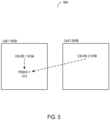
- FIG. 5 depicted is a block diagram of a resource mapping 400 performed by a user equipment (UE) 315 across two cells 505A and 505B (e.g., serving cell 305A or non-serving cell 305B).
- the UE 315 may map a set of CSI-RSs 510A and 510B to a PDSCH 1 515 (or vice-versa).
- the signals can be a channel state information reference signal (CSI-RS), and the configuration index (or cell) associated with the CSI-RS should be same as that of the PDSCH.
- CSI-RS channel state information reference signal
- the configuration index can be/include/represent a TCI state index, PCI (physical cell identity), or CORESET pool index.
- the configuration index of the PDSCH may be the configuration index corresponding to the QCL source of the PDSCH.
- the CSI-RS can be a CSI-RS used as or associated to QCL source corresponding to the PDSCH.
- the CSI-RS can be a CSI-RS used for mobility (e.g., mobility measurement), or the CSI-RS can be a CSI-RS configured in the higher-layer parameter MeasObjectNR IE.
- the CSI-RS may be indicated in a TCI state of a TCI state list configured by RRC configuration/signalling.
- the TCI state list may be associated or related to the serving cell of the PDSCH.
- the CSI-RS may be indicated in a TCI state of a TCI state list which is activated by MAC CE, the TCI state list associated or related to the BWP of the PDSCH.
- the index of one or multiple TCI states of TCI state list may correspond to one codepoint in the field of MAC CE (e.g. from a gNB).
- the CSI-RS may be indicated in a TCI state which is indicated by DCI (e.g., from the gNB).
- the TCI state may be associated with or related to the PDSCH.
- the CSI-RS can be a CSI-RS used for positioning, tracking, or L1-RSRP (layer 1 reference signal received power) or L1-SINR (Layer 1 signal-to-interference ratio) computation.
- the CSI-RS may be indicated in a TCI state of a TCI state list configured by RRC configuration/signalling.
- the TCI state list may be associated with or related to the serving cell of the PDSCH.
- the CSI-RS may be indicated in a TCI state of a TCI state list which is activated by MAC CE, the TCI state list associated or related to the BWP of the PDSCH.
- the index of one or multiple TCI states of TCI state list may correspond to one codepoint in the field of MAC CE.
- the CSI-RS may be indicated in a TCI state which is indicated by DCI, the TCI state associated or related to the PDSCH.
- the CSI-RS can be a CSI-RS used as or associated to QCL source corresponding to one or more signals or channels other than the PDSCH.
- the other signal(s) or channel(s) may be/include another PDSCH.
- the configuration index of the another PDSCH may be same as that of the PDSCH.
- the signals can be/include a CSI-RS, and a configuration index associated with the CSI-RS may be different from that of the PDSCH.
- the configuration index can be/include/represent a TCI state index, PCI (physical cell identity), or CORESET pool index.
- the configuration index of the PDSCH may be the configuration index corresponding to the QCL source of other signals or channels rather than the PDSCH.
- the CSI-RS can be a CSI-RS used as or associated with QCL source corresponding to the PDSCH.
- the CSI-RS can be a CSI-RS used for mobility (e.g., mobility measurement), or the CSI-RS can be a CSI-RS configured in the higher-layer parameter MeasObjectNR IE.
- the CSI-RS may be indicated in a TCI state of a TCI state list configured by RRC configuration/signalling.
- the TCI state list may be associated or related to the serving cell of the PDSCH.
- the CSI-RS may be indicated in a TCI state of a TCI state list which is activated by MAC CE.
- the TCI state list may be associated or related to the BWP of the PDSCH.
- the index of one or multiple TCI states of a TCI state list may correspond to one codepoint in the field of MAC CE (e.g., from a gNB).
- the CSI-RS is indicated in a TCI state which is indicated by DCI, the TCI state associated or related to the PDSCH.
- the CSI-RS can be a CSI-RS used for positioning, tracking, or L1-RSRP (layer 1 reference signal received power) or L1-SINR (Layer 1 signal-to-interference ratio) computation.
- the CSI-RS may be indicated in a TCI state of a TCI state list configured by RRC configuration/signalling.
- the TCI state list may be associated or related to the serving cell of the PDSCH.
- the CSI-RS may be indicated in a TCI state of a TCI state list which is activated by MAC CE.
- the TCI state list may be associated with or related to the BWP of the PDSCH.
- the index of one or multiple TCI states of a TCI state list may correspond to one codepoint in the field of MAC CE.
- the CSI-RS may be indicated in a TCI state which is indicated by DCI (e.g., from the gNB to the UE).
- the TCI state may be associated or related to the PDSCH.
- the CSI-RS can be a CSI-RS used as or associated to QCL source corresponding to other signals or channels rather than the PDSCH.
- the other signals or channels may be another PDSCH.
- the configuration index of the another PDSCH may be different from that of the PDSCH.
- resource mapping may serve to map the modulation symbols to the available resource elements in the set of the resource blocks assigned for PDSCH.
- some or all of the resource elements corresponding or related to some kinds of signals within the scheduled resource blocks may not be available or used for the PDSCH.
- the signals can be another PDSCH.
- the configuration index associated with the another PDSCH can be same with that associated with the PDSCH.
- the configuration index can be/include/represent a TCI state index, PCI (physical cell identity), or CORESET pool index.
- the configuration index associated with the other PDSCH can be different from that associated with the PDSCH.
- the configuration index can be a TCI state index, PCI (physical cell identity), or CORESET pool index.
- the signals can be a DM-RS (demodulation reference signal) used for the PDSCH.
- the signals can be a PT-RS (phase-tracking reference signal) used for the PDSCH.
- resource mapping serves one of the purposes that is to map the modulation symbols to the available resource elements in the set of the resource blocks assigned for PUSCH.
- some or all of the resource elements corresponding or related to some kinds of signals within the scheduled resource blocks may not be available or used for the PUSCH.
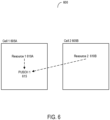
- FIG. 6 depicted is a block diagram of a resource mapping 600 performed by a user equipment (UE) 315 across two cells 605A and 605B (e.g., serving cell 305A or non-serving cell 305B).
- the UE 315 may map a set of resources 610A and 610B to a PUSCH 1 615 (or vice-versa).
- the signals can be/include a SRS (sounding reference signal), and a configuration index associated with the SRS may be same as that of the PUSCH.
- the configuration index can be/include/represent spatial relation info, TCI state index, PCI (physical cell identity), or CORESET pool index.
- the configuration index of the PUSCH may be the configuration index corresponding to the QCL source of the PUSCH.
- the SRS can be a SRS used as or associated to QCL source corresponding to the PUSCH.
- the SRS can be a SRS used for mobility, or the SRS can be a SRS configured in the higher-layer parameter MeasObjectNR IE.
- the SRS may be indicated in a spatial relation info configured by RRC (radio resource control) configuration/signalling from the wireless communication node (e.g., gNB) to the wireless communication device (e.g., UE).
- the spatial relation info may be associated or related to the serving cell of the PUSCH.
- the SRS is indicated in a spatial relation info which is activated by MAC CE from the wireless communication node (e.g., gNB) to the wireless communication device (e.g., UE), the spatial relation info associated or related to the bandwidth part (BWP) of the PUSCH.
- the SRS may be indicated in a spatial relation info which is indicated by DCI, the spatial relation info associated with or related to the PUSCH.
- the SRS can be a SRS used for channel sounding, positioning, antenna switching, carrier switching, RSRP or signal to interference and noise ratio (SINR) computation, or TPC commands configuration.
- the SRS may be indicated in a spatial relation info configured by RRC (radio resource control) configuration/signalling.
- the spatial relation info may be associated or related to the serving cell of the PUSCH.
- the SRS may be indicated in a spatial relation info which is activated by MAC CE, the spatial relation info associated or related to the BWP of the PUSCH.
- the SRS may be indicated in a spatial relation info which is indicated by DCI, the spatial relation info associated with or related to the PUSCH.
- the SRS can be a SRS used for mobility (e.g., mobility measurement), or the SRS can be a SRS configured in the higher-layer parameter MeasObjectNR IE.
- the SRS may be indicated in a spatial relation info configured by RRC configuration/signalling (from a wireless communication node). The spatial relation info may be associated with or related to the serving cell of the PUSCH.
- the SRS may be indicated in a spatial relation info which is activated by MAC CE (from a wireless communication node).
- the spatial relation info list may be associated or related to the BWP of the PUSCH.
- the SRS may be indicated in a spatial relation info which is indicated by DCI (from a wireless communication node to the wireless communication device).
- the spatial relation info may be associated with or related to the PUSCH.
- the SRS can be a SRS used for channel sounding, positioning, antenna switching, carrier switching, RSRP or a signal to interference and noise ratio (SINR) computation, or TPC commands configuration.
- the SRS may be indicated in a spatial relation info configured by RRC signalling/configuration.
- the spatial relation info may be associated with or related to the serving cell of the PUSCH.
- the SRS may be indicated in a spatial relation info which is activated by MAC CE.
- the spatial relation info may be associated with or related to the BWP of the PUSCH.
- the SRS may be indicated in a spatial relation info which is indicated by DCI (e.g., from a gNB).
- the spatial relation info may be associated with or related to the PUSCH.
- resource mapping may serve to map the modulation symbols to the available resource elements in the set of the resource blocks assigned for the PUSCH.
- some or all of the resource elements corresponding or related to some kinds of signals within the scheduled resource blocks may not available or usable for the PUSCH.
- a configuration index associated with another PUSCH can be same that of the PUSCH.
- the configuration index can be/include/represent spatial relation info, a transmission configuration indicator (TCI) state index, physical cell identity (PCI), or CORESET pool index.
- the configuration index associated with the another PUSCH can be different from that of the PUSCH.
- a UE may be scheduled by a network (NW) to only perform a downlink reception and/or a uplink transmission within a set of symbols or slots, and the downlink reception and the uplink transmission may be related to or associated with different physical cell identity (PCI) values.
- NW e.g., a wireless communication node such as a gNB
- the UE may only perform one of the downlink reception or the uplink transmission within the set of symbols and slots.
- downlink receptions and uplink transmissions may be related or associated to different PCI values respectively.
- a set of symbols or slots can only be configured or indicated as being for an uplink transmission or a downlink reception.
- the UE may not perform an uplink transmission related or associated to the other PCI, when the uplink transmission overlaps with the set of symbols or slots.
- the one PCI may be different from the other PCI.
- the performed downlink reception can be/include a SSB which can be used as the QCL source of other downlink receptions configured or indicated by the one PCI.
- the SSB can be a SSB used for RRM measurement, or the SSB can be a SSB configured in the higher-layer parameter MeasObjectNR IE.
- the other downlink reception can be a PDSCH, PDCCH, or CSI-RS.
- the CSI-RS can be used for tracking, mobility, or L1-RSRP or L1-SINR computation.
- the performed downlink reception can be a CSI-RS which used as the QCL source of other downlink receptions configured or indicated by the one PCI.
- the CSI-RS can be used for tracking.
- the CSI-RS can be used for mobility measurement.
- the CSI-RS can be used for L1-RSRP or L1-SINR computation.
- the unperformed uplink transmission can be a PUSCH, physical uplink control channel (PUCCH), preamble random access channel (PRACH), or SRS.
- the uplink transmission cannot be indicated by a DCI format. Otherwise, the downlink reception may not be performed by the UE.
- the downlink reception is configured by higher layer signalling over at least one symbol and a PUSCH reception is indicated by a DCI format 0_1 over multiple slots, which may also be overlapped with the downlink reception within one slot, the UE may not transmit the PUSCH in the one slot.
- downlink receptions and uplink transmissions may be related or associated to different PCI values respectively.
- a set of symbols or slots may only be configured or indicated for uplink transmission or downlink reception.
- the UE may not perform the downlink reception related or associated to the other PCI, when the downlink reception overlaps with the same set of symbols or slots.
- the one PCI may be different from the other PCI.
- the performed uplink transmission can be/include a SRS which can be used as the spatial relation of other uplink transmissions configured or indicated by the one PCI.
- the SRS can be a SRS used for RRM measurement, or the SRS can be a SRS configured in the higher-layer parameter MeasObjectNR IE.
- the other uplink transmission can be a PRACH, PUSCH, or PUCCH.
- the unperformed downlink reception can be a PDCCH, PDSCH, CSI-RS, or DL-PRS which is without a measurement gap.
- the downlink reception may not be indicated by a DCI format. Otherwise, the uplink transmission would not be performed by the UE.
- the set of symbols or slots may include N gap symbols located/residing before the valid PRACH occasion.
- the UE may not receive the PDSCH in the one slot.
- a UE may be scheduled to perform multiple downlink receptions by one reception timing window.
- the UE may perform a set of the multiple downlink receptions within the reception timing window.
- the timing misalignment between the received signals may fall within the cyclic prefix (CP).
- CP cyclic prefix
- the reception timing window can be/include a set of symbols or slots. In some embodiments, the set of symbols or slots can be discontinuous or non-contiguous in time.
- the one downlink transmission may have the highest priority. In some embodiments, the priority can be configured by RRC, or activated by the MAC CE, or indicated by DCI. In some embodiments, the priority may depend on the absolute or relative receiving timing of the one downlink signal. In some embodiments, the priority may depend on the sequence of the one downlink signal/transmission.
- the reception timing interval of or between the two time windows may exceed a threshold.
- the threshold can be configured by RRC configuration/signalling, or activated by the MAC CE, or indicated by DCI.
- the PCI associated with the two downlink transmissions can be different with each other.
- the timing misalignment between the received signals should fall within the cyclic prefix (CP).
- CP cyclic prefix
- the reception timing window can be a set of symbols or slots. In some embodiments, the set of symbols or slots can be discontinuous in time.
- the limited downlink transmissions may come from a same cell or be configured with a same PCI. In some embodiments, the PCIs associated with the limited downlink transmissions can be same or different with each other. In some embodiments, the timing misalignment between the multiple downlink transmissions may fall within the CP. In some embodiments, the timing misalignment between the multiple downlink transmissions can be allowed to exceed the CP.
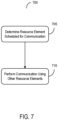
- a wireless communication device may determine a resource element scheduled for a communication (705). The wireless communication device may perform the communication using one or more other resource elements (710).
- a wireless communication device may identify or determine at least one resource element scheduled for a communication (705).
- the wireless communication device may be located and served by a serving cell (e.g., the serving cell 305A).
- the wireless communication device may be in communication with at least one wireless communication node (e.g., TRP 310) in the serving cell and at least one wireless communication node in a non-serving cell (e.g., the non-serving cell 305B).
- the wireless communication device may be scheduled to perform a downlink communication (e.g., DL 320A or 320B) with one of the wireless communication node at the serving cell or at the non-serving cell.
- a downlink communication e.g., DL 320A or 320B
- the at least one resource element may be scheduled for a defined communication associated with a first configuration index.
- the at least one resource element may be assigned for use for at least one signal associated with a second configuration index.
- Configuration indices may correspond to a particular cell (e.g., the serving cell 305A or the non-serving cell 305B).
- the first configuration index may reference the defined communication (e.g., PUSCH, or PDSCH) to be performed.
- the second configuration index may reference a signal (e.g., SRS or CSI-RS) to be communicated via one or more assigned resource elements.
- the signal may be a reference signal to be communicated via the defined communication.
- the signal may be a reference signal to be communicated via the defined communication.
- the defined communication may include a reception of a physical downlink shared channel (PDSCH).
- the PDSCH may be between the wireless communication device and the wireless communication node.
- the defined communication may include a reception of a physical uplink shared channel (PUSCH).
- the PUSCH may be between the wireless communication device and the wireless communication node.
- the signal may be a reference signal to be communicated via the PDSCH or using one or more resource elements assigned to the PDSCH.
- the signal may include a synchronization signal/physical broadcast channel (SS/PBCH) block (SSB).
- the first configuration index may be the same as the second configuration index.
- the signal can be a synchronization signal/physical broadcast channel (SS/PBCH) block (SSB), and the configuration index associated with the SSB may be same as that of the PDSCH.
- the first configuration index may differ from the second configuration index.
- the signal can be a synchronization signal/physical broadcast channel (SS/PBCH) block (SSB), and the configuration index associated with the SSB may differ from that of the PDSCH.
- the SSB may be used for one or more applications with respect to the PDSCH.
- the SSB may be used as or associated with a quasi co-location (QCL) source corresponding to the PDSCH.
- the QCL source may reference the PDSCH to be used for the SSB.
- the SSB may be used for radio resource management (RRM) measurements.
- RRM radio resource management
- the SSB may be also used for a higher-layer parameter information element (IE) (e.g., MeasObjectNR).
- IE parameter information element
- the RRM measurements may include measurements of co-channel interference, coding, resources, reception characteristics, and transmission characteristics, among others.
- the SSB may be indicated in a TCI state of a TCI state list configured by a higher-layer configuration (e.g., radio resource control (RRC)) signalling (from the wireless communication node).
- the TCI state list may be associated with the serving cell of PDSCH.
- the SSB may be indicated in a TCI state of a TCI state list activated by a media access control, control element (MAC CE) signalling (from the wireless communication node).
- the TCI state list may be associated with a bandwidth part (BWP) of the PDSCH.
- the SSB may be indicated in a TCI state indicated by a downlink control information (DCI) signalling (from the wireless communication node).
- the TCI state may be associated with the PDSCH.
- DCI downlink control information
- the SSB may be used as QCL source of tracking reference signal (TRS) or channel state information reference signal (CSI-RS) for mobility measurement.
- TRS or the CSI-RS may a QCL source of PDSCH.
- the SSB may be used for positioning. The positioning may include determining a position of the wireless communication device relative to the wireless communication node for transmission via the PDSCH.
- the SSB may be used as or associated with a QCL source corresponding to one or more other signals or channels other than the PDSCH.
- the other signals or channels may be other than the defined communication.
- the other signal or channel may another PDSCH.
- a configuration index of the another PDSCH may be the same as the first configuration index.
- the signal may include a channel state information reference signal (CSI-RS).
- CSI-RS channel state information reference signal
- the first configuration index may be the same as the second configuration index.
- the signal can be a CSI-RS, and the configuration index associated with the CSI-RS may be same with that of the PDSCH.
- the first configuration index may differ from the second configuration index.
- the signal can be a CSI-RS, and the configuration index associated with the CSI-RS may differ from that of the PDSCH.
- the first configuration index or the second configuration index may identify, reference, represent or otherwise include a transmission configuration indicator (TCI) state index, a physical cell identity (PCI) index, or a control resource set (CORESET) pool index.
- TCI state index may identify TCI state to be used.
- PCI index may identify a particular cell to be used.
- CORESET pool index may indicate a collection of CORESET to be used.
- the CSI-RS may be used for one or more applications with respect to the PDSCH.
- CSI-RS may be used as or associated with a quasi co-location (QCL) source corresponding to the PDSCH.
- the QCL source may reference the PDSCH to be used for the CSI-RS.
- the CSI-RS may be used for a radio resource management (RRM) measurements.
- RRM radio resource management
- the CSI-RS may be also used for a higher-layer parameter information element (IE) (e.g., MeasObjectNR).
- IE parameter information element
- the RRM measurements may include measurements of co-channel interference, coding, resources, reception characteristics, and transmission characteristics, among others.
- the CSI-RS may be indicated in a TCI state of a TCI state list configured by a higher-layer configuration (e.g., radio resource control (RRC)) signalling (e.g., from the wireless communication node to the wireless communication device).
- the TCI state list may be associated with the serving cell of PDSCH.
- the CSI-RS may be indicated in a TCI state of a TCI state list activated by a media access control control element (MAC CE) signalling (e.g., from the wireless communication node to the wireless communication device).
- the TCI state list may be associated with a bandwidth part (BWP) of the PDSCH.
- BWP bandwidth part
- the CSI-RS may be indicated in a TCI state indicated by a downlink control information (DCI) signalling (e.g., from the wireless communication node to the wireless communication device).
- DCI downlink control information
- the TCI state may be associated with the PDSCH.
- the CSI-RS may be used for positioning, tracking, or computation of layer 1 reference signal received power (L1-RSRP) or layer 1 signal-to-interference ratio (L1-SINR).
- L1-RSRP layer 1 reference signal received power
- L1-SINR layer 1 signal-to-interference ratio
- the CSI-RS may be used as or associated with a (QCL) source corresponding to at least one other signal or channel other than the PDSCH.
- the other signals or channels may be other than, or different from the defined communication.
- one or more other signals or channels may include another PDSCH.
- a configuration index of the other PDSCH may be the same as the first configuration index.
- the signal may include another PDSCH.
- the first configuration index may be the same as the second configuration index.
- the first configuration index may be different from the second configuration index.
- the first configuration index or the second configuration index may identify, reference, represent or otherwise include a transmission configuration indicator (TCI) state index, a physical cell identity (PCI) index, or a control resource set (CORESET) pool index.
- TCI state index may identify TCI state to be used.
- the PCI index may identify a particular cell to be used.
- the CORESET pool index may be used to identify a collection of CORESET to be used.
- the signal may be a reference signal to be communicated via the PUSCH.
- the signal may include a sounding reference signal (SRS).
- the first configuration index may be same as the second configuration index.
- the signal can be the SRS, and the configuration index associated with the SRS may be the same as that of the PUSCH.
- the first configuration index may be same as the second configuration index.
- the signal can be the SRS, and the configuration index associated with the SRS may be differ from that of the PUSCH.
- the first configuration index may identify, represent or include spatial relation information (SRI) information, a transmission configuration indicator (TCI) state index, a physical cell identity (PCI) index, or a control resource set (CORESET) pool index.
- the second configuration index may also identify, represent or include spatial relation information (SRI) information, a transmission configuration indicator (TCI) state index, a physical cell identity (PCI) index, or a control resource set (CORESET) pool index.
- the TCI state index may identify TCI state to be used.
- the PCI index may identify a particular cell to be used.
- the CORESET pool index may indicate or identify a collection of CORESET to be used.
- the SRS may be used as or associated with a quasi co-location (QCL) source corresponding to the PUSCH.
- the QCL source may reference the PUSCH to be used for the SRS.
- the SRS is used for mobility measurement, or is configured in a higher-layer parameter nformation element (IE) (e.g., MeasObjectN ) .
- IE parameter nformation element
- the SRS may be used as or associated with a QCL source corresponding to at least one other signal or channel other than the PUSCH.
- the other signals or channels may be other than, or different from the defined communication.
- the other signal or channel may include another PUSCH.
- a configuration index of the another PUSCH may be same as the first configuration index.
- the SRS may be defined, specified, or otherwise indicated by a higher-layer signalling.
- the SRS may be indicated by a spatial relation information (SRI) index configured by radio resource control (RRC) signalling (e.g., transmitted to the wireless communication device).
- RRC radio resource control
- the spatial relation information (SRI) index may be associated with the serving cell of the PUSCH.
- the SRI index may indicate which SRI to be used in the communication via PUSCH.
- the SRS may be indicated in SRI index activated by a media access control control element (MAC CE) signalling (e.g., transmitted to the wireless communication device).
- the SRI index may be associated with a bandwidth part (BWP) of the PUSCH.
- the SRS may be indicated by downlink control information (DCI) signalling (e.g., transmitted to the wireless communication device).
- DCI downlink control information
- the SRS may be used for channel sounding, positioning, antenna switching, carrier switching, computation of reference signal received power (RSRP) or signal and interference to noise ratio (SINR), or configuration of one or more transmit power control (TPC) commands.
- Channel sounding may include measuring channel performance across the PUSCH.
- the positioning may include determining a position of the wireless communication device relative to the wireless communication node for transmission via the PUSCH.
- the antenna switching may include switching between antenna ports of one of the nodes (e.g., the wireless communication device or the wireless communication node).
- the carrier switching may include switching between component carriers (CC) on the wireless communication device or the wireless communication node.
- the TPC commands may identify or define one or more parameters for transmissions in communications between the wireless communication node and the wireless communication device.
- the signal may include another PUSCH.
- the first configuration index may be the same as the second configuration index. In some embodiments, the first configuration index may be different from the second configuration index.
- the first configuration index or the second configuration index may identify, reference, or otherwise include a transmission configuration indicator (TCI) state index, a physical cell identity (PCI) index, or a control resource set (CORESET) pool index.
- TCI state index may identify a TCI state to be used.
- the PCI index may identify a particular cell to be used.
- the CORESET pool index may indicate/identify a collection of CORESET to be used.
- the wireless communication device may perform the communication using other resource elements (710).
- the wireless communication may perform the defined communication (e.g., PDSCH or PUSCH) using resource elements other than the one or more determined resource elements. For example, some or all of the resource elements corresponding or related to types of signals within the resource blocks may not be available for the defined communication.
- the wireless communication device may send the signal to the wireless communication node in accordance with the determined communication (e.g., PDSCH or PUSCH) using the other resource elements.
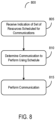
- a wireless communication device may receive an indication of a set of resources scheduled for communications (805). The wireless communication device may select a communication to perform in accordance with a schedule (810). The wireless communication device may perform the communication (815).
- a wireless communication device may identify, retrieve, or otherwise receive an indication of a set of resources scheduled for a first defined communication and a second defined communication (805).
- the indication of the set of resources may be received from a wireless communication node (e.g., BS 102, TRP 310, or a node of the NW).
- the wireless communication node may send, transmit, or otherwise provide the indication of the set of resources to the wireless communication device.
- the set of resources may identify or include symbol(s) and/or slot(s) for the first defined communications and the second defined communications.
- the first defined communication may correspond to or may be as associated with a first physical cell identity (PCI) value.
- the second defined communication may correspond to or may be associated with a second PCI value.
- the first defined communication may include, correspond to, or be associated with a downlink reception or uplink transmission between the wireless communication device and the wireless communication node.
- the second defined communication may include, correspond to, or be associated with a downlink reception or uplink transmission between the wireless communication device and the wireless communication node.
- the first defined communication may be different from the second defined communication. For example, when the first defined communication is used for the downlink reception, the second defined communication may be used for the uplink transmission, and vice-versa.
- the first defined communication may include a synchronization signal/physical broadcast channel (SS/PBCH) block.
- the SS/PBCH block may be used for radio resource management (RRM) measurement.
- the SS/PBCH block may be configured in a higher-layer parameter information element (IE) (e.g., MeasObjectNR).
- IE e.g., MeasObjectNR
- the first defined communication may include a channel state information reference signal (CSI-RS).
- the CSI-RS may be used as a quasi co-location (QCL) source of another first defined communication associated with the first PCI value.
- the first defined communication may include a sounding reference signal (SRS).
- the SRS may be used for RRM measurement.
- the SRS may be configured in a higher-layer parameter information element (IE) (e.g., MeasObjectNR).
- the signals, channels, or resources used may differ between the first defined communication and the second communication.
- the second defined communication may include a physical downlink shared channel (PDSCH).
- PDSCH physical downlink shared channel
- the second defined communication may include a physical uplink shared channel (PUSCH).
- PUSCH physical uplink shared channel
- the second defined communication may include a physical downlink control channel (PDCCH).
- PDCCH physical downlink control channel
- the second defined communication may include a preamble random access channel (PRACH).
- PRACH preamble random access channel
- the second defined communication may include a sounding reference signal (SRS). In some embodiments, the second defined communication may include a channel state information reference signal (CSI-RS). In some embodiments, the second defined communication may include a downlink positioning reference signal (DL-PRS). The DL-PRS may be without a measurement gap.
- SRS sounding reference signal
- CSI-RS channel state information reference signal
- DL-PRS downlink positioning reference signal
- the wireless communication device may identify, select, or otherwise determine one of the first defined communication or the second defined communication to perform in accordance with a schedule (810). In some embodiments, the wireless communication device may determine to perform only one of the first defined communication or the second defined communication. The determination may be in accordance with the set of scheduled resources. Due to the limited capability of the wireless communication device, the set of resources (e.g., symbols or slots) may be only configured or indicated as available for uplink transmission or downlink reception.
- the schedule may define one or more time windows in which the set of resources are to be available for one of the uplink transmission or downlink reception corresponding to the first defined communication and the second defined communication.
- the wireless communication device may identify or determine that the set of resources is configured for or indicates one of the first defined communication or the second defined communication. In some embodiments, the wireless communication device may identify or determine that the set of resources is configured for or indicates the first defined communication or the first PCI value associated with the first defined communication. In some embodiments, the wireless communication device may identify or determine that the set of resources is configured for or indicates the second defined communication or the second PCI value associated with the second defined communication.
- the wireless communication device may identify or determine whether the first defined communication and the second defined communication overlap. The determination of the overlap may be based on resource elements as defined in the set of resources. In some embodiments, the wireless communication device may determine that the second defined communication overlaps with the first defined communication in at least part of the set of resources. In some embodiments, the wireless communication device may determine that the first defined communication overlaps with the second defined communication in at least part of the set of resources. When the second defined communication is determined to overlap with the first defined communication, the wireless communication device may determine to perform only the first defined communication in accordance with the scheduled set of resources. On the other hand, when the first defined communication is determined to overlap with the second defined communication, the wireless communication device may determine to perform only the second defined communication in accordance with the scheduled set of resources.
- the wireless communication device may carry out or otherwise perform one of the first defined communication or the second defined communication in accordance to/with the determination (815).
- the performance may be for an uplink transmission or a downlink reception.
- the wireless communication device may handle timing misalignments for downlink receptions.
- at least one of the first defined communication or the second defined communication may include a set of downlink receptions within a reception timing window.
- the wireless communication device may identify or determine that a largest time difference between any two of the set of downlink receptions exceeds a cyclic prefix (CP).
- the CP may refer to a prefixing of a symbol to the set of symbols in the downlink reception.
- the wireless communication device may perform one (e.g., only one) of the set of downlink receptions within the reception time window.
- the downlink reception that is performed may correspond to or have a highest priority among the set of downlink receptions.
- the reception timing window for the one downlink reception (e.g., only one) may correspond to or may include a set of resources (e.g., symbols or slots) communicated via the one downlink reception.
- the wireless communication device may perform only a subset (or certain ones) of the set of downlink receptions within the reception timing window.
- the subset of downlink receptions may be from the same cell or configured with the same PCI value.
- the PCI value may correspond to the first PCI value, when the first defined communication is determined to be performed.
- the subset of downlink receptions may correspond to or may be associated with one or more PCI values.
- the one or more PCI values may include other values in addition to the first PCI value besides the second PCI value, when the first defined communication is determined to be performed.
- the reception timing window may include a set of resources (e.g., symbols or slots) to be communicated via the subset of downlink receptions.
- any reference to an element herein using a designation such as "first,” “second,” and so forth does not generally limit the quantity or order of those elements. Rather, these designations can be used herein as a convenient means of distinguishing between two or more elements or instances of an element. Thus, a reference to first and second elements does not mean that only two elements can be employed, or that the first element must precede the second element in some manner.
- any of the various illustrative logical blocks, modules, processors, means, circuits, methods and functions described in connection with the aspects disclosed herein can be implemented by electronic hardware (e.g., a digital implementation, an analog implementation, or a combination of the two), firmware, various forms of program or design code incorporating instructions (which can be referred to herein, for convenience, as "software” or a "software module), or any combination of these techniques.
- electronic hardware e.g., a digital implementation, an analog implementation, or a combination of the two
- firmware various forms of program or design code incorporating instructions
- software or a "software module”
- IC integrated circuit
- DSP digital signal processor
- ASIC application specific integrated circuit
- FPGA field programmable gate array
- the logical blocks, modules, and circuits can further include antennas and/or transceivers to communicate with various components within the network or within the device.
- a general purpose processor can be a microprocessor, but in the alternative, the processor can be any conventional processor, controller, or state machine.
- a processor can also be implemented as a combination of computing devices, e.g., a combination of a DSP and a microprocessor, a plurality of microprocessors, one or more microprocessors in conjunction with a DSP core, or any other suitable configuration to perform the functions described herein.
- Computer-readable media includes both computer storage media and communication media including any medium that can be enabled to transfer a computer program or code from one place to another.
- a storage media can be any available media that can be accessed by a computer.
- such computer-readable media can include RAM, ROM, EEPROM, CD-ROM or other optical disk storage, magnetic disk storage or other magnetic storage devices, or any other medium that can be used to store desired program code in the form of instructions or data structures and that can be accessed by a computer.
- module refers to software, firmware, hardware, and any combination of these elements for performing the associated functions described herein. Additionally, for purpose of discussion, the various modules are described as discrete modules; however, as would be apparent to one of ordinary skill in the art, two or more modules may be combined to form a single module that performs the associated functions according embodiments of the present solution.
- memory or other storage may be employed in embodiments of the present solution.
- memory or other storage may be employed in embodiments of the present solution.
- any suitable distribution of functionality between different functional units, processing logic elements or domains may be used without detracting from the present solution.
- functionality illustrated to be performed by separate processing logic elements, or controllers may be performed by the same processing logic element, or controller.
- references to specific functional units are only references to a suitable means for providing the described functionality, rather than indicative of a strict logical or physical structure or organization.
Landscapes
- Engineering & Computer Science (AREA)
- Signal Processing (AREA)
- Computer Networks & Wireless Communication (AREA)
- Mobile Radio Communication Systems (AREA)
Claims (13)
- Verfahren, aufweisend:Bestimmen, durch eine drahtlose Kommunikationsvorrichtung (104, 204, 315), mindestens eines Ressourcenelements, das für eine definierte Kommunikation vorgesehen ist, die mit einem ersten Konfigurationsindex assoziiert ist, und das zur Verwendung für mindestens ein Signal zugewiesen ist, das mit einem zweiten Konfigurationsindex assoziiert ist, der derselbe ist wie der erste Konfigurationsindex, wobei der erste Konfigurationsindex einen ersten physikalischen Zellidentität, PCI, Index aufweist und der zweite Konfigurationsindex einen zweiten PCI-Index aufweist; undDurchführen, durch die drahtlose Kommunikationsvorrichtung (104, 204, 315), der definierten Kommunikation unter Verwendung von anderen Ressourcenelementen als dem bestimmten mindestens einen Ressourcenelement.
- Verfahren nach Anspruch 1, wobei:die definierte Kommunikation den Empfang eines physikalischen gemeinsamen Downlink-Kanals, PDSCH, aufweist, unddas mindestens eine Signal einen Synchronisationssignal/physikalischen Broadcast-Kanal, SS/PBCH, Block, SSB aufweist.
- Verfahren nach Anspruch 2, wobei der SSB als eine Quasi-Colocation, QCL, Quelle verwendet wird, die dem PDSCH entspricht.
- Verfahren nach Anspruch 3, wobei der SSB in einem TCI-Zustand einer TCI-Zustandsliste indiziert wird, die durch eine Funkressourcensteuerung, RRC, Signalisierung konfiguriert wird.
- Verfahren nach Anspruch 1, wobei:die definierte Kommunikation einen Empfang eines physikalischen gemeinsamen Uplink-Kanals, PUSCH, eines physikalischen Uplink-Steuerkanals, PUCCH, eines Präambel-Direktzugriffskanals, PRACH, oder eines Sondierungs-Referenzsignals, SRS, aufweist unddas mindestens eine Signal einen Synchronisationssignal/physikalischen Broadcast-Kanal, SS/PBCH, Block, SSB, aufweist.
- Verfahren nach Anspruch 1, wobei:die definierte Kommunikation einen Empfang eines physikalischen Downlink-Steuerkanals, PDCCH, oder eines Downlink-Positionsreferenzsignals, DL-PRS, aufweist unddas mindestens eine Signal einen Synchronisationssignal/physikalischen Broadcast-Kanal, SS/PBCH, Block, SSB, aufweist.
- Drahtlose Kommunikationsvorrichtung (104, 204, 315), die aufweist:
mindestens einen Prozessor, der dazu eingerichtet ist:mindestens ein Ressourcenelement zu bestimmen, das für eine definierte Kommunikation vorgesehen ist, die mit einem ersten Konfigurationsindex verknüpft ist, und das zur Verwendung für mindestens ein Signal zugewiesen ist, das mit einem zweiten Konfigurationsindex assoziiert ist, der derselbe ist wie der erste Konfigurationsindex, wobei der erste Konfigurationsindex einen ersten physikalischen Zellidentität, PCI, Index aufweist und der zweite Konfigurationsindex einen zweiten PCI-Index aufweist; unddie definierte Kommunikation unter Verwendung von anderen Ressourcenelementen als dem bestimmten mindestens einen Ressourcenelement durchzuführen. - Drahtlose Kommunikationsvorrichtung (104, 204, 315) nach Anspruch 7, wobei:die definierte Kommunikation einen Empfang eines physikalischen gemeinsamen Downlink-Kanal, PDSCH, aufweist, unddas mindestens eine Signal einen Synchronisationssignal/physikalischen Broadcast-Kanal, SS/PBCH, Block, SSB, aufweist.
- Drahtlose Kommunikationsvorrichtung (104, 204, 315) nach Anspruch 8, wobei der SSB als eine Quasi-Colocation, QCL, Quelle verwendet wird, die dem PDSCH entspricht.
- Drahtlose Kommunikationsvorrichtung (104, 204, 315) nach Anspruch 9, wobei die SSB in einem TCI-Zustand einer TCI-Zustandsliste angegeben wird, die durch eine Funkressourcensteuerung, RRC, Signalisierung konfiguriert wird.
- Drahtlose Kommunikationsvorrichtung (104, 204, 315) nach Anspruch 7, wobei:die definierte Kommunikation einen Empfang eines physikalischen gemeinsamen Uplink-Kanals, PUSCH, eines physikalischen Uplink-Steuerkanals, PUCCH, eines Präambel-Direktzugriffskanals, PRACH, oder eines Sondierungs-Referenzsignals, SRS, aufweist, unddas mindestens eine Signal einen Synchronisationssignal/physikalischen Broadcast-Kanal, SS/PBCH, Block, SSB, aufweist.
- Drahtlose Kommunikationsvorrichtung (104, 204, 315) nach Anspruch 7, wobei:die definierte Kommunikation den Empfang eines physikalischen Downlink-Steuerkanals, PDCCH, oder eines Downlink-Positionsreferenzsignals, DL-PRS, aufweist, unddas mindestens eine Signal einen Synchronisationssignal/physikalischen Broadcast-Kanal, SS/PBCH, Block, SSB, aufweist.
- Nichtflüchtiges computerlesbares Medium, das Anweisungen speichert, die, wenn sie von mindestens einem Prozessor ausgeführt werden, den mindestens einen Prozessor veranlassen, das Verfahren nach einem der Ansprüche 1 bis 6 auszuführen.
Priority Applications (1)
| Application Number | Priority Date | Filing Date | Title |
|---|---|---|---|
| EP25157217.8A EP4542913A3 (de) | 2020-10-09 | 2020-10-09 | Durchführung von ressourcenzuordnung eines mehrsende-/empfangspunktbetriebs zwischen zellen |
Applications Claiming Priority (1)
| Application Number | Priority Date | Filing Date | Title |
|---|---|---|---|
| PCT/CN2020/119918 WO2022073180A1 (en) | 2020-10-09 | 2020-10-09 | Performing resource mapping of inter-cell multi transmission/reception point operation |
Related Child Applications (2)
| Application Number | Title | Priority Date | Filing Date |
|---|---|---|---|
| EP25157217.8A Division-Into EP4542913A3 (de) | 2020-10-09 | 2020-10-09 | Durchführung von ressourcenzuordnung eines mehrsende-/empfangspunktbetriebs zwischen zellen |
| EP25157217.8A Division EP4542913A3 (de) | 2020-10-09 | 2020-10-09 | Durchführung von ressourcenzuordnung eines mehrsende-/empfangspunktbetriebs zwischen zellen |
Publications (3)
| Publication Number | Publication Date |
|---|---|
| EP4209083A1 EP4209083A1 (de) | 2023-07-12 |
| EP4209083A4 EP4209083A4 (de) | 2023-11-08 |
| EP4209083B1 true EP4209083B1 (de) | 2025-03-19 |
Family
ID=81125663
Family Applications (2)
| Application Number | Title | Priority Date | Filing Date |
|---|---|---|---|
| EP20956495.4A Active EP4209083B1 (de) | 2020-10-09 | 2020-10-09 | Durchführung von ressourcenzuordnung eines mehrsende-/empfangspunktbetriebs zwischen zellen |
| EP25157217.8A Pending EP4542913A3 (de) | 2020-10-09 | 2020-10-09 | Durchführung von ressourcenzuordnung eines mehrsende-/empfangspunktbetriebs zwischen zellen |
Family Applications After (1)
| Application Number | Title | Priority Date | Filing Date |
|---|---|---|---|
| EP25157217.8A Pending EP4542913A3 (de) | 2020-10-09 | 2020-10-09 | Durchführung von ressourcenzuordnung eines mehrsende-/empfangspunktbetriebs zwischen zellen |
Country Status (7)
| Country | Link |
|---|---|
| US (2) | US12432724B2 (de) |
| EP (2) | EP4209083B1 (de) |
| CN (2) | CN118301761A (de) |
| CA (1) | CA3197721A1 (de) |
| ES (1) | ES3023267T3 (de) |
| FI (1) | FI4209083T3 (de) |
| WO (1) | WO2022073180A1 (de) |
Families Citing this family (4)
| Publication number | Priority date | Publication date | Assignee | Title |
|---|---|---|---|---|
| WO2020067623A1 (ko) * | 2018-09-28 | 2020-04-02 | 엘지전자 주식회사 | 무선 통신 시스템에서 단말과 기지국 간 하향링크 신호를 송수신하는 방법 및 이를 지원하는 장치 |
| CN116918397A (zh) * | 2020-12-24 | 2023-10-20 | 株式会社Ntt都科摩 | 终端、无线通信方法以及基站 |
| US20240163040A1 (en) * | 2021-03-23 | 2024-05-16 | Telefonaktiebolaget Lm Ericsson (Publ) | Systems and methods for handling serving and non-serving cells having different frequency domain reference points for reference signal sequence generation |
| CN116367312A (zh) * | 2021-12-22 | 2023-06-30 | 维沃移动通信有限公司 | 传输确定方法、装置、终端、网络侧设备和存储介质 |
Family Cites Families (7)
| Publication number | Priority date | Publication date | Assignee | Title |
|---|---|---|---|---|
| US10492184B2 (en) * | 2016-12-09 | 2019-11-26 | Samsung Electronics Co., Ltd. | Multiplexing control information in a physical uplink data channel |
| CN108282303B (zh) * | 2017-01-06 | 2023-03-10 | 北京三星通信技术研究有限公司 | 信号传输的方法及设备 |
| US10979966B2 (en) * | 2017-06-15 | 2021-04-13 | Telefonaktiebolaget Lm Ericsson (Publ) | Radio network nodes, wireless device and methods performed therein |
| EP3649822B1 (de) * | 2018-03-30 | 2022-07-13 | ResMed, Inc. | Auf planungsanforderung basierte strahlausfallwiederherstellung |
| US11184888B2 (en) * | 2018-09-25 | 2021-11-23 | Qualcomm Incorporated | Rate matching for a downlink transmission with multiple transmission configurations |
| MX2021009572A (es) * | 2019-02-15 | 2021-09-08 | Ericsson Telefon Ab L M | Harq ack para transmision de pdsch programada multi-pdcch sobre varios puntos de recepcion de transmision. |
| KR102677727B1 (ko) * | 2019-03-28 | 2024-06-25 | 애플 인크. | 다중-trp 동작을 위한 업링크 송신 핸들링 |
-
2020
- 2020-10-09 EP EP20956495.4A patent/EP4209083B1/de active Active
- 2020-10-09 CN CN202410541511.8A patent/CN118301761A/zh active Pending
- 2020-10-09 ES ES20956495T patent/ES3023267T3/es active Active
- 2020-10-09 CA CA3197721A patent/CA3197721A1/en active Pending
- 2020-10-09 EP EP25157217.8A patent/EP4542913A3/de active Pending
- 2020-10-09 FI FIEP20956495.4T patent/FI4209083T3/fi active
- 2020-10-09 CN CN202080105476.5A patent/CN116326024A/zh active Pending
- 2020-10-09 WO PCT/CN2020/119918 patent/WO2022073180A1/en not_active Ceased
-
2022
- 2022-07-29 US US17/877,150 patent/US12432724B2/en active Active
-
2025
- 2025-09-26 US US19/341,621 patent/US20260025817A1/en active Pending
Also Published As
| Publication number | Publication date |
|---|---|
| US12432724B2 (en) | 2025-09-30 |
| ES3023267T3 (en) | 2025-05-30 |
| EP4209083A1 (de) | 2023-07-12 |
| CN118301761A (zh) | 2024-07-05 |
| FI4209083T3 (fi) | 2025-06-10 |
| US20260025817A1 (en) | 2026-01-22 |
| CN116326024A (zh) | 2023-06-23 |
| EP4542913A2 (de) | 2025-04-23 |
| EP4209083A4 (de) | 2023-11-08 |
| WO2022073180A1 (en) | 2022-04-14 |
| EP4542913A3 (de) | 2025-08-13 |
| US20230028824A1 (en) | 2023-01-26 |
| CA3197721A1 (en) | 2022-04-14 |
Similar Documents
| Publication | Publication Date | Title |
|---|---|---|
| WO2023137665A1 (en) | Positioning using reference signals with overlapping resources between adjacent frequency hops | |
| US12335194B2 (en) | Scheduling resource mapping of inter-cell multi transmission/reception point operation | |
| US12432724B2 (en) | Performing resource mapping of inter-cell multi transmission/reception point operation | |
| US20230131134A1 (en) | Acquisition of quasi-co-location information using transmission configuration indicators | |
| US12537647B2 (en) | Methods, devices and systems for reporting frequency offset | |
| WO2022151224A1 (en) | Determining times for applying beam states for uplink transmissions | |
| EP4344484A1 (de) | Systeme und verfahren zur benutzergeräteverarbeitung | |
| US20250330988A1 (en) | Systems and methods for reporting user equipment capability | |
| EP4344506A1 (de) | Verfahren und vorrichtungen zur zeitfrequenzressourcenkonfiguration | |
| US20240048346A1 (en) | Systems and methods for uplink transmission scheme in multi-trp operation | |
| WO2023206279A1 (en) | Systems and methods for resource configuration for network nodes | |
| WO2022073179A1 (en) | Method and device for signal transmission | |
| US20240196393A1 (en) | Systems and methods for reference signaling design and configuration | |
| WO2024103529A1 (en) | Systems and methods for determining downlink control information | |
| WO2023000213A1 (en) | Systems and methods for validation of a random access channel occasion |
Legal Events
| Date | Code | Title | Description |
|---|---|---|---|
| STAA | Information on the status of an ep patent application or granted ep patent |
Free format text: STATUS: THE INTERNATIONAL PUBLICATION HAS BEEN MADE |
|
| PUAI | Public reference made under article 153(3) epc to a published international application that has entered the european phase |
Free format text: ORIGINAL CODE: 0009012 |
|
| STAA | Information on the status of an ep patent application or granted ep patent |
Free format text: STATUS: REQUEST FOR EXAMINATION WAS MADE |
|
| 17P | Request for examination filed |
Effective date: 20230404 |
|
| AK | Designated contracting states |
Kind code of ref document: A1 Designated state(s): AL AT BE BG CH CY CZ DE DK EE ES FI FR GB GR HR HU IE IS IT LI LT LU LV MC MK MT NL NO PL PT RO RS SE SI SK SM TR |
|
| REG | Reference to a national code |
Ref country code: DE Ref legal event code: R079 Free format text: PREVIOUS MAIN CLASS: H04W0072040000 Ipc: H04L0005000000 Ref country code: DE Ref legal event code: R079 Ref document number: 602020048167 Country of ref document: DE Free format text: PREVIOUS MAIN CLASS: H04W0072040000 Ipc: H04L0005000000 |
|
| A4 | Supplementary search report drawn up and despatched |
Effective date: 20231010 |
|
| RIC1 | Information provided on ipc code assigned before grant |
Ipc: H04L 5/00 20060101AFI20231004BHEP |
|
| DAV | Request for validation of the european patent (deleted) | ||
| DAX | Request for extension of the european patent (deleted) | ||
| GRAP | Despatch of communication of intention to grant a patent |
Free format text: ORIGINAL CODE: EPIDOSNIGR1 |
|
| STAA | Information on the status of an ep patent application or granted ep patent |
Free format text: STATUS: GRANT OF PATENT IS INTENDED |
|
| INTG | Intention to grant announced |
Effective date: 20241128 |
|
| GRAS | Grant fee paid |
Free format text: ORIGINAL CODE: EPIDOSNIGR3 |
|
| GRAA | (expected) grant |
Free format text: ORIGINAL CODE: 0009210 |
|
| STAA | Information on the status of an ep patent application or granted ep patent |
Free format text: STATUS: THE PATENT HAS BEEN GRANTED |
|
| AK | Designated contracting states |
Kind code of ref document: B1 Designated state(s): AL AT BE BG CH CY CZ DE DK EE ES FI FR GB GR HR HU IE IS IT LI LT LU LV MC MK MT NL NO PL PT RO RS SE SI SK SM TR |
|
| REG | Reference to a national code |
Ref country code: GB Ref legal event code: FG4D |
|
| REG | Reference to a national code |
Ref country code: CH Ref legal event code: EP |
|
| REG | Reference to a national code |
Ref country code: IE Ref legal event code: FG4D |
|
| REG | Reference to a national code |
Ref country code: DE Ref legal event code: R096 Ref document number: 602020048167 Country of ref document: DE |
|
| REG | Reference to a national code |
Ref country code: SE Ref legal event code: TRGR |
|
| REG | Reference to a national code |
Ref country code: NL Ref legal event code: FP |
|
| REG | Reference to a national code |
Ref country code: ES Ref legal event code: FG2A Ref document number: 3023267 Country of ref document: ES Kind code of ref document: T3 Effective date: 20250530 |
|
| REG | Reference to a national code |
Ref country code: FI Ref legal event code: FGE |
|
| PG25 | Lapsed in a contracting state [announced via postgrant information from national office to epo] |
Ref country code: RS Free format text: LAPSE BECAUSE OF FAILURE TO SUBMIT A TRANSLATION OF THE DESCRIPTION OR TO PAY THE FEE WITHIN THE PRESCRIBED TIME-LIMIT Effective date: 20250619 |
|
| REG | Reference to a national code |
Ref country code: LT Ref legal event code: MG9D |
|
| PG25 | Lapsed in a contracting state [announced via postgrant information from national office to epo] |
Ref country code: NO Free format text: LAPSE BECAUSE OF FAILURE TO SUBMIT A TRANSLATION OF THE DESCRIPTION OR TO PAY THE FEE WITHIN THE PRESCRIBED TIME-LIMIT Effective date: 20250619 |
|
| PG25 | Lapsed in a contracting state [announced via postgrant information from national office to epo] |
Ref country code: HR Free format text: LAPSE BECAUSE OF FAILURE TO SUBMIT A TRANSLATION OF THE DESCRIPTION OR TO PAY THE FEE WITHIN THE PRESCRIBED TIME-LIMIT Effective date: 20250319 |
|
| PG25 | Lapsed in a contracting state [announced via postgrant information from national office to epo] |
Ref country code: LV Free format text: LAPSE BECAUSE OF FAILURE TO SUBMIT A TRANSLATION OF THE DESCRIPTION OR TO PAY THE FEE WITHIN THE PRESCRIBED TIME-LIMIT Effective date: 20250319 |
|
| PG25 | Lapsed in a contracting state [announced via postgrant information from national office to epo] |
Ref country code: GR Free format text: LAPSE BECAUSE OF FAILURE TO SUBMIT A TRANSLATION OF THE DESCRIPTION OR TO PAY THE FEE WITHIN THE PRESCRIBED TIME-LIMIT Effective date: 20250620 Ref country code: BG Free format text: LAPSE BECAUSE OF FAILURE TO SUBMIT A TRANSLATION OF THE DESCRIPTION OR TO PAY THE FEE WITHIN THE PRESCRIBED TIME-LIMIT Effective date: 20250319 |
|
| REG | Reference to a national code |
Ref country code: AT Ref legal event code: MK05 Ref document number: 1777862 Country of ref document: AT Kind code of ref document: T Effective date: 20250319 |
|
| PG25 | Lapsed in a contracting state [announced via postgrant information from national office to epo] |
Ref country code: SM Free format text: LAPSE BECAUSE OF FAILURE TO SUBMIT A TRANSLATION OF THE DESCRIPTION OR TO PAY THE FEE WITHIN THE PRESCRIBED TIME-LIMIT Effective date: 20250319 |
|
| PG25 | Lapsed in a contracting state [announced via postgrant information from national office to epo] |
Ref country code: PT Free format text: LAPSE BECAUSE OF FAILURE TO SUBMIT A TRANSLATION OF THE DESCRIPTION OR TO PAY THE FEE WITHIN THE PRESCRIBED TIME-LIMIT Effective date: 20250721 |
|
| PG25 | Lapsed in a contracting state [announced via postgrant information from national office to epo] |
Ref country code: PL Free format text: LAPSE BECAUSE OF FAILURE TO SUBMIT A TRANSLATION OF THE DESCRIPTION OR TO PAY THE FEE WITHIN THE PRESCRIBED TIME-LIMIT Effective date: 20250319 |
|
| PGFP | Annual fee paid to national office [announced via postgrant information from national office to epo] |
Ref country code: NL Payment date: 20250912 Year of fee payment: 6 Ref country code: IT Payment date: 20250922 Year of fee payment: 6 |
|
| PGFP | Annual fee paid to national office [announced via postgrant information from national office to epo] |
Ref country code: GB Payment date: 20250904 Year of fee payment: 6 |
|
| PG25 | Lapsed in a contracting state [announced via postgrant information from national office to epo] |
Ref country code: AT Free format text: LAPSE BECAUSE OF FAILURE TO SUBMIT A TRANSLATION OF THE DESCRIPTION OR TO PAY THE FEE WITHIN THE PRESCRIBED TIME-LIMIT Effective date: 20250319 |
|
| PGFP | Annual fee paid to national office [announced via postgrant information from national office to epo] |
Ref country code: FR Payment date: 20250908 Year of fee payment: 6 |
|
| PGFP | Annual fee paid to national office [announced via postgrant information from national office to epo] |
Ref country code: SE Payment date: 20250910 Year of fee payment: 6 |
|
| PG25 | Lapsed in a contracting state [announced via postgrant information from national office to epo] |
Ref country code: CZ Free format text: LAPSE BECAUSE OF FAILURE TO SUBMIT A TRANSLATION OF THE DESCRIPTION OR TO PAY THE FEE WITHIN THE PRESCRIBED TIME-LIMIT Effective date: 20250319 Ref country code: EE Free format text: LAPSE BECAUSE OF FAILURE TO SUBMIT A TRANSLATION OF THE DESCRIPTION OR TO PAY THE FEE WITHIN THE PRESCRIBED TIME-LIMIT Effective date: 20250319 |
|
| PG25 | Lapsed in a contracting state [announced via postgrant information from national office to epo] |
Ref country code: RO Free format text: LAPSE BECAUSE OF FAILURE TO SUBMIT A TRANSLATION OF THE DESCRIPTION OR TO PAY THE FEE WITHIN THE PRESCRIBED TIME-LIMIT Effective date: 20250319 |
|
| PG25 | Lapsed in a contracting state [announced via postgrant information from national office to epo] |
Ref country code: SK Free format text: LAPSE BECAUSE OF FAILURE TO SUBMIT A TRANSLATION OF THE DESCRIPTION OR TO PAY THE FEE WITHIN THE PRESCRIBED TIME-LIMIT Effective date: 20250319 |
|
| PG25 | Lapsed in a contracting state [announced via postgrant information from national office to epo] |
Ref country code: IS Free format text: LAPSE BECAUSE OF FAILURE TO SUBMIT A TRANSLATION OF THE DESCRIPTION OR TO PAY THE FEE WITHIN THE PRESCRIBED TIME-LIMIT Effective date: 20250719 |
|
| REG | Reference to a national code |
Ref country code: CH Ref legal event code: U11 Free format text: ST27 STATUS EVENT CODE: U-0-0-U10-U11 (AS PROVIDED BY THE NATIONAL OFFICE) Effective date: 20251101 |
|
| REG | Reference to a national code |
Ref country code: DE Ref legal event code: R097 Ref document number: 602020048167 Country of ref document: DE |
|
| PGFP | Annual fee paid to national office [announced via postgrant information from national office to epo] |
Ref country code: DE Payment date: 20250902 Year of fee payment: 6 |
|
| PG25 | Lapsed in a contracting state [announced via postgrant information from national office to epo] |
Ref country code: DK Free format text: LAPSE BECAUSE OF FAILURE TO SUBMIT A TRANSLATION OF THE DESCRIPTION OR TO PAY THE FEE WITHIN THE PRESCRIBED TIME-LIMIT Effective date: 20250319 |
|
| PGFP | Annual fee paid to national office [announced via postgrant information from national office to epo] |
Ref country code: FI Payment date: 20251014 Year of fee payment: 6 |
|
| PGFP | Annual fee paid to national office [announced via postgrant information from national office to epo] |
Ref country code: CH Payment date: 20251101 Year of fee payment: 6 |
|
| PLBE | No opposition filed within time limit |
Free format text: ORIGINAL CODE: 0009261 |
|
| STAA | Information on the status of an ep patent application or granted ep patent |
Free format text: STATUS: NO OPPOSITION FILED WITHIN TIME LIMIT |
|
| REG | Reference to a national code |
Ref country code: CH Ref legal event code: L10 Free format text: ST27 STATUS EVENT CODE: U-0-0-L10-L00 (AS PROVIDED BY THE NATIONAL OFFICE) Effective date: 20260128 |
|
| PGFP | Annual fee paid to national office [announced via postgrant information from national office to epo] |
Ref country code: ES Payment date: 20251104 Year of fee payment: 6 |