EP4207014A1 - System und verfahren zur verwaltung des lebenszyklus von verträgen - Google Patents
System und verfahren zur verwaltung des lebenszyklus von verträgen Download PDFInfo
- Publication number
- EP4207014A1 EP4207014A1 EP22187999.2A EP22187999A EP4207014A1 EP 4207014 A1 EP4207014 A1 EP 4207014A1 EP 22187999 A EP22187999 A EP 22187999A EP 4207014 A1 EP4207014 A1 EP 4207014A1
- Authority
- EP
- European Patent Office
- Prior art keywords
- contract
- draft
- clauses
- hardware processors
- template
- Prior art date
- Legal status (The legal status is an assumption and is not a legal conclusion. Google has not performed a legal analysis and makes no representation as to the accuracy of the status listed.)
- Granted
Links
Images


Classifications
-
- G—PHYSICS
- G06—COMPUTING OR CALCULATING; COUNTING
- G06Q—INFORMATION AND COMMUNICATION TECHNOLOGY [ICT] SPECIALLY ADAPTED FOR ADMINISTRATIVE, COMMERCIAL, FINANCIAL, MANAGERIAL OR SUPERVISORY PURPOSES; SYSTEMS OR METHODS SPECIALLY ADAPTED FOR ADMINISTRATIVE, COMMERCIAL, FINANCIAL, MANAGERIAL OR SUPERVISORY PURPOSES, NOT OTHERWISE PROVIDED FOR
- G06Q50/00—Information and communication technology [ICT] specially adapted for implementation of business processes of specific business sectors, e.g. utilities or tourism
- G06Q50/10—Services
- G06Q50/18—Legal services
-
- G—PHYSICS
- G06—COMPUTING OR CALCULATING; COUNTING
- G06Q—INFORMATION AND COMMUNICATION TECHNOLOGY [ICT] SPECIALLY ADAPTED FOR ADMINISTRATIVE, COMMERCIAL, FINANCIAL, MANAGERIAL OR SUPERVISORY PURPOSES; SYSTEMS OR METHODS SPECIALLY ADAPTED FOR ADMINISTRATIVE, COMMERCIAL, FINANCIAL, MANAGERIAL OR SUPERVISORY PURPOSES, NOT OTHERWISE PROVIDED FOR
- G06Q10/00—Administration; Management
- G06Q10/06—Resources, workflows, human or project management; Enterprise or organisation planning; Enterprise or organisation modelling
- G06Q10/063—Operations research, analysis or management
- G06Q10/0635—Risk analysis of enterprise or organisation activities
Definitions
- the disclosure herein generally relates to the field of contract lifecycle management and more particularly, an automated method and system for management of lifecycle of contracts using a combination of artificial intelligence (AI) techniques.
- AI artificial intelligence
- a contract is a legally enforceable agreement to exchange value such as goods, services, or property. Contracts are a fundamental tool for coordinating economic activity. When parties engage in a transaction, oftentimes a contract is created and executed that delineates the terms of the transaction that the parties' legal and business representatives have negotiated and ultimately agreed upon. The intention in signing a contract is that all parties will perform as expected.
- a system for management of lifecycle of contracts comprises an input/output interface, one or more hardware processors and a memory.
- the input/output interface receives a request by a user for a creation or an amendment of a contract, wherein the request comprises a plurality of metadata corresponding to the contract.
- the memory is in communication with the one or more hardware processors, wherein the one or more first hardware processors are configured to execute programmed instructions stored in the one or more first memories, to: route the received request to an authoring unit for choosing a template to be used for the contract, wherein the template is picked from a contract guide based on a set of required combinations using a classification technique, or the template is generated using a natural language processing technique, if no template exists in the contract guide for the set of required combinations; digitize the chosen template to identify a plurality of meta-clauses of the contract using a natural language processing technique; classify a plurality of attributes of each of the plurality of meta-clauses; evaluate risks associated with the plurality of meta-clauses in the contract; update the chosen template with the plurality of metadata to generate a draft contract using a deep writing technique; send the draft contract along with the evaluated risk for a legal review, wherein the legal review results in one of the following: approval of the draft contract, wherein the approval also comprises a set of risky clauses
- a method for management of lifecycle of contracts is provided. Initially, a request is received by a user for a creation or an amendment of a contract, wherein the request comprises a plurality of metadata corresponding to the contract. Further, the received request is routed to an authoring unit for choosing a template to be used for the contract, wherein the template is picked from a contract guide based on a set of required combinations using a classification technique, or the template is generated using a natural language processing technique, if no template exists in the contract guide for the set of required combinations. In the next step, the chosen template is digitized to identify a plurality of meta-clauses of the contract using a natural language processing technique.
- a plurality of attributes is then classified of each of the plurality of meta-clauses.
- risks associated with the plurality of meta-clauses in the contract is evaluated.
- the chosen template is updated with the plurality of metadata to generate a draft contract using a deep writing technique.
- the draft contract along with the evaluated risk is then sent for a legal review, wherein the legal review results in one of the following: approval of the draft contract, wherein the approval also comprises a set of risky clauses identified in the draft contract, or updating one or more clauses of the draft contract either from the contract guide or manually, wherein the updated contract is sent back for digitization and risk evaluation.
- the draft contract is sent to the user, if the draft contract is approved in the legal review, wherein the user takes one of the following actions: send the draft contract to a plurality of stakeholders, wherein the plurality of stakeholders is decided based on the set of risky clauses present in the draft contract, and amend the draft contract based on the set of risky clauses identified during the legal review. Further, signatures of contracting parties are executed on the draft contract to finalize the contract. And finally, the fulfilment of contractual commitments with the contracting parties is tracked, whether obligations have been fulfilled using a fuzzy logic.
- one or more non-transitory machine-readable information storage mediums comprising one or more instructions which when executed by one or more hardware processors cause management of lifecycle of contracts.
- a request is received by a user for a creation or an amendment of a contract, wherein the request comprises a plurality of metadata corresponding to the contract.
- the received request is routed to an authoring unit for choosing a template to be used for the contract, wherein the template is picked from a contract guide based on a set of required combinations using a classification technique, or the template is generated using a natural language processing technique, if no template exists in the contract guide for the set of required combinations.
- the chosen template is digitized to identify a plurality of meta-clauses of the contract using a natural language processing technique. A plurality of attributes is then classified of each of the plurality of meta-clauses. In the next step, risks associated with the plurality of meta-clauses in the contract is evaluated. In the next step, the chosen template is updated with the plurality of metadata to generate a draft contract using a deep writing technique.
- the draft contract along with the evaluated risk is then sent for a legal review, wherein the legal review results in one of the following: approval of the draft contract, wherein the approval also comprises a set of risky clauses identified in the draft contract, or updating one or more clauses of the draft contract either from the contract guide or manually, wherein the updated contract is sent back for digitization and risk evaluation.
- the draft contract is sent to the user, if the draft contract is approved in the legal review, wherein the user takes one of the following actions: send the draft contract to a plurality of stakeholders, wherein the plurality of stakeholders is decided based on the set of risky clauses present in the draft contract, and amend the draft contract based on the set of risky clauses identified during the legal review.
- signatures of contracting parties are executed on the draft contract to finalize the contract.
- the fulfilment of contractual commitments with the contracting parties is tracked, whether obligations have been fulfilled using a fuzzy logic.
- Contracts are a fundamental tool for coordinating economic activity. Modern business organizations have dozens, hundreds or even thousands of contracts that need to be monitored, approved, reviewed and performed. Contracts can be voluminous and may comprise a lot of pages of rights, obligations, relationships, restrictions, and deadlines. Further, contracts dealing with delivery of information technology (IT) information services (IS), business process outsourcing (BPO) and related services lack any form of standardization due to the sheer number of customers and vendors involved in the process. This makes it difficult to ensure appropriate level of transparency to commitments, and governance is limited to key aspects of critical contracts.
- IT information technology
- BPO business process outsourcing
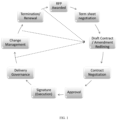
- FIG. 1 shows the basic lifecycle of a contract.
- the lifecycle of the contract starts with a request for proposal (RFP). Based on the RFP, term sheet is negotiated between the contracting parties. Then, based on the negotiation a draft contract is prepared. This prepared draft contract then further negotiated by the contracting parties. The draft contract is then sent for the approval of legal team and various other stakeholders. Once the approval is done, the draft contract is executed by taking signatures of the contracting parties. Further, delivery of the output of the contract is governed. And finally, after the change management either the contract is terminated or renewed.
- RFP request for proposal
- the embodiments herein provide an automated method and a system for management of lifecycle of contracts.
- the disclosure provides a holistic solution that leverages a combination of artificial intelligence (AI) techniques appropriate for different micro services in contract lifecycle management.
- AI artificial intelligence
- the system is configured to automatically generate contracts for a customer based on the service, geography and other criteria specific to the customer. Further, the system also identifies smallest logical units of clauses and attendant attributes like P&L impact, risk exposure, probability etc. The system also identifies alternate options to risky clauses and mandatory clauses to be included.
- the system is also configured to manage the workflows based on context of contract to seek exception approvals from appropriate stakeholders during contract creation and alert appropriate stakeholders on delivery governance issues.
- the risk exposure is also evaluated dynamically at clause level and probability of risk materializing.
- FIG. 2 through FIG. 7 where similar reference characters denote corresponding features consistently throughout the figures, there are shown preferred embodiments and these embodiments are described in the context of the following exemplary system and/or method.
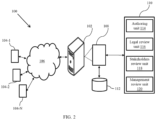
- FIG. 2 illustrates a block diagram of a system 100 for managing the life cycle of a contract.
- the system 100 is configured to use deep learning and natural language processing (NLP) techniques to analyze existing contracts and their actual execution data. This helps in understanding of clauses of the contract, risk levels involved in the contract, probabilities and templates.
- NLP natural language processing
- the system 100 is also configured to use deep writing and fuzzy logic to utilize the knowledge gained for creation of new contracts and providing guidance on alternates, risks etc.
- the system 100 is also using NLP to monitor and govern delivery execution and data to ensure smart updates and action triggers to appropriate stakeholders.
- the system 100 comprises one or more computing devices 102, such as a laptop computer, a desktop computer, a smartphone, a notebook, a workstation, a cloud-based computing environment and the like. It will be understood that the system 100 may be accessed through one or more input/output interfaces 104-1, 104-2... 104-N, collectively referred to as I/O interface 104. Examples of the I/O interface 104 may include, but are not limited to, a user interface, a portable computer, a personal digital assistant, a handheld device, a smartphone, a tablet computer, a workstation and the like. The I/O interface 104 are communicatively coupled to the system 100 through a network 106.
- the network 106 may be a wireless or a wired network, or a combination thereof.
- the network 106 can be implemented as a computer network, as one of the different types of networks, such as virtual private network (VPN), intranet, local area network (LAN), wide area network (WAN), the internet, and such.
- the network 106 may either be a dedicated network or a shared network, which represents an association of the different types of networks that use a variety of protocols, for example, Hypertext Transfer Protocol (HTTP), Transmission Control Protocol/Internet Protocol (TCP/IP), and Wireless Application Protocol (WAP), to communicate with each other.
- the network 106 may include a variety of network devices, including routers, bridges, servers, computing devices, storage devices. The network devices within the network 106 may interact with the system 100 through communication links.
- the system 100 may be implemented in a workstation, a mainframe computer, a server, and a network server.
- the computing device 102 further comprises one or more hardware processors 108, one or more memory 110, hereinafter referred as a memory 110 and a data repository 112, for example, a repository 112.
- the memory 110 is in communication with the one or more hardware processors 108, wherein the one or more hardware processors 108 are configured to execute programmed instructions stored in the memory 110, to perform various functions as explained in the later part of the disclosure.
- the repository 112 may store data processed, received, and generated by the system 100.
- the system 100 supports various connectivity options such as BLUETOOTH ® , USB, ZigBee and other cellular services.
- the network environment enables connection of various components of the system 100 using any communication link including Internet, WAN, MAN, and so on.
- the system 100 is implemented to operate as a stand-alone device.
- the system 100 may be implemented to work as a loosely coupled device to a smart computing environment. The components and functionalities of the system 100 are described further in detail.
- the memory 110 further comprises a plurality of units.
- the plurality of units is configured to perform various functions.
- the plurality of units comprises an authoring unit 114, a legal review unit 116, a stakeholders review unit 118 and a management review unit 120.
- the input/output interface 104 is configured to receive, a request by a user for a creation or amendment of the contract, wherein the request comprises a plurality of metadata corresponding to the contract.
- the plurality of metadata comprises names of contracting parties, a start date of the contract, an end date of the contract, a value and scope of the contract.
- the plurality of metadata may also comprise any other data related to the contract.
- the user and the plurality of stakeholders comprise a legal team, senior management in the organization, sales managers, delivery managers, finance team, human resources team or any other team providing support functions in the organization.
- the request for the creation or amendment of the contract is generated via the one or more hardware processors or via the one or more channels.
- the use of phrases "the one or more channels" and “the one or more hardware processors” is interchangeable.
- the one or more channels may be, but not limited to, a website, or an application running on the mobile phone.
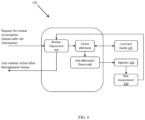
- the system 100 comprises the authoring unit 114 as shown in the schematic diagram of FIG. 3 .
- the authoring unit 114 is configured to receive the request and choose a template which can be used for the contract.
- the template is picked from a contract guide 122 based on a set of required combinations using a classification technique.
- the contract guide 122 is a type of pre-made repository containing a plurality of contract templates.
- the contract guide 122 uses deep learning technique to create a plurality of templates for a plurality of scenarios. Though if no template exists in the contract guide 122 for the set of required combinations, then the template is generated using a natural language processing (NLP) technique via a contract writer 124.
- NLP natural language processing
- the template is picked using a fuzzy logic technique by a template selector 126.
- the authoring unit 114 also configured to digitize the chosen template to identify a plurality of meta-clauses of the contract using a natural language processing technique via a digitizer 128.
- the authoring unit 114 also configured to classify a plurality of attributes for each of the plurality of meta-clauses.
- the authoring unit 114 further configured to evaluate risks associated with the plurality of meta-clauses in the contract via a risk analyzer 130. Once the risks are evaluated, the chosen template is then updated with the plurality of metadata to generate a draft contract using a deep writing technique.
- the risk analyzer 130 calculates a probability of risks and benefits materializing for each of the plurality of meta-clauses based on historic data from the contract guide 122.
- the authoring unit 114 is further configured to send the draft contract along with the evaluated risk for a legal review to the legal review unit 116.
- FIG. 4 is a schematic representation of the legal review unit 116.
- the legal team reviews the appropriateness of template, metadata usage in the draft contract, variance from standard, risk scores. After the legal review, if it is found that the draft contract is prepared as per a defined set of guidelines then the draft contract is approved. The approval also results in identification of a set of risky clauses in the draft contract for future assessment. If the draft contract is not prepared as per the defined set of guidelines, then the draft contract is not approved and the legal review unit 116 checks for the alternate clauses in the contract guide 122 or edit the draft contract manually.
- the legal review unit 116 is then configured to update the one or more clauses of the draft contract either from the contract guide or manually.
- the updated draft contract is then sent back by the legal review unit 116 to the authoring unit 114 for digitization and risk evaluation. Once the updated draft is approved, the legal review unit 114 is configured to send the draft contract to the user.
- the system 100 further comprises the stakeholders review unit 118 and the management review unit 120.
- FIG. 5 is a schematic representation of the stakeholders review unit 118.
- the authoring unit 114 is further configured to send the legal approved document to the plurality of stakeholders along with the indication of risk levels and exception approvals required.
- the plurality of stakeholders to which the draft contract needs to be sent is decided based on the set of risky clauses present in the draft contract.
- the plurality of stakeholders can request for exception approval or amend the contract to not have exceptions.
- the plurality of stakeholders is configured to review the legal approved draft contract.
- the plurality of stakeholders normally reviews the exception clauses with risk information.
- the stakeholders review unit 118 checks for the alternate clauses in the contract guide 122.
- the stakeholders review unit 118 is then configured to update the one or more clauses of the draft contract from the contract guide 122.
- the updated draft contract is then sent back by the stakeholders review unit 118 to the authoring unit 114 for digitization and risk evaluation. Once the updated draft is approved, the stakeholders review unit 118 is configured to send the draft contract to the user.
- a request may be triggered to the legal team to directly accept exception approval or amend document to remove exception.
- the contract guide 122 uses a rules engine to determine a number of approvals required for exceptions in agreed standards for clauses.
- the management review unit 120 is configured to review the legal approved and the stakeholders reviewed draft contract.
- FIG. 6 is a schematic representation of the management review unit 120.
- the authoring unit 114 sends legal approved document to the user with indication of risk levels and exception approvals required from senior management such as CEO, CFO etc.
- the senior management can request for exception approval or amend the contract to not have exceptions.
- the management review unit 120 checks for the alternate clauses in the contract guide 122.
- the management review unit 120 is then configured to update the one or more clauses of the draft contract from the contract guide 122.
- the updated draft contract is then sent back by the management review unit 120 to the authoring unit 114 for digitization and risk evaluation. Once the updated draft is approved, the management review unit 120 is configured to send the draft contract to the user.
- the legal review unit 116 is further configured to send the draft contract to appropriate authorized signatory to be signed to finalize the contract.
- the contract can be signed physically or digitally.
- the user confirms the removal or approval of the exception clauses from the draft contract.
- the system 100 further configured to determine appropriate signatory and appropriate signature process using a rule engine.
- the signed contract is then finally sent to the legal review unit 116 for check whether all the signatures are present as per a preset compliance.
- the system 100 is also configured to initiate the workflow for renewing the contract. Initially, the end date, a project type of the contract is checked. An appropriate timeframe is then defined to initiate renewal for each customer using a rule engine. A workflow is then initiated to the user for approval based on decision made by the rule engine. And finally, a workflow is initiated to the authoring unit 114 for amendment of the contract if the user approves the request.
- the system 100 is also configured to initiate the workflow for amending the contract. Initially, data related to the contract is analyzed using NLP to determine if the contract amendment process needs to be triggered. A request is then initiated to the user based on the analysis. In the last step, the workflow is initiated to the authoring unit 114 for creation of amendment, if the user approves the request.
- the system 100 is also configured to initiate the workflow for terminating the contract. Initially, data related to the contract is analyzed using the natural language processing technique to determine if termination process needs to be triggered as per a set of termination clauses present in the contract. A workflow is then initiated to get approval from the user based on the analysis. Further, workflow is initiated to the authoring unit 114, if the user approves the termination. And finally, workflows are initiated to the relevant stakeholders to raise invoices related to the termination.
- the system 100 is also configured to track, the fulfilment of contractual commitments with the contracting parties, whether obligations have been fulfilled or not, using a fuzzy logic technique.
- the system 100 is also configured to perform analytics and report the final contract on the I/O interface 104 based on the request from the plurality of stakeholders as per their role.
- the final contract is stored in the data repository 112.
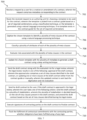
- FIG. 3 illustrates an example flow chart of a method 300 for management of lifecycle of contracts, in accordance with an example embodiment of the present disclosure.
- the method 300 depicted in the flow chart may be executed by a system, for example, the system 100 of FIG. 1 .
- the system 100 may be embodied in a computing device.
- Operations of the flowchart, and combinations of operations in the flowchart may be implemented by various means, such as hardware, firmware, processor, circuitry and/or other device associated with execution of software including one or more computer program instructions.
- one or more of the procedures described in various embodiments may be embodied by computer program instructions.
- the computer program instructions, which embody the procedures, described in various embodiments may be stored by at least one memory device of a system and executed by at least one processor in the system. Any such computer program instructions may be loaded onto a computer or other programmable system (for example, hardware) to produce a machine, such that the resulting computer or other programmable system embody means for implementing the operations specified in the flowchart.
- the operations of the method 300 are described with help of system 100. However, the operations of the method 300 can be described and/or practiced by using any other system.
- the request is received by the user for creation or amendment of the contract.
- the request comprises a plurality of metadata corresponding to the contract.
- the plurality of metadata comprises name of contracting parties, a start date of the contract, an end date of the contract, a value and scope of the contract.
- the received request is routed to the authoring unit 114 for choosing a template to be used for the contract.
- the template is picked from the contract guide 122 based on the set of required combinations using a classification technique. While, if no template exists in the contract guide for the set of required combinations, then the template is generated using a natural language processing technique.
- the chosen template is digitized to identify the plurality of meta-clauses of the contract using the natural language processing technique.
- the plurality of attributes of each of the plurality of meta-clauses are classified.
- the risks associated with the plurality of meta-clauses in the contract are evaluated. The evaluated risks are important to identify the risky clauses in the draft contract.
- the chosen template with the plurality of metadata to generate a draft contract using a deep writing technique.
- the draft contract along with the evaluated risk is sent for the legal review, wherein the legal review results in one of the following: approval of the draft contract, wherein the approval also comprises a set of risky clauses identified in the draft contract, or updating one or more clauses of the draft contract either from the contract guide or manually, wherein the updated contract is sent back for digitization and risk evaluation.
- the draft contract is then sent to the user, if the draft contract is approved in the legal review.
- the user takes one of the following actions: send the draft contract to a plurality of stakeholders, wherein the plurality of stakeholders is decided based on the set of risky clauses present in the draft contract, and amend the draft contract based on the set of risky clauses identified during the legal review.
- step 718 of the method 700 signatures of contracting parties are executed on the draft contract to finalize the contract.
- step 720 the fulfilment of contractual commitments with the contracting parties are tracked, whether obligations have been fulfilled using a fuzzy logic.
- the embodiments of present disclosure herein address problems high effort and time involved in the creation and maintenance of contracts.
- the embodiment thus provides an automated method and system for management of lifecycle of contracts.
- the hardware device can be any kind of device which can be programmed including e.g. any kind of computer like a server or a personal computer, or the like, or any combination thereof.
- the device may also include means which could be e.g. hardware means like e.g. an application-specific integrated circuit (ASIC), a field-programmable gate array (FPGA), or a combination of hardware and software means, e.g.
- ASIC application-specific integrated circuit
- FPGA field-programmable gate array
- the means can include both hardware means and software means.
- the method embodiments described herein could be implemented in hardware and software.
- the device may also include software means.
- the embodiments may be implemented on different hardware devices, e.g. using a plurality of CPUs.
- the embodiments herein can comprise hardware and software elements.
- the embodiments that are implemented in software include but are not limited to, firmware, resident software, microcode, etc.
- the functions performed by various components described herein may be implemented in other components or combinations of other components.
- a computer-usable or computer readable medium can be any apparatus that can comprise, store, communicate, propagate, or transport the program for use by or in connection with the instruction execution system, apparatus, or device.
- a computer-readable storage medium refers to any type of physical memory on which information or data readable by a processor may be stored.
- a computer-readable storage medium may store instructions for execution by one or more processors, including instructions for causing the processor(s) to perform steps or stages consistent with the embodiments described herein.
- the term "computer-readable medium” should be understood to include tangible items and exclude carrier waves and transient signals, i.e., be non-transitory. Examples include random access memory (RAM), read-only memory (ROM), volatile memory, nonvolatile memory, hard drives, CD ROMs, DVDs, flash drives, disks, and any other known physical storage media.
Landscapes
- Business, Economics & Management (AREA)
- Engineering & Computer Science (AREA)
- Human Resources & Organizations (AREA)
- Tourism & Hospitality (AREA)
- Economics (AREA)
- Strategic Management (AREA)
- Theoretical Computer Science (AREA)
- General Physics & Mathematics (AREA)
- Physics & Mathematics (AREA)
- General Business, Economics & Management (AREA)
- Marketing (AREA)
- Health & Medical Sciences (AREA)
- General Health & Medical Sciences (AREA)
- Technology Law (AREA)
- Primary Health Care (AREA)
- Entrepreneurship & Innovation (AREA)
- Development Economics (AREA)
- Educational Administration (AREA)
- Quality & Reliability (AREA)
- Game Theory and Decision Science (AREA)
- Operations Research (AREA)
- Management, Administration, Business Operations System, And Electronic Commerce (AREA)
- Artificial Intelligence (AREA)
- Audiology, Speech & Language Pathology (AREA)
- Computational Linguistics (AREA)
- General Engineering & Computer Science (AREA)
Applications Claiming Priority (1)
| Application Number | Priority Date | Filing Date | Title |
|---|---|---|---|
| IN202121061656 | 2021-12-30 |
Publications (3)
| Publication Number | Publication Date |
|---|---|
| EP4207014A1 true EP4207014A1 (de) | 2023-07-05 |
| EP4207014B1 EP4207014B1 (de) | 2025-11-19 |
| EP4207014C0 EP4207014C0 (de) | 2025-11-19 |
Family
ID=83049971
Family Applications (1)
| Application Number | Title | Priority Date | Filing Date |
|---|---|---|---|
| EP22187999.2A Active EP4207014B1 (de) | 2021-12-30 | 2022-08-01 | System und verfahren zur verwaltung des lebenszyklus von verträgen |
Country Status (2)
| Country | Link |
|---|---|
| US (1) | US12387282B2 (de) |
| EP (1) | EP4207014B1 (de) |
Cited By (1)
| Publication number | Priority date | Publication date | Assignee | Title |
|---|---|---|---|---|
| US20230229866A1 (en) * | 2021-12-30 | 2023-07-20 | Tata Consultancy Services Limited | System and method for management of life cycle of contracts |
Families Citing this family (1)
| Publication number | Priority date | Publication date | Assignee | Title |
|---|---|---|---|---|
| CN121190260A (zh) * | 2025-11-24 | 2025-12-23 | 深圳市易图资讯股份有限公司 | 合同的智能风控合规方法 |
Citations (3)
| Publication number | Priority date | Publication date | Assignee | Title |
|---|---|---|---|---|
| US20200410617A1 (en) * | 2019-06-28 | 2020-12-31 | Iterate Studio, Inc. | Dynamic and automatic agreement generation and modification |
| US20210350227A1 (en) * | 2020-05-08 | 2021-11-11 | Docusign, Inc. | High-risk passage automation in a digital transaction management platform |
| US20210357392A1 (en) * | 2020-05-12 | 2021-11-18 | International Business Machines Corporation | Computer implemented live cross walks in compliance mappings in response to regulatory changes and assessing risks of changes |
Family Cites Families (30)
| Publication number | Priority date | Publication date | Assignee | Title |
|---|---|---|---|---|
| US20020129056A1 (en) * | 2000-12-11 | 2002-09-12 | Conant Michael V. | Method and apparatus for electronic negotiation of document content |
| US6934715B2 (en) * | 2002-07-23 | 2005-08-23 | General Electric Company | Method for collecting and storing data regarding terms and conditions of contractual agreements |
| US20040230453A1 (en) * | 2003-05-16 | 2004-11-18 | Belmore Charles Edward | Method for measuring contract quality/risk |
| US20050182736A1 (en) * | 2004-02-18 | 2005-08-18 | Castellanos Maria G. | Method and apparatus for determining contract attributes based on language patterns |
| US20060287966A1 (en) * | 2004-12-21 | 2006-12-21 | Oracle International Corporation | Methods and systems for authoring customized contracts using contract templates that include user-configured rules and questions |
| US7853498B2 (en) * | 2005-11-03 | 2010-12-14 | International Business Machines Corporation | Method, system, and computer program product for on-demand creation and distribution of customized dynamic contracts |
| US20080306784A1 (en) * | 2007-06-05 | 2008-12-11 | Vijay Rajkumar | Computer-implemented methods and systems for analyzing clauses of contracts and other business documents |
| US9495333B2 (en) * | 2011-05-16 | 2016-11-15 | Zycus Infotech Pvt. Ltd. | Contract authoring system and method |
| US9747562B1 (en) * | 2012-03-19 | 2017-08-29 | Apttex Corporation | Linking structured database management systems with document creation and word processing tools |
| US20140053069A1 (en) * | 2012-08-16 | 2014-02-20 | Sap Ag | Identifying and mitigating risks in contract document using text analysis with custom high risk clause dictionary |
| US20140108072A1 (en) * | 2012-10-17 | 2014-04-17 | Bank Of America | Vendor Contract Assessment Tool |
| US20170011313A1 (en) * | 2015-07-06 | 2017-01-12 | The Boeing Company | Systems and methods for determining contract clauses |
| US9940681B2 (en) * | 2015-09-01 | 2018-04-10 | International Business Machines Corporation | Predictive approach to contract management |
| AU2016340241A1 (en) | 2015-10-13 | 2018-04-26 | Thomson Reuters Enterprise Centre Gmbh | Risk and compliance analytic system |
| US11468372B2 (en) * | 2016-03-08 | 2022-10-11 | Tata Consultancy Services Limited | Data modeling systems and methods for risk profiling |
| WO2017173399A1 (en) * | 2016-03-31 | 2017-10-05 | Clause, Inc. | System and method for creating and executing data-driven legal contracts |
| WO2017223047A1 (en) * | 2016-06-20 | 2017-12-28 | Wal-Mart Stores, Inc. | Contract negotiation assistance system and method |
| WO2018006072A1 (en) * | 2016-06-30 | 2018-01-04 | Clause, Inc. | Systems and method for forming, storing, managing,and executing contracts |
| US9754206B1 (en) * | 2016-07-01 | 2017-09-05 | Intraspexion Inc. | Using classified text and deep learning algorithms to identify drafting risks in a document and provide early warning |
| US11416956B2 (en) * | 2017-03-15 | 2022-08-16 | Coupa Software Incorporated | Machine evaluation of contract terms |
| US20180315141A1 (en) * | 2017-04-26 | 2018-11-01 | Clause, Inc. | System and method for business intelligence through data-driven contract analysis |
| US11164270B2 (en) * | 2018-09-27 | 2021-11-02 | International Business Machines Corporation | Role-oriented risk checking in contract review based on deep semantic association analysis |
| US20200226510A1 (en) * | 2019-01-11 | 2020-07-16 | Sirionlabs | Method and System for Determining Risk Score for a Contract Document |
| US11200259B2 (en) * | 2019-04-10 | 2021-12-14 | Ivalua S.A.S. | System and method for processing contract documents |
| US20200327172A1 (en) * | 2019-04-10 | 2020-10-15 | Ivalua S.A.S. | System and method for processing contract documents |
| US20210035247A1 (en) * | 2019-08-01 | 2021-02-04 | Arthur C. Swanson | Method for efficient contract preparation, review and negotiation |
| US20220335553A1 (en) * | 2019-11-18 | 2022-10-20 | QPQ Ltd. | System and a method for generating and managing machine executable digital contracts |
| US11348352B2 (en) * | 2019-12-26 | 2022-05-31 | Nb Ventures, Inc. | Contract lifecycle management |
| US20220092711A1 (en) * | 2020-09-15 | 2022-03-24 | SimpliContract Technologies Private Limited | System and method for extracting data from contracts using ai based natural language processing (nlp) |
| EP4207014B1 (de) * | 2021-12-30 | 2025-11-19 | Tata Consultancy Services Limited | System und verfahren zur verwaltung des lebenszyklus von verträgen |
-
2022
- 2022-08-01 EP EP22187999.2A patent/EP4207014B1/de active Active
- 2022-08-04 US US17/817,587 patent/US12387282B2/en active Active
Patent Citations (3)
| Publication number | Priority date | Publication date | Assignee | Title |
|---|---|---|---|---|
| US20200410617A1 (en) * | 2019-06-28 | 2020-12-31 | Iterate Studio, Inc. | Dynamic and automatic agreement generation and modification |
| US20210350227A1 (en) * | 2020-05-08 | 2021-11-11 | Docusign, Inc. | High-risk passage automation in a digital transaction management platform |
| US20210357392A1 (en) * | 2020-05-12 | 2021-11-18 | International Business Machines Corporation | Computer implemented live cross walks in compliance mappings in response to regulatory changes and assessing risks of changes |
Cited By (2)
| Publication number | Priority date | Publication date | Assignee | Title |
|---|---|---|---|---|
| US20230229866A1 (en) * | 2021-12-30 | 2023-07-20 | Tata Consultancy Services Limited | System and method for management of life cycle of contracts |
| US12387282B2 (en) * | 2021-12-30 | 2025-08-12 | Tata Consultancy Services Limited | System and method for management of life cycle of contracts |
Also Published As
| Publication number | Publication date |
|---|---|
| EP4207014B1 (de) | 2025-11-19 |
| US12387282B2 (en) | 2025-08-12 |
| EP4207014C0 (de) | 2025-11-19 |
| US20230229866A1 (en) | 2023-07-20 |
Similar Documents
| Publication | Publication Date | Title |
|---|---|---|
| US10404526B2 (en) | Method and system for generating recommendations associated with client process execution in an organization | |
| US10574539B2 (en) | System compliance assessment utilizing service tiers | |
| Tamraparani | Automating Invoice Processing in Fund Management: Insights from RPA and Data Integration Techniques | |
| US10275730B2 (en) | Method for creating and expressing risk-extended business process models | |
| US10885440B2 (en) | Contextual evaluation of process model for generation and extraction of project management artifacts | |
| US20160162819A1 (en) | Workflow definition, orchestration and enforcement via a collaborative interface according to a hierarchical procedure list | |
| WO2020005725A1 (en) | Knowledge-driven dialog support conversation system | |
| US20050165822A1 (en) | Systems and methods for business process automation, analysis, and optimization | |
| Al-Baik et al. | Waste identification and elimination in information technology organizations | |
| US8694487B2 (en) | Project management system | |
| US20170269971A1 (en) | Migrating enterprise workflows for processing on a crowdsourcing platform | |
| Kayis et al. | IRMAS–development of a risk management tool for collaborative multi‐site, multi‐partner new product development projects | |
| EP4207014B1 (de) | System und verfahren zur verwaltung des lebenszyklus von verträgen | |
| Gupta et al. | Reducing user input requests to improve IT support ticket resolution process | |
| US10387816B2 (en) | Automating a governance process of optimizing a portfolio of services in a governed SOA | |
| US20030055697A1 (en) | Systems and methods to facilitate migration of a process via a process migration template | |
| US20120066145A1 (en) | Automating A Governance Process Of Reviewing Service Artifacts In A Governed SOA | |
| Di Martino et al. | Semantic representation and rule based patterns discovery and verification in eProcurement business processes for eGovernment | |
| US8504412B1 (en) | Audit automation with survey and test plan | |
| US11640570B2 (en) | Methods and systems of risk identification, quantification, benchmarking and mitigation engine delivery | |
| US20230344852A1 (en) | Centralized technique to manage an enterprise-level cybersecurity maturity assessment | |
| Pathak et al. | Analysis of improving sales process efficiency with salesforce industries CPQ in CRM | |
| CN108536577B (zh) | 程序代码信息处理方法及装置 | |
| Pourshahid et al. | Toward an aspect-oriented framework for business process improvement | |
| Kwasafo et al. | Using case studies to model an AI-based construction bid automation framework |
Legal Events
| Date | Code | Title | Description |
|---|---|---|---|
| PUAI | Public reference made under article 153(3) epc to a published international application that has entered the european phase |
Free format text: ORIGINAL CODE: 0009012 |
|
| STAA | Information on the status of an ep patent application or granted ep patent |
Free format text: STATUS: REQUEST FOR EXAMINATION WAS MADE |
|
| 17P | Request for examination filed |
Effective date: 20230511 |
|
| AK | Designated contracting states |
Kind code of ref document: A1 Designated state(s): AL AT BE BG CH CY CZ DE DK EE ES FI FR GB GR HR HU IE IS IT LI LT LU LV MC MK MT NL NO PL PT RO RS SE SI SK SM TR |
|
| GRAP | Despatch of communication of intention to grant a patent |
Free format text: ORIGINAL CODE: EPIDOSNIGR1 |
|
| STAA | Information on the status of an ep patent application or granted ep patent |
Free format text: STATUS: GRANT OF PATENT IS INTENDED |
|
| RIC1 | Information provided on ipc code assigned before grant |
Ipc: G06Q 10/06 20230101AFI20250714BHEP Ipc: G06Q 50/18 20120101ALI20250714BHEP |
|
| INTG | Intention to grant announced |
Effective date: 20250725 |
|
| GRAS | Grant fee paid |
Free format text: ORIGINAL CODE: EPIDOSNIGR3 |
|
| GRAA | (expected) grant |
Free format text: ORIGINAL CODE: 0009210 |
|
| STAA | Information on the status of an ep patent application or granted ep patent |
Free format text: STATUS: THE PATENT HAS BEEN GRANTED |
|
| AK | Designated contracting states |
Kind code of ref document: B1 Designated state(s): AL AT BE BG CH CY CZ DE DK EE ES FI FR GB GR HR HU IE IS IT LI LT LU LV MC MK MT NL NO PL PT RO RS SE SI SK SM TR |
|
| REG | Reference to a national code |
Ref country code: CH Ref legal event code: F10 Free format text: ST27 STATUS EVENT CODE: U-0-0-F10-F00 (AS PROVIDED BY THE NATIONAL OFFICE) Effective date: 20251119 Ref country code: GB Ref legal event code: FG4D |
|
| REG | Reference to a national code |
Ref country code: DE Ref legal event code: R096 Ref document number: 602022025144 Country of ref document: DE |
|
| REG | Reference to a national code |
Ref country code: CH Ref legal event code: R17 Free format text: ST27 STATUS EVENT CODE: U-0-0-R10-R17 (AS PROVIDED BY THE NATIONAL OFFICE) Effective date: 20251212 |
|
| REG | Reference to a national code |
Ref country code: IE Ref legal event code: FG4D |
|
| U01 | Request for unitary effect filed |
Effective date: 20251210 |
|
| U07 | Unitary effect registered |
Designated state(s): AT BE BG DE DK EE FI FR IT LT LU LV MT NL PT RO SE SI Effective date: 20251217 |
|
| PG25 | Lapsed in a contracting state [announced via postgrant information from national office to epo] |
Ref country code: ES Free format text: LAPSE BECAUSE OF FAILURE TO SUBMIT A TRANSLATION OF THE DESCRIPTION OR TO PAY THE FEE WITHIN THE PRESCRIBED TIME-LIMIT Effective date: 20251119 |
|
| PG25 | Lapsed in a contracting state [announced via postgrant information from national office to epo] |
Ref country code: NO Free format text: LAPSE BECAUSE OF FAILURE TO SUBMIT A TRANSLATION OF THE DESCRIPTION OR TO PAY THE FEE WITHIN THE PRESCRIBED TIME-LIMIT Effective date: 20260219 |
|
| PG25 | Lapsed in a contracting state [announced via postgrant information from national office to epo] |
Ref country code: HR Free format text: LAPSE BECAUSE OF FAILURE TO SUBMIT A TRANSLATION OF THE DESCRIPTION OR TO PAY THE FEE WITHIN THE PRESCRIBED TIME-LIMIT Effective date: 20251119 |
|
| PG25 | Lapsed in a contracting state [announced via postgrant information from national office to epo] |
Ref country code: RS Free format text: LAPSE BECAUSE OF FAILURE TO SUBMIT A TRANSLATION OF THE DESCRIPTION OR TO PAY THE FEE WITHIN THE PRESCRIBED TIME-LIMIT Effective date: 20260219 |
|
| PG25 | Lapsed in a contracting state [announced via postgrant information from national office to epo] |
Ref country code: IS Free format text: LAPSE BECAUSE OF FAILURE TO SUBMIT A TRANSLATION OF THE DESCRIPTION OR TO PAY THE FEE WITHIN THE PRESCRIBED TIME-LIMIT Effective date: 20260319 |