EP4206169A1 - Composite adsorbent for separating ethylbenzene by adsorptive rectification and use thereof - Google Patents
Composite adsorbent for separating ethylbenzene by adsorptive rectification and use thereof Download PDFInfo
- Publication number
- EP4206169A1 EP4206169A1 EP21860343.9A EP21860343A EP4206169A1 EP 4206169 A1 EP4206169 A1 EP 4206169A1 EP 21860343 A EP21860343 A EP 21860343A EP 4206169 A1 EP4206169 A1 EP 4206169A1
- Authority
- EP
- European Patent Office
- Prior art keywords
- xylene
- column
- ethylbenzene
- adsorbent
- distillation
- Prior art date
- Legal status (The legal status is an assumption and is not a legal conclusion. Google has not performed a legal analysis and makes no representation as to the accuracy of the status listed.)
- Pending
Links
Images
Classifications
-
- C—CHEMISTRY; METALLURGY
- C07—ORGANIC CHEMISTRY
- C07C—ACYCLIC OR CARBOCYCLIC COMPOUNDS
- C07C7/00—Purification; Separation; Use of additives
- C07C7/04—Purification; Separation; Use of additives by distillation
- C07C7/05—Purification; Separation; Use of additives by distillation with the aid of auxiliary compounds
-
- C—CHEMISTRY; METALLURGY
- C07—ORGANIC CHEMISTRY
- C07C—ACYCLIC OR CARBOCYCLIC COMPOUNDS
- C07C7/00—Purification; Separation; Use of additives
- C07C7/12—Purification; Separation; Use of additives by adsorption, i.e. purification or separation of hydrocarbons with the aid of solids, e.g. with ion-exchangers
- C07C7/13—Purification; Separation; Use of additives by adsorption, i.e. purification or separation of hydrocarbons with the aid of solids, e.g. with ion-exchangers by molecular-sieve technique
-
- B—PERFORMING OPERATIONS; TRANSPORTING
- B01—PHYSICAL OR CHEMICAL PROCESSES OR APPARATUS IN GENERAL
- B01D—SEPARATION
- B01D3/00—Distillation or related exchange processes in which liquids are contacted with gaseous media, e.g. stripping
- B01D3/14—Fractional distillation or use of a fractionation or rectification column
- B01D3/32—Other features of fractionating columns ; Constructional details of fractionating columns not provided for in groups B01D3/16 - B01D3/30
-
- B—PERFORMING OPERATIONS; TRANSPORTING
- B01—PHYSICAL OR CHEMICAL PROCESSES OR APPARATUS IN GENERAL
- B01D—SEPARATION
- B01D3/00—Distillation or related exchange processes in which liquids are contacted with gaseous media, e.g. stripping
- B01D3/34—Distillation or related exchange processes in which liquids are contacted with gaseous media, e.g. stripping with one or more auxiliary substances
-
- B—PERFORMING OPERATIONS; TRANSPORTING
- B01—PHYSICAL OR CHEMICAL PROCESSES OR APPARATUS IN GENERAL
- B01J—CHEMICAL OR PHYSICAL PROCESSES, e.g. CATALYSIS OR COLLOID CHEMISTRY; THEIR RELEVANT APPARATUS
- B01J20/00—Solid sorbent compositions or filter aid compositions; Sorbents for chromatography; Processes for preparing, regenerating or reactivating thereof
- B01J20/02—Solid sorbent compositions or filter aid compositions; Sorbents for chromatography; Processes for preparing, regenerating or reactivating thereof comprising inorganic material
- B01J20/10—Solid sorbent compositions or filter aid compositions; Sorbents for chromatography; Processes for preparing, regenerating or reactivating thereof comprising inorganic material comprising silica or silicate
- B01J20/16—Alumino-silicates
- B01J20/18—Synthetic zeolitic molecular sieves
-
- B—PERFORMING OPERATIONS; TRANSPORTING
- B01—PHYSICAL OR CHEMICAL PROCESSES OR APPARATUS IN GENERAL
- B01J—CHEMICAL OR PHYSICAL PROCESSES, e.g. CATALYSIS OR COLLOID CHEMISTRY; THEIR RELEVANT APPARATUS
- B01J20/00—Solid sorbent compositions or filter aid compositions; Sorbents for chromatography; Processes for preparing, regenerating or reactivating thereof
- B01J20/02—Solid sorbent compositions or filter aid compositions; Sorbents for chromatography; Processes for preparing, regenerating or reactivating thereof comprising inorganic material
- B01J20/10—Solid sorbent compositions or filter aid compositions; Sorbents for chromatography; Processes for preparing, regenerating or reactivating thereof comprising inorganic material comprising silica or silicate
- B01J20/16—Alumino-silicates
- B01J20/18—Synthetic zeolitic molecular sieves
- B01J20/186—Chemical treatments in view of modifying the properties of the sieve, e.g. increasing the stability or the activity, also decreasing the activity
-
- B—PERFORMING OPERATIONS; TRANSPORTING
- B01—PHYSICAL OR CHEMICAL PROCESSES OR APPARATUS IN GENERAL
- B01J—CHEMICAL OR PHYSICAL PROCESSES, e.g. CATALYSIS OR COLLOID CHEMISTRY; THEIR RELEVANT APPARATUS
- B01J20/00—Solid sorbent compositions or filter aid compositions; Sorbents for chromatography; Processes for preparing, regenerating or reactivating thereof
- B01J20/22—Solid sorbent compositions or filter aid compositions; Sorbents for chromatography; Processes for preparing, regenerating or reactivating thereof comprising organic material
-
- B—PERFORMING OPERATIONS; TRANSPORTING
- B01—PHYSICAL OR CHEMICAL PROCESSES OR APPARATUS IN GENERAL
- B01J—CHEMICAL OR PHYSICAL PROCESSES, e.g. CATALYSIS OR COLLOID CHEMISTRY; THEIR RELEVANT APPARATUS
- B01J20/00—Solid sorbent compositions or filter aid compositions; Sorbents for chromatography; Processes for preparing, regenerating or reactivating thereof
- B01J20/28—Solid sorbent compositions or filter aid compositions; Sorbents for chromatography; Processes for preparing, regenerating or reactivating thereof characterised by their form or physical properties
- B01J20/28002—Solid sorbent compositions or filter aid compositions; Sorbents for chromatography; Processes for preparing, regenerating or reactivating thereof characterised by their form or physical properties characterised by their physical properties
- B01J20/28004—Sorbent size or size distribution, e.g. particle size
-
- C—CHEMISTRY; METALLURGY
- C07—ORGANIC CHEMISTRY
- C07C—ACYCLIC OR CARBOCYCLIC COMPOUNDS
- C07C15/00—Cyclic hydrocarbons containing only six-membered aromatic rings as cyclic parts
- C07C15/02—Monocyclic hydrocarbons
- C07C15/067—C8H10 hydrocarbons
- C07C15/073—Ethylbenzene
-
- C—CHEMISTRY; METALLURGY
- C07—ORGANIC CHEMISTRY
- C07C—ACYCLIC OR CARBOCYCLIC COMPOUNDS
- C07C15/00—Cyclic hydrocarbons containing only six-membered aromatic rings as cyclic parts
- C07C15/02—Monocyclic hydrocarbons
- C07C15/067—C8H10 hydrocarbons
- C07C15/08—Xylenes
Definitions
- the present invention relates to a composite adsorbent for separation by an adsorption distillation and the application thereof, concretely speaking, to a method for separating ethylbenzene in C 8 arene by an adsorption distillation using the composite adsorbent.
- Ethylbenzene is an important basic chemical material mainly used for the production of styrene. Currently, ethylbenzene is produced mainly by alkylation of benzene and ethylene. The oil refining and chemical industry has abundant ethylbenzene resources. Ethylbenzene accounts for about 18 mass% in the reforming C 8 fraction and about 50 mass% in the ethylene cracking C 8 fraction.
- this part of ethylbenzene can be separated directly, it can save the consumption of ethylene and benzene and optimize the allocation of chemical resources; besides, after the separation of ethylbenzene in the C 8 fraction, the use of xylene without ethylbenzene or with significantly reduced ethylbenzene as the raw material of the arene complex plant will significantly improve the efficiency of the arene complex plant. Therefore, it is quite necessary to develop a new process for an efficient separation of ethylbenzene from the mixed C 8 arene.
- GB1198592 describes a method for separating C 8 arene using a single or plural distillation columns, which requires at least 250 and preferably 365 column plates and a reflux ratio from 100 to 250:1.
- the method can separate ethylbenzene, ortho-xylene and a mixture of para- and meta-xylene by distillation.
- Para-xylene is further separated from the mixture of para- and meta-xylene by crystallization and other components are isomerized. This method has a high energy consumption and no economic advantage.
- the separation of ethylbenzene by adsorption can be divided into two categories.
- One is to preferentially adsorb the non-ethylbenzene components in C 8 arene to obtain ethylbenzene product from the raffinate.
- US3917734 , US4079094 and US4108915 respectively used Ca-X/Y, Sr-K-X or Sr-X zeolite to preferentially adsorb xylene isomers in C 8 arene and obtain ethylbenzene product from the raffinate, but it is difficult to obtain high-purity ethylbenzene product using such adsorbents, and its purity is easily affected by the composition of the raw material.
- CN100577617C discloses a method for separating ethylbenzene and para-xylene in the mixed C 8 arene using the pressure swing adsorption technology.
- a purging gas is used during the separation by the pressure swing adsorption to purge the adsorption bed layer, and the adsorbent as used is the ZSM-5 molecular sieve.
- Such an adsorbent can only take p-xylene and ethylbenzene together as aspirates, but cannot separate them.
- the selectivity of the adsorbent for the target products of p-xylene and ethylbenzene is low.
- An extractive distillation process is a method that uses an extractant to increase the relative volatility of the components to be separated to improve the separation efficiency.
- the solvent reported for the separation of ethylbenzene by the extractive distillation cannot provide an ideal selectivity, and the separation efficiency is low.
- US4292142 discloses a method for separation of ethylbenzene from para- and meta-xylenes by an extractive distillation.
- Maleic anhydride and phthalic anhydride are used as composite solvents for the extractive distillation.
- an oxygen containing compound can be further added.
- the relative volatility of ethylbenzene and p-xylene can reach 1.22 under the condition that the solvent ratio is 1.5.
- US5135620 discloses a process for separation of ethylbenzene from C 8 arene by an extractive distillation
- a copper (I) salt of a hydrocarbonsulfonic acid is employed as an entrainer to separate ethylbenzene from C 8 arene by the extractive distillation.
- the sulfonic acid includes p-toluenesulfonic acid, p-dodecylbenzenesulfonic acid, p-hexadecylbenzenesulfonic acid, naphthalene sulfonic acid, phenolsulfonic acid, naphtholsulfonic acids or halogenbenzenesulfonic acid.
- the entrainer is firstly introduced into an extractive distillation column, a component rich in ethylbenzene is withdrawn from the top of the column, and the entrainer dissolved in xylene is withdrawn from the bottom of the column.
- the xylene and the entrainer can be separated through the distillation column.
- the xylene is withdrawn from the top of the column, and the entrainer dissolved in xylene is withdrawn from the bottom of the column and returned to the extractive distillation column.
- the relative volatility of ethylbenzene and p-xylene reaches 1.16 under the condition that the solvent ratio is 2.
- Said composite adsorbent can increase the volatility of ethylbenzene relative to other C 8 arenes and thus a high-purity ethylbenzene can be separated from C 8 arene by the adsorption distillation.
- the composite adsorbent for separating ethylbenzene from C 8 arene by the adsorption distillation as provided in the present invention includes 1-50 mass% of a xylene adsorbent and 50-99 mass% of a carrier liquid, wherein the carrier liquid is selected from one or two of alkane, aryl-substituted alkane, decalin and alkyl-substituted decalin.
- the alkane is C 10 -C 26 alkane
- the aryl-substituted alkane is C 13 -C 16 aryl-substituted alkane.
- the composite adsorbent provided in the present invention is obtained by mixing the xylene adsorbent with an appropriate amount of the carrier liquid. It can be used to separate ethylbenzene and xylene in C 8 arene by means of the adsorption distillation method, and obtain a high-purity ethylbenzene product. The method can reduce the fixed investment and the energy consumption for separating ethylbenzene.
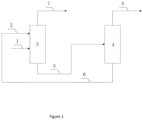
- Figure 1 is a flowchart of the method provided in the present invention for separating ethylbenzene from C 8 arene by the adsorption distillation.
- the composite adsorbent provided in the present invention comprises a xylene adsorbent and a carrier liquid.
- the said xylene adsorbent adsorbs xylene during the adsorption distillation, making it easy to separate ethylbenzene from xylene in C 8 arene.
- the said carrier liquid is used to carry the xylene adsorbent to flow. It does not react with C 8 arene, and its boiling point is preferably above 180 °C.
- the carrier liquid does not volatilize to the top of the adsorption distillation column during the adsorption distillation, and carries the adsorbent that adsorbs xylene into the distillation desorption column.
- the xylene in the adsorbent is desorbed in the distillation desorption column.
- the carrier liquid carries the regenerated xylene adsorbent and returns to the adsorption distillation column for reuse.
- the composite adsorbent can significantly increase the relative volatility of ethylbenzene relative to the respective isomers of xylene, and thus can separate a high-purity ethylbenzene from C 8 arene by the adsorption distillation.
- the xylene adsorbent in the composite adsorbent of the present invention is used to increase the relative volatility of ethylbenzene relative to the respective isomers of xylene, and the carrier liquid is used to carry the xylene adsorbent to flow.
- the composite adsorbent preferably includes 5-35 mass% of the xylene adsorbent and 65-95 mass% of the carrier liquid.
- the xylene adsorbent is preferably a Y molecular sieve with Group IA and/or Group IIA metal ions occupying cation sites, wherein the Group IA metal ions are preferably Li + or Na + , the Group IIA metal ions are preferably Sr 2+ or Ba 2+ , more preferably a NaY molecular sieve.
- the grain size of the Y molecular sieve is preferably 0. 1 ⁇ 2 microns, more preferably 0.2-1.5 microns.
- the carrier liquid is selected from one or arbitrary two of alkane, aryl-substituted alkane, decalin and alkyl-substituted decalin, wherein the said alkane may be n-alkane or isoalkane, preferably C 10 -C 24 n-alkane, more preferably C 11 -C 20 n-alkane.
- the said aryl-substituted alkane is preferably C 13 -C 16 diphenyl alkane.
- the alkyl of the said alkyl-substituted decalin may be C 1 -C 12 alkyl, preferably C 3 -C 10 alkyl, more preferably C 2 -C 6 alkyl.
- the number of the substituting alkyl can be 1-4, preferably 1-2.
- the method for separating ethylbenzene by the adsorption distillation comprises introducing the C 8 arene mixture into the middle part of the adsorption distillation column and introducing the composite adsorbent of the present invention into the upper part of the adsorption distillation column.
- ethylbenzene is withdrawn from the top of the adsorption distillation column, and the composite adsorbent enriched with xylene is withdrawn from the bottom of the column and enters the middle part of the distillation desorption column.
- a mixed xylene is withdrawn from the top of the column, and the regenerated composite adsorbent is obtained at the bottom of the column and is returned to the upper part of the adsorption distillation column for reuse.
- the overhead pressure of the adsorption distillation column is preferably 0.01-0.2 MPa.
- the theoretical plate number is preferably 30-100, more preferably 30-80.
- the composite adsorbent enters the column at a temperature of preferably 90-130 °C, the column bottom temperature is preferably 140-250 °C, and the overheard temperature is preferably 70-100 °C.
- the mass ratio of the composite adsorbent entering the adsorption distillation column to the C 8 arene mixture is preferably 5 to 30, more preferably 8 to 23; the mass ratio of the xylene adsorbent in the composite adsorbent to the C 8 arene mixture is preferably 1.5 to 6, more preferably 2 to 5; the mass ratio of the carrier liquid to the xylene adsorbent is preferably 1.5 to 20, more preferably 2 to 10.
- the reflux ratio at the upper part of the column is preferably 1 to 15, and more preferably 1 to 8.
- the overhead pressure of the distillation desorption column is preferably 0.01-0.15 MPa, more preferably 0.01-0.06 MPa; the theoretical plate number is preferably 20-50, more preferably 25-45; the bottom temperature is preferably 160-280 °C, and the overhead temperature is preferably 60-90 °C.
- the reflux ratio at the upper part of the distillation desorption column is preferably 0.3-3, more preferably 0.5-2.
- the reflux ratio is the mass ratio of the materials returning to the upper part of the column to the materials discharged from the top of the column.
- the said adsorption distillation column and the said distillation desorption column may be a packed column or a plate column.
- the content of ethylbenzene in the C 8 arene mixture is preferably 10-85 mass%, more preferably 15-60 mass%.
- the relative volatility refers to the ratio of the volatility of the easily volatile component i to the volatility of the difficultly involatile component j in the solution to be separated, which can reflect the difficulty degree of separating the two components during the distillation process.
- x is the liquid phase mole fraction of the component under the equilibrium state
- y is the gas phase mole fraction of the component under the equilibrium state.
- a C 8 arene mixture from pipeline 1 is introduced into the middle part of the adsorption distillation column 3.
- the composite adsorbent is introduced from pipeline 2 into the upper part of the adsorption distillation column.
- the C 8 arene is in countercurrent contact with the composite adsorbent in the column for the adsorption and the distillation.
- the xylene in the C 8 arene is adsorbed by the xylene adsorbent.
- the ethylbenzene is distilled to the overhead and withdrawn from the overhead pipeline 7, and an ethylbenzene product is obtained after condensation.
- the composite adsorbent that adsorbed xylene is withdrawn from the bottom of the adsorption distillation column and enters the middle part of the distillation desorption column 4 through pipeline 5.
- the xylene is desorbed from the composite adsorbent through distillation to realize the desorption and the regeneration of the xylene adsorbent.
- the desorbed xylene is withdrawn from the overhead pipeline 8 of the distillation desorption column and condensed to obtain xylene.
- the regenerated composite adsorbent is withdrawn from the bottom of the distillation desorption column, and returned via pipeline 6 and pipeline 2 to the adsorption distillation column for reuse.
- the said xylene basically contains no ethylbenzene and can be used as an isomerization raw material to produce p-xylene.
- the method for determining the relative volatility of the respective components of the C 8 arene is: adding the sample to be tested into the Agilent 7694 headspace sampler, letting it stand for certain time, determining the gas and liquid phase compositions in the sampler using Agilent 7890 chromatography when the gas-liquid equilibrium is reached, and calculating the relative volatility of the components according to Formula (1).
- Ethylbenzene, p-xylene, o-xylene, m-xylene were mixed according to the same mass ratio to formulate a C 8 arene mixture as the feedstock oil.
- the content of ethylbenzene in the feedstock oil is 25 mass%.
- a NaY molecular sieve powder with a grain size of 0.2-1 ⁇ m was used as the xylene adsorbent, and n-tetradecane was used as the carrier liquid.
- the xylene adsorbent was mixed with the carrier liquid to produce a composite adsorbent having a xylene adsorbent content of 20 mass% and a carrier liquid content of 80 mass%.
- the composite adsorbent and the feedstock oil were added to the headspace sampler, wherein the mass ratio of the carrier liquid/the xylene adsorbent/the feedstock oil was 8:2:1, and the mass ratio of the composite adsorbent to the feedstock oil was 10:1, and was let stand at 80 °C for 45 minutes to achieve the gas-liquid equilibrium.
- the gas and liquid phases were respectively taken for a composition analysis.
- the determined relative volatilities of ethylbenzene relative to the respective xylene isomers in the feedstock oil after addition of the composite adsorbent are shown in Table 1.
- the relative volatilities of ethylbenzene relative to the respective xylene isomers in the feedstock oil after addition of the composite adsorbent were determined according to the method of Example 1, except that the mass ratio of the carrier liquid/the xylene adsorbent/the feedstock oil as used was 18:2:1 and the mass ratio of the composite adsorbent to the feedstock oil was 20:1. The result is shown in Table 1.
- the relative volatilities of ethylbenzene relative to the respective xylene isomers in the feedstock oil after addition of the composite adsorbent were determined according to the method of Example 1, except that the mass ratio of ethylbenzene/p-xylene/o-xylene/m-xylene in the used feedstock oil was 1:2:1:1 and the ethylbenzene content in the feedstock oil was 20 mass%. The result is shown in Table 1.
- the relative volatilities of ethylbenzene relative to the respective xylene isomers in the feedstock oil were determined according to the method of Example 1, except that no composite adsorbent was used, and the mass ratio of ethylbenzene/p-xylene/o-xylene/m-xylene in the used feedstock oil was 2:1:1:1. The result is shown in Table 1.
- the use of the composite adsorbent in the present invention compared with the method of using no composite adsorbent or only using a carrier liquid, can significantly increase the relative volatilities of ethylbenzene relative to the respective xylene isomers, indicating that the use of the composite adsorbent in the present invention can separate ethylbenzene from C 8 arene.
- Ethylbenzene and xylene in C 8 arene were separated according to the process shown in Figure 1 , using the composite adsorbent and the feed oil as in Example 1.
- the operating conditions of the adsorption distillation column and the distillation desorption column and the purity of the obtained product are shown in Table 2.
- Ethylbenzene was separated from C 8 arene by the extractive distillation method.
- the C 8 arene was introduced into the middle part of the extractive distillation column, and the extraction solvent was introduced into the upper part of the column.
- ethylbenzene was withdrawn from the overhead.
- the rich solvent rich in xylene was withdrawn from the bottom of the column, and entered the solvent recovery column.
- the xylene was withdrawn from the overhead, and the lean solvent was withdrawn from the bottom of the column and returned to the extractive distillation column. 1,2,4-trichlorobenzene was used as the extraction solvent.
- the C 8 arene feedstock oil was formulated according to the method of Example 1.
- the composite adsorbent of Example 1 was used and the feedstock oil was a reformate C 8 fraction, wherein the mass ratio of ethylbenzene/p-xylene/m-xylene/o-xylene was 18:19:39:24.
- the ethylbenzene and the xylene in the C 8 fraction were separated according to the process shown in Figure 1 .
- the operating conditions of the adsorption distillation column and the distillation desorption column and the purity of the obtained product are shown in Table 3.
- Example 14 Comparative Example 7 adsorption distillation column/ common distillation column theoretical plate number 40 240 overhead pressure, MPa 0.02 0.02 overhead temperature, °C 85 85 column bottom temperature, °C 200 153 composite adsorbent entry temperature, °C 120 - mass ratio of composite adsorbent/feedstock oil 10 - reflux ratio 3 100 distillation desorption column theoretical plate number 40 - overhead pressure, MPa 0.01 - overhead temperature, °C 72 column bottom temperature, °C 242 - reflux ratio 1 - ethylbenzene product purity, mass% 99.8 99.8 ethylbenzene product yield, mass% 99.5 99.5 xylene product purity, mass% 99.8 99.8 xylene product yield, mass% 99.5 99.5 relative energy consumption 42 100
- the composite adsorbent of Example 1 was used and the feedstock oil was an ethylene cracking gasoline C 8 fraction, wherein the mass ratio of ethylbenzene/p-xylene/m-xylene/o-xylene was 52:10:23:15.
- the ethylbenzene and xylene in the C 8 fraction were separated according to the process shown in Figure 1 .
- the operating conditions of the adsorption distillation column and the distillation desorption column and the purity of the obtained product are shown in Table 4.
- Example 15 Comparative Example 8 adsorption distillation column/ common distillation column theoretical plate number 40 240 overhead pressure, MPa 0.02 0.02 composite adsorbent entry temperature, °C 120 - overhead temperature, °C 85 85 column bottom temperature, °C 210 153 mass ratio of composite adsorbent/feedstock oil 10 - reflux ratio 2 35 distillation desorption column theoretical plate number 40 - overhead pressure, MPa 0.01 - overhead temperature, °C 72 column bottom temperature, °C 242 - reflux ratio 1.5 - ethylbenzene product purity, mass% 99.8 99.8 ethylbenzene product yield, mass% 99.5 99.5 xylene product purity, mass% 99.8 99.8 xylene product yield, mass% 99.5 99.5 relative energy consumption 44 100
Landscapes
- Chemical & Material Sciences (AREA)
- Organic Chemistry (AREA)
- Analytical Chemistry (AREA)
- Chemical Kinetics & Catalysis (AREA)
- Engineering & Computer Science (AREA)
- Oil, Petroleum & Natural Gas (AREA)
- Water Supply & Treatment (AREA)
- Inorganic Chemistry (AREA)
- Organic Low-Molecular-Weight Compounds And Preparation Thereof (AREA)
- Treatment Of Liquids With Adsorbents In General (AREA)
- Solid-Sorbent Or Filter-Aiding Compositions (AREA)
Abstract
Description
- The present invention relates to a composite adsorbent for separation by an adsorption distillation and the application thereof, concretely speaking, to a method for separating ethylbenzene in C8 arene by an adsorption distillation using the composite adsorbent.
- Ethylbenzene is an important basic chemical material mainly used for the production of styrene. Currently, ethylbenzene is produced mainly by alkylation of benzene and ethylene. The oil refining and chemical industry has abundant ethylbenzene resources. Ethylbenzene accounts for about 18 mass% in the reforming C8 fraction and about 50 mass% in the ethylene cracking C8 fraction. If this part of ethylbenzene can be separated directly, it can save the consumption of ethylene and benzene and optimize the allocation of chemical resources; besides, after the separation of ethylbenzene in the C8 fraction, the use of xylene without ethylbenzene or with significantly reduced ethylbenzene as the raw material of the arene complex plant will significantly improve the efficiency of the arene complex plant. Therefore, it is quite necessary to develop a new process for an efficient separation of ethylbenzene from the mixed C8 arene.
- At present, there are three methods to separate ethylbenzene from C8 arene: the super distillation method, the adsorption method and the extraction method. It is a traditional process to separate ethylbenzene from the C8 fraction using the super distillation method. Since the boiling points of the four isomers of the mixed C8 arene are similar, and the boiling point difference between ethylbenzene and p-xylene is only 2.2 °C, it is difficult to separate them by distillation.
-
GB1198592 - The separation of ethylbenzene by adsorption can be divided into two categories. One is to preferentially adsorb the non-ethylbenzene components in C8 arene to obtain ethylbenzene product from the raffinate. For instance,
US3917734 ,US4079094 andUS4108915 respectively used Ca-X/Y, Sr-K-X or Sr-X zeolite to preferentially adsorb xylene isomers in C8 arene and obtain ethylbenzene product from the raffinate, but it is difficult to obtain high-purity ethylbenzene product using such adsorbents, and its purity is easily affected by the composition of the raw material. The other is to preferentially adsorb ethylbenzene.CN100577617C discloses a method for separating ethylbenzene and para-xylene in the mixed C8 arene using the pressure swing adsorption technology. A purging gas is used during the separation by the pressure swing adsorption to purge the adsorption bed layer, and the adsorbent as used is the ZSM-5 molecular sieve. Such an adsorbent can only take p-xylene and ethylbenzene together as aspirates, but cannot separate them. The selectivity of the adsorbent for the target products of p-xylene and ethylbenzene is low. - An extractive distillation process is a method that uses an extractant to increase the relative volatility of the components to be separated to improve the separation efficiency. At present, the solvent reported for the separation of ethylbenzene by the extractive distillation cannot provide an ideal selectivity, and the separation efficiency is low.
-
US4292142 discloses a method for separation of ethylbenzene from para- and meta-xylenes by an extractive distillation. Maleic anhydride and phthalic anhydride are used as composite solvents for the extractive distillation. To lower the freezing point of maleic anhydride and phthalic anhydride, an oxygen containing compound can be further added. The relative volatility of ethylbenzene and p-xylene can reach 1.22 under the condition that the solvent ratio is 1.5. -
US5135620 discloses a process for separation of ethylbenzene from C8 arene by an extractive distillation, A copper (I) salt of a hydrocarbonsulfonic acid is employed as an entrainer to separate ethylbenzene from C8 arene by the extractive distillation. The sulfonic acid includes p-toluenesulfonic acid, p-dodecylbenzenesulfonic acid, p-hexadecylbenzenesulfonic acid, naphthalene sulfonic acid, phenolsulfonic acid, naphtholsulfonic acids or halogenbenzenesulfonic acid. The entrainer is firstly introduced into an extractive distillation column, a component rich in ethylbenzene is withdrawn from the top of the column, and the entrainer dissolved in xylene is withdrawn from the bottom of the column. The xylene and the entrainer can be separated through the distillation column. The xylene is withdrawn from the top of the column, and the entrainer dissolved in xylene is withdrawn from the bottom of the column and returned to the extractive distillation column. The relative volatility of ethylbenzene and p-xylene reaches 1.16 under the condition that the solvent ratio is 2. - It is an object of the present invention to provide a composite adsorbent for separating ethylbenzene from C8 arene by an adsorption distillation and the application thereof. Said composite adsorbent can increase the volatility of ethylbenzene relative to other C8 arenes and thus a high-purity ethylbenzene can be separated from C8 arene by the adsorption distillation.
- The composite adsorbent for separating ethylbenzene from C8 arene by the adsorption distillation as provided in the present invention includes 1-50 mass% of a xylene adsorbent and 50-99 mass% of a carrier liquid, wherein the carrier liquid is selected from one or two of alkane, aryl-substituted alkane, decalin and alkyl-substituted decalin. The alkane is C10-C26 alkane, and the aryl-substituted alkane is C13-C16 aryl-substituted alkane.
- The composite adsorbent provided in the present invention is obtained by mixing the xylene adsorbent with an appropriate amount of the carrier liquid. It can be used to separate ethylbenzene and xylene in C8 arene by means of the adsorption distillation method, and obtain a high-purity ethylbenzene product. The method can reduce the fixed investment and the energy consumption for separating ethylbenzene.
-
Figure 1 is a flowchart of the method provided in the present invention for separating ethylbenzene from C8 arene by the adsorption distillation. - The composite adsorbent provided in the present invention comprises a xylene adsorbent and a carrier liquid. The said xylene adsorbent adsorbs xylene during the adsorption distillation, making it easy to separate ethylbenzene from xylene in C8 arene. The said carrier liquid is used to carry the xylene adsorbent to flow. It does not react with C8 arene, and its boiling point is preferably above 180 °C. In this way, it is possible that the carrier liquid does not volatilize to the top of the adsorption distillation column during the adsorption distillation, and carries the adsorbent that adsorbs xylene into the distillation desorption column. The xylene in the adsorbent is desorbed in the distillation desorption column. The carrier liquid carries the regenerated xylene adsorbent and returns to the adsorption distillation column for reuse. The composite adsorbent can significantly increase the relative volatility of ethylbenzene relative to the respective isomers of xylene, and thus can separate a high-purity ethylbenzene from C8 arene by the adsorption distillation.
- The xylene adsorbent in the composite adsorbent of the present invention is used to increase the relative volatility of ethylbenzene relative to the respective isomers of xylene, and the carrier liquid is used to carry the xylene adsorbent to flow. The composite adsorbent preferably includes 5-35 mass% of the xylene adsorbent and 65-95 mass% of the carrier liquid.
- The xylene adsorbent is preferably a Y molecular sieve with Group IA and/or Group IIA metal ions occupying cation sites, wherein the Group IA metal ions are preferably Li+ or Na+, the Group IIA metal ions are preferably Sr2+ or Ba2+, more preferably a NaY molecular sieve.
- The grain size of the Y molecular sieve is preferably 0. 1~2 microns, more preferably 0.2-1.5 microns.
- The carrier liquid is selected from one or arbitrary two of alkane, aryl-substituted alkane, decalin and alkyl-substituted decalin, wherein the said alkane may be n-alkane or isoalkane, preferably C10-C24 n-alkane, more preferably C11-C20 n-alkane.
- The said aryl-substituted alkane is preferably C13-C16 diphenyl alkane.
- The alkyl of the said alkyl-substituted decalin may be C1-C12 alkyl, preferably C3-C10 alkyl, more preferably C2-C6 alkyl. The number of the substituting alkyl can be 1-4, preferably 1-2.
- The method for separating ethylbenzene by the adsorption distillation provided in the present invention comprises introducing the C8 arene mixture into the middle part of the adsorption distillation column and introducing the composite adsorbent of the present invention into the upper part of the adsorption distillation column. After the adsorption distillation, ethylbenzene is withdrawn from the top of the adsorption distillation column, and the composite adsorbent enriched with xylene is withdrawn from the bottom of the column and enters the middle part of the distillation desorption column. After the distillation desorption, a mixed xylene is withdrawn from the top of the column, and the regenerated composite adsorbent is obtained at the bottom of the column and is returned to the upper part of the adsorption distillation column for reuse.
- In the above method, the overhead pressure of the adsorption distillation column is preferably 0.01-0.2 MPa. The theoretical plate number is preferably 30-100, more preferably 30-80. The composite adsorbent enters the column at a temperature of preferably 90-130 °C, the column bottom temperature is preferably 140-250 °C, and the overheard temperature is preferably 70-100 °C.
- The mass ratio of the composite adsorbent entering the adsorption distillation column to the C8 arene mixture is preferably 5 to 30, more preferably 8 to 23; the mass ratio of the xylene adsorbent in the composite adsorbent to the C8 arene mixture is preferably 1.5 to 6, more preferably 2 to 5; the mass ratio of the carrier liquid to the xylene adsorbent is preferably 1.5 to 20, more preferably 2 to 10. The reflux ratio at the upper part of the column is preferably 1 to 15, and more preferably 1 to 8.
- The overhead pressure of the distillation desorption column is preferably 0.01-0.15 MPa, more preferably 0.01-0.06 MPa; the theoretical plate number is preferably 20-50, more preferably 25-45; the bottom temperature is preferably 160-280 °C, and the overhead temperature is preferably 60-90 °C. The reflux ratio at the upper part of the distillation desorption column is preferably 0.3-3, more preferably 0.5-2.
- In the above method, the reflux ratio is the mass ratio of the materials returning to the upper part of the column to the materials discharged from the top of the column.
- The said adsorption distillation column and the said distillation desorption column may be a packed column or a plate column.
- In the method of the invention, the content of ethylbenzene in the C8 arene mixture is preferably 10-85 mass%, more preferably 15-60 mass%.
- In the adsorption distillation, the relative volatility is used to measure the separation effect of the solvents. The relative volatility (α) refers to the ratio of the volatility of the easily volatile component i to the volatility of the difficultly involatile component j in the solution to be separated, which can reflect the difficulty degree of separating the two components during the distillation process. The relative volatility of the two components i and j to be separated when reaching the gas-liquid equilibrium is calculated according to formula (1):

- In formula (1), x is the liquid phase mole fraction of the component under the equilibrium state, and y is the gas phase mole fraction of the component under the equilibrium state. When α is 1, the volatilities of the two components are equal, indicating that the two components cannot be separated by an adsorption distillation; when α is greater than 1, the higher the value of α is, the easier it is to separate the two components by the adsorption distillation.
- The invention is further described below through the drawing.
- In
Figure 1 , a C8 arene mixture from pipeline 1 is introduced into the middle part of theadsorption distillation column 3. The composite adsorbent is introduced frompipeline 2 into the upper part of the adsorption distillation column. The C8 arene is in countercurrent contact with the composite adsorbent in the column for the adsorption and the distillation. The xylene in the C8 arene is adsorbed by the xylene adsorbent. The ethylbenzene is distilled to the overhead and withdrawn from theoverhead pipeline 7, and an ethylbenzene product is obtained after condensation. The composite adsorbent that adsorbed xylene is withdrawn from the bottom of the adsorption distillation column and enters the middle part of thedistillation desorption column 4 throughpipeline 5. The xylene is desorbed from the composite adsorbent through distillation to realize the desorption and the regeneration of the xylene adsorbent. The desorbed xylene is withdrawn from theoverhead pipeline 8 of the distillation desorption column and condensed to obtain xylene. The regenerated composite adsorbent is withdrawn from the bottom of the distillation desorption column, and returned viapipeline 6 andpipeline 2 to the adsorption distillation column for reuse. The said xylene basically contains no ethylbenzene and can be used as an isomerization raw material to produce p-xylene. - The present invention is further illustrated by the following examples, but the present invention is not limited thereto.
- In the examples and the comparative examples, the method for determining the relative volatility of the respective components of the C8 arene is: adding the sample to be tested into the Agilent 7694 headspace sampler, letting it stand for certain time, determining the gas and liquid phase compositions in the sampler using Agilent 7890 chromatography when the gas-liquid equilibrium is reached, and calculating the relative volatility of the components according to Formula (1).
- Ethylbenzene, p-xylene, o-xylene, m-xylene were mixed according to the same mass ratio to formulate a C8 arene mixture as the feedstock oil. The content of ethylbenzene in the feedstock oil is 25 mass%. A NaY molecular sieve powder with a grain size of 0.2-1 µm was used as the xylene adsorbent, and n-tetradecane was used as the carrier liquid. The xylene adsorbent was mixed with the carrier liquid to produce a composite adsorbent having a xylene adsorbent content of 20 mass% and a carrier liquid content of 80 mass%.
- The composite adsorbent and the feedstock oil were added to the headspace sampler, wherein the mass ratio of the carrier liquid/the xylene adsorbent/the feedstock oil was 8:2:1, and the mass ratio of the composite adsorbent to the feedstock oil was 10:1, and was let stand at 80 °C for 45 minutes to achieve the gas-liquid equilibrium. The gas and liquid phases were respectively taken for a composition analysis. The determined relative volatilities of ethylbenzene relative to the respective xylene isomers in the feedstock oil after addition of the composite adsorbent are shown in Table 1.
- The relative volatilities of ethylbenzene relative to the respective xylene isomers in the feedstock oil after addition of the composite adsorbent were determined according to the method of Example 1, except that the mass ratio of the carrier liquid/the xylene adsorbent/the feedstock oil as used was 8:3:1 and the mass ratio of the composite adsorbent to the feedstock oil was 11: 1. The result is shown in Table 1.
- The relative volatilities of ethylbenzene relative to the respective xylene isomers in the feedstock oil after addition of the composite adsorbent were determined according to the method of Example 1, except that the mass ratio of the carrier liquid/the xylene adsorbent/the feedstock oil as used was 8:4:1 and the mass ratio of the composite adsorbent to feedstock oil was 12: 1. The result is shown in Table 1.
- The relative volatilities of ethylbenzene relative to the respective xylene isomers in the feedstock oil after addition of the composite adsorbent were determined according to the method of Example 1, except that the mass ratio of the carrier liquid/the xylene adsorbent/the feedstock oil as used was 13:2:1 and the mass ratio of the composite adsorbent to the feedstock oil was 15: 1. The result is shown in Table 1.
- The relative volatilities of ethylbenzene relative to the respective xylene isomers in the feedstock oil after addition of the composite adsorbent were determined according to the method of Example 1, except that the mass ratio of the carrier liquid/the xylene adsorbent/the feedstock oil as used was 18:2:1 and the mass ratio of the composite adsorbent to the feedstock oil was 20:1. The result is shown in Table 1.
- The relative volatilities of ethylbenzene relative to the respective xylene isomers in the feedstock oil after addition of the composite adsorbent were determined according to the method of Example 1, except that the used carrier liquid was n-undecane. The result is shown in Table 1.
- The relative volatilities of ethylbenzene relative to the respective xylene isomers in the feedstock oil after addition of the composite adsorbent were determined according to the method of Example 1, except that the used carrier liquid was n-hexadecane. The result is shown in Table 1.
- The relative volatilities of ethylbenzene relative to the respective xylene isomers in the feedstock oil after addition of the composite adsorbent were determined according to the method of Example 1, except that the used carrier liquid was diphenylmethane. The result is shown in Table 1.
- The relative volatilities of ethylbenzene relative to the respective xylene isomers in the feedstock oil after addition of the composite adsorbent were determined according to the method of Example 1, except that the used carrier liquids were respectively butyldecalin and decalin. The result is shown in Table 1.
- The relative volatilities of ethylbenzene relative to the respective xylene isomers in the feedstock oil after addition of the composite adsorbent were determined according to the method of Example 1, except that the mass ratio of ethylbenzene/p-xylene/o-xylene/m-xylene in the used feedstock oil was 1:2:1:1 and the ethylbenzene content in the feedstock oil was 20 mass%. The result is shown in Table 1.
- The relative volatilities of ethylbenzene relative to the respective xylene isomers in the feedstock oil after addition of the composite adsorbent were determined according to the method of Example 1, except that the mass ratio of ethylbenzene/p-xylene/o-xylene/m-xylene in the used feedstock oil was 2:1:1:1 and the ethylbenzene content in the feedstock oil was 40 mass%. The result is shown in Table 1.
Table 1 Example No. ethylbenzene content in feedstock oil, mass% carrier liquid mass ratio of carrier liquid/xylene adsorbent/feedstock oil relative volatility αEB/PX αEB/OX αEB/MX 1 25 n-tetradecane 8: 2: 1 1.50 1.54 3.07 2 25 n-tetradecane 8: 3: 1 1.74 1.80 3.55 3 25 n-tetradecane 8: 4: 1 2.15 2.21 4.39 4 25 n-tetradecane 13: 2: 1 1.48 1.52 3.05 5 25 n-tetradecane 18: 2: 1 1.47 1.51 3.00 6 25 n-undecane 8: 2: 1 1.50 1.53 3.06 7 25 n-hexadecane 8: 2: 1 1.49 1.54 3.06 8 25 diphenylmethane 8: 2: 1 1.45 1.49 2.97 9 25 butyldecalin 8: 2: 1 1.47 1.51 3.01 10 25 decalin 8: 2: 1 1.47 1.50 2.99 11 20 n-tetradecane 8: 2: 1 1.34 1.38 2.84 12 40 n-tetradecane 8: 2: 1 1.57 1.68 3.35 Comparative Example 1 25 - 0: 0: 1 1.06 1.22 1.08 Comparative Example 2 20 - 0: 0: 1 1.06 1.23 1.08 Comparative Example 3 40 - 0: 0: 1 1.07 1.24 1.09 Comparative Example 4 25 n-tetradecane 8: 0: 1 1.08 1.24 1.09 - The relative volatilities of ethylbenzene relative to the respective xylene isomers in the feedstock oil were determined according to the method of Example 1, except that no composite adsorbent was used. The result is shown in Table 1.
- The relative volatilities of ethylbenzene relative to the respective xylene isomers in the feedstock oil were determined according to the method of Example 1, except that no composite adsorbent was used, and the mass ratio of ethylbenzene/p-xylene/o-xylene/m-xylene in the used feedstock oil was 1:2:1:1. The result is shown in Table 1.
- The relative volatilities of ethylbenzene relative to the respective xylene isomers in the feedstock oil were determined according to the method of Example 1, except that no composite adsorbent was used, and the mass ratio of ethylbenzene/p-xylene/o-xylene/m-xylene in the used feedstock oil was 2:1:1:1. The result is shown in Table 1.
- The relative volatilities of ethylbenzene relative to the respective xylene isomers in the feedstock oil were determined according to the method of Example 1, except that only n-tetradecane was added in the feedstock oil and the mass ratio of n-tetradecane to the feedstock oil was 8:1. The result is shown in Table 1.
- As can be seen from Table 1, the use of the composite adsorbent in the present invention, compared with the method of using no composite adsorbent or only using a carrier liquid, can significantly increase the relative volatilities of ethylbenzene relative to the respective xylene isomers, indicating that the use of the composite adsorbent in the present invention can separate ethylbenzene from C8 arene.
- Ethylbenzene and xylene in C8 arene were separated according to the process shown in
Figure 1 , using the composite adsorbent and the feed oil as in Example 1. The operating conditions of the adsorption distillation column and the distillation desorption column and the purity of the obtained product are shown in Table 2. - A common distillation column was used to separate ethylbenzene and xylene in the feedstock oil of Example 1. The operating conditions of the distillation column and the purity of the obtained product are shown in Table 2.
- Ethylbenzene was separated from C8 arene by the extractive distillation method. The C8 arene was introduced into the middle part of the extractive distillation column, and the extraction solvent was introduced into the upper part of the column. After the extractive distillation, ethylbenzene was withdrawn from the overhead. The rich solvent rich in xylene was withdrawn from the bottom of the column, and entered the solvent recovery column. After distillation, the xylene was withdrawn from the overhead, and the lean solvent was withdrawn from the bottom of the column and returned to the extractive distillation column. 1,2,4-trichlorobenzene was used as the extraction solvent. The C8 arene feedstock oil was formulated according to the method of Example 1. The operating conditions of the extractive distillation column and the solvent recovery column and the purity of the obtained product are shown in Table 2.
Table 2 Items Example 13 Comparative Example 5 Comparative Example 6 adsorption distillation column/ common distillation column/ extractive distillation column theoretical plate number 40 240 80 overhead pressure, MPa 0.02 0.02 0.02 composite adsorbent/extraction solvent entry temperature, °C 120 - 120 overhead temperature, °C 85 85 85 column bottom temperature, °C 200 151 165 mass ratio of composite adsorbent/feedstock oil 10 - 10* reflux ratio 3 80 50 distillation desorption column/solvent recovery column theoretical plate number 40 - 40 overhead pressure, MPa 0.01 - 0.01 overhead temperature, °C 72 - 72 column bottom temperature, °C 242 - 172 reflux ratio 1 - 3 ethylbenzene product purity, mass% 99.8 99.8 99.8 ethylbenzene product yield, mass% 99.5 99.5 99.5 xylene product purity, mass% 99.8 99.8 99.8 xylene product yield, mass% 99.5 99.5 99.5 relative energy consumption 40 100 78 * mass ratio of extraction solvent/feedstock oil - The composite adsorbent of Example 1 was used and the feedstock oil was a reformate C8 fraction, wherein the mass ratio of ethylbenzene/p-xylene/m-xylene/o-xylene was 18:19:39:24. The ethylbenzene and the xylene in the C8 fraction were separated according to the process shown in
Figure 1 . The operating conditions of the adsorption distillation column and the distillation desorption column and the purity of the obtained product are shown in Table 3. - The ethylbenzene and the xylene in the feedstock oil of Example 14 were separated using a common distillation column. The operating conditions of the distillation column and the purity of the obtained product are shown in Table 3.
Table 3 Items Example 14 Comparative Example 7 adsorption distillation column/ common distillation column theoretical plate number 40 240 overhead pressure, MPa 0.02 0.02 overhead temperature, °C 85 85 column bottom temperature, °C 200 153 composite adsorbent entry temperature, °C 120 - mass ratio of composite adsorbent/feedstock oil 10 - reflux ratio 3 100 distillation desorption column theoretical plate number 40 - overhead pressure, MPa 0.01 - overhead temperature, °C 72 column bottom temperature, °C 242 - reflux ratio 1 - ethylbenzene product purity, mass% 99.8 99.8 ethylbenzene product yield, mass% 99.5 99.5 xylene product purity, mass% 99.8 99.8 xylene product yield, mass% 99.5 99.5 relative energy consumption 42 100 - The composite adsorbent of Example 1 was used and the feedstock oil was an ethylene cracking gasoline C8 fraction, wherein the mass ratio of ethylbenzene/p-xylene/m-xylene/o-xylene was 52:10:23:15. The ethylbenzene and xylene in the C8 fraction were separated according to the process shown in
Figure 1 . The operating conditions of the adsorption distillation column and the distillation desorption column and the purity of the obtained product are shown in Table 4. - The ethylbenzene and the xylene in the feedstock oil of Example 15 were separated using a common distillation column. The operating conditions of the distillation column and the purity of the obtained product are shown in Table 4.
Table 4 Items Example 15 Comparative Example 8 adsorption distillation column/ common distillation column theoretical plate number 40 240 overhead pressure, MPa 0.02 0.02 composite adsorbent entry temperature, °C 120 - overhead temperature, °C 85 85 column bottom temperature, °C 210 153 mass ratio of composite adsorbent/feedstock oil 10 - reflux ratio 2 35 distillation desorption column theoretical plate number 40 - overhead pressure, MPa 0.01 - overhead temperature, °C 72 column bottom temperature, °C 242 - reflux ratio 1.5 - ethylbenzene product purity, mass% 99.8 99.8 ethylbenzene product yield, mass% 99.5 99.5 xylene product purity, mass% 99.8 99.8 xylene product yield, mass% 99.5 99.5 relative energy consumption 44 100 - As can be seen from Tables 2-4, separating ethylbenzene from the C8 arene mixture by the adsorption distillation of the present invention, compared with the separation of ethylbenzene using a common distillation column or an extractive distillation alone, can significantly reduce the energy consumption and improve the separation efficiency of ethylbenzene and xylene.
Claims (13)
- A composite adsorbent for separating ethylbenzene from C8 arene by an adsorption distillation, including 1-50 mass% of a xylene adsorbent and 50-99 mass% of a carrier liquid, wherein the carrier liquid is selected from one or two of alkane, aryl-substituted alkane, decalin and alkyl-substituted decalin, the alkane is C10-C26 alkane, and the aryl-substituted alkane is C13-C16 aryl-substituted alkane.
- The composite adsorbent according to claim 1, characterized in that the composite adsorbent includes 5-35 mass% of the xylene adsorbent and 65-95 mass% of the carrier liquid.
- The composite adsorbent according to claim 1, characterized in that the xylene adsorbent is a Y molecular sieve with Group IA and/or Group IIA metal ions occupying cation sites.
- The composite adsorbent according to claim 3, characterized in that the xylene adsorbent is a NaY molecular sieve.
- The composite adsorbent according to claim 3 or 4, characterized in that a grain size of the Y molecular sieve is 0.1∼2 microns.
- The composite adsorbent according to claim 1, characterized in that the alkane is C10-C24 n-alkane; the aryl-substituted alkane is C13-C16 diphenyl alkane; the alkyl of the alkyl-substituted decalin is C1-C12 alkyl and the number of the substituting alkyl is 1-4.
- The composite adsorbent according to claim 6, characterized in that the alkane is C11-C20 n-alkane; and the alkyl of the alkyl-substituted decalin is C3-C10 alkyl.
- A method for separating ethylbenzene by an adsorption distillation, comprising: introducing a C8 arene mixture into a middle part of an adsorption distillation column (3), introducing the composite adsorbent of claim 1 into an upper part of the adsorption distillation column (3), after the adsorption distillation, withdrawing ethylbenzene from the top of the adsorption distillation column, withdrawing the composite adsorbent enriched with xylene from the bottom of the column and subjecting it to a middle part of a distillation desorption column (4), after a distillation desorption, withdrawing a mixed xylene from the top of the column, obtaining a regenerated composite adsorbent at the bottom of the column and returning it to the upper part of the adsorption distillation column for reuse.
- The method according to claim 8, characterized in that an overhead pressure of the adsorption distillation column is 0.01-0.2 MPa; a theoretical plate number is 30-100; the composite adsorbent enters the column at a temperature of 90-130 °C; and a column bottom temperature is 140-250 °C.
- The method according to claim 9, characterized in that a mass ratio of the xylene adsorbent in the composite adsorbent entering the adsorption distillation column to the C8 arene mixture is 1.5 to 6; a mass ratio of the carrier liquid to the xylene adsorbent is 1.5 to 20; a reflux ratio is 1 to 15.
- The method according to claim 8, characterized in that an overhead pressure of the distillation desorption column is 0.01-0.15 MPa; a theoretical plate number is 20-50; and a bottom temperature is 160-280 °C.
- The method according to claim 11, characterized in that a reflux ratio of the distillation desorption column is 0.3-3.
- The method according to claim 8, characterized in that the content of ethylbenzene in the C8 arene mixture is 10-85 mass%.
Applications Claiming Priority (2)
| Application Number | Priority Date | Filing Date | Title |
|---|---|---|---|
| CN202010870602 | 2020-08-26 | ||
| PCT/CN2021/114167 WO2022042508A1 (en) | 2020-08-26 | 2021-08-24 | Composite adsorbent for separating ethylbenzene by adsorptive rectification and use thereof |
Publications (2)
| Publication Number | Publication Date |
|---|---|
| EP4206169A1 true EP4206169A1 (en) | 2023-07-05 |
| EP4206169A4 EP4206169A4 (en) | 2024-09-18 |
Family
ID=80352669
Family Applications (1)
| Application Number | Title | Priority Date | Filing Date |
|---|---|---|---|
| EP21860343.9A Pending EP4206169A4 (en) | 2020-08-26 | 2021-08-24 | COMPOSITE ADSORPTION AGENT FOR SEPARATION OF ETHYLBENZENE BY ADSORPTIVE RECTIFICATION AND ITS USE |
Country Status (7)
| Country | Link |
|---|---|
| US (1) | US12441672B2 (en) |
| EP (1) | EP4206169A4 (en) |
| JP (1) | JP7696999B2 (en) |
| KR (1) | KR102991317B1 (en) |
| CN (1) | CN114105725B (en) |
| TW (1) | TWI887476B (en) |
| WO (1) | WO2022042508A1 (en) |
Families Citing this family (1)
| Publication number | Priority date | Publication date | Assignee | Title |
|---|---|---|---|---|
| CN114832786B (en) * | 2022-05-09 | 2024-05-03 | 中海油天津化工研究设计院有限公司 | Adsorbent for distillate oil adsorption rectification coupling dearomatization process and preparation method thereof |
Family Cites Families (29)
| Publication number | Priority date | Publication date | Assignee | Title |
|---|---|---|---|---|
| US3522153A (en) | 1968-04-04 | 1970-07-28 | Badger Co | Method of separating xylene isomers by distillation with crystallization and isomerization of a side stream |
| US4001111A (en) | 1974-03-19 | 1977-01-04 | Exxon Research And Engineering Company | Dual temperature gradient elution liquid chromatography |
| GB1488616A (en) | 1974-04-01 | 1977-10-12 | Exxon Research Engineering Co | Dual desorbent composition and temperature separation processes |
| US3917734A (en) | 1974-04-08 | 1975-11-04 | Universal Oil Prod Co | Process for the separation of ethylbenzene |
| US3997619A (en) | 1975-05-14 | 1976-12-14 | Universal Oil Products Company | Process for the separation of ethylbenzene |
| US3998901A (en) | 1975-07-14 | 1976-12-21 | Universal Oil Products Company | Separation of ethylbenzene with an adsorbent comprising sr and k exchanged x or y zeolite |
| US4028428A (en) | 1975-07-14 | 1977-06-07 | Universal Oil Products Company | Process for the separation of ethylbenzene |
| JPS5497592A (en) | 1978-01-20 | 1979-08-01 | Asahi Chem Ind Co Ltd | Improved zeolite adsorber and its manufacture and uses |
| US4292142A (en) | 1981-01-12 | 1981-09-29 | International Synthetic Rubber Co., Ltd. | Separation of ethylbenzene from para- and meta-xylenes by extractive distillation |
| US4940830A (en) | 1988-09-26 | 1990-07-10 | Uop | Rejective separation of para-xylene from xylene isomers and ethylbenzene with zeolites |
| CA2004430A1 (en) | 1988-12-07 | 1990-06-07 | Alexis A. Oswald | Zeolite separation process for olefin-paraffin mixtures useful in synlube production |
| US5135620A (en) | 1991-09-04 | 1992-08-04 | Phillips Petroleum Company | Separation of ethylbenzene from xylenes by extractive distillation |
| CN1022291C (en) | 1992-04-17 | 1993-10-06 | 天津大学 | Adsorption-distillation separation method |
| US5453560A (en) | 1994-05-20 | 1995-09-26 | Uop | Process for adsorptive separation of ethylbenzene from aromatic hydrocarbons |
| FR2822820B1 (en) | 2001-03-29 | 2003-05-30 | Inst Francais Du Petrole | PARAXYLENE AND METAXYLENE CO-PRODUCTION PROCESS COMPRISING TWO SEPARATION STEPS |
| US7271305B2 (en) | 2003-05-01 | 2007-09-18 | Bp Corporation North America Inc. | Method of obtaining para-xylene |
| US7122496B2 (en) | 2003-05-01 | 2006-10-17 | Bp Corporation North America Inc. | Para-xylene selective adsorbent compositions and methods |
| FR2889698B1 (en) * | 2005-08-10 | 2010-12-24 | Inst Francais Du Petrole | PROCESS FOR THE SEPARATION OF METAXYLENE FROM AN AROMATIC HYDROCARBON LOAD BY LIQUID ADSORPTION USING TETRALINE AS A DESORBENT |
| US7683233B2 (en) | 2006-09-14 | 2010-03-23 | Exxonmobil Chemical Patents Inc. | Process for producing para-xylene |
| EP2236483B1 (en) | 2006-12-06 | 2017-01-04 | Haldor Topsøe A/S | Hydrocarbon separation |
| US7972568B2 (en) * | 2008-06-26 | 2011-07-05 | Uop Llc | Apparatus for separating para-xylene from a mixture of C8 and C9 aromatic hydrocarbons |
| PL215253B1 (en) | 2008-06-26 | 2013-11-29 | Uop Llc | Method and apparatus for separating para-xylene from a mixture of aromatic hydrocarbons C8 and C9 |
| US7820869B2 (en) | 2008-06-30 | 2010-10-26 | Uop Llc | Binderless adsorbents and their use in the adsorptive separation of para-xylene |
| US7728187B2 (en) | 2008-06-30 | 2010-06-01 | Uop Llc | Adsorbent and process for the separation of meta-xylene from aromatic hydrocarbons |
| US8704031B2 (en) | 2010-06-30 | 2014-04-22 | Uop Llc | Adsorptive process for separation of C8 aromatic hydrocarbons |
| IN2015DN00188A (en) * | 2012-06-29 | 2015-06-12 | Mitsubishi Gas Chemical Co | |
| US9302955B2 (en) | 2013-09-27 | 2016-04-05 | Uop Llc | Systems and methods for separating xylene isomers using selective adsorption |
| RU2670963C9 (en) | 2014-09-05 | 2018-11-21 | ЭсСиДжи КЕМИКАЛЗ КОМПАНИ ЛИМИТЕД | Method for isolating ethylbenzene with increased yield |
| WO2017146914A1 (en) * | 2016-02-26 | 2017-08-31 | Exxonmobil Chemical Patents Inc. | Process for recovering para-xylene |
-
2021
- 2021-08-24 US US18/042,312 patent/US12441672B2/en active Active
- 2021-08-24 TW TW110131278A patent/TWI887476B/en active
- 2021-08-24 JP JP2023513399A patent/JP7696999B2/en active Active
- 2021-08-24 WO PCT/CN2021/114167 patent/WO2022042508A1/en not_active Ceased
- 2021-08-24 CN CN202110972115.7A patent/CN114105725B/en active Active
- 2021-08-24 KR KR1020237010338A patent/KR102991317B1/en active Active
- 2021-08-24 EP EP21860343.9A patent/EP4206169A4/en active Pending
Also Published As
| Publication number | Publication date |
|---|---|
| JP2023540227A (en) | 2023-09-22 |
| JP7696999B2 (en) | 2025-06-23 |
| US12441672B2 (en) | 2025-10-14 |
| TW202218744A (en) | 2022-05-16 |
| EP4206169A4 (en) | 2024-09-18 |
| CN114105725B (en) | 2025-01-03 |
| KR102991317B1 (en) | 2026-07-14 |
| US20230322648A1 (en) | 2023-10-12 |
| KR20230056758A (en) | 2023-04-27 |
| WO2022042508A1 (en) | 2022-03-03 |
| TWI887476B (en) | 2025-06-21 |
| CN114105725A (en) | 2022-03-01 |
Similar Documents
| Publication | Publication Date | Title |
|---|---|---|
| FI92926C (en) | Adsorbent separation of paraxylene by a tetralin desorbent | |
| US4108915A (en) | Process for the separation of ethylbenzene | |
| KR20150032805A (en) | Process for separating xylenes by simulated counter-current, treating a feed including oxygen-containing aromatic impurities of the phenol type | |
| KR840001305B1 (en) | Process for the separation of c8 aromatic hydrocarbons from their mixtures | |
| US12441672B2 (en) | Composite adsorbent for separation of ethylbenzene by adsorption distillation and application thereof | |
| GB2199590A (en) | Separating 2, 6-dimethylnaphthalene from isomeric mixtures | |
| US7960600B2 (en) | Process for improved meta-xylene yield from C8 aromatics | |
| US7396973B1 (en) | Simulated moving bed adsorptive separation process for handling multiple feedstocks | |
| JP5170996B2 (en) | Method for separating meta-xylene from an aromatic hydrocarbon feed by liquid phase adsorption using tetralin as desorbent | |
| CN1267388C (en) | From C5~C6Method for separating normal paraffin from paraffin isomerization product | |
| CN103012045B (en) | The method of adsorption separation of m-Xylene from C8 aronmatic | |
| CN101343207B (en) | A kind of separation method of diethylbenzene in ten aromatic hydrocarbons | |
| HU205058B (en) | Process for adsorption separation of paraxylol by using tetraline desorbent | |
| RU2841733C1 (en) | Composite adsorbent for separating ethylbenzene by adsorption distillation and use thereof | |
| CN117106477A (en) | A three-zone simulated moving bed kerosene adsorption separation system and method | |
| KR100674285B1 (en) | Method for separating 1,4-diethylbenzene and 1,3-diethylbenzene from diethylbenzene isomer mixture | |
| CN121362111A (en) | Compound slurry, application thereof and method for separating ethylbenzene and paraxylene from C8 aromatic hydrocarbon | |
| US5223589A (en) | Process for separating durene from substituted benzene hydrocarbons | |
| CN119661313A (en) | Ethylbenzene adsorption separation process of desorbent | |
| CN121377947A (en) | A method for separating allyl chloride and chloropropane | |
| SU1479490A1 (en) | Method of producing liquid n-paraffins | |
| CN116023217A (en) | A method for separating trimethylbenzene monomers from heavy aromatics | |
| CN114076808A (en) | Pretreatment method for determining composition of coal-based diesel group | |
| KR20220067522A (en) | Method of separating naphtha cracker generated from naphtha using adsorption bed | |
| JPS61165343A (en) | Separation of ethylbenzene from xylene by selective adsorption with rubidium-substituted x zeolite |
Legal Events
| Date | Code | Title | Description |
|---|---|---|---|
| STAA | Information on the status of an ep patent application or granted ep patent |
Free format text: STATUS: THE INTERNATIONAL PUBLICATION HAS BEEN MADE |
|
| PUAI | Public reference made under article 153(3) epc to a published international application that has entered the european phase |
Free format text: ORIGINAL CODE: 0009012 |
|
| STAA | Information on the status of an ep patent application or granted ep patent |
Free format text: STATUS: REQUEST FOR EXAMINATION WAS MADE |
|
| 17P | Request for examination filed |
Effective date: 20230315 |
|
| AK | Designated contracting states |
Kind code of ref document: A1 Designated state(s): AL AT BE BG CH CY CZ DE DK EE ES FI FR GB GR HR HU IE IS IT LI LT LU LV MC MK MT NL NO PL PT RO RS SE SI SK SM TR |
|
| DAV | Request for validation of the european patent (deleted) | ||
| DAX | Request for extension of the european patent (deleted) | ||
| A4 | Supplementary search report drawn up and despatched |
Effective date: 20240819 |
|
| RIC1 | Information provided on ipc code assigned before grant |
Ipc: B01J 20/18 20060101ALI20240812BHEP Ipc: C07C 7/04 20060101ALI20240812BHEP Ipc: C07C 7/13 20060101ALI20240812BHEP Ipc: C07C 15/08 20060101ALI20240812BHEP Ipc: C07C 15/073 20060101AFI20240812BHEP |