EP4201733A1 - Ein spannungswandler, ein elektrifiziertes fahrzeug und ein verfahren zur echtzeiterkennung eines spannungswandlers - Google Patents
Ein spannungswandler, ein elektrifiziertes fahrzeug und ein verfahren zur echtzeiterkennung eines spannungswandlers Download PDFInfo
- Publication number
- EP4201733A1 EP4201733A1 EP22214350.5A EP22214350A EP4201733A1 EP 4201733 A1 EP4201733 A1 EP 4201733A1 EP 22214350 A EP22214350 A EP 22214350A EP 4201733 A1 EP4201733 A1 EP 4201733A1
- Authority
- EP
- European Patent Office
- Prior art keywords
- voltage
- value
- detection
- detection voltage
- safety
- Prior art date
- Legal status (The legal status is an assumption and is not a legal conclusion. Google has not performed a legal analysis and makes no representation as to the accuracy of the status listed.)
- Pending
Links
Images

Classifications
-
- H—ELECTRICITY
- H02—GENERATION; CONVERSION OR DISTRIBUTION OF ELECTRIC POWER
- H02M—APPARATUS FOR CONVERSION BETWEEN AC AND AC, BETWEEN AC AND DC, OR BETWEEN DC AND DC, AND FOR USE WITH MAINS OR SIMILAR POWER SUPPLY SYSTEMS; CONVERSION OF DC OR AC INPUT POWER INTO SURGE OUTPUT POWER; CONTROL OR REGULATION THEREOF
- H02M3/00—Conversion of DC power input into DC power output
- H02M3/02—Conversion of DC power input into DC power output without intermediate conversion into AC
- H02M3/04—Conversion of DC power input into DC power output without intermediate conversion into AC by static converters
- H02M3/10—Conversion of DC power input into DC power output without intermediate conversion into AC by static converters using discharge tubes with control electrode or semiconductor devices with control electrode
- H02M3/145—Conversion of DC power input into DC power output without intermediate conversion into AC by static converters using discharge tubes with control electrode or semiconductor devices with control electrode using devices of a triode or transistor type requiring continuous application of a control signal
- H02M3/155—Conversion of DC power input into DC power output without intermediate conversion into AC by static converters using discharge tubes with control electrode or semiconductor devices with control electrode using devices of a triode or transistor type requiring continuous application of a control signal using semiconductor devices only
- H02M3/156—Conversion of DC power input into DC power output without intermediate conversion into AC by static converters using discharge tubes with control electrode or semiconductor devices with control electrode using devices of a triode or transistor type requiring continuous application of a control signal using semiconductor devices only with automatic control of output voltage or current, e.g. switching regulators
- H02M3/158—Conversion of DC power input into DC power output without intermediate conversion into AC by static converters using discharge tubes with control electrode or semiconductor devices with control electrode using devices of a triode or transistor type requiring continuous application of a control signal using semiconductor devices only with automatic control of output voltage or current, e.g. switching regulators including plural semiconductor devices as final control devices for a single load
- H02M3/1582—Buck-boost converters
-
- H—ELECTRICITY
- H02—GENERATION; CONVERSION OR DISTRIBUTION OF ELECTRIC POWER
- H02M—APPARATUS FOR CONVERSION BETWEEN AC AND AC, BETWEEN AC AND DC, OR BETWEEN DC AND DC, AND FOR USE WITH MAINS OR SIMILAR POWER SUPPLY SYSTEMS; CONVERSION OF DC OR AC INPUT POWER INTO SURGE OUTPUT POWER; CONTROL OR REGULATION THEREOF
- H02M3/00—Conversion of DC power input into DC power output
- H02M3/02—Conversion of DC power input into DC power output without intermediate conversion into AC
- H02M3/04—Conversion of DC power input into DC power output without intermediate conversion into AC by static converters
- H02M3/10—Conversion of DC power input into DC power output without intermediate conversion into AC by static converters using discharge tubes with control electrode or semiconductor devices with control electrode
- H02M3/145—Conversion of DC power input into DC power output without intermediate conversion into AC by static converters using discharge tubes with control electrode or semiconductor devices with control electrode using devices of a triode or transistor type requiring continuous application of a control signal
- H02M3/155—Conversion of DC power input into DC power output without intermediate conversion into AC by static converters using discharge tubes with control electrode or semiconductor devices with control electrode using devices of a triode or transistor type requiring continuous application of a control signal using semiconductor devices only
- H02M3/156—Conversion of DC power input into DC power output without intermediate conversion into AC by static converters using discharge tubes with control electrode or semiconductor devices with control electrode using devices of a triode or transistor type requiring continuous application of a control signal using semiconductor devices only with automatic control of output voltage or current, e.g. switching regulators
- H02M3/158—Conversion of DC power input into DC power output without intermediate conversion into AC by static converters using discharge tubes with control electrode or semiconductor devices with control electrode using devices of a triode or transistor type requiring continuous application of a control signal using semiconductor devices only with automatic control of output voltage or current, e.g. switching regulators including plural semiconductor devices as final control devices for a single load
-
- B—PERFORMING OPERATIONS; TRANSPORTING
- B60—VEHICLES IN GENERAL
- B60L—PROPULSION OF ELECTRICALLY-PROPELLED VEHICLES; SUPPLYING ELECTRIC POWER FOR AUXILIARY EQUIPMENT OF ELECTRICALLY-PROPELLED VEHICLES; ELECTRODYNAMIC BRAKE SYSTEMS FOR VEHICLES IN GENERAL; MAGNETIC SUSPENSION OR LEVITATION FOR VEHICLES; MONITORING OPERATING VARIABLES OF ELECTRICALLY-PROPELLED VEHICLES; ELECTRIC SAFETY DEVICES FOR ELECTRICALLY-PROPELLED VEHICLES
- B60L50/00—Electric propulsion with power supplied within the vehicle
- B60L50/50—Electric propulsion with power supplied within the vehicle using propulsion power supplied by batteries or fuel cells
- B60L50/60—Electric propulsion with power supplied within the vehicle using propulsion power supplied by batteries or fuel cells using power supplied by batteries
- B60L50/61—Electric propulsion with power supplied within the vehicle using propulsion power supplied by batteries or fuel cells using power supplied by batteries by batteries charged by engine-driven generators, e.g. series hybrid electric vehicles
-
- B—PERFORMING OPERATIONS; TRANSPORTING
- B60—VEHICLES IN GENERAL
- B60L—PROPULSION OF ELECTRICALLY-PROPELLED VEHICLES; SUPPLYING ELECTRIC POWER FOR AUXILIARY EQUIPMENT OF ELECTRICALLY-PROPELLED VEHICLES; ELECTRODYNAMIC BRAKE SYSTEMS FOR VEHICLES IN GENERAL; MAGNETIC SUSPENSION OR LEVITATION FOR VEHICLES; MONITORING OPERATING VARIABLES OF ELECTRICALLY-PROPELLED VEHICLES; ELECTRIC SAFETY DEVICES FOR ELECTRICALLY-PROPELLED VEHICLES
- B60L53/00—Methods of charging batteries, specially adapted for electric vehicles; Charging stations or on-board charging equipment therefor; Exchange of energy storage elements in electric vehicles
- B60L53/20—Methods of charging batteries, specially adapted for electric vehicles; Charging stations or on-board charging equipment therefor; Exchange of energy storage elements in electric vehicles characterised by converters located in the vehicle
- B60L53/22—Constructional details or arrangements of charging converters specially adapted for charging electric vehicles
-
- B—PERFORMING OPERATIONS; TRANSPORTING
- B60—VEHICLES IN GENERAL
- B60L—PROPULSION OF ELECTRICALLY-PROPELLED VEHICLES; SUPPLYING ELECTRIC POWER FOR AUXILIARY EQUIPMENT OF ELECTRICALLY-PROPELLED VEHICLES; ELECTRODYNAMIC BRAKE SYSTEMS FOR VEHICLES IN GENERAL; MAGNETIC SUSPENSION OR LEVITATION FOR VEHICLES; MONITORING OPERATING VARIABLES OF ELECTRICALLY-PROPELLED VEHICLES; ELECTRIC SAFETY DEVICES FOR ELECTRICALLY-PROPELLED VEHICLES
- B60L58/00—Methods or circuit arrangements for monitoring or controlling batteries or fuel cells, specially adapted for electric vehicles
- B60L58/10—Methods or circuit arrangements for monitoring or controlling batteries or fuel cells, specially adapted for electric vehicles for monitoring or controlling batteries
-
- G—PHYSICS
- G01—MEASURING; TESTING
- G01R—MEASURING ELECTRIC VARIABLES; MEASURING MAGNETIC VARIABLES
- G01R19/00—Arrangements for measuring currents or voltages or for indicating presence or sign thereof
-
- H—ELECTRICITY
- H02—GENERATION; CONVERSION OR DISTRIBUTION OF ELECTRIC POWER
- H02H—EMERGENCY PROTECTIVE CIRCUIT ARRANGEMENTS
- H02H7/00—Emergency protective circuit arrangements specially adapted for specific types of electric machines or apparatus or for sectionalised protection of cable or line systems, and effecting automatic switching in the event of an undesired change from normal working conditions
- H02H7/10—Emergency protective circuit arrangements specially adapted for specific types of electric machines or apparatus or for sectionalised protection of cable or line systems, and effecting automatic switching in the event of an undesired change from normal working conditions for converters; for rectifiers
- H02H7/12—Emergency protective circuit arrangements specially adapted for specific types of electric machines or apparatus or for sectionalised protection of cable or line systems, and effecting automatic switching in the event of an undesired change from normal working conditions for converters; for rectifiers for static converters or rectifiers
- H02H7/1213—Emergency protective circuit arrangements specially adapted for specific types of electric machines or apparatus or for sectionalised protection of cable or line systems, and effecting automatic switching in the event of an undesired change from normal working conditions for converters; for rectifiers for static converters or rectifiers for DC-DC converters
-
- H—ELECTRICITY
- H02—GENERATION; CONVERSION OR DISTRIBUTION OF ELECTRIC POWER
- H02J—ELECTRIC POWER NETWORKS; CIRCUIT ARRANGEMENTS OR SYSTEMS FOR SUPPLYING OR DISTRIBUTING ELECTRIC POWER; SYSTEMS FOR STORING ELECTRIC ENERGY
- H02J7/00—Circuit arrangements for charging or discharging batteries or for supplying loads from batteries
- H02J7/90—Regulation of charging or discharging current or voltage
-
- H—ELECTRICITY
- H02—GENERATION; CONVERSION OR DISTRIBUTION OF ELECTRIC POWER
- H02M—APPARATUS FOR CONVERSION BETWEEN AC AND AC, BETWEEN AC AND DC, OR BETWEEN DC AND DC, AND FOR USE WITH MAINS OR SIMILAR POWER SUPPLY SYSTEMS; CONVERSION OF DC OR AC INPUT POWER INTO SURGE OUTPUT POWER; CONTROL OR REGULATION THEREOF
- H02M1/00—Details of apparatus for conversion
- H02M1/32—Means for protecting converters other than automatic disconnection
-
- H—ELECTRICITY
- H02—GENERATION; CONVERSION OR DISTRIBUTION OF ELECTRIC POWER
- H02M—APPARATUS FOR CONVERSION BETWEEN AC AND AC, BETWEEN AC AND DC, OR BETWEEN DC AND DC, AND FOR USE WITH MAINS OR SIMILAR POWER SUPPLY SYSTEMS; CONVERSION OF DC OR AC INPUT POWER INTO SURGE OUTPUT POWER; CONTROL OR REGULATION THEREOF
- H02M3/00—Conversion of DC power input into DC power output
- H02M3/02—Conversion of DC power input into DC power output without intermediate conversion into AC
- H02M3/04—Conversion of DC power input into DC power output without intermediate conversion into AC by static converters
- H02M3/10—Conversion of DC power input into DC power output without intermediate conversion into AC by static converters using discharge tubes with control electrode or semiconductor devices with control electrode
- H02M3/145—Conversion of DC power input into DC power output without intermediate conversion into AC by static converters using discharge tubes with control electrode or semiconductor devices with control electrode using devices of a triode or transistor type requiring continuous application of a control signal
- H02M3/155—Conversion of DC power input into DC power output without intermediate conversion into AC by static converters using discharge tubes with control electrode or semiconductor devices with control electrode using devices of a triode or transistor type requiring continuous application of a control signal using semiconductor devices only
- H02M3/156—Conversion of DC power input into DC power output without intermediate conversion into AC by static converters using discharge tubes with control electrode or semiconductor devices with control electrode using devices of a triode or transistor type requiring continuous application of a control signal using semiconductor devices only with automatic control of output voltage or current, e.g. switching regulators
- H02M3/158—Conversion of DC power input into DC power output without intermediate conversion into AC by static converters using discharge tubes with control electrode or semiconductor devices with control electrode using devices of a triode or transistor type requiring continuous application of a control signal using semiconductor devices only with automatic control of output voltage or current, e.g. switching regulators including plural semiconductor devices as final control devices for a single load
- H02M3/1584—Conversion of DC power input into DC power output without intermediate conversion into AC by static converters using discharge tubes with control electrode or semiconductor devices with control electrode using devices of a triode or transistor type requiring continuous application of a control signal using semiconductor devices only with automatic control of output voltage or current, e.g. switching regulators including plural semiconductor devices as final control devices for a single load with a plurality of power processing stages connected in parallel
-
- B—PERFORMING OPERATIONS; TRANSPORTING
- B60—VEHICLES IN GENERAL
- B60L—PROPULSION OF ELECTRICALLY-PROPELLED VEHICLES; SUPPLYING ELECTRIC POWER FOR AUXILIARY EQUIPMENT OF ELECTRICALLY-PROPELLED VEHICLES; ELECTRODYNAMIC BRAKE SYSTEMS FOR VEHICLES IN GENERAL; MAGNETIC SUSPENSION OR LEVITATION FOR VEHICLES; MONITORING OPERATING VARIABLES OF ELECTRICALLY-PROPELLED VEHICLES; ELECTRIC SAFETY DEVICES FOR ELECTRICALLY-PROPELLED VEHICLES
- B60L2210/00—Converter types
- B60L2210/10—DC to DC converters
- B60L2210/12—Buck converters
-
- B—PERFORMING OPERATIONS; TRANSPORTING
- B60—VEHICLES IN GENERAL
- B60L—PROPULSION OF ELECTRICALLY-PROPELLED VEHICLES; SUPPLYING ELECTRIC POWER FOR AUXILIARY EQUIPMENT OF ELECTRICALLY-PROPELLED VEHICLES; ELECTRODYNAMIC BRAKE SYSTEMS FOR VEHICLES IN GENERAL; MAGNETIC SUSPENSION OR LEVITATION FOR VEHICLES; MONITORING OPERATING VARIABLES OF ELECTRICALLY-PROPELLED VEHICLES; ELECTRIC SAFETY DEVICES FOR ELECTRICALLY-PROPELLED VEHICLES
- B60L2210/00—Converter types
- B60L2210/10—DC to DC converters
- B60L2210/14—Boost converters
-
- H—ELECTRICITY
- H02—GENERATION; CONVERSION OR DISTRIBUTION OF ELECTRIC POWER
- H02J—ELECTRIC POWER NETWORKS; CIRCUIT ARRANGEMENTS OR SYSTEMS FOR SUPPLYING OR DISTRIBUTING ELECTRIC POWER; SYSTEMS FOR STORING ELECTRIC ENERGY
- H02J2207/00—Details of circuit arrangements for charging or discharging batteries or supplying loads from batteries
- H02J2207/20—Charging or discharging characterised by the power electronics converter
-
- Y—GENERAL TAGGING OF NEW TECHNOLOGICAL DEVELOPMENTS; GENERAL TAGGING OF CROSS-SECTIONAL TECHNOLOGIES SPANNING OVER SEVERAL SECTIONS OF THE IPC; TECHNICAL SUBJECTS COVERED BY FORMER USPC CROSS-REFERENCE ART COLLECTIONS [XRACs] AND DIGESTS
- Y02—TECHNOLOGIES OR APPLICATIONS FOR MITIGATION OR ADAPTATION AGAINST CLIMATE CHANGE
- Y02T—CLIMATE CHANGE MITIGATION TECHNOLOGIES RELATED TO TRANSPORTATION
- Y02T10/00—Road transport of goods or passengers
- Y02T10/60—Other road transportation technologies with climate change mitigation effect
- Y02T10/70—Energy storage systems for electromobility, e.g. batteries
Definitions
- Embodiments of the present disclosure relate generally to a voltage converter, an electrified vehicle and a real-time detection method for a voltage converter of an electrified vehicle.
- electrified vehicles which include for example pure electric vehicles (BEV, battery electric vehicles), hybrid electric vehicles (HEV), plug-in hybrid electric vehicles (PHEV), extended-range electric vehicles (range extended expansion valve) and fuel cell electric vehicles (FCEV), etc.
- BEV pure electric vehicles
- HEV hybrid electric vehicles
- PHEV plug-in hybrid electric vehicles
- FCEV fuel cell electric vehicles
- DC/DC direct current to direct current
- the first network is a low-voltage network supplying less than 30 volts (V), for example 24 V, 14 V or 12 V
- the second network is a high-voltage network supplying more than 30 V, for example 48 V or 60 V.
- the operation of performing voltage conversion specifically comprises connecting the high-voltage side of the DC/DC converter to an iBSG (integrated belt starter generator) in the vehicle, and connecting it to a 48 V or 60 V battery for example via a relay.
- iBSG integrated belt starter generator
- a capacitor at the high-voltage side needs to be charged to a battery voltage of 48 V or 60 V for example by means of a pre-charging mechanism of the DC/DC converter; the electrified vehicle then connects the closed relay to the high-voltage side with a 48 V or 60 V battery for example, the battery then supplies power to the iBSG, the iBSG operates in starter mode, then the iBSG operates in generator mode, driven by the internal combustion engine, and the electrified vehicle commands the DC/DC converter to run in a buck mode to realize power supply switching.
- a voltage converter for an electrified vehicle is provided.
- the voltage converter is connected between an external low-voltage source and an external high-voltage source.
- the voltage converter comprises a power conversion device comprising at least two power conversion components connected in parallel.
- the voltage converter further comprises a safety power switching device, connected to the power conversion device and comprising at least two safety power switching components, configured for providing a protection mechanism for the voltage converter in an turning-off or turning-on selection process thereof; and the voltage converter further comprises a safety detection controller, connected to each of the safety power switching components, configured for real-time detection for each of the safety power switching components.
- each of the safety power switching components is in correspondence with each of the power conversion components respectively, and a series connection is formed between each of the safety power switching components and the corresponding power conversion components.
- each of the safety power switching components comprises two power switches connected in a reverse-series manner for operating in a boost mode and a buck mode respectively, the two power switches are configured for providing a protection mechanism for the power conversion device in the boost mode and buck mode respectively.
- the safety detection controller comprises a receiver configured for receiving in real time a first detection voltage between each of the power conversion components and the safety power switching components connected in series therewith, and a second detection voltage between the two power switches connected in a reverse-series manner.
- the safety detection controller further comprises a comparator configured for setting predetermined voltage values of different stages of a pre-charging mode, and comparing in real time the received first detection voltage and second detection voltage to determine whether they reach the corresponding predetermined voltage values.
- the safety detection controller further comprises an outputter configured for outputting an error signal to indicate that the corresponding safety power switch is in an abnormal operating state when the first detection voltage or second detection voltage received in real time does not reach the corresponding predetermined voltage value.
- the predetermined voltage values comprise a first predetermined voltage value for a first pre-charging stage: the value of the first detection voltage and the value of the second detection voltage shall be zero during the first pre-charging stage; and the value of the first detection voltage shall be equal to or close to the first predetermined voltage value and the value of the second detection voltage shall be zero after the end of the first pre-charging stage.
- the predetermined voltage values further comprise a second predetermined voltage value for a second pre-charging stage: the value of the second detection voltage shall reach the second predetermined voltage value from zero at the beginning of the second pre-charging stage; the value of the first detection voltage shall be a varying value which keeps rising during the second pre-charging stage; and the value of the second detection voltage shall return to zero after the end of the second pre-charging stage.
- the present invention provides an electrified vehicle having the voltage converter described above.
- a method for real-timely detecting a voltage converter of an electrified vehicle comprises: in each stage of a pre-charging mode of the voltage converter, detecting in real time a first detection voltage value between a power conversion device and a safety power switching device connected thereto, and a second detection voltage value between two power switches, connected in a reverse series manner, provided with the safety power switching device; setting predetermined voltage values of different stages of the pre-charging mode, and comparing the first and second detection voltage values detected in real time to determine whether they reach the corresponding predetermined voltage values; and determining whether the safety power switching device is in a normal operating state upon the comparison results.
- the method further comprises: during a first pre-charging stage, if the first and second detection voltage values are both zero, indicating the safety power switching device is turn-off, it is determined that the power switching device is in a normal operating state; and afer the end of the first pre-charging stage, if the first detection voltage value is equal to or close to the predetermined voltage value of the first pre-charging stage and the second detection voltage value is zero, indicating the safety power switching device is turn-off, it is determined that the power switching device is in a normal operating state.
- the method further comprises: during a second pre-charging stage, if the first detection voltage value is a varying value which keeps rising and the second detection voltage value is equal to or close to the predetermined voltage value of the second pre-charging stage, indicating the safety power switching device is turn-on it is determined that the safety power switching device is in a normal operating state; and after the end of the second pre-charging stage, if the second detection voltage value returns to zero, the safety power switching device is turn-off, it is determined that the safety power switching device is in a normal operating state.
- the method further comprises: outputting a detection signal based on the comparison results; if the first detection voltage value or second detection voltage value detected in real time does not reach the corresponding predetermined voltage value, an error signal will be outputted to indicate that the corresponding safety power switching device is in an abnormal operating state.
- connection or “connected” and similar terms are not limited to a physical or mechanical connection, and may include an electrical connection, whether direct or indirect.
- the term "real-time” means that the times when associated events occur, the times when predetermined data is measured and collected, and the data processing times and systems correspond to at least one of the event and environment times. In the embodiments described herein, these times essentially occur instantaneously.
- Fig. 1 illustrates a circuit diagram of a DC/DC converter in an exemplary embodiment of the present disclosure
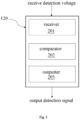
- Fig. 2 illustrates a structural schematic diagram of a safety detection controller in an exemplary embodiment.
- a DC/DC converter 1 may be implemented in an electrified vehicle equipped with a dual-voltage power supply network.
- a first on-board network may comprise a low-voltage source 2 of 12 V for example, and a second on-board network may comprise a high-voltage source 3 of 48 V for example.
- the low-voltage source 2 and high-voltage source 3 have the same electrical ground as a reference, and the DC/DC converter 1 is connected between the low-voltage source 2 and high-voltage source 3.
- the DC/DC converter 1 can operate in a first pre-charging stage and a second pre-charging stage, thereby realizing pre-charging of predetermined voltage values.
- a high-voltage side voltage value will be from 0 V to a first predetermined voltage value, e.g. a 12 V battery voltage.
- the high-voltage side voltage value will be from the first predetermined voltage value to a second predetermined voltage value, e.g. from 12 V to a 48 V battery voltage.
- the DC/DC converter 1 comprises a power conversion device 130, the power conversion device 130 comprising multiple power conversion components 30 connected in parallel.
- the DC/DC converter 1 further comprises a safety power switching device 110, the safety power switching device 110 comprising multiple safety power switching components 10, configured for providing a protection mechanism for the DC/DC converter 1 in the turning-off or turning-on selection process thereof.
- the safety power switching components 10 are in one-to-one correspondence with the power conversion components 30, and a series connection is formed between each of the safety power switching components 10 and power conversion components 30 in one-to-one correspondence with each other.
- Each of the safety power switching components 10 comprises two reverse-series-connected power switches 11, 12 to operate in a boost mode and a buck mode respectively, and is thereby used for providing a protection mechanism for the power conversion device 130 in the boost mode and buck mode respectively.
- the power switches 11, 12 include but are not limited to MOSFETs, insulated gate bipolar transistors (IGBT), integrated gate commutated thyristors (IGCT), injection enhanced gate transistors (IEGT), silicon carbide metal oxide semiconductor field effect transistors (SiC MOSFET), or other controllable electric switches capable of switching in ON and OFF states.
- the power switches 11, 12 may be MOSFETs.
- the DC/DC converter 1 further comprises a safety detection controller 120.
- the safety detection controller 120 is connected to each safety power switch component 10, for subjecting each safety power switching component 10 to real-time detection, in particular testing a switch-off path of the safety power switch in the present ignition cycle, in order to detect whether there is a fault in the safety power switch, and thereby ensure that it can operate normally in each ignition cycle.
- the safety detection controller 120 may comprise a receiver 121, a comparator 122 and an outputter 123.
- the receiver 121 is used to receive in real time a first detection voltage P1, P2»Pn between each power conversion component 30 and the safety power switching component 10 connected in series therewith, and a second detection voltage P12, P22 «Pn2 between the two reverse-series-connected power switches 11, 12 of each safety power switching component 10;
- the comparator 122 is used to set predetermined voltage values of different stages of a pre-charging mode, and compare in real time the received first detection voltages P1, P2 togetherPn and second detection voltages P12, P22 togetherPn2 to determine whether they have reached the corresponding predetermined voltage values;
- the outputter 123 is used to output an error signal to indicate that the corresponding safety power switches 11, 12 are in an abnormal operating state when the first detection voltages or second detection voltages received in real time are not in agreement with the corresponding predetermined voltage values.
- the values of the first detection voltages P1, P2»Pn and the values of the second detection voltages P12, P22»Pn2 should all be zero during the first pre-charging stage; and after the end of the first pre-charging stage, the values of the first detection voltages P1, P2»Pn should be equal to or close to the first predetermined voltage value while the values of the second detection voltages P12, P22»Pn2 should be zero.
- the values of the second detection voltages P12, P22 togetherPn2 should reach the second predetermined voltage value from zero; during the second pre-charging stage, the values of the first detection voltages P1, P2 togetherPn should be changing values which are steadily rising; and after the end of the second pre-charging stage, the values of the second detection voltages P12, P22 togetherPn2 should return to zero.
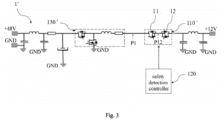
- FIG. 3 showing a schematic circuit diagram of a voltage converter according to another exemplary embodiment of the present disclosure.
- the DC/DC converter 1' shown in Fig. 3 and the DC/DC converter 1 shown in Fig. 1 differ in that the power conversion device 130' of the DC/DC converter 1' shown in Fig. 3 comprises only one power conversion component in the DC/DC converter 1 shown in Fig. 1 , and the safety power switching device 110' of the DC/DC converter 1' comprises only one safety power switching component in the DC/DC converter 1 shown in Fig. 1 , i.e. has only two reverse-series-connected power switches 11, 12; the safety detection controller 120 is connected to the two power switches 11, 12, for subjecting the two power switches 11, 12 to real-time detection.
- a first detection voltage P1 is set between the power conversion device 130' and the safety power switch connected thereto, and a second detection voltage P12 is set between the two reverse-series-connected power switches 11, 12.
- the values of the first and second detection voltages P1, P12 should both be zero; after the end of the first pre-charging stage, the value of the first detection voltage P1 should be equal to or close to the first predetermined voltage value and the value of the second detection voltage P12 should be zero.
- the value of the second detection voltage should reach the second predetermined voltage value from zero; during the second pre-charging stage, the value P1 of the first detection voltage is a changing value which is steadily rising; and after the end of the second pre-charging stage, the value of the second detection voltage P12 should return to zero.
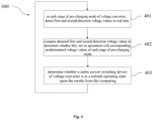
- an exemplary safety detection method 400 is applied to the voltage converters shown in Figs. 1 and 3 .
- the exemplary safety detection method 400 comprises the following steps:
- the safety power switching device is in a turning-off state, i.e. in a normal operating state; and when the first pre-charging stage has ended, if the first detection voltage value is equal to or close to the predetermined voltage value of the first pre-charging stage and the second detection voltage value is zero, then the safety power switch apparatus is in a turning-off state, i.e. in a normal operating state.
- the safety power switching device is in a turning-on state, i.e. in a normal operating state; and after the end of the second pre-charging stage, if the second detection voltage value has returned to zero, then the safety power switching device is in a turning-off state, i.e. in a normal operating state.
- a detection signal is outputted based on the comparison results; if the first detection voltage value or second detection voltage value detected in real time is not in agreement with the corresponding predetermined voltage value, then an error signal will be outputted to indicate that the corresponding safety power switch component is in an abnormal operating state.
- the first and second detection voltage values may be continuously monitored and read by means of a controller.
- the controller may be any type of programmable device, such as a controller, a controller unit (MCU) or a digital signal processor (DSP), etc.
- the DC/DC converter's own existing controller may be used for testing the safety switch, making it possible to detect whether the safety switch has a fault during power-up, with no need for additional testing software and steps to be added, and no need for additional costs, and it is possible to ensure that the safety switch can operate normally in each ignition cycle, thereby increasing the coverage of safety switch diagnostics.
Landscapes
- Engineering & Computer Science (AREA)
- Power Engineering (AREA)
- Transportation (AREA)
- Mechanical Engineering (AREA)
- Life Sciences & Earth Sciences (AREA)
- Sustainable Development (AREA)
- Sustainable Energy (AREA)
- Physics & Mathematics (AREA)
- General Physics & Mathematics (AREA)
- Dc-Dc Converters (AREA)
Applications Claiming Priority (1)
| Application Number | Priority Date | Filing Date | Title |
|---|---|---|---|
| CN202111584978.3A CN116345901A (zh) | 2021-12-22 | 2021-12-22 | 电压转换器、电动车和用于电压转换器的实时检测方法 |
Publications (1)
| Publication Number | Publication Date |
|---|---|
| EP4201733A1 true EP4201733A1 (de) | 2023-06-28 |
Family
ID=84537773
Family Applications (1)
| Application Number | Title | Priority Date | Filing Date |
|---|---|---|---|
| EP22214350.5A Pending EP4201733A1 (de) | 2021-12-22 | 2022-12-16 | Ein spannungswandler, ein elektrifiziertes fahrzeug und ein verfahren zur echtzeiterkennung eines spannungswandlers |
Country Status (3)
| Country | Link |
|---|---|
| US (1) | US12107502B2 (de) |
| EP (1) | EP4201733A1 (de) |
| CN (1) | CN116345901A (de) |
Citations (7)
| Publication number | Priority date | Publication date | Assignee | Title |
|---|---|---|---|---|
| CN205829235U (zh) * | 2016-07-18 | 2016-12-21 | 深圳市思通新能科技开发有限公司 | 非隔离双向dc‑dc变换器预充电电路 |
| WO2017073829A1 (ko) * | 2015-10-30 | 2017-05-04 | 엘에스오토모디브 주식회사 | 안정성이 향상된 양방향 비절연 dc-dc 컨버터 |
| US20180287494A1 (en) * | 2017-03-30 | 2018-10-04 | Omron Automotive Electronics Co., Ltd. | Bidirectional dc-dc converter |
| US20180287500A1 (en) * | 2015-10-14 | 2018-10-04 | Autonetworks Technologies, Ltd. | Dc-dc converter |
| DE102018206269A1 (de) * | 2017-12-14 | 2019-06-19 | Continental Automotive Gmbh | Gleichspannungswandler, Bordnetz mit einem Gleichspannungswandler |
| FR3090226A1 (fr) * | 2018-12-17 | 2020-06-19 | Valeo Systemes De Controle Moteur | Convertisseur de tension DC/DC comprenant un dispositif de sécurité |
| WO2021197380A1 (en) * | 2020-03-31 | 2021-10-07 | Valeo Powertrain (shanghai) Co., Ltd. | An undervoltage protection circuit for a dc/dc converter and method thereof |
Family Cites Families (3)
| Publication number | Priority date | Publication date | Assignee | Title |
|---|---|---|---|---|
| EP2978116A1 (de) | 2014-07-22 | 2016-01-27 | Delphi International Operations Luxembourg S.à r.l. | Gleichstromwandlerschaltung |
| KR20170049177A (ko) | 2015-10-28 | 2017-05-10 | 엘에스오토모티브 주식회사 | 프리차지 회로를 포함한 비절연 양방향 dc-dc 컨버터 |
| KR102877183B1 (ko) * | 2020-11-23 | 2025-10-29 | 현대모비스 주식회사 | 병렬 인터리빙 운전형 양방향 dc-dc 컨버터 및 그 제어방법과 장치 |
-
2021
- 2021-12-22 CN CN202111584978.3A patent/CN116345901A/zh active Pending
-
2022
- 2022-12-16 EP EP22214350.5A patent/EP4201733A1/de active Pending
- 2022-12-22 US US18/145,166 patent/US12107502B2/en active Active
Patent Citations (7)
| Publication number | Priority date | Publication date | Assignee | Title |
|---|---|---|---|---|
| US20180287500A1 (en) * | 2015-10-14 | 2018-10-04 | Autonetworks Technologies, Ltd. | Dc-dc converter |
| WO2017073829A1 (ko) * | 2015-10-30 | 2017-05-04 | 엘에스오토모디브 주식회사 | 안정성이 향상된 양방향 비절연 dc-dc 컨버터 |
| CN205829235U (zh) * | 2016-07-18 | 2016-12-21 | 深圳市思通新能科技开发有限公司 | 非隔离双向dc‑dc变换器预充电电路 |
| US20180287494A1 (en) * | 2017-03-30 | 2018-10-04 | Omron Automotive Electronics Co., Ltd. | Bidirectional dc-dc converter |
| DE102018206269A1 (de) * | 2017-12-14 | 2019-06-19 | Continental Automotive Gmbh | Gleichspannungswandler, Bordnetz mit einem Gleichspannungswandler |
| FR3090226A1 (fr) * | 2018-12-17 | 2020-06-19 | Valeo Systemes De Controle Moteur | Convertisseur de tension DC/DC comprenant un dispositif de sécurité |
| WO2021197380A1 (en) * | 2020-03-31 | 2021-10-07 | Valeo Powertrain (shanghai) Co., Ltd. | An undervoltage protection circuit for a dc/dc converter and method thereof |
Also Published As
| Publication number | Publication date |
|---|---|
| US12107502B2 (en) | 2024-10-01 |
| CN116345901A (zh) | 2023-06-27 |
| US20230198408A1 (en) | 2023-06-22 |
Similar Documents
| Publication | Publication Date | Title |
|---|---|---|
| US9461457B2 (en) | Driver for target switching element and control system for machine using the same | |
| US10525841B2 (en) | Gate driver with short circuit protection | |
| US8884660B2 (en) | Driver for switching element and control system for machine using the same | |
| US9130463B2 (en) | Drive circuit for switching element | |
| CN103208908B (zh) | 开关元件的驱动器及使用该驱动器的旋转机器的控制系统 | |
| US20140049215A1 (en) | Method for monitoring the charging mode of an energy store in a vechile and charging system for charging an energy store in a vechile | |
| US9853591B2 (en) | Inverter control device | |
| US11101793B2 (en) | Drive circuit | |
| US9543749B2 (en) | Driver for switching element and control system for rotary machine using the same | |
| US10090832B2 (en) | Controller for power converter having a delaying unit | |
| CN113471936B (zh) | 用于电动车的直流/直流转换器的欠压保护电路和欠压保护方法 | |
| CN101814720A (zh) | 电动车辆逆变器设备及其保护方法 | |
| US20190097561A1 (en) | Inverter driver | |
| US20200067502A1 (en) | Semiconductor device, inverter, and automobile | |
| US12119773B2 (en) | Power supply system and method for controlling power supply system | |
| CN102412769A (zh) | 旋转电机的控制设备 | |
| US11133795B2 (en) | Overcurrent determining apparatus and drive unit using the same | |
| EP4201733A1 (de) | Ein spannungswandler, ein elektrifiziertes fahrzeug und ein verfahren zur echtzeiterkennung eines spannungswandlers | |
| US11843240B2 (en) | Device and process for fault detection of a power device | |
| JP5696614B2 (ja) | コンデンサの放電回路 | |
| JP7354958B2 (ja) | 電力変換器の制御回路 | |
| WO2023117800A1 (en) | A safety power switching device, a voltage converter and an electrified vehicle | |
| KR102914379B1 (ko) | 인버터 제어 장치 및 방법 | |
| US10615682B2 (en) | Electrically driven vehicle inverter device | |
| CN114675151B (zh) | 绝缘检测电路、系统及车辆 |
Legal Events
| Date | Code | Title | Description |
|---|---|---|---|
| PUAI | Public reference made under article 153(3) epc to a published international application that has entered the european phase |
Free format text: ORIGINAL CODE: 0009012 |
|
| STAA | Information on the status of an ep patent application or granted ep patent |
Free format text: STATUS: REQUEST FOR EXAMINATION WAS MADE |
|
| 17P | Request for examination filed |
Effective date: 20221216 |
|
| AK | Designated contracting states |
Kind code of ref document: A1 Designated state(s): AL AT BE BG CH CY CZ DE DK EE ES FI FR GB GR HR HU IE IS IT LI LT LU LV MC ME MK MT NL NO PL PT RO RS SE SI SK SM TR |
|
| RAP1 | Party data changed (applicant data changed or rights of an application transferred) |
Owner name: VALEO ELECTRIFICATION |