EP4200731B1 - Cloud-sicherheitsüberwachung von anwendungen in paas-diensten - Google Patents
Cloud-sicherheitsüberwachung von anwendungen in paas-diensten Download PDFInfo
- Publication number
- EP4200731B1 EP4200731B1 EP21729102.0A EP21729102A EP4200731B1 EP 4200731 B1 EP4200731 B1 EP 4200731B1 EP 21729102 A EP21729102 A EP 21729102A EP 4200731 B1 EP4200731 B1 EP 4200731B1
- Authority
- EP
- European Patent Office
- Prior art keywords
- paas
- web service
- resource
- usage
- application
- Prior art date
- Legal status (The legal status is an assumption and is not a legal conclusion. Google has not performed a legal analysis and makes no representation as to the accuracy of the status listed.)
- Active
Links
Images




Classifications
-
- G—PHYSICS
- G06—COMPUTING OR CALCULATING; COUNTING
- G06F—ELECTRIC DIGITAL DATA PROCESSING
- G06F21/00—Security arrangements for protecting computers, components thereof, programs or data against unauthorised activity
- G06F21/50—Monitoring users, programs or devices to maintain the integrity of platforms, e.g. of processors, firmware or operating systems
- G06F21/55—Detecting local intrusion or implementing counter-measures
- G06F21/552—Detecting local intrusion or implementing counter-measures involving long-term monitoring or reporting
-
- H—ELECTRICITY
- H04—ELECTRIC COMMUNICATION TECHNIQUE
- H04L—TRANSMISSION OF DIGITAL INFORMATION, e.g. TELEGRAPHIC COMMUNICATION
- H04L63/00—Network architectures or network communication protocols for network security
- H04L63/14—Network architectures or network communication protocols for network security for detecting or protecting against malicious traffic
- H04L63/1408—Network architectures or network communication protocols for network security for detecting or protecting against malicious traffic by monitoring network traffic
- H04L63/1425—Traffic logging, e.g. anomaly detection
-
- G—PHYSICS
- G06—COMPUTING OR CALCULATING; COUNTING
- G06F—ELECTRIC DIGITAL DATA PROCESSING
- G06F11/00—Error detection; Error correction; Monitoring
- G06F11/30—Monitoring
- G06F11/3003—Monitoring arrangements specially adapted to the computing system or computing system component being monitored
- G06F11/3006—Monitoring arrangements specially adapted to the computing system or computing system component being monitored where the computing system is distributed, e.g. networked systems, clusters, multiprocessor systems
-
- G—PHYSICS
- G06—COMPUTING OR CALCULATING; COUNTING
- G06F—ELECTRIC DIGITAL DATA PROCESSING
- G06F11/00—Error detection; Error correction; Monitoring
- G06F11/30—Monitoring
- G06F11/3003—Monitoring arrangements specially adapted to the computing system or computing system component being monitored
- G06F11/302—Monitoring arrangements specially adapted to the computing system or computing system component being monitored where the computing system component is a software system
-
- G—PHYSICS
- G06—COMPUTING OR CALCULATING; COUNTING
- G06F—ELECTRIC DIGITAL DATA PROCESSING
- G06F11/00—Error detection; Error correction; Monitoring
- G06F11/30—Monitoring
- G06F11/34—Recording or statistical evaluation of computer activity, e.g. of down time, of input/output operation ; Recording or statistical evaluation of user activity, e.g. usability assessment
- G06F11/3447—Performance evaluation by modeling
-
- G—PHYSICS
- G06—COMPUTING OR CALCULATING; COUNTING
- G06F—ELECTRIC DIGITAL DATA PROCESSING
- G06F21/00—Security arrangements for protecting computers, components thereof, programs or data against unauthorised activity
- G06F21/50—Monitoring users, programs or devices to maintain the integrity of platforms, e.g. of processors, firmware or operating systems
- G06F21/55—Detecting local intrusion or implementing counter-measures
- G06F21/554—Detecting local intrusion or implementing counter-measures involving event detection and direct action
-
- G—PHYSICS
- G06—COMPUTING OR CALCULATING; COUNTING
- G06F—ELECTRIC DIGITAL DATA PROCESSING
- G06F9/00—Arrangements for program control, e.g. control units
- G06F9/06—Arrangements for program control, e.g. control units using stored programs, i.e. using an internal store of processing equipment to receive or retain programs
- G06F9/44—Arrangements for executing specific programs
- G06F9/455—Emulation; Interpretation; Software simulation, e.g. virtualisation or emulation of application or operating system execution engines
- G06F9/45533—Hypervisors; Virtual machine monitors
- G06F9/45558—Hypervisor-specific management and integration aspects
-
- G—PHYSICS
- G06—COMPUTING OR CALCULATING; COUNTING
- G06F—ELECTRIC DIGITAL DATA PROCESSING
- G06F9/00—Arrangements for program control, e.g. control units
- G06F9/06—Arrangements for program control, e.g. control units using stored programs, i.e. using an internal store of processing equipment to receive or retain programs
- G06F9/46—Multiprogramming arrangements
- G06F9/50—Allocation of resources, e.g. of the central processing unit [CPU]
- G06F9/5061—Partitioning or combining of resources
- G06F9/5077—Logical partitioning of resources; Management or configuration of virtualized resources
-
- H—ELECTRICITY
- H04—ELECTRIC COMMUNICATION TECHNIQUE
- H04L—TRANSMISSION OF DIGITAL INFORMATION, e.g. TELEGRAPHIC COMMUNICATION
- H04L63/00—Network architectures or network communication protocols for network security
- H04L63/14—Network architectures or network communication protocols for network security for detecting or protecting against malicious traffic
- H04L63/1408—Network architectures or network communication protocols for network security for detecting or protecting against malicious traffic by monitoring network traffic
- H04L63/1416—Event detection, e.g. attack signature detection
-
- H—ELECTRICITY
- H04—ELECTRIC COMMUNICATION TECHNIQUE
- H04L—TRANSMISSION OF DIGITAL INFORMATION, e.g. TELEGRAPHIC COMMUNICATION
- H04L63/00—Network architectures or network communication protocols for network security
- H04L63/14—Network architectures or network communication protocols for network security for detecting or protecting against malicious traffic
- H04L63/1441—Countermeasures against malicious traffic
- H04L63/1458—Denial of Service
-
- G—PHYSICS
- G06—COMPUTING OR CALCULATING; COUNTING
- G06F—ELECTRIC DIGITAL DATA PROCESSING
- G06F9/00—Arrangements for program control, e.g. control units
- G06F9/06—Arrangements for program control, e.g. control units using stored programs, i.e. using an internal store of processing equipment to receive or retain programs
- G06F9/44—Arrangements for executing specific programs
- G06F9/455—Emulation; Interpretation; Software simulation, e.g. virtualisation or emulation of application or operating system execution engines
- G06F9/45533—Hypervisors; Virtual machine monitors
- G06F9/45558—Hypervisor-specific management and integration aspects
- G06F2009/45591—Monitoring or debugging support
-
- G—PHYSICS
- G06—COMPUTING OR CALCULATING; COUNTING
- G06F—ELECTRIC DIGITAL DATA PROCESSING
- G06F9/00—Arrangements for program control, e.g. control units
- G06F9/06—Arrangements for program control, e.g. control units using stored programs, i.e. using an internal store of processing equipment to receive or retain programs
- G06F9/44—Arrangements for executing specific programs
- G06F9/455—Emulation; Interpretation; Software simulation, e.g. virtualisation or emulation of application or operating system execution engines
- G06F9/45533—Hypervisors; Virtual machine monitors
- G06F9/45558—Hypervisor-specific management and integration aspects
- G06F2009/45595—Network integration; Enabling network access in virtual machine instances
-
- G—PHYSICS
- G06—COMPUTING OR CALCULATING; COUNTING
- G06F—ELECTRIC DIGITAL DATA PROCESSING
- G06F2201/00—Indexing scheme relating to error detection, to error correction, and to monitoring
- G06F2201/81—Threshold
-
- G—PHYSICS
- G06—COMPUTING OR CALCULATING; COUNTING
- G06F—ELECTRIC DIGITAL DATA PROCESSING
- G06F2201/00—Indexing scheme relating to error detection, to error correction, and to monitoring
- G06F2201/865—Monitoring of software
Definitions
- Cloud computing services provide powerful environments for customers to develop, run and manage web applications without the complexity of building and maintaining any infrastructure typically associated with developing and launching the applications.
- Examples of cloud computing services include Infrastructure as a Service (IaaS), Platform as a Service (PaaS) and Software as a Service (SaaS). Each of these services has its own benefits and differences.
- SaaS service is a centralized software hosting service where a cloud provider licenses software that is hosted by the cloud provider on a subscription basis.
- the SaaS applications are typically accessed through a web browser and the SaaS service acts as a web delivery service for the application.
- SaaS is advantageous for companies and employees since it eliminates the time and expense of installing, managing, maintaining, and upgrading the software applications.
- the software applications are managed from a central location that is accessible through the Internet. SaaS is beneficial for applications that need web and mobile access, for applications that are not used that often, and for organizations that need to launch a web service quickly without the responsibility of operating a data center.
- the cloud provider maintains the SaaS service which includes the applications, data, runtime, middleware, operating system, virtualization, servers, storage, and networking facilities.
- the cloud provider also provides the service's security thereby monitoring the computer infrastructure for security threats.
- the cloud provider provides the computing infrastructure, such as the virtualization, servers, storage and networking facilities on demand for a customer.
- the customer pays for the computing resource that it uses thereby avoiding the expense and complexity of buying and maintaining these resources.
- the customer rents each hardware resource separately and the cloud provider is responsible for managing and maintaining those resources.
- the customer manages, installs, configures, and updates its own software, operating system, middleware, data, and applications.
- the IaaS service is advantageous since it eliminates the expense of purchasing and maintaining the hardware resources of a datacenter. It is an economical solution for organizations that require a computing infrastructure quickly for a limited time period.
- the customers are responsible for managing the applications, runtime, operating systems, data, and middleware, while the cloud provider maintains the virtualization, servers, storage and networking facilities and the security services for the hardware resources.
- the cloud provider offers provisioning and hosting capabilities for a developer to create, host and deploy applications, thereby saving developers from maintaining, configuring, and managing the underlying hardware, software, and provisioning hosting capabilities.
- the developer's application operates on one or more virtual machines (VMs) running on top of a hypervisor in a host server.
- VMs virtual machines
- the cloud provider manages the runtime, middleware, operating system, virtualization, servers, storage and networking facilities leaving the developer to maintain its applications and data.
- PaaS is advantageous since it offers low infrastructure and development costs, rapid time-to-deployment, and on-demand and scalable resources.
- US 2019/213099 A1 describes a method for monitoring resources in a computing system having system information includes transforming, via representation learning, variable-size information into fixed-size information, and creating a machine learning neural network model and training it the machine learning model to predict future resource usage of an application. The method further includes providing the prediction of further resources usage of the application as an input to an action component, wherein the action component is one of an anomaly detector or a reinforcement learner that drives a scheduler.
- the method additionally includes performing, by the action component, at least one of scheduling resources within the computing system or detecting a resources usage anomaly.
- ANKIT ANAND ET AL “Resource usage monitoring for KVM based virtual machines”, ADVANCED COMPUTING AND COMMUNICATIONS (ADCOM), 2012 18TH ANNUAL INTERNATIONAL CONFERENCE ON, IEEE, 14 December 2012 describes measuring the performance of web-servers hosted on a KVM based virtualized server.
- JAYATHILAKA HIRANYA ET AL "Detecting Performance Anomalies in Cloud Platform Applications”, IEEE TRANSACTIONS ON CLOUD COMPUTING, IEEE COMPUTER SOCIETY, USA, vol. 8, no. 3, 19 February 2018 describes Roots, a full-stack monitoring and analysis system for performance anomaly detection and bottleneck identification in cloud platform-as-a-service (PaaS) systems.
- An application threat detection system is used to monitor the resource usage of a hosted application in a PaaS service in order to detect anomalous behavior indicative of a security threat.
- a cloud provider hosts the application in a virtual machine where the application has no visibility to the physical resource consumption of the application.
- the application threat detection system analyzes the historical usage of the application's physical resources in order to determine the normal consumption of a physical resource by the application.
- Statistic models are generated that represent the normal usage of a resource by the application and then used to detect in real time any anomalous behavior.
- a security threat alert is provided when a statistical model indicates that the application's resource consumption is not within the normal range.
- the subject matter disclosed pertains to the security monitoring and detection of the anomalous behavior of an application running as a PaaS service.
- the cloud service provider manages the computing infrastructure or platform (e.g., runtime, operating system, middleware, virtualization, servers, storage, and networking facilities) for the developer of the application (i.e., customer, user) to develop, run, and manage the application and data with no access or visibility into the physical resources used by the application.
- the developer is responsible for the security of the application and its data while the cloud service provider maintains the security of the computing infrastructure.
- the application or PaaS service runs on a virtual machine that is isolated from other virtual machines. There may be several instances of the application with each instance residing in a different virtual machine hosted in numerous, distinct servers.
- an application security threat detection module is provided on each virtual machine to monitor the usage behavior of the application's resources in order to detect a security threat.
- the application security threat detection module resides in kernel space thereby having access to and visibility to the physical resource consumption of the application.
- the detection of a resource's behavior is compared with the application's typical consumption of the resource.
- the resource's behavior is represented by a statistic (e.g., threshold, centroid) that is used to signal a security threat.
- a security threat or threat is a potential attack that may lead to the misuse or disclosure of the information or resources of the application. For example, once the virtual machine is running with an open port, the application is susceptible to a brute force attack or port scanning. These attacks may be detected when the application use of the open port increases beyond its normal consumption.
- the application is monitored during a designated training period to compute a mathematical model of the typical usage of the application's physical resources.
- the model includes a statistic to represent a normal usage value for CPU/processor usage, memory usage, average number of network packets transmitted, the maximum size of the network packets transmitted, the frequency of transmission of the network packets, and/or the number of open ports.
- the model also includes usage data, such as the Internet Protocol (IP) addresses of the transmitted network packets and open port numbers used during the execution of the application.
- IP Internet Protocol
- the application's historical resource usage obtained during the training period may come from various resource logs that a cloud service generates to monitor the security of the computing infrastructure.
- the resource logs are analyzed for each resource that each instance of an application uses in order to determine the statistic and usage data that represents the normal resource usage of an application.
- Fig. 1 illustrates an exemplary system 100 in which various aspects of the invention may be practiced.
- the system 100 is implemented in a cloud service 101 that includes one or more cloud servers 102 that interact with computing devices 104 of the users of the cloud service through a network 106.
- the computing devices 104 include a web browser 108 which facilitates communication with the one or more cloud servers 102.
- a cloud service 101 is a service available on demand for users through a publicly-accessible network 106, such as the Internet.
- a cloud service 101 hosts the resources of multiple tenants.
- a tenant may be an organization, entity, business unit within an organization, a group of users within an organization, and the like.
- a tenant hosts resources for use by its customers.
- a tenant contains resources, such as virtual machines, applications, application programming interfaces (APIs), storage accounts, services, etc. that are grouped into a subscription.
- a subscription is an object that represents a folder where the resources reside.
- a tenant may have many subscriptions. As shown in Fig. 1 , a tenant has a subscription 141 having resource groups 142A, 142B where resource group 142A contains resources 144A-144B and resource group 142B contains resources 144C-144D.
- the cloud service 101 hosts the tenant's subscriptions and controls access to the resources contained within a subscription.
- a subscription may be fee-based or free and lasts for a designated length of time.
- Examples of a cloud service include without limitation, Microsoft Azure ® , Google Cloud Platform TM service, iCloud ® , and the like.
- a resource is an entity that is managed by the cloud service, such as a virtual machine, virtual network, storage account, database, web-accessible application, and services.
- Resources belong to a resource group which is a logical grouping of the resources so that they can be managed as a single entity.
- the cloud service 101 consists of one or more cloud servers 102.
- a cloud server 102 includes one or more virtual machines 1 10a- 110n ("110"), a virtualization layer 112, a resource mapping layer 146, and physical resources 114.
- a virtual machine 110 is a resource that uses software to emulate a computer to run application software.
- the virtual machine 110 has a user space 136, where the user's applications and data run, and a kernel space 138, where the operating system-level functions run outside of the user space and are not accessible from the user space.
- the virtual machine 110 includes a hosted application in a PaaS computing environment 116a-116n ("116"), log files 140a-140n (“140"), a host operating system 118a-118n (“118"), an application threat detection module 120a-120n (“120”), and an application resource usage profile 122a-122n (“122").
- the application hosted in the virtual machine 116 is often constructed as a web service.
- the activity of the application may be monitored and recorded in a log file 140.
- the log file 140 contains all the actions performed on a resource 144.
- a resource 144 writes an entry in the log file 140 each time an access and use are made to the resource 144.
- An entry in a log file 140 may identify the subscription identifier, the resource group, and the actions performed on a particular resource.
- an entry may be formatted as follows: / sub / subid / resourcegroup / RG1R2 / read , where sub indicates subscription, subid indicates the subscription identifier, resourcegroup indicates a resource group, RG1R2 indicates resource group 1 and resource 2, and read indicates that a read operation was performed on resource 2 in resource group 1 of subscription identifier subid.
- the application threat detection module 120 builds a usage profile 122 for the hosted application 116 from the various monitoring data collected on the cloud server.
- the usage profile 122 may pertain to the resource usage of a particular application or to the resource usage of the customer's applications.
- the usage profile 122 includes the models and usage data used to detect a security threat.
- the virtual machine 110 operates in an isolated environment without access to other virtual machines, applications and resources outside of the virtual machine.
- the developer manages the application and has no access or visibility to the host operating system 118, the application threat detection module 120, the application resource usage profile 122, the virtualization layer 112, the resource mapping layer 146, and the physical resources 114.
- the virtualization layer 112 includes the virtualized resources, a hypervisor, and the system operating system.
- the hypervisor creates the virtual machine and the virtualized resources used by the application.
- the virtualized resources are mapped to physical resources by the hypervisor and stored in resource mapping files 148 of the resource mapping layer 146.
- a resource mapping file 148 stores the relationship between a virtual resource and a tuple consisting of an identifier of the physical resource, the virtual machine assigned the physical resource and the process identifier that consumes the physical resource, virtual resource: ⁇ physical resource, virtual machine, process identifier> .
- a process is an instance of a program that is running on a computer. The process may include multiple threads of execution that perform the instructions of the program concurrently.
- the process identifier is a unique value that identifies the instance of the application that is running on a particular virtual machine.
- the physical resources 114 include one or more CPUs or processors 124, one or more memory device 126, one or more storage devices 128, one or more applications 116, and one or more network interfaces 130.
- CPUs/processors 124, memory devices 126, storage devices 128, and network interfaces 130 is described in further detail below.
- the cloud server 102 has security monitoring tools 132 that collect data on the usage of the various physical resources.
- the data collected from the security monitoring tools 132 is stored in various resource logs 134.
- the security monitoring tools may include Event Tracing For Windows (ETW) which is a kernel-level tracing facility that monitors kernel or application-defined events to a log file.
- the kernel-level tracing facility traces events, from a configured start time to an end time, for such events as TCP/UDP events, memory page faults, file I/O events, disk I/O events, thread events, virtual memory allocation, etc.
- the security monitoring tools 132 may include agents that collect data from security events, such as login events, process creation, file access, etc.
- Azure there is a Microsoft Monitoring Agent and an OMS Linux agent that collects data from security events.
- Microsoft Defender Advanced Threat Protection collects file creation, file deletion, and network events.
- the data from these security monitoring tools 132 is collected into various resource logs 134.
- the application threat detection module 120 obtains the data from the resource logs 134 and mines the data to obtain the logged data that relates to the physical resources used by a target application.
- the application threat detection module 120 generates an application usage profile 206 for a specific application from resource logs of the application.
- the resource logs from execution of the application is analyzed to extract resource usage data 202.
- the resource usage data 202 is then used to generate statistics representing the application's normal resource usage which is stored in an application usage profile 206.
- the application threat detection module 120 extracts resource usage data from all of the customer's resources 204.
- the resource logs from execution of the various applications of the customer is analyzed to extract usage data of all of the customer's resources.
- the extracted data is then used to generate statistics representing a customer's typical resource usage which is stored in a customer usage profile 208.
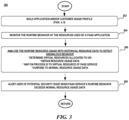
- Fig. 3 is an exemplary method for monitoring and detecting a security threat to a PaaS application.
- the system monitors the resource consumption of a target application to obtain historical resource usage data during an initial or training period of time. The historical resource usage data is used to create an application usage profile for the application (block 302).
- the system monitors the resource consumption of all the resources used by the customer's applications in order to compute a customer usage profile for the customer (block 302).
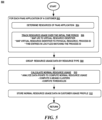
- Fig. 4 illustrates an exemplary method for building an application usage profile
- Fig. 5 illustrates an exemplary method for building a customer usage profile.
- the application threat detection module 120 initiates the security monitoring tools 132 to monitor the resources used in the execution of a target application during the initial training period.
- the historical resource usage data obtained is stored in various resource log files 134 and log files 140 during the initial training period.
- the resource log files may come from various sources, such as servers, networks, etc. (Collectively, block 402).
- the virtual resources that are consumed by a target PaaS application are identified by the application threat detection module 120.
- the cloud service 101 includes a mechanism (e.g., module, API, or service) that identifies the virtual resources allocated to the virtual machine that runs an application.
- Each virtual resource is identified with a Uniform Resource Identifier (URI).
- URI Uniform Resource Identifier
- the resource identifier or URI may be in a format such as the following: /subscriptions/resourceGroups/resource-group-name/resource-type/resource-name. (Collectively, block 404).
- the application threat detection module 120 maps each virtual resource consumed by the virtual machine to the physical resource and process that consumes the virtual resource.
- the usage data in the resource log files is relative to a physical resource and process identifier.
- the virtual machine that runs the application uses virtual resources.
- the application threat detection module 120 maps each virtual resource consumed by the application to where the virtual resource is being used, which is the corresponding physical resource and process identifier that is using the corresponding virtual resource.
- the process identifier is an identifier of the process executing the application. (Collectively, block 406).
- the application threat detection module 120 obtains the virtual resource identifier for each virtual resource.
- Azure provides an API, Get Resource By ID, which returns the virtual identifier of a resource when given the resource URI.
- the virtual resource identifier is then mapped to its corresponding physical resource. (Collectively, block 406).
- the cloud service may use the resource mapping files to map virtual resources to a particular physical resource.
- an instance of the PaaS application is considered as a resource which the resource mapping layer maps to the tuple including the server identifier, virtual machine identifier and process identifier, ⁇ server identifier, virtual machine identifier, process identifier>. (Collectively, block 406).
- the mapping to a physical resource includes the process identifier of the process that is using the virtual resource.
- the application threat detection module 120 searches the resource log files for the process identifier to obtain the historical usage data of a resource associated with the process. (Collectively, block 406).
- the application threat detection module 120 computes the normal usage of the resource by an application. For resources having measurement values, such as CPU usage and memory usage, a statistic is computed to represent normal resource usage. For other resources that do not utilize measurement values, such as the IP addresses used in the application's transmission or the open port numbers used by an application, a list of those features is collected. (Collectively, block 408).
- the statistic that represents the normal resource usage may be a threshold or a centroid.
- a threshold is a numeric value.
- the threshold represents a value that exceeds the normal range of values.
- the application threat detection module 120 analyzes the collected measurement values and finds the most frequent range of values.
- a threshold may be a value that exceeds the highest value or lowest value from the collected data or lies outside of a designated percentile of the collected data. (Collectively, block 408).
- the historical usage data of each resource may be clustered.
- Clustering is a technique that groups together data items that are similar to each other. Measurement values for a resource that are similar to other data items in a cluster may represent normal usage behavior and those measurement values that are different from the other data items represent abnormal resource usage behavior.
- K-means clustering may be utilized. The K-means technique uses a predetermined number of clusters, K and a set of initial estimates for the cluster means, and the data set to be clustered. The means or centroids define the parameters of a model. Typically, the K-means evaluation starts with a random choice of cluster centroids or means. Each cluster is represented by its mean and each data item is assigned membership in the cluster having the nearest mean.
- the measurement data is used to calculate the K-means cluster centroids.
- the K-means evaluation is used to generate a centroid for each cluster.
- a model for a resource may have one cluster that represents normal usage and another cluster that represents abnormal usage.
- the Euclidean distance between the real-time values and the centroids of each cluster is used to indicate whether the resource usage represents anomalous or normal usage behavior. (Collectively, block 408).
- usage data is collected, such as the list of open port numbers, the list of IP addresses network packets are transmitted to, etc.
- the application usage profile and customer usage profile store the list of these features.
- the resource usage data for each resource is then stored in the application usage profile. (Collectively, block 408).
- each application instance operating in a distinct virtual machine across multiple cloud servers.
- the usage data from the resource used by each application instance is obtained.
- a centralized processor obtains the usage data from each process of each application instance and then analyzed to compute the normal usage behavior of the resource by the application as noted above in Fig. 4 .
- the application threat detection module 120 generates resource usage data for the resources used by each application of a customer. Resources of a similar type are grouped together and a statistic is generated for the resource type. For example, disk I/O is a generic group that covers all types of virtual disks.
- the resource usage of each application of a customer is tracked by first determining the resources used by each instance of each PaaS application.
- the application threat detection module 120 initiates monitoring each of these applications (blocks 502, 504).
- a mapping is performed to identify the physical resources used by each application instance.
- the mapping from virtual resource to physical resource is performed as noted above, with respect to Fig. 3 block 306, to find the process identifier in the resource log files.
- the historical usage data from the resource log files is then collected for each resource type (block 508).
- the application threat detection module 120 starts to monitor the runtime resource usage of the application or customer (block 304).
- the application threat detection module 120 obtains the runtime usage data from the resource logs at periodic intervals and compares the runtime usage data from each resource with the resource usage data stored in the application usage profile for the application or the customer usage profile (block 306).
- the application threat detection module 120 obtains the virtual identifiers of the virtual resources allocated to the virtual machine running the application.
- the runtime usage data contained in a resource log contains runtime usage data identified by a physical resource identifier and a process identifier.
- the physical resource is mapped to its corresponding virtual resource identifier and when it matches the virtual resource identifier of a virtual resource used by the application, the runtime usage data is extracted. (Collectively, block 306).
- the runtime usage data is then compared with the normal usage data stored in the application usage profile or customer usage profile.
- the application threat detection module 120 alerts the developer of the application of a potential security breach. (Collectively, block 308).
- FIG. 6 illustrates an exemplary operating environment 600 of a cloud computing service having several computing devices 602.
- a computing device 602 may be any type of electronic device, such as, without limitation, a mobile device, a personal digital assistant, a mobile computing device, a smart phone, a cellular telephone, a handheld computer, a server, a server array or server farm, a web server, a network server, a blade server, an Internet server, a work station, a mini-computer, a mainframe computer, a supercomputer, a network appliance, a web appliance, a distributed computing system, multiprocessor systems, or combination thereof.
- the operating environment 600 may be configured in a network environment, a distributed environment, a multi-processor environment, or a stand-alone computing device having access to remote or local storage devices.
- a computing device 602 may include one or more processors 606, one or more network interfaces 608, one or more storage devices 610, one or more input/output devices 612, and one or more memory devices 614.
- a processor 606 may be any commercially available or customized processor and may include dual microprocessors and multi-processor architectures.
- a network interface 608 facilitates wired or wireless communications between the computing device 602 and other devices.
- a storage device 610 may be computer-readable medium that does not contain propagating signals, such as modulated data signals transmitted through a carrier wave.
- Examples of a storage device 610 include without limitation RAM, ROM, EEPROM, flash memory or other memory technology, CD-ROM, digital versatile disks (DVD), or other optical storage, magnetic cassettes, magnetic tape, magnetic disk storage, all of which do not contain propagating signals, such as modulated data signals transmitted through a carrier wave.
- the input/output devices 612 may include a keyboard, mouse, pen, voice input device, touch input device, display, speakers, printers, etc., and any combination thereof.
- a memory device 614 may be any non-transitory computer-readable storage media that may store executable procedures, applications, and data.
- the computer-readable storage media does not pertain to propagated signals, such as modulated data signals transmitted through a carrier wave. It may be any type of non-transitory memory device (e.g., random access memory, read-only memory, etc.), magnetic storage, volatile storage, non-volatile storage, optical storage, DVD, CD, floppy disk drive, etc. that does not pertain to propagated signals, such as modulated data signals transmitted through a carrier wave.
- a memory device 614 may also include one or more external storage devices or remotely located storage devices that do not pertain to propagated signals, such as modulated data signals transmitted through a carrier wave.
- the memory device 614 may contain instructions, components, and data.
- a component is a software program that performs a specific function and is otherwise known as a module, program, component, and/or application.
- the memory device 614 may include one or more virtual machines 616, with each virtual machine including one or more applications 618, a log file 620, a host operating system 622, an application threat detection module 624, and an application usage profile 626.
- the memory device 614 also includes a hypervisor 628, a system operating system 630, virtual resources 632, security monitoring tools 634, resource logs 636, resource mapping files 638, and other applications and data 640.
- a computing device 602 may be communicatively coupled via a network 606.
- the network 606 may be configured as an ad hoc network, an intranet, an extranet, a virtual private network (VPN), a local area network (LAN), a wireless LAN (WLAN), a wide area network (WAN), a wireless WAN (WWAN), a metropolitan network (MAN), the Internet, a portions of the Public Switched Telephone Network (PSTN), plain old telephone service (POTS) network, a wireless network, a WiFi ® network, or any other type of network or combination of networks.
- VPN virtual private network
- LAN local area network
- WLAN wireless LAN
- WAN wide area network
- WWAN wireless WAN
- MAN metropolitan network
- PSTN Public Switched Telephone Network
- POTS plain old telephone service
- the network 606 may employ a variety of wired and/or wireless communication protocols and/or technologies.
- Various generations of different communication protocols and/or technologies that may be employed by a network may include, without limitation, Global System for Mobile Communication (GSM), General Packet Radio Services (GPRS), Enhanced Data GSM Environment (EDGE), Code Division Multiple Access (CDMA), Wideband Code Division Multiple Access (W-CDMA), Code Division Multiple Access 2000, (CDMA-2000), High Speed Downlink Packet Access (HSDPA), Long Term Evolution (LTE), Universal Mobile Telecommunications System (UMTS), Evolution-Data Optimized (Ev-DO), Worldwide Interoperability for Microwave Access (WiMax), Time Division Multiple Access (TDMA), Orthogonal Frequency Division Multiplexing (OFDM), Ultra Wide Band (UWB), Wireless Application Protocol (WAP), User Datagram Protocol (UDP), Transmission Control Protocol/ Internet Protocol (TCP/IP), any portion of the Open Systems Interconnection (OSI) model protocols, Session Initiated Protocol/ Real-Time Transport
- a system having one or more processors; and a memory that stores one or more programs that are configured to be executed by the one or more processors, the one or more programs including instructions that: host an application as a Platform-as-a-Service (PaaS) web service in a virtual machine using virtual resources, the PaaS web service unaware of physical resources associated with the virtual resources; obtain an application usage profile for the PaaS web service, the application usage profile having one or more statistics, a statistic representing normal consumption of a physical resource used by the PaaS web service; monitor runtime usage of a first physical resource during execution of the PaaS web service; correlate the first physical resource to a corresponding virtual resource used during operation of the PaaS web service via a process identifier of the PaaS web service; compare the runtime usage of the first physical resource with a corresponding statistic; and upon the comparison indicating an anomaly, initiate a warning of the anomaly.
- PaaS Platform-as-a-Service
- the one or more programs include further instructions that: obtain historical resource consumption of the PaaS web service; derive a threshold for one or more of the physical resources consumed by the PaaS web service; and store the threshold in the application usage profile for the PaaS web service.
- the one or more programs include further instructions that: obtain historical resource consumption of the PaaS web service; cluster the historical resource consumption into one or more clusters for the first physical resource; compute a centroid for the first physical resource; and store the centroid in the application usage profile for the PaaS web service.
- the application usage profile includes one or more of processor consumption, memory consumption, number and types of disk I/O events, number of network packets transmitted, frequency of network packets transmitted, largest size of network packets transmitted, Internet Protocol (IP) addresses used in network packets transmitted, or identity of open ports.
- IP Internet Protocol
- the statistic includes a threshold for the first physical resource and the one or more programs include further instructions to detect when the threshold for the first physical resource is exceeded during runtime usage of the PaaS web service.
- the one or more programs include further instructions that: detect the anomaly when the runtime usage of the first physical resource exceeds a distance from a centroid representing normal usage consumption of the first physical resource.
- the statistic is derived from runtime usage of the first physical resource during multiple instances of the PaaS web service.
- the multiple instances of the PaaS web service operate on different virtual machines in different servers.
- a method comprising: configuring an application as a Platform as a Service (PaaS) web service in a virtual machine with virtual resources, wherein the PaaS web service is isolated from identity of physical resources consumed by the PaaS web service; during a training period, monitoring usage of the physical resources consumed by the PaaS web service; correlating the virtual resources used by the application to corresponding physical resources using a process identifier of a process hosting an instance of the PaaS web service; generating a mathematical model of normal resource consumption of at least one physical resource consumed by the PaaS web service; using the mathematical model during runtime execution of the PaaS web service to detect abnormal behavior in runtime resource consumption of the at least one physical resource by the PaaS web service; and generating an alert when the abnormal behavior is detected.
- PaaS Platform as a Service
- the method further comprises: monitoring resource usage of the PaaS web service across all instances of the PaaS web service. In an aspect, the method further comprises: monitoring processor consumption and memory consumption of the PaaS web service. In an aspect, the method further comprises: monitoring features of network usage of the PaaS web service, the features including a number of network packets transmitted, sizes of the network packets transmitted, open ports, and Internet Protocol (IP) addresses used.
- IP Internet Protocol
- the method further comprises monitoring features of disk I/O usage of the PaaS web service, the features including identity of files accessed and a number of I/O operations made.
- the mathematical model of the normal resource consumption of the at least one physical resource consumed by the PaaS web service is derived from historical resource usage of the at least one physical resource by the PaaS web service during the training period.
- the mathematical model of normal resource consumption of the at least one physical resource consumed by the PaaS web service is derived from clustering historical resource usage of the at least one physical resource by the PaaS web service during the training period.
- a device having one or more processors and a memory.
- the memory includes a virtual machine configured to: execute a Platform as a Service (PaaS) web service in the virtual machine, the PaaS web service utilizing virtual resources with no visibility to associated physical resources; obtain normal usage data of the physical resources used by the PaaS web service; extract runtime usage data of at least one physical resource used by the PaaS web service by mapping a virtual resource corresponding to the at least one physical resource through a process identifier of a process running an instance of the PaaS web service application on the virtual machine; and determine a security threat when the runtime usage data of the at least one physical resource exceeds the normal usage data of the at least one physical resource.
- PaaS Platform as a Service
- the virtual machine is further configured to: analyze historical resource usage data of a first physical resource used by the PaaS web service to generate a threshold; and detect the security threat when the runtime usage data for the first physical resource exceeds the threshold.
- the virtual machine is further configured to: analyze historical resource usage data of the first physical resource to generate a centroid representing a measurement value of normal behavior of the fist physical resource when used by the application; and detect the security threat when the runtime usage data for the first physical resource exceeds a distance from the centroid.
- the normal usage data represents processor consumption, memory consumption, number of network packets transmitted, frequency of network packets transmitted, number of disk I/O events, largest size of network packets transmitted, Internet Protocol (IP) addresses used in network packets transmitted, and/or identity of open ports.
- IP Internet Protocol
- the historical usage data is derived from runtime usage of the physical resources across multiple instances of the PaaS web service.
Landscapes
- Engineering & Computer Science (AREA)
- Theoretical Computer Science (AREA)
- Computer Security & Cryptography (AREA)
- General Engineering & Computer Science (AREA)
- Software Systems (AREA)
- Physics & Mathematics (AREA)
- Computing Systems (AREA)
- General Physics & Mathematics (AREA)
- Computer Hardware Design (AREA)
- Signal Processing (AREA)
- Computer Networks & Wireless Communication (AREA)
- Quality & Reliability (AREA)
- Mathematical Physics (AREA)
- Life Sciences & Earth Sciences (AREA)
- Bioinformatics & Cheminformatics (AREA)
- Bioinformatics & Computational Biology (AREA)
- Evolutionary Biology (AREA)
- Debugging And Monitoring (AREA)
Claims (15)
- System (600), umfassend:einen oder mehrere Prozessoren (606); undeinen Speicher (614), der ein oder mehrere Programme speichert, die zum Ausführen durch den einen oder die mehreren Prozessoren konfiguriert sind, wobei das eine oder die mehreren Programme Anweisungen einschließen, die:Hosten einer Anwendung als Platform-as-a-Service-Webdienst (PaaS-Webdienst) (618) in einer virtuellen Maschine (616) unter Verwendung virtueller Ressourcen (632), wobei der PaaS-Webdienst die den virtuellen Ressourcen zugeordneten physischen Ressourcen nicht kennt;Erhalten eines Anwendungsnutzungsprofils für den PaaS-Webdienst (628), wobei das Anwendungsnutzungsprofil eine oder mehrere Statistiken aufweist, wobei eine Statistik den normalen Verbrauch einer durch den PaaS-Webdienst verwendeten physischen Ressource darstellt;Überwachen der Laufzeitnutzung einer ersten physischen Ressource während der Ausführung des PaaS-Webdienstes (304);Korrelieren der ersten physischen Ressource mit einer entsprechenden virtuellen Ressource, die während des Betriebs des PaaS-Webdienstes verwendet wird, über eine Prozesskennung des PaaS-Webdienstes (306);Vergleichen der Laufzeitnutzung der ersten physischen Ressource mit einer entsprechenden Statistik (306); undnachdem der Vergleich eine Anomalie anzeigt, Einleiten einer Warnung vor der Anomalie (308).
- System nach Anspruch 1, wobei das eine oder die mehreren Programme ferner Anweisungen einschließen zum:Erhalten des historischen Ressourcenverbrauchs des PaaS-Webdienstes (402);Ableiten eines Schwellenwerts für eine oder mehrere der durch den PaaS-Webdienst verbrauchten physischen Ressourcen (408); undSpeichern des Schwellenwerts im Anwendungsnutzungsprofil für den PaaS-Webdienst (410).
- System nach Anspruch 1, wobei das eine oder die mehreren Programme ferner Anweisungen einschließen zum:Erhalten des historischen Ressourcenverbrauchs des PaaS-Webdienstes (402);Gruppieren des historischen Ressourcenverbrauchs in einem oder mehreren Clustern für die erste physische Ressource (408);Berechnen eines Schwerpunkts für die erste physische Ressource (408); undSpeichern des Schwerpunkts im Anwendungsnutzungsprofil für den PaaS-Webdienst (410).
- Das System nach Anspruch 1, wobei das Anwendungsnutzungsprofil eines oder mehreres umfasst aus Prozessorverbrauch, Speicherverbrauch, Anzahl und Arten von Festplatten-E/A-Ereignissen, Anzahl übertragener Netzwerkpakete, Häufigkeit übertragener Netzwerkpakete, größte Größe übertragener Netzwerkpakete, Internet-Protocol-Adressen (IP-Adressen), die in übertragenen Netzwerkpaketen verwendet werden, oder Identität offener Ports (206, 210, 212, 214).
- System nach Anspruch 1, wobei die Statistik einen Schwellenwert für die erste physische Ressource umfasst,
wobei das eine oder die mehreren Programme weitere Anweisungen einschließen, um zu erkennen, wann der Schwellenwert für die erste physische Ressource während der Laufzeitnutzung des PaaS-Webdienstes überschritten wird (306). - System nach Anspruch 1, wobei das eine oder die mehreren Programme ferner Anweisungen einschließen zum:
Erkennen der Anomalie, wenn die Laufzeitnutzung der ersten physischen Ressource einen Abstand von einem Schwerpunkt überschreitet, der den normalen Nutzungsverbrauch der ersten physischen Ressource darstellt (306). - System nach Anspruch 1, wobei die Statistik aus der Laufzeitnutzung der ersten physischen Ressource während mehrerer Instanzen des PaaS-Webdienstes abgeleitet wird (402).
- System nach Anspruch 7, wobei die mehreren Instanzen des PaaS-Webdienstes auf verschiedenen virtuellen Maschinen auf verschiedenen Servern (402, 116, 110) betrieben werden.
- Computerimplementiertes Verfahren, umfassend:Konfigurieren einer Anwendung als Platform-as-a-Service Webdienst (PaaS-Webdienst) (116) in einer virtuellen Maschine (110) mit virtuellen Ressourcen (112), wobei der PaaS-Webdienst von der Identität der durch den PaaS-Webdienst verbrauchten physischen Ressourcen isoliert ist;Überwachen der Nutzung der durch den PaaS-Webdienst verbrauchten physischen Ressourcen während eines Trainingszeitraums (304);Korrelieren der durch die Anwendung verwendeten virtuellen Ressourcen mit entsprechenden physischen Ressourcen unter Verwendung einer Prozesskennung eines Prozesses, der eine Instanz des PaaS-Webdienstes hostet (402, 404, 406);Erzeugen eines mathematischen Modells des normalen Ressourcenverbrauchs mindestens einer durch den PaaS-Webdienst verbrauchten physischen Ressource (408);Verwenden des mathematischen Modells während der Laufzeitausführung des PaaS-Webdienstes, um anormales Verhalten beim Laufzeitressourcenverbrauch der mindestens einen physischen Ressource durch den PaaS-Webdienst (306) zu erkennen; undErzeugen einer Warnung, wenn das anormale Verhalten erkannt wird (308).
- Computerimplementiertes Verfahren nach Anspruch 9, ferner umfassend:
Überwachen der Ressourcennutzung des PaaS-Webdienstes über alle Instanzen des PaaS-Webdienstes hinweg (304). - Computerimplementiertes Verfahren nach Anspruch 9, ferner umfassend:
Überwachen des Prozessorverbrauchs und des Speicherverbrauchs des PaaS-Webdienstes (210, 212, 216, 218). - Computerimplementiertes Verfahren nach Anspruch 9, ferner umfassend:
Überwachen von Merkmalen der Netzwerknutzung des PaaS-Webdienstes, wobei die Merkmale eine Anzahl übertragener Netzwerkpakete, Größen der übertragenen Netzwerkpakete, offene Ports und verwendete Internet-Protocol-Adressen (IP-Adressen) (214, 220) einschließen. - Computerimplementiertes Verfahren nach Anspruch 9, ferner umfassend:
Überwachen von Merkmalen der Festplatten-E/A-Nutzung des PaaS-Webdienstes, die eine Identität der Dateien, auf die zugegriffen wird, und eine Anzahl durchgeführter E/A-Vorgänge einschließen (140). - Computerimplementiertes Verfahren nach Anspruch 9, wobei das mathematische Modell des normalen Ressourcenverbrauchs der mindestens einen durch den PaaS-Webdienst verbrauchten physischen Ressource aus der historischen Ressourcennutzung der mindestens einen physischen Ressource durch den PaaS-Webdienst während des Trainingszeitraums abgeleitet wird (408).
- Computerimplementiertes Verfahren nach Anspruch 9, wobei das mathematische Modell des normalen Ressourcenverbrauchs der mindestens einen durch den PaaS-Webdienst verbrauchten physischen Ressource aus dem Clustern historischer Ressourcennutzung der mindestens einen physischen Ressource durch den PaaS-Webdienst während des Trainingszeitraums abgeleitet wird (408).
Applications Claiming Priority (2)
| Application Number | Priority Date | Filing Date | Title |
|---|---|---|---|
| US16/999,614 US11811802B2 (en) | 2020-08-21 | 2020-08-21 | Cloud security monitoring of applications in PaaS services |
| PCT/US2021/030991 WO2022039806A1 (en) | 2020-08-21 | 2021-05-06 | Cloud security monitoring of applications in paas services |
Publications (2)
| Publication Number | Publication Date |
|---|---|
| EP4200731A1 EP4200731A1 (de) | 2023-06-28 |
| EP4200731B1 true EP4200731B1 (de) | 2024-05-29 |
Family
ID=76197578
Family Applications (1)
| Application Number | Title | Priority Date | Filing Date |
|---|---|---|---|
| EP21729102.0A Active EP4200731B1 (de) | 2020-08-21 | 2021-05-06 | Cloud-sicherheitsüberwachung von anwendungen in paas-diensten |
Country Status (3)
| Country | Link |
|---|---|
| US (1) | US11811802B2 (de) |
| EP (1) | EP4200731B1 (de) |
| WO (1) | WO2022039806A1 (de) |
Families Citing this family (5)
| Publication number | Priority date | Publication date | Assignee | Title |
|---|---|---|---|---|
| US12153669B2 (en) * | 2021-01-26 | 2024-11-26 | EMC IP Holding Company LLC | Cyber immunity system as a biological self-recognition model on operating systems |
| US12095732B2 (en) * | 2021-06-30 | 2024-09-17 | Sony Group Corporation | Anti-piracy control based on blacklisting function |
| US20250094238A1 (en) * | 2023-09-17 | 2025-03-20 | Oracle International Corporation | Compute Targets For Data Science Workload Execution And Identity And Access Management Integration |
| KR20250046809A (ko) * | 2023-09-27 | 2025-04-03 | 현대자동차주식회사 | 자원 사용량 인식 기반의 idps 동적할당 장치 및 방법 |
| CN119276853B (zh) * | 2024-10-08 | 2025-08-08 | 北京南天智联软件有限公司 | 一种基于物联网的it设备远程监控系统 |
Family Cites Families (12)
| Publication number | Priority date | Publication date | Assignee | Title |
|---|---|---|---|---|
| IL197477A0 (en) * | 2009-03-08 | 2009-12-24 | Univ Ben Gurion | System and method for detecting new malicious executables, based on discovering and monitoring of characteristic system call sequences |
| US8473444B1 (en) * | 2009-08-28 | 2013-06-25 | Symantec Corporation | Management of actions in multiple virtual and non-virtual environments |
| WO2014192054A1 (ja) * | 2013-05-27 | 2014-12-04 | 株式会社日立製作所 | 監視項目選定方法及び装置並びに記憶媒体 |
| US10200387B2 (en) * | 2015-11-30 | 2019-02-05 | International Business Machines Corporation | User state tracking and anomaly detection in software-as-a-service environments |
| US10805332B2 (en) * | 2017-07-25 | 2020-10-13 | Nicira, Inc. | Context engine model |
| US10579494B2 (en) * | 2018-01-05 | 2020-03-03 | Nec Corporation | Methods and systems for machine-learning-based resource prediction for resource allocation and anomaly detection |
| US10936717B1 (en) * | 2018-01-30 | 2021-03-02 | EMC IP Holding Company LLC | Monitoring containers running on container host devices for detection of anomalies in current container behavior |
| KR102059808B1 (ko) * | 2018-06-11 | 2019-12-27 | 주식회사 티맥스오에스 | 컨테이너 기반 통합 관리 시스템 |
| US11368479B2 (en) * | 2019-09-27 | 2022-06-21 | Musarubra Us Llc | Methods and apparatus to identify and report cloud-based security vulnerabilities |
| US20210117306A1 (en) * | 2019-10-22 | 2021-04-22 | Citrix Systems, Inc. | Systems and methods for probing virtual, web and saas applications |
| US11966476B2 (en) * | 2020-05-17 | 2024-04-23 | Avocado Systems, Inc. | Deep application discovery and forensics for automated threat modeling |
| US20220207148A1 (en) * | 2020-12-26 | 2022-06-30 | Intel Corporation | Hardening branch hardware against speculation vulnerabilities |
-
2020
- 2020-08-21 US US16/999,614 patent/US11811802B2/en active Active
-
2021
- 2021-05-06 WO PCT/US2021/030991 patent/WO2022039806A1/en not_active Ceased
- 2021-05-06 EP EP21729102.0A patent/EP4200731B1/de active Active
Also Published As
| Publication number | Publication date |
|---|---|
| US11811802B2 (en) | 2023-11-07 |
| WO2022039806A1 (en) | 2022-02-24 |
| US20220060490A1 (en) | 2022-02-24 |
| EP4200731A1 (de) | 2023-06-28 |
Similar Documents
| Publication | Publication Date | Title |
|---|---|---|
| EP4200731B1 (de) | Cloud-sicherheitsüberwachung von anwendungen in paas-diensten | |
| Wu et al. | Ransomware detection on linux using machine learning with random forest algorithm | |
| EP3921750B1 (de) | Dynamische cybersicherheits-peer-identifizierung unter verwendung von gruppen | |
| US11146581B2 (en) | Techniques for defending cloud platforms against cyber-attacks | |
| US20220121995A1 (en) | Automatic generation of training data for anomaly detection using other user's data samples | |
| Gupta et al. | An immediate system call sequence based approach for detecting malicious program executions in cloud environment | |
| US10025929B2 (en) | Detection of anomalous program execution using hardware-based micro-architectural data | |
| US9591007B2 (en) | Detection of beaconing behavior in network traffic | |
| US10176321B2 (en) | Leveraging behavior-based rules for malware family classification | |
| US10530792B2 (en) | Using frequency analysis in enterprise threat detection to detect intrusions in a computer system | |
| US20200265119A1 (en) | Site-specific anomaly detection | |
| US20100192222A1 (en) | Malware detection using multiple classifiers | |
| US20250348566A1 (en) | Application identity account compromise detection | |
| US20190044965A1 (en) | Systems and methods for discriminating between human and non-human interactions with computing devices on a computer network | |
| US10547623B1 (en) | Security network devices by forecasting future security incidents for a network based on past security incidents | |
| CN107992751A (zh) | 一种基于分支行为模型的实时威胁检测方法 | |
| KR20200057402A (ko) | 가상 및 리얼 머신 기반의 악성코드 탐지 시스템 및 방법 | |
| US9171171B1 (en) | Generating a heat map to identify vulnerable data users within an organization | |
| US20250370912A1 (en) | System and Method thereof for Agentless Monitoring of Third-Party Applications | |
| Melvin et al. | A deep learning model leveraging time-series system call data to detect malware attacks in virtual machines | |
| US20240232385A1 (en) | A scenario-based cyber security system and method | |
| US20240370533A1 (en) | System to leverage active learning for alert processing | |
| US12463987B1 (en) | Application-level cybersecurity using multiple stages of classifiers | |
| Taubmann et al. | Architecture for resource-aware vmi-based cloud malware analysis | |
| Gonçalves et al. | Detecting anomalies through sequential performance analysis in virtualized environments |
Legal Events
| Date | Code | Title | Description |
|---|---|---|---|
| STAA | Information on the status of an ep patent application or granted ep patent |
Free format text: STATUS: UNKNOWN |
|
| STAA | Information on the status of an ep patent application or granted ep patent |
Free format text: STATUS: THE INTERNATIONAL PUBLICATION HAS BEEN MADE |
|
| PUAI | Public reference made under article 153(3) epc to a published international application that has entered the european phase |
Free format text: ORIGINAL CODE: 0009012 |
|
| STAA | Information on the status of an ep patent application or granted ep patent |
Free format text: STATUS: REQUEST FOR EXAMINATION WAS MADE |
|
| 17P | Request for examination filed |
Effective date: 20230106 |
|
| AK | Designated contracting states |
Kind code of ref document: A1 Designated state(s): AL AT BE BG CH CY CZ DE DK EE ES FI FR GB GR HR HU IE IS IT LI LT LU LV MC MK MT NL NO PL PT RO RS SE SI SK SM TR |
|
| REG | Reference to a national code |
Ref country code: DE Ref legal event code: R079 Free format text: PREVIOUS MAIN CLASS: G06F0021550000 Ipc: H04L0009400000 Ref country code: DE Ref legal event code: R079 Ref document number: 602021013860 Country of ref document: DE Free format text: PREVIOUS MAIN CLASS: G06F0021550000 Ipc: H04L0009400000 |
|
| DAV | Request for validation of the european patent (deleted) | ||
| DAX | Request for extension of the european patent (deleted) | ||
| GRAP | Despatch of communication of intention to grant a patent |
Free format text: ORIGINAL CODE: EPIDOSNIGR1 |
|
| STAA | Information on the status of an ep patent application or granted ep patent |
Free format text: STATUS: GRANT OF PATENT IS INTENDED |
|
| RIC1 | Information provided on ipc code assigned before grant |
Ipc: G06F 21/55 20130101ALI20231128BHEP Ipc: G06F 11/34 20060101ALI20231128BHEP Ipc: G06F 11/30 20060101ALI20231128BHEP Ipc: H04L 9/40 20220101AFI20231128BHEP |
|
| INTG | Intention to grant announced |
Effective date: 20240103 |
|
| P01 | Opt-out of the competence of the unified patent court (upc) registered |
Effective date: 20240227 |
|
| GRAS | Grant fee paid |
Free format text: ORIGINAL CODE: EPIDOSNIGR3 |
|
| GRAA | (expected) grant |
Free format text: ORIGINAL CODE: 0009210 |
|
| STAA | Information on the status of an ep patent application or granted ep patent |
Free format text: STATUS: THE PATENT HAS BEEN GRANTED |
|
| AK | Designated contracting states |
Kind code of ref document: B1 Designated state(s): AL AT BE BG CH CY CZ DE DK EE ES FI FR GB GR HR HU IE IS IT LI LT LU LV MC MK MT NL NO PL PT RO RS SE SI SK SM TR |
|
| REG | Reference to a national code |
Ref country code: CH Ref legal event code: EP |
|
| REG | Reference to a national code |
Ref country code: IE Ref legal event code: FG4D |
|
| REG | Reference to a national code |
Ref country code: DE Ref legal event code: R096 Ref document number: 602021013860 Country of ref document: DE |
|
| REG | Reference to a national code |
Ref country code: LT Ref legal event code: MG9D |
|
| REG | Reference to a national code |
Ref country code: NL Ref legal event code: MP Effective date: 20240529 |
|
| PG25 | Lapsed in a contracting state [announced via postgrant information from national office to epo] |
Ref country code: IS Free format text: LAPSE BECAUSE OF FAILURE TO SUBMIT A TRANSLATION OF THE DESCRIPTION OR TO PAY THE FEE WITHIN THE PRESCRIBED TIME-LIMIT Effective date: 20240929 |
|
| PG25 | Lapsed in a contracting state [announced via postgrant information from national office to epo] |
Ref country code: BG Free format text: LAPSE BECAUSE OF FAILURE TO SUBMIT A TRANSLATION OF THE DESCRIPTION OR TO PAY THE FEE WITHIN THE PRESCRIBED TIME-LIMIT Effective date: 20240529 |
|
| PG25 | Lapsed in a contracting state [announced via postgrant information from national office to epo] |
Ref country code: HR Free format text: LAPSE BECAUSE OF FAILURE TO SUBMIT A TRANSLATION OF THE DESCRIPTION OR TO PAY THE FEE WITHIN THE PRESCRIBED TIME-LIMIT Effective date: 20240529 Ref country code: FI Free format text: LAPSE BECAUSE OF FAILURE TO SUBMIT A TRANSLATION OF THE DESCRIPTION OR TO PAY THE FEE WITHIN THE PRESCRIBED TIME-LIMIT Effective date: 20240529 |
|
| PG25 | Lapsed in a contracting state [announced via postgrant information from national office to epo] |
Ref country code: GR Free format text: LAPSE BECAUSE OF FAILURE TO SUBMIT A TRANSLATION OF THE DESCRIPTION OR TO PAY THE FEE WITHIN THE PRESCRIBED TIME-LIMIT Effective date: 20240830 |
|
| REG | Reference to a national code |
Ref country code: AT Ref legal event code: MK05 Ref document number: 1691536 Country of ref document: AT Kind code of ref document: T Effective date: 20240529 |
|
| PG25 | Lapsed in a contracting state [announced via postgrant information from national office to epo] |
Ref country code: ES Free format text: LAPSE BECAUSE OF FAILURE TO SUBMIT A TRANSLATION OF THE DESCRIPTION OR TO PAY THE FEE WITHIN THE PRESCRIBED TIME-LIMIT Effective date: 20240529 |
|
| PG25 | Lapsed in a contracting state [announced via postgrant information from national office to epo] |
Ref country code: AT Free format text: LAPSE BECAUSE OF FAILURE TO SUBMIT A TRANSLATION OF THE DESCRIPTION OR TO PAY THE FEE WITHIN THE PRESCRIBED TIME-LIMIT Effective date: 20240529 |
|
| PG25 | Lapsed in a contracting state [announced via postgrant information from national office to epo] |
Ref country code: PL Free format text: LAPSE BECAUSE OF FAILURE TO SUBMIT A TRANSLATION OF THE DESCRIPTION OR TO PAY THE FEE WITHIN THE PRESCRIBED TIME-LIMIT Effective date: 20240529 |
|
| PG25 | Lapsed in a contracting state [announced via postgrant information from national office to epo] |
Ref country code: LV Free format text: LAPSE BECAUSE OF FAILURE TO SUBMIT A TRANSLATION OF THE DESCRIPTION OR TO PAY THE FEE WITHIN THE PRESCRIBED TIME-LIMIT Effective date: 20240529 |
|
| PG25 | Lapsed in a contracting state [announced via postgrant information from national office to epo] |
Ref country code: PL Free format text: LAPSE BECAUSE OF FAILURE TO SUBMIT A TRANSLATION OF THE DESCRIPTION OR TO PAY THE FEE WITHIN THE PRESCRIBED TIME-LIMIT Effective date: 20240529 Ref country code: NO Free format text: LAPSE BECAUSE OF FAILURE TO SUBMIT A TRANSLATION OF THE DESCRIPTION OR TO PAY THE FEE WITHIN THE PRESCRIBED TIME-LIMIT Effective date: 20240829 Ref country code: LV Free format text: LAPSE BECAUSE OF FAILURE TO SUBMIT A TRANSLATION OF THE DESCRIPTION OR TO PAY THE FEE WITHIN THE PRESCRIBED TIME-LIMIT Effective date: 20240529 Ref country code: IS Free format text: LAPSE BECAUSE OF FAILURE TO SUBMIT A TRANSLATION OF THE DESCRIPTION OR TO PAY THE FEE WITHIN THE PRESCRIBED TIME-LIMIT Effective date: 20240929 Ref country code: HR Free format text: LAPSE BECAUSE OF FAILURE TO SUBMIT A TRANSLATION OF THE DESCRIPTION OR TO PAY THE FEE WITHIN THE PRESCRIBED TIME-LIMIT Effective date: 20240529 Ref country code: GR Free format text: LAPSE BECAUSE OF FAILURE TO SUBMIT A TRANSLATION OF THE DESCRIPTION OR TO PAY THE FEE WITHIN THE PRESCRIBED TIME-LIMIT Effective date: 20240830 Ref country code: FI Free format text: LAPSE BECAUSE OF FAILURE TO SUBMIT A TRANSLATION OF THE DESCRIPTION OR TO PAY THE FEE WITHIN THE PRESCRIBED TIME-LIMIT Effective date: 20240529 Ref country code: ES Free format text: LAPSE BECAUSE OF FAILURE TO SUBMIT A TRANSLATION OF THE DESCRIPTION OR TO PAY THE FEE WITHIN THE PRESCRIBED TIME-LIMIT Effective date: 20240529 Ref country code: BG Free format text: LAPSE BECAUSE OF FAILURE TO SUBMIT A TRANSLATION OF THE DESCRIPTION OR TO PAY THE FEE WITHIN THE PRESCRIBED TIME-LIMIT Effective date: 20240529 Ref country code: AT Free format text: LAPSE BECAUSE OF FAILURE TO SUBMIT A TRANSLATION OF THE DESCRIPTION OR TO PAY THE FEE WITHIN THE PRESCRIBED TIME-LIMIT Effective date: 20240529 Ref country code: RS Free format text: LAPSE BECAUSE OF FAILURE TO SUBMIT A TRANSLATION OF THE DESCRIPTION OR TO PAY THE FEE WITHIN THE PRESCRIBED TIME-LIMIT Effective date: 20240829 |
|
| PG25 | Lapsed in a contracting state [announced via postgrant information from national office to epo] |
Ref country code: NL Free format text: LAPSE BECAUSE OF FAILURE TO SUBMIT A TRANSLATION OF THE DESCRIPTION OR TO PAY THE FEE WITHIN THE PRESCRIBED TIME-LIMIT Effective date: 20240529 |
|
| PG25 | Lapsed in a contracting state [announced via postgrant information from national office to epo] |
Ref country code: NL Free format text: LAPSE BECAUSE OF FAILURE TO SUBMIT A TRANSLATION OF THE DESCRIPTION OR TO PAY THE FEE WITHIN THE PRESCRIBED TIME-LIMIT Effective date: 20240529 |
|
| PG25 | Lapsed in a contracting state [announced via postgrant information from national office to epo] |
Ref country code: DK Free format text: LAPSE BECAUSE OF FAILURE TO SUBMIT A TRANSLATION OF THE DESCRIPTION OR TO PAY THE FEE WITHIN THE PRESCRIBED TIME-LIMIT Effective date: 20240529 |
|
| PG25 | Lapsed in a contracting state [announced via postgrant information from national office to epo] |
Ref country code: EE Free format text: LAPSE BECAUSE OF FAILURE TO SUBMIT A TRANSLATION OF THE DESCRIPTION OR TO PAY THE FEE WITHIN THE PRESCRIBED TIME-LIMIT Effective date: 20240529 |
|
| PG25 | Lapsed in a contracting state [announced via postgrant information from national office to epo] |
Ref country code: CZ Free format text: LAPSE BECAUSE OF FAILURE TO SUBMIT A TRANSLATION OF THE DESCRIPTION OR TO PAY THE FEE WITHIN THE PRESCRIBED TIME-LIMIT Effective date: 20240529 |
|
| PG25 | Lapsed in a contracting state [announced via postgrant information from national office to epo] |
Ref country code: SK Free format text: LAPSE BECAUSE OF FAILURE TO SUBMIT A TRANSLATION OF THE DESCRIPTION OR TO PAY THE FEE WITHIN THE PRESCRIBED TIME-LIMIT Effective date: 20240529 Ref country code: RO Free format text: LAPSE BECAUSE OF FAILURE TO SUBMIT A TRANSLATION OF THE DESCRIPTION OR TO PAY THE FEE WITHIN THE PRESCRIBED TIME-LIMIT Effective date: 20240529 |
|
| PG25 | Lapsed in a contracting state [announced via postgrant information from national office to epo] |
Ref country code: SM Free format text: LAPSE BECAUSE OF FAILURE TO SUBMIT A TRANSLATION OF THE DESCRIPTION OR TO PAY THE FEE WITHIN THE PRESCRIBED TIME-LIMIT Effective date: 20240529 |
|
| PG25 | Lapsed in a contracting state [announced via postgrant information from national office to epo] |
Ref country code: SM Free format text: LAPSE BECAUSE OF FAILURE TO SUBMIT A TRANSLATION OF THE DESCRIPTION OR TO PAY THE FEE WITHIN THE PRESCRIBED TIME-LIMIT Effective date: 20240529 Ref country code: SK Free format text: LAPSE BECAUSE OF FAILURE TO SUBMIT A TRANSLATION OF THE DESCRIPTION OR TO PAY THE FEE WITHIN THE PRESCRIBED TIME-LIMIT Effective date: 20240529 Ref country code: RO Free format text: LAPSE BECAUSE OF FAILURE TO SUBMIT A TRANSLATION OF THE DESCRIPTION OR TO PAY THE FEE WITHIN THE PRESCRIBED TIME-LIMIT Effective date: 20240529 Ref country code: EE Free format text: LAPSE BECAUSE OF FAILURE TO SUBMIT A TRANSLATION OF THE DESCRIPTION OR TO PAY THE FEE WITHIN THE PRESCRIBED TIME-LIMIT Effective date: 20240529 Ref country code: DK Free format text: LAPSE BECAUSE OF FAILURE TO SUBMIT A TRANSLATION OF THE DESCRIPTION OR TO PAY THE FEE WITHIN THE PRESCRIBED TIME-LIMIT Effective date: 20240529 Ref country code: CZ Free format text: LAPSE BECAUSE OF FAILURE TO SUBMIT A TRANSLATION OF THE DESCRIPTION OR TO PAY THE FEE WITHIN THE PRESCRIBED TIME-LIMIT Effective date: 20240529 |
|
| PG25 | Lapsed in a contracting state [announced via postgrant information from national office to epo] |
Ref country code: IT Free format text: LAPSE BECAUSE OF FAILURE TO SUBMIT A TRANSLATION OF THE DESCRIPTION OR TO PAY THE FEE WITHIN THE PRESCRIBED TIME-LIMIT Effective date: 20240529 |
|
| REG | Reference to a national code |
Ref country code: DE Ref legal event code: R097 Ref document number: 602021013860 Country of ref document: DE |
|
| PLBE | No opposition filed within time limit |
Free format text: ORIGINAL CODE: 0009261 |
|
| STAA | Information on the status of an ep patent application or granted ep patent |
Free format text: STATUS: NO OPPOSITION FILED WITHIN TIME LIMIT |
|
| PG25 | Lapsed in a contracting state [announced via postgrant information from national office to epo] |
Ref country code: SI Free format text: LAPSE BECAUSE OF FAILURE TO SUBMIT A TRANSLATION OF THE DESCRIPTION OR TO PAY THE FEE WITHIN THE PRESCRIBED TIME-LIMIT Effective date: 20240529 |
|
| 26N | No opposition filed |
Effective date: 20250303 |
|
| PG25 | Lapsed in a contracting state [announced via postgrant information from national office to epo] |
Ref country code: SE Free format text: LAPSE BECAUSE OF FAILURE TO SUBMIT A TRANSLATION OF THE DESCRIPTION OR TO PAY THE FEE WITHIN THE PRESCRIBED TIME-LIMIT Effective date: 20240529 |
|
| REG | Reference to a national code |
Ref country code: DE Ref legal event code: R119 Ref document number: 602021013860 Country of ref document: DE |
|
| REG | Reference to a national code |
Ref country code: CH Ref legal event code: H13 Free format text: ST27 STATUS EVENT CODE: U-0-0-H10-H13 (AS PROVIDED BY THE NATIONAL OFFICE) Effective date: 20251223 |
|
| PG25 | Lapsed in a contracting state [announced via postgrant information from national office to epo] |
Ref country code: LU Free format text: LAPSE BECAUSE OF NON-PAYMENT OF DUE FEES Effective date: 20250506 |
|
| PG25 | Lapsed in a contracting state [announced via postgrant information from national office to epo] |
Ref country code: CH Free format text: LAPSE BECAUSE OF NON-PAYMENT OF DUE FEES Effective date: 20250531 |
|
| GBPC | Gb: european patent ceased through non-payment of renewal fee |
Effective date: 20250506 |
|
| REG | Reference to a national code |
Ref country code: BE Ref legal event code: MM Effective date: 20250531 |
|
| PG25 | Lapsed in a contracting state [announced via postgrant information from national office to epo] |
Ref country code: MC Free format text: LAPSE BECAUSE OF FAILURE TO SUBMIT A TRANSLATION OF THE DESCRIPTION OR TO PAY THE FEE WITHIN THE PRESCRIBED TIME-LIMIT Effective date: 20240529 |
|
| PG25 | Lapsed in a contracting state [announced via postgrant information from national office to epo] |
Ref country code: GB Free format text: LAPSE BECAUSE OF NON-PAYMENT OF DUE FEES Effective date: 20250506 |
|
| PG25 | Lapsed in a contracting state [announced via postgrant information from national office to epo] |
Ref country code: IE Free format text: LAPSE BECAUSE OF NON-PAYMENT OF DUE FEES Effective date: 20250506 Ref country code: DE Free format text: LAPSE BECAUSE OF NON-PAYMENT OF DUE FEES Effective date: 20251202 |
|
| PG25 | Lapsed in a contracting state [announced via postgrant information from national office to epo] |
Ref country code: BE Free format text: LAPSE BECAUSE OF NON-PAYMENT OF DUE FEES Effective date: 20250531 |
|
| PG25 | Lapsed in a contracting state [announced via postgrant information from national office to epo] |
Ref country code: FR Free format text: LAPSE BECAUSE OF NON-PAYMENT OF DUE FEES Effective date: 20250531 |