EP4199514B1 - Verfahren und vorrichtung zur bilddecodierung auf basis von cclm-prädiktion in einem bildcodierungssystem - Google Patents
Verfahren und vorrichtung zur bilddecodierung auf basis von cclm-prädiktion in einem bildcodierungssystem Download PDFInfo
- Publication number
- EP4199514B1 EP4199514B1 EP23156140.8A EP23156140A EP4199514B1 EP 4199514 B1 EP4199514 B1 EP 4199514B1 EP 23156140 A EP23156140 A EP 23156140A EP 4199514 B1 EP4199514 B1 EP 4199514B1
- Authority
- EP
- European Patent Office
- Prior art keywords
- samples
- cclm
- block
- neighboring
- chroma block
- Prior art date
- Legal status (The legal status is an assumption and is not a legal conclusion. Google has not performed a legal analysis and makes no representation as to the accuracy of the status listed.)
- Active
Links
Images










Classifications
-
- H—ELECTRICITY
- H04—ELECTRIC COMMUNICATION TECHNIQUE
- H04N—PICTORIAL COMMUNICATION, e.g. TELEVISION
- H04N19/00—Methods or arrangements for coding, decoding, compressing or decompressing digital video signals
- H04N19/10—Methods or arrangements for coding, decoding, compressing or decompressing digital video signals using adaptive coding
- H04N19/102—Methods or arrangements for coding, decoding, compressing or decompressing digital video signals using adaptive coding characterised by the element, parameter or selection affected or controlled by the adaptive coding
- H04N19/103—Selection of coding mode or of prediction mode
- H04N19/105—Selection of the reference unit for prediction within a chosen coding or prediction mode, e.g. adaptive choice of position and number of pixels used for prediction
-
- H—ELECTRICITY
- H04—ELECTRIC COMMUNICATION TECHNIQUE
- H04N—PICTORIAL COMMUNICATION, e.g. TELEVISION
- H04N19/00—Methods or arrangements for coding, decoding, compressing or decompressing digital video signals
- H04N19/10—Methods or arrangements for coding, decoding, compressing or decompressing digital video signals using adaptive coding
- H04N19/102—Methods or arrangements for coding, decoding, compressing or decompressing digital video signals using adaptive coding characterised by the element, parameter or selection affected or controlled by the adaptive coding
- H04N19/103—Selection of coding mode or of prediction mode
- H04N19/11—Selection of coding mode or of prediction mode among a plurality of spatial predictive coding modes
-
- H—ELECTRICITY
- H04—ELECTRIC COMMUNICATION TECHNIQUE
- H04N—PICTORIAL COMMUNICATION, e.g. TELEVISION
- H04N19/00—Methods or arrangements for coding, decoding, compressing or decompressing digital video signals
- H04N19/10—Methods or arrangements for coding, decoding, compressing or decompressing digital video signals using adaptive coding
- H04N19/102—Methods or arrangements for coding, decoding, compressing or decompressing digital video signals using adaptive coding characterised by the element, parameter or selection affected or controlled by the adaptive coding
- H04N19/132—Sampling, masking or truncation of coding units, e.g. adaptive resampling, frame skipping, frame interpolation or high-frequency transform coefficient masking
-
- H—ELECTRICITY
- H04—ELECTRIC COMMUNICATION TECHNIQUE
- H04N—PICTORIAL COMMUNICATION, e.g. TELEVISION
- H04N19/00—Methods or arrangements for coding, decoding, compressing or decompressing digital video signals
- H04N19/10—Methods or arrangements for coding, decoding, compressing or decompressing digital video signals using adaptive coding
- H04N19/134—Methods or arrangements for coding, decoding, compressing or decompressing digital video signals using adaptive coding characterised by the element, parameter or criterion affecting or controlling the adaptive coding
- H04N19/157—Assigned coding mode, i.e. the coding mode being predefined or preselected to be further used for selection of another element or parameter
-
- H—ELECTRICITY
- H04—ELECTRIC COMMUNICATION TECHNIQUE
- H04N—PICTORIAL COMMUNICATION, e.g. TELEVISION
- H04N19/00—Methods or arrangements for coding, decoding, compressing or decompressing digital video signals
- H04N19/10—Methods or arrangements for coding, decoding, compressing or decompressing digital video signals using adaptive coding
- H04N19/134—Methods or arrangements for coding, decoding, compressing or decompressing digital video signals using adaptive coding characterised by the element, parameter or criterion affecting or controlling the adaptive coding
- H04N19/157—Assigned coding mode, i.e. the coding mode being predefined or preselected to be further used for selection of another element or parameter
- H04N19/159—Prediction type, e.g. intra-frame, inter-frame or bidirectional frame prediction
-
- H—ELECTRICITY
- H04—ELECTRIC COMMUNICATION TECHNIQUE
- H04N—PICTORIAL COMMUNICATION, e.g. TELEVISION
- H04N19/00—Methods or arrangements for coding, decoding, compressing or decompressing digital video signals
- H04N19/10—Methods or arrangements for coding, decoding, compressing or decompressing digital video signals using adaptive coding
- H04N19/169—Methods or arrangements for coding, decoding, compressing or decompressing digital video signals using adaptive coding characterised by the coding unit, i.e. the structural portion or semantic portion of the video signal being the object or the subject of the adaptive coding
- H04N19/17—Methods or arrangements for coding, decoding, compressing or decompressing digital video signals using adaptive coding characterised by the coding unit, i.e. the structural portion or semantic portion of the video signal being the object or the subject of the adaptive coding the unit being an image region, e.g. an object
- H04N19/176—Methods or arrangements for coding, decoding, compressing or decompressing digital video signals using adaptive coding characterised by the coding unit, i.e. the structural portion or semantic portion of the video signal being the object or the subject of the adaptive coding the unit being an image region, e.g. an object the region being a block, e.g. a macroblock
-
- H—ELECTRICITY
- H04—ELECTRIC COMMUNICATION TECHNIQUE
- H04N—PICTORIAL COMMUNICATION, e.g. TELEVISION
- H04N19/00—Methods or arrangements for coding, decoding, compressing or decompressing digital video signals
- H04N19/10—Methods or arrangements for coding, decoding, compressing or decompressing digital video signals using adaptive coding
- H04N19/169—Methods or arrangements for coding, decoding, compressing or decompressing digital video signals using adaptive coding characterised by the coding unit, i.e. the structural portion or semantic portion of the video signal being the object or the subject of the adaptive coding
- H04N19/186—Methods or arrangements for coding, decoding, compressing or decompressing digital video signals using adaptive coding characterised by the coding unit, i.e. the structural portion or semantic portion of the video signal being the object or the subject of the adaptive coding the unit being a colour or a chrominance component
-
- H—ELECTRICITY
- H04—ELECTRIC COMMUNICATION TECHNIQUE
- H04N—PICTORIAL COMMUNICATION, e.g. TELEVISION
- H04N19/00—Methods or arrangements for coding, decoding, compressing or decompressing digital video signals
- H04N19/46—Embedding additional information in the video signal during the compression process
-
- H—ELECTRICITY
- H04—ELECTRIC COMMUNICATION TECHNIQUE
- H04N—PICTORIAL COMMUNICATION, e.g. TELEVISION
- H04N19/00—Methods or arrangements for coding, decoding, compressing or decompressing digital video signals
- H04N19/50—Methods or arrangements for coding, decoding, compressing or decompressing digital video signals using predictive coding
- H04N19/593—Methods or arrangements for coding, decoding, compressing or decompressing digital video signals using predictive coding involving spatial prediction techniques
-
- H—ELECTRICITY
- H04—ELECTRIC COMMUNICATION TECHNIQUE
- H04N—PICTORIAL COMMUNICATION, e.g. TELEVISION
- H04N19/00—Methods or arrangements for coding, decoding, compressing or decompressing digital video signals
- H04N19/50—Methods or arrangements for coding, decoding, compressing or decompressing digital video signals using predictive coding
- H04N19/597—Methods or arrangements for coding, decoding, compressing or decompressing digital video signals using predictive coding specially adapted for multi-view video sequence encoding
-
- H—ELECTRICITY
- H04—ELECTRIC COMMUNICATION TECHNIQUE
- H04N—PICTORIAL COMMUNICATION, e.g. TELEVISION
- H04N19/00—Methods or arrangements for coding, decoding, compressing or decompressing digital video signals
- H04N19/70—Methods or arrangements for coding, decoding, compressing or decompressing digital video signals characterised by syntax aspects related to video coding, e.g. related to compression standards
Definitions
- the present document relates generally to an image coding technology and, more particularly, to an image decoding method based on intra prediction according to CCLM in an image coding system, and an apparatus therefor.
- the subject-matter of the claims is presented.
- the claims are directed to an encoding apparatus and a decoding apparatus.
- Corresponding methods are disclosed as examples useful for understanding the invention.
- the present disclosure provides a method and device for improving image coding efficiency.
- the present disclosure also provides a method and device for improving intra-prediction efficiency.
- the present disclosure also provides a method and device for improving intra-prediction efficiency based on Cross Component Linear Model (CCLM).
- CCLM Cross Component Linear Model
- Still another technical objective of this document is to provide an efficient encoding and decoding method for CCLM prediction, and an apparatus for performing the encoding and decoding method.
- Still another technical objective of this document is to provide a method and apparatus for selecting a neighboring sample for deriving a linear model parameter for CCLM.
- an image decoding method which is performed by a decoding apparatus.
- the method includes deriving a cross-component linear model (CCLM) mode as an intra prediction mode of a current chroma block; deriving a specific value for the current chroma block; comparing a width and a height of the current chroma block with the specific value; based on the width and the height being greater than the specific value, deriving specific top neighboring chroma samples whose number is equal to the specific value of the current chroma block, and specific left neighboring chroma samples whose number is equal to the specific value; deriving down-sampled neighboring luma samples and down-sampled luma samples of a current luma block, wherein the neighboring luma samples correspond to the specific top neighboring chroma samples and the specific left neighboring chroma samples; deriving CCLM parameters based on the specific top neighboring chroma samples, the specific left neighboring
- CCLM cross-com
- an image encoding method performed by an encoding apparatus comprising: determining a cross-component linear model, CCLM, mode as an intra prediction mode of a current chroma block; deriving a specific value for the current chroma block; comparing a width and a height of the current chroma block with the specific value; based on the width and the height being greater than the specific value, deriving specific top neighboring chroma samples whose number is equal to the specific value of the current chroma block, and specific left neighboring chroma samples whose number is equal to the specific value; deriving down-sampled neighboring luma samples and down-sampled luma samples of a current luma block, wherein the down-sampled neighboring luma samples correspond to the specific top neighboring chroma samples and the specific left neighboring chroma samples; deriving CCLM parameters based on the specific top neighboring
- a computer-readable storage medium storing a bitstream comprising the image information encoded by the image encoding method presented above.
- a transmission method of data for image comprising: obtaining a bitstream of image information including prediction related information for prediction samples for a current chroma block; and transmitting the data including the bitstream of the image information including the prediction related information, wherein the prediction samples for the current chroma block are derived based on a cross-component linear model, CCLM, parameters and down-sampled luma samples of a current luma block, wherein the CCLM parameters are derived based on specific top neighboring chroma samples of the current chroma block, specific left neighboring chroma samples of the current chroma block, and down-sampled neighboring luma samples of the current luma block correspond to the specific top neighboring chroma samples and the specific left neighboring chroma samples, wherein the derived specific value is 2, when the width is greater than the specific value, down-sampled top neighboring luma samples of specific top positions corresponding to the specific top neighbor
- the efficiency of intra-prediction can be improved.
- the image coding efficiency can be improved by performing an intra-prediction based on CCLM.
- the complexity of intra prediction can be reduced by limiting the number of neighboring samples selected to derive a linear model parameter for the CCLM to a specific number.
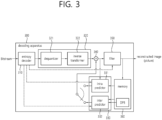
- FIG. 1 briefly illustrates an example of a video/image coding device to which embodiments of the present disclosure are applicable.
- a video/image coding system may include a first device (source device) and a second device (receiving device).
- the source device may deliver encoded video/image information or data in the form of a file or streaming to the receiving device via a digital storage medium or network.
- the source device may include a video source, an encoding apparatus, and a transmitter.
- the receiving device may include a receiver, a decoding apparatus, and a renderer.
- the encoding apparatus may be called a video/image encoding apparatus, and the decoding apparatus may be called a video/image decoding apparatus.
- the transmitter may be included in the encoding apparatus.
- the receiver may be included in the decoding apparatus.
- the renderer may include a display, and the display may be configured as a separate device or an external component.
- the video source may acquire video/image through a process of capturing, synthesizing, or generating the video/image.
- the video source may include a video/image capture device and/or a video/image generating device.
- the video/image capture device may include, for example, one or more cameras, video/image archives including previously captured video/images, and the like.
- the video/image generating device may include, for example, computers, tablets and smartphones, and may (electronically) generate video/images.
- a virtual video/image may be generated through a computer or the like. In this case, the video/image capturing process may be replaced by a process of generating related data.
- the encoding apparatus may encode input video/image.
- the encoding apparatus may perform a series of procedures such as prediction, transform, and quantization for compression and coding efficiency.
- the encoded data (encoded video/image information) may be output in the form of a bitstream.
- the transmitter may transmit the encoded image/image information or data output in the form of a bitstream to the receiver of the receiving device through a digital storage medium or a network in the form of a file or streaming.
- the digital storage medium may include various storage mediums such as USB, SD, CD, DVD, Blu-ray, HDD, SSD, and the like.
- the transmitter may include an element for generating a media file through a predetermined file format and may include an element for transmission through a broadcast/communication network.
- the receiver may receive/extract the bitstream and transmit the received bitstream to the decoding apparatus.
- the decoding apparatus may decode the video/image by performing a series of procedures such as dequantization, inverse transform, and prediction corresponding to the operation of the encoding apparatus.
- the renderer may render the decoded video/image.
- the rendered video/image may be displayed through the display.
- VVC versatile video coding
- EVC essential video coding
- AV1 AOMedia Video 1
- AVS2 2nd generation of audio video coding standard
- next generation video/image coding standard ex. H.267 or H.268, etc.
- a brick scan is a specific sequential ordering of CTUs partitioning a picture in which the CTUs are ordered consecutively in CTU raster scan in a brick, bricks within a tile are ordered consecutively in a raster scan of the bricks of the tile, and tiles in a picture are ordered consecutively in a raster scan of the tiles of the picture.
- a tile is a rectangular region of CTUs within a particular tile column and a particular tile row in a picture.
- the tile column is a rectangular region of CTUs having a height equal to the height of the picture and a width specified by syntax elements in the picture parameter set.
- the tile row is a rectangular region of CTUs having a height specified by syntax elements in the picture parameter set and a width equal to the width of the picture.
- a tile scan is a specific sequential ordering of CTUs partitioning a picture in which the CTUs are ordered consecutively in CTU raster scan in a tile whereas tiles in a picture are ordered consecutively in a raster scan of the tiles of the picture.
- a slice includes an integer number of bricks of a picture that may be exclusively contained in a single NAL unit.
- a slice may consists of either a number of complete tiles or only a consecutive sequence of complete bricks of one tile.
- Tile groups and slices may be used interchangeably in this document. For example, in this document, a tile group/tile group header may be called a slice/slice header.
- a pixel or a pel may mean a smallest unit constituting one picture (or image). Also, 'sample' may be used as a term corresponding to a pixel.
- a sample may generally represent a pixel or a value of a pixel, and may represent only a pixel/pixel value of a luma component or only a pixel/pixel value of a chroma component.
- a unit may represent a basic unit of image processing.
- the unit may include at least one of a specific region of the picture and information related to the region.
- One unit may include one luma block and two chroma (ex. cb, cr) blocks.
- the unit may be used interchangeably with terms such as block or area in some cases.
- an M ⁇ N block may include samples (or sample arrays) or a set (or array) of transform coefficients of M columns and N rows.
- the term “or” should be interpreted to indicate “and/or.”
- the expression “A or B” may comprise 1) only A, 2) only B, and/or 3) both A and B.
- the term “or” in this document should be interpreted to indicate "additionally or alternatively.”
- the encoding apparatus 200 includes an image partitioner 210, a predictor 220, a residual processor 230, and an entropy encoder 240, an adder 250, a filter 260, and a memory 270.
- the predictor 220 may include an inter predictor 221 and an intra predictor 222.
- the residual processor 230 may include a transformer 232, a quantizer 233, a dequantizer 234, and an inverse transformer 235.
- the residual processor 230 may further include a subtractor 231.
- the adder 250 may be called a reconstructor or a reconstructed block generator.
- the image partitioner 210, the predictor 220, the residual processor 230, the entropy encoder 240, the adder 250, and the filter 260 may be configured by at least one hardware component (ex. an encoder chipset or processor) according to an embodiment.
- the memory 270 may include a decoded picture buffer (DPB) or may be configured by a digital storage medium.
- the hardware component may further include the memory 270 as an internal/external component.
- the image partitioner 210 may partition an input image (or a picture or a frame) input to the encoding apparatus 200 into one or more processors.
- the processor may be called a coding unit (CU).
- the coding unit may be recursively partitioned according to a quad-tree binary-tree ternary-tree (QTBTTT) structure from a coding tree unit (CTU) or a largest coding unit (LCU).
- QTBTTT quad-tree binary-tree ternary-tree
- CTU coding tree unit
- LCU largest coding unit
- one coding unit may be partitioned into a plurality of coding units of a deeper depth based on a quad tree structure, a binary tree structure, and/or a ternary structure.
- the quad tree structure may be applied first and the binary tree structure and/or ternary structure may be applied later.
- the binary tree structure may be applied first.
- the coding procedure according to this document may be performed based on the final coding unit that is no longer partitioned.
- the largest coding unit may be used as the final coding unit based on coding efficiency according to image characteristics, or if necessary, the coding unit may be recursively partitioned into coding units of deeper depth and a coding unit having an optimal size may be used as the final coding unit.
- the coding procedure may include a procedure of prediction, transform, and reconstruction, which will be described later.
- the processor may further include a prediction unit (PU) or a transform unit (TU).
- the prediction unit and the transform unit may be split or partitioned from the aforementioned final coding unit.
- the prediction unit may be a unit of sample prediction
- the transform unit may be a unit for deriving a transform coefficient and/or a unit for deriving a residual signal from the transform coefficient.
- a prediction signal (predicted block, prediction sample array) output from the inter predictor 221 or the intra predictor 222 is subtracted from an input image signal (original block, original sample array) to generate a residual signal residual block, residual sample array), and the generated residual signal is transmitted to the transformer 232.
- a unit for subtracting a prediction signal (predicted block, prediction sample array) from the input image signal (original block, original sample array) in the encoder 200 may be called a subtractor 231.
- the predictor may perform prediction on a block to be processed (hereinafter, referred to as a current block) and generate a predicted block including prediction samples for the current block.
- the intra predictor 222 may predict the current block by referring to the samples in the current picture.
- the referred samples may be located in the neighborhood of the current block or may be located apart according to the prediction mode.
- prediction modes may include a plurality of non-directional modes and a plurality of directional modes.
- the non-directional mode may include, for example, a DC mode and a planar mode.
- the directional mode may include, for example, 33 directional prediction modes or 65 directional prediction modes according to the degree of detail of the prediction direction. However, this is merely an example, more or less directional prediction modes may be used depending on a setting.
- the intra predictor 222 may determine the prediction mode applied to the current block by using a prediction mode applied to a neighboring block.
- the inter predictor 221 may derive a predicted block for the current block based on a reference block (reference sample array) specified by a motion vector on a reference picture.
- the motion information may be predicted in units of blocks, subblocks, or samples based on correlation of motion information between the neighboring block and the current block.
- the motion information may include a motion vector and a reference picture index.
- the motion information may further include inter prediction direction (L0 prediction, L1 prediction, Bi prediction, etc.) information.
- the neighboring block may include a spatial neighboring block present in the current picture and a temporal neighboring block present in the reference picture.
- the reference picture including the reference block and the reference picture including the temporal neighboring block may be the same or different.
- the temporal neighboring block may be called a collocated reference block, a co-located CU (colCU), and the like, and the reference picture including the temporal neighboring block may be called a collocated picture (colPic).
- the inter predictor 221 may configure a motion information candidate list based on neighboring blocks and generate information indicating which candidate is used to derive a motion vector and/or a reference picture index of the current block. Inter prediction may be performed based on various prediction modes. For example, in the case of a skip mode and a merge mode, the inter predictor 221 may use motion information of the neighboring block as motion information of the current block.
- the residual signal may not be transmitted.
- the motion vector of the neighboring block may be used as a motion vector predictor and the motion vector of the current block may be indicated by signaling a motion vector difference.
- the predictor 220 may generate a prediction signal based on various prediction methods described below.
- the predictor may not only apply intra prediction or inter prediction to predict one block but also simultaneously apply both intra prediction and inter prediction. This may be called combined inter and intra prediction (CIIP).
- the predictor may be based on an intra block copy (IBC) prediction mode or a palette mode for prediction of a block.
- the IBC prediction mode or palette mode may be used for content image/video coding of a game or the like, for example, screen content coding (step, SCC).
- the IBC basically performs prediction in the current picture but may be performed similarly to inter prediction in that a reference block is derived in the current picture. That is, the IBC may use at least one of the inter prediction techniques described in this document.
- the palette mode may be considered as an example of intra coding or intra prediction. When the palette mode is applied, a sample value within a picture may be signaled based on information on the palette table and the palette index.
- the prediction signal generated by the predictor may be used to generate a reconstructed signal or to generate a residual signal.
- the transformer 232 may generate transform coefficients by applying a transform technique to the residual signal.
- the transform technique may include at least one of a discrete cosine transform (DCT), a discrete sine transform (DST), a karhunen-loève transform (KLT), a graph-based transform (GBT), or a conditionally nonlinear transform (CNT).
- the GBT means transform obtained from a graph when relationship information between pixels is represented by the graph.
- the CNT refers to transform generated based on a prediction signal generated using all previously reconstructed pixels.
- the transform process may be applied to square pixel blocks having the same size or may be applied to blocks having a variable size rather than square.
- the quantizer 233 may quantize the transform coefficients and transmit them to the entropy encoder 240 and the entropy encoder 240 may encode the quantized signal (information on the quantized transform coefficients) and output a bitstream.
- the information on the quantized transform coefficients may be referred to as residual information.
- the quantizer 233 may rearrange block type quantized transform coefficients into a one-dimensional vector form based on a coefficient scanning order and generate information on the quantized transform coefficients based on the quantized transform coefficients in the one-dimensional vector form. Information on transform coefficients may be generated.
- the entropy encoder 240 may perform various encoding methods such as, for example, exponential Golomb, context-adaptive variable length coding (CAVLC), context-adaptive binary arithmetic coding (CABAC), and the like.
- the entropy encoder 240 may encode information necessary for video/image reconstruction other than quantized transform coefficients (ex. values of syntax elements, etc.) together or separately.
- Encoded information (ex. encoded video/image information) may be transmitted or stored in units of NALs (network abstraction layer) in the form of a bitstream.
- the video/image information may further include information on various parameter sets such as an adaptation parameter set (APS), a picture parameter set (PPS), a sequence parameter set (step, SPS), or a video parameter set (VPS).
- the video/image information may further include general constraint information.
- information and/or syntax elements transmitted/signaled from the encoding apparatus to the decoding apparatus may be included in video/picture information.
- the video/image information may be encoded through the above-described encoding procedure and included in the bitstream.
- the bitstream may be transmitted over a network or may be stored in a digital storage medium.
- the network may include a broadcasting network and/or a communication network
- the digital storage medium may include various storage media such as USB, SD, CD, DVD, Blu-ray, HDD, SSD, and the like.
- a transmitter (not shown) transmitting a signal output from the entropy encoder 240 and/or a storage unit (not shown) storing the signal may be included as internal/external element of the encoding apparatus 200, and alternatively, the transmitter may be included in the entropy encoder 240.
- the quantized transform coefficients output from the quantizer 233 may be used to generate a prediction signal.
- the residual signal residual block or residual samples
- the adder 250 adds the reconstructed residual signal to the prediction signal output from the inter predictor 221 or the intra predictor 222 to generate a reconstructed signal (reconstructed picture, reconstructed block, reconstructed sample array). If there is no residual for the block to be processed, such as a case where the skip mode is applied, the predicted block may be used as the reconstructed block.
- the adder 250 may be called a reconstructor or a reconstructed block generator.
- the generated reconstructed signal may be used for intra prediction of a next block to be processed in the current picture and may be used for inter prediction of a next picture through filtering as described below.
- LMCS luma mapping with chroma scaling
- the filter 260 may improve subjective/objective image quality by applying filtering to the reconstructed signal.
- the filter 260 may generate a modified reconstructed picture by applying various filtering methods to the reconstructed picture and store the modified reconstructed picture in the memory 270, specifically, a DPB of the memory 270.
- the various filtering methods may include, for example, deblocking filtering, a sample adaptive offset, an adaptive loop filter, a bilateral filter, and the like.
- the filter 260 may generate various information related to the filtering and transmit the generated information to the entropy encoder 240 as described later in the description of each filtering method.
- the information related to the filtering may be encoded by the entropy encoder 240 and output in the form of a bitstream.
- the modified reconstructed picture transmitted to the memory 270 may be used as the reference picture in the inter predictor 221.
- prediction mismatch between the encoding apparatus 200 and the decoding apparatus may be avoided and encoding efficiency may be improved.
- the DPB of the memory 270 DPB may store the modified reconstructed picture for use as a reference picture in the inter predictor 221.
- the memory 270 may store the motion information of the block from which the motion information in the current picture is derived (or encoded) and/or the motion information of the blocks in the picture that have already been reconstructed.
- the stored motion information may be transmitted to the inter predictor 221 and used as the motion information of the spatial neighboring block or the motion information of the temporal neighboring block.
- the memory 270 may store reconstructed samples of reconstructed blocks in the current picture and may transfer the reconstructed samples to the intra predictor 222.
- Signaled/received information and/or syntax elements described later in this document may be decoded may decode the decoding procedure and obtained from the bitstream.
- the entropy decoder 310 decodes the information in the bitstream based on a coding method such as exponential Golomb coding, CAVLC, or CABAC, and output syntax elements required for image reconstruction and quantized values of transform coefficients for residual.
- the (modified) reconstructed picture stored in the DPB of the memory 360 may be used as a reference picture in the inter predictor 332.
- the memory 360 may store the motion information of the block from which the motion information in the current picture is derived (or decoded) and/or the motion information of the blocks in the picture that have already been reconstructed.
- the stored motion information may be transmitted to the inter predictor 260 so as to be utilized as the motion information of the spatial neighboring block or the motion information of the temporal neighboring block.
- the memory 360 may store reconstructed samples of reconstructed blocks in the current picture and transfer the reconstructed samples to the intra predictor 331.
- chroma block may represent the same meaning of chrominance block, chrominance image, and the like, and accordingly, chroma and chrominance may be commonly used.
- chroma block may represent the same meaning of luminance block, luminance image, and the like, and accordingly, luma and luminance may be commonly used.
- ⁇ and ⁇ represent a cross-correlation and a difference of average values between Cb or Cr chroma block neighboring template and luma block neighboring template, and ⁇ and ⁇ are represented as Equation 3 below.
- ⁇ M t L i j ⁇ M t L ⁇ M t C i j ⁇ M t C M t L i j ⁇ M t L ⁇ M t L i j ⁇ M t L
- ⁇ M t c ⁇ ⁇ M t L
- FIG. 6 illustrates 2N reference samples for parameter calculation for CCLM prediction described above.
- 2N reference sample pairs are shown, which is derived for parameter calculation for the CCLM prediction.
- the 2N reference sample pairs may include 2N reference samples adjacent to the current chroma block and 2N reference samples adjacent to the current luma block.
- the present embodiment may reduce operation complexity for deriving CCLM parameters, and through this, may reduce hardware cost and complexity and time of decoding procedure.
- an embodiment may be proposed for calculating a CCLM parameter by selecting a chroma block neighboring pixel, after configuring a neighboring sample selection upper limit N th as described below.
- the N th may also be represented as a maximum neighboring sample number.
- N th may be set as 2, 4, 8 or 16.
- N th as relatively small number (e.g., 4 or 8)
- a worst case operation e.g., chroma block of 32x32 size
- a required hardware gate numbers may be reduced in comparison with the worst case, and through this, there is also an effect of reducing hardware implementation cost.
- an amount of the CCLM parameter calculation for a chroma block size may be represented as the following table.
- N th value may be decoded based on the additional information transmitted through a high level syntax (HLS).
- HLS high level syntax
- the additional information signaled through a slice header may be represented as the following table.
- slice_header( ) Descriptor ... cclm_reduced_sample_num f(2) ...
- cclm_reduced_sample_num may represent a syntax element of the additional information representing N th .
- the additional information signaled through a Picture Parameter Set may be represented as the following table.
- PPS Picture Parameter Set
- step, SPS may be represented as the following table.
- SPS Sequence Parameter Set
- N th value which is derived based on the cclm_reduced_sample_num value (i.e., a value derived by decoding cclm_reduced_sample_num) transmitted through the slice header, the PPS or the SPS, may be derived as represented in the following table. [Table 6] cclm_reduced_sample_num N th 0 2 1 4 2 8 3 16
- N th may be derived based on the cclm_reduced_sample_num.
- Ncn may be derived as 2
- N th may be derived as 4
- N th may be derived as 8
- N th may be derived as 8
- N th may be derived as 3
- the encoding apparatus may determine the N th value as below and transmit the additional information representing N th that represent the N th value.
- an amount of operation required for the CCLM parameter calculation is not increase even a block size is increased.
- Table 7 to Table 10 above may represent coding efficiency and operation complexity in the case that the N th is 2, 4, 8 and 16, respectively.
- the method proposed in the present embodiment may be used for a CCLM mode which is an intra-prediction mode for a chroma component, and the chroma block predicted through the CCLM mode may be used for deriving a residual image through a differential from an original image in the encoding apparatus or used for reconstructed image through an addition with a residual signal in the decoding apparatus.
- FIGS. 7a and 7b are diagrams for describing a procedure of performing CCLM prediction for a current chroma block according to an embodiment.
- the encoding apparatus/decoding apparatus may calculate a CCLM parameter for the current block (step, S700).
- the CCLM parameter may be calculated as in the embodiment shown in FIG. 7b .
- FIG. 7b may illustratively represent a specific embodiment of calculating a CCLM parameter.
- the encoding apparatus/decoding apparatus may set N th for the current chroma block (step, S705).
- the N th may be a preset value, or may be derived based on additional information on the signaled Nth.
- the Ncn may be set as 2, 4, 8, or 16.
- the encoding apparatus/decoding apparatus may determine whether the current chroma block is a square chroma block (step, S710).
- the encoding apparatus/decoding apparatus may determine whether the width N of the current block is greater than the N th (step, S715).
- the encoding apparatus/decoding apparatus may select 2N th neighboring samples in a reference line adjacent to the current block as a reference sample for calculating the CCLM parameter (step, S720).
- the encoding apparatus/decoding apparatus may derive parameters ⁇ and ⁇ for the CCLM prediction based on the selected reference samples (step, S725).
- the encoding apparatus/decoding apparatus may select 2N neighboring samples in a reference line adjacent to the current block as a reference sample for calculating the CCLM parameter (step, S730). Thereafter, the encoding apparatus/decoding apparatus may derive parameters ⁇ and ⁇ for the CCLM prediction based on the selected reference samples (step, S725).
- the size of the current chroma block may be derived as an MxN size or an NxM size (step, S735).
- the M may represent a value greater than the N (N ⁇ M).
- the encoding apparatus/decoding apparatus may determine whether the N is greater than the N th (step, S740).
- the encoding apparatus/decoding apparatus may select 2N th neighboring samples in a reference line adjacent to the current block as a reference sample for calculating the CCLM parameter (step, S745).
- the encoding apparatus/decoding apparatus may derive parameters ⁇ and ⁇ for the CCLM prediction based on the selected reference samples (step, S725).
- the encoding apparatus/decoding apparatus may select 2N neighboring samples in a reference line adjacent to the current block as a reference sample for calculating the CCLM parameter (step, S750). Thereafter, the encoding apparatus/decoding apparatus may derive parameters ⁇ and ⁇ for the CCLM prediction based on the selected reference samples (step, S725).
- the encoding apparatus/decoding apparatus may perform CCLM prediction based on the parameters to generate a prediction sample for the current chroma block (step, S760). For example, the encoding apparatus/decoding apparatus may generate a prediction sample for the current chroma block based on Equation 1 in which the calculated parameters and reconstructed samples of the current luma block for the current chroma block are used.
- an embodiment may be proposed for calculating the CCLM parameter by configuring a neighboring sample selection upper limit N th to a block size of the current chroma block adaptively and selecting a neighboring pixel of the current chroma block based on the configured N th .
- the N th may also be represented as a maximum neighboring sample number.
- the N th may be configured to a block size of the current chroma block adaptively as below.
- a reference sample used for calculating the CCLM parameter may be selected as below.
- the N of the current chroma block 2 or 4
- two sample pairs for a block side is used, and the CCLM parameter may be calculated
- the N is 8, 16 or 32, four sample pairs for a block side is used, and the CCLM parameter may be calculated.
- the CCLM parameter may be calculated
- the N 16 or 32
- the N th is configured to a block size of the current chroma block adaptively, a sample number which is optimized for a block size may be selected.
- an amount of operation for the CCLM parameter calculation according to the existing CCLM reference sample selection method and the present embodiment may be represented as the following table.
- the N may represent the smallest value of a width and a height of the current block. Referring to Table 11 above, in the case that the CCLM reference sample selection method proposed in the present embodiment is used, an amount of operation required for the CCLM parameter calculation is not increased even in the case that a block size is increased.
- the TH may be derived as a predetermined value in the encoding apparatus and the decoding apparatus without need to transmit additional information representing the TH.
- additional information representing the TH may be transmitted in a unit of Coding Unit (CU), slice, picture or sequence, and the TH may be derived based on the additional information representing the TH.
- the additional information representing the TH may represent a value of the TH.
- a method may be proposed to parse syntax element cclm_reduced_sample_flag and perform a CCLM parameter calculation procedure.
- the cclm_reduced_sample_flag may represent a syntax element of CCLM reduced sample flag.
- TH value may be decoded based on the additional information transmitted through a high level syntax (HLS).
- HLS high level syntax
- method 1 may be selected as the method applied to the current chroma block, in the case that the cclm_reduced_sample_threshold value is 1, method 2 may be selected as the method applied to the current chroma block, in the case that the cclm_reduced_sample_threshold value is 2, method 3 may be selected as the method applied to the current chroma block, and in the case that the cclm_reduced_sample_threshold value is 3, method 4 may be selected as the method applied to the current chroma block.
- the encoding apparatus/decoding apparatus may calculate a CCLM parameter for the current block (step, S900).
- the CCLM parameter may be calculated as the present embodiment shown in FIG. 9b .
- the encoding apparatus/decoding apparatus may derive parameters ⁇ and ⁇ for the CCLM prediction based on the selected reference samples (step, S930).
- the encoding apparatus/decoding apparatus may select 2N th neighboring samples in a reference line adjacent to the current block as a reference sample for the CCLM parameter calculation (step, S940).
- the encoding apparatus/decoding apparatus may derive parameters ⁇ and ⁇ for the CCLM prediction based on the selected reference samples (step, S930).
- the encoding apparatus/decoding apparatus may select 2N th neighboring samples in a reference line adjacent to the current block as a reference sample for the CCLM parameter calculation (step, S945).
- the encoding apparatus/decoding apparatus may derive parameters ⁇ and ⁇ for the CCLM prediction based on the selected reference samples (step, S930).
- the encoding apparatus/decoding apparatus may perform CCLM prediction based on the parameters to generate a prediction sample for the current chroma block (step, S950). For example, the encoding apparatus/decoding apparatus may generate a prediction sample for the current chroma block based on Equation 1 in which the calculated parameters and reconstructed samples of the current luma block for the current chroma block are used.
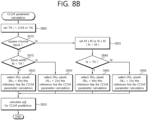
- FIGS. 10a and 10b are diagrams for describing a procedure of performing CCLM prediction based on the CCLM parameters of the current chroma block derived according to method 2 of the present embodiment described above.
- the encoding apparatus/decoding apparatus may calculate a CCLM parameter for the current block (step, S1000).
- the CCLM parameter may be calculated as the present embodiment shown in FIG. 10b .
- FIG. 10b may illustrate a specific embodiment of calculating the CCLM parameter.
- the encoding apparatus/decoding apparatus may determine whether the current chroma block is a square chroma block (step, S 1005).
- the encoding apparatus/decoding apparatus may set a width or a height of the current block to N (step, S1010) and determine whether N is smaller than 2 (N ⁇ 2) (step, S1015).
- a size of the current chroma block may be derived in MxN size or NxM size (step, S1020).
- the encoding apparatus/decoding apparatus determine whether the N is smaller than 2 (step, S1015).
- the M represents a value greater than the N (N ⁇ M).
- the encoding apparatus/decoding apparatus may select 2N th neighboring samples in a reference line adjacent to the current block as a reference sample for the CCLM parameter calculation (step, S1025).
- the encoding apparatus/decoding apparatus may derive parameters ⁇ and ⁇ for the CCLM prediction based on the selected reference samples (step, S1030).
- the encoding apparatus/decoding apparatus may select 2N th neighboring samples in a reference line adjacent to the current block as a reference sample for the CCLM parameter calculation (step, S1040).
- the N th may be 2.
- the encoding apparatus/decoding apparatus may derive the parameters ⁇ and ⁇ for the CCLM prediction based on the selected reference samples (step, S1030).
- the encoding apparatus/decoding apparatus may select 2N th neighboring samples in a reference line adjacent to the current block as a reference sample for calculating the CCLM parameter (step, S1050).
- the encoding apparatus/decoding apparatus may derive parameters ⁇ and ⁇ for the CCLM prediction based on the selected reference samples (step, S1030).
- the encoding apparatus/decoding apparatus may select 2N th neighboring samples in a reference line adjacent to the current block as a reference sample for calculating the CCLM parameter (step, S1055).
- the encoding apparatus/decoding apparatus may derive parameters ⁇ and ⁇ for the CCLM prediction based on the selected reference samples (step, S1030).
- the encoding apparatus/decoding apparatus may perform CCLM prediction based on the parameters to generate a prediction sample for the current chroma block (step, S1060). For example, the encoding apparatus/decoding apparatus may generate a prediction sample for the current chroma block based on Equation 1 in which the calculated parameters and reconstructed samples of the current luma block for the current chroma block are used.
- FIGS. 11a and 11b are diagrams for describing a procedure of performing CCLM prediction based on the CCLM parameters of the current chroma block derived according to method 3 of the present embodiment described above.
- the encoding apparatus/decoding apparatus may calculate a CCLM parameter for the current block (step, S 1100).
- the CCLM parameter may be calculated as the present embodiment shown in FIG. 11b .
- FIG. 11b may illustrate a specific embodiment of calculating the CCLM parameter.
- the encoding apparatus/decoding apparatus may determine whether the current chroma block is a square chroma block (step, S1105).
- the encoding apparatus/decoding apparatus may set a width or a height of the current block to N (step, S1110) and determine whether N is smaller than 2 (N ⁇ 2) (step, S1115).
- a size of the current chroma block may be derived in MxN size or NxM size (step, S1120).
- the encoding apparatus/decoding apparatus determine whether the N is smaller than 2 (step, S1115).
- the M represents a value greater than the N (N ⁇ M).
- the encoding apparatus/decoding apparatus may select 2N th neighboring samples in a reference line adjacent to the current block as a reference sample for the CCLM parameter calculation (step, S1135).
- the encoding apparatus/decoding apparatus may derive parameters ⁇ and ⁇ for the CCLM prediction based on the selected reference samples (step, S1130).
- the encoding apparatus/decoding apparatus may perform CCLM prediction based on the parameters to generate a prediction sample for the current chroma block (step, S1140). For example, the encoding apparatus/decoding apparatus may generate a prediction sample for the current chroma block based on Equation 1 in which the calculated parameters and reconstructed samples of the current luma block for the current chroma block are used.
- the encoding apparatus/decoding apparatus may calculate a CCLM parameter for the current block (step, S1200).
- the CCLM parameter may be calculated as the present embodiment shown in FIG. 12b .
- FIG. 12b may illustrate a specific embodiment of calculating the CCLM parameter.
- the encoding apparatus/decoding apparatus may determine whether the current chroma block is a square chroma block (step, S1205).
- a size of the current chroma block may be derived in MxN size or NxM size (step, S1220).
- the encoding apparatus/decoding apparatus determine whether the N is smaller than 2 (step, S1215).
- the M represents a value greater than the N (N ⁇ M).
- the encoding apparatus/decoding apparatus may select 2N th neighboring samples in a reference line adjacent to the current block as a reference sample for the CCLM parameter calculation (step, S1225).
- the encoding apparatus/decoding apparatus may derive parameters ⁇ and ⁇ for the CCLM prediction based on the selected reference samples (step, S1230).
- the encoding apparatus/decoding apparatus may select 2N th neighboring samples in a reference line adjacent to the current block as a reference sample for the CCLM parameter calculation (step, S1235).
- the encoding apparatus/decoding apparatus may derive parameters ⁇ and ⁇ for the CCLM prediction based on the selected reference samples (step, S1230).
- the encoding apparatus/decoding apparatus may perform CCLM prediction based on the parameters to generate a prediction sample for the current chroma block (step, S1240). For example, the encoding apparatus/decoding apparatus may generate a prediction sample for the current chroma block based on Equation 1 in which the calculated parameters and reconstructed samples of the current luma block for the current chroma block are used.
- the present embodiment proposes a method of configuring a pixel selection upper limit N th adaptively.
- the N th may be configured to a block size adaptively as below.
- the N th may be configured to a block size adaptively as below.
- the N th may be configured to a block size adaptively as below.
- the encoding apparatus/decoding apparatus may set the upper limit N th for neighboring sample selection, and then, calculate a CCLM parameter by selecting a chroma block neighboring sample as described above.
- a promised value may be used in the encoding apparatus and the decoding apparatus, or it may be transmitted whether to use the proposed method and information representing the N th value in a unit of CU, slice, picture and sequence.
- cclm_reduced_sample_flag may be parsed and the present embodiment described above may be performed as below.
- the method among method 1 to method 3 may be selected based on the information transmitted through a high level syntax (HLS), and based on the selected method, the CCLM parameter may be calculated.
- HLS high level syntax
- the information representing the applied method signaled through a slice header may be represented as the following table.
- slice_header( ) Descriptor ... cclm_reduced_sample_threshold f(2) ...
- cclm_reduced_sample_threshold may represent a syntax element of the information representing the applied method.
- the information representing the applied method signaled through a Picture Parameter Set may be represented as the following table.
- PPS Picture Parameter Set
- the information representing the applied method signaled through a Sequence Parameter Set may be represented as the following table.
- SPS Sequence Parameter Set
- cclm_reduced_sample_threshold value i.e., a value derived by decoding cclm_reduced_sample_threshold
- the PPS or the SPS may be derived as represented in the following table.
- the methods of the present embodiment described above may not be applied to the current chroma block, in the case that the cclm_reduced_sample_threshold value is 1, method 1 may be selected as the method applied to the current chroma block, in the case that the cclm_reduced_sample_threshold value is 2, method 2 may be selected as the method applied to the current chroma block, and in the case that the cclm_reduced_sample_threshold value is 3, method 3 may be selected as the method applied to the current chroma block.
- the method proposed in the present embodiment may be used a CCLM mode which is an intra-prediction mode for a chroma component, and the chroma block predicted through the CCLM mode may be used for deriving a residual image through a differential from an original image in the encoding apparatus or used for deriving a reconstructed image through an addition with a residual signal in the decoding apparatus.
- CCLM mode which is an intra-prediction mode for a chroma component
- the chroma block predicted through the CCLM mode may be used for deriving a residual image through a differential from an original image in the encoding apparatus or used for deriving a reconstructed image through an addition with a residual signal in the decoding apparatus.
- the encoding apparatus may determine one of method 1 to method 3 and transmit the information to the decoding apparatus as below.
- the method proposed in the present embodiment may be used for a CCLM mode which is an intra-prediction mode for a chroma component, and the chroma block predicted through the CCLM mode may be used for deriving a residual image through a differential from an original image in the encoding apparatus or used for reconstructed image through an addition with a residual signal in the decoding apparatus.
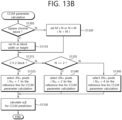
- FIGS. 13a and 13b are diagrams for describing a procedure of performing CCLM prediction based on the CCLM parameters of the current chroma block derived according to method 1 of the present embodiment described above.
- the encoding apparatus/decoding apparatus may calculate a CCLM parameter for the current block (step, S1300).
- the CCLM parameter may be calculated as the present embodiment shown in FIG. 13b .
- FIG. 13b may illustrate a specific embodiment of calculating the CCLM parameter.
- the encoding apparatus/decoding apparatus may determine whether the current chroma block is a square chroma block (step, S1305).
- the encoding apparatus/decoding apparatus may set a width or a height of the current block to N (step, S1310) and determine whether the size of the current chroma block is 2x2 size (step, S1315).
- a size of the current chroma block may be derived in MxN size or NxM size (step, S1320).
- the encoding apparatus/decoding apparatus determine whether the size of the current chroma block is 2x2 size (step, S1315).
- the M may represent a value greater than the N (N ⁇ M).
- the encoding apparatus/decoding apparatus may select 2N th neighboring samples in a reference line adjacent to the current block as a reference sample for the CCLM parameter calculation (step, S1325).
- the encoding apparatus/decoding apparatus may derive parameters ⁇ and ⁇ for the CCLM prediction based on the selected reference samples (step, S1330).
- the encoding apparatus/decoding apparatus may select 2N th neighboring samples in a reference line adjacent to the current block as a reference sample for the CCLM parameter calculation (step, S1340).
- the encoding apparatus/decoding apparatus may derive parameters ⁇ and ⁇ for the CCLM prediction based on the selected reference samples (step, S1330).
- the encoding apparatus/decoding apparatus may select 2N th neighboring samples in a reference line adjacent to the current block as a reference sample for the CCLM parameter calculation (step, S1345).
- the encoding apparatus/decoding apparatus may derive parameters ⁇ and ⁇ for the CCLM prediction based on the selected reference samples (step, S1330).
- the encoding apparatus/decoding apparatus may perform CCLM prediction based on the parameters to generate a prediction sample for the current chroma block (step, S1350). For example, the encoding apparatus/decoding apparatus may generate a prediction sample for the current chroma block based on Equation 1 in which the calculated parameters and reconstructed samples of the current luma block for the current chroma block are used.
- FIGS. 14a and 14b are diagrams for describing a procedure of performing CCLM prediction based on the CCLM parameters of the current chroma block derived according to method 2 of the present embodiment described above.
- the encoding apparatus/decoding apparatus may calculate a CCLM parameter for the current block (step, S1400).
- the CCLM parameter may be calculated as the present embodiment shown in FIG. 14b .
- FIG. 14b may illustrate a specific embodiment of calculating the CCLM parameter.
- the encoding apparatus/decoding apparatus may determine whether the current chroma block is a square chroma block (step, S1405).
- the encoding apparatus/decoding apparatus may set a width or a height of the current block to N (step, S1410) and determine whether a size of the current chroma block is 2x2 (step, S1415).
- a size of the current chroma block may be derived in MxN size or NxM size (step, S1420).
- the encoding apparatus/decoding apparatus determine whether a size of the current chroma block is 2x2 (step, S1415).
- the M represents a value greater than the N (N ⁇ M).
- the encoding apparatus/decoding apparatus may select 2N th neighboring samples in a reference line adjacent to the current block as a reference sample for the CCLM parameter calculation (step, S1425).
- the encoding apparatus/decoding apparatus may derive parameters ⁇ and ⁇ for the CCLM prediction based on the selected reference samples (step, S1430).
- the encoding apparatus/decoding apparatus may select 2N th neighboring samples in a reference line adjacent to the current block as a reference sample for the CCLM parameter calculation (step, S1440).
- the encoding apparatus/decoding apparatus may derive the parameters ⁇ and ⁇ for the CCLM prediction based on the selected reference samples (step, S1430).
- the encoding apparatus/decoding apparatus may select 2N th neighboring samples in a reference line adjacent to the current block as a reference sample for the CCLM parameter calculation (step, S1450).
- the encoding apparatus/decoding apparatus may derive parameters ⁇ and ⁇ for the CCLM prediction based on the selected reference samples (step, S1430).
- the encoding apparatus/decoding apparatus may select 2N th neighboring samples in a reference line adjacent to the current block as a reference sample for the CCLM parameter calculation (step, S1455).
- the encoding apparatus/decoding apparatus may derive parameters ⁇ and ⁇ for the CCLM prediction based on the selected reference samples (step, S1430).
- the encoding apparatus/decoding apparatus may perform CCLM prediction based on the parameters to generate a prediction sample for the current chroma block (step, S1460). For example, the encoding apparatus/decoding apparatus may generate a prediction sample for the current chroma block based on Equation 1 in which the calculated parameters and reconstructed samples of the current luma block for the current chroma block are used.
- FIGS. 15a and 15b are diagrams for describing a procedure of performing CCLM prediction based on the CCLM parameters of the current chroma block derived according to method 3 of the present embodiment described above.
- the encoding apparatus/decoding apparatus may calculate a CCLM parameter for the current block (step, S1500).
- the CCLM parameter may be calculated as the present embodiment shown in FIG. 15b .
- FIG. 15b may illustrate a specific embodiment of calculating the CCLM parameter.
- the encoding apparatus/decoding apparatus may determine whether the current chroma block is a square chroma block (step, S1505).
- the encoding apparatus/decoding apparatus may set a width or a height of the current block to N (step, S1510) and determine whether a size of the current chroma block is 2x2 (step, S1515).
- a size of the current chroma block may be derived in MxN size or NxM size (step, S1520).
- the encoding apparatus/decoding apparatus determine whether a size of the current chroma block is 2x2 (step, S1515).
- the M represents a value greater than the N (N ⁇ M).
- the encoding apparatus/decoding apparatus may select 2N th neighboring samples in a reference line adjacent to the current block as a reference sample for the CCLM parameter calculation (step, S1525).
- the encoding apparatus/decoding apparatus may derive parameters ⁇ and ⁇ for the CCLM prediction based on the selected reference samples (step, S1530).
- the encoding apparatus/decoding apparatus may select 2N th neighboring samples in a reference line adjacent to the current block as a reference sample for the CCLM parameter calculation (step, S1540).
- the encoding apparatus/decoding apparatus may derive the parameters ⁇ and ⁇ for the CCLM prediction based on the selected reference samples (step, S1530).
- the encoding apparatus/decoding apparatus may select 2N th neighboring samples in a reference line adjacent to the current block as a reference sample for the CCLM parameter calculation (step, S1550).
- the encoding apparatus/decoding apparatus may derive the parameters ⁇ and ⁇ for the CCLM prediction based on the selected reference samples (step, S1530).
- the encoding apparatus/decoding apparatus may select 2N th neighboring samples in a reference line adjacent to the current block as a reference sample for the CCLM parameter calculation (step, S1555).
- the encoding apparatus/decoding apparatus may derive the parameters ⁇ and ⁇ for the CCLM prediction based on the selected reference samples (step, S1530).
- the encoding apparatus/decoding apparatus may perform the CCLM prediction based on the parameters and generate a prediction sample for the current chroma block (step, S1560). For example, the encoding apparatus/decoding apparatus may generate a prediction sample for the current chroma block based on Equation 1 in which the calculated parameters and reconstructed samples of the current luma block for the current chroma block are used.
- the present disclosure proposes an embodiment of selecting a subsampling sample more efficiently.
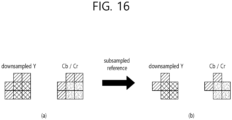
- FIG. 16 illustrates an example of selecting a neighboring reference sample of a chroma block.
- CCLM parameters ⁇ and ⁇ for the chroma block may be calculated based on 4 neighboring reference samples.
- the neighboring reference samples may include 4 neighboring reference samples of the luma block and 4 neighboring reference samples of the chroma block.
- CCLM parameters ⁇ and ⁇ for the chroma block may be calculated based on 2 neighboring reference samples.
- FIGS. 17a to 17c illustrates neighboring reference samples derived through the existing subsampling and neighboring reference samples derived through subsampling according to the present embodiment.
- a neighboring sample which is far from a top left side of the current chroma block is preferentially selected through the subsampling according to the present embodiment, more diverse sample values may be selected in CCLM parameter calculation.
- the present embodiment proposes subsampling that selects a side far from a top left side preferentially even for a non-square chroma block like nx2 size or 2xn size.
- a non-square chroma block like nx2 size or 2xn size.
- Idx_w x * width / subsample_num
- Idx_h y * height / subsample_num
- Idx_w may represent a neighboring reference sample (or position of neighboring reference sample) adjacent to a top current chroma block which is derived through subsampling
- Idx_h may represent a neighboring reference sample (or position of neighboring reference sample) adjacent to a left current chroma block which is derived through subsampling
- width may represent a width of the current chroma block
- height may represent a height of the current chroma block.
- subsample_num may represent the number of neighboring reference samples (the number of neighboring reference samples adjacent to a side) which is derived through subsampling.
- Equation 4 the subsampling performed based on Equation 4 above may be performed as below.
- x of Equation 4 above is a variable and may be increased from 0 to a reference sample number of top neighboring reference samples of the current chroma block after subsampling.
- the width of Equation 4 is 16, and x may vary from 0 to 1.
- the Subsample_num is 2, 0 and 8 may be selected as the Idx_w value.
- the top neighboring reference sample of which x coordinate is 0 and top the neighboring reference sample of which x coordinate is 8 may be selected among the top neighboring reference samples through the subsampling.
- y of Equation 4 above is a variable and may be increased from 0 to a reference sample number of left neighboring reference samples of the current chroma block after subsampling.
- the height of Equation 4 is 32, and y may vary from 0 to 3.
- the Subsample_num is 4, 0, 8, 16 and 24 may be selected as the Idx_h value.
- the left neighboring reference sample of which y coordinate is 0, the left neighboring reference sample of which y coordinate is 8, the left neighboring reference sample of which y coordinate is 16 and the left neighboring reference sample of which y coordinate is 24 may be selected among the left neighboring reference samples through the subsampling.
- subsampling may be performed based on an equation different from Equation 4 above.
- the subsampling proposed in the present embodiment may be performed based on the following equation.
- Idx_w width ⁇ 1 ⁇ x * width / subsample_num_width
- Idx_h height ⁇ 1 ⁇ y * height / subsample_num_height
- subsample_num_width may represent a top neighboring reference sample number derived through subsampling
- subsample_num_height may represent a left neighboring reference sample number derived through subsampling.
- x is a variable and may be increased from 0 to a reference sample number of top neighboring reference samples of the current chroma block after subsampling.
- y is a variable and may be increased from 0 to a reference sample number of left neighboring reference samples of the current chroma block after subsampling.
- the width of Equation 5 is 16, and x may vary from 0 to 1.
- the subsample_num_width is 2, 15 and 7 may be selected as the Idx_w value. Accordingly, in the case that x component and y component of a top left sample position of the current chroma block are 0, the top neighboring reference sample of which x coordinate is 15 and top the neighboring reference sample of which x coordinate is 7 may be selected among the top neighboring reference samples through the subsampling. That is, among the top neighboring reference samples of the current chroma block, the top neighboring reference sample which is far from the top left side of the current chroma block may be selected.
- Equation 5 in the case that 4 left neighboring reference samples are selected in the current chroma block of which height is 32, the height of Equation 5 is 32, and y may vary from 0 to 3.
- the subsample _num_height is 4, 31, 23, 15 and 7 may be selected as the Idx_h value.
- the left neighboring reference sample of which y coordinate 31
- the left neighboring reference sample of which y coordinate 23
- the left neighboring reference sample of which y coordinate 15
- the left neighboring reference sample of which y coordinate 7
- the subsample_num - width and the subsample _num_height of Equation 5 above may be derived based on a size of the current chroma block.
- the subsample_num_width and the subsample _num_height may be derived as represented in the following table.
- Chroma block size (subsample_num _ width, subsample_num_height) 2 ⁇ 2, 2 ⁇ N, N ⁇ 2 (N>2) (2,2) 4 ⁇ 4, 4 ⁇ N, N ⁇ 4 (N>4) (4,4) 8 ⁇ 8, 8 ⁇ N, N ⁇ 8 (N>8) (8,8) 16 ⁇ 16, 16 ⁇ N, N ⁇ 16 (N>16) (16,16) 32 ⁇ 32, 32 ⁇ N, N ⁇ 32 (N>32) (32,32) 64 ⁇ 64 (64,64)
- the subsample _num_width and the subsample _num_height may be derived based on the N th .
- the subsample_num_widthand the subsample_num_height may be derived as represented in the following table based on the N th .
- min (A, B) may represent a smaller value between A and B.
- LUT look-up table
- Chroma block size (subsample_num_width, subsample_num_height) 2 ⁇ 2, 2 ⁇ 4, 2 ⁇ 8, 2 ⁇ 16, 2 ⁇ 32 (2,2), (2,2), (2,6), (2,14), (2,30) 4 ⁇ 2, 8 ⁇ 2, 16 ⁇ 2, 32 ⁇ 2 (2,2), (6,2), (14,2), (30,2) 4 ⁇ 4, 4 ⁇ 8, 4 ⁇ 16, 4 ⁇ 32 (4,4), (4,4), (4,12), (4,28) 8 ⁇ 4, 16 ⁇ 4, 32 ⁇ 4 (4,4), (12,4), (28,4) 8 ⁇ 8, 8 ⁇ 16, 8 ⁇ 32 (8,8), (8,8), (8,24) 16 ⁇ 8, 32 ⁇ 8 (8,8), (24,8) 16 ⁇ 16, 16 ⁇ 32 (16,16), (16,16) 32 ⁇ 16 (16,16) 32 ⁇ 32 (32)
- the selected number of neighboring reference samples may be increased in comparison with the subsampling described above, and through this, a CCLM parameter may be calculated in higher accuracy.
- first 6 positions idx_w or idx_h
- first 12 or 14 positions may be selected among subsampling for deriving 16 neighboring reference samples.
- first 24 or 28 positions may be selected among subsampling for deriving 32 neighboring reference samples.
- determination of the number of reference samples selected by the encoding apparatus and the decoding apparatus may be as below.
- the subsample_num_width may be determined as 4 and the subsample _num_height may be determined as 28.
- the subsample_num - width and the subsample _num_height may be determined in the same manner.
- the LUT may be derived as represented in the following table.
- Chroma block size (subsample_num_width, subsample_num_height) 2 ⁇ 2, 2 ⁇ 4, 2 ⁇ 8, 2 ⁇ 16, 2 ⁇ 32 (2,2), (2,2), (2,6), (2,6), (2,6) 4 ⁇ 2, 8 ⁇ 2, 16 ⁇ 2, 32 ⁇ 2 (2,2), (6,2), (6,2), (6,2) 4 ⁇ 4, 4 ⁇ 8, 4 ⁇ 16, 4 ⁇ 32 (4,4), (4,4), (2,6), (2,6) 8 ⁇ 4, 16 ⁇ 4, 32 ⁇ 4 (4,4), (6,2), (6,2) 8 ⁇ 8, 8 ⁇ 16, 8 ⁇ 32 (4,4), (4,4), (2,6) 16 ⁇ 32 (4,4), (4,4), (2,6) 16 ⁇ 8, 32 ⁇ 8 (4,4), (6,2) 16 ⁇ 16, 16 ⁇ 32 (4,4), (4,4), (2,6) 16 ⁇ 8, 32 ⁇ 8 (4,4), (6,2) 16 ⁇ 16, 16 ⁇ 32 (4,4), (4,4) 32 ⁇ 16 (4,4) 32x32
- a maximum value of summation of the subsample _num_width and the subsample _num_height may set to 8. Through this, hardware complexity may be reduced, and simultaneously, a CCLM parameter may be calculated efficiently.
- first 6 positions may be selected among subsampling for deriving 8 neighboring reference samples.
- determination of the number of reference samples selected by the encoding apparatus and the decoding apparatus may be as below.
- the subsample_num_width may be determined as 2 and the subsample_num_height may be determined as 6.
- the subsample_num - width and the subsample _num_height may be determined in the same manner.
- a value promised in an encoder or a decoder may be used, or it may be transmitted whether to use the proposed method or a value in a unit of CU, slice, picture and sequence.
- the encoding apparatus and the decoding apparatus may use the subsample_num_width and subsample _num_height numbers determined in the Table (i.e., LUT), and in the case that the N th is used, the subsample _num_width and the subsample_num_height may be determined based on the N th value.
- the value derived as Table 17 may be used as a default subsample_num - width and a subsample _num_height number.
- a method for the decoding apparatus to perform a CCLM prediction by parsing cclm_subsample_flag as below, when an intra-prediciton mode of the current chroma block is the CCLM mode.
- the information representing whether to use the proposed method is transmitted in in a unit of slice, picture and sequence
- the information may be transmitted through high level syntax (HLS) as below.
- HLS high level syntax
- the decoding apparatus may select a subsampling method which is performed based on the information.
- the information representing whether to use the proposed method signaled through a slice header may be represented as the following Table.
- slice_header() Descriptor ... cclm_subsample_flag f(1) ...
- cclm_reduced_sample_flag may represent a syntax element of the information representing whether to use the proposed method.
- the information representing whether to use the proposed method signaled through a Picture Parameter Set may be represented as the following table.
- PPS Picture Parameter Set
- the information representing whether to use the proposed method signaled through a Sequence Parameter Set may be represented as the following table.
- SPS Sequence Parameter Set
- cclm_reduced_sample_flag value i.e., a value derived by decoding cclm_reduced_sample_flag
- the PPS or the SPS may be derived as represented in the following table.
- cclm_subsample_flag Proposed method 0 Not apply (Use Equation 5) 1 Apply (Use Equation 6)
- the subsampling using Equation 4 may be performed, and in the case that the cclm_reduced_sample_flag value is 1, the subsampling using Equation 5 may be performed.
- the encoding apparatus may perform the embodiment described above in the same manner of the decoding apparatus and perform a CCLM parameter calculation based on the selected neighboring reference samples.
- the encoding apparatus may determine whether to apply the proposed subsampling method, and then, transmit information of the determined method to the decoding apparatus.
- FIG. 18 shows an example of performing CCLM prediction using subsampling which utilizes Equation 5 described above.
- the encoding apparatus/decoding apparatus may calculate a CCLM parameter for the current block (step, S1800).
- the encoding apparatus/decoding apparatus may determine whether subsampling is required for neighboring samples of the current chroma block (step, S1805).
- the subsampling is required to be performed for the top neighboring samples of the current chroma block.
- the subsampling is required to be performed for the left neighboring samples of the current chroma block.
- the encoding apparatus/decoding apparatus may select a specific number of surrounding samples by performing the subsampling using Equation 5 on the neighboring samples (step, S1810). Thereafter, the encoding apparatus/decoding apparatus may calculate CCLM parameters for the current chroma block based on the selected neighboring samples (step, S1815).
- the encoding apparatus/decoding apparatus may select neighboring samples of the current chroma block without performing the subsampling (step, S1820). Thereafter, the encoding apparatus/decoding apparatus may calculate CCLM parameters for the current chroma block based on the selected neighboring samples (step, S1815).
- the encoding apparatus/decoding apparatus may generate a prediction sample of the current chroma block by performing CCLM prediction for the current chroma block based on the CCLM parameters (step, S1825).
- FIG. 19 schematically represents an image encoding method by an encoding apparatus according to the present document.
- the method disclosed in FIG. 19 may be performed by the encoding apparatus disclosed in FIG. 2 .
- S1900 to S1960 in FIG. 19 may be performed by the predictor of the encoding apparatus, and S1970 may be performed by the entropy encoder of the encoding apparatus.
- the process of deriving a residual sample for the current chroma block based on the original sample and the prediction sample for the current chroma block may be performed by the subtractor of the encoding apparatus; the process of deriving reconstructed samples for the current chroma block based on the residual samples and the prediction samples for the current chroma block may be performed by the adder of the encoding apparatus; the process of generating information on a residual for the current chroma block based on the residual sample may be performed by the transformer of the encoding apparatus; and the process of encoding the information on a residual may be performed by an entropy encoder unit of the encoding apparatus.
- the encoding apparatus determines a cross-component linear model (CCLM) mode as an intra prediction mode of a current chroma block (step, S1900). For example, the encoding apparatus may determine the intra prediction mode of the current chroma block based on a rate-distortion cost (RDO). Here, the RD cost may be derived based on Sum of Absolute Difference (step, SAD). The encoding apparatus may determine the CCLM mode as the intra prediction mode of the current chroma block based on the RD cost.
- RDO rate-distortion cost
- SAD Sum of Absolute Difference
- the encoding apparatus may encode information on the intra prediction mode of the current chroma block, and the information on the intra prediction mode may be signaled through a bitstream.
- the prediction related information of the current chroma block may include information on the intra prediction mode.
- the encoding apparatus derives a specific value for the current chroma block (step, S1910).
- the encoding apparatus may derive a specific value for the current chroma block.
- the specific value may be derived to derive CCLM parameters of the current chroma block.
- the specific value may be expressed as an upper limit of the number of neighboring samples or a maximum number of neighboring samples.
- the derived specific value may be 2. Alternatively, the derived specific value may be 4, 8 or 16.
- the specific value may be derived as a preset value. That is, the specific value may be derived as a value promised between the encoding apparatus and the decoding apparatus. In other words, the specific value may be derived as a preset value for the current chroma block to which the CCLM mode is applied.
- the encoding apparatus may encode image information including prediction related information, and signal image information including prediction related information through a bitstream, wherein the prediction related information may include information indicating the specific value.
- the information indicating the specific value may be signaled in units of a coding unit (CU), a slice, PPS, or SPS.
- the encoding apparatus may encode image information including prediction related information, which may include flag information indicating whether to derive the number of neighboring reference samples based on the specific value.
- prediction related information may include flag information indicating whether to derive the number of neighboring reference samples based on the specific value.
- the flag information may indicate that the number of neighboring reference samples is derived based on the specific value, while, in the case that the value of the flag information is 0, the flag information may indicate that the number of neighboring reference samples is not derived based on the specific value.
- the prediction related information may include information indicating the specific value.
- the information indicating the flag information and/or the specific value may be signaled in units of a coding unit (CU), a slice, PPS, or SPS.
- the specific value may be derived based on the size of the current block.
- the specific value may be derived based on whether a smaller value between the width and the height of the current block is greater than a specific threshold value.
- the specific value may be derived as 4, while, in the case that a smaller value between the width and the height of the current block is not greater than a specific threshold value, the specific value may be derived as 2,
- the specific threshold value may be derived as a preset value. That is, the specific threshold value may be derived as a value promised between the encoding apparatus and the decoding apparatus.
- the encoding apparatus may encode image information including prediction related information, which may include information indicating the specific threshold value.
- the specific threshold value may be derived based on information indicating the specific threshold value.
- the derived specific threshold value may be 4 or 8.
- the encoding apparatus compares the width and the height of the current chroma block with the specific value (step, S1920). For example, the encoding apparatus may compare the width and the height of the current chroma block with the specific value.
- the encoding apparatus may compare the width of the current chroma block with the specific value, and may compare the height of the current chroma block with the specific value.
- the encoding apparatus may compare a smaller value between the width and the height of the current chroma block with the specific value, and may compare the height of the current chroma block with the specific value.
- the encoding apparatus derives top neighboring chroma samples whose number is equal to the specific value of the current chroma block, and left neighboring chroma samples whose number is equal to the specific value (step, S 1930).
- the encoding apparatus derives down-sampled neighboring luma samples and down-sampled luma samples of the current luma block (step, S 1940).
- the neighboring luma samples may correspond to the top neighboring chroma samples and the left neighboring chroma samples.
- the down-sampled the surroundings luma samples may include down-sampled top neighboring luma samples of the current luma block corresponding to the top neighboring chroma samples, and down-sampled left neighboring luma samples of the current luma block corresponding to the left neighboring chroma samples.
- top neighboring chroma samples whose number is equal to the specific value are derived
- down-sampled top neighboring luma samples whose number is equal to the specific value corresponding to the top neighboring chroma samples may be derived.
- down-sampled top neighboring luma samples whose number is equal to the value of the width corresponding to the top neighboring chroma samples may be derived.
- down-sampled left neighboring luma samples whose number is equal to the specific value corresponding to the left neighboring chroma samples may be derived.
- down-sampled left neighboring luma samples whose number is equal to the value of the height corresponding to the left neighboring chroma samples may be derived.
- the encoding apparatus derives CCLM parameters based on the top neighboring chroma samples, the left neighboring chroma samples, and the down-sampled neighboring luma samples (step, S1950).
- the encoding apparatus may derive CCLM parameters based on the top neighboring chroma samples, the left neighboring chroma samples, and the down-sampled neighboring luma samples.
- the CCLM parameters may be derived based on Equation 3 described above.
- the encoding apparatus derives prediction samples for the current chroma block based on the CCLM parameters and the down-sampled luma samples (step, S1960).
- the encoding apparatus may derive prediction samples for the current chroma block based on the CCLM parameters and the down-sampled luma samples.
- the encoding apparatus may generate prediction samples for the current chroma block by applying the CCLM derived from the CCLM parameters to the down-sampled luma samples. That is, the encoding apparatus may generate prediction samples for the current chroma block by performing CCLM prediction based on the CCLM parameters. For example, the prediction samples may be derived based on Equation 1 described above.
- the encoding apparatus encodes image information including prediction related information on the current chroma block (step, S 1970).
- the encoding apparatus may encode image information including prediction related information on the current chroma block, and signal the encoded image information through a bitstream.
- the prediction related information may include information indicating the specific value. Additionally, for example, the prediction related information may include information indicating the specific value. Additionally, for example, the prediction related information may include flag information indicating whether to derive the number of neighboring reference samples based on the specific value. Also, for example, the prediction related information may include information indicating an intra prediction mode for the current chroma block.
- the encoding apparatus may derive residual samples for the current chroma block based on original samples and prediction samples for the current chroma block, generate information on a residual for the current chroma block based on the residual samples, and encode the information on a residual.
- the image information may include the information on a residual.
- the encoding apparatus may generate reconstructed samples for the current chroma block based on the prediction samples and the residual samples for the current chroma block.
- the bitstream may be transmitted to the decoding apparatus through a network or a (digital) storage medium.
- the network may include a broadcast network, a communication network and/or the like
- the digital storage medium may include various storage media, such as USB, SD, CD, DVD, Blu-ray, HDD, SSD, and the like.
- FIG. 20 schematically represents an encoding apparatus performing an image encoding method according to the present document.
- the method disclosed in FIG. 19 may be performed by the encoding apparatus disclosed in FIG. 20 .
- a predictor of the encoding apparatus of FIG. 20 may perform S1900 to S1960 in FIG. 19
- the entropy encoder of the encoding apparatus of FIG. 20 may perform S1970 in FIG. 19 .
- the process of deriving residual samples for the current chroma block based on the original samples and the prediction samples for the current chroma block may be performed by the subtractor of the encoding apparatus in FIG.
- the process of deriving reconstructed samples for the current chroma block based on the residual samples and the prediction samples for the current chroma block may be performed by the adder of the encoding apparatus in FIG. 20 ; the process of generating information on a residual for the current chroma block based on the residual sample may be performed by the transformer of the encoding apparatus in FIG. 20 ; and the process of encoding the information on a residual may be performed by an entropy encoder unit of the encoding apparatus in FIG. 20 .
- FIG. 21 schematically represents an image decoding method by a decoding apparatus according to the present document.
- the method disclosed in FIG. 21 may be performed by the decoding apparatus disclosed in FIG. 3 .
- S2100 to S2160 in FIG. 21 may be performed by the predictor of the decoding apparatus, and S2170 may be performed by the adder of the decoding apparatus.
- the process of obtaining information on a residual of the current block through a bitstream may be performed by the entropy decoder of the decoding apparatus, and the process of deriving the residual sample for the current block based on the residual information may be performed by the inverse transformer of the decoding apparatus.
- the decoding apparatus derives a cross-component linear model (CCLM) mode as an intra prediction mode of the current chroma block (step, S2100).
- the decoding apparatus may derive an intra prediction mode of the current chroma intra prediction mode.
- the decoding apparatus may receive information on an intra prediction mode of the current chroma block through a bitstream, and derive the CCLM mode as the intra prediction mode of the current chroma block based on the information on the intra prediction mode.
- the decoding apparatus derives a specific value for the current chroma block (step, S2110).
- the decoding apparatus may derive a specific value for the current chroma block.
- the specific value may be derived to derive CCLM parameters of the current chroma block.
- the specific value may be expressed as an upper limit of the number of neighboring samples or a maximum number of neighboring samples.
- the derived specific value may be 2. Alternatively, the derived specific value may be 4, 8 or 16.
- the specific value may be derived as a preset value. That is, the specific value may be derived as a value promised between the encoding apparatus and the decoding apparatus. In other words, the specific value may be derived as a preset value for the current chroma block to which the CCLM mode is applied.
- the decoding apparatus may obtain image information including prediction related information through a bitstream, and the prediction related information may include information indicating the specific value.
- the decoding apparatus may derive the specific value based on the information indicating the specific value.
- the information indicating the specific value may be signaled in units of a coding unit (CU), a slice, PPS, or SPS.
- the decoding apparatus may obtain image information including prediction related information through a bitstream, which may include flag information indicating whether to derive the number of neighboring reference samples based on the specific value.
- the flag information may indicate that the number of neighboring reference samples is derived based on the specific value, while, in the case that the value of the flag information is 0, the flag information may indicate that the number of neighboring reference samples is not derived based on the specific value.
- the prediction related information may include information indicating the specific value.
- the decoding apparatus may derive the specific value based on the information indicating the specific value.
- the information indicating the flag information and/or the specific value may be signaled in units of a coding unit (CU), a slice, PPS, or SPS.
- the specific value may be derived based on the size of the current block.
- the specific value may be derived based on whether a smaller value between the width and the height of the current block is greater than a specific threshold value.
- the specific value may be derived as 4, while, in the case that a smaller value between the width and the height of the current block is not greater than a specific threshold value, the specific value may be derived as 2,
- the specific threshold value may be derived as a preset value. That is, the specific threshold value may be derived as a value promised between the encoding apparatus and the decoding apparatus.
- the decoding apparatus may obtain image information including prediction related information through a bitstream, and the prediction related information may include information indicating the specific threshold value.
- the specific threshold value may be derived based on information indicating the specific threshold value.
- the derived specific threshold value may be 4 or 8.
- the decoding apparatus compares the width and the height of the current chroma block with the specific value (step, S2120). For example, the decoding apparatus may compare the width and the height of the current chroma block with the specific value.
- the decoding apparatus may compare the width of the current chroma block with the specific value, and may compare the height of the current chroma block with the specific value.
- the decoding apparatus may compare a smaller value between the width and the height of the current chroma block with the specific value, and may compare the height of the current chroma block with the specific value.
- the decoding apparatus derives top neighboring chroma samples whose number is equal to the specific value of the current chroma block, and left neighboring chroma samples whose number is equal to the specific value (step, S2130).
- the decoding apparatus may derive top neighboring chroma samples whose number is equal to the specific value of the current chroma block, and left neighboring chroma samples whose number is equal to the specific value.
- the decoding apparatus may derive top neighboring chroma samples whose number is equal to a value of the width of the current chroma block, and left neighboring chroma samples whose number is equal to a value of the height.
- the decoding apparatus may derive top neighboring chroma samples whose number is equal to the specific value of the current chroma block, and left neighboring chroma samples whose number is equal to a value of the height.
- the decoding apparatus may derive top neighboring chroma samples whose number is equal to a value of the width of the current chroma block, and left neighboring chroma samples whose number is equal to the specific value.
- the top neighboring chroma samples may be neighboring chroma samples adjacent to the top boundary of the current chroma block
- the left neighboring chroma samples may be neighboring chroma samples adjacent to the left boundary of the current chroma block.
- top neighboring chroma samples whose number is equal to the specific value may be derived as the top neighboring chroma samples whose number is equal to the specific value.
- top neighboring chroma samples of positions derived based on above Equation 4 among left neighboring chroma samples adjacent to the left boundary of the current chroma block may be derived as the left neighboring chroma samples whose number is equal to the specific value.
- top neighboring chroma samples of positions derived based on above Equation 5 among top neighboring chroma samples adjacent to the top boundary of the current chroma block may be derived as the top neighboring chroma samples whose number is equal to the specific value.
- top neighboring chroma samples of positions derived based on above Equation 5 among left neighboring chroma samples adjacent to the left boundary of the current chroma block may be derived as the left neighboring chroma samples whose number is equal to the specific value.
- the decoding apparatus derives down-sampled neighboring luma samples and down-sampled luma samples of the current luma block (step, S2140).
- the neighboring luma samples may correspond to the top neighboring chroma samples and the left neighboring chroma samples.
- the down-sampled the surroundings luma samples may include down-sampled top neighboring luma samples of the current luma block corresponding to the top neighboring chroma samples, and down-sampled left neighboring luma samples of the current luma block corresponding to the left neighboring chroma samples.
- top neighboring chroma samples whose number is equal to the specific value are derived
- down-sampled top neighboring luma samples whose number is equal to the specific value corresponding to the top neighboring chroma samples may be derived.
- down-sampled top neighboring luma samples whose number is equal to the value of the width corresponding to the top neighboring chroma samples may be derived.
- down-sampled left neighboring luma samples whose number is equal to the specific value corresponding to the left neighboring chroma samples may be derived.
- down-sampled left neighboring luma samples whose number is equal to the value of the height corresponding to the left neighboring chroma samples may be derived.
- the decoding apparatus derives CCLM parameters based on the top neighboring chroma samples, the left neighboring chroma samples, and the down-sampled neighboring luma samples (step, S2150).
- the decoding apparatus may derive CCLM parameters based on the top neighboring chroma samples, the left neighboring chroma samples, and the down-sampled neighboring luma samples.
- the CCLM parameters may be derived based on Equation 3 described above.
- the decoding apparatus derives prediction samples for the current chroma block based on the CCLM parameters and the down-sampled luma samples (step, S2160).
- the decoding apparatus may derive prediction samples for the current chroma block based on the CCLM parameters and the down-sampled luma samples.
- the decoding apparatus may generate prediction samples for the current chroma block by applying the CCLM derived from the CCLM parameters to the down-sampled luma samples. That is, the decoding apparatus may generate prediction samples for the current chroma block by performing CCLM prediction based on the CCLM parameters. For example, the prediction samples may be derived based on Equation 1 described above.
- the decoding apparatus generates reconstructed samples for the current chroma block based on the prediction samples (step, S2170).
- the decoding apparatus may generate reconstructed samples based on the prediction samples.
- the decoding apparatus may receive information on the residual for the current chroma block from the bitstream.
- the information on the residual may include a transform coefficient relating to a (chroma) residual sample.
- the decoding apparatus may derive the residual sample (or residual sample array) for the current chroma block based on the residual information.
- the decoding apparatus may generate the reconstructed samples based on the prediction samples and the residual samples.
- the decoding apparatus may derive a reconstructed block or a reconstructed picture based on the reconstructed sample.
- the decoding apparatus may apply an in-loop filtering procedure such as deblocking filtering and/or an SAO procedure to the reconstructed picture in order to improve subjective/objective video quality, as needed.
- FIG. 22 schematically represents a decoding apparatus performing an image decoding method according to the document.
- the method disclosed in FIG. 21 may be performed by the decoding apparatus disclosed in FIG. 22 .
- a predictor of the decoding apparatus of FIG. 22 may perform S2100 to S2160 in FIG. 21
- an adder of the decoding apparatus of FIG. 22 may perform S2170 in FIG. 21 .
- the process of obtaining image information including information on the residual of the current block through a bitstream may be performed by the entropy decoder of the decoding apparatus of FIG. 22
- the process of deriving the residual samples for the current block based on the information on the residual may be performed by the inverse transformer of the decoding apparatus of FIG. 22 .
- image coding efficiency can be improved by performing the intra prediction based on the CCLM.
- the complexity of intra prediction can be reduced by limiting the number of neighboring samples selected to derive a linear model parameter for the CCLM to a specific number.
- the methods are described based on the flowchart having a series of steps or blocks.
- the present disclosure is not limited to the order of the above steps or blocks. Some steps or blocks may occur simultaneously or in a different order from other steps or blocks as described above. Further, those skilled in the art will understand that the steps shown in the above flowchart are not exclusive, that further steps may be included, or that one or more steps in the flowchart may be deleted without affecting the scope of the present disclosure.
- the embodiments described in this specification may be performed by being implemented on a processor, a microprocessor, a controller or a chip.
- the functional units shown in each drawing may be performed by being implemented on a computer, a processor, a microprocessor, a controller or a chip.
- information for implementation (e.g., information on instructions) or algorithm may be stored in a digital storage medium.
- the decoding apparatus and the encoding apparatus to which the present disclosure is applied may be included in a multimedia broadcasting transmission/reception apparatus, a mobile communication terminal, a home cinema video apparatus, a digital cinema video apparatus, a surveillance camera, a video chatting apparatus, a real-time communication apparatus such as video communication, a mobile streaming apparatus, a storage medium, a camcorder, a VoD service providing apparatus, an Over the top (OTT) video apparatus, an Internet streaming service providing apparatus, a three-dimensional (3D) video apparatus, a teleconference video apparatus, a transportation user equipment (e.g., vehicle user equipment, an airplane user equipment, a ship user equipment, etc.) and a medical video apparatus and may be used to process video signals and data signals.
- the Over the top (OTT) video apparatus may include a game console, a blue-ray player, an internet access TV, a home theater system, a smart phone, a tablet PC, a Digital Video Recorder (DVR), and the like.
- the processing method to which the present disclosure is applied may be produced in the form of a program that is to be executed by a computer and may be stored in a computer-readable recording medium.
- Multimedia data having a data structure according to the present disclosure may also be stored in computer-readable recording media.
- the computer-readable recording media include all types of storage devices in which data readable by a computer system is stored.
- the computer-readable recording media may include a BD, a Universal Serial Bus (USB), ROM, PROM, EPROM, EEPROM, RAM, CD-ROM, a magnetic tape, a floppy disk, and an optical data storage device, for example.
- the computer-readable recording media includes media implemented in the form of carrier waves (e.g., transmission through the Internet).
- a bit stream generated by the encoding method may be stored in a computer-readable recording medium or may be transmitted over wired/wireless communication networks.
- embodiments of the present disclosure may be implemented with a computer program product according to program codes, and the program codes may be performed in a computer by the embodiments of the present disclosure.
- the program codes may be stored on a carrier which is readable by a computer.
- FIG. 23 illustrates a structural diagram of a contents streaming system to which the present disclosure is applied.
- the content streaming system to which the embodiment(s) of the present document is applied may largely include an encoding server, a streaming server, a web server, a media storage, a user device, and a multimedia input device.
- the encoding server compresses content input from multimedia input devices such as a smartphone, a camera, a camcorder, etc. into digital data to generate a bitstream and transmit the bitstream to the streaming server.
- multimedia input devices such as smartphones, cameras, camcorders, etc. directly generate a bitstream
- the encoding server may be omitted.
- the bitstream may be generated by an encoding method or a bitstream generating method to which the embodiment(s) of the present document is applied, and the streaming server may temporarily store the bitstream in the process of transmitting or receiving the bitstream.
- the streaming server transmits the multimedia data to the user device based on a user's request through the web server, and the web server serves as a medium for informing the user of a service.
- the web server delivers it to a streaming server, and the streaming server transmits multimedia data to the user.
- the content streaming system may include a separate control server.
- the control server serves to control a command/response between devices in the content streaming system.
- the streaming server may receive content from a media storage and/or an encoding server. For example, when the content is received from the encoding server, the content may be received in real time. In this case, in order to provide a smoo th streaming service, the streaming server may store the bitstream for a predetermined time.
- Examples of the user device may include a mobile phone, a smartphone, a laptop computer, a digital broadcasting terminal, a personal digital assistant (PDA), a portable multimedia player (PMP), navigation, a slate PC, tablet PCs, ultrabooks, wearable devices (ex. smartwatches, smart glasses, head mounted displays), digital TVs, desktops computer, digital signage, and the like.
- PDA personal digital assistant
- PMP portable multimedia player
- navigation a slate PC
- tablet PCs tablet PCs
- ultrabooks ultrabooks
- wearable devices ex. smartwatches, smart glasses, head mounted displays
- digital TVs desktops computer
- digital signage digital signage
- Each server in the content streaming system may be operated as a distributed server, in which case data received from each server may be distributed.
Landscapes
- Engineering & Computer Science (AREA)
- Multimedia (AREA)
- Signal Processing (AREA)
- Compression Or Coding Systems Of Tv Signals (AREA)
- Compression Of Band Width Or Redundancy In Fax (AREA)
- Compression, Expansion, Code Conversion, And Decoders (AREA)
Claims (2)
- Decodiervorrichtung für eine Bilddecodierung, die Decodiervorrichtung bestehend aus:einem Speicher; undmindestens einem Prozessor, der mit dem Speicher verbunden ist, wobei der mindestens eine Prozessor konfiguriert ist, um:(S2100) einen komponentenübergreifenden linearen Modell-Modus, CCLM-Modus, als Intra-Prädiktions-Modus eines aktuellen Chroma-Blocks abzuleiten;(S2110) einen spezifischen Wert für den aktuellen Chroma-Block abzuleiten;(S2120) eine Breite und eine Höhe des aktuellen Chroma-Blocks mit dem spezifischen Wert zu vergleichen;(S2130) basierend auf der Breite und der Höhe, die größer als der spezifische Wert sind, spezifische obere benachbarte Chroma-Abtastungen, deren Anzahl gleich dem spezifischen Wert des aktuellen Chroma-Blocks ist, und spezifische linke benachbarte Chroma-Abtastungen, deren Anzahl gleich dem spezifischen Wert ist, abzuleiten;(S2140) herunterabgetastete benachbarte Luma-Abtastungen und herunterabgetastete Luma-Abtastungen eines aktuellen Luma-Blocks abzuleiten, wobei die benachbarten Luma-Abtastungen den spezifischen oberen benachbarten Chroma-Abtastungen und den spezifischen linken benachbarten Chroma-Abtastungen entsprechen;(S2150) CCLM-Parameter basierend auf den spezifischen oberen benachbarten Chroma-Abtastungen, den spezifischen linken benachbarten Chroma-Abtastungen und den herunterabgetasteten benachbarten Luma-Abtastungen abzuleiten;(S2160) Prädiktions-Abtastungen für den aktuellen Chroma-Block basierend auf den CCLM-Parametern und den herunterabgetasteten Luma-Abtastungen abzuleiten; und(S2170) rekonstruierte Abtastungen für den aktuellen Chroma-Block basierend auf den Prädiktions-Abtastungen zu generieren,dadurch gekennzeichnet, dassder abgeleitete spezifische Wert 2 ist,wenn die Breite größer als der spezifische Wert ist, herunterabgetastete obere benachbarte Luma-Abtastungen spezifischer oberer Positionen, die den spezifischen oberen benachbarten Chroma-Abtastungen entsprechen, abgeleitet werden,wenn die Breite des aktuellen Chroma-Blocks 4 ist, die spezifischen oberen Positionen (1, -1) und (3, -1) sind, wenn die Höhe größer als der spezifische Wert ist, herunterabgetastete linke benachbarte Luma-Abtastungen mit spezifischen linken Positionen, die den spezifischen linken benachbarten Chroma-Abtastungen entsprechen, abgeleitet werden, und,wenn die Höhe des aktuellen Chroma-Blocks 4 ist, die spezifischen linken Positionen (-1, 1) und (-1, 3) sind.
- Codiervorrichtung für eine Bildcodierung, die Codiervorrichtung bestehend aus:einem Speicher; undmindestens einem Prozessor, der mit dem Speicher verbunden ist, wobei der mindestens eine Prozessor konfiguriert ist, um:(S1900) einen komponentenübergreifenden linearen Modell-Modus, CCLM-Modus, als Intra-Prädiktions-Modus eines aktuellen Chroma-Blocks zu bestimmen;(S1910) einen spezifischen Wert für den aktuellen Chroma-Block abzuleiten;(S1920) eine Breite und eine Höhe des aktuellen Chroma-Blocks mit dem spezifischen Wert zu vergleichen;(S1930) basierend auf der Breite und der Höhe, die größer als der spezifische Wert sind, spezifische obere benachbarte Chroma-Abtastungen, deren Anzahl gleich dem spezifischen Wert des aktuellen Chroma-Blocks ist, und spezifische linke benachbarte Chroma-Abtastungen, deren Anzahl gleich dem spezifischen Wert ist, abzuleiten;(S1940) herunterabgetastete benachbarte Luma-Abtastungen und herunterabgetastete Luma-Abtastungen eines aktuellen Luma-Blocks abzuleiten, wobei die herunterabgetasteten benachbarten Luma-Abtastungen den spezifischen oberen benachbarten Chroma-Abtastungen und den spezifischen linken benachbarten Chroma-Abtastungen entsprechen;(S1950) CCLM-Parameter basierend auf den spezifischen oberen benachbarten Chroma-Abtastungen, den spezifischen linken benachbarten Chroma-Abtastungen und den herunterabgetasteten benachbarten Luma-Abtastungen abzuleiten;(S1960) Prädiktions-Abtastungen für den aktuellen Chroma-Block basierend auf den CCLM-Parametern und den herunterabgetasteten Luma-Abtastungen abzuleiten; und(S1970) Bildinformationen, die prädiktionsbezogene Informationen für den aktuellen Chroma-Block beinhalten, zu codieren,dadurch gekennzeichnet, dassder abgeleitete spezifische Wert 2 ist,wenn die Breite größer als der spezifische Wert ist, herunterabgetastete obere benachbarte Luma-Abtastungen spezifischer oberer Positionen, die den spezifischen oberen benachbarten Chroma-Abtastungen entsprechen, abgeleitet werden,wenn die Breite des aktuellen Chroma-Blocks 4 ist, die spezifischen oberen Positionen (1, -1) und (3, -1) sind, wenn die Höhe größer als der spezifische Wert ist, herunterabgetastete linke benachbarte Luma-Abtastungen mit spezifischen linken Positionen, die den spezifischen linken benachbarten Chroma-Abtastungen entsprechen, abgeleitet werden, und,wenn die Höhe des aktuellen Chroma-Blocks 4 ist, die spezifischen linken Positionen (-1, 1) und (-1, 3) sind.
Priority Applications (2)
| Application Number | Priority Date | Filing Date | Title |
|---|---|---|---|
| EP24210811.6A EP4482152A3 (de) | 2018-09-20 | 2019-09-20 | Verfahren und vorrichtung zur bilddecodierung auf basis von cclm-prädiktion in einem bildcodierungssystem |
| HRP20241709TT HRP20241709T1 (hr) | 2018-09-20 | 2019-09-20 | Metoda i uređaj za dekodiranje slike na temelju cclm predviđanja u sustavu za kodiranje slika |
Applications Claiming Priority (4)
| Application Number | Priority Date | Filing Date | Title |
|---|---|---|---|
| US201862734239P | 2018-09-20 | 2018-09-20 | |
| US201862737885P | 2018-09-27 | 2018-09-27 | |
| PCT/KR2019/012195 WO2020060258A1 (ko) | 2018-09-20 | 2019-09-20 | 영상 코딩 시스템에서 cclm 예측에 기반한 영상 디코딩 방법 및 그 장치 |
| EP19861699.7A EP3840377B1 (de) | 2018-09-20 | 2019-09-20 | Verfahren und vorrichtung zur bilddecodierung auf der basis von cclm-prädiktion in einem bildcodierungssystem |
Related Parent Applications (2)
| Application Number | Title | Priority Date | Filing Date |
|---|---|---|---|
| EP19861699.7A Division-Into EP3840377B1 (de) | 2018-09-20 | 2019-09-20 | Verfahren und vorrichtung zur bilddecodierung auf der basis von cclm-prädiktion in einem bildcodierungssystem |
| EP19861699.7A Division EP3840377B1 (de) | 2018-09-20 | 2019-09-20 | Verfahren und vorrichtung zur bilddecodierung auf der basis von cclm-prädiktion in einem bildcodierungssystem |
Related Child Applications (1)
| Application Number | Title | Priority Date | Filing Date |
|---|---|---|---|
| EP24210811.6A Division EP4482152A3 (de) | 2018-09-20 | 2019-09-20 | Verfahren und vorrichtung zur bilddecodierung auf basis von cclm-prädiktion in einem bildcodierungssystem |
Publications (3)
| Publication Number | Publication Date |
|---|---|
| EP4199514A1 EP4199514A1 (de) | 2023-06-21 |
| EP4199514C0 EP4199514C0 (de) | 2024-11-27 |
| EP4199514B1 true EP4199514B1 (de) | 2024-11-27 |
Family
ID=69888603
Family Applications (3)
| Application Number | Title | Priority Date | Filing Date |
|---|---|---|---|
| EP19861699.7A Active EP3840377B1 (de) | 2018-09-20 | 2019-09-20 | Verfahren und vorrichtung zur bilddecodierung auf der basis von cclm-prädiktion in einem bildcodierungssystem |
| EP24210811.6A Pending EP4482152A3 (de) | 2018-09-20 | 2019-09-20 | Verfahren und vorrichtung zur bilddecodierung auf basis von cclm-prädiktion in einem bildcodierungssystem |
| EP23156140.8A Active EP4199514B1 (de) | 2018-09-20 | 2019-09-20 | Verfahren und vorrichtung zur bilddecodierung auf basis von cclm-prädiktion in einem bildcodierungssystem |
Family Applications Before (2)
| Application Number | Title | Priority Date | Filing Date |
|---|---|---|---|
| EP19861699.7A Active EP3840377B1 (de) | 2018-09-20 | 2019-09-20 | Verfahren und vorrichtung zur bilddecodierung auf der basis von cclm-prädiktion in einem bildcodierungssystem |
| EP24210811.6A Pending EP4482152A3 (de) | 2018-09-20 | 2019-09-20 | Verfahren und vorrichtung zur bilddecodierung auf basis von cclm-prädiktion in einem bildcodierungssystem |
Country Status (12)
| Country | Link |
|---|---|
| US (4) | US11290713B1 (de) |
| EP (3) | EP3840377B1 (de) |
| JP (2) | JP7227361B2 (de) |
| KR (3) | KR102542002B1 (de) |
| CN (3) | CN117812255A (de) |
| BR (2) | BR122022004915B1 (de) |
| ES (2) | ES2946014T3 (de) |
| FI (1) | FI3840377T3 (de) |
| HR (2) | HRP20241709T1 (de) |
| HU (2) | HUE069686T2 (de) |
| PL (2) | PL3840377T3 (de) |
| WO (1) | WO2020060258A1 (de) |
Families Citing this family (6)
| Publication number | Priority date | Publication date | Assignee | Title |
|---|---|---|---|---|
| WO2020060256A1 (ko) * | 2018-09-22 | 2020-03-26 | 엘지전자 주식회사 | 영상 코딩 시스템에서 cclm 예측을 사용하는 영상 디코딩 방법 및 그 장치 |
| MX2020005865A (es) * | 2018-11-23 | 2020-09-09 | Lg Electronics Inc | Metodo para decodificar imagenes con base en la prediccion cclm en el sistema de codificacion de imagenes y dispositivo para el mismo. |
| CN118741124A (zh) * | 2019-05-03 | 2024-10-01 | 韩国电子通信研究院 | 对图像进行编码/解码的方法以及比特流的数据的传输方法 |
| US11601657B2 (en) * | 2020-04-02 | 2023-03-07 | Qualcomm Incorporated | LUMA mapping with chroma scaling (LMCS) in video coding |
| US12069243B2 (en) | 2020-06-11 | 2024-08-20 | Hyundai Motor Company | Video encoding and decoding using luma mapping chroma scaling |
| US20240406375A1 (en) * | 2021-09-29 | 2024-12-05 | Lg Electronics Inc. | Image encoding/decoding method and device, and recording medium having bitstream stored thereon |
Family Cites Families (14)
| Publication number | Priority date | Publication date | Assignee | Title |
|---|---|---|---|---|
| JP2013034163A (ja) | 2011-06-03 | 2013-02-14 | Sony Corp | 画像処理装置及び画像処理方法 |
| JP2013034162A (ja) | 2011-06-03 | 2013-02-14 | Sony Corp | 画像処理装置及び画像処理方法 |
| WO2013109898A1 (en) | 2012-01-19 | 2013-07-25 | Futurewei Technologies, Inc. | Reference pixel reduction for intra lm prediction |
| CN105474639B (zh) | 2013-07-10 | 2018-08-07 | 凯迪迪爱通信技术有限公司 | 视频编码装置、视频解码装置、视频系统、视频编码方法、视频解码方法以及程序 |
| US10455249B2 (en) | 2015-03-20 | 2019-10-22 | Qualcomm Incorporated | Downsampling process for linear model prediction mode |
| US10602138B2 (en) * | 2015-08-27 | 2020-03-24 | Lg Electronics Inc. | Method and device for chroma sample intra prediction in video coding system |
| KR102160667B1 (ko) * | 2015-09-10 | 2020-09-28 | 엘지전자 주식회사 | 비디오 코딩 시스템에서 인트라 예측 방법 및 장치 |
| US10200719B2 (en) * | 2015-11-25 | 2019-02-05 | Qualcomm Incorporated | Modification of transform coefficients for non-square transform units in video coding |
| US10652575B2 (en) * | 2016-09-15 | 2020-05-12 | Qualcomm Incorporated | Linear model chroma intra prediction for video coding |
| CN116915984A (zh) | 2016-10-04 | 2023-10-20 | Lx 半导体科技有限公司 | 图像编码/解码方法和发送方法 |
| US10477240B2 (en) * | 2016-12-19 | 2019-11-12 | Qualcomm Incorporated | Linear model prediction mode with sample accessing for video coding |
| US11025903B2 (en) * | 2017-01-13 | 2021-06-01 | Qualcomm Incorporated | Coding video data using derived chroma mode |
| US10694181B2 (en) * | 2017-01-27 | 2020-06-23 | Qualcomm Incorporated | Bilateral filters in video coding with reduced complexity |
| CN116405688A (zh) * | 2018-07-12 | 2023-07-07 | 华为技术有限公司 | 视频译码中使用交叉分量线性模型进行帧内预测 |
-
2019
- 2019-09-20 HR HRP20241709TT patent/HRP20241709T1/hr unknown
- 2019-09-20 KR KR1020217007905A patent/KR102542002B1/ko active Active
- 2019-09-20 CN CN202410183190.9A patent/CN117812255A/zh active Pending
- 2019-09-20 EP EP19861699.7A patent/EP3840377B1/de active Active
- 2019-09-20 PL PL19861699.7T patent/PL3840377T3/pl unknown
- 2019-09-20 ES ES19861699T patent/ES2946014T3/es active Active
- 2019-09-20 KR KR1020247040312A patent/KR20250002761A/ko active Pending
- 2019-09-20 EP EP24210811.6A patent/EP4482152A3/de active Pending
- 2019-09-20 HR HRP20230564TT patent/HRP20230564T1/hr unknown
- 2019-09-20 JP JP2021515575A patent/JP7227361B2/ja active Active
- 2019-09-20 HU HUE23156140A patent/HUE069686T2/hu unknown
- 2019-09-20 BR BR122022004915-0A patent/BR122022004915B1/pt active IP Right Grant
- 2019-09-20 CN CN201980065766.9A patent/CN112806004B/zh active Active
- 2019-09-20 KR KR1020237018976A patent/KR102740494B1/ko active Active
- 2019-09-20 BR BR122022004891-9A patent/BR122022004891B1/pt active IP Right Grant
- 2019-09-20 HU HUE19861699A patent/HUE062478T2/hu unknown
- 2019-09-20 ES ES23156140T patent/ES2999646T3/es active Active
- 2019-09-20 WO PCT/KR2019/012195 patent/WO2020060258A1/ko not_active Ceased
- 2019-09-20 EP EP23156140.8A patent/EP4199514B1/de active Active
- 2019-09-20 US US17/276,438 patent/US11290713B1/en active Active
- 2019-09-20 CN CN202410183187.7A patent/CN117834862A/zh active Pending
- 2019-09-20 FI FIEP19861699.7T patent/FI3840377T3/fi active
- 2019-09-20 PL PL23156140.8T patent/PL4199514T3/pl unknown
-
2022
- 2022-02-09 US US17/667,957 patent/US11943434B2/en active Active
-
2023
- 2023-02-09 JP JP2023018282A patent/JP7538267B2/ja active Active
-
2024
- 2024-02-21 US US18/583,655 patent/US12457330B2/en active Active
-
2025
- 2025-10-09 US US19/354,104 patent/US20260039809A1/en active Pending
Also Published As
Similar Documents
| Publication | Publication Date | Title |
|---|---|---|
| EP4120680B1 (de) | Verfahren zum decodieren eines bildes auf basis von cclm-vorhersage in einem bildcodierungssystem und vorrichtung dafür | |
| EP4199514B1 (de) | Verfahren und vorrichtung zur bilddecodierung auf basis von cclm-prädiktion in einem bildcodierungssystem |
Legal Events
| Date | Code | Title | Description |
|---|---|---|---|
| REG | Reference to a national code |
Ref country code: HR Ref legal event code: TUEP Ref document number: P20241709T Country of ref document: HR |
|
| PUAI | Public reference made under article 153(3) epc to a published international application that has entered the european phase |
Free format text: ORIGINAL CODE: 0009012 |
|
| STAA | Information on the status of an ep patent application or granted ep patent |
Free format text: STATUS: REQUEST FOR EXAMINATION WAS MADE |
|
| 17P | Request for examination filed |
Effective date: 20230210 |
|
| AC | Divisional application: reference to earlier application |
Ref document number: 3840377 Country of ref document: EP Kind code of ref document: P |
|
| AK | Designated contracting states |
Kind code of ref document: A1 Designated state(s): AL AT BE BG CH CY CZ DE DK EE ES FI FR GB GR HR HU IE IS IT LI LT LU LV MC MK MT NL NO PL PT RO RS SE SI SK SM TR |
|
| STAA | Information on the status of an ep patent application or granted ep patent |
Free format text: STATUS: EXAMINATION IS IN PROGRESS |
|
| 17Q | First examination report despatched |
Effective date: 20231212 |
|
| GRAP | Despatch of communication of intention to grant a patent |
Free format text: ORIGINAL CODE: EPIDOSNIGR1 |
|
| STAA | Information on the status of an ep patent application or granted ep patent |
Free format text: STATUS: GRANT OF PATENT IS INTENDED |
|
| INTG | Intention to grant announced |
Effective date: 20240624 |
|
| GRAS | Grant fee paid |
Free format text: ORIGINAL CODE: EPIDOSNIGR3 |
|
| GRAA | (expected) grant |
Free format text: ORIGINAL CODE: 0009210 |
|
| STAA | Information on the status of an ep patent application or granted ep patent |
Free format text: STATUS: THE PATENT HAS BEEN GRANTED |
|
| AC | Divisional application: reference to earlier application |
Ref document number: 3840377 Country of ref document: EP Kind code of ref document: P |
|
| AK | Designated contracting states |
Kind code of ref document: B1 Designated state(s): AL AT BE BG CH CY CZ DE DK EE ES FI FR GB GR HR HU IE IS IT LI LT LU LV MC MK MT NL NO PL PT RO RS SE SI SK SM TR |
|
| REG | Reference to a national code |
Ref country code: GB Ref legal event code: FG4D |
|
| REG | Reference to a national code |
Ref country code: CH Ref legal event code: EP |
|
| REG | Reference to a national code |
Ref country code: DE Ref legal event code: R096 Ref document number: 602019062837 Country of ref document: DE |
|
| REG | Reference to a national code |
Ref country code: IE Ref legal event code: FG4D |
|
| U01 | Request for unitary effect filed |
Effective date: 20241212 |
|
| U07 | Unitary effect registered |
Designated state(s): AT BE BG DE DK EE FI FR IT LT LU LV MT NL PT RO SE SI Effective date: 20241223 |
|
| REG | Reference to a national code |
Ref country code: SK Ref legal event code: T3 Ref document number: E 45615 Country of ref document: SK |
|
| REG | Reference to a national code |
Ref country code: HR Ref legal event code: T1PR Ref document number: P20241709 Country of ref document: HR |
|
| REG | Reference to a national code |
Ref country code: ES Ref legal event code: FG2A Ref document number: 2999646 Country of ref document: ES Kind code of ref document: T3 Effective date: 20250226 |
|
| PG25 | Lapsed in a contracting state [announced via postgrant information from national office to epo] |
Ref country code: IS Free format text: LAPSE BECAUSE OF FAILURE TO SUBMIT A TRANSLATION OF THE DESCRIPTION OR TO PAY THE FEE WITHIN THE PRESCRIBED TIME-LIMIT Effective date: 20250327 |
|
| PG25 | Lapsed in a contracting state [announced via postgrant information from national office to epo] |
Ref country code: GR Free format text: LAPSE BECAUSE OF FAILURE TO SUBMIT A TRANSLATION OF THE DESCRIPTION OR TO PAY THE FEE WITHIN THE PRESCRIBED TIME-LIMIT Effective date: 20250228 |
|
| REG | Reference to a national code |
Ref country code: HU Ref legal event code: AG4A Ref document number: E069686 Country of ref document: HU |
|
| PG25 | Lapsed in a contracting state [announced via postgrant information from national office to epo] |
Ref country code: RS Free format text: LAPSE BECAUSE OF FAILURE TO SUBMIT A TRANSLATION OF THE DESCRIPTION OR TO PAY THE FEE WITHIN THE PRESCRIBED TIME-LIMIT Effective date: 20250227 |
|
| PG25 | Lapsed in a contracting state [announced via postgrant information from national office to epo] |
Ref country code: SM Free format text: LAPSE BECAUSE OF FAILURE TO SUBMIT A TRANSLATION OF THE DESCRIPTION OR TO PAY THE FEE WITHIN THE PRESCRIBED TIME-LIMIT Effective date: 20241127 |
|
| REG | Reference to a national code |
Ref country code: HR Ref legal event code: ODRP Ref document number: P20241709 Country of ref document: HR Payment date: 20250811 Year of fee payment: 7 |
|
| REG | Reference to a national code |
Ref country code: CH Ref legal event code: U11 Free format text: ST27 STATUS EVENT CODE: U-0-0-U10-U11 (AS PROVIDED BY THE NATIONAL OFFICE) Effective date: 20251001 |
|
| PLBE | No opposition filed within time limit |
Free format text: ORIGINAL CODE: 0009261 |
|
| STAA | Information on the status of an ep patent application or granted ep patent |
Free format text: STATUS: NO OPPOSITION FILED WITHIN TIME LIMIT |
|
| REG | Reference to a national code |
Ref country code: CH Ref legal event code: L10 Free format text: ST27 STATUS EVENT CODE: U-0-0-L10-L00 (AS PROVIDED BY THE NATIONAL OFFICE) Effective date: 20251008 |
|
| PGFP | Annual fee paid to national office [announced via postgrant information from national office to epo] |
Ref country code: NO Payment date: 20250807 Year of fee payment: 7 |
|
| PGFP | Annual fee paid to national office [announced via postgrant information from national office to epo] |
Ref country code: TR Payment date: 20250806 Year of fee payment: 7 Ref country code: PL Payment date: 20250806 Year of fee payment: 7 |
|
| PGFP | Annual fee paid to national office [announced via postgrant information from national office to epo] |
Ref country code: HU Payment date: 20250929 Year of fee payment: 7 Ref country code: GB Payment date: 20250805 Year of fee payment: 7 |
|
| PGFP | Annual fee paid to national office [announced via postgrant information from national office to epo] |
Ref country code: HR Payment date: 20250811 Year of fee payment: 7 |
|
| PGFP | Annual fee paid to national office [announced via postgrant information from national office to epo] |
Ref country code: IE Payment date: 20250805 Year of fee payment: 7 Ref country code: CZ Payment date: 20250808 Year of fee payment: 7 |
|
| PGFP | Annual fee paid to national office [announced via postgrant information from national office to epo] |
Ref country code: SK Payment date: 20250908 Year of fee payment: 7 |
|
| U20 | Renewal fee for the european patent with unitary effect paid |
Year of fee payment: 7 Effective date: 20250924 |
|
| 26N | No opposition filed |
Effective date: 20250828 |
|
| PGFP | Annual fee paid to national office [announced via postgrant information from national office to epo] |
Ref country code: CH Payment date: 20251001 Year of fee payment: 7 |
|
| PGFP | Annual fee paid to national office [announced via postgrant information from national office to epo] |
Ref country code: ES Payment date: 20251007 Year of fee payment: 7 |