EP4199418B1 - Local attribute verification using a computing device - Google Patents
Local attribute verification using a computing device Download PDFInfo
- Publication number
- EP4199418B1 EP4199418B1 EP21214682.3A EP21214682A EP4199418B1 EP 4199418 B1 EP4199418 B1 EP 4199418B1 EP 21214682 A EP21214682 A EP 21214682A EP 4199418 B1 EP4199418 B1 EP 4199418B1
- Authority
- EP
- European Patent Office
- Prior art keywords
- user
- computing device
- verification
- attribute
- data
- Prior art date
- Legal status (The legal status is an assumption and is not a legal conclusion. Google has not performed a legal analysis and makes no representation as to the accuracy of the status listed.)
- Active
Links
Images



Classifications
-
- H—ELECTRICITY
- H04—ELECTRIC COMMUNICATION TECHNIQUE
- H04L—TRANSMISSION OF DIGITAL INFORMATION, e.g. TELEGRAPHIC COMMUNICATION
- H04L63/00—Network architectures or network communication protocols for network security
- H04L63/08—Network architectures or network communication protocols for network security for authentication of entities
- H04L63/0861—Network architectures or network communication protocols for network security for authentication of entities using biometrical features, e.g. fingerprint, retina-scan
-
- G—PHYSICS
- G06—COMPUTING OR CALCULATING; COUNTING
- G06F—ELECTRIC DIGITAL DATA PROCESSING
- G06F21/00—Security arrangements for protecting computers, components thereof, programs or data against unauthorised activity
- G06F21/30—Authentication, i.e. establishing the identity or authorisation of security principals
- G06F21/31—User authentication
- G06F21/32—User authentication using biometric data, e.g. fingerprints, iris scans or voiceprints
-
- G—PHYSICS
- G06—COMPUTING OR CALCULATING; COUNTING
- G06K—GRAPHICAL DATA READING; PRESENTATION OF DATA; RECORD CARRIERS; HANDLING RECORD CARRIERS
- G06K19/00—Record carriers for use with machines and with at least a part designed to carry digital markings
- G06K19/06—Record carriers for use with machines and with at least a part designed to carry digital markings characterised by the kind of the digital marking, e.g. shape, nature, code
- G06K19/06009—Record carriers for use with machines and with at least a part designed to carry digital markings characterised by the kind of the digital marking, e.g. shape, nature, code with optically detectable marking
- G06K19/06037—Record carriers for use with machines and with at least a part designed to carry digital markings characterised by the kind of the digital marking, e.g. shape, nature, code with optically detectable marking multi-dimensional coding
-
- G—PHYSICS
- G06—COMPUTING OR CALCULATING; COUNTING
- G06V—IMAGE OR VIDEO RECOGNITION OR UNDERSTANDING
- G06V40/00—Recognition of biometric, human-related or animal-related patterns in image or video data
- G06V40/10—Human or animal bodies, e.g. vehicle occupants or pedestrians; Body parts, e.g. hands
- G06V40/12—Fingerprints or palmprints
- G06V40/1365—Matching; Classification
-
- H—ELECTRICITY
- H04—ELECTRIC COMMUNICATION TECHNIQUE
- H04L—TRANSMISSION OF DIGITAL INFORMATION, e.g. TELEGRAPHIC COMMUNICATION
- H04L2463/00—Additional details relating to network architectures or network communication protocols for network security covered by H04L63/00
- H04L2463/082—Additional details relating to network architectures or network communication protocols for network security covered by H04L63/00 applying multi-factor authentication
Definitions
- the present disclosure relates to systems and methods for verifying a user attribute, such as an age or identity of the user, using a computing device.
- IDs such as passports, driving licences or ID passes.
- This is disadvantageous because hardcopy identity documents can be easily lost, damaged, stolen, or forged.
- the use of hardcopy IDs has limited the possibility for automated systems to perform transactions with a user in an automated manner. For example, at present age restricted items cannot typically be sold via automated systems such as vending machines or self-service checkouts, because of the need to inspect ID documents before such a transaction may take place. Similarly, automated entry to a restricted building or venue can be problematic for similar reasons.
- the most common form of existing digital verification system involves a user signing up with a centralised authority which holds records or profiles for various users on a centralised server or database.
- a user signs up with the centralised authority and, typically, provides them with some form of personally identifiable information, PII, such as their name, date of birth, address and so on.
- PII personally identifiable information
- the central authority builds a profile for the user in question.
- the user transmits more PII to the server, which the server uses to match the user to one of the profiles it holds.
- the central authority may certify or vouch for that user's credentials, for example by providing a confirmation to the user or to the party querying the user's attribute.
- this existing attribute verification system is dependent on the user being able to correspond with the centralised authority both at registration time and subsequently at verification time. This is disadvantageous because it makes the system reliant on the user having a good network connection (typically an internet connection) to function, both at registration and verification time. If the user finds themselves in a remote location or somewhere where their network connection is poor, they may be unable to complete the verification process. In the case of a transaction, this may result in the transaction not taking place or not completing. Where verification is required for entry to a venue, the user may be locked out of that venue and be unable to enter.
- a good network connection typically an internet connection
- the known approach also requires a centralised authority to hold potentially sensitive PII data for all its users, and for that sensitive PII data to be transmitted both at registration and at verification stage between the user and the central authority. This presents a security and privacy weakness in the system, and data breaches where centralised authorities are hacked and the PII of potentially many users is made public are now commonplace as a result of systems of this nature.
- GB2587075A describes a proof of identity device including electronic storage configured to store a plurality of identity payloads, the proof of identity device maybe a smartcard or tag.
- Each payload has an independently verifiable payload signature as determined by cryptographically signing that identity payload individually.
- Each identity payload is associated with an identified attribute type and includes an identity attribute of that attribute type.
- the attributes may include name, biometric such as facial image, age, nationality.
- Performing an identity sharing function by processing a received interrogation signal, from an identity-requesting device, to determine therefrom at least one requested attribute type, accessing the electronic storage to match the requested attribute type to the attribute type associated with one of the stored identity payloads, and providing that identity payload and its payload signature to the identity requesting device directly.
- the device may provide both identity-sharing and electronic payment functions.
- US2018189583A1 describes a computer-implemented method including receiving, by a computing device, identifying data about a user, the identifying data including a digital self-image of the user, and extracting, by the computing device, one or more biometric identifiers about the user.
- the method further includes, verifying, by the computing device, at least one biometric identifier at least against a database that contains information about a plurality of individuals, and receiving, by the computing device, a confirmatory indicator associated with the user.
- the method still further includes, processing a pre-enrollment request associated with the user, the pre-enrollment request being associated with an identity verification program.
- US11182774B1 describes a transaction conducted between a first party using a user mobile-identification-credential device (UMD) and a second party using a relying party system (RPS), RPS receives a request from UMD for transfer of an item, requests identification information of the first party from UMD, receives, based on consent of the first party, some or all user ID information associated with a mobile identification credential (MIC) which UMD received from an authorizing party system (APS), receives verification of the received user ID information, uses the verified user ID information to verify or not verify an identity of the first party, grants the request to transfer the item in exchange for payment or another item to be transferred from the first party to the second party when the identity of the first party is verified, and denies the request when the identity of the first party is not verified.
- UMD user mobile-identification-credential device
- RPS relying party system
- US2017346851A1 describes a computer security and authentication solution.
- One aspect's flow, visually-enforced mutual-authentication is: customer visits protected web site's login page, gets identified via Cookies, site displays one random photograph on said page, triggers customer's smartphone to automatically show a grid of random photos, one of which matches the login page photo, and customer taps it to login.
- Disclosed techniques teach how to block fraudulent sites and activity by preventing these producing any matching photo the customer can tap.
- US2013138570A1 describes a credential issued to a user and a transaction application uploaded to a user device used to secure transactions between the user and a service provider interface, such as a webserver or a point-of-sale.
- the transaction application may capture real-time user data and comparing the real-time user data to prior user data stored on the credential, authenticate the service provider interface to the user and the user to the service provider interface; and establish an encrypted session between the service provider interface and the transaction application adapted to authenticate the transactions between the user and the service provider interface.
- a computer-implemented method of locally verifying an attribute associated with a user according to claim 1 is provided.
- a corresponding computing device, computer-readable medium or computer program according to claim 13 is provided.
- a computer-implemented method of locally verifying an attribute associated with a user comprising performing, by a computing device, various steps.
- Such a method may be considered to relate to a verification phase, in that it allows a user to verify an attribute of theirs using a computing device.
- the term "local” in this context means that the verification is performed locally by the computing device itself, as opposed to remotely by some centralised authority's server or database. Verification of an attribute may be considered as certification or proving of the attribute. For example, a person who verifies their age may demonstrate that they are of a certain minimum age to perform a particular act.
- the disclosed method comprises performing, by the computing device, steps including: capturing biometric verification data using the computing device; determining whether the biometric verification data corresponds to the user by comparing the biometric verification data with authenticated biometric data of the user previously obtained from an identity document, ID, and stored locally on the computing device; and in response to determining that the biometric verification data corresponds to the user, verifying the attribute associated with the user based on attribute information associated with the user previously obtained from the ID and stored locally on the computing device.
- the disclosed method provides a mechanism for attribute verification which can be performed locally using the computing device, entirely independently of any centralised authority or server.
- This approach removes the need for such a centralised authority to exist, thereby simplifying the system and avoiding the need for a central database of user PII.
- This in turn provides security and privacy benefits, because no PII needs to be transmitted to or from the central authority, and there is thus less scope for loss of sensitive data such as through a malicious hack to release user PII.
- the disclosed method is far more stable and reliable in locations where network connectivity is poor.
- a user in a store located in a remote environment where network coverage is poor can still make use of the disclosed verification mechanism, because it occurs locally on the computing device and is not dependent on any communication with a central server or network.
- the local network for example, in the case of a mobile network, the local network cell
- the present verification mechanism would work also in such an environment, because no connection to a network is required, thus addressing a technical limitation of previous systems.
- the disclosed verification mechanism may be considered an "offline” verification mechanism, in the sense that no connection to any network or centralised server is required at the time of verification. This is in stark contrast to existing verification mechanisms which rely on communication to and from a centralised server to verify user attributes. Such existing systems may be considered “online” verification mechanisms, because a network connection is a prerequisite for attribute verification to be possible.
- the computing device comprises a mobile device, for example a mobile device of the user.
- mobile device is intended to mean any suitable mobile computing device, typically handheld, which can be transported by a user and used at a point of interrogation to verify an attribute. Examples of such mobile devices include but are not limited to mobile phones, smartphones, personal digital assistants (PDAs), laptops, tablets, and other "smart" mobile devices, such as smartwatches.
- the disclosed mechanism provides the advantage of not requiring any dedicated verification hardware to be installed at the point of verification. Instead, the user simply utilises their own mobile device. This further simplifies the system, by utilising existing hardware rather than requiring new hardware to be installed.
- the user is also not required to have any PII scanned or stored by a third party device which they have no control over. Instead, the disclosed methods and system mean that PII is only ever stored on a user's own mobile device. By distributing PII over users' own devices, the chance of a single hack releasing data for multiple users is diminished.
- the biometric verification data comprises a verification image captured using a camera of the computing device and the authenticated biometric data comprises an authenticated image of the user previously obtained from the ID.
- mechanisms such as facial recognition can be used to determine whether the biometric verification data (i.e. the verification image) corresponds to (i.e. depicts) the user, through a comparison with the authenticated image of the user obtained from the ID.
- the biometric verification data comprises a verification fingerprint captured using a fingerprint scanner of the computing device and the authenticated biometric data comprises an authenticated fingerprint of the user previously obtained from the ID.
- mechanisms such as fingerprint matching can be used to determine whether the biometric verification data (i.e. the verification fingerprint) corresponds to (i.e. matches the fingerprint of) the user, through a comparison with the authenticated fingerprint of the user obtained from the ID.
- the attribute associated with the user may be an age of the user.
- Other attributes that may be verified will be apparent to the skilled reader, and include the user's name, date of birth, gender, nationality, address, entitlement to enter a venue, drive a particular vehicle or operate machinery etc.
- the disclosed verification mechanism occurs locally. That is, no connection to a server or network is required. Accordingly, the attribute associated with the user may be verified without requiring transmission of personally identifiable information, PII, from the computing device. This stands in contrast to existing systems where PII is transmitted to and from a central server to enable verification of user attributes.
- Verifying the attribute associated with the user may comprise accessing a certificate stored locally on the computing device, said certificate comprising the attribute information associated with the user.
- a certificate is typically of a standard format, for example as determined by an attribute verification software provider, and thereby presents a reliable and reproducible representation of the user attribute information which allows for greater interoperability between software applications, which can all be programmed to use (i.e. read and write) the same format of certificate.
- the authenticated biometric data of the user is also stored or embedded in the same certificate, such that software applications running on the computing device can access both the attribute information and the authenticated biometric data at the same memory location.
- the certificate is encrypted, to improve security and data privacy. For example, only certain authorised software applications running on the computing device may have the appropriate permissions to decrypt the certificate and access the data stored or embedded therein. This reduces the likelihood of the attribute information or authenticated biometric data being hacked or accessed by unauthorised parties.
- the steps performed by the computing device further includes providing a confirmation of the verified attribute associated with the user.
- Providing the confirmation comprises presenting the confirmation on a display of the computing device.
- the confirmation is machine-readable, such that it can be read and the attribute can be verified by a machine interface.
- the confirmation comprises a QR code which can be read by a QR code scanner. By scanning the QR code, a reading or querying device can confirm that the user attribute has been verified by the computing device.
- the QR code is a dynamic QR code, which may redirect a querying device to a particular location such as a URL and/or encode details associated with the attribute verification in a machine-readable manner, preferably in an encrypted form.
- the dynamic QR code may update periodically. Use of a dynamic QR code may provide improved spoof-protection as described in further detail below.
- Providing the confirmation of attribute verification may additionally or alternatively comprise transmitting a message confirming the verified attribute associated with the user.
- the computing device may transmit a message to another device confirming verification of the attribute.
- the message may be transmitted from one software application running on the computing device to another software application running on the computing device.
- the latter approach in particular may enable checkout-free shopping, whereby verification and confirmation of the user attribute takes place solely on the computing device (e.g. a smartphone of the user) and there is no need for a querying device or checkout.
- the steps performed by the computing device may further include: obtaining spatiotemporal information associated with verification of the attribute associated with the user.
- the steps may further include embedding the obtained spatiotemporal information in the confirmation of the verified attribute.
- "Spatiotemporal" in this context means relating to a time and/or location at which verification of the attribute associated with the user is taking place.
- the spatiotemporal information may comprise information relating to one or more of: a current date; a current time; a current location; and an identity of an establishment where verification of the attribute associated with the user is taking place.
- “Current” in this context means current at the time of verification, or within a threshold time or distance therefrom.
- the confirmation of the verified attribute e.g. a QR code
- the confirmation may also include a location, for example the name of an establishment, a GPS location, or the like, associated with where verification of the attribute took place. Embedding such information into the verification confirmation can reduce the possibility of ID spoofing, as described in more detail below. Hence, the verification process is made more secure.
- the steps performed by the computing device may further include, prior to capturing the biometric verification data: obtaining, from the ID document, the authenticated biometric data of the user and the attribute information associated with the user; capturing biometric registration data using the computing device; determining whether the biometric registration data corresponds to the user by comparing the biometric registration data with the authenticated biometric data; and in response to determining that the biometric registration data corresponds to the user, storing locally at the computing device:
- the above steps may be considered a registration or configuration phase, whereby the computing device is configured or registered for verification of an attribute associated with a user.
- This registration/configuration phase may precede a subsequent verification phase, during which the user attribute is actually verified.
- Obtaining the authenticated biometric data of the user and/or the attribute information associated with the user from the ID may comprise capturing an image of the ID using a camera of the computing device.
- the computing device may scan or photograph an ID to obtain the authenticated biometric data and attribute information.
- Such information may, in some examples, be obtained using optical character recognition, OCR.
- obtaining the authenticated biometric data of the user and/or the attribute information associated with the user may comprise interrogating a memory of the ID.
- the computing device may communicate with a memory comprised in the ID, whereby that memory stores the authenticated biometric data of the user and/or the attribute information associated with the user. The computing device can obtain this data from the memory.
- the ID is a document issued by an ID provisioning authority.
- the ID provisioning authority may be a trusted institution such as a government, government department, passport office, driving standards agency, driving licence issuer or any other authority which has been authorised for providing IDs. Limiting the disclosed methods to using specific forms of trusted ID ensures that the data obtained from the ID can be trusted to accurately relate to the owner of the ID.
- the ID may be a passport.
- the memory may be a wireless data transfer chip, such as an NFC chip.
- the ID is a passport and the memory is an ePassport NFC chip.
- ePassport NFC chips represent an existing mechanism whereby authenticated biometric data of a user and attribute information associated with the user (for example relating to the user's name, age, date of birth etc.) are digitally stored on the ePassport NFC chip of a passport. This chip can be read, and the information stored therein can be accessed, for example by the computing device of the present disclosure.
- the biometric data obtained from the ID may comprise an image of the user, a fingerprint of the user and/or a close-up of an iris of the user. These biometric data can be used as authenticated biometric data to match biometric data subsequently captured from the user, as described in further detail herein.
- Determining whether the biometric verification data and/or the biometric registration data corresponds to the user as disclosed above may comprise performing one or more anti-spoofing procedures.
- the biometric verification data comprises a verification image captured by the computing device
- the computing device may instruct the user to perform a certain gesture, such as "look left”, “look up”, “tilt head” etc., while the verification image is being captured.
- liveness tests can be conducted to ensure the image being captured is an image of a real human and not an image of a spoof (for example an image of a still photo). Similar mechanisms can be applied when a registration image is captured by the computing device during a registration phase.
- liveness anti-spoofing checks may comprise determining whether the finger changes colour when pressure is applied to the fingerprint scanner, or checking for particular landmarks which are commonly not found in spoof fingerprints.
- a computer-implemented method of configuring a computing device for verifying an attribute associated with a user may be considered to relate to a registration phase or configuration phase, in that it configures (or registers) the computing device to the user to be subsequently used for verification of an attribute associated with that user.
- the disclosed method comprises performing, by the computing device, steps including: a) obtaining, from an identity document, ID, authenticated biometric data of the user and attribute information associated with the user; b) capturing biometric registration data using the computing device; c) determining whether the biometric registration data corresponds to the user by comparing the biometric registration data with the authenticated biometric data; and d) in response to determining that the biometric registration data corresponds to the user, storing locally at the computing device:
- the computing device can be configured to perform attribute verification for the user as disclosed above and throughout this disclosure.
- the computing device can be configured to perform local attribute verification without need for a centralised server.
- the computing device may comprise a mobile device, for example a mobile device of the user.
- the method can also be performed without need for dedicated hardware to be installed at the verification location.
- the registration and authenticated biometric data may comprise, for example, images of the user or the user's fingerprint, captured by a camera or a fingerprint scanner of the computing device respectively.
- Said storing locally at the computing device may comprise embedding the authenticated biometric data of the user and/or the attribute information associated with the user in a certificate and storing the certificate locally at the computing device.
- a certificate presents a reliable and reproducible representation of the data in question, such that the computing device can access both the attribute information and the authenticated biometric data at a known location.
- the certificate is encrypted, to improve security and data privacy. For example, only certain authorised software applications running on the computing device may have the appropriate permissions to decrypt the certificate and access the data stored or embedded therein. This reduces the likelihood of the attribute information or authenticated biometric data being hacked or accessed by unauthorised parties.
- the authenticated biometric data of the user and the attribute information associated with the user may be stored such that they are accessible to more than one software application running on the computing device.
- the authenticated biometric data and attribute information may be embedded in a certificate and this certificate may be stored at a predetermined location in memory on the computing device. The location may be advertised or made accessible to more than one software application running on the computing device, such that more than one application can utilise the same data (e.g. certificate). This can enable subsequent applications which make use of the stored data to be configured and setup for attribute verification without the need to obtain any further data from an ID, as described in further detail below.
- steps a) - d) above are performed by a first software application running on the computing device, and the method subsequently further comprises: e) accessing, by a second software application running on the computing device, the authenticated biometric data of the user and the attribute information associated with the user stored locally at the computing device.
- the method may further comprise: f) configuring the second software application to enable verification of the attribute associated with the user, by the second software application.
- the method may further comprise: g) verifying, by the second software application, the attribute associated with the user.
- the second software application can be configured to enable attribute verification in the same manner as the first software application, but configuration of the second software application does not require access to the ID. This is beneficial because it means new applications can be setup for attribute verification more quickly and in the absence of the ID.
- the computing device may comprise a processor and memory.
- the memory may store instructions which, when executed by the processor, cause the processor to carry out one or more of the steps or processes disclosed herein.
- the computing device may be a mobile device, for example belonging to a user being verified.
- a computer-readable medium comprising instructions which, when executed by a processor of a computing device, cause the computing device to perform any of the methods or processes disclosed herein.
- the computing device may be a mobile device, for example belonging to a user being verified.
- a computer program comprising instructions which, when the program is executed by a computing device, cause the computing device to perform any of the methods or processes disclosed herein.
- the computing device may be a mobile device, for example belonging to a user being verified.
- a system comprising: a computing device configured to perform any of the methods or processes disclosed herein for verification of an attribute associated with a user; and a querying device configured to receive confirmation of the verified attribute associated with the user from the computing device.
- the computing device may comprise a mobile device, for example belonging to the user being verified.
- a system comprising: a computer program comprising instructions which, when the program is executed by a computing device, cause the computing device to perform any of the methods or processes disclosed herein; and a computer program comprising instructions which, when the program is executed by a querying device, configure the querying device to receive confirmation of the verified attribute associated with the user from the computing device.
- the computing device may comprise a mobile device, for example belonging to the user being verified.
- the querying device may be a point of sale, POS, device, for example provided at a checkout in a store.
- the querying device may comprise a self-checkout machine.
- Receiving confirmation of the verified attribute associated with the user from the computing device may comprise scanning, by the querying device, a display of the computing device.
- the methods and systems disclosed herein relate generally to verification of user attributes, such as age or identity.
- the presently disclosed processes and mechanisms enable such verification to be conducted locally using a computing device. No data needs to be exchanged with a central authority or database, in contrast to existing mechanisms. Accordingly, technical drawbacks associated with prior art systems are addressed.
- the disclosed methods may be performed by a querying device, for example located in a store or at a barrier or entry to a venue.
- the querying device may perform the disclosed methods to verify a user wishing to, for example, purchase a restricted item in the store or gain access to the venue.
- the disclosed methods are performed by a mobile device, typically belonging to or associated with the person being verified. In this case, the disclosed methods provide an additional advantage in that there is no need for any dedicated verification hardware to be installed at the point of verification. Instead, the user simply uses their own device.
- a server 102 associated with an attribute verification authority 101 is shown.
- This centralised authority 101 stores user profiles, for example in a database 104, to enable it to provide attribute verification functionality.
- database 104 may store a list of attributes associated with each user on the system, such as their age, date of birth, name, gender etc.
- the user When a new user wishes to register with the service, the user communicates with the central authority's server(s) and database(s) via a network 106, typically the internet, via user device 100. For example, the user may transmit a registration request alongside some form of personally identifiable information, PII, which the server 102 can then associate with the user and store in database 104.
- a network 106 typically the internet
- the user may be required to verify an attribute such as their age, for example when purchasing a particular good at a store.
- a querying authority such as the store at which the good is being purchased, communicates with the attribute verification authority 101 via network 106 to obtain the necessary verification data for the user.
- the device 100 of the user or the querying authority 108 may transmit some PII (for example a name or address) of the user to the verification authority 101.
- the server 102 may match that PII to one of the user profiles it holds in database 104 and respond to the user device 100 and/or querying authority 108 with a confirmation of the user's age, thereby verifying that attribute of the user.
- a significant technical drawback of such a prior art system is that it is entirely reliant on the user device 100 and/or querying authority 108 having a connection to network 106 and, thereby, to the centralised attribute verification authority 101.
- the prior art system of Figure 1 would fail and be unable to provide attribute verification to the user. Where attribute verification is an essential step in, for example, a transaction, then it would consequently not be possible for the user to complete that transaction. Similarly, a person may not be able to gain entry to a venue or building if they are unable to verify their identity.
- a further drawback of the system shown in Figure 1 is the fact that the centralised verification authority 101 must hold sensitive attribute data for many users. This presents a single attack surface through which a hacker or malicious entity could access untold volumes of personal user data. Further, as described above, PII such as a user's name, date of birth, or address must be transmitted over the network 106 as part of the registration or verification process. This presents yet a further opportunity for data hacking or loss.
- the disclosed system enables attribute verification to be performed locally at a computing device, such as a querying device at a store or venue or on the user's own mobile device. This means there is no need to rely on any central verification authority 101, in contrast with prior art systems.
- a computing device such as a querying device at a store or venue or on the user's own mobile device.
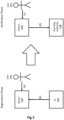
- the process by which this is enabled is shown schematically in Figure 2 and is then described in further detail in Figures 3 and 4 .
- a first phase which may be considered a registration phase, configures the computing device 200 for use in the attribute verification procedure.
- registration phase and “configuration phase” are therefore used interchangeably throughout this disclosure.
- the computing device 200 is then used to verify an attribute of the user 201, such as their age.
- computing device 200 may be stationary or mobile.
- the computing device is a terminal, machine, scanner or computer provided at a verification venue.
- computing device 200 may be part of an entry barrier at a building, or part of a checkout machine in a store.
- the computing device may be a mobile device, for example a mobile computing device including but not limited to a mobile phone, smartphone, personal digital assistant (PDA), laptop, tablet, and other "smart" mobile device, such as a smartwatch.
- PDA personal digital assistant
- the processes performed by the computing device 200 during the registration phase can be controlled by software running on the device.
- the process can be controlled through a software application or "app" running on the mobile device.
- the registration phase will be described in further detail in relation to Figure 3 below. In brief, however, the registration phase involves the computing device 200 capturing biometric data of the user using the computing device 200. This process is represented by arrow (a) in Figure 2 .
- the captured biometric data may be considered biometric registration data in that it is used to register user 201 with computing device 200 for attribute verification.
- the computing device 200 also obtains attribute information and authenticated biometric data of the user from an ID 202. This process is represented by arrow (b) in Figure 2 .
- the authenticated biometric data represents or comprises biometric data as stored or comprised in the user's ID 202.
- the authenticated biometric data may be any data suitable for biometrically identifying the user 201.
- the authenticated biometric data may comprise one or more of: an image of the user (e.g. a passport photo or driving licence photo); a fingerprint of the user; and an iris detail (e.g. a closeup of an iris) of the user. These biometrics may then subsequently be used to identify the user through, for example, facial recognition, fingerprint matching and/or iris recognition respectively when new biometric data is received for the user during registration or verification.
- the authenticated biometric data comprises the passport photo, fingerprint and iris detail of user 201.
- this biometric data can be considered to be authoritative or approved such that it accurately represents the user 201.
- the attribute information is also obtained from the ID 202 it can similarly be presumed to be accurate.
- the attribute information can relate to any attribute of the user 201 which is attested to by the data on the ID 202, such as the user's name, date of birth, age, gender, address, nationality etc.
- the disclosed methods are limited to using ID documents issued by a trusted or authorised ID provisioning authority.
- the ID provisioning authority may be a government, government department, passport office, driving standards agency, driving licence issuer or any other authority which has been verified for providing IDs.
- the computing device 200 may have access to a list of authorised ID provisioning authorities and may only accept the use of an ID issued by one of said authorities.
- the list of authorised ID provisioning authorities may be included as part of the software application(s) performing attribute verification on computing device 200, for example as part of SDK provided by an attribute verification software provider.
- the computing device 200 determines, based on this comparison, that the biometric registration data and authenticated biometric data do not correspond to the same person, then the registration process fails. The user 201 may be given an opportunity to retry the process. This check prevents a user from registering with someone else's ID 202.
- the computing device 200 determines, based on this comparison, that the biometric registration data and authenticated biometric data do correspond to the same person, i.e. both correspond to the user 201, then the registration process can be completed and the computing device 200 can be configured to verify one or more attributes of the user 201 in future.
- the computing device 200 can store locally at the computing device: i) the authenticated biometric data of the user obtained from ID 202; and ii) the attribute information associated with the user obtained from ID 202. The stored authenticated biometric data and attribute information can then be used subsequently during a verification phase, to verify one or more attributes of the user 201.
- Such a verification phase is also shown schematically in Figure 2 .
- the verification phase once again involves the computing device 200 obtaining biometric data of the user.
- the captured biometric data can be considered biometric verification data in that it is used to enable the computing device to verify a user attribute. This process is represented by arrow (c) in Figure 2 .
- the captured biometric verification data can then be compared, by the computing device 200, to the authenticated biometric data of the user previously obtained from the ID 202 and stored at the computing device during the registration phase.
- the computing device 200 determines, based on this comparison, that the biometric verification data does not correspond to the same person as the authenticated biometric data, i.e. does not correspond to user 201, then the verification process fails.
- the user 201 may be given an opportunity to retry the process. This check prevents a user from using a computing device 200 registered to someone else's ID 202 during attribute verification.
- attribute verification can proceed.
- the computing device 200 can access the attribute information previously obtained from the ID 202 and stored at the computing device 200 during the registration phase. Based on the attribute information, an attribute associated with the user can be verified.
- the attribute information may comprise the user's date of birth.
- the computing device 200 can verify or confirm the user's age, or that the user is of a certain minimum age.
- the attribute information may comprise the user's name. In that case, once the biometric verification stage has been successfully passed, the computing device 200 can verify or confirm the user's name, or that the user is on a list of certified or approved persons or has certain clearances or privileges.
- confirmation of the attribute verification is by the computing device 200, for example to a querying authority 108.
- the querying authority 108 may comprise a querying device, such as a checkout machine in a store, an entry barrier at a venue or other building, an automated vending machine, or a device of a delivery person such as where the disclosed methods are used in the context of home delivery.
- the querying device can confirm that the user is verified for the transaction in question, or for entry to a venue. This facilitates fully automated transaction flows and venue entry.
- an attribute of the user 201 can be verified in an entirely local manner. There is no need for any network connection during the registration or the verification phases. This means attribute verification can be conducted in any location and at any time, regardless of network quality or connectivity. Further, no PII or sensitive data needs to be transmitted from the computing device 200 to a remote network or server at any point, in contrast to the prior art system of Figure 1 . This reduces the possibility of a malicious actor obtaining user data or PII, further improving security. Further, where computing device 200 is a mobile device of the user, there is no need for any single centralised authority to hold sensitive data for multiple persons. Rather, data is held in a distributed manner on users' own personal computing devices. This distributes the attack surfaces available to a malicious actor, and avoids the possibility of a single hack or data loss resulting in, for example, the publicising of sensitive data of multiple users simultaneously.
- the disclosed methods enable a more reliable and more secure mechanism for verifying user attributes such as age and identity.
- user attributes such as age and identity.
- FIG. 3 an example of the registration or configuration phase described above and shown in Figure 2 is shown in more detail.
- this process is typically performed under control of software running on the computing device 200 and which instructs the processor of the computing device 200 to perform the recited steps.
- computing device 200 is a mobile device such as a smartphone
- said software typically comprises a software application or "app" running on the mobile device 200.
- the process begins or is initiated when the software or software application receives a request from the user 201, for example via an input to a screen of the computing device 200, to begin registration.
- the process of Figure 3 starts and the computing device 200 obtains, at block 301, authenticated biometric data of the user and attribute information associated with the user from the ID 202.
- the authenticated biometric data and attribute information are obtained using a camera of the computing device 200.
- a camera of the computing device 200 For example, an image of the ID 202 can be captured.
- OCR Optical character recognition
- An image of the user included in the ID 202 can be similarly scanned or photographed and extracted as the authenticated biometric data, i.e. as an authenticated image of the user 201.
- the authenticated biometric data and/or attribute information are obtained by interrogating a memory of the ID 202.
- the ID 202 may comprise a wireless data transfer chip, such as an NFC chip.
- the memory may be of the known ePassport NFC chip type.
- the computing device can communicate with or read from this memory to obtain the authenticated biometric data of the user and/or the attribute information associated with the user.
- the memory may be protected, for example by a password. In that case, the computing device 202 may obtain the password to enable communication with the memory.
- the password is obtained by capturing and performing OCR on characters or text displayed on the ID 202 and determining a password based on those characters or text.
- the type of ID that can be used during registration can be limited to certain document formats or types. This may in effect limit the types of IDs that can be used to certain specific authoritative documents issued by a predetermined subset of authorised institution(s) or government(s). This may improve the degree of trust which can be assigned to the authorised biometric data and attribute information obtained from the ID 202.
- IDs may include passports, driving licences, national identity cards, healthcare cards, biometric permits such as residency permits and the like. More generally, as discussed above, the disclosed methods may be limited to using IDs issued by an authorised ID provisioning authority, such as a government, passport office, driving standards agency or driving licence issuer.
- An authorised ID provisioning authority may be one which is authorised by the attribute verification software provider which has provided the attribute verification software running on computing device 200.
- Said attribute verification software provider may in that case include a list of authorised ID types and/or authorised ID provisioning authorities as part of the attribute verification software, for example embedded in SDK.
- the computing device 200 captures biometric registration data.
- the biometric registration data comprises an image of the user, i.e. a registration image.
- the user may be instructed to stand in front of the terminal such that they are in a field of view of the terminal's camera.
- the registration image may be a "selfie", in other words an image of the user taken with the front camera of the mobile device.
- Other methods for obtaining a registration image using a camera of the computing device 200 will be apparent to a skilled reader and will depend on the nature of the computing device 200 and the position of its camera.
- the biometric registration data comprises a fingerprint of the user, or a closeup of an iris of the user. These can be obtained in any suitable manner, such as via a fingerprint scanner or camera of the computing device 200.
- anti-spoofing procedures may be carried out when the biometric registration data is captured at block 303.
- the anti-spoofing procedures will include some form of liveness check to establish that the biometric registration data being captured is from a genuine human rather than of a spoof.
- the biometric registration data comprises a captured image and the computing device 200 may instruct the user 201 to perform one or more gestures, such as "look left", “look right", “turn head left” etc. The computing device 200 can then determine whether the instructed gestures have been performed by the person in the field of view of the camera. If the gesture(s) are followed, the computing device 200 can capture the registration image or use a frame captured during the anti-spoofing procedure as the registration image.
- the registration image can be rejected.
- biometric registration data comprises a fingerprint or iris
- other suitable anti-spoofing or liveness tests may be performed. Anti-spoofing procedures of this sort prevent the user 201 from spoofing their biometric registration data, for example by holding up a photograph or similar spoof to the camera during registration, or by using a mould or fake finger during fingerprint verification.
- liveness checks and anti-spoofing mechanisms which could be employed as part of the disclosed methods will be apparent to the skilled reader.
- the method proceeds, at block 305, to determine whether the biometric registration data corresponds to the same person as the ID 202. Specifically, the biometric registration data is compared with the authenticated biometric data obtained, at block 301, from the ID 202 to determine whether they match, i.e. correspond to the same person.
- the exact comparison mechanism(s) by which the determination of block 305 is made are beyond the scope of this disclosure and will be apparent to a skilled reader. In the case of a registration image, typically some form of facial recognition procedure will be performed on both the registration and authenticated images to determine whether the facial features in each image are sufficiently similar.
- the computing device 200 may use facial landmarking analysis to determine whether there is less than a predetermined threshold of difference in relative position between certain key facial landmarks in each of the authenticated image and the registration image.
- a method known as FaceNet may be used, which extracts high-quality features from the face and predicts a 128 element vector representation of these features, called a face embedding, to determine a match.
- iris recognition may be used and an iris in the registration image is compared with an iris in the authenticated image. Where fingerprints are used, the registration fingerprint obtained at block 303 is compared with the authenticated fingerprint obtained at block 301 through an appropriate fingerprint analysis mechanism. Other mechanisms for comparing the biometric data for similarity will be apparent to a skilled reader and may be used as part of the disclosed methods.
- biometric registration data is determined not to correspond to the same person as the authenticated biometric data, then registration fails and a registration error is recorded or displayed at block 309. The user may be prompted to retry the registration process. This check prevents a person from registering themselves with somebody else's ID.
- the method proceeds to block 307.
- the authenticated biometric data and the attribute information obtained, at block 301, from the ID 202 are stored locally at the computing device 200.
- the authenticated biometric data and attribute information are embedded in a certificate which is stored locally in memory of the computing device 200.
- the certificate is preferably encrypted to improve data security.
- the computing device 200 simply obtains the attribute information from the ID 202 and stores it as-is, once the biometric check has been passed. In other implementations, however, the computing device 200 computes some further attribute information for the user 201 based on the attribute information obtained from the ID 202. For example, the user's date of birth may be obtained from the ID 202. From this, the computing device 200 may determine the user's age or that the user meets some predetermined criteria, for example "user is over 18" or "user is over 21". In some examples, if the process determines at this stage that the user does not meet a minimum age criteria, then the registration process ends regardless of whether the biometric check is passed at block 305. The user is preferably informed that they do not meet the minimum registration requirements and, preferably, all data obtained so far by the computing device 200 is deleted.
- a current date can be used for the age calculation.
- the current date is obtained from a trusted source such as a data carrier or mobile phone network to which the computing device 200 has access, rather than the local date at the computing device 200. This prevents the user modifying the local date at the computing device 200 and spoofing their age by confounding the age calculation performed by the computing device 200. Note that whilst this approach requires some very limited contact with a network or carrier, the only information that needs to be obtained is a current date (and, optionally, time).
- the authenticated biometric data and attribute information are stored in a location and manner on computing device 200 such that other software applications which perform similar attribute verification processes can access them in future.
- registration and verification can be performed by different software applications, improving the versatility of the system as a whole.
- computing device 200 is a mobile device of the user, on which there may be multiple age verification applications associated with different vendors and/or venues.
- a subsequent second software application is able to access the stored authenticated biometric data and attribute information stored by a first software application, then there is no need for the user 201 to use ID 202 during configuration of the second software application.
- the authenticated biometric data and attribute information are, in some examples, stored at block 307 using an SDK provided by an attribute verification software provider.
- certain security measures such as encryption can be provided to secure the data in question.
- only applications which are running the same SDK or are provided by the same attribute verification software provider are able to access the stored authenticated biometric data and attribute information.
- the authenticated biometric data and attribute information may be encrypted, optionally as part of a certificate, and an encryption key to allow decryption of the stored data may be embedded in the SDK.
- Other applications can then only access the stored data if they have access to the key, which can be limited to those software applications that are running the same SDK or are given access to the key by the attribute verification software provider. In this way, the above-described functionality allowing interoperability between software applications can be provided without compromising the security of the stored data, because only certain authorised software applications can access the stored data.
- the stored data can additionally or alternatively be associated with, or encrypted using, a device chip ID or other unique ID of the computing device 200 on which registration is performed. This prevents the stored data (i.e. the authenticated biometric data and attribute information) from being transferrable or useable for attribute verification on a different user device, further improving security and reducing the possibility for identity spoofing.
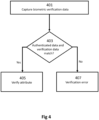
- FIG. 4 an example of the verification phase described above and shown in Figure 2 is shown in more detail.
- the various steps performed by computing device 200 during the verification phase in order to perform attribute verification for user 201 are shown.
- the process associated with the verification phase is typically performed under control of software running on the computing device 200 and which instructs the processor of the computing device 200 to perform the recited steps.
- the software may be provided in the form of an "app" as described above.
- the software responsible for performing the verification process of Figure 4 may be the same or different software as that which conducts the registration process of Figure 3 .
- the only requirement is that the software performing the process of Figure 4 has or is able to gain access to the authenticated biometric data and attribute information stored locally at the computing device 200 during the process of Figure 3 .
- the verification process begins or is initiated when the software receives a request from the user 201, for example via an input to a screen of the computing device 200, to begin attribute verification.
- computing device 200 may receive a request from a device such as a local querying device, for example a checkout machine at a store, a vending machine, or a querying device carried by, for example, a delivery person.
- a device such as a local querying device, for example a checkout machine at a store, a vending machine, or a querying device carried by, for example, a delivery person.
- the process of Figure 4 starts and the computing device 200 captures, at block 401, biometric verification data using the computing device 200.
- biometric verification data The same considerations discussed above in relation to capturing the biometric registration data of Figure 3 apply here to capturing the biometric verification data.
- the biometric verification data may be an image captured by a camera of the computing device 200, a fingerprint captured by a fingerprint scanner of the computing device 200, or any other suitable biometric data which enables biometric identification.
- the verification image may represent the field of view a stationary terminal or device, or may be a "selfie” captured by a front camera of a mobile device of the user.
- Anti-spoofing mechanisms may be employed to prevent spoofing of the biometric verification data as described above in respect of the biometric registration data.
- the computing device 200 determines whether the biometric verification data corresponds to the same person as the ID 202, i.e. whether the biometric data match. Specifically, the biometric verification data is compared with the authenticated biometric data obtained, at block 301 of the registration phase, from the ID 202. As in the case of the registration phase, the exact comparison mechanism(s) by which the determination of block 403 is made are beyond the scope of this disclosure, and the same considerations discussed above in relation to block 305 apply to block 403. In other words, any suitable form of facial recognition, fingerprint analysis, iris analysis or similar can be performed to determine whether the biometric data match.
- biometric verification data is determined not to correspond to the same person as the authenticated biometric data, then verification fails and a verification error 407 is recorded or displayed. The user may be prompted to retry the verification process. This prevents someone from using a computing device for attribute verification where the computing device has been configured using someone else's ID 202.
- the method proceeds to block 405.
- one or more attributes associated with the user are verified by the computing device 200 based on the attribute information associated with the user which was obtained from ID 202 and stored locally on the computing device during block 307 of the registration phase.
- block 405 involves accessing age-related attribute information obtained during registration from ID 202 and stored locally at computing device 200.
- the attribute information may comprise the user's date of birth. From this, computing device 200 may determine the user's age or that the user is over a minimum age, such as 18 years old.
- block 405 involves accessing identity-related attribute information obtained during registration from ID 202 and stored locally at computing device 200. For example, computing device 200 may confirm the user's name based on the stored attribute information.
- the verification process of Figure 4 can be performed entirely locally, in the sense that no connection between computing device 200 and any remote network or server is required for the attribute verification to take place. This is in contrast to the prior art system described with reference to Figure 1 above. Also in contrast to that system, the method of Figure 4 does not require transmission of any PII from the computing device 200.
- computing device 200 may take further action. For example, where computing device 200 is part of an entry barrier to a venue or building, on verifying the user's name and confirming that they are on a list of authorised persons, the computing device 200 may allow the person to access the venue or building.
- the computing device 200 proceeds to provide a confirmation of the verified attribute(s) associated with the user on a display of the computing device 200.
- the computing device may additionally transmit a message confirming the verified attribute(s) associated with the user, for example to a remote device or network and/or to another software application running on computing device 200.
- the confirmation may additionally take other forms, for example the confirmation may comprise an audio confirmation such as a confirmation tone or audio message.
- the confirmation comprises machine-readable elements.
- the user's precise age may be displayed, e.g. "35 years old".
- the display may indicate that the user is of a certain minimum age, e.g. "over 18".
- a graphic may accompany or replace such a textual indication of attribute verification. For example, a green tick with the word "verified” may be displayed. Any number of mechanisms for confirming attribute verification on the display of the computing device in this manner will be apparent to the skilled person.
- the confirmation includes a machine-readable element, this may be in the form of a QR code in which the attribute verification is embedded.
- the QR code may, when read by a suitable QR code reader, confirm the user's age to that reader or confirm that the user is over a required minimum age, such as 18.
- Providing such a visual confirmation of the attribute verification on a display of computing device 200 may be particularly useful where computing device 200 is a mobile device of the user 201, because then the user 201 can present their mobile device to a store or venue attendant, machine interface (such as a QR code scanner) at the store or venue, or any other querying authority or device such as a delivery person or vending machine. Presenting confirmation of verification in this manner can then facilitate completion of a transaction or entry to a venue, for example.
- the QR code displayed on the computing device 200 to confirm verification is a dynamic QR code which may redirect a querying device (QR scanner) to a particular location such as a URL or present certain recently obtained spatiotemporal data to the querying device.
- the dynamic QR code may update periodically. Use of such a dynamic QR code may provide improved spoof-protection as described in further detail below.
- the verification procedure of Figure 4 may include obtaining spatiotemporal information associated with verification of the attribute associated with the user. This obtained spatiotemporal information can then be embedded in the confirmation of the verified attribute, such as in a dynamic QR code displayed by the computing device 200 after verification.
- the spatiotemporal information provides some indication of when and/or where the attribute verification has taken place and may again be particularly useful where computing device 200 is a mobile device of the user and where the user is required to present the verification confirmation as part of a transaction or venue entry procedure.
- the spatiotemporal information includes one or more of a current date, a current time, a current location, and an identity of an establishment where the verification has taken place or is taking place.
- computing device 200 is a mobile device of the user 201 and the above-referenced spatiotemporal information is obtained during the verification process by way of the user scanning, using the camera of their mobile device 200, a QR code or similar visual indicator provided at the location where verification is taking place.
- the user may scan a QR code provided on a checkout machine at the store.
- the user may alternatively scan a memory, such as an NFC chip or similar element, to obtain the spatiotemporal information.
- the obtained spatiotemporal information in this example may also indicate the location and name of the store. This obtained location information can then be combined with, for example, the current date and time as provided by a local clock of the mobile device 200, a mobile network or, preferably, by the QR code being scanned.
- the combined spatiotemporal information can then be embedded within the confirmation of verification displayed at the mobile device 200.
- the confirmation of verification when the confirmation of verification is presented to and read by an attendant or scanner (if machine-readable) at the store or venue, the confirmation will confirm not only that the user's attribute has been verified but also the date, time and identity of the store or venue where verification took place.
- This provides an added layer of security to the verification process, because it means that it will be immediately apparent if the user is attempting to present a screenshot or image of an earlier verification confirmation on the mobile device 200.
- the time and/or location data embedded in the confirmation will not match an expected time and/or location, such that the confirmation can be rejected.
- the confirmation for example the QR code
- the confirmation is time-limited, in the sense that it automatically expires or refreshes periodically. This further prevents spoofing of the verification process because old verification confirmations cannot be re-used.
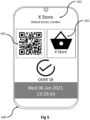
- FIG. 5 An example of a confirmation of verification which may be displayed on the computing device 200 after attribute verification has succeeded at block 405 is shown in Figure 5 .
- computing device 200 is a mobile device 500 of the user, on which is displayed a visual confirmation of attribute verification having been successful.
- the attribute being verified is the user's age, specifically that the user is over 18 years old.
- the confirmation includes both human-readable elements 501 and a machine-readable element 503. Both types of element 501, 503 contain, in this example, spatiotemporal information about where and when attribute verification has taken place.
- the human-readable elements contain spatiotemporal information concerning the name and location of the store at which verification has taken place ("X Store", at Oxford Street, London).
- This information can be obtained by reading, using the mobile device 500, a QR code provided at the checkout of the store in the manner described above.
- the human-readable elements also include a timestamp indicating the time and date at which verification took place (Wednesday, 6 th January 2021 at 13:29:43). This time can represent the time at which the process of Figure 4 completed, or the time at which a QR code or similar element at the store was read.
- the human-readable elements include a visual indicator that the user is over 18, in other words that this attribute has been verified.
- the displayed confirmation also includes a machine-readable QR code 503, which includes all of the above-mentioned information embedded in machine-readable form.
- the displayed confirmation is able to confirm to both a human (such as a shop attendant) and a machine (such as a QR scanner provided at the checkout or in an automated vending machine) that the user's age has been verified, and that verification took place recently and in the present store.
- the querying device or authority may set a threshold time, after which verification confirmations will not be accepted. For example, if the timestamp is more than 30 seconds in the past then the confirmation may not be accepted. Similarly, if the store or location identified is not the store or location in which the customer is present, the confirmation may also be rejected.
- the software running on computing device 200 may itself time-limit the confirmation, for example after a certain threshold time the confirmation may become void and/or unreadable. Limiting the confirmation in this manner prevents a customer using a confirmation obtained in the past or at a different store by someone else.
- the software application performing attribute verification may itself confirm that the user 201 has the required clearances.
- the software application may contain or have access to a list of persons with clearances. If the user 201 is found, during registration, to match one of the names on the clearance list, an indication of this fact can be stored as part of the attribute information.
- the confirmation of verification can then simply confirm that the user 201 has access permissions.
- verification simply confirms the name of the user 201 and a querying device such as an entry barrier then checks the user's verified name against a list of authorised persons.
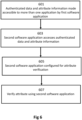
- FIG. 6 an example of a further method according to the present disclosure is set out.
- the disclosed verification procedure can be made more versatile and time-efficient by allowing multiple software applications to access the stored information. This can be particularly useful when computing device 200 is a mobile device, such as a smartphone, on which there may be installed multiple software applications for attribute verification.
- the method of Figure 6 which can be considered as an extension of the method shown in Figure 3 , allows greater interoperability between such plural software applications.
- block 307 of Figure 3 involves storing the authenticated biometric data and attribute information locally on memory of the computing device 200, using a first software application.
- the method of Figure 6 then follows on by ensuring, at block 601, that the authenticated biometric data and attribute information stored at block 307 are accessible to more than one software application, in particular that applications other than that which performed the registration process of Figure 3 can, with the right permissions, access the stored authenticated biometric data and attribute information.
- the functionality of block 601 can be incorporated or subsumed as part of the process of block 307, i.e. these do not need to be separate steps.
- the method of Figure 6 then involves, at block 603, accessing by a second software application the authenticated biometric data and attribute information stored at block 307 and made accessible at block 601.
- block 603 may involve the second software application being provided with a suitable key or password for decrypting or otherwise accessing the authenticated biometric data and attribute information.
- the authenticated biometric data and attribute information may be stored as a certificate, which may itself be encrypted or password protected. In that case, the second software application is given access to and, if needed, means to decrypt or access the certificate.
- the second software application is configured for attribute verification.
- this involves conducting the registration method of Figure 3 using the second software application.
- the second software application already has access to the stored authenticated biometric data and attribute information, use of ID 202 can be omitted when configuring the second software application. This significantly simplifies and speeds up the configuration process, because no ID 202 is required and no data needs to be obtained from it.
- attribute verification is performed using the second software application. This can involve performing, using the second software application, the method of Figure 4 .
- configuration of the second software application can be expedited by making use of data stored previously by a first software application.
- the second software application can then be used to perform attribute verification in the same way as the first software application.
- This is beneficial because different establishments may have their own respective software applications for performing attribute verification within their establishments or stores.
- the method of Figure 6 ensures that registration using an ID 202 only needs to be performed once across all such applications.
- subsequently used software applications are able to access the stored authenticated biometric data and attribute information, then these applications can be configured in a streamlined manner without the need for ID 202 and can each be subsequently used to perform attribute verification.
- access to the required information can be ensured by, for example, ensuring that all applications intended for attribute verification include the same SDK which enables them to share and access the relevant stored authenticated biometric data and attribute information.
- the example process of Figure 7 involves a user 201 using their own mobile device 500 to perform attribute verification at subsequent venues in order to verify both their age and identity.
- the method of Figure 7 uses image verification, however it will be appreciated that the method could just as well use another form of biometric data, such as fingerprint or iris data, to enable attribute verification.
- the process begins at block 701 with the mobile device 500 receiving a request from user 201 to register with a first software application running on the mobile device 500.
- the first software application is provided by an attribute verification software provider.
- the first software application performs the registration/configuration procedure described above in relation to Figure 3 .
- the first software application prompts the user to obtain the necessary authenticated biometric data from an ID.
- the mobile device obtains the authenticated biometric data, in this example an authenticated image of the user 201, from ID 202.
- the mobile device also obtains the attribute information from ID 202.
- ID 202 is a passport having an ePassport NFC chip, and so the authenticated image and attribute information are obtained by the user reading the ePassport NFC chip with an NFC reader of the mobile device 500.
- the first software application prompts the user to obtain biometric registration data, in this example a registration image.
- the first software application captures a first registration image of user 201 using the camera of mobile device 500, for example a "selfie" using the front camera of the mobile device 500.
- the first registration image and authenticated image obtained from the passport 202 are compared.
- the first software application confirms, through facial landmarking analysis, that both images depict the same person, i.e. user 201.
- the first software application embeds the authenticated image and attribute information obtained from passport 202 in a certificate having a predetermined format and file type set by SDK which the first software application is using.
- the first software application encrypts the certificate and stores it locally in memory of the mobile device 500 at block 709.
- the attribute information obtained from passport 202 includes the date of birth, name, nationality and address of user 201.
- the first software application calculates, based on the date of birth and a current time obtained from a mobile network provider, that the user 201 is over 18 years of age. Accordingly, a suitable indication of this is also stored as part of the attribute information in the certificate. The first software application then confirms, on a display of mobile device 500, that registration has been completed successfully.
- user 201 enters a store and wishes to buy a product which is associated with age restrictions.
- the user 201 must verify that they are over 18 years old to purchase the product as part of the transaction flow at a checkout machine.
- the user 201 opens the first software application and requests age attribute verification.
- the first software application initiates the verification procedure described above in relation to Figure 4 .
- the first software application prompts the user 201 to capture biometric verification data, which in this example comprises a verification image.
- a first verification image is captured, using the camera of mobile device 500, at block 711.
- the first software application accesses the certificate previously stored during registration.
- the first software application has access, through SDK provided with the first software application by the attribute verification software provider, to the necessary password or key to decrypt the certificate.
- the first software applications confirms, through facial landmarking analysis, that the first verification image just captured depicts the same person as the authenticated image, i.e. user 201.
- the first software application accesses the attribute information stored locally in the certificate to verify the age of the user.
- the first software application confirms that the attribute information includes an indication that the user is over 18 years of age.
- the first software application instructs the user 201 to scan a QR code present at the checkout machine of the store.
- the QR code provides spatiotemporal information about the current time and location.
- the first software application presents, at block 715, confirmation of the user being over 18 on a display of the mobile device 500.
- the confirmation resembles that shown in Figure 5 and discussed above.
- the confirmation includes a visual indicator that the user is over 18, which can be presented to a store attendant.
- the confirmation also includes the spatiotemporal information obtained from the QR code at the checkout.
- the confirmation includes an indication of the current time and date provided by the QR code, as well as the location and brand of the store.
- This spatiotemporal information and attribute verification confirmation are also embedded in a dynamic QR code presented on the display of the mobile device 500 as part of the confirmation.
- the store attendant or in an alternative embodiment, a scanner of a self-checkout machine, scans the QR code on the display of the mobile device to confirm in machine-readable form that the user 201 is over 18 and that the spatiotemporal data matches the expected time and location. On successful confirmation, the transaction completes and the user 201 is able to purchase the restricted product.
- user 201 downloads the second software application on mobile device 500.
- the user then initiates configuration of the second software application for attribute verification, such that the second software application receives a request to register the user 201, at block 717.
- This triggers the usual registration process described above, this time at the second software application.
- configuration of the second software application does not require the second software application to access any information from the user's passport 202 or any other ID.
- the second software application also includes SDK provided by the attribute verification software provider.
- the second software application is also able to access and decrypt the certificate previously stored in local memory of the mobile device 500 by the first software application.
- the second software application obtains the authenticated biometric data (in this example the authenticated image, i.e.
- the second software application then prompts the user to capture biometric registration data, which in this example comprises a registration image. Such a second registration is captured, using the camera of mobile device 500, at block 721. As usual, the second software application then proceeds to confirm that the second registration image and the authenticated image depict the same person, at block 723. In response to a successful match, the second software application confirms, on a display of mobile device 500, that registration has been completed successfully.
- the user 201 then arrives at the venue and is asked, either by an attendant or an automated barrier, to verify their name so that this name can be checked against a list of persons with access clearance to the venue. Accordingly, the user 201 opens the second software application and requests name attribute verification. In response, the second software application initiates the verification procedure described above in relation to Figure 4 . In particular, the second software application captures a second verification image, at block 725, and confirms that this image matches the authenticated image at block 727. On a successful match, the second software application displays confirmation of the user's name on the mobile display at block 729, in a similar manner as discussed above. On scanning the confirmation, the entry barrier determines that the user has the required access permissions and permits the user 201 to enter the venue.
- the disclosed systems and methods enable simple, secure and reliable user attribute verification.
- a user is able to make use of one or more software applications on the same computing device and can configure them easily, only needing to provide an ID during the very first registration. This allows for seamless and friction-free interoperability between multiple applications for attribute verification.
- Various attributes can be verified, such as age and identity. No network connection is required for verification, and no sensitive PII needs to be transmitted to any remote network or server.
- Incorporation of spatiotemporal information into attribute confirmation and/or the use of anti-spoofing processes during image verification can further ensure that the attribute verification is secure and that the system cannot be easily spoofed, thus providing further technical benefits.
- block 303 may precede block 301; in some implementations block 307 may precede block 305 and the data may be deleted if the answer to block 305 is "no"; in some implementations block 603 may precede or trigger block 601; and in some implementations block 605 may precede or subsume block 603 and/or block 601. Unless stated explicitly that a particular step must precede another, it should be assumed that any order of steps is possible.
- a unique ID of the computing device on which registration is performed may be incorporated into the certificate or stored verification data in some way, to ensure that verification can only subsequently be performed on that computing device.
- the unique ID is obtained from a device chip ID of the computing device, which may be a unique serial number or ID provided to the computing device at manufacture.
- the software application(s) provided on the computing device for attribute verification may include a particular SDK, or subset of SDK assets.
- the SDK may be provided by an attribute verification software provider to third parties and may be embeddable into third party software applications, for example applications associated with shopping establishments or venues.
- the SDK may set the minimum age criteria or contain a list of names of certified persons.
- the SDK may assist the software application in storing and/or encrypting the stored authenticated biometric data and attribute information, for example as a certificate.
- the SDK may subsequently provide or allow access to a private key for accessing the encrypted data with a different software application which also includes the SDK, or a subset of the SDK assets.
- pseudonymised or anonymised data may be sent to an attribute verification software provider which provided the verification software application and/or the SDK, to enable anonymous verification data to be collected. This may allow patterns and trends to be identified by the attribute verification software provider which can enable updates or improvements to the software application(s) and/or SDK to be provided.
- the transmitted anonymised data may include spatiotemporal data, for example details of the venue where attribute verification took place, and thereby provide a form of audit record of each individual verification performed by the user. This can assist in fraud prevention by providing a verified and traceable record of transactions.
- the sending of such anonymised data may be performed after verification, once network connectivity becomes available.
- the data may be stored in a local buffer on the computing device and then be transmitted at a later time.
- the user may be prompted to choose whether or not to share their data with the attribute verification software provider.
- the user may also be prompted to confirm whether they permit the venue (e.g. retailer) at which attribute verification has occurred to access certain data about the verification and/or transaction. This information may be obtained by the venue through scanning of a confirmation of verification displayed on the computing device.
- Verification may be part of a fully or partially automated process.
- a querying device (which may function autonomously or under the operation of the or another user) may have its own companion application provided by the same attribute verification software provider as the verification application on the user's mobile device and/or containing some or all of the same SDK. This can enable this companion application to interface with and interrogate the software application on the user's device.
- confirmation of verification may be presented to a human, such as a checkout attendant at a store, in which case the confirmation of verification can comprise human-readable elements.
- the humanadditionally scans or reads a machine-readable part of the verification confirmation, such as a dynamic QR code, using suitable hardware such as a QR scanner.
- the disclosed method may be used in the context of home delivery.
- a delivery person may deliver a package to a customer and perform attribute verification to ensure the customer is the correct recipient and/or is of a required minimum age to receive the package in question.
- the delivery person may have their own computing device which is configured to scan a confirmation of verification presented by the recipient on their own user device, in the manner discussed above.
- no human attendant is present and the confirmation of verification may then simply be presented to a machine interface, such as a QR scanner on a self-checkout machine or automated vending machine.
- a machine interface such as a QR scanner on a self-checkout machine or automated vending machine.
- attribute verification can be entirely automated.
- the user may download a host application associated with the store.
- the host application can then communicate with the attribute verification application on the user's device to confirm attribute verification.
- the user may confirm they are over a minimum age in the usual way, and confirmation of this may be transmitted to the host application associated with the store.
- the user may be permitted to leave the store with an item which has an associated minimum age without passing through a checkout.
- confirmation of verification is presented or transmitted to an automated vending machine.
- the automated vending machine can release an item, such as an age-restricted good, to the user.
- confirmation of age verification may comprise a digital proof of age, DPoA, certificate.
- this certificate follows the known PASS 5 DPoA standards. This can enable seamless integration of the disclosed age verification mechanisms into existing procedures already used in stores and establishments for proof of age.
- each establishment described has its own associated verification application.
- a single application may function for some or all establishments.
- verification may be triggered by a challenge notification.
- a user may scan an attribute verification element at a checkout, such as a QR code. This may trigger the verification application to begin attribute verification.
- verification may be time-limited. For example, after a pre-determined time threshold the verification may no longer be valid or useable and/or the software application may prompt the user to re-verify themselves by capturing a new biometric verification data.
- the time threshold may be, for example, 10 seconds, 20 seconds, 30 seconds, 40 seconds, 50 seconds, 60 seconds, 2 minutes, 5 minutes, 10 minutes, or an hour. Each of these time thresholds would provide at least some protection against identity spoofing.
- the verification confirmation shown in Figure 5 is merely an example. Certain elements may be omitted or added to the confirmation shown.
- the confirmation may include more or fewer elements of human-readable data.
- the confirmation includes the authenticated biometric data of the user and/or the biometric registration data of the user and/or the biometric verification data of the user.
- the disclosed functionality may be used in order to allow access to a device such as a personal computer, or to online sales or age restricted websites on such a computer.
- the disclosed systems may enable access to a person's home and may thereby provide home security functionality.
- the disclosed systems may be used in the context of home delivery to prove the identity of a recipient of a package.
- the disclosed systems may be used in the context of an automated vending machine.
- biometric data such as images (particularly facial images), fingerprints, and iris detail
- biometric data such as images (particularly facial images), fingerprints, and iris detail
- More than one biometric aspect may be checked for in the same verification or registration procedure. Verification may involve verification of more than one attribute associated with the user, for example both age and name.
- FIG 8 shows a schematic and simplified representation of a computer apparatus or computing device 800 which can be used to perform the methods described herein.
- computing device 800 may be user device 200, 500 and/or a querying device as described above.
- Computing device 800 may be a mobile computing device such as a mobile phone or smartphone.
- Computing device 800 may alternatively be a terminal or checkout device provided at a store or venue.
- the computer apparatus 800 comprises various data processing resources such as a processor 802 (in particular a hardware processor) coupled to a central bus structure. Also connected to the bus structure are further data processing resources such as memory 804.
- a display adapter 806 connects a display device 808 to the bus structure.
- One or more user-input device adapters 810 connect a user-input device 812, such as a keyboard and/or a mouse to the bus structure. In some examples, user input device 812 is part of display device 808, such as where a smartphone is provided with a touchscreen display.
- One or more communications adapters 814 are also connected to the bus structure to provide connections to other computer systems 800 and other networks.
- the processor 802 of computer system 800 executes a computer program comprising computer-executable instructions that may be stored in memory 804.
- the computer-executable instructions may cause the computer system 800 to perform one or more of the methods described herein.
- the results of the processing performed may be displayed to a user via the display adapter 806 and display device 808.
- User inputs for controlling the operation of the computer system 800 may be received via the user-input device adapters 810 from the user-input devices 812.
- computer system 800 shown in Figure 8 may be absent in certain cases.
- one or more of the plurality of computer apparatuses 800 may have no need for display adapter 806 or display device 808. This may be the case, for example, for particular server-side computer apparatuses 800 which are used only for their processing capabilities and do not need to display information to users.
- user input device adapter 810 and user input device 812 may not be required.
- computer apparatus 800 comprises processor 802 and memory 804.
- a computer program product or computer readable medium may comprise or store the computer executable instructions.
- the computer program product or computer readable medium may comprise a hard disk drive, a flash memory, a read-only memory (ROM), a CD, a DVD, a cache, a random-access memory (RAM) and/or any other storage media in which information is stored for any duration (e.g., for extended time periods, permanently, brief instances, for temporarily buffering, and/or for caching of the information).
- a computer program may comprise the computer executable instructions.
- the computer readable medium may be a tangible or non-transitory computer readable medium.
- the term "computer readable” encompasses "machine readable”.
Landscapes
- Engineering & Computer Science (AREA)
- Theoretical Computer Science (AREA)
- Computer Security & Cryptography (AREA)
- General Physics & Mathematics (AREA)
- Physics & Mathematics (AREA)
- Computer Hardware Design (AREA)
- General Engineering & Computer Science (AREA)
- Computing Systems (AREA)
- Signal Processing (AREA)
- Computer Networks & Wireless Communication (AREA)
- Health & Medical Sciences (AREA)
- Biomedical Technology (AREA)
- General Health & Medical Sciences (AREA)
- Multimedia (AREA)
- Software Systems (AREA)
- Human Computer Interaction (AREA)
- Collating Specific Patterns (AREA)
- Storage Device Security (AREA)
Priority Applications (8)
| Application Number | Priority Date | Filing Date | Title |
|---|---|---|---|
| ES21214682T ES2981613T3 (es) | 2021-12-15 | 2021-12-15 | Verificación local de atributos mediante un dispositivo informático |
| PL21214682.3T PL4199418T3 (pl) | 2021-12-15 | 2021-12-15 | Lokalne sprawdzanie atrybutu przy użyciu urządzenia obliczeniowego |
| EP21214682.3A EP4199418B1 (en) | 2021-12-15 | 2021-12-15 | Local attribute verification using a computing device |
| CA3240347A CA3240347A1 (en) | 2021-12-15 | 2022-12-14 | Local attribute verification using a computing device |
| JP2024536396A JP2025502680A (ja) | 2021-12-15 | 2022-12-14 | コンピューティングデバイスを用いるローカル属性検証 |
| PCT/GB2022/053236 WO2023111566A1 (en) | 2021-12-15 | 2022-12-14 | Local attribute verification using a computing device |
| KR1020247022282A KR20240124318A (ko) | 2021-12-15 | 2022-12-14 | 컴퓨팅 장치를 이용하는 국부 속성 검증 |
| US18/720,017 US20250061177A1 (en) | 2021-12-15 | 2022-12-14 | Local Attribute Verification Using a Computing Device |
Applications Claiming Priority (1)
| Application Number | Priority Date | Filing Date | Title |
|---|---|---|---|
| EP21214682.3A EP4199418B1 (en) | 2021-12-15 | 2021-12-15 | Local attribute verification using a computing device |
Publications (3)
| Publication Number | Publication Date |
|---|---|
| EP4199418A1 EP4199418A1 (en) | 2023-06-21 |
| EP4199418C0 EP4199418C0 (en) | 2024-04-17 |
| EP4199418B1 true EP4199418B1 (en) | 2024-04-17 |
Family
ID=79024505
Family Applications (1)
| Application Number | Title | Priority Date | Filing Date |
|---|---|---|---|
| EP21214682.3A Active EP4199418B1 (en) | 2021-12-15 | 2021-12-15 | Local attribute verification using a computing device |
Country Status (8)
| Country | Link |
|---|---|
| US (1) | US20250061177A1 (pl) |
| EP (1) | EP4199418B1 (pl) |
| JP (1) | JP2025502680A (pl) |
| KR (1) | KR20240124318A (pl) |
| CA (1) | CA3240347A1 (pl) |
| ES (1) | ES2981613T3 (pl) |
| PL (1) | PL4199418T3 (pl) |
| WO (1) | WO2023111566A1 (pl) |
Families Citing this family (2)
| Publication number | Priority date | Publication date | Assignee | Title |
|---|---|---|---|---|
| WO2025226253A1 (en) * | 2024-04-24 | 2025-10-30 | Ones Bilisim Teknolojileri Anonim Sirketi | Biometric identity verification system |
| US20250384484A1 (en) * | 2024-06-17 | 2025-12-18 | Capital One Services, Llc | Systems and methods for injecting data verification into third-party portals via a browser extension |
Family Cites Families (24)
| Publication number | Priority date | Publication date | Assignee | Title |
|---|---|---|---|---|
| US20030177102A1 (en) * | 2001-09-21 | 2003-09-18 | Timothy Robinson | System and method for biometric authorization for age verification |
| WO2013082329A1 (en) * | 2011-11-29 | 2013-06-06 | Bruce Ross | Layered security for age verification and transaction authorization |
| US10594484B2 (en) * | 2015-02-13 | 2020-03-17 | Yoti Holding Limited | Digital identity system |
| US20170264608A1 (en) * | 2016-03-09 | 2017-09-14 | Qualcomm Incorporated | Visual biometric authentication supplemented with a time-based secondary authentication factor |
| US10574692B2 (en) * | 2016-05-30 | 2020-02-25 | Christopher Nathan Tyrwhitt Drake | Mutual authentication security system with detection and mitigation of active man-in-the-middle browser attacks, phishing, and malware and other security improvements |
| EP3563291A4 (en) * | 2016-12-29 | 2020-01-15 | IDEMIA Identity & Security USA LLC | SECURE MOBILE BIOMETRIC REGISTRATION |
| US20190034610A1 (en) * | 2017-07-31 | 2019-01-31 | Morphotrust Usa, Llc | Mobile application for automatic information synthesis |
| WO2019032538A1 (en) * | 2017-08-08 | 2019-02-14 | Walmart Apollo, Llc | VALIDATION OF USER IDENTIFICATION FOR THE PURCHASE OF ARTICLES SUBJECT TO AGE LIMIT |
| NL2019698B1 (en) * | 2017-10-10 | 2019-04-19 | Morpho Bv | Authentication of a person using a virtual identity card |
| JP7323529B2 (ja) * | 2017-12-21 | 2023-08-08 | ジュール・ラブズ・インコーポレイテッド | 気化器の制御 |
| ES2937234T3 (es) * | 2018-04-23 | 2023-03-27 | Amadeus Sas | Método de autenticación biométrica, sistema y programa informático |
| GB201810639D0 (en) * | 2018-06-28 | 2018-08-15 | Yoti Holding Ltd | Age verification |
| WO2020060835A1 (en) * | 2018-09-20 | 2020-03-26 | Walmart Apollo, Llc | Systems and methods for the sale of age-restricted merchandise |
| US11643323B2 (en) * | 2018-11-02 | 2023-05-09 | Spot You More, Inc. | Pump monitoring system |
| WO2020191497A1 (en) * | 2019-03-27 | 2020-10-01 | Rapid Cash Atm Ltd. | Methods for automated transactions at self-service computing apparatuses |
| US11200770B2 (en) * | 2019-04-02 | 2021-12-14 | Rai Strategic Holdings, Inc. | Functional control and age verification of electronic devices through visual communication |
| GB201908864D0 (en) * | 2019-06-20 | 2019-08-07 | Yoti Holding Ltd | Proving identity |
| US11615174B2 (en) * | 2019-08-30 | 2023-03-28 | Biocube Technologies Inc | Method and a system to locally store and authenticate a data of a user |
| US11432149B1 (en) * | 2019-10-10 | 2022-08-30 | Wells Fargo Bank, N.A. | Self-sovereign identification via digital credentials for selected identity attributes |
| US10853795B1 (en) * | 2019-12-24 | 2020-12-01 | Capital One Services, Llc | Secure authentication based on identity data stored in a contactless card |
| US11182774B1 (en) * | 2020-07-10 | 2021-11-23 | The Government of the United States of America, as represented by the Secretary of Homeland Security | Use of mobile identification credential in merchant and personal transactions |
| US12242578B2 (en) * | 2021-10-13 | 2025-03-04 | Aetna Inc. | Systems and methods for using identifiers of enrollment systems for user authentication |
| US12107957B2 (en) * | 2022-12-07 | 2024-10-01 | Credence ID, LLC | Point-of-service digital identity verification device |
| US20240403481A1 (en) * | 2023-06-04 | 2024-12-05 | Apple Inc. | User interfaces for managing digital identification information |
-
2021
- 2021-12-15 PL PL21214682.3T patent/PL4199418T3/pl unknown
- 2021-12-15 ES ES21214682T patent/ES2981613T3/es active Active
- 2021-12-15 EP EP21214682.3A patent/EP4199418B1/en active Active
-
2022
- 2022-12-14 CA CA3240347A patent/CA3240347A1/en active Pending
- 2022-12-14 US US18/720,017 patent/US20250061177A1/en active Pending
- 2022-12-14 JP JP2024536396A patent/JP2025502680A/ja active Pending
- 2022-12-14 KR KR1020247022282A patent/KR20240124318A/ko active Pending
- 2022-12-14 WO PCT/GB2022/053236 patent/WO2023111566A1/en not_active Ceased
Also Published As
| Publication number | Publication date |
|---|---|
| CA3240347A1 (en) | 2023-06-22 |
| JP2025502680A (ja) | 2025-01-28 |
| EP4199418C0 (en) | 2024-04-17 |
| US20250061177A1 (en) | 2025-02-20 |
| EP4199418A1 (en) | 2023-06-21 |
| KR20240124318A (ko) | 2024-08-16 |
| PL4199418T3 (pl) | 2024-08-19 |
| WO2023111566A1 (en) | 2023-06-22 |
| ES2981613T3 (es) | 2024-10-09 |
Similar Documents
| Publication | Publication Date | Title |
|---|---|---|
| JP6648110B2 (ja) | クライアントをデバイスに対して認証するシステム及び方法 | |
| KR101877333B1 (ko) | 블록체인 기반의 모바일 아이디를 이용하여 사용자를 비대면 인증하는 방법, 단말 및 이를 이용한 서버 | |
| KR102450025B1 (ko) | 암호화 방법 및 시스템 | |
| US8775814B2 (en) | Personalized biometric identification and non-repudiation system | |
| US20240013198A1 (en) | Validate digital ownerships in immutable databases via physical devices | |
| JP6134371B1 (ja) | 利用者情報管理装置、利用者情報管理方法及び利用者情報管理プログラム | |
| US20100042835A1 (en) | System and method for permission confirmation by transmitting a secure request through a central server to a mobile biometric device | |
| US20140289116A1 (en) | System and method for performing authentication for a local transaction | |
| CN108604991A (zh) | 能够检测应用程序篡改的双通道认证代理系统及其方法 | |
| KR101829730B1 (ko) | 블록체인 데이터베이스를 통해 모바일 아이디를 이용하여 사용자를 인증하는 방법, 단말 및 이를 이용한 서버 | |
| KR101858653B1 (ko) | 블록체인 데이터베이스 및 이와 연동하는 머클 트리 구조를 통해 모바일 아이디를 이용하여 사용자를 인증하는 방법, 단말 및 이를 이용한 서버 | |
| JP7521540B2 (ja) | アクセス制御装置、制御方法、及びプログラム | |
| WO2016083987A1 (en) | Method of and system for obtaining proof of authorisation of a transaction | |
| US20250061177A1 (en) | Local Attribute Verification Using a Computing Device | |
| CN117882103A (zh) | 基于区块链的认证系统 | |
| US11880840B2 (en) | Method for carrying out a transaction, corresponding terminal, server and computer program | |
| TW202516384A (zh) | 資料驗證終端與資料驗證伺服器 | |
| US20120290483A1 (en) | Methods, systems and nodes for authorizing a securized exchange between a user and a provider site | |
| CN116897348A (zh) | 用相互信任方式通过第三方登记生物特征 | |
| JP4022781B1 (ja) | パスワード管理装置、マルチログインシステム、Webサービスシステム、及びこれらの方法 | |
| TW202127289A (zh) | 跨平台授權存取資源方法及授權存取系統 | |
| TWI764616B (zh) | 身分驗證及產品權限獲得方法、用於身分驗證的設備端和用於獲得產品權限的使用端 | |
| WO2026030384A1 (en) | Method and system for secure cryptographic authentication | |
| JP2008176762A (ja) | クライアント装置及びその方法 | |
| AU2018247338A1 (en) | Authentication of the change of custody within the logistics supply chain. |
Legal Events
| Date | Code | Title | Description |
|---|---|---|---|
| STAA | Information on the status of an ep patent application or granted ep patent |
Free format text: STATUS: EXAMINATION IS IN PROGRESS |
|
| PUAI | Public reference made under article 153(3) epc to a published international application that has entered the european phase |
Free format text: ORIGINAL CODE: 0009012 |
|
| 17P | Request for examination filed |
Effective date: 20220830 |
|
| AK | Designated contracting states |
Kind code of ref document: A1 Designated state(s): AL AT BE BG CH CY CZ DE DK EE ES FI FR GB GR HR HU IE IS IT LI LT LU LV MC MK MT NL NO PL PT RO RS SE SI SK SM TR |
|
| RBV | Designated contracting states (corrected) |
Designated state(s): AL AT BE BG CH CY CZ DE DK EE ES FI FR GB GR HR HU IE IS IT LI LT LU LV MC MK MT NL NO PL PT RO RS SE SI SK SM TR |
|
| GRAP | Despatch of communication of intention to grant a patent |
Free format text: ORIGINAL CODE: EPIDOSNIGR1 |
|
| STAA | Information on the status of an ep patent application or granted ep patent |
Free format text: STATUS: GRANT OF PATENT IS INTENDED |
|
| INTG | Intention to grant announced |
Effective date: 20231107 |
|
| GRAS | Grant fee paid |
Free format text: ORIGINAL CODE: EPIDOSNIGR3 |
|
| GRAA | (expected) grant |
Free format text: ORIGINAL CODE: 0009210 |
|
| STAA | Information on the status of an ep patent application or granted ep patent |
Free format text: STATUS: THE PATENT HAS BEEN GRANTED |
|
| AK | Designated contracting states |
Kind code of ref document: B1 Designated state(s): AL AT BE BG CH CY CZ DE DK EE ES FI FR GB GR HR HU IE IS IT LI LT LU LV MC MK MT NL NO PL PT RO RS SE SI SK SM TR |
|
| REG | Reference to a national code |
Ref country code: GB Ref legal event code: FG4D |
|
| REG | Reference to a national code |
Ref country code: CH Ref legal event code: EP |
|
| REG | Reference to a national code |
Ref country code: DE Ref legal event code: R096 Ref document number: 602021011899 Country of ref document: DE |
|
| REG | Reference to a national code |
Ref country code: IE Ref legal event code: FG4D |
|
| U01 | Request for unitary effect filed |
Effective date: 20240509 |
|
| U07 | Unitary effect registered |
Designated state(s): AT BE BG DE DK EE FI FR IT LT LU LV MT NL PT SE SI Effective date: 20240517 |
|
| REG | Reference to a national code |
Ref country code: SK Ref legal event code: T3 Ref document number: E 44225 Country of ref document: SK |
|
| PG25 | Lapsed in a contracting state [announced via postgrant information from national office to epo] |
Ref country code: IS Free format text: LAPSE BECAUSE OF FAILURE TO SUBMIT A TRANSLATION OF THE DESCRIPTION OR TO PAY THE FEE WITHIN THE PRESCRIBED TIME-LIMIT Effective date: 20240817 |
|
| REG | Reference to a national code |
Ref country code: ES Ref legal event code: FG2A Ref document number: 2981613 Country of ref document: ES Kind code of ref document: T3 Effective date: 20241009 |
|
| PG25 | Lapsed in a contracting state [announced via postgrant information from national office to epo] |
Ref country code: HR Free format text: LAPSE BECAUSE OF FAILURE TO SUBMIT A TRANSLATION OF THE DESCRIPTION OR TO PAY THE FEE WITHIN THE PRESCRIBED TIME-LIMIT Effective date: 20240417 |
|
| PG25 | Lapsed in a contracting state [announced via postgrant information from national office to epo] |
Ref country code: GR Free format text: LAPSE BECAUSE OF FAILURE TO SUBMIT A TRANSLATION OF THE DESCRIPTION OR TO PAY THE FEE WITHIN THE PRESCRIBED TIME-LIMIT Effective date: 20240718 |
|
| PG25 | Lapsed in a contracting state [announced via postgrant information from national office to epo] |
Ref country code: NO Free format text: LAPSE BECAUSE OF FAILURE TO SUBMIT A TRANSLATION OF THE DESCRIPTION OR TO PAY THE FEE WITHIN THE PRESCRIBED TIME-LIMIT Effective date: 20240717 Ref country code: IS Free format text: LAPSE BECAUSE OF FAILURE TO SUBMIT A TRANSLATION OF THE DESCRIPTION OR TO PAY THE FEE WITHIN THE PRESCRIBED TIME-LIMIT Effective date: 20240817 Ref country code: HR Free format text: LAPSE BECAUSE OF FAILURE TO SUBMIT A TRANSLATION OF THE DESCRIPTION OR TO PAY THE FEE WITHIN THE PRESCRIBED TIME-LIMIT Effective date: 20240417 Ref country code: GR Free format text: LAPSE BECAUSE OF FAILURE TO SUBMIT A TRANSLATION OF THE DESCRIPTION OR TO PAY THE FEE WITHIN THE PRESCRIBED TIME-LIMIT Effective date: 20240718 Ref country code: RS Free format text: LAPSE BECAUSE OF FAILURE TO SUBMIT A TRANSLATION OF THE DESCRIPTION OR TO PAY THE FEE WITHIN THE PRESCRIBED TIME-LIMIT Effective date: 20240717 |
|
| U20 | Renewal fee for the european patent with unitary effect paid |
Year of fee payment: 4 Effective date: 20241025 |
|
| REG | Reference to a national code |
Ref country code: DE Ref legal event code: R097 Ref document number: 602021011899 Country of ref document: DE |
|
| PG25 | Lapsed in a contracting state [announced via postgrant information from national office to epo] |
Ref country code: CZ Free format text: LAPSE BECAUSE OF FAILURE TO SUBMIT A TRANSLATION OF THE DESCRIPTION OR TO PAY THE FEE WITHIN THE PRESCRIBED TIME-LIMIT Effective date: 20240417 |
|
| PG25 | Lapsed in a contracting state [announced via postgrant information from national office to epo] |
Ref country code: RO Free format text: LAPSE BECAUSE OF FAILURE TO SUBMIT A TRANSLATION OF THE DESCRIPTION OR TO PAY THE FEE WITHIN THE PRESCRIBED TIME-LIMIT Effective date: 20240417 |
|
| PG25 | Lapsed in a contracting state [announced via postgrant information from national office to epo] |
Ref country code: SM Free format text: LAPSE BECAUSE OF FAILURE TO SUBMIT A TRANSLATION OF THE DESCRIPTION OR TO PAY THE FEE WITHIN THE PRESCRIBED TIME-LIMIT Effective date: 20240417 |
|
| PG25 | Lapsed in a contracting state [announced via postgrant information from national office to epo] |
Ref country code: SM Free format text: LAPSE BECAUSE OF FAILURE TO SUBMIT A TRANSLATION OF THE DESCRIPTION OR TO PAY THE FEE WITHIN THE PRESCRIBED TIME-LIMIT Effective date: 20240417 Ref country code: RO Free format text: LAPSE BECAUSE OF FAILURE TO SUBMIT A TRANSLATION OF THE DESCRIPTION OR TO PAY THE FEE WITHIN THE PRESCRIBED TIME-LIMIT Effective date: 20240417 Ref country code: CZ Free format text: LAPSE BECAUSE OF FAILURE TO SUBMIT A TRANSLATION OF THE DESCRIPTION OR TO PAY THE FEE WITHIN THE PRESCRIBED TIME-LIMIT Effective date: 20240417 |
|
| PLBE | No opposition filed within time limit |
Free format text: ORIGINAL CODE: 0009261 |
|
| STAA | Information on the status of an ep patent application or granted ep patent |
Free format text: STATUS: NO OPPOSITION FILED WITHIN TIME LIMIT |
|
| 26N | No opposition filed |
Effective date: 20250120 |
|
| PG25 | Lapsed in a contracting state [announced via postgrant information from national office to epo] |
Ref country code: MC Free format text: LAPSE BECAUSE OF FAILURE TO SUBMIT A TRANSLATION OF THE DESCRIPTION OR TO PAY THE FEE WITHIN THE PRESCRIBED TIME-LIMIT Effective date: 20240417 |
|
| REG | Reference to a national code |
Ref country code: CH Ref legal event code: PL |
|
| PG25 | Lapsed in a contracting state [announced via postgrant information from national office to epo] |
Ref country code: CH Free format text: LAPSE BECAUSE OF NON-PAYMENT OF DUE FEES Effective date: 20241231 |
|
| U20 | Renewal fee for the european patent with unitary effect paid |
Year of fee payment: 5 Effective date: 20251007 |
|
| PGFP | Annual fee paid to national office [announced via postgrant information from national office to epo] |
Ref country code: GB Payment date: 20251007 Year of fee payment: 5 |
|
| PGFP | Annual fee paid to national office [announced via postgrant information from national office to epo] |
Ref country code: IE Payment date: 20251218 Year of fee payment: 5 |
|
| PGFP | Annual fee paid to national office [announced via postgrant information from national office to epo] |
Ref country code: PL Payment date: 20251125 Year of fee payment: 5 |
|
| PGFP | Annual fee paid to national office [announced via postgrant information from national office to epo] |
Ref country code: SK Payment date: 20251124 Year of fee payment: 5 |
|
| PGFP | Annual fee paid to national office [announced via postgrant information from national office to epo] |
Ref country code: ES Payment date: 20260122 Year of fee payment: 5 |