EP4198896A1 - Feature tracking system and method - Google Patents
Feature tracking system and method Download PDFInfo
- Publication number
- EP4198896A1 EP4198896A1 EP22209871.7A EP22209871A EP4198896A1 EP 4198896 A1 EP4198896 A1 EP 4198896A1 EP 22209871 A EP22209871 A EP 22209871A EP 4198896 A1 EP4198896 A1 EP 4198896A1
- Authority
- EP
- European Patent Office
- Prior art keywords
- point
- flow
- feature
- points
- morphable model
- Prior art date
- Legal status (The legal status is an assumption and is not a legal conclusion. Google has not performed a legal analysis and makes no representation as to the accuracy of the status listed.)
- Pending
Links
Images

Classifications
-
- G—PHYSICS
- G06—COMPUTING OR CALCULATING; COUNTING
- G06T—IMAGE DATA PROCESSING OR GENERATION, IN GENERAL
- G06T7/00—Image analysis
- G06T7/20—Analysis of motion
- G06T7/246—Analysis of motion using feature-based methods, e.g. the tracking of corners or segments
-
- G—PHYSICS
- G06—COMPUTING OR CALCULATING; COUNTING
- G06T—IMAGE DATA PROCESSING OR GENERATION, IN GENERAL
- G06T7/00—Image analysis
- G06T7/20—Analysis of motion
- G06T7/269—Analysis of motion using gradient-based methods
-
- G—PHYSICS
- G06—COMPUTING OR CALCULATING; COUNTING
- G06T—IMAGE DATA PROCESSING OR GENERATION, IN GENERAL
- G06T17/00—Three dimensional [3D] modelling, e.g. data description of 3D objects
-
- G—PHYSICS
- G06—COMPUTING OR CALCULATING; COUNTING
- G06T—IMAGE DATA PROCESSING OR GENERATION, IN GENERAL
- G06T17/00—Three dimensional [3D] modelling, e.g. data description of 3D objects
- G06T17/20—Finite element generation, e.g. wire-frame surface description, tesselation
-
- G—PHYSICS
- G06—COMPUTING OR CALCULATING; COUNTING
- G06T—IMAGE DATA PROCESSING OR GENERATION, IN GENERAL
- G06T19/00—Manipulating 3D models or images for computer graphics
- G06T19/20—Editing of 3D images, e.g. changing shapes or colours, aligning objects or positioning parts
-
- G—PHYSICS
- G06—COMPUTING OR CALCULATING; COUNTING
- G06T—IMAGE DATA PROCESSING OR GENERATION, IN GENERAL
- G06T7/00—Image analysis
- G06T7/20—Analysis of motion
- G06T7/246—Analysis of motion using feature-based methods, e.g. the tracking of corners or segments
- G06T7/251—Analysis of motion using feature-based methods, e.g. the tracking of corners or segments involving models
-
- G—PHYSICS
- G06—COMPUTING OR CALCULATING; COUNTING
- G06V—IMAGE OR VIDEO RECOGNITION OR UNDERSTANDING
- G06V10/00—Arrangements for image or video recognition or understanding
- G06V10/70—Arrangements for image or video recognition or understanding using pattern recognition or machine learning
- G06V10/74—Image or video pattern matching; Proximity measures in feature spaces
- G06V10/75—Organisation of the matching processes, e.g. simultaneous or sequential comparisons of image or video features; Coarse-fine approaches, e.g. multi-scale approaches; using context analysis; Selection of dictionaries
- G06V10/755—Deformable models or variational models, e.g. snakes or active contours
-
- G—PHYSICS
- G06—COMPUTING OR CALCULATING; COUNTING
- G06T—IMAGE DATA PROCESSING OR GENERATION, IN GENERAL
- G06T2207/00—Indexing scheme for image analysis or image enhancement
- G06T2207/10—Image acquisition modality
- G06T2207/10016—Video; Image sequence
- G06T2207/10021—Stereoscopic video; Stereoscopic image sequence
-
- G—PHYSICS
- G06—COMPUTING OR CALCULATING; COUNTING
- G06T—IMAGE DATA PROCESSING OR GENERATION, IN GENERAL
- G06T2207/00—Indexing scheme for image analysis or image enhancement
- G06T2207/20—Special algorithmic details
- G06T2207/20076—Probabilistic image processing
-
- G—PHYSICS
- G06—COMPUTING OR CALCULATING; COUNTING
- G06T—IMAGE DATA PROCESSING OR GENERATION, IN GENERAL
- G06T2207/00—Indexing scheme for image analysis or image enhancement
- G06T2207/20—Special algorithmic details
- G06T2207/20081—Training; Learning
-
- G—PHYSICS
- G06—COMPUTING OR CALCULATING; COUNTING
- G06T—IMAGE DATA PROCESSING OR GENERATION, IN GENERAL
- G06T2207/00—Indexing scheme for image analysis or image enhancement
- G06T2207/20—Special algorithmic details
- G06T2207/20084—Artificial neural networks [ANN]
-
- G—PHYSICS
- G06—COMPUTING OR CALCULATING; COUNTING
- G06T—IMAGE DATA PROCESSING OR GENERATION, IN GENERAL
- G06T2207/00—Indexing scheme for image analysis or image enhancement
- G06T2207/30—Subject of image; Context of image processing
- G06T2207/30196—Human being; Person
-
- G—PHYSICS
- G06—COMPUTING OR CALCULATING; COUNTING
- G06T—IMAGE DATA PROCESSING OR GENERATION, IN GENERAL
- G06T2207/00—Indexing scheme for image analysis or image enhancement
- G06T2207/30—Subject of image; Context of image processing
- G06T2207/30196—Human being; Person
- G06T2207/30201—Face
-
- G—PHYSICS
- G06—COMPUTING OR CALCULATING; COUNTING
- G06T—IMAGE DATA PROCESSING OR GENERATION, IN GENERAL
- G06T2207/00—Indexing scheme for image analysis or image enhancement
- G06T2207/30—Subject of image; Context of image processing
- G06T2207/30241—Trajectory
-
- G—PHYSICS
- G06—COMPUTING OR CALCULATING; COUNTING
- G06T—IMAGE DATA PROCESSING OR GENERATION, IN GENERAL
- G06T2207/00—Indexing scheme for image analysis or image enhancement
- G06T2207/30—Subject of image; Context of image processing
- G06T2207/30244—Camera pose
-
- G—PHYSICS
- G06—COMPUTING OR CALCULATING; COUNTING
- G06T—IMAGE DATA PROCESSING OR GENERATION, IN GENERAL
- G06T2219/00—Indexing scheme for manipulating 3D models or images for computer graphics
- G06T2219/20—Indexing scheme for editing of 3D models
- G06T2219/2021—Shape modification
Definitions
- the present invention relates to a feature tracking system and method.
- Feature tracking is frequently used for example in the context of motion capture (e.g. performance capture); that is to say, transferring actor expressions from video footage to the 3D mesh of a virtual character.
- motion capture e.g. performance capture
- the present invention seeks to mitigate or alleviate some or all of the above-mentioned problems.
- a method of point tracking is provided in accordance with claim 1.
- a point tracking system is provided in accordance with claim 12.
- Embodiments of the present description are applicable to an entertainment system such as a computer or videogame console, a development kit for such a system, or a motion capture system using dedicated hardware or a computer and suitable camera system or systems.
- an entertainment system such as a computer or videogame console, a development kit for such a system, or a motion capture system using dedicated hardware or a computer and suitable camera system or systems.
- the terms entertainment system and motion capture system may be interpreted equivalently to mean any such suitable device or system.
- Figure 1 shows an example of an entertainment system 10 such as the Sony ® PlayStation 5 ® (PS5).
- PS5 Sony ® PlayStation 5 ®
- the entertainment system 10 comprises a central processor 20. This may be a single or multi core processor, for example comprising eight cores as in the PS5.
- the entertainment system also comprises a graphical processing unit or GPU 30.
- the GPU can be physically separate to the CPU, or integrated with the CPU as a system on a chip (SoC) as in the PS5.
- SoC system on a chip
- the entertainment device also comprises RAM 40, and may either have separate RAM for each of the CPU and GPU, or shared RAM as in the PS5.
- the or each RAM can be physically separate, or integrated as part of an SoC as in the PS5.
- Further storage is provided by a disk 50, either as an external or internal hard drive, or as an external solid state drive, or an internal solid state drive as in the PS5.
- the entertainment device may transmit or receive data via one or more data ports 60, such as a USB port, Ethernet ® port, WiFi ® port, Bluetooth ® port or similar, as appropriate. It may also optionally receive data via an optical drive 70.
- data ports 60 such as a USB port, Ethernet ® port, WiFi ® port, Bluetooth ® port or similar, as appropriate. It may also optionally receive data via an optical drive 70.
- Interaction with the system is typically provided using one or more handheld controllers 80, such as the DualSense ® controller in the case of the PS5.
- Audio/visual outputs from the entertainment device are typically provided through one or more A/V ports 90, or through one or more of the wired or wireless data ports 60.
- An example of a device for displaying images output by the entertainment system is a head mounted display 'HMD' 802, worn by a user 800.
- Such an entertainment system may be used to consume content generated using motion capture, and / or also to generate motion capture data, for example to drive a user avatar within a game or a virtual social environment.
- a motion capture performances may be used by game developers or film directors to capture actor performances for game characters, or for virtually transcribing actors and performers into a virtual environment.
- 'user', 'actor' and 'performer' may be used interchangeably except where indicated otherwise.
- a high density marker-less tracking scheme is proposed for tracking typically a hundred or more points, whilst avoiding or reducing tracking drift of these points with reference to a 3D morphable model (for example of a face, or whole body), which may optionally be calibrated to the specific face / body of the currently captured performer.
- a 3D morphable model for example of a face, or whole body
- the scheme comprises a number of steps.
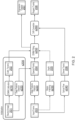
- the 3D morphable model (3DMM) is calibrated.
- the 3DMM is a mathematical 3D model of a face that is used to help constrain the tracked points to locations anatomically consistent with a human facial expression, as described later herein.
- the 3DMM may similarly be or comprise a model of a human body. Similarly if an animal is being captured, then the face and/or body of that animal may be used, and so on.
- the 3DMM can fit facial expressions and optionally face shapes.
- Facial expressions are modelled using combinations of blendshapes, as described elsewhere herein. Meanwhile face shapes are optionally modelled in a similar fashion using combinations of eigenvectors obtained after running principle component analysis (PCA) on a set of training data (a set of face meshes with a neutral expression).
- PCA running principle component analysis
- the 3DMM can then be optionally calibrated to the face shape of the specific actor as follows.
- a neutral image of the actor e.g. with no expression on the face, or a simple standing pose for a body
- a PCA based model is previously trained on a dataset of faces (e.g. neutral synthetic faces) to obtain these eigenvectors (e.g. so-called eigenfaces).
- the PCA parameters ('Calib. Params' 202) indicating the combination of eigenvectors that best approximate the actors face are then determined.
- a set of weights that deform a base mesh used for the 3DMM are modified based on the PCA parameters so that the mesh better fits the actor's face.
- the modified mesh is then kept as the base mesh on which to fit facial expression deformations (blendshapes) for the video sequences with this particular actor.
- the fitting process for facial expressions is described later herein, and comprises a deep feature detector in step s220 generating special facial feature points 204 for 3DMM fitting at step s250.
- the initialisation step may also use a deep feature detector in step s220 to detect the special points 204 for 3DMM fitting.
- the deep feature detector is a module the may be a dedicated hardware module, or may for example be the CPU and/or GPU of the entertainment device operating under suitable software instruction.
- the deep feature detector detects specific key-points in the input image.
- This module is typically an ensemble of multiple detectors for performing one or more of the detection of key-points around eyes, detection of key-points around the jaw, detection of key-points around lips, detection of key-points around one or more other significant facial features such as eyebrows (if treated separately from eyes), nose, and ears, segmentation of lips (e.g. for lip sync purposes), the overall facial region, and direction of gaze.
- detection may relate to specific limbs, hands, feet, the torso, and the like.
- the deep feature detector detects salient visual features of the tracked object, typically using a plurality of detectors each specialising in a respective feature or feature type.
- detectors could be provided by template matching, preferably they are typically implemented using deep learning models trained to extract visual features (key points) from respective facial or body regions. These key points typically cover some or all of the face (and/or body) as described above and form the special points 204.
- the deep feature detector will generate between 100 and 500 special points 204 on a face, without the need for make-up markers and the like.
- respective deep learning models Whilst it may be preferable to use respective deep learning models as such respective detectors, optionally such models may be trained on multiple facial or body regions or indeed the entire face or body.
- motion capture may begin.
- An input image frame 203 is provided to the deep feature detector to identify the special points 204. This is done in a similar manner as for the optional neutral image 201 described previously herein.
- the input image frame is a stereoscopic image.
- a depth image can be generated by applying a stereo vision algorithm on the left/right images at optional step s230.
- the special points can then be elevated according to the depth values at the corresponding points in the depth image to enable the special points to be tracked in 3D on the face or body surface, which can improve the fitting result of the 3DMM, and also enable the output of 3D tracking data.
- an optical flow module computes optical flow tracks across consecutive input frames 203.
- the optical flow is initialised to track specific locations on the face (or body) for example from the first input frame 203 in a given input sequence.
- the specific locations are typically at least a subset of the special points 204 identified by the deep feature detector.
- the optical flow module tracks some or all of the special points across consecutive input frames.
- the optical flow module can track points independent of the special points 204. Hence more generally these can be termed 'flow points' and may or may not fully coincide with the special points 204.
- the output is a dense set of tracks (e.g. tracked flow points) 206, and typically in the order of 100-500 tracks.
- the optical flow module is a module that may be a dedicated hardware module, or may for example be the CPU and/or GPU of the entertainment device operating under suitable software instruction.
- optical flow tracking can drift. To mitigate this, the optical flow is checked / corrected using the 3D morphable model, as described later herein.
- the 3D morphable model itself is typically a linear blendshape-based model of a human face, as used in the art for animation. These blend-shapes are typically hand-crafted by artists as a library of 3D offsets applied on top of a neutral face base mesh, which as noted previously herein may be separately calibrated to the shape of the particular actor.
- the blendshape model comprises a plurality of facial expressions, or blendshape targets, and a given facial expression is a linear combination of a number of these. As such it is similar to the construction of a given face from contributions of so-called eigenfaces, and indeed blendshape targets can be selected from principle component analysis of training images of facial expressions in an analogous manner.
- the 3D morphable model may be maintained, fitted and optionally adjusted/calibrated by a 3DMM module.
- This module may be a dedicated hardware module, or may for example be the CPU and/or GPU of the entertainment device operating under suitable software instruction
- the 3DMM is fitted to the visual features of the current face expression extracted by the deep feature detector (e.g. some or all of the special points 204).
- the fitting is optimized using a nonlinear least squares method that minimizes the projection error of a subset of vertices of the 3D face of the model, against the location of the special features computed by the deep feature detector from the input image.
- the algorithm can optimize two types of parameters:
- the 3DMM fitting step determines a 3D morphable model that fits the expression and relative pose of the actor's face (as defined at some or all of the special points).
- the base mesh modified by the blendshapes may optionally also use calibration parameters that morph the model to the anatomic proportions of the actor's face if these were determined in an initialisation step.
- fitting the 3DMM to some or all of the special points 204 of the actor's face results in a model that closely approximates the actual current expression of the actor, but whose key points are not corrupted by noise, classification errors and other data outliers that can occur with the detection of the special points.
- the parameters of the model can optionally be output separately as expression parameters 207 to drive animation or other processes if desired.
- the fitted 3DMM thus represents a best fit for the identified special points to a facial expression constrained to be possible or valid according to the blendshapes. This in turn also helps to identify special points that have been misclassified if they indicate part of the face at a position that is deemed impossible or invalid (e.g. if a nose shadow is partially identified as belonging to the nose, making the nose appear to suddenly veer to one size).
- the 3D morphable model as a regularised representation of the special points, can similarly be used to correct drift in the optical flow process, as follows.
- a drift correction module can operate in step s260.
- the drift correction module is a module the may be a dedicated hardware module, or may for example be the CPU and/or GPU of the entertainment device operating under suitable software instruction.
- optical flow tracks can be checked and/or corrected using one or more of the following heuristics:
- altering a position of a flow point typically this also means altering the track of the flow point, either directly (by correcting the track value) or indirectly (by correcting the flow point position before calculating an updated tracking, or optionally by re-running the tracking process with the corrected position information).
- a 3D morphable model of the actors face corresponding to the expression defined by those special points can be generated; this 3DMM can then be used to correct any drift in optical flow tracking of points (typically but not necessarily some or all of the special points) to keep them consistent with a possible or valid expression as defined by the 3DMM, and optionally also correct for more subtle effects of tracking drift within and between facial or body features.
- the resulting checked / corrected tracks can then be output to drive performance capture for the chosen activity, whether this is driving a live avatar within a game or social virtual environment, inputting body moves into a dance game or similar (either to play or to record a reference performance for subsequent comparisons), capture a performance for reproduction by a video game character, or capture a performance for use in a movie or TV show, or any similar such use of optical flow tracks 208, special point values 204, and/or 3DMM expression parameters 207.
- a method of point tracking comprises the following steps.
- a conventional equivalent device may be implemented in the form of a computer program product comprising processor implementable instructions stored on a non-transitory machine-readable medium such as a floppy disk, optical disk, hard disk, solid state disk, PROM, RAM, flash memory or any combination of these or other storage media, or realised in hardware as an ASIC (application specific integrated circuit) or an FPGA (field programmable gate array) or other configurable circuit suitable to use in adapting the conventional equivalent device.
- a computer program may be transmitted via data signals on a network such as an Ethernet, a wireless network, the Internet, or any combination of these or other networks.
- a point tracking system comprises the following.
- a video input module e.g. data port 60 or A/V port 90 of entertainment device 10, or a prerecorded source such as optical drive 70 or data drive 50, in conjunction with CPU 20 and/or GPU 30
- a video input module configured (for example by suitable software instruction) to receive successive input image frames 203 from a sequence of input image frames comprising an object to track, as described elsewhere herein.
- a feature detector module e.g. CPU 20 and/or GPU 30 configured (for example by suitable software instruction) to detect a plurality of feature points for each input frame, as described elsewhere herein.
- a 3D morphable model module e.g. CPU 20 and/or GPU 30 configured (for example by suitable software instruction) to map a 3D morphable model to the plurality of feature points, as described elsewhere herein.
- an optical flow module e.g. CPU 20 and/or GPU 30 configured (for example by suitable software instruction) to perform optical flow tracking of flow points between successive input frames, as described elsewhere herein.
- a drift correction module e.g. CPU 20 and/or GPU 30 configured (for example by suitable software instruction) to correct optical flow tracking for at least a first flow point position responsive to the mapped 3D morphable model, as described elsewhere herein.
Landscapes
- Engineering & Computer Science (AREA)
- Physics & Mathematics (AREA)
- Theoretical Computer Science (AREA)
- General Physics & Mathematics (AREA)
- Computer Vision & Pattern Recognition (AREA)
- Multimedia (AREA)
- Software Systems (AREA)
- Computer Graphics (AREA)
- Geometry (AREA)
- Computer Hardware Design (AREA)
- Architecture (AREA)
- General Engineering & Computer Science (AREA)
- Health & Medical Sciences (AREA)
- Artificial Intelligence (AREA)
- Computing Systems (AREA)
- Databases & Information Systems (AREA)
- Evolutionary Computation (AREA)
- General Health & Medical Sciences (AREA)
- Medical Informatics (AREA)
- Image Analysis (AREA)
Applications Claiming Priority (1)
| Application Number | Priority Date | Filing Date | Title |
|---|---|---|---|
| GB2118271.2A GB2613840B (en) | 2021-12-16 | 2021-12-16 | Feature tracking system and method |
Publications (1)
| Publication Number | Publication Date |
|---|---|
| EP4198896A1 true EP4198896A1 (en) | 2023-06-21 |
Family
ID=79269920
Family Applications (1)
| Application Number | Title | Priority Date | Filing Date |
|---|---|---|---|
| EP22209871.7A Pending EP4198896A1 (en) | 2021-12-16 | 2022-11-28 | Feature tracking system and method |
Country Status (5)
| Country | Link |
|---|---|
| US (1) | US20230196593A1 (enExample) |
| EP (1) | EP4198896A1 (enExample) |
| JP (1) | JP2023089947A (enExample) |
| CN (1) | CN116433718A (enExample) |
| GB (1) | GB2613840B (enExample) |
Families Citing this family (3)
| Publication number | Priority date | Publication date | Assignee | Title |
|---|---|---|---|---|
| US12430863B2 (en) * | 2022-08-21 | 2025-09-30 | Adobe Inc. | Deformable neural radiance field for editing facial pose and facial expression in neural 3D scenes |
| CN116862954B (zh) * | 2023-07-31 | 2025-12-19 | 咪咕新空文化科技(厦门)有限公司 | 图像跟踪方法及系统、位姿融合方法及系统、设备和介质 |
| CN117975543B (zh) * | 2024-04-01 | 2024-07-19 | 武汉烽火信息集成技术有限公司 | 一种基于光流表情的区块链零知识身份认证凭证交互方法 |
Citations (1)
| Publication number | Priority date | Publication date | Assignee | Title |
|---|---|---|---|---|
| WO2020112733A1 (en) * | 2018-11-28 | 2020-06-04 | Sony Corporation | Online calibration of 3d scan data from multiple viewpoints |
Family Cites Families (12)
| Publication number | Priority date | Publication date | Assignee | Title |
|---|---|---|---|---|
| US6807290B2 (en) * | 2000-03-09 | 2004-10-19 | Microsoft Corporation | Rapid computer modeling of faces for animation |
| US9317954B2 (en) * | 2013-09-23 | 2016-04-19 | Lucasfilm Entertainment Company Ltd. | Real-time performance capture with on-the-fly correctives |
| US9691165B2 (en) * | 2015-07-24 | 2017-06-27 | Disney Enterprises, Inc. | Detailed spatio-temporal reconstruction of eyelids |
| US9865032B2 (en) * | 2015-09-04 | 2018-01-09 | Adobe Systems Incorporated | Focal length warping |
| US10540817B2 (en) * | 2017-03-03 | 2020-01-21 | Augray Pvt. Ltd. | System and method for creating a full head 3D morphable model |
| CN109145681B (zh) * | 2017-06-16 | 2021-02-26 | 北京京东尚科信息技术有限公司 | 用于判断目标旋转方向的方法及装置 |
| CN119206817A (zh) * | 2018-06-14 | 2024-12-27 | 英特尔公司 | 使用图像和时间跟踪神经网络进行的3d面部捕获和修改 |
| CN109961507B (zh) * | 2019-03-22 | 2020-12-18 | 腾讯科技(深圳)有限公司 | 一种人脸图像生成方法、装置、设备及存储介质 |
| CN114026606B (zh) * | 2019-06-28 | 2025-06-17 | 奇跃公司 | 用于动态遮挡的快速手部网格划分 |
| US11514665B2 (en) * | 2020-04-01 | 2022-11-29 | Scandit Ag | Mapping optical-code images to an overview image |
| US12062130B2 (en) * | 2021-01-26 | 2024-08-13 | Qualcomm Incorporated | Object reconstruction using media data |
| KR20230072851A (ko) * | 2021-11-18 | 2023-05-25 | 조선대학교산학협력단 | 표정 분류를 위한 랜드마크 기반의 앙상블 네트워크 생성 방법 및 생성된 앙상블 네트워크를 이용한 표정 분류 방법. |
-
2021
- 2021-12-16 GB GB2118271.2A patent/GB2613840B/en active Active
-
2022
- 2022-11-28 EP EP22209871.7A patent/EP4198896A1/en active Pending
- 2022-12-02 JP JP2022193462A patent/JP2023089947A/ja active Pending
- 2022-12-08 CN CN202211588190.4A patent/CN116433718A/zh active Pending
- 2022-12-15 US US18/082,104 patent/US20230196593A1/en active Pending
Patent Citations (1)
| Publication number | Priority date | Publication date | Assignee | Title |
|---|---|---|---|---|
| WO2020112733A1 (en) * | 2018-11-28 | 2020-06-04 | Sony Corporation | Online calibration of 3d scan data from multiple viewpoints |
Non-Patent Citations (1)
| Title |
|---|
| DEREK BRADLEY ET AL: "High resolution passive facial performance capture", ACM SIGGRAPH 2010 PAPERS, ACM, US, 26 July 2010 (2010-07-26), pages 1 - 10, XP058312459, ISBN: 978-1-4503-0210-4, DOI: 10.1145/1833349.1778778 * |
Also Published As
| Publication number | Publication date |
|---|---|
| GB2613840B (en) | 2025-03-12 |
| JP2023089947A (ja) | 2023-06-28 |
| CN116433718A (zh) | 2023-07-14 |
| GB2613840A (en) | 2023-06-21 |
| US20230196593A1 (en) | 2023-06-22 |
Similar Documents
| Publication | Publication Date | Title |
|---|---|---|
| JP7476428B2 (ja) | 画像の視線補正方法、装置、電子機器、コンピュータ可読記憶媒体及びコンピュータプログラム | |
| EP4198896A1 (en) | Feature tracking system and method | |
| KR102866211B1 (ko) | 포토리얼리스틱 실시간 인물 애니메이션을 위한 시스템 및 방법 | |
| CN110807836B (zh) | 三维人脸模型的生成方法、装置、设备及介质 | |
| CN111598818B (zh) | 人脸融合模型训练方法、装置及电子设备 | |
| Chen et al. | Puppeteergan: Arbitrary portrait animation with semantic-aware appearance transformation | |
| US11010951B1 (en) | Explicit eye model for avatar | |
| CN105373218B (zh) | 用于改进眼睛跟踪的场景分析 | |
| US8737767B2 (en) | Perceptually guided capture and stylization of 3D human figures | |
| CN103733226B (zh) | 快速的有关节运动的跟踪 | |
| JP2022028791A (ja) | 画像正則化及びリターゲティングシステム | |
| US10713471B2 (en) | System and method for simulating facial expression of virtual facial model | |
| WO2021004257A1 (zh) | 视线检测和视频处理的方法、装置、设备和存储介质 | |
| EP3475920A1 (en) | Systems and methods for generating computer ready animation models of a human head from captured data images | |
| KR20190129985A (ko) | 파트 기반 키 프레임들 및 선험적 모델을 사용한 견고한 메시 트래킹 및 융합 | |
| TW202109359A (zh) | 人臉圖像處理方法、圖像設備及儲存介質 | |
| CN111652123A (zh) | 图像处理和图像合成方法、装置和存储介质 | |
| CN108961314B (zh) | 运动图像生成方法、装置、电子设备及计算机可读存储介质 | |
| CN108428209B (zh) | 高维数据可视化方法、装置及系统 | |
| US11893681B2 (en) | Method for processing two-dimensional image and device for executing method | |
| CN120359547A (zh) | 视频透视(vst)增强现实(ar)系统中扩展视图几何图形的生成和渲染 | |
| US20250078377A1 (en) | Body tracking from monocular video | |
| WO2019186833A1 (ja) | 画像処理装置、画像処理方法、及び、コンピュータ読み取り可能な記録媒体 | |
| CN114612976B (zh) | 关键点检测方法及装置、计算机可读介质和电子设备 | |
| CN118212311A (zh) | 图像的针对性的生成视觉编辑 |
Legal Events
| Date | Code | Title | Description |
|---|---|---|---|
| PUAI | Public reference made under article 153(3) epc to a published international application that has entered the european phase |
Free format text: ORIGINAL CODE: 0009012 |
|
| STAA | Information on the status of an ep patent application or granted ep patent |
Free format text: STATUS: REQUEST FOR EXAMINATION WAS MADE |
|
| 17P | Request for examination filed |
Effective date: 20221214 |
|
| AK | Designated contracting states |
Kind code of ref document: A1 Designated state(s): AL AT BE BG CH CY CZ DE DK EE ES FI FR GB GR HR HU IE IS IT LI LT LU LV MC ME MK MT NL NO PL PT RO RS SE SI SK SM TR |
|
| STAA | Information on the status of an ep patent application or granted ep patent |
Free format text: STATUS: EXAMINATION IS IN PROGRESS |
|
| RIC1 | Information provided on ipc code assigned before grant |
Ipc: G06T 7/246 20170101AFI20250725BHEP Ipc: G06T 7/269 20170101ALI20250725BHEP |
|
| 17Q | First examination report despatched |
Effective date: 20250902 |