EP4195084A1 - Verfahren und vorrichtung zur anpassung von modellparametern sowie speichermedium und programmprodukt - Google Patents
Verfahren und vorrichtung zur anpassung von modellparametern sowie speichermedium und programmprodukt Download PDFInfo
- Publication number
- EP4195084A1 EP4195084A1 EP21920540.8A EP21920540A EP4195084A1 EP 4195084 A1 EP4195084 A1 EP 4195084A1 EP 21920540 A EP21920540 A EP 21920540A EP 4195084 A1 EP4195084 A1 EP 4195084A1
- Authority
- EP
- European Patent Office
- Prior art keywords
- variable
- result
- classification
- classification prediction
- value
- Prior art date
- Legal status (The legal status is an assumption and is not a legal conclusion. Google has not performed a legal analysis and makes no representation as to the accuracy of the status listed.)
- Granted
Links
Images




Classifications
-
- G—PHYSICS
- G06—COMPUTING OR CALCULATING; COUNTING
- G06N—COMPUTING ARRANGEMENTS BASED ON SPECIFIC COMPUTATIONAL MODELS
- G06N20/00—Machine learning
- G06N20/20—Ensemble learning
-
- G—PHYSICS
- G06—COMPUTING OR CALCULATING; COUNTING
- G06F—ELECTRIC DIGITAL DATA PROCESSING
- G06F21/00—Security arrangements for protecting computers, components thereof, programs or data against unauthorised activity
- G06F21/60—Protecting data
- G06F21/62—Protecting access to data via a platform, e.g. using keys or access control rules
- G06F21/6218—Protecting access to data via a platform, e.g. using keys or access control rules to a system of files or objects, e.g. local or distributed file system or database
- G06F21/6245—Protecting personal data, e.g. for financial or medical purposes
-
- G—PHYSICS
- G06—COMPUTING OR CALCULATING; COUNTING
- G06F—ELECTRIC DIGITAL DATA PROCESSING
- G06F16/00—Information retrieval; Database structures therefor; File system structures therefor
- G06F16/20—Information retrieval; Database structures therefor; File system structures therefor of structured data, e.g. relational data
- G06F16/21—Design, administration or maintenance of databases
- G06F16/215—Improving data quality; Data cleansing, e.g. de-duplication, removing invalid entries or correcting typographical errors
-
- G—PHYSICS
- G06—COMPUTING OR CALCULATING; COUNTING
- G06F—ELECTRIC DIGITAL DATA PROCESSING
- G06F16/00—Information retrieval; Database structures therefor; File system structures therefor
- G06F16/20—Information retrieval; Database structures therefor; File system structures therefor of structured data, e.g. relational data
- G06F16/24—Querying
- G06F16/245—Query processing
- G06F16/2458—Special types of queries, e.g. statistical queries, fuzzy queries or distributed queries
- G06F16/2465—Query processing support for facilitating data mining operations in structured databases
-
- G—PHYSICS
- G06—COMPUTING OR CALCULATING; COUNTING
- G06N—COMPUTING ARRANGEMENTS BASED ON SPECIFIC COMPUTATIONAL MODELS
- G06N20/00—Machine learning
-
- G—PHYSICS
- G06—COMPUTING OR CALCULATING; COUNTING
- G06N—COMPUTING ARRANGEMENTS BASED ON SPECIFIC COMPUTATIONAL MODELS
- G06N3/00—Computing arrangements based on biological models
- G06N3/02—Neural networks
- G06N3/08—Learning methods
Definitions
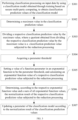
- a current classification model obtained through training based on secure multi-party computing is used to perform classification processing on input data to obtain classification prediction values of the current classification model.
- each of the classification prediction values is divided by a maximum value of all the classification prediction values, such that the classification prediction values are reduced into a range of [0, 1], and a result obtained from an exponential operation on the reduced classification prediction values will still be within the range of [0, 1], thereby generation of data overflow can be avoided in a process of normalization.
- the normalization result of the classification prediction values is obtained, taking the normalization result of the classification prediction values as predictive probability values of corresponding classifications, it is possible to determine, according to a predictive probability value of a respective classification, a classification result of the classification model.
- the value of the function parameter n in the exponential function is set to be the parameter threshold, such that an exponential operation is converted into multiplication operations; an approximate exponential operation is realized by means of multiplication operations based on secure multi-party computing, producing a very small error under a relatively large parameter threshold and incurring no data overflow.
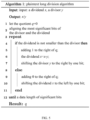
- a related division operation based on secure multi-party computing in the present application is implemented by implementing long division based on secure multi-party computing, which can be specifically implemented through the following steps.
- FIG. 5 shows an implementation of plaintext long division.
- the processing as shown in item 2 is required, namely, aligning a most significant bit of a dividend to that of a divisor. It is required that, after the alignment, a number of significant bits of the divisor is greater than or equal to a number of significant bits of the dividend.
- the most significant bit of the dividend and that of the divisor cannot be directly aligned since the dividend and the divisor are both ciphertext.
- the second variable is obtained by increasing the number of significant bits of the divisor, where the number of significant bits of the second variable is greater than or equal to the number of significant bits of the first variable, an implementation is possible through the following manner specifically.
- a quotient of the dividend and divisor can be initialized to 0.
- the dividend, divisor and quotient are all represented in binary.
- Step S402 comparing whether the first variable is greater than or equal to the second variable.
- a comparing operation for comparing two data values is a comparing operation based on secure multi-party computing, which can be implemented using a Boolean Circuit or a Garbled Circuit.
- determining the value of the current bit of the quotient according to the compare result may be implemented through the following manner: adding 1 or 0 to the end of the quotient according to the compare result, where 1 is added to the end of the quotient when the first variable is greater than or equal to the second variable, and 0 is added to the end of the quotient when the first variable is smaller than the second variable. Based on secure multi-party computing, 1 or 0 is added to the end of the quotient according to the compare result.
- the compare result in the step which is a compare operation obtained based on secure multi-party computing, is ciphertext, therefore, a compare result of plaintext cannot be learned. Under the circumstance that a compare result of plaintext cannot be learned, it is a technical difficulty to determine the value of the current bit of the quotient and update the first variable and the second variable according to the compare result.
- adding 1 or 0 to the end of the quotient according to the compare result may be specifically implemented through the following manner: adding 0 to the end of the quotient; and performing an XOR operation on the quotient with 0 added to the end thereof and the compare result.
- 1 or 0 is added to the end of the quotient directly, and it is also realized that 1 is added to the end of the quotient when the first variable is greater than or equal to the second variable, and 0 is added to the end of the quotient when the first variable is smaller than the second variable.
- the compare result is 1 (ciphertext); and when the first variable is smaller than the second variable, the compare result is 0 (ciphertext).
- the compare result is 0 (ciphertext).
- an XOR value will be 1, thereby 0 (ciphertext) which is added to the end of the quotient is changed into 1 (ciphertext), namely, it is realized that 1 is added to the end of the quotient when the first variable is greater than or equal to the second variable;
- a compare result is currently 0 (ciphertext)
- an XOR result will be 1, thereby 0 (ciphertext) which is added to the end of the quotient is still 0 (ciphertext), namely, it is realized that 0 is added to the end of the quotient when the first variable is smaller than the second
- updating the first variable according to the compare result may be implemented through the following manner: performing first update processing on the first variable to obtain a first update result, where the first update processing is update processing on the first variable when the first variable is greater than or equal to the second variable; performing second update processing on the first variable to obtain a second update result, where the second update processing is update processing on the first variable when the first variable is smaller than the second variable; calculating a first product of the compare result and the first update result, and a second product of a NOT operation result of the compare result and the second update result; and taking a sum of the first product and the second product as the updated first variable.
- the first variable is updated directly.
- the first update processing is update processing on the first variable when the first variable is greater than or equal to the second variable.
- the first update processing is specifically: through a subtraction operation based on secure multi-party computing, subtracting the second variable from the first variable to obtain the first update result.
- the second update processing is update processing on the first variable when the first variable is smaller than the second variable.
- the second update processing is specifically: through a shift operation based on secure multi-party computing, shifting the first variable to the left by one bit to obtain the second update result.
- updating the second variable according to the compare result may be implemented through the following manner: performing third update processing on the second variable to obtain a third update result, where the third update processing is update processing on the second variable when the first variable is greater than or equal to the second variable; calculating a third product of the compare result and the third update result, and a fourth product of a NOT operation result of the compare result and the second variable; and taking a sum of the third product and the fourth product as the updated second variable.
- the second variable is updated directly.
- the third update processing is update processing on the second variable when the first variable is greater than or equal to the second variable.
- the third update processing is specifically: through a shift operation based on secure multi-party computing, shifting the second variable to the right by one bit to obtain the third update result.
- the first variable is smaller than the second variable, the second variable remains unchangeable.
- Step S404 whether a number of bits of the quotient is equal to a preset length of significant bits.
- step S402 When the number of bits of the quotient is not equal to the preset length of significant bits, proceed with the step S402 to perform processing with regard to a next iteration according to the updated first variable and second variable.
- the currently obtained quotient is the quotient of the dividend and divisor, proceed with the step S405.
- Step S405 taking a currently obtained quotient as the quotient of the dividend and divisor.
- step S303 where the respective classification prediction value is divided by the maximum value of all the classification prediction values, it is possible to calculate, with the respective classification prediction value as the dividend and the maximum value as the divisor, the quotient of the respective classification prediction value and the maximum value using the method as shown in FIG. 4 .
- any one of the classification prediction values as the dividend, and the maximum value of the classification prediction values as the divisor if it is satisfied that the number of significant bits of the divisor is greater than or equal to the number of significant bits of the dividend, it is not necessary to perform alignment between the dividend and divisor.
- the processing of the foregoing steps S402-S404 iteratively where in a single iteration process, a value of one bit of the quotient is determined and added to the end of the quotient; until the number of iterations is greater than or equal to the length of significant bits for the quotient to arrive at the quotient of the classification prediction value and the maximum value.
- the long division operation based on the secure multi-party computing can be realized for the classification prediction values and the maximum value thereof which are ciphertext, thereby generation of data overflow in a division operation based on secure multi-party computing can be avoided effectively.
- calculation of the quotient of a respective classification prediction value and the maximum value is implemented through the long division based on secure multi-party computing using a Boolean Circuit or Garbled Circuit, no data overflow will be incurred and the precision is high.
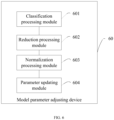
- FIG. 6 is a schematic diagram of a model parameter adjusting device according to a third embodiment of the present application.
- the model parameter adjusting device according to the embodiment of the present application can carry out the processing flows provided according to the embodiments of the model parameter adjusting method.
- the model parameter adjusting device 60 includes: a classification processing module 601, a reduction processing module 602, a normalization processing module 603 and a parameter updating module 604.
- the classification processing module 601 is configured to perform classification processing on input data by using a classification model obtained through training based on secure multi-party computing, to obtain classification prediction values of the classification model.
- the reduction processing module 602 is configured to perform reduction processing on the classification prediction values.
- the normalization processing module 603 is configured to perform normalization processing on the classification prediction values subjected to the reduction processing to obtain a normalization result of the classification prediction values.
- the parameter updating module 604 is configured to update a parameter of the classification model according to the normalization result of the classification prediction values.
- a process of model parameter adjustment based on secure multi-party computing perform classification processing on input data by using a classification model obtained through training based on secure multi-party computing to obtain classification prediction values of the classification model; perform reduction processing on the classification prediction values; perform normalization processing on the classification prediction values subjected to the reduction processing to obtain a normalization result of the classification prediction values; and update a parameter of the classification model according to the normalization result of the classification prediction values.
- FIG. 7 is a schematic diagram of a model parameter adjusting device according to a fourth embodiment of the present application.
- the model parameter adjusting device 70 includes: a classification processing module 701, a reduction processing module 702, a normalization processing module 703 and a parameter updating module 704.
- the classification processing module 701 is configured to perform classification processing on input data by using a classification model obtained through training based on secure multi-party computing, to obtain classification prediction values of the classification model.
- the reduction processing module 702 is configured to perform reduction processing on the classification prediction values.
- the normalization processing module 703 is configured to perform normalization processing on the classification prediction values subjected to the reduction processing to obtain a normalization result of the classification prediction values.
- the parameter updating module 704 is configured to update a parameter of the classification model according to the normalization result of the classification prediction values.
- the reduction processing module 702 includes:
- the division calculation unit 7022 includes:
- the iteration sub-unit is further configured to: add 1 or 0 to the end of the quotient according to the compare result, where 1 is added to the end of the quotient when the first variable is greater than or equal to the second variable, and 0 is added to the end of the quotient when the first variable is smaller than the second variable.
- the iteration sub-unit is further configured to: add 0 to the end of the quotient; and perform an XOR operation on the quotient with 0 added to the end thereof and the compare result.
- the iteration sub-unit is further configured to: perform first update processing on the first variable to obtain a first update result, where the first update processing is update processing on the first variable when the first variable is greater than or equal to the second variable; perform second update processing on the first variable to obtain a second update result, where the second update processing is update processing on the first variable when the first variable is smaller than the second variable; calculate a first product of the compare result and the first update result, and a second product of a NOT operation result of the compare result and the second update result; and take a sum of the first product and the second product as the updated first variable.
- the iteration sub-unit is further configured to: perform third update processing on the second variable to obtain a third update result, where the third update processing is update processing on the second variable when the first variable is greater than or equal to the second variable; calculate a third product of the compare result and the third update result, and a fourth product of a NOT operation result of the compare result and the second variable; and take a sum of the third product and the fourth product as the updated second variable.
- the normalization processing module 703 includes:
- the exponential calculation unit 7032 is further configured to:
- the device according to the embodiment of the present application can be specifically configured to perform the method embodiment according to the second embodiment, and the specific functions will not be described herein.
- the value of the function parameter n in the exponential function is set to be the parameter threshold, such that an exponential operation is converted into multiplication operations; an approximate exponential operation is realized by means of multiplication operations based on secure multi-party computing, producing a very small error under a relatively large parameter threshold and incurring no data overflow. Further, calculation of the quotient of a respective classification prediction value and the maximum value is implemented through the long division based on secure multi-party computing using a Boolean Circuit or Garbled Circuit, no data overflow will be incurred and the precision is high.
- the present application further provides a computer program product, including: a computer program, where the computer program is stored in a readable storage medium from which the computer program is readable by at least one processor of an electronic device, and the solution according to any one of the forgoing embodiments is implemented by the electronic device when the computer program is executed by the at least one processor.
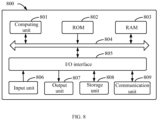
- the electronic device 800 includes a computing unit 801 that is capable of performing various appropriate actions or processes according to a computer program stored in a read only memory (ROM) 802 or a computer program loaded from a storage unit 808 into a random access memory (RAM) 803.
- ROM read only memory
- RAM random access memory
- various programs and data required for operations of the device 800 may also be stored.
- the computing unit 801, the ROM 802 and the RAM 803 are connected to each other via a bus 804.
- An input/output (I/O) interface 805 is also connected to the bus 804.
- the computing unit 801 may be various general-purpose and/or special-purpose processing components with processing and computing capabilities. Some examples of the computing unit 801 include but not limited to, a central processing unit (CPU), a graphics processing unit (GPU), various dedicated artificial intelligence (AI) computing chips, various computing units for running machine learning model algorithms, a digital signal processor (DSP), and any appropriate processor, controller, microcontroller, etc.
- the computing unit 801 executes various methods and processes described above, such as the model parameter adjusting method.
- the model parameter adjusting method may be implemented as a computer software program, which is tangibly contained in a machine-readable medium, such as the storage unit 808.
- a portion or an entirety of the computer program may be loaded and/or installed on the device 800 via the ROM 802 and/or the communication unit 809.
- the computer program When the computer program is loaded into the RAM 803 and executed by the computing unit 801, one or more steps of the model parameter adjusting method described above may be implemented.
- the computing unit 801 may be configured to perform the model parameter adjusting method by any other appropriate means (for example, by means of firmware).
- These various implementations may include: being implemented in one or more computer programs, where the one or more computer programs may be executed and/or interpreted on a programmable system including at least one programmable processor; the programmable processor may be a special-purpose or general-purpose programmable processor, which may receive data and instructions from a storage system, at least one input device and at least one output device and transmit the data and instructions to the storage system, the at least one input device, and the at least one output device.
- Program codes for implementing the method of the present disclosure may be written in one or any combination of multiple programming languages. These program codes may be provided to a processor or a controller of a general-purpose computer, a special-purpose computer or other programmable data processing apparatus, such that when the program codes are executed by the processor or the controller, the functions/operations specified in the flowcharts and/or block diagrams are implemented.
- the program codes may be executed completely on a machine, partially on the machine, partially on the machine and partially on a remote machine as a separate software package, or completely on the remote machine or a server.
- the machine-readable medium may be a tangible medium that may contain or store programs to be used by an instruction executing system, apparatus or device, or used in combination with the instruction executing system, apparatus or device.
- the machine-readable medium may be a machine-readable signal medium or a machine-readable storage medium.
- the machine-readable medium may include but not limited to an electronic, magnetic, optical, electromagnetic, infrared, or semiconductor system, apparatus or device, or any suitable combination of the above.
- machine-readable storage medium may include an electrically connected portable computer disk based on one or more lines, a hard disk, a random access memory (RAM), a read only memory (ROM), an erasable programmable read only memory (EPROM or flash memory), an optical fiber, a portable compact disk read only memory (CD-ROM), an optical storage device, a magnetic storage device or any suitable combination of the above.
- RAM random access memory
- ROM read only memory
- EPROM or flash memory erasable programmable read only memory
- CD-ROM portable compact disk read only memory
- magnetic storage device any suitable combination of the above.
- the systems and technologies described herein may be implemented on a computer having: a display device for displaying information to the user (for example, a CRT (cathode ray tube) or LCD (liquid crystal display) monitor); and a keyboard and pointing device (for example, a mouse or a trackball) through which the user may provide input to the computer.
- a display device for displaying information to the user
- LCD liquid crystal display
- keyboard and pointing device for example, a mouse or a trackball
- Other kinds of devices may also be used to provide an interaction with the user, for example, feedback provided to the user may be any form of sensory feedback (for example, visual feedback, auditory feedback, or tactile feedback); and the input from the user may be received in any form (including an acoustic input, a voice input or a tactile input).
- the systems and technologies described herein may be implemented in a computing system that includes a background component (for example, as a data server), or a computing system that includes a middleware component (for example, an application server), or a computing system that includes a front-end component (for example, a user computer having a graphical user interface or a web browser through which a user may interact with the implementations of the systems and technologies described herein), or a computing system that includes any combination of such background component, middleware component, or front-end component.
- the components of the system may be connected to each other by digital data communication (for example, a communication network) in any form or medium. Examples of the communication network include a local area network (LAN), a wide area network (WAN), and the Internet.
- a computer system may include a client and a server.
- the client and the server are generally far away from each other and typically interact through a communication network.
- the relationship between the client and the server is generated by running computer programs having a client-server relationship on corresponding computers.
- the server which may be a cloud server, also known as a cloud computing server or a cloud host, is a host product in a cloud computing service system to solve the defects of huge management difficulties and weak business scalability that exist in a conventional physical host and a VPS service ("virtual private server", or "VPS" for short).
- the server may also be a server of a distributed system, or a server combined with a blockchain.
Landscapes
- Engineering & Computer Science (AREA)
- Theoretical Computer Science (AREA)
- Software Systems (AREA)
- Physics & Mathematics (AREA)
- General Physics & Mathematics (AREA)
- General Engineering & Computer Science (AREA)
- Databases & Information Systems (AREA)
- Data Mining & Analysis (AREA)
- Mathematical Physics (AREA)
- Medical Informatics (AREA)
- Evolutionary Computation (AREA)
- Computing Systems (AREA)
- Artificial Intelligence (AREA)
- Computer Vision & Pattern Recognition (AREA)
- Health & Medical Sciences (AREA)
- General Health & Medical Sciences (AREA)
- Bioethics (AREA)
- Computational Linguistics (AREA)
- Fuzzy Systems (AREA)
- Quality & Reliability (AREA)
- Probability & Statistics with Applications (AREA)
- Computer Hardware Design (AREA)
- Computer Security & Cryptography (AREA)
- Life Sciences & Earth Sciences (AREA)
- Biomedical Technology (AREA)
- Biophysics (AREA)
- Molecular Biology (AREA)
- Management, Administration, Business Operations System, And Electronic Commerce (AREA)
- Information Retrieval, Db Structures And Fs Structures Therefor (AREA)
Applications Claiming Priority (2)
| Application Number | Priority Date | Filing Date | Title |
|---|---|---|---|
| CN202110088699.1A CN112818387B (zh) | 2021-01-22 | 2021-01-22 | 模型参数调整的方法、设备、存储介质及程序产品 |
| PCT/CN2021/105839 WO2022156159A1 (zh) | 2021-01-22 | 2021-07-12 | 模型参数调整的方法、设备、存储介质及程序产品 |
Publications (3)
| Publication Number | Publication Date |
|---|---|
| EP4195084A1 true EP4195084A1 (de) | 2023-06-14 |
| EP4195084A4 EP4195084A4 (de) | 2024-08-07 |
| EP4195084B1 EP4195084B1 (de) | 2025-12-24 |
Family
ID=75858832
Family Applications (1)
| Application Number | Title | Priority Date | Filing Date |
|---|---|---|---|
| EP21920540.8A Active EP4195084B1 (de) | 2021-01-22 | 2021-07-12 | Verfahren und vorrichtung zur anpassung von modellparametern sowie speichermedium und programmprodukt |
Country Status (5)
| Country | Link |
|---|---|
| US (1) | US20230206133A1 (de) |
| EP (1) | EP4195084B1 (de) |
| KR (1) | KR20230044318A (de) |
| CN (1) | CN112818387B (de) |
| WO (1) | WO2022156159A1 (de) |
Families Citing this family (4)
| Publication number | Priority date | Publication date | Assignee | Title |
|---|---|---|---|---|
| CN112818387B (zh) * | 2021-01-22 | 2024-07-23 | 百度在线网络技术(北京)有限公司 | 模型参数调整的方法、设备、存储介质及程序产品 |
| CN114972928B (zh) * | 2022-07-26 | 2022-11-11 | 深圳比特微电子科技有限公司 | 一种图像识别模型训练方法及装置 |
| KR20250002951A (ko) * | 2023-06-30 | 2025-01-07 | 한국전자기술연구원 | 양자 컴퓨팅 회로의 입력 데이터 전처리 방법 및 장치 |
| CN117854156B (zh) * | 2024-03-07 | 2024-05-07 | 腾讯科技(深圳)有限公司 | 一种特征提取模型的训练方法和相关装置 |
Family Cites Families (6)
| Publication number | Priority date | Publication date | Assignee | Title |
|---|---|---|---|---|
| CN106055891A (zh) * | 2016-05-27 | 2016-10-26 | 大连楼兰科技股份有限公司 | 基于人工智能Softmax回归方法建立分车型远程定损系统及方法 |
| CN109784490B (zh) * | 2019-02-02 | 2020-07-03 | 北京地平线机器人技术研发有限公司 | 神经网络的训练方法、装置和电子设备 |
| CN110890985B (zh) * | 2019-11-27 | 2021-01-12 | 北京邮电大学 | 虚拟网络映射方法及其模型训练方法、装置 |
| CN111537945B (zh) * | 2020-06-28 | 2021-05-11 | 南方电网科学研究院有限责任公司 | 基于联邦学习的智能电表故障诊断方法及设备 |
| CN111798047A (zh) * | 2020-06-30 | 2020-10-20 | 平安普惠企业管理有限公司 | 风控预测方法、装置、电子设备及存储介质 |
| CN112818387B (zh) * | 2021-01-22 | 2024-07-23 | 百度在线网络技术(北京)有限公司 | 模型参数调整的方法、设备、存储介质及程序产品 |
-
2021
- 2021-01-22 CN CN202110088699.1A patent/CN112818387B/zh active Active
- 2021-07-12 WO PCT/CN2021/105839 patent/WO2022156159A1/zh not_active Ceased
- 2021-07-12 EP EP21920540.8A patent/EP4195084B1/de active Active
- 2021-07-12 KR KR1020237009058A patent/KR20230044318A/ko active Pending
-
2023
- 2023-03-09 US US18/181,032 patent/US20230206133A1/en active Pending
Also Published As
| Publication number | Publication date |
|---|---|
| US20230206133A1 (en) | 2023-06-29 |
| KR20230044318A (ko) | 2023-04-03 |
| CN112818387A (zh) | 2021-05-18 |
| EP4195084A4 (de) | 2024-08-07 |
| EP4195084B1 (de) | 2025-12-24 |
| CN112818387B (zh) | 2024-07-23 |
| WO2022156159A1 (zh) | 2022-07-28 |
Similar Documents
| Publication | Publication Date | Title |
|---|---|---|
| EP4195084B1 (de) | Verfahren und vorrichtung zur anpassung von modellparametern sowie speichermedium und programmprodukt | |
| US11176469B2 (en) | Model training methods, apparatuses, and systems | |
| US20210406579A1 (en) | Model training method, identification method, device, storage medium and program product | |
| CN112765616A (zh) | 多方安全计算方法、装置、电子设备和存储介质 | |
| WO2023040429A1 (zh) | 用于联邦特征工程的数据处理方法、装置、设备以及介质 | |
| CN113051239B (zh) | 数据共享方法、应用其的模型的使用方法及相关设备 | |
| CN112506935B (zh) | 数据处理方法、装置、电子设备、存储介质及程序产品 | |
| EP3998583A2 (de) | Verfahren und vorrichtung zum trainieren eines generativen netzwerkmodells und verfahren und vorrichtung zum aufbauen einer zeichenbibliothek | |
| US20220398834A1 (en) | Method and apparatus for transfer learning | |
| US12554936B2 (en) | Method of training deep learning model and method of processing text data | |
| EP4187404A1 (de) | Verfahren und vorrichtung zur fragenbeantwortung auf basis einer tabelle und elektronische vorrichtung | |
| US20230162087A1 (en) | Federated learning method, electronic device, and storage medium | |
| CN114881247A (zh) | 基于隐私计算的纵向联邦特征衍生方法、装置、介质 | |
| CN115587382A (zh) | 全密态数据处理方法、装置、设备、介质 | |
| US20240303962A1 (en) | Method of determining image feature, electronic device, and storage medium | |
| CN115547508B (zh) | 数据校正方法、装置、电子设备及存储介质 | |
| CN114494818B (zh) | 图像处理方法、模型训练方法、相关装置及电子设备 | |
| CN114418830A (zh) | 安全计算方法、装置、设备以及存储介质 | |
| US20240329987A1 (en) | Apparatus and method of processing data, electronic device, and storage medium | |
| CN114494782B (zh) | 图像处理方法、模型训练方法、相关装置及电子设备 | |
| CN116304771A (zh) | 基于KMeans的联邦聚类模型的确定方法、装置、设备及介质 | |
| CN115860121A (zh) | 文本推理方法、装置、设备以及存储介质 | |
| CN115935976A (zh) | 一种试题匹配方法及装置 | |
| CN115471323A (zh) | 一种银行客户信用风险分析方法及装置 | |
| CN114926322A (zh) | 图像生成方法、装置、电子设备和存储介质 |
Legal Events
| Date | Code | Title | Description |
|---|---|---|---|
| STAA | Information on the status of an ep patent application or granted ep patent |
Free format text: STATUS: THE INTERNATIONAL PUBLICATION HAS BEEN MADE |
|
| PUAI | Public reference made under article 153(3) epc to a published international application that has entered the european phase |
Free format text: ORIGINAL CODE: 0009012 |
|
| STAA | Information on the status of an ep patent application or granted ep patent |
Free format text: STATUS: REQUEST FOR EXAMINATION WAS MADE |
|
| 17P | Request for examination filed |
Effective date: 20230309 |
|
| AK | Designated contracting states |
Kind code of ref document: A1 Designated state(s): AL AT BE BG CH CY CZ DE DK EE ES FI FR GB GR HR HU IE IS IT LI LT LU LV MC MK MT NL NO PL PT RO RS SE SI SK SM TR |
|
| DAV | Request for validation of the european patent (deleted) | ||
| DAX | Request for extension of the european patent (deleted) | ||
| A4 | Supplementary search report drawn up and despatched |
Effective date: 20240709 |
|
| RIC1 | Information provided on ipc code assigned before grant |
Ipc: G06N 20/20 20190101ALI20240703BHEP Ipc: G06N 3/08 20230101ALI20240703BHEP Ipc: G06N 20/00 20190101ALI20240703BHEP Ipc: G06F 21/62 20130101AFI20240703BHEP |
|
| STAA | Information on the status of an ep patent application or granted ep patent |
Free format text: STATUS: EXAMINATION IS IN PROGRESS |
|
| 17Q | First examination report despatched |
Effective date: 20241030 |
|
| GRAP | Despatch of communication of intention to grant a patent |
Free format text: ORIGINAL CODE: EPIDOSNIGR1 |
|
| STAA | Information on the status of an ep patent application or granted ep patent |
Free format text: STATUS: GRANT OF PATENT IS INTENDED |
|
| INTG | Intention to grant announced |
Effective date: 20250929 |
|
| GRAS | Grant fee paid |
Free format text: ORIGINAL CODE: EPIDOSNIGR3 |
|
| GRAA | (expected) grant |
Free format text: ORIGINAL CODE: 0009210 |
|
| STAA | Information on the status of an ep patent application or granted ep patent |
Free format text: STATUS: THE PATENT HAS BEEN GRANTED |
|
| P01 | Opt-out of the competence of the unified patent court (upc) registered |
Free format text: CASE NUMBER: UPC_APP_0011282_4195084/2025 Effective date: 20251028 |
|
| AK | Designated contracting states |
Kind code of ref document: B1 Designated state(s): AL AT BE BG CH CY CZ DE DK EE ES FI FR GB GR HR HU IE IS IT LI LT LU LV MC MK MT NL NO PL PT RO RS SE SI SK SM TR |
|
| REG | Reference to a national code |
Ref country code: CH Ref legal event code: F10 Free format text: ST27 STATUS EVENT CODE: U-0-0-F10-F00 (AS PROVIDED BY THE NATIONAL OFFICE) Effective date: 20251224 Ref country code: GB Ref legal event code: FG4D |
|
| REG | Reference to a national code |
Ref country code: DE Ref legal event code: R096 Ref document number: 602021045235 Country of ref document: DE |