EP4195016A2 - Information processing apparatus, information processing system, and program - Google Patents
Information processing apparatus, information processing system, and program Download PDFInfo
- Publication number
- EP4195016A2 EP4195016A2 EP22208937.7A EP22208937A EP4195016A2 EP 4195016 A2 EP4195016 A2 EP 4195016A2 EP 22208937 A EP22208937 A EP 22208937A EP 4195016 A2 EP4195016 A2 EP 4195016A2
- Authority
- EP
- European Patent Office
- Prior art keywords
- address
- display
- type
- contact
- information processing
- Prior art date
- Legal status (The legal status is an assumption and is not a legal conclusion. Google has not performed a legal analysis and makes no representation as to the accuracy of the status listed.)
- Pending
Links
Images





Classifications
-
- H—ELECTRICITY
- H04—ELECTRIC COMMUNICATION TECHNIQUE
- H04N—PICTORIAL COMMUNICATION, e.g. TELEVISION
- H04N1/00—Scanning, transmission or reproduction of documents or the like, e.g. facsimile transmission; Details thereof
- H04N1/0035—User-machine interface; Control console
- H04N1/00405—Output means
- H04N1/00408—Display of information to the user, e.g. menus
-
- G—PHYSICS
- G06—COMPUTING OR CALCULATING; COUNTING
- G06F—ELECTRIC DIGITAL DATA PROCESSING
- G06F3/00—Input arrangements for transferring data to be processed into a form capable of being handled by the computer; Output arrangements for transferring data from processing unit to output unit, e.g. interface arrangements
- G06F3/01—Input arrangements or combined input and output arrangements for interaction between user and computer
- G06F3/048—Interaction techniques based on graphical user interfaces [GUI]
- G06F3/0481—Interaction techniques based on graphical user interfaces [GUI] based on specific properties of the displayed interaction object or a metaphor-based environment, e.g. interaction with desktop elements like windows or icons, or assisted by a cursor's changing behaviour or appearance
- G06F3/0482—Interaction with lists of selectable items, e.g. menus
-
- G—PHYSICS
- G06—COMPUTING OR CALCULATING; COUNTING
- G06F—ELECTRIC DIGITAL DATA PROCESSING
- G06F3/00—Input arrangements for transferring data to be processed into a form capable of being handled by the computer; Output arrangements for transferring data from processing unit to output unit, e.g. interface arrangements
- G06F3/01—Input arrangements or combined input and output arrangements for interaction between user and computer
- G06F3/048—Interaction techniques based on graphical user interfaces [GUI]
- G06F3/0484—Interaction techniques based on graphical user interfaces [GUI] for the control of specific functions or operations, e.g. selecting or manipulating an object, an image or a displayed text element, setting a parameter value or selecting a range
- G06F3/04842—Selection of displayed objects or displayed text elements
-
- H—ELECTRICITY
- H04—ELECTRIC COMMUNICATION TECHNIQUE
- H04M—TELEPHONIC COMMUNICATION
- H04M1/00—Substation equipment, e.g. for use by subscribers
- H04M1/26—Devices for calling a subscriber
- H04M1/27—Devices whereby a plurality of signals may be stored simultaneously
- H04M1/274—Devices whereby a plurality of signals may be stored simultaneously with provision for storing more than one subscriber number at a time, e.g. using toothed disc
- H04M1/2745—Devices whereby a plurality of signals may be stored simultaneously with provision for storing more than one subscriber number at a time, e.g. using toothed disc using static electronic memories, e.g. chips
- H04M1/27453—Directories allowing storage of additional subscriber data, e.g. metadata
- H04M1/27457—Management thereof, e.g. manual editing of data
-
- H—ELECTRICITY
- H04—ELECTRIC COMMUNICATION TECHNIQUE
- H04M—TELEPHONIC COMMUNICATION
- H04M1/00—Substation equipment, e.g. for use by subscribers
- H04M1/26—Devices for calling a subscriber
- H04M1/27—Devices whereby a plurality of signals may be stored simultaneously
- H04M1/274—Devices whereby a plurality of signals may be stored simultaneously with provision for storing more than one subscriber number at a time, e.g. using toothed disc
- H04M1/2745—Devices whereby a plurality of signals may be stored simultaneously with provision for storing more than one subscriber number at a time, e.g. using toothed disc using static electronic memories, e.g. chips
- H04M1/27467—Methods of retrieving data
-
- H—ELECTRICITY
- H04—ELECTRIC COMMUNICATION TECHNIQUE
- H04N—PICTORIAL COMMUNICATION, e.g. TELEVISION
- H04N1/00—Scanning, transmission or reproduction of documents or the like, e.g. facsimile transmission; Details thereof
- H04N1/00127—Connection or combination of a still picture apparatus with another apparatus, e.g. for storage, processing or transmission of still picture signals or of information associated with a still picture
- H04N1/00204—Connection or combination of a still picture apparatus with another apparatus, e.g. for storage, processing or transmission of still picture signals or of information associated with a still picture with a digital computer or a digital computer system, e.g. an internet server
- H04N1/00209—Transmitting or receiving image data, e.g. facsimile data, via a computer, e.g. using e-mail, a computer network, the internet, I-fax
-
- H—ELECTRICITY
- H04—ELECTRIC COMMUNICATION TECHNIQUE
- H04N—PICTORIAL COMMUNICATION, e.g. TELEVISION
- H04N1/00—Scanning, transmission or reproduction of documents or the like, e.g. facsimile transmission; Details thereof
- H04N1/32—Circuits or arrangements for control or supervision between transmitter and receiver or between image input and image output device, e.g. between a still-image camera and its memory or between a still-image camera and a printer device
- H04N1/32101—Display, printing, storage or transmission of additional information, e.g. ID code, date and time or title
Definitions
- the present disclosure relates to an information processing apparatus, an information processing system, and a program.
- Japanese Patent Application Publication No. 2021-119499 proposes that a local application icon for launching a local application for an external application is displayed near multiple application icons displayed on the display screen of an electronic device in an unlocked state.
- the local application icon is displayed: in response to the reception of information indicating the current use of the external application in the external device while the multiple application icons are displayed; and on the basis of the presence of the external device in the range near the electronic device.
- Japanese Unexamined Patent Application Publication No. 2013-004072 proposes an electronic information transmission system capable of collective input from a collective input screen and collective transmission to multiple transmission destinations through an electronic information transmission relay device, in transmitting specific electronic information input by a user to multiple transmission destinations including providers who provide different types of services such as e-mail, blogs, and SNS.
- Japanese Unexamined Patent Application Publication No. 2009-094887 proposes an image transmission apparatus that registers an option for a transmission destination. Specifically, a transmission method based on recipient setting is registered for recipients, and a list of transmission destination names corresponding to the respective recipients is acquired from an address server. Selection of whether to follow the recipient setting is received from a user at the time of registering an option for a transmission destination used for transmitting image data. If the recipient setting is not followed, input of a transmission destination name and a transmission method for the transmission destination name is received from the user. If the recipient setting is followed, a transmission destination name is received from the transmission destination name list.
- the transmission destination name and the transmission method are registered in association with each other as one of transmission destination options. If the selection of the transmission destination name is received, the transmission destination name and the selection of the following of the recipient setting are registered in association with each other as one of the transmission destination options.
- addresses of multiple types are registerable for one contact.
- some limitation on a display area prevents the addresses from being displayed up to an address of an intended type, and thus the address of the intended type is prevented from being verified on occasions.
- an information processing apparatus including a processor configured to: display a contact screen displaying an address displayable in a display area, the address being included in an address of a type registered in advance on a per-contact basis; receive a type of an address to be displayed among addresses of multiple types registrable on the per-contact basis; and in response to the address of the received type not being displayed in the display area, execute a process for displaying the contact screen after changing the contact screen to display the address of the received type.
- an information processing apparatus including: a processor configured to: receive a type of an address to be displayed among addresses of multiple types registrable on a per-contact basis; and display a contact screen displaying an address displayable in a display area, the address being included in an address of a type registered in advance on a per-contact basis, and execute a process for displaying the contact screen with a higher priority given to the address of the received type over an address of a different type in a predetermined display order in which the addresses of the multiple types are displayed on the contact screen.
- the processor is configured to: display the contact screen displaying the addresses of the multiple types in a predetermined display order and change the contact screen to display the address of the received type by changing display priority.
- the processor is configured to: display the contact screen to display the address of the received type in a first place in the display area.
- all of character strings of an address are displayable in the first place in the display area.
- the processor is configured to: in response to character strings of the address of the received type being displayable in a second place in the display area, display the address of the received type in a first place or the second place.
- the processor is configured to: not display an address other than the address of the received type.
- the processor is configured to: not display a contact not including the address of the received type.
- the processor is configured to: in response to presence of a contact including the address of the received type not displayed in the display area, change display priority in the contact.
- the processor is configured to: display the contact screen to display an address in the predetermined display order except the address of the received type.
- the processor is configured to: display the address of the received type in a first place in the display area, and in response to the address of the different type not being displayed completely in the display area, to perform scrolling or changing display to display the address of the different type in order.
- the processor is configured to: in response to reception of an instruction to select an application from the contact screen, display a selectable application and preferentially display an application associated with the address of the received type.
- the processor is configured to: display an application of the received type in a first place in a display area.
- an information processing system including the information processing apparatus according to any one of the first to thirteenth aspects; and an image forming apparatus that receives an instruction from the information processing apparatus.
- a program causing a computer to execute a process for information processing, the process including: displaying a contact screen displaying an address displayable in a display area, the address being included in an address of a type registered in advance on a per-contact basis; receiving a type of an address to be displayed among addresses of multiple types registrable on the per-contact basis; and in response to the address of the received type not being displayed in the display area, executing a process for displaying the contact screen after changing the contact screen to display the address of the received type.
- the information processing apparatus enabled to verify an address of an intended type at the time of displaying the contact allowing the registration of the addresses of the multiple types may be provided.
- the information processing apparatus enabled to verify the address of the intended type at the time of displaying the contact allowing the registration of the addresses of the multiple types may be provided.
- the address of the intended type may be preferentially displayed.
- the address of the intended type may be verified.
- all of the character strings of the address of the intended type may be verified.
- the address of the intended type may be verified.
- only the address of the intended type may be verified.
- the contact including the registered address of the intended type may be displayed.
- the address of the intended type may be preferentially displayed on the per-contact basis.
- the address other than the address of the intended type may be verified.
- the address other than the address of the intended type may be verified in order.
- the application associated with the intended type may be selected more easily than in a case where multiple applications are displayed in the predetermined order.
- the application associated with the intended type may be selected more easily than in the case where multiple applications are displayed in the predetermined order.
- the information processing system enabled to verify an address of an intended type at the time of displaying the contact allowing the registration of the addresses of the multiple types may be provided.
- the program enabled to verify the address of the intended type at the time of displaying the contact allowing the registration of the addresses of the multiple types may be provided.
- FIG. 1 is a block diagram illustrating the configuration of the image forming apparatus according to this exemplary embodiment.
- an image forming apparatus having multiple functions such as a faxing function, an image reading function, an image forming function, a copying function, a storage function of storing image information and the like, and a transmission function of transmitting image information and the like is applied to an image forming apparatus 10 according to this exemplary embodiment.
- the image forming apparatus 10 includes a control unit 20 including a central processing unit (CPU) 20A as an example of a processor, a read only memory (ROM) 20B, and a random access memory (RAM) 20C.
- the CPU 20A administers the overall operation of the image forming apparatus 10.
- the RAM 20C is used as a work area or the like at the time when the CPU 20A runs various programs.
- the ROM 20B stores in advance various control programs, various parameters, and the like.
- the components of the control unit 20 are electrically connected through a system bus 42.
- the image forming apparatus 10 includes a hard disk drive (HDD) 26 that stores various pieces of data, application programs, and the like.
- the image forming apparatus 10 also includes a display controller 28 that is connected to a user interface 22 and that controls the display of various operation screens and the like to be displayed on the display of the user interface 22.
- the image forming apparatus 10 also includes an operation-input detection unit 30 that is connected to the user interface 22 and that detects an operation instruction input by using the user interface 22.
- the HDD 26, the display controller 28, and the operation-input detection unit 30 are electrically connected to the system bus 42.
- the HDD 26 is applied to a memory in the image forming apparatus 10 according to this exemplary embodiment, the memory is not limited to this. A nonvolatile memory such as the flash memory may also be applied.
- the image forming apparatus 10 also includes a reading controller 32 and an image-formation controller 34.
- the reading controller 32 controls an optical image-reading operation by a document reading unit 44 and a document feed operation by a document transportation unit.
- the image-formation controller 34 controls an image forming process by an image forming unit 24 and sheet transportation to the image forming unit 24 by a transportation unit 25.
- the image forming apparatus 10 also includes a communication network interface (I/F) unit 36 that transmits and receives communication data to and from a different external apparatus connected to a communication network 16 for various networks and an apparatus such as a mobile terminal apparatus through near field communication.
- I/F communication network interface
- the image forming apparatus 10 also includes a facsimile I/F unit 38 that is connected to a telephone network (not illustrated) and that transmits and receives facsimile data to and from a fax machine connected to the telephone network.
- the image forming apparatus 10 also includes a transmission/reception controller 40 that controls transmission and reception of facsimile data through the facsimile I/F unit 38.
- the transmission/reception controller 40, the reading controller 32, the image-formation controller 34, a communication-network I/F unit 36, and the facsimile I/F unit 38 are electrically connected to the system bus 42.
- the CPU 20A allows access to each of the RAM 20C, the ROM 20B, and the HDD 26.
- the image forming apparatus 10 also controls displaying of an operation screen to be displayed on a display 22A of the user interface 22 by using the display controller 28 and information such as various messages.
- the image forming apparatus 10 also controls the operation of the document reading unit 44 and the document transportation unit by using the reading controller 32.
- the image forming apparatus 10 controls the operation of the image forming unit 24 and the transportation unit 25 by using the image-formation controller 34 and controls the transmission and reception of the communication data by using the communication-network I/F unit 36.
- the CPU 20A controls the transmission and reception of facsimile data by the transmission/reception controller 40 by using the facsimile I/F unit 38. Further, in the image forming apparatus 10, the CPU 20A comprehends the content of operations of the user interface 22 on the basis of operation information detected by the operation-input detection unit 30 and performs various controls based on the content of the operation.
- Fig. 2 is a block diagram illustrating an example functional configuration of the control unit 20 of the image forming apparatus 10 according to this exemplary embodiment.
- the CPU 20A runs a program stored in the ROM 20B, and thereby the control unit 20 of the image forming apparatus 10 according to this exemplary embodiment functions as a display processing unit 50 that executes, for example, a process for displaying the operation screen for operating the image forming apparatus 10.
- the display processing unit 50 executes a process for displaying a contact registration screen for registering a contact and a process for displaying a contact list screen as an example of a contact screen representing the registered contacts.
- the contact registration screen is a screen for registering a contact such as an address name or an address.
- the screen as illustrated in Fig. 3 is displayed as the contact registration screen.
- addresses of multiple types are registerable for one contact.
- FIG. 3 illustrates an example screen for registering, as a type of an address, e-mail, server message block (SMB), file transfer protocol (FTP), SSH file transfer protocol (SFTP), fax, Internet protocol (IP) fax, and Internet fax.
- the contact list screen is a screen on which addresses of multiple types registered from the contact registration screen are displayed on a per-contact basis.
- the image forming apparatus 10 according to this exemplary embodiment displays a contact list screen 60 as illustrated in Fig. 4 .
- the addresses of multiple types registered from the contact registration screen are thus displayed on a per-contact basis.
- Fig. 4 is a view illustrating an example of the contact list screen 60.
- the display processing unit 50 has respective functions of an address-type receiving unit 52, an address-type extraction unit 54, a display-order changing unit 56, and a screen display 58.
- the address-type receiving unit 52 receives a type of an address to be displayed among the addresses of multiple types registerable on a per-contact basis.
- addresses may be filtered on the basis of an address type in displaying the contact list screen 60 representing a list of registered contacts.
- the address-type receiving unit 52 thus receives an address type for the filtering.
- the address type is received by receiving an operation of an address-type selection button 62 in Fig. 4 .
- a window 63 displaying a selectable address type is displayed, a selection result is received, and thereby an address type is received.
- An address type may be changed every touch operation of the address-type selection button 62.
- the address-type extraction unit 54 extracts contacts for which the address type received by the address-type receiving unit 52 is registered, from contacts registered in advance in the HDD 26 as an address database (DB). For example, if e-mail is received as the address type, contacts including e-mail registered as the address type are extracted.
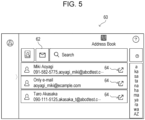
- Fig. 5 illustrates an example in which after e-mail is selected by using the address-type selection button 62, addresses including e-mail registered as the address type are extracted and are displayed on the contact list screen 60.
- the display-order changing unit 56 changes a display order in which the addresses of multiple types registered on a per-contact basis are displayed on the contact list screen.
- the display order in the addresses of multiple types may be changed to display addresses of the type received by the address-type receiving unit 52 in the display area at the time of displaying addresses displayable in the display area among the addresses of the type registered in advance on a per-contact basis.
- addresses of the received type may be displayed in such a manner as to be given a higher display priority over addresses of different types in a predetermined display order in which the addresses of multiple types are displayed on the contact list screen 60.
- each of SMB, FTP, and SFTP, Internet fax, fax, and e-mail are set in this order by default.
- the display-order changing unit 56 changes the display order to display an address of the type received by the address-type receiving unit 52 in the first place.
- the display-order changing unit 56 changes the display order to display e-mail in the first place among the addresses of multiple types, as illustrated in Fig. 6 .
- all of character strings of each address are displayable in the first place in the display area.
- an application window 66 for selecting an application associated with the address type registered for the corresponding contact as illustrated in Fig. 7 .
- the display order of applications is also changed to preferentially display the application, for example, to display, in the first place, the application associated with the address type received by the address-type receiving unit 52.
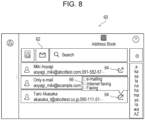
- Fig. 8 illustrates an example in which if e-mail is received as the address type, the display order of e-mailing as an application is changed to the first place.
- the display order is changed to display the address of the received type and the application associated with the address of the received type are displayed in the first place; however, if the address and the application in the second or succeeding place are displayable in the display area, the display order does not have to be changed, but the display priority may be changed to display the address and the application in the place preceding the second place. For example, if the address of the received type is displayable in a place other than the first place, the contact list screen 60 may be displayed without changing the display order. If there is a contact for which an address of the received type is not displayed in the display area, the display priority may be changed only for the contact.
- the screen display 58 executes a process for displaying the contact list screen or the like on the display of the user interface 22 in accordance with the result of the change by the display-order changing unit 56.
- the display processing unit 50 includes the address-type extraction unit 54. Contacts for which addresses of the type received by the address-type receiving unit 52 are registered are thus extracted, and the contact list screen 60 is displayed.
- the address-type extraction unit 54 may be omitted, and registered contacts may be displayed without being narrowed down.
- FIG. 9 is a flowchart illustrating an example of the processing performed by the display processing unit 50 of the image forming apparatus 10 according to this exemplary embodiment.
- the processing in Fig. 9 is started, for example, in response to an instruction to display an address book is given by operating the user interface 22.
- step S100 the CPU 20A displays the default address book, and the processing proceeds to step S102.
- the contact list screen 60 is displayed.
- addresses of multiple types registered on a per-contact basis are displayed in the predetermined order, and addresses displayable in the display area are displayed.
- step S102 the CPU 20A determines whether an address type is selected.
- the CPU 20A determines whether the address-type receiving unit 52 receives an address type, for example, on the basis of an operation of the address-type selection button 62 in Fig. 4 . If the determination result is affirmative, the processing proceeds to step S104. If the determination result is negative, the processing proceeds to step S112.
- step S104 the CPU 20A extracts contacts including addresses of the selected type, and the processing proceeds to step S106.
- the address-type extraction unit 54 extracts contacts for which the address type received by the address-type receiving unit 52 is registered, from the contacts registered in advance in the HDD 26 as the address database (DB).
- step S106 the CPU 20A determines whether any address of the selected type is undisplayable. For example, the display-order changing unit 56 determines whether the address of the selected type is located in a place other than the first place in the predetermined display order. Alternatively, the display-order changing unit 56 determines whether the display order prevents the address of the selected type from being displayed in the display area. If the determination result is affirmative, the processing proceeds to step S108. If the determination result is negative, the processing proceeds to step S112.
- the term "undisplayable" denotes a state where it is not possible to display the entirety of the address of the selected type in the display area.
- step S108 the CPU 20A changes the display order of each address of the selected type to the first place, and the processing proceeds to step S110.
- the display-order changing unit 56 changes the display order of the addresses of multiple types to place the address type received by the address-type receiving unit 52 in the first place.
- step S110 the CPU 20A updates the address book with the changed address book, and the processing proceeds to step S112. Specifically, the screen display 58 displays the contact list screen 60 on the display of the user interface 22 with the received address type being extracted and in the display order changed by the display-order changing unit 56.
- step S112 the CPU 20A determines whether an instruction to select an application is given.
- the CPU 20A determines whether, for example, one of the application selection buttons 64 provided on a per-contact basis on the contact list screen 60 is operated. If the determination result is negative, the processing proceeds to step S114. If the determination result is affirmative, the processing proceeds to step S116.
- step S114 the CPU 20A determines whether the displaying of the address book is to be terminated.
- the CPU 20A determines whether, for example, an operation for displaying an object other than the address book is performed on the user interface 22. If the determination result is negative, the processing returns to step S102, and steps above are repeated. If the determination result is affirmative, the series of steps are terminated.
- step S116 the processing proceeds to a process for displaying an application-selection-instruction window.
- the process for displaying an application-selection-instruction window will herein be described.
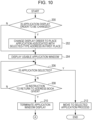
- Fig. 10 is a flowchart illustrating an example of the process for displaying an application-selection-instruction window.
- step S200 the CPU 20A determines whether the application display order is to be changed.
- the display-order changing unit 56 determines whether, for example, the application associated with the address type received by the address-type receiving unit 52 is located in a place other than the first place in the predetermined display order of the application associated with the address type registered for the contact having undergone the operation of the application selection button 64. If the determination result is affirmative, the processing proceeds to step S202. If the determination result is negative, the processing proceeds to step S204.
- step S202 the CPU 20A changes the display order to place the application associated with the address of the selected type in the first place.
- the display-order changing unit 56 changes the display order of the application to place the application associated with the address type received by the address-type receiving unit 52 in the first place.
- step S204 the CPU 20A displays a usable application window, and the processing proceeds to step S206.
- the screen display 58 displays a list of usable applications as the application window 66.
- step S206 the CPU 20A determines whether an application is selected.
- the CPU 20A determines whether an operation for selecting an application is performed on the displayed application window 66. If the determination result is negative, the processing proceeds to step S208. If the determination result is affirmative, the processing proceeds to step S212.
- step S208 the CPU 20A determines whether an instruction to return to the address book is given.
- the CPU 20A determines whether, for example, an operation of an object other than the application window 66 is performed. If the determination result is negative, the processing returns to step S206, and the steps above are repeated. If the determination result is affirmative, the processing proceeds to step S210.
- step S210 the CPU 20A terminates displaying the application window 66.
- the processing returns to step S102 above, and the steps above are repeated.
- step S212 the CPU 20A moves to a process for the selected application and terminates the series of steps.
- the order in which the addresses of multiple types are displayed on the contact list screen 60 is changed to display the address of the received type; however, the displaying is not limited to this.
- only addresses of the received type may be displayed without displaying addresses of different types.
- addresses of the received type may be displayed in the first place, and addresses of different types not completely displayed in the display area, if any, may be displayed in order by performing scrolling or display change.
- the application window 66 only the application associated with the addresses of the received type may be displayed without displaying any application associated with the addresses of different types.
- the image forming apparatus 10 has been described as an example; however, the exemplary embodiment is not limited to this and may be applied to a mobile terminal apparatus such as a smartphone and other devices.
- a mobile terminal apparatus such as a smartphone and other devices.
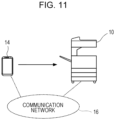
- the mobile terminal apparatus 14 capable of remotely operating the image forming apparatus 10 may be applied to the information processing apparatus.
- the mobile terminal apparatus 14 is configured to be able to communicate with the image forming apparatus 10 through near field communication, and thus the image forming apparatus 10 may be operated from the mobile terminal apparatus 14.
- a tablet terminal, a smartphone, or the like is applied to the mobile terminal apparatus 14.
- the contact list screen 60 may be displayed on the mobile terminal apparatus 14 when the image forming apparatus 10 is remotely operated from the mobile terminal apparatus 14 through communication between the mobile terminal apparatus 14 and the image forming apparatus 10.
- the communication between the mobile terminal apparatus 14 and the image forming apparatus 10 may be performed not by the near field communication but through radio base stations in a mobile network and the like and through the communication network 16 for various networks (such as LAN, WAN, Ethernet (registered trademark)).
- the exemplary embodiment is not limited to this.
- the address type may be received before the contact list screen 60 is displayed, and then the contact list screen 60 displayed in the display order changed from the predetermined display order may be displayed.
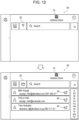
- the contact list screen 60 may be displayed in such a manner that a higher priority in the display order is given to addresses of the selected type over addresses of different types by the following operations. Specifically, as illustrated in the upper part of Fig. 12 , the contact list screen 60 without the list of individual contacts is displayed, an address type is selected by operating the address-type selection button 62, and thereafter an address book button 70 is operated.
- Fig. 12 is a view illustrating an example in which after the address type is selected, the contact list screen 60 is displayed in such a manner that a higher display priority is given to the address of the selected type over addresses of different types.
- processor refers to hardware in a broad sense.
- Examples of the processor include general processors (e.g., CPU: Central Processing Unit) and dedicated processors (e.g., GPU: Graphics Processing Unit, ASIC: Application Specific Integrated Circuit, FPGA: Field Programmable Gate Array, and programmable logic device).
- processor is broad enough to encompass one processor or plural processors in collaboration which are located physically apart from each other but may work cooperatively.
- the order of operations of the processor is not limited to one described in the embodiments above, and may be changed.
- the processing by the image forming apparatus 10 according to the exemplary embodiment above may be performed by software, hardware, or combination of these.
- the processing by the image forming apparatus 10 may also be stored as a program in the storage medium to be distributed.
Landscapes
- Engineering & Computer Science (AREA)
- General Engineering & Computer Science (AREA)
- Signal Processing (AREA)
- Theoretical Computer Science (AREA)
- Human Computer Interaction (AREA)
- Multimedia (AREA)
- General Physics & Mathematics (AREA)
- Physics & Mathematics (AREA)
- Library & Information Science (AREA)
- Computing Systems (AREA)
- General Business, Economics & Management (AREA)
- Business, Economics & Management (AREA)
- Facsimiles In General (AREA)
- Telephone Function (AREA)
- Small-Scale Networks (AREA)
- User Interface Of Digital Computer (AREA)
- Two-Way Televisions, Distribution Of Moving Picture Or The Like (AREA)
Abstract
Description
- The present disclosure relates to an information processing apparatus, an information processing system, and a program.
-
Japanese Patent Application Publication No. 2021-119499 - The local application icon is displayed: in response to the reception of information indicating the current use of the external application in the external device while the multiple application icons are displayed; and on the basis of the presence of the external device in the range near the electronic device.
-
Japanese Unexamined Patent Application Publication No. 2013-004072 -
Japanese Unexamined Patent Application Publication No. 2009-094887 - Suppose a case where addresses of multiple types are registerable for one contact. When the contact is displayed including the registered addresses, some limitation on a display area prevents the addresses from being displayed up to an address of an intended type, and thus the address of the intended type is prevented from being verified on occasions.
- Accordingly, it is an object of the present disclosure to provide an information processing apparatus, an information processing system, and a program that are enabled to verify an address of an intended type at the time of displaying a contact allowing the registration of the addresses of multiple types.
- According to a first aspect of the present disclosure, there is provided an information processing apparatus including a processor configured to: display a contact screen displaying an address displayable in a display area, the address being included in an address of a type registered in advance on a per-contact basis; receive a type of an address to be displayed among addresses of multiple types registrable on the per-contact basis; and in response to the address of the received type not being displayed in the display area, execute a process for displaying the contact screen after changing the contact screen to display the address of the received type.
- According to a second aspect of the present disclosure, there is provided an information processing apparatus including: a processor configured to: receive a type of an address to be displayed among addresses of multiple types registrable on a per-contact basis; and display a contact screen displaying an address displayable in a display area, the address being included in an address of a type registered in advance on a per-contact basis, and execute a process for displaying the contact screen with a higher priority given to the address of the received type over an address of a different type in a predetermined display order in which the addresses of the multiple types are displayed on the contact screen.
- According to a third aspect of the present disclosure, in the information processing apparatus according to the first aspect, the processor is configured to: display the contact screen displaying the addresses of the multiple types in a predetermined display order and change the contact screen to display the address of the received type by changing display priority.
- According to a fourth aspect of the present disclosure, in the information processing apparatus according to the first or second aspect, the processor is configured to: display the contact screen to display the address of the received type in a first place in the display area.
- According to a fifth aspect of the present disclosure, in the information processing apparatus according to the fourth aspect, all of character strings of an address are displayable in the first place in the display area.
- According to a sixth aspect of the present disclosure, in the information processing apparatus according to any one of the first to third aspects, the processor is configured to: in response to character strings of the address of the received type being displayable in a second place in the display area, display the address of the received type in a first place or the second place.
- According to a seventh aspect of the present disclosure, in the information processing apparatus according to the first or second aspect, the processor is configured to: not display an address other than the address of the received type.
- According to an eighth aspect of the present disclosure, in the information processing apparatus according to the first or second aspect, the processor is configured to: not display a contact not including the address of the received type.
- According to a ninth aspect of the present disclosure, in the information processing apparatus according to the first aspect, the processor is configured to: in response to presence of a contact including the address of the received type not displayed in the display area, change display priority in the contact.
- According to a tenth aspect of the present disclosure, in the information processing apparatus according to the first or second aspect, the processor is configured to: display the contact screen to display an address in the predetermined display order except the address of the received type.
- According to an eleventh aspect of the present disclosure, in the information processing apparatus according to the tenth aspect, the processor is configured to: display the address of the received type in a first place in the display area, and in response to the address of the different type not being displayed completely in the display area, to perform scrolling or changing display to display the address of the different type in order.
- According to a twelfth aspect of the present disclosure, in the information processing apparatus according to any one of the first to eleventh aspects, the processor is configured to: in response to reception of an instruction to select an application from the contact screen, display a selectable application and preferentially display an application associated with the address of the received type.
- According to a thirteenth aspect of the present disclosure, in the information processing apparatus according to the twelfth aspect, the processor is configured to: display an application of the received type in a first place in a display area.
- According to a fourteenth aspect of the present disclosure, there is provided an information processing system including the information processing apparatus according to any one of the first to thirteenth aspects; and an image forming apparatus that receives an instruction from the information processing apparatus.
- According to a fifteenth aspect of the present disclosure, there is provided a program causing a computer to execute a process for information processing, the process including: displaying a contact screen displaying an address displayable in a display area, the address being included in an address of a type registered in advance on a per-contact basis; receiving a type of an address to be displayed among addresses of multiple types registrable on the per-contact basis; and in response to the address of the received type not being displayed in the display area, executing a process for displaying the contact screen after changing the contact screen to display the address of the received type.
- According to the first aspect, the information processing apparatus enabled to verify an address of an intended type at the time of displaying the contact allowing the registration of the addresses of the multiple types may be provided.
- According to the second aspect, the information processing apparatus enabled to verify the address of the intended type at the time of displaying the contact allowing the registration of the addresses of the multiple types may be provided.
- According to the third aspect, the address of the intended type may be preferentially displayed.
- According to the fourth aspect, the address of the intended type may be verified.
- According to the fifth aspect, all of the character strings of the address of the intended type may be verified.
- According to the sixth aspect, the address of the intended type may be verified.
- According to the seventh aspect, only the address of the intended type may be verified.
- According to the eighth aspect, the contact including the registered address of the intended type may be displayed.
- According to the ninth aspect, the address of the intended type may be preferentially displayed on the per-contact basis.
- According to the tenth aspect, the address other than the address of the intended type may be verified.
- According to the eleventh aspect, the address other than the address of the intended type may be verified in order.
- According to the twelfth aspect, the application associated with the intended type may be selected more easily than in a case where multiple applications are displayed in the predetermined order.
- According to the thirteenth aspect, the application associated with the intended type may be selected more easily than in the case where multiple applications are displayed in the predetermined order.
- According to the fourteenth aspect, the information processing system enabled to verify an address of an intended type at the time of displaying the contact allowing the registration of the addresses of the multiple types may be provided.
- According to the fifteenth aspect, the program enabled to verify the address of the intended type at the time of displaying the contact allowing the registration of the addresses of the multiple types may be provided.
- An exemplary embodiment of the present disclosure will be described in detail based on the following figures, wherein:
-
Fig. 1 is a block diagram illustrating the configuration of an image forming apparatus according to this exemplary embodiment; -
Fig. 2 is a block diagram illustrating an example functional configuration of a control unit of the image forming apparatus according to this exemplary embodiment; -
Fig. 3 is a view illustrating an example of a contact registration screen; -
Fig. 4 is a view illustrating an example of a contact list screen; -
Fig. 5 is a view illustrating an example in which addresses including registered e-mails are displayed on the contact list screen after e-mail is selected by using an address-type selection button; -
Fig. 6 is a view illustrating an example of a contact list screen having undergone display order change to display e-mail in the first place among addresses of multiple types; -
Fig. 7 is a view illustrating an example of an application window for selecting an application; -
Fig. 8 is a view illustrating an example of an application window in which the display order of e-mailing serving as an application is changed to the first place after e-mail is received as the type of an address; -
Fig. 9 is a flowchart illustrating an example of processing performed by a display processing unit of the image forming apparatus according to this exemplary embodiment; -
Fig. 10 is a flowchart illustrating an example of a process for displaying an application-selection-instruction window; -
Fig. 11 is a view illustrating an example of an information processing system including the image forming apparatus and a mobile terminal apparatus; and -
Fig. 12 is a view illustrating an example in which after the type of an address is selected, the contact list screen is displayed in such a manner that addresses of the selected type are given a higher display priority over addresses of different types. - Hereinafter, an example of an exemplary embodiment of the present disclosure will be described in detail with reference to the drawings. In this exemplary embodiment, an image forming apparatus will be described as an example of an information processing apparatus.
Fig. 1 is a block diagram illustrating the configuration of the image forming apparatus according to this exemplary embodiment. - For example, an image forming apparatus having multiple functions such as a faxing function, an image reading function, an image forming function, a copying function, a storage function of storing image information and the like, and a transmission function of transmitting image information and the like is applied to an
image forming apparatus 10 according to this exemplary embodiment. - As illustrated in
Fig. 1 , theimage forming apparatus 10 according to this exemplary embodiment includes acontrol unit 20 including a central processing unit (CPU) 20A as an example of a processor, a read only memory (ROM) 20B, and a random access memory (RAM) 20C. TheCPU 20A administers the overall operation of theimage forming apparatus 10. TheRAM 20C is used as a work area or the like at the time when theCPU 20A runs various programs. TheROM 20B stores in advance various control programs, various parameters, and the like. In theimage forming apparatus 10, the components of thecontrol unit 20 are electrically connected through asystem bus 42. - The
image forming apparatus 10 according to this exemplary embodiment includes a hard disk drive (HDD) 26 that stores various pieces of data, application programs, and the like. Theimage forming apparatus 10 also includes adisplay controller 28 that is connected to auser interface 22 and that controls the display of various operation screens and the like to be displayed on the display of theuser interface 22. Theimage forming apparatus 10 also includes an operation-input detection unit 30 that is connected to theuser interface 22 and that detects an operation instruction input by using theuser interface 22. In theimage forming apparatus 10, theHDD 26, thedisplay controller 28, and the operation-input detection unit 30 are electrically connected to thesystem bus 42. Although theHDD 26 is applied to a memory in theimage forming apparatus 10 according to this exemplary embodiment, the memory is not limited to this. A nonvolatile memory such as the flash memory may also be applied. - The
image forming apparatus 10 according to this exemplary embodiment also includes a readingcontroller 32 and an image-formation controller 34. The readingcontroller 32 controls an optical image-reading operation by adocument reading unit 44 and a document feed operation by a document transportation unit. The image-formation controller 34 controls an image forming process by animage forming unit 24 and sheet transportation to theimage forming unit 24 by atransportation unit 25. Theimage forming apparatus 10 also includes a communication network interface (I/F)unit 36 that transmits and receives communication data to and from a different external apparatus connected to acommunication network 16 for various networks and an apparatus such as a mobile terminal apparatus through near field communication. Theimage forming apparatus 10 also includes a facsimile I/F unit 38 that is connected to a telephone network (not illustrated) and that transmits and receives facsimile data to and from a fax machine connected to the telephone network. Theimage forming apparatus 10 also includes a transmission/reception controller 40 that controls transmission and reception of facsimile data through the facsimile I/F unit 38. In theimage forming apparatus 10, the transmission/reception controller 40, the readingcontroller 32, the image-formation controller 34, a communication-network I/F unit 36, and the facsimile I/F unit 38 are electrically connected to thesystem bus 42. - With the configuration above, in the
image forming apparatus 10 according to this exemplary embodiment, theCPU 20A allows access to each of theRAM 20C, theROM 20B, and theHDD 26. By using theCPU 20A, theimage forming apparatus 10 also controls displaying of an operation screen to be displayed on a display 22A of theuser interface 22 by using thedisplay controller 28 and information such as various messages. By using theCPU 20A, theimage forming apparatus 10 also controls the operation of thedocument reading unit 44 and the document transportation unit by using the readingcontroller 32. By using theCPU 20A, theimage forming apparatus 10 controls the operation of theimage forming unit 24 and thetransportation unit 25 by using the image-formation controller 34 and controls the transmission and reception of the communication data by using the communication-network I/F unit 36. In theimage forming apparatus 10, theCPU 20A controls the transmission and reception of facsimile data by the transmission/reception controller 40 by using the facsimile I/F unit 38. Further, in theimage forming apparatus 10, theCPU 20A comprehends the content of operations of theuser interface 22 on the basis of operation information detected by the operation-input detection unit 30 and performs various controls based on the content of the operation. -
Fig. 2 is a block diagram illustrating an example functional configuration of thecontrol unit 20 of theimage forming apparatus 10 according to this exemplary embodiment. - As illustrated in
Fig. 2 , theCPU 20A runs a program stored in theROM 20B, and thereby thecontrol unit 20 of theimage forming apparatus 10 according to this exemplary embodiment functions as adisplay processing unit 50 that executes, for example, a process for displaying the operation screen for operating theimage forming apparatus 10. - The
display processing unit 50 executes a process for displaying a contact registration screen for registering a contact and a process for displaying a contact list screen as an example of a contact screen representing the registered contacts. - The contact registration screen is a screen for registering a contact such as an address name or an address. For example, the screen as illustrated in
Fig. 3 is displayed as the contact registration screen. In theimage forming apparatus 10 according to this exemplary embodiment, addresses of multiple types are registerable for one contact. For example, as illustrated inFig. 3 , when a new address name is registered as a contact, addresses of multiple types are registerable for one contact (the address name inFig. 3 ). The example inFig. 3 illustrates an example screen for registering, as a type of an address, e-mail, server message block (SMB), file transfer protocol (FTP), SSH file transfer protocol (SFTP), fax, Internet protocol (IP) fax, and Internet fax. - The contact list screen is a screen on which addresses of multiple types registered from the contact registration screen are displayed on a per-contact basis. The
image forming apparatus 10 according to this exemplary embodiment displays acontact list screen 60 as illustrated inFig. 4 . The addresses of multiple types registered from the contact registration screen are thus displayed on a per-contact basis.Fig. 4 is a view illustrating an example of thecontact list screen 60. - In a detailed description, the
display processing unit 50 has respective functions of an address-type receiving unit 52, an address-type extraction unit 54, a display-order changing unit 56, and ascreen display 58. - The address-
type receiving unit 52 receives a type of an address to be displayed among the addresses of multiple types registerable on a per-contact basis. In theimage forming apparatus 10 according to this exemplary embodiment, addresses may be filtered on the basis of an address type in displaying thecontact list screen 60 representing a list of registered contacts. The address-type receiving unit 52 thus receives an address type for the filtering. For example, the address type is received by receiving an operation of an address-type selection button 62 inFig. 4 . For example, if an operation of the address-type selection button 62 illustrated inFig. 4 is received, awindow 63 displaying a selectable address type is displayed, a selection result is received, and thereby an address type is received. An address type may be changed every touch operation of the address-type selection button 62. - The address-
type extraction unit 54 extracts contacts for which the address type received by the address-type receiving unit 52 is registered, from contacts registered in advance in theHDD 26 as an address database (DB). For example, if e-mail is received as the address type, contacts including e-mail registered as the address type are extracted.Fig. 5 illustrates an example in which after e-mail is selected by using the address-type selection button 62, addresses including e-mail registered as the address type are extracted and are displayed on thecontact list screen 60. - The display-
order changing unit 56 changes a display order in which the addresses of multiple types registered on a per-contact basis are displayed on the contact list screen. The display order in the addresses of multiple types may be changed to display addresses of the type received by the address-type receiving unit 52 in the display area at the time of displaying addresses displayable in the display area among the addresses of the type registered in advance on a per-contact basis. Alternatively, addresses of the received type may be displayed in such a manner as to be given a higher display priority over addresses of different types in a predetermined display order in which the addresses of multiple types are displayed on thecontact list screen 60. In this exemplary embodiment, as the predetermined display order, each of SMB, FTP, and SFTP, Internet fax, fax, and e-mail are set in this order by default. Hereinafter, an example in which the display-order changing unit 56 changes the display order to display an address of the type received by the address-type receiving unit 52 in the first place will be described. Specifically, in the case of receiving, for example, e-mail as the address type, the display-order changing unit 56 changes the display order to display e-mail in the first place among the addresses of multiple types, as illustrated inFig. 6 . In the example inFig. 6 , all of character strings of each address are displayable in the first place in the display area. In addition, in this exemplary embodiment, if one ofapplication selection buttons 64 provided on a per-contact basis on thecontact list screen 60 is operated, anapplication window 66 for selecting an application associated with the address type registered for the corresponding contact, as illustrated inFig. 7 . To display theapplication window 66, the display order of applications is also changed to preferentially display the application, for example, to display, in the first place, the application associated with the address type received by the address-type receiving unit 52. For example,Fig. 8 illustrates an example in which if e-mail is received as the address type, the display order of e-mailing as an application is changed to the first place. Note that in this exemplary embodiment, the display order is changed to display the address of the received type and the application associated with the address of the received type are displayed in the first place; however, if the address and the application in the second or succeeding place are displayable in the display area, the display order does not have to be changed, but the display priority may be changed to display the address and the application in the place preceding the second place. For example, if the address of the received type is displayable in a place other than the first place, thecontact list screen 60 may be displayed without changing the display order. If there is a contact for which an address of the received type is not displayed in the display area, the display priority may be changed only for the contact. - The
screen display 58 executes a process for displaying the contact list screen or the like on the display of theuser interface 22 in accordance with the result of the change by the display-order changing unit 56. - In this exemplary embodiment, the
display processing unit 50 includes the address-type extraction unit 54. Contacts for which addresses of the type received by the address-type receiving unit 52 are registered are thus extracted, and thecontact list screen 60 is displayed. However, the address-type extraction unit 54 may be omitted, and registered contacts may be displayed without being narrowed down. - Specific processing performed by the
image forming apparatus 10 according to this exemplary embodiment as configured above will be described.Fig. 9 is a flowchart illustrating an example of the processing performed by thedisplay processing unit 50 of theimage forming apparatus 10 according to this exemplary embodiment. The processing inFig. 9 is started, for example, in response to an instruction to display an address book is given by operating theuser interface 22. - In step S100, the
CPU 20A displays the default address book, and the processing proceeds to step S102. For example, as illustrated inFig. 4 , thecontact list screen 60 is displayed. On thecontact list screen 60, addresses of multiple types registered on a per-contact basis are displayed in the predetermined order, and addresses displayable in the display area are displayed. - In step S102, the
CPU 20A determines whether an address type is selected. TheCPU 20A determines whether the address-type receiving unit 52 receives an address type, for example, on the basis of an operation of the address-type selection button 62 inFig. 4 . If the determination result is affirmative, the processing proceeds to step S104. If the determination result is negative, the processing proceeds to step S112. - In step S104, the
CPU 20A extracts contacts including addresses of the selected type, and the processing proceeds to step S106. Specifically, the address-type extraction unit 54 extracts contacts for which the address type received by the address-type receiving unit 52 is registered, from the contacts registered in advance in theHDD 26 as the address database (DB). - In step S106, the
CPU 20A determines whether any address of the selected type is undisplayable. For example, the display-order changing unit 56 determines whether the address of the selected type is located in a place other than the first place in the predetermined display order. Alternatively, the display-order changing unit 56 determines whether the display order prevents the address of the selected type from being displayed in the display area. If the determination result is affirmative, the processing proceeds to step S108. If the determination result is negative, the processing proceeds to step S112. The term "undisplayable" denotes a state where it is not possible to display the entirety of the address of the selected type in the display area. - In step S108, the
CPU 20A changes the display order of each address of the selected type to the first place, and the processing proceeds to step S110. Specifically, the display-order changing unit 56 changes the display order of the addresses of multiple types to place the address type received by the address-type receiving unit 52 in the first place. - In step S110, the
CPU 20A updates the address book with the changed address book, and the processing proceeds to step S112. Specifically, thescreen display 58 displays thecontact list screen 60 on the display of theuser interface 22 with the received address type being extracted and in the display order changed by the display-order changing unit 56. - In step S112, the
CPU 20A determines whether an instruction to select an application is given. TheCPU 20A determines whether, for example, one of theapplication selection buttons 64 provided on a per-contact basis on thecontact list screen 60 is operated. If the determination result is negative, the processing proceeds to step S114. If the determination result is affirmative, the processing proceeds to step S116. - In step S114, the
CPU 20A determines whether the displaying of the address book is to be terminated. TheCPU 20A determines whether, for example, an operation for displaying an object other than the address book is performed on theuser interface 22. If the determination result is negative, the processing returns to step S102, and steps above are repeated. If the determination result is affirmative, the series of steps are terminated. - In contrast, in step S116, the processing proceeds to a process for displaying an application-selection-instruction window. The process for displaying an application-selection-instruction window will herein be described.
Fig. 10 is a flowchart illustrating an example of the process for displaying an application-selection-instruction window. - In step S200, the
CPU 20A determines whether the application display order is to be changed. The display-order changing unit 56 determines whether, for example, the application associated with the address type received by the address-type receiving unit 52 is located in a place other than the first place in the predetermined display order of the application associated with the address type registered for the contact having undergone the operation of theapplication selection button 64. If the determination result is affirmative, the processing proceeds to step S202. If the determination result is negative, the processing proceeds to step S204. - In step S202, the
CPU 20A changes the display order to place the application associated with the address of the selected type in the first place. Specifically, the display-order changing unit 56 changes the display order of the application to place the application associated with the address type received by the address-type receiving unit 52 in the first place. - In step S204, the
CPU 20A displays a usable application window, and the processing proceeds to step S206. Specifically, as illustrated inFigs. 7 and8 , thescreen display 58 displays a list of usable applications as theapplication window 66. - In step S206, the
CPU 20A determines whether an application is selected. TheCPU 20A determines whether an operation for selecting an application is performed on the displayedapplication window 66. If the determination result is negative, the processing proceeds to step S208. If the determination result is affirmative, the processing proceeds to step S212. - In step S208, the
CPU 20A determines whether an instruction to return to the address book is given. TheCPU 20A determines whether, for example, an operation of an object other than theapplication window 66 is performed. If the determination result is negative, the processing returns to step S206, and the steps above are repeated. If the determination result is affirmative, the processing proceeds to step S210. - In step S210, the
CPU 20A terminates displaying theapplication window 66. The processing returns to step S102 above, and the steps above are repeated. - In contrast, in step S212, the
CPU 20A moves to a process for the selected application and terminates the series of steps. - In the exemplary embodiment above, the order in which the addresses of multiple types are displayed on the
contact list screen 60 is changed to display the address of the received type; however, the displaying is not limited to this. For example, only addresses of the received type may be displayed without displaying addresses of different types. Alternatively, addresses of the received type may be displayed in the first place, and addresses of different types not completely displayed in the display area, if any, may be displayed in order by performing scrolling or display change. Also for theapplication window 66, only the application associated with the addresses of the received type may be displayed without displaying any application associated with the addresses of different types. - In the exemplary embodiment above, the
image forming apparatus 10 has been described as an example; however, the exemplary embodiment is not limited to this and may be applied to a mobile terminal apparatus such as a smartphone and other devices. For example, as illustrated inFig. 11 , in an information processing system including theimage forming apparatus 10 and a mobileterminal apparatus 14, the mobileterminal apparatus 14 capable of remotely operating theimage forming apparatus 10 may be applied to the information processing apparatus. In this case, the mobileterminal apparatus 14 is configured to be able to communicate with theimage forming apparatus 10 through near field communication, and thus theimage forming apparatus 10 may be operated from the mobileterminal apparatus 14. For example, a tablet terminal, a smartphone, or the like is applied to the mobileterminal apparatus 14. In addition, for example, Wi-Fi (registered trademark), Bluetooth (registered trademark), or the like is applied to the near field communication. Like the exemplary embodiment above, thecontact list screen 60 may be displayed on the mobileterminal apparatus 14 when theimage forming apparatus 10 is remotely operated from the mobileterminal apparatus 14 through communication between the mobileterminal apparatus 14 and theimage forming apparatus 10. In this case, as represented by dotted lines inFig. 11 , the communication between the mobileterminal apparatus 14 and theimage forming apparatus 10 may be performed not by the near field communication but through radio base stations in a mobile network and the like and through thecommunication network 16 for various networks (such as LAN, WAN, Ethernet (registered trademark)). - In the exemplary embodiment above, the example in which the address type is received after the
contact list screen 60 is displayed, and then the display order of the address type is changed has been described, but the exemplary embodiment is not limited to this. For example, the address type may be received before thecontact list screen 60 is displayed, and then thecontact list screen 60 displayed in the display order changed from the predetermined display order may be displayed. For example, thecontact list screen 60 may be displayed in such a manner that a higher priority in the display order is given to addresses of the selected type over addresses of different types by the following operations. Specifically, as illustrated in the upper part ofFig. 12 , thecontact list screen 60 without the list of individual contacts is displayed, an address type is selected by operating the address-type selection button 62, and thereafter anaddress book button 70 is operated.Fig. 12 is a view illustrating an example in which after the address type is selected, thecontact list screen 60 is displayed in such a manner that a higher display priority is given to the address of the selected type over addresses of different types. - In the embodiments above, the CPU has been described as an example of the processor. The term "processor" refers to hardware in a broad sense. Examples of the processor include general processors (e.g., CPU: Central Processing Unit) and dedicated processors (e.g., GPU: Graphics Processing Unit, ASIC: Application Specific Integrated Circuit, FPGA: Field Programmable Gate Array, and programmable logic device).
- In the embodiments above, the term "processor" is broad enough to encompass one processor or plural processors in collaboration which are located physically apart from each other but may work cooperatively. The order of operations of the processor is not limited to one described in the embodiments above, and may be changed.
- The processing by the
image forming apparatus 10 according to the exemplary embodiment above may be performed by software, hardware, or combination of these. The processing by theimage forming apparatus 10 may also be stored as a program in the storage medium to be distributed. - The present disclosure is not limited to the above, and it goes without saying that in addition to the above, various modifications may be made to implement the disclosure without departing from the spirit of thereof.
- The foregoing description of the exemplary embodiments of the present disclosure has been provided for the purposes of illustration and description. It is not intended to be exhaustive or to limit the disclosure to the precise forms disclosed. Obviously, many modifications and variations will be apparent to practitioners skilled in the art. The embodiments were chosen and described in order to best explain the principles of the disclosure and its practical applications, thereby enabling others skilled in the art to understand the disclosure for various embodiments and with the various modifications as are suited to the particular use contemplated. It is intended that the scope of the disclosure be defined by the following claims and their equivalents.
Claims (15)
- An information processing apparatus comprising:
a processor configured to:display a contact screen displaying an address displayable in a display area, the address being included in an address of a type registered in advance on a per-contact basis;receive a type of an address to be displayed among addresses of a plurality of types registrable on the per-contact basis; andin response to the address of the received type not being displayed in the display area, execute a process for displaying the contact screen after changing the contact screen to display the address of the received type. - An information processing apparatus comprising:
a processor configured to:receive a type of an address to be displayed among addresses of a plurality of types registrable on a per-contact basis; anddisplay a contact screen displaying an address displayable in a display area, the address being included in an address of a type registered in advance on a per-contact basis, and execute a process for displaying the contact screen with a higher priority given to the address of the received type over an address of a different type in a predetermined display order in which the addresses of the plurality of types are displayed on the contact screen. - The information processing apparatus according to Claim 1,
wherein the processor is configured to: display the contact screen displaying the addresses of the plurality of types in a predetermined display order and change the contact screen to display the address of the received type by changing display priority. - The information processing apparatus according to Claim 1 or 2,
wherein the processor is configured to: display the contact screen to display the address of the received type in a first place in the display area. - The information processing apparatus according to Claim 4,
wherein all of character strings of an address are displayable in the first place in the display area. - The information processing apparatus according to any one of Claims 1 to 3,
wherein the processor is configured to: in response to character strings of the address of the received type being displayable in a second place in the display area, display the address of the received type in a first place or the second place. - The information processing apparatus according to Claim 1 or 2,
wherein the processor is configured to: not display an address other than the address of the received type. - The information processing apparatus according to Claim 1 or 2,
wherein the processor is configured to: not display a contact not including the address of the received type. - The information processing apparatus according to Claim 1,
wherein the processor is configured to: in response to presence of a contact including the address of the received type not displayed in the display area, change display priority in the contact. - The information processing apparatus according to Claim 1 or 2,
wherein the processor is configured to: display the contact screen to display an address in the predetermined display order except the address of the received type. - The information processing apparatus according to Claim 10,
wherein the processor is configured to: display the address of the received type in a first place in the display area, and in response to the address of the different type not being displayed completely in the display area, to perform scrolling or changing display to display the address of the different type in order. - The information processing apparatus according to any one of Claims 1 to 11,
wherein the processor is configured to: in response to reception of an instruction to select an application from the contact screen, display a selectable application and preferentially display an application associated with the address of the received type. - The information processing apparatus according to Claim 12,
wherein the processor is configured to: display an application of the received type in a first place in a display area. - An information processing system comprising:the information processing apparatus according to any one of Claims 1 to 13; andan image forming apparatus that receives an instruction from the information processing apparatus.
- A program causing a computer to execute a process for information processing, the process comprising:displaying a contact screen displaying an address displayable in a display area, the address being included in an address of a type registered in advance on a per-contact basis;receiving a type of an address to be displayed among addresses of a plurality of types registrable on the per-contact basis; andin response to the address of the received type not being displayed in the display area, executing a process for displaying the contact screen after changing the contact screen to display the address of the received type.
Applications Claiming Priority (1)
| Application Number | Priority Date | Filing Date | Title |
|---|---|---|---|
| JP2021199644A JP7822762B2 (en) | 2021-12-08 | 2021-12-08 | Information processing device, information processing system, and information processing program |
Publications (2)
| Publication Number | Publication Date |
|---|---|
| EP4195016A2 true EP4195016A2 (en) | 2023-06-14 |
| EP4195016A3 EP4195016A3 (en) | 2023-09-06 |
Family
ID=84363697
Family Applications (1)
| Application Number | Title | Priority Date | Filing Date |
|---|---|---|---|
| EP22208937.7A Pending EP4195016A3 (en) | 2021-12-08 | 2022-11-22 | Information processing apparatus, information processing system, and program |
Country Status (4)
| Country | Link |
|---|---|
| US (1) | US12422972B2 (en) |
| EP (1) | EP4195016A3 (en) |
| JP (1) | JP7822762B2 (en) |
| CN (1) | CN116248800A (en) |
Families Citing this family (1)
| Publication number | Priority date | Publication date | Assignee | Title |
|---|---|---|---|---|
| JP7822762B2 (en) * | 2021-12-08 | 2026-03-03 | 富士フイルム株式会社 | Information processing device, information processing system, and information processing program |
Citations (3)
| Publication number | Priority date | Publication date | Assignee | Title |
|---|---|---|---|---|
| JP2009094887A (en) | 2007-10-10 | 2009-04-30 | Konica Minolta Business Technologies Inc | Image transmission apparatus, registration method, and registration program |
| JP2013004072A (en) | 2011-06-15 | 2013-01-07 | Mekiki:Kk | Electronic information transmission system, electronic information transmission repeating installation, electronic information transmission method and computer program |
| JP2021119499A (en) | 2014-05-30 | 2021-08-12 | アップル インコーポレイテッドApple Inc. | Continuity |
Family Cites Families (29)
| Publication number | Priority date | Publication date | Assignee | Title |
|---|---|---|---|---|
| US6675166B2 (en) * | 2000-02-09 | 2004-01-06 | The John Hopkins University | Integrated multidimensional database |
| JP2002041681A (en) | 2000-07-31 | 2002-02-08 | Recruit Co Ltd | System and method for supporting sales promotion activity and computer readable recording medium having program recorded thereon |
| JP4448000B2 (en) * | 2003-11-05 | 2010-04-07 | キヤノン株式会社 | Information transmission apparatus, information transmission destination designation method, storage medium, and program |
| US7694311B2 (en) * | 2004-09-29 | 2010-04-06 | International Business Machines Corporation | Grammar-based task analysis of web logs |
| JP4079156B2 (en) * | 2005-04-04 | 2008-04-23 | コニカミノルタビジネステクノロジーズ株式会社 | Data transmission device, destination setting auxiliary program, and recording medium for recording destination setting auxiliary program |
| US20070067726A1 (en) * | 2005-09-16 | 2007-03-22 | Microsoft Corporation | Content sharing user interface for mobile devices |
| US7904572B2 (en) * | 2006-11-10 | 2011-03-08 | Canon Denshi Kabushiki Kaisha | Method, apparatus, and medium for controlling access to and setting for features of an imaging processing device |
| JP4849677B2 (en) | 2006-11-10 | 2012-01-11 | キヤノン電子株式会社 | Information processing apparatus, information processing method, program, and storage medium |
| GB0702591D0 (en) * | 2007-02-09 | 2007-03-21 | Cognima Ltd | Mobile advertising |
| US9063981B2 (en) * | 2007-10-01 | 2015-06-23 | International Business Machines Corporation | Method and system for searching contact lists quickly—by group name, tags and/or metadata |
| US20100188697A1 (en) * | 2009-01-26 | 2010-07-29 | Kyocera Mita Corporation | Image forming apparatus and display method using operation display portion thereof |
| JP5337504B2 (en) | 2009-01-26 | 2013-11-06 | 京セラドキュメントソリューションズ株式会社 | Image forming apparatus |
| US8271597B2 (en) * | 2009-09-30 | 2012-09-18 | Bank Of America Corporation | Intelligent derivation of email addresses |
| US8341232B2 (en) * | 2009-09-30 | 2012-12-25 | Bank Of America Corporation | Relationship identification based on email traffic |
| US8856135B2 (en) * | 2009-09-30 | 2014-10-07 | Bank Of America Corporation | Intelligent sorting and correlation of email traffic |
| US8458224B2 (en) * | 2009-09-30 | 2013-06-04 | Bank Of America Corporation | Auditing search requests in a relationship analysis system |
| CA2781396C (en) * | 2009-12-01 | 2018-05-01 | Ringcentral, Inc. | Universal call management platform |
| AU2011340804A1 (en) * | 2010-12-09 | 2013-07-25 | Community Connections Australia | A mobility aid system |
| US20130132883A1 (en) * | 2011-11-22 | 2013-05-23 | Nokia Corporation | Apparatus and Associated Methods |
| KR102183856B1 (en) * | 2013-12-20 | 2020-11-30 | 삼성전자주식회사 | Terminal and Method for sharing content thereof |
| KR102314274B1 (en) * | 2014-08-18 | 2021-10-20 | 삼성전자주식회사 | Method for processing contents and electronics device thereof |
| US10380616B2 (en) * | 2015-06-10 | 2019-08-13 | Cheryl Parker | System and method for economic analytics and business outreach, including layoff aversion |
| US20160162924A1 (en) * | 2015-11-27 | 2016-06-09 | Yogesh Rathod | Track user activities and in exchange provide points to use for various activities including advertising contents to targeted users of network |
| WO2017222246A1 (en) * | 2016-06-22 | 2017-12-28 | S-Printing Solution Co., Ltd. | Content transmitting method and apparatus therefor |
| CN116578367A (en) * | 2017-12-29 | 2023-08-11 | 华为技术有限公司 | Programming method and electronic device |
| JP2020202506A (en) | 2019-06-11 | 2020-12-17 | キヤノン株式会社 | Information processing device, control method of the same, and program |
| JP7404746B2 (en) * | 2019-09-30 | 2023-12-26 | 富士フイルムビジネスイノベーション株式会社 | Information processing equipment, equipment control equipment and programs |
| JP7822762B2 (en) * | 2021-12-08 | 2026-03-03 | 富士フイルム株式会社 | Information processing device, information processing system, and information processing program |
| JP2025098727A (en) * | 2023-12-20 | 2025-07-02 | 富士フイルムビジネスイノベーション株式会社 | Information processing system and program |
-
2021
- 2021-12-08 JP JP2021199644A patent/JP7822762B2/en active Active
-
2022
- 2022-10-24 US US18/049,247 patent/US12422972B2/en active Active
- 2022-11-17 CN CN202211460340.3A patent/CN116248800A/en active Pending
- 2022-11-22 EP EP22208937.7A patent/EP4195016A3/en active Pending
Patent Citations (3)
| Publication number | Priority date | Publication date | Assignee | Title |
|---|---|---|---|---|
| JP2009094887A (en) | 2007-10-10 | 2009-04-30 | Konica Minolta Business Technologies Inc | Image transmission apparatus, registration method, and registration program |
| JP2013004072A (en) | 2011-06-15 | 2013-01-07 | Mekiki:Kk | Electronic information transmission system, electronic information transmission repeating installation, electronic information transmission method and computer program |
| JP2021119499A (en) | 2014-05-30 | 2021-08-12 | アップル インコーポレイテッドApple Inc. | Continuity |
Also Published As
| Publication number | Publication date |
|---|---|
| JP2023085139A (en) | 2023-06-20 |
| EP4195016A3 (en) | 2023-09-06 |
| US12422972B2 (en) | 2025-09-23 |
| JP7822762B2 (en) | 2026-03-03 |
| CN116248800A (en) | 2023-06-09 |
| US20230176709A1 (en) | 2023-06-08 |
Similar Documents
| Publication | Publication Date | Title |
|---|---|---|
| US12483525B2 (en) | Systems and methods for electronic distribution of messages over communication channels | |
| US8311531B2 (en) | Methods, apparatuses and computer program products for automatically saving information associated with one or more unknown contacts | |
| US20120050818A1 (en) | Sending scanned document data through a network to a mobile device | |
| CN105830391B (en) | presence-based content sharing | |
| US20080270613A1 (en) | Method of Processing a Contact for a Mobile Device and Related Device | |
| USRE48764E1 (en) | Information processing apparatus, recording system, computer readable medium | |
| EP4195016A2 (en) | Information processing apparatus, information processing system, and program | |
| CN110888701B (en) | A method, electronic device and medium for remote configuration of software resources | |
| JP2026042814A (en) | Information processing system, information processing device, data transfer method and program | |
| CN107844522A (en) | A kind of destination object display methods, device and electronic equipment | |
| CN108206890A (en) | A kind of applicative notifications management-control method, device and terminal | |
| CN107332762A (en) | Sharing method, mobile terminal and the device with store function of file/information | |
| JP5171392B2 (en) | Communication system, information holding device, and management device | |
| US20160150387A1 (en) | TextMuse Message Generator | |
| EP3223503B1 (en) | Image forming apparatus with confirmation display on which all selected transmission destinations fit on a single screen | |
| JP5924442B2 (en) | Operation terminal | |
| WO2016198957A1 (en) | Improved messaging service | |
| JP2020166544A (en) | E-mail check system, check device and e-mail check method | |
| KR101795620B1 (en) | Message transmission method in smart phone | |
| CN104518956B (en) | Instant message sends and receives system, terminal device and its control method | |
| JP2008203958A (en) | E-mail reception rejection setting method, program and portable terminal | |
| JP6492582B2 (en) | Information processing program and terminal device | |
| JP2008071310A (en) | Display device, information transmission device, information reception device, display method, transmission destination designation method, transmission destination display method, display program, transmission destination designation program, and transmission destination display program | |
| JP2007233666A (en) | E-mail sending device, e-mail sending method and program used therefor | |
| WO2016103926A1 (en) | Information processing apparatus and information processing apparatus control method |
Legal Events
| Date | Code | Title | Description |
|---|---|---|---|
| PUAI | Public reference made under article 153(3) epc to a published international application that has entered the european phase |
Free format text: ORIGINAL CODE: 0009012 |
|
| STAA | Information on the status of an ep patent application or granted ep patent |
Free format text: STATUS: THE APPLICATION HAS BEEN PUBLISHED |
|
| AK | Designated contracting states |
Kind code of ref document: A2 Designated state(s): AL AT BE BG CH CY CZ DE DK EE ES FI FR GB GR HR HU IE IS IT LI LT LU LV MC ME MK MT NL NO PL PT RO RS SE SI SK SM TR |
|
| PUAL | Search report despatched |
Free format text: ORIGINAL CODE: 0009013 |
|
| AK | Designated contracting states |
Kind code of ref document: A3 Designated state(s): AL AT BE BG CH CY CZ DE DK EE ES FI FR GB GR HR HU IE IS IT LI LT LU LV MC ME MK MT NL NO PL PT RO RS SE SI SK SM TR |
|
| RIC1 | Information provided on ipc code assigned before grant |
Ipc: H04N 1/00 20060101ALI20230802BHEP Ipc: H04M 1/27475 20200101ALI20230802BHEP Ipc: G06F 3/04842 20220101AFI20230802BHEP |
|
| STAA | Information on the status of an ep patent application or granted ep patent |
Free format text: STATUS: REQUEST FOR EXAMINATION WAS MADE |
|
| 17P | Request for examination filed |
Effective date: 20240214 |
|
| RBV | Designated contracting states (corrected) |
Designated state(s): AL AT BE BG CH CY CZ DE DK EE ES FI FR GB GR HR HU IE IS IT LI LT LU LV MC ME MK MT NL NO PL PT RO RS SE SI SK SM TR |