EP4194445A1 - Method for producing compound - Google Patents
Method for producing compound Download PDFInfo
- Publication number
- EP4194445A1 EP4194445A1 EP21853755.3A EP21853755A EP4194445A1 EP 4194445 A1 EP4194445 A1 EP 4194445A1 EP 21853755 A EP21853755 A EP 21853755A EP 4194445 A1 EP4194445 A1 EP 4194445A1
- Authority
- EP
- European Patent Office
- Prior art keywords
- group
- general formula
- compound represented
- added
- formula
- Prior art date
- Legal status (The legal status is an assumption and is not a legal conclusion. Google has not performed a legal analysis and makes no representation as to the accuracy of the status listed.)
- Granted
Links
Images
Classifications
-
- C—CHEMISTRY; METALLURGY
- C07—ORGANIC CHEMISTRY
- C07D—HETEROCYCLIC COMPOUNDS
- C07D303/00—Compounds containing three-membered rings having one oxygen atom as the only ring hetero atom
- C07D303/02—Compounds containing oxirane rings
- C07D303/48—Compounds containing oxirane rings with hetero atoms or with carbon atoms having three bonds to hetero atoms with at the most one bond to halogen, directly attached to ring carbon atoms, e.g. ester or nitrile radicals
-
- C—CHEMISTRY; METALLURGY
- C07—ORGANIC CHEMISTRY
- C07C—ACYCLIC OR CARBOCYCLIC COMPOUNDS
- C07C45/00—Preparation of compounds having >C = O groups bound only to carbon or hydrogen atoms; Preparation of chelates of such compounds
- C07C45/61—Preparation of compounds having >C = O groups bound only to carbon or hydrogen atoms; Preparation of chelates of such compounds by reactions not involving the formation of >C = O groups
- C07C45/63—Preparation of compounds having >C = O groups bound only to carbon or hydrogen atoms; Preparation of chelates of such compounds by reactions not involving the formation of >C = O groups by introduction of halogen; by substitution of halogen atoms by other halogen atoms
-
- C—CHEMISTRY; METALLURGY
- C07—ORGANIC CHEMISTRY
- C07C—ACYCLIC OR CARBOCYCLIC COMPOUNDS
- C07C67/00—Preparation of carboxylic acid esters
-
- C—CHEMISTRY; METALLURGY
- C07—ORGANIC CHEMISTRY
- C07C—ACYCLIC OR CARBOCYCLIC COMPOUNDS
- C07C67/00—Preparation of carboxylic acid esters
- C07C67/27—Preparation of carboxylic acid esters from ortho-esters
-
- C—CHEMISTRY; METALLURGY
- C07—ORGANIC CHEMISTRY
- C07C—ACYCLIC OR CARBOCYCLIC COMPOUNDS
- C07C67/00—Preparation of carboxylic acid esters
- C07C67/39—Preparation of carboxylic acid esters by oxidation of groups which are precursors for the acid moiety of the ester
- C07C67/42—Preparation of carboxylic acid esters by oxidation of groups which are precursors for the acid moiety of the ester by oxidation of secondary alcohols or ketones
-
- C—CHEMISTRY; METALLURGY
- C07—ORGANIC CHEMISTRY
- C07D—HETEROCYCLIC COMPOUNDS
- C07D249/00—Heterocyclic compounds containing five-membered rings having three nitrogen atoms as the only ring hetero atoms
- C07D249/02—Heterocyclic compounds containing five-membered rings having three nitrogen atoms as the only ring hetero atoms not condensed with other rings
- C07D249/08—1,2,4-Triazoles; Hydrogenated 1,2,4-triazoles
-
- C—CHEMISTRY; METALLURGY
- C07—ORGANIC CHEMISTRY
- C07D—HETEROCYCLIC COMPOUNDS
- C07D301/00—Preparation of oxiranes
- C07D301/02—Synthesis of the oxirane ring
Definitions
- the present invention relates to a method for producing a compound.
- An azole derivative is useful as an agricultural or horticultural chemical exhibiting a high controlling effect.
- a method for producing an intermediate product of an azole derivative has been studied.
- Patent Document 1 describes a method for producing methyl-2-(2-chloro-4-(4-chlorophenoxy)phenyl)-2-oxoacetate, which is an intermediate product of an azole derivative.
- Patent Document 1 WO 2019/093522 A1
- Patent Document 1 The method for producing an intermediate compound of an azole derivative described in Patent Document 1 describes performing oxiranation using trimethylsulfoxonium bromide (TMSOB) and substituting a ketone group for a ketoester group using iodine or iodomethane.
- TMSOB trimethylsulfoxonium bromide
- iodine, and iodomethane are expensive, there is an issue of increased production cost of an intermediate product of an azole derivative. Therefore, a method for producing an intermediate product of an azole derivative at a lower cost is demanded.
- the present invention has been completed in light of the issues described above, and an object of an aspect of the present invention is to realize a method by which an intermediate product of an azole derivative can be produced at a lower cost than those of known production methods.
- the production method according to an aspect of the present invention is a method for producing a compound represented by General Formula (IV):
- an intermediate product of an azole derivative can be produced at a lower cost than those of known production methods.
- production method 1 The method for producing a compound represented by General Formula (IV) (hereinafter, referred to as “oxirane derivative (IV)”) according to an aspect of the present invention (hereinafter, referred to as “production method 1") will be described:
- the C 1 -C 6 -alkyl group is a linear or branched alkyl group having from 1 to 6 carbon atoms, and examples thereof include a methyl group, an ethyl group, a 1-methylethyl group, a 1,1-dimethylethyl group, a propyl group, a 1-methylpropyl group, a 2-methylpropyl group, a 1,1-dimethylpropyl group, a 2,2-dimethylpropyl group, a 1-ethylpropyl group, a butyl group, a 1-methylbutyl group, a 2-methylbutyl group, a 3-methylbutyl group, a 3,3-dimethylbutyl group, a 2,2-dimethylbutyl group, a 1,1-dimethylbutyl group, a 1-ethylbutyl group, a 2-ethylbutyl group, a pentyl group, a 1-methylpentyl group,
- halogen group examples include a chlorine group, a bromine group, an iodine group, and a fluorine group.
- the C 1 -C 4 -haloalkyl group has one or more halogen atoms as substituents at substitutable positions of the C 1 -C 4 -alkyl group, and in a case of substitution with two or more halogen groups, the halogen groups may be the same or different.
- the C 1 -C 4 -alkyl group is a linear or branched alkyl group having from 1 to 4 carbon atoms.
- the C 1 -C 4 -alkyl group is a linear or branched alkyl group having from 1 to 4 carbon atoms, and examples thereof include a methyl group, an ethyl group, a propyl group, and a butyl group.
- the halogen group is as described above.
- Examples of the C 1 -C 4 -haloalkyl group include a chloromethyl group, a 2-chloroethyl group, a 2,3-dichloropropyl group, a bromomethyl group, a chlorodifluoromethyl group, a trifluoromethyl group, and a 3,3,3-trifluoropropyl group.
- the C 1 -C 4 -haloalkoxy group has one or more halogen atoms as substituents at substitutable positions of the C 1 -C 4 -alkoxy group, and in a case of substitution with two or more halogen groups, the halogen groups may be the same or different.
- the C 1 -C 4 -alkoxy group is a linear or branched alkoxy group having from 1 to 4 carbon atoms.
- the C 1 -C 4 -alkoxy group is a linear or branched alkoxy group having from 1 to 4 carbon atoms, and examples thereof include a methoxy group, an ethoxy group, a propoxy group, an isopropoxy group, a 1-methylpropoxy group, a 2-methylpropoxy group, a butoxy group, and a 1,1-dimethylethoxy group.
- the production method 1 of the present aspect include converting a compound represented by General Formula (II) (hereinafter, referred to as "ketoester derivative (II)”) into an oxirane derivative (IV) according to Scheme 1 below (hereinafter, referred to as "Step 1").
- Step 1 a compound represented by General Formula (II)
- ketoester derivative (II) into an oxirane derivative (IV) according to Scheme 1 below (hereinafter, referred to as "Step 1").
- Step 1 a compound represented by General Formula (II)
- Step 1 converting a compound represented by General Formula (II) (hereinafter, referred to as "ketoester derivative (II)" into an oxirane derivative (IV) according to Scheme 1 below (hereinafter, referred to as "Step 1").
- R 1 , X 1 , X 2 , and n in the following Scheme 1 correspond to R 1 , X 1 , X 2 , and n
- Step 1 in the production method 1 of the present aspect is a step of converting a ketoester derivative (II) into an oxirane derivative (IV) using:
- Step 1 oxiranation is performed by using dimethyl sulfide and/or dimethyl sulfoxide and a methyl-LG while a sulfonium salt is prepared in a reaction system. That is, the preparation of the sulfonium salt and the oxiranation reaction are performed simultaneously.
- the inorganic base is added from the perspective of proceeding the reaction of Step 1.
- Examples of the inorganic base used in Step 1 include sodium hydride, cesium carbonate, potassium phosphate, and potassium carbonate, and potassium carbonate is preferred.
- LG is a nucleophilically substitutable leaving group, such as a leaving group selected from the group consisting of a halogen group, an alkoxysulfonyloxy group, an aryloxysulfonyloxy group, an alkylsulfonyloxy group, a haloalkylsulfonyloxy group, and an arylsulfonyloxy group, and is preferably an alkoxysulfonyloxy group.
- a leaving group selected from the group consisting of a halogen group, an alkoxysulfonyloxy group, an aryloxysulfonyloxy group, an alkylsulfonyloxy group, a haloalkylsulfonyloxy group, and an arylsulfonyloxy group, and is preferably an alkoxysulfonyloxy group.
- the amount of the inorganic base coexisted in the reaction system in Step 1 is preferably from 1.0 to 10.0 equivalents (eq.) with respect to 1 equivalent (eq.) of the ketoester derivative (II) from the perspective of proceeding the reaction of Step 1.
- the amount of "(a) dimethyl sulfide and/or dimethyl sulfoxide" described above to be added to the reaction system in Step 1 is preferably from 1.0 to 10.0 equivalents (eq.) with respect to 1 equivalent (eq.) of the ketoester derivative (II) from the perspective of adequately performing the reaction.
- the amount of "(b) methyl-LG" described above to be added to the reaction system in Step 1 is preferably from 1.0 to 10.0 equivalents (eq.) with respect to 1 equivalent (eq.) of the ketoester derivative (II) from the perspective of adequately performing the reaction.
- Step 1 proceeds in an organic solvent.
- a solvent proceeding the reaction of Step 1 is appropriately selected, and examples of the organic solvent include dichloroethane.
- the reaction of Step 1 can be performed, for example, in an oil bath while heating to reflux and stirring are performed.
- the oil bath temperature is, for example, may be set to be 85 to 100°C in a manner that the internal temperature becomes 80 to 90°C.
- the amounts required for reaction of the (a) and the (b) are preferably divided and added in multiple batches.
- the divided addition in Step 1 refers to addition performed by dividing the amounts required for reaction of the (a) and the (b) into one or more batches.
- the timing of adding the second or later additions and the number of divided addition can be appropriately set to appropriate timing and number by a person skilled in the art, taking reaction conditions and the like into consideration. For example, the performance of second divided addition is only required before activity of the reagent added in the first time is lost.
- the addition amounts for one addition is not particularly limited.
- the divided addition amount can be appropriately adjusted depending on the number of divided addition.
- divided addition amounts e.g., when the amounts required for reaction are divided into two and added, divided addition amounts for the first addition and the second addition may be the same or different.
- the (a) may be dimethyl sulfide and/or dimethyl sulfoxide, and is preferably both dimethyl sulfide and dimethyl sulfoxide.
- effect of improving yield can be achieved as well as reducing used amounts of reagents compared to a case where only dimethyl sulfoxide is added.
- the production method 1 of the present aspect because oxiranation is performed by using dimethyl sulfide and/or dimethyl sulfoxide and a methyl-LG, which are relatively easy to obtain, are used in place of TMSOB, separate preparation of TMSOB is not needed.
- construction costs for a plant needed to produce TMSOB and labor costs and utility costs during production are not needed.
- there are advantages during production such as shortening of batch cycle time required for production of TMSOB.
- an operator of the production method 1 of the present aspect handles DMSO in a basic condition, there is an advantage of high safety during production.
- the oxirane derivative (IV) produced in the production method 1 of the present aspect is an intermediate product of a compound represented by General Formula (I) below (hereinafter, referred to as "azole derivative (I)").
- the production method 1 of the present aspect can produce the azole derivative (I) at a low cost because the production method 1 can produce the oxirane derivative (IV) at a low cost without using expensive TMSOB, iodine, and iodomethane: where in Formula (I), R 1 , X 1 , X 2 , and n are respectively the same as R 1 , X 1 , X 2 , and n in General Formula (IV) above.
- the production method 1 of the present aspect may include a method for producing a ketoester derivative (II) of the present aspect (hereinafter, referred to as "production method 2") before Step 1.
- the production method 2 of the present aspect include converting a compound represented by General Formula (III) (hereinafter, referred to as "methyl ketone derivative (III)”) into a ketoester derivative (II) according to Scheme 2 below (hereinafter, referred to as "Step 2").
- Step 2 a compound represented by General Formula (III)
- methyl ketone derivative (III) a compound represented by General Formula (III)
- Step 2 a compound represented by General Formula (III)
- Step 2 a compound represented by General Formula (III)
- Step 2 methyl ketone derivative
- R 1 , X 1 , X 2 , and n in the following Scheme 2 correspond to R 1 , X 1 , X 2 , and n in General Formula (IV) above.
- Step 2 in the production method 2 of the present aspect in a solvent containing dimethyl sulfoxide, bromine is allowed to react with a methyl ketone derivative (III) while the reaction system is heated, and subsequently R'-OH (R 1 is the same as R 1 in General Formula (IV) above) is allowed to react, and thus a ketoester derivative (II) is formed: where in Formula (III), X 1 , X 2 , and n are respectively the same as X 1 , X 2 , and n in Formula (IV).
- Step 2 synthesis of ketocarboxylic acid using bromine and dimethyl sulfoxide and esterification using R'-OH are performed continuously.
- a bromine in synthesis reaction of a ketocarboxylic acid
- the ketoester derivative (II) can be produced at a lower cost in a higher yield.
- the R 1 -OH is used as an esterification reagent used in the esterification reaction, compared to a case where iodomethane is used like Patent Document 1, the ketoester derivative (II) can be produced at a lower cost.
- the amount of dimethyl sulfoxide added to the reaction system in Step 2 is preferably from 2.0 to 10.0 equivalents (eq.) with respect to 1 equivalent (eq.) of the methyl ketone derivative (III) from the perspective of adequately performing the reaction.
- the amount of bromine added to the reaction system in Step 2 is preferably from 0.5 to 3.0 equivalents (eq.) with respect to 1 equivalent (eq.) of the methyl ketone derivative (III) from the perspective of adequately performing the reaction.
- the internal temperature of the synthesis reaction of the ketocarboxylic acid in Step 2 is preferably from 60 to 85°C, and more preferably at 70°C, from the perspective of suitably performing the reaction.
- the synthesis reaction of the ketocarboxylic acid in Step 2 can be performed in an oil bath while stirring and heating are performed to set the internal temperature the temperature described above.
- the esterification reaction in Step 2 can be performed, for example, in an oil bath while heating is performed to reflux.
- the oil bath temperature may be set to be from 60 to 80°C.
- Step 2 proceeds in an organic solvent.
- the organic solvent a solvent proceeding the reaction of Step 2 is appropriately selected, and examples of the organic solvent include dichloroethane.
- Step 2 in the production method 2 of another aspect of the present invention in the solvent containing dimethyl sulfoxide, after heating the reaction system to which bromine is added, the bromine may be allowed to react with a methyl ketone derivative (III) while the methyl ketone derivative (III) is added, and subsequently R'-OH (R 1 is the same as R 1 in General Formula (IV) above) may be allowed to react, and thus a ketoester derivative (II) may be formed.
- the heating temperature of the reaction system before addition of the methyl ketone derivative (III) is a temperature that makes the internal temperature preferably from 60 to 75°C, and more preferably at 65°C.
- the reaction temperature of the reaction system after the methyl ketone derivative (III) addition is a temperature that makes the internal temperature preferably from 65 to 80°C, and more preferably at 70°C.
- Step 2 is preferably performed in the presence of at least one type of compound selected from the group consisting of urea, adipic acid dihydrazide, and dibutylhydroxytoluene, and more preferably performed in the presence of urea.
- white accretion is generated inside the reactor due to use of the bromine. This white accretion is not included in the end product of Step 2; however, because the white accretion can cause clogging in the reactor, the white accretion in the reactor needs to be removed often.
- generation of the white accretion attached inside the reactor in Step 2 can be suppressed.
- the production efficiency is improved because the removal treatment of the white accretion inside the reactor is not necessary, which is advantageous for an operator.
- the compound that is allowed to coexist in the reaction system in Step 2 is preferably urea.
- the amount of at least one type of compound selected from the group consisting of urea, adipic acid dihydrazide, and dibutylhydroxytoluene, which coexists in the reaction system in Step 2, is preferably from 0.1 to 2.0 equivalents (eq.) with respect to 1 equivalent (eq.) of the methyl ketone derivative (III) from the perspective of suppressing generation of white accretion.
- the method for producing an azole derivative (I) of the present aspect (hereinafter, referred to as "production method 3") will be described.
- the production method 3 of the present aspect includes the method for producing the oxirane derivative (IV) of the present aspect described above to produce the oxirane derivative (IV), which is an intermediate product of an azole derivative (I), and includes converting the oxirane derivative (IV) obtained by the production method into the azole derivative (I) according to Scheme 3 below (hereinafter, referred to as "Step 3").
- the azole derivative (I) can be produced at a low cost because the oxirane derivative (IV) can be produced at a low cost.
- Step 3 since the method for producing the oxirane derivative (IV) is as described above, only Step 3 will be described here. Note that R 1 , X 1 , X 2 , and n in the following Scheme 3 correspond to R 1 , X 1 , X 2 , and n in General Formula (IV) above.
- the oxirane derivative (IV) formed in the production method 1 is converted into the azole derivative (I) using 1 ,2,4-triazole in the presence of an inorganic base.
- Step 3 using 1,2,4-triazole and an inorganic base, azolation is performed while a salt of the 1 ,2,4-triazole and the inorganic base (e.g., in a case where potassium carbonate is used as the inorganic base, potassium 1,2,4-triazolate) is prepared in the reaction system.
- a salt of the 1 ,2,4-triazole and the inorganic base e.g., in a case where potassium carbonate is used as the inorganic base, potassium 1,2,4-triazolate
- the production efficiency is improved because advance preparation of the salt of the 1,2,4-triazole and the inorganic base is not necessary, which is advantageous for an operator.
- Examples of the inorganic base used in Step 3 are same as those described for Step 1.
- the inorganic base used in Step 3 may be the same as or different from the inorganic base used in Step 1.
- the amount of the inorganic base coexisted in the reaction system in Step 3 is preferably from 0.1 to 3.0 equivalents (eq.) with respect to 1 equivalent (eq.) of the oxirane derivative (IV) from the perspective of proceeding the reaction of Step 3.
- the amount of 1,2,4-triazole added to the reaction system in Step 3 is preferably from 1.0 to 3.0 equivalents (eq.) with respect to 1 equivalent (eq.) of the oxirane derivative (IV) from the perspective of adequately performing the reaction of Step 3.
- Step 3 proceeds in an organic solvent.
- a solvent proceeding the reaction of Step 3 is appropriately selected, and examples of the organic solvent include N,N-dimethylformamide and N,N-dimethylacetamide.
- the reaction of Step 3 can be performed, for example, at room temperature while stirring is performed or in an oil bath while heating and stirring are performed.
- the reaction temperature at this time for example, the internal temperature is from 40 to 120°C.
- the method for converting the oxirane derivative (IV) into the azole derivative (I) is not limited to the method described above and can be performed by a known method (e.g., method described in Patent Document 1).
- the production method 3 according to another aspect of the present invention includes the method for producing the oxirane derivative (IV) of the present aspect described above and may convert the oxirane derivative (IV) obtained by the production method into the azole derivative (I) according to a known method (e.g., method described in Patent Document 1).
- the production method according to the present aspect 1 is a method for producing a compound represented by General Formula (IV) including Step 1, which is converting a compound represented by General Formula (II) into the compound represented by General Formula (IV) using (a) dimethyl sulfide and/or dimethyl sulfoxide and (b) a methyl-LG (an LG is a nucleophilically substitutable leaving group and is selected from the group consisting of a halogen group, an alkoxysulfonyloxy group, an aryloxysulfonyloxy group, an alkylsulfonyloxy group, a haloalkylsulfonyloxy group, and an arylsulfonyloxy group) in the presence of an inorganic base.
- the oxirane derivative (IV) can be produced without using TMSOB, which is costly.
- the production method according to the present aspect 2 preferably includes divided addition of the amounts required for reaction of the (a) and the (b) in Step 1 of converting into the compound represented by General Formula (IV) of the present aspect 1.
- reaction is efficiently performed, and thus the used amounts of reagents of the (a) and the (b) can be reduced.
- the (a) of the present aspect 1 or 2 is preferably both of dimethyl sulfide and dimethyl sulfoxide.
- the used amount of a reagent of the (a) can be reduced by addition of the dimethyl sulfide.
- the production method according to the present aspect 4 further includes Step 2, which is converting a compound represented by General Formula (III) into the compound represented by General Formula (II) in any one of the present aspects 1 to 3; and in Step 2, in a solvent containing dimethyl sulfoxide, bromine may be allowed to react with the compound represented by General Formula (III) while a reaction system is heated, and subsequently R'-OH (where R 1 is the same as R 1 in Formula (IV)) may be allowed to react, and thus the compound represented by General Formula (II) is formed.
- Step 2 of converting into the compound represented by General Formula (II) in the present aspect 4 in the solvent containing dimethyl sulfoxide, after a reaction system to which bromine is added is heated, the bromine is preferably allowed to react with the compound represented by General Formula (III) by adding the compound represented by General Formula (III), and subsequently R'-OH (where R 1 is the same as R 1 in Formula (IV)) is preferably allowed to react, and thus the compound represented by General Formula (II) is formed.
- R'-OH where R 1 is the same as R 1 in Formula (IV)
- Step 2 of converting into the compound represented by General Formula (II) in the present aspect 4 or 5 is performed in the presence of at least one selected from the group consisting of urea, adipic acid dihydrazide, and dibutylhydroxytoluene.
- the production method according to the present aspect 7 is a method for producing a compound represented by General Formula (I), the method including the method for producing a compound represented by General Formula (IV) according to any one of the present aspects 1 to 6, and Step 3 of converting the compound represented by General Formula (IV) obtained by the production method into the compound represented by General Formula (I) using 1,2,4-triazole in the presence of an inorganic base.
- stepwise heating was performed in an oil bath to make the internal temperature 70°C while the internal temperature was monitored, 468.77 g (6.00 mol) of dimethyl sulfoxide solution of 283.11 g (1.00 mol) 2'-chloro-4'-(4-chlorophenoxy)acetophenone was added by a dropping funnel.
- 39.07 g (0.50 mol) of dimethyl sulfoxide and 6 mL of dichloroethane were added.
- low boiling point substances were distilled off, and 500 mL of toluene and 500 mL of methanol were added and heated and refluxed.
- the above-mentioned compound in this orange liquid was quantified by gas chromatography (GC quantification). As a result, the GC quantified yield of the above-mentioned compound was 79%.
- Synthesis Example 2-3 was able to suppress 95% or more of generation of white accretion attached inside the reactor compared to those of synthesis Example 2-1 and Synthesis Example 2-2.
- the above-mentioned compound in this orange liquid was quantified by gas chromatography (GC quantification). As a result, the GC quantified yield of the above-mentioned compound was 84%.
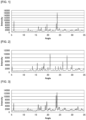
- the powder X-ray diffraction patterns of the triazol-1-yl (A), the triazol-4-yl (B), and the mixture (C) including the triazol-1-yl:triazol-4-yl of 95:5 are respectively shown in FIGS. 1 to 3 . Furthermore, 2 ⁇ values of the powder X-ray diffraction patterns are shown in Table 1 below.
- An embodiment of the present invention can be utilized as a method for producing an intermediate product for synthesizing an azole derivative useful as an agricultural or horticultural chemical.
Landscapes
- Chemical & Material Sciences (AREA)
- Organic Chemistry (AREA)
- Chemical Kinetics & Catalysis (AREA)
- Organic Low-Molecular-Weight Compounds And Preparation Thereof (AREA)
Abstract
Description
- The present invention relates to a method for producing a compound.
- An azole derivative is useful as an agricultural or horticultural chemical exhibiting a high controlling effect. To produce an azole derivative, a method for producing an intermediate product of an azole derivative has been studied. For example, Patent Document 1 describes a method for producing methyl-2-(2-chloro-4-(4-chlorophenoxy)phenyl)-2-oxoacetate, which is an intermediate product of an azole derivative.
- Patent Document 1:
WO 2019/093522 A1 - The method for producing an intermediate compound of an azole derivative described in Patent Document 1 describes performing oxiranation using trimethylsulfoxonium bromide (TMSOB) and substituting a ketone group for a ketoester group using iodine or iodomethane. However, since TMSOB, iodine, and iodomethane are expensive, there is an issue of increased production cost of an intermediate product of an azole derivative. Therefore, a method for producing an intermediate product of an azole derivative at a lower cost is demanded.
- The present invention has been completed in light of the issues described above, and an object of an aspect of the present invention is to realize a method by which an intermediate product of an azole derivative can be produced at a lower cost than those of known production methods.
- To solve the issues described above, the production method according to an aspect of the present invention is a method for producing a compound represented by General Formula (IV):
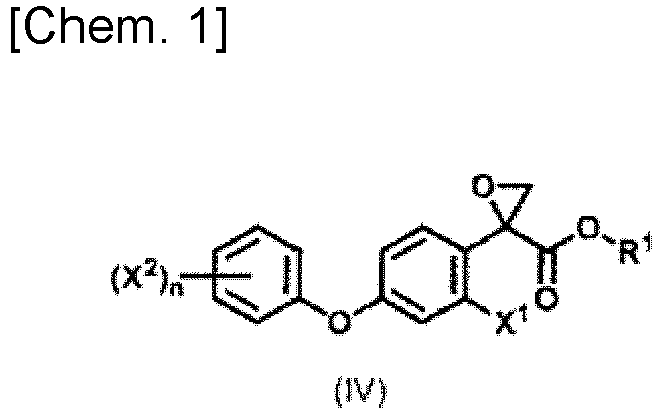
- where in Formula (IV), R1 is a C1-C6-alkyl group;
- X1 is a halogen group, a C1-C4-haloalkyl group, or a C1-C4-haloalkoxy group;
- X2 is a halogen group, a C1-C4-haloalkyl group, or a C1-C4-haloalkoxy group; and
- n is 1, 2, or 3.
- (a) dimethyl sulfide and/or dimethyl sulfoxide, and
- (b) a methyl-LG (an LG is a nucleophilically substitutable leaving group and is selected from the group consisting of a halogen group, an alkoxysulfonyloxy group, an aryloxysulfonyloxy group, an alkylsulfonyloxy group, a haloalkylsulfonyloxy group, and an arylsulfonyloxy group)
- According to an aspect of the present invention, an intermediate product of an azole derivative can be produced at a lower cost than those of known production methods.
-
-
FIG. 1 is an X-ray diffraction pattern of triazol-1-yl (A). Intensity indicates X-ray diffraction intensity, and angle indicates a diffraction angle (2θ). -
FIG. 2 is an X-ray diffraction pattern of triazol-4-yl (B). Intensity indicates X-ray diffraction intensity, and angle indicates a diffraction angle (2θ). -
FIG. 3 is an X-ray diffraction pattern of a mixture (C) having triazol-1-yl:triazol-4-yl of 95:5, synthesized in the present examples. Intensity indicates X-ray diffraction intensity, and angle indicates a diffraction angle (2θ). - A preferred embodiment for carrying out the present invention will now be explained. Note that the embodiment explained below illustrates a representative embodiment of the present invention, and it should not be interpreted that the scope of the present invention is narrowed by this embodiment.
- The method for producing a compound represented by General Formula (IV) (hereinafter, referred to as "oxirane derivative (IV)") according to an aspect of the present invention (hereinafter, referred to as "production method 1") will be described:
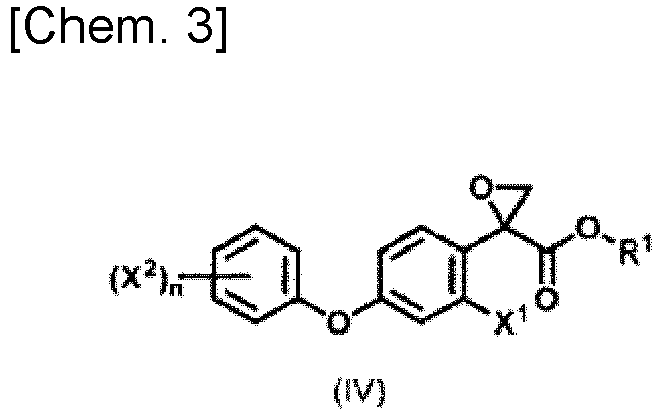
- where in Formula (IV), R1 is a C1-C6-alkyl group;
- X1 is a halogen group, a C1-C4-haloalkyl group, or a C1-C4-haloalkoxy group;
- X2 is a halogen group, a C1-C4-haloalkyl group, or a C1-C4-haloalkoxy group; and
- n is 1, 2, or 3.
- The C1-C6-alkyl group is a linear or branched alkyl group having from 1 to 6 carbon atoms, and examples thereof include a methyl group, an ethyl group, a 1-methylethyl group, a 1,1-dimethylethyl group, a propyl group, a 1-methylpropyl group, a 2-methylpropyl group, a 1,1-dimethylpropyl group, a 2,2-dimethylpropyl group, a 1-ethylpropyl group, a butyl group, a 1-methylbutyl group, a 2-methylbutyl group, a 3-methylbutyl group, a 3,3-dimethylbutyl group, a 2,2-dimethylbutyl group, a 1,1-dimethylbutyl group, a 1-ethylbutyl group, a 2-ethylbutyl group, a pentyl group, a 1-methylpentyl group, a 2-methylpentyl group, a 3-methylpentyl group, and a 4-methylpentyl group.
- Examples of the halogen group include a chlorine group, a bromine group, an iodine group, and a fluorine group.
- The C1-C4-haloalkyl group has one or more halogen atoms as substituents at substitutable positions of the C1-C4-alkyl group, and in a case of substitution with two or more halogen groups, the halogen groups may be the same or different. Note that the C1-C4-alkyl group is a linear or branched alkyl group having from 1 to 4 carbon atoms.
- The C1-C4-alkyl group is a linear or branched alkyl group having from 1 to 4 carbon atoms, and examples thereof include a methyl group, an ethyl group, a propyl group, and a butyl group. The halogen group is as described above. Examples of the C1-C4-haloalkyl group include a chloromethyl group, a 2-chloroethyl group, a 2,3-dichloropropyl group, a bromomethyl group, a chlorodifluoromethyl group, a trifluoromethyl group, and a 3,3,3-trifluoropropyl group.
- The C1-C4-haloalkoxy group has one or more halogen atoms as substituents at substitutable positions of the C1-C4-alkoxy group, and in a case of substitution with two or more halogen groups, the halogen groups may be the same or different. Note that the C1-C4-alkoxy group is a linear or branched alkoxy group having from 1 to 4 carbon atoms.
- The C1-C4-alkoxy group is a linear or branched alkoxy group having from 1 to 4 carbon atoms, and examples thereof include a methoxy group, an ethoxy group, a propoxy group, an isopropoxy group, a 1-methylpropoxy group, a 2-methylpropoxy group, a butoxy group, and a 1,1-dimethylethoxy group.
- The production method 1 of the present aspect include converting a compound represented by General Formula (II) (hereinafter, referred to as "ketoester derivative (II)") into an oxirane derivative (IV) according to Scheme 1 below (hereinafter, referred to as "Step 1"). Note that R1, X1, X2, and n in the following Scheme 1 correspond to R1, X1, X2, and n in General Formula (IV) above.

- Step 1 in the production method 1 of the present aspect is
a step of converting a ketoester derivative (II) into an oxirane derivative (IV) using: - (a) dimethyl sulfide and/or dimethyl sulfoxide; and
- (b) a methyl-LG (an LG is a nucleophilically substitutable leaving group and is selected from the group consisting of a halogen group, an alkoxysulfonyloxy group, an aryloxysulfonyloxy group, an alkylsulfonyloxy group, a haloalkylsulfonyloxy group, and an arylsulfonyloxy group) in the presence of an inorganic base:

- In Step 1, oxiranation is performed by using dimethyl sulfide and/or dimethyl sulfoxide and a methyl-LG while a sulfonium salt is prepared in a reaction system. That is, the preparation of the sulfonium salt and the oxiranation reaction are performed simultaneously.
- The inorganic base is added from the perspective of proceeding the reaction of Step 1. Examples of the inorganic base used in Step 1 include sodium hydride, cesium carbonate, potassium phosphate, and potassium carbonate, and potassium carbonate is preferred.
- LG is a nucleophilically substitutable leaving group, such as a leaving group selected from the group consisting of a halogen group, an alkoxysulfonyloxy group, an aryloxysulfonyloxy group, an alkylsulfonyloxy group, a haloalkylsulfonyloxy group, and an arylsulfonyloxy group, and is preferably an alkoxysulfonyloxy group.
- The amount of the inorganic base coexisted in the reaction system in Step 1 is preferably from 1.0 to 10.0 equivalents (eq.) with respect to 1 equivalent (eq.) of the ketoester derivative (II) from the perspective of proceeding the reaction of Step 1.
- The amount of "(a) dimethyl sulfide and/or dimethyl sulfoxide" described above to be added to the reaction system in Step 1 (referred to as "amount required for reaction") is preferably from 1.0 to 10.0 equivalents (eq.) with respect to 1 equivalent (eq.) of the ketoester derivative (II) from the perspective of adequately performing the reaction.
- The amount of "(b) methyl-LG" described above to be added to the reaction system in Step 1 (referred to as "amount required for reaction") is preferably from 1.0 to 10.0 equivalents (eq.) with respect to 1 equivalent (eq.) of the ketoester derivative (II) from the perspective of adequately performing the reaction.
- Step 1 proceeds in an organic solvent. As the organic solvent, a solvent proceeding the reaction of Step 1 is appropriately selected, and examples of the organic solvent include dichloroethane. The reaction of Step 1 can be performed, for example, in an oil bath while heating to reflux and stirring are performed. At this time, the oil bath temperature is, for example, may be set to be 85 to 100°C in a manner that the internal temperature becomes 80 to 90°C.
- In the production method 1 of the present aspect, in Step 1, the amounts required for reaction of the (a) and the (b) are preferably divided and added in multiple batches. The divided addition in Step 1 refers to addition performed by dividing the amounts required for reaction of the (a) and the (b) into one or more batches. The timing of adding the second or later additions and the number of divided addition can be appropriately set to appropriate timing and number by a person skilled in the art, taking reaction conditions and the like into consideration. For example, the performance of second divided addition is only required before activity of the reagent added in the first time is lost. By the divided addition of the (a) and the (b), effect of reducing the used amount of reagents of the (a) and the (b) required for the reaction of Step 1 is achieved, compared to a case where the (a) and the (b) are added in one batch without divided addition. It is conceived that this is because the reaction is performed more efficiently by the divided addition of the (a) and the (b) compared to a case where the (a) and the (b) are added in one batch.
- As long as all the amounts required for reaction are added to the reaction system, the addition amounts for one addition (referred to as "divided addition amount") is not particularly limited. The divided addition amount can be appropriately adjusted depending on the number of divided addition. Furthermore, divided addition amounts (e.g., when the amounts required for reaction are divided into two and added, divided addition amounts for the first addition and the second addition) may be the same or different.
- The (a) may be dimethyl sulfide and/or dimethyl sulfoxide, and is preferably both dimethyl sulfide and dimethyl sulfoxide. In the (a), by adding a combination of dimethyl sulfide and dimethyl sulfoxide, effect of improving yield can be achieved as well as reducing used amounts of reagents compared to a case where only dimethyl sulfoxide is added.
- In the production method 1 of the present aspect, because oxiranation is performed by using dimethyl sulfide and/or dimethyl sulfoxide and a methyl-LG, which are relatively easy to obtain, are used in place of TMSOB, separate preparation of TMSOB is not needed. By performing the production method 1 of the present aspect, for example, construction costs for a plant needed to produce TMSOB and labor costs and utility costs during production are not needed. Also, for an operator of the production method 1 of the present aspect, there are advantages during production, such as shortening of batch cycle time required for production of TMSOB. Furthermore, because an operator of the production method 1 of the present aspect handles DMSO in a basic condition, there is an advantage of high safety during production.
- The oxirane derivative (IV) produced in the production method 1 of the present aspect is an intermediate product of a compound represented by General Formula (I) below (hereinafter, referred to as "azole derivative (I)"). The production method 1 of the present aspect can produce the azole derivative (I) at a low cost because the production method 1 can produce the oxirane derivative (IV) at a low cost without using expensive TMSOB, iodine, and iodomethane:

- The production method 1 of the present aspect may include a method for producing a ketoester derivative (II) of the present aspect (hereinafter, referred to as "production method 2") before Step 1.
- The production method 2 of the present aspect include converting a compound represented by General Formula (III) (hereinafter, referred to as "methyl ketone derivative (III)") into a ketoester derivative (II) according to Scheme 2 below (hereinafter, referred to as "Step 2"). Note that R1, X1, X2, and n in the following Scheme 2 correspond to R1, X1, X2, and n in General Formula (IV) above.


- In Step 2 in the production method 2 of the present aspect, in a solvent containing dimethyl sulfoxide, bromine is allowed to react with a methyl ketone derivative (III) while the reaction system is heated, and subsequently R'-OH (R1 is the same as R1 in General Formula (IV) above) is allowed to react, and thus a ketoester derivative (II) is formed:

- In Step 2, synthesis of ketocarboxylic acid using bromine and dimethyl sulfoxide and esterification using R'-OH are performed continuously. By using a bromine in synthesis reaction of a ketocarboxylic acid, compared to a case where iodine is used like Patent Document 1, the ketoester derivative (II) can be produced at a lower cost in a higher yield. Furthermore, because the R1-OH is used as an esterification reagent used in the esterification reaction, compared to a case where iodomethane is used like Patent Document 1, the ketoester derivative (II) can be produced at a lower cost.
- The amount of dimethyl sulfoxide added to the reaction system in Step 2 is preferably from 2.0 to 10.0 equivalents (eq.) with respect to 1 equivalent (eq.) of the methyl ketone derivative (III) from the perspective of adequately performing the reaction.
- The amount of bromine added to the reaction system in Step 2 is preferably from 0.5 to 3.0 equivalents (eq.) with respect to 1 equivalent (eq.) of the methyl ketone derivative (III) from the perspective of adequately performing the reaction.
- For the reaction temperature of the synthesis reaction of the ketocarboxylic acid in Step 2, the internal temperature is preferably from 60 to 85°C, and more preferably at 70°C, from the perspective of suitably performing the reaction. For example, the synthesis reaction of the ketocarboxylic acid in Step 2 can be performed in an oil bath while stirring and heating are performed to set the internal temperature the temperature described above. Furthermore, the esterification reaction in Step 2 can be performed, for example, in an oil bath while heating is performed to reflux. At this time, to make the internal temperature preferably from 55 to 65°C, and more preferably at 65°C, the oil bath temperature may be set to be from 60 to 80°C.
- Step 2 proceeds in an organic solvent. As the organic solvent, a solvent proceeding the reaction of Step 2 is appropriately selected, and examples of the organic solvent include dichloroethane.
- In Step 2 in the production method 2 of another aspect of the present invention, in the solvent containing dimethyl sulfoxide, after heating the reaction system to which bromine is added, the bromine may be allowed to react with a methyl ketone derivative (III) while the methyl ketone derivative (III) is added, and subsequently R'-OH (R1 is the same as R1 in General Formula (IV) above) may be allowed to react, and thus a ketoester derivative (II) may be formed.
- In a case where the methyl ketone derivative (III) is added after the reaction system to which the bromine is added is heated, the heating temperature of the reaction system before addition of the methyl ketone derivative (III) is a temperature that makes the internal temperature preferably from 60 to 75°C, and more preferably at 65°C. Furthermore, the reaction temperature of the reaction system after the methyl ketone derivative (III) addition is a temperature that makes the internal temperature preferably from 65 to 80°C, and more preferably at 70°C. By addition of the methyl ketone derivative (III) after the reaction system to which the bromine is added is heated, heat build-up during synthesis reaction of the ketocarboxylic acid can be suppressed, and thus Step 2 can proceed more safely.
- Furthermore, in the production method 2 according to another aspect, Step 2 is preferably performed in the presence of at least one type of compound selected from the group consisting of urea, adipic acid dihydrazide, and dibutylhydroxytoluene, and more preferably performed in the presence of urea. In Step 2, white accretion is generated inside the reactor due to use of the bromine. This white accretion is not included in the end product of Step 2; however, because the white accretion can cause clogging in the reactor, the white accretion in the reactor needs to be removed often. However, by performing the reaction of Step 2 in the presence of the compound described above, generation of the white accretion attached inside the reactor in Step 2 can be suppressed. As a result, the production efficiency is improved because the removal treatment of the white accretion inside the reactor is not necessary, which is advantageous for an operator. From the perspective of high effect of suppressing generation of white accretion, the compound that is allowed to coexist in the reaction system in Step 2 is preferably urea.
- The amount of at least one type of compound selected from the group consisting of urea, adipic acid dihydrazide, and dibutylhydroxytoluene, which coexists in the reaction system in Step 2, is preferably from 0.1 to 2.0 equivalents (eq.) with respect to 1 equivalent (eq.) of the methyl ketone derivative (III) from the perspective of suppressing generation of white accretion.
- The method for producing an azole derivative (I) of the present aspect (hereinafter, referred to as "production method 3") will be described. The production method 3 of the present aspect includes the method for producing the oxirane derivative (IV) of the present aspect described above to produce the oxirane derivative (IV), which is an intermediate product of an azole derivative (I), and includes converting the oxirane derivative (IV) obtained by the production method into the azole derivative (I) according to Scheme 3 below (hereinafter, referred to as "Step 3"). By the configuration described above, the azole derivative (I) can be produced at a low cost because the oxirane derivative (IV) can be produced at a low cost.
- Since the method for producing the oxirane derivative (IV) is as described above, only Step 3 will be described here. Note that R1, X1, X2, and n in the following Scheme 3 correspond to R1, X1, X2, and n in General Formula (IV) above.


- In Step 3, using 1,2,4-triazole and an inorganic base, azolation is performed while a salt of the 1 ,2,4-triazole and the inorganic base (e.g., in a case where potassium carbonate is used as the inorganic base, potassium 1,2,4-triazolate) is prepared in the reaction system. As a result, the production efficiency is improved because advance preparation of the salt of the 1,2,4-triazole and the inorganic base is not necessary, which is advantageous for an operator.
- Examples of the inorganic base used in Step 3 are same as those described for Step 1. The inorganic base used in Step 3 may be the same as or different from the inorganic base used in Step 1.
- The amount of the inorganic base coexisted in the reaction system in Step 3 is preferably from 0.1 to 3.0 equivalents (eq.) with respect to 1 equivalent (eq.) of the oxirane derivative (IV) from the perspective of proceeding the reaction of Step 3.
- The amount of 1,2,4-triazole added to the reaction system in Step 3 is preferably from 1.0 to 3.0 equivalents (eq.) with respect to 1 equivalent (eq.) of the oxirane derivative (IV) from the perspective of adequately performing the reaction of Step 3.
- Step 3 proceeds in an organic solvent. As the organic solvent, a solvent proceeding the reaction of Step 3 is appropriately selected, and examples of the organic solvent include N,N-dimethylformamide and N,N-dimethylacetamide. The reaction of Step 3 can be performed, for example, at room temperature while stirring is performed or in an oil bath while heating and stirring are performed. As the reaction temperature at this time, for example, the internal temperature is from 40 to 120°C.
- The method for converting the oxirane derivative (IV) into the azole derivative (I) is not limited to the method described above and can be performed by a known method (e.g., method described in Patent Document 1). Thus, the production method 3 according to another aspect of the present invention includes the method for producing the oxirane derivative (IV) of the present aspect described above and may convert the oxirane derivative (IV) obtained by the production method into the azole derivative (I) according to a known method (e.g., method described in Patent Document 1).
- The present invention is not limited to the above-described embodiments, and various modifications can be made within the scope of the claims, and embodiments obtained by appropriately combining technical means disclosed in different embodiments are also included in the technical scope of the present invention.
- The production method according to the present aspect 1 is a method for producing a compound represented by General Formula (IV) including Step 1, which is converting a compound represented by General Formula (II) into the compound represented by General Formula (IV) using (a) dimethyl sulfide and/or dimethyl sulfoxide and (b) a methyl-LG (an LG is a nucleophilically substitutable leaving group and is selected from the group consisting of a halogen group, an alkoxysulfonyloxy group, an aryloxysulfonyloxy group, an alkylsulfonyloxy group, a haloalkylsulfonyloxy group, and an arylsulfonyloxy group) in the presence of an inorganic base. By this configuration, the oxirane derivative (IV) can be produced without using TMSOB, which is costly.
- The production method according to the present aspect 2 preferably includes divided addition of the amounts required for reaction of the (a) and the (b) in Step 1 of converting into the compound represented by General Formula (IV) of the present aspect 1. By the divided addition of the (a) and the (b), reaction is efficiently performed, and thus the used amounts of reagents of the (a) and the (b) can be reduced.
- In the production method according to the present aspect 3, the (a) of the present aspect 1 or 2 is preferably both of dimethyl sulfide and dimethyl sulfoxide. In the (a), the used amount of a reagent of the (a) can be reduced by addition of the dimethyl sulfide.
- The production method according to the present aspect 4 further includes Step 2, which is converting a compound represented by General Formula (III) into the compound represented by General Formula (II) in any one of the present aspects 1 to 3; and in Step 2, in a solvent containing dimethyl sulfoxide, bromine may be allowed to react with the compound represented by General Formula (III) while a reaction system is heated, and subsequently R'-OH (where R1 is the same as R1 in Formula (IV)) may be allowed to react, and thus the compound represented by General Formula (II) is formed. By this configuration, the ketoester derivative (II) can be produced without using iodine and iodomethane, which are costly.
- In the production method according to the
present aspect 5, in Step 2 of converting into the compound represented by General Formula (II) in the present aspect 4, in the solvent containing dimethyl sulfoxide, after a reaction system to which bromine is added is heated, the bromine is preferably allowed to react with the compound represented by General Formula (III) by adding the compound represented by General Formula (III), and subsequently R'-OH (where R1 is the same as R1 in Formula (IV)) is preferably allowed to react, and thus the compound represented by General Formula (II) is formed. By addition of the methyl ketone derivative (III) after the reaction system is heated, heat build-up can be suppressed, and thus Step 2 can proceed more safely. - In the production method according to the present aspect 6, Step 2 of converting into the compound represented by General Formula (II) in the
present aspect 4 or 5 is performed in the presence of at least one selected from the group consisting of urea, adipic acid dihydrazide, and dibutylhydroxytoluene. By this configuration, generation of the white accretion attached inside the reactor in Step 2 can be suppressed. - The production method according to the present aspect 7 is a method for producing a compound represented by General Formula (I), the method including the method for producing a compound represented by General Formula (IV) according to any one of the present aspects 1 to 6, and Step 3 of converting the compound represented by General Formula (IV) obtained by the production method into the compound represented by General Formula (I) using 1,2,4-triazole in the presence of an inorganic base. By the configuration described above, the production cost of the intermediate product of the azole derivative (I) can be reduced, and thus the production cost of the azole derivative (I) can be reduced.
- The present invention will now be explained in greater detail through the use of production examples. Moreover, the present invention is not limited to the production examples given below, as long as the gist of the invention is not exceeded.
- After 0.98 g (3.0 mmol) of methyl 2-(2-chloro-4-(4-chlorophenoxy)phenyl)-2-oxoacetate and 4.5 mL of dichloroethane were added to a flask, 2.24 g (16.2 mmol) of potassium carbonate, 1.54 mL (16.2 mmol) of dimethyl sulfate, and 0.58 mL (8.1 mmol) of dimethyl sulfoxide were added, and heated, refluxed, and stirred in an oil bath at 95°C. Two hours after the reaction started, water was added, extraction was performed twice using dichloroethane, and the obtained material was washed with water once. After drying over anhydrous sodium sulfate, the solvent was distilled off, and thus 1.06 g of a yellow liquid crude product was obtained.
- The above-mentioned compound in this yellow liquid crude product was quantified by NMR. As a result, the NMR quantified yield of the above-mentioned compound was 61%.
- After 12.90 g (purity: 76%; 30 mmol) of crude methyl 2-(2-chloro-4-(4-chlorophenoxy)phenyl)-2-oxoacetate, 14.95 g (108 mmol) of potassium carbonate, and 60 mL of dichloroethane were added in a flask, 3.84 mL (54 mmol) of dimethyl sulfoxide and 10.26 mL (108 mmol) of dimethyl sulfate were divided and added in multiple batches. The reaction was performed in an oil bath at 95°C while heating and refluxing were performed. Seven and a half hours after the reaction started, water was added to separate the liquid, an aqueous layer was re-extracted once with dichloroethane, and then an organic layer was combined and washed with water twice. After drying over anhydrous sodium sulfate, the solvent was distilled off, and thus 13.07 g of an orange liquid crude product was obtained.
- The above-mentioned compound in this orange liquid crude product was quantified by gas chromatography (GC quantification). As a result, the GC quantified yield of the above-mentioned compound was 91%.
- After 17.18 g (purity: 76%; 40 mmol) of crude methyl 2-(2-chloro-4-(4-chlorophenoxy)phenyl)-2-oxoacetate, 13.27 g (96 mmol) of potassium carbonate, 1.8 mL (24 mmol) of dimethyl sulfide, and 60 mL of dichloroethane were added in a flask, 3.4 mL (48 mmol) of dimethyl sulfoxide and 7.1 mL (96 mmol) of dimethyl sulfate were divided and added in multiple batches. The reaction was performed in an oil bath at 95°C while heating and refluxing were performed. Five hours after the reaction started, water was added to separate the liquid, and an organic layer was washed with water twice. After drying over anhydrous sodium sulfate, the solvent was distilled off, and thus 17.50 g of an orange liquid crude product was obtained.
- The above-mentioned compound in this orange liquid crude product was quantified by gas chromatography (GC quantification). As a result, the GC quantified yield of the above-mentioned compound was 97%.
- After 0.98 g (3.0 mmol) of methyl 2-(2-chloro-4-(4-chlorophenoxy)phenyl)-2-oxoacetate, 3.82 g (18.0 mmol) of potassium phosphate, and 6.0 mL of dichloroethane were added in a flask, 0.85 mL (9.0 mmol) of dimethyl sulfate and 0.32 mL (4.5 mmol) of dimethyl sulfoxide were divided and added in multiple batches. The reaction was performed in an oil bath at 95°C while heating and refluxing were performed. Seven hours after the reaction started, water was added, extraction was performed twice using dichloroethane, and the obtained material was washed with water once. After drying over anhydrous sodium sulfate, the solvent was distilled off, and thus 1.16 g of a yellow liquid crude product was obtained.
- The above-mentioned compound in this yellow liquid crude product was quantified by NMR. As a result, the NMR quantified yield of the above-mentioned compound was 76%.
- In a flask, 28.11 g (0.10 mol) of 2'-chloro-4'-(4-chlorophenoxy)acetophenone, 50 mL of dimethyl sulfoxide, and 45 mL of dichloroethane were added, dissolved, and cooled in an ice bath, and then 19.32 g (0.12 mol) of bromine was added by a dropping funnel, washed with 5 mL of dichloroethane, and heated and stirred in an oil bath in a manner that the internal temperature was 70°C. After 1 hour, low boiling point substances were distilled off, and 50 mL of toluene and 50 mL of methanol were added and heated and refluxed. After 1 hour, 50 mL of toluene was added to separate the bottom layer of the solution, and the bottom layer was re-extracted with toluene once. The top layer and the re-extracted toluene were combined and washed with a saturated sodium bicarbonate solution once, washed with water once, and washed with saturated brine solution once. After drying over anhydrous sodium sulfate, the solvent was distilled off, and thus 30.83 g of an orange liquid crude product was obtained.
- The above-mentioned compound in this orange liquid crude product was quantified by gas chromatography (GC quantification). As a result, the GC quantified yield of the above-mentioned compound was 83%.
- After 100 mL of dichloroethane was added to a flask, 38.36 g (0.24 mol) of bromine was added by a dropping funnel and stirred. After the reactor was cooled in a water bath, 28.4 mL of dimethyl sulfoxide was added by a dropping funnel. After heating was performed in an oil bath to make the internal temperature 70°C, 85.2 mL of dimethyl sulfoxide solution of 56.23 g (0.20 mol) 2'-chloro-4'-(4-chlorophenoxy)acetophenone was added by a dropping funnel. One hour after completion of the dropwise addition, 7.1 mL of dimethyl sulfoxide was added. Further after 1 hour, low boiling point substances were distilled off, and 100 mL of toluene and 100 mL of methanol were added and heated and refluxed. After 2 hours, 100 mL of toluene was added to separate the bottom layer of the solution, and the bottom layer was re-extracted with toluene once. The top layer and the re-extracted toluene were combined and washed with a saturated sodium bicarbonate solution once, and washed with water twice. The solvent was distilled off, and thus 59.29 g of an orange liquid crude product was obtained.
- The above-mentioned compound in this orange liquid crude product was quantified by gas chromatography (GC quantification). As a result, the GC quantified yield of the above-mentioned compound was 77%.
- After 18.01 g (0.30 mol) of urea and 468 mL of dichloroethane were added in a flask, 191.80 g (1.20 mol) of bromine was added in a dropping funnel and stirred. After the reactor was cooled in a water bath, a mixed solution of 156.26 g (2.00 mol) of dimethyl sulfoxide and 25 mL of dichloroethane was added by a dropping funnel. After stepwise heating was performed in an oil bath to make the internal temperature 70°C while the internal temperature was monitored, 468.77 g (6.00 mol) of dimethyl sulfoxide solution of 283.11 g (1.00 mol) 2'-chloro-4'-(4-chlorophenoxy)acetophenone was added by a dropping funnel. One hour after completion of the dropwise addition, 39.07 g (0.50 mol) of dimethyl sulfoxide and 6 mL of dichloroethane were added. Further after 1 hour, low boiling point substances were distilled off, and 500 mL of toluene and 500 mL of methanol were added and heated and refluxed. After 3 hours, 500 mL of toluene was added to separate the bottom layer of the solution, and the bottom layer was re-extracted with toluene once. The top layer and the re-extracted toluene were combined and washed with water once, washed with a 5% sodium bicarbonate solution once, and washed with water once. 1671.78 g of toluene solution of the target product was obtained as an orange liquid.
- The above-mentioned compound in this orange liquid was quantified by gas chromatography (GC quantification). As a result, the GC quantified yield of the above-mentioned compound was 79%.
- Furthermore, Synthesis Example 2-3 was able to suppress 95% or more of generation of white accretion attached inside the reactor compared to those of synthesis Example 2-1 and Synthesis Example 2-2.
- After 500 mL of dichloroethane and 191.79 g (1.20 mol) of bromine were added in a flask, heating and stirring were performed in an oil bath until the internal temperature became 65°C, and then 156.28 g (2.00 mol) of dimethyl sulfoxide solution of 18.02 g (0.30 mol) of urea was added by a dropping funnel. Then, 351.59 g (4.50 mol) of dimethyl sulfoxide solution of 283.68 g (purity: 99.1%; 1.00 mol) of 2'-chloro-4'-(4-chlorophenoxy)acetophenone was added by a dropping funnel. One hour after completion of the dropwise addition, 39.13 g (0.50 mol) of dimethyl sulfoxide was added. Further after 2 hours, low boiling point substances were distilled off, and 500 mL of toluene and 500 mL of methanol were added and heated and refluxed. After 7 hours, the bottom layer of the solution was separated, and the bottom layer was re-extracted with toluene once. The top layer and the re-extracted toluene were combined and washed with water for three times. 1261.67 g of toluene solution of the target product was obtained as an orange liquid.
- The above-mentioned compound in this orange liquid was quantified by gas chromatography (GC quantification). As a result, the GC quantified yield of the above-mentioned compound was 84%.
- After 152.35 g (purity: 74%; 0.33 mol) of crude methyl 2-(2-chloro-4-(4-chlorophenoxy)phenyl)-2-oxiranecarboxylate and 154.12 g of N,N-dimethylacetamide were added in a flask, 34.64 g (0.50 mol) of 1,2,4-triazole and 23.09 g (0.17 mol) of potassium carbonate were added, and heated and stirred in an oil bath at 50°C. After 0.75 hours, the internal temperature was raised to 60°C. After 5 hours, cooling to room temperature was performed, and among 363.71 g of the reaction solution, 111.95 g (0.10 mol equivalent) was transferred into a 500 mL cylindrical separable flask, 50 mL of toluene and 40 mL of water were added, and then 30 mg of seed crystal of the above-mentioned compound was added. After 30 minutes, 160 mL of water was added dropwise and stirred at room temperature for 30 minutes, cooling was gradually performed over 30 minutes using a cyclohexane bath at 6°C, and stirring was continued for 3 hours. Then, the crude liquid was vacuum-filtered and washed by using 50 mL of water and 25 mL of toluene. The filtered material was dried under a reduced pressure using a vacuum specimen dryer, and thus 39.09 g of a target white solid crude product was obtained.
- The above-mentioned compound in this white solid crude product was quantified by high-performance liquid chromatography (HPLC quantification). As a result, the HPLC quantified yield of the above-mentioned compound was 78%. Furthermore, triazol-1-yl:triazol-4-yl was 85:15.
- 36.6 g of the white solid crude product was subjected to hot filtration at 100°C while 164.8 g of toluene was used in appropriately divided batches. In a flask, 189 g of the filtrate was added, the temperature was raised to 100°C in an oil bath, and after the inner temperature reached 100°C, heating and stirring were performed for 10 minutes. Then, cooling was performed to 92°C at the rate of 15°C/h. After reaching 92°C, 159 mg of seed crystal of the above-mentioned compound was added, and then stirring was performed at 92°C for 30 minutes. Then, cooling was performed to 75°C at 6°C/h, from 75°C to 55°C at 10°C/h, and from 55°C to 5°C at 30°C/h, and after reaching 5°C, stirring was continued for 2 hours. The crude liquid was vacuum-filtered and washed by using 11.3 g of cold toluene. The filtered material was dried under a reduced pressure using a vacuum specimen dryer, and thus 31.2 g of a target white solid was obtained.
- The above-mentioned compound in this white solid crude product was quantified by high-performance liquid chromatography (HPLC quantification). As a result, the HPLC quantified recovery rate of the above-mentioned compound was 94.6%. At this time, triazol-1-yl:triazol-4-yl was 95:5.
- Powder X-ray diffraction data of the triazol-1-yl (A), the triazol-4-yl (B), and the mixture (C) including the triazol-1-yl:triazol-4-yl of 95:5 was recorded at room temperature by irradiation of germanium-CuKα1 radiation (λ = 1.5406 Å). 2θ Scan of 5° ≤ 2θ ≤ 35° (step size: 0.03°) was performed at room temperature by using a one-dimensional position sensitive detector.
- The powder X-ray diffraction patterns of the triazol-1-yl (A), the triazol-4-yl (B), and the mixture (C) including the triazol-1-yl:triazol-4-yl of 95:5 are respectively shown in
FIGS. 1 to 3 . Furthermore, 2θ values of the powder X-ray diffraction patterns are shown in Table 1 below.[Table 1] A B C 5.97 5.26 5.89 11.91 10.62 11.64 12.78 12.75 11.80 13.48 13.64 12.70 16.09 13.90 13.38 16.77 15.19 15.35 17.27 15.64 16.00 19.00 16.71 16.66 19.63 17.34 17.12 20.39 17.58 18.92 20.89 18.16 19.52 22.02 18.40 20.26 23.46 18.87 20.81 23.83 19.13 23.38 24.40 20.02 23.75 24.61 20.86 24.28 24.80 22.20 24.54 26.22 23.12 24.72 26.82 24.28 26.14 27.27 25.28 26.75 29.45 26.14 27.19 29.95 27.90 29.35 31.42 29.56 29.84 31.87 29.92 31.34 32.50 31.50 31.74 32.13 32.42 32.86 33.92 33.15 34.41 34.89 - An embodiment of the present invention can be utilized as a method for producing an intermediate product for synthesizing an azole derivative useful as an agricultural or horticultural chemical.

Claims (7)
- A method for producing a compound represented by General Formula (IV):
 where in General Formula (IV), R1 is a C1-C6-alkyl group;X1 is a halogen group, a C1-C4-haloalkyl group, or a C1-C4-haloalkoxy group;X2 is a halogen group, a C1-C4-haloalkyl group, or a C1-C4-haloalkoxy group; andn is 1, 2, or 3;the method comprising converting a compound represented by General Formula (II) into the compound represented by General Formula (IV) using:(a) dimethyl sulfide and/or dimethyl sulfoxide, and(b) a methyl-LG, where LG is a nucleophilically substitutable leaving group and is selected from the group consisting of a halogen group, an alkoxysulfonyloxy group, an aryloxysulfonyloxy group, an alkylsulfonyloxy group, a haloalkylsulfonyloxy group, and an arylsulfonyloxy groupin the presence of an inorganic base:
- The method according to claim 1, wherein, in the step of converting into the compound represented by General Formula (IV), amounts required for a reaction of the (a) and the (b) are divided and added in multiple batches.
- The method according to claim 1 or 2, wherein the (a) is dimethyl sulfide and dimethyl sulfoxide both.
- The method according to any one of claims 1 to 3, further comprising converting a compound represented by General Formula (III) into the compound represented by General Formula (II),
wherein, in this converting step, in a solvent containing dimethyl sulfoxide, bromine is allowed to react with the compound represented by General Formula (III) while a reaction system is heated, and subsequently R1-OH (where R1 is the same as R1 in Formula (IV)) is allowed to react, and thus the compound represented by General Formula (II) is formed:
- The method according to claim 4, wherein, in the step of converting into the compound represented by General Formula (II), in the solvent containing dimethyl sulfoxide, after a reaction system to which bromine is added is heated, the bromine is allowed to react with the compound represented by General Formula (III) by adding the compound represented by General Formula (III), and subsequently R'-OH (where R1 is the same as R1 in Formula (IV)) is allowed to react, and thus the compound represented by General Formula (II) is formed.
- The method according to claim 4 or 5, wherein the step of converting into the compound represented by General Formula (II) is performed in the presence of at least one selected from the group consisting of urea, adipic acid dihydrazide, and dibutylhydroxytoluene.
- A method for producing a compound represented by General Formula (I), comprising the method for producing the compound represented by General Formula (IV) according to any one of claims 1 to 6, and
converting the compound represented by General Formula (IV) obtained by the method into the compound represented by General Formula (I) using 1,2,4-triazole in the presence of an inorganic base:
Applications Claiming Priority (2)
| Application Number | Priority Date | Filing Date | Title |
|---|---|---|---|
| JP2020134138 | 2020-08-06 | ||
| PCT/JP2021/029343 WO2022030622A1 (en) | 2020-08-06 | 2021-08-06 | Method for producing compound |
Publications (3)
| Publication Number | Publication Date |
|---|---|
| EP4194445A1 true EP4194445A1 (en) | 2023-06-14 |
| EP4194445A4 EP4194445A4 (en) | 2024-08-14 |
| EP4194445B1 EP4194445B1 (en) | 2025-04-16 |
Family
ID=80118171
Family Applications (1)
| Application Number | Title | Priority Date | Filing Date |
|---|---|---|---|
| EP21853755.3A Active EP4194445B1 (en) | 2020-08-06 | 2021-08-06 | Method for producing compound |
Country Status (5)
| Country | Link |
|---|---|
| US (1) | US12428387B2 (en) |
| EP (1) | EP4194445B1 (en) |
| JP (1) | JP7427096B2 (en) |
| CN (1) | CN116171273B (en) |
| WO (1) | WO2022030622A1 (en) |
Families Citing this family (1)
| Publication number | Priority date | Publication date | Assignee | Title |
|---|---|---|---|---|
| RS65431B1 (en) | 2019-04-19 | 2024-05-31 | Kureha Corp | Fungicidal agent for agricultural or horticultural use, plant disease control method, and product for plant disease control use |
Family Cites Families (34)
| Publication number | Priority date | Publication date | Assignee | Title |
|---|---|---|---|---|
| ZA831466B (en) | 1982-03-23 | 1984-10-31 | Ici Plc | Heterocyclic compounds |
| EP0099165A1 (en) | 1982-03-23 | 1984-01-25 | Imperial Chemical Industries Plc | Triazole and imidazole compounds, process for their preparation and their use as fungicides and plant growth regulators, and intermediates for their synthesis |
| US4533659A (en) | 1982-06-09 | 1985-08-06 | Ciba-Geigy Corporation | Microbicidal 2-(1H-1,2,4-triazolylmethyl-1'-yl)-2-siloxy-2-phenyl-acetates |
| DE3315619A1 (en) | 1983-04-29 | 1984-10-31 | Bayer Ag, 5090 Leverkusen | METHOD FOR PRODUCING OXIRANES |
| GB9125791D0 (en) | 1991-12-04 | 1992-02-05 | Schering Agrochemicals Ltd | Herbicides |
| DE10349503A1 (en) | 2003-10-23 | 2005-05-25 | Bayer Cropscience Ag | Fungicidal drug combinations |
| DE102004045242A1 (en) | 2004-09-17 | 2006-03-23 | Bayer Cropscience Ag | Synergistic fungicidal drug combinations |
| JP2012530110A (en) | 2009-06-18 | 2012-11-29 | ビーエーエスエフ ソシエタス・ヨーロピア | Antibacterial 1,2,4-triazolyl derivative |
| US20120108422A1 (en) | 2009-06-18 | 2012-05-03 | Basf Se | Antifungal 1,2,4-triazolyl Derivatives |
| JP5852562B2 (en) | 2010-04-28 | 2016-02-03 | 塩野義製薬株式会社 | Novel cephem derivatives |
| US20150051231A1 (en) | 2010-09-29 | 2015-02-19 | Fmc Quimica Do Brasil Ltda. | Synergistic combinations of triazoles, strobilurins and benzimidazoles, uses, formulations, production processes and applications using the same |
| WO2012125533A1 (en) | 2011-03-14 | 2012-09-20 | Wellstat Therapeutics Corporation | 3-benzyloxyphenyloxoacetic acid compounds for reducing uric acid |
| CN103649057B (en) | 2011-07-13 | 2016-05-11 | 巴斯夫农业公司 | Fungicidal substituted 2-[2-haloalkyl-4-phenoxyphenyl]-1-[1,2,4]triazol-1-ylethanol compounds |
| EP2813501A4 (en) | 2011-11-11 | 2015-04-15 | Kureha Corp | Method for producing 4-benzyl-1-methyl-6-oxabicyclo[3,2,0]heptane derivative |
| CN102491959B (en) | 2011-12-19 | 2015-03-25 | 江苏澄扬作物科技有限公司 | Preparation method of oxirane derivative |
| US9458478B2 (en) | 2012-03-31 | 2016-10-04 | Novozymes A/S | Epoxidation using peroxygenase |
| CN104540818A (en) | 2012-10-11 | 2015-04-22 | 株式会社吴羽 | Method for producing cycloalkanol derivative, and method for producing azole derivative |
| EP2925730A1 (en) | 2012-11-27 | 2015-10-07 | Basf Se | Substituted 2-[phenoxy-phenyl]-1-[1,2,4]triazol-1-yl-ethanol compounds and their use as fungicides |
| US20160029630A1 (en) | 2012-11-27 | 2016-02-04 | Basf Se | Substituted 2-[phenoxy-phenyl]-1-[1,2,4]triazol-1-yl-ethanol compounds and their use as fungicides |
| EP3181558A1 (en) | 2012-12-19 | 2017-06-21 | Basf Se | Substituted [1,2,4]triazole compounds and their use as fungicides |
| BR112015014579A2 (en) | 2012-12-19 | 2017-07-11 | Basf Se | compounds of formula i, use of a compound of formula i, method for combating harmful fungi and seeds. |
| JP6576829B2 (en) | 2012-12-20 | 2019-09-18 | ビーエーエスエフ アグロ ベー.ブイ. | Composition comprising a triazole compound |
| CN104936450A (en) | 2012-12-20 | 2015-09-23 | 巴斯夫欧洲公司 | Compositions comprising triazole compound |
| CN103059004A (en) | 2012-12-21 | 2013-04-24 | 泰州职业技术学院 | Method of preparing 1-[Alpha-(2, 4-difluorophenyl)-2, 3-glycidyl]-1H-1, 2, 4-triazole |
| KR102310373B1 (en) | 2013-10-18 | 2021-10-08 | 바스프아그로케미칼 프로덕츠 비.브이. | Agricultural mixtures comprising carboxamide compound |
| AR100743A1 (en) | 2014-06-06 | 2016-10-26 | Basf Se | COMPOUNDS OF [1,2,4] SUBSTITUTED TRIAZOL |
| CN106660979B (en) | 2014-07-08 | 2020-07-07 | 巴斯夫农业公司 | Process for preparing substituted oxiranes and triazoles |
| CN108137538B (en) | 2015-08-14 | 2021-02-26 | 拜耳作物科学股份公司 | Triazole derivatives, intermediates thereof and their use as fungicides |
| JP2020507579A (en) | 2017-02-10 | 2020-03-12 | バイエル アクチェンゲゼルシャフトBayer Aktiengesellschaft | Composition for controlling harmful microorganisms containing 1- (phenoxy-pyridinyl) -2- (1,2,4-triazol-1-yl) -ethanol derivative |
| CA3071569C (en) | 2017-11-13 | 2020-12-29 | Kureha Corporation | Azole derivative, intermediate compound, method for producing azole derivative, agricultural or horticultural chemical agent, and protective agent for industrial material |
| JP2019206375A (en) | 2018-05-30 | 2019-12-05 | Toto株式会社 | Packaging box |
| JP2019048845A (en) | 2018-11-07 | 2019-03-28 | 住友化学株式会社 | Composition containing heterocyclic compound |
| RS65431B1 (en) | 2019-04-19 | 2024-05-31 | Kureha Corp | Fungicidal agent for agricultural or horticultural use, plant disease control method, and product for plant disease control use |
| US20230172209A1 (en) | 2020-02-27 | 2023-06-08 | Syngenta Crop Protection Ag | Fungicidal compositions |
-
2021
- 2021-08-06 CN CN202180060304.5A patent/CN116171273B/en active Active
- 2021-08-06 JP JP2022541750A patent/JP7427096B2/en active Active
- 2021-08-06 US US18/040,365 patent/US12428387B2/en active Active
- 2021-08-06 WO PCT/JP2021/029343 patent/WO2022030622A1/en not_active Ceased
- 2021-08-06 EP EP21853755.3A patent/EP4194445B1/en active Active
Also Published As
| Publication number | Publication date |
|---|---|
| US20230271929A1 (en) | 2023-08-31 |
| JP7427096B2 (en) | 2024-02-02 |
| JPWO2022030622A1 (en) | 2022-02-10 |
| EP4194445A4 (en) | 2024-08-14 |
| WO2022030622A1 (en) | 2022-02-10 |
| EP4194445B1 (en) | 2025-04-16 |
| US12428387B2 (en) | 2025-09-30 |
| CN116171273B (en) | 2024-05-14 |
| CN116171273A (en) | 2023-05-26 |
Similar Documents
| Publication | Publication Date | Title |
|---|---|---|
| EP2943476B1 (en) | Process for the preparation of substituted oxiranes and triazoles | |
| KR20130129180A (en) | Process for preparing aminobenzoylbenzofuran derivatives | |
| EP3395813B1 (en) | Voriconazole intermediate and voriconazole synthesis method | |
| CN109503399B (en) | A kind of preparation method of robencoxib | |
| CN107513031A (en) | A kind of preparation method of 2- OXo-1-pyrrolidines chiral derivatives | |
| EP4194445B1 (en) | Method for producing compound | |
| TWI462913B (en) | Method for preparing ascorbic acid derivatives | |
| CN105820128B (en) | A kind of preparation method of cyproconazole | |
| DK3250556T3 (en) | PROCEDURES FOR THE PREPARATION OF COMPOUNDS, SUCH AS 3-ARYL BUTANALS THAT CAN BE USED FOR THE SYNTHESIS OF MEDETOMIDINE | |
| JP6485878B2 (en) | Deuteration method and catalyst | |
| Vijayan et al. | Enhanced catalytic activity towards one-pot hydroxylation of phenol with hydrogen peroxide by nickel (II) complex encompassing 3-formylchromone-S-methylisothiosemicarbazone derivatives | |
| CN113429359A (en) | Preparation method of high-purity bis-ethylhexyloxyphenol methoxyphenyl triazine | |
| EP3109236B1 (en) | Scalable process for the preparation of sorafenib tosylate ethanol solvate and sorafenib tosylate form iii | |
| CN101891693A (en) | New method for preparing fluconazole | |
| EP3181545B1 (en) | Process for the preparation of ospemifene | |
| Eagles et al. | SOME NITRO-1, 2, 3-TRIAZOLES | |
| CN114773324A (en) | Preparation method of difenoconazole | |
| CN110240582B (en) | Flavone derivative with tumor cell inhibiting function and preparation method and application thereof | |
| EP4296267A1 (en) | Method for manufacturing azole derivative | |
| EP4119549B1 (en) | Compound producing method, and compound | |
| CN113045523A (en) | Preparation method of imidazoline pyridine compound intermediate | |
| CN113185470B (en) | Preparation method of prothioconazole | |
| WO2008092410A1 (en) | Preparation method of thioureas or salts thereof | |
| KR101354175B1 (en) | Method of preparing methyl (e)-2-(3-methoxy)acrylate from 2-(3,3-demethoxy)propanoate | |
| CN115819273A (en) | Preparation method and application of nilapali impurity 1 |
Legal Events
| Date | Code | Title | Description |
|---|---|---|---|
| STAA | Information on the status of an ep patent application or granted ep patent |
Free format text: STATUS: THE INTERNATIONAL PUBLICATION HAS BEEN MADE |
|
| PUAI | Public reference made under article 153(3) epc to a published international application that has entered the european phase |
Free format text: ORIGINAL CODE: 0009012 |
|
| STAA | Information on the status of an ep patent application or granted ep patent |
Free format text: STATUS: REQUEST FOR EXAMINATION WAS MADE |
|
| 17P | Request for examination filed |
Effective date: 20230123 |
|
| AK | Designated contracting states |
Kind code of ref document: A1 Designated state(s): AL AT BE BG CH CY CZ DE DK EE ES FI FR GB GR HR HU IE IS IT LI LT LU LV MC MK MT NL NO PL PT RO RS SE SI SK SM TR |
|
| DAV | Request for validation of the european patent (deleted) | ||
| DAX | Request for extension of the european patent (deleted) | ||
| A4 | Supplementary search report drawn up and despatched |
Effective date: 20240716 |
|
| RIC1 | Information provided on ipc code assigned before grant |
Ipc: C07C 69/738 20060101ALI20240710BHEP Ipc: C07C 67/00 20060101ALI20240710BHEP Ipc: C07D 249/08 20060101ALI20240710BHEP Ipc: C07D 303/48 20060101ALI20240710BHEP Ipc: C07D 301/02 20060101AFI20240710BHEP |
|
| GRAP | Despatch of communication of intention to grant a patent |
Free format text: ORIGINAL CODE: EPIDOSNIGR1 |
|
| STAA | Information on the status of an ep patent application or granted ep patent |
Free format text: STATUS: GRANT OF PATENT IS INTENDED |
|
| INTG | Intention to grant announced |
Effective date: 20250103 |
|
| GRAS | Grant fee paid |
Free format text: ORIGINAL CODE: EPIDOSNIGR3 |
|
| GRAA | (expected) grant |
Free format text: ORIGINAL CODE: 0009210 |
|
| STAA | Information on the status of an ep patent application or granted ep patent |
Free format text: STATUS: THE PATENT HAS BEEN GRANTED |
|
| P01 | Opt-out of the competence of the unified patent court (upc) registered |
Free format text: CASE NUMBER: APP_7182/2025 Effective date: 20250212 |
|
| AK | Designated contracting states |
Kind code of ref document: B1 Designated state(s): AL AT BE BG CH CY CZ DE DK EE ES FI FR GB GR HR HU IE IS IT LI LT LU LV MC MK MT NL NO PL PT RO RS SE SI SK SM TR |
|
| REG | Reference to a national code |
Ref country code: GB Ref legal event code: FG4D |
|
| REG | Reference to a national code |
Ref country code: CH Ref legal event code: EP |
|
| REG | Reference to a national code |
Ref country code: IE Ref legal event code: FG4D |
|
| REG | Reference to a national code |
Ref country code: DE Ref legal event code: R096 Ref document number: 602021029368 Country of ref document: DE |
|
| REG | Reference to a national code |
Ref country code: NL Ref legal event code: MP Effective date: 20250416 |
|
| PG25 | Lapsed in a contracting state [announced via postgrant information from national office to epo] |
Ref country code: NL Free format text: LAPSE BECAUSE OF FAILURE TO SUBMIT A TRANSLATION OF THE DESCRIPTION OR TO PAY THE FEE WITHIN THE PRESCRIBED TIME-LIMIT Effective date: 20250416 |
|
| REG | Reference to a national code |
Ref country code: AT Ref legal event code: MK05 Ref document number: 1785602 Country of ref document: AT Kind code of ref document: T Effective date: 20250416 |
|
| PG25 | Lapsed in a contracting state [announced via postgrant information from national office to epo] |
Ref country code: FI Free format text: LAPSE BECAUSE OF FAILURE TO SUBMIT A TRANSLATION OF THE DESCRIPTION OR TO PAY THE FEE WITHIN THE PRESCRIBED TIME-LIMIT Effective date: 20250416 Ref country code: ES Free format text: LAPSE BECAUSE OF FAILURE TO SUBMIT A TRANSLATION OF THE DESCRIPTION OR TO PAY THE FEE WITHIN THE PRESCRIBED TIME-LIMIT Effective date: 20250416 Ref country code: PT Free format text: LAPSE BECAUSE OF FAILURE TO SUBMIT A TRANSLATION OF THE DESCRIPTION OR TO PAY THE FEE WITHIN THE PRESCRIBED TIME-LIMIT Effective date: 20250818 |
|
| PGFP | Annual fee paid to national office [announced via postgrant information from national office to epo] |
Ref country code: DE Payment date: 20250820 Year of fee payment: 5 |
|
| REG | Reference to a national code |
Ref country code: LT Ref legal event code: MG9D |
|
| PG25 | Lapsed in a contracting state [announced via postgrant information from national office to epo] |
Ref country code: GR Free format text: LAPSE BECAUSE OF FAILURE TO SUBMIT A TRANSLATION OF THE DESCRIPTION OR TO PAY THE FEE WITHIN THE PRESCRIBED TIME-LIMIT Effective date: 20250717 Ref country code: NO Free format text: LAPSE BECAUSE OF FAILURE TO SUBMIT A TRANSLATION OF THE DESCRIPTION OR TO PAY THE FEE WITHIN THE PRESCRIBED TIME-LIMIT Effective date: 20250716 |
|
| PG25 | Lapsed in a contracting state [announced via postgrant information from national office to epo] |
Ref country code: PL Free format text: LAPSE BECAUSE OF FAILURE TO SUBMIT A TRANSLATION OF THE DESCRIPTION OR TO PAY THE FEE WITHIN THE PRESCRIBED TIME-LIMIT Effective date: 20250416 |
|
| PG25 | Lapsed in a contracting state [announced via postgrant information from national office to epo] |
Ref country code: BG Free format text: LAPSE BECAUSE OF FAILURE TO SUBMIT A TRANSLATION OF THE DESCRIPTION OR TO PAY THE FEE WITHIN THE PRESCRIBED TIME-LIMIT Effective date: 20250416 |
|
| PGFP | Annual fee paid to national office [announced via postgrant information from national office to epo] |
Ref country code: GB Payment date: 20250820 Year of fee payment: 5 |
|
| PG25 | Lapsed in a contracting state [announced via postgrant information from national office to epo] |
Ref country code: HR Free format text: LAPSE BECAUSE OF FAILURE TO SUBMIT A TRANSLATION OF THE DESCRIPTION OR TO PAY THE FEE WITHIN THE PRESCRIBED TIME-LIMIT Effective date: 20250416 |
|
| PG25 | Lapsed in a contracting state [announced via postgrant information from national office to epo] |
Ref country code: AT Free format text: LAPSE BECAUSE OF FAILURE TO SUBMIT A TRANSLATION OF THE DESCRIPTION OR TO PAY THE FEE WITHIN THE PRESCRIBED TIME-LIMIT Effective date: 20250416 |
|
| PGFP | Annual fee paid to national office [announced via postgrant information from national office to epo] |
Ref country code: FR Payment date: 20250828 Year of fee payment: 5 |
|
| PG25 | Lapsed in a contracting state [announced via postgrant information from national office to epo] |
Ref country code: RS Free format text: LAPSE BECAUSE OF FAILURE TO SUBMIT A TRANSLATION OF THE DESCRIPTION OR TO PAY THE FEE WITHIN THE PRESCRIBED TIME-LIMIT Effective date: 20250716 |
|
| PG25 | Lapsed in a contracting state [announced via postgrant information from national office to epo] |
Ref country code: IS Free format text: LAPSE BECAUSE OF FAILURE TO SUBMIT A TRANSLATION OF THE DESCRIPTION OR TO PAY THE FEE WITHIN THE PRESCRIBED TIME-LIMIT Effective date: 20250816 |
|
| PG25 | Lapsed in a contracting state [announced via postgrant information from national office to epo] |
Ref country code: LV Free format text: LAPSE BECAUSE OF FAILURE TO SUBMIT A TRANSLATION OF THE DESCRIPTION OR TO PAY THE FEE WITHIN THE PRESCRIBED TIME-LIMIT Effective date: 20250416 |
|
| PG25 | Lapsed in a contracting state [announced via postgrant information from national office to epo] |
Ref country code: SM Free format text: LAPSE BECAUSE OF FAILURE TO SUBMIT A TRANSLATION OF THE DESCRIPTION OR TO PAY THE FEE WITHIN THE PRESCRIBED TIME-LIMIT Effective date: 20250416 Ref country code: DK Free format text: LAPSE BECAUSE OF FAILURE TO SUBMIT A TRANSLATION OF THE DESCRIPTION OR TO PAY THE FEE WITHIN THE PRESCRIBED TIME-LIMIT Effective date: 20250416 |
|
| REG | Reference to a national code |
Ref country code: DE Ref legal event code: R097 Ref document number: 602021029368 Country of ref document: DE |
|
| PG25 | Lapsed in a contracting state [announced via postgrant information from national office to epo] |
Ref country code: CZ Free format text: LAPSE BECAUSE OF FAILURE TO SUBMIT A TRANSLATION OF THE DESCRIPTION OR TO PAY THE FEE WITHIN THE PRESCRIBED TIME-LIMIT Effective date: 20250416 |
|
| PG25 | Lapsed in a contracting state [announced via postgrant information from national office to epo] |
Ref country code: EE Free format text: LAPSE BECAUSE OF FAILURE TO SUBMIT A TRANSLATION OF THE DESCRIPTION OR TO PAY THE FEE WITHIN THE PRESCRIBED TIME-LIMIT Effective date: 20250416 |
|
| PG25 | Lapsed in a contracting state [announced via postgrant information from national office to epo] |
Ref country code: SK Free format text: LAPSE BECAUSE OF FAILURE TO SUBMIT A TRANSLATION OF THE DESCRIPTION OR TO PAY THE FEE WITHIN THE PRESCRIBED TIME-LIMIT Effective date: 20250416 |
|
| PG25 | Lapsed in a contracting state [announced via postgrant information from national office to epo] |
Ref country code: IT Free format text: LAPSE BECAUSE OF FAILURE TO SUBMIT A TRANSLATION OF THE DESCRIPTION OR TO PAY THE FEE WITHIN THE PRESCRIBED TIME-LIMIT Effective date: 20250416 |
|
| PLBE | No opposition filed within time limit |
Free format text: ORIGINAL CODE: 0009261 |
|
| STAA | Information on the status of an ep patent application or granted ep patent |
Free format text: STATUS: NO OPPOSITION FILED WITHIN TIME LIMIT |
|
| REG | Reference to a national code |
Ref country code: CH Ref legal event code: L10 Free format text: ST27 STATUS EVENT CODE: U-0-0-L10-L00 (AS PROVIDED BY THE NATIONAL OFFICE) Effective date: 20260225 |
|
| PG25 | Lapsed in a contracting state [announced via postgrant information from national office to epo] |
Ref country code: RO Free format text: LAPSE BECAUSE OF FAILURE TO SUBMIT A TRANSLATION OF THE DESCRIPTION OR TO PAY THE FEE WITHIN THE PRESCRIBED TIME-LIMIT Effective date: 20250416 |
|
| REG | Reference to a national code |
Ref country code: CH Ref legal event code: H13 Free format text: ST27 STATUS EVENT CODE: U-0-0-H10-H13 (AS PROVIDED BY THE NATIONAL OFFICE) Effective date: 20260324 |
|
| 26N | No opposition filed |
Effective date: 20260119 |
|
| PG25 | Lapsed in a contracting state [announced via postgrant information from national office to epo] |
Ref country code: MC Free format text: LAPSE BECAUSE OF FAILURE TO SUBMIT A TRANSLATION OF THE DESCRIPTION OR TO PAY THE FEE WITHIN THE PRESCRIBED TIME-LIMIT Effective date: 20250416 |
|
| PG25 | Lapsed in a contracting state [announced via postgrant information from national office to epo] |
Ref country code: LU Free format text: LAPSE BECAUSE OF NON-PAYMENT OF DUE FEES Effective date: 20250806 |
|
| PG25 | Lapsed in a contracting state [announced via postgrant information from national office to epo] |
Ref country code: CH Free format text: LAPSE BECAUSE OF NON-PAYMENT OF DUE FEES Effective date: 20250831 |
|
| REG | Reference to a national code |
Ref country code: BE Ref legal event code: MM Effective date: 20250831 |
|
| PG25 | Lapsed in a contracting state [announced via postgrant information from national office to epo] |
Ref country code: LT Free format text: LAPSE BECAUSE OF FAILURE TO SUBMIT A TRANSLATION OF THE DESCRIPTION OR TO PAY THE FEE WITHIN THE PRESCRIBED TIME-LIMIT Effective date: 20250416 |
|
| PG25 | Lapsed in a contracting state [announced via postgrant information from national office to epo] |
Ref country code: IE Free format text: LAPSE BECAUSE OF NON-PAYMENT OF DUE FEES Effective date: 20250806 Ref country code: BE Free format text: LAPSE BECAUSE OF NON-PAYMENT OF DUE FEES Effective date: 20250831 |
|
| PG25 | Lapsed in a contracting state [announced via postgrant information from national office to epo] |
Ref country code: SE Free format text: LAPSE BECAUSE OF FAILURE TO SUBMIT A TRANSLATION OF THE DESCRIPTION OR TO PAY THE FEE WITHIN THE PRESCRIBED TIME-LIMIT Effective date: 20250416 |