EP4193857A1 - Aerosol generating apparatus and control method for aerosol generating apparatus - Google Patents
Aerosol generating apparatus and control method for aerosol generating apparatus Download PDFInfo
- Publication number
- EP4193857A1 EP4193857A1 EP21943325.7A EP21943325A EP4193857A1 EP 4193857 A1 EP4193857 A1 EP 4193857A1 EP 21943325 A EP21943325 A EP 21943325A EP 4193857 A1 EP4193857 A1 EP 4193857A1
- Authority
- EP
- European Patent Office
- Prior art keywords
- microwave
- inspection member
- generation device
- control circuit
- resonance chamber
- Prior art date
- Legal status (The legal status is an assumption and is not a legal conclusion. Google has not performed a legal analysis and makes no representation as to the accuracy of the status listed.)
- Pending
Links
Images


Classifications
-
- A—HUMAN NECESSITIES
- A24—TOBACCO; CIGARS; CIGARETTES; SIMULATED SMOKING DEVICES; SMOKERS' REQUISITES
- A24F—SMOKERS' REQUISITES; MATCH BOXES; SIMULATED SMOKING DEVICES
- A24F40/00—Electrically operated smoking devices; Component parts thereof; Manufacture thereof; Maintenance or testing thereof; Charging means specially adapted therefor
- A24F40/40—Constructional details, e.g. connection of cartridges and battery parts
- A24F40/46—Shape or structure of electric heating means
-
- A—HUMAN NECESSITIES
- A24—TOBACCO; CIGARS; CIGARETTES; SIMULATED SMOKING DEVICES; SMOKERS' REQUISITES
- A24F—SMOKERS' REQUISITES; MATCH BOXES; SIMULATED SMOKING DEVICES
- A24F40/00—Electrically operated smoking devices; Component parts thereof; Manufacture thereof; Maintenance or testing thereof; Charging means specially adapted therefor
- A24F40/50—Control or monitoring
-
- A—HUMAN NECESSITIES
- A24—TOBACCO; CIGARS; CIGARETTES; SIMULATED SMOKING DEVICES; SMOKERS' REQUISITES
- A24F—SMOKERS' REQUISITES; MATCH BOXES; SIMULATED SMOKING DEVICES
- A24F40/00—Electrically operated smoking devices; Component parts thereof; Manufacture thereof; Maintenance or testing thereof; Charging means specially adapted therefor
- A24F40/50—Control or monitoring
- A24F40/51—Arrangement of sensors
-
- A—HUMAN NECESSITIES
- A24—TOBACCO; CIGARS; CIGARETTES; SIMULATED SMOKING DEVICES; SMOKERS' REQUISITES
- A24F—SMOKERS' REQUISITES; MATCH BOXES; SIMULATED SMOKING DEVICES
- A24F40/00—Electrically operated smoking devices; Component parts thereof; Manufacture thereof; Maintenance or testing thereof; Charging means specially adapted therefor
- A24F40/50—Control or monitoring
- A24F40/53—Monitoring, e.g. fault detection
-
- H—ELECTRICITY
- H05—ELECTRIC TECHNIQUES NOT OTHERWISE PROVIDED FOR
- H05B—ELECTRIC HEATING; ELECTRIC LIGHT SOURCES NOT OTHERWISE PROVIDED FOR; CIRCUIT ARRANGEMENTS FOR ELECTRIC LIGHT SOURCES, IN GENERAL
- H05B6/00—Heating by electric, magnetic or electromagnetic fields
- H05B6/64—Heating using microwaves
-
- H—ELECTRICITY
- H05—ELECTRIC TECHNIQUES NOT OTHERWISE PROVIDED FOR
- H05B—ELECTRIC HEATING; ELECTRIC LIGHT SOURCES NOT OTHERWISE PROVIDED FOR; CIRCUIT ARRANGEMENTS FOR ELECTRIC LIGHT SOURCES, IN GENERAL
- H05B6/00—Heating by electric, magnetic or electromagnetic fields
- H05B6/64—Heating using microwaves
- H05B6/6447—Method of operation or details of the microwave heating apparatus related to the use of detectors or sensors
-
- H—ELECTRICITY
- H05—ELECTRIC TECHNIQUES NOT OTHERWISE PROVIDED FOR
- H05B—ELECTRIC HEATING; ELECTRIC LIGHT SOURCES NOT OTHERWISE PROVIDED FOR; CIRCUIT ARRANGEMENTS FOR ELECTRIC LIGHT SOURCES, IN GENERAL
- H05B6/00—Heating by electric, magnetic or electromagnetic fields
- H05B6/64—Heating using microwaves
- H05B6/66—Circuits
- H05B6/68—Circuits for monitoring or control
-
- H—ELECTRICITY
- H05—ELECTRIC TECHNIQUES NOT OTHERWISE PROVIDED FOR
- H05B—ELECTRIC HEATING; ELECTRIC LIGHT SOURCES NOT OTHERWISE PROVIDED FOR; CIRCUIT ARRANGEMENTS FOR ELECTRIC LIGHT SOURCES, IN GENERAL
- H05B6/00—Heating by electric, magnetic or electromagnetic fields
- H05B6/64—Heating using microwaves
- H05B6/76—Prevention of microwave leakage, e.g. door sealings
-
- H—ELECTRICITY
- H05—ELECTRIC TECHNIQUES NOT OTHERWISE PROVIDED FOR
- H05B—ELECTRIC HEATING; ELECTRIC LIGHT SOURCES NOT OTHERWISE PROVIDED FOR; CIRCUIT ARRANGEMENTS FOR ELECTRIC LIGHT SOURCES, IN GENERAL
- H05B6/00—Heating by electric, magnetic or electromagnetic fields
- H05B6/64—Heating using microwaves
- H05B6/80—Apparatus for specific applications
-
- A—HUMAN NECESSITIES
- A24—TOBACCO; CIGARS; CIGARETTES; SIMULATED SMOKING DEVICES; SMOKERS' REQUISITES
- A24F—SMOKERS' REQUISITES; MATCH BOXES; SIMULATED SMOKING DEVICES
- A24F40/00—Electrically operated smoking devices; Component parts thereof; Manufacture thereof; Maintenance or testing thereof; Charging means specially adapted therefor
- A24F40/20—Devices using solid inhalable precursors
-
- A—HUMAN NECESSITIES
- A24—TOBACCO; CIGARS; CIGARETTES; SIMULATED SMOKING DEVICES; SMOKERS' REQUISITES
- A24F—SMOKERS' REQUISITES; MATCH BOXES; SIMULATED SMOKING DEVICES
- A24F40/00—Electrically operated smoking devices; Component parts thereof; Manufacture thereof; Maintenance or testing thereof; Charging means specially adapted therefor
- A24F40/85—Maintenance, e.g. cleaning
Definitions
- the present invention relates to the technical field of electronic atomization, and more particularly to an aerosol generation device and a control method of an aerosol generation device.
- a heat-not-burning (HNB) device is a kind of electronic equipment that heats, but does not burn, an aerosol generation base material (which is a product of processed plant leaves).
- the heating device heats, at a high temperature, the aerosol generation base material to a temperature that can generate an aerosol, but is not sufficient to cause burning, so that, without being caused to burn, the aerosol generation base material generates an aerosol desired by a user.
- the heat-not-burning devices that are currently available in the market generally adopts resistor heating means, namely a centered heating plate or a heating pin penetrates, at a center location of the aerosol generation base material, into the interior of the aerosol generation base material to proceed with heating.
- resistor heating means namely a centered heating plate or a heating pin penetrates, at a center location of the aerosol generation base material, into the interior of the aerosol generation base material to proceed with heating.
- Such a utensil takes a long time to wait for preheating before use, making it hard to freely start or stop vaping, and the aerosol generation base material cannot be uniformly carbonized, leading to insufficient baking of the aerosol generation base material and low efficiency of utilization.
- the heating plate of the HNB device may easily causes generation of contaminants, which are hard to cleanse, in an aerosol generation base material extractor and a heating plate holder, and a portion of the aerosol generation base material that is in contact with the heating body may get locally excessively high temperature, causing partial decomposition and releasing substances that are harmful to humans.
- the resistor heating means is gradually replaced by microwave heating technology, which becomes a new solution of heating.
- the microwave heating technology has advantages in respect of high efficiency, timeliness, optionality, and non-delay heating, and is only effective of heating for specific substances having certain dielectric properties.
- microwave heating based atomization include: (a) instantaneous vaping or stopping being achievable as the microwave heating is radiation based heating, rather than heat conduction; (b) there being no plate breaking or heating plate cleansing issues as no heating plate is involved; and (c) the utilization efficiency of the aerosol generation base material being high and mouthfeel being consistent, and the mouthfeel being much closer to cigarettes.
- the microwave device keeps emitting microwaves that may become hazardous to people in the vicinity, so that operation safety of users cannot be guaranteed.
- the application aims to resolve one of the technical issues that the prior art or the related art is suffering.
- an aerosol generation device which comprises: a housing, the housing comprising a receiving compartment, the receiving compartment being closable after opening; a microwave generation device, which is located in the interior of the receiving compartment, the microwave generation device comprising a microwave control circuit; and a first inspection member, which is arranged at the receiving compartment, the first inspection member being in electrical connection with the microwave control circuit, the first inspection member being operable to make the microwave control circuit open-circuited upon detecting opening of the receiving compartment.
- users when wishing to use the aerosol generation device, may dispose an aerosol base material into the housing.
- the microwave generation device is operable to generate microwaves, and when the microwave acts on the aerosol base material, the aerosol base material generates an aerosol.
- the microwave generation device is mounted in the interior of the receiving compartment of the housing.
- the housing is generally made of a metallic material, or the internal wall of the housing is provided with a metal coating layer, so that the housing induces a shielding effect against the microwave to prevent the microwave generated by the microwave generation device from leaking.
- the first inspection member is mounted in the interior of the receiving compartment.
- the receiving compartment is openable, and to avoid leaking of the microwave, the first inspection member is applied to carry out detection for whether the receiving compartment is opened.
- the microwave generation device is provided with a microwave control circuit and an operation circuit, the microwave control circuit being normally in a closed-circuit status and the operation circuit in a short-circuit status, and when it is desired to have the microwave acting on the aerosol base material to generate the aerosol, the microwave control circuit controls the operation circuit to become closed-circuited so as to generate the microwaves.
- the microwave control circuit controls the operation circuit to become closed-circuited, and at this moment, the microwave so generated is leaking out, causing damage to nearby users.
- the controller controls the microwave control circuit to become open-circuited, so that even though a signal for having the microwave acting on the aerosol base material to generate an aerosol may be detected, the microwave control circuit is incapable of controlling the operation circuit to become closed-circuited, and thus, no microwave will be generated, and microwave leaking to cause damage to users can be prevented thereby improving the safety of users in use of the aerosol generation device.
- the first inspection member is operable to detect whether the receiving compartment is opened, if the receiving compartment is maliciously opened, users still cannot use the microwave generation device to generate microwaves, and malicious use of microwave can be prevented.
- the microwave control circuit being open-circuited means the microwave control circuit set in a locked status
- the locked status means locking made in circuitry, and it is hard for ordinary users to rely on their own techniques to release the locking of the microwave control circuit, this helping avoid malicious use and avoid damage caused by microwave.
- the microwave control circuit Since the microwave control circuit is locked, if the locking of the microwave control circuit is not released, even though users may re-close the receiving compartment, the microwave control circuit cannot be activated.
- the aerosol generation device may further comprise the following additional technical features:
- the housing further comprises a resonance chamber, the microwave generation device being operable to feed microwaves into the interior of the resonance chamber, the resonance chamber being openable or closable; and the aerosol generation device further comprises a second inspection member, the second inspection member located in the interior of the resonance chamber, the second inspection member being in electrical connection with the microwave control circuit, the second inspection member being operable to make the microwave control circuit open-circuited upon detecting opening of the resonance chamber, the second inspection member being operable to make the microwave control circuit closed-circuited upon detecting closing of the resonance chamber.
- the housing is further provided with the resonance chamber, and the microwave assembly may feed microwaves into the interior of the resonance chamber.
- a resonance pillar is arranged in the housing, and a diameter of the resonance pillar is smaller than a diameter of the resonance chamber, so that a gap is present between the external wall of the resonance chamber and the internal wall of the resonance chamber, and the microwave is transmittable in the gap.
- the resonance pillar may function as a conductor, and the resonance pillar can be made of a metallic material.
- the resonance pillar is made of copper, aluminum, iron or an alloy thereof.
- the resonance pillar functions to transmit the microwave and to increase the transmission speed of the microwave, and the microwave does not readily deteriorate in transmitting in the interior of the resonance chamber, thereby enhancing an effect of the microwave acting on the aerosol generation base material, making the microwave acting on the aerosol generation base material with a high efficiency and a fast speed to facilitate satisfaction of users' needs of use.
- the resonance chamber is provided, in the interior thereof, with the second inspection member, and the second inspection member carries out detection on whether the resonance chamber is opened.
- the controller controls the microwave control circuit to become open-circuited, and, at this moment, even though a signal for having the microwave acting on the aerosol base material to generate an aerosol may be detected, the microwave control circuit is incapable of controlling the operation circuit to become closed-circuited, and thus, no microwave will be generated, and microwave leaking to cause damage to users can be prevented thereby improving the safety of users in use of the aerosol generation device.
- the second inspection member detects the resonance chamber closed, and the second inspection member feeds a detection signal to the controller, and the controller controls the microwave control circuit to become closed-circuited, so that the aerosol generation device is allowed to generate microwaves according to the users' needs for use, avoiding any influence on the use by the users.
- Closing/opening of the microwave control circuit is in relation with the status of opening of the resonance chamber, and on the basis of guaranteeing the safety of use, issues that the aerosol forming device cannot further generate microwave due to disassembling can be avoided.
- the resonance chamber and the receiving compartment are two separate cavities that are independent of each other.
- the housing comprises: a first body; a second body, the second body detachably connected to the first body, the first body and the second body enclosing and defining the receiving compartment, the first inspection member arranged on at least one of the first body and the second body; and a third body, the third body detachably connected to the first body, the first body and the third body enclosing and defining the resonance chamber, the second inspection member arranged on at least one of the first body and the third body.
- the second body and the third body are both set to be detachable from the first body.
- the third body can be detached from the first body so as to open the resonance chamber, to allow users to easily implement cleansing of the resonance chamber.
- the second inspection member detects the resonance chamber opened and makes the microwave control circuit open-circuited to prevent the microwave from leaking and causing damage to users.
- the third body is mounted to the first body, and the second inspection member detects the resonance chamber closed and makes the microwave control circuit closed-circuited, allowing the microwave generation device to normally generate the microwave, avoiding causing influence on use by users.
- the first body and the second body are arranged as a splitable structure, so that after mounting of the microwave generation device is completed, the second body is mounted to the first body.
- the second inspection member detects the resonance chamber opened and makes the microwave control circuit open-circuited to prevent the microwave from leaking and causing damage to users.
- the first body and the second body are connected by applying fasteners, such as bolts, or alternatively, snapping fasteners are applicable to lock the first body and the second body together. This is equally applicable to the first body and the third body.
- the first inspection member comprises: at least one of a pressure sensor, a position sensor, a photoelectric sensor, and a voltage sensor; and the second inspection member comprises: at least one of a pressure sensor, a position sensor, a photoelectric sensor, and a voltage sensor.
- the first inspection member can be a pressure sensor.
- the pressure sensor can be clamped by the first body and the second body. After the second body is detached, a pressure applied to the pressure sensor is reduced, and at this moment, the pressure sensor detects the receiving compartment opened, and makes the microwave control circuit open-circuited.
- the first inspection member can be a position sensor.
- the position sensor detects variation of the position of the second body, indicating the receiving compartment opened at this moment, and makes the microwave control circuit open-circuited.
- the first inspection member can be a photoelectric sensor.
- the first inspection member is an infrared sensor, and the infrared sensor determines if the second body is detached according to reflection of an infrared signal, so as to make the microwave control circuit open-circuited in case that the receiving compartment is opened.
- the first inspection member can be a voltage sensor.
- a detection circuit is arranged inside the housing, and when the second body and the first body are connected to each other, the detection circuit is closed, and when the second body and the first body are separated from each other, the detection circuit is open.
- the voltage sensor detects the voltage value acquired from the detection circuit varies, indicating the receiving compartment opened at this moment, and makes the microwave control circuit open-circuited.
- the second inspection member can also be at least one of a pressure sensor, a position sensor, a photoelectric sensor, and a voltage sensor.
- the aerosol generation device further comprises: a first elastic element; wherein the first inspection member is arranged on one of the first body and the second body, a first end of the first elastic element connected to the first inspection member, a second end of the first elastic element abutting on another one the first body and the second body.
- the first inspection member comprises a pressure sensor
- the pressure sensor is mounted on the first body, and in order to allow the second body to more accurately apply a pressure to the pressure sensor, a first elastic element is arranged between the pressure sensor and the second body.
- the first elastic element When the second body is mounted to the first body, the first elastic element is compressed, and at this moment, the first elastic element develops elastic deformation, so that the second body applies a pressure to the pressure sensor by means of the first elastic element.
- the first elastic element undergoes deformation to resume original, and, at this moment, the pressure sensor detects a drop of the pressure and controls the microwave control circuit to be open-circuited.
- the aerosol generation device further comprises: a second elastic element; wherein the second inspection member is arranged on one of the first body and the third body, a first end of the second elastic element connected to the second inspection member, a second end of the second elastic element abutting on another one of the first body and the third body.
- the second inspection member comprises a pressure sensor
- the pressure sensor is mounted on the first body, in order to allow the third body to more accurately apply a pressure to the pressure sensor, a second elastic element is arranged between the pressure sensor and the third body.
- the third body is mounted to the first body, the second elastic element is compressed, and at this moment, the second elastic element develops elastic deformation, so that the third body applies a pressure to the pressure sensor by means of the second elastic element.
- the second elastic element undergoes deformation to resume original, and, at this moment, the pressure sensor detects a drop of the pressure and controls the microwave control circuit to be open-circuited.
- the microwave generation device comprises: a microwave emission source, which is located in the interior of the receiving compartment; and a microwave lead-in section, a first end of the microwave lead-in section extending into the resonance chamber, a second end of the microwave lead-in section being in electrical connection with the microwave emission source.
- the microwave emission source is operable to generate microwaves, and the microwaves is transmitted through the microwave lead-in section into the interior of the resonance chamber.
- an entry site of the microwave in the resonance chamber can be varied, so as to avoid components in the interior of the resonance chamber and also to ensure stable transmission of the microwave from the first end of the resonance pillar toward the second end of the resonance pillar.
- the microwave emission source and the microwave lead-in section are set in contact with each other, and when the voltage sensor detects the resonance chamber opened, the microwave emission source and the microwave lead-in section are separated from each other.
- the microwave emission source and the microwave lead-in section are set to be of a splitable structure.
- the microwave emission source is allowed to transmit the microwave into the microwave lead-in section, and to transmit, by means of the microwave lead-in section, the microwave into the interior of the resonance chamber.
- the microwave emission source and the microwave lead-in section are separated, the microwave is not allowed to transmit into the microwave lead-in section.
- the microwave generation device receives a feedback signal of the microwave, and at this moment, the voltage sensor can detect a certain value of a reversed voltage.
- the microwave generation device When the microwave emission source and the microwave lead-in section are separated from each other, the microwave generation device does not receive, at this moment, the feedback signal of the microwave, and the reversed voltage detected by the voltage sensor increases, indicating the resonance chamber opened at this moment, and thus, it needs to make the microwave control circuit open-circuited. The accuracy is thus enhanced during a detection process.
- the microwave lead-in section is mounted on the third body, and in detaching the third body, the microwave emission source and the microwave lead-in section are separated from each other.
- the number of the first inspection member is one or multiple; and/or the number of the second inspection member is one or multiple.
- the number of the first inspection member can be just one, and the first inspection member is mounted on the first body or the second body.
- the first inspection member can also be multiple, and the multiple first inspection members can be mounted on the first body, or the multiple first inspection members can be mounted on the second body, both the first body and the second body are mounted with the first inspection members.
- the number of the second inspection member can be one or multiple.
- the application provides, in a second aspect, a control method of an aerosol generation device.
- the aerosol forming device comprises: a housing, a microwave generation device, and a first inspection member, the housing comprising a receiving compartment, the microwave generation device arranged in the interior of the receiving compartment, the microwave generation device comprising a microwave control circuit, the microwave control circuit being in electrical connection with the first inspection member, and the control method comprises: making the microwave control circuit open-circuited when a first inspection signal of the first inspection member detects the receiving compartment opened.
- the first inspection member is mounted in the interior of the receiving compartment, and the receiving compartment is openable. To prevent the microwave from leaking, the first inspection member is applied to detect whether the receiving compartment is opened.
- the microwave generation device is provided with a microwave control circuit and an operation circuit, the microwave control circuit being normally in a closed-circuit status and the operation circuit in a short-circuit status, and when it is desired to have the microwave acting on the aerosol base material to generate an aerosol, the microwave control circuit controls the operation circuit to become closed-circuited so as to generate the microwaves.
- the microwave control circuit When the receiving compartment is opened inadvertently or maliciously, due to the microwave control circuit being in the closed-circuit status, if it is detected, at this moment, a signal for having the microwave acting on the aerosol base material to generate the aerosol, then the microwave control circuit controls the operation circuit to become closed-circuited, and at this moment, the microwave so generated is leaking out, causing damage to nearby users.
- the controller controls the microwave control circuit to become open-circuited, so that even though a signal for having the microwave acting on the aerosol base material to generate an aerosol may be detected, the microwave control circuit is incapable of controlling the operation circuit to become closed-circuited, and thus, no microwave will be generated, and microwave leaking to cause damage to users can be prevented thereby improving the safety of users in use of the aerosol generation device.
- the first inspection member is operable to detect whether the receiving compartment is opened, if the receiving compartment is maliciously opened, users still cannot use the microwave generation device to generate microwaves, and malicious use of microwave can be prevented.
- the microwave control circuit being open-circuited means the microwave control circuit set in a locked status
- the locked status means locking made in circuitry, and it is hard for ordinary users to rely on their own techniques to release the locking of the microwave control circuit, this helping avoid malicious use and avoid damage caused by microwave.
- the microwave control circuit Since the microwave control circuit is locked, if the locking of the microwave control circuit is not released, even though users may re-close the receiving compartment, the microwave control circuit cannot be activated.
- the housing further comprises a resonance chamber
- the microwave generation device being operable to feed microwaves into the interior of the resonance chamber
- the aerosol forming device further comprises: a second inspection member, the second inspection member being in electrical connection with the microwave generation device
- the control method further comprises: making the microwave control circuit open-circuited when the second inspection member detects the resonance chamber opened, and making the microwave control circuit closed-circuited when the second inspection member detects the resonance chamber closed.
- the resonance chamber is provided, in the interior thereof, with the second inspection member, and the second inspection member carries out detection on whether the resonance chamber is opened.
- the controller controls the microwave control circuit to become open-circuited, and, at this moment, even though a signal for having the microwave acting on the aerosol base material to generate an aerosol may be detected, the microwave control circuit is incapable of controlling the operation circuit to become closed-circuited, and thus, no microwave will be generated, and microwave leaking to cause damage to users can be prevented thereby improving the safety of users in use of the aerosol generation device.
- the second inspection member detects the resonance chamber closed, and the second inspection member feeds a detection signal to the controller, and the controller controls the microwave control circuit to become closed-circuited, so that the aerosol generation device is allowed to generate microwaves according to the users' needs for use, avoiding any influence on the use by the users.
- Closing/opening of the microwave control circuit is in relation with the status of opening of the resonance chamber, and on the basis of guaranteeing the safety of use, issues that the aerosol forming device cannot continuously generate microwave can be avoided.
- the resonance chamber and the receiving compartment are two separate cavities that are independent of each other.
- the second inspection member comprises: a voltage sensor;
- the microwave generation device comprises: a microwave emission source and a microwave lead-in section, the microwave emission source and the microwave lead-in section separated from each other when the resonance chamber is opened; and the control method further comprises: the step of making the microwave control circuit open-circuited when the second inspection member detects the resonance chamber opened comprising: controlling the microwave control circuit to be in a status of being open-circuited when the voltage sensor detects a voltage value that is greater than a preset voltage value.
- the microwave emission source and the microwave lead-in section are set to be of a splitable structure.
- the microwave emission source is allowed to transmit the microwave into the microwave lead-in section, and to transmit, by means of the microwave lead-in section, the microwave into the interior of the resonance chamber.
- the microwave emission source and the microwave lead-in section are separated, the microwave is not allowed to transmit into the microwave lead-in section.
- the microwave generation device receives a feedback signal of the microwave, and at this moment, the voltage sensor can detect a certain value of a reversed voltage.
- the microwave generation device When the microwave emission source and the microwave lead-in section are separated from each other, the microwave generation device does not receive, at this moment, the feedback signal of the microwave, and the reversed voltage detected by the voltage sensor increases, indicating the resonance chamber opened at this moment, and thus, it needs to make the microwave control circuit open-circuited. The accuracy is thus enhanced during a detection process.
- the microwave lead-in section is mounted on the third body, and in detaching the third body, the microwave emission source and the microwave lead-in section are separated from each other.
- FIGS. 1-5 for describing an aerosol generation device and a control method of an aerosol generation device according to some embodiments of the application.
- an aerosol generation device comprising: a housing 100, a microwave generation device 200, and a first inspection member 500.
- the housing 100 comprises a receiving compartment 110, the receiving compartment 110 being closable after opening.
- the microwave generation device 200 is located in the interior of the receiving compartment 110, the microwave generation device 200 comprising a microwave control circuit.
- the first inspection member 500 is arranged at the receiving compartment 110 and is in electrical connection with the microwave control circuit, the first inspection member 500 being operable to make the microwave control circuit open-circuited upon detecting opening of the receiving compartment 110.
- users when wishing to use the aerosol generation device, may dispose an aerosol base material 400 into the housing 100.
- the microwave generation device 200 is operable to generate microwaves, and when the microwave acts on the aerosol base material 400, the aerosol base material 400 generates an aerosol.
- the microwave generation device 200 is mounted in the interior of the receiving compartment 110 of the housing 100.
- the housing 100 is generally made of a metallic material, or the internal wall of the housing 100 is provided with a metal coating layer, so that the housing 100 induces a shielding effect against the microwave to prevent the microwave generated by the microwave generation device from leaking.
- the first inspection member 500 is mounted in the interior of the receiving compartment 110.
- the receiving compartment 110 is openable, and to avoid leaking of the microwave, the first inspection member 500 is applied to carry out detection for whether the receiving compartment 110 is opened.
- the microwave generation device 200 is provided with a microwave control circuit and an operation circuit, the microwave control circuit being normally in a closed-circuit status and the operation circuit being in a short-circuit status, and when it is desired to have the microwave acting on the aerosol base material 400 to generate the aerosol, the microwave control circuit controls the operation circuit to become closed-circuited so as to generate the microwave.
- the microwave control circuit controls the operation circuit to become closed-circuited, and at this moment, the microwave so generated is leaking out, causing damage to nearby users.
- the controller controls the microwave control circuit to become open-circuited, so that even though a signal for having the microwave acting on the aerosol base material 400 to generate an aerosol is detected, the microwave control circuit is incapable of controlling the operation circuit to become closed-circuited, and thus, no microwave will be generated, and microwave leaking to cause damage to users can be prevented thereby improving the safety of users in use of the aerosol generation device.
- the first inspection member 500 is cable of detecting whether the receiving compartment 110 is opened, if the receiving compartment 110 is maliciously opened, users still cannot use the microwave generation device to generate microwaves, and malicious use of microwave can be prevented.
- the microwave control circuit being open-circuited means the microwave control circuit set in a locked status
- the locked status means locking made in circuitry, and it is hard for ordinary users to rely on their own techniques to release the locking of the microwave control circuit, this helping avoid malicious use and avoid damage caused by microwave.
- the microwave control circuit Since the microwave control circuit is locked, if the locking of the microwave control circuit is not released, even though users may re-close the receiving compartment 110, the microwave control circuit cannot be activated.
- the housing 100 further comprises a resonance chamber 120, the microwave generation device 200 configured to feed microwaves into the interior of the resonance chamber 120, the resonance chamber 120 being openable or closable.
- the aerosol generation device further comprises a second inspection member, the second inspection member located in the interior of the resonance chamber 120, the second inspection member being in electrical connection with the microwave control circuit, the second inspection member being operable to make the microwave control circuit open-circuited upon detecting opening of the resonance chamber 120, the second inspection member being operable to make the microwave control circuit closed-circuited upon detecting closing of the resonance chamber 120.
- the housing 100 is further provided with the resonance chamber 120, and the microwave assembly may feed microwaves into the interior of the resonance chamber 120.
- a resonance pillar 300 is arranged in the housing 100, and a diameter of the resonance pillar 300 is smaller than a diameter of the resonance chamber 120, so that a gap is present between the external wall of the resonance chamber 120 and the internal wall of the resonance chamber 120, and the microwave is transmittable in the gap.
- the resonance pillar 300 may function as a conductor, and the resonance pillar 300 can be made of a metallic material.
- the resonance pillar 300 is made of copper, aluminum, iron or an alloy thereof.
- the resonance pillar 300 functions to transmit the microwave and to increase the transmission speed of the microwave, and the microwave does not readily deteriorate during transmitting in the interior of the resonance chamber 120, thereby enhancing an effect of the microwave acting on the aerosol generation base material, making the microwave acting on the aerosol generation base material with a high efficiency and a fast speed to facilitate satisfaction of users' needs of use.
- the resonance chamber 120 may open the resonance chamber 120 to cleanse the interior of the resonance chamber 120.
- the resonance chamber 120 is provided, in the interior thereof, with the second inspection member, and the second inspection member carries out detection on whether the resonance chamber 120 is opened.
- the controller controls the microwave control circuit to become open-circuited, and, at this moment, even though a signal for having the microwave acting on the aerosol base material 400 to generate an aerosol may be detected, the microwave control circuit is incapable of controlling the operation circuit to become closed-circuited, and thus, no microwave will be generated, and microwave leaking to cause damage to users can be prevented thereby improving the safety of users in use of the aerosol generation device.
- the second inspection member detects the resonance chamber 120 closed, and the second inspection member feeds a detection signal to the controller, and the controller controls the microwave control circuit to become closed-circuited, so that the aerosol generation device is allowed to generate microwaves according to the users' needs for use, avoiding any influence on the use by the users.
- Closing/opening of the microwave control circuit is in relation with the status of opening of the resonance chamber 120, and on the basis of guaranteeing the safety of use, issues that the aerosol forming device cannot continuously generate microwave due to disassembling can be avoided.
- the resonance chamber 120 and the receiving compartment 110 are two separate cavities that are independent of each other.
- the housing 100 comprises: a first body, a second body, and a third body; the second body detachably connected to the first body, the first body and the second body enclosing and defining the receiving compartment 110, at least one of the first body and the second body provided with the first inspection member 500; the third body detachably connected to the first body, the first body and the third body enclosing and defining the resonance chamber 120, at least one of the first body and the third body provided with the second inspection member.
- the second body and the third body are both set to be detachable from the first body.
- the third body can be detached from the first body so as to open the resonance chamber 120, to allow users to easily implement cleansing of the resonance chamber 120.
- the second inspection member detects the resonance chamber 120 opened and makes the microwave control circuit open-circuited to prevent the microwave from leaking and causing damage to users.
- the third body is mounted to the first body, and the second inspection member detects the resonance chamber 120 closed and makes the microwave control circuit closed-circuited, allowing the microwave generation device to normally generate the microwave, avoiding causing influence on use by users.
- the first body and the second body are arranged as a splitable structure, so that after mounting of the microwave generation device is completed, the second body is mounted to the first body.
- the second inspection member detects the resonance chamber 120 opened and makes the microwave control circuit open-circuited to prevent the microwave from leaking and causing damage to users.
- the first body and the second body may be connected by fasteners, such as bolts, or alternatively, snap-fit joints are applicable to lock/engage the first body and the second body together. This is equally applicable to the first body and the third body.
- the first inspection member 500 comprises at least one of a pressure sensor, a position sensor, a photoelectric sensor, and a voltage sensor; and the second inspection member comprises at least one of a pressure sensor, a position sensor, a photoelectric sensor, and a voltage sensor.
- the first inspection member 500 can be a pressure sensor.
- the pressure sensor can be clamped/sandwiched by the first body and the second body. After the second body is detached from the first body, a pressure applied to the pressure sensor is reduced, and at this moment, the pressure sensor detects the receiving compartment 110 opened, and makes the microwave control circuit open-circuited.
- the first inspection member 500 can be a position sensor.
- the position sensor is capable of detecting variation of the position of the second body, indicating the receiving compartment 110 opened at this moment, and capable of making the microwave control circuit open-circuited.
- the first inspection member 500 can be a photoelectric sensor.
- the first inspection member 500 is an infrared sensor, and the infrared sensor determines whether the second body is detached according to reflection of an infrared signal, so as to make the microwave control circuit open-circuited in case that the receiving compartment 110 is opened.
- the first inspection member 500 can be a voltage sensor.
- a detection circuit is arranged inside the housing 100, and when the second body and the first body are connected to each other, the detection circuit is closed, and when the second body and the first body are separated from each other, the detection circuit is open.
- the voltage sensor detects the voltage value acquired from the detection circuit varies, indicating the receiving compartment 110 opened at this moment, and makes the microwave control circuit open-circuited.
- the second inspection member can also be at least one of a pressure sensor, a position sensor, a photoelectric sensor, and a voltage sensor.
- the aerosol generation device further comprises: a first elastic element; wherein the first inspection member 500 is arranged on one of the first body and the second body, a first end of the first elastic element connected to the first inspection member 500, a second end of the first elastic element abutting on the other one of the first body and the second body.
- the first inspection member 500 when the first inspection member 500 comprises a pressure sensor, it needs to rely on a pressure acting on the pressure sensor to determine whether the receiving compartment 110 is opened or not.
- the pressure sensor is mounted on the first body, and in order to allow the second body to more accurately apply a pressure to the pressure sensor, a first elastic element is arranged between the pressure sensor and the second body.
- the first elastic element When the second body is mounted to the first body, the first elastic element is compressed and the first elastic element develops elastic deformation, so that the second body applies a pressure to the pressure sensor by means of the first elastic element.
- the first elastic element undergoes deformation to resume original, and, at this moment, the pressure sensor detects a drop of the pressure and controls the microwave control circuit to be open-circuited.
- the second inspection member comprising a pressure sensor
- the aerosol generation device further comprises a second elastic element; wherein the second inspection member is arranged on one of the first body and the third body, a first end of the second elastic element connected to the second inspection member, a second end of the second elastic element abutting on the other of the first body and the third body.
- the second inspection member when the second inspection member comprises a pressure sensor, it needs to rely on a pressure acting on the pressure sensor to determine whether the receiving compartment 110 is opened or not.
- the pressure sensor is mounted on the first body, in order to allow the third body to more accurately apply a pressure to the pressure sensor, a second elastic element is arranged between the pressure sensor and the third body.
- the third body is mounted to the first body, the second elastic element is compressed, and at this moment, the second elastic element develops elastic deformation, so that the third body applies a pressure to the pressure sensor by means of the second elastic element.
- the second elastic element undergoes deformation to resume original, and, at this moment, the pressure sensor detects a drop of the pressure and controls the microwave control circuit to be open-circuited.
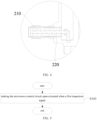
- the microwave generation device comprises a microwave emission source 210 and a microwave lead-in section 220, the microwave emission source 210 located in the interior of the receiving compartment 110; a first end of the microwave lead-in section 220 extending into the resonance chamber 120, a second end of the microwave lead-in section 220 being in electrical connection with the microwave emission source 210.
- the microwave emission source 210 is operable to generate microwaves, and the microwave is transmitted through the microwave lead-in section 220 into the interior of the resonance chamber 120.
- an entry site of the microwave in the resonance chamber 120 can be varied, so as to avoid components in the interior of the resonance chamber 120 and also to ensure stable transmission of the microwave from the first end of the resonance pillar 300 toward the second end of the resonance pillar 300.
- the microwave emission source 210 and the microwave lead-in section 220 are set in contact with each other, and when the voltage sensor detects the resonance chamber 120 opened, the microwave emission source 210 and the microwave lead-in section 220 are separated from each other.
- the microwave emission source 210 and the microwave lead-in section 220 are set to be of a splitable structure.
- the microwave emission source 210 and the microwave lead-in section 220 are in contact with each other, the microwave emission source 210 is allowed to transmit the microwaves to the microwave lead-in section 220 which transmits the microwaves into the interior of the resonance chamber 120.
- the microwave emission source 210 and the microwave lead-in section 220 are separated, the microwaves are not allowed to transmit into the microwave lead-in section 220.
- the microwave generation device receives a feedback signal of the microwaves, and at this moment, the voltage sensor can detect a certain value of a reversed voltage.
- the microwave generation device does not receive, at this moment, the feedback signal of the microwaves, and the reversed voltage detected by the voltage sensor increases, indicating the resonance chamber 120 opened at this moment, and thus, it needs to make the microwave control circuit open-circuited. The accuracy is thus enhanced during a detection process.
- the microwave lead-in section 220 is mounted on the third body, and in detaching the third body, the microwave emission source 210 and the microwave lead-in section 220 are separated from each other.
- the number of the first inspection member 500 is one or multiple; and/or the number of the second inspection member is one or multiple.
- the number of the first inspection member 500 can be just one, and the first inspection member 500 is mounted on the first body or the second body.
- the first inspection member 500 can also be multiple, and the multiple first inspection members 500 can be mounted on the first body, or the multiple first inspection members 500 can be mounted on the second body, both the first body and the second body are mounted with the first inspection members 500.
- the number of the second inspection member can be one or multiple.
- a control method of an aerosol generation device comprises a housing, a microwave generation device, and a first inspection member, the housing comprising a receiving compartment, the microwave generation device arranged in the interior of the receiving compartment, the microwave generation device comprising a microwave control circuit, the microwave control circuit being in electrical connection with the first inspection member.
- the control method of the aerosol generation device comprises: Step S102, making the microwave control circuit open-circuited when a first inspection signal of the first inspection member detects the receiving compartment opened.
- the first inspection member is mounted in the interior of the receiving compartment, and the receiving compartment is openable. To prevent the microwaves from leaking, the first inspection member is applied to detect whether the receiving compartment is opened.
- the microwave generation device is provided with a microwave control circuit and an operation circuit, the microwave control circuit being normally in a closed-circuit status and the operation circuit in a short-circuit status, and when it is desired to have the microwaves acting on the aerosol base material to generate an aerosol, the microwave control circuit controls the operation circuit to become closed-circuited so as to generate the microwaves.
- the microwave control circuit When the receiving compartment is opened inadvertently or maliciously, due to the microwave control circuit being in the closed-circuit status, if it is detected, at this moment, a signal for having the microwaves acting on the aerosol base material to generate the aerosol, then the microwave control circuit controls the operation circuit to become closed-circuited, and at this moment, the microwaves so generated are leaking out, causing damage to nearby users.
- the controller controls the microwave control circuit to become open-circuited, so that even though a signal for having the microwave acting on the aerosol base material to generate an aerosol may be detected, the microwave control circuit is incapable of controlling the operation circuit to become closed-circuited, and thus, no microwave will be generated, and microwave leaking to cause damage to users can be prevented thereby improving the safety of users in use of the aerosol generation device.
- the first inspection member is operable to detect whether the receiving compartment is opened, if the receiving compartment is maliciously opened, users still cannot use the microwave generation device to generate microwaves, and malicious use of microwave can be prevented.
- the microwave control circuit being open-circuited means the microwave control circuit set in a locked status
- the locked status means locking made in circuitry, and it is hard for ordinary users to rely on their own techniques to release the locking of the microwave control circuit, this helping avoid malicious use and avoid damage caused by microwave.
- the microwave control circuit Since the microwave control circuit is locked, if the locking of the microwave control circuit is not released, even though users may re-close the receiving compartment 110, the microwave control circuit cannot be activated.
- the housing further comprises a resonance chamber, the microwave generation device being operable to feed microwaves into the interior of the resonance chamber, and the aerosol forming device further comprises: a second inspection member, the second inspection member being in electrical connection with the microwave generation device.
- the control method of the aerosol generation device further comprises: making the microwave control circuit open-circuited when the second inspection member detects the resonance chamber opened, and making the microwave control circuit closed-circuited when the second inspection member detects the resonance chamber closed.
- the resonance chamber to ensure the cleanliness of the interior of the resonance chamber.
- the resonance chamber is provided, in the interior thereof, with the second inspection member, and the second inspection member carries out detection on whether the resonance chamber is opened.
- the controller controls the microwave control circuit to become open-circuited, and, at this moment, even though a signal for having the microwaves acting on the aerosol base material to generate an aerosol may be detected, the microwave control circuit is incapable of controlling the operation circuit to become closed-circuited, and thus, no microwave will be generated, and microwave leaking to cause damage to users can be prevented thereby improving the safety of users in use of the aerosol generation device.
- the second inspection member detects the resonance chamber closed, and the second inspection member feeds a detection signal to the controller, and the controller controls the microwave control circuit to become closed-circuited, so that the aerosol generation device is allowed to generate microwaves according to the users' needs for use, avoiding any influence on the use by the users.
- Closing/opening of the microwave control circuit is in relation with the status of opening of the resonance chamber, and on the basis of guaranteeing the safety of use, issues that the aerosol generation device cannot further generate microwave due to detached before can be avoided.
- the resonance chamber and the receiving compartment are two separate cavities that are independent of each other.
- the second inspection member comprises a voltage sensor;
- the microwave generation device comprises a microwave emission source and a microwave lead-in section, the microwave emission source and the microwave lead-in section separated from each other when the resonance chamber is opened.
- the control method of the aerosol generation device further comprises: the step of making the microwave control circuit open-circuited when the second inspection member detects the resonance chamber opened comprising: controlling the microwave control circuit to be in a status of being open-circuited when the voltage sensor detects a voltage value that is greater than a preset voltage value.
- the microwave emission source and the microwave lead-in section are set to be of a splitable structure.
- the microwave emission source is allowed to transmit the microwaves into the microwave lead-in section which transmits the microwaves into the interior of the resonance chamber.
- the microwave emission source and the microwave lead-in section are separated from each other, the microwaves are not allowed to transmit into the microwave lead-in section.
- the microwave generation device receives a feedback signal of the microwaves, and at this moment, the voltage sensor can detect a certain value of a reversed voltage.
- the microwave generation device When the microwave emission source and the microwave lead-in section are separated from each other, the microwave generation device does not receive, at this moment, the feedback signal of the microwaves, and the reversed voltage detected by the voltage sensor increases, indicating the resonance chamber opened at this moment, and thus, it needs to make the microwave control circuit open-circuited. The accuracy during a detection process is thus enhanced.
- the microwave lead-in section is mounted on the third body, and in detaching the third body, the microwave emission source and the microwave lead-in section are separated from each other.
- the term “multiple” means two or more than two.
- the terms “mounting”, “interconnecting”, “connecting”, and “fixing” should be interpreted in the broadest sense.
- connecting can be fixedly connected and can also be detachably connected, or integrally connected.
- Interconnecting can be directly interconnecting, and can also be interconnected by means of an intermediate medium.
- the terms “one embodiment”, “some embodiments”, and “specific embodiments” as used herein indicate a combination of specific characteristics, structures, materials, or features described in the embodiment or example is included in at least one embodiment or example of the application. In the disclosure, an illustrative reference to the above terms does not suggest applied to the same embodiment or example. Further, the description of the specific characteristics, structures, materials, or features can be combined, in any appropriate form, in any one or multiple embodiments or examples.
Landscapes
- Physics & Mathematics (AREA)
- Electromagnetism (AREA)
- Containers And Packaging Bodies Having A Special Means To Remove Contents (AREA)
- Catching Or Destruction (AREA)
Abstract
Description
- The present invention relates to the technical field of electronic atomization, and more particularly to an aerosol generation device and a control method of an aerosol generation device.
- A heat-not-burning (HNB) device is a kind of electronic equipment that heats, but does not burn, an aerosol generation base material (which is a product of processed plant leaves). The heating device heats, at a high temperature, the aerosol generation base material to a temperature that can generate an aerosol, but is not sufficient to cause burning, so that, without being caused to burn, the aerosol generation base material generates an aerosol desired by a user.
- The heat-not-burning devices that are currently available in the market generally adopts resistor heating means, namely a centered heating plate or a heating pin penetrates, at a center location of the aerosol generation base material, into the interior of the aerosol generation base material to proceed with heating. Such a utensil takes a long time to wait for preheating before use, making it hard to freely start or stop vaping, and the aerosol generation base material cannot be uniformly carbonized, leading to insufficient baking of the aerosol generation base material and low efficiency of utilization. Secondly, the heating plate of the HNB device may easily causes generation of contaminants, which are hard to cleanse, in an aerosol generation base material extractor and a heating plate holder, and a portion of the aerosol generation base material that is in contact with the heating body may get locally excessively high temperature, causing partial decomposition and releasing substances that are harmful to humans. Thus, the resistor heating means is gradually replaced by microwave heating technology, which becomes a new solution of heating. The microwave heating technology has advantages in respect of high efficiency, timeliness, optionality, and non-delay heating, and is only effective of heating for specific substances having certain dielectric properties. Advantages of microwave heating based atomization include: (a) instantaneous vaping or stopping being achievable as the microwave heating is radiation based heating, rather than heat conduction; (b) there being no plate breaking or heating plate cleansing issues as no heating plate is involved; and (c) the utilization efficiency of the aerosol generation base material being high and mouthfeel being consistent, and the mouthfeel being much closer to cigarettes.
- However, when a compartment in which a microwave device is arranged is opened, the microwave device keeps emitting microwaves that may become hazardous to people in the vicinity, so that operation safety of users cannot be guaranteed.
- The application aims to resolve one of the technical issues that the prior art or the related art is suffering.
- In view of this, the application provides, in a first aspect, an aerosol generation device, which comprises: a housing, the housing comprising a receiving compartment, the receiving compartment being closable after opening; a microwave generation device, which is located in the interior of the receiving compartment, the microwave generation device comprising a microwave control circuit; and a first inspection member, which is arranged at the receiving compartment, the first inspection member being in electrical connection with the microwave control circuit, the first inspection member being operable to make the microwave control circuit open-circuited upon detecting opening of the receiving compartment.
- In the application, users, when wishing to use the aerosol generation device, may dispose an aerosol base material into the housing. The microwave generation device is operable to generate microwaves, and when the microwave acts on the aerosol base material, the aerosol base material generates an aerosol. The microwave generation device is mounted in the interior of the receiving compartment of the housing. The housing is generally made of a metallic material, or the internal wall of the housing is provided with a metal coating layer, so that the housing induces a shielding effect against the microwave to prevent the microwave generated by the microwave generation device from leaking. The first inspection member is mounted in the interior of the receiving compartment. The receiving compartment is openable, and to avoid leaking of the microwave, the first inspection member is applied to carry out detection for whether the receiving compartment is opened. Specifically, the microwave generation device is provided with a microwave control circuit and an operation circuit, the microwave control circuit being normally in a closed-circuit status and the operation circuit in a short-circuit status, and when it is desired to have the microwave acting on the aerosol base material to generate the aerosol, the microwave control circuit controls the operation circuit to become closed-circuited so as to generate the microwaves. When the receiving compartment is opened inadvertently or maliciously, due to the microwave control circuit being in the closed-circuit status, if it is detected, at this moment, a signal for having the microwave acting on the aerosol base material to generate the aerosol, then the microwave control circuit controls the operation circuit to become closed-circuited, and at this moment, the microwave so generated is leaking out, causing damage to nearby users. To avoid occurrence of such a condition, if the first inspection member detects the receiving compartment opened, a detection signal of the first inspection member is fed to the controller, and the controller controls the microwave control circuit to become open-circuited, so that even though a signal for having the microwave acting on the aerosol base material to generate an aerosol may be detected, the microwave control circuit is incapable of controlling the operation circuit to become closed-circuited, and thus, no microwave will be generated, and microwave leaking to cause damage to users can be prevented thereby improving the safety of users in use of the aerosol generation device.
- Since the first inspection member is operable to detect whether the receiving compartment is opened, if the receiving compartment is maliciously opened, users still cannot use the microwave generation device to generate microwaves, and malicious use of microwave can be prevented.
- In a feasible application, the microwave control circuit being open-circuited means the microwave control circuit set in a locked status, and the locked status means locking made in circuitry, and it is hard for ordinary users to rely on their own techniques to release the locking of the microwave control circuit, this helping avoid malicious use and avoid damage caused by microwave.
- Since the microwave control circuit is locked, if the locking of the microwave control circuit is not released, even though users may re-close the receiving compartment, the microwave control circuit cannot be activated.
- Further, the aerosol generation device according to the above technical solution provided in the application may further comprise the following additional technical features:
In a feasible arrangement, the housing further comprises a resonance chamber, the microwave generation device being operable to feed microwaves into the interior of the resonance chamber, the resonance chamber being openable or closable; and the aerosol generation device further comprises a second inspection member, the second inspection member located in the interior of the resonance chamber, the second inspection member being in electrical connection with the microwave control circuit, the second inspection member being operable to make the microwave control circuit open-circuited upon detecting opening of the resonance chamber, the second inspection member being operable to make the microwave control circuit closed-circuited upon detecting closing of the resonance chamber. - In the arrangement, the housing is further provided with the resonance chamber, and the microwave assembly may feed microwaves into the interior of the resonance chamber. A resonance pillar is arranged in the housing, and a diameter of the resonance pillar is smaller than a diameter of the resonance chamber, so that a gap is present between the external wall of the resonance chamber and the internal wall of the resonance chamber, and the microwave is transmittable in the gap. The resonance pillar may function as a conductor, and the resonance pillar can be made of a metallic material. As an example, the resonance pillar is made of copper, aluminum, iron or an alloy thereof. The resonance pillar functions to transmit the microwave and to increase the transmission speed of the microwave, and the microwave does not readily deteriorate in transmitting in the interior of the resonance chamber, thereby enhancing an effect of the microwave acting on the aerosol generation base material, making the microwave acting on the aerosol generation base material with a high efficiency and a fast speed to facilitate satisfaction of users' needs of use.
- To guarantee the cleanliness of the interior of the resonance chamber, users may open the resonance chamber to cleanse the interior of the resonance chamber. To avoid occurrence of microwave leaking issues in opening the resonance chamber, the resonance chamber is provided, in the interior thereof, with the second inspection member, and the second inspection member carries out detection on whether the resonance chamber is opened. Specifically, if the second inspection member detects the resonance chamber opened, a detection signal of the second inspection member is fed to the controller, and the controller controls the microwave control circuit to become open-circuited, and, at this moment, even though a signal for having the microwave acting on the aerosol base material to generate an aerosol may be detected, the microwave control circuit is incapable of controlling the operation circuit to become closed-circuited, and thus, no microwave will be generated, and microwave leaking to cause damage to users can be prevented thereby improving the safety of users in use of the aerosol generation device. When users have cleansed the resonance chamber and close the resonance chamber, the second inspection member detects the resonance chamber closed, and the second inspection member feeds a detection signal to the controller, and the controller controls the microwave control circuit to become closed-circuited, so that the aerosol generation device is allowed to generate microwaves according to the users' needs for use, avoiding any influence on the use by the users. Closing/opening of the microwave control circuit is in relation with the status of opening of the resonance chamber, and on the basis of guaranteeing the safety of use, issues that the aerosol forming device cannot further generate microwave due to disassembling can be avoided.
- The resonance chamber and the receiving compartment are two separate cavities that are independent of each other.
- In a feasible arrangement, the housing comprises: a first body; a second body, the second body detachably connected to the first body, the first body and the second body enclosing and defining the receiving compartment, the first inspection member arranged on at least one of the first body and the second body; and a third body, the third body detachably connected to the first body, the first body and the third body enclosing and defining the resonance chamber, the second inspection member arranged on at least one of the first body and the third body.
- In the arrangement, the second body and the third body are both set to be detachable from the first body. To guarantee cleanliness of the interior of the resonance chamber, the third body can be detached from the first body so as to open the resonance chamber, to allow users to easily implement cleansing of the resonance chamber. When users detach the third body from the first body, the second inspection member detects the resonance chamber opened and makes the microwave control circuit open-circuited to prevent the microwave from leaking and causing damage to users. After the implementation of cleansing the resonance chamber is done, the third body is mounted to the first body, and the second inspection member detects the resonance chamber closed and makes the microwave control circuit closed-circuited, allowing the microwave generation device to normally generate the microwave, avoiding causing influence on use by users.
- Since impurity does not easily get into the receiving compartment, it is unnecessary for users to implement cleansing for the receiving compartment. Users are not suggested to detach the first body, yet to enhance easiness of mounting the microwave generation device, the first body and the second body are arranged as a splitable structure, so that after mounting of the microwave generation device is completed, the second body is mounted to the first body. When users detach the third body from the first body, the second inspection member detects the resonance chamber opened and makes the microwave control circuit open-circuited to prevent the microwave from leaking and causing damage to users.
- The first body and the second body are connected by applying fasteners, such as bolts, or alternatively, snapping fasteners are applicable to lock the first body and the second body together. This is equally applicable to the first body and the third body.
- In a feasible arrangement, the first inspection member comprises: at least one of a pressure sensor, a position sensor, a photoelectric sensor, and a voltage sensor; and the second inspection member comprises: at least one of a pressure sensor, a position sensor, a photoelectric sensor, and a voltage sensor.
- In the arrangement, the first inspection member can be a pressure sensor. As an example, the pressure sensor can be clamped by the first body and the second body. After the second body is detached, a pressure applied to the pressure sensor is reduced, and at this moment, the pressure sensor detects the receiving compartment opened, and makes the microwave control circuit open-circuited.
- The first inspection member can be a position sensor. As an example, when the second body is mounted to the first body, positions of the first body and the second body must be not varied. After the second body is detached, the position sensor detects variation of the position of the second body, indicating the receiving compartment opened at this moment, and makes the microwave control circuit open-circuited.
- The first inspection member can be a photoelectric sensor. As an example, the first inspection member is an infrared sensor, and the infrared sensor determines if the second body is detached according to reflection of an infrared signal, so as to make the microwave control circuit open-circuited in case that the receiving compartment is opened.
- The first inspection member can be a voltage sensor. As an example, a detection circuit is arranged inside the housing, and when the second body and the first body are connected to each other, the detection circuit is closed, and when the second body and the first body are separated from each other, the detection circuit is open. When the second body is detached, the voltage sensor detects the voltage value acquired from the detection circuit varies, indicating the receiving compartment opened at this moment, and makes the microwave control circuit open-circuited.
- Similar to the first inspection member, the second inspection member can also be at least one of a pressure sensor, a position sensor, a photoelectric sensor, and a voltage sensor.
- In a feasible arrangement, for the first inspection member comprising a pressure sensor, the aerosol generation device further comprises: a first elastic element; wherein the first inspection member is arranged on one of the first body and the second body, a first end of the first elastic element connected to the first inspection member, a second end of the first elastic element abutting on another one the first body and the second body.
- In the arrangement, when the first inspection member comprises a pressure sensor, it needs to rely on a pressure acting on the pressure sensor to determine whether the receiving compartment is opened or not. As an example, the pressure sensor is mounted on the first body, and in order to allow the second body to more accurately apply a pressure to the pressure sensor, a first elastic element is arranged between the pressure sensor and the second body. When the second body is mounted to the first body, the first elastic element is compressed, and at this moment, the first elastic element develops elastic deformation, so that the second body applies a pressure to the pressure sensor by means of the first elastic element. When the second body is separated from the first body, the first elastic element undergoes deformation to resume original, and, at this moment, the pressure sensor detects a drop of the pressure and controls the microwave control circuit to be open-circuited.
- By means of the arrangement of the first elastic element, a situation that pressure cannot be accurately detected due to a gap existing between the second body and the pressure sensor can be avoided, thereby improving the accuracy of detecting whether the second body is separated from the first body.
- In other arrangements, it is also feasible to mount the pressure sensor to the second body.
- In a feasible arrangement, for the second inspection member comprising a pressure sensor, the aerosol generation device further comprises: a second elastic element; wherein the second inspection member is arranged on one of the first body and the third body, a first end of the second elastic element connected to the second inspection member, a second end of the second elastic element abutting on another one of the first body and the third body.
- In the arrangement, when the second inspection member comprises a pressure sensor, it needs to rely on a pressure acting on the pressure sensor to determine whether the receiving compartment is opened or not. As an example, the pressure sensor is mounted on the first body, in order to allow the third body to more accurately apply a pressure to the pressure sensor, a second elastic element is arranged between the pressure sensor and the third body. When the third body is mounted to the first body, the second elastic element is compressed, and at this moment, the second elastic element develops elastic deformation, so that the third body applies a pressure to the pressure sensor by means of the second elastic element. When the third body is separated from the first body, the second elastic element undergoes deformation to resume original, and, at this moment, the pressure sensor detects a drop of the pressure and controls the microwave control circuit to be open-circuited.
- By means of the arrangement of the second elastic element, a situation that pressure cannot be accurately detected due to a gap existing between the third body and the pressure sensor can be avoided, thereby improving the accuracy of detecting whether the third body is separated from the first body.
- In other arrangements, it is also feasible to mount the pressure sensor to the third body.
- In a feasible arrangement, the microwave generation device comprises: a microwave emission source, which is located in the interior of the receiving compartment; and a microwave lead-in section, a first end of the microwave lead-in section extending into the resonance chamber, a second end of the microwave lead-in section being in electrical connection with the microwave emission source.
- In the arrangement, the microwave emission source is operable to generate microwaves, and the microwaves is transmitted through the microwave lead-in section into the interior of the resonance chamber. With the arrangement of the microwave lead-in section, an entry site of the microwave in the resonance chamber can be varied, so as to avoid components in the interior of the resonance chamber and also to ensure stable transmission of the microwave from the first end of the resonance pillar toward the second end of the resonance pillar.
- In a feasible arrangement, for the second inspection member comprising a voltage sensor, when the voltage sensor detects the resonance chamber closed, the microwave emission source and the microwave lead-in section are set in contact with each other, and when the voltage sensor detects the resonance chamber opened, the microwave emission source and the microwave lead-in section are separated from each other.
- In the arrangement, the microwave emission source and the microwave lead-in section are set to be of a splitable structure. When the microwave emission source and the microwave lead-in section are in contact with each other, the microwave emission source is allowed to transmit the microwave into the microwave lead-in section, and to transmit, by means of the microwave lead-in section, the microwave into the interior of the resonance chamber. When the microwave emission source and the microwave lead-in section are separated, the microwave is not allowed to transmit into the microwave lead-in section. Specifically, when the microwave emission source and the microwave lead-in section are in contact with each other and the microwave lead-in section transmits the microwave into the resonance chamber, the microwave generation device receives a feedback signal of the microwave, and at this moment, the voltage sensor can detect a certain value of a reversed voltage. When the microwave emission source and the microwave lead-in section are separated from each other, the microwave generation device does not receive, at this moment, the feedback signal of the microwave, and the reversed voltage detected by the voltage sensor increases, indicating the resonance chamber opened at this moment, and thus, it needs to make the microwave control circuit open-circuited. The accuracy is thus enhanced during a detection process.
- The microwave lead-in section is mounted on the third body, and in detaching the third body, the microwave emission source and the microwave lead-in section are separated from each other.
- In a feasible arrangement, the number of the first inspection member is one or multiple; and/or the number of the second inspection member is one or multiple.
- In the arrangement, the number of the first inspection member can be just one, and the first inspection member is mounted on the first body or the second body. The first inspection member can also be multiple, and the multiple first inspection members can be mounted on the first body, or the multiple first inspection members can be mounted on the second body, both the first body and the second body are mounted with the first inspection members. By increasing the number of the first inspection members, it is possible to enhance the accuracy whether the receiving compartment is opened, to effectively avoid damage to users by microwave.
- This is applicable to the second inspection member, and the number of the second inspection member can be one or multiple.
- The application provides, in a second aspect, a control method of an aerosol generation device. The aerosol forming device comprises: a housing, a microwave generation device, and a first inspection member, the housing comprising a receiving compartment, the microwave generation device arranged in the interior of the receiving compartment, the microwave generation device comprising a microwave control circuit, the microwave control circuit being in electrical connection with the first inspection member, and the control method comprises: making the microwave control circuit open-circuited when a first inspection signal of the first inspection member detects the receiving compartment opened.
- The first inspection member is mounted in the interior of the receiving compartment, and the receiving compartment is openable. To prevent the microwave from leaking, the first inspection member is applied to detect whether the receiving compartment is opened. Specifically, the microwave generation device is provided with a microwave control circuit and an operation circuit, the microwave control circuit being normally in a closed-circuit status and the operation circuit in a short-circuit status, and when it is desired to have the microwave acting on the aerosol base material to generate an aerosol, the microwave control circuit controls the operation circuit to become closed-circuited so as to generate the microwaves. When the receiving compartment is opened inadvertently or maliciously, due to the microwave control circuit being in the closed-circuit status, if it is detected, at this moment, a signal for having the microwave acting on the aerosol base material to generate the aerosol, then the microwave control circuit controls the operation circuit to become closed-circuited, and at this moment, the microwave so generated is leaking out, causing damage to nearby users. To avoid occurrence of such a condition, if the first inspection member detects the receiving compartment opened, a detection signal of the first inspection member is fed to the controller, and the controller controls the microwave control circuit to become open-circuited, so that even though a signal for having the microwave acting on the aerosol base material to generate an aerosol may be detected, the microwave control circuit is incapable of controlling the operation circuit to become closed-circuited, and thus, no microwave will be generated, and microwave leaking to cause damage to users can be prevented thereby improving the safety of users in use of the aerosol generation device.
- Since the first inspection member is operable to detect whether the receiving compartment is opened, if the receiving compartment is maliciously opened, users still cannot use the microwave generation device to generate microwaves, and malicious use of microwave can be prevented.
- In a feasible application, the microwave control circuit being open-circuited means the microwave control circuit set in a locked status, and the locked status means locking made in circuitry, and it is hard for ordinary users to rely on their own techniques to release the locking of the microwave control circuit, this helping avoid malicious use and avoid damage caused by microwave.
- Since the microwave control circuit is locked, if the locking of the microwave control circuit is not released, even though users may re-close the receiving compartment, the microwave control circuit cannot be activated.
- In a feasible arrangement, the housing further comprises a resonance chamber, the microwave generation device being operable to feed microwaves into the interior of the resonance chamber, and the aerosol forming device further comprises: a second inspection member, the second inspection member being in electrical connection with the microwave generation device, and the control method further comprises: making the microwave control circuit open-circuited when the second inspection member detects the resonance chamber opened, and making the microwave control circuit closed-circuited when the second inspection member detects the resonance chamber closed.
- In the arrangement, to guarantee the cleanliness of the interior of the resonance chamber, users may open the resonance chamber to cleanse the interior of the resonance chamber. To avoid occurrence of microwave leaking issues in opening the resonance chamber, the resonance chamber is provided, in the interior thereof, with the second inspection member, and the second inspection member carries out detection on whether the resonance chamber is opened. Specifically, if the second inspection member detects the resonance chamber opened, a detection signal of the second inspection member is fed to the controller, and the controller controls the microwave control circuit to become open-circuited, and, at this moment, even though a signal for having the microwave acting on the aerosol base material to generate an aerosol may be detected, the microwave control circuit is incapable of controlling the operation circuit to become closed-circuited, and thus, no microwave will be generated, and microwave leaking to cause damage to users can be prevented thereby improving the safety of users in use of the aerosol generation device. When users have cleansed the resonance chamber and close the resonance chamber, the second inspection member detects the resonance chamber closed, and the second inspection member feeds a detection signal to the controller, and the controller controls the microwave control circuit to become closed-circuited, so that the aerosol generation device is allowed to generate microwaves according to the users' needs for use, avoiding any influence on the use by the users. Closing/opening of the microwave control circuit is in relation with the status of opening of the resonance chamber, and on the basis of guaranteeing the safety of use, issues that the aerosol forming device cannot continuously generate microwave can be avoided.
- The resonance chamber and the receiving compartment are two separate cavities that are independent of each other.
- In a feasible arrangement, the second inspection member comprises: a voltage sensor; the microwave generation device comprises: a microwave emission source and a microwave lead-in section, the microwave emission source and the microwave lead-in section separated from each other when the resonance chamber is opened; and the control method further comprises: the step of making the microwave control circuit open-circuited when the second inspection member detects the resonance chamber opened comprising: controlling the microwave control circuit to be in a status of being open-circuited when the voltage sensor detects a voltage value that is greater than a preset voltage value.
- In the arrangement, the microwave emission source and the microwave lead-in section are set to be of a splitable structure. When the microwave emission source and the microwave lead-in section are in contact with each other, the microwave emission source is allowed to transmit the microwave into the microwave lead-in section, and to transmit, by means of the microwave lead-in section, the microwave into the interior of the resonance chamber. When the microwave emission source and the microwave lead-in section are separated, the microwave is not allowed to transmit into the microwave lead-in section. Specifically, when the microwave emission source and the microwave lead-in section are in contact with each other and the microwave lead-in section transmits the microwave into the resonance chamber, the microwave generation device receives a feedback signal of the microwave, and at this moment, the voltage sensor can detect a certain value of a reversed voltage. When the microwave emission source and the microwave lead-in section are separated from each other, the microwave generation device does not receive, at this moment, the feedback signal of the microwave, and the reversed voltage detected by the voltage sensor increases, indicating the resonance chamber opened at this moment, and thus, it needs to make the microwave control circuit open-circuited. The accuracy is thus enhanced during a detection process.
- The microwave lead-in section is mounted on the third body, and in detaching the third body, the microwave emission source and the microwave lead-in section are separated from each other.
- Additional aspects and advantages of the application will become obvious from the following section of description or can be appreciated through implementation of the application.
- The above and/or additional aspects and advantages of the application will become apparent and readily understandable from the following description of embodiments, with reference to the attached drawings, in which:
-
FIG. 1 illustrates a first one of schematic structure diagrams showing an aerosol generation device according to embodiments of the application; -
FIG. 2 illustrates a second one of schematic structure diagrams showing the aerosol generation device according to the embodiments of the application; -
FIG. 3 illustrates a third one of schematic structure diagrams showing the aerosol generation device according to the embodiments of the application; -
FIG. 4 illustrates a fourth one of schematic structure diagrams showing the aerosol generation device according to the embodiments of the application; and -
FIG. 5 illustrates a schematic diagram showing a flow chart of a control method of an aerosol generation device according to an embodiment of the application; - For better understanding of the above objectives, features, and advantages of the application, a detailed description of the application will be provided below with reference to the attached drawings and specific ways of embodiment. It is noted that without causing conflicts, embodiments of the application and features of the embodiments are combinable with each other.
- The description provided below gives an explanation to a lot of specifics and details for the purposes of better understanding of the application. However, the application can also be implemented by adopting other ways that are not described herein. Thus, the scope of protection that the application pursues is not limited to the specific embodiments disclosed below.
- In the following, reference is made to
FIGS. 1-5 for describing an aerosol generation device and a control method of an aerosol generation device according to some embodiments of the application. - As shown in
FIG. 1 , in some embodiments of the application, an aerosol generation device is provided, comprising: ahousing 100, amicrowave generation device 200, and afirst inspection member 500. Thehousing 100 comprises areceiving compartment 110, thereceiving compartment 110 being closable after opening. Themicrowave generation device 200 is located in the interior of thereceiving compartment 110, themicrowave generation device 200 comprising a microwave control circuit. Thefirst inspection member 500 is arranged at thereceiving compartment 110 and is in electrical connection with the microwave control circuit, thefirst inspection member 500 being operable to make the microwave control circuit open-circuited upon detecting opening of thereceiving compartment 110. - In the embodiment, users, when wishing to use the aerosol generation device, may dispose an
aerosol base material 400 into thehousing 100. Themicrowave generation device 200 is operable to generate microwaves, and when the microwave acts on theaerosol base material 400, theaerosol base material 400 generates an aerosol. Themicrowave generation device 200 is mounted in the interior of thereceiving compartment 110 of thehousing 100. Thehousing 100 is generally made of a metallic material, or the internal wall of thehousing 100 is provided with a metal coating layer, so that thehousing 100 induces a shielding effect against the microwave to prevent the microwave generated by the microwave generation device from leaking. Thefirst inspection member 500 is mounted in the interior of thereceiving compartment 110. Thereceiving compartment 110 is openable, and to avoid leaking of the microwave, thefirst inspection member 500 is applied to carry out detection for whether thereceiving compartment 110 is opened. Specifically, themicrowave generation device 200 is provided with a microwave control circuit and an operation circuit, the microwave control circuit being normally in a closed-circuit status and the operation circuit being in a short-circuit status, and when it is desired to have the microwave acting on theaerosol base material 400 to generate the aerosol, the microwave control circuit controls the operation circuit to become closed-circuited so as to generate the microwave. When thereceiving compartment 110 is opened inadvertently or maliciously, due to the microwave control circuit being in the closed-circuit status, if it is detected, at this moment, a signal for having the microwave acting on theaerosol base material 400 to generate the aerosol, then the microwave control circuit controls the operation circuit to become closed-circuited, and at this moment, the microwave so generated is leaking out, causing damage to nearby users. To avoid occurrence of such a condition, if thefirst inspection member 500 detects thereceiving compartment 110 opened, a detection signal of thefirst inspection member 500 is fed to the controller, and the controller controls the microwave control circuit to become open-circuited, so that even though a signal for having the microwave acting on theaerosol base material 400 to generate an aerosol is detected, the microwave control circuit is incapable of controlling the operation circuit to become closed-circuited, and thus, no microwave will be generated, and microwave leaking to cause damage to users can be prevented thereby improving the safety of users in use of the aerosol generation device. - Since the
first inspection member 500 is cable of detecting whether thereceiving compartment 110 is opened, if thereceiving compartment 110 is maliciously opened, users still cannot use the microwave generation device to generate microwaves, and malicious use of microwave can be prevented. - In a feasible application, the microwave control circuit being open-circuited means the microwave control circuit set in a locked status, and the locked status means locking made in circuitry, and it is hard for ordinary users to rely on their own techniques to release the locking of the microwave control circuit, this helping avoid malicious use and avoid damage caused by microwave.
- Since the microwave control circuit is locked, if the locking of the microwave control circuit is not released, even though users may re-close the
receiving compartment 110, the microwave control circuit cannot be activated. - In a feasible embodiment, the
housing 100 further comprises aresonance chamber 120, themicrowave generation device 200 configured to feed microwaves into the interior of theresonance chamber 120, theresonance chamber 120 being openable or closable. The aerosol generation device further comprises a second inspection member, the second inspection member located in the interior of theresonance chamber 120, the second inspection member being in electrical connection with the microwave control circuit, the second inspection member being operable to make the microwave control circuit open-circuited upon detecting opening of theresonance chamber 120, the second inspection member being operable to make the microwave control circuit closed-circuited upon detecting closing of theresonance chamber 120. - In the embodiment, the
housing 100 is further provided with theresonance chamber 120, and the microwave assembly may feed microwaves into the interior of theresonance chamber 120. Aresonance pillar 300 is arranged in thehousing 100, and a diameter of theresonance pillar 300 is smaller than a diameter of theresonance chamber 120, so that a gap is present between the external wall of theresonance chamber 120 and the internal wall of theresonance chamber 120, and the microwave is transmittable in the gap. Theresonance pillar 300 may function as a conductor, and theresonance pillar 300 can be made of a metallic material. As an example, theresonance pillar 300 is made of copper, aluminum, iron or an alloy thereof. Theresonance pillar 300 functions to transmit the microwave and to increase the transmission speed of the microwave, and the microwave does not readily deteriorate during transmitting in the interior of theresonance chamber 120, thereby enhancing an effect of the microwave acting on the aerosol generation base material, making the microwave acting on the aerosol generation base material with a high efficiency and a fast speed to facilitate satisfaction of users' needs of use. - To guarantee the cleanliness of the interior of the
resonance chamber 120, users may open theresonance chamber 120 to cleanse the interior of theresonance chamber 120. To avoid occurrence of microwave leaking issues in opening theresonance chamber 120, theresonance chamber 120 is provided, in the interior thereof, with the second inspection member, and the second inspection member carries out detection on whether theresonance chamber 120 is opened. Specifically, if the second inspection member detects theresonance chamber 120 opened, a detection signal of the second inspection member is fed to the controller, and the controller controls the microwave control circuit to become open-circuited, and, at this moment, even though a signal for having the microwave acting on theaerosol base material 400 to generate an aerosol may be detected, the microwave control circuit is incapable of controlling the operation circuit to become closed-circuited, and thus, no microwave will be generated, and microwave leaking to cause damage to users can be prevented thereby improving the safety of users in use of the aerosol generation device. When users have cleansed theresonance chamber 120 and close theresonance chamber 120, the second inspection member detects theresonance chamber 120 closed, and the second inspection member feeds a detection signal to the controller, and the controller controls the microwave control circuit to become closed-circuited, so that the aerosol generation device is allowed to generate microwaves according to the users' needs for use, avoiding any influence on the use by the users. Closing/opening of the microwave control circuit is in relation with the status of opening of theresonance chamber 120, and on the basis of guaranteeing the safety of use, issues that the aerosol forming device cannot continuously generate microwave due to disassembling can be avoided. Theresonance chamber 120 and thereceiving compartment 110 are two separate cavities that are independent of each other. - In a feasible embodiment, the
housing 100 comprises: a first body, a second body, and a third body; the second body detachably connected to the first body, the first body and the second body enclosing and defining thereceiving compartment 110, at least one of the first body and the second body provided with thefirst inspection member 500; the third body detachably connected to the first body, the first body and the third body enclosing and defining theresonance chamber 120, at least one of the first body and the third body provided with the second inspection member. - In the embodiment, the second body and the third body are both set to be detachable from the first body. To guarantee cleanliness of the interior of the
resonance chamber 120, the third body can be detached from the first body so as to open theresonance chamber 120, to allow users to easily implement cleansing of theresonance chamber 120. When users detach the third body from the first body, the second inspection member detects theresonance chamber 120 opened and makes the microwave control circuit open-circuited to prevent the microwave from leaking and causing damage to users. After the implementation of cleansing theresonance chamber 120 is done, the third body is mounted to the first body, and the second inspection member detects theresonance chamber 120 closed and makes the microwave control circuit closed-circuited, allowing the microwave generation device to normally generate the microwave, avoiding causing influence on use by users. - Since impurity does not easily get into the
receiving compartment 110, it is unnecessary for users to implement cleansing for thereceiving compartment 110. Users are not suggested to detach the first body, yet to enhance easiness of mounting the microwave generation device, the first body and the second body are arranged as a splitable structure, so that after mounting of the microwave generation device is completed, the second body is mounted to the first body. When users detach the third body from the first body, the second inspection member detects theresonance chamber 120 opened and makes the microwave control circuit open-circuited to prevent the microwave from leaking and causing damage to users. - The first body and the second body may be connected by fasteners, such as bolts, or alternatively, snap-fit joints are applicable to lock/engage the first body and the second body together. This is equally applicable to the first body and the third body.
- In a feasible embodiment, the
first inspection member 500 comprises at least one of a pressure sensor, a position sensor, a photoelectric sensor, and a voltage sensor; and the second inspection member comprises at least one of a pressure sensor, a position sensor, a photoelectric sensor, and a voltage sensor. - In the embodiment, the
first inspection member 500 can be a pressure sensor. As an example, the pressure sensor can be clamped/sandwiched by the first body and the second body. After the second body is detached from the first body, a pressure applied to the pressure sensor is reduced, and at this moment, the pressure sensor detects thereceiving compartment 110 opened, and makes the microwave control circuit open-circuited. - The
first inspection member 500 can be a position sensor. As an example, when the second body is mounted to the first body, the position of the second body relative to the first body is not varied. After the second body is detached from the first body, the position sensor is capable of detecting variation of the position of the second body, indicating thereceiving compartment 110 opened at this moment, and capable of making the microwave control circuit open-circuited. - The
first inspection member 500 can be a photoelectric sensor. As an example, thefirst inspection member 500 is an infrared sensor, and the infrared sensor determines whether the second body is detached according to reflection of an infrared signal, so as to make the microwave control circuit open-circuited in case that thereceiving compartment 110 is opened. - The
first inspection member 500 can be a voltage sensor. As an example, a detection circuit is arranged inside thehousing 100, and when the second body and the first body are connected to each other, the detection circuit is closed, and when the second body and the first body are separated from each other, the detection circuit is open. When the second body is detached, the voltage sensor detects the voltage value acquired from the detection circuit varies, indicating thereceiving compartment 110 opened at this moment, and makes the microwave control circuit open-circuited. - Similar to the
first inspection member 500, the second inspection member can also be at least one of a pressure sensor, a position sensor, a photoelectric sensor, and a voltage sensor. - In a feasible embodiment, for the
first inspection member 500 comprising a pressure sensor, the aerosol generation device further comprises: a first elastic element; wherein thefirst inspection member 500 is arranged on one of the first body and the second body, a first end of the first elastic element connected to thefirst inspection member 500, a second end of the first elastic element abutting on the other one of the first body and the second body. - In the embodiment, when the
first inspection member 500 comprises a pressure sensor, it needs to rely on a pressure acting on the pressure sensor to determine whether thereceiving compartment 110 is opened or not. As an example, the pressure sensor is mounted on the first body, and in order to allow the second body to more accurately apply a pressure to the pressure sensor, a first elastic element is arranged between the pressure sensor and the second body. When the second body is mounted to the first body, the first elastic element is compressed and the first elastic element develops elastic deformation, so that the second body applies a pressure to the pressure sensor by means of the first elastic element. When the second body is separated from the first body, the first elastic element undergoes deformation to resume original, and, at this moment, the pressure sensor detects a drop of the pressure and controls the microwave control circuit to be open-circuited. - By means of the arrangement of the first elastic element, a situation that pressure cannot be accurately detected due to a gap existing between the second body and the pressure sensor can be avoided, thereby improving the accuracy of detecting whether the second body is separated from the first body.
- In other embodiments, it is also feasible to mount the pressure sensor to the second body.
- In a feasible embodiment, the second inspection member comprising a pressure sensor, the aerosol generation device further comprises a second elastic element; wherein the second inspection member is arranged on one of the first body and the third body, a first end of the second elastic element connected to the second inspection member, a second end of the second elastic element abutting on the other of the first body and the third body.
- In the embodiment, when the second inspection member comprises a pressure sensor, it needs to rely on a pressure acting on the pressure sensor to determine whether the
receiving compartment 110 is opened or not. As an example, the pressure sensor is mounted on the first body, in order to allow the third body to more accurately apply a pressure to the pressure sensor, a second elastic element is arranged between the pressure sensor and the third body. When the third body is mounted to the first body, the second elastic element is compressed, and at this moment, the second elastic element develops elastic deformation, so that the third body applies a pressure to the pressure sensor by means of the second elastic element. When the third body is separated from the first body, the second elastic element undergoes deformation to resume original, and, at this moment, the pressure sensor detects a drop of the pressure and controls the microwave control circuit to be open-circuited. - By means of the arrangement of the second elastic element, a situation that pressure cannot be accurately detected due to a gap existing between the third body and the pressure sensor can be avoided, thereby improving the accuracy of detecting whether the third body is separated from the first body.
- In other embodiments, it is also feasible to mount the pressure sensor to the third body.
- Referring jointly to
FIGS. 1 and2 , in a feasible embodiment, the microwave generation device comprises amicrowave emission source 210 and a microwave lead-insection 220, themicrowave emission source 210 located in the interior of thereceiving compartment 110; a first end of the microwave lead-insection 220 extending into theresonance chamber 120, a second end of the microwave lead-insection 220 being in electrical connection with themicrowave emission source 210. - In the embodiment, the
microwave emission source 210 is operable to generate microwaves, and the microwave is transmitted through the microwave lead-insection 220 into the interior of theresonance chamber 120. With the arrangement of the microwave lead-insection 220, an entry site of the microwave in theresonance chamber 120 can be varied, so as to avoid components in the interior of theresonance chamber 120 and also to ensure stable transmission of the microwave from the first end of theresonance pillar 300 toward the second end of theresonance pillar 300. - Referring jointly to
FIGS. 2, 3 , and4 , in a feasible embodiment, for the second inspection member comprising a voltage sensor, when the voltage sensor detects theresonance chamber 120 closed, themicrowave emission source 210 and the microwave lead-insection 220 are set in contact with each other, and when the voltage sensor detects theresonance chamber 120 opened, themicrowave emission source 210 and the microwave lead-insection 220 are separated from each other. - In the embodiment, the
microwave emission source 210 and the microwave lead-insection 220 are set to be of a splitable structure. When themicrowave emission source 210 and the microwave lead-insection 220 are in contact with each other, themicrowave emission source 210 is allowed to transmit the microwaves to the microwave lead-insection 220 which transmits the microwaves into the interior of theresonance chamber 120. When themicrowave emission source 210 and the microwave lead-insection 220 are separated, the microwaves are not allowed to transmit into the microwave lead-insection 220. Specifically, when themicrowave emission source 210 and the microwave lead-insection 220 are in contact with each other and the microwave lead-insection 220 transmits the microwaves into theresonance chamber 120, the microwave generation device receives a feedback signal of the microwaves, and at this moment, the voltage sensor can detect a certain value of a reversed voltage. When themicrowave emission source 210 and the microwave lead-insection 220 are separated from each other, the microwave generation device does not receive, at this moment, the feedback signal of the microwaves, and the reversed voltage detected by the voltage sensor increases, indicating theresonance chamber 120 opened at this moment, and thus, it needs to make the microwave control circuit open-circuited. The accuracy is thus enhanced during a detection process. - The microwave lead-in
section 220 is mounted on the third body, and in detaching the third body, themicrowave emission source 210 and the microwave lead-insection 220 are separated from each other. - In a feasible embodiment, the number of the
first inspection member 500 is one or multiple; and/or the number of the second inspection member is one or multiple. - In the embodiment, the number of the
first inspection member 500 can be just one, and thefirst inspection member 500 is mounted on the first body or the second body. Thefirst inspection member 500 can also be multiple, and the multiplefirst inspection members 500 can be mounted on the first body, or the multiplefirst inspection members 500 can be mounted on the second body, both the first body and the second body are mounted with thefirst inspection members 500. By increasing the number of thefirst inspection members 500, it is possible to enhance the accuracy whether thereceiving compartment 110 is opened, to effectively avoid damage to users by microwave. - This is applicable to the second inspection member, and the number of the second inspection member can be one or multiple.
- In some embodiments of the application, a control method of an aerosol generation device is provided. The aerosol forming device comprises a housing, a microwave generation device, and a first inspection member, the housing comprising a receiving compartment, the microwave generation device arranged in the interior of the receiving compartment, the microwave generation device comprising a microwave control circuit, the microwave control circuit being in electrical connection with the first inspection member.
- As shown in
FIG. 5 , the control method of the aerosol generation device comprises:
Step S102, making the microwave control circuit open-circuited when a first inspection signal of the first inspection member detects the receiving compartment opened. - In the instant embodiment, the first inspection member is mounted in the interior of the receiving compartment, and the receiving compartment is openable. To prevent the microwaves from leaking, the first inspection member is applied to detect whether the receiving compartment is opened. Specifically, the microwave generation device is provided with a microwave control circuit and an operation circuit, the microwave control circuit being normally in a closed-circuit status and the operation circuit in a short-circuit status, and when it is desired to have the microwaves acting on the aerosol base material to generate an aerosol, the microwave control circuit controls the operation circuit to become closed-circuited so as to generate the microwaves. When the receiving compartment is opened inadvertently or maliciously, due to the microwave control circuit being in the closed-circuit status, if it is detected, at this moment, a signal for having the microwaves acting on the aerosol base material to generate the aerosol, then the microwave control circuit controls the operation circuit to become closed-circuited, and at this moment, the microwaves so generated are leaking out, causing damage to nearby users. To avoid occurrence of such a condition, if the first inspection member detects the receiving compartment opened, a detection signal of the first inspection member is fed to the controller, and the controller controls the microwave control circuit to become open-circuited, so that even though a signal for having the microwave acting on the aerosol base material to generate an aerosol may be detected, the microwave control circuit is incapable of controlling the operation circuit to become closed-circuited, and thus, no microwave will be generated, and microwave leaking to cause damage to users can be prevented thereby improving the safety of users in use of the aerosol generation device.
- Since the first inspection member is operable to detect whether the receiving compartment is opened, if the receiving compartment is maliciously opened, users still cannot use the microwave generation device to generate microwaves, and malicious use of microwave can be prevented.
- In a feasible application, the microwave control circuit being open-circuited means the microwave control circuit set in a locked status, and the locked status means locking made in circuitry, and it is hard for ordinary users to rely on their own techniques to release the locking of the microwave control circuit, this helping avoid malicious use and avoid damage caused by microwave.
- Since the microwave control circuit is locked, if the locking of the microwave control circuit is not released, even though users may re-close the
receiving compartment 110, the microwave control circuit cannot be activated. - In a feasible embodiment, the housing further comprises a resonance chamber, the microwave generation device being operable to feed microwaves into the interior of the resonance chamber, and the aerosol forming device further comprises: a second inspection member, the second inspection member being in electrical connection with the microwave generation device.
- The control method of the aerosol generation device further comprises: making the microwave control circuit open-circuited when the second inspection member detects the resonance chamber opened, and making the microwave control circuit closed-circuited when the second inspection member detects the resonance chamber closed.
- In the embodiment, to guarantee the cleanliness of the interior of the resonance chamber, users may open the resonance chamber to cleanse the interior of the resonance chamber. To avoid occurrence of microwave leaking issues in opening the resonance chamber, the resonance chamber is provided, in the interior thereof, with the second inspection member, and the second inspection member carries out detection on whether the resonance chamber is opened. Specifically, if the second inspection member detects the resonance chamber opened, a detection signal of the second inspection member is fed to the controller, and the controller controls the microwave control circuit to become open-circuited, and, at this moment, even though a signal for having the microwaves acting on the aerosol base material to generate an aerosol may be detected, the microwave control circuit is incapable of controlling the operation circuit to become closed-circuited, and thus, no microwave will be generated, and microwave leaking to cause damage to users can be prevented thereby improving the safety of users in use of the aerosol generation device. When users have cleansed the resonance chamber and close the resonance chamber, the second inspection member detects the resonance chamber closed, and the second inspection member feeds a detection signal to the controller, and the controller controls the microwave control circuit to become closed-circuited, so that the aerosol generation device is allowed to generate microwaves according to the users' needs for use, avoiding any influence on the use by the users. Closing/opening of the microwave control circuit is in relation with the status of opening of the resonance chamber, and on the basis of guaranteeing the safety of use, issues that the aerosol generation device cannot further generate microwave due to detached before can be avoided.
- The resonance chamber and the receiving compartment are two separate cavities that are independent of each other.
- In a feasible embodiment, the second inspection member comprises a voltage sensor; the microwave generation device comprises a microwave emission source and a microwave lead-in section, the microwave emission source and the microwave lead-in section separated from each other when the resonance chamber is opened.
- The control method of the aerosol generation device further comprises: the step of making the microwave control circuit open-circuited when the second inspection member detects the resonance chamber opened comprising: controlling the microwave control circuit to be in a status of being open-circuited when the voltage sensor detects a voltage value that is greater than a preset voltage value.
- In the embodiment, the microwave emission source and the microwave lead-in section are set to be of a splitable structure. When the microwave emission source and the microwave lead-in section are in contact with each other, the microwave emission source is allowed to transmit the microwaves into the microwave lead-in section which transmits the microwaves into the interior of the resonance chamber. When the microwave emission source and the microwave lead-in section are separated from each other, the microwaves are not allowed to transmit into the microwave lead-in section. Specifically, when the microwave emission source and the microwave lead-in section are in contact with each other and the microwave lead-in section transmits the microwaves into the resonance chamber, the microwave generation device receives a feedback signal of the microwaves, and at this moment, the voltage sensor can detect a certain value of a reversed voltage. When the microwave emission source and the microwave lead-in section are separated from each other, the microwave generation device does not receive, at this moment, the feedback signal of the microwaves, and the reversed voltage detected by the voltage sensor increases, indicating the resonance chamber opened at this moment, and thus, it needs to make the microwave control circuit open-circuited. The accuracy during a detection process is thus enhanced.
- The microwave lead-in section is mounted on the third body, and in detaching the third body, the microwave emission source and the microwave lead-in section are separated from each other.
- In the application, unless otherwise indicated, the term "multiple" means two or more than two. The terms "mounting", "interconnecting", "connecting", and "fixing" should be interpreted in the broadest sense. For example, "connecting" can be fixedly connected and can also be detachably connected, or integrally connected. "Interconnecting" can be directly interconnecting, and can also be interconnected by means of an intermediate medium. For those having ordinary skill in the art, the specific meanings of such terms as used in the application can be understood according to specific scenarios.
- In the description of the disclosure, the terms "one embodiment", "some embodiments", and "specific embodiments" as used herein indicate a combination of specific characteristics, structures, materials, or features described in the embodiment or example is included in at least one embodiment or example of the application. In the disclosure, an illustrative reference to the above terms does not suggest applied to the same embodiment or example. Further, the description of the specific characteristics, structures, materials, or features can be combined, in any appropriate form, in any one or multiple embodiments or examples.
- The description provided above illustrate only the preferred embodiments of the application and is not intended to limit the application. For artisans having ordinary skill, the application can be modified and varies in various ways. Thus, all modifications, equivalent substitutions, and improvements, which are made within the spirit and scope of the application should be construed falling within the scope of protection that the application pursues.
100 housing; 110 receiving compartment; 120 resonance chamber; 200 microwave generation device; 210 microwave emission source; 220 microwave lead-in section; 300 resonance pillar; 400 aerosol base material; 500 first inspection member.
Claims (12)
- An aerosol generation device, comprises:a housing, comprising a receiving compartment, the receiving compartment being closable after opening;a microwave generation device, which is located in the interior of the receiving compartment, the microwave generation device comprising a microwave control circuit; anda first inspection member, which is arranged at the receiving compartment, the first inspection member being in electrical connection with the microwave control circuit, the first inspection member being operable to make the microwave control circuit open-circuited upon detecting opening of the receiving compartment.
- The aerosol generation device according to claim 1, wherein:the housing further comprises a resonance chamber, the microwave generation device configured to feed microwaves into the interior of the resonance chamber, the resonance chamber being openable or closable; andthe aerosol generation device further comprises:
a second inspection member, which is located in the interior of the resonance chamber, the second inspection member being in electrical connection with the microwave control circuit, the second inspection member being operable to make the microwave control circuit open-circuited upon detecting opening of the resonance chamber, the second inspection member being operable to make the microwave control circuit closed-circuited upon detecting closing of the resonance chamber. - The aerosol generation device according to claim 2, wherein the housing comprises:a first body;a second body, the second body detachably connected to the first body, the first body and the second body enclosing and defining the receiving compartment, the first inspection member arranged on at least one of the first body and the second body; anda third body, the third body detachably connected to the first body, the first body and the third body enclosing and defining the resonance chamber, the second inspection member arranged on at least one of the first body and the third body.
- The aerosol generation device according to claim 3, wherein:the first inspection member comprises at least one of a pressure sensor, a position sensor, a photoelectric sensor, and a voltage sensor; andthe second inspection member comprises at least one of a pressure sensor, a position sensor, a photoelectric sensor, and a voltage sensor.
- The aerosol generation device according to claim 4, wherein:for the first inspection member comprising the pressure sensor, the aerosol generation device further comprises a first elastic element;wherein the first inspection member is arranged on one of the first body and the second body, a first end of the first elastic element connected to the first inspection member, a second end of the first elastic element abutting on another one of the first body and the second body.
- The aerosol generation device according to claim 4, wherein:for the second inspection member comprising the pressure sensor, the aerosol generation device further comprises a second elastic element;wherein the second inspection member is arranged on one of the first body and the third body, a first end of the second elastic element connected to the second inspection member, a second end of the second elastic element abutting on another one of the first body and the third body.
- The aerosol generation device according to claim 4, wherein the microwave generation device comprises:a microwave emission source, which is located in the interior of the receiving compartment; anda microwave lead-in section, a first end of the microwave lead-in section extending into the resonance chamber, a second end of the microwave lead-in section being in electrical connection with the microwave emission source.
- The aerosol generation device according to claim 7, wherein:
for the second inspection member comprising the voltage sensor, when the voltage sensor detects the resonance chamber closed, the microwave emission source and the microwave lead-in section are set in contact with each other, and when the voltage sensor detects the resonance chamber opened, the microwave emission source and the microwave lead-in section are separated from each other. - The aerosol generation device according to any one claims 2-8, wherein:the number of the first inspection member is one or multiple; and/orthe number of the second inspection member is one or multiple.
- A control method of an aerosol generation device, wherein the aerosol forming device comprises a housing, a microwave generation device, and a first inspection member, the housing comprising a receiving compartment, the microwave generation device arranged in the interior of the receiving compartment, the microwave generation device comprising a microwave control circuit, the microwave control circuit being in electrical connection with the first inspection member, the control method comprising:
making the microwave control circuit open-circuited when a first inspection signal of the first inspection member detects the receiving compartment opened. - The control method of the aerosol generation device according to claim 10, wherein the housing further comprises a resonance chamber, the microwave generation device being operable to feed microwaves into the interior of the resonance chamber, and the aerosol forming device further comprises a second inspection member, the second inspection member being in electrical connection with the microwave generation device, the control method further comprising:
making the microwave control circuit open-circuited when the second inspection member detects the resonance chamber opened, and making the microwave control circuit closed-circuited when the second inspection member detects the resonance chamber closed. - The control method of the aerosol generation device according to claim 11, wherein the second inspection member comprises a voltage sensor; the microwave generation device comprises a microwave emission source and a microwave lead-in section, the microwave emission source and the microwave lead-in sectionseparated from each other when the resonance chamber is opened; the control method further comprising:
making the microwave control circuit open-circuited when the second inspection member detects the resonance chamber opened comprises:
controlling the microwave control circuit to be in a status of being open-circuited when the voltage sensor detects a voltage value that is greater than a preset voltage value.
Applications Claiming Priority (1)
| Application Number | Priority Date | Filing Date | Title |
|---|---|---|---|
| PCT/CN2021/124894 WO2023065139A1 (en) | 2021-10-20 | 2021-10-20 | Aerosol generating apparatus and control method for aerosol generating apparatus |
Publications (2)
| Publication Number | Publication Date |
|---|---|
| EP4193857A1 true EP4193857A1 (en) | 2023-06-14 |
| EP4193857A4 EP4193857A4 (en) | 2023-09-13 |
Family
ID=86057894
Family Applications (1)
| Application Number | Title | Priority Date | Filing Date |
|---|---|---|---|
| EP21943325.7A Pending EP4193857A4 (en) | 2021-10-20 | 2021-10-20 | AEROSOL GENERATION APPARATUS AND CONTROL METHOD FOR AEROSOL GENERATION APPARATUS |
Country Status (4)
| Country | Link |
|---|---|
| EP (1) | EP4193857A4 (en) |
| JP (1) | JP7633284B2 (en) |
| KR (1) | KR102867051B1 (en) |
| WO (1) | WO2023065139A1 (en) |
Family Cites Families (15)
| Publication number | Priority date | Publication date | Assignee | Title |
|---|---|---|---|---|
| JP2003257614A (en) * | 2001-12-27 | 2003-09-12 | Sanyo Electric Co Ltd | High frequency heating device |
| JP2008225299A (en) | 2007-03-15 | 2008-09-25 | Seiko Epson Corp | Fixing apparatus and image forming apparatus |
| CA3007035A1 (en) * | 2016-02-25 | 2017-08-31 | Philip Morris Products S.A. | Electrically operated aerosol-generating system with temperature sensor |
| CN108552612A (en) * | 2018-07-16 | 2018-09-21 | 云南中烟工业有限责任公司 | A kind of microwave cavity for electronic cigarette |
| CN108552613A (en) | 2018-07-16 | 2018-09-21 | 云南中烟工业有限责任公司 | A kind of microwave resonance causes the electronic cigarette of atomization |
| CN208720296U (en) * | 2018-08-14 | 2019-04-09 | 广东美的厨房电器制造有限公司 | Micro-wave oven |
| TWI739172B (en) * | 2018-10-12 | 2021-09-11 | 瑞士商傑太日煙國際股份有限公司(瑞士) | Aerosol generation device, and heating chamber therefor, and aerosol generation system |
| JP7200709B2 (en) | 2019-01-31 | 2023-01-10 | 株式会社オートネットワーク技術研究所 | power supply |
| PT3747289T (en) * | 2019-06-06 | 2022-04-21 | Nvx Labs Gmbh | MICROWAVE HEATING UNIT AND METHOD |
| KR102389832B1 (en) * | 2019-06-18 | 2022-04-22 | 주식회사 케이티앤지 | Apparatus for generating aerosol by using microwave and method thereof |
| KR102299651B1 (en) * | 2019-09-10 | 2021-09-08 | 주식회사 이노아이티 | Microwave heating device with cylindrical antenna |
| CN110876493B (en) * | 2019-11-26 | 2021-11-09 | 深圳麦克韦尔科技有限公司 | Aerosol generating product, electronic atomization device and wave-absorbing phase change body preparation method |
| CN110876492B (en) | 2019-11-26 | 2022-11-22 | 深圳麦克韦尔科技有限公司 | Electronic atomization device |
| KR102328201B1 (en) * | 2020-02-07 | 2021-11-17 | 주식회사 케이티앤지 | Aerosol generating apparatus and method for operating the same |
| CN213587377U (en) | 2020-09-18 | 2021-07-02 | 英凯营养食品科技(上海)股份有限公司 | Microwave sterilizing equipment is used in dietary fiber processing |
-
2021
- 2021-10-20 EP EP21943325.7A patent/EP4193857A4/en active Pending
- 2021-10-20 KR KR1020227043596A patent/KR102867051B1/en active Active
- 2021-10-20 JP JP2022576502A patent/JP7633284B2/en active Active
- 2021-10-20 WO PCT/CN2021/124894 patent/WO2023065139A1/en not_active Ceased
Also Published As
| Publication number | Publication date |
|---|---|
| JP7633284B2 (en) | 2025-02-19 |
| WO2023065139A1 (en) | 2023-04-27 |
| KR20230058009A (en) | 2023-05-02 |
| JP2023549994A (en) | 2023-11-30 |
| EP4193857A4 (en) | 2023-09-13 |
| KR102867051B1 (en) | 2025-10-01 |
Similar Documents
| Publication | Publication Date | Title |
|---|---|---|
| EP0477633B1 (en) | High frequency heating apparatus utilizing inverter power supply | |
| ES2192383T3 (en) | PLASMA BURNER WITH MICROWAVE ISSUER. | |
| CN102544427A (en) | Power source apparatus and vehicle carrying same | |
| CN106992401A (en) | Charging socket for electric vehicle electronic lock and charging socket for electric vehicle, electric car | |
| CN103988269A (en) | Plug-in device for contactless inductive energy transfer and operating method for such a plug-in device | |
| CN1117949C (en) | Abnormal state detection apparatus for microwave oven and method thereof | |
| EP4193853A1 (en) | Aerosol generating device | |
| CN115777235A (en) | Determination of arcing during microwave processing flow of domestic microwave equipment | |
| WO2017000127A1 (en) | Temperature measuring component for microwave oven and microwave oven having same | |
| EP4183270A1 (en) | Aerosol generating matrix, and aerosol generating apparatus and system | |
| KR20190053887A (en) | How safety devices work | |
| US2448497A (en) | Flame electrode control device | |
| CN115989905A (en) | Aerosol generating device and control method for aerosol generating device | |
| JP2000348825A (en) | Outlet | |
| WO2023065139A1 (en) | Aerosol generating apparatus and control method for aerosol generating apparatus | |
| US5193100A (en) | Apparatus for detecting gaseous discharge in vacuum furnaces | |
| KR20170130761A (en) | Electric range having safety function and safety control method of the electric range | |
| JP2004156865A (en) | Device and method for controlling operation of plasma arc type melting furnace | |
| CN102997297B (en) | Micro-wave oven | |
| CN109193400A (en) | A kind of high and low voltage switchgear with real time monitoring warning function | |
| TWI714976B (en) | Ignition device | |
| CN101502182A (en) | Monitoring device | |
| JPH03218612A (en) | power converter | |
| KR101202754B1 (en) | Sensing apparatus of barbecue-bar of microwave range | |
| KR200147224Y1 (en) | Humidity Sensor of Microwave Using Copper Plate |
Legal Events
| Date | Code | Title | Description |
|---|---|---|---|
| STAA | Information on the status of an ep patent application or granted ep patent |
Free format text: STATUS: UNKNOWN |
|
| STAA | Information on the status of an ep patent application or granted ep patent |
Free format text: STATUS: THE INTERNATIONAL PUBLICATION HAS BEEN MADE |
|
| PUAI | Public reference made under article 153(3) epc to a published international application that has entered the european phase |
Free format text: ORIGINAL CODE: 0009012 |
|
| STAA | Information on the status of an ep patent application or granted ep patent |
Free format text: STATUS: REQUEST FOR EXAMINATION WAS MADE |
|
| 17P | Request for examination filed |
Effective date: 20221207 |
|
| AK | Designated contracting states |
Kind code of ref document: A1 Designated state(s): AL AT BE BG CH CY CZ DE DK EE ES FI FR GB GR HR HU IE IS IT LI LT LU LV MC MK MT NL NO PL PT RO RS SE SI SK SM TR |
|
| A4 | Supplementary search report drawn up and despatched |
Effective date: 20230811 |
|
| RIC1 | Information provided on ipc code assigned before grant |
Ipc: H05B 6/64 20060101ALI20230807BHEP Ipc: A24F 40/51 20200101ALI20230807BHEP Ipc: A24F 40/53 20200101ALI20230807BHEP Ipc: A24F 40/46 20200101AFI20230807BHEP |
|
| RAP3 | Party data changed (applicant data changed or rights of an application transferred) |
Owner name: SHENZHEN MERIT TECHNOLOGY CO., LTD. Owner name: SHENZHEN SMOORE TECHNOLOGY LIMITED |
|
| DAV | Request for validation of the european patent (deleted) | ||
| DAX | Request for extension of the european patent (deleted) | ||
| RAP3 | Party data changed (applicant data changed or rights of an application transferred) |
Owner name: SHENZHEN MERIT TECHNOLOGY CO., LTD. Owner name: SHENZHEN SMOORE TECHNOLOGY LIMITED |
|
| STAA | Information on the status of an ep patent application or granted ep patent |
Free format text: STATUS: EXAMINATION IS IN PROGRESS |
|
| 17Q | First examination report despatched |
Effective date: 20260213 |