EP4192813B1 - Inhibitors of transglutaminases - Google Patents
Inhibitors of transglutaminases Download PDFInfo
- Publication number
- EP4192813B1 EP4192813B1 EP22741487.7A EP22741487A EP4192813B1 EP 4192813 B1 EP4192813 B1 EP 4192813B1 EP 22741487 A EP22741487 A EP 22741487A EP 4192813 B1 EP4192813 B1 EP 4192813B1
- Authority
- EP
- European Patent Office
- Prior art keywords
- oxo
- ethyl
- dihydropyridin
- carboxamido
- oxoethyl
- Prior art date
- Legal status (The legal status is an assumption and is not a legal conclusion. Google has not performed a legal analysis and makes no representation as to the accuracy of the status listed.)
- Active
Links
Classifications
-
- C—CHEMISTRY; METALLURGY
- C07—ORGANIC CHEMISTRY
- C07D—HETEROCYCLIC COMPOUNDS
- C07D401/00—Heterocyclic compounds containing two or more hetero rings, having nitrogen atoms as the only ring hetero atoms, at least one ring being a six-membered ring with only one nitrogen atom
- C07D401/02—Heterocyclic compounds containing two or more hetero rings, having nitrogen atoms as the only ring hetero atoms, at least one ring being a six-membered ring with only one nitrogen atom containing two hetero rings
- C07D401/12—Heterocyclic compounds containing two or more hetero rings, having nitrogen atoms as the only ring hetero atoms, at least one ring being a six-membered ring with only one nitrogen atom containing two hetero rings linked by a chain containing hetero atoms as chain links
-
- A—HUMAN NECESSITIES
- A61—MEDICAL OR VETERINARY SCIENCE; HYGIENE
- A61K—PREPARATIONS FOR MEDICAL, DENTAL OR TOILETRY PURPOSES
- A61K31/00—Medicinal preparations containing organic active ingredients
- A61K31/33—Heterocyclic compounds
- A61K31/395—Heterocyclic compounds having nitrogen as a ring hetero atom, e.g. guanethidine or rifamycins
- A61K31/435—Heterocyclic compounds having nitrogen as a ring hetero atom, e.g. guanethidine or rifamycins having six-membered rings with one nitrogen as the only ring hetero atom
- A61K31/44—Non condensed pyridines; Hydrogenated derivatives thereof
- A61K31/4412—Non condensed pyridines; Hydrogenated derivatives thereof having oxo groups directly attached to the heterocyclic ring
-
- A—HUMAN NECESSITIES
- A61—MEDICAL OR VETERINARY SCIENCE; HYGIENE
- A61K—PREPARATIONS FOR MEDICAL, DENTAL OR TOILETRY PURPOSES
- A61K31/00—Medicinal preparations containing organic active ingredients
- A61K31/33—Heterocyclic compounds
- A61K31/395—Heterocyclic compounds having nitrogen as a ring hetero atom, e.g. guanethidine or rifamycins
- A61K31/435—Heterocyclic compounds having nitrogen as a ring hetero atom, e.g. guanethidine or rifamycins having six-membered rings with one nitrogen as the only ring hetero atom
- A61K31/44—Non condensed pyridines; Hydrogenated derivatives thereof
- A61K31/4427—Non condensed pyridines; Hydrogenated derivatives thereof containing further heterocyclic ring systems
- A61K31/443—Non condensed pyridines; Hydrogenated derivatives thereof containing further heterocyclic ring systems containing a five-membered ring with oxygen as a ring hetero atom
-
- A—HUMAN NECESSITIES
- A61—MEDICAL OR VETERINARY SCIENCE; HYGIENE
- A61K—PREPARATIONS FOR MEDICAL, DENTAL OR TOILETRY PURPOSES
- A61K31/00—Medicinal preparations containing organic active ingredients
- A61K31/33—Heterocyclic compounds
- A61K31/395—Heterocyclic compounds having nitrogen as a ring hetero atom, e.g. guanethidine or rifamycins
- A61K31/435—Heterocyclic compounds having nitrogen as a ring hetero atom, e.g. guanethidine or rifamycins having six-membered rings with one nitrogen as the only ring hetero atom
- A61K31/44—Non condensed pyridines; Hydrogenated derivatives thereof
- A61K31/4427—Non condensed pyridines; Hydrogenated derivatives thereof containing further heterocyclic ring systems
- A61K31/4436—Non condensed pyridines; Hydrogenated derivatives thereof containing further heterocyclic ring systems containing a heterocyclic ring having sulfur as a ring hetero atom
-
- A—HUMAN NECESSITIES
- A61—MEDICAL OR VETERINARY SCIENCE; HYGIENE
- A61K—PREPARATIONS FOR MEDICAL, DENTAL OR TOILETRY PURPOSES
- A61K31/00—Medicinal preparations containing organic active ingredients
- A61K31/33—Heterocyclic compounds
- A61K31/395—Heterocyclic compounds having nitrogen as a ring hetero atom, e.g. guanethidine or rifamycins
- A61K31/435—Heterocyclic compounds having nitrogen as a ring hetero atom, e.g. guanethidine or rifamycins having six-membered rings with one nitrogen as the only ring hetero atom
- A61K31/44—Non condensed pyridines; Hydrogenated derivatives thereof
- A61K31/4427—Non condensed pyridines; Hydrogenated derivatives thereof containing further heterocyclic ring systems
- A61K31/4439—Non condensed pyridines; Hydrogenated derivatives thereof containing further heterocyclic ring systems containing a five-membered ring with nitrogen as a ring hetero atom, e.g. omeprazole
-
- A—HUMAN NECESSITIES
- A61—MEDICAL OR VETERINARY SCIENCE; HYGIENE
- A61K—PREPARATIONS FOR MEDICAL, DENTAL OR TOILETRY PURPOSES
- A61K31/00—Medicinal preparations containing organic active ingredients
- A61K31/33—Heterocyclic compounds
- A61K31/395—Heterocyclic compounds having nitrogen as a ring hetero atom, e.g. guanethidine or rifamycins
- A61K31/435—Heterocyclic compounds having nitrogen as a ring hetero atom, e.g. guanethidine or rifamycins having six-membered rings with one nitrogen as the only ring hetero atom
- A61K31/44—Non condensed pyridines; Hydrogenated derivatives thereof
- A61K31/4427—Non condensed pyridines; Hydrogenated derivatives thereof containing further heterocyclic ring systems
- A61K31/444—Non condensed pyridines; Hydrogenated derivatives thereof containing further heterocyclic ring systems containing a six-membered ring with nitrogen as a ring heteroatom, e.g. amrinone
-
- A—HUMAN NECESSITIES
- A61—MEDICAL OR VETERINARY SCIENCE; HYGIENE
- A61K—PREPARATIONS FOR MEDICAL, DENTAL OR TOILETRY PURPOSES
- A61K31/00—Medicinal preparations containing organic active ingredients
- A61K31/33—Heterocyclic compounds
- A61K31/395—Heterocyclic compounds having nitrogen as a ring hetero atom, e.g. guanethidine or rifamycins
- A61K31/435—Heterocyclic compounds having nitrogen as a ring hetero atom, e.g. guanethidine or rifamycins having six-membered rings with one nitrogen as the only ring hetero atom
- A61K31/44—Non condensed pyridines; Hydrogenated derivatives thereof
- A61K31/445—Non condensed piperidines, e.g. piperocaine
- A61K31/4523—Non condensed piperidines, e.g. piperocaine containing further heterocyclic ring systems
- A61K31/4545—Non condensed piperidines, e.g. piperocaine containing further heterocyclic ring systems containing a six-membered ring with nitrogen as a ring hetero atom, e.g. pipamperone, anabasine
-
- A—HUMAN NECESSITIES
- A61—MEDICAL OR VETERINARY SCIENCE; HYGIENE
- A61K—PREPARATIONS FOR MEDICAL, DENTAL OR TOILETRY PURPOSES
- A61K31/00—Medicinal preparations containing organic active ingredients
- A61K31/33—Heterocyclic compounds
- A61K31/395—Heterocyclic compounds having nitrogen as a ring hetero atom, e.g. guanethidine or rifamycins
- A61K31/435—Heterocyclic compounds having nitrogen as a ring hetero atom, e.g. guanethidine or rifamycins having six-membered rings with one nitrogen as the only ring hetero atom
- A61K31/47—Quinolines; Isoquinolines
- A61K31/4709—Non-condensed quinolines and containing further heterocyclic rings
-
- A—HUMAN NECESSITIES
- A61—MEDICAL OR VETERINARY SCIENCE; HYGIENE
- A61K—PREPARATIONS FOR MEDICAL, DENTAL OR TOILETRY PURPOSES
- A61K31/00—Medicinal preparations containing organic active ingredients
- A61K31/33—Heterocyclic compounds
- A61K31/395—Heterocyclic compounds having nitrogen as a ring hetero atom, e.g. guanethidine or rifamycins
- A61K31/435—Heterocyclic compounds having nitrogen as a ring hetero atom, e.g. guanethidine or rifamycins having six-membered rings with one nitrogen as the only ring hetero atom
- A61K31/47—Quinolines; Isoquinolines
- A61K31/472—Non-condensed isoquinolines, e.g. papaverine
- A61K31/4725—Non-condensed isoquinolines, e.g. papaverine containing further heterocyclic rings
-
- A—HUMAN NECESSITIES
- A61—MEDICAL OR VETERINARY SCIENCE; HYGIENE
- A61K—PREPARATIONS FOR MEDICAL, DENTAL OR TOILETRY PURPOSES
- A61K31/00—Medicinal preparations containing organic active ingredients
- A61K31/33—Heterocyclic compounds
- A61K31/395—Heterocyclic compounds having nitrogen as a ring hetero atom, e.g. guanethidine or rifamycins
- A61K31/495—Heterocyclic compounds having nitrogen as a ring hetero atom, e.g. guanethidine or rifamycins having six-membered rings with two or more nitrogen atoms as the only ring heteroatoms, e.g. piperazine or tetrazines
- A61K31/4965—Non-condensed pyrazines
- A61K31/497—Non-condensed pyrazines containing further heterocyclic rings
-
- A—HUMAN NECESSITIES
- A61—MEDICAL OR VETERINARY SCIENCE; HYGIENE
- A61K—PREPARATIONS FOR MEDICAL, DENTAL OR TOILETRY PURPOSES
- A61K31/00—Medicinal preparations containing organic active ingredients
- A61K31/33—Heterocyclic compounds
- A61K31/395—Heterocyclic compounds having nitrogen as a ring hetero atom, e.g. guanethidine or rifamycins
- A61K31/495—Heterocyclic compounds having nitrogen as a ring hetero atom, e.g. guanethidine or rifamycins having six-membered rings with two or more nitrogen atoms as the only ring heteroatoms, e.g. piperazine or tetrazines
- A61K31/50—Pyridazines; Hydrogenated pyridazines
- A61K31/501—Pyridazines; Hydrogenated pyridazines not condensed and containing further heterocyclic rings
-
- A—HUMAN NECESSITIES
- A61—MEDICAL OR VETERINARY SCIENCE; HYGIENE
- A61K—PREPARATIONS FOR MEDICAL, DENTAL OR TOILETRY PURPOSES
- A61K31/00—Medicinal preparations containing organic active ingredients
- A61K31/33—Heterocyclic compounds
- A61K31/395—Heterocyclic compounds having nitrogen as a ring hetero atom, e.g. guanethidine or rifamycins
- A61K31/495—Heterocyclic compounds having nitrogen as a ring hetero atom, e.g. guanethidine or rifamycins having six-membered rings with two or more nitrogen atoms as the only ring heteroatoms, e.g. piperazine or tetrazines
- A61K31/505—Pyrimidines; Hydrogenated pyrimidines, e.g. trimethoprim
- A61K31/506—Pyrimidines; Hydrogenated pyrimidines, e.g. trimethoprim not condensed and containing further heterocyclic rings
-
- A—HUMAN NECESSITIES
- A61—MEDICAL OR VETERINARY SCIENCE; HYGIENE
- A61K—PREPARATIONS FOR MEDICAL, DENTAL OR TOILETRY PURPOSES
- A61K31/00—Medicinal preparations containing organic active ingredients
- A61K31/33—Heterocyclic compounds
- A61K31/395—Heterocyclic compounds having nitrogen as a ring hetero atom, e.g. guanethidine or rifamycins
- A61K31/535—Heterocyclic compounds having nitrogen as a ring hetero atom, e.g. guanethidine or rifamycins having six-membered rings with at least one nitrogen and one oxygen as the ring hetero atoms, e.g. 1,2-oxazines
- A61K31/5375—1,4-Oxazines, e.g. morpholine
- A61K31/5377—1,4-Oxazines, e.g. morpholine not condensed and containing further heterocyclic rings, e.g. timolol
-
- A—HUMAN NECESSITIES
- A61—MEDICAL OR VETERINARY SCIENCE; HYGIENE
- A61P—SPECIFIC THERAPEUTIC ACTIVITY OF CHEMICAL COMPOUNDS OR MEDICINAL PREPARATIONS
- A61P1/00—Drugs for disorders of the alimentary tract or the digestive system
- A61P1/16—Drugs for disorders of the alimentary tract or the digestive system for liver or gallbladder disorders, e.g. hepatoprotective agents, cholagogues, litholytics
-
- A—HUMAN NECESSITIES
- A61—MEDICAL OR VETERINARY SCIENCE; HYGIENE
- A61P—SPECIFIC THERAPEUTIC ACTIVITY OF CHEMICAL COMPOUNDS OR MEDICINAL PREPARATIONS
- A61P25/00—Drugs for disorders of the nervous system
- A61P25/28—Drugs for disorders of the nervous system for treating neurodegenerative disorders of the central nervous system, e.g. nootropic agents, cognition enhancers, drugs for treating Alzheimer's disease or other forms of dementia
-
- A—HUMAN NECESSITIES
- A61—MEDICAL OR VETERINARY SCIENCE; HYGIENE
- A61P—SPECIFIC THERAPEUTIC ACTIVITY OF CHEMICAL COMPOUNDS OR MEDICINAL PREPARATIONS
- A61P29/00—Non-central analgesic, antipyretic or antiinflammatory agents, e.g. antirheumatic agents; Non-steroidal antiinflammatory drugs [NSAID]
-
- A—HUMAN NECESSITIES
- A61—MEDICAL OR VETERINARY SCIENCE; HYGIENE
- A61P—SPECIFIC THERAPEUTIC ACTIVITY OF CHEMICAL COMPOUNDS OR MEDICINAL PREPARATIONS
- A61P35/00—Antineoplastic agents
-
- A—HUMAN NECESSITIES
- A61—MEDICAL OR VETERINARY SCIENCE; HYGIENE
- A61P—SPECIFIC THERAPEUTIC ACTIVITY OF CHEMICAL COMPOUNDS OR MEDICINAL PREPARATIONS
- A61P37/00—Drugs for immunological or allergic disorders
-
- C—CHEMISTRY; METALLURGY
- C07—ORGANIC CHEMISTRY
- C07D—HETEROCYCLIC COMPOUNDS
- C07D213/00—Heterocyclic compounds containing six-membered rings, not condensed with other rings, with one nitrogen atom as the only ring hetero atom and three or more double bonds between ring members or between ring members and non-ring members
- C07D213/02—Heterocyclic compounds containing six-membered rings, not condensed with other rings, with one nitrogen atom as the only ring hetero atom and three or more double bonds between ring members or between ring members and non-ring members having three double bonds between ring members or between ring members and non-ring members
- C07D213/04—Heterocyclic compounds containing six-membered rings, not condensed with other rings, with one nitrogen atom as the only ring hetero atom and three or more double bonds between ring members or between ring members and non-ring members having three double bonds between ring members or between ring members and non-ring members having no bond between the ring nitrogen atom and a non-ring member or having only hydrogen or carbon atoms directly attached to the ring nitrogen atom
- C07D213/60—Heterocyclic compounds containing six-membered rings, not condensed with other rings, with one nitrogen atom as the only ring hetero atom and three or more double bonds between ring members or between ring members and non-ring members having three double bonds between ring members or between ring members and non-ring members having no bond between the ring nitrogen atom and a non-ring member or having only hydrogen or carbon atoms directly attached to the ring nitrogen atom with hetero atoms or with carbon atoms having three bonds to hetero atoms with at the most one bond to halogen, e.g. ester or nitrile radicals, directly attached to ring carbon atoms
- C07D213/72—Nitrogen atoms
- C07D213/75—Amino or imino radicals, acylated by carboxylic or carbonic acids, or by sulfur or nitrogen analogues thereof, e.g. carbamates
-
- C—CHEMISTRY; METALLURGY
- C07—ORGANIC CHEMISTRY
- C07D—HETEROCYCLIC COMPOUNDS
- C07D405/00—Heterocyclic compounds containing both one or more hetero rings having oxygen atoms as the only ring hetero atoms, and one or more rings having nitrogen as the only ring hetero atom
- C07D405/02—Heterocyclic compounds containing both one or more hetero rings having oxygen atoms as the only ring hetero atoms, and one or more rings having nitrogen as the only ring hetero atom containing two hetero rings
- C07D405/12—Heterocyclic compounds containing both one or more hetero rings having oxygen atoms as the only ring hetero atoms, and one or more rings having nitrogen as the only ring hetero atom containing two hetero rings linked by a chain containing hetero atoms as chain links
-
- C—CHEMISTRY; METALLURGY
- C07—ORGANIC CHEMISTRY
- C07D—HETEROCYCLIC COMPOUNDS
- C07D409/00—Heterocyclic compounds containing two or more hetero rings, at least one ring having sulfur atoms as the only ring hetero atoms
- C07D409/02—Heterocyclic compounds containing two or more hetero rings, at least one ring having sulfur atoms as the only ring hetero atoms containing two hetero rings
- C07D409/12—Heterocyclic compounds containing two or more hetero rings, at least one ring having sulfur atoms as the only ring hetero atoms containing two hetero rings linked by a chain containing hetero atoms as chain links
-
- C—CHEMISTRY; METALLURGY
- C07—ORGANIC CHEMISTRY
- C07D—HETEROCYCLIC COMPOUNDS
- C07D413/00—Heterocyclic compounds containing two or more hetero rings, at least one ring having nitrogen and oxygen atoms as the only ring hetero atoms
- C07D413/02—Heterocyclic compounds containing two or more hetero rings, at least one ring having nitrogen and oxygen atoms as the only ring hetero atoms containing two hetero rings
- C07D413/12—Heterocyclic compounds containing two or more hetero rings, at least one ring having nitrogen and oxygen atoms as the only ring hetero atoms containing two hetero rings linked by a chain containing hetero atoms as chain links
-
- C—CHEMISTRY; METALLURGY
- C07—ORGANIC CHEMISTRY
- C07D—HETEROCYCLIC COMPOUNDS
- C07D417/00—Heterocyclic compounds containing two or more hetero rings, at least one ring having nitrogen and sulfur atoms as the only ring hetero atoms, not provided for by group C07D415/00
- C07D417/02—Heterocyclic compounds containing two or more hetero rings, at least one ring having nitrogen and sulfur atoms as the only ring hetero atoms, not provided for by group C07D415/00 containing two hetero rings
- C07D417/12—Heterocyclic compounds containing two or more hetero rings, at least one ring having nitrogen and sulfur atoms as the only ring hetero atoms, not provided for by group C07D415/00 containing two hetero rings linked by a chain containing hetero atoms as chain links
-
- C—CHEMISTRY; METALLURGY
- C07—ORGANIC CHEMISTRY
- C07D—HETEROCYCLIC COMPOUNDS
- C07D453/00—Heterocyclic compounds containing quinuclidine or iso-quinuclidine ring systems, e.g. quinine alkaloids
- C07D453/02—Heterocyclic compounds containing quinuclidine or iso-quinuclidine ring systems, e.g. quinine alkaloids containing not further condensed quinuclidine ring systems
-
- C—CHEMISTRY; METALLURGY
- C07—ORGANIC CHEMISTRY
- C07D—HETEROCYCLIC COMPOUNDS
- C07D471/00—Heterocyclic compounds containing nitrogen atoms as the only ring hetero atoms in the condensed system, at least one ring being a six-membered ring with one nitrogen atom, not provided for by groups C07D451/00 - C07D463/00
- C07D471/02—Heterocyclic compounds containing nitrogen atoms as the only ring hetero atoms in the condensed system, at least one ring being a six-membered ring with one nitrogen atom, not provided for by groups C07D451/00 - C07D463/00 in which the condensed system contains two hetero rings
- C07D471/04—Ortho-condensed systems
-
- C—CHEMISTRY; METALLURGY
- C07—ORGANIC CHEMISTRY
- C07D—HETEROCYCLIC COMPOUNDS
- C07D471/00—Heterocyclic compounds containing nitrogen atoms as the only ring hetero atoms in the condensed system, at least one ring being a six-membered ring with one nitrogen atom, not provided for by groups C07D451/00 - C07D463/00
- C07D471/02—Heterocyclic compounds containing nitrogen atoms as the only ring hetero atoms in the condensed system, at least one ring being a six-membered ring with one nitrogen atom, not provided for by groups C07D451/00 - C07D463/00 in which the condensed system contains two hetero rings
- C07D471/08—Bridged systems
-
- C—CHEMISTRY; METALLURGY
- C07—ORGANIC CHEMISTRY
- C07D—HETEROCYCLIC COMPOUNDS
- C07D487/00—Heterocyclic compounds containing nitrogen atoms as the only ring hetero atoms in the condensed system, not provided for by groups C07D451/00 - C07D477/00
- C07D487/02—Heterocyclic compounds containing nitrogen atoms as the only ring hetero atoms in the condensed system, not provided for by groups C07D451/00 - C07D477/00 in which the condensed system contains two hetero rings
- C07D487/08—Bridged systems
-
- C—CHEMISTRY; METALLURGY
- C07—ORGANIC CHEMISTRY
- C07D—HETEROCYCLIC COMPOUNDS
- C07D513/00—Heterocyclic compounds containing in the condensed system at least one hetero ring having nitrogen and sulfur atoms as the only ring hetero atoms, not provided for in groups C07D463/00, C07D477/00 or C07D499/00 - C07D507/00
- C07D513/02—Heterocyclic compounds containing in the condensed system at least one hetero ring having nitrogen and sulfur atoms as the only ring hetero atoms, not provided for in groups C07D463/00, C07D477/00 or C07D499/00 - C07D507/00 in which the condensed system contains two hetero rings
- C07D513/04—Ortho-condensed systems
Definitions
- the invention relates to novel inhibitors of transglutaminases, in particular transglutaminase 2, methods for their synthesis and to their use for the prophylaxis and treatment of diseases associated with transglutaminases, in particular transglutaminase 2.
- Any references in the description to methods of treatment refer to the compounds and pharmaceutical compositions of the present invention for use in a method for treatment of the human body by therapy.
- Transglutaminases are part of the class of transferases and according to EC nomenclature they are correctly designated as "protein-glutamine: amine ⁇ -glutamyl transferases" (EC 2.3.2.13). They link the ⁇ -amino group of the amino acid lysine and the ⁇ -glutamyl group of the amino acid glutamine forming an isopeptide bond while ammonia is released. In the absence of suitable amines and/or under certain conditions, deamidation of the glutamine may occur resulting in the corresponding glutamic acid.
- transglutaminases play an important role in many therapeutic areas such as the cardiovascular diseases (thrombosis and atherosclerosis), autoimmune diseases (celiac disease, Duhring-Brocq-disease, gluten ataxia), neurodegenerative diseases (Alzheimer's disease, Parkinson's disease, Huntington's disease), dermatological diseases (ichthyosis, psoriasis, acne) as well as in wound healing and inflammatory diseases (e.g. tissue fibrosis) ( J.M. Wodzinska, Mini-Reviews in medical chemistry, 2005, 5, 279 - 292 ).
- cardiovascular diseases thrombosis and atherosclerosis
- autoimmune diseases celiac disease, Duhring-Brocq-disease, gluten ataxia
- neurodegenerative diseases Alzheimer's disease, Parkinson's disease, Huntington's disease
- dermatological diseases ichthyosis, psoriasis, acne
- wound healing and inflammatory diseases e.g.
- Celiac disease a gluten intolerance, however, is one of the most important indications.
- Celiac disease is characterized by a chronic inflammation of the mucosa of the small intestine.
- the intestinal epithelium is successively destroyed after ingestion of gluten-containing food resulting in reduced absorption of nutrients which again has massive impact on the patients affected and is for example associated with symptoms such as loss of weight, anemia, diarrhea, nausea, vomiting, loss of appetite and fatigue.
- tissue transglutaminase 2 TG2, tTG
- the tissue transglutaminase is a central element during pathogenesis.
- the endogenous enzyme catalyses the deamidation of gluten/gliadin in the small intestinal mucosa and thus triggers the inflammatory response. Therefore inhibitors of tissue transglutaminase are suitable to be used as active agents for medication.
- Fibrotic disorders are characterized by the accumulation of crosslinked extracellular matrix proteins. Diabetic nephropathy, cystic fibrosis, idiopathic pulmonary fibrosis, kidney fibrosis as well as liver fibrosis belong to the most important fibrotic disorders to be addressed with the compounds disclosed.
- US 9,434,763 B2 discloses pyridinone derivatives having a warhead comprising at least one acceptor-substituted double bond, such as a Michael System, as irreversible transglutaminase inhibitors.
- Alkylacetamido and arylacetamido pyridinones showed inhibitory activity regarding tissue transglutaminase TG2 in nanomolar range (IC 50 ).
- US 11,072,634 B2 discloses reversible transglutaminase inhibitors comprising an aldehyde, a ketone, an ⁇ -ketoaldehyde, an ⁇ -ketoketone, an ⁇ -ketoacid, an ⁇ -ketoester, an ⁇ -ketoamide or a halogenmethylketone as warhead.
- the inhibitors showed inhibitory activity regarding tissue transglutaminase TG2 in nanomolar and micromolar range (IC 50 ).
- the objective of the present invention is to provide novel, most probably reversible inhibitors of transglutaminases, in particular transglutaminase 2 and methods for the synthesis of said inhibitors as well as several uses of these inhibitors.
- transglutaminase 2 tissue transglutaminase 2 or TG2.
- transglutaminase 2 tissue transglutaminase 2
- such chemical warhead moiety is particularly selected from reversible warheads such as ⁇ -ketoamides.
- the compounds of the present invention act as selective inhibitors of transglutaminase 2.
- branched alkyl moieties as lead structures, such excluding aromatic moieties, e.g. the phenyl group.
- bridged cycloalkyl groups are non-classical bioisosters of the phenyl group.
- a skilled person would expect similar physico-chemical or biochemical properties excluding to invest efforts. Since aromatic moieties are clearly not preferred, bridged cycloalkyl groups would not be considered improving the compounds.
- ZED3641 (Ref. 1, as disclosed in US 11,072,634 B2 ; reversible acting ⁇ -ketomethylamide analogue to Ref. 2, ZED1227) is about 15-fold more potent compared to Ref. 4 (compare table 1).
- Ref. 4 is analogous to compound A8 disclosed in US 9,434,763 B2 with respect to the backbone proving again superiority of branched alkyl moieties compared to aromatic derivatives in combination with reversible acting warheads.
- inventive compounds rated “A” show efficacies of about 30-fold higher compared to Ref. 3 (A8, compare to table1).
- Casein is one of the best known high molecular weight (24 kDa) protein substrates for transglutaminases.
- Inhibition data of the inventive compounds was compared with inhibition of compounds disclosed in US 9,434,763 B2 , particularly, compound A8, which is denoted herein as Reference 3. It is noteworthy that the IC 50 values of compounds A8 published in US 9,434,763 B2 and E16 from US 11,072,634 B2 cannot be compared to the present data, relying on a fluorogenic isopeptidase assay.
- inventive compounds of formula (I) rated “A” showed efficacies of about 100-fold higher compared to Ref. 3 (A8).
- Ref. 4 shows also that aromatic moiety of this reference comopund reduces the inhbibitory activity against TG2 strongly.
- inventive compounds demonstrate that bridged cycloalkyl groups improve the potency of the compounds by orders of magnitude compared to the aromatic reference compounds. Therefore, we credit bridged cycloalkyl groups as disclosed with an outstanding inventive manner.
- the unsubstituted bicyclic residues which can be substituted with 1 to 5 of the substituents R 9 - R 14 and R N ; have the following structure and the substituents R 9 - R 14 and R N have the meanings as defined herein:
- the present invention relates to the comopund of the formula (I) wherein
- the present invention relates to the comopund of the formula (I) wherein
- the present invention relates to the comopund of the formula (I) wherein
- the present invention relates to the compound of the formula ( Ia ): wherein
- the present invention relates to the compound of the formula ( Ia ): wherein
- the compound of the invention has the formula ( II ): wherein
- 2-bicyclo[3.1.1]heptyl have the following structure: and R a and R b , have the same meanings as defined herein.
- the compound has any one of the formulae ( II-a ) - ( II-I ), ( II-b1 ) - ( II-b2 ), and (III-a) - ( III-I ): wherein L 1 , L 2 , R 2 , R N , R a , R b , R c , R d and R e have the same meanings as defined in the formula ( I ), preferred in the formula ( Ia ) , more preferred in the formula ( II ).
- L 1 , L 2 , R 8 , R 10 , R 11 , R 12 , R 13 , R 11 , R N , R a , R b , R c , R d and R e have the same meanings as defined in the formula ( I ), preferred in the formula ( Ia ).
- the invention refers to the compound of the formulae ( I ), (Ia) and ( II ), wherein R 3 represents Also preferred, R 3 represents More preferred, R 3 represents
- the invention refers to the compound of any one of the formulae ( I ), (Ia) and ( II ), ( II-a ) - ( II-I ), ( II-b1 ) - ( II-b2 ), wherein R 2 represents wherein R 8 , R 9 , R 10 , R 11 , R 12 , R 13 , and R 14 , represent independently of each other -H, -F, -Cl, -Br, -I, -OH, -CN, -NO 2 , -CH 3 , -C 2 H 5 , -C 3 H 7 , -CH(CH 3 ) 2 , -C 4 H 9 , -CH 2 -CH(CH 3 ) 2 , -CH(CH 3 )-C 2 H 5 , -C(CH 3 ) 3 , -cyclo-C 3 H 5 , -CH 2 -cyclo-C 3 H 5 , -CH 2 -cyclo-C 3 H
- R N represents -H, -CH 3 , -C 2 H 5 , -C 3 H 7 , -CH(CH 3 ) 2 , -C 4 H 9 , -CH 2 -CH(CH 3 ) 2 , -CH(CH 3 )-C 2 H 5 , -C(CH 3 ) 3 , -cyclo-C 3 H 5 , -cyclo-C 4 H 7 , -cyclo-C 5 H 9 , -CH 2 -cyclo-C 3 H 5 , -CH 2 -cyclo-C 4 H 7 , -CH 2 -cyclo-C 5 H 9 , -CH 2 F, -CHF 2 , -CF 3 , -CH 2 Cl, -CH 2 Br, -CH 2 I, -CH 2 -CH 2 F, -CH 2 -CHF 2 , -CH 2 -CF 3 , -CH 2 -CH 2 Cl, -CH 2 -CH 2 Br
- the invention refers to the compound of any one of the formulae ( I ), (Ia) and ( II ), ( II-a ) - ( II-I ), ( II-b1 ) - (II-b2), R 2 represents or Also preferred, R 2 represents
- R 2 represents
- the invention refers to the compound of any one of the formulae ( I ), (IIa) and ( II ), ( II-a ) - ( II-I ), ( II-b1 ) - ( II-b2 ), wherein L represents -CH 2 -, -CH 2 CH 2 -, -CH 2 CH 2 CH 2 -, -CH 2 CONH-, -CH 2 CONH-CH 2 -, -CH 2 CON(CH 3 )-CH 2 -, -CH 2 CONH-CH(CH 3 )-,
- the present invention relates to a method for the synthesis of a compound of formula ( I ), especially any compound of the formula ( Ia ):
- Step 1A ' is carried out before the step 1A:
- first all protecting groups PG 1 and PG 2 are simultaneously removed and the protecting group PG 3 is selectively introduced.
- PG 1 and PG 3 are same.
- protecting groups refers to commonly used protection groups in organic synthesis, preferably for amino and carboxyl groups.
- PG 1 , PG 3 , and PG 5 preferably are suitable protecting groups for amino groups.
- PG 2 and PG 4 preferably are suitable protecting groups for carboxyl groups.
- PG 1 , PG 3 , and PG 5 may be selected from the group consisting of or comprising: acetyl, benzoyl, benzyloxycarbonyl (Cbz), tert-butylcarbonyl, tert-butyloxycarbonyl (Boc), and fluorenylmethylenoxy group (Fmoc).
- PG 2 and PG 4 may be selected from the group consisting of or comprising: methoxy, ethoxy, isobutoxy, tert-butoxy, benzyloxy; preferably, tert-butoxy group.
- activating reagents are commonly used to activating carboxylic acid ( " Peptide Coupling Reagents, More than a Letter Soup", Ayman El-Faham and Fernando Albericio, Chemical Reviews, 2011, 111(11), p.6557-6602 ).
- the activation may be introduced separate reaction or in situ reaction.
- any of the following coupling reagent can be used to activate carobxylic acid group: BOP (Benzotriazole-1-yl-oxy-tris-(dimethylamino)-phosphonium hexafluorophosphate), PyBOP (Benzotriazole-1-yl-oxy-tris-pyrrolidino-phosphonium hexafluorophosphate), AOP (7-(Azabenzotriazol-1-yl)oxy tris(dimethylamino)phosphonium hexafluorophosphate), PyAOP ((7-Azabenzotriazol-1-yloxy)tripyrrolidinophosphonium hexafluorophosphate), TBTU (2-(1H-Benzotriazole-1-yl)-1,1,3,3-tetramethylaminium tetrafluoroborate), EEDQ (N- Ethoxycarbonyl-2-ethoxy-1,2-dihydroquinoline), Polyphosphoric
- Another aspect of the present invention relates to compounds according to the general formula ( I ) as medicine as well as their use in medicine.
- the use as inhibitors of transglutaminases in particular transglutaminsase 2 (TG2).
- the compounds of the present invention may form of a pharmacologically acceptable salt with organic or inorganic acids or bases.
- suitable acids for such acid addition salt formation are hydrochloric acid, hydrobromic acid, sulfuric acid, phosphoric acid, acetic acid, citric acid, oxalic acid, malonic acid, salicylic acid, p-aminosalicylic acid, malic acid, fumaric acid, succinic acid, ascorbic acid, maleic acid, sulfonic acid, phosphonic acid, perchloric acid, nitric acid, formic acid, propionic acid, gluconic acid, lactic acid, tartaric acid, hydroxymaleic acid, pyruvic acid, phenylacetic acid, benzoic acid, p-aminobenzoic acid, p-hydroxybenzoic acid, methanesulfonic acid, ethanesulfonic acid, nitrous acid, hydroxyethanesulfonic acid, ethylenesulfonic acid, p
- the salts are prepared by contacting the free base form with a sufficient amount of the desired acid to produce a salt in the conventional manner.
- Preferred is the mesylate salt, hydrochloride salt and the trifluoroacetate salt and especially preferred is the trifluoroacetate salt and the hydrochloride salt.
- salts could also be formed with inorganic or organic bases.
- suitable inorganic or organic bases are, for example, NaOH, KOH, NH 4 OH, tetraalkylammonium hydroxide, lysine or arginine and the like.
- Salts may be prepared in a conventional manner using methods well known in the art, for example by treatment of a solution of the compound of the general formula (I) with a solution of an acid, selected out of the group mentioned above.
- novel compounds according to the general formula (I) are used as pharmaceutically active agent, i.e. the compound of the formula (I) is used in medicine.
- the present invention relates to a pharmaceutical composition
- a pharmaceutical composition comprising at least one compound according to the general formula (I), as an active ingredient or a pharmacologically acceptable salts thereof as an active ingredient, together with at least one pharmacologically acceptable carrier, excipient and/or diluent.
- the compounds according to general formula (I) described herein are especially suitable for the treatment and prophylaxis of diseases associated with and/or caused by transglutaminase 2.
- tissue transglutaminase TG 2
- fibrotic disorders are characterized by the accumulation of crosslinked extracellular matrix proteins. Diabetic nephropathy, cystic fibrosis, idiopathic pulmonary fibrosis, kidney fibrosis as well as liver fibrosis belong to the most important fibrotic disorders to be addressed with the compounds disclosed.
- inhibiting refers to the ability of a compound to downregulate, decrease, reduce, suppress, inactivate, or inhibit at least partially the activity of an enzyme, or the expression of an enzyme or protein.
- another aspect of the present invention is the use of the inventive compounds of the general formula (I), or the pharmaceutical composition thereof as described in the treatment or prophylaxis of autoimmune and inflammatory diseases, vascular diseases, fibrotic diseases, liver diseases, cholestatic liver diseases, cancer, neurodegenerative diseases, ocular diseases, and skin disorders.
- Further aspects of the present invention relate to the use of the compounds of general formula (I) for the preparation of a pharmaceutical composition useful for prophylaxis and/or treatment of autoimmune and inflammatory diseases, vascular diseases, fibrotic diseases, liver diseases, cholestatic liver diseases, cancer, neurodegenerative diseases, ocular diseases, and skin disorders.
- a method for preventing and/or treating autoimmune and inflammatory diseases, vascular diseases, fibrotic diseases, liver diseases, cholestatic liver diseases, cancer, neurodegenerative diseases, ocular diseases, and skin disorders comprises administering to a subject, in particular a human, a pharmaceutically effective amount of at least one compound of the general formula (I), to prevent and/or treat said autoimmune and inflammatory diseases, vascular diseases, fibrotic diseases, liver diseases, cholestatic liver diseases, cancer, neurodegenerative diseases, ocular diseases, and skin disorders.
- the autoimmune and inflammatory diseases comprises multiple sclerosis, celiac disease, Duhring-Brocq-disease (dermatitis herpetiformis), gluten ataxia, gluten neuropathy, diabetes, rheumatoid arthritis, Graves' disease, inflammatory bowel disease, systemic lupus erythematosus psoriasis, and gingivitis;
- the compound of the formula (I), or the pharmaceutical composition thereof is useful in the treatment or prophylaxis of celiac disease.
- the compounds of the general formula (I) can be administered in form of their pharmaceutically active salts, optionally using essentially non-toxic pharmaceutically acceptable carriers, adjuvants or extenders.
- Medications are prepared in a known manner in a conventional solid or fluid carrier or in extenders and a conventional pharmaceutically acceptable adjuvant/expedient in a suitable dose.
- the preferred preparations are provided in an administrable form suitable for oral application, such as pills, tablets, film tablets, coated tablets, capsules and powders.
- Tablets, film tablets, coated tablets, gelatin capsules and opaque capsules are the preferred pharmaceutical formulations.
- Any pharmaceutical compositions contains at least one compound of the general formula (I), and/or pharmaceutically acceptable salts thereof in an amount of 5 mg to 500 mg, preferably 10 mg to 250 mg and most preferred in an amount of 10 to 100 mg per formulation.
- the object of the present invention also includes pharmaceutical preparations for oral, parenteral, dermal, intradermal, intragastric, intracutaneous, intravascular, intravenous, intramuscular, intraperitoneal, intranasal, intravaginal, intrabuccal, percutaneous, rectal, subcutaneous, sublingual, topic, transdermal or inhalative application, containing, in addition to typical vehicles and extenders, a compound of the general formula (I), and/or a pharmaceutically acceptable salt thereof as active component.
- pharmaceutical preparations for oral, parenteral, dermal, intradermal, intragastric, intracutaneous, intravascular, intravenous, intramuscular, intraperitoneal, intranasal, intravaginal, intrabuccal, percutaneous, rectal, subcutaneous, sublingual, topic, transdermal or inhalative application containing, in addition to typical vehicles and extenders, a compound of the general formula (I), and/or a pharmaceutically acceptable salt thereof as active component.
- compositions of the present invention contain one of the compounds of the formula (I) disclosed herein as active component, typically mixed with suitable carrier materials, selected with respect to the intended form of administration, i.e. tablets to be administered orally, capsules (filled either with a solid, a semi-solid or a liquid), powders, orally administrable gels, elixirs, dispersible granulates, syrups, suspensions and the like in accordance with conventional pharmaceutical practices.
- suitable carrier materials selected with respect to the intended form of administration, i.e. tablets to be administered orally, capsules (filled either with a solid, a semi-solid or a liquid), powders, orally administrable gels, elixirs, dispersible granulates, syrups, suspensions and the like in accordance with conventional pharmaceutical practices.
- the compound of the formula (I) can as active agent component be combined with any oral, non-toxic, pharmaceutically acceptable, inert carrier, such as lactose, starch, sucrose, cellulose, magnesium stearate, dicalcium phosphate, calcium sulfate, talc, mannitol, ethyl alcohol (liquid forms) and the like for the oral administration in form of tablets or capsules.
- suitable binders, lubricants, disintegrants and colorants can be added to the mixture if required.
- Powders and tablets can consist of said inert carriers to an extent from about 5% per weight to about 95% per weight of the inventive composition.
- Suitable binders include starch, gelatin, natural sugars, sweeteners made of corn, natural and synthetic gums, such as acacia gum, sodium alginate, carboxymethylcellulose, polyethylene glycol and waxes.
- Possible lubricants for the use in said dosage forms include boric acid, sodium benzoate, sodium acetate, sodium chloride and the like.
- Disintegrants include starch, methylcellulose, cyclodextrins, guar gum and the like. If required, sweeteners and flavor additives and preservatives can also be included.
- compositions of the present invention can be formulated in a form with sustained release to provide a controlled release rate of any one or more components or active components, in order to optimize the therapeutic effect, i.e. the inhibitory activity and the like.
- Suitable dosage forms for sustained release include layered tablets containing layers with varying degradation rates or controlled release polymeric matrices impregnated with the active components and in the form of a tablet or capsule containing such impregnated or encapsulated porous polymeric matrices.
- Preparations in fluid form include solutions, suspensions and emulsions.
- solutions include solutions, suspensions and emulsions.
- exemplary mentioned are water or water propylene glycol solutions for parenteral injections or the addition of sweeteners and opacifiers for oral solutions, suspensions and emulsions.
- Aerosol preparations suitable for inhalation may include solutions and solids in the form of powders which can be combined with a pharmaceutically acceptable carrier, such as a compressed inert gas, e.g. nitrogen.
- a pharmaceutically acceptable carrier such as a compressed inert gas, e.g. nitrogen.
- a low melting wax such as a mixture of fatty acid glycerides, e.g. cocoa butter
- the active component is homogenously dispersed therein by stirring or similar mixing operations.
- the melted homogenous mixture is then poured in fitting forms, cooled and thus hardened.
- preparations in solid form which are to be converted into preparations in fluid form for either oral or parenteral administration shortly before use are included.
- fluid forms include solutions, suspensions and emulsions.
- transdermal compositions can have the form of crèmes, lotions, aerosols and/or emulsions.
- capsule refers to a special container or casing composed of methylcellulose, polyvinyl alcohols or denatured gelatins or starches, in which the active agents can be enclosed.
- hard shell capsules are prepared from mixtures of bones and porcine skin gelatins having comparatively high gel strength.
- the capsule itself can contain small amounts of colorants, opacifiers, softening agents and preservatives.
- Tablet means a compressed or cast solid dosage form containing the active components with suitable extenders.
- the tablet can be produced by compressing mixtures or granulates obtained by wet granulation, dry granulation or compaction, which are known to the one skilled in the art.
- Oral gels refer to the active components dispersed or solubilized in a hydrophilic semi-solid matrix.
- Powders for compositions refer to powder mixtures containing the active components and suitable extenders which can be suspended in water or juices.
- Suitable extenders are substances which usually form the largest part of the composition or dosage form. Suitable extenders include sugars such as lactose, sucrose, mannitol and sorbitol; starches derived from wheat, corn, rice and potatoes; and celluloses such as microcrystalline cellulose.
- the amount of extenders in the composition can range from about 5 to about 95% per weight of the total composition, preferably form about 25 to about 75% per weight and further preferred from about 30 to about 60% per weight.
- disintegrants refers to materials added to the composition in order to support disintegration and release of the medicinal substance.
- Suitable disintegrants include starches, modified starches which are soluble in cold water, such as sodium carboxymethyl starch; natural and synthetic gums such as locust bean gum, caraya, guar gum, tragacanth and agar; cellulose derivatives such as methylcellulose and sodium carboxymethylcellulose, microcrystalline celluloses and crosslinked microcrystalline celluloses such as croscarmellose sodium; alginates such as alginic acid and sodium alginate; clays such as bentonites and foaming mixtures.
- the amount of disintegrants used in the composition can range from about 2 to 20% per weight of the composition and further preferred from about 5 to about 10% per weight.
- Binders characterize substances binding or "gluing" powders to each other and they consequently serve as “glue” in the formulation. Binders add a cohesion starch which is already available in the extenders or the disintegrant. Suitable binders include sugar, such as sucrose; starches derived from wheat, corn, rice and potatoes; natural gums such as acacia gum, gelatin and tragacanth; derivatives of sea weed such as alginic acid, sodium alginate and ammonium calcium alginate, cellulose materials such as methyl cellulose and sodium carboxymethylcellulose and hydroxypropyl methylcellulose, polyvinylpyrrolidone and inorganic compounds, such as magnesium aluminum silicate.
- the amount of binders in the composition can range from about 2 to about 20% per weight of the total composition, preferably form about 3 to about 10% per weight and further preferred from about 3 to about 6% per weight.
- lubricant refers to a substance added to the dosage form in order to allow for the tablet, granulate, etc. to be released from the casting mold or pressing mold, after compression, by reducing the friction.
- Suitable lubricants include metallic stearates such as magnesium stearate, calcium stearate or potassium stearate; stearic acid; waxes with high melting points and water soluble lubricants such as sodium chloride, sodium benzoate, sodium acetate, sodium oleate, polyethylene glycols and D,L-leucine. Due to the fact that lubricants have to be present on the surface of the granulates as well as between the granulates and parts of the tablet press they are typically added during the last step prior to compression.
- the amount of lubricants in the composition can range from about 0.2 to about 5% per weight of the total composition, preferably form about 0.5 to about 2% per weight and further preferred from about 0.3 to about 1.5 % per weight.
- Lubricants are materials preventing caking and improving the flow characteristics of granulates so that the flow is smooth and uniform.
- Suitable lubricants include silicon dioxide and talc.
- the amount of lubricants in the composition can range from about 0.1 to about 5 % per weight of the total composition, preferably form about 0.5 to about 2 % per weight.
- Colorants are adjuvants coloring the composition or dosage form.
- Such adjuvants can include colorants having food quality which are adsorbed on a suitable adsorption means, such as clay or aluminum oxide.
- the amount of the colorant used can vary from about 0.1 to about 5% per weight of the composition and preferably from about 0.1 to about 1% per weight.
- a "pharmaceutically effective amount" of a transglutaminase inhibitor is the amount or activity effective for achieving the desired physiological result, either in cells treated in vitro or in a patient treated in vivo.
- a pharmaceutical effective amount is such an amount which is sufficient for inhibiting, for a certain period of time, one or more of the clinically defined pathological processes associated with transglutaminase 2.
- the effective amount can vary according to the specific compound of the formula (I) and additionally depends on a plurality of factors and conditions related to the subject to be treated and the severity of the disease.
- an inhibitor is to be administered in vivo, factors such as age, weight and health of the patients as well as dose reaction curves and data regarding toxicity obtained from preclinical animal studies are amongst the data to be considered. If the inhibitor in form of the compound of the formula (I) described herein is to be brought in contact with the cells in vivo, a plurality of preclinical in vitro studies would be designed in order to determine parameters such as absorption, half-life, dose, toxicity, etc. Determining a pharmaceutically effective amount for a given pharmaceutically active ingredient is part of the ordinary skills of the one skilled in the art.
- Boc tert-butoxycarbonyl
- BocOSu N-tert-butoxycarbonyloxy-succinimide
- DCM diichloromethane
- DMAP 4-(Dimethylamino)-pyridine
- TEA triethylamine
- DMF dimethylformamide
- DMP Dess-Martin periodiane
- DIPEA N-Ethyldiisopropylamine
- Glu glutamic acid
- EDC (1-ethyl-3-(3'-dimethylaminopropyl)carbodiimide
- TFA trifluoroacetic acid
- THF tetrahydrofuran
- EtOAc ethyl acetate
- HATU 1-[Bis(dimethylamino)methylene]-1H-1,2,3-triazolo[4,5-b]pyridinium 3-oxid hexafluorophosphate
- HOBt hydroxybenzo
- compound I-75 was performed according to compound I-1, using (R)-(-)-isobornylamine instead of 1-adamantanamine in step 2 (according to ZED3912) and 1-methyl-1H-1 ,2,3-triazole-4-carboxylic acid instead of 1-methyl-1H-imidazole-5-carboxylic acid in step 6 (according to compound I-1b).
- compound I-76 was performed according to compound I-1, using (1R,2R,3R,5S)-(-)-isopinocampheylamine instead of 1-adamantanamine in step 2 (according to ZED3912) and 1-methyl-1H-1 ,2,4-triazole-3-carboxylic acid instead of 1-methyl-1H-imidazole-5-carboxylic acid in step 6 (according to compound I-1b).
- compound I-82 was performed according to compound I-81, using 3-(bromomethyl)-1-adamantanol instead of 1-(bromomethyl)adamantane (according to ZED4893) and 4-cyclopropyl-[1,2,3]thiadiazole-5-carboxylic acid instead of 1-methyl-1H-pyrazole-5-carboxylic acid.
- compound I-83 was performed according to compound I-81, using 1-bromo-3-(bromomethyl)adamantane instead of 1-(bromomethyl)adamantane (according to ZED4893) and 1 ,2,5-thiadiazole-3-carboxylic acid instead of 1-methyl-1H-pyrazole-5-carboxylic acid.
- compound I-84 was performed according to compound I-81, using 2-(bromomethyl)adamantane instead of 1-(bromomethyl)adamantane (according to ZED4893) and 4-((tetrahydro-2H-pyran-2-yloxy)methyl)-1 ,2,3-thiadiazole-5-carboxylic acid instead of 1-methyl-1H-pyrazole-5-carboxylic acid.
- the tetrahydropyranyl (Thp) protecting group was cleaved by TFA in the final step.
- compound I-85 was performed according to compound I-81, using 1-(2-bromoethyl)adamantane instead of 1-(bromomethyl)adamantane (according to ZED4893) and 5-tert-butyl-1H-pyrrole-3-carboxylic acid instead of 1-methyl-1H-pyrazole-5-carboxylic acid.
- compound I-86 was performed according to compound I-81, using 1-(3-bromopropyl)adamantane instead of 1-(bromomethyl)adamantane (according to ZED4893) and 4-cyano-1-methyl-1H-pyrrole-2-carboxylic acid instead of 1-methyl-1H-pyrazole-5-carboxylic acid.
- compound I-104 was performed according to compound I-1, using bicyclo[2.1.1]hexan-1-amine instead of 1-adamantanamine in step 2 (according to ZED3912) and N-Boc-1,2,3,4-tetrahydroquinoline-6-carboxylic acid instead of benzofuran-2-carboxylic acid in step 6 (according to compound I-1b).
- the final product was obtained by deprotection (DCM/TFA) as described above and purified by HPLC.
- compound I-105 was performed according to compound I-1, using 2-amino-5-(trifluoromethyl)adamantane-2-carboxylic acid instead of 1-adamantanamine in step 2 (according to ZED3912) and 3-oxo-1,2,3,4-tetrahydroisoquinoline-6-carboxylic acid instead of benzofuran-2-carboxylic acid in step 6 (according to compound I-1b).
- compound I-106 was performed according to compound I-1, using 5-ethyladamantane-2-amine instead of 1-adamantanamine in step 2 (according to ZED3912) and 1,6-naphthyridine-2-carboxylic acid instead of benzofuran-2-carboxylic acid in step 6 (according to compound I-1b).
- compound I-112 was performed according to compound I-1, using 1-acetylamino-4-aminoadamantane instead of 1-adamantanamine in step 2 (according to ZED3912) and 5-sulfamoylfuran-3-carboxylic acid instead of benzofuran-2-carboxylic acid in step 6 (according to compound I-1b).
- compound I-115 was performed according to compound I-1, using 4-aminoadamantane-1-carboxamide instead of 1-adamantanamine in step 2 (according to ZED3912) and 3-(1-methylcyclopropyl)-1 ,2,4-oxadiazole-5-carboxylic acid instead of benzofuran-2-carboxylic acid in step 6 (according to compound I-1b).
- reference compound Ref. 4 was performed according to compound I-1, using 2-phenylethylamine instead of 1-adamantanamine in step 2 (according to ZED3912) and nicotinic acid instead of benzofuran-2-carboxylic acid in step 6 (according to compound I-1b).
- the final concentration of TG2 in the assay is 10 nM.
- a 10 mM inhibitor stock solution is prepared in DMSO, and from this a serial 1:2-fold dilution series is prepared also in DMSO.
- 15 ⁇ l of inhibitor working dilution are added per well of a 96 well microtiter plate.
- 15 ⁇ l of a 2% (v/v) DMSO solution prepared using the buffer mentioned above are added per well.
- IC 50 values are calculated by plotting the enzymatic activity (as percentage from control containing 2% DMSO instead of inhibitor) against the inhibitor concentration. IC 50 is defined as the inhibitor concentration blocking 50 % of initial enzyme activity.
- the inhibitory activity of the inventive compounds in regard to tissue transglutaminase (TG2) is shown in the following table 1 using IC 50 -values.
- Table 1 efficacy of reversible TG2 inhibitors A: IC 50 ⁇ 150 nM, B: 150 nM ⁇ IC 50 ⁇ 600 nM, C: 600 nM ⁇ IC 50 ⁇ 3,500 nM, D: 3,500 nM ⁇ IC 50 ⁇ 10,000 nM Compound IC 50 TG2 [nM] Compound IC 50 TG2 [nM] I-1 C I-61 B I-2 C I-62 B I-3 C I-63 B I-4 A I-64 A I-5 B I-65 A I-6 B I-66 B I-7 C I-67 C I-8 B I-68 A I-9 B I-69 B I-10 B I-70 A I-11 B I-71 B I-12 B I-72 B I-13 C I-73 B I-14 B I-74 B I-15 C I-75 B I-16 C
- LogD values distributed coefficient
- Example B-3 Caco-2 permeability assay of the inventive compounds
- Permeability coefficients were obtained from Caco-2 barrier studies predicting oral/intestinal bioavailability of the tested compounds.
- the assays were performed by using CacoReady TM ready-to-use kits from ReadyCell according to the manufacturers protocol.
Landscapes
- Chemical & Material Sciences (AREA)
- Organic Chemistry (AREA)
- Health & Medical Sciences (AREA)
- Medicinal Chemistry (AREA)
- Pharmacology & Pharmacy (AREA)
- Life Sciences & Earth Sciences (AREA)
- Animal Behavior & Ethology (AREA)
- General Health & Medical Sciences (AREA)
- Public Health (AREA)
- Veterinary Medicine (AREA)
- Epidemiology (AREA)
- Nuclear Medicine, Radiotherapy & Molecular Imaging (AREA)
- Chemical Kinetics & Catalysis (AREA)
- General Chemical & Material Sciences (AREA)
- Engineering & Computer Science (AREA)
- Bioinformatics & Cheminformatics (AREA)
- Biomedical Technology (AREA)
- Neurosurgery (AREA)
- Neurology (AREA)
- Pain & Pain Management (AREA)
- Gastroenterology & Hepatology (AREA)
- Hospice & Palliative Care (AREA)
- Rheumatology (AREA)
- Immunology (AREA)
- Psychiatry (AREA)
- Pharmaceuticals Containing Other Organic And Inorganic Compounds (AREA)
- Medicines That Contain Protein Lipid Enzymes And Other Medicines (AREA)
- Acyclic And Carbocyclic Compounds In Medicinal Compositions (AREA)
- Plural Heterocyclic Compounds (AREA)
- Enzymes And Modification Thereof (AREA)
- Organic Low-Molecular-Weight Compounds And Preparation Thereof (AREA)
- Peptides Or Proteins (AREA)
Description
- The invention relates to novel inhibitors of transglutaminases, in particular transglutaminase 2, methods for their synthesis and to their use for the prophylaxis and treatment of diseases associated with transglutaminases, in particular transglutaminase 2. Any references in the description to methods of treatment refer to the compounds and pharmaceutical compositions of the present invention for use in a method for treatment of the human body by therapy.
- Transglutaminases are part of the class of transferases and according to EC nomenclature they are correctly designated as "protein-glutamine: amine γ-glutamyl transferases" (EC 2.3.2.13). They link the ε-amino group of the amino acid lysine and the γ-glutamyl group of the amino acid glutamine forming an isopeptide bond while ammonia is released. In the absence of suitable amines and/or under certain conditions, deamidation of the glutamine may occur resulting in the corresponding glutamic acid.
- Additionally, transglutaminases play an important role in many therapeutic areas such as the cardiovascular diseases (thrombosis and atherosclerosis), autoimmune diseases (celiac disease, Duhring-Brocq-disease, gluten ataxia), neurodegenerative diseases (Alzheimer's disease, Parkinson's disease, Huntington's disease), dermatological diseases (ichthyosis, psoriasis, acne) as well as in wound healing and inflammatory diseases (e.g. tissue fibrosis) (J.M. Wodzinska, Mini-Reviews in medical chemistry, 2005, 5, 279 - 292).
- Celiac disease, a gluten intolerance, however, is one of the most important indications.
- Celiac disease is characterized by a chronic inflammation of the mucosa of the small intestine. In susceptible patients, the intestinal epithelium is successively destroyed after ingestion of gluten-containing food resulting in reduced absorption of nutrients which again has massive impact on the patients affected and is for example associated with symptoms such as loss of weight, anemia, diarrhea, nausea, vomiting, loss of appetite and fatigue. Due to these findings, there is a large demand for the development of a medicament for the treatment of celiac disease as well as of other diseases associated with tissue transglutaminase (transglutaminase 2, TG2, tTG). The tissue transglutaminase is a central element during pathogenesis. The endogenous enzyme catalyses the deamidation of gluten/gliadin in the small intestinal mucosa and thus triggers the inflammatory response. Therefore inhibitors of tissue transglutaminase are suitable to be used as active agents for medication.
- Another very important group of indications for tissue transglutaminase inhibitors are fibrotic disorders. Fibrotic disorders are characterized by the accumulation of crosslinked extracellular matrix proteins. Diabetic nephropathy, cystic fibrosis, idiopathic pulmonary fibrosis, kidney fibrosis as well as liver fibrosis belong to the most important fibrotic disorders to be addressed with the compounds disclosed.
-
US 9,434,763 B2 - Tse et al. (J. Med. Chem. 2020, 63, 11585-11601) report on replacement of phenyl residues by non-classical bioisosteres, such as cubane and bicyclo[1.1.1]pentane (BCP), in anti-malarial triazolopyrazine compounds in order to alter compound solubility and metabolic stability. The authors further evaluated in vitro antiplasmodial activity of bioisosteric modified triazolopyrazines against the 3D7 strain of P. falciparum. Replacement of phenyl by bioisosteric saturated heterocyclic residues resulted in complete loss of activity. Adamantyl residues as well as other hydrocarbon-caged derivatives led to potency up to 2-9 times lower than the corresponding phenyl triazolopyrazine compounds. In contrast, higher potencies were achieved by replacing phenyl with closo-1,2- and 1,7-carborane isomers. The authors concluded that the effect of non classical bioiostere replacement on biological properties cannot be predicted accurately and that a considerable range of possible bioisosteres has to be tested first in order to identify a suitable replacement leading to the desired properties of a given molecule.
- Subbaiah et al. (J. Med. Chem. 2021, 64, 19, 14046-14128) report on bioisosteres of the phenyl ring in lead optimization and drug design. It is noted that bioisosteric phenyl ring replacement with heterocyclic and carbocyclic moieties can lead to enhanced potency, solubility, and metabolic stability while reducing lipophilicity, plasma protein binding, phospholipidosis potential, and inhibition of cytochrome P450 enzymes and the hERG channel. However, this effect depends strongly on the properties of the compound itself and the addressed target.
-
US 11,072,634 B2 - The objective of the present invention is to provide novel, most probably reversible inhibitors of transglutaminases, in particular transglutaminase 2 and methods for the synthesis of said inhibitors as well as several uses of these inhibitors.
- Said objective is solved by the technical teachings of the independent claims. Further advantageous embodiments, aspects and details of the invention are evident from the dependent claims, the description and the examples.
- Surprisingly, it has been found that reversible inhibitors having a chemical warhead as disclosed herein inhibit effectively transglutaminases including tissue transglutaminase called transglutaminase 2 or TG2. Herein these terms are used synonymous.
- Preferably, such chemical warhead moiety is particularly selected from reversible warheads such as α-ketoamides. The compounds of the present invention act as selective inhibitors of transglutaminase 2.
- In order to prove inventiveness of the compounds of the present application, reference compounds were synthesized and tested in comparison to the most similar compounds of the present application. A skilled person might notice compound A8 from our patent
US 9,434,763 B2 US 9,434,763 B2 - To illustrate the advantage of branched alkyl moieties over aromatic moieties, we refer to reference compounds Ref. 2 (ZED1227,
US 9,434,763 B2 US 9,434,763 B2 - Accordingly, a person skilled in the art of medicinal chemistry would choose branched alkyl moieties as lead structures, such excluding aromatic moieties, e.g. the phenyl group. It is of common knowledge, that bridged cycloalkyl groups are non-classical bioisosters of the phenyl group. By replacement of the phenyl group in A8 by e.g. an adamantane group, a skilled person would expect similar physico-chemical or biochemical properties excluding to invest efforts. Since aromatic moieties are clearly not preferred, bridged cycloalkyl groups would not be considered improving the compounds.
- This is further supported by additional reference compounds. ZED3641 (Ref. 1, as disclosed in
US 11,072,634 B2 US 9,434,763 B2 - However, surprisingly, replacement of the preferred branched alkyl moieties by bridged cycloalkyl groups further significantly improve the potency of the compounds as shown in table 1. Therefore, we credit bridged cycloalkyl groups as disclosed with an outstanding inventive manner.
- In summary, the inventive compounds rated "A" show efficacies of about 30-fold higher compared to Ref. 3 (A8, compare to table1).
- Further, compounds with activities rated "B" or "C" are still preferred (lower IC50 values) to Ref. 3 (A8). These compounds can also be considered inventive, since peripheric ligands affect physico-chemical or biochemical properties. Therefore, also less potent compounds might be of high value, depending on the application.
- Thus, the present invention relates to compounds of the general formula (I):

- L represents -L1-L2-;
- L1 represents -CH2-, -CH2CH2-, -CH2CH2CH2-, -CH2CO-, or -CH2CH2CO-;
- L2 represents a bond, -NRN1- -NRN1CH2-, -NRN1CH2CH2-, or -NRN1CH(CH3)-,
- R1 represents

- R2 represents


















- wherein the unsubstituted bicyclic residues can be substituted with 1 to 5 of the substituents R9 - R14 , and RN and preferably with 1 to 3 of the substituents R11 - R13 ;
- R3 represents bicyclo[1.1.1]pentyl, bicyclo[2.1.1]hexyl, bicyclo[2.2.1]heptyl, bicyclo[3.1.1]heptyl, bicyclo[2.2.2]octyl, bicyclo[3.2.1]octyl, bicyclo[3.2.2]nonyl, bicyclo[3.3.2]decyl, bicyclo[3.3.3]undecyl, 4-homoisotwistyl, adamantyl, diamantyl, or hexamethylenetetraminyl and the afore-mentioned residues optionally contain one or more C=C double bond and/or are optionally substituted one or more of Ra , Rb , Rc , Rd , and Re ;
- Ra , Rb , Rc, Rd , and Re represents independently of each other -H, -F, -Cl, -Br, -CN, -OH, -CH3, -CH2CH3, -CH2CH2CH3, -CH(CH3)2, -CHF2, -CF3, -CH2CF3, -COCH3, -COCH2CH3, -CO2H, -CO2CH3, -CO2C2H5, -CONH2, -CONHCH3, -CON(CH3)2, -CONHC2H5, -CH2CO2H, -CH2CO2CH3, -CH2CO2C2H5, -CH2CONH2, -CH2CONHCH3, -CH2CON(CH3)2, -CH2CONHC2H5, -NHCOCH3, -NHCOC2H5, -NHCOCF3, -NHCOCH2CF3, -NHSO2CH3, -NHSO2C2H5, -NHSO2CHF2, -NHSO2CF3, or -NHSO2CH2CF3;
- R4 represents -NR6R7;
- R6 represents -CH2CH3, and R7 represents -H;
- R8, R9, R10, R11, R12, R13, and R14 represent independently of each other -H, -F, -Cl, -Br, -I, -OH, -CN, -NO2, -CH3, -C2H5, -C3H7, -CH(CH3)2, -C4H9, -CH2-CH(CH3)2, -CH(CH3)-C2H5, -C(CH3)3, -cyclo-C3H5, -CH2-cyclo-C3H5, -CH2F, -CHF2, -CF3, -CH2Cl, -CH2Br, -CH2I, -CH2-CH2F, -CH2-CHF2, -CH2-CF3, -CH2-CH2Cl, -CH2-CH2Br, -CH2-CH2I, -CH2OH, -OCH3, -OC2H5, -OC3H7, -OCH(CH3)2, -OC(CH3)3, -OC4H9, -OCHF2, -OCF3, -OCH2CF3, -OC2F5, -OCH2OCH3, -O-cyclo-C3H5, -OCH2-cyclo-C3H5, -O-C2H4-cyclo-C3H5, -CHO, -COCH3, -COCF3, -COC2H5, -COC3H7, -COCH(CH3)2, -COC(CH3)3, -COOH, -COOCH3, -COOC2H5, -COOC3H7, -COOCH(CH3)2, -COOC(CH3)3, -OOC-CH3, -OOC-CF3, -OOC-C2H5, -OOC-C3H7, -OOC-CH(CH3)2, -OOC-C(CH3)3, -NH2, -NHCH3, -NHC2H5, -NHC3H7, -NHCH(CH3)2, -NHC(CH3)3, -N(CH3)2, -N(C2H5)2, -N(C3H7)2, -N[CH(CH3)2]2, -N[C(CH3)3]2, -NHCOCH3, -NHCOCF3, -NHCOC2H5, -NHCOC3H7, -NHCOCH(CH3)2, -NHCOC(CH3)3, -CONH2, -CONHCH3, -CONHC2H5, -CONHC3H7, -CONHCH(CH3)2, -CONH-cyclo-C3H5, -CONHC(CH3)3, -CON(CH3)2, -CON(C2H5)2, -CON(C3H7)2, -CON[CH(CH3)2]2, -CON[C(CH3)3]2, -SO2NH2, -SO2NHCH3, -SO2NHC2H5, -SO2NHC3H7, -SO2NHCH(CH3)2, -SO2NH-cyclo-C3H5, -SO2NHC(CH3)3, -SO2N(CH3)2, -SO2N(C2H5)2, -SO2N(C3H7)2, -SO2N[CH(CH3)2]2, -SO2N[C(CH3)3]2, -NHSO2CH3, -NHSO2CF3, -NHSO2C2H5, -NHSO2C3H7, -NHSO2CH(CH3)2, -NHSO2C(CH3)3, -CH=CH2, -CH2-CH=CH2, -C(CH3)=CH2, -CH=CH-CH3, -C≡CH, -C≡C-CH3, -CH2-C≡CH, -Ph, -O-Ph, -O-CH2-Ph,


- or R8 and R9 or R9 and R10 can form together one of the following five-membered or six-membered rings:


- or R12 and R13 or R13 and R14 can form together one of the following five-membered or six-membered rings:

- RN represents -H, -CH3, -C2H5, -C3H7, -CH(CH3)2, -C4H9, -CH2-CH(CH3)2, -CH(CH3)-C2H5, -C(CH3)3, -cyclo-C3H5, -cyclo-C4H7, -cyclo-C5H9, -CH2-cyclo-C3H5, -CH2-cyclo-C4H7, -CH2-cyclo-C5H9, -CH2F, -CHF2, -CF3, -CH2Cl, -CH2Br, -CH2I, -CH2-CH2F, -CH2-CHF2, -CH2-CF3, -CH2-CH2Cl, -CH2-CH2Br, -CH2-CH2I, -CH2-CH=CH2, -CH2-C≡CH, -CHO, -COCH3, -COC2H5, -COC3H7, -COCH(CH3)2, -COC(CH3)3, -CO-cyclo-C3H5, -CO-cyclo-C4H7, -CO-cyclo-C5H9, -COOCH3, -COOC2H5, -COOC3H7, -COOCH(CH3)2, -COOC(CH3)3, -COOCH2Ph, -SO2CH3, -SO2CF3, -SO2C2H5, -SO2C3H7, -SO2CH(CH3)2, -SO2-cyclo-C3H5, or -SO2C(CH3)3;
- RN1 represent -H, -CH3, or -CH2CH3;
- or a diastereomer, an enantiomer, a mixture of diastereomers, a mixture of enantiomer, a racemate, a solvate, a hydrate, or a pharmaceutically acceptable salt thereof.
- The inventors have found that the reversible inhibitors of formula (I) disclosed herein having a bridged bicyclic residue R3 exhibit increased potency over the compounds of the prior art. Particularly, it is demonstrated herein, that the inventive compounds have an improved inhibitory activity compared to the known compounds bearing aromatic moieties R3 instead of bridged bicyclic residues. In order to prove inventiveness of the compounds of the present application, known compounds from
US 9,434,763 B2 US 11,072,634 B2 US 11,072,634 B2 US 9,434,763 B2 US 9,434,763 B2 US 9,434,763 B2 US 11,072,634 B2 - Thus, the inventive compounds of formula (I) rated "A" showed efficacies of about 100-fold higher compared to Ref. 3 (A8). The same argumentation applies to Ref. 4. Ref. 4 shows also that aromatic moiety of this reference comopund reduces the inhbibitory activity against TG2 strongly.
- Accordingly, a person skilled in the art would exclude aromatic moieties, e.g. the phenyl group. It is of common knowledge, that bridged cycloalkyl groups are non-classical bioisosters of the phenyl group. By replacement of the phenyl group in A8 by e.g. an adamantane group, a skilled person would expect similar physico-chemical or biochemical properties excluding to invest efforts. Since aromatic moieties are clearly not preferred, bridged cycloalkyl groups would not be considered improving the compounds.
- Surprisingly, the inventive compounds demonstrate that bridged cycloalkyl groups improve the potency of the compounds by orders of magnitude compared to the aromatic reference compounds. Therefore, we credit bridged cycloalkyl groups as disclosed with an outstanding inventive manner.
- In another set of preferred compounds
- R2 represents








- wherein the unsubstituted bicyclic residues can be substituted with 1 to 5 of the substituents R9 - R14 , and RN ; and preferably with 1 to 3 of the substituents R11 - R13 ; and the substituents R9 -R14 , and RN have the meanings as defined informula (I); and more preferably R2 represents


















- wherein the unsubstituted bicyclic residues can be substituted with 1 to 5 of the substituents R9 - R14 and RN ; and preferably with 1 to 3 of the substituents R11 - R13 ; and the substituents R9 -R14 and RN have the meanings as defined herein.
- Preferred, the unsubstituted bicyclic residues which can be substituted with 1 to 5 of the substituents R9 - R14 and RN ; have the following structure and the substituents R9 - R14 and RN have the meanings as defined herein:








- Also preferred are the compounds of the general formual (I)

- L represents -L 1-L 2- ;
- L1 represents -CH2CO-;
- L2 represents -NRN1 -, and R3 represents 1-adamantyl; or
- L2 represents -NRN1CH2-, and R3 represents 2-bicyclo[3.1.1]heptyl, and the afore-mentioned 1-adamantyl and 2-bicyclo[3.1.1]heptyl residues are optionally contain one or more C=C double bond and/or are optionally substituted one or more of Ra , Rb , Rc , Rd , and Re ;
- R1 represents

- R2 represents

- R6 represents -C2H5;
- Ra , Rb , Rc, Rd , and Re represents independently of each other -H, -F, -Cl, -Br, -CN, -OH, -CH3, -CH2CH3, -CH2CH2CH3, -CH(CH3)2, -CHF2, -CF3, -CH2CF3, -COCH3, -COCH2CH3, -CO2H, -CO2CH3, -CO2C2H5, -CONH2, -CONHCH3, -CON(CH3)2, -CONHC2H5, -CH2CO2H, -CH2CO2CH3, -CH2CO2C2H5, -CH2CONH2, -CH2CONHCH3, -CH2CON(CH3)2, -CH2CONHC2H5, -NHCOCH3, -NHCOC2H5, -NHCOCF3, -NHCOCH2CF3, -NHSO2CH3, -NHSO2C2H5, -NHSO2CHF2, -NHSO2CF3, or -NHSO2CH2CF3;
- R8, R10, and R11 represent independently of each other -H, -F, -Cl, -Br, -I, -OH, -CN, -NO2, -CH3, -C2H5, -C3H7, -CH(CH3)2, -C4H9, -CH2-CH(CH3)2, -CH(CH3)-C2H5, -C(CH3)3, -cyclo-C3H5, -CH2-cyclo-C3H5, -CH2F, -CHF2, -CF3, -CH2Cl, -CH2Br, -CH2I, -CH2-CH2F, -CH2-CHF2, -CH2-CF3, -CH2-CH2Cl, -CH2-CH2Br, -CH2-CH2I, -OCH3, -OC2H5, -OC3H7, -OCH(CH3)2, -OC(CH3)3, -OC4H9, -OCHF2, -OCF3, -OCH2CF3, -OC2F5, -OCH2OCH3, -O-cyclo-C3H5, -OCH2-cyclo-C3H5, -O-C2H4-cyclo-C3H5, -CHO, -COCH3, -COCF3, -COC2H5, -COC3H7, -COCH(CH3)2, -COC(CH3)3, -COOH, -COOCH3, -COOC2H5, -COOC3H7, -COOCH(CH3)2, -COOC(CH3)3, -OOC-CH3, -OOC-CF3, -OOC-C2H5, -OOC-C3H7, -OOC-CH(CH3)2, -OOC-C(CH3)3, -NH2, -NHCH3, -NHC2H5, -NHC3H7, -NHCH(CH3)2, -NHC(CH3)3, -N(CH3)2, -N(C2H5)2, -N(C3H7)2, -N[CH(CH3)2]2, -N[C(CH3)3]2, -NHCOCH3, -NHCOCF3, -NHCOC2H5, -NHCOC3H7, -NHCOCH(CH3)2, -NHCOC(CH3)3, -CONH2, -CONHCH3, -CONHC2H5, -CONHC3H7, -CONHCH(CH3)2, -CONH-cyclo-C3H5, -CONHC(CH3)3, -CON(CH3)2, -CON(C2H5)2, -CON(C3H7)2, -CON[CH(CH3)2]2, -CON[C(CH3)3]2, -SO2NH2, -SO2NHCH3, -SO2NHC2H5, -SO2NHC3H7, -SO2NHCH(CH3)2, -SO2NH-cyclo-C3H5, -SO2NHC(CH3)3, -SO2N(CH3)2, -SO2N(C2H5)2, -SO2N(C3H7)2, -SO2N[CH(CH3)2]2, -SO2N[C(CH3)3]2, -NHSO2CH3, -NHSO2CF3, -NHSO2C2H5, -NHSO2C3H7, -NHSO2CH(CH3)2, -NHSO2C(CH3)3, -CH=CH2, -CH2-CH=CH2, -C(CH3)=CH2, -CH=CH-CH3, -C≡CH, -C≡C-CH3, -CH2-C≡CH, -Ph, -O-Ph, -O-CH2-Ph,


- RN represents -H, -CH3, -C2H5, -C3H7, -CH(CH3)2, -C4H9, -CH2-CH(CH3)2, -CH(CH3)-C2H5, -C(CH3)3, -cyclo-C3H5, -cyclo-C4H7, -cyclo-C5H9, -CH2-cyclo-C3H5, -CH2-cyclo-C4H7, -CH2-cyclo-C5H9, -CH2F, -CHF2, -CF3, -CH2Cl, -CH2Br, -CH2I, -CH2-CH2F, -CH2-CHF2, -CH2-CF3, -CH2-CH2Cl, -CH2-CH2Br, -CH2-CH2I, -CH2-CH=CH2, -CH2-C≡CH, -CHO, -COCH3, -COC2H5, -COC3H7, -COCH(CH3)2, -COC(CH3)3, -CO-cyclo-C3H5, -CO-cyclo-C4H7, -CO-cyclo-C5H9, -COOCH3, -COOC2H5, -COOC3H7, -COOCH(CH3)2, -COOC(CH3)3, -COOCH2Ph, -SO2CH3, -SO2CF3, -SO2C2H5, -SO2C3H7, -SO2CH(CH3)2, -SO2-cyclo-C3H5, or -SO2C(CH3)3;
- RN1 represent -H, -CH3, or -CH2CH3;
- or a diastereomer, an enantiomer, a mixture of diastereomers, a mixture of enantiomer, a racemate, a solvate, a hydrate, or a pharmaceutically acceptable salt thereof.
- In a preferred set of compounds
- R2 represents
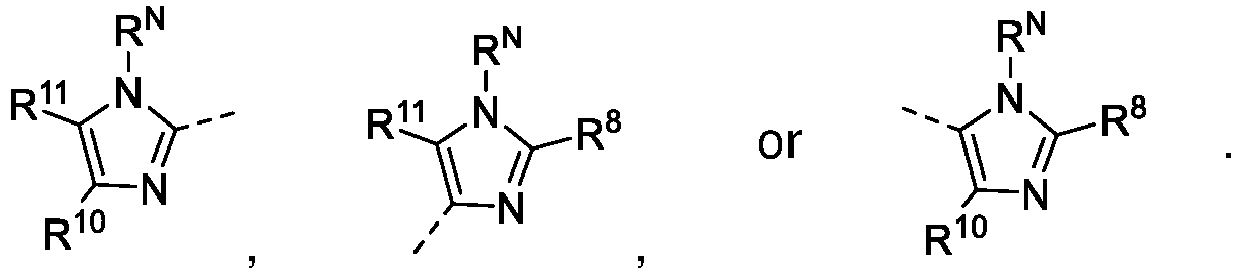
- and R8, R10, R11, and RN have the meanings as defined herein.
- The residues bicyclo[1.1.1]pentyl, bicyclo[2.1.1]hexyl, bicyclo[2.2.1]heptyl, bicyclo[3.1.1]heptyl, bicyclo[2.2.2]octyl, bicyclo[3.2.1]octyl, bicyclo[3.2.2]nonyl, bicyclo[3.3.2]decyl, bicyclo[3.3.3]undecyl, 4-homoisotwistyl, adamantyl, diamantyl, and hexamethylenetetraminyl used herein, have the following parent structures respectively:

- Preferred are the compounds of the formula (Ia):
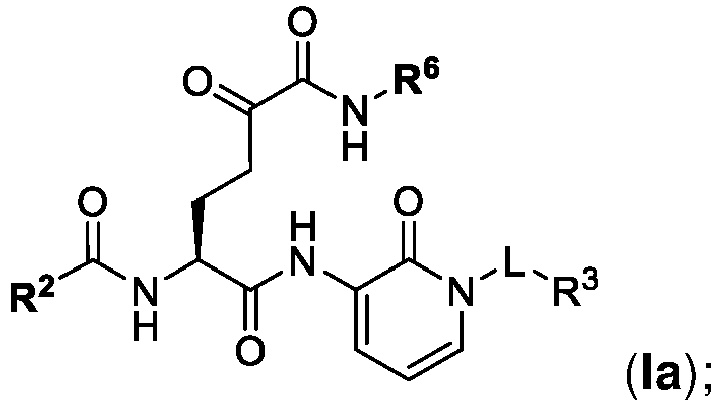
- Preferably, the present invention relates to the comopund of the formula (I)

- L represents -L1-L2- ;
- L1 represents -CH2-, -CH2CH2-, -CH2CH2CH2-, or -CH2CO-,
- L2 represents -NR N1 -, or -NR N1 CH2;; and preferably L represents -CH2-, -CH2CH2-, -CH2CH2CH2-, -CH2CONH-, -CH2CONH-CH2-, -CH2CON(CH3)-CH2-, or -CH2CONH-CH(CH3)-,
- R1 represents

- R2 represents






- R3 represents bicyclo[1.1.1]pentan-1-yl, bicyclo[2.1.1]hexan-1-yl, bicyclo[3.1.1]heptan-3-yl, bicyclo[2.2.1]heptan-2-yl, bicyclo[2.2.1]hept-5-en-2-yl, bicyclo[2.2.1]heptan-7-yl, bicyclo[2.2.1]heptan-2-yl, bicyclo[2.2.2]octan-2-yl, 1-adamantyl, 2-adamantyl , 4-homoisotwistyl, 1-diamantyl, or 4-diamantyl,
- and the afore-mentioned bicyclo[1.1.1]pentan-1-yl, bicyclo[2.1.1]hexan-1-yl, bicyclo[3.1.1]heptan-3-yl, bicyclo[2.2.1]heptan-2-yl, bicyclo[2.2.1]hept-5-en-2-yl, bicyclo[2.2.1]heptan-7-yl, bicyclo[2.2.1]heptan-2-yl, bicyclo[2.2.2]octan-2-yl, 1-adamantyl, 2-adamantyl , 4-homoisotwistyl, 1-diamantyl, or 4-diamantyl residues are optionally contain one or more C=C double bond and/or are optionally substituted one or more of Ra , Rb , Rc, Rd , and Re ;
- R6 represents -C2H5;
- and R8, R9, R10, R11, R12, R13, R14, Ra , Rb , Rc , Rd , Re , RN and RN1 have the same meanings as defined in formula (I) or a diastereomer, an enantiomer, a mixture of diastereomers, a mixture of enantiomer, a racemate, a solvate, a hydrate, or a pharmaceutically acceptable salt thereof.
- In some embodiments, the present invention relates to the comopund of the formula (I)

- L represents -L1-L2- ;
- L1 represents -CH2CO-,
- L2 represents -NR N1 -, and R3 represents 1-adamantyl; or
- L2 represents -NRN1CH2-, and R3 represents 2-bicyclo[3.1.1]heptyl,
- and the afore-mentioned 1-adamantyl and 2-bicyclo[3.1.1]heptyl residues are optionally contain one or more C=C double bond and/or are optionally substituted one or more of Ra , Rb , Rc , Rd , and Re ;
- R1 represents
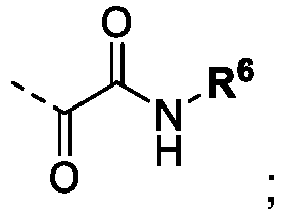
- R2 represents







- R6 represents -C2H5;
- and R8, R9, R10, R11, R12, R13, R14 , Ra , Rb , Rc , Rd , Re , RN and RN1 have the same meanings as defined in formula (I) or a diastereomer, an enantiomer, a mixture of diastereomers, a mixture of enantiomer, a racemate, a solvate, a hydrate, or a pharmaceutically acceptable salt thereof.
- In some embodiments, the present invention relates to the comopund of the formula (I)

- L represents -L1-L2- ;
- L1 represents -CH2CO-,
- L2 represents -NR N1 -, and R3 represents 1-adamantyl; or
- L2 represents -NRN1CH2-, and R3 represents 2-bicyclo[3.1.1]heptyl, and the afore-mentioned 1-adamantyl and 2-bicyclo[3.1.1]heptyl residues are optionally contain one or more C=C double bond and/or are optionally substituted one or more of Ra , Rb , Rc , Rd , and Re ;
- R1 represents

- R2 represents

- R6 represents -C2H5;
- and R8, R10, R11, Ra , Rb , Rc , Rd , Re , RN and RN1 have the same meanings as defined in formula (I) or a diastereomer, an enantiomer, a mixture of diastereomers, a mixture of enantiomer, a racemate, a solvate, a hydrate, or a pharmaceutically acceptable salt thereof.
- In some embodiments, the present invention relates to the compound of the formula (Ia):

- L represents -L1-L2- ;
- L1 represents -CH2CO-,
- L2 represents -NR N1 -, and R3 represents 1-adamantyl; or
- L2 represents -NRN1CH2-, and R3 represents 2-bicyclo[3.1.1]heptyl,
- and the afore-mentioned 1-adamantyl and 2-bicyclo[3.1.1]heptyl residues are optionally contain one or more C=C double bond and/or are optionally substituted one or more of Ra , Rb , Rc , Rd , and Re ;
- R2 represents


- R6 represents -C2H5;
- Ra , Rb , Rc, Rd , and Re represents independently of each other -H, -F, -Cl, -Br, -CN, -OH, -CH3, -CH2CH3, -CH2CH2CH3, -CH(CH3)2, -CHF2, -CF3, -CH2CF3, -COCH3, -COCH2CH3, -CO2H, -CO2CH3, -CO2C2H5, -CONH2, -CONHCH3, -CON(CH3)2, -CONHC2H5, -CH2CO2H, -CH2CO2CH3, -CH2CO2C2H5, -CH2CONH2, -CH2CONHCH3, -CH2CON(CH3)2, -CH2CONHC2H5, -NHCOCH3, -NHCOC2H5, -NHCOCF3, -NHCOCH2CF3, -NHSO2CH3, -NHSO2C2H5, -NHSO2CHF2, -NHSO2CF3, or -NHSO2CH2CF3;
- R8, R9, R10, R11, R12, R13, and R14 represent independently of each other -H, -F, -Cl, -Br, -I, -OH, -CN, -NO2, -CH3, -C2H5, -C3H7, -CH(CH3)2, -C4Hg, -CH2-CH(CH3)2, -CH(CH3)-C2H5, -C(CH3)3, -cyclo-C3H5, -CH2-cyclo-C3H5, -CH2F, -CHF2, -CF3, -CH2Cl, -CH2Br, -CH2I, -CH2-CH2F, -CH2-CHF2, -CH2-CF3, -CH2-CH2Cl, -CH2-CH2Br, -CH2-CH2I, -CH2OH, -OCH3, -OC2H5, -OC3H7, -OCH(CH3)2, -OC(CH3)3, -OC4H9, -OCHF2, -OCF3, -OCH2CF3, -OC2F5, -OCH2OCH3, -O-cyclo-C3H5, -OCH2-cyclo-C3H5, -O-C2H4-cyclo-C3H5, -CHO, -COCH3, -COCF3, -COC2H5, -COC3H7, -COCH(CH3)2, -COC(CH3)3, -COOH, -COOCH3, -COOC2H5, -COOC3H7, -COOCH(CH3)2, -COOC(CH3)3, -OOC-CH3, -OOC-CF3, -OOC-C2H5, -OOC-C3H7, -OOC-CH(CH3)2, -OOC-C(CH3)3, -NH2, -NHCH3, -NHC2H5, -NHC3H7, -NHCH(CH3)2, -NHC(CH3)3, -N(CH3)2, -N(C2H5)2, -N(C3H7)2, -N[CH(CH3)2]2, -N[C(CH3)3]2, -NHCOCH3, -NHCOCF3, -NHCOC2H5, -NHCOC3H7, -NHCOCH(CH3)2, -NHCOC(CH3)3, -CONH2, -CONHCH3, -CONHC2H5, -CONHC3H7, -CONHCH(CH3)2, -CONH-cyclo-C3H5, -CONHC(CH3)3, -CON(CH3)2, -CON(C2H5)2, -CON(C3H7)2, -CON[CH(CH3)2]2, -CON[C(CH3)3]2, -SO2NH2, -SO2NHCH3, -SO2NHC2H5, -SO2NHC3H7, -SO2NHCH(CH3)2, -SO2NH-cyclo-C3H5, -SO2NHC(CH3)3, -SO2N(CH3)2, -SO2N(C2H5)2, -SO2N(C3H7)2, -SO2N[CH(CH3)2]2, -SO2N[C(CH3)3]2, -NHSO2CH3, -NHSO2CF3, -NHSO2C2H5, -NHSO2C3H7, -NHSO2CH(CH3)2, -NHSO2C(CH3)3, -CH=CH2, -CH2-CH=CH2, -C(CH3)=CH2, -CH=CH-CH3, -C≡CH, -C≡C-CH3, -CH2-C≡CH, -Ph, -O-Ph, -O-CH2-Ph,


- RN represents -H, -CH3, -C2H5, -C3H7, -CH(CH3)2, -C4H9, -CH2-CH(CH3)2, -CH(CH3)-C2H5, -C(CH3)3, -cyclo-C3H5, -cyclo-C4H7, -cyclo-C5H9, -CH2-cyclo-C3H5, -CH2-cyclo-C4H7, -CH2-cyclo-C5H9, -CH2F, -CHF2, -CF3, -CH2Cl, -CH2Br, -CH2I, -CH2-CH2F, -CH2-CHF2, -CH2-CF3, -CH2-CH2Cl, -CH2-CH2Br, -CH2-CH2I, -CH2-CH=CH2, -CH2-C≡CH, -CHO, -COCH3, -COC2H5, -COC3H7, -COCH(CH3)2, -COC(CH3)3, -CO-cyclo-C3H5, -CO-cyclo-C4H7, -CO-cyclo-C5H9, -COOCH3, -COOC2H5, -COOC3H7, -COOCH(CH3)2, -COOC(CH3)3, -COOCH2Ph, -SO2CH3, -SO2CF3, -SO2C2H5, -SO2C3H7, -SO2CH(CH3)2, -SO2-cyclo-C3H5, or -SO2C(CH3)3;
- RN1 represents -H, -CH3, or -C2H5;
- or a diastereomer, an enantiomer, a mixture of diastereomers, a mixture of enantiomer, a racemate, a solvate, a hydrate, or a pharmaceutically acceptable salt thereof.
- Preferably, the present invention relates to the compound of the formula (Ia):

- L represents -L1-L2- ;
- L1 represents -CH2CO-,
- L2 represents -NR N1 -, and R3 represents 1-adamantyl; or
- L2 represents -NRN1CH2-, and R3 represents 2-bicyclo[3.1.1]heptyl,
- and the afore-mentioned 1-adamantyl and 2-bicyclo[3.1.1]heptyl residues are optionally contain one or more C=C double bond and/or are optionally substituted one or more of Ra , Rb , Rc , Rd , and Re ;
- R2 represents

- R6 represents -C2H5;
- Ra , Rb , Rc, Rd , and Re represents independently of each other -H, -F, -Cl, -Br, -CN, -OH, -CH3, -CH2CH3, -CH2CH2CH3, -CH(CH3)2, -CHF2, -CF3, -CH2CF3, -COCH3, -COCH2CH3, -CO2H, -CO2CH3, -CO2C2H5, -CONH2, -CONHCH3, -CON(CH3)2, -CONHC2H5, -CH2CO2H, -CH2CO2CH3, -CH2CO2C2H5, -CH2CONH2, -CH2CONHCH3, -CH2CON(CH3)2, -CH2CONHC2H5, -NHCOCH3, -NHCOC2H5, -NHCOCF3, -NHCOCH2CF3, -NHSO2CH3, -NHSO2C2H5, -NHSO2CHF2, -NHSO2CF3, or -NHSO2CH2CF3;
- R8, R10, and R11 represent independently of each other -H, -F, -Cl, -Br, -I, -OH, -CN, -NO2, -CH3, -C2H5, -C3H7, -CH(CH3)2, -C4H9, -CH2-CH(CH3)2, -CH(CH3)-C2H5, -C(CH3)3, -cyclo-C3H5, -CH2-cyclo-C3H5, -CH2F, -CHF2, -CF3, -CH2Cl, -CH2Br, -CH2I, -CH2-CH2F, -CH2-CHF2, -CH2-CF3, -CH2-CH2Cl, -CH2-CH2Br, -CH2-CH2I, -OCH3, -OC2H5, -OC3H7, -OCH(CH3)2, -OC(CH3)3, -OC4H9, -OCHF2, -OCF3, -OCH2CF3, -OC2F5, -OCH2OCH3, -O-cyclo-C3H5, -OCH2-cyclo-C3H5, -O-C2H4-cyclo-C3H5, -CHO, -COCH3, -COCF3, -COC2H5, -COC3H7, -COCH(CH3)2, -COC(CH3)3, -COOH, -COOCH3, -COOC2H5, -COOC3H7, -COOCH(CH3)2, -COOC(CH3)3, -OOC-CH3, -OOC-CF3, -OOC-C2H5, -OOC-C3H7, -OOC-CH(CH3)2, -OOC-C(CH3)3, -NH2, -NHCH3, -NHC2H5, -NHC3H7, -NHCH(CH3)2, -NHC(CH3)3, -N(CH3)2, -N(C2H5)2, -N(C3H7)2, -N[CH(CH3)2]2, -N[C(CH3)3]2, -NHCOCH3, -NHCOCF3, -NHCOC2H5, -NHCOC3H7, -NHCOCH(CH3)2, -NHCOC(CH3)3, -CONH2, -CONHCH3, -CONHC2H5, -CONHC3H7, -CONHCH(CH3)2, -CONH-cyclo-C3H5, -CONHC(CH3)3, -CON(CH3)2, -CON(C2H5)2, -CON(C3H7)2, -CON[CH(CH3)2]2, -CON[C(CH3)3]2, -SO2NH2, -SO2NHCH3, -SO2NHC2H5, -SO2NHC3H7, -SO2NHCH(CH3)2, -SO2NH-cyclo-C3H5, -SO2NHC(CH3)3, -SO2N(CH3)2, -SO2N(C2H5)2, -SO2N(C3H7)2, -SO2N[CH(CH3)2]2, -SO2N[C(CH3)3]2, -NHSO2CH3, -NHSO2CF3, -NHSO2C2H5, -NHSO2C3H7, -NHSO2CH(CH3)2, -NHSO2C(CH3)3, -CH=CH2, -CH2-CH=CH2, -C(CH3)=CH2, -CH=CH-CH3, -C≡CH, -C≡C-CH3, -CH2-C≡CH, -Ph, -O-Ph, -O-CH2-Ph,


- RN represents -H, -CH3, -C2H5, -C3H7, -CH(CH3)2, -C4H9, -CH2-CH(CH3)2, -CH(CH3)-C2H5, -C(CH3)3, -cyclo-C3H5, -cyclo-C4H7, -cyclo-C5H9, -CH2-cyclo-C3H5, -CH2-cyclo-C4H7, -CH2-cyclo-C5H9, -CH2F, -CHF2, -CF3, -CH2Cl, -CH2Br, -CH2I, -CH2-CH2F, -CH2-CHF2, -CH2-CF3, -CH2-CH2Cl, -CH2-CH2Br, -CH2-CH2I, -CH2-CH=CH2, -CH2-C=CH, -CHO, -COCH3, -COC2H5, -COC3H7, -COCH(CH3)2, -COC(CH3)3, -CO-cyclo-C3H5, -CO-cyclo-C4H7, -CO-cyclo-C5H9, -COOCH3, -COOC2H5, -COOC3H7, -COOCH(CH3)2, -COOC(CH3)3, -COOCH2Ph, -SO2CH3, -SO2CF3, -SO2C2H5, -SO2C3H7, -SO2CH(CH3)2, -SO2-cyclo-C3H5, or -SO2C(CH3)3;
- RN1 represents -H, -CH3, or -C2H5;
- or a diastereomer, an enantiomer, a mixture of diastereomers, a mixture of enantiomer, a racemate, a solvate, a hydrate, or a pharmaceutically acceptable salt thereof.
- Preferalby, the compound of the invention has the formula (II):

- L2 represents -NRN1-, and R3 represents 1-adamantyl; or
- L2 represents -NRN1CH2-, and R3 represents 2-bicyclo[3.1.1]heptyl, and the afore-mentioned adamantyl and bicyclo[3.1.1]heptyl residues are optionally contain one or more C=C double bond and/or are optionally substituted one or more of Ra, Rb, Rc, Rd, and Re;
- R2 represents

- Ra, Rb, Rc, Rd, and Re represents independently of each other -H, -F, -Cl, -Br, -CN, -OH, -CH3, -CH2CH3, -CH2CH2CH3, -CH(CH3)2, -CHF2, -CF3, -CH2CF3, -COCH3, -COCH2CH3, -CO2H, -CO2CH3, -CO2C2H5, -CONH2, -CONHCH3, -CON(CH3)2, -CONHC2H5, -CH2CO2H, -CH2CO2CH3, -CH2CO2C2H5, -CH2CONH2, -CH2CONHCH3, -CH2CON(CH3)2, -CH2CONHC2H5, -NHCOCH3, -NHCOC2H5, -NHCOCF3, -NHCOCH2CF3, -NHSO2CH3, -NHSO2C2H5, -NHSO2CHF2, -NHSO2CF3, or -NHSO2CH2CF3;
- RN represents -H, -CH3, -C2H5, -C3H7, -CH(CH3)2, -C4H9, -CH2-CH(CH3)2, -CH(CH3)-C2H5, -C(CH3)3, -cyclo-C3H5, -cyclo-C4H7, -cyclo-C5H9, -CH2-cyclo-C3H5, -CH2-cyclo-C4H7, -CH2-cyclo-C5H9, -CH2F, -CHF2, -CF3, -CH2Cl, -CH2Br, -CH2I, -CH2-CH2F, -CH2-CHF2, -CH2-CF3, -CH2-CH2Cl, -CH2-CH2Br, -CH2-CH2I, -CH2-CH=CH2, -CH2-C=CH, -CHO, -COCH3, -COC2H5, -COC3H7, -COCH(CH3)2, -COC(CH3)3, -CO-cyclo-C3H5, -CO-cyclo-C4H7, -CO-cyclo-C5H9, -COOCH3, -COOC2H5, -COOC3H7, -COOCH(CH3)2, -COOC(CH3)3, -COOCH2Ph, -SO2CH3, -SO2CF3, -SO2C2H5, -SO2C3H7, -SO2CH(CH3)2, or -SO2C(CH3)3;
- RN1 represent -H, -CH3, or -CH2CH3;
- R8 , R10 , and R11 represent independently of each other -H, -F, -Cl, -Br, -I, -OH, -CN, -NO2, -CH3, -C2H5, -C3H7, -CH(CH3)2, -C4H9, -CH2-CH(CH3)2, -CH(CH3)-C2H5, -cyclo-C3H5, -CH2-cyclo-C3H5, -CH2F, -CHF2, -CF3, -CH2Cl, -CH2Br, -CH2I, -CH2-CH2F, -CH2-CHF2, -CH2-CF3, -CH2-CH2Cl, -CH2-CH2Br, -CH2-CH2I, -OCH3, -OC2H5, -OC3H7, -OCH(CH3)2, -OC(CH3)3, -OC4H9, -OCHF2, -OCF3, -OCH2CF3, -OC2F5, -OCH2OCH3, -O-cyclo-C3H5, -OCH2-cyclo-C3H5, -O-C2H4-cyclo-C3H5, -CH=CH2, -CH2-CH=CH2, -C(CH3)=CH2, -CH=CH-CH3, -C≡CH, -C≡C-CH3, -CH2-C=CH, or -Ph;
- or a diastereomer, an enantiomer, a mixture of diastereomers, a mixture of enantiomer, a racemate, a solvate, a hydrate, or a pharmaceutically acceptable salt thereof.
- The term "1-adamantyl" and "2-bicyclo[3.1.1]heptyl" have the following structures respectively:
1-adamantyl 2-bicyclo[3.1.1]heptyl 

- Preferred, 2-bicyclo[3.1.1]heptyl have the following structure:

- More preferred, the compound has any one of the formulae (II-a) - (II-I), (II-b1) - (II-b2), and (III-a) - (III-I):


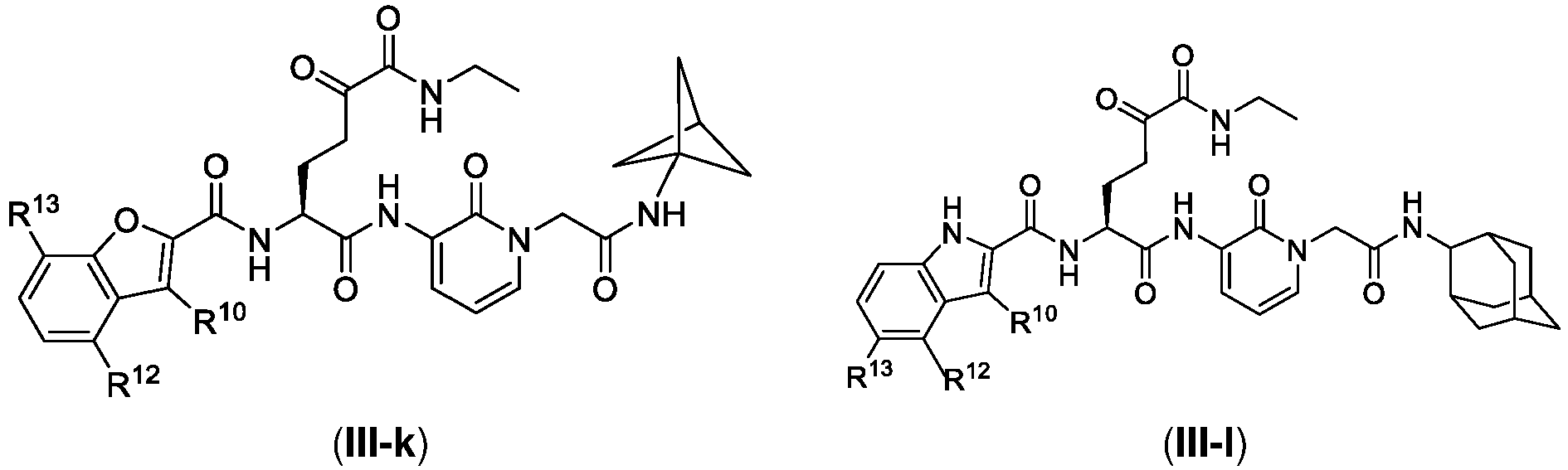
- In a preferred embodmiment, the invention refers to the compound of the formulae (I), (Ia) and (II), wherein
R3 represents



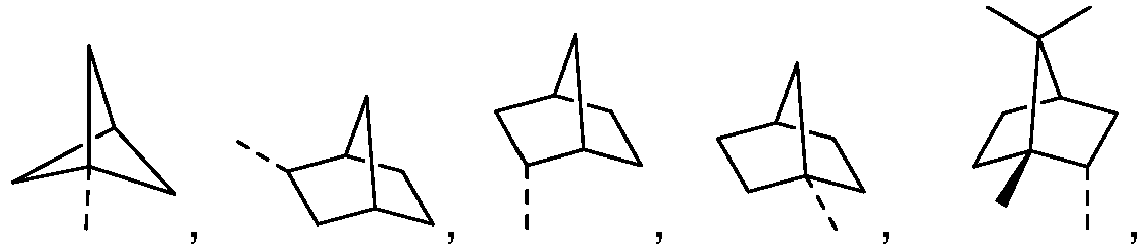
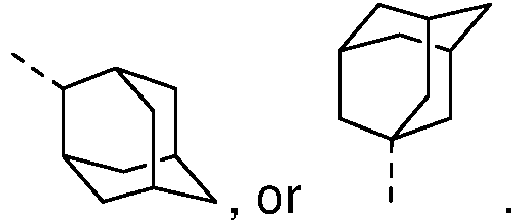
- In a preferred embodmiment, the invention refers to the compound of any one of the formulae (I), (Ia) and (II), (II-a) - (II-I), (II-b1) - (II-b2), wherein
R2 represents




R8 , R9 , R10 , R11, R12 , R13 , and R14 , represent independently of each other -H, -F, -Cl, -Br, -I, -OH, -CN, -NO2, -CH3, -C2H5, -C3H7, -CH(CH3)2, -C4H9, -CH2-CH(CH3)2, -CH(CH3)-C2H5, -C(CH3)3, -cyclo-C3H5, -CH2-cyclo-C3H5, -CH2F, -CHF2, -CF3, -CH2Cl, -CH2Br, -CH2I, -CH2-CH2F, -CH2-CHF2, -CH2-CF3, -CH2-CH2Cl, -CH2-CH2Br, -CH2-CH2I, -CH2OH, -OCH3, -OC2H5, -OC3H7, -OCH(CH3)2, -OC(CH3)3, -OC4H9, -OCHF2, -OCF3, -OCH2CF3, -OC2F5, -OCH2OCH3, -O-cyclo-C3H5, -OCH2-cyclo-C3H5, -O-C2H4-cyclo-C3H5, -CHO, -COCH3, -COCF3, -COC2H5, -COC3H7, -COCH(CH3)2, -COC(CH3)3, -COOH, -COOCH3, -COOC2H5, -COOC3H7, -COOCH(CH3)2, -COOC(CH3)3, -OOC-CH3, -OOC-CF3, -OOC-C2H5, -OOC-C3H7, -OOC-CH(CH3)2, -OOC-C(CH3)3, -NH2, -NHCH3, -NHC2H5, -NHC3H7, -NHCH(CH3)2, -NHC(CH3)3, -N(CH3)2, -N(C2H5)2, -N(C3H7)2, -N[CH(CH3)2]2, -N[C(CH3)3]2, -NHCOCH3, -NHCOCF3, -NHCOC2H5, -NHCOC3H7, -NHCOCH(CH3)2, -NHCOC(CH3)3, -CONH2, -CONHCH3, -CONHC2H5, -CONHC3H7, -CONHCH(CH3)2, -CONH-cyclo-C3H5, -CONHC(CH3)3, -CON(CH3)2, -CON(C2H5)2, -CON(C3H7)2, -CON[CH(CH3)2]2, -CON[C(CH3)3]2, -SO2NH2, -SO2NHCH3, -SO2NHC2H5, -SO2NHC3H7, -SO2NHCH(CH3)2, -SO2NH-cyclo-C3H5, -SO2NHC(CH3)3, -SO2N(CH3)2, -SO2N(C2H5)2, -SO2N(C3H7)2, -SO2N[CH(CH3)2]2, -SO2N[C(CH3)3]2, -NHSO2CH3, -NHSO2CF3, -NHSO2C2H5, -NHSO2C3H7, -NHSO2CH(CH3)2, -NHSO2C(CH3)3, -CH=CH2, -CH2-CH=CH2, -C(CH3)=CH2, -CH=CH-CH3, -C≡CH, -C≡C-CH3, -CH2-C=CH, -Ph, -O-Ph, -O-CH2-Ph,


- RN represents -H, -CH3, -C2H5, -C3H7, -CH(CH3)2, -C4H9, -CH2-CH(CH3)2, -CH(CH3)-C2H5, -C(CH3)3, -cyclo-C3H5, -cyclo-C4H7, -cyclo-C5H9, -CH2-cyclo-C3H5, -CH2-cyclo-C4H7, -CH2-cyclo-C5H9, -CH2F, -CHF2, -CF3, -CH2Cl, -CH2Br, -CH2I, -CH2-CH2F, -CH2-CHF2, -CH2-CF3, -CH2-CH2Cl, -CH2-CH2Br, -CH2-CH2I, -CH2-CH=CH2, -CH2-C=CH, -CHO, -COCH3, -COC2H5, -COC3H7, -COCH(CH3)2, -COC(CH3)3, -CO-cyclo-C3H5, -CO-cyclo-C4H7, -CO-cyclo-C5H9, -COOCH3, -COOC2H5, -COOC3H7, -COOCH(CH3)2, -COOC(CH3)3, -COOCH2Ph, -SO2CH3, -SO2CF3, -SO2C2H5, -SO2C3H7, -SO2CH(CH3)2, -SO2-cyclo-C3H5, or -SO2C(CH3)3;
Preferably, RN represents -H, -CH3, -C2H5, -CH(CH3)2, -cyclo-C3H5, -cyclo-C4H7, -cyclo-C5H9, -CH2-cyclo-C3H5, -CH2-cyclo-C4H7, -CH2-cyclo-C5H9, or -COCH3, more preferably, RN represents -H, -CH3, -C2H5, - CH(CH3)2, -cyclo-C4H7, -cyclo-C5H9, or -COCH3. - In a preferred embodmiment, the invention refers to the compound of any one of the formulae (I), (Ia) and (II), (II-a) - (II-I), (II-b1) - (II-b2), R2 represents









- Still more preferred, R2 represents


- In a preferred embodmiment, the invention refers to the compound of any one of the formulae (I), (IIa) and (II), (II-a) - (II-I), (II-b1) - (II-b2), wherein
L represents -CH2-, -CH2CH2-, -CH2CH2CH2-, -CH2CONH-, -CH2CONH-CH2-, -CH2CON(CH3)-CH2-, -CH2CONH-CH(CH3)-, - Most preferred are the following compounds of formula (I):
Cpd Structure Name I-1: 
(S)-N-1-ethyl-N6-(1-(2-(1-adamantylamino)-2-oxoethyl)-2-oxo-1,2-dihydropyridin-3-yl)-5-(1-methyl-1H-imidazole-5-carboxamido)-2-oxohexanediamide I-2: 
(S)-N1-ethyl-5-(1H-imidazole-4-carboxamido)-N6-(1-(2-(1-adamantylamino)-2-oxoethyl)-2-oxo-1,2-dihydropyridin-3-yl)-2-oxohexanediamide I-3: 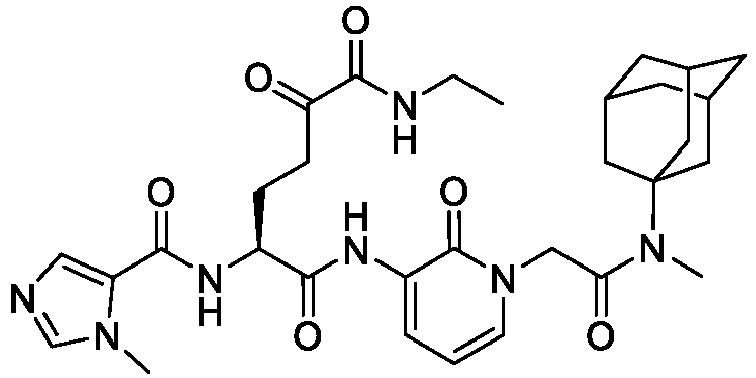
(S)-N-1-ethyl-N6-(1-(2-(1-adamantyl(methyl)amino)-2-oxoethyl)-2-oxo-1,2-dihydropyridin-3-yl)-5-(1-methyl-1H-imidazole-5-carboxamido)-2-oxohexanediamide I-4: 
(S)-N-1-ethyl-N6-(1-(2-(3,5-dimethyladamantane-1-amino)-2-oxoethyl)-2-oxo-1,2-dihydropyridin-3-yl)-5-(1-methyl-1H-imidazole-5-carboxamido)-2-oxohexanediamide I-5: 
(S)-N1-ethyl-N6-(1-(2-(3-ethyladamantane-1-amino)-2-oxoethyl)-2-oxo-1,2-dihydropyridin-3-yl)-5-(1-methyl-1H-imidazole-5-carboxamido)-2-oxohexanediamide I-6: 
(S)-N-1-ethyl-N6-(1-(2-(3-trifluoromethyladamantane-1-amino)-2-oxoethyl)-2-oxo-1,2-dihydropyridin-3-yl)-5-(1-methyl-1H-imidazole-5-carboxamido)-2-oxohexanediamide I-7: 
(S)-N-1-ethyl-N6-(1-(2-(3-hydroxyadamantane-1-amino)-2-oxoethyl)-2-oxo-1,2-dihydropyridin-3-yl)-5-(1-methyl-1H-imidazole-5-carboxamido)-2-oxohexanediamide I-8: 
(S)-N1-ethyl-N6-(1-(2-(3-fluoroadamantane-1-amino)-2-oxoethyl)-2-oxo-1,2-dihydropyridin-3-yl)-5-(1-methyl-1H-imidazole-5-carboxamido)-2-oxohexanediamide I-9: 
(S)-N-1-ethyl-N6-(1-(2-(3-chloroadamantane-1-amino)-2-oxoethyl)-2-oxo-1,2-dihydropyridin-3-yl)-5-(1-methyl-1H-imidazole-5-carboxamido)-2-oxohexanediamide I-10: 
(S)-N-1-ethyl-N6-(1-(2-(3-bromoadamantane-1-amino)-2-oxoethyl)-2-oxo-1,2-dihydropyridin-3-yl)-5-(1-methyl-1H-imidazole-5-carboxamido)-2-oxohexanediamide I-11: 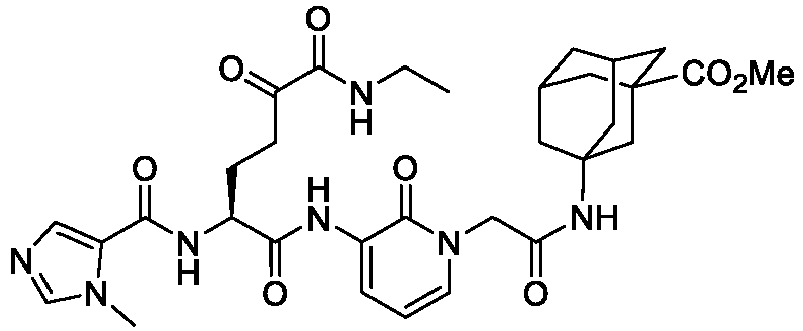
(S)-N-1-ethyl-N6-(1-(2-(3-methyl adamantane-3-carboxylate-1-amino)-2-oxoethyl)-2-oxo-1,2-dihydropyridin-3-yl)-5-(1-methyl-1H-imidazole-5-carboxamido)-2-oxohexanediamide I-12: 
(S)-N-1-ethyl-N6-(1-(2-(4,4-difluoroadamantane-1-amino)-2-oxoethyl)-2-oxo-1,2-dihydropyridin-3-yl)-5-(1-methyl-1H-imidazole-5-carboxamido)-2-oxohexanediamide I-13: 
(S)-N1-(1-(2-(((1S,2R,5S)-6,6-dimethylbicyclo[3.1.1]heptan-2-yl)methylamino)-2-oxoethyl)-2-oxo-1,2-dihydropyridin-3-yl)-N6-ethyl-2-(1-methyl-1H-imidazole-5-carboxamido)-5-oxohexanediamide I-14: 
(S)-N1-(1-(2-(((1R,2R,5R)-6,6-dimethylbicyclo[3.1.1]heptan-2-yl)methylamino)-2-oxoethyl)-2-oxo-1,2-dihydropyridin-3-yl)-N6-ethyl-2-(1-methyl-1H-imidazole-5-carboxamido)-5-oxohexanediamide I-15: 
(S)-N1-ethyl-N6-(1-(2-(3-ethyladamantane-1-amino)-2-oxoethyl)-2-oxo-1,2-dihydropyridin-3-yl)-5-(1-methyl-1H-imidazole-4-carboxamido)-2-oxohexanediamide I-16: 
(S)-N1-ethyl-N6-(1-(2-(3-ethyladamantane-1-amino)-2-oxoethyl)-2-oxo-1,2-dihydropyridin-3-yl)-5-(1-methyl-1H-imidazole-2-carboxamido)-2-oxohexanediamide I-17: 
(S)-2-(1,4-dimethyl-1H-imidazole-5-carboxamido)-N6-ethyl-N1-(1-(2-(3-ethyladamantane-1-amino)-2-oxoethyl)-2-oxo-1,2-dihydropyridin-3-yl)-5-oxohexanediamide I-18: 
(S)-N1-ethyl-5-(1-isobutyl-1H-imidazole-4-carboxamido)-N6-(1-(2-(3-ethyladamantane-1-amino)-2-oxoethyl)-2-oxo-1,2-dihydropyridin-3-yl)-2-oxohexanediamide I-19: 
(S)-2-(1-cyclopentyl-1H-imidazole-4-carboxamido)-N6-ethyl-N1-(1-(2-(3-ethyladamantane-1-amino)-2-oxoethyl)-2-oxo-1,2-dihydropyridin-3-yl)-5-oxohexanediamide I-20: 
(S)-2-(1-cyclobutyl-1H-imidazole-4-carboxamido)-N6-ethyl-N1-(1-(2-(3-ethyladamantane-1-amino)-2-oxoethyl)-2-oxo-1,2-dihydropyridin-3-yl)-5-oxohexanediamide I-21: 
(S)-2-(1,4-dimethyl-1H-imidazole-5-carboxamido)-N6-ethyl-N1-(1-(2-(3,5-dimethyladamantane-1-amino)-2-oxoethyl)-2-oxo-1,2-dihydropyridin-3-yl)-5-oxohexanediamide I-22: 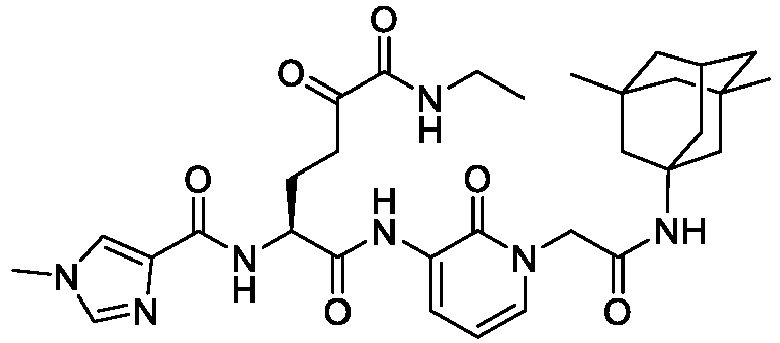
(S)-N1-ethyl-N6-(1-(2-(3,5-dimethyladamantane-1-amino)-2-oxoethyl)-2-oxo-1,2-dihydropyridin-3-yl)-5-(1-methyl-1H-imidazole-4-carboxamido)-2-oxohexanediamide I-23: 
(S)-N1-ethyl-N6-(1-(2-(3,5-dimethyladamantane-1-amino)-2-oxoethyl)-2-oxo-1,2-dihydropyridin-3-yl)-5-(1-methyl-1H-imidazole-2-carboxamido)-2-oxohexanediamide I-24: 
(S)-2-(1,2-dimethyl-1H-imidazole-5-carboxamido)-N6-ethyl-N1-(1-(2-(3,5-dimethyladamantane-1-amino)-2-oxoethyl)-2-oxo-1,2-dihydropyridin-3-yl)-5-oxohexanediamide I-25: 
(S)-N1-ethyl-N6-(1-(2-(3-methyladamantane-1-amino)-2-oxoethyl)-2-oxo-1,2-dihydropyridin-3-yl)-5-(1-methyl-1H-imidazole-5-carboxamido)-2-oxohexanediamide I-26: 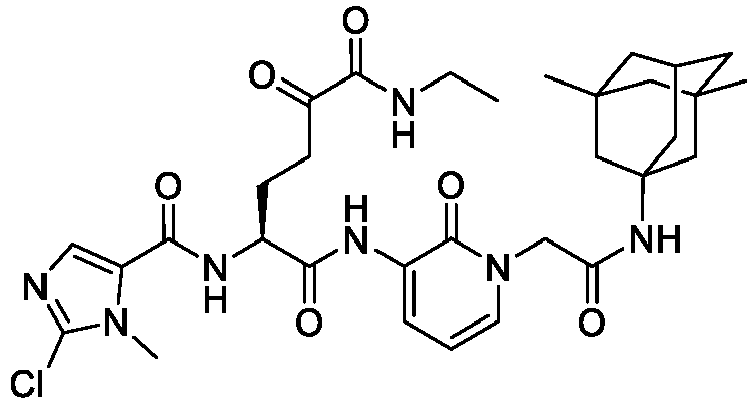
(S)-2-(2-chloro-1-methyl-1H-imidazole-5-carboxamido)-N6-ethyl-N1-(1-(2-(3,5-dimethyladamantane-1-amino)-2-oxoethyl)-2-oxo-1,2-dihydropyridin-3-yl)-5-oxohexanediamide I-27: 
(S)-2-(1,2-dimethyl-1H-imidazole-5-carboxamido)-N6-ethyl-N1-(1-(2-(3-methyladamantane-1-amino)-2-oxoethyl)-2-oxo-1,2-dihydropyridin-3-yl)-5-oxohexanediamide I-28: 
(S)-N1-ethyl-N6-(1-(2-(3,5,7-trimethyl-1-adamantylamino)-2-oxoethyl)-2-oxo-1,2-dihydropyridin-3-yl)-5-(1-methyl-1H-imidazole-5-carboxamido)-2-oxohexanediamide I-29: 
(S)-2-(2-chloro-1-methyl-1H-imidazole-5-carboxamido)-N6-ethyl-N1-(1-(2-(3,5,7-trimethyl-1-adamantylamino)-2-oxoethyl)-2-oxo-1,2-dihydropyridin-3-yl)-5-oxohexanediamide I-30 
(S)-2-(benzofuran-2-carboxamido)-N6-ethyl-N1-(1-(2-(2-adamantylamino)-2-oxoethyl)-2-oxo-1,2-dihydropyridin-3-yl)-5-oxohexanediamide I-31 
(S)-N1-ethyl-N6-(1-(2-(2-adamantylamino)-2-oxoethyl)-2-oxo-1,2-dihydropyridin-3-yl)-5-(3-methylbenzofuran-2-carboxamido)-2-oxohexanediamide I-32 
(S)-2-(3-chlorobenzofuran-2-carboxamido)-N6-ethyl-N1-(1-(2-(2-adamantylamino)-2-oxoethyl)-2-oxo-1,2-dihydropyridin-3-yl)-5-oxohexanediamide I-33 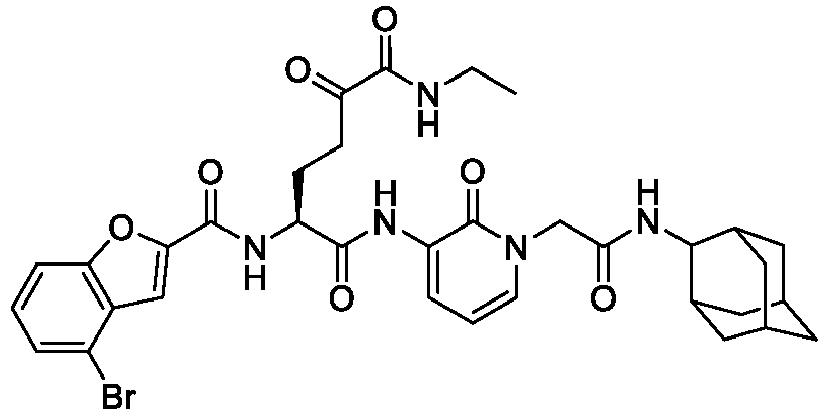
(S)-2-(4-bromobenzofuran-2-carboxamido)-N6-ethyl-N1-(1-(2-(2-adamantylamino)-2-oxoethyl)-2-oxo-1,2-dihydropyridin-3-yl)-5-oxohexanediamide I-34 
(S)-2-(benzo[b]thiophene-2-carboxamido)-N6-ethyl-N1-(1-(2-(2-adamantylamino)-2-oxoethyl)-2-oxo-1,2-dihydropyridin-3-yl)-5-oxohexanediamide I-35 
(S)-N1-ethyl-5-(7-fluorobenzo[b]thiophene-2-carboxamido)-N6-(1-(2-(2-adamantylamino)-2-oxoethyl)-2-oxo-1,2-dihydropyridin-3-yl)-2-oxohexanediamide I-36 
(S)-2-(4,5-difluoro-1H-indole-2-carboxamido)-N6-ethyl-N1-(1-(2-(2-adamantylamino)-2-oxoethyl)-2-oxo-1,2-dihydropyridin-3-yl)-5-oxohexanediamide I-37 
(S)-N1-ethyl-N6-(1-(2-(2-adamantylamino)-2-oxoethyl)-2-oxo-1,2-dihydropyridin-3-yl)-5-(3-methyl-1H-indole-2-carboxamido)-2-oxohexanediamide I-38 
(S)-2-(1H-benzo[d]imidazole-2-carboxamido)-N6-ethyl-N1-(1-(2-(2-adamantylamino)-2-oxoethyl)-2-oxo-1,2-dihydropyridin-3-yl)-5-oxohexanediamide I-39 
(S)-2-(2,3-dihydro-1H-indene-2-carboxamido)-N6-ethyl-N1-(1-(2-(2-adamantylamino)-2-oxoethyl)-2-oxo-1,2-dihydropyridin-3-yl)-5-oxohexanediamide I-40 
(S)-N1-ethyl-N6-(1-(2-(2-adamantylamino)-2-oxoethyl)-2-oxo-1,2-dihydropyridin-3-yl)-5-(4-methyl-2-(trifluoromethyl)thiazole-5-carboxamido)-2-oxohexanediamide I-41 
(S)-2-(4-bromo-2-(trifluoromethyl)thiazole-5-carboxamido)-N6-ethyl-N1-(1-(2-(2-adamantylamino)-2-oxoethyl)-2-oxo-1,2-dihydropyridin-3-yl)-5-oxohexanediamide I-42 
(S)-N1-ethyl-N6-(1-(2-(2-adamantylamino)-2-oxoethyl)-2-oxo-1,2-dihydropyridin-3-yl)-5-(4-methyl-2-phenylthiazole-5-carboxamido)-2-oxohexanediamide I-43 
(S)-2-(5-bromo-3-methylthiophene-2-carboxamido)-N6-ethyl-N1-(1-(2-(2-adamantylamino)-2-oxoethyl)-2-oxo-1,2-dihydropyridin-3-yl)-5-oxohexanediamide I-44 
(S)-2-(3,5-dibromothiophene-2-carboxamido)-N6-ethyl-N1-(1-(2-(2-adamantylamino)-2-oxoethyl)-2-oxo-1,2-dihydropyridin-3-yl)-5-oxohexanediamide I-45 
(S)-2-(5-bromo-3-methylfuran-2-carboxamido)-N6-ethyl-N1-(1-(2-(2-adamantylamino)-2-oxoethyl)-2-oxo-1,2-dihydropyridin-3-yl)-5-oxohexanediamide I-46 
(S)-2-(2,5-dichlorothiophene-3-carboxamido)-N6-ethyl-N1-(1-(2-(2-adamantylamino)-2-oxoethyl)-2-oxo-1,2-dihydropyridin-3-yl)-5-oxohexanediamide I-47 
(S)-2-(2,5-dibromothiophene-3-carboxamido)-N6-ethyl-N1-(1-(2-(2-adamantylamino)-2-oxoethyl)-2-oxo-1,2-dihydropyridin-3-yl)-5-oxohexanediamide I-48 
(S)-2-(2,5-dichlorothiazole-4-carboxamido)-N6-ethyl-N1-(1-(2-(2-adamantylamino)-2-oxoethyl)-2-oxo-1,2-dihydropyridin-3-yl)-5-oxohexanediamide I-49 
(S)-2-(2,5-dimethylfuran-3-carboxamido)-N6-ethyl-N1-(1-(2-(2-adamantylamino)-2-oxoethyl)-2-oxo-1,2-dihydropyridin-3-yl)-5-oxohexanediamide I-50 
(S)-2-(4-bromothiazole-2-carboxamido)-N6-ethyl-N1-(1-(2-(2-adamantylamino)-2-oxoethyl)-2-oxo-1,2-dihydropyridin-3-yl)-5-oxohexanediamide I-51 
(S)-2-(4-bromothiophene-2-carboxamido)-N6-ethyl-N1-(1-(2-(2-adamantylamino)-2-oxoethyl)-2-oxo-1,2-dihydropyridin-3-yl)-5-oxohexanediamide I-52 
(S)-2-(4-bromo-5-chlorothiophene-2-carboxamido)-N6-ethyl-N1-(1-(2-(2-adamantylamino)-2-oxoethyl)-2-oxo-1,2-dihydropyridin-3-yl)-5-oxohexanediamide I-53 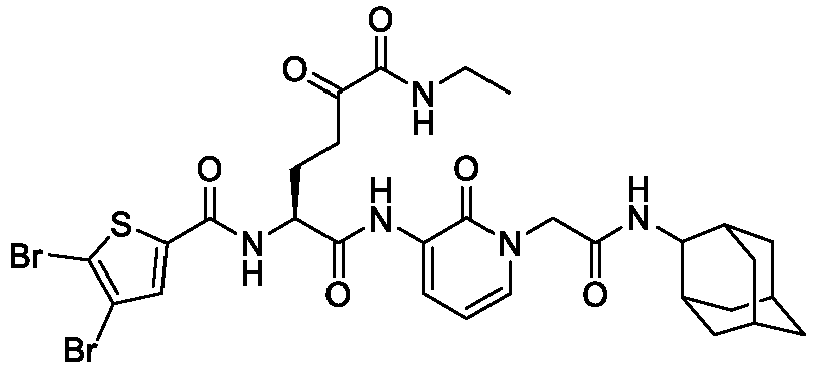
(S)-2-(4,5-dibromothiophene-2-carboxamido)-N6-ethyl-N1-(1-(2-(2-adamantylamino)-2-oxoethyl)-2-oxo-1,2-dihydropyridin-3-yl)-5-oxohexanediamide I-54 
(S)-2-(4,5-dichlorothiophene-2-carboxamido)-N6-ethyl-N1-(1-(2-(2-adamantylamino)-2-oxoethyl)-2-oxo-1,2-dihydropyridin-3-yl)-5-oxohexanediamide I-55 
(S)-2-((S)-1-acetylpyrrolidine-2-carboxamido)-N6-ethyl-N1-(1-(2-(2-adamantylamino)-2-oxoethyl)-2-oxo-1,2-dihydropyridin-3-yl)-5-oxohexanediamide I-56 
(S)-N1-ethyl-N6-(1-(2-(2-adamantylamino)-2-oxoethyl)-2-oxo-1,2-dihydropyridin-3-yl)-5-(1-methyl-1H-1,2,3-triazole-5-carboxamido)-2-oxohexanediamide I-57 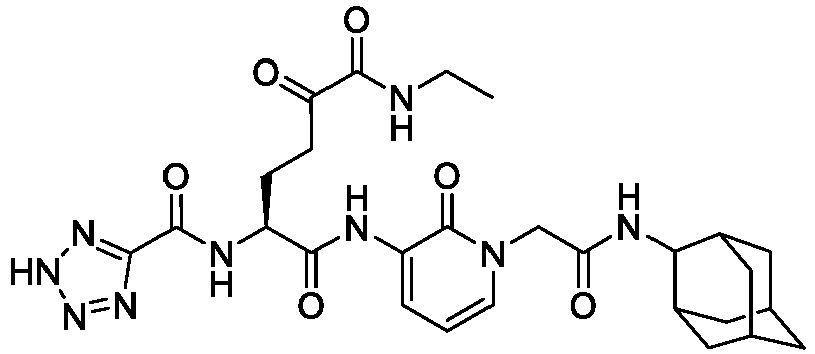
(S)-N1-ethyl-N6-(1-(2-(2-adamantylamino)-2-oxoethyl)-2-oxo-1,2-dihydropyridin-3-yl)-2-oxo-5-(2H-tetrazole-5-carboxamido)hexanediamide I-58 
(S)-N1-ethyl-N6-(1-(2-(5-hydroxyadamantane-2-amino)-2-oxoethyl)-2-oxo-1,2-dihydropyridin-3-yl)-2-oxo-5-(pyrazine-2-carboxamido)hexanediamide I-59 
(S)-N1-ethyl-N6-(1-(2-(5-fluoroadamantane-2-amino)-2-oxoethyl)-2-oxo-1,2-dihydropyridin-3-yl)-2-oxo-5-((S)-pyrrolidine-3-carboxamido)hexanediamide I-60 
(S)-N1-ethyl-N6-(1-(2-(5-chloroadamantane-2-amino)-2-oxoethyl)-2-oxo-1,2-dihydropyridin-3-yl)-2-oxo-5-((S)-piperidine-2-carboxamido)hexanediamide I-61 
(S)-N1-ethyl-N6-(1-(2-(5-bromoadamantane-2-amino)-2-oxoethyl)-2-oxo-1,2-dihydropyridin-3-yl)-2-oxo-5-((R)-piperidine-3-carboxamido)hexanediamide I-62 
(S)-N1-ethyl-N6-(1-(2-(5-methyladamantane-2-amino)-2-oxoethyl)-2-oxo-1,2-dihydropyridin-3-yl)-5-((R)-morpholine-3-carboxamido)-2-oxohexanediamide I-63 
(S)-N1-ethyl-N6-(1-(2-(2-carbonitrileadamantane-2-amino)-2-oxoethyl)-2-oxo-1,2-dihydropyridin-3-yl)-2-oxo-5-((3S,4R)-quinuclidine-3-carboxamido)hexanediamide I-64 
(S)-methyl 3-(6-(ethylamino)-1-(1-(2-(methyl 2-aminoadamantane-2-carboxylate)-2-oxoethyl)-2-oxo-1,2-dihydropyridin-3-ylamino)-1,5,6-trioxohexan-2-ylcarbamoyl)-5-nitrobenzoate I-65 
(S)-N1-(1-(2-(1-adamantylmethylamino)-2-oxoethyl)-2-oxo-1,2-dihydropyridin-3-yl)-N6-ethyl-2-(5-nitronicotinamido)-5-oxohexanediamide I-66 
5-((2S)-1-(1-(2-1-adamantylmethylamino)-2-oxoethyl)-2-oxo-1,2-dihydropyridin-3-ylamino)-6-(ethylamino)-1,5,6-trioxohexan-2-ylcarbamoyl)nicotinic acid I-67 
(S)-N1-ethyl-N6-(1-(2-(2-adamantyl(methyl)amino)-2-oxoethyl)-2-oxo-1,2-dihydropyridin-3-yl)-5-(6-methylimidazo[2,1-b]thiazole-5-carboxamido)-2-oxohexanediamide I-68 
(S)-N1-(1-(2-((1S,2R,4R)-bicyclo[2.2.1]heptan-2-ylamino)-2-oxoethyl)-2-oxo-1,2-dihydropyridin-3-yl)-N6-ethyl-2-(3-methylbenzofuran-2-carboxamido)-5-oxohexanediamide I-69 
(S)-N1-ethyl-5-(3-methylbenzofuran-2-carboxamido)-2-oxo-N6-(2-oxo-1-(2-oxo-2-((1R,2S,4R)-1,7,7-trimethylbicyclo[2.2.1]heptan-2-ylamino)ethyl)-1,2-dihydropyridin-3-yl)hexanediamide I-70 
(S)-N1-(1-(2-((1R,2R,4S)-bicyclo[2.2.1]heptan-2-ylamino)-2-oxoethyl)-2-oxo-1,2-dihydropyridin-3-yl)-N6-ethyl-2-(3-methylbenzofuran-2-carboxamido)-5-oxohexanediamide I-71 
(S)-N1-(1-(2-((1s,4R)-bicyclo[2.2.1]heptan-1-ylamino)-2-oxoethyl)-2-oxo-1,2-dihydropyridin-3-yl)-N6-ethyl-2-(isonicotinamido)-5-oxohexanediamide I-72 
(S)-N1-(1-(2-(bicyclo[2.2.1]heptan-7-ylamino)-2-oxoethyl)-2-oxo-1,2-dihydropyridin-3-yl)-N6-ethyl-5-oxo-2-(pyridazine-4-carboxamido)hexanediamide I-73 
(S)-N1-(1-(2-((1R,2R,4R)-bicyclo[2.2.1]hept-5-en-2-ylamino)-2-oxoethyl)-2-oxo-1,2-dihydropyridin-3-yl)-N6-ethyl-5-oxo-2-(pyridazine-3-carboxamido)hexanediamide I-74 
(2S)-N1-(1-(2-(bicyclo[2.2.2]octan-2-ylamino)-2-oxoethyl)-2-oxo-1,2-dihydropyridin-3-yl)-N6-ethyl-5-oxo-2-(2H-1,2,3-triazole-4-carboxamido)hexanediamide I-75 
(S)-N1-ethyl-5-(1-methyl-1H-1,2,3-triazole-4-carboxamido)-2-oxo-N6-(2-oxo-1-(2-oxo-2-((1R,2R,4R)-1,7,7-trimethylbicyclo[2.2.1]heptan-2-ylamino)ethyl)-1,2-dihydropyridin-3-yl)hexanediamide I-76 
(S)-N1-ethyl-5-(1-methyl-1H-1,2,4-triazole-3-carboxamido)-2-oxo-N6-(2-oxo-1-(2-oxo-2-((1R,2R,3R,5S)-2,6,6-trimethylbicyclo[3.1.1]heptan-3-ylamino)ethyl)-1,2-dihydropyridin-3-yl)hexanediamide I-77 
(S)-2-(benzofuran-3-carboxamido)-N6-ethyl-5-oxo-N1-(2-oxo-1-(2-oxo-2-((1S,2S,3S,5R)-2,6,6-trimethylbicyclo[3.1.1]heptan-3-ylamino)ethyl)-1,2-dihydropyridin-3-yl)hexanediamide I-78 
(S)-2-(benzo[b]thiophene-3-carboxamido)-N6-ethyl-N1-(1-(2-(4-homoisotwistane-3-amino)-2-oxoethyl)-2-oxo-1,2-dihydropyridin-3-yl)-5-oxohexanediamide I-79 
(S)-N1-ethyl-N6-(1-(2-(diamantane-1-amino)-2-oxoethyl)-2-oxo-1,2-dihydropyridin-3-yl)-5-(1-methyl-1H-pyrazole-4-carboxamido)-2-oxohexanediamide I-80 
(S)-N1-ethyl-N6-(1-(2-(diamantane-4-amino)-2-oxoethyl)-2-oxo-1,2-dihydropyridin-3-yl)-5-(1-methyl-1H-pyrazole-3-carboxamido)-2-oxohexanediamide I-81 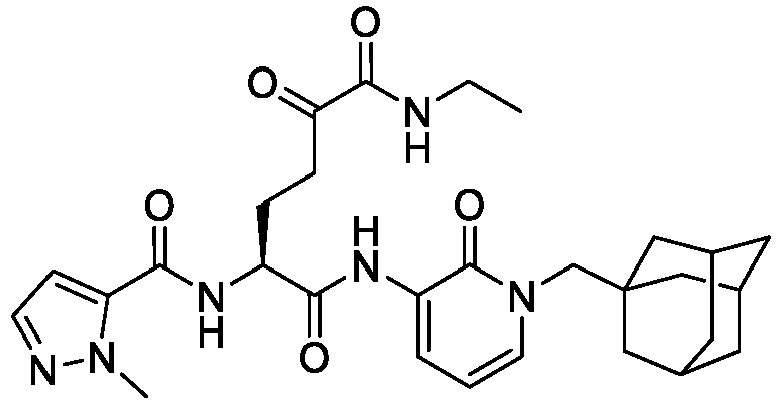
(S)-N1-(1-(1-adamantylmethyl)-2-oxo-1,2-dihydropyridin-3-yl)-N6-ethyl-2-(1-methyl-1H-pyrazole-5-carboxamido)-5-oxohexanediamide I-82 
(S)-N1-(1-((3-hydroxy-1-adamantyl)methyl)-2-oxo-1,2-dihydropyridin-3-yl)-2-(4-cyclopropyl-1,2,3-thiadiazole-5-carboxamido)-N6-ethyl-5-oxohexanediamide I-83 
(S)-N1-(1-((3-bromo-1-adamantyl)methyl)-2-oxo-1,2-dihydropyridin-3-yl)-N6-ethyl-5-oxo-2-(1,2,5-thiadiazole-3-carboxamido)hexanediamide I-84 
(S)-N1-(1-(2-adamantylmethyl)-2-oxo-1,2-dihydropyridin-3-yl)-N6-ethyl-2-(4-(hydroxymethyl)-1,2,3-thiadiazole-5-carboxamido)-5-oxohexanediamide I-85 
(S)-2-(4-tert-butyl-1H-pyrrole-3-carboxamido)-N1-(1-(2-(1-adamantylamino)ethyl)-2-oxo-1,2-dihydropyridin-3-yl)-N6-ethyl-5-oxohexanediamide I-86 
(S)-2-(4-cyano-1-methyl-1H-pyrrole-2-carboxamido)-N1-(1-(1-adamantylamino)propyl)-2-oxo-1,2-dihydropyridin-3-yl)-N6-ethyl-5-oxohexanediamide I-87 
(S)-N1-(1-(3-(2-adamantylamino)-3-oxopropyl)-2-oxo-1,2-dihydropyridin-3-yl)-N6-ethyl-2-(5-methoxyoxazole-2-carboxamido)-5-oxohexanediamide I-88 
(S)-N1-(1-(2-(bicyclo[1.1.1]pentan-1-ylamino)-2-oxoethyl)-2-oxo-1,2-dihydropyridin-3-yl)-N6-ethyl-2-(3-methylbenzofuran-2-carboxamido)-5-oxohexanediamide I-89 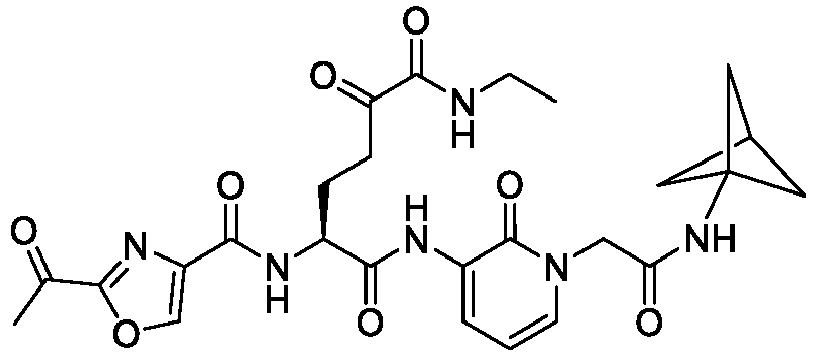
(S)-2-(2-acetyloxazole-4-carboxamido)-N1-(1-(2-(bicyclo[1.1.1]pentan-1-ylamino)-2-oxoethyl)-2-oxo-1,2-dihydropyridin-3-yl)-N6-ethyl-5-oxohexanediamide I-90 
(S)-N1-(1-(2-(bicyclo[2.1.1]hexan-1-ylamino)-2-oxoethyl)-2-oxo-1,2-dihydropyridin-3-yl)-N6-ethyl-2-(2-isopropyloxazole-5-carboxamido)-5-oxohexanediamide I-91 
(2S)-N1-(1-(2-(bicyclo[3.2.1]octan-8-ylamino)-2-oxoethyl)-2-oxo-1,2-dihydropyridin-3-yl)-2-(3,5-dimethylisoxazole-4-carboxamido)-N6-ethyl-5-oxohexanediamide I-92 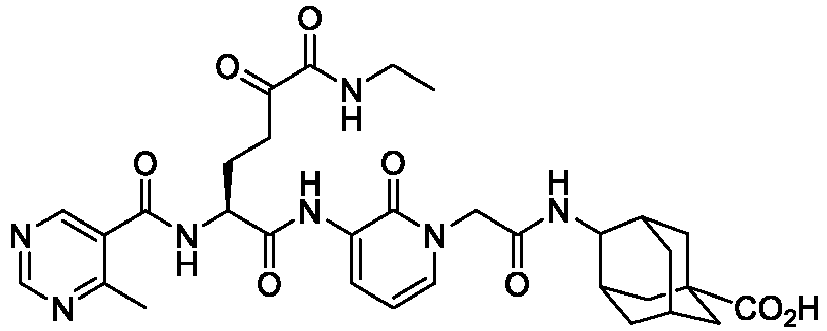
(S)-N1-ethyl-N6-(1-(2-(5-carboxy-2-aminoadamantane)-2-oxoethyl)-2-oxo-1,2-dihydropyridin-3-yl)-5-(4-methylpyrimidine-5-carboxamido)-2-oxohexanediamide I-93 
(5S)-N1-ethyl-N6-(1-(2-(4-aminoadamantane-N,N-dimethyl-1-carboxamide)-2-oxoethyl)-2-oxo-1,2-dihydropyridin-3-yl)-2-oxo-5-(1,2,3,4-tetrahydronaphthalene-2-carboxamido)hexanediamide I-94 
(S)-2-((S)-1,4-diazabicyclo[2.2.2]octane-2-carboxamido)-N6-ethyl-N1-(1-(2-(2-adamantylamino)-2-oxoethyl)-2-oxo-1,2-dihydropyridin-3-yl)-5-oxohexanediamide I-95 
(S)-N1-ethyl-5-(1H-indole-3-carboxamido)-N6-(1 -(2-(2-adamantylamino)-2-oxoethyl)-2-oxo-1,2-dihydropyridin-3-yl)-2-oxohexanediamide I-96 
(S)-N1-ethyl-N6-(1-(2-(2-adamantylamino)-2-oxoethyl)-2-oxo-1,2-dihydropyridin-3-yl)-5-(6-methylimidazo[2,1-b]thiazole-3-carboxamido)-2-oxohexanediamide I-97 
(S)-2-(benzo[d]thiazole-2-carboxamido)-N1-(1-(2-((1S,2R,4R)-bicyclo[2.2.1]heptan-2-ylamino)-2-oxoethyl)-2-oxo-1,2-dihydropyridin-3-yl)-N6-ethyl-5-oxohexanediamide I-98 
(S)-N1-(1-(2-((1S,2R,4R)-bicyclo[2.2.1]heptan-2-ylamino)-2-oxoethyl)-2-oxo-1,2-dihydropyridin-3-yl)-N6-ethyl-2-(imidazo[2,1-b]thiazole-6-carboxamido)-5-oxohexanediamide I-99 
(S)-N1-(1-(2-((1S,2R,4R)-bicyclo[2.2.1]heptan-2-ylamino)-2-oxoethyl)-2-oxo-1,2-dihydropyridin-3-yl)-N6-ethyl-2-(4-hydroxy-6-(trifluoromethoxy)quinoline-3-carboxamido)-5-oxohexanediamide I-100 
(S)-N1-(1-(2-(bicyclo[1.1.1]pentan-1-ylamino)-2-oxoethyl)-2-oxo-1,2-dihydropyridin-3-yl)-2-(cinnoline-3-carboxamido)-N6-ethyl-5-oxohexanediamide I-101 
(S)-N1-(1-(2-(bicyclo[1.1.1]pentan-1-ylamino)-2-oxoethyl)-2-oxo-1,2-dihydropyridin-3-yl)-N6-ethyl-2-(3-ethylbenzofuran-2-carboxamido)-5-oxohexanediamide I-102 
(S)-N1-(1-(2-(bicyclo[1.1.1]pentan-1-ylamino)-2-oxoethyl)-2-oxo-1,2-dihydropyridin-3-yl)-N6-ethyl-2-(1-ethyl-1H-indole-2-carboxamido)-5-oxohexanediamide I-103 
(S)-N1-(1-(2-(bicyclo[1.1.1]pentan-1-ylamino)-2-oxoethyl)-2-oxo-1,2-dihydropyridin-3-yl)-N6-ethyl-2-(2-methyl-1,8-naphthyridine-3-carboxamido)-5-oxohexanediamide I-104 
(S)-N1-(1-(2-(bicyclo[2.1.1]hexan-1-ylamino)-2-oxoethyl)-2-oxo-1,2-dihydropyridin-3-yl)-N6-ethyl-5-oxo-2-(1,2,3,4-tetrahydroquinoline-6-carboxamido)hexanediamide I-105 
(S)-N1-ethyl-N6-(1-(2-(2-carboxy-2-amino-5-(trifluoromethyl)adamantane)-2-oxoethyl)-2-oxo-1,2-dihydropyridin-3-yl)-2-oxo-5-(3-oxo-1,2,3,4-tetrahydroisoquinoline-6-carboxamido)hexanediamide I-106 
(S)-N1-ethyl-N6-(1-(2-(5-ethyladamantane-2-amino)-2-oxoethyl)-2-oxo-1,2-dihydropyridin-3-yl)-5-(1,6-naphthyridine-2-carboxamido)-2-oxohexanediamide I-107 
(S)-N1-(1-(2-(bicyclo[2.1.1]hexan-1-ylamino)-2-oxoethyl)-2-oxo-1,2-dihydropyridin-3-yl)-N6-ethyl-2-(2,6-naphthyridine-1-carboxamido)-5-oxohexanediamide I-108 
(S)-2-(4-amino-1,2,5-oxadiazole-3-carboxamido)-N1-(1-(2-(bicyclo[1.1.1]pentan-1-ylamino)-2-oxoethyl)-2-oxo-1,2-dihydropyridin-3-yl)-N6-ethyl-5-oxohexanediamide I-109 
(S)-N1-(1-(2-(bicyclo[1.1.1]pentan-1-ylamino)-2-oxoethyl)-2-oxo-1,2-dihydropyridin-3-yl)-2-(6-(dimethylamino)benzofuran-2-carboxamido)-N6-ethyl-5-oxohexanediamide I-110 
(S)-2-(2-acetamidothiazole-5-carboxamido)-N1-(1-(2-(bicyclo[1.1.1]pentan-1-ylamino)-2-oxoethyl)-2-oxo-1,2-dihydropyridin-3-yl)-N6-ethyl-5-oxohexanediamide I-111 
(S)-N4-(1-(1-(2-(bicyclo[1.1.1]pentan-1-ylamino)-2-oxoethyl)-2-oxo-1,2-dihydropyridin-3-ylamino)-6-(ethylamino)-1,5,6-trioxohexan-2-yl)-1H-pyrrole-2,4-dicarboxamide I-112 
(S)-N1-ethyl-N6-(1-(2-(1-acetylamino-4-aminoadamantane)-2-oxoethyl)-2-oxo-1,2-dihydropyridin-3-yl)-2-oxo-5-(5-sulfamoylfuran-3-carboxamido)hexanediamide I-113 
(S)-2-(benzofuran-5-carboxamido)-N6-ethyl-N1-(1-(2-(1-acetylamino-4-aminoadamantane)-2-oxoethyl)-2-oxo-1,2-dihydropyridin-3-yl)-5-oxohexanediamide I-114 
(S)-2-(benzofuran-6-carboxamido)-N6-ethyl-N1-(1-(2-(4-aminoadamantane-1-carboxamide)-2-oxoethyl)-2-oxo-1,2-dihydropyridin-3-yl)-5-oxohexanediamide I-115 
(S)-N1-ethyl-N6-(1-(2-(4-aminoadamantane-1-carboxamide)-2-oxoethyl)-2-oxo-1,2-dihydropyridin-3-yl)-5-(3-(1-methylcyclopropyl)-1,2,4-oxadiazole-5-carboxamido)-2-oxohexanediamide I-116 
(S)-N1-(1-(2-(bicyclo[1.1.1]pentan-1-ylamino)-2-oxoethyl)-2-oxo-1,2-dihydropyridin-3-yl)-N6-ethyl-2-(5-methyl-1,2,4-oxadiazole-3-carboxamido)-5-oxohexanediamide I-117 
(S)-N1-(1-(2-(bicyclo[1.1.1]pentan-1-ylamino)-2-oxoethyl)-2-oxo-1,2-dihydropyridin-3-yl)-N6-ethyl-5-oxo-2-(1,2,3-thiadiazole-4-carboxamido)hexanediamide I-118 
(S)-N1-(1-(2-(bicyclo[1.1.1]pentan-1-ylamino)-2-oxoethyl)-2-oxo-1,2-dihydropyridin-3-yl)-N6-ethyl-5-oxo-2-(1,2,4-thiadiazole-5-carboxamido)hexanediamide I-119 
(S)-N1-(1-(2-(bicyclo[1.1.1]pentan-1-ylamino)-2-oxoethyl)-2-oxo-1,2-dihydropyridin-3-yl)-N6-ethyl-5-oxo-2-(1,3,4-thiadiazole-2-carboxamido)hexanediamide I-120 
(S)-N1-ethyl-5-(4-formyl-1,2,3-thiadiazole-5-carboxamido)-N6-(1-(2-(2-adamantylamino)-2-oxoethyl)-2-oxo-1,2-dihydropyridin-3-yl)-2-oxohexanediamide I-121 
(S)-N1-ethyl-N6-(1-(2-(3,5-dimethyladamantane-1-amino)-2-oxoethyl)-2-oxo-1,2-dihydropyridin-3-yl)-5-(nicotinamido)-2-oxohexanediamide - In some embodiments, the present invention relates to a method for the synthesis of a compound of formula (I), especially any compound of the formula (Ia):

- As shown in Scheme 1,
a method for producing the compound of the formula (Ia) comprising: - Step 1A: providing a compound 4a
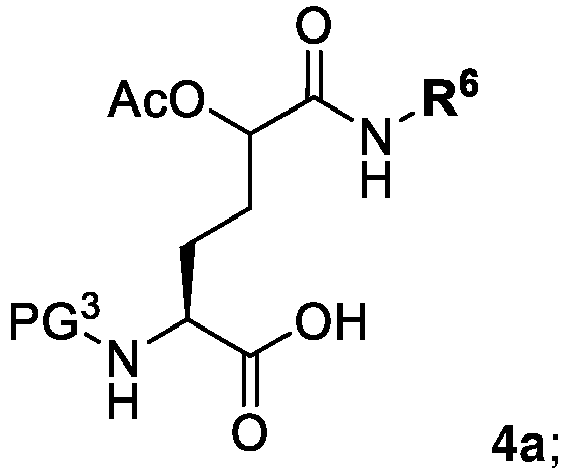
- Step 2A: performing coupling reaction of the compound 4a with a compound 5


- Step 3A: deprotecting an amino protecting group PG3 to obtain a compound 7a

- Step 4A: performing coupling reaction of the compound 7a with a carboxylic acid (R 2-CO2H 8) to obtain a compound 9a
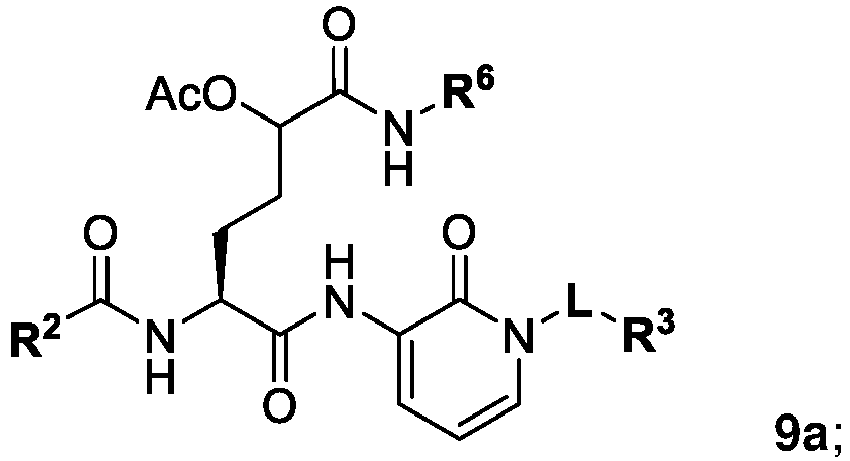
- Step 5A: performing oxidation reaction of the compound 9a to produce the compound of the formula (Ia)

- wherein L, R2, R3 ,and R6 have the same meanings as defined above in formula (Ia),
and - PG3 is an amino protecting group.

- wherein L, R2, R3 ,and R6 have the same meanings as defined above in formula (Ia),
- Optionally, Step 1A' is carried out before the step 1A:
- (a) providing a protected aldehyde 1

- (b) performing a coupling reaction of the aldehyde 1 with an isocyanide (CN-R6) 2a to obtain an intermediate compound 3a

- (c) deprotecting the protecting groups PG1 and PG2 of the compound 3a preferably under acidic condition and introducing an amino protecting group PG3 to obtain a compound 4a

- wherein R2, R6 have the same meanings as defined in formula (Ia),
- PG1 and PG3 are amino protecting groups,
- PG2 is a carboxyl protecting group.
- Therefore, the following method for the production of compounds of the formula (Ia) is preferred:
- Step 1 A':
- (a) providing a protected aldehyde 1

- (b) performing a coupling reaction of the aldehyde 1 with an isocyanide (CN-R6) 2a to obtain an intermediate compound 3a

- (c) deprotecting the protecting groups PG1 and PG2 of the compound 3a preferably under acidic condition and introducing an amino protecting group PG3 to obtain a compound 4a

- (a) providing a protected aldehyde 1
- Step 1A: providing a compound 4a

- Step 2A: performing coupling reaction of the compound 4a with a compound 5


- Step 3A: deprotecting the amino protecting group PG3 to obtain a compound 7a

- Step 4A: performing coupling reaction of the compound 7a with a carboxylic acid (R2 -CO2H 8) to obtain a compound 9a

- Step 5A: performing oxidation reaction of the compound 9a to produce the compound of the formula (Ia)

- wherein L, R2, R3 ,and R6 have the same meanings as defined above in the formula (Ia), and PG1 and PG3 are amino protecting groups,
- PG2 is a carboxyl protecting group.
- In an alternative route first all protecting groups PG1 and PG2 are simultaneously removed and the protecting group PG3 is selectively introduced. Preferably, PG1 and PG3 are same.
- The term "protecting groups" as used herein refers to commonly used protection groups in organic synthesis, preferably for amino and carboxyl groups. PG1, PG3, and PG5 preferably are suitable protecting groups for amino groups. PG2 and PG4 preferably are suitable protecting groups for carboxyl groups. Preferably, PG1, PG3, and PG5 may be selected from the group consisting of or comprising: acetyl, benzoyl, benzyloxycarbonyl (Cbz), tert-butylcarbonyl, tert-butyloxycarbonyl (Boc), and fluorenylmethylenoxy group (Fmoc). PG2 and PG4 may be selected from the group consisting of or comprising: methoxy, ethoxy, isobutoxy, tert-butoxy, benzyloxy; preferably, tert-butoxy group.
- In Step 2A to promote the coupling reaction with amino group of intermediate compound, activating reagents are commonly used to activating carboxylic acid (" Peptide Coupling Reagents, More than a Letter Soup", Ayman El-Faham and Fernando Albericio, Chemical Reviews, 2011, 111(11), p.6557-6602). The activation may be introduced separate reaction or in situ reaction. Preferably, any of the following coupling reagent can be used to activate carobxylic acid group: BOP (Benzotriazole-1-yl-oxy-tris-(dimethylamino)-phosphonium hexafluorophosphate), PyBOP (Benzotriazole-1-yl-oxy-tris-pyrrolidino-phosphonium hexafluorophosphate), AOP (7-(Azabenzotriazol-1-yl)oxy tris(dimethylamino)phosphonium hexafluorophosphate), PyAOP ((7-Azabenzotriazol-1-yloxy)tripyrrolidinophosphonium hexafluorophosphate), TBTU (2-(1H-Benzotriazole-1-yl)-1,1,3,3-tetramethylaminium tetrafluoroborate), EEDQ (N-Ethoxycarbonyl-2-ethoxy-1,2-dihydroquinoline), Polyphosphoric Acid (PPA), DPPA (Diphenyl phosphoryl azide), HATU (1-[Bis(dimethylamino)methylene]-1H-1,2,3-triazolo[4,5-b]pyridinium 3-oxide hexafluorophosphate), HBTU (O-Benzotriazol-1-yl-N,N,N',N'-tetramethyluronium hexafluorophosphate), HOBt (1-Hydroxybenzotriazole), HOAt (1-Hydroxy-7-azabenzotriazole), DCC (N,N-Dicyclohexylcarbodiimide), EDC (or EDAC or EDCl, 1-Ethyl-3-(3-dimethylaminopropyl)carbodiimide), BOP-Cl (Bis(2-oxo-3-oxazolidinyl)phosphinic chloride), TFFH (Tetramethylfluoroformamidinium hexafluorophosphate), BroP (Bromo tris(dimethylamino) phosphonium hexafluorophosphate), PyBroP (Bromo-tris-pyrrolidino-phosphonium hexafluorophosphate) and CIP (2-Chloro-1,3-dimethylimidazolidinium hexafluorophosphate), or further, similar acting reagents, providing an activated intermediate,or a mixture thereof.
- Therefore another aspect of the present invention relates to compounds according to the general formula (I) as medicine as well as their use in medicine. Especially preferred is the use as inhibitors of transglutaminases, in particular transglutaminsase 2 (TG2).
- Thus the compounds of formula (I) described herein or according to the present invention may be administered themselves or in form of a pharmacologically acceptable salt.
- The compounds of the present invention may form of a pharmacologically acceptable salt with organic or inorganic acids or bases. Examples of suitable acids for such acid addition salt formation are hydrochloric acid, hydrobromic acid, sulfuric acid, phosphoric acid, acetic acid, citric acid, oxalic acid, malonic acid, salicylic acid, p-aminosalicylic acid, malic acid, fumaric acid, succinic acid, ascorbic acid, maleic acid, sulfonic acid, phosphonic acid, perchloric acid, nitric acid, formic acid, propionic acid, gluconic acid, lactic acid, tartaric acid, hydroxymaleic acid, pyruvic acid, phenylacetic acid, benzoic acid, p-aminobenzoic acid, p-hydroxybenzoic acid, methanesulfonic acid, ethanesulfonic acid, nitrous acid, hydroxyethanesulfonic acid, ethylenesulfonic acid, p-toluenesulfonic acid, naphthylsulfonic acid, sulfanilic acid, camphorsulfonic acid, china acid, mandelic acid, o-methylmandelic acid, hydrogen-benzenesulfonic acid, picric acid, adipic acid, d-o-tolyltartaric acid, tartronic acid, (o, m, p)-toluic acid, naphthylamine sulfonic acid, trifluoroacetic acid, and other mineral or carboxylic acids well known to those skilled in the art. The salts are prepared by contacting the free base form with a sufficient amount of the desired acid to produce a salt in the conventional manner. Preferred is the mesylate salt, hydrochloride salt and the trifluoroacetate salt and especially preferred is the trifluoroacetate salt and the hydrochloride salt.
- In the case the inventive compounds bear acidic groups, salts could also be formed with inorganic or organic bases. Examples for suitable inorganic or organic bases are, for example, NaOH, KOH, NH4OH, tetraalkylammonium hydroxide, lysine or arginine and the like. Salts may be prepared in a conventional manner using methods well known in the art, for example by treatment of a solution of the compound of the general formula (I) with a solution of an acid, selected out of the group mentioned above.
- In a further aspect of the present invention, the novel compounds according to the general formula (I) are used as pharmaceutically active agent, i.e. the compound of the formula (I) is used in medicine.
- Furthermore, the present invention relates to a pharmaceutical composition comprising at least one compound according to the general formula (I), as an active ingredient or a pharmacologically acceptable salts thereof as an active ingredient, together with at least one pharmacologically acceptable carrier, excipient and/or diluent.
- The compounds according to general formula (I) described herein are especially suitable for the treatment and prophylaxis of diseases associated with and/or caused by transglutaminase 2.
- Celiac disease, a gluten intolerance is associated with tissue transglutaminase (TG 2). Another very important group of indications for tissue transglutaminase inhibitors are fibrotic disorders. Fibrotic disorders are characterized by the accumulation of crosslinked extracellular matrix proteins. Diabetic nephropathy, cystic fibrosis, idiopathic pulmonary fibrosis, kidney fibrosis as well as liver fibrosis belong to the most important fibrotic disorders to be addressed with the compounds disclosed.
- In the biological example B-1, it is proven that the inventive compounds as reversible inhibitors effectively inhibit the activity of TGs, especially TG2.
- As used herein the term "inhibiting" or "inhibition" refers to the ability of a compound to downregulate, decrease, reduce, suppress, inactivate, or inhibit at least partially the activity of an enzyme, or the expression of an enzyme or protein.
- Therefore, another aspect of the present invention is the use of the inventive compounds of the general formula (I), or the pharmaceutical composition thereof as described in the treatment or prophylaxis of autoimmune and inflammatory diseases, vascular diseases, fibrotic diseases, liver diseases, cholestatic liver diseases, cancer, neurodegenerative diseases, ocular diseases, and skin disorders.
- Further aspects of the present invention relate to the use of the compounds of general formula (I) for the preparation of a pharmaceutical composition useful for prophylaxis and/or treatment of autoimmune and inflammatory diseases, vascular diseases, fibrotic diseases, liver diseases, cholestatic liver diseases, cancer, neurodegenerative diseases, ocular diseases, and skin disorders.
- In a further aspect of the present invention, a method for preventing and/or treating autoimmune and inflammatory diseases, vascular diseases, fibrotic diseases, liver diseases, cholestatic liver diseases, cancer, neurodegenerative diseases, ocular diseases, and skin disorders, which method comprises administering to a subject, in particular a human, a pharmaceutically effective amount of at least one compound of the general formula (I), to prevent and/or treat said autoimmune and inflammatory diseases, vascular diseases, fibrotic diseases, liver diseases, cholestatic liver diseases, cancer, neurodegenerative diseases, ocular diseases, and skin disorders.
- Preferred, the autoimmune and inflammatory diseases comprises multiple sclerosis, celiac disease, Duhring-Brocq-disease (dermatitis herpetiformis), gluten ataxia, gluten neuropathy, diabetes, rheumatoid arthritis, Graves' disease, inflammatory bowel disease, systemic lupus erythematosus psoriasis, and gingivitis;
- the vascular diseases comprise atherosclerosis, thrombosis, vascular stiffness;
- the fibrotic diseases affecting the lung, the kidney, the liver, the skin or the gut like cystic fibrosis, kidney fibrosis and diabetic nephropathy, intestinal fibrosis, idiopathic lung fibrosis, liver fibrosis;
- the liver diseases like alcoholic hepatitis, alcoholic steatohepatitis, nonalcoholic steatohepatitis, non-alcoholic fatty liver disease, liver cirrhosis, autoimmune hepatitis or liver inflammation;
- the cholestatic liver diseases comprise primary biliary cholangitis and primary sclerosing cholangitis;
- the cancer comprises glioblastoma, melanoma, pancreatic cancer, renal cell carcinoma, meningioma, and breast cancer,
- the neurodegenerative diseases comprise Parkinson's disease, Huntington's disease, or Alzheimer's disease,
- the ocular diseases comprise glaucoma, cataracts, macular degeneration, or uveitis; the skin disorders comprise acne, psoriasis, scarring, and skin aging.
- More preferred, the compound of the formula (I), or the pharmaceutical composition thereof is useful in the treatment or prophylaxis of celiac disease.
- Furthermore, the compounds of the general formula (I), can be administered in form of their pharmaceutically active salts, optionally using essentially non-toxic pharmaceutically acceptable carriers, adjuvants or extenders. Medications are prepared in a known manner in a conventional solid or fluid carrier or in extenders and a conventional pharmaceutically acceptable adjuvant/expedient in a suitable dose. The preferred preparations are provided in an administrable form suitable for oral application, such as pills, tablets, film tablets, coated tablets, capsules and powders.
- Tablets, film tablets, coated tablets, gelatin capsules and opaque capsules are the preferred pharmaceutical formulations. Any pharmaceutical compositions contains at least one compound of the general formula (I), and/or pharmaceutically acceptable salts thereof in an amount of 5 mg to 500 mg, preferably 10 mg to 250 mg and most preferred in an amount of 10 to 100 mg per formulation.
- Besides, the object of the present invention also includes pharmaceutical preparations for oral, parenteral, dermal, intradermal, intragastric, intracutaneous, intravascular, intravenous, intramuscular, intraperitoneal, intranasal, intravaginal, intrabuccal, percutaneous, rectal, subcutaneous, sublingual, topic, transdermal or inhalative application, containing, in addition to typical vehicles and extenders, a compound of the general formula (I), and/or a pharmaceutically acceptable salt thereof as active component.
- The pharmaceutical compositions of the present invention contain one of the compounds of the formula (I) disclosed herein as active component, typically mixed with suitable carrier materials, selected with respect to the intended form of administration, i.e. tablets to be administered orally, capsules (filled either with a solid, a semi-solid or a liquid), powders, orally administrable gels, elixirs, dispersible granulates, syrups, suspensions and the like in accordance with conventional pharmaceutical practices. For example, the compound of the formula (I) can as active agent component be combined with any oral, non-toxic, pharmaceutically acceptable, inert carrier, such as lactose, starch, sucrose, cellulose, magnesium stearate, dicalcium phosphate, calcium sulfate, talc, mannitol, ethyl alcohol (liquid forms) and the like for the oral administration in form of tablets or capsules. Moreover, suitable binders, lubricants, disintegrants and colorants can be added to the mixture if required. Powders and tablets can consist of said inert carriers to an extent from about 5% per weight to about 95% per weight of the inventive composition.
- Suitable binders include starch, gelatin, natural sugars, sweeteners made of corn, natural and synthetic gums, such as acacia gum, sodium alginate, carboxymethylcellulose, polyethylene glycol and waxes. Possible lubricants for the use in said dosage forms include boric acid, sodium benzoate, sodium acetate, sodium chloride and the like. Disintegrants include starch, methylcellulose, cyclodextrins, guar gum and the like. If required, sweeteners and flavor additives and preservatives can also be included. Some of the terms used above, namely disintegrants, extenders, lubricants, binders and the like are discussed in greater detail below.
- Additionally, the compositions of the present invention can be formulated in a form with sustained release to provide a controlled release rate of any one or more components or active components, in order to optimize the therapeutic effect, i.e. the inhibitory activity and the like. Suitable dosage forms for sustained release include layered tablets containing layers with varying degradation rates or controlled release polymeric matrices impregnated with the active components and in the form of a tablet or capsule containing such impregnated or encapsulated porous polymeric matrices.
- Preparations in fluid form include solutions, suspensions and emulsions. Exemplarily mentioned are water or water propylene glycol solutions for parenteral injections or the addition of sweeteners and opacifiers for oral solutions, suspensions and emulsions.
- Aerosol preparations suitable for inhalation may include solutions and solids in the form of powders which can be combined with a pharmaceutically acceptable carrier, such as a compressed inert gas, e.g. nitrogen.
- For the preparation of suppositories a low melting wax, such as a mixture of fatty acid glycerides, e.g. cocoa butter, is melted firstly and the active component is homogenously dispersed therein by stirring or similar mixing operations. The melted homogenous mixture is then poured in fitting forms, cooled and thus hardened.
- Further preparations in solid form which are to be converted into preparations in fluid form for either oral or parenteral administration shortly before use are included. Such fluid forms include solutions, suspensions and emulsions.
- Furthermore, the compounds of the present invention may be administered via transdermal application. The transdermal compositions can have the form of crèmes, lotions, aerosols and/or emulsions.
- The term capsule refers to a special container or casing composed of methylcellulose, polyvinyl alcohols or denatured gelatins or starches, in which the active agents can be enclosed. Typically, hard shell capsules are prepared from mixtures of bones and porcine skin gelatins having comparatively high gel strength. The capsule itself can contain small amounts of colorants, opacifiers, softening agents and preservatives.
- Tablet means a compressed or cast solid dosage form containing the active components with suitable extenders. The tablet can be produced by compressing mixtures or granulates obtained by wet granulation, dry granulation or compaction, which are known to the one skilled in the art.
- Oral gels refer to the active components dispersed or solubilized in a hydrophilic semi-solid matrix.
- Powders for compositions refer to powder mixtures containing the active components and suitable extenders which can be suspended in water or juices.
- Suitable extenders are substances which usually form the largest part of the composition or dosage form. Suitable extenders include sugars such as lactose, sucrose, mannitol and sorbitol; starches derived from wheat, corn, rice and potatoes; and celluloses such as microcrystalline cellulose. The amount of extenders in the composition can range from about 5 to about 95% per weight of the total composition, preferably form about 25 to about 75% per weight and further preferred from about 30 to about 60% per weight.
- The term disintegrants refers to materials added to the composition in order to support disintegration and release of the medicinal substance. Suitable disintegrants include starches, modified starches which are soluble in cold water, such as sodium carboxymethyl starch; natural and synthetic gums such as locust bean gum, caraya, guar gum, tragacanth and agar; cellulose derivatives such as methylcellulose and sodium carboxymethylcellulose, microcrystalline celluloses and crosslinked microcrystalline celluloses such as croscarmellose sodium; alginates such as alginic acid and sodium alginate; clays such as bentonites and foaming mixtures. The amount of disintegrants used in the composition can range from about 2 to 20% per weight of the composition and further preferred from about 5 to about 10% per weight.
- Binders characterize substances binding or "gluing" powders to each other and they consequently serve as "glue" in the formulation. Binders add a cohesion starch which is already available in the extenders or the disintegrant. Suitable binders include sugar, such as sucrose; starches derived from wheat, corn, rice and potatoes; natural gums such as acacia gum, gelatin and tragacanth; derivatives of sea weed such as alginic acid, sodium alginate and ammonium calcium alginate, cellulose materials such as methyl cellulose and sodium carboxymethylcellulose and hydroxypropyl methylcellulose, polyvinylpyrrolidone and inorganic compounds, such as magnesium aluminum silicate. The amount of binders in the composition can range from about 2 to about 20% per weight of the total composition, preferably form about 3 to about 10% per weight and further preferred from about 3 to about 6% per weight.
- The term lubricant refers to a substance added to the dosage form in order to allow for the tablet, granulate, etc. to be released from the casting mold or pressing mold, after compression, by reducing the friction. Suitable lubricants include metallic stearates such as magnesium stearate, calcium stearate or potassium stearate; stearic acid; waxes with high melting points and water soluble lubricants such as sodium chloride, sodium benzoate, sodium acetate, sodium oleate, polyethylene glycols and D,L-leucine. Due to the fact that lubricants have to be present on the surface of the granulates as well as between the granulates and parts of the tablet press they are typically added during the last step prior to compression. The amount of lubricants in the composition can range from about 0.2 to about 5% per weight of the total composition, preferably form about 0.5 to about 2% per weight and further preferred from about 0.3 to about 1.5 % per weight.
- Lubricants are materials preventing caking and improving the flow characteristics of granulates so that the flow is smooth and uniform. Suitable lubricants include silicon dioxide and talc. The amount of lubricants in the composition can range from about 0.1 to about 5 % per weight of the total composition, preferably form about 0.5 to about 2 % per weight.
- Colorants are adjuvants coloring the composition or dosage form. Such adjuvants can include colorants having food quality which are adsorbed on a suitable adsorption means, such as clay or aluminum oxide. The amount of the colorant used can vary from about 0.1 to about 5% per weight of the composition and preferably from about 0.1 to about 1% per weight.
- As used herein, a "pharmaceutically effective amount" of a transglutaminase inhibitor is the amount or activity effective for achieving the desired physiological result, either in cells treated in vitro or in a patient treated in vivo. Specifically, a pharmaceutical effective amount is such an amount which is sufficient for inhibiting, for a certain period of time, one or more of the clinically defined pathological processes associated with transglutaminase 2. The effective amount can vary according to the specific compound of the formula (I) and additionally depends on a plurality of factors and conditions related to the subject to be treated and the severity of the disease. If, for example, an inhibitor is to be administered in vivo, factors such as age, weight and health of the patients as well as dose reaction curves and data regarding toxicity obtained from preclinical animal studies are amongst the data to be considered. If the inhibitor in form of the compound of the formula (I) described herein is to be brought in contact with the cells in vivo, a plurality of preclinical in vitro studies would be designed in order to determine parameters such as absorption, half-life, dose, toxicity, etc. Determining a pharmaceutically effective amount for a given pharmaceutically active ingredient is part of the ordinary skills of the one skilled in the art.
- Following abbreviations used in the examples have the following meaning. Boc (tert-butoxycarbonyl), BocOSu (N-tert-butoxycarbonyloxy-succinimide) DCM (dichloromethane), DMAP (4-(Dimethylamino)-pyridine), TEA (triethylamine), DMF (dimethylformamide), DMP (Dess-Martin periodiane), DIPEA (N-Ethyldiisopropylamine), Glu (glutamic acid), EDC (1-ethyl-3-(3'-dimethylaminopropyl)carbodiimide), TFA (trifluoroacetic acid), THF (tetrahydrofuran), EtOAc (ethyl acetate), HATU (1-[Bis(dimethylamino)methylene]-1H-1,2,3-triazolo[4,5-b]pyridinium 3-oxid hexafluorophosphate), HOBt (hydroxybenzotriazole), MTBE (methyl tert-butyl ether), tBu (tert-butyl),
- The following examples are intended to illustrate the invention with selected compounds without limiting the protecting scope of the present intellectual property right on these concrete examples. It is clear for a person skilled in the art that analogous compounds and compounds produced according to analogous synthetic ways fall under the protecting scope of the present intellectual property right.
-

-
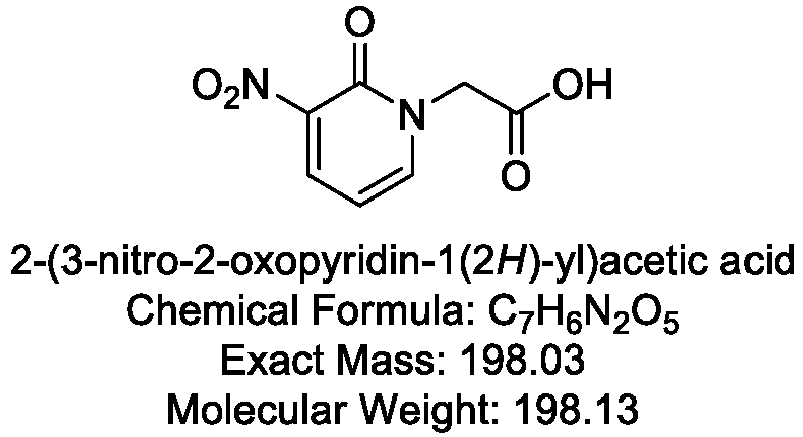
- 30.0 g (214 mmol) of 2-hydroxy-3-nitropyridine and 40.5 g (2 eq) of chloroacetic acid were suspended in 600 mL water. At 40°C, 245 g (3 eq) trisodium phosphate dodecahydrate were added, and the reaction was stirred at room temperature overnight. 250 mL HCl (32%) were added, and the suspension was stirred for another night at 4°C. The precipitate was filtered and dried.
Yield: 41.2 g, 97%; ESI-MS: 199.3 [M+H]+ -
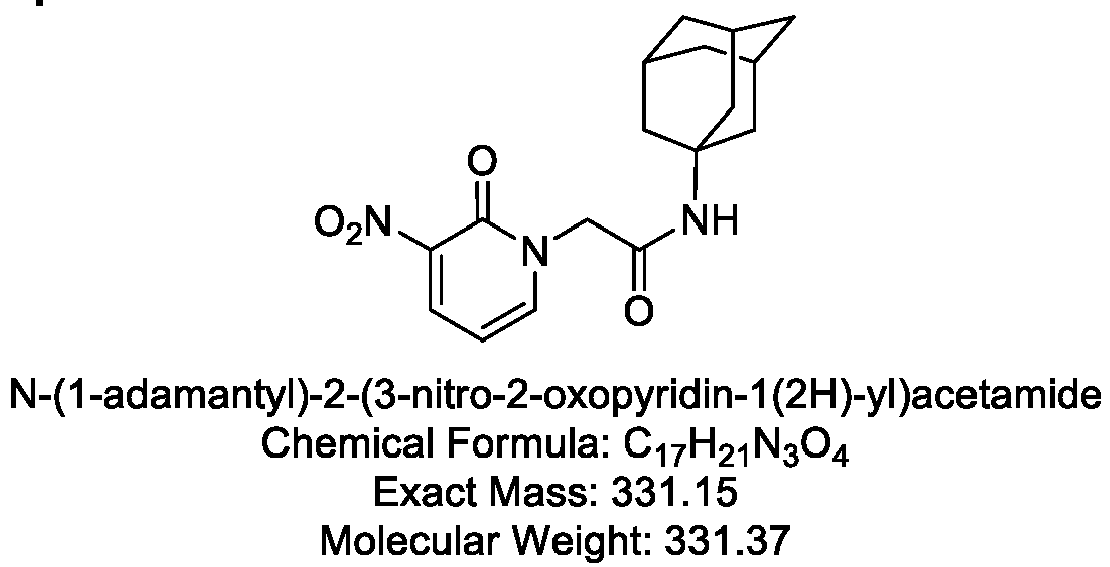
- 7.0 g (35.3 mmol) of ZED1657, 6.63 g (1 eq) of 1-adamantanamine hydrochloride and 4.77 g (1 eq) of HOBt were dissolved in 80 mL DMF and 7.38 mL (1.2 eq) DIPEA. 7.45 g (1.1 eq) of 1-ethyl-3-(3'-dimethylaminopropyl)carbodiimide hydrochloride were added and the reaction was stirred at room temperature overnight. The solvent was evaporated, and the residue was dissolved in 200 mL DCM. The solution was washed with each 100 mL citric acid solution (10%), NaHCO3 solution (10%) and brine. The organic phase was dried over Na2SO4, filtered and the solvent was evaporated.
Yield: 10.3 g, 88%; ESI-MS: 332.4 [M+H]+ -

- 10.3 g (31.0 mmol) of ZED3912 were suspended in 200 mL MeOH before 1.0 g of palladium (10%) on activated carbon (unreduced) were added. The suspension was stirred overnight at room temperature under an atmosphere of hydrogen. The catalyst was filtered, and the solvent was evaporated.
- Yield: 7.51 g, 78%
- ESI-MS: 302.3 [M+H]+
-

- 12.0 g of Boc-L-Glu-OtBu (39.6 mmol) and 7.09 g of cesium carbonate (21.8 mmol, 0.55 eq) were suspended in 100 ml of DMF and stirred for 1 h at room temperature. 2.47 ml iodomethane (39.6 mmol) we added, and the mixture was stirred at room temperature overnight. The solvent was evaporated, and the residue was dissolved in ethyl acetate and washed twice with each citric acid solution (10%), NaHCO3 solution (10%) and brine. The organic phase was dried over Na2SO4, filtered and the solvent was evaporated. The raw product was used without further purification.
- Yield: 13.4 g, >100%
- ESI-MS: 318.3 [M+H]+
-

- 13.4 g of ZED788 (-39,6 mmol) and 986 mg of N,N-dimethyl-4-aminopyridine (DMAP) were dissolved in 30 ml of acetonitrile. 17.6 g of di-tert-butyl bicarbonate (77.1 mmol) in 100 ml of acetonitrile was added and the solution was stirred at room temperature overnight. The solvent was evaporated, and the residue was dissolved in ethyl acetate and washed twice with each citric acid solution (10%), NaHCO3 solution (10%) and brine. The organic phase was dried over Na2SO4, filtered and the solvent was evaporated. The raw product was used without further purification.
- Yield: 13.7 g, 83%
- ESI-MS: 418.3 [M+H]+
-

- 13.7 g of ZED720 (32.8 mmol) were dissolved in 200 ml of dry diethyl ether and cooled to -78°C under argon atmosphere. 36.1 ml of diisobutylaluminum hydride (1M in hexane) were added dropwise and the solution was stirred for 30 min at -78°C before being quenched with potassium sodium tartrate (Rochelle salt) solution. The organic layer was separated, dried over Na2SO4, filtered, and concentrated to dryness. The raw product was used without further purification.
- Yield: 13.3 g, >100%
- ESI-MS: 388.3 [M+H]+
-

- 7.0 g (18.1 mmol) of the aldehyde (S)-tert-butyl 2-(bis(tert-butoxycarbonyl)amino)-5-oxopentanoate (ZED721) were dissolved in 30 mL DCM. At 0°C 1.04 g (1.05 eq) ethyl isocyanide and 1.09 mL (1.05 eq) acetic acid were added, and the reaction was stirred at room temperature overnight. 35 mL TFA were added, and the reaction was stirred for another 3 h. The solvent was evaporated, and the residue was dissolved in 20 mL DMF. 6.29 mL (2 eq) DIPEA and 4.73 g (1.2 eq) di-tert-butyl dicarbonate in 5 mL DMF were added and the reaction was stirred at room temperature overnight. The solvent was evaporated, and the residue was dissolved in DCM. After extraction with NaHCO3 solution (1.05 eq in water), 1.5 eq citric acid was added to the aqueous phase, followed by re-extraction with DCM. The organic phase was dried over Na2SO4, filtered and the solvent was evaporated. The residue was purified by flash chromatography.
- Yield: 5.77 g, 92%
- ESI-MS: 347.3 [M+H]+
-

- 5.77 g (16.7 mmol) of ZED3221, 6.33 g (1 eq) HATU and 5.02 g (1 eq) ZED3913 were dissolved in 100 mL DMF and 5.80 mL DIPEA (2 eq) and stirred at 45°C overnight. The solvent was evaporated; the residue was dissolved in 50 mL EtOAc and washed twice with each 35 mL citric acid solution (10%), NaHCO3 solution (10%) and brine. The organic phase was dried over Na2SO4, filtered and the solvent was evaporated.
- Yield: 7.41 g, 71%
- ESI-MS: 630.5 [M+H]+
-

- 600 mg (0.95 mmol) of I-1a were dissolved in 5 ml DCM/TFA (1:1) and stirred at room temperature for 1 h. The solvent was evaporated, and the residue was dissolved in 5 ml DMF. 120 mg (1 eq) 1-methyl-1H-imidazole-5-carboxylic acid, 362 mg (1 eq) HATU and 332 µl (2 eq) DIPEA were added, and the reaction was stirred at room temperature overnight. The solvent was evaporated; the residue was dissolved in 25 mL EtOAc and washed with each 15 mL citric acid solution (10%), NaHCO3 solution (10%) and brine. The organic phase was dried over Na2SO4, filtered and the solvent was evaporated.
- Yield: 527 mg, 87%
- ESI-MS: 638.5 [M+H]+
-

- 527 mg (0.83 mmol) of I-1b were dissolved in 7 ml MeOH. 171 mg (1.5 eq) potassium carbonate were added, and the reaction was stirred at room temperature for 1 h. The solution was diluted with DCM and washed with water. The organic phase was dried over Na2SO4, filtered and the solvent was evaporated.
- Yield: 469 mg, 95%
- ESI-MS: 596.5 [M+H]+
-

- 469 mg (0.60 mmol) of I-1c were dissolved in 5 ml DMF. 534 mg (1.6 eq) Dess-Martin periodinane (DMP) were added and the reaction was stirred at room temperature over 2 h. The precipitate was filtered off and the filtrate was evaporated. The residue was purified by HPLC.
- Yield: 362 mg, 77%
- ESI-MS: 594.5 [M+H]+
- 1H-NMR (DMSO-D6, 500 MHz, δ [ppm]: 1.27 (t, 3H, ethyl-CH3), 1.74 (m, 6H, adamantyl-C4-H2), 1.97 // 2.15 (m // m, 1H // 1H, β-CH2), 2.09 (m, 3H, adamantyl-C3-H), 2.17 (m, 6H, adamantyl-C2-H2), 3.23 (m, 2H, ethyl-CH2), 2.91 (t, 2H, γ-CH2), 3.74 (s, 3H, imidazole-N-CH3), 4.54 (ddd, 1H, a-CH2), 4.61 (s, 2H, N-CH2), 6.26 (t, 1H, pyridinone-C5-H), 7.31 (d, 1H, pyridinone-C6-H), 7.69 (s, 1H, imidazole-CH), 7.77 (s, 1H, imidazole-CH), 8.04 (d, 1H, adamantyl-NH), 8.17 (d, 1H, pyridinone-C4-H), 8.44 (q, 1H, ethylamide-NH), 8.56 (d, 1H, α-NH), 9.16 (s, 1H, pyridinone-NH).
- 13C-NMR (DMSO-D6, 500 MHz, δ [ppm]: 15.14 (ethyl-CH3), 24.54 (β-CH2), 29.19 (adamantyl-C3-H), 33.54 (imidazole-N-CH3), 33.71 (γ-CH2), 34.41 (ethyl-CH2), 35.89 (adamantyl-C4-H2), 40.77 (adamantyl-C2-H2), 44.12 (adamantyl-C1), 51.74 (N-CH2), 52.42 (α-CH2), 104.66 (pyridinone-C5-H), 122.39 (pyridinone-C4-H), 125.22 (imidazole-Cq), 127.92 (pyridinone-N-Cq), 132.85 (imidazole-CH), 133.27 (pyridinone-C6-H), 142.23 (imidazole-CH), 156.63 (pyridinone-C=O), 160.32 (imidazole-C=O), 161.10 (C=O-NH-CH2CH3), 165.75 (C=O-adamantylamide), 170.56 (C=O-NH-pyridinone), 198.43 (C=O-ethylamide).
-

- The synthesis of compound I-2 was performed according to compound I-1, using 1-Boc-imidazole-4-carboxylic acid instead of 1-methyl-1H-imidazole-5-carboxylic acid. The final product was obtained by deprotection (DCM/TFA) as described above and purified by HPLC.
- Yield: 45 mg, 63% (last step)
- ESI-MS: 580.4 [M+H]+
-

- The synthesis of compound I-3 was performed according to compound I-1, using N-methyl-1-adamantanamine instead of 1-adamantanamine in step 2 (according to ZED3912).
- Yield: 26 mg, 52% (last step)
- ESI-MS: 608.5 [M+H]+
-

- To the α-hydroxyester precursor of compound 1-4 (382 mg, 0.61 mmol, prepared by using 3,5-dimethyl-1-adamantanamine in step 2 according to compound ZED3912) in 10 mL of acetonitrile, 1 mg of TEMPO (2,2,6,6-tetramethylpiperidine-1-oxyl, 1 mol%) were added. 88 mg of calcium hypochlorite (1 eq) were added at 0°C and the reaction mixture was stirred at 25°C for 2 h. The suspension was filtered, diluted with ethyl acetate and washed with NaHCO3 solution (10%) and brine. The organic phase was dried over Na2SO4, filtered and the solvent was evaporated. The residue was purified by HPLC.
- Yield: 176 mg, 46%
- ESI-MS: 622.5 [M+H]+
-

- To the α-hydroxyester precursor of compound 1-5 (162 mg, 0.26 mmol, prepared by using 3-ethyl-1-adamantanamine in step 2 according to compound ZED3912) in 5 ml DMSO,
145 mg of 2-iodoxybenzoic acid (IBX, 2 eq) were added and the reaction mixture was stirred at room temperature for 3 h. NaHCO3 solution (10%) was added and the suspension was extracted with EtOAc. The organic phase was dried over Na2SO4, filtered and the solvent was evaporated. The residue was purified by HPLC. - Yield: 59 mg, 37% (last step)
- ESI-MS: 622.5 [M+H]+
-

- The synthesis of compound I-6 was performed according to compound I-1, using 3-trifluoromethyl-1-adamantanamine instead of 1-adamantanamine in step 2 (according to ZED3912).
- Yield: 36 mg, 51% (last step)
- ESI-MS: 662.4 [M+H]+
-

- The synthesis of compound I-7 was performed according to compound I-1, using 3-hydroxy-1-adamantanamine instead of 1-adamantanamine in step 2 (according to ZED3912).
- Yield: 21 mg, 45% (last step)
- ESI-MS: 610.5 [M+H]+
-

- The synthesis of compound I-8 was performed according to compound I-1, using 3-fluoro-1-adamantanamine instead of 1-adamantanamine in step 2 (according to ZED3912).
Yield: 52 mg, 61% (last step) ESI-MS: 612.5 [M+H]+ -

- The synthesis of compound I-9 was performed according to compound I-1, using 3-chloro-1-adamantanamine instead of 1-adamantanamine in step 2 (according to ZED3912).
Yield: 49 mg, 68% (last step) ESI-MS: 628.3 / 630.3 [M+H]+ -

- The synthesis of compound I-10 was performed according to compound I-1, using 3-bromo-1-adamantanamine instead of 1-adamantanamine in step 2 (according to ZED3912).
- Yield: 59 mg, 71% (last step)
- ESI-MS: 672.3 / 674.3 [M+H]+
-

- The synthesis of compound I-11 was performed according to compound I-1, using methyl 3-aminoadamantane-1-carboxylate instead of 1-adamantanamine in step 2 (according to ZED3912).
- Yield: 85 mg, 74% (last step)
- ESI-MS: 652.5 [M+H]+
-

- The synthesis of compound I-12 was performed according to compound I-1, using 4,4-difluoro-1-adamantanamine instead of 1-adamantanamine in step 2 (according to ZED3912).
- Yield: 23 mg, 47% (last step)
- ESI-MS: 630.4 [M+H]+
-

- The synthesis of compound I-13 was performed according to compound I-1, using (-)-cis-myrtanylamine instead of 1-adamantanamine in step 2 (according to ZED3912).
Yield: 74 mg, 68% (last step) ESI-MS: 596.5 [M+H]+ -

- The synthesis of compound I-14 was performed according to compound I-1, using (-)-cis-(pinan-2-ylmethyl)amine instead of 1-adamantanamine in step 2 (according to ZED3912).
Yield: 52 mg, 63% (last step) ESI-MS: 596.5 [M+H]+ -

- The synthesis of compound I-15 was performed according to compound I-5, using 1-methyl-1H-imidazole-4-carboxylic acid instead of 1-methyl-1H-imidazole-5-carboxylic acid in step 6 (according to compound I-1b).
- Yield: 26 mg, 67% (last step)
- ESI-MS: 622.5 [M+H]+
-

- The synthesis of compound I-16 was performed according to compound I-5, using 1-methyl-1H-imidazole-2-carboxylic acid instead of 1-methyl-1H-imidazole-5-carboxylic acid in step 6 (according to compound I-1b).
- Yield: 46 mg, 71% (last step)
- ESI-MS: 622.5 [M+H]+
-

- The synthesis of compound I-17 was performed according to compound I-5, using 1,4-dimethyl-1H-imidazole-5-carboxylic acid instead of 1-methyl-1H-imidazole-5-carboxylic acid in step 6 (according to compound I-1b).
- Yield: 69 mg, 75% (last step)
- ESI-MS: 636.5 [M+H]+
-

- The synthesis of compound I-18 was performed according to compound I-5, using 1-isobutyl-1H-imidazole-4-carboxylic acid instead of 1-methyl-1H-imidazole-5-carboxylic acid in step 6 (according to compound I-1b).
Yield: 38 mg, 62% (last step) ESI-MS: 664.5 [M+H]+ -

- The synthesis of compound I-19 was performed according to compound I-5, using 1-cyclopentyl-1H-imidazole-4-carboxylic acid instead of 1-methyl-1H-imidazole-5-carboxylic acid in step 6 (according to compound I-1b).
Yield: 24 mg, 57% (last step) ESI-MS: 676.5 [M+H]+ -

- The synthesis of compound I-20 was performed according to compound I-5, using 1-cyclobutyl-1H-imidazole-4-carboxylic acid instead of 1-methyl-1H-imidazole-5-carboxylic acid in step 6 (according to compound I-1b).
- Yield: 32 mg, 66% (last step)
- ESI-MS: 662.5 [M+H]+
-

- The synthesis of compound I-21 was performed according to compound I-4, using 1,4-dimethyl-1H-imidazole-5-carboxylic acid instead of 1-methyl-1H-imidazole-5-carboxylic acid in step 6 (according to compound I-1b).
- Yield: 25 mg, 56% (last step)
- ESI-MS: 636.5 [M+H]+
-

- The synthesis of compound I-22 was performed according to compound I-4, using 1-methyl-1H-imidazole-4-carboxylic acid instead of 1-methyl-1H-imidazole-5-carboxylic acid in step 6 (according to compound I-1b).
- Yield: 45 mg, 77% (last step)
- ESI-MS: 622.5 [M+H]+
- Preparation of compound I-23

- The synthesis of compound I-23 was performed according to compound I-4, using 1-methyl-1H-imidazole-2-carboxylic acid instead of 1-methyl-1H-imidazole-5-carboxylic acid in step 6 (according to compound I-1b).
- Yield: 18 mg, 50% (last step)
- ESI-MS: 622.5 [M+H]+
-

- The synthesis of compound I-24 was performed according to compound I-4, using 1,2-dimethyl-1H-imidazole-5-carboxylic acid instead of 1-methyl-1H-imidazole-5-carboxylic acid in step 6 (according to compound I-1b).
- Yield: 44 mg, 72% (last step)
- ESI-MS: 636.5 [M+H]+
-
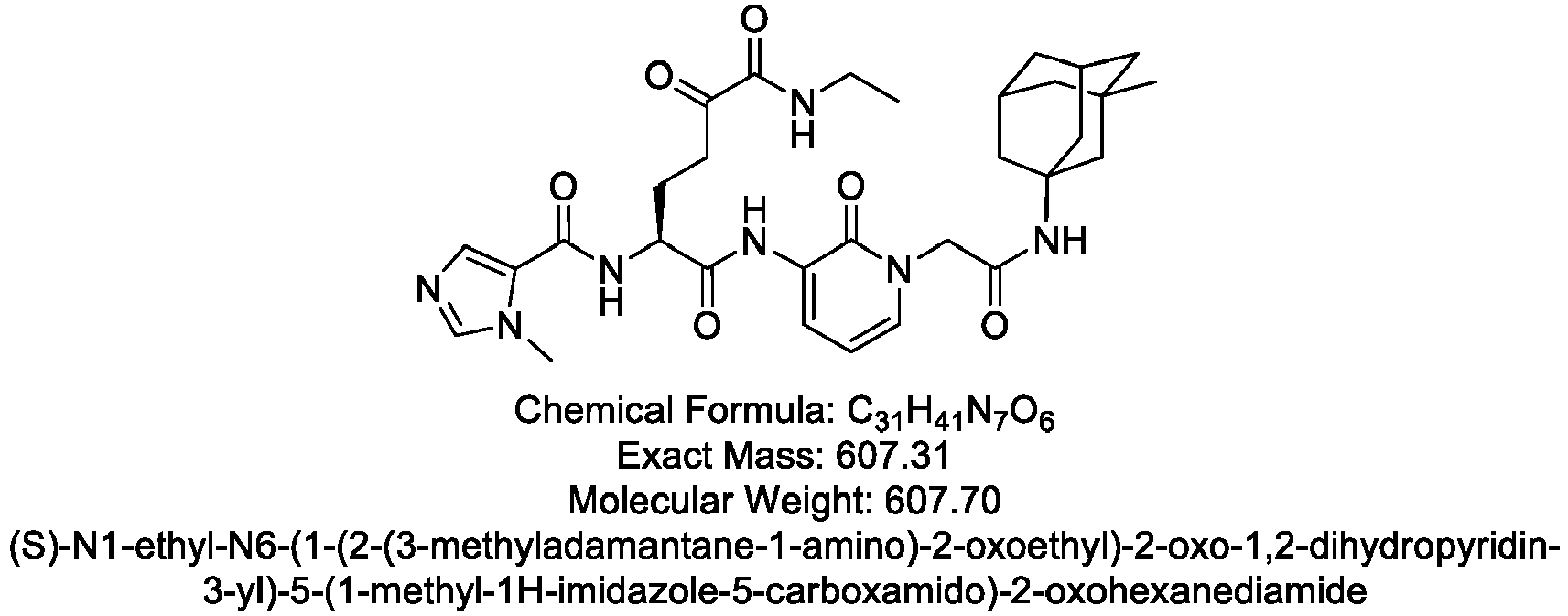
- The synthesis of compound I-25 was performed according to compound I-1, using 3-methyl-1-adamantanamine instead of 1-adamantanamine in step 2 (according to ZED3912). Yield: 37 mg, 59% (last step) ESI-MS: 608.5 [M+H]+
-

- The synthesis of compound I-26 was performed according to compound I-4, using 2-chloro-1-methyl-1H-imidazole-5-carboxylic acid instead of 1-methyl-1H-imidazole-5-carboxylic acid in step 6 (according to compound I-1b).
Yield: 57 mg, 71% (last step) ESI-MS: 656.5 / 658.5 [M+H]+ -

- The synthesis of compound I-27 was performed according to compound I-25, using 1,2-dimethyl-1H-imidazole-5-carboxylic acid instead of 1-methyl-1H-imidazole-5-carboxylic acid in step 6 (according to compound I-1b).
- Yield: 29 mg, 52% (last step)
- ESI-MS: 622.5 [M+H]+
-

- The synthesis of compound I-28 was performed according to compound I-1, using 3,5,7-trimethyl-1-adamantanamineinstead of 1-adamantanamine in step 2 (according to ZED3912).
- Yield: 48 mg, 63% (last step)
- ESI-MS: 636.5 [M+H]+
-

- The synthesis of compound I-29 was performed according to compound I-28, using 2-chloro-1-methyl-1H-imidazole-5-carboxylic acid instead of 1-methyl-1H-imidazole-5-carboxylic acid in step 6 (according to compound I-1b).
- Yield: 23 mg, 52% (last step)
- ESI-MS: 670.5 / 672.5 [M+H]+
-

- The synthesis of compound I-30 was performed according to compound I-1, using 1-adamantanamine instead of 1-adamantanamine in step 2 (according to ZED3912) and benzofuran-2-carboxylic acid instead of 1-methyl-1H-imidazole-5-carboxylic acid in step 6 (according to compound I-1b).
- Yield: 73 mg, 68% (last step)
- ESI-MS: 630.4 [M+H]+
-

- The synthesis of compound I-31 was performed according to compound I-30, using 3-methylbenzo[b]furan-2-carboxylic acid instead of benzofuran-2-carboxylic acid in step 6 (according to compound I-1b).
- Yield: 90 mg, 77% (last step)
- ESI-MS: 644.5 [M+H]+
-

- The synthesis of compound I-32 was performed according to compound I-30, using 3-chlorobenzofuran-2-carboxylic acid instead of benzofuran-2-carboxylic acid in step 6 (according to compound I-1b).
- Yield: 56 mg, 72% (last step)
- ESI-MS: 664.4 / 666.4 [M+H]+
-

- The synthesis of compound I-33 was performed according to compound I-30, using 4-bromo-1-benzofuran-2-carboxylic acid instead of benzofuran-2-carboxylic acid in step 6 (according to compound I-1b).
- Yield: 64 mg, 69% (last step)
- ESI-MS: 708.3 / 710.3 [M+H]+
-

- The synthesis of compound I-34 was performed according to compound i-30, using benzo[b]thiophene-2-carboxylic acid instead of benzofuran-2-carboxylic acid in step 6 (according to compound I-1b).
- Yield: 51 mg, 67% (last step)
- ESI-MS: 646.4 [M+H]+
-
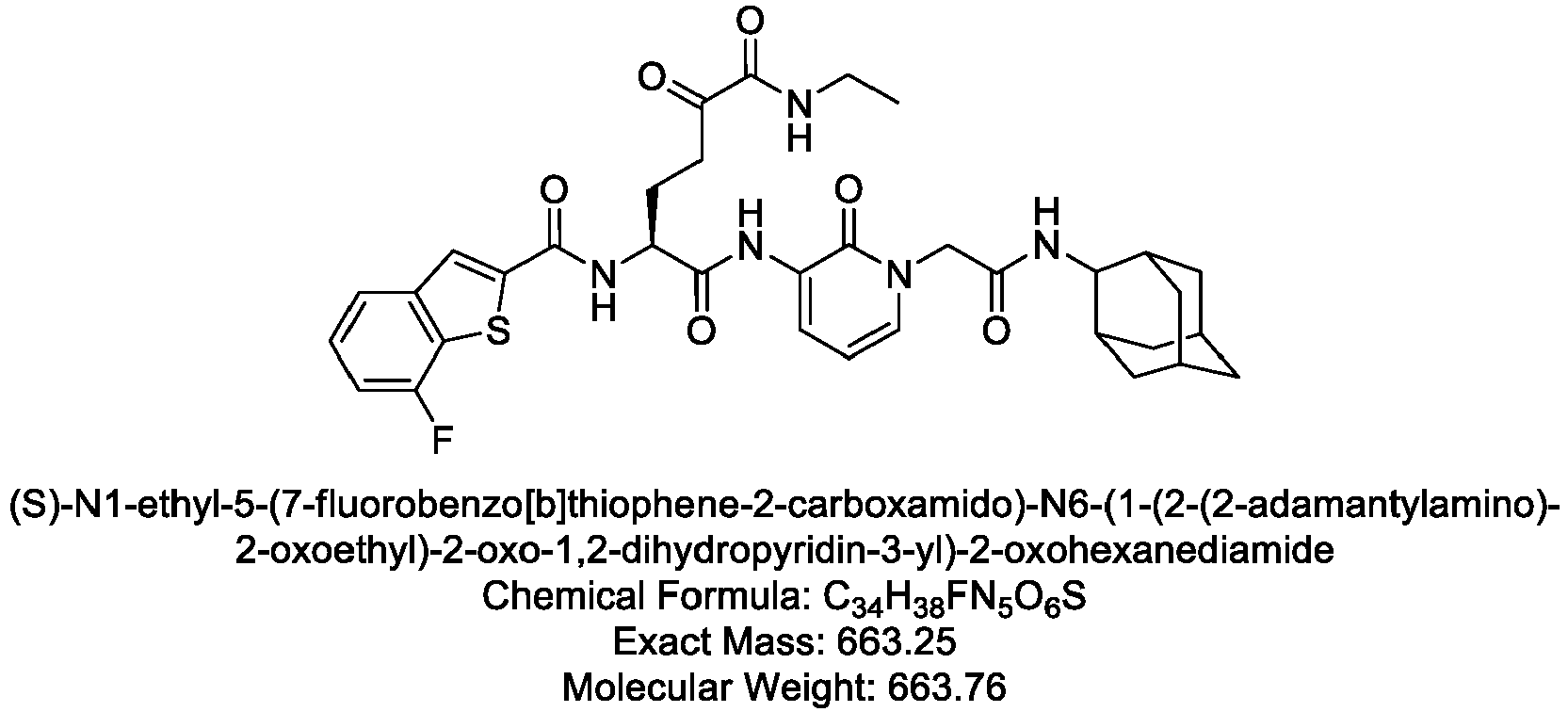
- The synthesis of compound I-35 was performed according to compound I-30, using 7-fluorobenzo[b]thiophene-2-carboxylic acid instead of benzofuran-2-carboxylic acid in step 6 (according to compound I-1b).
- Yield: 36 mg, 64% (last step)
- ESI-MS: 664.4 [M+H]+
-

- The synthesis of compound I-36 was performed according to compound I-30, using 4,5-difluoro-1H-indole-2-carboxylic acid instead of benzofuran-2-carboxylic acid in step 6 (according to compound I-1b).
- Yield: 48 mg, 67% (last step)
- ESI-MS: 665.4 [M+H]+
-

- The synthesis of compound I-37 was performed according to compound I-30, using 3-methyl-1H-indole-2-carboxylic acid instead of benzofuran-2-carboxylic acid in step 6 (according to compound I-1b).
- Yield: 42 mg, 64% (last step)
- ESI-MS: 643.5 [M+H]+
-

- The synthesis of compound I-38 was performed according to compound I-30, using 1H-benzo[d]imidazole-2-carboxylic acid instead of benzofuran-2-carboxylic acid in step 6 (according to compound I-1b).
- Yield: 26 mg, 55% (last step)
- ESI-MS: 630.5 [M+H]+
-

- The synthesis of compound I-39 was performed according to compound I-30, using 2,3-dihydro-1H-indene-2-carboxylic acid instead of benzofuran-2-carboxylic acid in step 6 (according to compound I-1b).
- Yield: 19 mg, 46% (last step)
- ESI-MS: 630.5 [M+H]+
-

- The synthesis of compound I-40 was performed according to compound I-30, using 4-methyl-2-(trifluoromethyl)thiazole-5-carboxylic acid instead of benzofuran-2-carboxylic acid in step 6 (according to compound I-1b).
- Yield: 34 mg, 61% (last step)
- ESI-MS: 679.4 [M+H]+
-

- The synthesis of compound I-41 was performed according to compound I-30, using 4-bromo-2-(trifluoromethyl)thiazole-5-carboxylic acid instead of benzofuran-2-carboxylic acid in step 6 (according to compound I-1b).
- Yield: 39 mg, 56% (last step)
- ESI-MS: 743.3 / 745.3 [M+H]+
-

- The synthesis of compound I-42 was performed according to compound I-30, using 4-methyl-2-phenylthiazole-5-carboxylic acid instead of benzofuran-2-carboxylic acid in step 6 (according to compound I-1b).
- Yield: 43 mg, 69% (last step)
- ESI-MS: 687.5 [M+H]+
-

- The synthesis of compound I-43 was performed according to compound I-30, using 5-bromo-3-methylthiophene-2-carboxylic acid instead of benzofuran-2-carboxylic acid in step 6 (according to compound I-1b).
- Yield: 55 mg, 67% (last step)
- ESI-MS: 688.3 / 690.3 [M+H]+
-

- The synthesis of compound I-44 was performed according to compound I-30, using 3,5-dibromothiophene-2-carboxylic acid instead of benzofuran-2-carboxylic acid in step 6 (according to compound I-1b).
- Yield: 43 mg, 60% (last step)
- ESI-MS: 752.2 / 754.2 / 756.2 [M+H]+
-

- The synthesis of compound I-45 was performed according to compound I-30, using 5-bromo-3-methylfuran-2-carboxylic acid instead of benzofuran-2-carboxylic acid in step 6 (according to compound I-1b).
- Yield: 52 mg, 71% (last step)
- ESI-MS: 672.3 / 674.3 [M+H]+
-

- The synthesis of compound I-46 was performed according to compound i-30, using 2,5-dichlorothiophene-3-carboxylic acid instead of benzofuran-2-carboxylic acid in step 6 (according to compound I-1b).
- Yield: 85 mg, 72% (last step)
- ESI-MS: 664.3 / 666.3 [M+H]+
-

- The synthesis of compound I-47 was performed according to compound I-30, using 2,5-dibromothiophene-3-carboxylic acid instead of benzofuran-2-carboxylic acid in step 6 (according to compound I-1b).
- Yield: 64 mg, 68% (last step)
- ESI-MS: 752.2 / 754.2 / 756.2 [M+H]+
-

- The synthesis of compound I-48 was performed according to compound i-30, using 2,5-dichlorothiazole-4-carboxylic acid instead of benzofuran-2-carboxylic acid in step 6 (according to compound I-1b).
- Yield: 26 mg, 48% (last step)
- ESI-MS: 665.3 / 667.3 [M+H]+
-

- The synthesis of compound I-49 was performed according to compound i-30, using 2,5-dimethylfuran-3-carboxylic acid instead of benzofuran-2-carboxylic acid in step 6 (according to compound I-1b).
- Yield: 53 mg, 74% (last step)
- ESI-MS: 608.5 [M+H]+
-

- The synthesis of compound I-50 was performed according to compound I-30, using 4-bromothiazole-2-carboxylic acid instead of benzofuran-2-carboxylic acid in step 6 (according to compound I-1b).
- Yield: 37 mg, 59% (last step)
- ESI-MS: 675.3 / 677.3 [M+H]+
-

- The synthesis of compound I-51 was performed according to compound I-30, using 4-bromothiophene-2-carboxylic acid instead of benzofuran-2-carboxylic acid in step 6 (according to compound I-1b).
- Yield: 52 mg, 66% (last step)
- ESI-MS: 674.3 / 676.3 [M+H]+
-

- The synthesis of compound I-52 was performed according to compound I-30, using 4-bromo-5-chlorothiophene-2-carboxylic acid instead of benzofuran-2-carboxylic acid in step 6 (according to compound I-1b).
- Yield: 48 mg, 65% (last step)
- ESI-MS: 708.2 / 710.2 [M+H]+
-

- The synthesis of compound I-53 was performed according to compound I-30, using 4,5-dibromothiophene-2-carboxylic acid instead of benzofuran-2-carboxylic acid in step 6 (according to compound I-1b).
- Yield: 52 mg, 63% (last step)
- ESI-MS: 752.2 / 754.2 / 756.2 [M+H]+
-

- The synthesis of compound I-54 was performed according to compound I-30, using 4,5-dichlorothiophene-2-carboxylic acid instead of benzofuran-2-carboxylic acid in step 6 (according to compound I-1b).
- Yield: 63 mg, 68% (last step)
- ESI-MS: 664.2 / 666.2 [M+H]+
-

- The synthesis of compound I-55 was performed according to compound I-30, using (S)-1-acetylpyrrolidine-2-carboxylic acid instead of benzofuran-2-carboxylic acid in step 6 (according to compound I-1b).
- Yield: 76 mg, 73% (last step)
- ESI-MS: 625.5 [M+H]+
-

- The synthesis of compound I-56 was performed according to compound I-30, using 1-methyl-1H-1 ,2,3-triazole-5-carboxylic acid instead of benzofuran-2-carboxylic acid in step 6 (according to compound I-1b).
- Yield: 50 mg, 61% (last step)
- ESI-MS: 595.5 [M+H]+
-

- The synthesis of compound I-57 was performed according to compound I-30, using 2H-tetrazole-5-carboxylic acid instead of benzofuran-2-carboxylic acid in step 6 (according to compound I-1b).
- Yield: 32 mg, 48% (last step)
- ESI-MS: 582.4 [M+H]+
-
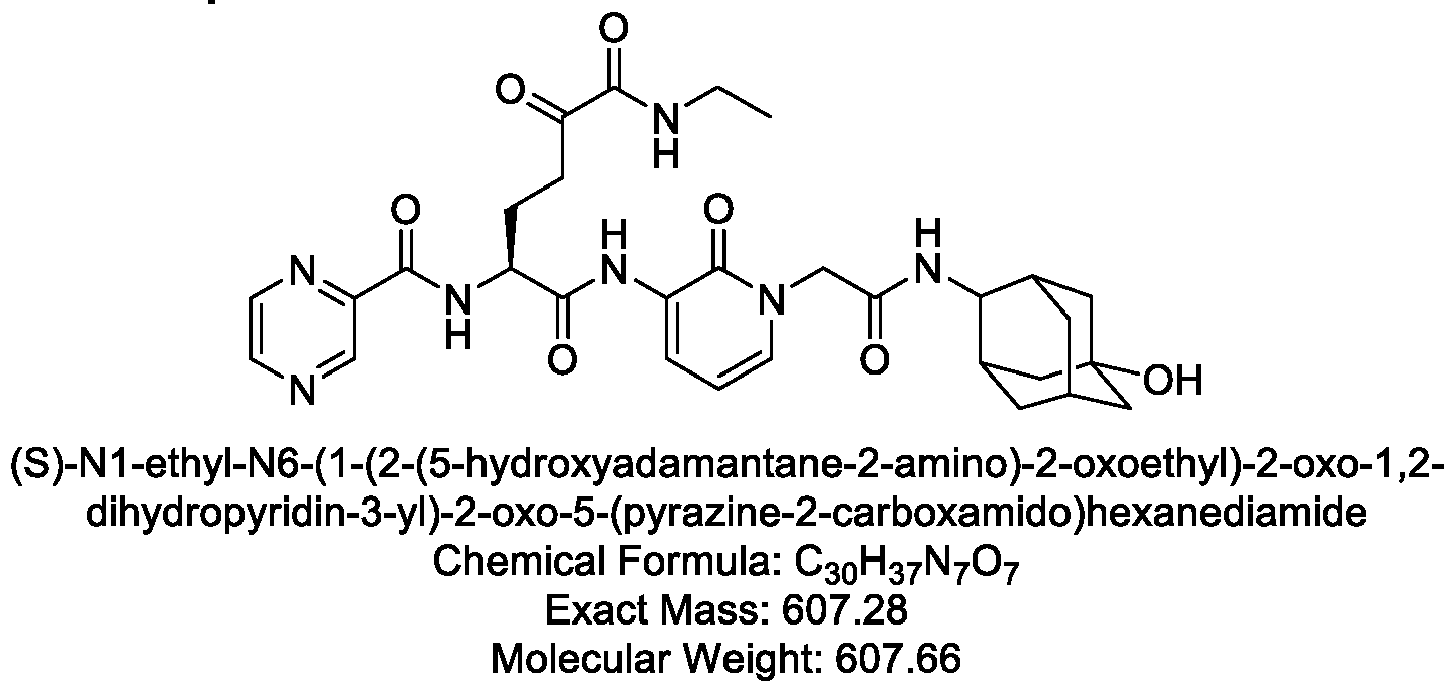
- The synthesis of compound I-58 was performed according to compound I-1, using 5-hydroxy-2-adamantanamine instead of 1-adamantanamine in step 2 (according to ZED3912) and pyrazine-2-carboxylic acid instead of 1-methyl-1H-imidazole-5-carboxylic acid in step 6 (according to compound I-1b).
- Yield: 26 mg, 53% (last step)
- ESI-MS: 608.5 [M+H]+
-

- The synthesis of compound I-59 was performed according to compound I-1, using 5-fluoro-2-adamantanamine instead of 1-adamantanamine in step 2 (according to ZED3912) and (S)-1-Boc-pyrrolidine-3-carboxylic acid instead of 1-methyl-1H-imidazole-5-carboxylic acid in step 6 (according to compound I-1b). The final product was obtained by deprotection (DCM/TFA) as described above and purified by HPLC.
- Yield: 35 mg, 83% (last step)
- ESI-MS: 601.5 [M+H]+
-

- The synthesis of compound I-60 was performed according to compound I-1, using 5-chloro-2-adamantanamine instead of 1-adamantanamine in step 2 (according to ZED3912) and (S)-1-Boc-piperidine-2-carboxylic acid instead of 1-methyl-1H-imidazole-5-carboxylic acid in step 6 (according to compound I-1b). The final product was obtained by deprotection (DCM/TFA) as described above and purified by HPLC.
- Yield: 37 mg, 78% (last step)
- ESI-MS: 631.4 / 633.4 [M+H]+
-

- The synthesis of compound I-61 was performed according to compound I-1, using 5-bromo-2-adamantanamine instead of 1-adamantanamine in step 2 (according to ZED3912) and (R)-1-Boc-piperidine-3-carboxylic acid instead of 1-methyl-1H-imidazole-5-carboxylic acid in step 6 (according to compound I-1b). The final product was obtained by deprotection (DCM/TFA) as described above and purified by HPLC.
- Yield: 35 mg, 72% (last step)
- ESI-MS: 675.3 / 677.3 [M+H]+
-

- The synthesis of compound I-62 was performed according to compound I-1, using 5-methyl-2-adamantanamine instead of 1-adamantanamine in step 2 (according to ZED3912) and (R)-4-Boc-morpholine-3-carboxylic acid instead of 1-methyl-1H-imidazole-5-carboxylic acid in step 6 (according to compound I-1b). The final product was obtained by deprotection (DCM/TFA) as described above and purified by HPLC.
- Yield: 31 mg, 80% (last step)
- ESI-MS: 613.5 [M+H]+
-
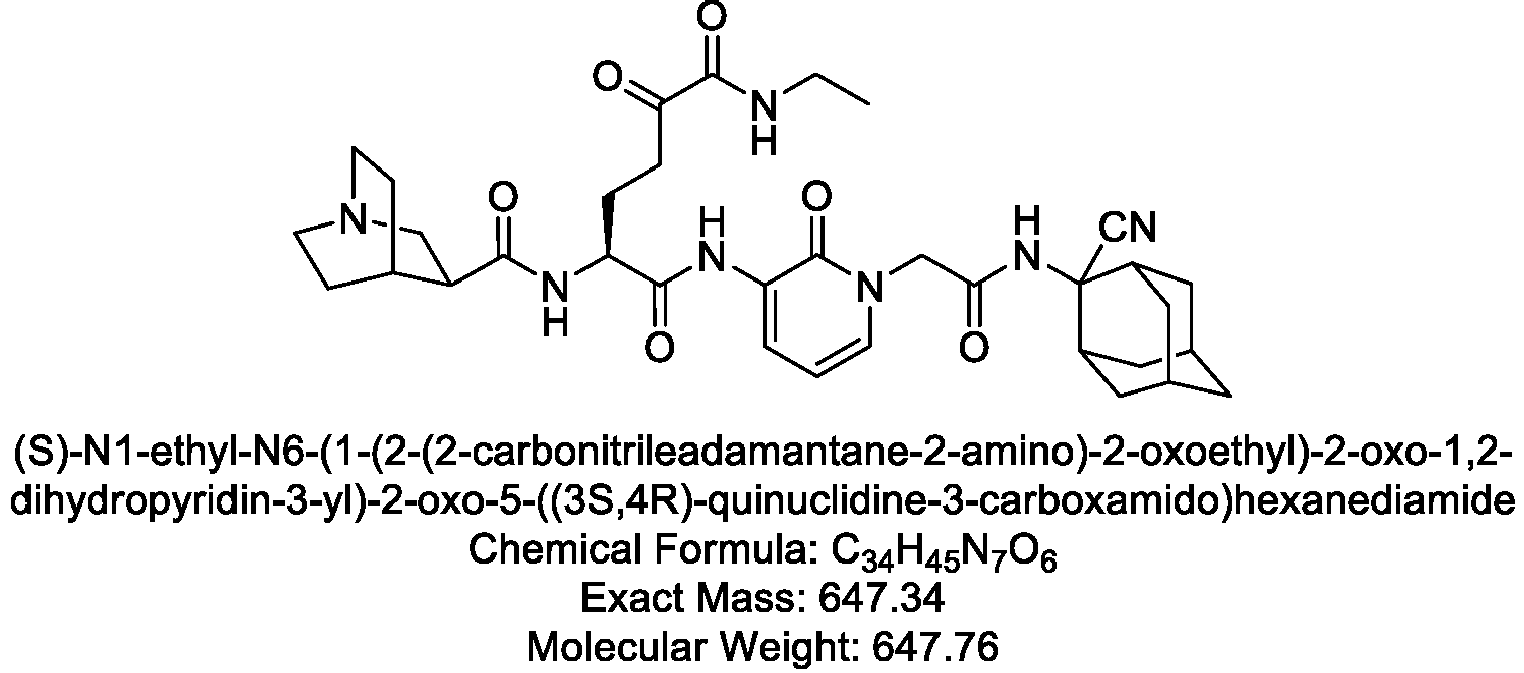
- The synthesis of compound I-63 was performed according to compound I-1, using 2-aminoadamantane-2-carbonitrile instead of 1-adamantanamine in step 2 (according to ZED3912) and quinuclidine-3-carboxylic acid instead of 1-methyl-1H-imidazole-5-carboxylic acid in step 6 (according to compound I-1b).
- Yield: 24 mg, 56% (last step)
- ESI-MS: 648.5 [M+H]+
-

- The synthesis of compound I-64 was performed according to compound I-1, using 2-methyl 2-aminoadamantane-2-carboxylate instead of 1-adamantanamine in step 2 (according to ZED3912) and mono-methyl 5-nitroisophthalate instead of 1-methyl-1H-imidazole-5-carboxylic acid in step 6 (according to compound I-1b).
- Yield: 46 mg, 71% (last step)
- ESI-MS: 751.5 [M+H]+
-

- The synthesis of compound I-65 was performed according to compound I-1, using 1-adamantanemethylamine instead of 1-adamantanamine in step 2 (according to ZED3912) and 5-nitronicotinic acid instead of 1-methyl-1H-imidazole-5-carboxylic acid in step 6 (according to compound I-1b).
- Yield: 61 mg, 74% (last step)
- ESI-MS: 650.5 [M+H]+
-

- The synthesis of compound I-66 was performed according to compound I-1, using 1-rimantadine instead of 1-adamantanamine in step 2 (according to ZED3912) and 3,5-pyridinedicarboxylic acid instead of 1-methyl-1H-imidazole-5-carboxylic acid in step 6 (according to compound I-1b).
- Yield: 31 mg, 56% (last step)
- ESI-MS: 663.5 [M+H]+
-

- The synthesis of compound I-67 was performed according to compound I-1, using N-methyl-2-adamantanamine instead of 1-adamantanamine in step 2 (according to ZED3912) and 6-methylimidazo[2,1-b]thiazole-5-carboxylic acid instead of 1-methyl-1H-imidazole-5-carboxylic acid in step 6 (according to compound I-1b).
- Yield: 23 mg, 52% (last step)
- ESI-MS: 664.5 [M+H]+
-

- The synthesis of compound I-68 was performed according to compound I-1, using (±)-endo-2-norbornylamine instead of 1-adamantanamine in step 2 (according to ZED3912) and 3-methylbenzo[b]furan-2-carboxylic acid instead of 1-methyl-1H-imidazole-5-carboxylic acid in step 6 (according to compound I-1b).
- Yield: 106 mg, 78% (last step)
- ESI-MS: 604.4 [M+H]+
-

- The synthesis of compound I-69 was performed according to compound I-1, using (R)-(+)-bornylamine instead of 1-adamantanamine in step 2 (according to ZED3912) and 3-methylbenzo[b]furan-2-carboxylic acid instead of 1-methyl-1H-imidazole-5-carboxylic acid in step 6 (according to compound I-1b).
- Yield: 86 mg, 72% (last step)
- ESI-MS: 646.5 [M+H]+
-

- The synthesis of compound I-70 was performed according to compound I-1, using exo-2-aminonorbornane instead of 1-adamantanamine in step 2 (according to ZED3912) and 3-methylbenzo[b]furan-2-carboxylic acid instead of 1-methyl-1H-imidazole-5-carboxylic acid in step 6 (according to compound I-1b).
- Yield: 94 mg, 79% (last step)
- ESI-MS: 604.4 [M+H]+
-

- The synthesis of compound I-71 was performed according to compound I-1, using bicyclo[2.2.1]heptan-1-ylamine instead of 1-adamantanamine in step 2 (according to ZED3912) and isonicotinic acid instead of 1-methyl-1H-imidazole-5-carboxylic acid in step 6 (according to compound I-1b).
- Yield: 77 mg, 72% (last step)
- ESI-MS: 551.4 [M+H]+
-

- The synthesis of compound I-72 was performed according to compound I-1, using bicyclo[2.2.1]heptan-7-ylamine instead of 1-adamantanamine in step 2 (according to ZED3912) and pyridazine-4-carboxylic acid instead of 1-methyl-1H-imidazole-5-carboxylic acid in step 6 (according to compound I-1b).
- Yield: 44 mg, 61% (last step)
- ESI-MS: 552.4 [M+H]+
-

- The synthesis of compound I-73 was performed according to compound I-1, using bicyclo[2.2.1]hept-5-en-2-amine instead of 1-adamantanamine in step 2 (according to ZED3912) and pyridazine-3-carboxylic acid instead of 1-methyl-1H-imidazole-5-carboxylic acid in step 6 (according to compound I-1b).
- Yield: 31 mg, 52% (last step)
- ESI-MS: 550.4 [M+H]+
-

- The synthesis of compound I-74 was performed according to compound I-1, using bicyclo[2.2.2]oct-2-ylamine instead of 1-adamantanamine in step 2 (according to ZED3912) and 2H-1,2,3-triazole-4-carboxylic acid instead of 1-methyl-1H-imidazole-5-carboxylic acid in step 6 (according to compound I-1b).
- Yield: 35 mg, 57% (last step)
- ESI-MS: 555.4 [M+H]+
-

- The synthesis of compound I-75 was performed according to compound I-1, using (R)-(-)-isobornylamine instead of 1-adamantanamine in step 2 (according to ZED3912) and 1-methyl-1H-1 ,2,3-triazole-4-carboxylic acid instead of 1-methyl-1H-imidazole-5-carboxylic acid in step 6 (according to compound I-1b).
- Yield: 44 mg, 68% (last step)
- ESI-MS: 597.5 [M+H]+
-

- The synthesis of compound I-76 was performed according to compound I-1, using (1R,2R,3R,5S)-(-)-isopinocampheylamine instead of 1-adamantanamine in step 2 (according to ZED3912) and 1-methyl-1H-1 ,2,4-triazole-3-carboxylic acid instead of 1-methyl-1H-imidazole-5-carboxylic acid in step 6 (according to compound I-1b).
- Yield: 51 mg, 72% (last step)
- ESI-MS: 597.5 [M+H]+
-

- The synthesis of compound I-77 was performed according to compound I-1, using (1S,2S,3S,5R)-(+)-isopinocampheylamine instead of 1-adamantanamine in step 2 (according to ZED3912) and benzofuran-3-carboxylic acid instead of 1-methyl-1H-imidazole-5-carboxylic acid in step 6 (according to compound I-1b).
- Yield: 66 mg, 75% (last step)
- ESI-MS: 632.5 [M+H]+
-

- The synthesis of compound I-78 was performed according to compound I-1, using 3-amino-4-homoisotwistane instead of 1-adamantanamine in step 2 (according to ZED3912) and benzo[b]thiophene-3-carboxylic acid instead of 1-methyl-1H-imidazole-5-carboxylic acid in step 6 (according to compound I-1b).
- Yield: 42 mg, 59% (last step)
- ESI-MS: 660.4 [M+H]+
-

- The synthesis of compound I-79 was performed according to compound I-1, using 1-aminodiamantane instead of 1-adamantanamine in step 2 (according to ZED3912) and 1-methyl-1H-pyrazole-4-carboxylic acid instead of 1-methyl-1H-imidazole-5-carboxylic acid in step 6 (according to compound I-1b).
- Yield: 28 mg, 53% (last step)
- ESI-MS: 646.5 [M+H]+
-

- The synthesis of compound I-80 was performed according to compound I-1, using 4-aminodiamantane instead of 1-adamantanamine in step 2 (according to ZED3912) and 1-methyl-1H-pyrazole-3-carboxylic acid instead of 1-methyl-1H-imidazole-5-carboxylic acid in step 6 (according to compound I-1b).
- Yield: 36 mg, 59% (last step)
- ESI-MS: 646.5 [M+H]+
- 1 Preparation of compound ZED4893

- Yield: 484 mg, 47%
- ESI-MS: 289.3 [M+H]+
- 2 Preparation of compound ZED4894

- Yield: 339 mg, 78%
- ESI-MS: 259.4 [M+H]+
-

- The synthesis of compound I-81 was performed according to compound I-1, using ZED4894 instead of ZED3913 in step 5 (according to I-1a) and 1-methyl-1H-pyrazole-5-carboxylic acid instead of 1-methyl-1H-imidazole-5-carboxylic acid in step 6 (according to compound I-1b).
- Yield: 43 mg, 65% (last step)
- ESI-MS: 551.5 [M+H]+
-

- The synthesis of compound I-82 was performed according to compound I-81, using 3-(bromomethyl)-1-adamantanol instead of 1-(bromomethyl)adamantane (according to ZED4893) and 4-cyclopropyl-[1,2,3]thiadiazole-5-carboxylic acid instead of 1-methyl-1H-pyrazole-5-carboxylic acid.
- Yield: 26 mg, 46% (last step)
- ESI-MS: 611.4 [M+H]+
-

- The synthesis of compound I-83 was performed according to compound I-81, using 1-bromo-3-(bromomethyl)adamantane instead of 1-(bromomethyl)adamantane (according to ZED4893) and 1 ,2,5-thiadiazole-3-carboxylic acid instead of 1-methyl-1H-pyrazole-5-carboxylic acid.
- Yield: 42 mg, 61% (last step)
- ESI-MS: 633.3 / 635.3 [M+H]+
-

- The synthesis of compound I-84 was performed according to compound I-81, using 2-(bromomethyl)adamantane instead of 1-(bromomethyl)adamantane (according to ZED4893) and 4-((tetrahydro-2H-pyran-2-yloxy)methyl)-1 ,2,3-thiadiazole-5-carboxylic acid instead of 1-methyl-1H-pyrazole-5-carboxylic acid. The tetrahydropyranyl (Thp) protecting group was cleaved by TFA in the final step.
- Yield: 15 mg, 68% (last step)
- ESI-MS: 585.4 [M+H]+
-

- The synthesis of compound I-85 was performed according to compound I-81, using 1-(2-bromoethyl)adamantane instead of 1-(bromomethyl)adamantane (according to ZED4893) and 5-tert-butyl-1H-pyrrole-3-carboxylic acid instead of 1-methyl-1H-pyrazole-5-carboxylic acid.
- Yield: 32 mg, 58% (last step)
- ESI-MS: 606.5 [M+H]+
-

- The synthesis of compound I-86 was performed according to compound I-81, using 1-(3-bromopropyl)adamantane instead of 1-(bromomethyl)adamantane (according to ZED4893) and 4-cyano-1-methyl-1H-pyrrole-2-carboxylic acid instead of 1-methyl-1H-pyrazole-5-carboxylic acid.
- Yield: 28 mg, 51% (last step)
- ESI-MS: 603.5 [M+H]+
-

- The synthesis of compound I-87 was performed according to compound I-1, using 3-chloropropionic acid instead of chloroacetic acid (according to ZED1657) and 5-methoxyoxazole-2-carboxylic acid instead of 1-methyl-1H-pyrazole-5-carboxylic acid in step 6 (according to compound I-1b).
- Yield: 39 mg, 64% (last step)
- ESI-MS: 625.5 [M+H]+
-

- The synthesis of compound I-88 was performed according to compound I-1, using 1-bicyclo[1.1.1]pentylamine instead of 1-adamantanamine in step 2 (according to ZED3912) and 3-methylbenzo[b]furan-2-carboxylic acid instead of 1-methyl-1H-imidazole-5-carboxylic acid in step 6 (according to compound I-1b).
- Yield: 107 mg, 81% (last step)
- ESI-MS: 576.4 [M+H]+
-

- The synthesis of compound I-89 was performed according to compound I-1, using 1-bicyclo[1.1.1]pentylamine instead of 1-adamantanamine in step 2 (according to ZED3912) and 2-acetyloxazole-4-carboxylic acid instead of 1-methyl-1H-imidazole-5-carboxylic acid in step 6 (according to compound I-1b).
- Yield: 68 mg, 75% (last step)
- ESI-MS: 555.4 [M+H]+
-
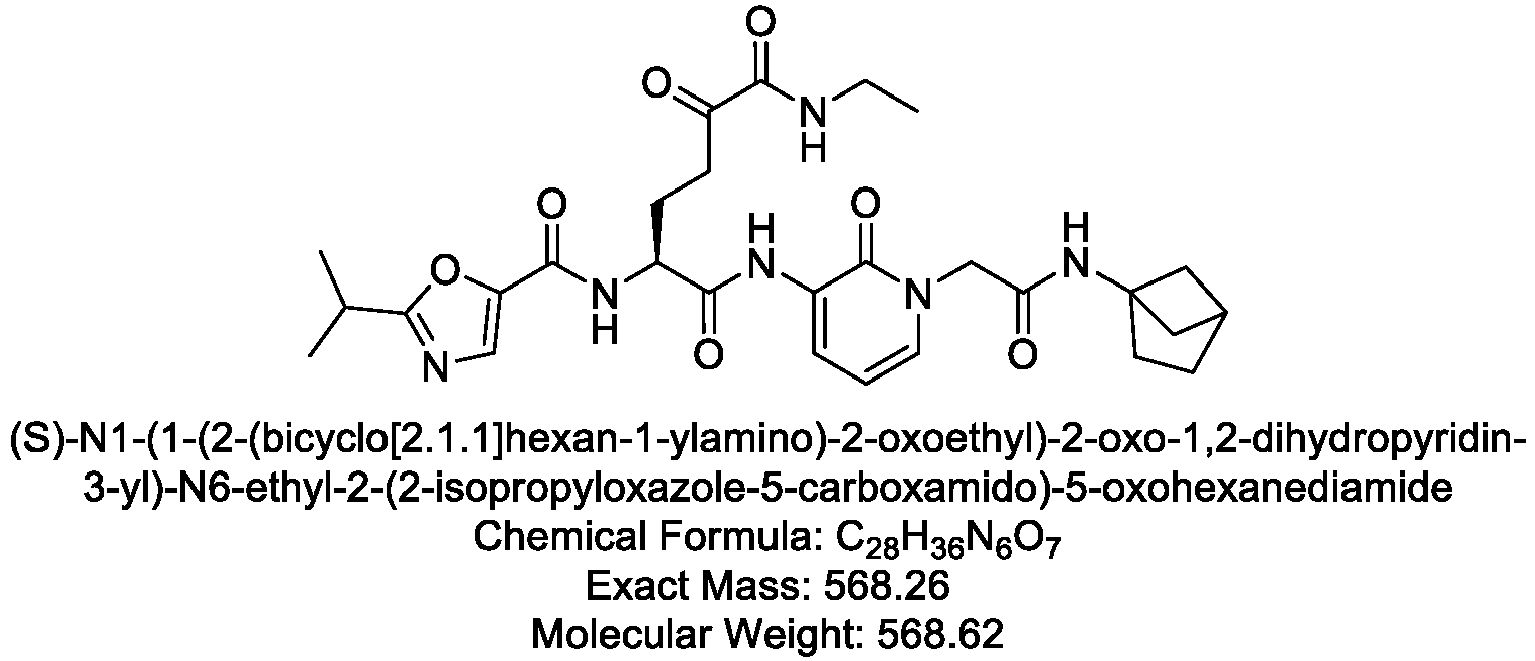
- The synthesis of compound I-90 was performed according to compound I-1, using 1-bicyclo[2.1 .1]hexan-1-amine instead of 1-adamantanamine in step 2 (according to ZED3912) and 2-isopropyloxazole-5-carboxylic acid instead of 1-methyl-1H-imidazole-5-carboxylic acid in step 6 (according to compound I-1b).
- Yield: 46 mg, 60% (last step)
- ESI-MS: 569.4 [M+H]+
-

- The synthesis of compound I-91 was performed according to compound I-1, using 1-bicyclo[3.2.1]octan-8-amine instead of 1-adamantanamine in step 2 (according to ZED3912) and 3,5-dimethylisoxazole-4-carboxylic acid instead of 1-methyl-1H-imidazole-5-carboxylic acid in step 6 (according to compound I-1b).
- Yield: 32 mg, 54% (last step)
- ESI-MS: 583.4 [M+H]+
-

- The synthesis of compound I-92 was performed according to compound I-1, using 4-aminoadamantane-1-carboxylic acid instead of 1-adamantanamine in step 2 (according to ZED3912) and 4-methylpyrimidine-5-carboxylic acid instead of 1-methyl-1H-imidazole-5-carboxylic acid in step 6 (according to compound I-1b).
- Yield: 35 mg, 46% (last step)
- ESI-MS: 650.5 [M+H]+
-

- The synthesis of compound I-93 was performed according to compound I-1, using 4-aminoadamantane-N,N-dimethyl-1-carboxamide instead of 1-adamantanamine in step 2 (according to ZED3912) and 1 ,2,3,4-tetrahydronaphthalene-2-carboxylic acid instead of 1-methyl-1H-imidazole-5-carboxylic acid in step 6 (according to compound I-1b).
- Yield: 31 mg, 55% (last step)
- ESI-MS: 672.5 [M+H]+
-

- The synthesis of compound I-94 was performed according to compound I-30, using 1,4-diazabicyclo[2.2.2]octane-2-carboxylic acid instead of benzofuran-2-carboxylic acid in step 6 (according to compound I-1b).
- Yield: 39 mg, 58% (last step)
- ESI-MS: 624.5 [M+H]+
-

- The synthesis of compound I-95 was performed according to compound I-30, using 1H-indole-3-carboxylic acid instead of benzofuran-2-carboxylic acid in step 6 (according to compound I-1b).
- Yield: 56 mg, 74% (last step)
- ESI-MS: 629.5 [M+H]+
-

- The synthesis of compound I-96 was performed according to compound I-30, using 6-methylimidazo[2,1-b][1 ,3]thiazole-3-carboxylic acid instead of benzofuran-2-carboxylic acid in step 6 (according to compound I-1b).
- Yield: 33 mg, 56% (last step)
- ESI-MS: 650.5 [M+H]+
-

- The synthesis of compound I-97 was performed according to compound I-1, using (±)-endo-2-norbornylamine instead of 1-adamantanamine in step 2 (according to ZED3912) and 1 ,3-benzothiazole-2-carboxylic acid instead of benzofuran-2-carboxylic acid in step 6 (according to compound I-1b).
- Yield: 45 mg, 73% (last step)
- ESI-MS: 607.4 [M+H]+
-

- The synthesis of compound I-98 was performed according to compound I-1, using (±)-endo-2-norbornylamine instead of 1-adamantanamine in step 2 (according to ZED3912) and imidazo[2,1-b][1 ,3]thiazole-6-carboxylic acid instead of benzofuran-2-carboxylic acid in step 6 (according to compound I-1b).
- Yield: 26 mg, 50% (last step)
- ESI-MS: 596.4 [M+H]+
-

- The synthesis of compound I-99 was performed according to compound I-1, using (±)-endo-2-norbornylamine instead of 1-adamantanamine in step 2 (according to ZED3912) and 4-hydroxy-6-(trifluoromethoxy)quinoline-3-carboxylic acid instead of benzofuran-2-carboxylic acid in step 6 (according to compound I-1b).
- Yield: 15 mg, 42% (last step)
- ESI-MS: 701.4 [M+H]+
-

- The synthesis of compound I-100 was performed according to compound I-1, using 1-bicyclo[1.1.1]pentylamine instead of 1-adamantanamine in step 2 (according to ZED3912) and 3-cinnolinecarboxylic acid instead of benzofuran-2-carboxylic acid in step 6 (according to compound I-1b).
- Yield: 37 mg, 65% (last step)
- ESI-MS: 574.4 [M+H]+
-

- The synthesis of compound I-101 was performed according to compound I-1, using 1-bicyclo[1.1.1]pentylamine instead of 1-adamantanamine in step 2 (according to ZED3912) and 3-ethylbenzofuran-2-carboxylic acid instead of benzofuran-2-carboxylic acid in step 6 (according to compound I-1b).
- Yield: 55 mg, 73% (last step)
- ESI-MS: 590.4 [M+H]+
-

- The synthesis of compound I-102 was performed according to compound I-1, using 1-bicyclo[1.1.1]pentylamine instead of 1-adamantanamine in step 2 (according to ZED3912) and 1-ethyl-1H-indole-2-carboxylic acid instead of benzofuran-2-carboxylic acid in step 6 (according to compound I-1b).
- Yield: 43 mg, 68% (last step)
- ESI-MS: 589.4 [M+H]+
-

- The synthesis of compound I-103 was performed according to compound I-1, using 1-bicyclo[1.1.1]pentylamine instead of 1-adamantanamine in step 2 (according to ZED3912) and 2-methyl-1,8-naphthyridine-3-carboxylic acid instead of benzofuran-2-carboxylic acid in step 6 (according to compound I-1b).
- Yield: 40 mg, 64% (last step)
- ESI-MS: 588.4 [M+H]+
-

- The synthesis of compound I-104 was performed according to compound I-1, using bicyclo[2.1.1]hexan-1-amine instead of 1-adamantanamine in step 2 (according to ZED3912) and N-Boc-1,2,3,4-tetrahydroquinoline-6-carboxylic acid instead of benzofuran-2-carboxylic acid in step 6 (according to compound I-1b). The final product was obtained by deprotection (DCM/TFA) as described above and purified by HPLC.
- Yield: 27 mg, 73% (last step)
- ESI-MS: 591.4 [M+H]+
-

- The synthesis of compound I-105 was performed according to compound I-1, using 2-amino-5-(trifluoromethyl)adamantane-2-carboxylic acid instead of 1-adamantanamine in step 2 (according to ZED3912) and 3-oxo-1,2,3,4-tetrahydroisoquinoline-6-carboxylic acid instead of benzofuran-2-carboxylic acid in step 6 (according to compound I-1b).
- Yield: 19 mg, 44% (last step)
- ESI-MS: 771.5 [M+H]+
-

- The synthesis of compound I-106 was performed according to compound I-1, using 5-ethyladamantane-2-amine instead of 1-adamantanamine in step 2 (according to ZED3912) and 1,6-naphthyridine-2-carboxylic acid instead of benzofuran-2-carboxylic acid in step 6 (according to compound I-1b).
- Yield: 25 mg, 54% (last step)
- ESI-MS: 670.5 [M+H]+
-

- The synthesis of compound I-107 was performed according to compound I-1, using bicyclo[2.1.1]hexan-1-amine instead of 1-adamantanamine in step 2 (according to ZED3912) and 2,6-naphthyridine-1-carboxylic acid instead of benzofuran-2-carboxylic acid in step 6 (according to compound I-1b).
- Yield: 58 mg, 74% (last step)
- ESI-MS: 588.4 [M+H]+
-

- The synthesis of compound I-108 was performed according to compound I-1, using 1-bicyclo[1.1.1]pentylamine instead of 1-adamantanamine in step 2 (according to ZED3912) and 4-Boc-amino-1,2,5-oxadiazole-3-carboxylic acid instead of benzofuran-2-carboxylic acid in step 6 (according to compound I-1b). The final product was obtained by deprotection (DCM/TFA) as described above and purified by HPLC.
- Yield: 27 mg, 77% (last step)
- ESI-MS: 529.4 [M+H]+
-

- The synthesis of compound I-109 was performed according to compound I-1, using 1-bicyclo[1.1.1]pentylamine instead of 1-adamantanamine in step 2 (according to ZED3912) and 6-(dimethylamino)benzofuran-2-carboxylic acid instead of benzofuran-2-carboxylic acid in step 6 (according to compound I-1b).
- Yield: 35 mg, 57% (last step)
- ESI-MS: 605.4 [M+H]+
-

- The synthesis of compound I-110 was performed according to compound I-1, using 1-bicyclo[1.1.1]pentylamine instead of 1-adamantanamine in step 2 (according to ZED3912) and 2-acetylamino-5-thiazolecarboxylic acid instead of benzofuran-2-carboxylic acid in step 6 (according to compound I-1b).
- Yield: 25 mg, 49% (last step)
- ESI-MS: 586.4 [M+H]+
-

- The synthesis of compound I-111 was performed according to compound I-1, using 1-bicyclo[1.1.1]pentylamine instead of 1-adamantanamine in step 2 (according to ZED3912) and 5-carbamoyl-1H-pyrrole-3-carboxylic acid instead of benzofuran-2-carboxylic acid in step 6 (according to compound I-1b).
- Yield: 19 mg, 42% (last step)
- ESI-MS: 554.4 [M+H]+
-

- The synthesis of compound I-112 was performed according to compound I-1, using 1-acetylamino-4-aminoadamantane instead of 1-adamantanamine in step 2 (according to ZED3912) and 5-sulfamoylfuran-3-carboxylic acid instead of benzofuran-2-carboxylic acid in step 6 (according to compound I-1b).
- Yield: 24 mg, 53% (last step)
- ESI-MS: 716.4 [M+H]+
-

- The synthesis of compound I-113 was performed according to compound I-1, using 1-acetylamino-4-aminoadamantane instead of 1-adamantanamine in step 2 (according to ZED3912) and benzofuran-5-carboxylic acid instead of benzofuran-2-carboxylic acid in step 6 (according to compound I-1b).
- Yield: 30 mg, 58% (last step)
- ESI-MS: 687.5 [M+H]+
-

- The synthesis of compound I-114 was performed according to compound I-1, using 4-aminoadamantane-1-carboxamide instead of 1-adamantanamine in step 2 (according to ZED3912) and benzofuran-6-carboxylic acid instead of benzofuran-2-carboxylic acid in step 6 (according to compound I-1b).
- Yield: 37 mg, 65% (last step)
- ESI-MS: 673.5 [M+H]+
-

- The synthesis of compound I-115 was performed according to compound I-1, using 4-aminoadamantane-1-carboxamide instead of 1-adamantanamine in step 2 (according to ZED3912) and 3-(1-methylcyclopropyl)-1 ,2,4-oxadiazole-5-carboxylic acid instead of benzofuran-2-carboxylic acid in step 6 (according to compound I-1b).
- Yield: 23 mg, 47% (last step)
- ESI-MS: 679.5 [M+H]+
-

- The synthesis of compound I-116 was performed according to compound I-1, using 1-bicyclo[1.1.1]pentylamine instead of 1-adamantanamine in step 2 (according to ZED3912) and 5-methyl-1,2,4-oxadiazole-3-carboxylic acid instead of benzofuran-2-carboxylic acid in step 6 (according to compound I-1b).
- Yield: 36 mg, 62% (last step)
- ESI-MS: 528.4 [M+H]+
-

- The synthesis of compound I-117 was performed according to compound I-1, using 1-bicyclo[1.1.1]pentylamine instead of 1-adamantanamine in step 2 (according to ZED3912) and 1,2,3-thiadiazole-4-carboxylic acid instead of benzofuran-2-carboxylic acid in step 6 (according to compound I-1b).
- Yield: 31 mg, 57% (last step)
- ESI-MS: 530.3 [M+H]+
-

- The synthesis of compound I-118 was performed according to compound I-1, using 1-bicyclo[1.1.1]pentylamine instead of 1-adamantanamine in step 2 (according to ZED3912) and 1,2,4-thiadiazole-4-carboxylic acid instead of benzofuran-2-carboxylic acid in step 6 (according to compound I-1b).
- Yield: 39 mg, 63% (last step)
- ESI-MS: 530.3 [M+H]+
-

- The synthesis of compound I-119 was performed according to compound I-1, using 1-bicyclo[1.1.1]pentylamine instead of 1-adamantanamine in step 2 (according to ZED3912) and 1,3,4-thiadiazole-5-carboxylic acid instead of benzofuran-2-carboxylic acid in step 6 (according to compound I-1b).
- Yield: 28 mg, 52% (last step)
- ESI-MS: 530.3 [M+H]+
-

- The synthesis of compound I-120 was performed according to compound I-30, using 4-(hydroxymethyl)-1,2,3-thiadiazole-5-carboxylic acid instead of benzofuran-2-carboxylic acid in step 6 (according to compound I-1b).
- Yield: 17 mg, 41% (last step)
- ESI-MS: 626.4 [M+H]+
-

- The synthesis of compound I-120 was performed according to compound I-1, using nicotinic acid instead of benzofuran-2-carboxylic acid in step 6 (according to compound I-1b).
- Yield: 56 mg, 60% (last step)
- ESI-MS: 591.5 [M+H]+
-

- The synthesis of reference compound Ref. 4 was performed according to compound I-1, using 2-phenylethylamine instead of 1-adamantanamine in step 2 (according to ZED3912) and nicotinic acid instead of benzofuran-2-carboxylic acid in step 6 (according to compound I-1b).
- Yield: 68 mg, 77% (last step)
- ESI-MS: 561.4 [M+H]+
- For the determination of potency of inhibitors against tissue transglutaminase, the incorporation of dansylcadaverine into dimethylcasein (Zedira product T036, Lorand et al., Anal Biochem, 1971, 44:221-31) was measured using recombinant human transglutaminase 2 (Zedira Product T022).
- The tissue transglutaminase is diluted in buffer (50 mM Tris-HCl, 7.5 mM CaCl2, 150 mM NaCl, pH = 7.4). The final concentration of TG2 in the assay is 10 nM.
- A 10 mM inhibitor stock solution is prepared in DMSO, and from this a serial 1:2-fold dilution series is prepared also in DMSO. Each of the initial dilutions is subsequently diluted 1:50-fold with buffer (50 mM Tris-HCl, 7.5 mM CaCl2, 150 mM NaCl, pH = 7.4) to yield the final working dilutions containing 2% (v/v) DMSO. 15 µl of inhibitor working dilution are added per well of a 96 well microtiter plate. As control, 15 µl of a 2% (v/v) DMSO solution prepared using the buffer mentioned above are added per well.
- Immediately before starting the assay, 600 µl transglutaminase working solution are added to 11.4 ml assay buffer (50 mM Tris-HCl, 10 mM CaCl2, 10 mM glutathione, 2.5% glycerol, 16.7 µM dansylcadaverine, 4 µM N,N-dimethylcasein, 200 mM NaCl, pH = 8.0). 285 µl of this reaction mix are added per well containing the inhibitor.
- Increase in fluorescence is measured using λex = 330 nm and λem = 500 nm at 37°C for 30 min. A slope of the increase in fluorescence between 20 and 30 min is calculated for determination of the IC50 value (inhibitor concentration at which 50% of the initial activity is blocked).
- Analysis of enzymatic activity is performed by calculation of the slope of an increase in fluorescence intensity. IC50 values are calculated by plotting the enzymatic activity (as percentage from control containing 2% DMSO instead of inhibitor) against the inhibitor concentration. IC50 is defined as the inhibitor concentration blocking 50 % of initial enzyme activity.
- The inhibitory activity of the inventive compounds in regard to tissue transglutaminase (TG2) is shown in the following table 1 using IC50-values.
Table 1. efficacy of reversible TG2 inhibitors A: IC50 < 150 nM, B: 150 nM ≤ IC50 < 600 nM, C: 600 nM ≤ IC50 < 3,500 nM, D: 3,500 nM ≤ IC50 < 10,000 nM Compound IC50 TG2 [nM] Compound IC50 TG2 [nM] I-1 C I-61 B I-2 C I-62 B I-3 C I-63 B I-4 A I-64 A I-5 B I-65 A I-6 B I-66 B I-7 C I-67 C I-8 B I-68 A I-9 B I-69 B I-10 B I-70 A I-11 B I-71 B I-12 B I-72 B I-13 C I-73 B I-14 B I-74 B I-15 C I-75 B I-16 C I-76 B I-17 C I-77 B I-18 C I-78 B I-19 C I-79 B I-20 C I-80 B I-21 C I-81 B I-22 C I-82 B I-23 C I-83 B I-24 B I-84 B I-25 B I-85 C I-26 B I-86 C I-27 C I-87 C I-28 A I-88 A I-29 A I-89 A I-30 A I-90 A I-31 A I-91 B I-32 A I-92 B I-33 A I-93 B I-34 A I-94 C I-35 A I-95 B I-36 A I-96 C I-37 A I-97 B I-38 A I-98 C I-39 A I-99 C I-40 A I-100 C I-41 A I-101 B I-42 B I-102 B I-43 A I-103 C I-44 A I-104 C I-45 A I-105 C I-46 A I-106 C I-47 A I-107 C I-48 B I-108 C I-49 A I-109 B I-50 A I-110 C I-51 A I-111 C I-52 A I-112 C I-53 A I-113 B I-54 A I-114 B I-55 B I-115 C I-56 A I-116 C I-57 C I-117 B I-58 B I-118 B I-59 B I-119 B I-60 B I-120 B Ref. 1 C I-121 A Ref. 2 A Ref. 3 D Ref. 4 D 

- In order to classify the inventive compounds according to their lipophilicity, LogD values (distribution coefficient) were determined by means of the well-established shake flask method, measuring the partition of a compound between an octanol and phosphatebuffered saline (PBS, pH 7.4) by HPLC.
- Compounds with a moderate lipophilicity (LogD values from 0 to 3) are usually advantaged for oral absorption, being in balance between solubility and permeability. However, sophisticated formulation of a compound might improve oral bioavailability for highly lipophilic compounds.
Table 2. logD values of reversible TG2 inhibitors A: logD < 1, B: 1 ≤ logD < 3, C: 3 ≤ logO < 5 Compound logO Compound logO I-1 A I-61 B I-2 A I-62 B I-3 B I-63 A I-4 B I-64 B I-5 B I-65 B I-6 A I-66 C I-7 A I-67 C I-8 A I-68 B I-9 A I-69 C I-10 A I-70 B I-11 A I-71 A I-12 A I-72 A I-13 B I-73 A I-14 B I-74 A I-15 B I-75 A I-16 B I-76 B I-17 B I-77 C I-18 C I-78 C I-19 C I-79 B I-20 B I-80 B I-21 B I-81 B I-22 B I-82 A I-23 B I-83 C I-24 B I-84 B I-25 B I-85 C I-26 B I-86 C I-27 B I-87 B I-28 B I-88 A I-29 B I-89 A I-30 C I-90 A I-31 C I-91 A I-32 C I-92 A I-33 C I-93 A I-34 C I-94 B I-35 C I-95 B I-36 C I-96 C I-37 C I-97 B I-38 C I-98 B I-39 C I-99 C I-40 B I-100 A I-41 B I-101 A I-42 C I-102 B I-43 C I-103 A I-44 C I-104 A I-45 C I-105 A I-46 C I-106 C I-47 C I-107 A I-48 B I-108 A I-49 B I-109 A I-50 C I-110 A I-51 C I-111 A I-52 C I-112 A I-53 C I-113 A I-54 C I-114 A I-55 B I-115 A I-56 A I-116 A I-57 A I-117 A I-58 A I-118 A I-59 A I-119 A I-60 B I-120 A Ref. 1 A I-121 A Ref. 2 B Ref. 3 B Ref. 4 A - Permeability coefficients (Papp values) were obtained from Caco-2 barrier studies predicting oral/intestinal bioavailability of the tested compounds. The assays were performed by using CacoReady™ ready-to-use kits from ReadyCell according to the manufacturers protocol.
- It is considered that compounds bearing Papp values above 1×10⁻⁶ cm/s are classified as permeable whereas compounds bearing Papp values below 1×10⁻⁶ cm/s are classified as not permeable.
Table 3. Caco2 permeability assay of reversible TG2 inhibitors A:Papp < 1×10⁻⁶ cm/s, B: Papp ≥ 1×10⁻⁶ cm/s ≤ Papp < 10×10-6 cm/s Compound Papp [cm/s] x10-6 Compound Papp [cm/s] x10-6 I-1 A I-61 A I-2 A I-62 A I-3 A I-63 A I-4 A I-64 B I-5 A I-65 B I-6 A I-66 A I-7 A I-67 A I-8 A I-68 B I-9 A I-69 B I-10 A I-70 B I-11 A I-71 A I-12 A I-72 A I-13 A I-73 A I-14 A I-74 A I-15 A I-75 B I-16 A I-76 A I-17 A I-77 B I-18 A I-78 B I-19 A I-79 A I-20 A I-80 A I-21 A I-81 A I-22 A I-82 A I-23 A I-83 A I-24 A I-84 A I-25 A I-85 B I-26 A I-86 B I-27 A I-87 B I-28 A I-88 B I-29 A I-89 A I-30 B I-90 B I-31 B I-91 B I-32 B I-92 A I-33 B I-93 A I-34 B I-94 A I-35 B I-95 B I-36 B I-96 A I-37 B I-97 B I-38 A I-98 A I-39 B I-99 A I-40 B I-100 A I-41 B I-101 B I-42 B I-102 B I-43 B I-103 A I-44 B I-104 A I-45 B I-105 A I-46 B I-106 A I-47 B I-107 A I-48 B I-108 A I-49 B I-109 A I-50 B I-110 A I-51 B I-111 A I-52 B I-112 A I-53 B I-113 A I-54 B I-114 A I-55 A I-115 A I-56 B I-116 A I-57 A I-117 A I-58 A I-118 A I-59 A I-119 A I-60 A I-120 A Ref. 1 A I-121 A Ref. 2 A Ref. 3 A Ref. 4 A


Claims (15)
- A compound of the general formula (I):
 L represents -L1 -L2 -;L1 represents -CH2-, -CH2CH2-, -CH2CH2CH2-, -CH2CO-, or -CH2CH2CO-;L2 represents a bond, -NRN1 - -NRN1 CH2-, -NRN1 CH2CH2-, or -NRN1 CH(CH3)-;R1 represents
 R2 represents








 wherein the unsubstituted bicyclic residues can be substituted with 1 to 5 of the substituents R9 - R14 and RN ; and preferably with 1 to 3 of the substituents R11 - R13 ;R3 represents bicyclo[1.1.1]pentyl, bicyclo[2.1.1]hexyl, bicyclo[2.2.1]heptyl, bicyclo[3.1.1]heptyl, bicyclo[2.2.2]octyl, bicyclo[3.2.1]octyl, bicyclo[3.2.2]nonyl, bicyclo[3.3.2]decyl, bicyclo[3.3.3]undecyl, 4-homoisotwistyl, adamantyl, diamantyl, or hexamethylenetetraminyl and the afore-mentioned residues optionally contain one or more C=C double bond(s) and/or are optionally substituted by one or more of Ra, Rb, Rc, Rd, and Re ;Ra, Rb, Rc, Rd, and Re represent independently of each other -H, -F, -Cl, -Br, -CN, -OH, -CH3, -CH2CH3, -CH2CH2CH3, -CH(CH3)2, -CHF2, -CF3, -CH2CF3, -COCH3, -COCH2CH3, -CO2H, -CO2CH3, -CO2C2H5, -CONH2, -CONHCH3, -CON(CH3)2, -CONHC2H5, -CH2CO2H, -CH2CO2CH3, -CH2CO2C2H5, -CH2CONH2, -CH2CONHCH3, -CH2CON(CH3)2, -CH2CONHC2H5, -NHCOCH3, -NHCOC2H5, -NHCOCF3, -NHCOCH2CF3, -NHSO2CH3, -NHSO2C2H5, -NHSO2CHF2, -NHSO2CF3, or -NHSO2CH2CF3;R4 represents -NR6R7 ;R6 represents -CH2CH3; and R7 represents -H;R8 , R9 , R10 , R11 , R12 , R13 , and R14 represent independently of each other -H, -F, -Cl, -Br, -I, -OH, -CN, -NO2, -CH3, -C2H5, -C3H7, -CH(CH3)2, -C4H9, -CH2-CH(CH3)2, -CH(CH3)-C2H5, -C(CH3)3, -cyclo-C3H5, -CH2-cyclo-C3H5, -CH2F, -CHF2, -CF3, -CH2Cl, -CH2Br, -CH2I, -CH2-CH2F, -CH2-CHF2, -CH2-CF3, -CH2-CH2Cl, -CH2-CH2Br, -CH2-CH2I, -CH2OH, -OCH3, -OC2H5, -OC3H7, -OCH(CH3)2, -OC(CH3)3, -OC4H9, -OCHF2, -OCF3, -OCH2CF3, -OC2F5, -OCH2OCH3, -O-cyclo-C3H5, -OCH2-cyclo-C3H5, -O-C2H4-cyclo-C3H5, -CHO, -COCH3, -COCF3, -COC2H5, -COC3H7, -COCH(CH3)2, -COC(CH3)3, -COOH, -COOCH3, -COOC2H5, -COOC3H7, -COOCH(CH3)2, -COOC(CH3)3, -OOC-CH3, -OOC-CF3, -OOC-C2H5, -OOC-C3H7, -OOC-CH(CH3)2, -OOC-C(CH3)3, -NH2, -NHCH3, -NHC2H5, -NHC3H7, -NHCH(CH3)2, -NHC(CH3)3, -N(CH3)2, -N(C2H5)2, -N(C3H7)2, -N[CH(CH3)2]2, -N[C(CH3)3]2, -NHCOCH3, -NHCOCF3, -NHCOC2H5, -NHCOC3H7, -NHCOCH(CH3)2, -NHCOC(CH3)3, -CONH2, -CONHCH3, -CONHC2H5, -CONHC3H7, -CONHCH(CH3)2, -CONH-cyclo-C3H5, -CONHC(CH3)3, -CON(CH3)2, -CON(C2H5)2, -CON(C3H7)2, -CON[CH(CH3)2]2, -CON[C(CH3)3]2, -SO2NH2, -SO2NHCH3, -SO2NHC2H5, -SO2NHC3H7, -SO2NHCH(CH3)2, -SO2NH-cyclo-C3H5, -SO2NHC(CH3)3, -SO2N(CH3)2, -SO2N(C2H5)2, -SO2N(C3H7)2, -SO2N[CH(CH3)2]2, -SO2N[C(CH3)3]2, -NHSO2CH3, -NHSO2CF3, -NHSO2C2H5, -NHSO2C3H7, -NHSO2CH(CH3)2, -NHSO2C(CH3)3, -CH=CH2, -CH2-CH=CH2, -C(CH3)=CH2, -CH=CH-CH3, -C≡CH, -C≡C-CH3, -CH2-C≡CH, -Ph, -O-Ph, -O-CH2-Ph,
 or R8 and R9 or R9 and R10 can form together one of the following fivemembered or six-membered rings:
 or R12 and R13 or R13 and R14 can form together one of the following fivemembered or six-membered rings:
 RN represents -H, -CH3, -C2H5, -C3H7, -CH(CH3)2, -C4H9, -CH2-CH(CH3)2, -CH(CH3)-C2H5, -C(CH3)3, -cyclo-C3H5, -cyclo-C4H7, -cyclo-C5H9, -CH2-cyclo-C3H5, -CH2-cyclo-C4H7, -CH2-cyclo-C5H9, -CH2F, -CHF2, -CF3, -CH2Cl, -CH2Br, -CH2I, -CH2-CH2F, -CH2-CHF2, -CH2-CF3, -CH2-CH2Cl, -CH2-CH2Br, -CH2-CH2I, -CH2-CH=CH2, -CH2-C≡CH, -CHO, -COCH3, -COC2H5, -COC3H7, -COCH(CH3)2, -COC(CH3)3, -CO-cyclo-C3H5, -CO-cyclo-C4H7, -CO-cyclo-C5H9, -COOCH3, -COOC2H5, -COOC3H7, -COOCH(CH3)2, -COOC(CH3)3, -COOCH2Ph, -SO2CH3, -SO2CF3, -SO2C2H5, -SO2C3H7, -SO2CH(CH3)2, -SO2-cyclo-C3H5, or -SO2C(CH3)3;RN1 represents -H, -CH3, or -CH2CH3;or a diastereomer, an enantiomer, a mixture of diastereomers, a mixture of enantiomer, a racemate, a solvate, a hydrate, or a pharmaceutically acceptable salt thereof.
 - The compound according to Claim 1, whereinR2 represents








 wherein the unsubstituted bicyclic residues can be substituted with 1 to 5 of the substituents R9 - R14 and RN ; and preferably with 1 to 3 of the substituents R11 - R13 ;and the substituents R9 - R14 and RN have the meanings as defined in claim 1.
 - The compound according to Claim 1, whereinR2 represents









 and R8 , R9 , R10 , R11 , R12 , R13 , R14 , and RN have the meanings as defined in claim 1.
 - The compound according to Claim 1, wherein
 L represents -L1 -L2 - ;L1 represents -CH2CO-,L2 represents -NRN1- and R3 represents 1-adamantyl; orL2 represents -NRN1 CH2-, and R3 represents 2-bicyclo[3.1.1]heptyl,and the afore-mentioned 1-adamantyl and 2-bicyclo[3.1.1]heptyl residues optionally contain one or more C=C double bond(s) and/or are optionally substituted by one or more of Ra, Rb, Rc, Rd, and Re ;R1 represents
 R2 represents




 R6 represents -C2H5;and R8 , R9 , R10 , R11 , R12 , R13 , R14 , Ra , Rb , Rc , Rd , Re , RN and RN1 have the same meanings as defined in claim 1 or a diastereomer, an enantiomer, a mixture of diastereomers, a mixture of enantiomer, a racemate, a solvate, a hydrate, or a pharmaceutically acceptable salt thereof.
 - The compound according to Claim 1 or 4 represented by formula (II):
 L2 represents -NRN1-, and R3 represents 1-adamantyl; orL2 represents -NRN1 CH2-, and R3 represents 2-bicyclo[3.1.1]heptyl,and the afore-mentioned 1-adamantyl and 2-bicyclo[3.1.1]heptyl residues optionally contain one or more C=C double bond(s) and/or are optionally substituted by one or more of Ra, Rb, Rc, Rd, and Re ;R2 represents
 Ra, Rb, Rc, Rd, and Re represent independently of each other -H, -F, -Cl, -Br, -CN, -OH, -CH3, -CH2CH3, -CH2CH2CH3, -CH(CH3)2, -CHF2, -CF3, -CH2CF3, -COCH3, -COCH2CH3, -CO2H, -CO2CH3, -CO2C2H5, -CONH2, -CONHCH3, -CON(CH3)2, -CONHC2H5, -CH2CO2H, -CH2CO2CH3, -CH2CO2C2H5, -CH2CONH2, -CH2CONHCH3, -CH2CON(CH3)2, -CH2CONHC2H5, -NHCOCH3, -NHCOC2H5, -NHCOCF3, -NHCOCH2CF3, -NHSO2CH3, -NHSO2C2H5, -NHSO2CHF2, -NHSO2CF3, or -NHSO2CH2CF3;RN represents -H, -CH3, -C2H5, -C3H7, -CH(CH3)2, -C4H9, -CH2-CH(CH3)2, -CH(CH3)-C2H5, -C(CH3)3, -cyclo-C3H5, -cyclo-C4H7, -cyclo-C5H9, -CH2-cyclo-C3H5, -CH2-cyclo-C4H7, -CH2-cyclo-C5H9, -CH2F, -CHF2, -CF3, -CH2Cl, -CH2Br, -CH2I, -CH2-CH2F, -CH2-CHF2, -CH2-CF3, -CH2-CH2Cl, -CH2-CH2Br, -CH2-CH2I, -CH2-CH=CH2, -CH2-C≡CH, -CHO, -COCH3, -COC2H5, -COC3H7, -COCH(CH3)2, -COC(CH3)3, -CO-cyclo-C3H5, -CO-cyclo-C4H7, -CO-cyclo-C5H9, -COOCH3, -COOC2H5, -COOC3H7, -COOCH(CH3)2, -COOC(CH3)3, -COOCH2Ph, -SO2CH3, -SO2CF3, -SO2C2H5, -SO2C3H7, -SO2CH(CH3)2, or -SO2C(CH3)3;RN1 represents -H, -CH3, or -CH2CH3;R8 , R10 , and R11 represent independently of each other -H, -F, -Cl, -Br, -I, -OH, -CN, -NO2, -CH3, -C2H5, -C3H7, -CH(CH3)2, -C4H9, -CH2-CH(CH3)2, -CH(CH3)-C2H5, -cyclo-C3H5, -CH2-cyclo-C3H5, -CH2F, -CHF2, -CF3, -CH2Cl, -CH2Br, -CH2I, -CH2-CH2F, -CH2-CHF2, -CH2-CF3, -CH2-CH2Cl, -CH2-CH2Br, -CH2-CH2I, -OCH3, -OC2H5, -OC3H7, -OCH(CH3)2, -OC(CH3)3, -OC4H9, -OCHF2, -OCF3, -OCH2CF3, -OC2F5, -OCH2OCH3, -O-cyclo-C3H5, -OCH2-cyclo-C3H5, -O-C2H4-cyclo-C3H5, -CH=CH2, -CH2-CH=CH2, -C(CH3)=CH2, -CH=CH-CH3, -C≡CH, -C≡C-CH3, -CH2-C≡CH, or -Ph,or a diastereomer, an enantiomer, a mixture of diastereomers, a mixture of enantiomer, a racemate, a solvate, a hydrate, or a pharmaceutically acceptable salt thereof.
 - The compound according to Claim 1, wherein the compound has any one of the formula (II-a) - (II-I), (II-b1) - (II-b2), and (III-a) - (III-I):


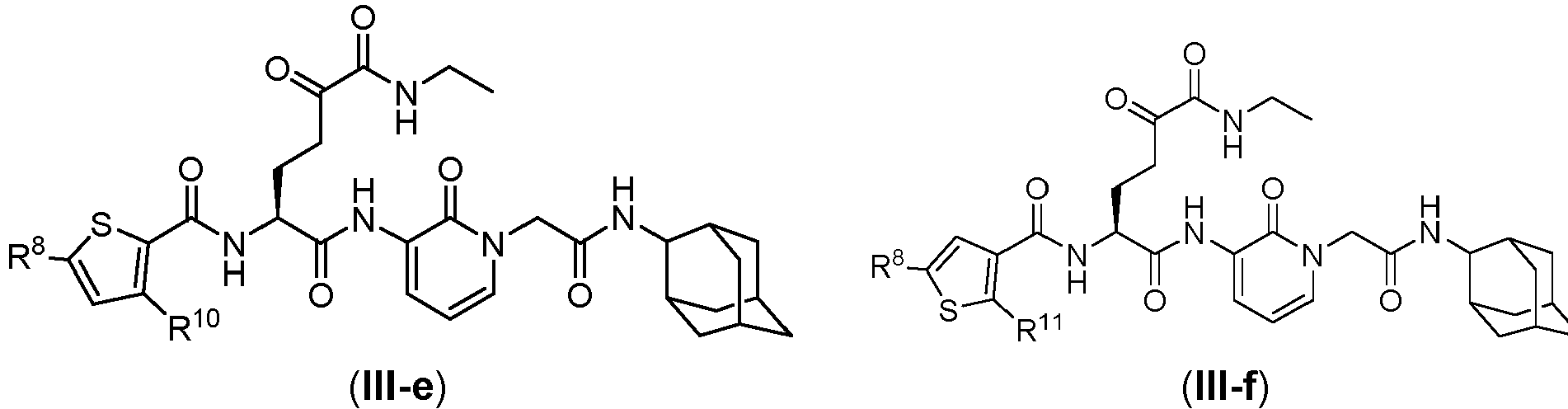


- The compound according to any one of the claims 1 - 5, wherein R3 represents





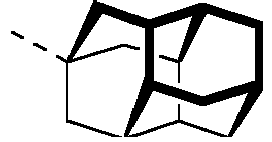
- The compound according to any one of the claims 1 - 7, wherein R2 represents








- The compound according to claim 1 selected from the group consisting of:
Compound Name I-1: (S)-N1-ethyl-N6-(1-(2-(1-adamantylamino)-2-oxoethyl)-2-oxo-1,2-dihydropyridin-3-yl)-5-(1-methyl-1H-imidazole-5-carboxamido)-2-oxohexanediamide, I-2: (S)-N1-ethyl-5-(1H-imidazole-4-carboxamido)-N6-(1-(2-(1-adamantylamino)-2-oxoethyl)-2-oxo-1,2-dihydropyridin-3-yl)-2-oxohexanediamide, I-3: (S)-N1-ethyl-N6-(1-(2-(1-adamantyl(methyl)amino)-2-oxoethyl)-2-oxo-1,2-dihydropyrid in-3-yl)-5-(1-methyl-1H-imidazole-5-carboxamido)-2-oxohexanediamide, I-4: (S)-N1-ethyl-N6-(1-(2-(3,5-dimethyladamantane-1-amino)-2-oxoethyl)-2-oxo-1,2-dihydropyridin-3-yl)-5-(1-methyl-1H-imidazole-5-carboxamido)-2-oxohexanediamide, I-5: (S)-N1-ethyl-N6-(1-(2-(3-ethyladamantane-1-amino)-2-oxoethyl)-2-oxo-1,2-dihydropyrid in-3-yl)-5-(1-methyl-1H-imidazole-5-carboxamido)-2-oxohexanediamide, I-6: (S)-N1-ethyl-N6-(1-(2-(3-trifluoromethyladamantane-1-amino)-2-oxoethyl)-2-oxo-1,2-dihydropyridin-3-yl)-5-(1-methyl-1H-imidazole-5-carboxamido)-2-oxohexanediamide, I-7: (S)-N1-ethyl-N6-(1-(2-(3-hydroxyadamantane-1-amino)-2-oxoethyl)-2-oxo-1,2-dihydropyridin-3-yl)-5-(1-methyl-1H-imidazole-5-carboxamido)-2-oxohexanediamide, I-8: (S)-N1-ethyl-N6-(1-(2-(3-fluoroadamantane-1-amino)-2-oxoethyl)-2-oxo-1,2-dihydropyrid in-3-yl)-5-(1-methyl-1H-imidazole-5-carboxamido)-2-oxohexanediamide, I-9: (S)-N1-ethyl-N6-(1-(2-(3-chloroadamantane-1-amino)-2-oxoethyl)-2-oxo-1,2-dihydropyridin-3-yl)-5-(1-methyl-1H-imidazole-5-carboxamido)-2-oxohexanediamide, I-10: (S)-N1-ethyl-N6-(1-(2-(3-bromoadamantane-1-amino)-2-oxoethyl)-2-oxo-1,2-dihydropyridin-3-yl)-5-(1-methyl-1H-imidazole-5-carboxamido)-2-oxohexanediamide, I-11: (S)-N1-ethyl-N6-(1-(2-(3-methyl adamantane-3-carboxylate-1-amino)-2-oxoethyl)-2-oxo-1,2-dihydropyridin-3-yl)-5-(1-methyl-1H-imidazole-5-carboxamido)-2-oxohexanediamide, I-12: (S)-N1-ethyl-N6-(1-(2-(4,4-difluoroadamantane-1-amino)-2-oxoethyl)-2-oxo-1,2-dihydropyridin-3-yl)-5-(1-methyl-1H-imidazole-5-carboxamido)-2-oxohexanediamide, I-13: (S)-N1-(1-(2-(((1S,2R,5S)-6,6-dimethylbicyclo[3.1.1]heptan-2-yl)methylamino)-2-oxoethyl)-2-oxo-1,2-dihydropyridin-3-yl)-N6-ethyl-2-(1-methyl-1H-imidazole-5-carboxamido)-5-oxohexanediamide, I-14: (S)-N1-(1-(2-(((1R,2R,5R)-6,6-dimethylbicyclo[3.1.1]heptan-2-yl)methylamino)-2-oxoethyl)-2-oxo-1,2-dihydropyridin-3-yl)-N6-ethyl-2-(1-methyl-1H-imidazole-5-carboxamido)-5-oxohexanediamide, I-15: (S)-N1-ethyl-N6-(1-(2-(3-ethyladamantane-1-amino)-2-oxoethyl)-2-oxo-1,2-dihydropyridin-3-yl)-5-(1-methyl-1H-imidazole-4-carboxamido)-2-oxohexanediamide, I-16: (S)-N1-ethyl-N6-(1-(2-(3-ethyladamantane-1-amino)-2-oxoethyl)-2-oxo-1,2-dihydropyridin-3-yl)-5-(1-methyl-1H-imidazole-2-carboxamido)-2-oxohexanediamide, I-17: (S)-2-(1,4-dimethyl-1H-imidazole-5-carboxamido)-N6-ethyl-N1-(1-(2-(3-ethyladamantane-1-amino)-2-oxoethyl)-2-oxo-1,2-dihydropyridin-3-yl)-5-oxohexanediamide, I-18: (S)-N1-ethyl-5-(1-isobutyl-1H-im idazole-4-carboxam ido)-N6-(1-(2-(3-ethyladamantane-1-amino)-2-oxoethyl)-2-oxo-1,2-dihydropyridin-3-yl)-2-oxohexanediamide, I-19: (S)-2-(1-cyclopentyl-1H-imidazole-4-carboxamido)-N6-ethyl-N1-(1-(2-(3-ethyladamantane-1-amino)-2-oxoethyl)-2-oxo-1,2-dihydropyridin-3-yl)-5-oxohexanediamide, I-20: (S)-2-(1-cyclobutyl-1H-imidazole-4-carboxamido)-N6-ethyl-N1-(1-(2-(3-ethyladamantane-1-amino)-2-oxoethyl)-2-oxo-1,2-dihydropyridin-3-yl)-5-oxohexanediamide, I-21: (S)-2-(1,4-dimethyl-1H-imidazole-5-carboxamido)-N6-ethyl-N1-(1-(2-(3,5-dimethyladamantane-1-amino)-2-oxoethyl)-2-oxo-1,2-dihydropyridin-3-yl)-5-oxohexanediamide, I-22: (S)-N1-ethyl-N6-(1-(2-(3,5-dimethyladamantane-1-amino)-2-oxoethyl)-2-oxo-1,2-dihydropyridin-3-yl)-5-(1-methyl-1H-imidazole-4-carboxamido)-2-oxohexanediamide, I-23: (S)-N1-ethyl-N6-(1-(2-(3,5-dimethyladamantane-1-amino)-2-oxoethyl)-2-oxo-1,2-dihydropyridin-3-yl)-5-(1-methyl-1H-imidazole-2-carboxamido)-2-oxohexanediamide, I-24: (S)-2-(1,2-dimethyl-1H-imidazole-5-carboxamido)-N6-ethyl-N1-(1-(2-(3,5-dimethyladamantane-1-amino)-2-oxoethyl)-2-oxo-1,2-dihydropyridin-3-yl)-5-oxohexanediamide, I-25: (S)-N1-ethyl-N6-(1-(2-(3-methyladamantane-1-amino)-2-oxoethyl)-2-oxo-1,2-dihydropyridin-3-yl)-5-(1-methyl-1H-imidazole-5-carboxamido)-2-oxohexanediamide, I-26: (S)-2-(2-chloro-1-methyl-1H-imidazole-5-carboxamido)-N6-ethyl-N1- (1-(2-(3,5-dimethyladamantane-1-amino)-2-oxoethyl)-2-oxo-1,2-dihydropyridin-3-yl)-5-oxohexanediamide, I-27: (S)-2-(1,2-dimethyl-1H-imidazole-5-carboxamido)-N6-ethyl-N1-(1-(2-(3-methyladamantane-1-amino)-2-oxoethyl)-2-oxo-1,2-dihydropyridin-3-yl)-5-oxohexanediamide, I-28: (S)-N1-ethyl-N6-(1-(2-(3,5,7-trimethyl-1-adamantylamino)-2-oxoethyl)-2-oxo-1,2-dihydropyridin-3-yl)-5-(1-methyl-1H-imidazole-5-carboxam ido)-2-oxohexanediamide, I-29: (S)-2-(2-chloro-1-methyl-1H-imidazole-5-carboxamido)-N6-ethyl-N1- (1-(2-(3,5,7-trimethyl-1-adamantylamino)-2-oxoethyl)-2-oxo-1,2-dihydropyridin-3-yl)-5-oxohexanediamide, I-30 (S)-2-(benzofuran-2-carboxamido)-N6-ethyl-N1-(1-(2-(2-adamantylamino)-2-oxoethyl)-2-oxo-1,2-dihydropyridin-3-yl)-5-oxohexanediamide, I-31 (S)-N1-ethyl-N6-(1-(2-(2-adamantylamino)-2-oxoethyl)-2-oxo-1,2-dihydropyridin-3-yl)-5-(3-methylbenzofuran-2-carboxamido)-2-oxohexanediamide, I-32 (S)-2-(3-chlorobenzofuran-2-carboxamido)-N6-ethyl-N1-(1-(2-(2-adamantylamino)-2-oxoethyl)-2-oxo-1,2-dihydropyridin-3-yl)-5-oxohexanediamide, I-33 (S)-2-(4-bromobenzofuran-2-carboxamido)-N6-ethyl-N1-(1-(2-(2-adamantylamino)-2-oxoethyl)-2-oxo-1,2-dihydropyridin-3-yl)-5-oxohexanediamide, I-34 (S)-2-(benzo[b]th iophene-2-carboxam ido)-N6-ethyl-N1-(1-(2-(2-adamantylamino)-2-oxoethyl)-2-oxo-1,2-dihydropyridin-3-yl)-5-oxohexanediamide, I-35 (S)-N1-ethyl-5-(7-fluorobenzo[b]thiophene-2-carboxamido)-N6-(1-(2-(2-adamantylamino)-2-oxoethyl)-2-oxo-1,2-dihydropyridin-3-yl)-2-oxohexanediamide, I-36 (S)-2-(4,5-difluoro-1H-indole-2-carboxamido)-N6-ethyl-N1-(1-(2-(2-adamantylamino)-2-oxoethyl)-2-oxo-1,2-dihydropyridin-3-yl)-5-oxohexanediamide, I-37 (S)-N 1-ethyl-N6-(1-(2-(2-adamantylamino)-2-oxoethyl)-2-oxo-1,2-dihydropyridin-3-yl)-5-(3-methyl-1H-indole-2-carboxamido)-2-oxohexanediamide, I-38 (S)-2-(1H-benzo[d]imidazole-2-carboxamido)-N6-ethyl-N1-(1-(2-(2-adamantylamino)-2-oxoethyl)-2-oxo-1,2-dihydropyridin-3-yl)-5-oxohexanediamide, I-39 (S)-2-(2,3-dihydro-1H-indene-2-carboxamido)-N6-ethyl-N1-(1-(2-(2-adamantylamino)-2-oxoethyl)-2-oxo-1,2-dihydropyridin-3-yl)-5-oxohexanediamide, I-40 (S)-N1-ethyl-N6-(1-(2-(2-adamantylamino)-2-oxoethyl)-2-oxo-1,2-dihydropyridin-3-yl)-5-(4-methyl-2-(trifluoromethyl)thiazole-5-carboxamido)-2-oxohexanediamide, I-41 (S)-2-(4-bromo-2-(trifluoromethyl)thiazole-5-carboxamido)-N6-ethyl-N1-(1-(2-(2-adamantylamino)-2-oxoethyl)-2-oxo-1,2-dihydropyridin-3-yl)-5-oxohexanediamide, I-42 (S)-N1-ethyl-N6-(1-(2-(2-adamantylamino)-2-oxoethyl)-2-oxo-1,2-dihydropyridin-3-yl)-5-(4-methyl-2-phenylthiazole-5-carboxamido)-2-oxohexanediamide, I-43 (S)-2-(5-bromo-3-methylthiophene-2-carboxamido)-N6-ethyl-N1-(1-(2-(2-adamantylamino)-2-oxoethyl)-2-oxo-1,2-dihydropyridin-3-yl)-5-oxohexanediamide, I-44 (S)-2-(3,5-dibromothiophene-2-carboxamido)-N6-ethyl-N1-(1-(2-(2-adamantylamino)-2-oxoethyl)-2-oxo-1,2-dihydropyridin-3-yl)-5-oxohexanediamide, I-45 (S)-2-(5-bromo-3-methylfuran-2-carboxamido)-N6-ethyl-N1-(1-(2-(2-adamantylamino)-2-oxoethyl)-2-oxo-1,2-dihydropyridin-3-yl)-5-oxohexanediamide, I-46 (S)-2-(2,5-dichlorothiophene-3-carboxamido)-N6-ethyl-N1-(1-(2-(2-adamantylamino)-2-oxoethyl)-2-oxo-1,2-dihydropyridin-3-yl)-5-oxohexanediamide, I-47 (S)-2-(2,5-dibromothiophene-3-carboxamido)-N6-ethyl-N1-(1-(2-(2-adamantylamino)-2-oxoethyl)-2-oxo-1,2-dihydropyridin-3-yl)-5-oxohexanediamide, I-48 (S)-2-(2,5-dichlorothiazole-4-carboxamido)-N6-ethyl-N1-(1-(2-(2-adamantylamino)-2-oxoethyl)-2-oxo-1,2-dihydropyridin-3-yl)-5-oxohexanediamide, I-49 (S)-2-(2,5-dimethylfuran-3-carboxamido)-N6-ethyl-N1-(1-(2-(2-adamantylamino)-2-oxoethyl)-2-oxo-1,2-dihydropyridin-3-yl)-5-oxohexanediamide, I-50 (S)-2-(4-bromothiazole-2-carboxamido)-N6-ethyl-N1-(1-(2-(2-adamantylamino)-2-oxoethyl)-2-oxo-1,2-dihydropyridin-3-yl)-5-oxohexanediamide, I-51 (S)-2-(4-bromothiophene-2-carboxamido)-N6-ethyl-N1-(1-(2-(2-adamantylamino)-2-oxoethyl)-2-oxo-1,2-dihydropyridin-3-yl)-5-oxohexanediamide, I-52 (S)-2-(4-bromo-5-chlorothiophene-2-carboxamido)-N6-ethyl-N1-(1-(2-(2-adamantylamino)-2-oxoethyl)-2-oxo-1,2-dihydropyridin-3-yl)-5-oxohexanediamide, I-53 (S)-2-(4,5-dibromothiophene-2-carboxamido)-N6-ethyl-N1-(1-(2-(2-adamantylamino)-2-oxoethyl)-2-oxo-1,2-dihydropyridin-3-yl)-5-oxohexanediamide, I-54 (S)-2-(4,5-dichlorothiophene-2-carboxamido)-N6-ethyl-N1-(1-(2-(2-adamantylamino)-2-oxoethyl)-2-oxo-1,2-dihydropyridin-3-yl)-5-oxohexanediamide, I-55 (S)-2-((S)-1-acetylpyrrolidine-2-carboxamido)-N6-ethyl-N1-(1-(2-(2-adamantylamino)-2-oxoethyl)-2-oxo-1,2-dihydropyridin-3-yl)-5-oxohexanediamide, I-56 (S)-N1-ethyl-N6-(1-(2-(2-adamantylamino)-2-oxoethyl)-2-oxo-1,2-dihydropyridin-3-yl)-5-(1-methyl-1H-1,2,3-triazole-5-carboxamido)-2-oxohexanediamide, I-57 (S)-N1-ethyl-N6-(1-(2-(2-adamantylamino)-2-oxoethyl)-2-oxo-1,2-dihydropyridin-3-yl)-2-oxo-5-(2H-tetrazole-5-carboxamido)hexanediamide, I-58 (S)-N1-ethyl-N6-(1-(2-(5-hydroxyadamantane-2-amino)-2-oxoethyl)-2-oxo-1,2-dihydropyridin-3-yl)-2-oxo-5-(pyrazine-2-carboxamido)hexanediamide, I-59 (S)-N1-ethyl-N6-(1-(2-(5-fluoroadamantane-2-amino)-2-oxoethyl)-2-oxo-1,2-dihydropyridin-3-yl)-2-oxo-5-((S)-pyrrolidine-3-carboxamido)hexanediamide, I-60 (S)-N1-ethyl-N6-(1-(2-(5-chloroadamantane-2-amino)-2-oxoethyl)-2-oxo-1,2-dihydropyridin-3-yl)-2-oxo-5-((S)-piperidine-2-carboxamido)hexanediamide, I-61 (S)-N1-ethyl-N6-(1-(2-(5-bromoadamantane-2-amino)-2-oxoethyl)-2-oxo-1,2-dihydropyridin-3-yl)-2-oxo-5-((R)-piperidine-3-carboxamido)hexanediamide, I-62 (S)-N1-ethyl-N6-(1-(2-(5-methyladamantane-2-amino)-2-oxoethyl)-2-oxo-1,2-dihydropyridin-3-yl)-5-((R)-morpholine-3-carboxamido)-2-oxohexanediamide, I-63 (S)-N1-ethyl-N6-(1-(2-(2-carbonitrileadamantane-2-amino)-2-oxoethyl)-2-oxo-1,2-dihydropyridin-3-yl)-2-oxo-5-((3S,4R)-quinuclidine-3-carboxamido)hexanediamide, I-64 (S)-methyl 3-(6-(ethylamino)-1-(1-(2-(methyl 2-aminoadamantane-2-carboxylate)-2-oxoethyl)-2-oxo-1,2-dihydropyridin-3-ylamino)-1,5,6-trioxohexan-2-ylcarbamoyl)-5-nitrobenzoate, I-65 (S)-N1-(1-(2-(1-adamantylmethylamino)-2-oxoethyl)-2-oxo-1,2-dihydropyridin-3-yl)-N6-ethyl-2-(5-nitronicotinamido)-5-oxohexanediamide, I-66 5-((2S)-1-(1-(2-1-adamantylmethylamino)-2-oxoethyl)-2-oxo-1,2-dihydropyridin-3-ylamino)-6-(ethylamino)-1,5,6-trioxohexan-2-ylcarbamoyl)nicotinic acid, I-67 (S)-N1-ethyl-N6-(1-(2-(2-adamantyl(methyl)amino)-2-oxoethyl)-2-oxo-1,2-dihydropyridin-3-yl)-5-(6-methylimidazo[2,1-b]thiazole-5-carboxamido)-2-oxohexanediamide, I-68 (S)-N1-(1-(2-((1S,2R,4R)-bicyclo[2.2.1]heptan-2-ylamino)-2-oxoethyl)-2-oxo-1,2-dihydropyridin-3-yl)-N6-ethyl-2-(3-methylbenzofuran-2-carboxamido)-5-oxohexanediamide, I-69 (S)-N1-ethyl-5-(3-methylbenzofuran-2-carboxamido)-2-oxo-N6-(2-oxo-1-(2-oxo-2-((1R,2S,4R)-1,7,7-trimethylbicyclo[2.2.1]heptan-2-ylamino)ethyl)-1,2-dihydropyridin-3-yl)hexanediamide, I-70 (S)-N1-(1-(2-((1R,2R,4S)-bicyclo[2.2.1]heptan-2-ylamino)-2-oxoethyl)-2-oxo-1,2-dihydropyridin-3-yl)-N6-ethyl-2-(3-methylbenzofuran-2-carboxamido)-5-oxohexanediamide, I-71 (S)-N1-(1-(2-((1s,4R)-bicyclo[2.2.1]heptan-1-ylamino)-2-oxoethyl)-2-oxo-1,2-dihydropyridin-3-yl)-N6-ethyl-2-(isonicotinamido)-5-oxohexanediamide, I-72 (S)-N1-(1-(2-(bicyclo[2.2.1]heptan-7-ylam ino)-2-oxoethyl)-2-oxo-1,2-dihydropyridin-3-yl)-N6-ethyl-5-oxo-2-(pyridazine-4-carboxamido)hexanediamide, I-73 (S)-N1-(1-(2-((1R,2R,4R)-bicyclo[2.2.1]hept-5-en-2-ylamino)-2-oxoethyl)-2-oxo-1,2-dihydropyridin-3-yl)-N6-ethyl-5-oxo-2-(pyridazine-3-carboxamido)hexanediamide, I-74 (2S)-N1-(1-(2-(bicyclo[2.2.2]octan-2-ylamino)-2-oxoethyl)-2-oxo-1,2-dihydropyridin-3-yl)-N6-ethyl-5-oxo-2-(2H-1,2,3-triazole-4-carboxamido)hexanediamide, I-75 (S)-N1-ethyl-5-(1-methyl-1H-1,2,3-triazole-4-carboxamido)-2-oxoN6-(2-oxo-1-(2-oxo-2-((1R,2R,4R)-1,7,7-trimethylbicyclo[2.2.1]heptan-2-ylamino)ethyl)-1,2-dihydropyridin-3-yl)hexanediamide, I-76 (S)-N1-ethyl-5-(1-methyl-1H-1,2,4-triazole-3-carboxamido)-2-oxoN6-(2-oxo-1-(2-oxo-2-((1R,2R,3R,5S)-2,6,6-trimethylbicyclo[3.1.1]heptan-3-ylamino)ethyl)-1,2-dihydropyridin-3-yl)hexanediamide, I-77 (S)-2-(benzofuran-3-carboxamido)-N6-ethyl-5-oxo-N1-(2-oxo-1-(2-oxo-2-((1S,2S,3S,5R)-2,6,6-trimethylbicyclo[3.1.1]heptan-3-ylamino)ethyl)-1,2-dihydropyridin-3-yl)hexanediamide, I-78 (S)-2-(benzo[b]thiophene-3-carboxamido)-N6-ethyl-N1-(1-(2-(4-homoisotwistane-3-amino)-2-oxoethyl)-2-oxo-1,2-dihydropyridin-3-yl)-5-oxohexanediamide, I-79 (S)-N1-ethyl-N6-(1-(2-(diamantane-1-amino)-2-oxoethyl)-2-oxo-1,2-dihydropyridin-3-yl)-5-(1-methyl-1H-pyrazole-4-carboxamido)-2-oxohexanediamide, I-80 (S)-N1-ethyl-N6-(1-(2-(diamantane-4-amino)-2-oxoethyl)-2-oxo-1,2-dihydropyridin-3-yl)-5-(1-methyl-1H-pyrazole-3-carboxamido)-2-oxohexanediamide, I-81 (S)-N1-(1-(1-adamantylmethyl)-2-oxo-1,2-dihydropyridin-3-yl)-N6-ethyl-2-(1-methyl-1H-pyrazole-5-carboxamido)-5-oxohexanediamide, I-82 (S)-N1-(1-((3-hydroxy-1-adamantyl)methyl)-2-oxo-1,2-dihydropyridin-3-yl)-2-(4-cyclopropyl-1,2,3-thiadiazole-5-carboxamido)-N6-ethyl-5-oxohexanediamide, I-83 (S)-N1-(1-((3-bromo-1-adamantyl)methyl)-2-oxo-1,2-dihydropyridin-3-yl)-N6-ethyl-5-oxo-2-(1,2,5-thiadiazole-3-carboxamido)hexanediamide, I-84 (S)-N1-(1-(2-adamantylmethyl)-2-oxo-1,2-dihydropyridin-3-yl)-N6-ethyl-2-(4-(hydroxymethyl)-1,2,3-thiadiazole-5-carboxamido)-5-oxohexanediamide, I-85 (S)-2-(4-tert-butyl-1H-pyrrole-3-carboxamido)-N1-(1-(2-(1-adamantylamino)ethyl)-2-oxo-1,2-dihydropyridin-3-yl)-N6-ethyl-5-oxohexanediamide, I-86 (S)-2-(4-cyano-1-methyl-1H-pyrrole-2-carboxamido)-N1-(1-(1-adamantylamino)propyl)-2-oxo-1,2-dihydropyridin-3-yl)-N6-ethyl-5-oxohexanediamide, I-87 (S)-N1-(1-(3-(2-adamantylamino)-3-oxopropyl)-2-oxo-1,2-dihydropyridin-3-yl)-N6-ethyl-2-(5-methoxyoxazole-2-carboxamido)-5-oxohexanediam ide, I-88 (S)-N1-(1-(2-(bicyclo[1.1.1]pentan-1-ylam ino)-2-oxoethyl)-2-oxo-1,2-dihydropyridin-3-yl)-N6-ethyl-2-(3-methylbenzofuran-2-carboxamido)-5-oxohexanediamide, I-89 (S)-2-(2-acetyloxazole-4-carboxamido)-N1-(1-(2-(bicyclo[1.1.1]pentan-1-ylamino)-2-oxoethyl)-2-oxo-1,2-dihydropyridin-3-yl)-N6-ethyl-5-oxohexanediamide, I-90 (S)-N1-(1-(2-(bicyclo[2.1.1]hexan-1-ylamino)-2-oxoethyl)-2-oxo-1,2-dihydropyridin-3-yl)-N6-ethyl-2-(2-isopropyloxazole-5-carboxamido)-5-oxohexanediamide, I-91 (2S)-N1-(1-(2-(bicyclo[3.2.1]octan-8-ylamino)-2-oxoethyl)-2-oxo-1,2-dihydropyridin-3-yl)-2-(3,5-dimethylisoxazole-4-carboxamido)-N6-ethyl-5-oxohexanediamide, I-92 (S)-N1-ethyl-N6-(1-(2-(5-carboxy-2-aminoadamantane)-2-oxoethyl)-2-oxo-1,2-dihydropyridin-3-yl)-5-(4-methylpyrimidine-5-carboxamido)-2-oxohexanediamide, I-93 (5S)-N1-ethyl-N6-(1-(2-(4-aminoadamantane-N,N-dimethyl-1-carboxamide)-2-oxoethyl)-2-oxo-1,2-dihydropyridin-3-yl)-2-oxo-5-(1,2,3,4-tetrahydronaphthalene-2-carboxamido)hexanediamide, I-94 (S)-2-((S)-1,4-diazabicyclo[2.2.2]octane-2-carboxamido)-N6-ethyl-N1-(1-(2-(2-adamantylamino)-2-oxoethyl)-2-oxo-1,2-dihydropyridin-3-yl)-5-oxohexanediamide, I-95 (S)-N1-ethyl-5-(1H-indole-3-carboxamido)-N6-(1-(2-(2-adamantylamino)-2-oxoethyl)-2-oxo-1,2-dihydropyridin-3-yl)-2-oxohexanediamide, I-96 (S)-N1-ethyl-N6-(1-(2-(2-adamantylamino)-2-oxoethyl)-2-oxo-1,2-dihydropyridin-3-yl)-5-(6-methylimidazo[2,1-b]thiazole-3-carboxamido)-2-oxohexanediamide, I-97 (S)-2-(benzo[d]thiazole-2-carboxamido)-N1-(1-(2-((1S,2R,4R)-bicyclo[2.2.1]heptan-2-ylamino)-2-oxoethyl)-2-oxo-1,2-dihydropyridin-3-yl)-N6-ethyl-5-oxohexanediamide, I-98 (S)-N1-(1-(2-((1S,2R,4R)-bicyclo[2.2.1]heptan-2-ylamino)-2-oxoethyl)-2-oxo-1,2-dihydropyridin-3-yl)-N6-ethyl-2-(imidazo[2,1-b]thiazole-6-carboxamido)-5-oxohexanediamide, I-99 (S)-N1-(1-(2-((1S,2R,4R)-bicyclo[2.2.1]heptan-2-ylamino)-2-oxoethyl)-2-oxo-1,2-dihydropyridin-3-yl)-N6-ethyl-2-(4-hydroxy-6-(trifluoromethoxy)quinoline-3-carboxamido)-5-oxohexanediamide, I-100 (S)-N1-(1-(2-(bicyclo[1.1.1]pentan-1-ylamino)-2-oxoethyl)-2-oxo-1,2-dihydropyridin-3-yl)-2-(cinnoline-3-carboxamido)-N6-ethyl-5-oxohexanediamide, I-101 (S)-N1-(1-(2-(bicyclo[1.1.1]pentan-1-ylam ino)-2-oxoethyl)-2-oxo-1,2-dihydropyridin-3-yl)-N6-ethyl-2-(3-ethylbenzofuran-2-carboxamido)-5-oxohexanediamide, I-102 (S)-N1-(1-(2-(bicyclo[1.1.1]pentan-1-ylam ino)-2-oxoethyl)-2-oxo-1,2-dihydropyridin-3-yl)-N6-ethyl-2-(1-ethyl-1H-indole-2-carboxamido)-5-oxohexanediamide, I-103 (S)-N1-(1-(2-(bicyclo[1.1.1]pentan-1-ylamino)-2-oxoethyl)-2-oxo-1,2-dihydropyridin-3-yl)-N6-ethyl-2-(2-methyl-1,8-naphthyridine-3-carboxamido)-5-oxohexanediamide, I-104 (S)-N1-(1-(2-(bicyclo[2.1.1]hexan-1-ylamino)-2-oxoethyl)-2-oxo-1,2-dihydropyridin-3-yl)-N6-ethyl-5-oxo-2-(1,2,3,4-tetrahydroquinoline-6-carboxamido)hexanediamide, I-105 (S)-N1-ethyl-N6-(1-(2-(2-carboxy-2-amino-5-(trifluoromethyl)adamantane)-2-oxoethyl)-2-oxo-1,2-dihydropyridin-3-yl)-2-oxo-5-(3-oxo-1,2,3,4-tetrahydroisoquinoline-6-carboxamido)hexanediamide, I-106 (S)-N1-ethyl-N6-(1-(2-(5-ethyladamantane-2-amino)-2-oxoethyl)-2-oxo-1,2-dihydropyridin-3-yl)-5-(1,6-naphthyridine-2-carboxamido)-2-oxohexanediamide, I-107 (S)-N1-(1-(2-(bicyclo[2.1.1]hexan-1-ylamino)-2-oxoethyl)-2-oxo-1,2-dihydropyridin-3-yl)-N6-ethyl-2-(2,6-naphthyridine-1-carboxamido)-5-oxohexanediamide, I-108 (S)-2-(4-amino-1,2,5-oxadiazole-3-carboxamido)-N1-(1-(2-(bicyclo[1.1.1]pentan-1-ylamino)-2-oxoethyl)-2-oxo-1,2-dihydropyridin-3-yl)-N6-ethyl-5-oxohexanediamide, 1-109 (S)-N1-(1-(2-(bicyclo[1.1.1]pentan-1-ylamino)-2-oxoethyl)-2-oxo-1,2-dihydropyridin-3-yl)-2-(6-(dimethylamino)benzofuran-2-carboxamido)-N6-ethyl-5-oxohexanediamide, I-110 (S)-2-(2-acetamidothiazole-5-carboxamido)-N1-(1-(2-(bicyclo[1.1.1]pentan-1-ylamino)-2-oxoethyl)-2-oxo-1,2-dihydropyridin-3-yl)-N6-ethyl-5-oxohexanediamide, I-111 (S)-N4-(1-(1-(2-(bicyclo[1.1.1]pentan-1-ylam ino)-2-oxoethyl)-2-oxo-1,2-dihydropyridin-3-ylamino)-6-(ethylamino)-1,5,6-trioxohexan-2-yl)-1H-pyrrole-2,4-dicarboxamide, I-112 (S)-N1-ethyl-N6-(1-(2-(1-acetylamino-4-aminoadamantane)-2-oxoethyl)-2-oxo-1,2-dihydropyridin-3-yl)-2-oxo-5-(5-sulfamoylfuran-3-carboxamido)hexanediamide, I-113 (S)-2-(benzofuran-5-carboxamido)-N6-ethyl-N1-(1-(2-(1-acetylamino-4-aminoadamantane)-2-oxoethyl)-2-oxo-1,2-dihydropyridin-3-yl)-5-oxohexanediamide, I-114 (S)-2-(benzofuran-6-carboxamido)-N6-ethyl-N1-(1-(2-(4-aminoadamantane-1-carboxam ide)-2-oxoethyl)-2-oxo-1,2-dihydropyridin-3-yl)-5-oxohexanediamide, I-115 (S)-N1-ethyl-N6-(1-(2-(4-aminoadamantane-1-carboxamide)-2-oxoethyl)-2-oxo-1,2-dihydropyridin-3-yl)-5-(3-(1-methylcyclopropyl)-1,2,4-oxadiazole-5-carboxamido)-2-oxohexanediamide, I-116 (S)-N1-(1-(2-(bicyclo[1.1.1]pentan-1-ylam ino)-2-oxoethyl)-2-oxo-1,2-dihydropyridin-3-yl)-N6-ethyl-2-(5-methyl-1,2,4-oxadiazole-3-carboxamido)-5-oxohexanediamide, I-117 (S)-N1-(1-(2-(bicyclo[1.1.1]pentan-1-ylamino)-2-oxoethyl)-2-oxo-1,2-dihydropyridin-3-yl)-N6-ethyl-5-oxo-2-(1,2,3-thiadiazole-4-carboxamido)hexanediamide, I-118 (S)-N1-(1-(2-(bicyclo[1.1.1]pentan-1-ylamino)-2-oxoethyl)-2-oxo-1,2-dihydropyridin-3-yl)-N6-ethyl-5-oxo-2-(1,2,4-thiadiazole-5-carboxamido)hexanediamide, I-119 (S)-N1-(1-(2-(bicyclo[1.1.1]pentan-1-ylamino)-2-oxoethyl)-2-oxo-1,2-dihydropyridin-3-yl)-N6-ethyl-5-oxo-2-(1,3,4-thiadiazole-2-carboxamido)hexanediamide, I-120 (S)-N1-ethyl-5-(4-formyl-1,2,3-thiadiazole-5-carboxamido)-N6-(1-(2-(2-adamantylamino)-2-oxoethyl)-2-oxo-1,2-dihydropyridin-3-yl)-2-oxohexanediamide, I-121 (S)-N1-ethyl-N6-(1-(2-(3,5-dimethyladamantane-1-amino)-2-oxoethyl)-2-oxo-1,2-dihydropyridin-3-yl)-5-(nicotinamido)-2-oxohexanediamide - A pharmaceutical composition comprising a compound of any one of the claims 1 - 9 as an active ingredient, together with at least one pharmaceutically acceptable carrier, excipient and/or diluent.
- Compound according to any one of the claims 1 - 9 for use in medicine.
- Compound according to any one of the claims 1 - 9 or the pharmaceutical composition according to claim 10 for use in the treatment or prophylaxis of autoimmune and inflammatory diseases, vascular diseases, fibrotic diseases, liver diseases, cholestatic liver diseases, cancer, neurodegenerative diseases, ocular diseases, and skin disorders.
- Compound for use, or the pharmaceutical composition for use according to claim 12, whereinthe autoimmune and inflammatory diseases comprises multiple sclerosis, celiac disease, Duhring-Brocq-disease (dermatitis herpetiformis), gluten ataxia, gluten neuropathy, diabetes, rheumatoid arthritis, Graves' disease, inflammatory bowel disease, systemic lupus erythematosus psoriasis, and gingivitis;the vascular diseases comprise atherosclerosis, thrombosis, vascular stiffness; the fibrotic diseases affecting the lung, the kidney, the liver, the skin or the gut like cystic fibrosis, kidney fibrosis and diabetic nephropathy, intestinal fibrosis, idiopathic lung fibrosis, liver fibrosis;the liver diseases like alcoholic hepatitis, alcoholic steatohepatitis, nonalcoholic steatohepatitis, non-alcoholic fatty liver disease, liver cirrhosis, autoimmune hepatitis or liver inflammation;the cholestatic liver diseases comprise primary biliary cholangitis and primary sclerosing cholangitis;the cancer comprises glioblastoma, melanoma, pancreatic cancer, renal cell carcinoma, meningioma, and breast cancer,the neurodegenerative diseases comprise Parkinson's disease, Huntington's disease, or Alzheimer's disease;the ocular diseases comprise glaucoma, cataracts, macular degeneration, or uveitis; andthe skin disorders comprise acne, psoriasis, scarring, and skin aging.
- Compound for use, or the pharmaceutical composition for use according to any one of the claims 12 and 13 in the treatment or prophylaxis of celiac disease.
- A method for producing the compound of formula (Ia) according to claim 1 comprising:Step 1A: providing a compound 4a
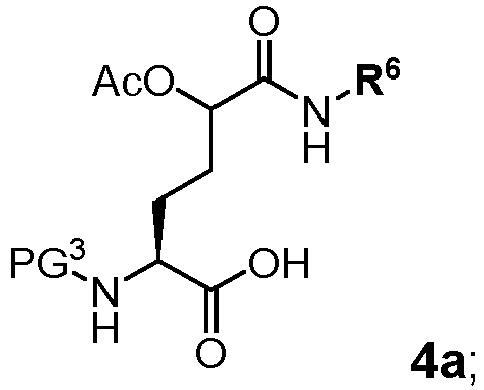 Step 2A: performing coupling reaction of the compound 4a with a compound 5
 Step 3A: deprotecting an amino protecting group PG3 to obtain a compound 7a
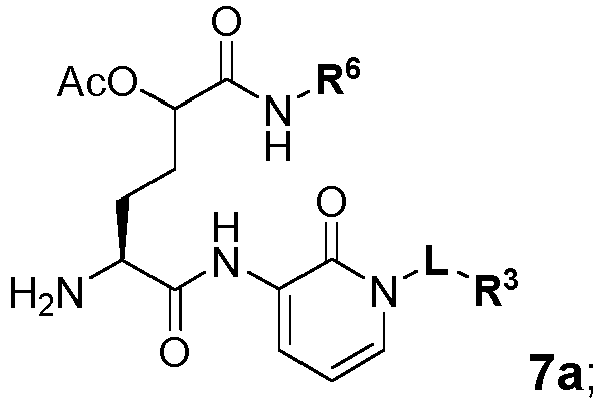 Step 4A: performing coupling reaction of the compound 7a with a carboxylic acid (R2 -CO2H 8) to obtain a compound 9a
 Step 5A: performing oxidation reaction of the compound 9a to produce the compound of the formula (Ia)
Priority Applications (3)
| Application Number | Priority Date | Filing Date | Title |
|---|---|---|---|
| HRP20241524TT HRP20241524T1 (en) | 2021-06-30 | 2022-06-30 | Inhibitors of transglutaminases |
| SI202230064T SI4192813T1 (en) | 2021-06-30 | 2022-06-30 | Inhibitors of transglutaminases |
| RS20241217A RS66138B1 (en) | 2021-06-30 | 2022-06-30 | Inhibitors of transglutaminases |
Applications Claiming Priority (6)
| Application Number | Priority Date | Filing Date | Title |
|---|---|---|---|
| EP21182956 | 2021-06-30 | ||
| EP21183316 | 2021-07-01 | ||
| US202163217783P | 2021-07-02 | 2021-07-02 | |
| PCT/EP2021/086674 WO2023110138A1 (en) | 2021-12-17 | 2021-12-17 | Inhibitors of transglutaminases |
| EP2022065430 | 2022-06-07 | ||
| PCT/EP2022/068216 WO2023275336A1 (en) | 2021-06-30 | 2022-06-30 | Inhibitors of transglutaminases |
Publications (2)
| Publication Number | Publication Date |
|---|---|
| EP4192813A1 EP4192813A1 (en) | 2023-06-14 |
| EP4192813B1 true EP4192813B1 (en) | 2024-08-14 |
Family
ID=82547318
Family Applications (1)
| Application Number | Title | Priority Date | Filing Date |
|---|---|---|---|
| EP22741487.7A Active EP4192813B1 (en) | 2021-06-30 | 2022-06-30 | Inhibitors of transglutaminases |
Country Status (20)
| Country | Link |
|---|---|
| US (2) | US20240376055A1 (en) |
| EP (1) | EP4192813B1 (en) |
| JP (2) | JP7696024B2 (en) |
| KR (1) | KR20240028473A (en) |
| CN (1) | CN117561241B (en) |
| AU (1) | AU2022305117A1 (en) |
| CL (1) | CL2023003979A1 (en) |
| DK (1) | DK4192813T3 (en) |
| ES (1) | ES2991364T3 (en) |
| FI (1) | FI4192813T3 (en) |
| HR (1) | HRP20241524T1 (en) |
| HU (1) | HUE068818T2 (en) |
| IL (1) | IL309474A (en) |
| LT (1) | LT4192813T (en) |
| MX (1) | MX2023015490A (en) |
| PL (1) | PL4192813T3 (en) |
| RS (1) | RS66138B1 (en) |
| SI (1) | SI4192813T1 (en) |
| WO (1) | WO2023275336A1 (en) |
| ZA (1) | ZA202400823B (en) |
Families Citing this family (2)
| Publication number | Priority date | Publication date | Assignee | Title |
|---|---|---|---|---|
| SI4192812T1 (en) * | 2021-06-30 | 2025-02-28 | Zedira Gmbh | Inhibitors of transglutaminases |
| JP7805983B2 (en) | 2022-03-22 | 2026-01-26 | アッヴィ・インコーポレイテッド | Pyrimidines for degrading Bruton's tyrosine kinase |
Family Cites Families (3)
| Publication number | Priority date | Publication date | Assignee | Title |
|---|---|---|---|---|
| DE102006052755A1 (en) * | 2006-11-08 | 2008-05-15 | N-Zyme Biotec Gmbh | New peptide derivatives and peptidomimetics are transglutaminase inhibitors useful for the treatment or prophylaxis of e.g. celiac disease, fibrosis, thrombosis, neurodegenerative disorders, Huntington's chorea and Parkinson disease |
| EP2687511A1 (en) * | 2012-07-17 | 2014-01-22 | Zedira GmbH | Pyridinone derivatives as tissue transglutaminase inhibitors |
| EP3342779A1 (en) | 2016-12-27 | 2018-07-04 | Zedira GmbH | Inhibitors of transglutaminases |
-
2022
- 2022-06-30 SI SI202230064T patent/SI4192813T1/en unknown
- 2022-06-30 US US18/572,114 patent/US20240376055A1/en active Pending
- 2022-06-30 RS RS20241217A patent/RS66138B1/en unknown
- 2022-06-30 DK DK22741487.7T patent/DK4192813T3/en active
- 2022-06-30 PL PL22741487.7T patent/PL4192813T3/en unknown
- 2022-06-30 HR HRP20241524TT patent/HRP20241524T1/en unknown
- 2022-06-30 IL IL309474A patent/IL309474A/en unknown
- 2022-06-30 KR KR1020247003631A patent/KR20240028473A/en active Pending
- 2022-06-30 FI FIEP22741487.7T patent/FI4192813T3/en active
- 2022-06-30 MX MX2023015490A patent/MX2023015490A/en unknown
- 2022-06-30 LT LTEPPCT/EP2022/068216T patent/LT4192813T/en unknown
- 2022-06-30 CN CN202280045270.7A patent/CN117561241B/en active Active
- 2022-06-30 HU HUE22741487A patent/HUE068818T2/en unknown
- 2022-06-30 WO PCT/EP2022/068216 patent/WO2023275336A1/en not_active Ceased
- 2022-06-30 ES ES22741487T patent/ES2991364T3/en active Active
- 2022-06-30 EP EP22741487.7A patent/EP4192813B1/en active Active
- 2022-06-30 AU AU2022305117A patent/AU2022305117A1/en active Pending
- 2022-06-30 JP JP2023580901A patent/JP7696024B2/en active Active
-
2023
- 2023-12-22 US US18/394,766 patent/US20240270715A1/en active Pending
- 2023-12-29 CL CL2023003979A patent/CL2023003979A1/en unknown
-
2024
- 2024-01-24 ZA ZA2024/00823A patent/ZA202400823B/en unknown
- 2024-10-07 JP JP2024175605A patent/JP2025001006A/en active Pending
Also Published As
| Publication number | Publication date |
|---|---|
| JP2024524458A (en) | 2024-07-05 |
| AU2022305117A1 (en) | 2023-12-14 |
| RS66138B1 (en) | 2024-11-29 |
| CN117561241B (en) | 2025-10-28 |
| KR20240028473A (en) | 2024-03-05 |
| EP4192813A1 (en) | 2023-06-14 |
| DK4192813T3 (en) | 2024-09-02 |
| SI4192813T1 (en) | 2025-03-31 |
| WO2023275336A1 (en) | 2023-01-05 |
| ES2991364T3 (en) | 2024-12-03 |
| US20240270715A1 (en) | 2024-08-15 |
| CN117561241A (en) | 2024-02-13 |
| JP2025001006A (en) | 2025-01-07 |
| LT4192813T (en) | 2024-11-11 |
| PL4192813T3 (en) | 2024-12-23 |
| US20240376055A1 (en) | 2024-11-14 |
| FI4192813T3 (en) | 2024-11-07 |
| HUE068818T2 (en) | 2025-01-28 |
| CL2023003979A1 (en) | 2024-06-14 |
| JP7696024B2 (en) | 2025-06-19 |
| IL309474A (en) | 2024-02-01 |
| HRP20241524T1 (en) | 2025-01-03 |
| ZA202400823B (en) | 2025-05-28 |
| MX2023015490A (en) | 2024-01-19 |
Similar Documents
| Publication | Publication Date | Title |
|---|---|---|
| RU2489423C2 (en) | Water-soluble analogues cc-1065 and their conjugates | |
| JP2025001006A (en) | Inhibitors of transglutaminases | |
| JP2010509195A (en) | Michael System as a transglutaminase inhibitor | |
| EP2836494B1 (en) | New alkylating agents | |
| EP4192814B1 (en) | Inhibitors of transglutaminases | |
| WO2021175848A1 (en) | Alpha-methyl-substituted diazabicyclo[4.3.1] decane derivates for treatment of psychiatric disorders | |
| HK40095238A (en) | Inhibitors of transglutaminases | |
| HK40095238B (en) | Inhibitors of transglutaminases | |
| EP4192812B1 (en) | Inhibitors of transglutaminases | |
| JP5103563B2 (en) | Somatostatin receptor 1 and / or 4 selective agonists and antagonists | |
| EA048648B1 (en) | TRANSGLUTAMINASE INHIBITORS | |
| EP3875456A1 (en) | Hetero-bifunctional proteolysis-targeting chimeras (protacs) for the selective degradation of fk506-binding proteins (fkbps) | |
| HK40095266A (en) | Inhibitors of transglutaminases | |
| HK40095266B (en) | Inhibitors of transglutaminases | |
| JP2015054844A (en) | Cycloalkane derivative | |
| CA3231322A1 (en) | Inhibitors of transglutaminases | |
| HK40095264A (en) | Inhibitors of transglutaminases | |
| HK40095264B (en) | Inhibitors of transglutaminases | |
| CN108349945A (en) | HCV inhibitor, preparation method and application | |
| EA045146B1 (en) | HETEROAROMATIC COMPOUNDS AS VANINE INHIBITORS | |
| JPH0873451A (en) | Novel 2,3-dihydrobenzofuran derivative, production method and use thereof |
Legal Events
| Date | Code | Title | Description |
|---|---|---|---|
| REG | Reference to a national code |
Ref country code: HR Ref legal event code: TUEP Ref document number: P20241524T Country of ref document: HR |
|
| STAA | Information on the status of an ep patent application or granted ep patent |
Free format text: STATUS: UNKNOWN |
|
| STAA | Information on the status of an ep patent application or granted ep patent |
Free format text: STATUS: THE INTERNATIONAL PUBLICATION HAS BEEN MADE |
|
| PUAI | Public reference made under article 153(3) epc to a published international application that has entered the european phase |
Free format text: ORIGINAL CODE: 0009012 |
|
| STAA | Information on the status of an ep patent application or granted ep patent |
Free format text: STATUS: REQUEST FOR EXAMINATION WAS MADE |
|
| 17P | Request for examination filed |
Effective date: 20230307 |
|
| AK | Designated contracting states |
Kind code of ref document: A1 Designated state(s): AL AT BE BG CH CY CZ DE DK EE ES FI FR GB GR HR HU IE IS IT LI LT LU LV MC MK MT NL NO PL PT RO RS SE SI SK SM TR |
|
| REG | Reference to a national code |
Ref country code: HK Ref legal event code: DE Ref document number: 40095238 Country of ref document: HK |
|
| GRAP | Despatch of communication of intention to grant a patent |
Free format text: ORIGINAL CODE: EPIDOSNIGR1 |
|
| STAA | Information on the status of an ep patent application or granted ep patent |
Free format text: STATUS: GRANT OF PATENT IS INTENDED |
|
| DAV | Request for validation of the european patent (deleted) | ||
| INTG | Intention to grant announced |
Effective date: 20240409 |
|
| GRAS | Grant fee paid |
Free format text: ORIGINAL CODE: EPIDOSNIGR3 |
|
| GRAA | (expected) grant |
Free format text: ORIGINAL CODE: 0009210 |
|
| STAA | Information on the status of an ep patent application or granted ep patent |
Free format text: STATUS: THE PATENT HAS BEEN GRANTED |
|
| AK | Designated contracting states |
Kind code of ref document: B1 Designated state(s): AL AT BE BG CH CY CZ DE DK EE ES FI FR GB GR HR HU IE IS IT LI LT LU LV MC MK MT NL NO PL PT RO RS SE SI SK SM TR |
|
| REG | Reference to a national code |
Ref country code: GB Ref legal event code: FG4D |
|
| REG | Reference to a national code |
Ref country code: CH Ref legal event code: EP |
|
| P01 | Opt-out of the competence of the unified patent court (upc) registered |
Free format text: CASE NUMBER: APP_42010/2024 Effective date: 20240716 |
|
| REG | Reference to a national code |
Ref country code: DE Ref legal event code: R096 Ref document number: 602022005360 Country of ref document: DE |
|
| REG | Reference to a national code |
Ref country code: DK Ref legal event code: T3 Effective date: 20240827 |
|
| REG | Reference to a national code |
Ref country code: IE Ref legal event code: FG4D |
|
| REG | Reference to a national code |
Ref country code: SE Ref legal event code: TRGR |
|
| REG | Reference to a national code |
Ref country code: NL Ref legal event code: FP |
|
| REG | Reference to a national code |
Ref country code: PT Ref legal event code: SC4A Ref document number: 4192813 Country of ref document: PT Date of ref document: 20241014 Kind code of ref document: T Free format text: AVAILABILITY OF NATIONAL TRANSLATION Effective date: 20241004 |
|
| REG | Reference to a national code |
Ref country code: FI Ref legal event code: FGE |
|
| REG | Reference to a national code |
Ref country code: ES Ref legal event code: FG2A Ref document number: 2991364 Country of ref document: ES Kind code of ref document: T3 Effective date: 20241203 |
|
| REG | Reference to a national code |
Ref country code: SK Ref legal event code: T3 Ref document number: E 45314 Country of ref document: SK |
|
| REG | Reference to a national code |
Ref country code: GR Ref legal event code: EP Ref document number: 20240402527 Country of ref document: GR Effective date: 20241209 |
|
| REG | Reference to a national code |
Ref country code: HR Ref legal event code: T1PR Ref document number: P20241524 Country of ref document: HR |
|
| REG | Reference to a national code |
Ref country code: HU Ref legal event code: AG4A Ref document number: E068818 Country of ref document: HU |
|
| PG25 | Lapsed in a contracting state [announced via postgrant information from national office to epo] |
Ref country code: SM Free format text: LAPSE BECAUSE OF FAILURE TO SUBMIT A TRANSLATION OF THE DESCRIPTION OR TO PAY THE FEE WITHIN THE PRESCRIBED TIME-LIMIT Effective date: 20240814 |
|
| PG25 | Lapsed in a contracting state [announced via postgrant information from national office to epo] |
Ref country code: EE Free format text: LAPSE BECAUSE OF FAILURE TO SUBMIT A TRANSLATION OF THE DESCRIPTION OR TO PAY THE FEE WITHIN THE PRESCRIBED TIME-LIMIT Effective date: 20240814 |
|
| REG | Reference to a national code |
Ref country code: DE Ref legal event code: R097 Ref document number: 602022005360 Country of ref document: DE |
|
| PLBE | No opposition filed within time limit |
Free format text: ORIGINAL CODE: 0009261 |
|
| STAA | Information on the status of an ep patent application or granted ep patent |
Free format text: STATUS: NO OPPOSITION FILED WITHIN TIME LIMIT |
|
| REG | Reference to a national code |
Ref country code: HR Ref legal event code: ODRP Ref document number: P20241524 Country of ref document: HR Payment date: 20250624 Year of fee payment: 4 |
|
| PGFP | Annual fee paid to national office [announced via postgrant information from national office to epo] |
Ref country code: FI Payment date: 20250617 Year of fee payment: 4 |
|
| PGFP | Annual fee paid to national office [announced via postgrant information from national office to epo] |
Ref country code: PL Payment date: 20250624 Year of fee payment: 4 Ref country code: DE Payment date: 20250603 Year of fee payment: 4 |
|
| PGFP | Annual fee paid to national office [announced via postgrant information from national office to epo] |
Ref country code: DK Payment date: 20250618 Year of fee payment: 4 |
|
| PGFP | Annual fee paid to national office [announced via postgrant information from national office to epo] |
Ref country code: LT Payment date: 20250612 Year of fee payment: 4 |
|
| PGFP | Annual fee paid to national office [announced via postgrant information from national office to epo] |
Ref country code: IS Payment date: 20250630 Year of fee payment: 4 Ref country code: RS Payment date: 20250620 Year of fee payment: 4 Ref country code: NO Payment date: 20250617 Year of fee payment: 4 |
|
| PGFP | Annual fee paid to national office [announced via postgrant information from national office to epo] |
Ref country code: AL Payment date: 20250620 Year of fee payment: 4 Ref country code: LU Payment date: 20250617 Year of fee payment: 4 Ref country code: NL Payment date: 20250618 Year of fee payment: 4 Ref country code: BE Payment date: 20250617 Year of fee payment: 4 |
|
| PGFP | Annual fee paid to national office [announced via postgrant information from national office to epo] |
Ref country code: HR Payment date: 20250624 Year of fee payment: 4 |
|
| PGFP | Annual fee paid to national office [announced via postgrant information from national office to epo] |
Ref country code: PT Payment date: 20250622 Year of fee payment: 4 Ref country code: LV Payment date: 20250617 Year of fee payment: 4 |
|
| PGFP | Annual fee paid to national office [announced via postgrant information from national office to epo] |
Ref country code: HU Payment date: 20250625 Year of fee payment: 4 Ref country code: FR Payment date: 20250624 Year of fee payment: 4 |
|
| PGFP | Annual fee paid to national office [announced via postgrant information from national office to epo] |
Ref country code: GR Payment date: 20250616 Year of fee payment: 4 Ref country code: BG Payment date: 20250613 Year of fee payment: 4 |
|
| 26N | No opposition filed |
Effective date: 20250515 |
|
| PGFP | Annual fee paid to national office [announced via postgrant information from national office to epo] |
Ref country code: RO Payment date: 20250626 Year of fee payment: 4 |
|
| PGFP | Annual fee paid to national office [announced via postgrant information from national office to epo] |
Ref country code: TR Payment date: 20250625 Year of fee payment: 4 Ref country code: SK Payment date: 20250624 Year of fee payment: 4 |
|
| PGFP | Annual fee paid to national office [announced via postgrant information from national office to epo] |
Ref country code: CZ Payment date: 20250619 Year of fee payment: 4 |
|
| PGFP | Annual fee paid to national office [announced via postgrant information from national office to epo] |
Ref country code: IE Payment date: 20250618 Year of fee payment: 4 |
|
| PGFP | Annual fee paid to national office [announced via postgrant information from national office to epo] |
Ref country code: SI Payment date: 20250616 Year of fee payment: 4 Ref country code: SE Payment date: 20250618 Year of fee payment: 4 |
|
| PGFP | Annual fee paid to national office [announced via postgrant information from national office to epo] |
Ref country code: ES Payment date: 20250718 Year of fee payment: 4 |
|
| PGFP | Annual fee paid to national office [announced via postgrant information from national office to epo] |
Ref country code: IT Payment date: 20250630 Year of fee payment: 4 |
|
| PGFP | Annual fee paid to national office [announced via postgrant information from national office to epo] |
Ref country code: CH Payment date: 20250701 Year of fee payment: 4 |
|
| PGFP | Annual fee paid to national office [announced via postgrant information from national office to epo] |
Ref country code: MK Payment date: 20250618 Year of fee payment: 4 |
|
| PGFP | Annual fee paid to national office [announced via postgrant information from national office to epo] |
Ref country code: CY Payment date: 20250617 Year of fee payment: 4 |
|
| PG25 | Lapsed in a contracting state [announced via postgrant information from national office to epo] |
Ref country code: MC Free format text: LAPSE BECAUSE OF FAILURE TO SUBMIT A TRANSLATION OF THE DESCRIPTION OR TO PAY THE FEE WITHIN THE PRESCRIBED TIME-LIMIT Effective date: 20240814 |
|
| PGFP | Annual fee paid to national office [announced via postgrant information from national office to epo] |
Ref country code: AT Payment date: 20260410 Year of fee payment: 4 |
|
| REG | Reference to a national code |
Ref country code: AT Ref legal event code: UEP Ref document number: 1713224 Country of ref document: AT Kind code of ref document: T Effective date: 20240814 |