EP4192087A1 - Verfahren und vorrichtung zum melden und empfangen von csi sowie endgerätevorrichtung und netzwerkvorrichtung - Google Patents
Verfahren und vorrichtung zum melden und empfangen von csi sowie endgerätevorrichtung und netzwerkvorrichtung Download PDFInfo
- Publication number
- EP4192087A1 EP4192087A1 EP20951926.3A EP20951926A EP4192087A1 EP 4192087 A1 EP4192087 A1 EP 4192087A1 EP 20951926 A EP20951926 A EP 20951926A EP 4192087 A1 EP4192087 A1 EP 4192087A1
- Authority
- EP
- European Patent Office
- Prior art keywords
- csi
- information
- value
- csi part
- assumption
- Prior art date
- Legal status (The legal status is an assumption and is not a legal conclusion. Google has not performed a legal analysis and makes no representation as to the accuracy of the status listed.)
- Granted
Links
Images






Classifications
-
- H—ELECTRICITY
- H04—ELECTRIC COMMUNICATION TECHNIQUE
- H04B—TRANSMISSION
- H04B7/00—Radio transmission systems, i.e. using radiation field
- H04B7/02—Diversity systems; Multi-antenna system, i.e. transmission or reception using multiple antennas
- H04B7/04—Diversity systems; Multi-antenna system, i.e. transmission or reception using multiple antennas using two or more spaced independent antennas
- H04B7/0413—MIMO systems
- H04B7/0456—Selection of precoding matrices or codebooks, e.g. using matrices antenna weighting
-
- H—ELECTRICITY
- H04—ELECTRIC COMMUNICATION TECHNIQUE
- H04L—TRANSMISSION OF DIGITAL INFORMATION, e.g. TELEGRAPHIC COMMUNICATION
- H04L1/00—Arrangements for detecting or preventing errors in the information received
- H04L1/02—Arrangements for detecting or preventing errors in the information received by diversity reception
- H04L1/06—Arrangements for detecting or preventing errors in the information received by diversity reception using space diversity
- H04L1/0618—Space-time coding
- H04L1/0675—Space-time coding characterised by the signaling
- H04L1/0693—Partial feedback, e.g. partial channel state information [CSI]
-
- H—ELECTRICITY
- H04—ELECTRIC COMMUNICATION TECHNIQUE
- H04B—TRANSMISSION
- H04B7/00—Radio transmission systems, i.e. using radiation field
- H04B7/02—Diversity systems; Multi-antenna system, i.e. transmission or reception using multiple antennas
- H04B7/04—Diversity systems; Multi-antenna system, i.e. transmission or reception using multiple antennas using two or more spaced independent antennas
- H04B7/06—Diversity systems; Multi-antenna system, i.e. transmission or reception using multiple antennas using two or more spaced independent antennas at the transmitting station
- H04B7/0613—Diversity systems; Multi-antenna system, i.e. transmission or reception using multiple antennas using two or more spaced independent antennas at the transmitting station using simultaneous transmission
- H04B7/0615—Diversity systems; Multi-antenna system, i.e. transmission or reception using multiple antennas using two or more spaced independent antennas at the transmitting station using simultaneous transmission of weighted versions of same signal
- H04B7/0619—Diversity systems; Multi-antenna system, i.e. transmission or reception using multiple antennas using two or more spaced independent antennas at the transmitting station using simultaneous transmission of weighted versions of same signal using feedback from receiving side
- H04B7/0621—Feedback content
- H04B7/0626—Channel coefficients, e.g. channel state information [CSI]
-
- H—ELECTRICITY
- H04—ELECTRIC COMMUNICATION TECHNIQUE
- H04B—TRANSMISSION
- H04B7/00—Radio transmission systems, i.e. using radiation field
- H04B7/02—Diversity systems; Multi-antenna system, i.e. transmission or reception using multiple antennas
- H04B7/04—Diversity systems; Multi-antenna system, i.e. transmission or reception using multiple antennas using two or more spaced independent antennas
- H04B7/06—Diversity systems; Multi-antenna system, i.e. transmission or reception using multiple antennas using two or more spaced independent antennas at the transmitting station
- H04B7/0613—Diversity systems; Multi-antenna system, i.e. transmission or reception using multiple antennas using two or more spaced independent antennas at the transmitting station using simultaneous transmission
- H04B7/0615—Diversity systems; Multi-antenna system, i.e. transmission or reception using multiple antennas using two or more spaced independent antennas at the transmitting station using simultaneous transmission of weighted versions of same signal
- H04B7/0619—Diversity systems; Multi-antenna system, i.e. transmission or reception using multiple antennas using two or more spaced independent antennas at the transmitting station using simultaneous transmission of weighted versions of same signal using feedback from receiving side
- H04B7/0621—Feedback content
- H04B7/063—Parameters other than those covered in groups H04B7/0623 - H04B7/0634, e.g. channel matrix rank or transmit mode selection
-
- H—ELECTRICITY
- H04—ELECTRIC COMMUNICATION TECHNIQUE
- H04B—TRANSMISSION
- H04B7/00—Radio transmission systems, i.e. using radiation field
- H04B7/02—Diversity systems; Multi-antenna system, i.e. transmission or reception using multiple antennas
- H04B7/04—Diversity systems; Multi-antenna system, i.e. transmission or reception using multiple antennas using two or more spaced independent antennas
- H04B7/06—Diversity systems; Multi-antenna system, i.e. transmission or reception using multiple antennas using two or more spaced independent antennas at the transmitting station
- H04B7/0613—Diversity systems; Multi-antenna system, i.e. transmission or reception using multiple antennas using two or more spaced independent antennas at the transmitting station using simultaneous transmission
- H04B7/0615—Diversity systems; Multi-antenna system, i.e. transmission or reception using multiple antennas using two or more spaced independent antennas at the transmitting station using simultaneous transmission of weighted versions of same signal
- H04B7/0619—Diversity systems; Multi-antenna system, i.e. transmission or reception using multiple antennas using two or more spaced independent antennas at the transmitting station using simultaneous transmission of weighted versions of same signal using feedback from receiving side
- H04B7/0621—Feedback content
- H04B7/0632—Channel quality parameters, e.g. channel quality indicator [CQI]
-
- H—ELECTRICITY
- H04—ELECTRIC COMMUNICATION TECHNIQUE
- H04B—TRANSMISSION
- H04B7/00—Radio transmission systems, i.e. using radiation field
- H04B7/02—Diversity systems; Multi-antenna system, i.e. transmission or reception using multiple antennas
- H04B7/04—Diversity systems; Multi-antenna system, i.e. transmission or reception using multiple antennas using two or more spaced independent antennas
- H04B7/06—Diversity systems; Multi-antenna system, i.e. transmission or reception using multiple antennas using two or more spaced independent antennas at the transmitting station
- H04B7/0613—Diversity systems; Multi-antenna system, i.e. transmission or reception using multiple antennas using two or more spaced independent antennas at the transmitting station using simultaneous transmission
- H04B7/0615—Diversity systems; Multi-antenna system, i.e. transmission or reception using multiple antennas using two or more spaced independent antennas at the transmitting station using simultaneous transmission of weighted versions of same signal
- H04B7/0619—Diversity systems; Multi-antenna system, i.e. transmission or reception using multiple antennas using two or more spaced independent antennas at the transmitting station using simultaneous transmission of weighted versions of same signal using feedback from receiving side
- H04B7/0636—Feedback format
- H04B7/0639—Using selective indices, e.g. of a codebook, e.g. pre-distortion matrix index [PMI] or for beam selection
-
- H—ELECTRICITY
- H04—ELECTRIC COMMUNICATION TECHNIQUE
- H04L—TRANSMISSION OF DIGITAL INFORMATION, e.g. TELEGRAPHIC COMMUNICATION
- H04L5/00—Arrangements affording multiple use of the transmission path
- H04L5/003—Arrangements for allocating sub-channels of the transmission path
- H04L5/0048—Allocation of pilot signals, i.e. of signals known to the receiver
-
- H—ELECTRICITY
- H04—ELECTRIC COMMUNICATION TECHNIQUE
- H04L—TRANSMISSION OF DIGITAL INFORMATION, e.g. TELEGRAPHIC COMMUNICATION
- H04L5/00—Arrangements affording multiple use of the transmission path
- H04L5/003—Arrangements for allocating sub-channels of the transmission path
- H04L5/0053—Allocation of signalling, i.e. of overhead other than pilot signals
-
- H—ELECTRICITY
- H04—ELECTRIC COMMUNICATION TECHNIQUE
- H04W—WIRELESS COMMUNICATION NETWORKS
- H04W24/00—Supervisory, monitoring or testing arrangements
- H04W24/08—Testing, supervising or monitoring using real traffic
-
- H—ELECTRICITY
- H04—ELECTRIC COMMUNICATION TECHNIQUE
- H04B—TRANSMISSION
- H04B7/00—Radio transmission systems, i.e. using radiation field
- H04B7/02—Diversity systems; Multi-antenna system, i.e. transmission or reception using multiple antennas
- H04B7/022—Site diversity; Macro-diversity
-
- H—ELECTRICITY
- H04—ELECTRIC COMMUNICATION TECHNIQUE
- H04W—WIRELESS COMMUNICATION NETWORKS
- H04W48/00—Access restriction; Network selection; Access point selection
- H04W48/08—Access restriction or access information delivery, e.g. discovery data delivery
- H04W48/10—Access restriction or access information delivery, e.g. discovery data delivery using broadcasted information
Definitions
- Embodiments of the disclosure relate to the technical field of mobile communication, and in particular, to a Channel State Information (CSI) reporting and receiving method and device, and a terminal device and a network device.
- CSI Channel State Information
- a terminal device In order to enable a network device to perform scheduling reasonably, a terminal device needs to report CSI, so that the network device determines scheduling information of the terminal device.
- the terminal device reports the CSI based on a CSI reporting configuration configured by the network device.
- the terminal device reports one piece of CSI for each CSI reporting configuration.
- One piece of CSI can only be used for obtaining the channel information of one Transmission/Reception Point (TRP) under one transmission solution.
- TRP Transmission/Reception Point
- the network device In order to support a plurality of transmission solutions, the network device needs to configure a plurality of CSI reporting configurations for the terminal device, so that the terminal device reports a plurality of pieces of CSI based on different transmission solutions.
- this reporting method requires a large amount of CSI reporting overhead, which affects the uplink transmission performance.
- a great CSI feedback delay will also be introduced, which affects the downlink transmission performance.
- Embodiments of the disclosure provide a CSI reporting and receiving method and device, and a terminal device and a network device.
- the method for reporting CSI may include the following operations.
- a terminal device determines second information in a second CSI part according to first information in a first CSI part.
- the first information is assumption information or two Rank Indicators (RIs).
- the assumption information is used for indicating a transmission assumption or a measurement assumption on which CSI reporting is based.
- the two RIs are obtained by performing measurement based on different measurement resources.
- the second information includes at least one of: a Precoding Matrix Indicator (PMI), or a Channel Quality Indicator (CQI).
- PMI Precoding Matrix Indicator
- CQI Channel Quality Indicator
- the terminal device reports CSI.
- the CSI includes the first CSI part and the second CSI part.
- the CSI receiving method provided by the embodiments of the disclosure includes the following operations.
- a network device receives the CSI reported by a terminal device.
- the CSI includes a first CSI part and a second CSI part.
- Second information in the second CSI part is determined based on first information in the first CSI part.
- the first information is assumption information or two RIs.
- the assumption information is used for indicating a transmission assumption or a measurement assumption on which CSI reporting is based.
- the two RIs are obtained by performing measurement based on different measurement resources.
- the second information includes at least one of: a PMI, or a CQI.
- a CSI reporting device provided by the embodiments of the disclosure is applied to a terminal device and includes a determination unit and a transmitting unit.
- the determination unit is configured to determine second information in a second CSI part according to first information in a first CSI part.
- the first information is assumption information or two Rank Indicators (RIs).
- the assumption information is used for indicating a transmission assumption or a measurement assumption on which CSI reporting is based.
- the two RIs are obtained by performing measurement based on different measurement resources.
- the second information includes a PMI and/or a CQI.
- the transmitting unit is configured to report CSI.
- the CSI includes the first CSI part and the second CSI part.
- a CSI receiving device provided by the embodiments of the disclosure is applied to a network device and includes a receiving unit.
- the receiving unit is configured to receive the CSI reported by a terminal device.
- the CSI includes a first CSI part and a second CSI part.
- Second information in the second CSI part is determined based on first information in the first CSI part.
- the first information is assumption information or two RIs.
- the assumption information is used for indicating a transmission assumption or a measurement assumption on which CSI reporting is based.
- the two RIs are obtained by performing measurement based on different measurement resources.
- the second information includes a PMI and/or a CQI.
- the terminal device provided by an embodiment of the disclosure includes a processor and a memory.
- the memory is configured to store a computer program
- the processor is configured to call and run the computer program stored in the memory to perform the abovementioned CSI reporting method.
- the network device provided by an embodiment of the disclosure includes a processor and a memory.
- the memory is configured to store a computer program
- the processor is configured to call and run the computer program stored in the memory to perform the abovementioned CSI receiving method.
- a chip provided by the embodiments of the disclosure is configured to implement the abovementioned CSI reporting method or CSI receiving method.
- the chip includes a processor, configured to call and run a computer program from a memory to enable a device installed with the chip to perform the abovementioned CSI reporting method or CSI receiving method.
- a computer readable storage medium provided by the embodiments of the disclosure is configured to store a computer program.
- the computer program enables a computer to perform the abovementioned CSI reporting method or CSI receiving method.
- a computer program product provided by the embodiments of the disclosure includes a computer program instruction.
- the computer program instruction enables a computer to perform the abovementioned CSI reporting method or CSI receiving method.
- a computer program provided by the embodiments of the disclosure enables, when running on a computer, the computer to perform the abovementioned CSI reporting method or CSI receiving method.
- different transmission solutions are indicated through the assumption information or the two RIs.
- the terminal device reports the PMI and/or the CQI corresponding to the indicated transmission solution in the second CSI part.
- the overhead of the second CSI part is flexibly determined according to the transmission solution indicated by the first CSI part, and the terminal device only needs to report the CSI corresponding to the best transmission solution, so that flexible switching between different transmission solutions can be supported with very low CSI feedback overhead.
- LTE Long Term Evolution
- FDD Frequency Division Duplex
- TDD Time Division Duplex
- 5G 5th generation
- the communication system 100 may include a network device 110.
- the network device 110 may be a device in communication with a terminal 120 (or referred to as a communication terminal or a terminal).
- the network device 110 may provide communication coverage for a specific geographical area, and may communicate with a terminal located within the coverage.
- the network device 110 may be an Evolutional Node B (eNB or eNodeB) in the LTE system or a wireless controller in a Cloud Radio Access Network (CRAN).
- eNB or eNodeB Evolutional Node B
- CRAN Cloud Radio Access Network
- the network device may be a mobile switching center, a relay station, an access point, an on-board device, a wearable device, a hub, a switch, a network bridge, a router, a network-side device in a 5G network, or a network device in a future communication system.
- the communication system 100 further includes at least one terminal 120 located within the coverage of the network device 110.
- a "terminal” used herein includes, but not is limited to, an apparatus arranged to receive/transmit a communication signal through a wired line connection, such as through Public Switched Telephone Network (PSTN), Digital Subscriber Line (DSL), digital cable and direct cable connections, and/or another data connection/network, and/or through a wireless interface, for example, for a cellular network, a Wireless Local Area Network (WLAN), a digital television network like a Digital Video Broadcasting-Handheld (DVB-H) network, a satellite network and an Amplitude Modulated (AM)-Frequency Modulated (FM) broadcast transmitter, and/or a device of another terminal arranged to receive/transmit the communication signal, and/or an Internet of Things (IoT) device.
- PSTN Public Switched Telephone Network
- DSL Digital Subscriber Line
- WLAN Wireless Local Area Network
- WLAN Wireless Local Area Network
- DVD-H Digital Video
- the terminal arranged to communicate through a wireless interface may be referred to as a "wireless communication terminal", a “wireless terminal” or a “mobile terminal”.
- the mobile terminal include, but are not limited to, satellite or cellular phones, Personal Communications System (PCS) terminals that can combine cellular radiotelephones with data processing, fax, and data communication capabilities, PDAs that can include radiotelephones, pagers, Intemet/Intranet access, Web browsers, notebooks, calendars, and/or Global Positioning System (GPS) receivers, and conventional laptop and/or hand-held receivers or other electronic devices including radiotelephone transceivers.
- PCS Personal Communications System
- GPS Global Positioning System
- the terminal may also be referred to as an access terminal, a User Equipment (UE), a subscriber unit, a subscriber station, a mobile console, a mobile station, a remote station, a remote terminal, a mobile device, a user terminal, a terminal, a wireless communication device, a user agent, or a user apparatus.
- UE User Equipment
- the access terminal may be a cellular phone, a cordless phone, a Session Initiation Protocol (Session Initiation Protocol, SIP) phone, a Wireless Local Loop (WLL) station, a Personal Digital Assistant (PDA), a hand-held device having a wireless communication function, a computing device or another processing device connected to a wireless modem, an on-board device, a wearable device, a terminal device in a 5G network, a terminal in a PLMN in future evolution, or the like.
- SIP Session Initiation Protocol
- WLL Wireless Local Loop
- PDA Personal Digital Assistant
- D2D communication may be performed between the terminals 120.
- a 5G communication system or a 5G network may also be referred to as a New Ratio (NR) system or an NR network.
- NR New Ratio
- FIG. 1 exemplarily illustrates one network device and two terminal devices.
- the communication system 100 may include a plurality of network devices and the coverage of each network device may include other numbers of terminal devices. No limits are made thereto in the embodiments of the disclosure.
- the communication system 100 may further include other network entities, such as a network controller and a mobile management entity. No limits are made thereto in the embodiments of the disclosure.
- a device with a communication function in a network/a system in the embodiments of the disclosure may be referred to as a communication device.
- the communication device may include a network device 110 and a terminal 120 with a communication function.
- the network device 110 and the terminal 120 may be specific devices as described above, which will not be elaborated here.
- the communication device 100 may also include other devices of the communication system 100, for example, other network entities, such as a network controller and a mobile management entity. No limits are made thereto in the embodiments of the disclosure.
- system and “network” herein are often used interchangeably herein.
- network herein is often used interchangeably herein.
- the term “and/or” herein is only an association relationship for describing associated objects and indicates that three relationships may exist. For example, A and/or B may indicate the following three cases: Only A exists, both A and B exist, and only B exists.
- the character “/” herein generally indicates that the contextual objects are in an "or” relationship.
- Downlink and uplink incoherent transmission based on a plurality of TRPs are introduced in a New Radio (NR) system.
- Backhaul connection between TRPs may be ideal or non-ideal. Under ideal backhaul, the TRPs can perform information interaction quickly and dynamically, while under non-ideal backhaul, the TRPs can only perform information interaction quasi-statically due to a great delay.
- the plurality of TRPs may independently schedule a plurality of Physical Downlink Shared Channel (PDSCH) transmissions of one terminal device by using different Physical Downlink Control Channels (PDCCHs).
- the plurality of TRPs may also schedule a plurality of PDSCH transmissions of one terminal device by using the same PDCCH (which can only be used in the ideal backhaul).
- the data of different TRPs uses different transmission layers.
- the scheduled PDSCH may be transmitted in the same time slot or different time slots.
- the terminal device needs to support simultaneously receiving the PDCCHs and the PDSCHs from different TRPs.
- the terminal device feeds back Acknowledge (ACK)/Non-Acknowledge (NACK) and CSI
- the ACK/NACK and the CSI may also be fed back to different TRPs transmitting corresponding PDSCHs (as shown in FIG. 2A ), or may also be merged and reported to one TRP (as shown in FIG. 2B ).
- the former may be applied to both ideal and non-ideal backhaul scenarios, while the latter can only be applied to an ideal backhaul scenario.
- Downlink Control Information (DCI) transmitted by different TRPs and used for scheduling PDSCHs can be borne by different Control Resource Sets (CORESETs). That is, the network device configures a plurality of CORESETs, and each TRP uses its own CORESET for performing scheduling, that is, different TRPs may be distinguished through the CORESETs. For example, the network device may configure one index for each CORESET. Different indexes correspond to different TRPs. When the terminal device feeds back the CSI, the CSI corresponding to each TRP needs to be fed back separately.
- the CSI includes the contents such as a RI, a PMI, and a CQI, and may be used for the respective TRP to perform scheduling of the downlink transmission.
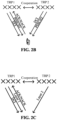
- the same piece of DCI may schedule a plurality of transmission layers from different TRPs, referring to FIG. 2C .
- the transmission layers from different TRPs use Demodulation Reference Signal (DMRS) ports in different Code Division Multiplexing (CDM) groups, and use different Transmission Configuration Indicator (TCI) states.
- DMRS Demodulation Reference Signal
- CDM Code Division Multiplexing
- TCI Transmission Configuration Indicator
- the network device needs to indicate the DMRS ports from different CDM groups in one piece of DCI, and TCI states corresponding to different CDM groups, so as to support different DMRS ports using different beams for transmission.
- HARQ-ACK feedback and CSI reporting may reuse mechanisms in existing protocols. This solution can only be used for an ideal backhaul scenario.
- a terminal device In order to enable a network device to perform scheduling reasonably, a terminal device needs to feed back the downlink CSI, so that the network device determines scheduling information of the terminal device, such as the number of transmission layers, a precoding matrix, a transmission beam, and a modulation coding method.
- CSI reporting of the terminal device is performed based on a CSI reporting configuration indicated by the network device.
- An uplink resource used for the terminal device to report CSI and a downlink reference signal for the terminal to perform CSI measurement are both indicated by the CSI reporting configuration.
- Each CSI reporting configuration corresponds to one CSI reporting.
- Each CSI reporting may include the information such as a CSI-RS Resource Indicator (CRI), a RI, a PMI, and a CQI.
- CRI CSI-RS Resource Indicator
- PMI RI
- CQI CQI
- the periodic CSI is transmitted on a Physical Uplink Control Channel (PUCCH), and its CSI reporting configuration is configured by Radio Resource Control (RRC) signaling.
- RRC Radio Resource Control
- the terminal device periodically reports the CSI after receiving the corresponding RRC signaling.
- the quasi-continuous CSI may be transmitted on a PUCCH or a Physical Uplink Shared Channel (PUSCH).
- the CSI reporting configuration corresponding to the CSI transmitted on the PUCCH is pre-configured by the RRC signaling, and is activated or deactivated by Media Access Control (MAC) layer signaling.
- MAC Media Access Control
- the CSI reporting configuration corresponding to the CSI transmitted on the PUSCH is dynamically indicated (activated or deactivated) through DCI signaling.
- the CSI is periodically transmitted on the PUCCH or the PUSCH, and is stopped to be reported until receiving deactivation signaling.
- the CSI reporting configuration corresponding to non-periodic CSI reporting is also pre-configured through the RRC signaling. Part configuration of the CSI reporting configuration may be activated through the MAC layer signaling, and then the CSI reporting configuration used for the CSI reporting is indicated through CSI trigger signaling in the DCI.
- the terminal device receives the CSI trigger signaling, the corresponding CSI is reported at one time on the scheduled PUSCH according to the indicated CSI reporting configuration.
- one piece of CSI may be divided into two parts.
- the CSI information included in CSI Part 1 and CSI Part 2 is as shown in the following Table 1.
- the number of bits of CSI Part 1 is fixed, and is used for carrying a small amount of important information such as a RI and a CQI; and the number of bits of CSI Part 2 is determined according to CSI Part 1, and is used for carrying the information with a large number of bits, such as a PMI.
- the terminal device When the code rate of an uplink channel (such as a PUSCH or a PUCCH) carrying the CSI exceeds a certain value, the terminal device needs to discard some information in CSI Part 2 to ensure the transmission performance of the uplink channel (at least the bit rate is within a reasonable range). Specifically, the information in CSI part 1 cannot be discarded, and in CSI Part 2, the CSI Part 2 corresponding to the CSI with low priority is discarded first according to the priority of the CSI reporting.
- the priority of the CSI reporting is determined according to the periodicity of the CSI, the content of the CSI reporting, the carrier corresponding to the CSI reporting, and the Identity (ID) of the CSI reporting configuration.
- Type CSI Part 1 CSI Part 2 Type I codebook RI, CRI, CQI for 1st CW PMI, CQI for 2nd CW (RI>4)
- a terminal device reports one piece of CSI for each CSI reporting configuration.
- the CSI is obtained by calculating on the basis of a CMR and an IMR configured by a network device.
- One piece of CSI can only be used for obtaining the channel information of one TRP under one transmission solution.
- the network device needs to configure a plurality of CSI reporting configurations for the terminal device, so that the terminal device reports a plurality of pieces of CSI based on different transmission solutions.
- the terminal device respectively obtains the CSI of TRP 1 and CSI of TRP 2 when a single TRP performs scheduling based on the first CSI reporting configuration and second CSI reporting configuration (not considering the interference between TRPs), and respectively obtains the CSI of TRP 1 and CSI of TRP 2 when TRP 1 and TRP 2 perform scheduling simultaneously based on the third CSI reporting configuration and fourth CSI reporting configuration (considering the interference between the TRPs).
- This reporting method needs a large amount of CSI reporting overhead, which affects the uplink transmission performance.
- a great CSI feedback delay will also be introduced, which affects the downlink transmission performance. Therefore, the following technical solutions of the embodiments of the disclosure are proposed.
- FIG. 4 is a schematic flowchart of a CSI reporting and receiving method provided by the embodiments of the disclosure. As shown in FIG. 4 , the method includes steps S401 to S402.
- a terminal device determines second information in a second CSI part according to first information in a first CSI part.
- the first information is assumption information or two RIs.
- the assumption information is used for indicating a transmission assumption or a measurement assumption on which reporting the CSI is based.
- the two RIs are obtained by performing measurement based on different measurement resources.
- the second information includes at least one of: a PMI, or a CQI.
- the terminal device reports CSI.
- the CSI includes the first CSI part and the second CSI part.
- the terminal device reports the CSI.
- a network device receives the CSI reported by the terminal device.
- the CSI includes the first CSI part and the second CSI part.
- the network device may be a base station, such as gNB.
- the second information in the second CSI part is determined based on the first information in the first CSI part.
- the terminal device determines the second information in the second CSI part according to the first information in the first CSI part.
- the first information is assumption information or two RIs.
- the assumption information is used for indicating a transmission assumption or a measurement assumption on which CSI reporting is based.
- the two RIs are obtained by performing measurement based on different measurement resources.
- the second information includes the PMI and/or the CQI.
- the CSI comprises CSI Part 1 (i.e., the first CSI part) and CSI Part 2 (i.e., the second CSI part).
- the terminal device determines a PMI and/or a CQI included in the CSI Part 2 that constitutes the CSI according to the assumption information in CSI Part 1 of the CSI or the values of the two RIs included in CSI Part 1.
- the assumption information is used for indicating a transmission assumption or a measurement assumption on which CSI reporting is based.
- the assumption information is used for indicating the transmission assumption on which the CSI reporting is based. Specifically, the assumption information is used for indicating whether the CSI reporting is based on the transmission assumption of a single TRP or the transmission assumption of a plurality of TRPs.
- the assumption information may also be referred to as transmission assumption information.
- the assumption information is used for indicating the measurement assumption on which the CSI reporting is based. Specifically, the assumption information is used for indicating whether the CSI reporting is based on the measurement assumption of a single measurement resource or the measurement assumption of a plurality of measurement resources.
- the assumption information may also be referred to as measurement assumption information.
- the measurement resource may also be referred to as a CSI measurement resource.
- the measurement resource includes a CMR and/or an IMR.
- one measurement resource includes one CMR and one IMR.
- one measurement resource includes one CMR.
- one measurement resource includes one IMR.
- the first information is assumption information or two RIs.
- the technical solutions of the embodiments of the disclosure will be described below with reference to different implementations of the first information.
- the first information being assumption information
- the terminal device determines a PMI and/or a CQI in the second CSI part according to the assumption information in the first CSI part.
- the value of the assumption information being the first value corresponds to the transmission assumption of a single TRP or the measurement assumption of a single measurement resource.
- the second CSI part includes one PMI.
- all information in the CSI is obtained by performing measurement based on a single measurement resource.
- all information in the CSI is obtained by performing measurement based on the first measurement resource.
- the terminal device determines that the second CSI part includes two PMIs and k CQI in a case that the value of the assumption information is a second value.
- the value of k is 0 or 1.
- the second value is different from the first value.
- the terminal device determines that the second CSI part includes two PMIs and k CQI in a case that the value of the assumption information is not the first value.
- the value of the assumption information being the second value corresponds to the transmission assumption of a plurality of TRPs or the measurement assumption of a plurality of measurement resources.
- the second CSI part includes two PMIs and k CQI.
- the two PMIs are obtained by performing measurement based on different measurement resources.
- the first PMI of the two PMIs is obtained by performing measurement based on the first measurement resource
- the second PMI of the two PMIs is obtained by performing measurement based on the second measurement resource.
- the CQI included in the first CSI part is obtained by performing calculation based on the two PMIs in a case that the value of k is 0.
- the CQI included in the first CSI part is obtained by performing calculation based on the first PMI of the two PMIs
- the CQI included in the second CSI part is obtained by performing calculation based on the second PMI of the two PMIs.
- the value of k is determined according to a CSI reporting configuration corresponding to the CSI, or the number of CORESET group indexes configured by a network device, or the value of the assumption information.
- the second CSI part included one RI, and the one RI and the RI included in the first CSI part are obtained by performing measurement based on different measurement resources.
- the RI included in the first CSI part is obtained by performing measurement based on the first measurement resource
- the RI included in the second CSI part is obtained by performing measurement based on the second measurement resource.
- the sum of the RI included in the second CSI part and the RI included in the first CSI part is less than or equal to the maximum number of transmission layers supported by the terminal device.
- the second CSI part includes one CRI, and the one CRI and the CRI included in the first CSI part are obtained by performing measurement based on different measurement resource sets.
- the CRI included in the first CSI part is obtained by performing measurement based on the first measurement resource set
- the CRI included in the second CSI part is obtained by performing measurement based on the second measurement resource set.
- the first value is 0, and the second value is 1 or 2.
- B1) in the abovementioned solution may be implemented separately, or may be implemented in combination with B2) and/or B3).
- the code rate of a PUSCH or a PUCCH bearing the second CSI part needs to be less than or equal to a threshold value (referred to as a first threshold value).
- the terminal device discards at least one piece of a plurality of pieces of information in the second CSI part according to the priority sequence of the plurality of pieces of information in a case that the code rate of the PUSCH or the PUCCH bearing the second CSI part exceeds the first threshold value.
- the priority corresponding to the discarded information is lower than the priority corresponding to the information not to be discarded. That is, the information with low priority is discarded first until the code rate of the PUSCH or the PUCCH bearing the second CSI part needs to be less than or equal to the first threshold value.
- the priority of the first PMI in the second CSI part is higher than the priority of other information in the second CSI part, and there is a corresponding relationship between the first PMI and the RI of the first CSI part.
- the priority of the PMI, in the second CSI part, corresponding to the RI in the first CSI part is higher than the priority of other information in the second CSI part.
- the first information being two RIs
- the terminal device determines a PMI and/or a CQI in the second CSI part according to the values of the two RIs in the first CSI part.
- the two RIs are obtained by performing measurement based on different measurement resources.
- the first RI of the two RIs is obtained by performing measurement based on the first measurement resource
- the second RI of the two RIs is obtained by performing measurement based on the second measurement resource.
- the sum of the two RIs is less than or equal to the maximum number of transmission layers supported by the terminal device.
- the value of the first RI of the two RIs being 0 and the value of the second RI being not 0 corresponds to the transmission assumption of a single TRP or the measurement assumption of a single measurement resource.
- the second CSI part includes one PMI.
- the PMI corresponds to the second RI (that is, a non-zero RI).
- both the PMI and the CQI included in the CSI are obtained by performing calculation based on the second RI.
- the terminal device determines that the second CSI part includes two PMIs and k CQI, and the value of k is 0 or 1.
- the first PMI of the two PMIs corresponds to the first RI
- the second PMI of the two PMIs corresponds to the second RI.
- the values of both the first RI and the second RI of the two RIs being greater than 0 corresponds to the transmission assumption of a plurality of TRPs or the measurement assumption of a plurality of measurement resources.
- the second CSI part includes two PMIs and k CQI.
- the CQI included in the first CSI part is obtained by performing calculation based on the two RIs and the two PMIs in a case that the value of k is 0.
- the CQI included in the first CSI part is obtained by performing calculation based on the first PMI of the two PMIs
- the CQI included in the second CSI part is obtained by performing calculation based on the second PMI of the two PMIs.
- the value of k is determined according to a CSI reporting configuration corresponding to the CSI, or the number of CORESET group indexes configured by the network device.
- the first CSI part or the second CSI part further includes two CRIs, and the two CRIs are obtained by performing measurement based on different measurement resource sets. For example, one CRI is obtained by performing measurement based on the first measurement resource set, and the other CRI is obtained by performing measurement based on the second measurement resource.
- the code rate of a PUSCH or a PUCCH bearing the second CSI part needs to be less than or equal to a threshold value (referred to as a first threshold value).
- the terminal device discards at least one piece of a plurality of pieces of information in the second CSI part according to the priority sequence of the plurality of pieces of information in a case that the code rate of the PUSCH or the PUCCH bearing the second CSI part exceeds the first threshold value.
- the priority corresponding to the discarded information is lower than that corresponding to the information not to be discarded. That is, the information with low priority is discarded first until the code rate of the PUSCH or the PUCCH bearing the second CSI part to be less than or equal to the first threshold value.
- the priority of the first PMI in the second CSI part is higher than the priority of other information in the second CSI part, and there is a corresponding relationship between the first PMI and the first RI of the two RIs included in the first CSI part.
- the priority of the PMI i.e., the first PMI
- the second CSI part corresponding to the first RI of the two RIs included in the first CSI part is higher than the priority of other information in the second CSI part.
- the terminal device determines the PMI and/or the CQI included in the second CSI part that constitutes the CSI according to the assumption information in the first CSI part of the CSI or the values of the two RIs included in the first CSI part, so as to report the CSI.
- different transmission solutions may be indicated through the first CSI part.
- the terminal device may report the PMI and/or the CQI, in the second CSI part, corresponding to the indicated transmission solution, so that flexible switching between different transmission solutions can be supported with very low CSI feedback overhead.
- CSI Part 1 corresponds to the first CSI part in the embodiment of the disclosure
- CSI Part 2 corresponds to the second CSI part in the embodiment of the disclosure
- the network device in the following disclosure examples may be a base station, such as a gNB.
- the CSI reporting method of this disclosure example includes the steps S501 to S504.
- a network device configures two groups of CSI measurement resources in a CSI reporting configuration.
- each group of CSI measurement resources respectively correspond to two TRPs that cooperate with each other.
- Each group of CSI measurement resources includes at least one measurement resource (i.e., at least one CMR and at least one IMR) corresponding to one TRP.
- the terminal device performs measurement based on these two groups of CSI measurement resources, determines assumption information, and reports the assumption information through CSI Part 1 that constitutes the CSI.
- the assumption information is used for indicating whether the CSI reporting is based on the transmission assumption of a single TRP or the transmission assumption of a plurality of TRPs, or the assumption information is used for indicating whether the CSI reporting is based on the measurement assumption of a single measurement resource or the measurement assumption of a plurality of measurement resources.
- the CSI reported by the terminal device includes uplink control information corresponding to one TRP or one measurement resource.
- the CSI reported by the terminal device includes uplink control information corresponding to the plurality of TRPs respectively or uplink control information corresponding to the plurality of measurement resources respectively, or includes uplink control information obtained by performing joint measurement by the plurality of TRPs or the plurality of measurement resources.
- the terminal device may determine assumption information by the following manners: the terminal device may perform CSI measurement based on the transmission assumption of a single TRP and the transmission assumption of two TRPs, respectively, so as to select a superior transmission assumption and determine corresponding transmission assumption information (referred to as assumption information). Or, a terminal may perform CSI measurement based on the measurement assumption of a single measurement resource and the measurement assumption of two measurement resources, respectively, so as to select a superior measurement assumption and determine corresponding measurement assumption information (referred to as assumption information).
- the CSI measurement refers to the measurement for the CMR and/or the IMR.
- the measurement resource may be replaced with the CMR and the IMR, or replaced with the CMR, or replaced with the IMR.
- the terminal device determines a PMI and/or a CQI included in CSI Part 2 that constitutes the CSI according to the assumption information in CSI Part 1.
- the assumption information is used for indicating a transmission assumption or a measurement assumption on which reporting the CSI is based.
- TAI Transmission Assumption Information
- the first value is 0.
- the reporting of the CSI is based on the transmission assumption of a single TRP or the reporting of the CSI is based on the measurement assumption of a single measurement resource.
- all information in the CSI is obtained by performing measurement based on a first group of CSI measurement resources (i.e., CMRO and IMR0).
- the terminal device may report the CSI by reusing the existing CSI reporting mechanism.
- CSI Part 1 may include a RI and a CQI
- CSI Part 2 may include one PMI.
- CSI Part 2 may further include another CQI.
- the CQI in CSI Part 1 corresponds to a first codeword
- the CQI in CSI Part 2 corresponds to a second codeword.
- the second value is 1 or 2.
- the reporting of the CSI is based on the transmission assumption of a plurality of TRPs or the reporting of the CSI is based on the measurement assumption of a plurality of measurement resources.
- information in the CSI is obtained by performing measurement based on a first group of CSI measurement resources (i.e., CMRO and IMR0) and a second group of CSI measurement resources (i.e., CMR1 and IMR1).
- the terminal device needs to report the uplink control information corresponding to two TRPs or two measurement resources.
- the value of k may be determined according to a CSI reporting configuration corresponding to the CSI, or the number of CORESET group indexes configured by a network device, or the value of the TAI.
- the reporting of the CSI is based on the transmission assumption of a plurality of TRPs scheduled by a single DCI (that is, two TRPs perform scheduling jointly).
- the CQI included in CSI Part 1 is obtained by performing calculation based on the two PMIs, and CSI Part 2 does not include a CQI.
- CSI Part 2 may further include one RI.
- the one RI and the RI included in CSI Part 1 are obtained by performing measurement based on different measurement resources.
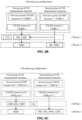
- CSI Part 1 includes TAI, RI0, and CQIO.
- CSI Part 2 includes RI1, PMI0, and PMI1.
- RI0 and PMI0 are obtained by performing measurement based on a group of CMR and IMR (i.e., CMRO and IMR0).
- RI1 and PMI2 are obtained by performing measurement based on another group of CMR and IMR (i.e., CMR1 and IMR1).
- CQIO is obtained by performing calculation based on the channel estimated by the terminal device, PMI0, and PMI1, that is, CQIO is the CQI jointly estimated based on channel measurement results of two TRPs.
- FIG. 6B illustrates that each of the two groups of CSI measurement resources configured by the network device only includes one CMR and one IMR. At this case, the terminal device does not need to report the CRI.
- CSI Part 2 may further include one CRI, and the one CRI and the CRI included in CSI Part 1 are obtained by performing measurement based on different measurement resource sets.
- CSI Part 1 includes CRI0
- CRI Part 2 includes CRI1.
- CMRO and IMR0 are a group of CMR and IMR corresponding to CRI0.
- CMR1 and IMR1 are a group of CMR and IMR corresponding to CRI1.
- the reporting of the CSI is based on the transmission assumption of a plurality of TRPs scheduled by a plurality of DCIs (that is, two TRPs performs scheduling independently).
- the CQI included in CSI Part 2 and the CQI included in CSI Part 1 are obtained by performing calculation based on the two PMIs, respectively.
- CSI Part 2 may further include one RI, and the RI and the RI included in CSI Part 1 are obtained by performing measurement based on different measurement resources. The two PMIs are obtained based on the RI in CSI Part 1 and the RI in CSI Part 2, respectively.
- CSI Part 2 may further include one CRI, and the one CRI and the CRI included in CSI Part 1 are obtained by performing measurement based on different measurement resource sets.
- the terminal device needs to select one CMR and one IMR therefrom and report the corresponding CRI. For example, as shown in FIG.
- CSI Part 1 includes CRI0, RI0, CQIO, and TAI
- CSI Part 2 includes CRI1, RI1, PMI0, PMI1, and CQI1.
- RI0, PMI0 and CQIO are obtained by performing measurement based on a group of CMR and IMR (i.e., CMRO and IMR0)
- CMRO and IMR0 are a group of CMR and IMR corresponding to CRI0
- RI1, PMI1 and CQI1 are obtained by performing measurement based on another group of CMR and IMR (i.e., CMR1 and IMR1)
- CMR1 and IMR1 are a group of CMR and IMR corresponding to CRI1).
- the sum of the RIs in CSI Part 1 and CSI Part 2 cannot exceed the maximum number of transmission layers supported by the terminal device. Further, the sum of the RIs in CSI Part 1 and CSI Part 2 also cannot exceed 4.
- the terminal device or the network device may determine the number of bits of the information included in CSI Part 2 based on the assumption information, so as to perform generation or detection for CSI Part 2.
- the assumption information on which the CSI reporting is based corresponds to the number of the PMIs/CQIs included in the CSI. Therefore, the assumption information may also be the information of the number of PMIs or the information of the number of CQIs, that is, the assumption information may be used for indicating the number of the PMIs included in the CSI or the number of the CQIs included in the CSI.
- the terminal device indicates a transmission assumption or a measurement assumption with the best performance currently through the assumption information.
- the network device may perform scheduling for downlink transmission based on the transmission assumption or the measurement assumption, so as to support flexible switching between different transmission solutions.
- the terminal device since the terminal device only needs to report the CSI corresponding to one transmission assumption or one measurement assumption, and does not need to report the CSI corresponding to a plurality of transmission assumptions or a plurality of measurement assumptions, the overhead of CSI feedback can be reduced significantly.
- the content included in CSI Part 2 is determined according to the assumption information in CSI Part 1, and the bit number and occupied resources of CSI Part 2 can be flexibly adjusted based on different feedback contents, so as to avoid unnecessary uplink resource waste.
- the terminal device reports the CSI according to the determined CSI Part 1 and CSI part 2.
- the CSI includes CSI Part 1 and CSI Part 2.
- CSI Part 1 and CSI Part 2 may be reported with reference to the methods in related arts.
- the threshold value may be calculated by the terminal device or may be configured to the terminal device by the network device.
- the priority of the PMI, corresponding to the RI in CSI Part 1, in CSI Part 2 is higher than the priority of other information in CSI Part 2.
- the CSI reporting method of the present application example includes steps S701 to S704.
- a network device configures two groups of CSI measurement resources in a CSI reporting configuration.
- each group of CSI measurement resources respectively correspond two TRPs that cooperate with each other.
- Each group of CSI measurement resources includes at least one measurement resource (i.e., at least one CMR and at least one IMR) corresponding to one TRP.
- the terminal device performs measurement based on these two groups of CSI measurement resources to obtain corresponding two RIs, and reports the two RIs through CSI Part 1 that constitutes CSI.
- the first group of CSI measurement resources corresponds to the first RI of the two RIs
- the second group of CSI measurement resources corresponds to the second RI of the two RIs.
- the terminal device determines a PMI and/or a CQI included in CSI Part 2 that constitutes the CSI according to the values of the two RIs in CSI Part 1.
- the uplink control information included in CSI Part 2 is described below.
- the reporting of the CSI is based on the transmission assumption of a single TRP or the reporting of the CSI is based on the measurement assumption of a single measurement resource.
- all information in the CSI is obtained by performing measurement based on a first group of CSI measurement resources (i.e., CMRO and IMR0).
- CSI Part 1 may include one CQI.
- CSI Part 2 may further include another CQI.
- the CQI in CSI Part 1 corresponds to a first codeword, and the CQI in CSI Part 2 corresponds to a second codeword.
- the value of one of the two RIs is 0, the value of the other non-zero RI is not limited.
- the two PMIs are obtained by performing measurement based on the same measurement resources as the two RIs, respectively.
- the first PMI of the two PMIs is obtained by performing measurement based on the same measurement resource (such as the first group of CSI measurement resources) as the first RI of the two RIs
- the second PMI of the two PMIs is obtained by performing measurement based on the same measurement resource (such as the second group of CSI measurement resources) as the second RI of the two RIs.
- the reporting of the CSI is based on the transmission assumption of a plurality of TRPs or the reporting of the CSI is based on the measurement assumption of a plurality of measurement resources.
- information in the CSI is obtained by performing measurement based on a first group of CSI measurement resources (i.e., CMRO and IMR0) and a second group of CSI measurement resources (i.e., CMR1 and IMR1).
- the terminal device needs to report the uplink control information corresponding to two TRPs or two measurement resources.
- the value of k may be determined according to a CSI reporting configuration corresponding to the CSI, or the number of CORESET group indexes configured by the network device.
- the reporting of the CSI is based on the transmission assumption of a plurality of TRPs scheduled by a single DCI (that is, two TRPs performs scheduling jointly).
- the CQI included in CSI Part 1 is calculated based on the two RIs and the two PMIs, and CSI Part 2 does not include a CQI.
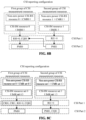
- CSI Part 1 includes RI0>0, RI1>0, and CQIO.
- CSI Part 2 includes PMI0 and PMI1.
- RI0 and PMI1 are obtained by performing measurement based on a group of CMR and IMR (i.e., CMRO and IMR0).
- RI1 and PMI1 are obtained by performing measurement based on a group of CMR and IMR (i.e., CMR1 and IMR1).
- CQIO is obtained by performing calculation based on the channel estimated by the terminal device, PMI0, and PMI1, that is, CQIO is the CQI jointly estimated based on channel measurement results of two TRPs.
- FIG. 8B illustrates that each of the two groups of CSI measurement resources configured by the network device only include one CMR and one IMR. At this case, the terminal device does not need to report the CRI.
- CSI Part 1 may further include two CRIs, and the two CRIs are obtained by performing measurement based on different measurement resource sets.
- CSI Part 1 further includes CRI0 and CRI1.
- CMRO and IMR0 are a group of CMR and IMR corresponding to CRI0.
- CMR1 and IMR1 are a group of CMR and IMR corresponding to CRI1.
- the reporting of the CSI is based on the transmission assumption of a plurality of TRPs scheduled by a plurality of DCIs (that is, two TRPs performs scheduling independently).
- the CQI included in CSI Part 2 and the CQI included in CSI Part 1 are obtained by performing calculation based on the two PMIs, respectively.
- CSI may further include two CRIs, and the two CRIs are obtained by performing measurement based on different measurement resource sets.
- the terminal device needs to select one CMR and one IMR therefrom and report the corresponding CRI.
- Two groups of CSI measurement resources correspond to two CRIs. Both the CRIs may be in CSI Part 1 or may be in CSI Part 2, or one CRI is in CSI Part 1 and the other CRI is in CSI Part 2.
- CSI Part 1 includes CRI0, CRI1, RI0>0, RI1>0, and CQIO.
- CSI Part 2 includes PMI0, PMI1, and CQI1.
- RI0, PMI0, and CQIO are obtained by performing measurement based on a group of CMR and IMR (i.e., CMRO and IMR0) (CMRO and IMR0 are a group of CMR and IMR corresponding to CRI0).
- RI1, PMI1, and CQI1 are obtained by performing measurement based on the other group of CMR and IMR (i.e., CMR1 and IMR1) (CMR1 and IMR1 are a group of CMR and IMR corresponding to CRI1).
- the sum of the two RIs cannot exceed the maximum number of transmission layers supported by the terminal device. Further, the sum of the two RIs also cannot exceed 4.
- the terminal device or the network device may determine the number of bits of the information included in CSI Part 2 based on the values of the two RIs, so as to perform generation or detection for CSI Part 2.
- the terminal device indicates different transmission solutions (equivalent to a transmission assumption or a measurement assumption) through the values of two RIs, and the network device may perform scheduling for the downlink transmission based on the transmission solutions corresponding to the values of the two RIs, such that flexible switching between different transmission solutions can be supported.
- the terminal device since the terminal device only needs to report the CSI corresponding to the best transmission assumption, and does not need to report the CSI corresponding to a plurality of transmission assumptions, the overhead of CSI feedback can be reduced significantly.
- the content included in CSI Part 2 is determined according to the value of the RI in CSI Part 1, and the bit number and occupied resources of CSI Part 2 can be flexibly adjusted based on different feedback contents, so as to avoid unnecessary uplink resource waste.
- the terminal device reports the CSI according to the determined CSI Part 1 and CSI part 2.
- the CSI comprises CSI Part 1 and CSI Part 2.
- CSI Part 1 and CSI Part 2 may be reported with reference to the methods in related arts.
- the threshold value may be calculated by the terminal device or may be configured to the terminal device by the network device.
- the priority of the PMI, corresponding to the first RI of CSI Part 1, in CSI Part 2 is higher than the priority of other information in CSI Part 2.
- the determination unit 901 is configured to determine second information in a second CSI part according to first information in a first CSI part.
- the first information is assumption information or two RIs.
- the assumption information is used for indicating a transmission assumption or a measurement assumption on which reporting the CSI is based.
- the two RIs are obtained by performing measurement based on different measurement resources.
- the second information includes at least one of: a PMI, or a CQI.
- the transmitting unit 902 is configured to report CSI.
- the CSI includes the first CSI part and the second CSI part.
- the assumption information is used for indicating whether reporting the CSI is based on the transmission assumption of a single TRP or based on the transmission assumption of a plurality of TRPs, or the assumption information is used for indicating whether reporting the CSI is based on the measurement assumption of a single measurement resource or based on the measurement assumption of a plurality of measurement resources.
- the first information is assumption information.
- the determination unit 901 is configured to: determine that the second CSI part includes one PMI in a case that the value of the assumption information is a first value, and determine that the second CSI part includes two PMIs and k CQI in a case that the value of the assumption information is a second value.
- the value of k is 0 or 1.
- all information in the CSI is obtained by performing measurement based on a single measurement resource in a case that the value of the assumption information is the first value.
- the two PMIs are obtained by performing measurement based on different measurement resources.
- the CQI included in the first CSI part is obtained by performing calculation based on the two PMIs in a case that the value of k is 0.
- the CQI included in the first CSI part is obtained by performing calculation based on the first PMI of the two PMIs
- the CQI included in the second CSI part is obtained by performing calculation based on the second PMI of the two PMIs.
- the value of k is determined according to a CSI reporting configuration corresponding to the CSI, or the number of CORESET group indexes configured by a network device, or the value of assumption information.
- the second CSI part includes one RI, and the one RI and the RI included in the first CSI part are obtained by performing measurement based on different measurement resources.
- the sum of the RI included in the second CSI part and the RI included in the first CSI part is less than or equal to the maximum number of transmission layers supported by the terminal device.
- the second CSI part includes one CRI, and the one CRI and the CRI included in the first CSI part are obtained by performing measurement based on different measurement resource sets.
- the first information is two RIs.
- the determination unit 901 is configured to determine that the second CSI part includes one PMI in a case that the value of the first RI of the two RIs is 0 and the value of the second RI of the two RIs is not 0.
- both the PMI and the CQI included in the CSI are obtained by performing calculation based on the second RI.
- the first information is two RIs.
- the determination unit 901 is configured to determine that the second CSI part includes two PMIs and k CQI in a case that both the value of the first RI of the two RIs and the value of the second RI of the two RIs are greater than 0.
- the value of k is 0 or 1.
- the first PMI of the two PMIs corresponds to the first RI
- the second PMI of the two PMIs corresponds to the second RI.
- the CQI included in the first CSI part is obtained by performing calculation based on the two RIs and the two PMIs in a case that the value of k is 0.
- the CQI included in the first CSI part is obtained by performing calculation based on the first PMI of the two PMIs
- the CQI included in the second CSI part is obtained by performing calculation based on the second PMI of the two PMIs.
- the value of k is based on a CSI reporting configuration corresponding to the CSI, or the number of CORESET group indexes configured by a network device.
- the first CSI part or the second CSI part includes two CRIs, and the two CRIs are obtained by performing measurement based on different measurement resource sets.
- the sum of the two RIs is less than or equal to the maximum number of transmission layers supported by the terminal device.
- the device further includes a processing unit.
- the processing unit (not shown in the drawings) is configured to discard at least one piece of a plurality of pieces of information in the second CSI part according to the priority sequence of the plurality of pieces of information in a case that the code rate of a PUSCH or a PUCCH bearing the second CSI part exceeds a first threshold value.
- the priority corresponding to the discarded information is lower than the priority corresponding to the information not to be discarded.
- the priority of the first PMI in the second CSI part is higher than the priority of other information in the second CSI part, and there is a corresponding relationship between the first PMI and the RI of the first CSI part.
- the device further includes a processing unit.
- the processing unit is configured to discard at least one piece of a plurality of pieces of information in the second CSI part according to the priority sequence of the plurality of pieces of information in a case that the code rate of a PUSCH or a PUCCH bearing the second CSI part exceeds a first threshold value.
- the priority corresponding to the discarded information is lower than the priority corresponding to the information not to be discarded.
- the priority of the first PMI in the second CSI part is higher than the priority of other information in the second CSI part, and there is a corresponding relationship between the first PMI and the first RI of the two RIs included in the first CSI part.
- the measurement resource includes a CMR and/or an IMR.
- FIG. 10 is a schematic diagram of structural compositions of a CSI receiving device provided by an embodiment of the disclosure, which is applied to a network device. As shown in FIG. 10 , the CSI receiving device includes a receiving unit 1001.
- the receiving unit 1001 receives the CSI reported by a terminal device.
- the CSI includes a first CSI part and a second CSI part.
- Second information in the second CSI part is determined based on first information in the first CSI part.
- the first information is assumption information or two RIs.
- the assumption information is used for indicating a transmission assumption or a measurement assumption on which reporting the CSI is based.
- the two RIs are obtained by performing measurement based on different measurement resources.
- the second information includes at least one of: a PMI, or a CQI.
- the assumption information is used for indicating whether the CSI reporting is based on the transmission assumption of a single TRP or based on the transmission assumption of a plurality of TRPs, or the assumption information is used for indicating whether the CSI reporting is based on the measurement assumption of a single measurement resource or based on the measurement assumption of a plurality of measurement resources.
- the first information is assumption information.
- the second CSI part includes one PMI in a case that the value of the assumption information is a first value.
- the second CSI part includes two PMIs and k CQI in a case that the value of the assumption information is a second value, and the value of k is 0 or 1.
- all information in the CSI is obtained by performing measurement based on a single measurement resource in a case that the value of the assumption information is the first value.
- the two PMIs are obtained by performing measurement based on different measurement resources.
- the CQI included in the first CSI part is obtained by performing calculation based on the two PMIs in a case that the value of k is 0.
- the CQI included in the first CSI part is obtained by performing calculation based on the first PMI of the two PMIs
- the CQI included in the second CSI part is obtained by performing calculation based on the second PMI of the two PMIs.
- the value of k is determined according to a CSI reporting configuration corresponding to the CSI, or the number of control resource set CORESET group indexes configured by a network device, or the value of assumption information.
- the second CSI part includes one RI, and the one RI and the RI included in the first CSI part are obtained by performing measurement based on different measurement resources.
- the sum of the RI included in the second CSI part and the RI included in the first CSI part is less than or equal to the maximum number of transmission layers supported by the terminal device.
- the second CSI part includes one RI, and the one RI and the RI included in the first CSI part are obtained by performing measurement based on different measurement resource sets.
- the first information is two RIs.
- the second CSI part includes one PMI in a case that the value of the first RI of the two RIs is 0 and the value of the second RI of the two RIs is not 0.
- both the PMI and the CQI included in the CSI are obtained by performing calculation based on the second RI.
- the first information is two RIs.
- the second CSI part includes two PMIs and k CQI in a case that both values of the first RI and the second RI of the two RIs are greater than 0.
- the value of k is 0 or 1.
- the first PMI of the two PMIs corresponds to the first RI
- the second PMI of the two PMIs corresponds to the second RI.
- the CQI included in the first CSI part is obtained by performing calculation based on the two RIs and the two PMIs in a case that the value of k is 0.
- the CQI included in the first CSI part is obtained by performing calculation based on the first PMI of the two PMIs
- the CQI included in the second CSI part is obtained by performing calculation based on the second PMI of the two PMIs.
- the value of k is determined according to a CSI reporting configuration corresponding to the CSI, or the number of CORESET group indexes configured by a network device.
- the first CSI part or the second CSI part includes two CRIs, and the two CRIs are obtained by performing calculation based on different measurement resource sets.
- the sum of the two RIs is less than or equal to the maximum number of transmission layers supported by the terminal device.
- the measurement resource includes a CMR and/or an IMR.
- FIG. 11 is a schematic structural diagram of a communication device 1100 provided by an embodiment of the disclosure.
- the communication device 1100 may be a terminal device, or may be a network device.
- the communication device 1100 as shown in FIG. 11 includes a processor 1110.
- the processor 1110 may call and run a computer program from a memory to implement the method in the embodiment of the disclosure.
- device 1100 may further include a memory 1120.
- the processor 1110 may call and run the computer program from the memory 1120 to implement the method in the embodiments of the disclosure.
- the memory 1120 may be independent from the processor 1110, or may be integrated into the processor 1110.
- the communications device 1100 may also include a transceiver 1130.
- the processor 1110 may control the transceiver 1130 to be in communication with other devices, specifically, to send information or data to other devices, or receive the information or data sent by other devices.
- the transceiver 1130 may include a transmitter and a receiver.
- the transceiver 1130 may further include an antenna. There may be one or more antennas.
- the communications device 1100 may specifically be a network device of the embodiment of the disclosure, and the communication device 1100 may implement corresponding flows implemented by the network device in various methods of the embodiments of the disclosure, which will not be elaborated here for simplicity.
- the communications device 1100 may specifically be a mobile terminal/a terminal device of the embodiment of the disclosure, and the communication device 1100 may implement corresponding flows implemented by the mobile terminal/the terminal device in various methods of the embodiments of the disclosure, which will not be elaborated here for simplicity.
- FIG. 12 is a schematic structural diagram of a chip of an embodiment of the disclosure.
- the chip 1200 as shown in FIG. 12 includes a processor 1210.
- the processor 1210 may call and run a computer program from a memory 1220 to implement the method in the embodiments of the disclosure.
- an input interface 1230 and an output interface 1240 are further included.
- FIG. 13 is a schematic block diagram of a communication system 1300 provided by an embodiment of the disclosure. As shown in FIG. 13 , the communication system 1300 includes a terminal device 1310 and a network device 1320.
- the terminal device 1310 may be configured to implement corresponding functions implemented by the terminal device in the abovementioned method
- the network device 1320 may be configured to implement corresponding functions implemented by the network device in the abovementioned method, which will not be elaborated here for simplicity.
- the embodiments of the disclosure further provide a computer program product, which includes a computer program instruction.
- the computer program product may be applied to a network device in the embodiments of the disclosure.
- the computer program instruction enables a computer to execute corresponding flows implemented by the network device in each method of the embodiments of the disclosure, which will not be elaborated here for simplicity.
- the computer program product may be applied to a mobile terminal/a terminal device in the embodiments of the disclosure.
- the computer program instruction enables a computer to execute corresponding flows implemented by the mobile terminal/the terminal device in each method of the embodiments of the disclosure, which will not be elaborated here for simplicity.
- the embodiments of the disclosure further provide a computer program.
- the computer program may be applied to a network device in the embodiments of the disclosure.
- the computer program runs in a computer to enable the computer to execute corresponding flows implemented by the network device in each method of the embodiments of the disclosure, which will not be elaborated here for simplicity.
- the computer program may be applied to a mobile terminal/a terminal device in the embodiments of the disclosure.
- the computer program When running on a computer, the computer program enables a computer to execute corresponding flows implemented by the mobile terminal/the terminal device in each method of the embodiments of the disclosure, which will not be elaborated here for simplicity.
- the disclosed system, device, and method may be implemented in other manners.
- the described device embodiment is merely schematic.
- the unit division is merely logical function division and may be other division in actual implementation.
- a plurality of units or components may be combined or integrated into another system, or some features may be ignored or may not be performed.
- the displayed or discussed mutual couplings or direct couplings or communication connections may be implemented by using some interfaces.
- the indirect couplings or communication connections between the devices or units may be implemented in electronic, mechanical, or other forms.
- the units described as separate parts may or may not be physically separate, and parts displayed as units may or may not be physical units, may be located in one location, or may be distributed on a plurality of network elements. Some or all of the units may be selected based on actual requirements to achieve the objectives of the solutions of the embodiments.
- functional units in the embodiments of the disclosure may be integrated into one processing unit, or each of the units may exist alone physically, or two or more units are integrated into one unit.
- the software product is stored in a storage medium, and includes several instructions for instructing a computer device (which may be a personal computer, a server, a network device, or the like) to perform all or some of the steps of the methods described in the embodiments of the disclosure.
- the abovementioned storage medium includes: various media capable of storing program codes such as a U disk, a mobile hard disk, a Read-Only Memory (ROM), a Radom Access Memory (RAM), a magnetic disk or an optical disk.
Landscapes
- Engineering & Computer Science (AREA)
- Signal Processing (AREA)
- Computer Networks & Wireless Communication (AREA)
- Physics & Mathematics (AREA)
- Mathematical Physics (AREA)
- Mobile Radio Communication Systems (AREA)
Applications Claiming Priority (1)
| Application Number | Priority Date | Filing Date | Title |
|---|---|---|---|
| PCT/CN2020/113101 WO2022047679A1 (zh) | 2020-09-02 | 2020-09-02 | Csi上报及接收方法、装置、终端设备、网络设备 |
Publications (3)
| Publication Number | Publication Date |
|---|---|
| EP4192087A1 true EP4192087A1 (de) | 2023-06-07 |
| EP4192087A4 EP4192087A4 (de) | 2023-08-30 |
| EP4192087B1 EP4192087B1 (de) | 2025-04-23 |
Family
ID=80492387
Family Applications (1)
| Application Number | Title | Priority Date | Filing Date |
|---|---|---|---|
| EP20951926.3A Active EP4192087B1 (de) | 2020-09-02 | 2020-09-02 | Verfahren und vorrichtung zum melden und empfangen von csi sowie endgerätevorrichtung und netzwerkvorrichtung |
Country Status (7)
| Country | Link |
|---|---|
| US (1) | US20230208492A1 (de) |
| EP (1) | EP4192087B1 (de) |
| JP (1) | JP7615307B2 (de) |
| KR (1) | KR20230061420A (de) |
| CN (2) | CN117155524B (de) |
| ES (1) | ES3027204T3 (de) |
| WO (1) | WO2022047679A1 (de) |
Families Citing this family (7)
| Publication number | Priority date | Publication date | Assignee | Title |
|---|---|---|---|---|
| CN116569590A (zh) * | 2020-09-30 | 2023-08-08 | 株式会社Ntt都科摩 | 终端、无线通信方法以及基站 |
| US12301308B2 (en) * | 2021-04-06 | 2025-05-13 | Nokia Technologies Oy | CRI extension for multi-TRP CSI enhancement |
| WO2023004754A1 (en) * | 2021-07-30 | 2023-02-02 | Zte Corporation | Systems and methods for reference signaling design and configuration |
| CN118830211A (zh) * | 2022-03-31 | 2024-10-22 | 富士通株式会社 | 用于报告和接收信道状态信息的方法和装置 |
| JP2025524833A (ja) * | 2022-07-19 | 2025-08-01 | エルジー エレクトロニクス インコーポレイティド | 無線通信システムにおいてチャネル品質インジケータを送信する方法及びそのための装置 |
| CN118353581A (zh) * | 2023-01-13 | 2024-07-16 | 北京紫光展锐通信技术有限公司 | 一种信道状态信息报告确定方法、装置、芯片及模组设备 |
| WO2024168830A1 (zh) * | 2023-02-17 | 2024-08-22 | 富士通株式会社 | 信道状态信息的发送和接收方法、装置和通信系统 |
Family Cites Families (10)
| Publication number | Priority date | Publication date | Assignee | Title |
|---|---|---|---|---|
| CN102291228B (zh) * | 2011-08-16 | 2014-08-06 | 电信科学技术研究院 | 信道状态信息的反馈、接收方法和设备 |
| WO2017048048A1 (ko) * | 2015-09-14 | 2017-03-23 | 엘지전자 주식회사 | 무선 통신 시스템에서 채널 상태 정보 송수신 방법 및 이를 위한 장치 |
| WO2018027908A1 (en) * | 2016-08-12 | 2018-02-15 | Qualcomm Incorporated | Dynamic multi-beam transmission for new radio technology multiple-input multiple-output |
| US10873439B2 (en) | 2016-12-16 | 2020-12-22 | Samsung Electronics Co., Ltd. | Method and apparatus for multiplexing channel state information |
| CN109391404B (zh) * | 2017-08-10 | 2021-02-09 | 电信科学技术研究院有限公司 | 一种csi的反馈及其控制方法、装置 |
| WO2019148399A1 (zh) * | 2018-01-31 | 2019-08-08 | 华为技术有限公司 | 上报信道状态信息csi的方法和装置 |
| US10819410B2 (en) | 2018-04-06 | 2020-10-27 | Qualcomm Incorporated | Selecting physical uplink control channel (PUCCH) resources for channel state information |
| WO2020026297A1 (ja) | 2018-07-30 | 2020-02-06 | 株式会社Nttドコモ | 基地局及び無線通信方法 |
| US11128429B2 (en) * | 2018-10-05 | 2021-09-21 | Lenovo (Singapore) Pte. Ltd. | Method and apparatus for generating a CSI report |
| CN111277360B (zh) * | 2019-01-11 | 2023-02-21 | 维沃移动通信有限公司 | 信道状态信息csi报告的传输方法、终端及网络设备 |
-
2020
- 2020-09-02 CN CN202310922488.2A patent/CN117155524B/zh active Active
- 2020-09-02 CN CN202080103620.1A patent/CN116018772A/zh active Pending
- 2020-09-02 KR KR1020237010209A patent/KR20230061420A/ko active Pending
- 2020-09-02 ES ES20951926T patent/ES3027204T3/es active Active
- 2020-09-02 WO PCT/CN2020/113101 patent/WO2022047679A1/zh not_active Ceased
- 2020-09-02 JP JP2023514484A patent/JP7615307B2/ja active Active
- 2020-09-02 EP EP20951926.3A patent/EP4192087B1/de active Active
-
2022
- 2022-12-27 US US18/146,643 patent/US20230208492A1/en active Pending
Also Published As
| Publication number | Publication date |
|---|---|
| KR20230061420A (ko) | 2023-05-08 |
| CN116018772A (zh) | 2023-04-25 |
| CN117155524B (zh) | 2025-03-18 |
| EP4192087B1 (de) | 2025-04-23 |
| JP7615307B2 (ja) | 2025-01-16 |
| US20230208492A1 (en) | 2023-06-29 |
| ES3027204T3 (en) | 2025-06-13 |
| JP2023545234A (ja) | 2023-10-27 |
| EP4192087A4 (de) | 2023-08-30 |
| WO2022047679A1 (zh) | 2022-03-10 |
| CN117155524A (zh) | 2023-12-01 |
Similar Documents
| Publication | Publication Date | Title |
|---|---|---|
| EP4192087B1 (de) | Verfahren und vorrichtung zum melden und empfangen von csi sowie endgerätevorrichtung und netzwerkvorrichtung | |
| US11924815B2 (en) | Bandwidth recourse switching method, terminal, and network device for indicating bandwidth resource switching | |
| US11239950B2 (en) | Method for configuring channel state information reporting band and communications apparatus | |
| EP3874662B1 (de) | Csi-rückkopplung zur datenübertragung über mehrere übertragungspunkte | |
| US12150071B2 (en) | Method for transmitting sidelink data, terminal device, and network device | |
| US11012995B2 (en) | Feedback information transmission method and apparatus | |
| JP6466515B2 (ja) | 協調マルチポイント(CoMP)システムのための周期的チャネル状態情報レポート | |
| RU2484589C2 (ru) | Терминал пользователя, базовая станция и способ передачи сигнала, используемые в системе мобильной связи | |
| US12395298B2 (en) | Information configuration method and apparatus, and terminal | |
| WO2021013013A1 (en) | Methods and devices for determining spatial relation, user equipment and network device | |
| CN114982333B (zh) | Csi上报及接收方法、装置、终端设备、网络设备 | |
| US12301308B2 (en) | CRI extension for multi-TRP CSI enhancement | |
| US10511411B2 (en) | Method for configuring channel state information reporting band and communications apparatus | |
| WO2020029233A1 (zh) | 上报信道状态信息的方法和装置 | |
| US20210111773A1 (en) | Method for feedback of correlation of beams in wireless communication system and user equipment | |
| CN113285794A (zh) | 传输上行反馈信息的方法、终端设备和网络设备 | |
| US20200145973A1 (en) | Information transmission method, apparatus and terminal | |
| CN112703699A (zh) | 传输数据信道的方法和终端设备 | |
| CN114258654A (zh) | 用于传输信道状态信息的方法及设备 | |
| TW202013917A (zh) | 一種通道狀態訊息上報方法、終端設備及網路設備 | |
| US11290906B2 (en) | Channel measurement method | |
| WO2021151855A1 (en) | Csi accuracy indicator reporting for mu-mimo broadcast channel | |
| CN114501622B (zh) | 一种传输处理方法及装置 | |
| CN114070482B (zh) | 业务传输的处理方法、装置、网络侧设备及终端 | |
| CN119896004A (zh) | 一种无线通信方法及设备、存储介质 |
Legal Events
| Date | Code | Title | Description |
|---|---|---|---|
| STAA | Information on the status of an ep patent application or granted ep patent |
Free format text: STATUS: THE INTERNATIONAL PUBLICATION HAS BEEN MADE |
|
| PUAI | Public reference made under article 153(3) epc to a published international application that has entered the european phase |
Free format text: ORIGINAL CODE: 0009012 |
|
| STAA | Information on the status of an ep patent application or granted ep patent |
Free format text: STATUS: REQUEST FOR EXAMINATION WAS MADE |
|
| 17P | Request for examination filed |
Effective date: 20221222 |
|
| AK | Designated contracting states |
Kind code of ref document: A1 Designated state(s): AL AT BE BG CH CY CZ DE DK EE ES FI FR GB GR HR HU IE IS IT LI LT LU LV MC MK MT NL NO PL PT RO RS SE SI SK SM TR |
|
| A4 | Supplementary search report drawn up and despatched |
Effective date: 20230801 |
|
| RIC1 | Information provided on ipc code assigned before grant |
Ipc: H04L 5/00 20060101ALI20230726BHEP Ipc: H04W 24/08 20090101AFI20230726BHEP |
|
| DAV | Request for validation of the european patent (deleted) | ||
| DAX | Request for extension of the european patent (deleted) | ||
| STAA | Information on the status of an ep patent application or granted ep patent |
Free format text: STATUS: EXAMINATION IS IN PROGRESS |
|
| 17Q | First examination report despatched |
Effective date: 20240226 |
|
| GRAP | Despatch of communication of intention to grant a patent |
Free format text: ORIGINAL CODE: EPIDOSNIGR1 |
|
| STAA | Information on the status of an ep patent application or granted ep patent |
Free format text: STATUS: GRANT OF PATENT IS INTENDED |
|
| INTG | Intention to grant announced |
Effective date: 20250103 |
|
| GRAS | Grant fee paid |
Free format text: ORIGINAL CODE: EPIDOSNIGR3 |
|
| GRAA | (expected) grant |
Free format text: ORIGINAL CODE: 0009210 |
|
| STAA | Information on the status of an ep patent application or granted ep patent |
Free format text: STATUS: THE PATENT HAS BEEN GRANTED |
|
| AK | Designated contracting states |
Kind code of ref document: B1 Designated state(s): AL AT BE BG CH CY CZ DE DK EE ES FI FR GB GR HR HU IE IS IT LI LT LU LV MC MK MT NL NO PL PT RO RS SE SI SK SM TR |
|
| REG | Reference to a national code |
Ref country code: GB Ref legal event code: FG4D |
|
| REG | Reference to a national code |
Ref country code: CH Ref legal event code: EP |
|
| REG | Reference to a national code |
Ref country code: DE Ref legal event code: R096 Ref document number: 602020050214 Country of ref document: DE |
|
| REG | Reference to a national code |
Ref country code: IE Ref legal event code: FG4D |
|
| REG | Reference to a national code |
Ref country code: NL Ref legal event code: FP |
|
| REG | Reference to a national code |
Ref country code: ES Ref legal event code: FG2A Ref document number: 3027204 Country of ref document: ES Kind code of ref document: T3 Effective date: 20250613 |
|
| REG | Reference to a national code |
Ref country code: AT Ref legal event code: MK05 Ref document number: 1789020 Country of ref document: AT Kind code of ref document: T Effective date: 20250423 |
|
| P01 | Opt-out of the competence of the unified patent court (upc) registered |
Free format text: CASE NUMBER: UPC_APP_5337_4192087/2025 Effective date: 20250829 |
|
| PG25 | Lapsed in a contracting state [announced via postgrant information from national office to epo] |
Ref country code: FI Free format text: LAPSE BECAUSE OF FAILURE TO SUBMIT A TRANSLATION OF THE DESCRIPTION OR TO PAY THE FEE WITHIN THE PRESCRIBED TIME-LIMIT Effective date: 20250423 Ref country code: PT Free format text: LAPSE BECAUSE OF FAILURE TO SUBMIT A TRANSLATION OF THE DESCRIPTION OR TO PAY THE FEE WITHIN THE PRESCRIBED TIME-LIMIT Effective date: 20250825 |
|
| PGFP | Annual fee paid to national office [announced via postgrant information from national office to epo] |
Ref country code: DE Payment date: 20250923 Year of fee payment: 6 |
|
| REG | Reference to a national code |
Ref country code: LT Ref legal event code: MG9D |
|
| PG25 | Lapsed in a contracting state [announced via postgrant information from national office to epo] |
Ref country code: NO Free format text: LAPSE BECAUSE OF FAILURE TO SUBMIT A TRANSLATION OF THE DESCRIPTION OR TO PAY THE FEE WITHIN THE PRESCRIBED TIME-LIMIT Effective date: 20250723 Ref country code: GR Free format text: LAPSE BECAUSE OF FAILURE TO SUBMIT A TRANSLATION OF THE DESCRIPTION OR TO PAY THE FEE WITHIN THE PRESCRIBED TIME-LIMIT Effective date: 20250724 |
|
| PG25 | Lapsed in a contracting state [announced via postgrant information from national office to epo] |
Ref country code: PL Free format text: LAPSE BECAUSE OF FAILURE TO SUBMIT A TRANSLATION OF THE DESCRIPTION OR TO PAY THE FEE WITHIN THE PRESCRIBED TIME-LIMIT Effective date: 20250423 |
|
| PGFP | Annual fee paid to national office [announced via postgrant information from national office to epo] |
Ref country code: NL Payment date: 20250916 Year of fee payment: 6 Ref country code: IT Payment date: 20250917 Year of fee payment: 6 |
|
| PG25 | Lapsed in a contracting state [announced via postgrant information from national office to epo] |
Ref country code: BG Free format text: LAPSE BECAUSE OF FAILURE TO SUBMIT A TRANSLATION OF THE DESCRIPTION OR TO PAY THE FEE WITHIN THE PRESCRIBED TIME-LIMIT Effective date: 20250423 |
|
| PGFP | Annual fee paid to national office [announced via postgrant information from national office to epo] |
Ref country code: GB Payment date: 20250915 Year of fee payment: 6 |
|
| PG25 | Lapsed in a contracting state [announced via postgrant information from national office to epo] |
Ref country code: HR Free format text: LAPSE BECAUSE OF FAILURE TO SUBMIT A TRANSLATION OF THE DESCRIPTION OR TO PAY THE FEE WITHIN THE PRESCRIBED TIME-LIMIT Effective date: 20250423 |
|
| PG25 | Lapsed in a contracting state [announced via postgrant information from national office to epo] |
Ref country code: AT Free format text: LAPSE BECAUSE OF FAILURE TO SUBMIT A TRANSLATION OF THE DESCRIPTION OR TO PAY THE FEE WITHIN THE PRESCRIBED TIME-LIMIT Effective date: 20250423 |
|
| PGFP | Annual fee paid to national office [announced via postgrant information from national office to epo] |
Ref country code: FR Payment date: 20250915 Year of fee payment: 6 |
|
| PG25 | Lapsed in a contracting state [announced via postgrant information from national office to epo] |
Ref country code: RS Free format text: LAPSE BECAUSE OF FAILURE TO SUBMIT A TRANSLATION OF THE DESCRIPTION OR TO PAY THE FEE WITHIN THE PRESCRIBED TIME-LIMIT Effective date: 20250723 |
|
| PG25 | Lapsed in a contracting state [announced via postgrant information from national office to epo] |
Ref country code: IS Free format text: LAPSE BECAUSE OF FAILURE TO SUBMIT A TRANSLATION OF THE DESCRIPTION OR TO PAY THE FEE WITHIN THE PRESCRIBED TIME-LIMIT Effective date: 20250823 |
|
| PG25 | Lapsed in a contracting state [announced via postgrant information from national office to epo] |
Ref country code: LV Free format text: LAPSE BECAUSE OF FAILURE TO SUBMIT A TRANSLATION OF THE DESCRIPTION OR TO PAY THE FEE WITHIN THE PRESCRIBED TIME-LIMIT Effective date: 20250423 |
|
| PG25 | Lapsed in a contracting state [announced via postgrant information from national office to epo] |
Ref country code: SM Free format text: LAPSE BECAUSE OF FAILURE TO SUBMIT A TRANSLATION OF THE DESCRIPTION OR TO PAY THE FEE WITHIN THE PRESCRIBED TIME-LIMIT Effective date: 20250423 Ref country code: DK Free format text: LAPSE BECAUSE OF FAILURE TO SUBMIT A TRANSLATION OF THE DESCRIPTION OR TO PAY THE FEE WITHIN THE PRESCRIBED TIME-LIMIT Effective date: 20250423 |
|
| PG25 | Lapsed in a contracting state [announced via postgrant information from national office to epo] |
Ref country code: CZ Free format text: LAPSE BECAUSE OF FAILURE TO SUBMIT A TRANSLATION OF THE DESCRIPTION OR TO PAY THE FEE WITHIN THE PRESCRIBED TIME-LIMIT Effective date: 20250423 |
|
| PG25 | Lapsed in a contracting state [announced via postgrant information from national office to epo] |
Ref country code: EE Free format text: LAPSE BECAUSE OF FAILURE TO SUBMIT A TRANSLATION OF THE DESCRIPTION OR TO PAY THE FEE WITHIN THE PRESCRIBED TIME-LIMIT Effective date: 20250423 |
|
| REG | Reference to a national code |
Ref country code: DE Ref legal event code: R097 Ref document number: 602020050214 Country of ref document: DE |
|
| PG25 | Lapsed in a contracting state [announced via postgrant information from national office to epo] |
Ref country code: SK Free format text: LAPSE BECAUSE OF FAILURE TO SUBMIT A TRANSLATION OF THE DESCRIPTION OR TO PAY THE FEE WITHIN THE PRESCRIBED TIME-LIMIT Effective date: 20250423 |
|
| PGFP | Annual fee paid to national office [announced via postgrant information from national office to epo] |
Ref country code: ES Payment date: 20251002 Year of fee payment: 6 |
|
| PLBE | No opposition filed within time limit |
Free format text: ORIGINAL CODE: 0009261 |
|
| STAA | Information on the status of an ep patent application or granted ep patent |
Free format text: STATUS: NO OPPOSITION FILED WITHIN TIME LIMIT |
|
| REG | Reference to a national code |
Ref country code: CH Ref legal event code: L10 Free format text: ST27 STATUS EVENT CODE: U-0-0-L10-L00 (AS PROVIDED BY THE NATIONAL OFFICE) Effective date: 20260304 |
|
| PG25 | Lapsed in a contracting state [announced via postgrant information from national office to epo] |
Ref country code: RO Free format text: LAPSE BECAUSE OF FAILURE TO SUBMIT A TRANSLATION OF THE DESCRIPTION OR TO PAY THE FEE WITHIN THE PRESCRIBED TIME-LIMIT Effective date: 20250423 |
|
| 26N | No opposition filed |
Effective date: 20260126 |