EP4192018B1 - Verfahren und vorrichtung zur signierung einer kodierten videosequenz - Google Patents
Verfahren und vorrichtung zur signierung einer kodierten videosequenz Download PDFInfo
- Publication number
- EP4192018B1 EP4192018B1 EP21212291.5A EP21212291A EP4192018B1 EP 4192018 B1 EP4192018 B1 EP 4192018B1 EP 21212291 A EP21212291 A EP 21212291A EP 4192018 B1 EP4192018 B1 EP 4192018B1
- Authority
- EP
- European Patent Office
- Prior art keywords
- frame
- generated
- document
- information unit
- video sequence
- Prior art date
- Legal status (The legal status is an assumption and is not a legal conclusion. Google has not performed a legal analysis and makes no representation as to the accuracy of the status listed.)
- Active
Links
Images


Classifications
-
- H—ELECTRICITY
- H04—ELECTRIC COMMUNICATION TECHNIQUE
- H04N—PICTORIAL COMMUNICATION, e.g. TELEVISION
- H04N19/00—Methods or arrangements for coding, decoding, compressing or decompressing digital video signals
- H04N19/46—Embedding additional information in the video signal during the compression process
-
- H—ELECTRICITY
- H04—ELECTRIC COMMUNICATION TECHNIQUE
- H04N—PICTORIAL COMMUNICATION, e.g. TELEVISION
- H04N19/00—Methods or arrangements for coding, decoding, compressing or decompressing digital video signals
- H04N19/46—Embedding additional information in the video signal during the compression process
- H04N19/467—Embedding additional information in the video signal during the compression process characterised by the embedded information being invisible, e.g. watermarking
-
- H—ELECTRICITY
- H04—ELECTRIC COMMUNICATION TECHNIQUE
- H04N—PICTORIAL COMMUNICATION, e.g. TELEVISION
- H04N21/00—Selective content distribution, e.g. interactive television or video on demand [VOD]
- H04N21/20—Servers specifically adapted for the distribution of content, e.g. VOD servers; Operations thereof
- H04N21/23—Processing of content or additional data; Elementary server operations; Server middleware
- H04N21/238—Interfacing the downstream path of the transmission network, e.g. adapting the transmission rate of a video stream to network bandwidth; Processing of multiplex streams
- H04N21/2389—Multiplex stream processing, e.g. multiplex stream encrypting
- H04N21/23892—Multiplex stream processing, e.g. multiplex stream encrypting involving embedding information at multiplex stream level, e.g. embedding a watermark at packet level
-
- H—ELECTRICITY
- H04—ELECTRIC COMMUNICATION TECHNIQUE
- H04N—PICTORIAL COMMUNICATION, e.g. TELEVISION
- H04N21/00—Selective content distribution, e.g. interactive television or video on demand [VOD]
- H04N21/80—Generation or processing of content or additional data by content creator independently of the distribution process; Content per se
- H04N21/83—Generation or processing of protective or descriptive data associated with content; Content structuring
- H04N21/835—Generation of protective data, e.g. certificates
-
- H—ELECTRICITY
- H04—ELECTRIC COMMUNICATION TECHNIQUE
- H04L—TRANSMISSION OF DIGITAL INFORMATION, e.g. TELEGRAPHIC COMMUNICATION
- H04L9/00—Cryptographic mechanisms or cryptographic arrangements for secret or secure communications; Network security protocols
- H04L9/32—Cryptographic mechanisms or cryptographic arrangements for secret or secure communications; Network security protocols including means for verifying the identity or authority of a user of the system or for message authentication, e.g. authorization, entity authentication, data integrity or data verification, non-repudiation, key authentication or verification of credentials
- H04L9/3247—Cryptographic mechanisms or cryptographic arrangements for secret or secure communications; Network security protocols including means for verifying the identity or authority of a user of the system or for message authentication, e.g. authorization, entity authentication, data integrity or data verification, non-repudiation, key authentication or verification of credentials involving digital signatures
-
- H—ELECTRICITY
- H04—ELECTRIC COMMUNICATION TECHNIQUE
- H04N—PICTORIAL COMMUNICATION, e.g. TELEVISION
- H04N19/00—Methods or arrangements for coding, decoding, compressing or decompressing digital video signals
- H04N19/10—Methods or arrangements for coding, decoding, compressing or decompressing digital video signals using adaptive coding
- H04N19/134—Methods or arrangements for coding, decoding, compressing or decompressing digital video signals using adaptive coding characterised by the element, parameter or criterion affecting or controlling the adaptive coding
- H04N19/157—Assigned coding mode, i.e. the coding mode being predefined or preselected to be further used for selection of another element or parameter
- H04N19/159—Prediction type, e.g. intra-frame, inter-frame or bidirectional frame prediction
-
- H—ELECTRICITY
- H04—ELECTRIC COMMUNICATION TECHNIQUE
- H04N—PICTORIAL COMMUNICATION, e.g. TELEVISION
- H04N19/00—Methods or arrangements for coding, decoding, compressing or decompressing digital video signals
- H04N19/10—Methods or arrangements for coding, decoding, compressing or decompressing digital video signals using adaptive coding
- H04N19/169—Methods or arrangements for coding, decoding, compressing or decompressing digital video signals using adaptive coding characterised by the coding unit, i.e. the structural portion or semantic portion of the video signal being the object or the subject of the adaptive coding
- H04N19/17—Methods or arrangements for coding, decoding, compressing or decompressing digital video signals using adaptive coding characterised by the coding unit, i.e. the structural portion or semantic portion of the video signal being the object or the subject of the adaptive coding the unit being an image region, e.g. an object
- H04N19/172—Methods or arrangements for coding, decoding, compressing or decompressing digital video signals using adaptive coding characterised by the coding unit, i.e. the structural portion or semantic portion of the video signal being the object or the subject of the adaptive coding the unit being an image region, e.g. an object the region being a picture, frame or field
-
- H—ELECTRICITY
- H04—ELECTRIC COMMUNICATION TECHNIQUE
- H04N—PICTORIAL COMMUNICATION, e.g. TELEVISION
- H04N19/00—Methods or arrangements for coding, decoding, compressing or decompressing digital video signals
- H04N19/10—Methods or arrangements for coding, decoding, compressing or decompressing digital video signals using adaptive coding
- H04N19/169—Methods or arrangements for coding, decoding, compressing or decompressing digital video signals using adaptive coding characterised by the coding unit, i.e. the structural portion or semantic portion of the video signal being the object or the subject of the adaptive coding
- H04N19/177—Methods or arrangements for coding, decoding, compressing or decompressing digital video signals using adaptive coding characterised by the coding unit, i.e. the structural portion or semantic portion of the video signal being the object or the subject of the adaptive coding the unit being a group of pictures [GOP]
-
- H—ELECTRICITY
- H04—ELECTRIC COMMUNICATION TECHNIQUE
- H04N—PICTORIAL COMMUNICATION, e.g. TELEVISION
- H04N19/00—Methods or arrangements for coding, decoding, compressing or decompressing digital video signals
- H04N19/10—Methods or arrangements for coding, decoding, compressing or decompressing digital video signals using adaptive coding
- H04N19/169—Methods or arrangements for coding, decoding, compressing or decompressing digital video signals using adaptive coding characterised by the coding unit, i.e. the structural portion or semantic portion of the video signal being the object or the subject of the adaptive coding
- H04N19/188—Methods or arrangements for coding, decoding, compressing or decompressing digital video signals using adaptive coding characterised by the coding unit, i.e. the structural portion or semantic portion of the video signal being the object or the subject of the adaptive coding the unit being a video data packet, e.g. a network abstraction layer [NAL] unit
-
- H—ELECTRICITY
- H04—ELECTRIC COMMUNICATION TECHNIQUE
- H04N—PICTORIAL COMMUNICATION, e.g. TELEVISION
- H04N19/00—Methods or arrangements for coding, decoding, compressing or decompressing digital video signals
- H04N19/50—Methods or arrangements for coding, decoding, compressing or decompressing digital video signals using predictive coding
- H04N19/503—Methods or arrangements for coding, decoding, compressing or decompressing digital video signals using predictive coding involving temporal prediction
- H04N19/51—Motion estimation or motion compensation
- H04N19/577—Motion compensation with bidirectional frame interpolation, i.e. using B-pictures
-
- H—ELECTRICITY
- H04—ELECTRIC COMMUNICATION TECHNIQUE
- H04N—PICTORIAL COMMUNICATION, e.g. TELEVISION
- H04N19/00—Methods or arrangements for coding, decoding, compressing or decompressing digital video signals
- H04N19/50—Methods or arrangements for coding, decoding, compressing or decompressing digital video signals using predictive coding
- H04N19/593—Methods or arrangements for coding, decoding, compressing or decompressing digital video signals using predictive coding involving spatial prediction techniques
-
- H—ELECTRICITY
- H04—ELECTRIC COMMUNICATION TECHNIQUE
- H04N—PICTORIAL COMMUNICATION, e.g. TELEVISION
- H04N19/00—Methods or arrangements for coding, decoding, compressing or decompressing digital video signals
- H04N19/70—Methods or arrangements for coding, decoding, compressing or decompressing digital video signals characterised by syntax aspects related to video coding, e.g. related to compression standards
-
- H—ELECTRICITY
- H04—ELECTRIC COMMUNICATION TECHNIQUE
- H04N—PICTORIAL COMMUNICATION, e.g. TELEVISION
- H04N21/00—Selective content distribution, e.g. interactive television or video on demand [VOD]
- H04N21/80—Generation or processing of content or additional data by content creator independently of the distribution process; Content per se
- H04N21/83—Generation or processing of protective or descriptive data associated with content; Content structuring
- H04N21/835—Generation of protective data, e.g. certificates
- H04N21/8358—Generation of protective data, e.g. certificates involving watermark
Definitions
- the present disclosure relates to the field of security arrangements for protecting video sequences against unauthorised activity.
- it proposes methods and devices for signing an encoded video sequence.
- a video sequence is an ordered sequence of video frames, and a video frame is made up of pixels. If a common scene is being imaged, the consecutive video frames will be strongly correlated.
- the ability to predict one video frame given past frames is an underlying assumption of prediction-based encoding.
- Prediction-based encoding may be described as a data compression technique specifically adapted for video sequences.
- a video frame used as a reference for predicting other frames is called a reference frame.
- Frames encoded without information from other frames are referred to as intra-coded frames, intra-frames, I-frames or key frames.
- Frames that use prediction from one or more reference frames are referred to as intra-coded frames or inter-frames.
- a P-frame is an inter-frame that uses prediction from a single preceding reference frame (or a single frame for prediction of each region)
- a B-frame is an inter-frame that uses prediction from two reference frames, one preceding and one succeeding.
- a frame is sometimes referred to as a picture.
- Recommendation ITU-T H.264 (08/2021) "Advanced video coding for generic audiovisual services", International Telecommunication Union, specifies a video coding standard in which both forward-predicted and bidirectionally predicted frames are used.
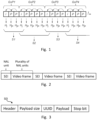
- Figure 1 illustrates a segment of a prediction-based encoded video sequence composed of I-frames and P-frames.
- an I-frame is a data structure with independently decodable image data, which can be decoded into a decoded video frame (or a decoded part of a video frame) by means of a predefined associated decoding operation.
- a P-frame for its part, is a data structure whose associated decoding operation makes reference not only to the image data of the P-frame itself but also to at least one other I- or P-frame.
- the image data in a P-frame expresses the change or movement relative to the video frame that its preceding I- or P-frame encodes. If the decoding operations are successful, video frames decoded from P-frames and I-frames are in general indistinguishable.
- each P-frame refers to the immediately preceding I- or P-frame. If the first P-frame refers to a second P-frame, the second P-frame necessarily refers to at least one further I- or P-frame. In the present disclosure, the first P-frame will be said to refer directly to the second P-frame and to refer indirectly to the at least one further I- or P-frame. Because the image data in an I-frame is independently decodable, the chain of references (arc-shaped arrows) does not continue past an I-frame.
- I-frame and the subsequent P-frames which refer to the I-frame directly or indirectly can be referred to as a group of pictures, which in some encoding formats are referred to as GOPs.
- GOPs Four GOPs are indicated in Figure 1A: IPP, IPPPP, IPPP, IPPP.
- Digital signatures provide a layer of validation and security to digital messages that are transmitted through a non-secure channel.
- a recipient of the digital message can validate the authenticity or integrity of the message.
- video data e.g., a video sequence
- the video data may be signed by signing a fingerprint of the video data rather than the video data itself.
- the use of frame-wise fingerprints H I , H p is illustrated in the lower part of Figure 1 , where each fingerprint may be a hash of that video frame's image data or a hash of that video frame's image in combination with optional further information.
- Signatures S1, S2, S3, S4 for the GOPs are obtained by digitally signing a combination of the fingerprints in that GOP.
- the security of the video sequence may further be protected from unauthorized replacement, removal or insertion of full GOPs if the I-frame fingerprints H I are signed both as part of its own GOP and as part of the preceding GOP's signature, as illustrated in Figure 1A. It is noted that straight downward arrows in the upper row represent the hash function, and the arrows in the lower row represent digital signing.
- the video sequence may still be exposed to fraudulent manipulation as data may be added to the video, e.g., before the first GOP in the video sequence.
- the I-frame fingerprints H I are not signed both as part of its own GOP and as part of the preceding GOP's signature, one or more GOPs may be deleted, added or replaced with a risk of such manipulation not being detected.
- US 2008/0291999 A1 discloses a method and apparatus for marking individual video frames of an H.264/AVC standard compliant or equivalent digital video stream.
- Each video frame in a H.264/AVC video stream is conventionally divided into NAL units. There are typically a number of NAL units for each video frame.
- a Supplemental Enhancement Information (SEI) type is specified in the H.264/AVC standard.
- SEI type includes the user data unregistered type, which can contain arbitrary data.
- an NAL unit of this type is provided at the beginning of each video frame, preceding the other NAL units associated with that video frame. This is schematically illustrated in Figure 2 .
- the payload data contained in the special SEI unit is typically control information for downstream control of use of the video content.
- SEI data are stream positioning data such as a video frame number; stream bit rate, such as normal, fast forward; decryption data, such as a decryption key or key derivation seed; and validation elements, such as a checksum or hash function value or signature.
- the SEI data may comprise decryption data, such as the decryption key or the key derivation seed, needed for decrypting encrypted video frames.
- the SEI data may comprise validation data, such as the checksum or hash function value or signature, needed for validating signed video frames.
- the SEI NAL unit may itself be encrypted and/or signed (validated) so that information contained in it is not easily accessible to an unauthorized user.
- the information contained in the SEI is understood as the SEI data and thus it seems as the SEI data may be encrypted and/or signed (validated). If the SEI data is encrypted and/or signed in analogy with the encryption and signing of the video frame it is assumed that the SEI may include the decryption data and/or validation data needed to decrypt and validate the encrypted and/or signed SEI data in the payload.
- Figure 3 schematically illustrates an SEI according to prior art.
- the prior art SEI consists of a header, information about a payload size, a universally unique identifier (UUID), a payload, e.g., SEI data, and a stop bit indicating an end of the SEI.
- UUID universally unique identifier
- SEI data e.g., SEI data
- stop bit indicating an end of the SEI.
- the payload of the SEI disclosed in US 2008/0291999 A1 in addition to the encrypted and/or signed SEI data may comprise also the decryption data and/or validation data needed to decrypt and/or validate the encrypted and/or signed SEI data, or that such decryption data and/or validation data is sent of another transmission channel.
- the examples illustrate the shortcomings of available methods for signing, e.g., digitally signing, an encoded video sequence.
- WO 2008/125601 A1 describes a method for transmitting video data in a video stream and associated metadata. A fingerprint associated with at least one frame of the video data is determined and a message comprising the fingerprint information is inserted into the video stream.
- One objective of the present disclosure is to make available methods and devices for signing, e.g., digitally signing, an encoded video sequence with a mechanism protecting against unauthorized replacement, removal or insertion of video frames.
- a further objective is to provide a mechanism to detect an occurrence of a manipulation of the encoded video sequence.
- a method of signing an encoded video sequence comprises: obtaining an encoded video sequence composed of encoded image frames; generating a set of one or more frame fingerprints for each encoded image frame, wherein a frame fingerprint is a unique identifier of an encoded image frame, and wherein the frame fingerprint is obtained by: performing a hashing operation or a checksum operation on the encoded image frame or on a subset thereof, or by digitally signing the encoded image frame or a subset thereof, wherein the encoded image frame or the subset thereof is digitally signed by asymmetric cryptography; generating a document comprising a header of a supplemental information unit and a representation of the generated sets of one or more frame fingerprints, wherein the document is a data structure, wherein the header of the supplemental information unit comprises an indication of the supplemental information unit, and wherein the representation of the generated sets of one or more frame fingerprints comprises a set of frame fingerprints from all the generated sets of one or more frame fingerprint
- the term "fingerprint” should be understood as a unique identifier of a data item.
- the fingerprint of the data item may be obtained by hashing, i.e., by performing a hashing operation on, the data item or a subset thereof.
- the fingerprint may be obtained by performing a different operation, such as a checksum operation, on the data item or a subset thereof.
- Yet an alternative to obtain the fingerprint of the data item is to digitally sign the data item or a subset thereof.
- the data item may be image data which encodes a video frame or a part of the image data. Possibly, the data item may be combined with other data, such as a cryptographic salt or a timestamp.
- frame fingerprint should in this disclosure be understood as a fingerprint of a frame, e.g., of an encoded image frame.
- an encoded image frame may be composed of a plurality of units, e.g., Network Abstraction Layer (NAL) units in the H.26x encoding format or Open Bitstream Units (OBUs) in the AV1 encoding format
- NAL Network Abstraction Layer
- OFBUs Open Bitstream Units
- a frame fingerprint may be generated for each of the plurality of units, and thus, a set of one or more such frame fingerprints may be generated for each encoded image frame.
- Each NAL unit consists of a header specifying the type of the NAL unit, e.g., if the NAL unit relates to an encoded image frame such as an intra-frame or inter-frame, or if it relates to a supplementation information unit.
- each NAL unit comprises a payload.
- Each OBU has a header that provides identifying information for the data (payload) contained in the OBU (AV1 Bitstream & Decoding Process Specification, https://aomediacodec.github.io/av1-spec/av1-spec.pdf).
- the term "document” should be understood as a text file or another data structure, such as a bytestream or bitstream.
- document signature refers to a digital signature for the document, and by means of which document signature the document's authenticity can be validated.
- supplemental information unit SIU
- SIU Supplemental Enhancement Information
- the supplemental information unit may for example be a Supplemental Enhancement Information (SEI) message in the H.26x encoding format, or Metadata Open Bitstream Unit (OBU) in the AV1 encoding format.
- SEI Supplemental Enhancement Information
- OBU Metadata Open Bitstream Unit
- the header of the supplemental information unit comprises supplemental data, such as an indication of the supplemental information unit, i.e., an indication indicating the supplemental information unit as a supplemental information unit.
- supplemental data such as an indication of the supplemental information unit, i.e., an indication indicating the supplemental information unit as a supplemental information unit.
- the representation of the generated sets of one or more frame fingerprints may be or comprise a set or a list of frame fingerprints from all the generated sets of one or more frame fingerprints or a set or list of a part of the frame fingerprints from all the generated sets of one or more frame fingerprints.
- the representation may be or comprise one or more hashes of the frame fingerprints from all generated sets of one or more frame fingerprints or one or more hashes of parts of the frame fingerprints from all generated set of one or more frame fingerprints.
- the generated supplemental information unit comprising the document and the document signature
- sign e.g., digitally sign
- the encoded video sequence is provided with a signature thanks to the association of the generated supplemental information unit, comprising the document and the document signature, with the encoded video sequence.
- a recipient of the signed encoded video sequence and the associated supplemental information unit will use the document and the document signature of the supplemental information unit to validate the encoded video sequence.
- the document and the document signature may be referred to as a signature for the encoded video sequence.
- the generated supplemental information unit may be associated with the encoded video sequence in different ways.
- generating the supplemental information unit to only consist of the document, the document signature and an indication of an end of the supplemental information unit; and by signing the encoded video sequence by associating the generated supplemental information unit with the encoded video sequence, it will not be possible to manipulate the supplemental information unit, e.g., with the document, without detection. The reason being that the document will not be correctly validated by means of the document signature if the document has been modified after the generation of the document signature.
- the recipient will not be able to verify the authenticity of the document using the received document signature. If the authenticity of the document cannot be verified, the recipient will understand that the encoded video sequence has been exposed to an unauthorised activity of some sort and can take necessary actions.
- a device arranged to perform the method disclosed herein.
- the second aspect of the invention shares the effects and advantages of the first aspect, and it can be implemented with a corresponding degree of technical variation.
- a third aspect of the invention relates to a computer program containing instructions for causing a computer to carry out the method(s) described in this disclosure.
- the computer program may be stored or distributed on a data carrier.
- a “data carrier” may be a transitory data carrier, such as modulated electromagnetic or optical waves, or a non-transitory data carrier.
- Non-transitory data carriers include volatile and non-volatile memories, such as permanent and non-permanent storage media of magnetic, optical or solid-state type. Still within the scope of "data carrier”, such memories may be fixedly mounted or portable.
- the present invention describes a method and a device for signing an encoded video sequence.
- the encoded video sequence is signed by associating the encoded video sequence with a special supplemental information unit, which supplemental information unit is generated to only consist of a document, a document signature and an indication of an end of the supplemental information unit.
- the supplemental information unit may be a SEI message in the H.26x encoding format, or a Metadata OBU in the AV1 encoding format. Since the supplemental information unit only comprises these three components and no other component(-s), it is not possible to manipulate the content of the supplemental information unit, e.g., to change the document, without detection as any tampering will result in an unsuccessful validation of the document. Thus, a recipient of the supplemental information unit will understand that a manipulation of the content of the supplemental information unit has been made.
- the method and device for signing the encoded video sequence will be described in more detail below.
- the encoded image frames may comprise at least one intra-frame and one or more predicted inter-frames.
- the at least one intra-frame and the one or more predicted inter-frames may be encoded by a video encoding format prescribing temporal video compression.
- the intra-frame may be an I-frame encoded according to a H.26x compression format, or an intra-frame or key frame encoded according to an AV1 compression format.
- the predicted inter-frame may be a forward predicted inter-frame, P-frame, or a bidirectional predicted inter-frame, B-frame, encoded according to the H.26x compression formats, or an inter-frame encoded according to the AV1 compression format.
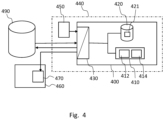
- the method 500 which signs the encoded video sequence, may be carried out by a suitably arranged generic programmable computer (e.g., with the relevant input and output interfaces) and, in particular, by means of a device 400 as schematically illustrated in Figure 4 .
- the device 400 comprises processing circuitry 410 arranged to perform actions of the method 500.
- the processing circuitry 410 may comprise a generating component 412 and a signing component 414 configured to perform actions of the method 500.
- the device 400 further comprises a memory 420 and an input-output interface 430 which is adapted for bidirectional communication with an external memory 490 which may store, in some embodiments and during some operational phases, the encoded video sequences to be signed.
- the device 400 is comprised in a video management system configured to provide signing of stored encoded video sequences as an external service.
- the device 400 and the external memory 490 may then be owned and operated by different entities or by a common entity.
- the (internal) memory 420 of the device 400 may be suitable for storage of a program 421 with software instructions for carrying out the method 500, for storage of cryptographic information (e.g., private keys) for generating signatures, as well as logs, configuration files and data supporting various internal housekeeping procedures.
- the computer program 421 may comprise instructions which, when the program is executed by a computer, cause the computer to carry out actions of the method 500.
- the device 400 may be provided as a local computer or server, or it may be implemented in a distributed fashion on the basis of networked (cloud) processing resources.
- the device 400 may be integrated in a camera 440, such as a digital video camera, e.g., a monitoring camera adapted for a monitoring application and/or a surveillance application.
- the device 400 may be arranged in communication with an encoder 450 of the camera 440 and configured to receive the encoded video sequence directly from the encoder 450 and to sign the encoded video sequence before the signed encoded video sequence is transmitted to a recipient, such as a client device 460, comprising a decoder 470, or to the external memory 490 for storage.
- the client device 460 may be configured to validate and decode the signed encoded video sequence.
- the encoder 450 may be an external encoder arranged separately from the camera 440 and the device 400 but arranged in communication with them.
- the camera 440 illustrated in FIG. 4 also may include other components relating to, e.g., image capturing and image processing, which are common in conventional camera systems and whose purpose and operations are well known to those having ordinary skill in the art. Such components have been omitted from the illustration and description of FIG. 4 for clarity reasons.
- the encoded video sequence may be encoded according to a conventional video encoding format.
- Some common video encoding formats that work with the various embodiments of the present invention include: High Efficiency Video Coding (HEVC), also known as H.265 and MPEG-H Part 2; Advanced Video Coding (AVC), also known as H.264 and MPEG-4 Part 10; Versatile Video Coding (VVC), also known as H.266, MPEG-I Part 3 and Future Video Coding (FVC); VP9, VP10 and AOMedia Video 1 (AV1), just to give some examples.
- HEVC High Efficiency Video Coding
- AVC Advanced Video Coding
- VVC Versatile Video Coding
- AV1 AOMedia Video 1
- the H.264, H.265, and H.266 coding formats are sometimes in this disclosure referred to as H.26x coding formats.
- the terms "coding format” and “compression format” are used interchangeably in this disclosure.
- the above-mentioned video encoding formats prescribe temporal video compression implemented in terms
- the method 500 for signing an encoded video sequence starts with action 502, wherein an encoded video sequence composed of encoded image frames of a video sequence is obtained.
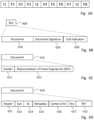
- Figure 6A schematically illustrates an encoded video sequence comprising three intra-frames denoted I1-I3, and eight inter-frames, denoted P1-P8.
- the device 400 may be configured to obtain, e.g., retrieve or receive, the encoded video sequence from the external memory 490 or from the encoder 450.
- the act of obtaining the encoded video sequence may include gaining access to a memory where the video data is stored (e.g., the external memory 490), downloading the video data, and/or receiving a transmission with the video data.
- a set of one or more frame fingerprints for each encoded image frame is generated in action 504.
- a fingerprint is a unique identifier of a data item, and thus a frame fingerprint is a fingerprint for an image frame, especially for an encoded image frame.
- a specific frame fingerprint may be used by a recipient to verify the authenticity of a specific encoded image frame for which the specific frame fingerprint was generated.
- the frame fingerprint for the encoded image frame may be obtained by hashing, i.e., by performing a hashing operation on the encoded image frame or a part thereof.
- a cryptographic salt may be added to the data on which the hashing operation is to be performed, whereby the number of hash operations needed may be reduced.
- An alternative to the hashing operation is to obtain the fingerprint by performing a different operation, such as a checksum operation, on the encoded image frame or a part thereof.
- Yet an alternative to obtain the fingerprint for the encoded image frame is to digitally sign the encoded image frame or a part thereof.
- an encoded image frame may be composed of a plurality of units, such as NAL units or OBUs
- a frame fingerprint may be generated for each such unit resulting in that a set of a plurality of frame fingerprints is generated for each encoded image frame.
- the device 400 is configured to generate the set of one or more frame fingerprints, e.g., by means of the generating component 412 of the processing circuitry 410.
- the representation of the generated sets of the one or more frame fingerprints comprises a generated fingerprint ( H I ) of the at least one intra-frame, and a generated fingerprint ( H P ) of each predicted inter-frame of the one or more predicted inter-frames.
- the respective fingerprints H I , H P of the intra-frame and the predicted inter-frame can be generated using a same or two different hash functions.
- the fingerprint H I of the intra-frame is generated using a relatively safer hash function (e.g., 1024 bits) and the fingerprint H P of the predicted inter-frame is generated using a relatively simpler hash function (e.g., 256 bits) which has a lower computational cost.
- the fingerprint H P of the predicted inter-frame is dependent on the fingerprint of the intra-frame, it can be generated in a computationally lean manner using a simpler hash function without lowering the overall safety level significantly.
- the encoded video sequence may comprise a first group of pictures and a second group of pictures.
- the method may comprise a sub-action of identifying the first and second groups of pictures.
- the generated sets of the one or more frame fingerprints may comprise a generated fingerprint ( H I ) of an intra-frame of the first group of pictures, a generated fingerprint ( H P ) of each predicted inter-frame of the first group of pictures, and a generated fingerprint ( H I ) of an intra-frame of the second group of pictures.
- the generated fingerprint ( H P ) of each predicted inter-frame may be generated by hashing a combination of data derived from the predicted inter-frame and data derived from an intra-frame to which the predicted inter-frame refers directly or indirectly.
- the fingerprint of the predicted inter-frame may be independent of any further predicted inter-frame to which the predicted inter-frame refers directly or indirectly.
- the data derived from the predicted inter-frame includes one out of the predicted inter-frame's image data and the generated first fingerprint of the predicted inter-frame's image data.
- the data derived from the intra-frame is the generated first fingerprint of the intra-frame.
- the hash function (or one-way function) may be a cryptographic hash function that provides a safety level considered adequate in view of the sensitivity of the video data to be signed and/or in view of the value at stake if the video data is manipulated by an unauthorized party.
- Three examples are SHA-256, SHA3-512 and RSA-1024.
- the hash function shall be predefined (e.g., it shall be reproducible) so that the fingerprints can be regenerated when the fingerprint is to be verified.
- the curly brackets notation ⁇ refers to a generic data combination operation, which may include concatenating the data linearly (juxtaposition) or in various staggered arrangements.
- the combination operation may further include an arithmetic operation on the data, such as bitwise OR, XOR, multiplication, division or a modulo operation.
- a document comprising a header of a supplemental information unit and a representation of the generated sets of one or more frame fingerprints is generated.
- a document 610 is schematically illustrated in Figure 6C to comprise a header 611 and a representation of frame fingerprints 612.
- the representation of the frame fingerprints 612 may be referred to as the payload of the document 610 illustrated in Figure 6C .
- the document may be a text file or another data structure, and the supplemental information unit may be a unit or message comprising supplemental information.
- the header of the supplemental information unit comprises supplemental data, such as an indication of the supplemental information unit to indicate that it is a supplemental information unit..
- the supplementation information unit is generated in action 512.
- the supplemental information unit is not yet generated, but it is still possible in action 506 to have knowledge about the header of the supplemental information unit, i.e., about the header of the to be generated supplementation information unit.
- the device 400 may set the header to comprise the indication of the supplemental information unit.
- the indication of the supplemental information unit indicates the supplemental information unit as a supplemental information unit and is the same for all supplemental information units.
- the representation of the generated sets of one or more frame fingerprints may be or comprise a set or a list of frame fingerprints from all the generated sets of one or more frame fingerprints or from a part thereof.
- the representation may be or comprise one or more hashes of the frame fingerprints from all generated sets of one or more frame fingerprints or from a part thereof.
- the representation may be a combination of frame fingerprints and hashes of the frame fingerprints.
- the device 400 is configured to generate the document, e.g., by means of the generation component of the processing circuitry 410.
- the document comprises further information in addition to the header and the representation mentioned above.
- the document may comprise one or more out of: a payload size value for a payload comprised in the supplemental information unit, an identifier of the payload, metadata relating to the encoded video sequence, camera information relating to a camera capturing the video sequence, and a public key of an asymmetric cryptographic key pair.
- the identifier may identify the type of payload comprised in the document. For example, the identifier may identify or indicate that the payload relates to a signed encoded video sequence. Further, the identifier may be a unique identifier, such as a universally unique identifier (UUID).
- UUID universally unique identifier
- FIG. 6D An example of a document 610 comprising all of the further information mentioned above in addition to the header 611 and the representation 612 is illustrated in Figure 6D .
- a document 610 comprises the header 611, the representation 612, a payload size value 613, an identifier ID 614, metadata 615 relating to the encoded video sequence, camera information 616 and a public key 617.
- the identifier ID 614 is an identifier of the payload comprised in the supplemental information unit and may be a UUID.
- the metadata 615 may comprise information describing, e.g., how to interpret, or the syntax of, the camera information 616 and/or the representation of frame fingerprints 612.
- the representation 612, the metadata 615, the camera information 616 and/or the public key 617 are comprised in a sub-document.
- the sub-document possibly also including the identifier ID 614, may be referred to as payload of the document 610 illustrated in Figure 6D .
- the sub-document may be a text file or another data structure.
- the document 610 may comprise the header 611, the payload size value 613, the identifier 614 and the sub-document.
- a document fingerprint for the document is generated in action 508.
- the document fingerprint is a fingerprint for the document.
- the document fingerprint may be obtained by hashing, i.e., by performing a hashing operation, on the document, i.e., on the content of the document, or on a part thereof.
- the fingerprint may be obtained by performing a different operation, such as a checksum operation, on the document or a part thereof.
- Yet an alternative to obtain the fingerprint of the document is to digitally sign the document or a part thereof.
- the processing circuitry 410 may be configured, e.g., by means of the generation component 412, to generate the document fingerprint.
- a document signature is generated by digitally signing the document.
- the document signature generated in action 510 is generated by digitally signing the document fingerprint.
- the document signature may be referred to as a signature of the encoded video sequence or of a segment of the encoded video sequence.
- the segment of the encoded video sequence may be a group of pictures.
- the document signature may for example be generated by asymmetric cryptography, i.e., using a private key from a key pair in which the public key has been pre-shared with the recipient such that the recipient is able to verify the signature.
- the device 400 is configured to generate the document signature, e.g., by means of the generation component 412 of the processing circuitry 410.
- the supplemental information unit is generated to only consist of the document, the document signature and an indication of an end of the supplemental information unit.
- the supplemental information unit is of the same type of unit as the plurality of units constituting the encoded image frames. That is, the supplementation information unit is a NAL unit in the H.26x encoding formats and an OBU in the AV1 coding format.
- Figure 6B illustrates a generated supplemental information unit 600 that consists of a document 610, a document signature 620 and an indication 630 of an end of the supplemental information unit 600.
- the indication of the end of the supplemental information unit may be an explicit indication, such as a stop bit, or it may be an implicit indication, such as reaching a predetermined number of bits in the supplemental information unit.
- the document, the document signature and the indication of an end of the supplemental information unit are the only components of the supplemental information unit. Thereby is achieved that any tampering with the content of the supplemental information unit will be detected, as the tampering will result in an unsuccessful validation of the document's authenticity. Thus, a recipient of the supplemental information unit will understand that a manipulation of the content of the supplemental information unit has been made.
- the device 400 is configured to generate the supplemental information unit, e.g., by means of the generation component 412 of the processing circuitry 410.
- the supplemental information unit may be a SEI message of the H.26x encoding formats or a metadata OBU of the AV1 encoding format.
- a SEI contains information that is not necessary to decode encoded image frames.
- the supplemental information unit according to the present invention is needed to validate the authenticity of the encoded image frames.
- the supplemental information unit is generated to consist of the document, the document signature and the indication of the end. As the document comprises the representation of the generated sets of one or more frame fingerprints, the document is needed to validate the encoded image frames. If it is not possible to use the document signature to validate the document due to a manipulation of the document's content, it may not be possible to validate the authenticity of the encoded image frames.
- the document comprises the representation of the generated sets of one or more frame fingerprints for the entire encoded video sequence, and thus the document is needed to validate the authenticity of the encoded image frames. If it is not possible to use the document signature to validate the document due to a manipulation of the document's content, it may not be possible to validate the authenticity of the encoded image frames.
- each supplemental information unit's document needs to be successfully verified in order to be able to validate the authenticity of the encoded image frames of that group of pictures.
- the encoded video sequence is signed in action 514 by associating the generated supplemental information unit with the encoded video sequence.
- the device 400 is configured to sign the encoded video sequence, e.g., by means of the signing component 414 of the processing circuitry 410.
- the generated supplemental information unit may be associated with the encoded video sequence in different ways, some of which will be described below.
- the generated supplemental information unit is associated with the encoded video sequence by a reference to the encoded video sequence and transmitted on a channel different from a channel transmitting the encoded video sequence.
- the generated supplemental information unit and the encoded video sequence may be associated with each other by means of timestamps. For example, if a generated supplemental information unit and an encoded video sequence have the same or corresponding timestamps, they are considered as being associated with each other.
- the generated supplemental information unit may sign the encoded video sequences even if it is not transmitted together with the encoded video sequence as long as a recipient is able to receive both the generated supplemental information and the encoded video sequence and to validate the signature.
- the channel transmitting the (smaller) supplemental information unit may be a first communication channel, such as a safe communication path, and the channel transmitting the (larger) encoded video sequence may be a second communication channel, such as an arbitrary communication path.
- the generated supplemental information unit is associated with the encoded video sequence by an association between the encoded video sequence and the supplemental information unit outside the data format, e.g., by forming a data structure (container) which includes both the encoded video sequence and the supplemental information unit and in which the encoded video sequence will be transmitted to the intended recipient.
- the generated supplemental information unit is associated with the encoded video sequence by adding the generated supplemental information at an end of the encoded video sequence. This is schematically illustrated in Figure 7A , wherein the supplemental information unit SIU is added at an end of the encoded video sequence IPPPIPPPPIPP.
- the signature of the encoded video sequence may be said to consist of multiple sub-signatures, i.e., of multiple supplemental information units, which are provided for different segments of the encoded video sequence. This allows continuous signature verification during playback. It also supports the signing of video data encoding a live video stream, which is particularly useful in video monitoring applications.
- the encoded video sequence may comprise a first part of encoded image frames associated with a first group of pictures, and a second, directly subsequent, part of encoded image frames associated with a second group of pictures.
- a supplementation information unit may be generated for each group.
- a generated supplemental information unit may be generated for the first part of encoded image frames.
- the generated supplemental information unit may be associated with the encoded video sequence by adding the generated supplemental information unit subsequent to the first group of pictures associated with the first part of encoded image frames.
- the first and second groups of pictures may in some encoding formats be referred to as a first GOP and a second GOP.
- This is schematically illustrated in for example Figures 7B, 7C, 7D and 7E wherein the supplementation information unit SIU1 generated for the first part of encoded image frames associated with a first group of pictures GOP1 is associated with the encoded video sequence by adding it after the first group of pictures GOP1.
- SIU0, SIU2, and SIU3 generated for groups of pictures GOP0 (not shown), GOP2 and GOP3, respectively.
- the generated supplemental information unit may be associated with the encoded video sequence by adding it to the encoded video sequence before the second group of pictures associated with the second part of encoded image frames.
- the supplemental information unit may be added after the first group of pictures but before the second group of pictures.
- the generated supplemental information unit may be added between the first group of pictures and the second group of pictures of the encoded video sequence.
- This may also be expressed as the supplemental information unit is inserted in the encoded video sequence after the first group of pictures, e.g., after the last inter-frame, but before the second group of pictures, e.g., before a subsequent intra-frame.
- Figure 7B wherein the supplemental information unit SIU1 is added between the group of pictures GOP1 and GOP2.
- the supplemental information unit SIU2 being added between the groups of pictures GOP2 and GOP3.
- the generated supplemental information unit may be associated with the encoded video sequence by adding the generated supplemental information to the encoded video sequence as part of the second group of pictures associated with the second part of encoded image frames.
- the supplemental information unit may be included in the second group of pictures. This is schematically illustrated in Figures 7C and 7D , wherein the supplemental information unit SIU1 is comprised in the group of pictures GOP2.
- the supplemental information unit is of the same type as the units constituting the encoded image frames it is possible to add the supplemental information unit to the encoded video sequence at the desired location, e.g., sequential order, in the encoded video sequence without needing a special decoder at the recipient's side to decode the encoded video sequence.
- a recipient in possession of the encoded video sequence which has been signed in the above-described manner can validate its authenticity by the following procedure:
- the verification in step 2 includes replicating a fingerprinting operation deemed to have been performed by the sender, i.e., recomputing the fingerprints.
- the verification in step 1 typically relates to an asymmetric signature setup, where signing and verification are distinct cryptographic operations corresponding to private/public keys. Other combinations of symmetric and/or asymmetric verification operations are possible without departing from the scope of the invention.
- the document signature described herein is a digital signature.
- the document signature works by proving that a digital message or document was not modified-intentionally or unintentionally-from the time it was signed.
- the document signature does this by generating a unique hash of the message or document and encrypting it using the sender's private key.
- the hash generated is unique to the message or document and changing any part of it will completely change the hash.
- the message or digital document is digitally signed and sent to the recipient.
- the recipient then generates their own hash of the message or digital document and decrypts the sender's hash (included in the original message) using the sender's public key.
- the recipient compares the hash they generate against the sender's decrypted hash; if they match, the message or digital document has not been modified and the sender is authenticated.
Landscapes
- Engineering & Computer Science (AREA)
- Signal Processing (AREA)
- Multimedia (AREA)
- Computer Security & Cryptography (AREA)
- Computer Networks & Wireless Communication (AREA)
- Compression Or Coding Systems Of Tv Signals (AREA)
Claims (14)
- Verfahren zum Signieren einer kodierten Videosequenz, das umfasst:- Erhalten (502) einer kodierten Videosequenz, die aus kodierten Bild-Frames besteht;- Erzeugen (504) eines Satzes von einem Frame-Fingerabdruck oder mehreren Frame-Fingerabdrücken für jedes kodierte Bild-Frame, wobei ein Frame-Fingerabdruck ein eindeutiger Identifikator eines kodierten Bild-Frames ist und wobei der Frame-Fingerabdruck erhalten wird durch:Durchführen einer Hashen-Operation oder einer Prüfsummenoperation am kodierten Bild-Frame oder an einem Teilsatz davon, oder durchdigitales Signieren des kodierten Bild-Frames oder eines Teilsatzes davon, wobei das kodierte Bild-Frame oder der Teilsatz davon durch asymmetrische Kryptographie digital signiert wird,- Erzeugen (506) eines Dokuments (610), das einen Header (611) einer Zusatzinformationseinheit (600) und eine Darstellung (612) der erzeugten Sätze von einem Frame-Fingerabdruck oder mehreren Frame-Fingerabdrücken umfasst, wobei das Dokument (610) eine Datenstruktur ist, wobei der Header (611) der Zusatzinformationseinheit (600) eine Angabe der Zusatzinformationseinheit umfasst und wobei die Darstellung (612) der erzeugten Sätze von einem Frame-Fingerabdruck oder mehreren Frame-Fingerabdrücken einen Satz von Frame-Fingerabdrücken von allen erzeugten Sätzen von einem Frame-Fingerabdruck oder mehreren Frame-Fingerabdrücken oder von einem Teil der Frame-Fingerabdrücke von allen erzeugten Sätzen von einem Frame-Fingerabdruck oder mehreren Frame-Fingerabdrücken oder einen oder mehrere Hash(es) der Frame-Fingerabdrücke von allen erzeugten Sätzen von einem Frame-Fingerabdruck oder mehreren Frame-Fingerabdrücken oder einen oder mehrere Hash(es) von Teilen der Frame-Fingerabdrücke von allen erzeugten Sätzen von einem Frame-Fingerabdruck oder mehreren Frame-Fingerabdrücken umfasst;- Erzeugen (510) einer Dokumentsignatur (620) durch digitales Signieren des Dokuments (610), wobei die Dokumentsignatur (620) eine digitale Signatur für das Dokument (610) ist und wobei die Dokumentsignatur durch asymmetrische Kryptographie erzeugt wird;- Erzeugen (512) der Zusatzinformationseinheit (600), die nur aus dem Dokument (610), der Dokumentsignatur (620) und einer Angabe (630) eines Endes der Zusatzinformationseinheit (600) besteht; und- Signieren (514) der kodierten Videosequenz durch Zuordnen der erzeugten Zusatzinformationseinheit (600) zur kodierten Videosequenz.
- Verfahren nach Anspruch 1, das ferner umfasst:- Erzeugen (508) eines Dokumentfingerabdrucks für das Dokument (610); und wobei das Erzeugen (510) der Dokumentsignatur (620) für das Dokument (610) umfasst:- Erzeugen der Dokumentsignatur (620) durch digitales Signieren des Dokumentfingerabdrucks, wobei die Dokumentsignatur durch asymmetrische Kryptographie erzeugt wird.
- Verfahren nach einem der Ansprüche 1-2, wobei die erzeugte Zusatzinformationseinheit (600) der kodierten Videosequenz zugeordnet wird, indem sie die gleichen oder entsprechende Zeitstempel wie die kodierte Videosequenz aufweist, und wobei die erzeugte Zusatzinformationseinheit (600) auf einem Kanal übertragen wird, der von einem Kanal, der die kodierte Videosequenz überträgt, verschieden ist.
- Verfahren nach einem der Ansprüche 1-2, wobei die erzeugte Zusatzinformationseinheit (600) der kodierten Videosequenz durch Hinzufügen der erzeugten Zusatzinformationen (600; SIU) an einem Ende der kodierten Videosequenz zugeordnet wird.
- Verfahren nach einem der Ansprüche 1-2, wobei die kodierte Videosequenz einen ersten Teil kodierter Bild-Frames, die einer ersten Bildgruppe (GOP1) zugeordnet sind, und einen zweiten, direkt nachfolgenden, Teil kodierter Bild-Frames, die einer zweiten Bildgruppe (GOP2) zugeordnet sind, umfasst, wobei die erzeugte Zusatzinformationseinheit (600; SIU1) für den ersten Teil kodierter Bild-Frames erzeugt wird und wobei die erzeugte Zusatzinformationseinheit (600; SIU1) der kodierten Videosequenz durch Hinzufügen der erzeugten Zusatzinformationseinheit (600; SIU1) anschließend an die erste Bildgruppe (GOP1), die dem ersten Teil kodierter Bild-Frames zugeordnet ist, zugeordnet wird.
- Verfahren nach Anspruch 5, wobei die erzeugte Zusatzinformationseinheit (600; SIU1) der kodierten Videosequenz durch Hinzufügen der erzeugten Zusatzinformationseinheit (600; SIU1) zur kodierten Videosequenz vor der zweiten Bildgruppe (GOP2), die dem zweiten Teil kodierter Bild-Frames zugeordnet ist, zugeordnet wird.
- Verfahren nach Anspruch 5, wobei die erzeugte Zusatzinformationseinheit (600; SIU1) der kodierten Videosequenz durch Hinzufügen der erzeugten Zusatzinformationseinheit (600; SIU1) zur kodierten Videosequenz als Teil der zweiten Bildgruppe (GOP2), die dem zweiten Teil kodierter Bild-Frames zugeordnet ist, zugeordnet wird.
- Verfahren nach einem der Ansprüche 1-7, wobei die kodierten Bild-Frames mindestens ein Intra-Frame und ein oder mehrere vorhergesagte(s) Inter-Frame(s) umfassen, wobei das mindestens eine Intra-Frame und das eine oder die mehreren vorhergesagte(n) Inter-Frame(s) durch ein Videokodierungsformat, das eine zeitliche Videokomprimierung vorschreibt, kodiert werden.
- Verfahren nach Anspruch 8, wobei die Darstellung (612) der erzeugten Sätze von einem Frame-Fingerabdruck oder mehreren Frame-Fingerabdrücken einen erzeugten Fingerabdruck (HI ) des mindestens einen Intra-Frames und einen erzeugten Fingerabdruck (HP ) jedes vorhergesagten Inter-Frames des einen oder der mehreren vorhergesagten Inter-Frames umfasst.
- Verfahren nach Anspruch 8, wenn abhängig von Anspruch 5, wobei die Darstellung (612) der erzeugten Sätze von dem einen Frame-Fingerabdruck oder den mehreren Frame-Fingerabdrücken einen erzeugten Fingerabdruck (HI ) eines Intra-Frames der ersten Bildgruppe, einen erzeugten Fingerabdruck (HP ) jedes vorhergesagten Inter-Frames der ersten Bildgruppe und einen erzeugten Fingerabdruck (HI ) eines Intra-Frames der zweiten Bildgruppe umfasst.
- Verfahren nach einem der Ansprüche 9-10, wobei der erzeugte Fingerabdruck (HP ) jedes vorhergesagten Inter-Frames durch Hashen einer Kombination von Daten, die vom vorhergesagten Inter-Frame abgeleitet werden, und Daten, die von einem Intra-Frame abgeleitet werden, auf das sich das vorhergesagte Inter-Frame direkt oder indirekt bezieht, erzeugt wird, wobei der Fingerabdruck des vorhergesagten Inter-Frames unabhängig von einem beliebigen weiteren vorhergesagten Inter-Frame ist, auf das sich das vorhergesagte Inter-Frame direkt oder indirekt bezieht, wobei die Daten, die vom vorhergesagten Inter-Frame abgeleitet werden, eines von den Bilddaten des vorhergesagten Inter-Frames und dem erzeugten ersten Fingerabdruck der Bilddaten des vorhergesagten Inter-Frames einschließen und wobei die Daten, die vom Intra-Frame abgeleitet werden, der erzeugte erste Fingerabdruck des Intra-Frames sind.
- Verfahren nach einem der Ansprüche 8-11, wobei das Intra-Frame ein I-Frame, das gemäß einem H.26x-Komprimierungsformat kodiert ist, oder ein Intra-Frame oder Schlüssel-Frame, das gemäß einem AOMedia Video 1-Komprimierungsformat, AV1-Komprimierungsformat, kodiert ist, ist und wobei das vorhergesagte Inter-Frame ein vorwärtsvorhergesagtes Inter-Frame, P-Frame, oder ein bidirektionales vorhergesagtes Inter-Frame, B-Frame, das gemäß den H.26x-Komprimierungsformaten kodiert ist, oder ein Inter-Frame, das gemäß dem AV1-Komprimierungsformat kodiert ist, ist.
- Vorrichtung (400), die eine Verarbeitungsschaltlogik (410) umfasst, die zum Durchführen des Verfahrens nach einem der Ansprüche 1-12 angeordnet ist.
- Computerprogramm (421), das Anweisungen umfasst, die, wenn das Programm durch einen Computer ausgeführt wird, den Computer veranlassen, das Verfahren nach einem der Ansprüche 1-12 auszuführen.
Priority Applications (6)
| Application Number | Priority Date | Filing Date | Title |
|---|---|---|---|
| EP21212291.5A EP4192018B1 (de) | 2021-12-03 | 2021-12-03 | Verfahren und vorrichtung zur signierung einer kodierten videosequenz |
| TW111140828A TW202325028A (zh) | 2021-12-03 | 2022-10-27 | 對經編碼視訊序列進行簽名之方法及裝置 |
| US17/980,138 US12445636B2 (en) | 2021-12-03 | 2022-11-03 | Method and device for signing an encoded video sequence |
| JP2022187978A JP7789652B2 (ja) | 2021-12-03 | 2022-11-25 | エンコードされたビデオシーケンスに署名するための方法及びデバイス |
| CN202211493213.3A CN116233568A (zh) | 2021-12-03 | 2022-11-25 | 用于对编码视频序列进行签名的方法和装置 |
| KR1020220163337A KR102906509B1 (ko) | 2021-12-03 | 2022-11-29 | 인코딩된 비디오 시퀀스를 서명하기 위한 방법 및 장치 |
Applications Claiming Priority (1)
| Application Number | Priority Date | Filing Date | Title |
|---|---|---|---|
| EP21212291.5A EP4192018B1 (de) | 2021-12-03 | 2021-12-03 | Verfahren und vorrichtung zur signierung einer kodierten videosequenz |
Publications (3)
| Publication Number | Publication Date |
|---|---|
| EP4192018A1 EP4192018A1 (de) | 2023-06-07 |
| EP4192018C0 EP4192018C0 (de) | 2025-06-11 |
| EP4192018B1 true EP4192018B1 (de) | 2025-06-11 |
Family
ID=78822387
Family Applications (1)
| Application Number | Title | Priority Date | Filing Date |
|---|---|---|---|
| EP21212291.5A Active EP4192018B1 (de) | 2021-12-03 | 2021-12-03 | Verfahren und vorrichtung zur signierung einer kodierten videosequenz |
Country Status (6)
| Country | Link |
|---|---|
| US (1) | US12445636B2 (de) |
| EP (1) | EP4192018B1 (de) |
| JP (1) | JP7789652B2 (de) |
| KR (1) | KR102906509B1 (de) |
| CN (1) | CN116233568A (de) |
| TW (1) | TW202325028A (de) |
Families Citing this family (3)
| Publication number | Priority date | Publication date | Assignee | Title |
|---|---|---|---|---|
| US20250097471A1 (en) * | 2023-09-20 | 2025-03-20 | Nvidia Corporation | Validating bitstream compliance at runtime for multimedia streaming systems and applications |
| EP4564215B1 (de) | 2023-11-29 | 2025-10-15 | Axis AB | Verfahren und system zur digitalen signierung von audio- und videodaten |
| CN119182974B (zh) * | 2024-11-22 | 2025-02-21 | 合肥高维数据技术有限公司 | 一种基于边缘像素隐蔽性的视频防篡改水印方法及装置 |
Family Cites Families (20)
| Publication number | Priority date | Publication date | Assignee | Title |
|---|---|---|---|---|
| US6996717B2 (en) * | 2001-05-24 | 2006-02-07 | Matsushita Electric Industrial Co., Ltd. | Semi-fragile watermarking system for MPEG video authentication |
| US7752449B1 (en) * | 2006-02-22 | 2010-07-06 | Avaya, Inc. | System and method for generating a non-repudiatable record of a data stream |
| EP1983755A1 (de) * | 2007-04-17 | 2008-10-22 | Thomson Licensing | Verfahren zur Übertragung von Videodaten in einem Datenstrom und damit verbundene Mediadaten |
| US20080291999A1 (en) * | 2007-05-24 | 2008-11-27 | Julien Lerouge | Method and apparatus for video frame marking |
| JP5548419B2 (ja) | 2009-09-30 | 2014-07-16 | 富士通株式会社 | 署名生成装置、署名検証装置、署名生成方法、署名検証方法、署名生成プログラム、および署名検証プログラム |
| US8863165B2 (en) * | 2010-11-01 | 2014-10-14 | Gracenote, Inc. | Method and system for presenting additional content at a media system |
| EP2568711A1 (de) | 2011-09-12 | 2013-03-13 | Thomson Licensing | Verfahren und Vorrichtungen zur selektiven, formaterhaltenden Datenverschlüsselung |
| US9258127B2 (en) | 2012-07-09 | 2016-02-09 | Cisco Technology, Inc. | System and method for providing cryptographic video verification |
| ES2624916B1 (es) * | 2016-01-15 | 2018-01-17 | Safe Creative, S.L. | Sistema para grabación y certificación de navegación web y metodo para dicho sistema |
| US10560506B2 (en) * | 2017-07-19 | 2020-02-11 | Netflix, Inc. | Identifying previously streamed portions of a media title to avoid repetitive playback |
| US11122344B2 (en) * | 2017-08-17 | 2021-09-14 | Ltn Global Communications, Inc. | System and method for synchronizing metadata with audiovisual content |
| US10404467B1 (en) * | 2018-09-09 | 2019-09-03 | Tyson York Winarski | Blockchain digest augmention of media files including group-of-pictures video streams for MXF files |
| CN109543432A (zh) | 2018-11-23 | 2019-03-29 | 济南中维世纪科技有限公司 | 一种视频中人脸图像加密防篡改和检索的方法 |
| EP3672244B1 (de) * | 2018-12-20 | 2020-10-28 | Axis AB | Verfahren und vorrichtungen zum codieren und decodieren einer folge von bildfeldern, in denen die privatsphäre eines objekts geschützt ist |
| WO2020214899A1 (en) * | 2019-04-19 | 2020-10-22 | Beijing Dajia Internet Information Technology Co., Ltd. | Supplemental enhancement information message for embedded image |
| CN110427762B (zh) | 2019-07-23 | 2021-03-23 | 湖南匡安网络技术有限公司 | 一种实现电力监控系统视频安全传输的加密和解密方法 |
| CN110401818B (zh) | 2019-08-08 | 2020-11-13 | 北京珞安科技有限责任公司 | 一种电力视频传输的安全通信系统 |
| WO2021183645A1 (en) | 2020-03-11 | 2021-09-16 | Bytedance Inc. | Indication of digital media integrity |
| US12470748B2 (en) * | 2020-04-03 | 2025-11-11 | Intel Corporation | Methods and apparatus to identify a video decoding error |
| EP3902244B1 (de) * | 2020-04-23 | 2022-03-23 | Axis AB | Steuerung einer kamera mit schwenk-/neige-zoom |
-
2021
- 2021-12-03 EP EP21212291.5A patent/EP4192018B1/de active Active
-
2022
- 2022-10-27 TW TW111140828A patent/TW202325028A/zh unknown
- 2022-11-03 US US17/980,138 patent/US12445636B2/en active Active
- 2022-11-25 CN CN202211493213.3A patent/CN116233568A/zh active Pending
- 2022-11-25 JP JP2022187978A patent/JP7789652B2/ja active Active
- 2022-11-29 KR KR1020220163337A patent/KR102906509B1/ko active Active
Also Published As
| Publication number | Publication date |
|---|---|
| US12445636B2 (en) | 2025-10-14 |
| JP2023083231A (ja) | 2023-06-15 |
| JP7789652B2 (ja) | 2025-12-22 |
| KR102906509B1 (ko) | 2025-12-31 |
| EP4192018A1 (de) | 2023-06-07 |
| EP4192018C0 (de) | 2025-06-11 |
| TW202325028A (zh) | 2023-06-16 |
| CN116233568A (zh) | 2023-06-06 |
| US20230179787A1 (en) | 2023-06-08 |
| KR20230084055A (ko) | 2023-06-12 |
Similar Documents
| Publication | Publication Date | Title |
|---|---|---|
| US12445636B2 (en) | Method and device for signing an encoded video sequence | |
| US12322002B2 (en) | Signed video data with linked hashes | |
| KR102871122B1 (ko) | 솔티드 해시를 갖는 서명된 비디오 데이터 | |
| US12506617B2 (en) | Validation of signatures of a video stream encoded in layers | |
| KR102945700B1 (ko) | 비디오 데이터 세그먼트에서 디지털 서명을 추가하고 검증하는 방법 | |
| JP7675229B2 (ja) | ビデオシーケンスの検証のための送信機、受信機、ならびに送信機および受信機における方法 | |
| Mesa-Simón et al. | Enabling live video provenance and authenticity: A C2PA-Based system with TPM-based security for livestreaming platforms | |
| EP4369704B1 (de) | Signierung von videos für reduzierte bitrate | |
| EP4369725B1 (de) | Transkodierbare signierte videodaten | |
| TWI920352B (zh) | 具有加鹽雜湊之經簽署視訊資料 | |
| Eliasson | Cryptographic Attestation of the Origin of Surveillance Images |
Legal Events
| Date | Code | Title | Description |
|---|---|---|---|
| PUAI | Public reference made under article 153(3) epc to a published international application that has entered the european phase |
Free format text: ORIGINAL CODE: 0009012 |
|
| STAA | Information on the status of an ep patent application or granted ep patent |
Free format text: STATUS: REQUEST FOR EXAMINATION WAS MADE |
|
| 17P | Request for examination filed |
Effective date: 20220706 |
|
| AK | Designated contracting states |
Kind code of ref document: A1 Designated state(s): AL AT BE BG CH CY CZ DE DK EE ES FI FR GB GR HR HU IE IS IT LI LT LU LV MC MK MT NL NO PL PT RO RS SE SI SK SM TR |
|
| STAA | Information on the status of an ep patent application or granted ep patent |
Free format text: STATUS: EXAMINATION IS IN PROGRESS |
|
| 17Q | First examination report despatched |
Effective date: 20231130 |
|
| GRAP | Despatch of communication of intention to grant a patent |
Free format text: ORIGINAL CODE: EPIDOSNIGR1 |
|
| STAA | Information on the status of an ep patent application or granted ep patent |
Free format text: STATUS: GRANT OF PATENT IS INTENDED |
|
| INTG | Intention to grant announced |
Effective date: 20250325 |
|
| GRAS | Grant fee paid |
Free format text: ORIGINAL CODE: EPIDOSNIGR3 |
|
| GRAA | (expected) grant |
Free format text: ORIGINAL CODE: 0009210 |
|
| STAA | Information on the status of an ep patent application or granted ep patent |
Free format text: STATUS: THE PATENT HAS BEEN GRANTED |
|
| AK | Designated contracting states |
Kind code of ref document: B1 Designated state(s): AL AT BE BG CH CY CZ DE DK EE ES FI FR GB GR HR HU IE IS IT LI LT LU LV MC MK MT NL NO PL PT RO RS SE SI SK SM TR |
|
| REG | Reference to a national code |
Ref country code: GB Ref legal event code: FG4D |
|
| REG | Reference to a national code |
Ref country code: CH Ref legal event code: EP |
|
| REG | Reference to a national code |
Ref country code: IE Ref legal event code: FG4D |
|
| REG | Reference to a national code |
Ref country code: DE Ref legal event code: R096 Ref document number: 602021032052 Country of ref document: DE |
|
| U01 | Request for unitary effect filed |
Effective date: 20250611 |
|
| U07 | Unitary effect registered |
Designated state(s): AT BE BG DE DK EE FI FR IT LT LU LV MT NL PT RO SE SI Effective date: 20250618 |
|
| PG25 | Lapsed in a contracting state [announced via postgrant information from national office to epo] |
Ref country code: ES Free format text: LAPSE BECAUSE OF FAILURE TO SUBMIT A TRANSLATION OF THE DESCRIPTION OR TO PAY THE FEE WITHIN THE PRESCRIBED TIME-LIMIT Effective date: 20250611 |
|
| PG25 | Lapsed in a contracting state [announced via postgrant information from national office to epo] |
Ref country code: GR Free format text: LAPSE BECAUSE OF FAILURE TO SUBMIT A TRANSLATION OF THE DESCRIPTION OR TO PAY THE FEE WITHIN THE PRESCRIBED TIME-LIMIT Effective date: 20250912 Ref country code: NO Free format text: LAPSE BECAUSE OF FAILURE TO SUBMIT A TRANSLATION OF THE DESCRIPTION OR TO PAY THE FEE WITHIN THE PRESCRIBED TIME-LIMIT Effective date: 20250911 |
|
| PG25 | Lapsed in a contracting state [announced via postgrant information from national office to epo] |
Ref country code: HR Free format text: LAPSE BECAUSE OF FAILURE TO SUBMIT A TRANSLATION OF THE DESCRIPTION OR TO PAY THE FEE WITHIN THE PRESCRIBED TIME-LIMIT Effective date: 20250611 |
|
| PG25 | Lapsed in a contracting state [announced via postgrant information from national office to epo] |
Ref country code: RS Free format text: LAPSE BECAUSE OF FAILURE TO SUBMIT A TRANSLATION OF THE DESCRIPTION OR TO PAY THE FEE WITHIN THE PRESCRIBED TIME-LIMIT Effective date: 20250911 |
|
| U20 | Renewal fee for the european patent with unitary effect paid |
Year of fee payment: 5 Effective date: 20251119 |
|
| PG25 | Lapsed in a contracting state [announced via postgrant information from national office to epo] |
Ref country code: IS Free format text: LAPSE BECAUSE OF FAILURE TO SUBMIT A TRANSLATION OF THE DESCRIPTION OR TO PAY THE FEE WITHIN THE PRESCRIBED TIME-LIMIT Effective date: 20251011 |
|
| PGFP | Annual fee paid to national office [announced via postgrant information from national office to epo] |
Ref country code: GB Payment date: 20251120 Year of fee payment: 5 |
|
| PG25 | Lapsed in a contracting state [announced via postgrant information from national office to epo] |
Ref country code: SM Free format text: LAPSE BECAUSE OF FAILURE TO SUBMIT A TRANSLATION OF THE DESCRIPTION OR TO PAY THE FEE WITHIN THE PRESCRIBED TIME-LIMIT Effective date: 20250611 |
|
| PG25 | Lapsed in a contracting state [announced via postgrant information from national office to epo] |
Ref country code: CZ Free format text: LAPSE BECAUSE OF FAILURE TO SUBMIT A TRANSLATION OF THE DESCRIPTION OR TO PAY THE FEE WITHIN THE PRESCRIBED TIME-LIMIT Effective date: 20250611 |
|
| PG25 | Lapsed in a contracting state [announced via postgrant information from national office to epo] |
Ref country code: PL Free format text: LAPSE BECAUSE OF FAILURE TO SUBMIT A TRANSLATION OF THE DESCRIPTION OR TO PAY THE FEE WITHIN THE PRESCRIBED TIME-LIMIT Effective date: 20250611 |
|
| PG25 | Lapsed in a contracting state [announced via postgrant information from national office to epo] |
Ref country code: SK Free format text: LAPSE BECAUSE OF FAILURE TO SUBMIT A TRANSLATION OF THE DESCRIPTION OR TO PAY THE FEE WITHIN THE PRESCRIBED TIME-LIMIT Effective date: 20250611 |
|
| PLBE | No opposition filed within time limit |
Free format text: ORIGINAL CODE: 0009261 |
|
| STAA | Information on the status of an ep patent application or granted ep patent |
Free format text: STATUS: NO OPPOSITION FILED WITHIN TIME LIMIT |
|
| REG | Reference to a national code |
Ref country code: CH Ref legal event code: L10 Free format text: ST27 STATUS EVENT CODE: U-0-0-L10-L00 (AS PROVIDED BY THE NATIONAL OFFICE) Effective date: 20260423 |