EP4191764B1 - Battery box, battery, and electrical device - Google Patents
Battery box, battery, and electrical device Download PDFInfo
- Publication number
- EP4191764B1 EP4191764B1 EP21930593.5A EP21930593A EP4191764B1 EP 4191764 B1 EP4191764 B1 EP 4191764B1 EP 21930593 A EP21930593 A EP 21930593A EP 4191764 B1 EP4191764 B1 EP 4191764B1
- Authority
- EP
- European Patent Office
- Prior art keywords
- outer plate
- balance valve
- ventilation
- battery
- balance
- Prior art date
- Legal status (The legal status is an assumption and is not a legal conclusion. Google has not performed a legal analysis and makes no representation as to the accuracy of the status listed.)
- Active
Links
Images

Classifications
-
- H—ELECTRICITY
- H01—ELECTRIC ELEMENTS
- H01M—PROCESSES OR MEANS, e.g. BATTERIES, FOR THE DIRECT CONVERSION OF CHEMICAL ENERGY INTO ELECTRICAL ENERGY
- H01M10/00—Secondary cells; Manufacture thereof
- H01M10/60—Heating or cooling; Temperature control
- H01M10/61—Types of temperature control
- H01M10/613—Cooling or keeping cold
-
- H—ELECTRICITY
- H01—ELECTRIC ELEMENTS
- H01M—PROCESSES OR MEANS, e.g. BATTERIES, FOR THE DIRECT CONVERSION OF CHEMICAL ENERGY INTO ELECTRICAL ENERGY
- H01M10/00—Secondary cells; Manufacture thereof
- H01M10/60—Heating or cooling; Temperature control
- H01M10/62—Heating or cooling; Temperature control specially adapted for specific applications
- H01M10/625—Vehicles
-
- H—ELECTRICITY
- H01—ELECTRIC ELEMENTS
- H01M—PROCESSES OR MEANS, e.g. BATTERIES, FOR THE DIRECT CONVERSION OF CHEMICAL ENERGY INTO ELECTRICAL ENERGY
- H01M10/00—Secondary cells; Manufacture thereof
- H01M10/60—Heating or cooling; Temperature control
- H01M10/65—Means for temperature control structurally associated with the cells
- H01M10/655—Solid structures for heat exchange or heat conduction
- H01M10/6551—Surfaces specially adapted for heat dissipation or radiation, e.g. fins or coatings
-
- H—ELECTRICITY
- H01—ELECTRIC ELEMENTS
- H01M—PROCESSES OR MEANS, e.g. BATTERIES, FOR THE DIRECT CONVERSION OF CHEMICAL ENERGY INTO ELECTRICAL ENERGY
- H01M10/00—Secondary cells; Manufacture thereof
- H01M10/60—Heating or cooling; Temperature control
- H01M10/65—Means for temperature control structurally associated with the cells
- H01M10/655—Solid structures for heat exchange or heat conduction
- H01M10/6554—Rods or plates
-
- H—ELECTRICITY
- H01—ELECTRIC ELEMENTS
- H01M—PROCESSES OR MEANS, e.g. BATTERIES, FOR THE DIRECT CONVERSION OF CHEMICAL ENERGY INTO ELECTRICAL ENERGY
- H01M10/00—Secondary cells; Manufacture thereof
- H01M10/60—Heating or cooling; Temperature control
- H01M10/65—Means for temperature control structurally associated with the cells
- H01M10/655—Solid structures for heat exchange or heat conduction
- H01M10/6556—Solid parts with flow channel passages or pipes for heat exchange
-
- H—ELECTRICITY
- H01—ELECTRIC ELEMENTS
- H01M—PROCESSES OR MEANS, e.g. BATTERIES, FOR THE DIRECT CONVERSION OF CHEMICAL ENERGY INTO ELECTRICAL ENERGY
- H01M50/00—Constructional details or processes of manufacture of the non-active parts of electrochemical cells other than fuel cells, e.g. hybrid cells
- H01M50/20—Mountings; Secondary casings or frames; Racks, modules or packs; Suspension devices; Shock absorbers; Transport or carrying devices; Holders
- H01M50/204—Racks, modules or packs for multiple batteries or multiple cells
-
- H—ELECTRICITY
- H01—ELECTRIC ELEMENTS
- H01M—PROCESSES OR MEANS, e.g. BATTERIES, FOR THE DIRECT CONVERSION OF CHEMICAL ENERGY INTO ELECTRICAL ENERGY
- H01M50/00—Constructional details or processes of manufacture of the non-active parts of electrochemical cells other than fuel cells, e.g. hybrid cells
- H01M50/20—Mountings; Secondary casings or frames; Racks, modules or packs; Suspension devices; Shock absorbers; Transport or carrying devices; Holders
- H01M50/204—Racks, modules or packs for multiple batteries or multiple cells
- H01M50/207—Racks, modules or packs for multiple batteries or multiple cells characterised by their shape
- H01M50/209—Racks, modules or packs for multiple batteries or multiple cells characterised by their shape adapted for prismatic or rectangular cells
-
- H—ELECTRICITY
- H01—ELECTRIC ELEMENTS
- H01M—PROCESSES OR MEANS, e.g. BATTERIES, FOR THE DIRECT CONVERSION OF CHEMICAL ENERGY INTO ELECTRICAL ENERGY
- H01M50/00—Constructional details or processes of manufacture of the non-active parts of electrochemical cells other than fuel cells, e.g. hybrid cells
- H01M50/20—Mountings; Secondary casings or frames; Racks, modules or packs; Suspension devices; Shock absorbers; Transport or carrying devices; Holders
- H01M50/233—Mountings; Secondary casings or frames; Racks, modules or packs; Suspension devices; Shock absorbers; Transport or carrying devices; Holders characterised by physical properties of casings or racks, e.g. dimensions
- H01M50/24—Mountings; Secondary casings or frames; Racks, modules or packs; Suspension devices; Shock absorbers; Transport or carrying devices; Holders characterised by physical properties of casings or racks, e.g. dimensions adapted for protecting batteries from their environment, e.g. from corrosion
-
- H—ELECTRICITY
- H01—ELECTRIC ELEMENTS
- H01M—PROCESSES OR MEANS, e.g. BATTERIES, FOR THE DIRECT CONVERSION OF CHEMICAL ENERGY INTO ELECTRICAL ENERGY
- H01M50/00—Constructional details or processes of manufacture of the non-active parts of electrochemical cells other than fuel cells, e.g. hybrid cells
- H01M50/20—Mountings; Secondary casings or frames; Racks, modules or packs; Suspension devices; Shock absorbers; Transport or carrying devices; Holders
- H01M50/249—Mountings; Secondary casings or frames; Racks, modules or packs; Suspension devices; Shock absorbers; Transport or carrying devices; Holders specially adapted for aircraft or vehicles, e.g. cars or trains
-
- H—ELECTRICITY
- H01—ELECTRIC ELEMENTS
- H01M—PROCESSES OR MEANS, e.g. BATTERIES, FOR THE DIRECT CONVERSION OF CHEMICAL ENERGY INTO ELECTRICAL ENERGY
- H01M50/00—Constructional details or processes of manufacture of the non-active parts of electrochemical cells other than fuel cells, e.g. hybrid cells
- H01M50/20—Mountings; Secondary casings or frames; Racks, modules or packs; Suspension devices; Shock absorbers; Transport or carrying devices; Holders
- H01M50/262—Mountings; Secondary casings or frames; Racks, modules or packs; Suspension devices; Shock absorbers; Transport or carrying devices; Holders with fastening means, e.g. locks
-
- H—ELECTRICITY
- H01—ELECTRIC ELEMENTS
- H01M—PROCESSES OR MEANS, e.g. BATTERIES, FOR THE DIRECT CONVERSION OF CHEMICAL ENERGY INTO ELECTRICAL ENERGY
- H01M50/00—Constructional details or processes of manufacture of the non-active parts of electrochemical cells other than fuel cells, e.g. hybrid cells
- H01M50/20—Mountings; Secondary casings or frames; Racks, modules or packs; Suspension devices; Shock absorbers; Transport or carrying devices; Holders
- H01M50/271—Lids or covers for the racks or secondary casings
-
- H—ELECTRICITY
- H01—ELECTRIC ELEMENTS
- H01M—PROCESSES OR MEANS, e.g. BATTERIES, FOR THE DIRECT CONVERSION OF CHEMICAL ENERGY INTO ELECTRICAL ENERGY
- H01M50/00—Constructional details or processes of manufacture of the non-active parts of electrochemical cells other than fuel cells, e.g. hybrid cells
- H01M50/30—Arrangements for facilitating escape of gases
-
- H—ELECTRICITY
- H01—ELECTRIC ELEMENTS
- H01M—PROCESSES OR MEANS, e.g. BATTERIES, FOR THE DIRECT CONVERSION OF CHEMICAL ENERGY INTO ELECTRICAL ENERGY
- H01M50/00—Constructional details or processes of manufacture of the non-active parts of electrochemical cells other than fuel cells, e.g. hybrid cells
- H01M50/30—Arrangements for facilitating escape of gases
- H01M50/317—Re-sealable arrangements
- H01M50/325—Re-sealable arrangements comprising deformable valve members, e.g. elastic or flexible valve members
-
- H—ELECTRICITY
- H01—ELECTRIC ELEMENTS
- H01M—PROCESSES OR MEANS, e.g. BATTERIES, FOR THE DIRECT CONVERSION OF CHEMICAL ENERGY INTO ELECTRICAL ENERGY
- H01M50/00—Constructional details or processes of manufacture of the non-active parts of electrochemical cells other than fuel cells, e.g. hybrid cells
- H01M50/30—Arrangements for facilitating escape of gases
- H01M50/394—Gas-pervious parts or elements
-
- H—ELECTRICITY
- H01—ELECTRIC ELEMENTS
- H01M—PROCESSES OR MEANS, e.g. BATTERIES, FOR THE DIRECT CONVERSION OF CHEMICAL ENERGY INTO ELECTRICAL ENERGY
- H01M2220/00—Batteries for particular applications
- H01M2220/20—Batteries in motive systems, e.g. vehicle, ship, plane
-
- Y—GENERAL TAGGING OF NEW TECHNOLOGICAL DEVELOPMENTS; GENERAL TAGGING OF CROSS-SECTIONAL TECHNOLOGIES SPANNING OVER SEVERAL SECTIONS OF THE IPC; TECHNICAL SUBJECTS COVERED BY FORMER USPC CROSS-REFERENCE ART COLLECTIONS [XRACs] AND DIGESTS
- Y02—TECHNOLOGIES OR APPLICATIONS FOR MITIGATION OR ADAPTATION AGAINST CLIMATE CHANGE
- Y02E—REDUCTION OF GREENHOUSE GAS [GHG] EMISSIONS, RELATED TO ENERGY GENERATION, TRANSMISSION OR DISTRIBUTION
- Y02E60/00—Enabling technologies; Technologies with a potential or indirect contribution to GHG emissions mitigation
- Y02E60/10—Energy storage using batteries
Definitions
- the present application relates to the technical field of batteries, and in particular, to a battery box, a battery and an electrical device.
- the battery will generate heat during use, which will increase the temperature of the battery. If the battery is at the temperature too high, the battery will be caused to spontaneously ignite or explode. Therefore, the battery needs to be dissipated.
- the inventor of the present application found in study that the heat dissipation effect of the existing heat dissipation solutions is poor, which will cause problems, such as, abnormal noise is produced during the heat dissipation process. Any of DE2020201 01150U1 , EP2506336A1 and CN112018299A disclose different exhaust means.
- the embodiments of the present application propose a battery box, a battery and an electrical device.
- an embodiment of the present application proposes a battery box, comprising: a box frame, a heat management component and an outer plate, wherein the heat management component is arranged on one side of the box frame and is configured to adjust temperature of a battery; and the outer plate is arranged adjacent to the heat management component and is configured to cover the heat management component on the box frame, and a balance valve is arranged on the outer plate, and the balance valve is configured to make a cavity between the outer plate and the heat management component communicated with outside air.
- the air inside the cavity can be communicated with the outside air.
- the air pressure inside the cavity is relatively high, the air inside the cavity diffuses outward through the balance valve, reducing the pressure inside the cavity.
- the pressures inside and outside the cavity are balanced, thus avoiding the deformation of the outer plate due to the pressure inside the cavity, and also avoiding the looseness between the outer plate and the heat management component to produce abnormal noise.
- the balance valve is disposed both ends of the outer plate. That the balance valve is arranged at both ends of the outer plate can quickly balance the air pressures received at both ends of the outer plate, and reduce the influence which is caused to the outer plate by the air pressure difference between the two ends of the inside of the cavity.
- the balance valve is arranged at center of the outer plate. Taking into account the air pressure in each area in the cavity, the gas in each area can flow out quickly.
- the outer plate is provided with a fixing hole; and the balance valve comprises a balance valve body, and a fixing structure is arranged on the balance valve body, and the fixing structure cooperates with the fixing hole to fix the balance valve on one side of the outer plate. In this way, the installation and maintenance of the balance valve and the use are convenient.
- the balance valve body is provided with a ventilation hole, and the ventilation hole and the fixing hole form a ventilation channel.
- a ventilation channel is formed by the ventilation hole and the fixing hole, so that the air in the cavity is communicated with the outside, which is beneficial to the rapid balance of the air pressures inside and outside the cavity.
- the fixing structure is a snapping structure; and the snapping structure is arranged as extending along periphery of the ventilation hole toward the outer plate, and is snapped with the fixing hole on the outer plate.
- the balance valve By providing the fixing structure as a snapping structure, the balance valve can be easily snapped on the outer plate.
- the snapping structure passes through the fixing hole and is engaged with the fixing hole, which facilitates the installation of the balance valve.
- the snapping structure it can also be easily disassembled, which is convenient for subsequent maintenance.
- the snapping structure has a strain value greater than 15%. With this strain value, the snap-fit structure is less likely to be broken during subsequent use, which ensures the service life of the balance valve.
- width of the fixing hole is greater than width of the snapping structure. In this way, the fixing hole can be used to install the balance valve, and form, together with the ventilation hole, a ventilation channel. There is no need to provide additional ventilation holes on the outer plate, which simplifies the structure and can achieve good ventilation effect.
- the fixing structure is a threaded structure; and the threaded structure is arranged as extending along periphery of the ventilation hole toward the outer plate, an inner threaded structure is correspondingly provided on an inner wall of the fixing hole on the outer plate, and the threaded structure cooperates with the inner threaded structure and is screwed into the fixing hole.
- the battery box further comprises further comprising a sealing gasket, wherein the sealing gasket is arranged between the balance valve and the outer plate, and is configured for sealingly connecting the balance valve and the outer plate.
- the sealing gasket is squeezed between the balance valve body and the outer plate, and the sealing gasket is elastically deformed, which squeezes the fixing structure, which can play a better sealing effect between the balance valve and the outer plate.
- the sealing gasket has a compression amount of 40%-60%.
- the applicant has obtained through experiments that the optimal compression amount was 40%-60%. If the compression amount is too large, it will lead to overpressure of the sealing gasket, which will affect the service life of the sealing gasket. If the compression amount is too small, it will lead to poor sealing.
- a ventilation groove is provided around the ventilation hole, on one side of the balance valve body away from the outer plate; and the ventilation groove, the ventilation hole and the fixing hole together form a ventilation channel.
- the ventilation groove By arranging the ventilation groove around the ventilation hole, the gas in the cavity is not directly communicated to the ventilation hole, and needs to enter the ventilation hole via the ventilation groove. Therefore, the ventilation channel is bent through the ventilation groove to avoid dust or debris from blocking the ventilation hole.
- positioning protrusions are provided at intervals around the ventilation hole, and ventilation grooves are formed between the positioning protrusions. Ventilation grooves are formed between the positioning protrusions, and the ventilation groove is communicated with the ventilation hole, so that the balance valve is of a more compact structure and a smaller volume.
- the battery box further comprises a balance film, wherein the balance film is arranged as covering the ventilation hole.
- the balance film By providing the balance film, the liquid outside the cavity can be prevented from entering the cavity through the fixing hole and the ventilation hole, and at the same time, the circulation of the gas inside the cavity and the outside gas is not affected, and the waterproof and air-ventilation effects are achieved.
- the balance film is of waterproof and air-ventilation composite material.
- the sealing gasket is in shape of a ring, wherein circumference of an inner ring of the ring is smaller than circumference of an outer ring of the balance film, and circumference of an outer ring of the ring is greater than circumference of an outer ring of the balance film, so that the sealing areas between the sealing gasket and the balance film overlap, so as to achieve a better sealing effect.
- the battery box further comprises a protective cover, wherein the protective cover is arranged as covering one end of the balance valve away from the outer plate.
- the balance film of the balance valve can be effectively prevented from being damaged during assembly, transportation and storage.
- the dust or debris in the cavity can also be prevented from falling directly above the ventilation hole to block the ventilation channel.
- the protective cover is arranged as covering the positioning protrusions. In this way, the protective cover can make all the balance film, the balance valve body and the sealing gasket cover the outer plate, and is of a compact structure and a small occupied volume.
- an embodiment of the present application further proposes a battery, including a battery cell and the battery box proposed in the above embodiments, wherein the battery cell is disposed in the battery box.
- an embodiment of the present application also provides an electrical device, which comprises the battery provided in the above-mentioned embodiments, and the battery is used to provide power.
- battery cell 1000 battery cell 1000, vehicle 2000, battery 2100, controller 2200, motor 2300, battery box 1100, upper box 110, lower box 120, box frame 100, heat management component 200, outer plate 300, fixing hole 310, balance valve 400, protective cover 410, balance film 420, balance valve body 430, ventilation hole 432, ventilation groove 434, snapping structure 436, threaded structure 437, positioning protrusion 438, sealing gasket 440, first balance valve 500, the second balance valve 600 and the third balance valve 700.
- the terms, “installed”, “connected with”, “connected to” and “attached” should be understood in a broad sense. For example, it may be a fixed connection, or a detachable connection, or an integral connection. It can be directly connected, or indirectly connected through an intermediate medium, and it can be internally communicated between two components. For those skilled in the art, the specific meanings of the above terms in the present application can be understood according to specific situations.
- plun refers to two or more (including two), and similarly, “plural groups” refers to two or more groups (including two groups), and “plural sheets” refers to two or more sheets (comprises two sheets).
- Power batteries are used not only in energy storage power systems, such as water, fire, wind and solar power plants, but also in electric vehicles, such as electric bicycles, electric motorcycles, and electric vehicles, as well as military equipment and aerospace and other fields. With the continuous expansion of the application field of power batteries, the market demand is also constantly expanding.
- the heat dissipation schemes mainly adopted comprise air cooling, water cooling and heat dissipation by other means.
- the heat management components are arranged inside the battery box to dissipate heat from the battery as a part of the battery box.
- the heat management components comprise water cooling boards and heat dissipation sheets, etc.
- heat management components are provided on a part of the battery, which is not the top, such as the bottom or sides.
- disposing the heat management components in these parts can avoid the high-voltage electrical cavity on the top of the battery, and prevent the pipeline of the heat management component from being damaged or prevent the liquid produced by condensation, from flowing into the high-voltage electrical cavity.
- a sealing will be provided between the heat management component and outer plate of the battery, located on the outside thereof.
- the traditional balance valve is fixed on the sealed casing by screws, and it is often necessary to form a through hole on the installation casing for performing the bolt assembly.
- the bolt assembly has low installation efficiency and complicated post-processing procedures.
- traditional balance valve products are large in height, and further large in size, and it is difficult to install them in the confined space of heat management components and battery outer plate. If the balance valve is arranged outside the outer plate, the overall appearance consistency of the battery will be damaged, the volume of the battery will be increased, and the energy density of the battery will be reduced.
- a balance valve is provided in the battery box, and the balance valve and the outer plate of the battery box are sealingly provided, so that the sealing performance of the battery box can be ensured.
- the balance valve can make the heat dissipation space sealed in the battery box communicated with the external space, so that the internal hot air can be dissipated through the balance valve.
- it can take away the heat inside the battery box.
- it also realizes the balance of internal and external air pressures, which avoids the deformation of the outer plate caused by the difference between the internal and external pressures, and also avoids abnormal sound caused by the difference between the internal and external pressures during use of the battery.
- the battery box and the battery disclosed in the embodiments of the present application can be used, but not limited to, in electrical devices, such as vehicles, ships, or aircraft.
- the battery box and the battery disclosed in the present application can be used to form a part of the power supply system of the electric device, which is beneficial to improve the heat dissipation performance of the battery box, thereby improving the safety of the electric device.
- the embodiment of the present application provides an electrical device using a battery as a power source
- the electrical device can be, but is not limited to, a mobile phone, a tablet, a notebook computer, an electric toy, an electric tool, a battery car, an electric vehicle, a ship, a spacecraft, and the like.
- the electric toys may comprise stationary or mobile electric toys, such as, game consoles, electric car toys, electric ship toys, electric airplane toys, etc.
- the spacecraft may comprise airplanes, rockets, space shuttles, and spaceships, etc.
- the vehicle 2000 may be a fuel vehicle, a gas vehicle, or a new energy vehicle, and the new energy vehicle may be a pure electric vehicle, a hybrid vehicle, or an extended-range vehicle, etc.
- the vehicle 2000 is provided therein with a battery 2100, and the battery 2100 may be provided at the bottom or the head or the rear of the vehicle 2000.
- the battery 2100 may be used to power the vehicle 2000, for example, the battery 2100 may serve as an operating power source for the vehicle 2000.
- the vehicle 2000 may also comprise a controller 2200 and a motor 2300, with the controller 2200 used for controlling the battery 2100 to supply power to the motor 2300, e.g., for work power requirements when starting, navigating, and driving the vehicle 2000.
- the battery 2100 can not only be used as the operating power source of the vehicle 2000, but also be used as the driving power source of the vehicle 2000, to provide the driving power for the vehicle 2000, replacing or partially replacing the fuel or natural gas.
- FIG. 2 it is an exploded view of a battery 2100 provided by an embodiment of the present application.
- the battery 2100 comprises a battery box 1100 and a battery cell 1000, and the battery cell 1000 is accommodated in the battery box 1100.
- the battery 2100 mentioned in the embodiments of the present application refers to a single physical module including one or more battery cells to provide higher voltage and capacity.
- the battery 2100 mentioned in the present application may comprise a battery module or a battery pack or the like.
- the mixed connection means that plural battery cells 1000 are connected in series and in parallel.
- a plurality of battery cells 1000 can be directly connected together in series or in parallel or in the mixed connection, and then the whole composed of the plurality of battery cells 1000 can be accommodated in the battery box 1100.
- a plurality of battery cells 1000 can also be connected in series or in parallel or in mixed connection, to form a battery 2100 in the form of a battery module, and then a plurality of battery modules can be connected in series or in parallel or in mixed connection to form a whole which is housed in the battery box 1100.
- the battery 2100 may further include other structures, for example, the battery 2100 may further include a bus component for realizing the electrical connection between the plurality of battery cells 1000.
- the battery box 1100 is used to provide accommodation space for the battery cells 1000, and the battery box 1100 may be of various structures.
- the battery box 1100 may comprise an upper box 110 and a lower box 120, wherein the upper box 110 and the lower box 120 are covered with each other, and the upper box 110 and the lower box 120 together define a space for the accommodating space for accommodating the battery cell 1000.
- the lower box body 120 may be a hollow structure with one end open, the upper box body 110 may be a plate-like structure, and the upper box body 110 covers the open side of the lower box body 120, so that the upper box body 110 and the lower box body 120 together define an accommodating space.
- each of the upper box body 110 and the lower box body 120 is the hollow structure with one side open, and the open side of the upper box body 110 covers the open side of the lower box body 120.
- the battery box 1100 formed by the upper box body 110 and the lower box body 120 may be in various shapes, such as a cylinder, a cuboid, and the like.
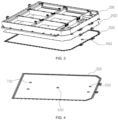
- FIG. 3 is a structural diagram of a battery box 1100 provided by an embodiment of the present application, including a box frame 100, a heat management component 200 and an outer plate 300.
- the heat management component 200 is disposed on one side of the box frame 100 to adjust the temperature of the battery.
- the outer plate 300 is disposed adjacent to the heat management component 200, for making the heat management component 200 cover the box frame 100.
- the outer plate 300 is provided with a balance valve 400.
- the balance valve 400 is used to make the cavity between the outer plate 300 and the heat management component 200 communicated with external air.
- the box frame 100 is used to carry the battery cell, and is usually made of stainless steel or other hard materials. After the battery cell is fixedly provided on the box frame 100, the battery is provided on the vehicle body through the box frame 100, to provide power to the vehicle.
- a heat management component 200 is provided on one side of the box frame 100 for dissipating heat to the battery cell arranged in the box frame 100.
- the heat management component 200 is usually disposed below the box frame 100 and is attached to the box frame 100, so as to have a better heat dissipation effect.
- the heat management component 200 comprises a water cooling plate, a heat dissipation plate or other heat dissipation components.
- the water cooling plate dissipates heat through liquid water.
- the water-cooling plate comprises an inlet and an outlet of liquid water, and a water-passing pipe is arranged on the water-cooling plate. By inputting cold water into the water-passing pipe, the heat is taken away by utilizing the heat-absorbing properties of liquid water, in the process of water transmission.
- the heat dissipation plate is generally made of materials that are easy to absorb heat. By contacting the heat source, the heat is quickly removed.
- the specific heat management method is not limited, and the technical solution proposed in the present application can be applied to various heat management solutions.
- the outer plate 300 is disposed on the other side of the heat management component 200. It is first sealingly fixed with the heat management component 200, and then they, as a whole, are sealingly fixed with the box frame 100. In order to ensure the sealing protection level of the battery and meet its requirements for waterproof performance, the outer plate 300 and the heat management component 200, as well as the outer plate 300 and the box frame 100 need to be provided to be together in a sealing manner.
- the outer plate 300, the heat management component 200 and the box frame 100 may be sealingly fixed by screws, or may be provided to be together, directly by welding.
- a balance valve 400 is provided on the outer plate 300, and the balance valve 400 is used to make the cavity between the outer plate 300 and the heat management component 200 communicated with external air. Due to the sealing arrangement of the outer plate 300 and the heat management component 200, during the heat dissipation process of the heat management component 200, the gas in the sealed cavity formed by the outer plate 300 and the heat management component 200 may be caused to expand with heat and contract with cold, causing the outer plate to be deformed. At the same time, due to the influence of the gas pressure, loosening or abnormal noise occurs between the outer plate 300 and the heat management component 200.
- the balance valve 400 is disposed on the outer plate 300.
- the air inside the cavity diffuses outward through the balance valve 400, which reduces the pressure inside the cavity and realizes the balance of the pressures inside and outside the cavity, thereby preventing the outer plate 300 from being deformed by the internal pressure of the cavity, and also avoids the occurrence of looseness between the outer plate 300 and the heat management component 200 which causes abnormal noise.
- a plurality of balance valves 400 are arranged on the outer plate 300, and the balance valves 400 are respectively arranged at both ends of the outer plate 300.
- the first balance valve 500 and the third balance valve 700 are located at two ends of the outer plate 300 respectively, and the arrangement of the balance valve 400 at both ends of the outer plate 300 is beneficial to balance the gas pressures received at both ends of the outer plate 300, especially when the area of the battery box is relatively large. Due to the different heating conditions of different battery cells, it will cause a relatively large difference in local heating of the battery box, resulting in that the internal gas pressure is unbalanced and the air pressure in the cavity between the heat management component 200 and the outer plate 300 is unbalanced.
- the balance valves 400 are arranged at both ends of the outer plate 300, which can quickly balance the air pressures received at both ends of the outer plate 300 and reduce the impact on the outer plate 300, which is caused by the air pressure difference between the two ends of the cavity.
- the balance valve 400 may also be disposed at the center of the outer plate 300.
- the second balance valve 600 is arranged at the center of the outer plate 300.
- the center position of the outer plate 300 refers to the non-edge positions of the outer plate 300.
- the balance valve 400 is arranged at the center of the outer plate 300, wherein with taking into account the air pressures in individual areas of the cavity, the gas in each area can flow out quickly.
- the balance valves 400 can also be arranged at both ends and the center position of the outer plate 300, which can realize the rapid circulation of the gas in the cavity and realize the rapid balance of the internal and external gas pressures.
- the outer plate 300 is provided with a fixing hole 310;
- the balance valve 400 comprises a balance valve body 430, a fixing structure is provided on the balance valve body 430, and the fixing structure cooperates with the fixing hole 310, to make the balance valve 400 fixed on one side of the outer plate 300.
- the balance valve 400 can be arranged on the outer plate 300 in various ways.
- the balance valve 400 can be directly welded on the outer plate 300 by means of welding.
- the balance valve 400 is fixed on the outer plate 300 by welding, when the balance valve 400 malfunctions, there is a problem of inconvenient maintenance.
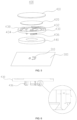
- the embodiment of the present application proposes an arranging method. As shown in FIG. 5 , in the embodiment of the present application, a fixing hole 310 is arranged on the outer plate 300, and a fixing structure is arranged on the balance valve body 430. The balance valve 400 is fixed on one side of the outer plate 300 through the cooperation of the fixing structure with the fixing hole 310.
- the fixing hole 310 can be in various shapes, for example, it can be directly a through hole, or it can be through holes with plural special shapes, as long as it can be adapted to the fixing structure, and the balance valve body 430 can be fixed. In this way, the installation and maintenance of the balance valve 400 are facilitated, and the use is convenient.
- the balance valve body 430 is provided with a ventilation hole 432, and the ventilation hole 432 and the fixing hole 310 together form a ventilation channel.
- a ventilation hole 432 is provided on the balance valve body 430.
- the ventilation hole 432 and the fixing hole 310 form a ventilation channel, so that the air in the cavity communicates with the outside, which is conducive to the rapid balance of air pressures inside and outside the cavity.
- the ventilation hole 432 on the balance valve body 430 is arranged at the center of the balance valve body 430, which may be the same as the axis of the fixing hole 310 on the outer plate 300 or staggered.
- the ventilation channel can be bent to a certain extent in the balance valve body 430 to prevent the gas in the cavity from directly impacting and damaging the balance valve 400, which can improve the service life of the balance valve 400.
- the fixing structure is a snapping structure 436.
- the snapping structure 436 is arranged as extending along the periphery of the ventilation hole 432 toward the outer plate 300, and is connected to the outer plate 300.
- the fixing holes 310 are snapped together.
- the fixing structure on the balance valve body 430 is provided as a snapping structure 436, and the snapping structure 436 is shown in FIG. 5 .
- the snapping structure 436 is arranged as extending along the periphery of the ventilation hole 432 toward the outer plate 300.
- One end of the snapping structure 436 is provided with a protrusion outward, and the protrusion is used to cooperate with the fixing hole 310 to be snapped in the fixing hole 310.
- the snapping structure 436 is a cantilever beam snapping arm structure.
- the snapping structure 436 may comprise a plurality of cantilever beam snapping arm structures.
- the plurality of cantilever beam snapping arm structures are arranged as dispersed.
- the length L of the snapping arm of the snapping structure 436 is greater than or equal to the thickness of the outer plate 300
- H is the thickness of the snapping arm
- the deformation amount Y is the height of the protrusion
- the setting of the deformation amount Y is related to the strength of the snapping of the balance valve 400.
- the balance valve 400 can be easily snapped on the outer plate 300.
- the snapping structure 436 passes through the fixing hole 310 to be engaged with the fixing hole 310, which facilitates the installation of the balance valve 400.
- the disassembling can also be easily achieved, which facilitates the subsequent maintenance.
- the strain value of the snapping structure 436 is greater than 15%.
- the applicant obtained through experiments that determining the strain value of the snapping structure 436 to be greater than 15% can achieve a better fixing effect.
- the snapping structure 436 is not easy to be broken during subsequent use, which ensures the service life of the balance valve 400, and the snapping structure 436 can be made of materials such as PCABS alloy, PPE, PP, or PA, etc.
- the width of the fixing hole 310 is greater than the width of the snapping structure 436.
- the width of the fixing hole 310 is set to be larger than the snapping structure 436 in this embodiment of the present application, so that after the balance valve 400 is snapped into the fixing hole 310 through the snapping structure 436, there is still a remaining space in the fixing hole 310 for gas to pass through.
- the fixing hole 310 can not only be used to install the balance valve 400, but also form, together with the ventilation hole 432, a ventilation channel. There is no need to provide additional ventilation hole 432 on the outer plate 300, which simplifies the structure and can achieve a good ventilation effect.
- the fixing structure is provided as a threaded structure 437, and the threaded structure 437 is arranged as extending along the periphery of the ventilation hole 432 toward the outer plate 300.
- the inner wall of the fixing hole 310 on the outer plate 300 is correspondingly provided with an internal threaded structure 437.
- the threaded structure 437 cooperates with the internal threaded structure 437 to be screwed into the fixing hole 310.
- the balance valve 400 is provided with a threaded structure 437, which is similar to the snapping structure 436 and is arranged as extending along the periphery of the ventilation hole 432 toward the outer plate 300.
- External thread is provided on the outer wall of the extending structure.
- an internal threaded structure 437 is provided on the inner wall of the fixing hole 310.
- the threaded structures 437 cooperate with each other to screw the balance valve 400 into the fixing hole 310. Similar to the snapping structure, the threaded structure 437 fixes the balance valve 400 by means of screwing.
- the fixing hole 310 is provided to have a hollow structure inside, and the hollow structure communicates with the ventilation hole 432 on the balance valve body 430 to form a ventilation channel.
- the battery box further comprises a sealing gasket 440 disposed between the balance valve 400 and the outer plate 300, for making the balance valve 400 and the outer plate 300 sealingly connected.
- a sealing gasket 440 is arranged between the balance valve body 430 and the outer plate 300.
- the sealing gasket 440 is of an annular structure and is sleeved on the outer periphery of the fixing structure.
- the sealing gasket 440 is squeezed between the balance valve body 430 and the outer plate 300.
- the sealing gasket 440 is elastically deformed to squeeze the fixing structure, so as to achieve a better sealing effect between the balance valve 400 and the outer plate 300.
- the sealing gasket 440 is made of elastic material, which can ensure that the sealing level between the balance valve body 430 and the outer plate 300 reaches the IPX8 level. In order to achieve a better sealing effect, before the connection, glue can be applied first between the sealing gasket 440 and the balance valve body 430 and between the sealing gasket 440 and the outer plate 300, so that it can achieve a better sealing effect.
- the sealing gasket 440 has a compression amount of 40%-60%.
- the compression amount of the sealing gasket 440 needs to be limited in a certain range after the fixing structure and the outer plate 300 are mounted together. Too little or too much compression amount is not conducive to the sealing. In the embodiment of the present application, the applicant has obtained through experiments that the optimal compression amount is 40%-60%. If the compression amount is too large, the sealing gasket 440 will be caused to be over-pressed, which will affect the service life of the sealing gasket 440. If the compression amount is too small, it will cause occurrence of poor sealing.
- a ventilation groove 434 is provided around the ventilation hole 432.
- the ventilation groove 434, the ventilation hole 432 and the fixing holes 310 together form a ventilation channel.
- ventilation grooves 434 are provided around the ventilation hole 432.
- the ventilation groove 434 communicates with the ventilation hole 432 and the fixing hole 310 to form together a ventilation channel. Since the ventilation grooves 434 are arranged around the ventilation holes 432, the gas in the cavity is not directly communicated with the ventilation holes 432, but needs to pass through the ventilation groove 434 to enter the ventilation hole 432, so the ventilation channel is bent through the ventilation groove 434 to prevent dust or debris from blocking the ventilation hole 432.
- positioning protrusions 438 are provided at intervals around the ventilation hole 432, and ventilation grooves 434 are formed between the positioning protrusions 438.
- positioning protrusions 438 are arranged at intervals around the ventilation hole 432.
- the ventilation grooves 434 are formed between the positioning protrusions 438 by arranging the positioning protrusions 438 at intervals.
- the ventilation groove 434 communicates with the ventilation hole 432, so that the balance valve 400 is of a more compact structure and a smaller volume.
- the balance film 420 further comprises a balance film 420, and the balance film 420 covers the ventilation holes 432.
- the balance film 420 has waterproof and air-ventilation function, and is usually made of e-PTFE film material.
- the waterproof level reaches the IPX8 standard level.
- the balance film 420 is attached above the ventilation holes 432 on the balance valve body 400 by thermo-compression welding, so as to cover the ventilation holes 432.
- the balance film 420 is disposed above the ventilation holes 432 to isolate the ventilation holes 432 from the ventilation grooves 434. On the one hand, the air in the cavity flows out, by passing through the ventilation holes 432, through the ventilation grooves 434, and on the other hand, the liquid entering the fixing holes 310 and the ventilation holes 432 is prevented from entering the cavity through the balance film 420, which has a good waterproof and ventilation effects.
- the balance film 420 is made of a waterproof and air-ventilation composite material.
- the balance film 420 has the waterproof and ventilation function, and is usually made of e-PTFE film material, and the waterproof level reaches the IPX8 standard level.
- the balance film 420 is attached above the ventilation holes 432 on the balance valve body 400 by thermo-compression welding, so as to cover the ventilation holes 432.
- the sealing gasket 440 is in the shape of a ring.
- the circumference of the inner ring of the ring is smaller than the circumference of the outer ring of the balance film 420, and the circumference of the outer ring of the ring is larger than the circumference of the outer ring of the balance film 420.
- the sealing gasket 440 mainly plays the role of sealing between the balance valve body 400 and the outer plate 300, and the balance film 420 mainly plays the role of sealing the ventilation hole 432.
- the circumference of the inner ring of the sealing gasket 440 is set to be smaller than the circumference of the outer ring of the balance film 420, and the circumference of the outer ring of the ring is set to be larger than the circumference of the outer ring of the balancing film 420, such that the sealing areas between the sealing gasket 440 and the balance film 420 overlap, so as to achieve a better sealing effect.
- the battery box further comprises a protective cover 410, and the protective cover 410 covers an end of the balance valve 400 away from the outer plate 300.
- a protective cover 410 is provided on the end of the balance valve 400 away from the outer plate 300 to protect the balance film 420.
- the dust or debris in the cavity can also be prevented from falling directly above the ventilation hole 432 and blocking the ventilation channel.
- the protective cover 410 covers the positioning protrusions 438. As shown in FIG. 5 , in order to make the structure of the balance valve 400 more compact, the protection cover 410 is placed to cover the positioning protrusion 438. In this way, the protective cover 410 can cover all the balance film 420, the balance valve body 400 and the sealing gasket 440 on the outer plate 300, which is of a compact structure and a small occupied volume. At the same time, by making the protective cover 410 cover the positioning protrusions 438, the protective cover 410 and the ventilation groove 434 together form a ventilation channel, which can also prevent the dust or debris in the cavity from directly falling above the ventilation hole 432 and blocking the ventilation channel.
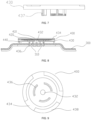
- FIG. 8 shows a cross-sectional view of the assembled balance valve 400 in the embodiment of the present application.
- the outer plate 300 is provided thereon with a fixing hole 310, and a sealing gasket 440 is arranged between the balance valve 400 and the outer plate 300.
- the fixing structure is arranged in the fixing hole 310, and a balance film 420 and a protective cover 410 are arranged to cover the ventilation hole 432.
- the balance film 420 separates the ventilation hole 432 from the external liquid to achieve waterproofing and air-ventilation effect.
- FIG. 9 shows a schematic diagram of a ventilation channel, wherein the fixing hole 310 is in communication with the ventilation hole 432, a ventilation groove 434 is formed between the cover plate and the positioning protrusion 438, and the ventilation groove 434, the ventilation hole 432, and the fixing hole 310 form together a ventilation channel, so as to realize the circulation of the cavity between the outer plate 300 and the heat management component 200 with the external air.
- the balance valve 400 is fixed on the outer plate 300, forming a compact structure, which is flat and occupies a small space, and therefore it can be well arranged in the narrow space between the outer plate 300 and the heat management component 200, achieving a good waterproof and air-ventilation performance. It can well balance the pressures of the gas in the cavity and the external gas, preventing the deformation of the outer plate 300 and the generation of abnormal noise.
- a battery is also provided, and the battery comprises any one of the battery boxes mentioned in the above embodiments.
- the battery box comprises a box frame 100, a heat management component 200 and an outer plate 300, wherein the heat management component 200 is disposed on one side of the box frame 100 and is used to adjust the temperature of the battery; the outer plate 300 is arranged adjacent to the heat management component 200 for covering the heat management component 200 on the box frame 100, and a balance valve 400 is arranged on the outer plate 300, and the balance valve 400 is used for making the cavity between the outer plate 300 and the heat management component 200 communicated with the outside air.
- the structure of the battery box proposed in the embodiments of the present application not only improves the heat dissipation performance of the battery box, but also reduces the possibility of deformation of the battery box during use, reduces abnormal noise, and improves the use experience.
- an electrical device is also provided, and the electrical device comprises the battery provided in the above embodiments.
- the battery is used to provide electrical energy for the electrical device.
- the electrical device can be, but is not limited to, a mobile phone, a tablet, a notebook computer, an electric toy, an electric tool, a battery car, an electric vehicle, a ship, a spacecraft, and the like.
- the electric toys may comprise stationary or mobile electric toys, such as, game consoles, electric car toys, electric ship toys, electric airplane toys, etc.
- the spacecraft may comprise airplanes, rockets, space shuttles, and spaceships.
Landscapes
- Chemical & Material Sciences (AREA)
- Chemical Kinetics & Catalysis (AREA)
- Electrochemistry (AREA)
- General Chemical & Material Sciences (AREA)
- Engineering & Computer Science (AREA)
- Manufacturing & Machinery (AREA)
- Aviation & Aerospace Engineering (AREA)
- Battery Mounting, Suspending (AREA)
- Gas Exhaust Devices For Batteries (AREA)
- Secondary Cells (AREA)
Description
- The present application relates to the technical field of batteries, and in particular, to a battery box, a battery and an electrical device.
- The key to sustainable development of automobile industry is the energy saving and emission reduction. Electric vehicles, thanks to their advantages of energy saving and environmental protection, have become important for the sustainable development of the automobile industry. For electric vehicles, battery technology is an important factor in their development.
- The battery will generate heat during use, which will increase the temperature of the battery. If the battery is at the temperature too high, the battery will be caused to spontaneously ignite or explode. Therefore, the battery needs to be dissipated. The inventor of the present application found in study that the heat dissipation effect of the existing heat dissipation solutions is poor, which will cause problems, such as, abnormal noise is produced during the heat dissipation process. Any of
DE2020201 01150U1 ,EP2506336A1 andCN112018299A disclose different exhaust means. - In order to solve the problems of poor heat dissipation effect and abnormal noise during the heat dissipation process, etc., in the prior art, the embodiments of the present application propose a battery box, a battery and an electrical device.
- The invention is defined in the appended claims.
- On the one hand, an embodiment of the present application proposes a battery box, comprising: a box frame, a heat management component and an outer plate, wherein the heat management component is arranged on one side of the box frame and is configured to adjust temperature of a battery; and the outer plate is arranged adjacent to the heat management component and is configured to cover the heat management component on the box frame, and a balance valve is arranged on the outer plate, and the balance valve is configured to make a cavity between the outer plate and the heat management component communicated with outside air.
- Through the above-mentioned embodiments proposed in the present application, the air inside the cavity can be communicated with the outside air. When the air pressure inside the cavity is relatively high, the air inside the cavity diffuses outward through the balance valve, reducing the pressure inside the cavity. The pressures inside and outside the cavity are balanced, thus avoiding the deformation of the outer plate due to the pressure inside the cavity, and also avoiding the looseness between the outer plate and the heat management component to produce abnormal noise.
- In some embodiments, the balance valve is disposed both ends of the outer plate. That the balance valve is arranged at both ends of the outer plate can quickly balance the air pressures received at both ends of the outer plate, and reduce the influence which is caused to the outer plate by the air pressure difference between the two ends of the inside of the cavity.
- In some embodiments, the balance valve is arranged at center of the outer plate. Taking into account the air pressure in each area in the cavity, the gas in each area can flow out quickly.
- In some embodiments, the outer plate is provided with a fixing hole; and the balance valve comprises a balance valve body, and a fixing structure is arranged on the balance valve body, and the fixing structure cooperates with the fixing hole to fix the balance valve on one side of the outer plate. In this way, the installation and maintenance of the balance valve and the use are convenient.
- In some embodiments, the balance valve body is provided with a ventilation hole, and the ventilation hole and the fixing hole form a ventilation channel. A ventilation channel is formed by the ventilation hole and the fixing hole, so that the air in the cavity is communicated with the outside, which is beneficial to the rapid balance of the air pressures inside and outside the cavity.
- In some embodiments, the fixing structure is a snapping structure; and the snapping structure is arranged as extending along periphery of the ventilation hole toward the outer plate, and is snapped with the fixing hole on the outer plate.
- By providing the fixing structure as a snapping structure, the balance valve can be easily snapped on the outer plate. When fixing, it is only necessary to press the balance valve, and the snapping structure passes through the fixing hole and is engaged with the fixing hole, which facilitates the installation of the balance valve. At the same time, through the snapping structure, it can also be easily disassembled, which is convenient for subsequent maintenance.
- In some embodiments, the snapping structure has a strain value greater than 15%. With this strain value, the snap-fit structure is less likely to be broken during subsequent use, which ensures the service life of the balance valve.
- In some embodiments, width of the fixing hole is greater than width of the snapping structure. In this way, the fixing hole can be used to install the balance valve, and form, together with the ventilation hole, a ventilation channel. There is no need to provide additional ventilation holes on the outer plate, which simplifies the structure and can achieve good ventilation effect.
- In some embodiments, the fixing structure is a threaded structure; and the threaded structure is arranged as extending along periphery of the ventilation hole toward the outer plate, an inner threaded structure is correspondingly provided on an inner wall of the fixing hole on the outer plate, and the threaded structure cooperates with the inner threaded structure and is screwed into the fixing hole.
- In the above manner, when fixing the balance valve, it is only necessary to twist the balance valve and make it screwed into the fixing hole, to realize the installation and fixing of the balance valve.
- In some embodiments, the battery box further comprises further comprising a sealing gasket, wherein the sealing gasket is arranged between the balance valve and the outer plate, and is configured for sealingly connecting the balance valve and the outer plate. When the balance valve body is connected to the outer plate, the sealing gasket is squeezed between the balance valve body and the outer plate, and the sealing gasket is elastically deformed, which squeezes the fixing structure, which can play a better sealing effect between the balance valve and the outer plate.
- In some embodiments, the sealing gasket has a compression amount of 40%-60%. The applicant has obtained through experiments that the optimal compression amount was 40%-60%. If the compression amount is too large, it will lead to overpressure of the sealing gasket, which will affect the service life of the sealing gasket. If the compression amount is too small, it will lead to poor sealing.
- In some embodiments, a ventilation groove is provided around the ventilation hole, on one side of the balance valve body away from the outer plate; and the ventilation groove, the ventilation hole and the fixing hole together form a ventilation channel.
- By arranging the ventilation groove around the ventilation hole, the gas in the cavity is not directly communicated to the ventilation hole, and needs to enter the ventilation hole via the ventilation groove. Therefore, the ventilation channel is bent through the ventilation groove to avoid dust or debris from blocking the ventilation hole.
- In some embodiments, positioning protrusions are provided at intervals around the ventilation hole, and ventilation grooves are formed between the positioning protrusions. Ventilation grooves are formed between the positioning protrusions, and the ventilation groove is communicated with the ventilation hole, so that the balance valve is of a more compact structure and a smaller volume.
- In some embodiments, the battery box further comprises a balance film, wherein the balance film is arranged as covering the ventilation hole. By providing the balance film, the liquid outside the cavity can be prevented from entering the cavity through the fixing hole and the ventilation hole, and at the same time, the circulation of the gas inside the cavity and the outside gas is not affected, and the waterproof and air-ventilation effects are achieved.
- In some embodiments, the balance film is of waterproof and air-ventilation composite material. By providing the balance film, the liquid outside the cavity can be prevented from entering the cavity through the fixing hole and the ventilation hole, and at the same time, the circulation of the gas inside the cavity and the external gas is not affected, and the waterproof and air-ventilation effects are achieved.
- In some embodiments, the sealing gasket is in shape of a ring, wherein circumference of an inner ring of the ring is smaller than circumference of an outer ring of the balance film, and circumference of an outer ring of the ring is greater than circumference of an outer ring of the balance film, so that the sealing areas between the sealing gasket and the balance film overlap, so as to achieve a better sealing effect.
- In some embodiments, the battery box further comprises a protective cover, wherein the protective cover is arranged as covering one end of the balance valve away from the outer plate.
- By providing the protective cover, the balance film of the balance valve can be effectively prevented from being damaged during assembly, transportation and storage. At the same time, by providing the protective cover, the dust or debris in the cavity can also be prevented from falling directly above the ventilation hole to block the ventilation channel.
- In some embodiments, the protective cover is arranged as covering the positioning protrusions. In this way, the protective cover can make all the balance film, the balance valve body and the sealing gasket cover the outer plate, and is of a compact structure and a small occupied volume.
- On the other hand, an embodiment of the present application further proposes a battery, including a battery cell and the battery box proposed in the above embodiments, wherein the battery cell is disposed in the battery box.
- On the other hand, an embodiment of the present application also provides an electrical device, which comprises the battery provided in the above-mentioned embodiments, and the battery is used to provide power.
- The drawings described herein are used to provide further understanding on the present application and constitute a part of the present application. The illustrative embodiments and descriptions of the present application are used to explain the present application and do not constitute an improper limitation on the present application. In the drawings:
-
FIG. 1 is a schematic structural diagram of a vehicle provided by some embodiments of the present application; -
FIG. 2 is an exploded schematic diagram of a battery provided by some embodiments of the present application; -
FIG. 3 is an exploded schematic diagram of a battery box provided by some embodiments of the present application; -
FIG. 4 is a schematic structural diagram of an outer plate provided by some embodiments of the present application; -
FIG. 5 is an exploded view of the balance valve and the outer plate, which are fixed, provided by some embodiments of the present application; -
Fig. 6 is a partial enlarged view of a balance valve provided by some embodiments of the present application; -
FIG. 7 is a structural diagram of another balance valve provided by some embodiments of the present application; -
FIG. 8 is a cross-sectional view of a balance valve provided by some embodiments of the present application; and -
FIG. 9 is a top view of a balance valve provided by some embodiments of the present application. - Reference Numbers:
battery cell 1000,vehicle 2000,battery 2100,controller 2200,motor 2300,battery box 1100,upper box 110,lower box 120,box frame 100,heat management component 200,outer plate 300, fixinghole 310,balance valve 400,protective cover 410,balance film 420,balance valve body 430,ventilation hole 432,ventilation groove 434, snappingstructure 436, threadedstructure 437,positioning protrusion 438, sealinggasket 440,first balance valve 500, thesecond balance valve 600 and thethird balance valve 700. - Embodiments of the technical solutions of the present application will be described in detail below with reference to the drawings. The following embodiments are only used to illustrate the technical solutions of the present invention more clearly, and therefore only used as examples, and cannot be used to limit the protection scope of the present invention.
- Unless otherwise defined, all technical and scientific terms used in the present application have the same meaning as commonly understood by those skilled in the technical field of the present application. The terms used in the present application in the specification of the present application are only for the purpose of describing specific embodiments, not limiting the present application. The terms "comprising" and "comprise" and any variations thereof in the description and claims of the present application and the above drawing description are intended to cover non-exclusive inclusion. The terms "first", "second" and the like in the description and claims of the present application or the above drawings are used to distinguish different objects, rather than to describe a specific order or a primary and secondary relationship.
- The "embodiment" mentioned in the present application means that a particular feature, structure, or characteristic, which is described in connection with the embodiment, can be included in at least one embodiment of the present application. The appearances of the term in various places in the specification do not necessarily refer to a same embodiment, or a separate or alternative embodiment that is mutually exclusive of other embodiments. It is explicitly and implicitly understood by those skilled in the art that the embodiments described in the present application may be combined with other embodiments.
- In the description of the present application, it should be noted that, unless expressly specified and limited otherwise, the terms, "installed", "connected with", "connected to" and "attached" should be understood in a broad sense. For example, it may be a fixed connection, or a detachable connection, or an integral connection. It can be directly connected, or indirectly connected through an intermediate medium, and it can be internally communicated between two components. For those skilled in the art, the specific meanings of the above terms in the present application can be understood according to specific situations.
- The term "and/or" in the present application is only an association relationship to describe associated objects, which means that there can be three kinds of relationships, for example, A and/or B, can mean that A exists alone, A and B exist at the same time, and B exists alone, which are three situations. In addition, the character "/" in the present application generally indicates that the related objects are an "or" relationship.
- In the present application, "plural" refers to two or more (including two), and similarly, "plural groups" refers to two or more groups (including two groups), and "plural sheets" refers to two or more sheets (comprises two sheets).
- At present, with the development of technology, the power battery is more and more extensively used. Power batteries are used not only in energy storage power systems, such as water, fire, wind and solar power plants, but also in electric vehicles, such as electric bicycles, electric motorcycles, and electric vehicles, as well as military equipment and aerospace and other fields. With the continuous expansion of the application field of power batteries, the market demand is also constantly expanding.
- With the increasing use of power batteries, the safety issues of batteries are becoming more and more prominent. At present, the main problem of battery safety is that the temperature of the battery will be caused to rise during operation. If the temperature is not properly controlled, it will cause the battery to spontaneously ignite or even explode. Therefore, how to control the battery temperature and dissipate heat to the battery in time when the battery temperature rises becomes more and more important. At present, the heat dissipation schemes mainly adopted comprise air cooling, water cooling and heat dissipation by other means. Usually, the heat management components are arranged inside the battery box to dissipate heat from the battery as a part of the battery box. The heat management components comprise water cooling boards and heat dissipation sheets, etc.
- In one design, heat management components are provided on a part of the battery, which is not the top, such as the bottom or sides. In addition, disposing the heat management components in these parts can avoid the high-voltage electrical cavity on the top of the battery, and prevent the pipeline of the heat management component from being damaged or prevent the liquid produced by condensation, from flowing into the high-voltage electrical cavity. And in order to ensure the sealing protection level requirements of the battery, a sealing will be provided between the heat management component and outer plate of the battery, located on the outside thereof.
- However, in the process of use, due to the heat management components having the effect of expanding with heat and contracting with cold on the air, the internal air pressure will change greatly, resulting in the deformation of the sealed outer plate, which will cause abnormal noise during use, affecting experience of customers and also affecting the cooling effect.
- In addition, the traditional balance valve is fixed on the sealed casing by screws, and it is often necessary to form a through hole on the installation casing for performing the bolt assembly. The bolt assembly has low installation efficiency and complicated post-processing procedures. On the other hand, traditional balance valve products are large in height, and further large in size, and it is difficult to install them in the confined space of heat management components and battery outer plate. If the balance valve is arranged outside the outer plate, the overall appearance consistency of the battery will be damaged, the volume of the battery will be increased, and the energy density of the battery will be reduced.
- Based on the above considerations, in the embodiments of the present application, a balance valve is provided in the battery box, and the balance valve and the outer plate of the battery box are sealingly provided, so that the sealing performance of the battery box can be ensured. At the same time, the balance valve can make the heat dissipation space sealed in the battery box communicated with the external space, so that the internal hot air can be dissipated through the balance valve. On the one hand, it can take away the heat inside the battery box. On the other hand, it also realizes the balance of internal and external air pressures, which avoids the deformation of the outer plate caused by the difference between the internal and external pressures, and also avoids abnormal sound caused by the difference between the internal and external pressures during use of the battery.
- The battery box and the battery disclosed in the embodiments of the present application can be used, but not limited to, in electrical devices, such as vehicles, ships, or aircraft. The battery box and the battery disclosed in the present application can be used to form a part of the power supply system of the electric device, which is beneficial to improve the heat dissipation performance of the battery box, thereby improving the safety of the electric device.
- The embodiment of the present application provides an electrical device using a battery as a power source, and the electrical device can be, but is not limited to, a mobile phone, a tablet, a notebook computer, an electric toy, an electric tool, a battery car, an electric vehicle, a ship, a spacecraft, and the like. Here, the electric toys may comprise stationary or mobile electric toys, such as, game consoles, electric car toys, electric ship toys, electric airplane toys, etc., and the spacecraft may comprise airplanes, rockets, space shuttles, and spaceships, etc.
- For the convenience of description, the following embodiments are described by taking as an example in which an electrical device according to an embodiment of the present application is a
vehicle 2000. - Referring to
FIG. 1 , it is a schematic structural diagram of avehicle 2000 according to an embodiment of the present application. Thevehicle 2000 may be a fuel vehicle, a gas vehicle, or a new energy vehicle, and the new energy vehicle may be a pure electric vehicle, a hybrid vehicle, or an extended-range vehicle, etc. Thevehicle 2000 is provided therein with abattery 2100, and thebattery 2100 may be provided at the bottom or the head or the rear of thevehicle 2000. Thebattery 2100 may be used to power thevehicle 2000, for example, thebattery 2100 may serve as an operating power source for thevehicle 2000. Thevehicle 2000 may also comprise acontroller 2200 and amotor 2300, with thecontroller 2200 used for controlling thebattery 2100 to supply power to themotor 2300, e.g., for work power requirements when starting, navigating, and driving thevehicle 2000. - In some embodiments of the present application, the
battery 2100 can not only be used as the operating power source of thevehicle 2000, but also be used as the driving power source of thevehicle 2000, to provide the driving power for thevehicle 2000, replacing or partially replacing the fuel or natural gas. - Referring to
FIG. 2 , it is an exploded view of abattery 2100 provided by an embodiment of the present application. Thebattery 2100 comprises abattery box 1100 and abattery cell 1000, and thebattery cell 1000 is accommodated in thebattery box 1100. - The
battery 2100 mentioned in the embodiments of the present application refers to a single physical module including one or more battery cells to provide higher voltage and capacity. For example, thebattery 2100 mentioned in the present application may comprise a battery module or a battery pack or the like. There may be a plurality ofbattery cells 1000, and the plurality ofbattery cells 1000 may be connected in series or in parallel or in a mixed connection. The mixed connection means thatplural battery cells 1000 are connected in series and in parallel. A plurality ofbattery cells 1000 can be directly connected together in series or in parallel or in the mixed connection, and then the whole composed of the plurality ofbattery cells 1000 can be accommodated in thebattery box 1100. Of course, a plurality ofbattery cells 1000 can also be connected in series or in parallel or in mixed connection, to form abattery 2100 in the form of a battery module, and then a plurality of battery modules can be connected in series or in parallel or in mixed connection to form a whole which is housed in thebattery box 1100. Thebattery 2100 may further include other structures, for example, thebattery 2100 may further include a bus component for realizing the electrical connection between the plurality ofbattery cells 1000. - The
battery box 1100 is used to provide accommodation space for thebattery cells 1000, and thebattery box 1100 may be of various structures. In some embodiments, thebattery box 1100 may comprise anupper box 110 and alower box 120, wherein theupper box 110 and thelower box 120 are covered with each other, and theupper box 110 and thelower box 120 together define a space for the accommodating space for accommodating thebattery cell 1000. Thelower box body 120 may be a hollow structure with one end open, theupper box body 110 may be a plate-like structure, and theupper box body 110 covers the open side of thelower box body 120, so that theupper box body 110 and thelower box body 120 together define an accommodating space. It is also possible that each of theupper box body 110 and thelower box body 120 is the hollow structure with one side open, and the open side of theupper box body 110 covers the open side of thelower box body 120. Of course, thebattery box 1100 formed by theupper box body 110 and thelower box body 120 may be in various shapes, such as a cylinder, a cuboid, and the like. -
FIG. 3 is a structural diagram of abattery box 1100 provided by an embodiment of the present application, including abox frame 100, aheat management component 200 and anouter plate 300. Theheat management component 200 is disposed on one side of thebox frame 100 to adjust the temperature of the battery. Theouter plate 300 is disposed adjacent to theheat management component 200, for making theheat management component 200 cover thebox frame 100. Theouter plate 300 is provided with abalance valve 400. Thebalance valve 400 is used to make the cavity between theouter plate 300 and theheat management component 200 communicated with external air. - As shown in
FIG. 3 , thebox frame 100 is used to carry the battery cell, and is usually made of stainless steel or other hard materials. After the battery cell is fixedly provided on thebox frame 100, the battery is provided on the vehicle body through thebox frame 100, to provide power to the vehicle. - A
heat management component 200 is provided on one side of thebox frame 100 for dissipating heat to the battery cell arranged in thebox frame 100. Theheat management component 200 is usually disposed below thebox frame 100 and is attached to thebox frame 100, so as to have a better heat dissipation effect. Theheat management component 200 comprises a water cooling plate, a heat dissipation plate or other heat dissipation components. The water cooling plate dissipates heat through liquid water. The water-cooling plate comprises an inlet and an outlet of liquid water, and a water-passing pipe is arranged on the water-cooling plate. By inputting cold water into the water-passing pipe, the heat is taken away by utilizing the heat-absorbing properties of liquid water, in the process of water transmission. Of course, other liquid substances can also be used to replace the water for heat dissipation. The heat dissipation plate is generally made of materials that are easy to absorb heat. By contacting the heat source, the heat is quickly removed. In the embodiments of the present application, the specific heat management method is not limited, and the technical solution proposed in the present application can be applied to various heat management solutions. - The
outer plate 300 is disposed on the other side of theheat management component 200. It is first sealingly fixed with theheat management component 200, and then they, as a whole, are sealingly fixed with thebox frame 100. In order to ensure the sealing protection level of the battery and meet its requirements for waterproof performance, theouter plate 300 and theheat management component 200, as well as theouter plate 300 and thebox frame 100 need to be provided to be together in a sealing manner. Theouter plate 300, theheat management component 200 and thebox frame 100 may be sealingly fixed by screws, or may be provided to be together, directly by welding. - A
balance valve 400 is provided on theouter plate 300, and thebalance valve 400 is used to make the cavity between theouter plate 300 and theheat management component 200 communicated with external air. Due to the sealing arrangement of theouter plate 300 and theheat management component 200, during the heat dissipation process of theheat management component 200, the gas in the sealed cavity formed by theouter plate 300 and theheat management component 200 may be caused to expand with heat and contract with cold, causing the outer plate to be deformed. At the same time, due to the influence of the gas pressure, loosening or abnormal noise occurs between theouter plate 300 and theheat management component 200. Thebalance valve 400 is disposed on theouter plate 300. On the one hand, it can isolate external water from entering the cavity formed by theouter plate 300 and theheat management component 200, and on the other hand, it can make the air inside the cavity and the outside air communicated with each other. When the air pressure inside the cavity is relatively high, the air inside the cavity diffuses outward through thebalance valve 400, which reduces the pressure inside the cavity and realizes the balance of the pressures inside and outside the cavity, thereby preventing theouter plate 300 from being deformed by the internal pressure of the cavity, and also avoids the occurrence of looseness between theouter plate 300 and theheat management component 200 which causes abnormal noise. - In some embodiments, as shown in
FIG. 4 , in order that thebalance valve 400 better balances the cavity between theouter plate 300 and theheat management component 200 and the external air pressure, a plurality ofbalance valves 400 are arranged on theouter plate 300, and thebalance valves 400 are respectively arranged at both ends of theouter plate 300. - As shown in
FIG. 4 , thefirst balance valve 500 and thethird balance valve 700 are located at two ends of theouter plate 300 respectively, and the arrangement of thebalance valve 400 at both ends of theouter plate 300 is beneficial to balance the gas pressures received at both ends of theouter plate 300, especially when the area of the battery box is relatively large. Due to the different heating conditions of different battery cells, it will cause a relatively large difference in local heating of the battery box, resulting in that the internal gas pressure is unbalanced and the air pressure in the cavity between theheat management component 200 and theouter plate 300 is unbalanced. Thebalance valves 400 are arranged at both ends of theouter plate 300, which can quickly balance the air pressures received at both ends of theouter plate 300 and reduce the impact on theouter plate 300, which is caused by the air pressure difference between the two ends of the cavity. - In some embodiments, as shown in
FIG. 4 , thebalance valve 400 may also be disposed at the center of theouter plate 300. As shown inFIG. 4 , thesecond balance valve 600 is arranged at the center of theouter plate 300. The center position of theouter plate 300 refers to the non-edge positions of theouter plate 300. In order to facilitate the air circulation in the cavity between theouter plate 300 and theheat management component 200, thebalance valve 400 is arranged at the center of theouter plate 300, wherein with taking into account the air pressures in individual areas of the cavity, the gas in each area can flow out quickly. At the same time, thebalance valves 400 can also be arranged at both ends and the center position of theouter plate 300, which can realize the rapid circulation of the gas in the cavity and realize the rapid balance of the internal and external gas pressures. - In some embodiments, as shown in
FIG. 5 , theouter plate 300 is provided with a fixinghole 310; thebalance valve 400 comprises abalance valve body 430, a fixing structure is provided on thebalance valve body 430, and the fixing structure cooperates with the fixinghole 310, to make thebalance valve 400 fixed on one side of theouter plate 300. - The
balance valve 400 can be arranged on theouter plate 300 in various ways. For example, thebalance valve 400 can be directly welded on theouter plate 300 by means of welding. However, in the case that thebalance valve 400 is fixed on theouter plate 300 by welding, when thebalance valve 400 malfunctions, there is a problem of inconvenient maintenance. The embodiment of the present application proposes an arranging method. As shown inFIG. 5 , in the embodiment of the present application, a fixinghole 310 is arranged on theouter plate 300, and a fixing structure is arranged on thebalance valve body 430. Thebalance valve 400 is fixed on one side of theouter plate 300 through the cooperation of the fixing structure with the fixinghole 310. The fixinghole 310 can be in various shapes, for example, it can be directly a through hole, or it can be through holes with plural special shapes, as long as it can be adapted to the fixing structure, and thebalance valve body 430 can be fixed. In this way, the installation and maintenance of thebalance valve 400 are facilitated, and the use is convenient. - In some embodiments, the
balance valve body 430 is provided with aventilation hole 432, and theventilation hole 432 and the fixinghole 310 together form a ventilation channel. In order to enhance the ventilation performance of thebalance valve 400, as shown inFIG. 5 , aventilation hole 432 is provided on thebalance valve body 430. Theventilation hole 432 and the fixinghole 310 form a ventilation channel, so that the air in the cavity communicates with the outside, which is conducive to the rapid balance of air pressures inside and outside the cavity. Theventilation hole 432 on thebalance valve body 430 is arranged at the center of thebalance valve body 430, which may be the same as the axis of the fixinghole 310 on theouter plate 300 or staggered. When theventilation hole 432 and the fixinghole 310 are arranged as staggered, the ventilation channel can be bent to a certain extent in thebalance valve body 430 to prevent the gas in the cavity from directly impacting and damaging thebalance valve 400, which can improve the service life of thebalance valve 400. - In some embodiments, as shown in
FIG. 5 , the fixing structure is a snappingstructure 436. The snappingstructure 436 is arranged as extending along the periphery of theventilation hole 432 toward theouter plate 300, and is connected to theouter plate 300. The fixing holes 310 are snapped together. - In order to realize the quick installation of the
balance valve 400, the fixing structure on thebalance valve body 430 is provided as a snappingstructure 436, and the snappingstructure 436 is shown inFIG. 5 . The snappingstructure 436 is arranged as extending along the periphery of theventilation hole 432 toward theouter plate 300. One end of the snappingstructure 436 is provided with a protrusion outward, and the protrusion is used to cooperate with the fixinghole 310 to be snapped in the fixinghole 310. - As shown in
FIG. 6 , which is a schematic diagram of the snappingstructure 436, the snappingstructure 436 is a cantilever beam snapping arm structure. The snappingstructure 436 may comprise a plurality of cantilever beam snapping arm structures. The plurality of cantilever beam snapping arm structures are arranged as dispersed. The length L of the snapping arm of the snappingstructure 436 is greater than or equal to the thickness of theouter plate 300, H is the thickness of the snapping arm, the deformation amount Y is the height of the protrusion, wherein the setting of the deformation amount Y is related to the strength of the snapping of thebalance valve 400. In the embodiment of the present application, the value of the deformation amount Y is determined according to the formula: Y = 0.67ξL 2 / H. When selecting the material used for the snappingstructure 436, firstly the deformation amount of the snappingstructure 436 is determined according to experience, to obtain the theoretical strain value through calculation, and then select a material that meets this requirement, according to the theoretical strain value. - By providing the fixing structure as the snapping
structure 436, thebalance valve 400 can be easily snapped on theouter plate 300. When fixing, it is only necessary to press thebalance valve 400, and the snappingstructure 436 passes through the fixinghole 310 to be engaged with the fixinghole 310, which facilitates the installation of thebalance valve 400. At the same time, through the snappingstructure 436, the disassembling can also be easily achieved, which facilitates the subsequent maintenance. - In some embodiments, the strain value of the snapping
structure 436 is greater than 15%. In the embodiment of the present application, the applicant obtained through experiments that determining the strain value of the snappingstructure 436 to be greater than 15% can achieve a better fixing effect. With this strain value, the snappingstructure 436 is not easy to be broken during subsequent use, which ensures the service life of thebalance valve 400, and the snappingstructure 436 can be made of materials such as PCABS alloy, PPE, PP, or PA, etc. - In some embodiments, the width of the fixing
hole 310 is greater than the width of the snappingstructure 436. In order to facilitate the gas circulation in the cavity between theouter plate 300 and theheat management component 200 and simplify the structure of thebalance valve 400, the width of the fixinghole 310 is set to be larger than the snappingstructure 436 in this embodiment of the present application, so that after thebalance valve 400 is snapped into the fixinghole 310 through the snappingstructure 436, there is still a remaining space in the fixinghole 310 for gas to pass through. In this way, the fixinghole 310 can not only be used to install thebalance valve 400, but also form, together with theventilation hole 432, a ventilation channel. There is no need to provideadditional ventilation hole 432 on theouter plate 300, which simplifies the structure and can achieve a good ventilation effect. - In some embodiments, the fixing structure is provided as a threaded
structure 437, and the threadedstructure 437 is arranged as extending along the periphery of theventilation hole 432 toward theouter plate 300. The inner wall of the fixinghole 310 on theouter plate 300 is correspondingly provided with an internal threadedstructure 437. The threadedstructure 437 cooperates with the internal threadedstructure 437 to be screwed into the fixinghole 310. - As shown in
FIG. 7 , thebalance valve 400 is provided with a threadedstructure 437, which is similar to the snappingstructure 436 and is arranged as extending along the periphery of theventilation hole 432 toward theouter plate 300. External thread is provided on the outer wall of the extending structure. Corresponding to the external thread, an internal threadedstructure 437 is provided on the inner wall of the fixinghole 310. The threadedstructures 437 cooperate with each other to screw thebalance valve 400 into the fixinghole 310. Similar to the snapping structure, the threadedstructure 437 fixes thebalance valve 400 by means of screwing. When fixing thebalance valve 400, it is only necessary to twist thebalance valve 400 and screw thebalance valve 400 into the fixinghole 310, so that thebalance valve 400 can be installed and fixed. Similarly, in order that the ventilation channel still remains in the fixinghole 310 after the balancingvalve 400 is installed, the fixinghole 310 is provided to have a hollow structure inside, and the hollow structure communicates with theventilation hole 432 on thebalance valve body 430 to form a ventilation channel. - In some embodiments, the battery box further comprises a sealing
gasket 440 disposed between thebalance valve 400 and theouter plate 300, for making thebalance valve 400 and theouter plate 300 sealingly connected. - Continuing to refer to
FIG. 5 , it can be seen fromFIG. 5 that a sealinggasket 440 is arranged between thebalance valve body 430 and theouter plate 300. The sealinggasket 440 is of an annular structure and is sleeved on the outer periphery of the fixing structure. When thebalance valve body 430 is connected with theouter plate 300, the sealinggasket 440 is squeezed between thebalance valve body 430 and theouter plate 300. The sealinggasket 440 is elastically deformed to squeeze the fixing structure, so as to achieve a better sealing effect between thebalance valve 400 and theouter plate 300. - The sealing
gasket 440 is made of elastic material, which can ensure that the sealing level between thebalance valve body 430 and theouter plate 300 reaches the IPX8 level. In order to achieve a better sealing effect, before the connection, glue can be applied first between the sealinggasket 440 and thebalance valve body 430 and between the sealinggasket 440 and theouter plate 300, so that it can achieve a better sealing effect. - In some embodiments, the sealing
gasket 440 has a compression amount of 40%-60%. In order to ensure the sealing effect of the sealinggasket 440, the compression amount of the sealinggasket 440 needs to be limited in a certain range after the fixing structure and theouter plate 300 are mounted together. Too little or too much compression amount is not conducive to the sealing. In the embodiment of the present application, the applicant has obtained through experiments that the optimal compression amount is 40%-60%. If the compression amount is too large, the sealinggasket 440 will be caused to be over-pressed, which will affect the service life of the sealinggasket 440. If the compression amount is too small, it will cause occurrence of poor sealing. - In some embodiments, on the side of the
balance valve body 400 away from theouter plate 300, aventilation groove 434 is provided around theventilation hole 432. Theventilation groove 434, theventilation hole 432 and the fixingholes 310 together form a ventilation channel. - In the cavity formed by the
outer plate 300 and theheat management component 200, foreign matters, such as dust or debris, may sometimes be generated. In order to prevent dust or debris inside the cavity from blocking the ventilation channel, in the embodiment of the present application,ventilation grooves 434 are provided around theventilation hole 432. Theventilation groove 434 communicates with theventilation hole 432 and the fixinghole 310 to form together a ventilation channel. Since theventilation grooves 434 are arranged around the ventilation holes 432, the gas in the cavity is not directly communicated with the ventilation holes 432, but needs to pass through theventilation groove 434 to enter theventilation hole 432, so the ventilation channel is bent through theventilation groove 434 to prevent dust or debris from blocking theventilation hole 432. - In some embodiments, positioning
protrusions 438 are provided at intervals around theventilation hole 432, andventilation grooves 434 are formed between the positioningprotrusions 438. - As shown in
FIG. 5 , in order to provide theventilation grooves 434, positioningprotrusions 438 are arranged at intervals around theventilation hole 432. Theventilation grooves 434 are formed between the positioningprotrusions 438 by arranging the positioningprotrusions 438 at intervals. Theventilation groove 434 communicates with theventilation hole 432, so that thebalance valve 400 is of a more compact structure and a smaller volume. - In some embodiments, it further comprises a
balance film 420, and thebalance film 420 covers the ventilation holes 432. As shown inFIG. 5 , thebalance film 420 has waterproof and air-ventilation function, and is usually made of e-PTFE film material. The waterproof level reaches the IPX8 standard level. Thebalance film 420 is attached above the ventilation holes 432 on thebalance valve body 400 by thermo-compression welding, so as to cover the ventilation holes 432. By providing thebalance film 420, the liquid outside the cavity can be prevented from entering the cavity through the fixingholes 310 and the ventilation holes 432, and at the same time, the circulation of the air inside the cavity and the outside air is not affected, and the waterproof and ventilation effects are achieved. Thebalance film 420 is disposed above the ventilation holes 432 to isolate the ventilation holes 432 from theventilation grooves 434. On the one hand, the air in the cavity flows out, by passing through the ventilation holes 432, through theventilation grooves 434, and on the other hand, the liquid entering the fixingholes 310 and the ventilation holes 432 is prevented from entering the cavity through thebalance film 420, which has a good waterproof and ventilation effects. - In some embodiments, the
balance film 420 is made of a waterproof and air-ventilation composite material. Thebalance film 420 has the waterproof and ventilation function, and is usually made of e-PTFE film material, and the waterproof level reaches the IPX8 standard level. Thebalance film 420 is attached above the ventilation holes 432 on thebalance valve body 400 by thermo-compression welding, so as to cover the ventilation holes 432. By providing thebalance film 420, the liquid outside the cavity can be prevented from entering the cavity through the fixinghole 310 and theventilation hole 432, and at the same time, the circulation of the gas inside the cavity and the external gas is not affected, and the waterproof and ventilation effects are achieved. - In some embodiments, the sealing
gasket 440 is in the shape of a ring. The circumference of the inner ring of the ring is smaller than the circumference of the outer ring of thebalance film 420, and the circumference of the outer ring of the ring is larger than the circumference of the outer ring of thebalance film 420. - As shown in
FIG. 5 , the sealinggasket 440 mainly plays the role of sealing between thebalance valve body 400 and theouter plate 300, and thebalance film 420 mainly plays the role of sealing theventilation hole 432. In order to achieve a better sealing effect, in this embodiment of the present application, the circumference of the inner ring of the sealinggasket 440 is set to be smaller than the circumference of the outer ring of thebalance film 420, and the circumference of the outer ring of the ring is set to be larger than the circumference of the outer ring of thebalancing film 420, such that the sealing areas between the sealinggasket 440 and thebalance film 420 overlap, so as to achieve a better sealing effect. - In some embodiments, the battery box further comprises a
protective cover 410, and theprotective cover 410 covers an end of thebalance valve 400 away from theouter plate 300. In order to prevent thebalance film 420 of thebalance valve 400 from being damaged during assembly, transportation and storage, in this embodiment of the present application, aprotective cover 410 is provided on the end of thebalance valve 400 away from theouter plate 300 to protect thebalance film 420. At the same time, by providing theprotective cover 410, the dust or debris in the cavity can also be prevented from falling directly above theventilation hole 432 and blocking the ventilation channel. - In some embodiments, the
protective cover 410 covers thepositioning protrusions 438. As shown inFIG. 5 , in order to make the structure of thebalance valve 400 more compact, theprotection cover 410 is placed to cover thepositioning protrusion 438. In this way, theprotective cover 410 can cover all thebalance film 420, thebalance valve body 400 and the sealinggasket 440 on theouter plate 300, which is of a compact structure and a small occupied volume. At the same time, by making theprotective cover 410 cover thepositioning protrusions 438, theprotective cover 410 and theventilation groove 434 together form a ventilation channel, which can also prevent the dust or debris in the cavity from directly falling above theventilation hole 432 and blocking the ventilation channel. -
FIG. 8 shows a cross-sectional view of the assembledbalance valve 400 in the embodiment of the present application. Theouter plate 300 is provided thereon with a fixinghole 310, and a sealinggasket 440 is arranged between thebalance valve 400 and theouter plate 300. The fixing structure is arranged in the fixinghole 310, and abalance film 420 and aprotective cover 410 are arranged to cover theventilation hole 432. Thebalance film 420 separates theventilation hole 432 from the external liquid to achieve waterproofing and air-ventilation effect.FIG. 9 shows a schematic diagram of a ventilation channel, wherein the fixinghole 310 is in communication with theventilation hole 432, aventilation groove 434 is formed between the cover plate and thepositioning protrusion 438, and theventilation groove 434, theventilation hole 432, and the fixinghole 310 form together a ventilation channel, so as to realize the circulation of the cavity between theouter plate 300 and theheat management component 200 with the external air. Thebalance valve 400 is fixed on theouter plate 300, forming a compact structure, which is flat and occupies a small space, and therefore it can be well arranged in the narrow space between theouter plate 300 and theheat management component 200, achieving a good waterproof and air-ventilation performance. It can well balance the pressures of the gas in the cavity and the external gas, preventing the deformation of theouter plate 300 and the generation of abnormal noise. - According to some embodiments of the present application, a battery is also provided, and the battery comprises any one of the battery boxes mentioned in the above embodiments. The battery box comprises a
box frame 100, aheat management component 200 and anouter plate 300, wherein theheat management component 200 is disposed on one side of thebox frame 100 and is used to adjust the temperature of the battery; theouter plate 300 is arranged adjacent to theheat management component 200 for covering theheat management component 200 on thebox frame 100, and abalance valve 400 is arranged on theouter plate 300, and thebalance valve 400 is used for making the cavity between theouter plate 300 and theheat management component 200 communicated with the outside air. The structure of the battery box proposed in the embodiments of the present application not only improves the heat dissipation performance of the battery box, but also reduces the possibility of deformation of the battery box during use, reduces abnormal noise, and improves the use experience. - According to some embodiments proposed in the present application, an electrical device is also provided, and the electrical device comprises the battery provided in the above embodiments. The battery is used to provide electrical energy for the electrical device. The electrical device can be, but is not limited to, a mobile phone, a tablet, a notebook computer, an electric toy, an electric tool, a battery car, an electric vehicle, a ship, a spacecraft, and the like. Here, the electric toys may comprise stationary or mobile electric toys, such as, game consoles, electric car toys, electric ship toys, electric airplane toys, etc., and the spacecraft may comprise airplanes, rockets, space shuttles, and spaceships.
Claims (14)
- A battery box, characterized by comprising: a box frame, a heat management component and an outer plate, whereinthe heat management component is arranged on one side of the box frame, and is configured to adjust temperature of a battery; andthe outer plate is arranged adjacent to the heat management component and is configured to cover the heat management component on the box frame, and a balance valve is arranged on the outer plate, and the balance valve is configured to make a cavity between the outer plate and the heat management component communicated with outside air, wherein the outer plate is provided with a fixing hole; andthe balance valve comprises a balance valve body, and a fixing structure is arranged on the balance valve body, and the fixing structure cooperates with the fixing hole to fix the balance valve on one side of the outer plate.
- The battery box according to claim 1, wherein the balance valve is disposed both ends of the outer plate.
- The battery box according to claim 1 or 2, wherein the balance valve is arranged at center of the outer plate.
- The battery box according to claim 1, wherein the balance valve body is provided with a ventilation hole, and the ventilation hole and the fixing hole form a ventilation channel.
- The battery box according to claim 1 or 4, wherein the fixing structure is a snapping structure; and
the snapping structure is arranged as extending along periphery of the ventilation hole toward the outer plate, and is snapped with the fixing hole on the outer plate. - The battery box according to claim 5, wherein the snapping structure has a strain value greater than 15%.
- The battery box according to claim 5 or 6, wherein a width of the fixing hole is greater than a width of the snapping structure.
- The battery box according to claim 1 or 4, wherein the fixing structure is a threaded structure; and
the threaded structure is arranged as extending along periphery of the ventilation hole toward the outer plate, an inner threaded structure is correspondingly provided on an inner wall of the fixing hole on the outer plate, and the threaded structure cooperates with the inner threaded structure and is screwed into the fixing hole. - The battery box according to any one of claims 1-8, further comprising a sealing gasket,
wherein the sealing gasket is arranged between the balance valve and the outer plate, and is configured for sealingly connecting the balance valve and the outer plate, particularly wherein the sealing gasket has a compression amount of 40%-60%. - The battery box according to any one of claims 1-9, wherein a ventilation groove is provided around the ventilation hole, on one side of the balance valve body away from the outer plate; and
the ventilation groove, the ventilation hole and the fixing hole together form a ventilation channel. - The battery box according to claim 10, wherein positioning protrusions are provided at intervals around the ventilation hole, and ventilation grooves are formed between the positioning protrusions, particularly comprising a protective cover,
wherein the protective cover is arranged as covering the positioning protrusions. - The battery box according to any one of claims 1-11, further comprising a balance film, wherein
the balance film is arranged as covering the ventilation hole, particularly wherein the balance film is of waterproof and air-ventilation composite material. - The battery box according to claim 12, wherein the sealing gasket is in shape of a ring, wherein a circumference of an inner ring of the ring is smaller than a circumference of an outer ring of the balance film, and a circumference of an outer ring of the ring is greater than the circumference of the outer ring of the balance film.
- The battery box according to any one of claims 1-13, further comprising a protective cover,
wherein the protective cover is arranged as covering one end of the balance valve away from the outer plate.
Applications Claiming Priority (1)
| Application Number | Priority Date | Filing Date | Title |
|---|---|---|---|
| PCT/CN2021/124207 WO2023060593A1 (en) | 2021-10-15 | 2021-10-15 | Battery box, battery, and electrical device |
Publications (3)
| Publication Number | Publication Date |
|---|---|
| EP4191764A1 EP4191764A1 (en) | 2023-06-07 |
| EP4191764A4 EP4191764A4 (en) | 2023-09-06 |
| EP4191764B1 true EP4191764B1 (en) | 2025-06-11 |
Family
ID=85981277
Family Applications (1)
| Application Number | Title | Priority Date | Filing Date |
|---|---|---|---|
| EP21930593.5A Active EP4191764B1 (en) | 2021-10-15 | 2021-10-15 | Battery box, battery, and electrical device |
Country Status (6)
| Country | Link |
|---|---|
| US (1) | US20230123699A1 (en) |
| EP (1) | EP4191764B1 (en) |
| JP (1) | JP7519454B2 (en) |
| KR (1) | KR102834204B1 (en) |
| CN (1) | CN116762217A (en) |
| WO (1) | WO2023060593A1 (en) |
Families Citing this family (4)
| Publication number | Priority date | Publication date | Assignee | Title |
|---|---|---|---|---|
| CN116742201B (en) * | 2023-08-14 | 2024-01-26 | 深圳海辰储能控制技术有限公司 | Battery pack and energy storage device |
| CN222690807U (en) * | 2023-12-21 | 2025-03-28 | 阳光电源股份有限公司 | Box and battery module having the same |
| JP2025116578A (en) * | 2024-01-29 | 2025-08-08 | トヨタ自動車株式会社 | Power storage device |
| CN118215257A (en) * | 2024-04-11 | 2024-06-18 | 辉创电子科技(苏州)有限公司 | A PCBA assembly balanced fixed structure |
Family Cites Families (14)
| Publication number | Priority date | Publication date | Assignee | Title |
|---|---|---|---|---|
| US8557415B2 (en) * | 2009-04-22 | 2013-10-15 | Tesla Motors, Inc. | Battery pack venting system |
| DE102011005916A1 (en) * | 2011-03-22 | 2012-09-27 | Sb Limotive Co., Ltd. | Pressure compensation element, housing having a pressure compensation element, lithium ion accumulator and motor vehicle |
| JP5749200B2 (en) | 2011-03-30 | 2015-07-15 | テスラ・モーターズ・インコーポレーテッド | Battery pack gas exhaust system |
| KR101967703B1 (en) | 2015-10-05 | 2019-04-10 | 주식회사 엘지화학 | Battery module and battery pack including the same |
| CN107464907A (en) * | 2017-09-20 | 2017-12-12 | 北京普莱德新能源电池科技有限公司 | A kind of electrokinetic cell system is breathed freely explosion-proof balanced valve |
| CN207441831U (en) * | 2017-11-29 | 2018-06-01 | 宁德时代新能源科技股份有限公司 | Balanced valve and battery case |
| JP6863916B2 (en) | 2018-02-21 | 2021-04-21 | 株式会社Gsユアサ | Power storage device |
| CN207441931U (en) * | 2018-03-06 | 2018-06-01 | 南京安尔泰通信科技有限公司 | A kind of low intermodulation attenuator |
| JP7306843B2 (en) | 2019-03-14 | 2023-07-11 | 株式会社Subaru | vehicle power supply |
| DE102019218456A1 (en) * | 2019-11-28 | 2021-06-02 | Elringklinger Ag | Pressure equalization system and electrochemical system |
| CN112928376B (en) | 2020-10-19 | 2024-01-23 | 江苏时代新能源科技有限公司 | Box, battery and device |
| CN112018300B (en) * | 2020-10-19 | 2021-02-09 | 江苏时代新能源科技有限公司 | Battery box, battery, electric device, and method and device for preparing battery |
| CN112103443B (en) * | 2020-11-13 | 2021-04-27 | 江苏时代新能源科技有限公司 | Box, battery, electrical equipment and manufacturing method of battery |
| CN213989032U (en) * | 2020-12-29 | 2021-08-17 | 蜂巢能源科技有限公司 | Battery box bottom plate structure and battery pack |
-
2021
- 2021-10-15 EP EP21930593.5A patent/EP4191764B1/en active Active
- 2021-10-15 WO PCT/CN2021/124207 patent/WO2023060593A1/en not_active Ceased
- 2021-10-15 CN CN202180092242.6A patent/CN116762217A/en active Pending
- 2021-10-15 KR KR1020227031541A patent/KR102834204B1/en active Active
- 2021-10-15 JP JP2022551387A patent/JP7519454B2/en active Active
-
2022
- 2022-09-16 US US17/947,080 patent/US20230123699A1/en active Pending
Also Published As
| Publication number | Publication date |
|---|---|
| KR102834204B1 (en) | 2025-07-14 |
| EP4191764A4 (en) | 2023-09-06 |
| US20230123699A1 (en) | 2023-04-20 |
| KR20230054607A (en) | 2023-04-25 |
| JP2023550217A (en) | 2023-12-01 |
| EP4191764A1 (en) | 2023-06-07 |
| JP7519454B2 (en) | 2024-07-19 |
| WO2023060593A1 (en) | 2023-04-20 |
| CN116762217A (en) | 2023-09-15 |
Similar Documents
| Publication | Publication Date | Title |
|---|---|---|
| EP4191764B1 (en) | Battery box, battery, and electrical device | |
| CN216529223U (en) | a battery pack | |
| JP2022500824A (en) | Battery packs, vehicles and energy storage devices | |
| WO2025166894A1 (en) | Battery and electrical device | |
| CN217641535U (en) | Battery Modules, Batteries and Consumer Devices | |
| WO2022156400A1 (en) | Battery liquid cooling plate assembly, battery assembly, and vehicle | |
| CN219873741U (en) | Thermal management component, battery and electric equipment | |
| WO2021249272A1 (en) | Battery pack and electric vehicle | |
| JP2025525283A (en) | Battery modules and battery packs | |
| CN105990538A (en) | Tube-type heat exchange power battery module device and manufacturing method thereof | |
| CN215527855U (en) | Power battery system and electric vehicle | |
| CN113937383B (en) | Battery module, battery pack and vehicle | |
| CN211455896U (en) | Battery liquid cooling structure and power battery | |
| CN116156832B (en) | A new energy vehicle power module control assembly device | |
| CN219066956U (en) | Battery pack and electricity utilization device | |
| CN120691032B (en) | Battery device and electric equipment | |
| CN210379290U (en) | Power battery pack structure | |
| CN115719821B (en) | A fuel cell PACK structure integrating DC/DC | |
| CN222507762U (en) | CTP battery pack | |
| CN116505137B (en) | Bionic impact-resistant light-weight new energy automobile battery pack | |
| CN223693250U (en) | Battery device and electric equipment | |
| CN220604839U (en) | Box, battery and electrical equipment | |
| CN220963568U (en) | Battery module and electricity utilization device | |
| CN206432306U (en) | Battery modules and battery bag | |
| CN222463180U (en) | Battery box, battery and power utilization device |
Legal Events
| Date | Code | Title | Description |
|---|---|---|---|
| STAA | Information on the status of an ep patent application or granted ep patent |
Free format text: STATUS: UNKNOWN |
|
| STAA | Information on the status of an ep patent application or granted ep patent |
Free format text: STATUS: THE INTERNATIONAL PUBLICATION HAS BEEN MADE |
|
| PUAI | Public reference made under article 153(3) epc to a published international application that has entered the european phase |
Free format text: ORIGINAL CODE: 0009012 |
|
| STAA | Information on the status of an ep patent application or granted ep patent |
Free format text: STATUS: REQUEST FOR EXAMINATION WAS MADE |
|
| 17P | Request for examination filed |
Effective date: 20221028 |
|
| AK | Designated contracting states |
Kind code of ref document: A1 Designated state(s): AL AT BE BG CH CY CZ DE DK EE ES FI FR GB GR HR HU IE IS IT LI LT LU LV MC MK MT NL NO PL PT RO RS SE SI SK SM TR |
|
| A4 | Supplementary search report drawn up and despatched |
Effective date: 20230809 |
|
| RIC1 | Information provided on ipc code assigned before grant |
Ipc: H01M 10/625 20140101ALI20230803BHEP Ipc: F16K 17/00 20060101ALI20230803BHEP Ipc: H01M 50/30 20210101ALI20230803BHEP Ipc: H01M 50/20 20210101AFI20230803BHEP |
|
| RAP1 | Party data changed (applicant data changed or rights of an application transferred) |
Owner name: CONTEMPORARY AMPEREX TECHNOLOGY(HONG KONG) LIMITED |
|
| GRAP | Despatch of communication of intention to grant a patent |
Free format text: ORIGINAL CODE: EPIDOSNIGR1 |
|
| STAA | Information on the status of an ep patent application or granted ep patent |
Free format text: STATUS: GRANT OF PATENT IS INTENDED |
|
| DAV | Request for validation of the european patent (deleted) | ||
| DAX | Request for extension of the european patent (deleted) | ||
| INTG | Intention to grant announced |
Effective date: 20250108 |
|
| RIN1 | Information on inventor provided before grant (corrected) |
Inventor name: WANG, QING Inventor name: CHEN, ZHIMING Inventor name: CHEN, BINBIN Inventor name: MIAO, HUIMIN |
|
| GRAS | Grant fee paid |
Free format text: ORIGINAL CODE: EPIDOSNIGR3 |
|
| GRAA | (expected) grant |
Free format text: ORIGINAL CODE: 0009210 |
|
| STAA | Information on the status of an ep patent application or granted ep patent |
Free format text: STATUS: THE PATENT HAS BEEN GRANTED |
|
| AK | Designated contracting states |
Kind code of ref document: B1 Designated state(s): AL AT BE BG CH CY CZ DE DK EE ES FI FR GB GR HR HU IE IS IT LI LT LU LV MC MK MT NL NO PL PT RO RS SE SI SK SM TR |
|
| REG | Reference to a national code |
Ref country code: GB Ref legal event code: FG4D |
|
| REG | Reference to a national code |
Ref country code: CH Ref legal event code: EP |
|
| REG | Reference to a national code |
Ref country code: DE Ref legal event code: R096 Ref document number: 602021032291 Country of ref document: DE |
|
| REG | Reference to a national code |
Ref country code: IE Ref legal event code: FG4D |
|
| P01 | Opt-out of the competence of the unified patent court (upc) registered |
Free format text: CASE NUMBER: APP_28850/2025 Effective date: 20250617 |
|
| PG25 | Lapsed in a contracting state [announced via postgrant information from national office to epo] |
Ref country code: ES Free format text: LAPSE BECAUSE OF FAILURE TO SUBMIT A TRANSLATION OF THE DESCRIPTION OR TO PAY THE FEE WITHIN THE PRESCRIBED TIME-LIMIT Effective date: 20250611 Ref country code: FI Free format text: LAPSE BECAUSE OF FAILURE TO SUBMIT A TRANSLATION OF THE DESCRIPTION OR TO PAY THE FEE WITHIN THE PRESCRIBED TIME-LIMIT Effective date: 20250611 |
|
| REG | Reference to a national code |
Ref country code: LT Ref legal event code: MG9D |
|
| PG25 | Lapsed in a contracting state [announced via postgrant information from national office to epo] |
Ref country code: GR Free format text: LAPSE BECAUSE OF FAILURE TO SUBMIT A TRANSLATION OF THE DESCRIPTION OR TO PAY THE FEE WITHIN THE PRESCRIBED TIME-LIMIT Effective date: 20250912 Ref country code: NO Free format text: LAPSE BECAUSE OF FAILURE TO SUBMIT A TRANSLATION OF THE DESCRIPTION OR TO PAY THE FEE WITHIN THE PRESCRIBED TIME-LIMIT Effective date: 20250911 |
|
| REG | Reference to a national code |
Ref country code: NL Ref legal event code: MP Effective date: 20250611 |
|
| PG25 | Lapsed in a contracting state [announced via postgrant information from national office to epo] |
Ref country code: BG Free format text: LAPSE BECAUSE OF FAILURE TO SUBMIT A TRANSLATION OF THE DESCRIPTION OR TO PAY THE FEE WITHIN THE PRESCRIBED TIME-LIMIT Effective date: 20250611 |
|
| PG25 | Lapsed in a contracting state [announced via postgrant information from national office to epo] |
Ref country code: HR Free format text: LAPSE BECAUSE OF FAILURE TO SUBMIT A TRANSLATION OF THE DESCRIPTION OR TO PAY THE FEE WITHIN THE PRESCRIBED TIME-LIMIT Effective date: 20250611 |
|
| PG25 | Lapsed in a contracting state [announced via postgrant information from national office to epo] |
Ref country code: RS Free format text: LAPSE BECAUSE OF FAILURE TO SUBMIT A TRANSLATION OF THE DESCRIPTION OR TO PAY THE FEE WITHIN THE PRESCRIBED TIME-LIMIT Effective date: 20250911 |
|
| PG25 | Lapsed in a contracting state [announced via postgrant information from national office to epo] |
Ref country code: LV Free format text: LAPSE BECAUSE OF FAILURE TO SUBMIT A TRANSLATION OF THE DESCRIPTION OR TO PAY THE FEE WITHIN THE PRESCRIBED TIME-LIMIT Effective date: 20250611 |
|
| PG25 | Lapsed in a contracting state [announced via postgrant information from national office to epo] |
Ref country code: NL Free format text: LAPSE BECAUSE OF FAILURE TO SUBMIT A TRANSLATION OF THE DESCRIPTION OR TO PAY THE FEE WITHIN THE PRESCRIBED TIME-LIMIT Effective date: 20250611 |
|
| PG25 | Lapsed in a contracting state [announced via postgrant information from national office to epo] |
Ref country code: PT Free format text: LAPSE BECAUSE OF FAILURE TO SUBMIT A TRANSLATION OF THE DESCRIPTION OR TO PAY THE FEE WITHIN THE PRESCRIBED TIME-LIMIT Effective date: 20251013 |
|
| REG | Reference to a national code |
Ref country code: AT Ref legal event code: MK05 Ref document number: 1802996 Country of ref document: AT Kind code of ref document: T Effective date: 20250611 |
|
| PG25 | Lapsed in a contracting state [announced via postgrant information from national office to epo] |
Ref country code: IS Free format text: LAPSE BECAUSE OF FAILURE TO SUBMIT A TRANSLATION OF THE DESCRIPTION OR TO PAY THE FEE WITHIN THE PRESCRIBED TIME-LIMIT Effective date: 20251011 |
|
| PGFP | Annual fee paid to national office [announced via postgrant information from national office to epo] |
Ref country code: DE Payment date: 20251027 Year of fee payment: 5 |
|
| PGFP | Annual fee paid to national office [announced via postgrant information from national office to epo] |
Ref country code: GB Payment date: 20251024 Year of fee payment: 5 |
|
| PG25 | Lapsed in a contracting state [announced via postgrant information from national office to epo] |
Ref country code: AT Free format text: LAPSE BECAUSE OF FAILURE TO SUBMIT A TRANSLATION OF THE DESCRIPTION OR TO PAY THE FEE WITHIN THE PRESCRIBED TIME-LIMIT Effective date: 20250611 Ref country code: SM Free format text: LAPSE BECAUSE OF FAILURE TO SUBMIT A TRANSLATION OF THE DESCRIPTION OR TO PAY THE FEE WITHIN THE PRESCRIBED TIME-LIMIT Effective date: 20250611 |
|
| PGFP | Annual fee paid to national office [announced via postgrant information from national office to epo] |
Ref country code: FR Payment date: 20251028 Year of fee payment: 5 |
|
| PG25 | Lapsed in a contracting state [announced via postgrant information from national office to epo] |
Ref country code: CZ Free format text: LAPSE BECAUSE OF FAILURE TO SUBMIT A TRANSLATION OF THE DESCRIPTION OR TO PAY THE FEE WITHIN THE PRESCRIBED TIME-LIMIT Effective date: 20250611 |
|
| PG25 | Lapsed in a contracting state [announced via postgrant information from national office to epo] |
Ref country code: PL Free format text: LAPSE BECAUSE OF FAILURE TO SUBMIT A TRANSLATION OF THE DESCRIPTION OR TO PAY THE FEE WITHIN THE PRESCRIBED TIME-LIMIT Effective date: 20250611 |
|
| PG25 | Lapsed in a contracting state [announced via postgrant information from national office to epo] |
Ref country code: EE Free format text: LAPSE BECAUSE OF FAILURE TO SUBMIT A TRANSLATION OF THE DESCRIPTION OR TO PAY THE FEE WITHIN THE PRESCRIBED TIME-LIMIT Effective date: 20250611 |
|
| PG25 | Lapsed in a contracting state [announced via postgrant information from national office to epo] |
Ref country code: SK Free format text: LAPSE BECAUSE OF FAILURE TO SUBMIT A TRANSLATION OF THE DESCRIPTION OR TO PAY THE FEE WITHIN THE PRESCRIBED TIME-LIMIT Effective date: 20250611 |
|
| REG | Reference to a national code |
Ref country code: DE Ref legal event code: R097 Ref document number: 602021032291 Country of ref document: DE |
|
| PG25 | Lapsed in a contracting state [announced via postgrant information from national office to epo] |
Ref country code: RO Free format text: LAPSE BECAUSE OF FAILURE TO SUBMIT A TRANSLATION OF THE DESCRIPTION OR TO PAY THE FEE WITHIN THE PRESCRIBED TIME-LIMIT Effective date: 20250611 |
|
| PG25 | Lapsed in a contracting state [announced via postgrant information from national office to epo] |
Ref country code: DK Free format text: LAPSE BECAUSE OF FAILURE TO SUBMIT A TRANSLATION OF THE DESCRIPTION OR TO PAY THE FEE WITHIN THE PRESCRIBED TIME-LIMIT Effective date: 20250611 |
|
| PG25 | Lapsed in a contracting state [announced via postgrant information from national office to epo] |
Ref country code: IT Free format text: LAPSE BECAUSE OF FAILURE TO SUBMIT A TRANSLATION OF THE DESCRIPTION OR TO PAY THE FEE WITHIN THE PRESCRIBED TIME-LIMIT Effective date: 20250611 |
|
| PLBE | No opposition filed within time limit |
Free format text: ORIGINAL CODE: 0009261 |
|
| STAA | Information on the status of an ep patent application or granted ep patent |
Free format text: STATUS: NO OPPOSITION FILED WITHIN TIME LIMIT |
|
| REG | Reference to a national code |
Ref country code: CH Ref legal event code: L10 Free format text: ST27 STATUS EVENT CODE: U-0-0-L10-L00 (AS PROVIDED BY THE NATIONAL OFFICE) Effective date: 20260423 |