EP4191150A2 - Airborne contaminant abatement systems and methods - Google Patents
Airborne contaminant abatement systems and methods Download PDFInfo
- Publication number
- EP4191150A2 EP4191150A2 EP22210526.4A EP22210526A EP4191150A2 EP 4191150 A2 EP4191150 A2 EP 4191150A2 EP 22210526 A EP22210526 A EP 22210526A EP 4191150 A2 EP4191150 A2 EP 4191150A2
- Authority
- EP
- European Patent Office
- Prior art keywords
- air
- vent
- airflow
- spaces
- return port
- Prior art date
- Legal status (The legal status is an assumption and is not a legal conclusion. Google has not performed a legal analysis and makes no representation as to the accuracy of the status listed.)
- Withdrawn
Links
- 239000000356 contaminant Substances 0.000 title claims abstract description 46
- 238000000034 method Methods 0.000 title claims description 23
- 239000012530 fluid Substances 0.000 claims abstract description 17
- 238000004891 communication Methods 0.000 claims abstract description 16
- 238000009423 ventilation Methods 0.000 claims description 37
- 238000001914 filtration Methods 0.000 claims description 10
- 241001465754 Metazoa Species 0.000 claims description 9
- 238000011109 contamination Methods 0.000 claims description 4
- 238000012544 monitoring process Methods 0.000 claims description 2
- 230000004888 barrier function Effects 0.000 description 5
- 238000004887 air purification Methods 0.000 description 4
- 230000009977 dual effect Effects 0.000 description 4
- 238000009434 installation Methods 0.000 description 3
- 208000025721 COVID-19 Diseases 0.000 description 2
- CURLTUGMZLYLDI-UHFFFAOYSA-N Carbon dioxide Chemical compound O=C=O CURLTUGMZLYLDI-UHFFFAOYSA-N 0.000 description 2
- 230000003993 interaction Effects 0.000 description 2
- 239000000126 substance Substances 0.000 description 2
- 238000002255 vaccination Methods 0.000 description 2
- MGWGWNFMUOTEHG-UHFFFAOYSA-N 4-(3,5-dimethylphenyl)-1,3-thiazol-2-amine Chemical compound CC1=CC(C)=CC(C=2N=C(N)SC=2)=C1 MGWGWNFMUOTEHG-UHFFFAOYSA-N 0.000 description 1
- 208000035473 Communicable disease Diseases 0.000 description 1
- 241000700605 Viruses Species 0.000 description 1
- 230000002411 adverse Effects 0.000 description 1
- 238000004378 air conditioning Methods 0.000 description 1
- 239000010425 asbestos Substances 0.000 description 1
- 239000001569 carbon dioxide Substances 0.000 description 1
- 229910002092 carbon dioxide Inorganic materials 0.000 description 1
- 210000000078 claw Anatomy 0.000 description 1
- 230000001143 conditioned effect Effects 0.000 description 1
- 230000003750 conditioning effect Effects 0.000 description 1
- 238000006073 displacement reaction Methods 0.000 description 1
- 230000000694 effects Effects 0.000 description 1
- 239000012717 electrostatic precipitator Substances 0.000 description 1
- 238000005516 engineering process Methods 0.000 description 1
- 239000003344 environmental pollutant Substances 0.000 description 1
- 238000010438 heat treatment Methods 0.000 description 1
- 208000015181 infectious disease Diseases 0.000 description 1
- 238000011081 inoculation Methods 0.000 description 1
- 239000011133 lead Substances 0.000 description 1
- 239000000463 material Substances 0.000 description 1
- 238000005259 measurement Methods 0.000 description 1
- WSFSSNUMVMOOMR-NJFSPNSNSA-N methanone Chemical compound O=[14CH2] WSFSSNUMVMOOMR-NJFSPNSNSA-N 0.000 description 1
- 238000012986 modification Methods 0.000 description 1
- 230000004048 modification Effects 0.000 description 1
- JCXJVPUVTGWSNB-UHFFFAOYSA-N nitrogen dioxide Inorganic materials O=[N]=O JCXJVPUVTGWSNB-UHFFFAOYSA-N 0.000 description 1
- 230000003647 oxidation Effects 0.000 description 1
- 238000007254 oxidation reaction Methods 0.000 description 1
- 239000002245 particle Substances 0.000 description 1
- 239000013618 particulate matter Substances 0.000 description 1
- 239000000575 pesticide Substances 0.000 description 1
- 231100000719 pollutant Toxicity 0.000 description 1
- 238000000746 purification Methods 0.000 description 1
- 229910052895 riebeckite Inorganic materials 0.000 description 1
- 230000035943 smell Effects 0.000 description 1
- -1 smells Substances 0.000 description 1
- 239000012855 volatile organic compound Substances 0.000 description 1
- XLYOFNOQVPJJNP-UHFFFAOYSA-N water Substances O XLYOFNOQVPJJNP-UHFFFAOYSA-N 0.000 description 1
Images


Classifications
-
- F—MECHANICAL ENGINEERING; LIGHTING; HEATING; WEAPONS; BLASTING
- F24—HEATING; RANGES; VENTILATING
- F24F—AIR-CONDITIONING; AIR-HUMIDIFICATION; VENTILATION; USE OF AIR CURRENTS FOR SCREENING
- F24F3/00—Air-conditioning systems in which conditioned primary air is supplied from one or more central stations to distributing units in the rooms or spaces where it may receive secondary treatment; Apparatus specially designed for such systems
- F24F3/12—Air-conditioning systems in which conditioned primary air is supplied from one or more central stations to distributing units in the rooms or spaces where it may receive secondary treatment; Apparatus specially designed for such systems characterised by the treatment of the air otherwise than by heating and cooling
- F24F3/16—Air-conditioning systems in which conditioned primary air is supplied from one or more central stations to distributing units in the rooms or spaces where it may receive secondary treatment; Apparatus specially designed for such systems characterised by the treatment of the air otherwise than by heating and cooling by purification, e.g. by filtering; by sterilisation; by ozonisation
- F24F3/163—Clean air work stations, i.e. selected areas within a space which filtered air is passed
-
- F—MECHANICAL ENGINEERING; LIGHTING; HEATING; WEAPONS; BLASTING
- F24—HEATING; RANGES; VENTILATING
- F24F—AIR-CONDITIONING; AIR-HUMIDIFICATION; VENTILATION; USE OF AIR CURRENTS FOR SCREENING
- F24F9/00—Use of air currents for screening, e.g. air curtains
-
- F—MECHANICAL ENGINEERING; LIGHTING; HEATING; WEAPONS; BLASTING
- F24—HEATING; RANGES; VENTILATING
- F24F—AIR-CONDITIONING; AIR-HUMIDIFICATION; VENTILATION; USE OF AIR CURRENTS FOR SCREENING
- F24F13/00—Details common to, or for air-conditioning, air-humidification, ventilation or use of air currents for screening
- F24F13/02—Ducting arrangements
-
- F—MECHANICAL ENGINEERING; LIGHTING; HEATING; WEAPONS; BLASTING
- F24—HEATING; RANGES; VENTILATING
- F24F—AIR-CONDITIONING; AIR-HUMIDIFICATION; VENTILATION; USE OF AIR CURRENTS FOR SCREENING
- F24F13/00—Details common to, or for air-conditioning, air-humidification, ventilation or use of air currents for screening
- F24F13/28—Arrangement or mounting of filters
-
- F—MECHANICAL ENGINEERING; LIGHTING; HEATING; WEAPONS; BLASTING
- F24—HEATING; RANGES; VENTILATING
- F24F—AIR-CONDITIONING; AIR-HUMIDIFICATION; VENTILATION; USE OF AIR CURRENTS FOR SCREENING
- F24F7/00—Ventilation
- F24F7/003—Ventilation in combination with air cleaning
-
- F—MECHANICAL ENGINEERING; LIGHTING; HEATING; WEAPONS; BLASTING
- F24—HEATING; RANGES; VENTILATING
- F24F—AIR-CONDITIONING; AIR-HUMIDIFICATION; VENTILATION; USE OF AIR CURRENTS FOR SCREENING
- F24F7/00—Ventilation
- F24F7/04—Ventilation with ducting systems, e.g. by double walls; with natural circulation
- F24F7/06—Ventilation with ducting systems, e.g. by double walls; with natural circulation with forced air circulation, e.g. by fan positioning of a ventilator in or against a conduit
-
- F—MECHANICAL ENGINEERING; LIGHTING; HEATING; WEAPONS; BLASTING
- F24—HEATING; RANGES; VENTILATING
- F24F—AIR-CONDITIONING; AIR-HUMIDIFICATION; VENTILATION; USE OF AIR CURRENTS FOR SCREENING
- F24F8/00—Treatment, e.g. purification, of air supplied to human living or working spaces otherwise than by heating, cooling, humidifying or drying
- F24F8/10—Treatment, e.g. purification, of air supplied to human living or working spaces otherwise than by heating, cooling, humidifying or drying by separation, e.g. by filtering
-
- F—MECHANICAL ENGINEERING; LIGHTING; HEATING; WEAPONS; BLASTING
- F24—HEATING; RANGES; VENTILATING
- F24F—AIR-CONDITIONING; AIR-HUMIDIFICATION; VENTILATION; USE OF AIR CURRENTS FOR SCREENING
- F24F9/00—Use of air currents for screening, e.g. air curtains
- F24F2009/002—Room dividers
-
- F—MECHANICAL ENGINEERING; LIGHTING; HEATING; WEAPONS; BLASTING
- F24—HEATING; RANGES; VENTILATING
- F24F—AIR-CONDITIONING; AIR-HUMIDIFICATION; VENTILATION; USE OF AIR CURRENTS FOR SCREENING
- F24F2120/00—Control inputs relating to users or occupants
- F24F2120/10—Occupancy
-
- F—MECHANICAL ENGINEERING; LIGHTING; HEATING; WEAPONS; BLASTING
- F24—HEATING; RANGES; VENTILATING
- F24F—AIR-CONDITIONING; AIR-HUMIDIFICATION; VENTILATION; USE OF AIR CURRENTS FOR SCREENING
- F24F8/00—Treatment, e.g. purification, of air supplied to human living or working spaces otherwise than by heating, cooling, humidifying or drying
- F24F8/10—Treatment, e.g. purification, of air supplied to human living or working spaces otherwise than by heating, cooling, humidifying or drying by separation, e.g. by filtering
- F24F8/108—Treatment, e.g. purification, of air supplied to human living or working spaces otherwise than by heating, cooling, humidifying or drying by separation, e.g. by filtering using dry filter elements
-
- F—MECHANICAL ENGINEERING; LIGHTING; HEATING; WEAPONS; BLASTING
- F24—HEATING; RANGES; VENTILATING
- F24F—AIR-CONDITIONING; AIR-HUMIDIFICATION; VENTILATION; USE OF AIR CURRENTS FOR SCREENING
- F24F8/00—Treatment, e.g. purification, of air supplied to human living or working spaces otherwise than by heating, cooling, humidifying or drying
- F24F8/10—Treatment, e.g. purification, of air supplied to human living or working spaces otherwise than by heating, cooling, humidifying or drying by separation, e.g. by filtering
- F24F8/192—Treatment, e.g. purification, of air supplied to human living or working spaces otherwise than by heating, cooling, humidifying or drying by separation, e.g. by filtering by electrical means, e.g. by applying electrostatic fields or high voltages
-
- F—MECHANICAL ENGINEERING; LIGHTING; HEATING; WEAPONS; BLASTING
- F24—HEATING; RANGES; VENTILATING
- F24F—AIR-CONDITIONING; AIR-HUMIDIFICATION; VENTILATION; USE OF AIR CURRENTS FOR SCREENING
- F24F8/00—Treatment, e.g. purification, of air supplied to human living or working spaces otherwise than by heating, cooling, humidifying or drying
- F24F8/20—Treatment, e.g. purification, of air supplied to human living or working spaces otherwise than by heating, cooling, humidifying or drying by sterilisation
-
- F—MECHANICAL ENGINEERING; LIGHTING; HEATING; WEAPONS; BLASTING
- F24—HEATING; RANGES; VENTILATING
- F24F—AIR-CONDITIONING; AIR-HUMIDIFICATION; VENTILATION; USE OF AIR CURRENTS FOR SCREENING
- F24F8/00—Treatment, e.g. purification, of air supplied to human living or working spaces otherwise than by heating, cooling, humidifying or drying
- F24F8/30—Treatment, e.g. purification, of air supplied to human living or working spaces otherwise than by heating, cooling, humidifying or drying by ionisation
Definitions
- Exemplary embodiments pertain to the art of ventilation. More particularly, the present disclosure relates to configurations of ventilation systems for abating airborne contaminants.
- COVID-19 pandemic continues to ravage communities where vaccination rates are low.
- Means for preventing the spread of infectious diseases like COVID -19 remain relevant as it is clear that some portion of every country's population will refuse inoculation.
- other contaminants such as particulate matter, smells, chemical pollutants (e.g., formaldehyde, asbestos, lead, nitrogen dioxide, pesticides, volatile organic compounds, and the like), and even carbon dioxide levels can have adverse effects on people.
- systems capable of providing people with fresh air offer benefits for preventing airborne contamination. Accordingly, there remains a need in the art for systems and methods cable of abating airborne contamination.
- a first aspect of the present invention provides a method of abating airborne contamination comprising: operating an air mover of a ventilation apparatus to create an airflow through the ventilation apparatus; filtering an airborne contaminant from the airflow in the ventilation apparatus; directing the airflow to a boundary of a plurality of spaces through a supply air passage and a fluidly connected vent; accelerating the airflow through the vent to create an air curtain at the boundary between two or more of the plurality of spaces; receiving the airflow at a return port fluidly connected to the air mover by a return air passage; and directing the airflow through the return air passage to an inlet of the air mover.
- the method may comprise monitoring one or more spaces of the plurality of spaces for a presence of an animal and selectively operating the air mover when the presence of the animal is detected in the one or more spaces.
- the method may comprise selectively directing the airflow to one or more boundaries of the one or more spaces where the presence of the animal is detected.
- the animal is optionally a human.
- the method may comprise directing the air curtain upward from the vent to the return port.
- the method may comprise directing the air curtain downward from vent to the return port.
- the method may comprise entraining in the air curtain airborne contaminants generated by an occupant of the space.
- a second aspect of the present invention provides an airborne contaminant abatement apparatus comprising: an air mover having an air mover inlet and an air mover outlet and configured to create an airflow when operating; a filter disposed in fluid communication with the airflow and configured to remove airborne contaminants therefrom; a supply air passage disposed in fluid communication with the air mover outlet and a vent; the vent disposed along at least a portion of a boundary of a plurality of spaces to be occupied, wherein the vent is configured to accelerate the airflow passing therethrough to create an air curtain extending from the boundary; a return air passage configured to receive the airflow at a return port and direct the airflow to the air mover inlet.
- the boundary at least partially surrounds at least one of the plurality of spaces.
- the air supply passage and the vent define a top cover of a wall of a cubicle, a retainer of the top cover of the wall of the cubicle, or both.
- the air supply passage defines a retainer of a top cover of a wall of a cubicle
- the vent defines a top cover of the wall of the cubicle
- the return port is disposed centrally within a space of the plurality of spaces.
- the vent is vertically aligned with the return port.
- the vent comprises a plurality of vent openings configured to divide the airflow into two or more adjacent air curtains.
- the two or more adjacent air curtains extend parallel to one another.
- a third aspect of the present invention provides a method of configuring a space for temporary occupancy comprising: providing a ventilation device in fluid communication with a space to be occupied, wherein the ventilation device comprises a contaminant filter for filtering contaminants from an airflow passing therethrough; disposing a vent at least partially along a border of the space to be occupied; arranging an air supply passage in fluid communication with an air outlet of the ventilation device and the vent; disposing a return port a distance away from the vent, wherein the return port is configured for receiving the airflow from the vent; arranging a return air passage in fluid communication with the return port and with an air inlet of the ventilation device; and operating the ventilation device to create an air curtain from the airflow, wherein the air curtain extends between the vent and the return port along at least a portion of the boundary.
- the method may comprise detecting a presence of an occupant in the space to be occupied and selectively operating the ventilation device when the presence of the occupant in the space to be occupied is detected.
- Figure 1 is a schematic illustration of an airborne contaminant abatement apparatus 100 having a ventilation device 110, an air supply passage 120, a vent 130, return port 150, and return air passage 160.
- the contaminant abatement apparatus 100 can be configured for operation in a cubicle section 220 of a building to provide an air curtain 200 between occupants of the cubicles while they are working.
- the air curtain 200 can provide a contaminant barrier between adjacent cubicles isolating occupants from exhaled contaminants of their co-workers.
- the air curtain 200 can be configured to deflect or capture airborne contaminants exhaled by occupants of the adjacent space. When deflected the airborne contaminant can be pushed away from the air curtain 200 while when captured the airborne contaminant can be entrained in the air curtain 200 becoming part of the fluid stream. Entrained contaminants can be filtered from the airstream in the ventilation device 110 using any suitable filtering technology.
- the ventilation device 110 can use a mechanical filtering (e.g., high efficiency particle arrestance (HEPA) filter), chemical filtering (e.g., oxidation, irradiation), electrical filtering (e.g., with ionizers, electrostatic precipitators, and the like), or a combination thereof to filter contaminants from the airstream before it is returned to the vent 130.
- a mechanical filtering e.g., high efficiency particle arrestance (HEPA) filter
- chemical filtering e.g., oxidation, irradiation
- electrical filtering e.g., with ionizers, electrostatic precipitators, and the like
- FIG. 2 is a schematic illustration of the airborne contaminant abatement apparatus 100 having a ventilation device 110, an air supply passage 120, a vent 130, return port 150, and return air passage 160.
- the contaminant abatement apparatus 100 can be configured for operation in a horizontal fashion such as when people 10 (or animals) are queued in a line, such as waiting to enter a building or a space therein.
- the exhaled breath 15 of the people 10 can be entrained in the air curtain 200 and returned to the ventilation device 110 for purification.
- Figure 3 is a schematic illustration of the airborne contaminant abatement apparatus 100 having a ventilation device 110, an air supply passage 120, a vent 130, return port 150, and return air passage 160.
- the contaminant abatement apparatus 100 can be configured for operation between people 10 to prevent airborne contaminants from passing from one person to another and posing an infection risk. Air exhaled from nearby or adjacently situated people 10 can be entrained in the air curtain 200 or deflected away from the air curtain 200 to prevent passing of contaminants between the adjacent spaces.
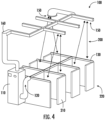
- FIG 4 is a schematic illustration of an airborne contaminant abatement apparatus 100 having a ventilation device 110, an air supply passage 120, a vent 130, return port 150, and return air passage 160.
- the contaminant abatement apparatus 100 can be configured for operation in a cubicle section 220 of a building to provide an air curtain 200 between occupants of the cubicles while they are working.
- the air curtain 200 can provide a contaminant barrier between adjacent cubicles isolating occupants from exhaled contaminants of their co-workers and/or other air quality concerns.
- the contaminant abatement apparatus 100 can be configured such that the vents 130 define at least a portion of a perimeter of one or more co-located work areas and the return ports 150 are arranged more centrally within each space.
- a return port 150 can include a centrally located port that draws air from vents located along two or more perimeters of a work area disposed in plurality of work areas (e.g., co-located work area).
- the ventilation device 110 can include any device capable of taking an airstream into a return air passage 160, filtering airborne contaminants from the airstream, and returning the cleaned airstream to an air supply passage 120.
- the ventilation device 110 can include a "stand alone" air purifier (e.g., an air scrubber, a negative air machine, a combination thereof, or the like), a ducted air purification system, or a combination of the two.
- a "stand alone” air purifier system can include an air inlet, an air outlet, an air mover, and a filter, where the air mover is configured to urge an airflow from the air inlet through the filter to the air outlet to provide cleaned air.
- a ducted air purification system can include a central heating ventilation, and air conditioning (HVAC) system having air purification functionality built into the system.
- HVAC heating ventilation, and air conditioning
- a central HVAC system disposed in a building can include a plurality of air ducts fluidly connecting one or more spaces to be conditioned within the building to an air handler having air purification functionality.
- the central HVAC system can be configured for environmentally conditioning the one or more spaces fluidly connected to the air handler within the building through a vent 130 located in fluid communication with the one or more spaces.
- An air mover inlet of the ventilation device 110 can be disposed in fluid communication with the return air passage 160 and the air mover outlet of the ventilation device 110 can be disposed in fluid communication with the air supply passage 130.
- the air mover can include any suitable device for urging an airflow through the ventilation device 110.
- the air mover can include a centrifugal fan, axial fan, mixed flow fan, single stage or multistage blower, positive displacement blower (e.g., rotary lobe, claw pump), centrifugal blower, rotary vane blower, water ring pump, or the like.
- the contaminant abatement apparatus 100 can optionally include one or more booster fans or blowers disposed in fluid communication with the air supply passage 120 to increase the velocity of air flowing through the vent 130.
- one or more booster fans or blowers disposed in fluid communication with the air supply passage 120 to increase the velocity of air flowing through the vent 130.
- an inline fan 125 can be used to increase the velocity of air flowing through vents 130a and 130b.
- the contaminant abatement apparatus 100 can be configured for up-flow, downflow, or dual up/down-flow configurations of the air curtain 200.
- the vent 130 can be positioned at the ceiling and oriented to direct the air curtain 200 downward toward the return port 150 positioned in the floor (e.g., or the top of a barrier such as a cubicle wall).
- the vent 130 can be positioned at a low point, such as the floor, or the top of a barrier 210 such as a cubicle wall, and oriented to direct the air curtain 200 upward toward the return port 150 positioned in the ceiling.
- adjacently located vents 130 and return ports 150 can be positioned at both the ceiling and floor such that a dual up/down-flow barrier is formed by dual air curtains 200 flowing in opposing directions.
- dual air curtains having co-flow configurations, e.g., where adjacent vents deliver a plurality of airflows creating a plurality of air curtains extending between the vent 130 and the return port 150.
- the vent 130 can be configured to accelerate the airflow passing therethrough.
- the vent can include a converging section, a diverging section, or a combination thereof.
- the converging section can be used to accelerate the airflow and focus the airflow into a smaller flow area.
- a method of abating airborne contaminants can include operating the ventilation device 110 to create an airflow therethrough. Directing the airflow from the ventilation device 110 to a vent 130 using an air supply passage 120 to extend to one or more perimeters of a space to be isolated. The method can include accelerating the airflow through the vent 130 to create an air curtain 200 at the perimeters of the space to be isolated. Furthermore, the method can include collecting at least a portion of the airflow exiting the vent 130 at the return port 150 and returning it to the ventilation device 110 through the return air passage 160. The method can further include filtering contaminants from the airflow within the ventilation device 110.
Landscapes
- Engineering & Computer Science (AREA)
- Chemical & Material Sciences (AREA)
- Combustion & Propulsion (AREA)
- Mechanical Engineering (AREA)
- General Engineering & Computer Science (AREA)
- Filtering Of Dispersed Particles In Gases (AREA)
- Ventilation (AREA)
- Accommodation For Nursing Or Treatment Tables (AREA)
Abstract
Description
- Exemplary embodiments pertain to the art of ventilation. More particularly, the present disclosure relates to configurations of ventilation systems for abating airborne contaminants.
- Despite vaccination availability worldwide, the COVID-19 pandemic continues to ravage communities where vaccination rates are low. Means for preventing the spread of infectious diseases like COVID -19 remain relevant as it is clear that some portion of every country's population will refuse inoculation. In addition to viruses, other contaminants such as particulate matter, smells, chemical pollutants (e.g., formaldehyde, asbestos, lead, nitrogen dioxide, pesticides, volatile organic compounds, and the like), and even carbon dioxide levels can have adverse effects on people. As urbanization continues to drive people into closer interactions, systems capable of providing people with fresh air offer benefits for preventing airborne contamination. Accordingly, there remains a need in the art for systems and methods cable of abating airborne contamination.
A first aspect of the present invention provides a method of abating airborne contamination comprising: operating an air mover of a ventilation apparatus to create an airflow through the ventilation apparatus; filtering an airborne contaminant from the airflow in the ventilation apparatus; directing the airflow to a boundary of a plurality of spaces through a supply air passage and a fluidly connected vent; accelerating the airflow through the vent to create an air curtain at the boundary between two or more of the plurality of spaces; receiving the airflow at a return port fluidly connected to the air mover by a return air passage; and directing the airflow through the return air passage to an inlet of the air mover. - The method may comprise monitoring one or more spaces of the plurality of spaces for a presence of an animal and selectively operating the air mover when the presence of the animal is detected in the one or more spaces.
- The method may comprise selectively directing the airflow to one or more boundaries of the one or more spaces where the presence of the animal is detected.
- The animal is optionally a human.
- The method may comprise directing the air curtain upward from the vent to the return port.
- The method may comprise directing the air curtain downward from vent to the return port.
- The method may comprise entraining in the air curtain airborne contaminants generated by an occupant of the space.
- A second aspect of the present invention provides an airborne contaminant abatement apparatus comprising: an air mover having an air mover inlet and an air mover outlet and configured to create an airflow when operating; a filter disposed in fluid communication with the airflow and configured to remove airborne contaminants therefrom; a supply air passage disposed in fluid communication with the air mover outlet and a vent; the vent disposed along at least a portion of a boundary of a plurality of spaces to be occupied, wherein the vent is configured to accelerate the airflow passing therethrough to create an air curtain extending from the boundary; a return air passage configured to receive the airflow at a return port and direct the airflow to the air mover inlet.
- Optionally, the boundary at least partially surrounds at least one of the plurality of spaces.
- Optionally, the air supply passage and the vent define a top cover of a wall of a cubicle, a retainer of the top cover of the wall of the cubicle, or both.
- Optionally, the air supply passage defines a retainer of a top cover of a wall of a cubicle, and the vent defines a top cover of the wall of the cubicle.
- Optionally, the return port is disposed centrally within a space of the plurality of spaces.
- Optionally, the vent is vertically aligned with the return port.
- Optionally, the vent comprises a plurality of vent openings configured to divide the airflow into two or more adjacent air curtains.
- Optionally, the two or more adjacent air curtains extend parallel to one another.
- A third aspect of the present invention provides a method of configuring a space for temporary occupancy comprising: providing a ventilation device in fluid communication with a space to be occupied, wherein the ventilation device comprises a contaminant filter for filtering contaminants from an airflow passing therethrough; disposing a vent at least partially along a border of the space to be occupied; arranging an air supply passage in fluid communication with an air outlet of the ventilation device and the vent; disposing a return port a distance away from the vent, wherein the return port is configured for receiving the airflow from the vent; arranging a return air passage in fluid communication with the return port and with an air inlet of the ventilation device; and operating the ventilation device to create an air curtain from the airflow, wherein the air curtain extends between the vent and the return port along at least a portion of the boundary.
- The method may comprise detecting a presence of an occupant in the space to be occupied and selectively operating the ventilation device when the presence of the occupant in the space to be occupied is detected.
- The following descriptions should not be considered limiting in any way. With reference to the accompanying drawings, like elements are numbered alike:
-
FIG. 1 is a schematic illustration of a contaminant abatement apparatus configured for cubicle installation; -
FIG. 2 is a schematic illustration of a contaminant abatement apparatus configured for hallway installation; -
FIG. 3 is a schematic illustration of a contaminant abatement apparatus configured for interaction between adjacently situated people; and -
FIG. 4 is a schematic illustration of a contaminant abatement apparatus configured for cubicle installation where the return ports are not vertically aligned with the vents. - A detailed description of one or more embodiments of the disclosed apparatus and method are presented herein by way of exemplification and not limitation with reference to the Figures.
-
Figure 1 is a schematic illustration of an airbornecontaminant abatement apparatus 100 having aventilation device 110, anair supply passage 120, avent 130,return port 150, andreturn air passage 160. Thecontaminant abatement apparatus 100 can be configured for operation in acubicle section 220 of a building to provide anair curtain 200 between occupants of the cubicles while they are working. Theair curtain 200 can provide a contaminant barrier between adjacent cubicles isolating occupants from exhaled contaminants of their co-workers. - The
air curtain 200 can be configured to deflect or capture airborne contaminants exhaled by occupants of the adjacent space. When deflected the airborne contaminant can be pushed away from theair curtain 200 while when captured the airborne contaminant can be entrained in theair curtain 200 becoming part of the fluid stream. Entrained contaminants can be filtered from the airstream in theventilation device 110 using any suitable filtering technology. For example, theventilation device 110 can use a mechanical filtering (e.g., high efficiency particle arrestance (HEPA) filter), chemical filtering (e.g., oxidation, irradiation), electrical filtering (e.g., with ionizers, electrostatic precipitators, and the like), or a combination thereof to filter contaminants from the airstream before it is returned to thevent 130. -
Figure 2 is a schematic illustration of the airbornecontaminant abatement apparatus 100 having aventilation device 110, anair supply passage 120, avent 130,return port 150, andreturn air passage 160. Thecontaminant abatement apparatus 100 can be configured for operation in a horizontal fashion such as when people 10 (or animals) are queued in a line, such as waiting to enter a building or a space therein. The exhaledbreath 15 of thepeople 10 can be entrained in theair curtain 200 and returned to theventilation device 110 for purification. -
Figure 3 is a schematic illustration of the airbornecontaminant abatement apparatus 100 having aventilation device 110, anair supply passage 120, avent 130,return port 150, andreturn air passage 160. Thecontaminant abatement apparatus 100 can be configured for operation betweenpeople 10 to prevent airborne contaminants from passing from one person to another and posing an infection risk. Air exhaled from nearby or adjacently situatedpeople 10 can be entrained in theair curtain 200 or deflected away from theair curtain 200 to prevent passing of contaminants between the adjacent spaces. -
Figure 4 is a schematic illustration of an airbornecontaminant abatement apparatus 100 having aventilation device 110, anair supply passage 120, avent 130,return port 150, andreturn air passage 160. Thecontaminant abatement apparatus 100 can be configured for operation in acubicle section 220 of a building to provide anair curtain 200 between occupants of the cubicles while they are working. Theair curtain 200 can provide a contaminant barrier between adjacent cubicles isolating occupants from exhaled contaminants of their co-workers and/or other air quality concerns. Thecontaminant abatement apparatus 100 can be configured such that thevents 130 define at least a portion of a perimeter of one or more co-located work areas and thereturn ports 150 are arranged more centrally within each space. Such a configuration can create angled air curtains 200 (e.g., not vertically aligned with the vents 130) that extend into the space defined by the perimeter of the one or more co-located work areas. In an example, areturn port 150 can include a centrally located port that draws air from vents located along two or more perimeters of a work area disposed in plurality of work areas (e.g., co-located work area). - The
ventilation device 110 can include any device capable of taking an airstream into areturn air passage 160, filtering airborne contaminants from the airstream, and returning the cleaned airstream to anair supply passage 120. For example, theventilation device 110 can include a "stand alone" air purifier (e.g., an air scrubber, a negative air machine, a combination thereof, or the like), a ducted air purification system, or a combination of the two. A "stand alone" air purifier system can include an air inlet, an air outlet, an air mover, and a filter, where the air mover is configured to urge an airflow from the air inlet through the filter to the air outlet to provide cleaned air. A ducted air purification system can include a central heating ventilation, and air conditioning (HVAC) system having air purification functionality built into the system. For example, a central HVAC system disposed in a building can include a plurality of air ducts fluidly connecting one or more spaces to be conditioned within the building to an air handler having air purification functionality. The central HVAC system can be configured for environmentally conditioning the one or more spaces fluidly connected to the air handler within the building through avent 130 located in fluid communication with the one or more spaces. - An air mover inlet of the
ventilation device 110 can be disposed in fluid communication with thereturn air passage 160 and the air mover outlet of theventilation device 110 can be disposed in fluid communication with theair supply passage 130. The air mover can include any suitable device for urging an airflow through theventilation device 110. For example, the air mover can include a centrifugal fan, axial fan, mixed flow fan, single stage or multistage blower, positive displacement blower (e.g., rotary lobe, claw pump), centrifugal blower, rotary vane blower, water ring pump, or the like. - The
contaminant abatement apparatus 100 can optionally include one or more booster fans or blowers disposed in fluid communication with theair supply passage 120 to increase the velocity of air flowing through thevent 130. For example, aninline fan 125 can be used to increase the velocity of air flowing throughvents - The
contaminant abatement apparatus 100 can be configured for up-flow, downflow, or dual up/down-flow configurations of theair curtain 200. For example, thevent 130 can be positioned at the ceiling and oriented to direct theair curtain 200 downward toward thereturn port 150 positioned in the floor (e.g., or the top of a barrier such as a cubicle wall). Alternatively, thevent 130 can be positioned at a low point, such as the floor, or the top of abarrier 210 such as a cubicle wall, and oriented to direct theair curtain 200 upward toward thereturn port 150 positioned in the ceiling. In an embodiment, adjacently locatedvents 130 andreturn ports 150 can be positioned at both the ceiling and floor such that a dual up/down-flow barrier is formed bydual air curtains 200 flowing in opposing directions. Embodiments of dual air curtains having co-flow configurations, e.g., where adjacent vents deliver a plurality of airflows creating a plurality of air curtains extending between thevent 130 and thereturn port 150. - The
vent 130 can be configured to accelerate the airflow passing therethrough. For example, the vent can include a converging section, a diverging section, or a combination thereof. The converging section can be used to accelerate the airflow and focus the airflow into a smaller flow area. - A method of abating airborne contaminants can include operating the
ventilation device 110 to create an airflow therethrough. Directing the airflow from theventilation device 110 to avent 130 using anair supply passage 120 to extend to one or more perimeters of a space to be isolated. The method can include accelerating the airflow through thevent 130 to create anair curtain 200 at the perimeters of the space to be isolated. Furthermore, the method can include collecting at least a portion of the airflow exiting thevent 130 at thereturn port 150 and returning it to theventilation device 110 through thereturn air passage 160. The method can further include filtering contaminants from the airflow within theventilation device 110. - The term "about" is intended to include the degree of error associated with measurement of the particular quantity based upon the equipment available at the time of filing the application.
- The terminology used herein is for the purpose of describing particular embodiments only and is not intended to be limiting of the present invention. As used herein, the singular forms "a", "an" and "the" are intended to include the plural forms as well, unless the context clearly indicates otherwise. It will be further understood that the terms "comprises" and/or "comprising," when used in this specification, specify the presence of stated features, integers, steps, operations, elements, and/or components, but do not preclude the presence or addition of one or more other features, integers, steps, operations, element components, and/or groups thereof.
- While the present invention has been described with reference to an exemplary embodiment or embodiments, it will be understood by those skilled in the art that various changes may be made and equivalents may be substituted for elements thereof without departing from the scope of the present invention. In addition, many modifications may be made to adapt a particular situation or material to the teachings of the present invention without departing from the scope thereof. Therefore, it is intended that the present invention not be limited to the particular embodiment disclosed as the best mode contemplated for carrying out this present invention, but that the present invention will include all embodiments falling within the scope of the claims.
Claims (15)
- A method of abating airborne contamination comprising:operating an air mover of a ventilation apparatus (110) to create an airflow through the ventilation apparatus (110);filtering an airborne contaminant from the airflow in the ventilation apparatus (110);directing the airflow to a boundary of a plurality of spaces through a supply air passage (120) and a fluidly connected vent (130);accelerating the airflow through the vent (130) to create an air curtain (200) at the boundary between two or more of the plurality of spaces;receiving the airflow at a return port (150) fluidly connected to the air mover by a return air passage (160); anddirecting the airflow through the return air passage (160) to an inlet of the air mover.
- The method of claim 1, further comprising monitoring one or more spaces of the plurality of spaces for a presence of an animal (10) and selectively operating the air mover when the presence of the animal is detected in the one or more spaces,
optionally wherein the animal is a human (10). - The method of claim 2, further comprising selectively directing the airflow to one or more boundaries of the one or more spaces where the presence of the animal (10) is detected.
- The method of any preceding claim, further comprising directing the air curtain (200) upward from the vent (130) to the return port (150).
- The method of any preceding claim, further comprising directing the air curtain (200) downward from vent (130) to the return port (150).
- The method of any preceding claim, further comprising entraining in the air curtain (200) airborne contaminants generated by an occupant (10) of the space.
- An airborne contaminant abatement apparatus (100) comprising:an air mover having an air mover inlet and an air mover outlet and configured to create an airflow when operating;a filter disposed in fluid communication with the airflow and configured to remove airborne contaminants therefrom;a supply air passage (120) disposed in fluid communication with the air mover outlet and a vent (130);the vent (130) disposed along at least a portion of a boundary of a plurality of spaces to be occupied, wherein the vent is configured to accelerate the airflow passing therethrough to create an air curtain (200) extending from the boundary;a return air passage (160) configured to receive the airflow at a return port (150) and direct the airflow to the air mover inlet.
- The apparatus of claim 7, wherein the boundary at least partially surrounds at least one of the plurality of spaces.
- The apparatus of claim 7 or 8, wherein the air supply passage (120) and the vent (130) define a top cover of a wall of a cubicle, a retainer of the top cover of the wall of the cubicle, or both.
- The apparatus of claim 7 or 8, wherein the air supply passage (120) defines a retainer of a top cover of a wall of a cubicle, and the vent (130) defines a top cover of the wall of the cubicle.
- The apparatus of any of claims 7 to 10, wherein the return port (150) is disposed centrally within a space of the plurality of spaces.
- The apparatus of any of claims 7 to 11, wherein the vent (130) is vertically aligned with the return port (150).
- The apparatus of any of claims 7 to 12, wherein the vent (130) comprises a plurality of vent openings configured to divide the airflow into two or more adjacent air curtains (200),
optionally wherein the two or more adjacent air curtains (200) extend parallel to one another. - A method of configuring a space for temporary occupancy comprising:providing a ventilation device (110) in fluid communication with a space to be occupied, wherein the ventilation device comprises a contaminant filter for filtering contaminants from an airflow passing therethrough;disposing a vent (130) at least partially along a border of the space to be occupied;arranging an air supply passage (120) in fluid communication with an air outlet of the ventilation device and the vent (130);disposing a return port (150) a distance away from the vent (130), wherein the return port (150) is configured for receiving the airflow from the vent (130);arranging a return air passage (160) in fluid communication with the return port (150) and with an air inlet of the ventilation device (110); andoperating the ventilation device (110) to create an air curtain (200) from the airflow, wherein the air curtain extends between the vent (130) and the return port (150) along at least a portion of the boundary.
- The method of claim 14, further comprising detecting a presence of an occupant (10) in the space to be occupied and selectively operating the ventilation device (110) when the presence of the occupant in the space to be occupied is detected.
Applications Claiming Priority (1)
| Application Number | Priority Date | Filing Date | Title |
|---|---|---|---|
| US202163264757P | 2021-12-01 | 2021-12-01 |
Publications (2)
| Publication Number | Publication Date |
|---|---|
| EP4191150A2 true EP4191150A2 (en) | 2023-06-07 |
| EP4191150A3 EP4191150A3 (en) | 2023-07-26 |
Family
ID=84488084
Family Applications (1)
| Application Number | Title | Priority Date | Filing Date |
|---|---|---|---|
| EP22210526.4A Withdrawn EP4191150A3 (en) | 2021-12-01 | 2022-11-30 | Airborne contaminant abatement systems and methods |
Country Status (3)
| Country | Link |
|---|---|
| US (1) | US20230167987A1 (en) |
| EP (1) | EP4191150A3 (en) |
| CN (1) | CN116255699A (en) |
Families Citing this family (1)
| Publication number | Priority date | Publication date | Assignee | Title |
|---|---|---|---|---|
| US12098859B2 (en) * | 2020-12-01 | 2024-09-24 | AirPure Control Systems, LLC | Feedback-driven air treatment system for new and existing buildings |
Family Cites Families (9)
| Publication number | Priority date | Publication date | Assignee | Title |
|---|---|---|---|---|
| JPH05223304A (en) * | 1992-02-14 | 1993-08-31 | Matsushita Seiko Co Ltd | Partition for smoking |
| JP2011137588A (en) * | 2009-12-28 | 2011-07-14 | Akimasa Sugaya | Method of preventing movement of splash and air curtain device for blocking splash |
| CN108518791B (en) * | 2018-04-16 | 2023-08-01 | 江西理工大学 | A layered air-conditioning and ventilation system for large-space buildings |
| CN111219835A (en) * | 2020-03-05 | 2020-06-02 | 合肥正浩机械科技有限公司 | An integrated air curtain isolation device |
| US20210348784A1 (en) * | 2020-05-09 | 2021-11-11 | Gerard Stephen Henwood | Breathing zone ventillation system |
| WO2021228410A1 (en) * | 2020-05-15 | 2021-11-18 | Georg Silvano | Method for preparing decontamination measures, method for carrying out decontamination measures and method for monitoring decontamination measures |
| CA3186155A1 (en) * | 2020-05-15 | 2021-11-18 | Michael Dieter DECHERT | Method for preparing decontamination measures, device and method for carrying out decontamination measures, and method for monitoring decontamination measures |
| JP6932823B1 (en) * | 2020-08-04 | 2021-09-08 | 株式会社楠風エナジーシステム | Ventilation system and ventilation method |
| JP6868922B1 (en) * | 2020-09-18 | 2021-05-12 | 株式会社日本マシンサービス | Atmosphere shut-off purification equipment, aerosol purification methods, fitness clubs, medical equipment, and event venues |
-
2022
- 2022-11-29 US US18/059,730 patent/US20230167987A1/en not_active Abandoned
- 2022-11-30 EP EP22210526.4A patent/EP4191150A3/en not_active Withdrawn
- 2022-12-01 CN CN202211527764.7A patent/CN116255699A/en active Pending
Also Published As
| Publication number | Publication date |
|---|---|
| US20230167987A1 (en) | 2023-06-01 |
| EP4191150A3 (en) | 2023-07-26 |
| CN116255699A (en) | 2023-06-13 |
Similar Documents
| Publication | Publication Date | Title |
|---|---|---|
| US7585344B2 (en) | Air cleaner airflow shaper | |
| KR100556431B1 (en) | Air-Cleaning Ventilation System | |
| TWM378746U (en) | A system for cleaning atmospheric pollution | |
| US20230213220A1 (en) | Air treatment apparatus with electrostatic precipitation function | |
| US20230167987A1 (en) | Airborne contaminant abatement systems and methods | |
| CN208815638U (en) | A kind of deodorization ventilating system | |
| US20080063558A1 (en) | Odour Reduction Apparatus | |
| JPH01179841A (en) | Fluid processing device | |
| US7934981B2 (en) | Patient isolation module and use thereof | |
| JPH10286420A (en) | Air cleaning system | |
| JP2008075945A (en) | Local cleaning equipment | |
| JP5201718B2 (en) | Floating mist trapping machine and oil mist trapping method of factory and building using this floating mist trapping machine | |
| JP2551923Y2 (en) | Clean room | |
| JP2002174441A (en) | Air cleaning system and air cleaning housing | |
| KR101134541B1 (en) | High-Performance Labyrinth Type Air Treatment Apparatus | |
| US12055318B2 (en) | Overhead air filtration system | |
| JP2019092435A5 (en) | ||
| CN114543324B (en) | Airflow Control System | |
| JP7333603B2 (en) | working equipment | |
| JP2014025617A (en) | Air shower device | |
| JP2009092260A (en) | Air cleaning system | |
| JP7019102B1 (en) | Air purification system | |
| JPH02171533A (en) | Air cleaning system | |
| US20230075567A1 (en) | Microbial ventilation device | |
| JP2775026B2 (en) | Air cleaner |
Legal Events
| Date | Code | Title | Description |
|---|---|---|---|
| PUAI | Public reference made under article 153(3) epc to a published international application that has entered the european phase |
Free format text: ORIGINAL CODE: 0009012 |
|
| STAA | Information on the status of an ep patent application or granted ep patent |
Free format text: STATUS: THE APPLICATION HAS BEEN PUBLISHED |
|
| AK | Designated contracting states |
Kind code of ref document: A2 Designated state(s): AL AT BE BG CH CY CZ DE DK EE ES FI FR GB GR HR HU IE IS IT LI LT LU LV MC ME MK MT NL NO PL PT RO RS SE SI SK SM TR |
|
| PUAL | Search report despatched |
Free format text: ORIGINAL CODE: 0009013 |
|
| AK | Designated contracting states |
Kind code of ref document: A3 Designated state(s): AL AT BE BG CH CY CZ DE DK EE ES FI FR GB GR HR HU IE IS IT LI LT LU LV MC ME MK MT NL NO PL PT RO RS SE SI SK SM TR |
|
| RIC1 | Information provided on ipc code assigned before grant |
Ipc: F24F 9/00 20060101AFI20230619BHEP |
|
| STAA | Information on the status of an ep patent application or granted ep patent |
Free format text: STATUS: THE APPLICATION IS DEEMED TO BE WITHDRAWN |
|
| 18D | Application deemed to be withdrawn |
Effective date: 20240127 |