EP4190829A1 - Polymer having dispersing function, oil well cement dispersant, and preparation method therefor and use thereof - Google Patents
Polymer having dispersing function, oil well cement dispersant, and preparation method therefor and use thereof Download PDFInfo
- Publication number
- EP4190829A1 EP4190829A1 EP21855638.9A EP21855638A EP4190829A1 EP 4190829 A1 EP4190829 A1 EP 4190829A1 EP 21855638 A EP21855638 A EP 21855638A EP 4190829 A1 EP4190829 A1 EP 4190829A1
- Authority
- EP
- European Patent Office
- Prior art keywords
- structural unit
- formula
- carbon atoms
- polymer
- denotes
- Prior art date
- Legal status (The legal status is an assumption and is not a legal conclusion. Google has not performed a legal analysis and makes no representation as to the accuracy of the status listed.)
- Pending
Links
- 239000004568 cement Substances 0.000 title claims abstract description 81
- 239000002270 dispersing agent Substances 0.000 title claims abstract description 76
- 229920000642 polymer Polymers 0.000 title claims abstract description 58
- 239000003129 oil well Substances 0.000 title claims abstract description 24
- 238000002360 preparation method Methods 0.000 title abstract description 4
- 150000003839 salts Chemical class 0.000 claims abstract description 22
- BLRPTPMANUNPDV-UHFFFAOYSA-N Silane Chemical compound [SiH4] BLRPTPMANUNPDV-UHFFFAOYSA-N 0.000 claims abstract description 19
- 229910000077 silane Inorganic materials 0.000 claims abstract description 18
- KPUWHANPEXNPJT-UHFFFAOYSA-N disiloxane Chemical class [SiH3]O[SiH3] KPUWHANPEXNPJT-UHFFFAOYSA-N 0.000 claims abstract description 15
- 150000003460 sulfonic acids Chemical class 0.000 claims abstract description 14
- 239000004721 Polyphenylene oxide Substances 0.000 claims abstract description 11
- 229920000570 polyether Polymers 0.000 claims abstract description 11
- 150000008064 anhydrides Chemical class 0.000 claims abstract description 9
- 229920000728 polyester Polymers 0.000 claims abstract description 5
- 150000001735 carboxylic acids Chemical class 0.000 claims abstract 5
- -1 vinyl octadecyl trimethoxysilane Chemical compound 0.000 claims description 48
- 239000000178 monomer Substances 0.000 claims description 47
- 125000004432 carbon atom Chemical group C* 0.000 claims description 36
- XLYOFNOQVPJJNP-UHFFFAOYSA-N water Substances O XLYOFNOQVPJJNP-UHFFFAOYSA-N 0.000 claims description 33
- 239000003638 chemical reducing agent Substances 0.000 claims description 31
- 239000000203 mixture Substances 0.000 claims description 30
- 239000000706 filtrate Substances 0.000 claims description 29
- 238000006116 polymerization reaction Methods 0.000 claims description 28
- 238000000034 method Methods 0.000 claims description 25
- 125000000217 alkyl group Chemical group 0.000 claims description 19
- 125000002947 alkylene group Chemical group 0.000 claims description 18
- SMZOUWXMTYCWNB-UHFFFAOYSA-N 2-(2-methoxy-5-methylphenyl)ethanamine Chemical compound COC1=CC=C(C)C=C1CCN SMZOUWXMTYCWNB-UHFFFAOYSA-N 0.000 claims description 15
- NIXOWILDQLNWCW-UHFFFAOYSA-N 2-Propenoic acid Natural products OC(=O)C=C NIXOWILDQLNWCW-UHFFFAOYSA-N 0.000 claims description 15
- MAGFQRLKWCCTQJ-UHFFFAOYSA-N 4-ethenylbenzenesulfonic acid Chemical compound OS(=O)(=O)C1=CC=C(C=C)C=C1 MAGFQRLKWCCTQJ-UHFFFAOYSA-N 0.000 claims description 13
- 229910052739 hydrogen Inorganic materials 0.000 claims description 13
- 239000001257 hydrogen Substances 0.000 claims description 13
- XHZPRMZZQOIPDS-UHFFFAOYSA-N 2-Methyl-2-[(1-oxo-2-propenyl)amino]-1-propanesulfonic acid Chemical compound OS(=O)(=O)CC(C)(C)NC(=O)C=C XHZPRMZZQOIPDS-UHFFFAOYSA-N 0.000 claims description 10
- 238000010276 construction Methods 0.000 claims description 9
- 239000011203 carbon fibre reinforced carbon Substances 0.000 claims description 8
- 125000004178 (C1-C4) alkyl group Chemical group 0.000 claims description 7
- 125000004169 (C1-C6) alkyl group Chemical group 0.000 claims description 7
- JAHNSTQSQJOJLO-UHFFFAOYSA-N 2-(3-fluorophenyl)-1h-imidazole Chemical compound FC1=CC=CC(C=2NC=CN=2)=C1 JAHNSTQSQJOJLO-UHFFFAOYSA-N 0.000 claims description 7
- 125000003545 alkoxy group Chemical group 0.000 claims description 7
- 125000002496 methyl group Chemical group [H]C([H])([H])* 0.000 claims description 7
- LVHBHZANLOWSRM-UHFFFAOYSA-N methylenebutanedioic acid Natural products OC(=O)CC(=C)C(O)=O LVHBHZANLOWSRM-UHFFFAOYSA-N 0.000 claims description 7
- VZCYOOQTPOCHFL-UHFFFAOYSA-N trans-butenedioic acid Natural products OC(=O)C=CC(O)=O VZCYOOQTPOCHFL-UHFFFAOYSA-N 0.000 claims description 7
- VZCYOOQTPOCHFL-OWOJBTEDSA-N Fumaric acid Chemical compound OC(=O)\C=C\C(O)=O VZCYOOQTPOCHFL-OWOJBTEDSA-N 0.000 claims description 6
- HBBGRARXTFLTSG-UHFFFAOYSA-N Lithium ion Chemical compound [Li+] HBBGRARXTFLTSG-UHFFFAOYSA-N 0.000 claims description 6
- NPYPAHLBTDXSSS-UHFFFAOYSA-N Potassium ion Chemical compound [K+] NPYPAHLBTDXSSS-UHFFFAOYSA-N 0.000 claims description 6
- FKNQFGJONOIPTF-UHFFFAOYSA-N Sodium cation Chemical compound [Na+] FKNQFGJONOIPTF-UHFFFAOYSA-N 0.000 claims description 6
- 229910001413 alkali metal ion Inorganic materials 0.000 claims description 6
- 125000004435 hydrogen atom Chemical group [H]* 0.000 claims description 6
- 239000003999 initiator Substances 0.000 claims description 6
- 229910001416 lithium ion Inorganic materials 0.000 claims description 6
- 229910021645 metal ion Chemical group 0.000 claims description 6
- 229910001414 potassium ion Inorganic materials 0.000 claims description 6
- 229910001415 sodium ion Inorganic materials 0.000 claims description 6
- 239000012986 chain transfer agent Substances 0.000 claims description 5
- OFOBLEOULBTSOW-UHFFFAOYSA-N Propanedioic acid Natural products OC(=O)CC(O)=O OFOBLEOULBTSOW-UHFFFAOYSA-N 0.000 claims description 4
- 239000006087 Silane Coupling Agent Substances 0.000 claims description 4
- 150000002431 hydrogen Chemical class 0.000 claims description 4
- VZCYOOQTPOCHFL-UPHRSURJSA-N maleic acid Chemical compound OC(=O)\C=C/C(O)=O VZCYOOQTPOCHFL-UPHRSURJSA-N 0.000 claims description 4
- 239000011976 maleic acid Substances 0.000 claims description 4
- RKLXSINPXIQKIB-UHFFFAOYSA-N trimethoxy(oct-7-enyl)silane Chemical compound CO[Si](OC)(OC)CCCCCCC=C RKLXSINPXIQKIB-UHFFFAOYSA-N 0.000 claims description 4
- DZSVIVLGBJKQAP-UHFFFAOYSA-N 1-(2-methyl-5-propan-2-ylcyclohex-2-en-1-yl)propan-1-one Chemical compound CCC(=O)C1CC(C(C)C)CC=C1C DZSVIVLGBJKQAP-UHFFFAOYSA-N 0.000 claims description 3
- UFHFLCQGNIYNRP-UHFFFAOYSA-N Hydrogen Chemical compound [H][H] UFHFLCQGNIYNRP-UHFFFAOYSA-N 0.000 claims description 3
- CERQOIWHTDAKMF-UHFFFAOYSA-N Methacrylic acid Chemical compound CC(=C)C(O)=O CERQOIWHTDAKMF-UHFFFAOYSA-N 0.000 claims description 3
- 125000003368 amide group Chemical group 0.000 claims description 3
- 150000001555 benzenes Chemical group 0.000 claims description 3
- 125000003700 epoxy group Chemical group 0.000 claims description 3
- 239000001530 fumaric acid Substances 0.000 claims description 3
- 229910052736 halogen Inorganic materials 0.000 claims description 3
- 150000002367 halogens Chemical class 0.000 claims description 3
- UIIIBRHUICCMAI-UHFFFAOYSA-N prop-2-ene-1-sulfonic acid Chemical compound OS(=O)(=O)CC=C UIIIBRHUICCMAI-UHFFFAOYSA-N 0.000 claims description 3
- 229920006305 unsaturated polyester Polymers 0.000 claims description 3
- COKSCZARNKHOPB-UHFFFAOYSA-N 4-prop-1-enylbenzenesulfonic acid Chemical compound CC=CC1=CC=C(S(O)(=O)=O)C=C1 COKSCZARNKHOPB-UHFFFAOYSA-N 0.000 claims description 2
- 239000004372 Polyvinyl alcohol Substances 0.000 claims description 2
- 239000001913 cellulose Substances 0.000 claims description 2
- 229920002678 cellulose Polymers 0.000 claims description 2
- 238000010528 free radical solution polymerization reaction Methods 0.000 claims description 2
- NHLDKDYUMJJCHD-UHFFFAOYSA-N methyl 4-ethenylbenzenesulfonate Chemical compound COS(=O)(=O)C1=CC=C(C=C)C=C1 NHLDKDYUMJJCHD-UHFFFAOYSA-N 0.000 claims description 2
- 229920002451 polyvinyl alcohol Polymers 0.000 claims description 2
- IRLPACMLTUPBCL-KQYNXXCUSA-N 5'-adenylyl sulfate Chemical compound C1=NC=2C(N)=NC=NC=2N1[C@@H]1O[C@H](COP(O)(=O)OS(O)(=O)=O)[C@@H](O)[C@H]1O IRLPACMLTUPBCL-KQYNXXCUSA-N 0.000 claims 2
- DUGDVPXCHOVCOS-UHFFFAOYSA-N methyl prop-2-ene-1-sulfonate Chemical compound COS(=O)(=O)CC=C DUGDVPXCHOVCOS-UHFFFAOYSA-N 0.000 claims 1
- 239000002002 slurry Substances 0.000 abstract description 34
- 239000000654 additive Substances 0.000 abstract description 15
- 239000000463 material Substances 0.000 abstract description 8
- 229910052710 silicon Inorganic materials 0.000 abstract description 7
- 239000004816 latex Substances 0.000 abstract description 5
- 229920000126 latex Polymers 0.000 abstract description 5
- 230000000996 additive effect Effects 0.000 abstract description 3
- 239000010703 silicon Substances 0.000 abstract description 3
- 238000004062 sedimentation Methods 0.000 abstract description 2
- MHAJPDPJQMAIIY-UHFFFAOYSA-N Hydrogen peroxide Chemical compound OO MHAJPDPJQMAIIY-UHFFFAOYSA-N 0.000 description 20
- 238000005345 coagulation Methods 0.000 description 19
- 230000015271 coagulation Effects 0.000 description 19
- 239000002253 acid Substances 0.000 description 18
- 239000007787 solid Substances 0.000 description 16
- 230000000052 comparative effect Effects 0.000 description 14
- 230000003111 delayed effect Effects 0.000 description 13
- 230000008719 thickening Effects 0.000 description 13
- 238000010521 absorption reaction Methods 0.000 description 12
- 230000000694 effects Effects 0.000 description 12
- 230000036571 hydration Effects 0.000 description 12
- 238000006703 hydration reaction Methods 0.000 description 12
- 239000006185 dispersion Substances 0.000 description 11
- CIWBSHSKHKDKBQ-JLAZNSOCSA-N Ascorbic acid Chemical compound OC[C@H](O)[C@H]1OC(=O)C(O)=C1O CIWBSHSKHKDKBQ-JLAZNSOCSA-N 0.000 description 10
- 238000003756 stirring Methods 0.000 description 10
- LSNNMFCWUKXFEE-UHFFFAOYSA-M Bisulfite Chemical compound OS([O-])=O LSNNMFCWUKXFEE-UHFFFAOYSA-M 0.000 description 7
- 150000001732 carboxylic acid derivatives Chemical class 0.000 description 7
- 238000002156 mixing Methods 0.000 description 7
- 239000011718 vitamin C Substances 0.000 description 7
- DKIDEFUBRARXTE-UHFFFAOYSA-N 3-mercaptopropanoic acid Chemical compound OC(=O)CCS DKIDEFUBRARXTE-UHFFFAOYSA-N 0.000 description 6
- XUIMIQQOPSSXEZ-UHFFFAOYSA-N Silicon Chemical group [Si] XUIMIQQOPSSXEZ-UHFFFAOYSA-N 0.000 description 6
- 230000003647 oxidation Effects 0.000 description 6
- 238000007254 oxidation reaction Methods 0.000 description 6
- 239000000047 product Substances 0.000 description 6
- 238000001179 sorption measurement Methods 0.000 description 6
- 229920000536 2-Acrylamido-2-methylpropane sulfonic acid Polymers 0.000 description 5
- ZZZCUOFIHGPKAK-UHFFFAOYSA-N D-erythro-ascorbic acid Natural products OCC1OC(=O)C(O)=C1O ZZZCUOFIHGPKAK-UHFFFAOYSA-N 0.000 description 5
- 229930003268 Vitamin C Natural products 0.000 description 5
- 238000005227 gel permeation chromatography Methods 0.000 description 5
- 239000002245 particle Substances 0.000 description 5
- 230000002572 peristaltic effect Effects 0.000 description 5
- 230000008569 process Effects 0.000 description 5
- 239000002904 solvent Substances 0.000 description 5
- 235000019154 vitamin C Nutrition 0.000 description 5
- HIXDQWDOVZUNNA-UHFFFAOYSA-N 2-(3,4-dimethoxyphenyl)-5-hydroxy-7-methoxychromen-4-one Chemical compound C=1C(OC)=CC(O)=C(C(C=2)=O)C=1OC=2C1=CC=C(OC)C(OC)=C1 HIXDQWDOVZUNNA-UHFFFAOYSA-N 0.000 description 4
- 238000006243 chemical reaction Methods 0.000 description 4
- RTZKZFJDLAIYFH-UHFFFAOYSA-N ether Substances CCOCC RTZKZFJDLAIYFH-UHFFFAOYSA-N 0.000 description 4
- 125000001997 phenyl group Chemical group [H]C1=C([H])C([H])=C(*)C([H])=C1[H] 0.000 description 4
- 238000011160 research Methods 0.000 description 4
- 238000012360 testing method Methods 0.000 description 4
- 239000002585 base Substances 0.000 description 3
- 238000012512 characterization method Methods 0.000 description 3
- 239000003795 chemical substances by application Substances 0.000 description 3
- 238000005516 engineering process Methods 0.000 description 3
- 238000009472 formulation Methods 0.000 description 3
- 239000003208 petroleum Substances 0.000 description 3
- 229920005646 polycarboxylate Polymers 0.000 description 3
- 229920000056 polyoxyethylene ether Polymers 0.000 description 3
- 229940051841 polyoxyethylene ether Drugs 0.000 description 3
- 229920005604 random copolymer Polymers 0.000 description 3
- 239000002994 raw material Substances 0.000 description 3
- 230000002829 reductive effect Effects 0.000 description 3
- 150000004756 silanes Chemical class 0.000 description 3
- XDLMVUHYZWKMMD-UHFFFAOYSA-N 3-trimethoxysilylpropyl 2-methylprop-2-enoate Chemical compound CO[Si](OC)(OC)CCCOC(=O)C(C)=C XDLMVUHYZWKMMD-UHFFFAOYSA-N 0.000 description 2
- 239000005046 Chlorosilane Substances 0.000 description 2
- 239000007818 Grignard reagent Substances 0.000 description 2
- 238000004566 IR spectroscopy Methods 0.000 description 2
- KFZMGEQAYNKOFK-UHFFFAOYSA-N Isopropanol Chemical compound CC(C)O KFZMGEQAYNKOFK-UHFFFAOYSA-N 0.000 description 2
- TWRXJAOTZQYOKJ-UHFFFAOYSA-L Magnesium chloride Chemical compound [Mg+2].[Cl-].[Cl-] TWRXJAOTZQYOKJ-UHFFFAOYSA-L 0.000 description 2
- 238000005481 NMR spectroscopy Methods 0.000 description 2
- UFWIBTONFRDIAS-UHFFFAOYSA-N Naphthalene Chemical compound C1=CC=CC2=CC=CC=C21 UFWIBTONFRDIAS-UHFFFAOYSA-N 0.000 description 2
- KFSLWBXXFJQRDL-UHFFFAOYSA-N Peracetic acid Chemical compound CC(=O)OO KFSLWBXXFJQRDL-UHFFFAOYSA-N 0.000 description 2
- 229920003171 Poly (ethylene oxide) Polymers 0.000 description 2
- DWAQJAXMDSEUJJ-UHFFFAOYSA-M Sodium bisulfite Chemical compound [Na+].OS([O-])=O DWAQJAXMDSEUJJ-UHFFFAOYSA-M 0.000 description 2
- PPBRXRYQALVLMV-UHFFFAOYSA-N Styrene Chemical compound C=CC1=CC=CC=C1 PPBRXRYQALVLMV-UHFFFAOYSA-N 0.000 description 2
- ROOXNKNUYICQNP-UHFFFAOYSA-N ammonium persulfate Chemical compound [NH4+].[NH4+].[O-]S(=O)(=O)OOS([O-])(=O)=O ROOXNKNUYICQNP-UHFFFAOYSA-N 0.000 description 2
- 125000003178 carboxy group Chemical group [H]OC(*)=O 0.000 description 2
- 125000002843 carboxylic acid group Chemical group 0.000 description 2
- 230000005465 channeling Effects 0.000 description 2
- KOPOQZFJUQMUML-UHFFFAOYSA-N chlorosilane Chemical compound Cl[SiH3] KOPOQZFJUQMUML-UHFFFAOYSA-N 0.000 description 2
- 238000009833 condensation Methods 0.000 description 2
- 230000005494 condensation Effects 0.000 description 2
- 238000007796 conventional method Methods 0.000 description 2
- 230000007547 defect Effects 0.000 description 2
- 238000011161 development Methods 0.000 description 2
- UJHCJDCOHFYRSA-UHFFFAOYSA-N dimethoxy-octyl-prop-1-enylsilane Chemical compound CCCCCCCC[Si](C=CC)(OC)OC UJHCJDCOHFYRSA-UHFFFAOYSA-N 0.000 description 2
- HSJRZOAGXYTBBM-UHFFFAOYSA-N dodecyl-ethenyl-dimethoxysilane Chemical compound C(=C)[Si](OC)(OC)CCCCCCCCCCCC HSJRZOAGXYTBBM-UHFFFAOYSA-N 0.000 description 2
- GDALZULIKYLDKX-UHFFFAOYSA-N ethenyl-dimethoxy-octadecylsilane Chemical compound CCCCCCCCCCCCCCCCCC[Si](OC)(OC)C=C GDALZULIKYLDKX-UHFFFAOYSA-N 0.000 description 2
- AORTXVFUCGBXNS-UHFFFAOYSA-N ethenyl-dimethoxy-octylsilane Chemical compound C(CCCCCCC)[Si](OC)(OC)C=C AORTXVFUCGBXNS-UHFFFAOYSA-N 0.000 description 2
- HVYAVKCJFKPUAH-UHFFFAOYSA-N ethenyl-hexyl-dimethoxysilane Chemical compound C(CCCCC)[Si](OC)(OC)C=C HVYAVKCJFKPUAH-UHFFFAOYSA-N 0.000 description 2
- 150000004795 grignard reagents Chemical class 0.000 description 2
- NXRUELKFERWFOW-UHFFFAOYSA-N hexyl-dimethoxy-prop-1-enylsilane Chemical compound CCCCCC[Si](C=CC)(OC)OC NXRUELKFERWFOW-UHFFFAOYSA-N 0.000 description 2
- 230000002209 hydrophobic effect Effects 0.000 description 2
- 239000004615 ingredient Substances 0.000 description 2
- PHTQWCKDNZKARW-UHFFFAOYSA-N isoamylol Chemical compound CC(C)CCO PHTQWCKDNZKARW-UHFFFAOYSA-N 0.000 description 2
- 238000005086 pumping Methods 0.000 description 2
- 238000000746 purification Methods 0.000 description 2
- 235000010267 sodium hydrogen sulphite Nutrition 0.000 description 2
- 238000007711 solidification Methods 0.000 description 2
- 230000008023 solidification Effects 0.000 description 2
- 239000000126 substance Substances 0.000 description 2
- 125000000542 sulfonic acid group Chemical group 0.000 description 2
- CWERGRDVMFNCDR-UHFFFAOYSA-N thioglycolic acid Chemical compound OC(=O)CS CWERGRDVMFNCDR-UHFFFAOYSA-N 0.000 description 2
- 230000001988 toxicity Effects 0.000 description 2
- 231100000419 toxicity Toxicity 0.000 description 2
- LCPVQAHEFVXVKT-UHFFFAOYSA-N 2-(2,4-difluorophenoxy)pyridin-3-amine Chemical compound NC1=CC=CN=C1OC1=CC=C(F)C=C1F LCPVQAHEFVXVKT-UHFFFAOYSA-N 0.000 description 1
- 239000010755 BS 2869 Class G Substances 0.000 description 1
- OKTJSMMVPCPJKN-UHFFFAOYSA-N Carbon Chemical group [C] OKTJSMMVPCPJKN-UHFFFAOYSA-N 0.000 description 1
- PWHULOQIROXLJO-UHFFFAOYSA-N Manganese Chemical compound [Mn] PWHULOQIROXLJO-UHFFFAOYSA-N 0.000 description 1
- 230000009471 action Effects 0.000 description 1
- 238000006136 alcoholysis reaction Methods 0.000 description 1
- 150000001336 alkenes Chemical class 0.000 description 1
- 150000001350 alkyl halides Chemical class 0.000 description 1
- 150000001356 alkyl thiols Chemical class 0.000 description 1
- 229910001870 ammonium persulfate Inorganic materials 0.000 description 1
- 150000003863 ammonium salts Chemical class 0.000 description 1
- 238000004873 anchoring Methods 0.000 description 1
- 239000011668 ascorbic acid Substances 0.000 description 1
- 229960005070 ascorbic acid Drugs 0.000 description 1
- JRWYZYPTFZAEDQ-UHFFFAOYSA-N but-2-enoxy-dimethoxy-octadecylsilane Chemical compound CCCCCCCCCCCCCCCCCC[Si](OC)(OC)OCC=CC JRWYZYPTFZAEDQ-UHFFFAOYSA-N 0.000 description 1
- CVYHCTDXDNYHFZ-UHFFFAOYSA-N but-2-enoxy-dimethoxy-tetradecylsilane Chemical compound CCCCCCCCCCCCCC[Si](OC)(OC)OCC=CC CVYHCTDXDNYHFZ-UHFFFAOYSA-N 0.000 description 1
- ASKRTHSNELGVIC-UHFFFAOYSA-N but-2-enoxy-dodecyl-dimethoxysilane Chemical compound CCCCCCCCCCCC[Si](OC)(OC)OCC=CC ASKRTHSNELGVIC-UHFFFAOYSA-N 0.000 description 1
- QHIBJSHRUZLTRX-UHFFFAOYSA-N but-2-enyl-dimethyl-octadecylsilane Chemical compound CCCCCCCCCCCCCCCCCC[Si](C)(C)CC=CC QHIBJSHRUZLTRX-UHFFFAOYSA-N 0.000 description 1
- OEOJSWHFHNUKDM-UHFFFAOYSA-N but-2-enyl-hexadecyl-dimethylsilane Chemical compound CCCCCCCCCCCCCCCC[Si](C)(C)CC=CC OEOJSWHFHNUKDM-UHFFFAOYSA-N 0.000 description 1
- 238000004364 calculation method Methods 0.000 description 1
- AQWKIRVGNVDYEZ-UHFFFAOYSA-N chloro-hexadecyl-dimethylsilane Chemical compound CCCCCCCCCCCCCCCC[Si](C)(C)Cl AQWKIRVGNVDYEZ-UHFFFAOYSA-N 0.000 description 1
- 230000002860 competitive effect Effects 0.000 description 1
- 150000001875 compounds Chemical class 0.000 description 1
- 238000005859 coupling reaction Methods 0.000 description 1
- 230000003247 decreasing effect Effects 0.000 description 1
- ZZWXOKCMYCHTHU-UHFFFAOYSA-N decyl-dimethoxy-prop-2-enoxysilane Chemical compound CCCCCCCCCC[Si](OC)(OC)OCC=C ZZWXOKCMYCHTHU-UHFFFAOYSA-N 0.000 description 1
- 230000018044 dehydration Effects 0.000 description 1
- 238000006297 dehydration reaction Methods 0.000 description 1
- 238000010586 diagram Methods 0.000 description 1
- BEIHMCOUCSYBDC-UHFFFAOYSA-N dimethoxy-octadecyl-prop-1-enylsilane Chemical compound CCCCCCCCCCCCCCCCCC[Si](C=CC)(OC)OC BEIHMCOUCSYBDC-UHFFFAOYSA-N 0.000 description 1
- HROLPSAAIVMKDW-UHFFFAOYSA-N dimethoxy-octyl-prop-2-enoxysilane Chemical compound CCCCCCCC[Si](OC)(OC)OCC=C HROLPSAAIVMKDW-UHFFFAOYSA-N 0.000 description 1
- KETXJEAOCMLCEY-UHFFFAOYSA-N dimethoxy-prop-1-enyl-tetradecylsilane Chemical compound CCCCCCCCCCCCCC[Si](C=CC)(OC)OC KETXJEAOCMLCEY-UHFFFAOYSA-N 0.000 description 1
- YVISFRZLOXBVHV-UHFFFAOYSA-N dimethyl-octadecyl-prop-1-enylsilane Chemical compound CCCCCCCCCCCCCCCCCC[Si](C)(C)C=CC YVISFRZLOXBVHV-UHFFFAOYSA-N 0.000 description 1
- UBLKMTVVDJUVKW-UHFFFAOYSA-N dimethyl-octyl-prop-1-enylsilane Chemical compound CCCCCCCC[Si](C)(C)C=CC UBLKMTVVDJUVKW-UHFFFAOYSA-N 0.000 description 1
- VKUCOMCWUDACEC-UHFFFAOYSA-N dimethyl-prop-1-enyl-tetradecylsilane Chemical compound CCCCCCCCCCCCCC[Si](C)(C)C=CC VKUCOMCWUDACEC-UHFFFAOYSA-N 0.000 description 1
- 238000009826 distribution Methods 0.000 description 1
- DPRAHRCOCVFDNR-UHFFFAOYSA-N dodecyl-dimethoxy-prop-1-enylsilane Chemical compound CCCCCCCCCCCC[Si](C=CC)(OC)OC DPRAHRCOCVFDNR-UHFFFAOYSA-N 0.000 description 1
- YIECXAQGKIVAEK-UHFFFAOYSA-N dodecyl-dimethyl-prop-1-enylsilane Chemical compound CCCCCCCCCCCC[Si](C)(C)C=CC YIECXAQGKIVAEK-UHFFFAOYSA-N 0.000 description 1
- 230000002708 enhancing effect Effects 0.000 description 1
- 230000007613 environmental effect Effects 0.000 description 1
- 125000001495 ethyl group Chemical group [H]C([H])([H])C([H])([H])* 0.000 description 1
- 230000002349 favourable effect Effects 0.000 description 1
- 239000012530 fluid Substances 0.000 description 1
- 239000007789 gas Substances 0.000 description 1
- FFFMTWFPRUMFCD-UHFFFAOYSA-N hexadecyl-dimethoxy-prop-1-enylsilane Chemical compound CCCCCCCCCCCCCCCC[Si](C=CC)(OC)OC FFFMTWFPRUMFCD-UHFFFAOYSA-N 0.000 description 1
- QNHKXAXIKUAFCW-UHFFFAOYSA-N hexadecyl-dimethyl-prop-1-enylsilane Chemical compound CCCCCCCCCCCCCCCC[Si](C)(C)C=CC QNHKXAXIKUAFCW-UHFFFAOYSA-N 0.000 description 1
- DGODFIDUXGFXFY-UHFFFAOYSA-N hexyl-dimethoxy-prop-2-enoxysilane Chemical compound C(=C)CO[Si](OC)(OC)CCCCCC DGODFIDUXGFXFY-UHFFFAOYSA-N 0.000 description 1
- RNJABWDKICGCTR-UHFFFAOYSA-N hexyl-dimethyl-prop-1-enylsilane Chemical compound CCCCCC[Si](C)(C)C=CC RNJABWDKICGCTR-UHFFFAOYSA-N 0.000 description 1
- 229930195733 hydrocarbon Natural products 0.000 description 1
- 150000002430 hydrocarbons Chemical class 0.000 description 1
- 238000012844 infrared spectroscopy analysis Methods 0.000 description 1
- 230000002401 inhibitory effect Effects 0.000 description 1
- 230000005764 inhibitory process Effects 0.000 description 1
- 125000000959 isobutyl group Chemical group [H]C([H])([H])C([H])(C([H])([H])[H])C([H])([H])* 0.000 description 1
- 125000001449 isopropyl group Chemical group [H]C([H])([H])C([H])(*)C([H])([H])[H] 0.000 description 1
- 239000007788 liquid Substances 0.000 description 1
- 229910052749 magnesium Inorganic materials 0.000 description 1
- 239000011777 magnesium Substances 0.000 description 1
- 229910001629 magnesium chloride Inorganic materials 0.000 description 1
- CYSFUFRXDOAOMP-UHFFFAOYSA-M magnesium;prop-1-ene;chloride Chemical compound [Mg+2].[Cl-].[CH2-]C=C CYSFUFRXDOAOMP-UHFFFAOYSA-M 0.000 description 1
- 238000004519 manufacturing process Methods 0.000 description 1
- 230000007246 mechanism Effects 0.000 description 1
- GRVDJDISBSALJP-UHFFFAOYSA-N methyloxidanyl Chemical group [O]C GRVDJDISBSALJP-UHFFFAOYSA-N 0.000 description 1
- 230000004048 modification Effects 0.000 description 1
- 238000012986 modification Methods 0.000 description 1
- 125000004108 n-butyl group Chemical group [H]C([H])([H])C([H])([H])C([H])([H])C([H])([H])* 0.000 description 1
- 125000004123 n-propyl group Chemical group [H]C([H])([H])C([H])([H])C([H])([H])* 0.000 description 1
- 239000003921 oil Substances 0.000 description 1
- JRZJOMJEPLMPRA-UHFFFAOYSA-N olefin Natural products CCCCCCCC=C JRZJOMJEPLMPRA-UHFFFAOYSA-N 0.000 description 1
- 239000007800 oxidant agent Substances 0.000 description 1
- 230000001590 oxidative effect Effects 0.000 description 1
- 229920001451 polypropylene glycol Polymers 0.000 description 1
- 229920001296 polysiloxane Polymers 0.000 description 1
- USHAGKDGDHPEEY-UHFFFAOYSA-L potassium persulfate Chemical compound [K+].[K+].[O-]S(=O)(=O)OOS([O-])(=O)=O USHAGKDGDHPEEY-UHFFFAOYSA-L 0.000 description 1
- 159000000001 potassium salts Chemical class 0.000 description 1
- 238000004321 preservation Methods 0.000 description 1
- 230000002265 prevention Effects 0.000 description 1
- 238000010526 radical polymerization reaction Methods 0.000 description 1
- XWGJFPHUCFXLBL-UHFFFAOYSA-M rongalite Chemical compound [Na+].OCS([O-])=O XWGJFPHUCFXLBL-UHFFFAOYSA-M 0.000 description 1
- 238000007665 sagging Methods 0.000 description 1
- 238000000926 separation method Methods 0.000 description 1
- 229910021487 silica fume Inorganic materials 0.000 description 1
- FDNAPBUWERUEDA-UHFFFAOYSA-N silicon tetrachloride Chemical compound Cl[Si](Cl)(Cl)Cl FDNAPBUWERUEDA-UHFFFAOYSA-N 0.000 description 1
- 239000011863 silicon-based powder Substances 0.000 description 1
- JVBXVOWTABLYPX-UHFFFAOYSA-L sodium dithionite Chemical compound [Na+].[Na+].[O-]S(=O)S([O-])=O JVBXVOWTABLYPX-UHFFFAOYSA-L 0.000 description 1
- CHQMHPLRPQMAMX-UHFFFAOYSA-L sodium persulfate Substances [Na+].[Na+].[O-]S(=O)(=O)OOS([O-])(=O)=O CHQMHPLRPQMAMX-UHFFFAOYSA-L 0.000 description 1
- 159000000000 sodium salts Chemical class 0.000 description 1
- 230000002195 synergetic effect Effects 0.000 description 1
- 125000004213 tert-butoxy group Chemical group [H]C([H])([H])C(O*)(C([H])([H])[H])C([H])([H])[H] 0.000 description 1
- 125000000999 tert-butyl group Chemical group [H]C([H])([H])C(*)(C([H])([H])[H])C([H])([H])[H] 0.000 description 1
Images
Classifications
-
- C—CHEMISTRY; METALLURGY
- C08—ORGANIC MACROMOLECULAR COMPOUNDS; THEIR PREPARATION OR CHEMICAL WORKING-UP; COMPOSITIONS BASED THEREON
- C08F—MACROMOLECULAR COMPOUNDS OBTAINED BY REACTIONS ONLY INVOLVING CARBON-TO-CARBON UNSATURATED BONDS
- C08F283/00—Macromolecular compounds obtained by polymerising monomers on to polymers provided for in subclass C08G
- C08F283/06—Macromolecular compounds obtained by polymerising monomers on to polymers provided for in subclass C08G on to polyethers, polyoxymethylenes or polyacetals
-
- C—CHEMISTRY; METALLURGY
- C04—CEMENTS; CONCRETE; ARTIFICIAL STONE; CERAMICS; REFRACTORIES
- C04B—LIME, MAGNESIA; SLAG; CEMENTS; COMPOSITIONS THEREOF, e.g. MORTARS, CONCRETE OR LIKE BUILDING MATERIALS; ARTIFICIAL STONE; CERAMICS; REFRACTORIES; TREATMENT OF NATURAL STONE
- C04B24/00—Use of organic materials as active ingredients for mortars, concrete or artificial stone, e.g. plasticisers
- C04B24/40—Compounds containing silicon, titanium or zirconium or other organo-metallic compounds; Organo-clays; Organo-inorganic complexes
- C04B24/42—Organo-silicon compounds
-
- C—CHEMISTRY; METALLURGY
- C08—ORGANIC MACROMOLECULAR COMPOUNDS; THEIR PREPARATION OR CHEMICAL WORKING-UP; COMPOSITIONS BASED THEREON
- C08F—MACROMOLECULAR COMPOUNDS OBTAINED BY REACTIONS ONLY INVOLVING CARBON-TO-CARBON UNSATURATED BONDS
- C08F283/00—Macromolecular compounds obtained by polymerising monomers on to polymers provided for in subclass C08G
- C08F283/06—Macromolecular compounds obtained by polymerising monomers on to polymers provided for in subclass C08G on to polyethers, polyoxymethylenes or polyacetals
- C08F283/065—Macromolecular compounds obtained by polymerising monomers on to polymers provided for in subclass C08G on to polyethers, polyoxymethylenes or polyacetals on to unsaturated polyethers, polyoxymethylenes or polyacetals
-
- C—CHEMISTRY; METALLURGY
- C04—CEMENTS; CONCRETE; ARTIFICIAL STONE; CERAMICS; REFRACTORIES
- C04B—LIME, MAGNESIA; SLAG; CEMENTS; COMPOSITIONS THEREOF, e.g. MORTARS, CONCRETE OR LIKE BUILDING MATERIALS; ARTIFICIAL STONE; CERAMICS; REFRACTORIES; TREATMENT OF NATURAL STONE
- C04B24/00—Use of organic materials as active ingredients for mortars, concrete or artificial stone, e.g. plasticisers
- C04B24/16—Sulfur-containing compounds
- C04B24/161—Macromolecular compounds comprising sulfonate or sulfate groups
- C04B24/163—Macromolecular compounds comprising sulfonate or sulfate groups obtained by reactions only involving carbon-to-carbon unsaturated bonds
- C04B24/165—Macromolecular compounds comprising sulfonate or sulfate groups obtained by reactions only involving carbon-to-carbon unsaturated bonds containing polyether side chains
-
- C—CHEMISTRY; METALLURGY
- C04—CEMENTS; CONCRETE; ARTIFICIAL STONE; CERAMICS; REFRACTORIES
- C04B—LIME, MAGNESIA; SLAG; CEMENTS; COMPOSITIONS THEREOF, e.g. MORTARS, CONCRETE OR LIKE BUILDING MATERIALS; ARTIFICIAL STONE; CERAMICS; REFRACTORIES; TREATMENT OF NATURAL STONE
- C04B24/00—Use of organic materials as active ingredients for mortars, concrete or artificial stone, e.g. plasticisers
- C04B24/24—Macromolecular compounds
- C04B24/26—Macromolecular compounds obtained by reactions only involving carbon-to-carbon unsaturated bonds
- C04B24/2688—Copolymers containing at least three different monomers
- C04B24/2694—Copolymers containing at least three different monomers containing polyether side chains
-
- C—CHEMISTRY; METALLURGY
- C04—CEMENTS; CONCRETE; ARTIFICIAL STONE; CERAMICS; REFRACTORIES
- C04B—LIME, MAGNESIA; SLAG; CEMENTS; COMPOSITIONS THEREOF, e.g. MORTARS, CONCRETE OR LIKE BUILDING MATERIALS; ARTIFICIAL STONE; CERAMICS; REFRACTORIES; TREATMENT OF NATURAL STONE
- C04B28/00—Compositions of mortars, concrete or artificial stone, containing inorganic binders or the reaction product of an inorganic and an organic binder, e.g. polycarboxylate cements
- C04B28/02—Compositions of mortars, concrete or artificial stone, containing inorganic binders or the reaction product of an inorganic and an organic binder, e.g. polycarboxylate cements containing hydraulic cements other than calcium sulfates
-
- C—CHEMISTRY; METALLURGY
- C09—DYES; PAINTS; POLISHES; NATURAL RESINS; ADHESIVES; COMPOSITIONS NOT OTHERWISE PROVIDED FOR; APPLICATIONS OF MATERIALS NOT OTHERWISE PROVIDED FOR
- C09K—MATERIALS FOR MISCELLANEOUS APPLICATIONS, NOT PROVIDED FOR ELSEWHERE
- C09K8/00—Compositions for drilling of boreholes or wells; Compositions for treating boreholes or wells, e.g. for completion or for remedial operations
- C09K8/42—Compositions for cementing, e.g. for cementing casings into boreholes; Compositions for plugging, e.g. for killing wells
- C09K8/46—Compositions for cementing, e.g. for cementing casings into boreholes; Compositions for plugging, e.g. for killing wells containing inorganic binders, e.g. Portland cement
- C09K8/467—Compositions for cementing, e.g. for cementing casings into boreholes; Compositions for plugging, e.g. for killing wells containing inorganic binders, e.g. Portland cement containing additives for specific purposes
-
- C—CHEMISTRY; METALLURGY
- C04—CEMENTS; CONCRETE; ARTIFICIAL STONE; CERAMICS; REFRACTORIES
- C04B—LIME, MAGNESIA; SLAG; CEMENTS; COMPOSITIONS THEREOF, e.g. MORTARS, CONCRETE OR LIKE BUILDING MATERIALS; ARTIFICIAL STONE; CERAMICS; REFRACTORIES; TREATMENT OF NATURAL STONE
- C04B2103/00—Function or property of ingredients for mortars, concrete or artificial stone
- C04B2103/0045—Polymers chosen for their physico-chemical characteristics
- C04B2103/0046—Polymers chosen for their physico-chemical characteristics added as monomers or as oligomers
-
- C—CHEMISTRY; METALLURGY
- C04—CEMENTS; CONCRETE; ARTIFICIAL STONE; CERAMICS; REFRACTORIES
- C04B—LIME, MAGNESIA; SLAG; CEMENTS; COMPOSITIONS THEREOF, e.g. MORTARS, CONCRETE OR LIKE BUILDING MATERIALS; ARTIFICIAL STONE; CERAMICS; REFRACTORIES; TREATMENT OF NATURAL STONE
- C04B2103/00—Function or property of ingredients for mortars, concrete or artificial stone
- C04B2103/40—Surface-active agents, dispersants
- C04B2103/408—Dispersants
Definitions
- the invention relates to a polymer suitable for oil well cement and an oil well cement dispersant, and a preparation method and a use thereof.
- Well cementation is an essential part of the oil exploration and development, and it requires pumping a cement slurry into the annulus between the casing pipes and the wellbore.
- the addition of various admixtures to cement slurry to adjust the comprehensive properties of cement slurry is a key technique for the well cementation, such that the type of oil well cement can meet the requirements of the endlessly emerging conditions of well cementation and the high quality of well cementation.
- Conventional cement additives include filtrate reducers, thickening time control agents (set retarders, coagulation accelerators), dispersants, weight reducers, weighting agents, etc.
- Filtrate reducers serve to reduce the water loss of cement slurries and prevent dehydration of the cement slurries.
- the set retarders and coagulation accelerators are used to adjust the thickening time of the cement slurries, and some coagulation accelerators can further increase the early strength of the set cement.
- the addition of said additives tends to cause that the slurry has a reduced fluidity and the pumping operation is difficult. Therefore, the addition of dispersing agents are needed to improve the fluidity of cement slurries.
- the sulfonated ketoaldehyde condensation polymer dispersants have been successfully developed in the early 1990's as dispersant products, and currently are among the most widely used dispersants in oil well cements in China and foreign countries.
- the kind of dispersants has the advantages such as a wide variety of raw materials, being reasonably priced, having better temperature resistance than naphthalene based products and being suitable for many types of oil well cements.
- the conventional dispersants used in the construction industry are polycarboxylic acid type dispersants.
- the polycarboxylic acid type dispersants are produced by free radical polymerization of the unsaturated acid type monomers (e.g., acrylic acid, maleic acid, itaconic acid) and polyether macro-monomers (e.g., methylallyl polyoxyethylene/ polyoxypropylen ether, isoamyl alcohol polyoxyethylene ehter), and have a comb-like molecular structure.
- the dispersants can be used in various cement slurry systems by changing the acid ether ratio, side chain length and density, so as to produce a desirable dispersion effect.
- the higher is the acid/ether ratio in the molecular structure i.e., the higher is the carboxylic acid content
- the stronger is the adsorption property and the better is the dispersion effect but the higher acid/ether ratio will greatly inhibit cement hydration, especially in the medium- and low-temperature well cementing projects at 30-120°C, wherein the dispersants exhibit the defects such as long thickening time, low early strength, and even causing a long-setting or ultra-long setting accidents.
- the conventional polycarboxylic acid dispersants are used together with the filtrate reducer, set retarder and other commonly used additive in the oil well cement, there are problems such as poor dispersion effect and unsatisfactory compatibility.
- the construction process of the well cementation projects has the characteristics of a plurality of admixtures and additives, it imposes a much stringent requirements on the oil well cement dispersants than the building cement, the three key requirements are as follows: 1. Eefficient dispersion property. The desired dispersion effect is required for special cement slurry systems other than the conventional cement slurries, such as high density cement slurries, low density cement slurries, latex cement slurries, fluid silicone slurries, etc.; 2. Without delaying cement hydration and without affecting early strength, that is, the delayed coagulation is a side effect for the oil well cement dispersants.
- the delayed coagulation increases the risk of gas channeling during the coagulation process of cement slurry, affects the solidification of the cement sheath during the low temperature stage, increases the time of waiting on cement setting, extends the time period of construction, or even causes engineering accidents with ultra-long setting; the addition of coagulation accelerators or early strength agents into the polycarboxylate dispersants in order to overcome the delayed coagulation is generally ineffective due to the strong adsorption of polycarboxylate, and the addition brings about the engineering risks; 3.
- polycarboxylate at present has ubiquitous defect of poor compatibility with other oil well cement additives, especially the poor compatibility with the new-type polymer-based set retarders, filtrate reducers, there is an urgent need to solve the problems such as damage of the filtrate reducer, or dispersant failure.
- the inventors of the present invention have discovered that by introducing a large amount of sulfonic acid to replace a portion of carboxylic acid, causing the sulfonic acid to perform a major adsorption function, the problem of delayed coagulation caused by the carboxylic acid groups are eliminated and the thickening time is effectively shortened, while ensuring the effective dispersion properties caused by steric hindrance of the comb-shaped structure of the polymer; in addition, the introduction of a long-chain silane into the polymer can produce the favorable effects in two aspects.
- the dispersant produces a chemical anchoring function by the water shrinkage action of the silane groups on the surface of the cement particles and hydration products, thereby enhancing the adsorption function of the dispersant with the surface of the cement-based material particles, avoid the failure of the dispersant due to competitive adsorption caused by the charge-adsorbing groups such as carboxylic acid, sulfonic acid of the additives, when the conventional polycarboxylic acid dispersant is used in combination with other additives (e.g., a set retarder, a filtrate reducer), such that the compatibility of the dispersant with the other additives is enhanced.
- additives e.g., a set retarder, a filtrate reducer
- the hydrophobicity of the long-chain groups can destroy the thick hydration film formed on the surface of the cement particles along the comb-finger structure of polyether chain segments of the dispersant, thereby breaking the delayed coagulation properties caused by the hydration film, and produce the effect of reducing the delayed coagulation properties.
- the hydrophobicity of the benzene ring and the hydrophobicity of the long-chain silane can produce a synergistic effect
- the dispersant can form hydrophobic patches along the thick hydration film formed along the comb-finger direction of the comb-shaped polymer when the dispersant adsorbs on the surface of the cement particles
- the hydrophobic patches may disrupt the structural integrity of the hydration film from the inside, and are conducive to breaking the hydration film, thereby further reducing the delayed coagulation properties caused by the thick hydration film and increasing the early strength of the cement.
- the dispersant in the invention not only has the efficient dispersion property of the polycarboxylic acid comb-shaped dispersants, but also overcomes the side effects of the delayed coagulation of the dispersants from the operation mechanism level, which is extremely important in the well cementing projects.
- the dispersant of the present invention can guarantee the rheological properties of the cement slurry and ensure the timely solidification, thereby facilitating the prevention of leakages and channeling, securing the safety of construction and saving of work hours, such that the present invention has been completed.
- the polymer and cement dispersant provided by the invention have advantages such as excellent dispersion effect, short thickening time, and high early strength, thus are especially suitable for application in the medium- and low-temperature well cementing projects at a temperature range of 30-120°C.
- the present invention provides a polymer having a dispersing function, the polymer comprises a structural unit a, a structural unit b, a structural unit c and a structural unit d; wherein the structural unit a is provided by an unsaturated polyether and/or polyester, the structural unit b is provided by an unsaturated carboxylic acid or an anhydride or salt thereof, the structural unit c is provided by a silane and/or siloxane containing a polymerizable group, and the structural unit d is provided by an unsaturated sulfonic acid or a salt thereof; the molar ratio of the structural unit a to the structural unit d is 1:(5-15), preferably 1: (6-10), the polymer has a weight average molecular weight of 20,000-120,000.
- the molar ratio of the structural unit a: the structural unit b: the structural unit c is 1: (0.5-6): (0.01-4), preferably 1: (1-4): (0.05-2), more preferably 1: (1-4): (0.1-1).
- the molar ratio of the structural unit b to the structural unit d is 1: (2-8).
- the unsaturated polyester has a structure represented by formula (I):
- the term "unsaturated acid and/or salts thereof and/or anhydrides thereof' refers to one or more selected from the group consisting of the unsaturated acid; the sodium salts, potassium salts and ammonium salts of the unsaturated acid, and the anhydrides of the unsaturated acid.
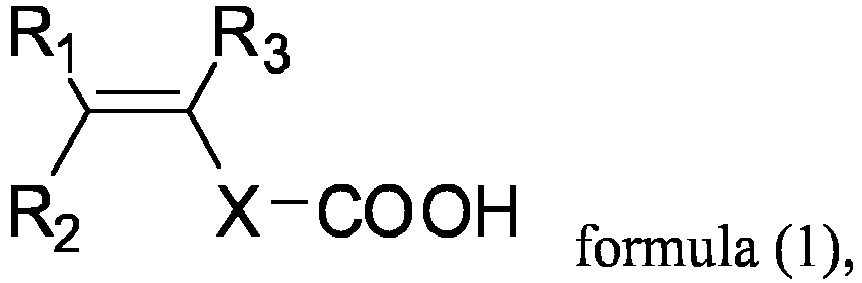
- the unsaturated carboxylic acid has a structure represented by formula (1): in formula (1), R 1 , R 2 and R 3 each is independently selected from hydrogen, C1-C6 alkyl, and -COOH, X is (CH 2 ) n , and n is 0, 1, 2, 3, 4, 5, or 6.
- the unsaturated carboxylic acid and/or an anhydride thereof and/or a salt thereof is one or more selected from the group consisting of acrylic acid, methacrylic acid, itaconic acid, fumaric acid and maleic acid, and the anhydrides or salts thereof.
- the unsaturated sulfonic acid and/or salt thereof contains a substituted or unsubstituted benzene ring or amide group, preferably the unsaturated sulfonic acid or salt thereof includes a structure represented by any one of formula (IIIA)-formula (IIID):
- the unsaturated sulfonic acid or salt thereof is one or more selected from the group consisting of 2-acrylamide-2-methyl propane sulfonic acid, 2-acrylamido-2-methyl propanesulfonate, p-styrene sulfonic acid, p-styrene sulfonate, methyl p-styrene sulfonic acid, methyl p-styrene sulfonate, p-styrene sulfonate, allyl sulfonic acid and allyl sulfonate.
- the polymerizable group may be various groups capable of bonding with other monomers under desired conditions, for example, the polymerizable group may be one or more selected from the group consisting of carbon-carbon double bonds, carbon-carbon triple bonds and epoxy groups.
- the silane and/or siloxane used in the present invention is preferably a silane and/or siloxane having a number of linear carbon atoms between the silicon atom and the polymerizable group being not less than 5, preferably not less than 7, further preferably from 8 to 25, even further preferably from 8 to 18, where n may be 8, 9, 10, 11, 12, 13, 14, 15, 16, 17, 18, 19, 20, 21, 22, 23, 24 or 25.
- the silane and/or siloxane preferably has a structure represented by formula (IV):
- each of R 1 , R 2 , R 3 , R 1 ' and R 2 ' is independently selected from H and C1-C4 alkyl;
- R a , R b and R c are each independently selected from H and C1-C4 alkyl or alkoxyl, and
- n is an integer from 5 to 25, preferably from 8 to 18.
- the number of linear chain carbon atoms between the polymerizable group and the silicon atom refers to the number of carbon atoms of the backbone carbon chain between the polymerizable group and the silicon atom, and n in the aforesaid formula (IV) is exactly the number of linear chain carbon atoms between the polymerizable group and the silicon atom.
- the C1-C4 alkyl may be methyl, ethyl, n-propyl, isopropyl, n-butyl, isobutyl and tert-butyl.
- the C1-C4 alkoxyl may be methoxyl, ethoxyl, n-propoxy, isopropoxy, n-butoxy, isobutoxy and tert-butoxy.
- silanes and/or siloxanes used in the present invention may be, for example, one or more selected from the group consisting of vinyl octadecyl trimethoxysilane (i.e., n in formula (IV) is 18, and the following compounds are similar), vinyl hexadecyl trimethoxysilane, vinyl tetradecyl trimethoxysilane, vinyl dodecyl trimethoxysilane, vinyl decyl dimethoxysilane, vinyl octyl dimethoxysilane, 7-octenyl trimethoxysilane, vinyl hexyl dimethoxysilane; vinyl octadecyl dimethoxysilane, vinyl hexadecyl dimethoxysilane, vinyl tetradecyl dimethoxysilane, vinyl dodecyl dimethoxysilane, vinyl octadecyl trimethoxys
- the silane and/or siloxane containing a polymerizable group are commercially available, and can also be prepared with the conventional methods in the art.
- a long-chain chlorosilane can be obtained by initially reacting a Grignard reagent having the structure represented by formula (IV') with tetrachlorosilane, the obtained long-chain chlorosilane is then subjected to alcoholysis to produce a silane coupling agent of the present invention.
- the conditions for preparing the silane coupling agent are not particularly limited herein, as long as the requirements of the present invention can be satisfied,
- R 1 , R 2 , R 3 , R 1 ', R 2 ', R a , R b , R c and n are as those defined in formula (IV).
- a Grignard reagent which refers to a hydrocarbyl magnesium halide (R-MgX)
- R-MgX hydrocarbyl magnesium halide
- silane/siloxane in the following examples of the present invention are prepared by using the aforesaid process.
- the presence of structural unit a, structural unit b, structural unit c and structural unit d and the molar content thereof can be measured by the infrared spectroscopy in combination with 1 H-NMR (1 hydrogen-nuclear magnetic resonance).
- the polymer has a comb-shaped structure.
- the comb-shaped structure refers to that the structure formed by polymerization of the carbon-carbon double bonds is a skeleton structure, and the structure of each structural unit coupled with a carbon-carbon double bond forms a sagging structure which resembles a comb finger.
- the polymer is a random copolymer.
- the polymer in the invention may be verified as a random copolymer by confirming that the DSC(Diffferential Scanning Calorimeter) of said polymer is a single peak.
- the invention provides a method for preparing a dispersant, the method comprises: subjecting a monomer mixture to polymerization in water under the solution polymerization conditions in the presence of an initiator, wherein the monomer mixture comprises a monomer A, a monomer B, a monomer C and a monomer D, a monomer A being an unsaturated polyether and/or polyester, a monomer B being an unsaturated carboxylic acid and/or anhydride and/or salt thereof, a monomer C being a silane and/or siloxane containing a polymerizable group, and a monomer D being an unsaturated sulfonic acid and/or a salt thereof; and the molar ratio of monomer A: monomer B: monomer C: monomer D is 1: (0.5-6): (0.01-4): (5-15), preferably 1: (1-4): (0.1-1): (6-10), the polymerization conditions cause that the polymer has a weight average molecular weight of 20,000
- the conditions of polymerization reaction comprises: a temperature of 50-80°C, preferably 60-70°C, and a time of 2-10 hours, preferably 3-5 hours.
- the monomer mixture is subjected to a pre-oxidation prior to the polymerization reaction, the pre-oxidation is carried out in the presence of hydrogen peroxide (perhydrol).
- hydrogen peroxide perhydrol
- the hydrogen peroxide is used in an amount of 0.1-1g relative to 60g of the monomer A.
- the hydrogen peroxide is preferably present in a form of solution having a mass fraction of solute of 20-40 wt%.
- the pre-oxidation is performed for a time of 5 to 30 minutes.
- the initiator is at least one selected from the group consisting of a perhydrol-ascorbic acid (oxidant-reducing agent), a perhydrol-vitamin C, sodium bisulfite, sodium sulfoxylate formaldehyde and sodium dithionite; wherein the oxidant is at least one selected from the group consisting of a perhydrol, a peroxyacetic acid, ammonium persulfate, sodium persulfate and potassium persulfate.
- the perhydrol has a concentration of 25-35 wt%.
- the initiator is selected from the group consisting of a perhydrol-vitamin C and/or sodium bisulfite.
- the polymerization reaction is carried out in the presence of a chain transfer agent.
- the chain transfer agent is at least one selected from the group consisting of mercaptopropionic acid, mercaptoacetic acid, alkylthiol and isopropanol.
- the solvent is preferably used in an amount such that the solid content of the product obtained from the polymerization (the dispersant) is 15-50 wt%.
- the method comprises the following steps:
- the pre-oxidation in the step (1) is performed in the presence of water, wherein the used amount of water is 50-110g relative to 60g of the monomer A.
- the pre-oxidation is carried out in the presence of hydrogen peroxide; wherein the hydrogen peroxide is used in an amount of 0.1-1g relative to 60g of the monomer A.
- the hydrogen peroxide is preferably present in a form of solution having a mass fraction of solute of 20-40 wt%.
- the pre-oxidation is performed for a time of 5-30 minutes.
- the water is used in an amount (weight) of 2-3.5 times of the total amount (weight) of the monomer B, monomer C and monomer D.
- step (3) the water is used in an amount (weight) of 50-150 times of the total amount (weight) of chain transfer agent and initiator.
- the first mixture and the second mixture are preferably simultaneously added into the pre-oxidized material of step (1) in a dropwise manner.
- the time of the aforementioned polymerization reaction includes the time of the dropwise addition, i.e., the time of said polymerization reaction is counted from the start of the dropwise addition.
- the reaction and heat preservation are continued for 0.5-1.5 hours after the completion of said dropwise addition.
- the polymerized material (containing the solvent) can be used directly as a cement slurry dispersant.
- the polymer may be subjected to a corresponding purification treatment according to the characterization requirements.
- the content of the monomer structures in the polymer and the structural characteristics of the polymer can be tested by using conventional methods in the prior art, for example, characterization is performed through the Infrared Spectroscopy, Nuclear magnetic resonance, Gel Permeation Chromatography , TGA-DSC(Simultaneous Thermal Analyzer) and the like.
- the absorption peak at 3,550cm -1 corresponds to the group -OH of unsaturated acid
- the absorption peaks at 3,442cm -1 and 1,110cm -1 correspond to the groups -OH and -C-O-C of unsaturated polyether monomer (e.g., TPEG)
- each of a plurality of absorption peaks of 1,650 cm -1 to 1,450 cm -1 and 900 cm -1 to 650 cm -1 is corresponding to the phenyl ring
- the absorption peak at 1,593cm -1 corresponds to the group -COO of unsaturated acid (e.g., acrylic acid)
- the absorption peaks at 1,461cm -1 and 2,882cm -1 correspond to CH 2 in long straight chain of silane and/or siloxane
- the molecular weight of the polymer and its distribution are determined by Gel Permeation Chromatography(GPC).
- the polymerization products obtained from the aforesaid process can be used directly as cement dispersants without subjecting to the separation and purification step.
- the present invention provides a cement composition
- a cement composition comprising the aforementioned dispersant and cement, the dispersant is used in an amount of 0.05-5 wt%, preferably 0.1-1 wt%, based on the total amount of the cement composition.
- the content of the dispersant comprises the amount of solvent in the dispersant.
- the composition further comprises a filtrate reducer
- the filtrate reducer is preferably one or more selected from the group consisting of a cellulose-based filtrate reducer, a polyvinyl alcohol-based filtrate reducer and an AMPS-based filtrate reducer, the filtrate reducer is more preferably selected from an AMPS-based filtrate reducer.
- the filtrate reducer is generally used in an amount of 1-10 wt% of the total amount of the cement composition.
- the invention provides an use of the aforesaid polymer, the aforesaid dispersant, the aforesaid cement composition in an oil well cement or oil well construction, the oil well construction is preferably carried out at a temperature range of 20-120°C.
- the use of the polymer of the present invention as an oil well cement dispersant solves the strong inhibitive effect of hydration of the conventional dispersants at a temperature range of 20-120°C, and produce the effects of small hydration inhibition and low delayed coagulation by decreasing the content of carboxyl group and increasing the content of sulfonic acid group; in addition, the long chain silanes are coupled and anchored to cement and hydration product through the chemical bonds, such that the adsorption is enhanced, the long chain silanes can be cooperated with the sulfonic acid to effectively control the delayed coagulation of cement without affecting dispersibility; in use, the dispersant can not only solve the fluidity of cement slurry, but also improve the sedimentation stability of the slurry; in addition to good compatibility with additives, the dispersant also exhibit desirable compatibility and dispersibility for additive materials such as micro-silicon and latex; the dispersant is suitable for use in medium- and low-temperature well cementing projects, and greatly meets the actual requirements for oil
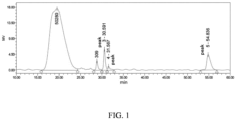
- Figure 1 illustrates a Gel Permeation Chromatography diagram of the polymer produced in Example 1.
- the polymer has a single peak in the DSC spectrogram, indicating that the polymers are random copolymers.
- 7.2g of Acrylic Acid (AA), 27.6g of p-styrene sulfonic acid, 5.81g of 7-octenyl trimethoxysilane and 100g of water were mixed uniformly to form a drip solution A; 0.48g of mercaptopropionic acid, 0.21g of vitamin C and 45g of water were blended uniformly to form a drip solution B.
- the drip solution A and the drip solution B were dropwise added into the three-port flask in a constant speed by a peristaltic pump, the drip solution A was dropwise added for 3 hours, and the drip solution B was dropwise added for 3.5 hours. After the dropwise adding operation was completed, the temperature was kept for 1 hour.
- the obtained sample had an actual solid content of 30.1 wt%.
- the polymer had a weight average molecular weight of 52,000.
- the polymerization reaction was carried out according to the method of Example 1, except that 36.8g of p-styrene sulfonic acid was replaced by the same molar amount (i.e., 41.4g) of 2-Acrylamido-2-methylpropane sulfonic acid (AMPS), the obtained sample had an actual solid content of 29.7 wt%, the polymer had a weight average molecular weight of 54,130.
- AMPS 2-Acrylamido-2-methylpropane sulfonic acid
- the polymerization reaction was carried out according to the method of Example 1, except that 3g of vinyl octadecyl trimethoxysilane was replaced by the same molar amount (i.e., 1.86g) of ⁇ -methacryloxy propyl trimethoxysilane, the obtained sample had an actual solid content of 30.2 wt%, the polymer had a weight average molecular weight of 51,768.
- the polymerization reaction was carried out according to the method of Example 1, except that 36.8g of p-styrene sulfonic acid was replaced by the same molar amount of 2-Acrylamido-2-methylpropane sulfonic acid (AMPS), 3g of vinyl octadecyl trimethoxysilane was replaced by the same molar amount of ⁇ -methacryloxy propyl trimethoxysilane, the obtained sample had an actual solid content of 30.1 wt%, the polymer had a weight average molecular weight of 50,354.
- AMPS 2-Acrylamido-2-methylpropane sulfonic acid
- vinyl octadecyl trimethoxysilane was replaced by the same molar amount of ⁇ -methacryloxy propyl trimethoxysilane
- the obtained sample had an actual solid content of 30.1 wt%
- the polymer had a weight average molecular weight of 50,
- the polymerization was carried out according to the method of Example 1, except that the molar ratio of TPEG: Acrylic Acid (AA): sulfonic acid was 1:5:5, the obtained sample had an actual solid content of 29.8 wt%, the polymer had a weight average molecular weight of 50,211.
- the drip solution A and the drip solution B were dropwise added into the three-port flask in a constant speed by a peristaltic pump, the drip solution A was dropwise added for 3 hours, and the drip solution B was dropwise added for 3.5 hours. After the dropwise adding operation was completed, the temperature was kept for 1 hour.
- the obtained sample had an actual solid content of 30.2 wt%, the polymer had a weight average molecular weight of 51,070.
- the drip solution A and the drip solution B were dropwise added into the three-port flask in a constant speed by a peristaltic pump, the drip solution A was dropwise added for 3.5 hours, and the drip solution B was dropwise added for 4 hours. After the dropwise adding operation was completed, the temperature was kept for 1.5 hours.
- the obtained sample had an actual solid content of 30.3 wt%, the polymer had a weight average molecular weight of 50,911.
- the polymerization reaction was carried out according to the method of Example 1, except that 36.8g of p-styrene sulfonic acid was replaced by the same molar amount (i.e., 14.4g) of Acrylic Acid (AA), the obtained sample had an actual solid content of 29.5 wt%, the polymer had a weight average molecular weight of 43,627.
- AA Acrylic Acid
- the polymerization reaction was carried out according to the method of Comparative Example 1, except that the vinyl octadecyl trimethoxysilane was not added, the obtained sample had an actual solid content of 29.9 wt%, the polymer had a weight average molecular weight of 51,397.
- the polymerization reaction was carried out according to the method of Example 15 in CN108250370A , the obtained sample had an actual solid content of 29.6 wt%, the polymer had a weight average molecular weight of 50,280.
- the polymerization reaction was carried out according to the method of Example 1, except that the TPEG, AA and vinyl octadecyl trimethoxysilane were not added, the obtained sample had an actual solid content of 29.1 wt%, the polymer had a weight average molecular weight of 71,583.
- the dispersant prepared in the present invention had a low delayed coagulation property while ensuring a desired dispersibility in the case of a high used amount of sulfonic acid.
- a cement slurry was prepared according to the National Standard GB/T19139-2003 of China for evaluating its rheological property, thickening time and compressive strength.
- the base slurry II was formulated by mixing 100 parts by weight of cement and 4 parts by weight filtrate reducer and 44 parts by weight of water, the mixing amount of the dispersant was 0.7% by mass of the cement.
- the filtrate reducer was SCF-180L filtrate reducer produced by the Sinopec Petroleum Engineering Technology Research Institute, the other ingredients were derived from the same sources as those in the formulation I. The testing results were shown in Table 2.
- a cement slurry was prepared according to the National Standard GB/T19139-2003 of China for evaluating its rheological property, thickening time and compressive strength.
- the base slurry III was formulated by mixing 450g cement, 225g silicon powder, 225g weighting material micro manganese powder, 31.5g filtrate reducer, 27g nanometer liquid silicon, 27g latex, 14g set retarder, 2g dispersant and 200g of on-site water, wherein the filtrate reducer was SCF-180L filtrate reducer (AMPS type filtrate reducer) produced by the Sinopec Petroleum Engineering Technology Research Institute, the set retarder was SCR-3 set retarder (acid-type set retarder) produced by the Sinopec Petroleum Engineering Technology Research Institute, the other ingredients were derived from the same sources as those in the formulation I.
- Formula III was exactly the currently used cement slurry formulation.
- the dispersants of the present invention had desirable compatibility with other additives in the cement slurry, the dispersants had an obvious dispersion effect, and the thickening time was not significantly influenced, the compressive strength of the set cement was not reduced.
- the dispersants in Comparative Example 1 and Comparative Example 3 were used in combination with the set retarder, the dispersibility of said dispersants was affected, the dispersibility was lower than the dispersants in the present application, and the delayed coagulation time was greatly extended.
Landscapes
- Chemical & Material Sciences (AREA)
- Engineering & Computer Science (AREA)
- Ceramic Engineering (AREA)
- Organic Chemistry (AREA)
- Materials Engineering (AREA)
- Structural Engineering (AREA)
- Chemical Kinetics & Catalysis (AREA)
- Inorganic Chemistry (AREA)
- Polymers & Plastics (AREA)
- Health & Medical Sciences (AREA)
- Medicinal Chemistry (AREA)
- Life Sciences & Earth Sciences (AREA)
- General Life Sciences & Earth Sciences (AREA)
- Addition Polymer Or Copolymer, Post-Treatments, Or Chemical Modifications (AREA)
- Curing Cements, Concrete, And Artificial Stone (AREA)
- Macromonomer-Based Addition Polymer (AREA)
Abstract
Description
- The application claims priority to the
Chinese Patent Application No. 202010820725.0, filed on August 14, 2020 - The invention relates to a polymer suitable for oil well cement and an oil well cement dispersant, and a preparation method and a use thereof.
- Well cementation is an essential part of the oil exploration and development, and it requires pumping a cement slurry into the annulus between the casing pipes and the wellbore. The addition of various admixtures to cement slurry to adjust the comprehensive properties of cement slurry is a key technique for the well cementation, such that the type of oil well cement can meet the requirements of the endlessly emerging conditions of well cementation and the high quality of well cementation.
- Conventional cement additives include filtrate reducers, thickening time control agents (set retarders, coagulation accelerators), dispersants, weight reducers, weighting agents, etc. Filtrate reducers serve to reduce the water loss of cement slurries and prevent dehydration of the cement slurries. The set retarders and coagulation accelerators are used to adjust the thickening time of the cement slurries, and some coagulation accelerators can further increase the early strength of the set cement. The addition of said additives tends to cause that the slurry has a reduced fluidity and the pumping operation is difficult. Therefore, the addition of dispersing agents are needed to improve the fluidity of cement slurries.
- The sulfonated ketoaldehyde condensation polymer dispersants have been successfully developed in the early 1990's as dispersant products, and currently are among the most widely used dispersants in oil well cements in China and foreign countries. The kind of dispersants has the advantages such as a wide variety of raw materials, being reasonably priced, having better temperature resistance than naphthalene based products and being suitable for many types of oil well cements. However, along with the deepening of oil well exploration and development as well as increasingly stringent requirements of environmental protection, the shortcomings of the sulfonated ketoaldehyde condensation polymer dispersants have been exposed: 1) the toxicity and pollution of raw materials cause the pollution, serious toxicity and side-effect in the production and application process; 2) low dispersive power and high dosage; 3) insufficient dispersive power for complex systems which are added with silica fume, latex and the like, and 4) poor compatibility with other novel additives.
- The conventional dispersants used in the construction industry are polycarboxylic acid type dispersants. Generally, the polycarboxylic acid type dispersants are produced by free radical polymerization of the unsaturated acid type monomers (e.g., acrylic acid, maleic acid, itaconic acid) and polyether macro-monomers (e.g., methylallyl polyoxyethylene/ polyoxypropylen ether, isoamyl alcohol polyoxyethylene ehter), and have a comb-like molecular structure. The dispersants can be used in various cement slurry systems by changing the acid ether ratio, side chain length and density, so as to produce a desirable dispersion effect. However, researches show that the polycarboxylic acid dispersants used in construction industry lack temperature resistance, and are prone to decompose above 70°C degrees, which causes the cement slurry have a delayed coagulation or even super-retarded coagulation. Therefore, the direct use of the polycarboxylic acid type dispersants in the oil well cement cannot meet the requirements of well cementing. The carboxylic acid groups in the molecular structure of the polycarboxylic acid type dispersants can be adsorbed on the surface of cement particles, and they can produce the dispersion effect by the electrostatic repulsion. Therefore, generally speaking, the higher is the acid/ether ratio in the molecular structure (i.e., the higher is the carboxylic acid content), the stronger is the adsorption property and the better is the dispersion effect, but the higher acid/ether ratio will greatly inhibit cement hydration, especially in the medium- and low-temperature well cementing projects at 30-120°C, wherein the dispersants exhibit the defects such as long thickening time, low early strength, and even causing a long-setting or ultra-long setting accidents. Furthermore, when the conventional polycarboxylic acid dispersants are used together with the filtrate reducer, set retarder and other commonly used additive in the oil well cement, there are problems such as poor dispersion effect and unsatisfactory compatibility.
- The construction process of the well cementation projects has the characteristics of a plurality of admixtures and additives, it imposes a much stringent requirements on the oil well cement dispersants than the building cement, the three key requirements are as follows: 1. Eefficient dispersion property. The desired dispersion effect is required for special cement slurry systems other than the conventional cement slurries, such as high density cement slurries, low density cement slurries, latex cement slurries, fluid silicone slurries, etc.; 2. Without delaying cement hydration and without affecting early strength, that is, the delayed coagulation is a side effect for the oil well cement dispersants. The delayed coagulation increases the risk of gas channeling during the coagulation process of cement slurry, affects the solidification of the cement sheath during the low temperature stage, increases the time of waiting on cement setting, extends the time period of construction, or even causes engineering accidents with ultra-long setting; the addition of coagulation accelerators or early strength agents into the polycarboxylate dispersants in order to overcome the delayed coagulation is generally ineffective due to the strong adsorption of polycarboxylate, and the addition brings about the engineering risks; 3. Compatibility with various additives, polycarboxylate at present has ubiquitous defect of poor compatibility with other oil well cement additives, especially the poor compatibility with the new-type polymer-based set retarders, filtrate reducers, there is an urgent need to solve the problems such as damage of the filtrate reducer, or dispersant failure.
- In regard to the problems and technical difficulties of the oil well cement dispersants, the inventors of the present invention have discovered that by introducing a large amount of sulfonic acid to replace a portion of carboxylic acid, causing the sulfonic acid to perform a major adsorption function, the problem of delayed coagulation caused by the carboxylic acid groups are eliminated and the thickening time is effectively shortened, while ensuring the effective dispersion properties caused by steric hindrance of the comb-shaped structure of the polymer; in addition, the introduction of a long-chain silane into the polymer can produce the favorable effects in two aspects. On the one hand, the dispersant produces a chemical anchoring function by the water shrinkage action of the silane groups on the surface of the cement particles and hydration products, thereby enhancing the adsorption function of the dispersant with the surface of the cement-based material particles, avoid the failure of the dispersant due to competitive adsorption caused by the charge-adsorbing groups such as carboxylic acid, sulfonic acid of the additives, when the conventional polycarboxylic acid dispersant is used in combination with other additives (e.g., a set retarder, a filtrate reducer), such that the compatibility of the dispersant with the other additives is enhanced. On the other hand, the hydrophobicity of the long-chain groups can destroy the thick hydration film formed on the surface of the cement particles along the comb-finger structure of polyether chain segments of the dispersant, thereby breaking the delayed coagulation properties caused by the hydration film, and produce the effect of reducing the delayed coagulation properties. In addition, an use of the sulfonic acid having a benzene ring under a preferred embodiment, the hydrophobicity of the benzene ring and the hydrophobicity of the long-chain silane can produce a synergistic effect, the dispersant can form hydrophobic patches along the thick hydration film formed along the comb-finger direction of the comb-shaped polymer when the dispersant adsorbs on the surface of the cement particles, the hydrophobic patches may disrupt the structural integrity of the hydration film from the inside, and are conducive to breaking the hydration film, thereby further reducing the delayed coagulation properties caused by the thick hydration film and increasing the early strength of the cement. Therefore, unlike the conventional dispersants, the dispersant in the invention not only has the efficient dispersion property of the polycarboxylic acid comb-shaped dispersants, but also overcomes the side effects of the delayed coagulation of the dispersants from the operation mechanism level, which is extremely important in the well cementing projects. The dispersant of the present invention can guarantee the rheological properties of the cement slurry and ensure the timely solidification, thereby facilitating the prevention of leakages and channeling, securing the safety of construction and saving of work hours, such that the present invention has been completed. The polymer and cement dispersant provided by the invention have advantages such as excellent dispersion effect, short thickening time, and high early strength, thus are especially suitable for application in the medium- and low-temperature well cementing projects at a temperature range of 30-120°C.
- In a first aspect, the present invention provides a polymer having a dispersing function, the polymer comprises a structural unit a, a structural unit b, a structural unit c and a structural unit d;
wherein the structural unit a is provided by an unsaturated polyether and/or polyester, the structural unit b is provided by an unsaturated carboxylic acid or an anhydride or salt thereof, the structural unit c is provided by a silane and/or siloxane containing a polymerizable group, and the structural unit d is provided by an unsaturated sulfonic acid or a salt thereof; the molar ratio of the structural unit a to the structural unit d is 1:(5-15), preferably 1: (6-10), the polymer has a weight average molecular weight of 20,000-120,000. - According to some embodiments of the invention, the molar ratio of the structural unit a: the structural unit b: the structural unit c is 1: (0.5-6): (0.01-4), preferably 1: (1-4): (0.05-2), more preferably 1: (1-4): (0.1-1).
- According to some embodiments of the invention, the molar ratio of the structural unit b to the structural unit d is 1: (2-8).
- According to some embodiments of the invention, the unsaturated polyester has a structure represented by formula (I):

- in formula (I),
- A denotes an alkylene having 2-4 carbon atoms;
- B denotes an alkylene having 2-4 carbon atoms and different from A;
- R1 and R2 each independently represents H or an alkyl having 1-5 carbon atoms, preferably methyl;
- R3 denotes an alkyl having 1-4 carbon atoms;
- X denotes an alkylene having 1-5 carbon atoms;
- m represents an integer from 0 to 200, preferably 20 to 140;
- n represents an integer from 0 to 200, preferably 20 to 140;
- m + n >10, preferably m + n ≥40;
- the unsaturated polyether has a structure represented by formula (II):

- in formula (II),
- E denotes an alkylene having 2-4 carbon atoms;
- F denotes an alkylene having 2-4 carbon atoms and different from E;
- R4 and R5 each independently represents H or an alkyl having 1-5 carbon atoms, preferably methyl;
- R6 denotes an alkyl having 1-4 carbon atoms;
- Y denotes an alkylene having 1-5 carbon atoms;
- p represents an integer from 0 to 200, preferably 20 to 140;
- q represents an integer from 0 to 200, preferably 20 to 140;
- p + q >10, preferably p + q ≥40.
- In the present invention, the term "unsaturated acid and/or salts thereof and/or anhydrides thereof' refers to one or more selected from the group consisting of the unsaturated acid; the sodium salts, potassium salts and ammonium salts of the unsaturated acid, and the anhydrides of the unsaturated acid.
- According to some embodiments of the invention, the unsaturated carboxylic acid has a structure represented by formula (1):
- According to some embodiments of the invention, the unsaturated carboxylic acid and/or an anhydride thereof and/or a salt thereof is one or more selected from the group consisting of acrylic acid, methacrylic acid, itaconic acid, fumaric acid and maleic acid, and the anhydrides or salts thereof.
- According to some embodiments of the invention, the unsaturated sulfonic acid and/or salt thereof contains a substituted or unsubstituted benzene ring or amide group, preferably the unsaturated sulfonic acid or salt thereof includes a structure represented by any one of formula (IIIA)-formula (IIID):


- in formula IIIA, formula IIIB and formula IIIC, R1, R2, R3 and R4 are each independently selected from hydrogen, halogen, C1-C6 alkyl and C1-C6 alkoxyl, X is (CH2)n, n is an integer from 0 to 6, and M is hydrogen or a metal ion, such as an alkali metal ion, preferably lithium ion, sodium ion or potassium ion;
- in formula IIID, R1, R2 and R3 are each independently selected from hydrogen and C1-C6 alkyl, X is (CH2)n, n is an integer from 0 to 6, and M is hydrogen or a metal ion, such as an alkali metal ion, preferably lithium ion, sodium ion or potassium ion.
- According to some embodiments of the invention, the unsaturated sulfonic acid or salt thereof is one or more selected from the group consisting of 2-acrylamide-2-methyl propane sulfonic acid, 2-acrylamido-2-methyl propanesulfonate, p-styrene sulfonic acid, p-styrene sulfonate, methyl p-styrene sulfonic acid, methyl p-styrene sulfonate, p-styrene sulfonate, allyl sulfonic acid and allyl sulfonate.
- In the present invention, the polymerizable group may be various groups capable of bonding with other monomers under desired conditions, for example, the polymerizable group may be one or more selected from the group consisting of carbon-carbon double bonds, carbon-carbon triple bonds and epoxy groups.
- The silane and/or siloxane used in the present invention is preferably a silane and/or siloxane having a number of linear carbon atoms between the silicon atom and the polymerizable group being not less than 5, preferably not less than 7, further preferably from 8 to 25, even further preferably from 8 to 18, where n may be 8, 9, 10, 11, 12, 13, 14, 15, 16, 17, 18, 19, 20, 21, 22, 23, 24 or 25.
- According to some embodiments of the invention, the silane and/or siloxane preferably has a structure represented by formula (IV):

- In formula (IV), each of R1, R2, R3, R1' and R2' is independently selected from H and C1-C4 alkyl; Ra, Rb and Rc are each independently selected from H and C1-C4 alkyl or alkoxyl, and n is an integer from 5 to 25, preferably from 8 to 18.
- In the present invention, the number of linear chain carbon atoms between the polymerizable group and the silicon atom refers to the number of carbon atoms of the backbone carbon chain between the polymerizable group and the silicon atom, and n in the aforesaid formula (IV) is exactly the number of linear chain carbon atoms between the polymerizable group and the silicon atom.
- In the present invention, the C1-C4 alkyl may be methyl, ethyl, n-propyl, isopropyl, n-butyl, isobutyl and tert-butyl.
- In the present invention, the C1-C4 alkoxyl may be methoxyl, ethoxyl, n-propoxy, isopropoxy, n-butoxy, isobutoxy and tert-butoxy.
- The silanes and/or siloxanes used in the present invention may be, for example, one or more selected from the group consisting of vinyl octadecyl trimethoxysilane (i.e., n in formula (IV) is 18, and the following compounds are similar), vinyl hexadecyl trimethoxysilane, vinyl tetradecyl trimethoxysilane, vinyl dodecyl trimethoxysilane, vinyl decyl dimethoxysilane, vinyl octyl dimethoxysilane, 7-octenyl trimethoxysilane, vinyl hexyl dimethoxysilane; vinyl octadecyl dimethoxysilane, vinyl hexadecyl dimethoxysilane, vinyl tetradecyl dimethoxysilane, vinyl dodecyl dimethoxysilane, vinyl octadecyl trimethoxysilane, vinyl hexadecyl trimethoxysilane, vinyl tetradecyl trimethoxysilane, vinyl dodecyl trimethoxysilane, vinyl decyl trimethoxysilane, vinyl octyl trimethoxysilane, vinyl hexyl trimethoxysilane; vinyl octadecyl dimethoxysilane, vinyl hexadecyl dimethoxysilane, vinyl tetradecyl dimethoxysilane, vinyl dodecyl dimethoxysilane, vinyl decyl dimethoxysilane, vinyl octyl dimethoxysilane, vinyl hexyl dimethoxysilane; propenyl octadecyl trimethoxysilane, propenyl hexadecyl trimethoxysilane, propenyl tetradecyl trimethoxysilane, propenyl dodecyl trimethoxysilane, propenyl decyl dimethoxysilane, propenyl octyl dimethoxysilane, propenyl hexyl dimethoxysilane; propenyl octadecyl dimethoxysilane, propenyl hexadecyl dimethoxysilane, propenyl tetradecyl dimethoxysilane, propenyl dodecyl dimethoxysilane, propenyl decyl dimethoxysilane, propenyl octyl dimethoxysilane, propenyl hexyl dimethoxysilane; propenyl octadecyl trimethylsilane, propenyl hexadecyl trimethylsilane, propenyl tetradecyl trimethylsilane, propenyl dodecyl trimethylsilane, propenyl decyl trimethylsilane, propenyl octyl trimethylsilane, propenyl hexyl trimethylsilane; propenyl octadecyl dimethylsilane, propenyl hexadecyl dimethylsilane, propenyl tetradecyl dimethylsilane, propenyl dodecyl dimethylsilane, propenyl decyl dimethylsilane, propenyl octyl dimethylsilane and propenyl hexyl dimethylsilane.
- In the present invention, the silane and/or siloxane containing a polymerizable group (particularly, a long-chain silane) are commercially available, and can also be prepared with the conventional methods in the art. For example, a long-chain chlorosilane can be obtained by initially reacting a Grignard reagent having the structure represented by formula (IV') with tetrachlorosilane, the obtained long-chain chlorosilane is then subjected to alcoholysis to produce a silane coupling agent of the present invention. The conditions for preparing the silane coupling agent are not particularly limited herein, as long as the requirements of the present invention can be satisfied,

- In formula (IV'), the definitions of R1, R2, R3, R1', R2', Ra, Rb, Rc and n are as those defined in formula (IV). Alternatively, a Grignard reagent (which refers to a hydrocarbyl magnesium halide (R-MgX)) is subjected to a coupling reaction with an haloalkane to form hydrocarbons, for example, vinyl heptadecanyl dimethylsilane is produced through the reaction of hexadecyl dimethyl chlorosilane and allyl magnesium chloride, the reaction formula is as follows: Cl(CH2)16SiH(CH3)2 + H2C=CH-CH2MgCl → H2C=CH-CH2-(CH2)16SiH(CH3)2+ MgCl2
- The specific reaction conditions are generally known among those skilled in the art, the content will not be repeatedly described herein. Unless otherwise specified, the silane/siloxane in the following examples of the present invention are prepared by using the aforesaid process.
- In the present invention, the presence of structural unit a, structural unit b, structural unit c and structural unit d and the molar content thereof can be measured by the infrared spectroscopy in combination with 1H-NMR (1 hydrogen-nuclear magnetic resonance).
- According to some embodiments of the invention, the polymer has a comb-shaped structure. The comb-shaped structure refers to that the structure formed by polymerization of the carbon-carbon double bonds is a skeleton structure, and the structure of each structural unit coupled with a carbon-carbon double bond forms a sagging structure which resembles a comb finger.
- In accordance with some embodiments of the invention, the polymer is a random copolymer. The polymer in the invention may be verified as a random copolymer by confirming that the DSC(Diffferential Scanning Calorimeter) of said polymer is a single peak.
- In a second aspect, the invention provides a method for preparing a dispersant, the method comprises: subjecting a monomer mixture to polymerization in water under the solution polymerization conditions in the presence of an initiator, wherein the monomer mixture comprises a monomer A, a monomer B, a monomer C and a monomer D, a monomer A being an unsaturated polyether and/or polyester, a monomer B being an unsaturated carboxylic acid and/or anhydride and/or salt thereof, a monomer C being a silane and/or siloxane containing a polymerizable group, and a monomer D being an unsaturated sulfonic acid and/or a salt thereof; and the molar ratio of monomer A: monomer B: monomer C: monomer D is 1: (0.5-6): (0.01-4): (5-15), preferably 1: (1-4): (0.1-1): (6-10), the polymerization conditions cause that the polymer has a weight average molecular weight of 20,000-120,000.
- According to some embodiments of the invention, the conditions of polymerization reaction comprises: a temperature of 50-80°C, preferably 60-70°C, and a time of 2-10 hours, preferably 3-5 hours.
- According to some preferred embodiments of the present invention, the monomer mixture is subjected to a pre-oxidation prior to the polymerization reaction, the pre-oxidation is carried out in the presence of hydrogen peroxide (perhydrol). Preferably, the hydrogen peroxide is used in an amount of 0.1-1g relative to 60g of the monomer A. The hydrogen peroxide is preferably present in a form of solution having a mass fraction of solute of 20-40 wt%. The pre-oxidation is performed for a time of 5 to 30 minutes.
- According to some embodiments of the invention, the initiator is at least one selected from the group consisting of a perhydrol-ascorbic acid (oxidant-reducing agent), a perhydrol-vitamin C, sodium bisulfite, sodium sulfoxylate formaldehyde and sodium dithionite; wherein the oxidant is at least one selected from the group consisting of a perhydrol, a peroxyacetic acid, ammonium persulfate, sodium persulfate and potassium persulfate. Preferably, the perhydrol has a concentration of 25-35 wt%.
- Preferably, the initiator is selected from the group consisting of a perhydrol-vitamin C and/or sodium bisulfite.
- According to some embodiments of the invention, the polymerization reaction is carried out in the presence of a chain transfer agent.
- Preferably, the chain transfer agent is at least one selected from the group consisting of mercaptopropionic acid, mercaptoacetic acid, alkylthiol and isopropanol.
- The solvent is preferably used in an amount such that the solid content of the product obtained from the polymerization (the dispersant) is 15-50 wt%.
- According to some embodiments of the invention, the method comprises the following steps:
- (1) Pre-oxidizing the monomer A at 50-70°C to obtain a pre-oxidized material;
- (2) Subjecting water and monomer B, monomer C, monomer D to a first mixing to obtain a first mixture;
- (3) Subjecting water and a chain transfer agent and an initiator to a second mixing to produce a second mixture;
- (4) Adding the first mixture and the second mixture into the pre-oxidized material of step (1) to perform a polymerization reaction.
- In the present invention, the pre-oxidation in the step (1) is performed in the presence of water, wherein the used amount of water is 50-110g relative to 60g of the monomer A.
- In the present invention, the pre-oxidation is carried out in the presence of hydrogen peroxide; wherein the hydrogen peroxide is used in an amount of 0.1-1g relative to 60g of the monomer A. The hydrogen peroxide is preferably present in a form of solution having a mass fraction of solute of 20-40 wt%. The pre-oxidation is performed for a time of 5-30 minutes.
- In the step (2) of the present invention, the water is used in an amount (weight) of 2-3.5 times of the total amount (weight) of the monomer B, monomer C and monomer D.
- In step (3), the water is used in an amount (weight) of 50-150 times of the total amount (weight) of chain transfer agent and initiator.
- In order to prevent auto-polymerization and implosion in step (4), and ensure that comb-shaped structure is more uniform and well-defined, the first mixture and the second mixture are preferably simultaneously added into the pre-oxidized material of step (1) in a dropwise manner. When a dropwise manner is used, the time of the aforementioned polymerization reaction includes the time of the dropwise addition, i.e., the time of said polymerization reaction is counted from the start of the dropwise addition. Preferably, for the sake of making the polymerization reaction to be more efficient, the reaction and heat preservation are continued for 0.5-1.5 hours after the completion of said dropwise addition.
- In the present invention, further post-treatment is not performed after the polymerization reaction, the polymerized material (containing the solvent) can be used directly as a cement slurry dispersant. However, when the relevant structural characterization is performed, the polymer may be subjected to a corresponding purification treatment according to the characterization requirements.
- In the present invention, the content of the monomer structures in the polymer and the structural characteristics of the polymer can be tested by using conventional methods in the prior art, for example, characterization is performed through the Infrared Spectroscopy, Nuclear magnetic resonance, Gel Permeation Chromatography , TGA-DSC(Simultaneous Thermal Analyzer) and the like. Specifically, for example, in regard to the Infrared Spectroscopic Analysis, the absorption peak at 3,550cm-1 corresponds to the group -OH of unsaturated acid; the absorption peaks at 3,442cm-1 and 1,110cm-1 correspond to the groups -OH and -C-O-C of unsaturated polyether monomer (e.g., TPEG); the absorption peak at 3,030 cm-1 corresponds to the group = CH on the phenyl ring, each of a plurality of absorption peaks of 1,650 cm-1 to 1,450 cm-1 and 900 cm-1 to 650 cm-1 is corresponding to the phenyl ring; the absorption peak at 1,593cm-1 corresponds to the group -COO of unsaturated acid (e.g., acrylic acid); the absorption peaks at 1,461cm-1 and 2,882cm-1 correspond to CH2 in long straight chain of silane and/or siloxane, the absorption peak at 1,347cm-1 corresponds to the group -Si-C-, the absorption peak at 1,100cm-1 corresponds to the group -C-O- or -Si-O-; the absorption peaks at 1,190cm-1, 1,068cm-1, 620cm-1, 530cm-1 correspond to the sulfonic acid group; moreover, the C-C double bond in styrene has a characteristic absorption peak at 1,660 cm-1, since the double bond is opened, there is no characteristic absorption peak at this peak; for the same reason, there is no absorption peak between 1,645 cm-1 and 1,620cm-1, representing that there is not remaining "-C = C-" of the other olefin.
- The molecular weight of the polymer and its distribution are determined by Gel Permeation Chromatography(GPC).
- The polymerization products obtained from the aforesaid process can be used directly as cement dispersants without subjecting to the separation and purification step.
- In a third aspect, the present invention provides a cement composition comprising the aforementioned dispersant and cement, the dispersant is used in an amount of 0.05-5 wt%, preferably 0.1-1 wt%, based on the total amount of the cement composition.
- In the present invention, the content of the dispersant comprises the amount of solvent in the dispersant.
- According to some embodiments of the invention, the composition further comprises a filtrate reducer, the filtrate reducer is preferably one or more selected from the group consisting of a cellulose-based filtrate reducer, a polyvinyl alcohol-based filtrate reducer and an AMPS-based filtrate reducer, the filtrate reducer is more preferably selected from an AMPS-based filtrate reducer.
- Wherein the filtrate reducer is generally used in an amount of 1-10 wt% of the total amount of the cement composition.
- In a fourth aspect, the invention provides an use of the aforesaid polymer, the aforesaid dispersant, the aforesaid cement composition in an oil well cement or oil well construction, the oil well construction is preferably carried out at a temperature range of 20-120°C.
- The use of the polymer of the present invention as an oil well cement dispersant solves the strong inhibitive effect of hydration of the conventional dispersants at a temperature range of 20-120°C, and produce the effects of small hydration inhibition and low delayed coagulation by decreasing the content of carboxyl group and increasing the content of sulfonic acid group; in addition, the long chain silanes are coupled and anchored to cement and hydration product through the chemical bonds, such that the adsorption is enhanced, the long chain silanes can be cooperated with the sulfonic acid to effectively control the delayed coagulation of cement without affecting dispersibility; in use, the dispersant can not only solve the fluidity of cement slurry, but also improve the sedimentation stability of the slurry; in addition to good compatibility with additives, the dispersant also exhibit desirable compatibility and dispersibility for additive materials such as micro-silicon and latex; the dispersant is suitable for use in medium- and low-temperature well cementing projects, and greatly meets the actual requirements for oil well cement dispersants.
-
Figure 1 illustrates a Gel Permeation Chromatography diagram of the polymer produced in Example 1. - The present invention will be described in detail below with reference to examples, but the invention is not subjected to limitation of the examples.
- Unless otherwise specified, the raw materials used in the Examples and Comparative Examples are commercially available, or prepared according to the methods of the prior art.
- In the following Examples and Comparative Examples, the amounts of the structural units in the polymer are determined by using the feeding amount of said monomers, in particular, the feeding ratio of individual monomer which actually participates the polymerization is determined by measuring the content of unreacted monomer, thereby determining the contents of said structural units in the polymer; the solid content is obtained through calculation based on the feeding amount, that is, solid content = feeding amount (weight) excluding the solvent / feeding amount (weight) including the solvent *100%. In the Examples, the polymer has a single peak in the DSC spectrogram, indicating that the polymers are random copolymers.
- 101g of water and 60g (0.025mol) of isopentenyl polyoxyethylene ether (TPEG, with a weight average molecular weight of 2,400) were weighted and sufficiently dissolved and uniformly mixed, the mixture was poured into a three-port flask in a constant-temperature water bath, and subjected to a constant speed stirring by a stirring paddle at a rotation speed of 200 rpm and heated to 65°C; 0.52g of H2O2 having a concentration of 30% by mass was weighted and added into the three-port flask. 3.6g of Acrylic Acid (AA), 36.8g of p-styrene sulfonic acid, 3g of vinyl octadecyl trimethoxysilane and 100g of water were mixed uniformly to form a drip solution A; 0.48g of mercaptopropionic acid, 0.21g of vitamin C and 45g of water were blended uniformly to form a drip solution B. The drip solution A and the drip solution B were dropwise added into the three-port flask in a constant speed by a peristaltic pump, the drip solution A was dropwise added for 3 hours, and the drip solution B was dropwise added for 3.5 hours. After the dropwise adding operation was completed, the temperature was kept for 1 hour. The obtained sample had an actual solid content of 30.0 wt%. Upon the Gel Permeation Chromatography (
Figure 1 ): the polymer had a weight average molecular weight of 50,280. - 98g of water and 60g (0.025mol) of isopentenyl polyoxyethylene ether (TPEG, with a weight average molecular weight of 2,400) were weighted and sufficiently dissolved and uniformly mixed, the mixture was poured into a three-port flask in a constant-temperature water bath, and subjected to a constant speed stirring by a stirring paddle at a rotation speed of 200 rpm and heated to 65°C, 0.52g of H2O2 having a concentration of 30% by mass was weighted and added into the three-port flask. 7.2g of Acrylic Acid (AA), 27.6g of p-styrene sulfonic acid, 5.81g of 7-octenyl trimethoxysilane and 100g of water were mixed uniformly to form a drip solution A; 0.48g of mercaptopropionic acid, 0.21g of vitamin C and 45g of water were blended uniformly to form a drip solution B. The drip solution A and the drip solution B were dropwise added into the three-port flask in a constant speed by a peristaltic pump, the drip solution A was dropwise added for 3 hours, and the drip solution B was dropwise added for 3.5 hours. After the dropwise adding operation was completed, the temperature was kept for 1 hour. The obtained sample had an actual solid content of 30.1 wt%. The polymer had a weight average molecular weight of 52,000.
- 103g of water and 60g (0.025mol) of isopentenyl polyoxyethylene ether (TPEG, with a weight average molecular weight of 2,400) were weighted and sufficiently dissolved and uniformly mixed, the mixture was poured into a three-port flask in a constant-temperature water bath, and subjected to a constant speed stirring by a stirring paddle at a rotation speed of 200 rpm and heated to 65°C; 0.52g of H2O2 having a concentration of 30% by mass was weighted and added into the three-port flask. 3.25g of Itaconic Acid (IA), 46g of p-styrene sulfonic acid, 3.95g of vinyl dodecyl trimethoxysilane and 100g of water were mixed uniformly to form a drip solution A; 0.55g of mercaptopropionic acid, 0.24g of vitamin C and 65g of water were blended uniformly to form a drip solution B. The drip solution A and the drip solution B were dropwise added into the three-port flask in a constant speed by a peristaltic pump, the drip solution A was dropwise added for 3 hours, and the drip solution B was dropwise added for 3.5 hours. After the dropwise adding operation was completed, the temperature was kept for 1 hour. The obtained sample had an actual solid content of 29.9 wt%. The polymer had a weight average molecular weight of 53,890.
- The polymerization reaction was carried out according to the method of Example 1, except that 36.8g of p-styrene sulfonic acid was replaced by the same molar amount (i.e., 41.4g) of 2-Acrylamido-2-methylpropane sulfonic acid (AMPS), the obtained sample had an actual solid content of 29.7 wt%, the polymer had a weight average molecular weight of 54,130.
- The polymerization reaction was carried out according to the method of Example 1, except that 3g of vinyl octadecyl trimethoxysilane was replaced by the same molar amount (i.e., 1.86g) of γ-methacryloxy propyl trimethoxysilane, the obtained sample had an actual solid content of 30.2 wt%, the polymer had a weight average molecular weight of 51,768.
- The polymerization reaction was carried out according to the method of Example 1, except that 36.8g of p-styrene sulfonic acid was replaced by the same molar amount of 2-Acrylamido-2-methylpropane sulfonic acid (AMPS), 3g of vinyl octadecyl trimethoxysilane was replaced by the same molar amount of γ-methacryloxy propyl trimethoxysilane, the obtained sample had an actual solid content of 30.1 wt%, the polymer had a weight average molecular weight of 50,354.
- The polymerization was carried out according to the method of Example 1, except that the molar ratio of TPEG: Acrylic Acid (AA): sulfonic acid was 1:5:5, the obtained sample had an actual solid content of 29.8 wt%, the polymer had a weight average molecular weight of 50,211.
- 70g of water and 60g of HPEG were weighted and sufficiently dissolved and uniformly mixed, the mixture was poured into a three-port flask in a constant-temperature water bath, and subjected to a constant speed stirring by a stirring paddle at a rotation speed of 200 rpm and heated to 65°C, 0.52g of H2O2 having a concentration of 30% by mass was weighted and added into the three-port flask. 3.6g of AA, 31.1g of AMPS, 0.62g of KH570 and 100g of water were mixed uniformly to form a drip solution A; 0.48g of mercaptopropionic acid, 0.21g of vitamin C and 45g of water were blended uniformly to form a drip solution B. The drip solution A and the drip solution B were dropwise added into the three-port flask in a constant speed by a peristaltic pump, the drip solution A was dropwise added for 3 hours, and the drip solution B was dropwise added for 3.5 hours. After the dropwise adding operation was completed, the temperature was kept for 1 hour. The obtained sample had an actual solid content of 30.2 wt%, the polymer had a weight average molecular weight of 51,070.
- 70g of water and 60g of TPEG were weighted and sufficiently dissolved and uniformly mixed, the mixture was poured into a three-port flask in a constant-temperature water bath, and subjected to a constant speed stirring by a stirring paddle at a rotation speed of 200 rpm and heated to 65°C, 0.58g of H2O2 having a concentration of 30% by mass was weighted and added into the three-port flask. 9.76g of IA, 31.1g of AMPS, 1.24g of KH570 and 100g of water were mixed uniformly to form a drip solution A; 0.54g of mercaptopropionic acid, 0.23g of vitamin C and 60g of water were blended uniformly to form a drip solution B. The drip solution A and the drip solution B were dropwise added into the three-port flask in a constant speed by a peristaltic pump, the drip solution A was dropwise added for 3.5 hours, and the drip solution B was dropwise added for 4 hours. After the dropwise adding operation was completed, the temperature was kept for 1.5 hours. The obtained sample had an actual solid content of 30.3 wt%, the polymer had a weight average molecular weight of 50,911.
- The polymerization reaction was carried out according to the method of Example 1, except that 36.8g of p-styrene sulfonic acid was replaced by the same molar amount (i.e., 14.4g) of Acrylic Acid (AA), the obtained sample had an actual solid content of 29.5 wt%, the polymer had a weight average molecular weight of 43,627.
- The polymerization reaction was carried out according to the method of Comparative Example 1, except that the vinyl octadecyl trimethoxysilane was not added, the obtained sample had an actual solid content of 29.9 wt%, the polymer had a weight average molecular weight of 51,397.
- The polymerization reaction was carried out according to the method of Example 15 in
CN108250370A , the obtained sample had an actual solid content of 29.6 wt%, the polymer had a weight average molecular weight of 50,280. - The polymerization reaction was carried out according to the method of Example 1, except that the TPEG, AA and vinyl octadecyl trimethoxysilane were not added, the obtained sample had an actual solid content of 29.1 wt%, the polymer had a weight average molecular weight of 71,583.
-
- (1) A cement slurry was prepared according to the National Standard GB/T19139-2003 of China for evaluating its rheological property and thickening time. The cement in use was the class G cement manufactured by the Sichuan Jiahua Cement Plant, and the base slurry I was formulated by mixing 100 parts by weight of cement and 40 parts by weight of water, the mixing amount of the dispersants (the mixture produced from polymerization) in Comparative Examples 1-4 and Examples 1-7 were 0.4% by mass of the cement. The testing results were shown in Table 1.
- As can be seen from Table 1, the dispersant prepared in the present invention had a low delayed coagulation property while ensuring a desired dispersibility in the case of a high used amount of sulfonic acid.
- (2) A cement slurry was prepared according to the National Standard GB/T19139-2003 of China for evaluating its rheological property, thickening time and compressive strength. The base slurry II was formulated by mixing 100 parts by weight of cement and 4 parts by weight filtrate reducer and 44 parts by weight of water, the mixing amount of the dispersant was 0.7% by mass of the cement. The filtrate reducer was SCF-180L filtrate reducer produced by the Sinopec Petroleum Engineering Technology Research Institute, the other ingredients were derived from the same sources as those in the formulation I. The testing results were shown in Table 2.
Table 2 Flow index n Thickening time at 85°C (min) Compressive strength at 48h (MPa) 25°C 85°C 25°C 50°C Base slurry II 0.56 0.43 131 20.40 22.77 Example 1 0.81 0.75 136 21.57 23.98 Example 2 0.76 0.74 135 20.22 24.56 Example 3 0.77 0.72 132 21.98 23.02 Example 4 0.72 0.69 145 19.06 22.32 Example 5 0.73 0.67 141 19.23 23.42 Example 6 0.68 0.61 147 20.91 22.86 Example 7 0.73 0.63 159 20.03 22.94 Example 8 0.64 0.57 152 21.57 23.98 Example 9 0.65 0.58 155 19.23 23.42 Comparati ve Example 1 0.73 0.65 251 16.23 19.86 Comparati ve Example 2 0.70 0.61 146 17.56 20.15 Comparati ve Example 3 0.72 0.67 269 18.56 21.11 Comparati 0.62 0.54 173 17.93 21.35 ve Example 4 - As can be seen from Table 2, when the dispersants in the present invention were complexed with a filtrate reducer, the dispersants had an obvious dispersion effect, and the thickening time was not significantly influenced, the compressive strength of the set cement was not reduced.
- (3) A cement slurry was prepared according to the National Standard GB/T19139-2003 of China for evaluating its rheological property, thickening time and compressive strength. The base slurry III was formulated by mixing 450g cement, 225g silicon powder, 225g weighting material micro manganese powder, 31.5g filtrate reducer, 27g nanometer liquid silicon, 27g latex, 14g set retarder, 2g dispersant and 200g of on-site water, wherein the filtrate reducer was SCF-180L filtrate reducer (AMPS type filtrate reducer) produced by the Sinopec Petroleum Engineering Technology Research Institute, the set retarder was SCR-3 set retarder (acid-type set retarder) produced by the Sinopec Petroleum Engineering Technology Research Institute, the other ingredients were derived from the same sources as those in the formulation I. The testing results were shown in Table 3.
Table 3 Flow index n Thickening time at 85°C (min) Compressive strength at 48h (MPa) 25°C 85°C 25°C 50°C Base 0.51 0.46 251 18.34 20.73 slurry III Example 1 0.84 0.79 257 18.50 20.65 Example 2 0.79 0.76 259 18.53 20.57 Example 3 0.81 0.77 251 17.98 20.20 Example 4 0.77 0.73 256 18.01 20.36 Example 5 0.76 0.69 272 18.52 20.24 Example 6 0.70 0.64 258 17.99 20.68 Example 7 0.75 0.69 277 18.03 20.34 Example 8 0.67 0.60 260 17.96 20.18 Example 9 0.68 0.61 263 18.11 20.20 Comparati ve Example 1 0.65 0.54 343 17.40 19.76 Comparati ve Example 2 0.70 0.62 290 17.42 20.01 Comparati ve Example 3 0.64 0.55 351 18.49 20.31 Comparati ve Example 4 0.66 0.59 280 18.63 20.08 - Formula III was exactly the currently used cement slurry formulation. As can be seen in Table 3, the dispersants of the present invention had desirable compatibility with other additives in the cement slurry, the dispersants had an obvious dispersion effect, and the thickening time was not significantly influenced, the compressive strength of the set cement was not reduced. However, when the dispersants in Comparative Example 1 and Comparative Example 3 were used in combination with the set retarder, the dispersibility of said dispersants was affected, the dispersibility was lower than the dispersants in the present application, and the delayed coagulation time was greatly extended.
- Although the invention has been described in detail, the modifications within the inventive concept and scopes will be apparent for those skilled in the art. Moreover, it shall be comprehended that the various aspects described in the invention, the portions of different specific embodiments, and various features enumerated herein may be combined or interchanged in whole or in part. In the various embodiments described above, those embodiments that refer to another specific embodiment can be appropriately combined with other embodiments, as will be understood by those skilled in the art. Furthermore, those skilled in the art will understand that the foregoing description is only used as the typical example, instead of imposing limitation on the present invention.
| Flow index n | Thickening time at 85°C (min) | Compressive strength at 48h (MPa) | |||
| 25°C | 85°C | 25°C | 50°C | ||
| Base slurry I | 0.42 | 0.34 | 71 | 21.21 | 23.53 |
| Example 1 | 0.91 | 0.85 | 79 | 21.12 | 23.45 |
| Example 2 | 0.86 | 0.80 | 77 | 20.94 | 23.89 |
| Example 3 | 0.87 | 0.82 | 78 | 21.93 | 24.02 |
| Example 4 | 0.83 | 0.77 | 95 | 19.06 | 22.32 |
| Example 5 | 0.84 | 0.76 | 91 | 19.23 | 23.42 |
| Example 6 | 0.70 | 0.66 | 102 | 20.91 | 22.86 |
| Example 7 | 0.82 | 0.75 | 106 | 19.03 | 22.94 |
| Example 8 | 0.67 | 0.59 | 104 | 20.08 | 22.12 |
| Example 9 | 0.69 | 0.60 | 105 | 20.54 | 21.73 |
| Comparative Example 1 | 0.80 | 0.74 | 135 | 18.00 | 21.15 |
| Comparative Example 2 | 0.82 | 0.67 | 99 | 19.42 | 21.78 |
| Comparative Example 3 | 0.75 | 0.68 | 181 | 18.13 | 20.35 |
| Comparative Example 4 | 0.67 | 0.57 | 78 | 20.18 | 22.76 |
Claims (16)
- A polymer having a dispersing function, characterized in that the polymer comprises a structural unit a, a structural unit b, a structural unit c and a structural unit d;wherein the structural unit a is provided by an unsaturated polyether and/or polyester, the structural unit b is provided by an unsaturated carboxylic acid or an anhydride or salt thereof, the structural unit c is provided by a silane and/or siloxane containing a polymerizable group, and the structural unit d is provided by an unsaturated sulfonic acid or a salt thereof; the molar ratio of the structural unit a to the structural unit d is 1:(5-15);the polymer has a weight average molecular weight of 20,000-120,000.
- The polymer of claim 1, wherein the molar ratio of the structural unit a to the structural unit d is 1: (6-10).
- The polymer of claim 1 or 2, wherein the molar ratio of the structural unit a: the structural unit b: the structural unit c is 1: (0.5-6): (0.01-4), preferably 1: (1-4): (0.1-1).
- The polymer of any of claims 1-3, wherein the unsaturated polyester has a structure represented by formula (I):
 in formula (I),A denotes an alkylene having 2-4 carbon atoms;B denotes an alkylene having 2-4 carbon atoms and different from A;R1 and R2 each independently represents H or an alkyl having 1-5 carbon atoms, preferably methyl;R3 denotes an alkyl having 1-4 carbon atoms;X denotes an alkylene having 1-5 carbon atoms;m represents an integer from 0 to 200, preferably 20 to 140;n represents an integer from 0 to 200, preferably 20 to 140;m + n >10, preferably m + n ≥40;the unsaturated polyether has a structure represented by formula (II):
 in formula (II),E denotes an alkylene having 2-4 carbon atoms;F denotes an alkylene having 2-4 carbon atoms and different from E;R4 and R5 each independently represents H or an alkyl having 1-5 carbon atoms, preferably methyl;R6 denotes an alkyl having 1-4 carbon atoms;Y denotes an alkylene having 1-5 carbon atoms;p represents an integer from 0 to 200, preferably 20 to 140;q represents an integer from 0 to 200, preferably 20 to 140;p + q >10, preferably p + q ≥40.
 - The polymer of any one of claims 1-4, wherein the unsaturated carboxylic acid includes, but is not limited to, one or more selected from the group consisting of acrylic acid, methacrylic acid, itaconic acid, fumaric acid and maleic acid.
- The polymer of any one of claims 1-5, wherein the unsaturated sulfonic acid or salt thereof contains a substituted or unsubstituted benzene ring or amide group, preferably the unsaturated sulfonic acid and/or salt thereof includes, but is not limited to having a structure represented by any one of formula (IIIA) -formula (IIID):
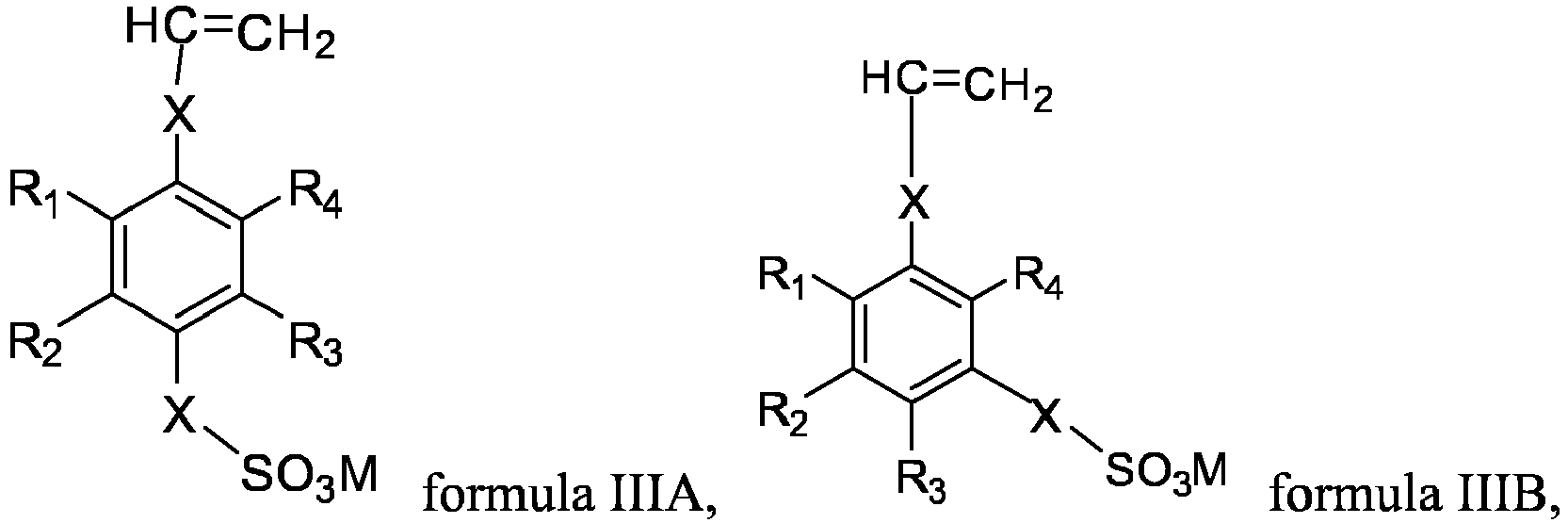

 in formula IIIA, formula IIIB and formula IIIC, R1, R2, R3 and R4 are each independently selected from hydrogen, halogen, C1-C6 alkyl and C1-C6 alkoxyl, X is (CH2)n, n is an integer from 0 to 6, and M is hydrogen or a metal ion, such as an alkali metal ion, preferably lithium ion, sodium ion or potassium ion;in formula IIID, R1, R2 and R3 are each independently selected from hydrogen and C1-C6 alkyl, X is (CH2)n, n is an integer from 0 to 6, and M is hydrogen or a metal ion, such as an alkali metal ion, preferably lithium ion, sodium ion or potassium ion;and/or, the unsaturated sulfonic acid or salt thereof is one or more selected from the group consisting of 2-acrylamide-2-methyl propane sulfonic acid, 2-acrylamido-2-methyl propanesulfonate, p-styrene sulfonic acid, p-styrene sulfonate, methyl p-styrene sulfonic acid, methyl p-styrene sulfonate, allyl sulfonic acid and allyl sulfonate.
 - The polymer of any one of claims 1-6, wherein the silane and/or siloxane containing a polymerizable group has not less than 5, preferably 8-25 carbon atoms, the polymerizable group is one or more selected from the group consisting of carbon-carbon double bonds, carbon-carbon triple bonds and epoxy groups; preferably the silane coupling agent has a structure represented by formula (IV):
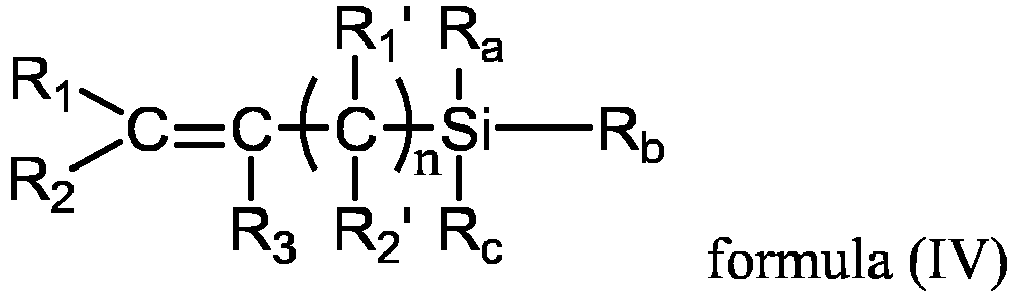 In formula (IV), each of R1, R2, R3, R1' and R2' is independently selected from H and C1-C4 alkyl; Ra, Rb and Rc are each independently selected from H and C1-C4 alkyl or alkoxyl, and n is an integer from 5 to 25, preferably from 8 to 18;preferably, the silane and/or siloxane is at least one selected from the group consisting of 7-octenyl trimethoxysilane, vinyl octadecyl trimethoxysilane, vinyl hexadecyl trimethoxysilane and vinyl dodecyl trimethoxysilane.
 - A method for preparing a dispersant, the method comprises: subjecting a monomer mixture to polymerization in water under the solution polymerization conditions in the presence of an initiator, wherein the monomer mixture comprises a monomer A, a monomer B, a monomer C and a monomer D, a monomer A being an unsaturated polyether and/or polyester, a monomer B being an unsaturated carboxylic acid and/or anhydride and/or salt thereof, a monomer C being a silane and/or siloxane containing a polymerizable group, and a monomer D being an unsaturated sulfonic acid and/or a salt thereof; and the molar ratio of monomer A:
monomer B: monomer C: monomer D is 1: (0.5-6): (0.01-4): (5-15), preferably 1: (1-4): (0.1-1): (6-10), the polymerization conditions cause that the polymer has a weight average molecular weight of 20,000-120,000. - The method of claim 8, wherein the unsaturated polyester has a structure represented by formula (I):
 in formula (I),A denotes an alkylene having 2-4 carbon atoms;B denotes an alkylene having 2-4 carbon atoms and different from A;R1 and R2 each independently represents H or an alkyl having 1-5 carbon atoms, preferably methyl;R3 denotes an alkyl having 1-4 carbon atoms;X denotes an alkylene having 1-5 carbon atoms;m represents an integer from 0 to 200, preferably 20 to 140;n represents an integer from 0 to 200, preferably 20 to 140;m + n >10, preferably m + n ≥40;the unsaturated polyether has a structure represented by formula (II):
 in formula (II),E denotes an alkylene having 2-4 carbon atoms;F denotes an alkylene having 2-4 carbon atoms and different from E;R4 and R5 each independently represents H or an alkyl having 1-5 carbon atoms, preferably methyl;R6 denotes an alkyl having 1-4 carbon atoms;Y denotes an alkylene having 1-5 carbon atoms;p represents an integer from 0 to 200, preferably 20 to 140;q represents an integer from 0 to 200, preferably 20 to 140;p + q >10, preferably p + q ≥40;and/or, the unsaturated carboxylic acid includes, but is not limited to, one or more selected from the group consisting of acrylic acid, methacrylic acid, itaconic acid, fumaric acid and maleic acid.
 - The method of claim 8 or 9, wherein the unsaturated sulfonic acid or salt thereof contains a substituted or unsubstituted benzene ring or amide group, preferably the unsaturated sulfonic acid and/or salt thereof includes, but is not limited to having a structure represented by any one of formula (IIIA) -formula (IIID):


 in formula IIIA, formula IIIB and formula IIIC, R1, R2, R3 and R4 are each independently selected from hydrogen, halogen, C1-C6 alkyl and C1-C6 alkoxyl, X is (CH2)n, n is an integer from 0 to 6, and M is hydrogen or a metal ion, such as an alkali metal ion, preferably lithium ion, sodium ion or potassium ion;in formula IIID, R1, R2 and R3 are each independently selected from hydrogen and C1-C6 alkyl, X is (CH2)n, n is an integer from 0 to 6, and M is hydrogen or a metal ion, such as an alkali metal ion, preferably lithium ion, sodium ion or potassium ion;and/or, the unsaturated sulfonic acid or salt thereof is one or more selected from the group consisting of 2-acrylamide-2-methyl propane sulfonic acid, 2-acrylamido-2-methyl propanesulfonate, p-styrene sulfonic acid, p-styrene sulfonate, allyl sulfonic acid and allyl sulfonate.
 - The method of any one of claims 8-10, wherein the silane and/or siloxane containing a polymerizable group has not less than 5, preferably 8-25 carbon atoms, the polymerizable group is one or more selected from the group consisting of carbon-carbon double bonds, carbon-carbon triple bonds and epoxy groups; preferably the silane coupling agent has a structure represented by formula (IV):
 In formula (IV), each of R1, R2, R3, R1' and R2' is independently selected from H and C1-C4 alkyl; Ra, Rb and Rc are each independently selected from H and C1-C4 alkyl or alkoxyl, and n is an integer from 5 to 25, preferably from 8 to 18;preferably, the silane and/or siloxane is at least one selected from the group consisting of 7-octenyl trimethoxysilane, vinyl octadecyl trimethoxysilane, vinyl hexadecyl trimethoxysilane and vinyl dodecyl trimethoxysilane.
 - The method of any one of claims 8-11, wherein said polymerization reaction is carried out in the presence of a chain transfer agent, the conditions of polymerization reaction comprises: a temperature of 50-80°C, preferably 60-70°C, and a time of 2-10 hours, preferably 3-5 hours.
- A dispersant produced with the method of any one of claims 8-12.
- A cement composition comprising cement and the polymer of any of claims 1-7 as a dispersant, or the dispersant of claim 13, it is preferable that the dispersant is used in an amount of 0.05-5 wt%, preferably 0.1-1 wt%, based on the total amount of the cement composition.
- The cement composition of claim 14, wherein the composition further comprises a filtrate reducer, the filtrate reducer is preferably one or more selected from the group consisting of a cellulose-based filtrate reducer, a polyvinyl alcohol-based filtrate reducer and an AMPS-based filtrate reducer, the filtrate reducer is preferably selected from an AMPS-based filtrate reducer.
- An use of the polymer of any of claims 1-7, the dispersant of claim 13, the cement composition of claim 14 or 15 in an oil well cement or oil well construction, the oil well construction is preferably carried out at a temperature range of 20-120°C.
Applications Claiming Priority (2)
| Application Number | Priority Date | Filing Date | Title |
|---|---|---|---|
| CN202010820725.0A CN114075314A (en) | 2020-08-14 | 2020-08-14 | Dispersant for oil well cement and application thereof |
| PCT/CN2021/112593 WO2022033588A1 (en) | 2020-08-14 | 2021-08-13 | Polymer having dispersing function, oil well cement dispersant, and preparation method therefor and use thereof |
Publications (2)
| Publication Number | Publication Date |
|---|---|
| EP4190829A1 true EP4190829A1 (en) | 2023-06-07 |
| EP4190829A4 EP4190829A4 (en) | 2024-10-02 |
Family
ID=80247727
Family Applications (1)
| Application Number | Title | Priority Date | Filing Date |
|---|---|---|---|
| EP21855638.9A Pending EP4190829A4 (en) | 2020-08-14 | 2021-08-13 | POLYMER HAVING DISPERSION FUNCTION, CEMENT DISPERSANT FOR OIL WELL, AND PREPARATION METHOD THEREFOR AND USE THEREOF |
Country Status (6)
| Country | Link |
|---|---|
| US (1) | US20230286862A1 (en) |
| EP (1) | EP4190829A4 (en) |
| JP (1) | JP7634096B2 (en) |
| CN (1) | CN114075314A (en) |
| CA (1) | CA3191730A1 (en) |
| WO (1) | WO2022033588A1 (en) |
Cited By (1)
| Publication number | Priority date | Publication date | Assignee | Title |
|---|---|---|---|---|
| EP4212494A4 (en) * | 2020-10-13 | 2024-03-27 | China Petroleum & Chemical Corporation | POLYMER HAVING A DISPERSION FUNCTION, POLYCARBOXYLIC ACID CEMENT DISPERSANT, ASSOCIATED PREPARATION METHOD AND USE THEREOF |
Families Citing this family (5)
| Publication number | Priority date | Publication date | Assignee | Title |
|---|---|---|---|---|
| CN115612466B (en) * | 2022-10-25 | 2023-06-06 | 四川川庆井下科技有限公司 | A rheology regulator for well cementing and anti-pollution and its preparation method |
| CN120344542A (en) * | 2022-12-26 | 2025-07-18 | 大金工业株式会社 | Silane compounds containing alkylene chains |
| CN118909205A (en) * | 2024-10-11 | 2024-11-08 | 中国石油集团西部钻探工程有限公司 | Retarder for oil well cement paste, and preparation method and application thereof |
| CN119431687A (en) * | 2025-01-07 | 2025-02-14 | 中海油田服务股份有限公司 | A salt-resistant and high-temperature-resistant polymer micro-manganese dispersant and its preparation method and application |
| CN119823320B (en) * | 2025-01-21 | 2025-12-19 | 西南石油大学 | A method for preparing an element-organic polymer type high-temperature retarder |
Family Cites Families (19)
| Publication number | Priority date | Publication date | Assignee | Title |
|---|---|---|---|---|
| US6384111B1 (en) * | 1996-12-20 | 2002-05-07 | Basf Aktiengesellschaft | Polymers containing carboxyl groups and polyalkylene ether side- chains as additives in mineral building materials |
| KR100552922B1 (en) * | 1998-03-03 | 2006-02-22 | 다케모토 유시 가부시키 가이샤 | Dispersant for cement and preparation method of concrete using the same |
| JP2000072505A (en) * | 1998-08-28 | 2000-03-07 | Lion Corp | Cement admixture |
| CN101792281B (en) * | 2010-01-26 | 2012-04-18 | 辽宁奥克化学股份有限公司 | Polycarboxylate superplasticizer and preparation method thereof |
| CN104558434B (en) * | 2014-12-16 | 2017-11-03 | 上海台界化工有限公司 | Siliceous polycarboxylate water-reducer, preparation method and the usage |
| CN104592457B (en) * | 2015-02-13 | 2017-07-07 | 水利部交通运输部国家能源局南京水利科学研究院 | A kind of preparation method of the compatible type poly carboxylic acid series water reducer of sulfate |
| CN105754045B (en) * | 2016-03-02 | 2018-04-17 | 海南太和科技有限公司 | A kind of silane coupler modified polycarboxylate water-reducer and preparation method thereof |
| CN105837763B (en) * | 2016-06-04 | 2020-10-02 | 石家庄市长安育才建材有限公司 | Silane polycarboxylic acid water reducing agent and preparation method thereof |
| CN106496442B (en) * | 2016-10-27 | 2018-11-06 | 湖南大学 | A kind of high-efficiency water-reducing agent of poly-carboxylic acid and preparation method thereof |
| CN106496445A (en) * | 2016-11-15 | 2017-03-15 | 湖北工业大学 | A kind of hydrophobic minor comonomer modification viscosity reduction type polycarboxylate water-reducer masterbatch |
| JP2018111627A (en) * | 2017-01-11 | 2018-07-19 | 株式会社日本触媒 | Cement admixture and cement composition |
| CN107540795B (en) * | 2017-09-12 | 2019-07-16 | 上海三瑞高分子材料股份有限公司 | A kind of shrinkage-reducing polycarboxylate water-reducing agent and preparation method thereof |
| CN108250370B (en) * | 2017-12-25 | 2020-07-21 | 清华大学 | Polycarboxylic acid and its use in cement |
| CN108102043A (en) * | 2017-12-28 | 2018-06-01 | 科之杰新材料集团有限公司 | A kind of preparation method to the low responsive type polycarboxylic acid super-plasticizer of clay content |
| CN108976355A (en) * | 2018-06-15 | 2018-12-11 | 北京工业大学 | A kind of polycarboxylate water-reducer and preparation method with high absorption property and low surface tension |
| CN108840587A (en) * | 2018-06-16 | 2018-11-20 | 国电东北环保产业集团有限公司华盈环保材料分公司 | A kind of anti-chamotte mould cement water reducing agent and preparation method thereof |
| CN109749019A (en) * | 2018-12-13 | 2019-05-14 | 天津大学 | Silane-modified polycarboxylic acid dispersant for oil well cement, preparation method and application |
| CN109970931A (en) * | 2019-01-30 | 2019-07-05 | 西北农林科技大学 | A kind of shrinkage type poly carboxylic acid series super plasticizer, preparation method and applications |
| CN110790528B (en) * | 2019-11-28 | 2022-02-11 | 北京服装学院 | A kind of preparation method and application of micro-nano crystal core composite material |
-
2020
- 2020-08-14 CN CN202010820725.0A patent/CN114075314A/en active Pending
-
2021
- 2021-08-13 US US18/041,600 patent/US20230286862A1/en active Pending
- 2021-08-13 JP JP2023534240A patent/JP7634096B2/en active Active
- 2021-08-13 CA CA3191730A patent/CA3191730A1/en active Pending
- 2021-08-13 WO PCT/CN2021/112593 patent/WO2022033588A1/en not_active Ceased
- 2021-08-13 EP EP21855638.9A patent/EP4190829A4/en active Pending
Cited By (1)
| Publication number | Priority date | Publication date | Assignee | Title |
|---|---|---|---|---|
| EP4212494A4 (en) * | 2020-10-13 | 2024-03-27 | China Petroleum & Chemical Corporation | POLYMER HAVING A DISPERSION FUNCTION, POLYCARBOXYLIC ACID CEMENT DISPERSANT, ASSOCIATED PREPARATION METHOD AND USE THEREOF |
Also Published As
| Publication number | Publication date |
|---|---|
| CN114075314A (en) | 2022-02-22 |
| US20230286862A1 (en) | 2023-09-14 |
| WO2022033588A1 (en) | 2022-02-17 |
| EP4190829A4 (en) | 2024-10-02 |
| JP2023538703A (en) | 2023-09-08 |
| JP7634096B2 (en) | 2025-02-20 |
| CA3191730A1 (en) | 2022-02-17 |
Similar Documents
| Publication | Publication Date | Title |
|---|---|---|
| US20230286862A1 (en) | Polymer having dispersing function, oil well cement dispersant, and preparation method therefor and use thereof | |
| EP4212494B1 (en) | Polymer having dispersing function and use thereof | |
| US11548967B2 (en) | Preparation method for polycarboxylate water reducer having regular sequence structure | |
| US8158699B2 (en) | Water-soluble copolymers containing sulpho groups, process for their preparation and their use | |
| CN103183795B (en) | Low air content polycarboxylic acid water reducer and preparation method thereof | |
| CN101928114A (en) | High water-reducing and high-slump-preserving polycarboxylate high-performance water-reducing agent and its non-pyrogenic preparation method | |
| US20150291716A1 (en) | Slump retaining polycarboxylic acid superplasticizer | |
| CN103897116A (en) | Mud-resistant polycarboxylic acid water reducer and preparation method thereof | |
| CN103896510A (en) | Polycarboxylate superplasticizer with high dispersion and high slump protection and preparation method of polycarboxylate superplasticizer | |
| CN111978001B (en) | Silane-containing polymer oil well cement dispersant, and preparation method and application thereof | |
| CN103613306A (en) | Hyperbranched poly(amine-ester) structure-containing polycarboxylic water reducer and preparation method thereof | |
| CN104371081B (en) | A kind of preparation method of rapid dispersion viscosity reduction type poly-carboxylic-acid cement dispersant | |
| CN105800992A (en) | Anti-mud-type polycarboxylic-acid water-reducing agent and preparation method thereof | |
| CN109133710A (en) | A kind of naphthalene water reducer matching preparation method for subtracting jelly | |
| CN106883355A (en) | A kind of low entraining viscosity reduction type polycarboxylate water-reducer and preparation method thereof | |
| Feng et al. | Study on the polymerization process and monomer reactivity of EPEG‐type polycarboxylate superplasticizer | |
| CN107987231A (en) | A kind of anti-chamotte mould polycarboxylate water-reducer and preparation method thereof | |
| CN111892685A (en) | Anti-mud polycarboxylate superplasticizer and preparation method thereof | |
| CN112250799A (en) | A kind of organosilicon modified polycarboxylate dispersant and its preparation method and application | |
| CN108948283B (en) | A kind of phthalic anhydride modified polycarboxylate water reducer and preparation method thereof | |
| CN106496442B (en) | A kind of high-efficiency water-reducing agent of poly-carboxylic acid and preparation method thereof | |
| CN108219079B (en) | Polycarboxylic acid water reducing agent, and preparation method and use method thereof | |
| CN111560105B (en) | A kind of viscosity-reducing tannic acid-based star-shaped polycarboxylate water reducer and its preparation method | |
| CN109626860B (en) | Preparation method of block viscosity-reducing concrete admixture | |
| CN107722189A (en) | A kind of preparation method of rigidity end-blocking resistance mud polycarboxylate water-reducer |
Legal Events
| Date | Code | Title | Description |
|---|---|---|---|
| STAA | Information on the status of an ep patent application or granted ep patent |
Free format text: STATUS: THE INTERNATIONAL PUBLICATION HAS BEEN MADE |
|
| PUAI | Public reference made under article 153(3) epc to a published international application that has entered the european phase |
Free format text: ORIGINAL CODE: 0009012 |
|
| STAA | Information on the status of an ep patent application or granted ep patent |
Free format text: STATUS: REQUEST FOR EXAMINATION WAS MADE |
|
| 17P | Request for examination filed |
Effective date: 20230214 |
|
| AK | Designated contracting states |
Kind code of ref document: A1 Designated state(s): AL AT BE BG CH CY CZ DE DK EE ES FI FR GB GR HR HU IE IS IT LI LT LU LV MC MK MT NL NO PL PT RO RS SE SI SK SM TR |
|
| DAV | Request for validation of the european patent (deleted) | ||
| DAX | Request for extension of the european patent (deleted) | ||
| A4 | Supplementary search report drawn up and despatched |
Effective date: 20240904 |
|
| RIC1 | Information provided on ipc code assigned before grant |
Ipc: C09K 8/467 20060101ALI20240829BHEP Ipc: C04B 103/30 20060101ALI20240829BHEP Ipc: C04B 24/16 20060101ALI20240829BHEP Ipc: C08F 283/06 20060101AFI20240829BHEP |