EP4187755B1 - Devices and methods for testing of far-field wireless charging - Google Patents
Devices and methods for testing of far-field wireless charging Download PDFInfo
- Publication number
- EP4187755B1 EP4187755B1 EP21210681.9A EP21210681A EP4187755B1 EP 4187755 B1 EP4187755 B1 EP 4187755B1 EP 21210681 A EP21210681 A EP 21210681A EP 4187755 B1 EP4187755 B1 EP 4187755B1
- Authority
- EP
- European Patent Office
- Prior art keywords
- dut
- dependence
- power
- charging efficiency
- charging
- Prior art date
- Legal status (The legal status is an assumption and is not a legal conclusion. Google has not performed a legal analysis and makes no representation as to the accuracy of the status listed.)
- Active
Links
Images
Classifications
-
- G—PHYSICS
- G01—MEASURING; TESTING
- G01R—MEASURING ELECTRIC VARIABLES; MEASURING MAGNETIC VARIABLES
- G01R31/00—Arrangements for testing electric properties; Arrangements for locating electric faults; Arrangements for electrical testing characterised by what is being tested not provided for elsewhere
- G01R31/28—Testing of electronic circuits, e.g. by signal tracer
- G01R31/302—Contactless testing
- G01R31/3025—Wireless interface with the DUT
-
- H—ELECTRICITY
- H02—GENERATION; CONVERSION OR DISTRIBUTION OF ELECTRIC POWER
- H02J—ELECTRIC POWER NETWORKS; CIRCUIT ARRANGEMENTS OR SYSTEMS FOR SUPPLYING OR DISTRIBUTING ELECTRIC POWER; SYSTEMS FOR STORING ELECTRIC ENERGY
- H02J50/00—Circuit arrangements or systems for wireless supply or distribution of electric power
- H02J50/20—Circuit arrangements or systems for wireless supply or distribution of electric power using microwaves or radio frequency waves
-
- H—ELECTRICITY
- H04—ELECTRIC COMMUNICATION TECHNIQUE
- H04B—TRANSMISSION
- H04B17/00—Monitoring; Testing
-
- G—PHYSICS
- G01—MEASURING; TESTING
- G01R—MEASURING ELECTRIC VARIABLES; MEASURING MAGNETIC VARIABLES
- G01R31/00—Arrangements for testing electric properties; Arrangements for locating electric faults; Arrangements for electrical testing characterised by what is being tested not provided for elsewhere
- G01R31/28—Testing of electronic circuits, e.g. by signal tracer
- G01R31/317—Testing of digital circuits
- G01R31/3181—Functional testing
- G01R31/319—Tester hardware, i.e. output processing circuits
- G01R31/31903—Tester hardware, i.e. output processing circuits tester configuration
- G01R31/31908—Tester set-up, e.g. configuring the tester to the device under test [DUT], down loading test patterns
-
- H—ELECTRICITY
- H02—GENERATION; CONVERSION OR DISTRIBUTION OF ELECTRIC POWER
- H02J—ELECTRIC POWER NETWORKS; CIRCUIT ARRANGEMENTS OR SYSTEMS FOR SUPPLYING OR DISTRIBUTING ELECTRIC POWER; SYSTEMS FOR STORING ELECTRIC ENERGY
- H02J50/00—Circuit arrangements or systems for wireless supply or distribution of electric power
- H02J50/40—Circuit arrangements or systems for wireless supply or distribution of electric power using two or more transmitting or receiving devices
-
- H—ELECTRICITY
- H02—GENERATION; CONVERSION OR DISTRIBUTION OF ELECTRIC POWER
- H02J—ELECTRIC POWER NETWORKS; CIRCUIT ARRANGEMENTS OR SYSTEMS FOR SUPPLYING OR DISTRIBUTING ELECTRIC POWER; SYSTEMS FOR STORING ELECTRIC ENERGY
- H02J50/00—Circuit arrangements or systems for wireless supply or distribution of electric power
- H02J50/80—Circuit arrangements or systems for wireless supply or distribution of electric power involving the exchange of data, concerning supply or distribution of electric power, between transmitting devices and receiving devices
-
- H—ELECTRICITY
- H04—ELECTRIC COMMUNICATION TECHNIQUE
- H04B—TRANSMISSION
- H04B1/00—Details of transmission systems, not covered by a single one of groups H04B3/00 - H04B13/00; Details of transmission systems not characterised by the medium used for transmission
- H04B1/38—Transceivers, i.e. devices in which transmitter and receiver form a structural unit and in which at least one part is used for functions of transmitting and receiving
- H04B1/40—Circuits
-
- H—ELECTRICITY
- H04—ELECTRIC COMMUNICATION TECHNIQUE
- H04Q—SELECTING
- H04Q9/00—Arrangements in telecontrol or telemetry systems for selectively calling a substation from a main station, in which substation desired apparatus is selected for applying a control signal thereto or for obtaining measured values therefrom
Definitions
- the present disclosure relates to testing of a variant of wireless charging involving far-field wireless power transfer, and in particular, to devices and methods for testing of such far-field wireless charging.
- wireless charging has gained significant market momentum, especially for bridging a charging gap of up to several centimeters by near-field wireless charging charging variants involving capacitive coupling via electric fields or inductive coupling via magnetic fields.
- near-field wireless charging charging variants involving capacitive coupling via electric fields or inductive coupling via magnetic fields.
- One example is us 2017/331331.
- a far-field charging variant, bridging up to several meters, is less widespread for its limited power transfer capacity, but still attracting interest in particular deployments of an abundance of devices which are difficult to access, for example.
- a first aspect of the present disclosure relates to a device for testing of far-field wireless charging.
- the device includes a first transceiver configured to conduct a far-field wireless power transfer between the device and a device under test (DUT); a second transceiver configured to conduct a data transfer between the device and the DUT; and a processor configured to establish a figure of merit of a wireless charging of the DUT in dependence of the power transfer and the data transfer.
- the far-field wireless power transfer between the device and the DUT may exceed a Fraunhofer distance.
- the first transceiver may further be configured for beamforming of the far-field wireless power transfer.
- the second transceiver may include one of: a wireless transceiver; and a wired transceiver.
- the data transfer may include one of: a receive power of the DUT due to the power transfer; a battery charge power of the DUT due to the power transfer; a battery DC level of the DUT; and a battery state of charge of the DUT.
- the data transfer may include: a transmit power of the DUT due to the power transfer.
- the figure of merit of the DUT may include one of: a compliance of the transmit power of the DUT with a preset transmit power at a preset frequency; and a charging efficiency of the DUT in dependence of the transmit power of the DUT.
- the figure of merit of the DUT may include at least one of: a charging efficiency of the DUT over time; a charging efficiency of the DUT in dependence of a relative distance between the device and the DUT; a charging efficiency of the DUT in dependence of a relative orientation between the device and the DUT; a charging efficiency of the DUT in dependence of a relative motion between the device and the DUT; a charging efficiency of the DUT in dependence of a preset channel condition between the device and the DUT; a charging efficiency of the DUT in dependence of a simultaneous wireless data transfer of the first transceiver; a charging efficiency of the DUT in dependence of a simultaneous wireless transmission in a frequency range of the first transceiver; and a charging efficiency of the DUT in dependence of a waveform of the power transfer.
- the relative orientation may include an angle of arrival, AoA, or an angle of departure, AoD, of the DUT.
- the preset channel condition may include one or more of: a fading profile; an outdoor condition; and an indoor condition.
- the processor may further be configured to trigger the simultaneous wireless transmission; and the simultaneous wireless transmission may include a Bluetooth, WiFi, cellular or ambient transmission.
- a second aspect of the present disclosure relates to a method for testing of far-field wireless charging.
- the method includes: conducting a far-field wireless power transfer between the device and a DUT; conducting a data transfer between the device and the DUT; and establishing a figure of merit of a wireless charging of the DUT in dependence of the power transfer and the data transfer.
- the method may be performed by a device for testing of far-field wireless charging as defined above.
- the present disclosure provides devices and methods for testing of far-field wireless charging, which ensures proper operation of DUTs involved in the charging, and conformity of said DUTs with applicable standards and regulation.
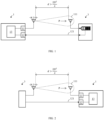
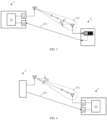
- FIGs. 1 and 2 illustrate respective devices 1 for testing of far-field wireless charging in accordance with the present disclosure.
- the respective device 1 includes a first transceiver 11 configured to conduct a far-field wireless power transfer 111, P between the device 1 and a device under test, DUT 3.
- the Fraunhofer distance defines the limit between the near field and the far field.
- the far field is characterized by propagating electromagnetic waves.
- the first transceiver 11 may further be configured for beamforming of the far-field wireless power transfer 111, P.
- Beamforming or spatial filtering as used herein may refer to a signal processing technique used in antenna arrays for directional signal transmission or reception. Beamforming can be used at both the transmitting and receiving ends in order to achieve directivity (i.e., spatial selectivity).
- directivity of the respective power transfer 111, P is indicated by a respective schematic main lobe.
- the respective device 1 further includes a second transceiver 12 configured to conduct a data transfer 121 between the device 1 and the DUT 3.
- the second transceiver 12 may include one of: a wireless transceiver (not shown); and a wired transceiver (see FIGs. 1 to 6 ).
- the data transfer 121 may be realized by means of a potentially standardized protocol.
- the data transfer 121 may be realized by direct measurement of the respective electric quantity of the DUT 3 by the device 1.
- the data transfer 121 is directed towards the device 1.
- this further data transfer may involve sending control signals needed for charging purposes, or sending communication signals to the DUT 3.
- the respective device 1 further includes a processor 13 configured to establish a figure of merit of a wireless charging of the DUT 3 in dependence of the power transfer 111, P and the data transfer 121.
- the data transfer 121 may include one of: a receive power of the DUT 3 due to the power transfer 111, P; a battery charge power of the DUT 3 due to the power transfer 111, P; a battery direct current (DC) level of the DUT 3; and a battery state of charge of the DUT 3.
- the established figure of merit of the DUT 3 may include a charging efficiency of the DUT 3 in dependence of a transmit (RF) power of the device 1 due to the power transfer 111, P.
- an efficiency may generally refer to a ratio of useful output to total input, and a charging efficiency may correspondingly refer to a ratio of an indication of charging output/achievement to an indication of charging input/effort.
- the figure of merit of the charge-receiving DUT 3 of FIG. 1 may include one of:
- the overall charging efficiency may be calculated as a ratio of the charging DC power at the receiving DUT 3 and the transmit RF power at the transmitting device 1.
- the overall charging efficiency may be determined as a product of an RF-to-RF efficiency over the air and an RF-to-DC efficiency of the DUT 3.
- the RF-to-RF efficiency is a ratio of a received RF power at the receiving DUT 3 and a transmit RF power at the transmitting device 1, and may depend on a relative distance d between the device 1 and the DUT 3, or on a frequency of the power transfer 111, for example.
- the RF-to-DC efficiency is a ratio of the charging DC power at the receiving DUT 3 and the received RF power at the receiving DUT 3, and may depend on an RF-to-DC conversion circuit of the DUT 3, or on a waveform (i.e., shape) of the power transfer 111, for example.
- the data transfer 121 may include: a transmit (RF) power of the DUT 3 due to the power transfer 111, P.
- the established figure of merit of the DUT 3 may include one of: a compliance of the transmit RF power of the DUT 3 with a preset transmit power at a preset frequency; and a charging efficiency of the DUT 3 in dependence of the transmit RF power of the DUT 3.
- the overall charging efficiency may be calculated as a ratio between the charging DC power at the receiving device 1 and the transmit RF power of the transmitting DUT 3.
- the compliance of the transmit power of the DUT 3 with a preset transmit power at a preset frequency may be established by a frequency sweep through a spectral mask defining a preset transmit power at a respective preset frequency and verifying that the transmit power of the DUT 3 does not project beyond the spectral mask.
- the established figure of merit may correspond to a binary value indicating that the compliance test has (not) been passed successfully, for instance.
- the charging efficiency of the DUT 3 in dependence of the transmit power of the DUT 3 may be established by: dividing a receive power of the device 1 due to the power transfer 111, P by the communicated transmit power of the DUT 3 due to the power transfer 111, P.
- the figure of merit of the DUT 3 may include at least one of: a charging efficiency of the DUT 3 over time; a charging efficiency of the DUT 3 in dependence of a relative distance d between the device 1 and the DUT 3; a charging efficiency of the DUT 3 in dependence of a relative orientation between the device 1 and the DUT 3; a charging efficiency of the DUT 3 in dependence of a relative motion between the device 1 and the DUT 3; a charging efficiency of the DUT 3 in dependence of a preset channel condition between the device 1 and the DUT 3; a charging efficiency of the DUT 3 in dependence of a simultaneous wireless data transfer of the first transceiver 11; a charging efficiency of the DUT 3 in dependence of a simultaneous wireless transmission 61 in a frequency range of the first transceiver 11; and a charging efficiency of the DUT 3 in dependence of the waveform of the power transfer
- the charging efficiency of the DUT 3 over time may be established by recording individually established charging efficiency values as a function of the applicable recording time.
- the charging efficiency of the DUT 3 in dependence of a relative distance d between the device 1 and the DUT 3 may be established by recording individually established charging efficiency values as a function of the applicable relative distance d between the device 1 and the DUT 3.
- the charging efficiency of the DUT 3 in dependence of a relative motion between the device 1 and the DUT 3 may be established by recording individually established charging efficiency values as a function of the applicable relative motion (i.e., velocity, acceleration, rotation, ...) between the device 1 and the DUT 3.
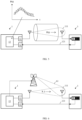
- FIGs. 3 and 4 respectively illustrate testing subject to a relative orientation between the respective device 1 and its DUT 3.
- the charging efficiency of the DUT 3 in dependence of the relative orientation between the device 1 and the DUT 3 may be established by recording individually established charging efficiency values as a function of the applicable relative orientation between the device 1 and the DUT 3.
- the relative orientation may include an angle of arrival, AoA 31 (see FIG. 3 ), or an angle of departure, AoD 41 (see FIG. 4 ), of the DUT 3.
- FIG. 5 illustrates testing subject to preset channel conditions between the device 1 and its DUT 3
- the charging efficiency of the DUT 3 in dependence of a preset channel condition between the device 1 and the DUT 3 may be established by recording individually established charging efficiency values as a function of the applicable preset channel condition between the device 1 and the DUT 3.
- the preset channel condition may include one or more of: a fading profile; an outdoor condition; and an indoor condition.
- FIG. 5 shows that an exemplary fading profile P(t) may be used as the preset channel condition to which the power transfer 111, P between the device 1 and the DUT 3 may be subjected, resulting in a time-variant power transfer 111, P(t).
- the processor 13 may further be configured to simulate an exposure of the power transfer 111, P(t) between the device 1 and the DUT 3 to the preset channel conditions.
- FIG. 6 illustrates testing subject to a simultaneous wireless data transfer I of the first transceiver and a simultaneous wireless transmission 61 in a frequency range of the first transceiver.
- the processor 13 may further be configured to activate the simultaneous wireless data transfer I of the first transceiver 11.
- the charging efficiency of the DUT 3 in dependence of the simultaneous wireless data transfer I of the first transceiver 11 may be established by recording individually established charging efficiency values in a presence or an absence of the simultaneous wireless data transfer I and averaging the charging efficiency values recorded in a presence of the simultaneous wireless data transfer I to obtain the corresponding charging efficiency of the DUT 3.
- a change in the charging efficiency of the DUT 3 in a presence of the simultaneous wireless data transfer I may be determined.
- the charging efficiency of the DUT 3 in dependence of the simultaneous wireless transmission 61 in a frequency range of the first transceiver 11 may be established by recording individually established charging efficiency values in a presence or an absence of the simultaneous wireless transmission 61.
- the processor 13 may further be configured to trigger the simultaneous wireless transmission 61.
- the simultaneous wireless transmission 61 may be conducted by the device 1 or preferably by an external source of radiation.
- the simultaneous wireless transmission 61 may include a Bluetooth, WiFi, cellular or ambient transmission (e.g., noise floor).
- an exemplary simultaneous cellular transmission 61 is suggested in FIG. 6 .
- additional considerations may be required for reproducibility of testing results, such as a preset transmit power, a preset relative distance, a preset relative orientation etc. between the external source of radiation and the DUT 3.
- an interfering signal may be disadvantageous to a communication signal making it more difficult at the receiver to extract the information from the communication signal.
- an interfering signal may advantageously add power on top of a transmitted power transfer 111.
- the charging efficiency of the DUT 3 in dependence of the waveform (i.e., pulse shape) of the power transfer 111 may be established by recording individually established charging efficiency values at the DUT 3 for different waveforms (e.g., constant-envelope sinusoidal signal, multi-sine signals with different number of frequency tones, with different amplitude and phase for each tone, signals with different peak-to-average-power ratios, etc.).
- waveforms e.g., constant-envelope sinusoidal signal, multi-sine signals with different number of frequency tones, with different amplitude and phase for each tone, signals with different peak-to-average-power ratios, etc.
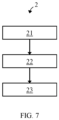
- FIG. 7 illustrates a method 2 for testing of far-field wireless charging in accordance with the present disclosure.
- the method 2 includes: conducting 21 a far-field wireless power transfer 111, P between the device 1 and a DUT 3; conducting 22 a data transfer 121 between the device 1 and the DUT 3; and establishing 23 a figure of merit of a wireless charging of the DUT 3 in dependence of the power transfer 111, P and the data transfer 121.
- the method 2 may be performed by a device 1 for testing of far-field wireless charging as defined above.
Landscapes
- Engineering & Computer Science (AREA)
- Computer Networks & Wireless Communication (AREA)
- Physics & Mathematics (AREA)
- Power Engineering (AREA)
- General Engineering & Computer Science (AREA)
- General Physics & Mathematics (AREA)
- Signal Processing (AREA)
- Electromagnetism (AREA)
- Charge And Discharge Circuits For Batteries Or The Like (AREA)
- Testing Electric Properties And Detecting Electric Faults (AREA)
Description
- The present disclosure relates to testing of a variant of wireless charging involving far-field wireless power transfer, and in particular, to devices and methods for testing of such far-field wireless charging.
- Ongoing power supply of wireless electronic devices typically involves repeated manual recharging or battery replacement. For a great deal of more recent wireless electronic devices, such an approach is impractical. This particularly applies to devices or chipsets for the Internet of Things (IoT).
- The alternative of wireless charging has gained significant market momentum, especially for bridging a charging gap of up to several centimeters by near-field wireless charging charging variants involving capacitive coupling via electric fields or inductive coupling via magnetic fields. One example is us 2017/331331. A far-field charging variant, bridging up to several meters, is less widespread for its limited power transfer capacity, but still attracting interest in particular deployments of an abundance of devices which are difficult to access, for example.
- When implementing far-field wireless charging, device manufacturers require the means to verify associated device capabilities and device conformity with applicable standards and regulation.
- In view of the above, the present disclosure aims to provide such testing means. This is achieved by the subject-matter defined by the appended independent claims. Preferred embodiments are set forth in the dependent claims and in the following description and drawings.
- A first aspect of the present disclosure relates to a device for testing of far-field wireless charging. The device includes a first transceiver configured to conduct a far-field wireless power transfer between the device and a device under test (DUT); a second transceiver configured to conduct a data transfer between the device and the DUT; and a processor configured to establish a figure of merit of a wireless charging of the DUT in dependence of the power transfer and the data transfer.
- The far-field wireless power transfer between the device and the DUT may exceed a Fraunhofer distance.
- The first transceiver may further be configured for beamforming of the far-field wireless power transfer.
- The second transceiver may include one of: a wireless transceiver; and a wired transceiver.
- The data transfer may include one of: a receive power of the DUT due to the power transfer; a battery charge power of the DUT due to the power transfer; a battery DC level of the DUT; and a battery state of charge of the DUT.
- The data transfer may include: a transmit power of the DUT due to the power transfer.
- The figure of merit of the DUT may include one of: a compliance of the transmit power of the DUT with a preset transmit power at a preset frequency; and a charging efficiency of the DUT in dependence of the transmit power of the DUT.
- The figure of merit of the DUT may include at least one of: a charging efficiency of the DUT over time; a charging efficiency of the DUT in dependence of a relative distance between the device and the DUT; a charging efficiency of the DUT in dependence of a relative orientation between the device and the DUT; a charging efficiency of the DUT in dependence of a relative motion between the device and the DUT; a charging efficiency of the DUT in dependence of a preset channel condition between the device and the DUT; a charging efficiency of the DUT in dependence of a simultaneous wireless data transfer of the first transceiver; a charging efficiency of the DUT in dependence of a simultaneous wireless transmission in a frequency range of the first transceiver; and a charging efficiency of the DUT in dependence of a waveform of the power transfer.
- The relative orientation may include an angle of arrival, AoA, or an angle of departure, AoD, of the DUT.
- The preset channel condition may include one or more of: a fading profile; an outdoor condition; and an indoor condition.
- The processor may further be configured to trigger the simultaneous wireless transmission; and the simultaneous wireless transmission may include a Bluetooth, WiFi, cellular or ambient transmission.
- A second aspect of the present disclosure relates to a method for testing of far-field wireless charging. The method includes: conducting a far-field wireless power transfer between the device and a DUT; conducting a data transfer between the device and the DUT; and establishing a figure of merit of a wireless charging of the DUT in dependence of the power transfer and the data transfer.
- The method may be performed by a device for testing of far-field wireless charging as defined above.
- The present disclosure provides devices and methods for testing of far-field wireless charging, which ensures proper operation of DUTs involved in the charging, and conformity of said DUTs with applicable standards and regulation.
- Testing of a charge-receiving DUT may advantageously cover aspects such as:
- Charging quality of the DUT
- Charging while moving / rotating
- Coexistence testing
- Charging under different channel conditions
- Charging level over time
- Charging efficiency of the DUT for different transmit waveforms
- Charging range
- Simultaneous data reception or transmission while charging.
- Testing of a charge-transmitting DUT may advantageously cover aspects such as:
- DUT transmitted directivity
- Charging support for multiple simultaneous receiver devices
- Charging support for multiple charging rates
- Power transfer efficiency of the transmitting DUT
- Charging efficiency in dependence of the transmitted waveform
- Simultaneously transmitting power & data
- Coexistence tests
- Standard compliance
- Regulatory testing
- The above-described aspects and implementations will now be explained with reference to the accompanying drawings, in which the same or similar reference numerals designate the same or similar elements.
- The features of these aspects and implementations may be combined with each other unless specifically stated otherwise.
- The drawings are to be regarded as being schematic representations, and elements illustrated in the drawings are not necessarily shown to scale. Rather, the various elements are represented such that their function and general purpose become apparent to those skilled in the art.
- FIGs. 1 and 2
- illustrate respective devices for testing of far-field wireless charging in accordance with the present disclosure;
- FIGs. 3 and 4
- respectively illustrate testing subject to a relative orientation between the respective device and its DUT;
- FIG. 5
- illustrates testing subject to preset channel conditions between the device and its DUT;
- FIG. 6
- illustrates testing subject to a simultaneous wireless data transfer of the first transceiver and/or a simultaneous wireless transmission in a frequency range of the first transceiver; and
- FIG. 7
- illustrates a method for testing of far-field wireless charging in accordance with the present disclosure.
-
FIGs. 1 and 2 illustraterespective devices 1 for testing of far-field wireless charging in accordance with the present disclosure. - With reference to both
FIG. 1 and FIG. 2 , therespective device 1 includes afirst transceiver 11 configured to conduct a far-fieldwireless power transfer 111, P between thedevice 1 and a device under test,DUT 3. - The far-field
wireless power transfer 111, P between thedevice 1 and theDUT 3 may exceed a Fraunhofer distance of d = 2D2 /λ, wherein D represents a largest dimension of a radiator (i.e., transmit antenna) involved in thepower transfer 111, P, and λ is a wavelength of the radiated radio wave. The Fraunhofer distance defines the limit between the near field and the far field. The far field is characterized by propagating electromagnetic waves. - In particular, the
first transceiver 11 may further be configured for beamforming of the far-fieldwireless power transfer 111, P. Beamforming or spatial filtering as used herein may refer to a signal processing technique used in antenna arrays for directional signal transmission or reception. Beamforming can be used at both the transmitting and receiving ends in order to achieve directivity (i.e., spatial selectivity). Those skilled in the art will readily appreciate that in the case of beamforming the individual antennas indicated inFIGs. 1 and 2 actually stand for antenna arrays. A directivity of therespective power transfer 111, P is indicated by a respective schematic main lobe. - The
respective device 1 further includes asecond transceiver 12 configured to conduct adata transfer 121 between thedevice 1 and theDUT 3. - The
second transceiver 12 may include one of: a wireless transceiver (not shown); and a wired transceiver (seeFIGs. 1 to 6 ). - For example, the
data transfer 121 may be realized by means of a potentially standardized protocol. Alternatively, thedata transfer 121 may be realized by direct measurement of the respective electric quantity of theDUT 3 by thedevice 1. - According to both
FIG. 1 and FIG. 2 , thedata transfer 121 is directed towards thedevice 1. However, there may also be an optional data transfer (not shown) from thedevice 1 to theDUT 3. For example, this further data transfer may involve sending control signals needed for charging purposes, or sending communication signals to theDUT 3. - The
respective device 1 further includes aprocessor 13 configured to establish a figure of merit of a wireless charging of theDUT 3 in dependence of thepower transfer 111, P and thedata transfer 121. - Upon testing of charge-receiving DUTs 3 (see
FIG. 1 ), thedata transfer 121 may include one of: a receive power of theDUT 3 due to thepower transfer 111, P; a battery charge power of theDUT 3 due to thepower transfer 111, P; a battery direct current (DC) level of theDUT 3; and a battery state of charge of theDUT 3. The established figure of merit of theDUT 3 may include a charging efficiency of theDUT 3 in dependence of a transmit (RF) power of thedevice 1 due to thepower transfer 111, P. - As used herein, an efficiency may generally refer to a ratio of useful output to total input, and a charging efficiency may correspondingly refer to a ratio of an indication of charging output/achievement to an indication of charging input/effort.
- As such, the figure of merit of the charge-receiving
DUT 3 ofFIG. 1 may include one of: - a ratio of the receive power of the
DUT 3 due to thepower transfer 111 and the transmit RF power of thedevice 1, - a ratio of the battery charge power (i.e., charging DC power) of the
DUT 3 due to thepower transfer 111 and the transmit RF power of thedevice 1, - a ratio of an increase in the battery DC level (ΔVDC) of the
DUT 3 due to thepower transfer 111 and the transmit RF power of thedevice 1, and - a ratio of an increase in the battery state of charge (ΔSOC) of the
DUT 3 due to thepower transfer 111 and the transmit RF power of thedevice 1. - In other words, when testing the charge-receiving
DUT 3 ofFIG. 1 , the overall charging efficiency may be calculated as a ratio of the charging DC power at the receivingDUT 3 and the transmit RF power at the transmittingdevice 1. - The overall charging efficiency may be determined as a product of an RF-to-RF efficiency over the air and an RF-to-DC efficiency of the
DUT 3. - The RF-to-RF efficiency is a ratio of a received RF power at the receiving
DUT 3 and a transmit RF power at the transmittingdevice 1, and may depend on a relative distance d between thedevice 1 and theDUT 3, or on a frequency of thepower transfer 111, for example. - The RF-to-DC efficiency is a ratio of the charging DC power at the receiving
DUT 3 and the received RF power at the receivingDUT 3, and may depend on an RF-to-DC conversion circuit of theDUT 3, or on a waveform (i.e., shape) of thepower transfer 111, for example. - Upon testing of charge-transmitting DUTs 3 (see
FIG. 2 ), thedata transfer 121 may include: a transmit (RF) power of theDUT 3 due to thepower transfer 111, P. The established figure of merit of theDUT 3 may include one of: a compliance of the transmit RF power of theDUT 3 with a preset transmit power at a preset frequency; and a charging efficiency of theDUT 3 in dependence of the transmit RF power of theDUT 3. - In other words, when testing the charge-transmitting
DUT 3 ofFIG. 2 , then the overall charging efficiency may be calculated as a ratio between the charging DC power at the receivingdevice 1 and the transmit RF power of the transmittingDUT 3. - For example, the compliance of the transmit power of the
DUT 3 with a preset transmit power at a preset frequency may be established by a frequency sweep through a spectral mask defining a preset transmit power at a respective preset frequency and verifying that the transmit power of theDUT 3 does not project beyond the spectral mask. The established figure of merit may correspond to a binary value indicating that the compliance test has (not) been passed successfully, for instance. - For example, the charging efficiency of the
DUT 3 in dependence of the transmit power of theDUT 3 may be established by: dividing a receive power of thedevice 1 due to thepower transfer 111, P by the communicated transmit power of theDUT 3 due to thepower transfer 111, P. - Upon testing of charge-receiving DUTs 3 (see
FIG. 1 ) or charge-transmitting DUTs 3 (seeFIG. 2 ), the figure of merit of theDUT 3 may include at least one of: a charging efficiency of theDUT 3 over time; a charging efficiency of theDUT 3 in dependence of a relative distance d between thedevice 1 and theDUT 3; a charging efficiency of theDUT 3 in dependence of a relative orientation between thedevice 1 and theDUT 3; a charging efficiency of theDUT 3 in dependence of a relative motion between thedevice 1 and theDUT 3; a charging efficiency of theDUT 3 in dependence of a preset channel condition between thedevice 1 and theDUT 3; a charging efficiency of theDUT 3 in dependence of a simultaneous wireless data transfer of thefirst transceiver 11; a charging efficiency of theDUT 3 in dependence of asimultaneous wireless transmission 61 in a frequency range of thefirst transceiver 11; and a charging efficiency of theDUT 3 in dependence of the waveform of thepower transfer 111. - For example, the charging efficiency of the
DUT 3 over time may be established by recording individually established charging efficiency values as a function of the applicable recording time. - For example, the charging efficiency of the
DUT 3 in dependence of a relative distance d between thedevice 1 and theDUT 3 may be established by recording individually established charging efficiency values as a function of the applicable relative distance d between thedevice 1 and theDUT 3. - For example, the charging efficiency of the
DUT 3 in dependence of a relative motion between thedevice 1 and theDUT 3 may be established by recording individually established charging efficiency values as a function of the applicable relative motion (i.e., velocity, acceleration, rotation, ...) between thedevice 1 and theDUT 3. -
FIGs. 3 and 4 respectively illustrate testing subject to a relative orientation between therespective device 1 and itsDUT 3. - For example, the charging efficiency of the
DUT 3 in dependence of the relative orientation between thedevice 1 and theDUT 3 may be established by recording individually established charging efficiency values as a function of the applicable relative orientation between thedevice 1 and theDUT 3. - In particular, the relative orientation may include an angle of arrival, AoA 31 (see
FIG. 3 ), or an angle of departure, AoD 41 (seeFIG. 4 ), of theDUT 3. -
FIG. 5 illustrates testing subject to preset channel conditions between thedevice 1 and itsDUT 3; - For example, the charging efficiency of the
DUT 3 in dependence of a preset channel condition between thedevice 1 and theDUT 3 may be established by recording individually established charging efficiency values as a function of the applicable preset channel condition between thedevice 1 and theDUT 3. - In particular, the preset channel condition may include one or more of: a fading profile; an outdoor condition; and an indoor condition.
-
FIG. 5 shows that an exemplary fading profile P(t) may be used as the preset channel condition to which thepower transfer 111, P between thedevice 1 and theDUT 3 may be subjected, resulting in a time-variant power transfer 111, P(t). As such, theprocessor 13 may further be configured to simulate an exposure of thepower transfer 111, P(t) between thedevice 1 and theDUT 3 to the preset channel conditions. -
FIG. 6 illustrates testing subject to a simultaneous wireless data transfer I of the first transceiver and asimultaneous wireless transmission 61 in a frequency range of the first transceiver. - In this connection, the
processor 13 may further be configured to activate the simultaneous wireless data transfer I of thefirst transceiver 11. - For example, the charging efficiency of the
DUT 3 in dependence of the simultaneous wireless data transfer I of thefirst transceiver 11 may be established by recording individually established charging efficiency values in a presence or an absence of the simultaneous wireless data transfer I and averaging the charging efficiency values recorded in a presence of the simultaneous wireless data transfer I to obtain the corresponding charging efficiency of theDUT 3. By further averaging the charging efficiency values recorded in an absence of the simultaneous wireless data transfer I and forming a ratio of the averaged charging efficiency values for both cases, a change in the charging efficiency of theDUT 3 in a presence of the simultaneous wireless data transfer I may be determined. - Similarly, the charging efficiency of the
DUT 3 in dependence of thesimultaneous wireless transmission 61 in a frequency range of thefirst transceiver 11 may be established by recording individually established charging efficiency values in a presence or an absence of thesimultaneous wireless transmission 61. - To this end, the
processor 13 may further be configured to trigger thesimultaneous wireless transmission 61. In other words, thesimultaneous wireless transmission 61 may be conducted by thedevice 1 or preferably by an external source of radiation. Thesimultaneous wireless transmission 61 may include a Bluetooth, WiFi, cellular or ambient transmission (e.g., noise floor). Without limitation, an exemplary simultaneouscellular transmission 61 is suggested inFIG. 6 . Of note, additional considerations may be required for reproducibility of testing results, such as a preset transmit power, a preset relative distance, a preset relative orientation etc. between the external source of radiation and theDUT 3. - In general, considering interfering signals in a same frequency range of a transmit signal may have the following effects: On the one hand, an interfering signal may be disadvantageous to a communication signal making it more difficult at the receiver to extract the information from the communication signal. On the other hand, an interfering signal may advantageously add power on top of a transmitted
power transfer 111. - The charging efficiency of the
DUT 3 in dependence of the waveform (i.e., pulse shape) of thepower transfer 111 may be established by recording individually established charging efficiency values at theDUT 3 for different waveforms (e.g., constant-envelope sinusoidal signal, multi-sine signals with different number of frequency tones, with different amplitude and phase for each tone, signals with different peak-to-average-power ratios, etc.). -
FIG. 7 illustrates a method 2 for testing of far-field wireless charging in accordance with the present disclosure. - The method 2 includes: conducting 21 a far-field
wireless power transfer 111, P between thedevice 1 and aDUT 3; conducting 22 adata transfer 121 between thedevice 1 and theDUT 3; and establishing 23 a figure of merit of a wireless charging of theDUT 3 in dependence of thepower transfer 111, P and thedata transfer 121. - The method 2 may be performed by a
device 1 for testing of far-field wireless charging as defined above.
Claims (13)
- A device (1) for testing of far-field wireless charging, includinga first transceiver (11) configured to conduct a far-field wireless power transfer (111) between the device (1) and a device under test, DUT (3), the DUT (3) is connectable to the device (1) for a data transfer;a second transceiver (12) configured to conduct a data transfer (121) between the device (1) and the DUT (3); and characterised by using a processora processor (13) configured to establish a figure of merit of a wireless charging of the DUT (3) in dependence of the power transfer (111) and the data transfer (121), the figure of merit is one of a compliance of the transmit power of the DUT with a preset transmit power at a preset frequency; and a charging efficiency of the DUT in dependence of the transmit power of the DUT.
- The device (1) of claim 1,
the far-field wireless power transfer (111) between the device (1) and the DUT (3) exceeding a Fraunhofer distance. - The device (1) of claim 1 or claim 2,
the first transceiver (11) further configured for beamforming of the far-field wireless power transfer (111). - The device (1) of any one of the claims 1 to 3,
the second transceiver (12) including one of:- a wireless transceiver; and- a wired transceiver. - The device (1) of any one of the claims 1 to 4,
the data transfer (121) including one of:- a receive power of the DUT (3) due to the power transfer (111);- a battery charge power of the DUT (3) due to the power transfer (111);- a battery DC level of the DUT (3); and- a battery state of charge of the DUT (3). - The device (1) of any one of the claims 1 to 4,
the data transfer (121) including:- a transmit power of the DUT (3) due to the power transfer (111). - The device (1) of claim 6,
the figure of merit of the DUT (3) including one of:- a compliance of the transmit power of the DUT (3) with a preset transmit power at a preset frequency; and- a charging efficiency of the DUT (3) in dependence of the transmit power of the DUT (3). - The device (1) of any one of the claims 5 to 7,
the figure of merit of the DUT (3) including at least one of:- a charging efficiency of the DUT (3) over time;- a charging efficiency of the DUT (3) in dependence of a relative distance (d) between the device (1) and the DUT (3);- a charging efficiency of the DUT (3) in dependence of a relative orientation between the device (1) and the DUT (3);- a charging efficiency of the DUT (3) in dependence of a relative motion between the device (1) and the DUT (3);- a charging efficiency of the DUT (3) in dependence of a preset channel condition between the device (1) and the DUT (3);- a charging efficiency of the DUT (3) in dependence of a simultaneous wireless data transfer of the first transceiver (11); and- a charging efficiency of the DUT (3) in dependence of a simultaneous wireless transmission (61) in a frequency range of the first transceiver (11); and- a charging efficiency of the DUT (3) in dependence of a waveform of the power transfer (111). - The device (1) of claim 8,
the relative orientation including an angle of arrival, AoA (31), or an angle of departure, AoD (41), of the DUT (3). - The device (1) of claim 8 or claim 9,
the preset channel condition including one or more of:- a fading profile;- an outdoor condition; and- an indoor condition. - The device (1) of any one of the claims 8 to 10,
the processor further configured to trigger the simultaneous wireless transmission (61); the simultaneous wireless transmission (61) including a Bluetooth, WiFi, cellular or ambient transmission. - A method (2) for testing of far-field wireless charging, includingconducting (21) a far-field wireless power transfer (111) between the device (1) and a device under test, DUT (3), the DUT (3) is connectable to the device (1) for a data transfer;conducting (22) a data transfer (121) between the device (1) and the DUT (3); and characteried byestablishing (23) a figure of merit of a wireless charging of the DUT (3) in dependence of the power transfer (111) and the data transfer (121), the figure of merit is one of a compliance of the transmit power of the DUT with a preset transmit power at a preset frequency; and a charging efficiency of the DUT in dependence of the transmit power of the DUT.
- The method (2) of claim 12,
being performed by a device (1) for testing of far-field wireless charging of any one of the claims 1 to 11.
Priority Applications (3)
| Application Number | Priority Date | Filing Date | Title |
|---|---|---|---|
| EP21210681.9A EP4187755B1 (en) | 2021-11-26 | 2021-11-26 | Devices and methods for testing of far-field wireless charging |
| CN202211147760.6A CN116192291A (en) | 2021-11-26 | 2022-09-19 | Apparatus and method for testing far field wireless charging |
| US17/973,276 US20230168299A1 (en) | 2021-11-26 | 2022-10-25 | Devices and methods for testing of far-field wireless charging |
Applications Claiming Priority (1)
| Application Number | Priority Date | Filing Date | Title |
|---|---|---|---|
| EP21210681.9A EP4187755B1 (en) | 2021-11-26 | 2021-11-26 | Devices and methods for testing of far-field wireless charging |
Publications (2)
| Publication Number | Publication Date |
|---|---|
| EP4187755A1 EP4187755A1 (en) | 2023-05-31 |
| EP4187755B1 true EP4187755B1 (en) | 2024-04-03 |
Family
ID=78806310
Family Applications (1)
| Application Number | Title | Priority Date | Filing Date |
|---|---|---|---|
| EP21210681.9A Active EP4187755B1 (en) | 2021-11-26 | 2021-11-26 | Devices and methods for testing of far-field wireless charging |
Country Status (3)
| Country | Link |
|---|---|
| US (1) | US20230168299A1 (en) |
| EP (1) | EP4187755B1 (en) |
| CN (1) | CN116192291A (en) |
Family Cites Families (12)
| Publication number | Priority date | Publication date | Assignee | Title |
|---|---|---|---|---|
| CA2623257A1 (en) * | 2008-02-29 | 2009-08-29 | Scanimetrics Inc. | Method and apparatus for interrogating an electronic component |
| KR101706616B1 (en) * | 2009-11-09 | 2017-02-14 | 삼성전자주식회사 | Load Impedance Selecting Device, Wireless Power Transmission Device and Wireless Power Transmission Method |
| US9276440B2 (en) * | 2012-09-07 | 2016-03-01 | WIPQTUS Inc. | Multi-mode multi-coupling multi-protocol ubiquitous wireless power transmitter |
| US9660739B2 (en) * | 2015-02-09 | 2017-05-23 | Spirent Communications, Inc. | System and methods of testing adaptive antennas |
| US11101915B2 (en) * | 2016-04-25 | 2021-08-24 | University Of Maryland, College Park | System and method for wireless power transfer using time reversed electromagnetic wave propagation |
| US11038379B2 (en) * | 2016-05-16 | 2021-06-15 | Ossia Inc. | Techniques for calibrating wireless power transmission systems for operation in multipath wireless power delivery environments |
| US11050496B2 (en) * | 2018-05-21 | 2021-06-29 | National Instruments Corporation | Over-the-air testing of millimeter wave integrated circuits with integrated antennas |
| US10396909B1 (en) * | 2018-06-27 | 2019-08-27 | Rohde & Schwarz Gmbh & Co. Kg | Multi-antenna test system and method |
| JP2022519749A (en) * | 2019-02-06 | 2022-03-24 | エナージャス コーポレイション | Systems and methods for estimating the optimum phase for use with individual antennas in an antenna array |
| US11411441B2 (en) * | 2019-09-20 | 2022-08-09 | Energous Corporation | Systems and methods of protecting wireless power receivers using multiple rectifiers and establishing in-band communications using multiple rectifiers |
| WO2021055900A1 (en) * | 2019-09-20 | 2021-03-25 | Energous Corporation | Classifying and detecting foreign objects using a power amplifier controller integrated circuit in wireless power transmission systems |
| US11469629B2 (en) * | 2020-08-12 | 2022-10-11 | Energous Corporation | Systems and methods for secure wireless transmission of power using unidirectional communication signals from a wireless-power-receiving device |
-
2021
- 2021-11-26 EP EP21210681.9A patent/EP4187755B1/en active Active
-
2022
- 2022-09-19 CN CN202211147760.6A patent/CN116192291A/en active Pending
- 2022-10-25 US US17/973,276 patent/US20230168299A1/en active Pending
Also Published As
| Publication number | Publication date |
|---|---|
| EP4187755A1 (en) | 2023-05-31 |
| CN116192291A (en) | 2023-05-30 |
| US20230168299A1 (en) | 2023-06-01 |
Similar Documents
| Publication | Publication Date | Title |
|---|---|---|
| Arai | Measurement of mobile antenna systems | |
| CN101802625B (en) | Transmission power measurement method and transmission power measurement device | |
| CN116148546B (en) | A multi-beam channel calibration system for phased array antennas | |
| JP6126373B2 (en) | Wireless module and wireless communication device | |
| CN102834724A (en) | Apparatus for measuring a radiation pattern of an active antenna arrangement | |
| CN107959515B (en) | Method and device for measuring noise power of multiple antennas | |
| CN109889239A (en) | A dual-anechoic chamber structure and testing method for MIMO OTA testing | |
| CN101726670A (en) | Multi-antenna measurement method and multi-antenna measurement system | |
| US11131701B1 (en) | Multi-probe anechoic chamber for beam performance testing of an active electronically steered array antenna | |
| CN103125082A (en) | Coupling an electronic device having a radio link, in particular a mobile telephone, to equipment of a motor vehicle | |
| CN211046941U (en) | Radio frequency performance test system | |
| US11916309B2 (en) | Apparatus and method for transmitting and receiving magnetic field signals in magnetic field communication system | |
| CN113242098B (en) | Radio frequency performance test system and method | |
| EP4187755B1 (en) | Devices and methods for testing of far-field wireless charging | |
| Van Mulders et al. | Keeping energy-neutral devices operational: A coherent massive beamforming approach | |
| CN117997447B (en) | Radio station non-contact detection method, system, electronic equipment and storage medium | |
| CN219041790U (en) | Antenna performance testing device for communication equipment of Internet of things | |
| CN118094924A (en) | A time inversion method for realizing electromagnetic environment excitation to device antenna port response | |
| JPH0755862A (en) | Terminal reception status measuring device | |
| Bergström et al. | Emission from wireless power transfer of electrical vehicles | |
| CN111342198B (en) | Wireless feed system for antenna measurement | |
| Adomnitei et al. | Analysis of a three-quarter wavelength antenna array for UHF satellite communication band | |
| Qi et al. | Over the Air Measurement for Wireless Communication Systems | |
| CN117527093B (en) | 5G terminal wireless communication performance testing method and system | |
| Adler et al. | Demonstration of Joint Communication and Sensing with Fully Digital Arrays |
Legal Events
| Date | Code | Title | Description |
|---|---|---|---|
| PUAI | Public reference made under article 153(3) epc to a published international application that has entered the european phase |
Free format text: ORIGINAL CODE: 0009012 |
|
| STAA | Information on the status of an ep patent application or granted ep patent |
Free format text: STATUS: THE APPLICATION HAS BEEN PUBLISHED |
|
| STAA | Information on the status of an ep patent application or granted ep patent |
Free format text: STATUS: REQUEST FOR EXAMINATION WAS MADE |
|
| AK | Designated contracting states |
Kind code of ref document: A1 Designated state(s): AL AT BE BG CH CY CZ DE DK EE ES FI FR GB GR HR HU IE IS IT LI LT LU LV MC MK MT NL NO PL PT RO RS SE SI SK SM TR |
|
| 17P | Request for examination filed |
Effective date: 20230511 |
|
| RBV | Designated contracting states (corrected) |
Designated state(s): AL AT BE BG CH CY CZ DE DK EE ES FI FR GB GR HR HU IE IS IT LI LT LU LV MC MK MT NL NO PL PT RO RS SE SI SK SM TR |
|
| GRAP | Despatch of communication of intention to grant a patent |
Free format text: ORIGINAL CODE: EPIDOSNIGR1 |
|
| STAA | Information on the status of an ep patent application or granted ep patent |
Free format text: STATUS: GRANT OF PATENT IS INTENDED |
|
| INTG | Intention to grant announced |
Effective date: 20240104 |
|
| GRAS | Grant fee paid |
Free format text: ORIGINAL CODE: EPIDOSNIGR3 |
|
| GRAA | (expected) grant |
Free format text: ORIGINAL CODE: 0009210 |
|
| STAA | Information on the status of an ep patent application or granted ep patent |
Free format text: STATUS: THE PATENT HAS BEEN GRANTED |
|
| RBV | Designated contracting states (corrected) |
Designated state(s): AL AT BE BG CY CZ DE DK EE ES FI FR GB GR HR HU IS IT LT LU LV MC MK MT NL NO PL PT RO RS SE SI SK SM TR |
|
| AK | Designated contracting states |
Kind code of ref document: B1 Designated state(s): AL AT BE BG CY CZ DE DK EE ES FI FR GB GR HR HU IS IT LT LU LV MC MK MT NL NO PL PT RO RS SE SI SK SM TR |
|
| REG | Reference to a national code |
Ref country code: DE Ref legal event code: R096 Ref document number: 602021011223 Country of ref document: DE |
|
| REG | Reference to a national code |
Ref country code: LT Ref legal event code: MG9D |
|
| REG | Reference to a national code |
Ref country code: NL Ref legal event code: MP Effective date: 20240403 |
|
| REG | Reference to a national code |
Ref country code: AT Ref legal event code: MK05 Ref document number: 1673470 Country of ref document: AT Kind code of ref document: T Effective date: 20240403 |
|
| PG25 | Lapsed in a contracting state [announced via postgrant information from national office to epo] |
Ref country code: NL Free format text: LAPSE BECAUSE OF FAILURE TO SUBMIT A TRANSLATION OF THE DESCRIPTION OR TO PAY THE FEE WITHIN THE PRESCRIBED TIME-LIMIT Effective date: 20240403 |
|
| PG25 | Lapsed in a contracting state [announced via postgrant information from national office to epo] |
Ref country code: NL Free format text: LAPSE BECAUSE OF FAILURE TO SUBMIT A TRANSLATION OF THE DESCRIPTION OR TO PAY THE FEE WITHIN THE PRESCRIBED TIME-LIMIT Effective date: 20240403 |
|
| PG25 | Lapsed in a contracting state [announced via postgrant information from national office to epo] |
Ref country code: IS Free format text: LAPSE BECAUSE OF FAILURE TO SUBMIT A TRANSLATION OF THE DESCRIPTION OR TO PAY THE FEE WITHIN THE PRESCRIBED TIME-LIMIT Effective date: 20240803 |
|
| PG25 | Lapsed in a contracting state [announced via postgrant information from national office to epo] |
Ref country code: BG Free format text: LAPSE BECAUSE OF FAILURE TO SUBMIT A TRANSLATION OF THE DESCRIPTION OR TO PAY THE FEE WITHIN THE PRESCRIBED TIME-LIMIT Effective date: 20240403 |
|
| PG25 | Lapsed in a contracting state [announced via postgrant information from national office to epo] |
Ref country code: HR Free format text: LAPSE BECAUSE OF FAILURE TO SUBMIT A TRANSLATION OF THE DESCRIPTION OR TO PAY THE FEE WITHIN THE PRESCRIBED TIME-LIMIT Effective date: 20240403 Ref country code: FI Free format text: LAPSE BECAUSE OF FAILURE TO SUBMIT A TRANSLATION OF THE DESCRIPTION OR TO PAY THE FEE WITHIN THE PRESCRIBED TIME-LIMIT Effective date: 20240403 |
|
| PG25 | Lapsed in a contracting state [announced via postgrant information from national office to epo] |
Ref country code: GR Free format text: LAPSE BECAUSE OF FAILURE TO SUBMIT A TRANSLATION OF THE DESCRIPTION OR TO PAY THE FEE WITHIN THE PRESCRIBED TIME-LIMIT Effective date: 20240704 |
|
| PG25 | Lapsed in a contracting state [announced via postgrant information from national office to epo] |
Ref country code: PT Free format text: LAPSE BECAUSE OF FAILURE TO SUBMIT A TRANSLATION OF THE DESCRIPTION OR TO PAY THE FEE WITHIN THE PRESCRIBED TIME-LIMIT Effective date: 20240805 |
|
| PG25 | Lapsed in a contracting state [announced via postgrant information from national office to epo] |
Ref country code: ES Free format text: LAPSE BECAUSE OF FAILURE TO SUBMIT A TRANSLATION OF THE DESCRIPTION OR TO PAY THE FEE WITHIN THE PRESCRIBED TIME-LIMIT Effective date: 20240403 |
|
| PG25 | Lapsed in a contracting state [announced via postgrant information from national office to epo] |
Ref country code: CZ Free format text: LAPSE BECAUSE OF FAILURE TO SUBMIT A TRANSLATION OF THE DESCRIPTION OR TO PAY THE FEE WITHIN THE PRESCRIBED TIME-LIMIT Effective date: 20240403 |
|
| PG25 | Lapsed in a contracting state [announced via postgrant information from national office to epo] |
Ref country code: AT Free format text: LAPSE BECAUSE OF FAILURE TO SUBMIT A TRANSLATION OF THE DESCRIPTION OR TO PAY THE FEE WITHIN THE PRESCRIBED TIME-LIMIT Effective date: 20240403 |
|
| PG25 | Lapsed in a contracting state [announced via postgrant information from national office to epo] |
Ref country code: PL Free format text: LAPSE BECAUSE OF FAILURE TO SUBMIT A TRANSLATION OF THE DESCRIPTION OR TO PAY THE FEE WITHIN THE PRESCRIBED TIME-LIMIT Effective date: 20240403 |
|
| PG25 | Lapsed in a contracting state [announced via postgrant information from national office to epo] |
Ref country code: LV Free format text: LAPSE BECAUSE OF FAILURE TO SUBMIT A TRANSLATION OF THE DESCRIPTION OR TO PAY THE FEE WITHIN THE PRESCRIBED TIME-LIMIT Effective date: 20240403 |
|
| PG25 | Lapsed in a contracting state [announced via postgrant information from national office to epo] |
Ref country code: PT Free format text: LAPSE BECAUSE OF FAILURE TO SUBMIT A TRANSLATION OF THE DESCRIPTION OR TO PAY THE FEE WITHIN THE PRESCRIBED TIME-LIMIT Effective date: 20240805 Ref country code: PL Free format text: LAPSE BECAUSE OF FAILURE TO SUBMIT A TRANSLATION OF THE DESCRIPTION OR TO PAY THE FEE WITHIN THE PRESCRIBED TIME-LIMIT Effective date: 20240403 Ref country code: NO Free format text: LAPSE BECAUSE OF FAILURE TO SUBMIT A TRANSLATION OF THE DESCRIPTION OR TO PAY THE FEE WITHIN THE PRESCRIBED TIME-LIMIT Effective date: 20240703 Ref country code: LV Free format text: LAPSE BECAUSE OF FAILURE TO SUBMIT A TRANSLATION OF THE DESCRIPTION OR TO PAY THE FEE WITHIN THE PRESCRIBED TIME-LIMIT Effective date: 20240403 Ref country code: IS Free format text: LAPSE BECAUSE OF FAILURE TO SUBMIT A TRANSLATION OF THE DESCRIPTION OR TO PAY THE FEE WITHIN THE PRESCRIBED TIME-LIMIT Effective date: 20240803 Ref country code: HR Free format text: LAPSE BECAUSE OF FAILURE TO SUBMIT A TRANSLATION OF THE DESCRIPTION OR TO PAY THE FEE WITHIN THE PRESCRIBED TIME-LIMIT Effective date: 20240403 Ref country code: GR Free format text: LAPSE BECAUSE OF FAILURE TO SUBMIT A TRANSLATION OF THE DESCRIPTION OR TO PAY THE FEE WITHIN THE PRESCRIBED TIME-LIMIT Effective date: 20240704 Ref country code: FI Free format text: LAPSE BECAUSE OF FAILURE TO SUBMIT A TRANSLATION OF THE DESCRIPTION OR TO PAY THE FEE WITHIN THE PRESCRIBED TIME-LIMIT Effective date: 20240403 Ref country code: ES Free format text: LAPSE BECAUSE OF FAILURE TO SUBMIT A TRANSLATION OF THE DESCRIPTION OR TO PAY THE FEE WITHIN THE PRESCRIBED TIME-LIMIT Effective date: 20240403 Ref country code: CZ Free format text: LAPSE BECAUSE OF FAILURE TO SUBMIT A TRANSLATION OF THE DESCRIPTION OR TO PAY THE FEE WITHIN THE PRESCRIBED TIME-LIMIT Effective date: 20240403 Ref country code: BG Free format text: LAPSE BECAUSE OF FAILURE TO SUBMIT A TRANSLATION OF THE DESCRIPTION OR TO PAY THE FEE WITHIN THE PRESCRIBED TIME-LIMIT Effective date: 20240403 Ref country code: AT Free format text: LAPSE BECAUSE OF FAILURE TO SUBMIT A TRANSLATION OF THE DESCRIPTION OR TO PAY THE FEE WITHIN THE PRESCRIBED TIME-LIMIT Effective date: 20240403 Ref country code: RS Free format text: LAPSE BECAUSE OF FAILURE TO SUBMIT A TRANSLATION OF THE DESCRIPTION OR TO PAY THE FEE WITHIN THE PRESCRIBED TIME-LIMIT Effective date: 20240703 |
|
| REG | Reference to a national code |
Ref country code: DE Ref legal event code: R097 Ref document number: 602021011223 Country of ref document: DE |
|
| PG25 | Lapsed in a contracting state [announced via postgrant information from national office to epo] |
Ref country code: DK Free format text: LAPSE BECAUSE OF FAILURE TO SUBMIT A TRANSLATION OF THE DESCRIPTION OR TO PAY THE FEE WITHIN THE PRESCRIBED TIME-LIMIT Effective date: 20240403 |
|
| PG25 | Lapsed in a contracting state [announced via postgrant information from national office to epo] |
Ref country code: EE Free format text: LAPSE BECAUSE OF FAILURE TO SUBMIT A TRANSLATION OF THE DESCRIPTION OR TO PAY THE FEE WITHIN THE PRESCRIBED TIME-LIMIT Effective date: 20240403 |
|
| PG25 | Lapsed in a contracting state [announced via postgrant information from national office to epo] |
Ref country code: RO Free format text: LAPSE BECAUSE OF FAILURE TO SUBMIT A TRANSLATION OF THE DESCRIPTION OR TO PAY THE FEE WITHIN THE PRESCRIBED TIME-LIMIT Effective date: 20240403 Ref country code: SK Free format text: LAPSE BECAUSE OF FAILURE TO SUBMIT A TRANSLATION OF THE DESCRIPTION OR TO PAY THE FEE WITHIN THE PRESCRIBED TIME-LIMIT Effective date: 20240403 |
|
| PG25 | Lapsed in a contracting state [announced via postgrant information from national office to epo] |
Ref country code: SM Free format text: LAPSE BECAUSE OF FAILURE TO SUBMIT A TRANSLATION OF THE DESCRIPTION OR TO PAY THE FEE WITHIN THE PRESCRIBED TIME-LIMIT Effective date: 20240403 |
|
| PG25 | Lapsed in a contracting state [announced via postgrant information from national office to epo] |
Ref country code: SM Free format text: LAPSE BECAUSE OF FAILURE TO SUBMIT A TRANSLATION OF THE DESCRIPTION OR TO PAY THE FEE WITHIN THE PRESCRIBED TIME-LIMIT Effective date: 20240403 Ref country code: SK Free format text: LAPSE BECAUSE OF FAILURE TO SUBMIT A TRANSLATION OF THE DESCRIPTION OR TO PAY THE FEE WITHIN THE PRESCRIBED TIME-LIMIT Effective date: 20240403 Ref country code: RO Free format text: LAPSE BECAUSE OF FAILURE TO SUBMIT A TRANSLATION OF THE DESCRIPTION OR TO PAY THE FEE WITHIN THE PRESCRIBED TIME-LIMIT Effective date: 20240403 Ref country code: EE Free format text: LAPSE BECAUSE OF FAILURE TO SUBMIT A TRANSLATION OF THE DESCRIPTION OR TO PAY THE FEE WITHIN THE PRESCRIBED TIME-LIMIT Effective date: 20240403 Ref country code: DK Free format text: LAPSE BECAUSE OF FAILURE TO SUBMIT A TRANSLATION OF THE DESCRIPTION OR TO PAY THE FEE WITHIN THE PRESCRIBED TIME-LIMIT Effective date: 20240403 |
|
| PLBE | No opposition filed within time limit |
Free format text: ORIGINAL CODE: 0009261 |
|
| STAA | Information on the status of an ep patent application or granted ep patent |
Free format text: STATUS: NO OPPOSITION FILED WITHIN TIME LIMIT |
|
| 26N | No opposition filed |
Effective date: 20250106 |
|
| P01 | Opt-out of the competence of the unified patent court (upc) registered |
Free format text: CASE NUMBER: APP_7339/2025 Effective date: 20250212 |
|
| PG25 | Lapsed in a contracting state [announced via postgrant information from national office to epo] |
Ref country code: SI Free format text: LAPSE BECAUSE OF FAILURE TO SUBMIT A TRANSLATION OF THE DESCRIPTION OR TO PAY THE FEE WITHIN THE PRESCRIBED TIME-LIMIT Effective date: 20240403 |
|
| PG25 | Lapsed in a contracting state [announced via postgrant information from national office to epo] |
Ref country code: MC Free format text: LAPSE BECAUSE OF FAILURE TO SUBMIT A TRANSLATION OF THE DESCRIPTION OR TO PAY THE FEE WITHIN THE PRESCRIBED TIME-LIMIT Effective date: 20240403 |
|
| PG25 | Lapsed in a contracting state [announced via postgrant information from national office to epo] |
Ref country code: LU Free format text: LAPSE BECAUSE OF NON-PAYMENT OF DUE FEES Effective date: 20241126 |
|
| REG | Reference to a national code |
Ref country code: BE Ref legal event code: MM Effective date: 20241130 |
|
| PG25 | Lapsed in a contracting state [announced via postgrant information from national office to epo] |
Ref country code: SE Free format text: LAPSE BECAUSE OF FAILURE TO SUBMIT A TRANSLATION OF THE DESCRIPTION OR TO PAY THE FEE WITHIN THE PRESCRIBED TIME-LIMIT Effective date: 20240403 |
|
| PG25 | Lapsed in a contracting state [announced via postgrant information from national office to epo] |
Ref country code: BE Free format text: LAPSE BECAUSE OF NON-PAYMENT OF DUE FEES Effective date: 20241130 |
|
| PGFP | Annual fee paid to national office [announced via postgrant information from national office to epo] |
Ref country code: DE Payment date: 20251118 Year of fee payment: 5 |
|
| PGFP | Annual fee paid to national office [announced via postgrant information from national office to epo] |
Ref country code: GB Payment date: 20251120 Year of fee payment: 5 |
|
| PGFP | Annual fee paid to national office [announced via postgrant information from national office to epo] |
Ref country code: FR Payment date: 20251120 Year of fee payment: 5 |
|
| PG25 | Lapsed in a contracting state [announced via postgrant information from national office to epo] |
Ref country code: IT Free format text: LAPSE BECAUSE OF FAILURE TO SUBMIT A TRANSLATION OF THE DESCRIPTION OR TO PAY THE FEE WITHIN THE PRESCRIBED TIME-LIMIT Effective date: 20240403 |
|
| PG25 | Lapsed in a contracting state [announced via postgrant information from national office to epo] |
Ref country code: HU Free format text: LAPSE BECAUSE OF FAILURE TO SUBMIT A TRANSLATION OF THE DESCRIPTION OR TO PAY THE FEE WITHIN THE PRESCRIBED TIME-LIMIT; INVALID AB INITIO Effective date: 20211126 |
|
| PG25 | Lapsed in a contracting state [announced via postgrant information from national office to epo] |
Ref country code: CY Free format text: LAPSE BECAUSE OF FAILURE TO SUBMIT A TRANSLATION OF THE DESCRIPTION OR TO PAY THE FEE WITHIN THE PRESCRIBED TIME-LIMIT; INVALID AB INITIO Effective date: 20211126 |