EP4187347B1 - System and method for multi-image-based vessel proximity situation recognition support - Google Patents
System and method for multi-image-based vessel proximity situation recognition support Download PDFInfo
- Publication number
- EP4187347B1 EP4187347B1 EP22210233.7A EP22210233A EP4187347B1 EP 4187347 B1 EP4187347 B1 EP 4187347B1 EP 22210233 A EP22210233 A EP 22210233A EP 4187347 B1 EP4187347 B1 EP 4187347B1
- Authority
- EP
- European Patent Office
- Prior art keywords
- surface vehicle
- unmanned surface
- situation recognition
- information
- image
- Prior art date
- Legal status (The legal status is an assumption and is not a legal conclusion. Google has not performed a legal analysis and makes no representation as to the accuracy of the status listed.)
- Active
Links
Images



Classifications
-
- G—PHYSICS
- G08—SIGNALLING
- G08G—TRAFFIC CONTROL SYSTEMS
- G08G3/00—Traffic control systems for marine craft
- G08G3/02—Anti-collision systems
-
- G—PHYSICS
- G05—CONTROLLING; REGULATING
- G05D—SYSTEMS FOR CONTROLLING OR REGULATING NON-ELECTRIC VARIABLES
- G05D1/00—Control of position, course, altitude or attitude of land, water, air or space vehicles, e.g. using automatic pilots
- G05D1/02—Control of position or course in two dimensions
- G05D1/0206—Control of position or course in two dimensions specially adapted to water vehicles
-
- B—PERFORMING OPERATIONS; TRANSPORTING
- B63—SHIPS OR OTHER WATERBORNE VESSELS; RELATED EQUIPMENT
- B63B—SHIPS OR OTHER WATERBORNE VESSELS; EQUIPMENT FOR SHIPPING
- B63B49/00—Arrangements of nautical instruments or navigational aids
-
- B—PERFORMING OPERATIONS; TRANSPORTING
- B63—SHIPS OR OTHER WATERBORNE VESSELS; RELATED EQUIPMENT
- B63B—SHIPS OR OTHER WATERBORNE VESSELS; EQUIPMENT FOR SHIPPING
- B63B79/00—Monitoring properties or operating parameters of vessels in operation
-
- B—PERFORMING OPERATIONS; TRANSPORTING
- B63—SHIPS OR OTHER WATERBORNE VESSELS; RELATED EQUIPMENT
- B63B—SHIPS OR OTHER WATERBORNE VESSELS; EQUIPMENT FOR SHIPPING
- B63B79/00—Monitoring properties or operating parameters of vessels in operation
- B63B79/40—Monitoring properties or operating parameters of vessels in operation for controlling the operation of vessels, e.g. monitoring their speed, routing or maintenance schedules
-
- G—PHYSICS
- G01—MEASURING; TESTING
- G01C—MEASURING DISTANCES, LEVELS OR BEARINGS; SURVEYING; NAVIGATION; GYROSCOPIC INSTRUMENTS; PHOTOGRAMMETRY OR VIDEOGRAMMETRY
- G01C21/00—Navigation; Navigational instruments not provided for in groups G01C1/00 - G01C19/00
- G01C21/10—Navigation; Navigational instruments not provided for in groups G01C1/00 - G01C19/00 by using measurements of speed or acceleration
- G01C21/12—Navigation; Navigational instruments not provided for in groups G01C1/00 - G01C19/00 by using measurements of speed or acceleration executed aboard the object being navigated; Dead reckoning
- G01C21/16—Navigation; Navigational instruments not provided for in groups G01C1/00 - G01C19/00 by using measurements of speed or acceleration executed aboard the object being navigated; Dead reckoning by integrating acceleration or speed, i.e. inertial navigation
- G01C21/165—Navigation; Navigational instruments not provided for in groups G01C1/00 - G01C19/00 by using measurements of speed or acceleration executed aboard the object being navigated; Dead reckoning by integrating acceleration or speed, i.e. inertial navigation combined with non-inertial navigation instruments
- G01C21/1652—Navigation; Navigational instruments not provided for in groups G01C1/00 - G01C19/00 by using measurements of speed or acceleration executed aboard the object being navigated; Dead reckoning by integrating acceleration or speed, i.e. inertial navigation combined with non-inertial navigation instruments with ranging devices, e.g. LIDAR or RADAR
-
- G—PHYSICS
- G01—MEASURING; TESTING
- G01C—MEASURING DISTANCES, LEVELS OR BEARINGS; SURVEYING; NAVIGATION; GYROSCOPIC INSTRUMENTS; PHOTOGRAMMETRY OR VIDEOGRAMMETRY
- G01C21/00—Navigation; Navigational instruments not provided for in groups G01C1/00 - G01C19/00
- G01C21/10—Navigation; Navigational instruments not provided for in groups G01C1/00 - G01C19/00 by using measurements of speed or acceleration
- G01C21/12—Navigation; Navigational instruments not provided for in groups G01C1/00 - G01C19/00 by using measurements of speed or acceleration executed aboard the object being navigated; Dead reckoning
- G01C21/16—Navigation; Navigational instruments not provided for in groups G01C1/00 - G01C19/00 by using measurements of speed or acceleration executed aboard the object being navigated; Dead reckoning by integrating acceleration or speed, i.e. inertial navigation
- G01C21/165—Navigation; Navigational instruments not provided for in groups G01C1/00 - G01C19/00 by using measurements of speed or acceleration executed aboard the object being navigated; Dead reckoning by integrating acceleration or speed, i.e. inertial navigation combined with non-inertial navigation instruments
- G01C21/1656—Navigation; Navigational instruments not provided for in groups G01C1/00 - G01C19/00 by using measurements of speed or acceleration executed aboard the object being navigated; Dead reckoning by integrating acceleration or speed, i.e. inertial navigation combined with non-inertial navigation instruments with passive imaging devices, e.g. cameras
-
- G—PHYSICS
- G05—CONTROLLING; REGULATING
- G05D—SYSTEMS FOR CONTROLLING OR REGULATING NON-ELECTRIC VARIABLES
- G05D1/00—Control of position, course, altitude or attitude of land, water, air or space vehicles, e.g. using automatic pilots
- G05D1/0011—Control of position, course, altitude or attitude of land, water, air or space vehicles, e.g. using automatic pilots associated with a remote control arrangement
- G05D1/0038—Control of position, course, altitude or attitude of land, water, air or space vehicles, e.g. using automatic pilots associated with a remote control arrangement by providing the operator with simple or augmented images from one or more cameras located onboard the vehicle, e.g. tele-operation
-
- G—PHYSICS
- G06—COMPUTING OR CALCULATING; COUNTING
- G06V—IMAGE OR VIDEO RECOGNITION OR UNDERSTANDING
- G06V10/00—Arrangements for image or video recognition or understanding
- G06V10/10—Image acquisition
- G06V10/12—Details of acquisition arrangements; Constructional details thereof
-
- G—PHYSICS
- G06—COMPUTING OR CALCULATING; COUNTING
- G06V—IMAGE OR VIDEO RECOGNITION OR UNDERSTANDING
- G06V20/00—Scenes; Scene-specific elements
- G06V20/50—Context or environment of the image
- G06V20/56—Context or environment of the image exterior to a vehicle by using sensors mounted on the vehicle
- G06V20/58—Recognition of moving objects or obstacles, e.g. vehicles or pedestrians; Recognition of traffic objects, e.g. traffic signs, traffic lights or roads
-
- B—PERFORMING OPERATIONS; TRANSPORTING
- B63—SHIPS OR OTHER WATERBORNE VESSELS; RELATED EQUIPMENT
- B63B—SHIPS OR OTHER WATERBORNE VESSELS; EQUIPMENT FOR SHIPPING
- B63B35/00—Vessels or similar floating structures specially adapted for specific purposes and not otherwise provided for
- B63B2035/006—Unmanned surface vessels, e.g. remotely controlled
- B63B2035/007—Unmanned surface vessels, e.g. remotely controlled autonomously operating
-
- B—PERFORMING OPERATIONS; TRANSPORTING
- B63—SHIPS OR OTHER WATERBORNE VESSELS; RELATED EQUIPMENT
- B63B—SHIPS OR OTHER WATERBORNE VESSELS; EQUIPMENT FOR SHIPPING
- B63B35/00—Vessels or similar floating structures specially adapted for specific purposes and not otherwise provided for
- B63B2035/006—Unmanned surface vessels, e.g. remotely controlled
- B63B2035/008—Unmanned surface vessels, e.g. remotely controlled remotely controlled
-
- B—PERFORMING OPERATIONS; TRANSPORTING
- B63—SHIPS OR OTHER WATERBORNE VESSELS; RELATED EQUIPMENT
- B63B—SHIPS OR OTHER WATERBORNE VESSELS; EQUIPMENT FOR SHIPPING
- B63B43/00—Improving safety of vessels, e.g. damage control, not otherwise provided for
- B63B43/18—Improving safety of vessels, e.g. damage control, not otherwise provided for preventing collision or grounding; reducing collision damage
Definitions
- the present disclosure relates to a system and method for multi-image-based vessel proximity situation recognition support.
- An unmanned ship is a ship that automatically navigates a set route without a crew member, and refers to a vessel whose navigation and engine parts (e.g. engine, rudder) can be controlled from a remote control center, if necessary.
- a remote control center is needed on shore to control the unmanned ship remotely, and a qualified person must directly conduct command and control at the remote control center in order to resolve technical and legal issues.
- Patent Document 0001 Korean Patent No. 10-0734814 (June 27, 2007 ).
- US 2021/125502 A1 is another piece of relevant prior art, which discloses determining vessel collision avoidance maneuvers on the basis of historical navigational data which corresponds to the real-time data determined when the collision risk is above the predetermined threshold. The collision avoidance maneuvers are provided to an operator of the vessel.
- KR 20170089574 A and US 2020/278433 A1 disclose displaying the surroundings objects of a vessel with additional situational data.
- the present disclosure has been made keeping in mind the above problems occurring in the related art, and the present disclosure is intended to provide a system and method for multi-image-based vessel proximity situation recognition support that detects obstacles around an unmanned surface vehicle (USV) using multiple cameras and various navigation sensors mounted on the USV, and provides remote situational awareness information regarding the risk of collision with the detected obstacles, according to respectively the subject-matter of claims 1 and 7.
- USV unmanned surface vehicle
- the system for multi-image-based vessel proximity situation recognition support includes: an unmanned surface vehicle (USV) configured to detect and track surrounding objects by monitoring surroundings using surrounding images and navigation sensors; and a remote navigation control device configured to support proximity situation recognition of the unmanned surface vehicle according to detection of the surrounding objects, wherein the unmanned surface vehicle may include: an image acquisition unit configured to acquire multiple images showing the surroundings of the unmanned surface vehicle to detect objects around the unmanned surface vehicle through image analysis; a navigation sensor unit configured to acquire current navigation information of the unmanned surface vehicle and information on obstacles around the unmanned surface vehicle in real time; and a detection unit configured to monitor the surroundings of the unmanned surface vehicle by using the multiple images, current navigation information, and information on obstacles and, when an object close to the unmanned surface vehicle within a preset distance is detected as a result of monitoring, track the object detected.
- the unmanned surface vehicle may include: an image acquisition unit configured to acquire multiple images showing the surroundings of the unmanned surface vehicle to detect objects around the unmanned surface vehicle through image analysis; a navigation sensor unit configured to acquire current navigation information
- the image acquisition unit may include: a thermal imaging camera, a panoramic camera, and a 360-degree camera installed to photograph the surroundings of the unmanned surface vehicle, and acquires the multiple images including thermal images, panoramic images; and 360-degree images of the surroundings of the unmanned surface vehicle in a form of Around View (AV).
- AV Around View
- the navigation sensor unit may include: a global positioning system (GPS), a gyro sensor, an automatic identification system (AIS), and RADAR, wherein the GPS and gyro sensor may obtain the current navigation information including location, speed, direction, and posture of the unmanned surface vehicle, while the AIS and RADAR may obtain the information on obstacles around the unmanned surface vehicle.
- GPS global positioning system
- AIS automatic identification system
- RADAR RADAR
- the remote navigation control device may include: an estimation unit configured to estimate a collision risk between the unmanned surface vehicle and the object detected by using the multiple images, current navigation information, and information on obstacles; and a situation recognition unit configured to display the collision risk estimated, along with the object detected, on an electronic navigational chart for each detected object and to output the collision risk in order to support proximity situation recognition.
- the estimation unit may determine whether the object detected is located on an expected path of the unmanned surface vehicle by using the current navigation information, and when it is determined that the object detected is located on the expected path, may calculate the collision risk between the unmanned surface vehicle and the object detected, by using fuzzy inference.
- the situation recognition unit may display the collision risk for the object detected in an augmented reality (AR) or virtual reality (VR) screen based on the multiple images and may output the screen in order to support the proximity situation recognition.
- AR augmented reality
- VR virtual reality
- a method for multi-image-based vessel proximity situation recognition support performed in a system including an unmanned surface vehicle and a remote navigation control device.
- the method for multi-image-based vessel proximity situation recognition support may include: acquiring, by the unmanned surface vehicle, multiple images of surroundings to detect surrounding objects through image analysis; obtaining, by the unmanned surface vehicle, current navigation information and information on surrounding obstacles in real time; monitoring, by the unmanned surface vehicle, the surroundings using the multiple images, current navigation information, and information on surrounding obstacles and, when an object close to a surrounding area within a preset distance is detected as a result of monitoring, tracking the object detected; and supporting, by the remote navigation control device, proximity situation recognition of the unmanned surface vehicle according to detection of the object.
- a system and method for multi-image-based vessel proximity situation recognition support has an effect that collision accidents with ships and obstacles in proximity can be prevented in advance during remote operation of an unmanned surface vehicle (USV) by detecting obstacles around the unmanned surface vehicle using multiple cameras and various navigation sensors mounted on the unmanned surface vehicle, and providing remote situational awareness information regarding the risk of collision with the detected obstacles.
- USV unmanned surface vehicle
- FIG. 1 is a view schematically illustrating an environment in which a system and method for multi-image-based vessel proximity situation recognition support according to an embodiment of the present disclosure may be implemented
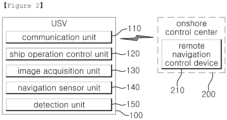
- FIGS. 2 and 3 are views schematically illustrating the configuration of the system and method for multi-image-based vessel proximity situation recognition support according to the embodiment of the present disclosure
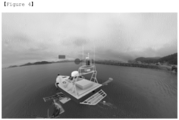
- FIGS. 4 and 5 are views illustrating the system and method for multi-image-based vessel proximity situation recognition support according to the embodiment of the present disclosure.
- FIGS. 1 to 5 the system for multi-image-based vessel proximity situation recognition support according to the embodiment of the present disclosure will be described.
- the system for multi-image-based vessel proximity situation recognition support may be implemented in an unmanned surface vehicle (USV) and an onshore control center 200.
- USV unmanned surface vehicle
- communication between the unmanned surface vehicle 100 and the onshore control center 200 may be performed through a marine communication network such as LTE-Maritime or a communication satellite.
- a marine communication network such as LTE-Maritime or a communication satellite.
- the system for multi-image-based vessel proximity situation recognition support may be configured to include a remote navigation control device 210 installed in the unmanned surface vehicle 100 and the onshore control center 200.
- the unmanned surface vehicle 100 detects and tracks surrounding objects by monitoring the surroundings using surrounding images and navigation sensors.
- the remote navigation control device 210 supports the recognition of surrounding situations by the unmanned surface vehicle in line with the detection of surrounding objects.
- the unmanned surface vehicle 100 may include a communication unit 110, a ship operation control unit 120, an image acquisition unit 130, a navigation sensor unit 140 and a detection unit 150.
- the communication unit 110 communicates with other ships or land-based communicable devices.
- the communication unit 110 may include various communication media such as CDMA, satellite communication, LTE, and RF communication.
- the communication unit 110 may communicate with the remote navigation control device 210 installed in the onshore control center 200 that remotely supports navigation of ships.
- the ship operation control unit 120 controls the operation of the unmanned surface vehicle 100 according to control commands and control information received from the remote navigation control device 210 in the onshore control center 200.
- the remote navigation control device 210 may receive control commands and control information from a user and transmit the received control commands and control information to the unmanned surface vehicle 100.
- the ship operation control unit 120 may have an autonomous navigation function.
- the ship operation control unit 120 may receive destination information, generate an optimal navigation route to the destination, and control the unmanned surface vehicle 100 to navigate according to the generated optimal navigation route.
- the ship operation control unit 120 may be implemented as software, hardware, or a combination thereof, and may include an electronic navigational chart database, a route algorithm for calculating an optimal navigation route, and the like.
- the ship operation control unit 120 may control the speed and direction of the unmanned surface vehicle 100 by controlling the engine and steering gear of the unmanned surface vehicle 100. At this time, the ship operation control unit 120 may control the speed and direction of the unmanned surface vehicle 100 so that the unmanned surface vehicle 100 avoids surrounding ships or obstacles by utilizing the image acquisition unit 130 and the navigation sensor unit 140 to be described later to monitor the surrounding situations.
- the image acquisition unit 130 acquires multiple images showing the surroundings of the unmanned surface vehicle 100 in order to detect objects around the unmanned surface vehicle 100 through image analysis.
- the image acquisition unit 130 may include a thermal imaging camera, a panoramic camera, and a 360-degree camera installed to photograph the surroundings of the unmanned surface vehicle 100.
- the image acquisition unit 130 may acquire thermal images, panoramic images, and 360-degree images showing the surroundings of the unmanned surface vehicle 100 in the form of Around View (AV).
- AV Around View
- the navigation sensor unit 140 acquires current navigation information of the unmanned surface vehicle 100 and information about obstacles around the unmanned surface vehicle 100 in real time.
- the navigation sensor unit 140 may include a global positioning system (GPS), a gyro sensor, an automatic identification system (AIS), RADAR, LiDAR, and the like.
- GPS global positioning system
- AIS automatic identification system
- RADAR RADAR
- LiDAR LiDAR
- the GPS and gyro sensor may obtain current navigation information including the location, speed, direction, and posture of the unmanned surface vehicle 100.
- the AIS, RADAR, and LiDAR may obtain information about obstacles around the unmanned surface vehicle 100.
- the obstacle information may include information on an unidentified object (obstacle) located around the unmanned surface vehicle 100 or a ship operating around the unmanned surface vehicle 100.
- the AIS receives and collects AIS data, which is the track data of ships around the unmanned surface vehicle 100.
- the AIS data consists of static date and dynamic data.
- the static date includes information on ship name, specifications, and destination while the dynamic data includes navigation information such as the current location, course, and speed of a ship.
- the RADAR and LiDAR detect objects existing around the unmanned surface vehicle 100, and obtain location information, movement speed, movement direction, and shape information of the detected objects.
- the objects may include a ship sailing around the unmanned surface vehicle 100, an iceberg, a reef, a floating object, and the like.
- the detection unit 150 monitors the surroundings of the unmanned surface vehicle 100 and, when an object close to the unmanned surface vehicle 100 within a preset distance is detected as a result of monitoring, tracks the detected object.
- the detection unit 150 may transmit the multiple-image information, obstacle information, and current navigation information acquired by the image acquisition unit 110 and the navigation sensor unit 140 to the remote navigation control device 210, and in case an object is detected, may also transmit information on the detected object to the remote navigation control device 210.
- the remote navigation control device 210 may be configured to include a communication unit 211, an interface unit 212, an estimation unit 213 and a situation recognition unit 214.
- the communication unit 211 communicates with various ships in operation.
- the communication unit 211 may include various communication media such as CDMA, satellite communication, LTE, and RF communication.
- the communication unit 211 may communicate with the unmanned surface vehicle 100 that a remote operator wants to control through the remote navigation control device 210.
- the interface unit 212 is a means for the remote operator in the onshore control center 200 to control the unmanned surface vehicle 100 located remotely.
- the interface unit 212 may include a display, a remote controller, and the like.
- the display may output the multiple images showing the surroundings of the unmanned surface vehicle 100, as well as obstacle information and current navigation information acquired by the image acquisition unit 110 and the navigation sensor unit 140 and received from the unmanned surface vehicle 100.
- the remote controller is a device for the remote operator to control the unmanned surface vehicle 100, and may receive various control commands for the unmanned surface vehicle 100 and transmit the received control commands to the unmanned surface vehicle 100.
- the estimation unit 213 estimates a collision risk between the unmanned surface vehicle 100 and an object around the unmanned surface vehicle 100 detected by the detection unit 150 by using the multiple-image information, obstacle information, and current navigation information received from the unmanned surface vehicle 100.
- the estimation unit 213 may calculate the collision risk by using fuzzy inference.
- the estimation unit 213 may determine whether the detected object is located on the expected path of the unmanned surface vehicle 100 by using the current navigation information including the location, speed, direction, and posture of the unmanned surface vehicle 100 and, when it is determined that the detected object is located on the expected path, may calculate the collision risk between the unmanned surface vehicle 100 and the detected object, by using fuzzy inference.
- the estimation unit 213 may calculate the time when the detected object passes through the expected path of the unmanned surface vehicle 100, and calculate the collision risk between the unmanned surface vehicle 100 and the detected object at the time of passing through the calculated predicted path by the detected object, by using fuzzy inference.
- the situation recognition unit 214 displays the collision risk calculated by the estimation unit 213 through the display of the interface unit 212 along with the detected object on an electronic navigational chart for each detected object and outputs the displayed collision risk in order to support the remote operator's awareness of the surrounding situations of the unmanned surface vehicle 100.
- the situation recognition unit 214 may display the calculated collision risk for the detected object in an augmented reality (AR) or virtual reality (VR) screen based on the multiple images showing the surroundings of the unmanned surface vehicle 100 and output the screen in order to support the remote operator's awareness of the surrounding situations of the unmanned surface vehicle 100.
- AR augmented reality
- VR virtual reality
- FIGS. 4 and 5 on the augmented reality or virtual reality-based surrounding situation recognition support screen that is output, detected objects are highlighted to increase their visibility, and among the detected objects, the one with a high risk of collision due to close proximity to the unmanned surface vehicle 100 may be displayed with a sign indicating the danger.
- FIG. 4 shows an augmented reality and virtual reality-based surrounding situation recognition support screen using 360-degree images
- FIG. 5 shows an augmented reality-based proximity situation recognition support screen using a panoramic image.
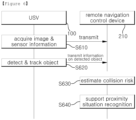
- FIG. 6 is a flowchart schematically illustrating an operating method of a system for multi-image-based vessel proximity situation recognition support according to the embodiment of the present disclosure.
- the unmanned surface vehicle 100 acquires multiple images of the surroundings by utilizing the image acquisition unit 130 and the navigation sensor unit 140, obtains current navigation information of the unmanned surface vehicle 100 and information on obstacles around the unmanned surface vehicle 100 in real time, and transmits the acquired multi-image information, current navigation information, and obstacle information to the remote navigation control device 210.
- the unmanned surface vehicle 100 monitors the surroundings using multiple images, current navigation information, and obstacle information, and as a result of monitoring, when an object close to the surrounding area within a preset distance is detected, the unmanned surface vehicle 100 tracks the detected object.
- the unmanned surface vehicle 100 may also transmit information on the detected object to the remote navigation control device 210.
- the remote navigation control device 210 estimates a collision risk between the unmanned surface vehicle 100 and the object around the unmanned surface vehicle 100 detected by the detection unit 150 by using the multiple-image information, obstacle information, and current navigation information received from the unmanned surface vehicle 100.
- the remote navigation control device 210 displays the estimated collision risk along with the object on the electronic navigational chart for each detected object and outputs the displayed collision risk in order to support the remote operator's awareness of the surrounding situations of the unmanned surface vehicle 100.
- the remote navigation control device 210 may display and output the calculated collision risk for the detected object displayed on the augmented reality or virtual reality screen based on the multiple images showing the surroundings of the unmanned surface vehicle 100 in order to support the remote operator's awareness of the surrounding situations of the unmanned surface vehicle 100.
- components of the above-described embodiment may be easily grasped from a process perspective. That is, each component may be identified as a separate process.
- the process of the above-described embodiment may be easily grasped from the point of view of components of the device.
- the technical contents described above may be implemented in the form of program instructions that can be executed through various computer means and recorded in a computer-readable medium.
- the computer-readable medium may include program instructions, data files, data structures, etc., or a combination thereof.
- the program instructions recorded on the medium may be specially designed and configured for the embodiments or may be known and usable to those skilled in the art of computer software.
- Examples of computer-readable medium include magnetic storage media such as hard disks, floppy disks, and magnetic tapes, optical media such as CD-ROM and DVD, magnetooptical media, such as floptical disks, a hardware device specially configured to store and execute program instructions, such as ROM, RAM, flash memory, etc.
- Examples of the program instructions include high-level language codes that can be executed by a computer using an interpreter, as well as machine language codes such as those produced by a compiler.
- the hardware device may be configured to act as one or more software modules to perform the operations of the embodiments and vice versa.
Landscapes
- Engineering & Computer Science (AREA)
- Radar, Positioning & Navigation (AREA)
- Remote Sensing (AREA)
- General Physics & Mathematics (AREA)
- Physics & Mathematics (AREA)
- Ocean & Marine Engineering (AREA)
- Automation & Control Theory (AREA)
- Mechanical Engineering (AREA)
- Chemical & Material Sciences (AREA)
- Combustion & Propulsion (AREA)
- Theoretical Computer Science (AREA)
- Multimedia (AREA)
- Aviation & Aerospace Engineering (AREA)
- Traffic Control Systems (AREA)
- Control Of Position, Course, Altitude, Or Attitude Of Moving Bodies (AREA)
- Health & Medical Sciences (AREA)
- Public Health (AREA)
- Computer Vision & Pattern Recognition (AREA)
Description
- The present application claims priority to
Korean Patent Application No. 10-2021-0167292 - The present disclosure relates to a system and method for multi-image-based vessel proximity situation recognition support.
- An unmanned ship is a ship that automatically navigates a set route without a crew member, and refers to a vessel whose navigation and engine parts (e.g. engine, rudder) can be controlled from a remote control center, if necessary. To this end, a remote control center is needed on shore to control the unmanned ship remotely, and a qualified person must directly conduct command and control at the remote control center in order to resolve technical and legal issues.
- Meanwhile, due to the recent development of GPS and a variety of sensors, it is not difficult for a vehicle to autonomously drive on the shortest route, but it is not so in the case of ship navigation. This is because, unlike land-based vehicles, such as cars and motorcycles, ships have very large inertial forces due to the nature of being operated on water, and thus it is very difficult for ships to instantly adjust their speed or direction. In addition, the reality is that it is very difficult to navigate on a scheduled route at sea because the sea does not have a fixed road like on land and is greatly affected by multiple variables such as weather. Moreover, crew members should always look ahead to prevent unexpected collisions with other ships and reefs.
- Particularly, in case of heavy rain or snow, high concentration of fog, smog, yellow dust or fine dust during ship operation, visibility is rapidly reduced, making it difficult for the crew members to detect objects with the naked eye even if they look ahead. Consequently, the ship and its crew members may be put in very dangerous situations where they may collide with other ships and reefs unexpectedly, which is problematic. In other words, when it comes to ship navigation, collision avoidance is essential, and in order to adjust the speed or direction of a ship, it is necessary to predict the ship's navigation path in advance and operate a steering wheel or shift lever in advance.
- (Patent Document 0001)
Korean Patent No. 10-0734814 (June 27, 2007 US 2021/125502 A1 is another piece of relevant prior art, which discloses determining vessel collision avoidance maneuvers on the basis of historical navigational data which corresponds to the real-time data determined when the collision risk is above the predetermined threshold. The collision avoidance maneuvers are provided to an operator of the vessel.KR 20170089574 A US 2020/278433 A1 disclose displaying the surroundings objects of a vessel with additional situational data. - Accordingly, the present disclosure has been made keeping in mind the above problems occurring in the related art, and the present disclosure is intended to provide a system and method for multi-image-based vessel proximity situation recognition support that detects obstacles around an unmanned surface vehicle (USV) using multiple cameras and various navigation sensors mounted on the USV, and provides remote situational awareness information regarding the risk of collision with the detected obstacles, according to respectively the subject-matter of claims 1 and 7.
- In order to achieve the above objective, according to an embodiment of the present disclosure, there is provided a system for multi-image-based vessel proximity situation recognition support.
- The system for multi-image-based vessel proximity situation recognition support according to the embodiment of the present disclosure includes: an unmanned surface vehicle (USV) configured to detect and track surrounding objects by monitoring surroundings using surrounding images and navigation sensors; and a remote navigation control device configured to support proximity situation recognition of the unmanned surface vehicle according to detection of the surrounding objects, wherein the unmanned surface vehicle may include: an image acquisition unit configured to acquire multiple images showing the surroundings of the unmanned surface vehicle to detect objects around the unmanned surface vehicle through image analysis; a navigation sensor unit configured to acquire current navigation information of the unmanned surface vehicle and information on obstacles around the unmanned surface vehicle in real time; and a detection unit configured to monitor the surroundings of the unmanned surface vehicle by using the multiple images, current navigation information, and information on obstacles and, when an object close to the unmanned surface vehicle within a preset distance is detected as a result of monitoring, track the object detected.
- The image acquisition unit may include: a thermal imaging camera, a panoramic camera, and a 360-degree camera installed to photograph the surroundings of the unmanned surface vehicle, and acquires the multiple images including thermal images, panoramic images; and 360-degree images of the surroundings of the unmanned surface vehicle in a form of Around View (AV).
- The navigation sensor unit may include: a global positioning system (GPS), a gyro sensor, an automatic identification system (AIS), and RADAR, wherein the GPS and gyro sensor may obtain the current navigation information including location, speed, direction, and posture of the unmanned surface vehicle, while the AIS and RADAR may obtain the information on obstacles around the unmanned surface vehicle.
- The remote navigation control device may include: an estimation unit configured to estimate a collision risk between the unmanned surface vehicle and the object detected by using the multiple images, current navigation information, and information on obstacles; and a situation recognition unit configured to display the collision risk estimated, along with the object detected, on an electronic navigational chart for each detected object and to output the collision risk in order to support proximity situation recognition.
- The estimation unit may determine whether the object detected is located on an expected path of the unmanned surface vehicle by using the current navigation information, and when it is determined that the object detected is located on the expected path, may calculate the collision risk between the unmanned surface vehicle and the object detected, by using fuzzy inference.
- The situation recognition unit may display the collision risk for the object detected in an augmented reality (AR) or virtual reality (VR) screen based on the multiple images and may output the screen in order to support the proximity situation recognition.
- According to another embodiment of the present disclosure, there is provided a method for multi-image-based vessel proximity situation recognition support performed in a system including an unmanned surface vehicle and a remote navigation control device.
- The method for multi-image-based vessel proximity situation recognition support according to another embodiment of the present disclosure may include: acquiring, by the unmanned surface vehicle, multiple images of surroundings to detect surrounding objects through image analysis; obtaining, by the unmanned surface vehicle, current navigation information and information on surrounding obstacles in real time; monitoring, by the unmanned surface vehicle, the surroundings using the multiple images, current navigation information, and information on surrounding obstacles and, when an object close to a surrounding area within a preset distance is detected as a result of monitoring, tracking the object detected; and supporting, by the remote navigation control device, proximity situation recognition of the unmanned surface vehicle according to detection of the object.
- As described above, a system and method for multi-image-based vessel proximity situation recognition support according to an embodiment of the present disclosure has an effect that collision accidents with ships and obstacles in proximity can be prevented in advance during remote operation of an unmanned surface vehicle (USV) by detecting obstacles around the unmanned surface vehicle using multiple cameras and various navigation sensors mounted on the unmanned surface vehicle, and providing remote situational awareness information regarding the risk of collision with the detected obstacles.
- The above and other objectives, features, and other advantages of the present disclosure will be more clearly understood from the following detailed description when taken in conjunction with the accompanying drawings, in which:
-
FIG. 1 is a view schematically illustrating an environment in which a system and method for multi-image-based vessel proximity situation recognition support according to an embodiment of the present disclosure may be implemented; -
FIGS. 2 and3 are views schematically illustrating the configuration of the system and method for multi-image-based vessel proximity situation recognition support according to the embodiment of the present disclosure; -
FIGS. 4 and5 are views illustrating the system and method for multi-image-based vessel proximity situation recognition support according to the embodiment of the present disclosure; and -
FIG. 6 is a flowchart schematically illustrating an operating method of a system for multi-image-based vessel proximity situation recognition support according to the embodiment of the present disclosure. - As used herein, the singular expression includes the plural expression unless the context clearly dictates otherwise. In this specification, terms such as "comprise", "include", or "have" should not be construed as necessarily including all of the various components or steps described in the specification, but should be construed that some of the components or steps may not be included, or may further include additional components or steps. In addition, terms such as "...unit", "...part", and "module" described in the specification mean a unit that processes at least one function or operation, which may be implemented as hardware or software or a combination thereof.
- Hereinafter, various embodiments of the present invention will be described in detail with reference to the accompanying drawings.
-
FIG. 1 is a view schematically illustrating an environment in which a system and method for multi-image-based vessel proximity situation recognition support according to an embodiment of the present disclosure may be implemented,FIGS. 2 and3 are views schematically illustrating the configuration of the system and method for multi-image-based vessel proximity situation recognition support according to the embodiment of the present disclosure, andFIGS. 4 and5 are views illustrating the system and method for multi-image-based vessel proximity situation recognition support according to the embodiment of the present disclosure. Hereinafter, with reference toFIGS. 1 to 5 , the system for multi-image-based vessel proximity situation recognition support according to the embodiment of the present disclosure will be described. - Referring to
FIG. 1 , the system for multi-image-based vessel proximity situation recognition support according to the embodiment of the present disclosure may be implemented in an unmanned surface vehicle (USV) and anonshore control center 200. - For example, communication between the
unmanned surface vehicle 100 and theonshore control center 200 may be performed through a marine communication network such as LTE-Maritime or a communication satellite. - Referring to
FIG. 2 , the system for multi-image-based vessel proximity situation recognition support according to the embodiment of the present disclosure may be configured to include a remotenavigation control device 210 installed in theunmanned surface vehicle 100 and theonshore control center 200. - The
unmanned surface vehicle 100 detects and tracks surrounding objects by monitoring the surroundings using surrounding images and navigation sensors. - The remote
navigation control device 210 supports the recognition of surrounding situations by the unmanned surface vehicle in line with the detection of surrounding objects. - As shown in
FIG. 2 , theunmanned surface vehicle 100 may include acommunication unit 110, a shipoperation control unit 120, animage acquisition unit 130, anavigation sensor unit 140 and adetection unit 150. - The
communication unit 110 communicates with other ships or land-based communicable devices. For example, thecommunication unit 110 may include various communication media such as CDMA, satellite communication, LTE, and RF communication. - In particular, the
communication unit 110 may communicate with the remotenavigation control device 210 installed in theonshore control center 200 that remotely supports navigation of ships. - The ship
operation control unit 120 controls the operation of theunmanned surface vehicle 100 according to control commands and control information received from the remotenavigation control device 210 in theonshore control center 200. - That is, the remote
navigation control device 210 may receive control commands and control information from a user and transmit the received control commands and control information to theunmanned surface vehicle 100. - Meanwhile, the ship
operation control unit 120 may have an autonomous navigation function. - For example, the ship
operation control unit 120 may receive destination information, generate an optimal navigation route to the destination, and control theunmanned surface vehicle 100 to navigate according to the generated optimal navigation route. The shipoperation control unit 120 may be implemented as software, hardware, or a combination thereof, and may include an electronic navigational chart database, a route algorithm for calculating an optimal navigation route, and the like. - In addition, the ship
operation control unit 120 may control the speed and direction of theunmanned surface vehicle 100 by controlling the engine and steering gear of theunmanned surface vehicle 100. At this time, the shipoperation control unit 120 may control the speed and direction of theunmanned surface vehicle 100 so that theunmanned surface vehicle 100 avoids surrounding ships or obstacles by utilizing theimage acquisition unit 130 and thenavigation sensor unit 140 to be described later to monitor the surrounding situations. - The
image acquisition unit 130 acquires multiple images showing the surroundings of theunmanned surface vehicle 100 in order to detect objects around theunmanned surface vehicle 100 through image analysis. - That is, the
image acquisition unit 130 may include a thermal imaging camera, a panoramic camera, and a 360-degree camera installed to photograph the surroundings of theunmanned surface vehicle 100. As such, theimage acquisition unit 130 may acquire thermal images, panoramic images, and 360-degree images showing the surroundings of theunmanned surface vehicle 100 in the form of Around View (AV). - The
navigation sensor unit 140 acquires current navigation information of theunmanned surface vehicle 100 and information about obstacles around theunmanned surface vehicle 100 in real time. - That is, the
navigation sensor unit 140 may include a global positioning system (GPS), a gyro sensor, an automatic identification system (AIS), RADAR, LiDAR, and the like. - The GPS and gyro sensor may obtain current navigation information including the location, speed, direction, and posture of the
unmanned surface vehicle 100. - The AIS, RADAR, and LiDAR may obtain information about obstacles around the
unmanned surface vehicle 100. The obstacle information may include information on an unidentified object (obstacle) located around theunmanned surface vehicle 100 or a ship operating around theunmanned surface vehicle 100. - That is, the AIS receives and collects AIS data, which is the track data of ships around the
unmanned surface vehicle 100. At this time, the AIS data consists of static date and dynamic data. The static date includes information on ship name, specifications, and destination while the dynamic data includes navigation information such as the current location, course, and speed of a ship. - The RADAR and LiDAR detect objects existing around the
unmanned surface vehicle 100, and obtain location information, movement speed, movement direction, and shape information of the detected objects. At this time, the objects may include a ship sailing around theunmanned surface vehicle 100, an iceberg, a reef, a floating object, and the like. - By using the multiple images showing the surroundings of the
unmanned surface vehicle 100, as well as obstacle information and current navigation information acquired by theimage acquisition unit 110 and thenavigation sensor unit 140, thedetection unit 150 monitors the surroundings of theunmanned surface vehicle 100 and, when an object close to theunmanned surface vehicle 100 within a preset distance is detected as a result of monitoring, tracks the detected object. - At this time, the
detection unit 150 may transmit the multiple-image information, obstacle information, and current navigation information acquired by theimage acquisition unit 110 and thenavigation sensor unit 140 to the remotenavigation control device 210, and in case an object is detected, may also transmit information on the detected object to the remotenavigation control device 210. - Referring to FGI. 3, the remote
navigation control device 210 may be configured to include acommunication unit 211, aninterface unit 212, anestimation unit 213 and asituation recognition unit 214. - The
communication unit 211 communicates with various ships in operation. For example, thecommunication unit 211 may include various communication media such as CDMA, satellite communication, LTE, and RF communication. - In particular, the
communication unit 211 may communicate with theunmanned surface vehicle 100 that a remote operator wants to control through the remotenavigation control device 210. - The
interface unit 212 is a means for the remote operator in theonshore control center 200 to control theunmanned surface vehicle 100 located remotely. - For example, the
interface unit 212 may include a display, a remote controller, and the like. The display may output the multiple images showing the surroundings of theunmanned surface vehicle 100, as well as obstacle information and current navigation information acquired by theimage acquisition unit 110 and thenavigation sensor unit 140 and received from theunmanned surface vehicle 100. In addition, the remote controller is a device for the remote operator to control theunmanned surface vehicle 100, and may receive various control commands for theunmanned surface vehicle 100 and transmit the received control commands to theunmanned surface vehicle 100. - The
estimation unit 213 estimates a collision risk between theunmanned surface vehicle 100 and an object around theunmanned surface vehicle 100 detected by thedetection unit 150 by using the multiple-image information, obstacle information, and current navigation information received from theunmanned surface vehicle 100. - For example, the
estimation unit 213 may calculate the collision risk by using fuzzy inference. - That is, the
estimation unit 213 may determine whether the detected object is located on the expected path of theunmanned surface vehicle 100 by using the current navigation information including the location, speed, direction, and posture of theunmanned surface vehicle 100 and, when it is determined that the detected object is located on the expected path, may calculate the collision risk between theunmanned surface vehicle 100 and the detected object, by using fuzzy inference. - In addition, as a result of tracking by the
detection unit 150, when the detected object is identified as a moving object such as a ship, theestimation unit 213 may calculate the time when the detected object passes through the expected path of theunmanned surface vehicle 100, and calculate the collision risk between theunmanned surface vehicle 100 and the detected object at the time of passing through the calculated predicted path by the detected object, by using fuzzy inference. - The
situation recognition unit 214 displays the collision risk calculated by theestimation unit 213 through the display of theinterface unit 212 along with the detected object on an electronic navigational chart for each detected object and outputs the displayed collision risk in order to support the remote operator's awareness of the surrounding situations of theunmanned surface vehicle 100. - In addition, the
situation recognition unit 214 may display the calculated collision risk for the detected object in an augmented reality (AR) or virtual reality (VR) screen based on the multiple images showing the surroundings of theunmanned surface vehicle 100 and output the screen in order to support the remote operator's awareness of the surrounding situations of theunmanned surface vehicle 100. - For example, as shown in
FIGS. 4 and5 , on the augmented reality or virtual reality-based surrounding situation recognition support screen that is output, detected objects are highlighted to increase their visibility, and among the detected objects, the one with a high risk of collision due to close proximity to theunmanned surface vehicle 100 may be displayed with a sign indicating the danger.FIG. 4 shows an augmented reality and virtual reality-based surrounding situation recognition support screen using 360-degree images, andFIG. 5 shows an augmented reality-based proximity situation recognition support screen using a panoramic image. -
FIG. 6 is a flowchart schematically illustrating an operating method of a system for multi-image-based vessel proximity situation recognition support according to the embodiment of the present disclosure. - In the step of S610, the
unmanned surface vehicle 100 acquires multiple images of the surroundings by utilizing theimage acquisition unit 130 and thenavigation sensor unit 140, obtains current navigation information of theunmanned surface vehicle 100 and information on obstacles around theunmanned surface vehicle 100 in real time, and transmits the acquired multi-image information, current navigation information, and obstacle information to the remotenavigation control device 210. - In the step of S620, the
unmanned surface vehicle 100 monitors the surroundings using multiple images, current navigation information, and obstacle information, and as a result of monitoring, when an object close to the surrounding area within a preset distance is detected, theunmanned surface vehicle 100 tracks the detected object. - At this time, in case the object is detected, the
unmanned surface vehicle 100 may also transmit information on the detected object to the remotenavigation control device 210. - In the step of S630, the remote
navigation control device 210 estimates a collision risk between theunmanned surface vehicle 100 and the object around theunmanned surface vehicle 100 detected by thedetection unit 150 by using the multiple-image information, obstacle information, and current navigation information received from theunmanned surface vehicle 100. - In the step of S640, the remote
navigation control device 210 displays the estimated collision risk along with the object on the electronic navigational chart for each detected object and outputs the displayed collision risk in order to support the remote operator's awareness of the surrounding situations of theunmanned surface vehicle 100. - In addition, the remote
navigation control device 210 may display and output the calculated collision risk for the detected object displayed on the augmented reality or virtual reality screen based on the multiple images showing the surroundings of theunmanned surface vehicle 100 in order to support the remote operator's awareness of the surrounding situations of theunmanned surface vehicle 100. - Meanwhile, components of the above-described embodiment may be easily grasped from a process perspective. That is, each component may be identified as a separate process. In addition, the process of the above-described embodiment may be easily grasped from the point of view of components of the device.
- Furthermore, the technical contents described above may be implemented in the form of program instructions that can be executed through various computer means and recorded in a computer-readable medium. The computer-readable medium may include program instructions, data files, data structures, etc., or a combination thereof. The program instructions recorded on the medium may be specially designed and configured for the embodiments or may be known and usable to those skilled in the art of computer software. Examples of computer-readable medium include magnetic storage media such as hard disks, floppy disks, and magnetic tapes, optical media such as CD-ROM and DVD, magnetooptical media, such as floptical disks, a hardware device specially configured to store and execute program instructions, such as ROM, RAM, flash memory, etc. Examples of the program instructions include high-level language codes that can be executed by a computer using an interpreter, as well as machine language codes such as those produced by a compiler. The hardware device may be configured to act as one or more software modules to perform the operations of the embodiments and vice versa.
Claims (7)
- A system for multi-image-based vessel proximity situation recognition support, the system comprising:an unmanned surface vehicle (USV) configured to detect and track surrounding objects by monitoring surroundings using surrounding images and navigation sensors; anda remote navigation control device configured to support proximity situation recognition of the unmanned surface vehicle according to detection of the surrounding objects,wherein the unmanned surface vehicle comprises:an image acquisition unit configured to acquire multiple images showing the surroundings of the unmanned surface vehicle to detect objects around the unmanned surface vehicle through image analysis;a navigation sensor unit configured to acquire current navigation information of the unmanned surface vehicle and information on obstacles around the unmanned surface vehicle in real time; anda detection unit configured to monitor the surroundings of the unmanned surface vehicle by using the multiple images, current navigation information, and information on obstacles and, when an object close to the unmanned surface vehicle within a preset distance is detected as a result of monitoring, track the object detected,wherein the remote navigation control device comprises:an estimation unit configured to estimate a collision risk between the unmanned surface vehicle and the object detected by using the multiple images, current navigation information, and information on obstacles; anda situation recognition unit configured to display the collision risk estimated, along with the object detected, on an electronic navigational chart for each detected object and to output the collision risk in order to support proximity situation recognition,wherein the situation recognition unit displays the collision risk for the object detected in an augmented reality (AR) or virtual reality (VR) screen based on the multiple images and outputs the screen in order to support the proximity situation recognition,wherein on the augmented reality or virtual reality-based surrounding situation recognition support screen that is output, detected objects are highlighted to increase their visibility.
- The system for multi-image-based vessel proximity situation recognition support of claim 1, wherein the object with a high risk of collision due to close proximity is displayed with a sign indicating the danger.
- The system for multi-image-based vessel proximity situation recognition support of claim 2, wherein the image acquisition unit includes a panoramic camera or a 360-degree camera installed to photograph the surroundings of the unmanned surface vehicle; and
acquires the multiple images including thermal images, panoramic images, and 360-degree images of the surroundings of the unmanned surface vehicle in a form of Around View (AV). - The system for multi-image-based vessel proximity situation recognition support of claim 1, wherein the image acquisition unit includes a thermal imaging camera, a panoramic camera, and a 360-degree camera installed to photograph the surroundings of the unmanned surface vehicle, and
acquires the multiple images including thermal images, panoramic images, and 360-degree images of the surroundings of the unmanned surface vehicle in a form of Around View (AV). - The system for multi-image-based vessel proximity situation recognition support of claim 1, wherein the navigation sensor unit includes a global positioning system (GPS), a gyro sensor, an automatic identification system (AIS), and RADAR,
wherein the GPS and gyro sensor obtain the current navigation information including location, speed, direction, and posture of the unmanned surface vehicle, while the AIS and RADAR obtain the information on obstacles around the unmanned surface vehicle. - The system for multi-image-based vessel proximity situation recognition support of claim 1, wherein the estimation unit determines whether the object detected is located on an expected path of the unmanned surface vehicle by using the current navigation information, and
when it is determined that the object detected is located on the expected path, calculates the collision risk between the unmanned surface vehicle and the object detected, by using fuzzy inference. - A method for multi-image-based vessel proximity situation recognition support performed in a system according to claim 1, the method comprising:acquiring, by the unmanned surface vehicle, multiple images of surroundings to detect surrounding objects through image analysis;obtaining, by the unmanned surface vehicle, current navigation information and information on surrounding obstacles in real time;monitoring, by the unmanned surface vehicle, the surroundings using the multiple images, current navigation information, and information on surrounding obstacles and, when an object close to a surrounding area within a preset distance is detected as a result of monitoring, tracking the object detected; andsupporting, by the remote navigation control device, proximity situation recognition of the unmanned surface vehicle according to detection of the object, comprisingestimating, by the estimation unit, a collision risk between the unmanned surface vehicle and the object detected by using the multiple images, current navigation information, and information on obstacles; anddisplaying, by the situation recognition unit, the collision risk estimated for the object detected in an augmented reality (AR) or virtual reality (VR) screen based on the multiple images, along with the object detected, on an electronic navigational chart for each detected object and outputting the collision risk in order to support proximity situation recognition.
Applications Claiming Priority (1)
| Application Number | Priority Date | Filing Date | Title |
|---|---|---|---|
| KR1020210167292A KR102455565B1 (en) | 2021-11-29 | 2021-11-29 | System and method for multi-image-based vessel proximity situation recognition support |
Publications (3)
| Publication Number | Publication Date |
|---|---|
| EP4187347A2 EP4187347A2 (en) | 2023-05-31 |
| EP4187347A3 EP4187347A3 (en) | 2023-09-27 |
| EP4187347B1 true EP4187347B1 (en) | 2025-01-29 |
Family
ID=83810053
Family Applications (1)
| Application Number | Title | Priority Date | Filing Date |
|---|---|---|---|
| EP22210233.7A Active EP4187347B1 (en) | 2021-11-29 | 2022-11-29 | System and method for multi-image-based vessel proximity situation recognition support |
Country Status (4)
| Country | Link |
|---|---|
| US (1) | US12592151B2 (en) |
| EP (1) | EP4187347B1 (en) |
| JP (1) | JP7622024B2 (en) |
| KR (1) | KR102455565B1 (en) |
Families Citing this family (6)
| Publication number | Priority date | Publication date | Assignee | Title |
|---|---|---|---|---|
| KR102455565B1 (en) | 2021-11-29 | 2022-10-17 | 한국해양과학기술원 | System and method for multi-image-based vessel proximity situation recognition support |
| KR102736343B1 (en) | 2022-11-28 | 2024-11-29 | 한국해양과학기술원 | System and method for visualizing situational awareness information for autonomous ship |
| WO2024150982A1 (en) * | 2023-01-11 | 2024-07-18 | 주식회사 아비커스 | Svm video generation method and device for ship |
| KR102754371B1 (en) | 2023-11-08 | 2025-01-16 | 한국농어촌공사 | Unmanned autonomous water robot system based on Artificial Intelligence machine learning for managing water quality and/or algal blooms on the waterside |
| JP2025101123A (en) * | 2023-12-25 | 2025-07-07 | 日本操舵システム株式会社 | Ship navigation monitoring robot and collision avoidance maneuvering system for autonomous single-propeller, dual-rudder ships |
| CN120909340B (en) * | 2025-10-13 | 2026-01-02 | 中山大学 | Multi-unmanned aerial vehicle and unmanned ship formation control method and device based on illusion engine |
Family Cites Families (22)
| Publication number | Priority date | Publication date | Assignee | Title |
|---|---|---|---|---|
| AU2002953227A0 (en) * | 2002-12-10 | 2003-01-02 | Defence Science & Technology Agency | Adaptive collision avoidance advisory system |
| US20050124234A1 (en) * | 2003-12-05 | 2005-06-09 | Robin Sells | Remote marine craft system and methods of using same |
| KR100734814B1 (en) | 2006-08-03 | 2007-07-03 | 디에스엠이 유텍 주식회사 | Autonomous Flight Unmanned Vessel |
| US8849483B2 (en) * | 2011-04-13 | 2014-09-30 | California Institute Of Technology | Target trailing with safe navigation with colregs for maritime autonomous surface vehicles |
| US10908611B2 (en) * | 2011-05-12 | 2021-02-02 | Unmanned Innovations, Inc. | Systems and methods for semi-submersible launch and recovery of objects from multi-mode unmanned vehicle |
| JP6039063B2 (en) * | 2012-05-18 | 2016-12-07 | キング アブドラ ユニバーシティ オブ サイエンス アンド テクノロジー | Satellite and acoustic tracking device |
| US9223310B2 (en) * | 2013-02-08 | 2015-12-29 | The Boeing Company | Ship course obstruction warning transport |
| KR102043060B1 (en) * | 2015-05-08 | 2019-11-11 | 엘지전자 주식회사 | Autonomous drive apparatus and vehicle including the same |
| KR101823029B1 (en) * | 2016-01-27 | 2018-01-31 | 대우조선해양 주식회사 | System for managing obstacle of ship and method for managing obstacle |
| DK201670186A1 (en) * | 2016-03-31 | 2017-10-16 | A P Møller - Mærsk As | A method and system for operating one or more tugboats |
| WO2019096401A1 (en) * | 2017-11-17 | 2019-05-23 | Abb Schweiz Ag | Real-time monitoring of surroundings of marine vessel |
| US11915594B2 (en) * | 2017-12-22 | 2024-02-27 | Rolls-Royce Plc | Collision avoidance method and system for marine vessels |
| KR101882483B1 (en) * | 2018-01-24 | 2018-07-27 | 엘아이지넥스원 주식회사 | Apparatus and method for detecting obstacle by unmanned surface vessel |
| JP2020140603A (en) * | 2019-03-01 | 2020-09-03 | パナソニックIpマネジメント株式会社 | Display control device, display control method, and display control program |
| US20200369351A1 (en) * | 2019-05-24 | 2020-11-26 | Garmin Switzerland Gmbh | Marine docking and object awareness system |
| US11820468B2 (en) * | 2019-10-08 | 2023-11-21 | ExxonMobil Technology and Engineering Company | Unmanned surface vehicles, survey systems, and methods for using the same |
| KR102269384B1 (en) * | 2019-10-15 | 2021-06-25 | 한국조선해양 주식회사 | support system for vessel operation and ship having the same |
| CN110782481B (en) * | 2019-10-18 | 2023-09-05 | 华中光电技术研究所(中国船舶重工集团有限公司第七一七研究所) | Intelligent decision-making method and system for unmanned boat |
| KR102746287B1 (en) * | 2019-11-06 | 2024-12-26 | 삼성중공업(주) | Apparatus and method for displaying around view nearby vessel |
| WO2021115609A1 (en) * | 2019-12-12 | 2021-06-17 | Ejzenberg Geoffrey | A situational awareness system of a cyber-physical hybrid electric autonomous or semi-autonomous off-highway dump truck for surface mining industry |
| US11453125B2 (en) * | 2020-03-09 | 2022-09-27 | Kyndryl, Inc. | Drone-enabled active fall protection |
| KR102455565B1 (en) | 2021-11-29 | 2022-10-17 | 한국해양과학기술원 | System and method for multi-image-based vessel proximity situation recognition support |
-
2021
- 2021-11-29 KR KR1020210167292A patent/KR102455565B1/en active Active
-
2022
- 2022-11-28 US US18/059,102 patent/US12592151B2/en active Active
- 2022-11-29 JP JP2022190139A patent/JP7622024B2/en active Active
- 2022-11-29 EP EP22210233.7A patent/EP4187347B1/en active Active
Also Published As
| Publication number | Publication date |
|---|---|
| KR102455565B1 (en) | 2022-10-17 |
| US20230169872A1 (en) | 2023-06-01 |
| EP4187347A2 (en) | 2023-05-31 |
| JP7622024B2 (en) | 2025-01-27 |
| US12592151B2 (en) | 2026-03-31 |
| JP2023080054A (en) | 2023-06-08 |
| EP4187347A3 (en) | 2023-09-27 |
Similar Documents
| Publication | Publication Date | Title |
|---|---|---|
| EP4187347A2 (en) | System and method for multi-image-based vessel proximity situation recognition support | |
| EP3639104B1 (en) | Perimeter ranging sensor systems and methods | |
| EP3408720B1 (en) | Autonomous operation of a vessel | |
| US8849483B2 (en) | Target trailing with safe navigation with colregs for maritime autonomous surface vehicles | |
| US20210206460A1 (en) | Navigation scene analysis systems and methods | |
| JP4343536B2 (en) | Car sensing device | |
| KR102617981B1 (en) | Collision avoidance system for autonomous ships | |
| EP3343438A1 (en) | Automatic parking system and automatic parking method | |
| KR20180121784A (en) | Automatic Positioning System | |
| EP3690849B1 (en) | Method and device for detecting emergency vehicles in real time and planning driving routes to cope with situations to be expected to be occurred by the emergency vehicles | |
| WO2020061545A1 (en) | Augmented reality display view generation | |
| JP2012528417A (en) | Computer-aided ship maneuvering method | |
| Kim et al. | Field experiment of autonomous ship navigation in canal and surrounding nearshore environments | |
| WO2016092591A1 (en) | Collision risk calculation device, collision risk display device, and vehicle body control device | |
| KR20240030736A (en) | Operating system for ship | |
| EP4520649A1 (en) | Method and apparatus for controlling automatic docking or undocking of ship | |
| KR101823030B1 (en) | System for avoiding risk environments of ship and method for avoiding using the same | |
| Kohlhaas et al. | Towards driving autonomously: Autonomous cruise control in urban environments | |
| US12235646B2 (en) | System and method for assisting a docking operation | |
| CN110456793B (en) | Unmanned ship autonomous mooring method and device and unmanned ship | |
| EP2047213B1 (en) | Generating a map | |
| Zantopp et al. | Lidar-based obstacle detection and path prediction for unmanned surface vehicles | |
| EP4546305A1 (en) | Parking assisting method and parking assistance device | |
| JP4380609B2 (en) | Driving assistance device | |
| US12377942B1 (en) | Systems and methods for detecting waves and controlling a marine vessel based on the detected waves |
Legal Events
| Date | Code | Title | Description |
|---|---|---|---|
| PUAI | Public reference made under article 153(3) epc to a published international application that has entered the european phase |
Free format text: ORIGINAL CODE: 0009012 |
|
| STAA | Information on the status of an ep patent application or granted ep patent |
Free format text: STATUS: REQUEST FOR EXAMINATION WAS MADE |
|
| 17P | Request for examination filed |
Effective date: 20221129 |
|
| AK | Designated contracting states |
Kind code of ref document: A2 Designated state(s): AL AT BE BG CH CY CZ DE DK EE ES FI FR GB GR HR HU IE IS IT LI LT LU LV MC ME MK MT NL NO PL PT RO RS SE SI SK SM TR |
|
| PUAL | Search report despatched |
Free format text: ORIGINAL CODE: 0009013 |
|
| AK | Designated contracting states |
Kind code of ref document: A3 Designated state(s): AL AT BE BG CH CY CZ DE DK EE ES FI FR GB GR HR HU IE IS IT LI LT LU LV MC ME MK MT NL NO PL PT RO RS SE SI SK SM TR |
|
| RIC1 | Information provided on ipc code assigned before grant |
Ipc: B63B 35/00 20200101ALI20230823BHEP Ipc: B63B 43/18 20060101ALI20230823BHEP Ipc: B63B 49/00 20060101ALI20230823BHEP Ipc: G05D 1/02 20200101AFI20230823BHEP |
|
| RBV | Designated contracting states (corrected) |
Designated state(s): AL AT BE BG CH CY CZ DE DK EE ES FI FR GB GR HR HU IE IS IT LI LT LU LV MC ME MK MT NL NO PL PT RO RS SE SI SK SM TR |
|
| REG | Reference to a national code |
Ref country code: DE Ref legal event code: R079 Free format text: PREVIOUS MAIN CLASS: G05D0001020000 Ipc: G05D0001000000 Ref country code: DE Ref legal event code: R079 Ref document number: 602022010076 Country of ref document: DE Free format text: PREVIOUS MAIN CLASS: G05D0001020000 Ipc: G05D0001000000 |
|
| GRAP | Despatch of communication of intention to grant a patent |
Free format text: ORIGINAL CODE: EPIDOSNIGR1 |
|
| STAA | Information on the status of an ep patent application or granted ep patent |
Free format text: STATUS: GRANT OF PATENT IS INTENDED |
|
| RIC1 | Information provided on ipc code assigned before grant |
Ipc: B63B 35/00 20200101ALI20240802BHEP Ipc: B63B 43/18 20060101ALI20240802BHEP Ipc: B63B 49/00 20060101ALI20240802BHEP Ipc: G05D 1/00 20060101AFI20240802BHEP |
|
| INTG | Intention to grant announced |
Effective date: 20240902 |
|
| GRAS | Grant fee paid |
Free format text: ORIGINAL CODE: EPIDOSNIGR3 |
|
| GRAA | (expected) grant |
Free format text: ORIGINAL CODE: 0009210 |
|
| STAA | Information on the status of an ep patent application or granted ep patent |
Free format text: STATUS: THE PATENT HAS BEEN GRANTED |
|
| AK | Designated contracting states |
Kind code of ref document: B1 Designated state(s): AL AT BE BG CH CY CZ DE DK EE ES FI FR GB GR HR HU IE IS IT LI LT LU LV MC ME MK MT NL NO PL PT RO RS SE SI SK SM TR |
|
| REG | Reference to a national code |
Ref country code: GB Ref legal event code: FG4D |
|
| REG | Reference to a national code |
Ref country code: CH Ref legal event code: EP |
|
| REG | Reference to a national code |
Ref country code: DE Ref legal event code: R096 Ref document number: 602022010076 Country of ref document: DE |
|
| REG | Reference to a national code |
Ref country code: IE Ref legal event code: FG4D |
|
| REG | Reference to a national code |
Ref country code: NL Ref legal event code: MP Effective date: 20250129 |
|
| PG25 | Lapsed in a contracting state [announced via postgrant information from national office to epo] |
Ref country code: NL Free format text: LAPSE BECAUSE OF FAILURE TO SUBMIT A TRANSLATION OF THE DESCRIPTION OR TO PAY THE FEE WITHIN THE PRESCRIBED TIME-LIMIT Effective date: 20250129 |
|
| PG25 | Lapsed in a contracting state [announced via postgrant information from national office to epo] |
Ref country code: RS Free format text: LAPSE BECAUSE OF FAILURE TO SUBMIT A TRANSLATION OF THE DESCRIPTION OR TO PAY THE FEE WITHIN THE PRESCRIBED TIME-LIMIT Effective date: 20250429 |
|
| PG25 | Lapsed in a contracting state [announced via postgrant information from national office to epo] |
Ref country code: FI Free format text: LAPSE BECAUSE OF FAILURE TO SUBMIT A TRANSLATION OF THE DESCRIPTION OR TO PAY THE FEE WITHIN THE PRESCRIBED TIME-LIMIT Effective date: 20250129 |
|
| PG25 | Lapsed in a contracting state [announced via postgrant information from national office to epo] |
Ref country code: PL Free format text: LAPSE BECAUSE OF FAILURE TO SUBMIT A TRANSLATION OF THE DESCRIPTION OR TO PAY THE FEE WITHIN THE PRESCRIBED TIME-LIMIT Effective date: 20250129 |
|
| PG25 | Lapsed in a contracting state [announced via postgrant information from national office to epo] |
Ref country code: ES Free format text: LAPSE BECAUSE OF FAILURE TO SUBMIT A TRANSLATION OF THE DESCRIPTION OR TO PAY THE FEE WITHIN THE PRESCRIBED TIME-LIMIT Effective date: 20250129 |
|
| REG | Reference to a national code |
Ref country code: LT Ref legal event code: MG9D |
|
| PG25 | Lapsed in a contracting state [announced via postgrant information from national office to epo] |
Ref country code: NO Free format text: LAPSE BECAUSE OF FAILURE TO SUBMIT A TRANSLATION OF THE DESCRIPTION OR TO PAY THE FEE WITHIN THE PRESCRIBED TIME-LIMIT Effective date: 20250429 Ref country code: IS Free format text: LAPSE BECAUSE OF FAILURE TO SUBMIT A TRANSLATION OF THE DESCRIPTION OR TO PAY THE FEE WITHIN THE PRESCRIBED TIME-LIMIT Effective date: 20250529 |
|
| REG | Reference to a national code |
Ref country code: AT Ref legal event code: MK05 Ref document number: 1764067 Country of ref document: AT Kind code of ref document: T Effective date: 20250129 |
|
| PG25 | Lapsed in a contracting state [announced via postgrant information from national office to epo] |
Ref country code: HR Free format text: LAPSE BECAUSE OF FAILURE TO SUBMIT A TRANSLATION OF THE DESCRIPTION OR TO PAY THE FEE WITHIN THE PRESCRIBED TIME-LIMIT Effective date: 20250129 |
|
| PG25 | Lapsed in a contracting state [announced via postgrant information from national office to epo] |
Ref country code: LV Free format text: LAPSE BECAUSE OF FAILURE TO SUBMIT A TRANSLATION OF THE DESCRIPTION OR TO PAY THE FEE WITHIN THE PRESCRIBED TIME-LIMIT Effective date: 20250129 Ref country code: PT Free format text: LAPSE BECAUSE OF FAILURE TO SUBMIT A TRANSLATION OF THE DESCRIPTION OR TO PAY THE FEE WITHIN THE PRESCRIBED TIME-LIMIT Effective date: 20250529 |
|
| PG25 | Lapsed in a contracting state [announced via postgrant information from national office to epo] |
Ref country code: GR Free format text: LAPSE BECAUSE OF FAILURE TO SUBMIT A TRANSLATION OF THE DESCRIPTION OR TO PAY THE FEE WITHIN THE PRESCRIBED TIME-LIMIT Effective date: 20250430 Ref country code: BG Free format text: LAPSE BECAUSE OF FAILURE TO SUBMIT A TRANSLATION OF THE DESCRIPTION OR TO PAY THE FEE WITHIN THE PRESCRIBED TIME-LIMIT Effective date: 20250129 |
|
| PG25 | Lapsed in a contracting state [announced via postgrant information from national office to epo] |
Ref country code: AT Free format text: LAPSE BECAUSE OF FAILURE TO SUBMIT A TRANSLATION OF THE DESCRIPTION OR TO PAY THE FEE WITHIN THE PRESCRIBED TIME-LIMIT Effective date: 20250129 |
|
| PG25 | Lapsed in a contracting state [announced via postgrant information from national office to epo] |
Ref country code: SE Free format text: LAPSE BECAUSE OF FAILURE TO SUBMIT A TRANSLATION OF THE DESCRIPTION OR TO PAY THE FEE WITHIN THE PRESCRIBED TIME-LIMIT Effective date: 20250129 |
|
| PG25 | Lapsed in a contracting state [announced via postgrant information from national office to epo] |
Ref country code: SM Free format text: LAPSE BECAUSE OF FAILURE TO SUBMIT A TRANSLATION OF THE DESCRIPTION OR TO PAY THE FEE WITHIN THE PRESCRIBED TIME-LIMIT Effective date: 20250129 |
|
| PG25 | Lapsed in a contracting state [announced via postgrant information from national office to epo] |
Ref country code: DK Free format text: LAPSE BECAUSE OF FAILURE TO SUBMIT A TRANSLATION OF THE DESCRIPTION OR TO PAY THE FEE WITHIN THE PRESCRIBED TIME-LIMIT Effective date: 20250129 |
|
| PG25 | Lapsed in a contracting state [announced via postgrant information from national office to epo] |
Ref country code: IT Free format text: LAPSE BECAUSE OF FAILURE TO SUBMIT A TRANSLATION OF THE DESCRIPTION OR TO PAY THE FEE WITHIN THE PRESCRIBED TIME-LIMIT Effective date: 20250129 |
|
| PGFP | Annual fee paid to national office [announced via postgrant information from national office to epo] |
Ref country code: FR Payment date: 20250925 Year of fee payment: 4 |
|
| PG25 | Lapsed in a contracting state [announced via postgrant information from national office to epo] |
Ref country code: CZ Free format text: LAPSE BECAUSE OF FAILURE TO SUBMIT A TRANSLATION OF THE DESCRIPTION OR TO PAY THE FEE WITHIN THE PRESCRIBED TIME-LIMIT Effective date: 20250129 Ref country code: EE Free format text: LAPSE BECAUSE OF FAILURE TO SUBMIT A TRANSLATION OF THE DESCRIPTION OR TO PAY THE FEE WITHIN THE PRESCRIBED TIME-LIMIT Effective date: 20250129 |
|
| PG25 | Lapsed in a contracting state [announced via postgrant information from national office to epo] |
Ref country code: RO Free format text: LAPSE BECAUSE OF FAILURE TO SUBMIT A TRANSLATION OF THE DESCRIPTION OR TO PAY THE FEE WITHIN THE PRESCRIBED TIME-LIMIT Effective date: 20250129 |
|
| PG25 | Lapsed in a contracting state [announced via postgrant information from national office to epo] |
Ref country code: SK Free format text: LAPSE BECAUSE OF FAILURE TO SUBMIT A TRANSLATION OF THE DESCRIPTION OR TO PAY THE FEE WITHIN THE PRESCRIBED TIME-LIMIT Effective date: 20250129 |
|
| REG | Reference to a national code |
Ref country code: DE Ref legal event code: R097 Ref document number: 602022010076 Country of ref document: DE |
|
| PLBE | No opposition filed within time limit |
Free format text: ORIGINAL CODE: 0009261 |
|
| STAA | Information on the status of an ep patent application or granted ep patent |
Free format text: STATUS: NO OPPOSITION FILED WITHIN TIME LIMIT |
|
| 26N | No opposition filed |
Effective date: 20251030 |
|
| PGFP | Annual fee paid to national office [announced via postgrant information from national office to epo] |
Ref country code: DE Payment date: 20250922 Year of fee payment: 4 |