EP4186915A1 - Method for synthesizing c-nucleoside compound - Google Patents
Method for synthesizing c-nucleoside compound Download PDFInfo
- Publication number
- EP4186915A1 EP4186915A1 EP21841411.8A EP21841411A EP4186915A1 EP 4186915 A1 EP4186915 A1 EP 4186915A1 EP 21841411 A EP21841411 A EP 21841411A EP 4186915 A1 EP4186915 A1 EP 4186915A1
- Authority
- EP
- European Patent Office
- Prior art keywords
- formula
- compound represented
- represented
- compound
- preparing
- Prior art date
- Legal status (The legal status is an assumption and is not a legal conclusion. Google has not performed a legal analysis and makes no representation as to the accuracy of the status listed.)
- Pending
Links
Classifications
-
- C—CHEMISTRY; METALLURGY
- C07—ORGANIC CHEMISTRY
- C07D—HETEROCYCLIC COMPOUNDS
- C07D487/00—Heterocyclic compounds containing nitrogen atoms as the only ring hetero atoms in the condensed system, not provided for by groups C07D451/00 - C07D477/00
- C07D487/02—Heterocyclic compounds containing nitrogen atoms as the only ring hetero atoms in the condensed system, not provided for by groups C07D451/00 - C07D477/00 in which the condensed system contains two hetero rings
- C07D487/04—Ortho-condensed systems
-
- C—CHEMISTRY; METALLURGY
- C07—ORGANIC CHEMISTRY
- C07H—SUGARS; DERIVATIVES THEREOF; NUCLEOSIDES; NUCLEOTIDES; NUCLEIC ACIDS
- C07H15/00—Compounds containing hydrocarbon or substituted hydrocarbon radicals directly attached to hetero atoms of saccharide radicals
- C07H15/18—Acyclic radicals, substituted by carbocyclic rings
-
- C—CHEMISTRY; METALLURGY
- C07—ORGANIC CHEMISTRY
- C07H—SUGARS; DERIVATIVES THEREOF; NUCLEOSIDES; NUCLEOTIDES; NUCLEIC ACIDS
- C07H1/00—Processes for the preparation of sugar derivatives
-
- C—CHEMISTRY; METALLURGY
- C07—ORGANIC CHEMISTRY
- C07H—SUGARS; DERIVATIVES THEREOF; NUCLEOSIDES; NUCLEOTIDES; NUCLEIC ACIDS
- C07H15/00—Compounds containing hydrocarbon or substituted hydrocarbon radicals directly attached to hetero atoms of saccharide radicals
- C07H15/02—Acyclic radicals, not substituted by cyclic structures
- C07H15/04—Acyclic radicals, not substituted by cyclic structures attached to an oxygen atom of the saccharide radical
-
- C—CHEMISTRY; METALLURGY
- C07—ORGANIC CHEMISTRY
- C07H—SUGARS; DERIVATIVES THEREOF; NUCLEOSIDES; NUCLEOTIDES; NUCLEIC ACIDS
- C07H15/00—Compounds containing hydrocarbon or substituted hydrocarbon radicals directly attached to hetero atoms of saccharide radicals
- C07H15/02—Acyclic radicals, not substituted by cyclic structures
- C07H15/04—Acyclic radicals, not substituted by cyclic structures attached to an oxygen atom of the saccharide radical
- C07H15/10—Acyclic radicals, not substituted by cyclic structures attached to an oxygen atom of the saccharide radical containing unsaturated carbon-to-carbon bonds
-
- C—CHEMISTRY; METALLURGY
- C07—ORGANIC CHEMISTRY
- C07F—ACYCLIC, CARBOCYCLIC OR HETEROCYCLIC COMPOUNDS CONTAINING ELEMENTS OTHER THAN CARBON, HYDROGEN, HALOGEN, OXYGEN, NITROGEN, SULFUR, SELENIUM OR TELLURIUM
- C07F7/00—Compounds containing elements of Groups 4 or 14 of the Periodic Table
- C07F7/02—Silicon compounds
- C07F7/08—Compounds having one or more C—Si linkages
- C07F7/10—Compounds having one or more C—Si linkages containing nitrogen having a Si-N linkage
-
- Y—GENERAL TAGGING OF NEW TECHNOLOGICAL DEVELOPMENTS; GENERAL TAGGING OF CROSS-SECTIONAL TECHNOLOGIES SPANNING OVER SEVERAL SECTIONS OF THE IPC; TECHNICAL SUBJECTS COVERED BY FORMER USPC CROSS-REFERENCE ART COLLECTIONS [XRACs] AND DIGESTS
- Y02—TECHNOLOGIES OR APPLICATIONS FOR MITIGATION OR ADAPTATION AGAINST CLIMATE CHANGE
- Y02P—CLIMATE CHANGE MITIGATION TECHNOLOGIES IN THE PRODUCTION OR PROCESSING OF GOODS
- Y02P20/00—Technologies relating to chemical industry
- Y02P20/50—Improvements relating to the production of bulk chemicals
- Y02P20/55—Design of synthesis routes, e.g. reducing the use of auxiliary or protecting groups
Definitions
- the present application relates to the field of pharmaceutical synthesis, specifically to a method for synthesizing a chiral intermediate C-nucleoside compound of Remdesivir.
- Nucleoside analogs have a unique effect on viruses, a variety of small-molecule nucleoside analogs such as favipiravir, brincidofovir and galidesivir have been found to have some antiviral activity in clinical stages. Gilead screened a large number of nucleoside analogs and found that remdesivir had shown good inhibitory activity against Ebola virus, respiratory syncytial virus, coronavirus, Nipah virus and Hendra virus, etc., and also showed high antiviral activity against the coronavirus SARS-CoV-2. Currently, the Phase III clinical trials for the treatment of SARS-CoV-2 virus infection are being carried out in China, Europe and the United States.
- the reported synthetic methods mainly comprise: 7-bromopyrrolo[2,1-f][1,2,4]triazin-4-amine (1a) and D-ribonolactone (2) undergo a metal-halogen exchange reaction through temporarily protecting the amino group in Compound 1a in the presence of trimethylchlorosilane (TMSCl) and n-butyllithium (n-BuLi), then an addition reaction with D-ribonolactone (2) is performed, the target C-nucleoside compound (3) can be obtained in 25% yield.
- TMSCl trimethylchlorosilane
- n-BuLi n-butyllithium
- the purpose of the present application is to provide a method for efficiently preparing a chiral C-nucleoside compound; another purpose of the present application is to provide a simple method for preparing a chiral C-nucleoside compound; another purpose of the present application is to provide a method for preparing a chiral C-nucleoside compound that is easy to implement and scale up; and another purpose of the present application is to provide a method for preparing a chiral C-nucleoside compound that can be produced on a large scale.
- X in the compound of Formula 1 is a bromine atom or an iodine atom.
- X in the compound of Formula 1 is a bromine atom.
- X in the compound of Formula 1 is an iodine atom.
- each R in the secondary amine represented by Formula 4 is each independently methyl, ethyl, n-propyl, isopropyl, n-butyl, isobutyl, cyclopropyl, cyclobutyl, cyclopentyl, cyclohexyl or trimethylsilyl.
- each R in the secondary amine represented by Formula 4 is independently methyl.
- each R in the secondary amine represented by Formula 4 is independently ethyl.
- each R in the secondary amine represented by Formula 4 is independently n-propyl.
- each R in the secondary amine represented by Formula 4 is independently isopropyl.
- each R in the secondary amine represented by Formula 4 is independently n-butyl.
- each R in the secondary amine represented by Formula 4 is independently isobutyl.
- each R in the secondary amine represented by Formula 4 is independently cyclopropyl.
- each R in the secondary amine represented by Formula 4 is independently cyclobutyl.
- each R in the secondary amine represented by Formula 4 is each independently cyclopentyl.
- each R in the secondary amine represented by Formula 4 is independently cyclohexyl.
- each R in the secondary amine represented by Formula 4 is independently trimethylsilyl.
- the two Rs in the secondary amine represented by Formula 4 and the nitrogen atom to which they are attached together form piperidine, pyrrolidine, or 2,2,6,6-tetramethylpiperidine.
- the two Rs in the secondary amine represented by Formula 4 and the nitrogen atom to which they are attached together form piperidine.
- the two Rs in the secondary amine represented by Formula 4 and the nitrogen atom to which they are attached together form pyrrolidine.
- the two Rs in the secondary amine represented by Formula 4 and the nitrogen atom to which they are attached together form 2,2,6,6-tetramethylpiperidine.
- the secondary amine represented by Formula 4 is diethylamine, dipropylamine, diisopropylamine, dibutylamine, diisobutylamine, dicyclohexylamine, dicyclopentylamine, dicyclopropylamine, 2,2,6,6-tetramethylpiperidine or hexamethyldisilazane.
- the secondary amine represented by Formula 4 is diethylamine, dipropylamine, diisopropylamine, dibutylamine, diisobutylamine, dicyclohexylamine, 2,2,6,6-tetramethylpiperidine or hexamethyldisilazane.
- the secondary amine represented by Formula 4 is diisopropylamine, diisobutylamine, dicyclohexylamine, 2,2,6,6-tetramethylpiperidine or hexamethyldisilazane.
- the secondary amine represented by Formula 4 is diisopropylamine, diisobutylamine, dicyclohexylamine, or 2,2,6,6-tetramethylpiperidine.
- the secondary amine represented by Formula 4 is hexamethyldisilazane.
- the secondary amine represented by Formula 4 is diisopropylamine. In some embodiments, the secondary amine represented by Formula 4 is diisobutylamine.
- the secondary amine represented by Formula 4 is dicyclohexylamine.
- the secondary amine of Formula 4 is 2,2,6,6-tetramethylpiperidine.
- the secondary amine represented by Formula 4 is diethylamine, dipropylamine, or dibutylamine.
- the secondary amine represented by Formula 4 is diethylamine.
- the secondary amine represented by Formula 4 is dipropylamine.
- the secondary amine represented by Formula 4 is dibutylamine.
- R a , R b , and R c in the compound represented by Formula II or Formula III is each independently benzyl (Bn).
- R a , R b , and R c in the compound represented by Formula II or Formula III is each independently p-methoxybenzyl (PBM).
- R a , R b , and R c in the compound represented by Formula II is each independently benzyl (Bn).
- R a , R b , and R c in the compound represented by Formula III is each independently benzyl (Bn).
- the solvent of the present application is an organic solvent such as tetrahydrofuran.
- the metal lithium reagent of the present application is methyllithium, n-butyllithium, tert-butyllithium, lithium diisopropylamide, lithium bis(trimethylsilyl)amide, lithium bis(trifluoromethanesulfonimide), lithium triethylborohydride, lithium borohydride, lithium amide or lithium hydride.
- the metal lithium reagent of the present application is n-butyllithium.
- the step b) comprises:
- step b) in the method for preparing C-nucleoside compound as described in the present application, is performed under anhydrous and anaerobic conditions.
- the metal lithium reagent and the compound represented by Formula II are sequentially added to the mixture obtained in b1) at a temperature of 0°C to -80°C (e.g., 0°C to -78°C, preferably -78°C).
- the metal lithium reagent and the compound represented by Formula II are sequentially added to the mixture obtained in b1) at a temperature of -70°C to -80°C.
- the metal lithium reagent and the compound represented by Formula II are sequentially added to the mixture obtained in b1) at a temperature of -78°C to -80°C.
- the compound represented by Formula 1 in the method for preparing C-nucleoside compound as described in the present application, is reacted with the compound represented by Formula II, and the initial concentration of the compound represented by Formula 1 is 0.06 to 0.3 mol/ L, such as 0.08 mol/L, 0.1 mol/L, 0.15 mol/L, 0.18 mol/L, 0.2 mol/L, 0.25 mol/L.
- the compound represented by Formula 1 in the method for preparing C-nucleoside compound as described in the present application, is reacted with the compound represented by Formula II, and the initial concentration of the compound represented by Formula 1 is 0.08 to 0.25mol/ L.
- the compound represented by Formula 1 is reacted with the compound represented by Formula II at a temperature of 0°C to -80°C (e.g., 0°C to -78°C, preferably -78°C).
- the compound represented by Formula 1 is reacted with the compound represented by Formula II at a temperature of -70°C to -80°C.
- the compound represented by Formula 1 is reacted with the compound represented by Formula II at a temperature of -78°C to -80°C.
- the feeding molar ratio of the compound represented by Formula 1 to the compound represented by Formula II is 1:1.5-3, such as about 1:1.6, about 1:1.8, about 1:2.
- the feeding molar ratio of the compound represented by Formula 1 to the compound represented by Formula II is 1:1.6-3.
- the feeding molar ratio of the compound represented by Formula 1 to the compound represented by Formula II is 1:1.8-3.
- the feeding molar ratio of the compound represented by Formula 1 to the compound represented by Formula II is 1:1.9-3.
- the feeding molar ratio of the compound represented by Formula 1 to the compound represented by Formula II is 1:2-3.
- the feeding molar ratio of the compound represented by Formula 1 to the compound represented by Formula II is 1:1.6-2.5.
- the feeding molar ratio of the compound represented by Formula 1 to the compound represented by Formula II is 1:1.8-2.5.
- the feeding molar ratio of the compound represented by Formula 1 to the compound represented by Formula II is 1:1.9-2.5.
- the feeding molar ratio of the compound represented by Formula 1 to the compound represented by Formula II is 1:2 ⁇ 2.5.
- the compound represented by Formula 1 in the method for preparing C-nucleoside compound as described in the present application, is reacted with the compound represented by Formula II, the initial concentration of the compound represented by Formula 1 is 0.06 to 0.3 mol/ L, and the feeding molar ratio of the compound represented by Formula 1 to the compound represented by Formula II is 1:1.5-3.
- the compound represented by Formula 1 in the method for preparing C-nucleoside compound as described in the present application, is reacted with the compound represented by Formula II, the initial concentration of the compound represented by Formula 1 is 0.06 to 0.3 mol/ L, and the feeding molar ratio of the compound represented by Formula 1 to the compound represented by Formula II is 1: 1.6-3.
- the compound represented by Formula 1 in the method for preparing C-nucleoside compound as described in the present application, is reacted with the compound represented by Formula II, the initial concentration of the compound represented by Formula 1 is 0.06 to 0.3 mol/ L, and the feeding molar ratio of the compound represented by Formula 1 to the compound represented by Formula II is 1: 1.8-3.
- the compound represented by Formula 1 in the method for preparing C-nucleoside compound as described in the present application, is reacted with the compound represented by Formula II, the initial concentration of the compound represented by Formula 1 is 0.06 to 0.3 mol/ L, and the feeding molar ratio of the compound represented by Formula 1 to the compound represented by Formula II is 1: 1.9-3.
- the compound represented by Formula 1 in the method for preparing C-nucleoside compound as described in the present application, is reacted with the compound represented by Formula II, the initial concentration of the compound represented by Formula 1 is 0.06 to 0.3 mol/ L, and the feeding molar ratio of the compound represented by Formula 1 to the compound represented by Formula II is 1: 2-3.
- the compound represented by Formula 1 in the method for preparing C-nucleoside compound as described in the present application, is reacted with the compound represented by Formula II, the initial concentration of the compound represented by Formula 1 is 0.08 to 0.25 mol/ L, and the feeding molar ratio of the compound represented by Formula 1 to the compound represented by Formula II is 1: 1.6-2.
- the compound represented by Formula 1 in the method for preparing C-nucleoside compound as described in the present application, is reacted with the compound represented by Formula II, the initial concentration of the compound represented by Formula 1 is 0.08 to 0.25 mol/ L, and the feeding molar ratio of the compound represented by Formula 1 to the compound represented by Formula II is 1: 1.8-2.
- the compound represented by Formula 1 in the method for preparing C-nucleoside compound as described in the present application, is reacted with the compound represented by Formula II, the initial concentration of the compound represented by Formula 1 is 0.08 to 0.25 mol/ L, and the feeding molar ratio of the compound represented by Formula 1 to the compound represented by Formula II is 1: 1.9-2.
- the compound represented by Formula 1 in the method for preparing C-nucleoside compound as described in the present application, is reacted with the compound represented by Formula II, the initial concentration of the compound represented by Formula 1 is 0.08 to 0.25 mol/ L, and the feeding molar ratio of the compound represented by Formula 1 to the compound represented by Formula II is 1: 2 ⁇ 2.5.
- the feeding molar ratio of the compound represented by Formula 1 to the metal lithium reagent is 1: 3.5-4.5, for example, about 1: 4.
- the feeding molar ratio of the compound represented by Formula 1 to 1,2-bis(chlorodimethylsilyl)ethane is 1:1-1.5, for example, about 1:1.1, about 1:1.2, about 1:1.3, about 1:1.4.
- the feeding molar ratio of the compound represented by Formula 1 to the secondary amine represented by Formula 4 is 1: 1-1.5, for example, about 1:1.1, about 1:1.2, about 1:1.3, about 1:1.4.
- the reaction of the compound represented by Formula 1 and the compound represented by Formula II comprises:
- the synthetic scheme of the method for preparing C-nucleoside compound as described in the present application is:
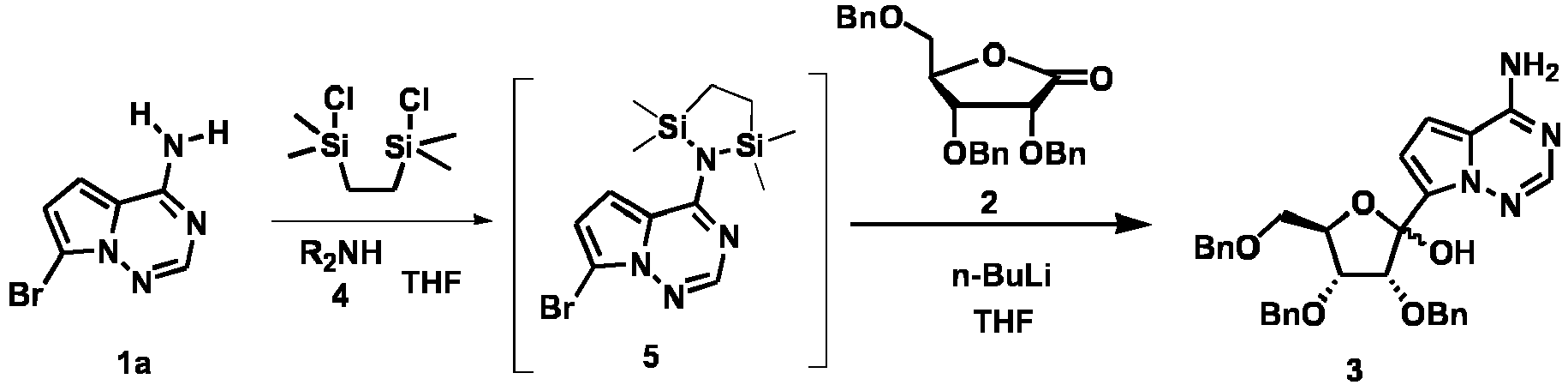
- the temporary bis-silicon protection (Compound 5) of the 4-position amine group in Compound 1 is firstly achieved with 1,2-bis(chlorodimethylsilyl)ethane under the action of amine 4 and butyllithium, then under the combined action of amine 4 and butyllithium, intermediate 5 undergoes a lithium-halogen exchange, and the obtained heterocyclic lithium intermediate undergoes an addition reaction with ribonolactone 2 to achieve the preparation of C-nucleoside Compound 3.
- the present application also provides a method for preparing a C-nucleoside compound, comprising:
- alkyl is defined as a straight or branched chain saturated aliphatic hydrocarbon group. In some embodiments, the alkyl has 1 to 6, for example, 1 to 4, carbon atoms.
- C 1 -C 6 alkyl refers to a straight or branched chain group having 1 to 6 carbon atoms, such as methyl, ethyl, n-propyl, isopropyl, n-butyl, isobutyl, sec-butyl, tert-butyl, n-pentyl or n-hexyl.
- C 3 -C 6 cycloalkyl refers to a saturated or unsaturated non-aromatic monocyclic or polycyclic (e.g., bicyclic) hydrocarbon ring having 3 to 6 ring carbon atoms, for example, cyclopropyl, cyclobutyl, cyclopentyl, cyclohexyl, which may be optionally substituted with one or more (e.g., 1, 2, or 3) suitable substituents, for example, methyl-substituted cyclopropyl, methyl-substituted cyclohexyl.
- suitable substituents for example, methyl-substituted cyclopropyl, methyl-substituted cyclohexyl.
- halogen group is defined to include F, Cl, Br or I.
- the term "about” should be understood as a value which is within the range of 110%, ⁇ 9%, ⁇ 8%, ⁇ 7%, ⁇ 6%, ⁇ 5%, ⁇ 4%, ⁇ 3%, 2%, ⁇ 1%, ⁇ 0.5%, ⁇ 0.1%, ⁇ 0.05% or ⁇ 0.01% of the designated value.
- the beneficial effects of the present application are as follows:
- the method for preparing a chiral intermediate C-nucleoside compound of remdesivir provided by the present application has one or more of the following advantages:
- reaction solution reacted at -78°C for 2 hours, then citric acid in aqueous solution (1M, 200 mL) was added to quench the reaction, the reaction solution was warmed to room temperature, and the aqueous layer was extracted with ethyl acetate (3 ⁇ 200 mL), and the organic layers were combined, washed sequentially with water (1 ⁇ 250 mL), saturated NaHCO 3 solution (1 ⁇ 250 mL), and saturated NaCl solution (1 ⁇ 250 mL).
Landscapes
- Chemical & Material Sciences (AREA)
- Organic Chemistry (AREA)
- Biotechnology (AREA)
- Life Sciences & Earth Sciences (AREA)
- Engineering & Computer Science (AREA)
- Biochemistry (AREA)
- Health & Medical Sciences (AREA)
- General Health & Medical Sciences (AREA)
- Genetics & Genomics (AREA)
- Molecular Biology (AREA)
- Crystallography & Structural Chemistry (AREA)
- Saccharide Compounds (AREA)
- Nitrogen Condensed Heterocyclic Rings (AREA)
- Pharmaceuticals Containing Other Organic And Inorganic Compounds (AREA)
Abstract
Description
- The present application is based on and claims the benefit of priority from
Chinese application No. 202010692306.3, filed on July 17, 2020 - The present application relates to the field of pharmaceutical synthesis, specifically to a method for synthesizing a chiral intermediate C-nucleoside compound of Remdesivir.
- Nucleoside analogs have a unique effect on viruses, a variety of small-molecule nucleoside analogs such as favipiravir, brincidofovir and galidesivir have been found to have some antiviral activity in clinical stages. Gilead screened a large number of nucleoside analogs and found that remdesivir had shown good inhibitory activity against Ebola virus, respiratory syncytial virus, coronavirus, Nipah virus and Hendra virus, etc., and also showed high antiviral activity against the coronavirus SARS-CoV-2. Currently, the Phase III clinical trials for the treatment of SARS-CoV-2 virus infection are being carried out in China, Europe and the United States. In the existing reports related to the synthesis of remdesivir, 7-halogenated pyrrolo[2,1-f][1,2,4]triazin-4-amine (1) and its analogs and D-ribonolactone (2) are the starting materials, and the C-nucleoside compound (3) is obtained by addition reaction, then remdesivir is prepared by further derivatization. Due to the difficulty of remdesivir synthesis, further clinical application research of the drug is seriously restricted.


- For the synthesis of drugs, the efficient synthesis of starting materials is crucial for reducing the overall cost of drug production. At present, for the key addition reaction in the synthesis of remdesivir, the reported synthetic methods mainly comprise: 7-bromopyrrolo[2,1-f][1,2,4]triazin-4-amine (1a) and D-ribonolactone (2) undergo a metal-halogen exchange reaction through temporarily protecting the amino group in Compound 1a in the presence of trimethylchlorosilane (TMSCl) and n-butyllithium (n-BuLi), then an addition reaction with D-ribonolactone (2) is performed, the target C-nucleoside compound (3) can be obtained in 25% yield. However, the synthetic method has low yield and high production cost, which restricts the follow-up clinical research and application of the drug (
WO2011035250A1 ).
WO 2011035250 - In view of the low yield of the above synthetic method, Sina Bavari et al. subsequently improved the addition reaction of this step (Nature, 2016, 531, 381-385). In the improved method, 7-iodopyrrolo[2,1-f][1,2,4]triazin-4-amine (1b) instead of 7-bromopyrrolo[2,1-f][1,2,4]triazin- 4-amine (1a) is used, and Grignard reagents PhMgCl and i-PrMgCl•LiCl are used to complete the temporary silicon protection of the amino group in Compound 1b, then the metal-halogen exchange is carried out, the resultant heterocyclic metal compound is further subjected to an addition reaction with D-ribonolactone (2), which can increase the reaction yield to 40%. However, this reaction needs to temporarily protect the amino group in Compound 1b with TMSCl through phenyl Grignard reagent at 0°C, and then the temperature is lowered down to -20°C and then the addition reaction with D-ribonolactone (2) is performed under the action of isopropyl Grignard reagent. This synthesis strategy requires frequent changes of reaction temperature during the feeding and reaction process, and usage of different Grignard reagents, and the operation is cumbersome.

- In addition to the above-mentioned addition methods using TMSCl as a temporary protecting group, the literature also discloses an addition method using 1,2-bis(chlorodimethylsilyl)ethane instead of TMSCl to temporarily protect the amino group in Compound 1 (Bioorg. Med. Chem. Lett. 2012, 22, 2705-2707;
WO2014042433A2 ,WO2014035140A2 ). These methods need to complete the protection of amino group in Compound 1 and the addition reaction by using more than two metal reagents or at different temperatures, not only the yield is still not ideal (40% to 60%), but also the operation is cumbersome, which is not conducive to scale-up synthesis.
- In view of the problems of low yield, cumbersome operation, high cost, and difficulty in scale-up production of remdesivir reported in the existing reports, it is extremely important to develop a more concise and efficient synthetic method to prepare its chiral synthetic intermediate C-nucleoside compound (3), and the newly developed method should help to reduce the cost of drug production, thereby solving the problem of drug accessibility and satisfying the clinical application of remdesivir against SARS-CoV-2 virus infection.
- The purpose of the present application is to provide a method for efficiently preparing a chiral C-nucleoside compound; another purpose of the present application is to provide a simple method for preparing a chiral C-nucleoside compound; another purpose of the present application is to provide a method for preparing a chiral C-nucleoside compound that is easy to implement and scale up; and another purpose of the present application is to provide a method for preparing a chiral C-nucleoside compound that can be produced on a large scale.
- The purposes of the present application are achieved through the following technical solutions:
A method for preparing a C-nucleoside compound represented by Formula III or salt thereof, comprising: - a) providing a compound represented by Formula II;
- b) in a solvent, in the presence of a secondary amine represented by Formula 4, a metal lithium reagent and 1,2-bis(chlorodimethylsilyl)ethane, allowing a compound represented by Formula 1 to react with the compound represented by Formula II to generate the C-nucleoside compound represented by Formula III,

- in the compound represented by Formula 1, X is halogen;
- in the secondary amine represented by Formula 4, each R is independently C1-C6 alkyl, C3-C6 cycloalkyl or trimethylsilyl, or two Rs and the nitrogen atom to which they are attached together form a substituted or unsubstituted piperidine or pyrrolidine (e.g., 2,2,6,6-tetramethylpiperidine);
- in the compound represented by Formula II or Formula III, Ra, Rb and Rc are each independently methyl, benzyl (Bn), p-methoxybenzyl (PBM), trityl (Tr), tert-butyl or allyl;
- in the compound represented by the Formula III, "" indicates that the structural formula can represent the α configuration or the β configuration of the compound, or a mixture of the α configuration and the β configuration in any ratio.

- In some embodiments, X in the compound of Formula 1 is a bromine atom or an iodine atom.
- In some embodiments, X in the compound of Formula 1 is a bromine atom.
- In some embodiments, X in the compound of Formula 1 is an iodine atom.
- In some embodiments, each R in the secondary amine represented by Formula 4 is each independently methyl, ethyl, n-propyl, isopropyl, n-butyl, isobutyl, cyclopropyl, cyclobutyl, cyclopentyl, cyclohexyl or trimethylsilyl.
- In some embodiments, each R in the secondary amine represented by Formula 4 is independently methyl.
- In some embodiments, each R in the secondary amine represented by Formula 4 is independently ethyl.
- In some embodiments, each R in the secondary amine represented by Formula 4 is independently n-propyl.
- In some embodiments, each R in the secondary amine represented by Formula 4 is independently isopropyl.
- In some embodiments, each R in the secondary amine represented by Formula 4 is independently n-butyl.
- In some embodiments, each R in the secondary amine represented by Formula 4 is independently isobutyl.
- In some embodiments, each R in the secondary amine represented by Formula 4 is independently cyclopropyl.
- In some embodiments, each R in the secondary amine represented by Formula 4 is independently cyclobutyl.
- In some embodiments, each R in the secondary amine represented by Formula 4 is each independently cyclopentyl.
- In some embodiments, each R in the secondary amine represented by Formula 4 is independently cyclohexyl.
- In some embodiments, each R in the secondary amine represented by Formula 4 is independently trimethylsilyl.
- In some embodiments, the two Rs in the secondary amine represented by Formula 4 and the nitrogen atom to which they are attached together form piperidine, pyrrolidine, or 2,2,6,6-tetramethylpiperidine.
- In some embodiments, the two Rs in the secondary amine represented by Formula 4 and the nitrogen atom to which they are attached together form piperidine.
- In some embodiments, the two Rs in the secondary amine represented by Formula 4 and the nitrogen atom to which they are attached together form pyrrolidine.
- In some embodiments, the two Rs in the secondary amine represented by Formula 4 and the nitrogen atom to which they are attached together form 2,2,6,6-tetramethylpiperidine.
- In some embodiments, the secondary amine represented by Formula 4 is diethylamine, dipropylamine, diisopropylamine, dibutylamine, diisobutylamine, dicyclohexylamine, dicyclopentylamine, dicyclopropylamine, 2,2,6,6-tetramethylpiperidine or hexamethyldisilazane.
- In some embodiments, the secondary amine represented by Formula 4 is diethylamine, dipropylamine, diisopropylamine, dibutylamine, diisobutylamine, dicyclohexylamine, 2,2,6,6-tetramethylpiperidine or hexamethyldisilazane.
- In some embodiments, the secondary amine represented by Formula 4 is diisopropylamine, diisobutylamine, dicyclohexylamine, 2,2,6,6-tetramethylpiperidine or hexamethyldisilazane.
- In some embodiments, the secondary amine represented by Formula 4 is diisopropylamine, diisobutylamine, dicyclohexylamine, or 2,2,6,6-tetramethylpiperidine.
- In some embodiments, the secondary amine represented by Formula 4 is hexamethyldisilazane.
- In some embodiments, the secondary amine represented by Formula 4 is diisopropylamine. In some embodiments, the secondary amine represented by Formula 4 is diisobutylamine.
- In some embodiments, the secondary amine represented by Formula 4 is dicyclohexylamine.
- In some embodiments, the secondary amine of Formula 4 is 2,2,6,6-tetramethylpiperidine.
- In some embodiments, the secondary amine represented by Formula 4 is diethylamine, dipropylamine, or dibutylamine.
- In some embodiments, the secondary amine represented by Formula 4 is diethylamine.
- In some embodiments, the secondary amine represented by Formula 4 is dipropylamine.
- In some embodiments, the secondary amine represented by Formula 4 is dibutylamine.
- In some embodiments, Ra, Rb, and Rc in the compound represented by Formula II or Formula III is each independently benzyl (Bn).
- In some embodiments, Ra, Rb, and Rc in the compound represented by Formula II or Formula III is each independently p-methoxybenzyl (PBM).
- In some embodiments, Ra, Rb, and Rc in the compound represented by Formula II is each independently benzyl (Bn).
- In some embodiments, Ra, Rb, and Rc in the compound represented by Formula III is each independently benzyl (Bn).
- In some embodiments, the solvent of the present application is an organic solvent such as tetrahydrofuran.
- In some embodiments, the metal lithium reagent of the present application is methyllithium, n-butyllithium, tert-butyllithium, lithium diisopropylamide, lithium bis(trimethylsilyl)amide, lithium bis(trifluoromethanesulfonimide), lithium triethylborohydride, lithium borohydride, lithium amide or lithium hydride.
- In some embodiments, the metal lithium reagent of the present application is n-butyllithium.
- In some embodiments, in the method for preparing C-nucleoside compound as described in the present application, the step b) comprises:
- b1) dissolving the compound represented by Formula 1 and 1,2-bis(chlorodimethylsilyl)ethane in the solvent, and adding the secondary amine represented by Formula 4 to obtain a mixture;
- b2) sequentially adding the metal lithium reagent and the compound represented by Formula II to the mixture obtained in b1), and allowing the compound represented by Formula 1 to react with the compound represented by Formula II to obtain the compound represented by Formula III.
- In some embodiments, in the method for preparing C-nucleoside compound as described in the present application, step b) is performed under anhydrous and anaerobic conditions.
- In some embodiments, in the method for preparing C-nucleoside compound as described in the present application, the metal lithium reagent and the compound represented by Formula II are sequentially added to the mixture obtained in b1) at a temperature of 0°C to -80°C (e.g., 0°C to -78°C, preferably -78°C).
- In some embodiments, in the method for preparing C-nucleoside compound as described in the present application, the metal lithium reagent and the compound represented by Formula II are sequentially added to the mixture obtained in b1) at a temperature of -70°C to -80°C.
- In some embodiments, in the method for preparing C-nucleoside compound as described in the present application, the metal lithium reagent and the compound represented by Formula II are sequentially added to the mixture obtained in b1) at a temperature of -78°C to -80°C.
- In some embodiments, in the method for preparing C-nucleoside compound as described in the present application, the compound represented by Formula 1 is reacted with the compound represented by Formula II, and the initial concentration of the compound represented by Formula 1 is 0.06 to 0.3 mol/ L, such as 0.08 mol/L, 0.1 mol/L, 0.15 mol/L, 0.18 mol/L, 0.2 mol/L, 0.25 mol/L.
- In some embodiments, in the method for preparing C-nucleoside compound as described in the present application, the compound represented by Formula 1 is reacted with the compound represented by Formula II, and the initial concentration of the compound represented by Formula 1 is 0.08 to 0.25mol/ L.
- In some embodiments, in the method for preparing C-nucleoside compound as described in the present application, the compound represented by Formula 1 is reacted with the compound represented by Formula II at a temperature of 0°C to -80°C (e.g., 0°C to -78°C, preferably -78°C).
- In some embodiments, in the method for preparing C-nucleoside compound as described in the present application, the compound represented by Formula 1 is reacted with the compound represented by Formula II at a temperature of -70°C to -80°C.
- In some embodiments, in the method for preparing C-nucleoside compound as described in the present application, the compound represented by Formula 1 is reacted with the compound represented by Formula II at a temperature of -78°C to -80°C.
- In some embodiments, in the method for preparing C-nucleoside compound as described in the present application, the feeding molar ratio of the compound represented by Formula 1 to the compound represented by Formula II is 1:1.5-3, such as about 1:1.6, about 1:1.8, about 1:2.
- In some embodiments, in the method for preparing C-nucleoside compound as described in the present application, the feeding molar ratio of the compound represented by Formula 1 to the compound represented by Formula II is 1:1.6-3.
- In some embodiments, in the method for preparing C-nucleoside compound as described in the present application, the feeding molar ratio of the compound represented by Formula 1 to the compound represented by Formula II is 1:1.8-3.
- In some embodiments, in the method for preparing C-nucleoside compound as described in the present application, the feeding molar ratio of the compound represented by Formula 1 to the compound represented by Formula II is 1:1.9-3.
- In some embodiments, in the method for preparing C-nucleoside compound as described in the present application, the feeding molar ratio of the compound represented by Formula 1 to the compound represented by Formula II is 1:2-3.
- In some embodiments, in the method for preparing C-nucleoside compound as described in the present application, the feeding molar ratio of the compound represented by Formula 1 to the compound represented by Formula II is 1:1.6-2.5.
- In some embodiments, in the method for preparing C-nucleoside compound as described in the present application, the feeding molar ratio of the compound represented by Formula 1 to the compound represented by Formula II is 1:1.8-2.5.
- In some embodiments, in the method for preparing C-nucleoside compound as described in the present application, the feeding molar ratio of the compound represented by Formula 1 to the compound represented by Formula II is 1:1.9-2.5.
- In some embodiments, in the method for preparing C-nucleoside compound as described in the present application, the feeding molar ratio of the compound represented by Formula 1 to the compound represented by Formula II is 1:2~2.5.
- In some embodiments, in the method for preparing C-nucleoside compound as described in the present application, the compound represented by Formula 1 is reacted with the compound represented by Formula II, the initial concentration of the compound represented by Formula 1 is 0.06 to 0.3 mol/ L, and the feeding molar ratio of the compound represented by Formula 1 to the compound represented by Formula II is 1:1.5-3.
- In some embodiments, in the method for preparing C-nucleoside compound as described in the present application, the compound represented by Formula 1 is reacted with the compound represented by Formula II, the initial concentration of the compound represented by Formula 1 is 0.06 to 0.3 mol/ L, and the feeding molar ratio of the compound represented by Formula 1 to the compound represented by Formula II is 1: 1.6-3.
- In some embodiments, in the method for preparing C-nucleoside compound as described in the present application, the compound represented by Formula 1 is reacted with the compound represented by Formula II, the initial concentration of the compound represented by Formula 1 is 0.06 to 0.3 mol/ L, and the feeding molar ratio of the compound represented by Formula 1 to the compound represented by Formula II is 1: 1.8-3.
- In some embodiments, in the method for preparing C-nucleoside compound as described in the present application, the compound represented by Formula 1 is reacted with the compound represented by Formula II, the initial concentration of the compound represented by Formula 1 is 0.06 to 0.3 mol/ L, and the feeding molar ratio of the compound represented by Formula 1 to the compound represented by Formula II is 1: 1.9-3.
- In some embodiments, in the method for preparing C-nucleoside compound as described in the present application, the compound represented by Formula 1 is reacted with the compound represented by Formula II, the initial concentration of the compound represented by Formula 1 is 0.06 to 0.3 mol/ L, and the feeding molar ratio of the compound represented by Formula 1 to the compound represented by Formula II is 1: 2-3.
- In some embodiments, in the method for preparing C-nucleoside compound as described in the present application, the compound represented by Formula 1 is reacted with the compound represented by Formula II, the initial concentration of the compound represented by Formula 1 is 0.08 to 0.25 mol/ L, and the feeding molar ratio of the compound represented by Formula 1 to the compound represented by Formula II is 1: 1.6-2.
- In some embodiments, in the method for preparing C-nucleoside compound as described in the present application, the compound represented by Formula 1 is reacted with the compound represented by Formula II, the initial concentration of the compound represented by Formula 1 is 0.08 to 0.25 mol/ L, and the feeding molar ratio of the compound represented by Formula 1 to the compound represented by Formula II is 1: 1.8-2.
- In some embodiments, in the method for preparing C-nucleoside compound as described in the present application, the compound represented by Formula 1 is reacted with the compound represented by Formula II, the initial concentration of the compound represented by Formula 1 is 0.08 to 0.25 mol/ L, and the feeding molar ratio of the compound represented by Formula 1 to the compound represented by Formula II is 1: 1.9-2.
- In some embodiments, in the method for preparing C-nucleoside compound as described in the present application, the compound represented by Formula 1 is reacted with the compound represented by Formula II, the initial concentration of the compound represented by Formula 1 is 0.08 to 0.25 mol/ L, and the feeding molar ratio of the compound represented by Formula 1 to the compound represented by Formula II is 1: 2~2.5.
- In some embodiments, in the method for preparing C-nucleoside compound as described in the present application, the feeding molar ratio of the compound represented by Formula 1 to the metal lithium reagent is 1: 3.5-4.5, for example, about 1: 4.
- In some embodiments, in the method for preparing C-nucleoside compound as described in the present application, the feeding molar ratio of the compound represented by Formula 1 to 1,2-bis(chlorodimethylsilyl)ethane is 1:1-1.5, for example, about 1:1.1, about 1:1.2, about 1:1.3, about 1:1.4.
- In some embodiments, in the method for preparing C-nucleoside compound as described in the present application, the feeding molar ratio of the compound represented by Formula 1 to the secondary amine represented by Formula 4 is 1: 1-1.5, for example, about 1:1.1, about 1:1.2, about 1:1.3, about 1:1.4.
- In some embodiments, in the method for preparing C-nucleoside compound as described in the present application, the reaction of the compound represented by Formula 1 and the compound represented by Formula II comprises:
- under the action of the secondary amine represented by Formula 4 and the metal lithium reagent, allowing the 4-position amino group in the compound represented by Formula 1 to undergo a bis-silicon protection by using 1,2-bis(chlorodimethylsilyl)ethane to generate a compound represented by Formula 5;

- under the action of the secondary amine represented by Formula 4 and the metal lithium reagent, the compound represented by Formula 5 undergoing a lithium-halogen exchange to obtain a compound represented by the intermediate Formula 6, wherein M is Li;
- the compound represented by Formula 6 undergoing an addition reaction with the compound represented by Formula II to generate the C-nucleoside compound represented by the Formula III.
- In some embodiments, the synthetic scheme of the method for preparing C-nucleoside compound as described in the present application is:

- The specific steps of this technical scheme are as follows: the heterocyclic Compound 1 are sequentially mixed with 1,2-bis(chlorodimethylsilyl)ethane, amine 4 and butyllithium, and undergoes an addition reaction with ribonolactone 2 at the same reaction temperature to complete the synthesis of nucleoside Compound 3. In the above technical scheme, the temporary bis-silicon protection (Compound 5) of the 4-position amine group in Compound 1 is firstly achieved with 1,2-bis(chlorodimethylsilyl)ethane under the action of amine 4 and butyllithium, then under the combined action of amine 4 and butyllithium, intermediate 5 undergoes a lithium-halogen exchange, and the obtained heterocyclic lithium intermediate undergoes an addition reaction with ribonolactone 2 to achieve the preparation of C-nucleoside Compound 3.
- The present application also provides a method for preparing a C-nucleoside compound, comprising:
- 1) in a solvent, under the action of a secondary amine represented by Formula 4 and a metal lithium reagent, allowing the 4-position amino group in the compound represented by Formula 1 to undergo a bis-silicon protection by using 1,2-bis(chlorodimethylsilyl)ethane to generate a compound represented by a intermediate Formula 5;


- 2) under the action of the secondary amine represented by Formula 4 and the metal lithium reagent, the compound represented by Formula 5 undergoing a lithium-halogen exchange to generate a compound represented by a intermediate Formula 6, wherein M is Li;
- 3) the compound represented by Formula 6 undergoing an addition reaction with a compound represented by Formula II to generate a C-nucleoside compound represented by Formula III,
wherein, the definitions of the solvent, X, R, Ra, Rb, Rc,, as well as the reaction conditions, feeding ratios and so on are as described in the present application.
- Unless otherwise defined below, all technical and scientific terms used herein are intended to have the same meanings as commonly understood by one skilled in the art. References to techniques used herein are intended to refer to techniques commonly understood in the art, including those variations or substitutions of equivalent techniques that would be obvious to one skilled in the art. While the following terms are believed to be well understood by one skilled in the art, the following definitions are set forth to better explain the present application.
- As used herein, the terms "comprising", "including", "having", "containing" or "involving" and other variations thereof herein are inclusive or open-ended and do not exclude other unenumerated elements or method steps.
- As used herein, the term "alkyl" is defined as a straight or branched chain saturated aliphatic hydrocarbon group. In some embodiments, the alkyl has 1 to 6, for example, 1 to 4, carbon atoms. For example, as used herein, the term "C1-C6 alkyl" refers to a straight or branched chain group having 1 to 6 carbon atoms, such as methyl, ethyl, n-propyl, isopropyl, n-butyl, isobutyl, sec-butyl, tert-butyl, n-pentyl or n-hexyl.
- As used herein, the term "C3-C6 cycloalkyl" refers to a saturated or unsaturated non-aromatic monocyclic or polycyclic (e.g., bicyclic) hydrocarbon ring having 3 to 6 ring carbon atoms, for example, cyclopropyl, cyclobutyl, cyclopentyl, cyclohexyl, which may be optionally substituted with one or more (e.g., 1, 2, or 3) suitable substituents, for example, methyl-substituted cyclopropyl, methyl-substituted cyclohexyl.
- As used herein, the term "halogen" group is defined to include F, Cl, Br or I.
- As used herein, the term "about" should be understood as a value which is within the range of 110%, ±9%, ±8%, ±7%, ±6%, ±5%, ±4%, ±3%, 2%, ±1%, ±0.5%, ±0.1%, ±0.05% or ±0.01% of the designated value.
- The beneficial effects of the present application are as follows:
The method for preparing a chiral intermediate C-nucleoside compound of remdesivir provided by the present application has one or more of the following advantages: - 1) this method has a high reaction yield, for example, the yield is not less than 40%, preferably not less than 45%, and more preferably not less than 70%;
- 2) the method is simple to operate;
- 3) this method uses a single metal reagent;
- 4) the temperature conditions of the reaction of this method are stable, and the operation process does not need to frequently change the reaction system;
- 5) this method is suitable for scale-up synthesis and may be adapted to the large-scale production of remdesivir;
- 6) the method is used to prepare a chiral intermediate C-nucleoside compound of remdesivir, and the cost is low.
- The technical solutions of the present application are described in further detail below, but the protection scope of the present application is not limited to the following description.
- Synthesis of chiral C-nucleoside compound represented by Formula 3

- Under anhydrous and anaerobic conditions, Compound 1a (10.0 g, 46.94 mmol) and 1,2-bis(chlorodimethylsilyl)ethane (11.1 g, 51.63 mmol) were dissolved in THF (100 mL), then diisopropylamine represented by Formula 4 (7.3 mL, 51.63 mmol) was added. N-butyllithium (81 mL, 201.8 mmol) and ribonolactone (39.3 g, 93.88 mmol) represented by Formula 2 in THF solution (50 mL) were sequentially added to the reaction solution at -78°C. The reaction solution reacted at -78°C for 2 hours, then citric acid in aqueous solution (1M, 200 mL) was added to quench the reaction, the reaction solution was warmed to room temperature, and the aqueous layer was extracted with ethyl acetate (3×200 mL), and the organic layers were combined, washed sequentially with water (1×250 mL), saturated NaHCO3 solution (1×250 mL), and saturated NaCl solution (1×250 mL). The organic layer was dried with anhydrous magnesium sulfate, and filtered, and the solvent was removed under reduced pressure, and the obtained crude product was separated and purified by silica gel column chromatography (developing solvent: firstly gradient eluted with petroleum ether : ethyl acetate = 1:1 to pure ethyl acetate, then eluted with methanol/ethyl acetate = 10%) to obtain a white foamy solid compound (19.2 g), which was the chiral C-nucleoside compound represented by Formula 3, with a yield of 74%. 1H-NMR (400 MHz, DMSO-d6): δ 8.06 (br s, 2H), 7.99 (s, 1H), 7.37 - 7.22 (m, 11H), 7.19 - 7.10 (m, 3H), 7.03 - 6.97 (m, 2H), 6.95 (d, J = 4.8 Hz, 1H), 5.39 (d, J = 5.9 Hz, 1H), 5.05 (d, J = 5.2 Hz, 1H), 4.61 - 4.54 (m, 2H), 4.52 - 4.42 (m, 4H), 4.06 - 3.98 (m, 1H), 3.93 (dd, J = 5.9, 4.4 Hz, 1H), 3.69 (dd, J = 10.1, 3.4 Hz, 1H), 3.47 (dd, J = 10.0, 6.4 Hz, 1H); 13C-NMR (100 MHz, DMSO-d6): δ 187.98, 155.88, 148.96, 138.63, 138.43, 138.14, 128.67, 128.14, 128.12, 127.82, 127.54, 127.44, 127.26, 127.21, 127.09, 118.60, 117.51, 103.15, 102.30, 81.91, 80.92, 72.50, 72.33, 71.74, 71.44, 69.42; HRMS calcd for C32H32N4O5 552.2373, found 552.2362.
- According to the method described in Example 1, Compound 1a and the ribonolactone represented by Formula 2 were used as substrates, the yields of synthesis of the chiral C-nucleoside compound represented by Formula 3 under the action of different secondary amines represented by Formula 4 were compared, and the data obtained were shown in the table below.
Item Amine (4) Product 3 (yield) Item Amine (4) Product 3 (yield) 1 
41% 5 
71% 2 
74% 6 
70% 3 
45% 7 
57% 4 
54% 8 
74% - According to the method described in Example 1, Compound 1a was reacted on a scale of 10 grams, other reaction conditions remained unchanged, and only the concentration of Compound 1a in the reaction solution and the equivalent number of ribonolactone represented by Formula 2 were changed, the obtained data of synthesis yields of the chiral C-nucleoside compounds represented by Formula 3 were shown in the table below.
No. Compound 2 (equivalent) Concentration of Compuond 1a (mol/L) Product 3 (yield) 1 2.0 0.08 75% 2 2.0 0.20 74% 3 2.0 0.25 70% 4 1.8 0.20 62% 5 1.6 0.20 59% - According to the method described in Example 1, Compound 1a and Compound 1b were used as substrates, respectively, and other reaction conditions unchanged, 1 equivalent of Compound 1 was subjected to an addition reaction with 2.5 equivalents of ribonolactone represented by Formula 2, and the reaction was carried out in the presence of different amines or bases. The synthesis yield data of the chiral C-nucleoside compound represented by the Formula 3 obtained under the conditions of different amine or base were shown in the following table.

No. Compound 1 Amine or base (equivalent) n-BuLi (equivalent) Reaction temperature Product 3 (yield) 1 1a i-Pr2NH (1.1) 4.3 -78 °C 74% 2 1a NaH (2.5) 3.3 Room temperature/-78°C 42% 3 1b i-Pr2NH (1.1) 4.3 -78 °C 59% 4 1b No amine added i-Pr2NH 3.3 -78 °C 24% - The above are only preferred embodiments of the present application, and it should be understood that the present application is not limited to the form disclosed herein, and they should not be regarded as an exclusion of other embodiments, but may be used in various other combinations, modifications and environments, and can be modified within the scope of the concepts described herein according to the above teachings or skill or knowledge in the relevant field. However, the modifications and changes made by one skilled in the art do not depart from the spirit and scope of the present application, and should be within the scope of protection of the appended claims of the present application.
Claims (13)
- A method for preparing a C-nucleoside compound represented by Formula III or salt thereof, comprising:a) providing a compound represented by Formula II;b) in a solvent, in the presence of a secondary amine represented by Formula 4, a metal lithium reagent and 1,2-bis(chlorodimethylsilyl)ethane, allowing a compound represented by Formula 1 to react with the compound represented by Formula II to generate the C-nucleoside compound represented by Formula III,
 in the compound represented by Formula 1, X is halogen;in the secondary amine represented by Formula 4, each R is independently C1-C6 alkyl, C3-C6 cycloalkyl or trimethylsilyl, or two Rs and the nitrogen atom to which they are attached together form a substituted or unsubstituted piperidine or pyrrolidine (e.g., 2,2,6,6-tetramethylpiperidine);in the compound represented by Formula II or Formula III, Ra, Rb and Rc are each independently methyl, benzyl (Bn), p-methoxybenzyl (PBM), trityl (Tr), tert-butyl or allyl;in the compound represented by the Formula III, "" indicates that the structural formula can represent the α configuration or the β configuration of the compound, or a mixture of the α configuration and the β configuration in any ratio.
- The method for preparing C-nucleoside compound according to claim 1, wherein X is a bromine atom or an iodine atom, preferably a bromine atom.
- The method for preparing C-nucleoside compound according to claim 1, wherein each R is independently methyl, ethyl, n-propyl, isopropyl, n-butyl, isobutyl, cyclopropyl, cyclobutyl, cyclopentyl, cyclohexyl or trimethylsilyl, or two Rs and the nitrogen atom to which they are attached together form piperidine, pyrrolidine or 2,2,6,6-tetramethylpiperidine;preferably, the secondary amine represented by Formula 4 is diethylamine, dipropylamine, diisopropylamine, dibutylamine, diisobutylamine, dicyclohexylamine, dicyclopentylamine, dicyclopropylamine, 2,2,6,6-tetramethylpiperidine or hexamethyldisilazane;preferably, the secondary amine represented by Formula 4 is diethylamine, dipropylamine, diisopropylamine, dibutylamine, diisobutylamine, dicyclohexylamine, 2,2,6,6-tetramethylpiperidine or hexamethyldisilazane;preferably, the secondary amine represetned by Formula 4 is diisopropylamine, diisobutylamine, dicyclohexylamine, 2,2,6,6-tetramethylpiperidine or hexamethyldisilazane;preferably, the secondary amine represented by Formula 4 is diethylamine, dipropylamine or dibutylamine.
- The method for preparing C-nucleoside compound according to claim 1, wherein Ra, Rb, and Rc are each independently benzyl group (Bn).
- The method for preparing C-nucleoside compound according to claim 1, wherein the solvent is an organic solvent, such as tetrahydrofuran.
- The method for preparing C-nucleoside compound according to claim 1, wherein the metal lithium reagent is methyllithium, n-butyllithium, tert-butyllithium, lithium diisopropylamide, lithium bis(trimethylsilyl)amide, lithium bis(trifluoromethanesulfonimide), lithium triethylborohydride, lithium borohydride, lithium amide or lithium hydride, preferably n-butyllithium.
- The method for preparing C-nucleoside compound according to claim 1, wherein step b) comprises:b1) dissolving the compound represented by Formula 1 and 1,2-bis(chlorodimethylsilyl)ethane in the solvent, and adding the secondary amine represented by Formula 4 to obtain a mixture;b2) sequentially adding the metal lithium reagent and the compound represented by Formula II to the mixture obtained in b1), and allowing the compound represented by Formula 1 to react with the compound represented by Formula II to obtain the compound represented by Formula III.
- The method for preparing C-nucleoside compound according to any one of claims 1 to 7, wherein the compound represented by Formula 1 is reacted with the compound represented by Formula II, and the initial concentration of the compound represented by Formula 1 is 0.06 to 0.3 mol/L, such as 0.08mol/L, 0.1 mol/L, 0.15 mol/L, 0.18 mol/L, 0.2 mol/L, 0.25 mol/L.
- The method for preparing C-nucleoside compound according to any one of claims 1 to 7, wherein the compound represented by Formula 1 is reacted with the compound represented by Formula II at a temperature of 0°C to -80°C (e.g. 0°C to -78°C).
- The method for preparing C-nucleoside compound according to any one of claims 1 to 7, wherein the feeding molar ratio of the compound represented by Formula 1 to the compound represented by Formula II is 1: 1.5-3;preferably, the feeding molar ratio of the compound represented by Formula 1 to the lithium metal reagent is 1: 3.5-4.5;preferably, the feeding molar ratio of the compound represented by Formula 1 to 1,2-bis(chlorodimethylsilyl)ethane is 1: 1-1.5;preferably, the feeding molar ratio of the compound represented by Formula 1 to the secondary amine represented by Formula 4 is 1: 1-1.5.
- The method for preparing C-nucleoside compound according to any one of claims 1 to 7, wherein step b) is carried out under anhydrous and anaerobic conditions;
preferably, the metal lithium reagent and the compound represented by Formula II are sequentially added to the mixture obtained in b1) at a temperature of 0°C to -80°C (e.g., 0°C to -78°C). - The method for preparing C-nucleoside compound according to any one of claims 1 to 7, wherein the reaction between the compound represented by Formula 1 and the compound represented by Formula II comprises:under the action of the secondary amine represented by Formula 4 and the metal lithium reagent, allowing the 4-position amino group in the compound represented by Formula 1 to undergo a bis-silicon protection by using 1,2-bis(chlorodimethylsilyl)ethane to generate a compound represented by the intermediate Formula 5;
 under the action of the secondary amine represented by Formula 4 and the metal lithium reagent, the compound represented by Formula 5 undergoing a lithium-halogen exchange to generate a compound represented by the intermediate Formula 6, wherein M is Li;the compound represented by the Formula 6 undergoing an addition reaction with the compound represented by the Formula II to generate the C-nucleoside compound represented by the Formula III.
 - A method for preparing a C-nucleoside compound, comprising:1) in a solvent, under the action of a secondary amine represented by Formula 4 and a metal lithium reagent, allowing the 4-position amino group in the compound represented by Formula 1 to undergo a bis-silicon protection by using 1,2-bis(chlorodimethylsilyl)ethane to generate a compound represented by the intermediate Formula 5;

 2) under the action of the secondary amine represented by Formula 4 and the metal lithium reagent, the compound represented by Formula 5 undergoing lithium-halogen exchange to generate a compound represented by the intermediate Formula 6, wherein M is Li;3) the compound represented by Formula 6 undergoing an addition reaction with a compound represented by Formula II to generate a C-nucleoside compound represented by Formula III,
wherein, the definitions of the solvent, X, R, Ra, Rb, Rc,, as well as the reaction conditions and feeding ratios are as described in any one of claims 1 to 11.
Applications Claiming Priority (2)
| Application Number | Priority Date | Filing Date | Title |
|---|---|---|---|
| CN202010692306.3A CN111793101B (en) | 2020-07-17 | 2020-07-17 | Process for the synthesis of C-nucleoside compounds |
| PCT/CN2021/106520 WO2022012630A1 (en) | 2020-07-17 | 2021-07-15 | Method for synthesizing c-nucleoside compound |
Publications (2)
| Publication Number | Publication Date |
|---|---|
| EP4186915A1 true EP4186915A1 (en) | 2023-05-31 |
| EP4186915A4 EP4186915A4 (en) | 2024-07-24 |
Family
ID=72807626
Family Applications (1)
| Application Number | Title | Priority Date | Filing Date |
|---|---|---|---|
| EP21841411.8A Pending EP4186915A4 (en) | 2020-07-17 | 2021-07-15 | METHOD FOR THE SYNTHESIS OF A C-NUCLEOSIDE COMPOUND |
Country Status (5)
| Country | Link |
|---|---|
| US (1) | US12583879B2 (en) |
| EP (1) | EP4186915A4 (en) |
| JP (1) | JP7703642B2 (en) |
| CN (1) | CN111793101B (en) |
| WO (1) | WO2022012630A1 (en) |
Families Citing this family (6)
| Publication number | Priority date | Publication date | Assignee | Title |
|---|---|---|---|---|
| CN111793101B (en) | 2020-07-17 | 2022-09-30 | 四川大学 | Process for the synthesis of C-nucleoside compounds |
| KR20230170948A (en) * | 2021-04-16 | 2023-12-19 | 길리애드 사이언시즈, 인코포레이티드 | Method for producing carbanucleosides using amides |
| JP7688152B2 (en) * | 2021-04-16 | 2025-06-03 | ギリアード サイエンシーズ, インコーポレイテッド | Method for preparing carbanucleosides using amides |
| CN113321643B (en) * | 2021-06-17 | 2023-06-20 | 四川大学 | Intermediate and preparation method and its application in the synthesis of vincamine |
| CN113402506B (en) * | 2021-06-17 | 2023-06-16 | 四川大学 | Intermediate, preparation method and application thereof in synthesizing vinca-bunting |
| CN115677828B (en) * | 2022-11-02 | 2024-10-18 | 四川大学 | An anti-tumor meta-dichlorophenol derivative and its preparation method |
Family Cites Families (13)
| Publication number | Priority date | Publication date | Assignee | Title |
|---|---|---|---|---|
| EP1571150A1 (en) | 2004-03-02 | 2005-09-07 | Aventis Pharma Deutschland GmbH | Process for the preparation of tryptase inhibitors |
| WO2011035250A1 (en) | 2009-09-21 | 2011-03-24 | Gilead Sciences, Inc. | Processes and intermediates for the preparation of 1'-substituted carba-nucleoside analogs |
| TW201305185A (en) | 2010-09-13 | 2013-02-01 | 吉李德科學股份有限公司 | 2'-fluoro substituted carbon-nucleoside analog for antiviral therapy |
| WO2014035140A2 (en) | 2012-08-30 | 2014-03-06 | Kainos Medicine, Inc. | Compounds and compositions for modulating histone methyltransferase activity |
| WO2014042433A2 (en) | 2012-09-14 | 2014-03-20 | Kainos Medicine, Inc. | Compounds and compositions for modulating adenosine a3 receptor activity |
| SG11201502750UA (en) | 2012-10-08 | 2015-06-29 | Idenix Pharmaceuticals Inc | 2'-chloro nucleoside analogs for hcv infection |
| UA119050C2 (en) | 2013-11-11 | 2019-04-25 | Ґілеад Саєнсиз, Інк. | PYROL [1.2-f] [1.2.4] TRIASINES USED FOR TREATMENT OF RESPIRATORY-SYNCITAL VIRAL INFECTIONS |
| MX2018001814A (en) | 2015-08-13 | 2018-05-07 | Merck Sharp & Dohme | CYCLIC DINUCLEOTID COMPOUNDS AS AGONISTS OF THE INTERFERON GENE STIMULATOR. |
| CA3075950A1 (en) | 2017-09-18 | 2019-03-21 | Janssen Biopharma, Inc. | Substituted nucleosides, nucleotides and analogs thereof |
| CN109748921B (en) * | 2017-11-03 | 2022-03-22 | 中国科学院上海药物研究所 | N-tert-butoxycarbonyl-protected heterocyclic compounds, methods for their preparation and methods for preparing C-nucleoside analogs |
| CN111205327B (en) * | 2020-02-17 | 2022-05-31 | 南京法恩化学有限公司 | Preparation method of Reideciclovir |
| CN111233869B (en) * | 2020-03-12 | 2022-09-16 | 杭州新博思生物医药有限公司 | New compounds for preparing key intermediates of Remdesivir and preparation method thereof |
| CN111793101B (en) | 2020-07-17 | 2022-09-30 | 四川大学 | Process for the synthesis of C-nucleoside compounds |
-
2020
- 2020-07-17 CN CN202010692306.3A patent/CN111793101B/en active Active
-
2021
- 2021-07-15 US US18/016,172 patent/US12583879B2/en active Active
- 2021-07-15 JP JP2023503016A patent/JP7703642B2/en active Active
- 2021-07-15 EP EP21841411.8A patent/EP4186915A4/en active Pending
- 2021-07-15 WO PCT/CN2021/106520 patent/WO2022012630A1/en not_active Ceased
Also Published As
| Publication number | Publication date |
|---|---|
| CN111793101B (en) | 2022-09-30 |
| US12583879B2 (en) | 2026-03-24 |
| US20230219990A1 (en) | 2023-07-13 |
| CN111793101A (en) | 2020-10-20 |
| JP2023534965A (en) | 2023-08-15 |
| JP7703642B2 (en) | 2025-07-07 |
| WO2022012630A1 (en) | 2022-01-20 |
| EP4186915A4 (en) | 2024-07-24 |
Similar Documents
| Publication | Publication Date | Title |
|---|---|---|
| JP7703642B2 (en) | Method for synthesizing C-nucleoside compounds | |
| EP4352052A1 (en) | Process for preparing an erk inhibitor | |
| CN115768763B (en) | Preparation method of CDK4/6 inhibitor | |
| CN110845502A (en) | Preparation method of 7-bromopyrrolo [2,1-f ] [1,2,4] thiazine-4-amine | |
| CN109705011B (en) | A kind of synthetic method and intermediate of Upatinib intermediate | |
| CN102584795A (en) | Preparing method of crizotinib | |
| KR20190013554A (en) | Novel intermediates useful for the synthesis of aminopyrimidine derivatives, process for preparing the same, and process for preparing aminopyrimidine derivatives using the same | |
| CN109265480B (en) | Preparation method of high-purity tenofovir alafenamide impurity TAF-Y | |
| CN111646964B (en) | Novel method for synthesizing 2H-pyran-2-one derivative by base catalysis | |
| CN111635404B (en) | Preparation method of duloxetine | |
| CN114315823B (en) | Intermediates of berberine hydrochloride and analogues thereof and preparation methods thereof | |
| CN101260085A (en) | A method for the synthesis of chiral gamma-sultam by catalytic asymmetric hydrogenation | |
| CN104926900A (en) | Method for preparing Capecitabine intermediate represented by formula I | |
| CN101805339B (en) | Entecavir compound preparation method | |
| CN115385850B (en) | Preparation method of 1, 4-dihydropyridine compound | |
| CN107021969B (en) | The method that catalysis oxidation prepares biotin precursor ketone acid | |
| CN112679439B (en) | Preparation method of 2-chloro-5-methylthiopyrimidine | |
| CA2445766A1 (en) | Improved process for preparing zolpidem | |
| CN115215803B (en) | Preparation method of 4-halogenated-1- (difluoromethyl) -1H-imidazole | |
| CN114230598B (en) | A process for synthesizing 2-substituted thiazole-4-boronic acid pinacol ester | |
| CN111574523A (en) | A kind of method for preparing 1'-substituted carbon nucleoside analog intermediate | |
| US11548862B2 (en) | Preparation method of selenium-containing heterocyclic compounds | |
| CN119431219A (en) | A chiral 3-hydroxy-4-fluoropiperidine derivative and a synthesis method thereof | |
| CN111377850A (en) | Chiral N-substituted-3, 3-difluoro-4-hydroxypiperidine derivative and preparation method thereof | |
| CN101555248A (en) | Method for preparing poly-substituted 1, 5-naphthyridine compound |
Legal Events
| Date | Code | Title | Description |
|---|---|---|---|
| STAA | Information on the status of an ep patent application or granted ep patent |
Free format text: STATUS: THE INTERNATIONAL PUBLICATION HAS BEEN MADE |
|
| PUAI | Public reference made under article 153(3) epc to a published international application that has entered the european phase |
Free format text: ORIGINAL CODE: 0009012 |
|
| STAA | Information on the status of an ep patent application or granted ep patent |
Free format text: STATUS: REQUEST FOR EXAMINATION WAS MADE |
|
| 17P | Request for examination filed |
Effective date: 20230113 |
|
| AK | Designated contracting states |
Kind code of ref document: A1 Designated state(s): AL AT BE BG CH CY CZ DE DK EE ES FI FR GB GR HR HU IE IS IT LI LT LU LV MC MK MT NL NO PL PT RO RS SE SI SK SM TR |
|
| DAV | Request for validation of the european patent (deleted) | ||
| DAX | Request for extension of the european patent (deleted) | ||
| REG | Reference to a national code |
Ref country code: DE Ref legal event code: R079 Free format text: PREVIOUS MAIN CLASS: C07H0015180000 Ipc: C07H0001000000 |
|
| A4 | Supplementary search report drawn up and despatched |
Effective date: 20240624 |
|
| RIC1 | Information provided on ipc code assigned before grant |
Ipc: C07D 487/04 20060101ALI20240618BHEP Ipc: C07F 7/10 20060101ALI20240618BHEP Ipc: C07H 15/04 20060101ALI20240618BHEP Ipc: C07H 15/10 20060101ALI20240618BHEP Ipc: C07H 15/18 20060101ALI20240618BHEP Ipc: C07H 1/00 20060101AFI20240618BHEP |