EP4186554A1 - System and method for providing virtual reality content for relaxation training to user so as to stabilize user's psychological state - Google Patents
System and method for providing virtual reality content for relaxation training to user so as to stabilize user's psychological state Download PDFInfo
- Publication number
- EP4186554A1 EP4186554A1 EP21845807.3A EP21845807A EP4186554A1 EP 4186554 A1 EP4186554 A1 EP 4186554A1 EP 21845807 A EP21845807 A EP 21845807A EP 4186554 A1 EP4186554 A1 EP 4186554A1
- Authority
- EP
- European Patent Office
- Prior art keywords
- user
- contents
- biological signal
- providing
- psychological
- Prior art date
- Legal status (The legal status is an assumption and is not a legal conclusion. Google has not performed a legal analysis and makes no representation as to the accuracy of the status listed.)
- Withdrawn
Links
Images




Classifications
-
- A—HUMAN NECESSITIES
- A61—MEDICAL OR VETERINARY SCIENCE; HYGIENE
- A61M—DEVICES FOR INTRODUCING MEDIA INTO, OR ONTO, THE BODY; DEVICES FOR TRANSDUCING BODY MEDIA OR FOR TAKING MEDIA FROM THE BODY; DEVICES FOR PRODUCING OR ENDING SLEEP OR STUPOR
- A61M21/00—Other devices or methods to cause a change in the state of consciousness; Devices for producing or ending sleep by mechanical, optical, or acoustical means, e.g. for hypnosis
- A61M21/02—Other devices or methods to cause a change in the state of consciousness; Devices for producing or ending sleep by mechanical, optical, or acoustical means, e.g. for hypnosis for inducing sleep or relaxation, e.g. by direct nerve stimulation, hypnosis, analgesia
-
- G—PHYSICS
- G06—COMPUTING OR CALCULATING; COUNTING
- G06F—ELECTRIC DIGITAL DATA PROCESSING
- G06F3/00—Input arrangements for transferring data to be processed into a form capable of being handled by the computer; Output arrangements for transferring data from processing unit to output unit, e.g. interface arrangements
- G06F3/16—Sound input; Sound output
- G06F3/167—Audio in a user interface, e.g. using voice commands for navigating, audio feedback
-
- G—PHYSICS
- G06—COMPUTING OR CALCULATING; COUNTING
- G06F—ELECTRIC DIGITAL DATA PROCESSING
- G06F3/00—Input arrangements for transferring data to be processed into a form capable of being handled by the computer; Output arrangements for transferring data from processing unit to output unit, e.g. interface arrangements
- G06F3/01—Input arrangements or combined input and output arrangements for interaction between user and computer
- G06F3/011—Arrangements for interaction with the human body, e.g. for user immersion in virtual reality
-
- A—HUMAN NECESSITIES
- A61—MEDICAL OR VETERINARY SCIENCE; HYGIENE
- A61B—DIAGNOSIS; SURGERY; IDENTIFICATION
- A61B5/00—Measuring for diagnostic purposes; Identification of persons
- A61B5/02—Detecting, measuring or recording for evaluating the cardiovascular system, e.g. pulse, heart rate, blood pressure or blood flow
- A61B5/024—Measuring pulse rate or heart rate
-
- A—HUMAN NECESSITIES
- A61—MEDICAL OR VETERINARY SCIENCE; HYGIENE
- A61B—DIAGNOSIS; SURGERY; IDENTIFICATION
- A61B5/00—Measuring for diagnostic purposes; Identification of persons
- A61B5/02—Detecting, measuring or recording for evaluating the cardiovascular system, e.g. pulse, heart rate, blood pressure or blood flow
- A61B5/024—Measuring pulse rate or heart rate
- A61B5/02405—Determining heart rate variability
-
- A—HUMAN NECESSITIES
- A61—MEDICAL OR VETERINARY SCIENCE; HYGIENE
- A61B—DIAGNOSIS; SURGERY; IDENTIFICATION
- A61B5/00—Measuring for diagnostic purposes; Identification of persons
- A61B5/16—Devices for psychotechnics; Testing reaction times ; Devices for evaluating the psychological state
-
- A—HUMAN NECESSITIES
- A61—MEDICAL OR VETERINARY SCIENCE; HYGIENE
- A61B—DIAGNOSIS; SURGERY; IDENTIFICATION
- A61B5/00—Measuring for diagnostic purposes; Identification of persons
- A61B5/16—Devices for psychotechnics; Testing reaction times ; Devices for evaluating the psychological state
- A61B5/165—Evaluating the state of mind, e.g. depression, anxiety
-
- G—PHYSICS
- G06—COMPUTING OR CALCULATING; COUNTING
- G06F—ELECTRIC DIGITAL DATA PROCESSING
- G06F3/00—Input arrangements for transferring data to be processed into a form capable of being handled by the computer; Output arrangements for transferring data from processing unit to output unit, e.g. interface arrangements
- G06F3/16—Sound input; Sound output
-
- G—PHYSICS
- G06—COMPUTING OR CALCULATING; COUNTING
- G06T—IMAGE DATA PROCESSING OR GENERATION, IN GENERAL
- G06T19/00—Manipulating three-dimensional [3D] models or images for computer graphics
-
- G—PHYSICS
- G06—COMPUTING OR CALCULATING; COUNTING
- G06T—IMAGE DATA PROCESSING OR GENERATION, IN GENERAL
- G06T19/00—Manipulating three-dimensional [3D] models or images for computer graphics
- G06T19/003—Navigation within 3D models or images
-
- G—PHYSICS
- G16—INFORMATION AND COMMUNICATION TECHNOLOGY [ICT] SPECIALLY ADAPTED FOR SPECIFIC APPLICATION FIELDS
- G16H—HEALTHCARE INFORMATICS, i.e. INFORMATION AND COMMUNICATION TECHNOLOGY [ICT] SPECIALLY ADAPTED FOR THE HANDLING OR PROCESSING OF MEDICAL OR HEALTHCARE DATA
- G16H20/00—ICT specially adapted for therapies or health-improving plans, e.g. for handling prescriptions, for steering therapy or for monitoring patient compliance
- G16H20/70—ICT specially adapted for therapies or health-improving plans, e.g. for handling prescriptions, for steering therapy or for monitoring patient compliance relating to mental therapies, e.g. psychological therapy or autogenous training
-
- G—PHYSICS
- G16—INFORMATION AND COMMUNICATION TECHNOLOGY [ICT] SPECIALLY ADAPTED FOR SPECIFIC APPLICATION FIELDS
- G16H—HEALTHCARE INFORMATICS, i.e. INFORMATION AND COMMUNICATION TECHNOLOGY [ICT] SPECIALLY ADAPTED FOR THE HANDLING OR PROCESSING OF MEDICAL OR HEALTHCARE DATA
- G16H40/00—ICT specially adapted for the management or administration of healthcare resources or facilities; ICT specially adapted for the management or operation of medical equipment or devices
- G16H40/60—ICT specially adapted for the management or administration of healthcare resources or facilities; ICT specially adapted for the management or operation of medical equipment or devices for the operation of medical equipment or devices
- G16H40/63—ICT specially adapted for the management or administration of healthcare resources or facilities; ICT specially adapted for the management or operation of medical equipment or devices for the operation of medical equipment or devices for local operation
-
- G—PHYSICS
- G16—INFORMATION AND COMMUNICATION TECHNOLOGY [ICT] SPECIALLY ADAPTED FOR SPECIFIC APPLICATION FIELDS
- G16H—HEALTHCARE INFORMATICS, i.e. INFORMATION AND COMMUNICATION TECHNOLOGY [ICT] SPECIALLY ADAPTED FOR THE HANDLING OR PROCESSING OF MEDICAL OR HEALTHCARE DATA
- G16H50/00—ICT specially adapted for medical diagnosis, medical simulation or medical data mining; ICT specially adapted for detecting, monitoring or modelling epidemics or pandemics
- G16H50/20—ICT specially adapted for medical diagnosis, medical simulation or medical data mining; ICT specially adapted for detecting, monitoring or modelling epidemics or pandemics for computer-aided diagnosis, e.g. based on medical expert systems
-
- A—HUMAN NECESSITIES
- A61—MEDICAL OR VETERINARY SCIENCE; HYGIENE
- A61M—DEVICES FOR INTRODUCING MEDIA INTO, OR ONTO, THE BODY; DEVICES FOR TRANSDUCING BODY MEDIA OR FOR TAKING MEDIA FROM THE BODY; DEVICES FOR PRODUCING OR ENDING SLEEP OR STUPOR
- A61M21/00—Other devices or methods to cause a change in the state of consciousness; Devices for producing or ending sleep by mechanical, optical, or acoustical means, e.g. for hypnosis
- A61M2021/0005—Other devices or methods to cause a change in the state of consciousness; Devices for producing or ending sleep by mechanical, optical, or acoustical means, e.g. for hypnosis by the use of a particular sense, or stimulus
- A61M2021/0027—Other devices or methods to cause a change in the state of consciousness; Devices for producing or ending sleep by mechanical, optical, or acoustical means, e.g. for hypnosis by the use of a particular sense, or stimulus by the hearing sense
-
- A—HUMAN NECESSITIES
- A61—MEDICAL OR VETERINARY SCIENCE; HYGIENE
- A61M—DEVICES FOR INTRODUCING MEDIA INTO, OR ONTO, THE BODY; DEVICES FOR TRANSDUCING BODY MEDIA OR FOR TAKING MEDIA FROM THE BODY; DEVICES FOR PRODUCING OR ENDING SLEEP OR STUPOR
- A61M21/00—Other devices or methods to cause a change in the state of consciousness; Devices for producing or ending sleep by mechanical, optical, or acoustical means, e.g. for hypnosis
- A61M2021/0005—Other devices or methods to cause a change in the state of consciousness; Devices for producing or ending sleep by mechanical, optical, or acoustical means, e.g. for hypnosis by the use of a particular sense, or stimulus
- A61M2021/0044—Other devices or methods to cause a change in the state of consciousness; Devices for producing or ending sleep by mechanical, optical, or acoustical means, e.g. for hypnosis by the use of a particular sense, or stimulus by the sight sense
- A61M2021/005—Other devices or methods to cause a change in the state of consciousness; Devices for producing or ending sleep by mechanical, optical, or acoustical means, e.g. for hypnosis by the use of a particular sense, or stimulus by the sight sense images, e.g. video
-
- A—HUMAN NECESSITIES
- A61—MEDICAL OR VETERINARY SCIENCE; HYGIENE
- A61M—DEVICES FOR INTRODUCING MEDIA INTO, OR ONTO, THE BODY; DEVICES FOR TRANSDUCING BODY MEDIA OR FOR TAKING MEDIA FROM THE BODY; DEVICES FOR PRODUCING OR ENDING SLEEP OR STUPOR
- A61M2205/00—General characteristics of the apparatus
- A61M2205/50—General characteristics of the apparatus with microprocessors or computers
-
- A—HUMAN NECESSITIES
- A61—MEDICAL OR VETERINARY SCIENCE; HYGIENE
- A61M—DEVICES FOR INTRODUCING MEDIA INTO, OR ONTO, THE BODY; DEVICES FOR TRANSDUCING BODY MEDIA OR FOR TAKING MEDIA FROM THE BODY; DEVICES FOR PRODUCING OR ENDING SLEEP OR STUPOR
- A61M2205/00—General characteristics of the apparatus
- A61M2205/50—General characteristics of the apparatus with microprocessors or computers
- A61M2205/502—User interfaces, e.g. screens or keyboards
- A61M2205/507—Head Mounted Displays [HMD]
-
- A—HUMAN NECESSITIES
- A61—MEDICAL OR VETERINARY SCIENCE; HYGIENE
- A61M—DEVICES FOR INTRODUCING MEDIA INTO, OR ONTO, THE BODY; DEVICES FOR TRANSDUCING BODY MEDIA OR FOR TAKING MEDIA FROM THE BODY; DEVICES FOR PRODUCING OR ENDING SLEEP OR STUPOR
- A61M2230/00—Measuring parameters of the user
- A61M2230/04—Heartbeat characteristics, e.g. ECG, blood pressure modulation
-
- A—HUMAN NECESSITIES
- A61—MEDICAL OR VETERINARY SCIENCE; HYGIENE
- A61M—DEVICES FOR INTRODUCING MEDIA INTO, OR ONTO, THE BODY; DEVICES FOR TRANSDUCING BODY MEDIA OR FOR TAKING MEDIA FROM THE BODY; DEVICES FOR PRODUCING OR ENDING SLEEP OR STUPOR
- A61M2230/00—Measuring parameters of the user
- A61M2230/04—Heartbeat characteristics, e.g. ECG, blood pressure modulation
- A61M2230/06—Heartbeat rate only
-
- A—HUMAN NECESSITIES
- A61—MEDICAL OR VETERINARY SCIENCE; HYGIENE
- A61M—DEVICES FOR INTRODUCING MEDIA INTO, OR ONTO, THE BODY; DEVICES FOR TRANSDUCING BODY MEDIA OR FOR TAKING MEDIA FROM THE BODY; DEVICES FOR PRODUCING OR ENDING SLEEP OR STUPOR
- A61M2230/00—Measuring parameters of the user
- A61M2230/40—Respiratory characteristics
- A61M2230/42—Rate
-
- G—PHYSICS
- G06—COMPUTING OR CALCULATING; COUNTING
- G06F—ELECTRIC DIGITAL DATA PROCESSING
- G06F2203/00—Indexing scheme relating to G06F3/00 - G06F3/048
- G06F2203/01—Indexing scheme relating to G06F3/01
- G06F2203/011—Emotion or mood input determined on the basis of sensed human body parameters such as pulse, heart rate or beat, temperature of skin, facial expressions, iris, voice pitch, brain activity patterns
Definitions
- the present disclosure relates to a system for providing VR (Virtual Reality) contents for stabilizing the psychological state of a user through relaxation training and a method for providing virtual reality contents using the same, and particularly, to a system and method for providing VR contents, which model VR contents for relaxation training according to the psychological state of a user, provide the modeled VR contents such that the user experiences the VR contents, and provide VR contents more suitable for the user by analyzing a change in psychological state of the user according to the provided VR contents.
- VR Virtual Reality
- Depression is a common mental disease that may cause various problems such as a poor personal relationship or job disruption. In a severe case, depression may cause a serious result such as a suicide. In particular, depression is considered as a kind of cold to modern people.
- a VR (Virtual Reality)-based treatment is currently used to treat a patient who suffers from a phobia such as acrophobia or claustrophobia, among mental diseases. That is, the VR-based treatment exposes a patient to a situation or object that creates a sense of fear, such that the patient is trained to try to avoid the situation on his/her own.
- the exposure training may rather maximize a user's sense of fear, thereby worsening the mental disease.
- Patent Document 1 entitled 'Stress Relaxation System and Stress Relaxation Method by the System'.
- the system and method in accordance with Patent Document 1 may provide VR contents which are provided with breathing training contents which guide and train a user to breathe in a correct breathing pattern in order to relax the user's stress, and drive a motion chair in synchronization with the VR contents, in order to effectively stabilize the psychological state of the user.
- Various embodiments are directed to a system and method for providing VR contents, which can measure a change in biological signal of a user in real time, analyze the psychological state of the user, and effectively improve the psychological state of the user.
- various embodiments are directed to a system and method for providing VR contents, which can provide a plurality of VR contents for relaxation training to a user who suffers from depression and anxiety, analyze the correlation between the provided VR contents and the psychological state of the user, extract only VR contents which have been evaluated to most significantly improve the psychological stability of the user, reconfigure new VR contents, and provide contents suitable for the user.
- the present disclosure relates to a system for providing VR contents for relaxation training to stabilize the psychological stability of a user.
- a system for providing VR (Virtual Reality) contents for relaxation training to stabilize the psychological state of a user may include: a contents providing unit configured to provide VR contents to a user such that the user experiences the VR contents; a VR modeling unit configured to receive information from the user, model the VR contents for stabilizing the psychological state of the user, based on the received user information, and provide the modeled VR contents to the contents providing unit; a biological signal measurement unit configured to measure a biological signal of the user; and a biological signal analysis unit configured to analyze the psychological state of the user according to the experience of the VR contents, based on a change in the measured biological signal of the user.
- the VR modeling unit may remodel the VR contents according to the psychological state of the user, analyzed by the biological signal analysis unit.
- the VR modeling unit may have a plurality of VR contents each composed of a series of images and sounds, extract VR contents suitable for the psychological state of the user, among the plurality of VR contents, based on the user information received from the user, and provide the extracted VR contents to the contents providing unit.
- the VR contents may be configured as a video in which an object changes.
- the VR modeling unit may change the change speed of the object in the video based on the psychological state of the user, analyzed by the biological signal analysis unit, and provide the changed VR contents to the contents providing unit.
- the VR modeling unit may analyze the correlation between the VR contents experienced by the user and the psychological stability of the user, analyzed by the biological signal analysis unit, extract the VR contents that have been evaluated to most significantly improve the psychological stability of the user, among the plurality of VR contents, and store the extracted VR contents in a database with the received user information.
- the system for providing VR contents may measure a change in biological signal of a user in real time, analyze the psychological state of the user according to the biological signal, and provide VR contents to effectively improve the psychological stability of the user based on the analysis result.
- the biological signal measurement unit may include: a first sensor module configured to measure a biological signal of the user; and a second sensor module configured to measure an HRV (Heart Rate Variability) signal of the user.
- HRV Heart Rate Variability
- the biological signal analysis unit may determine that the psychological stability of the user is low, when the rate of change in the biological signal of the user, measured by the first sensor module, is 20% and above.
- the system for providing VR contents for relaxation training in accordance with an aspect of the present disclosure may acquire a more accurate measurement value for the psychological stability of the user than when only the heart rate or breathing signal of the user is measured.
- a method for providing VR contents for relaxation training to a user by using a VR apparatus to stabilize the psychological state of the user may include: providing a plurality of VR contents; an information input step of receiving user information; a first contents providing step of selecting VR contents to stabilize the psychological state of a user according to the received user information, and measuring a biological signal of the user while providing the selected VR contents to the user such that the user experiences the VR contents; an analysis step of calculating a change in the biological signal of the user based on the biological signal of the user, measured in the first contents providing step, and analyzing the psychological state of the user according to the calculated change in the biological signal; and a second contents providing step of changing the VR contents provided in the first contents providing step so as to improve the psychological stability of the user according to the analysis result of the analysis step, and measuring a biological signal of the user.
- the method may further include a storage step of analyzing the correlations between the changes in the biological signal of the user, calculated in the first and second VR contents providing steps, and the VR contents provided to the user, extracting the VR contents that have been evaluated to most significantly improve the psychological stability of the user, and storing the extracted VR contents in a database with the received user information.
- the analysis step may include determining that the psychological stability of the user is low, when the rate of change in the biological signal of the user is 20% and above, and the VR contents selected in the second contents providing step may be different from the VR contents which are provided in the first contents providing step and in which the psychological stability of the user are determined to be low.
- the biological signal of the user may include an HRV signal, and the VR contents where the psychological stability of the user may be the highest are VR contents where the LF/HF ratio mean value of the HRV signal is the lowest.
- a computer readable recording medium in which a program for implementing the above-described method is recorded.
- the system and method for providing VR contents in accordance with an aspect of the present disclosure may measure a change in biological signal of a user in real time, analyze the psychological state of the user according to the biological signal, and provide VR contents to effectively improve the psychological stability of the user based on the analysis result.
- the system and method for providing VR contents for relaxation training may acquire a more accurate measurement value for the psychological stability of the user than when only the heart rate or breathing signal of the user is measured.
- the present disclosure relates to a system for providing VR (Virtual Reality) contents for relaxation training to stabilize the psychological state of a user.
- VR Virtual Reality
- a system for providing VR (Virtual Reality) contents for relaxation training to stabilize the psychological state of a user may include: a contents providing unit configured to provide VR contents to a user such that the user experiences the VR contents; a VR modeling unit configured to receive information from the user, model the VR contents for stabilizing the psychological state of the user, based on the received user information, and provide the modeled VR contents to the contents providing unit; a biological signal measurement unit configured to measure a biological signal of the user; and a biological signal analysis unit configured to analyze the psychological state of the user according to the experience of the VR contents, based on a change in the measured biological signal of the user.
- the VR modeling unit may remodel the VR contents according to the psychological state of the user, analyzed by the biological signal analysis unit.
- the VR modeling unit may have a plurality of VR contents each composed of a series of images and sounds, extract VR contents suitable for the psychological state of the user, among the plurality of VR contents, based on the user information received from the user, and provide the extracted VR contents to the contents providing unit.
- the VR contents may be configured as a video in which an object changes.
- the VR modeling unit may change the change speed of the object in the video based on the psychological state of the user, analyzed by the biological signal analysis unit, and provide the changed VR contents to the contents providing unit.
- the VR modeling unit may analyze the correlation between the VR contents experienced by the user and the psychological stability of the user, analyzed by the biological signal analysis unit, extract the VR contents that have been evaluated to most significantly improve the psychological stability of the user, among the plurality of VR contents, and store the extracted VR contents in a database with the received user information.
- the system and method for providing VR contents in accordance with an aspect of the present disclosure may measure a change in biological signal of a user in real time, analyze the psychological state of the user according to the biological signal, and provide VR contents to effectively improve the psychological stability of the user based on the analysis result.
- the biological signal measurement unit may include: a first sensor module configured to measure a biological signal of the user; and a second sensor module configured to measure an HRV (Heart Rate Variability) signal of the user.
- HRV Heart Rate Variability
- the biological signal analysis unit may determine that the psychological stability of the user is low, when the rate of change in the biological signal of the user, measured by the first sensor module, is 20% and above.
- the system and method for providing VR contents for relaxation training in accordance with an aspect of the present disclosure may acquire a more accurate measurement value for the psychological stability of the user than when only the heart rate or breathing signal of the user is measured.
- a method for providing VR contents for relaxation training to a user by using a VR apparatus to stabilize the psychological state of the user may include: providing a plurality of VR contents; an information input step of receiving user information; a first contents providing step of selecting VR contents to stabilize the psychological state of a user according to the received user information, and measuring a biological signal of the user while providing the selected VR contents to the user such that the user experiences the VR contents; an analysis step of calculating a change in the biological signal of the user based on the biological signal of the user, measured in the first contents providing step, and analyzing the psychological state of the user according to the calculated change in the biological signal; and a second contents providing step of changing the VR contents provided in the first contents providing step so as to improve the psychological stability of the user according to the analysis result of the analysis step, and measuring a biological signal of the user.
- the method may further include a storage step of analyzing the correlations between the changes in the biological signal of the user, calculated in the first and second VR contents providing steps, and the VR contents provided to the user, extracting the VR contents that have been evaluated to most significantly improve the psychological stability of the user, and storing the extracted VR contents in a database with the received user information.
- the analysis step may include determining that the psychological stability of the user is low, when the rate of change in the biological signal of the user is 20% and above, and the VR contents selected in the second contents providing step may be different from the VR contents which are provided in the first contents providing step and in which the psychological stability of the user are determined to be low.
- the biological signal of the user may include an HRV signal, and the VR contents where the psychological stability of the user may be the highest are VR contents where the LF/HF ratio mean value of the HRV signal is the lowest.
- a computer readable recording medium in which a program for implementing the above-described method is recorded.
- FIG. 1 is a diagram illustrating a system for providing VR contents for relaxation training in accordance with an embodiment of the present disclosure
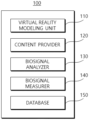
- FIG. 2 is a block diagram schematically illustrating the configuration of the system for providing VR contents for relaxation training in accordance with the embodiment of the present disclosure.
- a system 100 for providing VR contents for relaxation training in accordance with the embodiment of the present disclosure may include a VR modeling unit 110, a contents providing unit 120, a biological signal analysis unit 130 and a biological signal measurement unit 140.
- the system 100 may further include a database 150.
- the system for providing VR contents for relaxation training in accordance with the embodiment of the present disclosure may further include a motion chair 1 for further raising the actuality and reality of VR contents provided to a user.
- the system for providing VR contents for relaxation training operates as follows.
- the VR modeling unit 110 analyzes information received from a user through information stored in the database 150, and selectively provides the user with VR contents for relaxation training, suitable for the user, through the contents providing unit 120, while interworking with the contents providing unit 120 and the database 150.
- the biological signal measurement unit 140 measures a change in biological signal of the user by the VR contents, while interworking with the biological signal analysis unit 130.
- the biological signal analysis unit 130 analyzes the psychological stability of the user based on the change in biological signal, and transmits the analysis result value to the VR modeling unit 110.
- the contents providing unit 120 may be configured to form an image and sound such that the user watches and listens to the image and sound.
- the contents providing unit 120 is implemented as a device that provides the user with visual data, auditory data, tactile data and the like.
- the contents providing unit 120 may be implemented as a monitor or HMD (Head Mounted Display) which is equipped with a speaker and display and worn by the user.
- the contents providing unit 120 may be configured to include both of the HMD and the monitor.
- FIG. 3 is a block diagram illustrating the biological signal measurement unit 140 in accordance with the embodiment of the present disclosure.
- the biological signal measurement unit 140 in accordance with the embodiment of the present disclosure includes a first sensor module 141 and a second sensor module 142.
- the first sensor module 141 includes at least one sensing device configured to measure biological signals such as the electrocardiogram, the respiration volume and the respiration frequency of the user
- the second sensor module 142 includes at least measurement device configured to measure an HRV (Heart Rate Variability) of the user.
- the first sensor module 141 and the second sensor module 142 are disposed at the positions where the modules can measure biological signals of the user.
- the first sensor module 141 may be disposed in a belt of the motion chair 1 or a portion of the motion chair 1, which is touched by the user's arm or leg
- the second sensor module 142 may be disposed in a vest installed in the motion chair 1.
- the positions where the first and second sensor modules are disposed are not limited to the above-described examples, but may be disposed anywhere as long as the first and second sensor modules can measure biological signals of the user.
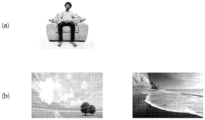
- FIGS. 4A and 4B are images showing VR contents for relaxation training in accordance with the embodiment of the present disclosure.
- the relaxation training provided by the present disclosure refers to a training process of training a patient to master a method of relaxing muscles, such that the patient can recover psychological stability by relaxing muscles when facing a psychological problem situation. That is, the contents for relaxation training include contents that guide the user to learn a method of relaxing muscles by repeating a motion of intentionally and gradually contracting the muscles of main body parts and then gradually relieving the muscles.
- the VR contents provided by the system in accordance with the embodiment of the present disclosure may include an image that makes the user feel like moving in a specific direction, as an image which is mainly constructed by blue and green backgrounds that are helpful in stabilizing the psychological state of the user.
- the VR contents may include a visual effect in which the user seems to walk or the body of the user seems to rise by itself.
- the VR contents may be formed to show a change to new place or scene with the movement.
- the image of the VR contents may be changed so that the view of the user is moved forward or vertically, while a change in movement of the image in a side-to-side direction is minimized.
- the VR contents for relaxation training in accordance with the embodiment of the present disclosure are composed of Stages 1 to 4.
- Stage 1 an image of FIG. 4A , in which a doctor describes a relaxation method, is provided to the contents providing unit 120, with a guide voice to guide a subject to perform the relaxation method.
- Stage 2 images of FIG. 4B , which make the subject feel like slowly flying over tall trees and grass, a road with the sky, a beach with waves, a valley or waterfall at a proper height, are outputted with the visual effect in which the body of the user seems to rise. Then, the user's biological signal is measured.
- Stage 3 the speed at which the subject flies in the sky is reduced, the speed at which the grass trembles is reduced, or the height of the waves is lowered according to the analysis result on the biological signal of the user, measured in Stage 2. Furthermore, the time during which each of the images is provided may be adjusted.
- Stage 4 the correlations between the contents and the user's psychological state are stored in the database 150, while the visual effect in which the user seems to slowly land on the ground is provided.
- the sounds of nature may also be provided as low sounds suitable for the respective images. Whenever each of the images is changed, a bell sound may come out.
- FIG. 5 is a flowchart illustrating a method for providing VR contents for relaxation training in accordance with a first embodiment of the present disclosure.
- the method for providing VR contents in accordance with the first embodiment includes a first step S100 in which the database 150 stores a plurality of VR contents for relaxation training and receives user information; a second step S200 in which the VR modeling unit 110 selects VR contents for relaxation training, which are configured to stabilize a user's psychological state, according to the user information received by the database 150, combines the selected VR contents and provides the combined VR contents to the user such that the user experiences the VR contents, and the biological signal measurement unit 140 measures a biological signal of the user; a third step S300 in which the biological signal analysis unit 130 calculates a change in biological signal of the user based on the biological signal of the user, measured in the second step, and analyzes the psychological state of the user according to the calculated change in biological signal; and a fourth step S400 in which the VR modeling unit 110 changes the VR contents provided to the user in the second step, in order to improve the psychological stability of the user according to the psychological state of the user, analyzed in the third step, and the biological signal measurement unit 140 measures
- the plurality of VR contents provided in the first step include the plurality of VR contents for relaxation training, which are described with reference to FIGS. 4A and 4B .
- the user information inputted to the database 150 may include the age of the user, the degree of a mental disease, the degree of dizziness and the like. Depending on a situation, the user information may be a medical interview result with a doctor.
- the plurality of VR contents combined by the VR modeling unit 110 may be composed of different images or formed as consecutive images.
- the VR modeling unit 110 combines the plurality of visual and auditory data based on the received user information, and outputs the combined data through the contents providing unit 120. For example, when the medical interview result data with the doctor says that the psychological anxiety of the user appears due to specific visual information and auditory information, the VR modeling unit 110 may remove the visual information and the auditory information, or exclude the visual information and the auditory information from the VR contents and then output the resultant VR contents. Furthermore, the VR modeling unit 110 changes the VR contents based on an addition or change of the received user information. For example, when information indicating that the dizziness has been relieved is inputted, the VR modeling unit 110 may change the type, output effect and output time of the VR contents, and then output the changed VR contents.
- the VR contents selected by the VR modeling unit include more green or blue backgrounds or have low output speed, as the age of the user is higher, the degree of the depression is higher, and the degree of the dizziness is higher. This is based on a search result saying that an image including more green or blue backgrounds can further stabilize the psychological state of a user, and an image whose output speed is low can further relieve the tension of the user who has relatively severe depression, easily feels dizziness, compared to a strong stimulus such as exposure training.
- the biological signal measurement unit 140 measures a biological signal of the user according to the VR contents provided to the user through the contents providing unit 120, and transmits the measured data to the biological signal analysis unit 130.
- the change in the biological signal may be configured as a breathing period, respiration volume or heart rate.
- the rate of change in the breathing period, the respiration volume or the heart rate is 20% and above, the VR modeling unit 110 determines that the psychological stability of the user has been lowered.
- the VR modeling unit 110 changes the VR contents provided in the second step in order to improve the psychological stability of the user, in the fourth step.
- the VR modeling unit 110 may change the image of the VR contents to an image including more blue and green backgrounds, or change the chroma and illuminance of the VR contents.
- the VR modeling unit 110 may repeatedly output the VR contents, which have been evaluated to most significantly improve the stability of the user based on the data stored in the database 150, by a predetermined number of times, or change the current VR contents to the VR contents which have been evaluated to most significantly improve the stability of the user based on the data stored in the database 150, when the psychological stability of the user is not changed or improved while the current VR contents are outputted.
- the VR modeling unit 110 may lower the output speed of the provided VR contents, or reduce the change rate of an object included in the VR contents. For example, the VR modeling unit 110 may lower the falling speed of water in an image showing a waterfall, or lower the height of waves in an image of a beach, in order to reduce the change rate of an object in the VR contents.
- FIG. 6 is a flowchart illustrating a method for providing VR contents in accordance with a second embodiment of the present disclosure.
- the method for providing VR contents in accordance with the second embodiment further includes a fifth step S500 of analyzing the correlation between the change in biological signal of the user, calculated in the fourth step S400, and the VR contents provided to the user in the first step S100, extracting VR contents which have been evaluated to most significantly improve the psychological stability of the user, and storing the extracted VR contents and the received user information in the database, in addition to the steps of the first embodiment.
- the extracting of the VR contents that have been evaluated to most significantly improve the psychological stability of the user includes extracting VR contents in which the LF/HF ratio mean value of the HRV signal of the user, measured in the first and fourth steps, is the lowest.
- the information on the VR contents stored in the database with the user information is reused as data for providing VR contents suitable for the user, when the VR contents are provided to the same user again.
Landscapes
- Health & Medical Sciences (AREA)
- Engineering & Computer Science (AREA)
- Life Sciences & Earth Sciences (AREA)
- General Health & Medical Sciences (AREA)
- Physics & Mathematics (AREA)
- Public Health (AREA)
- Biomedical Technology (AREA)
- Medical Informatics (AREA)
- Theoretical Computer Science (AREA)
- Psychology (AREA)
- Heart & Thoracic Surgery (AREA)
- Veterinary Medicine (AREA)
- Animal Behavior & Ethology (AREA)
- Anesthesiology (AREA)
- General Engineering & Computer Science (AREA)
- Psychiatry (AREA)
- Cardiology (AREA)
- General Physics & Mathematics (AREA)
- Pathology (AREA)
- Molecular Biology (AREA)
- Child & Adolescent Psychology (AREA)
- Biophysics (AREA)
- Surgery (AREA)
- Social Psychology (AREA)
- Hospice & Palliative Care (AREA)
- Developmental Disabilities (AREA)
- Epidemiology (AREA)
- Primary Health Care (AREA)
- Software Systems (AREA)
- Acoustics & Sound (AREA)
- Pain & Pain Management (AREA)
- Hematology (AREA)
- Human Computer Interaction (AREA)
- Educational Technology (AREA)
- Computer Graphics (AREA)
- Physiology (AREA)
- Computer Hardware Design (AREA)
- Audiology, Speech & Language Pathology (AREA)
- Radar, Positioning & Navigation (AREA)
- Remote Sensing (AREA)
Abstract
Description
- The present disclosure relates to a system for providing VR (Virtual Reality) contents for stabilizing the psychological state of a user through relaxation training and a method for providing virtual reality contents using the same, and particularly, to a system and method for providing VR contents, which model VR contents for relaxation training according to the psychological state of a user, provide the modeled VR contents such that the user experiences the VR contents, and provide VR contents more suitable for the user by analyzing a change in psychological state of the user according to the provided VR contents.
- Depression is a common mental disease that may cause various problems such as a poor personal relationship or job disruption. In a severe case, depression may cause a serious result such as a suicide. In particular, depression is considered as a kind of cold to modern people.
- In most cases, various mental diseases such as depression are caused by complex factors in which a biological factor and a psychological or social factor are combined. In order to treat such mental diseases which are caused by the complex factors, various methods such as exercise, meditation therapy, medicine treatment and psychology counseling are suggested.
- However, it is not easy for a patient to try on his/her own to overcome a psychological disorder through the exercise or meditation therapy. Furthermore, although the patient relies on the medicine treatment, it is difficult to expect satisfactory treatment efficiency. The psychological counseling is considered as the most effective method. In many cases, however, patients tend to avoid the psychological counseling due to surrounding peoples' stares.
- In consideration of such aspects, a VR (Virtual Reality)-based treatment is currently used to treat a patient who suffers from a phobia such as acrophobia or claustrophobia, among mental diseases. That is, the VR-based treatment exposes a patient to a situation or object that creates a sense of fear, such that the patient is trained to try to avoid the situation on his/her own.
- However, when VR is used for mental disease treatment, the exposure training may rather maximize a user's sense of fear, thereby worsening the mental disease.
- In order to solve such a problem, one of VR control technologies used for mental disease treatment is disclosed in
Korean Patent Application Publication No. 10-2018-0094892 Patent Document 1 may provide VR contents which are provided with breathing training contents which guide and train a user to breathe in a correct breathing pattern in order to relax the user's stress, and drive a motion chair in synchronization with the VR contents, in order to effectively stabilize the psychological state of the user. - However, such a system and method cannot reconstruct the VR contents according to the degree of the user's uneasiness, and thus have difficulties in determining the treatment progress, and taking a proper action or discovering side effects, the proper action including correcting the future treatment plan or changing the treatment method.
- Various embodiments are directed to a system and method for providing VR contents, which can measure a change in biological signal of a user in real time, analyze the psychological state of the user, and effectively improve the psychological state of the user.
- Also, various embodiments are directed to a system and method for providing VR contents, which can provide a plurality of VR contents for relaxation training to a user who suffers from depression and anxiety, analyze the correlation between the provided VR contents and the psychological state of the user, extract only VR contents which have been evaluated to most significantly improve the psychological stability of the user, reconfigure new VR contents, and provide contents suitable for the user.
- The present disclosure relates to a system for providing VR contents for relaxation training to stabilize the psychological stability of a user.
- In an embodiment, there is provided a system for providing VR (Virtual Reality) contents for relaxation training to stabilize the psychological state of a user. The system may include: a contents providing unit configured to provide VR contents to a user such that the user experiences the VR contents; a VR modeling unit configured to receive information from the user, model the VR contents for stabilizing the psychological state of the user, based on the received user information, and provide the modeled VR contents to the contents providing unit; a biological signal measurement unit configured to measure a biological signal of the user; and a biological signal analysis unit configured to analyze the psychological state of the user according to the experience of the VR contents, based on a change in the measured biological signal of the user. The VR modeling unit may remodel the VR contents according to the psychological state of the user, analyzed by the biological signal analysis unit.
- The VR modeling unit may have a plurality of VR contents each composed of a series of images and sounds, extract VR contents suitable for the psychological state of the user, among the plurality of VR contents, based on the user information received from the user, and provide the extracted VR contents to the contents providing unit.
- The VR contents may be configured as a video in which an object changes. The VR modeling unit may change the change speed of the object in the video based on the psychological state of the user, analyzed by the biological signal analysis unit, and provide the changed VR contents to the contents providing unit.
- The VR modeling unit may analyze the correlation between the VR contents experienced by the user and the psychological stability of the user, analyzed by the biological signal analysis unit, extract the VR contents that have been evaluated to most significantly improve the psychological stability of the user, among the plurality of VR contents, and store the extracted VR contents in a database with the received user information.
- Therefore, the system for providing VR contents in accordance with an aspect of the present disclosure may measure a change in biological signal of a user in real time, analyze the psychological state of the user according to the biological signal, and provide VR contents to effectively improve the psychological stability of the user based on the analysis result.
- The biological signal measurement unit may include: a first sensor module configured to measure a biological signal of the user; and a second sensor module configured to measure an HRV (Heart Rate Variability) signal of the user.
- The biological signal analysis unit may determine that the psychological stability of the user is low, when the rate of change in the biological signal of the user, measured by the first sensor module, is 20% and above.
- Therefore, the system for providing VR contents for relaxation training in accordance with an aspect of the present disclosure may acquire a more accurate measurement value for the psychological stability of the user than when only the heart rate or breathing signal of the user is measured.
- In an embodiment, there is provided a method for providing VR contents for relaxation training to a user by using a VR apparatus to stabilize the psychological state of the user. The method may include: providing a plurality of VR contents; an information input step of receiving user information; a first contents providing step of selecting VR contents to stabilize the psychological state of a user according to the received user information, and measuring a biological signal of the user while providing the selected VR contents to the user such that the user experiences the VR contents; an analysis step of calculating a change in the biological signal of the user based on the biological signal of the user, measured in the first contents providing step, and analyzing the psychological state of the user according to the calculated change in the biological signal; and a second contents providing step of changing the VR contents provided in the first contents providing step so as to improve the psychological stability of the user according to the analysis result of the analysis step, and measuring a biological signal of the user.
- The method may further include a storage step of analyzing the correlations between the changes in the biological signal of the user, calculated in the first and second VR contents providing steps, and the VR contents provided to the user, extracting the VR contents that have been evaluated to most significantly improve the psychological stability of the user, and storing the extracted VR contents in a database with the received user information.
- The analysis step may include determining that the psychological stability of the user is low, when the rate of change in the biological signal of the user is 20% and above, and the VR contents selected in the second contents providing step may be different from the VR contents which are provided in the first contents providing step and in which the psychological stability of the user are determined to be low.
- The biological signal of the user may include an HRV signal, and the VR contents where the psychological stability of the user may be the highest are VR contents where the LF/HF ratio mean value of the HRV signal is the lowest.
- In an embodiment, there is provided a computer readable recording medium in which a program for implementing the above-described method is recorded.
- In accordance with the embodiments of the present disclosure, the system and method for providing VR contents in accordance with an aspect of the present disclosure may measure a change in biological signal of a user in real time, analyze the psychological state of the user according to the biological signal, and provide VR contents to effectively improve the psychological stability of the user based on the analysis result.
- Furthermore, the system and method for providing VR contents for relaxation training may acquire a more accurate measurement value for the psychological stability of the user than when only the heart rate or breathing signal of the user is measured.
-
-
FIG. 1 is a diagram illustrating a system for providing VR contents for relaxation training in accordance with an embodiment of the present disclosure. -
FIG. 2 is a block diagram illustrating the system for providing VR contents for relaxation training in accordance with the embodiment of the present disclosure. -
FIG. 3 is a block diagram illustrating a biological signal measurement unit in accordance with the embodiment of the present disclosure. -
FIGS. 4A and 4B are images showing VR contents which may construct the VR contents for relaxation training in accordance with the embodiment of the present disclosure. -
FIG. 5 is a flowchart illustrating a method for providing VR contents for relaxation training in accordance with a first embodiment of the present disclosure. -
FIG. 6 is a flowchart illustrating a method for providing VR contents for relaxation training in accordance with a second embodiment of the present disclosure. - The present disclosure relates to a system for providing VR (Virtual Reality) contents for relaxation training to stabilize the psychological state of a user.
- In an embodiment, there is provided a system for providing VR (Virtual Reality) contents for relaxation training to stabilize the psychological state of a user. The system may include: a contents providing unit configured to provide VR contents to a user such that the user experiences the VR contents; a VR modeling unit configured to receive information from the user, model the VR contents for stabilizing the psychological state of the user, based on the received user information, and provide the modeled VR contents to the contents providing unit; a biological signal measurement unit configured to measure a biological signal of the user; and a biological signal analysis unit configured to analyze the psychological state of the user according to the experience of the VR contents, based on a change in the measured biological signal of the user. The VR modeling unit may remodel the VR contents according to the psychological state of the user, analyzed by the biological signal analysis unit.
- The VR modeling unit may have a plurality of VR contents each composed of a series of images and sounds, extract VR contents suitable for the psychological state of the user, among the plurality of VR contents, based on the user information received from the user, and provide the extracted VR contents to the contents providing unit.
- The VR contents may be configured as a video in which an object changes. The VR modeling unit may change the change speed of the object in the video based on the psychological state of the user, analyzed by the biological signal analysis unit, and provide the changed VR contents to the contents providing unit.
- The VR modeling unit may analyze the correlation between the VR contents experienced by the user and the psychological stability of the user, analyzed by the biological signal analysis unit, extract the VR contents that have been evaluated to most significantly improve the psychological stability of the user, among the plurality of VR contents, and store the extracted VR contents in a database with the received user information.
- Therefore, the system and method for providing VR contents in accordance with an aspect of the present disclosure may measure a change in biological signal of a user in real time, analyze the psychological state of the user according to the biological signal, and provide VR contents to effectively improve the psychological stability of the user based on the analysis result.
- The biological signal measurement unit may include: a first sensor module configured to measure a biological signal of the user; and a second sensor module configured to measure an HRV (Heart Rate Variability) signal of the user.
- The biological signal analysis unit may determine that the psychological stability of the user is low, when the rate of change in the biological signal of the user, measured by the first sensor module, is 20% and above.
- Therefore, the system and method for providing VR contents for relaxation training in accordance with an aspect of the present disclosure may acquire a more accurate measurement value for the psychological stability of the user than when only the heart rate or breathing signal of the user is measured.
- In an embodiment, there is provided a method for providing VR contents for relaxation training to a user by using a VR apparatus to stabilize the psychological state of the user. The method may include: providing a plurality of VR contents; an information input step of receiving user information; a first contents providing step of selecting VR contents to stabilize the psychological state of a user according to the received user information, and measuring a biological signal of the user while providing the selected VR contents to the user such that the user experiences the VR contents; an analysis step of calculating a change in the biological signal of the user based on the biological signal of the user, measured in the first contents providing step, and analyzing the psychological state of the user according to the calculated change in the biological signal; and a second contents providing step of changing the VR contents provided in the first contents providing step so as to improve the psychological stability of the user according to the analysis result of the analysis step, and measuring a biological signal of the user.
- The method may further include a storage step of analyzing the correlations between the changes in the biological signal of the user, calculated in the first and second VR contents providing steps, and the VR contents provided to the user, extracting the VR contents that have been evaluated to most significantly improve the psychological stability of the user, and storing the extracted VR contents in a database with the received user information.
- The analysis step may include determining that the psychological stability of the user is low, when the rate of change in the biological signal of the user is 20% and above, and the VR contents selected in the second contents providing step may be different from the VR contents which are provided in the first contents providing step and in which the psychological stability of the user are determined to be low.
- The biological signal of the user may include an HRV signal, and the VR contents where the psychological stability of the user may be the highest are VR contents where the LF/HF ratio mean value of the HRV signal is the lowest.
- In an embodiment, there is provided a computer readable recording medium in which a program for implementing the above-described method is recorded.
- Hereafter, a system and method for providing VR contents for relaxation training in accordance with the present disclosure and components involved in the operation of the system and method for providing VR contents for relaxation training will be described, as concrete contents for carrying out the present disclosure, with reference to the drawings.
-
FIG. 1 is a diagram illustrating a system for providing VR contents for relaxation training in accordance with an embodiment of the present disclosure, andFIG. 2 is a block diagram schematically illustrating the configuration of the system for providing VR contents for relaxation training in accordance with the embodiment of the present disclosure. Referring toFIGS. 1 and2 , asystem 100 for providing VR contents for relaxation training in accordance with the embodiment of the present disclosure may include aVR modeling unit 110, acontents providing unit 120, a biologicalsignal analysis unit 130 and a biologicalsignal measurement unit 140. Thesystem 100 may further include adatabase 150. - Referring to
FIG. 1 , the system for providing VR contents for relaxation training in accordance with the embodiment of the present disclosure may further include amotion chair 1 for further raising the actuality and reality of VR contents provided to a user. - The system for providing VR contents for relaxation training operates as follows. The
VR modeling unit 110 analyzes information received from a user through information stored in thedatabase 150, and selectively provides the user with VR contents for relaxation training, suitable for the user, through thecontents providing unit 120, while interworking with thecontents providing unit 120 and thedatabase 150. The biologicalsignal measurement unit 140 measures a change in biological signal of the user by the VR contents, while interworking with the biologicalsignal analysis unit 130. The biologicalsignal analysis unit 130 analyzes the psychological stability of the user based on the change in biological signal, and transmits the analysis result value to theVR modeling unit 110. - The
contents providing unit 120 may be configured to form an image and sound such that the user watches and listens to the image and sound. For example, thecontents providing unit 120 is implemented as a device that provides the user with visual data, auditory data, tactile data and the like. In accordance with an embodiment, thecontents providing unit 120 may be implemented as a monitor or HMD (Head Mounted Display) which is equipped with a speaker and display and worn by the user. Thecontents providing unit 120 may be configured to include both of the HMD and the monitor. -
FIG. 3 is a block diagram illustrating the biologicalsignal measurement unit 140 in accordance with the embodiment of the present disclosure. - Referring to
FIG. 3 , the biologicalsignal measurement unit 140 in accordance with the embodiment of the present disclosure includes afirst sensor module 141 and asecond sensor module 142. - In accordance with the embodiment of the present disclosure, the
first sensor module 141 includes at least one sensing device configured to measure biological signals such as the electrocardiogram, the respiration volume and the respiration frequency of the user, and thesecond sensor module 142 includes at least measurement device configured to measure an HRV (Heart Rate Variability) of the user. Thefirst sensor module 141 and thesecond sensor module 142 are disposed at the positions where the modules can measure biological signals of the user. For example, thefirst sensor module 141 may be disposed in a belt of themotion chair 1 or a portion of themotion chair 1, which is touched by the user's arm or leg, and thesecond sensor module 142 may be disposed in a vest installed in themotion chair 1. However, the positions where the first and second sensor modules are disposed are not limited to the above-described examples, but may be disposed anywhere as long as the first and second sensor modules can measure biological signals of the user. -
FIGS. 4A and 4B are images showing VR contents for relaxation training in accordance with the embodiment of the present disclosure. - The relaxation training provided by the present disclosure refers to a training process of training a patient to master a method of relaxing muscles, such that the patient can recover psychological stability by relaxing muscles when facing a psychological problem situation. That is, the contents for relaxation training include contents that guide the user to learn a method of relaxing muscles by repeating a motion of intentionally and gradually contracting the muscles of main body parts and then gradually relieving the muscles.
- Furthermore, the VR contents provided by the system in accordance with the embodiment of the present disclosure may include an image that makes the user feel like moving in a specific direction, as an image which is mainly constructed by blue and green backgrounds that are helpful in stabilizing the psychological state of the user. The VR contents may include a visual effect in which the user seems to walk or the body of the user seems to rise by itself. In this case, the VR contents may be formed to show a change to new place or scene with the movement. The image of the VR contents may be changed so that the view of the user is moved forward or vertically, while a change in movement of the image in a side-to-side direction is minimized.
- Referring to
FIG. 4A and 4B , the VR contents for relaxation training in accordance with the embodiment of the present disclosure are composed ofStages 1 to 4. - In
Stage 1, an image ofFIG. 4A , in which a doctor describes a relaxation method, is provided to thecontents providing unit 120, with a guide voice to guide a subject to perform the relaxation method. - In Stage 2, images of
FIG. 4B , which make the subject feel like slowly flying over tall trees and grass, a road with the sky, a beach with waves, a valley or waterfall at a proper height, are outputted with the visual effect in which the body of the user seems to rise. Then, the user's biological signal is measured. - In Stage 3, the speed at which the subject flies in the sky is reduced, the speed at which the grass trembles is reduced, or the height of the waves is lowered according to the analysis result on the biological signal of the user, measured in Stage 2. Furthermore, the time during which each of the images is provided may be adjusted.
- In Stage 4, the correlations between the contents and the user's psychological state are stored in the
database 150, while the visual effect in which the user seems to slowly land on the ground is provided. - In Stages 1 to 4, the sounds of nature may also be provided as low sounds suitable for the respective images. Whenever each of the images is changed, a bell sound may come out.
-
FIG. 5 is a flowchart illustrating a method for providing VR contents for relaxation training in accordance with a first embodiment of the present disclosure. - Referring to
FIG. 5 , the method for providing VR contents in accordance with the first embodiment includes a first step S100 in which thedatabase 150 stores a plurality of VR contents for relaxation training and receives user information; a second step S200 in which theVR modeling unit 110 selects VR contents for relaxation training, which are configured to stabilize a user's psychological state, according to the user information received by thedatabase 150, combines the selected VR contents and provides the combined VR contents to the user such that the user experiences the VR contents, and the biologicalsignal measurement unit 140 measures a biological signal of the user; a third step S300 in which the biologicalsignal analysis unit 130 calculates a change in biological signal of the user based on the biological signal of the user, measured in the second step, and analyzes the psychological state of the user according to the calculated change in biological signal; and a fourth step S400 in which theVR modeling unit 110 changes the VR contents provided to the user in the second step, in order to improve the psychological stability of the user according to the psychological state of the user, analyzed in the third step, and the biologicalsignal measurement unit 140 measures a biological signal of the user. - The plurality of VR contents provided in the first step include the plurality of VR contents for relaxation training, which are described with reference to
FIGS. 4A and 4B . Furthermore, the user information inputted to thedatabase 150 may include the age of the user, the degree of a mental disease, the degree of dizziness and the like. Depending on a situation, the user information may be a medical interview result with a doctor. - In the second step, the plurality of VR contents combined by the
VR modeling unit 110 may be composed of different images or formed as consecutive images. TheVR modeling unit 110 combines the plurality of visual and auditory data based on the received user information, and outputs the combined data through thecontents providing unit 120. For example, when the medical interview result data with the doctor says that the psychological anxiety of the user appears due to specific visual information and auditory information, theVR modeling unit 110 may remove the visual information and the auditory information, or exclude the visual information and the auditory information from the VR contents and then output the resultant VR contents. Furthermore, theVR modeling unit 110 changes the VR contents based on an addition or change of the received user information. For example, when information indicating that the dizziness has been relieved is inputted, theVR modeling unit 110 may change the type, output effect and output time of the VR contents, and then output the changed VR contents. - Furthermore, the VR contents selected by the VR modeling unit include more green or blue backgrounds or have low output speed, as the age of the user is higher, the degree of the depression is higher, and the degree of the dizziness is higher. This is based on a search result saying that an image including more green or blue backgrounds can further stabilize the psychological state of a user, and an image whose output speed is low can further relieve the tension of the user who has relatively severe depression, easily feels dizziness, compared to a strong stimulus such as exposure training.
- Furthermore, in the second step, the biological
signal measurement unit 140 measures a biological signal of the user according to the VR contents provided to the user through thecontents providing unit 120, and transmits the measured data to the biologicalsignal analysis unit 130. - In the third stage, the change in the biological signal may be configured as a breathing period, respiration volume or heart rate. When the rate of change in the breathing period, the respiration volume or the heart rate is 20% and above, the
VR modeling unit 110 determines that the psychological stability of the user has been lowered. - When the analysis result of the third step indicates that the psychological stability of the user has been lowered, the
VR modeling unit 110 changes the VR contents provided in the second step in order to improve the psychological stability of the user, in the fourth step. - For example, the
VR modeling unit 110 may change the image of the VR contents to an image including more blue and green backgrounds, or change the chroma and illuminance of the VR contents. Alternatively, theVR modeling unit 110 may repeatedly output the VR contents, which have been evaluated to most significantly improve the stability of the user based on the data stored in thedatabase 150, by a predetermined number of times, or change the current VR contents to the VR contents which have been evaluated to most significantly improve the stability of the user based on the data stored in thedatabase 150, when the psychological stability of the user is not changed or improved while the current VR contents are outputted. - Furthermore, the
VR modeling unit 110 may lower the output speed of the provided VR contents, or reduce the change rate of an object included in the VR contents. For example, theVR modeling unit 110 may lower the falling speed of water in an image showing a waterfall, or lower the height of waves in an image of a beach, in order to reduce the change rate of an object in the VR contents. -
FIG. 6 is a flowchart illustrating a method for providing VR contents in accordance with a second embodiment of the present disclosure. - Referring to
FIG. 6 , the method for providing VR contents in accordance with the second embodiment further includes a fifth step S500 of analyzing the correlation between the change in biological signal of the user, calculated in the fourth step S400, and the VR contents provided to the user in the first step S100, extracting VR contents which have been evaluated to most significantly improve the psychological stability of the user, and storing the extracted VR contents and the received user information in the database, in addition to the steps of the first embodiment. - In the fifth step, the extracting of the VR contents that have been evaluated to most significantly improve the psychological stability of the user includes extracting VR contents in which the LF/HF ratio mean value of the HRV signal of the user, measured in the first and fourth steps, is the lowest.
- In the fifth step, the information on the VR contents stored in the database with the user information is reused as data for providing VR contents suitable for the user, when the VR contents are provided to the same user again.
- So far, the embodiments of the present disclosure have been described. However, the present disclosure is not limited to the configurations of the system for providing VR contents in accordance with the embodiments, but may be variously modified and changed without departing from the scope described in claims.
- While various embodiments have been described above, it will be understood to those skilled in the art that the embodiments described are by way of example only. Accordingly, the disclosure described herein should not be limited based on the described embodiments.
Claims (12)
- A system for providing VR (Virtual Reality) contents for relaxation training to stabilize the psychological state of a user, the system comprising:a contents providing unit configured to provide VR contents to a user such that the user experiences the VR contents;a VR modeling unit configured to receive information from the user, model the VR contents for stabilizing the psychological state of the user, based on the received user information, and provide the modeled VR contents to the contents providing unit;a biological signal measurement unit configured to measure a biological signal of the user; anda biological signal analysis unit configured to analyze the psychological state of the user according to the experience of the VR contents, based on a change in the measured biological signal of the user,wherein the VR modeling unit remodels the VR contents according to the psychological state of the user, analyzed by the biological signal analysis unit.
- The system of claim 1, wherein the VR modeling unit has a plurality of VR contents each composed of a series of images and sounds, extracts VR contents suitable for the psychological state of the user, among the plurality of VR contents, based on the user information received from the user, and provides the extracted VR contents to the contents providing unit.
- The system of claim 1, wherein the VR contents are configured as a video in which an object changes,
wherein the VR modeling unit changes the change speed of the object in the video based on the psychological state of the user, analyzed by the biological signal analysis unit, and provides the changed VR contents to the contents providing unit. - The system of claim 2 or 3, wherein the VR modeling unit analyzes the correlation between the VR contents experienced by the user and the psychological stability of the user, analyzed by the biological signal analysis unit, extracts the VR contents that have been evaluated to most significantly improve the psychological stability of the user, among the plurality of VR contents, and stores the extracted VR contents in a database with the received user information.
- The system of claim 4, wherein the biological signal measurement unit comprises:a first sensor module configured to measure a biological signal of the user; anda second sensor module configured to measure an HRV (Heart Rate Variability) signal of the user.
- The system of claim 5, wherein the biological signal analysis unit determines that the psychological stability of the user is low, when the rate of change in the biological signal of the user, measured by the first sensor module, is 20% and above.
- The system of claim 5, wherein when the LF/HF ratio mean value of the HRV signal of the user, measured by the second sensor module according to the VR contents, is the lowest, the biological signal analysis unit determines that the psychological stability of the user is high.
- A method for providing VR contents for relaxation training to a user by using a VR apparatus to stabilize the psychological state of the user, the method comprising:providing a plurality of VR contents;an information input step of receiving user information;a first contents providing step of selecting VR contents to stabilize the psychological state of a user according to the received user information, and measuring a biological signal of the user while providing the selected VR contents to the user such that the user experiences the VR contents;an analysis step of calculating a change in the biological signal of the user based on the biological signal of the user, measured in the first contents providing step, and analyzing the psychological state of the user according to the calculated change in the biological signal; anda second contents providing step of changing the VR contents provided in the first contents providing step so as to improve the psychological stability of the user according to the analysis result of the analysis step, and measuring a biological signal of the user.
- The method of claim 8, further comprising a storage step of analyzing the correlations between the changes in the biological signal of the user, calculated in the first and second VR contents providing steps, and the VR contents provided to the user, extracting the VR contents that have been evaluated to most significantly improve the psychological stability of the user, and storing the extracted VR contents in a database with the received user information.
- The method of claim 8, wherein the analysis step comprises determining that the psychological stability of the user is low, when the rate of change in the biological signal of the user is 20% and above,
wherein the VR contents selected in the second contents providing step are different from the VR contents which are provided in the first contents providing step and in which the psychological stability of the user are determined to be low. - The method of claim 9, wherein the biological signal of the user comprises an HRV signal,
wherein the VR contents where the psychological stability of the user is the highest are VR contents where the LF/HF ratio mean value of the HRV signal is the lowest. - A computer readable recording medium in which a program for implementing the method of any one of claims 8 to 11 is recorded.
Applications Claiming Priority (2)
| Application Number | Priority Date | Filing Date | Title |
|---|---|---|---|
| KR1020200091292A KR102461909B1 (en) | 2020-07-22 | 2020-07-22 | System and method for providing virtual-reality contents for relaxation training to the user so that the user's phychology is stabilized |
| PCT/KR2021/008801 WO2022019545A1 (en) | 2020-07-22 | 2021-07-09 | System and method for providing virtual reality content for relaxation training to user so as to stabilize user's psychological state |
Publications (2)
| Publication Number | Publication Date |
|---|---|
| EP4186554A1 true EP4186554A1 (en) | 2023-05-31 |
| EP4186554A4 EP4186554A4 (en) | 2024-08-28 |
Family
ID=79729261
Family Applications (1)
| Application Number | Title | Priority Date | Filing Date |
|---|---|---|---|
| EP21845807.3A Withdrawn EP4186554A4 (en) | 2020-07-22 | 2021-07-09 | System and method for providing virtual reality content for relaxation training to user so as to stabilize user's psychological state |
Country Status (6)
| Country | Link |
|---|---|
| US (1) | US12613569B2 (en) |
| EP (1) | EP4186554A4 (en) |
| JP (1) | JP2023537255A (en) |
| KR (2) | KR102461909B1 (en) |
| CN (1) | CN116133593A (en) |
| WO (1) | WO2022019545A1 (en) |
Families Citing this family (2)
| Publication number | Priority date | Publication date | Assignee | Title |
|---|---|---|---|---|
| KR102508601B1 (en) * | 2022-08-01 | 2023-03-15 | 주식회사 한국명상교육진흥원 | System for providing digital therapy service using meditation simulation |
| JP2025028636A (en) * | 2023-08-18 | 2025-03-03 | Cyberdyne株式会社 | SPACE SHARING SYSTEM AND SPACE SHARING METHOD |
Family Cites Families (24)
| Publication number | Priority date | Publication date | Assignee | Title |
|---|---|---|---|---|
| JP2005018167A (en) * | 2003-06-23 | 2005-01-20 | Softopia Japan Foundation | Biological reaction utilization device control apparatus and device control method |
| CN101198277B (en) * | 2005-02-22 | 2011-06-15 | 海尔思-斯玛特有限公司 | Systems for physiological and psycho-physiological monitoring |
| US9380978B2 (en) * | 2011-06-29 | 2016-07-05 | Bruce Reiner | Method and apparatus for real-time measurement and analysis of occupational stress and fatigue and performance outcome predictions |
| US9213403B1 (en) * | 2013-03-27 | 2015-12-15 | Google Inc. | Methods to pan, zoom, crop, and proportionally move on a head mountable display |
| US9872968B2 (en) * | 2013-04-17 | 2018-01-23 | Sri International | Biofeedback virtual reality sleep assistant |
| US20140378810A1 (en) * | 2013-04-18 | 2014-12-25 | Digimarc Corporation | Physiologic data acquisition and analysis |
| WO2015044851A2 (en) * | 2013-09-25 | 2015-04-02 | Mindmaze Sa | Physiological parameter measurement and feedback system |
| US10912915B2 (en) * | 2015-11-03 | 2021-02-09 | Itai ARGAMAN | Apparatus, system and method of multisensory stimulation |
| US10475351B2 (en) * | 2015-12-04 | 2019-11-12 | Saudi Arabian Oil Company | Systems, computer medium and methods for management training systems |
| US10628770B2 (en) * | 2015-12-14 | 2020-04-21 | Saudi Arabian Oil Company | Systems and methods for acquiring and employing resiliency data for leadership development |
| DE102015225537B4 (en) | 2015-12-17 | 2019-11-14 | Carl Zeiss Smt Gmbh | Device for aligning a component, actuating device and projection exposure device |
| CN105708436A (en) * | 2016-04-18 | 2016-06-29 | 深圳竹信科技有限公司 | Mental regulation method and device |
| CN105893780B (en) * | 2016-05-10 | 2019-04-09 | 广州博观文语科技有限公司 | Based on the interactive psychiatric appraisal procedure monitored with brain wave and brain blood flow of VR |
| US10482669B2 (en) * | 2016-09-23 | 2019-11-19 | Apple Inc. | Augmented virtual display |
| US9953650B1 (en) * | 2016-12-08 | 2018-04-24 | Louise M Falevsky | Systems, apparatus and methods for using biofeedback for altering speech |
| EP3565464A4 (en) * | 2017-01-04 | 2020-10-14 | Storyup, Inc. | SYSTEM AND METHOD OF MODIFYING A BIOMETRIC ACTIVITY USING A THERAPY OF VIRTUAL REALITY |
| WO2018218356A1 (en) * | 2017-05-30 | 2018-12-06 | Interaxon Inc. | Wearable computing device with electrophysiological sensors |
| WO2019036051A1 (en) * | 2017-08-18 | 2019-02-21 | VRHealth Ltd | Biofeedback for therapy in virtual and augmented reality |
| KR20190020418A (en) * | 2017-08-21 | 2019-03-04 | 주식회사 엠투에스 | Virtual Reality Monitoring System Using Virtual Reality and Psychotherapy Using the Same |
| US11687800B2 (en) * | 2017-08-30 | 2023-06-27 | P Tech, Llc | Artificial intelligence and/or virtual reality for activity optimization/personalization |
| US20190160286A1 (en) * | 2017-11-27 | 2019-05-30 | National Cheng Kung University | Apparatus and uses thereof |
| KR102274918B1 (en) * | 2018-08-14 | 2021-07-09 | 사회복지법인 삼성생명공익재단 | The stress relaxation system and stress relaxation method by the system |
| KR102365118B1 (en) * | 2018-10-29 | 2022-02-22 | 사회복지법인 삼성생명공익재단 | The biological signal analysis system and biological signal analysis method for operating by the system |
| CN110806803A (en) * | 2019-11-01 | 2020-02-18 | 山东大学 | Integrated interactive system based on virtual reality and multi-source information fusion |
-
2020
- 2020-07-22 KR KR1020200091292A patent/KR102461909B1/en active Active
-
2021
- 2021-07-09 JP JP2023504435A patent/JP2023537255A/en active Pending
- 2021-07-09 WO PCT/KR2021/008801 patent/WO2022019545A1/en not_active Ceased
- 2021-07-09 US US17/608,358 patent/US12613569B2/en active Active
- 2021-07-09 EP EP21845807.3A patent/EP4186554A4/en not_active Withdrawn
- 2021-07-09 CN CN202180049942.7A patent/CN116133593A/en active Pending
-
2022
- 2022-09-27 KR KR1020220122097A patent/KR20220136973A/en not_active Withdrawn
Also Published As
| Publication number | Publication date |
|---|---|
| EP4186554A4 (en) | 2024-08-28 |
| US20220179480A1 (en) | 2022-06-09 |
| US12613569B2 (en) | 2026-04-28 |
| CN116133593A (en) | 2023-05-16 |
| KR102461909B1 (en) | 2022-11-01 |
| WO2022019545A1 (en) | 2022-01-27 |
| KR20220012497A (en) | 2022-02-04 |
| JP2023537255A (en) | 2023-08-31 |
| KR20220136973A (en) | 2022-10-11 |
Similar Documents
| Publication | Publication Date | Title |
|---|---|---|
| KR102595088B1 (en) | The virtual reality contents control system and the virtual reality contents control method operating by the same | |
| JP6503519B2 (en) | Detection device | |
| KR100616370B1 (en) | Methods and apparatus for promoting physiological coherence and autonomic balance | |
| AU2017386412A1 (en) | Systems and methods for real-time data quantification, acquisition, analysis, and feedback | |
| MXPA06010498A (en) | Methods and devices for relieving stress. | |
| KR20150095661A (en) | Method and Device for Determining Vital Parameters | |
| EP2072094A1 (en) | Sound producing device which uses physiological information | |
| JP2007512860A (en) | Systems and methods for promoting physiological harmony using respiratory training | |
| JP2004294593A (en) | Training support device | |
| CN113180944A (en) | Intelligent system therapeutic instrument | |
| US12613569B2 (en) | System and method for providing virtual reality contents for relaxation training to stabilize psychological state of user | |
| CN113952580A (en) | Method, device, equipment and storage medium for training of memorial meditation | |
| CN116807476A (en) | Multi-mode psychological health assessment system and method based on interface type emotion interaction | |
| CN103501849A (en) | System and method to trigger breathing response for reduction of associated anxiety | |
| KR102274918B1 (en) | The stress relaxation system and stress relaxation method by the system | |
| WO2019077304A1 (en) | Device and method for guiding breathing of a user | |
| CN116807473A (en) | Diphase affective disorder auxiliary diagnosis and treatment system based on virtual digital panorama | |
| KR20220012139A (en) | System and method for providing virtual-reality contents for cognitive behavior training to the user so that the user's phychology is stabilized | |
| Gonzalez et al. | Fear levels in virtual environments, an approach to detection and experimental user stimuli sensation | |
| Janidarmian et al. | Haptic feedback and human performance in a wearable sensor system | |
| KR102901081B1 (en) | Method and system for providing digital content information | |
| Kavitha et al. | Drowning detection and security in falls with IoT server | |
| KR101722690B1 (en) | Apparatus and method for providing contents related to taking a medical image | |
| CN120809095B (en) | Preoperative anxiety relieving method and system based on virtual reality technology | |
| Portanti | Development of a VR scenario for controlled box breathing exercises with heart rate and respiratory pattern biofeedback using embedded headset sensors |
Legal Events
| Date | Code | Title | Description |
|---|---|---|---|
| STAA | Information on the status of an ep patent application or granted ep patent |
Free format text: STATUS: THE INTERNATIONAL PUBLICATION HAS BEEN MADE |
|
| PUAI | Public reference made under article 153(3) epc to a published international application that has entered the european phase |
Free format text: ORIGINAL CODE: 0009012 |
|
| STAA | Information on the status of an ep patent application or granted ep patent |
Free format text: STATUS: REQUEST FOR EXAMINATION WAS MADE |
|
| 17P | Request for examination filed |
Effective date: 20230220 |
|
| AK | Designated contracting states |
Kind code of ref document: A1 Designated state(s): AL AT BE BG CH CY CZ DE DK EE ES FI FR GB GR HR HU IE IS IT LI LT LU LV MC MK MT NL NO PL PT RO RS SE SI SK SM TR |
|
| RAP1 | Party data changed (applicant data changed or rights of an application transferred) |
Owner name: MEDITRIX CO., LTD. |
|
| DAV | Request for validation of the european patent (deleted) | ||
| DAX | Request for extension of the european patent (deleted) | ||
| REG | Reference to a national code |
Ref country code: DE Ref legal event code: R079 Free format text: PREVIOUS MAIN CLASS: A61M0021020000 Ipc: G16H0020700000 |
|
| A4 | Supplementary search report drawn up and despatched |
Effective date: 20240730 |
|
| RIC1 | Information provided on ipc code assigned before grant |
Ipc: G06F 3/16 20060101ALI20240724BHEP Ipc: A61M 21/00 20060101ALI20240724BHEP Ipc: G06T 19/00 20110101ALI20240724BHEP Ipc: A61B 5/024 20060101ALI20240724BHEP Ipc: A61B 5/16 20060101ALI20240724BHEP Ipc: A61M 21/02 20060101ALI20240724BHEP Ipc: G16H 50/30 20180101ALI20240724BHEP Ipc: G16H 50/20 20180101ALI20240724BHEP Ipc: G16H 40/60 20180101ALI20240724BHEP Ipc: G16H 20/70 20180101AFI20240724BHEP |
|
| STAA | Information on the status of an ep patent application or granted ep patent |
Free format text: STATUS: EXAMINATION IS IN PROGRESS |
|
| 17Q | First examination report despatched |
Effective date: 20260120 |
|
| STAA | Information on the status of an ep patent application or granted ep patent |
Free format text: STATUS: THE APPLICATION HAS BEEN WITHDRAWN |
|
| 18W | Application withdrawn |
Effective date: 20260312 |