EP4185945B1 - Modellierung des räumlichen ausmasses für volumetrische audioquellen - Google Patents
Modellierung des räumlichen ausmasses für volumetrische audioquellen Download PDFInfo
- Publication number
- EP4185945B1 EP4185945B1 EP20746144.3A EP20746144A EP4185945B1 EP 4185945 B1 EP4185945 B1 EP 4185945B1 EP 20746144 A EP20746144 A EP 20746144A EP 4185945 B1 EP4185945 B1 EP 4185945B1
- Authority
- EP
- European Patent Office
- Prior art keywords
- spatial extent
- value
- source
- audio source
- effective
- Prior art date
- Legal status (The legal status is an assumption and is not a legal conclusion. Google has not performed a legal analysis and makes no representation as to the accuracy of the status listed.)
- Active
Links
Images




Classifications
-
- G—PHYSICS
- G06—COMPUTING OR CALCULATING; COUNTING
- G06F—ELECTRIC DIGITAL DATA PROCESSING
- G06F3/00—Input arrangements for transferring data to be processed into a form capable of being handled by the computer; Output arrangements for transferring data from processing unit to output unit, e.g. interface arrangements
- G06F3/16—Sound input; Sound output
- G06F3/165—Management of the audio stream, e.g. setting of volume, audio stream path
-
- G—PHYSICS
- G06—COMPUTING OR CALCULATING; COUNTING
- G06F—ELECTRIC DIGITAL DATA PROCESSING
- G06F3/00—Input arrangements for transferring data to be processed into a form capable of being handled by the computer; Output arrangements for transferring data from processing unit to output unit, e.g. interface arrangements
- G06F3/16—Sound input; Sound output
- G06F3/167—Audio in a user interface, e.g. using voice commands for navigating, audio feedback
-
- H—ELECTRICITY
- H04—ELECTRIC COMMUNICATION TECHNIQUE
- H04S—STEREOPHONIC SYSTEMS
- H04S7/00—Indicating arrangements; Control arrangements, e.g. balance control
- H04S7/30—Control circuits for electronic adaptation of the sound field
- H04S7/302—Electronic adaptation of stereophonic sound system to listener position or orientation
- H04S7/303—Tracking of listener position or orientation
-
- H—ELECTRICITY
- H04—ELECTRIC COMMUNICATION TECHNIQUE
- H04S—STEREOPHONIC SYSTEMS
- H04S7/00—Indicating arrangements; Control arrangements, e.g. balance control
- H04S7/30—Control circuits for electronic adaptation of the sound field
- H04S7/302—Electronic adaptation of stereophonic sound system to listener position or orientation
- H04S7/303—Tracking of listener position or orientation
- H04S7/304—For headphones
-
- H—ELECTRICITY
- H04—ELECTRIC COMMUNICATION TECHNIQUE
- H04R—LOUDSPEAKERS, MICROPHONES, GRAMOPHONE PICK-UPS OR LIKE ACOUSTIC ELECTROMECHANICAL TRANSDUCERS; ELECTRIC HEARING AIDS; PUBLIC ADDRESS SYSTEMS
- H04R2499/00—Aspects covered by H04R or H04S not otherwise provided for in their subgroups
- H04R2499/10—General applications
- H04R2499/15—Transducers incorporated in visual displaying devices, e.g. televisions, computer displays, laptops
-
- H—ELECTRICITY
- H04—ELECTRIC COMMUNICATION TECHNIQUE
- H04S—STEREOPHONIC SYSTEMS
- H04S2400/00—Details of stereophonic systems covered by H04S but not provided for in its groups
- H04S2400/11—Positioning of individual sound objects, e.g. moving airplane, within a sound field
Definitions
- An XR scene also often contains audio sources that are of a volumetric nature rather than a point-like nature, meaning that they have a certain spatial extent in one or more spatial dimensions.
- such a volumetric audio source may correspond to a single physical entity (e.g., an airplane, a piano, a train, a transportation pipe in a factory, etc.) in the scene.
- Some of these volumetric audio sources may radiate audio as single coherent audio sources while others may radiate audio more like spatially extended diffuse audio sources.
- a volumetric audio source may represent an area in the scene that contains a multitude (and perhaps even a continuum) of independent audio sources which together can be considered as a compound volumetric audio source.
- Examples of this type of volumetric audio source are the seashore at a beach and a busy highway. In the busy highway example, although each car is in principle an independent audio source, the highway with many cars on it can be considered as a compound volumetric audio source.
- the spatial extent of a volumetric audio source may be very large in one or more of its spatial dimensions, and in some cases it may effectively even be infinitely large (e.g., in relation to the distance of a listener to the volumetric audio source).
- WO 2020/144062 relates to rendering spatially-heterogeneous audio element using spatial extent information and location information indicating position and/or orientation of user.
- US 2019/020968 relates to a plurality of head-related transfer characteristics corresponding to respective points within a range that accords with the size set by the setting processor from among a plurality of points, with each point having a different position relative to a listening point.
- scene description data for an XR scene specifies the extent of a volumetric audio source in terms of the source's physical geometry (e.g., the source's physical size in one or more dimensions, or a geometrical mesh structure that describes the source's physical geometry).
- This specified physical geometry of the source typically relates directly to the physical geometry of some corresponding physical (often also visual) entity (e.g., a car, a piano, etc.) in the XR scene.
- volumetric audio sources may physically be very large in one or more dimensions, like the seashore and busy highway discussed above.
- the physical size or the geometry of the volumetric audio source as typically specified in its extent data is often not very suitable to be used directly for rendering the audio source to a listener.
- volumetric audio source contributes in a significant way to the audio energy received by a listener at a given listening position. This is the case for very large (especially for "infinitely" large) volumetric sources, where the outer parts of the geometrical extent are so far away from the listener that, due to distance and medium attenuation, no significant audio energy reaches the listener from these outer parts.
- the "acoustically relevant" part of a given volumetric audio source may be dependent on the listener's position relative to the source.
- the resulting subjective spatial extent of the source e.g., the size of the source as perceived by a listener
- the resulting subjective spatial extent of the source may be unnatural (e.g., unnaturally wide - the spatial extent may be perceived wider than would be the case in real life).
- This problem may occur, for example, in a rendering scenario where the audio of a volumetric audio source is rendered to a listener using virtual loudspeakers positioned at the edges of the source's specified geometrical extent. As explained above, these virtual loudspeakers are in many cases spaced too widely.
- Specifying the intended perceived spatial extent of the source instead of its geometric extent would also be problematic because the intended perceived spatial extent is valid for one specific listening position only, and deriving the intended perceived spatial extent for other listening positions (as would be needed in 6 degrees of freedom XR use cases) may not be straightforward or even possible.
- the parameters of the model may also include (i) a parameter indicating a coherence property of the volumetric audio source (e.g., coherent, diffuse, or something in between) and/or (ii) a frequency parameter (in case of a (partially) coherent source).
- a parameter indicating a coherence property of the volumetric audio source e.g., coherent, diffuse, or something in between
- a frequency parameter in case of a (partially) coherent source
- the determined effective spatial extent may be used in rendering the volumetric audio source to the listener.
- the determined effective spatial extent may be used to (i) determine a target auditory rendering size for the volumetric audio source at the given listening position, and/or (ii) select only the acoustically relevant subpart of the geometrical extent of the volumetric audio source for rendering the audio of the volumetric source to the listener while discarding other acoustically non-relevant parts of the geometrical spatial extent for rendering.
- using the effective spatial extent according to the embodiments of this disclosure enables a more natural and realistic spatial rendering of the sources than directly using the sources' geometrical extent.
- the modeled effective spatial extent according to the embodiments of this disclosure is valid at any listening position.
- the methods and the systems according to the embodiments of this disclosure enable better computational efficiency in rendering the audio of a large volumetric audio source as only parts of the geometrical extent that are acoustically relevant at the given listening position are considered in the rendering.
- a reasonable general starting assumption for developing such a model is that parts of a volumetric audio source that do not significantly contribute to the source's perceived loudness at a specific listening position (in the sense that the listener is not able to perceive any difference in loudness regardless of whether the audio coming from those parts is included in the rendering or not) will also not significantly contribute to the source's perceived spatial properties (including the source's perceived spatial extent) at that same listening position.
- the starting point for building the model is the simple case of a 1-dimensional volumetric audio source (i.e., a line source) that has a variable geometrical spatial extent of size L in a single dimension (i.e., an acoustic line source with a variable length L ).
- a 1-dimensional volumetric audio source i.e., a line source
- L variable geometrical spatial extent of size L in a single dimension
- SPL Sound Pressure Level
- the contributions from the outer edges of the source to the SPL at the observation point become smaller and smaller, due to the increasing distance of these outer parts to the observation point.
- the rate at which the SPL increases as a function of increasing the length L may decrease.
- the rate that the SPL increases may become insignificant such that the SPL will no longer increase with further increase of the source length. In other words, the SPL will saturate beyond a certain length ( L eff ) of the line source.
- different segments of the size L eff of the infinitely long line source may be the acoustically significant parts of the source.
- the listener effectively perceives the source through a spatial window of size L eff that moves along with the listener.
- the threshold sound level difference value used in determining the effective spatial extent may be chosen in different ways but may be most conveniently defined in relative terms (e.g., as a certain percentage of the linear sound pressure due to the complete source or as a certain number of decibels below the SPL of the complete source).
- the threshold sound level difference value such that it has a relation to this perceived auditory size. Specifically, it may be desirable to select the threshold sound level difference value such that the resulting effective spatial extent corresponds to the size of the smallest source segment for which the loudness (which is a perceptual measure) is indistinguishable from the loudness of the complete source.
- a perceptually relevant criterion for setting the threshold sound level difference value is therefore the just-noticeable-difference (JND) for loudness, which from acoustical perception literature is known to be approximately 1 dB SPL.
- a volumetric audio source may be physically modeled as a dense distribution of point sources.
- 1-dimensional volumetric audio sources which include a coherent 1-dimensional volumetric audio source (of which all points coherently radiate the same acoustical signal) and a diffuse 1-dimensional volumetric source (of which all points radiate independent, fully uncorrelated signals). These two extreme types of 1-dimensional volumetric audio sources behave significantly differently in various aspects, as described in more detail below.
- a diffuse volumetric audio source can be seen as a dense distribution of independent point sources that all have a frequency-independent SPL-vs-distance behavior, the behavior of the diffuse volumetric audio source is frequency-independent too. Therefore, the following results are valid for any individual frequency as well as for broadband.
- FIG. 2 shows simulation results for the total SPL of a fully incoherent, or diffuse, 1-dimensional volumetric audio source as a function of line source length L, for observation distances D of 0.1, 1, 10, and 100 m.
- Equation 3 implies a 3 dB increase of the SPL when doubling the number of point sources N. If it is further assumed that the spacing between the individual point sources is uniform, then equation 3 implies a 3 dB SPL increase for a doubling of the line source length L.
- the saturation of the SPL to a constant value at large line source lengths (or at small observation distances) is consistent with the qualitative model discussed above. As explained above, the saturation of the SPL can be explained from the fact that as the length increases, the contributions of the newly added point sources at the outer edges become less and less significant, and eventually completely insignificant. In other words, once a diffuse 1-dimensional volumetric audio source has reached a certain line source length, then increasing the length further does not lead to a further increase of the SPL.
- the effective spatial extent of a very long diffuse 1-dimensional volumetric audio source may be estimated from the curves shown in FIG. 2 by finding the line source length L where the SPL is a certain threshold sound level difference value below the saturation SPL observed at very large source lengths.
- the line source length at which the SPL saturates is found to be proportional to the observation distance D.
- the threshold sound level difference value equals approximately 1 dB SPL. Then, the line source length at which the SPL saturates (i.e., the - 1 dB point in this specific case) is found to have a value of approximately 6 times the observation distance D.
- the effective spatial extent of a source that has a length of 6D or more is equal to 6 D (i.e., it is proportional to the observation distance D ). Equivalently, at observation distances smaller than L /6, the spatial extent is equal to 6 D .
- the effective spatial extent is simply equal to the line source length L (i.e., every part of the 1-dimensional volumetric source contributes significantly to the sound received at the observation point). This characterization enables a more efficient and realistic rendering of audio sources that behave like a 1-dimensional diffuse volumetric source.
- the effective spatial extent may be expressed either (i) in terms of length or (ii) in terms of an angular span ("opening angle”)).
- the effective spatial extent for line source lengths larger than the saturation length is proportional to the observation distance D (e.g., the effective spatial extent is equal to 6D for some audio sources).
- the effective spatial extent in terms of an angular span ("opening angle (OA)"
- the effective spatial extent has a constant value (i.e., independent of the observation distance).
- Another common characteristic of the curves shown in FIG. 2 is that in the region where the SPL increases with 3 dB per doubling of length, the SPL decreases by 20 dB for an increase of observation distance by a factor of 10, or equivalently by 6 dB per doubling of distance.
- the 1-dimensional diffuse volumetric audio source behaves like a point source in terms of SPL (i.e., p ⁇ 1/r).
- the SPL decreases by only 10 dB for each increase of distance by a factor of 10, or by 3 dB per doubling of distance.
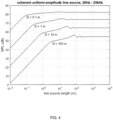
- FIG. 3 shows the SPL response as function of line source length for various frequencies and one observation distance.
- the coherent 1-dimensional volumetric audio source there is an expected saturation of the SPL beyond a certain line source length for each of the individual frequencies, but unlike the curves shown in FIG. 2 , the saturation length now depends on the frequency.
- the SPL at small line source lengths increases at a rate of 6 dB per doubling of length instead of 3 dB as shown in FIG. 2 for the diffuse 1-dimensional volumetric audio source.
- the distances r i from the individual point sources to the observation point are essentially equal
- the effective spatial extent is frequency-dependent and may be expressed as being equal to c 1 D / f (with f being the frequency and c 1 being a constant), while the effective spatial extent is again simply equal to line source length L for large observation distances (or small line source lengths).
- transition distance between the two regions was found to be proportional to L 2 f , with the proportionality factor being equal to 1/ c 1 2 .
- c 1 was empirically found to be equal to approximately 18.4.
- the behavior of the coherent 1-dimensional volumetric audio source is frequency-dependent and will typically also be rendered in a frequency-dependent way.
- a simulation may be carried out for 128 evenly spaced frequencies from 20 Hz to 20 kHz and the results for all individual frequencies may be summed to obtain the broadband result, implying a white source spectrum assumption.
- FIG. 4 shows the broadband SPL as function of line source length L for several observation distances D. Comparing FIG. 4 to FIG. 2 (which shows the SPL of the frequency-independent diffuse source), the overall broadband behaviors of the coherent source and the diffuse source is quite similar, especially for very small and very large line source lengths. The main differences are that (1) the transition region of the coherent source is much broader and (2) there is some ripple within the transition region of the coherent source. In addition, at large observation distances, the SPL for the coherent source increases by 6 dB per doubling of line source length (as observed for individual frequencies) instead of the 3 dB per doubling of line source length for the diffuse source.
- the broadband effective spatial extent is proportional to the square root of the observation distance D, i.e. c 2 D , while it is again simply equal to line source length L for large observation distances (or small source lengths).
- the transition distance between the two regions is proportional to the square of line source length L , with the proportionality factor being equal to 1/ c 2 2 .
- c 2 was found to be approximately equal to 3.5.
- the effective spatial extent of a 1-dimensional volumetric audio source is equal to line source length L for observation distances larger than a certain transition distance (a.k.a., the threshold distance value) (or for line source lengths smaller than a certain transition length).
- the transition distance is proportional to source length L for a diffuse 1-dimensional volumetric audio source while for a coherent 1-dimensional volumetric audio source, the transition distance is proportional to the square of L.
- the derived effective spatial extent may be used to determine which part of the source to render at what moment in time to a listener who is moving along, away, and/or towards the source. This is like applying a spatial window that is sliding along with the listener, where the derived effective spatial extent (which is dynamically updated according to changes in the listener's position) determines the width of the spatial window.
Landscapes
- Engineering & Computer Science (AREA)
- Theoretical Computer Science (AREA)
- Physics & Mathematics (AREA)
- General Engineering & Computer Science (AREA)
- Multimedia (AREA)
- Health & Medical Sciences (AREA)
- Audiology, Speech & Language Pathology (AREA)
- General Health & Medical Sciences (AREA)
- Human Computer Interaction (AREA)
- General Physics & Mathematics (AREA)
- Signal Processing (AREA)
- Acoustics & Sound (AREA)
- Stereophonic System (AREA)
Claims (17)
- Verfahren (800) zum Wiedergeben einer Audioquelle für einen Zuhörer, wobei das Verfahren Folgendes umfasst:Erhalten (s802) mindestens eines ersten Werts der räumlichen Ausdehnung, der eine erste räumliche Ausdehnung der Audioquelle angibt, wobei das Erhalten des ersten Werts der räumlichen Ausdehnung Folgendes umfasst: (i) Empfangen, von einem Encoder, von Metadaten in Verbindung mit der Audioquelle, wobei die Metadaten Geometrieinformationen in Verbindung mit der Audioquelle beinhalten und (ii) Ableiten des ersten Werts der räumlichen Ausdehnung basierend auf den Geometrieinformationen, die in den Metadaten beinhaltet sind;Erhalten (s804) eines Distanzwerts, der eine Distanz zwischen der Audioquelle und dem Zuhörer spezifiziert;Bestimmen (s806), ob der Distanzwert kleiner ist als ein Grenzdistanzwert, wobei der Grenzdistanzwert eine Funktion des ersten Werts der räumlichen Ausdehnung ist; undals Ergebnis des Bestimmens, dass der Distanzwert kleiner ist als der Grenzdistanzwert, Wiedergeben (s808), für den Zuhörer, eines akustisch relevanten Segments der Audioquelle unter Verwendung eines Werts der effektiven räumlichen Ausdehnung zum Identifizieren des akustisch relevanten Segments der Audioquelle, wobei der Wert der effektiven räumlichen Ausdehnung eine Funktion des Distanzwerts ist und der Wert der effektiven räumlichen Ausdehnung kleiner ist als der erste Wert der räumlichen Ausdehnung, undwenn der Distanzwert größer ist als der Grenzdistanzwert, Wiedergeben, für den Zuhörer, des akustisch relevanten Segments der Audioquelle unter Verwendung des Werts der effektiven räumlichen Ausdehnung zum Identifizieren des akustisch relevanten Segments der Audioquelle, wobei der Wert der effektiven räumlichen Ausdehnung gleich dem ersten Wert der räumlichen Ausdehnung ist.
- Verfahren nach Anspruch 1, wobei der Wert der effektiven räumlichen Ausdehnung proportional zu einer Potenz des Distanzwerts ist, wobei die Potenz einen Wert zwischen und einschließlich 0,5 und 1 hat.
- Verfahren nach einem der Ansprüche 1-2, wobei das Verfahren ferner Erhalten von Kohärenzeigenschaftsinformationen umfasst, wobei die Kohärenzeigenschaftsinformationen einen Grad der Kohärenz für die Audioquelle angeben.
- Verfahren nach Anspruch 3, wobei das Verfahren ferner Berechnen des Werts der effektiven räumlichen Ausdehnung basierend auf den erhaltenen Kohärenzeigenschaftsinformationen umfasst.
- Verfahren nach Anspruch 4, wobei das Verfahren ferner Folgendes umfasst:
basierend auf dem Grad der Kohärenz für die Audioquelle, Bestimmen, ob die Audioquelle eine beliebige einer diffusen Quelle, einer kohärenten Quelle oder eine Mischung aus einer diffusen Quelle und einer kohärenten Quelle ist. - Verfahren nach einem der Ansprüche 1-5,
wobei falls die Quelle eine diffuse Quelle ist, das Berechnen des Werts der effektiven räumlichen Ausdehnung Berechnen des Werts der effektiven räumlichen Ausdehnung basierend auf C0 x D umfasst, wobei C0 eine Konstante ist und D der Distanzwert ist. - Verfahren nach einem der Ansprüche 1-5,
wobei falls die Quelle eine kohärente Quelle ist, das Berechnen des Werts der effektiven räumlichen Ausdehnung Berechnen des Werts der effektiven räumlichen Ausdehnung basierend auf C1 x
- Verfahren nach einem der Ansprüche 1-7, wobei das Verfahren ferner Empfangen von Metadaten in Verbindung mit der Audioquelle umfasst, wobei die Metadaten Folgendes beinhalten: (i) eine Markierung, die angibt, dass die Größe der Audioquelle im Wesentlichen unendlich ist, und/oder (ii) eine Markierung, die Anweisungen gibt, ob ein effektives räumliches Ausdehnungsmodell zum Wiedergeben der Audioquelle zu verwenden ist, und/oder (iii) die Grenzdistanz.
- Verfahren nach einem der Ansprüche 1-8, wobei das Wiedergeben der Audioquelle Folgendes umfasst:Bestimmen von Positionen für einen oder mehrere virtuelle Lautsprecher basierend auf dem Wert der effektiven räumlichen Ausdehnung undVerwenden des einen oder der mehreren virtuellen Lautsprecher zum Wiedergeben der Audioquelle.
- Verfahren nach einem der Ansprüche 1-9, wobei die Audioquelle im Wesentlichen eine eindimensionale (1D) Audioquelle ist.
- Verfahren nach einem der Ansprüche 1-9, wobeidie erste räumliche Ausdehnung der Audioquelle eine räumliche Ausdehnung in einer ersten räumlichen Dimension ist, unddas Verfahren ferner Folgendes umfasst:Erhalten eines zweiten Werts der räumlichen Ausdehnung, der eine zweite räumliche Ausdehnung der Audioquelle angibt, wobei die zweite räumliche Ausdehnung eine räumliche Ausdehnung in einer zweiten räumlichen Dimension ist; undBestimmen, ob der Wert der effektiven räumlichen Ausdehnung abzuleiten ist, als ob die Audioquelle eine räumliche Ausdehnung in nur eine räumliche Dimension hat, oder nicht.
- Verfahren nach Anspruch 11, wobei das Bestimmen, ob der Wert der effektiven räumlichen Ausdehnung abzuleiten ist, als ob die Audioquelle eine räumliche Ausdehnung in nur eine räumliche Dimension hat, oder nicht, Empfangen einer Markierung umfasst, die angibt, dass der Wert der effektiven räumlichen Ausdehnung abgeleitet werden kann, als ob die Audioquelle eine räumliche Ausdehnung in nur eine räumliche Dimension hat.
- Verfahren nach Anspruch 11, wobei das Bestimmen, ob der Wert der effektiven räumlichen Ausdehnung abzuleiten ist, als ob die Audioquelle eine räumliche Ausdehnung in nur eine räumliche Dimension hat, oder nicht, Bestimmen von Folgendem umfasst:i) ob eine Differenz zwischen dem ersten oder dem zweiten Wert der räumlichen Ausdehnung und dem Distanzwert größer ist als eine Grenze, oderii) ob eine Differenz zwischen dem ersten oder dem zweiten Wert der räumlichen Ausdehnung und einem Wert, der eine Funktion des Distanzwerts ist, größer ist als eine Grenze.
- Verfahren nach Anspruch 13, wobeiwenn die Audioquelle eine diffuse Audioquelle ist, das Verfahren dann Bestimmen umfasst, ob die Differenz zwischen dem ersten oder dem zweiten Wert der räumlichen Ausdehnung und dem Distanzwert größer ist als eine Grenze, undwenn die Audioquelle keine diffuse Audioquelle ist, das Verfahren dann Bestimmen umfasst, ob die Differenz zwischen dem ersten oder dem zweiten Wert der räumlichen Ausdehnung und dem Wert, der eine Funktion des Distanzwerts ist, größer ist als eine Grenze.
- Verfahren nach Anspruch 13 oder 14, wobei das Bestimmen, ob die Differenz zwischen dem ersten oder dem zweiten Wert der räumlichen Ausdehnung und dem Distanzwert größer ist als eine Grenze, aus Bestimmen besteht, ob der Distanzwert größer ist als der erste oder der zweite Wert der räumlichen Ausdehnung.
- Vorrichtung (900) zum Wiedergeben einer Audioquelle für einen Zuhörer, wobei die Vorrichtung zu Folgendem konfiguriert ist:Erhalten (s802) mindestens eines ersten Werts der räumlichen Ausdehnung, der eine erste räumliche Ausdehnung der Audioquelle angibt, wobei das Erhalten des ersten Werts der räumlichen Ausdehnung Folgendes umfasst: (i) Empfangen, von einem Encoder, von Metadaten in Verbindung mit der Audioquelle, wobei die Metadaten Geometrieinformationen in Verbindung mit der Audioquelle beinhalten und (ii) Ableiten des ersten Werts der räumlichen Ausdehnung basierend auf den Geometrieinformationen, die in den Metadaten beinhaltet sind;Erhalten (s804) eines Distanzwerts, der eine Distanz zwischen der Audioquelle und dem Zuhörer spezifiziert;Bestimmen (s806), ob der Distanzwert kleiner ist als ein Grenzdistanzwert, wobei der Grenzdistanzwert eine Funktion des ersten Werts der räumlichen Ausdehnung ist; undals Ergebnis des Bestimmens, dass der Distanzwert kleiner ist als der Grenzdistanzwert, Wiedergeben (s808), für den Zuhörer, eines akustisch relevanten Segments der Audioquelle unter Verwendung eines Werts der effektiven räumlichen Ausdehnung zum Identifizieren des akustisch relevanten Segments der Audioquelle, wobei der Wert der effektiven räumlichen Ausdehnung eine Funktion des Distanzwerts ist und der Wert der effektiven räumlichen Ausdehnung kleiner ist als der erste Wert der räumlichen Ausdehnung, undwenn der Distanzwert größer ist als der Grenzdistanzwert, Wiedergeben, für den Zuhörer, des akustisch relevanten Segments der Audioquelle unter Verwendung des Werts der effektiven räumlichen Ausdehnung zum Identifizieren des akustisch relevanten Segments der Audioquelle, wobei der Wert der effektiven räumlichen Ausdehnung gleich dem ersten Wert der räumlichen Ausdehnung ist.
- Vorrichtung nach Anspruch 16, wobei die Vorrichtung ferner dazu konfiguriert ist, das Verfahren nach einem der Ansprüche 2-15 durchzuführen.
Priority Applications (1)
| Application Number | Priority Date | Filing Date | Title |
|---|---|---|---|
| EP25182235.9A EP4593429A3 (de) | 2020-07-22 | 2020-07-22 | Modellierung des räumlichen ausmasses für volumetrische audioquellen |
Applications Claiming Priority (1)
| Application Number | Priority Date | Filing Date | Title |
|---|---|---|---|
| PCT/EP2020/070606 WO2022017594A1 (en) | 2020-07-22 | 2020-07-22 | Spatial extent modeling for volumetric audio sources |
Related Child Applications (1)
| Application Number | Title | Priority Date | Filing Date |
|---|---|---|---|
| EP25182235.9A Division EP4593429A3 (de) | 2020-07-22 | 2020-07-22 | Modellierung des räumlichen ausmasses für volumetrische audioquellen |
Publications (3)
| Publication Number | Publication Date |
|---|---|
| EP4185945A1 EP4185945A1 (de) | 2023-05-31 |
| EP4185945C0 EP4185945C0 (de) | 2025-06-25 |
| EP4185945B1 true EP4185945B1 (de) | 2025-06-25 |
Family
ID=71786923
Family Applications (2)
| Application Number | Title | Priority Date | Filing Date |
|---|---|---|---|
| EP20746144.3A Active EP4185945B1 (de) | 2020-07-22 | 2020-07-22 | Modellierung des räumlichen ausmasses für volumetrische audioquellen |
| EP25182235.9A Pending EP4593429A3 (de) | 2020-07-22 | 2020-07-22 | Modellierung des räumlichen ausmasses für volumetrische audioquellen |
Family Applications After (1)
| Application Number | Title | Priority Date | Filing Date |
|---|---|---|---|
| EP25182235.9A Pending EP4593429A3 (de) | 2020-07-22 | 2020-07-22 | Modellierung des räumlichen ausmasses für volumetrische audioquellen |
Country Status (5)
| Country | Link |
|---|---|
| US (1) | US20230353968A1 (de) |
| EP (2) | EP4185945B1 (de) |
| JP (3) | JP7493673B2 (de) |
| CN (2) | CN120144085A (de) |
| WO (1) | WO2022017594A1 (de) |
Families Citing this family (1)
| Publication number | Priority date | Publication date | Assignee | Title |
|---|---|---|---|---|
| WO2023203139A1 (en) | 2022-04-20 | 2023-10-26 | Telefonaktiebolaget Lm Ericsson (Publ) | Rendering of volumetric audio elements |
Citations (1)
| Publication number | Priority date | Publication date | Assignee | Title |
|---|---|---|---|---|
| US20170325045A1 (en) * | 2016-05-04 | 2017-11-09 | Gaudio Lab, Inc. | Apparatus and method for processing audio signal to perform binaural rendering |
Family Cites Families (8)
| Publication number | Priority date | Publication date | Assignee | Title |
|---|---|---|---|---|
| EP1376997A1 (de) * | 2002-06-24 | 2004-01-02 | Alcatel | Verfahren zum Testen und Anpassen der Audioeinheitsparameter für ein Telekommunikationssystem |
| JP4512652B2 (ja) * | 2008-06-24 | 2010-07-28 | 株式会社ソニー・コンピュータエンタテインメント | ゲーム装置、ゲーム制御方法、及びゲーム制御プログラム |
| KR102712214B1 (ko) * | 2013-03-28 | 2024-10-04 | 돌비 인터네셔널 에이비 | 임의적 라우드스피커 배치들로의 겉보기 크기를 갖는 오디오 오브젝트들의 렌더링 |
| JP6786834B2 (ja) | 2016-03-23 | 2020-11-18 | ヤマハ株式会社 | 音響処理装置、プログラムおよび音響処理方法 |
| US11146905B2 (en) * | 2017-09-29 | 2021-10-12 | Apple Inc. | 3D audio rendering using volumetric audio rendering and scripted audio level-of-detail |
| EP3550860B1 (de) * | 2018-04-05 | 2021-08-18 | Nokia Technologies Oy | Darstellung von räumlichem audioinhalt |
| US10425762B1 (en) * | 2018-10-19 | 2019-09-24 | Facebook Technologies, Llc | Head-related impulse responses for area sound sources located in the near field |
| EP3909265A1 (de) * | 2019-01-08 | 2021-11-17 | Telefonaktiebolaget Lm Ericsson (Publ) | Effiziente räumlich heterogene audioelemente für virtuelle realität |
-
2020
- 2020-07-22 CN CN202510296452.7A patent/CN120144085A/zh active Pending
- 2020-07-22 WO PCT/EP2020/070606 patent/WO2022017594A1/en not_active Ceased
- 2020-07-22 JP JP2023504452A patent/JP7493673B2/ja active Active
- 2020-07-22 US US18/017,291 patent/US20230353968A1/en active Pending
- 2020-07-22 EP EP20746144.3A patent/EP4185945B1/de active Active
- 2020-07-22 EP EP25182235.9A patent/EP4593429A3/de active Pending
- 2020-07-22 CN CN202080104750.7A patent/CN116113918A/zh active Pending
-
2024
- 2024-05-21 JP JP2024082256A patent/JP7776574B2/ja active Active
-
2025
- 2025-11-13 JP JP2025194064A patent/JP2026041760A/ja active Pending
Patent Citations (1)
| Publication number | Priority date | Publication date | Assignee | Title |
|---|---|---|---|---|
| US20170325045A1 (en) * | 2016-05-04 | 2017-11-09 | Gaudio Lab, Inc. | Apparatus and method for processing audio signal to perform binaural rendering |
Also Published As
| Publication number | Publication date |
|---|---|
| US20230353968A1 (en) | 2023-11-02 |
| EP4593429A3 (de) | 2025-08-06 |
| EP4185945A1 (de) | 2023-05-31 |
| JP7493673B2 (ja) | 2024-05-31 |
| JP2023534862A (ja) | 2023-08-14 |
| CN120144085A (zh) | 2025-06-13 |
| EP4593429A2 (de) | 2025-07-30 |
| JP2026041760A (ja) | 2026-03-10 |
| EP4185945C0 (de) | 2025-06-25 |
| WO2022017594A1 (en) | 2022-01-27 |
| JP2024119834A (ja) | 2024-09-03 |
| CN116113918A (zh) | 2023-05-12 |
| JP7776574B2 (ja) | 2025-11-26 |
Similar Documents
| Publication | Publication Date | Title |
|---|---|---|
| US20240349002A1 (en) | Audio rendering of audio sources | |
| EP4118525A1 (de) | Wiedergabe von audioobjekten mit komplexer form | |
| US20100246839A1 (en) | Speaker configuration | |
| KR20230058443A (ko) | 잔향 오디오 신호 생성 방법 | |
| JP2026041760A (ja) | ボリュメトリックオーディオソースのための空間広がりモデル化 | |
| US10779106B2 (en) | Audio object clustering based on renderer-aware perceptual difference | |
| US8705757B1 (en) | Computationally efficient multi-resonator reverberation | |
| US20240420675A1 (en) | Deriving parameters for a reverberation processor | |
| KR20220103167A (ko) | 패닝된 객체 라우드스피커 이득 및 전파된 객체 라우드스피커 이득을 사용하는 오디오 객체 렌더러, 라우드스피커 이득을 결정하기 위한 방법 및 컴퓨터 프로그램 | |
| Müller et al. | Auralization of electric vehicles for the perceptual evaluation of acoustic vehicle alerting systems | |
| US20250227427A1 (en) | Method of rendering an audio element having a size, corresponding apparatus and computer program | |
| US20240340606A1 (en) | Spatial rendering of audio elements having an extent | |
| CN115250417B (zh) | 用于收听者位置和对象位置的音频电平计量 | |
| JP2025540822A (ja) | 接続された空間における残響のレンダリング | |
| KR20240104154A (ko) | 사운드 처리 장치, 디코더, 인코더, 비트스트림 및 해당 방법 | |
| US20250350903A1 (en) | Deriving parameters for use in audio rendering | |
| Aspöck et al. | Room geometry acquisition and processing methods for geometrical acoustics simulation models | |
| EP4627810A1 (de) | Darstellung von nachhall in verbundenen räumen | |
| CN117616782A (zh) | 混响级别的调整 |
Legal Events
| Date | Code | Title | Description |
|---|---|---|---|
| STAA | Information on the status of an ep patent application or granted ep patent |
Free format text: STATUS: UNKNOWN |
|
| STAA | Information on the status of an ep patent application or granted ep patent |
Free format text: STATUS: THE INTERNATIONAL PUBLICATION HAS BEEN MADE |
|
| PUAI | Public reference made under article 153(3) epc to a published international application that has entered the european phase |
Free format text: ORIGINAL CODE: 0009012 |
|
| STAA | Information on the status of an ep patent application or granted ep patent |
Free format text: STATUS: REQUEST FOR EXAMINATION WAS MADE |
|
| 17P | Request for examination filed |
Effective date: 20230209 |
|
| AK | Designated contracting states |
Kind code of ref document: A1 Designated state(s): AL AT BE BG CH CY CZ DE DK EE ES FI FR GB GR HR HU IE IS IT LI LT LU LV MC MK MT NL NO PL PT RO RS SE SI SK SM TR |
|
| DAV | Request for validation of the european patent (deleted) | ||
| DAX | Request for extension of the european patent (deleted) | ||
| STAA | Information on the status of an ep patent application or granted ep patent |
Free format text: STATUS: EXAMINATION IS IN PROGRESS |
|
| 17Q | First examination report despatched |
Effective date: 20240328 |
|
| GRAP | Despatch of communication of intention to grant a patent |
Free format text: ORIGINAL CODE: EPIDOSNIGR1 |
|
| STAA | Information on the status of an ep patent application or granted ep patent |
Free format text: STATUS: GRANT OF PATENT IS INTENDED |
|
| RIC1 | Information provided on ipc code assigned before grant |
Ipc: H04S 7/00 20060101ALI20250108BHEP Ipc: G06F 3/16 20060101AFI20250108BHEP |
|
| INTG | Intention to grant announced |
Effective date: 20250116 |
|
| GRAS | Grant fee paid |
Free format text: ORIGINAL CODE: EPIDOSNIGR3 |
|
| GRAA | (expected) grant |
Free format text: ORIGINAL CODE: 0009210 |
|
| STAA | Information on the status of an ep patent application or granted ep patent |
Free format text: STATUS: THE PATENT HAS BEEN GRANTED |
|
| AK | Designated contracting states |
Kind code of ref document: B1 Designated state(s): AL AT BE BG CH CY CZ DE DK EE ES FI FR GB GR HR HU IE IS IT LI LT LU LV MC MK MT NL NO PL PT RO RS SE SI SK SM TR |
|
| REG | Reference to a national code |
Ref country code: GB Ref legal event code: FG4D |
|
| REG | Reference to a national code |
Ref country code: CH Ref legal event code: EP |
|
| REG | Reference to a national code |
Ref country code: DE Ref legal event code: R096 Ref document number: 602020053326 Country of ref document: DE |
|
| REG | Reference to a national code |
Ref country code: CH Ref legal event code: EP |
|
| REG | Reference to a national code |
Ref country code: IE Ref legal event code: FG4D |
|
| U01 | Request for unitary effect filed |
Effective date: 20250701 |
|
| U07 | Unitary effect registered |
Designated state(s): AT BE BG DE DK EE FI FR IT LT LU LV MT NL PT RO SE SI Effective date: 20250707 |
|
| U20 | Renewal fee for the european patent with unitary effect paid |
Year of fee payment: 6 Effective date: 20250728 |
|
| PG25 | Lapsed in a contracting state [announced via postgrant information from national office to epo] |
Ref country code: GR Free format text: LAPSE BECAUSE OF FAILURE TO SUBMIT A TRANSLATION OF THE DESCRIPTION OR TO PAY THE FEE WITHIN THE PRESCRIBED TIME-LIMIT Effective date: 20250926 Ref country code: NO Free format text: LAPSE BECAUSE OF FAILURE TO SUBMIT A TRANSLATION OF THE DESCRIPTION OR TO PAY THE FEE WITHIN THE PRESCRIBED TIME-LIMIT Effective date: 20250925 |
|
| PGFP | Annual fee paid to national office [announced via postgrant information from national office to epo] |
Ref country code: GB Payment date: 20250728 Year of fee payment: 6 |
|
| PG25 | Lapsed in a contracting state [announced via postgrant information from national office to epo] |
Ref country code: HR Free format text: LAPSE BECAUSE OF FAILURE TO SUBMIT A TRANSLATION OF THE DESCRIPTION OR TO PAY THE FEE WITHIN THE PRESCRIBED TIME-LIMIT Effective date: 20250625 |
|
| PG25 | Lapsed in a contracting state [announced via postgrant information from national office to epo] |
Ref country code: RS Free format text: LAPSE BECAUSE OF FAILURE TO SUBMIT A TRANSLATION OF THE DESCRIPTION OR TO PAY THE FEE WITHIN THE PRESCRIBED TIME-LIMIT Effective date: 20250925 |
|
| PG25 | Lapsed in a contracting state [announced via postgrant information from national office to epo] |
Ref country code: IS Free format text: LAPSE BECAUSE OF FAILURE TO SUBMIT A TRANSLATION OF THE DESCRIPTION OR TO PAY THE FEE WITHIN THE PRESCRIBED TIME-LIMIT Effective date: 20251025 |
|
| PG25 | Lapsed in a contracting state [announced via postgrant information from national office to epo] |
Ref country code: SM Free format text: LAPSE BECAUSE OF FAILURE TO SUBMIT A TRANSLATION OF THE DESCRIPTION OR TO PAY THE FEE WITHIN THE PRESCRIBED TIME-LIMIT Effective date: 20250625 |
|
| PG25 | Lapsed in a contracting state [announced via postgrant information from national office to epo] |
Ref country code: CZ Free format text: LAPSE BECAUSE OF FAILURE TO SUBMIT A TRANSLATION OF THE DESCRIPTION OR TO PAY THE FEE WITHIN THE PRESCRIBED TIME-LIMIT Effective date: 20250625 |
|
| PG25 | Lapsed in a contracting state [announced via postgrant information from national office to epo] |
Ref country code: PL Free format text: LAPSE BECAUSE OF FAILURE TO SUBMIT A TRANSLATION OF THE DESCRIPTION OR TO PAY THE FEE WITHIN THE PRESCRIBED TIME-LIMIT Effective date: 20250625 |
|
| PG25 | Lapsed in a contracting state [announced via postgrant information from national office to epo] |
Ref country code: SK Free format text: LAPSE BECAUSE OF FAILURE TO SUBMIT A TRANSLATION OF THE DESCRIPTION OR TO PAY THE FEE WITHIN THE PRESCRIBED TIME-LIMIT Effective date: 20250625 |
|
| PG25 | Lapsed in a contracting state [announced via postgrant information from national office to epo] |
Ref country code: ES Free format text: LAPSE BECAUSE OF FAILURE TO SUBMIT A TRANSLATION OF THE DESCRIPTION OR TO PAY THE FEE WITHIN THE PRESCRIBED TIME-LIMIT Effective date: 20250625 |
|
| REG | Reference to a national code |
Ref country code: CH Ref legal event code: H13 Free format text: ST27 STATUS EVENT CODE: U-0-0-H10-H13 (AS PROVIDED BY THE NATIONAL OFFICE) Effective date: 20260224 |
|
| PG25 | Lapsed in a contracting state [announced via postgrant information from national office to epo] |
Ref country code: MC Free format text: LAPSE BECAUSE OF FAILURE TO SUBMIT A TRANSLATION OF THE DESCRIPTION OR TO PAY THE FEE WITHIN THE PRESCRIBED TIME-LIMIT Effective date: 20250625 |