EP4184875A1 - Kommunikationsüberwachungsverfahren und kommunikationsüberwachungssystem - Google Patents
Kommunikationsüberwachungsverfahren und kommunikationsüberwachungssystem Download PDFInfo
- Publication number
- EP4184875A1 EP4184875A1 EP21843073.4A EP21843073A EP4184875A1 EP 4184875 A1 EP4184875 A1 EP 4184875A1 EP 21843073 A EP21843073 A EP 21843073A EP 4184875 A1 EP4184875 A1 EP 4184875A1
- Authority
- EP
- European Patent Office
- Prior art keywords
- communication
- triplets
- triplet
- information indicating
- learning
- Prior art date
- Legal status (The legal status is an assumption and is not a legal conclusion. Google has not performed a legal analysis and makes no representation as to the accuracy of the status listed.)
- Pending
Links
Images











Classifications
-
- H—ELECTRICITY
- H04—ELECTRIC COMMUNICATION TECHNIQUE
- H04L—TRANSMISSION OF DIGITAL INFORMATION, e.g. TELEGRAPHIC COMMUNICATION
- H04L63/00—Network architectures or network communication protocols for network security
- H04L63/14—Network architectures or network communication protocols for network security for detecting or protecting against malicious traffic
- H04L63/1408—Network architectures or network communication protocols for network security for detecting or protecting against malicious traffic by monitoring network traffic
- H04L63/1425—Traffic logging, e.g. anomaly detection
-
- H—ELECTRICITY
- H04—ELECTRIC COMMUNICATION TECHNIQUE
- H04L—TRANSMISSION OF DIGITAL INFORMATION, e.g. TELEGRAPHIC COMMUNICATION
- H04L41/00—Arrangements for maintenance, administration or management of data switching networks, e.g. of packet switching networks
- H04L41/14—Network analysis or design
- H04L41/145—Network analysis or design involving simulating, designing, planning or modelling of a network
-
- H—ELECTRICITY
- H04—ELECTRIC COMMUNICATION TECHNIQUE
- H04L—TRANSMISSION OF DIGITAL INFORMATION, e.g. TELEGRAPHIC COMMUNICATION
- H04L41/00—Arrangements for maintenance, administration or management of data switching networks, e.g. of packet switching networks
- H04L41/14—Network analysis or design
- H04L41/147—Network analysis or design for predicting network behaviour
-
- H—ELECTRICITY
- H04—ELECTRIC COMMUNICATION TECHNIQUE
- H04L—TRANSMISSION OF DIGITAL INFORMATION, e.g. TELEGRAPHIC COMMUNICATION
- H04L43/00—Arrangements for monitoring or testing data switching networks
- H04L43/06—Generation of reports
- H04L43/062—Generation of reports related to network traffic
-
- H—ELECTRICITY
- H04—ELECTRIC COMMUNICATION TECHNIQUE
- H04L—TRANSMISSION OF DIGITAL INFORMATION, e.g. TELEGRAPHIC COMMUNICATION
- H04L63/00—Network architectures or network communication protocols for network security
- H04L63/02—Network architectures or network communication protocols for network security for separating internal from external traffic, e.g. firewalls
- H04L63/0227—Filtering policies
- H04L63/0236—Filtering by address, protocol, port number or service, e.g. IP-address or URL
-
- H—ELECTRICITY
- H04—ELECTRIC COMMUNICATION TECHNIQUE
- H04L—TRANSMISSION OF DIGITAL INFORMATION, e.g. TELEGRAPHIC COMMUNICATION
- H04L63/00—Network architectures or network communication protocols for network security
- H04L63/16—Implementing security features at a particular protocol layer
- H04L63/162—Implementing security features at a particular protocol layer at the data link layer
-
- H—ELECTRICITY
- H04—ELECTRIC COMMUNICATION TECHNIQUE
- H04L—TRANSMISSION OF DIGITAL INFORMATION, e.g. TELEGRAPHIC COMMUNICATION
- H04L63/00—Network architectures or network communication protocols for network security
- H04L63/16—Implementing security features at a particular protocol layer
- H04L63/164—Implementing security features at a particular protocol layer at the network layer
-
- H—ELECTRICITY
- H04—ELECTRIC COMMUNICATION TECHNIQUE
- H04L—TRANSMISSION OF DIGITAL INFORMATION, e.g. TELEGRAPHIC COMMUNICATION
- H04L63/00—Network architectures or network communication protocols for network security
- H04L63/16—Implementing security features at a particular protocol layer
- H04L63/166—Implementing security features at a particular protocol layer at the transport layer
-
- H—ELECTRICITY
- H04—ELECTRIC COMMUNICATION TECHNIQUE
- H04L—TRANSMISSION OF DIGITAL INFORMATION, e.g. TELEGRAPHIC COMMUNICATION
- H04L41/00—Arrangements for maintenance, administration or management of data switching networks, e.g. of packet switching networks
- H04L41/16—Arrangements for maintenance, administration or management of data switching networks, e.g. of packet switching networks using machine learning or artificial intelligence
-
- Y—GENERAL TAGGING OF NEW TECHNOLOGICAL DEVELOPMENTS; GENERAL TAGGING OF CROSS-SECTIONAL TECHNOLOGIES SPANNING OVER SEVERAL SECTIONS OF THE IPC; TECHNICAL SUBJECTS COVERED BY FORMER USPC CROSS-REFERENCE ART COLLECTIONS [XRACs] AND DIGESTS
- Y04—INFORMATION OR COMMUNICATION TECHNOLOGIES HAVING AN IMPACT ON OTHER TECHNOLOGY AREAS
- Y04S—SYSTEMS INTEGRATING TECHNOLOGIES RELATED TO POWER NETWORK OPERATION, COMMUNICATION OR INFORMATION TECHNOLOGIES FOR IMPROVING THE ELECTRICAL POWER GENERATION, TRANSMISSION, DISTRIBUTION, MANAGEMENT OR USAGE, i.e. SMART GRIDS
- Y04S40/00—Systems for electrical power generation, transmission, distribution or end-user application management characterised by the use of communication or information technologies, or communication or information technology specific aspects supporting them
- Y04S40/20—Information technology specific aspects, e.g. CAD, simulation, modelling, system security
Definitions
- the present disclosure relates to communication monitoring methods and communication monitoring systems.
- ICSs industrial control systems
- critical infrastructure such as electric power systems and water treatment systems.
- the whitelist includes 3-tuples including the IP address of a server, the TCP/UDP port number, and the IP address of a client (hereinafter referred to as a communication triplet).
- a communication triplet When a communication triplet that is not included in the whitelist is observed, an alert is issued; in this manner, security measures for the ICSs can be implemented.
- NPLs 1 and 2 normal communication triplets are held as a whitelist, and a communication triplet that is not included in the whitelist is detected as an anomalous triplet; these methods are problematic in that false detection occurs frequently.
- Security operators need to analyze whether a detected anomalous communication triplet, due to which an alert has been issued, is important in terms of security, for example, whether the detected anomalous communication triplet exposes the ICS network to malware infection or cyberattacks. Therefore, the security operators are forced to deal with a large number of false alerts.
- the anomaly detection methods disclosed in NPLs 1 and 2 impose heavy analysis burdens on the security operators for the ICS network, and thus it is impractical to apply these methods.
- the present disclosure is conceived in view of the above-described circumstances and has an object to provide a communication monitoring method and a communication monitoring system in which false detections of network communication can be reduced.
- a communication monitoring method for monitoring communication in a network and includes: extracting, from the communication, a first communication triplet that is a 3-tuple including information indicating a source device, information indicating a destination device, and information indicating a type of communication performed between devices; determining whether the first communication triplet extracted corresponds to any of a plurality of second communication triplets stored in storage in advance as a whitelist and each being a 3-tuple including information indicating a source device, information indicating a destination device, and information indicating a type of communication; and estimating, as a score, a possibility that the first communication triplet emerges as the communication, by using a model that has been trained, and outputting the score when the first communication triplet does not correspond to any of the plurality of second communication triplets.
- CD-ROM compact disc read-only memory
- a communication monitoring method is a communication monitoring method for monitoring communication in a network and includes: extracting, from the communication, a first communication triplet that is a 3-tuple including information indicating a source device, information indicating a destination device, and information indicating a type of communication performed between devices; determining whether the first communication triplet extracted corresponds to any of a plurality of second communication triplets stored in storage in advance as a whitelist and each being a 3-tuple including information indicating a source device, information indicating a destination device, and information indicating a type of communication; and estimating, as a score, a possibility that the first communication triplet emerges as the communication, by using a model that has been trained, and outputting the score when the first communication triplet does not correspond to any of the plurality of second communication triplets.
- a monitoring result indicating that the communication is suspicious may be output.
- the estimating of the score may include causing the model that has been trained to perform the following: converting a set of 3-tuples of the first communication triplet into a multigraph in which the information indicating the source device and the information indicating the destination device are nodes and the information indicating the type of communication is a type of an edge, and mapping each of the nodes of the multigraph to vector representation of a fixed dimension to obtain vector representation of each element of the first communication triplet; and estimating the score from the vector representation of the first communication triplet obtained.
- the model may include a relational graph convolutional network (R-GCN).
- R-GCN relational graph convolutional network
- the estimating of the score may include causing the model that has been trained to perform the following: converting a set of 3-tuples of the first communication triplet into a multigraph in which the information indicating the source device and the information indicating the destination device are nodes and the information indicating the type of communication is a type of an edge, and obtaining vector representation of the first communication triplet from the multigraph; and estimating the score using a link prediction algorithm from the vector representation of the first communication triplet obtained.
- the model may include a composition-based multi-relational graph convolutional network (COMPGCN).
- COMPGCN composition-based multi-relational graph convolutional network
- the estimating of the score may include causing the model that has been trained to perform the following: obtaining vector representation of the first communication triplet from a set of 3-tuples of the first communication triplet; and estimating the score using a link prediction algorithm from the vector representation of the first communication triplet obtained.
- the model may include any of DistMult, convolutional 2D knowledge graph embeddings (convE), translating embeddings for modeling multi-relational data (TransE), holographic embeddings of knowledge graphs (HolE), and complex embeddings for simple link prediction (ComplEx).
- convE convolutional 2D knowledge graph embeddings
- TransE translating embeddings for modeling multi-relational data
- HolE holographic embeddings of knowledge graphs
- ComplEx complex embeddings for simple link prediction
- the information indicating the source device may be an IP address of a server that is the source device
- the information indicating the destination device may be an IP address of a client that is the destination device
- the information indicating the type of communication may include a TCP/UDP port number or a type of an alert.
- the information indicating the source device may be a MAC address or a serial number of the source device
- the information indicating the destination device may be a MAC address or a serial number of the destination device
- the information indicating the type of communication may include a type of an alert or a type of a communication command that is exchanged between the source device and the destination device.
- the communication monitoring method may further include: before the extracting, obtaining the plurality of second communication triplets from network communication performed in a predetermined period; and performing a learning process using, as data for learning, the plurality of second communication triplets obtained, the learning process including causing the model to obtain vector representation of the plurality of second communication triplets and estimate, as a score, a possibility that the network communication performed in the predetermined period emerges.
- the communication monitoring method may further include: before the extracting, obtaining the plurality of second communication triplets from network communication performed in a predetermined period; performing a learning process using, as data for learning, the plurality of second communication triplets obtained, the learning process including causing the model to obtain vector representation of the plurality of second communication triplets and estimate, as a score, a possibility that the network communication performed in the predetermined period emerges; and estimating, as a score indicating an anomaly level, a possibility that each of the plurality of second communication triplets obtained emerges as the communication, by using the model that has been trained, and outputting the score.
- the score indicating the anomaly level of each of the second communication triplets can be checked, and thus it is possible to check whether any of the second communication triplets obtained from network communication performed in the predetermined period as a learning period and used as the data for learning is anomalous.
- a multigraph in which the information indicating the source device and the information indicating the destination device are nodes and the information indicating the type of communication is a type of an edge may be constructed from a set of 3-tuples of the plurality of second communication triplets, and the multigraph constructed may be input to the model, and training may be conducted by causing the model to map each of the nodes of the multigraph to vector representation of a fixed dimension and obtain the vector representation of the plurality of second communication triplets.
- a feature amount regarding the network communication performed in the predetermined period may be included as the type of communication.
- the vector representation obtained by the model has increased accuracy
- the score estimated by the trained model has increased accuracy
- the feature amount includes at least one of an amount of communication per unit time or a median communication time interval in the network communication performed in the predetermined period.
- the communication monitoring method may further include: before the extracting, obtaining, from network communication performed in a predetermined period, a plurality of third communication triplets each being a 3-tuple including information indicating a source device, information indicating a destination device, and information indicating a type of communication; performing a learning process using, as data for learning, the plurality of third communication triplets obtained, the learning process including causing the model to obtain vector representation of the plurality of third communication triplets and estimate, as a score, a possibility that the network communication performed in the predetermined period emerges; estimating, as a score indicating an anomaly level, a possibility that each of the plurality of third communication triplets emerges as the communication, by using the model that has been trained, and outputting the score; and storing communication triplets obtained by excluding one or more third communication triplets from the plurality of third communication triplets based on the score indicating the anomaly level into the storage as the plurality of second communication triplets.
- the third communication triplets obtained by excluding anomalous third communication triplets, using the estimated score indicating the anomaly level, from the plurality of third communication triplets obtained from the network communication performed in the predetermined period as a learning period can be stored as a whitelist (the plurality of second communication triplets).
- the communication monitoring method may further include: before the extracting, obtaining, from network communication performed in a predetermined period, a plurality of third communication triplets each being a 3-tuple including information indicating a source device, information indicating a destination device, and information indicating a type of communication; performing a learning process using, as data for learning, the plurality of third communication triplets obtained, the learning process including causing the model to obtain vector representation of the plurality of third communication triplets and estimate, as a score, a possibility that the network communication performed in the predetermined period emerges; estimating, as a score indicating an anomaly level, a possibility that each of the plurality of third communication triplets emerges as the communication, by using the model that has been trained, and outputting the score; performing a re-learning process using, as data for re-learning, communication triplets obtained by excluding one or more third communication triplets from the plurality of third communication triplets based on the score, the re-learning process including causing
- the third communication triplets obtained by excluding anomalous third communication triplets, using the estimated score indicating the anomaly level, from the plurality of third communication triplets obtained from the network communication performed in the predetermined period as a learning period can be stored as a whitelist (the plurality of second communication triplets).
- the model can be re-trained using, as data for re-learning, the third communication triplets obtained by excluding anomalous third communication triplets from the plurality of third communication triplets.
- the use of the re-trained model can minimize the risk of overlooking an anomalous communication triplet at the time of the scoring process.
- a multigraph in which the information indicating the source device and the information indicating the destination device are nodes and the information indicating the type of communication is a type of an edge is constructed from a set of 3-tuples of the plurality of third communication triplets, and the multigraph constructed is input to the model, and training is conducted by causing the model to map each of the nodes of the multigraph to vector representation of a fixed dimension and obtain vector representation of the plurality of second communication triplets.
- a communication monitoring system is a communication monitoring system for monitoring communication in a network and includes: an extractor that extracts, from the communication, a first communication triplet being a 3-tuple including information indicating a source device, information indicating a destination device, and information indicating a type of communication performed between devices; storage in which a plurality of second communication triplets each being a 3-tuple including information indicating a source device, information indicating a destination device, and information indicating a type of communication are stored as a whitelist; and a scoring unit that determines whether the first communication triplet extracted corresponds to any of the plurality of second communication triplets and when the first communication triplet does not correspond to any of the plurality of second communication triplets, estimates, as a score, a possibility that the first communication triplet emerges as the communication, by using a model that has been trained, and outputs the score.
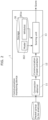
- FIG. 1 is a block diagram illustrating one example of the configuration of communication monitoring system 100 according to the present embodiment.
- Communication monitoring system 100 which is provided as a computer or the like, performs a scoring process on a communication triplet included in a packet to be analyzed, on the basis of information such as a communication triplet included in a learning packet group, and outputs an estimated score.
- the score herein indicates quantitative representation of the possibility (naturalness) that said communication triplet emerges as network communication.
- communication monitoring system 100 includes connection obtainer 11, communication triplet extractor 12, scoring unit 13, connection obtainer 21, communication triplet extractor 22, leaning unit 23, storage 31, and storage 32, as illustrated in FIG. 1 .
- connection obtainer 21, communication triplet extractor 22, leaning unit 23, storage 31, and storage 32 constitute learning device unit 2, as illustrated in FIG. 1 .
- Connection obtainer 11, communication triplet extractor 12, and scoring unit 13 constitute communication monitoring device 1 illustrated in FIG. 2 .
- communication monitoring device 1 will be described.
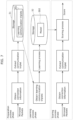
- FIG. 2 is a block diagram illustrating one example of the configuration of communication monitoring device 1 according to the present embodiment.
- Communication monitoring device 1 which is provided as computer 1000 or the like illustrated in FIG. 3 , monitors network communication.
- FIG. 3 is a diagram illustrating one example of the hardware configuration of computer 1000 that implements, using software, the functions of communication monitoring device 1 according to the present embodiment.
- Computer 1000 illustrated in FIG. 3 includes input device 1001, output device 1002, CPU 1003, internal storage 1004, RAM 1005, reading device 1007, transmitting/receiving device 1008, and bus 1009.
- Input device 1001, output device 1002, CPU 1003, internal storage 1004, RAM 1005, reading device 1007, and transmitting/receiving device 1008 are connected by bus 1009.
- Input device 1001 which is a device serving as a user interface such as an input button, a touchpad, and a touch panel display, receives user input. Note that input device 1001 may be configured to not only receive user touch input, but also receive voice control and a remote operation using a remote control or the like.
- Internal storage 1004 is a flash memory or the like. At least one of a program for implementing the functions of communication monitoring device 1 and an application in which the functional configuration of communication monitoring device 1 is used may be stored in internal storage 1004 in advance.
- RAM 1005 which is a random-access memory, is used to store data, etc., at the time of execution of the program or the application.
- Reading device 1007 reads information from a recording medium such as a universal serial bus (USB) memory. Reading device 1007 reads the aforementioned program, application, etc., from a recording medium on which said program, application, etc., are recorded, and stores the read program, application, etc., into internal storage 1004.
- a recording medium such as a universal serial bus (USB) memory.
- Reading device 1007 reads the aforementioned program, application, etc., from a recording medium on which said program, application, etc., are recorded, and stores the read program, application, etc., into internal storage 1004.
- USB universal serial bus
- Transmitting/receiving device 1008 is a communication circuit for performing wired or wireless communication.
- transmitting/receiving device 1008 may communicate with a cloud storage, a server device, etc., connected to a network, download the aforementioned program, application, etc., and store the program, application, etc., into internal storage 1004.
- CPU 1003 which is a central processing unit, copies the program, application, etc., stored in internal storage 1004 onto RAM 1005, sequentially reads commands included in said program, application, etc., from RAM 1005, and executes the read commands.
- Communication monitoring device 1 includes connection obtainer 11, communication triplet extractor 12, scoring unit 13, and storage 30, as illustrated in FIG. 2 .
- connection obtainer 11 communication triplet extractor 12, scoring unit 13, and storage 30, as illustrated in FIG. 2 .
- Connection obtainer 11 obtains connection information from network communication.
- connection obtainer 11 obtains connection information from a packet group to be analyzed in network communication.
- the connection information herein is information regarding a dedicated virtual communication path formed between software products or devices that perform communication.
- the connection information is, for example, information indicating from which node (device) to which node (device) a connection is established and what port is used to establish the connection.
- Connection obtainer 11 may use the technique disclosed in NPL 3, for example; by obtaining a file called "conn.log", it is possible to obtain the connection information.
- Communication triplet extractor 12 extracts, from network communication, a first communication triplet that is a 3-tuple including information indicating a source device, information indicating a destination device, and information indicating the type of communication performed between the devices.
- communication triplet extractor 12 extracts a communication triplet as the first communication triplet from the connection information obtained by connection obtainer 11.
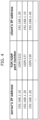
- FIG. 4 and FIG. 5 are diagrams each illustrating one example of a communication triplet according to the present embodiment.
- the communication triplet which is observed in communication in the ICS network to be monitored, is a 3-tuple including the IP address of a server, the TCP/UDP port number, and the IP address of a client, as illustrated in FIG. 4 , for example.
- the communication triplet is not limited to having the exemplary configuration illustrated in FIG. 4 and may be configured to include the type of an alert as illustrated in FIG. 5 .
- the information indicating a source device is the IP address of a server that is the source device
- the information indicating a destination device is the IP address of a client that is the destination device
- the information indicating the type of communication may include the TCP/UDP port number or the type of an alert.
- the communication triplet is not limited to having a configuration resulting from combinations of the examples illustrated in FIG. 4 and FIG. 5 .
- Information that specifies a device such as an MAC address or a device serial number, and the protocol name or the category of information that is exchanged between devices, for example, the type of a communication command to be used, such as write or read, may be combined.
- the information indicating a source device may be the MAC address or the serial number of the source device
- the information indicating a destination device may be the MAC address or the serial number of the destination device.
- the information indicating the type of communication may include the type of an alert or the type of a communication command that is exchanged between the source device and the destination device.
- Storage 30 includes, for example, a rewritable non-volatile memory such as a hard disk drive or a solid-state drive.
- a plurality of second communication triplets are stored in advance as a whitelist.
- Each of the plurality of second communication triplets herein is a 3-tuple including information indicating a source device, information indicating a destination device, and information indicating the type of communication.
- whitelist 301a and trained model 302 are stored in storage 30.
- Whitelist 301a holds the plurality of second communication triplets (the plurality of communication triplets) that are the same as learning communication triplets 301 illustrated in FIG. 1 .
- Trained model 302 is the same as model 302 trained by learning unit 23 illustrated in FIG. 1 .
- storage 30 is storage 31 and storage 32 that are separate in the example illustrated in FIG. 2 , but may be configured to include storage 31 and storage 32.
- Scoring unit 13 performs a scoring process on communication that is not included in whitelist 301a. Specifically, scoring unit 13 determines whether the first communication triplet extracted corresponds to any of the plurality of second communication triplets stored in storage 30 as the whitelist. Furthermore, when the first communication triplet does not correspond to any of the plurality of second communication triplets, scoring unit 13 estimates, using trained model 302, a score indicating the possibility that the first communication triplet emerges as communication, and outputs the score.
- Model 302 includes a relational graph convolutional network (R-GCN), for example.
- scoring unit 13 determines whether the communication triplet extracted by communication triplet extractor 12 is included in whitelist 301a.
- scoring unit 13 may preclude the extracted communication triplet from the subjects of the scoring process and skip the scoring process. This is because when the extracted communication triplet is included in whitelist 301a, it is possible to determine that the communication of the extracted communication triplet is normal (not suspicious). Note that when the extracted communication triplet is included in whitelist 301a, scoring unit 13 may output, as a monitoring result, a score indicating that the communication of the extracted communication triplet is normal (not suspicious).
- scoring unit 13 performs the scoring process on the extracted communication triplet using trained model 302. Scoring unit 13 outputs the score of the extracted communication triplet, that is, a score indicating the estimated possibility that the extracted communication triplet emerges as communication.
- scoring unit 13 may preclude the extracted communication triplet from the subjects of the scoring process. In this case, scoring unit 13 may output, as a monitoring result, a score indicating that the communication of said communication triplet is suspicious or may output a report indicating that the communication of said communication triplet is suspicious.
- scoring unit 13 causes trained model 302 to obtain the vector representation of the elements of the communication triplet to be monitored. Subsequently, scoring unit 13 causes trained model 302 to estimate a score from the obtained vector representation of the communication triplet to be monitored, and outputs the score.
- FIG. 6A is one example of whitelist 301a according to the present embodiment.
- FIG. 6B is a diagram illustrating a multigraph of whitelist 301a according to the present embodiment.
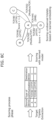
- FIG. 6C is a diagram illustrating one example of the result of the scoring process of the communication triplet to be monitored according to the present embodiment.
- whitelist 301a includes four communication triplets each of which is a 3-tuple including a source device, the type of communication, and a destination device.
- trained model 302 includes information obtained by converting the four communication triplets included in whitelist 301a into the multigraph illustrated in FIG. 6B and then mapping each of the nodes of said multigraph to the vector representation of the fixed dimension.
- trained model 302 includes the information of the multigraph structure illustrated in FIG. 6B in which A, B, C, and D are nodes that are the source device and the destination device indicated in FIG. 6A and HTTP, SMB, and MSSQL, which are the type of communication, are the types of edges.
- trained model 302 includes the information in which each of the nodes of the multigraph illustrated in FIG. 6B is mapped to the vector representation of the fixed dimension.
- scoring unit 13 adds an edge indicating MSSQL to node A and node C of the multigraph illustrated in FIG. 6B , as illustrated in FIG. 6C . Furthermore, scoring unit 13 causes trained model 302 to estimate, as the score of the communication triplet to be monitored, the possibility that the edge connecting node A and node C and indicating MSSQL emerges as communication. In the example illustrated in FIG. 6C , the score of the communication triplet to be monitored is 1.3.
- the score is less than or equal to the threshold value, it can be determined that the communication is anomalous (suspicious).
- the threshold value can be 0, for example.
- the score is 1.3, which is greater than the threshold value, meaning that the communication of the communication triplet to be monitored is determined as being normal (not suspicious).
- Learning device unit 2 includes connection obtainer 21, communication triplet extractor 22, learning unit 23, storage 31, and storage 32, as mentioned above.
- Connection obtainer 21 obtains connection information from network communication. In the example illustrated in FIG. 1 , connection obtainer 21 obtains connection information from a learning packet group in network communication. A method in which connection obtainer 21 obtains the connection information is as described above with connection obtainer 11; thus, the description will not be repeated.
- Communication triplet extractor 22 obtains the second communication triplet from network communication performed in a predetermined period.
- communication triplet extractor 22 extracts a communication triplet from the connection information obtained by connection obtainer 21 and stores the communication triplet into storage 31 as learning communication triplet 301.
- communication triplet extractor 22 When the extracted communication triplet is found stored (already observed) as learning communication triplet 301, communication triplet extractor 22 does not add the communication triplet to learning communication triplet 301. In other words, when the extracted communication triplet is not found stored (not already observed) as learning communication triplet 301, communication triplet extractor 22 adds the communication triplet to learning communication triplet 301; thus, learning communication triplet 301 is obtained.
- Storage 31 which includes, for example, a rewritable non-volatile memory such as a hard disk drive or a solid-state drive, stores learning communication triplet 301.
- learning communication triplet 301 is used as whitelist 301a in scoring unit 13, as described above.
- Model 302 includes, for example, a R-GCN, as described above. Model 302 is learned in the learning process by learning unit 23.
- learning unit 23 uses learning communication triplet 301 that is stored in storage 31, learning unit 23 performs the learning process on model 302 stored in storage 32. Subsequently, learning unit 23 updates model 302 stored in storage 32 to trained model 302.
- learning unit 23 uses the second communication triplet as data for learning, learning unit 23 performs the learning process of causing model 302 to obtain the vector representation of the second communication triplet and estimate, as a score, the possibility that network communication performed in a predetermined period emerges.
- Learning unit 23 constructs, from a set of 3-tuples of the second communication triplet, a multigraph in which the information indicating the source device and the information indicating the destination device are nodes and the information indicating the type of communication is the type of an edge. Learning unit 23 inputs the constructed multigraph to model 302 and thereby conducts training by causing model 302 to map each of the nodes of said multigraph to the vector representation of the fixed dimension and obtain the vector representation of the second communication triplet.
- the second communication triplet used as the data for learning may include a feature amount regarding network communication performed in the predetermined period as the type of communication, in addition to said type of communication.
- This feature amount may include at least one of the amount of communication per unit time and the median communication time interval in the network communication performed in the predetermined period.
- communication monitoring system 100 which includes the elements of communication monitoring device 1 and learning device unit 2 configured as described above will be described.
- FIG. 7 is a diagram illustrating a framework for the process of communication monitoring system 100 according to the present embodiment. Elements that are substantially the same as those in FIG. 1 and FIG. 2 are assigned the same reference signs. As illustrated in FIG. 7 , the process of communication monitoring system 100 can be divided into a preparation process phase, a learning process phase, and a scoring process phase.
- FIG. 8A is a diagram conceptually illustrating one example of the process in the preparation process phase performed by communication monitoring system 100 according to the present embodiment.
- Communication monitoring system 100 which monitors communication in the ICS network, for example, obtains connection information from a mirror packet (learning packet group) in the communication in the ICS network, as illustrated in (a) in FIG. 8A .
- the connection information includes information indicating a server IP (the IP address of a server), the port number of a server, a protocol, and a client IP (the IP address of a client) at each of time t1 to time t4, for example, as illustrated in (b) in FIG. 8A .
- server IP the IP address of a server
- the port number of a server the port number of a server
- a protocol the protocol
- client IP the IP address of a client
- communication monitoring system 100 obtains connection information excluding devices located outside the ICS network to be monitored.
- the port number of a client is often different depending on packets; therefore, in the present embodiment, the port number of a client is not included in the connection information.
- communication monitoring system 100 extracts four communication triplets from the obtained connection information.
- Each of the four communication triplets is a 3-tuple including a source device, the type of communication, and a destination device, as illustrated in (c) in FIG. 8A .
- communication monitoring system 100 stores the four communication triplets illustrated in (c) in FIG. 8A into storage 31 as learning communication triplets 301.
- FIG. 8B is a diagram conceptually illustrating one example of the process in the learning process phase performed by communication monitoring system 100 according to the present embodiment.
- Communication monitoring system 100 obtains learning communication triplet 301 from storage 31 and performs the leaning process on model 302 using learning communication triplets 301.
- communication monitoring system 100 obtains learning communication triplets 301 illustrated in (c) in FIG. 8A and constructs the multigraph illustrated in (a) in FIG. 8B from the obtained learning communication triplets.
- communication monitoring system 100 trains model 302, as illustrated in (b) in FIG. 8B .
- communication monitoring system 100 conducts training by causing model 302 to learn the structure of the multigraph illustrated in (a) in FIG. 8B and furthermore, map each of the nodes of said multigraph to the vector representation of the fixed dimension, thereby obtaining the vector representation of learning communication triplets 301.
- the vector representation is referred to as embeddings.
- communication monitoring system 100 conducts training by causing model 302 to map each of the nodes of the multigraph of learning communication triplets 301 to a vector space such as that illustrated in (c) in FIG. 8B and thereby obtain the vector representation of the fixed dimension.
- a graph autoencoder using the R-GCN may be used as model 302.
- the graph autoencoder using the R-GCN is a model capable of link prediction using the DistMult disclosed in NPL 4 as a scoring function.
- FIG. 8C is a diagram conceptually illustrating one example of the process in the scoring process phase performed by communication monitoring system 100 according to the present embodiment.
- Communication monitoring system 100 which monitors communication in the ICS network, for example, obtains connection information from a mirror packet (packet group to be analyzed) in the communication in the ICS network, as in the case of (a) in FIG. 8A .
- Communication monitoring system 100 extracts, from the obtained connection information, a communication triplet to be analyzed (to be monitored).
- Each of two communication triplets to be analyzed is a 3-tuple including A as a source device, TCP/80 as the type of communication, and C or D as a destination device, as illustrated in FIG. 8C .
- communication monitoring system 100 performs, using trained model 302, the scoring process for the communication triplets to be analyzed.
- communication monitoring system 100 causes trained model 302 to convert the communication triplet to be analyzed into a multigraph and map two nodes of the multigraph to the vector representation of the fixed dimension, thereby obtaining the vector representation of the communication triplet to be analyzed. Furthermore, using trained model 302, communication monitoring system 100 estimates, from the learned vector representation illustrated in (c) in FIG. 8B and the obtained vector representation of the communication triplet to be analyzed, the score of the communication triplet to be analyzed, and outputs the score. In the example illustrated in FIG. 8C , the score of the communication triplet to be analyzed that includes A as the source device, TCP/80 (HTTP) as the type of communication, and C as the destination device is 1.3.
- HTTP HTTP
- the score of the communication triplet to be analyzed that includes A as the source device, TCP/80 (HTTP) as the type of communication, and D as the destination device is -5.3.
- a threshold value for example, 0
- the communication with these two communication triplets to be analyzed is determined as being normal (not suspicious).
- the R-GCN is a network model that is an extension of a graph convolutional network (GCN), which is a network model that convolutes a graph structure, and is disclosed in NPL 5.
- GCN graph convolutional network
- the R-GCN When data having a graph structure is input, the R-GCN convolutes the graph structure and outputs the feature amount of said data.
- the R-GCN extracts a feature amount for each of the nodes of the graph structure and convolutes one node using a current node and a neighboring node to convolute the graph structure.
- the graph structure is convoluted assuming that information propagates (feedforward propagation) in consideration of the type and direction of an edge in each layer of the R-GCN layer.
- the feedforward propagation in one layer of a multilayer R-GCN can be represented by Expression 1 below.
- the left-hand side represents the vector of node i in the (I+1)-th layer.
- the first term on the right-hand side represents the sum of convolutions at the neighboring nodes, and the second term on the right-hand side represents the convolution at the current node.
- N i is a set of nodes neighboring node i
- 1/c i is a normalization constant
- ⁇ is a non-linear activation function.
- Expression 1 can be represented as Expression 2 below.
- h B l + 1 ⁇ 1 c B W l h A l + W 0 l h B l
- the left-hand side represents the vector of node B illustrated in FIG. 6B in the (I+1)-th layer.
- the first term on the right-hand side that is indicated by the dotted box (1) represents propagation from the link with node A
- the second term on the right-hand side that is indicated by the dotted box (2) represents propagation from node B itself which is called a self-loop.
- the feedforward propagation in one layer of the multilayer R-GCN can be represented by Expression 3 below.
- h i l + 1 ⁇ ⁇ j ⁇ R ⁇ j ⁇ N i p 1 c i ,p W p l h j l + W 0 l h i l
- the left-hand side represents the vector of node i in the (I+1)-th layer.
- the first term on the right-hand side represents the sum of convolutions at the neighboring nodes related to node i
- the second term on the right-hand side represents the convolution at the current node.
- N i,p is a set of nodes neighboring node i and related to node i
- 1/c i,p is a normalization constant
- ⁇ is a non-linear activation function.
- Expression 3 can be represented as Expression 4 below.
- h B l + 1 ⁇ 1 c B ,http W http l h A l + 1 c B , mssql W mssql l h A l + W 0 l h B l
- the left-hand side represents the vector of node B in the (I+1)-th layer.
- the first term on the right-hand side that is indicated by the dotted box (3) represents propagation from the HTTP link with node A
- the second term on the right-hand side that is indicated by the dotted box (4) represents propagation from the MSSQL link with node A.
- the third term on the right-hand side that is indicated by the dotted box (5) represents propagation from node B itself which is called a self-loop.
- communication triplets indicating communication situations in the ICS network are interpreted as a multigraph, and the possibility that a communication triplet to be monitored that is not included in the whitelist emerges as a link of the multigraph is estimated.
- the present disclosure regards the problem of scoring communications that are not present in the whitelist as a link prediction problem in multigraphs where the IP addresses observed in the ICS network are interpreted as nodes and the types of communication such as TCP/UDP used between two IP addresses are interpreted as edges. Furthermore, the present disclosure interprets the link prediction problem in multigraphs as a task to predict whether a communication triplet is a communication triplet that has not been observed so far, but may be likely to exist (that is, a normal communication triplet).
- the R-GCN is included in model 302 in the present embodiment.
- model 302 including the R-GCN to learn the communication triplets observed in the ICS network, it is possible to estimate, as a score, the anomality of the communication triplets that have not been observed in the ICS network.
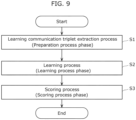
- FIG. 9 is a flowchart illustrating the outline of operation of communication monitoring system 100 according to the present embodiment.
- communication monitoring system 100 performs a learning communication triplet extraction process (S1). Note that the learning communication triplet extraction process performed in Step S1 corresponds to the processing in the above-described preparation process phase. Next, communication monitoring system 100 performs a learning process (S2). Note that the learning process performed in Step S2 corresponds to the processing in the above-described learning process phase. Next, communication monitoring system 100 performs a scoring process (S3). The scoring process in Step S3 corresponds to the processing in the above-described scoring process phase.
- FIG. 10 is a flowchart illustrating details of the learning communication triplet extraction process illustrated in FIG. 9 .
- communication monitoring system 100 obtains a leaning packet (S11).
- communication monitoring system 100 obtains, as the learning packet, a mirror packet in communication in a network such as the ICS network, for example.
- communication monitoring system 100 obtains connection information from the learning packet that has been obtained in Step S11 (S12).
- communication monitoring system 100 obtains, from the learning packet that has been obtained in Step S11, connection information including information indicating the IP address of a server, the port number of the server, a protocol, and the IP address of a client.
- communication monitoring system 100 extracts a communication triplet from the connection information obtained in Step S12 (S13).
- communication monitoring system 100 extracts, from the connection information obtained in Step S12, a communication triplet that is a 3-tuple including a source device, the type of communication, and a destination device.
- the source device is the IP address of a server
- the type of communication is the port number of the server and a protocol
- the destination device is the IP address of a client.
- communication monitoring system 100 determines whether the communication triplet extracted in Step S13 has already been observed (S14). In the present embodiment, communication monitoring system 100 determines whether the communication triplet extracted in Step S13 has been stored as learning communication triplet 301.
- Step S14 When the extracted communication triplet is determined in Step S14 as not being an already observed communication triplet (NO in S14), communication monitoring system 100 accumulates the extracted communication triplet as learning communication triplet 301 (S15).
- communication monitoring system 100 checks whether there is any packet from which a communication triplet has not yet been extracted aside from the learning packet that has been obtained in Step S11 (S16).
- Step S14 determines whether the extracted communication triplet is determined in Step S14 as being an already observed communication triplet (YES in S14).
- Step S16 When it is determined in Step S16 that there is no packet from which a communication triplet has not been extracted (NO in S16), communication monitoring system 100 outputs the accumulated learning communication triplets (S17). On the other hand, when it is determined in Step 16 that there is a packet from which a communication triplet has not been extracted (YES in S16), communication monitoring system 100 returns to Step S11 and repeats these processes.
- FIG. 11 is a flowchart illustrating details of the learning process illustrated in FIG. 9 .
- communication monitoring system 100 obtains a learning communication triplet (S21).
- communication monitoring system 100 obtains learning communication triplet 301 from storage 31.
- communication monitoring system 100 constructs a multigraph of learning communication triplets 301 that has been obtained in Step S21 (S22).
- model 302 causes model 302 to learn the multigraph constructed in Step S22 (S23).
- model 302 includes the R-GCN, for example.
- Communication monitoring system 100 causes model 302 to learn the structure of the multigraph constructed in Step S22 and map each of the nodes of the constructed multigraph to the vector representation of the fixed dimension, thereby obtaining the vector representation of learning communication triplets 301.
- model 302 is trained using a graph autoencoder; through learning with the graph autoencoder, the vector representation of nodes and edges can be obtained.
- Step S24 communication monitoring system 100 outputs the vector representation of learning communication triplet 301 that has been obtained by learning, in other words, the embeddings of the nodes and the embeddings of the edges (S24).
- trained model 302 includes information of the vector representation of learning communication triplet 301 that has been obtained by learning, in other words, the embeddings of the nodes and the embeddings of the edges.
- FIG. 12 is a diagram illustrating algorithm 1 for performing the learning process illustrated in FIG. 11 .
- V indicates a set of observed IP addresses
- R indicates a set of observed TCP/UDP port numbers.
- ⁇ ⁇ This indicates learning communication triplet 301.
- e i ⁇ R d This indicates the embeddings of IP addresses and can be obtained by calculating the feedforward propagation using Expression 3 indicated above.
- Rp i ⁇ R d ⁇ d This indicates the parameter of model 302.
- W p j l As mentioned above, this indicates the weight of the R-GCN, and I indicates the number of hidden layers.
- parameter of model 302 is optimized as a loss function using a cross-entropy error such as that indicated in Expression 5 blow.
- T indicates the total of real and corrupted communication triplets
- f(s, p, c) is the score of communication triplet (s, p, c)
- I indicates the logistic sigmoid function
- y indicates an indicator.
- FIG. 13 is a flowchart illustrating details of the scoring process illustrated in FIG. 9 . Note that the processing illustrated in FIG. 13 may be performed by communication monitoring device 1 described above.
- communication monitoring system 100 obtains a packet to be analyzed (S31).
- communication monitoring system 100 obtains, as the packet to be analyzed, a mirror packet in communication in a network such as the ICS network, for example.
- communication monitoring system 100 obtains connection information from the packet to be analyzed that has been obtained in Step S31 (S32).
- communication monitoring system 100 obtains, from the packet to be analyzed that has been obtained in Step S31, connection information including information indicating the IP address of a server, the port number of the server, a protocol, and the IP address of a client.
- communication monitoring system 100 extracts a communication triplet from the connection information obtained in Step S32 (S33).
- communication monitoring system 100 extracts, from the connection information obtained in Step S32, a communication triplet that is a 3-tuple including a source device, the type of communication, and a destination device.
- the source device is the IP address of a server
- the type of communication is the port number of the server and a protocol
- the destination device is the IP address of a client.
- communication monitoring system 100 determines whether the communication triplet extracted in Step S33 is among learning communication triplets 301 (S34).
- communication monitoring system 100 uses, as a whitelist, learning communication triplets 301. This means that communication monitoring system 100 determines whether the communication triplet extracted in Step S33 is present in the whitelist.
- Step S34 When it is determined in Step S34 that the extracted communication triplet is not among learning communication triplets 301 (NO in S34), communication monitoring system 100 determines whether at least one element of the 3-tuple of the extracted communication triplet has been observed for the first time (S35).
- the 3-tuple includes the IP address of a server, the IP address of a client, and a TCP/UDP port number, for example.
- the case where at least one element of the 3-tuple of the extracted communication triplet has been observed for the first time is the case where at least one element of said 3-tuple is not present in the whitelist.
- Step S35 When it is not determined in Step S35 that at least one element of the 3-tuple of the extracted communication triplet has been observed for the first time (NO in S35), communication monitoring system 100 performs the scoring process on the extracted communication triplet (S36).
- model 302 includes the R-GCN, for example. Therefore, communication monitoring system 100 causes trained model 302 to convert the communication triplet to be analyzed into a multigraph and map two nodes of the multigraph to the vector representation of the fixed dimension, thereby obtaining the vector representation of the communication triplet to be analyzed. Furthermore, using trained model 302, communication monitoring system 100 estimates, from the learned vector representation and the obtained vector representation of the communication triplet to be analyzed, the score of the communication triplet to be analyzed and outputs the score.
- communication monitoring system 100 checks whether there is any packet that has not yet been analyzed aside from the packet to be analyzed that has been obtained in Step S31 (S37).
- Step S37 When there is no packet that has not yet been analyzed in Step S37 (NO in S37), communication monitoring system 100 ends the scoring process. On the other hand, when there is a packet that has not yet been analyzed in Step S37 (YES in S37), communication monitoring system 100 returns to Step S31 and repeats these processes.
- Step S34 when the extracted communication triplet is among learning communication triplets 301 (YES in S34), communication monitoring system 100 determines that the communication of the extracted communication triplet is not suspicious, and proceeds to Step S37.
- Step S35 when it is not determined in Step S35 that at least one element of the 3-tuple of the extracted communication triplet has been observed for the first time (YES in S35), communication monitoring system 100 excludes the extracted communication triplet from the subjects of the scoring process (S38). Subsequently, communication monitoring system 100 outputs a result indicating the communication of the extracted communication triplet is suspicious (S39).
- FIG. 14 is a diagram illustrating algorithm 2 for performing the scoring process illustrated in FIG. 13 . Note that variables substantially the same as those in FIG. 12 are indicated as the same variables, and thus description thereof will be omitted.
- s ⁇ p ⁇ c ⁇ In FIG. 14 , this indicates the communication triplet to be analyzed. e s ⁇ , R p ⁇ , e c ⁇ This indicates the embeddings of said communication triplet. e s ⁇ , T R p ⁇ , e c ⁇ This indicates the score of said communication triplet.
- communication triplets indicating communication situations in the ICS network are interpreted as a multigraph, and the possibility that a communication triplet to be monitored that is not included in the whitelist emerges as a link of the multigraph is estimated as a score. Note that when the possibility of the emergence of a communication triplet that is not included in the whitelist is handled as the link prediction problem in multigraphs, it is possible to accurately estimate the score of the communication triplet that is not included in the whitelist.
- an unimportant alert can be excluded using the score of the communication triplet not included in the whitelist, allowing a security operator to focus only on fatal alerts.
- model 302 is described as including the R-GCN in the above embodiment, but this is not limiting.
- Model 302 may be COMPosition-based multi-relational Graph Convolutional Networks (COMPGCN) disclosed in NPL 6.
- COMPGCN COMPosition-based multi-relational Graph Convolutional Networks
- trained model 302 convert a set of 3-tuples of the first communication triplet into a multigraph in which the information indicating the source device and the information indicating the destination device are nodes and the information indicating the type of communication is the type of an edge, and obtain the vector representation of the first communication triplet from said multigraph. Subsequently, it is sufficient that a score be estimated from the obtained vector representation of the first communication triplet using the link prediction algorithm.
- model 302 may be a DistMult or convolutional 2D knowledge graph embeddings (convE) disclosed in NPL 7.
- model 302 may be translating embeddings for modeling multi-relational data (TransE) disclosed in NPL 8.
- model 302 may be holographic embeddings of knowledge graphs (HolE) disclosed in NPL 9.
- model 302 may be complex embeddings for simple link prediction (ComplEx) disclosed in NPL 10.
- trained model 302 obtain the vector representation of the first communication triplet from the set of 3-tuples of the first communication triplet and estimate a score from the obtained vector representation of the first communication triplet using the link prediction algorithm.
- model 302 including the R-GCN was verified; the result of experiments thereof will be described below as a working example.
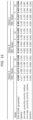
- FIG. 15 is a diagram illustrating the nature of a dataset according to the present working example.
- the traffic of the ICS network in three factories owned by Panasonic Corporation was used for evaluation. Note that each factory produces different items, and installed facilities, communication protocols, and network configurations are different depending on the factories.
- Packets in the ICS network used in the three factories were independently collected for two weeks each, using the mirror port of a L2 switch.
- protocols such as Modbus and Ethernet/IP
- protocols such as NetBIOS, DNS, HTTP, HTTPS, FTP, SMB, RDP, SSH, and MSSQL were observed. Therefore, only unicast communications excluding multicast and broadcast communications were subjected to the learning process and the scoring process.
- the numbers of IP addresses, the TCP/UDP port numbers, and learning communication triplets that are illustrated in FIG. 15 were obtained by counting the number of emergence thereof in communication in the ICS network at the three factories, namely, A, B, and C, in a specific one week. Test communication triplets were obtained one week after the specific one week. Note that communication triplets included in the learning communication triplets were excluded from the test communication triplets. Furthermore, communication triplets having unobserved IP addresses or TCP/UDP port numbers were also excluded from the test communication triplets.
- model 302 including the R-GCN As comparative examples for model 302 including the R-GCN, a model including the DistMult, and a first-order proximity priority method and a second-order proximity priority method, which are heuristic, were also evaluated. Note that the DistMult has substantially the same configuration as a R-GCN having no graph structure convolutional layers.
- model 302 including the R-GCN will be referred to as GCN SCOPE (proposed).
- the GCN SCOPE and the comparative examples were evaluated through two different methods that are link prediction evaluation in which the presence of test communication triplets is predicted and an evaluation on how well normal communication triplets and anomalous communication triplets can be distinguished (recognized).
- Hyper parameters of the GCN SCOPE and the model including the DistMult were searched for.
- the search for hyper parameters was conducted by splitting the dataset of factory A into data for learning and data for validation and using bays optimization with the mean reciprocal rank in the validation data.
- the hyper parameters of the GCN SCOPE were determined as follows. Specifically, the dropout rate was determined to be 0.2, the number of hidden layer units was determined to be 100, the L2 regularization weight was determined to be 0.0, the learning rate was determined to be 0.01, and the negative sampling rate was determined to be 10.
- the hyper parameters of the model including the DistMult were determined as follows. Specifically, the number of hidden layer units was determined to be 50, the L2 regularization weight was determined to be 0.01, the learning rate was determined to be 0.02, and the negative sampling rate was determined to be 10.
- FIG. 16 is a diagram illustrating the evaluation result of link prediction in which test communication triplets according to the present working example are used for prediction.
- the GCN SCOPE, the model including the DistMult, and the like were trained using learning communication triplets in the respective datasets of the three factories indicated in FIG. 15 , and output the scores of the test communication triplets. Subsequently, the output scores were evaluated using the mean reciprocal rank (MRR) such as that indicated in Expression 6 below and the proportion of entities that were ranked within the top n. The result is shown in FIG. 16 . Note that rank i in Expression 6 represents the rank position of the correct answer for the i-th query.
- MRR mean reciprocal rank
- the GCN SCOPE exceeds the comparative examples including the model including the DistMult in almost all cases. This shows that the GCN SCOPE can exhibit high performance in the link prediction for communication triplets in the ICS network.
- FIG. 17 is a diagram illustrating evaluation of the ability of distinguishing between anomalous links and normal links based on the scores that have been output using the test communication triplets according to the present working example.
- ROC-AUC is used to quantify the evaluation of the distinguishing ability.
- ROC is an abbreviation for receiver operating characteristic
- AUC is an abbreviation for under the curve
- ROC-AUC represents the area under the ROC curve.
- ACU can take values between 0 and 1; the closer to 1 the value of ACU is, the higher the distinguishing ability is.
- test communication triplets were used as negative samples, and random communication triplets were used as positive samples.
- the random communication triplets were generated by selecting two different IP addresses and TCP/UDP port numbers separately and uniformly at random from the elements included in the learning communication triplets.
- the distinguishing ability was evaluated on the basis of the scores output by the GCN SCOPE, the model including the DistMult, and the like from the test communication triplets.
- the ability of distinguishing between anomalous links and normal links was evaluated through threshold determination of the output score.
- the average ROC-AUC of the GCN SCOPE is 0.957, which means that the distinguishing ability is superior to those in the first-order proximity priority method and the second-order proximity priority method. This shows that the GCN SCOPE is capable of accurately distinguishing between normal communication triplets and anomalous communication triplets.
- the GCN SCOPE can accurately handle, as link prediction in multigraphs, the possibility of the emergence of a communication triplet that is not included in the whitelist, and accurately estimate the score of a communication triplet that is not included in the whitelist.
- the above embodiment describes the case where the communication triplets (the second communication triplets) obtained from network communication performed in the predetermined period are determined as being safe and then stored into storage 30 as a whitelist. Furthermore, the above embodiment describes the case where the second communication triplets stored in storage 30 are used as learning communication triplets 301.
- the second communication triplets obtained from the network communication performed in the predetermined period may include an unsafe second communication triplet.
- one or more links of a multigraph constructed using, as learning communication triplets 301, the second communication triplets obtained from network communication performed in the predetermined period, as illustrated in (a) in FIG. 8B may be anomalous.
- the one or more links of the multigraph constructed at the time of learning are, for example, setting errors or are generated by malware, the one or more links are not safe, but are anomalous.
- model 302 is trained using the multigraph having such an anomalous link, an anomalous communication triplet may be overlooked at the time of the scoring process.
- the present variation describes a method, etc., for checking whether learning communication triplets 301 include an anomalous communication triplet.
- FIG. 18 is a block diagram illustrating one example of the configuration of learning device unit 2A according to the present variation. Elements that are substantially the same as those in FIG. 1 are assigned the same reference signs and detailed description thereof will be omitted.
- Learning device unit 2A includes connection obtainer 21, communication triplet extractor 22A, learning unit 23A, storage 31, storage 32, and anomaly level checker 33A, as illustrated in FIG. 18 .
- Learning device unit 2A illustrated in FIG. 18 is different from learning device unit 2 illustrated in FIG. 1 in that anomaly level checker 33A is additionally included and communication triplet extractor 22A and learning unit 23A having different configurations are included.
- Communication triplet extractor 22A obtains third communication triplets from network communication performed in a predetermined period.
- Each of the plurality of third communication triplets herein is a 3-tuple including information indicating a source device, information indicating a destination device, and information indicating the type of communication.
- communication triplet extractor 22A extracts a communication triplet as a third communication triplet from the connection information obtained by connection obtainer 21 and stores the communication triplet into storage 31 as learning communication triplet 301.
- communication triplet extractor 22A when the extracted communication triplet is found stored (already observed) as learning communication triplet 301, communication triplet extractor 22A does not add the communication triplet to learning communication triplet 301.
- anomaly level checker 33A only presents or outputs, to a display screen, a score indicating the anomaly level estimated using trained model 302 and does not update learning communication triplet 301 that is stored in storage 31.
- communication triplet extractor 22A operate in substantially the same manner as communication triplet extractor 22. Specifically, it is sufficient that communication triplet extractor 22A extract a communication triplet from network communication performed in a predetermined period and obtain the communication triplet as the second communication triplet.
- learning unit 23A uses learning communication triplet 301 that is stored in storage 31, learning unit 23A performs the learning process on model 302 stored in storage 32. Subsequently, learning unit 23A updates model 302 stored in storage 32 to trained model 302.
- learning unit 23A uses the third communication triplet as data for learning, learning unit 23A performs the learning process of causing model 302 to obtain the vector representation of the third communication triplet and estimate, as a score, the possibility that network communication performed in a predetermined period emerges.
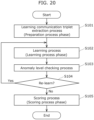
- learning unit 23A may use, as data for re-learning, communication triplets obtained by excluding one or more third communication triplets from the plurality of third communication triplets on the basis of scores indicating the anomaly levels estimated by anomaly level checker 33A. In this case, it is sufficient that using said data for re-learning, learning unit 23A perform the re-learning process of causing model 302 to obtain the vector representation of the third communication triplet included in the data for re-learning and estimate, as a score, the possibility that network communication performed in a predetermined period emerges.
- learning unit 23A construct, from the set of 3-tuples of the third communication triplet, a multigraph in which the information indicating the source device and the information indicating the destination device are nodes and the information indicating the type of communication is the type of an edge. Subsequently, it is sufficient that learning unit 23A input the constructed multigraph to model 302 and thus conduct training by causing model 302 to map each of the nodes of said multigraph to the vector representation of the fixed dimension and obtain the vector representation of the third communication triplet.
- learning device unit 2A there are cases where anomaly level checker 33A only presents or outputs, to a display screen, a score indicating the anomaly level estimated using trained model 302 and does not update learning communication triplet 301 that is stored in storage 31.
- learning unit 23A operate in substantially the same manner as learning unit 23.
- learning unit 23A perform the learning process of causing model 302 to obtain the vector representation of the second communication triplet and estimate, as a score, the possibility that network communication performed in a predetermined period emerges.
- the second communication triplet used as the data for learning or the third communication triplet used as the data for learning or the data for re-learning may include a feature amount regarding network communication performed in the predetermined period as the type of communication, in addition to said type of communication.
- This feature amount may include at least one of the amount of communication per unit time and the median communication time interval in the network communication performed in the predetermined period.
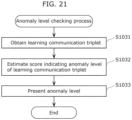
- anomaly level checker 33A uses trained model 302 to estimate a score indicating an anomaly level that indicates the possibility that each of the plurality of third communication triplets emerges as network communication performed in the predetermined period, and outputs the score.
- anomaly level checker 33A performs a scoring process such as that described above on learning communication triplets 301 using trained model 302 that is stored in storage 32.
- model 302 is trained using the links observed in the learning period (the links of the multigraph constructed at the time of learning), which is as described in the above embodiment.
- every link of the multigraph constructed at the time of learning is assumed to be safe.
- a score indicating the anomaly level of an already observed link that is, a link of the multigraph constructed at the time of learning is estimated.
- FIG. 19 is a diagram illustrating links and estimated scores indicating anomaly levels when a multigraph is constructed at the time of learning according to the present variation.
- anomaly level checker 33A causes trained model 302 to convert learning communication triplet 301 into a multigraph and map two nodes of said multigraph to the vector representation of the fixed dimension, thereby obtaining the vector representation of learning communication triplet 301. Furthermore, using trained model 302, anomaly level checker 33A estimates the score of learning communication triplet 301 as a score indicating an anomaly level from the learned vector representation such as that illustrated in (c) in FIG. 8B and the obtained vector representation of learning communication triplet 301.
- FIG. 19 illustrates one example of a score indicating an anomaly level of each of the links of the multigraph constructed at the time of learning.
- the link with (a score indicating) an anomaly level of 80 may be anomalous.
- this threshold value is preferably set less than the threshold value set in the scoring process according to the above embodiment, but may be equal to said threshold value.
- Anomaly level checker 33A may output a score indicating the anomaly level of a link of the multigraph constructed at the time of learning and present the score on a display screen such as a display.
- a user of leaning device unit 2A can check whether each of the links of the multigraph constructed at the time of learning is normal or anomalous.
- a user of learning device unit 2A can store communication triplets obtained by excluding one or more third communication triplets from the plurality of third communication triplets on the basis of scores indicating anomaly levels into storage 30 as whitelist 301a (the plurality of second communication triplets).
- a user of learning device unit 2A can store communication triplets obtained by excluding unsafe third communication triplets from the plurality of third communication triplets obtained from network communication performed in a predetermined period that is a learning period using scores indicating anomaly levels into storage 30 as whitelist 301a.
- anomaly level checker 33A only need to present or display, on a display screen, the score indicating the anomaly level estimated using trained model 302. In other words, anomaly level checker 33A may avoid updating learning communication triplet 301 that is stored in storage 31. In this case, it is sufficient that using trained model 302, anomaly level checker 33A estimate a score indicating an anomaly level that indicates the possibility that each of the second communication triplets obtained from network communication performed in a predetermined period that is a learning period emerges as network communication performed in the predetermined period, and output the score.
- whitelist 301a may be reviewed (updated) not only by a user of learning device unit 2A, but also by anomaly level checker 33A.
- anomaly level checker 33A may store communication triplets obtained by excluding one or more third communication triplets from the plurality of obtained third communication triplets on the basis of scores indicating anomaly levels into storage 30 as whitelist 301a (the plurality of second communication triplets).
- anomaly level checker 33A may update learning communication triplet 301. Specifically, anomaly level checker 33A may update learning communication triplets 301 to the communication triplets obtained by excluding one or more third communication triplets from the plurality of third communication triplets obtained from network communication performed in a predetermined period that is a learning period on the basis of scores indicating anomaly levels. Furthermore, learning unit 23A may perform a re-learning process on model 302 using updated learning communication triplets 301. This allows communication monitoring device 1 to use re-trained model 302, making it possible to minimize the risk of overlooking an anomalous communication triplet at the time of the scoring process.
- communication monitoring system 100 including learning device unit 2A that is configured as described above will be described below.
- FIG. 20 is a flowchart illustrating the outline of operation of communication monitoring system 100 including learning device unit 2A according to the present variation.
- communication monitoring system 100 including learning device unit 2A performs a learning communication triplet extraction process (S101).
- communication monitoring system 100 extracts a communication triplet from network communication performed in a predetermined period that is a learning period, and stores the communication triplet into storage 31 as learning communication triplet 301.
- communication monitoring system 100 performs a learning process (S102).
- communication monitoring system 100 performs the learning process on model 302 using, as data for learning, learning communication triplet 301 that has been extracted and stored in storage 31.
- communication monitoring system 100 performs an anomaly level checking process (S103). Details of the anomaly level checking process in Step S103 will be described later.
- communication monitoring system 100 determines whether to perform the re-learning process (S104).
- Step S104 When it is determined in Step S104 that learning communication triplet 301 has been updated, communication monitoring system 100 determines that the re-learning process is to be performed (Yes in S104), and returns to Step S102. Subsequently, in Step S102, communication monitoring system 100 performs the learning process (re-learning process) on model 302 using, as data for re-learning, updated learning communication triplet 301.
- Step S104 when it is determined in Step S104 that learning communication triplet 301 has not been updated, communication monitoring system 100 determines that the re-learning process is not to be performed (No in S104), and proceeds to Step S105.
- Step S105 communication monitoring system 100 performs a scoring process (S105).
- the scoring process performed in Step S105 is substantially the same as the scoring process performed in Step S3 in FIG. 9 described above and thus, description thereof will not be repeated.
- FIG. 21 is a flowchart illustrating a detailed example of the anomaly level checking process illustrated in FIG. 20 .
- the anomaly level checking process shown in FIG. 21 includes only presenting or outputting the estimated score indicating the anomaly level of learning communication triplet 301.
- learning device unit 2A included in communication monitoring system 100 obtains learning communication triplet 301 that is stored in storage 31 (S1031).
- learning device unit 2A obtains, from network communication performed in a predetermined period that is a learning period, learning communication triplet 301 that includes the plurality of second communication triplets which are extracted communication triplets.
- learning device unit 2A estimates a score indicating an anomaly level of learning communication triplet 301 that has been obtained in Step S1031 (S1032).
- learning device unit 2A uses trained model 302, learning device unit 2A estimates, as a score indicating an anomaly level, the possibility that each of the plurality of second communication triplets emerges as network communication performed in said predetermined period.
- learning device unit 2A presents the anomaly level (the score indicating the anomaly level) estimated in Step S1032 (S1033).
- learning device unit 2A displays, for example, on a display or the like, the anomaly level (the score indicating the anomaly level) estimated in Step S1032, to present the anomaly level.
- FIG. 22 is a flowchart illustrating another detailed example of the anomaly level checking process illustrated in FIG. 20 .
- the anomaly level checking process shown in FIG. 22 includes the process of updating whitelist 301a on the basis of the estimated score indicating the anomaly level of learning communication triplet 301.
- learning device unit 2A included in communication monitoring system 100 obtains learning communication triplet 301 that is stored in storage 31 (S1041).
- learning device unit 2A obtains, from network communication performed in a predetermined period that is a learning period, learning communication triplet 301 that includes the plurality of third communication triplets which are extracted communication triplets.
- learning device unit 2A estimates a score indicating an anomaly level of learning communication triplet 301 that has been obtained in Step S1041 (S1042).
- learning device unit 2A uses trained model 302, learning device unit 2A estimates, as a score indicating an anomaly level, the possibility that each of the plurality of third communication triplets emerges as network communication performed in said predetermined period.
- learning device unit 2A updates whitelist 301a on the basis of the anomaly level (the score indicating the anomaly level) estimated in Step S1042 (S1043).
- learning device unit 2A excludes one or more third communication triplets from the plurality of third communication triplets obtained in Step S1041, on the basis of the anomaly level (the score indicating the anomaly level) estimated in Step S1042.
- learning device unit 2A stores communication triplets obtained by excluding said one or more third communication triplets from the plurality of obtained third communication triplets, into storage 30 as whitelist 301a (the plurality of second communication triplets). In this manner, learning device unit 2A updates whitelist 301a.
- learning device unit 2A determines whether the re-learning process is to be performed (S1044), and when it is determined that the re-learning process is to be performed (Yes in S1044), updates learning communication triplet 301 (S1045). On the other hand, when it is determined in Step S1044 that the re-learning process is not to be performed (No in S1044), learning device unit 2A ends the processing.
- the scoring process is performed on the plurality of communication triplets used for learning, and an anomalous communication triplet can be checked.
- the score indicating the anomaly level of each learning communication triplet 301 that is also used as whitelist 301a can be checked. This makes it possible to check whether learning communication triplets 301 that have been obtained from network communication performed in a predetermined period that is a learning period include any anomalous communication triplet.
- learning device unit 2A estimates scores indicating the anomaly levels of links that have already been observed, in other words, the links of the multigraph constructed at the time of learning. This allows learning device unit 2A or a user of learning device unit 2A to check, on the basis of the estimated scores indicating the anomaly levels, whether those links are normal or anomalous.
- whitelist 301a on the basis of the estimated scores indicating the anomaly levels, whitelist 301a can be reviewed and updated to safer whitelist 301a.
- whitelist 301a communication triplets obtained by excluding, using the estimated scores indicating the anomaly levels, anomalous third communication triplets from the plurality of third communication triplets obtained from network communication performed in a predetermined period as a learning period.
- learning communication triplet 301 that includes safer communication triplets obtained by excluding, using the estimated scores indicating the anomaly levels, communication triplets presumed to be unsafe (anomalous).
- learning device unit 2A to perform the re-learning process on model 302 using updated learning communication triplet 301.
- re-train model 302 using, as data for re-learning, learning communication triplet 301 that has been updated to exclude anomalous communication triplets from the plurality of communication triplets obtained from network communication performed in a predetermined period as a learning period.
- communication monitoring device 1 can minimize the risk of overlooking an anomalous communication triplet at the time of the scoring process.
- the present disclosure can be used for communication monitoring methods and systems and particularly used for communication monitoring methods and systems for implementing security measures for ICSs without imposing heavy analysis burdens on security operators.
Landscapes
- Engineering & Computer Science (AREA)
- Computer Security & Cryptography (AREA)
- Computer Networks & Wireless Communication (AREA)
- Signal Processing (AREA)
- General Engineering & Computer Science (AREA)
- Computing Systems (AREA)
- Computer Hardware Design (AREA)
- Artificial Intelligence (AREA)
- Computer Vision & Pattern Recognition (AREA)
- Databases & Information Systems (AREA)
- Evolutionary Computation (AREA)
- Medical Informatics (AREA)
- Software Systems (AREA)
- Data Exchanges In Wide-Area Networks (AREA)
Applications Claiming Priority (3)
| Application Number | Priority Date | Filing Date | Title |
|---|---|---|---|
| US202063052036P | 2020-07-15 | 2020-07-15 | |
| JP2020193196 | 2020-11-20 | ||
| PCT/JP2021/025530 WO2022014422A1 (ja) | 2020-07-15 | 2021-07-06 | 通信監視方法、及び、通信監視システム |
Publications (2)
| Publication Number | Publication Date |
|---|---|
| EP4184875A1 true EP4184875A1 (de) | 2023-05-24 |
| EP4184875A4 EP4184875A4 (de) | 2023-12-27 |
Family
ID=79554774
Family Applications (1)
| Application Number | Title | Priority Date | Filing Date |
|---|---|---|---|
| EP21843073.4A Pending EP4184875A4 (de) | 2020-07-15 | 2021-07-06 | Kommunikationsüberwachungsverfahren und kommunikationsüberwachungssystem |
Country Status (5)
| Country | Link |
|---|---|
| US (1) | US12470576B2 (de) |
| EP (1) | EP4184875A4 (de) |
| JP (1) | JP7809637B2 (de) |
| CN (1) | CN115804066A (de) |
| WO (1) | WO2022014422A1 (de) |
Families Citing this family (3)
| Publication number | Priority date | Publication date | Assignee | Title |
|---|---|---|---|---|
| JP7858464B2 (ja) * | 2022-07-28 | 2026-05-14 | 株式会社東芝 | 情報処理装置、情報処理方法及び情報処理プログラム |
| WO2024127731A1 (ja) * | 2022-12-13 | 2024-06-20 | パナソニックIpマネジメント株式会社 | 異常判定方法、異常判定システム、および、プログラム |
| CN119094250B (zh) * | 2024-11-08 | 2025-02-18 | 辽宁交投艾特斯技术股份有限公司 | 一种内网流量异常检测方法、装置、电子设备及存储介质 |
Family Cites Families (19)
| Publication number | Priority date | Publication date | Assignee | Title |
|---|---|---|---|---|
| CN104091122A (zh) * | 2014-06-17 | 2014-10-08 | 北京邮电大学 | 一种移动互联网恶意数据的检测系统 |
| KR20180117204A (ko) * | 2016-04-26 | 2018-10-26 | 미쓰비시덴키 가부시키가이샤 | 침입 검지 장치, 침입 검지 방법 및 기억 매체에 저장된 침입 검지 프로그램 |
| US11146578B2 (en) * | 2016-12-16 | 2021-10-12 | Patternex, Inc. | Method and system for employing graph analysis for detecting malicious activity in time evolving networks |
| JP6516923B2 (ja) * | 2017-01-23 | 2019-05-22 | 三菱電機株式会社 | ホワイトリスト生成器、ホワイトリスト評価器およびホワイトリスト生成・評価器、並びにホワイトリスト生成方法、ホワイトリスト評価方法およびホワイトリスト生成・評価方法 |
| US10637744B2 (en) * | 2017-04-12 | 2020-04-28 | Battelle Memorial Institute | Complementary workflows for identifying one-hop network behavior and multi-hop network dependencies |
| US11108809B2 (en) * | 2017-10-27 | 2021-08-31 | Fireeye, Inc. | System and method for analyzing binary code for malware classification using artificial neural network techniques |
| US11122063B2 (en) * | 2017-11-17 | 2021-09-14 | Accenture Global Solutions Limited | Malicious domain scoping recommendation system |
| JP7654404B2 (ja) * | 2018-03-08 | 2025-04-01 | フォアスカウト テクノロジーズ インコーポレイテッド | 完全性監視及びネットワーク侵入検出のための属性ベースのポリシー |
| US12106217B2 (en) * | 2018-05-18 | 2024-10-01 | Benevolentai Technology Limited | Graph neutral networks with attention |
| JP6904307B2 (ja) * | 2018-05-25 | 2021-07-14 | 日本電信電話株式会社 | 特定装置、特定方法及び特定プログラム |
| CN112219374B (zh) * | 2018-06-13 | 2023-05-02 | 松下知识产权经营株式会社 | 非法通信探测装置、非法通信探测方法以及制造系统 |
| US11082438B2 (en) * | 2018-09-05 | 2021-08-03 | Oracle International Corporation | Malicious activity detection by cross-trace analysis and deep learning |
| WO2020070916A1 (ja) * | 2018-10-02 | 2020-04-09 | 日本電信電話株式会社 | 算出装置、算出方法及び算出プログラム |
| CN111200575B (zh) * | 2018-11-16 | 2023-12-01 | 慧盾信息安全科技(苏州)股份有限公司 | 一种基于机器学习的信息系统恶意行为的识别方法 |
| WO2021009739A1 (en) * | 2019-07-15 | 2021-01-21 | Ics Security (2014) Ltd. | System and method for protection of an ics network by an hmi server therein |
| US11509687B2 (en) * | 2019-08-26 | 2022-11-22 | The Western Union Company | Detection of a malicious entity within a network |
| US11921697B2 (en) * | 2019-11-22 | 2024-03-05 | Fraud.net, Inc. | Methods and systems for detecting spurious data patterns |
| US12229779B2 (en) * | 2020-01-06 | 2025-02-18 | Visa International Service Association | Method, system, and computer program product for detecting group activities in a network |
| US12147534B2 (en) * | 2020-04-06 | 2024-11-19 | Cybereason Inc. | Graph-based classification of elements |
-
2021
- 2021-07-06 WO PCT/JP2021/025530 patent/WO2022014422A1/ja not_active Ceased
- 2021-07-06 JP JP2022536285A patent/JP7809637B2/ja active Active
- 2021-07-06 EP EP21843073.4A patent/EP4184875A4/de active Pending
- 2021-07-06 CN CN202180048831.4A patent/CN115804066A/zh active Pending
-
2023
- 2023-01-05 US US18/093,631 patent/US12470576B2/en active Active
Also Published As
| Publication number | Publication date |
|---|---|
| WO2022014422A1 (ja) | 2022-01-20 |
| EP4184875A4 (de) | 2023-12-27 |
| US12470576B2 (en) | 2025-11-11 |
| JPWO2022014422A1 (de) | 2022-01-20 |
| JP7809637B2 (ja) | 2026-02-02 |
| CN115804066A (zh) | 2023-03-14 |
| US20230141747A1 (en) | 2023-05-11 |
Similar Documents
| Publication | Publication Date | Title |
|---|---|---|
| US12470576B2 (en) | Communication monitoring method and communication monitoring system | |
| Hasan et al. | Attack and anomaly detection in IoT sensors in IoT sites using machine learning approaches | |
| CN114330510B (zh) | 模型训练方法、装置、电子设备和存储介质 | |
| Perumallaplli | Detecting Software Dependencies Vulnerabilities Using Deep Neural Networks | |
| US10511613B2 (en) | Knowledge transfer system for accelerating invariant network learning | |
| De Farias et al. | A multi-sensor data fusion technique using data correlations among multiple applications | |
| Moudoud et al. | Empowering security and trust in 5G and beyond: A deep reinforcement learning approach | |
| US20210027167A1 (en) | Model structure extraction for analyzing unstructured text data | |
| CN109214456A (zh) | 一种网络异常检测方法、系统及电子设备 | |
| Al-Rousan et al. | Feature selection for classification of BGP anomalies using Bayesian models | |
| CN118503895B (zh) | 基于工业大数据平台的数据治理方法 | |
| Ntalampiras et al. | A fault diagnosis system for interdependent critical infrastructures based on HMMs | |
| Ahakonye et al. | Machine learning explainability for intrusion detection in the industrial internet of things | |
| CN116915459B (zh) | 一种基于大语言模型的网络威胁分析方法 | |
| Martins et al. | A support vector machine based technique for online detection of outliers in transient time series | |
| Utic et al. | A survey of reinforcement learning in intrusion detection | |
| Oba et al. | Graph convolutional network-based suspicious communication pair estimation for industrial control systems | |
| CN117134943A (zh) | 一种基于模糊贝叶斯网络的攻击模式预测方法 | |
| Muthukumar et al. | Denoising internet delay measurements using weak supervision | |
| CN114785879A (zh) | 一种用于识别ospf协议异常行为的方法及系统 | |
| Kalliola et al. | Learning flow characteristics distributions with elm for distributed denial of service detection and mitigation | |
| WO2019032502A1 (en) | KNOWLEDGE TRANSFER SYSTEM FOR ACCELERATING INVARIANT NETWORK LEARNING | |
| Zhang et al. | Automatic Generation of Industrial Internet Attack Graphs with Graph Neural Networks and Bayesian Models | |
| US20250300898A1 (en) | Anomaly determination method, anomaly determination system, and recording medium | |
| Rekha et al. | AI-Enabled Forecasting and Isolation Forest-Based Detection of CBF Flow Anomalies in Secure Internet Architectures |
Legal Events
| Date | Code | Title | Description |
|---|---|---|---|
| STAA | Information on the status of an ep patent application or granted ep patent |
Free format text: STATUS: THE INTERNATIONAL PUBLICATION HAS BEEN MADE |
|
| PUAI | Public reference made under article 153(3) epc to a published international application that has entered the european phase |
Free format text: ORIGINAL CODE: 0009012 |
|
| STAA | Information on the status of an ep patent application or granted ep patent |
Free format text: STATUS: REQUEST FOR EXAMINATION WAS MADE |
|
| 17P | Request for examination filed |
Effective date: 20221230 |
|
| AK | Designated contracting states |
Kind code of ref document: A1 Designated state(s): AL AT BE BG CH CY CZ DE DK EE ES FI FR GB GR HR HU IE IS IT LI LT LU LV MC MK MT NL NO PL PT RO RS SE SI SK SM TR |
|
| DAV | Request for validation of the european patent (deleted) | ||
| DAX | Request for extension of the european patent (deleted) | ||
| REG | Reference to a national code |
Ref country code: DE Ref legal event code: R079 Free format text: PREVIOUS MAIN CLASS: H04L0012660000 Ipc: H04L0009400000 |
|
| A4 | Supplementary search report drawn up and despatched |
Effective date: 20231127 |
|
| RIC1 | Information provided on ipc code assigned before grant |
Ipc: H04L 43/062 20220101ALI20231121BHEP Ipc: H04L 41/16 20220101ALI20231121BHEP Ipc: H04L 41/147 20220101ALI20231121BHEP Ipc: H04L 41/14 20220101ALI20231121BHEP Ipc: H04L 12/66 20060101ALI20231121BHEP Ipc: H04L 9/40 20220101AFI20231121BHEP |