EP4181470A1 - Deterministic behavior in a shared physical network - Google Patents
Deterministic behavior in a shared physical network Download PDFInfo
- Publication number
- EP4181470A1 EP4181470A1 EP21208205.1A EP21208205A EP4181470A1 EP 4181470 A1 EP4181470 A1 EP 4181470A1 EP 21208205 A EP21208205 A EP 21208205A EP 4181470 A1 EP4181470 A1 EP 4181470A1
- Authority
- EP
- European Patent Office
- Prior art keywords
- vlan
- network
- physical network
- traffic
- traffic flow
- Prior art date
- Legal status (The legal status is an assumption and is not a legal conclusion. Google has not performed a legal analysis and makes no representation as to the accuracy of the status listed.)
- Granted
Links
Images
Classifications
-
- H—ELECTRICITY
- H04—ELECTRIC COMMUNICATION TECHNIQUE
- H04L—TRANSMISSION OF DIGITAL INFORMATION, e.g. TELEGRAPHIC COMMUNICATION
- H04L47/00—Traffic control in data switching networks
- H04L47/10—Flow control; Congestion control
- H04L47/24—Traffic characterised by specific attributes, e.g. priority or QoS
- H04L47/2425—Traffic characterised by specific attributes, e.g. priority or QoS for supporting services specification, e.g. SLA
- H04L47/2433—Allocation of priorities to traffic types
-
- H—ELECTRICITY
- H04—ELECTRIC COMMUNICATION TECHNIQUE
- H04L—TRANSMISSION OF DIGITAL INFORMATION, e.g. TELEGRAPHIC COMMUNICATION
- H04L12/00—Data switching networks
- H04L12/28—Data switching networks characterised by path configuration, e.g. LAN [Local Area Networks] or WAN [Wide Area Networks]
- H04L12/46—Interconnection of networks
- H04L12/4641—Virtual LANs, VLANs, e.g. virtual private networks [VPN]
-
- H—ELECTRICITY
- H04—ELECTRIC COMMUNICATION TECHNIQUE
- H04L—TRANSMISSION OF DIGITAL INFORMATION, e.g. TELEGRAPHIC COMMUNICATION
- H04L12/00—Data switching networks
- H04L12/28—Data switching networks characterised by path configuration, e.g. LAN [Local Area Networks] or WAN [Wide Area Networks]
- H04L12/46—Interconnection of networks
- H04L12/4641—Virtual LANs, VLANs, e.g. virtual private networks [VPN]
- H04L12/4645—Details on frame tagging
-
- H—ELECTRICITY
- H04—ELECTRIC COMMUNICATION TECHNIQUE
- H04L—TRANSMISSION OF DIGITAL INFORMATION, e.g. TELEGRAPHIC COMMUNICATION
- H04L43/00—Arrangements for monitoring or testing data switching networks
- H04L43/08—Monitoring or testing based on specific metrics, e.g. QoS, energy consumption or environmental parameters
- H04L43/0876—Network utilisation, e.g. volume of load or congestion level
- H04L43/0882—Utilisation of link capacity
-
- H—ELECTRICITY
- H04—ELECTRIC COMMUNICATION TECHNIQUE
- H04L—TRANSMISSION OF DIGITAL INFORMATION, e.g. TELEGRAPHIC COMMUNICATION
- H04L47/00—Traffic control in data switching networks
- H04L47/10—Flow control; Congestion control
- H04L47/22—Traffic shaping
-
- H—ELECTRICITY
- H04—ELECTRIC COMMUNICATION TECHNIQUE
- H04L—TRANSMISSION OF DIGITAL INFORMATION, e.g. TELEGRAPHIC COMMUNICATION
- H04L47/00—Traffic control in data switching networks
- H04L47/10—Flow control; Congestion control
- H04L47/24—Traffic characterised by specific attributes, e.g. priority or QoS
-
- H—ELECTRICITY
- H04—ELECTRIC COMMUNICATION TECHNIQUE
- H04L—TRANSMISSION OF DIGITAL INFORMATION, e.g. TELEGRAPHIC COMMUNICATION
- H04L47/00—Traffic control in data switching networks
- H04L47/10—Flow control; Congestion control
- H04L47/24—Traffic characterised by specific attributes, e.g. priority or QoS
- H04L47/2441—Traffic characterised by specific attributes, e.g. priority or QoS relying on flow classification, e.g. using integrated services [IntServ]
-
- H—ELECTRICITY
- H04—ELECTRIC COMMUNICATION TECHNIQUE
- H04L—TRANSMISSION OF DIGITAL INFORMATION, e.g. TELEGRAPHIC COMMUNICATION
- H04L47/00—Traffic control in data switching networks
- H04L47/10—Flow control; Congestion control
- H04L47/24—Traffic characterised by specific attributes, e.g. priority or QoS
- H04L47/2475—Traffic characterised by specific attributes, e.g. priority or QoS for supporting traffic characterised by the type of applications
-
- H—ELECTRICITY
- H04—ELECTRIC COMMUNICATION TECHNIQUE
- H04L—TRANSMISSION OF DIGITAL INFORMATION, e.g. TELEGRAPHIC COMMUNICATION
- H04L47/00—Traffic control in data switching networks
- H04L47/10—Flow control; Congestion control
- H04L47/28—Flow control; Congestion control in relation to timing considerations
-
- H—ELECTRICITY
- H04—ELECTRIC COMMUNICATION TECHNIQUE
- H04L—TRANSMISSION OF DIGITAL INFORMATION, e.g. TELEGRAPHIC COMMUNICATION
- H04L49/00—Packet switching elements
- H04L49/35—Switches specially adapted for specific applications
- H04L49/351—Switches specially adapted for specific applications for local area network [LAN], e.g. Ethernet switches
Definitions
- the technology disclosed herein relates generally to the field of industrial networks, and in particular to a method, a device, computer program and computer program product for providing a deterministic behavior in a shared physical network.
- Industrial networks are often, for various reasons, handled as separate networks.
- a common reason for using separated networks is to make automation networks behave in a deterministic way, wherein no other traffic can disturb; commonly in order to provide e.g., a guaranteed capacity and delay.
- Some Ethernet-based fieldbuses use a Quality-of-Service (QoS), provided by Ethernet standards, giving critical traffic higher priority than non-critical traffic.
- QoS Quality-of-Service
- Further reasons for separating networks are based on availability and/or security perspectives. However, the network separation may lead to fragmentation and required information not being readily available for various functionalities that are needed in automation systems.
- Larger process automation installations utilize Virtual Local Area Networks (VLANs) to consolidate control networks and client/server networks.
- VLANs Virtual Local Area Networks
- such measures fail to provide guarantees for the desired deterministic behavior, and may also cause spurious problems, such as, for instance, a large backup procedure consuming the entire network capacity.
- An objective of the present invention is to address and improve various aspects for industrial networks.
- a particular objective is to enable use of a single physical network for automation equipment while still maintaining a secure and safe functioning thereof.
- Another particular objective is to prevent high-priority traffic from consuming all network capacity, and thus avoiding to completely starve lower prioritized traffic during those periods.
- the objective is according to a first aspect achieved by a method for providing a deterministic behavior in a shared physical network.
- the method is performed in a device controlling a Virtual Local Area Network (VLAN) of the shared physical network.
- the method comprises rate limiting the amount of inbound traffic for each traffic flow in the VLAN and assigning a respective priority for each traffic flow in the VLAN.
- VLAN Virtual Local Area Network
- the objective is according to a second aspect achieved by a VLAN configured for providing a deterministic behavior in a physical network.
- the VLAN is communicating over Ethernet, and the VLAN is configured to rate limit amount of inbound traffic for each traffic flow in the VLAN, and to assign a respective priority for each traffic flow in the VLAN.
- the objective is according to a third aspect achieved by a computer program for a device controlling a VLAN of a shared physical network.
- the computer program comprises computer program code, which, when run on at processing circuitry of the device causes the device to perform the method according to the first aspect.
- the objective is according to a fourth aspect achieved by a computer program product comprising a computer program according to the third aspect and a computer readable means on which the computer program is stored.
- the present invention provides methods and means for paving way for further advances towards a next generation of automation systems in the era of digitalization.
- the herein described embodiments relate to Rate-Limited VLANs allowing for prioritization of different traffic classes/types, while also providing guaranteed capacity in the VLANs, in a single shared physical network (in the following also denoted network). Taken together this enables a deterministic behavior in the network, as well as bound network delays, which are two paramount requirements in automation systems. Further, in various embodiments, best effort traffic can still exist and consume the remaining capacity of the network while maintaining the deterministic behavior of the critical traffic.
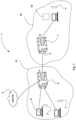
- FIG. 1 illustrates an environment in which embodiments according to the invention may be implemented.
- the physical network e.g., a computer network, a local area network (LAN) or a wide area network (WAN), typically comprises various types of cables interconnecting different pieces of hardware that are part of the network 1.
- the hardware may, for instance, comprise interconnected computers 2, 3, 4, repeaters, switches, routers 6, 7, workstations 8, Internet access 5 etc., connected to the network 1.
- the network 1 is thus a group of hardware sharing a communications line and/or wireless link to a server.
- the network 1 may, e.g., use Standard Ethernet, IEEE 802.3 Ethernet. In the Ethernet network there is a high amount of broadcast data sent directly to all network devices, which may lead to network jitter.
- a VLAN is a switched network that is logically segmented by, for instance, function or application.
- the VLAN may be seen as a subnetwork which groups together devices of separate physical LANs to form a virtual network. Broadcast and unicast traffic within a certain VLAN is not forwarded to other VLANs, thereby reducing network jitter.
- a first VLAN may comprise two computers 2, 3 and a first router 6, and a second VLAN may comprise one computer 4 and one router 7.
- Ethernet allows for Quality of Service (QoS) by using priorities in an IEEE 802.1Q tag, which also contains fields for VLAN separation.
- QoS Quality of Service
- the VLAN and QoS enables reduced jitter and worst-case packet delays for the high-priority traffic in the network 1.
- high-priority traffic may consume all the capacity in the network 1, thus starving the lower prioritized traffic completely during those periods.
- VLAN Voice over IP
- the typical use-case for VLANs is to partition the physical network 1 for achieving improved security and performance.
- the VLAN also allows for simplified physical network maintenance when equipment is physically removed and also enables simplified network expansions.
- the same advantages are beneficial in industrial networks as well but is rarely used for the same reasons as in corporate networks.
- the present invention enables, in various embodiments, a deterministic behavior in the shared physical network 1.
- the shared physical network 1 is a deterministic system since considering the given priority levels, the worst-case delay of the traffics in each VLAN can be calculated. This enables verification of the expected performance and provide the determinism of the system.
- Rate-Limited VLANs enables the "informational technology (IT)/ operational technology (OT) integration" in different ways. It provides the determinism for the time-critical OT traffic by eliminating the starvation problem and offering predictable worst-case delays for the prioritized traffic. Further, the concept allows both OT and IT traffic in the same physical network with same strategy as non-scheduled traffic classes from IEC60802 and brings possibilities of implementing best IT practices for enhanced security, partitioning and network expansions while there is no need for change in the automation system (endpoints).
- a rate-limiter 9 ensures that high priority traffic cannot consume all available capacity, thus providing capacity guarantees for the other remaining priorities for traffic in a recursive manner. This gives predictable worst-case delays while allowing IT traffic in the automation networks.
- the rate-limiter 9 may be applied on access ports or on trunk ports, or both.
- bandwidth limitation parameters In order to set bandwidth limitation parameters, a prior knowledge of traffic in the network should be available, such that high priority traffic can be sent within an expected time. That is, the bandwidth limitation parameters may be based on prior knowledge of traffic.
- TSN time Sensitive Networking
- the invention uses VLANs and ingress limiting at multiple locations in order to deterministically handle worst-case delays in the network.
- the present teachings do not require two disjoint VLANs. All traffic classes are rate-limited in order to guarantee that the desired deterministic delays are not exceeding the available memory. This leads to that low priority traffic, such as e.g. TCP, cannot cause packet loss of high priority traffic.
- QoS Quality of Service
- CoS Class of Service
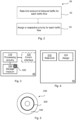
- FIG. 2 is a flowchart of methods in accordance embodiments.
- the method 30 provides a deterministic behavior in a shared physical network 1, such as the network 1 described in relation to figure 1 .
- the method 30 maybe performed in a device 40, for instance a processing device, controlling a Virtual Local Area Network, VLAN, 10, 20 of the shared physical network 1.
- the method 30 comprises rate limiting 32 the amount of inbound traffic for each traffic flow in the VLAN 10.
- the provided rate limited VLANs 10, 20 enables determinism.
- the method also allows both OT traffic and IT traffic in the same physical network.
- the method 30 further enables implementation of best possible IT practices, which gives enhanced security, partitioning and network expansions.
- the method 30 comprises assigning 34 a respective priority for each traffic flow in the VLAN 10, 20.
- the method 30 provides a number of advantages. For instance, the method ensures that critical traffic obtains its required capacity, although using a single physical network 1. All automation equipment may share this physical network 1, which simplifies the exchange of information, while also at least preserving the current level of security, predictability, safety and availability of the physical network.
- the present invention provides methods and means for paving way for further advances towards a next generation of automation systems in the era of digitalization.
- this method enables deterministic behavior in the shared physical network.
- the rate limiting 32 comprises setting a certain bandwidth limitation for each traffic flow based on prior knowledge of traffic in the network 1 by using a monitoring tool that provides an estimation of the required bandwidth and/or by previous knowledge of application demand.
- the rate-limiter that can be applied both on access ports or on trunk ports (or both), ensures that high priority traffic cannot consume all available capacity, thus providing capacity guarantees for the other remaining priorities in a recursive manner. This gives predictable worst-case delays while allowing IT traffic in the automation networks.
- an information technology traffic flow and an operational technology traffic flow are allowed in the shared physical network 1.
- the rate limiting 34 is performed in one or both of: an access port and a trunk port.
- the shared physical network 1 controls, by means of e.g., a process control system, an automation system, which is a system performing one or more functions with essentially no human intervention.
- a process control system e.g., an automation system
- Examples of such systems comprise, for instance, electricity generating plants, assembling and processes in factories.
- the VLAN 10 implements an IEEE 802.1Q Standard.
- the shared physical network 1 maybe an IEEE 802.3 Ethernet network.
- FIG. 3 schematically illustrates, in terms of a number of functional units, the components of a device 40 according to an embodiment.
- Processing circuitry 110 is provided using any combination of one or more of a suitable central processing unit (CPU), multiprocessor, microcontroller, digital signal processor (DSP), etc., capable of executing software instructions stored in a computer program product 330 (as in Fig. 5 ), e.g. in the form of a storage medium 130.
- the processing circuitry 110 may further be provided as at least one application specific integrated circuit (ASIC), or field programmable gate array (FPGA).
- ASIC application specific integrated circuit
- FPGA field programmable gate array
- the processing circuitry 110 is configured to cause the device 40 to perform a set of operations, or actions, as disclosed herein.
- the storage medium 130 may store the set of operations
- the processing circuitry 110 may be configured to retrieve the set of operations from the storage medium 130 to cause the device 40 to perform the set of operations.
- the set of operations may be provided as a set of executable instructions.
- the processing circuitry 110 is thereby arranged to execute methods as herein disclosed.
- the storage medium 130 may also comprise persistent storage, which, for example, can be any single one or combination of magnetic memory, optical memory, solid state memory or even remotely mounted memory.
- the device 40 may further comprise a communications interface 120 for communications with other entities, functions, nodes, and devices, over the interfaces as illustrated in Fig. 1 .
- the communications interface 120 may comprise one or more transmitters and receivers, comprising analogue and digital components.
- the processing circuitry 110 controls the general operation of the device 40 e.g. by sending data and control signals to the communications interface 120 and the storage medium 130, by receiving data and reports from the communications interface 120, and by retrieving data and instructions from the storage medium 130.
- Other components, as well as the related functionality, of the device 40 are omitted in order not to obscure the concepts presented herein.
- FIG. 4 schematically illustrates, in terms of a number of functional modules, the components of a device 40 according to an embodiment.
- the device 40 of Fig. 4 comprises a number of functional modules; a rate limiter 210 configured to perform step 32 of the method 30, and an assign module 220 configured to perform step 34 of the method 30.
- the device 40 of Fig. 4 may further comprise a number of optional functional modules, to perform further actions of the method 30.
- each functional module 210, 220 may be implemented in hardware or in software.
- one or more or all functional modules 210, 220 may be implemented by the processing circuitry 110, possibly in cooperation with the communications interface 120 and the storage medium 130.
- the processing circuitry 110 may thus be arranged to from the storage medium 130 fetch instructions as provided by a functional module 210, 220 and to execute these instructions, thereby performing any actions of the device 40 as disclosed herein.
- Figure 5 shows one example of a computer program product 330 comprising computer readable means 340.
- a computer program 320 can be stored, which computer program 320 can cause the processing circuitry 110 and thereto operatively coupled entities and devices, such as the communications interface 120 and the storage medium 130, to execute methods according to embodiments described herein.
- the computer program 320 and/or computer program product 330 may thus provide means for performing any actions of the device 40 as herein disclosed.
- the computer program product 330 is illustrated as an optical disc, such as a CD (compact disc) or a DVD (digital versatile disc) or a Blu-Ray disc.
- the computer program product 330 could also be embodied as a memory, such as a random access memory (RAM), a read-only memory (ROM), an erasable programmable read-only memory (EPROM), or an electrically erasable programmable read-only memory (EEPROM) and more particularly as a non-volatile storage medium of a device in an external memory such as a USB (Universal Serial Bus) memory or a Flash memory, such as a compact Flash memory.
- the computer program 320 is here schematically shown as a track on the depicted optical disk, the computer program 320 can be stored in any way which is suitable for the computer program product 330.
Landscapes
- Engineering & Computer Science (AREA)
- Computer Networks & Wireless Communication (AREA)
- Signal Processing (AREA)
- Computer Security & Cryptography (AREA)
- Environmental & Geological Engineering (AREA)
- Small-Scale Networks (AREA)
- Data Exchanges In Wide-Area Networks (AREA)
Abstract
Description
- The technology disclosed herein relates generally to the field of industrial networks, and in particular to a method, a device, computer program and computer program product for providing a deterministic behavior in a shared physical network.
- Industrial networks are often, for various reasons, handled as separate networks. A common reason for using separated networks is to make automation networks behave in a deterministic way, wherein no other traffic can disturb; commonly in order to provide e.g., a guaranteed capacity and delay. Some Ethernet-based fieldbuses use a Quality-of-Service (QoS), provided by Ethernet standards, giving critical traffic higher priority than non-critical traffic. Further reasons for separating networks are based on availability and/or security perspectives. However, the network separation may lead to fragmentation and required information not being readily available for various functionalities that are needed in automation systems. Larger process automation installations utilize Virtual Local Area Networks (VLANs) to consolidate control networks and client/server networks. However, such measures fail to provide guarantees for the desired deterministic behavior, and may also cause spurious problems, such as, for instance, a large backup procedure consuming the entire network capacity.
- From the above it is realized that the current industrial networks involve several drawbacks. On the one hand, it would be desirable for all automation equipment to share the same physical network since this would simplify the exchange of information. On the other hand, such shared network may lead to security problems and also result in critical traffic failing to get the required capacity.
- An objective of the present invention is to address and improve various aspects for industrial networks. A particular objective is to enable use of a single physical network for automation equipment while still maintaining a secure and safe functioning thereof. Another particular objective is to prevent high-priority traffic from consuming all network capacity, and thus avoiding to completely starve lower prioritized traffic during those periods. These objectives and others are achieved by the methods, devices, computer programs and computer program products according to the appended independent claims, and by the embodiments according to the dependent claims.
- The objective is according to a first aspect achieved by a method for providing a deterministic behavior in a shared physical network. The method is performed in a device controlling a Virtual Local Area Network (VLAN) of the shared physical network. The method comprises rate limiting the amount of inbound traffic for each traffic flow in the VLAN and assigning a respective priority for each traffic flow in the VLAN.
- The objective is according to a second aspect achieved by a VLAN configured for providing a deterministic behavior in a physical network. The VLAN is communicating over Ethernet, and the VLAN is configured to rate limit amount of inbound traffic for each traffic flow in the VLAN, and to assign a respective priority for each traffic flow in the VLAN.
- The objective is according to a third aspect achieved by a computer program for a device controlling a VLAN of a shared physical network. The computer program comprises computer program code, which, when run on at processing circuitry of the device causes the device to perform the method according to the first aspect.
- The objective is according to a fourth aspect achieved by a computer program product comprising a computer program according to the third aspect and a computer readable means on which the computer program is stored.
- These aspects method provides a number of advantages. For instance, it is ensured that critical traffic obtains its required capacity, although using a single physical network. Further, by having all automation equipment share the same physical network the exchange of information is simplified, while also preserving or even increasing the level of security, predictability, safety and availability of the physical network. The present invention provides methods and means for paving way for further advances towards a next generation of automation systems in the era of digitalization.
- Further features and advantages of the embodiments of the present teachings will become clear upon reading the following description and the accompanying drawings.
-
-
Figure 1 is a schematic diagram illustrating a network in which embodiments may be implemented. -
Figure 2 is a flowchart of methods in accordance with embodiments. -
Figure 3 is a schematic diagram showing functional units of a device according to an embodiment. -
Figure 4 is a schematic diagram showing functional modules of a device according to an embodiment. - In the following description, for purposes of explanation and not limitation, specific details are set forth such as particular architectures, interfaces, techniques, etc. in order to provide a thorough understanding. In other instances, detailed descriptions of well-known devices, circuits, and methods are omitted so as not to obscure the description with unnecessary detail. Same reference numerals refer to same or similar elements throughout the description.
- Briefly, the herein described embodiments relate to Rate-Limited VLANs allowing for prioritization of different traffic classes/types, while also providing guaranteed capacity in the VLANs, in a single shared physical network (in the following also denoted network). Taken together this enables a deterministic behavior in the network, as well as bound network delays, which are two paramount requirements in automation systems. Further, in various embodiments, best effort traffic can still exist and consume the remaining capacity of the network while maintaining the deterministic behavior of the critical traffic.
-
Figure 1 illustrates an environment in which embodiments according to the invention may be implemented. Thephysical network 1, e.g., a computer network, a local area network (LAN) or a wide area network (WAN), typically comprises various types of cables interconnecting different pieces of hardware that are part of thenetwork 1. The hardware may, for instance, comprise interconnectedcomputers routers workstations 8,Internet access 5 etc., connected to thenetwork 1. Thenetwork 1 is thus a group of hardware sharing a communications line and/or wireless link to a server. Thenetwork 1 may, e.g., use Standard Ethernet, IEEE 802.3 Ethernet. In the Ethernet network there is a high amount of broadcast data sent directly to all network devices, which may lead to network jitter. - A VLAN is a switched network that is logically segmented by, for instance, function or application. The VLAN may be seen as a subnetwork which groups together devices of separate physical LANs to form a virtual network. Broadcast and unicast traffic within a certain VLAN is not forwarded to other VLANs, thereby reducing network jitter. In the
physical network 1 offigure 1 , a first VLAN may comprise twocomputers first router 6, and a second VLAN may comprise onecomputer 4 and onerouter 7. - Ethernet allows for Quality of Service (QoS) by using priorities in an IEEE 802.1Q tag, which also contains fields for VLAN separation. The VLAN and QoS enables reduced jitter and worst-case packet delays for the high-priority traffic in the
network 1. However, high-priority traffic may consume all the capacity in thenetwork 1, thus starving the lower prioritized traffic completely during those periods. - The typical use-case for VLANs is to partition the
physical network 1 for achieving improved security and performance. The VLAN also allows for simplified physical network maintenance when equipment is physically removed and also enables simplified network expansions. The same advantages are beneficial in industrial networks as well but is rarely used for the same reasons as in corporate networks. - By combining the use of VLANs and its priorities with rate-limiting the amount of traffic that can flow in a VLANs, the present invention enables, in various embodiments, a deterministic behavior in the shared
physical network 1. The sharedphysical network 1 is a deterministic system since considering the given priority levels, the worst-case delay of the traffics in each VLAN can be calculated. This enables verification of the expected performance and provide the determinism of the system. - The concept of Rate-Limited VLANs enables the "informational technology (IT)/ operational technology (OT) integration" in different ways. It provides the determinism for the time-critical OT traffic by eliminating the starvation problem and offering predictable worst-case delays for the prioritized traffic. Further, the concept allows both OT and IT traffic in the same physical network with same strategy as non-scheduled traffic classes from IEC60802 and brings possibilities of implementing best IT practices for enhanced security, partitioning and network expansions while there is no need for change in the automation system (endpoints).
- A rate-
limiter 9 ensures that high priority traffic cannot consume all available capacity, thus providing capacity guarantees for the other remaining priorities for traffic in a recursive manner. This gives predictable worst-case delays while allowing IT traffic in the automation networks. The rate-limiter 9 may be applied on access ports or on trunk ports, or both. In order to set bandwidth limitation parameters, a prior knowledge of traffic in the network should be available, such that high priority traffic can be sent within an expected time. That is, the bandwidth limitation parameters may be based on prior knowledge of traffic. - The presented teachings may be deployed in many different ways in real installations. TSN enables fine-grained control and further jitter reduction, but requires changes in network infrastructure, endpoints, and engineering toolchains. In this context, an important use case of the invention is that it allows for a stepwise introduction of the benefits of TSN, while also providing support for currently used products and systems. For instance, a first step may be to use the network infrastructure to handle the rate limited
VLANs - In various aspects, the invention uses VLANs and ingress limiting at multiple locations in order to deterministically handle worst-case delays in the network. In contrast to prior art, in which determinism is enabled by using dedicated networks, the present teachings do not require two disjoint VLANs. All traffic classes are rate-limited in order to guarantee that the desired deterministic delays are not exceeding the available memory. This leads to that low priority traffic, such as e.g. TCP, cannot cause packet loss of high priority traffic.
- When a network experiences congestion and delay, some packets must be prioritized to avoid random loss of data. Quality of Service (QoS), also known as Class of Service (CoS), accomplishes this prioritization by dividing similar types of traffic, such as e-mail, streaming video, voice, large document file transfer, into classes. By applying different levels of priority, such as those for throughput and packet loss, to each group, traffic behavior can be controlled. For example, when packets must be dropped, it is ensured that packet losses take place according to the configured rules.
-
Figure 2 is a flowchart of methods in accordance embodiments. Themethod 30 provides a deterministic behavior in a sharedphysical network 1, such as thenetwork 1 described in relation tofigure 1 . Themethod 30 maybe performed in adevice 40, for instance a processing device, controlling a Virtual Local Area Network, VLAN, 10, 20 of the sharedphysical network 1. Themethod 30 comprises rate limiting 32 the amount of inbound traffic for each traffic flow in theVLAN 10. The provided rate limitedVLANs method 30 further enables implementation of best possible IT practices, which gives enhanced security, partitioning and network expansions. - The
method 30 comprises assigning 34 a respective priority for each traffic flow in theVLAN - As noted earlier, the
method 30 provides a number of advantages. For instance, the method ensures that critical traffic obtains its required capacity, although using a singlephysical network 1. All automation equipment may share thisphysical network 1, which simplifies the exchange of information, while also at least preserving the current level of security, predictability, safety and availability of the physical network. The present invention provides methods and means for paving way for further advances towards a next generation of automation systems in the era of digitalization. - By combining the use of VLANs and its priorities, with an addition of rate-limiting the amount of traffic that can flow in a VLANs, this method enables deterministic behavior in the shared physical network.
- The rate-limiting may be performed in various different ways. In an embodiment of the
method 30, the rate limiting 32 comprises setting a certain bandwidth limitation for each traffic flow based on prior knowledge of traffic in thenetwork 1 by using a monitoring tool that provides an estimation of the required bandwidth and/or by previous knowledge of application demand. The rate-limiter, that can be applied both on access ports or on trunk ports (or both), ensures that high priority traffic cannot consume all available capacity, thus providing capacity guarantees for the other remaining priorities in a recursive manner. This gives predictable worst-case delays while allowing IT traffic in the automation networks. - In various embodiments of the
method 30 an information technology traffic flow and an operational technology traffic flow are allowed in the sharedphysical network 1. - In various embodiments, the rate limiting 34 is performed in one or both of: an access port and a trunk port.
- In various embodiments, the shared
physical network 1 controls, by means of e.g., a process control system, an automation system, which is a system performing one or more functions with essentially no human intervention. Examples of such systems comprise, for instance, electricity generating plants, assembling and processes in factories. - In various embodiments, the
VLAN 10 implements an IEEE 802.1Q Standard. In such embodiments, the sharedphysical network 1 maybe an IEEE 802.3 Ethernet network. -
Figure 3 schematically illustrates, in terms of a number of functional units, the components of adevice 40 according to an embodiment.Processing circuitry 110 is provided using any combination of one or more of a suitable central processing unit (CPU), multiprocessor, microcontroller, digital signal processor (DSP), etc., capable of executing software instructions stored in a computer program product 330 (as inFig. 5 ), e.g. in the form of astorage medium 130. Theprocessing circuitry 110 may further be provided as at least one application specific integrated circuit (ASIC), or field programmable gate array (FPGA). - Particularly, the
processing circuitry 110 is configured to cause thedevice 40 to perform a set of operations, or actions, as disclosed herein. For example, thestorage medium 130 may store the set of operations, and theprocessing circuitry 110 may be configured to retrieve the set of operations from thestorage medium 130 to cause thedevice 40 to perform the set of operations. The set of operations may be provided as a set of executable instructions. Theprocessing circuitry 110 is thereby arranged to execute methods as herein disclosed. - The
storage medium 130 may also comprise persistent storage, which, for example, can be any single one or combination of magnetic memory, optical memory, solid state memory or even remotely mounted memory. - The
device 40 may further comprise acommunications interface 120 for communications with other entities, functions, nodes, and devices, over the interfaces as illustrated inFig. 1 . As such thecommunications interface 120 may comprise one or more transmitters and receivers, comprising analogue and digital components. - The
processing circuitry 110 controls the general operation of thedevice 40 e.g. by sending data and control signals to thecommunications interface 120 and thestorage medium 130, by receiving data and reports from thecommunications interface 120, and by retrieving data and instructions from thestorage medium 130. Other components, as well as the related functionality, of thedevice 40 are omitted in order not to obscure the concepts presented herein. -
Figure 4 schematically illustrates, in terms of a number of functional modules, the components of adevice 40 according to an embodiment. Thedevice 40 ofFig. 4 comprises a number of functional modules; arate limiter 210 configured to performstep 32 of themethod 30, and an assignmodule 220 configured to performstep 34 of themethod 30. Thedevice 40 ofFig. 4 may further comprise a number of optional functional modules, to perform further actions of themethod 30. In general terms, eachfunctional module functional modules processing circuitry 110, possibly in cooperation with thecommunications interface 120 and thestorage medium 130. Theprocessing circuitry 110 may thus be arranged to from thestorage medium 130 fetch instructions as provided by afunctional module device 40 as disclosed herein. -
Figure 5 shows one example of acomputer program product 330 comprising computerreadable means 340. On this computerreadable means 340, acomputer program 320 can be stored, whichcomputer program 320 can cause theprocessing circuitry 110 and thereto operatively coupled entities and devices, such as thecommunications interface 120 and thestorage medium 130, to execute methods according to embodiments described herein. Thecomputer program 320 and/orcomputer program product 330 may thus provide means for performing any actions of thedevice 40 as herein disclosed. - In the example of
Fig. 5 , thecomputer program product 330 is illustrated as an optical disc, such as a CD (compact disc) or a DVD (digital versatile disc) or a Blu-Ray disc. Thecomputer program product 330 could also be embodied as a memory, such as a random access memory (RAM), a read-only memory (ROM), an erasable programmable read-only memory (EPROM), or an electrically erasable programmable read-only memory (EEPROM) and more particularly as a non-volatile storage medium of a device in an external memory such as a USB (Universal Serial Bus) memory or a Flash memory, such as a compact Flash memory. Thus, while thecomputer program 320 is here schematically shown as a track on the depicted optical disk, thecomputer program 320 can be stored in any way which is suitable for thecomputer program product 330. - The invention has mainly been described herein with reference to a few embodiments. However, as is appreciated by a person skilled in the art, other embodiments than the particular ones disclosed herein are equally possible within the scope of the invention, as defined by the appended patent claims.
Claims (14)
- A method (30) for providing a deterministic behavior in a shared physical network (1), the method (30) being performed in a device (40) controlling a Virtual Local Area Network, VLAN, (10) of the shared physical network (1), the method (30) comprising:- rate limiting (32) amount of inbound traffic for each traffic flow in the VLAN (10), and- assigning (34) a respective priority for each traffic flow in the VLAN (10).
- The method (30) as claimed in claim 1, wherein the rate limiting (32) comprises setting a certain bandwidth limitation for each traffic flow based on prior knowledge of traffic in the network (1) by using a monitoring tool that provides an estimation of the required bandwidth and/or by previous knowledge of application demand.
- The method (30) as claimed in claim 1 or 2, allowing an information technology traffic flow and an operational technology traffic flow in the shared physical network (1).
- The method (30) as claimed in any of the preceding claims, comprising performing the rate limiting (34) in one or both of: an access port and a trunk port.
- The method (30) as claimed in any of the preceding claims, wherein the shared physical network (1) controls an automation system.
- The method (30) as claimed in any of the preceding claims, wherein the VLAN (10) implements an IEEE 802.1Q Standard.
- The method (30) as claimed in claim 6, wherein the shared physical network (1) is an IEEE 802.3 Ethernet network.
- A Virtual Local Area Network, VLAN, (10) configured for providing a deterministic behavior in a physical network (1), the VLAN (10) communicating over Ethernet, and the VLAN (10) being configured to:- rate limit amount of inbound traffic for each traffic flow in the VLAN (10), and- assign a respective priority for each traffic flow in the VLAN (10).
- The VLAN (10) as claimed in claim 8, configured to be rate limited based on prior knowledge of network traffic and/or application demand.
- The VLAN (10) as claimed in claim 8 or 9, configured to allow an information technology traffic flow and an operational technology traffic flow in the shared physical network (1).
- The VLAN (10) as claimed in any of claims 8 - 10, configured to perform the rate limiting in one or both of: an access port and a trunk port.
- The VLAN (10) as claimed in any of claims 8 - 11, implementing an IEEE 802.1Q Standard.
- A computer program (42) for a device (40) controlling a Virtual Local Area Network, VLAN, (10) of a shared physical network (1), the computer program (42) comprising computer program code, which, when run on at processing circuitry of the device (40) causes the device (40) to perform the method (30) according to any of claims 1-7.
- A computer program product (41) comprising a computer program (42) as claimed in claim 13 and a computer readable means on which the computer program (41) is stored.
Priority Applications (3)
| Application Number | Priority Date | Filing Date | Title |
|---|---|---|---|
| EP21208205.1A EP4181470B1 (en) | 2021-11-15 | 2021-11-15 | DETERMINISTIC BEHAVIOR IN A COMMON PHYSICAL NETWORK |
| CN202211387693.5A CN116132372A (en) | 2021-11-15 | 2022-11-07 | Deterministic behavior in shared physical networks |
| US18/055,567 US12395378B2 (en) | 2021-11-15 | 2022-11-15 | Deterministic behavior in a shared physical network |
Applications Claiming Priority (1)
| Application Number | Priority Date | Filing Date | Title |
|---|---|---|---|
| EP21208205.1A EP4181470B1 (en) | 2021-11-15 | 2021-11-15 | DETERMINISTIC BEHAVIOR IN A COMMON PHYSICAL NETWORK |
Publications (2)
| Publication Number | Publication Date |
|---|---|
| EP4181470A1 true EP4181470A1 (en) | 2023-05-17 |
| EP4181470B1 EP4181470B1 (en) | 2025-12-31 |
Family
ID=78621778
Family Applications (1)
| Application Number | Title | Priority Date | Filing Date |
|---|---|---|---|
| EP21208205.1A Active EP4181470B1 (en) | 2021-11-15 | 2021-11-15 | DETERMINISTIC BEHAVIOR IN A COMMON PHYSICAL NETWORK |
Country Status (3)
| Country | Link |
|---|---|
| US (1) | US12395378B2 (en) |
| EP (1) | EP4181470B1 (en) |
| CN (1) | CN116132372A (en) |
Citations (2)
| Publication number | Priority date | Publication date | Assignee | Title |
|---|---|---|---|---|
| US20070133549A1 (en) * | 2005-12-08 | 2007-06-14 | Electronics & Telecommunications Research Institute | Apparatus and method for managing traffic using VID in EPON |
| EP2066081A1 (en) * | 2007-11-30 | 2009-06-03 | Ciena Corporation | Flow control using referential tables in a carrier ethernet network |
Family Cites Families (4)
| Publication number | Priority date | Publication date | Assignee | Title |
|---|---|---|---|---|
| US6111876A (en) * | 1996-03-12 | 2000-08-29 | Nortel Networks Limited | VLAN frame format |
| US7855972B2 (en) * | 2002-02-08 | 2010-12-21 | Enterasys Networks, Inc. | Creating, modifying and storing service abstractions and role abstractions representing one or more packet rules |
| GB2588161B (en) * | 2019-10-10 | 2021-12-22 | Metaswitch Networks Ltd | Processing traffic in a virtualised environment |
| US11353855B1 (en) * | 2019-12-13 | 2022-06-07 | Amazon Technologies, Inc. | Configuring and deploying gateway connectors and workflows for data sources at client networks |
-
2021
- 2021-11-15 EP EP21208205.1A patent/EP4181470B1/en active Active
-
2022
- 2022-11-07 CN CN202211387693.5A patent/CN116132372A/en active Pending
- 2022-11-15 US US18/055,567 patent/US12395378B2/en active Active
Patent Citations (2)
| Publication number | Priority date | Publication date | Assignee | Title |
|---|---|---|---|---|
| US20070133549A1 (en) * | 2005-12-08 | 2007-06-14 | Electronics & Telecommunications Research Institute | Apparatus and method for managing traffic using VID in EPON |
| EP2066081A1 (en) * | 2007-11-30 | 2009-06-03 | Ciena Corporation | Flow control using referential tables in a carrier ethernet network |
Non-Patent Citations (1)
| Title |
|---|
| KORNER MARC ET AL: "An approach for QoS constraint networks in cloud environments", 2013 FOURTH INTERNATIONAL CONFERENCE ON THE NETWORK OF THE FUTURE (NOF), IEEE, 23 October 2013 (2013-10-23), pages 1 - 3, XP032558765, DOI: 10.1109/NOF.2013.6724522 * |
Also Published As
| Publication number | Publication date |
|---|---|
| EP4181470B1 (en) | 2025-12-31 |
| US12395378B2 (en) | 2025-08-19 |
| US20230155861A1 (en) | 2023-05-18 |
| CN116132372A (en) | 2023-05-16 |
Similar Documents
| Publication | Publication Date | Title |
|---|---|---|
| US11811663B2 (en) | Network traffic load balancing | |
| US10911355B2 (en) | Multi-site telemetry tracking for fabric traffic using in-band telemetry | |
| US9473414B2 (en) | Method and system for supporting packet prioritization at a data network | |
| US9705827B2 (en) | Methods and apparatus for virtual channel flow control associated with a switch fabric | |
| US8327014B2 (en) | Multi-layer hardware-based service acceleration (MHSA) | |
| US9438435B2 (en) | Secure, multi-tenancy aware and bandwidth-efficient data center multicast | |
| US20140010083A1 (en) | Flow-based network switching system | |
| EP3226492B1 (en) | Method, system, and apparatus for improving forwarding capabilities during route convergence | |
| WO2020076490A1 (en) | Rdma with virtual address space | |
| US10313268B2 (en) | Network arrangement and method prioritization of real-time telegrams in a convergent network | |
| US12107704B2 (en) | Method for network slices to share uplink port, apparatus, and storage medium | |
| US9992168B2 (en) | Data transfer | |
| US9985879B2 (en) | Apparatus, system, and method for preventing multicast traffic drops at egress routers in E-Tree topologies | |
| US10581738B2 (en) | Efficient inter-VLAN routing in openflow networks | |
| CN112997457B (en) | Vehicle control unit architecture | |
| US10715437B2 (en) | Deadline driven packet prioritization for IP networks | |
| Owens et al. | Explicit routing in software-defined networking (ersdn): Addressing controller scalability | |
| US12395378B2 (en) | Deterministic behavior in a shared physical network | |
| CN117729178A (en) | Method for transferring data within a computing unit | |
| US20260121987A1 (en) | Systems and methods for managing packet data with variable metadata size | |
| US9584428B1 (en) | Apparatus, system, and method for increasing scheduling efficiency in network devices | |
| Paikan et al. | Communication channel prioritization in a publish-subscribe architecture | |
| Ubik et al. | QoS in Layer 2 Networks with Cisco Catalyst 3550 | |
| Kodama et al. | Packet tagging system using adaptive MSS clamping on TCP | |
| CN119341852A (en) | A network acceleration system and method based on Loongson platform |
Legal Events
| Date | Code | Title | Description |
|---|---|---|---|
| PUAI | Public reference made under article 153(3) epc to a published international application that has entered the european phase |
Free format text: ORIGINAL CODE: 0009012 |
|
| STAA | Information on the status of an ep patent application or granted ep patent |
Free format text: STATUS: THE APPLICATION HAS BEEN PUBLISHED |
|
| AK | Designated contracting states |
Kind code of ref document: A1 Designated state(s): AL AT BE BG CH CY CZ DE DK EE ES FI FR GB GR HR HU IE IS IT LI LT LU LV MC MK MT NL NO PL PT RO RS SE SI SK SM TR |
|
| STAA | Information on the status of an ep patent application or granted ep patent |
Free format text: STATUS: REQUEST FOR EXAMINATION WAS MADE |
|
| 17P | Request for examination filed |
Effective date: 20231116 |
|
| RBV | Designated contracting states (corrected) |
Designated state(s): AL AT BE BG CH CY CZ DE DK EE ES FI FR GB GR HR HU IE IS IT LI LT LU LV MC MK MT NL NO PL PT RO RS SE SI SK SM TR |
|
| GRAP | Despatch of communication of intention to grant a patent |
Free format text: ORIGINAL CODE: EPIDOSNIGR1 |
|
| STAA | Information on the status of an ep patent application or granted ep patent |
Free format text: STATUS: GRANT OF PATENT IS INTENDED |
|
| RIC1 | Information provided on ipc code assigned before grant |
Ipc: H04L 49/351 20220101ALN20250528BHEP Ipc: H04L 47/2441 20220101ALI20250528BHEP Ipc: H04L 47/22 20220101ALI20250528BHEP Ipc: H04L 47/20 20220101ALI20250528BHEP Ipc: H04L 47/24 20220101ALI20250528BHEP Ipc: H04L 12/46 20060101AFI20250528BHEP |
|
| INTG | Intention to grant announced |
Effective date: 20250611 |
|
| GRAS | Grant fee paid |
Free format text: ORIGINAL CODE: EPIDOSNIGR3 |
|
| GRAA | (expected) grant |
Free format text: ORIGINAL CODE: 0009210 |
|
| STAA | Information on the status of an ep patent application or granted ep patent |
Free format text: STATUS: THE PATENT HAS BEEN GRANTED |
|
| AK | Designated contracting states |
Kind code of ref document: B1 Designated state(s): AL AT BE BG CH CY CZ DE DK EE ES FI FR GB GR HR HU IE IS IT LI LT LU LV MC MK MT NL NO PL PT RO RS SE SI SK SM TR |
|
| REG | Reference to a national code |
Ref country code: CH Ref legal event code: F10 Free format text: ST27 STATUS EVENT CODE: U-0-0-F10-F00 (AS PROVIDED BY THE NATIONAL OFFICE) Effective date: 20251231 Ref country code: GB Ref legal event code: FG4D |
|
| REG | Reference to a national code |
Ref country code: DE Ref legal event code: R096 Ref document number: 602021045363 Country of ref document: DE |
|
| REG | Reference to a national code |
Ref country code: IE Ref legal event code: FG4D |
|
| REG | Reference to a national code |
Ref country code: LT Ref legal event code: MG9D |
|
| PG25 | Lapsed in a contracting state [announced via postgrant information from national office to epo] |
Ref country code: NO Free format text: LAPSE BECAUSE OF FAILURE TO SUBMIT A TRANSLATION OF THE DESCRIPTION OR TO PAY THE FEE WITHIN THE PRESCRIBED TIME-LIMIT Effective date: 20260331 |
|
| PG25 | Lapsed in a contracting state [announced via postgrant information from national office to epo] |
Ref country code: HR Free format text: LAPSE BECAUSE OF FAILURE TO SUBMIT A TRANSLATION OF THE DESCRIPTION OR TO PAY THE FEE WITHIN THE PRESCRIBED TIME-LIMIT Effective date: 20251231 Ref country code: FI Free format text: LAPSE BECAUSE OF FAILURE TO SUBMIT A TRANSLATION OF THE DESCRIPTION OR TO PAY THE FEE WITHIN THE PRESCRIBED TIME-LIMIT Effective date: 20251231 |
|
| PG25 | Lapsed in a contracting state [announced via postgrant information from national office to epo] |
Ref country code: RS Free format text: LAPSE BECAUSE OF FAILURE TO SUBMIT A TRANSLATION OF THE DESCRIPTION OR TO PAY THE FEE WITHIN THE PRESCRIBED TIME-LIMIT Effective date: 20260331 |
|
| PG25 | Lapsed in a contracting state [announced via postgrant information from national office to epo] |
Ref country code: LV Free format text: LAPSE BECAUSE OF FAILURE TO SUBMIT A TRANSLATION OF THE DESCRIPTION OR TO PAY THE FEE WITHIN THE PRESCRIBED TIME-LIMIT Effective date: 20251231 |
|
| PG25 | Lapsed in a contracting state [announced via postgrant information from national office to epo] |
Ref country code: BG Free format text: LAPSE BECAUSE OF FAILURE TO SUBMIT A TRANSLATION OF THE DESCRIPTION OR TO PAY THE FEE WITHIN THE PRESCRIBED TIME-LIMIT Effective date: 20251231 |
|
| REG | Reference to a national code |
Ref country code: NL Ref legal event code: MP Effective date: 20251231 |