EP4181070A1 - System and method for recreating graphical image using character recognition to reduce storage space - Google Patents
System and method for recreating graphical image using character recognition to reduce storage space Download PDFInfo
- Publication number
- EP4181070A1 EP4181070A1 EP22207049.2A EP22207049A EP4181070A1 EP 4181070 A1 EP4181070 A1 EP 4181070A1 EP 22207049 A EP22207049 A EP 22207049A EP 4181070 A1 EP4181070 A1 EP 4181070A1
- Authority
- EP
- European Patent Office
- Prior art keywords
- character
- given
- textual character
- textual
- graphical image
- Prior art date
- Legal status (The legal status is an assumption and is not a legal conclusion. Google has not performed a legal analysis and makes no representation as to the accuracy of the status listed.)
- Granted
Links
Images




Classifications
-
- G—PHYSICS
- G06—COMPUTING OR CALCULATING; COUNTING
- G06T—IMAGE DATA PROCESSING OR GENERATION, IN GENERAL
- G06T11/00—Two-dimensional [2D] image generation
- G06T11/40—Filling planar surfaces by adding surface attributes, e.g. adding colours or textures
-
- G—PHYSICS
- G06—COMPUTING OR CALCULATING; COUNTING
- G06T—IMAGE DATA PROCESSING OR GENERATION, IN GENERAL
- G06T11/00—Two-dimensional [2D] image generation
- G06T11/20—Drawing from basic elements
- G06T11/23—Drawing from basic elements using straight lines or curves
Definitions
- Flight charts are typically received from a third-party vendor in an industry standard print format, such as a portable digital file (PDF) format which are large in file size.
- PDF portable digital file
- the space required to store flight charts in an avionics system is large, and the available space to store flight charts in those avionics systems is limited. Additionally, avionics systems typically must maintain a multitude of potentially needed flight charts for each flight, which compounds the storage capacity problem.
- each character on a PDF version of a flight chart is represented as a rasterized image character, and the text formed from such rasterized image characters requires considerable space to maintain, especially when multiple flight charts typically should be maintained by an avionics display unit computing device.
- inventions of the inventive concepts disclosed herein are directed to a system.
- the system may include at least one computer readable medium and at least one processor communicatively coupled to the at least one computer readable medium.
- the at least one processor may be configured to: obtain a graphical image file, the graphical image file including an image, wherein the image includes at least one portion including textual characters, wherein each textual character of the textual characters is formed of line segments; and convert the graphical image file to at least one file including hardware directives that when executed cause a recreation of the image of the graphical image file to be drawn, wherein a size of the at least one file is smaller than the graphical image file.
- inventions of the inventive concepts disclosed herein are directed to a method.
- the method may include: obtaining, by at least one processor communicatively coupled to at least one computer readable medium, a graphical image file, the graphical image file including an image, wherein the image includes at least one portion including textual characters, wherein each textual character of the textual characters is formed of line segments; and converting, by the at least one processor, the graphical image file to at least one file including hardware directives that when executed cause a recreation of the image of the graphical image file to be drawn, wherein a size of the at least one file is smaller than the graphical image file.
- inventive concepts are not limited in their application to the details of construction and the arrangement of the components or steps or methodologies set forth in the following description or illustrated in the drawings.
- inventive concepts disclosed herein may be practiced without these specific details.
- well-known features may not be described in detail to avoid unnecessarily complicating the instant disclosure.
- inventive concepts disclosed herein are capable of other embodiments or of being practiced or carried out in various ways. Also, it is to be understood that the phraseology and terminology employed herein is for the purpose of description and should not be regarded as limiting.
- a letter following a reference numeral is intended to reference an embodiment of the feature or element that may be similar, but not necessarily identical, to a previously described element or feature bearing the same reference numeral (e.g., 1, 1a, 1b).
- reference numeral e.g. 1, 1a, 1b
- Such shorthand notations are used for purposes of convenience only, and should not be construed to limit the inventive concepts disclosed herein in any way unless expressly stated to the contrary.
- any reference to "one embodiment,” or “some embodiments” means that a particular element, feature, structure, or characteristic described in connection with the embodiment is included in at least one embodiment of the inventive concepts disclosed herein.
- the appearances of the phrase “in some embodiments” in various places in the specification are not necessarily all referring to the same embodiment, and embodiments of the inventive concepts disclosed may include one or more of the features expressly described or inherently present herein, or any combination of sub-combination of two or more such features, along with any other features which may not necessarily be expressly described or inherently present in the instant disclosure.
- embodiments of the inventive concepts disclosed herein may be directed to a system and a method configured to recreate an image of a graphical image file to reduce storage space, the image having textual characters.
- Some embodiments include a method for automated character recognition within a tool set of a host computing device that may generate charts for use within an avionics application (e.g., of an avionics display unit computing device). While some embodiments are related to a tool to facilitate customer generated chart databases for use with a certified avionics system, other embodiments may use the method for character recognition in any system that needs to recognize characters as alphanumeric entities and not as groups of lines.
- Some embodiments may include converting avionics charts (e.g., flight charts) from a PDF format into a set of graphical hardware directives for an avionics display unit to display. Characters in the PDF format are often defined by individual lines and are often rasterized. Some embodiments may convert characters of the PDF format into characters (e.g., vectorized characters) which are stored once, but used many times, which can reduce the space required for character storage by up to 99% or more.
- avionics charts e.g., flight charts
- Characters in the PDF format are often defined by individual lines and are often rasterized.
- Some embodiments may convert characters of the PDF format into characters (e.g., vectorized characters) which are stored once, but used many times, which can reduce the space required for character storage by up to 99% or more.
- the flight charts are large enough that the charts will not fit within the hardware constraints imposed by an avionics display system. This may be true both for the size of one displayed chart and for the total size of all stored charts. Reducing the space used for characters may improve the ability to provide avionics charts to pilots.
- PDF input characters such as shown in FIG. 2 and 4
- PDF input characters do not follow a specific standard. This makes detecting a character difficult, and accuracy of character recognition is important for presenting accurate information to a pilot.
- the mechanism to detect characters should be flexible enough to find characters that are defined differently from each other, but should also not find groups of lines that are not characters.
- clarity can be improved using standard characters. It is important that the pilot be able to read the displayed charts in the cockpit. Since a single standard is not followed, and because PDF characters vary in their clarity, using a common font can improve cockpit readability by a pilot.
- Some embodiments may provide a system and method to condense certain types of repeating textual characters in a display system (e.g., an avionics display system) without affecting the image displayed. While some embodiments may be used by an avionics display system, other embodiments may be used in any suitable system that handles images having repeating textual characters that could be condensed to reduce storage space.
- a display system e.g., an avionics display system
- an exemplary embodiment of an image (e.g., a flight chart image 100) of an image file (e.g., a graphical image file) according to the inventive concepts disclosed herein is depicted.
- flight charts typically have many textual portions 102 including textual characters 104 in various locations of the flight chart image 100.
- each of the three textual characters 104-1, 104-2, 104-3 may be defined by individual lines and may be rasterized; however, each of the three textual characters 104-1, 104-2, 104-3 may be defined differently by the individual lines making up a given textual character 104.
- the tolerances should be set so that characters are detected with a high probability and nearly never (or never) incorrectly. Tolerances may be used since the group of lines representing a character is not always 'clean'. Adding tolerances allows detection of characters 104-1, 104-2, 104-3 (different "e"s) with these types of imperfection and inconsistency.
- exemplary textual character 104A e.g., "A” textual character
- textual character 104C e.g., "C” textual character
- image e.g., the flight chart image 100
- image file e.g., a graphical image file
- a computing device may be configured to: obtain a graphical image file (e.g., which may be in PDF format), the graphical image file including an image (e.g., a flight chart image 100), wherein the image includes at least one portion including textual characters 104, wherein each textual character 104 of the textual characters 104 is formed of line segments; and convert the graphical image file to at least one file including hardware directives that when executed cause a recreation of the image of the graphical image file to be drawn.
- a graphical image file e.g., which may be in PDF format
- the graphical image file including an image (e.g., a flight chart image 100), wherein the image includes at least one portion including textual characters 104, wherein each textual character 104 of the textual characters 104 is formed of line segments
- convert the graphical image file to at least one file including hardware directives that when executed cause a recreation of the image of the graphical image file to be drawn.
- the step of converting the graphical image file to at least one file including hardware directives that when executed cause a recreation of the image of the graphical image file to be drawn may include any or all of the following: testing sections (e.g., made up of the line segments) in each path around a shape(s) of the textual character 104 to determine if the textual character 104 represents a character in a known font; loop through each known character in each known font to try to determine if the textual character 104 is a match to any known character in any known font, wherein each known character in each known font may be stored in at least one data structure (e.g., table(s)); and/or inspect the textual character 104 against pre-determined font characteristic values (e.g., of a table(s)).
- testing sections e.g., made up of the line segments
- the step of converting the graphical image file to at least one file including hardware directives that when executed cause a recreation of the image of the graphical image file to be drawn may include any or all of the following: if a match is detected, replace the line segments of the given textual character 104 with a character font reference; and/or draw the character corresponding to the character font reference while accounting for an orientation angle and appropriate sizing.
- the predetermined font characteristic values may be determined by analyzation of a statistically significant sample size of exemplars.
- chart text and characters 104 may be input to the chart tools of the computing device as filled shapes, and each character 104 may be drawn by an individual path. Some of the character shapes have hundreds of points forming the character 104. To lower the total number of points stored, characters may be converted to a predefined standard character font and stored once as a 'character subroutine', or more properly as a 'font' and accessed as a common resource for other matching characters in the flight chart image 100 or other flight chart images 100.
- Fonts may be detected using values in a predetermined table(s).
- the pre-determined font characteristic values vary by font.
- Each upper and lower case character, each number, and a number of special characters have their own detection values.
- Character fonts may be detected using a sequence of criteria that separate characters from other chart objects and from each other. These criteria may include: the number of vertices in a path; the sequence of angles at each vertex; the sum of a sequence of angles; whether the character has an inside shape; and/or the ratio of character width to character height.
- each character has a consistently defined start location and a 'reference line' that can be used to determine the rotation angle of the character.
- start location is not always at the left corner of the character.
- the reference line is often a horizontal line when the character is drawn upright, but not always.
- Curves within a character are broken into many small line segments which are not standard. To match a predetermined font characteristic value, the segment angles must fall within a specified range (for example, 176-183 degrees). The entire curve is considered one vertex angle. The curve is "completed" once a line segment angle falls outside of the specified range.
- the tolerances should be set so that characters are detected with a high probability and nearly never (or never) incorrectly. Tolerances may be used since the group of lines representing a character is not always 'clean'.
- character "C" 104-C has three curve sections (Angles 1, 4, and 7).
- the first curve (Angle 1) is the starting location for this character and angle 7 completes the character. There are many points along this curve. The angle between any two points on the curve is in the range of 177-181 degrees. The curve ends when it hits Angle 2, and the straight-line segment is drawn from that vertex to the vertex of Angle 3.
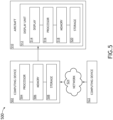
- the system 500 may include at least one computing device 502, at least one aircraft 510, at least one computing device 522, and/or at least one network 524, some or all of which may be communicatively coupled at any given time.
- the computing device 502 may be configured to obtain (e.g., receive from the computing device 522) a graphical image file, the graphical image file including an image (e.g., a flight chart image 100).
- the image may include at least one portion 102 including textual characters 104, wherein each textual character 104 of the textual characters 104 is formed of line segments.
- the computing device 502 may be configured to convert the graphical image file to at least one file including hardware directives that when executed cause a recreation of the image of the graphical image file to be drawn, wherein a file size of the at least one file is smaller than the graphical image file.
- the at least one file may be output by the computing device 502 and loaded onto an avionics computing device of the aircraft 510, such as a display unit computing device 512.
- the display unit computing device 512 may be configured to execute the hardware directives of the at least one file, which causes a recreation of the image of the graphical image file to be drawn on a display 514 of the display unit computing device 512.
- the at least one computing device 502 may be implemented as any suitable computing device, such as a host computing device located offboard of the aircraft 510 and/or located remotely from the aircraft 510.
- the at least one computing device 502 may include any or all of the elements, as shown in FIG. 5 .
- the computing device 502 may include at least one processor 504, at least one memory 506, and/or at least one storage 508, some or all of which may be communicatively coupled at any given time.
- the at least one processor 504 may include at least one central processing unit (CPU), at least one graphics processing unit (GPU), at least one field-programmable gate array (FPGA), at least one application specific integrated circuit (ASIC), at least one digital signal processor, at least one image processor, at least one virtual machine (VM) running on at least one processor, and/or the like configured to perform (e.g., collectively perform) any of the operations disclosed throughout.
- the at least one processor 504 may include a CPU and a GPU configured to perform (e.g., collectively perform) any of the operations disclosed throughout.
- the processor 504 may be configured to run various software applications or computer code stored (e.g., maintained) in a non-transitory computer-readable medium (e.g., memory 506 and/or storage 508) and configured to execute various instructions or operations.
- the processor 504 of the computing device 502 may be configured to perform any or all of the operations disclosed throughout.
- the processor 504 of the computing device 502 may be configured to: obtain a graphical image file (e.g., a graphical flight chart image file), the graphical image file including an image (e.g., a flight chart image 100), wherein the image includes at least one portion 102 including textual characters 104, wherein each textual character 104 of the textual characters 104 is formed of line segments; and/or convert the graphical image file to at least one file including hardware directives that when executed cause a recreation of the image of the graphical image file to be drawn, wherein a file size of the at least one file is smaller than the graphical image file.
- a graphical image file e.g., a graphical flight chart image file
- the graphical image file including an image (e.g., a flight chart image 100)
- the image includes at least one portion 102 including textual characters 104, wherein each textual character 104 of the textual characters 104 is formed of line segments
- convert the graphical image file to at least one file including hardware
- each textual character of the graphical image file are connected line segments that define a filled area
- at least some of the textual characters of the graphical image file are converted to character hardware directives
- execution of each of the character hardware directives causes at least one of a vectorized version of a textual character or a filled-triangles version of the textual character to be drawn in the recreation of the image (e.g., the flight chart image 100).
- whether each of the character hardware directives causes a vectorized version of a textual character and/or a filled-triangles version of the textual character to be drawn may depend on any of several factors, such as a maximum required size of the character when at maximum zoom, or the like.
- the graphical image file may be any suitable type of graphical image file that has at least one portion 102 including the textual characters 104.
- the graphical image file may be a portable digital file (PDF), a Joint Photographic Experts Group (JPEG) file, a Portable Network Graphics (PNG) file, a graphics interchange format (GIF) file, a tagged image file (TIFF), a Photoshop document (PSD), an encapsulated postscript (EPS) file, an Adobe Illustrator (Al) document, an Adobe Indesign Document (INDD), or a raw image format.
- PDF portable digital file
- JPEG Joint Photographic Experts Group
- PNG Portable Network Graphics
- GIF graphics interchange format
- TIFF tagged image file
- PSD Photoshop document
- EPS encapsulated postscript
- Al Adobe Illustrator
- INDD Adobe Indesign Document
- At least one data structure (e.g., table(s) 600A, 600B) may be maintained in the at least one computer readable medium, wherein the at least one data structure contains predetermined font characteristic values for predetermined characters of multiple predetermined fonts.
- a size of the at least one character hardware directive is at least 75% (e.g., at least 99%) smaller than a size of the given textual character 104 of the graphical image file.
- at least one of the hardware directives includes scaling and rotational characteristics necessary for drawing the at least one of the vectorized version or the filled-triangles version of the given textual character 104 to match a scale and angular orientation of the given textual character 104 in the image (e.g., the flight chart image 100) of the graphical image file.
- the image of the graphical image file is a flight chart image 100
- the recreation of the flight chart image 100 of the graphical image file is drawn on a display 514 of the display unit computing device 512.
- the aircraft 510 may include at least one user (e.g., flight crew and/or pilot(s)) (not shown), at least one display unit computing device 512, at least one aircraft computing device (not shown), and/or at least one user interface (not shown), some or all of which may be communicatively coupled at any given time.
- the display unit computing device 512 may be implemented as any suitable computing device, such as a primary flight display (PFD) computing device and/or a multi-function window (MFW) display computing device. As shown in FIG. 5 , the display unit computing device 512 may include at least one display 514, at least one processor 516, at least one memory 518, and/or at least one storage 520, some or all of which may be communicatively coupled at any given time.
- PFD primary flight display
- MMW multi-function window
- the at least one processor 516 may include at least one central processing unit (CPU), at least one graphics processing unit (GPU), at least one field-programmable gate array (FPGA), at least one application specific integrated circuit (ASIC), at least one digital signal processor, at least one virtual machine (VM) running on at least one processor, and/or the like configured to perform (e.g., collectively perform) any of the operations disclosed throughout.
- the at least one processor 516 may include a CPU and a GPU configured to perform (e.g., collectively perform) any of the operations disclosed throughout.
- the processor 516 may be configured to run various software applications (e.g., a PFD application, and/or an MFW application) and/or computer code stored (e.g., maintained) in a non-transitory computer-readable medium (e.g., memory 518 and/or storage 520) and configured to execute various instructions or operations.
- the processor 516 may be configured to perform any or all of the operations disclosed throughout.
- the processor 516 may be configured to: obtain the at least one file (e.g., from the computing device 502); and/or execute the hardware directives of the at least one file, which causes a recreation of the image of the graphical image file to be drawn on a display 514 of the display unit computing device 512.
- the display 514 may be configured to display the recreation of the image (e.g., a flight chart image 100) of the graphical image file.
- the at least one display unit computing device 104 for the aircraft 510 may be located offboard of the aircraft 102, for example, if a given aircraft 102 is a remotely piloted and/or managed aircraft (e.g., an unmanned aerial vehicle (UAV) or a drone aircraft).
- UAV unmanned aerial vehicle
- the computing device 522 may be any suitable computing device.
- the computing device 522 may have similar elements and functionality as the computing device 502, except that the computing device 522 may be configured to provide (e.g., via the network 524) the graphical image file to the computing device 502.
- the computing device 522 may be operated by a third-party vendor of the graphical image file.
- the at least one display unit computing device 512, the computing device 502, and/or the computing device 522 may be implemented as a single computing device or any number of computing devices configured to perform (e.g., collectively perform if more than one computing device) any or all of the operations disclosed throughout.
- At least one processor may be configured to perform (e.g., collectively perform) any or all of the operations disclosed throughout.
- FIGS. 6A-6B exemplary embodiments of data structures (e.g., tables 600A, 600B) containing predetermined font characteristic values for predetermined characters of a given font according to the inventive concepts disclosed herein are depicted.
- data structures e.g., tables 600A, 600B
- the tables 600A, 600B may contain predetermined font characteristic values that define the character recognition parameters for each font.
- "Path Angle Ranges” are defined in the order each vertex angle is expected to occur within a character path definition. Some characters contain multiple shapes, so each path angle range list starts with the shape number ("1:”, “2:”, etc.). Curves are described using many small line segments, each vertex angle within the curve must fall with the specified angle range. The curve is "completed” once a vertex angle falls outside the specified range. The sum of the angles for consecutive vertices can also be used, this is specified using the format “Total:x,y-z", where "x” is the number of vertices to sum, and "y-z” is the total angle range.
- the tables 600A, 600B contain the base character definitions for each font.
- the reference angle is calculated using two points within the base character path. Points are 0 based (0 is the first point in a path), and unless noted otherwise, belong to the first shape in the base character path. If the reference angle point begins with “x:”, then "x" is the 1 based shape number. Some reference angle points are also specified using "First”, “First+1 “, “Last”, etc., and refer to logical points within the first shape of the base character path.
- the predetermined font characteristic values are obtained by analyzing exemplar character fonts through the analysis of short lines. Those lines meet at angles that can be pre-determined and placed in these tables.
- an angle between 293 and 296 degrees, followed by an angle between 244 and 247, etc. starts to define an A.
- An A is also defined by having two closed areas, the outer boundary, and the inner boundary (inside shape) that has two defined angles (the 2[Range:64-66, Range: 64-66]). Angles are relative to the previous line rather than absolute angles. The last angle is usually a 'close shape' so no angle is given and so no determination needs to be made as to whether it matches.
- the second table 600B gives other relevant information, including a ratio between the height and the width, what points indicate the reference line, and what the angle of the reference line is.
- a character recognition analysis steps through a set of given lines, matching angles, and ensuring that the ratio between height and width is correct.
- 'curves' as defined in the table, any number of connected lines may be analyzed, as long as they are within the given angle range. If the set of lines varies from the data in the table, a match is not found.
- the character 104 may now be reduced to a function call that draws a pre-defined image of standard character of a given font.
- the character 104 will be drawn at an angle defined by the difference between the reference angle and the actual line angle.
- the height and width will be scaled based on the height and width ratios as compared to the pre-defined image ratios.
- the individual lines that were input may then be discarded.
- characters 104 are stored once as function calls or 'character subroutines', or more properly as 'fonts' and accessed as a common resource. Having detected a character (e.g., C, as shown in FIG. 3B ), we can store the character 104.
- a character 104 may have many points, especially one that is curvy. When another character 104 of that type is found (e.g., another C), the many points that define the character 104 do not have to be saved. Instead, a single 'call subroutine' can be placed in the display data stream. This call points to the stored image (the many points that make up the character 104).
- the start location may be determined by analysis of the input data.
- the ratios, angles and variance are also determined by analysis. This control data should be loose enough to ensure we find a high percentage of characters, but tight enough to ensure we never or almost never make an incorrect character assignment.
- the reference line is also determined by analysis. For an "8", for instance, it was noted that the first point in the second shape and the first point in the third shape defined a constant angle that could be used as a reference (the second and third shapes in the input data define the two inner circles that make up the character '8'.)
- the dots of the "C" character 104-C in FIG. 3B represent points that are received in the input data. Those points are close together and, when connected, give the 'C' its curvy shape.
- range angle 3 If range angle 2 passed, range angle 3 would be checked.
- curve angle 4 would be checked until it failed. It would fail at angle 5.
- curve angle 7 would be checked until a 'close command' was found (the input data defines a close command, which connects the last stylus position with the start position).
- the reference angle would be the last angle drawn (the line defined by the close command connecting the last small line around the curve) .
- the start point would be one of the right-side flat edges, and the reference line is that flat edge.
- the height and width of the character are also checked to ensure that the character size ratio is correct. For example, this is done to prevent a building 702A, which matches all the given angles, from being converted to an "L" 702B, as shown in FIG. 7 .
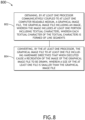
- an exemplary embodiment of a method 800 may include one or more of the following steps. Additionally, for example, some embodiments may include performing one or more instances of the method 800 iteratively, concurrently, and/or sequentially. Additionally, for example, at least some of the steps of the method 800 may be performed in parallel and/or concurrently. Additionally, in some embodiments, at least some of the steps of the method 800 may be performed non-sequentially.
- a step 802 may include obtaining, by at least one processor communicatively coupled to at least one computer readable medium, a graphical image file, the graphical image file including an image, wherein the image includes at least one portion including textual characters, wherein each textual character of the textual characters is formed of line segments.
- a step 804 may include converting, by the at least one processor, the graphical image file to at least one file including hardware directives that when executed cause a recreation of the image of the graphical image file to be drawn, wherein a size of the at least one file is smaller than the graphical image file.
- method 800 may include any of the operations disclosed throughout.
- embodiments of the inventive concepts disclosed herein may be directed to a system and a method configured to recreate an image of a graphical image file to reduce storage space, the image having textual characters.
- At least one non-transitory computer-readable medium may refer to as at least one non-transitory computer-readable medium (e.g., at least one computer-readable medium implemented as hardware; e.g., at least one non-transitory processor-readable medium, at least one memory (e.g., at least one nonvolatile memory, at least one volatile memory, or a combination thereof; e.g., at least one random-access memory, at least one flash memory, at least one read-only memory (ROM) (e.g., at least one electrically erasable programmable read-only memory (EEPROM)), at least one on-processor memory (e.g., at least one on-processor cache, at least one on-processor buffer, at least one on-processor flash memory, at least one on-processor EEPROM, or a combination thereof), or a combination thereof), at least one storage device (e.g., at least one hard-disk drive, at
- At least one means one or a plurality of; for example, “at least one” may comprise one, two, three, ..., one hundred, or more.
- one or more means one or a plurality of; for example, “one or more” may comprise one, two, three, ..., one hundred, or more.
- zero or more means zero, one, or a plurality of; for example, “zero or more” may comprise zero, one, two, three, ..., one hundred, or more.
- the methods, operations, and/or functionality disclosed may be implemented as sets of instructions or software readable by a device. Further, it is understood that the specific order or hierarchy of steps in the methods, operations, and/or functionality disclosed are examples of exemplary approaches. Based upon design preferences, it is understood that the specific order or hierarchy of steps in the methods, operations, and/or functionality can be rearranged while remaining within the scope of the inventive concepts disclosed herein.
- the accompanying claims may present elements of the various steps in a sample order, and are not necessarily meant to be limited to the specific order or hierarchy presented.
- embodiments of the methods according to the inventive concepts disclosed herein may include one or more of the steps described herein. Further, such steps may be carried out in any desired order and two or more of the steps may be carried out simultaneously with one another. Two or more of the steps disclosed herein may be combined in a single step, and in some embodiments, one or more of the steps may be carried out as two or more sub-steps. Further, other steps or sub-steps may be carried in addition to, or as substitutes to one or more of the steps disclosed herein.
- inventive concepts disclosed herein are well adapted to carry out the objects and to attain the advantages mentioned herein as well as those inherent in the inventive concepts disclosed herein. While presently preferred embodiments of the inventive concepts disclosed herein have been described for purposes of this disclosure, it will be understood that numerous changes may be made which will readily suggest themselves to those skilled in the art and which are accomplished within the broad scope and coverage of the inventive concepts disclosed and claimed herein.
Landscapes
- Physics & Mathematics (AREA)
- General Physics & Mathematics (AREA)
- Engineering & Computer Science (AREA)
- Theoretical Computer Science (AREA)
- Controls And Circuits For Display Device (AREA)
Abstract
Description
- Flight charts are typically received from a third-party vendor in an industry standard print format, such as a portable digital file (PDF) format which are large in file size. The space required to store flight charts in an avionics system is large, and the available space to store flight charts in those avionics systems is limited. Additionally, avionics systems typically must maintain a multitude of potentially needed flight charts for each flight, which compounds the storage capacity problem. Currently, each character on a PDF version of a flight chart is represented as a rasterized image character, and the text formed from such rasterized image characters requires considerable space to maintain, especially when multiple flight charts typically should be maintained by an avionics display unit computing device.
- In one aspect, embodiments of the inventive concepts disclosed herein are directed to a system. The system may include at least one computer readable medium and at least one processor communicatively coupled to the at least one computer readable medium. The at least one processor may be configured to: obtain a graphical image file, the graphical image file including an image, wherein the image includes at least one portion including textual characters, wherein each textual character of the textual characters is formed of line segments; and convert the graphical image file to at least one file including hardware directives that when executed cause a recreation of the image of the graphical image file to be drawn, wherein a size of the at least one file is smaller than the graphical image file.
- In a further aspect, embodiments of the inventive concepts disclosed herein are directed to a method. The method may include: obtaining, by at least one processor communicatively coupled to at least one computer readable medium, a graphical image file, the graphical image file including an image, wherein the image includes at least one portion including textual characters, wherein each textual character of the textual characters is formed of line segments; and converting, by the at least one processor, the graphical image file to at least one file including hardware directives that when executed cause a recreation of the image of the graphical image file to be drawn, wherein a size of the at least one file is smaller than the graphical image file.
- Implementations of the inventive concepts disclosed herein may be better understood when consideration is given to the following detailed description thereof. Such description makes reference to the included drawings, which are not necessarily to scale, and in which some features may be exaggerated and some features may be omitted or may be represented schematically in the interest of clarity. Like reference numerals in the drawings may represent and refer to the same or similar element, feature, or function. In the drawings:
-
FIG. 1 is a view of an exemplary embodiment of an image of an image file according to the inventive concepts disclosed herein. -
FIG. 2 is a view of an exemplary embodiment of three textual characters according to the inventive concepts disclosed herein. -
FIG. 3A is a view of exemplary embodiments of an exemplary textual character according to the inventive concepts disclosed herein. -
FIG. 3B is a view of exemplary embodiments of an exemplary textual character according to the inventive concepts disclosed herein. -
FIG. 4 is a view of an exemplary embodiment of two exemplary unclosed sets of paths according to the inventive concepts disclosed herein. -
FIG. 5 is a view of an exemplary embodiment of a system according to the inventive concepts disclosed herein. -
FIGS. 6A and6B are views of exemplary embodiments of data structures containing predetermined font characteristic values for predetermined characters of a given font according to the inventive concepts disclosed herein. -
FIG. 7 is a view of an exemplary embodiment comparing a building and an "L" textual character according to the inventive concepts disclosed herein. -
FIG. 8 is a diagram of an exemplary embodiment of a method according to the inventive concepts disclosed herein. - Before explaining at least one embodiment of the inventive concepts disclosed herein in detail, it is to be understood that the inventive concepts are not limited in their application to the details of construction and the arrangement of the components or steps or methodologies set forth in the following description or illustrated in the drawings. In the following detailed description of embodiments of the instant inventive concepts, numerous specific details are set forth in order to provide a more thorough understanding of the inventive concepts. However, it will be apparent to one of ordinary skill in the art having the benefit of the instant disclosure that the inventive concepts disclosed herein may be practiced without these specific details. In other instances, well-known features may not be described in detail to avoid unnecessarily complicating the instant disclosure. The inventive concepts disclosed herein are capable of other embodiments or of being practiced or carried out in various ways. Also, it is to be understood that the phraseology and terminology employed herein is for the purpose of description and should not be regarded as limiting.
- As used herein a letter following a reference numeral is intended to reference an embodiment of the feature or element that may be similar, but not necessarily identical, to a previously described element or feature bearing the same reference numeral (e.g., 1, 1a, 1b). Such shorthand notations are used for purposes of convenience only, and should not be construed to limit the inventive concepts disclosed herein in any way unless expressly stated to the contrary.
- Further, unless expressly stated to the contrary, "or" refers to an inclusive or and not to an exclusive or. For example, a condition A or B is satisfied by anyone of the following: A is true (or present) and B is false (or not present), A is false (or not present) and B is true (or present), and both A and B are true (or present).
- In addition, use of the "a" or "an" are employed to describe elements and components of embodiments of the instant inventive concepts. This is done merely for convenience and to give a general sense of the inventive concepts, and "a" and "an" are intended to include one or at least one and the singular also includes the plural unless it is obvious that it is meant otherwise.
- Finally, as used herein any reference to "one embodiment," or "some embodiments" means that a particular element, feature, structure, or characteristic described in connection with the embodiment is included in at least one embodiment of the inventive concepts disclosed herein. The appearances of the phrase "in some embodiments" in various places in the specification are not necessarily all referring to the same embodiment, and embodiments of the inventive concepts disclosed may include one or more of the features expressly described or inherently present herein, or any combination of sub-combination of two or more such features, along with any other features which may not necessarily be expressly described or inherently present in the instant disclosure.
- Broadly, embodiments of the inventive concepts disclosed herein may be directed to a system and a method configured to recreate an image of a graphical image file to reduce storage space, the image having textual characters.
- Some embodiments include a method for automated character recognition within a tool set of a host computing device that may generate charts for use within an avionics application (e.g., of an avionics display unit computing device). While some embodiments are related to a tool to facilitate customer generated chart databases for use with a certified avionics system, other embodiments may use the method for character recognition in any system that needs to recognize characters as alphanumeric entities and not as groups of lines.
- Some embodiments may include converting avionics charts (e.g., flight charts) from a PDF format into a set of graphical hardware directives for an avionics display unit to display. Characters in the PDF format are often defined by individual lines and are often rasterized. Some embodiments may convert characters of the PDF format into characters (e.g., vectorized characters) which are stored once, but used many times, which can reduce the space required for character storage by up to 99% or more.
- Currently, the flight charts are large enough that the charts will not fit within the hardware constraints imposed by an avionics display system. This may be true both for the size of one displayed chart and for the total size of all stored charts. Reducing the space used for characters may improve the ability to provide avionics charts to pilots.
- In some embodiments, PDF input characters, such as shown in
FIG. 2 and4 , do not follow a specific standard. This makes detecting a character difficult, and accuracy of character recognition is important for presenting accurate information to a pilot. The mechanism to detect characters should be flexible enough to find characters that are defined differently from each other, but should also not find groups of lines that are not characters. - In some embodiments, clarity can be improved using standard characters. It is important that the pilot be able to read the displayed charts in the cockpit. Since a single standard is not followed, and because PDF characters vary in their clarity, using a common font can improve cockpit readability by a pilot.
- Some embodiments may provide a system and method to condense certain types of repeating textual characters in a display system (e.g., an avionics display system) without affecting the image displayed. While some embodiments may be used by an avionics display system, other embodiments may be used in any suitable system that handles images having repeating textual characters that could be condensed to reduce storage space.
- Referring now to
FIG. 1 , an exemplary embodiment of an image (e.g., a flight chart image 100) of an image file (e.g., a graphical image file) according to the inventive concepts disclosed herein is depicted. For example, flight charts typically have manytextual portions 102 includingtextual characters 104 in various locations of theflight chart image 100. - Referring now to
FIG. 2 , an exemplary embodiment of three textual characters 104-1, 104-2, 104-3 of the image (e.g., the flight chart image 100) of the image file (e.g., a graphical image file) according to the inventive concepts disclosed herein is depicted. For example, each of the three textual characters 104-1, 104-2, 104-3 (e.g., "e" textual characters) may be defined by individual lines and may be rasterized; however, each of the three textual characters 104-1, 104-2, 104-3 may be defined differently by the individual lines making up a giventextual character 104. - In some embodiments for character recognition, the tolerances should be set so that characters are detected with a high probability and nearly never (or never) incorrectly. Tolerances may be used since the group of lines representing a character is not always 'clean'. Adding tolerances allows detection of characters 104-1, 104-2, 104-3 (different "e"s) with these types of imperfection and inconsistency.
- Referring now to
FIGS. 3A-4 , exemplary embodiments of exemplary textual character 104A (e.g., "A" textual character) and textual character 104C (e.g., "C" textual character) of the image (e.g., the flight chart image 100) of the image file (e.g., a graphical image file) according to the inventive concepts disclosed herein is depicted. - In some embodiments, a computing device may be configured to: obtain a graphical image file (e.g., which may be in PDF format), the graphical image file including an image (e.g., a flight chart image 100), wherein the image includes at least one portion including
textual characters 104, wherein eachtextual character 104 of thetextual characters 104 is formed of line segments; and convert the graphical image file to at least one file including hardware directives that when executed cause a recreation of the image of the graphical image file to be drawn. For example, the step of converting the graphical image file to at least one file including hardware directives that when executed cause a recreation of the image of the graphical image file to be drawn may include any or all of the following: testing sections (e.g., made up of the line segments) in each path around a shape(s) of thetextual character 104 to determine if thetextual character 104 represents a character in a known font; loop through each known character in each known font to try to determine if thetextual character 104 is a match to any known character in any known font, wherein each known character in each known font may be stored in at least one data structure (e.g., table(s)); and/or inspect thetextual character 104 against pre-determined font characteristic values (e.g., of a table(s)). For example, inspecting the giventextual character 104 against the predetermined font characteristic values for at least one of the following: a) a number of sections of the giventextual character 104, b) a number of angles of each shape of the giventextual character 104, wherein each angle of the angles is between two sections of the sections, c) for each angle or curve of the shape of the giventextual character 104, at least one of an angle range (+/- a predetermined tolerance value), a curve range (+/- a predetermined tolerance value), or a total angle range (+/- a predetermined tolerance value) for consecutive angles, d) a sequence of the angles of the giventextual character 104, and/or e) a ratio (+/- a predetermined tolerance value) of width to height of the giventextual character 104. Further, the step of converting the graphical image file to at least one file including hardware directives that when executed cause a recreation of the image of the graphical image file to be drawn may include any or all of the following: if a match is detected, replace the line segments of the giventextual character 104 with a character font reference; and/or draw the character corresponding to the character font reference while accounting for an orientation angle and appropriate sizing. The predetermined font characteristic values may be determined by analyzation of a statistically significant sample size of exemplars. - In some embodiments, chart text and
characters 104 may be input to the chart tools of the computing device as filled shapes, and eachcharacter 104 may be drawn by an individual path. Some of the character shapes have hundreds of points forming thecharacter 104. To lower the total number of points stored, characters may be converted to a predefined standard character font and stored once as a 'character subroutine', or more properly as a 'font' and accessed as a common resource for other matching characters in theflight chart image 100 or otherflight chart images 100. - Fonts may be detected using values in a predetermined table(s). The pre-determined font characteristic values vary by font. Each upper and lower case character, each number, and a number of special characters have their own detection values.
- Character fonts may be detected using a sequence of criteria that separate characters from other chart objects and from each other. These criteria may include: the number of vertices in a path; the sequence of angles at each vertex; the sum of a sequence of angles; whether the character has an inside shape; and/or the ratio of character width to character height.
- To draw the character properly, each character has a consistently defined start location and a 'reference line' that can be used to determine the rotation angle of the character. Note that the start location is not always at the left corner of the character. The reference line is often a horizontal line when the character is drawn upright, but not always. Some characters (such as O and 8) do not have any straight lines. Others, such as S, have straight lines, but they are not oriented along a primary axis.
- Curves within a character are broken into many small line segments which are not standard. To match a predetermined font characteristic value, the segment angles must fall within a specified range (for example, 176-183 degrees). The entire curve is considered one vertex angle. The curve is "completed" once a line segment angle falls outside of the specified range.
- The tolerances should be set so that characters are detected with a high probability and nearly never (or never) incorrectly. Tolerances may be used since the group of lines representing a character is not always 'clean'.
- Both tolerances and tracking total angles may be necessary for curved shapes since the component lines defining the characters are not standard, as illustrated by two unclosed sets of paths 106-1, 106-2 (e.g., for generating numbers "9") in
FIG. 4 . - Referring now to
FIG. 3B , as shown, character "C" 104-C has three curve sections (Angles angle 7 completes the character. There are many points along this curve. The angle between any two points on the curve is in the range of 177-181 degrees. The curve ends when it hitsAngle 2, and the straight-line segment is drawn from that vertex to the vertex ofAngle 3. - Referring now to
FIG. 5 , an exemplary embodiment of asystem 500 according to the inventive concepts disclosed herein is depicted. In some embodiments, thesystem 500 may include at least onecomputing device 502, at least oneaircraft 510, at least onecomputing device 522, and/or at least onenetwork 524, some or all of which may be communicatively coupled at any given time. - For example, the
computing device 502 may be configured to obtain (e.g., receive from the computing device 522) a graphical image file, the graphical image file including an image (e.g., a flight chart image 100). The image may include at least oneportion 102 includingtextual characters 104, wherein eachtextual character 104 of thetextual characters 104 is formed of line segments. For example, thecomputing device 502 may be configured to convert the graphical image file to at least one file including hardware directives that when executed cause a recreation of the image of the graphical image file to be drawn, wherein a file size of the at least one file is smaller than the graphical image file. In some embodiments, the at least one file may be output by thecomputing device 502 and loaded onto an avionics computing device of theaircraft 510, such as a displayunit computing device 512. For example, the displayunit computing device 512 may be configured to execute the hardware directives of the at least one file, which causes a recreation of the image of the graphical image file to be drawn on adisplay 514 of the displayunit computing device 512. - The at least one
computing device 502 may be implemented as any suitable computing device, such as a host computing device located offboard of theaircraft 510 and/or located remotely from theaircraft 510. The at least onecomputing device 502 may include any or all of the elements, as shown inFIG. 5 . For example, thecomputing device 502 may include at least oneprocessor 504, at least onememory 506, and/or at least onestorage 508, some or all of which may be communicatively coupled at any given time. For example, the at least oneprocessor 504 may include at least one central processing unit (CPU), at least one graphics processing unit (GPU), at least one field-programmable gate array (FPGA), at least one application specific integrated circuit (ASIC), at least one digital signal processor, at least one image processor, at least one virtual machine (VM) running on at least one processor, and/or the like configured to perform (e.g., collectively perform) any of the operations disclosed throughout. For example, the at least oneprocessor 504 may include a CPU and a GPU configured to perform (e.g., collectively perform) any of the operations disclosed throughout. Theprocessor 504 may be configured to run various software applications or computer code stored (e.g., maintained) in a non-transitory computer-readable medium (e.g.,memory 506 and/or storage 508) and configured to execute various instructions or operations. Theprocessor 504 of thecomputing device 502 may be configured to perform any or all of the operations disclosed throughout. For example, theprocessor 504 of thecomputing device 502 may be configured to: obtain a graphical image file (e.g., a graphical flight chart image file), the graphical image file including an image (e.g., a flight chart image 100), wherein the image includes at least oneportion 102 includingtextual characters 104, wherein eachtextual character 104 of thetextual characters 104 is formed of line segments; and/or convert the graphical image file to at least one file including hardware directives that when executed cause a recreation of the image of the graphical image file to be drawn, wherein a file size of the at least one file is smaller than the graphical image file. - In some embodiments, wherein the line segments of each textual character of the graphical image file are connected line segments that define a filled area, wherein at least some of the textual characters of the graphical image file are converted to character hardware directives, wherein execution of each of the character hardware directives causes at least one of a vectorized version of a textual character or a filled-triangles version of the textual character to be drawn in the recreation of the image (e.g., the flight chart image 100). For example, whether each of the character hardware directives causes a vectorized version of a textual character and/or a filled-triangles version of the textual character to be drawn may depend on any of several factors, such as a maximum required size of the character when at maximum zoom, or the like.
- In some embodiments, the graphical image file may be any suitable type of graphical image file that has at least one
portion 102 including thetextual characters 104. For example, the graphical image file may be a portable digital file (PDF), a Joint Photographic Experts Group (JPEG) file, a Portable Network Graphics (PNG) file, a graphics interchange format (GIF) file, a tagged image file (TIFF), a Photoshop document (PSD), an encapsulated postscript (EPS) file, an Adobe Illustrator (Al) document, an Adobe Indesign Document (INDD), or a raw image format. - In some embodiments, at least one data structure (e.g., table(s) 600A, 600B) may be maintained in the at least one computer readable medium, wherein the at least one data structure contains predetermined font characteristic values for predetermined characters of multiple predetermined fonts. In some embodiments, the at least one processor 504 being configured to convert the graphical image file to the at least one file comprises the at least one processor 504 being configured to: for a given textual character 104 of the at least one portion 102 including the textual characters 104, inspect the given textual character 104 against the predetermined font characteristic values for at least one of the following: a) a number of sections of the given textual character 104, b) a number of angles of each shape of the given textual character 104, wherein each angle of the angles is between two sections of the sections, c) for each angle or curve of the shape of the given textual character 104, at least one of an angle range, a curve range, or a total angle range for consecutive angles, d) a sequence of the angles of the given textual character 104, and/or e) a ratio of width to height of the given textual character 104; for the given textual character 104, determine that the given textual character 104 matches a given character of a given font based at least on the given textual character 104 matching all inspected font characteristic values of the predetermined font characteristic values for the given character of the given font; upon determining that the given textual character 104 matches the given character of the given font, store at least one character hardware directive that when executed causes at least one of a vectorized version or a filled-triangles version of the given textual character 104 to be drawn. In some embodiments, a size of the at least one character hardware directive is at least 75% (e.g., at least 99%) smaller than a size of the given
textual character 104 of the graphical image file. In some embodiments, at least one of the hardware directives includes scaling and rotational characteristics necessary for drawing the at least one of the vectorized version or the filled-triangles version of the giventextual character 104 to match a scale and angular orientation of the giventextual character 104 in the image (e.g., the flight chart image 100) of the graphical image file. - In some embodiments, the at least one processor 504 being configured to convert the graphical image file to the at least one file comprises the at least one processor 504 being configured to: for a second given textual character 104 of the at least one portion 102 including the textual characters 104, inspect the second given textual character 104 against the predetermined font characteristic values for at least one of the following: a) a number of sections of the second given textual character 104, b) a number of angles of each shape of the second given textual character 104, c) for each angle or curve of the shape of the second given textual character 104, at least one of an angle range, a curve range, or a total angle range for consecutive angles, d) a sequence of the angles of the second given textual character 104, and/or e) a ratio of width to height of the second given textual character 104; for the second given textual character 104, determine that the second given textual character 104 matches the given character of the given font based at least on the second given textual character 104 matching all inspected font characteristic values of the predetermined font characteristic values for the given character of the given font; and/or upon determining that the second given textual character 104 matches the given character of the given font, store at least one call to execute the at least one character hardware directive that when executed causes the at least one of the vectorized version or the filled-triangles version of the given textual character to be drawn. In some embodiments, a size of the at least one call is at least 75% (e.g., at least 99%) smaller than a size of the second given
textual character 104 of the graphical image file. - In some embodiments, the image of the graphical image file is a
flight chart image 100, and when the hardware directives are executed by a displayunit computing device 512 of anaircraft 510, the recreation of theflight chart image 100 of the graphical image file is drawn on adisplay 514 of the displayunit computing device 512. - In some embodiments, the at least one processor 504 being configured to convert the graphical image file to the at least one file comprises the at least one processor 504 being configured to: for a second given textual character 104 of the at least one portion 102 including the textual characters 104, inspect the second given textual character 104 against the predetermined font characteristic values for the following: a) the number of sections of the second given textual character 104, b) the number of the angles of each shape of the second given textual character 104, c) for each angle or curve of the shape of the second given textual character 104, the at least one of the angle range, the curve range, or the total angle range for the consecutive angles, d) the sequence of the angles of the second given textual character 104, and/or e) the ratio of the width to the height of the second given textual character 104; for the second given textual character 104, determine that the second given textual character 104 fails to match any character of any font based at least on the second given textual character 104 failing to match all inspected font characteristic values of the predetermined font characteristic values for any character of any font; and/or upon determining that the second given textual character 104 fails to match any character of any font based at least on the second given textual character failing to match all inspected font characteristic values of the predetermined font characteristic values for any character of any font, store at least one second character hardware directive that when executed causes a copied version of the second given textual character 104 to be drawn, the copied version of the second given textual character 104 being copied from the graphical image file.
- In some embodiments, the
aircraft 510 may include at least one user (e.g., flight crew and/or pilot(s)) (not shown), at least one displayunit computing device 512, at least one aircraft computing device (not shown), and/or at least one user interface (not shown), some or all of which may be communicatively coupled at any given time. - The display
unit computing device 512 may be implemented as any suitable computing device, such as a primary flight display (PFD) computing device and/or a multi-function window (MFW) display computing device. As shown inFIG. 5 , the displayunit computing device 512 may include at least onedisplay 514, at least oneprocessor 516, at least onememory 518, and/or at least onestorage 520, some or all of which may be communicatively coupled at any given time. For example, the at least oneprocessor 516 may include at least one central processing unit (CPU), at least one graphics processing unit (GPU), at least one field-programmable gate array (FPGA), at least one application specific integrated circuit (ASIC), at least one digital signal processor, at least one virtual machine (VM) running on at least one processor, and/or the like configured to perform (e.g., collectively perform) any of the operations disclosed throughout. For example, the at least oneprocessor 516 may include a CPU and a GPU configured to perform (e.g., collectively perform) any of the operations disclosed throughout. Theprocessor 516 may be configured to run various software applications (e.g., a PFD application, and/or an MFW application) and/or computer code stored (e.g., maintained) in a non-transitory computer-readable medium (e.g.,memory 518 and/or storage 520) and configured to execute various instructions or operations. Theprocessor 516 may be configured to perform any or all of the operations disclosed throughout. For example, theprocessor 516 may be configured to: obtain the at least one file (e.g., from the computing device 502); and/or execute the hardware directives of the at least one file, which causes a recreation of the image of the graphical image file to be drawn on adisplay 514 of the displayunit computing device 512. Thedisplay 514 may be configured to display the recreation of the image (e.g., a flight chart image 100) of the graphical image file. - In some embodiments, the at least one display
unit computing device 104 for theaircraft 510 may be located offboard of theaircraft 102, for example, if a givenaircraft 102 is a remotely piloted and/or managed aircraft (e.g., an unmanned aerial vehicle (UAV) or a drone aircraft). - In some embodiments, the
computing device 522 may be any suitable computing device. Thecomputing device 522 may have similar elements and functionality as thecomputing device 502, except that thecomputing device 522 may be configured to provide (e.g., via the network 524) the graphical image file to thecomputing device 502. In some embodiments, thecomputing device 522 may be operated by a third-party vendor of the graphical image file. - In some embodiments, the at least one display
unit computing device 512, thecomputing device 502, and/or thecomputing device 522 may be implemented as a single computing device or any number of computing devices configured to perform (e.g., collectively perform if more than one computing device) any or all of the operations disclosed throughout. - At least one processor (e.g., the at least one
processor 504 and/or the at least one processor 516) may be configured to perform (e.g., collectively perform) any or all of the operations disclosed throughout. - Referring now to
FIGS. 6A-6B , exemplary embodiments of data structures (e.g., tables 600A, 600B) containing predetermined font characteristic values for predetermined characters of a given font according to the inventive concepts disclosed herein are depicted. - The tables 600A, 600B may contain predetermined font characteristic values that define the character recognition parameters for each font. "Path Angle Ranges" are defined in the order each vertex angle is expected to occur within a character path definition. Some characters contain multiple shapes, so each path angle range list starts with the shape number ("1:", "2:", etc.). Curves are described using many small line segments, each vertex angle within the curve must fall with the specified angle range. The curve is "completed" once a vertex angle falls outside the specified range. The sum of the angles for consecutive vertices can also be used, this is specified using the format "Total:x,y-z", where "x" is the number of vertices to sum, and "y-z" is the total angle range.
- The tables 600A, 600B contain the base character definitions for each font. The reference angle is calculated using two points within the base character path. Points are 0 based (0 is the first point in a path), and unless noted otherwise, belong to the first shape in the base character path. If the reference angle point begins with "x:", then "x" is the 1 based shape number. Some reference angle points are also specified using "First", "First+1 ", "Last", etc., and refer to logical points within the first shape of the base character path.
- The predetermined font characteristic values are obtained by analyzing exemplar character fonts through the analysis of short lines. Those lines meet at angles that can be pre-determined and placed in these tables.
- Referring now to
FIGS. 3A and6A , for an "A", using the first table 600A, an angle between 293 and 296 degrees, followed by an angle between 244 and 247, etc. (as shown in the table 600A) starts to define an A. An A is also defined by having two closed areas, the outer boundary, and the inner boundary (inside shape) that has two defined angles (the 2[Range:64-66, Range: 64-66]). Angles are relative to the previous line rather than absolute angles. The last angle is usually a 'close shape' so no angle is given and so no determination needs to be made as to whether it matches. - Referring now to
FIG. 6B , the second table 600B gives other relevant information, including a ratio between the height and the width, what points indicate the reference line, and what the angle of the reference line is. - Referring again to
FIGS. 6A and6B , for acharacter 104 to be recognized, a character recognition analysis steps through a set of given lines, matching angles, and ensuring that the ratio between height and width is correct. For 'curves', as defined in the table, any number of connected lines may be analyzed, as long as they are within the given angle range. If the set of lines varies from the data in the table, a match is not found. - If a
character 104 is recognized, thecharacter 104 may now be reduced to a function call that draws a pre-defined image of standard character of a given font. Thecharacter 104 will be drawn at an angle defined by the difference between the reference angle and the actual line angle. The height and width will be scaled based on the height and width ratios as compared to the pre-defined image ratios. The individual lines that were input may then be discarded. - To lower the total number of points stored,
characters 104 are stored once as function calls or 'character subroutines', or more properly as 'fonts' and accessed as a common resource. Having detected a character (e.g., C, as shown inFIG. 3B ), we can store thecharacter 104. Acharacter 104 may have many points, especially one that is curvy. When anothercharacter 104 of that type is found (e.g., another C), the many points that define thecharacter 104 do not have to be saved. Instead, a single 'call subroutine' can be placed in the display data stream. This call points to the stored image (the many points that make up the character 104). - The start location may be determined by analysis of the input data. The ratios, angles and variance are also determined by analysis. This control data should be loose enough to ensure we find a high percentage of characters, but tight enough to ensure we never or almost never make an incorrect character assignment.
- The reference line is also determined by analysis. For an "8", for instance, it was noted that the first point in the second shape and the first point in the third shape defined a constant angle that could be used as a reference (the second and third shapes in the input data define the two inner circles that make up the character '8'.)
- Referring now to
FIGS. 3B and6A-6B , for a "C", an exemplary character recognition analysis is described below. (It should be noted that the "C" character 104-C inFIG. 3B is referenced as an example of a "C", as the "C" character 104-C inFIG. 3B is a different font than that of tables 600A, 600B.) - The dots of the "C" character 104-C in
FIG. 3B represent points that are received in the input data. Those points are close together and, when connected, give the 'C' its curvy shape. - The start of this 'C' definition would define a 'Curve' with angle and
tolerance 1. Each of the points would be traversed until they failed to match the angle within the tolerance. The check would fail atrange angle 2. - If
range angle 2 passed,range angle 3 would be checked. - If
range angle 3 passed,curve angle 4 would be checked until it failed. It would fail atangle 5. - If range angles 5 and 6 passed,
curve angle 7 would be checked until a 'close command' was found (the input data defines a close command, which connects the last stylus position with the start position). - In this example for the "C" character 104-C in
FIG. 3B , the reference angle would be the last angle drawn (the line defined by the close command connecting the last small line around the curve) . In the actual table 600A, the start point would be one of the right-side flat edges, and the reference line is that flat edge. - The height and width of the character, given by the farthest points (top, bottom, left, right) are also checked to ensure that the character size ratio is correct. For example, this is done to prevent a
building 702A, which matches all the given angles, from being converted to an "L" 702B, as shown inFIG. 7 . - Referring now to
FIG. 8 , an exemplary embodiment of amethod 800 according to the inventive concepts disclosed herein may include one or more of the following steps. Additionally, for example, some embodiments may include performing one or more instances of themethod 800 iteratively, concurrently, and/or sequentially. Additionally, for example, at least some of the steps of themethod 800 may be performed in parallel and/or concurrently. Additionally, in some embodiments, at least some of the steps of themethod 800 may be performed non-sequentially. - A
step 802 may include obtaining, by at least one processor communicatively coupled to at least one computer readable medium, a graphical image file, the graphical image file including an image, wherein the image includes at least one portion including textual characters, wherein each textual character of the textual characters is formed of line segments. - A
step 804 may include converting, by the at least one processor, the graphical image file to at least one file including hardware directives that when executed cause a recreation of the image of the graphical image file to be drawn, wherein a size of the at least one file is smaller than the graphical image file. - Further, the
method 800 may include any of the operations disclosed throughout. - As will be appreciated from the above, embodiments of the inventive concepts disclosed herein may be directed to a system and a method configured to recreate an image of a graphical image file to reduce storage space, the image having textual characters.
- As used throughout and as would be appreciated by those skilled in the art, "at least one non-transitory computer-readable medium" may refer to as at least one non-transitory computer-readable medium (e.g., at least one computer-readable medium implemented as hardware; e.g., at least one non-transitory processor-readable medium, at least one memory (e.g., at least one nonvolatile memory, at least one volatile memory, or a combination thereof; e.g., at least one random-access memory, at least one flash memory, at least one read-only memory (ROM) (e.g., at least one electrically erasable programmable read-only memory (EEPROM)), at least one on-processor memory (e.g., at least one on-processor cache, at least one on-processor buffer, at least one on-processor flash memory, at least one on-processor EEPROM, or a combination thereof), or a combination thereof), at least one storage device (e.g., at least one hard-disk drive, at least one tape drive, at least one solid-state drive, at least one flash drive, at least one readable and/or writable disk of at least one optical drive configured to read from and/or write to the at least one readable and/or writable disk, or a combination thereof), or a combination thereof).
- As used throughout, "at least one" means one or a plurality of; for example, "at least one" may comprise one, two, three, ..., one hundred, or more. Similarly, as used throughout, "one or more" means one or a plurality of; for example, "one or more" may comprise one, two, three, ..., one hundred, or more. Further, as used throughout, "zero or more" means zero, one, or a plurality of; for example, "zero or more" may comprise zero, one, two, three, ..., one hundred, or more.
- In the present disclosure, the methods, operations, and/or functionality disclosed may be implemented as sets of instructions or software readable by a device. Further, it is understood that the specific order or hierarchy of steps in the methods, operations, and/or functionality disclosed are examples of exemplary approaches. Based upon design preferences, it is understood that the specific order or hierarchy of steps in the methods, operations, and/or functionality can be rearranged while remaining within the scope of the inventive concepts disclosed herein. The accompanying claims may present elements of the various steps in a sample order, and are not necessarily meant to be limited to the specific order or hierarchy presented.
- It is to be understood that embodiments of the methods according to the inventive concepts disclosed herein may include one or more of the steps described herein. Further, such steps may be carried out in any desired order and two or more of the steps may be carried out simultaneously with one another. Two or more of the steps disclosed herein may be combined in a single step, and in some embodiments, one or more of the steps may be carried out as two or more sub-steps. Further, other steps or sub-steps may be carried in addition to, or as substitutes to one or more of the steps disclosed herein.
- From the above description, it is clear that the inventive concepts disclosed herein are well adapted to carry out the objects and to attain the advantages mentioned herein as well as those inherent in the inventive concepts disclosed herein. While presently preferred embodiments of the inventive concepts disclosed herein have been described for purposes of this disclosure, it will be understood that numerous changes may be made which will readily suggest themselves to those skilled in the art and which are accomplished within the broad scope and coverage of the inventive concepts disclosed and claimed herein.
Claims (15)
- A system (500), comprising:at least one computer readable medium (506, 508); andat least one processor (504) communicatively coupled to the at least one computer readable medium, the at least one processor configured to:obtain a graphical image file, the graphical image file including an image (100), wherein the image includes at least one portion (102) including textual characters (104), wherein each textual character of the textual characters is formed of line segments; andconvert the graphical image file to at least one file including hardware directives that when executed cause a recreation of the image of the graphical image file to be drawn,wherein a size of the at least one file is smaller than the graphical image file.
- The system of claim 1, wherein the line segments of each textual character (104) of the graphical image (102) file are connected line segments that define a filled area, wherein at least some of the textual characters of the graphical image file are converted to character hardware directives, wherein execution of each of the character hardware directives causes at least one of a vectorized version of a textual character or a filled-triangles version of the textual character to be drawn in the recreation of the image.
- The system of claim 2, wherein the graphical image file (100) is a portable digital file (PDF).
- The system of claim 2 or 3, wherein at least one data structure is maintained in the at least one computer readable medium, wherein the at least one data structure contains predetermined font characteristic values for predetermined characters of multiple predetermined fonts, wherein the at least one processor being configured to convert the graphical image file to the at least one file comprises the at least one processor being configured to:for a given textual character of the textual characters, inspect the given textual character against the predetermined font characteristic values for at least one of the following: a) a number of sections of the given textual character, b) a number of angles of each shape of the given textual character, wherein each angle of the angles is between two sections of the sections, c) for each angle or curve of the shape of the given textual character, at least one of an angle range, a curve range, or a total angle range for consecutive angles, d) a sequence of the angles of the given textual character, or e) a ratio of width to height of the given textual character;for the given textual character, determine that the given textual character matches a given character of a given font based at least on the given textual character matching all inspected font characteristic values of the predetermined font characteristic values for the given character of the given font; andupon determining that the given textual character matches the given character of the given font, store at least one character hardware directive that when executed causes at least one of a vectorized version or a filled-triangles version of the given textual character to be drawn.
- The system of claim 4, wherein a size of the at least one character hardware directive is at least 75% smaller than a size of the given textual character of the graphical image file.
- The system of claim 4 or 5, wherein the at least one processor (504) being configured to convert the graphical image file to the at least one file further comprises the at least one processor being configured to:for a second given textual character of the textual characters, inspect the second given textual character against the predetermined font characteristic values for at least one of the following: a) a number of sections of the second given textual character, b) a number of angles of each shape of the second given textual character, c) for each angle or curve of the shape of the second given textual character, at least one of an angle range, a curve range, or a total angle range for consecutive angles, d) a sequence of the angles of the second given textual character, or e) a ratio of width to height of the second given textual character;for the second given textual character, determine that the second given textual character matches the given character of the given font based at least on the second given textual character matching all inspected font characteristic values of the predetermined font characteristic values for the given character of the given font; andupon determining that the second given textual character matches the given character of the given font, store at least one call to execute the at least one character hardware directive that when executed causes the at least one of the vectorized version or the filled-triangles version of the given textual character to be drawn.
- The system of claim 6, wherein a size of the at least one call is at least 99% smaller than a size of the second given textual character of the graphical image file.
- The system of any of claims 4 to 7, wherein the at least one processor being configured to for the given textual character of the at least one portion including the textual characters, inspect the given textual character against the predetermined font characteristic values for the at least one of the following: a) the number of sections of the given textual character, wherein each angle of the angles is between the two sections of the sections b) the number of the angles of each shape of the given textual character, c) for each angle or curve of the shape of the given textual character, the at least one of the angle range, the curve range, or the total angle range for the consecutive angles, d) the sequence of the angles, or e) the ratio of the width to the height of the given textual character comprises the at least one processor being configured to:
for the given textual character of the textual characters, inspect the given textual character against the predetermined font characteristic values for the following: a) the number of sections of the given textual character, b) the number of the angles of each shape of the given textual character, c) for each angle or curve of the shape of the given textual character, the at least one of the angle range or the curve range or the total angle range for the consecutive angles, d) the sequence of the angles of the given textual character, and e) the ratio of the width to the height of the given textual character. - The system of any of claims 4 to 8, wherein at least one of the hardware directives includes scaling and rotational characteristics necessary for drawing the at least one of the vectorized version or the filled-triangles version of the given textual character to match a scale and angular orientation of the given textual character in the image of the graphical image file.
- The system of any of claims 4 to 9, wherein the image of the graphical image file is a flight chart image (100), wherein when the hardware directives are executed by a display unit computing device (512) of an aircraft (510), the recreation of the flight chart image of the graphical image file is drawn on a display (514) of the display unit computing device.
- The system of claim 10, wherein at least one of the hardware directives includes scaling and rotational characteristics necessary for drawing the at least one of the vectorized version or the filled-triangles version of the given textual character to match a scale and angular orientation of the given textual character in the image of the graphical image file.
- The system of any of claims 4 to 11, wherein the at least one processor is further configured to:for a second given textual character of the textual characters, inspect the second given textual character against the predetermined font characteristic values for the following: a) the number of sections of the second given textual character, b) the number of the angles of each shape of the second given textual character, c) for each angle or curve of the shape of the second given textual character, the at least one of the angle range, the curve range, or the total angle range for the consecutive angles, d) the sequence of the angles of the second given textual character, and e) the ratio of the width to the height of the second given textual character;for the second given textual character, determine that the second given textual character fails to match any character of any font based at least on the second given textual character failing to match all inspected font characteristic values of the predetermined font characteristic values for any character of any font; andupon determining that the second given textual character fails to match any character of any font based at least on the second given textual character failing to match all inspected font characteristic values of the predetermined font characteristic values for any character of any font, store at least one second character hardware directive that when executed causes a copied version of the second given textual character to be drawn, the copied version of the second given textual character being copied from the graphical image file.
- The system of any of claims 2 to 12, wherein the image of the graphical image file is a flight chart image (100), wherein when the hardware directives are executed by a display unit computing device of an aircraft, wherein the recreation of the flight chart image of the graphical image is drawn on a display (514) of the display unit computing device (512).
- The system of claim 13, further comprising a computing device (502) comprising the at least one computer readable medium (506, 508) and the at least one processor (504), wherein the computing device is located remotely from the aircraft.
- A method (500), comprising:Obtaining (802), by at least one processor communicatively coupled to at least one computer readable medium, a graphical image file, the graphical image file including an image, wherein the image includes at least one portion including textual characters, wherein each textual character of the textual characters is formed of line segments; andConverting (804), by the at least one processor, the graphical image file to at least one file including hardware directives that when executed cause a recreation of the image of the graphical image file to be drawn,wherein a size of the at least one file is smaller than the graphical image file.
Applications Claiming Priority (2)
| Application Number | Priority Date | Filing Date | Title |
|---|---|---|---|
| US202163278576P | 2021-11-12 | 2021-11-12 | |
| US17/525,534 US11954770B2 (en) | 2021-11-12 | 2021-11-12 | System and method for recreating graphical image using character recognition to reduce storage space |
Publications (2)
| Publication Number | Publication Date |
|---|---|
| EP4181070A1 true EP4181070A1 (en) | 2023-05-17 |
| EP4181070B1 EP4181070B1 (en) | 2025-10-08 |
Family
ID=84331684
Family Applications (1)
| Application Number | Title | Priority Date | Filing Date |
|---|---|---|---|
| EP22207049.2A Active EP4181070B1 (en) | 2021-11-12 | 2022-11-11 | System and method for recreating graphical image using character recognition to reduce storage space |
Country Status (2)
| Country | Link |
|---|---|
| US (1) | US11954770B2 (en) |
| EP (1) | EP4181070B1 (en) |
Citations (1)
| Publication number | Priority date | Publication date | Assignee | Title |
|---|---|---|---|---|
| EP3845862A1 (en) * | 2020-01-06 | 2021-07-07 | Rockwell Collins, Inc. | Interactive charts system and method |
Family Cites Families (166)
| Publication number | Priority date | Publication date | Assignee | Title |
|---|---|---|---|---|
| US3522586A (en) | 1965-08-25 | 1970-08-04 | Nippon Electric Co | Automatic character recognition apparatus |
| US3656178A (en) | 1969-09-15 | 1972-04-11 | Research Corp | Data compression and decompression system |
| JPS5242017A (en) | 1975-09-29 | 1977-04-01 | Fuji Xerox Co Ltd | Run length code processing method for facsimile signal |
| JPS61234312A (en) | 1985-04-09 | 1986-10-18 | Mitsubishi Electric Corp | Vehicle-borne navigation apparatus |
| JPS622721A (en) | 1985-06-28 | 1987-01-08 | Nec Corp | Coding and decoding device for picture signal |
| JPH0634237B2 (en) | 1986-02-24 | 1994-05-02 | 三菱電機株式会社 | Image clipping method |
| JPS6393273A (en) | 1986-10-07 | 1988-04-23 | Fuji Xerox Co Ltd | Coding device for image information |
| JPH0820862B2 (en) | 1987-02-27 | 1996-03-04 | キヤノン株式会社 | Character processor |
| US4792981A (en) | 1987-09-21 | 1988-12-20 | Am International, Inc. | Manipulation of run-length encoded images |
| US4876651A (en) | 1988-05-11 | 1989-10-24 | Honeywell Inc. | Digital map system |
| AU624205B2 (en) | 1989-01-23 | 1992-06-04 | General Electric Capital Corporation | Variable length string matcher |
| US5050230A (en) | 1989-11-29 | 1991-09-17 | Eastman Kodak Company | Hybrid residual-based hierarchical storage and display method for high resolution digital images in a multiuse environment |
| US5428692A (en) | 1991-11-18 | 1995-06-27 | Kuehl; Eberhard | Character recognition system |
| US5546572A (en) | 1991-08-28 | 1996-08-13 | Hitachi, Ltd. | Method for retrieving database of image information |
| JP3155595B2 (en) | 1992-01-24 | 2001-04-09 | キヤノン株式会社 | Encoding method and apparatus |
| US5526476A (en) | 1992-12-07 | 1996-06-11 | Fujitsu Limited | Method and apparatus for generating character patterns expressed by coordinates of a coordinate system |
| NO933205D0 (en) | 1993-09-08 | 1993-09-08 | Harald Martens | Data representation system |
| US5499382A (en) | 1993-09-20 | 1996-03-12 | Nusinov; Eugene B. | Circuit and method of bit-packing and bit-unpacking using a barrel shifter |
| US5537669A (en) | 1993-09-30 | 1996-07-16 | Kla Instruments Corporation | Inspection method and apparatus for the inspection of either random or repeating patterns |
| US5577170A (en) | 1993-12-23 | 1996-11-19 | Adobe Systems, Incorporated | Generation of typefaces on high resolution output devices |
| DE4447434A1 (en) | 1994-02-23 | 1995-08-31 | Gfr Ges Fuer Regelungstechnik | CCD sensor for reading out image zones or lines |
| US5454076A (en) | 1994-03-02 | 1995-09-26 | Vlsi Technology, Inc. | Method and apparatus for simultaneously minimizing storage and maximizing total memory bandwidth for a repeating pattern |
| US5559707A (en) | 1994-06-24 | 1996-09-24 | Delorme Publishing Company | Computer aided routing system |
| US6014133A (en) | 1996-06-14 | 2000-01-11 | Seiko Epson Corporation | Data transmitter/receiver apparatus, data transmitter, data receiver, and data compression method |
| US6275610B1 (en) | 1996-10-16 | 2001-08-14 | Convey Corporation | File structure for scanned documents |
| WO1998043208A2 (en) | 1997-03-21 | 1998-10-01 | Newfire, Inc. | Method and apparatus for graphics processing |
| JPH10293852A (en) | 1997-04-21 | 1998-11-04 | Fuji Photo Film Co Ltd | Outline extracting method |
| US5978715A (en) | 1997-10-15 | 1999-11-02 | Dassault Aviation | Apparatus and method for aircraft display and control |
| JP2004500731A (en) | 1998-06-18 | 2004-01-08 | ソニー エレクトロニクス インク | Method and apparatus for splitting, scaling and displaying video and / or graphic images across multiple display devices |
| US6240341B1 (en) | 1999-01-18 | 2001-05-29 | Honeywell International Inc. | Flight management system (FMS) with integrated bit mapped data charts |
| JP4433236B2 (en) | 1999-12-03 | 2010-03-17 | ソニー株式会社 | Information processing apparatus, information processing method, and program recording medium |
| US6781600B2 (en) | 2000-04-14 | 2004-08-24 | Picsel Technologies Limited | Shape processor |
| CA2417763A1 (en) | 2000-08-04 | 2002-02-14 | Infoglide Corporation | System and method for comparing heterogeneous data sources |
| US6448922B1 (en) | 2000-08-24 | 2002-09-10 | Rockwell Collins, Inc. | Retrofit solution for the integration of ground-based weather radar images with on-board weather radar |
| US6856864B1 (en) | 2000-11-17 | 2005-02-15 | Honeywell International Inc. | Method and system for entering data within a flight plan entry field |
| US20020097418A1 (en) | 2001-01-19 | 2002-07-25 | Chang William Ho | Raster image processor and processing method for universal data output |
| US6823333B2 (en) | 2001-03-02 | 2004-11-23 | The United States Of America As Represented By The Administrator Of The National Aeronautics And Space Administration | System, method and apparatus for conducting a keyterm search |
| US7117089B2 (en) | 2001-03-06 | 2006-10-03 | Honeywell International Inc. | Ground runway awareness and advisory system |
| DE10128858A1 (en) | 2001-06-15 | 2003-02-13 | Heidelberger Druckmasch Ag | Process for creating trapping frames in a printed page |
| US7640098B2 (en) | 2001-07-31 | 2009-12-29 | Stenbock & Everson, Inc. | Process for generating travel plans on the internet |
| US7158141B2 (en) | 2002-01-17 | 2007-01-02 | University Of Washington | Programmable 3D graphics pipeline for multimedia applications |
| US7408552B2 (en) | 2002-02-08 | 2008-08-05 | Raytheon Company | System and method for representation of aircraft altitude using spatial size and other natural perceptual cues |
| US20170313332A1 (en) | 2002-06-04 | 2017-11-02 | General Electric Company | Autonomous vehicle system and method |
| US7039505B1 (en) | 2002-07-19 | 2006-05-02 | Avidyne Corporation | Method for digital transmission and display of weather imagery |
| US20040071351A1 (en) | 2002-10-07 | 2004-04-15 | Johan Rade | Method and system for graphics compression and display |
| US7562289B2 (en) | 2003-06-18 | 2009-07-14 | Layton Geo-Science, Inc. | Methods and systems for encoding geographic coordinates and features in a portable document format file |
| KR100501173B1 (en) | 2003-08-07 | 2005-07-18 | 에스케이 텔레콤주식회사 | Method for Displaying High-Resolution Pictures in Mobile Communication Terminal, Mobile Communication Terminal and File Format Converting System of the Pictures therefor |
| US20050091340A1 (en) | 2003-10-01 | 2005-04-28 | International Business Machines Corporation | Processing interactive content offline |
| WO2005052863A2 (en) | 2003-11-28 | 2005-06-09 | Bracco Imaging S.P.A. | Method and system for distinguishing surfaces in 3d data sets ('dividing voxels') |
| WO2005096173A1 (en) | 2004-03-30 | 2005-10-13 | Victor Company Of Japan, Limited | Digitization service manual generation method and additional data generation method |
| JP2006098250A (en) | 2004-09-30 | 2006-04-13 | Fuji Photo Film Co Ltd | Car navigation system |
| US7581036B2 (en) | 2004-10-13 | 2009-08-25 | Microsoft Corporation | Offline caching of control transactions for storage devices |
| JP4247684B2 (en) | 2005-01-19 | 2009-04-02 | ソニー株式会社 | Map display device and map display method |
| JP4266939B2 (en) | 2005-02-10 | 2009-05-27 | 株式会社ソニー・コンピュータエンタテインメント | Drawing processing apparatus and drawing data compression method |
| KR100639109B1 (en) | 2005-03-23 | 2006-10-31 | 주식회사 코아로직 | An apparatus for generating a thumbnail J.P. image, a method for generating the same, and a storage medium thereof |
| US20070067095A1 (en) | 2005-07-01 | 2007-03-22 | Honeywell International Inc. | Method and apparatus for resolving ambiguous waypoints |
| JP4728744B2 (en) | 2005-08-29 | 2011-07-20 | シャープ株式会社 | Image processing device |
| US7647179B2 (en) | 2005-08-31 | 2010-01-12 | Hilton Goldstein | System and method for coordinate mapping onto airport diagrams |
| US20070094591A1 (en) | 2005-10-24 | 2007-04-26 | Etgen Michael P | System and method for text legibility enhancement |
| JP2007133231A (en) | 2005-11-11 | 2007-05-31 | Denso Corp | Map display device and navigation device |
| US7542846B2 (en) | 2006-02-07 | 2009-06-02 | Alpine Electronics, Inc. | Navigation system utilizing XML/SVG map data converted from geographic map data and layered structure of XML/SVG map data based on administrative regions |
| WO2007114722A1 (en) | 2006-03-30 | 2007-10-11 | Intel Corporation | An optimal floating-point expression translation method based on pattern matching |
| JP2008022215A (en) | 2006-07-12 | 2008-01-31 | Matsushita Electric Ind Co Ltd | Image encoding device, image encoding method, and storage medium therefor |
| US7739622B2 (en) | 2006-10-27 | 2010-06-15 | Microsoft Corporation | Dynamic thumbnails for document navigation |
| US20080103641A1 (en) | 2006-10-31 | 2008-05-01 | Honeywell International, Inc. | Methods and apparatus for overlaying non-georeferenced symbology on a georeferenced chart |
| JP2008158765A (en) | 2006-12-22 | 2008-07-10 | Canon Inc | Information processing apparatus, information processing method, and program for causing computer to execute information processing method |
| US20080240152A1 (en) | 2007-03-27 | 2008-10-02 | Dell Products L.P. | System And Method For Communicating Data For Display On A Remote Display Device |
| US7908082B2 (en) | 2007-05-04 | 2011-03-15 | The Boeing Company | Methods and systems for displaying airport moving map information |
| US20100262318A1 (en) | 2007-05-16 | 2010-10-14 | J. Ariens & Associates, Inc. | Electronic flight bag user interface system |
| US8582919B2 (en) | 2007-09-24 | 2013-11-12 | Microsoft Corporation | Altering the appearance of a digital image using a shape |
| US20090125837A1 (en) | 2007-11-08 | 2009-05-14 | International Business Machines Corporation | Tab control with type ahead and thumbnail images |
| US8260048B2 (en) | 2007-11-14 | 2012-09-04 | Exelis Inc. | Segmentation-based image processing system |
| JP5056469B2 (en) | 2008-02-22 | 2012-10-24 | 富士通株式会社 | Image management device |
| US7948502B2 (en) | 2008-05-13 | 2011-05-24 | Mitac International Corp. | Method of displaying picture having location data and apparatus thereof |
| JP4969515B2 (en) | 2008-05-23 | 2012-07-04 | 株式会社リコー | Image forming apparatus, gradation graphic image drawing method, gradation graphic image drawing program, and recording medium |
| FR2932047B1 (en) | 2008-05-29 | 2010-08-13 | Airbus France | COMPUTER SYSTEM FOR MAINTENANCE OF A REMOTE TERMINAL AIRCRAFT |
| JP5302768B2 (en) * | 2008-06-26 | 2013-10-02 | キヤノン株式会社 | Image processing apparatus and image processing method |
| US8339417B2 (en) | 2008-07-25 | 2012-12-25 | Navteq B.V. | Open area maps based on vector graphics format images |
| CN101676988B (en) | 2008-09-19 | 2011-12-28 | 威锋数位开发股份有限公司 | Method for displaying the quality of small characters in stroke-based Chinese fonts |
| KR101319342B1 (en) | 2008-11-25 | 2013-10-16 | 엘지디스플레이 주식회사 | Multi-panel display and method of driving the same |
| US8386957B2 (en) | 2009-02-25 | 2013-02-26 | Hewlett-Packard Development Company, L.P. | Method for dynamically scaling an original background layout |
| JP5274305B2 (en) | 2009-02-27 | 2013-08-28 | キヤノン株式会社 | Image processing apparatus, image processing method, and computer program |
| US10440329B2 (en) | 2009-05-22 | 2019-10-08 | Immersive Media Company | Hybrid media viewing application including a region of interest within a wide field of view |
| US8374390B2 (en) | 2009-06-24 | 2013-02-12 | Navteq B.V. | Generating a graphic model of a geographic object and systems thereof |
| US20100328353A1 (en) * | 2009-06-30 | 2010-12-30 | Solidfx Llc | Method and system for displaying an image on a display of a computing device |
| US8515658B1 (en) * | 2009-07-06 | 2013-08-20 | The Boeing Company | Managing navigational chart presentation |
| CN101751449B (en) | 2009-09-16 | 2012-10-10 | 中国科学院计算技术研究所 | Spatial overlap analysis method and system used in geographic information system |
| GB0916994D0 (en) | 2009-09-28 | 2009-11-11 | Nats Services Ltd | Aeronautical information processing |
| US20110157473A1 (en) | 2009-12-30 | 2011-06-30 | Hoon Choi | Method, apparatus, and system for simultaneously previewing contents from multiple protected sources |
| US20110191014A1 (en) | 2010-02-04 | 2011-08-04 | Microsoft Corporation | Mapping interface with higher zoom level inset map |
| US8583368B1 (en) | 2010-02-17 | 2013-11-12 | The Boeing Company | Rule based depiction of minimum altitudes |
| US9430195B1 (en) | 2010-04-16 | 2016-08-30 | Emc Corporation | Dynamic server graphics |
| US9031971B2 (en) | 2010-07-23 | 2015-05-12 | Qualcomm Incorporated | Flexible data download models for augmented reality |
| US8704732B2 (en) | 2010-09-29 | 2014-04-22 | Qualcomm Incorporated | Image synchronization for multiple displays |
| US9195637B2 (en) | 2010-11-03 | 2015-11-24 | Microsoft Technology Licensing, Llc | Proportional font scaling |
| KR101495189B1 (en) | 2011-03-25 | 2015-02-24 | 엘지전자 주식회사 | Image processing apparatus and image processing method |
| US8913080B2 (en) | 2011-05-09 | 2014-12-16 | Microsoft Corporation | Partitioning high resolution images into sub-images for display |
| CN103649904A (en) | 2011-05-10 | 2014-03-19 | Nds有限公司 | Adaptive Content Presentation |
| JP2013025331A (en) | 2011-07-14 | 2013-02-04 | Konica Minolta Business Technologies Inc | Image processing apparatus, thumbnail image creation method using the apparatus and thumbnail image creation program |
| US20130031072A1 (en) | 2011-07-25 | 2013-01-31 | Luca Passani | System and Method for using a Device Description Repository |
| US9721324B2 (en) | 2011-09-10 | 2017-08-01 | Microsoft Technology Licensing, Llc | Thumbnail zoom |
| US9489121B2 (en) | 2011-11-02 | 2016-11-08 | Microsoft Technology Licensing, Llc | Optimal display and zoom of objects and text in a document |
| CN104115108B (en) | 2012-02-16 | 2018-07-27 | 古野电气株式会社 | Information display device and display mode switching method |
| US10620241B2 (en) | 2012-02-17 | 2020-04-14 | Perspecta Labs Inc. | Method and system for packet acquisition, analysis and intrusion detection in field area networks |
| GB2504085A (en) | 2012-07-16 | 2014-01-22 | Software Ltd C | Displaying maps and data sets on image display interfaces |
| US20150070373A1 (en) | 2012-08-23 | 2015-03-12 | Google Inc. | Clarification of Zoomed Text Embedded in Images |
| US9361003B2 (en) | 2012-10-18 | 2016-06-07 | Dental Imaging Technologies Corporation | Overlay maps for navigation of intraoral images |
| US9035969B2 (en) | 2012-11-29 | 2015-05-19 | Seiko Epson Corporation | Method for multiple projector display using a GPU frame buffer |
| US9619919B1 (en) | 2012-12-19 | 2017-04-11 | Rockwell Collins, Inc. | Synthetic environments with stereoscopic avionics displays system and related method |
| US9484006B2 (en) | 2013-02-13 | 2016-11-01 | Documill Oy | Manipulation of textual content data for layered presentation |
| US10372292B2 (en) | 2013-03-13 | 2019-08-06 | Microsoft Technology Licensing, Llc | Semantic zoom-based navigation of displayed content |
| KR102124188B1 (en) | 2013-03-13 | 2020-06-26 | 삼성전자주식회사 | Electronic device and method for processing image |
| US20140282038A1 (en) | 2013-03-15 | 2014-09-18 | InTheAirNet, LLC. | Flight detail application and interactive map system and method |
| CN104063844B (en) | 2013-03-21 | 2019-01-15 | 腾讯科技(深圳)有限公司 | A kind of reduced graph generating method and system |
| US9465513B2 (en) | 2013-04-11 | 2016-10-11 | General Electric Company | Visual representation of map navigation history |
| US9002637B2 (en) | 2013-04-16 | 2015-04-07 | The Boeing Company | Systems and methods for generating a navigation chart |
| CN105144230A (en) | 2013-04-30 | 2015-12-09 | 索尼公司 | Image processing device, image processing method, and program |
| US9846534B2 (en) | 2013-06-13 | 2017-12-19 | Microsoft Technology Licensing, Llc | Inset dynamic content preview pane |
| US9939271B1 (en) | 2013-09-23 | 2018-04-10 | The Boeing Company | Enroute distance measuring tool |
| CN103645837B (en) | 2013-11-27 | 2016-08-31 | 小米科技有限责任公司 | The method and apparatus amplifying display font |
| US9718558B2 (en) | 2014-02-26 | 2017-08-01 | Honeywell International Inc. | Pilot centered system and method for decluttering aircraft displays |
| JP6268023B2 (en) | 2014-03-31 | 2018-01-24 | 日本電産サンキョー株式会社 | Character recognition device and character cutout method thereof |
| US20150324088A1 (en) | 2014-05-09 | 2015-11-12 | Lyve Minds, Inc. | Thumbnail image creation |
| US9921721B2 (en) | 2014-08-08 | 2018-03-20 | Google Llc | Navigation interfaces for ebooks |
| KR20160030701A (en) | 2014-09-11 | 2016-03-21 | 삼성전자주식회사 | Host divice transmitting print data to printer and method for rendering print data by host device |
| US10210246B2 (en) | 2014-09-26 | 2019-02-19 | Oracle International Corporation | Techniques for similarity analysis and data enrichment using knowledge sources |
| US20160093080A1 (en) | 2014-09-30 | 2016-03-31 | Microsoft Technology Licensing, Llc | Optimizing the Legibility of Displayed Text |
| US10001376B1 (en) | 2015-02-19 | 2018-06-19 | Rockwell Collins, Inc. | Aircraft position monitoring system and method |
| US9443433B1 (en) | 2015-04-23 | 2016-09-13 | The Boeing Company | Method and system to monitor for conformance to a traffic control instruction |
| US9858823B1 (en) | 2015-06-09 | 2018-01-02 | Rockwell Collins, Inc. | Interactive flight plan |
| US10061480B1 (en) | 2015-07-28 | 2018-08-28 | Rockwell Collins, Inc. | Navigation chart information generating and presenting system, device, and method |
| US11106329B2 (en) | 2015-09-18 | 2021-08-31 | Honeywell International Inc. | Flight deck display systems and methods for generating cockpit displays including dynamic taxi turnoff icons |
| US9639309B1 (en) | 2015-10-14 | 2017-05-02 | Kyocera Document Solutions Inc. | Image conversion methods |
| US9818051B2 (en) | 2016-01-29 | 2017-11-14 | Ricoh Company, Ltd. | Rotation and clipping mechanism |
| US20170223227A1 (en) | 2016-01-29 | 2017-08-03 | Kabushiki Kaisha Toshiba | Dynamic font size management system and method for multifunction devices |
| US10489489B2 (en) * | 2016-03-09 | 2019-11-26 | Adobe Inc. | Automatically classifying and presenting digital fonts |
| CN107239786B (en) | 2016-03-29 | 2022-01-11 | 阿里巴巴集团控股有限公司 | Character recognition method and device |
| EP3243668B1 (en) | 2016-05-10 | 2020-07-15 | Agfa Nv | Manufacturing of a security document |
| US9781294B1 (en) | 2016-08-09 | 2017-10-03 | Xerox Corporation | System and method for rendering micro gloss effect image patterns on a recording medium |
| US10108883B2 (en) | 2016-10-28 | 2018-10-23 | Intuit Inc. | Image quality assessment and improvement for performing optical character recognition |
| IL248975B2 (en) | 2016-11-14 | 2023-05-01 | Israel Aerospace Ind Ltd | System and method for auto-execution of aircraft check lists |
| US20180181646A1 (en) | 2016-12-26 | 2018-06-28 | Infosys Limited | System and method for determining identity relationships among enterprise data entities |
| JP2018147259A (en) | 2017-03-06 | 2018-09-20 | キヤノン株式会社 | Information processing device, program, storage medium, and information processing method |
| WO2018183994A1 (en) | 2017-03-31 | 2018-10-04 | Area 2601, LLC | Computer-based systems and methods for facilitating aircraft approach |
| CN107402734A (en) | 2017-07-25 | 2017-11-28 | 浪潮金融信息技术有限公司 | A kind of method that text definition is automatically adjusted with screen resolution |
| US10417991B2 (en) | 2017-08-18 | 2019-09-17 | Microsoft Technology Licensing, Llc | Multi-display device user interface modification |
| EP3662666B1 (en) | 2017-09-08 | 2024-08-07 | HFI Innovation Inc. | Methods and apparatuses of processing pictures in an image or video coding system |
| US11106339B2 (en) | 2017-09-19 | 2021-08-31 | Adobe Inc. | Designing and resizing graphical user interfaces |
| US10095925B1 (en) | 2017-12-18 | 2018-10-09 | Capital One Services, Llc | Recognizing text in image data |
| US10459670B2 (en) | 2018-01-15 | 2019-10-29 | Lucid Dream Software, Inc. | Methods, systems, apparatuses and devices for facilitating printing of a digital image based on image splitting |
| US10446113B2 (en) * | 2018-01-30 | 2019-10-15 | ForeFlight LLC | Method and system for inversion of raster images |
| US10170010B1 (en) | 2018-06-07 | 2019-01-01 | Rockwell Collins, Inc. | Display of traffic overlaid on aeronautical chart |
| US11580166B2 (en) | 2018-06-13 | 2023-02-14 | Oracle International Corporation | Regular expression generation using span highlighting alignment |
| CN109325083B (en) | 2018-08-03 | 2021-01-26 | 江苏联旺信息科技有限公司 | Aviation flight image map loading method, aviation flight image map loading software and aerial photographing device |
| GB2577478B (en) | 2018-09-06 | 2021-03-10 | Maritech Development Ltd | A method of creating map tiles which comprise vessel information |
| CN110906938A (en) | 2018-09-14 | 2020-03-24 | 上海擎感智能科技有限公司 | Map navigation query method, system, medium, and apparatus |
| CN111510642A (en) | 2019-01-31 | 2020-08-07 | 中强光电股份有限公司 | Display system, display method for display system, and display device |
| JP2020201649A (en) | 2019-06-07 | 2020-12-17 | トヨタ自動車株式会社 | Map generation device, map generation method and computer program for map generation |
| WO2021003294A1 (en) | 2019-07-01 | 2021-01-07 | Digimarc Corporation | Watermarking arrangements permitting vector graphics editing |
| EP3772030A1 (en) | 2019-08-01 | 2021-02-03 | Honeywell International Inc. | Systems and methods to utilize flight monitoring data |
| US20210056251A1 (en) | 2019-08-22 | 2021-02-25 | Educational Vision Technologies, Inc. | Automatic Data Extraction and Conversion of Video/Images/Sound Information from a Board-Presented Lecture into an Editable Notetaking Resource |
| US11087123B2 (en) | 2019-08-24 | 2021-08-10 | Kira Inc. | Text extraction, in particular table extraction from electronic documents |
| CN110516221B (en) | 2019-08-29 | 2021-07-30 | 企查查科技有限公司 | Method, equipment and storage medium for extracting chart data in PDF document |
| CN110727747B (en) | 2019-09-02 | 2022-03-15 | 湖北大学 | Paper map rapid vectorization method and system based on longitude and latitude recognition |
| US20210225181A1 (en) | 2020-01-20 | 2021-07-22 | Honeywell International Inc. | Display systems and methods for providing ground traffic collison threat awareness |
| US20230154338A1 (en) | 2021-11-12 | 2023-05-18 | Rockwell Collins, Inc. | Tool to facilitate customer generated chart databases for use with a certified avionics system |
-
2021
- 2021-11-12 US US17/525,534 patent/US11954770B2/en active Active
-
2022
- 2022-11-11 EP EP22207049.2A patent/EP4181070B1/en active Active
Patent Citations (1)
| Publication number | Priority date | Publication date | Assignee | Title |
|---|---|---|---|---|
| EP3845862A1 (en) * | 2020-01-06 | 2021-07-07 | Rockwell Collins, Inc. | Interactive charts system and method |
Non-Patent Citations (2)
| Title |
|---|
| HATLAPATKA RADIM: "JBIG2 Supported by OCR", EUDML, 9 July 2012 (2012-07-09), pages 1 - 9, XP093036460, Retrieved from the Internet <URL:https://ceur-ws.org/Vol-921/wip-04.pdf> [retrieved on 20230331] * |
| SHANG JUNQING ET AL: "JBIG2 text image compression based on OCR", PROCEEDINGS OF THE SPIE, vol. 6067, 15 January 2006 (2006-01-15), US, pages 60670D, XP093036132, ISSN: 0277-786X, DOI: 10.1117/12.641557 * |
Also Published As
| Publication number | Publication date |
|---|---|
| EP4181070B1 (en) | 2025-10-08 |
| US11954770B2 (en) | 2024-04-09 |
| US20230154072A1 (en) | 2023-05-18 |
Similar Documents
| Publication | Publication Date | Title |
|---|---|---|
| US11221988B2 (en) | File management device and file management method for presuming naming rule of file names | |
| US20180300592A1 (en) | Font Replacement Based on Visual Similarity | |
| US20210089767A1 (en) | Extracting and analyzing information from engineering drawings | |
| EP4181400B1 (en) | Tool to facilitate customer generated chart databases for use with a certified avionics system | |
| US10613707B2 (en) | Auditing icons via image recognition to provide individualized assets to software project teams | |
| JP2005531813A (en) | Scalable stroke font system and method | |
| JP2022176171A (en) | Aircraft classification from aerial image | |
| US12367779B2 (en) | System and method to generate and display runway overrun awareness and alerting system (ROAAS) image depicting current runway displaced threshold value and current landing distance available value | |
| van Brügge et al. | Application of 3D-scanning for structural and geometric assessment of aerospace structures | |
| CN110375710A (en) | The determination method, apparatus and aerocraft system of aircraft altitude | |
| EP4181070B1 (en) | System and method for recreating graphical image using character recognition to reduce storage space | |
| CN111326024A (en) | Associated Display System with Organized Display for Aircraft | |
| US11093730B2 (en) | Measurement system and measurement method | |
| US11854110B2 (en) | System and method for determining geographic information of airport terminal chart and converting graphical image file to hardware directives for display unit | |
| CN111597993A (en) | Data processing method and device | |
| Hsiao et al. | Reading detection of needle-type instrument in a noisy environment using computer vision-based algorithms: application to airspeed instrument readings | |
| US12080173B2 (en) | Aircraft system and method to display air traffic indicators | |
| EP4231249A1 (en) | System and method for verifying display | |
| US11915389B2 (en) | System and method for recreating image with repeating patterns of graphical image file to reduce storage space | |
| US20230267601A1 (en) | System and method for verifying display | |
| US12584746B2 (en) | Method and system of evaluation of source map sufficiency for vehicle map integration | |
| EP4711713A1 (en) | Method and system of evaluation of source map sufficiency for on-board vehicle map integration | |
| US12056838B2 (en) | Computer-automated separation rules compliance analysis | |
| Rintoul et al. | PANTHER. Trajectory Analysis | |
| US12530856B2 (en) | Self-validating augmented reality inspection of a component |
Legal Events
| Date | Code | Title | Description |
|---|---|---|---|
| PUAI | Public reference made under article 153(3) epc to a published international application that has entered the european phase |
Free format text: ORIGINAL CODE: 0009012 |
|
| STAA | Information on the status of an ep patent application or granted ep patent |
Free format text: STATUS: THE APPLICATION HAS BEEN PUBLISHED |
|
| AK | Designated contracting states |
Kind code of ref document: A1 Designated state(s): AL AT BE BG CH CY CZ DE DK EE ES FI FR GB GR HR HU IE IS IT LI LT LU LV MC ME MK MT NL NO PL PT RO RS SE SI SK SM TR |
|
| STAA | Information on the status of an ep patent application or granted ep patent |
Free format text: STATUS: REQUEST FOR EXAMINATION WAS MADE |
|
| 17P | Request for examination filed |
Effective date: 20231116 |
|
| RBV | Designated contracting states (corrected) |
Designated state(s): AL AT BE BG CH CY CZ DE DK EE ES FI FR GB GR HR HU IE IS IT LI LT LU LV MC ME MK MT NL NO PL PT RO RS SE SI SK SM TR |
|
| GRAP | Despatch of communication of intention to grant a patent |
Free format text: ORIGINAL CODE: EPIDOSNIGR1 |
|
| STAA | Information on the status of an ep patent application or granted ep patent |
Free format text: STATUS: GRANT OF PATENT IS INTENDED |
|
| INTG | Intention to grant announced |
Effective date: 20250516 |
|
| GRAS | Grant fee paid |
Free format text: ORIGINAL CODE: EPIDOSNIGR3 |
|
| GRAA | (expected) grant |
Free format text: ORIGINAL CODE: 0009210 |
|
| STAA | Information on the status of an ep patent application or granted ep patent |
Free format text: STATUS: THE PATENT HAS BEEN GRANTED |
|
| AK | Designated contracting states |
Kind code of ref document: B1 Designated state(s): AL AT BE BG CH CY CZ DE DK EE ES FI FR GB GR HR HU IE IS IT LI LT LU LV MC ME MK MT NL NO PL PT RO RS SE SI SK SM TR |
|
| REG | Reference to a national code |
Ref country code: GB Ref legal event code: FG4D Ref country code: CH Ref legal event code: F10 Free format text: ST27 STATUS EVENT CODE: U-0-0-F10-F00 (AS PROVIDED BY THE NATIONAL OFFICE) Effective date: 20251008 |
|
| REG | Reference to a national code |
Ref country code: DE Ref legal event code: R096 Ref document number: 602022022613 Country of ref document: DE |
|
| REG | Reference to a national code |
Ref country code: IE Ref legal event code: FG4D |
|
| PGFP | Annual fee paid to national office [announced via postgrant information from national office to epo] |
Ref country code: DE Payment date: 20251022 Year of fee payment: 4 |
|
| PGFP | Annual fee paid to national office [announced via postgrant information from national office to epo] |
Ref country code: AT Payment date: 20260113 Year of fee payment: 4 |
|
| PGFP | Annual fee paid to national office [announced via postgrant information from national office to epo] |
Ref country code: FR Payment date: 20251119 Year of fee payment: 4 |
|
| REG | Reference to a national code |
Ref country code: NL Ref legal event code: MP Effective date: 20251008 |
|
| REG | Reference to a national code |
Ref country code: AT Ref legal event code: MK05 Ref document number: 1845490 Country of ref document: AT Kind code of ref document: T Effective date: 20251008 |
|
| PG25 | Lapsed in a contracting state [announced via postgrant information from national office to epo] |
Ref country code: NL Free format text: LAPSE BECAUSE OF FAILURE TO SUBMIT A TRANSLATION OF THE DESCRIPTION OR TO PAY THE FEE WITHIN THE PRESCRIBED TIME-LIMIT Effective date: 20251008 |
|
| PG25 | Lapsed in a contracting state [announced via postgrant information from national office to epo] |
Ref country code: ES Free format text: LAPSE BECAUSE OF FAILURE TO SUBMIT A TRANSLATION OF THE DESCRIPTION OR TO PAY THE FEE WITHIN THE PRESCRIBED TIME-LIMIT Effective date: 20251008 |
|
| REG | Reference to a national code |
Ref country code: LT Ref legal event code: MG9D |
|
| PG25 | Lapsed in a contracting state [announced via postgrant information from national office to epo] |
Ref country code: NO Free format text: LAPSE BECAUSE OF FAILURE TO SUBMIT A TRANSLATION OF THE DESCRIPTION OR TO PAY THE FEE WITHIN THE PRESCRIBED TIME-LIMIT Effective date: 20260108 |
|
| PG25 | Lapsed in a contracting state [announced via postgrant information from national office to epo] |
Ref country code: HR Free format text: LAPSE BECAUSE OF FAILURE TO SUBMIT A TRANSLATION OF THE DESCRIPTION OR TO PAY THE FEE WITHIN THE PRESCRIBED TIME-LIMIT Effective date: 20251008 Ref country code: AT Free format text: LAPSE BECAUSE OF FAILURE TO SUBMIT A TRANSLATION OF THE DESCRIPTION OR TO PAY THE FEE WITHIN THE PRESCRIBED TIME-LIMIT Effective date: 20251008 Ref country code: FI Free format text: LAPSE BECAUSE OF FAILURE TO SUBMIT A TRANSLATION OF THE DESCRIPTION OR TO PAY THE FEE WITHIN THE PRESCRIBED TIME-LIMIT Effective date: 20251008 |
|
| PG25 | Lapsed in a contracting state [announced via postgrant information from national office to epo] |
Ref country code: RS Free format text: LAPSE BECAUSE OF FAILURE TO SUBMIT A TRANSLATION OF THE DESCRIPTION OR TO PAY THE FEE WITHIN THE PRESCRIBED TIME-LIMIT Effective date: 20260108 |
|
| PG25 | Lapsed in a contracting state [announced via postgrant information from national office to epo] |
Ref country code: IS Free format text: LAPSE BECAUSE OF FAILURE TO SUBMIT A TRANSLATION OF THE DESCRIPTION OR TO PAY THE FEE WITHIN THE PRESCRIBED TIME-LIMIT Effective date: 20260208 |
|
| PG25 | Lapsed in a contracting state [announced via postgrant information from national office to epo] |
Ref country code: PT Free format text: LAPSE BECAUSE OF FAILURE TO SUBMIT A TRANSLATION OF THE DESCRIPTION OR TO PAY THE FEE WITHIN THE PRESCRIBED TIME-LIMIT Effective date: 20260209 |
|
| PG25 | Lapsed in a contracting state [announced via postgrant information from national office to epo] |
Ref country code: PL Free format text: LAPSE BECAUSE OF FAILURE TO SUBMIT A TRANSLATION OF THE DESCRIPTION OR TO PAY THE FEE WITHIN THE PRESCRIBED TIME-LIMIT Effective date: 20251008 |
|
| PG25 | Lapsed in a contracting state [announced via postgrant information from national office to epo] |
Ref country code: LV Free format text: LAPSE BECAUSE OF FAILURE TO SUBMIT A TRANSLATION OF THE DESCRIPTION OR TO PAY THE FEE WITHIN THE PRESCRIBED TIME-LIMIT Effective date: 20251008 |
|
| PG25 | Lapsed in a contracting state [announced via postgrant information from national office to epo] |
Ref country code: BG Free format text: LAPSE BECAUSE OF FAILURE TO SUBMIT A TRANSLATION OF THE DESCRIPTION OR TO PAY THE FEE WITHIN THE PRESCRIBED TIME-LIMIT Effective date: 20251008 |