EP4180892B1 - Selbstbewusster visuelles-textueller navigationsagent mit co-grounding - Google Patents
Selbstbewusster visuelles-textueller navigationsagent mit co-grounding Download PDFInfo
- Publication number
- EP4180892B1 EP4180892B1 EP22179960.4A EP22179960A EP4180892B1 EP 4180892 B1 EP4180892 B1 EP 4180892B1 EP 22179960 A EP22179960 A EP 22179960A EP 4180892 B1 EP4180892 B1 EP 4180892B1
- Authority
- EP
- European Patent Office
- Prior art keywords
- grounding
- instruction
- navigation
- visual
- entropy
- Prior art date
- Legal status (The legal status is an assumption and is not a legal conclusion. Google has not performed a legal analysis and makes no representation as to the accuracy of the status listed.)
- Active
Links
Images




Classifications
-
- G—PHYSICS
- G05—CONTROLLING; REGULATING
- G05D—SYSTEMS FOR CONTROLLING OR REGULATING NON-ELECTRIC VARIABLES
- G05D1/00—Control of position, course, altitude or attitude of land, water, air or space vehicles, e.g. using automatic pilots
- G05D1/0011—Control of position, course, altitude or attitude of land, water, air or space vehicles, e.g. using automatic pilots associated with a remote control arrangement
- G05D1/0016—Control of position, course, altitude or attitude of land, water, air or space vehicles, e.g. using automatic pilots associated with a remote control arrangement characterised by the operator's input device
-
- B—PERFORMING OPERATIONS; TRANSPORTING
- B25—HAND TOOLS; PORTABLE POWER-DRIVEN TOOLS; MANIPULATORS
- B25J—MANIPULATORS; CHAMBERS PROVIDED WITH MANIPULATION DEVICES
- B25J9/00—Program-controlled manipulators
- B25J9/0003—Home robots, i.e. small robots for domestic use
-
- B—PERFORMING OPERATIONS; TRANSPORTING
- B25—HAND TOOLS; PORTABLE POWER-DRIVEN TOOLS; MANIPULATORS
- B25J—MANIPULATORS; CHAMBERS PROVIDED WITH MANIPULATION DEVICES
- B25J9/00—Program-controlled manipulators
- B25J9/16—Program controls
- B25J9/1694—Program controls characterised by use of sensors other than normal servo-feedback from position, speed or acceleration sensors, perception control, multi-sensor controlled systems, sensor fusion
- B25J9/1697—Vision controlled systems
-
- G—PHYSICS
- G05—CONTROLLING; REGULATING
- G05D—SYSTEMS FOR CONTROLLING OR REGULATING NON-ELECTRIC VARIABLES
- G05D1/00—Control of position, course, altitude or attitude of land, water, air or space vehicles, e.g. using automatic pilots
- G05D1/02—Control of position or course in two dimensions
- G05D1/021—Control of position or course in two dimensions specially adapted to land vehicles
- G05D1/0212—Control of position or course in two dimensions specially adapted to land vehicles with means for defining a desired trajectory
- G05D1/0221—Control of position or course in two dimensions specially adapted to land vehicles with means for defining a desired trajectory involving a learning process
-
- G—PHYSICS
- G05—CONTROLLING; REGULATING
- G05D—SYSTEMS FOR CONTROLLING OR REGULATING NON-ELECTRIC VARIABLES
- G05D1/00—Control of position, course, altitude or attitude of land, water, air or space vehicles, e.g. using automatic pilots
- G05D1/02—Control of position or course in two dimensions
- G05D1/021—Control of position or course in two dimensions specially adapted to land vehicles
- G05D1/0231—Control of position or course in two dimensions specially adapted to land vehicles using optical position detecting means
- G05D1/0246—Control of position or course in two dimensions specially adapted to land vehicles using optical position detecting means using a video camera in combination with image processing means
-
- G—PHYSICS
- G05—CONTROLLING; REGULATING
- G05D—SYSTEMS FOR CONTROLLING OR REGULATING NON-ELECTRIC VARIABLES
- G05D1/00—Control of position, course, altitude or attitude of land, water, air or space vehicles, e.g. using automatic pilots
- G05D1/20—Control system inputs
- G05D1/22—Command input arrangements
- G05D1/221—Remote-control arrangements
- G05D1/222—Remote-control arrangements operated by humans
- G05D1/223—Command input arrangements on the remote controller, e.g. joysticks or touch screens
-
- G—PHYSICS
- G06—COMPUTING OR CALCULATING; COUNTING
- G06F—ELECTRIC DIGITAL DATA PROCESSING
- G06F18/00—Pattern recognition
- G06F18/20—Analysing
- G06F18/25—Fusion techniques
- G06F18/254—Fusion techniques of classification results, e.g. of results related to same input data
- G06F18/256—Fusion techniques of classification results, e.g. of results related to same input data of results relating to different input data, e.g. multimodal recognition
-
- G—PHYSICS
- G06—COMPUTING OR CALCULATING; COUNTING
- G06F—ELECTRIC DIGITAL DATA PROCESSING
- G06F3/00—Input arrangements for transferring data to be processed into a form capable of being handled by the computer; Output arrangements for transferring data from processing unit to output unit, e.g. interface arrangements
- G06F3/16—Sound input; Sound output
- G06F3/167—Audio in a user interface, e.g. using voice commands for navigating, audio feedback
-
- G—PHYSICS
- G06—COMPUTING OR CALCULATING; COUNTING
- G06N—COMPUTING ARRANGEMENTS BASED ON SPECIFIC COMPUTATIONAL MODELS
- G06N20/00—Machine learning
-
- G—PHYSICS
- G06—COMPUTING OR CALCULATING; COUNTING
- G06N—COMPUTING ARRANGEMENTS BASED ON SPECIFIC COMPUTATIONAL MODELS
- G06N3/00—Computing arrangements based on biological models
- G06N3/02—Neural networks
-
- G—PHYSICS
- G06—COMPUTING OR CALCULATING; COUNTING
- G06N—COMPUTING ARRANGEMENTS BASED ON SPECIFIC COMPUTATIONAL MODELS
- G06N3/00—Computing arrangements based on biological models
- G06N3/02—Neural networks
- G06N3/04—Architecture, e.g. interconnection topology
- G06N3/044—Recurrent networks, e.g. Hopfield networks
- G06N3/0442—Recurrent networks, e.g. Hopfield networks characterised by memory or gating, e.g. long short-term memory [LSTM] or gated recurrent units [GRU]
-
- G—PHYSICS
- G06—COMPUTING OR CALCULATING; COUNTING
- G06N—COMPUTING ARRANGEMENTS BASED ON SPECIFIC COMPUTATIONAL MODELS
- G06N3/00—Computing arrangements based on biological models
- G06N3/02—Neural networks
- G06N3/04—Architecture, e.g. interconnection topology
- G06N3/045—Combinations of networks
- G06N3/0455—Auto-encoder networks; Encoder-decoder networks
-
- G—PHYSICS
- G06—COMPUTING OR CALCULATING; COUNTING
- G06N—COMPUTING ARRANGEMENTS BASED ON SPECIFIC COMPUTATIONAL MODELS
- G06N3/00—Computing arrangements based on biological models
- G06N3/02—Neural networks
- G06N3/04—Architecture, e.g. interconnection topology
- G06N3/0464—Convolutional networks [CNN, ConvNet]
-
- G—PHYSICS
- G06—COMPUTING OR CALCULATING; COUNTING
- G06N—COMPUTING ARRANGEMENTS BASED ON SPECIFIC COMPUTATIONAL MODELS
- G06N3/00—Computing arrangements based on biological models
- G06N3/02—Neural networks
- G06N3/08—Learning methods
-
- G—PHYSICS
- G06—COMPUTING OR CALCULATING; COUNTING
- G06N—COMPUTING ARRANGEMENTS BASED ON SPECIFIC COMPUTATIONAL MODELS
- G06N3/00—Computing arrangements based on biological models
- G06N3/02—Neural networks
- G06N3/08—Learning methods
- G06N3/09—Supervised learning
-
- G—PHYSICS
- G06—COMPUTING OR CALCULATING; COUNTING
- G06V—IMAGE OR VIDEO RECOGNITION OR UNDERSTANDING
- G06V10/00—Arrangements for image or video recognition or understanding
- G06V10/40—Extraction of image or video features
- G06V10/44—Local feature extraction by analysis of parts of the pattern, e.g. by detecting edges, contours, loops, corners, strokes or intersections; Connectivity analysis, e.g. of connected components
- G06V10/443—Local feature extraction by analysis of parts of the pattern, e.g. by detecting edges, contours, loops, corners, strokes or intersections; Connectivity analysis, e.g. of connected components by matching or filtering
- G06V10/449—Biologically inspired filters, e.g. difference of Gaussians [DoG] or Gabor filters
- G06V10/451—Biologically inspired filters, e.g. difference of Gaussians [DoG] or Gabor filters with interaction between the filter responses, e.g. cortical complex cells
- G06V10/454—Integrating the filters into a hierarchical structure, e.g. convolutional neural networks [CNN]
-
- G—PHYSICS
- G06—COMPUTING OR CALCULATING; COUNTING
- G06V—IMAGE OR VIDEO RECOGNITION OR UNDERSTANDING
- G06V10/00—Arrangements for image or video recognition or understanding
- G06V10/70—Arrangements for image or video recognition or understanding using pattern recognition or machine learning
- G06V10/764—Arrangements for image or video recognition or understanding using pattern recognition or machine learning using classification, e.g. of video objects
-
- G—PHYSICS
- G06—COMPUTING OR CALCULATING; COUNTING
- G06V—IMAGE OR VIDEO RECOGNITION OR UNDERSTANDING
- G06V10/00—Arrangements for image or video recognition or understanding
- G06V10/70—Arrangements for image or video recognition or understanding using pattern recognition or machine learning
- G06V10/77—Processing image or video features in feature spaces; using data integration or data reduction, e.g. principal component analysis [PCA] or independent component analysis [ICA] or self-organising maps [SOM]; Blind source separation
- G06V10/80—Fusion, i.e. combining data from various sources at the sensor level, preprocessing level, feature extraction level or classification level
- G06V10/809—Fusion, i.e. combining data from various sources at the sensor level, preprocessing level, feature extraction level or classification level of classification results, e.g. where the classifiers operate on the same input data
- G06V10/811—Fusion, i.e. combining data from various sources at the sensor level, preprocessing level, feature extraction level or classification level of classification results, e.g. where the classifiers operate on the same input data the classifiers operating on different input data, e.g. multi-modal recognition
-
- G—PHYSICS
- G06—COMPUTING OR CALCULATING; COUNTING
- G06V—IMAGE OR VIDEO RECOGNITION OR UNDERSTANDING
- G06V10/00—Arrangements for image or video recognition or understanding
- G06V10/70—Arrangements for image or video recognition or understanding using pattern recognition or machine learning
- G06V10/82—Arrangements for image or video recognition or understanding using pattern recognition or machine learning using neural networks
-
- G—PHYSICS
- G06—COMPUTING OR CALCULATING; COUNTING
- G06V—IMAGE OR VIDEO RECOGNITION OR UNDERSTANDING
- G06V20/00—Scenes; Scene-specific elements
- G06V20/10—Terrestrial scenes
Definitions
- the present disclosure relates generally to automated navigation systems, and more specifically to a self-aware visual-textual co-grounded navigation agent.
- a Vision-and-Language Navigation (VLN) task entails a robot or other mobile automated system following navigational instruction in an unknown environment.
- VLN task an agent is placed in an unknown realistic environment and is required to follow natural language instructions to navigate the mobile automated system from its starting location to a goal location.
- a technical problem with a VLN task is that the agent does not have an explicit representation of the target (e.g., location in a map or image representation of the goal) to know if the goal has been reached or not. Instead, the agent needs to be aware of its navigation status through the association between the sequence of observed visual inputs to instructions.
- FIG. 1 is a simplified diagram of a computing device 100 according to some embodiments.
- computing device 100 may be used to implement an agent that can provide computer instructions to a robot or other mobile automated system for navigating in an unknown environment.
- computing device 100 may be incorporated into the robot or automated system.
- the computing device may be separate from the robot or automated system, but in communication with the same, for example, over wireless signaling, to exchange data, information, and control.
- the computing device 100 can receive instructions 160 for instructing the robot or automated system to navigate in its current environment.
- An example of such instructions can be: "Exit the bedroom and go towards to the table. Go to the stairs on the left of the couch. Wait on the third step.”
- These instructions can be in the in the form of text or speech provided, for example, by a human user.
- the computing device 100 can also receive visual information 170, for example, in the form of images captured by a camera in the robot or mobile automated system.
- the computing device 100 processes both the navigation instructions 160 and visual information 170, and generates next action and progress results 180 for controlling the robot or mobile automated system.
- the computing device 100 implements or participates in the implementation of a Vision-and-Language (VLN) navigation task, which requires the agent to follow natural language instructions to navigate through a photo-realistic environment without a map.
- VLN Vision-and-Language
- an agent is placed in an unknown realistic environment and is required to follow natural language instructions to navigate from its starting location to a goal location.
- the agent does not have an explicit representation of the target (e.g., location in a map or image representation of the goal) to know if the goal has been reached or not.
- computing device 100 includes a processor 110 coupled to memory 120. Operation of computing device 100 is controlled by processor 110.
- processor 110 may be representative of one or more central processing units, multi-core processors, microprocessors, microcontrollers, digital signal processors, field programmable gate arrays (FPGAs), application specific integrated circuits (ASICs), graphics processing units (GPUs), tensor processing units (TPUs), and/or the like in computing device 100.
- Computing device 100 may be implemented as a stand-alone subsystem, as a board added to a computing device, and/or as a virtual machine.
- Memory 120 may be used to store software executed by computing device 100 and/or one or more data structures used during operation of computing device 100.
- Memory 120 may include one or more types of machine readable media. Some common forms of machine readable media may include floppy disk, flexible disk, hard disk, magnetic tape, any other magnetic medium, CD-ROM, any other optical medium, punch cards, paper tape, any other physical medium with patterns of holes, RAM, PROM, EPROM, FLASH-EPROM, any other memory chip or cartridge, and/or any other medium from which a processor or computer is adapted to read.
- Processor 110 and/or memory 120 may be arranged in any suitable physical arrangement.
- processor 110 and/or memory 120 may be implemented on a same board, in a same package (e.g., system-in-package), on a same chip (e.g., system-on-chip), and/or the like.
- processor 110 and/or memory 120 may include distributed, virtualized, and/or containerized computing resources. Consistent with such embodiments, processor 110 and/or memory 120 may be located in one or more data centers and/or cloud computing facilities.
- FIG 3 illustrates the Vision-and-Language (VLN) navigation task for the instructions "Exit the bedroom and go towards the table. Go to the stairs on the left of the couch. Wait on the third step.”
- the navigation agent of the present disclosure first needs to locate which instruction is needed for the next movement, which in turn requires the agent to be aware of (e.g., to explicitly represent or have an attentional focus on) which instructions were completed or are ongoing. For instance, the action "Go to the stairs” should be carried out once the agent has exited the room and moved towards the table.
- the navigation agent implemented by computing device 100 is provided or equipped with self-awareness, which provides or supports the following abilities: (1) identifying which direction to go or proceed by determining the part of the instruction that corresponds to the observed images-visual grounding, (2) identifying which part of the instruction has been completed or ongoing and which part is potentially needed for the next action selection-textual grounding, and (3) ensuring that the grounded instruction can correctly be used to estimate the progress made towards the goal, and apply regularization to ensure this -progress monitoring.
- both visual and textual grounding are achieved simultaneously by incorporating the full history of grounded instructions (e.g., based on or derived from navigation instructions 160), observed images (e.g., visual information 170), and selected actions into the navigation agent.
- the navigation agent leverages the structural bias between the words in the instructions used for action selection and the progress made towards the goal.
- a new objective function for the agent is proposed or provided to measure how well the agent can estimate the completion of instruction-following.
- memory 120 includes a textual grounding module 130, a visual grounding module 140, a progress monitor module 150, and an action selection module 155.
- any, up to all, of textual grounding module 130, visual grounding module 140, progress monitor module 150, and action selection module 155 may include or be implemented with a single- or multi-layer neural network, with suitable pre-processing, encoding, decoding, and output layers.
- Neural networks have demonstrated great promise as a technique for automatically analyzing real-world information with human-like accuracy. In general, neural network models receive input information and make predictions based on the input information.
- a neural network classifier may predict a class of the input information among a predetermined set of classes.
- neural networks learn to make predictions gradually, by a process of trial and error, using a machine learning process.
- a given neural network model may be trained using a large number of training examples, proceeding iteratively until the neural network model begins to consistently make similar inferences from the training examples that a human might make.
- the agent-implemented with textual grounding module 130, visual grounding module 140, progress monitor module 150, and action selection module 155- is modeled with sequence-to-sequence architecture with attention by using one or more recurrent neural networks (RNNs).
- RNNs recurrent neural networks
- the RNN can use or be implemented with Long Short Term Memory (LSTM) to effectively carry the flow of information.
- LSTM Long Short Term Memory
- textual grounding module 130 visual grounding module 140, progress monitor module 150, and action selection module 155 are depicted as software modules, they may be implemented using hardware, software, and/or a combination of hardware and software.
- Figure 1 is a high-level diagram
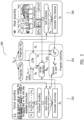
- Figure 2 illustrates more details for the co-grounded navigation agent according to some embodiments.
- Figure 3 shows a corresponding method 300 for the co-grounded navigation agent according to some embodiments.
- Figure 3 suggests an ordering to processes 310-360, it is understood that the processes may be performed in other orders.
- processes 330 and 340 may be performed in any order and/or concurrently.
- Figure 2 is a simplified diagram of a navigation agent 200 according to some embodiments.
- the navigation agent 200 can implement the navigation agent of the computing device 100 described with respect to Figure 1 .
- the navigation agent 200 comprises textual grounding module 230, visual grounding module 240, progress monitor module 250, and action selection module 255 which in some embodiments, can be implementations for the textual grounding module 130, visual grounding module 140, progress monitor module 150, and action selection module 155 of Figure 1 .
- navigation agent 200 may comprise one or more neural networks, which can implement one or more of the textual grounding module 230, visual grounding module 240, progress monitor module 250, and action selection module 255, or be in addition to, or separate from those modules.
- the one or more neural networks implement or operate as encoder and decoder to process the various information and other items received by, and generated within, the navigation agent 200. This includes, but is not limited to, the navigation instructions, observed images (e.g., visual information), and information for actions taken by the robot or mobile automated system.
- the navigation agent 200 performs co-grounding on visual and textual signals or information for the VLN task-visual grounding from instructions helps the agent 200 to determine the right direction, whereas textual grounding implicitly enables the navigation agent 200 to know which part of the instruction is completed and which is needed to proceed.
- Co-grounding provides useful information for the navigation agent 200 to be self-aware, continually monitoring its progress toward a desired goal-e.g., such as the completion of the set of navigations instructions for the robot or mobile automated system.
- the navigation agent 200 is modeled with a sequence-to-sequence architecture with attention by using a recurrent neural network (RNN).
- RNN recurrent neural network
- such RNN is implemented with one or more encoding elements, which separately or take together implement a Long Short Term Memory (LSTM) 260 to carry the flow of information effectively.
- the LSTM 260 receives operates or processes (e.g., decodes) information or elements from, among other things, the textual grounding module 230 and the visual grounding module 240.
- the navigation agent 200 is enabled with panoramic view (for example, as described in more detail in Fried et al., “Speaker-follower models for vision-and-language navigation,” In Advances in Neural Information Processing Systems (NIPS), 2018 , which is incorporated by reference herein).
- panoramic view for example, as described in more detail in Fried et al., "Speaker-follower models for vision-and-language navigation," In Advances in Neural Information Processing Systems (NIPS), 2018 , which is incorporated by reference herein).
- X ⁇ x 1 , x 2 , ..., x L ⁇
- x l is the feature vector for the l -th word encoded by an LSTM language encoder.
- the co-grounding feature of instruction and image are denoted as x ⁇ t and v ⁇ t respectively.
- the selected action is denoted as a t .
- the learnable weights are denoted with W , with appropriate sub/super-scripts as necessary.
- the bias term b can be omitted to avoid notational clutter in the exposition.
- the previous encoder context h t- 1 is used to obtain the textual grounding feature x ⁇ t and visual grounding feature v ⁇ t
- the current encoder context h t can be used to obtain next action a t , as described herein.
- Navigation agent 200 receives as input navigation instructions (process 310 of Figure 3 )-e.g., "Exit the bedroom and go towards to the table. Go to the stairs on the left of the couch. Wait on the third step.”
- the textual grounding module 230 receives and operates on the navigation instructions.
- the agent 200 moves from one viewpoint to another, it is required to identify which direction to go by relying on grounded instruction, i.e., which parts of the instruction should be used. This can either be the instruction matched with the past (ongoing action a t -1 ) or predicted for the future (next action a t ).
- the textual grounding module 230 performs natural language processing (NLP) on the instructions 160.
- NLP is one class of problems to which neural networks may be applied. NLP can be used to instill new neural networks with an understanding of individual words and phrases.
- textual grounding module 230 Based on the received navigation instructions, textual grounding module 230 generates an instruction grounding (process 330 of Figure3 ). Textual grounding module 230 identifies which part of an instruction has been completed or ongoing and which part is outstanding, and thus potentially needed for the next action. To capture the relative position between words within an instruction, in some embodiments, textual grounding module 230 performs or incorporates positional encoding PE(.) (as described in more detail, for example, in Vaswani et al., "Attention is all you need," In Advances in Neural Information Processing Systems (NIPS), pp. 5998-6008, 2017 , which is incorporated by reference herein) into the instruction features.
- PE(.) as described in more detail, for example, in Vaswani et al., "Attention is all you need," In Advances in Neural Information Processing Systems (NIPS), pp. 5998-6008, 2017 , which is incorporated by reference herein
- Textual grounding module 230 then performs soft-attention (e.g., softmax) on the instruction features X , as shown on the left side of Figure 2 .
- soft-attention e.g., softmax
- the embedding dimension for encoding the navigation instruction is 256.
- the navigation agent can use a dropout layer with ratio 0.5 after the embedding layer.
- the instruction can be encoded using a regular LSTM, and the hidden state is 512 dimensional.
- the MLP g used for projecting the raw image feature is BN ⁇ FC ⁇ BN ⁇ Dropout ⁇ ReLU.
- the FC layer projects the 2176-d input vector to a 1024-d vector, and the dropout ratio is set to be 0.5.
- the hidden state of the LSTM used for carrying the textual and visual information through time in Eq. 1 is 512.
- the maximum length of instruction is set to be 80, thus the dimension of the attention weights of textual grounding ⁇ t is also 80.
- the dimension of the learnable matrices from Eq. 2 to 5 are: W x ⁇ R 512 ⁇ 512 , W v ⁇ R 512 ⁇ 1024 , W a ⁇ R 1024 ⁇ 1024 , W h ⁇ R 1536 ⁇ 512 , and W h ⁇ R 592 ⁇ 1 .
- the navigation agent 200 In order to locate the completed or ongoing instruction, the navigation agent 200 should keep track of the sequence of images observed along the navigation trajectory. To accomplish this, the navigation agent 200 receives visual information (process 320 of Figure 3 ).
- the visual grounding module 240 operates on the visual information v t , which can be in the form of one or more images from a camera, e.g., provided on the robot or automated system.
- the visual grounding module 240 generates visual grounding (process 340 of Figure 3 ).
- the navigation agent 200 using visual grounding module 240, finds the image features on navigable directions with the highest correlation with the grounded navigation instruction.
- visual grounding module 240 can use the pre-trained ResNet-152 on ImageNet to extract image features.
- Each image feature is thus a 2048-d vector.
- the embedded feature vector for each navigable direction is obtained by concatenating an appearance feature with a 4-d orientation feature [ sin ⁇ ; cos ⁇ ; sin ⁇ ; cos ⁇ ] , where ⁇ and ⁇ are the heading and elevation angles.
- the 4-dim orientation features are tiled 32 times (as described in more detail in Fried et al., 2018), resulting in an embedding feature vector with 2176 dimension.
- visual grounding module 240 performs visual attention over the surrounding views based on its previous hidden vector h t- 1 .
- MLP Multi-Layer Perceptron
- Navigation agent 200 generates an action for navigation (process 350 of Figure 3 ).
- action selection module 255 identifies, determines, generates, or selects an action at for the robot or automated system to take (e.g., which direction to go). To make a decision on the action, in some embodiments, the action selection module 255 identifies or finds the image features on navigable directions with the highest correlation with the grounded navigation instruction x ⁇ t and the current hidden state h t .
- the action selection module 255 uses categorical sampling during training to select the next action a t .
- the navigation agent 200 achieves both textual and visual grounding using the shared hidden state output containing, derived, or based on grounded information from both textual and visual modalities.
- action selection module 255 relies on both hidden state output and grounded instruction, instead of only relying on grounded instruction.
- one or both of LSTM 260 and action selection module 255 taken together with the textual grounding module 230 and the visual grounding module 240 support, allow for, or provide visual-textual co-grounding to identify or determine the navigation instruction completed in the past, the navigation instruction needed in the next action, and the moving direction from surrounding images.
- LSTM 260 and action selection module 255 taken together with the textual grounding module 230 and the visual grounding module 240 support, allow for, or provide visual-textual co-grounding to identify or determine the navigation instruction completed in the past, the navigation instruction needed in the next action, and the moving direction from surrounding images.
- visual-textual co-grounding module can form a visual-textual co-grounding module.
- the textual-grounding should correctly or accurately reflect the progress (e.g., that the robot or mobile automated system is making) towards the goal, since the navigation agent 200 can then implicitly know where it is now and what the next instruction to be completed will be.
- the visual-textual co-grounding navigation agent 200 can ensure that the grounded instruction reasonably informs decision making when selecting a navigable direction. This may be necessary, but not sufficient, for ensuring that the notion of progress to the goal is encoded.
- the navigation agent 200 may monitor the progress of the robot or mobile automated system towards its goal (process 360 of Figure 3 ).
- navigation agent 200 may include or incorporate a progress monitor module 250.
- the progress monitor module 250 can serve as regularizer during training and intelligently prunes unfinished trajectories during inference.
- the progress monitor module 250 can estimate how close the current viewpoint is to the final goal by conditioning on the positions and weights of grounded instruction. This can further enforce the result of textual-grounding to align with the progress made towards the goal and to ensure the correctness of the textual-grounding.
- the progress monitor module 250 aims to estimate the navigation progress by conditioning on three inputs: the history of grounded images and instructions, the current observation of the surrounding images, and the positions of grounded instructions. We therefore represent these inputs by using (1) the previous hidden state h t- 1 and the current cell state c t of the LSTM 260, (2) the grounded surrounding images v ⁇ t , and (3) the distribution of attention weights of textual-grounding ⁇ t , as shown at the bottom of Figure 2 . For this, the progress monitor module 250 receives input from each of the textual grounding module 230 and visual grounding module 240.
- the progress monitor module 250 first computes an additional hidden state output h t pm by using grounded image representations v ⁇ t as input, similar to how a regular LSTM computes hidden states except it uses concatenation over element-wise addition for empirical reasons.
- the hidden state output is then concatenated with the attention weights ⁇ t on textual-grounding to estimate how close the navigation agent 200 is to the goal.
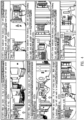
- Figure 4 shows an example of the navigation agent 200 of the present disclosure operating to instruct a robot or mobile automated system to carry out navigation instructions-e.g., "Walk up stairs. At top of stairs turn right. Walk straight to bedroom. Turn left and walk to bed lamp. Turn left and enter closet. Stop at."
- the self-aware agent 200 successfully navigates in an unseen environment. The agent 200 starts from starting position and follows the instruction towards the goal. The percentage of instruction completeness estimated by the proposed progress monitor gradually increases as the agent 200 navigates and approaches to the desired goal.
- a new objective function is used to train the progress monitor module 250.
- the training target y t pm is defined as the normalized distance from the current viewpoint to the goal, i.e., the target will be 0 at the beginning and closer to 1 as the navigation agent 200 approaches the goal. Note that the target can also be lower than 0, if the navigation agent's current distance from the goal is farther than the starting point.
- the self-aware agent 200 is optimized with two cross-entropy losses, computed with respect to the outputs from both action selection and progress monitor.
- p k,t the action probability of each navigable direction
- y t nv the ground-truth navigable direction at step t.
- use ADAM can be used as the optimizer during training.
- the learning rate is 1 e - 4 with batch size of 64 consistently throughout all experiments.
- the beam size is set to be 15. Categorical sampling can be performed during training for action selection.
- the navigation agent 200 can use or employ beam search (as described in more detail in Fried et al., 2018).
- beam search as described in more detail in Fried et al., 2018.
- the navigation agent 200 decides which trajectories in the beams to keep, it is equally important to evaluate the state of the beams on actions as well as on the agent's confidence in completing the given instruction at each traversed viewpoint. This is accomplished by integrating the output of progress monitor module 250 into the accumulated probability of beam search.
- the estimated completeness of instruction-following p t pm is integrated with action probability p k,t to directly evaluate the partial and unfinished candidate routes:
- p t beam p t pm ⁇ Pk , t
- the navigation agent 200 can be evaluated using the Room-to-Room (R2R) dataset, as further described in more detail in Anderson et al., "Vision-and-language navigation: Interpreting visually-grounded navigation instructions in real environments," In Proceedings of the IEEE Conference on Computer Vision and Pattern Recognition (CVPR), volume 2, 2018 , which is incorporated by reference.
- R2R dataset has 7,189 paths, with each path having three ground-truth navigation instructions written by humans.
- the whole dataset is divided into 4 sets: training, validation seen, validation unseen, and test sets unseen.
- NE Navigation Error
- SR Success Rate
- OSR Oracle Success Rate
- the self-aware navigation agent 200 of the present disclosure is compared with various existing approaches-e.g., Student-forcing (Anderson et al., 2018), RPA ( Wang et al., "Look before you leap: Bridging model-free and model-based reinforcement learning for planned-ahead vision-and-language navigation," In European Conference on Computer Vision (ECCV), 2018 ), and Speaker-Follower (Fried et al., 2018).
- the navigation agent 200 of the present disclosure (and its corresponding method) achieve significant performance improvement compared to the state of the art without data augmentation.
- the agent 200 achieves 70% SR on the seen environment and 57% on the unseen environment while the best performing existing method achieved 63% and 50% SR, respectively.
- agent and method of the present disclosure When trained with synthetic data2, the agent and method of the present disclosure achieve slightly better performance on the seen environments and significantly better performance on both the validation unseen environments and the test unseen environments when submitted to the test server.
- the agent and method of the present disclosure achieve 3% and 8% improvement on SR on both validation and test unseen environments. Both results with or without data augmentation indicate that agent and method of the present disclosure are more generalizable to unseen environments.
- an instruction-following agent is required to strongly demonstrate the ability to correctly focus and follow the corresponding part of the instruction as it navigates through an environment.
- the distribution of attention weights on instruction are recorded at each step as indications of which parts of the instruction are being used for action selection. All runs are averaged across both validation seen and unseen dataset splits. It is expected that the distribution of attention weights lies close to a diagonal, where at the beginning, the agent 200 focuses on the beginning of the instruction and shifts its attention towards the end of instruction as it moves closer to the goal.
- the method with panoramic action space (proposed in Fried et al., 2018) is used as a baseline for comparison.
- the self-aware navigation agent 200 with progress monitor demonstrates that the positions of grounded instruction over time form a line similar to a diagonal. This result may further indicate that the agent successfully utilizes the attention on instruction to complete the task sequentially.
- Both the baseline approach and the navigation agent 200 of the present disclosure were able to focus on the first part of the instruction at the beginning of navigation consistently.
- the self-aware agent 200 can still successfully identify the parts of instruction that are potentially useful for action selection, whereas the baseline approach becomes uncertain about which part of the instruction should be used for selecting an action.
- Figure 6 illustrates an example table for an ablation study.
- this table shows the effect of each component of the navigation agent 200-co-grounded, progress monitoring, and data augmentation-compared to the existing approaches. All methods use a panoramic action space.
- the model from with panoramic action space (proposed in Fried et al., 2018) is implemented as a baseline.
- the co-grounding agent 200 outperformed the baseline by a large margin. This is due to the fact that the navigation agent 200 uses the LSTM to carry both the textually and visually grounded content, and the decision on each navigable direction is predicted with both textually grounded instruction and the hidden state output of the LSTM.
- the baseline agent relies on the LSTM to carry visually grounded content, and uses the hidden state output for predicting the textually grounded instruction. As a result, it is observed that instead of predicting the instruction needed for selecting a navigable direction, the textually grounded instruction may match with the past sequence of observed images implicitly saved within the LSTM.
- the output of the progress monitor is integrated with the state-factored beam search (Fried et al., 2018), so that the candidate paths compete not only based on the probability of selecting a certain navigable direction but also on the estimated correspondence between the past trajectory and the instruction. As seen by comparing row #1 with #2 in the table of Figure 6 , the progress monitor significantly improved the success rate on both seen and unseen environments and is the key for surpassing the state of the art even without data augmentation.
- the agent 200 navigates through unseen environments by following instructions as illustrated in Figure 7 .
- the self-aware agent 200 follows the grounded instruction (at the top of the figure) and decides to move towards a certain direction (arrow).
- the grounded instruction illustrated that the agent 200 just completed “turn right” and focuses mainly on “walk straight to bedroom.” As the agent 200 entered the bedroom, it then shifts the textual grounding to the next action "Turn left and walk to bed lamp.” Finally, at step 6, the agent 200 completed another "turn left” and successfully stops at the rug.
- the agent 200 has already entered the hallway and now turns right to walk across to another room. However, it is ambiguous as to which room the instruction is referring.
- the navigation agent 200 checked out the room on the left first and realized that it does not match with "Stop in doorway in front of rug.” It then moves to the next room and successfully stops at the goal.
- the navigation agent includes two complementary modules: a visual-textual co-grounding module and a progress monitor module.
- the visual-textual co-grounding module identifies or determines the navigation instruction completed in the past, the navigation instruction needed in the next action, and the moving direction from surrounding images.
- the progress monitor module regularizes and ensures the grounded instruction correctly or accurately reflects the progress towards the goal by explicitly estimating the completeness of instruction-following. This estimation is conditioned on the positions and weights of grounded instruction. Experiments have shown that this approach sets a new state-of-the-art performance on the standard Room-to-Room dataset on both seen and unseen environments.
Landscapes
- Engineering & Computer Science (AREA)
- Theoretical Computer Science (AREA)
- Physics & Mathematics (AREA)
- General Physics & Mathematics (AREA)
- Evolutionary Computation (AREA)
- Health & Medical Sciences (AREA)
- General Health & Medical Sciences (AREA)
- Artificial Intelligence (AREA)
- Computing Systems (AREA)
- Software Systems (AREA)
- Multimedia (AREA)
- Computer Vision & Pattern Recognition (AREA)
- General Engineering & Computer Science (AREA)
- Mathematical Physics (AREA)
- Data Mining & Analysis (AREA)
- Life Sciences & Earth Sciences (AREA)
- Molecular Biology (AREA)
- Biomedical Technology (AREA)
- Medical Informatics (AREA)
- Computational Linguistics (AREA)
- Biophysics (AREA)
- Databases & Information Systems (AREA)
- Remote Sensing (AREA)
- Automation & Control Theory (AREA)
- Radar, Positioning & Navigation (AREA)
- Aviation & Aerospace Engineering (AREA)
- Robotics (AREA)
- Mechanical Engineering (AREA)
- Audiology, Speech & Language Pathology (AREA)
- Human Computer Interaction (AREA)
- Biodiversity & Conservation Biology (AREA)
- Bioinformatics & Cheminformatics (AREA)
- Bioinformatics & Computational Biology (AREA)
- Evolutionary Biology (AREA)
- Electromagnetism (AREA)
- Control Of Position, Course, Altitude, Or Attitude Of Moving Bodies (AREA)
- User Interface Of Digital Computer (AREA)
- Traffic Control Systems (AREA)
- Image Analysis (AREA)
- Navigation (AREA)
Claims (13)
- Computervorrichtung, umfassend:ein maschinenlesbares Medium, das einen Speicher enthält, in dem ein maschinenausführbarer Code gespeichert ist; undein oder mehrere Prozessoren, die mit dem Speicher gekoppelt sind und konfigurierbar sind zum Ausführen des maschinenausführbaren Codes, um den einen oder die mehreren Prozessoren zu veranlassen zum:Erzeugen, durch ein textuelles Grounding-Modul, eines anleitenden Groundings aus einem Anleitungsbeispiel einer Trainingsnavigation zum Anleiten eines mobilen automatisierten Systems, um in einer Umgebung zu navigieren, in der sich das mobile automatisierte System befindet;Erzeugen, durch ein visuelles Grounding-Modul, eines visuellen Groundings aus einem oder mehreren Trainingsbildern, die für die Umgebung beobachtet werden, wenn das mobile automatisierte Systems durch selbige navigiert;Erzeugen, durch ein neuronales Modell, einer Fortschrittsüberwachungswahrscheinlichkeit als Reaktion auf eine Eingabe des anleitenden Groundings und des visuellen Groundings;Berechnen einer Aktionswahrscheinlichkeit von Navigationsrichtungen basierend auf einem verborgenen Zustand des neuronalen Modells und des anleitenden Groundings;Berechnen eines Verlustziels mindestens teilweise basierend auf einer ersten Kreuzentropie zwischen der Fortschrittsüberwachungswahrscheinlichkeit und einer Ground-Truth-Fortschrittskennzeichnung und auf einer zweiten Kreuzentropie zwischen der Aktionswahrscheinlichkeit und einer navigierbaren Ground-Truth-Richtung, wobei das Verlustziel als eine lineare Kombination der ersten Kreuzentropie und der zweiten Kreuzentropie mit einem Gewichtungsparameter berechnet wird, der ein Verhältnis zwischen der ersten Kreuzentropie und der zweiten Kreuzentropie anpasst; undAktualisieren des neuronalen Modells basierend auf dem Verlustziel.
- Computervorrichtung nach Anspruch 1, wobei der maschinenausführbare Code ferner den einen oder die mehreren Prozessoren veranlasst zum Erzeugen des anleitenden Groundings mindestens teilweise basierend auf dem Anleitungsbeispiel der Trainingsnavigation, wobei das anleitende Grounding identifiziert, welcher Teil des Anleitungsbeispiels der Trainingsnavigation von dem mobilen automatisierten System abgeschlossen wurde und welcher Teil des Anleitungsbeispiels der Trainingsnavigation noch aussteht.
- Computervorrichtung nach Anspruch 1 oder 2, wobei der maschinenausführbare Code ferner den einen oder die mehreren Prozessoren veranlasst zum Erzeugen des visuellen Groundings mindestens teilweise basierend auf visuellen Informationen, die in den Trainingsbildern enthalten sind, wobei das visuelle Grounding eine Richtung identifiziert, in der das mobile automatisierte System weitergehen sollte.
- Computervorrichtung nach einem der vorhergehenden Ansprüche, wobei die Ground-Truth-Fortschrittskennzeichnung als ein normalisierter Abstand von einem aktuellen Beobachtungspunkt zu einem Ziel berechnet wird.
- Computervorrichtung nach einem der vorhergehenden Ansprüche, wobei der maschinenausführbare Code ferner den einen oder die mehreren Prozessoren veranlasst zum Überwachen des Fortschritts einer Navigation des mobilen automatisierten Systems, um sicherzustellen, dass das anleitende Grounding den Navigationsfortschritt genau wiedergibt.
- Computervorrichtung nach einem der vorhergehenden Ansprüche, wobei der maschinenausführbare Code ferner den einen oder die mehreren Prozessoren veranlasst zum:Erzeugen eines Codiererkontexts eines basierend auf dem anleitenden Grounding und dem visuellen Grounding; undErzeugen der Aktionswahrscheinlichkeit für das mobile automatisierte System unter Verwendung des Codiererkontexts.
- Computervorrichtung nach einem der vorhergehenden Ansprüche, wobei der maschinenausführbare Code ferner den einen oder die mehreren Prozessoren veranlasst zum Durchführen einer Verarbeitungsaufgabe in natürlicher Sprache an dem Anleitungsbeispiel der Trainingsnavigation.
- Computervorrichtung nach einem der vorhergehenden Ansprüche, wobei der maschinenausführbare Code ferner den einen oder die mehreren Prozessoren veranlasst zum Identifizieren einer navigierbaren Richtung mit der höchsten Korrelation mit dem anleitenden Grounding.
- Computervorrichtung nach einem der vorhergehenden Ansprüche, wobei der maschinenausführbare Code ferner den einen oder die mehreren Prozessoren veranlasst zum:Identifizieren einer Vielzahl von Richtungen, in denen das mobile automatisierte System navigieren kann; undfür jede identifizierte navigierbare Richtung, Erzeugen einer jeweiligen Wahrscheinlichkeit.
- Verfahren zum Trainieren eines mobilen automatisierten Systems zum Überwachen eines Navigationsfortschritts, wobei das Verfahren umfasst:Erzeugen, durch ein textuelles Grounding-Modul, eines anleitenden Groundings aus einem Anleitungsbeispiel einer Trainingsnavigation zum Anleiten des mobilen automatisierten Systems, um in einer Umgebung zu navigieren, in der sich das mobile automatisierte System befindet;Erzeugen, durch ein visuelles Grounding-Modul, eines visuellen Groundings aus einem oder mehreren Trainingsbildern, die für die Umgebung beobachtet werden, wenn das mobile automatisierte Systems durch selbige navigiert;Erzeugen, durch ein neuronales Modell, einer Fortschrittsüberwachungswahrscheinlichkeit als Reaktion auf eine Eingabe des anleitenden Groundings und des visuellen Groundings;Berechnen einer Aktionswahrscheinlichkeit von Navigationsrichtungen basierend auf einem verborgenen Zustand des neuronalen Modells und des anleitenden Groundings;Berechnen eines Verlustziels mindestens teilweise basierend auf einer ersten Kreuzentropie zwischen der Fortschrittsüberwachungswahrscheinlichkeit und einer Ground-Truth-Navigationskennzeichnung und auf einer zweiten Kreuzentropie zwischen der Aktionswahrscheinlichkeit und einer navigierbaren Ground-Truth-Richtung, wobei das Verlustziel als eine lineare Kombination der ersten Kreuzentropie und der zweiten Kreuzentropie mit einem Gewichtungsparameter berechnet wird, der ein Verhältnis zwischen der ersten Kreuzentropie und der zweiten Kreuzentropie anpasst; undAktualisieren des neuronalen Modells basierend auf dem Verlustziel.
- Verfahren nach Anspruch 10, das ferner umfasst:
Erzeugen des anleitenden Groundings mindestens teilweise basierend auf dem Anleitungsbeispiel der Trainingsnavigation, wobei das anleitende Grounding identifiziert, welcher Teil des Anleitungsbeispiels der Trainingsnavigation von dem mobilen automatisierten System abgeschlossen wurde und welcher Teil des Anleitungsbeispiels der Trainingsnavigation noch aussteht. - Verfahren nach Anspruch 10 oder 11, das ferner umfasst:
Erzeugen des visuellen Groundings mindestens teilweise basierend auf visuellen Informationen, die in den Trainingsbildern enthalten sind, wobei das visuelle Grounding eine Richtung identifiziert, in der sich das mobile automatisierte System weitergehen sollte. - Nicht-flüchtiges maschinenlesbares Medium, das einen ausführbaren Code umfasst, der, wenn er von einem oder mehreren Prozessoren ausgeführt wird, die mit der Computervorrichtung assoziiert sind, geeignet ist, um den einen oder die mehreren Prozessoren zu veranlassen, um ein Verfahren durchzuführen, das umfasst:Erzeugen, durch ein textuelles Grounding-Modul, eines anleitenden Groundings aus einem Anleitungsbeispiel einer Trainingsnavigation zum Anleiten eines mobilen automatisierten Systems, um in einer Umgebung zu navigieren, in der sich das mobile automatisierte System befindet;Erzeugen, durch ein visuelles Grounding-Modul, eines visuellen Groundings aus einem oder mehreren Trainingsbildern, die für die Umgebung beobachtet werden, wenn das mobile automatisierte Systems durch selbige navigiert;Erzeugen, durch ein neuronales Modell, einer Fortschrittsüberwachungswahrscheinlichkeit als Reaktion auf eine Eingabe des anleitenden Groundings und des visuellen Groundings;Berechnen einer Aktionswahrscheinlichkeit von Navigationsrichtungen basierend auf einem verborgenen Zustand des neuronalen Modells und des anleitenden Groundings;Berechnen eines Verlustziels mindestens teilweise basierend auf einer ersten Kreuzentropie zwischen der Fortschrittsüberwachungswahrscheinlichkeit und einer Ground-Truth-Navigationskennzeichnung und auf einer zweiten Kreuzentropie zwischen der Aktionswahrscheinlichkeit und einer navigierbaren Ground-Truth-Richtung, wobei das Verlustziel als eine lineare Kombination der ersten Kreuzentropie und der zweiten Kreuzentropie mit einem Gewichtungsparameter berechnet wird, der ein Verhältnis zwischen der ersten Kreuzentropie und der zweiten Kreuzentropie anpasst; undAktualisieren des neuronalen Modells basierend auf dem Verlustziel.
Applications Claiming Priority (4)
| Application Number | Priority Date | Filing Date | Title |
|---|---|---|---|
| US201862737684P | 2018-09-27 | 2018-09-27 | |
| US16/176,955 US11029694B2 (en) | 2018-09-27 | 2018-10-31 | Self-aware visual-textual co-grounded navigation agent |
| PCT/US2019/053200 WO2020069160A1 (en) | 2018-09-27 | 2019-09-26 | Self-aware visual-textual co-grounded navigation agent |
| EP19783943.4A EP3814865B1 (de) | 2018-09-27 | 2019-09-26 | Selbstbewusster visuelles-textueller navigationsagent mit co-grounding |
Related Parent Applications (1)
| Application Number | Title | Priority Date | Filing Date |
|---|---|---|---|
| EP19783943.4A Division EP3814865B1 (de) | 2018-09-27 | 2019-09-26 | Selbstbewusster visuelles-textueller navigationsagent mit co-grounding |
Publications (2)
| Publication Number | Publication Date |
|---|---|
| EP4180892A1 EP4180892A1 (de) | 2023-05-17 |
| EP4180892B1 true EP4180892B1 (de) | 2025-01-29 |
Family
ID=69947468
Family Applications (2)
| Application Number | Title | Priority Date | Filing Date |
|---|---|---|---|
| EP22179960.4A Active EP4180892B1 (de) | 2018-09-27 | 2019-09-26 | Selbstbewusster visuelles-textueller navigationsagent mit co-grounding |
| EP19783943.4A Active EP3814865B1 (de) | 2018-09-27 | 2019-09-26 | Selbstbewusster visuelles-textueller navigationsagent mit co-grounding |
Family Applications After (1)
| Application Number | Title | Priority Date | Filing Date |
|---|---|---|---|
| EP19783943.4A Active EP3814865B1 (de) | 2018-09-27 | 2019-09-26 | Selbstbewusster visuelles-textueller navigationsagent mit co-grounding |
Country Status (5)
| Country | Link |
|---|---|
| US (2) | US11029694B2 (de) |
| EP (2) | EP4180892B1 (de) |
| JP (1) | JP7331084B2 (de) |
| CN (1) | CN112714896B (de) |
| WO (1) | WO2020069160A1 (de) |
Families Citing this family (36)
| Publication number | Priority date | Publication date | Assignee | Title |
|---|---|---|---|---|
| US10817650B2 (en) | 2017-05-19 | 2020-10-27 | Salesforce.Com, Inc. | Natural language processing using context specific word vectors |
| CN113165178B (zh) * | 2018-11-28 | 2025-01-24 | 谷歌有限责任公司 | 使用高级策略模型和经训练的低级策略模型进行机器人导航 |
| US11822897B2 (en) | 2018-12-11 | 2023-11-21 | Salesforce.Com, Inc. | Systems and methods for structured text translation with tag alignment |
| US10963652B2 (en) | 2018-12-11 | 2021-03-30 | Salesforce.Com, Inc. | Structured text translation |
| US11003867B2 (en) | 2019-03-04 | 2021-05-11 | Salesforce.Com, Inc. | Cross-lingual regularization for multilingual generalization |
| US11809977B2 (en) * | 2019-11-14 | 2023-11-07 | NEC Laboratories Europe GmbH | Weakly supervised reinforcement learning |
| US11481636B2 (en) | 2019-11-18 | 2022-10-25 | Salesforce.Com, Inc. | Systems and methods for out-of-distribution classification |
| US11922303B2 (en) | 2019-11-18 | 2024-03-05 | Salesforce, Inc. | Systems and methods for distilled BERT-based training model for text classification |
| US11487999B2 (en) | 2019-12-09 | 2022-11-01 | Salesforce.Com, Inc. | Spatial-temporal reasoning through pretrained language models for video-grounded dialogues |
| US11640505B2 (en) | 2019-12-09 | 2023-05-02 | Salesforce.Com, Inc. | Systems and methods for explicit memory tracker with coarse-to-fine reasoning in conversational machine reading |
| US12086539B2 (en) | 2019-12-09 | 2024-09-10 | Salesforce, Inc. | System and method for natural language processing using neural network with cross-task training |
| US11416688B2 (en) | 2019-12-09 | 2022-08-16 | Salesforce.Com, Inc. | Learning dialogue state tracking with limited labeled data |
| US11256754B2 (en) | 2019-12-09 | 2022-02-22 | Salesforce.Com, Inc. | Systems and methods for generating natural language processing training samples with inflectional perturbations |
| US11573957B2 (en) | 2019-12-09 | 2023-02-07 | Salesforce.Com, Inc. | Natural language processing engine for translating questions into executable database queries |
| US11669745B2 (en) | 2020-01-13 | 2023-06-06 | Salesforce.Com, Inc. | Proposal learning for semi-supervised object detection |
| US11562147B2 (en) | 2020-01-23 | 2023-01-24 | Salesforce.Com, Inc. | Unified vision and dialogue transformer with BERT |
| US20210249105A1 (en) | 2020-02-06 | 2021-08-12 | Salesforce.Com, Inc. | Systems and methods for language modeling of protein engineering |
| US11263476B2 (en) | 2020-03-19 | 2022-03-01 | Salesforce.Com, Inc. | Unsupervised representation learning with contrastive prototypes |
| US11328731B2 (en) | 2020-04-08 | 2022-05-10 | Salesforce.Com, Inc. | Phone-based sub-word units for end-to-end speech recognition |
| US12299982B2 (en) | 2020-05-12 | 2025-05-13 | Salesforce, Inc. | Systems and methods for partially supervised online action detection in untrimmed videos |
| EP3916507B1 (de) * | 2020-05-29 | 2023-05-24 | Tata Consultancy Services Limited | Verfahren und systeme zur ermöglichung der mensch-roboter-interaktion durch gemeinsame wahrnehmung |
| US11669699B2 (en) | 2020-05-31 | 2023-06-06 | Saleforce.com, inc. | Systems and methods for composed variational natural language generation |
| US12265909B2 (en) | 2020-06-01 | 2025-04-01 | Salesforce, Inc. | Systems and methods for a k-nearest neighbor based mechanism of natural language processing models |
| US11720559B2 (en) | 2020-06-02 | 2023-08-08 | Salesforce.Com, Inc. | Bridging textual and tabular data for cross domain text-to-query language semantic parsing with a pre-trained transformer language encoder and anchor text |
| US12530560B2 (en) | 2020-06-03 | 2026-01-20 | Salesforce, Inc. | System and method for differential architecture search for neural networks |
| US20220050877A1 (en) | 2020-08-14 | 2022-02-17 | Salesforce.Com, Inc. | Systems and methods for query autocompletion |
| KR102430442B1 (ko) * | 2020-08-19 | 2022-08-09 | 경기대학교 산학협력단 | 에이전트 학습 보상 시스템 |
| US11934952B2 (en) | 2020-08-21 | 2024-03-19 | Salesforce, Inc. | Systems and methods for natural language processing using joint energy-based models |
| US11934781B2 (en) | 2020-08-28 | 2024-03-19 | Salesforce, Inc. | Systems and methods for controllable text summarization |
| US20220121213A1 (en) * | 2020-10-21 | 2022-04-21 | Automotive Research & Testing Center | Hybrid planning method in autonomous vehicle and system thereof |
| US11829442B2 (en) | 2020-11-16 | 2023-11-28 | Salesforce.Com, Inc. | Methods and systems for efficient batch active learning of a deep neural network |
| CN112529295B (zh) * | 2020-12-09 | 2023-10-27 | 西湖大学 | 一种基于进度预测的自监督视觉语言导航器及路径缩短方法 |
| US11720108B2 (en) | 2020-12-22 | 2023-08-08 | Baidu Usa Llc | Natural language based indoor autonomous navigation |
| CN113984052B (zh) * | 2021-06-16 | 2024-03-19 | 北京小米移动软件有限公司 | 室内导航方法、室内导航装置、设备及存储介质 |
| EP4633880A4 (de) * | 2023-05-12 | 2026-04-15 | Samsung Electronics Co Ltd | System und verfahren zur zero-shot-objektnavigation unter verwendung grosser sprachmodelle |
| KR102903342B1 (ko) * | 2024-02-21 | 2025-12-24 | 서울대학교산학협력단 | 시각 인식 기반의 자연어 인스트럭션 생성 방법 및 장치 |
Family Cites Families (60)
| Publication number | Priority date | Publication date | Assignee | Title |
|---|---|---|---|---|
| US7831433B1 (en) * | 2005-02-03 | 2010-11-09 | Hrl Laboratories, Llc | System and method for using context in navigation dialog |
| WO2010044277A1 (ja) * | 2008-10-16 | 2010-04-22 | 株式会社テムザック | 移動体ナビゲーション装置 |
| US8818605B2 (en) * | 2009-08-26 | 2014-08-26 | Electronics And Telecommunications Research Institute | Device and method for providing navigation information |
| JP5647905B2 (ja) * | 2010-01-20 | 2015-01-07 | 株式会社Ihiエアロスペース | 無人移動体の制御方法 |
| US9008859B2 (en) * | 2010-12-22 | 2015-04-14 | Microsoft Technology Licensing, Llc | Navigation instructions using low-bandwidth signaling |
| JP2012216069A (ja) * | 2011-03-31 | 2012-11-08 | Equos Research Co Ltd | 車両および車両制御プログラム |
| CN102306145A (zh) * | 2011-07-27 | 2012-01-04 | 东南大学 | 一种基于自然语言处理的机器人导航方法 |
| US9638537B2 (en) * | 2012-06-21 | 2017-05-02 | Cellepathy Inc. | Interface selection in navigation guidance systems |
| JP5969903B2 (ja) * | 2012-11-26 | 2016-08-17 | 株式会社Ihiエアロスペース | 無人移動体の制御方法 |
| CN103324197A (zh) * | 2013-06-26 | 2013-09-25 | 西安电子科技大学 | 一种语音控制多用途智能服务机器人 |
| US9575720B2 (en) * | 2013-07-31 | 2017-02-21 | Google Inc. | Visual confirmation for a recognized voice-initiated action |
| US9547306B2 (en) * | 2014-09-30 | 2017-01-17 | Speak Loud SPA | State and context dependent voice based interface for an unmanned vehicle or robot |
| US20160350653A1 (en) | 2015-06-01 | 2016-12-01 | Salesforce.Com, Inc. | Dynamic Memory Network |
| US11113598B2 (en) | 2015-06-01 | 2021-09-07 | Salesforce.Com, Inc. | Dynamic memory network |
| US20170032280A1 (en) | 2015-07-27 | 2017-02-02 | Salesforce.Com, Inc. | Engagement estimator |
| US20170140240A1 (en) | 2015-07-27 | 2017-05-18 | Salesforce.Com, Inc. | Neural network combined image and text evaluator and classifier |
| US10282663B2 (en) | 2015-08-15 | 2019-05-07 | Salesforce.Com, Inc. | Three-dimensional (3D) convolution with 3D batch normalization |
| JP2017156511A (ja) * | 2016-03-01 | 2017-09-07 | ソニー株式会社 | 情報処理装置、情報処理方法、およびプログラム |
| US9811074B1 (en) * | 2016-06-21 | 2017-11-07 | TruPhysics GmbH | Optimization of robot control programs in physics-based simulated environment |
| US10565493B2 (en) | 2016-09-22 | 2020-02-18 | Salesforce.Com, Inc. | Pointer sentinel mixture architecture |
| US10595037B2 (en) * | 2016-10-28 | 2020-03-17 | Nec Corporation | Dynamic scene prediction with multiple interacting agents |
| US11222253B2 (en) | 2016-11-03 | 2022-01-11 | Salesforce.Com, Inc. | Deep neural network model for processing data through multiple linguistic task hierarchies |
| US10963782B2 (en) | 2016-11-04 | 2021-03-30 | Salesforce.Com, Inc. | Dynamic coattention network for question answering |
| US11080595B2 (en) | 2016-11-04 | 2021-08-03 | Salesforce.Com, Inc. | Quasi-recurrent neural network based encoder-decoder model |
| US10565305B2 (en) | 2016-11-18 | 2020-02-18 | Salesforce.Com, Inc. | Adaptive attention model for image captioning |
| US11354565B2 (en) | 2017-03-15 | 2022-06-07 | Salesforce.Com, Inc. | Probability-based guider |
| AU2018236433B2 (en) * | 2017-03-17 | 2022-03-03 | Magic Leap, Inc. | Room layout estimation methods and techniques |
| CN106863307A (zh) * | 2017-04-13 | 2017-06-20 | 苏州宇希新材料科技有限公司 | 一种基于视觉和语音智能控制的机器人 |
| US10565318B2 (en) | 2017-04-14 | 2020-02-18 | Salesforce.Com, Inc. | Neural machine translation with latent tree attention |
| US10474709B2 (en) | 2017-04-14 | 2019-11-12 | Salesforce.Com, Inc. | Deep reinforced model for abstractive summarization |
| US10606898B2 (en) * | 2017-04-19 | 2020-03-31 | Brown University | Interpreting human-robot instructions |
| US11386327B2 (en) | 2017-05-18 | 2022-07-12 | Salesforce.Com, Inc. | Block-diagonal hessian-free optimization for recurrent and convolutional neural networks |
| US10747761B2 (en) | 2017-05-18 | 2020-08-18 | Salesforce.Com, Inc. | Neural network based translation of natural language queries to database queries |
| US10817650B2 (en) | 2017-05-19 | 2020-10-27 | Salesforce.Com, Inc. | Natural language processing using context specific word vectors |
| US12014257B2 (en) | 2017-05-19 | 2024-06-18 | Salesforce, Inc. | Domain specific language for generation of recurrent neural network architectures |
| JP6890720B2 (ja) * | 2017-06-16 | 2021-06-18 | マーカブル インコーポレイテッドMarkable,Inc. | 画像処理システム |
| US11354823B2 (en) * | 2017-07-11 | 2022-06-07 | Deepmind Technologies Limited | Learning visual concepts using neural networks |
| CN107562069B (zh) * | 2017-08-03 | 2020-06-05 | 乌鲁木齐众合联达网络科技有限公司 | 一种自主式巡逻导航无人机 |
| US10817779B2 (en) * | 2017-08-30 | 2020-10-27 | International Business Machines Corporation | Bayesian network based hybrid machine learning |
| US10366166B2 (en) * | 2017-09-07 | 2019-07-30 | Baidu Usa Llc | Deep compositional frameworks for human-like language acquisition in virtual environments |
| US20190130896A1 (en) | 2017-10-26 | 2019-05-02 | Salesforce.Com, Inc. | Regularization Techniques for End-To-End Speech Recognition |
| US11928600B2 (en) | 2017-10-27 | 2024-03-12 | Salesforce, Inc. | Sequence-to-sequence prediction using a neural network model |
| US10573295B2 (en) | 2017-10-27 | 2020-02-25 | Salesforce.Com, Inc. | End-to-end speech recognition with policy learning |
| US11170287B2 (en) | 2017-10-27 | 2021-11-09 | Salesforce.Com, Inc. | Generating dual sequence inferences using a neural network model |
| US11604956B2 (en) | 2017-10-27 | 2023-03-14 | Salesforce.Com, Inc. | Sequence-to-sequence prediction using a neural network model |
| US10592767B2 (en) | 2017-10-27 | 2020-03-17 | Salesforce.Com, Inc. | Interpretable counting in visual question answering |
| US11562287B2 (en) | 2017-10-27 | 2023-01-24 | Salesforce.Com, Inc. | Hierarchical and interpretable skill acquisition in multi-task reinforcement learning |
| US11380034B2 (en) * | 2017-10-27 | 2022-07-05 | Google Llc | Semantically-consistent image style transfer |
| US10346721B2 (en) | 2017-11-01 | 2019-07-09 | Salesforce.Com, Inc. | Training a neural network using augmented training datasets |
| US10542270B2 (en) | 2017-11-15 | 2020-01-21 | Salesforce.Com, Inc. | Dense video captioning |
| US11276002B2 (en) | 2017-12-20 | 2022-03-15 | Salesforce.Com, Inc. | Hybrid training of deep networks |
| US10776581B2 (en) | 2018-02-09 | 2020-09-15 | Salesforce.Com, Inc. | Multitask learning as question answering |
| US11227218B2 (en) | 2018-02-22 | 2022-01-18 | Salesforce.Com, Inc. | Question answering from minimal context over documents |
| US10929607B2 (en) | 2018-02-22 | 2021-02-23 | Salesforce.Com, Inc. | Dialogue state tracking using a global-local encoder |
| US11106182B2 (en) | 2018-03-16 | 2021-08-31 | Salesforce.Com, Inc. | Systems and methods for learning for domain adaptation |
| US10783875B2 (en) | 2018-03-16 | 2020-09-22 | Salesforce.Com, Inc. | Unsupervised non-parallel speech domain adaptation using a multi-discriminator adversarial network |
| US10909157B2 (en) | 2018-05-22 | 2021-02-02 | Salesforce.Com, Inc. | Abstraction of text summarization |
| US11631009B2 (en) | 2018-05-23 | 2023-04-18 | Salesforce.Com, Inc | Multi-hop knowledge graph reasoning with reward shaping |
| US11341356B2 (en) * | 2018-06-15 | 2022-05-24 | Uatc, Llc | System and method for determining object intention through visual attributes |
| US11449079B2 (en) * | 2019-01-30 | 2022-09-20 | Adobe Inc. | Generalizable robot approach control techniques |
-
2018
- 2018-10-31 US US16/176,955 patent/US11029694B2/en active Active
-
2019
- 2019-09-26 EP EP22179960.4A patent/EP4180892B1/de active Active
- 2019-09-26 CN CN201980061398.0A patent/CN112714896B/zh active Active
- 2019-09-26 WO PCT/US2019/053200 patent/WO2020069160A1/en not_active Ceased
- 2019-09-26 EP EP19783943.4A patent/EP3814865B1/de active Active
- 2019-09-26 JP JP2021505331A patent/JP7331084B2/ja active Active
-
2021
- 2021-05-27 US US17/332,756 patent/US11971712B2/en active Active
Also Published As
| Publication number | Publication date |
|---|---|
| US20200103911A1 (en) | 2020-04-02 |
| CN112714896A (zh) | 2021-04-27 |
| EP3814865A1 (de) | 2021-05-05 |
| JP2022500725A (ja) | 2022-01-04 |
| US11029694B2 (en) | 2021-06-08 |
| EP4180892A1 (de) | 2023-05-17 |
| CN112714896B (zh) | 2024-03-08 |
| US20210286369A1 (en) | 2021-09-16 |
| US11971712B2 (en) | 2024-04-30 |
| WO2020069160A1 (en) | 2020-04-02 |
| EP3814865B1 (de) | 2022-06-22 |
| JP7331084B2 (ja) | 2023-08-22 |
Similar Documents
| Publication | Publication Date | Title |
|---|---|---|
| EP4180892B1 (de) | Selbstbewusster visuelles-textueller navigationsagent mit co-grounding | |
| US12450768B2 (en) | End-to-end tracking of objects | |
| Sadeghian et al. | Sophie: An attentive gan for predicting paths compliant to social and physical constraints | |
| US10595037B2 (en) | Dynamic scene prediction with multiple interacting agents | |
| Mahdavian et al. | Stpotr: Simultaneous human trajectory and pose prediction using a non-autoregressive transformer for robot follow-ahead | |
| US12000945B2 (en) | Visual and RF sensor fusion for multi-agent tracking | |
| Chen et al. | Stigcn: spatial–temporal interaction-aware graph convolution network for pedestrian trajectory prediction | |
| US12311555B2 (en) | Robotic navigation and transport of objects | |
| Ye et al. | Gaple: Generalizable approaching policy learning for robotic object searching in indoor environment | |
| US12488571B2 (en) | Generating images for neural network training | |
| Gao et al. | Efficient hierarchical reinforcement learning for mapless navigation with predictive neighbouring space scoring | |
| Ge et al. | Deep reinforcement learning navigation via decision transformer in autonomous driving | |
| Nguyen et al. | Uncertainty-aware visually-attentive navigation using deep neural networks | |
| Lim et al. | RONet: Real-time range-only indoor localization via stacked bidirectional LSTM with residual attention | |
| Dixon et al. | Predicting uncertainty in vision-based satellite pose estimation using deep evidential regression | |
| US20250111543A1 (en) | Method of training a model for a goal-oriented visual navigation task | |
| CN119068231A (zh) | 一种视觉导航模型训练方法、系统、设备和可读存储介质 | |
| CN118070967A (zh) | 自适应多模态数据的船舶轨迹预测方法及系统 | |
| Sun et al. | TransFusionOdom: Interpretable transformer-based LiDAR-inertial fusion odometry estimation | |
| Kayalvizhi et al. | A comprehensive study on supermarket indoor navigation for visually impaired using computer vision techniques | |
| Wei | Enabling Platform Agnostic Situational Awareness using Machine Learning and View Geometry | |
| Bautista Linde | Deep reinforcement learning for UAV patrolling in rescue operations | |
| Mei et al. | Trajectory Prediction Method for Unmanned Systems Based on Dynamic Graph Neural Network with Adaptive Weight Adjustment | |
| Deng | BS-CYOLOv5: A Deep Learning and Backtracking Search Framework for Multi-Sensor UAV Navigation and Obstacle Avoidance | |
| Banerjee et al. | Cost-Aware Diffusion Active Search |
Legal Events
| Date | Code | Title | Description |
|---|---|---|---|
| PUAI | Public reference made under article 153(3) epc to a published international application that has entered the european phase |
Free format text: ORIGINAL CODE: 0009012 |
|
| STAA | Information on the status of an ep patent application or granted ep patent |
Free format text: STATUS: THE APPLICATION HAS BEEN PUBLISHED |
|
| AC | Divisional application: reference to earlier application |
Ref document number: 3814865 Country of ref document: EP Kind code of ref document: P |
|
| AK | Designated contracting states |
Kind code of ref document: A1 Designated state(s): AL AT BE BG CH CY CZ DE DK EE ES FI FR GB GR HR HU IE IS IT LI LT LU LV MC MK MT NL NO PL PT RO RS SE SI SK SM TR |
|
| P01 | Opt-out of the competence of the unified patent court (upc) registered |
Effective date: 20230528 |
|
| STAA | Information on the status of an ep patent application or granted ep patent |
Free format text: STATUS: REQUEST FOR EXAMINATION WAS MADE |
|
| 17P | Request for examination filed |
Effective date: 20231115 |
|
| RBV | Designated contracting states (corrected) |
Designated state(s): AL AT BE BG CH CY CZ DE DK EE ES FI FR GB GR HR HU IE IS IT LI LT LU LV MC MK MT NL NO PL PT RO RS SE SI SK SM TR |
|
| GRAP | Despatch of communication of intention to grant a patent |
Free format text: ORIGINAL CODE: EPIDOSNIGR1 |
|
| STAA | Information on the status of an ep patent application or granted ep patent |
Free format text: STATUS: GRANT OF PATENT IS INTENDED |
|
| INTG | Intention to grant announced |
Effective date: 20240902 |
|
| GRAS | Grant fee paid |
Free format text: ORIGINAL CODE: EPIDOSNIGR3 |
|
| GRAA | (expected) grant |
Free format text: ORIGINAL CODE: 0009210 |
|
| STAA | Information on the status of an ep patent application or granted ep patent |
Free format text: STATUS: THE PATENT HAS BEEN GRANTED |
|
| AC | Divisional application: reference to earlier application |
Ref document number: 3814865 Country of ref document: EP Kind code of ref document: P |
|
| AK | Designated contracting states |
Kind code of ref document: B1 Designated state(s): AL AT BE BG CH CY CZ DE DK EE ES FI FR GB GR HR HU IE IS IT LI LT LU LV MC MK MT NL NO PL PT RO RS SE SI SK SM TR |
|
| REG | Reference to a national code |
Ref country code: GB Ref legal event code: FG4D |
|
| REG | Reference to a national code |
Ref country code: CH Ref legal event code: EP |
|
| REG | Reference to a national code |
Ref country code: DE Ref legal event code: R096 Ref document number: 602019065577 Country of ref document: DE |
|
| REG | Reference to a national code |
Ref country code: IE Ref legal event code: FG4D |
|
| REG | Reference to a national code |
Ref country code: NL Ref legal event code: MP Effective date: 20250129 |
|
| PG25 | Lapsed in a contracting state [announced via postgrant information from national office to epo] |
Ref country code: NL Free format text: LAPSE BECAUSE OF FAILURE TO SUBMIT A TRANSLATION OF THE DESCRIPTION OR TO PAY THE FEE WITHIN THE PRESCRIBED TIME-LIMIT Effective date: 20250129 |
|
| PG25 | Lapsed in a contracting state [announced via postgrant information from national office to epo] |
Ref country code: RS Free format text: LAPSE BECAUSE OF FAILURE TO SUBMIT A TRANSLATION OF THE DESCRIPTION OR TO PAY THE FEE WITHIN THE PRESCRIBED TIME-LIMIT Effective date: 20250429 |
|
| PG25 | Lapsed in a contracting state [announced via postgrant information from national office to epo] |
Ref country code: FI Free format text: LAPSE BECAUSE OF FAILURE TO SUBMIT A TRANSLATION OF THE DESCRIPTION OR TO PAY THE FEE WITHIN THE PRESCRIBED TIME-LIMIT Effective date: 20250129 |
|
| PG25 | Lapsed in a contracting state [announced via postgrant information from national office to epo] |
Ref country code: PL Free format text: LAPSE BECAUSE OF FAILURE TO SUBMIT A TRANSLATION OF THE DESCRIPTION OR TO PAY THE FEE WITHIN THE PRESCRIBED TIME-LIMIT Effective date: 20250129 |
|
| PG25 | Lapsed in a contracting state [announced via postgrant information from national office to epo] |
Ref country code: ES Free format text: LAPSE BECAUSE OF FAILURE TO SUBMIT A TRANSLATION OF THE DESCRIPTION OR TO PAY THE FEE WITHIN THE PRESCRIBED TIME-LIMIT Effective date: 20250129 |
|
| REG | Reference to a national code |
Ref country code: LT Ref legal event code: MG9D |
|
| PG25 | Lapsed in a contracting state [announced via postgrant information from national office to epo] |
Ref country code: NO Free format text: LAPSE BECAUSE OF FAILURE TO SUBMIT A TRANSLATION OF THE DESCRIPTION OR TO PAY THE FEE WITHIN THE PRESCRIBED TIME-LIMIT Effective date: 20250429 Ref country code: IS Free format text: LAPSE BECAUSE OF FAILURE TO SUBMIT A TRANSLATION OF THE DESCRIPTION OR TO PAY THE FEE WITHIN THE PRESCRIBED TIME-LIMIT Effective date: 20250529 |
|
| REG | Reference to a national code |
Ref country code: AT Ref legal event code: MK05 Ref document number: 1764059 Country of ref document: AT Kind code of ref document: T Effective date: 20250129 |
|
| PG25 | Lapsed in a contracting state [announced via postgrant information from national office to epo] |
Ref country code: HR Free format text: LAPSE BECAUSE OF FAILURE TO SUBMIT A TRANSLATION OF THE DESCRIPTION OR TO PAY THE FEE WITHIN THE PRESCRIBED TIME-LIMIT Effective date: 20250129 |
|
| PG25 | Lapsed in a contracting state [announced via postgrant information from national office to epo] |
Ref country code: PT Free format text: LAPSE BECAUSE OF FAILURE TO SUBMIT A TRANSLATION OF THE DESCRIPTION OR TO PAY THE FEE WITHIN THE PRESCRIBED TIME-LIMIT Effective date: 20250529 Ref country code: LV Free format text: LAPSE BECAUSE OF FAILURE TO SUBMIT A TRANSLATION OF THE DESCRIPTION OR TO PAY THE FEE WITHIN THE PRESCRIBED TIME-LIMIT Effective date: 20250129 |
|
| PG25 | Lapsed in a contracting state [announced via postgrant information from national office to epo] |
Ref country code: BG Free format text: LAPSE BECAUSE OF FAILURE TO SUBMIT A TRANSLATION OF THE DESCRIPTION OR TO PAY THE FEE WITHIN THE PRESCRIBED TIME-LIMIT Effective date: 20250129 Ref country code: GR Free format text: LAPSE BECAUSE OF FAILURE TO SUBMIT A TRANSLATION OF THE DESCRIPTION OR TO PAY THE FEE WITHIN THE PRESCRIBED TIME-LIMIT Effective date: 20250430 |
|
| PG25 | Lapsed in a contracting state [announced via postgrant information from national office to epo] |
Ref country code: AT Free format text: LAPSE BECAUSE OF FAILURE TO SUBMIT A TRANSLATION OF THE DESCRIPTION OR TO PAY THE FEE WITHIN THE PRESCRIBED TIME-LIMIT Effective date: 20250129 |
|
| PG25 | Lapsed in a contracting state [announced via postgrant information from national office to epo] |
Ref country code: SE Free format text: LAPSE BECAUSE OF FAILURE TO SUBMIT A TRANSLATION OF THE DESCRIPTION OR TO PAY THE FEE WITHIN THE PRESCRIBED TIME-LIMIT Effective date: 20250129 |
|
| PG25 | Lapsed in a contracting state [announced via postgrant information from national office to epo] |
Ref country code: SM Free format text: LAPSE BECAUSE OF FAILURE TO SUBMIT A TRANSLATION OF THE DESCRIPTION OR TO PAY THE FEE WITHIN THE PRESCRIBED TIME-LIMIT Effective date: 20250129 |
|
| PG25 | Lapsed in a contracting state [announced via postgrant information from national office to epo] |
Ref country code: DK Free format text: LAPSE BECAUSE OF FAILURE TO SUBMIT A TRANSLATION OF THE DESCRIPTION OR TO PAY THE FEE WITHIN THE PRESCRIBED TIME-LIMIT Effective date: 20250129 |
|
| PGFP | Annual fee paid to national office [announced via postgrant information from national office to epo] |
Ref country code: DE Payment date: 20250819 Year of fee payment: 7 |
|
| PG25 | Lapsed in a contracting state [announced via postgrant information from national office to epo] |
Ref country code: IT Free format text: LAPSE BECAUSE OF FAILURE TO SUBMIT A TRANSLATION OF THE DESCRIPTION OR TO PAY THE FEE WITHIN THE PRESCRIBED TIME-LIMIT Effective date: 20250129 |
|
| PGFP | Annual fee paid to national office [announced via postgrant information from national office to epo] |
Ref country code: GB Payment date: 20250916 Year of fee payment: 7 |
|
| PGFP | Annual fee paid to national office [announced via postgrant information from national office to epo] |
Ref country code: FR Payment date: 20250922 Year of fee payment: 7 |
|
| PG25 | Lapsed in a contracting state [announced via postgrant information from national office to epo] |
Ref country code: EE Free format text: LAPSE BECAUSE OF FAILURE TO SUBMIT A TRANSLATION OF THE DESCRIPTION OR TO PAY THE FEE WITHIN THE PRESCRIBED TIME-LIMIT Effective date: 20250129 Ref country code: CZ Free format text: LAPSE BECAUSE OF FAILURE TO SUBMIT A TRANSLATION OF THE DESCRIPTION OR TO PAY THE FEE WITHIN THE PRESCRIBED TIME-LIMIT Effective date: 20250129 |
|
| PG25 | Lapsed in a contracting state [announced via postgrant information from national office to epo] |
Ref country code: RO Free format text: LAPSE BECAUSE OF FAILURE TO SUBMIT A TRANSLATION OF THE DESCRIPTION OR TO PAY THE FEE WITHIN THE PRESCRIBED TIME-LIMIT Effective date: 20250129 |
|
| PG25 | Lapsed in a contracting state [announced via postgrant information from national office to epo] |
Ref country code: SK Free format text: LAPSE BECAUSE OF FAILURE TO SUBMIT A TRANSLATION OF THE DESCRIPTION OR TO PAY THE FEE WITHIN THE PRESCRIBED TIME-LIMIT Effective date: 20250129 |
|
| REG | Reference to a national code |
Ref country code: DE Ref legal event code: R097 Ref document number: 602019065577 Country of ref document: DE |
|
| PLBE | No opposition filed within time limit |
Free format text: ORIGINAL CODE: 0009261 |
|
| STAA | Information on the status of an ep patent application or granted ep patent |
Free format text: STATUS: NO OPPOSITION FILED WITHIN TIME LIMIT |
|
| 26N | No opposition filed |
Effective date: 20251030 |
|
| REG | Reference to a national code |
Ref country code: DE Ref legal event code: R081 Ref document number: 602019065577 Country of ref document: DE Owner name: SALESFORCE, INC., SAN FRANCISCO, US Free format text: FORMER OWNER: SALESFORCE.COM, INC., SAN FRANCISCO, CA, US |