EP4180887A1 - Work plan specification program, work plan specification method, and information processing device - Google Patents
Work plan specification program, work plan specification method, and information processing device Download PDFInfo
- Publication number
- EP4180887A1 EP4180887A1 EP20944889.3A EP20944889A EP4180887A1 EP 4180887 A1 EP4180887 A1 EP 4180887A1 EP 20944889 A EP20944889 A EP 20944889A EP 4180887 A1 EP4180887 A1 EP 4180887A1
- Authority
- EP
- European Patent Office
- Prior art keywords
- changeover
- raw material
- cutting device
- objects
- work plan
- Prior art date
- Legal status (The legal status is an assumption and is not a legal conclusion. Google has not performed a legal analysis and makes no representation as to the accuracy of the status listed.)
- Withdrawn
Links
Images





Classifications
-
- G—PHYSICS
- G05—CONTROLLING; REGULATING
- G05B—CONTROL OR REGULATING SYSTEMS IN GENERAL; FUNCTIONAL ELEMENTS OF SUCH SYSTEMS; MONITORING OR TESTING ARRANGEMENTS FOR SUCH SYSTEMS OR ELEMENTS
- G05B19/00—Program-control systems
- G05B19/02—Program-control systems electric
- G05B19/18—Numerical control [NC], i.e. automatically operating machines, in particular machine tools, e.g. in a manufacturing environment, so as to execute positioning, movement or co-ordinated operations by means of program data in numerical form
- G05B19/182—Numerical control [NC], i.e. automatically operating machines, in particular machine tools, e.g. in a manufacturing environment, so as to execute positioning, movement or co-ordinated operations by means of program data in numerical form characterised by the machine tool function, e.g. thread cutting, cam making, tool direction control
-
- G—PHYSICS
- G06—COMPUTING OR CALCULATING; COUNTING
- G06Q—INFORMATION AND COMMUNICATION TECHNOLOGY [ICT] SPECIALLY ADAPTED FOR ADMINISTRATIVE, COMMERCIAL, FINANCIAL, MANAGERIAL OR SUPERVISORY PURPOSES; SYSTEMS OR METHODS SPECIALLY ADAPTED FOR ADMINISTRATIVE, COMMERCIAL, FINANCIAL, MANAGERIAL OR SUPERVISORY PURPOSES, NOT OTHERWISE PROVIDED FOR
- G06Q10/00—Administration; Management
- G06Q10/04—Forecasting or optimisation specially adapted for administrative or management purposes, e.g. linear programming or "cutting stock problem"
- G06Q10/043—Optimisation of two dimensional placement, e.g. cutting of clothes or wood
-
- G—PHYSICS
- G05—CONTROLLING; REGULATING
- G05B—CONTROL OR REGULATING SYSTEMS IN GENERAL; FUNCTIONAL ELEMENTS OF SUCH SYSTEMS; MONITORING OR TESTING ARRANGEMENTS FOR SUCH SYSTEMS OR ELEMENTS
- G05B19/00—Program-control systems
- G05B19/02—Program-control systems electric
- G05B19/418—Total factory control, i.e. centrally controlling a plurality of machines, e.g. direct or distributed numerical control [DNC], flexible manufacturing systems [FMS], integrated manufacturing systems [IMS] or computer integrated manufacturing [CIM]
- G05B19/41865—Total factory control, i.e. centrally controlling a plurality of machines, e.g. direct or distributed numerical control [DNC], flexible manufacturing systems [FMS], integrated manufacturing systems [IMS] or computer integrated manufacturing [CIM] characterised by job scheduling, process planning, material flow
-
- G—PHYSICS
- G06—COMPUTING OR CALCULATING; COUNTING
- G06Q—INFORMATION AND COMMUNICATION TECHNOLOGY [ICT] SPECIALLY ADAPTED FOR ADMINISTRATIVE, COMMERCIAL, FINANCIAL, MANAGERIAL OR SUPERVISORY PURPOSES; SYSTEMS OR METHODS SPECIALLY ADAPTED FOR ADMINISTRATIVE, COMMERCIAL, FINANCIAL, MANAGERIAL OR SUPERVISORY PURPOSES, NOT OTHERWISE PROVIDED FOR
- G06Q50/00—Information and communication technology [ICT] specially adapted for implementation of business processes of specific business sectors, e.g. utilities or tourism
- G06Q50/04—Manufacturing
-
- G—PHYSICS
- G05—CONTROLLING; REGULATING
- G05B—CONTROL OR REGULATING SYSTEMS IN GENERAL; FUNCTIONAL ELEMENTS OF SUCH SYSTEMS; MONITORING OR TESTING ARRANGEMENTS FOR SUCH SYSTEMS OR ELEMENTS
- G05B2219/00—Program-control systems
- G05B2219/30—Nc systems
- G05B2219/32—Operator till task planning
- G05B2219/32016—Minimize setup time of machines
-
- G—PHYSICS
- G05—CONTROLLING; REGULATING
- G05B—CONTROL OR REGULATING SYSTEMS IN GENERAL; FUNCTIONAL ELEMENTS OF SUCH SYSTEMS; MONITORING OR TESTING ARRANGEMENTS FOR SUCH SYSTEMS OR ELEMENTS
- G05B2219/00—Program-control systems
- G05B2219/30—Nc systems
- G05B2219/32—Operator till task planning
- G05B2219/32253—As a function of, change of machine operation
-
- G—PHYSICS
- G05—CONTROLLING; REGULATING
- G05B—CONTROL OR REGULATING SYSTEMS IN GENERAL; FUNCTIONAL ELEMENTS OF SUCH SYSTEMS; MONITORING OR TESTING ARRANGEMENTS FOR SUCH SYSTEMS OR ELEMENTS
- G05B2219/00—Program-control systems
- G05B2219/30—Nc systems
- G05B2219/32—Operator till task planning
- G05B2219/32257—Tool replacement minimization
-
- G—PHYSICS
- G05—CONTROLLING; REGULATING
- G05B—CONTROL OR REGULATING SYSTEMS IN GENERAL; FUNCTIONAL ELEMENTS OF SUCH SYSTEMS; MONITORING OR TESTING ARRANGEMENTS FOR SUCH SYSTEMS OR ELEMENTS
- G05B2219/00—Program-control systems
- G05B2219/30—Nc systems
- G05B2219/32—Operator till task planning
- G05B2219/32264—Setup time
-
- G—PHYSICS
- G05—CONTROLLING; REGULATING
- G05B—CONTROL OR REGULATING SYSTEMS IN GENERAL; FUNCTIONAL ELEMENTS OF SUCH SYSTEMS; MONITORING OR TESTING ARRANGEMENTS FOR SUCH SYSTEMS OR ELEMENTS
- G05B2219/00—Program-control systems
- G05B2219/30—Nc systems
- G05B2219/32—Operator till task planning
- G05B2219/32301—Simulate production, process stages, determine optimum scheduling rules
-
- G—PHYSICS
- G05—CONTROLLING; REGULATING
- G05B—CONTROL OR REGULATING SYSTEMS IN GENERAL; FUNCTIONAL ELEMENTS OF SUCH SYSTEMS; MONITORING OR TESTING ARRANGEMENTS FOR SUCH SYSTEMS OR ELEMENTS
- G05B2219/00—Program-control systems
- G05B2219/30—Nc systems
- G05B2219/36—Nc in input of data, input key till input tape
- G05B2219/36289—Cutting, machining conditions by optimisation of time, cost, accuracy
-
- Y—GENERAL TAGGING OF NEW TECHNOLOGICAL DEVELOPMENTS; GENERAL TAGGING OF CROSS-SECTIONAL TECHNOLOGIES SPANNING OVER SEVERAL SECTIONS OF THE IPC; TECHNICAL SUBJECTS COVERED BY FORMER USPC CROSS-REFERENCE ART COLLECTIONS [XRACs] AND DIGESTS
- Y02—TECHNOLOGIES OR APPLICATIONS FOR MITIGATION OR ADAPTATION AGAINST CLIMATE CHANGE
- Y02P—CLIMATE CHANGE MITIGATION TECHNOLOGIES IN THE PRODUCTION OR PROCESSING OF GOODS
- Y02P90/00—Enabling technologies with a potential contribution to greenhouse gas [GHG] emissions mitigation
- Y02P90/02—Total factory control, e.g. smart factories, flexible manufacturing systems [FMS] or integrated manufacturing systems [IMS]
Definitions
- This case relates to a work plan specifying program, a work plan specifying method, and an information processing device.
- a technique for optimizing objective functions such as a production cost or a production completion time when an input order of products to a production line is optimized (for example, refer to Patent Documents 1 and 2).
- an object of the present invention is to provide an information processing device, a work plan specifying method, and a work plan specifying program that can improve an objective function reflecting a changeover while suppressing an excess material amount.
- a work plan specifying program that specifies a predetermined order under conditions that, in a work line that includes a cutting device and a working device and generates a plurality of objects in the predetermined order, a predetermined amount of a material is partially cut by the cutting device from a raw material for each of the plurality of objects, the cut material is processed by the working device, the raw material is switched to a next raw material when the raw material lacks in the cutting device, settings for at least one of the cutting device and the working device are determined for each of the plurality of objects, and a changeover is performed to change the settings of at least one of the cutting device and the working device in a case where the settings are changed, and that causes a computer to execute processing including optimizing an objective function that reflects the changeover and an excess amount of each raw material that are determined according to an input order of the plurality of objects to the work line.
- a work plan specifying program that specifies a predetermined order under conditions that, in a work line that includes a cutting device and a working device and generates a plurality of objects in the predetermined order, a predetermined amount of a material is partially cut by the cutting device from a raw material for each of the plurality of objects, the cut material is processed by the working device, the raw material is switched to a next raw material when the raw material lacks in the cutting device, settings for at least one of the cutting device and the working device are determined for each of the plurality of objects, and a changeover is performed to change the settings of at least one of the cutting device and the working device in a case where the settings are changed, the work plan specifying program causing a computer to execute a process, the process includes optimizing an objective function that reflects the changeover and an excess amount of each raw material that are determined according to an input order of the plurality of objects to the work line.
- a planning method for reflecting a processing time of each device in a production process, the number of works in progress, or the like in a scheduler or a line simulator and performing optimization by an algorithm.
- FIGs. 1A and 1B are diagrams illustrating a method for minimizing an excess material amount.
- Raw materials 1 to 3 are members with the same standard and have the same material and the same shape, and can be substituted for each other.
- the raw materials 1 to 3 are partially cut by a cutting device and are used as parts of products by a processing device.
- FIG. 1A material information regarding the raw material 1 is illustrated. Furthermore, in FIG. 1A , an input order in which each product is input to a production line is described. In the example in FIG. 1A , a product with a product number 1 is input to the production line first, and then, a product with a product number 2 is input to the production line second. A material size indicates a size of an amount of a raw material used for each product. In the example in FIG. 1A , an amount of 100 is used for the product with the product number 1, and an amount of 200 is used for the product with the product number 2.
- Product type information represents settings of at least one of the cutting device and the processing device. For example, a type of a saw of the cutting device is changed according to a product type. Alternatively, a processing method of the processing device is changed according to the product type. Therefore, since it is needed to change the settings of at least one of the cutting device and the processing device when the product type information changes, a changeover is needed. In the example in FIG. 1A , although a changeover is not needed in the middle for the products with the product numbers 1 to 3, it is needed to perform a changeover when a product with a product number 4 is input to the production line.
- FIG. 1A material information regarding the raw material 2 is illustrated.
- the raw material 2 is used from a product with a product number 8 that is an eighth input.
- a product type C is set to the product with the product number 8. Therefore, a changeover to switch the product type from B to C is performed.
- a product type B is set to a next product with a product number 9 that is a ninth input. Therefore, a changeover to switch the product type from C to B is performed.
- an excess material amount of each raw material in this case is illustrated. Since a material size is different for each product, an excess material amount is generated. In the settings in FIG. 1A , when it is assumed that the size of the raw material be 3000, a total material size of the products with the product numbers 1 to 7 is 2800. Therefore, the excess material amount is 200. For the raw materials 2 and 3, an excess material amount is also generated.
- FIG. 1B illustrates a case where an order of products to be input to the production line is switched in order to reduce the excess material amount as possible.
- the excess material amount is 100. Therefore, the excess material amount can be reduced as compared with a case of FIG. 1A .
- an information processing device a work plan specifying method, and a work plan specifying program that can improve an objective function reflecting a changeover while suppressing an excess material amount will be described.
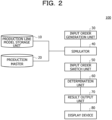
- FIG. 2 is a functional block diagram illustrating an overall configuration of an information processing device 100 according to a first embodiment.
- the information processing device 100 is a server for optimization processing or the like.
- the information processing device 100 includes a production line model storage unit 10, a production master 20, an input order generation unit 30, a simulator 40, an input order switch unit 50, a determination unit 60, a result output unit 70, a display device 80, or the like.
- the display device 80 is a device that displays a processing result of the information processing device 100 or the like and is a display or the like.
- the production line model storage unit 10 stores a production line model.
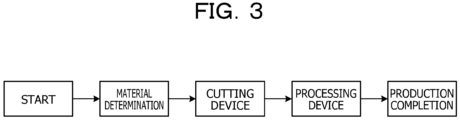
- FIG. 3 is a diagram illustrating the production line model stored in the production line model storage unit 10. As illustrated in FIG. 3 , the production line model has a configuration in which a "start” cell, a “material determination” cell, a “cutting device” cell, a “processing device” cell, and a “production completion” cell are arranged in order.
- a plurality of products is input to the "start" cell one by one according to an input order.
- the product stays until a processing time uniquely set to the product has elapsed.
- the processing time elapses, if there is no product in a next moving destination cell, the product moves to the cell.
- the production master 20 stores production order information in which a size of a material to be used and product type information are associated with a product number.
- FIG. 4 is a diagram illustrating the production order information. As illustrated in FIG. 4 , the size of the material to be used and the product type information are associated with each product number. Since the product number is a unique number for each product, product numbers of a plurality of products do not overlap.
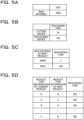
- FIG. 5B is a diagram illustrating the device information. As illustrated in FIG. 5B , "50" is stored as a processing time of the cutting device, and "150" is stored as a processing time of the processing device.
- the processing time of the cutting device is a time for cutting a material from a raw material.
- the processing time of the processing device is a time for executing processing such as incorporating the cut material into a product.
- the processing time of the cutting device and the processing time of the processing device may be determined for each product.
- FIG. 5C is a diagram illustrating the changeover condition in a case where the changeover for switching the raw materials is performed.
- a processing time needed for the changeover when the raw materials are switched is set to ° 100"
- a processing time when the raw materials are not switched is set to "1".
- FIG. 5D is a diagram illustrating the changeover condition in a case where the changeover for switching the product types is performed.
- a processing time for each product type switching such as product type switching from a product type A to a product type B is set to "100".
- the changeover times needed for the respective times of product type switching may be different from each other.
- the input order generation unit 30 generates an initial input order for all products stored in the production master 20 (step S1).
- the initial input order is, for example, an order obtained by arranging purchase orders as received from customers and may be input in advance by a user using an input device. Alternatively, the initial input order may be generated by random numbers. Since the initial input order is generated without considering the excess material amount and the production completion time, both of the excess material amount and the production completion time often do not take good values.
- the simulator 40 performs a line simulation in a case where products are input to the production line one by one according to the initial input order (step S2).
- the simulator 40 arranges the products in the "start” cell one by one according to the initial input order.
- a material size of the product arriving at the “material determination” cell is sequentially subtracted from a raw material size of the raw material information. Thereby, a remaining amount of the raw material is calculated. If the subtracted result is positive, a processing time in the "material determination” cell is "1". Therefore, the product stays at the material determination cell for only a time corresponding to the processing time "1", and the product moves to the next cell if no product stays in the next cell. If the subtracted result is negative, since a changeover of the raw material occurs, the processing time in the "material determination” cell is "100".
- the product stays at the material determination cell for only a time corresponding to the processing time "100", and the product moves to the next cell if no product stays in the next cell.
- a raw material remaining amount immediately before the subtracted result becomes negative is the excess material amount of the raw material.
- the material size of the product is subtracted from a new raw material size.
- the product that has arrived at the "cutting device” cell stays for only a time corresponding to the processing time "50". Furthermore, in the "cutting device” cell, it is determined whether or not product type information of the product that has arrived at the "cutting device” cell is different from product type information of a previous product that has arrived. If the product type information of the product that has arrived at the "cutting device” cell is different from the product type information of the previous product that has arrived, a changeover occurs. If the changeover has occurred, the product further stays at the "cutting device” cell for only a time corresponding to the processing time "100", and then, moves to the next cell.
- the product that has arrived at the "processing device” cell stays for only a time corresponding to the processing time "150" and moves to the next cell.
- the determination unit 60 evaluates a key performance indicator (KPI) for the result of the line simulation performed in step S2 (step S3).
- KPI key performance indicator
- the determination unit 60 calculates an excess material amount and a production completion time for the line simulation result.
- the excess material amount is a total value of raw material remaining amounts of respective raw materials that have been used.
- the production completion time is a time from when a first product is input to start to when a final product arrives at a production completion cell.
- the determination unit 60 determines whether or not the excess material amount and the production completion time calculated in step S3 satisfy an end condition (step S4). For example, the determination unit 60 determines whether or not the excess material amount is equal to or less than a threshold and the production completion time is equal to or less than a threshold.
- step S4 the input order switch unit 50 selects an input order candidate for the input order that is a target of the line simulation in step S2 (step S5).
- step S5 the input order switch unit 50 intersects the input order to be the target of the line simulation in step S2 with the input order candidate selected in step S5 (step S6).
- step S7 the input order switch unit 50 generates an input order by mutating the result of step S6 (step S7).
- step S2 is executed again. In this case, in step S2, a line simulation is performed for the input order generated in step S7.
- FIG. 7 is a diagram illustrating a result obtained by repeating switching of an input order.
- the initial input order often does not consider the excess material amount and the production completion time. Therefore, the excess material amount tends to be larger, and the production completion time also tends to be longer.
- the input order is optimized so as to reduce only the excess material amount with respect to the initial input order, although the excess material amount is reduced, the production completion time tends to be longer because the production completion time is not considered.
- the input order is optimized so as to shorten only the production completion time with respect to the initial input order, although the production completion time is shortened, the excess material amount tends to be larger because the excess material amount is not considered.
- the input order can be obtained in which the excess material amount is reduced and the production completion time is shortened.
- a production line is assumed that produces a product including a part A, a part B, and a part C.
- the production line is separated for each of the parts A to C.
- a "branch” cell is provided between the "start” cell and the "material determination” cell, and a production line for the part A, a production line for the part B, and a production line for the part C are provided.
- a "merging” cell used to merge each production line is provided.
- an "assembly” cell for assembling a product from the parts A to C is provided.
- a processing time is set to the "assembly” cell.
- the parts A to C be cut from three types of raw materials ⁇ , ⁇ , and ⁇ with different materials and three types of shapes 1 to 3 having different cross-sectional shapes. Furthermore, it is assumed that an input order of 156 parts be switched.
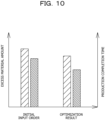
- FIG. 10 is a diagram illustrating a simulation result.
- the excess material amount has been larger, and the production completion time has been longer.
- the input order can be obtained in which the excess material amount is reduced and the production completion time is shortened. Note that, in the simulation result, the excess material amount has been reduced by 10%. The production completion time is shortened by 30%.
- the present embodiment it is possible to suppress the excess material amount by switching the input order of each product to the production line and performing optimization, and an objective function reflecting the changeover caused by switching the input order is optimized. As a result, it is possible to improve the objective function reflecting the changeover while suppressing the excess material amount.
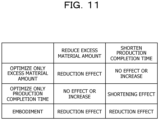
- FIG. 11 is a diagram used to organize effects of the present embodiment. As illustrated in FIG. 11 , if the input order is optimized to reduce only the excess material amount, although an effect for reducing the excess material amount is obtained, the production completion time is not affected or tends to increase because the production completion time is not considered. If the input order is optimized in order to shorten only the production completion time, although a production completion time shortening effect is obtained, the excess material amount is not affected or tends to increase because the excess material amount is not considered. On the other hand, in the embodiment, the input order is optimized so as to reduce both of the excess material amount and the production completion time. Therefore, an effect for reducing both of the excess material amount and the production completion time can be obtained.
- an evolutionary algorithm and a local search method may be used as the method for switching the input order. These algorithms can also be used for multi-objective optimization.
- the evolutionary algorithms include an evolutionary strategy algorithm, a genetic algorithm, or the like.
- the local search methods include an annealing method or the like.
- FIG. 12A is a diagram illustrating device information stored in a production master 20. As illustrated in FIG. 12A , “50” is stored as a processing time of a cutting device, “400” is stored as power consumption of the cutting device, and “300” is stored as a cost of the cutting device. Furthermore, “150” is stored as a processing time of a processing device. “200” is stored as power consumption of the processing device, and “200” is stored as a cost of the processing device.
- the power consumption of the cutting device is power consumed to cut a material.
- the cost of the cutting device is a cost for cutting a material.
- the power consumption of the processing device is power consumed to process a product using the material.
- the cost of the processing device is a cost for processing a product using the material. The processing times, the power consumption, and the costs of the cutting device and the processing device may be determined for each product.
- FIG. 12B is a diagram illustrating a processing time, power consumption, and a cost in a case where a changeover for switching raw materials is performed.
- the processing time when the raw materials are switched is set to "100”
- the power consumption is set to "50”
- the cost is set to "30”.
- the processing time when the raw materials are not switched is set to "1”
- the power consumption is set to "1”
- the cost is set to "1".
- FIG. 12C is a diagram illustrating a processing time, power consumption, and a cost when a changeover for switching a product type is performed.
- the processing time for switching each product type such as product type switching from a product type A to a product type B is set to "100”
- the power consumption is set to "40”
- the cost is set to "30”.
- the power consumption in this case is power needed for a changeover for switching a product type.
- the cost in this case is a cost needed for a changeover for switching a product type.
- the processing times, the power consumptions, and the costs needed for respective times of product type switching may be different from each other.
- a “start” cell performs an operation as in the first embodiment.
- a material size of the product arriving at the “material determination” cell is sequentially subtracted from a raw material size of the raw material information. Thereby, a remaining amount of the raw material is calculated. If the subtracted result is positive, a processing time in the "material determination” cell is “1", the power consumption is “1”, and the cost is "1". Therefore, the product stays at the material determination cell for only a time corresponding to the processing time "1", and the product moves to the next cell if no product stays in the next cell. Furthermore, the power consumption "1" and the cost "1" are added to the product.
- the processing time in the "material determination” cell is "100"
- the power consumption is "50”
- the cost is "50”. Therefore, the product stays at the material determination cell for only a time corresponding to the processing time "100”, and the product moves to the next cell if no product stays in the next cell.
- a raw material remaining amount immediately before the subtracted result becomes negative is the excess material amount of the raw material. In this case, the material size of the product is subtracted from a new raw material size.
- a product that has arrived at the “cutting device” cell stays for only a time corresponding to the processing time "50", power consumption "400" and a cost "300" are added to the product. Furthermore, in the “cutting device” cell, it is determined whether or not product type information of the product that has arrived at the “cutting device” cell is different from product type information of a previous product that has arrived. If the product type information of the product that has arrived at the “cutting device” cell is different from the product type information of the previous product that has arrived, a changeover occurs. If the changeover has occurred, the product further stays at the "cutting device” cell for only a time corresponding to the processing time "100", and then, moves to the next cell.
- the product that has arrived at the "processing device” cell stays for only a time corresponding to the processing time "150" and moves to the next cell.
- the determination unit 60 calculates an excess material amount, a production completion time, power consumption, and a cost for a line simulation result.
- the excess material amount is a total value of raw material remaining amounts of respective raw materials that have been used.
- the production completion time is a time from when a first product is input to start to when a final product arrives at a production completion cell.
- the power consumption is a total value of power consumption added to each product.
- the cost is a total value of costs added to each product.
- the determination unit 60 determines whether or not the excess material amount is equal to or less than a threshold and at least any one of the production completion time, the power consumption, and the cost is equal to or less than the threshold.
- the power consumption, the cost, or the like caused by the changeover can be optimized.
- the power consumption, the cost, or the like the number of changeovers or the like may be included in the objective function.
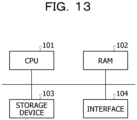
- FIG. 13 is a block diagram illustrating a hardware configuration of each unit other than the display device 80 of the information processing device 100.
- the information processing device 100 includes a CPU 101, a RAM 102, a storage device 103, an interface 104, or the like.
- the central processing unit (CPU) 101 is a central processing unit.
- the CPU 101 includes one or more cores.
- the random access memory (RAM) 102 is a volatile memory that temporarily stores a program to be executed by the CPU 101, data to be processed by the CPU 101, or the like.
- the storage device 103 is a nonvolatile storage device. For example, a read only memory (ROM), a solid state drive (SSD) such as a flash memory, a hard disk to be driven by a hard disk drive, or the like may be used as the storage device 103.
- the storage device 103 stores a work plan specifying program.
- the interface 104 is an interface device with an external device. Each unit of the information processing device 100 is implemented by executing the work plan specifying program by the CPU 101. Note that hardware such as a dedicated circuit may be used as each unit of the information processing device 100.
- the production line is an example of a work line for a plurality of objects according to a predetermined order.
- a plurality of products input to the production line is an example of the plurality of objects.
- the processing device is an example of a working device that performs a work on the plurality of objects.
- the input order switch unit and the determination unit 60 are examples of an optimization execution unit that optimizes the objective function reflecting the changeover and the excess amount of each raw material determined according to the input order of the plurality of objects to the work line.
Landscapes
- Engineering & Computer Science (AREA)
- Business, Economics & Management (AREA)
- Human Resources & Organizations (AREA)
- Physics & Mathematics (AREA)
- Strategic Management (AREA)
- Economics (AREA)
- General Physics & Mathematics (AREA)
- General Business, Economics & Management (AREA)
- Manufacturing & Machinery (AREA)
- Theoretical Computer Science (AREA)
- Marketing (AREA)
- Tourism & Hospitality (AREA)
- Quality & Reliability (AREA)
- Operations Research (AREA)
- Development Economics (AREA)
- Entrepreneurship & Innovation (AREA)
- Game Theory and Decision Science (AREA)
- Health & Medical Sciences (AREA)
- General Health & Medical Sciences (AREA)
- Primary Health Care (AREA)
- Automation & Control Theory (AREA)
- Human Computer Interaction (AREA)
- General Engineering & Computer Science (AREA)
- Management, Administration, Business Operations System, And Electronic Commerce (AREA)
- General Factory Administration (AREA)
Abstract
Description
- This case relates to a work plan specifying program, a work plan specifying method, and an information processing device.
- A technique is disclosed for optimizing objective functions such as a production cost or a production completion time when an input order of products to a production line is optimized (for example, refer to
Patent Documents 1 and 2). -
- Patent Document 1:
Japanese Laid-open Patent Publication No. 2005-092827 - Patent Document 2:
Japanese Laid-open Patent Publication No. 2019-175488 - In a production line, it is required to use up materials used for products. In order to use up materials, a planning method has been known that solves combinatorial optimization problems such as a cutting stock problem or a bin packing problem. However, if a product input order is switched in order to reduce an excess amount of materials, the number of changeovers in the production line increases, and there is a possibility that an objective function reflecting the changeover is deteriorated.
- In one aspect, an object of the present invention is to provide an information processing device, a work plan specifying method, and a work plan specifying program that can improve an objective function reflecting a changeover while suppressing an excess material amount.
- In one mode, a work plan specifying program that specifies a predetermined order under conditions that, in a work line that includes a cutting device and a working device and generates a plurality of objects in the predetermined order, a predetermined amount of a material is partially cut by the cutting device from a raw material for each of the plurality of objects, the cut material is processed by the working device, the raw material is switched to a next raw material when the raw material lacks in the cutting device, settings for at least one of the cutting device and the working device are determined for each of the plurality of objects, and a changeover is performed to change the settings of at least one of the cutting device and the working device in a case where the settings are changed, and that causes a computer to execute processing including optimizing an objective function that reflects the changeover and an excess amount of each raw material that are determined according to an input order of the plurality of objects to the work line.
- According to an aspect of the embodiments, a work plan specifying program that specifies a predetermined order under conditions that, in a work line that includes a cutting device and a working device and generates a plurality of objects in the predetermined order, a predetermined amount of a material is partially cut by the cutting device from a raw material for each of the plurality of objects, the cut material is processed by the working device, the raw material is switched to a next raw material when the raw material lacks in the cutting device, settings for at least one of the cutting device and the working device are determined for each of the plurality of objects, and a changeover is performed to change the settings of at least one of the cutting device and the working device in a case where the settings are changed, the work plan specifying program causing a computer to execute a process, the process includes optimizing an objective function that reflects the changeover and an excess amount of each raw material that are determined according to an input order of the plurality of objects to the work line.
- It is possible to improve an objective function reflecting a changeover while suppressing an excess material amount.
-
-
FIGs. 1A and 1B are diagrams illustrating a method for minimizing an excess material amount; -
FIG. 2 is a functional block diagram illustrating an overall configuration of an information processing device according to a first embodiment; -
FIG. 3 is a diagram illustrating a production line model stored in a production line model storage unit; -
FIG. 4 is a diagram illustrating production order information; -
FIGs. 5A to 5D are diagrams illustrating information stored in a production master; -
FIG. 6 is a diagram illustrating a flowchart executed by the information processing device; -
FIG. 7 is a diagram illustrating a result obtained by repeating switching of an input order; -
FIG. 8 is a diagram for explaining a simulation; -
FIG. 9 is a diagram for explaining a simulation; -
FIG. 10 is a diagram illustrating a simulation result; -
FIG. 11 is a diagram illustrating an effect of an embodiment; -
FIGs. 12A to 12C are diagrams illustrating information stored in the production master; and -
FIG. 13 is a block diagram illustrating a hardware configuration of each unit other than a display device of the information processing device. - In a production line, it is required to use up materials used for products without waste. In order to use up materials, a planning method has been known that solves combinatorial optimization problems such as a cutting stock problem or a bin packing problem.
- Furthermore, it is also required to shorten a production completion time to meet a delivery deadline. In a case where the production completion time is shortened in order to meet the delivery deadline, a planning method is known for reflecting a processing time of each device in a production process, the number of works in progress, or the like in a scheduler or a line simulator and performing optimization by an algorithm.
-
FIGs. 1A and 1B are diagrams illustrating a method for minimizing an excess material amount.Raw materials 1 to 3 are members with the same standard and have the same material and the same shape, and can be substituted for each other. Theraw materials 1 to 3 are partially cut by a cutting device and are used as parts of products by a processing device. - In
FIG. 1A , material information regarding theraw material 1 is illustrated. Furthermore, inFIG. 1A , an input order in which each product is input to a production line is described. In the example inFIG. 1A , a product with aproduct number 1 is input to the production line first, and then, a product with aproduct number 2 is input to the production line second. A material size indicates a size of an amount of a raw material used for each product. In the example inFIG. 1A , an amount of 100 is used for the product with theproduct number 1, and an amount of 200 is used for the product with theproduct number 2. - Product type information represents settings of at least one of the cutting device and the processing device. For example, a type of a saw of the cutting device is changed according to a product type. Alternatively, a processing method of the processing device is changed according to the product type. Therefore, since it is needed to change the settings of at least one of the cutting device and the processing device when the product type information changes, a changeover is needed. In the example in
FIG. 1A , although a changeover is not needed in the middle for the products with theproduct numbers 1 to 3, it is needed to perform a changeover when a product with aproduct number 4 is input to the production line. - Furthermore, in
FIG. 1A , material information regarding theraw material 2 is illustrated. As illustrated inFIG. 1A , theraw material 2 is used from a product with aproduct number 8 that is an eighth input. A product type C is set to the product with theproduct number 8. Therefore, a changeover to switch the product type from B to C is performed. A product type B is set to a next product with aproduct number 9 that is a ninth input. Therefore, a changeover to switch the product type from C to B is performed. - In the upper part of
FIG. 1A , an excess material amount of each raw material in this case is illustrated. Since a material size is different for each product, an excess material amount is generated. In the settings inFIG. 1A , when it is assumed that the size of the raw material be 3000, a total material size of the products with theproduct numbers 1 to 7 is 2800. Therefore, the excess material amount is 200. For theraw materials - In order to reduce these excess material amounts as possible, it is sufficient to change a combination of products using the respective raw materials.
FIG. 1B illustrates a case where an order of products to be input to the production line is switched in order to reduce the excess material amount as possible. In the example inFIG. 1B , since a total material size of products used for theraw material 1 is 2900, the excess material amount is 100. Therefore, the excess material amount can be reduced as compared with a case ofFIG. 1A . - However, in the example in
FIG. 1B , since the product type is changed four times for theraw material 1, the changeover is performed four times. If the number of changeovers increases, there is a possibility that an objective function such as a production completion time reflecting the changeovers is deteriorated. - Therefore, in the following embodiments, an information processing device, a work plan specifying method, and a work plan specifying program that can improve an objective function reflecting a changeover while suppressing an excess material amount will be described.
-
FIG. 2 is a functional block diagram illustrating an overall configuration of aninformation processing device 100 according to a first embodiment. Theinformation processing device 100 is a server for optimization processing or the like. As illustrated inFIG. 2 , theinformation processing device 100 includes a production linemodel storage unit 10, aproduction master 20, an inputorder generation unit 30, asimulator 40, an inputorder switch unit 50, adetermination unit 60, aresult output unit 70, adisplay device 80, or the like. Thedisplay device 80 is a device that displays a processing result of theinformation processing device 100 or the like and is a display or the like. - The production line
model storage unit 10 stores a production line model.FIG. 3 is a diagram illustrating the production line model stored in the production linemodel storage unit 10. As illustrated inFIG. 3 , the production line model has a configuration in which a "start" cell, a "material determination" cell, a "cutting device" cell, a "processing device" cell, and a "production completion" cell are arranged in order. - A plurality of products is input to the "start" cell one by one according to an input order. In each cell, the product stays until a processing time uniquely set to the product has elapsed. When the processing time elapses, if there is no product in a next moving destination cell, the product moves to the cell.
- The
production master 20 stores production order information in which a size of a material to be used and product type information are associated with a product number.FIG. 4 is a diagram illustrating the production order information. As illustrated inFIG. 4 , the size of the material to be used and the product type information are associated with each product number. Since the product number is a unique number for each product, product numbers of a plurality of products do not overlap. - Furthermore, the
production master 20 stores raw material information.FIG. 5A is a diagram illustrating the raw material information. As illustrated inFIG. 5A , for example, the size of the raw material (= 3000) is stored as the raw material information. - Furthermore, the
production master 20 stores device information.FIG. 5B is a diagram illustrating the device information. As illustrated inFIG. 5B , "50" is stored as a processing time of the cutting device, and "150" is stored as a processing time of the processing device. The processing time of the cutting device is a time for cutting a material from a raw material. The processing time of the processing device is a time for executing processing such as incorporating the cut material into a product. The processing time of the cutting device and the processing time of the processing device may be determined for each product. - Furthermore, the
production master 20 stores a changeover condition in a case where a changeover for switching raw materials is performed.FIG. 5C is a diagram illustrating the changeover condition in a case where the changeover for switching the raw materials is performed. In the example inFIG. 5C , a processing time needed for the changeover when the raw materials are switched is set to ° 100", and a processing time when the raw materials are not switched is set to "1". - Furthermore, the
production master 20 stores a changeover condition in a case where a changeover for switching product types is performed.FIG. 5D is a diagram illustrating the changeover condition in a case where the changeover for switching the product types is performed. In the example inFIG. 5D , a processing time for each product type switching such as product type switching from a product type A to a product type B is set to "100". The changeover times needed for the respective times of product type switching may be different from each other. - Next, processing of the
information processing device 100 will be described with reference to the flowchart inFIG. 6 . As illustrated inFIG. 6 , the inputorder generation unit 30 generates an initial input order for all products stored in the production master 20 (step S1). The initial input order is, for example, an order obtained by arranging purchase orders as received from customers and may be input in advance by a user using an input device. Alternatively, the initial input order may be generated by random numbers. Since the initial input order is generated without considering the excess material amount and the production completion time, both of the excess material amount and the production completion time often do not take good values. - Next, the
simulator 40 performs a line simulation in a case where products are input to the production line one by one according to the initial input order (step S2). - First, the
simulator 40 arranges the products in the "start" cell one by one according to the initial input order. In the "material determination" cell, a material size of the product arriving at the "material determination" cell is sequentially subtracted from a raw material size of the raw material information. Thereby, a remaining amount of the raw material is calculated. If the subtracted result is positive, a processing time in the "material determination" cell is "1". Therefore, the product stays at the material determination cell for only a time corresponding to the processing time "1", and the product moves to the next cell if no product stays in the next cell. If the subtracted result is negative, since a changeover of the raw material occurs, the processing time in the "material determination" cell is "100". Therefore, the product stays at the material determination cell for only a time corresponding to the processing time "100", and the product moves to the next cell if no product stays in the next cell. A raw material remaining amount immediately before the subtracted result becomes negative is the excess material amount of the raw material. In this case, the material size of the product is subtracted from a new raw material size. - In the "cutting device" cell, the product that has arrived at the "cutting device" cell stays for only a time corresponding to the processing time "50". Furthermore, in the "cutting device" cell, it is determined whether or not product type information of the product that has arrived at the "cutting device" cell is different from product type information of a previous product that has arrived. If the product type information of the product that has arrived at the "cutting device" cell is different from the product type information of the previous product that has arrived, a changeover occurs. If the changeover has occurred, the product further stays at the "cutting device" cell for only a time corresponding to the processing time "100", and then, moves to the next cell.
- In the "processing device" cell, the product that has arrived at the "processing device" cell stays for only a time corresponding to the processing time "150" and moves to the next cell.
- Next, the
determination unit 60 evaluates a key performance indicator (KPI) for the result of the line simulation performed in step S2 (step S3). In step S3, thedetermination unit 60 calculates an excess material amount and a production completion time for the line simulation result. The excess material amount is a total value of raw material remaining amounts of respective raw materials that have been used. The production completion time is a time from when a first product is input to start to when a final product arrives at a production completion cell. - Next, the
determination unit 60 determines whether or not the excess material amount and the production completion time calculated in step S3 satisfy an end condition (step S4). For example, thedetermination unit 60 determines whether or not the excess material amount is equal to or less than a threshold and the production completion time is equal to or less than a threshold. - In a case where it is determined as "Yes" in step S4, the execution of the flowchart ends. In a case where it is determined as "No" in step S4, the input
order switch unit 50 selects an input order candidate for the input order that is a target of the line simulation in step S2 (step S5). Next, the inputorder switch unit 50 intersects the input order to be the target of the line simulation in step S2 with the input order candidate selected in step S5 (step S6). Next, the inputorder switch unit 50 generates an input order by mutating the result of step S6 (step S7). Thereafter, the process from step S2 is executed again. In this case, in step S2, a line simulation is performed for the input order generated in step S7. -
FIG. 7 is a diagram illustrating a result obtained by repeating switching of an input order. As illustrated inFIG. 7 , the initial input order often does not consider the excess material amount and the production completion time. Therefore, the excess material amount tends to be larger, and the production completion time also tends to be longer. If the input order is optimized so as to reduce only the excess material amount with respect to the initial input order, although the excess material amount is reduced, the production completion time tends to be longer because the production completion time is not considered. If the input order is optimized so as to shorten only the production completion time with respect to the initial input order, although the production completion time is shortened, the excess material amount tends to be larger because the excess material amount is not considered. However, by switching the input order so that both of the excess material amount and the production completion time are equal to or less than the threshold, the input order can be obtained in which the excess material amount is reduced and the production completion time is shortened. - Subsequently, a result of an actual simulation will be described. As illustrated in
FIG. 8 , a production line is assumed that produces a product including a part A, a part B, and a part C. The production line is separated for each of the parts A to C. Specifically, a "branch" cell is provided between the "start" cell and the "material determination" cell, and a production line for the part A, a production line for the part B, and a production line for the part C are provided. Furthermore, after the "processing device" cell, a "merging" cell used to merge each production line is provided. After the "merging" cell, an "assembly" cell for assembling a product from the parts A to C is provided. A processing time is set to the "assembly" cell. - As illustrated in
FIG. 9 , by changing sizes of the parts A to C for each product, it is assumed that the parts A to C be cut from three types of raw materials α, β, and γ with different materials and three types ofshapes 1 to 3 having different cross-sectional shapes. Furthermore, it is assumed that an input order of 156 parts be switched. -
FIG. 10 is a diagram illustrating a simulation result. As illustratedFIG. 10 , for the initial input order, the excess material amount has been larger, and the production completion time has been longer. On the other hand, by switching the input order so that both of the excess material amount and the production completion time are equal to or less than the threshold, the input order can be obtained in which the excess material amount is reduced and the production completion time is shortened. Note that, in the simulation result, the excess material amount has been reduced by 10%. The production completion time is shortened by 30%. - According to the present embodiment, it is possible to suppress the excess material amount by switching the input order of each product to the production line and performing optimization, and an objective function reflecting the changeover caused by switching the input order is optimized. As a result, it is possible to improve the objective function reflecting the changeover while suppressing the excess material amount.
-
FIG. 11 is a diagram used to organize effects of the present embodiment. As illustrated inFIG. 11 , if the input order is optimized to reduce only the excess material amount, although an effect for reducing the excess material amount is obtained, the production completion time is not affected or tends to increase because the production completion time is not considered. If the input order is optimized in order to shorten only the production completion time, although a production completion time shortening effect is obtained, the excess material amount is not affected or tends to increase because the excess material amount is not considered. On the other hand, in the embodiment, the input order is optimized so as to reduce both of the excess material amount and the production completion time. Therefore, an effect for reducing both of the excess material amount and the production completion time can be obtained. - Note that as the method for switching the input order, an evolutionary algorithm and a local search method may be used. These algorithms can also be used for multi-objective optimization. The evolutionary algorithms include an evolutionary strategy algorithm, a genetic algorithm, or the like. The local search methods include an annealing method or the like.
- Although the production completion time is used as the objective function in the first embodiment, the present invention is not limited to this. In a second embodiment, a case will be described where a power consumption amount and a cost caused by a changeover are used as objective functions.
FIG. 12A is a diagram illustrating device information stored in aproduction master 20. As illustrated inFIG. 12A , "50" is stored as a processing time of a cutting device, "400" is stored as power consumption of the cutting device, and "300" is stored as a cost of the cutting device. Furthermore, "150" is stored as a processing time of a processing device. "200" is stored as power consumption of the processing device, and "200" is stored as a cost of the processing device. The power consumption of the cutting device is power consumed to cut a material. The cost of the cutting device is a cost for cutting a material. The power consumption of the processing device is power consumed to process a product using the material. The cost of the processing device is a cost for processing a product using the material. The processing times, the power consumption, and the costs of the cutting device and the processing device may be determined for each product. -
FIG. 12B is a diagram illustrating a processing time, power consumption, and a cost in a case where a changeover for switching raw materials is performed. In the example inFIG. 12B , the processing time when the raw materials are switched is set to "100", the power consumption is set to "50", and the cost is set to "30". The processing time when the raw materials are not switched is set to "1", the power consumption is set to "1", and the cost is set to "1". -
FIG. 12C is a diagram illustrating a processing time, power consumption, and a cost when a changeover for switching a product type is performed. In the example inFIG. 12C , the processing time for switching each product type such as product type switching from a product type A to a product type B is set to "100", the power consumption is set to "40", and the cost is set to "30". The power consumption in this case is power needed for a changeover for switching a product type. The cost in this case is a cost needed for a changeover for switching a product type. The processing times, the power consumptions, and the costs needed for respective times of product type switching may be different from each other. - Subsequently, a line simulation in the second embodiment will be described. A "start" cell performs an operation as in the first embodiment. In a "material determination" cell, a material size of the product arriving at the "material determination" cell is sequentially subtracted from a raw material size of the raw material information. Thereby, a remaining amount of the raw material is calculated. If the subtracted result is positive, a processing time in the "material determination" cell is "1", the power consumption is "1", and the cost is "1". Therefore, the product stays at the material determination cell for only a time corresponding to the processing time "1", and the product moves to the next cell if no product stays in the next cell. Furthermore, the power consumption "1" and the cost "1" are added to the product. If the subtracted result is negative, since the changeover of the raw material occurs, the processing time in the "material determination" cell is "100", the power consumption is "50", and the cost is "50". Therefore, the product stays at the material determination cell for only a time corresponding to the processing time "100", and the product moves to the next cell if no product stays in the next cell. A raw material remaining amount immediately before the subtracted result becomes negative is the excess material amount of the raw material. In this case, the material size of the product is subtracted from a new raw material size.
- In a "cutting device" cell, a product that has arrived at the "cutting device" cell stays for only a time corresponding to the processing time "50", power consumption "400" and a cost "300" are added to the product. Furthermore, in the "cutting device" cell, it is determined whether or not product type information of the product that has arrived at the "cutting device" cell is different from product type information of a previous product that has arrived. If the product type information of the product that has arrived at the "cutting device" cell is different from the product type information of the previous product that has arrived, a changeover occurs. If the changeover has occurred, the product further stays at the "cutting device" cell for only a time corresponding to the processing time "100", and then, moves to the next cell.
- In the "processing device" cell, the product that has arrived at the "processing device" cell stays for only a time corresponding to the processing time "150" and moves to the next cell.
- In the present embodiment, in step S3 in the flowchart in
FIG. 6 , thedetermination unit 60 calculates an excess material amount, a production completion time, power consumption, and a cost for a line simulation result. The excess material amount is a total value of raw material remaining amounts of respective raw materials that have been used. The production completion time is a time from when a first product is input to start to when a final product arrives at a production completion cell. The power consumption is a total value of power consumption added to each product. The cost is a total value of costs added to each product. In step S4 inFIG. 6 , thedetermination unit 60 determines whether or not the excess material amount is equal to or less than a threshold and at least any one of the production completion time, the power consumption, and the cost is equal to or less than the threshold. - According to the present embodiment, in addition to the production completion time, the power consumption, the cost, or the like caused by the changeover can be optimized. Note that, in addition to the production completion time, the power consumption, the cost, or the like, the number of changeovers or the like may be included in the objective function.
-
FIG. 13 is a block diagram illustrating a hardware configuration of each unit other than thedisplay device 80 of theinformation processing device 100. As illustrated inFIG. 13 , theinformation processing device 100 includes aCPU 101, aRAM 102, astorage device 103, aninterface 104, or the like. - The central processing unit (CPU) 101 is a central processing unit. The
CPU 101 includes one or more cores. The random access memory (RAM) 102 is a volatile memory that temporarily stores a program to be executed by theCPU 101, data to be processed by theCPU 101, or the like. Thestorage device 103 is a nonvolatile storage device. For example, a read only memory (ROM), a solid state drive (SSD) such as a flash memory, a hard disk to be driven by a hard disk drive, or the like may be used as thestorage device 103. Thestorage device 103 stores a work plan specifying program. Theinterface 104 is an interface device with an external device. Each unit of theinformation processing device 100 is implemented by executing the work plan specifying program by theCPU 101. Note that hardware such as a dedicated circuit may be used as each unit of theinformation processing device 100. - In each example described above, the production line is an example of a work line for a plurality of objects according to a predetermined order. A plurality of products input to the production line is an example of the plurality of objects. The processing device is an example of a working device that performs a work on the plurality of objects. The input order switch unit and the
determination unit 60 are examples of an optimization execution unit that optimizes the objective function reflecting the changeover and the excess amount of each raw material determined according to the input order of the plurality of objects to the work line. - While the embodiments of the present invention have been described above in detail, the present invention is not limited to such specific embodiments, and various modifications and alterations may be made within the scope of the present invention described in the claims.
-
- 10
- production line model storage unit
- 20
- production master
- 30
- input order generation unit
- 40
- simulator
- 50
- input order switch unit
- 60
- determination unit
- 70
- result output unit
- 80
- display device
- 100
- information processing device
Claims (15)
- A work plan specifying program that specifies a predetermined order under conditions that, in a work line that includes a cutting device and a working device and generates a plurality of objects in the predetermined order, a predetermined amount of a material is partially cut by the cutting device from a raw material for each of the plurality of objects, the cut material is processed by the working device, the raw material is switched to a next raw material when the raw material lacks in the cutting device, settings for at least one of the cutting device and the working device are determined for each of the plurality of objects, and a changeover is performed to change the settings of at least one of the cutting device and the working device in a case where the settings are changed, the work plan specifying program causing a computer to execute a process, the process comprising
optimizing an objective function that reflects the changeover and an excess amount of each raw material that are determined according to an input order of the plurality of objects to the work line. - The work plan specifying program according to claim 1, wherein when the raw material is switched to the next raw material in the cutting device, the changeover is performed in the cutting device.
- The work plan specifying program according to claim 1 or 2, wherein the process further comprising
using an evolutionary algorithm when the optimization is executed. - The work plan specifying program according to any one of claims 1 to 3, wherein the objective function is the number of times of changeover, a processing time caused by the changeover, power consumption caused by the changeover, or a cost caused by the changeover.
- The work plan specifying program according to any one of claims 1 to 4, wherein the objective function also reflects a changeover to exchange the raw material.
- A work plan specifying method that specifies a predetermined order under conditions that, in a work line that includes a cutting device and a working device and generates a plurality of objects in the predetermined order, a predetermined amount of a material is partially cut by the cutting device from a raw material for each of the plurality of objects, the cut material is processed by the working device, the raw material is switched to a next raw material when the raw material lacks in the cutting device, settings for at least one of the cutting device and the working device are determined for each of the plurality of objects, and a changeover is performed to change the settings of at least one of the cutting device and the working device in a case where the settings are changed, the work plan specifying method being executed by a computer, the work plan specifying method comprising
optimizing an objective function that reflects the changeover and an excess amount of each raw material that are determined according to an input order of the plurality of objects to the work line. - The work plan specifying method according to claim 6, wherein when the raw material is switched to the next raw material in the cutting device, the changeover is performed in the cutting device.
- The work plan specifying method according to claim 6 or 7, further comprising
using an evolutionary algorithm when the optimization is executed. - The work plan specifying method according to any one of claims 6 to 8, wherein the objective function is the number of times of changeover, a processing time caused by the changeover, power consumption caused by the changeover, or a cost caused by the changeover.
- The work plan specifying method according to any one of claims 6 to 9, wherein the objective function also reflects a changeover to exchange the raw material.
- An information processing device that specifies a predetermined order under conditions that, in a work line that includes a cutting device and a working device and generates a plurality of objects in the predetermined order, a predetermined amount of a material is partially cut by the cutting device from a raw material for each of the plurality of objects, the cut material is processed by the working device, the raw material is switched to a next raw material when the raw material lacks in the cutting device, settings for at least one of the cutting device and the working device are determined for each of the plurality of objects, and a changeover is performed to change the settings of at least one of the cutting device and the working device in a case where the settings are changed, the information processing device comprising:
an optimization execution unit configured to optimize an objective function that reflects the changeover and an excess amount of each raw material that are determined according to an input order of the plurality of objects to the work line. - The information processing device according to claim 11, wherein when the raw material is switched to the next raw material in the cutting device, the changeover is performed in the cutting device.
- The information processing device according to claim 11 or 12,
wherein the optimization execution unit uses an evolutionary algorithm when the optimization is executed. - The information processing device according to any one of claims 11 to 13, wherein the objective function is the number of times of changeover, a processing time caused by the changeover, power consumption caused by the changeover, or a cost caused by the changeover.
- The information processing device according to any one of claims 11 to 14, wherein the objective function also reflects a changeover to exchange the raw material.
Applications Claiming Priority (1)
| Application Number | Priority Date | Filing Date | Title |
|---|---|---|---|
| PCT/JP2020/027259 WO2022013921A1 (en) | 2020-07-13 | 2020-07-13 | Work plan specification program, work plan specification method, and information processing device |
Publications (2)
| Publication Number | Publication Date |
|---|---|
| EP4180887A1 true EP4180887A1 (en) | 2023-05-17 |
| EP4180887A4 EP4180887A4 (en) | 2023-08-16 |
Family
ID=79555294
Family Applications (1)
| Application Number | Title | Priority Date | Filing Date |
|---|---|---|---|
| EP20944889.3A Withdrawn EP4180887A4 (en) | 2020-07-13 | 2020-07-13 | Work plan specification program, work plan specification method, and information processing device |
Country Status (5)
| Country | Link |
|---|---|
| US (1) | US20230147377A1 (en) |
| EP (1) | EP4180887A4 (en) |
| JP (1) | JPWO2022013921A1 (en) |
| CN (1) | CN115769159A (en) |
| WO (1) | WO2022013921A1 (en) |
Families Citing this family (1)
| Publication number | Priority date | Publication date | Assignee | Title |
|---|---|---|---|---|
| JP7829374B2 (en) * | 2022-03-23 | 2026-03-13 | 株式会社東芝 | Creation system, creation method, program, and storage medium |
Family Cites Families (8)
| Publication number | Priority date | Publication date | Assignee | Title |
|---|---|---|---|---|
| JPH07314297A (en) * | 1994-05-25 | 1995-12-05 | Toyota Motor Corp | Material processing system |
| JP4369189B2 (en) * | 2003-09-22 | 2009-11-18 | 三菱電機株式会社 | Scheduling system and program for causing computer to execute scheduling |
| US7277768B2 (en) * | 2004-11-05 | 2007-10-02 | International Business Machines Corporation | Method for production design and operations scheduling for plate design in the steel industry |
| JP2011028539A (en) * | 2009-07-27 | 2011-02-10 | Amada Co Ltd | Plate material machining system and machining schedule setting method thereof |
| US20110258087A1 (en) * | 2010-04-14 | 2011-10-20 | International Business Machines Corporation | Analytics for setting up strategic inventory systems to handle small lot orders in the steel industry |
| WO2013016176A1 (en) | 2011-07-22 | 2013-01-31 | Packsize Llc | Tiling production of packaging materials |
| JP5872101B1 (en) * | 2015-06-01 | 2016-03-01 | 株式会社Jls | Face material cutting processing instruction device, face material cutting machine and face material |
| JP2019049837A (en) * | 2017-09-08 | 2019-03-28 | フルサト工業株式会社 | Production instruction device, production instruction method and program |
-
2020
- 2020-07-13 CN CN202080102042.XA patent/CN115769159A/en active Pending
- 2020-07-13 EP EP20944889.3A patent/EP4180887A4/en not_active Withdrawn
- 2020-07-13 WO PCT/JP2020/027259 patent/WO2022013921A1/en not_active Ceased
- 2020-07-13 JP JP2022536001A patent/JPWO2022013921A1/ja not_active Ceased
-
2022
- 2022-11-30 US US18/060,020 patent/US20230147377A1/en not_active Abandoned
Also Published As
| Publication number | Publication date |
|---|---|
| JPWO2022013921A1 (en) | 2022-01-20 |
| EP4180887A4 (en) | 2023-08-16 |
| US20230147377A1 (en) | 2023-05-11 |
| WO2022013921A1 (en) | 2022-01-20 |
| CN115769159A (en) | 2023-03-07 |
Similar Documents
| Publication | Publication Date | Title |
|---|---|---|
| Chien et al. | Agent-based approach integrating deep reinforcement learning and hybrid genetic algorithm for dynamic scheduling for Industry 3.5 smart production | |
| Dai et al. | Energy-efficient scheduling for a flexible flow shop using an improved genetic-simulated annealing algorithm | |
| Yuan et al. | An effective hybrid honey bee mating optimization algorithm for balancing mixed-model two-sided assembly lines | |
| Long et al. | Dynamic scheduling in steelmaking-continuous casting production for continuous caster breakdown | |
| Hyun et al. | Multiobjective optimization for modular unit production lines focusing on crew allocation and production performance | |
| CN109284858A (en) | Reinforcing steel bar blanking optimization method and device and storage equipment | |
| US20080046272A1 (en) | Mining Optimisation | |
| Erenay et al. | Comparison of layered cellular manufacturing system design approaches | |
| Wang et al. | Inventory based two-objective job shop scheduling model and its hybrid genetic algorithm | |
| Nikabadi et al. | A hybrid algorithm for unrelated parallel machines scheduling | |
| Zhang et al. | Mathematical formulation and an improved moth–flame optimization algorithm for parallel two-sided disassembly line balancing based on fixed common stations | |
| EP4180887A1 (en) | Work plan specification program, work plan specification method, and information processing device | |
| Shen et al. | An iterative approach for the serial batching problem with parallel machines and job families | |
| Chang et al. | Scheduling optimization of flexible flow shop with buffer capacity limitation based on an improved discrete particle swarm optimization algorithm | |
| Wong et al. | Decision-making on multi-mould maintenance in production scheduling | |
| Delgoshaei et al. | A new method for decreasing cell-load variation in dynamic cellular manufacturing systems | |
| CN118052423B (en) | Intelligent scheduling method, electronic equipment, storage medium and computer program product | |
| Kim et al. | Scheduling 3D printers with multiple printing alternatives | |
| US20250225458A1 (en) | Production scheduling method and production management system | |
| Huang et al. | Distributed supply‐chain project rescheduling: Part I—impacts of information‐sharing strategies | |
| JP2021189622A (en) | Information processor, work planning method, and work planning program | |
| JP6776161B2 (en) | Simulation equipment and method | |
| Wallrath et al. | Modified benders-DES algorithm for real-world flow shop and job shop scheduling problems | |
| JP7410345B1 (en) | Production planning device, production planning program, and production planning method | |
| Stawowy et al. | Production scheduling for the furnace-casting line system |
Legal Events
| Date | Code | Title | Description |
|---|---|---|---|
| STAA | Information on the status of an ep patent application or granted ep patent |
Free format text: STATUS: THE INTERNATIONAL PUBLICATION HAS BEEN MADE |
|
| PUAI | Public reference made under article 153(3) epc to a published international application that has entered the european phase |
Free format text: ORIGINAL CODE: 0009012 |
|
| STAA | Information on the status of an ep patent application or granted ep patent |
Free format text: STATUS: REQUEST FOR EXAMINATION WAS MADE |
|
| 17P | Request for examination filed |
Effective date: 20221124 |
|
| AK | Designated contracting states |
Kind code of ref document: A1 Designated state(s): AL AT BE BG CH CY CZ DE DK EE ES FI FR GB GR HR HU IE IS IT LI LT LU LV MC MK MT NL NO PL PT RO RS SE SI SK SM TR |
|
| A4 | Supplementary search report drawn up and despatched |
Effective date: 20230714 |
|
| RIC1 | Information provided on ipc code assigned before grant |
Ipc: G05B 19/418 20060101AFI20230710BHEP |
|
| DAV | Request for validation of the european patent (deleted) | ||
| DAX | Request for extension of the european patent (deleted) | ||
| STAA | Information on the status of an ep patent application or granted ep patent |
Free format text: STATUS: THE APPLICATION HAS BEEN WITHDRAWN |
|
| 18W | Application withdrawn |
Effective date: 20231023 |