EP4180766A1 - Method for automatically matching chart names - Google Patents
Method for automatically matching chart names Download PDFInfo
- Publication number
- EP4180766A1 EP4180766A1 EP22207012.0A EP22207012A EP4180766A1 EP 4180766 A1 EP4180766 A1 EP 4180766A1 EP 22207012 A EP22207012 A EP 22207012A EP 4180766 A1 EP4180766 A1 EP 4180766A1
- Authority
- EP
- European Patent Office
- Prior art keywords
- identifier
- item
- codex
- match
- procedure
- Prior art date
- Legal status (The legal status is an assumption and is not a legal conclusion. Google has not performed a legal analysis and makes no representation as to the accuracy of the status listed.)
- Pending
Links
Images




Classifications
-
- G—PHYSICS
- G01—MEASURING; TESTING
- G01C—MEASURING DISTANCES, LEVELS OR BEARINGS; SURVEYING; NAVIGATION; GYROSCOPIC INSTRUMENTS; PHOTOGRAMMETRY OR VIDEOGRAMMETRY
- G01C21/00—Navigation; Navigational instruments not provided for in groups G01C1/00 - G01C19/00
- G01C21/005—Navigation; Navigational instruments not provided for in groups G01C1/00 - G01C19/00 with correlation of navigation data from several sources, e.g. map or contour matching
-
- G—PHYSICS
- G06—COMPUTING OR CALCULATING; COUNTING
- G06F—ELECTRIC DIGITAL DATA PROCESSING
- G06F7/00—Methods or arrangements for processing data by operating upon the order or content of the data handled
-
- G—PHYSICS
- G01—MEASURING; TESTING
- G01C—MEASURING DISTANCES, LEVELS OR BEARINGS; SURVEYING; NAVIGATION; GYROSCOPIC INSTRUMENTS; PHOTOGRAMMETRY OR VIDEOGRAMMETRY
- G01C21/00—Navigation; Navigational instruments not provided for in groups G01C1/00 - G01C19/00
- G01C21/38—Electronic maps specially adapted for navigation; Updating thereof
- G01C21/3863—Structures of map data
- G01C21/387—Organisation of map data, e.g. version management or database structures
- G01C21/3874—Structures specially adapted for data searching and retrieval
-
- G—PHYSICS
- G01—MEASURING; TESTING
- G01C—MEASURING DISTANCES, LEVELS OR BEARINGS; SURVEYING; NAVIGATION; GYROSCOPIC INSTRUMENTS; PHOTOGRAMMETRY OR VIDEOGRAMMETRY
- G01C23/00—Combined instruments indicating more than one navigational value, e.g. for aircraft; Combined measuring devices for measuring two or more variables of movement, e.g. distance, speed or acceleration
-
- G—PHYSICS
- G06—COMPUTING OR CALCULATING; COUNTING
- G06F—ELECTRIC DIGITAL DATA PROCESSING
- G06F16/00—Information retrieval; Database structures therefor; File system structures therefor
- G06F16/10—File systems; File servers
- G06F16/14—Details of searching files based on file metadata
-
- G—PHYSICS
- G06—COMPUTING OR CALCULATING; COUNTING
- G06F—ELECTRIC DIGITAL DATA PROCESSING
- G06F17/00—Digital computing or data processing equipment or methods, specially adapted for specific functions
- G06F17/10—Complex mathematical operations
- G06F17/15—Correlation function computation including computation of convolution operations
-
- G—PHYSICS
- G08—SIGNALLING
- G08G—TRAFFIC CONTROL SYSTEMS
- G08G5/00—Traffic control systems for aircraft
- G08G5/20—Arrangements for acquiring, generating, sharing or displaying traffic information
- G08G5/21—Arrangements for acquiring, generating, sharing or displaying traffic information located onboard the aircraft
-
- G—PHYSICS
- G08—SIGNALLING
- G08G—TRAFFIC CONTROL SYSTEMS
- G08G5/00—Traffic control systems for aircraft
- G08G5/20—Arrangements for acquiring, generating, sharing or displaying traffic information
- G08G5/26—Transmission of traffic-related information between aircraft and ground stations
-
- G—PHYSICS
- G08—SIGNALLING
- G08G—TRAFFIC CONTROL SYSTEMS
- G08G5/00—Traffic control systems for aircraft
- G08G5/50—Navigation or guidance aids
- G08G5/53—Navigation or guidance aids for cruising
-
- G—PHYSICS
- G06—COMPUTING OR CALCULATING; COUNTING
- G06F—ELECTRIC DIGITAL DATA PROCESSING
- G06F2207/00—Indexing scheme relating to methods or arrangements for processing data by operating upon the order or content of the data handled
- G06F2207/02—Indexing scheme relating to groups G06F7/02 - G06F7/026
- G06F2207/025—String search, i.e. pattern matching, e.g. find identical word or best match in a string
-
- G—PHYSICS
- G08—SIGNALLING
- G08G—TRAFFIC CONTROL SYSTEMS
- G08G5/00—Traffic control systems for aircraft
- G08G5/50—Navigation or guidance aids
- G08G5/55—Navigation or guidance aids for a single aircraft
Definitions
- Flight procedures particularly flight procedures relating to navigation, can be particularly cognitively taxing. These procedures initially require the pilot to upload a navigation chart upon a display, such as a display on a flight management system (FMS), that is specific for the procedure.
- FMS flight management system
- Navigation charts are available from several vendors, with some vendors offering tens of thousands of different navigation charts, which must be matched to thousands of procedural names.
- Navigation chart names may be short/abbreviated descriptions of the chart or chart characteristics, or may have many (e.g., -90) characters, and it is often not obvious to a pilot whether a specific navigation chart is relevant to the navigation procedure.
- procedure names are often short/abbreviated descriptions of the of the procedure or a characteristic of the procedure. For example, a procedure name may include the designation of a specific runway of an airport for landing. These abbreviated procedure names and associated chart names often do not match in an immediately meaningful manner. To illustrate this, a chart 90 comparing a sampling of FMS procedure names with corresponding navigation chart names is shown in FIG. 1A .
- a method for correlating a first item to a second item includes detecting a first identifier associated with the first item. In one or more embodiments, the method further includes detecting a second identifier associated with the second item. In one or more embodiments, the method further includes executing a matching procedure configured to match the first simplified identifier to the second identifier and generate a match value. In one or more embodiments, the method further includes comparing the first simplified identifier to the second identifier. In one or more embodiments, the method further includes generating the match value between the first simplified identifier and the second identifier. In one or more embodiments, the method further includes reporting a correlation between the first item and the second item based on the match value.
- simplifying the first identifier includes generating a codex string configured as character string based on the first identifier. In some embodiments, simplifying the first identifier includes generating a codex value configured as a bit field based on the first identifier. In some embodiments, simplifying the first identifier includes removing nonessential letters. In some embodiments, simplifying the first identifier includes setting one or more bits of the codex value based on the first identifier. In some embodiments, simplifying the first identifier i includes adding one or more sub-strings of the first identifier to the codex string.
- executing a matching procedure configured to match the first identifier to the second identifier and generate a match value further includes determining a second identifier type of the second identifier. In some embodiments, executing a matching procedure configured to match the first identifier to the second identifier and generate a match value further includes comparing bits in the codex value and values in the codex string to the second identifier. In some embodiments, executing a matching procedure configured to match the first identifier to the second identifier and generate a match value further includes generating a match value based on the comparison between the first identifier and the second identifier.
- the first item and the second item are configured as electronic files.
- the first item is configured as a chart
- the second item is configured as a procedure
- the codex string includes at least one of a moniker name, a procedure name, or a geographic location.
- the geographical location includes a runway number.
- simplifying the first identifier is performed in a non-mobile computing environment, wherein executing the matching procedure is performed in a mobile computing environment.
- the codex value includes a least one of an equipment type or document characteristic.
- the second identifier is configured as a second simplified identifier.
- the system includes a controller configured to correlating a first item to a second item.
- the controller includes one or more processors.
- the controller further includes a memory configured to store data and instructions executable by the one or more processors.
- the instructions include detecting a first identifier associated with the first item.
- the instructions further include detecting a second identifier associated with the second item.
- the instructions further include executing a matching procedure configured to match the first identifier to the second identifier and generating a match value.
- executing a matching procedure includes comparing the first identifier to the second identifier. In one or more embodiments, executing a matching procedure further includes generating the match value between the first identifier and the second identifier. In one or more embodiments, the instructions further include reporting a correlation between the first item and the second item based on the match value.
- the instructions further include simplifying the first identifier
- simplifying the first identifier includes generating a codex string configured as character string based on the first identifier.
- simplifying the first identifier includes generating a codex value based on the first identifier.
- simplifying the first identifier includes removing nonessential letters.
- simplifying the first identifier includes setting one or more bits of the codex value based on the first identifier.
- simplifying the first identifier includes adding one or more sub-strings of the first identifier to the codex string.
- executing a matching procedure includes determining a second identifier type of the second identifier. In some embodiments of the system, executing a matching procedure further includes comparing bits in the codex value and values in the codex string to the second identifier. In some embodiments of the system, executing a matching procedure further includes generating a match value based on the comparison between the first simplified identifier and the second identifier.
- first item and the second item are configured as electronic files.
- the first item is configured as a chart
- the second item is configured as a procedure
- the second identifier is simplified.
- a letter following a reference numeral is intended to reference an embodiment of the feature or element that may be similar, but not necessarily identical, to a previously described element or feature bearing the same reference numeral (e.g., 1, 1a, 1b).
- reference numeral e.g. 1, 1a, 1b
- Such shorthand notations are used for purposes of convenience only and should not be construed to limit the disclosure in any way unless expressly stated to the contrary.
- any reference to “one embodiment” or “some embodiments” means that a particular element, feature, structure, or characteristic described in connection with the embodiment is included in at least one embodiment disclosed herein.
- the appearances of the phrase “in some embodiments” in various places in the specification are not necessarily all referring to the same embodiment, and embodiments may include one or more of the features expressly described or inherently present herein, or any combination of sub-combination of two or more such features, along with any other features which may not necessarily be expressly described or inherently present in the instant disclosure.
- a system and method for matching procedure names with associated chart names are presented.
- the method includes simplifying the chart name, then performing a name-matching procedure.
- the method reports to a user, such as a pilot, a chart name, or a list of chart names, that most likely matches the chart associated with a procedure.
- the method greatly simplifies the arduous process of matching a chart name with a FMS procedure, as the digital representation of paper charts used in navigation come from different sources with differing or no standards (e.g., Federal Aviation Administration (FAA) Department of Defense (DOD), foreign governments, independent contractors).
- FMS procedure names are also difficult to predict, as FMS procedure names follow a general pattern, but do not follow a precise standard. The method to associate these names is innovative.
- the chart names are parsed and certain data is stored. At run time, this data is used in a series of comparisons against the procedure name, airport identifier, procedure type, and other information to find match candidates. Additional comparisons increase the likelihood that those candidates are valid matches. A high-probability match or set of matches is presented to the pilot, reducing the time needed to select a chart.
- FIG. 1B is a block diagram of a system 100 within a computing environment 102 configured to facilitate the matching of a first item to a second item, in accordance with one or more embodiments of the disclosure.
- the first item and the second item may each include any type of file, document, list, chart, procedure, or any named entity wherein the name or identifier of the first item is to be associated with a name or identifier of the second item.
- the first item may be configured as a chart with a first identifier (e.g., an FMS navigation chart configured with a chart name), and the second item may be configured as procedure with a second identifier (e.g., a specifically-named landing procedure).
- the first item may be configured as a text file that includes a first identifier configured as a short filename (e.g., SFN or 8.3 filename) and the second item may be configured as a spreadsheet file configured with a list of second identifiers (e.g., a column of named entries), one of which is the second identifier that is associated with the first item.
- the first item and second item may be configured as associated text files (e.g., user manuals for a vacuum cleaner) with the text and identifiers of the first item and the second item each written in different languages.
- the system 102 may be configured as a stand-alone monolithic processing device, or as a component or module within a larger computing framework.
- one or more components of the system 102 may be configured as a component or tool within a toolkit for displaying graphics.
- the system 102 is incorporated within the Electronic Charts Application Tool Suite (ECATS) toolkit as described in U.S. Provisional Patent Application Serial No. 63/278,576 entitled SYSTEMS AND METHODS FOR GENERATION, SELECTION, AND DISPLAY OF MAP-BASED CHART DATABASES FOR USE WITH CERTIFIED AVIONICS SYSTEMS and filed November 12, 2021 , which is incorporated by referenced in its entirety.
- ECATS Electronic Charts Application Tool Suite
- the system 100 may also be configured as a multi-component system, as shown in FIG. 2 .
- the initial processing of the first identifier and/or the second identifier may be accomplished off-line in a separate system 100 or system component than the matching of the first identifier and second identifier.
- the system 100 may perform initial processing may in a non-mobile computing environment 204 (e.g., in an air traffic control tower 206 or other building), whereas the matching may be performed on a mobile computing environment 208 on-board an aircraft 212 (e.g., a mobile computing environment).
- Data from the initial processing may be physically inputted onto the aircraft 212 via a technician while the aircraft 212 is in service, or may be sent directly via a wireless signal 216.
- the system 100 and/or the computing environment 102 may include an input device 104, an output device 108.
- the system 100 further includes a controller 112 configured to facilitate the functions of the system 100.
- the controller may also be coupled to the input device 104 and the output device 108, as well as to a network 114.
- the input device 104 inputs first item data, including first identifier data, and second item data, including second identifier data, into the system 100.
- the input device 104 may be configured as any type of input device including but not limited to a keyboard, a scanner, a camera, or data port.
- the input device 104 may be configured as a scanner configured to scan a graphic or list (e.g., a graphic or list of a physical avionics chart) into the system.
- the input device 104 may be configured as a USB port configured to receive a USB memory device having avionics charts (e.g., a digital navigation chart of a flight management system (FMS)) or avionic chart names loaded onto it (e.g., as a pdf. file, jpg. file, text file, or other type of file).
- the input device 104 may include a data port configured to receive data from the network 114.
- the output device 108 may be configured to report matching data and/or output candidate first items from the system 100 to a user and may be configured as any type of output device 108 including but not limited to a display, a printer, or any type of data port.
- the output device 108 may be configured as a computer screen.
- the output device 108 may be configured as a data port connected to the network 114.
- the controller 112 includes one or more processors 116, a memory 120, and a communication interface 124.
- the one or more processors 116 may include any processor or processing element known in the art.
- the term "processor” or “processing element” may be broadly defined to encompass any device having one or more processing or logic elements (e.g., one or more micro-processor devices, one or more application specific integrated circuit (ASIC) devices, one or more field programmable gate arrays (FPGAs), or one or more digital signal processors (DSPs)).
- the one or more processors may include any device configured to execute algorithms and/or instructions (e.g., program instructions stored in memory).
- the one or more processors may be embodied as a desktop computer, mainframe computer system, workstation, image computer, parallel processor, networked computer, or any other computer system configured to execute a program configured to operate or operate in conjunction with the system 100, as described throughout the present disclosure.
- different subsystems of the system 100 may include a processor or logic elements suitable for carrying out at least a portion of the steps described in the present disclosure. Therefore, the above description should not be interpreted as a limitation on the embodiments of the present disclosure but merely as an illustration.
- the memory 120 can be an example of tangible, computer-readable storage medium that provides storage functionality to store various data and/or program code associated with operation of the controller 112 and/or other components of the system 100, such as software programs and/or code segments, or other data to instruct the controller and/or other components to perform the functionality described herein.
- the memory can store data, such as a program of instructions for operating the system 100 or other components.
- data such as a program of instructions for operating the system 100 or other components.
- the memory can be integral with the controller, can comprise stand-alone memory, or can be a combination of both.
- the memory 120 can include removable and non-removable memory components, such as random-access memory (RAM), read-only memory (ROM), flash memory (e.g., a secure digital (SD) memory card, a mini-SD memory card, and/or a micro-SD memory card), solid-state drive (SSD) memory, magnetic memory, optical memory, universal serial bus (USB) memory devices, hard disk memory, external memory, and so forth.
- RAM random-access memory
- ROM read-only memory
- flash memory e.g., a secure digital (SD) memory card, a mini-SD memory card, and/or a micro-SD memory card
- SSD solid-state drive
- magnetic memory magnetic memory
- optical memory optical memory
- USB universal serial bus
- the communication interface 124 can be operatively configured to communicate with components of the controller 112 and other components of the system 100.
- the communication interface 124 can be configured to retrieve data from the controller 112 or other components, transmit data for storage in the memory 120, retrieve data from storage in the memory 120, and so forth.
- the communication interface 124 can also be communicatively coupled with controller112 and/or system elements to facilitate data transfer between system components.
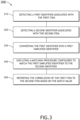
- FIG. 3 is a flow diagram illustrating a method 300 for correlating a first item to a second item, in accordance with one or more embodiments of the disclosure.
- the first item and the second item may include the navigation chart and the FMS procedure, respectively, or may include any other first item or second item as detailed above.
- the method 300 includes a step 310 of detecting the first identifier associated with the first item.
- the first identifier may be configured as the name of a file.
- the first identifier may be configured as a title of a document, a digital object identifier (DOI), data from the citation of a document (e.g., issue number, volume number and/or page number), or any text within the document.
- DOI digital object identifier
- the first identifier may be one entry of a list of entries in a spreadsheet.
- a first item may be configured with two or more data pieces within the first identifier.
- a digitized document may have two or more identifiers (e.g., a file name, and a title name) that together comprise the first identifier
- the method 300 includes a step 320 of detecting a second identifier associated with the second item.
- the second identifier of the second item may include any data type as indicated for the first identifier of the first item, and vice versa.
- the second identifier may be configured as a name that identifies a procedure file or the procedure itself.
- the second identifier may be configured to identify an FMS procedure.
- a second item may be configured with two or more data pieces within the second identifier.
- a digitized document may have two or more identifiers (e.g., a file name, and a title name) that together comprise the second identifier
- the method 300 includes a step 330 of converting the first identifier into a first simplified identifier. Converting the first identifier into a first simplified identifier facilitates downstream matching with the second identifier.
- First identifier simplification may be performed off-line through software tools (e.g., as indicated in FIG. 2 ), via one or more processors 116, and involves the conversion of the first identifier into one or more data and/or data field types.
- first identifier simplification may include detecting first identifier data and converting that the detected first identifier data into a Codex Value, configured as a bit field, and a Codex String, configured as a character string.
- step 330 is optional, or performed to a modest extent.
- a system 100 e.g., such as on-board an aircraft 212
- the first identifier may be simplified to begin with to a point where the system 100 can perform the matching process without requiring further simplification. Therefore, a first identifier may be configured as a first simplified identifier, and a first simplified identifier may be configured as a first identifier.
- the method 300 includes a step 340 of executing a matching procedure configured to match the first simplified identifier to the second identifier, in accordance with one or more embodiments of the disclosure.
- the matching procedure may be performed on the aircraft 212 at run-time, as shown in FIG. 2 .
- the one or more processors 116 of the system 100 located on the aircraft 212 may compare the first simplified identifier to the second identifier, and then generate a match value between the first identifier and the second identifier.
- the match value is an indicator of the amount of match between the first simplified identifier and the second simplifier, and is indicative of a probability that the second item is correlative to the first item. Details of the matching procedure are detailed below.
- the method 300 includes a step 350 of reporting the correlation of the first item to the second item based on the match value. Based on the number of potential or probable matches and the level of matching between the first simplified identifier and the second identifier, a determination is made on whether the most likely match is identified and reported, a list (e.g., a minimized list) of matches is identified and reported, or that an indication of no matching (e.g., no matching beyond a match threshold) is reported. For example, a pilot attempting to select a navigation chart a based on an FMS procedure may be presented via the output device 108 three navigation charts with match values that suggest a moderate to high probability that one of the three navigation charts is the correct chart.
- a pilot attempting to select a navigation chart a based on an FMS procedure may be presented via the output device 108 three navigation charts with match values that suggest a moderate to high probability that one of the three navigation charts is the correct chart.
- FIG. 4 is a block diagram of a flow chart illustrating a method 400 for converting a first identifier into a first simplified identifier, in accordance with one or more embodiments of the disclosure.
- the method 400 may include the parsing of the first identifier into one or more data forms, or within one of more data fields.
- a first identifier may already be simplified, or partially simplified, and may not require one or more steps of the method 400.
- the method 400 includes a step 410 of generating a codex string configured as character string based on the first identifier.
- the codex string may contain moniker names, procedure names, geographical locations, runway numbers, or any other identifying information.
- the coded string may be configured as any type of data string.
- the codex string may be defined with a form ⁇ N,N,LLL;M;M ⁇ , where "N" is defined as zero or more numbers separated by commas, "L” is defined as zero or more letters without separation, and "M” defined as a moniker string of up to four characters preceded by a semicolon.
- “N” may indicate specific runway numbers
- "L” may indicate procedure variants
- “M” may indicate the names of the monikers represented by the chart. There may be more than one Moniker defined within a chart name.
- the method includes a step 420 of generating a codex value based on the first identifier.
- the codex value may be configured as a bit field comprising any number or range of bits.
- the codex value may comprise bits in a range of 16 to 128 bits.
- the codex value may comprise bits in a range of 32 to 64 bits.
- the codex value may comprise approximately 32 bits.
- the codex value may include any type of information relating to the first item including but not limited to: type of equipment being used (e.g., Global Positioning System (GPS) equipment, or Instrument Landing System (ILS) equipment), runway positions (e.g., left, center, or right), page number of the chart, and whether the chart name is a "Guidance” type (e.g., such as a GPS chart), or a "Moniker” type (e.g., such as a BENKE7).
- type of equipment being used e.g., Global Positioning System (GPS) equipment, or Instrument Landing System (ILS) equipment
- runway positions e.g., left, center, or right
- page number of the chart e.g., and whether the chart name is a "Guidance” type (e.g., such as a GPS chart), or a "Moniker” type (e.g., such as a BENKE7).
- the method 400 includes a step 430 of removing nonessential letters.
- Nonessential letters may include any letters that are either not needed or redundant for correlating the first item for the second item.
- a list of letters and words may be generated that may be removed from the first identifier.
- An example list 600 of letters and words to be removed from the first identifier is shown in FIG. 6 .
- the method 400 includes at step 440 of setting one or more bits of the codex value based on the first identifier.
- the FMS chart is a 'Guidance" chart type (e.g., the chart comprises approach chart, departure chart, arrival chart, or airport chart types, and at least one of the following key strings exist as either a word or a substring: ILS, LOC, GPS, TACAN, NDB, DME, VOR, RNP, GNSS, LDA, SDF)
- the appropriate bit e.g., bit zero in FIG. 5
- the guidance type e.g., bit 6 in FIG. 5 ).
- bits for SID and STAR will be set (e.g., bit 28-29 in FIG. 5 ) upon detection of the strings SID/SIDS and STAR, respectively.
- bits for X, Y, Z, R (right), C (center), and L (left) will be set depending if the first identifier contains number with letters immediately preceding the number. For instance, the designation 17L in a first identifier will result in the setting of bit 25 in FIG. 5 ).
- strings within the first identifier that denote paging (e.g., PGn or CONTn, where n is a number) and set the continued bits as appropriate (e.g., bits 30-31 in FIG. 5 ).
- detection of the words "high” or "Hi” in the first identifier will result in the setting of a bit for high airway (e.g., bit three in FIG. 5 ).
- the method 400 includes a step 450 of adding one or more sub-strings of the first identifier to the codex string.
- a first identifier than contains a number either written as a numeral (e.g., 7) or spelled out (e.g., seven) will be added to the codex string in a numeral form.
- non-codex value-relevant sub-strings are processed and added to the codex string.
- the sub-string is a moniker if the string itself has not yet been determined to be a moniker (e.g., no un-reserved sub-string of more than two letter has been found to the left of the two-letter sub-string).
- the 2-letter substring is a modifier for the moniker and is treated as the individual letters in the codex string.
- "BAYES_AB” indicates the "BAYES” moniker with procedures "A” and "B” while "SL_403_621_DEP" would be treated as a moniker since the two letters, "SL", were processed before finding a moniker.
- a codex string may have both guidance and moniker characteristics.
- FIG. 7 is a block diagram of a flow chart illustrating a method 700 for executing a matching procedure configured to match the first simplified identifier to the second identifier, in accordance with one or more embodiments of the disclosure.
- the first simplified identifier provides a more straightforward approach for correlating the first item to the second than the non-simplified first identifier.
- the method 700 includes a step 710 of determining a second identifier type of the second identifier. For example, one or more characteristics of the second identifier may be used to determine the second identifier type, which then determines whether to perform a matching procedure, or which specific matching procedure is appropriate. For instance, if the second identifier is identified as a guidance procedure, then a procedure specific for matching a guidance procedure to the first simplified identifier will be performed. In another instance, if the second identifier is identified as a moniker, then a procedure specific for matching a moniker to the first simplified identifier will be performed.
- an FMS procedure (e.g., the second identifier) will be identified as a guidance procedure if the second procedure contains any of the following: a letter followed by two numbers, and/or a combination of numbers that includes "TTAC”, “EVOR”, “SVOR: “FNDB”, and/or "GGPS". If a procedure is not a guidance procedure, then it is a moniker.
- the method 700 includes a step 720 of comparing bits in the codex value and values in the codex string to the second identifier.
- the system 100 may compare an FMS procedure (e.g., or an FMS International Civil Aviation (ICAO) procedure, or an FMS procedure type, and match it to a chart name (e.g., the first simplified identifier). For instance, a procedure will only match to a chart if both the procedure and the chart are of the same type (e.g., guidance or moniker) and include the same airport.
- FMS procedure e.g., or an FMS International Civil Aviation (ICAO) procedure, or an FMS procedure type
- a chart name e.g., the first simplified identifier
- the method includes a step 730 of generating a match value based on the comparison between the first simplified identifier and the second identifier.
- the match value may be any parametric or nonparametric value system that facilitates the grading or placement of a comparison between the first simplified identifier and the second identifier. Once generated, the match value may be used to determine which comparisons, and therefore which first item may be reported as a potential match.
- the values or levels within the match value may include known value systems.
- the match values may include and exact match, a close match, a possible match, and no match.
- the following description details an example set of rules for generating match values between a first simplified identifier (e.g., a processed chart name) and a second identifier (e.g., a procedure name, such as an FMS procedure name).
- the rules differ slightly between guidance-related matching and moniker-related matching.
- guidance matching follows a set of rules which takes the first letter of the FMS procedure name (or possibly a specific embedded string within the FMS procedure name) and matches it to a guidance type bit in the codex value. Additional matching is done against positional type information (left right, center, and others), runway IDs, version of chart (X, Y, Z for FAA charts but random other letters for some foreign charts), and other information.
- Moniker matching is performed as a comparison between the procedure string (e.g., the FMS procedure name) and the moniker sub-strings stored in the codex string. Additional matching is done with version numbers, version of procedure letters, and other information.
- an exact match between a chart name and a guidance procedure name is determined when 1) the guidance bit in the codex value is set, 2) an FMS embedded runway identification (ID) number matches a runway ID in the codex string, 3) there is a match on the first letter of the procedure name to the associated codex value bit (e.g., see FIG. 8 ) , and 4 ) no additional letters are found in the procedure name or additional procedure name letters are found in the codex string or there is a match between additional letter in the FMS procedure name and the codex value bit (e.g., see chart 800 in FIG. 8 ).
- ID FMS embedded runway identification
- a close match between a chart name and a guidance procedure name is determined when the first three conditions of the exact match criteria are met, but not the fourth criteria, or 1) the guidance bit in the codex value is set, 2) the FMS embedded runway ID number matches a runway ID in the codex string, and 3) there is a match on the first letter of the procedure name associated codex values "G" and "R" (e.g., codex bits for GPS and required navigation performance (RNP)) as shown in FIG. 8 .
- a possible match between a chart name and a guidance procedure name is determined when 1) there is a single chart at the ICAO that matches the FMS procedure name (e.g., guidance chart type), 2) the FMS procedure type is "departure” and the SID bit is set in the codex value and the FMS runway ID is found in the codex string, or 3) the FMS procedure type is "arrival” and the STAR bit is set in the codex value, and the FMS runway ID is found in the codex string.
- the FMS procedure name e.g., guidance chart type
- an exact match between a chart name and a moniker procedure name is determined when 1), the moniker bit in the codex string is set, 2) the first characters of the FMS procedure name match the first characters of a moniker sub-string in the codex string, 3) either a) no numbers exist in the FMS procedure name or b) a number in the FMS procedure name matches a number in the codex string, or c) a number exists in the FMS procedure name and no numbers exist in the codex string, and 4) either if the FMS procedure name has an additional associated letter, the codex string also has the same additional associated letter or an equivalent bit set in the codex value if the letter is "X", "Y", or "Z".
- a close match between a chart name and a moniker procedure name is determined when the moniker bit in the codex value is set and 1) the first characters of the FMS procedure name match the first characters of a moniker in the codex string, 2) two characters in the FMS procedure name match two characters in a moniker in the codex string and there is a number in the FMS procedure name that matches an associated number in the codex string, 3) the FMS procedure type is "departure" and the FMS runway ID exists in the codex string and the SID bit is set in the codex value, or 4) the FMS procedure type is "arrival" and the FMS runway ID exists in the codex string and the STAR bit is set in the codex value.
- a possible match between a chart name and a moniker procedure name is determined when 1) the FMS procedure type is "departure” and the FMS runway ID does not exist in the codex string and the SID bit is set in the codex value, 2) the FMS procedure type is "arrival” and the FMS runway ID does not exist in the codex string and the STAR bit is set in the codex value, 3) a number exists in the FMS procedure name, no numbers in the codex string, and at least two letter can be matched, in order, between the FMS procedure name and a moniker sub-string in the codex string, or 4) there is a single chart of the FMS procedure type for the ICAO.
- the second identifier is configured as a second simplified identifier.
- the second identifier may be converted similarly to that of the first identifier such that the converted, or simplified, second identifier is configured with a second codex value and a second codex string. Once converted, the second identifier, now simplified, may be matched with the first simplified identifier, and a match value calculated.
- embodiments of the methods disclosed herein may include one or more of the steps described herein. Further, such steps may be carried out in any desired order and two or more of the steps may be carried out simultaneously with one another. Two or more of the steps disclosed herein may be combined in a single step, and in some embodiments, one or more of the steps may be carried out as two or more sub-steps. Further, other steps or sub-steps may be carried in addition to, or as substitutes to one or more of the steps disclosed herein.
Landscapes
- Engineering & Computer Science (AREA)
- Physics & Mathematics (AREA)
- General Physics & Mathematics (AREA)
- Remote Sensing (AREA)
- Radar, Positioning & Navigation (AREA)
- Theoretical Computer Science (AREA)
- Databases & Information Systems (AREA)
- Data Mining & Analysis (AREA)
- Aviation & Aerospace Engineering (AREA)
- General Engineering & Computer Science (AREA)
- Computational Mathematics (AREA)
- Pure & Applied Mathematics (AREA)
- Mathematical Optimization (AREA)
- Mathematical Physics (AREA)
- Mathematical Analysis (AREA)
- Automation & Control Theory (AREA)
- Library & Information Science (AREA)
- Computing Systems (AREA)
- Software Systems (AREA)
- Algebra (AREA)
- Management, Administration, Business Operations System, And Electronic Commerce (AREA)
- Computer Networks & Wireless Communication (AREA)
- Signal Processing (AREA)
- Computer Security & Cryptography (AREA)
Abstract
Description
- Aircraft pilots undergo periods of high workload at specific time points in flight. Flight procedures, particularly flight procedures relating to navigation, can be particularly cognitively taxing. These procedures initially require the pilot to upload a navigation chart upon a display, such as a display on a flight management system (FMS), that is specific for the procedure.
- Uploading and displaying aircraft navigation charts based upon specific navigation procedures can be particularly troublesome and time-consuming. Navigation charts are available from several vendors, with some vendors offering tens of thousands of different navigation charts, which must be matched to thousands of procedural names. Navigation chart names may be short/abbreviated descriptions of the chart or chart characteristics, or may have many (e.g., -90) characters, and it is often not obvious to a pilot whether a specific navigation chart is relevant to the navigation procedure. Similarly, procedure names are often short/abbreviated descriptions of the of the procedure or a characteristic of the procedure. For example, a procedure name may include the designation of a specific runway of an airport for landing. These abbreviated procedure names and associated chart names often do not match in an immediately meaningful manner. To illustrate this, a
chart 90 comparing a sampling of FMS procedure names with corresponding navigation chart names is shown inFIG. 1A . - Although some vendors insert a match code into a navigation chart that matches the procedure to the correct navigation chart, there are vendors that do not offer matching services, and physically matching large numbers of navigation charts to navigation procedures is labor and cost intensive. Accordingly, it would be advantageous to provide a system and method that overcomes the shortcomings described above.
- A method for correlating a first item to a second item is disclosed. In one or more embodiments, the method includes detecting a first identifier associated with the first item. In one or more embodiments, the method further includes detecting a second identifier associated with the second item. In one or more embodiments, the method further includes executing a matching procedure configured to match the first simplified identifier to the second identifier and generate a match value. In one or more embodiments, the method further includes comparing the first simplified identifier to the second identifier. In one or more embodiments, the method further includes generating the match value between the first simplified identifier and the second identifier. In one or more embodiments, the method further includes reporting a correlation between the first item and the second item based on the match value.
- In some embodiments, simplifying the first identifier, includes generating a codex string configured as character string based on the first identifier. In some embodiments, simplifying the first identifier includes generating a codex value configured as a bit field based on the first identifier. In some embodiments, simplifying the first identifier includes removing nonessential letters. In some embodiments, simplifying the first identifier includes setting one or more bits of the codex value based on the first identifier. In some embodiments, simplifying the first identifier i includes adding one or more sub-strings of the first identifier to the codex string.
- In some embodiments, executing a matching procedure configured to match the first identifier to the second identifier and generate a match value further includes determining a second identifier type of the second identifier. In some embodiments, executing a matching procedure configured to match the first identifier to the second identifier and generate a match value further includes comparing bits in the codex value and values in the codex string to the second identifier. In some embodiments, executing a matching procedure configured to match the first identifier to the second identifier and generate a match value further includes generating a match value based on the comparison between the first identifier and the second identifier.
- In some embodiments of the method, the first item and the second item are configured as electronic files.
- In some embodiments of the method the first item is configured as a chart, and the second item is configured as a procedure.
- In some embodiments of the method, the codex string includes at least one of a moniker name, a procedure name, or a geographic location.
- In some embodiments of the method, the geographical location includes a runway number.
- In some embodiments of the method, simplifying the first identifier is performed in a non-mobile computing environment, wherein executing the matching procedure is performed in a mobile computing environment.
- In some embodiments of the method, the codex value includes a least one of an equipment type or document characteristic.
- In some embodiments of the method, the second identifier is configured as a second simplified identifier.
- A system is disclosed. In one or more embodiments, the system includes a controller configured to correlating a first item to a second item. In one or more embodiments, the controller includes one or more processors. In one or more embodiments, the controller further includes a memory configured to store data and instructions executable by the one or more processors. In one or more embodiments, the instructions include detecting a first identifier associated with the first item. In one or more embodiments, the instructions further include detecting a second identifier associated with the second item. In one or more embodiments, the instructions further include executing a matching procedure configured to match the first identifier to the second identifier and generating a match value. In one or more embodiments, executing a matching procedure includes comparing the first identifier to the second identifier. In one or more embodiments, executing a matching procedure further includes generating the match value between the first identifier and the second identifier. In one or more embodiments, the instructions further include reporting a correlation between the first item and the second item based on the match value.
- In some embodiments of the system, the instructions further include simplifying the first identifier In some embodiments of the system, simplifying the first identifier includes generating a codex string configured as character string based on the first identifier. In some embodiments of the system, simplifying the first identifier includes generating a codex value based on the first identifier. In some embodiments of the system, simplifying the first identifier includes removing nonessential letters. In some embodiments of the system simplifying the first identifier includes setting one or more bits of the codex value based on the first identifier. In some embodiments of the system, simplifying the first identifier includes adding one or more sub-strings of the first identifier to the codex string.
- In some embodiments of the system, executing a matching procedure includes determining a second identifier type of the second identifier. In some embodiments of the system, executing a matching procedure further includes comparing bits in the codex value and values in the codex string to the second identifier. In some embodiments of the system, executing a matching procedure further includes generating a match value based on the comparison between the first simplified identifier and the second identifier.
- In some embodiments of the system, wherein the first item and the second item are configured as electronic files.
- In some embodiments of the system, the first item is configured as a chart, and the second item is configured as a procedure.
- In some embodiments of the system, the second identifier is simplified.
- This Summary is provided solely as an introduction to subject matter that is fully described in the Detailed Description and Drawings. The Summary should not be considered to describe essential features nor be used to determine the scope of the Claims. Moreover, it is to be understood that both the foregoing Summary and the following Detailed Description are example and explanatory only and are not necessarily restrictive of the subject matter claimed.
- The detailed description is described with reference to the accompanying figures. The use of the same reference numbers in different instances in the description and the figures may indicate similar or identical items. Various embodiments or examples ("examples") of the present disclosure are disclosed in the following detailed description and the accompanying drawings. The drawings are not necessarily to scale. In general, operations of disclosed processes may be performed in an arbitrary order, unless otherwise provided in the claims. In the drawings:
-
FIG. 1A is a chart comparing FMS procedure names with corresponding chart names; -
FIG. 1B is a block diagram of asystem 100 within acomputing environment 102 configured to facilitate the matching of a first item to a second item, in accordance with one or more embodiments of the disclosure; -
FIG. 2 is a drawing diagram illustrating a computing environment for a system comprising an aircraft and an air traffic control tower in accordance with one or more embodiments of the disclosure; -
FIG. 3 is a flow diagram illustrating a method for correlating a first item to a second item, in accordance with one or more embodiments of the disclosure; -
FIG. 4 is a block diagram of a flow chart illustrating a method for converting a first identifier into a first simplified identifier, in accordance with one or more embodiments of the disclosure; -
FIG. 5 is a chart illustrating an example of a codex value, in accordance with one or more embodiments of the disclosure; -
FIG. 6 is a chart illustrating a list of letters and words that may be removed from the first identifier, in accordance with one or more embodiments of the disclosure; -
FIG. 7 is a block diagram of a flow chart illustrating a method for executing a matching procedure configured to match the first simplified identifier to the second simplified identifier, in accordance with one or more embodiments of the disclosure; and -
FIG. 8 is a chart illustrating a list of codex value bits and corresponding 1st letter of a procedure name, in accordance with one or more embodiments of the disclosure. - Before explaining one or more embodiments of the disclosure in detail, it is to be understood that the embodiments are not limited in their application to the details of construction and the arrangement of the components or steps or methodologies set forth in the following description or illustrated in the drawings. In the following detailed description of embodiments, numerous specific details may be set forth in order to provide a more thorough understanding of the disclosure. However, it will be apparent to one of ordinary skill in the art having the benefit of the instant disclosure that the embodiments disclosed herein may be practiced without some of these specific details. In other instances, well-known features may not be described in detail to avoid unnecessarily complicating the instant disclosure.
- As used herein a letter following a reference numeral is intended to reference an embodiment of the feature or element that may be similar, but not necessarily identical, to a previously described element or feature bearing the same reference numeral (e.g., 1, 1a, 1b). Such shorthand notations are used for purposes of convenience only and should not be construed to limit the disclosure in any way unless expressly stated to the contrary.
- Further, unless expressly stated to the contrary, "or" refers to an inclusive or and not to an exclusive or. For example, a condition A or B is satisfied by anyone of the following: A is true (or present) and B is false (or not present), A is false (or not present) and B is true (or present), and both A and B are true (or present).
- In addition, use of "a" or "an" may be employed to describe elements and components of embodiments disclosed herein. This is done merely for convenience and "a" and "an" are intended to include "one" or "at least one," and the singular also includes the plural unless it is obvious that it is meant otherwise.
- Finally, as used herein any reference to "one embodiment" or "some embodiments" means that a particular element, feature, structure, or characteristic described in connection with the embodiment is included in at least one embodiment disclosed herein. The appearances of the phrase "in some embodiments" in various places in the specification are not necessarily all referring to the same embodiment, and embodiments may include one or more of the features expressly described or inherently present herein, or any combination of sub-combination of two or more such features, along with any other features which may not necessarily be expressly described or inherently present in the instant disclosure.
- A system and method for matching procedure names with associated chart names are presented. The method includes simplifying the chart name, then performing a name-matching procedure. The method reports to a user, such as a pilot, a chart name, or a list of chart names, that most likely matches the chart associated with a procedure. The method greatly simplifies the arduous process of matching a chart name with a FMS procedure, as the digital representation of paper charts used in navigation come from different sources with differing or no standards (e.g., Federal Aviation Administration (FAA) Department of Defense (DOD), foreign governments, independent contractors). FMS procedure names are also difficult to predict, as FMS procedure names follow a general pattern, but do not follow a precise standard. The method to associate these names is innovative. Off-line, the chart names are parsed and certain data is stored. At run time, this data is used in a series of comparisons against the procedure name, airport identifier, procedure type, and other information to find match candidates. Additional comparisons increase the likelihood that those candidates are valid matches. A high-probability match or set of matches is presented to the pilot, reducing the time needed to select a chart.
-
FIG. 1B is a block diagram of asystem 100 within acomputing environment 102 configured to facilitate the matching of a first item to a second item, in accordance with one or more embodiments of the disclosure. The first item and the second item may each include any type of file, document, list, chart, procedure, or any named entity wherein the name or identifier of the first item is to be associated with a name or identifier of the second item. For example, the first item may be configured as a chart with a first identifier (e.g., an FMS navigation chart configured with a chart name), and the second item may be configured as procedure with a second identifier (e.g., a specifically-named landing procedure). In another example, the first item may be configured as a text file that includes a first identifier configured as a short filename (e.g., SFN or 8.3 filename) and the second item may be configured as a spreadsheet file configured with a list of second identifiers (e.g., a column of named entries), one of which is the second identifier that is associated with the first item. In another example, the first item and second item may be configured as associated text files (e.g., user manuals for a vacuum cleaner) with the text and identifiers of the first item and the second item each written in different languages. - The
system 102 may be configured as a stand-alone monolithic processing device, or as a component or module within a larger computing framework. For example, one or more components of thesystem 102 may be configured as a component or tool within a toolkit for displaying graphics. For instance, in some embodiments, thesystem 102 is incorporated within the Electronic Charts Application Tool Suite (ECATS) toolkit as described inU.S. Provisional Patent Application Serial No. 63/278,576 entitled SYSTEMS AND METHODS FOR GENERATION, SELECTION, AND DISPLAY OF MAP-BASED CHART DATABASES FOR USE WITH CERTIFIED AVIONICS SYSTEMS and filed November 12, 2021 system 100 may also be configured as a multi-component system, as shown inFIG. 2 . For example, the initial processing of the first identifier and/or the second identifier may be accomplished off-line in aseparate system 100 or system component than the matching of the first identifier and second identifier. For instance, thesystem 100 may perform initial processing may in a non-mobile computing environment 204 (e.g., in an airtraffic control tower 206 or other building), whereas the matching may be performed on a mobile computing environment 208 on-board an aircraft 212 (e.g., a mobile computing environment). Data from the initial processing may be physically inputted onto theaircraft 212 via a technician while theaircraft 212 is in service, or may be sent directly via awireless signal 216. Performing initial processing off-line and performing matching at run-time saves computing space at run-time and allows quicker response to the pilot when compared to performing both initial processing and matching at run-time. Referring back toFIG. 1B , thesystem 100 and/or thecomputing environment 102 may include aninput device 104, anoutput device 108. Thesystem 100 further includes acontroller 112 configured to facilitate the functions of thesystem 100. The controller may also be coupled to theinput device 104 and theoutput device 108, as well as to anetwork 114. - In embodiments, the
input device 104 inputs first item data, including first identifier data, and second item data, including second identifier data, into thesystem 100. Theinput device 104 may be configured as any type of input device including but not limited to a keyboard, a scanner, a camera, or data port. For example, theinput device 104 may be configured as a scanner configured to scan a graphic or list (e.g., a graphic or list of a physical avionics chart) into the system. In another example, theinput device 104 may be configured as a USB port configured to receive a USB memory device having avionics charts (e.g., a digital navigation chart of a flight management system (FMS)) or avionic chart names loaded onto it (e.g., as a pdf. file, jpg. file, text file, or other type of file). In another example, theinput device 104 may include a data port configured to receive data from thenetwork 114. - In embodiments, the
output device 108 may be configured to report matching data and/or output candidate first items from thesystem 100 to a user and may be configured as any type ofoutput device 108 including but not limited to a display, a printer, or any type of data port. For example, theoutput device 108 may be configured as a computer screen. In another example, theoutput device 108 may be configured as a data port connected to thenetwork 114. - In embodiments, the
controller 112 includes one ormore processors 116, amemory 120, and acommunication interface 124. The one ormore processors 116 may include any processor or processing element known in the art. For the purposes of the present disclosure, the term "processor" or "processing element" may be broadly defined to encompass any device having one or more processing or logic elements (e.g., one or more micro-processor devices, one or more application specific integrated circuit (ASIC) devices, one or more field programmable gate arrays (FPGAs), or one or more digital signal processors (DSPs)). In this sense, the one or more processors may include any device configured to execute algorithms and/or instructions (e.g., program instructions stored in memory). In one embodiment, the one or more processors may be embodied as a desktop computer, mainframe computer system, workstation, image computer, parallel processor, networked computer, or any other computer system configured to execute a program configured to operate or operate in conjunction with thesystem 100, as described throughout the present disclosure. Moreover, different subsystems of thesystem 100 may include a processor or logic elements suitable for carrying out at least a portion of the steps described in the present disclosure. Therefore, the above description should not be interpreted as a limitation on the embodiments of the present disclosure but merely as an illustration. - The
memory 120 can be an example of tangible, computer-readable storage medium that provides storage functionality to store various data and/or program code associated with operation of thecontroller 112 and/or other components of thesystem 100, such as software programs and/or code segments, or other data to instruct the controller and/or other components to perform the functionality described herein. Thus, the memory can store data, such as a program of instructions for operating thesystem 100 or other components. It should be noted that while asingle memory 120 is described, a wide variety of types and combinations of memory 120 (e.g., tangible, non-transitory memory) can be employed. The memory can be integral with the controller, can comprise stand-alone memory, or can be a combination of both. Some examples of thememory 120 can include removable and non-removable memory components, such as random-access memory (RAM), read-only memory (ROM), flash memory (e.g., a secure digital (SD) memory card, a mini-SD memory card, and/or a micro-SD memory card), solid-state drive (SSD) memory, magnetic memory, optical memory, universal serial bus (USB) memory devices, hard disk memory, external memory, and so forth. - The
communication interface 124 can be operatively configured to communicate with components of thecontroller 112 and other components of thesystem 100. For example, thecommunication interface 124 can be configured to retrieve data from thecontroller 112 or other components, transmit data for storage in thememory 120, retrieve data from storage in thememory 120, and so forth. Thecommunication interface 124 can also be communicatively coupled with controller112 and/or system elements to facilitate data transfer between system components. -
FIG. 3 is a flow diagram illustrating amethod 300 for correlating a first item to a second item, in accordance with one or more embodiments of the disclosure. The first item and the second item may include the navigation chart and the FMS procedure, respectively, or may include any other first item or second item as detailed above. - In embodiments, the
method 300 includes astep 310 of detecting the first identifier associated with the first item. For example, the first identifier may be configured as the name of a file. In another example, the first identifier may be configured as a title of a document, a digital object identifier (DOI), data from the citation of a document (e.g., issue number, volume number and/or page number), or any text within the document. (For instance, the first identifier may be one entry of a list of entries in a spreadsheet. A first item may be configured with two or more data pieces within the first identifier. For example, a digitized document may have two or more identifiers (e.g., a file name, and a title name) that together comprise the first identifier - In embodiments, the
method 300 includes astep 320 of detecting a second identifier associated with the second item. The second identifier of the second item may include any data type as indicated for the first identifier of the first item, and vice versa. For example, the second identifier may be configured as a name that identifies a procedure file or the procedure itself. For instance, the second identifier may be configured to identify an FMS procedure. A second item may be configured with two or more data pieces within the second identifier. For example, a digitized document may have two or more identifiers (e.g., a file name, and a title name) that together comprise the second identifier - In some embodiments, the
method 300 includes astep 330 of converting the first identifier into a first simplified identifier. Converting the first identifier into a first simplified identifier facilitates downstream matching with the second identifier. First identifier simplification may be performed off-line through software tools (e.g., as indicated inFIG. 2 ), via one ormore processors 116, and involves the conversion of the first identifier into one or more data and/or data field types. For example, first identifier simplification may include detecting first identifier data and converting that the detected first identifier data into a Codex Value, configured as a bit field, and a Codex String, configured as a character string. Other data relating to the item type and item description/name may also be stored inmemory 120. Details for converting the first identifier into the first simplified identifier are detailed below. In some embodiments,step 330 is optional, or performed to a modest extent. For example, a system 100 (e.g., such as on-board an aircraft 212) may perform the matching process between the first identifier and the second identifier with no simplification. For instance, the first identifier may be simplified to begin with to a point where thesystem 100 can perform the matching process without requiring further simplification. Therefore, a first identifier may be configured as a first simplified identifier, and a first simplified identifier may be configured as a first identifier. - In some embodiments, the
method 300 includes astep 340 of executing a matching procedure configured to match the first simplified identifier to the second identifier, in accordance with one or more embodiments of the disclosure. The matching procedure may be performed on theaircraft 212 at run-time, as shown inFIG. 2 . For example, the one ormore processors 116 of thesystem 100 located on theaircraft 212 may compare the first simplified identifier to the second identifier, and then generate a match value between the first identifier and the second identifier. The match value is an indicator of the amount of match between the first simplified identifier and the second simplifier, and is indicative of a probability that the second item is correlative to the first item. Details of the matching procedure are detailed below. - In some embodiments, the
method 300 includes astep 350 of reporting the correlation of the first item to the second item based on the match value. Based on the number of potential or probable matches and the level of matching between the first simplified identifier and the second identifier, a determination is made on whether the most likely match is identified and reported, a list (e.g., a minimized list) of matches is identified and reported, or that an indication of no matching (e.g., no matching beyond a match threshold) is reported. For example, a pilot attempting to select a navigation chart a based on an FMS procedure may be presented via theoutput device 108 three navigation charts with match values that suggest a moderate to high probability that one of the three navigation charts is the correct chart. -
FIG. 4 is a block diagram of a flow chart illustrating amethod 400 for converting a first identifier into a first simplified identifier, in accordance with one or more embodiments of the disclosure. Themethod 400 may include the parsing of the first identifier into one or more data forms, or within one of more data fields. As described herein, a first identifier may already be simplified, or partially simplified, and may not require one or more steps of themethod 400. - In some embodiments, the
method 400 includes astep 410 of generating a codex string configured as character string based on the first identifier. The codex string may contain moniker names, procedure names, geographical locations, runway numbers, or any other identifying information. The coded string may be configured as any type of data string. For example, the codex string may be defined with a form {N,N,LLL;M;M}, where "N" is defined as zero or more numbers separated by commas, "L" is defined as zero or more letters without separation, and "M" defined as a moniker string of up to four characters preceded by a semicolon. In this form, "N" may indicate specific runway numbers, "L" may indicate procedure variants, and "M" may indicate the names of the monikers represented by the chart. There may be more than one Moniker defined within a chart name. - In some embodiments, the method includes a
step 420 of generating a codex value based on the first identifier. The codex value may be configured as a bit field comprising any number or range of bits. For example, the codex value may comprise bits in a range of 16 to 128 bits. In another example, the codex value may comprise bits in a range of 32 to 64 bits. For instance, the codex value may comprise approximately 32 bits. The codex value may include any type of information relating to the first item including but not limited to: type of equipment being used (e.g., Global Positioning System (GPS) equipment, or Instrument Landing System (ILS) equipment), runway positions (e.g., left, center, or right), page number of the chart, and whether the chart name is a "Guidance" type (e.g., such as a GPS chart), or a "Moniker" type (e.g., such as a BENKE7). Acodex value chart 500 illustrating an example of a codex value is shown inFIG. 5 , in accordance with one or more embodiments of the disclosure. - In embodiments, the
method 400 includes astep 430 of removing nonessential letters. Nonessential letters may include any letters that are either not needed or redundant for correlating the first item for the second item. For example, a list of letters and words may be generated that may be removed from the first identifier. Anexample list 600 of letters and words to be removed from the first identifier is shown inFIG. 6 . - In some embodiments, the
method 400 includes atstep 440 of setting one or more bits of the codex value based on the first identifier. For example, if the FMS chart is a 'Guidance" chart type (e.g., the chart comprises approach chart, departure chart, arrival chart, or airport chart types, and at least one of the following key strings exist as either a word or a substring: ILS, LOC, GPS, TACAN, NDB, DME, VOR, RNP, GNSS, LDA, SDF), then the appropriate bit (e.g., bit zero inFIG. 5 ) will be set along with the guidance type (e.g.,bit 6 inFIG. 5 ). In another example, bits for SID and STAR will be set (e.g., bit 28-29 inFIG. 5 ) upon detection of the strings SID/SIDS and STAR, respectively. In another example, bits for X, Y, Z, R (right), C (center), and L (left) (e.g., bits 20-25 inFIG. 5 , respectively) will be set depending if the first identifier contains number with letters immediately preceding the number. For instance, the designation 17L in a first identifier will result in the setting ofbit 25 inFIG. 5 ). In another example, for strings within the first identifier that denote paging (e.g., PGn or CONTn, where n is a number) and set the continued bits as appropriate (e.g., bits 30-31 inFIG. 5 ). In another example, detection of the words "high" or "Hi" in the first identifier will result in the setting of a bit for high airway (e.g., bit three inFIG. 5 ). - In some embodiments, the
method 400 includes astep 450 of adding one or more sub-strings of the first identifier to the codex string. For example, a first identifier than contains a number either written as a numeral (e.g., 7) or spelled out (e.g., seven) will be added to the codex string in a numeral form. In another example, non-codex value-relevant sub-strings are processed and added to the codex string. For instance, when parsing left to right, and a 2-letter sub-string is detected, the sub-string is a moniker if the string itself has not yet been determined to be a moniker (e.g., no un-reserved sub-string of more than two letter has been found to the left of the two-letter sub-string). If the string has already been determined to be a moniker, the 2-letter substring is a modifier for the moniker and is treated as the individual letters in the codex string. In a particular illustration, "BAYES_AB" indicates the "BAYES" moniker with procedures "A" and "B" while "SL_403_621_DEP" would be treated as a moniker since the two letters, "SL", were processed before finding a moniker. This catches moniker place names that start with "EL", "LA", or "ST". Any remaining moniker strings are added to the codex string, and if are remaining unprocessed strings, the moniker bit will be set in the codex value (e.g.,bit 1 inFIG. 5 ). A codex string may have both guidance and moniker characteristics. -
FIG. 7 is a block diagram of a flow chart illustrating amethod 700 for executing a matching procedure configured to match the first simplified identifier to the second identifier, in accordance with one or more embodiments of the disclosure. Once generated, the first simplified identifier provides a more straightforward approach for correlating the first item to the second than the non-simplified first identifier. - In some embodiments, the
method 700 includes astep 710 of determining a second identifier type of the second identifier. For example, one or more characteristics of the second identifier may be used to determine the second identifier type, which then determines whether to perform a matching procedure, or which specific matching procedure is appropriate. For instance, if the second identifier is identified as a guidance procedure, then a procedure specific for matching a guidance procedure to the first simplified identifier will be performed. In another instance, if the second identifier is identified as a moniker, then a procedure specific for matching a moniker to the first simplified identifier will be performed. In a particular illustration, an FMS procedure (e.g., the second identifier) will be identified as a guidance procedure if the second procedure contains any of the following: a letter followed by two numbers, and/or a combination of numbers that includes "TTAC", "EVOR", "SVOR: "FNDB", and/or "GGPS". If a procedure is not a guidance procedure, then it is a moniker. - In embodiments, the
method 700 includes astep 720 of comparing bits in the codex value and values in the codex string to the second identifier. For example, utilizing the one or more processors 110, thesystem 100 may compare an FMS procedure (e.g., or an FMS International Civil Aviation (ICAO) procedure, or an FMS procedure type, and match it to a chart name (e.g., the first simplified identifier). For instance, a procedure will only match to a chart if both the procedure and the chart are of the same type (e.g., guidance or moniker) and include the same airport. - In embodiments, the method includes a
step 730 of generating a match value based on the comparison between the first simplified identifier and the second identifier. The match value may be any parametric or nonparametric value system that facilitates the grading or placement of a comparison between the first simplified identifier and the second identifier. Once generated, the match value may be used to determine which comparisons, and therefore which first item may be reported as a potential match. The values or levels within the match value may include known value systems. For example, the match values may include and exact match, a close match, a possible match, and no match. - The following description details an example set of rules for generating match values between a first simplified identifier (e.g., a processed chart name) and a second identifier (e.g., a procedure name, such as an FMS procedure name). The rules differ slightly between guidance-related matching and moniker-related matching. In general, guidance matching follows a set of rules which takes the first letter of the FMS procedure name (or possibly a specific embedded string within the FMS procedure name) and matches it to a guidance type bit in the codex value. Additional matching is done against positional type information (left right, center, and others), runway IDs, version of chart (X, Y, Z for FAA charts but random other letters for some foreign charts), and other information. Moniker matching is performed as a comparison between the procedure string (e.g., the FMS procedure name) and the moniker sub-strings stored in the codex string. Additional matching is done with version numbers, version of procedure letters, and other information.
- For example, an exact match between a chart name and a guidance procedure name is determined when 1) the guidance bit in the codex value is set, 2) an FMS embedded runway identification (ID) number matches a runway ID in the codex string, 3) there is a match on the first letter of the procedure name to the associated codex value bit (e.g., see
FIG. 8 ) , and4 ) no additional letters are found in the procedure name or additional procedure name letters are found in the codex string or there is a match between additional letter in the FMS procedure name and the codex value bit (e.g., seechart 800 inFIG. 8 ). - In another example, a close match between a chart name and a guidance procedure name is determined when the first three conditions of the exact match criteria are met, but not the fourth criteria, or 1) the guidance bit in the codex value is set, 2) the FMS embedded runway ID number matches a runway ID in the codex string, and 3) there is a match on the first letter of the procedure name associated codex values "G" and "R" (e.g., codex bits for GPS and required navigation performance (RNP)) as shown in
FIG. 8 . - In another example, a possible match between a chart name and a guidance procedure name is determined when 1) there is a single chart at the ICAO that matches the FMS procedure name (e.g., guidance chart type), 2) the FMS procedure type is "departure" and the SID bit is set in the codex value and the FMS runway ID is found in the codex string, or 3) the FMS procedure type is "arrival" and the STAR bit is set in the codex value, and the FMS runway ID is found in the codex string.
- In another example, an exact match between a chart name and a moniker procedure name is determined when 1), the moniker bit in the codex string is set, 2) the first characters of the FMS procedure name match the first characters of a moniker sub-string in the codex string, 3) either a) no numbers exist in the FMS procedure name or b) a number in the FMS procedure name matches a number in the codex string, or c) a number exists in the FMS procedure name and no numbers exist in the codex string, and 4) either if the FMS procedure name has an additional associated letter, the codex string also has the same additional associated letter or an equivalent bit set in the codex value if the letter is "X", "Y", or "Z".
- In another example, a close match between a chart name and a moniker procedure name is determined when the moniker bit in the codex value is set and 1) the first characters of the FMS procedure name match the first characters of a moniker in the codex string, 2) two characters in the FMS procedure name match two characters in a moniker in the codex string and there is a number in the FMS procedure name that matches an associated number in the codex string, 3) the FMS procedure type is "departure" and the FMS runway ID exists in the codex string and the SID bit is set in the codex value, or 4) the FMS procedure type is "arrival" and the FMS runway ID exists in the codex string and the STAR bit is set in the codex value.
- In another example, a possible match between a chart name and a moniker procedure name is determined when 1) the FMS procedure type is "departure" and the FMS runway ID does not exist in the codex string and the SID bit is set in the codex value, 2) the FMS procedure type is "arrival" and the FMS runway ID does not exist in the codex string and the STAR bit is set in the codex value, 3) a number exists in the FMS procedure name, no numbers in the codex string, and at least two letter can be matched, in order, between the FMS procedure name and a moniker sub-string in the codex string, or 4) there is a single chart of the FMS procedure type for the ICAO.
- In some embodiments, the second identifier is configured as a second simplified identifier. For example, the second identifier may be converted similarly to that of the first identifier such that the converted, or simplified, second identifier is configured with a second codex value and a second codex string. Once converted, the second identifier, now simplified, may be matched with the first simplified identifier, and a match value calculated.
- It is to be understood that embodiments of the methods disclosed herein may include one or more of the steps described herein. Further, such steps may be carried out in any desired order and two or more of the steps may be carried out simultaneously with one another. Two or more of the steps disclosed herein may be combined in a single step, and in some embodiments, one or more of the steps may be carried out as two or more sub-steps. Further, other steps or sub-steps may be carried in addition to, or as substitutes to one or more of the steps disclosed herein.
- Although inventive concepts have been described with reference to the embodiments illustrated in the attached drawing figures, equivalents may be employed and substitutions made herein without departing from the scope of the claims. Components illustrated and described herein are merely examples of a system/device and components that may be used to implement embodiments of the inventive concepts and may be replaced with other devices and components without departing from the scope of the claims. Furthermore, any dimensions, degrees, and/or numerical ranges provided herein are to be understood as non-limiting examples unless otherwise specified in the claims.
Claims (15)
- A method (300) for correlating a first item to a second item comprising:Detecting (310) a first identifier associated with the first item;detecting (320) a second identifier associated with the second item;executing (340) a matching procedure configured to match the first identifier to the second identifier and generate a match value comprising:comparing the first identifier to the second identifier; andgenerating the match value between the first identifier and the second identifier;reporting (350) a correlation between the first item and the second item based on the match value.
- The method of claim 1, further comprising simplifying the first identifier, wherein simplifying the first identifier further comprises at least one of:generating (410) a codex string configured as character string based on the first identifier;generating (420) a codex value configured as a bit field based on the first identifier;removing (430) nonessential letters;setting (440) one or more bits of the codex value based on the first identifier; andadding (450) one or more sub-strings of the first identifier to the codex string.
- The method of claim 2, wherein executing (340) the matching procedure configured to match the first identifier to the second and generate the match value further comprises:determining a second identifier type of the second identifier;comparing bits in the codex value and values in the codex string to the second identifier;generating a match value based on a comparison between the first identifier and the second identifier.
- The method of any preceding claim, wherein the first item and the second item are configured as electronic files.
- The method of any preceding claim, wherein the first item is configured as a chart, and the second item is configured as a procedure.
- The method of claim 2 or any claim dependent thereon, wherein the codex string comprises at least one of a moniker name, a procedure name, or a geographic location.
- The method of claim 2 or any claim dependent thereon, wherein simplifying the first identifier is performed in a non-mobile computing environment, wherein executing the matching procedure is performed in a mobile computing environment.
- The method of claim 2 or any claim dependent thereon, wherein the codex value includes a least one of an equipment type or document characteristic.
- The method of any preceding claim, wherein the second identifier is simplified.
- A system (100) comprising:
a controller (112) configured to correlating a first item to a second item comprising:one or more processors (116); anda memory (120) configured to store data and instructions executable by the one or more processors, wherein the instructions include:detecting a first identifier associated with the first item;detecting a second identifier associated with the second item;executing a matching procedure configured to match the first identifier to the second identifier and generating a match value comprising:comparing the first identifier to the second identifier; andgenerating the match value between the first identifier and the second identifier; andreporting a correlation between the first item and the second item based on the match value. - The system of claim 10, wherein the instructions further include simplifying the first identifier, wherein simplifying the first identifier further comprises at least one of:generating a codex string configured as character string based on the first identifier;generating a codex value based on the first identifier;removing nonessential letters;setting one or more bits of the codex value based on the first identifier; andadding one or more sub-strings of the first identifier to the codex string.
- The system of claim 11, wherein executing the matching procedure configured to match the first identifier to the second identifier and generate the match value further comprises:determining a second identifier type of the second identifier; andcomparing bits in the codex value and values in the codex string to the second identifier;generating a match value based on a comparison between the first simplified identifier and the second identifier.
- The system of any of claims 10 to 12, wherein the first item and the second item are configured as electronic files.
- The system of any of claims 10 to 13, wherein the first item is configured as a chart, and the second item is configured as a procedure.
- The system of any of claims 10 to 14, wherein the second identifier is simplified.
Applications Claiming Priority (2)
| Application Number | Priority Date | Filing Date | Title |
|---|---|---|---|
| US202163278576P | 2021-11-12 | 2021-11-12 | |
| US17/525,378 US12254282B2 (en) | 2021-11-12 | 2021-11-12 | Method for automatically matching chart names |
Publications (1)
| Publication Number | Publication Date |
|---|---|
| EP4180766A1 true EP4180766A1 (en) | 2023-05-17 |
Family
ID=84331598
Family Applications (1)
| Application Number | Title | Priority Date | Filing Date |
|---|---|---|---|
| EP22207012.0A Pending EP4180766A1 (en) | 2021-11-12 | 2022-11-11 | Method for automatically matching chart names |
Country Status (2)
| Country | Link |
|---|---|
| US (1) | US12254282B2 (en) |
| EP (1) | EP4180766A1 (en) |
Families Citing this family (1)
| Publication number | Priority date | Publication date | Assignee | Title |
|---|---|---|---|---|
| US20250006064A1 (en) * | 2023-06-27 | 2025-01-02 | The Boeing Company | Methods and systems for preventing wrong surface events |
Citations (5)
| Publication number | Priority date | Publication date | Assignee | Title |
|---|---|---|---|---|
| US20070067095A1 (en) * | 2005-07-01 | 2007-03-22 | Honeywell International Inc. | Method and apparatus for resolving ambiguous waypoints |
| EP1352315B1 (en) * | 2000-11-17 | 2009-02-25 | Honeywell International Inc. | A method and system for entering data within a flight plan entry field |
| US20160092557A1 (en) * | 2014-09-26 | 2016-03-31 | Oracle International Corporation | Techniques for similarity analysis and data enrichment using knowledge sources |
| US9443433B1 (en) * | 2015-04-23 | 2016-09-13 | The Boeing Company | Method and system to monitor for conformance to a traffic control instruction |
| US20200320142A1 (en) * | 2018-06-13 | 2020-10-08 | Oracle International Corporation | Regular expression generation using span highlighting alignment |
Family Cites Families (252)
| Publication number | Priority date | Publication date | Assignee | Title |
|---|---|---|---|---|
| FR1504564A (en) | 1965-08-25 | 1967-12-08 | Nippon Electric Co | Automatic character identification device |
| US3656178A (en) | 1969-09-15 | 1972-04-11 | Research Corp | Data compression and decompression system |
| JPS5242017A (en) | 1975-09-29 | 1977-04-01 | Fuji Xerox Co Ltd | Run length code processing method for facsimile signal |
| JPS61234312A (en) | 1985-04-09 | 1986-10-18 | Mitsubishi Electric Corp | Vehicle-borne navigation apparatus |
| JPS622721A (en) | 1985-06-28 | 1987-01-08 | Nec Corp | Coding and decoding device for picture signal |
| JPH0634237B2 (en) | 1986-02-24 | 1994-05-02 | 三菱電機株式会社 | Image clipping method |
| JPS6393273A (en) | 1986-10-07 | 1988-04-23 | Fuji Xerox Co Ltd | Coding device for image information |
| JPH0820862B2 (en) | 1987-02-27 | 1996-03-04 | キヤノン株式会社 | Character processor |
| US4792981A (en) | 1987-09-21 | 1988-12-20 | Am International, Inc. | Manipulation of run-length encoded images |
| US4876651A (en) | 1988-05-11 | 1989-10-24 | Honeywell Inc. | Digital map system |
| AU624205B2 (en) | 1989-01-23 | 1992-06-04 | General Electric Capital Corporation | Variable length string matcher |
| US5050230A (en) | 1989-11-29 | 1991-09-17 | Eastman Kodak Company | Hybrid residual-based hierarchical storage and display method for high resolution digital images in a multiuse environment |
| US5428692A (en) | 1991-11-18 | 1995-06-27 | Kuehl; Eberhard | Character recognition system |
| US5546572A (en) | 1991-08-28 | 1996-08-13 | Hitachi, Ltd. | Method for retrieving database of image information |
| JP3155595B2 (en) | 1992-01-24 | 2001-04-09 | キヤノン株式会社 | Encoding method and apparatus |
| US5526476A (en) | 1992-12-07 | 1996-06-11 | Fujitsu Limited | Method and apparatus for generating character patterns expressed by coordinates of a coordinate system |
| NO933205D0 (en) | 1993-09-08 | 1993-09-08 | Harald Martens | Data representation system |
| US5499382A (en) | 1993-09-20 | 1996-03-12 | Nusinov; Eugene B. | Circuit and method of bit-packing and bit-unpacking using a barrel shifter |
| US5537669A (en) | 1993-09-30 | 1996-07-16 | Kla Instruments Corporation | Inspection method and apparatus for the inspection of either random or repeating patterns |
| US5577170A (en) | 1993-12-23 | 1996-11-19 | Adobe Systems, Incorporated | Generation of typefaces on high resolution output devices |
| DE4447434A1 (en) | 1994-02-23 | 1995-08-31 | Gfr Ges Fuer Regelungstechnik | CCD sensor for reading out image zones or lines |
| US5454076A (en) | 1994-03-02 | 1995-09-26 | Vlsi Technology, Inc. | Method and apparatus for simultaneously minimizing storage and maximizing total memory bandwidth for a repeating pattern |
| US5559707A (en) | 1994-06-24 | 1996-09-24 | Delorme Publishing Company | Computer aided routing system |
| JP3568621B2 (en) * | 1995-04-20 | 2004-09-22 | 株式会社日立製作所 | Map display device |
| US6336074B1 (en) * | 1995-05-12 | 2002-01-01 | Trimble Navigation Limited | Satellite navigation receiver with map graphics and hypertext driven by a PDF database |
| US6014133A (en) | 1996-06-14 | 2000-01-11 | Seiko Epson Corporation | Data transmitter/receiver apparatus, data transmitter, data receiver, and data compression method |
| US6275610B1 (en) | 1996-10-16 | 2001-08-14 | Convey Corporation | File structure for scanned documents |
| JPH10293852A (en) | 1997-04-21 | 1998-11-04 | Fuji Photo Film Co Ltd | Outline extracting method |
| US5978715A (en) | 1997-10-15 | 1999-11-02 | Dassault Aviation | Apparatus and method for aircraft display and control |
| US6501441B1 (en) | 1998-06-18 | 2002-12-31 | Sony Corporation | Method of and apparatus for partitioning, scaling and displaying video and/or graphics across several display devices |
| US6240341B1 (en) | 1999-01-18 | 2001-05-29 | Honeywell International Inc. | Flight management system (FMS) with integrated bit mapped data charts |
| US6922703B1 (en) * | 1999-09-14 | 2005-07-26 | Honeywell International Inc. | Methods and apparatus for real-time projection and rendering of geospatially organized data |
| JP4433236B2 (en) | 1999-12-03 | 2010-03-17 | ソニー株式会社 | Information processing apparatus, information processing method, and program recording medium |
| US6914626B2 (en) | 2000-02-21 | 2005-07-05 | Hewlett Packard Development Company, L.P. | Location-informed camera |
| US6781600B2 (en) | 2000-04-14 | 2004-08-24 | Picsel Technologies Limited | Shape processor |
| US6839714B2 (en) | 2000-08-04 | 2005-01-04 | Infoglide Corporation | System and method for comparing heterogeneous data sources |
| US6448922B1 (en) | 2000-08-24 | 2002-09-10 | Rockwell Collins, Inc. | Retrofit solution for the integration of ground-based weather radar images with on-board weather radar |
| US6757445B1 (en) | 2000-10-04 | 2004-06-29 | Pixxures, Inc. | Method and apparatus for producing digital orthophotos using sparse stereo configurations and external models |
| US20020097417A1 (en) | 2001-01-19 | 2002-07-25 | Chang William Ho | System for universal data output |
| US6823333B2 (en) | 2001-03-02 | 2004-11-23 | The United States Of America As Represented By The Administrator Of The National Aeronautics And Space Administration | System, method and apparatus for conducting a keyterm search |
| US7117089B2 (en) | 2001-03-06 | 2006-10-03 | Honeywell International Inc. | Ground runway awareness and advisory system |
| DE10128858A1 (en) | 2001-06-15 | 2003-02-13 | Heidelberger Druckmasch Ag | Process for creating trapping frames in a printed page |
| US7640098B2 (en) | 2001-07-31 | 2009-12-29 | Stenbock & Everson, Inc. | Process for generating travel plans on the internet |
| US7158141B2 (en) | 2002-01-17 | 2007-01-02 | University Of Washington | Programmable 3D graphics pipeline for multimedia applications |
| US7408552B2 (en) | 2002-02-08 | 2008-08-05 | Raytheon Company | System and method for representation of aircraft altitude using spatial size and other natural perceptual cues |
| US20170313332A1 (en) | 2002-06-04 | 2017-11-02 | General Electric Company | Autonomous vehicle system and method |
| EP1516287A1 (en) | 2002-06-27 | 2005-03-23 | MJW Corporation | Interactive video tour system editor |
| US7039505B1 (en) | 2002-07-19 | 2006-05-02 | Avidyne Corporation | Method for digital transmission and display of weather imagery |
| US20040071351A1 (en) | 2002-10-07 | 2004-04-15 | Johan Rade | Method and system for graphics compression and display |
| US7475060B2 (en) | 2003-05-09 | 2009-01-06 | Planeteye Company Ulc | Browsing user interface for a geo-coded media database |
| US7562289B2 (en) | 2003-06-18 | 2009-07-14 | Layton Geo-Science, Inc. | Methods and systems for encoding geographic coordinates and features in a portable document format file |
| US6934608B2 (en) * | 2003-07-09 | 2005-08-23 | Honeywell International Inc. | Integrated vertical situation display |
| KR100501173B1 (en) | 2003-08-07 | 2005-07-18 | 에스케이 텔레콤주식회사 | Method for Displaying High-Resolution Pictures in Mobile Communication Terminal, Mobile Communication Terminal and File Format Converting System of the Pictures therefor |
| US20050091340A1 (en) | 2003-10-01 | 2005-04-28 | International Business Machines Corporation | Processing interactive content offline |
| JP2007528529A (en) | 2003-11-28 | 2007-10-11 | ブラッコ イメージング エス.ピー.エー. | Method and system for identifying the surface of a 3D dataset ("voxel partitioning") |
| US9058177B2 (en) | 2004-02-12 | 2015-06-16 | Raju Venkata Chiluvuri | Real software components for achieving real component-based design |
| WO2005096173A1 (en) | 2004-03-30 | 2005-10-13 | Victor Company Of Japan, Limited | Digitization service manual generation method and additional data generation method |
| US7242407B2 (en) | 2004-05-28 | 2007-07-10 | Lockheed Martin Corporation | Reprojecting map images using graphical techniques |
| JP2006098250A (en) | 2004-09-30 | 2006-04-13 | Fuji Photo Film Co Ltd | Car navigation system |
| US7581036B2 (en) | 2004-10-13 | 2009-08-25 | Microsoft Corporation | Offline caching of control transactions for storage devices |
| JP4247684B2 (en) | 2005-01-19 | 2009-04-02 | ソニー株式会社 | Map display device and map display method |
| JP4266939B2 (en) | 2005-02-10 | 2009-05-27 | 株式会社ソニー・コンピュータエンタテインメント | Drawing processing apparatus and drawing data compression method |
| KR100639109B1 (en) | 2005-03-23 | 2006-10-31 | 주식회사 코아로직 | An apparatus for generating a thumbnail J.P. image, a method for generating the same, and a storage medium thereof |
| JP4728744B2 (en) | 2005-08-29 | 2011-07-20 | シャープ株式会社 | Image processing device |
| US7647179B2 (en) | 2005-08-31 | 2010-01-12 | Hilton Goldstein | System and method for coordinate mapping onto airport diagrams |
| US20070094591A1 (en) | 2005-10-24 | 2007-04-26 | Etgen Michael P | System and method for text legibility enhancement |
| JP2007133231A (en) | 2005-11-11 | 2007-05-31 | Denso Corp | Map display device and navigation device |
| US20070132767A1 (en) | 2005-11-30 | 2007-06-14 | William Wright | System and method for generating stories in time and space and for analysis of story patterns in an integrated visual representation on a user interface |
| JP4835134B2 (en) | 2005-12-06 | 2011-12-14 | ソニー株式会社 | Image display device, image display method, and program |
| US7542846B2 (en) | 2006-02-07 | 2009-06-02 | Alpine Electronics, Inc. | Navigation system utilizing XML/SVG map data converted from geographic map data and layered structure of XML/SVG map data based on administrative regions |
| WO2007114722A1 (en) | 2006-03-30 | 2007-10-11 | Intel Corporation | An optimal floating-point expression translation method based on pattern matching |
| US20080045138A1 (en) | 2006-05-01 | 2008-02-21 | Microsoft Corporation | Context information communications via a mobile device |
| US7474317B2 (en) | 2006-05-18 | 2009-01-06 | International Business Machines Corporation | Method and apparatus for displaying overlapping markers |
| JP2008022215A (en) | 2006-07-12 | 2008-01-31 | Matsushita Electric Ind Co Ltd | Image encoding device, image encoding method, and storage medium therefor |
| US20080172627A1 (en) | 2006-12-28 | 2008-07-17 | Sharp Kabushiki Kaisha | Information display apparatus, information providing server, information display system, method for controlling information display apparatus, method for controlling information providing server, control program and recording medium |
| US8453060B2 (en) | 2006-08-25 | 2013-05-28 | Microsoft Corporation | Panoramic ring user interface |
| US7739622B2 (en) | 2006-10-27 | 2010-06-15 | Microsoft Corporation | Dynamic thumbnails for document navigation |
| US20080103641A1 (en) | 2006-10-31 | 2008-05-01 | Honeywell International, Inc. | Methods and apparatus for overlaying non-georeferenced symbology on a georeferenced chart |
| US7966125B2 (en) | 2006-11-29 | 2011-06-21 | The Boeing Company | System and method for terminal charts, airport maps and aeronautical context display |
| US8195383B2 (en) | 2006-11-29 | 2012-06-05 | The Boeing Company | System and method for electronic moving map and aeronautical context display |
| JP2008158765A (en) | 2006-12-22 | 2008-07-10 | Canon Inc | Information processing apparatus, information processing method, and program for causing computer to execute information processing method |
| US8368695B2 (en) | 2007-02-08 | 2013-02-05 | Microsoft Corporation | Transforming offline maps into interactive online maps |
| US20080240152A1 (en) | 2007-03-27 | 2008-10-02 | Dell Products L.P. | System And Method For Communicating Data For Display On A Remote Display Device |
| US7908082B2 (en) | 2007-05-04 | 2011-03-15 | The Boeing Company | Methods and systems for displaying airport moving map information |
| US20100262318A1 (en) | 2007-05-16 | 2010-10-14 | J. Ariens & Associates, Inc. | Electronic flight bag user interface system |
| US8582919B2 (en) | 2007-09-24 | 2013-11-12 | Microsoft Corporation | Altering the appearance of a digital image using a shape |
| WO2009041042A1 (en) | 2007-09-26 | 2009-04-02 | Panasonic Corporation | Map display device |
| US8862986B2 (en) | 2007-10-01 | 2014-10-14 | Hewlett-Packard Development Company, L.P. | Arranging graphic objects on a page with relative position based control |
| US20090125837A1 (en) | 2007-11-08 | 2009-05-14 | International Business Machines Corporation | Tab control with type ahead and thumbnail images |
| US8260048B2 (en) | 2007-11-14 | 2012-09-04 | Exelis Inc. | Segmentation-based image processing system |
| US20090172035A1 (en) * | 2007-12-31 | 2009-07-02 | Pieter Lessing | System and method for capturing and storing casino information in a relational database system |
| US20090210388A1 (en) | 2008-02-20 | 2009-08-20 | Microsoft Corporation | Efficiently discovering and synthesizing maps from a large corpus of maps |
| JP5056469B2 (en) | 2008-02-22 | 2012-10-24 | 富士通株式会社 | Image management device |
| WO2009133603A1 (en) | 2008-04-30 | 2009-11-05 | 株式会社ザナヴィ・インフォマティクス | Map display |
| US7948502B2 (en) | 2008-05-13 | 2011-05-24 | Mitac International Corp. | Method of displaying picture having location data and apparatus thereof |
| FR2932047B1 (en) | 2008-05-29 | 2010-08-13 | Airbus France | COMPUTER SYSTEM FOR MAINTENANCE OF A REMOTE TERMINAL AIRCRAFT |
| JP5302768B2 (en) | 2008-06-26 | 2013-10-02 | キヤノン株式会社 | Image processing apparatus and image processing method |
| US8339417B2 (en) | 2008-07-25 | 2012-12-25 | Navteq B.V. | Open area maps based on vector graphics format images |
| CN101676988B (en) | 2008-09-19 | 2011-12-28 | 威锋数位开发股份有限公司 | Method for displaying the quality of small characters in stroke-based Chinese fonts |
| KR101319342B1 (en) | 2008-11-25 | 2013-10-16 | 엘지디스플레이 주식회사 | Multi-panel display and method of driving the same |
| CA2646117A1 (en) | 2008-12-02 | 2010-06-02 | Oculus Info Inc. | System and method for visualizing connected temporal and spatial information as an integrated visual representation on a user interface |
| US8386957B2 (en) | 2009-02-25 | 2013-02-26 | Hewlett-Packard Development Company, L.P. | Method for dynamically scaling an original background layout |
| JP5274305B2 (en) | 2009-02-27 | 2013-08-28 | キヤノン株式会社 | Image processing apparatus, image processing method, and computer program |
| US10440329B2 (en) | 2009-05-22 | 2019-10-08 | Immersive Media Company | Hybrid media viewing application including a region of interest within a wide field of view |
| US8374390B2 (en) | 2009-06-24 | 2013-02-12 | Navteq B.V. | Generating a graphic model of a geographic object and systems thereof |
| US20100328353A1 (en) | 2009-06-30 | 2010-12-30 | Solidfx Llc | Method and system for displaying an image on a display of a computing device |
| US8515658B1 (en) | 2009-07-06 | 2013-08-20 | The Boeing Company | Managing navigational chart presentation |
| JP2011061047A (en) | 2009-09-11 | 2011-03-24 | Hitachi High-Technologies Corp | Defect review support device, defect review device, and inspection support device |
| CN101751449B (en) | 2009-09-16 | 2012-10-10 | 中国科学院计算技术研究所 | Spatial overlap analysis method and system used in geographic information system |
| GB0916994D0 (en) | 2009-09-28 | 2009-11-11 | Nats Services Ltd | Aeronautical information processing |
| JP5387366B2 (en) | 2009-11-26 | 2014-01-15 | ソニー株式会社 | Information processing apparatus, information processing method, and program |
| JP5716383B2 (en) | 2009-12-28 | 2015-05-13 | 株式会社ニコン | Information processing apparatus and information processing program |
| US20110157473A1 (en) | 2009-12-30 | 2011-06-30 | Hoon Choi | Method, apparatus, and system for simultaneously previewing contents from multiple protected sources |
| US20110191014A1 (en) | 2010-02-04 | 2011-08-04 | Microsoft Corporation | Mapping interface with higher zoom level inset map |
| US8583368B1 (en) | 2010-02-17 | 2013-11-12 | The Boeing Company | Rule based depiction of minimum altitudes |
| US9430195B1 (en) | 2010-04-16 | 2016-08-30 | Emc Corporation | Dynamic server graphics |
| US8134362B1 (en) | 2010-06-15 | 2012-03-13 | American Airlines, Inc. | System and method for recording and monitoring directives for vehicles such as airplanes |
| US20120010765A1 (en) | 2010-07-07 | 2012-01-12 | Honeywell International Inc. | System for displaying a procedure to an aircraft operator during a flight of an aircraft |
| US9031971B2 (en) | 2010-07-23 | 2015-05-12 | Qualcomm Incorporated | Flexible data download models for augmented reality |
| US8704732B2 (en) | 2010-09-29 | 2014-04-22 | Qualcomm Incorporated | Image synchronization for multiple displays |
| US9195637B2 (en) | 2010-11-03 | 2015-11-24 | Microsoft Technology Licensing, Llc | Proportional font scaling |
| JP5773618B2 (en) | 2010-11-08 | 2015-09-02 | キヤノン株式会社 | Information processing apparatus, control method for information processing apparatus, and program |
| KR101495189B1 (en) | 2011-03-25 | 2015-02-24 | 엘지전자 주식회사 | Image processing apparatus and image processing method |
| US8913080B2 (en) | 2011-05-09 | 2014-12-16 | Microsoft Corporation | Partitioning high resolution images into sub-images for display |
| EP2695049A1 (en) | 2011-05-10 | 2014-02-12 | NDS Limited | Adaptive presentation of content |
| US9247133B2 (en) | 2011-06-01 | 2016-01-26 | Apple Inc. | Image registration using sliding registration windows |
| JP2013016018A (en) | 2011-07-04 | 2013-01-24 | Canon Inc | Display control apparatus, control method, and program |
| JP5889559B2 (en) | 2011-07-13 | 2016-03-22 | ソニー株式会社 | Information processing method and information processing system |
| JP2013025331A (en) | 2011-07-14 | 2013-02-04 | Konica Minolta Business Technologies Inc | Image processing apparatus, thumbnail image creation method using the apparatus and thumbnail image creation program |
| US20130031072A1 (en) | 2011-07-25 | 2013-01-31 | Luca Passani | System and Method for using a Device Description Repository |
| US9721324B2 (en) | 2011-09-10 | 2017-08-01 | Microsoft Technology Licensing, Llc | Thumbnail zoom |
| US9489121B2 (en) | 2011-11-02 | 2016-11-08 | Microsoft Technology Licensing, Llc | Optimal display and zoom of objects and text in a document |
| US8803920B2 (en) | 2011-12-12 | 2014-08-12 | Google Inc. | Pre-fetching map tile data along a route |
| US20130159825A1 (en) | 2011-12-16 | 2013-06-20 | Microsoft Corporation | Search results with maps |
| US9058380B2 (en) * | 2012-02-06 | 2015-06-16 | Fis Financial Compliance Solutions, Llc | Methods and systems for list filtering based on known entity matching |
| WO2013121459A1 (en) | 2012-02-16 | 2013-08-22 | 古野電気株式会社 | Information display device, display mode switching method, and display mode switching program |
| US10620241B2 (en) | 2012-02-17 | 2020-04-14 | Perspecta Labs Inc. | Method and system for packet acquisition, analysis and intrusion detection in field area networks |
| US8878872B1 (en) | 2012-02-24 | 2014-11-04 | Rockwell Collins Inc. | System, device and method for generating an overlay of navigation chart information |
| KR101389841B1 (en) | 2012-05-16 | 2014-04-29 | 주식회사바텍 | Panorama image data providing method and apparatus |
| JP6035931B2 (en) | 2012-07-13 | 2016-11-30 | ソニー株式会社 | Information processing apparatus, information processing method, and information processing program |
| GB2504085A (en) | 2012-07-16 | 2014-01-22 | Software Ltd C | Displaying maps and data sets on image display interfaces |
| US20150070373A1 (en) | 2012-08-23 | 2015-03-12 | Google Inc. | Clarification of Zoomed Text Embedded in Images |
| US20140109012A1 (en) | 2012-10-16 | 2014-04-17 | Microsoft Corporation | Thumbnail and document map based navigation in a document |
| US8976081B2 (en) | 2012-10-17 | 2015-03-10 | Intel Corporation | Integration of displays |
| US9361003B2 (en) | 2012-10-18 | 2016-06-07 | Dental Imaging Technologies Corporation | Overlay maps for navigation of intraoral images |
| US9035969B2 (en) | 2012-11-29 | 2015-05-19 | Seiko Epson Corporation | Method for multiple projector display using a GPU frame buffer |
| US9619919B1 (en) | 2012-12-19 | 2017-04-11 | Rockwell Collins, Inc. | Synthetic environments with stereoscopic avionics displays system and related method |
| US9047847B2 (en) | 2013-02-05 | 2015-06-02 | Facebook, Inc. | Displaying clusters of media items on a map using representative media items |
| US9484006B2 (en) | 2013-02-13 | 2016-11-01 | Documill Oy | Manipulation of textual content data for layered presentation |
| US9306990B2 (en) | 2013-02-14 | 2016-04-05 | Raytheon Company | System and method for map collaboration |
| US9070227B2 (en) | 2013-03-04 | 2015-06-30 | Microsoft Technology Licensing, Llc | Particle based visualizations of abstract information |
| US9253609B2 (en) * | 2013-03-12 | 2016-02-02 | Doug Hosier | Online systems and methods for advancing information organization sharing and collective action |
| US10372292B2 (en) | 2013-03-13 | 2019-08-06 | Microsoft Technology Licensing, Llc | Semantic zoom-based navigation of displayed content |
| KR102124188B1 (en) | 2013-03-13 | 2020-06-26 | 삼성전자주식회사 | Electronic device and method for processing image |
| US20140282038A1 (en) | 2013-03-15 | 2014-09-18 | InTheAirNet, LLC. | Flight detail application and interactive map system and method |
| CN104063844B (en) | 2013-03-21 | 2019-01-15 | 腾讯科技(深圳)有限公司 | A kind of reduced graph generating method and system |
| WO2014162659A1 (en) | 2013-04-01 | 2014-10-09 | ソニー株式会社 | Display control device, display control method, and display control program |
| US9465513B2 (en) | 2013-04-11 | 2016-10-11 | General Electric Company | Visual representation of map navigation history |
| US9002637B2 (en) | 2013-04-16 | 2015-04-07 | The Boeing Company | Systems and methods for generating a navigation chart |
| JP6337888B2 (en) | 2013-04-30 | 2018-06-06 | ソニー株式会社 | Image processing apparatus, image processing method, and program |
| US8799799B1 (en) | 2013-05-07 | 2014-08-05 | Palantir Technologies Inc. | Interactive geospatial map |
| US9846534B2 (en) | 2013-06-13 | 2017-12-19 | Microsoft Technology Licensing, Llc | Inset dynamic content preview pane |
| US9905043B2 (en) | 2013-09-10 | 2018-02-27 | Microsoft Technology Licensing, Llc | Techniques to generate digital maps |
| US9939271B1 (en) | 2013-09-23 | 2018-04-10 | The Boeing Company | Enroute distance measuring tool |
| CN103645837B (en) | 2013-11-27 | 2016-08-31 | 小米科技有限责任公司 | The method and apparatus amplifying display font |
| WO2015081386A1 (en) | 2013-12-04 | 2015-06-11 | Groundprobe Pty Ltd | Method and system for displaying an area |
| US9529657B2 (en) * | 2014-02-07 | 2016-12-27 | Oracle International Corporation | Techniques for generating diagnostic identifiers to trace events and identifying related diagnostic information |
| US9718558B2 (en) | 2014-02-26 | 2017-08-01 | Honeywell International Inc. | Pilot centered system and method for decluttering aircraft displays |
| US9428056B2 (en) | 2014-03-11 | 2016-08-30 | Textron Innovations, Inc. | Adjustable synthetic vision |
| JP6268023B2 (en) | 2014-03-31 | 2018-01-24 | 日本電産サンキョー株式会社 | Character recognition device and character cutout method thereof |
| US20150324088A1 (en) | 2014-05-09 | 2015-11-12 | Lyve Minds, Inc. | Thumbnail image creation |
| US9921721B2 (en) | 2014-08-08 | 2018-03-20 | Google Llc | Navigation interfaces for ebooks |
| KR20160030701A (en) | 2014-09-11 | 2016-03-21 | 삼성전자주식회사 | Host divice transmitting print data to printer and method for rendering print data by host device |
| EP2998817B1 (en) * | 2014-09-16 | 2017-06-07 | Aviovision | System for calculating aircraft performance and method for performing the same |
| US20160093080A1 (en) | 2014-09-30 | 2016-03-31 | Microsoft Technology Licensing, Llc | Optimizing the Legibility of Displayed Text |
| US10277869B2 (en) | 2014-12-11 | 2019-04-30 | Sensormatic Electronics, LLC | Efficient process for camera call-up |
| US10001376B1 (en) | 2015-02-19 | 2018-06-19 | Rockwell Collins, Inc. | Aircraft position monitoring system and method |
| US9754495B2 (en) * | 2015-04-02 | 2017-09-05 | The Boeing Company | Associative memory system and method for flight plan modification |
| US20160299905A1 (en) | 2015-04-07 | 2016-10-13 | Tripping International, Inc. | Geographic location linked searching and record access systems and methods |
| KR20160144269A (en) | 2015-06-08 | 2016-12-16 | 삼성전자주식회사 | Electronic device and method of displaying an electronic map in the electronic device |
| US9858823B1 (en) | 2015-06-09 | 2018-01-02 | Rockwell Collins, Inc. | Interactive flight plan |
| US9672747B2 (en) | 2015-06-15 | 2017-06-06 | WxOps, Inc. | Common operating environment for aircraft operations |
| US20170011064A1 (en) | 2015-07-09 | 2017-01-12 | Pixxcell Worldwide Ltd. | Methods and Apparatus for Sending or Receiving an Image |
| US10061480B1 (en) | 2015-07-28 | 2018-08-28 | Rockwell Collins, Inc. | Navigation chart information generating and presenting system, device, and method |
| US11106329B2 (en) | 2015-09-18 | 2021-08-31 | Honeywell International Inc. | Flight deck display systems and methods for generating cockpit displays including dynamic taxi turnoff icons |
| US9639309B1 (en) | 2015-10-14 | 2017-05-02 | Kyocera Document Solutions Inc. | Image conversion methods |
| US10204430B2 (en) * | 2015-11-03 | 2019-02-12 | Honeywell International Inc. | Aircraft systems and methods with enhanced CPDLC message management |
| US9818051B2 (en) | 2016-01-29 | 2017-11-14 | Ricoh Company, Ltd. | Rotation and clipping mechanism |
| US20170223227A1 (en) | 2016-01-29 | 2017-08-03 | Kabushiki Kaisha Toshiba | Dynamic font size management system and method for multifunction devices |
| US10489489B2 (en) | 2016-03-09 | 2019-11-26 | Adobe Inc. | Automatically classifying and presenting digital fonts |
| CN107239786B (en) | 2016-03-29 | 2022-01-11 | 阿里巴巴集团控股有限公司 | Character recognition method and device |
| US9682784B1 (en) * | 2016-03-31 | 2017-06-20 | Rockwell Collins, Inc. | Pilot notes presenting system, device, and method |
| US11885623B1 (en) | 2016-04-01 | 2024-01-30 | Hilton Goldstein | System and method for mapping a position on a non-linear navigational chart |
| US10534960B2 (en) | 2016-04-01 | 2020-01-14 | California Institute Of Technology | System and method for locating and performing fine grained classification from multi-view image data |
| US10147215B2 (en) | 2016-04-17 | 2018-12-04 | Streetography, Inc. | Digitally generated set of regional shapes for presenting information on a display screen |
| US10145704B2 (en) | 2016-04-17 | 2018-12-04 | Streetography, Inc. | Digitally-generated map containing defined regions for rendering with photo overlays |
| EP3243668B1 (en) | 2016-05-10 | 2020-07-15 | Agfa Nv | Manufacturing of a security document |
| US10382557B2 (en) | 2016-06-30 | 2019-08-13 | Panasonic Avionics Corporation | Conversion of aircraft data over wireless networks for flight deck and cabin airline applications |
| US10558669B2 (en) * | 2016-07-22 | 2020-02-11 | National Student Clearinghouse | Record matching system |
| US9781294B1 (en) | 2016-08-09 | 2017-10-03 | Xerox Corporation | System and method for rendering micro gloss effect image patterns on a recording medium |
| US10108883B2 (en) | 2016-10-28 | 2018-10-23 | Intuit Inc. | Image quality assessment and improvement for performing optical character recognition |
| IL248975B2 (en) | 2016-11-14 | 2023-05-01 | Israel Aerospace Ind Ltd | System and method for auto-execution of aircraft check lists |
| US10157616B2 (en) * | 2016-12-19 | 2018-12-18 | Honeywell International Inc. | Methods and apparatus for post-processing speech recognition results of received radio voice messages onboard an aircraft |
| US20180181646A1 (en) | 2016-12-26 | 2018-06-28 | Infosys Limited | System and method for determining identity relationships among enterprise data entities |
| JP2018147259A (en) | 2017-03-06 | 2018-09-20 | キヤノン株式会社 | Information processing device, program, storage medium, and information processing method |
| EP3596620A4 (en) * | 2017-03-13 | 2020-12-23 | Chartspan Medical Technologies, Inc. | Interoperable record matching process |
| US10297159B2 (en) * | 2017-03-17 | 2019-05-21 | Honeywell International Inc. | Systems and methods for graphical visualization of communication transmissions received onboard an aircraft |
| WO2018183994A1 (en) | 2017-03-31 | 2018-10-04 | Area 2601, LLC | Computer-based systems and methods for facilitating aircraft approach |
| US10417276B2 (en) | 2017-05-15 | 2019-09-17 | Adobe, Inc. | Thumbnail generation from panoramic images |
| CN107402734A (en) | 2017-07-25 | 2017-11-28 | 浪潮金融信息技术有限公司 | A kind of method that text definition is automatically adjusted with screen resolution |
| US11921672B2 (en) * | 2017-07-31 | 2024-03-05 | Splunk Inc. | Query execution at a remote heterogeneous data store of a data fabric service |
| US10417991B2 (en) | 2017-08-18 | 2019-09-17 | Microsoft Technology Licensing, Llc | Multi-display device user interface modification |
| WO2019047763A1 (en) | 2017-09-08 | 2019-03-14 | Mediatek Inc. | Methods and apparatuses of processing pictures in an image or video coding system |
| US11106339B2 (en) | 2017-09-19 | 2021-08-31 | Adobe Inc. | Designing and resizing graphical user interfaces |
| KR102396526B1 (en) | 2017-09-29 | 2022-05-11 | 삼성전자주식회사 | Electronic device for displaying content and operating method thereof |
| US10095925B1 (en) | 2017-12-18 | 2018-10-09 | Capital One Services, Llc | Recognizing text in image data |
| US10459670B2 (en) | 2018-01-15 | 2019-10-29 | Lucid Dream Software, Inc. | Methods, systems, apparatuses and devices for facilitating printing of a digital image based on image splitting |
| US10446113B2 (en) | 2018-01-30 | 2019-10-15 | ForeFlight LLC | Method and system for inversion of raster images |
| KR102494101B1 (en) | 2018-02-14 | 2023-02-01 | 삼성전자주식회사 | Touch input processing method and electronic device supportingthe same |
| US11334543B1 (en) * | 2018-04-30 | 2022-05-17 | Splunk Inc. | Scalable bucket merging for a data intake and query system |
| US10170010B1 (en) | 2018-06-07 | 2019-01-01 | Rockwell Collins, Inc. | Display of traffic overlaid on aeronautical chart |
| CN109325083B (en) | 2018-08-03 | 2021-01-26 | 江苏联旺信息科技有限公司 | Aviation flight image map loading method, aviation flight image map loading software and aerial photographing device |
| JP7265822B2 (en) | 2018-08-27 | 2023-04-27 | キヤノン株式会社 | Display control device, display control method, and program |
| GB2577478B (en) | 2018-09-06 | 2021-03-10 | Maritech Development Ltd | A method of creating map tiles which comprise vessel information |
| CN110906938A (en) | 2018-09-14 | 2020-03-24 | 上海擎感智能科技有限公司 | Map navigation query method, system, medium, and apparatus |
| GB2591041B (en) * | 2018-09-20 | 2023-04-19 | FLIR Belgium BVBA | Video Sensor Fusion and Model Based Virtual and Augmented Reality Systems and Methods |
| US11429380B2 (en) * | 2018-09-25 | 2022-08-30 | Fossid AB | Method for converting source code into numeric identifiers and comparison against data sets |
| US20200192872A1 (en) * | 2018-12-13 | 2020-06-18 | Zoox, Inc. | Device message framework |
| US11756153B2 (en) | 2018-12-31 | 2023-09-12 | Intel Corporation | Hemisphere cube map projection format in imaging environments |
| CN111510642A (en) | 2019-01-31 | 2020-08-07 | 中强光电股份有限公司 | Display system, display method for display system, and display device |
| US11721220B2 (en) * | 2019-04-03 | 2023-08-08 | Honeywell International Inc. | Systems and methods for monitoring and identifying failure in dual flight management systems |
| JP2020201649A (en) | 2019-06-07 | 2020-12-17 | トヨタ自動車株式会社 | Map generation device, map generation method and computer program for map generation |
| US11288764B2 (en) | 2019-07-01 | 2022-03-29 | Digimarc Corporation | Watermarking arrangements permitting vector graphics editing |
| EP3772030A1 (en) | 2019-08-01 | 2021-02-03 | Honeywell International Inc. | Systems and methods to utilize flight monitoring data |
| WO2021035223A1 (en) | 2019-08-22 | 2021-02-25 | Educational Vision Technologies, Inc. | Automatic data extraction and conversion of video/images/sound information from a board-presented lecture into an editable notetaking resource |
| US11087123B2 (en) | 2019-08-24 | 2021-08-10 | Kira Inc. | Text extraction, in particular table extraction from electronic documents |
| CN110516221B (en) | 2019-08-29 | 2021-07-30 | 企查查科技有限公司 | Method, equipment and storage medium for extracting chart data in PDF document |
| CN110727747B (en) | 2019-09-02 | 2022-03-15 | 湖北大学 | Paper map rapid vectorization method and system based on longitude and latitude recognition |
| US11211997B2 (en) | 2019-12-16 | 2021-12-28 | Google Llc | Networking with HAPs and additional ground-based nodes |
| US11061563B1 (en) | 2020-01-06 | 2021-07-13 | Rockwell Collins, Inc. | Interactive charts system and method |
| US20210225181A1 (en) | 2020-01-20 | 2021-07-22 | Honeywell International Inc. | Display systems and methods for providing ground traffic collison threat awareness |
| US11669794B2 (en) * | 2020-04-06 | 2023-06-06 | Johnson Controls Tyco IP Holdings LLP | Building risk analysis system with geographic risk scoring |
| US11536855B2 (en) | 2020-07-14 | 2022-12-27 | Spirent Communications Plc | Path planning using forecasts of obscuration and multipath |
| GB202011023D0 (en) | 2020-07-17 | 2020-09-02 | Agco Int Gmbh | System and method of assisted or automated grain unload synchronization |
| US11994406B2 (en) | 2020-09-11 | 2024-05-28 | The Government Of The United States Of America, As Represented By The Secretary Of The Navy | Group-based technique for dynamic label placement |
| US20220139238A1 (en) | 2020-10-29 | 2022-05-05 | Rockwell Collins, Inc. | Flight path inspection display |
| US11568018B2 (en) * | 2020-12-22 | 2023-01-31 | Dropbox, Inc. | Utilizing machine-learning models to generate identifier embeddings and determine digital connections between digital content items |
| US12002369B2 (en) | 2021-11-12 | 2024-06-04 | Rockwell Collins, Inc. | Graphical user interface (GUI) for selection and display of enroute charts in an avionics chart display system |
| US12304648B2 (en) | 2021-11-12 | 2025-05-20 | Rockwell Collins, Inc. | System and method for separating avionics charts into a plurality of display panels |
| US20230150685A1 (en) | 2021-11-12 | 2023-05-18 | Rockwell Collins, Inc. | System and method for enhancing situational awareness via panel selector display while viewing multipanel map-based charts |
| US20230154338A1 (en) | 2021-11-12 | 2023-05-18 | Rockwell Collins, Inc. | Tool to facilitate customer generated chart databases for use with a certified avionics system |
| US12175625B2 (en) | 2021-11-29 | 2024-12-24 | Microsoft Technology Licensing, Llc | Computing device displaying image conversion possibility information |
-
2021
- 2021-11-12 US US17/525,378 patent/US12254282B2/en active Active
-
2022
- 2022-11-11 EP EP22207012.0A patent/EP4180766A1/en active Pending
Patent Citations (5)
| Publication number | Priority date | Publication date | Assignee | Title |
|---|---|---|---|---|
| EP1352315B1 (en) * | 2000-11-17 | 2009-02-25 | Honeywell International Inc. | A method and system for entering data within a flight plan entry field |
| US20070067095A1 (en) * | 2005-07-01 | 2007-03-22 | Honeywell International Inc. | Method and apparatus for resolving ambiguous waypoints |
| US20160092557A1 (en) * | 2014-09-26 | 2016-03-31 | Oracle International Corporation | Techniques for similarity analysis and data enrichment using knowledge sources |
| US9443433B1 (en) * | 2015-04-23 | 2016-09-13 | The Boeing Company | Method and system to monitor for conformance to a traffic control instruction |
| US20200320142A1 (en) * | 2018-06-13 | 2020-10-08 | Oracle International Corporation | Regular expression generation using span highlighting alignment |
Also Published As
| Publication number | Publication date |
|---|---|
| US20230153064A1 (en) | 2023-05-18 |
| US12254282B2 (en) | 2025-03-18 |
Similar Documents
| Publication | Publication Date | Title |
|---|---|---|
| US8180562B2 (en) | System and method for taxi route entry parsing | |
| EP3971731A1 (en) | Fence address-based coordinate data processing method and apparatus, and computer device | |
| US20230154338A1 (en) | Tool to facilitate customer generated chart databases for use with a certified avionics system | |
| US9830910B1 (en) | Natrual voice speech recognition for flight deck applications | |
| US20160379640A1 (en) | System and method for aircraft voice-to-text communication with message validation | |
| US20120022778A1 (en) | Systems and methods for searching and displaying flight plans | |
| CN102306149A (en) | Flight planning with digital notam | |
| US11967306B2 (en) | Contextual speech recognition methods and systems | |
| EP4180766A1 (en) | Method for automatically matching chart names | |
| CN112328642A (en) | Aviation multi-source data entity alignment method and device and readable storage medium | |
| US20250054398A1 (en) | System and method to generate and display runway overrun awareness and alerting system (roaas) image depicting current runway displaced threshold value and current landing distance available value | |
| US20220388630A1 (en) | Speech recognition methods and systems with contextual keyword mapping | |
| CN113990109A (en) | Method and system for updating a flight plan | |
| US20100145955A1 (en) | Method and system for virtually printing digital content to a searchable electronic database format | |
| EP3525197B1 (en) | Method and system for monitoring execution of conditional air traffic control clearances for an aircraft | |
| US20240321114A1 (en) | Method and system to detection of restrictive obstacles for the optimization of aircraft takeoffs | |
| EP4180769A1 (en) | System and method for providing more readable font characters in size adjusting avionics charts | |
| EP1895268B1 (en) | Systems and Methods for Detecting and Alerting Mis-Setting of Barometric Altimeter Setting Above A Transition Altitude | |
| Yang et al. | Using transponder signals to model aircraft performance at non-towered airports | |
| US20230326449A1 (en) | System and method for constraining air traffic communication (atc) transcription in real-time | |
| EP4180772A1 (en) | Electronic chart application with enhanced element searching and highlighting using generic third-party data | |
| US10453225B2 (en) | System and method for converting path terminators to drawing commands and filling the voids between flight path segments | |
| CN110377907B (en) | Recruitment information standardization method and device | |
| EP4435758A1 (en) | Method and system to detection of restrictive obstacles for the optimization of aircraft takeoffs | |
| EP4464603A1 (en) | Systems and methods for a smart navigation tuning panel |
Legal Events
| Date | Code | Title | Description |
|---|---|---|---|
| PUAI | Public reference made under article 153(3) epc to a published international application that has entered the european phase |
Free format text: ORIGINAL CODE: 0009012 |
|
| STAA | Information on the status of an ep patent application or granted ep patent |
Free format text: STATUS: THE APPLICATION HAS BEEN PUBLISHED |
|
| AK | Designated contracting states |
Kind code of ref document: A1 Designated state(s): AL AT BE BG CH CY CZ DE DK EE ES FI FR GB GR HR HU IE IS IT LI LT LU LV MC ME MK MT NL NO PL PT RO RS SE SI SK SM TR |
|
| STAA | Information on the status of an ep patent application or granted ep patent |
Free format text: STATUS: REQUEST FOR EXAMINATION WAS MADE |
|
| 17P | Request for examination filed |
Effective date: 20231116 |
|
| RBV | Designated contracting states (corrected) |
Designated state(s): AL AT BE BG CH CY CZ DE DK EE ES FI FR GB GR HR HU IE IS IT LI LT LU LV MC ME MK MT NL NO PL PT RO RS SE SI SK SM TR |
|
| STAA | Information on the status of an ep patent application or granted ep patent |
Free format text: STATUS: EXAMINATION IS IN PROGRESS |
|
| 17Q | First examination report despatched |
Effective date: 20250425 |