EP4178809B1 - Reifen mit verbesserten rollwiderstandseigenschaften - Google Patents
Reifen mit verbesserten rollwiderstandseigenschaften Download PDFInfo
- Publication number
- EP4178809B1 EP4178809B1 EP21743225.1A EP21743225A EP4178809B1 EP 4178809 B1 EP4178809 B1 EP 4178809B1 EP 21743225 A EP21743225 A EP 21743225A EP 4178809 B1 EP4178809 B1 EP 4178809B1
- Authority
- EP
- European Patent Office
- Prior art keywords
- tyre
- layer
- reinforcing elements
- less
- cavity
- Prior art date
- Legal status (The legal status is an assumption and is not a legal conclusion. Google has not performed a legal analysis and makes no representation as to the accuracy of the status listed.)
- Active
Links
Images
Classifications
-
- B—PERFORMING OPERATIONS; TRANSPORTING
- B60—VEHICLES IN GENERAL
- B60C—VEHICLE TYRES; TYRE INFLATION; TYRE CHANGING; CONNECTING VALVES TO INFLATABLE ELASTIC BODIES IN GENERAL; DEVICES OR ARRANGEMENTS RELATED TO TYRES
- B60C1/00—Tyres characterised by the chemical composition or the physical arrangement or mixture of the composition
- B60C1/0016—Compositions of the tread
-
- B—PERFORMING OPERATIONS; TRANSPORTING
- B60—VEHICLES IN GENERAL
- B60C—VEHICLE TYRES; TYRE INFLATION; TYRE CHANGING; CONNECTING VALVES TO INFLATABLE ELASTIC BODIES IN GENERAL; DEVICES OR ARRANGEMENTS RELATED TO TYRES
- B60C11/00—Tyre tread bands; Tread patterns; Anti-skid inserts
- B60C11/0008—Tyre tread bands; Tread patterns; Anti-skid inserts characterised by the tread rubber
-
- B—PERFORMING OPERATIONS; TRANSPORTING
- B60—VEHICLES IN GENERAL
- B60C—VEHICLE TYRES; TYRE INFLATION; TYRE CHANGING; CONNECTING VALVES TO INFLATABLE ELASTIC BODIES IN GENERAL; DEVICES OR ARRANGEMENTS RELATED TO TYRES
- B60C2200/00—Tyres specially adapted for particular applications
- B60C2200/06—Tyres specially adapted for particular applications for heavy duty vehicles
-
- Y—GENERAL TAGGING OF NEW TECHNOLOGICAL DEVELOPMENTS; GENERAL TAGGING OF CROSS-SECTIONAL TECHNOLOGIES SPANNING OVER SEVERAL SECTIONS OF THE IPC; TECHNICAL SUBJECTS COVERED BY FORMER USPC CROSS-REFERENCE ART COLLECTIONS [XRACs] AND DIGESTS
- Y02—TECHNOLOGIES OR APPLICATIONS FOR MITIGATION OR ADAPTATION AGAINST CLIMATE CHANGE
- Y02T—CLIMATE CHANGE MITIGATION TECHNOLOGIES RELATED TO TRANSPORTATION
- Y02T10/00—Road transport of goods or passengers
- Y02T10/80—Technologies aiming to reduce greenhouse gasses emissions common to all road transportation technologies
- Y02T10/86—Optimisation of rolling resistance, e.g. weight reduction
Definitions
- the present invention relates to a tire, with radial carcass reinforcement and more particularly a tire intended to equip vehicles carrying heavy loads and traveling at high speed, such as, for example, trucks, tractors, trailers or road buses.
- the carcass reinforcement is anchored on both sides in the bead area and is surmounted radially by a crown reinforcement consisting of at least two layers, superimposed and formed of parallel wires or cables in each layer and crossed from one layer to the next, making angles of between 10° and 45° with the circumferential direction.
- Said working layers, forming the working reinforcement may also be covered with at least one so-called protective layer and formed of advantageously metallic and extensible reinforcement elements, called elastic.
- the triangulation ply may also comprise a layer of low-extensibility metal wires or cables forming an angle of between 45° and 90° with the circumferential direction, this ply, called the triangulation ply, being radially located between the carcass reinforcement and the first crown ply called the working ply, formed of parallel wires or cables having angles of at most 45° in absolute value.
- the triangulation ply forms with at least said working ply a triangulated reinforcement, which exhibits little deformation under the various stresses to which it is subjected, the triangulation ply having the essential role of absorbing the transverse compression forces to which all of the reinforcing elements are subjected in the crown area of the tire.
- the tread Radially outside the crown reinforcement is the tread, usually made of polymeric materials intended to come into contact with the ground in the contact area between the ground and the tire.
- Cables are said to be inextensible when said cables exhibit, under a tensile force equal to 10% of the breaking force, a relative elongation of at most 0.2%.
- Cables are said to be elastic when said cables exhibit, under a tensile force equal to the breaking load, a relative elongation at least equal to 3% with a maximum tangent modulus less than 150 GPa.
- Circumferential reinforcing elements are reinforcing elements which make angles with the circumferential direction in the range + 2.5°, - 2.5° around 0°.
- the circumferential direction of the tire is the direction corresponding to the periphery of the tire and defined by the rolling direction of the tire.
- the transverse or axial direction of the tire is parallel to the tire's axis of rotation.
- the radial direction is a direction intersecting the axis of rotation of the tire and perpendicular to it.
- the tire's axis of rotation is the axis around which it rotates during normal use.
- a radial or meridian plane is a plane that contains the axis of rotation of the tire.
- the circumferential median plane is a plane perpendicular to the tire's axis of rotation and which divides the tire into two halves.
- road tires Some current tires, called “road tires”, are designed to run at high speed and on increasingly long journeys, due to the improvement of the road network and the growth of the motorway network in the world. All the conditions under which such a tire is called upon to run undoubtedly allow an increase in the number of kilometers traveled, the wear of the tire being less; on the other hand, the endurance of the latter and in particular of the crown reinforcement becomes penalizing.
- the materials making up the tread are advantageously chosen with hysteretic losses adapted to the operating conditions of the tire.
- the patent FR 1 389 428 to improve the resistance to degradation of rubber compounds located in the vicinity of the crown reinforcement edges, recommends the use, in combination with a low hysteresis tread, of a rubber profile covering at least the sides and marginal edges of the crown reinforcement and consisting of a low hysteresis rubber compound.
- the patent FR 2 222 232 to avoid separations between plies of crown reinforcement, teaches to coat the ends of the reinforcement in a rubber mattress, the Shore A hardness of which is different from that of the tread surmounting said reinforcement, and greater than the Shore A hardness of the rubber mixture profile arranged between the edges of the plies of crown reinforcement and carcass reinforcement.
- the French request FR 2 728 510 proposes to have, on the one hand between the carcass reinforcement and the working ply of the crown reinforcement, radially closest to the axis of rotation, an axially continuous ply, formed of inextensible metal cables making an angle at least equal to 60° with the circumferential direction, and whose axial width is at least equal to the axial width of the shortest working crown ply, and on the other hand between the two working crown plies a ply additional formed of metallic elements, oriented substantially parallel to the circumferential direction.
- the French request WO 99/24269 further proposes, on either side of the equatorial plane and in the immediate axial extension of the additional ply of reinforcing elements substantially parallel to the circumferential direction, to couple, over a certain axial distance, the two working crown plies formed of reinforcing elements crossed from one ply to the next and then to decouple them by rubber compound profiles at least over the remainder of the width common to said two working plies.
- the layer of circumferential reinforcing elements is usually constituted by at least one metal cable wound to form a set of turns whose laying angle relative to the circumferential direction is less than 2.5°.
- Such tires are for example described in the document US 6,247,512 This document describes the superposition of two layers of materials to form the tread, the external material coming into contact with the ground being notably more efficient in terms of wear while the internal material has hysteretic properties making it possible to limit the temperature rises of the tire in the crown area.
- the document FR 2 950 838 A1 describes a tire for improving the endurance performance of the carcass reinforcement with reduced production cost by reducing the thicknesses of the compounds forming the inner surface of the tire.
- WO 2019/211565 A1 describes a tire with a low thermal conductivity rolling strip that allows the rolling resistance-manufacturing cost trade-off to be modified.
- the inventors have thus set themselves the mission of being able to provide tires whose wear performance and endurance performance are preserved, or even improved for road use, and whose manufacturing cost is reduced while providing satisfactory rolling resistance properties.
- a tire with a radial carcass reinforcement comprising a crown reinforcement, itself capped radially with a tread, said tread being joined to two beads by means of two sidewalls, the crown reinforcement comprising at least one layer of circumferential reinforcing elements, said tread comprising at least one layer of polymeric mixture forming a running surface intended to come into contact with a roadway, the thermal conductivity of said layer of polymeric mixture forming the running surface being strictly less than 0.270 W/(mK) and said layer of polymeric mixture forming the running surface being formed of a rubber composition based on at least one elastomer matrix comprising predominantly a copolymer based on styrene and butadiene having a glass transition temperature Tg strictly greater than -65°C and less than or equal to -30°C and, in a radial plane, over at least 50% of the meridian profile of the tire, the thickness of rubber compound between the inner surface of the tire cavity and the point of a metal rein
- the thermal conductivity of polymer blends is measured in accordance with ISO 8302:1991, entitled Thermal insulation - Determination of thermal resistance and related properties in steady state - Guarded hot plate method. The measurement is carried out at 25°C on parallelepiped samples of 50 to 100 millimeters on each side with a thickness of 2.5 millimeters.
- elastomer matrix or “elastomeric matrix” is meant all of the elastomer(s) present in the rubber composition.
- iene elastomer or indistinctly rubber, whether natural or synthetic, must be understood an elastomer consisting at least in part (i.e. a homopolymer or a copolymer) of diene monomer(s) (i.e., bearing(s) two carbon-carbon double bonds, conjugated or not).
- copolymer based on styrene and butadiene is meant here a copolymer of at least one styrene monomer and at least one butadiene monomer (and of course also any mixture of such copolymers) having a glass transition temperature Tg strictly greater than -65°C and less than or equal to -30°C; in other words, said copolymer based on styrene and butadiene comprises by definition at least styrene units (derived from the styrene monomer) and butadiene units (derived from the butadiene monomer) and has a glass transition temperature Tg strictly greater than -65°C and less than or equal to -30°C.
- the glass transition temperature “Tg” values are measured in a known manner by DSC (Differential Scanning Calorimetry) according to ASTM D3418 (1999).
- the meridian profile of the tire is defined by the curvilinear abscissa of the inner surface of the tire, in contact with the cavity of the tire, measured between the two points of this surface forming an intersection with a straight line passing through the radially outermost points of each of the bead wires.
- the measurement of the curvilinear abscissa of the inner surface of the tire is carried out on a section of a tire, the bead spacing of which is the same as when the tire is mounted on the mounting rim recommended by ETRTO, it is therefore neither mounted nor inflated.
- the thickness of rubber compound between the inner surface of the tire cavity and the point of a reinforcing element closest to said surface is equal to the length of the orthogonal projection of the end of the point of a reinforcing element closest to said surface on the inner surface of the tire cavity.
- Rubber compound thickness measurements are made on a cross-section of a tire, with the tire in an uninflated state.
- the thickness of rubber mixture between the inner surface of the tire cavity and the point of a metal reinforcing element of the carcass reinforcement closest to said inner surface of the cavity is less than 4.5 mm over at least 70% of the meridian profile of the tire, and more preferably over at least 80% of the meridian profile of the tire.
- the rubber composition forming the polymeric mixture layer forming the rolling surface comprises at least one reinforcing filler comprising predominantly an inorganic reinforcing filler.
- the rubber composition used in the tires of the invention comprises at least one reinforcing filler comprising a reinforcing inorganic filler as the majority, that is to say that the mass of the reinforcing inorganic filler represents at least 51% of the total mass of the constituents of the reinforcing filler.
- the mass of the reinforcing inorganic filler represents more than 60%, preferably more than 70% of the total mass of the reinforcing filler.
- reinforcing inorganic filler is meant here any inorganic or mineral filler, whatever its color and origin (natural or synthetic), also called “white” filler, “clear” filler or even “non-black” filler (“non-black filler”) as opposed to carbon black; this inorganic filler being capable of reinforcing on its own, without any other means than a reinforcing agent.
- intermediate coupling a rubber composition intended for the manufacture of pneumatic tires, in other words capable of replacing, in its reinforcing function, a conventional tire grade carbon black.
- Such a filler is generally characterized, in a known manner, by the presence of hydroxyl groups (-OH) on its surface, requiring, in order to be used as a reinforcing filler, the use of a coupling agent or system intended to ensure a stable chemical bond between the filler and the elastomeric matrix.
- -OH hydroxyl groups
- Suitable inorganic reinforcing fillers include in particular siliceous mineral fillers, preferably silica (SiO 2 ).
- the silica used may be any reinforcing silica known to those skilled in the art, in particular any precipitated or pyrogenic silica having a BET surface area and a CTAB specific surface area both of less than 450 m 2 /g, preferably from 30 to 400 m 2 /g, in particular between 60 and 300 m 2 /g.
- Examples of highly dispersible precipitated silicas include the silicas “Ultrasil 7000" and “Ultrasil 7005" from Evonik, the silicas “Zeosil 1165MP, 1135MP and 1115MP” and the silica “Zeosil Premium 200" from Solvay, the silica "Hi-Sil EZ150G” from PPG, the silicas “Zeopol 8715, 8745 and 8755” from Huber, the silicas with a high specific surface area as described in the application WO 03/016387 .
- HDS highly dispersible precipitated silicas
- inorganic reinforcing filler also means mixtures of different reinforcing inorganic fillers, in particular highly dispersible silicas as described above or a mixture of inorganic fillers of the siliceous type and non-siliceous inorganic fillers.
- non-siliceous inorganic fillers mention may be made of mineral fillers of the aluminous type, in particular alumina (Al 2 O 3 ) or aluminium (oxide)hydroxides, or reinforcing titanium oxides, for example described in US 6,610,261 And US 6,747,087 .
- Non-siliceous inorganic fillers when present, are a minority in the reinforcing filler.
- the physical state in which the inorganic reinforcing filler is presented is indifferent, whether in the form of powder, microbeads, granules, or even balls.
- the rate of the reinforcing filler, in the rubber composition of the tire according to the invention can range from 55 phr to 200 phr, preferably from 55 to 150 phr, more preferably from 55 to 80 phr. These preferential ranges apply to any of the embodiments of the invention.
- a reinforcing filler of another nature could be used, in particular organic such as carbon black, provided that this reinforcing filler would be covered with an inorganic layer such as silica, or would have functional sites on its surface, in particular hydroxyl sites, requiring the use of a coupling agent to establish the bond between the filler and the elastomer.
- organic such as carbon black
- silica inorganic layer
- a coupling agent to establish the bond between the filler and the elastomer.
- the thickness of the rubber compound layer between the carcass reinforcement and the tire cavity being reduced compared to conventional tires and this constituting one of the most expensive components of the tire, the manufacturing cost of the tire is lower than that of a conventional tire.
- the inventors have also been able to demonstrate that in comparison with more usual mixtures for obtaining a tread exhibiting low hysteretic losses, the wear rate of the tread layer according to the invention is considerably improved.
- the rubber composition based on at least one elastomer matrix comprising predominantly a copolymer based on styrene and butadiene having a glass transition temperature Tg strictly greater than -65°C and less than or equal to -30°C associated with a thermal conductivity of said mixture layer polymer mixture forming the tread surface strictly less than 0.270 W/(mK) and said layer of polymer mixture forming the tread surface may comprise at least one reinforcing filler formed mainly of a reinforcing inorganic filler provides high rolling resistance performance and wear performance.
- the inventors have however been able to demonstrate that the low thermal conductivity of said layer of polymer mixture forming the tread surface leads to an increase in the temperature of the tire tread, the heat generated during rolling being evacuated only very slowly. Such an increase in temperature accentuates the aging of polymer mixtures already subjected to shear phenomena between the working layers of the crown reinforcement and is therefore unfavorable to endurance performance.
- the inventors have however been able to show that the layer of circumferential reinforcing elements makes it possible to compensate for this temperature rise due to the low thermal conductivity of the mixture and makes it possible to maintain endurance performance of the crown reinforcement at the level expected.
- the inventors still concerned about the risks of oxidation, in particular of the carcass reinforcement, linked to the presence of oxidizing agents within the pressurized tire which increase with the service life of the tire, have also been able to demonstrate that the increase in the temperature of the mixtures forming the tread is transmitted by conduction to the mixtures forming the wall between the carcass reinforcement and the cavity of the tire pressurized during inflation.
- This increase in temperature, in particular of the polymer mixture in contact with the carcass reinforcement layer which is intended to fix the oxygen which migrates from the cavity reinforces the reactivity of said mixture which will be able to fix more oxygen.
- the inventors thus believe to explain that the endurance properties of the carcass reinforcement are thus preserved while the thickness of the rubber mixture between the inner surface of the tire cavity and the point of a metal reinforcing element of the carcass reinforcement closest to said inner surface of the cavity is reduced in comparison with more usual tires.
- the rubber mixture between the tire cavity and the reinforcing elements of the reinforcement layer radially innermost carcass consisting of at least two layers of rubber compound, in a radial plane, on at least the part of the meridian profile of the tire on which the thickness of rubber compound between the inner surface of the tire cavity and the point of a metal reinforcing element of the carcass reinforcement closest to said inner surface of the cavity is less than 4.5 mm
- the radially innermost layer of rubber compound has a thickness of less than 2 mm and preferably less than 1.8 mm.
- this layer is usually partly composed of butyl so as to increase the sealing of the tire and since this type of material has a non-negligible cost, the reduction of this layer is favorable.
- the layer of rubber mixture radially adjacent to the radially innermost layer of rubber mixture has a thickness of less than 2.5 mm and preferably less than 2 mm.
- the thickness of this layer the constituents of which in particular make it possible to fix the oxygen in the air, can also be reduced so as to further reduce the cost of the tire.
- each of these two layers are equal to the length of the orthogonal projection of a point of one surface onto the other surface of said layer.
- the thermal conductivity of said layer of polymer mixture forming the rolling surface is strictly less than 0.265 W/(m.K).
- the rubber composition of said at least one layer of polymeric mixture forming the rolling surface of the tire comprises a plasticizing system comprising from 0 to 15 phr, preferably from 0 to 9 phr, of at least one plasticizing resin having a glass transition temperature Tg greater than or equal to 20°C, and the total level of the plasticizing system in the composition of which ranges from 0 to 17 phr, preferably from 0 to 11 phr.
- pce (usually “phr” in English for “per hundred part of rubber”) means parts by weight per hundred parts of elastomers (of the total elastomers if several elastomers are present) or rubber present in the rubber composition.
- the plasticizing system can comprise from 2 to 15 pce, preferably from 2 to 9 pce of the plasticizing resin, the total level of the plasticizing system in the composition ranges from 2 to 17 pce, preferably from 2 to 11 pce.
- the styrene-butadiene based copolymer can be obtained by solution polymerization.
- the styrene-butadiene based copolymer has a glass transition temperature Tg ranging from -60°C to -40°C.
- the styrene-based and butadiene-based copolymer may be a styrene-butadiene copolymer.
- the elastomer matrix may further comprise at least one second diene elastomer different from the styrene-butadiene-based copolymer; in particular, said second diene elastomer being chosen from the group formed by polybutadienes, natural rubber, synthetic isoprenes, butadienes copolymers other than butadiene-styrene copolymers, isoprene copolymers and mixtures of these polymers and copolymers; preferably said second diene elastomer may be a polybutadiene.
- the rate of the second diene elastomer can range from 5 to 49 pce, preferably from 15 to 35 pce.
- the elastomer matrix may further comprise at least one third diene elastomer different from the styrene and butadiene-based copolymer and the second diene elastomer, in particular the third diene elastomer may be chosen from natural rubber and an isoprene elastomer, preferably it may consist of natural rubber.
- the rate of the second diene elastomer can range from 0.5 to 35 pce and a rate of the third diene elastomer can range from 0.5 to 35 pce, preferably the rate of the second diene elastomer can range from 9 to 31 pce and a rate of the third diene elastomer can range from 4 to 24 pce.
- the composition may further comprise carbon black; in particular the carbon black content may be less than or equal to 10 pce, less than or equal to 5 pce, preferably the carbon black content may range from 0.5 to 4 pce.
- the level of the reinforcing filler can range from 55 to 200 pce, preferably from 55 to 150 pce, more preferably from 55 to 80 pce.
- the plasticizing resin may have a glass transition temperature Tg greater than or equal to 30°C, preferably ranging from 30 to 100°C; and in particular, the plasticizing resin may be selected from the group consisting of cyclopentadiene homopolymer or copolymer resins, dicyclopentadiene homopolymer or copolymer resins, terpene homopolymer or copolymer resins, C5-cut homopolymer or copolymer resins, C9-cut homopolymer or copolymer resins, homopolymer resins, in particular blends of C5-cut homopolymer or copolymer resins and C9-cut homopolymer or copolymer resins and alpha-methyl-styrene copolymer resins and blends of these resins.
- Tg glass transition temperature
- the plasticizing system may comprise from 0 to 2 pce of at least one plasticizing agent which is liquid at room temperature (23°C).
- the rubber composition of tires in accordance with the invention may be free of plasticizing system.
- the layer of circumferential reinforcing elements has an axial width greater than 0.5xW.
- W is the maximum axial width of the tire, when mounted on its service rim and inflated to its recommended pressure.
- the axial widths of the layers of reinforcing elements are measured on a cross-section of a tire, the tire being therefore in an uninflated state.
- the crown reinforcement being made up of at least two layers of reinforcing elements, a layer of circumferential reinforcing elements is radially arranged between two working crown layers.
- the layer of circumferential reinforcing elements makes it possible to limit the compression of the reinforcing elements of the carcass reinforcement more significantly than a similar layer placed radially outside the working layers. It is preferably radially separated from the carcass reinforcement by at least one working layer so as to limit the stresses on said reinforcing elements and not fatigue them too much.
- At least two working crown layers have different axial widths, the difference between the axial width of the axially widest working crown layer and the axial width of the axially narrowest working crown layer being between 10 and 30 mm.
- the axially widest working crown layer is radially inside the other working crown layers.
- the axial widths of the working crown layers radially adjacent to the layer of circumferential reinforcing elements are greater than the axial width of said layer of circumferential reinforcing elements and preferably, said working crown layers adjacent to the layer of circumferential reinforcing elements are on either side of the equatorial plane and in the immediate axial extension of the layer of circumferential reinforcing elements coupled over an axial width, to then be decoupled by a layer of rubber mixture at least over the remainder of the width common to said two working layers.
- the reinforcing elements of at least one layer of circumferential reinforcing elements are metallic reinforcing elements having a secant modulus at 0.7% elongation of between 10 and 120 GPa and a maximum tangent modulus of less than 150 GPa.
- the secant modulus of the reinforcing elements at 0.7% elongation is less than 100 GPa and greater than 20 GPa, preferably between 30 and 90 GPa and more preferably less than 80 GPa.
- the maximum tangent modulus of the reinforcing elements is less than 130 GPa and more preferably less than 120 GPa.
- the modules expressed above are measured on a tensile stress versus elongation curve determined with a prestress of 20 MPa, the tensile stress corresponding to a measured tension related to the metal section of the reinforcing element.
- the measurements are carried out on cables extracted from the tire on a part of the layer of circumferential reinforcing elements extending from an axial end of said layer over an axial width of 50 mm towards the inside of said layer.
- the moduli of the same reinforcing elements can be measured on a tensile stress versus elongation curve determined with a prestress of 10 MPa, the tensile stress corresponding to a measured tension related to the overall section of the reinforcing element.
- the overall section of the reinforcing element is the section of a composite element consisting of metal and rubber, the latter having in particular penetrated the reinforcing element during the curing phase of the tyre; this overall section of the reinforcing element concerned is approximately twice the metal section of the reinforcing element.
- the reinforcing elements of the axially outer parts and of the central part of at least one layer of circumferential reinforcing elements are metallic reinforcing elements having a secant modulus at 0.7% elongation of between 5 and 60 GPa and a maximum tangent modulus of less than 75 GPa.
- the secant modulus of the reinforcing elements at 0.7% elongation is less than 50 GPa and greater than 10 GPa, preferably between 15 and 45 GPa and more preferably less than 40 GPa.
- the maximum tangent modulus of the reinforcing elements is less than 65 GPa and more preferably less than 60 GPa.
- the reinforcing elements of at least one layer of circumferential reinforcing elements are metallic reinforcing elements having a tensile stress curve as a function of relative elongation having low slopes for low elongations and a substantially constant and steep slope for higher elongations.
- Reinforcing elements more particularly suited to the production of at least one layer of circumferential reinforcing elements according to the invention are, for example, assemblies of formula 21.23, the construction of which is 3x(0.26+6x0.23) 4.4/6.6 SS; this stranded cable is made up of 21 elementary wires of formula 3 x (1+6), with 3 strands twisted together each made up of 7 wires, one wire forming a central core with a diameter equal to 26/100 mm and 6 wound wires with a diameter equal to 23/100 mm.
- Such a cable has a secant modulus at 0.7% equal to 45 GPa and a maximum tangent modulus equal to 98 GPa, measured on a tensile stress versus elongation curve determined with a prestress of 20 MPa related to the metal section of the reinforcing element, the tensile stress corresponding to a measured tension related to the metal section of the reinforcing element.
- this cable of formula 21.23 On a tensile stress versus elongation curve determined with a prestress of 10 MPa related to the overall section of the reinforcing element, the tensile stress corresponding to a measured tension brought back to the overall section of the reinforcement element, this cable of formula 21.23 has a secant modulus at 0.7% equal to 23 GPa and a maximum tangent modulus equal to 49 GPa.
- reinforcing elements is an assembly of formula 21.28, whose construction is 3x(0.32+6x0.28) 6.2/9.3 SS.
- This cable has a secant modulus at 0.7% equal to 56 GPa and a maximum tangent modulus equal to 102 GPa, measured on a tensile stress versus elongation curve determined with a prestress of 20 MPa referred to the metal section of the reinforcing element, the tensile stress corresponding to a tension measured referred to the metal section of the reinforcing element.
- this cable of formula 21.28 On a tensile stress curve as a function of elongation determined with a prestress of 10 MPa reduced to the overall section of the reinforcing element, the tensile stress corresponding to a measured tension reduced to the overall section of the reinforcing element, this cable of formula 21.28 has a secant modulus at 0.7% equal to 27 GPa and a maximum tangent modulus equal to 49 GPa.
- the circumferential reinforcing elements may be formed of inextensible metal elements and cut so as to form sections of a length much less than the circumference of the shortest layer, but preferably greater than 0.1 times said circumference, the cuts between sections being axially offset from each other. More preferably, the tensile modulus of elasticity per unit width of the additional layer is less than the tensile modulus of elasticity, measured under the same conditions, of the most extensible working crown layer.
- Such an embodiment makes it possible to give, in a simple manner, to the layer of circumferential reinforcing elements a modulus which can easily be adjusted (by choosing the intervals between sections of the same row), but in all cases, lower than the modulus of the layer made up of the same metal elements but continuous, the modulus of the layer additional being measured on a vulcanized layer of cut elements, taken from the tire.
- the circumferential reinforcing elements are corrugated metal elements, the ratio a/ ⁇ of the corrugation amplitude over the wavelength being at most equal to 0.09.
- the tensile modulus of elasticity per unit width of the additional layer is less than the tensile modulus of elasticity, measured under the same conditions, of the most extensible working crown layer.
- the metal elements are preferably steel cables.
- the reinforcing elements of the working top layers of reinforcing elements are inextensible metal cables.
- the crown reinforcement is formed of at least two working crown layers of reinforcing elements, crossed from one layer to the other making angles of between 10° and 45° with the circumferential direction.
- the invention further advantageously provides, in order to reduce the tensile stresses acting on the axially outermost circumferential elements, that the angle formed with the circumferential direction by the reinforcing elements of the working crown layers of reinforcing elements is less than 30° and preferably less than 25°.
- a preferred embodiment of the invention further provides that the crown reinforcement is completed radially on the outside by at least one additional layer, called a protective layer, of so-called elastic reinforcing elements, oriented relative to the circumferential direction at an angle of between 10° and 45° and in the same direction as the angle formed by the reinforcing elements of the working crown layer of reinforcing elements which is radially adjacent to it.
- a protective layer of so-called elastic reinforcing elements
- the crown reinforcement can be further completed, radially inside between the carcass reinforcement and the radially inner working crown layer of reinforcing elements closest to said carcass reinforcement, by a triangulation layer of inextensible steel metal reinforcing elements making, with the circumferential direction, an angle greater than 45° and of the same direction as that of the angle formed by the reinforcing elements of the radially inner working crown layer of reinforcing elements closest to the carcass reinforcement.
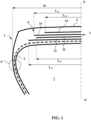
- figure 1 represents only a half-view of a tire which extends symmetrically with respect to the XX' axis which represents the circumferential median plane, or equatorial plane, of a tire.
- the crown frame is itself topped with a tread 4 having a surface 5 intended to come into contact with the ground.
- the maximum axial width W of the tire is equal to 317 mm.
- the axial width L 31 of the first working layer 31 is equal to 252 mm.
- the axial width L 33 of the second working layer 33 is equal to 232 mm.
- the axial width L 32 of the layer of circumferential reinforcing elements 32 is equal to 194 mm.
- the last top sheet 34 has a width L44 equal to 124 mm.
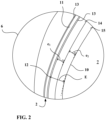
- FIG 2 illustrates an enlargement of zone 6 of the figure 1 and indicates in particular the thickness E of rubber mixture between the inner surface 10 of the cavity 7 of the tire and the point 12 of a reinforcing element 11 closest to said surface 10.
- This thickness E is equal to the length of the orthogonal projection of the point 12 of a reinforcing element 11 closest to said surface 10 on the surface 10.
- This thickness E is the sum of the thicknesses of the different rubber mixtures put in place between said reinforcing element 11 of the carcass reinforcement 2; these are on the one hand the thickness of the radially inner calendering layer 13 of the carcass reinforcement and on the other hand, the thicknesses e 1 , e 2 of the different layers 14, 15 of rubber mixture forming the inner wall of the tire 1.
- These thicknesses e 1 , e 2 are moreover equal to the length of the orthogonal projection of a point of a surface on the other surface of the layer concerned respectively 14 or 15.
- the measured value of E is equal to 3.5 mm.
- ei and e 2 are respectively equal to 1.5 mm and 1.5 mm.
- compositions (T1, T2 and C) comprise a crosslinking system conventionally used in the manufacture of tire treads; this crosslinking system notably comprises sulfur, ZnO, stearic acid and an accelerator.
- First reference tires P1 and P2 have treads made up of the compounds T1 and T2 respectively. These reference tires P1 and P2 also differ from the tires according to the invention by a thickness E of rubber compound between the inner surface of the cavity of the tire and the point of a reinforcing element closest to said surface being equal to 5 mm, each of the thicknesses ei and e 2 being respectively equal to 2.2 mm and 2.3 mm.
- the tires according to the invention have the advantage of being lighter with a weight reduction of 6% compared to the reference tires P1 and P2.
- P3 reference tires have been produced. They are similar to tires I of the invention and their crown architecture differs in that the crown reinforcement does not include a layer of circumferential reinforcing elements. They are produced with a tread consisting of mixtures C.
- Wear resistance tests were carried out by comparing the tires I according to the invention with the reference tires P1 and P2 by equipping identical vehicles with each of these tires.
- Second endurance tests were carried out on a test machine cyclically imposing a transverse force and a dynamic overload on the tires. The tests were carried out for the tires according to the invention with conditions identical to those applied to the reference tires.
- the P3 tires covered much shorter distances, approximately equal to half of those covered by the I tires according to the invention and the reference tires P1 and P2.
- Rolling resistance measurements are expressed in kg/t, with a value of 100 being assigned to the P1 tyre. Values above 100 show better rolling resistance performance.
Landscapes
- Engineering & Computer Science (AREA)
- Mechanical Engineering (AREA)
- Compositions Of Macromolecular Compounds (AREA)
- Tires In General (AREA)
Claims (15)
- Reifen (1) mit Radialkarkassenverstärkung (2), beinhaltend eine Gürtelverstärkung (3), die wiederum radial von einem Laufstreifen (4) überdeckt wird, wobei der Laufstreifen über zwei Flanken mit zwei Wülsten verbunden ist, wobei die Gürtelverstärkung (3) mindestens eine Lage aus umfänglichen Festigkeitsträgerelementen (32) umfasst, wobei der Laufstreifen mindestens eine Lage aus Polymermischung umfasst, die eine Lauffläche (5) bildet, die dazu bestimmt ist, mit einer Fahrbahn in Kontakt zu kommen, dadurch gekennzeichnet, dass die Wärmeleitfähigkeit der Lage aus Polymermischung, die die Lauffläche bildet, strikt kleiner als 0,270 W/(m.K) ist, wobei die Wärmeleitfähigkeit nach der Norm ISO 8302:1991 gemessen wird, und dass die Lage aus Polymermischung, die die Lauffläche bildet, aus einer Kautschukzusammensetzung auf Basis von mindestens einer Elastomermatrix, welche überwiegend ein Copolymer auf Basis von Styrol und Butadien beinhaltet, das eine Glasübergangstemperatur Tg von strikt größer als -65 °C und kleiner als oder gleich -30 °C hat, und dass, in einer radialen Ebene, über mindestens 50 % des Meridianprofils des Reifens, die Kautschukmischungsdicke (E) zwischen der Innenfläche (10) des Hohlraums (7) des Reifens und dem zu der Innenfläche des Hohlraums nächstgelegenen Punkt eines metallischen Festigkeitsträgerelements kleiner als 4,5 mm ist.
- Reifen (1) nach Anspruch 1, dadurch gekennzeichnet, dass, in einer radialen Ebene, die Kautschukmischungsdicke (E) zwischen der Innenfläche des Hohlraums (7) des Reifens und dem zu der Innenfläche des Hohlraums nächstgelegenen Punkt eines metallischen Festigkeitsträgerelements über mindestens 70 % des Meridianprofils des Reifens und vorzugsweise über mindestens 80 % des Meridianprofils des Reifens kleiner als 4,5 mm ist.
- Reifen (1) nach Anspruch 1 oder 2, dadurch gekennzeichnet, dass die Kautschukzusammensetzung der mindestens einen Lage aus Polymermischung, die die Lauffläche des Reifens bildet, mindestens einen verstärkenden Füllstoff umfasst, der überwiegend einen verstärkenden anorganischen Füllstoff beinhaltet.
- Reifen (1) nach Anspruch 3, dadurch gekennzeichnet, dass der verstärkende anorganische Füllstoff Siliciumdioxid ist.
- Reifen (1) nach einem der vorhergehenden Ansprüche, wobei die Kautschukmischung zwischen dem Hohlraum des Reifens und den Festigkeitsträgerelementen der radial innersten Karkassenverstärkungslage aus mindestens zwei Lagen aus Kautschukmischung besteht, dadurch gekennzeichnet, dass, in einer radialen Ebene, über mindestens den Teil des Meridianprofils des Reifens, über den die Kautschukmischungsdicke zwischen der Innenfläche des Hohlraums des Reifens und dem zu der Innenfläche des Hohlraums nächstgelegenen Punkt eines metallischen Festigkeitsträgerelements kleiner als 4,5 mm ist, die radial innerste Lage aus Kautschukmischung (15) eine Dicke (e2) kleiner als 2 mm und vorzugsweise kleiner als 1,8 mm aufweist.
- Reifen (1) nach einem der vorhergehenden Ansprüche, wobei die Kautschukmischung zwischen dem Hohlraum des Reifens und den Festigkeitsträgerelementen der radial innersten Karkassenverstärkungslage aus mindestens zwei Lagen aus Kautschukmischung (14, 15) besteht, dadurch gekennzeichnet, dass, in einer radialen Ebene, über mindestens den Teil des Meridianprofils des Reifens, über den die Kautschukmischungsdicke zwischen der Innenfläche des Hohlraums des Reifens und dem zu der Innenfläche des Hohlraums nächstgelegenen Punkt eines metallischen Festigkeitsträgerelements kleiner als 4,5 mm ist, die Lage aus Kautschukmischung (14), die zu der radial innersten Lage aus Kautschukmischung radial benachbart ist, eine Dicke (e1) kleiner als 2,5 mm und vorzugsweise kleiner als 2 mm aufweist.
- Reifen (1) nach einem der vorhergehenden Ansprüche, dadurch gekennzeichnet, dass die Wärmeleitfähigkeit der Lage aus Polymermischung, die die Lauffläche bildet, strikt kleiner als 0,265 W/(m.K) ist.
- Reifen (1) nach einem der vorhergehenden Ansprüche, dadurch gekennzeichnet, dass die Kautschukzusammensetzung der mindestens einen Lage aus Polymermischung, die die Lauffläche des Reifens bildet, ein Weichmachersystem umfasst, das 0 bis 15 phe, vorzugsweise 0 bis 9 phe, mindestens eines Weichmacherharzes beinhaltet, das eine Glasübergangstemperatur Tg von größer als oder gleich 20 °C hat, und wobei der Gesamtgehalt des Weichmachersystems in der Zusammensetzung 0 bis 17 phe, vorzugsweise 0 bis 11 phe beträgt.
- Reifen (1) nach einem der vorhergehenden Ansprüche, dadurch gekennzeichnet, dass das Copolymer auf Basis von Styrol und Butadien eine Glasübergangstemperatur Tg von -60 °C bis -40 °C hat.
- Reifen (1) nach einem der vorhergehenden Ansprüche, dadurch gekennzeichnet, dass das Copolymer auf Basis von Styrol und auf Basis von Butadien ein Styrol-Butadien-Copolymer ist.
- Reifen (1) nach Anspruch 10, dadurch gekennzeichnet, dass die Elastomermatrix ferner mindestens ein zweites Dienelastomer beinhaltet, das sich von dem Copolymer auf Basis von Styrol und Butadien unterscheidet.
- Reifen (1) nach einem der vorhergehenden Ansprüche, wobei die Gürtelverstärkung (3) mindestens zwei Arbeitsgürtellagen aus Festigkeitsträgerelementen (31, 33) umfasst, dadurch gekennzeichnet, dass die mindestens eine Lage aus umfänglichen Festigkeitsträgerelementen (32) radial zwischen zwei Arbeitsgürtellagen aus Festigkeitsträgerelementen (31, 33) angeordnet ist.
- Reifen (1) nach einem der vorhergehenden Ansprüche, dadurch gekennzeichnet, dass die Gürtelverstärkung (3) mindestens zwei Arbeitsgürtellagen aus Festigkeitsträgerelementen (31, 33) umfasst, die vorzugsweise nicht dehnbar sind und sich von einer Lage zur anderen kreuzen, wobei sie mit der Umfangsrichtung Winkel zwischen 10° und 45° bilden.
- Reifen (1) nach einem der vorhergehenden Ansprüche, dadurch gekennzeichnet, dass die Festigkeitsträgerelemente der mindestens einen Lage aus umfänglichen Festigkeitsträgerelementen (32) metallische Festigkeitsträgerelemente sind, die einen Sekantenmodul bei 0,7 % Dehnung zwischen 10 und 120 GPa und einen maximalen Tangentenmodul von weniger als 150 GPa aufweisen.
- Reifen (1) nach einem der vorhergehenden Ansprüche, dadurch gekennzeichnet, dass die Gürtelverstärkung (3) radial außen um mindestens eine zusätzliche Lage (34), Schutzlage genannt, aus sogenannten elastischen Festigkeitsträgerelementen ergänzt wird, die bezogen auf die Umfangsrichtung mit einem Winkel zwischen 10° und 45° und mit der gleichen Richtung wie der Winkel, der von den Festigkeitsträgerelementen der zu ihr radial benachbarten Arbeitslage (33) gebildet wird, ausgerichtet sind.
Applications Claiming Priority (2)
| Application Number | Priority Date | Filing Date | Title |
|---|---|---|---|
| FR2007182A FR3112310B1 (fr) | 2020-07-07 | 2020-07-07 | Pneumatique presentant des proprietes de resistance au roulement ameliorees |
| PCT/FR2021/051193 WO2022008817A1 (fr) | 2020-07-07 | 2021-06-29 | Pneumatique presentant des proprietes de resistance au roulement ameliorees |
Publications (2)
| Publication Number | Publication Date |
|---|---|
| EP4178809A1 EP4178809A1 (de) | 2023-05-17 |
| EP4178809B1 true EP4178809B1 (de) | 2025-01-29 |
Family
ID=73401621
Family Applications (1)
| Application Number | Title | Priority Date | Filing Date |
|---|---|---|---|
| EP21743225.1A Active EP4178809B1 (de) | 2020-07-07 | 2021-06-29 | Reifen mit verbesserten rollwiderstandseigenschaften |
Country Status (6)
| Country | Link |
|---|---|
| EP (1) | EP4178809B1 (de) |
| CN (1) | CN115916547A (de) |
| BR (1) | BR112022027018A2 (de) |
| CA (1) | CA3182811A1 (de) |
| FR (1) | FR3112310B1 (de) |
| WO (1) | WO2022008817A1 (de) |
Families Citing this family (3)
| Publication number | Priority date | Publication date | Assignee | Title |
|---|---|---|---|---|
| FR3138352B1 (fr) * | 2022-07-29 | 2025-04-25 | Michelin & Cie | Pneumatique à armature de carcasse radiale |
| FR3138351B1 (fr) * | 2022-07-29 | 2025-04-25 | Michelin & Cie | Pneumatique à armature de carcasse radiale |
| FR3138350B1 (fr) * | 2022-07-29 | 2025-04-18 | Michelin & Cie | Pneumatique à armature de carcasse radiale |
Family Cites Families (16)
| Publication number | Priority date | Publication date | Assignee | Title |
|---|---|---|---|---|
| FR1389428A (fr) | 1963-07-19 | 1965-02-19 | Pneumatiques, Caoutchouc Manufacture Et Plastiques Kleber Colombes | Pneumatique pour véhicule de forte charge |
| DE2313586A1 (de) | 1973-03-19 | 1974-09-26 | Uniroyal Ag | Fahrzeugluftreifen, insbesondere fuer lastkraftwagen |
| JPS56163908A (en) * | 1980-05-23 | 1981-12-16 | Bridgestone Corp | Pneumatic tyre |
| FR2728510A1 (fr) | 1994-12-23 | 1996-06-28 | Michelin & Cie | Pneumatique de rapport de forme h/s inferieur ou egal a 0,6 |
| CA2221564C (en) | 1995-05-22 | 2009-02-03 | Cabot Corporation | Elastomeric compounds incorporating silicon-treated carbon blacks |
| DE69722109T2 (de) | 1996-09-03 | 2004-02-19 | Michelin Recherche Et Technique S.A. | Reifen mit einer Lauffläche aus zwei verschiedenen Gummizusammensetzungen zur Steuerung der Abnutzung |
| FR2770458B1 (fr) | 1997-11-05 | 1999-12-03 | Michelin & Cie | Armature de sommet pour pneumatique "poids-lours" |
| JP2001525436A (ja) | 1997-11-28 | 2001-12-11 | コンパニー ゼネラール デ エタブリッスマン ミシュラン−ミシュラン エ コムパニー | アルミナ層で被覆されたカーボンブラックで補強したタイヤ用ゴム組成物 |
| KR100632720B1 (ko) | 1997-11-28 | 2006-10-16 | 꽁빠니 제네랄 드 에따블리세망 미쉘린-미쉘린 에 씨 | 보강 알루미늄계 충전제, 이의 제조방법, 이를 포함하는 고무 조성물, 및 이에 의해 보강된 타이어 및 타이어용 트레드 |
| EP1114093B1 (de) | 1999-05-28 | 2004-10-13 | Société de Technologie Michelin | Kautschukzusammensetzung für reifen basierend auf einem dienelastomer und einem verstärkenden titanoxyd |
| BR0211898A (pt) | 2001-08-13 | 2004-09-21 | Michelin Soc Tech | Composição de borracha diênica para pneumático, processo para preparar a mesma, utilização de uma composição de borracha, artigo semi-acabado de borracha para pneumático, pneumático, banda de rodagem de pneumático, e, processo para reforçar uma composição de borracha diênica destinada à fabricação de pneumáticos |
| FR2950838B1 (fr) * | 2009-10-07 | 2013-02-22 | Michelin Soc Tech | Pneumatique comportant des cables d'armatures de carcasse presentant une faible permeabilite, et des epaisseurs de melanges caoutchouteux variables. |
| FR3008348B1 (fr) * | 2013-07-12 | 2015-08-07 | Michelin & Cie | Pneumatique comportant des epaisseurs variables des melanges caoutchouteux interieurs a l'armature de carcasse |
| WO2019197765A1 (fr) * | 2018-04-09 | 2019-10-17 | Compagnie Generale Des Etablissements Michelin | Pneumatique presentant des proprietes de resistance au roulement et de resistance aux chocs ameliorees |
| FR3080797A1 (fr) * | 2018-05-04 | 2019-11-08 | Compagnie Generale Des Etablissements Michelin | Pneumatique presentant des proprietes d'usure et de resistance au roulement ameliorees |
| FR3112309B1 (fr) * | 2020-07-07 | 2022-06-03 | Michelin & Cie | Pneumatique presentant des proprietes d’endurance et de resistance au roulement ameliorees |
-
2020
- 2020-07-07 FR FR2007182A patent/FR3112310B1/fr active Active
-
2021
- 2021-06-29 EP EP21743225.1A patent/EP4178809B1/de active Active
- 2021-06-29 WO PCT/FR2021/051193 patent/WO2022008817A1/fr not_active Ceased
- 2021-06-29 BR BR112022027018A patent/BR112022027018A2/pt unknown
- 2021-06-29 CN CN202180048569.3A patent/CN115916547A/zh active Pending
- 2021-06-29 CA CA3182811A patent/CA3182811A1/fr active Pending
Also Published As
| Publication number | Publication date |
|---|---|
| CA3182811A1 (fr) | 2022-01-13 |
| FR3112310B1 (fr) | 2023-10-27 |
| FR3112310A1 (fr) | 2022-01-14 |
| EP4178809A1 (de) | 2023-05-17 |
| WO2022008817A1 (fr) | 2022-01-13 |
| CN115916547A (zh) | 2023-04-04 |
| BR112022027018A2 (pt) | 2023-01-24 |
Similar Documents
| Publication | Publication Date | Title |
|---|---|---|
| EP2766201B1 (de) | Reifen mit einer schicht aus umlaufenden verstärkungselementen | |
| EP2766204B1 (de) | Reifen mit einer schicht aus umlaufenden verstärkungselementen | |
| EP2766202B1 (de) | Reifen mit einer schicht aus umlaufenden verstärkungselementen | |
| EP2788202B1 (de) | Reifen mit einer umlaufverstärkungslage | |
| EP4178809B1 (de) | Reifen mit verbesserten rollwiderstandseigenschaften | |
| EP2788201A1 (de) | Reifen mit einer schicht aus umlaufenden verstärkungselementen | |
| WO2019048762A1 (fr) | Pneumatique allege | |
| EP3160766B1 (de) | Reifen mit einer schicht aus umlaufenden verstärkungselementen | |
| EP3160761B1 (de) | Reifen mit einer schicht aus umlaufenden verstärkungselementen | |
| EP3160768B1 (de) | Reifen mit einer schicht aus umlaufenden verstärkungselementen | |
| EP4178810B1 (de) | Reifen mit verbesserten dauer- und rollwiderstandseigenschaften | |
| EP3160765A1 (de) | Reifen mit einer schicht aus umlaufenden verstärkungselementen | |
| WO2017103452A1 (fr) | Pneumatique presentant des proprietes d'usure ameliorees | |
| EP3390100A1 (de) | Reifen mit verbesserten eigenschaften der abnutzung und des rollwiderstands | |
| EP3160764B1 (de) | Reifen mit einer schicht aus umlaufenden verstärkungselementen | |
| EP3390080A1 (de) | Reifen mit verbesserten abnutzungs- und rollwiderstandseigenschaften | |
| WO2019048760A1 (fr) | Pneumatique allege | |
| WO2017103448A1 (fr) | Pneumatique présentant des propriétés d'usure améliorées | |
| WO2017103446A1 (fr) | Pneumatique présentant des propriétés d'usure améliorées | |
| FR3045478A1 (fr) | Pneumatique presentant des proprietes d'usure et de resistance au roulement ameliorees | |
| WO2019063919A1 (fr) | Pneumatique allege | |
| FR3045465A1 (fr) | Pneumatique presentant des proprietes d'usure ameliorees | |
| WO2017103450A1 (fr) | Pneumatique présentant des propriétés d'usure améliorées | |
| FR3045472A1 (fr) | Pneumatique presentant des proprietes d'usure et de resistance au roulement ameliorees |
Legal Events
| Date | Code | Title | Description |
|---|---|---|---|
| STAA | Information on the status of an ep patent application or granted ep patent |
Free format text: STATUS: UNKNOWN |
|
| STAA | Information on the status of an ep patent application or granted ep patent |
Free format text: STATUS: THE INTERNATIONAL PUBLICATION HAS BEEN MADE |
|
| PUAI | Public reference made under article 153(3) epc to a published international application that has entered the european phase |
Free format text: ORIGINAL CODE: 0009012 |
|
| STAA | Information on the status of an ep patent application or granted ep patent |
Free format text: STATUS: REQUEST FOR EXAMINATION WAS MADE |
|
| 17P | Request for examination filed |
Effective date: 20230207 |
|
| AK | Designated contracting states |
Kind code of ref document: A1 Designated state(s): AL AT BE BG CH CY CZ DE DK EE ES FI FR GB GR HR HU IE IS IT LI LT LU LV MC MK MT NL NO PL PT RO RS SE SI SK SM TR |
|
| DAV | Request for validation of the european patent (deleted) | ||
| DAX | Request for extension of the european patent (deleted) | ||
| GRAP | Despatch of communication of intention to grant a patent |
Free format text: ORIGINAL CODE: EPIDOSNIGR1 |
|
| STAA | Information on the status of an ep patent application or granted ep patent |
Free format text: STATUS: GRANT OF PATENT IS INTENDED |
|
| RIC1 | Information provided on ipc code assigned before grant |
Ipc: B60C 11/00 20060101ALI20240821BHEP Ipc: B60C 1/00 20060101AFI20240821BHEP |
|
| INTG | Intention to grant announced |
Effective date: 20240923 |
|
| GRAS | Grant fee paid |
Free format text: ORIGINAL CODE: EPIDOSNIGR3 |
|
| GRAA | (expected) grant |
Free format text: ORIGINAL CODE: 0009210 |
|
| STAA | Information on the status of an ep patent application or granted ep patent |
Free format text: STATUS: THE PATENT HAS BEEN GRANTED |
|
| AK | Designated contracting states |
Kind code of ref document: B1 Designated state(s): AL AT BE BG CH CY CZ DE DK EE ES FI FR GB GR HR HU IE IS IT LI LT LU LV MC MK MT NL NO PL PT RO RS SE SI SK SM TR |
|
| REG | Reference to a national code |
Ref country code: GB Ref legal event code: FG4D Free format text: NOT ENGLISH |
|
| REG | Reference to a national code |
Ref country code: CH Ref legal event code: EP |
|
| REG | Reference to a national code |
Ref country code: DE Ref legal event code: R096 Ref document number: 602021025442 Country of ref document: DE |
|
| REG | Reference to a national code |
Ref country code: IE Ref legal event code: FG4D Free format text: LANGUAGE OF EP DOCUMENT: FRENCH |
|
| REG | Reference to a national code |
Ref country code: NL Ref legal event code: MP Effective date: 20250129 |
|
| PG25 | Lapsed in a contracting state [announced via postgrant information from national office to epo] |
Ref country code: NL Free format text: LAPSE BECAUSE OF FAILURE TO SUBMIT A TRANSLATION OF THE DESCRIPTION OR TO PAY THE FEE WITHIN THE PRESCRIBED TIME-LIMIT Effective date: 20250129 |
|
| PG25 | Lapsed in a contracting state [announced via postgrant information from national office to epo] |
Ref country code: RS Free format text: LAPSE BECAUSE OF FAILURE TO SUBMIT A TRANSLATION OF THE DESCRIPTION OR TO PAY THE FEE WITHIN THE PRESCRIBED TIME-LIMIT Effective date: 20250429 |
|
| PG25 | Lapsed in a contracting state [announced via postgrant information from national office to epo] |
Ref country code: FI Free format text: LAPSE BECAUSE OF FAILURE TO SUBMIT A TRANSLATION OF THE DESCRIPTION OR TO PAY THE FEE WITHIN THE PRESCRIBED TIME-LIMIT Effective date: 20250129 |
|
| PG25 | Lapsed in a contracting state [announced via postgrant information from national office to epo] |
Ref country code: PL Free format text: LAPSE BECAUSE OF FAILURE TO SUBMIT A TRANSLATION OF THE DESCRIPTION OR TO PAY THE FEE WITHIN THE PRESCRIBED TIME-LIMIT Effective date: 20250129 |
|
| PGFP | Annual fee paid to national office [announced via postgrant information from national office to epo] |
Ref country code: DE Payment date: 20250618 Year of fee payment: 5 |
|
| PG25 | Lapsed in a contracting state [announced via postgrant information from national office to epo] |
Ref country code: ES Free format text: LAPSE BECAUSE OF FAILURE TO SUBMIT A TRANSLATION OF THE DESCRIPTION OR TO PAY THE FEE WITHIN THE PRESCRIBED TIME-LIMIT Effective date: 20250129 |
|
| REG | Reference to a national code |
Ref country code: LT Ref legal event code: MG9D |
|
| PG25 | Lapsed in a contracting state [announced via postgrant information from national office to epo] |
Ref country code: NO Free format text: LAPSE BECAUSE OF FAILURE TO SUBMIT A TRANSLATION OF THE DESCRIPTION OR TO PAY THE FEE WITHIN THE PRESCRIBED TIME-LIMIT Effective date: 20250429 Ref country code: IS Free format text: LAPSE BECAUSE OF FAILURE TO SUBMIT A TRANSLATION OF THE DESCRIPTION OR TO PAY THE FEE WITHIN THE PRESCRIBED TIME-LIMIT Effective date: 20250529 |
|
| REG | Reference to a national code |
Ref country code: AT Ref legal event code: MK05 Ref document number: 1763103 Country of ref document: AT Kind code of ref document: T Effective date: 20250129 |
|
| PG25 | Lapsed in a contracting state [announced via postgrant information from national office to epo] |
Ref country code: HR Free format text: LAPSE BECAUSE OF FAILURE TO SUBMIT A TRANSLATION OF THE DESCRIPTION OR TO PAY THE FEE WITHIN THE PRESCRIBED TIME-LIMIT Effective date: 20250129 |
|
| PG25 | Lapsed in a contracting state [announced via postgrant information from national office to epo] |
Ref country code: LV Free format text: LAPSE BECAUSE OF FAILURE TO SUBMIT A TRANSLATION OF THE DESCRIPTION OR TO PAY THE FEE WITHIN THE PRESCRIBED TIME-LIMIT Effective date: 20250129 Ref country code: PT Free format text: LAPSE BECAUSE OF FAILURE TO SUBMIT A TRANSLATION OF THE DESCRIPTION OR TO PAY THE FEE WITHIN THE PRESCRIBED TIME-LIMIT Effective date: 20250529 |
|
| PGFP | Annual fee paid to national office [announced via postgrant information from national office to epo] |
Ref country code: FR Payment date: 20250627 Year of fee payment: 5 |
|
| PG25 | Lapsed in a contracting state [announced via postgrant information from national office to epo] |
Ref country code: GR Free format text: LAPSE BECAUSE OF FAILURE TO SUBMIT A TRANSLATION OF THE DESCRIPTION OR TO PAY THE FEE WITHIN THE PRESCRIBED TIME-LIMIT Effective date: 20250430 Ref country code: BG Free format text: LAPSE BECAUSE OF FAILURE TO SUBMIT A TRANSLATION OF THE DESCRIPTION OR TO PAY THE FEE WITHIN THE PRESCRIBED TIME-LIMIT Effective date: 20250129 |
|
| PG25 | Lapsed in a contracting state [announced via postgrant information from national office to epo] |
Ref country code: AT Free format text: LAPSE BECAUSE OF FAILURE TO SUBMIT A TRANSLATION OF THE DESCRIPTION OR TO PAY THE FEE WITHIN THE PRESCRIBED TIME-LIMIT Effective date: 20250129 |
|
| PG25 | Lapsed in a contracting state [announced via postgrant information from national office to epo] |
Ref country code: SE Free format text: LAPSE BECAUSE OF FAILURE TO SUBMIT A TRANSLATION OF THE DESCRIPTION OR TO PAY THE FEE WITHIN THE PRESCRIBED TIME-LIMIT Effective date: 20250129 |
|
| PG25 | Lapsed in a contracting state [announced via postgrant information from national office to epo] |
Ref country code: SM Free format text: LAPSE BECAUSE OF FAILURE TO SUBMIT A TRANSLATION OF THE DESCRIPTION OR TO PAY THE FEE WITHIN THE PRESCRIBED TIME-LIMIT Effective date: 20250129 |
|
| PG25 | Lapsed in a contracting state [announced via postgrant information from national office to epo] |
Ref country code: DK Free format text: LAPSE BECAUSE OF FAILURE TO SUBMIT A TRANSLATION OF THE DESCRIPTION OR TO PAY THE FEE WITHIN THE PRESCRIBED TIME-LIMIT Effective date: 20250129 |
|
| PG25 | Lapsed in a contracting state [announced via postgrant information from national office to epo] |
Ref country code: IT Free format text: LAPSE BECAUSE OF FAILURE TO SUBMIT A TRANSLATION OF THE DESCRIPTION OR TO PAY THE FEE WITHIN THE PRESCRIBED TIME-LIMIT Effective date: 20250129 |
|
| PG25 | Lapsed in a contracting state [announced via postgrant information from national office to epo] |
Ref country code: EE Free format text: LAPSE BECAUSE OF FAILURE TO SUBMIT A TRANSLATION OF THE DESCRIPTION OR TO PAY THE FEE WITHIN THE PRESCRIBED TIME-LIMIT Effective date: 20250129 Ref country code: CZ Free format text: LAPSE BECAUSE OF FAILURE TO SUBMIT A TRANSLATION OF THE DESCRIPTION OR TO PAY THE FEE WITHIN THE PRESCRIBED TIME-LIMIT Effective date: 20250129 |
|
| PG25 | Lapsed in a contracting state [announced via postgrant information from national office to epo] |
Ref country code: RO Free format text: LAPSE BECAUSE OF FAILURE TO SUBMIT A TRANSLATION OF THE DESCRIPTION OR TO PAY THE FEE WITHIN THE PRESCRIBED TIME-LIMIT Effective date: 20250129 |
|
| PG25 | Lapsed in a contracting state [announced via postgrant information from national office to epo] |
Ref country code: SK Free format text: LAPSE BECAUSE OF FAILURE TO SUBMIT A TRANSLATION OF THE DESCRIPTION OR TO PAY THE FEE WITHIN THE PRESCRIBED TIME-LIMIT Effective date: 20250129 |
|
| REG | Reference to a national code |
Ref country code: DE Ref legal event code: R097 Ref document number: 602021025442 Country of ref document: DE |
|
| PLBE | No opposition filed within time limit |
Free format text: ORIGINAL CODE: 0009261 |
|
| STAA | Information on the status of an ep patent application or granted ep patent |
Free format text: STATUS: NO OPPOSITION FILED WITHIN TIME LIMIT |
|
| REG | Reference to a national code |
Ref country code: CH Ref legal event code: L10 Free format text: ST27 STATUS EVENT CODE: U-0-0-L10-L00 (AS PROVIDED BY THE NATIONAL OFFICE) Effective date: 20251210 |
|
| 26N | No opposition filed |
Effective date: 20251030 |
|
| REG | Reference to a national code |
Ref country code: CH Ref legal event code: H13 Free format text: ST27 STATUS EVENT CODE: U-0-0-H10-H13 (AS PROVIDED BY THE NATIONAL OFFICE) Effective date: 20260127 |
|
| PG25 | Lapsed in a contracting state [announced via postgrant information from national office to epo] |
Ref country code: MC Free format text: LAPSE BECAUSE OF FAILURE TO SUBMIT A TRANSLATION OF THE DESCRIPTION OR TO PAY THE FEE WITHIN THE PRESCRIBED TIME-LIMIT Effective date: 20250129 |
|
| PG25 | Lapsed in a contracting state [announced via postgrant information from national office to epo] |
Ref country code: LU Free format text: LAPSE BECAUSE OF NON-PAYMENT OF DUE FEES Effective date: 20250629 |
|
| GBPC | Gb: european patent ceased through non-payment of renewal fee |
Effective date: 20250629 |
|
| REG | Reference to a national code |
Ref country code: BE Ref legal event code: MM Effective date: 20250630 |
|
| PG25 | Lapsed in a contracting state [announced via postgrant information from national office to epo] |
Ref country code: GB Free format text: LAPSE BECAUSE OF NON-PAYMENT OF DUE FEES Effective date: 20250629 |
|
| PG25 | Lapsed in a contracting state [announced via postgrant information from national office to epo] |
Ref country code: IE Free format text: LAPSE BECAUSE OF NON-PAYMENT OF DUE FEES Effective date: 20250629 |
|
| PG25 | Lapsed in a contracting state [announced via postgrant information from national office to epo] |
Ref country code: BE Free format text: LAPSE BECAUSE OF NON-PAYMENT OF DUE FEES Effective date: 20250630 |
|
| PG25 | Lapsed in a contracting state [announced via postgrant information from national office to epo] |
Ref country code: CH Free format text: LAPSE BECAUSE OF NON-PAYMENT OF DUE FEES Effective date: 20250630 |