EP4177801B1 - Verfahren zur beurteilung eines risikos von online-transaktionen - Google Patents
Verfahren zur beurteilung eines risikos von online-transaktionen Download PDFInfo
- Publication number
- EP4177801B1 EP4177801B1 EP21206410.9A EP21206410A EP4177801B1 EP 4177801 B1 EP4177801 B1 EP 4177801B1 EP 21206410 A EP21206410 A EP 21206410A EP 4177801 B1 EP4177801 B1 EP 4177801B1
- Authority
- EP
- European Patent Office
- Prior art keywords
- attributes
- machine learning
- user
- risk
- risk score
- Prior art date
- Legal status (The legal status is an assumption and is not a legal conclusion. Google has not performed a legal analysis and makes no representation as to the accuracy of the status listed.)
- Active
Links
Images


Classifications
-
- G—PHYSICS
- G06—COMPUTING OR CALCULATING; COUNTING
- G06Q—INFORMATION AND COMMUNICATION TECHNOLOGY [ICT] SPECIALLY ADAPTED FOR ADMINISTRATIVE, COMMERCIAL, FINANCIAL, MANAGERIAL OR SUPERVISORY PURPOSES; SYSTEMS OR METHODS SPECIALLY ADAPTED FOR ADMINISTRATIVE, COMMERCIAL, FINANCIAL, MANAGERIAL OR SUPERVISORY PURPOSES, NOT OTHERWISE PROVIDED FOR
- G06Q20/00—Payment architectures, schemes or protocols
- G06Q20/38—Payment protocols; Details thereof
- G06Q20/40—Authorisation, e.g. identification of payer or payee, verification of customer or shop credentials; Review and approval of payers, e.g. check credit lines or negative lists
- G06Q20/401—Transaction verification
- G06Q20/4016—Transaction verification involving fraud or risk level assessment in transaction processing
-
- G—PHYSICS
- G06—COMPUTING OR CALCULATING; COUNTING
- G06N—COMPUTING ARRANGEMENTS BASED ON SPECIFIC COMPUTATIONAL MODELS
- G06N20/00—Machine learning
-
- G—PHYSICS
- G06—COMPUTING OR CALCULATING; COUNTING
- G06Q—INFORMATION AND COMMUNICATION TECHNOLOGY [ICT] SPECIALLY ADAPTED FOR ADMINISTRATIVE, COMMERCIAL, FINANCIAL, MANAGERIAL OR SUPERVISORY PURPOSES; SYSTEMS OR METHODS SPECIALLY ADAPTED FOR ADMINISTRATIVE, COMMERCIAL, FINANCIAL, MANAGERIAL OR SUPERVISORY PURPOSES, NOT OTHERWISE PROVIDED FOR
- G06Q20/00—Payment architectures, schemes or protocols
- G06Q20/30—Payment architectures, schemes or protocols characterised by the use of specific devices or networks
- G06Q20/32—Payment architectures, schemes or protocols characterised by the use of specific devices or networks using wireless devices
- G06Q20/322—Aspects of commerce using mobile devices [M-devices]
- G06Q20/3223—Realising banking transactions through M-devices
-
- G—PHYSICS
- G06—COMPUTING OR CALCULATING; COUNTING
- G06Q—INFORMATION AND COMMUNICATION TECHNOLOGY [ICT] SPECIALLY ADAPTED FOR ADMINISTRATIVE, COMMERCIAL, FINANCIAL, MANAGERIAL OR SUPERVISORY PURPOSES; SYSTEMS OR METHODS SPECIALLY ADAPTED FOR ADMINISTRATIVE, COMMERCIAL, FINANCIAL, MANAGERIAL OR SUPERVISORY PURPOSES, NOT OTHERWISE PROVIDED FOR
- G06Q20/00—Payment architectures, schemes or protocols
- G06Q20/30—Payment architectures, schemes or protocols characterised by the use of specific devices or networks
- G06Q20/32—Payment architectures, schemes or protocols characterised by the use of specific devices or networks using wireless devices
- G06Q20/325—Payment architectures, schemes or protocols characterised by the use of specific devices or networks using wireless devices using wireless networks
-
- G—PHYSICS
- G06—COMPUTING OR CALCULATING; COUNTING
- G06Q—INFORMATION AND COMMUNICATION TECHNOLOGY [ICT] SPECIALLY ADAPTED FOR ADMINISTRATIVE, COMMERCIAL, FINANCIAL, MANAGERIAL OR SUPERVISORY PURPOSES; SYSTEMS OR METHODS SPECIALLY ADAPTED FOR ADMINISTRATIVE, COMMERCIAL, FINANCIAL, MANAGERIAL OR SUPERVISORY PURPOSES, NOT OTHERWISE PROVIDED FOR
- G06Q20/00—Payment architectures, schemes or protocols
- G06Q20/38—Payment protocols; Details thereof
- G06Q20/389—Keeping log of transactions for guaranteeing non-repudiation of a transaction
-
- G—PHYSICS
- G06—COMPUTING OR CALCULATING; COUNTING
- G06Q—INFORMATION AND COMMUNICATION TECHNOLOGY [ICT] SPECIALLY ADAPTED FOR ADMINISTRATIVE, COMMERCIAL, FINANCIAL, MANAGERIAL OR SUPERVISORY PURPOSES; SYSTEMS OR METHODS SPECIALLY ADAPTED FOR ADMINISTRATIVE, COMMERCIAL, FINANCIAL, MANAGERIAL OR SUPERVISORY PURPOSES, NOT OTHERWISE PROVIDED FOR
- G06Q20/00—Payment architectures, schemes or protocols
- G06Q20/38—Payment protocols; Details thereof
- G06Q20/40—Authorisation, e.g. identification of payer or payee, verification of customer or shop credentials; Review and approval of payers, e.g. check credit lines or negative lists
- G06Q20/409—Device specific authentication in transaction processing
- G06Q20/4093—Monitoring of device authentication
Definitions
- the invention relates to a method, a telecommunication system, a user device and a computer program product to assess a security risk of online based transactions.
- US 2021/326881 A1 shows Methods and systems for configuring a risk assessment engine to predict a risk of a user based on a topic classification across a set of unknown topics generated by a topic model.
- a risk determination system obtains a plurality of transactions previously conducted by a user.
- the risk determination system generates a risk document comprising a sequence of words that describe the plurality of transactions.
- a topic model is used to determine a topic classification for the user based on the sequence of words.
- the topic model comprises a natural language processor configured to classify the risk document to one or more topics based on the words within the risk document.
- the risk determination system configures the risk assessment engine to accept the topic classification as input value(s) for predicting a risk associated with the user.
- the risk score on an absolute scale, for example from 1 to 10, wherein 1 indicates the lowest security risk and 10 indicates the highest security risk, but it is also possible to design the risk score as a probability value, wherein zero indicates the lowest security risk and one indicates the highest security risk.
- the user and/or the telecommunication provider implements different actions, based on the outcome of the risk score. For example, do not apply a 2 nd factor authentication method and allow the transaction based on a "good” risk score or stop a transaction or ask for 2 nd factor on case of a "bad” risk score.
- the risk owner may as well contact the customer and validate the transaction.
- the use-case-specific machine learning algorithms are trained with specific attributes and associated risks scores.
- the telecommunication provider and/or the user and/or the company interrupt the online transaction if the risk score exceeds a predefined risk value.
- the interruption can be implemented within the system of the telecommunication provider and/or the company and/or the user device in an automated fashion if the risk value exceeds a predefined risk score.
- the company can:
- different use cases for online transactions have individual predefined risk values.
- the user can adjust the predefined risk value on his user device or within his computing system.
- this provides the advantage that the user can decide for himself at which risk score the online transaction will be interrupted by his user device or his system.
- the attributes are retrieved from databases of the telecommunication provider.
- the databases can be configured as a secure environment.
- it can be specified for each use case which attributes shall be retrieved.
- attributes being older than a predefined timestamp shall not be retrieved.
- Possible attributes are SIM SWAPs, Fraud history, Type Allocation Code ("TAC”), eID, SIM Type, stolen credentials, contract data, operating system (OS), Coordinated Vulnerability Database (“CVD”), IMEI Blacklist (devices of perpetrators), Mobile Protect Pro, applications, location information, access information.
- TAC Type Allocation Code
- eID Session ID
- SIM Type Session ID
- SIM Type Session ID
- CVD Coordinated Vulnerability Database
- IMEI Blacklist devices of perpetrators
- Mobile Protect Pro applications, location information, access information.
- the attributes are grouped into the following data classes of attributes:
- the score may be applied for various business areas and fraud vectors without variations - even if those vectors were unknown at the time of score invention.
- training data of the machine learning algorithm comprises annotated and/or non-annotated historic fraud data.
- historic fraud data provides the advantage according to an old well-known principle of physics "the experiment is the best teacher".
- historic fraud data is data that was actually used to commit online attacks so that this historic fraud data is the best starting point to train the machine learning algorithm because it covers real cases.
- security experts can update historic fraud data regarding recent approaches of criminal elements that did not happen in the original historic fraud data set.
- a feedback loop is used to update the machine learning algorithm.
- the user and/or telecommunication provider triggers the feedback loop by editing the returned calculated risk score.
- This provides an efficient way of triggering the feedback loop by providing new training data at the same time.
- the user and/or the communication provider will edit the returned calculated risk score if they think the return risk score was not accurate, for example because the returned risk score did not prevent a cyber-attack regarding the online transaction.
- a data communication system in particular a telecommunication system, wherein the telecommunication system is configured to execute the steps of the methods described above.
- the telecommunication system comprises servers that are configured to execute the steps of the method.
- the telecommunication system comprises appropriate interfaces to communicate over the Internet, in particular to receive the online transaction requests and return the calculated score results via REST API interfaces.
- a user device configured to perform a request and to receive and process the calculated risk score as described above.
- a computer program product comprises instructions which, when the program is executed by a telecommunication system, cause the telecommunication system to carry out the steps of the method described above.
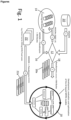
- Fig. 1 shows a schematic overview of the training process of the machine learning algorithm of the inventive method.
- a database 10 in particular a Short Message Service Center Large Account 10, comprises numbers "MSISDN" with passwords, in particular in the area of direct carrier billing.
- database 10 comprises all possible events which means that every number of this database can trigger an online transaction.
- a trained machine learning algorithm in other words a trained AI-model, shall be able to identify in particular such online transactions that were affected, by criminals. It follows that not all numbers of the database 10 are needed to train the machine learning algorithm. Hence, all the numbers of the database 10 enter into the decision 12, wherein the decision 12 filters those numbers "MSISDN" that were actually affected by criminals.
- the attributes that can be used to calculate the risk score are retrieved from databases of the telecommunication provider.
- the attributes can comprise one and/or a combination of the following attributes: SIM SWAPs, Fraud History, TAC, eID, SIM Type, Stolen Credentials, Contract data, OS, CVD, IMEI BL, Mobile Protect Pro, type of connection, applications running an the user device, and/or Location verification.
- step 16 the "MSISDN” and the associated attributes and the decision 12, wherein the decision 12 pseudonymises the "MSISDN” in order to maintain data privacy.
- step 18 the pseudonyms and the attributes served as the first input training data for the machine learning algorithm 20.
- the numeral reference 18a shows that it is possible to assign specific pseudonyms and the attributes for different use cases, in the example for cases A - D, as the first input training data. This would yield different trained machine learning models A - D, wherein each of the models is tailored to one of the use cases A - D. AI-models that are tailored in such a way provide general results which are more accurate.
- Fig. 1 shows the second part of the training data for the machine learning algorithm 20.
- security experts evaluate a risk score of the corresponding events from which the attributes were retrieved in step 14. Based on their expertise, these security experts assign a risk score to each of the events in which criminals were involved.
- the numeral reference 22a shows that it is possible to assign specific risk scores for the different use cases, in the example for cases A - D, as the second input training data.
- the machine learning algorithm 20 can be trained with the first and second input training data so that the trained machine learning algorithm 20 can return a risk score to determine the probability of criminal action if the associated attributes of the online transaction are given as input to the trained machine learning algorithm 20.
- a user 24 requests a risk score by using his user device 25, for example a computer 25 and/or a smartphone 25, of a certain online transaction.
- the user 24 can use an API interface 26, in particular an API gateway 26, to send his request to a telecommunication system 1 of a telecommunication provider.
- the telecommunication system 1 comprises a network to transfer data and server entities to perform the tasks of a telecommunication system.
- step 28 the request is being enriched with the attributes that correspond to the request.
- the attributes are retrieved from one or more databases 32 of the telecommunication provider.
- the request serves as input for the trained machine learning algorithm 20.
- the trained machine learning algorithm 20 is implemented on a server 35 of the telecommunication provider and generates a calculated risk score 34 and returns the calculated risk score 34 to the user, in particular the calculated risk score 34 is returned as a response to the user via the API interface 26, in particular the API gateway 26.
- the user can decide the probability of criminal action regarding his online transaction and can apply the appropriate measures. Possible measures are to continue with the online transaction, if the calculated risk 34 is below a predefined threshold or to stop the online transaction if the calculated risk are 34 is higher than the predefined threshold.
- Last SIM-Change (3) 'empty' means that according to the data available a SIM swap/change has never happened.
- the interpretation can also be left to the user/risk owner.
- the telecommunication provider and/or the user can implement appropriate security means. For example, if the risk score is below 0.4, a 2-factor-autentification is started to secure the online transaction.
- a user 50 makes a risk score request for an online transaction, wherein the request is almost performed in real time.
- This request can be submitted to the operational machine learning algorithm 20b as described in Fig. 2 , wherein the attributes belonging to the request are retrieved from the database 32.
- the operational machine learning algorithm 20b then returns the calculated risk score 34 and returns the score resulted in step 42 to the user.
- the user 50 can mark the returned risk score 34 as being true or false in step 44. In particular, he can mark the return risk score 34 as being false if it turned out that the transaction was actually affected by criminal action even if the returned risk score 34 indicated that the online transaction should be safe.
- This feedback of the user 50 can be transferred to a feedback loop 46, wherein this new information about the risk score can be used to train 48, in particular to retrain 48, the to-be-trained machine learning algorithm 20a.
- fraud expertise 52 from security experts can be used to train the to-be-trained machine learning algorithm 20a. After the to-be-trained machine learning algorithm 20a was updated, it becomes the operational machine learning 20b in step 54.
- Fig. 4 shows a further schematic overview of the inventive method.
Landscapes
- Business, Economics & Management (AREA)
- Engineering & Computer Science (AREA)
- Accounting & Taxation (AREA)
- Theoretical Computer Science (AREA)
- Physics & Mathematics (AREA)
- General Physics & Mathematics (AREA)
- Strategic Management (AREA)
- General Business, Economics & Management (AREA)
- Finance (AREA)
- Computer Networks & Wireless Communication (AREA)
- Computer Security & Cryptography (AREA)
- Software Systems (AREA)
- Artificial Intelligence (AREA)
- Computer Vision & Pattern Recognition (AREA)
- Data Mining & Analysis (AREA)
- Evolutionary Computation (AREA)
- Medical Informatics (AREA)
- Computing Systems (AREA)
- General Engineering & Computer Science (AREA)
- Mathematical Physics (AREA)
- Financial Or Insurance-Related Operations Such As Payment And Settlement (AREA)
Claims (13)
- Verfahren zum Beurteilen eines Sicherheitsrisikos online-basierter Transaktionen, wobei das Verfahren die folgenden, von einem Telekommunikationssystem ausgeführten Schritte umfasst:• Empfangen einer Online-Transaktionsanfrage (24), insbesondere Empfangen einer Online-Transaktionsanfrage (24) durch einen Benutzer mittels eines Benutzerendgeräts (25);• Abfragen (30), durch einen Telekommunikationsanbieter, mindestens eines Attributs, das mit der Transaktionsanfrage verknüpft ist;• Übergeben des mindestens einen Attributs der Transaktionsanfrage an einen trainierten maschinellen Lernalgorithmus (20),∘ wobei der maschinelle Lernalgorithmus mit mehreren Datensätzen mit mindestens einem Attribut und einem zugeordneten Risikowert trainiert worden ist;∘ wobei der trainierte maschinelle Lernalgorithmus dazu eingerichtet ist, basierend auf den bereitgestellten Attributen einen Risikowert (34), insbesondere eine netzwerkbezogene forensische Risikobewertung "NRFRS", zu berechnen;• Zurückgeben des berechneten Risikowerts, insbesondere Zurückgeben des berechneten Risikowerts an den Benutzer und/oder an ein Unternehmen, das mit der Online-Transaktionsanfrage (24) verknüpft ist,dadurch gekennzeichnet, dass
die Attribute Daten sind, die exklusiv dem Telekommunikationsanbieter zur Verfügung stehen. - Verfahren nach Anspruch 1, wobei anwendungsfallspezifische maschinelle Lernalgorithmen für verschiedene Anwendungsfälle für Online-Transaktionen implementiert werden.
- Verfahren nach Anspruch 2, wobei die anwendungsfallspezifischen maschinellen Lernalgorithmen mit spezifischen Attributen und zugehörigen Risikowerten trainiert werden.
- Verfahren nach einem der Ansprüche, wobei der Telekommunikationsanbieter und/oder der Benutzer die Online-Transaktion unterbrechen, falls der Risikowert einen vordefinierten Risikowert übersteigt.
- Verfahren nach Anspruch 4, wobei verschiedene Anwendungsfälle für Online-Transaktionen individuelle vordefinierte Risikowerte aufweisen.
- Verfahren nach einem der Ansprüche 4 bis 6, wobei der Benutzer den vordefinierten Risikowert auf seinem Benutzerendgerät anpassen kann.
- Verfahren nach einem der Ansprüche, wobei die Attribute aus Datenbanken der Telekommunikationsanbieter abgefragt werden.
- Verfahren nach einem der Ansprüche, wobei die Attribute in die folgenden Attribut-Datenklassen gruppiert sind:• Geräte-bezogene Attribute,• Schnittstellen-bezogene Attribute,• Anmeldedaten-bezogene Attribute,• Datenverkehrs-bezogene Attribute,• Prozess-bezogene Attribute und/oder• Betrugshistorien-bezogene Attribute.
- Verfahren nach einem der Ansprüche, wobei Trainingsdaten des maschinellen Lernalgorithmus annotierte und/oder nicht annotierte historische Betrugsdaten umfassen.
- Verfahren nach einem der Ansprüche, wobei eine Rückkopplungsschleife benutzt wird, um den maschinellen Lernalgorithmus zu aktualisieren.
- Verfahren nach Anspruch 10, wobei der Benutzer die Rückkopplungsschleife durch Editieren des zurückgegebenen berechneten Risikowerts auslöst.
- Telekommunikationssystem, das dazu eingerichtet ist, die Schritte der Verfahren nach einem der Ansprüche 1 bis 11 auszuführen.
- Computerprogrammprodukt, umfassend Anweisungen, die, wenn das Programm von einem Telekommunikationssystem ausgeführt wird, das Telekommunikationssystem dazu veranlasst, die Schritte des Verfahrens nach Ansprüchen 1 bis 11 auszuführen.
Priority Applications (1)
| Application Number | Priority Date | Filing Date | Title |
|---|---|---|---|
| EP21206410.9A EP4177801B1 (de) | 2021-11-04 | 2021-11-04 | Verfahren zur beurteilung eines risikos von online-transaktionen |
Applications Claiming Priority (1)
| Application Number | Priority Date | Filing Date | Title |
|---|---|---|---|
| EP21206410.9A EP4177801B1 (de) | 2021-11-04 | 2021-11-04 | Verfahren zur beurteilung eines risikos von online-transaktionen |
Publications (2)
| Publication Number | Publication Date |
|---|---|
| EP4177801A1 EP4177801A1 (de) | 2023-05-10 |
| EP4177801B1 true EP4177801B1 (de) | 2025-01-01 |
Family
ID=78528688
Family Applications (1)
| Application Number | Title | Priority Date | Filing Date |
|---|---|---|---|
| EP21206410.9A Active EP4177801B1 (de) | 2021-11-04 | 2021-11-04 | Verfahren zur beurteilung eines risikos von online-transaktionen |
Country Status (1)
| Country | Link |
|---|---|
| EP (1) | EP4177801B1 (de) |
Family Cites Families (6)
| Publication number | Priority date | Publication date | Assignee | Title |
|---|---|---|---|---|
| US20150106265A1 (en) * | 2013-10-11 | 2015-04-16 | Telesign Corporation | System and methods for processing a communication number for fraud prevention |
| EP2975874A1 (de) * | 2014-07-17 | 2016-01-20 | Deutsche Telekom AG | Verfahren zum Verhindern von Betrug oder von Missbrauch auf Basis eines Risikobewertungsansatzes bei Verwendung eines Dienstes eines Dienstanbieters, System zum Verhindern von Betrug oder Missbrauch und mobiles Kommunikationsnetzwerk zum Verhindern von Betrug oder Missbrauch |
| WO2020227335A1 (en) * | 2019-05-08 | 2020-11-12 | SAIX Inc. | Identity risk and cyber access risk engine |
| US20200372509A1 (en) * | 2019-05-23 | 2020-11-26 | Paypal, Inc. | Detecting malicious transactions using multi-level risk analysis |
| US11257088B2 (en) * | 2019-09-30 | 2022-02-22 | Microsoft Technology Licensing, Llc | Knowledge neighbourhoods for evaluating business events |
| US11501302B2 (en) * | 2020-04-15 | 2022-11-15 | Paypal, Inc. | Systems and methods for generating a machine learning model for risk determination |
-
2021
- 2021-11-04 EP EP21206410.9A patent/EP4177801B1/de active Active
Also Published As
| Publication number | Publication date |
|---|---|
| EP4177801A1 (de) | 2023-05-10 |
Similar Documents
| Publication | Publication Date | Title |
|---|---|---|
| US12339992B2 (en) | Data security hub | |
| EP4319054B1 (de) | Identifizierung legitimierter websites zur entfernung von falschen positiven ergebnissen aus der domänenentdeckungsanalyse | |
| US10958673B1 (en) | Multi-factor authentication augmented workflow | |
| US20160321745A1 (en) | Account binding processing method, apparatus and system | |
| CN114338064B (zh) | 识别网络流量类型的方法、装置、系统、设备和存储介质 | |
| US20220050751A1 (en) | Fallback artificial intelligence system for redundancy during system failover | |
| CN108718341B (zh) | 数据的共享和搜索的方法 | |
| CA3106936A1 (en) | Centralized threat intelligence | |
| US11658965B2 (en) | Adaptive artificial intelligence systems and methods for token verification | |
| US20210158360A1 (en) | Systems, methods and computer program products for securing electronic transactions | |
| US9049596B1 (en) | Prevention of fraud in mobile SIM reissuing via knowledge based authentication | |
| CN109344583A (zh) | 阈值确定及核身方法、装置、电子设备及存储介质 | |
| US12149529B2 (en) | Adaptive artificial intelligence systems and methods for token verification | |
| EP3734484B1 (de) | System zur bereitstellung eines abfrageverarbeitungsdiensts auf basis des schutzes persönlicher informationen | |
| EP3972315A1 (de) | Identifizierung von netzwerkgeräten | |
| CN119941266B (zh) | 风险操作识别方法、行为记录获取方法及权重分配方法 | |
| CN110457601A (zh) | 社交账号的识别方法和装置、存储介质及电子装置 | |
| US20260122088A1 (en) | System and Method for Performing Access Control Enforcement via Packet Inspection | |
| CN115442159A (zh) | 一种基于家用路由的风险管控方法、系统和存储介质 | |
| US12556558B2 (en) | Bot detection through explainable deep learning and rule violation codebooks from generative artificial intelligence | |
| EP4177801B1 (de) | Verfahren zur beurteilung eines risikos von online-transaktionen | |
| CN115730251B (zh) | 关系识别方法 | |
| TWI827066B (zh) | 防治網路詐騙的方法與系統 | |
| CN115150834A (zh) | 诈骗号码的识别方法、设备和存储介质 | |
| US20260059320A1 (en) | Short message service (sms) firewall monitoring and protection systems targeting fraudulent sms phishing attacks across telecommunication networks |
Legal Events
| Date | Code | Title | Description |
|---|---|---|---|
| PUAI | Public reference made under article 153(3) epc to a published international application that has entered the european phase |
Free format text: ORIGINAL CODE: 0009012 |
|
| STAA | Information on the status of an ep patent application or granted ep patent |
Free format text: STATUS: THE APPLICATION HAS BEEN PUBLISHED |
|
| AK | Designated contracting states |
Kind code of ref document: A1 Designated state(s): AL AT BE BG CH CY CZ DE DK EE ES FI FR GB GR HR HU IE IS IT LI LT LU LV MC MK MT NL NO PL PT RO RS SE SI SK SM TR |
|
| STAA | Information on the status of an ep patent application or granted ep patent |
Free format text: STATUS: REQUEST FOR EXAMINATION WAS MADE |
|
| 17P | Request for examination filed |
Effective date: 20230801 |
|
| RBV | Designated contracting states (corrected) |
Designated state(s): AL AT BE BG CH CY CZ DE DK EE ES FI FR GB GR HR HU IE IS IT LI LT LU LV MC MK MT NL NO PL PT RO RS SE SI SK SM TR |
|
| REG | Reference to a national code |
Ref country code: DE Ref legal event code: R079 Free format text: PREVIOUS MAIN CLASS: G06N0020000000 Ipc: G06Q0020320000 Ref document number: 602021024161 Country of ref document: DE |
|
| STAA | Information on the status of an ep patent application or granted ep patent |
Free format text: STATUS: EXAMINATION IS IN PROGRESS |
|
| RIC1 | Information provided on ipc code assigned before grant |
Ipc: G06Q 20/40 20120101ALI20240119BHEP Ipc: G06N 20/00 20190101ALI20240119BHEP Ipc: G06Q 20/38 20120101ALI20240119BHEP Ipc: G06Q 20/32 20120101AFI20240119BHEP |
|
| 17Q | First examination report despatched |
Effective date: 20240212 |
|
| GRAP | Despatch of communication of intention to grant a patent |
Free format text: ORIGINAL CODE: EPIDOSNIGR1 |
|
| STAA | Information on the status of an ep patent application or granted ep patent |
Free format text: STATUS: GRANT OF PATENT IS INTENDED |
|
| INTG | Intention to grant announced |
Effective date: 20240913 |
|
| GRAS | Grant fee paid |
Free format text: ORIGINAL CODE: EPIDOSNIGR3 |
|
| GRAA | (expected) grant |
Free format text: ORIGINAL CODE: 0009210 |
|
| STAA | Information on the status of an ep patent application or granted ep patent |
Free format text: STATUS: THE PATENT HAS BEEN GRANTED |
|
| AK | Designated contracting states |
Kind code of ref document: B1 Designated state(s): AL AT BE BG CH CY CZ DE DK EE ES FI FR GB GR HR HU IE IS IT LI LT LU LV MC MK MT NL NO PL PT RO RS SE SI SK SM TR |
|
| REG | Reference to a national code |
Ref country code: GB Ref legal event code: FG4D |
|
| REG | Reference to a national code |
Ref country code: DE Ref legal event code: R096 Ref document number: 602021024161 Country of ref document: DE |
|
| REG | Reference to a national code |
Ref country code: CH Ref legal event code: EP |
|
| REG | Reference to a national code |
Ref country code: IE Ref legal event code: FG4D |
|
| REG | Reference to a national code |
Ref country code: LT Ref legal event code: MG9D |
|
| REG | Reference to a national code |
Ref country code: NL Ref legal event code: MP Effective date: 20250101 |
|
| REG | Reference to a national code |
Ref country code: AT Ref legal event code: MK05 Ref document number: 1757059 Country of ref document: AT Kind code of ref document: T Effective date: 20250101 |
|
| PG25 | Lapsed in a contracting state [announced via postgrant information from national office to epo] |
Ref country code: NL Free format text: LAPSE BECAUSE OF FAILURE TO SUBMIT A TRANSLATION OF THE DESCRIPTION OR TO PAY THE FEE WITHIN THE PRESCRIBED TIME-LIMIT Effective date: 20250101 |
|
| PG25 | Lapsed in a contracting state [announced via postgrant information from national office to epo] |
Ref country code: FI Free format text: LAPSE BECAUSE OF FAILURE TO SUBMIT A TRANSLATION OF THE DESCRIPTION OR TO PAY THE FEE WITHIN THE PRESCRIBED TIME-LIMIT Effective date: 20250101 |
|
| PG25 | Lapsed in a contracting state [announced via postgrant information from national office to epo] |
Ref country code: PL Free format text: LAPSE BECAUSE OF FAILURE TO SUBMIT A TRANSLATION OF THE DESCRIPTION OR TO PAY THE FEE WITHIN THE PRESCRIBED TIME-LIMIT Effective date: 20250101 |
|
| PG25 | Lapsed in a contracting state [announced via postgrant information from national office to epo] |
Ref country code: ES Free format text: LAPSE BECAUSE OF FAILURE TO SUBMIT A TRANSLATION OF THE DESCRIPTION OR TO PAY THE FEE WITHIN THE PRESCRIBED TIME-LIMIT Effective date: 20250101 |
|
| PG25 | Lapsed in a contracting state [announced via postgrant information from national office to epo] |
Ref country code: IS Free format text: LAPSE BECAUSE OF FAILURE TO SUBMIT A TRANSLATION OF THE DESCRIPTION OR TO PAY THE FEE WITHIN THE PRESCRIBED TIME-LIMIT Effective date: 20250501 Ref country code: NO Free format text: LAPSE BECAUSE OF FAILURE TO SUBMIT A TRANSLATION OF THE DESCRIPTION OR TO PAY THE FEE WITHIN THE PRESCRIBED TIME-LIMIT Effective date: 20250401 |
|
| PG25 | Lapsed in a contracting state [announced via postgrant information from national office to epo] |
Ref country code: HR Free format text: LAPSE BECAUSE OF FAILURE TO SUBMIT A TRANSLATION OF THE DESCRIPTION OR TO PAY THE FEE WITHIN THE PRESCRIBED TIME-LIMIT Effective date: 20250101 |
|
| PG25 | Lapsed in a contracting state [announced via postgrant information from national office to epo] |
Ref country code: LV Free format text: LAPSE BECAUSE OF FAILURE TO SUBMIT A TRANSLATION OF THE DESCRIPTION OR TO PAY THE FEE WITHIN THE PRESCRIBED TIME-LIMIT Effective date: 20250101 Ref country code: PT Free format text: LAPSE BECAUSE OF FAILURE TO SUBMIT A TRANSLATION OF THE DESCRIPTION OR TO PAY THE FEE WITHIN THE PRESCRIBED TIME-LIMIT Effective date: 20250502 |
|
| PG25 | Lapsed in a contracting state [announced via postgrant information from national office to epo] |
Ref country code: GR Free format text: LAPSE BECAUSE OF FAILURE TO SUBMIT A TRANSLATION OF THE DESCRIPTION OR TO PAY THE FEE WITHIN THE PRESCRIBED TIME-LIMIT Effective date: 20250402 Ref country code: BG Free format text: LAPSE BECAUSE OF FAILURE TO SUBMIT A TRANSLATION OF THE DESCRIPTION OR TO PAY THE FEE WITHIN THE PRESCRIBED TIME-LIMIT Effective date: 20250101 |
|
| PG25 | Lapsed in a contracting state [announced via postgrant information from national office to epo] |
Ref country code: AT Free format text: LAPSE BECAUSE OF FAILURE TO SUBMIT A TRANSLATION OF THE DESCRIPTION OR TO PAY THE FEE WITHIN THE PRESCRIBED TIME-LIMIT Effective date: 20250101 |
|
| PG25 | Lapsed in a contracting state [announced via postgrant information from national office to epo] |
Ref country code: CZ Free format text: LAPSE BECAUSE OF FAILURE TO SUBMIT A TRANSLATION OF THE DESCRIPTION OR TO PAY THE FEE WITHIN THE PRESCRIBED TIME-LIMIT Effective date: 20250101 |
|
| PG25 | Lapsed in a contracting state [announced via postgrant information from national office to epo] |
Ref country code: SE Free format text: LAPSE BECAUSE OF FAILURE TO SUBMIT A TRANSLATION OF THE DESCRIPTION OR TO PAY THE FEE WITHIN THE PRESCRIBED TIME-LIMIT Effective date: 20250101 |
|
| REG | Reference to a national code |
Ref country code: DE Ref legal event code: R097 Ref document number: 602021024161 Country of ref document: DE |
|
| PG25 | Lapsed in a contracting state [announced via postgrant information from national office to epo] |
Ref country code: SM Free format text: LAPSE BECAUSE OF FAILURE TO SUBMIT A TRANSLATION OF THE DESCRIPTION OR TO PAY THE FEE WITHIN THE PRESCRIBED TIME-LIMIT Effective date: 20250101 |
|
| PG25 | Lapsed in a contracting state [announced via postgrant information from national office to epo] |
Ref country code: DK Free format text: LAPSE BECAUSE OF FAILURE TO SUBMIT A TRANSLATION OF THE DESCRIPTION OR TO PAY THE FEE WITHIN THE PRESCRIBED TIME-LIMIT Effective date: 20250101 |
|
| PG25 | Lapsed in a contracting state [announced via postgrant information from national office to epo] |
Ref country code: IT Free format text: LAPSE BECAUSE OF FAILURE TO SUBMIT A TRANSLATION OF THE DESCRIPTION OR TO PAY THE FEE WITHIN THE PRESCRIBED TIME-LIMIT Effective date: 20250101 |
|
| PG25 | Lapsed in a contracting state [announced via postgrant information from national office to epo] |
Ref country code: EE Free format text: LAPSE BECAUSE OF FAILURE TO SUBMIT A TRANSLATION OF THE DESCRIPTION OR TO PAY THE FEE WITHIN THE PRESCRIBED TIME-LIMIT Effective date: 20250101 |
|
| PG25 | Lapsed in a contracting state [announced via postgrant information from national office to epo] |
Ref country code: RO Free format text: LAPSE BECAUSE OF FAILURE TO SUBMIT A TRANSLATION OF THE DESCRIPTION OR TO PAY THE FEE WITHIN THE PRESCRIBED TIME-LIMIT Effective date: 20250101 |
|
| PG25 | Lapsed in a contracting state [announced via postgrant information from national office to epo] |
Ref country code: SK Free format text: LAPSE BECAUSE OF FAILURE TO SUBMIT A TRANSLATION OF THE DESCRIPTION OR TO PAY THE FEE WITHIN THE PRESCRIBED TIME-LIMIT Effective date: 20250101 |
|
| PLBE | No opposition filed within time limit |
Free format text: ORIGINAL CODE: 0009261 |
|
| STAA | Information on the status of an ep patent application or granted ep patent |
Free format text: STATUS: NO OPPOSITION FILED WITHIN TIME LIMIT |
|
| 26N | No opposition filed |
Effective date: 20251002 |
|
| PGFP | Annual fee paid to national office [announced via postgrant information from national office to epo] |
Ref country code: DE Payment date: 20251118 Year of fee payment: 5 |
|
| PGFP | Annual fee paid to national office [announced via postgrant information from national office to epo] |
Ref country code: GB Payment date: 20251120 Year of fee payment: 5 |
|
| PGFP | Annual fee paid to national office [announced via postgrant information from national office to epo] |
Ref country code: FR Payment date: 20251120 Year of fee payment: 5 |