EP4177800A1 - Quantenrechenvorrichtung - Google Patents
Quantenrechenvorrichtung Download PDFInfo
- Publication number
- EP4177800A1 EP4177800A1 EP21207022.1A EP21207022A EP4177800A1 EP 4177800 A1 EP4177800 A1 EP 4177800A1 EP 21207022 A EP21207022 A EP 21207022A EP 4177800 A1 EP4177800 A1 EP 4177800A1
- Authority
- EP
- European Patent Office
- Prior art keywords
- register
- qudit
- qudits
- main
- computing device
- Prior art date
- Legal status (The legal status is an assumption and is not a legal conclusion. Google has not performed a legal analysis and makes no representation as to the accuracy of the status listed.)
- Pending
Links
Images


Classifications
-
- G—PHYSICS
- G06—COMPUTING OR CALCULATING; COUNTING
- G06N—COMPUTING ARRANGEMENTS BASED ON SPECIFIC COMPUTATIONAL MODELS
- G06N10/00—Quantum computing, i.e. information processing based on quantum-mechanical phenomena
- G06N10/60—Quantum algorithms, e.g. based on quantum optimisation, quantum Fourier or Hadamard transforms
-
- G—PHYSICS
- G06—COMPUTING OR CALCULATING; COUNTING
- G06N—COMPUTING ARRANGEMENTS BASED ON SPECIFIC COMPUTATIONAL MODELS
- G06N10/00—Quantum computing, i.e. information processing based on quantum-mechanical phenomena
- G06N10/20—Models of quantum computing, e.g. quantum circuits or universal quantum computers
Definitions
- the invention is directed to a quantum computing device, a use thereof and a method for performing a quantum algorithm.
- the invention is directed to the so called Quantum Phase Estimation (QPE) and Quantum Amplitude Estimation (QAE) algorithms.
- QPE Quantum Phase Estimation
- QAE Quantum Amplitude Estimation
- the object of the invention is to improve the prior art so that available hardware elements are used more efficiently.
- it is an object of the invention to perform QPE or QAE in a particularly efficient and accurate manner.
- a quantum computing device that comprises:
- the described quantum computing device can be configured as a quantum computer. Alternatively, the described quantum computing device can be configured to be used as part of a quantum computer. The described quantum computing device can be combined with further quantum computing or conventional computing hardware.
- the described quantum computing device comprises qudits.
- a qudit can be realized in a d-level quantum system.
- quantum computers use qubits, which are qudits realized in a 2-level quantum system.
- the qudit is a qubit or a collection of qubits.
- the advantages of the described quantum computing device cannot only be achieved with qubits, but with any qudits.
- qutrits can be used, which are 3-level qudits.
- all qudits of the described quantum computing device are realized on the same piece of hardware.
- several pieces of hardware interact with each other so as to jointly constitute the described quantum computing device.
- the described quantum computing device is preferably configured for Quantum Phase Estimation (QPE).
- QPE Quantum Phase Estimation
- This is a quantum algorithm that calculates an unknown eigenvalue ⁇ of an operator U when an eigenstate
- the operator U is preferably implemented as a quantum circuit by a controlled gate.
- the initialization gates preferably constitute a respective quantum circuit for initializing a qudit in the eigenstate
- the described quantum computing device is preferably configured for Quantum Amplitude Estimation (QAE).
- QAE Quantum Amplitude Estimation
- the term QAE is used for the algorithm "Amplitude Estimation" described in arXiv:quant-ph/0005055. Since QAE is a variant of QPE, this case can be considered a refinement of the previously described case.
- the quantum computing device is preferably configured for providing a binary encoding of the probability of "good results”.
- the probability of a single qudit to be in a certain state encodes information about the probability of the "good results”.
- a key difference between QPE and QAE in the standard version lies in the preparation of the eigenstate
- ⁇ ⁇ or an approximation thereof is prepared.
- the preparation is done by an operator that prepares a superposition of two eigenstates.
- the standard version of QPE with a Grover operator then produces a superposition of two solutions.
- a subsequent measurement then yields one of two eigenvalues and both lead to the same overall solution.
- the initialization gates are preferably configured for initializing the main qudits in the same eigenstate.
- the prepared state is preferably no superposition of eigenstates.
- the described quantum computing device is particularly suitable for QPE and QAE, the described advantages can be achieved in various other quantum algorithms. As soon as a quantum algorithm involves an operator which acts repeatedly, the described parallel processing can be beneficial.
- QPE and QAE are used herein as examples. Apart from that can the described quantum computing device be used for performing only parts of QPE or QAE. In such a case, for example, the remainder of the QPE or QAE, respectively, could be performed using further quantum or conventional hardware.
- the available hardware can be used particularly efficiently. This is possible because with the described quantum computing device operations can be performed in parallel instead of in series, which reduces the gate depth.
- the described quantum computing device is a setup that is at least partly parallel.
- a lower gate depth can lead to a lower error rate. That is, with the described quantum computing device a particularly low error rate can be achieved even if the fidelity is not improved. This applies in particular in view of errors caused by hardware inherent decoherence.
- available hardware components can be used particularly efficiently with the described quantum computing device.
- a lower gate depth reduces the computation time. Thereby, in particular QPE or QAE can be performed in an efficient manner with the described quantum computing device.
- the parallel processing of operations is possible because of the arrangement of qudits within the described quantum computing device.
- the qudits are arranged in two registers.
- the term "register" is supposed to be understood as a group of qudits.
- the qudits of a register are realized with the same piece of hardware.
- the qudits of a register are distributed over several pieces of hardware.
- the second register can be realized with quantum processing units distributed over several quantum computers.
- the first register has N 1 qudits and the second register has N 2 main qudits.
- the expression "main qudits” is used because below it is also described that the second register can further have "auxiliary qudits".
- the qudits of the first register are preferably configured in the same way.
- the qudits of the second register are preferably configured in the same way. This applies not only of the main qudits of the second register, but also to the auxiliary qudits.
- the qudits of the first register are preferably different from the qudits of the second register.
- the first register can have N 1 qubits as qudits of a first type and the second register can have N 2 subregisters of qubits as qudits of a second type.
- the N 2 subregisters are preferably identical to each other, for example so as to comprise x qubits of the first type.
- the qudits of the first register are qubits.
- the main qudits of the second register are qubits.
- the main qudits of the second register are realized by a respective subregister comprising multiple qubits, for example two or three qubits each.
- the auxiliary qudits are qubits.
- the described quantum computing device comprises, for each main qudit of the second register, a respective initialization gate and a respective controlled gate.
- the initialization gates are preferably configured to initialize the respective main qudit in an eigenstate of the respective controlled gate or in an approximation of such an eigenstate.
- the main qudits are initialized in a state that is exactly an eigenstate of the respective controlled gate.
- the described advantages can already be achieved if this condition is not met exactly, that is if the initial state is only an approximation of an eigenstate.
- a state is supposed to be regarded as an "approximation of an eigenstate" if the overlap of the state and the exact eigenstate is at least 90%, that is, the absolute value of the projection of the state onto the eigenstate is at least 0.9, i.e. the fidelity of the state and the exact eigenvector is at least 0.9.
- an approximation of an eigenstate is sufficient whenever an eigenstate is referred to.
- the initialization gates preferably act onto the respective main qudit as a first step.
- the controlled gates are configured for implementing an operator that acts on the main qudit.
- the "eigenstate of the controlled gate” is in fact the eigenstate of this operator. However, as is commonplace in quantum computing, herein this is simply referred to as the "eigenstate of the controlled gate".
- all controlled gates are configured identically. That is, all controlled gates implement the same operator.
- the initialization gates are preferably configured for initializing the main qudits in the same eigenstate or in an approximation of the same eigenstate. That is, after initialization all main qudits are preferably in the same eigenstate or approximation thereof.
- the initialization gates and the controlled gates can be used to provide input into the described quantum computing device. That is, the initialization gates and the controlled gates provide the input values for the performed algorithm such as the QPE or QAE. Amending the design of the initialization gates and/or the controlled gates can thus change the input of the algorithm. It is preferred that the initialization gates and/or the controlled gates are software configurable gates. This way, the initialization gates and/or the controlled gates can be amended by software. In that case the described quantum computing device can be used for various input values. In theory, however, it is also conceivable to use hardware that does not allow such manipulation.
- the controlled gates are configured to act on the respective main qudit after initialization by the respective initialization gate. That is, after a certain main qudit has been initialized by the respective initialization gate, the controlled gate associated with this main qudit acts on this main qudit. By doing so, the state of the main qudit can be changed from the eigenstate of the controlled gate to a manipulated state.
- Each of the controlled gates is configured for a phase kickback onto one of the qudits of the first register. That is supposed to be understood such that each of the controlled gates is configured for a phase kickback onto at least one of the qudits of the first register. Preferably, however, each of the controlled gates is configured for a phase kickback onto one and only one of the qudits of the first register.
- the quantum computing device is configured such that a phase can be kicked back from each of the main qudits of the second register to one of the qudits of the first register, wherein the phase is generated when applying the controlled gate to the respective main qudit.
- Phase kickback is a known method in quantum computing.
- a controlled gate acts on a certain qudit (here a main qudit of the second register), wherein a phase of a different qudit (here the respective qudit of the first register) that is coupled to the controlled gate is affected in that its phase is altered.
- a phase of a different qudit here the respective qudit of the first register
- the first register can have one or more qudits.
- the second register has at least two main qudits. In particular this contributes to using the available hardware elements particularly efficiently. Since the second register has at least two main qudits, the eigenstate of the operator is not only initialized once, but at least twice. That is, initially there are at least two copies of the eigenstate of the controlled gate. Subsequently, the operator is applied to each of the main qudits, that is to each copy of the eigenstate. In algorithms that require multiple applications of the operator to an eigenstate, this can reduce the gate depth.
- N 2 ⁇ N 1 it is preferred that N 2 ⁇ 3, in particular N 2 ⁇ 10. Also, it is preferred that N 1 ⁇ 3, in particular N 1 ⁇ 10.
- each of the controlled gates is configured for a phase kickback onto one and only one of the qudits of the first register. That is, only one controlled gate acts on each of the main qudits. This results in the minimal gate depth possible and thus in a particularly low error rate.
- the described advantages can also be achieved if one or several of the controlled gates is/are configured for a phase kickback onto multiple of the qudits of the first register.
- a particularly low error rate can also be achieved because error propagation is limited. If an operator is applied to a qudit multiple instances in series, an error occurring in one of the instances results in errors in all following instances. With the described quantum computing device, however, the number of instances an operator has to be applied to a certain main qudit is reduced. Ideally, each of the main qudits is only acted upon by the operator once. In that case there is no error propagation. That is, when an error occurs it will not destroy the entire calculation, but only slightly reduce the accuracy.
- the qudits of the first register can be configured to receive phase kickback(s) from one or more of the controlled gates.
- the described quantum computing device can be used for QPE or QAE.
- the corresponding controlled gate is configured for a phase kickback onto one of the qudits of the first register in that the respective qudit of the first register is coupled to the respective controlled gate.
- phase kickback can be achieved in different ways.
- at least one phase is kicked back in that the respective qudit of the first register is coupled to the respective controlled gate.
- this is referred to as "direct phase kickback".
- the "respective qudit of the first register” is the qudit onto which the phase is kicked back.
- the “respective controlled gate” is the controlled gate of the main qudit of the second register from which the phase is kicked back.
- the respective qudit of the first register is coupled to the respective controlled gate in that the respective qudit of the first register is configured to act as control qudit for the respective controlled gate.
- the direct phase kickback for all main qudits of the second register. That is, it is preferred that for all of the main qudits of the second register the corresponding controlled gate is configured for a phase kickback onto one of the qudits of the first register in that the respective qudit of the first register is coupled to the respective controlled gate. In that case all phases are kicked back by the direct phase kickback described here.
- At least one phase is kicked back as described via the auxiliary qudit.
- this is referred to as an "indirect phase kickback" in contrast to the previously described “direct phase kickback”.
- the indirect phase kickback involves one auxiliary qudit per main qudit of the second register that is used for the indirect phase kickback.
- the auxiliary qudit is coupled with the controlled gate of the respective main qudit.
- the auxiliary qudit is coupled with the controlled gate of the respective main qudit in that the entanglement gates have the respective gate of the first register as control qudit.
- the "respective qudit of the first register” is the qudit onto which the phase is kicked back.
- One of the entanglement gates is applied before the controlled gate and one thereafter. It was found that thereby the phase is kicked back onto the respective qudit of the first register. The reason for this is explained in the following.
- the entanglement gates are preferably CNOT gates.
- the first CNOT gate By means of the first CNOT gate the respective qudit of the first register and the respective auxiliary qudit are entangled.
- the second CNOT gate By means of the second CNOT gate the respective qudit of the first register and the respective auxiliary qudit are untangled again.
- performing QPE using the described indirect phase kickback may be referred to as "Entangled Phase Estimation”.
- QAE using the indirect phase kickback may be referred to as "Entangled Amplitude Estimation”.
- the direct phase kickback for one of the main qudits of the second register and to use the indirect phase kickback for all other main qudits of the second register. That is, it is preferred that for N 2 - 1 of the main qudits of the second register the corresponding controlled gate is configured for a phase kickback onto one of the qudits of the first register in that
- the direct phase kickback in one instance facilitates the quantum computing device, without impairing the advantages achievable with the indirect phase kickback.
- the direct phase kickback is used only for the qudit of the first register that receives exactly one phase kickback.
- the advantages described for the quantum computing device can be achieved independently of how the phase is kicked back. It is thus possible to use the same way or different ways for the individual phase kickbacks.
- all phases can be kicked back by direct phase kickback, all phases can be kicked back by indirect phase kickback and one or more phases can be kicked back by direct phase kickback with the remaining phases being kicked back by indirect phase kickback.
- both the direct and the indirect phase kickback have respective advantages and disadvantages.
- Using the direct phase kickback has the advantage that the qudits of the first register and the main qudits of the first register are sufficient. In particular, no auxiliary qudits are necessary. That is, the number of qudits is particularly low.
- the respective controlled gates have to be applied one after the other to the respective main qudit. Although each controlled gate acts onto a different main qudit, this increases the computation time. This is not only disadvantageous in view of computation speed. Moreover, the longer the computation time is, the higher the number of errors gets.
- the indirect phase kickback has the advantage that all involved controlled gates can be applied simultaneously. This is possible because there is a respective auxiliary qudit for each of the involved main qudits.
- the indirect phase kickback requires a correspondingly larger number of qudits. That is, the parallelization by means of the indirect phase kickback involves more qudits than the parallelization by means of the direct phase kickback.
- a higher degree of parallelization can be achieved in that the controlled gates can be applied simultaneously. This is possible because due to the auxiliary qudits the controlled gates are fully independent of each other. This reduces the computation time and, consequently, reduces the error rate even further.
- N 2 2 N 1 - 1.
- This embodiment is particularly preferably in case the quantum computing device is configured for QPE or QAE.
- the quantum computing device further comprises for each of the qudits of the first register a respective Hadamard gate for initializing the respective qudit prior to receiving the phase kickback(s).
- the quantum computing device is particularly suitable for QPE and QAE.
- a gate equivalent to a Hadamard gate can be used.
- the quantum computing device further comprises a Quantum Fourier Transformation (QFT) element configured to act on the qudits of the first register after these have received the respective phase kickback(s).
- QFT Quantum Fourier Transformation
- the first register eventually contains the phase or an approximation of the phase in binary encoding. With the Quantum Fourier Transformation element, this can be transferred into the desired result.
- the quantum computing device is particularly suitable for QPE.
- the result obtained with the Quantum Fourier Transformation element can either be measured and further processed using conventional hardware. Alternatively, the result obtained with the Quantum Fourier Transformation element can be fed into a further quantum algorithm for further processing.
- the controlled gates implement a unitary operator.
- the quantum computing device is particularly suitable for QPE and QAE.
- the controlled gates implement a Grover operator.
- the quantum computing device is particularly suitable for QAE.
- the Grover operator is a unitary operator.
- the QAE algorithm is a QPE algorithm with a special operator, the QAE can be parallelized analogously to what has been described for the QPE.
- the method comprises:
- the advantages and features of the quantum computing device and the use thereof are transferrable to the method, and vice versa.
- the quantum computing device is preferably configured to be used according to the method.
- the method is preferably performed using the quantum computing device.
- the method is preferably performed with a single piece of hardware. However, it is also possible to perform the method using several quantum computers that interact with each other.
- the respective qudit of the first register is coupled to the operator, in particular in that the respective qudit of the first register acts as control qudit of the operator.
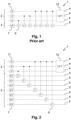
- Fig. 1 shows a prior art quantum computing device 1.
- QPE can be performed in that an unknown eigenvalue ⁇ of a unitary operator U is calculated from a given eigenstate
- an initialization gate 7 and seven controlled gates 8 are provided. By means of the initialization gate 7 the main qubit 5 can be initialized in an eigenstate of the controlled gates 8.
- QFT Quantum Fourier Transformation element 12
- Fig. 2 shows a first embodiment of a quantum computing device 1 according to the invention.
- This embodiment can be referred to as "(Fully) Parallel Phase Estimation".
- the example of Fig. 2 is distinguished from the prior art solution according to Fig. 1 . Therefore, in the embodiment of Fig. 2 the operator U is applied only once to each of the main qubits 5.
- the embodiment of Fig. 2 can be considered fully parallelized compared to the embodiment of Fig. 1 .
- the quantum computing device 1 of Fig. 2 comprises for each of the qubits 4 of the first register 2 a respective Hadamard gate 11 for initializing the respective qubit 4 prior to receiving the phase kickback.
- the quantum computing device 1 of Fig. 2 comprises, for each main qubit 5 of the second register 3, a respective initialization gate 7 and a respective controlled gate 8.
- the initialization gates 7 are configured to initialize the respective main qubit 5 in an eigenstate of the respective controlled gate 8.
- the controlled gates 8 are configured to act on the respective main qubit 5 after initialization by the respective initialization gate 7.
- the controlled gates 8 implement the same unitary operator U.
- the initialization gates 7 are configured to initialize the respective main qubit 5 in the same eigenstate of U.
- Each of the controlled gates 8 is configured for a phase kickback onto one and only one of the qubits 4 of the first register 2.
- the quantum computing device 1 of Fig. 2 can be used for QPE.
- a Quantum Fourier Transformation element 12 is provided that is configured to act on the qubits 4 of the first register 2 after these qubits 4 have received the respective phase kickback(s).
- the quantum computing device 1 of Fig. 2 can be used for QAE. In that case the embodiment can be referred to as "(Fully) Parallel Quantum Amplitude Estimation".
- Fig. 3 shows a second embodiment of a quantum computing device 1 according to the invention.
- This embodiment can be referred to as "(Fully) Entangled Phase Estimation". That is, the embodiment of Fig. 3 can be considered fully entangled compared to the embodiments of Fig. 1 and 2 .
- one phase is kicked back by direct phase kickback.
- the corresponding controlled gate 8 is configured for a phase kickback onto one and only of the qubits 4 of the first register 2 in that the respective qubit 4 of the first register 2 is configured to act as control qubit for the respective controlled gate 8.
- the quantum computing device 1 of Fig. 3 can be used for QAE. In that case the embodiment can be referred to as "(Fully) Entangled Quantum Amplitude Estimation".
- the embodiment of Fig. 5 can be part of a larger quantum circuit. For example, it can be used for a low-depth QAE.
- the idea of the indirect phase kickback is explained for qubits and using CNOT gates based on Fig. 5 .
- the first and third qubits 4 from the top are considered.
- the entangled state 1 2 0 0 ⁇ + 1 1 ⁇ is obtained by applying the first CNOT gate 9.
- the entangled state obtains one phase for
- ⁇ ⁇ ⁇
- the second CNOT gate 10 leads to the state 1 2 0 ⁇ + ⁇ 2 1 ⁇ ⁇
- the generalization to a higher power of U is straightforward.
- the construction also generalizes to higher precisions, that is by applying the operators U , U 2 , U 4 , ... , U 2 b ⁇ 1 for b bits of precision.
- Fig. 6 can be used for QAE.
- This embodiment can be referred to as "Parallel QAE without Phase Estimation".
- the result of the QAE can be obtained using conventional hardware (not shown).
- Fig. 6 The embodiment of Fig. 6 is an example of how the invention can be used to combine quantum computing and classical computing. This is based on the possibility to split a QPE algorithm into separate steps on a quantum computer and an additional classical combination of the results.
- the quantum computing device 1 shown in Fig. 6 can be used to perform the most complex quantum part of such methods, that is the implementation of G N 2 for the Grover operator G .
- Fig. 6 shows the example of G 4 ⁇ EP ⁇
- measuring the qubit 4 of the first register 2 will allow a frequency measurement for results corresponding to G 4 .
- a single copy of G has to be executed on each of the main qubits 5 of the second register 3.
- the phase kickback from G is e 2i ⁇ .
- each application of G increases the phase by 2 ⁇ .
- the final Hadamard gate 11 has the same function as the previously described Quantum Fourier Transformation element 12.
- a circuit like the one shown in Fig. 6 is run with 1,2,..., n copies of G and the qubit 4 of the first register 2 is measured in each case, one can perform a classical analysis on the results. A maximum likelihood estimation or other statistical techniques (usually performed on a classical computer) then yields the result.
- a single measurement is sufficient, namely that of the qubit 4 of the first register 2 that collects the phase kickbacks.
- the standard version of QAE in contrast, would require measurements of all qubits in the respective register. This can be a considerable advantage in cases of large oracles and noisy measurement operations.
- Fig. 7 shows a further visualization of a quantum computing device 1 that can be used for QPE or QAE. Therein, several Quantum Processing Units 13 are shown.
- QPU Quantum Processing Unit
- a Quantum Processing Unit must have a high degree of connectivity for general purpose computations, that is there must be a basic two-qubit operation between almost all pairs of qubits within the QPU.
- each Grover oracle used for standard QAE may require such a highly connected QPU.
- a key advantage of the parallel and entangled versions of QPE and QAE is that each of the oracles can be executed on different parts of the quantum computer in parallel and no connections between them are necessary. It is sufficient for the qubits 4 of the first register 2 to be shared between the different parts of the quantum computing device 1. That is, it is sufficient that each QPU 13 for the Grover oracle implementation is connected with a single qubit to the central QPU 13.
- the central QPU 13 collects the phase kickbacks, that is the central QPU 13 implements the first register 2.
- the central QPU 13 can also be trivial, in that it is a single qubit 4 which can be measured in the end of the algorithm. Such a layout would be suitable for the parallel QAE without phase estimation.
- the remaining QPU's 13 implement the second register 3.
- the operator EP implemented by the initialization gates 7 of Fig. 2 to 6 is capable of initializing the main qubits 5 in the same eigenstate
- Fig. 8 shows how this initialization can be implemented for relevant examples.
- U is a Grover operator.
- U for estimating the probability (frequency) of finding "good states"
- 0 ⁇ of some model M, represented by an operator, can be written as U ⁇ MS 0 M ⁇ 1 S 1 where S 0 is an operator inverting the sign for the 0-state and doing nothing otherwise, and S 1 is an operator inverting the sign of a good state and doing nothing otherwise. Further, it is assumed:
- the second Hadamard gate 11 leads to 1 2
- v ⁇ 1 2
- v ⁇ 1 2
- v ⁇ 1 2
- v ⁇ 1 2
- the final Hadamard gate 11 then leads to the state 1 2
- each initialization gate 7 may requires one more qubit than the implementation of the operator U.
- This additional qubit is for internal use of the initialization gate only, and is omitted from figures 1 to 6 to simplify the images.
- This additional qubit is the qubit at the top of Fig. 8 .
- the gates U, V and P in Fig. 8 are preferred to act on a qudit, preferrably consisting of a collection of qubits.
Landscapes
- Engineering & Computer Science (AREA)
- General Physics & Mathematics (AREA)
- Theoretical Computer Science (AREA)
- Physics & Mathematics (AREA)
- Mathematical Analysis (AREA)
- Data Mining & Analysis (AREA)
- Evolutionary Computation (AREA)
- Condensed Matter Physics & Semiconductors (AREA)
- Computational Mathematics (AREA)
- Mathematical Optimization (AREA)
- Pure & Applied Mathematics (AREA)
- Computing Systems (AREA)
- General Engineering & Computer Science (AREA)
- Mathematical Physics (AREA)
- Software Systems (AREA)
- Artificial Intelligence (AREA)
- Optical Modulation, Optical Deflection, Nonlinear Optics, Optical Demodulation, Optical Logic Elements (AREA)
Priority Applications (2)
| Application Number | Priority Date | Filing Date | Title |
|---|---|---|---|
| EP21207022.1A EP4177800A1 (de) | 2021-11-08 | 2021-11-08 | Quantenrechenvorrichtung |
| PCT/EP2022/076854 WO2023078617A1 (en) | 2021-11-08 | 2022-09-27 | Quantum computing device |
Applications Claiming Priority (1)
| Application Number | Priority Date | Filing Date | Title |
|---|---|---|---|
| EP21207022.1A EP4177800A1 (de) | 2021-11-08 | 2021-11-08 | Quantenrechenvorrichtung |
Publications (1)
| Publication Number | Publication Date |
|---|---|
| EP4177800A1 true EP4177800A1 (de) | 2023-05-10 |
Family
ID=78592554
Family Applications (1)
| Application Number | Title | Priority Date | Filing Date |
|---|---|---|---|
| EP21207022.1A Pending EP4177800A1 (de) | 2021-11-08 | 2021-11-08 | Quantenrechenvorrichtung |
Country Status (2)
| Country | Link |
|---|---|
| EP (1) | EP4177800A1 (de) |
| WO (1) | WO2023078617A1 (de) |
-
2021
- 2021-11-08 EP EP21207022.1A patent/EP4177800A1/de active Pending
-
2022
- 2022-09-27 WO PCT/EP2022/076854 patent/WO2023078617A1/en not_active Ceased
Non-Patent Citations (3)
| Title |
|---|
| EGGER DANIEL J ET AL: "Credit Risk Analysis Using Quantum Computers", IEEE TRANSACTIONS ON COMPUTERS, IEEE, USA, vol. 70, no. 12, 16 November 2020 (2020-11-16), pages 2136 - 2145, XP011887248, ISSN: 0018-9340, [retrieved on 20211105], DOI: 10.1109/TC.2020.3038063 * |
| EMANUEL KNILL ET AL: "Optimal quantum measurements of expectation values of observables", PHYSICAL REVIEW A (ATOMIC, MOLECULAR, AND OPTICAL PHYSICS), vol. 75, no. 1, 1 January 2007 (2007-01-01), USA, XP055617623, ISSN: 1050-2947, DOI: 10.1103/PhysRevA.75.012328 * |
| YUCHEN WANG ET AL: "Qudits and high-dimensional quantum computing", ARXIV.ORG, CORNELL UNIVERSITY LIBRARY, 201 OLIN LIBRARY CORNELL UNIVERSITY ITHACA, NY 14853, 11 November 2020 (2020-11-11), XP081811073, DOI: 10.3389/FPHY.2020.589504 * |
Also Published As
| Publication number | Publication date |
|---|---|
| WO2023078617A1 (en) | 2023-05-11 |
Similar Documents
| Publication | Publication Date | Title |
|---|---|---|
| US10846366B1 (en) | Selecting parameters for a quantum approximate optimization algorithm (QAOA) | |
| US11210602B2 (en) | Multi-qubit control | |
| Cornelissen et al. | Near-optimal quantum algorithms for multivariate mean estimation | |
| Gebhart et al. | Bayesian quantum multiphase estimation algorithm | |
| US11551127B1 (en) | Using a quantum processor unit to preprocess data | |
| Shaydulin et al. | QAOAwith $ N\cdot p\geq 200$ | |
| CN112884153A (zh) | 处理数据的方法和相关装置 | |
| EP4369260A1 (de) | Verfahren und system zur codierung eines datensatzes in einer quantenschaltung zum quantenmaschinenlernen | |
| Peres et al. | Relativistic Doppler effect in quantum communication | |
| US20240249040A1 (en) | OPTIMAL FAULT-TOLERANT IMPLEMENTATIONS OF HEISENBERG INTERACTIONS AND CONTROLLED-Z^a GATES | |
| WO2022024135A1 (en) | Quantum computing device for determining a network parameter | |
| Takahira et al. | Quantum algorithms based on the block-encoding framework for matrix functions by contour integrals | |
| Van Vu et al. | Fidelity-dissipation relations in quantum gates | |
| Li et al. | Efficient circuit wire cutting based on commuting groups | |
| Jiang et al. | Generation of 95-qubit genuine entanglement and verification of symmetry-protected topological phases | |
| EP4177800A1 (de) | Quantenrechenvorrichtung | |
| Tscharke et al. | Quack: Quantum aligned centroid kernel | |
| Mello et al. | Clifford-dressed variational principles for precise Loschmidt echoes | |
| Laneve | Robust black-box quantum-state preparation via quantum signal processing | |
| Abdel-Aty | The Pancharatnam phase of a two-level atom in the presence of another two-level atom in a cavity | |
| US20240169241A1 (en) | Addition of Qubit States Using Entangled Quaternionic Roots of Single-Qubit Gates | |
| Whitfield | Unified views of quantum simulation algorithms for chemistry | |
| Yu et al. | Entangling power in deterministic quantum computation with one qubit | |
| Binkowski et al. | One for All: Universal Quantum Conic Programming Framework for Hard-Constrained Combinatorial Optimization Problems | |
| Riguzzi | Quantum weighted model counting |
Legal Events
| Date | Code | Title | Description |
|---|---|---|---|
| PUAI | Public reference made under article 153(3) epc to a published international application that has entered the european phase |
Free format text: ORIGINAL CODE: 0009012 |
|
| STAA | Information on the status of an ep patent application or granted ep patent |
Free format text: STATUS: THE APPLICATION HAS BEEN PUBLISHED |
|
| AK | Designated contracting states |
Kind code of ref document: A1 Designated state(s): AL AT BE BG CH CY CZ DE DK EE ES FI FR GB GR HR HU IE IS IT LI LT LU LV MC MK MT NL NO PL PT RO RS SE SI SK SM TR |
|
| STAA | Information on the status of an ep patent application or granted ep patent |
Free format text: STATUS: REQUEST FOR EXAMINATION WAS MADE |
|
| 17P | Request for examination filed |
Effective date: 20231107 |
|
| RBV | Designated contracting states (corrected) |
Designated state(s): AL AT BE BG CH CY CZ DE DK EE ES FI FR GB GR HR HU IE IS IT LI LT LU LV MC MK MT NL NO PL PT RO RS SE SI SK SM TR |
|
| RAP1 | Party data changed (applicant data changed or rights of an application transferred) |
Owner name: JOS QUANTUM GMBH |
|
| STAA | Information on the status of an ep patent application or granted ep patent |
Free format text: STATUS: EXAMINATION IS IN PROGRESS |
|
| 17Q | First examination report despatched |
Effective date: 20250220 |