EP4177751A1 - Ressourcenplanungsverfahren, ressourcenplanungssystem und vorrichtung - Google Patents
Ressourcenplanungsverfahren, ressourcenplanungssystem und vorrichtung Download PDFInfo
- Publication number
- EP4177751A1 EP4177751A1 EP21833960.4A EP21833960A EP4177751A1 EP 4177751 A1 EP4177751 A1 EP 4177751A1 EP 21833960 A EP21833960 A EP 21833960A EP 4177751 A1 EP4177751 A1 EP 4177751A1
- Authority
- EP
- European Patent Office
- Prior art keywords
- scheduling
- resource
- crd
- pods
- scheduler
- Prior art date
- Legal status (The legal status is an assumption and is not a legal conclusion. Google has not performed a legal analysis and makes no representation as to the accuracy of the status listed.)
- Pending
Links
Images



Classifications
-
- H—ELECTRICITY
- H04—ELECTRIC COMMUNICATION TECHNIQUE
- H04L—TRANSMISSION OF DIGITAL INFORMATION, e.g. TELEGRAPHIC COMMUNICATION
- H04L67/00—Network arrangements or protocols for supporting network services or applications
- H04L67/01—Protocols
- H04L67/10—Protocols in which an application is distributed across nodes in the network
- H04L67/1001—Protocols in which an application is distributed across nodes in the network for accessing one among a plurality of replicated servers
- H04L67/1036—Load balancing of requests to servers for services different from user content provisioning, e.g. load balancing across domain name servers
-
- G—PHYSICS
- G06—COMPUTING OR CALCULATING; COUNTING
- G06F—ELECTRIC DIGITAL DATA PROCESSING
- G06F9/00—Arrangements for program control, e.g. control units
- G06F9/06—Arrangements for program control, e.g. control units using stored programs, i.e. using an internal store of processing equipment to receive or retain programs
- G06F9/46—Multiprogramming arrangements
- G06F9/50—Allocation of resources, e.g. of the central processing unit [CPU]
- G06F9/5005—Allocation of resources, e.g. of the central processing unit [CPU] to service a request
- G06F9/5027—Allocation of resources, e.g. of the central processing unit [CPU] to service a request the resource being a machine, e.g. CPUs, Servers, Terminals
-
- G—PHYSICS
- G06—COMPUTING OR CALCULATING; COUNTING
- G06F—ELECTRIC DIGITAL DATA PROCESSING
- G06F9/00—Arrangements for program control, e.g. control units
- G06F9/06—Arrangements for program control, e.g. control units using stored programs, i.e. using an internal store of processing equipment to receive or retain programs
- G06F9/46—Multiprogramming arrangements
- G06F9/48—Program initiating; Program switching, e.g. by interrupt
-
- G—PHYSICS
- G06—COMPUTING OR CALCULATING; COUNTING
- G06F—ELECTRIC DIGITAL DATA PROCESSING
- G06F9/00—Arrangements for program control, e.g. control units
- G06F9/06—Arrangements for program control, e.g. control units using stored programs, i.e. using an internal store of processing equipment to receive or retain programs
- G06F9/46—Multiprogramming arrangements
- G06F9/48—Program initiating; Program switching, e.g. by interrupt
- G06F9/4806—Task transfer initiation or dispatching
- G06F9/4843—Task transfer initiation or dispatching by program, e.g. task dispatcher, supervisor, operating system
- G06F9/4881—Scheduling strategies for dispatcher, e.g. round robin, multi-level priority queues
-
- G—PHYSICS
- G06—COMPUTING OR CALCULATING; COUNTING
- G06F—ELECTRIC DIGITAL DATA PROCESSING
- G06F9/00—Arrangements for program control, e.g. control units
- G06F9/06—Arrangements for program control, e.g. control units using stored programs, i.e. using an internal store of processing equipment to receive or retain programs
- G06F9/46—Multiprogramming arrangements
- G06F9/50—Allocation of resources, e.g. of the central processing unit [CPU]
-
- G—PHYSICS
- G06—COMPUTING OR CALCULATING; COUNTING
- G06F—ELECTRIC DIGITAL DATA PROCESSING
- G06F9/00—Arrangements for program control, e.g. control units
- G06F9/06—Arrangements for program control, e.g. control units using stored programs, i.e. using an internal store of processing equipment to receive or retain programs
- G06F9/46—Multiprogramming arrangements
- G06F9/50—Allocation of resources, e.g. of the central processing unit [CPU]
- G06F9/5005—Allocation of resources, e.g. of the central processing unit [CPU] to service a request
- G06F9/5027—Allocation of resources, e.g. of the central processing unit [CPU] to service a request the resource being a machine, e.g. CPUs, Servers, Terminals
- G06F9/5038—Allocation of resources, e.g. of the central processing unit [CPU] to service a request the resource being a machine, e.g. CPUs, Servers, Terminals considering the execution order of a plurality of tasks, e.g. taking priority or time dependency constraints into consideration
-
- G—PHYSICS
- G06—COMPUTING OR CALCULATING; COUNTING
- G06F—ELECTRIC DIGITAL DATA PROCESSING
- G06F9/00—Arrangements for program control, e.g. control units
- G06F9/06—Arrangements for program control, e.g. control units using stored programs, i.e. using an internal store of processing equipment to receive or retain programs
- G06F9/46—Multiprogramming arrangements
- G06F9/50—Allocation of resources, e.g. of the central processing unit [CPU]
- G06F9/5005—Allocation of resources, e.g. of the central processing unit [CPU] to service a request
- G06F9/5027—Allocation of resources, e.g. of the central processing unit [CPU] to service a request the resource being a machine, e.g. CPUs, Servers, Terminals
- G06F9/505—Allocation of resources, e.g. of the central processing unit [CPU] to service a request the resource being a machine, e.g. CPUs, Servers, Terminals considering the load
-
- G—PHYSICS
- G06—COMPUTING OR CALCULATING; COUNTING
- G06F—ELECTRIC DIGITAL DATA PROCESSING
- G06F9/00—Arrangements for program control, e.g. control units
- G06F9/06—Arrangements for program control, e.g. control units using stored programs, i.e. using an internal store of processing equipment to receive or retain programs
- G06F9/46—Multiprogramming arrangements
- G06F9/50—Allocation of resources, e.g. of the central processing unit [CPU]
- G06F9/5061—Partitioning or combining of resources
-
- G—PHYSICS
- G06—COMPUTING OR CALCULATING; COUNTING
- G06F—ELECTRIC DIGITAL DATA PROCESSING
- G06F9/00—Arrangements for program control, e.g. control units
- G06F9/06—Arrangements for program control, e.g. control units using stored programs, i.e. using an internal store of processing equipment to receive or retain programs
- G06F9/46—Multiprogramming arrangements
- G06F9/50—Allocation of resources, e.g. of the central processing unit [CPU]
- G06F9/5061—Partitioning or combining of resources
- G06F9/5077—Logical partitioning of resources; Management or configuration of virtualized resources
-
- G—PHYSICS
- G06—COMPUTING OR CALCULATING; COUNTING
- G06N—COMPUTING ARRANGEMENTS BASED ON SPECIFIC COMPUTATIONAL MODELS
- G06N3/00—Computing arrangements based on biological models
- G06N3/02—Neural networks
- G06N3/08—Learning methods
-
- H—ELECTRICITY
- H04—ELECTRIC COMMUNICATION TECHNIQUE
- H04L—TRANSMISSION OF DIGITAL INFORMATION, e.g. TELEGRAPHIC COMMUNICATION
- H04L67/00—Network arrangements or protocols for supporting network services or applications
- H04L67/01—Protocols
- H04L67/10—Protocols in which an application is distributed across nodes in the network
- H04L67/1001—Protocols in which an application is distributed across nodes in the network for accessing one among a plurality of replicated servers
- H04L67/1004—Server selection for load balancing
-
- H—ELECTRICITY
- H04—ELECTRIC COMMUNICATION TECHNIQUE
- H04L—TRANSMISSION OF DIGITAL INFORMATION, e.g. TELEGRAPHIC COMMUNICATION
- H04L67/00—Network arrangements or protocols for supporting network services or applications
- H04L67/01—Protocols
- H04L67/10—Protocols in which an application is distributed across nodes in the network
- H04L67/1095—Replication or mirroring of data, e.g. scheduling or transport for data synchronisation between network nodes
-
- G—PHYSICS
- G06—COMPUTING OR CALCULATING; COUNTING
- G06F—ELECTRIC DIGITAL DATA PROCESSING
- G06F2209/00—Indexing scheme relating to G06F9/00
- G06F2209/50—Indexing scheme relating to G06F9/50
- G06F2209/5017—Task decomposition
-
- G—PHYSICS
- G06—COMPUTING OR CALCULATING; COUNTING
- G06N—COMPUTING ARRANGEMENTS BASED ON SPECIFIC COMPUTATIONAL MODELS
- G06N20/00—Machine learning
Definitions
- the present disclosure relates to the field of computer technologies, and specifically to a resource scheduling method, a resource scheduling system, a device, and a computer-readable storage medium.
- Kubernetes can support the management of Custom Resource Definitions (CRDs) through good scalability, allowing users to manage customized resources as a whole object entity.
- CRDs Custom Resource Definitions
- Kubernetes only supports the scheduling of Pods.
- a special scheduler is required to schedule CRDs. Resource scheduling conflicts will occur among multiple schedulers.
- resources cannot meet a resource request for CRDs, so that the CRDs cannot be scheduled; and even if a CRD can be successfully scheduled, the CRD is not scheduled according to an optimal resource allocation mode, and thus the operational efficiency is reduced.
- the present disclosure provides a resource scheduling method, a resource scheduling system, a device, and a computer-readable storage medium.
- an embodiment provides a resource scheduling method.
- the method includes: obtaining a scheduling object from a scheduling queue; in response to the scheduling object being a customized resource, splitting the customized resource according to a current resource state to obtain a scheduling unit list, where the scheduling unit list includes scheduling units configured to form the customized resource; and sequentially scheduling the scheduling units in the scheduling unit list.
- an embodiment provides a resource scheduling system.
- the system includes: a scheduler, configured for obtaining a scheduling object from a scheduling queue; and a splitter, configured for: in response to the scheduling object being a customized resource, splitting the customized resource according to a current resource state to obtain a scheduling unit list, where the scheduling unit list includes scheduling units configured to form the customized resource; where the scheduler is further configured for sequentially scheduling the scheduling units in the scheduling unit list.
- an embodiment provides a device.
- the device includes: a memory, a processor, and a computer program stored in the memory and executable by the processor which, when executed by the processor, causes the processor to implement the resource scheduling method described above.
- an embodiment provides a computer-readable storage medium, storing a computer-executable instruction which, when executed by a processor, causes the processor to implement the resource scheduling method described above.
- Kubernetes is an open-source application used to manage containerized applications on multiple hosts in the cloud platform. Kubernetes aims to make the deployment of containerized applications simple and efficient. Kubernetes provides a mechanism for deployment, planning, updating, and maintenance of applications. In Kubernetes, multiple containers may be created. An application instance is run in each container. Then the management of, discovery of, and access to this group of application instances are implemented based on a built-in load balancing policy. These details do not require complex manual configuration and processing by operation and maintenance personnel. Kubernetes has a wide range of applications. Cloud computing, artificial intelligence and other platforms of many enterprises or research institutions are implemented based on Kubernetes. Kubernetes supports the management of Custom Resource Definitions (CRDs) through good scalability, allowing users to manage customized resources as a whole object entity.
- CCDs Custom Resource Definitions
- Kubernetes only supports the scheduling of Pods.
- Pods are the smallest units that can be created and deployed in Kubernetes.
- a Pod is an application instance in a Kubernetes cluster, and is always deployed on the same node.
- a Pod contains one or more containers, as well as resources shared by various containers, such as storage resources and network resources.
- Kubernetes requires a special scheduler to schedule CRDs, and resource scheduling conflicts will occur among multiple schedulers.
- the present disclosure provides a resource scheduling method, a resource scheduling system, a device, and a computer-readable storage medium.
- the resource scheduling method includes: during resource scheduling, obtaining a scheduling object from a scheduling queue; if the scheduling object is a customized resource, splitting the customized resource according to a current resource state to obtain a scheduling unit list, where the scheduling unit list includes first scheduling units configured to form the customized resource; and sequentially scheduling the first scheduling units according to the scheduling unit list.
- the resource scheduling method can be applied to a Kubernetes scheduling platform, and correspondingly, the first scheduling units are CRD objects.
- the scheduling object is a CRD
- the CRD is split according to a current resource state to obtain a scheduling unit list, where the scheduling unit list includes a set of Pods.
- the Kubernetes scheduling platform can perform atomic scheduling of the Pods according to the scheduling unit list, and all the Pods are scheduled sequentially according to the queue to prevent insertion of other Pods. This ensures that the CRD can be reasonably scheduled with high scheduling efficiency, enabling the Kubernetes scheduling platform to be compatible with various service scenarios.
- FIG. 1 is a schematic diagram of a system architecture platform 100 configured for executing a resource scheduling according to an embodiment of the present disclosure.
- the system architecture platform 100 is a resource scheduling system.
- the system architecture platform 100 includes a scheduler 110 and a splitter 120.
- the scheduler 110 is configured for scheduling a scheduling object.
- the splitter 120 is configured for splitting the scheduling object in response to a split request from the scheduler 110, to meet a scheduling requirement of the scheduler 110.
- the scheduler 110 obtains a scheduling object from a scheduling queue.
- the splitter 120 can split the customized resource according to a current resource state to obtain a scheduling unit list, where the scheduling unit list includes first scheduling units configured to form the customized resource.
- the scheduler 110 sequentially schedules the first scheduling units in the scheduling unit list according to the scheduling unit list, to complete the scheduling of the customized resource.
- a Kubernetes scheduling platform is taken as an example for description.
- the Kubernetes scheduling system in this embodiment includes a scheduler 110, a splitter (i.e., Pod splitter) 120, and a controller (i.e., CRD controller) 130.
- a splitter i.e., Pod splitter
- a controller i.e., CRD controller
- the scheduler 110 is configured for scheduling of Pods.
- the splitter is configured for splitting of CRD objects.
- the first scheduling unit is a CRD object.
- the second scheduling unit is a native Pod object. In this embodiment, CRDs and Pods are placed in the same scheduling queue.
- the scheduler 110 obtains a set of Pods obtained by splitting the CRD through an extended split interface, and schedule all the Pods in sequence.
- the splitter 120 is a user-defined extension component, which is mainly configured for splitting the CRD into reasonable Pods according to a current cluster resource occupation status in response to a split request from the scheduler 110, creating a scheduling unit list containing these Pods, and feeding the scheduling unit list back to the scheduler 110 for scheduling.
- the splitter 120 can implement an operation of binding the Pods to nodes in response to a node binding request from the scheduler 110. Binding of a Pod to a node may be construed as adding some node information and resource information to the Pod object, and then a special component in the scheduling system runs the Pod on a corresponding node according to the binding information.
- the controller 130 is a user-defined extension component for managing states and life cycles of specific CRDs.
- the CRD state is updated according to the states of the CRD and the corresponding Pods.
- the life cycle of the CRD is maintained according to a user command or a policy for the CRD.
- the policy for the CRD may be that the life cycle of the CRD ends after the Pod normally ends.
- the controller 130 is a functional component of the Kubernetes scheduling platform, and the details will not be repeated herein.
- a user creates CRD and Pod objects through an API server 140.
- the scheduler 110 monitors binding information of the CRD and Pod objects through the API server. After the scheduling of all the Pods is completed, the splitter 120 implements the binding of the Pods to nodes through the API server.
- the scheduler 110 currently has two extension modes: an extender and a scheduling framework.
- a split interface is added in original extension interfaces.
- the scheduler 110 obtains, through the split interface, a set of Pods obtained by splitting the CRD.
- the extender extends the scheduler 110 through a web hook, and the scheduling framework directly compiles the extension interface into the scheduler 110.
- the embodiments of the present disclosure introduce a new extension interface, i.e., the Split interface, which is configured for splitting the CRD resource object and transforming the CRD into a set of Pods. Different CRD resources may be split in different ways.
- the split interface is implemented in the extender or scheduling framework, and is mainly responsible for two functions: splitting the CRD into a set of 1 to N Pods using a certain strategy, and allocating a specific number of resources to each Pod.
- splitting it is necessary to determine whether a remaining resource of a cluster node meets a splitting requirement, for example, GPU or CPU resources. If not, the scheduler 110 returns error information. If yes, the set of Pods obtained by splitting are returned.
- the scheduling system For the scheduling system, during scheduling, if the scheduling object is a CRD, the CRD is split according to a current resource state to obtain a scheduling unit list, where the scheduling unit list includes a set of Pods.
- the Kubernetes scheduling platform can perform scheduling of the Pods according to the scheduling unit list, and all the Pods are scheduled sequentially according to the queue to prevent insertion of other Pods. This ensures that the CRD can be reasonably scheduled with high scheduling efficiency, enabling the Kubernetes scheduling platform to be compatible with various service scenarios.
- the scheduling object is a Pod
- processing is performed according to an original scheduling process of the Kubernetes scheduling system, but the operation of binding the Pods is implemented by the splitter 120.
- the splitter 120 splits the CRD into one or more Pods according to the current resource state of the cluster.
- the splitter 120 only needs to determine the number of Pods into which the CRD is to be split and resources (CPU, memory, GPU) used by a Pod.
- the scheduler 110 implements the scheduling of these Pods.
- the scheduler 110 selects appropriate nodes for the Pods by filtering, sorting, or scoring the nodes or by processing the nodes based on other optimization algorithms.
- the splitter 120 binds the Pods in the Pod list with the nodes. In this way, resource synchronization between the scheduler 110 and the splitter 120 can be ensured.
- the scheduler 110 of the Kubernetes scheduling platform can support a hybrid scheduling of CRDs and Pods and the atomic scheduling of Pods of a single CRD. It can be understood that during the hybrid scheduling of CRDs and Pods, the scheduler 110 reads a configuration and learns which CRDs participate in the scheduling. The scheduler 110 puts the Pods and the CRDs to be scheduled in the same scheduling queue. When an object scheduled by the scheduler 110 is a CRD, a Pod object list obtained by splitting the CRD object needs to be obtained through the extended Split interface, and the Pods are sequentially scheduled, thereby achieving the hybrid scheduling of CRDs and Pods.
- the atomic scheduling of Pods of the CRD may be construed as that when the set of Pods obtained by splitting the CRD is scheduled, no other Pod can be scheduled.
- the scheduling of the CRD is considered to be successful only when the set of Pods obtained by splitting the CRD has been successfully scheduled; otherwise, the scheduling fails. This can solve the problem that the scheduling of the entire CRD as a whole fails due to insufficient remaining resources.
- a BackOff mechanism is provided for the scheduling of the CRD.
- the BackOff mechanism may be construed as that if the scheduling of any one of the Pods of the CRD fails, it is determined that the scheduling of the entire CRD fails. If the scheduling of the CRD fails, the Pods in the CRD that have been successfully scheduled need to be deleted and resources need to be released.
- a reentry protection function is provided for the splitting of CRDs into Pods.
- the scheduling queue of the scheduler 110 stores CRD objects and Pod objects. A set of Pods belonging to a CRD object does not need to be inserted into the scheduling queue.
- a resource synchronization mechanism is provided between the scheduler 110 and the splitter 120.
- the splitter 120 needs to learn the resource state of the cluster, monitor node and Pod information, and cache allocatable resource information locally.
- the scheduler 110 After the scheduler 110 successfully schedules the set of Pods of the CRD, the scheduler 110 sends a binding request for the Pods to the splitter 120.
- the splitter 120 After receiving the binding request, the splitter 120 first updates the allocatable resource information of nodes locally cached by the splitter 120, and then sends a final binding request to the API server 140. In this way, resource synchronization is achieved.
- the system architecture platform 100 and application scenarios described in the embodiments of the present application are for the purpose of illustrating the technical schemes of the embodiments of the present application more clearly, and do not constitute a limitation on the technical schemes provided in the embodiments of the present application.
- Those having ordinary skills in the art may know that with the evolution of the system architecture platform 100 and the emergence of new application scenarios, the technical schemes provided in the embodiments of the present application are also applicable to similar technical problems.
- system architecture platform 100 shown in FIG. 1 do not constitute a limitation to the embodiments of the present application, and more or fewer components than those shown in the figure may be included, or some components may be combined, or a different component arrangement may be used.
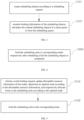
- FIG. 2 is a flowchart of a resource scheduling method according to an embodiment of the present disclosure.
- the resource scheduling method includes, but not limited to, the following operations S100, S200, and S300.
- a scheduling object is obtained from a scheduling queue.
- resource scheduling may be construed as the rational and effective use of various resources.
- the scheduling object is a resource object.
- Schedulable objects are arranged in a queue. During scheduling, the objects are invoked according to the sequential positions or priorities of the objects in the queue, so as to obtain scheduling objects. In this way, the scheduling objects can be quickly obtained, and resources can be reasonably scheduled.
- the Kubernetes scheduling platform may provide a variety of default resource types, e.g., a series of resources such as Pod, Deployment, Service, and Volume, which can meet most of daily requirements on system deployment and management.
- CRDs can be used to meet these requirements to effectively improve the scalability of Kubernetes.
- the Kubernetes scheduling platform supports the scheduling of Pods, that is, can directly schedule Pods. It can be understood that CRDs and Pod objects may be inserted in the same scheduling queue, or a CRD may be scheduled separately.
- the scheduler of the Kubernetes scheduling platform reads a configuration to obtain CRD objects and Pod objects that may participate in scheduling. The scheduler puts the Pods and the CRDs to be scheduled in the same scheduling queue, and sequentially obtains and schedules the scheduling objects from the scheduling queue.
- the customized resource is split according to a current resource state to obtain a scheduling unit list.
- the scheduling unit list includes first scheduling units configured to form the customized resource.
- the customized resource is a CRD
- the first scheduling unit is a CRD object.
- CRD objects and native Pod objects may be inserted in the same scheduling queue, i.e., CRD objects and Pod objects may be mixed for scheduling.
- the scheduler sequentially obtains the scheduling objects from the scheduling queue.
- the scheduler first determines the type of the scheduling object during scheduling. If the scheduling object is a CRD, the CRD is split according to the current resource state to obtain a scheduling unit list.
- the scheduling unit list is a list of Pods that make up the CRD. In other words, the CRD is split into a set of Pods. In this way, the Kubernetes scheduling platform can directly schedule the Pods according to the list of Pods.
- the CRD needs to be split according to the current resource status, and the current resource status may be construed as current remaining resources or available resources of the scheduling platform.
- the splitter reasonably splits the CRD object, so that the CRD can be scheduled according to an optimal resource allocation mode, thereby achieving higher operational efficiency.
- the scheduling object when the scheduling object is a native Pod, the Pod can be directly scheduled without being split.
- the Pod is the basic unit of the Kubernetes scheduling platform, is the smallest component created or deployed by users, and is also a resource object for running container applications. All other resource objects in the Kubernetes cluster are for supporting the Pod resource object to achieve the management of application services on Kubernetes.
- the Kubernetes scheduling platform supports the hybrid scheduling of Pods and CRDs, and also supports the atomic scheduling of Pods of a single CRD, which ensures that the CRD can be reasonably scheduled, enabling the Kubernetes scheduling platform to be compatible with various service scenarios.
- scheduling units in the scheduling unit list are sequentially scheduled.
- the scheduling unit list is generated.
- the scheduling unit is a Pod
- the scheduling unit list is a Pod set list. According to the Pod set list, the scheduler sequentially schedules all the Pods in the Pod set list, to complete the scheduling of a single CRD.
- the scheduling of all the Pods in the form of a list can prevent the insertion of other Pods that may lead to insufficient remaining resources for scheduling of the remaining Pods in the list and thus result in a failure of the scheduling of the entire CRD, and can also avoid the problem that when some Pods of another CRD are inserted during scheduling of some Pods of a CRD, the scheduling of the remaining Pods of the two CRD may fail due to insufficient remaining resources, the resources already occupied cannot be released, and the two CRDs enter a resource deadlock state.
- splitting the customized resource according to a current resource state to obtain a scheduling unit list in S200 may include, but not limited to, a following operation S210.
- the customized resource is split to obtain the scheduling unit list when a remaining resource of a cluster node meets a requirement of splitting the customized resource.
- the splitter is mainly configured for splitting the CRD into reasonable Pods according to a current resource occupation status of a cluster node in response to a split request from the scheduler, creating a scheduling unit list containing these Pods, and feeding the scheduling unit list back to the scheduler for scheduling. It can be seen that the splitter can learn a resource state of the cluster node by, for example, monitoring a binding status of the cluster node, and reasonably split the CRD according to the resource state to meet an optimal CRD splitting requirement.
- the splitter can efficiently and reasonably split the CRD while fully considering the resource state, and the scheduler only focuses on the scheduling of Pods without having to understand the CRD, thereby achieving the splitting and scheduling of the CRD.
- CRD objects and Pod objects are stored in the scheduling queue of the scheduler. A set of Pods belonging to a CRD object does not need to be inserted into the scheduling queue.
- the resource scheduling method further includes, but not limited to, the following operations S101 and S102.
- scheduling objects are created according to a scheduling request.
- binding information of the scheduling objects is monitored, and the created scheduling objects are placed in a same queue to form the scheduling queue.
- a user creates CRD objects and Pod objects according to an actual requirement of an application scenario. For example, deep learning of CRDs is required.
- the user creates CRD objects and Pod objects through the API server.
- the scheduler monitors binding information of the CRD objects and the Pod objects through the API server, and puts schedulable CRDs and Pods in the same queue.
- the CRDs and the Pods are added to the queue to form a scheduling queue.
- scheduling objects are obtained from the scheduling queue.
- the added scheduling objects may be CRDs and Pods, or may all be CRDs, or may all be Pods.
- the resource scheduling method further includes, but not limited to, a following operation S400.
- the scheduling units are bound to corresponding nodes respectively after scheduling of all the scheduling objects is completed.
- the CRD can be reasonably split, and the scheduling unit list is fed back to the scheduler for scheduling.
- the scheduler only needs to focus on the scheduling of Pods to complete the scheduling of all scheduling objects.
- the scheduler sends a node binding request to the splitter.
- the splitter can implement an operation of binding the Pods to nodes in response to the node binding request from the scheduler.
- the splitter implements binding of the Pods to nodes through the API server.
- the resource scheduling method further includes, but not limited to, a following operation S500.
- the scheduling of any Pod in the set of Pods in the CRD fails, it is determined that the scheduling of the entire CRD fails. If the scheduling of the CRD fails, the Pods in the CRD that have been successfully scheduled need to be deleted and resources need to be released, so as to avoid resource occupation and reduce the operational efficiency.
- binding the scheduling units to corresponding nodes respectively after scheduling of all the scheduling objects is completed in S400 may include, but not limited to, the following operations S410 and S420.
- a node binding request is initiated, allocatable resource information of the nodes is updated, an optimal node is determined according to the allocatable resource information, and hosts are respectively allocated to the scheduling units according to the optimal node.
- the scheduling units are bound to the corresponding hosts.
- the splitter implements binding of the Pods to nodes through the API server.
- a node binding process is to select appropriate nodes by filtering, sorting, or scoring the nodes or by processing the nodes based on other optimization algorithms, then select an optimal node to allocate a host to the Pod, and send a binding request for the Pod to the API server, so as to bind the Pod to the corresponding host, thereby completing the binding operation.
- the scheduling object when the scheduling object is a Pod, processing is performed according to an original scheduling process of the Kubernetes scheduling system, but the operation of binding the Pods is implemented by the splitter.
- the splitter split the CRD into one or more Pods according to the current resource state of the cluster.
- the splitter only needs to determine the number of Pods into which the CRD is to be split and resources (CPU, memory, GPU) used by a Pod.
- the scheduler implements the scheduling of these Pods.
- the scheduler selects appropriate nodes for the Pods by filtering, sorting, or scoring the nodes or by processing the nodes based on other optimization algorithms.
- the splitter binds the Pods in the Pod list with the nodes. In this way, resource synchronization between the scheduler and the splitter can be ensured.
- a resource synchronization mechanism is provided between the scheduler and the splitter.
- the splitter needs to learn the resource state of the cluster, monitor node and Pod information, and cache allocatable resource information locally.
- the scheduler After the scheduler successfully schedules the set of Pods of the CRD, the scheduler sends a binding request for the Pods to the splitter.
- the splitter After receiving the binding request, the splitter first updates the allocatable resource information of nodes locally cached by the splitter, and then sends the final binding request to the API server. In this way, resource synchronization is achieved.
- the resource scheduling method includes, but not limited to, the following operations S610 to S650.
- CRD and Pod objects are created through the API server.
- the CRD and Pod objects are monitored through the API server, and the new CRDs or Pods are placed into the same scheduling queue.
- a scheduling object is obtained from the scheduling queue.
- processing is performed according to a Pod scheduling process.
- a CRD split request is sent to the splitter so that the splitter splits the CRD according to the current resource state, and Pods obtained by splitting are created through the API server.
- pods in a Pod list fed back by the splitter are sequentially scheduled according to the Pod list.
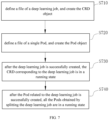
- This embodiment is an example of the scheduler successfully performing hybrid scheduling of CRDs and Pods.
- the embodiment shows a process of hybrid scheduling of CRDs and Pods on the Kubernetes scheduling platform.
- Deep learning jobs are defined as CRDs, and Workers executed in parallel for completing the deep learning jobs are carried by Pods.
- the hybrid scheduling of deep learning jobs and Pods can be implemented, and the CRDs and the Pods can be run successfully.
- a Kubernetes cluster with Ubuntu 16.04 system includes two nodes with sufficient resources.
- the cluster has deployed a modified scheduler, and a controller and a splitter for customized deep learning jobs.
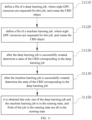
- a file of a deep learning job is defined, and the CRD object is created.
- a file of a single Pod is defined, and the Pod object is created.
- the CRD corresponding to the deep learning job is in a running state.
- the state of the single Pod created in S720 is the running state.
- the state of the CRD shall be consistent with the state of the Pod obtained by splitting.
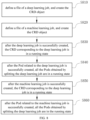
- This embodiment is an example of the scheduler successfully performing hybrid scheduling of two types of CRD objects.
- the embodiment shows a process of hybrid scheduling of different CRDs on the Kubernetes scheduling platform.
- Deep learning jobs are defined as CRDs
- machine learning jobs are defined as CRDs
- Workers executed by the two types of CRD objects are carried by Pods.
- the hybrid scheduling of deep learning jobs and machine learning jobs can be implemented, and both the two types of CRD objects can be run successfully.
- a Kubernetes cluster with Ubuntu 16.04 system includes two nodes with sufficient resources.
- the cluster has deployed a modified scheduler, a controller and a splitter for customized deep learning jobs, and a controller and a splitter for customized machine learning jobs.
- a file of a deep learning job is defined, and the CRD object is created.
- a file of a machine learning job is defined, and the CRD object is created.
- the CRD corresponding to the deep learning job is in a running state.
- the CRD corresponding to the deep learning job is in a running state.
- the state of the CRD shall be consistent with the state of the Pod obtained by splitting.
- the scheduler schedules a CRD to a smallest number of nodes for running.
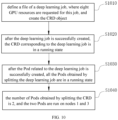
- This embodiment shows that when a CRD object is scheduled on the Kubernetes scheduling platform, the CRD can be reasonably split according to the resource state. Deep learning jobs are defined as CRDs, and Workers executed in parallel for completing the deep learning jobs are carried by Pods.
- the scheduler can automatically split the CRD based on the current resource state, and schedule Pods of the CRD to a small number of nodes for running, thereby reducing network overheads and ensuring the rationality of splitting.
- a Kubernetes cluster with Ubuntu 16.04 system includes three nodes with sufficient CPU and memory resources, where node 1 has eight idle GPUs, and nodes 2 and 3 each have four idle GPUs.
- the cluster has deployed a modified scheduler, and a controller and a splitter for customized deep learning jobs.
- a file of a deep learning job is defined, where eight GPU resources are requested for this job, and the CRD object is created.
- the CRD corresponding to the deep learning job is in a running state.
- the number of Pods obtained by splitting the CRD is 1, and the Pod is run on node 1.
- the scheduler successfully schedules a CRD with a large resource request granularity.
- This embodiment shows that when a CRD object is scheduled on the Kubernetes scheduling platform, the CRD can be reasonably split according to the resource state.
- Deep learning jobs are defined as CRDs, and Workers executed in parallel for completing the deep learning jobs are carried by Pods.
- the scheduler can automatically split the CRD based on the current resource state. If the resource request granularity of this job is large, resources of a single node cannot meet the resource request of the job, but total resources of the cluster can meet the resource request of the job, the CRD can be successfully split and successfully scheduled and run to ensure that this job will not be in a resource starved state.
- AKubernetes cluster with Ubuntu 16.04 system includes four nodes with sufficient CPU and memory resources, where nodes 1 and 3 each have four idle GPUs, and nodes 2 and 4 each have two idle GPUs.
- the cluster has deployed a modified scheduler, and a controller and a splitter for customized deep learning jobs.
- a file of a deep learning job is defined, where eight GPU resources are requested for this job, and the CRD object is created.
- the CRD corresponding to the deep learning job is in a running state.
- the number of Pods obtained by splitting the CRD is 2, and the two Pods are run on nodes 1 and 3.
- the scheduler performs atomic scheduling of Pods obtained by splitting the CRD.
- the embodiment shows that the scheduler in the Kubernetes scheduling platform can schedule Pods of a single CRD object. Deep learning jobs are defined as CRDs, machine learning jobs are defined as CRDs, and Workers executed by the two types of CRD objects are carried by Pods.
- the atomic scheduling of the Pods of the CRD can be implemented, thereby avoiding the problems of unreasonable scheduling of the CRD and resource deadlock between two CRDs.
- a Kubernetes cluster with Ubuntu 16.04 system includes three nodes with sufficient CPU and memory resources, where the three nodes each have four idle GPUs.
- the cluster has deployed a modified scheduler, a controller and a splitter for customized deep learning jobs, and a controller and a splitter for customized machine learning jobs.
- a file of a deep learning job is defined, where eight GPU resources are requested for this job, and the CRD object is created.
- a file of a machine learning job is defined, where eight GPU resources are requested for this job, and the CRD object is created.
- the state of the CRD corresponding to the deep learning job is determined.
- an embodiment of the present disclosure further provides a device.
- the device includes: a memory, a processor, and a computer program stored in the memory and executable by the processor.
- the processor and the memory may be connected by a bus or in other ways.
- the memory may be configured for storing a non-transitory software program and a non-transitory computer-executable program.
- the memory may include a high-speed random access memory, and may also include a non-transitory memory, e.g., at least one magnetic disk storage device, flash memory device, or other non-transitory solid-state storage device.
- the memory may include memories located remotely from the processor, and the remote memories may be connected to the processor via a network. Examples of the network include, but are not limited to, the Internet, an intranet, a local area network, a mobile communication network, and combinations thereof.
- the terminal in this embodiment may include the system architecture platform 100 in the embodiment shown in FIG. 1 . Therefore, the terminal in this embodiment and the system architecture platform 100 in the embodiment shown in FIG. 1 . belong to the same inventive concept, and these embodiments have the same implementation principle and technical effects, so the details will not be repeated here.
- the non-transitory software program and instructions required to implement the resource scheduling method of the foregoing embodiments are stored in the memory which, when executed by the processor, cause the processor to implement the resource scheduling method of the foregoing embodiments, for example, implement the method operations S100 to S300 in FIG. 2 , the method operations S101 to S102 in FIG. 3 , the method operation S400 in FIG. 4 , the method operations S410 to S420 in FIG. 5 , the method operations S610 to S650 in FIG. 6 , the method operations S710 to S740 in FIG. 7 , the method operations S810 to S860 in FIG. 8 , the method operations S910 to S940 in FIG. 9 , the method operations S1010 to S1040 in FIG. 10 , and the method operations S1110 to S1150 in FIG. 11 .
- the apparatus embodiments described above are merely examples.
- the units described as separate components may or may not be physically separated, i.e., may be located in one place or may be distributed over a plurality of network units. Some or all of the modules may be selected according to actual needs to achieve the objects of the scheme of this embodiment.
- an embodiment of the present application also provides a computer-readable storage medium, storing a computer-executable instruction which, when executed by a processor or controller, for example, by a processor in the terminal embodiment described above, may cause the processor to implement the resource scheduling method of the foregoing embodiments, for example, implement the method operations S100 to S300 in FIG. 2 , the method operations S101 to S102 in FIG. 3 , the method operation S400 in FIG. 4 , the method operations S410 to S420 in FIG. 5 , the method operations S610 to S650 in FIG. 6 , the method operations S710 to S740 in FIG. 7 , the method operations S810 to S860 in FIG. 8 , the method operations S910 to S940 in FIG. 9 , the method operations S1010 to S1040 in FIG. 10 , and the method operations S1110 to S1150 in FIG. 11 .
- An embodiment of the present disclosure includes: during resource scheduling, obtaining a scheduling object from a scheduling queue; if the scheduling object is a customized resource, splitting the customized resource according to a current resource state to obtain a scheduling unit list, where the scheduling unit list includes first scheduling units configured to form the customized resource; and sequentially scheduling the first scheduling units according to the scheduling unit list.
- the present disclosure can be applied to a Kubernetes scheduling platform.
- the scheduling object is a CRD
- the CRD is split according to a current resource state to obtain a scheduling unit list, where the scheduling unit list includes a set of Pods.
- the Kubernetes scheduling platform can perform atomic scheduling of all the Pods according to the scheduling unit list, and all the Pods are scheduled sequentially according to the queue to prevent insertion of other Pods. This ensures that the CRD can be reasonably scheduled with high scheduling efficiency, enabling the Kubernetes scheduling platform to be compatible with various service scenarios.
- the term "computer storage medium” includes volatile and nonvolatile, removable and non-removable media implemented in any method or technology for storage of information (such as computer readable instructions, data structures, program modules, or other data).
- the computer storage medium includes, but is not limited to, a random access memory (RAM), a read-only memory (ROM), an electrically erasable programmable read-only memory (EEPROM), a flash memory or other memory technology, a compact disc read-only memory (CD-ROM), a digital versatile disc (DVD) or other optical storage, a cassette, a magnetic tape, a magnetic disk storage or other magnetic storage device, or any other medium which can be used to store the desired information and which can be accessed by a computer.
- the communication medium typically includes computer-readable instructions, data structures, program modules, or other data in a modulated data signal such as a carrier or other transport mechanism, and can include any information passing medium.
Landscapes
- Engineering & Computer Science (AREA)
- Theoretical Computer Science (AREA)
- Software Systems (AREA)
- Physics & Mathematics (AREA)
- General Engineering & Computer Science (AREA)
- General Physics & Mathematics (AREA)
- Computer Networks & Wireless Communication (AREA)
- Signal Processing (AREA)
- Artificial Intelligence (AREA)
- Evolutionary Computation (AREA)
- Health & Medical Sciences (AREA)
- Biomedical Technology (AREA)
- Biophysics (AREA)
- Computational Linguistics (AREA)
- Data Mining & Analysis (AREA)
- Life Sciences & Earth Sciences (AREA)
- General Health & Medical Sciences (AREA)
- Molecular Biology (AREA)
- Computing Systems (AREA)
- Mathematical Physics (AREA)
- Management, Administration, Business Operations System, And Electronic Commerce (AREA)
- Data Exchanges In Wide-Area Networks (AREA)
Applications Claiming Priority (2)
| Application Number | Priority Date | Filing Date | Title |
|---|---|---|---|
| CN202010625668.0A CN113961335B (zh) | 2020-07-01 | 2020-07-01 | 资源调度方法、资源调度系统及设备 |
| PCT/CN2021/103638 WO2022002148A1 (zh) | 2020-07-01 | 2021-06-30 | 资源调度方法、资源调度系统及设备 |
Publications (2)
| Publication Number | Publication Date |
|---|---|
| EP4177751A1 true EP4177751A1 (de) | 2023-05-10 |
| EP4177751A4 EP4177751A4 (de) | 2023-12-20 |
Family
ID=79317431
Family Applications (1)
| Application Number | Title | Priority Date | Filing Date |
|---|---|---|---|
| EP21833960.4A Pending EP4177751A4 (de) | 2020-07-01 | 2021-06-30 | Ressourcenplanungsverfahren, ressourcenplanungssystem und vorrichtung |
Country Status (5)
| Country | Link |
|---|---|
| US (1) | US20230266999A1 (de) |
| EP (1) | EP4177751A4 (de) |
| JP (1) | JP7502550B2 (de) |
| CN (1) | CN113961335B (de) |
| WO (1) | WO2022002148A1 (de) |
Families Citing this family (11)
| Publication number | Priority date | Publication date | Assignee | Title |
|---|---|---|---|---|
| EP4092587A1 (de) * | 2021-05-21 | 2022-11-23 | Robert Bosch GmbH | Planung von aufträgen eines fertigungs- oder logistikprozesses |
| CN114866229A (zh) * | 2022-03-30 | 2022-08-05 | 杭州溪塔科技有限公司 | 一种基于Kubernetes的数据加解密方法和装置 |
| CN115022198B (zh) * | 2022-05-31 | 2023-10-24 | 阿里巴巴(中国)有限公司 | 资源信息获取方法、设备及存储介质 |
| CN115202874A (zh) * | 2022-07-07 | 2022-10-18 | 浪潮云信息技术股份公司 | 基于声明式api的数据传输系统资源调度的方法及存储介质 |
| CN115080248B (zh) * | 2022-08-19 | 2023-01-10 | 中兴通讯股份有限公司 | 调度装置的调度优化方法、调度装置和存储介质 |
| CN115145695B (zh) * | 2022-08-30 | 2022-12-06 | 浙江大华技术股份有限公司 | 资源调度方法、装置、计算机设备和存储介质 |
| CN115878124A (zh) * | 2022-10-21 | 2023-03-31 | 上海道客网络科技有限公司 | 一种云原生场景下自动化持续集成方法和系统 |
| KR102790978B1 (ko) * | 2022-11-11 | 2025-04-04 | 한국전자기술연구원 | 대규모 컨테이너 운용 환경에서 유연한 gpu 리소스 스케줄링 방법 |
| CN116382110B (zh) * | 2023-03-31 | 2025-06-03 | 青岛海尔科技有限公司 | 设备调度方法及装置、存储介质及电子装置 |
| CN117033000B (zh) * | 2023-10-09 | 2024-01-05 | 合肥中科类脑智能技术有限公司 | 数据调度方法、设备 |
| CN117591295A (zh) * | 2023-12-07 | 2024-02-23 | 北京火山引擎科技有限公司 | 资源调度方法、设备、系统及存储介质 |
Family Cites Families (18)
| Publication number | Priority date | Publication date | Assignee | Title |
|---|---|---|---|---|
| JP4963855B2 (ja) | 2006-03-28 | 2012-06-27 | 株式会社ソニー・コンピュータエンタテインメント | ネットワークコンピューティングシステムおよびマルチプロセッサコンピュータ |
| CN102739770B (zh) * | 2012-04-18 | 2015-06-17 | 上海和辰信息技术有限公司 | 一种基于云计算的资源调度方法及系统 |
| US9674742B2 (en) * | 2013-07-30 | 2017-06-06 | Telefonaktiebolaget Lm Ericsson (Publ) | Exploiting almost blank subframes for inter-cell scheduling |
| US9880881B1 (en) * | 2014-12-04 | 2018-01-30 | HCA Holdings, Inc. | Multi-tier resource and load orchestration |
| US11243818B2 (en) * | 2017-05-04 | 2022-02-08 | Salesforce.Com, Inc. | Systems, methods, and apparatuses for implementing a scheduler and workload manager that identifies and optimizes horizontally scalable workloads |
| CN108228354B (zh) * | 2017-12-29 | 2022-03-18 | 杭州朗和科技有限公司 | 调度方法、系统、计算机设备和介质 |
| CN109067828B (zh) * | 2018-06-22 | 2022-01-04 | 杭州才云科技有限公司 | 基于Kubernetes和OpenStack容器云平台多集群构建方法、介质、设备 |
| US10922145B2 (en) * | 2018-09-04 | 2021-02-16 | Target Brands, Inc. | Scheduling software jobs having dependencies |
| US10897497B2 (en) * | 2018-11-13 | 2021-01-19 | International Business Machines Corporation | Automated infrastructure updates in a cluster environment that includes containers |
| CN110244964B (zh) * | 2019-05-28 | 2023-04-28 | 创新先进技术有限公司 | 一种基于运维应用的运维方法、运维方法、装置及设备 |
| CN110457130B (zh) * | 2019-07-24 | 2023-09-01 | 广东工业大学 | 一种分布式资源弹性调度模型、方法、电子设备及存储介质 |
| CN110609742B (zh) * | 2019-09-25 | 2023-01-06 | 苏州浪潮智能科技有限公司 | 一种Kubernetes调度器的队列的配置方法和装置 |
| US11513842B2 (en) * | 2019-10-03 | 2022-11-29 | International Business Machines Corporation | Performance biased resource scheduling based on runtime performance |
| CN110825520B (zh) * | 2019-10-18 | 2023-08-29 | 山东省计算中心(国家超级计算济南中心) | 一种实现资源高效利用的集群极速弹性伸缩方法 |
| CN110888736A (zh) * | 2019-11-15 | 2020-03-17 | 北京浪潮数据技术有限公司 | 一种基于容器云平台的应用管理方法、系统及相关组件 |
| CN112948050A (zh) * | 2019-11-26 | 2021-06-11 | 西安华为技术有限公司 | 一种部署pod的方法及装置 |
| CN111274191A (zh) * | 2020-01-08 | 2020-06-12 | 山东汇贸电子口岸有限公司 | 管理ceph集群的方法及云本地存储协调器 |
| US11544289B2 (en) | 2020-06-02 | 2023-01-03 | Sap Se | Interface custom resource definition for stateful service management of clusters |
-
2020
- 2020-07-01 CN CN202010625668.0A patent/CN113961335B/zh active Active
-
2021
- 2021-06-30 US US18/004,067 patent/US20230266999A1/en active Pending
- 2021-06-30 JP JP2023500093A patent/JP7502550B2/ja active Active
- 2021-06-30 WO PCT/CN2021/103638 patent/WO2022002148A1/zh not_active Ceased
- 2021-06-30 EP EP21833960.4A patent/EP4177751A4/de active Pending
Also Published As
| Publication number | Publication date |
|---|---|
| JP7502550B2 (ja) | 2024-06-18 |
| WO2022002148A1 (zh) | 2022-01-06 |
| JP2023532358A (ja) | 2023-07-27 |
| CN113961335A (zh) | 2022-01-21 |
| US20230266999A1 (en) | 2023-08-24 |
| CN113961335B (zh) | 2025-02-28 |
| EP4177751A4 (de) | 2023-12-20 |
Similar Documents
| Publication | Publication Date | Title |
|---|---|---|
| EP4177751A1 (de) | Ressourcenplanungsverfahren, ressourcenplanungssystem und vorrichtung | |
| WO2023045467A1 (zh) | 容器cpu资源调度与隔离方法和装置、存储介质及电子设备 | |
| EP3698247B1 (de) | Vorrichtung und verfahren zur bereitstellung eines leistungsbasierten paket-schedulers | |
| CN113918270A (zh) | 基于Kubernetes的云资源调度方法及系统 | |
| WO2020001320A1 (zh) | 一种资源分配方法、装置及设备 | |
| CN111682973B (zh) | 一种边缘云的编排方法及系统 | |
| US12547464B2 (en) | Systems and methods of hybrid centralized distributive scheduling on shared physical hosts | |
| CN110838939B (zh) | 一种基于轻量级容器的调度方法及边缘物联管理平台 | |
| CN113760549B (zh) | 一种pod部署方法及装置 | |
| CN109271236A (zh) | 一种业务调度的方法、装置、计算机存储介质及终端 | |
| EP4567598A1 (de) | Ressourcenplanungsverfahren, vorrichtung, system und speichermedium | |
| CN113608834A (zh) | 一种基于超融合的资源调度方法、装置、设备及可读介质 | |
| CN120560776A (zh) | 容器重调度方法、系统、设备、存储介质及程序产品 | |
| CN114003361A (zh) | 用可视化界面在云边端协同网络中部署任务的方法及系统 | |
| CN116016162B (zh) | 节点调度方法、装置、设备及介质 | |
| CN117435324B (zh) | 基于容器化的任务调度方法 | |
| CN114115913A (zh) | 一种大数据平台的部署方法、装置和计算机可读存储介质 | |
| CN117608760A (zh) | 应用于Kubernetes的云上应用混合部署方法 | |
| US20240061698A1 (en) | Managing the assignment of virtual machines to non-uniform memory access nodes | |
| CN117952078A (zh) | 多源语言模型的管理方法、装置、计算机设备及存储介质 | |
| CN115858097A (zh) | 一种资源处理方法及设备 | |
| CN119938238A (zh) | 离线任务调度方法、装置、电子设备和计算机可读介质 | |
| CN116723105A (zh) | 虚拟网络功能的部署方法和部署装置 | |
| US11762704B2 (en) | Resource allocation device, resource management system, and resource allocation program | |
| CN117950816A (zh) | 作业调度方法、装置和芯片 |
Legal Events
| Date | Code | Title | Description |
|---|---|---|---|
| STAA | Information on the status of an ep patent application or granted ep patent |
Free format text: STATUS: THE INTERNATIONAL PUBLICATION HAS BEEN MADE |
|
| PUAI | Public reference made under article 153(3) epc to a published international application that has entered the european phase |
Free format text: ORIGINAL CODE: 0009012 |
|
| STAA | Information on the status of an ep patent application or granted ep patent |
Free format text: STATUS: REQUEST FOR EXAMINATION WAS MADE |
|
| 17P | Request for examination filed |
Effective date: 20230201 |
|
| AK | Designated contracting states |
Kind code of ref document: A1 Designated state(s): AL AT BE BG CH CY CZ DE DK EE ES FI FR GB GR HR HU IE IS IT LI LT LU LV MC MK MT NL NO PL PT RO RS SE SI SK SM TR |
|
| DAV | Request for validation of the european patent (deleted) | ||
| DAX | Request for extension of the european patent (deleted) | ||
| A4 | Supplementary search report drawn up and despatched |
Effective date: 20231120 |
|
| RIC1 | Information provided on ipc code assigned before grant |
Ipc: H04L 67/1036 20220101ALI20231114BHEP Ipc: G06F 9/48 20060101ALI20231114BHEP Ipc: G06F 9/50 20060101AFI20231114BHEP |