EP4177076A1 - Pneumatic tire - Google Patents
Pneumatic tire Download PDFInfo
- Publication number
- EP4177076A1 EP4177076A1 EP21848885.6A EP21848885A EP4177076A1 EP 4177076 A1 EP4177076 A1 EP 4177076A1 EP 21848885 A EP21848885 A EP 21848885A EP 4177076 A1 EP4177076 A1 EP 4177076A1
- Authority
- EP
- European Patent Office
- Prior art keywords
- rubber
- mass
- parts
- pneumatic tire
- resin
- Prior art date
- Legal status (The legal status is an assumption and is not a legal conclusion. Google has not performed a legal analysis and makes no representation as to the accuracy of the status listed.)
- Pending
Links
- 229920001971 elastomer Polymers 0.000 claims abstract description 161
- 239000005060 rubber Substances 0.000 claims abstract description 161
- 229920003048 styrene butadiene rubber Polymers 0.000 claims abstract description 75
- RRHGJUQNOFWUDK-UHFFFAOYSA-N Isoprene Chemical compound CC(=C)C=C RRHGJUQNOFWUDK-UHFFFAOYSA-N 0.000 claims abstract description 64
- 239000000203 mixture Substances 0.000 claims abstract description 54
- 229920005989 resin Polymers 0.000 claims description 64
- 239000011347 resin Substances 0.000 claims description 64
- VYPSYNLAJGMNEJ-UHFFFAOYSA-N Silicium dioxide Chemical compound O=[Si]=O VYPSYNLAJGMNEJ-UHFFFAOYSA-N 0.000 claims description 49
- PPBRXRYQALVLMV-UHFFFAOYSA-N Styrene Chemical compound C=CC1=CC=CC=C1 PPBRXRYQALVLMV-UHFFFAOYSA-N 0.000 claims description 32
- 239000005062 Polybutadiene Substances 0.000 claims description 25
- 229920002857 polybutadiene Polymers 0.000 claims description 25
- 239000000377 silicon dioxide Substances 0.000 claims description 23
- 235000007586 terpenes Nutrition 0.000 claims description 19
- 150000003505 terpenes Chemical class 0.000 claims description 13
- 239000006087 Silane Coupling Agent Substances 0.000 claims description 10
- 239000004014 plasticizer Substances 0.000 claims description 7
- RSWGJHLUYNHPMX-UHFFFAOYSA-N Abietic-Saeure Natural products C12CCC(C(C)C)=CC2=CCC2C1(C)CCCC2(C)C(O)=O RSWGJHLUYNHPMX-UHFFFAOYSA-N 0.000 claims description 6
- KHPCPRHQVVSZAH-HUOMCSJISA-N Rosin Natural products O(C/C=C/c1ccccc1)[C@H]1[C@H](O)[C@@H](O)[C@@H](O)[C@@H](CO)O1 KHPCPRHQVVSZAH-HUOMCSJISA-N 0.000 claims description 6
- 229920006272 aromatic hydrocarbon resin Polymers 0.000 claims description 6
- 229920005992 thermoplastic resin Polymers 0.000 claims description 6
- KHPCPRHQVVSZAH-UHFFFAOYSA-N trans-cinnamyl beta-D-glucopyranoside Natural products OC1C(O)C(O)C(CO)OC1OCC=CC1=CC=CC=C1 KHPCPRHQVVSZAH-UHFFFAOYSA-N 0.000 claims description 6
- HECLRDQVFMWTQS-RGOKHQFPSA-N 1755-01-7 Chemical compound C1[C@H]2[C@@H]3CC=C[C@@H]3[C@@H]1C=C2 HECLRDQVFMWTQS-RGOKHQFPSA-N 0.000 claims description 4
- 229920006271 aliphatic hydrocarbon resin Polymers 0.000 claims description 4
- 230000002349 favourable effect Effects 0.000 abstract 1
- 239000002174 Styrene-butadiene Substances 0.000 description 51
- 239000003795 chemical substances by application Substances 0.000 description 25
- -1 diglycidylamino compounds Chemical class 0.000 description 22
- 238000004073 vulcanization Methods 0.000 description 20
- XLOMVQKBTHCTTD-UHFFFAOYSA-N Zinc monoxide Chemical compound [Zn]=O XLOMVQKBTHCTTD-UHFFFAOYSA-N 0.000 description 17
- 238000004898 kneading Methods 0.000 description 17
- 238000012360 testing method Methods 0.000 description 17
- 239000006229 carbon black Substances 0.000 description 15
- 150000001875 compounds Chemical class 0.000 description 15
- 229910052717 sulfur Inorganic materials 0.000 description 15
- NINIDFKCEFEMDL-UHFFFAOYSA-N Sulfur Chemical compound [S] NINIDFKCEFEMDL-UHFFFAOYSA-N 0.000 description 14
- 230000003712 anti-aging effect Effects 0.000 description 14
- 238000013329 compounding Methods 0.000 description 14
- 239000000126 substance Substances 0.000 description 14
- 229910052757 nitrogen Inorganic materials 0.000 description 13
- ISWSIDIOOBJBQZ-UHFFFAOYSA-N phenol group Chemical group C1(=CC=CC=C1)O ISWSIDIOOBJBQZ-UHFFFAOYSA-N 0.000 description 13
- 239000011593 sulfur Substances 0.000 description 13
- 239000003921 oil Substances 0.000 description 11
- 235000019198 oils Nutrition 0.000 description 11
- XMGQYMWWDOXHJM-UHFFFAOYSA-N limonene Chemical compound CC(=C)C1CCC(C)=CC1 XMGQYMWWDOXHJM-UHFFFAOYSA-N 0.000 description 10
- 239000003208 petroleum Substances 0.000 description 10
- OKTJSMMVPCPJKN-UHFFFAOYSA-N Carbon Chemical compound [C] OKTJSMMVPCPJKN-UHFFFAOYSA-N 0.000 description 9
- 125000000524 functional group Chemical group 0.000 description 9
- QIQXTHQIDYTFRH-UHFFFAOYSA-N octadecanoic acid Chemical compound CCCCCCCCCCCCCCCCCC(O)=O QIQXTHQIDYTFRH-UHFFFAOYSA-N 0.000 description 9
- 235000014692 zinc oxide Nutrition 0.000 description 9
- 239000011787 zinc oxide Substances 0.000 description 9
- YBYIRNPNPLQARY-UHFFFAOYSA-N 1H-indene Chemical compound C1=CC=C2CC=CC2=C1 YBYIRNPNPLQARY-UHFFFAOYSA-N 0.000 description 8
- 235000021355 Stearic acid Nutrition 0.000 description 8
- 239000003431 cross linking reagent Substances 0.000 description 8
- 229920003049 isoprene rubber Polymers 0.000 description 8
- OQCDKBAXFALNLD-UHFFFAOYSA-N octadecanoic acid Natural products CCCCCCCC(C)CCCCCCCCC(O)=O OQCDKBAXFALNLD-UHFFFAOYSA-N 0.000 description 8
- 239000008117 stearic acid Substances 0.000 description 8
- 229920002554 vinyl polymer Polymers 0.000 description 8
- DOIRQSBPFJWKBE-UHFFFAOYSA-N dibutyl phthalate Chemical compound CCCCOC(=O)C1=CC=CC=C1C(=O)OCCCC DOIRQSBPFJWKBE-UHFFFAOYSA-N 0.000 description 7
- 238000011156 evaluation Methods 0.000 description 7
- 238000004519 manufacturing process Methods 0.000 description 7
- 239000000463 material Substances 0.000 description 7
- 238000000034 method Methods 0.000 description 7
- BGNGWHSBYQYVRX-UHFFFAOYSA-N 4-(dimethylamino)benzaldehyde Chemical compound CN(C)C1=CC=C(C=O)C=C1 BGNGWHSBYQYVRX-UHFFFAOYSA-N 0.000 description 6
- IJGRMHOSHXDMSA-UHFFFAOYSA-N Atomic nitrogen Chemical compound N#N IJGRMHOSHXDMSA-UHFFFAOYSA-N 0.000 description 6
- 244000043261 Hevea brasiliensis Species 0.000 description 6
- 125000003545 alkoxy group Chemical group 0.000 description 6
- 125000003277 amino group Chemical group 0.000 description 6
- DMBHHRLKUKUOEG-UHFFFAOYSA-N diphenylamine Chemical compound C=1C=CC=CC=1NC1=CC=CC=C1 DMBHHRLKUKUOEG-UHFFFAOYSA-N 0.000 description 6
- 229920003052 natural elastomer Polymers 0.000 description 6
- 229920001194 natural rubber Polymers 0.000 description 6
- 239000003981 vehicle Substances 0.000 description 6
- WSFSSNUMVMOOMR-UHFFFAOYSA-N Formaldehyde Chemical compound O=C WSFSSNUMVMOOMR-UHFFFAOYSA-N 0.000 description 5
- 229920000459 Nitrile rubber Polymers 0.000 description 5
- 125000004432 carbon atom Chemical group C* 0.000 description 5
- 230000007423 decrease Effects 0.000 description 5
- 125000003700 epoxy group Chemical group 0.000 description 5
- 229920000642 polymer Polymers 0.000 description 5
- 239000010734 process oil Substances 0.000 description 5
- GRWFGVWFFZKLTI-IUCAKERBSA-N (-)-α-pinene Chemical compound CC1=CC[C@@H]2C(C)(C)[C@H]1C2 GRWFGVWFFZKLTI-IUCAKERBSA-N 0.000 description 4
- 125000000217 alkyl group Chemical group 0.000 description 4
- IISBACLAFKSPIT-UHFFFAOYSA-N bisphenol A Chemical compound C=1C=C(O)C=CC=1C(C)(C)C1=CC=C(O)C=C1 IISBACLAFKSPIT-UHFFFAOYSA-N 0.000 description 4
- 230000020169 heat generation Effects 0.000 description 4
- 150000002430 hydrocarbons Chemical class 0.000 description 4
- 230000006872 improvement Effects 0.000 description 4
- 238000005259 measurement Methods 0.000 description 4
- WTARULDDTDQWMU-RKDXNWHRSA-N (+)-β-pinene Chemical compound C1[C@H]2C(C)(C)[C@@H]1CCC2=C WTARULDDTDQWMU-RKDXNWHRSA-N 0.000 description 3
- WTARULDDTDQWMU-IUCAKERBSA-N (-)-Nopinene Natural products C1[C@@H]2C(C)(C)[C@H]1CCC2=C WTARULDDTDQWMU-IUCAKERBSA-N 0.000 description 3
- IANQTJSKSUMEQM-UHFFFAOYSA-N 1-benzofuran Chemical compound C1=CC=C2OC=CC2=C1 IANQTJSKSUMEQM-UHFFFAOYSA-N 0.000 description 3
- WTARULDDTDQWMU-UHFFFAOYSA-N Pseudopinene Natural products C1C2C(C)(C)C1CCC2=C WTARULDDTDQWMU-UHFFFAOYSA-N 0.000 description 3
- 239000000654 additive Substances 0.000 description 3
- XCPQUQHBVVXMRQ-UHFFFAOYSA-N alpha-Fenchene Natural products C1CC2C(=C)CC1C2(C)C XCPQUQHBVVXMRQ-UHFFFAOYSA-N 0.000 description 3
- 150000001491 aromatic compounds Chemical class 0.000 description 3
- 125000003118 aryl group Chemical group 0.000 description 3
- 229930006722 beta-pinene Natural products 0.000 description 3
- KAKZBPTYRLMSJV-UHFFFAOYSA-N butadiene group Chemical group C=CC=C KAKZBPTYRLMSJV-UHFFFAOYSA-N 0.000 description 3
- 229910052799 carbon Inorganic materials 0.000 description 3
- 125000003178 carboxy group Chemical group [H]OC(*)=O 0.000 description 3
- 238000002474 experimental method Methods 0.000 description 3
- 239000000945 filler Substances 0.000 description 3
- 238000009472 formulation Methods 0.000 description 3
- 239000000446 fuel Substances 0.000 description 3
- LCWMKIHBLJLORW-UHFFFAOYSA-N gamma-carene Natural products C1CC(=C)CC2C(C)(C)C21 LCWMKIHBLJLORW-UHFFFAOYSA-N 0.000 description 3
- 235000001510 limonene Nutrition 0.000 description 3
- 229940087305 limonene Drugs 0.000 description 3
- 230000004048 modification Effects 0.000 description 3
- 238000012986 modification Methods 0.000 description 3
- DEQZTKGFXNUBJL-UHFFFAOYSA-N n-(1,3-benzothiazol-2-ylsulfanyl)cyclohexanamine Chemical compound C1CCCCC1NSC1=NC2=CC=CC=C2S1 DEQZTKGFXNUBJL-UHFFFAOYSA-N 0.000 description 3
- 230000000379 polymerizing effect Effects 0.000 description 3
- 150000003097 polyterpenes Chemical class 0.000 description 3
- 230000008569 process Effects 0.000 description 3
- 239000012763 reinforcing filler Substances 0.000 description 3
- 238000001179 sorption measurement Methods 0.000 description 3
- 229920003051 synthetic elastomer Polymers 0.000 description 3
- 239000005061 synthetic rubber Substances 0.000 description 3
- 125000003396 thiol group Chemical group [H]S* 0.000 description 3
- KUAZQDVKQLNFPE-UHFFFAOYSA-N thiram Chemical compound CN(C)C(=S)SSC(=S)N(C)C KUAZQDVKQLNFPE-UHFFFAOYSA-N 0.000 description 3
- 229960002447 thiram Drugs 0.000 description 3
- 229930195735 unsaturated hydrocarbon Natural products 0.000 description 3
- YXIWHUQXZSMYRE-UHFFFAOYSA-N 1,3-benzothiazole-2-thiol Chemical compound C1=CC=C2SC(S)=NC2=C1 YXIWHUQXZSMYRE-UHFFFAOYSA-N 0.000 description 2
- KJCVRFUGPWSIIH-UHFFFAOYSA-N 1-naphthol Chemical compound C1=CC=C2C(O)=CC=CC2=C1 KJCVRFUGPWSIIH-UHFFFAOYSA-N 0.000 description 2
- VZSRBBMJRBPUNF-UHFFFAOYSA-N 2-(2,3-dihydro-1H-inden-2-ylamino)-N-[3-oxo-3-(2,4,6,7-tetrahydrotriazolo[4,5-c]pyridin-5-yl)propyl]pyrimidine-5-carboxamide Chemical compound C1C(CC2=CC=CC=C12)NC1=NC=C(C=N1)C(=O)NCCC(N1CC2=C(CC1)NN=N2)=O VZSRBBMJRBPUNF-UHFFFAOYSA-N 0.000 description 2
- NGNBDVOYPDDBFK-UHFFFAOYSA-N 2-[2,4-di(pentan-2-yl)phenoxy]acetyl chloride Chemical compound CCCC(C)C1=CC=C(OCC(Cl)=O)C(C(C)CCC)=C1 NGNBDVOYPDDBFK-UHFFFAOYSA-N 0.000 description 2
- VVBLNCFGVYUYGU-UHFFFAOYSA-N 4,4'-Bis(dimethylamino)benzophenone Chemical compound C1=CC(N(C)C)=CC=C1C(=O)C1=CC=C(N(C)C)C=C1 VVBLNCFGVYUYGU-UHFFFAOYSA-N 0.000 description 2
- ZZMVLMVFYMGSMY-UHFFFAOYSA-N 4-n-(4-methylpentan-2-yl)-1-n-phenylbenzene-1,4-diamine Chemical compound C1=CC(NC(C)CC(C)C)=CC=C1NC1=CC=CC=C1 ZZMVLMVFYMGSMY-UHFFFAOYSA-N 0.000 description 2
- VTYYLEPIZMXCLO-UHFFFAOYSA-L Calcium carbonate Chemical compound [Ca+2].[O-]C([O-])=O VTYYLEPIZMXCLO-UHFFFAOYSA-L 0.000 description 2
- HECLRDQVFMWTQS-UHFFFAOYSA-N Dicyclopentadiene Chemical compound C1C2C3CC=CC3C1C=C2 HECLRDQVFMWTQS-UHFFFAOYSA-N 0.000 description 2
- ZRALSGWEFCBTJO-UHFFFAOYSA-N Guanidine Chemical compound NC(N)=N ZRALSGWEFCBTJO-UHFFFAOYSA-N 0.000 description 2
- SECXISVLQFMRJM-UHFFFAOYSA-N N-Methylpyrrolidone Chemical compound CN1CCCC1=O SECXISVLQFMRJM-UHFFFAOYSA-N 0.000 description 2
- SMWDFEZZVXVKRB-UHFFFAOYSA-N Quinoline Chemical compound N1=CC=CC2=CC=CC=C21 SMWDFEZZVXVKRB-UHFFFAOYSA-N 0.000 description 2
- MOYAFQVGZZPNRA-UHFFFAOYSA-N Terpinolene Chemical compound CC(C)=C1CCC(C)=CC1 MOYAFQVGZZPNRA-UHFFFAOYSA-N 0.000 description 2
- XYLMUPLGERFSHI-UHFFFAOYSA-N alpha-Methylstyrene Chemical compound CC(=C)C1=CC=CC=C1 XYLMUPLGERFSHI-UHFFFAOYSA-N 0.000 description 2
- MVNCAPSFBDBCGF-UHFFFAOYSA-N alpha-pinene Natural products CC1=CCC23C1CC2C3(C)C MVNCAPSFBDBCGF-UHFFFAOYSA-N 0.000 description 2
- HUMNYLRZRPPJDN-UHFFFAOYSA-N benzaldehyde Chemical compound O=CC1=CC=CC=C1 HUMNYLRZRPPJDN-UHFFFAOYSA-N 0.000 description 2
- RWCCWEUUXYIKHB-UHFFFAOYSA-N benzophenone Chemical compound C=1C=CC=CC=1C(=O)C1=CC=CC=C1 RWCCWEUUXYIKHB-UHFFFAOYSA-N 0.000 description 2
- 239000012965 benzophenone Substances 0.000 description 2
- VTEKOFXDMRILGB-UHFFFAOYSA-N bis(2-ethylhexyl)carbamothioylsulfanyl n,n-bis(2-ethylhexyl)carbamodithioate Chemical compound CCCCC(CC)CN(CC(CC)CCCC)C(=S)SSC(=S)N(CC(CC)CCCC)CC(CC)CCCC VTEKOFXDMRILGB-UHFFFAOYSA-N 0.000 description 2
- RFFOTVCVTJUTAD-UHFFFAOYSA-N cineole Natural products C1CC2(C)CCC1(C(C)C)O2 RFFOTVCVTJUTAD-UHFFFAOYSA-N 0.000 description 2
- 230000000052 comparative effect Effects 0.000 description 2
- 229920001577 copolymer Polymers 0.000 description 2
- ZSWFCLXCOIISFI-UHFFFAOYSA-N cyclopentadiene Chemical compound C1C=CC=C1 ZSWFCLXCOIISFI-UHFFFAOYSA-N 0.000 description 2
- 238000006073 displacement reaction Methods 0.000 description 2
- 230000000694 effects Effects 0.000 description 2
- 150000002170 ethers Chemical class 0.000 description 2
- 239000003925 fat Substances 0.000 description 2
- NNRLDGQZIVUQTE-UHFFFAOYSA-N gamma-Terpineol Chemical compound CC(C)=C1CCC(C)(O)CC1 NNRLDGQZIVUQTE-UHFFFAOYSA-N 0.000 description 2
- 125000002887 hydroxy group Chemical group [H]O* 0.000 description 2
- VNWKTOKETHGBQD-UHFFFAOYSA-N methane Chemical compound C VNWKTOKETHGBQD-UHFFFAOYSA-N 0.000 description 2
- 125000004433 nitrogen atom Chemical group N* 0.000 description 2
- 150000001451 organic peroxides Chemical class 0.000 description 2
- 150000002989 phenols Chemical class 0.000 description 2
- GRWFGVWFFZKLTI-UHFFFAOYSA-N rac-alpha-Pinene Natural products CC1=CCC2C(C)(C)C1C2 GRWFGVWFFZKLTI-UHFFFAOYSA-N 0.000 description 2
- 230000009467 reduction Effects 0.000 description 2
- 239000000243 solution Substances 0.000 description 2
- 150000003440 styrenes Chemical class 0.000 description 2
- 125000000101 thioether group Chemical group 0.000 description 2
- FBBATURSCRIBHN-UHFFFAOYSA-N triethoxy-[3-(3-triethoxysilylpropyldisulfanyl)propyl]silane Chemical compound CCO[Si](OCC)(OCC)CCCSSCCC[Si](OCC)(OCC)OCC FBBATURSCRIBHN-UHFFFAOYSA-N 0.000 description 2
- 235000015112 vegetable and seed oil Nutrition 0.000 description 2
- 235000019871 vegetable fat Nutrition 0.000 description 2
- 239000008158 vegetable oil Substances 0.000 description 2
- OGLDWXZKYODSOB-UHFFFAOYSA-N α-phellandrene Chemical compound CC(C)C1CC=C(C)C=C1 OGLDWXZKYODSOB-UHFFFAOYSA-N 0.000 description 2
- YHQGMYUVUMAZJR-UHFFFAOYSA-N α-terpinene Chemical compound CC(C)C1=CC=C(C)CC1 YHQGMYUVUMAZJR-UHFFFAOYSA-N 0.000 description 2
- YKFLAYDHMOASIY-UHFFFAOYSA-N γ-terpinene Chemical compound CC(C)C1=CCC(C)=CC1 YKFLAYDHMOASIY-UHFFFAOYSA-N 0.000 description 2
- WYTZZXDRDKSJID-UHFFFAOYSA-N (3-aminopropyl)triethoxysilane Chemical compound CCO[Si](OCC)(OCC)CCCN WYTZZXDRDKSJID-UHFFFAOYSA-N 0.000 description 1
- PMJHHCWVYXUKFD-SNAWJCMRSA-N (E)-1,3-pentadiene Chemical compound C\C=C\C=C PMJHHCWVYXUKFD-SNAWJCMRSA-N 0.000 description 1
- WUOACPNHFRMFPN-SECBINFHSA-N (S)-(-)-alpha-terpineol Chemical compound CC1=CC[C@@H](C(C)(C)O)CC1 WUOACPNHFRMFPN-SECBINFHSA-N 0.000 description 1
- RUJPNZNXGCHGID-UHFFFAOYSA-N (Z)-beta-Terpineol Natural products CC(=C)C1CCC(C)(O)CC1 RUJPNZNXGCHGID-UHFFFAOYSA-N 0.000 description 1
- TUMNHQRORINJKE-UHFFFAOYSA-N 1,1-diethylurea Chemical compound CCN(CC)C(N)=O TUMNHQRORINJKE-UHFFFAOYSA-N 0.000 description 1
- OPNUROKCUBTKLF-UHFFFAOYSA-N 1,2-bis(2-methylphenyl)guanidine Chemical compound CC1=CC=CC=C1N\C(N)=N\C1=CC=CC=C1C OPNUROKCUBTKLF-UHFFFAOYSA-N 0.000 description 1
- OUPZKGBUJRBPGC-UHFFFAOYSA-N 1,3,5-tris(oxiran-2-ylmethyl)-1,3,5-triazinane-2,4,6-trione Chemical class O=C1N(CC2OC2)C(=O)N(CC2OC2)C(=O)N1CC1CO1 OUPZKGBUJRBPGC-UHFFFAOYSA-N 0.000 description 1
- CYSGHNMQYZDMIA-UHFFFAOYSA-N 1,3-Dimethyl-2-imidazolidinon Chemical compound CN1CCN(C)C1=O CYSGHNMQYZDMIA-UHFFFAOYSA-N 0.000 description 1
- QUQZYDAVOUBILO-UHFFFAOYSA-N 1,3-bis(n-phenylanilino)propan-2-one Chemical compound C=1C=CC=CC=1N(C=1C=CC=CC=1)CC(=O)CN(C=1C=CC=CC=1)C1=CC=CC=C1 QUQZYDAVOUBILO-UHFFFAOYSA-N 0.000 description 1
- NYCCIHSMVNRABA-UHFFFAOYSA-N 1,3-diethylimidazolidin-2-one Chemical compound CCN1CCN(CC)C1=O NYCCIHSMVNRABA-UHFFFAOYSA-N 0.000 description 1
- OWRCNXZUPFZXOS-UHFFFAOYSA-N 1,3-diphenylguanidine Chemical compound C=1C=CC=CC=1NC(=N)NC1=CC=CC=C1 OWRCNXZUPFZXOS-UHFFFAOYSA-N 0.000 description 1
- RFFOTVCVTJUTAD-AOOOYVTPSA-N 1,4-cineole Chemical compound CC(C)[C@]12CC[C@](C)(CC1)O2 RFFOTVCVTJUTAD-AOOOYVTPSA-N 0.000 description 1
- CBCKQZAAMUWICA-UHFFFAOYSA-N 1,4-phenylenediamine Chemical compound NC1=CC=C(N)C=C1 CBCKQZAAMUWICA-UHFFFAOYSA-N 0.000 description 1
- FILVIKOEJGORQS-UHFFFAOYSA-N 1,5-dimethylpyrrolidin-2-one Chemical compound CC1CCC(=O)N1C FILVIKOEJGORQS-UHFFFAOYSA-N 0.000 description 1
- GGFFPCJSGABICG-UHFFFAOYSA-N 1,7-bis[ethyl(methyl)amino]heptan-4-one Chemical compound CCN(C)CCCC(=O)CCCN(C)CC GGFFPCJSGABICG-UHFFFAOYSA-N 0.000 description 1
- WEEGYLXZBRQIMU-UHFFFAOYSA-N 1,8-cineole Natural products C1CC2CCC1(C)OC2(C)C WEEGYLXZBRQIMU-UHFFFAOYSA-N 0.000 description 1
- UWFRVQVNYNPBEF-UHFFFAOYSA-N 1-(2,4-dimethylphenyl)propan-1-one Chemical compound CCC(=O)C1=CC=C(C)C=C1C UWFRVQVNYNPBEF-UHFFFAOYSA-N 0.000 description 1
- HUDYANRNMZDQGA-UHFFFAOYSA-N 1-[4-(dimethylamino)phenyl]ethanone Chemical compound CN(C)C1=CC=C(C(C)=O)C=C1 HUDYANRNMZDQGA-UHFFFAOYSA-N 0.000 description 1
- YEUIMZOJSJEGFM-UHFFFAOYSA-N 1-cyclohexyl-n,n-bis(oxiran-2-ylmethyl)methanamine Chemical compound C1OC1CN(CC1CCCCC1)CC1CO1 YEUIMZOJSJEGFM-UHFFFAOYSA-N 0.000 description 1
- PBGPBHYPCGDFEZ-UHFFFAOYSA-N 1-ethenylpiperidin-2-one Chemical compound C=CN1CCCCC1=O PBGPBHYPCGDFEZ-UHFFFAOYSA-N 0.000 description 1
- UZXXRFKXXJEKJA-UHFFFAOYSA-N 1-ethyl-3-methylimidazolidin-2-one Chemical compound CCN1CCN(C)C1=O UZXXRFKXXJEKJA-UHFFFAOYSA-N 0.000 description 1
- LRTOHSLOFCWHRF-UHFFFAOYSA-N 1-methyl-1h-indene Chemical compound C1=CC=C2C(C)C=CC2=C1 LRTOHSLOFCWHRF-UHFFFAOYSA-N 0.000 description 1
- GGYVTHJIUNGKFZ-UHFFFAOYSA-N 1-methylpiperidin-2-one Chemical compound CN1CCCCC1=O GGYVTHJIUNGKFZ-UHFFFAOYSA-N 0.000 description 1
- VETPHHXZEJAYOB-UHFFFAOYSA-N 1-n,4-n-dinaphthalen-2-ylbenzene-1,4-diamine Chemical compound C1=CC=CC2=CC(NC=3C=CC(NC=4C=C5C=CC=CC5=CC=4)=CC=3)=CC=C21 VETPHHXZEJAYOB-UHFFFAOYSA-N 0.000 description 1
- RUFPHBVGCFYCNW-UHFFFAOYSA-N 1-naphthylamine Chemical compound C1=CC=C2C(N)=CC=CC2=C1 RUFPHBVGCFYCNW-UHFFFAOYSA-N 0.000 description 1
- OPISVEPYALEQJT-UHFFFAOYSA-N 1-phenylazetidin-2-one Chemical compound O=C1CCN1C1=CC=CC=C1 OPISVEPYALEQJT-UHFFFAOYSA-N 0.000 description 1
- NKOGCJIYHZVBDR-UHFFFAOYSA-N 1-phenylpiperidin-2-one Chemical compound O=C1CCCCN1C1=CC=CC=C1 NKOGCJIYHZVBDR-UHFFFAOYSA-N 0.000 description 1
- JMVIVASFFKKFQK-UHFFFAOYSA-N 1-phenylpyrrolidin-2-one Chemical compound O=C1CCCN1C1=CC=CC=C1 JMVIVASFFKKFQK-UHFFFAOYSA-N 0.000 description 1
- LUVQSCCABURXJL-UHFFFAOYSA-N 1-tert-butylpyrrolidin-2-one Chemical compound CC(C)(C)N1CCCC1=O LUVQSCCABURXJL-UHFFFAOYSA-N 0.000 description 1
- ZNRLMGFXSPUZNR-UHFFFAOYSA-N 2,2,4-trimethyl-1h-quinoline Chemical compound C1=CC=C2C(C)=CC(C)(C)NC2=C1 ZNRLMGFXSPUZNR-UHFFFAOYSA-N 0.000 description 1
- BYLSIPUARIZAHZ-UHFFFAOYSA-N 2,4,6-tris(1-phenylethyl)phenol Chemical compound C=1C(C(C)C=2C=CC=CC=2)=C(O)C(C(C)C=2C=CC=CC=2)=CC=1C(C)C1=CC=CC=C1 BYLSIPUARIZAHZ-UHFFFAOYSA-N 0.000 description 1
- OVSKIKFHRZPJSS-UHFFFAOYSA-N 2,4-D Chemical compound OC(=O)COC1=CC=C(Cl)C=C1Cl OVSKIKFHRZPJSS-UHFFFAOYSA-N 0.000 description 1
- XMNIXWIUMCBBBL-UHFFFAOYSA-N 2-(2-phenylpropan-2-ylperoxy)propan-2-ylbenzene Chemical compound C=1C=CC=CC=1C(C)(C)OOC(C)(C)C1=CC=CC=C1 XMNIXWIUMCBBBL-UHFFFAOYSA-N 0.000 description 1
- HIXDQWDOVZUNNA-UHFFFAOYSA-N 2-(3,4-dimethoxyphenyl)-5-hydroxy-7-methoxychromen-4-one Chemical compound C=1C(OC)=CC(O)=C(C(C=2)=O)C=1OC=2C1=CC=C(OC)C(OC)=C1 HIXDQWDOVZUNNA-UHFFFAOYSA-N 0.000 description 1
- OZDGMOYKSFPLSE-UHFFFAOYSA-N 2-Methylaziridine Chemical compound CC1CN1 OZDGMOYKSFPLSE-UHFFFAOYSA-N 0.000 description 1
- SYEWHONLFGZGLK-UHFFFAOYSA-N 2-[1,3-bis(oxiran-2-ylmethoxy)propan-2-yloxymethyl]oxirane Chemical compound C1OC1COCC(OCC1OC1)COCC1CO1 SYEWHONLFGZGLK-UHFFFAOYSA-N 0.000 description 1
- NUPIVHLUIBBDPK-UHFFFAOYSA-N 2-[[3,5-bis(oxiran-2-ylmethyl)phenyl]methyl]oxirane Chemical compound C=1C(CC2OC2)=CC(CC2OC2)=CC=1CC1CO1 NUPIVHLUIBBDPK-UHFFFAOYSA-N 0.000 description 1
- PFJPHQUZCRACDD-UHFFFAOYSA-N 2-[[4-(oxiran-2-ylmethyl)phenyl]methyl]oxirane Chemical compound C=1C=C(CC2OC2)C=CC=1CC1CO1 PFJPHQUZCRACDD-UHFFFAOYSA-N 0.000 description 1
- KXGFMDJXCMQABM-UHFFFAOYSA-N 2-methoxy-6-methylphenol Chemical class [CH]OC1=CC=CC([CH])=C1O KXGFMDJXCMQABM-UHFFFAOYSA-N 0.000 description 1
- YRVRZDIWEXCJSX-UHFFFAOYSA-N 2-methyl-3-(3-triethoxysilylpropyl)thiirane-2-carboxylic acid Chemical compound CCO[Si](OCC)(OCC)CCCC1SC1(C)C(O)=O YRVRZDIWEXCJSX-UHFFFAOYSA-N 0.000 description 1
- OVEUFHOBGCSKSH-UHFFFAOYSA-N 2-methyl-n,n-bis(oxiran-2-ylmethyl)aniline Chemical compound CC1=CC=CC=C1N(CC1OC1)CC1OC1 OVEUFHOBGCSKSH-UHFFFAOYSA-N 0.000 description 1
- QTWJRLJHJPIABL-UHFFFAOYSA-N 2-methylphenol;3-methylphenol;4-methylphenol Chemical compound CC1=CC=C(O)C=C1.CC1=CC=CC(O)=C1.CC1=CC=CC=C1O QTWJRLJHJPIABL-UHFFFAOYSA-N 0.000 description 1
- CBDWNRVMCWOYEK-UHFFFAOYSA-N 2-triethoxysilyl-n,n-bis(trimethylsilyl)ethanamine Chemical compound CCO[Si](OCC)(OCC)CCN([Si](C)(C)C)[Si](C)(C)C CBDWNRVMCWOYEK-UHFFFAOYSA-N 0.000 description 1
- DVNPFNZTPMWRAX-UHFFFAOYSA-N 2-triethoxysilylethanethiol Chemical compound CCO[Si](CCS)(OCC)OCC DVNPFNZTPMWRAX-UHFFFAOYSA-N 0.000 description 1
- RHAYEZASBOVCGH-UHFFFAOYSA-N 2-trimethoxysilyl-n,n-bis(trimethylsilyl)ethanamine Chemical compound CO[Si](OC)(OC)CCN([Si](C)(C)C)[Si](C)(C)C RHAYEZASBOVCGH-UHFFFAOYSA-N 0.000 description 1
- KSCAZPYHLGGNPZ-UHFFFAOYSA-N 3-chloropropyl(triethoxy)silane Chemical compound CCO[Si](OCC)(OCC)CCCCl KSCAZPYHLGGNPZ-UHFFFAOYSA-N 0.000 description 1
- OXYZDRAJMHGSMW-UHFFFAOYSA-N 3-chloropropyl(trimethoxy)silane Chemical compound CO[Si](OC)(OC)CCCCl OXYZDRAJMHGSMW-UHFFFAOYSA-N 0.000 description 1
- MECNWXGGNCJFQJ-UHFFFAOYSA-N 3-piperidin-1-ylpropane-1,2-diol Chemical compound OCC(O)CN1CCCCC1 MECNWXGGNCJFQJ-UHFFFAOYSA-N 0.000 description 1
- SLSKAIZCBJQHFI-UHFFFAOYSA-N 3-triethoxysilyl-n,n-bis(trimethylsilyl)propan-1-amine Chemical compound CCO[Si](OCC)(OCC)CCCN([Si](C)(C)C)[Si](C)(C)C SLSKAIZCBJQHFI-UHFFFAOYSA-N 0.000 description 1
- JOGZENPUTBJZBI-UHFFFAOYSA-N 3-trimethoxysilyl-n,n-bis(trimethylsilyl)propan-1-amine Chemical compound CO[Si](OC)(OC)CCCN([Si](C)(C)C)[Si](C)(C)C JOGZENPUTBJZBI-UHFFFAOYSA-N 0.000 description 1
- SJECZPVISLOESU-UHFFFAOYSA-N 3-trimethoxysilylpropan-1-amine Chemical compound CO[Si](OC)(OC)CCCN SJECZPVISLOESU-UHFFFAOYSA-N 0.000 description 1
- UUEWCQRISZBELL-UHFFFAOYSA-N 3-trimethoxysilylpropane-1-thiol Chemical compound CO[Si](OC)(OC)CCCS UUEWCQRISZBELL-UHFFFAOYSA-N 0.000 description 1
- ZEUAKOUTLQUQDN-UHFFFAOYSA-N 6-(dibenzylcarbamothioyldisulfanyl)hexylsulfanyl n,n-dibenzylcarbamodithioate Chemical compound C=1C=CC=CC=1CN(CC=1C=CC=CC=1)C(=S)SSCCCCCCSSC(=S)N(CC=1C=CC=CC=1)CC1=CC=CC=C1 ZEUAKOUTLQUQDN-UHFFFAOYSA-N 0.000 description 1
- NOWKCMXCCJGMRR-UHFFFAOYSA-N Aziridine Chemical compound C1CN1 NOWKCMXCCJGMRR-UHFFFAOYSA-N 0.000 description 1
- 238000004438 BET method Methods 0.000 description 1
- NLZUEZXRPGMBCV-UHFFFAOYSA-N Butylhydroxytoluene Chemical compound CC1=CC(C(C)(C)C)=C(O)C(C(C)(C)C)=C1 NLZUEZXRPGMBCV-UHFFFAOYSA-N 0.000 description 1
- SXLPVOKGQWNWFD-UHFFFAOYSA-N CCO[Si](CC[S+]=C(N(C)C)SSSSC(N(C)C)=[S+]CC[Si](OCC)(OCC)OCC)(OCC)OCC Chemical compound CCO[Si](CC[S+]=C(N(C)C)SSSSC(N(C)C)=[S+]CC[Si](OCC)(OCC)OCC)(OCC)OCC SXLPVOKGQWNWFD-UHFFFAOYSA-N 0.000 description 1
- SKFGZHGVWONCTD-UHFFFAOYSA-N CN(C)C(SSSSC(N(C)C)=[S+]CCC[Si](OC)(OC)OC)=[S+]CCC[Si](OC)(OC)OC Chemical compound CN(C)C(SSSSC(N(C)C)=[S+]CCC[Si](OC)(OC)OC)=[S+]CCC[Si](OC)(OC)OC SKFGZHGVWONCTD-UHFFFAOYSA-N 0.000 description 1
- 239000004215 Carbon black (E152) Substances 0.000 description 1
- BWGNESOTFCXPMA-UHFFFAOYSA-N Dihydrogen disulfide Chemical compound SS BWGNESOTFCXPMA-UHFFFAOYSA-N 0.000 description 1
- WEEGYLXZBRQIMU-WAAGHKOSSA-N Eucalyptol Chemical compound C1C[C@H]2CC[C@]1(C)OC2(C)C WEEGYLXZBRQIMU-WAAGHKOSSA-N 0.000 description 1
- PSMFFFUWSMZAPB-UHFFFAOYSA-N Eukalyptol Natural products C1CC2CCC1(C)COCC2(C)C PSMFFFUWSMZAPB-UHFFFAOYSA-N 0.000 description 1
- 239000006237 Intermediate SAF Substances 0.000 description 1
- 235000018330 Macadamia integrifolia Nutrition 0.000 description 1
- 240000000912 Macadamia tetraphylla Species 0.000 description 1
- 235000003800 Macadamia tetraphylla Nutrition 0.000 description 1
- WSTYNZDAOAEEKG-UHFFFAOYSA-N Mayol Natural products CC1=C(O)C(=O)C=C2C(CCC3(C4CC(C(CC4(CCC33C)C)=O)C)C)(C)C3=CC=C21 WSTYNZDAOAEEKG-UHFFFAOYSA-N 0.000 description 1
- XQVWYOYUZDUNRW-UHFFFAOYSA-N N-Phenyl-1-naphthylamine Chemical compound C=1C=CC2=CC=CC=C2C=1NC1=CC=CC=C1 XQVWYOYUZDUNRW-UHFFFAOYSA-N 0.000 description 1
- WHNWPMSKXPGLAX-UHFFFAOYSA-N N-Vinyl-2-pyrrolidone Chemical compound C=CN1CCCC1=O WHNWPMSKXPGLAX-UHFFFAOYSA-N 0.000 description 1
- OUBMGJOQLXMSNT-UHFFFAOYSA-N N-isopropyl-N'-phenyl-p-phenylenediamine Chemical compound C1=CC(NC(C)C)=CC=C1NC1=CC=CC=C1 OUBMGJOQLXMSNT-UHFFFAOYSA-N 0.000 description 1
- CHJJGSNFBQVOTG-UHFFFAOYSA-N N-methyl-guanidine Natural products CNC(N)=N CHJJGSNFBQVOTG-UHFFFAOYSA-N 0.000 description 1
- ZWXPDGCFMMFNRW-UHFFFAOYSA-N N-methylcaprolactam Chemical compound CN1CCCCCC1=O ZWXPDGCFMMFNRW-UHFFFAOYSA-N 0.000 description 1
- UFWIBTONFRDIAS-UHFFFAOYSA-N Naphthalene Chemical compound C1=CC=CC2=CC=CC=C21 UFWIBTONFRDIAS-UHFFFAOYSA-N 0.000 description 1
- 240000007594 Oryza sativa Species 0.000 description 1
- 235000007164 Oryza sativa Nutrition 0.000 description 1
- 235000019482 Palm oil Nutrition 0.000 description 1
- 241000282320 Panthera leo Species 0.000 description 1
- 235000019483 Peanut oil Nutrition 0.000 description 1
- XBDQKXXYIPTUBI-UHFFFAOYSA-M Propionate Chemical compound CCC([O-])=O XBDQKXXYIPTUBI-UHFFFAOYSA-M 0.000 description 1
- 235000019484 Rapeseed oil Nutrition 0.000 description 1
- 229920006978 SSBR Polymers 0.000 description 1
- UCKMPCXJQFINFW-UHFFFAOYSA-N Sulphide Chemical compound [S-2] UCKMPCXJQFINFW-UHFFFAOYSA-N 0.000 description 1
- 235000019486 Sunflower oil Nutrition 0.000 description 1
- FZWLAAWBMGSTSO-UHFFFAOYSA-N Thiazole Chemical compound C1=CSC=N1 FZWLAAWBMGSTSO-UHFFFAOYSA-N 0.000 description 1
- 239000007983 Tris buffer Substances 0.000 description 1
- 235000010724 Wisteria floribunda Nutrition 0.000 description 1
- BEUGBYXJXMVRFO-UHFFFAOYSA-N [4-(dimethylamino)phenyl]-phenylmethanone Chemical compound C1=CC(N(C)C)=CC=C1C(=O)C1=CC=CC=C1 BEUGBYXJXMVRFO-UHFFFAOYSA-N 0.000 description 1
- MFIBZDZRPYQXOM-UHFFFAOYSA-N [dimethyl-[3-(oxiran-2-ylmethoxy)propyl]silyl]oxy-dimethyl-[3-(oxiran-2-ylmethoxy)propyl]silane Chemical compound C1OC1COCCC[Si](C)(C)O[Si](C)(C)CCCOCC1CO1 MFIBZDZRPYQXOM-UHFFFAOYSA-N 0.000 description 1
- 238000000862 absorption spectrum Methods 0.000 description 1
- 125000004036 acetal group Chemical group 0.000 description 1
- 239000006230 acetylene black Substances 0.000 description 1
- 239000002253 acid Substances 0.000 description 1
- 230000000996 additive effect Effects 0.000 description 1
- 230000002776 aggregation Effects 0.000 description 1
- 238000004220 aggregation Methods 0.000 description 1
- 125000005370 alkoxysilyl group Chemical group 0.000 description 1
- OVKDFILSBMEKLT-UHFFFAOYSA-N alpha-Terpineol Natural products CC(=C)C1(O)CCC(C)=CC1 OVKDFILSBMEKLT-UHFFFAOYSA-N 0.000 description 1
- HSFWRNGVRCDJHI-UHFFFAOYSA-N alpha-acetylene Natural products C#C HSFWRNGVRCDJHI-UHFFFAOYSA-N 0.000 description 1
- OGLDWXZKYODSOB-SNVBAGLBSA-N alpha-phellandrene Natural products CC(C)[C@H]1CC=C(C)C=C1 OGLDWXZKYODSOB-SNVBAGLBSA-N 0.000 description 1
- 229940088601 alpha-terpineol Drugs 0.000 description 1
- WNROFYMDJYEPJX-UHFFFAOYSA-K aluminium hydroxide Chemical compound [OH-].[OH-].[OH-].[Al+3] WNROFYMDJYEPJX-UHFFFAOYSA-K 0.000 description 1
- PNEYBMLMFCGWSK-UHFFFAOYSA-N aluminium oxide Inorganic materials [O-2].[O-2].[O-2].[Al+3].[Al+3] PNEYBMLMFCGWSK-UHFFFAOYSA-N 0.000 description 1
- 125000003368 amide group Chemical group 0.000 description 1
- QGZKDVFQNNGYKY-UHFFFAOYSA-O ammonium group Chemical group [NH4+] QGZKDVFQNNGYKY-UHFFFAOYSA-O 0.000 description 1
- 238000004458 analytical method Methods 0.000 description 1
- 239000000427 antigen Substances 0.000 description 1
- 102000036639 antigens Human genes 0.000 description 1
- 108091007433 antigens Proteins 0.000 description 1
- 125000004104 aryloxy group Chemical group 0.000 description 1
- QVGXLLKOCUKJST-UHFFFAOYSA-N atomic oxygen Chemical compound [O] QVGXLLKOCUKJST-UHFFFAOYSA-N 0.000 description 1
- 125000000751 azo group Chemical group [*]N=N[*] 0.000 description 1
- 239000011324 bead Substances 0.000 description 1
- 238000005452 bending Methods 0.000 description 1
- 150000003935 benzaldehydes Chemical class 0.000 description 1
- 125000000051 benzyloxy group Chemical group [H]C1=C([H])C([H])=C(C([H])=C1[H])C([H])([H])O* 0.000 description 1
- VYHBFRJRBHMIQZ-UHFFFAOYSA-N bis[4-(diethylamino)phenyl]methanone Chemical compound C1=CC(N(CC)CC)=CC=C1C(=O)C1=CC=C(N(CC)CC)C=C1 VYHBFRJRBHMIQZ-UHFFFAOYSA-N 0.000 description 1
- CKWRKMQGPPYFQH-UHFFFAOYSA-N bis[4-(n-phenylanilino)phenyl]methanone Chemical compound C=1C=C(N(C=2C=CC=CC=2)C=2C=CC=CC=2)C=CC=1C(=O)C(C=C1)=CC=C1N(C=1C=CC=CC=1)C1=CC=CC=C1 CKWRKMQGPPYFQH-UHFFFAOYSA-N 0.000 description 1
- 229910000019 calcium carbonate Inorganic materials 0.000 description 1
- 239000010495 camellia oil Substances 0.000 description 1
- 125000002915 carbonyl group Chemical group [*:2]C([*:1])=O 0.000 description 1
- 239000004359 castor oil Substances 0.000 description 1
- 235000019438 castor oil Nutrition 0.000 description 1
- 239000006231 channel black Substances 0.000 description 1
- 150000001805 chlorine compounds Chemical class 0.000 description 1
- 125000001309 chloro group Chemical group Cl* 0.000 description 1
- 239000004927 clay Substances 0.000 description 1
- 229910052570 clay Inorganic materials 0.000 description 1
- 239000003240 coconut oil Substances 0.000 description 1
- 235000019864 coconut oil Nutrition 0.000 description 1
- 238000007796 conventional method Methods 0.000 description 1
- 235000005687 corn oil Nutrition 0.000 description 1
- 239000002285 corn oil Substances 0.000 description 1
- 235000012343 cottonseed oil Nutrition 0.000 description 1
- 239000002385 cottonseed oil Substances 0.000 description 1
- 229930003836 cresol Natural products 0.000 description 1
- 239000013078 crystal Substances 0.000 description 1
- 125000000000 cycloalkoxy group Chemical group 0.000 description 1
- 125000002933 cyclohexyloxy group Chemical group C1(CCCCC1)O* 0.000 description 1
- 238000013461 design Methods 0.000 description 1
- 230000006866 deterioration Effects 0.000 description 1
- 125000000664 diazo group Chemical group [N-]=[N+]=[*] 0.000 description 1
- AFZSMODLJJCVPP-UHFFFAOYSA-N dibenzothiazol-2-yl disulfide Chemical compound C1=CC=C2SC(SSC=3SC4=CC=CC=C4N=3)=NC2=C1 AFZSMODLJJCVPP-UHFFFAOYSA-N 0.000 description 1
- GMPQKSBPMUOECM-UHFFFAOYSA-N dibutoxy-methyl-(3-trimethylsilylsulfanylpropyl)silane Chemical compound CCCCO[Si](C)(OCCCC)CCCS[Si](C)(C)C GMPQKSBPMUOECM-UHFFFAOYSA-N 0.000 description 1
- KFKGTZPOKJZYKR-UHFFFAOYSA-N diethoxy-methyl-(3-trimethylsilylsulfanylpropyl)silane Chemical compound CCO[Si](C)(OCC)CCCS[Si](C)(C)C KFKGTZPOKJZYKR-UHFFFAOYSA-N 0.000 description 1
- 238000006471 dimerization reaction Methods 0.000 description 1
- NVVRVXMUPKBCEO-UHFFFAOYSA-N dimethoxy-methyl-(3-trimethylsilylsulfanylpropyl)silane Chemical compound CO[Si](C)(OC)CCCS[Si](C)(C)C NVVRVXMUPKBCEO-UHFFFAOYSA-N 0.000 description 1
- OYWALDPIZVWXIM-UHFFFAOYSA-N dimethyl-[3-(oxiran-2-ylmethoxy)propyl]-trimethylsilyloxysilane Chemical compound C[Si](C)(C)O[Si](C)(C)CCCOCC1CO1 OYWALDPIZVWXIM-UHFFFAOYSA-N 0.000 description 1
- SWSQBOPZIKWTGO-UHFFFAOYSA-N dimethylaminoamidine Natural products CN(C)C(N)=N SWSQBOPZIKWTGO-UHFFFAOYSA-N 0.000 description 1
- 238000007323 disproportionation reaction Methods 0.000 description 1
- 238000009826 distribution Methods 0.000 description 1
- 125000002228 disulfide group Chemical group 0.000 description 1
- 230000007613 environmental effect Effects 0.000 description 1
- 230000032050 esterification Effects 0.000 description 1
- 238000005886 esterification reaction Methods 0.000 description 1
- FWDBOZPQNFPOLF-UHFFFAOYSA-N ethenyl(triethoxy)silane Chemical compound CCO[Si](OCC)(OCC)C=C FWDBOZPQNFPOLF-UHFFFAOYSA-N 0.000 description 1
- NKSJNEHGWDZZQF-UHFFFAOYSA-N ethenyl(trimethoxy)silane Chemical compound CO[Si](OC)(OC)C=C NKSJNEHGWDZZQF-UHFFFAOYSA-N 0.000 description 1
- RTZKZFJDLAIYFH-UHFFFAOYSA-N ether Substances CCOCC RTZKZFJDLAIYFH-UHFFFAOYSA-N 0.000 description 1
- 125000001033 ether group Chemical group 0.000 description 1
- 125000002534 ethynyl group Chemical group [H]C#C* 0.000 description 1
- 229930195729 fatty acid Natural products 0.000 description 1
- 239000006232 furnace black Substances 0.000 description 1
- 238000007429 general method Methods 0.000 description 1
- ZEMPKEQAKRGZGQ-XOQCFJPHSA-N glycerol triricinoleate Natural products CCCCCC[C@@H](O)CC=CCCCCCCCC(=O)OC[C@@H](COC(=O)CCCCCCCC=CC[C@@H](O)CCCCCC)OC(=O)CCCCCCCC=CC[C@H](O)CCCCCC ZEMPKEQAKRGZGQ-XOQCFJPHSA-N 0.000 description 1
- 239000010439 graphite Substances 0.000 description 1
- 229910002804 graphite Inorganic materials 0.000 description 1
- 229920001519 homopolymer Polymers 0.000 description 1
- 229930195733 hydrocarbon Natural products 0.000 description 1
- 125000004435 hydrogen atom Chemical group [H]* 0.000 description 1
- 238000005984 hydrogenation reaction Methods 0.000 description 1
- 125000002883 imidazolyl group Chemical group 0.000 description 1
- 125000005462 imide group Chemical group 0.000 description 1
- 125000001841 imino group Chemical group [H]N=* 0.000 description 1
- IQPQWNKOIGAROB-UHFFFAOYSA-N isocyanate group Chemical group [N-]=C=O IQPQWNKOIGAROB-UHFFFAOYSA-N 0.000 description 1
- 229940119170 jojoba wax Drugs 0.000 description 1
- 150000003951 lactams Chemical class 0.000 description 1
- 239000000944 linseed oil Substances 0.000 description 1
- 235000021388 linseed oil Nutrition 0.000 description 1
- 239000007788 liquid Substances 0.000 description 1
- 230000007246 mechanism Effects 0.000 description 1
- 229910052751 metal Inorganic materials 0.000 description 1
- 239000002184 metal Substances 0.000 description 1
- 239000010445 mica Substances 0.000 description 1
- 229910052618 mica group Inorganic materials 0.000 description 1
- 238000005065 mining Methods 0.000 description 1
- XMWFMEYDRNJSOO-UHFFFAOYSA-N morpholine-4-carbonyl chloride Chemical compound ClC(=O)N1CCOCC1 XMWFMEYDRNJSOO-UHFFFAOYSA-N 0.000 description 1
- 238000000465 moulding Methods 0.000 description 1
- XPJCIBUAEOITBZ-UHFFFAOYSA-N n,n-bis(oxiran-2-ylmethoxy)aniline Chemical compound C1OC1CON(C=1C=CC=CC=1)OCC1CO1 XPJCIBUAEOITBZ-UHFFFAOYSA-N 0.000 description 1
- JAYXSROKFZAHRQ-UHFFFAOYSA-N n,n-bis(oxiran-2-ylmethyl)aniline Chemical compound C1OC1CN(C=1C=CC=CC=1)CC1CO1 JAYXSROKFZAHRQ-UHFFFAOYSA-N 0.000 description 1
- BSDJDVJJSQFGOW-UHFFFAOYSA-N n,n-diethyl-2-triethoxysilylethanamine Chemical compound CCO[Si](OCC)(OCC)CCN(CC)CC BSDJDVJJSQFGOW-UHFFFAOYSA-N 0.000 description 1
- QXQSYCPFYFZNGY-UHFFFAOYSA-N n,n-diethyl-2-trimethoxysilylethanamine Chemical compound CCN(CC)CC[Si](OC)(OC)OC QXQSYCPFYFZNGY-UHFFFAOYSA-N 0.000 description 1
- BVBBZEKOMUDXMZ-UHFFFAOYSA-N n,n-diethyl-3-triethoxysilylpropan-1-amine Chemical compound CCO[Si](OCC)(OCC)CCCN(CC)CC BVBBZEKOMUDXMZ-UHFFFAOYSA-N 0.000 description 1
- ZLDHYRXZZNDOKU-UHFFFAOYSA-N n,n-diethyl-3-trimethoxysilylpropan-1-amine Chemical compound CCN(CC)CCC[Si](OC)(OC)OC ZLDHYRXZZNDOKU-UHFFFAOYSA-N 0.000 description 1
- AJFDBNQQDYLMJN-UHFFFAOYSA-N n,n-diethylacetamide Chemical compound CCN(CC)C(C)=O AJFDBNQQDYLMJN-UHFFFAOYSA-N 0.000 description 1
- XTOSZDRAGWRSBP-UHFFFAOYSA-N n,n-dimethyl-2-triethoxysilylethanamine Chemical compound CCO[Si](OCC)(OCC)CCN(C)C XTOSZDRAGWRSBP-UHFFFAOYSA-N 0.000 description 1
- RKOBOSOXEJGFTF-UHFFFAOYSA-N n,n-dimethyl-2-trimethoxysilylethanamine Chemical compound CO[Si](OC)(OC)CCN(C)C RKOBOSOXEJGFTF-UHFFFAOYSA-N 0.000 description 1
- AQIQPUUNTCVHBS-UHFFFAOYSA-N n,n-dimethyl-3-triethoxysilylpropan-1-amine Chemical compound CCO[Si](OCC)(OCC)CCCN(C)C AQIQPUUNTCVHBS-UHFFFAOYSA-N 0.000 description 1
- QIOYHIUHPGORLS-UHFFFAOYSA-N n,n-dimethyl-3-trimethoxysilylpropan-1-amine Chemical compound CO[Si](OC)(OC)CCCN(C)C QIOYHIUHPGORLS-UHFFFAOYSA-N 0.000 description 1
- IUJLOAKJZQBENM-UHFFFAOYSA-N n-(1,3-benzothiazol-2-ylsulfanyl)-2-methylpropan-2-amine Chemical compound C1=CC=C2SC(SNC(C)(C)C)=NC2=C1 IUJLOAKJZQBENM-UHFFFAOYSA-N 0.000 description 1
- VAUOPRZOGIRSMI-UHFFFAOYSA-N n-(oxiran-2-ylmethyl)aniline Chemical compound C1OC1CNC1=CC=CC=C1 VAUOPRZOGIRSMI-UHFFFAOYSA-N 0.000 description 1
- SEEYREPSKCQBBF-UHFFFAOYSA-N n-methylmaleimide Chemical compound CN1C(=O)C=CC1=O SEEYREPSKCQBBF-UHFFFAOYSA-N 0.000 description 1
- 150000004780 naphthols Chemical class 0.000 description 1
- 239000000025 natural resin Substances 0.000 description 1
- 125000002560 nitrile group Chemical group 0.000 description 1
- 125000000449 nitro group Chemical group [O-][N+](*)=O 0.000 description 1
- 239000010466 nut oil Substances 0.000 description 1
- 239000004006 olive oil Substances 0.000 description 1
- 235000008390 olive oil Nutrition 0.000 description 1
- 230000008520 organization Effects 0.000 description 1
- 125000001820 oxy group Chemical group [*:1]O[*:2] 0.000 description 1
- 125000005740 oxycarbonyl group Chemical group [*:1]OC([*:2])=O 0.000 description 1
- 229910052760 oxygen Inorganic materials 0.000 description 1
- 239000001301 oxygen Substances 0.000 description 1
- 239000003346 palm kernel oil Substances 0.000 description 1
- 235000019865 palm kernel oil Nutrition 0.000 description 1
- 239000002540 palm oil Substances 0.000 description 1
- QNGNSVIICDLXHT-UHFFFAOYSA-N para-ethylbenzaldehyde Natural products CCC1=CC=C(C=O)C=C1 QNGNSVIICDLXHT-UHFFFAOYSA-N 0.000 description 1
- 239000000312 peanut oil Substances 0.000 description 1
- YWAKXRMUMFPDSH-UHFFFAOYSA-N pentene Chemical compound CCCC=C YWAKXRMUMFPDSH-UHFFFAOYSA-N 0.000 description 1
- 125000000951 phenoxy group Chemical group [H]C1=C([H])C([H])=C(O*)C([H])=C1[H] 0.000 description 1
- 230000000704 physical effect Effects 0.000 description 1
- 239000010665 pine oil Substances 0.000 description 1
- 239000011297 pine tar Substances 0.000 description 1
- 229940068124 pine tar Drugs 0.000 description 1
- 238000006116 polymerization reaction Methods 0.000 description 1
- 229920001296 polysiloxane Polymers 0.000 description 1
- 230000002265 prevention Effects 0.000 description 1
- 125000002924 primary amino group Chemical group [H]N([H])* 0.000 description 1
- HJWLCRVIBGQPNF-UHFFFAOYSA-N prop-2-enylbenzene Chemical compound C=CCC1=CC=CC=C1 HJWLCRVIBGQPNF-UHFFFAOYSA-N 0.000 description 1
- 125000004076 pyridyl group Chemical group 0.000 description 1
- XACWJIQLDLUFSR-UHFFFAOYSA-N pyrrolidine-1-carbonyl chloride Chemical compound ClC(=O)N1CCCC1 XACWJIQLDLUFSR-UHFFFAOYSA-N 0.000 description 1
- 230000003014 reinforcing effect Effects 0.000 description 1
- 235000009566 rice Nutrition 0.000 description 1
- 239000000565 sealant Substances 0.000 description 1
- 239000008159 sesame oil Substances 0.000 description 1
- 235000011803 sesame oil Nutrition 0.000 description 1
- 229910000077 silane Inorganic materials 0.000 description 1
- 150000004756 silanes Chemical class 0.000 description 1
- 125000005372 silanol group Chemical group 0.000 description 1
- 125000004469 siloxy group Chemical group [SiH3]O* 0.000 description 1
- 125000003808 silyl group Chemical group [H][Si]([H])([H])[*] 0.000 description 1
- 235000012424 soybean oil Nutrition 0.000 description 1
- 239000003549 soybean oil Substances 0.000 description 1
- 125000001424 substituent group Chemical group 0.000 description 1
- 150000005846 sugar alcohols Polymers 0.000 description 1
- QAZLUNIWYYOJPC-UHFFFAOYSA-M sulfenamide Chemical compound [Cl-].COC1=C(C)C=[N+]2C3=NC4=CC=C(OC)C=C4N3SCC2=C1C QAZLUNIWYYOJPC-UHFFFAOYSA-M 0.000 description 1
- 125000000475 sulfinyl group Chemical group [*:2]S([*:1])=O 0.000 description 1
- 125000000472 sulfonyl group Chemical group *S(*)(=O)=O 0.000 description 1
- 125000004434 sulfur atom Chemical group 0.000 description 1
- 229940052367 sulfur,colloidal Drugs 0.000 description 1
- 239000002600 sunflower oil Substances 0.000 description 1
- QJVXKWHHAMZTBY-GCPOEHJPSA-N syringin Chemical compound COC1=CC(\C=C\CO)=CC(OC)=C1O[C@H]1[C@H](O)[C@@H](O)[C@H](O)[C@@H](CO)O1 QJVXKWHHAMZTBY-GCPOEHJPSA-N 0.000 description 1
- 239000000454 talc Substances 0.000 description 1
- 229910052623 talc Inorganic materials 0.000 description 1
- 239000003784 tall oil Substances 0.000 description 1
- 150000003512 tertiary amines Chemical class 0.000 description 1
- 239000006234 thermal black Substances 0.000 description 1
- 125000002813 thiocarbonyl group Chemical group *C(*)=S 0.000 description 1
- ZZUIPNXRUAGCJF-UHFFFAOYSA-N tributoxy(3-trimethylsilylsulfanylpropyl)silane Chemical compound CCCCO[Si](OCCCC)(OCCCC)CCCS[Si](C)(C)C ZZUIPNXRUAGCJF-UHFFFAOYSA-N 0.000 description 1
- FPBXRRDHCADTAL-UHFFFAOYSA-N triethoxy(3-nitropropyl)silane Chemical compound CCO[Si](OCC)(OCC)CCC[N+]([O-])=O FPBXRRDHCADTAL-UHFFFAOYSA-N 0.000 description 1
- IWJOAWOCUCJBII-UHFFFAOYSA-N triethoxy(3-trimethylsilylsulfanylpropyl)silane Chemical compound CCO[Si](OCC)(OCC)CCCS[Si](C)(C)C IWJOAWOCUCJBII-UHFFFAOYSA-N 0.000 description 1
- CPUDPFPXCZDNGI-UHFFFAOYSA-N triethoxy(methyl)silane Chemical compound CCO[Si](C)(OCC)OCC CPUDPFPXCZDNGI-UHFFFAOYSA-N 0.000 description 1
- FJXRKYLOOJTENP-UHFFFAOYSA-N triethoxy-[2-(2-triethoxysilylethyldisulfanyl)ethyl]silane Chemical compound CCO[Si](OCC)(OCC)CCSSCC[Si](OCC)(OCC)OCC FJXRKYLOOJTENP-UHFFFAOYSA-N 0.000 description 1
- ASAOXGWSIOQTDI-UHFFFAOYSA-N triethoxy-[2-(2-triethoxysilylethyltetrasulfanyl)ethyl]silane Chemical compound CCO[Si](OCC)(OCC)CCSSSSCC[Si](OCC)(OCC)OCC ASAOXGWSIOQTDI-UHFFFAOYSA-N 0.000 description 1
- URIYERBJSDIUTC-UHFFFAOYSA-N triethoxy-[2-(2-triethoxysilylethyltrisulfanyl)ethyl]silane Chemical compound CCO[Si](OCC)(OCC)CCSSSCC[Si](OCC)(OCC)OCC URIYERBJSDIUTC-UHFFFAOYSA-N 0.000 description 1
- VTHOKNTVYKTUPI-UHFFFAOYSA-N triethoxy-[3-(3-triethoxysilylpropyltetrasulfanyl)propyl]silane Chemical compound CCO[Si](OCC)(OCC)CCCSSSSCCC[Si](OCC)(OCC)OCC VTHOKNTVYKTUPI-UHFFFAOYSA-N 0.000 description 1
- JXUKBNICSRJFAP-UHFFFAOYSA-N triethoxy-[3-(oxiran-2-ylmethoxy)propyl]silane Chemical compound CCO[Si](OCC)(OCC)CCCOCC1CO1 JXUKBNICSRJFAP-UHFFFAOYSA-N 0.000 description 1
- PTRSAJDNBVXVMV-UHFFFAOYSA-N triethoxy-[4-(4-triethoxysilylbutyldisulfanyl)butyl]silane Chemical compound CCO[Si](OCC)(OCC)CCCCSSCCCC[Si](OCC)(OCC)OCC PTRSAJDNBVXVMV-UHFFFAOYSA-N 0.000 description 1
- NOPBHRUFGGDSAD-UHFFFAOYSA-N triethoxy-[4-(4-triethoxysilylbutyltetrasulfanyl)butyl]silane Chemical compound CCO[Si](OCC)(OCC)CCCCSSSSCCCC[Si](OCC)(OCC)OCC NOPBHRUFGGDSAD-UHFFFAOYSA-N 0.000 description 1
- QPPXVBLDIDEHBA-UHFFFAOYSA-N trimethoxy(3-nitropropyl)silane Chemical compound CO[Si](OC)(OC)CCC[N+]([O-])=O QPPXVBLDIDEHBA-UHFFFAOYSA-N 0.000 description 1
- PMXKHNVLACXGAZ-UHFFFAOYSA-N trimethoxy(3-trimethylsilylsulfanylpropyl)silane Chemical compound CO[Si](OC)(OC)CCCS[Si](C)(C)C PMXKHNVLACXGAZ-UHFFFAOYSA-N 0.000 description 1
- JQBSHJQOBJRYIX-UHFFFAOYSA-N trimethoxy-[2-(2-trimethoxysilylethyldisulfanyl)ethyl]silane Chemical compound CO[Si](OC)(OC)CCSSCC[Si](OC)(OC)OC JQBSHJQOBJRYIX-UHFFFAOYSA-N 0.000 description 1
- JSXKIRYGYMKWSK-UHFFFAOYSA-N trimethoxy-[2-(2-trimethoxysilylethyltetrasulfanyl)ethyl]silane Chemical compound CO[Si](OC)(OC)CCSSSSCC[Si](OC)(OC)OC JSXKIRYGYMKWSK-UHFFFAOYSA-N 0.000 description 1
- NQRACKNXKKOCJY-UHFFFAOYSA-N trimethoxy-[3-(3-trimethoxysilylpropyldisulfanyl)propyl]silane Chemical compound CO[Si](OC)(OC)CCCSSCCC[Si](OC)(OC)OC NQRACKNXKKOCJY-UHFFFAOYSA-N 0.000 description 1
- JTTSZDBCLAKKAY-UHFFFAOYSA-N trimethoxy-[3-(3-trimethoxysilylpropyltetrasulfanyl)propyl]silane Chemical compound CO[Si](OC)(OC)CCCSSSSCCC[Si](OC)(OC)OC JTTSZDBCLAKKAY-UHFFFAOYSA-N 0.000 description 1
- BPSIOYPQMFLKFR-UHFFFAOYSA-N trimethoxy-[3-(oxiran-2-ylmethoxy)propyl]silane Chemical compound CO[Si](OC)(OC)CCCOCC1CO1 BPSIOYPQMFLKFR-UHFFFAOYSA-N 0.000 description 1
- BNBXBRPOAJZBNB-UHFFFAOYSA-N trimethoxy-[4-(4-trimethoxysilylbutyldisulfanyl)butyl]silane Chemical compound CO[Si](OC)(OC)CCCCSSCCCC[Si](OC)(OC)OC BNBXBRPOAJZBNB-UHFFFAOYSA-N 0.000 description 1
- GSZUEPNJCPXEGU-UHFFFAOYSA-N trimethoxy-[4-(4-trimethoxysilylbutyltrisulfanyl)butyl]silane Chemical compound CO[Si](OC)(OC)CCCCSSSCCCC[Si](OC)(OC)OC GSZUEPNJCPXEGU-UHFFFAOYSA-N 0.000 description 1
- LQBHRPIAMBRGHZ-UHFFFAOYSA-N trimethyl(3-tripropoxysilylpropylsulfanyl)silane Chemical compound CCCO[Si](OCCC)(OCCC)CCCS[Si](C)(C)C LQBHRPIAMBRGHZ-UHFFFAOYSA-N 0.000 description 1
- OCOGNADUEMUKHC-UHFFFAOYSA-N trimethyl-[3-[methyl(dipropoxy)silyl]propylsulfanyl]silane Chemical compound CCCO[Si](C)(OCCC)CCCS[Si](C)(C)C OCOGNADUEMUKHC-UHFFFAOYSA-N 0.000 description 1
- 239000002383 tung oil Substances 0.000 description 1
- XSQUKJJJFZCRTK-UHFFFAOYSA-N urea group Chemical group NC(=O)N XSQUKJJJFZCRTK-UHFFFAOYSA-N 0.000 description 1
- 125000000391 vinyl group Chemical group [H]C([*])=C([H])[H] 0.000 description 1
- 239000001993 wax Substances 0.000 description 1
- 125000002256 xylenyl group Chemical class C1(C(C=CC=C1)C)(C)* 0.000 description 1
- 229910052725 zinc Inorganic materials 0.000 description 1
Classifications
-
- C—CHEMISTRY; METALLURGY
- C08—ORGANIC MACROMOLECULAR COMPOUNDS; THEIR PREPARATION OR CHEMICAL WORKING-UP; COMPOSITIONS BASED THEREON
- C08L—COMPOSITIONS OF MACROMOLECULAR COMPOUNDS
- C08L91/00—Compositions of oils, fats or waxes; Compositions of derivatives thereof
-
- B—PERFORMING OPERATIONS; TRANSPORTING
- B60—VEHICLES IN GENERAL
- B60C—VEHICLE TYRES; TYRE INFLATION; TYRE CHANGING; CONNECTING VALVES TO INFLATABLE ELASTIC BODIES IN GENERAL; DEVICES OR ARRANGEMENTS RELATED TO TYRES
- B60C1/00—Tyres characterised by the chemical composition or the physical arrangement or mixture of the composition
- B60C1/0016—Compositions of the tread
-
- B—PERFORMING OPERATIONS; TRANSPORTING
- B60—VEHICLES IN GENERAL
- B60C—VEHICLE TYRES; TYRE INFLATION; TYRE CHANGING; CONNECTING VALVES TO INFLATABLE ELASTIC BODIES IN GENERAL; DEVICES OR ARRANGEMENTS RELATED TO TYRES
- B60C11/00—Tyre tread bands; Tread patterns; Anti-skid inserts
- B60C11/0041—Tyre tread bands; Tread patterns; Anti-skid inserts comprising different tread rubber layers
- B60C11/005—Tyre tread bands; Tread patterns; Anti-skid inserts comprising different tread rubber layers with cap and base layers
-
- B—PERFORMING OPERATIONS; TRANSPORTING
- B60—VEHICLES IN GENERAL
- B60C—VEHICLE TYRES; TYRE INFLATION; TYRE CHANGING; CONNECTING VALVES TO INFLATABLE ELASTIC BODIES IN GENERAL; DEVICES OR ARRANGEMENTS RELATED TO TYRES
- B60C3/00—Tyres characterised by the transverse section
- B60C3/04—Tyres characterised by the transverse section characterised by the relative dimensions of the section, e.g. low profile
-
- C—CHEMISTRY; METALLURGY
- C08—ORGANIC MACROMOLECULAR COMPOUNDS; THEIR PREPARATION OR CHEMICAL WORKING-UP; COMPOSITIONS BASED THEREON
- C08K—Use of inorganic or non-macromolecular organic substances as compounding ingredients
- C08K3/00—Use of inorganic substances as compounding ingredients
- C08K3/34—Silicon-containing compounds
- C08K3/36—Silica
-
- C—CHEMISTRY; METALLURGY
- C08—ORGANIC MACROMOLECULAR COMPOUNDS; THEIR PREPARATION OR CHEMICAL WORKING-UP; COMPOSITIONS BASED THEREON
- C08K—Use of inorganic or non-macromolecular organic substances as compounding ingredients
- C08K5/00—Use of organic ingredients
- C08K5/54—Silicon-containing compounds
- C08K5/548—Silicon-containing compounds containing sulfur
-
- C—CHEMISTRY; METALLURGY
- C08—ORGANIC MACROMOLECULAR COMPOUNDS; THEIR PREPARATION OR CHEMICAL WORKING-UP; COMPOSITIONS BASED THEREON
- C08L—COMPOSITIONS OF MACROMOLECULAR COMPOUNDS
- C08L7/00—Compositions of natural rubber
-
- C—CHEMISTRY; METALLURGY
- C08—ORGANIC MACROMOLECULAR COMPOUNDS; THEIR PREPARATION OR CHEMICAL WORKING-UP; COMPOSITIONS BASED THEREON
- C08L—COMPOSITIONS OF MACROMOLECULAR COMPOUNDS
- C08L9/00—Compositions of homopolymers or copolymers of conjugated diene hydrocarbons
-
- C—CHEMISTRY; METALLURGY
- C08—ORGANIC MACROMOLECULAR COMPOUNDS; THEIR PREPARATION OR CHEMICAL WORKING-UP; COMPOSITIONS BASED THEREON
- C08L—COMPOSITIONS OF MACROMOLECULAR COMPOUNDS
- C08L93/00—Compositions of natural resins; Compositions of derivatives thereof
- C08L93/04—Rosin
-
- B—PERFORMING OPERATIONS; TRANSPORTING
- B60—VEHICLES IN GENERAL
- B60C—VEHICLE TYRES; TYRE INFLATION; TYRE CHANGING; CONNECTING VALVES TO INFLATABLE ELASTIC BODIES IN GENERAL; DEVICES OR ARRANGEMENTS RELATED TO TYRES
- B60C11/00—Tyre tread bands; Tread patterns; Anti-skid inserts
- B60C11/0008—Tyre tread bands; Tread patterns; Anti-skid inserts characterised by the tread rubber
- B60C2011/0016—Physical properties or dimensions
- B60C2011/0025—Modulus or tan delta
-
- C—CHEMISTRY; METALLURGY
- C08—ORGANIC MACROMOLECULAR COMPOUNDS; THEIR PREPARATION OR CHEMICAL WORKING-UP; COMPOSITIONS BASED THEREON
- C08K—Use of inorganic or non-macromolecular organic substances as compounding ingredients
- C08K2201/00—Specific properties of additives
- C08K2201/002—Physical properties
- C08K2201/006—Additives being defined by their surface area
-
- Y—GENERAL TAGGING OF NEW TECHNOLOGICAL DEVELOPMENTS; GENERAL TAGGING OF CROSS-SECTIONAL TECHNOLOGIES SPANNING OVER SEVERAL SECTIONS OF THE IPC; TECHNICAL SUBJECTS COVERED BY FORMER USPC CROSS-REFERENCE ART COLLECTIONS [XRACs] AND DIGESTS
- Y02—TECHNOLOGIES OR APPLICATIONS FOR MITIGATION OR ADAPTATION AGAINST CLIMATE CHANGE
- Y02T—CLIMATE CHANGE MITIGATION TECHNOLOGIES RELATED TO TRANSPORTATION
- Y02T10/00—Road transport of goods or passengers
- Y02T10/80—Technologies aiming to reduce greenhouse gasses emissions common to all road transportation technologies
- Y02T10/86—Optimisation of rolling resistance, e.g. weight reduction
Definitions
- the present disclosure relates to a pneumatic tire.
- the molecular weight of the polymer contained in the compound is low, so that the fracture strength and wear resistance of the product tire may decrease.
- Patent Documents 1 to 4 it has been proposed to compound isoprene-based rubber having excellent fracture strength together with styrene-butadiene rubber (SBR: synthetic rubber) (for example, Patent Documents 1 to 4).
- SBR styrene-butadiene rubber
- the reinforcing filler for example, silica
- the reinforcing filler is unevenly distributed in the isoprene-based rubber phase, so that the SBR phase is not sufficiently reinforced and the wear resistance may deteriorate.
- the present disclosure provides a pneumatic tire in which both wear resistance and slip resistance are improved in a well-balanced manner, and in particular, both wear resistance and slip resistance when running in the rain are highly compatible.
- the present discloser has diligently studied the solution to the above-mentioned problem, found that the above-mentioned problem can be solved by the disclosure described below, and has completed the present disclosure.
- This disclosure is a pneumatic tire, in which
- the present discloser has considered that the conventional technique of controlling the physical properties of rubber by compounding is not sufficient, and it is necessary to study the shape of the tire. As a result of various experiments and studies, the present discloser has completed this disclosure.
- At least one layer of a rubber layers forming a tread portion is formed by a rubber composition containing styrene-butadiene rubber (SBR rubber) and isoprene-based rubber as a rubber component.
- SBR rubber styrene-butadiene rubber
- the tire according to the present disclosure further satisfy the following (formula 3) and (formula 4) when installed on a standardized rim, and the contact width of the tire is Wt (mm) and the diameter is Dt (mm) when the internal pressure is 250 kPa. 1963.4 ⁇ Dt 2 ⁇ ⁇ / 4 / Wt ⁇ 2827.4 R2 ⁇ R1 ⁇ Wt ⁇ 3500
- both wear resistance and slip resistance are improved in a well-balanced manner, and in particular, a tire in which both wear resistance and slip resistance when running in the rain are highly compatible can be provided.
- the tread portion is formed of a plurality of rubber layers such as a cap rubber layer forming the outermost surface of the tread portion and a base rubber layer forming the inside of the tread portion, it is preferable that this rubber composition is used for the cap rubber layer. Further, an additional rubber layer may be provided between the cap rubber layer and the base rubber layer to form a tread portion having three or more layers.
- the isoprene-based rubber is excellent in fracture strength, and therefore, when applied as a rubber component of a rubber composition forming a tread portion, it is considered to be effective in improving the wear resistance of a tire.
- the tread portion is formed of a rubber composition containing only isoprene-based rubber as the rubber component, it is not possible to secure sufficient grip on a wet road surface, so that, if step on the accelerator with the handle turned when a left turn or a right turn is made when running in the rain, tire slippage may occur and the vehicle body may slip. In addition, the occurrence of this slip may lead to deterioration of wear resistance.
- SBR rubber having higher heat generation than isoprene-based rubber and excellent grip is used as a rubber component together with isoprene-based rubber; and the total amount of the isoprene-based rubber and SBR rubber in 100 parts by mass of the rubber component is 60 parts by mass or more (formula 1), and the amount of isoprene-based rubber is 35 parts by mass or more and 80 parts by mass or less (formula 2).
- the total amount of the above-mentioned isoprene-based rubber and SBR rubber is more preferably 75 parts by mass or more and 85 parts by mass or less, and the amount of isoprene-based rubber is more preferably 55 parts by mass or more and 65 parts by mass or less.
- the contact width Wt (mm) and the diameter Dt (mm) satisfy 1963.4 ⁇ (Dt 2 ⁇ ⁇ /4) / Wt ⁇ 2827.4 (formula 3), when the tire is installed on a standardized rim and the internal pressure is 250 kPa.
- (Dt 2 ⁇ ⁇ /4) / Wt in (formula 3) is more preferably 1963.5 or more, further preferably 2018 or more, further preferably 2137 or more, further preferably 2143 or more, further preferably 2153 or more, further preferably 2155 or more, further preferably 2174 or more, further preferably 2187 or more, further preferably 2467 or more, further preferably 2474 or more, further preferably 2483 or more, further preferably 2485 or more, further preferably 2492 or more, and further preferably 2501 or more.
- the "standardized rim” is a rim defined for each tire in the standard system including the standard on which the tire is based.
- JATMA Joint Automobile Tire Association
- it is the standard rim in applicable sizes described in the "JATMA YEAR BOOK”
- ERRTO European Tire and Rim Technical Organization
- it is “Measuring Rim” described in “STANDARDS MANUAL”
- TRA The Tire and Rim Association, Inc.
- DesignRim described in "YEAR BOOK ".
- a rim that can be assembled and can maintain internal pressure, that is, the rim that does not cause air leakage from between the rim and the tire, and has the smallest rim diameter, and then the narrowest rim width.
- the "ground contact width Wt” refers to the maximum linear distance in the tire axial direction on the contact surface with the flat plate, when the tire is installed on the "standardized rim", an air pressure of 250 kPa is filled, the tire is placed stationary on a flat plate in a vertical position, and the "standardized load” is applied.
- the ground contact width Wt (mm) is preferably 153 mm or more, more preferably 154 mm or more, further preferably 155 mm or more, further preferably 156 mm or more, and further preferably 173 mm or more.
- the upper limit is not particularly limited, but is preferably 275 mm or less, more preferably 245 mm or less, and further preferably 215 mm or less.
- the diameter Dt (mm) is preferably 691 mm or more, more preferably 692 mm or more, further preferably 693 mm or more, further preferably 694 mm or more, further preferably 695 mm or more, further preferably 698 mm or more, further preferably 699 mm or more, further preferably 700 mm or more, and further preferably 701 mm or more.
- the "standardized load” is the load defined for each tire in the standard in the standard system including the standard on which the tire is based, and refers to the maximum mass that can be loaded on the tire.
- JATMA it is the maximum load capacity
- TRA it is the maximum value described in the table "TIRE LOAD LIMITS AT VARIOUS COLD INFLATION PRESSURES"
- ETRTO it is "LOAD CAPACTY”.
- the isoprene-based rubber phase and the SBR rubber phase form a co-continuous phase, it is considered that it is easy to hinder the movement of phases each other.
- the grip force decreases when the steering angle is set. So, by further increasing the difference in the compounding amounts of isoprene-based rubber and SBR rubber to create a sea-island structure, it is considered that the mobility can be enhanced, so that slipping in rainy weather can be prevented and the wear resistance can be improved.
- ⁇ Wt is more preferably 6120 or more, further preferably 6160 or more, further preferably 6200 or more, further preferably 6240 or more, and further preferably 6920 or more, further preferably 6960 or more, further preferably 7000 or more, further preferably 7040 or more, and further preferably 7080 or more.
- the upper limit is not particularly limited, but is preferably 10,000 or less.
- the measurement of E* is performed on the rubber cut out from the radial outside of at least the groove bottom of the tire, preferably from the radial outside of the half depth of the deepest circumferential groove. Then, specifically, the measurement can be performed using, for example, a viscoelasticity measuring device of "Eplexor (registered trademark)" manufactured by GABO.
- E*(MPa) is preferably 7.5 MPa or more, more preferably 8.0 MPa or more, further preferably 8.5 MPa or more, and still more preferably 9.0 MPa or more.
- the upper limit is not particularly limited, but is preferably 15.0 MPa or less.
- E* ⁇ Wt is preferably 1575 or less, more preferably 1557 or less, further preferably 1479 or less, further preferably 1416 or less, further preferably 1404 or less, further preferably 1386 or less, further preferably 1326 or less is further preferable, further preferably 1320 or less, and further preferably 1300.5 or less.
- the lower limit is not particularly limited, but is preferably 1000 or more.
- the rubber composition of the rubber layer forming at least one layer of the tread portion (hereinafter, also s imply referred to as "rubber composition" ) can be obtained from the r ubber component described below and other compounding materials.
- styrene but adiene rubber and isoprene-based rubber are contained in an amount of 60 parts by mass or more, preferably 75 parts by mass or more and 85 parts by mass or less in 100 parts by mass of the rubber component.
- the isoprene-based rubber is contained in an a mount of 35 parts by mass or more and 80 parts by mass or less, prefe rably 55 parts by mass or more and 65 parts by mass or less.
- isoprene-based rubber examples include natural rubber (N R), isoprene rubber (IR), reformed NR, modified NR, and modified IR.
- N R natural rubber
- IR isoprene rubber
- NR is preferably used.
- NR for example, SIR20, RSS # 3, TSR20 and the like, which are commonly used in the tire industry, can be used.
- the IR is not particularly limited, and for example, IR 2200 or the like, whi ch is commonly used in the tire industry, can be used.
- Reformed NR in cludes deproteinized natural rubber (DPNR), high-purity natural rubber (UPNR), etc.
- modified NR includes epoxidized natural rubber (ENR), hydrogenated natural rubber (HNR), grafted natural rubber, etc.
- Examp les of the modified IR include epoxidized isoprene rubber, hydrogenated i soprene rubber, and grafted isoprene rubber. These may be used alone or in combination of two or more.
- SBR styrene-butadiene rubber
- SBR having a weight average molecular weight of, for example, 100,000 or more and 2 million or less is preferably used.
- the strength against strain and stress of the SBR phase can be improved, so that the fracture strength of the tire can be further improved.
- the styrene content (hereinafter, also referred to as "styrene amount" ) in the SBR used in the present embodiment is preferably 5% by mass or more and 25% by mass or less.
- the styrene content in the rubber composition is preferably 1% by mass or more and 5% by mass or less.
- the amount of vinyl bond (1,2-bonded butadiene unit amount) in the butadiene portion of SBR is preferably 40% by mass or less. Then, the structure identification of SBR (measurement of the amount of styrene and the amount of vinyl bond) can be performed using, for example, an apparatus of the JNM-ECA series manufactured by JEOL Ltd.
- the SBR is not particularly limited, and for example, emulsion-polymerized styrene-butadiene rubber (E-SBR), solution-polymerized styrene-butadiene rubber (S-SBR) and the like can be used.
- E-SBR emulsion-polymerized styrene-butadiene rubber
- S-SBR solution-polymerized styrene-butadiene rubber
- the SBR may be either a non-modified SBR or a modified SBR, but when the modified S-SBR is used, the dispersibility is improved, and further improvement in wear resistance and slip resistance is expected. Therefore, it is preferable.
- the modified SBR may be any SBR having a functional group that interacts with a filler such as silica. Examples thereof include
- Examples of the functional group include an amino group, an amide group, a silyl group, an alkoxysilyl group, an isocyanate group, an imino group, an imidazole group, a urea group, an ether group, a carbonyl group, an oxycarbonyl group, a mercapto group, a sulfide group, a disulfide group, a sulfonyl group, a sulfinyl group, a thiocarbonyl group, an ammonium group, an imide group, a hydrazo group, an azo group, a diazo group, a carboxyl group, a nitrile group, a pyridyl group, an alkoxy group, a hydroxyl group, an oxy group, and an epoxy group.
- these functional groups may have a substituent.
- modified SBR for example, an SBR modified with a compound (modifying agent) represented by the following formula can be used.
- R 1 , R 2 and R 3 are the same or different and represent alkyl group, alkoxy group, silyloxy group, acetal group, carboxyl group (-COOH), mercapto group (-SH) or derivatives thereof.
- R 4 and R 5 are the same or different and represent hydrogen atoms or alkyl group. R 4 and R 5 may be combined to form a ring structure with nitrogen atoms. n represents an integer.
- SBR solution-polymerized styrene-butadiene rubber
- S-SBR solution-polymerized styrene-butadiene rubber
- an alkoxy group is suitable (preferably an alkoxy group having 1 to 8 carbon atoms, more preferably an alkoxy group having 1 to 4 carbon atoms).
- an alkyl group (preferably an alkyl group having 1 to 3 carbon atoms) is suitable, n is preferably 1 to 5, more preferably 2 to 4, and even more preferably 3. Further, when R 4 and R 5 are combined to form a ring structure together with a nitrogen atom, a 4- to 8-membered ring is preferable.
- the alkoxy group also includes a cycloalkoxy group (cyclohexyloxy group, and the like) and an aryloxy group (phenoxy group, benzyloxy group, and the like).
- the above modifying agent examples include 2-dimethylaminoethyltrimethoxysilane, 3-dimethylaminopropyltrimethoxysilane, 2-dimethylaminoethyltriethoxysilane, 3-dimethylaminopropyltriethoxysilane, 2-diethylaminoethyltrimethoxysilane, 3-diethylaminopropyltrimethoxysilane, 2-diethylaminoethyltriethoxysilane, and 3-diethylaminopropyltriethoxysilane. These may be used alone or in combination of two or more.
- modified SBR a modified SBR modified with the following compound (modifying agent) can also be used.
- modifying agent examples include
- SBR for example, SBR manufactured and sold by Sumitomo Chemical Co., Ltd., JSR Corporation, Asahi Kasei Co., Ltd., Zeon Co., Ltd., Versalis Co., Ltd., etc. can be used.
- the SBR may be used alone or in combination of two or more.
- the weight average of each SBR is used for the above-mentioned styrene amount, vinyl bond amount and the like.
- the rubber composition may further contain butadiene rubber (BR) as a rubber component, and when BR is contained, the content of BR in 100 parts by mass of the rubber component is, for example, 40 parts by mass or less, preferably 20 parts by mass or less.
- the weight average molecular weight of BR is, for example, 100,000 or more and 2 million or less.
- the vinyl bond amount of BR is, for example, 1% by mass or more and 30% by mass or less.
- the cis content of BR is, for example, 1% by mass or more and 98% by mass or less.
- the trans content of BR is, for example, 1% by mass or more and 60% by mass or less.
- the BR is not particularly limited, and BR having a high cis content (cis content of 90% or more), BR having a low cis content, BR containing syndiotactic polybutadiene crystals, and the like can be used.
- the BR may be either a non-modified BR or a modified BR, and examples of the modified BR include a modified BR into which the above-mentioned functional group has been introduced. These may be used alone or in combination of two or more.
- the cis content can be measured by infrared absorption spectrum analysis.
- BR for example, products of Ube Kosan Co., Ltd., JSR Corporation, Asahi Kasei Co., Ltd., and Nippon Zeon Co., Ltd., etc. can be used.
- rubber generally used in the production of tires such as nitrile rubber (NBR) may be contained.
- NBR nitrile rubber
- the rubber composition preferably contains silica as a reinforcing filler.
- the content of the rubber component with respect to 100 parts by mass is preferably 60 parts by mass or more, and more preferably 80 parts by mass or more.
- the upper limit is not particularly limited as long as the rubber composition can be kneaded, but is preferably about 200 parts by mass, for example.
- silica is dispersed throughout the rubber system without being unevenly distributed in either NR or SBR, so that wear resistance and slip resistance can be further improved.
- silica having a BET specific surface area of 180 m 2 /g or more and 300 m 2 /g or less can be preferably used. As a result, the reinforcing property of silica can be further enhanced, so that particularly the wear resistance is improved.
- the BET specific surface area is the value of the nitrogen adsorption specific surface area (N 2 SA) measured by the BET method according to ASTM D3037-93.
- silica examples include dry silica (anhydrous silica) and wet silica (hydrous silica). Of these, wet silica is preferable because it has a large number of silanol groups, and products of Evonik, Degussa, Rhodia, Tosoh Silica Co., Ltd., Solbay Japan Co., Ltd., and Tokuyama Co., Ltd., etc. can be used.
- the rubber composition preferably contains a silane coupling agent together with silica.
- the silane coupling agent is not particularly limited. Examples of the silane coupling agent include
- the preferable content of the silane coupling agent is, for example, 10% by mass or more, 15% by mass or less, and more preferably 11 parts by mass or more with respect to 100 parts by mass of silica.
- a specific silane coupling agent for example, products of Degussa, Momentive, Shinetsu Silicone Co., Ltd., Tokyo Chemical Industry Co., Ltd., Azumax Co., Ltd., Toray Dow Corning Co., Ltd., etc. can be used.
- the rubber composition preferably contains carbon black.
- the content of carbon black is, for example, 1 part by mass or more and 200 parts by mass or less with respect to 100 parts by mass of the rubber component.
- the carbon black is not particularly limited, and examples thereof includes furnace black (furnace carbon black) such as SAF, ISAF, HAF, MAF, FEF, SRF, GPF, APF, FF, CF, SCF and ECF; acetylene black (acetylene carbon black); thermal black (thermal carbon black) such as FT and MT; and channel black (channel carbon black) such as EPC, MPC and CC. These may be used alone or in combination of two or more.
- Nitrogen adsorption specific surface area (N 2 SA) of carbon black is, for example, 30 m 2 /g or more and 250 m 2 /g or less.
- the amount of dibutyl phthalate (DBP) absorbed by carbon black is, for example, 50 ml/100 g or more and 250 ml/100 g or less.
- the nitrogen adsorption specific surface area of carbon black is measured according to ASTM D4820-93, and the amount of DBP absorbed is measured according to ASTM D2414-93.
- the specific carbon black is not particularly limited, and examples thereof include N134, N110, N220, N234, N219, N339, N330, N326, N351, N550, and N762.
- Commercially available products include, for example, products of Asahi Carbon Co., Ltd., Cabot Japan Co., Ltd., Tokai Carbon Co., Ltd., Mitsubishi Chemical Corporation, Lion Corporation, Shin Nikka Carbon Co., Ltd., Columbia Carbon Co., Ltd., etc. These may be used alone or in combination of two or more.
- the rubber composition may contain a plasticizer component such as oil or a thermoplastic resin (resin).
- a plasticizer component such as oil or a thermoplastic resin (resin).
- the preferable content of the plasticizer component is, for example, 5 parts by mass or more and 40 parts by mass or less, more preferably 8 parts by mass or more and 35 parts by mass or less, and further preferably15 parts by mass or more and 25 parts by mass or less with respect to 100 parts by mass of the rubber component.
- the oil content also includes the amount of oil contained in rubber (oil spread rubber).
- oils examples include process oils, vegetable oils and fats, and mixtures thereof.
- process oil for example, a paraffinic process oil, an aroma-based process oil, a naphthene process oil, or the like can be used.
- vegetable oils and fats include castor oil, cottonseed oil, linseed oil, rapeseed oil, soybean oil, palm oil, coconut oil, peanut oil, rosin, pine oil, pine tar, tall oil, corn oil, rice oil, beni-flower oil, sesame oil, olive oil, sunflower oil, palm kernel oil, camellia oil, jojoba oil, macadamia nut oil, and tung oil. These may be used alone or in combination of two or more.
- thermoplastic resin examples include C5 resin, C5-C9 resin, C9 resin, terpene resin, terpene-aromatic compound resin, rosin resin, and dicyclopentadiene resin (DCPD resin), and alkylphenol-based resin.
- C5 based petroleum resin refers to a resin obtained by polymerizing a C5 fraction.
- the C5 fraction include petroleum fractions having 4 to 5 carbon atoms such as cyclopentadiene, pentene, pentadiene, and isoprene.
- a dicyclopentadiene resin DCPD resin
- DCPD resin dicyclopentadiene resin
- C9-based petroleum resin refers to a resin obtained by polymerizing a C9 fraction, which may be hydrogenated or modified.
- the C9 fraction include petroleum fractions having 8 to 10 carbon atoms such as vinyltoluene, alkylstyrene, indene, and methyl indene.
- aromatic petroleum resin for example, a coumaron indene resin, a coumaron resin, an indene resin, and an aromatic vinyl resin are preferably used.
- aromatic vinyl resin a homopolymer of a -methylstyrene or styrene or a copolymer of ⁇ -methylstyrene and styrene is preferable because it is economical, easy to process, and excellent in heat generation.
- a copolymer of ⁇ -methylstyrene and styrene is more preferred.
- aromatic vinyl-based resin for example, those commercially available from Clayton, Eastman Chemical, etc. can be used.
- C5-C9-based petroleum resin refers to a resin obtained by copolymerizing the C5 fraction and the C9 fraction, which may be hydrogenated or modified.
- Examples of the C5 fraction and the C9 fraction include the above-mentioned petroleum fraction.
- the C5-C9 petroleum resin for example, those commercially available from Tosoh Corporation, LUHUA, etc. can be used.
- terpene-based resin and the terpene-aromatic compound-based resin examples include polyterpenes, terpenephenols, and aromatic-modified terpene resins.
- Polyterpene includes a resin obtained by polymerizing a terpene compound and a hydrogenated additive thereof.
- Terpene compound includes a hydrocarbon having a composition of (C5H8)n and an oxygen - containing derivative thereof.
- Terpene compound is a compound having a terpene as a basic skeleton, which include ⁇ -pinene, ⁇ - pinene, dipentene, limonene, milsen, aloosimene, osimene, ⁇ -phellandrene, ⁇ -terpinene, ⁇ -terpinene, terpinolene, 1,8-cineol, 1,4-cineol, ⁇ -terpineol, ⁇ -terpineol, ⁇ -terpineol and the like.
- polyterpene resins such as ⁇ - pinene resin, ⁇ -pinene resin, limonene resin, dipentene resin, and ⁇ - pinene/limonene resin, which are made from the above-mentioned terpene compound, as well as hydrogenating terpene resins obtained by hydrogenating the terpene resin.
- terpene resin phenol include a resin obtained by copolymerizing the above-mentioned terpene compound and the phenol-based compound, and a resin obtained by hydrogenating the resin. Specifically, a resin obtained by condensing the above-mentioned terpene compound, a phenol-based compound and formalin can be mentioned.
- Examples of the phenolic compound include phenol, bisphenol A, cresol, xylenol and the like.
- examples of the aromatic-modified terpene resin include a resin obtained by modifying a terpene resin with an aromatic compound, and a resin obtained by hydrogenating the resin.
- the aromatic compound is not particularly limited as long as it has an aromatic ring, and for example, phenol compounds such as phenol, alkylphenol, alkoxyphenol, and unsaturated hydrocarbon group-containing phenol; naphthol compounds such as naphthol, alkylnaphthol, alkoxynaphthol, and unsaturated hydrocarbon group-containing naphthol; styrene derivatives such as styrene, alkylstyrene, alkoxystyrene, and unsaturated hydrocarbon group-containing styrene; coumaron, indene and the like can be mentioned.
- phenol compounds such as phenol, alkylphenol, alkoxyphenol, and unsaturated hydrocarbon group-containing phenol
- naphthol compounds such as naphthol, alkylnaphthol, alkoxynaphthol, and unsaturated hydrocarbon group-containing naphthol
- styrene derivatives such as
- terpene resin for example, a product of Yasuhara Chemical Co., Ltd. can be used. It may be used alone or in combination of two or more.
- the rosin-based resin is not particularly limited, and examples thereof include natural resin rosin, and rosin-modified resin obtained by modifying it by hydrogenation, disproportionation, dimerization, esterification, or the like.
- the alkylphenol-based resin is not particularly limited, and examples thereof include an alkylphenol formaldehyde resin, an alkylphenol acetylene resin, and an oil-modified phenol formaldehyde resin.
- the rubber composition preferably contains an anti-aging agent.
- Content of the anti-aging agent is, for example, 1 part by mass or more and 10 parts by mass or less, and more preferably 2.5 parts by mass or more with respect to 100 parts by mass of the rubber component.
- the antiaging agent examples include naphthylamine-based antiaging agents such as phenyl- ⁇ -naphthylamine; diphenylamine-based antiaging agents such as octylated diphenylamine and 4,4'-bis ( ⁇ , ⁇ '-dimethylbenzyl) diphenylamine; p-phenylenediamine-based anti-aging agent such as N-isopropyl-N'-phenyl-p-phenylenediamine, N-(1,3-dimethylbutyl)-N'-phenyl-p-phenylenediamine, and N,N'-di-2-naphthyl-p-phenylenediamine; quinoline-based anti-aging agent such as a polymer of 2,2,4-trimethyl-1,2-dihydroquinolin; monophenolic anti-aging agents such as 2,6-di-t-butyl-4-methylphenol, styrenated phenol; bis, tris
- anti-aging agent for example, products of Seiko Chemical Co., Ltd., Sumitomo Chemical Co., Ltd., Ouchi Shinko Chemical Industry Co., Ltd., Flexsys Co., Ltd., etc. can be used.
- the rubber composition may contain stearic acid.
- Content of stearic acid is, for example, 0.5 parts by mass or more and 10.0 parts by mass or less, and more preferably 2 parts by mass or more, with respect to 100 parts by mass of the rubber component.
- stearic acid conventionally known ones can be used, and, for example, products of NOF Corporation, NOF Corporation, Kao Corporation, Fuji film Wako Pure Chemical Industries, Ltd., and Chiba Fatty Acid Co., Ltd., etc. can be used.
- the rubber composition may contain zinc oxide.
- Content of zinc oxide is, for example, 0.5 parts by mass or more and 10 parts by mass or less, and more preferably 1.5 parts by mass or more, with respect to 100 parts by mass of the rubber component.
- As the zinc oxide conventionally known ones can be used, for example, products of Mitsui Metal Mining Co., Ltd., Toho Zinc Co., Ltd., Hakusui Tech Co., Ltd., Shodo Chemical Industry Co., Ltd., Sakai Chemical Industry Co., Ltd., etc. can be used.
- the rubber composition preferably contains a cross-linking agent such as sulfur.
- Content of the cross-linking agent is, for example, 0.1 part by mass or more and 10.0 parts by mass or less, and more preferably 2 parts by mass or more, with respect to 100 parts by mass of the rubber component.
- sulfur examples include powdered sulfur, precipitated sulfur, colloidal sulfur, insoluble sulfur, highly dispersible sulfur, and soluble sulfur, which are commonly used in the rubber industry. These may be used alone or in combination of two or more.
- sulfur for example, products of Tsurumi Chemical Industry Co., Ltd., Karuizawa Sulfur Co., Ltd., Shikoku Chemicals Corporation, Flexsys Co., Ltd., Nippon Kanryo Kogyo Co., Ltd., Hosoi Chemical Industry Co., Ltd., etc. can be used.
- cross-linking agent other than sulfur examples include vulcanizing agents containing a sulfur atom such as Tackirol V200 manufactured by Taoka Chemical Industry Co., Ltd., DURALINK HTS (1,6-hexamethylene-sodium dithiosulfate dihydrate) manufactured by Flexsys, and KA9188 (1,6-bis (N, N'-dibenzylthiocarbamoyldithio) hexane) manufactured by Lanxess; and organic peroxides such as dicumyl peroxide.
- vulcanizing agents containing a sulfur atom such as Tackirol V200 manufactured by Taoka Chemical Industry Co., Ltd., DURALINK HTS (1,6-hexamethylene-sodium dithiosulfate dihydrate) manufactured by Flexsys, and KA9188 (1,6-bis (N, N'-dibenzylthiocarbamoyldithio) hexane) manufactured by
- the rubber composition preferably contains a vulcanization accelerator.
- Content of the vulcanization accelerator is, for example, 0.3 parts by mass or more and 10.0 parts by mass or less, and more preferably 1 part by mass or more, with respect to 100 parts by mass of the rubber component.
- vulcanization accelerator examples include
- the rubber composition may further contain additives generally used in the tire industry, for example, fillers such as organic peroxides, graphite, calcium carbonate, talc, alumina, clay, aluminum hydroxide, and mica.
- Fillers such as organic peroxides, graphite, calcium carbonate, talc, alumina, clay, aluminum hydroxide, and mica.
- Content of these additives is, for example, 0.1 part by mass or more and 200 parts by mass or less with respect to 100 parts by mass of the rubber component.
- the rubber composition is produced by a general method, for example, a manufacturing method including a base kneading step of kneading a rubber component with a filler such as silica or carbon black, and a finish kneading step of kneading the kneaded product obtained in the base kneading step and a cross-linking agent.
- a manufacturing method including a base kneading step of kneading a rubber component with a filler such as silica or carbon black, and a finish kneading step of kneading the kneaded product obtained in the base kneading step and a cross-linking agent.
- the kneading can be performed using a known (sealed) kneader such as a banbury mixer, a kneader, or an open roll.
- a known (sealed) kneader such as a banbury mixer, a kneader, or an open roll.
- the kneading temperature of the base kneading step is, for example, higher than 50 °C or higher and 200 °C or lower, and the kneading time is, for example, 30 seconds or more and 30 minutes or less.
- compounding agents conventionally used in the rubber industry such as softeners such as oil, stearic acid, zinc oxide, antiaging agents, waxes, and vulcanization accelerators, may be appropriately added and kneaded as needed.
- the finish kneading step the kneaded product obtained in the base kneading step and the cross-linking agent are kneaded.
- the kneading temperature of the finish kneading step is, for example, room temperature or higher and 80 °C or lower, and the kneading time is, for example, 1 minute or more and 15 minutes or less.
- a vulcanization accelerator, zinc oxide and the like may be appropriately added and kneaded as needed.
- the tire of the present discloser is manufactured by a usual method using an unvulcanized rubber composition obtained through the finish kneading step. That is, the unvulcanized rubber composition is extruded according to the shape of each tire member of the tread, and is molded together with other tire members by a normal method on a tire molding machine to produce an unvulcanized tire.
- the inner liner as a member to ensure the airtightness of the tire
- the carcass as a member to withstand the load, impact, and filling air pressure received by the tire
- a belt as a member to strongly tighten the carcass to increase the rigidity of the tread, and the like are wound, both ends of the carcass are fixed to both side edges, a bead part as a member for fixing the tire to the rim is arranged, and formed into a toroid shape.
- the tread is pasted on the center of the outer circumference, and the sidewall portion as a member that protects the carcass and withstands bending is pasted on the radial outer side to produce an unvulcanized tire.
- an inclined belt layer that extends at an angle of 55 ° or more and 75 ° or less with respect to the tire circumferential direction, as the belt.
- the vulcanization step can be carried out by applying a known vulcanization means.
- the vulcanization temperature is, for example, 120 °C or higher and 200 °C or lower, and the vulcanization time is, for example, 5 minutes or more and 15 minutes or less.
- the tire is formed into a shape that satisfies the above-mentioned (formula 3) and (formula 4).
- Specific tires that can satisfy the above-mentioned (formula 3) and (formula 4) include 145/60R18, 145/60R19, 155/55R18, 155/55R19, 155/70R17, 155/70R19, 165/55R20, 165/55R21, 165/60R19, 165/65R19, 165/70R18, 175/55R19, 175/55R20, 175/55R22, 175/60R18, 185/55R19, 185/60R20, 195/50R20, and 195/55R20.
- the tire satisfying the above-mentioned (formula 1) to (formula 4) is preferably applied to a pneumatic tire for a passenger car, and by satisfying the above formula, it is possible to contribute more preferably to the solution of the problem in the present disclosure, that is, to provide a tire in which both wear resistance and slip resistance are improved in a well-balanced manner, and in particular, both wear resistance and slip resistance when running in the rain are highly compatible.
- the pneumatic tire for a passenger car referred to here is a tire mounted on a vehicle traveling on four wheels and has a maximum load capacity of 1000 kg or less.
- the maximum load capacity is not particularly limited as long as it is 1000 kg or less. However, in general, the tire weight tends to increase as the maximum load capacity increases, and the braking distance also increases due to inertia accordingly. Therefore, the maximum load capacity is preferably 900 kg or less, more preferably 800 kg or less, and further preferably 700 kg or less.
- the tire weight is preferably 20 kg or less, more preferably 15 kg or less, and further preferably 12 kg or less, 10 kg or less, and 8 kg or less.
- the tire of the present disclosure may be provided with electronic components, and in this case, the tire weight referred to here is the weight of the tire including the weights of the electronic components and the electronic component mounting members. If a sealant, sponge or the like is provided in the lumen, the weight of the tire includes them.
- Table 2 shows the evaluation results for the size 155 type
- Table 3 shows the evaluation results for the size 175 type.
- the test tires of Example 1-1 are used in Table 2
- the test tires of Example 2-1 are used in Table 3.
- the balance between the slip resistance and the wear resistance can be evaluated by taking the average value of the evaluation results of the slip resistance (1) and the wear resistance (2).
- the present disclosure (1) is a pneumatic tire, in which
- the present disclosure (2) is the pneumatic tire according to the present disclosure (1), wherein the weight average molecular weight of the styrene-butadiene rubber is 100,000 or more and 2 million or less.
- the present disclosure (3) is the pneumatic tire according to the present disclosure (1) or (2), wherein the styrene-butadiene rubber is a modified solution-polymerized styrene-butadiene rubber.
- the present disclosure (4) is the pneumatic tire of any combination of the present disclosures (1) to (3), wherein the styrene content in the styrene-butadiene rubber is 5% by mass or more and 25% by mass or less.
- the present disclosure (5) is the pneumatic tire of any combination of the present disclosures (1) to (4), wherein the styrene content in the rubber composition is 1% by mass or more and 5% by mass or less.
- the present disclosure (6) is the pneumatic tire of any combination of the present disclosures (1) to (5), wherein the rubber composition further contains 40 parts by mass or less of butadiene rubber in 100 parts by mass of the rubber component.
- the present disclosure (7) is the pneumatic tire of any combination of the present disclosures (1) to (6), wherein the rubber composition contains 5 parts by mass or more and 40 parts by mass or less of a plasticizer component with respect to 100 parts by mass of the rubber component.
- the present disclosure (8) is the pneumatic tire according to the present disclosure (7), wherein a thermoplastic resin is contained as the plasticizer component.
- the present disclosure (9) is the pneumatic tire according to the present disclosure (8), wherein the thermoplastic resin is selected from the group consisting of C5 resin, C5-C9 resin, C9 resin, terpene resin, terpene-aromatic compound resin, rosin resin, dicyclopentadiene resin, and alkylphenol based resin.
- the thermoplastic resin is selected from the group consisting of C5 resin, C5-C9 resin, C9 resin, terpene resin, terpene-aromatic compound resin, rosin resin, dicyclopentadiene resin, and alkylphenol based resin.
- the present disclosure (10) is the pneumatic tire of any combination of the present disclosures (1) to (9), wherein the rubber composition contains 60 parts by mass or more of silica with respect to 100 parts by mass of the rubber component.
- the present disclosure (11) is the pneumatic tire according to the present disclosure (10), wherein the BET specific surface area of the silica is 180 m 2 /g or more and 300 m 2 /g or less.
- the present disclosure (12) is the pneumatic tire according to the present disclosure (10) or (11), which contains 10% by mass or more and 15% by mass or less of a silane coupling agent with respect to 100 parts by mass of the silica
- the present disclosure (13) is the pneumatic tire of any combination of the present disclosures (1) to (12), wherein, when the complex elastic modulus of the rubber composition measured under the conditions of 30°C, frequency 10Hz, initial strain 5%, and dynamic strain rate 1% is E*(MPa), the following formula is satisfied. E * ⁇ Wt ⁇ 2000
- the present disclosure (14) is the pneumatic tire of any combination of the present disclosures (1) to (13), wherein, the tread portion is formed of a plurality of rubber layers, and the rubber composition is used for the cap rubber layer of the tread.
- the present disclosure is the pneumatic tire of any combination of the present disclosures (1) to (14), which is a pneumatic tire for a passenger car.
Landscapes
- Chemical & Material Sciences (AREA)
- Health & Medical Sciences (AREA)
- Chemical Kinetics & Catalysis (AREA)
- Medicinal Chemistry (AREA)
- Polymers & Plastics (AREA)
- Organic Chemistry (AREA)
- Engineering & Computer Science (AREA)
- Mechanical Engineering (AREA)
- Oil, Petroleum & Natural Gas (AREA)
- Tires In General (AREA)
- Compositions Of Macromolecular Compounds (AREA)
Abstract
Description
- The present disclosure relates to a pneumatic tire.
- In recent years, from the viewpoint of increasing interest in environmental issues and economic efficiency, there has been a growing demand for fuel efficiency in automobiles, and, regarding pneumatic tires (hereinafter, simply referred to as "tires") installed in automobiles, improvement of fuel efficiency is required.
- Conventionally, as a specific means for improving the fuel efficiency of a tire, it was common to form a tread portion using a compound for tires containing a modified synthetic rubber in which a terminal-modified polymer is applied to synthetic rubber, and number of terminals is increased by reducing polymer molecular weight in order to improve the modification effect.
- However, in such a tire compounding, the molecular weight of the polymer contained in the compound is low, so that the fracture strength and wear resistance of the product tire may decrease.
- Therefore, it has been proposed to compound isoprene-based rubber having excellent fracture strength together with styrene-butadiene rubber (SBR: synthetic rubber) (for example, Patent Documents 1 to 4).
-
- [Patent Document 1]
JP 2014-213836 A - [Patent Document 2]
JP 2017-52329 A - [Patent Document 3]
JP 2018-154181 A - [Patent Document 4]
JP 2019-85445 A - However, even if a small amount of isoprene-based rubber is added to the SBR, the reinforcing filler (for example, silica) is unevenly distributed in the isoprene-based rubber phase, so that the SBR phase is not sufficiently reinforced and the wear resistance may deteriorate.
- Further, if isoprene-based rubber is simply added, the SBR ratio in the rubber component is lowered, which may lead to a decrease in grip force on the road surface as a tire and a decrease in slip resistance.
- As described above, in the conventional compound design method, there is room for improvement in wear resistance and slip resistance, and in particular, a tire having both slip resistance and wear resistance when running in the rain is strongly required.
- Therefore, the present disclosure provides a pneumatic tire in which both wear resistance and slip resistance are improved in a well-balanced manner, and in particular, both wear resistance and slip resistance when running in the rain are highly compatible.
- The present discloser has diligently studied the solution to the above-mentioned problem, found that the above-mentioned problem can be solved by the disclosure described below, and has completed the present disclosure.
- This disclosure is a pneumatic tire, in which
- at least one layer of the rubber layers forming the tread portion is formed by the rubber composition containing styrene-butadiene rubber and isoprene-based rubber as a rubber component;
- when the amount of the styrene-butadiene rubber is R1 (parts by mass), and the amount of the isoprene-based rubber is R2 (parts by mass) in 100 parts by mass of the rubber component, and the ground contact width of the tire is Wt (mm) and the diameter is Dt (mm) when the tire is installed on a standardized rim and the internal pressure is 250 kPa, the following (formula 1) to (formula 4) are satisfied.


- According to the present disclosure, it is possible to provide a pneumatic tire in which both wear resistance and slip resistance are improved in a well-balanced manner, and in particular, wear resistance and slip resistance when running in the rain are highly compatible.
- Hereinafter, the present disclosure will be specifically described based on the embodiments.
- First, the characteristics of the tire according to the present disclosure will be described.
- In order to solve the above problems, that is, to provide a pneumatic tire in which both wear resistance and slip resistance are improved in a well-balanced manner, and in particular, wear resistance and slip resistance when running in the rain are highly compatible, the present discloser has considered that the conventional technique of controlling the physical properties of rubber by compounding is not sufficient, and it is necessary to study the shape of the tire. As a result of various experiments and studies, the present discloser has completed this disclosure.
- Specifically, in the tire according to the present disclosure, at least one layer of a rubber layers forming a tread portion is formed by a rubber composition containing styrene-butadiene rubber (SBR rubber) and isoprene-based rubber as a rubber component.
- When the amount of SBR rubber is R1 (parts by mass) and the amount of isoprene-based rubber is R2 (parts by mass), the following (formula 1) and (formula 2) are satisfied.


- The tire according to the present disclosure further satisfy the following (formula 3) and (formula 4) when installed on a standardized rim, and the contact width of the tire is Wt (mm) and the diameter is Dt (mm) when the internal pressure is 250 kPa.


- By having the above characteristics, both wear resistance and slip resistance are improved in a well-balanced manner, and in particular, a tire in which both wear resistance and slip resistance when running in the rain are highly compatible can be provided.
- When the tread portion is formed of a plurality of rubber layers such as a cap rubber layer forming the outermost surface of the tread portion and a base rubber layer forming the inside of the tread portion, it is preferable that this rubber composition is used for the cap rubber layer. Further, an additional rubber layer may be provided between the cap rubber layer and the base rubber layer to form a tread portion having three or more layers.
- In the tire according to the present disclosure, the mechanism in which wear resistance and slip resistance when running in the rain are highly compatible is presumed as follows.
- As described above, the isoprene-based rubber is excellent in fracture strength, and therefore, when applied as a rubber component of a rubber composition forming a tread portion, it is considered to be effective in improving the wear resistance of a tire.
- However, when the tread portion is formed of a rubber composition containing only isoprene-based rubber as the rubber component, it is not possible to secure sufficient grip on a wet road surface, so that, if step on the accelerator with the handle turned when a left turn or a right turn is made when running in the rain, tire slippage may occur and the vehicle body may slip. In addition, the occurrence of this slip may lead to deterioration of wear resistance.
- Therefore, in the present disclosure, SBR rubber having higher heat generation than isoprene-based rubber and excellent grip is used as a rubber component together with isoprene-based rubber; and the total amount of the isoprene-based rubber and SBR rubber in 100 parts by mass of the rubber component is 60 parts by mass or more (formula 1), and the amount of isoprene-based rubber is 35 parts by mass or more and 80 parts by mass or less (formula 2).
- As a result, it is possible to improve the wear resistance and the slip resistance in a well-balanced manner, and it is possible to increase the heat generation while preventing the rubber from losing the followability due to the uneven distribution of the reinforcing filler. Therefore, it is possible to achieve a high degree of compatibility of wear resistance and slip resistance when driving on a wet road surface during the rain.
- The total amount of the above-mentioned isoprene-based rubber and SBR rubber is more preferably 75 parts by mass or more and 85 parts by mass or less, and the amount of isoprene-based rubber is more preferably 55 parts by mass or more and 65 parts by mass or less.
- Further, when running in the rain, slippage occurs between the tread portion and the road surface, so that the frequency of deformation applied to the tread rubber becomes high, and the followability to the road surface tends to be lost.
- Therefore, in the present disclosure, the contact width Wt (mm) and the diameter Dt (mm) satisfy 1963.4 ≦ (Dt2 × π /4) / Wt ≦ 2827.4 (formula 3), when the tire is installed on a standardized rim and the internal pressure is 250 kPa.
- (Dt2 × π /4) / Wt in (formula 3) is more preferably 1963.5 or more, further preferably 2018 or more, further preferably 2137 or more, further preferably 2143 or more, further preferably 2153 or more, further preferably 2155 or more, further preferably 2174 or more, further preferably 2187 or more, further preferably 2467 or more, further preferably 2474 or more, further preferably 2483 or more, further preferably 2485 or more, further preferably 2492 or more, and further preferably 2501 or more.
- Above (formula 3) indicates that the area from the lateral direction of the tire [(Dt/2)2 × π ) = (Dt2 × π /4)] with respect to the contact width Wt of the tire is larger than the conventional tire. As a result, the frequency of deformation applied to the tread rubber can be made lower than before, and the tread rubber can be made easier to follow the road surface. And, since the heat generation in the SBR rubber phase effectively exerts the property as a grip force with the road surface and reduce the frequency of contact with the road surface even in normal driving, it is possible to prevent the occurrence of slip when driving in the rain and improve the wear resistance.
- In the above description, the "standardized rim" is a rim defined for each tire in the standard system including the standard on which the tire is based. For example, in the case of JATMA (Japan Automobile Tire Association), it is the standard rim in applicable sizes described in the "JATMA YEAR BOOK", in the case of "ETRTO (The European Tire and Rim Technical Organization)", it is "Measuring Rim" described in "STANDARDS MANUAL", and in the case of TRA (The Tire and Rim Association, Inc.), it is "DesignRim" described in "YEAR BOOK ". In the case of tires that are not specified in the standard, it refers a rim that can be assembled and can maintain internal pressure, that is, the rim that does not cause air leakage from between the rim and the tire, and has the smallest rim diameter, and then the narrowest rim width.
- In the above description, the "ground contact width Wt" refers to the maximum linear distance in the tire axial direction on the contact surface with the flat plate, when the tire is installed on the "standardized rim", an air pressure of 250 kPa is filled, the tire is placed stationary on a flat plate in a vertical position, and the "standardized load" is applied.
- Here, the ground contact width Wt (mm) is preferably 153 mm or more, more preferably 154 mm or more, further preferably 155 mm or more, further preferably 156 mm or more, and further preferably 173 mm or more. On the other hand, the upper limit is not particularly limited, but is preferably 275 mm or less, more preferably 245 mm or less, and further preferably 215 mm or less.
- The diameter Dt (mm) is preferably 691 mm or more, more preferably 692 mm or more, further preferably 693 mm or more, further preferably 694 mm or more, further preferably 695 mm or more, further preferably 698 mm or more, further preferably 699 mm or more, further preferably 700 mm or more, and further preferably 701 mm or more.
- Here, the "standardized load" is the load defined for each tire in the standard in the standard system including the standard on which the tire is based, and refers to the maximum mass that can be loaded on the tire. In the case of JATMA, it is the maximum load capacity; in the case of TRA, it is the maximum value described in the table "TIRE LOAD LIMITS AT VARIOUS COLD INFLATION PRESSURES"; and in the case of ETRTO, it is "LOAD CAPACTY".
- Further, in the rubber component containing the isoprene-based rubber and the SBR rubber, when the difference in the compounding amounts of the isoprene-based rubber and the SBR rubber becomes small, the isoprene-based rubber phase and the SBR rubber phase form a co-continuous phase, it is considered that it is easy to hinder the movement of phases each other. In particular, for tires with a small total width (small ground contact width), the grip force decreases when the steering angle is set. So, by further increasing the difference in the compounding amounts of isoprene-based rubber and SBR rubber to create a sea-island structure, it is considered that the mobility can be enhanced, so that slipping in rainy weather can be prevented and the wear resistance can be improved.
- As a result of experiments and studies based on this idea, it was found that the "difference in the compounding amounts of isoprene-based rubber and SBR rubber" and the "ground contact width" should satisfy |R2-R1| × Wt ≧ 3500 (formula 4).
- The above-mentioned |R2-R1| × Wt is more preferably 6120 or more, further preferably 6160 or more, further preferably 6200 or more, further preferably 6240 or more, and further preferably 6920 or more, further preferably 6960 or more, further preferably 7000 or more, further preferably 7040 or more, and further preferably 7080 or more. The upper limit is not particularly limited, but is preferably 10,000 or less.
- As a result of further experiments and studies, it was found that, when the complex elastic modulus E*(MPa) of the rubber composition measured under the conditions of 30°C, frequency 10 Hz, initial strain 5%, and dynamic strain ratio 1%, and the ground contact width Wt (mm) satisfy the following formula, it can further contribute to slip prevention and improvement of wear resistance in rainy weather.

- The measurement of E* is performed on the rubber cut out from the radial outside of at least the groove bottom of the tire, preferably from the radial outside of the half depth of the deepest circumferential groove. Then, specifically, the measurement can be performed using, for example, a viscoelasticity measuring device of "Eplexor (registered trademark)" manufactured by GABO.
- Here, E*(MPa) is preferably 7.5 MPa or more, more preferably 8.0 MPa or more, further preferably 8.5 MPa or more, and still more preferably 9.0 MPa or more. The upper limit is not particularly limited, but is preferably 15.0 MPa or less. Further, E* × Wt is preferably 1575 or less, more preferably 1557 or less, further preferably 1479 or less, further preferably 1416 or less, further preferably 1404 or less, further preferably 1386 or less, further preferably 1326 or less is further preferable, further preferably 1320 or less, and further preferably 1300.5 or less. On the other hand, the lower limit is not particularly limited, but is preferably 1000 or more.
- Hereinafter, the present disclosure will be specifically described b ased on the embodiments.
- In the present embodiment, the rubber composition of the rubber layer forming at least one layer of the tread portion (hereinafter, also s imply referred to as "rubber composition" ) can be obtained from the r ubber component described below and other compounding materials.
- In the present embodiment, as shown in (formula 1), styrene but adiene rubber and isoprene-based rubber are contained in an amount of 60 parts by mass or more, preferably 75 parts by mass or more and 85 parts by mass or less in 100 parts by mass of the rubber component. As shown in (formula 2), the isoprene-based rubber is contained in an a mount of 35 parts by mass or more and 80 parts by mass or less, prefe rably 55 parts by mass or more and 65 parts by mass or less.
- Examples of the isoprene-based rubber include natural rubber (N R), isoprene rubber (IR), reformed NR, modified NR, and modified IR. Among them, NR is preferably used.
- As the specific NR, for example, SIR20, RSS # 3, TSR20 and the like, which are commonly used in the tire industry, can be used. The IR is not particularly limited, and for example, IR 2200 or the like, whi ch is commonly used in the tire industry, can be used. Reformed NR in cludes deproteinized natural rubber (DPNR), high-purity natural rubber ( UPNR), etc., and modified NR includes epoxidized natural rubber (ENR), hydrogenated natural rubber (HNR), grafted natural rubber, etc. Examp les of the modified IR include epoxidized isoprene rubber, hydrogenated i soprene rubber, and grafted isoprene rubber. These may be used alone or in combination of two or more.
- As the styrene-butadiene rubber, SBR having a weight average molecular weight of, for example, 100,000 or more and 2 million or less is preferably used. As a result, the strength against strain and stress of the SBR phase can be improved, so that the fracture strength of the tire can be further improved.
- The styrene content (hereinafter, also referred to as "styrene amount" ) in the SBR used in the present embodiment is preferably 5% by mass or more and 25% by mass or less. The styrene content in the rubber composition is preferably 1% by mass or more and 5% by mass or less. As a result, the aggregation of styrenes in the rubber composition can be suppressed, so that the followability of the tread can be improved. The amount of vinyl bond (1,2-bonded butadiene unit amount) in the butadiene portion of SBR is preferably 40% by mass or less. Then, the structure identification of SBR (measurement of the amount of styrene and the amount of vinyl bond) can be performed using, for example, an apparatus of the JNM-ECA series manufactured by JEOL Ltd.
- The SBR is not particularly limited, and for example, emulsion-polymerized styrene-butadiene rubber (E-SBR), solution-polymerized styrene-butadiene rubber (S-SBR) and the like can be used. The SBR may be either a non-modified SBR or a modified SBR, but when the modified S-SBR is used, the dispersibility is improved, and further improvement in wear resistance and slip resistance is expected. Therefore, it is preferable.
- The modified SBR may be any SBR having a functional group that interacts with a filler such as silica. Examples thereof include
- end-modified SBR (end-modified SBR having the above functional group at the terminal) in which at least one end of the SBR is modified with a compound having the above functional group (modifying agent),
- main chain modified SBR having the functional group in the main chain,
- main chain terminal modified SBR having the functional group at the main chain and the terminal (for example, a main chain terminal modified SBR having the above functional group to the main chain and having at least one end modified with the above modifying agent, and
- end-modified SBR which is modified (coupled) with a polyfunctional compound having two or more epoxy groups in the molecule, and into which an epoxy group or hydroxyl group has been introduced,
- Examples of the functional group include an amino group, an amide group, a silyl group, an alkoxysilyl group, an isocyanate group, an imino group, an imidazole group, a urea group, an ether group, a carbonyl group, an oxycarbonyl group, a mercapto group, a sulfide group, a disulfide group, a sulfonyl group, a sulfinyl group, a thiocarbonyl group, an ammonium group, an imide group, a hydrazo group, an azo group, a diazo group, a carboxyl group, a nitrile group, a pyridyl group, an alkoxy group, a hydroxyl group, an oxy group, and an epoxy group. In addition, these functional groups may have a substituent.
- Further, as the modified SBR, for example, an SBR modified with a compound (modifying agent) represented by the following formula can be used.
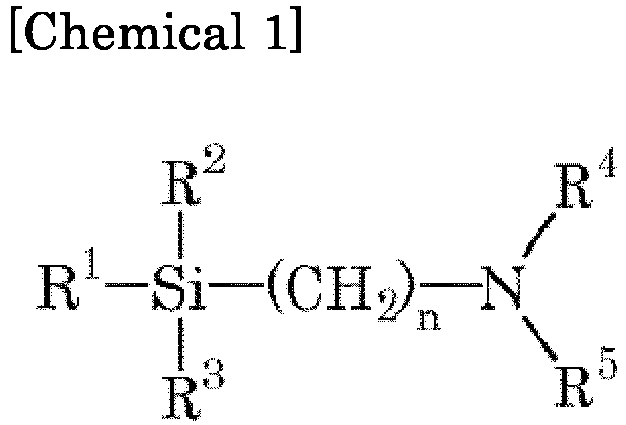
- In the formula, R1, R2 and R3 are the same or different and represent alkyl group, alkoxy group, silyloxy group, acetal group, carboxyl group (-COOH), mercapto group (-SH) or derivatives thereof. R4 and R5 are the same or different and represent hydrogen atoms or alkyl group. R4 and R5 may be combined to form a ring structure with nitrogen atoms. n represents an integer.
- As the modified SBR modified by the compound (modifying agent) represented by the above formula, SBR, in which the polymerization end (active end) of the solution-polymerized styrene-butadiene rubber (S-SBR) is modified by the compound represented by the above formula (for example, modified SBR described in
JP-A-2010-111753 - As R1, R2 and R3, an alkoxy group is suitable (preferably an alkoxy group having 1 to 8 carbon atoms, more preferably an alkoxy group having 1 to 4 carbon atoms). As R4 and R5, an alkyl group (preferably an alkyl group having 1 to 3 carbon atoms) is suitable, n is preferably 1 to 5, more preferably 2 to 4, and even more preferably 3. Further, when R4 and R5 are combined to form a ring structure together with a nitrogen atom, a 4- to 8-membered ring is preferable. The alkoxy group also includes a cycloalkoxy group (cyclohexyloxy group, and the like) and an aryloxy group (phenoxy group, benzyloxy group, and the like).
- Specific examples of the above modifying agent include 2-dimethylaminoethyltrimethoxysilane, 3-dimethylaminopropyltrimethoxysilane, 2-dimethylaminoethyltriethoxysilane, 3-dimethylaminopropyltriethoxysilane, 2-diethylaminoethyltrimethoxysilane, 3-diethylaminopropyltrimethoxysilane, 2-diethylaminoethyltriethoxysilane, and 3-diethylaminopropyltriethoxysilane. These may be used alone or in combination of two or more.
- Further, as the modified SBR, a modified SBR modified with the following compound (modifying agent) can also be used. Examples of the modifying agent include
- polyglycidyl ethers of polyhydric alcohols such as ethylene glycol diglycidyl ether, glycerin triglycidyl ether, trimethylolethanetriglycidyl ether, and trimethylolpropane triglycidyl ether;
- polyglycidyl ethers of aromatic compounds having two or more phenol groups such as diglycidylated bisphenol A;
polyepoxy compounds such as 1,4-diglycidylbenzene, 1,3,5-triglycidylbenzene, and polyepoxidized liquid polybutadiene; - epoxy group-containing tertiary amines such as 4,4' -diglycidyl-diphenylmethylamine, and 4,4'-diglycidyl-dibenzylmethylamine;
- diglycidylamino compounds such as diglycidylaniline, N, N'-diglycidyl-4-glycidyloxyaniline, diglycidyl orthotoluidine, tetraglycidylmetaxylenidiamine, tetraglycidylaminodiphenylmethane, tetraglycidyl-p-phenylenediamine, diglycidylaminomethylcyclohexane, and tetraglycidyl-1,3-bisaminomethylcyclohexane;
- amino group-containing acid chlorides such as bis- (1-methylpropyl) carbamate chloride, 4-morpholincarbonyl chloride, 1-pyrrolidincarbonyl chloride, N, N-dimethylcarbamide acid chloride, and N, N-diethylcarbamide acid chloride;
- epoxy group-containing silane compounds such as 1,3-bis-(glycidyloxypropyl) -tetramethyldisiloxane, and (3-glycidyloxypropyl) - pentamethyldisiloxane;
- sulfide group-containing silane compound such as (trimethylsilyl) [3- (trimethoxysilyl) propyl] sulfide, (trimethylsilyl) [3- (triethoxysilyl) propyl] sulfide, (trimethylsilyl) [3- (tripropoxysilyl) propyl] sulfide, (trimethylsilyl) [3-(tributoxysilyl) propyl] sulfide, (trimethylsilyl) [3- (methyldimethoxysilyl) propyl] sulfide, (trimethylsilyl) [3- (methyldiethoxysilyl) propyl] sulfide, (trimethylsilyl) [3- (methyldipropoxysilyl) propyl] sulfide, and (trimethylsilyl) [3- (methyldibutoxysilyl) propyl] sulfide;
- N-substituted aziridine compound such as ethyleneimine and propyleneimine;
- alkoxysilanes such as methyltriethoxysilane, N, N-bis (trimethylsilyl) -3-aminopropyltrimethoxysilane, N, N-bis (trimethylsilyl) -3-aminopropyltriethoxysilane, N, N-bis (trimethylsilyl) aminoethyltrimethoxysilane, and N, N-bis (trimethylsilyl) aminoethyltriethoxysilane;
- (thio) benzophenone compound having an amino group and/or a substituted amino group such as 4-N, N-dimethylaminobenzophenone, 4-N, N-di-t-butylaminobenzophenone, 4-N, N-diphenylamino benzophenone, 4,4'-bis (dimethylamino) benzophenone, 4,4'-bis (diethylamino) benzophenone, 4,4'-bis (diphenylamino) benzophenone, and N, N, N', N'-bis-(tetraethylamino) benzophenone;
- benzaldehyde compounds having an amino group and/or a substituted amino group such as 4-N, N-dimethylaminobenzaldehyde, 4-N, N-diphenylaminobenzaldehyde, and 4-N, N-divinylamino benzaldehyde;
- N-substituted pyroridone such as N-methyl-2-pyrrolidone, N-vinyl-2-pyrrolidone, N-phenyl-2-pyrrolidone, N-t-butyl-2-pyrrolidone, and N-methyl-5-methyl-2-pyrrolidone;
- N- substituted piperidone such as methyl-2-piperidone, N-vinyl-2-piperidone, and N-phenyl-2-piperidone;
- N-substituted lactams such as
N-methyl -ε-caprolactam, N-phenyl-ε-caprolactum, N-methyl-ω-laurilolactum, N-vinyl-ω-laurilolactum, N-methyl-6-propiolactam, and N-phenyl-β-propiolactam; and - N, N-bis- (2,3-epoxypropoxy)-aniline, 4,4-methylene-bis- (N, N-glycidylaniline), tris- (2,3-epoxypropyl)-1,3,5-triazine-2,4,6-triones, N, N-diethylacetamide, N-methylmaleimide, N, N-diethylurea, 1,3-dimethylethylene urea, 1,3-divinylethyleneurea, 1,3-diethyl-2-imidazolidinone, 1-methyl-3-ethyl-2-imidazolidinone, 4-N, N-dimethylaminoacetophenone, 4-N, N-diethylaminoacetophenone, 1,3-bis (diphenylamino)-2-propanone, and 1,7 -bis(methylethylamino)-4-heptanone. The modification with the above compound (modifying agent) can be carried out by a known method.
- As the SBR, for example, SBR manufactured and sold by Sumitomo Chemical Co., Ltd., JSR Corporation, Asahi Kasei Co., Ltd., Zeon Co., Ltd., Versalis Co., Ltd., etc. can be used. The SBR may be used alone or in combination of two or more. When two or more types of SBR are used in combination, the weight average of each SBR is used for the above-mentioned styrene amount, vinyl bond amount and the like.
- The rubber composition may further contain butadiene rubber (BR) as a rubber component, and when BR is contained, the content of BR in 100 parts by mass of the rubber component is, for example, 40 parts by mass or less, preferably 20 parts by mass or less. The weight average molecular weight of BR is, for example, 100,000 or more and 2 million or less. The vinyl bond amount of BR is, for example, 1% by mass or more and 30% by mass or less. The cis content of BR is, for example, 1% by mass or more and 98% by mass or less. The trans content of BR is, for example, 1% by mass or more and 60% by mass or less.
- The BR is not particularly limited, and BR having a high cis content (cis content of 90% or more), BR having a low cis content, BR containing syndiotactic polybutadiene crystals, and the like can be used. The BR may be either a non-modified BR or a modified BR, and examples of the modified BR include a modified BR into which the above-mentioned functional group has been introduced. These may be used alone or in combination of two or more. The cis content can be measured by infrared absorption spectrum analysis.
- As the BR, for example, products of Ube Kosan Co., Ltd., JSR Corporation, Asahi Kasei Co., Ltd., and Nippon Zeon Co., Ltd., etc. can be used.
- Further, as another rubber component, rubber (polymer) generally used in the production of tires such as nitrile rubber (NBR) may be contained.
- The rubber composition preferably contains silica as a reinforcing filler. The content of the rubber component with respect to 100 parts by mass is preferably 60 parts by mass or more, and more preferably 80 parts by mass or more. The upper limit is not particularly limited as long as the rubber composition can be kneaded, but is preferably about 200 parts by mass, for example. As a result, silica is dispersed throughout the rubber system without being unevenly distributed in either NR or SBR, so that wear resistance and slip resistance can be further improved.
- As the silica, silica having a BET specific surface area of 180 m2/g or more and 300 m2/g or less can be preferably used. As a result, the reinforcing property of silica can be further enhanced, so that particularly the wear resistance is improved. The BET specific surface area is the value of the nitrogen adsorption specific surface area (N2SA) measured by the BET method according to ASTM D3037-93.
- Specific examples of silica include dry silica (anhydrous silica) and wet silica (hydrous silica). Of these, wet silica is preferable because it has a large number of silanol groups, and products of Evonik, Degussa, Rhodia, Tosoh Silica Co., Ltd., Solbay Japan Co., Ltd., and Tokuyama Co., Ltd., etc. can be used.
- The rubber composition preferably contains a silane coupling agent together with silica. The silane coupling agent is not particularly limited. Examples of the silane coupling agent include
- sulfide-based ones such as bis(3-triethoxysilylpropyl)tetrasulfide, bis (2-triethoxysilylethyl)tetrasulfide, bis (4-triethoxysilylbutyl)tetrasulfide, bis(3-trimethoxysilylpropyl) tetrasulfide, bis(2-trimethoxysilylethyl) tetrasulfide, bis(2-triethoxysilylethyl)trisulfide, bis(4-trimethoxysilylbutyl) trisulfide, bis(3-triethoxysilylpropyl)disulfide, bis(2-triethoxysilylethyl) disulfide, bis(4-triethoxysilylbutyl)disulfide, bis(3-trimethoxysilylpropyl) disulfide, bis(2-trimethoxysilylethyl)disulfide, bis(4-trimethoxysilylbutyl)disulfide, 3-trimethoxysilylpropyl-N, N-dimethylthiocarbamoyltetrasulfide, 2-triethoxysilylethyl-N, N-dimethylthiocarbamoyltetrasulfide, and 3-triethoxysilylpropylmethacrylatemonosulfide;
- mercapto-based ones such as 3-mercaptopropyltrimethoxysilane, 2-mercaptoethyltriethoxysilane, and NXT and NXT-Z manufactured by Momentive;
- vinyl-based ones such as vinyl triethoxysilane, and vinyl trimethoxysilane;
- amino-based ones such as 3-aminopropyltriethoxysilane and 3-aminopropyltrimethoxysilane;
- glycidoxy-based ones such as γ-glycidoxypropyltriethoxysilane and γ-glycidoxypropyltrimethoxysilane;
- nitro-based ones such as 3-nitropropyltrimethoxysilane, and 3-nitropropyltriethoxysilane; and
- chloro-based ones such as 3-chloropropyltrimethoxysilane, and 3-chloropropyltriethoxysilane. These may be used alone or in combination of two or more.
- The preferable content of the silane coupling agent is, for example, 10% by mass or more, 15% by mass or less, and more preferably 11 parts by mass or more with respect to 100 parts by mass of silica. As a specific silane coupling agent, for example, products of Degussa, Momentive, Shinetsu Silicone Co., Ltd., Tokyo Chemical Industry Co., Ltd., Azumax Co., Ltd., Toray Dow Corning Co., Ltd., etc. can be used.
- The rubber composition preferably contains carbon black. The content of carbon black is, for example, 1 part by mass or more and 200 parts by mass or less with respect to 100 parts by mass of the rubber component.
- The carbon black is not particularly limited, and examples thereof includes furnace black (furnace carbon black) such as SAF, ISAF, HAF, MAF, FEF, SRF, GPF, APF, FF, CF, SCF and ECF; acetylene black (acetylene carbon black); thermal black (thermal carbon black) such as FT and MT; and channel black (channel carbon black) such as EPC, MPC and CC. These may be used alone or in combination of two or more.
- Nitrogen adsorption specific surface area (N2SA) of carbon black is, for example, 30 m2/g or more and 250 m2/g or less. The amount of dibutyl phthalate (DBP) absorbed by carbon black is, for example, 50 ml/100 g or more and 250 ml/100 g or less. The nitrogen adsorption specific surface area of carbon black is measured according to ASTM D4820-93, and the amount of DBP absorbed is measured according to ASTM D2414-93.
- The specific carbon black is not particularly limited, and examples thereof include N134, N110, N220, N234, N219, N339, N330, N326, N351, N550, and N762. Commercially available products include, for example, products of Asahi Carbon Co., Ltd., Cabot Japan Co., Ltd., Tokai Carbon Co., Ltd., Mitsubishi Chemical Corporation, Lion Corporation, Shin Nikka Carbon Co., Ltd., Columbia Carbon Co., Ltd., etc. These may be used alone or in combination of two or more.
- The rubber composition may contain a plasticizer component such as oil or a thermoplastic resin (resin). The preferable content of the plasticizer component is, for example, 5 parts by mass or more and 40 parts by mass or less, more preferably 8 parts by mass or more and 35 parts by mass or less, and further preferably15 parts by mass or more and 25 parts by mass or less with respect to 100 parts by mass of the rubber component. As a result, since the cohesive power between the silicas is weakened and the dispersibility is improved, when the rubber composition is kneaded, the followability of the tread to the road surface is improved, and the wear resistance and the slip resistance can be further improved. The oil content also includes the amount of oil contained in rubber (oil spread rubber).
- Examples of the oil include process oils, vegetable oils and fats, and mixtures thereof. As the process oil, for example, a paraffinic process oil, an aroma-based process oil, a naphthene process oil, or the like can be used. Examples of the vegetable oils and fats include castor oil, cottonseed oil, linseed oil, rapeseed oil, soybean oil, palm oil, coconut oil, peanut oil, rosin, pine oil, pine tar, tall oil, corn oil, rice oil, beni-flower oil, sesame oil, olive oil, sunflower oil, palm kernel oil, camellia oil, jojoba oil, macadamia nut oil, and tung oil. These may be used alone or in combination of two or more.
- As the specific examples of oil, products of Idemitsu Kosan Co., Ltd., Sankyo Yuka Kogyo Co., Ltd., Japan Energy Co., Ltd., Orisoi Co., Ltd., H & R Co., Ltd., Toyokuni Seiyu Co., Ltd., Showa Shell Sekiyu Co., Ltd., and Fuji Kosan Co., Ltd. can be used.
- Examples of the plasticizing agent component of the thermoplastic resin (resin) include C5 resin, C5-C9 resin, C9 resin, terpene resin, terpene-aromatic compound resin, rosin resin, and dicyclopentadiene resin (DCPD resin), and alkylphenol-based resin.
- The "C5 based petroleum resin" refers to a resin obtained by polymerizing a C5 fraction. Examples of the C5 fraction include petroleum fractions having 4 to 5 carbon atoms such as cyclopentadiene, pentene, pentadiene, and isoprene. As the C5 based petroleum resin, a dicyclopentadiene resin (DCPD resin) is preferably used.
- The "C9-based petroleum resin" (aromatic petroleum resin) refers to a resin obtained by polymerizing a C9 fraction, which may be hydrogenated or modified. Examples of the C9 fraction include petroleum fractions having 8 to 10 carbon atoms such as vinyltoluene, alkylstyrene, indene, and methyl indene. As specific examples of the aromatic petroleum resin, for example, a coumaron indene resin, a coumaron resin, an indene resin, and an aromatic vinyl resin are preferably used. As the aromatic vinyl resin, a homopolymer of a -methylstyrene or styrene or a copolymer of α -methylstyrene and styrene is preferable because it is economical, easy to process, and excellent in heat generation. A copolymer of α -methylstyrene and styrene is more preferred. As the aromatic vinyl-based resin, for example, those commercially available from Clayton, Eastman Chemical, etc. can be used.
- The "C5-C9-based petroleum resin" refers to a resin obtained by copolymerizing the C5 fraction and the C9 fraction, which may be hydrogenated or modified. Examples of the C5 fraction and the C9 fraction include the above-mentioned petroleum fraction. As the C5-C9 petroleum resin, for example, those commercially available from Tosoh Corporation, LUHUA, etc. can be used.
- Examples of the terpene-based resin and the terpene-aromatic compound-based resin include polyterpenes, terpenephenols, and aromatic-modified terpene resins. Polyterpene includes a resin obtained by polymerizing a terpene compound and a hydrogenated additive thereof. Terpene compound includes a hydrocarbon having a composition of (C5H8)n and an oxygen - containing derivative thereof. Terpene compound is a compound having a terpene as a basic skeleton, which include α -pinene, β - pinene, dipentene, limonene, milsen, aloosimene, osimene, α -phellandrene, α -terpinene, γ -terpinene, terpinolene, 1,8-cineol, 1,4-cineol, α -terpineol, β -terpineol, γ -terpineol and the like.
- Examples of the polyterpene include terpene resins, such as α - pinene resin, β -pinene resin, limonene resin, dipentene resin, and β - pinene/limonene resin, which are made from the above-mentioned terpene compound, as well as hydrogenating terpene resins obtained by hydrogenating the terpene resin. Examples of the terpene phenol include a resin obtained by copolymerizing the above-mentioned terpene compound and the phenol-based compound, and a resin obtained by hydrogenating the resin. Specifically, a resin obtained by condensing the above-mentioned terpene compound, a phenol-based compound and formalin can be mentioned. Examples of the phenolic compound include phenol, bisphenol A, cresol, xylenol and the like. Examples of the aromatic-modified terpene resin include a resin obtained by modifying a terpene resin with an aromatic compound, and a resin obtained by hydrogenating the resin. The aromatic compound is not particularly limited as long as it has an aromatic ring, and for example, phenol compounds such as phenol, alkylphenol, alkoxyphenol, and unsaturated hydrocarbon group-containing phenol; naphthol compounds such as naphthol, alkylnaphthol, alkoxynaphthol, and unsaturated hydrocarbon group-containing naphthol; styrene derivatives such as styrene, alkylstyrene, alkoxystyrene, and unsaturated hydrocarbon group-containing styrene; coumaron, indene and the like can be mentioned.
- As the commercially available terpene resin, for example, a product of Yasuhara Chemical Co., Ltd. can be used. It may be used alone or in combination of two or more.
- The rosin-based resin is not particularly limited, and examples thereof include natural resin rosin, and rosin-modified resin obtained by modifying it by hydrogenation, disproportionation, dimerization, esterification, or the like.
- The alkylphenol-based resin is not particularly limited, and examples thereof include an alkylphenol formaldehyde resin, an alkylphenol acetylene resin, and an oil-modified phenol formaldehyde resin.
- The rubber composition preferably contains an anti-aging agent. Content of the anti-aging agent is, for example, 1 part by mass or more and 10 parts by mass or less, and more preferably 2.5 parts by mass or more with respect to 100 parts by mass of the rubber component.
- Examples of the antiaging agent include naphthylamine-based antiaging agents such as phenyl-α-naphthylamine; diphenylamine-based antiaging agents such as octylated diphenylamine and 4,4'-bis (α, α'-dimethylbenzyl) diphenylamine; p-phenylenediamine-based anti-aging agent such as N-isopropyl-N'-phenyl-p-phenylenediamine, N-(1,3-dimethylbutyl)-N'-phenyl-p-phenylenediamine, and N,N'-di-2-naphthyl-p-phenylenediamine; quinoline-based anti-aging agent such as a polymer of 2,2,4-trimethyl-1,2-dihydroquinolin; monophenolic anti-aging agents such as 2,6-di-t-butyl-4-methylphenol, styrenated phenol;
bis, tris, polyphenolic anti-aging agents such as tetrakis-[methylene-3- (3',5'-di-t-butyl-4'-hydroxyphenyl)propionate] methane. These may be used alone or in combination of two or more. - As the anti-aging agent, for example, products of Seiko Chemical Co., Ltd., Sumitomo Chemical Co., Ltd., Ouchi Shinko Chemical Industry Co., Ltd., Flexsys Co., Ltd., etc. can be used.
- The rubber composition may contain stearic acid. Content of stearic acid is, for example, 0.5 parts by mass or more and 10.0 parts by mass or less, and more preferably 2 parts by mass or more, with respect to 100 parts by mass of the rubber component. As the stearic acid, conventionally known ones can be used, and, for example, products of NOF Corporation, NOF Corporation, Kao Corporation, Fuji film Wako Pure Chemical Industries, Ltd., and Chiba Fatty Acid Co., Ltd., etc. can be used.
- The rubber composition may contain zinc oxide. Content of zinc oxide is, for example, 0.5 parts by mass or more and 10 parts by mass or less, and more preferably 1.5 parts by mass or more, with respect to 100 parts by mass of the rubber component. As the zinc oxide, conventionally known ones can be used, for example, products of Mitsui Metal Mining Co., Ltd., Toho Zinc Co., Ltd., Hakusui Tech Co., Ltd., Shodo Chemical Industry Co., Ltd., Sakai Chemical Industry Co., Ltd., etc. can be used.
- The rubber composition preferably contains a cross-linking agent such as sulfur. Content of the cross-linking agent is, for example, 0.1 part by mass or more and 10.0 parts by mass or less, and more preferably 2 parts by mass or more, with respect to 100 parts by mass of the rubber component.
- Examples of sulfur include powdered sulfur, precipitated sulfur, colloidal sulfur, insoluble sulfur, highly dispersible sulfur, and soluble sulfur, which are commonly used in the rubber industry. These may be used alone or in combination of two or more.
- As the sulfur, for example, products of Tsurumi Chemical Industry Co., Ltd., Karuizawa Sulfur Co., Ltd., Shikoku Chemicals Corporation, Flexsys Co., Ltd., Nippon Kanryo Kogyo Co., Ltd., Hosoi Chemical Industry Co., Ltd., etc. can be used.
- Examples of the cross-linking agent other than sulfur include vulcanizing agents containing a sulfur atom such as Tackirol V200 manufactured by Taoka Chemical Industry Co., Ltd., DURALINK HTS (1,6-hexamethylene-sodium dithiosulfate dihydrate) manufactured by Flexsys, and KA9188 (1,6-bis (N, N'-dibenzylthiocarbamoyldithio) hexane) manufactured by Lanxess; and organic peroxides such as dicumyl peroxide.
- The rubber composition preferably contains a vulcanization accelerator. Content of the vulcanization accelerator is, for example, 0.3 parts by mass or more and 10.0 parts by mass or less, and more preferably 1 part by mass or more, with respect to 100 parts by mass of the rubber component.
- Examples of the vulcanization accelerator include
- thiazole-based vulcanization accelerators such as 2-mercaptobenzothiazole, di-2-benzothiazolyl disulfide, and N-cyclohexyl-2-benzothiadylsulfenamide;
- thiuram-based vulcanization accelerators such as tetramethylthiuram disulfide (TMTD), tetrabenzyltiuram disulfide (TBzTD), and tetrakis (2-ethylhexyl) thiuram disulfide (TOT-N);
- sulfenamide-based vulcanization accelerators such as N-cyclohexyl-2-benzothiazolesulfenamide, N-t-butyl- 2-benzothiazolyl sulfenamide, N-oxyethylene-2-benzothiazolesulfenamide, N-oxyethylene-2-benzothiazolesulfenamide, and N,N'-diisopropyl-2-benzothiazolesulfenamide; and
- guanidine-based vulcanization accelerators such as diphenylguanidine, di-ortho-tolylguanidine and ortho-tolylbiguanidine. These may be used alone or in combination of two or more.
- In addition to the above components, the rubber composition may further contain additives generally used in the tire industry, for example, fillers such as organic peroxides, graphite, calcium carbonate, talc, alumina, clay, aluminum hydroxide, and mica. Content of these additives is, for example, 0.1 part by mass or more and 200 parts by mass or less with respect to 100 parts by mass of the rubber component.
- The rubber composition is produced by a general method, for example, a manufacturing method including a base kneading step of kneading a rubber component with a filler such as silica or carbon black, and a finish kneading step of kneading the kneaded product obtained in the base kneading step and a cross-linking agent.
- The kneading can be performed using a known (sealed) kneader such as a banbury mixer, a kneader, or an open roll.
- The kneading temperature of the base kneading step is, for example, higher than 50 °C or higher and 200 °C or lower, and the kneading time is, for example, 30 seconds or more and 30 minutes or less. In the base kneading process, in addition to the above components, compounding agents conventionally used in the rubber industry, such as softeners such as oil, stearic acid, zinc oxide, antiaging agents, waxes, and vulcanization accelerators, may be appropriately added and kneaded as needed.
- In the finish kneading step, the kneaded product obtained in the base kneading step and the cross-linking agent are kneaded. The kneading temperature of the finish kneading step is, for example, room temperature or higher and 80 °C or lower, and the kneading time is, for example, 1 minute or more and 15 minutes or less. In the finish kneading step, in addition to the above components, a vulcanization accelerator, zinc oxide and the like may be appropriately added and kneaded as needed.
- The tire of the present discloser is manufactured by a usual method using an unvulcanized rubber composition obtained through the finish kneading step. That is, the unvulcanized rubber composition is extruded according to the shape of each tire member of the tread, and is molded together with other tire members by a normal method on a tire molding machine to produce an unvulcanized tire.
- Specifically, on the molded drum, the inner liner as a member to ensure the airtightness of the tire, the carcass as a member to withstand the load, impact, and filling air pressure received by the tire, a belt as a member to strongly tighten the carcass to increase the rigidity of the tread, and the like are wound, both ends of the carcass are fixed to both side edges, a bead part as a member for fixing the tire to the rim is arranged, and formed into a toroid shape. Then the tread is pasted on the center of the outer circumference, and the sidewall portion as a member that protects the carcass and withstands bending is pasted on the radial outer side to produce an unvulcanized tire.
- In the present embodiment, it is preferable to provide with an inclined belt layer that extends at an angle of 55 ° or more and 75 ° or less with respect to the tire circumferential direction, as the belt. As a result, the durability of the tire is ensured while the rigidity of the tread can be sufficiently maintained.
- Then, the produced unvulcanized tire is heated and pressed in a vulcanizer to obtain a tire. The vulcanization step can be carried out by applying a known vulcanization means. The vulcanization temperature is, for example, 120 °C or higher and 200 °C or lower, and the vulcanization time is, for example, 5 minutes or more and 15 minutes or less.
- At this time, the tire is formed into a shape that satisfies the above-mentioned (formula 3) and (formula 4).
- Specific tires that can satisfy the above-mentioned (formula 3) and (formula 4) include 145/60R18, 145/60R19, 155/55R18, 155/55R19, 155/70R17, 155/70R19, 165/55R20, 165/55R21, 165/60R19, 165/65R19, 165/70R18, 175/55R19, 175/55R20, 175/55R22, 175/60R18, 185/55R19, 185/60R20, 195/50R20, and 195/55R20.
- In this embodiment,
the tire satisfying the above-mentioned (formula 1) to (formula 4) is preferably applied to a pneumatic tire for a passenger car, and by satisfying the above formula, it is possible to contribute more preferably to the solution of the problem in the present disclosure, that is, to provide a tire in which both wear resistance and slip resistance are improved in a well-balanced manner, and in particular, both wear resistance and slip resistance when running in the rain are highly compatible. - The pneumatic tire for a passenger car referred to here is a tire mounted on a vehicle traveling on four wheels and has a maximum load capacity of 1000 kg or less.
- The maximum load capacity is not particularly limited as long as it is 1000 kg or less. However, in general, the tire weight tends to increase as the maximum load capacity increases, and the braking distance also increases due to inertia accordingly. Therefore, the maximum load capacity is preferably 900 kg or less, more preferably 800 kg or less, and further preferably 700 kg or less.
- From the viewpoint of the braking distance due to the inertia described above, the tire weight is preferably 20 kg or less, more preferably 15 kg or less, and further preferably 12 kg or less, 10 kg or less, and 8 kg or less. The tire of the present disclosure may be provided with electronic components, and in this case, the tire weight referred to here is the weight of the tire including the weights of the electronic components and the electronic component mounting members. If a sealant, sponge or the like is provided in the lumen, the weight of the tire includes them.
- Hereinafter, the present disclosure will be described in more detail with reference to examples.
- First, a rubber composition for tread was produced.
- (1) Compounding material
First, each compounding material shown below was prepared.- (a) Rubber component
- (a-1) NR: TSR20
- (a-2-1) SBR-A: T3830 (Toughden 3830) manufactured by Asahi Kasei
Corporation. (Amount of styrene: 35% by mass) - (a-2-2) SBR-B: Nipol NS616 manufactured by Nippon Zeon Corporation (Modified S-SBR, amount of styrene: 20% by mass)
- (a-3) BR: BR150 manufactured by Ube Kosan Co., Ltd.
- (b) Compounding materials other than rubber components
- (b-1) Carbon black: Diablack N220 manufactured by Mitsubishi Chemical Corporation
- (b-2-1) Silica-A: Ultrasil VN3 manufactured by Evonik Industries, Inc. (BET specific surface area: 140 m2/g)
- (b-2-2) Silica-B: Ultrasil 9000 Gr manufactured by Evonik Industries, Inc. (BET specific surface area: 210 m2/g)
- (b-3) Silane coupling agent: Si266 manufactured by Degussa (Bis(3-triethoxysilylpropyl) disulfide)
- (b-4) Oil: Process X-140 manufactured by Japan Energy Co., Ltd.
- (b-5-1) Resin-A: Petrotac 100V manufactured by Tosoh Corporation (C5 resin)
- (b-5-2) Resin-B: YS Polystar U130 manufactured by Yasuhara Chemical Co., Ltd. (Terpen-aromatic compound resin)
- (b-6) Zinc oxide: Zinc white No. 1 manufactured by Mitsui Mining & Smelting Co., Ltd.
- (b-7) Stearic acid: Stearic acid "TSUBAKI" manufactured by NOF CORPORATION
- (b-8) Anti-aging agent: Antigen 6C manufactured by Sumitomo Chemical Co., Ltd. (N- (1,3-dimethylbutyl) -N'-phenyl-p-phenylenediamine)
- (b-9) Crosslinking agent and vulcanization accelerator
- Sulfur: Powdered sulfur manufactured by Tsurumi Chemical Industry Co., Ltd.
- Vulcanization accelerator: Nocceler CZ manufactured by Ouchi Shinko Chemical Industry Co., Ltd. (N-Cyclohexyl-2-benzothiazolyl sulphenamide)
- (a) Rubber component
- (2) Production of rubber composition
According to the compounding contents of A-1 to A-6 and B-1 to B-9 shown in Table 1, using a Banbury mixer, materials other than sulfur and a vulcanization accelerator were kneaded for 5 minutes under the condition of 150 °C to obtain a kneaded product. Each compounding amount is a mass part. - Next, sulfur and a vulcanization accelerator were added to the obtained kneaded product, and the mixture was kneaded at 80 °C for 5 minutes using an open roll to obtain a tread rubber composition. A tread is formed using the obtained tread rubber composition, bonded together with other tire members to form an unvulcanized tire, which is then vulcanized for 10 minutes under the condition of 170°C to produce each test tire having the size of 155 type(Table 2), or 175 type (Table 3). For each test tire, the contact width Wt (mm), diameter Dt (mm), and the complex elastic modulus E* (MPa) measured under the condition of 30°C, frequency 10 Hz, initial strain 5%,and the dynamic strain rate 1% using "Eplexor" manufactured by GABO are shown in Tables 2 to 3.
- After each test tire is installed on all wheels of the vehicle (domestic FF vehicle, displacement 2000cc) and is filled with air at 250kPa, a steady circular turn on the test course on a wet road surface was made while gradually increasing the vehicle speed, and the maximum speed until the driver felt the slip of the car body was measured. The evaluation was performed by calculating the average value of the measurement results by the five drivers for each test tire and then indexing the average value against a reference test tire. The larger the value, the better the slip resistance when running in the rain. The results are also shown in Tables 2 to 3.
- Each test tire is installed on all wheels of the vehicle (domestic FF vehicle, displacement 2000cc) and is filled with air at 250kPa. Then, after driving 8000km at a speed of 80km/h on a test course on a wet road surface, the depth of the groove near the equator of the tire was measured, and the rate of decrease with respect to the depth before the test was determined. The evaluation was performed by indexing by the following formula based on the ratio of the result in the reference test tire and the result in each test tire. The larger the value, the better the wear resistance. The results are also shown in Tables 2 to 3.

- Table 2 shows the evaluation results for the size 155 type, and Table 3 shows the evaluation results for the size 175 type. As the reference test tires, the test tires of Example 1-1 are used in Table 2, and the test tires of Example 2-1 are used in Table 3. The balance between the slip resistance and the wear resistance can be evaluated by taking the average value of the evaluation results of the slip resistance (1) and the wear resistance (2).
[Table 2] Example Comparative example 1-1 1-2 1-3 1-4 1-5 1-6 1-1 1-2 1-3 1-4 1-5 1-6 1-7 1-8 1-9 1-10 Formulation A-1 A-2 A-3 A-4 A-5 A-6 B-1 B-2 A-1 B-3 B-4 B-5 B-6 B-7 B-8 B-9 Size(155/) 70R19 70R19 60R17 70R19 Dt mm 699 700 700 698 701 698 699 701 618 702 700 699 698 699 700 701 Wt mm 154 156 155 154 156 153 155 154 154 153 155 155 156 154 155 156 NR+SBR 80 80 80 80 80 80 45 100 80 90 45 45 45 45 45 46 NR 60 60 60 60 60 60 35 90 60 60 35 35 35 35 35 35 E*(MPa) 9.0 8.5 7.5 8.0 9.0 8.5 7.0 8.0 9.0 10 7.0 6.5 7.0 8.0 7.0 7.0 (Dt2×π/4)/Wt 2492 2467 2483 2485 2474 2501 2476 2506 1947 2530 2480 2476 2453 2492 2480 2474 |NR-SSBR|×Wt 6160 6240 6200 6160 6240 6120 3875 12320 6160 1530 3875 3875 3900 3850 3875 3900 E*×Wt 1386 1326 1162.5 1232 1404 1300.5 1085 1232 1386 1530 1085 1007.5 1092 1232 1085 1092 Slip resistance 100 105 105 105 105 108 90 90 95 90 90 90 90 90 93 93 Wear resistance 100 105 107 110 113 115 90 95 95 90 90 92 95 98 100 105 [Table 3] Example Comparative example 2-1 2-2 2-3 2-4 2-5 2-6 2-1 2-2 2-3 2-4 2-5 2-6 2-7 2-8 2-9 2-10 Formulation A-1 A-2 A-3 A-4 A-5 A-6 B-1 B-2 A-1 B-3 B-4 B-5 B-6 B-7 B-8 B-9 Size(175/) 60R19 60R19 55R18 60R19 Dt mm 693 694 692 695 694 691 692 693 650 695 692 693 694 691 692 693 Wt mm 175 174 176 177 173 174 176 176 176 174 176 176 176 174 175 176 NR+SBR 80 80 80 80 80 80 45 100 80 90 45 45 45 45 45 46 NR 60 60 60 60 60 60 35 90 60 60 35 35 35 35 35 35 E*(MPa) 9.0 8.5 7.5 8.0 9.0 8.5 7.0 8.0 9.0 10 7.0 6.5 7.0 8.0 7.0 7.0 (Dt2×π/4)/Wt 2153 2174 2137 2143 2187 2155 2137 2143 1896 2180 2149 2155 2149 2155 2149 2143 |NR-SBR|×Wt 7000 6960 7040 7080 6920 6960 4400 14080 7000 1740 4375 4375 4400 4350 4375 4400 E*×Wt 1575 1479 1320 1416 1557 1479 1232 1408 1575 1740 1225 1137.5 1232 1392 1225 1232 Slip resistance 100 107 107 107 107 112 89 89 93 89 88 89 88 88 90 91 Wear resistance 100 107 109 112 115 119 88 93 93 88 89 90 92 97 98 102 - From Tables 2 to 3, it can be seen that, for tires of any size, 155 size and 175 size, if all of the above (formula 1) to (formula 4) are satisfied, it is possible to provide a tire in which wear resistance and slip resistance are highly compatible when driving in the rain.
- Then, it can be seen that, by satisfying each of the requirements specified in claim 2 and thereafter, it is possible to provide a tire in which wear resistance and slip resistance are more highly compatible when driving in the rain.
- On the other hand, when any one of (formula 1) to (formula 4) is not satisfied, it can be seen that the wear resistance and the slip resistance cannot be said to be highly compatible when driving in the rain.
- Although the present disclosure has been described above based on the embodiments, the present disclosure is not limited to the above embodiments. Various modifications can be made to the above embodiments within the same and equal scope as the present disclosure.
- The present disclosure (1) is a pneumatic tire, in which
- at least one layer of the rubber layers forming the tread portion is formed by the rubber composition containing styrene-butadiene rubber and isoprene-based rubber as a rubber component;
- when the amount of the styrene-butadiene rubber is R1 (parts by mass), and the amount of the isoprene-based rubber is R2 (parts by mass) in 100 parts by mass of the rubber component, and the ground contact width of the tire is Wt (mm) and the diameter is Dt (mm) when the tire is installed on a standardized rim and the internal pressure is 250 kPa, the following (formula 1) to (formula 4) are satisfied.


- The present disclosure (2) is the pneumatic tire according to the present disclosure (1), wherein the weight average molecular weight of the styrene-butadiene rubber is 100,000 or more and 2 million or less.
- The present disclosure (3) is the pneumatic tire according to the present disclosure (1) or (2), wherein the styrene-butadiene rubber is a modified solution-polymerized styrene-butadiene rubber.
- The present disclosure (4) is the pneumatic tire of any combination of the present disclosures (1) to (3), wherein the styrene content in the styrene-butadiene rubber is 5% by mass or more and 25% by mass or less.
- The present disclosure (5) is the pneumatic tire of any combination of the present disclosures (1) to (4), wherein the styrene content in the rubber composition is 1% by mass or more and 5% by mass or less.
- The present disclosure (6) is the pneumatic tire of any combination of the present disclosures (1) to (5), wherein the rubber composition further contains 40 parts by mass or less of butadiene rubber in 100 parts by mass of the rubber component.
- The present disclosure (7) is the pneumatic tire of any combination of the present disclosures (1) to (6), wherein the rubber composition contains 5 parts by mass or more and 40 parts by mass or less of a plasticizer component with respect to 100 parts by mass of the rubber component.
- The present disclosure (8) is the pneumatic tire according to the present disclosure (7), wherein a thermoplastic resin is contained as the plasticizer component.
- The present disclosure (9) is the pneumatic tire according to the present disclosure (8), wherein the thermoplastic resin is selected from the group consisting of C5 resin, C5-C9 resin, C9 resin, terpene resin, terpene-aromatic compound resin, rosin resin, dicyclopentadiene resin, and alkylphenol based resin.
- The present disclosure (10) is the pneumatic tire of any combination of the present disclosures (1) to (9), wherein the rubber composition contains 60 parts by mass or more of silica with respect to 100 parts by mass of the rubber component.
- The present disclosure (11) is the pneumatic tire according to the present disclosure (10), wherein the BET specific surface area of the silica is 180 m2/g or more and 300 m2/g or less.
- The present disclosure (12) is the pneumatic tire according to the present disclosure (10) or (11), which contains 10% by mass or more and 15% by mass or less of a silane coupling agent with respect to 100 parts by mass of the silica
- The present disclosure (13) is the pneumatic tire of any combination of the present disclosures (1) to (12), wherein, when the complex elastic modulus of the rubber composition measured under the conditions of 30°C, frequency 10Hz, initial strain 5%, and dynamic strain rate 1% is E*(MPa), the following formula is satisfied.

- The present disclosure (14) is the pneumatic tire of any combination of the present disclosures (1) to (13), wherein, the tread portion is formed of a plurality of rubber layers, and the rubber composition is used for the cap rubber layer of the tread.
- The present disclosure (15) is the pneumatic tire of any combination of the present disclosures (1) to (14), which is a pneumatic tire for a passenger car.
| Formulation | A-1 | A-2 | A-3 | A-4 | A-5 | A-6 | B-1 | B-2 | B-3 | B-4 | B-5 | B-6 | B-7 | B-8 | B-9 |
| (Rubber component) | |||||||||||||||
| NR | 60 | 60 | 60 | 60 | 60 | 60 | 35 | 90 | 50 | 35 | 35 | 35 | 35 | 35 | 35 |
| SBR-A | 20 | 0 | 0 | 0 | 0 | 0 | 10 | 10 | 40 | 0 | 0 | 0 | 0 | 0 | 0 |
| SBR-B | 0 | 20 | 20 | 20 | 20 | 20 | 0 | 0 | 0 | 10 | 10 | 10 | 10 | 10 | 10 |
| BR | 20 | 20 | 20 | 20 | 20 | 20 | 55 | 0 | 10 | 55 | 55 | 55 | 55 | 55 | 55 |
| (NR+SBR) | 80 | 80 | 80 | 80 | 80 | 80 | 45 | 100 | 90 | 45 | 45 | 45 | 45 | 45 | 45 |
| [Other Compounding Materials] | |||||||||||||||
| Carbon Black | 5 | 5 | 5 | 5 | 5 | 5 | 5 | 5 | 5 | 5 | 5 | 5 | 5 | 5 | 5 |
| Silica-A | 55 | 55 | 55 | 80 | 0 | 0 | 55 | 55 | 55 | 55 | 55 | 80 | 0 | 0 | 0 |
| Silica-B | 0 | 0 | 0 | 0 | 80 | 80 | 0 | 0 | 0 | 0 | 0 | 0 | 80 | 80 | 80 |
| Silane coupling agent | 5.5 | 5.5 | 5.5 | 8.8 | 8.8 | 8.8 | 5.5 | 5.5 | 5.5 | 5.5 | 5.5 | 8.8 | 8.8 | 8.8 | 8.8 |
| Oil | 0 | 0 | 10 | 10 | 10 | 10 | 0 | 0 | 0 | 0 | 10 | 10 | 10 | 10 | 10 |
| Resin-A | 0 | 0 | 0 | 0 | 0 | 10 | 0 | 0 | 0 | 0 | 0 | 0 | 0 | 10 | 0 |
| Resin-B | 0 | 0 | 0 | 0 | 0 | 0 | 0 | 0 | 0 | 0 | 0 | 0 | 0 | 0 | 10 |
| Zinc oxide | 1.5 | 1.5 | 1.5 | 1.5 | 1.5 | 1.5 | 1.5 | 1.5 | 1.5 | 1.5 | 1.5 | 1.5 | 1.5 | 1.5 | 1.5 |
| Stearic acid | 2 | 2 | 2 | 2 | 2 | 2 | 2 | 2 | 2 | 2 | 2 | 2 | 2 | 2 | 2 |
| Anti-aging agents | 2.5 | 2.5 | 2.5 | 2.5 | 2.5 | 2.5 | 2.5 | 2.5 | 2.5 | 2.5 | 2.5 | 2.5 | 2.5 | 2.5 | 2.5 |
| [Crosslinking agent and vulcanization accelerator] | |||||||||||||||
| Sulfur | 2 | 2 | 2 | 2 | 2 | 2 | 2 | 2 | 2 | 2 | 2 | 2 | 2 | 2 | 2 |
| Vulcanization accelerator | 1 | 1 | 1 | 1 | 1 | 1 | 1 | 1 | 1 | 1 | 1 | 1 | 1 | 1 | 1 |
Claims (15)
- A pneumatic tire, in whichat least one layer of the rubber layers forming the tread portion is formed by the rubber composition containing styrene-butadiene rubber and isoprene-based rubber as a rubber component;when the amount of the styrene-butadiene rubber is R1 (parts by mass), and the amount of the isoprene-based rubber is R2 (parts by mass) in 100 parts by mass of the rubber component, and the ground contact width of the tire is Wt (mm) and the diameter is Dt (mm) when the tire is installed on a standardized rim and the internal pressure is 250 kPa, the following (formula 1) to (formula 4) are satisfied.


- The pneumatic tire according to claim 1, wherein the weight average molecular weight of the styrene-butadiene rubber is 100,000 or more and 2 million or less.
- The pneumatic tire according to claim 1 or 2, wherein the styrene-butadiene rubber is a modified solution-polymerized styrene-butadiene rubber.
- The pneumatic tire according to any one of claims 1 to 3, wherein the styrene content in the styrene-butadiene rubber is 5% by mass or more and 25% by mass or less.
- The pneumatic tire according to any one of claims 1 to 4, wherein the styrene content in the rubber composition is 1% by mass or more and 5% by mass or less.
- The pneumatic tire according to any one of claims 1 to 5, wherein the rubber composition further contains 40 parts by mass or less of butadiene rubber in 100 parts by mass of the rubber component.
- The pneumatic tire according to any one of claims 1 to 6, wherein the rubber composition contains 5 parts by mass or more and 40 parts by mass or less of a plasticizer component with respect to 100 parts by mass of the rubber component.
- The pneumatic tire according to claim 7, wherein a thermoplastic resin is contained as the plasticizer component.
- The pneumatic tire according to claim 8, wherein the thermoplastic resin is selected from the group consisting of C5 resin, C5-C9 resin, C9 resin, terpene resin, terpene-aromatic compound resin, rosin resin, dicyclopentadiene resin, and alkylphenol based resin.
- The pneumatic tire according to any one of claims 1 to 9, wherein the rubber composition contains 60 parts by mass or more of silica with respect to 100 parts by mass of the rubber component.
- The pneumatic tire according to claim 10, wherein the BET specific surface area of the silica is 180 m2/g or more and 300 m2/g or less.
- The pneumatic tire according to claim 10 or 11, which contains 10% by mass or more and 15% by mass or less of a silane coupling agent with respect to 100 parts by mass of the silica
- The pneumatic tire according to any one of claims 1 to 12, wherein, when the complex elastic modulus of the rubber composition measured under the conditions of 30°C, frequency 10Hz, initial strain 5%, and dynamic strain rate 1% is E*(MPa), the following formula is satisfied.

- The pneumatic tire according to any one of claims 1 to 13, wherein, the tread portion is formed of a plurality of rubber layers, and the rubber composition is used for the cap rubber layer of the tread.
- The pneumatic tire according to any one of claims 1 to 14, which is a pneumatic tire for a passenger car.
Applications Claiming Priority (2)
| Application Number | Priority Date | Filing Date | Title |
|---|---|---|---|
| JP2020127571 | 2020-07-28 | ||
| PCT/JP2021/027591 WO2022025008A1 (en) | 2020-07-28 | 2021-07-26 | Pneumatic tire |
Publications (2)
| Publication Number | Publication Date |
|---|---|
| EP4177076A1 true EP4177076A1 (en) | 2023-05-10 |
| EP4177076A4 EP4177076A4 (en) | 2024-07-10 |
Family
ID=80036202
Family Applications (1)
| Application Number | Title | Priority Date | Filing Date |
|---|---|---|---|
| EP21848885.6A Pending EP4177076A4 (en) | 2020-07-28 | 2021-07-26 | PNEUMATIC |
Country Status (4)
| Country | Link |
|---|---|
| EP (1) | EP4177076A4 (en) |
| JP (1) | JP7686186B2 (en) |
| CN (1) | CN116133876A (en) |
| WO (1) | WO2022025008A1 (en) |
Family Cites Families (20)
| Publication number | Priority date | Publication date | Assignee | Title |
|---|---|---|---|---|
| JP2005255099A (en) * | 2004-03-15 | 2005-09-22 | Yokohama Rubber Co Ltd:The | Pneumatic tire |
| JP4758764B2 (en) * | 2005-12-28 | 2011-08-31 | 住友ゴム工業株式会社 | Heavy duty radial tire |
| JP5091921B2 (en) * | 2008-09-19 | 2012-12-05 | 住友ゴム工業株式会社 | Rubber composition for tire |
| JP4881362B2 (en) | 2008-11-05 | 2012-02-22 | 住友ゴム工業株式会社 | Rubber composition and tire |
| JP5249362B2 (en) * | 2010-03-16 | 2013-07-31 | 住友ゴム工業株式会社 | Rubber composition for tire and pneumatic tire |
| WO2012141158A1 (en) * | 2011-04-11 | 2012-10-18 | 住友ゴム工業株式会社 | Pneumatic tire |
| JP2014213836A (en) | 2013-04-30 | 2014-11-17 | 株式会社ブリヂストン | Pneumatic radial tire for passenger car |
| JP6478407B2 (en) * | 2015-06-30 | 2019-03-06 | 株式会社クラレ | Farnesene polymer, rubber composition and tire using the same |
| JP2017052329A (en) | 2015-09-07 | 2017-03-16 | 株式会社ブリヂストン | Pneumatic tires for passenger cars |
| JP6826876B2 (en) | 2016-12-13 | 2021-02-10 | Toyo Tire株式会社 | Rubber composition and pneumatic tire |
| JP6758088B2 (en) | 2016-05-20 | 2020-09-23 | 株式会社ブリヂストン | Pneumatic tires |
| JP6897080B2 (en) * | 2016-12-09 | 2021-06-30 | 住友ゴム工業株式会社 | Rubber composition and pneumatic tire |
| JP7009753B2 (en) | 2017-03-16 | 2022-01-26 | 住友ゴム工業株式会社 | Pneumatic tires |
| JP6972932B2 (en) | 2017-11-01 | 2021-11-24 | 住友ゴム工業株式会社 | Rubber composition |
| JP7159566B2 (en) | 2018-02-13 | 2022-10-25 | 横浜ゴム株式会社 | Rubber composition for tire |
| JP7151160B2 (en) | 2018-05-09 | 2022-10-12 | 住友ゴム工業株式会社 | Tire rubber composition and pneumatic tire |
| JP7158989B2 (en) * | 2018-10-10 | 2022-10-24 | 株式会社ブリヂストン | tire |
| JP7298292B2 (en) | 2019-05-17 | 2023-06-27 | 住友ゴム工業株式会社 | Rubber composition for tread and tire |
| JP7494496B2 (en) | 2020-03-09 | 2024-06-04 | 住友ゴム工業株式会社 | tire |
| JP6800435B1 (en) * | 2020-07-28 | 2020-12-16 | 住友ゴム工業株式会社 | Pneumatic tires |
-
2021
- 2021-07-26 WO PCT/JP2021/027591 patent/WO2022025008A1/en not_active Ceased
- 2021-07-26 JP JP2022540303A patent/JP7686186B2/en active Active
- 2021-07-26 CN CN202180059150.8A patent/CN116133876A/en active Pending
- 2021-07-26 EP EP21848885.6A patent/EP4177076A4/en active Pending
Also Published As
| Publication number | Publication date |
|---|---|
| JPWO2022025008A1 (en) | 2022-02-03 |
| EP4177076A4 (en) | 2024-07-10 |
| WO2022025008A1 (en) | 2022-02-03 |
| JP7686186B2 (en) | 2025-06-02 |
| CN116133876A (en) | 2023-05-16 |
Similar Documents
| Publication | Publication Date | Title |
|---|---|---|
| EP4177068A1 (en) | Pneumatic tire | |
| EP3608125B1 (en) | Rubber composition for tread and pneumatic tire | |
| EP3919289B1 (en) | Pneumatic tire | |
| EP4205998B1 (en) | Pneumatic tire | |
| EP4190593B1 (en) | Pneumatic tire | |
| EP4177082A1 (en) | Pneumatic tire | |
| EP4177069A1 (en) | Pneumatic tire | |
| EP4245569A1 (en) | Tire | |
| EP4296313A1 (en) | Tire | |
| EP4190590B1 (en) | Pneumatic tire | |
| EP4269130A1 (en) | Pneumatic tire | |
| EP4209360B1 (en) | Pneumatic tire | |
| EP4296080A1 (en) | Tire | |
| EP4147881B1 (en) | Pneumatic radial tire for passenger vehicle | |
| EP4183596B1 (en) | Pneumatic tire | |
| JP7306050B2 (en) | Tire rubber composition and pneumatic tire | |
| EP4296082B1 (en) | Tire | |
| JP7682447B2 (en) | Pneumatic tires | |
| JP7516943B2 (en) | Rubber composition for tires and tires | |
| EP3608127B1 (en) | Pneumatic tire | |
| EP3581398B1 (en) | Rubber composition for tire, and pneumatic tire | |
| JP7686186B2 (en) | Pneumatic tires | |
| JP7135438B2 (en) | Tire rubber composition and pneumatic tire | |
| US12617238B2 (en) | Pneumatic tire | |
| EP4190597B1 (en) | Pneumatic tire |
Legal Events
| Date | Code | Title | Description |
|---|---|---|---|
| STAA | Information on the status of an ep patent application or granted ep patent |
Free format text: STATUS: THE INTERNATIONAL PUBLICATION HAS BEEN MADE |
|
| PUAI | Public reference made under article 153(3) epc to a published international application that has entered the european phase |
Free format text: ORIGINAL CODE: 0009012 |
|
| STAA | Information on the status of an ep patent application or granted ep patent |
Free format text: STATUS: REQUEST FOR EXAMINATION WAS MADE |
|
| 17P | Request for examination filed |
Effective date: 20230201 |
|
| AK | Designated contracting states |
Kind code of ref document: A1 Designated state(s): AL AT BE BG CH CY CZ DE DK EE ES FI FR GB GR HR HU IE IS IT LI LT LU LV MC MK MT NL NO PL PT RO RS SE SI SK SM TR |
|
| DAV | Request for validation of the european patent (deleted) | ||
| DAX | Request for extension of the european patent (deleted) | ||
| P01 | Opt-out of the competence of the unified patent court (upc) registered |
Effective date: 20240327 |
|
| A4 | Supplementary search report drawn up and despatched |
Effective date: 20240611 |
|
| RIC1 | Information provided on ipc code assigned before grant |
Ipc: C08L 7/00 20060101ALI20240605BHEP Ipc: C08L 9/06 20060101ALI20240605BHEP Ipc: C08L 9/00 20060101ALI20240605BHEP Ipc: C08K 3/36 20060101ALI20240605BHEP Ipc: B60C 11/00 20060101ALI20240605BHEP Ipc: B60C 1/00 20060101ALI20240605BHEP Ipc: B60C 3/04 20060101AFI20240605BHEP |