EP4176875A1 - Pharmaceutical composition, its use as a drug and new compounds, especially for treating sars-cov-2 infection - Google Patents
Pharmaceutical composition, its use as a drug and new compounds, especially for treating sars-cov-2 infection Download PDFInfo
- Publication number
- EP4176875A1 EP4176875A1 EP21306547.7A EP21306547A EP4176875A1 EP 4176875 A1 EP4176875 A1 EP 4176875A1 EP 21306547 A EP21306547 A EP 21306547A EP 4176875 A1 EP4176875 A1 EP 4176875A1
- Authority
- EP
- European Patent Office
- Prior art keywords
- ace2
- compound
- group
- cov
- sars
- Prior art date
- Legal status (The legal status is an assumption and is not a legal conclusion. Google has not performed a legal analysis and makes no representation as to the accuracy of the status listed.)
- Withdrawn
Links
- 150000001875 compounds Chemical class 0.000 title claims abstract description 93
- 239000008194 pharmaceutical composition Substances 0.000 title claims abstract description 12
- 208000025721 COVID-19 Diseases 0.000 title claims description 7
- 208000037847 SARS-CoV-2-infection Diseases 0.000 title claims description 7
- 239000003814 drug Substances 0.000 title description 64
- 229940079593 drug Drugs 0.000 title description 56
- 208000015181 infectious disease Diseases 0.000 claims abstract description 21
- 230000002265 prevention Effects 0.000 claims abstract description 9
- 150000003839 salts Chemical class 0.000 claims abstract description 8
- 102000053723 Angiotensin-converting enzyme 2 Human genes 0.000 claims description 148
- 108090000975 Angiotensin-converting enzyme 2 Proteins 0.000 claims description 148
- 230000003993 interaction Effects 0.000 claims description 63
- 230000002401 inhibitory effect Effects 0.000 claims description 14
- 101710198474 Spike protein Proteins 0.000 claims description 10
- 239000011324 bead Substances 0.000 claims description 9
- 239000008187 granular material Substances 0.000 claims description 9
- 239000003826 tablet Substances 0.000 claims description 9
- 239000002552 dosage form Substances 0.000 claims description 6
- 239000006196 drop Substances 0.000 claims description 4
- 239000000499 gel Substances 0.000 claims description 4
- -1 patch Substances 0.000 claims description 4
- 239000000243 solution Substances 0.000 claims description 4
- 239000007936 buccal or sublingual tablet Substances 0.000 claims description 3
- 239000002775 capsule Substances 0.000 claims description 3
- 239000007910 chewable tablet Substances 0.000 claims description 3
- 229940068682 chewable tablet Drugs 0.000 claims description 3
- 229940112822 chewing gum Drugs 0.000 claims description 3
- 235000015218 chewing gum Nutrition 0.000 claims description 3
- 239000006071 cream Substances 0.000 claims description 3
- 239000000839 emulsion Substances 0.000 claims description 3
- 239000006260 foam Substances 0.000 claims description 3
- 239000007903 gelatin capsule Substances 0.000 claims description 3
- 238000007918 intramuscular administration Methods 0.000 claims description 3
- 238000001990 intravenous administration Methods 0.000 claims description 3
- 239000006210 lotion Substances 0.000 claims description 3
- 239000007937 lozenge Substances 0.000 claims description 3
- 239000008185 minitablet Substances 0.000 claims description 3
- 230000003232 mucoadhesive effect Effects 0.000 claims description 3
- 239000007923 nasal drop Substances 0.000 claims description 3
- 229940100662 nasal drops Drugs 0.000 claims description 3
- 229940052404 nasal powder Drugs 0.000 claims description 3
- 229940097496 nasal spray Drugs 0.000 claims description 3
- 239000007922 nasal spray Substances 0.000 claims description 3
- 239000002674 ointment Substances 0.000 claims description 3
- 229940098462 oral drops Drugs 0.000 claims description 3
- 229940042126 oral powder Drugs 0.000 claims description 3
- 239000000843 powder Substances 0.000 claims description 3
- 238000002360 preparation method Methods 0.000 claims description 3
- 239000007921 spray Substances 0.000 claims description 3
- 238000007920 subcutaneous administration Methods 0.000 claims description 3
- 239000000829 suppository Substances 0.000 claims description 3
- 239000006188 syrup Substances 0.000 claims description 3
- 235000020357 syrup Nutrition 0.000 claims description 3
- 239000010409 thin film Substances 0.000 claims description 3
- 230000000699 topical effect Effects 0.000 claims description 3
- 235000012431 wafers Nutrition 0.000 claims description 3
- 239000000725 suspension Substances 0.000 claims description 2
- 210000004027 cell Anatomy 0.000 description 80
- 241001678559 COVID-19 virus Species 0.000 description 42
- IAZDPXIOMUYVGZ-UHFFFAOYSA-N Dimethylsulphoxide Chemical compound CS(C)=O IAZDPXIOMUYVGZ-UHFFFAOYSA-N 0.000 description 27
- 238000003032 molecular docking Methods 0.000 description 27
- 230000000694 effects Effects 0.000 description 23
- 239000001257 hydrogen Substances 0.000 description 19
- 229910052739 hydrogen Inorganic materials 0.000 description 19
- 238000002474 experimental method Methods 0.000 description 18
- 238000003556 assay Methods 0.000 description 15
- 230000001965 increasing effect Effects 0.000 description 15
- 230000005764 inhibitory process Effects 0.000 description 15
- 241000700605 Viruses Species 0.000 description 14
- 238000012575 bio-layer interferometry Methods 0.000 description 13
- 108090000623 proteins and genes Proteins 0.000 description 13
- 230000003612 virological effect Effects 0.000 description 13
- 238000012815 AlphaLISA Methods 0.000 description 12
- 230000015572 biosynthetic process Effects 0.000 description 12
- 125000001041 indolyl group Chemical group 0.000 description 12
- 238000000034 method Methods 0.000 description 12
- 102000004169 proteins and genes Human genes 0.000 description 12
- 241000282414 Homo sapiens Species 0.000 description 11
- 101000629318 Severe acute respiratory syndrome coronavirus 2 Spike glycoprotein Proteins 0.000 description 11
- IJGRMHOSHXDMSA-UHFFFAOYSA-N Atomic nitrogen Chemical compound N#N IJGRMHOSHXDMSA-UHFFFAOYSA-N 0.000 description 10
- 238000004458 analytical method Methods 0.000 description 10
- 239000002953 phosphate buffered saline Substances 0.000 description 10
- 108091003079 Bovine Serum Albumin Proteins 0.000 description 9
- 239000006144 Dulbecco’s modified Eagle's medium Substances 0.000 description 9
- 238000010494 dissociation reaction Methods 0.000 description 9
- 230000005593 dissociations Effects 0.000 description 9
- 230000002209 hydrophobic effect Effects 0.000 description 9
- ISWSIDIOOBJBQZ-UHFFFAOYSA-N phenol group Chemical group C1(=CC=CC=C1)O ISWSIDIOOBJBQZ-UHFFFAOYSA-N 0.000 description 9
- 230000010076 replication Effects 0.000 description 9
- 230000029812 viral genome replication Effects 0.000 description 9
- 229940096437 Protein S Drugs 0.000 description 8
- 230000001413 cellular effect Effects 0.000 description 8
- 108020003175 receptors Proteins 0.000 description 8
- 102000005962 receptors Human genes 0.000 description 8
- 239000013598 vector Substances 0.000 description 8
- 108010090804 Streptavidin Proteins 0.000 description 7
- 230000000903 blocking effect Effects 0.000 description 7
- 239000012091 fetal bovine serum Substances 0.000 description 7
- PCHJSUWPFVWCPO-UHFFFAOYSA-N gold Chemical compound [Au] PCHJSUWPFVWCPO-UHFFFAOYSA-N 0.000 description 7
- 239000010931 gold Substances 0.000 description 7
- 229910052737 gold Inorganic materials 0.000 description 7
- 239000013612 plasmid Substances 0.000 description 7
- 230000002685 pulmonary effect Effects 0.000 description 7
- NGVDGCNFYWLIFO-UHFFFAOYSA-N pyridoxal 5'-phosphate Chemical compound CC1=NC=C(COP(O)(O)=O)C(C=O)=C1O NGVDGCNFYWLIFO-UHFFFAOYSA-N 0.000 description 7
- 201000003176 Severe Acute Respiratory Syndrome Diseases 0.000 description 6
- 239000011535 reaction buffer Substances 0.000 description 6
- 239000006228 supernatant Substances 0.000 description 6
- 150000003512 tertiary amines Chemical class 0.000 description 6
- 241000494545 Cordyline virus 2 Species 0.000 description 5
- 101000929928 Homo sapiens Angiotensin-converting enzyme 2 Proteins 0.000 description 5
- JUJWROOIHBZHMG-UHFFFAOYSA-N Pyridine Chemical compound C1=CC=NC=C1 JUJWROOIHBZHMG-UHFFFAOYSA-N 0.000 description 5
- 230000000840 anti-viral effect Effects 0.000 description 5
- 231100000135 cytotoxicity Toxicity 0.000 description 5
- 230000003013 cytotoxicity Effects 0.000 description 5
- 102000048657 human ACE2 Human genes 0.000 description 5
- 230000001404 mediated effect Effects 0.000 description 5
- 229910052757 nitrogen Inorganic materials 0.000 description 5
- 230000008569 process Effects 0.000 description 5
- 241000711573 Coronaviridae Species 0.000 description 4
- 102000007056 Recombinant Fusion Proteins Human genes 0.000 description 4
- 108010008281 Recombinant Fusion Proteins Proteins 0.000 description 4
- 125000000539 amino acid group Chemical group 0.000 description 4
- 238000013461 design Methods 0.000 description 4
- 238000010790 dilution Methods 0.000 description 4
- 239000012895 dilution Substances 0.000 description 4
- 208000037265 diseases, disorders, signs and symptoms Diseases 0.000 description 4
- 238000000684 flow cytometry Methods 0.000 description 4
- 238000011534 incubation Methods 0.000 description 4
- 239000003112 inhibitor Substances 0.000 description 4
- 150000002611 lead compounds Chemical class 0.000 description 4
- 239000003446 ligand Substances 0.000 description 4
- 230000007246 mechanism Effects 0.000 description 4
- 238000000329 molecular dynamics simulation Methods 0.000 description 4
- 239000002245 particle Substances 0.000 description 4
- 230000037361 pathway Effects 0.000 description 4
- 238000000159 protein binding assay Methods 0.000 description 4
- 238000011002 quantification Methods 0.000 description 4
- 239000000126 substance Substances 0.000 description 4
- 230000008685 targeting Effects 0.000 description 4
- 230000007502 viral entry Effects 0.000 description 4
- 102100031673 Corneodesmosin Human genes 0.000 description 3
- 101710139375 Corneodesmosin Proteins 0.000 description 3
- 231100000002 MTT assay Toxicity 0.000 description 3
- 238000000134 MTT assay Methods 0.000 description 3
- 238000011529 RT qPCR Methods 0.000 description 3
- 238000013459 approach Methods 0.000 description 3
- QVGXLLKOCUKJST-UHFFFAOYSA-N atomic oxygen Chemical compound [O] QVGXLLKOCUKJST-UHFFFAOYSA-N 0.000 description 3
- 238000004422 calculation algorithm Methods 0.000 description 3
- 239000003795 chemical substances by application Substances 0.000 description 3
- 230000003247 decreasing effect Effects 0.000 description 3
- 238000005516 engineering process Methods 0.000 description 3
- 230000002068 genetic effect Effects 0.000 description 3
- 238000000338 in vitro Methods 0.000 description 3
- 210000003292 kidney cell Anatomy 0.000 description 3
- 238000004519 manufacturing process Methods 0.000 description 3
- 230000035772 mutation Effects 0.000 description 3
- 239000001301 oxygen Substances 0.000 description 3
- 229910052760 oxygen Inorganic materials 0.000 description 3
- 239000000546 pharmaceutical excipient Substances 0.000 description 3
- 238000010361 transduction Methods 0.000 description 3
- 230000026683 transduction Effects 0.000 description 3
- JKMHFZQWWAIEOD-UHFFFAOYSA-N 2-[4-(2-hydroxyethyl)piperazin-1-yl]ethanesulfonic acid Chemical compound OCC[NH+]1CCN(CCS([O-])(=O)=O)CC1 JKMHFZQWWAIEOD-UHFFFAOYSA-N 0.000 description 2
- HJCMDXDYPOUFDY-WHFBIAKZSA-N Ala-Gln Chemical compound C[C@H](N)C(=O)N[C@H](C(O)=O)CCC(N)=O HJCMDXDYPOUFDY-WHFBIAKZSA-N 0.000 description 2
- 102100030988 Angiotensin-converting enzyme Human genes 0.000 description 2
- 201000009030 Carcinoma Diseases 0.000 description 2
- KCXVZYZYPLLWCC-UHFFFAOYSA-N EDTA Chemical compound OC(=O)CN(CC(O)=O)CCN(CC(O)=O)CC(O)=O KCXVZYZYPLLWCC-UHFFFAOYSA-N 0.000 description 2
- 102000004190 Enzymes Human genes 0.000 description 2
- 108090000790 Enzymes Proteins 0.000 description 2
- SIKJAQJRHWYJAI-UHFFFAOYSA-N Indole Chemical compound C1=CC=C2NC=CC2=C1 SIKJAQJRHWYJAI-UHFFFAOYSA-N 0.000 description 2
- 241001112090 Pseudovirus Species 0.000 description 2
- FAPWRFPIFSIZLT-UHFFFAOYSA-M Sodium chloride Chemical compound [Na+].[Cl-] FAPWRFPIFSIZLT-UHFFFAOYSA-M 0.000 description 2
- 208000036142 Viral infection Diseases 0.000 description 2
- 238000002835 absorbance Methods 0.000 description 2
- 239000000427 antigen Substances 0.000 description 2
- 102000036639 antigens Human genes 0.000 description 2
- 108091007433 antigens Proteins 0.000 description 2
- 229940054051 antipsychotic indole derivative Drugs 0.000 description 2
- 239000012148 binding buffer Substances 0.000 description 2
- 238000002306 biochemical method Methods 0.000 description 2
- 230000037396 body weight Effects 0.000 description 2
- 229940098773 bovine serum albumin Drugs 0.000 description 2
- 238000004364 calculation method Methods 0.000 description 2
- 210000000170 cell membrane Anatomy 0.000 description 2
- 238000012512 characterization method Methods 0.000 description 2
- 238000006243 chemical reaction Methods 0.000 description 2
- 238000007621 cluster analysis Methods 0.000 description 2
- 230000000052 comparative effect Effects 0.000 description 2
- 230000001419 dependent effect Effects 0.000 description 2
- LOKCTEFSRHRXRJ-UHFFFAOYSA-I dipotassium trisodium dihydrogen phosphate hydrogen phosphate dichloride Chemical compound P(=O)(O)(O)[O-].[K+].P(=O)(O)([O-])[O-].[Na+].[Na+].[Cl-].[K+].[Cl-].[Na+] LOKCTEFSRHRXRJ-UHFFFAOYSA-I 0.000 description 2
- 201000010099 disease Diseases 0.000 description 2
- 208000037828 epithelial carcinoma Diseases 0.000 description 2
- 125000001033 ether group Chemical group 0.000 description 2
- MHMNJMPURVTYEJ-UHFFFAOYSA-N fluorescein-5-isothiocyanate Chemical group O1C(=O)C2=CC(N=C=S)=CC=C2C21C1=CC=C(O)C=C1OC1=CC(O)=CC=C21 MHMNJMPURVTYEJ-UHFFFAOYSA-N 0.000 description 2
- 239000012737 fresh medium Substances 0.000 description 2
- 210000005260 human cell Anatomy 0.000 description 2
- 238000003384 imaging method Methods 0.000 description 2
- 238000000126 in silico method Methods 0.000 description 2
- 150000002475 indoles Chemical class 0.000 description 2
- 210000004072 lung Anatomy 0.000 description 2
- 239000000463 material Substances 0.000 description 2
- 239000012528 membrane Substances 0.000 description 2
- 230000009456 molecular mechanism Effects 0.000 description 2
- 238000002703 mutagenesis Methods 0.000 description 2
- 231100000350 mutagenesis Toxicity 0.000 description 2
- 239000013642 negative control Substances 0.000 description 2
- 238000007911 parenteral administration Methods 0.000 description 2
- 125000001997 phenyl group Chemical group [H]C1=C([H])C([H])=C(*)C([H])=C1[H] 0.000 description 2
- 238000003762 quantitative reverse transcription PCR Methods 0.000 description 2
- 238000003753 real-time PCR Methods 0.000 description 2
- RWWYLEGWBNMMLJ-MEUHYHILSA-N remdesivir Drugs C([C@@H]1[C@H]([C@@H](O)[C@@](C#N)(O1)C=1N2N=CN=C(N)C2=CC=1)O)OP(=O)(N[C@@H](C)C(=O)OCC(CC)CC)OC1=CC=CC=C1 RWWYLEGWBNMMLJ-MEUHYHILSA-N 0.000 description 2
- RWWYLEGWBNMMLJ-YSOARWBDSA-N remdesivir Chemical compound NC1=NC=NN2C1=CC=C2[C@]1([C@@H]([C@@H]([C@H](O1)CO[P@](=O)(OC1=CC=CC=C1)N[C@H](C(=O)OCC(CC)CC)C)O)O)C#N RWWYLEGWBNMMLJ-YSOARWBDSA-N 0.000 description 2
- UCSJYZPVAKXKNQ-HZYVHMACSA-N streptomycin Chemical compound CN[C@H]1[C@H](O)[C@@H](O)[C@H](CO)O[C@H]1O[C@@H]1[C@](C=O)(O)[C@H](C)O[C@H]1O[C@@H]1[C@@H](NC(N)=N)[C@H](O)[C@@H](NC(N)=N)[C@H](O)[C@H]1O UCSJYZPVAKXKNQ-HZYVHMACSA-N 0.000 description 2
- 229960005322 streptomycin Drugs 0.000 description 2
- 125000000472 sulfonyl group Chemical group *S(*)(=O)=O 0.000 description 2
- 238000003786 synthesis reaction Methods 0.000 description 2
- 238000004448 titration Methods 0.000 description 2
- 238000005199 ultracentrifugation Methods 0.000 description 2
- 230000009385 viral infection Effects 0.000 description 2
- DUQFPFZHKNFHDF-UHFFFAOYSA-N 2-[2-(1H-indol-2-yl)pyridin-3-yl]-1H-indole Chemical class N1C(=CC2=CC=CC=C12)C=1C(=NC=CC1)C=1NC2=CC=CC=C2C1 DUQFPFZHKNFHDF-UHFFFAOYSA-N 0.000 description 1
- WESVSHYNOQOFIU-UHFFFAOYSA-N 2-[5-(1h-indol-2-yl)pyridin-3-yl]-1h-indole Chemical compound C1=CC=C2NC(C=3C=NC=C(C=3)C3=CC4=CC=CC=C4N3)=CC2=C1 WESVSHYNOQOFIU-UHFFFAOYSA-N 0.000 description 1
- QTBSBXVTEAMEQO-UHFFFAOYSA-M Acetate Chemical compound CC([O-])=O QTBSBXVTEAMEQO-UHFFFAOYSA-M 0.000 description 1
- 102000007469 Actins Human genes 0.000 description 1
- 108010085238 Actins Proteins 0.000 description 1
- 239000012103 Alexa Fluor 488 Substances 0.000 description 1
- 241000710929 Alphavirus Species 0.000 description 1
- 241000283707 Capra Species 0.000 description 1
- 241000282552 Chlorocebus aethiops Species 0.000 description 1
- 241001533413 Deltavirus Species 0.000 description 1
- 101001095965 Dictyostelium discoideum Phospholipid-inositol phosphatase Proteins 0.000 description 1
- 101150013191 E gene Proteins 0.000 description 1
- 238000002965 ELISA Methods 0.000 description 1
- VZCYOOQTPOCHFL-OWOJBTEDSA-N Fumaric acid Chemical compound OC(=O)\C=C\C(O)=O VZCYOOQTPOCHFL-OWOJBTEDSA-N 0.000 description 1
- 239000007995 HEPES buffer Substances 0.000 description 1
- 102100022893 Histone acetyltransferase KAT5 Human genes 0.000 description 1
- 241000282412 Homo Species 0.000 description 1
- 101100433975 Homo sapiens ACE2 gene Proteins 0.000 description 1
- 101001046996 Homo sapiens Histone acetyltransferase KAT5 Proteins 0.000 description 1
- 101000977771 Homo sapiens Interleukin-1 receptor-associated kinase 4 Proteins 0.000 description 1
- 101000738757 Homo sapiens Phosphatidylglycerophosphatase and protein-tyrosine phosphatase 1 Proteins 0.000 description 1
- 101000638154 Homo sapiens Transmembrane protease serine 2 Proteins 0.000 description 1
- 108010048209 Human Immunodeficiency Virus Proteins Proteins 0.000 description 1
- 241000711467 Human coronavirus 229E Species 0.000 description 1
- 241000482741 Human coronavirus NL63 Species 0.000 description 1
- 241001428935 Human coronavirus OC43 Species 0.000 description 1
- VEXZGXHMUGYJMC-UHFFFAOYSA-N Hydrochloric acid Chemical compound Cl VEXZGXHMUGYJMC-UHFFFAOYSA-N 0.000 description 1
- 102100023533 Interleukin-1 receptor-associated kinase 4 Human genes 0.000 description 1
- 241000713666 Lentivirus Species 0.000 description 1
- 206010058467 Lung neoplasm malignant Diseases 0.000 description 1
- 241001465754 Metazoa Species 0.000 description 1
- AFVFQIVMOAPDHO-UHFFFAOYSA-N Methanesulfonic acid Chemical compound CS(O)(=O)=O AFVFQIVMOAPDHO-UHFFFAOYSA-N 0.000 description 1
- 241000127282 Middle East respiratory syndrome-related coronavirus Species 0.000 description 1
- MUBZPKHOEPUJKR-UHFFFAOYSA-N Oxalic acid Chemical compound OC(=O)C(O)=O MUBZPKHOEPUJKR-UHFFFAOYSA-N 0.000 description 1
- 108091008606 PDGF receptors Proteins 0.000 description 1
- 229910019142 PO4 Inorganic materials 0.000 description 1
- 229930182555 Penicillin Natural products 0.000 description 1
- JGSARLDLIJGVTE-MBNYWOFBSA-N Penicillin G Chemical compound N([C@H]1[C@H]2SC([C@@H](N2C1=O)C(O)=O)(C)C)C(=O)CC1=CC=CC=C1 JGSARLDLIJGVTE-MBNYWOFBSA-N 0.000 description 1
- 102000035195 Peptidases Human genes 0.000 description 1
- 108091005804 Peptidases Proteins 0.000 description 1
- 102000011653 Platelet-Derived Growth Factor Receptors Human genes 0.000 description 1
- 239000004365 Protease Substances 0.000 description 1
- 102100024740 Protein unc-93 homolog B1 Human genes 0.000 description 1
- 241000315672 SARS coronavirus Species 0.000 description 1
- 101000629313 Severe acute respiratory syndrome coronavirus Spike glycoprotein Proteins 0.000 description 1
- CZMRCDWAGMRECN-UGDNZRGBSA-N Sucrose Chemical compound O[C@H]1[C@H](O)[C@@H](CO)O[C@@]1(CO)O[C@@H]1[C@H](O)[C@@H](O)[C@H](O)[C@@H](CO)O1 CZMRCDWAGMRECN-UGDNZRGBSA-N 0.000 description 1
- 229930006000 Sucrose Natural products 0.000 description 1
- 102100031989 Transmembrane protease serine 2 Human genes 0.000 description 1
- 239000013504 Triton X-100 Substances 0.000 description 1
- 229920004890 Triton X-100 Polymers 0.000 description 1
- 102000004243 Tubulin Human genes 0.000 description 1
- 108090000704 Tubulin Proteins 0.000 description 1
- 101150041147 Unc93b1 gene Proteins 0.000 description 1
- 108700005077 Viral Genes Proteins 0.000 description 1
- 108020000999 Viral RNA Proteins 0.000 description 1
- 108070000030 Viral receptors Proteins 0.000 description 1
- 101150054399 ace2 gene Proteins 0.000 description 1
- 230000009471 action Effects 0.000 description 1
- 239000004480 active ingredient Substances 0.000 description 1
- 230000006978 adaptation Effects 0.000 description 1
- 230000003044 adaptive effect Effects 0.000 description 1
- 101150063416 add gene Proteins 0.000 description 1
- 238000013019 agitation Methods 0.000 description 1
- 150000001413 amino acids Chemical class 0.000 description 1
- 238000010171 animal model Methods 0.000 description 1
- 230000000181 anti-adherent effect Effects 0.000 description 1
- 239000003911 antiadherent Substances 0.000 description 1
- 239000003443 antiviral agent Substances 0.000 description 1
- 238000011948 assay development Methods 0.000 description 1
- MQTOSJVFKKJCRP-BICOPXKESA-N azithromycin Chemical compound O([C@@H]1[C@@H](C)C(=O)O[C@@H]([C@@]([C@H](O)[C@@H](C)N(C)C[C@H](C)C[C@@](C)(O)[C@H](O[C@H]2[C@@H]([C@H](C[C@@H](C)O2)N(C)C)O)[C@H]1C)(C)O)CC)[C@H]1C[C@@](C)(OC)[C@@H](O)[C@H](C)O1 MQTOSJVFKKJCRP-BICOPXKESA-N 0.000 description 1
- 229960004099 azithromycin Drugs 0.000 description 1
- 239000011230 binding agent Substances 0.000 description 1
- GQJIQKLWZMQQGO-UHFFFAOYSA-N bis(1h-indol-2-yl)methanone Chemical class C1=CC=C2NC(C(C=3NC4=CC=CC=C4C=3)=O)=CC2=C1 GQJIQKLWZMQQGO-UHFFFAOYSA-N 0.000 description 1
- 210000004556 brain Anatomy 0.000 description 1
- 239000012512 bulk drug substance Substances 0.000 description 1
- 229910000389 calcium phosphate Inorganic materials 0.000 description 1
- 239000001506 calcium phosphate Substances 0.000 description 1
- 235000011010 calcium phosphates Nutrition 0.000 description 1
- 230000003197 catalytic effect Effects 0.000 description 1
- 230000007910 cell fusion Effects 0.000 description 1
- 238000003570 cell viability assay Methods 0.000 description 1
- 239000003153 chemical reaction reagent Substances 0.000 description 1
- 238000000576 coating method Methods 0.000 description 1
- 239000003086 colorant Substances 0.000 description 1
- 230000002301 combined effect Effects 0.000 description 1
- 230000001447 compensatory effect Effects 0.000 description 1
- 230000009918 complex formation Effects 0.000 description 1
- 238000007796 conventional method Methods 0.000 description 1
- 238000012937 correction Methods 0.000 description 1
- 239000010779 crude oil Substances 0.000 description 1
- 229940043378 cyclin-dependent kinase inhibitor Drugs 0.000 description 1
- 231100000433 cytotoxic Toxicity 0.000 description 1
- 229940127089 cytotoxic agent Drugs 0.000 description 1
- 239000002254 cytotoxic agent Substances 0.000 description 1
- 231100000599 cytotoxic agent Toxicity 0.000 description 1
- 230000001472 cytotoxic effect Effects 0.000 description 1
- 238000002784 cytotoxicity assay Methods 0.000 description 1
- 231100000263 cytotoxicity test Toxicity 0.000 description 1
- 238000011161 development Methods 0.000 description 1
- 230000018109 developmental process Effects 0.000 description 1
- UREBDLICKHMUKA-CXSFZGCWSA-N dexamethasone Chemical compound C1CC2=CC(=O)C=C[C@]2(C)[C@]2(F)[C@@H]1[C@@H]1C[C@@H](C)[C@@](C(=O)CO)(O)[C@@]1(C)C[C@@H]2O UREBDLICKHMUKA-CXSFZGCWSA-N 0.000 description 1
- 229960003957 dexamethasone Drugs 0.000 description 1
- 238000007598 dipping method Methods 0.000 description 1
- 239000007884 disintegrant Substances 0.000 description 1
- 208000035475 disorder Diseases 0.000 description 1
- 231100000673 dose–response relationship Toxicity 0.000 description 1
- 241001493065 dsRNA viruses Species 0.000 description 1
- 238000001317 epifluorescence microscopy Methods 0.000 description 1
- 238000011156 evaluation Methods 0.000 description 1
- 239000000796 flavoring agent Substances 0.000 description 1
- 235000019634 flavors Nutrition 0.000 description 1
- 235000003599 food sweetener Nutrition 0.000 description 1
- 239000012634 fragment Substances 0.000 description 1
- 108010027225 gag-pol Fusion Proteins Proteins 0.000 description 1
- 239000011521 glass Substances 0.000 description 1
- 238000010166 immunofluorescence Methods 0.000 description 1
- 238000003125 immunofluorescent labeling Methods 0.000 description 1
- PZOUSPYUWWUPPK-UHFFFAOYSA-N indole Natural products CC1=CC=CC2=C1C=CN2 PZOUSPYUWWUPPK-UHFFFAOYSA-N 0.000 description 1
- RKJUIXBNRJVNHR-UHFFFAOYSA-N indolenine Natural products C1=CC=C2CC=NC2=C1 RKJUIXBNRJVNHR-UHFFFAOYSA-N 0.000 description 1
- 230000001939 inductive effect Effects 0.000 description 1
- 230000002458 infectious effect Effects 0.000 description 1
- 238000003780 insertion Methods 0.000 description 1
- 230000037431 insertion Effects 0.000 description 1
- 230000010354 integration Effects 0.000 description 1
- 238000012482 interaction analysis Methods 0.000 description 1
- 150000002632 lipids Chemical class 0.000 description 1
- 239000000314 lubricant Substances 0.000 description 1
- 201000005202 lung cancer Diseases 0.000 description 1
- 208000020816 lung neoplasm Diseases 0.000 description 1
- 239000003550 marker Substances 0.000 description 1
- 239000002609 medium Substances 0.000 description 1
- 239000000203 mixture Substances 0.000 description 1
- 238000000324 molecular mechanic Methods 0.000 description 1
- 238000012544 monitoring process Methods 0.000 description 1
- 238000006386 neutralization reaction Methods 0.000 description 1
- 108020004707 nucleic acids Proteins 0.000 description 1
- 102000039446 nucleic acids Human genes 0.000 description 1
- 150000007523 nucleic acids Chemical class 0.000 description 1
- 238000005457 optimization Methods 0.000 description 1
- 229940100688 oral solution Drugs 0.000 description 1
- 229940100692 oral suspension Drugs 0.000 description 1
- 239000008188 pellet Substances 0.000 description 1
- 229940049954 penicillin Drugs 0.000 description 1
- NBIIXXVUZAFLBC-UHFFFAOYSA-K phosphate Chemical compound [O-]P([O-])([O-])=O NBIIXXVUZAFLBC-UHFFFAOYSA-K 0.000 description 1
- 239000010452 phosphate Substances 0.000 description 1
- 229910052698 phosphorus Inorganic materials 0.000 description 1
- 230000010399 physical interaction Effects 0.000 description 1
- 230000004962 physiological condition Effects 0.000 description 1
- 229920000729 poly(L-lysine) polymer Polymers 0.000 description 1
- 230000003389 potentiating effect Effects 0.000 description 1
- 238000001556 precipitation Methods 0.000 description 1
- 239000003755 preservative agent Substances 0.000 description 1
- 230000000644 propagated effect Effects 0.000 description 1
- 230000006916 protein interaction Effects 0.000 description 1
- UMJSCPRVCHMLSP-UHFFFAOYSA-N pyridine Natural products COC1=CC=CN=C1 UMJSCPRVCHMLSP-UHFFFAOYSA-N 0.000 description 1
- 230000003014 reinforcing effect Effects 0.000 description 1
- 230000000241 respiratory effect Effects 0.000 description 1
- 239000012898 sample dilution Substances 0.000 description 1
- 238000012216 screening Methods 0.000 description 1
- 238000013207 serial dilution Methods 0.000 description 1
- 238000004088 simulation Methods 0.000 description 1
- 210000000813 small intestine Anatomy 0.000 description 1
- 239000011780 sodium chloride Substances 0.000 description 1
- 239000002904 solvent Substances 0.000 description 1
- 239000002594 sorbent Substances 0.000 description 1
- 238000005556 structure-activity relationship Methods 0.000 description 1
- 239000000758 substrate Substances 0.000 description 1
- 239000005720 sucrose Substances 0.000 description 1
- 239000004094 surface-active agent Substances 0.000 description 1
- 239000003765 sweetening agent Substances 0.000 description 1
- 208000024891 symptom Diseases 0.000 description 1
- 208000011580 syndromic disease Diseases 0.000 description 1
- 230000009897 systematic effect Effects 0.000 description 1
- 238000012360 testing method Methods 0.000 description 1
- 230000001225 therapeutic effect Effects 0.000 description 1
- 238000002560 therapeutic procedure Methods 0.000 description 1
- VZCYOOQTPOCHFL-UHFFFAOYSA-N trans-butenedioic acid Natural products OC(=O)C=CC(O)=O VZCYOOQTPOCHFL-UHFFFAOYSA-N 0.000 description 1
- 230000002463 transducing effect Effects 0.000 description 1
- 238000003146 transient transfection Methods 0.000 description 1
- QORWJWZARLRLPR-UHFFFAOYSA-H tricalcium bis(phosphate) Chemical compound [Ca+2].[Ca+2].[Ca+2].[O-]P([O-])([O-])=O.[O-]P([O-])([O-])=O QORWJWZARLRLPR-UHFFFAOYSA-H 0.000 description 1
- 229960005486 vaccine Drugs 0.000 description 1
- 238000010200 validation analysis Methods 0.000 description 1
- 238000011311 validation assay Methods 0.000 description 1
- 230000002792 vascular Effects 0.000 description 1
- 230000035899 viability Effects 0.000 description 1
- 210000002845 virion Anatomy 0.000 description 1
Images
Classifications
-
- A—HUMAN NECESSITIES
- A61—MEDICAL OR VETERINARY SCIENCE; HYGIENE
- A61K—PREPARATIONS FOR MEDICAL, DENTAL OR TOILETRY PURPOSES
- A61K31/00—Medicinal preparations containing organic active ingredients
- A61K31/33—Heterocyclic compounds
- A61K31/395—Heterocyclic compounds having nitrogen as a ring hetero atom, e.g. guanethidine or rifamycins
- A61K31/40—Heterocyclic compounds having nitrogen as a ring hetero atom, e.g. guanethidine or rifamycins having five-membered rings with one nitrogen as the only ring hetero atom, e.g. sulpiride, succinimide, tolmetin, buflomedil
- A61K31/403—Heterocyclic compounds having nitrogen as a ring hetero atom, e.g. guanethidine or rifamycins having five-membered rings with one nitrogen as the only ring hetero atom, e.g. sulpiride, succinimide, tolmetin, buflomedil condensed with carbocyclic rings, e.g. carbazole
- A61K31/404—Indoles, e.g. pindolol
-
- A—HUMAN NECESSITIES
- A61—MEDICAL OR VETERINARY SCIENCE; HYGIENE
- A61P—SPECIFIC THERAPEUTIC ACTIVITY OF CHEMICAL COMPOUNDS OR MEDICINAL PREPARATIONS
- A61P11/00—Drugs for disorders of the respiratory system
-
- A—HUMAN NECESSITIES
- A61—MEDICAL OR VETERINARY SCIENCE; HYGIENE
- A61P—SPECIFIC THERAPEUTIC ACTIVITY OF CHEMICAL COMPOUNDS OR MEDICINAL PREPARATIONS
- A61P31/00—Antiinfectives, i.e. antibiotics, antiseptics, chemotherapeutics
- A61P31/12—Antivirals
- A61P31/14—Antivirals for RNA viruses
Definitions
- the present invention refers to a compound or a pharmaceutically acceptable salt thereof, for use in the prevention or the treatment of an infection, especially for use in the prevention or in the treatment of SARS-CoV-2 infection.
- the present invention has utility in medical field, especially in the field of treatment of infection diseases.
- brackets ([]) refer to the listing of references situated at the end of the text.
- Severe Acute Respiratory Syndrome-coronavirus 2 (SARS-CoV-2) is the positive-strand RNA virus causing agent of severe respiratory syndrome in humans (COVID-19).
- ACE2 Angiotensin-Converting enzyme 2 ACE2 at the surface of the cell membrane.
- ACE2 has been reported as receptor for SARS-CoV-2 in lung as previously shown for SARS-CoV responsible for the first SARS outbreak in 2003.
- ACE2 is expressed in human airway epithelia, lung parenchyma, vascular endothelia, kidney cells, and small intestine cells but only weakly detected in the brain.
- converging data from the literature indicate the S/ACE2 interaction remains the central entry way for SARS-CoV-2 virus. Being the first contact point between the virus and the cell, the S/ACE2 complex constitute an attractive target for blocking the very early events of the viral infection.
- AlphaLISA and biolayer interferometry confirmed a direct inhibitory effect of the compounds on the S/ACE2 association.
- the Applicant found novel drugs capable to specifically block the SARS-CoV-2 entry step by impairing the ACE2/S interaction leading to inhibition of the viral SARS-CoV-2 replication in naturally susceptible cells.
- the present invention provides a compound comprising a compound having formula (I) below: wherein:
- pharmaceutically acceptable salt is meant to include any salt commonly used in the pharmaceutical field and that is adapted to indole derivatives used in the invention according to the general technical knowledge of the skilled person. It can be for example hydrochloride, acetate, phosphate or methanesulfonate, fumarate and oxalate.
- the compounds may be prepared by methods known in the art, for example in document Jacquemard et al. (Synthesis of 3,5-bis(2-indolyl)pyridine and 3-[(2-indolyl)-5-phenyl]pyridine derivatives as CDK inhibitors and cytotoxic agents. (2008) Bioorg. Med. Chem., 16, 4932-4953 ([1])) and in document Mahboobi et al. (Bis(1H-2-indolyl)methanones as a novel class of inhibitors of the platelet-derived growth factor receptor kinase; J. Med. Chem 2002 45 1002-1018 ([13])).
- the infection prevented or treated by the compound may be for example an infection caused by a virus for which viral entry into cells requires the interaction between the spike S protein of the virus and the Angiotensin-Converting enzyme 2 ACE2 at the surface of the cell membrane.
- the compound may inhibit the interaction between Spike and ACE2 proteins.
- the virus may be, for example, selected from the Coronaviridae family.
- Viruses of the Coronaviridae family may be for example selected from the group comprising Coronavirus SARS-CoV-2, Coronavirus SARS, Coronavirus 229E, Coronavirus NL63, Coronavirus OC43, Coronavirus HKU1 and Coronavirus MERS-CoV.
- the viral infection is a SARS-CoV-2 infection.
- the SARS-CoV-2 may be the original strain appeared in 2019, or variants appeared from then, including alpha variant, beta variant, gamma variant and delta variant.
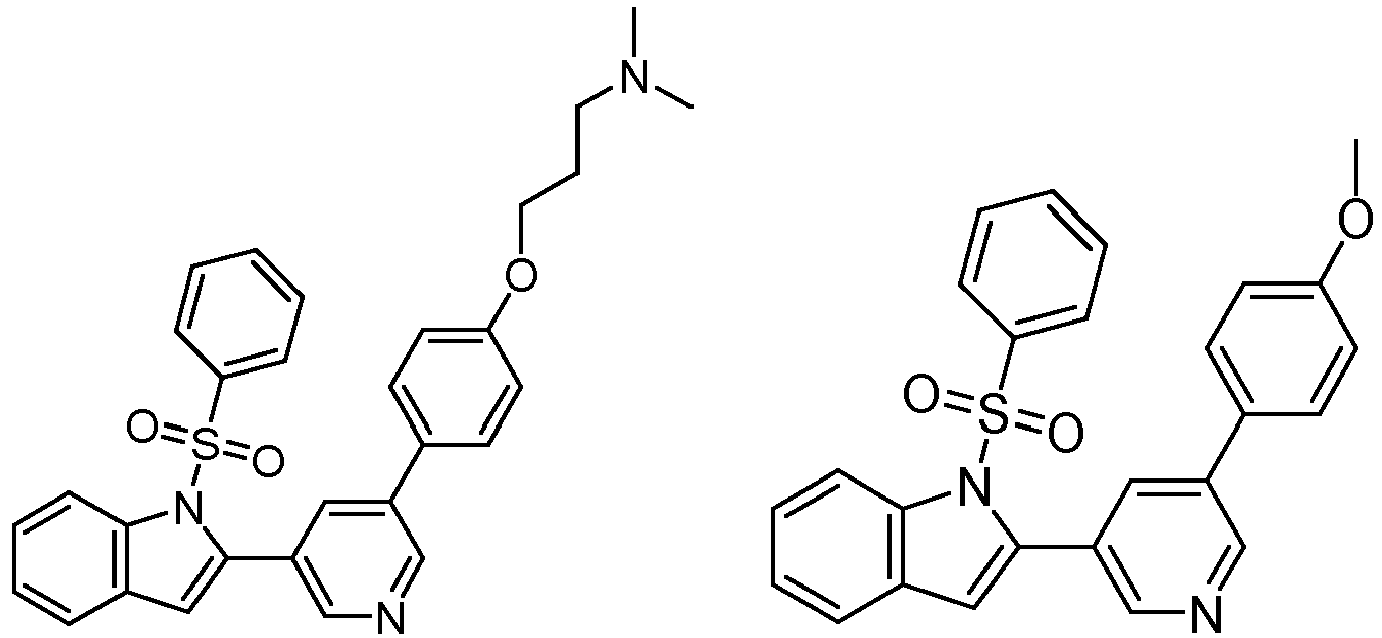
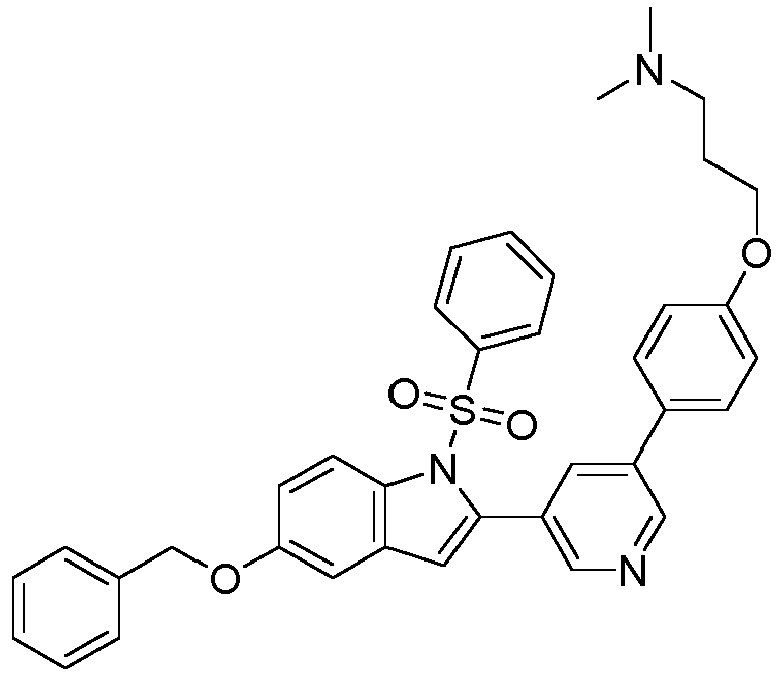
- particular compounds for use according to the invention may be chosen among: and or a pharmaceutically acceptable salt thereof.
- the compound may be in a enteral, parenteral or topical form.
- the compound may be for example in a form for oral administration, for example selected from the group comprising an oral solution, a syrup, an oral suspension, an emulsion and oral drops.
- it may be in an oral effervescent dosage form, selected from the group comprising tablets, granules, powders.
- it may be in the form of an oral powder or a multiparticulate system, for example selected from the group comprising beads, granules, mini tablets and micro granules.
- it may be in the form of an orodispersible dosage form, selected from the group comprising orodispersible tablets, lyophilised wafers, thin films, a chewable tablet, a tablet and a capsule, a medical chewing gum.
- it may be in a form for buccal and sublingual routes, for example selected from the group comprising buccal or sublingual tablets, muco adhesive preparation, lozenges, oro-mucosal drops and sprays.
- it may be in a form for topical-transdermal administration, for example selected from the group comprising ointments, cream, gel, lotion, patch and foam.
- nasal administration for example selected from the group comprising nasal drops, nasal spray, nasal powder.
- rectal administration for example suppository or hard gelatin capsule.
- parenteral administration for example subcutaneous, intramuscular, intravenous administration.
- Another object of the invention relates to a pharmaceutical composition
- a pharmaceutical composition comprising a compound as defined above, for use in the prevention or in the treatment of an infection as defined above.
- composition refers herein to a composition comprising at least one active drug and at least one pharmaceutically acceptable excipient, that can be administered to animals and to human beings for the treatment of the disorders and diseases as mentioned above.
- one active drug is the compound as defined above.
- the pharmaceutical composition may comprise at least one other active drug, for example chosen among dexamethasone, remdesivir, azithromycin.
- the pharmaceutically acceptable excipient may be any substance adapted to be formulated alongside the active ingredient (s) of the pharmaceutical composition of the invention. It may be for example selected among antiadherents, binders, coatings, colours, disintegrants, flavors, glidants, lubricants, preservatives, sorbents, sweeteners, surfactants, lipids, and vehicles.
- the pharmaceutical composition may be in any pharmaceutical form, i.e. enteral, parenteral or topical. It may be a medicament for oral administration, for example selected from the group comprising a solution, a syrup, a suspension, an emulsion and oral drops. Alternatively, it may be a medicament in the form of an oral effervescent dosage form, selected from the group comprising tablets, granules, powders. Alternatively, it may be an oral powder or a multiparticulate system, in a form selected from the group comprising beads, granules, mini tablets and micro granules.
- it may be a medicament in the form of an orodispersible dosage form, selected from the group comprising orodispersible tablets, lyophilised wafers, thin films, a chewable tablet, a tablet and a capsule, a medical chewing gum.
- it may be a medicament for buccal, intratracheal and sublingual routes, for example selected from the group comprising buccal or sublingual tablets, muco adhesive preparation, lozenges, oro-mucosal drops and sprays.
- it may be a medicament for topical-transdermal or local administration, for example selected from the group comprising ointments, cream, gel, lotion, patch and foam.
- it may be a medicament for nasal administration, for example selected from the group comprising nasal drops, nasal spray, nasal powder.
- it may be a medicament for rectal administration, for example suppository or hard gelatin capsule.
- it may be a medicament for parenteral administration, for example subcutaneous, intramuscular, intravenous administration.
- the pharmaceutical composition of the invention may be prepared using conventional techniques known by the skilled person.
- the bulk drug substance may be dissolved in a suitable solvent in the presence of one or more of the excipients described above, and mixed.
- the pharmaceutical composition may allow delivery of a pharmaceutically acceptable and efficient dose of the compound, for the prevention or the treatment of an infection as defined above.
- the pharmaceutical composition may comprise a dose of compound of 1 to 50 mg/kg of body weight per day, preferably a dose of 1 to 20 mg/kg of body weight per day.
- the administration may be carried out with one dose or with a plurality of doses per day.
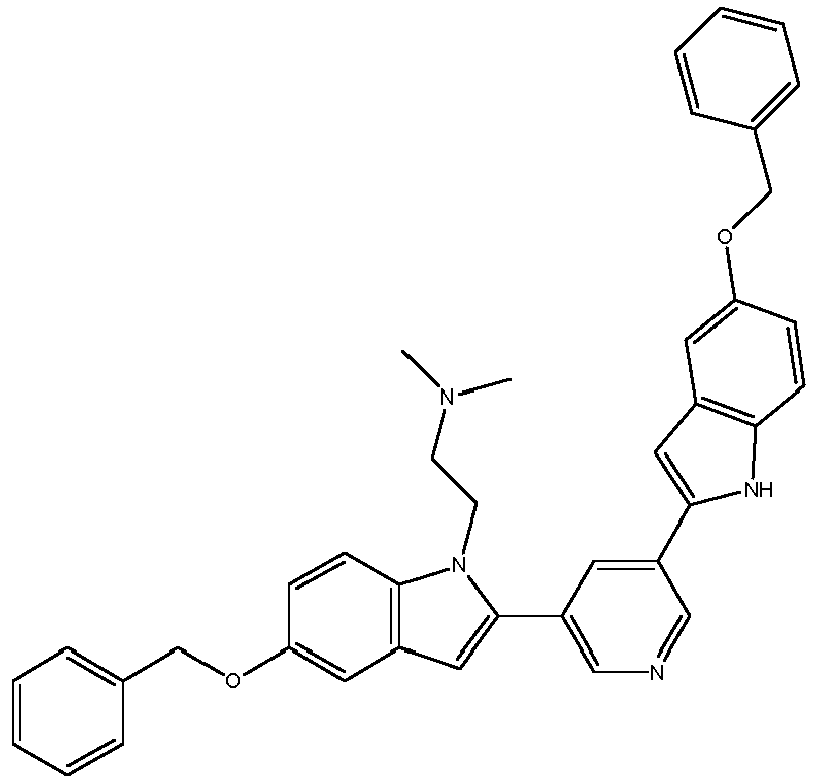
- AB-00011778 compound of formula: was selected and first tested on the lentiviral vectors-based cellular approach previously set up in the laboratory ( Lapaillerie et al. (2021) In Silico, In Vitro and In Cellulo Models for Monitoring SARS-CoV-2 Spike/Human ACE2 Complex, Viral Entry and Cell Fusion. Viruses, 13 ([2])).
- lentiviral vectors pseudotyped with the SARS-CoV-2 Spike protein have been produced from HEK293T cells transfected with three plasmids: a plasmid encoding a lentiviral backbone (LV44: pRRLSIN-PPT-hPGK-eGFP-WPRE) expressing a marker protein, the HDM_IDTSpike_fixK plasmid expressing the Spike protein (kind gift from the Bloom laboratory ( Crawford et al. (2020) Protocol and Reagents for Pseudotyping Lentiviral Particles with SARS-CoV-2 Spike Protein for Neutralization Assays.
- LV44 pRRLSIN-PPT-hPGK-eGFP-WPRE
- HEK293T-ACE2 cells containing 9 copies of the ACE2 gene were generated by lentiviral vector insertion of the human ACE2 gene in their genome ([2]).
- the CoV-2 LVs were shown to transduce efficiently only the 293T-ACE2 cells in contrast to the original 293T cells leading to the integration and expression of the eGFP gene encoded by the LV. This confirms that the transduction efficiency monitored by the percentage of eGFP positive cells relies on the early S/ACE2 interaction.
- AB-00011778 compound was thus tested on both VSVg and SARS-CoV-2 LVs infectivity to determine its possible effect on the S/ACE2 mediated entry pathway.
- a first screen using 10 ⁇ M concentration of drug showed significant inhibitory effect for some molecules on CoV-2 LVs without any effect on VSVg LVs (see Figure 1A ).
- AB-00011778 was found efficient by inducing a 40 to 80% decrease of the viral infectivity.
- Further accurate analysis of the inhibitory effect of the compound using increasing concentrations confirmed their specific capability of inhibiting the CoV-2 LVs infectivity ( Figure 1B ) without significant effect on the VSVg LVs within the 0-20 ⁇ M range.
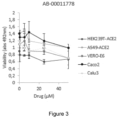
- the cytotoxicity of the molecule determined in different cell lines including HEK-293T, A549, Calu3 and Caco2 cell lines using MTT assay showed no or poor cytotoxicity within the 0-50 ⁇ M range (see Figure 3 ).
- Figure 2 displays results from the predicted binding poses to the S-RDB/ACE2 interface and to the S-RBD, highlighting the interacting amino acid residues.
- ACE2 residues Lys26, Leu29, and Asp38, and S-RDB residues Lys417 and Gln493 are also involved in hydrophobic interactions with AB-00011778 compound.
- the interactions of the AB-00011778 compound with the amino acid residues ACE2 Asp38 and with S-RDB Lys417 and Gln493 are of special relevance.
- the AlphaLISA assay previously set up ([2]) was used and the binding conditions were adapted for use in 384-well microplate in a final reaction volume of 20 ⁇ l.
- the optimal concentration of 3 nM for each recombinant protein was previously established with cross-titration experiments.
- increasing concentrations (1 to 25 ⁇ M) of AB-00011778 drug was preincubated with S-RBD(His) 6 in the plate before being mixed with ACE2-Biot for 2h.
- Anti-6XHis acceptor and streptavidin donor beads were used for complex capture after 2 h of incubation of the two partners.
- biotinylated ACE2 was loaded onto streptavidin biosensors and binding kinetics were carried out with 50 nM of S-RBD(His) 6 preincubated with increased concentrations of compound AB-00011778 as described in the Materials and Methods section.
- a strong binding of S-RBD(His) 6 to ACE2 was observed as indicated by the wavelength shift in the BLI sensorgrams ( Figure 5B ).
- the kinetic binding parameters (k a , k d ) and equilibrium dissociation constant (K D ) were determined after local fitting of the association and dissociation curves using a 1:1 binding model with ForteBio Blitz pro 1.1 software.
- the K D was found to be 3.42 ⁇ 0.49 nM confirming previous data (([2]); Lan et al. (2020) Structure of the SARS-CoV-2 spike receptor-binding domain bound to the ACE2 receptor. Nature, 581, 215-220 ([3])). Addition of AB-00011778 compound inhibited the interaction leading to a strong drop of the K D to 111 ⁇ 16 nM and 68.8 ⁇ 5.1 nM respectively (see Figure 5C ).
- the drug was tested in different pulmonary cell lines overexpressing, or not, the human ACE2 viral receptor and infected with the SARS-CoV-2 reference strain. As reported in Figure 7A , both molecules induced an inhibition of the viral replication in A549-ACE2 cells with an EC 50 for AB-00011778 compound of 2.5 ⁇ M and 0.25 ⁇ M, respectively. Drugs were then further tested in infection assays using the Calu3 human lung cancer cell lines that naturally express the ACE2 receptor. As reported in Figure 7B an inhibitory effect of the viral replication was confirmed for both drugs leading to a significant 50% inhibition of the viral replication at concentration around 1 ⁇ M.
- AB-00011778 compound was docked into the structures of each of the mutants using the PLP scoring function from GOLD with 500 independent genetic algorithm runs. Molecules were docked into: (1) the S-RDB/ACE2 interface; (2) S-RDB alone. Table 3 presents the best scores obtained when docking the two molecules to the different variants, compared with the values obtained against the initial non-mutated S-RDB/ACE2. Table 3.
- ACE Asp30 and S-RDB Glu406 also interact the tertiary amines.
- ACE2 His34 establishes ⁇ - ⁇ stacking interactions with the indole group and S-RDB Lys417 interacts with the other indole group via ⁇ -cation interactions.
- S-RDB Lys417 interacts with the other indole group via ⁇ -cation interactions.
- ACE2 Glu37 and S-RDB Lys417 perform hydrophobic interactions.
- One salt bridge is formed between ACE2 Asp30 and the tertiary amine and a ⁇ -cation interaction occurs between Lys417 and one of the indole groups.
- ACE2 Glu37 and Tyr78 also interact with A03-6 via hydrophobic interactions.
- AB-00011778_6 docked with S-RDB had a score of 60.34.
- the interactions of AB-00011778_6 with S-RDB are very similar to what was observed with AB-00011778_2.
- Gly496 interacts with one of the phenol groups, with a length of 1.84 ⁇
- Gln409 and Lys417 interact with the other phenol group, with interaction lengths of 2.58 ⁇ and 2.14 ⁇ .
- Tyr505 also interacts with one of the indole groups via ⁇ - ⁇ stacking interactions.
- Lys417 interacts with A03-6 via hydrophobic interactions.
- the SARS-CoV-2 S/ACE2 mediated entry remains a major antiviral target not yet exploited in therapy.
- the specific inhibition of SARS-CoV-2 LV infectivity in comparison with VSVg LVs suggested that the selected drugs target the early S/ACE2 dependent entry process recapitulated in this model.
- the simplest explanation for the inhibition mechanism is a block in the S/ACE2 association due to binding of the drug on the S/ACE2 interface.
- Biochemical approaches confirmed a direct effect of the drugs in blocking the S-RBD/ACE2 interaction.
- AB-00011778 compound kept an efficient blocking effect reaching 60-40% inhibition at 1 ⁇ M.
- both drugs showed IC 50 between 0.25 to 5 ⁇ M among all the cell lines without showing significant cyto-toxicity allowing them to reach selectivity indexes >10.
- the AB-00011778 compound showed an inhibitory effects in all the cell lines with SI>50-200.
- SARS-CoV-2 (438-516) S-RBD(HiS) 6 including the minimal receptor binding motif previously described (([3]); Wrapp et al. (2020) Cryo-EM structure of the 2019-nCoV spike in the prefusion conformation. Science, 367, 1260-1263 ([10])) and biotynilated human ACE2 have been purchased from Fisher Scientific (respective references 16534204 and 16545164). Monoclonal anti-6X His tag antibody has been purchased from ABCAM (reference ab18184, dilution 1/200). Anti ⁇ -tubulin antibody has been purchased from SIGMA (reference T6199, dilution 1/500). Secondary goat anti-mouse antibody coupled to AlexaFluor 488 has been purchase from Fisher Scientific (Reference Allo2g, dilution 1/400).
- the AlphaLISA assay development was performed as previously described ([2]) using the recombinant S minimal binding domain (RBD) fused to a 6x-His tag (S-RBD(His) 6 ) and biotinylated human ACE2 protein (ACE2-Biot).
- the binding conditions were adapted for use in 384-well plate (white OptiPlate, reference 6007290, PerkinElmer, Waltham, MA) in a final reaction volume of 20 ⁇ l.
- An optimal final concentration of 3nM for each recombinant protein was previously established with cross-titration experiments. Proteins were diluted in the binding buffer (phosphate-buffered saline (PBS) pH 7.4, 0.1% (w/v) bovine serum albumin).
- PBS phosphate-buffered saline
- the plate was then incubated for 1h at RT in the dark before the AlphaLISA signal was detected using an EnSpire Multimode Plate Reader (Perkin Elmer). Negative control with binding buffer was used to control the assay quality. Data were analyzed with GraphPad Prism 5.01 software. The AlphaLISA binding data obtained with compounds were compared to the 1% DMSO control condition.
- TruHits counterassay kit (reference AL900D, PerkinElmer) was performed by incubating AB-00011778 drug with biotin-BSA acceptor and streptavidin donor beads with the same working dilutions than in the AlphaLISA binding assay. In this validation assay, if the compound causes a decrease of the signal, it means that it interferes with AlphaLISA readout and therefore it is not relevant to the specific target of interest.
- Bio-Layer Interferometry (BLI) experiments were performed on a BLItz instrument (Sartorius, Göttingen, Germany) to measure the binding of S-RBD(His) 6 to ACE2-Biot.
- BLI assay was set up as previously described ([2]) with some adaptations for the competition binding analysis with drugs. All sample dilutions and baseline steps were carried out using the same reaction buffer (phosphate-buffered saline pH 7.4, 0.1% (w/v) bovine serum albumin, 1% (v/v) DMSO).
- Streptavidin biosensors (Sartorius, reference 18-5019) were first pre-wet for 10 min with the reaction buffer and 1 ⁇ M of ACE2-Biot was then loaded onto the coated biosensors for 500 s in order to reach a binding value of ⁇ 3 nm.
- protein samples were prepared at the concentration of 50 nM S-RBD(His) 6 in accordance with our previous BLI binding studies and were preincubated for 15 min at room temperature with increased concentrations (0-25 ⁇ M) of AB-00011778 drug. Binding kinetics were divided in three steps. Firstly, baseline with the reaction buffer was measured for 60 s.
- each loaded biosensor was dipped into into S-RBD sample with drugs or DMSO as control for 300 s with a 2200 rpm shaking speed.
- the dissociation step of the bound S-RBD(His) 6 was monitored by dipping the biosensor back into the reaction buffer for 300 s.
- Systematic baseline drift correction was done by subtracting the shift recorded for biosensor loaded with ACE2 but incubated with reaction buffer.
- the association and dissociation experimental curves were local fitted using a 1:1 binding model with the Blitz pro 1.1 software and the kinetic binding parameters (k on , k off ) were determined as means of two to three independent experiments.
- Sensorgrams curves were plotted using Prism 5.0 software (Graphpad Software, La Jolla, CA).
- Lentivirus vector production was done by the service platform Vect'UB, (INSERM US 005 - CNRS UMS 3427- TBM-Core, liable de Bordeaux, France). Lentiviral particles were produced by transient transfection of HEK293T (human embryonic kidney cells according to standard protocols.
- subconfluent HEK293T cells were cotransfected with lentiviral genome (psPAX2) (gift from Didier Trono (Addgene plasmid # 12260 ), with an envelope coding plasmid (pMD2G-VSVG or wild type SARS-CoV-2 Spike protein (HDM_IDTSpike_fixK (kind gift from Bloom's laboratory, ([4]) and with vector constructs (44 :pRRLSIN-PPT-hPGK-eGFP-WPRE or pHAGE_EF1aInt_ACE2_WT) by calcium phosphate precipitation.
- LVs were harvested 48h posttransfection and concentrated by ultracentrifugation.
- Viral titers of VSV-g pseudotype pLV lentivectors were determined by transducing HEK293T cells with serial dilutions of viral supernatant and eGFP expression was quantified 5 days later by flow cytometry analysis.
- SARS-CoV-2 Spike pseudotype p24 antigen levels were measured in the concentrated viral supernatants by an enzyme-linked immunosorbent assay (Innotest HIV Ag nAb; Fugibio, France) and viral titers were estimated by comparing p24 antigen levels of each lentiviral supernatant with a similar VSV-g pseudotype lentiviral supernatant produced simultaneously.
- HEK293T-ACE2 cell lines have been generated by lentiviral transduction using pHAGE_EF1aInt_ACE2_WT plasmid (kind gift from Bloom's laboratory ([4]).
- HEK293T cells (200 000 cells) were then transduced with optimized concentration of ACE2 lentiviral particles in 6-well plates. The efficacy of transduction was assessed using real time PCR ten days post infection.
- ACE2 provirus DNA from this cell line was quantified by q-PCR using the ⁇ Ct method as compared with 1 copy cell line. DNA from two different cell clones (human 293T and K562 cells), containing a single integrated copy of the provirus, was used as a normalized cell line.
- HEK293T were cultured in DMEM medium supplemented with 1% penicillin-streptomycin and FBS (Fetal Bovine Serum) 10%.
- A549 cells Human alveolar basal epithelial carcinoma, Calu3 (human bronchial epithelial carcinoma) and Vero E6 cells (African green monkey kidney cells) were maintained in Dulbecco Modified Eagle Medium (DMEM; Invitrogen Life Technologies) supplemented with 10% heat-inactivated fetal bovine serum (FBS) and 1% penicillin/streptomycin (P/S) and 1% GlutaMAX (Life Technologies).
- DMEM Dulbecco Modified Eagle Medium
- FBS heat-inactivated fetal bovine serum
- P/S penicillin/streptomycin
- GlutaMAX GlutaMAX
- HEK293T and HEK293T-ACE2 cells were incubated 45 minutes at 37°C in 100 ⁇ l Dulbecco's Modified Eagle's Medium (DMEM) and increasing concentrations of RBD recombinant protein.
- DMEM Dulbecco's Modified Eagle's Medium
- One ml of PBS was added the cells were centrifugated 5 minutes at 2 500 rpm.
- 50 ⁇ l of anti-His antibody 1/200 in DMEM was added and the cells were further incubated 45 minutes at 37°C.
- PBS washes 50 ⁇ l of a 1/400 DMEM solution of secondary antibody was added and cells were incubated 30 minutes at 37°C.
- PBS washes the cells were resuspended in 200 ⁇ l PBS, FBS 2% EDTA 2mM and the percentage of FITC positive cells was quantified by flow cytometry.
- MTT cell viability assay was performed following furnisher protocols. Cells were seeded at the density of 20,000 cells/well in a 96 well plate containing 100 ⁇ L complete DMEM (Gibco, USA) supplemented with 10% FBS (Gibco, USA) and 1% Penstrep (Gibco, USA). Cells were incubated for 12 hours at 37° C in humidified 5% CO 2 incubator for adherence. After 12-hour incubation, the media was replaced with fresh media, and cells were treated with compounds. Untreated cells were considered as negative control, DMSO treated cells were considered as the vehicles. After the treatment, cells were incubated at 37 ° C in humidified 5% CO 2 incubator. 48-hour post-treatment, 20 ⁇ L of MTT substrate (5 mg/mL) was added in each well and incubated for 4 additional hours at 37° C in the dark. The media was then carefully removed, and 492nm absorbance was measured.
- MTT substrate 5 mg/mL
- SARS-CoV-2 strain 220_95 (EPI_ISL_469284) was isolated from nasopharyngeal swab specimens collected at Service de Virologie (Hospital Saint Louis, Paris) and grown as previously described (Onodi et al. (2021) SARS-CoV-2 induces human plasmacytoid predendritic cell diversification via UNC93B and IRAK4. J. Exp. Med., 218 ([11])). Briefly, virus was propagated on Vero E6 in DMEM-2% (DMEM supplemented with 2% FBS, 1% P/S, 1% GlutaMAX, and 25 mM Hepes).
- viruses were purified through a 20% sucrose cushion by ultracentrifugation at 80,000xg for 2 hours at 4°C. Pellets were resuspended in HNE 1X (HEPES 25mM, NaCl 100mM EDTA 0.5mM) aliquoted and stored at -80°C.
- HNE 1X HNE 1X
- A549-Ace2 and Calu3 cells grown in 12-well plates were challenged with SARS-CoV-2 at a MOI of 0.05 in the presence of the indicated drug or with DMSO as a control. After 3 hours, cells were washed once with PBS and incubated with fresh media. Compounds were maintained throughout the course of infection.
- Viruses were first inactivated by incubating the supernatants v/v with 1% Triton X-100 (Sigma) in PBS for 30 min under agitation at RT. Yields of viral RNA were quantified by real-time qPCR by using SARS-CoV-2 specific primers targeting the E gene with the Luna ® Universal One-Step RT-qPCR Kit (New England Biolabs) in a LightCycler 480 thermocycler (Roche) according to the manufacturer's protocol.
- the number of viral genomes is expressed as PFU equivalent/ml and was calculated by performing a standard curve with a similarly treated supernatant from a viral stock with a known titer as described by Gordon et al ( Gordon et al. (2020) Comparative host-coronavirus protein interaction networks reveal pan-viral disease mechanisms. Science, 10.1126/science.abe9403 ([12])).
Landscapes
- Health & Medical Sciences (AREA)
- Life Sciences & Earth Sciences (AREA)
- Medicinal Chemistry (AREA)
- Veterinary Medicine (AREA)
- Public Health (AREA)
- General Health & Medical Sciences (AREA)
- Animal Behavior & Ethology (AREA)
- Chemical & Material Sciences (AREA)
- Pharmacology & Pharmacy (AREA)
- Nuclear Medicine, Radiotherapy & Molecular Imaging (AREA)
- General Chemical & Material Sciences (AREA)
- Organic Chemistry (AREA)
- Chemical Kinetics & Catalysis (AREA)
- Virology (AREA)
- Oncology (AREA)
- Communicable Diseases (AREA)
- Molecular Biology (AREA)
- Epidemiology (AREA)
- Engineering & Computer Science (AREA)
- Bioinformatics & Cheminformatics (AREA)
- Pulmonology (AREA)
- Measuring Or Testing Involving Enzymes Or Micro-Organisms (AREA)
Abstract
The present invention relates to a compound comprising a compound having formula (I) below:
wherein R1, R2 and R3 are as defined, or a pharmaceutically acceptable salt thereof, for use in the prevention or in the treatment of an infection.
The invention also relates to a pharmaceutical composition comprising the compound, for use in the prevention or in the treatment of an infection.
Description
- The present invention refers to a compound or a pharmaceutically acceptable salt thereof, for use in the prevention or the treatment of an infection, especially for use in the prevention or in the treatment of SARS-CoV-2 infection.
- Therefore, the present invention has utility in medical field, especially in the field of treatment of infection diseases.
- In the description below, the references into brackets ([]) refer to the listing of references situated at the end of the text.
- Severe Acute Respiratory Syndrome-coronavirus 2 (SARS-CoV-2) is the positive-strand RNA virus causing agent of severe respiratory syndrome in humans (COVID-19).
- Viral entry into cells requires the interaction between the spike S protein of the virus and the Angiotensin-Converting
enzyme 2 ACE2 at the surface of the cell membrane. ACE2 has been reported as receptor for SARS-CoV-2 in lung as previously shown for SARS-CoV responsible for the first SARS outbreak in 2003. ACE2 is expressed in human airway epithelia, lung parenchyma, vascular endothelia, kidney cells, and small intestine cells but only weakly detected in the brain. Thus, converging data from the literature indicate the S/ACE2 interaction remains the central entry way for SARS-CoV-2 virus. Being the first contact point between the virus and the cell, the S/ACE2 complex constitute an attractive target for blocking the very early events of the viral infection. - While several vaccines have been developed since the beginning of the pandemic, no efficient drugs have been identified as having strong effect on viral replication usable in clinic, partly due to the lack of understanding of viral replication processes.
- Therefore, a better understanding of the replication processes and the search for new antiviral approaches remain crucial.
- Thus, a need exists of drugs allowing to treat, or at least decrease the symptoms due to SARS-CoV-2 infection. The present invention fulfills these and other needs.
- The Applicant surprisingly found that compounds derived from indole have the capability to block the infectivity of lentiviral vectors pseudotyped with the SARS-CoV-2 S protein as well as wild type and variants SARS-CoV-2 circulating strains in various human cell lines, including pulmonary cells naturally susceptible to the infection.
- AlphaLISA and biolayer interferometry confirmed a direct inhibitory effect of the compounds on the S/ACE2 association.
- Thus, after extensive works, the Applicant found novel drugs capable to specifically block the SARS-CoV-2 entry step by impairing the ACE2/S interaction leading to inhibition of the viral SARS-CoV-2 replication in naturally susceptible cells.
-
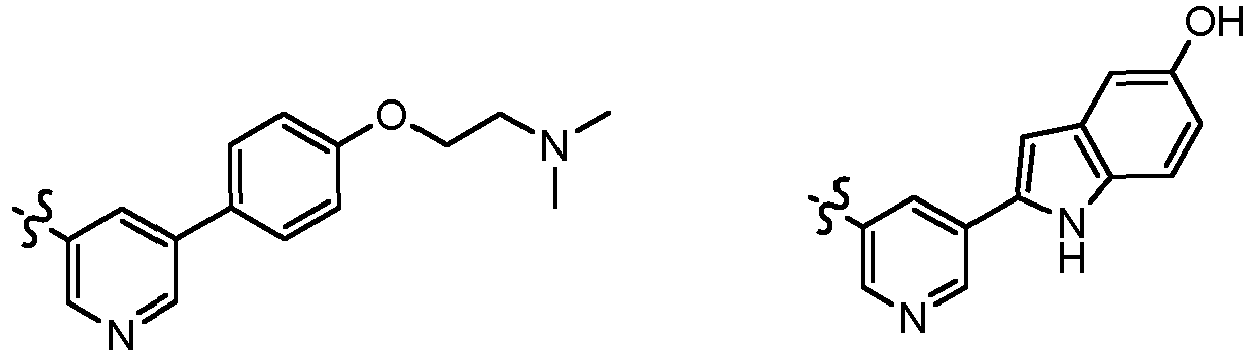
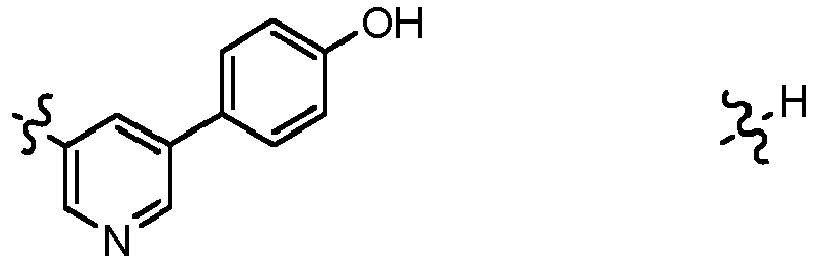
- R1 is chosen from the group comprising:
- R2 is chosen from the group comprising:
m being an integer from 2 to 6, - R3 is chosen from the group comprising:
and in which R2 is defined as above,
and R4 is chosen among : or a pharmaceutically acceptable salt thereof, - The term "pharmaceutically acceptable salt" is meant to include any salt commonly used in the pharmaceutical field and that is adapted to indole derivatives used in the invention according to the general technical knowledge of the skilled person. It can be for example hydrochloride, acetate, phosphate or methanesulfonate, fumarate and oxalate.
- The compounds may be prepared by methods known in the art, for example in document Jacquemard et al. (Synthesis of 3,5-bis(2-indolyl)pyridine and 3-[(2-indolyl)-5-phenyl]pyridine derivatives as CDK inhibitors and cytotoxic agents. (2008) Bioorg. Med. Chem., 16, 4932-4953 ([1])) and in document Mahboobi et al. (Bis(1H-2-indolyl)methanones as a novel class of inhibitors of the platelet-derived growth factor receptor kinase; J. Med. Chem 2002 45 1002-1018 ([13])).
- According to the invention, the infection prevented or treated by the compound may be for example an infection caused by a virus for which viral entry into cells requires the interaction between the spike S protein of the virus and the Angiotensin-Converting
enzyme 2 ACE2 at the surface of the cell membrane. Advantageously, the compound may inhibit the interaction between Spike and ACE2 proteins. - The virus may be, for example, selected from the Coronaviridae family. Viruses of the Coronaviridae family may be for example selected from the group comprising Coronavirus SARS-CoV-2, Coronavirus SARS, Coronavirus 229E, Coronavirus NL63, Coronavirus OC43, Coronavirus HKU1 and Coronavirus MERS-CoV. In a preferred embodiment of the invention, the viral infection is a SARS-CoV-2 infection. The SARS-CoV-2 may be the original strain appeared in 2019, or variants appeared from then, including alpha variant, beta variant, gamma variant and delta variant.
- Advantageously, in the compound for use of the invention:
- R2 may be chosen from the group comprising:
and and - R3 may be chosen from the group comprising:
-
- According to the use of the invention, the compound may be in a enteral, parenteral or topical form. The compound may be for example in a form for oral administration, for example selected from the group comprising an oral solution, a syrup, an oral suspension, an emulsion and oral drops. Alternatively, it may be in an oral effervescent dosage form, selected from the group comprising tablets, granules, powders. Alternatively, it may be in the form of an oral powder or a multiparticulate system, for example selected from the group comprising beads, granules, mini tablets and micro granules. Alternatively, it may be in the form of an orodispersible dosage form, selected from the group comprising orodispersible tablets, lyophilised wafers, thin films, a chewable tablet, a tablet and a capsule, a medical chewing gum. Alternatively, it may be in a form for buccal and sublingual routes, for example selected from the group comprising buccal or sublingual tablets, muco adhesive preparation, lozenges, oro-mucosal drops and sprays. Alternatively, it may be in a form for topical-transdermal administration, for example selected from the group comprising ointments, cream, gel, lotion, patch and foam. Alternatively, it may be in a form for a nasal administration, for example selected from the group comprising nasal drops, nasal spray, nasal powder. Alternatively, it may be in a form for a rectal administration, for example suppository or hard gelatin capsule. Alternatively, it may be in a form for parenteral administration, for example subcutaneous, intramuscular, intravenous administration.
- Another object of the invention relates to a pharmaceutical composition comprising a compound as defined above, for use in the prevention or in the treatment of an infection as defined above.
- The term "pharmaceutical composition" refers herein to a composition comprising at least one active drug and at least one pharmaceutically acceptable excipient, that can be administered to animals and to human beings for the treatment of the disorders and diseases as mentioned above.
- According to the invention, one active drug is the compound as defined above. Advantageously, the pharmaceutical composition may comprise at least one other active drug, for example chosen among dexamethasone, remdesivir, azithromycin. The pharmaceutically acceptable excipient may be any substance adapted to be formulated alongside the active ingredient (s) of the pharmaceutical composition of the invention. It may be for example selected among antiadherents, binders, coatings, colours, disintegrants, flavors, glidants, lubricants, preservatives, sorbents, sweeteners, surfactants, lipids, and vehicles.
- The pharmaceutical composition may be in any pharmaceutical form, i.e. enteral, parenteral or topical. It may be a medicament for oral administration, for example selected from the group comprising a solution, a syrup, a suspension, an emulsion and oral drops. Alternatively, it may be a medicament in the form of an oral effervescent dosage form, selected from the group comprising tablets, granules, powders. Alternatively, it may be an oral powder or a multiparticulate system, in a form selected from the group comprising beads, granules, mini tablets and micro granules. Alternatively, it may be a medicament in the form of an orodispersible dosage form, selected from the group comprising orodispersible tablets, lyophilised wafers, thin films, a chewable tablet, a tablet and a capsule, a medical chewing gum. Alternatively, it may be a medicament for buccal, intratracheal and sublingual routes, for example selected from the group comprising buccal or sublingual tablets, muco adhesive preparation, lozenges, oro-mucosal drops and sprays. Alternatively, it may be a medicament for topical-transdermal or local administration, for example selected from the group comprising ointments, cream, gel, lotion, patch and foam. Alternatively, it may be a medicament for nasal administration, for example selected from the group comprising nasal drops, nasal spray, nasal powder. Alternatively, it may be a medicament for rectal administration, for example suppository or hard gelatin capsule. Alternatively, it may be a medicament for parenteral administration, for example subcutaneous, intramuscular, intravenous administration.
- The pharmaceutical composition of the invention may be prepared using conventional techniques known by the skilled person. For example, the bulk drug substance may be dissolved in a suitable solvent in the presence of one or more of the excipients described above, and mixed.
- Advantageously, the pharmaceutical composition may allow delivery of a pharmaceutically acceptable and efficient dose of the compound, for the prevention or the treatment of an infection as defined above. For example, the pharmaceutical composition may comprise a dose of compound of 1 to 50 mg/kg of body weight per day, preferably a dose of 1 to 20 mg/kg of body weight per day. The administration may be carried out with one dose or with a plurality of doses per day.
- This invention is further illustrated by the following examples with regard to the annexed drawings that should not be construed as limiting.
-
-
Figure 1 : represents the characterization of AB-00011778 compound, using increasing concentration of drugs. Infectivity (% of GFP positive cells) of COV2 or VSVg in presence of AB-00011778 compound or DMSO (A). Infectivity (% of control DMSO) of COV2 or VSVg in presence of AB-00011778 compound (B). Data are shown as means of at least three independent experiment ±standard deviation. ***p<0.001, **p<0.01. -
Figure 2 : represents molecular docking of AB-00011778 compound to the spike/ACE2 complex and to the spike protein alone. Data were obtained from the predicted binding poses of the compounds to the S-RDB and to S-RDB/ACE2 interface. The interacting amino acid residues have been highlighted. (A) AB-00011778 compound bound to the spike/ACE2 complex; (B) AB-00011778 bound to the spike alone. -
Figure 3 : represents the cytotoxicity of AB-00011778 compound in various cell lines (HEK293T-ACE2, A549-ACE2, VERO-E6, Caco2, Calu3). The viability of the cells (492nm absorbance in MTT assay) was plotted against the increasing concentration of drugs. Data are shown as means of at three independent experiments. Data are shown as means of at least three independent experiments ± (SD). -
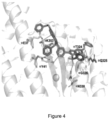
Figure 4 : represents molecular docking of AB-00011778 bound to ACE2 alone. Data were obtained from the predicted binding poses of the compounds to the ACE2 around the interface region. The interacting amino acid residues have been highlighted. -
Figure 5 : represents the effect of AB-00011778 compound on the in vitro S-RBD/ACE2 interaction using AlphaLISA and Bio-Layer Interferometry (BLI) technologies. SARS-CoV-2 S-RBD(His)6 and human ACE2-Biot interaction have been first monitored by AlphaLISA (A) using 3 nM of each protein. Increasing concentrations of AB-00011778 drug were incubated for 30 min with S-RBD(His)6 before being mixed with ACE2-Biot for 2h. The microplate was read after 2 h incubation with anti-6X His acceptor and streptavidin donor beads. Data obtained with the compounds were compared to DMSO control and are reported as mean of percentage of control condition from two to three independent experiments in duplicate ± standard deviation. **p<0.01. The effect of the drug on the binding kinetics of S-RBD to biotinylated ACE2 immobilized on streptavidin biosensor was also performed using BLI experiments (B). Baseline with reaction buffer was measured for 60 s. For the association step (300 s), each loaded biosensor was dipped into 50 nM of S-RBD(His)6 preincubated for 15 min with increasing concentrations of AB-00011778 compound. The dissociation step was subsequently measured for 300 s. Sensorgrams curves shown in (B) were plotted using Prism 5.0 software (Graphpad Software, La Jolla, CA). The association and dissociation experimental curves were local fitted using a 1:1 binding model with the Blitz pro 1.1 software. Kinetic binding parameters (kon, koff) and the equilibrium dissociation constant (KD) were determined as means of two to three independent experiments and reported in (D). Data are shown as means of two to three independent experiment ±standard deviation. ***p<0.001, **p<0.01. -
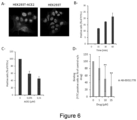
Figure 6 : represents the effect of AB-00011778 compound on the S-RBD/ACE2 interaction in cellular context. The SARS-CoV-2 S-RBD fragment was added to either HEK293T or HEK293-ACE2 cells for 0-60 minutes and immunofluorescence staining was performed using anti-(His)6 antibody and secondary antibody coupled to Alexa-Fluo 488. Cells were observed by epifluorescence microscopy (A). Cells were also analyzed using flow cytometry to detect the percentage of positive cells for FITC signal during time (B). Increasing concentrations of either soluble ACE2 (C) or drug (D) were added with the RBD. Data are reported as mean of percentage of positive cells from at least three independent experiments. **p<0.05. -
Figure 7 : represents effect of the AB-00011778 compound on SARS-CoV-2 replication in human pulmonary cells. A549-ACE2 (A), or Calu3 (B) cells were incubated with the SARS-CoV-2 reference strain (MOI=1) and increasing concentrations of the drug. The replication was evaluated by the quantification of the viral genome copies after 24 hours. Data are reported as means from 3-4 independent experiments and expressed as a percentage of control w/o drug. -
Figure 8 : represents the effect of the AB-00011778 on SARS-CoV-2 Delta and Alpa replication in human pulmonary cells. A549-ACE2-TMPRS2 cells were incubated with the SARS-CoV-2 Wuhan, Alpha or Delta strain (MOI=1) and increasing concentrations of drugs. The replication was evaluated by the quantification of the viral gene E (A) and S (B) genome copies of normalized to Actin RNA after 24 hours. A representative experiment is reported in the figure. -
Figure 9 : represents chemical derivatives from the AB-0001178 compounds. The structure of the initially selected drugs is reported in (A). Several analogs have been designed and synthetized on the basis of the docking calculation performed inFigure 2 . -
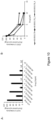
Figure 10 : represents Effect of the AB-0001178 and its derivatives on SARS-CoV-2 pseudotyped lenviruses in HEK-293T cells. 10µM concentration of the AB-0001178 derivatives (A) and increasing concentrations (0-10 µl) of AB-0001178, AB-0001178_2 and AD-0001178_6 (B) were added to an infectivity assay using SARS-CoV-2 pseudotyped lentiviral vector and HEK293T-Ace2 cells. Data are reported as mean of three experiments ±SD. -
Figure 11 : represents interactions of the Analogues. (A) AB-00011778_2 with S-RDB/ACE2; (B) AB-00011778_6 with S-RDB/ACE2; (C) AB-00011778_2 with S-RDB; (D) AB-00011778_6 with S-RDB. -
Figure 12 : represents the analysis of the Interactions of AB-00011778_2 and AB-00011778_6 to the spike/ACE2 complex and to the spike protein alone. (A) Detail on the S-RDB/ACE2 interaction; (B) AB-00011778_2 bound to the spike/ACE2 complex; (C) AB-00011778_6 bound to the spike/ACE2 complex; (D) Comparison of the crystallographic position of ACE2 vs the position occupied by AB-00011778_2 and AB-00011778_6 when bound to the spike protein alone; (E) AB-00011778_2 bound to the spike alone; (F) AB-00011778_6 bound to the spike alone. -
Figure 13 : represents interactions of the Analogues. (A) AB-00011778_2 with ACE2 alone; (B)AB-00011778_6 with with ACE2 alone. -
Figure 14 : represents (A) Comparison of the crystallographic position of S-RDB vs the position occupied by AB-00011778_2 and AB-00011778_6 when bound to ACE2 alone; (B) AB-00011778_2 bound to ACE2 alone; (C) AB-00011778_6 bound to ACE2 alone. - AB-00011778 compound of formula:
was selected and first tested on the lentiviral vectors-based cellular approach previously set up in the laboratory (Lapaillerie et al. (2021) In Silico, In Vitro and In Cellulo Models for Monitoring SARS-CoV-2 Spike/Human ACE2 Complex, Viral Entry and Cell Fusion. Viruses, 13 ([2])). Briefly, lentiviral vectors pseudotyped with the SARS-CoV-2 Spike protein (CoV-2 LV) have been produced from HEK293T cells transfected with three plasmids: a plasmid encoding a lentiviral backbone (LV44: pRRLSIN-PPT-hPGK-eGFP-WPRE) expressing a marker protein, the HDM_IDTSpike_fixK plasmid expressing the Spike protein (kind gift from the Bloom laboratory (Crawford et al. (2020) Protocol and Reagents for Pseudotyping Lentiviral Particles with SARS-CoV-2 Spike Protein for Neutralization Assays. Viruses, 12 ([4])) and the psPAX2 plasmid expressing the other HIV proteins needed for virion formation (Tat, Gag-Pol, and Rev). HEK293T-ACE2 cells containing 9 copies of the ACE2 gene were generated by lentiviral vector insertion of the human ACE2 gene in their genome ([2]). The CoV-2 LVs were shown to transduce efficiently only the 293T-ACE2 cells in contrast to the original 293T cells leading to the integration and expression of the eGFP gene encoded by the LV. This confirms that the transduction efficiency monitored by the percentage of eGFP positive cells relies on the early S/ACE2 interaction. On the contrary, typical VSVg pseudotyped LV were able to transduce both 293T and 293T-ACE2 cells and will serve as control for the next selection of drugs specific for S/ACE2 entry. Inhibition competition experiments using the soluble ACE2 protein fully validated the S/ACE2 dependency of the LV CoV-2 infectivity while the LV VSVg was not affected by the protein (data not shown) ([2]). - AB-00011778 compound was thus tested on both VSVg and SARS-CoV-2 LVs infectivity to determine its possible effect on the S/ACE2 mediated entry pathway. A first screen using 10 µM concentration of drug showed significant inhibitory effect for some molecules on CoV-2 LVs without any effect on VSVg LVs (see
Figure 1A ). AB-00011778 was found efficient by inducing a 40 to 80% decrease of the viral infectivity. Further accurate analysis of the inhibitory effect of the compound using increasing concentrations confirmed their specific capability of inhibiting the CoV-2 LVs infectivity (Figure 1B ) without significant effect on the VSVg LVs within the 0-20µM range. The cytotoxicity of the molecule determined in different cell lines including HEK-293T, A549, Calu3 and Caco2 cell lines using MTT assay showed no or poor cytotoxicity within the 0-50µM range (seeFigure 3 ). - Taken together our data strongly suggested that AB00011778 compound interfered with the early S/ACE2 mediated SARS-CoV-2 entry process. To confirm this, we next investigated whether this inhibitory effect could be due to direct effect of the drugs on the physical interaction between S and ACE2 using molecular docking and biochemical approaches.
- To better understand the binding of AB-00011778 compound to the target protein, molecular docking studies were performed.
Figure 2 displays results from the predicted binding poses to the S-RDB/ACE2 interface and to the S-RBD, highlighting the interacting amino acid residues. - The docking of AB-00011778 compound to the S-RDB/ACE2 interface (
Figure 2A ) resulted in a score of 92.05. S-RDB residues Arg403, Gln409 and Lys417 establish strong hydrogen bonds with this molecule. Arg403 interacts with one oxygen from one of the sulfonyl groups with a distance of 3.00 Å. Gln409 and Lys417 interact with the nitrogen from the central pyridine with distances of 3.78 Å and 3.55 Å, respectively. In addition, ACE2 His34 interacts with the indole group via π-π stacking interactions. ACE2 residues Lys26, Leu29, and Asp38, and S-RDB residues Lys417 and Gln493 are also involved in hydrophobic interactions with AB-00011778 compound. The interactions of the AB-00011778 compound with the amino acid residues ACE2 Asp38 and with S-RDB Lys417 and Gln493 are of special relevance. In fact, previous MD studies of the S-RDB/ACE2 interface ([2]) have shown that Asp38 from ACE2 establishes important hydrogen bonds with S-RDB Tyr449 and Gln498; S-RDB Lys417 was shown to be involved in very stable hydrogen bonds and charged interactions with Asp30 from ACE2, while S-RDB Gln493 formed important hydrogen bonds with ACE-2 Glu35. The disruption of these interactions caused by AB-00011778 compound binding should lead to the blocking the S/ACE2 interaction and could be one of the reasons why this molecule is a successful inhibitor of this system. - The docking of AB-00011778 compound to the S-RDB protein (
Figure 2B ) in the absence of ACE2 led to a score of 89.12. The obtained docking pose shows the formation of a strong hydrogen bond between Gly502 and one of AB-0001778 ether groups, with a length of 1.90 Å. There is also the formation of π-π stacking interactions between Tyr505 the indole group and two of the ligand's phenyl groups. Finally, Lys417, Leu455, Asn501 and Tyr505 are involved in hydrophobic interactions with AB-00011778. Gly502 and Tyr505 have been implicated in MD studies of the S-RDB/ACE2 interface in very stable hydrogen bonds between with ACE2, with Gly502 interacting with Lys353 and Tyr505 with ACE2' Glu37, during 57 % and 56 % of simulation time, respectively ([2]). Hence, the interactions of AB-00011778 compound with these two residues are likely significantly interfere with the S-RDB/ACE2 association. - Additionally, the ability of AB-00011778 compound in binding to ACE2 competitively with the spike protein was evaluated. Both molecules were docked against the ACE2 receptor, defining as potential binding region the surface of the ACE2 that is known to interact and recognize the spike protein. Results are presented in
Figure 4 , showing that AB-00011778 compound can bind ACE2 with strong binding scores that are comparable to those observed when docked to S-RDB/ACE2 interface and to S-RDB alone. - The docking of AB-00011778 compound to ACE2 alone resulted in a score of 81.41 (GOLD/PLP). The most stable pose reveals the formation of multiple hydrogen bonds between ACE2 and AB-00011778 compound: (1) between Tyr41 and the nitrogen from the central pyridine group, with a length of 1.66 Å; (2) between Gln325 and Gly326 interacting with the oxygen from one of the ligand's ether groups, with a length of 2.04 Å and 3.09 Å respectively ; (3) between Asn330 and one oxygen from one of the sulfonyl groups, with a distance of 2.10 Å. One can also observe the formation of one π-cation interaction between Lys353 and phenyl ring from one of the indole groups. Glu37, Tyr41, Thr324, Gln325 and Lys353 are involved in hydrophobic interactions. Glu37, Tyr41 and Lys335 have also been previously implicated (Lapaillerie et al. ([2])) in important hydrogen bonds to the Spike protein, also suggesting that the interaction of AB-00011778 with these residues could interfere with the ACE2 ability to bind the Spike protein.
- To confirm that the selected drugs may physically prevent the formation of the S/ACE2 complex we next performed an in vitro alphaLISA assay using the recombinant S minimal binding domain (RBD) fused to a 6x-His tag (S-RBD(His)6) and human ACE2 protein (ACE2-Biot).
- For this, the AlphaLISA assay previously set up ([2]) was used and the binding conditions were adapted for use in 384-well microplate in a final reaction volume of 20 µl. The optimal concentration of 3 nM for each recombinant protein was previously established with cross-titration experiments. For the competition assay, increasing concentrations (1 to 25µM) of AB-00011778 drug was preincubated with S-RBD(His)6 in the plate before being mixed with ACE2-Biot for 2h. Anti-6XHis acceptor and streptavidin donor beads were used for complex capture after 2 h of incubation of the two partners. As reported in
Figure 5A , the AlphaLISA data confirmed that AB-00011778 compound could similarly interfere with the formation of the RBD/ACE2 complex reaching in both cases 50% inhibition at 25 µM of drugs. TruHlts counterassay experiment did not show any significant effect of the compound on the AS signal confirming the specific inhibition of the S-RBD/ACE2 interaction (data not shown). In order to get additional information about the effect of the drugs on the kinetic of the S-RBD/ACE2 interaction we performed biolayer interferometry (BLI) experiments as setup previously ([2]). In these competition binding assays, biotinylated ACE2 was loaded onto streptavidin biosensors and binding kinetics were carried out with 50 nM of S-RBD(His)6 preincubated with increased concentrations of compound AB-00011778 as described in the Materials and Methods section. A strong binding of S-RBD(His)6 to ACE2 was observed as indicated by the wavelength shift in the BLI sensorgrams (Figure 5B ). The kinetic binding parameters (ka, kd) and equilibrium dissociation constant (KD) were determined after local fitting of the association and dissociation curves using a 1:1 binding model with ForteBio Blitz pro 1.1 software. The KD was found to be 3.42 ±0.49 nM confirming previous data (([2]); Lan et al. (2020) Structure of the SARS-CoV-2 spike receptor-binding domain bound to the ACE2 receptor. Nature, 581, 215-220 ([3])). Addition of AB-00011778 compound inhibited the interaction leading to a strong drop of the KD to 111 ±16 nM and 68.8 ± 5.1 nM respectively (seeFigure 5C ). Determination of the kinetic constants in the absence or in the presence of drugs showed that the compounds interfered on both the S-RBD/ACE2 association and dissociation steps, indicating that they can not only prevent the formation of the S-RBD/ACE2 complex and also decrease its stability, in agreement with the docking models. - In a cellular context both ACE2 and S are embedded in a membranous environment, i.e. the viral envelop and the cellular membrane. Thus, we next investigate whether the compounds could also prevent the S/ACE2 interaction in a more physiological context. For this purpose we used the cellular S-RBD/ACE2 interaction model developed previously ([2]). This model allows to monitor the association between recombinant S-RBD protein and the cellular membranous ACE2 protein at the HEK293T-ACE2 cells surface by anti-S immunofluorescence (
Figure 6A ). Flow cytometry analysis allows the quantification of the global S-RBD association to ACE2 protein (Figure 6B ) and competition with soluble ACE2 protein confirms the specificity of the interaction as well as validates the assay for testing potential S/ACE2 inhibitors (Figure 6C ). Addition of AB-00014778 compound decreased the efficiency of S-RBD/ACE2 association at the surface of the cell (Figure 6D ). The AB-00014778 compound was found efficient, in agreement with data obtained in infectivity assays reported inFigure 1 . - Altogether, the data obtained demonstrate that the selected drug blocks the early interaction between S and ACE2 supporting, in concert with the data obtained with pseudoviruses, their effect on the early entry pathway mediated by this interaction.
- We next investigate whether this S/ACE2 inhibitory effect could be sufficient for blocking the replication of wild type circulating SARS-CoV-2 strains in different cell lines naturally susceptible to the infection.
- The drug was tested in different pulmonary cell lines overexpressing, or not, the human ACE2 viral receptor and infected with the SARS-CoV-2 reference strain. As reported in
Figure 7A , both molecules induced an inhibition of the viral replication in A549-ACE2 cells with an EC50 for AB-00011778 compound of 2.5µM and 0.25µM, respectively. Drugs were then further tested in infection assays using the Calu3 human lung cancer cell lines that naturally express the ACE2 receptor. As reported inFigure 7B an inhibitory effect of the viral replication was confirmed for both drugs leading to a significant 50% inhibition of the viral replication at concentration around 1µM. - As reported in Table 1, based on the apparent IC50 and CC50 reported in the different cell lines the two compounds reached selectivity index (SI) higher than 50 making them good candidates and anti-SARS-coV-2 selective drugs. AB-00011778 was found a promising molecules reaching a SI>200 in A549-ACE2 cells. We, thus, further studied the molecular mechanism underlying the viral inhibition by the selected drug.
Table 1. IC50, CC50 and SI of AB-00011778 compound. The CC50 was calculated using four-parameter variable slope sigmoidal dose-response models based on MTT assays. 293-ACE2 A 549- ACE2 Calu3 IC 50 1 0.25 1 CC50 >50 >50 >50 SI >50 >200 >50 - To determine whether the selected drug could be effective on the current major SARS-CoV-2 variants we first performed an in silico modelling and molecular dynamics simulations of the SARS-CoV-2 S/ACE2 complex variants alpha, beta, gamma and delta.
- Models for the S-RDB/ACE2 complex formed with the different SARS-CoV-2 mutants were prepared starting from the X-ray structure 6M0J (resolution 2.45 Å) ([3]), which represents the original SARS-CoV-2 spike protein receptor binding domain complexed with ACE2. Mutant variants were prepared by modelling the interface mutations using the mutagenesis feature in Pymol 1.7.2.1 software, using the Dunbrack rotamer libraries available (Shapovalov and Dunbrack (2011) A smoothed backbone-dependent rotamer library for proteins derived from adaptive kernel density estimates and regressions. Struct. Lond. Engl. 1993, 19, 844-858 ([5])). Selection of the initial amino-acid conformation of each mutant was based on the dominant conformer predicted, excluding clashes with other residues. This computational mutagenesis protocol has been previously used with success in the study of other enzymes (Serrano et al. (2021) Compensatory epistasis explored by molecular dynamics simulations. Hum. Genet., 140, 1329-1342 ([6]); Improving the Catalytic Power of the DszD Enzyme for the Biodesulfurization of Crude Oil and Derivatives - Ferreira - 2017 - Chemistry - A European Journal - Wiley Online Library ([7])). The mutations modelled are described in Table 2.
Table 2. Description of the SARS-CoV-2 mutants modelled in the evaluation of the S-RDB/ACE2 interaction Mutant Common Name Pango Name Mutations in the S-RDB Alpha UK B.1.1.7 N501Y Beta South Africa B.1.351 K417N, E484K, N501Y Gamma Brazil B.1.1.28.1 K417T, E484K, N501Y Delta India B.1.617.2 L452R, T478K - All the 4 systems were subject to the same molecular mechanics minimization and molecular dynamics procedure previously described, employing AMBER and the ff14sb force field. Molecular dynamics simulations were run for 400 ns for each mutant. Final trajectories were analyzed in terms of backbone root-mean-square deviation (RMSD), hydrogen bonds formed and cluster analysis. From the cluster analysis performed on each mutant, a representative structure from the dominant cluster of conformations obtained for each mutant was selected using cpptraj from AmberTools and prepared for the molecular docking stage.
- AB-00011778 compound was docked into the structures of each of the mutants using the PLP scoring function from GOLD with 500 independent genetic algorithm runs. Molecules were docked into: (1) the S-RDB/ACE2 interface; (2) S-RDB alone. Table 3 presents the best scores obtained when docking the two molecules to the different variants, compared with the values obtained against the initial non-mutated S-RDB/ACE2.
Table 3. GOLD/PLP docking scores of AB-00011778 compound to the structures of the different SARS-CoV-2 mutants Molecules AB-00011778 Targets S-RDB/ACE2 S-RDB Initial 92.05 89.12 Alpha 89.75 92.99 Beta 78.14 92.67 Gamma 91.97 93.96 Delta 81.57 87.30 Average 86.7 ± 5.7 91.2 ± 2.6 - The results presented in Table 3 show that both molecules are able to bind with high docking scores and consistently to the different mutants, reinforcing the idea that these molecules can be equally effective in impairing the S/ACE2 association in the different mutants.
- To confirm this we tested AB-00011778 drug on the three major circulating forms of SARS-CoV2 namely the original Wuhan strain and the Alpha and Delta viruses in pulmonary A549-ACE2. The molecule was found to be also able to block the viral replication of both viruses with very similar efficiency leading IC50 = 0.5-1µM. Noticeably, as shown in
Figure 8 , similar effects were observed in A549 cells expressing both ACE2 and the TMPRS2 membrane protease suggesting that the drug is efficient in inhibiting the natural SARS-CoV-2 entry pathway as expected from its effect on the early S/ACE2 association. - Based on the chemical structure of the molecule we design several derivatives from the initial AB-00011778 compounds (see their names and structures in
Figure 9 ). - The selected compounds were first screened in the SARS-CoV-2 LVs infectivity assay as in
Figure 10 using 10µM concentration. Among all the tested drugs three were found cytotoxic and could not be studied further. Two derivatives, namely AB-0001178_2 and AB-0001178_6 were more efficient in inhibiting the LV infectivity in HEK-293T-ACE2 cell model than the leading compound (Figure 10A ). Infectivity assay performed with wider concentration ranges confirmed that both analogs were 4-6 times more efficient that the initial molecule (Figure 10B ). - One of the hypotheses emerging from the experimental studies was the ability of the selected molecules in binding simultaneously, targeting different components of the interface, namely (1) the S-RDB/ACE2 interface; (2) S-RDB alone; (3) ACE2 alone. It has been suggested that the combined effect of these three association modes could contribute for the inhibitory effect observed. To evaluate that hypothesis AB-00011778 compound, were docked into: (1) the S-RDB/ACE2 interface; (2) S-RDB alone; (3) ACE2 alone. For (2) and (3) the cavity for docking was defined based on the known binding region of the other partner in the complex formed (i.e. of ACE2 for the S-RDB model (2) and S-RDB for the ACE2 model (3), plus a radius of 10 Å. The PLP scoring function from GOLD was used with 500 independent genetic algorithm runs. The same procedure was later extended to AB-00011778_2 and AB-00011778_6. Results are presented in Table 4.
Table 4. GOLD/PLP docking scores of AB-00011778, AB-00011778_2 and AB-00011778_6 to the different possible targets involved in the S-RDB/ACE2 association. Molecules S-RDB/ACE2 S-RDB ACE2 AB-00011778 92.05 89.12 81.41 AB-00011778 _ 2 72.15 63.90 61.50 AB-00011778 _ 6 69.56 60.34 59.74 - The results presented in Table 4 show that although the best docking scores are observed for all molecules against the S-RDB/ACE2 interface, all these molecules exhibit high affinity towards S-RDB alone and interestingly towards ACE2 alone. For AB-00011778_2 and AB-00011778_6, the scoring values obtained for S-RDB and ACE2 alone are very similar. Globally, these results agree with the proposed hypothesis that these molecules can target the different components involved in the S-RDB/ACE2 association, suggesting that the observed effect can results from the combined action of different binding modes to the interface and to the individual components.
- In terms of interaction analysis (see
Figure 11-12 ), the best docked pose of AB-00011778_2 in the interface between S-RDB/ACE2 yielded a score of 72.15 using the GOLD/PLP scoring function. Multiple hydrogen bonds are established. Residues ACE2 Lys353 and S-RDB Ser494 and Gly496 interact with one of the phenol groups, with interaction distances of 1.84 Å, 3.28 Å and 2.67 Å. ACE2 Asn33 interacts with one of the tertiary amines with a distance of 2.38 Å. Lastly, S-RDB Arg403 interacts with the other tertiary amine with distance of 3.60 Å. Residues ACE Asp30 and S-RDB Glu406 also interact the tertiary amines. ACE2 His34 establishes π-π stacking interactions with the indole group and S-RDB Lys417 interacts with the other indole group via π-cation interactions. Finally, ACE2 Glu37 and S-RDB Lys417 perform hydrophobic interactions. - The docking of AB-00011778_2 to S-RDB alone yielded a score of 63.90. Hydrogen bonds are formed between Gly496 and one of the phenol groups, with a length of 1.82 Å. The other phenol group established hydrogen bonds with Gln409 and Lys417 with a length of 2.55 Å and 2.20 Å. Tyr505 interacts with the indole group via π-π stacking interactions. Hydrophobic interactions occur between AB-00011778_2 and Lys417.
- The best docked pose of AB-00011778_6 to the S-RDB/ACE2 interface generated a score of 69.56. One can observe multiple hydrogen bonds being formed between AB-00011778_6 and the two proteins. ACE2 Asp38 and S-RDB Gly496 establish hydrogen bonds with one of the phenol groups, with an interaction distances of 4.02 Å and 2.09 Å respectively. ACE2 Asn33 interacts with the tertiary amine group with a distance of 2.57 Å. Finally, S-RDB Arg403 forms a 2.52 Å long hydrogen bond with the nitrogen from the indole group. One salt bridge is formed between ACE2 Asp30 and the tertiary amine and a π-cation interaction occurs between Lys417 and one of the indole groups. ACE2 Glu37 and Tyr78 also interact with A03-6 via hydrophobic interactions.
- AB-00011778_6 docked with S-RDB had a score of 60.34. The interactions of AB-00011778_6 with S-RDB are very similar to what was observed with AB-00011778_2. Gly496 interacts with one of the phenol groups, with a length of 1.84 Å, and Gln409 and Lys417 interact with the other phenol group, with interaction lengths of 2.58 Å and 2.14 Å. Tyr505 also interacts with one of the indole groups via π-π stacking interactions. Lys417 interacts with A03-6 via hydrophobic interactions.
- Next, the interaction of the two analogs with the ACE protein alone was examined (see
Figure 13-14 ). The best conformation of the docking of AB-00011778_2 to the ACE2 protein alone resulted in a score of 61.50. Hydrogen bonds are formed between Lys31 and one of the phenol groups, with a length of 2.69 Å, and between Tyr83 and the nitrogen from the central pyridine group, with a distance of 2.84 Å. Asp30 forms a salt bridge with one of the tertiary amines and Lys31 establishes π-cation interaction with one of the indole groups. Hydrophobic interactions occur between AB-00011778_2 and ACE2 Gln24 and Lys31. - The docking of AB-00011778_6 to ACE2 resulted in a best score of 59.74. A hydrogen bond is formed between Asp30 and one of the phenol groups, with a distance of 1.64 Å. Other hydrogen bond established between Lys31 and the central pyridine group, with a length of 1.96 Å. Glu35 interacts with the nitrogen from one of the indole groups, with a distance of 3.08 Å. One last hydrogen bond, with a length of 1.84 Å is formed between Lys353 and the other phenol group. Finally, hydrophobic interactions happen between AB-00011778_6 and Thr27, Lys31, His34 and Asp38. Three residues are of major importance since they are reported to be involved in the interaction between ACE2 and S-RDB. These are Glu35, Asp38 and Lys353.
- Taken together all these data indicate that the selected drugs are efficient on all the current SARS-CoV-2 strains and show an original entry inhibition mechanism by possibly acting simultaneously on distinct S/ACE2 interfaces.
- The SARS-CoV-2 S/ACE2 mediated entry remains a major antiviral target not yet exploited in therapy. We identified drugs showing potent entry inhibition in lentiviral-based pseudovirus infectivity assays. The specific inhibition of SARS-CoV-2 LV infectivity in comparison with VSVg LVs suggested that the selected drugs target the early S/ACE2 dependent entry process recapitulated in this model. The simplest explanation for the inhibition mechanism is a block in the S/ACE2 association due to binding of the drug on the S/ACE2 interface. Biochemical approaches confirmed a direct effect of the drugs in blocking the S-RBD/ACE2 interaction. The two compounds were also shown to inhibit the interaction between the soluble S-RBD and the ACE2 receptor expressed at the surface of HEK-293T-ACE2 cells confirming their capability to interfere with the formation of the S/ACE2 complex in a physiological condition. Detailed analysis of the effect of the drugs on the kinetic parameters of the S/ACE2 complex formation indicated that they could both prevent the association between the two partners but also decrease the stability of the complex. These data are in full agreement with the molecular docking calculation performed on the S/ACE2 complex structure and on the S-RDB and ACE2 proteins alone indicating that both drugs could make contact with the viral and cellular proteins.
- In order to determine whether the selected drug could be potential antiviral lead compounds we tested them on the wild type viral replication using different cell lines including naturally susceptible cells. Data confirm that both drugs were able to block or reduce the replication of the virus in pulmonary A549-ACE2 and Calu3 cells. AB-00011778 compound kept an efficient blocking effect reaching 60-40% inhibition at 1µM. Overall, both drugs showed IC50 between 0.25 to 5µM among all the cell lines without showing significant cyto-toxicity allowing them to reach selectivity indexes >10. Notably, the AB-00011778 compound showed an inhibitory effects in all the cell lines with SI>50-200. Further analysis of the inhibitory effect of the AB-00011778 compound showed that it could also block the replication of the main major circulating forms Wuhan, Alpha and Delta of SARS-CoV-2 in pulmonary cells including those expressing both ACE2 and TMPRS2 showed to dictate the viral entry (Koch et al. (2021) TMPRSS2 expression dictates the entry route used by SARS-CoV-2 to infect host cells. EMBO J., 40 ([8])). These data indicate that the drug is able to block the different entry routes of the virus. Taken together these data pointed out the AB-00011778 compound as a good lead compound candidate for further developments.
- Deeper molecular docking analyses allowed us to design new potential effective molecules. Especially, the indole structure of AB-00011778 provides interesting framework for the design of novel compounds using previously reported synthesis approaches ([1]). Based on these new designs we selected two additional derivatives, AB-00011778_2 and AB-00011778_6 four to six times more efficient than the initial compounds in blocking SARS-coV-2 LV infectivity in HEK293T-ACE2 cells. This fully confirmed the lead compound position of AB-00011778 and the possibility to identify new molecules with higher inhibitory capability during structure-activity relationship studies. Noticeably, the selection of molecules active on wild type virus replication also validate the overall strategy and screening pipeline used in this work. This suggest that the list of selected compounds may provide additional potential candidates as SARS-CoV-2 entry inhibitors that remain to be validated.
- Interestingly, the molecular modelization studies reported in this work suggest that the selected drugs may interact both with S and ACE2 protein. This fully agree with the BLI data indicating that the molecules could interfere the formation of the S/ACE2 complex as well as decreasing the stability of the formed complex. This may constitute an original inhibition mechanism of simultaneous blocking of various S/ACE2 interfaces increasing the inhibition potency in addition to decreasing the resistance emergency.
- Apart, from the recently licensed remdesivir no effective drugs has been validated as potential COVID treatment. The compounds reported here constitute the first molecules acting on the SARS-CoV-2 entry step by targeting specifically the S/ACE2 interfaces making them very promising agent. The lack of cytotoxicity observed for these molecules in various cell lines also open the way for future animal model studies and clinical trials in order to fully evaluate their antiviral property and therapeutic potency. Further characterization of the molecular mechanism underlying the inhibition of S/ACE2 interaction by the selected drugs will certainly allow the optimization of this original antiviral process and lead to new promising agents.
- For the molecular docking of AB-00011778 compound, the PLP scoring function from GOLD was used with 500 independent genetic algorithm runs. Molecules were docked into: (1) the S-RDB/ACE2 interface; (2) S-RDB alone; (3) ACE-2 alone. For (2) and (3) the cavity for docking was defined based on the known binding region of the other partner in the complex formed (i.e. of ACE2 for the S-RDB model (2) and S-RDB for the ACE2 model (3)), plus a radius of 10 Å. The same procedure was later extended to AB-00011778_2 and AB-00011778_6. Analysis of the interactions was done with the help of Protein-Ligand Interaction Profiler (Adasme et al. (2021) PLIP 2021: expanding the scope of the protein-ligand interaction profiler to DNA and RNA. Nucleic Acids Res., 49, W530-W534 ([9])).
- Bis-indolylpyridines and their derivatives have been synthetized as previously reported by Jacquemard et al. ([1]) and Mahboobi et al. ([13]).
- SARS-CoV-2 (438-516) S-RBD(HiS)6 including the minimal receptor binding motif previously described (([3]); Wrapp et al. (2020) Cryo-EM structure of the 2019-nCoV spike in the prefusion conformation. Science, 367, 1260-1263 ([10])) and biotynilated human ACE2 have been purchased from Fisher Scientific (respective references 16534204 and 16545164). Monoclonal anti-6X His tag antibody has been purchased from ABCAM (reference ab18184,
dilution 1/200). Anti α-tubulin antibody has been purchased from SIGMA (reference T6199,dilution 1/500). Secondary goat anti-mouse antibody coupled to AlexaFluor 488 has been purchase from Fisher Scientific (Reference Allo2g,dilution 1/400). - The AlphaLISA assay development was performed as previously described ([2]) using the recombinant S minimal binding domain (RBD) fused to a 6x-His tag (S-RBD(His)6) and biotinylated human ACE2 protein (ACE2-Biot). The binding conditions were adapted for use in 384-well plate (white OptiPlate, reference 6007290, PerkinElmer, Waltham, MA) in a final reaction volume of 20 µl. An optimal final concentration of 3nM for each recombinant protein was previously established with cross-titration experiments. Proteins were diluted in the binding buffer (phosphate-buffered saline (PBS) pH 7.4, 0.1% (w/v) bovine serum albumin). For the AlphaLISA competition assay, increasing concentrations of AB-00011778 drug (1 to 25 µM, 1% DMSO final concentration) were preincubated with S-RBD(His)6 for 30 min before being mixed with ACE2-Biot for 2h with rotation at room temperature. Next, 5µL of anti-6X His acceptor beads (Perkin Elmer, reference AL178) were added and after 1h of incubation at RT with rotation, 5 µL of streptavidin donor acceptor beads (Perkin Elmer, reference 6760002) were also mixed to the wells. This established a final concentration of 20 µg/mL for each bead. The plate was then incubated for 1h at RT in the dark before the AlphaLISA signal was detected using an EnSpire Multimode Plate Reader (Perkin Elmer). Negative control with binding buffer was used to control the assay quality. Data were analyzed with GraphPad Prism 5.01 software. The AlphaLISA binding data obtained with compounds were compared to the 1% DMSO control condition.
- For hits validation, TruHits counterassay kit (reference AL900D, PerkinElmer) was performed by incubating AB-00011778 drug with biotin-BSA acceptor and streptavidin donor beads with the same working dilutions than in the AlphaLISA binding assay. In this validation assay, if the compound causes a decrease of the signal, it means that it interferes with AlphaLISA readout and therefore it is not relevant to the specific target of interest.
- Bio-Layer Interferometry (BLI) experiments were performed on a BLItz instrument (Sartorius, Göttingen, Germany) to measure the binding of S-RBD(His)6 to ACE2-Biot. BLI assay was set up as previously described ([2]) with some adaptations for the competition binding analysis with drugs. All sample dilutions and baseline steps were carried out using the same reaction buffer (phosphate-buffered saline pH 7.4, 0.1% (w/v) bovine serum albumin, 1% (v/v) DMSO). Streptavidin biosensors (Sartorius, reference 18-5019) were first pre-wet for 10 min with the reaction buffer and 1 µM of ACE2-Biot was then loaded onto the coated biosensors for 500 s in order to reach a binding value of ~ 3 nm. For the competition kinetic analyses, protein samples were prepared at the concentration of 50 nM S-RBD(His)6 in accordance with our previous BLI binding studies and were preincubated for 15 min at room temperature with increased concentrations (0-25µM) of AB-00011778 drug. Binding kinetics were divided in three steps. Firstly, baseline with the reaction buffer was measured for 60 s. For the association step, each loaded biosensor was dipped into into S-RBD sample with drugs or DMSO as control for 300 s with a 2200 rpm shaking speed. Finally, the dissociation step of the bound S-RBD(His)6 was monitored by dipping the biosensor back into the reaction buffer for 300 s. Systematic baseline drift correction was done by subtracting the shift recorded for biosensor loaded with ACE2 but incubated with reaction buffer. The association and dissociation experimental curves were local fitted using a 1:1 binding model with the Blitz pro 1.1 software and the kinetic binding parameters (kon, koff) were determined as means of two to three independent experiments. The equilibrium dissociation constant (KD) calculated as KD = koff/kon. Sensorgrams curves were plotted using Prism 5.0 software (Graphpad Software, La Jolla, CA).
- Lentivirus vector production was done by the service platform Vect'UB, (INSERM US 005 - CNRS UMS 3427- TBM-Core, Université de Bordeaux, France). Lentiviral particles were produced by transient transfection of HEK293T (human embryonic kidney cells according to standard protocols. In brief, subconfluent HEK293T cells were cotransfected with lentiviral genome (psPAX2) (gift from Didier Trono (Addgene plasmid # 12260 ), with an envelope coding plasmid (pMD2G-VSVG or wild type SARS-CoV-2 Spike protein (HDM_IDTSpike_fixK (kind gift from Bloom's laboratory, ([4]) and with vector constructs (44 :pRRLSIN-PPT-hPGK-eGFP-WPRE or pHAGE_EF1aInt_ACE2_WT) by calcium phosphate precipitation. LVs were harvested 48h posttransfection and concentrated by ultracentrifugation. Viral titers of VSV-g pseudotype pLV lentivectors were determined by transducing HEK293T cells with serial dilutions of viral supernatant and eGFP expression was quantified 5 days later by flow cytometry analysis. For SARS-CoV-2 Spike pseudotype, p24 antigen levels were measured in the concentrated viral supernatants by an enzyme-linked immunosorbent assay (Innotest HIV Ag nAb; Fugibio, France) and viral titers were estimated by comparing p24 antigen levels of each lentiviral supernatant with a similar VSV-g pseudotype lentiviral supernatant produced simultaneously.
- HEK293T-ACE2 cell lines have been generated by lentiviral transduction using pHAGE_EF1aInt_ACE2_WT plasmid (kind gift from Bloom's laboratory ([4]). HEK293T cells (200 000 cells) were then transduced with optimized concentration of ACE2 lentiviral particles in 6-well plates. The efficacy of transduction was assessed using real time PCR ten days post infection. ACE2 provirus DNA from this cell line was quantified by q-PCR using the ΔCt method as compared with 1 copy cell line. DNA from two different cell clones (human 293T and K562 cells), containing a single integrated copy of the provirus, was used as a normalized cell line. HEK293T were cultured in DMEM medium supplemented with 1% penicillin-streptomycin and FBS (Fetal Bovine Serum) 10%.
- A549 cells (Human alveolar basal epithelial carcinoma), Calu3 (human bronchial epithelial carcinoma) and Vero E6 cells (African green monkey kidney cells) were maintained in Dulbecco Modified Eagle Medium (DMEM; Invitrogen Life Technologies) supplemented with 10% heat-inactivated fetal bovine serum (FBS) and 1% penicillin/streptomycin (P/S) and 1% GlutaMAX (Life Technologies).
- In cellulo imaging of the SARS-CoV-2 S-RBD/ACE2 interaction.
- 10 000 HEK293T and HEK293T-ACE2 plated on glass coverslips pretreated with poly-L-Lysine solution 0.01% (SIGMA ref P4832) 5 minutes at room temperature. After 24 hours the RBD recombinant protein (4-40 pmoles) was added to the cells in 100µl PBS. Cells were then washed and fixed (PFA 4%) at different time points. Cell imaging was performed as described above.
- For quantification of the S-RBD/ACE2 interaction in cellular context 45 000 HEK293T and HEK293T-ACE2 cells were incubated 45 minutes at 37°C in 100 µl Dulbecco's Modified Eagle's Medium (DMEM) and increasing concentrations of RBD recombinant protein. One ml of PBS was added the cells were centrifugated 5 minutes at 2 500 rpm. 50 µl of
anti-His antibody 1/200 in DMEM was added and the cells were further incubated 45 minutes at 37°C. After PBS washes 50 µl of a 1/400 DMEM solution of secondary antibody was added and cells were incubated 30 minutes at 37°C. After PBS washes the cells were resuspended in 200µl PBS,FBS 2% EDTA 2mM and the percentage of FITC positive cells was quantified by flow cytometry. - MTT cell viability assay was performed following furnisher protocols. Cells were seeded at the density of 20,000 cells/well in a 96 well plate containing 100 µL complete DMEM (Gibco, USA) supplemented with 10% FBS (Gibco, USA) and 1% Penstrep (Gibco, USA). Cells were incubated for 12 hours at 37° C in humidified 5% CO2 incubator for adherence. After 12-hour incubation, the media was replaced with fresh media, and cells were treated with compounds. Untreated cells were considered as negative control, DMSO treated cells were considered as the vehicles. After the treatment, cells were incubated at 37 ° C in humidified 5% CO2 incubator. 48-hour post-treatment, 20 µL of MTT substrate (5 mg/mL) was added in each well and incubated for 4 additional hours at 37° C in the dark. The media was then carefully removed, and 492nm absorbance was measured.
- SARS-CoV-2 strain 220_95 (EPI_ISL_469284) was isolated from nasopharyngeal swab specimens collected at Service de Virologie (Hospital Saint Louis, Paris) and grown as previously described (Onodi et al. (2021) SARS-CoV-2 induces human plasmacytoid predendritic cell diversification via UNC93B and IRAK4. J. Exp. Med., 218 ([11])). Briefly, virus was propagated on Vero E6 in DMEM-2% (DMEM supplemented with 2% FBS, 1% P/S, 1% GlutaMAX, and 25 mM Hepes). viruses were purified through a 20% sucrose cushion by ultracentrifugation at 80,000xg for 2 hours at 4°C. Pellets were resuspended in HNE 1X (HEPES 25mM, NaCl 100mM EDTA 0.5mM) aliquoted and stored at -80°C.
- A549-Ace2 and Calu3 cells grown in 12-well plates were challenged with SARS-CoV-2 at a MOI of 0.05 in the presence of the indicated drug or with DMSO as a control. After 3 hours, cells were washed once with PBS and incubated with fresh media. Compounds were maintained throughout the course of infection.
- To assess productive viral replication, we quantified the infectious viral particles release during infection 24 hours post-infection by RT-qPCR. Viruses were first inactivated by incubating the supernatants v/v with 1% Triton X-100 (Sigma) in PBS for 30 min under agitation at RT. Yields of viral RNA were quantified by real-time qPCR by using SARS-CoV-2 specific primers targeting the E gene with the Luna® Universal One-Step RT-qPCR Kit (New England Biolabs) in a LightCycler 480 thermocycler (Roche) according to the manufacturer's protocol. The number of viral genomes is expressed as PFU equivalent/ml and was calculated by performing a standard curve with a similarly treated supernatant from a viral stock with a known titer as described by Gordon et al (Gordon et al. (2020) Comparative host-coronavirus protein interaction networks reveal pan-viral disease mechanisms. Science, 10.1126/science.abe9403 ([12])).
-
- 1. Jacquemard,U., Dias,N., Lansiaux,A., Bailly,C., Logé,C., Robert,J.-M., Lozach,O., Meijer,L., Mérour,J.-Y. and Routier,S. (2008) Synthesis of 3,5-bis(2-indolyl)pyridine and 3-[(2-indolyl)-5-phenyl]pyridine derivatives as CDK inhibitors and cytotoxic agents. Bioorg. Med. Chem., 16, 4932-4953.
- 2. Lapaillerie,D., Charlier,C., Fernandes,H.S., Sousa,S.F., Lesbats,P., Weigel,P., Favereaux,A., Guyonnet-Duperat,V. and Parissi,V. (2021) In Silico, In Vitro and In Cellulo Models for Monitoring SARS-CoV-2 Spike/Human ACE2 Complex, Viral Entry and Cell Fusion. Viruses, 13.
- 3. Lan,J., Ge,J., Yu,J., Shan,S., Zhou,H., Fan,S., Zhang,Q., Shi,X., Wang,Q., Zhang,L., et al. (2020) Structure of the SARS-CoV-2 spike receptor-binding domain bound to the ACE2 receptor. Nature, 581, 215-220.
- 4. Crawford,K.H.D., Eguia,R., Dingens,A.S., Loes,A.N., Malone,K.D., Wolf,C.R., Chu,H.Y., Tortorici,M.A., Veesler,D., Murphy,M., et al. (2020) Protocol and Reagents for Pseudotyping Lentiviral Particles with SARS-CoV-2 Spike Protein for Neutralization Assays. Viruses, 12.
- 5. Shapovalov,M.V. and Dunbrack,R.L. (2011) A smoothed backbone-dependent rotamer library for proteins derived from adaptive kernel density estimates and regressions. Struct. Lond. Engl. 1993, 19, 844-858.
- 6. Serrano,C., Teixeira,C.S.S., Cooper,D.N., Carneiro,J., Lopes-Marques,M., Stenson,P.D., Amorim,A., Prata,M.J., Sousa,S.F. and Azevedo,L. (2021) Compensatory epistasis explored by molecular dynamics simulations. Hum. Genet., 140, 1329-1342.
- 7. Improving the Catalytic Power of the DszD Enzyme for the Biodesulfurization of Crude Oil and Derivatives - Ferreira - 2017 - Chemistry - A European Journal - Wiley Online Library.
- 8. Koch,J., Uckeley,Z.M., Doldan,P., Stanifer,M., Boulant,S. and Lozach,P. (2021) TMPRSS2 expression dictates the entry route used by SARS-CoV-2 to infect host cells. EMBO J., 40.
- 9. Adasme,M.F., Linnemann,K.L., Bolz,S.N., Kaiser,F., Salentin,S., Haupt,V.J. and Schroeder,M. (2021) PLIP 2021: expanding the scope of the protein-ligand interaction profiler to DNA and RNA. Nucleic Acids Res., 49, W530-W534.
- 10. Wrapp,D., Wang,N., Corbett,K.S., Goldsmith,J.A., Hsieh,C.-L., Abiona,O., Graham,B.S. and McLellan,J.S. (2020) Cryo-EM structure of the 2019-nCoV spike in the prefusion conformation. Science, 367, 1260-1263.
- 11. Onodi,F., Bonnet-Madin,L., Meertens,L., Karpf,L., Poirot,J., Zhang,S.-Y., Picard,C., Puel,A., Jouanguy,E., Zhang,Q., et al. (2021) SARS-CoV-2 induces human plasmacytoid predendritic cell diversification via UNC93B and IRAK4. J. Exp. Med., 218.
- 12. Gordon,D.E., Hiatt,J., Bouhaddou,M., Rezelj,V.V., Ulferts,S., Braberg,H., Jureka,A.S., Obernier,K., Guo,J.Z., Batra,J., et al. (2020) Comparative host-coronavirus protein interaction networks reveal pan-viral disease mechanisms. Science, 10.1126/science.abe9403.
- 13. Mahboobi et al. (Bis(1H-2-indolyl)methanones as a novel class of inhibitors of the platelet-derived growth factor receptor kinase; J. Med. Chem 2002 45 1002-1018.
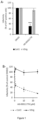
Claims (10)
- A compound comprising a compound having formula (I) below:
wherein: - The compound for use according to anyone of the preceding claims, wherein the compound is in an enteral, parenteral or topical form.
- The compound for use according to anyone of the preceding claims, wherein the compound is administered in a form chosen among a form for oral administration, a form for topical-transdermal administration, a form for nasal administration, a form for a rectal administration, a subcutaneous form, an intramuscular form, an intratracheal form and an intravenous administration.
- The compound for use according to claim 4, wherein the compound is administered in a form selected among a solution, a syrup, a suspension, an emulsion, oral drops, an oral effervescent dosage form selected from the group comprising tablets, granules and powders, an oral powder or a multiparticulate system selected from the group comprising beads, granules, mini tablets and micro granules, an orodispersible dosage form selected from the group comprising orodispersible tablets, lyophilised wafers, thin films, a chewable tablet, a tablet, a soft gel capsule and a medical chewing gum, a form for buccal and sublungual routes selected from the group comprising buccal or sublingual tablets, muco adhesive preparation, lozenges, oro-mucosal drops and sprays, ointments, cream, gel, lotion, patch, foam. Alternatively, it may be in a form for a nasal administration, for example selected from the group comprising nasal drops, nasal spray, nasal powder, suppository, hard gelatin capsule.
- The compound for use according to anyone of the preceding claims, wherein the infection is a SARS-CoV-2 infection.
- The compound for use according to anyone of the preceding claims, for inhibiting the interaction between Spike and ACE2 proteins.
- A pharmaceutical composition comprising a compound as defined in claims 1 to 3, for use in the prevention or in the treatment of an infection.
- The pharmaceutical composition for use as claimed in claim 8, wherein the infection is a SARS-CoV-2 infection.
Priority Applications (6)
| Application Number | Priority Date | Filing Date | Title |
|---|---|---|---|
| EP21306547.7A EP4176875A1 (en) | 2021-11-04 | 2021-11-04 | Pharmaceutical composition, its use as a drug and new compounds, especially for treating sars-cov-2 infection |
| IL312592A IL312592A (en) | 2021-11-04 | 2022-11-03 | Pharmaceutical composition, its use as a drug and new compounds, especially for treating sars-cov-2 infection |
| PCT/EP2022/080737 WO2023079033A1 (en) | 2021-11-04 | 2022-11-03 | Pharmaceutical composition, its use as a drug and new compounds, especially for treating sars-cov-2 infection |
| AU2022381706A AU2022381706A1 (en) | 2021-11-04 | 2022-11-03 | Pharmaceutical composition, its use as a drug and new compounds, especially for treating sars-cov-2 infection |
| JP2024527201A JP2024539416A (en) | 2021-11-04 | 2022-11-03 | Pharmaceutical compositions, their use as drugs and novel compounds, particularly for treating SARS-COV-2 infections |
| EP22818203.6A EP4426292A1 (en) | 2021-11-04 | 2022-11-03 | Pharmaceutical composition, its use as a drug and new compounds, especially for treating sars-cov-2 infection |
Applications Claiming Priority (1)
| Application Number | Priority Date | Filing Date | Title |
|---|---|---|---|
| EP21306547.7A EP4176875A1 (en) | 2021-11-04 | 2021-11-04 | Pharmaceutical composition, its use as a drug and new compounds, especially for treating sars-cov-2 infection |
Publications (1)
| Publication Number | Publication Date |
|---|---|
| EP4176875A1 true EP4176875A1 (en) | 2023-05-10 |
Family
ID=78770558
Family Applications (1)
| Application Number | Title | Priority Date | Filing Date |
|---|---|---|---|
| EP21306547.7A Withdrawn EP4176875A1 (en) | 2021-11-04 | 2021-11-04 | Pharmaceutical composition, its use as a drug and new compounds, especially for treating sars-cov-2 infection |
Country Status (1)
| Country | Link |
|---|---|
| EP (1) | EP4176875A1 (en) |
Citations (1)
| Publication number | Priority date | Publication date | Assignee | Title |
|---|---|---|---|---|
| WO2011106992A1 (en) * | 2010-03-02 | 2011-09-09 | Merck Sharp & Dohme Corp. | Inhibitors of hepatitis c virus ns5b polymerase |
-
2021
- 2021-11-04 EP EP21306547.7A patent/EP4176875A1/en not_active Withdrawn
Patent Citations (1)
| Publication number | Priority date | Publication date | Assignee | Title |
|---|---|---|---|---|
| WO2011106992A1 (en) * | 2010-03-02 | 2011-09-09 | Merck Sharp & Dohme Corp. | Inhibitors of hepatitis c virus ns5b polymerase |
Non-Patent Citations (18)
| Title |
|---|
| ADASME,M.F.LINNEMANN,K.L.BOLZ,S.N.KAISER,F.SALENTIN,S.HAUPT,V.J.SCHROEDER,M.: "PLIP 2021: expanding the scope of the protein-ligand interaction profiler to DNA and RNA", NUCLEIC ACIDS RES., vol. 49, 2021, pages W530 - W534 |
| CRAWFORD,K.H.D.EGUIA,R.DINGENS,A.S.LOES,A.N.MALONE,K.D.WOLF,C.R.CHU,H.Y.TORTORICI,M.A.VEESLER,D.MURPHY,M. ET AL.: "Protocol and Reagents for Pseudotyping Lentiviral Particles with SARS-CoV-2 Spike Protein for Neutralization Assays", VIRUSES, vol. 12, 2020, XP055854276, DOI: 10.3390/v12050513 |
| EL-HAMID ATTIA A ET AL: "Synthesis of 3,5-disubstituted pyridines as antimicrobial agents", PHARMAZIE, GOVI VERLAG PHARMAZEUTISCHER VERLAG GMBH, DE, vol. 50, no. 7, 1 January 1995 (1995-01-01), pages 455 - 459, XP001526434, ISSN: 0031-7144 * |
| FERREIRA: "Chemistry - A European Journal", 2017, WILEY ONLINE LIBRARY, article "Improving the Catalytic Power of the DszD Enzyme for the Biodesulfurization of Crude Oil and Derivatives" |
| GORDON,D.E.HIATT,J.BOUHADDOU,M.REZELJ,V.V.ULFERTS,S.BRABERG,H.JUREKA,A.S.OBERNIER,K.GUO,J.Z.BATRA,J. ET AL.: "Comparative host-coronavirus protein interaction networks reveal pan-viral disease mechanisms", SCIENCE, 2020 |
| JACQUEMARD,U.DIAS,N.LANSIAUX,A.BAILLY,C.LOGE,C.ROBERT,J.-M.LOZACH,O.MEIJER,L.MEROUR,J.-Y.ROUTIER,S.: "Synthesis of 3,5-bis(2-indolyl)pyridine and 3-[(2-indolyl)-5-phenyl]pyridine derivatives as CDK inhibitors and cytotoxic agents", BIOORG. MED. CHEM., vol. 16, 2008, pages 4932 - 4953, XP022647286, DOI: 10.1016/j.bmc.2008.03.034 |
| KOCH,J.UCKELEY,Z.M.DOLDAN,P.STANIFER,M.BOULANT,S.LOZACH,P.: "TMPRSS2 expression dictates the entry route used by SARS-CoV-2 to infect host cells", EMBO J., vol. 40, 2021 |
| LAN ET AL.: "tructure of the SARS-CoV-2 spike receptor-binding domain bound to the ACE2 receptor", NATURE, vol. 581, 2020, pages 215 - 220 |
| LAN,J.GE,J.YU,J.SHAN,S.ZHOU,H.FAN,S.ZHANG,Q.SHI,X.WANG,Q.ZHANG,L. ET AL.: "Structure of the SARS-CoV-2 spike receptor-binding domain bound to the ACE2 receptor", NATURE, vol. 581, 2020, pages 215 - 220, XP037182122, DOI: 10.1038/s41586-020-2180-5 |
| LAPAILLERIE,D.CHARLIER,C.FERNANDES,H.S.SOUSA,S.F.LESBATS,P.WEIGEL,P.FAVEREAUX,A.GUYONNET-DUPERAT,V.PARISSI,V.: "In Silico, In Vitro and In Cellulo Models for Monitoring SARS-CoV-2 Spike/Human ACE2 Complex, Viral Entry and Cell Fusion", VIRUSES, vol. 13, 2021 |
| LIU YONGHUA ET AL: "Synthesis and structure-activity relationship of novel bisindole amidines active against MDR Gram-positive and Gram-negative bacteria", EUROPEAN JOURNAL OF MEDICINAL CHEMISTRY, vol. 150, 25 April 2018 (2018-04-25), pages 771 - 782, XP002806284, ISSN: 0223-5234 * |
| MAHBOOBI ET AL.: "Bis(1 H-2-indolyl)methanones as a novel class of inhibitors of the platelet-derived growth factor receptor kinase", J. MED. CHEM, vol. 45, 2002, pages 1002 - 1018 |
| ONODI,F.BONNET-MADIN,L.MEERTENS,L.KARPF,L.POIROT,J.ZHANG,S.-Y.PICARD,C.PUEL,A.JOUANGUY,E.ZHANG,Q. ET AL.: "SARS-CoV-2 induces human plasmacytoid predendritic cell diversification via UNC93B and IRAK4", J. EXP. MED., vol. 218, 2021 |
| PAMELA KASSIS ET AL: "Synthesis and biological evaluation of new 3-(6-hydroxyindol-2-yl)-5-(Phenyl) pyridine or pyrazine V-Shaped molecules as kinase inhibitors and cytotoxic agents", EUROPEAN JOURNAL OF MEDICINAL CHEMISTRY, ELSEVIER, AMSTERDAM, NL, vol. 46, no. 11, 31 August 2011 (2011-08-31), pages 5416 - 5434, XP028324202, ISSN: 0223-5234, [retrieved on 20110908], DOI: 10.1016/J.EJMECH.2011.08.048 * |
| SERRANO,C.TEIXEIRA,C.S.S.COOPER,D.N.CARNEIRO,J.LOPES-MARQUES,M.STENSON,P.D.AMORIM,A.PRATA,M.J.SOUSA,S.F.AZEVEDO,L.: "Compensatory epistasis explored by molecular dynamics simulations", HUM. GENET., vol. 140, 2021, pages 1329 - 1342, XP037528044, DOI: 10.1007/s00439-021-02307-x |
| SHAPOVALOV,M.V.DUNBRACK,R.L.: "A smoothed backbone-dependent rotamer library for proteins derived from adaptive kernel density estimates and regressions", STRUCT. LOND. ENGL., vol. 19, 1993, pages 844 - 858, XP028230135, DOI: 10.1016/j.str.2011.03.019 |
| SUZEN S.: "Recent Studies and Biological Aspects of Substantial Indole Derivatives with Anti-cancer Activity", CURRENT ORGANIC CHEMISTRY, vol. 21, 2017, pages 2068 - 2076, XP002806285 * |
| WRAPP,D.WANG,N.CORBETT,K.S.GOLDSMITH,J.A.HSIEH,C.-L.ABIONA,O.GRAHAM,B.S.MCLELLAN,J.S.: "Cryo-EM structure of the 2019-nCoV spike in the prefusion conformation", SCIENCE, vol. 367, 2020, pages 1260 - 1263, XP055829062, DOI: 10.1126/science.abb2507 |
Similar Documents
| Publication | Publication Date | Title |
|---|---|---|
| Yan et al. | Structural biology of SARS-CoV-2: open the door for novel therapies | |
| Xu et al. | Broad spectrum antiviral agent niclosamide and its therapeutic potential | |
| Timilsina et al. | SARS-CoV-2 ORF7a potently inhibits the antiviral effect of the host factor SERINC5 | |
| US12329754B2 (en) | Use of berbamine dihydrochloride in preparation of Ebola virus inhibitor | |
| CN112516143B (en) | Application of dibenzyl tetrahydroisoquinoline derivative in preparation of anti-coronavirus medicines | |
| CN116236580B (en) | Application of old drugs such as Auranofin and their combination in combating single positive strand RNA viruses | |
| AU2004230485A1 (en) | The severe acute respiratory syndrome coronavirus | |
| Stevaert et al. | Betulonic acid derivatives interfering with human coronavirus 229E replication via the nsp15 endoribonuclease | |
| Yi et al. | Repurposing of berbamine hydrochloride to inhibit Ebola virus by targeting viral glycoprotein | |
| Shepley-McTaggart et al. | Viruses go modular | |
| Qiu et al. | N-substituted pyrrole derivative 12m inhibits HIV-1 entry by targeting Gp41 of HIV-1 envelope glycoprotein | |
| CN117304335A (en) | Application of recombinant expressed proteins in preventing/or treating respiratory diseases | |
| Geronikaki et al. | Anti-HIV agents: current status and recent trends | |
| Xu et al. | Discovery of novel substituted N-(4-Amino-2-chlorophenyl)-5-chloro-2-hydroxybenzamide analogues as potent human adenovirus inhibitors | |
| Lapaillerie et al. | Selection of bis-indolyl pyridines and triphenylamines as new inhibitors of SARS-CoV-2 cellular entry by modulating the spike protein/ACE2 interfaces | |
| Chakraborty et al. | NL-63: A better surrogate virus for studying SARS-CoV-2 | |
| US10300080B2 (en) | Methods and compounds to inhibit enveloped virus release | |
| AU2022381706A1 (en) | Pharmaceutical composition, its use as a drug and new compounds, especially for treating sars-cov-2 infection | |
| EP4176875A1 (en) | Pharmaceutical composition, its use as a drug and new compounds, especially for treating sars-cov-2 infection | |
| CN114224896A (en) | Composition for prevention and early treatment of viral infection | |
| EP4173621A1 (en) | Pharmaceutical composition, its use as a drug and new compounds, especially for treating sars-cov-2 infection | |
| US20080200550A1 (en) | Inhibition of Hiv-1 Replication by Disruption of the Processing of the Viral Capsid-Spacer Peptide 1 Protein | |
| JP4473134B2 (en) | Ligand | |
| CN118475348A (en) | Pharmaceutical composition, use as a medicament and novel compounds, in particular for the treatment of SARS-COV-2 infection | |
| US20220348569A1 (en) | Respiratory virus inhibitors |
Legal Events
| Date | Code | Title | Description |
|---|---|---|---|
| PUAI | Public reference made under article 153(3) epc to a published international application that has entered the european phase |
Free format text: ORIGINAL CODE: 0009012 |
|
| STAA | Information on the status of an ep patent application or granted ep patent |
Free format text: STATUS: THE APPLICATION HAS BEEN PUBLISHED |
|
| AK | Designated contracting states |
Kind code of ref document: A1 Designated state(s): AL AT BE BG CH CY CZ DE DK EE ES FI FR GB GR HR HU IE IS IT LI LT LU LV MC MK MT NL NO PL PT RO RS SE SI SK SM TR |
|
| STAA | Information on the status of an ep patent application or granted ep patent |
Free format text: STATUS: THE APPLICATION IS DEEMED TO BE WITHDRAWN |
|
| 18D | Application deemed to be withdrawn |
Effective date: 20231111 |