EP4176327B1 - Verfahren zur bewertung des relativen zustands eines flugzeugmotors - Google Patents
Verfahren zur bewertung des relativen zustands eines flugzeugmotors Download PDFInfo
- Publication number
- EP4176327B1 EP4176327B1 EP21740146.2A EP21740146A EP4176327B1 EP 4176327 B1 EP4176327 B1 EP 4176327B1 EP 21740146 A EP21740146 A EP 21740146A EP 4176327 B1 EP4176327 B1 EP 4176327B1
- Authority
- EP
- European Patent Office
- Prior art keywords
- time
- flight
- domain series
- indicator
- time series
- Prior art date
- Legal status (The legal status is an assumption and is not a legal conclusion. Google has not performed a legal analysis and makes no representation as to the accuracy of the status listed.)
- Active
Links
Images



Classifications
-
- G—PHYSICS
- G05—CONTROLLING; REGULATING
- G05B—CONTROL OR REGULATING SYSTEMS IN GENERAL; FUNCTIONAL ELEMENTS OF SUCH SYSTEMS; MONITORING OR TESTING ARRANGEMENTS FOR SUCH SYSTEMS OR ELEMENTS
- G05B23/00—Testing or monitoring of control systems or parts thereof
- G05B23/02—Electric testing or monitoring
- G05B23/0205—Electric testing or monitoring by means of a monitoring system capable of detecting and responding to faults
- G05B23/0218—Electric testing or monitoring by means of a monitoring system capable of detecting and responding to faults characterised by the fault detection method dealing with either existing or incipient faults
- G05B23/0224—Process history based detection method, e.g. whereby history implies the availability of large amounts of data
- G05B23/024—Quantitative history assessment, e.g. mathematical relationships between available data; Functions therefor; Principal component analysis [PCA]; Partial least square [PLS]; Statistical classifiers, e.g. Bayesian networks, linear regression or correlation analysis; Neural networks
-
- B—PERFORMING OPERATIONS; TRANSPORTING
- B64—AIRCRAFT; AVIATION; COSMONAUTICS
- B64F—GROUND OR AIRCRAFT-CARRIER-DECK INSTALLATIONS SPECIALLY ADAPTED FOR USE IN CONNECTION WITH AIRCRAFT; DESIGNING, MANUFACTURING, ASSEMBLING, CLEANING, MAINTAINING OR REPAIRING AIRCRAFT, NOT OTHERWISE PROVIDED FOR; HANDLING, TRANSPORTING, TESTING OR INSPECTING AIRCRAFT COMPONENTS, NOT OTHERWISE PROVIDED FOR
- B64F5/00—Designing, manufacturing, assembling, cleaning, maintaining or repairing aircraft, not otherwise provided for; Handling, transporting, testing or inspecting aircraft components, not otherwise provided for
- B64F5/60—Testing or inspecting aircraft components or systems
-
- G—PHYSICS
- G05—CONTROLLING; REGULATING
- G05B—CONTROL OR REGULATING SYSTEMS IN GENERAL; FUNCTIONAL ELEMENTS OF SUCH SYSTEMS; MONITORING OR TESTING ARRANGEMENTS FOR SUCH SYSTEMS OR ELEMENTS
- G05B23/00—Testing or monitoring of control systems or parts thereof
- G05B23/02—Electric testing or monitoring
- G05B23/0205—Electric testing or monitoring by means of a monitoring system capable of detecting and responding to faults
- G05B23/0259—Electric testing or monitoring by means of a monitoring system capable of detecting and responding to faults characterized by the response to fault detection
- G05B23/0283—Predictive maintenance, e.g. involving the monitoring of a system and, based on the monitoring results, taking decisions on the maintenance schedule of the monitored system; Estimating remaining useful life [RUL]
-
- G—PHYSICS
- G06—COMPUTING OR CALCULATING; COUNTING
- G06N—COMPUTING ARRANGEMENTS BASED ON SPECIFIC COMPUTATIONAL MODELS
- G06N20/00—Machine learning
-
- G—PHYSICS
- G06—COMPUTING OR CALCULATING; COUNTING
- G06N—COMPUTING ARRANGEMENTS BASED ON SPECIFIC COMPUTATIONAL MODELS
- G06N3/00—Computing arrangements based on biological models
- G06N3/02—Neural networks
- G06N3/08—Learning methods
- G06N3/09—Supervised learning
-
- G—PHYSICS
- G07—CHECKING-DEVICES
- G07C—TIME OR ATTENDANCE REGISTERS; REGISTERING OR INDICATING THE WORKING OF MACHINES; GENERATING RANDOM NUMBERS; VOTING OR LOTTERY APPARATUS; ARRANGEMENTS, SYSTEMS OR APPARATUS FOR CHECKING NOT PROVIDED FOR ELSEWHERE
- G07C5/00—Registering or indicating the working of vehicles
- G07C5/006—Indicating maintenance
-
- G—PHYSICS
- G06—COMPUTING OR CALCULATING; COUNTING
- G06N—COMPUTING ARRANGEMENTS BASED ON SPECIFIC COMPUTATIONAL MODELS
- G06N20/00—Machine learning
- G06N20/10—Machine learning using kernel methods, e.g. support vector machines [SVM]
-
- G—PHYSICS
- G06—COMPUTING OR CALCULATING; COUNTING
- G06N—COMPUTING ARRANGEMENTS BASED ON SPECIFIC COMPUTATIONAL MODELS
- G06N3/00—Computing arrangements based on biological models
- G06N3/02—Neural networks
- G06N3/08—Learning methods
-
- G—PHYSICS
- G06—COMPUTING OR CALCULATING; COUNTING
- G06N—COMPUTING ARRANGEMENTS BASED ON SPECIFIC COMPUTATIONAL MODELS
- G06N5/00—Computing arrangements using knowledge-based models
- G06N5/01—Dynamic search techniques; Heuristics; Dynamic trees; Branch-and-bound
-
- G—PHYSICS
- G06—COMPUTING OR CALCULATING; COUNTING
- G06N—COMPUTING ARRANGEMENTS BASED ON SPECIFIC COMPUTATIONAL MODELS
- G06N7/00—Computing arrangements based on specific mathematical models
- G06N7/01—Probabilistic graphical models, e.g. probabilistic networks
-
- G—PHYSICS
- G07—CHECKING-DEVICES
- G07C—TIME OR ATTENDANCE REGISTERS; REGISTERING OR INDICATING THE WORKING OF MACHINES; GENERATING RANDOM NUMBERS; VOTING OR LOTTERY APPARATUS; ARRANGEMENTS, SYSTEMS OR APPARATUS FOR CHECKING NOT PROVIDED FOR ELSEWHERE
- G07C5/00—Registering or indicating the working of vehicles
- G07C5/08—Registering or indicating performance data other than driving, working, idle, or waiting time, with or without registering driving, working, idle or waiting time
- G07C5/0808—Diagnosing performance data
Definitions
- the technical field of the invention is that of monitoring the condition of aircraft engines.
- the present invention relates to a method for assessing the condition of an aircraft engine, and more particularly to a method for assessing the relative condition of an aircraft engine.
- the present invention also relates to a method for monitoring the relative condition of an aircraft engine.
- a first family of methods consists in choosing from the data a set of physical and/or mechanical indicators representative of the efficiency of the engine and in monitoring the value of these indicators over time.
- the choice of the set of indicators is based on business expertise, and in particular on knowledge of the data and their values in different flight contexts.
- the set of indicators often includes a significant amount of data that is not necessarily available for all flights.
- a second family of methods consists of using a physical or statistical model, fitting it to the data and then monitoring indicators, for example parameters or residuals of the model.
- such methods require a priori knowledge of the physical model of the engine or to construct a substitute statistical model explaining the dynamics of the data.
- a third family of methods consists of monitoring hidden variables extracted from the data by decomposition into explanatory factors.
- the values of the indicators or variables monitored are obtained for each flight and then a trend is extracted from the evolution of the values over all flights.
- these methods do not use explicitly temporal information, for example the fact that the aircraft ages over time, and nothing forces the monotony of the indicators or variables calculated with respect to time, which can predict an improvement in the condition of the engine over certain periods, while no maintenance operation has been carried out.
- the invention offers a solution to the problems mentioned above, by making it possible to assess the condition of an aircraft engine by taking into account the aging of the engine over time, from data conventionally recorded during successive flights of the aircraft, without requiring professional expertise.
- a time series comprising data recorded successively during the flight, ordered according to time, is constructed for each flight.
- the time series corresponding to flights having taken place between two same maintenances are grouped within a data set.
- the invention is based on the assumption that information about engine aging is contained in the data and that aging is a monotonic process with respect to time.
- an embedding function is trained on each dataset of a set of training datasets using a classifier that forces the embedding function to learn to place, from their time series, each flight corresponding to the same dataset according to the temporal order in an embedding space.
- the embedding function is able to provide a representation of the different time series recorded along the life of the aircraft ordered in time in the embedding space.
- the indicator is monotonic between two engine maintenances, which prevents the assessed engine condition from improving without performing a maintenance operation.
- the invention therefore makes it possible to evaluate the state of the engine by explicitly taking aging into account and without requiring modeling of the engine or time series, unlike the prior art.
- the evaluation method according to the first aspect of the invention may have one or more complementary characteristics among the following, considered individually or according to all technically possible combinations.
- the aging indicator is the sum of the calculated monotony indicators.
- the aging condition is verified for the maximum calculated aging indicator.
- the selected reference flight is the flight associated with a time series of the validation set corresponding to the healthiest possible engine state, i.e. the flight allowing the most monotonous aging curves possible.
- the evaluation method according to the first aspect of the invention comprises in in addition to a step of triggering an alarm if the engine status indicator is above an alarm threshold.
- the alarm threshold is equal to the maximum aging indicator preceding maintenance by a predefined time margin.
- an alarm is triggered when the assessed condition of the engine has reached a level of aging from which maintenance should be carried out to anticipate an engine failure.
- a second aspect of the invention relates to a method of monitoring the relative state of an aircraft engine over a plurality of flights comprising the steps of the evaluation method according to any one of the preceding claims for one flight of the plurality of flights, and the evaluation step for each other flight of the plurality of flights.
- a third aspect of the invention relates to a computer program product comprising instructions which, when the program is executed on a computer, cause the latter to implement the steps of the evaluation method according to the first aspect of the invention or the steps of the monitoring method according to the second aspect of the invention.
- a first aspect of the invention relates to a method for evaluating the condition of an aircraft engine.
- the aircraft is for example an airplane, a helicopter or a drone.
- the engine condition is assessed for a given flight of the aircraft, i.e. it is considered that the condition of the aircraft engine does not vary during a flight.
- the aircraft must have carried out a plurality of maintenance operations and a plurality of flights between two successive maintenance operations, before the flight for which the condition of the engine is evaluated.
- FIG. 3 There figure 3 illustrates an example of the aircraft's previous maintenances M i and flights V i,j for which the engine condition is assessed for a given flight V.
- An i-th maintenance M i is associated with a set of flights V i,j , the notation flight V i,j corresponds to the j-th flight having taken place between the maintenance M i-1 and the maintenance M i .
- Each maintenance M i is associated with a maintenance instant t Mi , corresponding for example to the start or end of the time interval necessary to carry out the maintenance M i .
- the aircraft has carried out three maintenances M 0 , M 1 , M 2 associated respectively with the maintenance times t M0 , t M1 , t M2 .
- the first maintenance M 0 of the aircraft is considered to be carried out before it is put into service, i.e. before its first flight V 1.0 .
- each flight V i,j , V data are recorded periodically. More specifically, sets X i,j,k of variables each associated with a recording time t Ei,j,k are recorded.
- the sets X i,j,k of variables can be recorded at a fixed time interval, that is, the time interval between the recording times t Ei,j,k , t Ei,j,k+1 of two sets of variables X i,j,k and X i,j,k+1 recorded successively is fixed, or at a variable time interval.
- the sets X i,j,k of variables recorded for the same flight V i,j , V or for different flights V i,j , V all contain the same variables.
- Each set of variables includes, for example, at least one engine-related variable, such as torque, temperature, or pressure.
- One or more environmental variables may be added, such as outside temperature, atmospheric pressure, flight conditions, and/or one or more flight parameters, such as pilot controls or onboard load.
- Each flight V i,j , V is associated with a time series S i,j , S comprising the sets X i,j,k of variables recorded successively during the flight considered.
- the sets X i,j,k of variables are ordered in the order of recording, that is to say that a first set X i,j,k of variables recorded at a first recording time t Ei,j,k prior to a second recording time t Ei,j,k+1 of a second set X i,j,k+1 of variables is located before this second set X i,j,k+1 of variables in the time series S i,j , S.
- Each time series S i,j , S is associated with a flight instant t Vi,j , tv corresponding for example to the start or end of the flight V i,j , V corresponding to the time series S i,j , S.
- the aircraft has performed five flights V 1.0 , V 1.1 , V 2.0 , V 2.1 , V 2.2 associated respectively with the time series S 1.0 , S 1.1 , S 2.0 , S 2.1 , S 2.2 , before the flight V considered, two flights V 1.0 , V 1.1 between the first maintenance M 0 and the second maintenance M 1 and three flights V 2.0 , V 2.1 , V 2.2 between the second maintenance M 1 and the third maintenance M 2 .
- the time series S 1.0 , S 1.1 , S 2.0 , S 2.1 , S 2.2 are respectively associated with the flight times t V1.0 , t V1.1 , t V2.0 , t V2.1 , tv2.2.
- the time series S 2,0 therefore includes the sets of variables X 2,0,0 , X 2,0,1 , X 2,0,2 , X 2,0,3 , X 2,0,4 , X 2,0,5 , X 2,0,6 , X 2,0,7 ordered according to the order of the recording times t E2,0,0 , t E2,0,1 , t E2,0,2 , t E2,0,3 , t E2,0,4 , t E2,0,5 , t E2,0,6 , t E2,0,7 .
- the state evaluated by the method according to the first aspect of the invention for the flight V considered is relative because it is obtained by comparison with a reference flight selected from the flights V i,j previously carried out by the aircraft.
- the time series S i,j associated with the reference flight is called the reference time series.
- FIG. 1 is a block diagram illustrating the sequence of steps of the method 100 according to the first aspect of the invention.
- a first step 101 of the method 100 consists of creating a data set Ji for each maintenance M i carried out by the aircraft before the flight V considered.
- the Ji dataset includes the time series S i,j associated with each flight V i,j that was performed between the maintenance time t Mi associated with maintenance M i and the maintenance time t Mi-1 associated with maintenance M i-1 immediately preceding maintenance M i .
- a dataset J 1 is created for maintenance M 1 comprising the time series S 1.0 and S 1.1 associated respectively with flights V 1.0 and V 1.1 having taken place between the first maintenance M 0 and maintenance M 1 .
- a dataset J 2 is created for maintenance M 2 comprising the time series S 2.0 , S 2.1 , S 2.2 associated respectively with flights V 2.0 , V 2.1 , V 2.2 having taken place between maintenance M 1 and maintenance M 2 .
- a second step 102 of the method 100 consists of creating a set of data sets comprising each data set Ji created in the first step 101.
- the dataset set includes at least one Ji dataset.
- the dataset set includes two datasets J 1 and J 2 .
- the second step 102 of the method 100 then consists in separating the set of datasets into a training set and a validation set. For example, if the set of datasets comprises N datasets, the training set comprises n datasets among the N datasets of the set of datasets, with n strictly less than N, and the validation set comprises N-n datasets. In general, and depending on the number of datasets available, n is chosen so that the training set comprises more datasets than the validation set.
- the training set and the validation set each comprise a dataset comprising a portion of the single dataset in the dataset set.
- a third step 103 of the method 100 consists of jointly training an embedding function and a classifier.
- FIG. 4 shows a schematic representation of the third step 103 of the method 100.
- the embedding function 201 is a parametric function configured to associate a time series S i , j with a point, called embedding P i,j , in a embedding space.
- the embedding function 201 is chosen based on the space of time series S i,j , S.
- the embedding function 201 is for example a neural network, a distribution density, a parametric analytical function or a representation function defining a Hilbert reproducing kernel.
- the classifier 202 is configured to associate with a pair of points in the embedding space, i.e. with a pair of embeddings P i,j comprising a first embedding P i,j1 and a second embedding P i,j2 , a scalar between 0 and 1 corresponding to a probability p i,j1,i,j2 .
- the classifier 202 is chosen according to the embedding space.
- the classifier 202 is for example a linear classifier, such as a perceptron, a support vector machine or a Bayesian classifier, a quadratic classifier, a neural network or a decision tree.
- a linear classifier such as a perceptron, a support vector machine or a Bayesian classifier, a quadratic classifier, a neural network or a decision tree.
- the training is performed by minimizing a cost function H depending on the probability p i,j1,i,j2 , allowing on the one hand to update the parameters of the classifier 202 so that the probability p i,j1,i,j2 calculated by the classifier 202 corresponds to the probability that a first time series S i,j1 corresponding to the first embedding P i,j1 is associated with a flight time t Vi,j1 prior to the flight time t Vi,j2 associated with a second time series S i,j2 corresponding to the second embedding P i,j2 , and on the other hand to update the parameters of the embedding function 201 so that it is capable of ordering the embeddings P i,j corresponding to the time series S i,j according to the temporal order in the embedding space.
- the third step 103 includes several substeps performed for each dataset Ji of the training set.
- a first sub-step 1031 of the third step 103 consists of randomly drawing from the data set Ji of the training set, a pair of time series comprising a first time series S i,j1 and a second time series S i,j2 .
- the first sub-step 1031 is carried out for a data set Ji comprising three flights V i,j1 , V i,j2 , V i,j3 associated respectively with the time series S i,j1 , S i,j2 , S i,j3 , and the time series S i,j1 and S i,j2 are drawn randomly.
- a second sub-step 1032 of the third step 103 consists of using the embedding function 201 to associate the pair of time series drawn in the first sub-step 1031 with a pair of embeddings P i,j1 , P i,j2 .
- an embedding P i,j1 is obtained for the time series S i,j1 and an embedding P i,j2 obtained for the time series S i,j2 using the embedding function 201.
- a third sub-step 1033 of the third step 103 consists of using the classifier 202 to obtain the probability p i,j1,i,j2 for the pair of embeddings P i,j1 , P i,j2 obtained in the second sub-step 1032.
- a probability p i,j1,i,j2 is obtained for a pair of embeddings comprising the embedding P i,j1 and the embedding P i,j2 using the classifier 202.
- a fourth sub-step 1034 of the third step 103 consists of calculating the cost function H from the probability p i,j1,i,j2 obtained in the third sub-step 1033, from the flight time t Vi,j1 corresponding to the first time series S i,j1 and from the flight time t Vi,j2 corresponding to the second time series S i,j2 .
- c is equal to 1 since the first time series S i,j1 is associated with a flight time t Vi,j1 prior to the flight time t Vi,j2 corresponding to the second time series S i,j2 .
- ⁇ . ⁇ corresponding to the regularization term for example by the norm L1 ⁇ . ⁇ 1 to obtain a sparse embedding or the norm L2 ⁇ . ⁇ 2 to obtain a spherical embedding centered at 0.
- a fifth sub-step 1035 of the third step 103 consists of optimizing the embedding function 201 and the classifier 202 by minimizing the cost function H calculated in the fourth sub-step 1034.
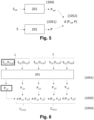
- FIG. 5 shows a schematic representation of a fourth and a fifth step 105 of the method 100.
- the fourth step 104 of the method 100 consists of selecting the reference time series S ref from among the time series S i,j included in the validation set.
- FIG. 2 is a block diagram illustrating the sequence of sub-steps for a first embodiment of the fourth step 104 of the method 100.
- FIG. 6 shows a schematic representation of a first substep 1041, a second substep 1042 and a third substep 1043 of the first embodiment of the fourth step 104 of the method 100.
- the first sub-step 1041 of the fourth step 104 consists in applying the trained embedding function 201 to each time series S i,j of the validation set, to obtain an embedding P i,j for each time series S i,j of the validation set.
- the validation set comprises a first dataset Ji comprising two time series S i,j1 , S i,j2 and a second dataset J l comprising three time series S l,j1 , S l,j2 , S l,j3 .
- an embedding P i,j1 is obtained for the time series S i,j1
- an embedding P i,j2 is obtained for the time series S i,j2
- an embedding P l,j1 is obtained for the time series S l,j1
- an embedding P l,j2 is obtained for the time series S l,j2
- an embedding P l,j3 is obtained for the time series S l,j3 .
- the second substep 1042, the third substep 1043, the fourth substep 1044 and the fifth substep 1045 are performed for each time series S i,j of the validation set.
- the second sub-step 1042 of the fourth step 104 consists in using the embedding P i,j calculated in the first sub-step 1041 for each time series S i,j of the validation set, to calculate a distance d between the embedding P i,j of a time series S i,j considered and the embedding of each of the other time series of the validation set.
- the time series considered is the time series S i,j1 which is materialized by a frame.
- a distance d (P i,j1 , P i,j2 ) is calculated between the time series S i,j1 considered and the time series S i,j2
- a distance d (P i,j1 , P l,j1 ) is calculated between the time series S i,j1 considered and the time series S l,j1
- a distance d (P i,j1 , P l,j2 ) is calculated between the time series S i,j1 considered and the time series S l,j2
- a distance d (P i,j1 , P l,j3 ) is calculated between the time series S i,j1 considered and the time series S l,j3 .
- the distance d is a distance on the embedding space.
- the distance d can be any distance defined on the distribution space.
- the distance d can be any distance defined on a vector space.
- a distance d (P i,j1 , P l,j2 ) calculated between the vector embedding P i,j1 of the time series S i,j1 and the vector embedding P l,j2 of the time series S l,j2 is for example the distance L2 between the vectors P i,j1 and P l,j2 which is expressed as follows: ⁇ P i , I 1 ⁇ P L , I 2 ⁇
- the third sub-step 1043 of the fourth step 104 consists in creating an aging curve C i,Si,j for each data set Ji of the validation set and each time series S i,j of the validation set considered.
- FIG. 7 There figure 7 represents an example of an aging curve for a dataset.
- the aging curve C l,Si,j associates with each flight instant t Vl,j associated with a time series S l,j of the validation set included in the data set J l , the distance d calculated in the second sub-step 1042 of the fourth step 104 according to the first embodiment, between the time series S i,j considered and the time series S l,j of the validation set included in the data set J l .
- the validation set comprises only two datasets Ji and J l .
- an aging curve C i,Si,j1 is created for the dataset Ji and an aging curve C l,Si,j1 is created for the dataset Ji.
- the aging curve C i,Si,j1 comprises the distance d (P i,j1 , P i,j2 ) between the time series S i,j1 considered and the time series S i,j2
- the aging curve C l,Si,j1 comprises the distance d (P i ,j1 , P l,j1 ) between the time series S i,j1 considered and the time series S l,j1
- the aging curve Ci, Si ,j1 calculated for the data set J l with respect to the considered time series Si ,j is represented as a function of time.
- the aging curve C l, Si,j1 is for example a continuous function with respect to time constructed by linear interpolation.
- the fourth sub-step 1044 of the fourth step 104 according to the first embodiment consists in calculating a monotony indicator for each aging curve C i,Si,j created in the third sub-step 1043 of the fourth step 104 according to the first embodiment.
- the fourth sub-step 1044 of the fourth step 104 comprises for example a first sub-step consisting of initializing the monotonicity indicator to zero, then a second sub-step consisting of calculating the time derivative to order 1 of the aging curve C i,Si,j for each time interval between two successive flight instants t Vi,j and incrementing the monotonicity indicator by 1 when the calculated derivative is positive.
- the monotonicity indicator of an aging curve then corresponds to the number of time intervals between two successive flight instants t Vi,j for which the time derivative of order 1 of the aging curve C i,Si,j is positive.
- the fifth sub-step 1045 of the fourth step 104 according to the first embodiment consists in calculating an aging indicator from each monotony indicator calculated in the fourth sub-step 1044 of the fourth step 104 according to the first embodiment.
- the aging indicator is for example the sum of the monotony indicators calculated in the fourth sub-step 1044 of the fourth step 104 according to the first embodiment.
- an aging indicator is calculated for each time series S i,j of the validation set.
- the reference time series S ref is then the time series S i,j for which the aging indicator calculated in the fifth sub-step 1045 of the fourth step 104 according to the first embodiment meets an aging condition.
- the aging condition is for example checked for the maximum aging indicator.
- the embedding P i,j calculated in the first sub-step 1041 of the fourth step 104 according to the first embodiment for the reference time series S ref is called the reference embedding P ref .
- the reference time series S ref is the time series S 1.0 associated with the first flight V 1.0 of the aircraft.
- the fourth step 104 comprises a sub-step of using the embedding function 201 trained on the reference series S ref to obtain a reference embedding P ref .
- the fifth step 105 of the method 100 consists of calculating an engine state indicator for the flight V considered.
- a first sub-step 1051 of the fifth step 105 consists in applying the trained embedding function 201 to the time series S associated with the flight V to obtain an embedding P, as illustrated in the figure 5 .
- a second sub-step 1052 of the fifth step 105 consists in calculating the distance d between the embedding P calculated in the first sub-step 1051 of the fifth step 105 and the reference embedding P ref , as illustrated in the figure 5 .
- the engine status indicator is then equal to the distance d calculated in the second sub-step 1052 of the fifth step 105.
- FIG. 8 There figure 8 represents the relative state of the aircraft engine over time, in the form of a curve that represents the engine state indicator as a function of time.
- the vertical lines represent the times of maintenance performed. This curve thus presents a discontinuity at each maintenance M i ; it is approximately monotonic between two maintenances M i , corresponding to the aging curve of a data set calculated between these two maintenances.
- the method 100 may further comprise a sixth step 106 consisting of triggering an alarm if the engine status indicator is greater than an alarm threshold SA.
- the alarm threshold SA is for example equal to the maximum aging indicator preceding a maintenance M i of a predefined time margin, that is to say to the aging indicator having the highest value among a set of aging indicators comprising each aging indicator calculated at a time preceding a maintenance M i of the time margin.
- a second aspect of the invention relates to a method for monitoring the relative state of the aircraft engine during a set of flights V.
- the tracking method according to the second aspect of the invention comprises for example the steps of the evaluation method 100 according to the first aspect of the invention for a first flight V of the set of flights, then the sixth step 106 of the evaluation method 100 according to the first aspect of the invention for the other flights V of the set of flights.
- a third aspect of the invention relates to a computer program product comprising instructions which, when the program is executed on a computer, cause the latter to implement the steps of the evaluation method according to the first aspect of the invention or the steps of the monitoring method according to the second aspect of the invention.
- the computer program product according to the invention is a surveillance or monitoring tool, preferably implemented on the ground.
Landscapes
- Engineering & Computer Science (AREA)
- Physics & Mathematics (AREA)
- General Physics & Mathematics (AREA)
- Theoretical Computer Science (AREA)
- Software Systems (AREA)
- Artificial Intelligence (AREA)
- Mathematical Physics (AREA)
- Evolutionary Computation (AREA)
- Computing Systems (AREA)
- Data Mining & Analysis (AREA)
- General Engineering & Computer Science (AREA)
- Automation & Control Theory (AREA)
- Aviation & Aerospace Engineering (AREA)
- Manufacturing & Machinery (AREA)
- Medical Informatics (AREA)
- Computer Vision & Pattern Recognition (AREA)
- Transportation (AREA)
- Health & Medical Sciences (AREA)
- Life Sciences & Earth Sciences (AREA)
- Biomedical Technology (AREA)
- Biophysics (AREA)
- Molecular Biology (AREA)
- Computational Linguistics (AREA)
- General Health & Medical Sciences (AREA)
- Traffic Control Systems (AREA)
- Testing Of Devices, Machine Parts, Or Other Structures Thereof (AREA)
- Management, Administration, Business Operations System, And Electronic Commerce (AREA)
- Testing Of Engines (AREA)
- Combined Controls Of Internal Combustion Engines (AREA)
Claims (10)
- Verfahren (100) zur Bewertung des relativen Zustands eines Luftfahrzeugtriebwerks für einen gegebenen Flug (V) des Luftfahrzeugs, wobei an dem Luftfahrzeug vor dem gegebenen Flug (V) eine Vielzahl von Wartungen (Mi) und zwischen zwei aufeinanderfolgenden Wartungen (Mi) eine Vielzahl von Flügen (Vi,j) durchgeführt werden, wobei jede Wartung (Mi) einem Wartungszeitpunkt (tMi) zugeordnet wird und während jedes Flugs (Vi,j ,V) in einer Aufzeichungsreihenfolge eine Vielzahl von Variablen (Xi,j,k) aufgezeichnet werden, wobei jeder Flug (Vi,j,V) einer einem Flugzeitpunkt (tv, tVi,j) entsprechenden Zeitreihe (S, Si,j) zugeordnet ist und die Vielzahl von Variablen (Xi,j,k) umfasst, die während des Flugs (Vi,j,V) in der Aufzeichnungsreihenfolge aufgezeichnet werden, wobei das Verfahren (100) dadurch gekennzeichnet ist, dass es die folgenden Schritte umfasst:- Für jede Wartung (Mi) Erstellung eines Datensatzes (Ji) mit der Zeitreihe (Si,j), die jedem Flug (Vi,j) zugeordnet ist, der zwischen dem der Wartung (Mi) zugeordneten Zeitpunkt (tMi) und dem der vorherigen Wartung (Mi-1, 101) zugeordneten Wartungszeitpunkt (tMi-1) durchgeführt wurde;- Erstellung einer Reihe von Datensätzen, jeden angelegten Datensatz (Ji) umfassend und Trennung der Reihe von Datensätzen (Ji) in eine Trainingsdatenmenge und eine Freigabedatenmenge (102);- Gemeinsames Training einer Einbettungsfunktion (201) und eines Klassifikators (202) durch Minimierung einer Kostenfunktion (H, 103), mit den folgenden Teilschritten:∘ Für jeden Datensatz (Ji) aus der Trainingsdatenmenge:• Zufälliges Ziehen eines Zeitreihenpaares mit einer ersten Zeitreihe (Si,j1) und einer zweiten Zeitreihe (Si,j2, 1031);• Anwendung der Einbettungsfunktion (201) auf das Zeitreihenpaar, um ein Einbettungspaar (Pi,j1, Pi,j2, 1032) zu erzielen;• Verwendung des Klassifikators (202) auf das Einbettungspaar (Pi,j1, Pi,j2), um eine Wahrscheinlichkeit (pi,j1,i,j2) zu erreichen, dass die erste Zeitreihe (Si,j1) einem Flugzeitpunkt (tVi,j1) entspricht, der vor dem der zweiten Zeitreihe (Si,j2, 1033) entsprechenden Flugzeitpunkt liegt;• Berechnung der Kostenfunktion (H), ausgehend von der erzielten Wahrscheinlichkeit (pi,j1,i,j2), des der ersten Zeitreihe (Si,j1) entsprechenden Flugzeitpunkts (tV1,j1) und des der zweiten Zeitreihe (Si,j2, 1034) entsprechenden Flugzeitpunkts (tvi, j2);• Optimierung der Einbettungsfunktion (201) und des Klassifikators (202) durch Minimierung der berechneten (1035) Kostenfunktion (H);- Auswahl einer Referenzzeitreihe (Sref) unter den Zeitreihen (Si,j) der Freigabedatenmenge, einen Anwendungsteilschritt der Einbettungsfunktion (201) umfassend, die mit der Referenzzeitreihe (Sref) trainiert wird, um eine Referenzeinbettung zu erhalten (Pref, 104);- Berechnung einer Triebwerkszustandsanzeige für den gegebenen (105) Flug (V) mit folgenden Teilschritten:∘ Anwendung der Einbettungsfunktion (201), die mit der dem Flug (V) zugeordneten Zeitreihe (S) trainiert wird, um eine Einbettung (P, 1051) zu erzielen;∘ Berechnung einer Distanz (d) zwischen der Einbettung (P) und der Referenzeinbettung (Pref, 1052), wobei die berechnete Distanz (d) der Triebwerkszustandsanzeige entspricht.
- Evaluierungsverfahren (100) nach Anspruch 1, dadurch gekennzeichnet, dass der Auswahlschritt (104) der Referenzzeitreihe (Sref) die folgenden Teilschritte umfasst:- Anwendung der Einbettungsfunktion (201), die mit jeder Zeitreihe (Si,j) der Freigabedatenmenge trainiert wird, um für jede Zeitreihe (Si,j) der Freigabedatenmenge (1041) eine Einbettung (Pi,j) zu erzielen;- Für jede Zeitreihe (Si,j) der Freigabedatenmenge:wobei die Referenzzeitreihe (Sref) die Zeitreihe (Si,j) ist, für die der berechnete Alterungsindikator einer Alterungsbedingung entspricht.∘ Berechnung der Distanz (d) zwischen der Einbettung (Pi,j) der Zeitreihe (Si,j) und der Einbettung (Pi,j) jeder anderen Zeitreihe (Si,j) der Freigabedatenmenge (1042);∘ Für jeden Datensatz (Ji) der Freigabedatenmenge, Erstellung einer Alterungskurve (Ci,si,j), die für jeden Flugzeitpunkt (tVi,j), der mit einer Zeitreihe (Si,j) aus der im Datensatz (Ji) enthaltenen Freigabedatenmenge assoziiert ist, die entsprechend berechnete (1043) Distanz (d) assoziiert;∘ Für jede Alterungskurve (Ci,Si,j), Berechnung eines Monotonieindikators (1044);∘ Berechnung eines Alterungsindikators anhand der berechneten Monotonieindikatoren (1045);
- Evaluierungsverfahren (100) nach Anspruch 2, dadurch gekennzeichnet, dass der Teilschritt (1044) der Berechnung des Monotonieindikators die folgenden Teilschritte umfasst:- Initialisierung des Monotonieindikators auf null;- Für jedes Zeitintervall zwischen zwei aufeinanderfolgenden Flugzeitpunkten (tVi,j), Berechnung der zeitlichen Ableitung in der Reihenfolge 1 der Alterungskurve (Ci,Si,j):∘ Wenn die Ableitung positiv ist, inkrementiert der Monotonieindikator um 1.
- Evaluierungsverfahren (100) nach Anspruch 3, dadurch gekennzeichnet, dass der Alterungsindikator die Summe der berechneten Monotonieindikatoren ist.
- Evaluierungsverfahren (100) nach Anspruch 4, dadurch gekennzeichnet, dass die Alterungsbedingung für den maximal berechneten Alterungsindikator überprüft wird.
- Evaluierungsverfahren (100) nach einem der vorhergehenden Ansprüche, dadurch gekennzeichnet, dass die Kostenfunktion (H) eine binäre Entropiefunktion ist.
- Evaluierungsverfahren (100) nach einem der vorhergehenden Ansprüche, dadurch gekennzeichnet, dass es außerdem einen Schritt (106) der Auslösung eines Alarms umfasst, wenn die Triebswerkszustandsanzeige über einen Alarm-Grenzwert (SA) liegt.
- Evaluierungsverfahren (100) nach den Ansprüchen 2 und 7, dadurch gekennzeichnet, dass der Grenzwert für den Alarm (SA) gleich dem maximalen Alterungsindikator vor einer Wartung (Mi) mit einem voreingestellten Zeitpuffer ist.
- Trackingverfahren des relativen Zustands eines Flugzeugtriebwerks während einer Vielzahl von Flügen (V) mit den Schritten des Evaluierungsverfahrens (100) nach einem der vorhergehenden Ansprüche für einen Flug (V) der Vielzahl von Flügen (V), und Schritt (106) des Auslösens für jeden anderen Flug (V) aus der Vielzahl von Flügen (V).
- Computerproduktprogramm mit Anweisungen, die, wenn das Programm auf einem Computer ausgeführt wird, diesen dazu führen, die Schritte des Evaluierungsverfahrens (100) nach einem der Ansprüche 1 bis 8 oder die Schritte des Trackingsverfahrens nach Anspruch 9 auszuführen.
Applications Claiming Priority (2)
| Application Number | Priority Date | Filing Date | Title |
|---|---|---|---|
| FR2007139A FR3112122B1 (fr) | 2020-07-06 | 2020-07-06 | Procédé d’évaluation de l’état relatif d’un moteur d’aéronef |
| PCT/FR2021/051119 WO2022008814A1 (fr) | 2020-07-06 | 2021-06-21 | Procédé d'évaluation de l'état relatif d'un moteur d'aéronef |
Publications (2)
| Publication Number | Publication Date |
|---|---|
| EP4176327A1 EP4176327A1 (de) | 2023-05-10 |
| EP4176327B1 true EP4176327B1 (de) | 2024-11-13 |
Family
ID=73138922
Family Applications (1)
| Application Number | Title | Priority Date | Filing Date |
|---|---|---|---|
| EP21740146.2A Active EP4176327B1 (de) | 2020-07-06 | 2021-06-21 | Verfahren zur bewertung des relativen zustands eines flugzeugmotors |
Country Status (5)
| Country | Link |
|---|---|
| US (1) | US12492013B2 (de) |
| EP (1) | EP4176327B1 (de) |
| CN (1) | CN115867874B (de) |
| FR (1) | FR3112122B1 (de) |
| WO (1) | WO2022008814A1 (de) |
Family Cites Families (24)
| Publication number | Priority date | Publication date | Assignee | Title |
|---|---|---|---|---|
| US7072797B2 (en) * | 2003-08-29 | 2006-07-04 | Honeywell International, Inc. | Trending system and method using monotonic regression |
| FR2939170B1 (fr) * | 2008-11-28 | 2010-12-31 | Snecma | Detection d'anomalie dans un moteur d'aeronef. |
| FR2970358B1 (fr) * | 2011-01-06 | 2019-04-12 | Airbus Helicopters | Pronostic de duree avant maintenance par fusion entre modelisation et simulation, pour equipements electroniques embarques dans un aeronef |
| US9442490B2 (en) * | 2011-04-29 | 2016-09-13 | Airbus Engineering Centre India | System and method for aircraft performance predictions for descent and approach phases |
| US9086280B2 (en) * | 2011-09-07 | 2015-07-21 | Honeywell International Inc. | Aircraft display systems and methods with flight plan deviation symbology |
| FR3006785B1 (fr) * | 2013-06-10 | 2015-07-03 | Snecma | Procedes de creation d'une base de donnees et d'elaboration d'une carte d'etats de fonctionnement de moteurs d'aeronefs, et un procede de surveillance du fonctionnement d'un moteur d'aeronef associe |
| FR3014952B1 (fr) * | 2013-12-13 | 2016-01-22 | Snecma | Prevision d'operations de maintenance a appliquer sur un moteur |
| FR3016710B1 (fr) * | 2014-01-20 | 2016-01-08 | Jean-Hugues Pettre | Procede de prediction d'une anomalie de fonctionnement des equipements d'un aeronef ou d'une flotte d'aeronefs |
| US9273969B2 (en) * | 2014-03-17 | 2016-03-01 | Honeywell International Inc. | System and method for providing enhanced flight-plan management |
| FR3022997B1 (fr) * | 2014-06-25 | 2016-06-10 | Snecma | Procede de surveillance d'une degradation d'un dispositif embarque d'un aeronef incluant la determination d'un seuil de comptage |
| US9625261B2 (en) * | 2014-09-04 | 2017-04-18 | Honeywell International Inc. | System and method for managing speed constraints during required time of arrival operations |
| CN104598926B (zh) * | 2015-01-29 | 2017-11-07 | 西北工业大学 | 一种飞机发动机瞬态故障检测的方法 |
| FR3032687B1 (fr) * | 2015-02-16 | 2018-10-12 | Hutchinson | Aerodyne vtol a soufflante(s) axiale(s) porteuse(s) |
| US9815571B1 (en) * | 2015-03-04 | 2017-11-14 | Rockwell Collins, Inc. | Aircraft energy indicator generating system, device, and method |
| FR3035232B1 (fr) * | 2015-04-20 | 2017-03-31 | Snecma | Systeme de surveillance de l'etat de sante d'un moteur et procede de configuration associe |
| FR3057986B1 (fr) * | 2016-10-20 | 2021-04-30 | Thales Sa | Procede et systeme de determination d'un profil de descente et de rejointe synchrone en poussee minimale pour un aeronef |
| EP3327419B1 (de) * | 2016-11-29 | 2020-09-09 | STS Intellimon Limited | Motordiagnosevorrichtung und -verfahren |
| US10654589B2 (en) * | 2017-03-27 | 2020-05-19 | Honeywell International Inc. | Avionic display systems and methods for generating vertical situation displays including instability prediction and avoidance symbology |
| FR3068125B1 (fr) * | 2017-06-22 | 2020-12-18 | Thales Sa | Procede d'aide au controle de la situation energetique d'un aeronef, produit programme d'ordinateur et systeme d'aide au controle associes |
| US10867455B2 (en) * | 2017-10-20 | 2020-12-15 | Appliedea, Inc. | Diagnostics, prognostics, and health management for vehicles using kinematic clusters, behavioral sensor data, and maintenance impact data |
| JP6896590B2 (ja) * | 2017-11-08 | 2021-06-30 | 三菱重工航空エンジン株式会社 | 予知モデル維持システム、予知モデル維持方法及び予知モデル維持プログラム |
| US11435580B1 (en) * | 2018-09-20 | 2022-09-06 | Rockwell Collins, Inc. | High dynamic range head-up display |
| FR3089501B1 (fr) * | 2018-12-07 | 2021-09-17 | Safran Aircraft Engines | Système d’environnement informatique pour la surveillance de moteurs d’aéronefs |
| KR102756478B1 (ko) * | 2019-08-16 | 2025-01-16 | 텍스트론 시스템즈 코포레이션 | 관절형 로터를 갖는 분리형 리프트 추력 수직이착륙 항공기 |
-
2020
- 2020-07-06 FR FR2007139A patent/FR3112122B1/fr active Active
-
2021
- 2021-06-21 CN CN202180048743.4A patent/CN115867874B/zh active Active
- 2021-06-21 EP EP21740146.2A patent/EP4176327B1/de active Active
- 2021-06-21 WO PCT/FR2021/051119 patent/WO2022008814A1/fr not_active Ceased
- 2021-06-21 US US18/004,258 patent/US12492013B2/en active Active
Also Published As
| Publication number | Publication date |
|---|---|
| FR3112122A1 (fr) | 2022-01-07 |
| FR3112122B1 (fr) | 2022-06-03 |
| US20230264835A1 (en) | 2023-08-24 |
| US12492013B2 (en) | 2025-12-09 |
| CN115867874A (zh) | 2023-03-28 |
| EP4176327A1 (de) | 2023-05-10 |
| WO2022008814A1 (fr) | 2022-01-13 |
| CN115867874B (zh) | 2026-01-16 |
Similar Documents
| Publication | Publication Date | Title |
|---|---|---|
| WO2010057846A1 (fr) | Procédé de reconnaissance de motifs séquentiels pour procédé de traitement des messages de pannes | |
| WO2022207573A1 (fr) | Autoencodeur multimodal a fusion de donnees latente amelioree | |
| EP3633552B1 (de) | Verfahren zum lernen von parametern in einem neuronalen netzwerk mit konvolution und zum erkennen von wichtigen elementen, die auf einem bild sichtbar sind | |
| EP4099228A1 (de) | Verbessertes maschinelles lernen ohne anmerkungen durch adaptive gruppierungen in offenen klassensätzen | |
| WO2016075409A1 (fr) | Procédé de surveillance d'un moteur d'aéronef en fonctionnement dans un environnement donné | |
| CN120449892B (zh) | 基于联邦多模态全局扩散模型的情绪识别方法、系统、终端及存储介质 | |
| FR3134363A1 (fr) | Procédé de prédiction de trajectoires de piétons pour le renforcement de la sécurité de la conduite autonome d’un véhicule, véhicule muni de moyens pour la mise en œuvre de ce procédé | |
| WO2022008605A1 (fr) | Dispositif électronique et procédé de traitement de données à base de réseaux génératifs inversibles, système électronique de détection et programme d'ordinateur associés | |
| CN118212114A (zh) | 一种图形渲染程序帧率预测方法 | |
| EP4071672A1 (de) | Klassifizierung von unbekannten fehlern in einem elektronischen kommunikationssystem | |
| EP4176327B1 (de) | Verfahren zur bewertung des relativen zustands eines flugzeugmotors | |
| EP3502904B1 (de) | Verbesserungsverfahren der ausführungszeit einer it-anwendung | |
| EP1792278B1 (de) | Verfahren zur detektion und nachverfolgung von punktuellen zielen in einem optoelektronischen überwachungssystem | |
| WO2019211367A1 (fr) | Procede de generation automatique de reseaux de neurones artificiels et procede d'evaluation d'un risque associe | |
| CN118657188A (zh) | 一种面向大规模跨模态检索的无监督哈希学习系统及方法 | |
| FR3143160A1 (fr) | Procédé de prévision d’une séquence d’images par intelligence artificielle et son architecture de réseau de neurones | |
| EP4012619A1 (de) | Verfahren zur kompression eines künstlichen neuronalen netzes | |
| FR3075995A1 (fr) | Procede de detection de donnees aberrantes. | |
| EP2180436B1 (de) | System eines halbüberwachten Lernverfahrens für die Klassifizierung von Daten mit Hilfe von diskriminierenden Parametern | |
| WO2022135964A1 (fr) | Procédé de partitionnement de séries temporelles | |
| EP4322061A1 (de) | Elektronische vorrichtung und datenverarbeitungsverfahren mit mindestens einem selbstadaptiven künstlichen intelligenzmodell mit lokalem lernen, elektronisches system und computerprogramm dafür | |
| FR3076634A1 (fr) | Procede d'analyse de symptomes de panne de plateformes, et systeme associe | |
| FR3103600A1 (fr) | Procede de determination automatique de parametres d’un reseau de neurones artificiels et microcontroleur pour la mise en œuvre du procede | |
| WO2023126420A1 (fr) | Procédé de caractérisation du déplacement d'entités mobiles et produit programme d'ordinateur associé | |
| EP3920101A1 (de) | Methode zur reduzierung der grösse eines künstlichen neuronalen netzes |
Legal Events
| Date | Code | Title | Description |
|---|---|---|---|
| STAA | Information on the status of an ep patent application or granted ep patent |
Free format text: STATUS: UNKNOWN |
|
| STAA | Information on the status of an ep patent application or granted ep patent |
Free format text: STATUS: THE INTERNATIONAL PUBLICATION HAS BEEN MADE |
|
| PUAI | Public reference made under article 153(3) epc to a published international application that has entered the european phase |
Free format text: ORIGINAL CODE: 0009012 |
|
| STAA | Information on the status of an ep patent application or granted ep patent |
Free format text: STATUS: REQUEST FOR EXAMINATION WAS MADE |
|
| 17P | Request for examination filed |
Effective date: 20230124 |
|
| AK | Designated contracting states |
Kind code of ref document: A1 Designated state(s): AL AT BE BG CH CY CZ DE DK EE ES FI FR GB GR HR HU IE IS IT LI LT LU LV MC MK MT NL NO PL PT RO RS SE SI SK SM TR |
|
| DAV | Request for validation of the european patent (deleted) | ||
| DAX | Request for extension of the european patent (deleted) | ||
| GRAP | Despatch of communication of intention to grant a patent |
Free format text: ORIGINAL CODE: EPIDOSNIGR1 |
|
| RIC1 | Information provided on ipc code assigned before grant |
Ipc: G06N 20/10 20190101ALI20231220BHEP Ipc: G06N 7/01 20230101ALI20231220BHEP Ipc: G06N 5/01 20230101ALI20231220BHEP Ipc: G06N 3/08 20230101ALI20231220BHEP Ipc: G07C 5/08 20060101ALI20231220BHEP Ipc: G07C 5/00 20060101ALI20231220BHEP Ipc: G05B 23/02 20060101AFI20231220BHEP |
|
| STAA | Information on the status of an ep patent application or granted ep patent |
Free format text: STATUS: GRANT OF PATENT IS INTENDED |
|
| INTG | Intention to grant announced |
Effective date: 20240125 |
|
| GRAS | Grant fee paid |
Free format text: ORIGINAL CODE: EPIDOSNIGR3 |
|
| GRAA | (expected) grant |
Free format text: ORIGINAL CODE: 0009210 |
|
| STAA | Information on the status of an ep patent application or granted ep patent |
Free format text: STATUS: THE PATENT HAS BEEN GRANTED |
|
| AK | Designated contracting states |
Kind code of ref document: B1 Designated state(s): AL AT BE BG CH CY CZ DE DK EE ES FI FR GB GR HR HU IE IS IT LI LT LU LV MC MK MT NL NO PL PT RO RS SE SI SK SM TR |
|
| REG | Reference to a national code |
Ref country code: GB Ref legal event code: FG4D Free format text: NOT ENGLISH |
|
| REG | Reference to a national code |
Ref country code: CH Ref legal event code: EP |
|
| REG | Reference to a national code |
Ref country code: IE Ref legal event code: FG4D Free format text: LANGUAGE OF EP DOCUMENT: FRENCH |
|
| REG | Reference to a national code |
Ref country code: DE Ref legal event code: R096 Ref document number: 602021021810 Country of ref document: DE |
|
| REG | Reference to a national code |
Ref country code: LT Ref legal event code: MG9D |
|
| REG | Reference to a national code |
Ref country code: NL Ref legal event code: MP Effective date: 20241113 |
|
| PG25 | Lapsed in a contracting state [announced via postgrant information from national office to epo] |
Ref country code: IS Free format text: LAPSE BECAUSE OF FAILURE TO SUBMIT A TRANSLATION OF THE DESCRIPTION OR TO PAY THE FEE WITHIN THE PRESCRIBED TIME-LIMIT Effective date: 20250313 Ref country code: PT Free format text: LAPSE BECAUSE OF FAILURE TO SUBMIT A TRANSLATION OF THE DESCRIPTION OR TO PAY THE FEE WITHIN THE PRESCRIBED TIME-LIMIT Effective date: 20250313 Ref country code: HR Free format text: LAPSE BECAUSE OF FAILURE TO SUBMIT A TRANSLATION OF THE DESCRIPTION OR TO PAY THE FEE WITHIN THE PRESCRIBED TIME-LIMIT Effective date: 20241113 |
|
| PG25 | Lapsed in a contracting state [announced via postgrant information from national office to epo] |
Ref country code: NL Free format text: LAPSE BECAUSE OF FAILURE TO SUBMIT A TRANSLATION OF THE DESCRIPTION OR TO PAY THE FEE WITHIN THE PRESCRIBED TIME-LIMIT Effective date: 20241113 Ref country code: FI Free format text: LAPSE BECAUSE OF FAILURE TO SUBMIT A TRANSLATION OF THE DESCRIPTION OR TO PAY THE FEE WITHIN THE PRESCRIBED TIME-LIMIT Effective date: 20241113 |
|
| REG | Reference to a national code |
Ref country code: AT Ref legal event code: MK05 Ref document number: 1742147 Country of ref document: AT Kind code of ref document: T Effective date: 20241113 |
|
| PG25 | Lapsed in a contracting state [announced via postgrant information from national office to epo] |
Ref country code: BG Free format text: LAPSE BECAUSE OF FAILURE TO SUBMIT A TRANSLATION OF THE DESCRIPTION OR TO PAY THE FEE WITHIN THE PRESCRIBED TIME-LIMIT Effective date: 20241113 |
|
| PG25 | Lapsed in a contracting state [announced via postgrant information from national office to epo] |
Ref country code: ES Free format text: LAPSE BECAUSE OF FAILURE TO SUBMIT A TRANSLATION OF THE DESCRIPTION OR TO PAY THE FEE WITHIN THE PRESCRIBED TIME-LIMIT Effective date: 20241113 |
|
| PG25 | Lapsed in a contracting state [announced via postgrant information from national office to epo] |
Ref country code: NO Free format text: LAPSE BECAUSE OF FAILURE TO SUBMIT A TRANSLATION OF THE DESCRIPTION OR TO PAY THE FEE WITHIN THE PRESCRIBED TIME-LIMIT Effective date: 20250213 |
|
| PG25 | Lapsed in a contracting state [announced via postgrant information from national office to epo] |
Ref country code: GR Free format text: LAPSE BECAUSE OF FAILURE TO SUBMIT A TRANSLATION OF THE DESCRIPTION OR TO PAY THE FEE WITHIN THE PRESCRIBED TIME-LIMIT Effective date: 20250214 Ref country code: LV Free format text: LAPSE BECAUSE OF FAILURE TO SUBMIT A TRANSLATION OF THE DESCRIPTION OR TO PAY THE FEE WITHIN THE PRESCRIBED TIME-LIMIT Effective date: 20241113 Ref country code: AT Free format text: LAPSE BECAUSE OF FAILURE TO SUBMIT A TRANSLATION OF THE DESCRIPTION OR TO PAY THE FEE WITHIN THE PRESCRIBED TIME-LIMIT Effective date: 20241113 |
|
| PG25 | Lapsed in a contracting state [announced via postgrant information from national office to epo] |
Ref country code: PL Free format text: LAPSE BECAUSE OF FAILURE TO SUBMIT A TRANSLATION OF THE DESCRIPTION OR TO PAY THE FEE WITHIN THE PRESCRIBED TIME-LIMIT Effective date: 20241113 |
|
| PG25 | Lapsed in a contracting state [announced via postgrant information from national office to epo] |
Ref country code: RS Free format text: LAPSE BECAUSE OF FAILURE TO SUBMIT A TRANSLATION OF THE DESCRIPTION OR TO PAY THE FEE WITHIN THE PRESCRIBED TIME-LIMIT Effective date: 20250213 |
|
| PG25 | Lapsed in a contracting state [announced via postgrant information from national office to epo] |
Ref country code: SM Free format text: LAPSE BECAUSE OF FAILURE TO SUBMIT A TRANSLATION OF THE DESCRIPTION OR TO PAY THE FEE WITHIN THE PRESCRIBED TIME-LIMIT Effective date: 20241113 |
|
| PGFP | Annual fee paid to national office [announced via postgrant information from national office to epo] |
Ref country code: DE Payment date: 20250618 Year of fee payment: 5 |
|
| PG25 | Lapsed in a contracting state [announced via postgrant information from national office to epo] |
Ref country code: DK Free format text: LAPSE BECAUSE OF FAILURE TO SUBMIT A TRANSLATION OF THE DESCRIPTION OR TO PAY THE FEE WITHIN THE PRESCRIBED TIME-LIMIT Effective date: 20241113 |
|
| PGFP | Annual fee paid to national office [announced via postgrant information from national office to epo] |
Ref country code: GB Payment date: 20250625 Year of fee payment: 5 |
|
| PG25 | Lapsed in a contracting state [announced via postgrant information from national office to epo] |
Ref country code: EE Free format text: LAPSE BECAUSE OF FAILURE TO SUBMIT A TRANSLATION OF THE DESCRIPTION OR TO PAY THE FEE WITHIN THE PRESCRIBED TIME-LIMIT Effective date: 20241113 |
|
| PGFP | Annual fee paid to national office [announced via postgrant information from national office to epo] |
Ref country code: FR Payment date: 20250623 Year of fee payment: 5 |
|
| PG25 | Lapsed in a contracting state [announced via postgrant information from national office to epo] |
Ref country code: RO Free format text: LAPSE BECAUSE OF FAILURE TO SUBMIT A TRANSLATION OF THE DESCRIPTION OR TO PAY THE FEE WITHIN THE PRESCRIBED TIME-LIMIT Effective date: 20241113 |
|
| PG25 | Lapsed in a contracting state [announced via postgrant information from national office to epo] |
Ref country code: SK Free format text: LAPSE BECAUSE OF FAILURE TO SUBMIT A TRANSLATION OF THE DESCRIPTION OR TO PAY THE FEE WITHIN THE PRESCRIBED TIME-LIMIT Effective date: 20241113 |
|
| PG25 | Lapsed in a contracting state [announced via postgrant information from national office to epo] |
Ref country code: CZ Free format text: LAPSE BECAUSE OF FAILURE TO SUBMIT A TRANSLATION OF THE DESCRIPTION OR TO PAY THE FEE WITHIN THE PRESCRIBED TIME-LIMIT Effective date: 20241113 |
|
| PG25 | Lapsed in a contracting state [announced via postgrant information from national office to epo] |
Ref country code: IT Free format text: LAPSE BECAUSE OF FAILURE TO SUBMIT A TRANSLATION OF THE DESCRIPTION OR TO PAY THE FEE WITHIN THE PRESCRIBED TIME-LIMIT Effective date: 20241113 |
|
| REG | Reference to a national code |
Ref country code: DE Ref legal event code: R097 Ref document number: 602021021810 Country of ref document: DE |
|
| PG25 | Lapsed in a contracting state [announced via postgrant information from national office to epo] |
Ref country code: SE Free format text: LAPSE BECAUSE OF FAILURE TO SUBMIT A TRANSLATION OF THE DESCRIPTION OR TO PAY THE FEE WITHIN THE PRESCRIBED TIME-LIMIT Effective date: 20241113 |
|
| PLBE | No opposition filed within time limit |
Free format text: ORIGINAL CODE: 0009261 |
|
| STAA | Information on the status of an ep patent application or granted ep patent |
Free format text: STATUS: NO OPPOSITION FILED WITHIN TIME LIMIT |
|
| 26N | No opposition filed |
Effective date: 20250814 |
|
| REG | Reference to a national code |
Ref country code: CH Ref legal event code: H13 Free format text: ST27 STATUS EVENT CODE: U-0-0-H10-H13 (AS PROVIDED BY THE NATIONAL OFFICE) Effective date: 20260127 |
|
| PG25 | Lapsed in a contracting state [announced via postgrant information from national office to epo] |
Ref country code: MC Free format text: LAPSE BECAUSE OF FAILURE TO SUBMIT A TRANSLATION OF THE DESCRIPTION OR TO PAY THE FEE WITHIN THE PRESCRIBED TIME-LIMIT Effective date: 20241113 |
|
| PG25 | Lapsed in a contracting state [announced via postgrant information from national office to epo] |
Ref country code: LU Free format text: LAPSE BECAUSE OF NON-PAYMENT OF DUE FEES Effective date: 20250621 |
|
| REG | Reference to a national code |
Ref country code: BE Ref legal event code: MM Effective date: 20250630 |
|
| PG25 | Lapsed in a contracting state [announced via postgrant information from national office to epo] |
Ref country code: IE Free format text: LAPSE BECAUSE OF NON-PAYMENT OF DUE FEES Effective date: 20250621 |
|
| PG25 | Lapsed in a contracting state [announced via postgrant information from national office to epo] |
Ref country code: BE Free format text: LAPSE BECAUSE OF NON-PAYMENT OF DUE FEES Effective date: 20250630 |