EP4174823A1 - Learning system, learning method, and learning program - Google Patents
Learning system, learning method, and learning program Download PDFInfo
- Publication number
- EP4174823A1 EP4174823A1 EP21829416.3A EP21829416A EP4174823A1 EP 4174823 A1 EP4174823 A1 EP 4174823A1 EP 21829416 A EP21829416 A EP 21829416A EP 4174823 A1 EP4174823 A1 EP 4174823A1
- Authority
- EP
- European Patent Office
- Prior art keywords
- questions
- learner
- question
- feedback
- answer
- Prior art date
- Legal status (The legal status is an assumption and is not a legal conclusion. Google has not performed a legal analysis and makes no representation as to the accuracy of the status listed.)
- Pending
Links
Images

Classifications
-
- G—PHYSICS
- G09—EDUCATION; CRYPTOGRAPHY; DISPLAY; ADVERTISING; SEALS
- G09B—EDUCATIONAL OR DEMONSTRATION APPLIANCES; APPLIANCES FOR TEACHING, OR COMMUNICATING WITH, THE BLIND, DEAF OR MUTE; MODELS; PLANETARIA; GLOBES; MAPS; DIAGRAMS
- G09B7/00—Electrically-operated teaching apparatus or devices working with questions and answers
- G09B7/02—Electrically-operated teaching apparatus or devices working with questions and answers of the type wherein the student is expected to construct an answer to the question which is presented or wherein the machine gives an answer to the question presented by a student
- G09B7/04—Electrically-operated teaching apparatus or devices working with questions and answers of the type wherein the student is expected to construct an answer to the question which is presented or wherein the machine gives an answer to the question presented by a student characterised by modifying the teaching program in response to a wrong answer, e.g. repeating the question or supplying a further explanation
-
- A—HUMAN NECESSITIES
- A61—MEDICAL OR VETERINARY SCIENCE; HYGIENE
- A61B—DIAGNOSIS; SURGERY; IDENTIFICATION
- A61B5/00—Measuring for diagnostic purposes; Identification of persons
- A61B5/16—Devices for psychotechnics; Testing reaction times ; Devices for evaluating the psychological state
-
- A—HUMAN NECESSITIES
- A61—MEDICAL OR VETERINARY SCIENCE; HYGIENE
- A61B—DIAGNOSIS; SURGERY; IDENTIFICATION
- A61B5/00—Measuring for diagnostic purposes; Identification of persons
- A61B5/16—Devices for psychotechnics; Testing reaction times ; Devices for evaluating the psychological state
- A61B5/165—Evaluating the state of mind, e.g. depression, anxiety
-
- A—HUMAN NECESSITIES
- A61—MEDICAL OR VETERINARY SCIENCE; HYGIENE
- A61B—DIAGNOSIS; SURGERY; IDENTIFICATION
- A61B5/00—Measuring for diagnostic purposes; Identification of persons
- A61B5/24—Detecting, measuring or recording bioelectric or biomagnetic signals of the body or parts thereof
- A61B5/316—Modalities, i.e. specific diagnostic methods
- A61B5/369—Electroencephalography [EEG]
-
- A—HUMAN NECESSITIES
- A61—MEDICAL OR VETERINARY SCIENCE; HYGIENE
- A61B—DIAGNOSIS; SURGERY; IDENTIFICATION
- A61B5/00—Measuring for diagnostic purposes; Identification of persons
- A61B5/24—Detecting, measuring or recording bioelectric or biomagnetic signals of the body or parts thereof
- A61B5/316—Modalities, i.e. specific diagnostic methods
- A61B5/369—Electroencephalography [EEG]
- A61B5/375—Electroencephalography [EEG] using biofeedback
-
- G—PHYSICS
- G06—COMPUTING OR CALCULATING; COUNTING
- G06Q—INFORMATION AND COMMUNICATION TECHNOLOGY [ICT] SPECIALLY ADAPTED FOR ADMINISTRATIVE, COMMERCIAL, FINANCIAL, MANAGERIAL OR SUPERVISORY PURPOSES; SYSTEMS OR METHODS SPECIALLY ADAPTED FOR ADMINISTRATIVE, COMMERCIAL, FINANCIAL, MANAGERIAL OR SUPERVISORY PURPOSES, NOT OTHERWISE PROVIDED FOR
- G06Q50/00—Information and communication technology [ICT] specially adapted for implementation of business processes of specific business sectors, e.g. utilities or tourism
- G06Q50/10—Services
- G06Q50/20—Education
-
- G—PHYSICS
- G09—EDUCATION; CRYPTOGRAPHY; DISPLAY; ADVERTISING; SEALS
- G09B—EDUCATIONAL OR DEMONSTRATION APPLIANCES; APPLIANCES FOR TEACHING, OR COMMUNICATING WITH, THE BLIND, DEAF OR MUTE; MODELS; PLANETARIA; GLOBES; MAPS; DIAGRAMS
- G09B7/00—Electrically-operated teaching apparatus or devices working with questions and answers
-
- G—PHYSICS
- G09—EDUCATION; CRYPTOGRAPHY; DISPLAY; ADVERTISING; SEALS
- G09B—EDUCATIONAL OR DEMONSTRATION APPLIANCES; APPLIANCES FOR TEACHING, OR COMMUNICATING WITH, THE BLIND, DEAF OR MUTE; MODELS; PLANETARIA; GLOBES; MAPS; DIAGRAMS
- G09B7/00—Electrically-operated teaching apparatus or devices working with questions and answers
- G09B7/02—Electrically-operated teaching apparatus or devices working with questions and answers of the type wherein the student is expected to construct an answer to the question which is presented or wherein the machine gives an answer to the question presented by a student
-
- G—PHYSICS
- G09—EDUCATION; CRYPTOGRAPHY; DISPLAY; ADVERTISING; SEALS
- G09B—EDUCATIONAL OR DEMONSTRATION APPLIANCES; APPLIANCES FOR TEACHING, OR COMMUNICATING WITH, THE BLIND, DEAF OR MUTE; MODELS; PLANETARIA; GLOBES; MAPS; DIAGRAMS
- G09B7/00—Electrically-operated teaching apparatus or devices working with questions and answers
- G09B7/06—Electrically-operated teaching apparatus or devices working with questions and answers of the multiple-choice answer-type, i.e. where a given question is provided with a series of answers and a choice has to be made from the answers
- G09B7/08—Electrically-operated teaching apparatus or devices working with questions and answers of the multiple-choice answer-type, i.e. where a given question is provided with a series of answers and a choice has to be made from the answers characterised by modifying the teaching program in response to a wrong answer, e.g. repeating the question or supplying further information
Definitions
- the present invention relates to a learning system, a learning method, and a learning program.
- Conventional learning systems use a method where the difficulty level of questions is selected by learners themselves or is selected based on a behavioral index, such as the percentage of correct answers, to adaptively determine which questions are to be presented to learners.
- a behavioral index such as the percentage of correct answers
- For a question being answered it is difficult to objectively evaluate whether a learner is bored and unmotivated or conversely has high learning motivation. This means that with conventional learning systems, it has been difficult to adopt a question setting strategy that increases the learning motivation of the learner based on an objective index.
- Patent Literature 1 proposes a method of measuring the brain waves of a learner and estimating the degree of concentration and degree of deliberation from brain wave patterns. According to this method, it is possible to use brain waves as an objective index and adopt a question setting strategy that increases the learning motivation of the learner.
- Patent Literature 1 JP 2018-124483A
- Patent Literature 1 The inventors of the present invention found that the learning system using brain waves proposed in Patent Literature 1 and the like has the following problems. That is, correspondence between the learner's state and brain wave patterns is not exhibited, and it is unclear whether it is possible to appropriately evaluate the learner's degree of concentration and degree of deliberation based on brain wave patterns. There is also the possibility of accurate analysis of brain wave patterns making a learning system complicated (as one example, the arithmetic processing will become sophisticated and require a high-powered computational unit).
- the present invention was conceived in view of the situation described above, and has an object of providing a technology that uses brainwaves to select a problem-setting strategy capable of easily and appropriately increasing the learning motivation of a learner.
- the present invention uses the following configurations.
- a learning system includes: a question acquisition unit configured to acquire one or more first questions; a question presentation unit configured to present the acquired one or more first questions to a learner; an answer reception unit configured to receive answers to the presented first questions from the learner; a correct answer presentation unit configured to present correct answers for the first questions to the learner after the answers to the first questions have been received; and an intensity calculation unit configured to acquire, in a case where an answer by the learner to a first question is incorrect, measurement data generated by measuring brain activity of the learner in a case where the correct answer was presented, and calculate an intensity of feedback-related negativity from the acquired measurement data.
- the question acquisition unit acquires one or more second questions in accordance with the calculated intensity of feedback-related negativity and the first question that was incorrectly answered, the question presentation unit presents the acquired one or more second questions to the learner, and the answer reception unit receives an answer to each presented second question from the learner.
- the present inventors discovered that the intensity of feedback-related negativity (hereinafter also indicated as "FRN") induced when the correct answer to an incorrectly answered question was presented to a learner is useful as an objective index for evaluating the learning motivation of the learner.
- the intensity of FRN can be measured and calculated comparatively easily. This means that according to the learning system of the configuration described above, based on the above finding, it is possible to adopt a question setting strategy that increases the learning motivation of a learner easily and appropriately using brain waves.
- the question acquisition unit may acquire, as the second questions, other questions of the same level as the first question that was incorrectly answered. According to this configuration, it is possible to continuously set questions of a level evaluated as providing high learning motivation to the learner based on the intensity of FRN.
- the question acquisition unit may acquire, as the second questions, other questions of a different level to the first question that was incorrectly answered. According to this configuration, by setting questions of a different level to questions evaluated as providing low learning motivation to the learner based on the intensity of FRN as the next questions, it is possible to find questions of a level that provides high learning motivation.
- the learning system may further include a stopping unit configured, in a case where presentation of questions to the learner by the question presentation unit is repeated and the calculated intensity of the feedback-related negativity is continuously lower than a third threshold, to stop the repeated presentation of the questions.
- a stopping unit configured, in a case where presentation of questions to the learner by the question presentation unit is repeated and the calculated intensity of the feedback-related negativity is continuously lower than a third threshold, to stop the repeated presentation of the questions.
- the learning systems according to the configurations described above may be constructed of one or a plurality of computers. Also, aside from the learning systems of the configurations described above, other aspects of the present invention may include an information processing method that realizes all or part of the configurations described above, a program, and a storage medium on which such a program is stored and which is readable by a computer or other device, machine, or the like.
- the storage medium that is readable by a computer or the like is a medium in which information such as a program is stored by an electrical, magnetic, optical, mechanical, or chemical action.
- a learning method is an information processing method in which a computer executes: a step of acquiring one or more first questions; a step of presenting the acquired one or more first questions to a learner; a step of receiving answers to the presented first questions from the learner; a step of presenting correct answers for the first questions to the learner after the answers to the first questions have been received; a step of acquiring, in a case where an answer by the learner to a first question is incorrect, measurement data generated by measuring brain activity of the learner in a case where the correct answer was presented; a step of calculating an intensity of feedback-related negativity from the acquired measurement data; a step of acquiring one or more second questions in accordance with the calculated intensity of feedback-related negativity and the first question that was incorrectly answered; a step of presenting the acquired one or more second questions to the learner; and a step of receiving an answer to each presented second question from the learner.
- a learning program is a program that causes a computer to execute: a step of acquiring one or more first questions; a step of presenting the acquired one or more first questions to a learner; a step of receiving answers to the presented first questions from the learner; a step of presenting correct answers for the first questions to the learner after the answers to the first questions have been received; a step of acquiring, in a case where an answer by the learner to a first question is incorrect, measurement data generated by measuring brain activity of the learner in a case where the correct answer was presented; a step of calculating an intensity of feedback-related negativity from the acquired measurement data; a step of acquiring one or more second questions in accordance with the calculated intensity of feedback-related negativity and the first question that was incorrectly answered; a step of presenting the acquired one or more second questions to the learner; and a step of receiving an answer to each presented second question from the learner.
- the present embodiment An embodiment according to one aspect of the present invention (hereinafter, referred to as "the present embodiment") is described below with reference to the drawings. However, the embodiment described below represents in every way a mere example of the present invention. It should be obvious that various improvements and modifications can be made without departing from the scope of the present invention. That is, when implementing the present invention, a specific configuration suited to that particular implementation may be adopted as appropriate. Note that although data that appears in the present embodiment is indicated using natural language, in more specific terms, data is specified in a pseudo language, commands, parameters, machine language, and the like that can be recognized by a computer.
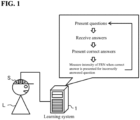
- FIG. 1 schematically depicts an example situation where the present invention is applied.
- a learning system 1 is a computer configured to provide a series of learning processes in which questions are presented to a learner L, answers are received, and feedback on whether the answers are correct or incorrect is provided.
- the learning system 1 acquires one or more questions and presents the acquired one or more questions to the learner L.
- the learning system 1 receives answer(s) to the presented question(s) from the learner L. After receiving the answer(s) to the question(s), the learning system 1 presents the learner L with the correct answer to each question.
- the learning system 1 acquires measurement data generated by measuring brain activity of the learner L when a correct answer was presented.
- the learner L wears a measurement sensor S configured to measure brain waves, and the measurement sensor S is connected to the learning system 1.
- the learning system 1 is capable of acquiring the measurement data from this measurement sensor S.
- the learning system 1 calculates the intensity of feedback-related negativity from the acquired measurement data.
- the learning system 1 obtains one or more following questions in accordance with the calculated intensity of the feedback-related negativity and the question that was answered incorrectly. After this, the learning system 1 presents the obtained one or more following questions to the learner L and receives answer(s) to the presented question(s) from the learner L.
- a first question provided for FRN measurement is one example of a "first question” for the present invention and a subsequent question provided based on FRN intensity is one example of a "second question” for the present invention.
- a second question may be treated as a first question. That is, when the series of learning processes mentioned above is repeated, the FRN intensity is also calculated for a second question that has been provided, and further questions may be obtained in keeping with the calculated FRN intensity and the second question.
- the following question to be provided is determined based on the feedback-related negativity induced when the learner L was presented with the correct answer to a question that was incorrectly answered.
- the intensity of the feedback-related negativity it is possible to objectively evaluate the learning motivation of the learner L.
- the intensity of the feedback-related negativity can be measured and calculated comparatively easily. This means that according to the present embodiment, it is possible to adopt a question setting strategy that increases the learning motivation of the learner L easily and appropriately using brain waves.
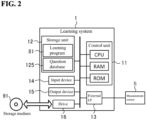
- FIG. 2 schematically depicts one example hardware configuration of the learning system 1 according to the present embodiment.
- the learning system 1 according to the present embodiment is a computer in which a control unit 11, a storage unit 12, an external interface 13, an input device 14, an output device 15, and a drive 16 are electrically connected. Note that in FIG. 2 , the external interface is indicated as "external I/F".
- the control unit 11 includes a CPU (Central Processing Unit) that is a hardware processor, RAM (Random Access Memory), ROM (Read Only Memory), and the like, and is configured to execute information processing based on a program and various data.
- the storage unit 12 is one example of a memory, and as examples is composed of a hard disk drive or a solid state drive. In the present embodiment, the storage unit 12 stores various information such as a learning program 81 and a question database 125.
- the learning program 81 is a program for causing the learning system 1 to execute information processing (see FIG. 5 ), described later, which provides the learner L with a series of learning processes.
- the learning program 81 includes a series of instructions for this information processing.
- questions and correct answers to be provided to the learner L are stored separately according to difficulty level. Difficulty level is one example of a "level" for the present invention and will be described in detail later.
- the external interface 13 is an interface for connecting to an external device and as examples, is a USB (Universal Serial Bus) port or a dedicated port.
- USB Universal Serial Bus
- the types and number of external interfaces 13 may be freely selected.
- the learning system 1 is connected via the external interface 13 to the measurement sensor S.
- the measurement sensor S may be a plate electrode coated with conductive gel or a dry electrode.
- the method of connecting the learning system 1 and the measurement sensor S is not necessarily limited to the example given here.
- the learning system 1 and the measurement sensor S (or another computer to which the measurement sensor S is connected) are each equipped with a communication interface
- the learning system 1 and the measurement sensor S may be connected via their communication interfaces.
- the input device 14 is a device for inputting, for example, a mouse, keyboard, touch panel display, or microphone.
- the output device 15 is a device for outputting, for example, a display (a regular display or touch panel display) or a speaker.
- the input device 14 and the output device 15 may be integrally constructed of a touch panel display.
- the learning system 1 may include a plurality of input devices 14 and output devices 15.
- the input device 14 is used to receive answers.
- the output device 15 is used to present questions and correct answers.
- the drive 16 is a CD drive or a DVD drive, for example, and is a drive device for reading various information, such as programs, stored on a storage medium 91.
- the storage medium 91 is a medium that stores various information, such as programs, by an electrical, magnetic, optical, mechanical, or chemical action so that a computer or other device, machine, or the like can read the stored various information, such as programs.
- At least one of the learning program 81 and the question database 125 described above may be stored on the storage medium 91.
- the learning system 1 may acquire at least one of the learning program 81 and the question database 125 described above from the storage medium 91.
- a disk-type storage medium such as a CD or DVD is illustrated as one example of the storage medium 91.
- the storage medium 91 is not limited to a disk-type medium, and may be a non-disk medium.
- Semiconductor memory such as flash memory, can be given as one example of a storage medium that is a non-disk medium.
- the type of drive 16 may be freely selected according to the type of storage medium 91.
- the control unit 11 may include a plurality of hardware processors.
- the hardware processors may be composed of microprocessors, field-programmable gate arrays (FPGA), or the like.
- the storage unit 12 may be composed of RAM and ROM included in the control unit 11. At least one of the external interface 13, the input device 14, the output device 15, and the drive 16 may be omitted.
- the learning system 1 may be composed of a plurality of computers. In this case, the hardware configuration of each computer may be the same or may differ.
- the learning system 1 may be a general-purpose server device, a desktop PC (Personal Computer), a mobile terminal (as examples, a mobile phone, such as a smartphone, or a tablet PC), or the like.
- the learning system 1 may be configured to provide the learner L with a series of learning processes via a client device (or "user terminal").
- FIG. 3 schematically depicts an example software configuration of the learning system 1 according to the present embodiment.
- the control unit 11 of the learning system 1 loads the learning program 81 stored in the storage unit 12 into the RAM.
- the control unit 11 then causes the CPU to interpret and execute instructions included in the learning program 81 loaded into the RAM, and controls the respective components.
- the learning system 1 operates as a computer equipped with a question acquisition unit 111, a question presentation unit 112, an answer reception unit 113, a correct answer presentation unit 114, an intensity calculation unit 115, and a stopping unit 116 serving as software modules.
- the question acquisition unit 111 acquires one or more first questions.
- the question presentation unit 112 presents the acquired one or more first questions to the learner L.
- the answer reception unit 113 accepts answers to the presented first questions from the learner L.
- the correct answer presentation unit 114 presents the correct answer of a first question to the learner L after the answer to the first question has been received.
- the intensity calculation unit 115 acquires measurement data generated by measuring the brain activity of the learner L when the correct answer was presented, and calculates the intensity of the feedback-related negativity from the acquired measurement data.
- the question acquisition unit 111 acquires one or more second questions according to the calculated intensity of the feedback-related negativity and the first question that was incorrectly answered.
- the question acquisition unit 111 can acquire the first questions and the second questions from the question database 125.
- the question presentation unit 112 presents the acquired one or more second questions to the learner L.
- the answer reception unit 113 receives answer(s) to the presented second question(s) from the learner L.
- the presentation of questions to the learner L (that is, the series of learning processes) is repeated by the question presentation unit 112, and when the calculated intensity of the feedback-related negativity is continuously lower than a threshold, the stopping unit 116 stops the repeated presentation of questions.
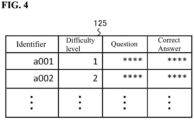
- FIG. 4 schematically depicts an example configuration of the question database 125 according to the present embodiment.
- the question database 125 is structured in a table format in which each record has fields for storing various types of information, such as an identifier, a difficulty level, a question, and a correct answer.
- the identifier is used to identify the data in each record.
- the scale of the difficulty level may be set freely.
- the format of questions may be determined as appropriate according to the implementation.
- the question types may include calculation questions, multiple choice questions, and written questions.
- the learner L to whom the questions are to be provided may be appropriately selected according to the implementation.
- the learner L may be a student (a student at any institution from elementary school to college, or a vocational school), someone studying for a qualification, a foreign language learner, or a student on an e-learning program. Accordingly, the subject of the questions may also be appropriately selected according to the implementation.
- the correct answer data is composed of information for judging whether an answer to a question is correct or incorrect.
- the configuration of the question database 125 is not limited to the example described above and may be appropriately determined according to the implementation. If it is possible, as with a calculation problem or a language question for example, to specify the correct answer from a specified question itself, information on the correct answer may be omitted.
- each record may further include fields that identify the question format, subject, and the like.
- different types of question database 125 may be separately prepared, for different question formats, subjects, or the like.
- each software module of the learning system 1 is described in detail in the "Example Operation" given below. Note that for the present embodiment, an example where each software module of the learning system 1 is implemented by a general-purpose CPU is described. However, some or all of the software modules described above may be implemented by one or a plurality of dedicated processors. Regarding the software configuration of the learning system 1, software modules may be omitted, replaced, and/or added as appropriate according to the implementation.
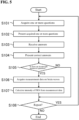
- FIG. 5 is a flowchart depicting an example of the processing procedure of the learning system 1 according to the present embodiment.
- the processing procedure of the learning system 1 described below is one example of a learning method.
- the processing procedure of the learning system 1 described below is merely one example, and each step in the procedure may be changed whenever possible.
- steps may be omitted, replaced, and/or added as appropriate according to the implementation.
- control unit 11 operates as the question acquisition unit 111 and acquires one or more questions.
- the method used to acquire the questions may be appropriately selected according to the implementation.
- control unit 11 can acquire one or more questions by accessing the question database 125.
- the question(s) to be acquired may be freely decided.
- the control unit 11 may acquire one or more questions by randomly selecting one or more records from the question database 125.
- the control unit 11 may determine the difficulty level of the questions to be acquired by an any method, as examples, according to a designation by the learner L or a setting value in the learning program 81, and then acquire one or more questions by freely selecting records including questions of the determined difficulty level from the question database 125. If a record of previous use of the learning system 1 exists, the difficulty level of the questions to be acquired may be determined according to the difficulty level of the questions presented the previous time.
- the control unit 11 may determine the range of difficulty levels according to an any method and acquire one or more questions by selecting records including questions of difficulty levels belonging to the determined range from the question database 125. Questions acquired at this initial stage are one example of "first questions" for the present invention. After acquiring one or more questions, the control unit 11 advances the processing to the next step, step S102.
- control unit 11 operates as the question presentation unit 112 and presents the learner L with the one or more questions that were acquired.
- the method of presenting the questions may be appropriately selected according to the implementation.
- the control unit 11 may present the acquired one or more questions to the learner L by outputting the acquired one or more questions via the speaker as audio.
- the control unit 11 may present the acquired one or more questions to the learner L by displaying the acquired one or more questions on the display.
- the output destination of the questions is not necessarily the same device.
- the control unit 11 may present the acquired one or more questions to the learner L via the output device of the user terminal. After presenting the question(s), the control unit 11 advances the processing to the next step, step S103.
- step S103 the control unit 11 operates as the answer reception unit 113 and receives answers from the learner L to the presented questions.
- a method of receiving answers may be appropriately selected according to the implementation.
- the control unit 11 may receive answers as audio via the microphone.
- the input device 14 includes an operation device such as a mouse, a keyboard, or a touch panel display
- the control unit 11 may receive answers via operations of the operation device.
- the device that receives an answer is not necessarily the same device.
- the control unit 11 may indirectly receive answers to the presented questions via the input device of the user terminal. After receiving the answers, the control unit 11 advances the processing to the next step, step S104.
- step S104 the control unit 11 operates as the correct answer presentation unit 114 and presents the learner L with the correct answers to the provided questions.
- the presented content of the correct answer may be appropriately determined according to the implementation.
- the control unit 11 may present the information in the correct answer field of the record selected in step S101 as it is.
- the control unit 11 may determine whether the learner L's answer is correct or incorrect by checking the answer received from the learner L against the information on the correct answer. After this, the control unit 11 may present the determination result to the learner L as information on the correct answer. If the information on the correct answer includes an explanation, the control unit 11 may present the explanation together with the determination result to the learner L.
- the method of presenting the correct answer may be appropriately selected according to the implementation.
- the output destination of the correct answer may be the same as the output destination of the question, or may differ. After the correct answer has been presented, the control unit 11 advances the processing to the next step, step S105.
- step S105 the control unit 11 determines a branch destination of the processing depending on whether the learner L incorrectly answered a question in the series of learning processes in steps S102 to S104.
- the control unit 11 may use the result of that determination to determine the branch destination of the processing.
- the control unit 11 may determine whether the learner L's answers were correct or incorrect separately to the processing in step S104 and determine the branch destination of the processing according to the result of this determination. If there is an incorrectly answered question, the control unit 11 advances the processing to the next step, step S106. On the other hand, if there are no incorrectly answered questions, the control unit 11 advances the processing to step S108.
- step S106 the control unit 11 operates as the intensity calculation unit 115 and acquires measurement data generated by measuring the brain activity of the learner L when the correct answer was presented by the processing in step S104.
- the control unit 11 can acquire the measurement data from the measurement sensor S.
- the route for acquiring the measurement data is not limited to the example given here.
- the measurement sensor S may be connected to another computer and the control unit 11 may acquire the measurement data from this other computer.
- the timing at which the measurement sensor S measures brain activity may be appropriately determined so as to include at least a 300 ms period starting from the instant the correct answer was presented by step S104.
- the control unit 11 advances the processing to the next step, step S107.
- step S107 the control unit 11 operates as the intensity calculation unit 115 and calculates the intensity of the feedback-related negativity from the measurement data acquired by the processing in step S106.
- a method of calculating the intensity of the feedback-related negativity it is possible to adopt an arithmetic averaging method that averages a plurality of measurement data or a machine learning method that calculates the intensity from single trial data.
- the control unit 11 advances the processing to the next step, step S108.
- control unit 11 determines whether to repeat the series of learning processes from steps S102 to S104.
- the criteria for repeating the processes may be set freely.
- the learner L may select whether to repeat the series of learning processes.
- the control unit 11 may determine whether to repeat the series of learning processes according to the learner L's selection.
- a number of iterations may be set. The number of iterations may be provided by any method, such as a designation by the learner L or a set value included in the learning program 81.
- the control unit 11 may determine whether to repeat the series of learning processes according to whether the executed number of iterations of the series of learning processes composed of steps S102 to S104 has reached a set number of iterations.
- control unit 11 ends the processing procedure according to this example operation. Note that if a determination to not repeat the processing was taken at the step S104 stage based on the criteria described above, the control unit 11 may omit the processing in steps S105 to S107 and end the processing procedure according to this example operation. On the other hand, when a determination to repeat the processing has been taken, the control unit 11 causes the processing to return to step S101 and repeats the series of learning processes.
- the control unit 11 may acquire one or more questions according to the intensity of the feedback-related negativity calculated in the previous iteration and the incorrectly answered question(s). That is, the control unit 11 may determine the question setting strategy based on the feedback-related negativity.
- the questions acquired in the previous iteration are examples of "first questions” for the present invention, and the questions acquired in the current iteration are examples of "second questions”.
- questions acquired in the current iteration may be treated as "first questions" with respect to this further iteration.
- the question setting strategy based on the feedback-related negativity may be determined according to any rules. As indicated in the "Experimental Example” described later, the intensity of the feedback-related negativity is higher for questions where the learning motivation is high and is lower for questions where the learning motivation is low. Any rules may be provided based on this observation.
- the controller 11 may compare the calculated intensity of the feedback-related negativity with a first threshold. When the calculated intensity of the feedback-related negativity exceeds the first threshold, the control unit 11 may acquire another question with the same difficulty level as the question for which an incorrect answer was given in the previous iteration from the question database 125 as the question in the current iteration. When the calculated intensity of the feedback-related negativity is equal to the first threshold, the control unit 11 may acquire another question of the same difficulty level as the question for which an incorrect answer was given in the previous iteration as the question of the current iteration.
- control unit 11 may compare the calculated intensity of the feedback-related negativity with a second threshold. If the calculated intensity of the feedback-related negativity is less than the second threshold, the control unit 11 may acquire another question, with a different difficulty level to the question answered incorrectly in the previous iteration, from the question database 125 as the question of the current iteration. When the calculated intensity of the feedback-related negativity is equal to the second threshold, the control unit 11 may acquire another question with a different difficulty level to the question answered incorrectly in the previous iteration as the question of the current iteration.
- control unit 11 may decide whether to increase or decrease the difficulty level from the level of the question (s) in the previous iteration according to the performance (that is, the percentage of correct answers) of the learner L up to the current iteration. In more detail, if the percentage of correct answers for the difficulty level of the question answered incorrectly in the previous iteration exceeds a threshold, the control unit 11 may acquire a question with a higher degree of difficulty than the question answered incorrectly in the previous iteration.
- the control unit 11 may acquire a question with a lower difficulty level than the question that was answered incorrectly in the previous iteration. If the percentage of correct answers is equal to the threshold, either of these strategies may be selected as appropriate. As a different example, when acquiring a plurality of questions, the control unit 11 may acquire one or more questions with a higher difficulty level and one or more questions with a lower difficulty level than the questions in the previous iteration.
- control unit 11 may acquire one or more questions according to any method.
- the control unit 11 may acquire one or more questions using a similar method to step S101 in the previous iteration.
- control unit 11 may execute the processing of steps S102 to S107 for the acquired questions in the same way as the previous iteration. That is, in step S102, the control unit 11 presents the one or more questions that have been acquired in the current iteration to the learner L. In step S103, the control unit 11 receives answer(s) to the presented question(s) from the learner L. After reception of the answer(s) is complete, in step S104, the control unit 11 presents correct answer(s) for the presented question(s) to the learner L.
- control unit 11 acquires measurement data generated by measuring the brain activity of the learner L when the correct answer(s) were presented (step S106) and calculates the intensity of the feedback-related negativity from the acquired measurement data (step S107) .
- step S108 the control unit 11 may operate as the stopping unit 116 and determine whether the intensity of the feedback-related negativity calculated in each iteration has continuously been below than a third threshold.
- a case where the intensity of the feedback-related negativity is equal to the third threshold may be treated in the same way as cases where the potential is below the third threshold or cases where the potential is above the third threshold.
- the criteria for recognizing whether the state qualifies as "continuously" may be determined freely.
- the control unit 11 may determine that the calculated intensity of the feedback-related negativity is continuously lower than the third threshold.
- the control unit 11 may determine to not repeat the series of processes (that is, to stop the repeated presentation of questions), and end the processing procedure according to this example operation. By doing so, it is possible, when the learning motivation of the learner L is continuously evaluated as being low based on the intensity of the feedback-related negativity, to stop presenting questions and encourage the learner L to take a break.
- the first threshold, the second threshold, and the third threshold mentioned above may be the same value or different values.
- the respective thresholds may be determined so that the rules are not inconsistent.
- the first threshold may be equal to or greater than the second threshold
- the third threshold may be equal to or less than the first threshold and the second threshold.
- Each threshold may be provided freely, as examples, according to a designation by the learner L and/or set values inside the learning program 81.
- control unit 11 may select questions according to an any method in the same way as in the initial stage.
- the learning system 1 is capable, when repeating a series of processes composed of step S101 to step S107 described above, of deciding the next questions to be presented based on the intensity of the feedback-related negativity induced when the learner L was presented with the correct answer of a question that was incorrectly answered.
- the intensity of the feedback-related negativity it is possible to objectively evaluate the learning motivation of the learner L. Since the intensity of the feedback-related negativity can be stably measured for different subjects and can be measured even with a small number of electrodes, measurement and calculation can be performed comparatively easily. This means that according to the present embodiment, it is possible to adopt a question setting strategy that increases the learning motivation of the learner L easily and appropriately using brain waves.
- the question database 125 is present inside the learning system 1.
- the placed location of the question database 125 is not limited to the example described above.
- the question database 125 may be present in another computer, such as NAS (Network Attached Storage).
- the control unit 11 may acquire questions by accessing the other computer as appropriate.
- the learning system 1 acquires the questions from the question database 125.
- the method of acquiring the questions is not limited to this example.
- the control unit 11 may generate a question by any method.
- the control unit 11 may generate a question by appropriately inputting numerical values into a template.
- the control unit 11 may present the generated question to the learner L in step S102.
- the control unit 11 may appropriately solve the presented question to generate correct answer information for the presented question and present this generated correct answer information.
- a trained model generated by machine learning may be used to determine a question setting strategy based on feedback-related negativity. That is, a configuration may be used where a question setting strategy that is decided based on the intensity of the feedback-related negativity is determined using a machine learning technique.
- the control unit 11 may use a trained model to acquire one or more questions in accordance with the calculated intensity of feedback-related negativity and questions that were incorrectly answered.
- the trained model may be appropriately generated to estimate the difficulty level of questions that will increase the learning motivation of the learner from the calculated intensity of the feedback-related negativity and the difficulty level of the incorrectly answered questions.
- the learning system 1 may be configured to calculate the intensity of the feedback-related negativity when the correct answer was presented regardless of whether the answer was incorrect.
- the processing in step S105 may be omitted from the above processing procedure.
- the learning system 1 may generate history information on the calculated intensity of the feedback-related negativity. Using this history information, it is possible to verify after the fact whether the learner L tackled provided questions with high learning motivation.
- the processing that stops the repeating of the processes in response to the calculated intensity of the feedback-related negativity being continuously lower than the third threshold may be omitted.
- the stopping unit 116 may be omitted from the software configuration of the learning system 1.
- the question setting strategy is determined based on the intensity of the feedback-related negativity obtained in one iteration of the processes.
- the way in which the intensity of the feedback-related negativity is used to determine the question setting strategy is not limited to this example.
- the learning system 1 may be configured to determine the question setting strategy based on the intensity of the feedback-related negativity obtained in multiple iterations of the processes.
- calculation problems were presented to the subjects in a game format where a point is added for each correct answer, targets (that is, a target setting time and target points) are set, and bonus points are added for the number of consecutive correct answers and any remaining time, with a ranking being displayed based on the acquired points.
- targets that is, a target setting time and target points
- bonus points are added for the number of consecutive correct answers and any remaining time, with a ranking being displayed based on the acquired points.
- the amplitude of the feedback-related negativity induced when the correct answer for an incorrectly answered question was presented to the learner was then measured.
- the subjects were asked to rank the calculation problems of each difficulty level (A) in order of questions for which the learner felt high learning motivation to get a high score, and (B) in order of questions that the learner felt were suited to his/her level.
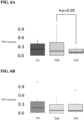
- FIG. 6A depicts the result of comparing the amplitudes of feedback-related negativity induced when correct answers to incorrectly answered questions were fed back to subjects, in order of a ranking of the subjects' learning motivation (that is, whether the subjects were highly motivated to get a high score).
- FIG. 6B depicts the result of comparing the amplitudes of feedback-related negativity induced when the correct answers to incorrectly answered questions were fed back to subjects, in order of a ranking based on self-evaluation by the subjects (that is, whether the questions were suited to the learner's own level).
Landscapes
- Engineering & Computer Science (AREA)
- Health & Medical Sciences (AREA)
- Life Sciences & Earth Sciences (AREA)
- Theoretical Computer Science (AREA)
- Physics & Mathematics (AREA)
- Educational Technology (AREA)
- General Physics & Mathematics (AREA)
- Educational Administration (AREA)
- Business, Economics & Management (AREA)
- Heart & Thoracic Surgery (AREA)
- Animal Behavior & Ethology (AREA)
- Biophysics (AREA)
- Pathology (AREA)
- Biomedical Technology (AREA)
- Psychology (AREA)
- Medical Informatics (AREA)
- Molecular Biology (AREA)
- Surgery (AREA)
- Psychiatry (AREA)
- General Health & Medical Sciences (AREA)
- Public Health (AREA)
- Veterinary Medicine (AREA)
- Social Psychology (AREA)
- Hospice & Palliative Care (AREA)
- Developmental Disabilities (AREA)
- Child & Adolescent Psychology (AREA)
- Electrically Operated Instructional Devices (AREA)
- Management, Administration, Business Operations System, And Electronic Commerce (AREA)
- Measurement Of The Respiration, Hearing Ability, Form, And Blood Characteristics Of Living Organisms (AREA)
Abstract
Description
- The present invention relates to a learning system, a learning method, and a learning program.
- Conventional learning systems use a method where the difficulty level of questions is selected by learners themselves or is selected based on a behavioral index, such as the percentage of correct answers, to adaptively determine which questions are to be presented to learners. However, with this method, it is difficult to objectively evaluate psychological aspects of learners, such as their learning motivation. As one example, for a question being answered, it is difficult to objectively evaluate whether a learner is bored and unmotivated or conversely has high learning motivation. This means that with conventional learning systems, it has been difficult to adopt a question setting strategy that increases the learning motivation of the learner based on an objective index.
- On the other hand, in recent years, development has progressed into a method that observes the state of a learner based on an objective index, such as brain waves, and selects suitable questions for the learner's state according to the obtained observation results. As one example,
Patent Literature 1 proposes a method of measuring the brain waves of a learner and estimating the degree of concentration and degree of deliberation from brain wave patterns. According to this method, it is possible to use brain waves as an objective index and adopt a question setting strategy that increases the learning motivation of the learner. - Patent Literature 1:
JP 2018-124483A - The inventors of the present invention found that the learning system using brain waves proposed in
Patent Literature 1 and the like has the following problems. That is, correspondence between the learner's state and brain wave patterns is not exhibited, and it is unclear whether it is possible to appropriately evaluate the learner's degree of concentration and degree of deliberation based on brain wave patterns. There is also the possibility of accurate analysis of brain wave patterns making a learning system complicated (as one example, the arithmetic processing will become sophisticated and require a high-powered computational unit). - According to one aspect, the present invention was conceived in view of the situation described above, and has an object of providing a technology that uses brainwaves to select a problem-setting strategy capable of easily and appropriately increasing the learning motivation of a learner.
- To solve the problem indicated above, the present invention uses the following configurations.
- A learning system according to one aspect of the present invention includes: a question acquisition unit configured to acquire one or more first questions; a question presentation unit configured to present the acquired one or more first questions to a learner; an answer reception unit configured to receive answers to the presented first questions from the learner; a correct answer presentation unit configured to present correct answers for the first questions to the learner after the answers to the first questions have been received; and an intensity calculation unit configured to acquire, in a case where an answer by the learner to a first question is incorrect, measurement data generated by measuring brain activity of the learner in a case where the correct answer was presented, and calculate an intensity of feedback-related negativity from the acquired measurement data. The question acquisition unit acquires one or more second questions in accordance with the calculated intensity of feedback-related negativity and the first question that was incorrectly answered, the question presentation unit presents the acquired one or more second questions to the learner, and the answer reception unit receives an answer to each presented second question from the learner.
- From the experimental example described later, the present inventors discovered that the intensity of feedback-related negativity (hereinafter also indicated as "FRN") induced when the correct answer to an incorrectly answered question was presented to a learner is useful as an objective index for evaluating the learning motivation of the learner. The intensity of FRN can be measured and calculated comparatively easily. This means that according to the learning system of the configuration described above, based on the above finding, it is possible to adopt a question setting strategy that increases the learning motivation of a learner easily and appropriately using brain waves.
- In the learning system according to the above aspect, in a case where the calculated intensity of the feedback-related negativity exceeds a first threshold, the question acquisition unit may acquire, as the second questions, other questions of the same level as the first question that was incorrectly answered. According to this configuration, it is possible to continuously set questions of a level evaluated as providing high learning motivation to the learner based on the intensity of FRN.
- In the learning system according to the above aspect, in a case where the calculated intensity of the feedback-related negativity is below a second threshold, the question acquisition unit may acquire, as the second questions, other questions of a different level to the first question that was incorrectly answered. According to this configuration, by setting questions of a different level to questions evaluated as providing low learning motivation to the learner based on the intensity of FRN as the next questions, it is possible to find questions of a level that provides high learning motivation.
- In the learning system according to the above aspect, the learning system may further include a stopping unit configured, in a case where presentation of questions to the learner by the question presentation unit is repeated and the calculated intensity of the feedback-related negativity is continuously lower than a third threshold, to stop the repeated presentation of the questions. According to this configuration, it is possible to stop the presentation of questions and encourage the learner to take a break when the learning motivation of the learner has been continuously evaluated as being low based on the intensity of FRN.
- The learning systems according to the configurations described above may be constructed of one or a plurality of computers. Also, aside from the learning systems of the configurations described above, other aspects of the present invention may include an information processing method that realizes all or part of the configurations described above, a program, and a storage medium on which such a program is stored and which is readable by a computer or other device, machine, or the like. Here, the storage medium that is readable by a computer or the like is a medium in which information such as a program is stored by an electrical, magnetic, optical, mechanical, or chemical action.
- As one example, a learning method according to one aspect of the present invention is an information processing method in which a computer executes: a step of acquiring one or more first questions; a step of presenting the acquired one or more first questions to a learner; a step of receiving answers to the presented first questions from the learner; a step of presenting correct answers for the first questions to the learner after the answers to the first questions have been received; a step of acquiring, in a case where an answer by the learner to a first question is incorrect, measurement data generated by measuring brain activity of the learner in a case where the correct answer was presented; a step of calculating an intensity of feedback-related negativity from the acquired measurement data; a step of acquiring one or more second questions in accordance with the calculated intensity of feedback-related negativity and the first question that was incorrectly answered; a step of presenting the acquired one or more second questions to the learner; and a step of receiving an answer to each presented second question from the learner.
- Also, as one example, a learning program according to one aspect of the present invention is a program that causes a computer to execute: a step of acquiring one or more first questions; a step of presenting the acquired one or more first questions to a learner; a step of receiving answers to the presented first questions from the learner; a step of presenting correct answers for the first questions to the learner after the answers to the first questions have been received; a step of acquiring, in a case where an answer by the learner to a first question is incorrect, measurement data generated by measuring brain activity of the learner in a case where the correct answer was presented; a step of calculating an intensity of feedback-related negativity from the acquired measurement data; a step of acquiring one or more second questions in accordance with the calculated intensity of feedback-related negativity and the first question that was incorrectly answered; a step of presenting the acquired one or more second questions to the learner; and a step of receiving an answer to each presented second question from the learner.
- According to the present invention, it is possible to provide a technology that makes it possible to adopt a question setting strategy that increases the learning motivation of a learner easily and appropriately using brain waves.
-
-
FIG. 1 schematically depicts an example situation where the present invention is applied; -
FIG. 2 schematically depicts one example hardware configuration of a learning system according to an embodiment; -
FIG. 3 schematically depicts an example software configuration of the learning system according to the present embodiment; -
FIG. 4 schematically depicts an example configuration of a question database according to the present embodiment; -
FIG. 5 is a flowchart depicting an example of a processing procedure of the learning system according to the present embodiment; -
FIG. 6A depicts a result of comparing intensity of FRN induced when correct answers to incorrectly answered questions were fed back to subjects, in order of ranking of learning motivation by subjects (that is, whether the subjects were highly motivated to get a high score); and -
FIG. 6B depicts a result of comparing intensity of FRN induced when correct answers to incorrectly answered questions were fed back to subjects, in order of ranking based on self-evaluation the subjects (that is, whether questions were suited to the subject's own level). - An embodiment according to one aspect of the present invention (hereinafter, referred to as "the present embodiment") is described below with reference to the drawings. However, the embodiment described below represents in every way a mere example of the present invention. It should be obvious that various improvements and modifications can be made without departing from the scope of the present invention. That is, when implementing the present invention, a specific configuration suited to that particular implementation may be adopted as appropriate. Note that although data that appears in the present embodiment is indicated using natural language, in more specific terms, data is specified in a pseudo language, commands, parameters, machine language, and the like that can be recognized by a computer.
-
FIG. 1 schematically depicts an example situation where the present invention is applied. Alearning system 1 is a computer configured to provide a series of learning processes in which questions are presented to a learner L, answers are received, and feedback on whether the answers are correct or incorrect is provided. - In more detail, the
learning system 1 according to the present embodiment acquires one or more questions and presents the acquired one or more questions to the learner L. Thelearning system 1 according to the present embodiment receives answer(s) to the presented question(s) from the learner L. After receiving the answer(s) to the question(s), thelearning system 1 presents the learner L with the correct answer to each question. - If the learner L's answer to a question was incorrect, the
learning system 1 acquires measurement data generated by measuring brain activity of the learner L when a correct answer was presented. In the present embodiment, the learner L wears a measurement sensor S configured to measure brain waves, and the measurement sensor S is connected to thelearning system 1. Thelearning system 1 is capable of acquiring the measurement data from this measurement sensor S. - The
learning system 1 calculates the intensity of feedback-related negativity from the acquired measurement data. Thelearning system 1 obtains one or more following questions in accordance with the calculated intensity of the feedback-related negativity and the question that was answered incorrectly. After this, thelearning system 1 presents the obtained one or more following questions to the learner L and receives answer(s) to the presented question(s) from the learner L. - Note that a first question provided for FRN measurement is one example of a "first question" for the present invention and a subsequent question provided based on FRN intensity is one example of a "second question" for the present invention. After being presented to the learner L, a second question may be treated as a first question. That is, when the series of learning processes mentioned above is repeated, the FRN intensity is also calculated for a second question that has been provided, and further questions may be obtained in keeping with the calculated FRN intensity and the second question.
- As described above, in the present embodiment, the following question to be provided is determined based on the feedback-related negativity induced when the learner L was presented with the correct answer to a question that was incorrectly answered. According to the intensity of the feedback-related negativity, it is possible to objectively evaluate the learning motivation of the learner L. The intensity of the feedback-related negativity can be measured and calculated comparatively easily. This means that according to the present embodiment, it is possible to adopt a question setting strategy that increases the learning motivation of the learner L easily and appropriately using brain waves.
-
FIG. 2 schematically depicts one example hardware configuration of thelearning system 1 according to the present embodiment. Thelearning system 1 according to the present embodiment is a computer in which acontrol unit 11, astorage unit 12, anexternal interface 13, aninput device 14, anoutput device 15, and adrive 16 are electrically connected. Note that inFIG. 2 , the external interface is indicated as "external I/F". - The
control unit 11 includes a CPU (Central Processing Unit) that is a hardware processor, RAM (Random Access Memory), ROM (Read Only Memory), and the like, and is configured to execute information processing based on a program and various data. Thestorage unit 12 is one example of a memory, and as examples is composed of a hard disk drive or a solid state drive. In the present embodiment, thestorage unit 12 stores various information such as alearning program 81 and aquestion database 125. - The
learning program 81 is a program for causing thelearning system 1 to execute information processing (seeFIG. 5 ), described later, which provides the learner L with a series of learning processes. Thelearning program 81 includes a series of instructions for this information processing. In thequestion database 125, questions and correct answers to be provided to the learner L are stored separately according to difficulty level. Difficulty level is one example of a "level" for the present invention and will be described in detail later. - The
external interface 13 is an interface for connecting to an external device and as examples, is a USB (Universal Serial Bus) port or a dedicated port. The types and number ofexternal interfaces 13 may be freely selected. In the present embodiment, thelearning system 1 is connected via theexternal interface 13 to the measurement sensor S. - So long as it is possible to acquire measurement data for brain waves from which the intensity of the feedback-related negativity can be derived, there are no particular limitations on the type of the measurement sensor S and the measurement sensor S may be appropriately selected according to the specific implementation. As examples, the measurement sensor S may be a plate electrode coated with conductive gel or a dry electrode.
- Note that the method of connecting the
learning system 1 and the measurement sensor S is not necessarily limited to the example given here. As another example, when thelearning system 1 and the measurement sensor S (or another computer to which the measurement sensor S is connected) are each equipped with a communication interface, thelearning system 1 and the measurement sensor S may be connected via their communication interfaces. - The
input device 14 is a device for inputting, for example, a mouse, keyboard, touch panel display, or microphone. Theoutput device 15 is a device for outputting, for example, a display (a regular display or touch panel display) or a speaker. Theinput device 14 and theoutput device 15 may be integrally constructed of a touch panel display. Thelearning system 1 may include a plurality ofinput devices 14 andoutput devices 15. Theinput device 14 is used to receive answers. Theoutput device 15 is used to present questions and correct answers. - The
drive 16 is a CD drive or a DVD drive, for example, and is a drive device for reading various information, such as programs, stored on astorage medium 91. Thestorage medium 91 is a medium that stores various information, such as programs, by an electrical, magnetic, optical, mechanical, or chemical action so that a computer or other device, machine, or the like can read the stored various information, such as programs. At least one of thelearning program 81 and thequestion database 125 described above may be stored on thestorage medium 91. Thelearning system 1 may acquire at least one of thelearning program 81 and thequestion database 125 described above from thestorage medium 91. Note that inFIG. 2 , a disk-type storage medium such as a CD or DVD is illustrated as one example of thestorage medium 91. However, thestorage medium 91 is not limited to a disk-type medium, and may be a non-disk medium. Semiconductor memory, such as flash memory, can be given as one example of a storage medium that is a non-disk medium. The type ofdrive 16 may be freely selected according to the type ofstorage medium 91. - Note that regarding the specific hardware configuration of the
learning system 1, it is possible to omit, replace, and add components as appropriate according to the actual implementation. As one example, thecontrol unit 11 may include a plurality of hardware processors. The hardware processors may be composed of microprocessors, field-programmable gate arrays (FPGA), or the like. Thestorage unit 12 may be composed of RAM and ROM included in thecontrol unit 11. At least one of theexternal interface 13, theinput device 14, theoutput device 15, and thedrive 16 may be omitted. Thelearning system 1 may be composed of a plurality of computers. In this case, the hardware configuration of each computer may be the same or may differ. In place of an information processing device that has been designed specifically for the service to be provided, thelearning system 1 may be a general-purpose server device, a desktop PC (Personal Computer), a mobile terminal (as examples, a mobile phone, such as a smartphone, or a tablet PC), or the like. When thelearning system 1 is a server device, thelearning system 1 may be configured to provide the learner L with a series of learning processes via a client device (or "user terminal"). -
FIG. 3 schematically depicts an example software configuration of thelearning system 1 according to the present embodiment. Thecontrol unit 11 of thelearning system 1 loads thelearning program 81 stored in thestorage unit 12 into the RAM. Thecontrol unit 11 then causes the CPU to interpret and execute instructions included in thelearning program 81 loaded into the RAM, and controls the respective components. By doing so, thelearning system 1 according to the present embodiment operates as a computer equipped with aquestion acquisition unit 111, aquestion presentation unit 112, ananswer reception unit 113, a correctanswer presentation unit 114, anintensity calculation unit 115, and a stoppingunit 116 serving as software modules. - The
question acquisition unit 111 acquires one or more first questions. Thequestion presentation unit 112 presents the acquired one or more first questions to the learner L. Theanswer reception unit 113 accepts answers to the presented first questions from the learner L. The correctanswer presentation unit 114 presents the correct answer of a first question to the learner L after the answer to the first question has been received. When the learner L's answer to the first question is incorrect, theintensity calculation unit 115 acquires measurement data generated by measuring the brain activity of the learner L when the correct answer was presented, and calculates the intensity of the feedback-related negativity from the acquired measurement data. - The
question acquisition unit 111 acquires one or more second questions according to the calculated intensity of the feedback-related negativity and the first question that was incorrectly answered. In the present embodiment, thequestion acquisition unit 111 can acquire the first questions and the second questions from thequestion database 125. Thequestion presentation unit 112 presents the acquired one or more second questions to the learner L. Theanswer reception unit 113 receives answer(s) to the presented second question(s) from the learner L. The presentation of questions to the learner L (that is, the series of learning processes) is repeated by thequestion presentation unit 112, and when the calculated intensity of the feedback-related negativity is continuously lower than a threshold, the stoppingunit 116 stops the repeated presentation of questions. -
FIG. 4 schematically depicts an example configuration of thequestion database 125 according to the present embodiment. In the example inFIG. 4 , thequestion database 125 is structured in a table format in which each record has fields for storing various types of information, such as an identifier, a difficulty level, a question, and a correct answer. The identifier is used to identify the data in each record. The scale of the difficulty level may be set freely. The format of questions may be determined as appropriate according to the implementation. As examples, the question types may include calculation questions, multiple choice questions, and written questions. The learner L to whom the questions are to be provided may be appropriately selected according to the implementation. As examples, the learner L may be a student (a student at any institution from elementary school to college, or a vocational school), someone studying for a qualification, a foreign language learner, or a student on an e-learning program. Accordingly, the subject of the questions may also be appropriately selected according to the implementation. The correct answer data is composed of information for judging whether an answer to a question is correct or incorrect. - However, as long as it is possible to acquire questions according to difficulty level, the configuration of the
question database 125 is not limited to the example described above and may be appropriately determined according to the implementation. If it is possible, as with a calculation problem or a language question for example, to specify the correct answer from a specified question itself, information on the correct answer may be omitted. When a plurality of types of questions are included, each record may further include fields that identify the question format, subject, and the like. Alternatively, different types ofquestion database 125 may be separately prepared, for different question formats, subjects, or the like. - Each software module of the
learning system 1 is described in detail in the "Example Operation" given below. Note that for the present embodiment, an example where each software module of thelearning system 1 is implemented by a general-purpose CPU is described. However, some or all of the software modules described above may be implemented by one or a plurality of dedicated processors. Regarding the software configuration of thelearning system 1, software modules may be omitted, replaced, and/or added as appropriate according to the implementation. -
FIG. 5 is a flowchart depicting an example of the processing procedure of thelearning system 1 according to the present embodiment. The processing procedure of thelearning system 1 described below is one example of a learning method. However, the processing procedure of thelearning system 1 described below is merely one example, and each step in the procedure may be changed whenever possible. Also, in the processing procedure described below, steps may be omitted, replaced, and/or added as appropriate according to the implementation. - In
step 101, thecontrol unit 11 operates as thequestion acquisition unit 111 and acquires one or more questions. The method used to acquire the questions may be appropriately selected according to the implementation. In the present embodiment, thecontrol unit 11 can acquire one or more questions by accessing thequestion database 125. - At an initial stage, the question(s) to be acquired may be freely decided. As one example, the
control unit 11 may acquire one or more questions by randomly selecting one or more records from thequestion database 125. As another example, thecontrol unit 11 may determine the difficulty level of the questions to be acquired by an any method, as examples, according to a designation by the learner L or a setting value in thelearning program 81, and then acquire one or more questions by freely selecting records including questions of the determined difficulty level from thequestion database 125. If a record of previous use of thelearning system 1 exists, the difficulty level of the questions to be acquired may be determined according to the difficulty level of the questions presented the previous time. - When a plurality of questions are acquired, the difficulty level of all of the acquired questions may be the same, or the difficulty level of some of the acquired questions may differ to other acquired questions. When questions of different difficulty levels are acquired, the
control unit 11 may determine the range of difficulty levels according to an any method and acquire one or more questions by selecting records including questions of difficulty levels belonging to the determined range from thequestion database 125. Questions acquired at this initial stage are one example of "first questions" for the present invention. After acquiring one or more questions, thecontrol unit 11 advances the processing to the next step, step S102. - In step S102, the
control unit 11 operates as thequestion presentation unit 112 and presents the learner L with the one or more questions that were acquired. - The method of presenting the questions may be appropriately selected according to the implementation. As one example, when the
output device 15 includes a speaker, thecontrol unit 11 may present the acquired one or more questions to the learner L by outputting the acquired one or more questions via the speaker as audio. As another example, when theoutput device 15 includes a display, thecontrol unit 11 may present the acquired one or more questions to the learner L by displaying the acquired one or more questions on the display. The output destination of the questions is not necessarily the same device. As one example, when the learner L accesses thelearning system 1 using a user terminal including an output device, thecontrol unit 11 may present the acquired one or more questions to the learner L via the output device of the user terminal. After presenting the question(s), thecontrol unit 11 advances the processing to the next step, step S103. - In step S103, the
control unit 11 operates as theanswer reception unit 113 and receives answers from the learner L to the presented questions. - A method of receiving answers may be appropriately selected according to the implementation. As one example, if the
input device 14 includes a microphone, thecontrol unit 11 may receive answers as audio via the microphone. As another example, if theinput device 14 includes an operation device such as a mouse, a keyboard, or a touch panel display, thecontrol unit 11 may receive answers via operations of the operation device. The device that receives an answer is not necessarily the same device. As one example, when the learner L accesses thelearning system 1 using a user terminal including an input device, thecontrol unit 11 may indirectly receive answers to the presented questions via the input device of the user terminal. After receiving the answers, thecontrol unit 11 advances the processing to the next step, step S104. - In step S104, the
control unit 11 operates as the correctanswer presentation unit 114 and presents the learner L with the correct answers to the provided questions. - The presented content of the correct answer may be appropriately determined according to the implementation. As one example, the
control unit 11 may present the information in the correct answer field of the record selected in step S101 as it is. As another example, thecontrol unit 11 may determine whether the learner L's answer is correct or incorrect by checking the answer received from the learner L against the information on the correct answer. After this, thecontrol unit 11 may present the determination result to the learner L as information on the correct answer. If the information on the correct answer includes an explanation, thecontrol unit 11 may present the explanation together with the determination result to the learner L. In the same way as step S102, the method of presenting the correct answer may be appropriately selected according to the implementation. The output destination of the correct answer may be the same as the output destination of the question, or may differ. After the correct answer has been presented, thecontrol unit 11 advances the processing to the next step, step S105. - In step S105, the
control unit 11 determines a branch destination of the processing depending on whether the learner L incorrectly answered a question in the series of learning processes in steps S102 to S104. When it was determined in step S104 whether the learner L's answers were correct or incorrect, thecontrol unit 11 may use the result of that determination to determine the branch destination of the processing. As a different example, thecontrol unit 11 may determine whether the learner L's answers were correct or incorrect separately to the processing in step S104 and determine the branch destination of the processing according to the result of this determination. If there is an incorrectly answered question, thecontrol unit 11 advances the processing to the next step, step S106. On the other hand, if there are no incorrectly answered questions, thecontrol unit 11 advances the processing to step S108. - In step S106, the
control unit 11 operates as theintensity calculation unit 115 and acquires measurement data generated by measuring the brain activity of the learner L when the correct answer was presented by the processing in step S104. - In the present embodiment, the
control unit 11 can acquire the measurement data from the measurement sensor S. However, the route for acquiring the measurement data is not limited to the example given here. The measurement sensor S may be connected to another computer and thecontrol unit 11 may acquire the measurement data from this other computer. The timing at which the measurement sensor S measures brain activity may be appropriately determined so as to include at least a 300 ms period starting from the instant the correct answer was presented by step S104. After acquiring the measurement data, thecontrol unit 11 advances the processing to the next step, step S107. - In step S107, the
control unit 11 operates as theintensity calculation unit 115 and calculates the intensity of the feedback-related negativity from the measurement data acquired by the processing in step S106. As examples of a method of calculating the intensity of the feedback-related negativity, it is possible to adopt an arithmetic averaging method that averages a plurality of measurement data or a machine learning method that calculates the intensity from single trial data. After calculating the intensity of the feedback-related negativity, thecontrol unit 11 advances the processing to the next step, step S108. - At step S108, the
control unit 11 determines whether to repeat the series of learning processes from steps S102 to S104. - The criteria for repeating the processes may be set freely. As one example, the learner L may select whether to repeat the series of learning processes. In this case, the
control unit 11 may determine whether to repeat the series of learning processes according to the learner L's selection. As a different example, a number of iterations may be set. The number of iterations may be provided by any method, such as a designation by the learner L or a set value included in thelearning program 81. In this case, thecontrol unit 11 may determine whether to repeat the series of learning processes according to whether the executed number of iterations of the series of learning processes composed of steps S102 to S104 has reached a set number of iterations. - When a determination to not repeat the processing has been taken, the
control unit 11 ends the processing procedure according to this example operation. Note that if a determination to not repeat the processing was taken at the step S104 stage based on the criteria described above, thecontrol unit 11 may omit the processing in steps S105 to S107 and end the processing procedure according to this example operation. On the other hand, when a determination to repeat the processing has been taken, thecontrol unit 11 causes the processing to return to step S101 and repeats the series of learning processes. - When the series of processes is repeated, if the processing in steps S106 and S107 was performed during the previous iteration, in step S101 of the current iteration, the
control unit 11 may acquire one or more questions according to the intensity of the feedback-related negativity calculated in the previous iteration and the incorrectly answered question(s). That is, thecontrol unit 11 may determine the question setting strategy based on the feedback-related negativity. The questions acquired in the previous iteration are examples of "first questions" for the present invention, and the questions acquired in the current iteration are examples of "second questions". When the series of processes is repeated for a further iteration, questions acquired in the current iteration may be treated as "first questions" with respect to this further iteration. - The question setting strategy based on the feedback-related negativity may be determined according to any rules. As indicated in the "Experimental Example" described later, the intensity of the feedback-related negativity is higher for questions where the learning motivation is high and is lower for questions where the learning motivation is low. Any rules may be provided based on this observation.
- As one example, the
controller 11 may compare the calculated intensity of the feedback-related negativity with a first threshold. When the calculated intensity of the feedback-related negativity exceeds the first threshold, thecontrol unit 11 may acquire another question with the same difficulty level as the question for which an incorrect answer was given in the previous iteration from thequestion database 125 as the question in the current iteration. When the calculated intensity of the feedback-related negativity is equal to the first threshold, thecontrol unit 11 may acquire another question of the same difficulty level as the question for which an incorrect answer was given in the previous iteration as the question of the current iteration. By using this strategy, it is possible to continue setting questions with a difficulty level that has been evaluated, based on the intensity of the feedback-related negativity, as providing high learning motivation for the learner L. - As a different example, the
control unit 11 may compare the calculated intensity of the feedback-related negativity with a second threshold. If the calculated intensity of the feedback-related negativity is less than the second threshold, thecontrol unit 11 may acquire another question, with a different difficulty level to the question answered incorrectly in the previous iteration, from thequestion database 125 as the question of the current iteration. When the calculated intensity of the feedback-related negativity is equal to the second threshold, thecontrol unit 11 may acquire another question with a different difficulty level to the question answered incorrectly in the previous iteration as the question of the current iteration. By setting, as the next question to be presented, a question with a different difficulty level to a question evaluated based on the intensity of the feedback-related negativity as providing low learning motivation to the learner L, it is possible to find a question with a difficulty level for which the learning motivation is high. - Note that whether to increase or decrease the difficulty level from the question in the previous iteration may be freely determined. As one example, the
control unit 11 may decide whether to increase or decrease the difficulty level from the level of the question (s) in the previous iteration according to the performance (that is, the percentage of correct answers) of the learner L up to the current iteration. In more detail, if the percentage of correct answers for the difficulty level of the question answered incorrectly in the previous iteration exceeds a threshold, thecontrol unit 11 may acquire a question with a higher degree of difficulty than the question answered incorrectly in the previous iteration. On the other hand, if the percentage of correct answers for the difficulty level of a question that was answered incorrectly in the previous iteration is below the threshold, thecontrol unit 11 may acquire a question with a lower difficulty level than the question that was answered incorrectly in the previous iteration. If the percentage of correct answers is equal to the threshold, either of these strategies may be selected as appropriate. As a different example, when acquiring a plurality of questions, thecontrol unit 11 may acquire one or more questions with a higher difficulty level and one or more questions with a lower difficulty level than the questions in the previous iteration. - On the other hand, if the processing in steps S106 and S107 were not executed in the previous iteration, in step S101 of the current iteration, the
control unit 11 may acquire one or more questions according to any method. As one example, thecontrol unit 11 may acquire one or more questions using a similar method to step S101 in the previous iteration. - After acquiring one or more questions, the
control unit 11 may execute the processing of steps S102 to S107 for the acquired questions in the same way as the previous iteration. That is, in step S102, thecontrol unit 11 presents the one or more questions that have been acquired in the current iteration to the learner L. In step S103, thecontrol unit 11 receives answer(s) to the presented question(s) from the learner L. After reception of the answer(s) is complete, in step S104, thecontrol unit 11 presents correct answer(s) for the presented question(s) to the learner L. If the learner L's answer (s) to the presented question(s) is/are incorrect, thecontrol unit 11 acquires measurement data generated by measuring the brain activity of the learner L when the correct answer(s) were presented (step S106) and calculates the intensity of the feedback-related negativity from the acquired measurement data (step S107) . - The above series of processes may be repeated for two or more iterations by the processing in step S108. In this case, in step S108, the
control unit 11 may operate as the stoppingunit 116 and determine whether the intensity of the feedback-related negativity calculated in each iteration has continuously been below than a third threshold. A case where the intensity of the feedback-related negativity is equal to the third threshold may be treated in the same way as cases where the potential is below the third threshold or cases where the potential is above the third threshold. The criteria for recognizing whether the state qualifies as "continuously" may be determined freely. As one example, when the number of times the calculated intensity of the feedback-related negativity is continuously lower than the third threshold exceeds a set number of times, thecontrol unit 11 may determine that the calculated intensity of the feedback-related negativity is continuously lower than the third threshold. When the calculated intensity of the feedback-related negativity is continuously lower than the third threshold, thecontrol unit 11 may determine to not repeat the series of processes (that is, to stop the repeated presentation of questions), and end the processing procedure according to this example operation. By doing so, it is possible, when the learning motivation of the learner L is continuously evaluated as being low based on the intensity of the feedback-related negativity, to stop presenting questions and encourage the learner L to take a break. - Note that the first threshold, the second threshold, and the third threshold mentioned above may be the same value or different values. When rules are to be adopted simultaneously, the respective thresholds may be determined so that the rules are not inconsistent. As one example, the first threshold may be equal to or greater than the second threshold, and the third threshold may be equal to or less than the first threshold and the second threshold. Each threshold may be provided freely, as examples, according to a designation by the learner L and/or set values inside the
learning program 81. If the calculated intensity of the feedback-related negativity does not correspond to any of the cases described above (for example, when the first threshold is greater than the second threshold and the intensity of the FRN is between the first and second thresholds), in step S101, thecontrol unit 11 may select questions according to an any method in the same way as in the initial stage. - As described above, the
learning system 1 according to the present embodiment is capable, when repeating a series of processes composed of step S101 to step S107 described above, of deciding the next questions to be presented based on the intensity of the feedback-related negativity induced when the learner L was presented with the correct answer of a question that was incorrectly answered. Using the intensity of the feedback-related negativity, it is possible to objectively evaluate the learning motivation of the learner L. Since the intensity of the feedback-related negativity can be stably measured for different subjects and can be measured even with a small number of electrodes, measurement and calculation can be performed comparatively easily. This means that according to the present embodiment, it is possible to adopt a question setting strategy that increases the learning motivation of the learner L easily and appropriately using brain waves. - Although embodiments of the present invention have been described above in detail, the description given thus far is in every way a mere example of the present invention. It should be obvious that various improvements or modifications can be made without departing from the scope of the present invention. As examples, the following changes can be made. Note that in the following description, the same reference numerals are used for the same components as those in the embodiment described above, and description of points that are the same as in the above embodiment is omitted as appropriate. The following modifications can also be combined as appropriate.
- In the embodiment described above, the
question database 125 is present inside thelearning system 1. However, the placed location of thequestion database 125 is not limited to the example described above. As a different example, thequestion database 125 may be present in another computer, such as NAS (Network Attached Storage). In this case, in step S101 described above, thecontrol unit 11 may acquire questions by accessing the other computer as appropriate. - In the embodiment described above, the
learning system 1 acquires the questions from thequestion database 125. However, the method of acquiring the questions is not limited to this example. As a different example, in step S101, thecontrol unit 11 may generate a question by any method. As one example of a generation method, when a calculation problem is to be set, thecontrol unit 11 may generate a question by appropriately inputting numerical values into a template. In this case, thecontrol unit 11 may present the generated question to the learner L in step S102. In the same way, in step S104, thecontrol unit 11 may appropriately solve the presented question to generate correct answer information for the presented question and present this generated correct answer information. - Also, in the embodiment described above, a trained model generated by machine learning may be used to determine a question setting strategy based on feedback-related negativity. That is, a configuration may be used where a question setting strategy that is decided based on the intensity of the feedback-related negativity is determined using a machine learning technique. As one example, in step S101 described above, the
control unit 11 may use a trained model to acquire one or more questions in accordance with the calculated intensity of feedback-related negativity and questions that were incorrectly answered. The trained model may be appropriately generated to estimate the difficulty level of questions that will increase the learning motivation of the learner from the calculated intensity of the feedback-related negativity and the difficulty level of the incorrectly answered questions. - Also, in the embodiment described above, the
learning system 1 may be configured to calculate the intensity of the feedback-related negativity when the correct answer was presented regardless of whether the answer was incorrect. In this case, the processing in step S105 may be omitted from the above processing procedure. - In addition, in the embodiment described above, the
learning system 1 may generate history information on the calculated intensity of the feedback-related negativity. Using this history information, it is possible to verify after the fact whether the learner L tackled provided questions with high learning motivation. - In the embodiments described above, the processing that stops the repeating of the processes in response to the calculated intensity of the feedback-related negativity being continuously lower than the third threshold may be omitted. In this case, the stopping
unit 116 may be omitted from the software configuration of thelearning system 1. - Also, in the embodiment described above, the question setting strategy is determined based on the intensity of the feedback-related negativity obtained in one iteration of the processes. However, the way in which the intensity of the feedback-related negativity is used to determine the question setting strategy is not limited to this example. The
learning system 1 may be configured to determine the question setting strategy based on the intensity of the feedback-related negativity obtained in multiple iterations of the processes. - To verify whether the intensity of the feedback-related negativity induced when the correct answer to an incorrectly answered question is presented to the learner is valid as an objective index for evaluating learning motivation, a brain wave measuring experiment was conducted under the following conditions.
-
- · Subjects: 11 people (aged 20 to 40)
- · Submitted questions: Calculation problems (five difficulty levels, where the simplest problem is the addition of single-digit numbers, and the most difficult problem is the addition of three-digit numbers)
- · Measurement sensor: Polymate Mini AP108
- · Method of presenting correct answers: Audio (auditory feedback indicating whether the answer was correct)
- To change the learning motivation, calculation problems were presented to the subjects in a game format where a point is added for each correct answer, targets (that is, a target setting time and target points) are set, and bonus points are added for the number of consecutive correct answers and any remaining time, with a ranking being displayed based on the acquired points. The amplitude of the feedback-related negativity induced when the correct answer for an incorrectly answered question was presented to the learner was then measured. After answering calculation problems of every difficulty level, the subjects were asked to rank the calculation problems of each difficulty level (A) in order of questions for which the learner felt high learning motivation to get a high score, and (B) in order of questions that the learner felt were suited to his/her level.
-
FIG. 6A depicts the result of comparing the amplitudes of feedback-related negativity induced when correct answers to incorrectly answered questions were fed back to subjects, in order of a ranking of the subjects' learning motivation (that is, whether the subjects were highly motivated to get a high score).FIG. 6B depicts the result of comparing the amplitudes of feedback-related negativity induced when the correct answers to incorrectly answered questions were fed back to subjects, in order of a ranking based on self-evaluation by the subjects (that is, whether the questions were suited to the learner's own level). - As depicted in
FIG. 6A , a significant difference in the amplitude of the feedback-related negativity was observed between questions with a difficulty level evaluated as providing high learning motivation (ranked first and second), and questions with a difficulty level evaluated as providing low learning motivation (ranked third or lower). On the other hand, such significant difference was not observed for questions ranked according to self-assessment. From these experimental results, it was understood that the intensity of the feedback-related negativity is useful as an objective index for evaluating learning motivation. It was also understood that the learner's self-evaluation does not always match learning motivation. Accordingly, it was understood that to adopt a question setting strategy that increases the learning motivation of learners, it is beneficial to determine the difficulty level based on the intensity of the feedback-related negativity, rather than determining the difficulty level based on self-evaluation. -
- 1
- Learning system
- 11
- Control unit
- 12
- Storage unit
- 13
- External interfac
- 14
- Input device
- 15
- Output device
- 16
- Drive
- 81
- Learning program
- 91
- Storage medium
- 111
- Question acquisition unit
- 112
- Question presentation uni
- 113
- Answer reception unit
- 114
- Correct answer presentation unit
- 115
- Intensity calculation unit
- 116
- Stopping unit
- 125
- Question database
- S
- Measurement sensor
- L
- Learner
Claims (6)
- A learning system comprising:a question acquisition unit configured to acquire one or more first questions;a question presentation unit configured to present the acquired one or more first questions to a learner;an answer reception unit configured to receive answers to the presented first questions from the learner;a correct answer presentation unit configured to present correct answers for the first questions to the learner after the answers to the first questions have been received; andan intensity calculation unit configured to acquire, in a case where an answer by the learner to a first question is incorrect, measurement data generated by measuring brain activity of the learner in a case where the correct answer was presented, and calculate an intensity of feedback-related negativity from the acquired measurement data,wherein the question acquisition unit acquires one or more second questions in accordance with the calculated intensity of feedback-related negativity and the first question that was incorrectly answered,the question presentation unit presents the acquired one or more second questions to the learner, andthe answer reception unit receives an answer to each presented second question from the learner.
- The learning system according to claim 1,
wherein in a case where the calculated intensity of the feedback-related negativity exceeds a first threshold, the question acquisition unit acquires, as the second questions, other questions of the same level as the first question that was incorrectly answered. - The learning system according to claim 1 or claim 2,
wherein in a case where the calculated intensity of the feedback-related negativity is below a second threshold, the question acquisition unit acquires, as the second questions, other questions of a different level to the first question that was incorrectly answered. - The learning system according to any one of claim 1 to claim 3, further comprising:
a stopping unit configured, in a case where presentation of questions to the learner by the question presentation unit is repeated and the calculated intensity of the feedback-related negativity is continuously lower than a third threshold, to stop the repeated presentation of questions. - A learning method in which a computer executes:a step of acquiring one or more first questions;a step of presenting the acquired one or more first questions to a learner;a step of receiving answers to the presented first questions from the learner;a step of presenting correct answers for the first questions to the learner after the answers to the first questions have been received;a step of acquiring, in a case where an answer by the learner to a first question is incorrect, measurement data generated by measuring brain activity of the learner in a case where the correct answer was presented;a step of calculating an intensity of feedback-related negativity from the acquired measurement data;a step of acquiring one or more second questions in accordance with the calculated intensity of feedback-related negativity and the first question that was incorrectly answered;a step of presenting the acquired one or more second questions to the learner; anda step of receiving an answer to each presented second question from the learner.
- A learning program that causes a computer to execute:a step of acquiring one or more first questions;a step of presenting the acquired one or more first questions to a learner;a step of receiving answers to the presented first questions from the learner;a step of presenting correct answers for the first questions to the learner after the answers to the first questions have been received;a step of acquiring, in a case where an answer by the learner to a first question is incorrect, measurement data generated by measuring brain activity of the learner in a case where the correct answer was presented;a step of calculating an intensity of feedback-related negativity from the acquired measurement data;a step of acquiring one or more second questions in accordance with the calculated intensity of feedback-related negativity and the first question that was incorrectly answered;a step of presenting the acquired one or more second questions to the learner; anda step of receiving an answer to each presented second question from the learner.
Applications Claiming Priority (2)
| Application Number | Priority Date | Filing Date | Title |
|---|---|---|---|
| JP2020110897A JP7458633B2 (en) | 2020-06-26 | 2020-06-26 | Learning system, learning method, and learning program |
| PCT/JP2021/022762 WO2021261342A1 (en) | 2020-06-26 | 2021-06-15 | Learning system, learning method, and learning program |
Publications (2)
| Publication Number | Publication Date |
|---|---|
| EP4174823A1 true EP4174823A1 (en) | 2023-05-03 |
| EP4174823A4 EP4174823A4 (en) | 2024-07-24 |
Family
ID=79281268
Family Applications (1)
| Application Number | Title | Priority Date | Filing Date |
|---|---|---|---|
| EP21829416.3A Pending EP4174823A4 (en) | 2020-06-26 | 2021-06-15 | LEARNING SYSTEM, LEARNING PROCESS AND LEARNING PROGRAM |
Country Status (4)
| Country | Link |
|---|---|
| US (1) | US20230177973A1 (en) |
| EP (1) | EP4174823A4 (en) |
| JP (1) | JP7458633B2 (en) |
| WO (1) | WO2021261342A1 (en) |
Families Citing this family (1)
| Publication number | Priority date | Publication date | Assignee | Title |
|---|---|---|---|---|
| JP7833229B1 (en) * | 2025-10-10 | 2026-03-19 | 株式会社フォーサイト | Difficulty level calculation device, difficulty level calculation method, and test creation system |
Family Cites Families (14)
| Publication number | Priority date | Publication date | Assignee | Title |
|---|---|---|---|---|
| US20050191605A1 (en) * | 2002-12-31 | 2005-09-01 | Nguyen Hoanganh T. | Method and apparatus for improving math or other educational skills |
| JP4441345B2 (en) | 2004-07-08 | 2010-03-31 | パナソニック株式会社 | Understanding level determination apparatus and method |
| CN101080752B (en) | 2005-12-09 | 2010-05-19 | 松下电器产业株式会社 | Information processing system, information processing apparatus, and method |
| US10388178B2 (en) * | 2010-08-27 | 2019-08-20 | Arthur Carl Graesser | Affect-sensitive intelligent tutoring system |
| US20140227675A1 (en) * | 2013-02-13 | 2014-08-14 | YourLabs, LLC | Knowledge evaluation system |
| US20150325133A1 (en) * | 2014-05-06 | 2015-11-12 | Knowledge Diffusion Inc. | Intelligent delivery of educational resources |
| US20160225274A1 (en) * | 2015-01-29 | 2016-08-04 | Zyante, Inc. | System and method for providing adaptive teaching exercises and quizzes |
| CN107368896B (en) * | 2016-05-13 | 2023-02-21 | 松下知识产权经营株式会社 | Learning system, learning method and recording medium |
| US9953650B1 (en) * | 2016-12-08 | 2018-04-24 | Louise M Falevsky | Systems, apparatus and methods for using biofeedback for altering speech |
| JP2018124483A (en) | 2017-02-02 | 2018-08-09 | 日本電信電話株式会社 | Learning support system, learning support device, and learning support method |
| US20190051201A1 (en) * | 2017-08-10 | 2019-02-14 | Ewha University - Industry Collaboration Foundation | Learning situation determining method and apparatus for performing the method |
| JP7067428B2 (en) * | 2018-11-05 | 2022-05-16 | 日本電信電話株式会社 | Learning support devices, learning support methods and programs |
| WO2020105413A1 (en) * | 2018-11-22 | 2020-05-28 | パナソニックIpマネジメント株式会社 | Learning system and learning method |
| US20200367798A1 (en) * | 2019-05-20 | 2020-11-26 | Anthony Frolov | Wearable device for determining psycho-emotional state of user during evaluation or testing |
-
2020
- 2020-06-26 JP JP2020110897A patent/JP7458633B2/en active Active
-
2021
- 2021-06-15 US US17/927,687 patent/US20230177973A1/en active Pending
- 2021-06-15 WO PCT/JP2021/022762 patent/WO2021261342A1/en not_active Ceased
- 2021-06-15 EP EP21829416.3A patent/EP4174823A4/en active Pending
Also Published As
| Publication number | Publication date |
|---|---|
| WO2021261342A1 (en) | 2021-12-30 |
| JP7458633B2 (en) | 2024-04-01 |
| JP2022007770A (en) | 2022-01-13 |
| US20230177973A1 (en) | 2023-06-08 |
| EP4174823A4 (en) | 2024-07-24 |
Similar Documents
| Publication | Publication Date | Title |
|---|---|---|
| Scheiter et al. | Looking at mental effort appraisals through a metacognitive lens: Are they biased? | |
| US11778095B2 (en) | Objective training and evaluation | |
| Dunlap et al. | Meta-analysis of experiments with matched groups or repeated measures designs. | |
| Zanesco et al. | Meditation training influences mind wandering and mindless reading. | |
| Cirett Galán et al. | EEG estimates of engagement and cognitive workload predict math problem solving outcomes | |
| CA2917447A1 (en) | System and method for real-time analysis and guidance of learning | |
| CN111651677A (en) | Course content recommendation method and device, computer equipment and storage medium | |
| CN112199598A (en) | Recommendation method and device for network courses and computer equipment | |
| Oliveira et al. | Towards automatic flow experience identification in educational systems: A theory-driven approach | |
| US20230020808A1 (en) | Device and method for recommending educational content | |
| Meraner et al. | Using involvement to reduce inconsistencies in risk preference elicitation | |
| Van Stan et al. | Self-ratings of vocal status in daily life: Reliability and validity for patients with vocal hyperfunction and a normative group | |
| JP2023098155A (en) | Computer program, information processing device and information processing method | |
| Chen et al. | Computer Adaptive Testing Using the Same-Decision Probability. | |
| Effatpanah et al. | Differential item functioning analysis of likert scales: An overview and demonstration of rating scale tree model | |
| US20230177973A1 (en) | Learning system, learning method, and learning program | |
| CN118394879A (en) | Test question answering scoring method, related device, equipment and storage medium | |
| JP5394009B2 (en) | Problem information output device, problem information output method, and program | |
| Krenmayr et al. | Development of a Mandarin tone identification test: Sensitivity index d'as a performance measure for individual tones | |
| Saekhu et al. | Identifying Key Psychological, Academic, and Environmental Determinants of Student Stress Using Regression-Based Machine Learning | |
| CN110693509B (en) | Case correlation determination method and device, computer equipment and storage medium | |
| Uminski et al. | GenBio-MAPS as a case study to understand and address the effects of test-taking motivation in low-stakes program assessments | |
| Hossain et al. | Measurement of cognitive load for writing tasks using galvanic skin response | |
| Penteado et al. | Detecting behavioral trajectories in continued education online courses | |
| EP4287198A1 (en) | Method and system for determining which stage a user performance belongs to |
Legal Events
| Date | Code | Title | Description |
|---|---|---|---|
| STAA | Information on the status of an ep patent application or granted ep patent |
Free format text: STATUS: THE INTERNATIONAL PUBLICATION HAS BEEN MADE |
|
| PUAI | Public reference made under article 153(3) epc to a published international application that has entered the european phase |
Free format text: ORIGINAL CODE: 0009012 |
|
| STAA | Information on the status of an ep patent application or granted ep patent |
Free format text: STATUS: REQUEST FOR EXAMINATION WAS MADE |
|
| 17P | Request for examination filed |
Effective date: 20221124 |
|
| AK | Designated contracting states |
Kind code of ref document: A1 Designated state(s): AL AT BE BG CH CY CZ DE DK EE ES FI FR GB GR HR HU IE IS IT LI LT LU LV MC MK MT NL NO PL PT RO RS SE SI SK SM TR |
|
| DAV | Request for validation of the european patent (deleted) | ||
| DAX | Request for extension of the european patent (deleted) | ||
| A4 | Supplementary search report drawn up and despatched |
Effective date: 20240621 |
|
| RIC1 | Information provided on ipc code assigned before grant |
Ipc: G09B 7/04 20060101AFI20240617BHEP |
|
| GRAP | Despatch of communication of intention to grant a patent |
Free format text: ORIGINAL CODE: EPIDOSNIGR1 |
|
| STAA | Information on the status of an ep patent application or granted ep patent |
Free format text: STATUS: GRANT OF PATENT IS INTENDED |
|
| RIC1 | Information provided on ipc code assigned before grant |
Ipc: G09B 7/04 20060101AFI20260331BHEP Ipc: A61B 5/16 20060101ALI20260331BHEP Ipc: A61B 5/369 20210101ALI20260331BHEP |