EP4174751A1 - Verfahren und systeme zur beurteilung der moralen gefahr und unerwünschten auswahl bei landwirtschaftlicher versicherung - Google Patents
Verfahren und systeme zur beurteilung der moralen gefahr und unerwünschten auswahl bei landwirtschaftlicher versicherung Download PDFInfo
- Publication number
- EP4174751A1 EP4174751A1 EP22191438.5A EP22191438A EP4174751A1 EP 4174751 A1 EP4174751 A1 EP 4174751A1 EP 22191438 A EP22191438 A EP 22191438A EP 4174751 A1 EP4174751 A1 EP 4174751A1
- Authority
- EP
- European Patent Office
- Prior art keywords
- agricultural
- moral hazard
- insurance
- index
- data
- Prior art date
- Legal status (The legal status is an assumption and is not a legal conclusion. Google has not performed a legal analysis and makes no representation as to the accuracy of the status listed.)
- Pending
Links
Images

Classifications
-
- G—PHYSICS
- G06—COMPUTING OR CALCULATING; COUNTING
- G06Q—INFORMATION AND COMMUNICATION TECHNOLOGY [ICT] SPECIALLY ADAPTED FOR ADMINISTRATIVE, COMMERCIAL, FINANCIAL, MANAGERIAL OR SUPERVISORY PURPOSES; SYSTEMS OR METHODS SPECIALLY ADAPTED FOR ADMINISTRATIVE, COMMERCIAL, FINANCIAL, MANAGERIAL OR SUPERVISORY PURPOSES, NOT OTHERWISE PROVIDED FOR
- G06Q50/00—Information and communication technology [ICT] specially adapted for implementation of business processes of specific business sectors, e.g. utilities or tourism
- G06Q50/02—Agriculture; Fishing; Forestry; Mining
-
- G—PHYSICS
- G06—COMPUTING OR CALCULATING; COUNTING
- G06Q—INFORMATION AND COMMUNICATION TECHNOLOGY [ICT] SPECIALLY ADAPTED FOR ADMINISTRATIVE, COMMERCIAL, FINANCIAL, MANAGERIAL OR SUPERVISORY PURPOSES; SYSTEMS OR METHODS SPECIALLY ADAPTED FOR ADMINISTRATIVE, COMMERCIAL, FINANCIAL, MANAGERIAL OR SUPERVISORY PURPOSES, NOT OTHERWISE PROVIDED FOR
- G06Q40/00—Finance; Insurance; Tax strategies; Processing of corporate or income taxes
- G06Q40/08—Insurance
Definitions
- the disclosure herein generally relates to agricultural insurance, and, more particularly, to methods and systems for assessing moral hazard and adverse selection in agricultural insurance.
- An agricultural insurance scheme is difficult and complex to execute. Specifically, crop insurance would have to reach out to a majority of farmers to become a meaningful policy risk management tool. However, lack of data on yield levels as well as risk position of individual farmers puts insurance companies in a disadvantageous position. Further, high premium rates discourage majority participation and only high risk clients participate, leading to high adverse selection. Thus, traditional agricultural insurance approaches involve manual intervention and result in financial failures due to high adverse selection and moral hazard problems.
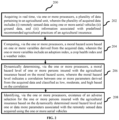
- a system for assessing moral hazard and adverse selection in agricultural insurance comprising a memory storing instructions; one or more communication interfaces; and one or more hardware processors coupled to the memory via the one or more communication interfaces, wherein the one or more hardware processors are configured by the instructions to: acquire in real time, a plurality of data pertaining to an agricultural unit, wherein the plurality of acquired data includes (i) remotely sensed data using one or more aerial vehicles (ii) ground data, and (iii) information associated with predefined recommended agricultural practices of an agricultural insurance; compute, a moral hazard score based on one or more variables derived from the acquired data, wherein the one or more variables include an adoption index, a crop health index and a weather index; dynamically determine, a moral hazard level of one or more persons insured with the agricultural insurance based on the moral
- system further comprising determining a risk factor and a claim amount associated with the agricultural insurance of the agricultural unit based on the moral hazard level and the adverse selection.
- a processor implemented method for agricultural insurance comprising acquiring in real time, via one or more processors, a plurality of data pertaining to an agricultural unit, wherein the plurality of acquired data includes (i) remotely sensed data using one or more aerial vehicles (ii) ground data, and (iii) information associated with predefined recommended agricultural practices of an agricultural insurance; computing, via the one or more processors, a moral hazard score based on one or more variables derived from the acquired data, wherein the one or more variables include an adoption index, a crop health index and a weather index; dynamically determining, via the one or more processors, a moral hazard level of one or more persons insured with the agricultural insurance based on the moral hazard score, wherein the moral hazard level indicates a correlation between one or more parameters derived from the acquired data and classified as low, moderate, and high based on the correlation; and identifying, via the one or more processors, existence of an adverse selection for the one or more persons insured with the agricultural insurance based
- the processor implemented method for agricultural insurance further comprising determining a risk factor and a claim amount associated with the agricultural insurance of the agricultural unit based on the moral hazard level and the adverse selection.
- a non-transitory computer readable medium comprising: acquiring in real time, via one or more processors, a plurality of data pertaining to an agricultural unit, wherein the plurality of acquired data includes (i) remotely sensed data using one or more aerial vehicles (ii) ground data, and (iii) information associated with predefined recommended agricultural practices of an agricultural insurance; computing, via the one or more processors, a moral hazard score based on one or more variables derived from the acquired data, wherein the one or more variables include an adoption index, a crop health index and a weather index; dynamically determining, via the one or more processors, a moral hazard level of one or more persons insured with the agricultural insurance based on the moral hazard score, wherein the moral hazard level indicates a correlation between one or more parameters derived from the acquired data and classified as low, moderate, and high based on the correlation; and identifying, via the one or more processors, existence of an adverse selection
- the non-transitory computer readable medium further comprising determining a risk factor and a claim amount associated with the agricultural insurance of the agricultural unit based on the moral hazard level and the adverse selection.
- the weather index is indicative of presence of weather induced pest and diseases in the agricultural unit.
- the adverse selection is indicative of a compliant or a non-compliant status of the predefined recommended agricultural practices of the agricultural insurance units.
- the agricultural insurance is a mechanism to protect farmers against the uncertainties of crop production, due to natural factors beyond the farmers control.
- Agricultural insurance programme is administered through rural agricultural bank branch network in each state and department and block (group of villages). Actual area yields are established through sample crop cutting experiment (CCE). This is a major and costly exercise and suffers from delays in processing results. Indemnity payments are therefore often delayed for six months or more.
- CCE sample crop cutting experiment
- the present disclosure is directed to methods and systems for assessing moral hazard and adverse selection in agricultural insurance associated with insured farmers by aggregating data that significantly influence individual claim pay out by insurers. This helps in selection of a farmer for efficient underwriting of insurance policy by the insurance company on real time basis.
- Assessment of the moral hazard and the adverse selection, of the insured farmers involves adoption of crop protocols recommended by dynamic crop protocol (DFI) engine of insurance companies during the crop cycle (CP) is used.
- DFI dynamic crop protocol
- CP crop cycle
- the moral hazard of the insured farmers is monitored on real time basis by deriving insights from satellite data during the crop critical growth stage.
- the satellite data could be captured using satellite data sources such as Sentinel 1, 2, Landsat 5,7,8, MODIS, LANDSAT and/or the like are also used.
- the crop critical growth stage includes crop health indices, weather indices and climatic conditions of agricultural units.
- a moral hazard level of the insured farmers is determined with help of crop health indicators such as Normalized Difference Vegetative Index (NDVI), Relative Vegetative Index (RVI), crop phenological characters and their relationship with weather parameters to classify farmer compliance.
- NDVI Normalized Difference Vegetative Index
- RVVI Relative Vegetative Index
- crop phenological characters crop phenological characters and their relationship with weather parameters to classify farmer compliance.
- a method for identifying adverse selection of the agricultural unit or farm or the insured farmer is provided. The adverse selection is identified using geographic information system (GIS) and the moral hazard level information on the agricultural insurance unit which derives insights from satellite data by obtaining geo reference characters. Based on a geo location of a farm and location wise geographical risk, system would recommend customized crop protocol to the insured to mitigate the risk associated with insurance unit.
- GIS geographic information system
- the expression 'adverse selection' refers to a situation with voluntary participation of clients where if premium rates are high (or perceived high), participation of majority of client is discouraged and only high-risk clients participate. Further, the risk is not sufficiently diversified relative to expected payouts. pooled over.
- the expression 'moral hazard' refers to temptation of an insured individual to take less care in preventing a loss than an uninsured counterpart when expected indemnity.
- FIG. 1 and FIG. 2 where similar reference characters denote corresponding features consistently throughout the figures, there are shown preferred embodiments and these embodiments are described in the context of the following exemplary system and/or method.
- FIG. 1 illustrates an exemplary block diagram of a system 100 for assessing moral hazard and adverse selection in agricultural insurance according to some embodiments of the present disclosure.
- the system 100 includes processor (s) 104, communication interface device(s), alternatively referred as or input/output (I/O) interface(s) 106, and one or more data storage devices or memory 102 operatively coupled to the processor(s) 104.
- the processor(s) alternatively referred as one or more processors 104 may be one or more software processing modules and/or hardware processors.
- the hardware processors can be implemented as one or more microprocessors, microcomputers, microcontrollers, digital signal processors, central processing units, state machines, logic circuitries, component modelers, and/or any devices that manipulate signals/inputs based on operational instructions.
- the processor(s) is configured to fetch and execute computer-readable instructions stored in the memory.
- the system 100 can be implemented in a variety of computing systems, such as laptop computers, notebooks, hand-held devices, workstations, mainframe computers, servers, a network cloud and the like.
- the I/O interface(s) 106 can include a variety of software and hardware interfaces, for example, a web interface, a graphical user interface, and the like and can facilitate multiple communications within a wide variety of networks N/W and protocol types, including wired networks, for example, LAN, cable, etc., and wireless networks, such as WLAN, cellular, or satellite.
- the I/O interface device(s) can include one or more ports for connecting a number of devices to one another or to another server. The I/O interface 106, through the ports can be configured to receive inputs stored external to the system 100.
- the memory 102 may include any computer-readable medium known in the art including, for example, volatile memory, such as static random access memory (SRAM) and dynamic random access memory (DRAM), and/or non-volatile memory, such as read only memory (ROM), erasable programmable ROM, flash memories, hard disks, optical disks, and magnetic tapes.
- volatile memory such as static random access memory (SRAM) and dynamic random access memory (DRAM)
- non-volatile memory such as read only memory (ROM), erasable programmable ROM, flash memories, hard disks, optical disks, and magnetic tapes.
- ROM read only memory
- erasable programmable ROM erasable programmable ROM
- flash memories such as hard disks, optical disks, and magnetic tapes.
- the memory 102 includes a data repository 108 for storing data processed, received, and generated as output(s) by the system 100.
- the data repository 108 includes a system database.
- the data repository 108 may be external (not shown) to the system 100 and accessed through the I/O interfaces 106.
- the memory 102 may further comprise information pertaining to input(s)/output(s) of each step performed by the processor 104 of the system 100 and methods of the present disclosure.
- the system database stores information pertaining to inputs fed to the system 100 and/or outputs generated by the system (e.g., at each stage), specific to the methodology described herein. More specifically, the system database stores information being processed at each step of the proposed methodology.
- the one or more hardware processors 104 can be configured to perform a system for assessing moral hazard and adverse selection in agricultural insurance, which can be carried out by using methodology, described in conjunction with FIG. 2 , and use case examples.
- FIG. 2 is an exemplary flow diagram illustrating a method 200 for assessing moral hazard and adverse selection in agricultural insurance using the system of FIG. 1 , according to some embodiments of the present disclosure.
- the system 100 comprises one or more data storage devices or the memory 102 operatively coupled to the one or more processors 104 and is configured to store instructions for execution of steps of the method 200 by the one or more processors 104.
- the steps of the method 200 of the present disclosure will now be explained with reference to the components or blocks of the system 100 as depicted in FIG. 1 and the steps of flow diagram as depicted in FIG. 2 .
- process steps, method steps, techniques or the like may be described in a sequential order, such processes, methods and techniques may be configured to work in alternate orders. In other words, any sequence or order of steps that may be described does not necessarily indicate a requirement that the steps to be performed in that order.
- the steps of processes described herein may be performed in any order practical. Further, some steps may be performed simultaneously.
- the one or more hardware processors 104 are configured to acquire in real time, a plurality of data pertaining to an agricultural unit, wherein the plurality of acquired data includes (i) remotely sensed data using one or more aerial vehicles (ii) ground data, and (iii) information associated with predefined recommended agricultural practices of agricultural insurance units.
- the expression 'agricultural insurance unit' refers to a piece of farm or land insured by an insurance company.
- the remotely sensed data may include but is not limited to geomap of insured agricultural unit, past weather adversities in an area, crops grown, crop health data, agricultural insurance unit agroclimatic zones and its location specific information which is acquired from internet. For example, for any region, based on the agricultural insurance unit size available for a farmer, satellite data is used and type of crop grown on the field for past consecutive years is detected. In addition to this, for each season, level of adoption of farm technologies is planned to be estimated with the help of optimum crop health indices at the agricultural insurance unit level and their level of hazard during a season, before and after calamity is measured quantitatively.
- location specific information may further include availability of climate factors such as temperature, rainfall, relative humidity, sun-shine hours, wind velocity, wind direction, seasons and agro-ecological situations data which adds value to farming practices.
- the ground data may be acquired using a handheld device or global positioning system (GPS) enabled mobile phone and may include but is not limited to optimum conditions for sowing such as available surface soil moisture for sowing, information about suitability of a land for sowing, crop type, crop health index, weather index and/or the like.
- GPS global positioning system
- the information associated with predefined recommended agricultural practices of agricultural insurance units includes crop protocols recommended by dynamic crop protocol (DFI) engine of insurance companies or recommend personalized crop protocol advised by insurance companies to the farmers on best crop suited to his/her field as a risk mitigation strategy to minimize loss due to natural events.
- DFI dynamic crop protocol
- the plurality of data which is acquired is stored in a system database comprised in the data repository 108.
- the one or more hardware processors 104 are configured to compute, a moral hazard score based on one or more variables derived from the acquired data.
- the one or more variables include an adoption index, a crop health index and a weather index.
- the crop health index is determined based on one or more parameters related to crop health in a specific area such as plant density, level of crop health indicators including the NDVI, RVI AND CVI, and/or the like.
- the weather index is indicative of presence of weather induced pest and diseases in the agricultural unit. The weather index is dependent on data related to extreme weather conditions and crop damages during a season to assess crop health status pre and post events such as floods, intermittent rainfall, excess rainfall, hailstorm, nature fire, cyclone and/or the like.
- risk of Moral hazard occurs when an insured deliberately alters their behavior to increase the magnitude of potential loss. It is observed based on various studies that moral hazard incentive leads insured farmers to use fewer chemical inputs such as chemical fertilizers, poor quality seeds or plant on marginal lands that are not suitable for certain crops thus making their crops less resilient and productive.
- Personalized crop protocol is a risk mitigation strategy recommended by the system, which is based on the past historical events and weather adversities occurred in the insurance unit.
- the insured farmers moral hazard is monitored based on an adoption level of the recommended agricultural practices by the system 100 to the farmers on time. To monitor crop growth of the insured agricultural unit on real time basis, an adoption level, weather parameters, crop growth map that are prepared with help of NDVI and adverse weather index.
- pseudo code for computing the moral hazard score which is updated at interval T is provided below:
- the one or more hardware processors 104 are configured to dynamically determine a moral hazard level of one or more persons insured with said agricultural insurance based on the moral hazard score.
- the moral hazard level indicates a correlation between one or more parameters derived from the acquired data and classified as low, moderate, and high based on the correlation.
- the one or more parameters required for classifying the moral hazard level include crop health index, weather index and farm operations of an insured agricultural unit denoted by p in an insured zone denoted by i .
- steps for determining the moral hazard level is provided below:
- the one or more hardware processors 104 are configured to identify existence of an adverse selection for the one or more persons insured with the agricultural insurance based on the dynamically determined moral hazard level and one or more data parameters associated with the remotely sensed data acquired using the one or more aerial vehicles.
- the one or more data parameters associated with the remotely sensed data that are used for identifying the existence of an adverse selection may include the GIS information on the agricultural unit deriving insights from satellite data by obtaining geo reference characters. Based on geo location of the agricultural unit and location wise geographical risk, DFI engine recommends personalized and customized crop protocols to an insurer to rid out of risk associated with the agricultural unit.
- the adverse selection is identified using remote sensing based on the location of land, and suitability for crop production, prone to calamity and agroclimatic zone. In an embodiment, the adverse selection is indicative of a compliant or a non-compliant status of the predefined recommended agricultural practices of the agricultural insurance units.
- the personalized crop protocol is the risk mitigation strategy recommended by the system which is based on the past historical events and weather adversities occurred in the insurance unit. The insured farmers insurance is monitored based on the adoption level of the system recommended agricultural practices by the farmers during the crop cycle. In an embodiment, any adverse variations during the crop growth stages is measured and informed to the insurer for non-compliance.
- a risk factor and a claim amount associated with the agricultural insurance of the agricultural unit is determined based on the moral hazard level and the adverse selection. For example, if the moral hazard level associated with farmers is high and adverse selection is present, then claim amount associated with the agricultural insurance is high. Accordingly, the claim premium rates are affected based on the moral hazard level and adverse selection.
- the method of the present disclosure is an automated method for assessment of moral hazard and adverse selection in agricultural insurance that assist an insurer, re-insurer with the help of remotely sensed satellite data, ground data in accordance with adoption of crop protocols recommended by the dynamic Crop Protocol (DFI) engine of insurance companies during the crop cycle (CP) and aids to under-write policy effectively and efficiently for determining eligible claim pay out to minimize manual error.
- DFI dynamic Crop Protocol
- the hardware device can be any kind of device which can be programmed including e.g. any kind of computer like a server or a personal computer, or the like, or any combination thereof.
- the device may also include means which could be e.g. hardware means like e.g. an application-specific integrated circuit (ASIC), a field-programmable gate array (FPGA), or a combination of hardware and software means, e.g.
- ASIC application-specific integrated circuit
- FPGA field-programmable gate array
- the means can include both hardware means and software means.
- the method embodiments described herein could be implemented in hardware and software.
- the device may also include software means.
- the embodiments may be implemented on different hardware devices, e.g. using a plurality of CPUs.
- the embodiments herein can comprise hardware and software elements.
- the embodiments that are implemented in software include but are not limited to, firmware, resident software, microcode, etc.
- the functions performed by various components described herein may be implemented in other components or combinations of other components.
- a computer-usable or computer readable medium can be any apparatus that can comprise, store, communicate, propagate, or transport the program for use by or in connection with the instruction execution system, apparatus, or device.
- a computer-readable storage medium refers to any type of physical memory on which information or data readable by a processor may be stored.
- a computer-readable storage medium may store instructions for execution by one or more processors, including instructions for causing the processor(s) to perform steps or stages consistent with the embodiments described herein.
- the term "computer-readable medium” should be understood to include tangible items and exclude carrier waves and transient signals, i.e., be non-transitory. Examples include random access memory (RAM), read-only memory (ROM), volatile memory, nonvolatile memory, hard drives, CD ROMs, DVDs, flash drives, disks, and any other known physical storage media.
Landscapes
- Business, Economics & Management (AREA)
- Engineering & Computer Science (AREA)
- Accounting & Taxation (AREA)
- Finance (AREA)
- Theoretical Computer Science (AREA)
- Economics (AREA)
- Marketing (AREA)
- Strategic Management (AREA)
- Physics & Mathematics (AREA)
- General Business, Economics & Management (AREA)
- General Physics & Mathematics (AREA)
- Technology Law (AREA)
- Development Economics (AREA)
- Life Sciences & Earth Sciences (AREA)
- Agronomy & Crop Science (AREA)
- Animal Husbandry (AREA)
- Marine Sciences & Fisheries (AREA)
- Mining & Mineral Resources (AREA)
- Health & Medical Sciences (AREA)
- General Health & Medical Sciences (AREA)
- Human Resources & Organizations (AREA)
- Primary Health Care (AREA)
- Tourism & Hospitality (AREA)
- Financial Or Insurance-Related Operations Such As Payment And Settlement (AREA)
Applications Claiming Priority (1)
| Application Number | Priority Date | Filing Date | Title |
|---|---|---|---|
| IN202121049259 | 2021-10-28 |
Publications (1)
| Publication Number | Publication Date |
|---|---|
| EP4174751A1 true EP4174751A1 (de) | 2023-05-03 |
Family
ID=83319148
Family Applications (1)
| Application Number | Title | Priority Date | Filing Date |
|---|---|---|---|
| EP22191438.5A Pending EP4174751A1 (de) | 2021-10-28 | 2022-08-22 | Verfahren und systeme zur beurteilung der moralen gefahr und unerwünschten auswahl bei landwirtschaftlicher versicherung |
Country Status (3)
| Country | Link |
|---|---|
| US (1) | US20230142764A1 (de) |
| EP (1) | EP4174751A1 (de) |
| BR (1) | BR102022019016A2 (de) |
Citations (2)
| Publication number | Priority date | Publication date | Assignee | Title |
|---|---|---|---|---|
| CN107909279A (zh) * | 2017-11-24 | 2018-04-13 | 安厦系统科技成都有限责任公司 | 一种用于企业道德风险评估的方法 |
| CN109242708A (zh) * | 2018-09-18 | 2019-01-18 | 安徽阡陌网络科技有限公司 | 一种基于遥感数据与数字田块的农业灾害精准理赔方法 |
-
2022
- 2022-08-22 EP EP22191438.5A patent/EP4174751A1/de active Pending
- 2022-08-25 US US17/822,331 patent/US20230142764A1/en not_active Abandoned
- 2022-09-22 BR BR102022019016-0A patent/BR102022019016A2/pt unknown
Patent Citations (2)
| Publication number | Priority date | Publication date | Assignee | Title |
|---|---|---|---|---|
| CN107909279A (zh) * | 2017-11-24 | 2018-04-13 | 安厦系统科技成都有限责任公司 | 一种用于企业道德风险评估的方法 |
| CN109242708A (zh) * | 2018-09-18 | 2019-01-18 | 安徽阡陌网络科技有限公司 | 一种基于遥感数据与数字田块的农业灾害精准理赔方法 |
Also Published As
| Publication number | Publication date |
|---|---|
| US20230142764A1 (en) | 2023-05-11 |
| BR102022019016A2 (pt) | 2023-05-09 |
Similar Documents
| Publication | Publication Date | Title |
|---|---|---|
| Benami et al. | Uniting remote sensing, crop modelling and economics for agricultural risk management | |
| Dalhaus et al. | Phenology information contributes to reduce temporal basis risk in agricultural weather index insurance | |
| Aryal et al. | Adoption of multiple climate-smart agricultural practices in the Gangetic plains of Bihar, India | |
| EP4145365A1 (de) | Verfahren und system zum bewerten der kohlenstoffbindung im boden eines landwirtschaftlichen betriebes basierend auf fernerkundung | |
| Hellmuth et al. | Index insurance and climate risk: Prospects for development and disaster management | |
| CN113362192A (zh) | 农业保险核保方法、系统、设备和存储介质 | |
| JP6618561B2 (ja) | 推奨作物のプロトコルに対する順守度を推測するシステムおよび方法 | |
| EP4145375B1 (de) | Verfahren und system zur bewertung der kreditwürdigkeit von landwirten und des mit dem betrieb verbundenen risikos | |
| Freedman et al. | Disparities in the impact of drought on agriculture across countries | |
| EP4174751A1 (de) | Verfahren und systeme zur beurteilung der moralen gefahr und unerwünschten auswahl bei landwirtschaftlicher versicherung | |
| Yang et al. | Climate-crop models to support opportunity crop adaptation in Africa | |
| US20240078561A1 (en) | Method and system for agricultural greenhouse gas estimation | |
| Ceballos et al. | Assessing feasibility and effects of Personalized Remote Advisories based on smartphone pictures: A formative evaluation in India | |
| Dalhaus | Agricultural weather insurance: basis risk reduction, behavioral insurance and uncovering quality risks | |
| US20140207641A1 (en) | Globally Optimum Trading Positions for Path-Dependent Options | |
| Shekhar et al. | Crop Insurance in a Changing Climate: Resilience, Exclusion, and Reform in PMFBY and RWBCIS | |
| Xu | Climate change and sustainability: an actuarial risk management perspective | |
| EP4564248B1 (de) | Schätzung des dynamischen adoptionsindex und übergangszeit zur verschiebung in die regenerative landwirtschaft | |
| EP4138026B1 (de) | Systeme und verfahren zum detektieren verdeckter notleidender aktiva (npas) und zum vorhersagen potenzieller npas in der landwirtschaft | |
| Gyawali et al. | Inseason crop yield forecasting for early warning planning of food security using CCAFS Regional Agricultural Forecasting Toolbox (CRAFT) in Nepal | |
| Jimenez Maldonado | Developing decision rules for the rainfall index insurance program: An application to Pennsylvania producers | |
| Essam | Analyzing millet price regimes and market performance in Niger with remote sensing data | |
| Murabula et al. | The ABC of crop insurance as a risk management tool: A manual for trainers | |
| Hellin et al. | Evidence-Based Insurance Development for Nigeria’s Farmers: Briefing paper for Nigerian Federal Ministry of Agriculture and Rural Development (FMARD)-CCAFS Knowledge-Sharing Workshop, London, 27-28 January 2015 | |
| Kalfin et al. | Formulation of the Black–Scholes Model for Agricultural Insurance Premium Determination in Response to Climate Change Risk |
Legal Events
| Date | Code | Title | Description |
|---|---|---|---|
| PUAI | Public reference made under article 153(3) epc to a published international application that has entered the european phase |
Free format text: ORIGINAL CODE: 0009012 |
|
| STAA | Information on the status of an ep patent application or granted ep patent |
Free format text: STATUS: THE APPLICATION HAS BEEN PUBLISHED |
|
| AK | Designated contracting states |
Kind code of ref document: A1 Designated state(s): AL AT BE BG CH CY CZ DE DK EE ES FI FR GB GR HR HU IE IS IT LI LT LU LV MC MK MT NL NO PL PT RO RS SE SI SK SM TR |
|
| STAA | Information on the status of an ep patent application or granted ep patent |
Free format text: STATUS: REQUEST FOR EXAMINATION WAS MADE |
|
| 17P | Request for examination filed |
Effective date: 20230630 |
|
| RBV | Designated contracting states (corrected) |
Designated state(s): AL AT BE BG CH CY CZ DE DK EE ES FI FR GB GR HR HU IE IS IT LI LT LU LV MC MK MT NL NO PL PT RO RS SE SI SK SM TR |
|
| STAA | Information on the status of an ep patent application or granted ep patent |
Free format text: STATUS: EXAMINATION IS IN PROGRESS |
|
| 17Q | First examination report despatched |
Effective date: 20250401 |