EP4173793A1 - Method for producing flame retardant polycarbonate resin composition pellet - Google Patents
Method for producing flame retardant polycarbonate resin composition pellet Download PDFInfo
- Publication number
- EP4173793A1 EP4173793A1 EP21834258.2A EP21834258A EP4173793A1 EP 4173793 A1 EP4173793 A1 EP 4173793A1 EP 21834258 A EP21834258 A EP 21834258A EP 4173793 A1 EP4173793 A1 EP 4173793A1
- Authority
- EP
- European Patent Office
- Prior art keywords
- mass
- kneading
- polycarbonate resin
- pellet
- screw
- Prior art date
- Legal status (The legal status is an assumption and is not a legal conclusion. Google has not performed a legal analysis and makes no representation as to the accuracy of the status listed.)
- Granted
Links
Images
Classifications
-
- B—PERFORMING OPERATIONS; TRANSPORTING
- B29—WORKING OF PLASTICS; WORKING OF SUBSTANCES IN A PLASTIC STATE IN GENERAL
- B29B—PREPARATION OR PRETREATMENT OF THE MATERIAL TO BE SHAPED; MAKING GRANULES OR PREFORMS; RECOVERY OF PLASTICS OR OTHER CONSTITUENTS OF WASTE MATERIAL CONTAINING PLASTICS
- B29B9/00—Making granules
- B29B9/02—Making granules by dividing preformed material
- B29B9/06—Making granules by dividing preformed material in the form of filamentary material, e.g. combined with extrusion
-
- B—PERFORMING OPERATIONS; TRANSPORTING
- B29—WORKING OF PLASTICS; WORKING OF SUBSTANCES IN A PLASTIC STATE IN GENERAL
- B29B—PREPARATION OR PRETREATMENT OF THE MATERIAL TO BE SHAPED; MAKING GRANULES OR PREFORMS; RECOVERY OF PLASTICS OR OTHER CONSTITUENTS OF WASTE MATERIAL CONTAINING PLASTICS
- B29B9/00—Making granules
- B29B9/02—Making granules by dividing preformed material
- B29B9/06—Making granules by dividing preformed material in the form of filamentary material, e.g. combined with extrusion
- B29B9/065—Making granules by dividing preformed material in the form of filamentary material, e.g. combined with extrusion under-water, e.g. underwater pelletizers
-
- B—PERFORMING OPERATIONS; TRANSPORTING
- B29—WORKING OF PLASTICS; WORKING OF SUBSTANCES IN A PLASTIC STATE IN GENERAL
- B29B—PREPARATION OR PRETREATMENT OF THE MATERIAL TO BE SHAPED; MAKING GRANULES OR PREFORMS; RECOVERY OF PLASTICS OR OTHER CONSTITUENTS OF WASTE MATERIAL CONTAINING PLASTICS
- B29B7/00—Mixing; Kneading
- B29B7/30—Mixing; Kneading continuous, with mechanical mixing or kneading devices
- B29B7/34—Mixing; Kneading continuous, with mechanical mixing or kneading devices with movable mixing or kneading devices
- B29B7/38—Mixing; Kneading continuous, with mechanical mixing or kneading devices with movable mixing or kneading devices rotary
- B29B7/46—Mixing; Kneading continuous, with mechanical mixing or kneading devices with movable mixing or kneading devices rotary with more than one shaft
- B29B7/48—Mixing; Kneading continuous, with mechanical mixing or kneading devices with movable mixing or kneading devices rotary with more than one shaft with intermeshing devices, e.g. screws
- B29B7/482—Mixing; Kneading continuous, with mechanical mixing or kneading devices with movable mixing or kneading devices rotary with more than one shaft with intermeshing devices, e.g. screws provided with screw parts in addition to other mixing parts, e.g. paddles, gears, discs
-
- B—PERFORMING OPERATIONS; TRANSPORTING
- B29—WORKING OF PLASTICS; WORKING OF SUBSTANCES IN A PLASTIC STATE IN GENERAL
- B29B—PREPARATION OR PRETREATMENT OF THE MATERIAL TO BE SHAPED; MAKING GRANULES OR PREFORMS; RECOVERY OF PLASTICS OR OTHER CONSTITUENTS OF WASTE MATERIAL CONTAINING PLASTICS
- B29B7/00—Mixing; Kneading
- B29B7/30—Mixing; Kneading continuous, with mechanical mixing or kneading devices
- B29B7/58—Component parts, details or accessories; Auxiliary operations
- B29B7/72—Measuring, controlling or regulating
- B29B7/726—Measuring properties of mixture, e.g. temperature or density
-
- B—PERFORMING OPERATIONS; TRANSPORTING
- B29—WORKING OF PLASTICS; WORKING OF SUBSTANCES IN A PLASTIC STATE IN GENERAL
- B29B—PREPARATION OR PRETREATMENT OF THE MATERIAL TO BE SHAPED; MAKING GRANULES OR PREFORMS; RECOVERY OF PLASTICS OR OTHER CONSTITUENTS OF WASTE MATERIAL CONTAINING PLASTICS
- B29B7/00—Mixing; Kneading
- B29B7/80—Component parts, details or accessories; Auxiliary operations
- B29B7/82—Heating or cooling
- B29B7/826—Apparatus therefor
-
- B—PERFORMING OPERATIONS; TRANSPORTING
- B29—WORKING OF PLASTICS; WORKING OF SUBSTANCES IN A PLASTIC STATE IN GENERAL
- B29C—SHAPING OR JOINING OF PLASTICS; SHAPING OF MATERIAL IN A PLASTIC STATE, NOT OTHERWISE PROVIDED FOR; AFTER-TREATMENT OF THE SHAPED PRODUCTS, e.g. REPAIRING
- B29C48/00—Extrusion moulding, i.e. expressing the moulding material through a die or nozzle which imparts the desired form; Apparatus therefor
- B29C48/001—Combinations of extrusion moulding with other shaping operations
- B29C48/0022—Combinations of extrusion moulding with other shaping operations combined with cutting
-
- B—PERFORMING OPERATIONS; TRANSPORTING
- B29—WORKING OF PLASTICS; WORKING OF SUBSTANCES IN A PLASTIC STATE IN GENERAL
- B29C—SHAPING OR JOINING OF PLASTICS; SHAPING OF MATERIAL IN A PLASTIC STATE, NOT OTHERWISE PROVIDED FOR; AFTER-TREATMENT OF THE SHAPED PRODUCTS, e.g. REPAIRING
- B29C48/00—Extrusion moulding, i.e. expressing the moulding material through a die or nozzle which imparts the desired form; Apparatus therefor
- B29C48/022—Extrusion moulding, i.e. expressing the moulding material through a die or nozzle which imparts the desired form; Apparatus therefor characterised by the choice of material
-
- B—PERFORMING OPERATIONS; TRANSPORTING
- B29—WORKING OF PLASTICS; WORKING OF SUBSTANCES IN A PLASTIC STATE IN GENERAL
- B29C—SHAPING OR JOINING OF PLASTICS; SHAPING OF MATERIAL IN A PLASTIC STATE, NOT OTHERWISE PROVIDED FOR; AFTER-TREATMENT OF THE SHAPED PRODUCTS, e.g. REPAIRING
- B29C48/00—Extrusion moulding, i.e. expressing the moulding material through a die or nozzle which imparts the desired form; Apparatus therefor
- B29C48/03—Extrusion moulding, i.e. expressing the moulding material through a die or nozzle which imparts the desired form; Apparatus therefor characterised by the shape of the extruded material at extrusion
- B29C48/05—Filamentary, e.g. strands
-
- B—PERFORMING OPERATIONS; TRANSPORTING
- B29—WORKING OF PLASTICS; WORKING OF SUBSTANCES IN A PLASTIC STATE IN GENERAL
- B29C—SHAPING OR JOINING OF PLASTICS; SHAPING OF MATERIAL IN A PLASTIC STATE, NOT OTHERWISE PROVIDED FOR; AFTER-TREATMENT OF THE SHAPED PRODUCTS, e.g. REPAIRING
- B29C48/00—Extrusion moulding, i.e. expressing the moulding material through a die or nozzle which imparts the desired form; Apparatus therefor
- B29C48/25—Component parts, details or accessories; Auxiliary operations
- B29C48/30—Extrusion nozzles or dies
- B29C48/345—Extrusion nozzles comprising two or more adjacently arranged ports, for simultaneously extruding multiple strands, e.g. for pelletising
-
- B—PERFORMING OPERATIONS; TRANSPORTING
- B29—WORKING OF PLASTICS; WORKING OF SUBSTANCES IN A PLASTIC STATE IN GENERAL
- B29C—SHAPING OR JOINING OF PLASTICS; SHAPING OF MATERIAL IN A PLASTIC STATE, NOT OTHERWISE PROVIDED FOR; AFTER-TREATMENT OF THE SHAPED PRODUCTS, e.g. REPAIRING
- B29C48/00—Extrusion moulding, i.e. expressing the moulding material through a die or nozzle which imparts the desired form; Apparatus therefor
- B29C48/25—Component parts, details or accessories; Auxiliary operations
- B29C48/36—Means for plasticising or homogenising the moulding material or forcing it through the nozzle or die
- B29C48/395—Means for plasticising or homogenising the moulding material or forcing it through the nozzle or die using screws surrounded by a cooperating barrel, e.g. single screw extruders
- B29C48/40—Means for plasticising or homogenising the moulding material or forcing it through the nozzle or die using screws surrounded by a cooperating barrel, e.g. single screw extruders using two or more parallel screws or at least two parallel non-intermeshing screws, e.g. twin screw extruders
- B29C48/405—Intermeshing co-rotating screws
-
- B—PERFORMING OPERATIONS; TRANSPORTING
- B29—WORKING OF PLASTICS; WORKING OF SUBSTANCES IN A PLASTIC STATE IN GENERAL
- B29C—SHAPING OR JOINING OF PLASTICS; SHAPING OF MATERIAL IN A PLASTIC STATE, NOT OTHERWISE PROVIDED FOR; AFTER-TREATMENT OF THE SHAPED PRODUCTS, e.g. REPAIRING
- B29C48/00—Extrusion moulding, i.e. expressing the moulding material through a die or nozzle which imparts the desired form; Apparatus therefor
- B29C48/25—Component parts, details or accessories; Auxiliary operations
- B29C48/36—Means for plasticising or homogenising the moulding material or forcing it through the nozzle or die
- B29C48/50—Details of extruders
- B29C48/505—Screws
- B29C48/54—Screws with additional forward-feeding elements
-
- B—PERFORMING OPERATIONS; TRANSPORTING
- B29—WORKING OF PLASTICS; WORKING OF SUBSTANCES IN A PLASTIC STATE IN GENERAL
- B29C—SHAPING OR JOINING OF PLASTICS; SHAPING OF MATERIAL IN A PLASTIC STATE, NOT OTHERWISE PROVIDED FOR; AFTER-TREATMENT OF THE SHAPED PRODUCTS, e.g. REPAIRING
- B29C48/00—Extrusion moulding, i.e. expressing the moulding material through a die or nozzle which imparts the desired form; Apparatus therefor
- B29C48/25—Component parts, details or accessories; Auxiliary operations
- B29C48/36—Means for plasticising or homogenising the moulding material or forcing it through the nozzle or die
- B29C48/50—Details of extruders
- B29C48/505—Screws
- B29C48/57—Screws provided with kneading disc-like elements, e.g. with oval-shaped elements
-
- B—PERFORMING OPERATIONS; TRANSPORTING
- B29—WORKING OF PLASTICS; WORKING OF SUBSTANCES IN A PLASTIC STATE IN GENERAL
- B29C—SHAPING OR JOINING OF PLASTICS; SHAPING OF MATERIAL IN A PLASTIC STATE, NOT OTHERWISE PROVIDED FOR; AFTER-TREATMENT OF THE SHAPED PRODUCTS, e.g. REPAIRING
- B29C48/00—Extrusion moulding, i.e. expressing the moulding material through a die or nozzle which imparts the desired form; Apparatus therefor
- B29C48/25—Component parts, details or accessories; Auxiliary operations
- B29C48/36—Means for plasticising or homogenising the moulding material or forcing it through the nozzle or die
- B29C48/50—Details of extruders
- B29C48/505—Screws
- B29C48/58—Screws provided with seal ring elements, i.e. elements of generally circular and tapered shape for preventing the back flow of the melt
-
- B—PERFORMING OPERATIONS; TRANSPORTING
- B29—WORKING OF PLASTICS; WORKING OF SUBSTANCES IN A PLASTIC STATE IN GENERAL
- B29C—SHAPING OR JOINING OF PLASTICS; SHAPING OF MATERIAL IN A PLASTIC STATE, NOT OTHERWISE PROVIDED FOR; AFTER-TREATMENT OF THE SHAPED PRODUCTS, e.g. REPAIRING
- B29C48/00—Extrusion moulding, i.e. expressing the moulding material through a die or nozzle which imparts the desired form; Apparatus therefor
- B29C48/25—Component parts, details or accessories; Auxiliary operations
- B29C48/36—Means for plasticising or homogenising the moulding material or forcing it through the nozzle or die
- B29C48/50—Details of extruders
- B29C48/505—Screws
- B29C48/625—Screws characterised by the ratio of the threaded length of the screw to its outside diameter [L/D ratio]
-
- C—CHEMISTRY; METALLURGY
- C08—ORGANIC MACROMOLECULAR COMPOUNDS; THEIR PREPARATION OR CHEMICAL WORKING-UP; COMPOSITIONS BASED THEREON
- C08G—MACROMOLECULAR COMPOUNDS OBTAINED OTHERWISE THAN BY REACTIONS ONLY INVOLVING UNSATURATED CARBON-TO-CARBON BONDS
- C08G64/00—Macromolecular compounds obtained by reactions forming a carbonic ester link in the main chain of the macromolecule
-
- C—CHEMISTRY; METALLURGY
- C08—ORGANIC MACROMOLECULAR COMPOUNDS; THEIR PREPARATION OR CHEMICAL WORKING-UP; COMPOSITIONS BASED THEREON
- C08K—Use of inorganic or non-macromolecular organic substances as compounding ingredients
- C08K5/00—Use of organic ingredients
- C08K5/49—Phosphorus-containing compounds
- C08K5/51—Phosphorus bound to oxygen
- C08K5/52—Phosphorus bound to oxygen only
- C08K5/521—Esters of phosphoric acids, e.g. of H3PO4
-
- C—CHEMISTRY; METALLURGY
- C08—ORGANIC MACROMOLECULAR COMPOUNDS; THEIR PREPARATION OR CHEMICAL WORKING-UP; COMPOSITIONS BASED THEREON
- C08L—COMPOSITIONS OF MACROMOLECULAR COMPOUNDS
- C08L55/00—Compositions of homopolymers or copolymers, obtained by polymerisation reactions only involving carbon-to-carbon unsaturated bonds, not provided for in groups C08L23/00 - C08L53/00
- C08L55/02—ABS [Acrylonitrile-Butadiene-Styrene] polymers
-
- B—PERFORMING OPERATIONS; TRANSPORTING
- B29—WORKING OF PLASTICS; WORKING OF SUBSTANCES IN A PLASTIC STATE IN GENERAL
- B29K—INDEXING SCHEME ASSOCIATED WITH SUBCLASSES B29B, B29C OR B29D, RELATING TO MOULDING MATERIALS OR TO MATERIALS FOR MOULDS, REINFORCEMENTS, FILLERS OR PREFORMED PARTS, e.g. INSERTS
- B29K2055/00—Use of specific polymers obtained by polymerisation reactions only involving carbon-to-carbon unsaturated bonds, not provided for in a single one of main groups B29K2023/00 - B29K2049/00, e.g. having a vinyl group, as moulding material
- B29K2055/02—ABS polymers, i.e. acrylonitrile-butadiene-styrene polymers
-
- B—PERFORMING OPERATIONS; TRANSPORTING
- B29—WORKING OF PLASTICS; WORKING OF SUBSTANCES IN A PLASTIC STATE IN GENERAL
- B29K—INDEXING SCHEME ASSOCIATED WITH SUBCLASSES B29B, B29C OR B29D, RELATING TO MOULDING MATERIALS OR TO MATERIALS FOR MOULDS, REINFORCEMENTS, FILLERS OR PREFORMED PARTS, e.g. INSERTS
- B29K2069/00—Use of PC, i.e. polycarbonates or derivatives thereof, as moulding material
-
- B—PERFORMING OPERATIONS; TRANSPORTING
- B29—WORKING OF PLASTICS; WORKING OF SUBSTANCES IN A PLASTIC STATE IN GENERAL
- B29K—INDEXING SCHEME ASSOCIATED WITH SUBCLASSES B29B, B29C OR B29D, RELATING TO MOULDING MATERIALS OR TO MATERIALS FOR MOULDS, REINFORCEMENTS, FILLERS OR PREFORMED PARTS, e.g. INSERTS
- B29K2105/00—Condition, form or state of moulded material or of the material to be shaped
- B29K2105/0005—Condition, form or state of moulded material or of the material to be shaped containing compounding ingredients
- B29K2105/0026—Flame proofing or flame retarding agents
-
- B—PERFORMING OPERATIONS; TRANSPORTING
- B29—WORKING OF PLASTICS; WORKING OF SUBSTANCES IN A PLASTIC STATE IN GENERAL
- B29K—INDEXING SCHEME ASSOCIATED WITH SUBCLASSES B29B, B29C OR B29D, RELATING TO MOULDING MATERIALS OR TO MATERIALS FOR MOULDS, REINFORCEMENTS, FILLERS OR PREFORMED PARTS, e.g. INSERTS
- B29K2105/00—Condition, form or state of moulded material or of the material to be shaped
- B29K2105/0088—Blends of polymers
-
- B—PERFORMING OPERATIONS; TRANSPORTING
- B29—WORKING OF PLASTICS; WORKING OF SUBSTANCES IN A PLASTIC STATE IN GENERAL
- B29K—INDEXING SCHEME ASSOCIATED WITH SUBCLASSES B29B, B29C OR B29D, RELATING TO MOULDING MATERIALS OR TO MATERIALS FOR MOULDS, REINFORCEMENTS, FILLERS OR PREFORMED PARTS, e.g. INSERTS
- B29K2105/00—Condition, form or state of moulded material or of the material to be shaped
- B29K2105/25—Solid
- B29K2105/251—Particles, powder or granules
-
- B—PERFORMING OPERATIONS; TRANSPORTING
- B29—WORKING OF PLASTICS; WORKING OF SUBSTANCES IN A PLASTIC STATE IN GENERAL
- B29K—INDEXING SCHEME ASSOCIATED WITH SUBCLASSES B29B, B29C OR B29D, RELATING TO MOULDING MATERIALS OR TO MATERIALS FOR MOULDS, REINFORCEMENTS, FILLERS OR PREFORMED PARTS, e.g. INSERTS
- B29K2105/00—Condition, form or state of moulded material or of the material to be shaped
- B29K2105/26—Scrap or recycled material
-
- Y—GENERAL TAGGING OF NEW TECHNOLOGICAL DEVELOPMENTS; GENERAL TAGGING OF CROSS-SECTIONAL TECHNOLOGIES SPANNING OVER SEVERAL SECTIONS OF THE IPC; TECHNICAL SUBJECTS COVERED BY FORMER USPC CROSS-REFERENCE ART COLLECTIONS [XRACs] AND DIGESTS
- Y02—TECHNOLOGIES OR APPLICATIONS FOR MITIGATION OR ADAPTATION AGAINST CLIMATE CHANGE
- Y02W—CLIMATE CHANGE MITIGATION TECHNOLOGIES RELATED TO WASTEWATER TREATMENT OR WASTE MANAGEMENT
- Y02W30/00—Technologies for solid waste management
- Y02W30/50—Reuse, recycling or recovery technologies
- Y02W30/62—Plastics recycling; Rubber recycling
Definitions
- the present invention relates to a method for producing a flame retardant polycarbonate resin composition pellet.
- Polycarbonate resins exhibit excellent heat resistance and mechanical properties, and are therefore widely used in, for example, materials for producing components of electrical equipment, electronic devices, vehicles such as automobiles, office automation equipment such as printers and copiers, houses, buildings and other industrial fields.
- flame retardant polycarbonate resin compositions in particular are advantageously used in office automation equipment such as printers and copiers, personal computers, a variety of handheld terminals, housings for batteries, and the like.
- thermoplastic plastic members are recovered from components of equipment and washed with a washing liquid, and pulverized thermoplastic plastic is separated from the pulverized mixture, as disclosed in PTL 1 for example.
- raw materials for recycled polycarbonate resins include optical discs, such as CDs and DVDs, light guide plates, transparent motor vehicle components, such as vehicle windows, headlamp lenses and windscreens, containers such as water bottles, eyeglass lenses, and construction materials, such as noise barriers, windows and corrugated sheets, and these are reused as pellets obtained by pulverizing, washing, separating and recovering.
- optical discs such as CDs and DVDs
- transparent motor vehicle components such as vehicle windows, headlamp lenses and windscreens
- containers such as water bottles, eyeglass lenses
- construction materials such as noise barriers, windows and corrugated sheets
- halogen-containing flame retardants such as organic bromine compound
- Phosphorus-containing flame retardants such as phosphate ester-containing flame retardants
- the phosphorus-containing liquid flame retardant and a pellet-like polycarbonate resin such as a recycled material mentioned above are melt kneaded using an extruder, the phosphorus-containing liquid flame retardant is hardly blended, unmelted polycarbonate resin can be present, resin can leak from a vent opening, the discharged amount may not increase, strand take-up may not be possible, the flame retardancy of an obtained polycarbonate resin composition pellet may be insufficient, and color hue may deteriorate.
- the purpose of (problem to be addressed by) the present invention resides in a method for producing a polycarbonate resin composition, in which the problem mentioned above can be solved by obtaining a flame retardant polycarbonate resin composition using a phosphorus-containing liquid flame retardant.
- the inventors of the present invention found that in a case where a resin pellet containing a polycarbonate resin is produced in a twin screw extruder through addition of a phosphate ester flame retardant that is a liquid at room temperature, by feeding the liquid phosphate ester to a downstream part of a first kneading zone, then kneading in a subsequent kneading zone, and imparting each kneading zone with a specific screw configuration, it is possible to produce a polycarbonate resin composition pellet which does not cause unmelted product to be present, does not cause resin to leak from a vent, achieves good productivity stably at a high discharge rate, and exhibits excellent uniform flame retardancy and color hue, and thereby completed the present invention.
- a phosphate ester flame retardant that is a liquid at room temperature
- the present invention relates to the following method for producing a polycarbonate resin composition pellet
- the production method of the present invention it is possible to produce a polycarbonate resin composition pellet which does not cause unmelted product to be present, does not cause resin to leak from a vent, achieves good productivity stably at a high discharge rate, and exhibits excellent uniform flame retardancy and color hue.
- Raw materials used in the method for producing a polycarbonate resin composition pellet of the present invention comprise 30 to 95 mass% of a resin pellet (A) containing more than 40 mass% of a polycarbonate resin in the pellet; not less than 5 mass% and less than 40 mass% of a phosphate ester flame retardant (B) that is a liquid at room temperature; 0 to 50 mass% of polycarbonate resin flake (C); 0 to 30 mass% of an ABS resin (D); and 0 to 15 mass% of an additive (E) other than component (B), each relative to a total amount of 100 mass% of components (A) to (E).
- the total amount of components (A) to (E) is 100 mass%.
- a resin pellet (A) containing more than 40 mass% of a polycarbonate resin in the pellet is used in the method for producing a polycarbonate resin composition pellet of the present invention.
- the resin pellet (A) should contain more than 40 mass% of a polycarbonate resin, and the resin pellet is preferably a mixture or alloy that also contains another resin other than a polycarbonate resin, such as an ABS resin or a thermoplastic polyester (a polybutylene terephthalate resin or a polyethylene terephthalate resin).
- the content of the polycarbonate resin pellet in the resin pellet (A) is preferably more than 50 mass%.
- the resin pellet (A) may be an unused so-called virgin pellet, but may also be a recycled material pellet or include a recycled material pellet.
- Preferred examples of raw materials of recycled material pellet include optical disc, such as CD and DVD, light guide plate, transparent motor vehicle component, such as vehicle window, headlamp lense and windscreen, container such as water bottle, eyeglass lense, and construction material, such as noise barrier, window and corrugated sheet. It is also possible to use pulverized product obtained from defective product, sprue and runner formed during molding, and repelleted product obtained by pulverizing, washing, separating and recovering these. Hereinafter, these recycled material and repelleted product are also referred to as recycled material and recycled pellet.
- pellet of recycled material is particularly preferred in the method for producing a polycarbonate resin composition pellet of the present invention.
- Use of pellet of recycled material is preferred from the perspective of lowering LCA (life cycle assessment).
- Recycled material often contains resin other than polycarbonate resin and a variety of additive, but a pellet containing more than 40 mass% of the polycarbonate resin can be used as the resin pellet (A).
- Pellet of polycarbonate resin recycled material can be purchased from recycled material manufacturers.
- polycarbonate resin examples include aromatic polycarbonate resin, aliphatic polycarbonate resin and aromatic-aliphatic polycarbonate resin, but aromatic polycarbonate resin are preferred, and more specifically, it is possible to use an aromatic polycarbonate polymer or copolymer obtained by reacting an aromatic dihydroxy compound with phosgene or a carbonic acid diester.
- aromatic dihydroxy compound examples include 2,2-bis(4-hydroxyphenyl)propane (that is, bisphenol A), 2,2-bis(3-methyl-4-hydroxyphenyl)propane (that is, bisphenol C), tetramethylbisphenol A, ⁇ , ⁇ '-bis(4-hydroxyphenyl)-p-diisopropylbenzene, hydroquinone, resorcinol and 4,4'-dihydroxydiphenyl.
- polycarbonate resin examples include polycarbonate resin obtained using bisphenol A or a combination of bisphenol A and another aromatic dihydroxy compound as dihydroxy compound and polycarbonate resin obtained using bisphenol C or a combination of bisphenol C and another aromatic dihydroxy compound (especially bisphenol A).
- the polycarbonate resin may be a homopolymer comprising one type of repeating unit or a copolymer having two or more types of repeating unit.
- copolymer may be selected from among a variety of copolymer form, such as random copolymer and block copolymer.
- the method for producing the aromatic polycarbonate resin is not particularly limited, and it is possible to use a conventional method such as the phosgene method (an interfacial polymerization method) or a melt process (a transesterification method).
- the molecular weight of the polycarbonate resin is not limited, but the viscosity average molecular weight (Mv) thereof is generally approximately 10,000 to 100,000, and preferably approximately 12,000 to 35,000.
- Mv the viscosity average molecular weight
- the viscosity average molecular weight (Mv) of the polycarbonate resin is a value that is obtained by determining the intrinsic viscosity ([ ⁇ ]) by measuring the viscosity of a methylene chloride solution of the polycarbonate resin at 25°C using a Ubbelohde type viscometer, and then calculating the viscosity average molecular weight from the Schnell viscosity equation below.
- ⁇ 1.23 ⁇ 10 ⁇ 4 Mv 0.83
- the method for producing the polycarbonate resin is not particularly limited, and it is possible to use a polycarbonate resin produced using the phosgene method (an interfacial polymerization method) or a melt process (a transesterification method).
- a polycarbonate resin obtained by subjecting a polycarbonate resin produced by means of a melt process to a post treatment for adjusting the amount of terminal hydroxyl groups is also preferred.
- Preferred examples of used products include optical disc, such as CD and DVD, light guide plate, transparent motor vehicle component, such as vehicle window, headlamp lense and windscreen, container such as water bottle, eyeglass lense, and construction material, such as noise barrier, window and corrugated sheet.
- recycled polycarbonate resin can be pulverized product obtained from defective article, sprues and runner at the time of molding, or pellet obtained by melting these pulverized product.
- the phosphate ester flame retardant used in the present invention is a phosphate ester flame retardant that is a liquid at room temperature.
- being “a liquid at room temperature” means being a liquid at 23°C.
- phosphate ester flame retardant examples include phosphate compound and condensed phosphate ester, with condensed phosphate ester being preferred.
- a phosphate ester compound represented by general formula (1) below which is a liquid at room temperature, is particularly preferred as a condensed phosphate ester.
- R 1 , R 2 , R 3 and R 4 each denote an alkyl group having 1 to 6 carbon atoms or an aryl group which has 6 to 20 carbon atoms and which may be substituted with an alkyl group
- p, q, r and s are each 0 or 1
- k is an integer between 1 and 5
- X 1 is an arylene group.
- the phosphate ester compound represented by general formula (1) may be a mixture of compounds for which the value of k differs from compound to compound, and in the case of a mixture of phosphate esters for which the value of k differs from compound to compound, the value of k is taken to be the average value of k of the compounds in the mixture.
- the average value of k is preferably 1 to 2, more preferably 1 to 1.5, further preferably 1 to 1.2, and particularly preferably 1 to 1.15.
- X 1 denotes a divalent arylene group, and is a divalent group derived from, for example, a dihydroxy compound such as resorcinol, hydroquinone, bisphenol A, 2,2'-dihydroxybiphenyl, 2,3'-dihydroxybiphenyl, 2,4'-dihydroxybiphenyl, 3,3'-dihydroxybiphenyl, 3,4'-dihydroxybiphenyl, 4,4'-dihydroxybiphenyl, 1,2-dihydroxynaphthalene, 1,3-dihydroxynaphthalene, 1,4-dihydroxynaphthalene, 1,5-dihydroxynaphthalene, 1,6-dihydroxynaphthalene, 1,7-dihydroxynaphthalene, 1,8-dihydroxynaphthalene, 2,3-dihydroxynaphthalene, 2,6-dihydroxynaphthalene or 2,7-dihydroxynaphthalene.
- R 1 , R 2 , R 3 and R 4 each denote an alkyl group having 1 to 6 carbon atoms or an aryl group which has 6 to 20 carbon atoms and which may be substituted with an alkyl group.
- aryl groups include phenyl group, cresyl group, xylyl group, isopropylphenyl group, butylphenyl group, tert-butylphenyl group, di-tert-butylphenyl group and p-cumylphenyl group, but phenyl group, cresyl group and xylyl group are more preferred.
- condensed phosphate ester represented by general formula (1) bisphenol A bis-diphenyl phosphate or the like is preferred as a specific example that is a liquid at room temperature.
- examples of commercially available products include FP-600 produced by ADEKA and CR-741 produced by Daihachi Chemical Industry Co., Ltd.
- the production method of the present invention includes a first step for feeding the resin pellet (A) and other components in a twin screw extruder and kneading with a first kneading zone, a second step for feeding component (B) to a downstream part in the first kneading zone and kneading with a second kneading zone, and a third step for decompressing a vent in the downstream part in the second kneading zone to devolatilize and extrude.
- a twin screw extruder is used in the production method of the present invention.
- a variety of twin screw extruders can be used, and the screw rotation type can be co-rotating or counter-rotating, but a same direction meshing type twin screw extruder is preferred.
- a vent opening which can be decompressed or opened to the atmosphere is provided in the twin screw extruder.
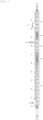
- Fig. 1 is a horizontal cross-sectional view showing an example of a screw configuration of an extruder used in the method of the present invention. The production method of the present invention will now be explained with reference to Figs. 1 to 2 .
- the raw material resin pellet (A) and other components (C) to (E) are fed to a twin screw extruder from a feeding port 1 located at the base of the extruder, the resin pellet (A) is transported towards a discharge port 9, which is shown on the right hand side of Fig. 1 , while being melt kneaded as a result of the extruder barrel being heated and a screw being rotated, and a strand that is discharged from the discharge port 9 is pelletized by a granulator.
- the resin pellet (A) or the like fed from the feeding port 1 is fed, transported and pre-heated in a feeding ⁇ transporting ⁇ preheating zone 2.
- the transporting screw is preferably constituted from ordinary flight-shaped screw elements.
- the resin pellet (A) is then melted in a first kneading zone 3, but the first kneading zone 3 has a configuration in which the length thereof is 2.5 D to 6.0 D (D denotes the diameter of the screw) and consists of a combination of two or more of an R kneading disc, an N kneading disc, an L kneading disc, an L screw, a sealing ring, a mixing screw and a rotor screw.
- D denotes the diameter of the screw
- the first kneading zone means a region in which kneading is carried out before the phosphate ester liquid flame retardant is fed, and the first kneading zone may be configured so that two or more of an R kneading disc, an N kneading disc, an L kneading disc, an L screw, a sealing ring, a mixing screw and a rotor screw are continuous or separated into multiple sections.
- the total length of two or more of an R kneading disc, an N kneading disc, an L kneading disc, an L screw, a sealing ring, a mixing screw and a rotor screw should be 2.5 D to 6.0 D (D denotes the diameter of the screw), and an ordinary transporting flight that does not have a kneading action is not included in the length of the first kneading zone.
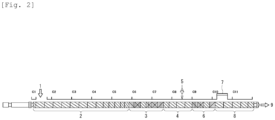
- an ordinary transporting flight-shaped element (a diagonally hatched element shown in 3 in Fig. 2 ) may be placed between a plurality of kneading discs, as in the case of the first kneading zone 3 shown in Fig. 2 , and this transporting flight-shaped element is not included in the length of 2.5 D to 6.0 D.
- An R kneading disc is also referred to as a forward kneading disc (hereinafter also referred to as R), and generally has 2 or more vanes, with the angle of twist ⁇ between the vanes being 10° to 75°.
- N kneading disc is also referred to as an orthogonal kneading disc (hereinafter also referred to as N), and generally has 2 or more vanes, with the angle of twist ⁇ between the vanes being 75° to 105°. Because the vanes are disposed so as to be offset by approximately 90°, there is almost no force for transporting the resin, but the kneading force is strong.
- An L kneading disc is also referred to as a backward kneading disc (hereinafter also referred to as L), and generally has 2 or more vanes, with the angle of twist ⁇ between the vanes being -10° to -75°.
- An L kneading disc is an element having a pressure-increasing function that holds up the transported resin and acts on the transported resin in the opposite direction. By providing an element for facilitating kneading on the downstream side, the resin is held up and a strong kneading effect is achieved.
- An L screw is also referred to as a backward screw, and generally rotates in the opposite direction from a transporting screw, and is an element having a pressure-increasing function that holds up the transported resin and acts on the transported resin in the opposite direction.
- vanes mentioned above are generally elliptical, and flattened parts are formed at two elliptical apexes. These vanes are also referred to as discs, and the kneading discs are generally constituted from 3 to 7 discs. These discs may, in some cases, have 3 substantially triangular apexes, and such discs are also referred to as three-pointed kneading discs. The same is true for R, N and L types. These can be used in the same way. There are also twisted kneading discs in which apexes in kneading discs are twisted in the screw axis direction, and these can achieve a similar kneading effect.
- a sealing ring is a ring-shaped element fitted to a screw, blocks approximately 70 to 90% of a flow path, and hinders the flow of the resin, thereby enabling the resin pressure to increase.
- a mixing screw is formed by removing a part of a peak of a screw flight, is a one-pointed or two-pointed screw for forward or reverse transporting, and is an element having a strong shearing and dispersing force.
- Types of mixing screw include a forward transporting notch type mixing screw and a reverse transporting notch type mixing screw.
- a rotor screw is a screw obtained by forming a rotor blade having an elliptical shape (a two-blade structure) or a triangular shape, and a strong shearing force can be applied by a gap between the rotor and the inner wall surface of the barrel (the tip clearance).
- the first kneading zone 3 is formed by combining two or more of the components mentioned above, but is preferably a combination of an R kneading disc, an N kneading disc and an L kneading disc, for example a configuration in which a plurality of N are provided after an R and an L is then provided, with RNNL, RNNNL, and the like, being particularly preferred.
- the length of the disc configuration in the first kneading zone 3 is 2.5 D to 6.0 D, but is preferably 3.5 D to 5.5 D.
- the resin pellet (A) can be sufficiently melted and transported to the second kneading zone 6 by a transporting zone 4, but in this case, a phosphate ester liquid flame retardant (B) is fed using a liquid feeding device 5 (a liquid supply pump or the like) provided downstream of the first kneading zone.
- a liquid feeding device 5 a liquid supply pump or the like
- the quantity of the phosphate ester liquid flame retardant (B) is not less than 5 mass% and less than 40 mass% relative to 100 mass% of the obtained polycarbonate resin composition pellet, and by specifying such an quantity, it is possible to achieve both high flame retardancy and high heat resistance. If this quantity is 40 mass% or more, heat resistance deteriorates.
- This quantity is preferably 7 mass% or more and more preferably 10 mass% or more, and is preferably less than 35 mass%, more preferably less than 30 mass%, such as less than 25 mass% or 23 mass% or less, and is particularly preferably 21 mass% or less.
- the molten resin pellet (A) or the like and the phosphate ester liquid flame retardant (B) are melt kneaded in the second kneading zone 6.
- the second kneading zone 6 has a configuration in which the length thereof is 1.3 D to 4.0 D and consists of a combination of two or more of an R kneading disc, an N kneading disc, an L kneading disc, an L screw, a sealing ring, a mixing screw and a rotor screw.
- the resin pellet (A) and the phosphate ester liquid flame retardant (B) can be uniformly melt kneaded, good productivity can be stably achieved, and it is possible to produce a polycarbonate resin composition pellet that exhibits excellent uniform flame retardancy and color hue.
- the second kneading zone means a region in which kneading is carried out up to the point where the phosphate ester flame retardant is introduced and reaches the vacuum vent, and the second kneading zone may be configured so that two or more of an R kneading disc, an N kneading disc, an L kneading disc, an L screw, a sealing ring, a mixing screw and a rotor screw are continuous or separated into multiple sections.
- the total length of two or more of an R kneading disc, an N kneading disc, an L kneading disc, an L screw, a sealing ring, a mixing screw and a rotor screw should be 1.3 D to 4.0 D (D denotes the diameter of the screw), and an ordinary transporting flight that does not have a kneading action is not included in the length of the second kneading zone.
- an ordinary transporting flight-shaped element (a diagonally hatched element shown in 6 in Fig. 2 ) may be placed and distributed between a plurality of kneading discs, as in the case of the second kneading zone 6 shown in Fig. 2 , and this transporting flight-shaped element is not included in the length of 1.3 D to 4.0 D.
- the second kneading zone 6 is formed by combining two or more of the components mentioned above, but is preferably a combination of an R kneading disc, an N kneading disc and an L kneading disc, for example a configuration in which a plurality of N are provided after an R and an L is then provided, with RNL, RNNL, RNNNL, RNNNNL, RNNNNNL, and the like, being particularly preferred. In these configurations, it is possible to use a combination of 0.5 D or 1.0 D for the R, N and L.
- the length of the disc configuration in the second kneading zone 6 is 1.3 D to 4.0 D, but is preferably 2.0 D to 4.0 D.
- devolatilization is carried out by decompressing a vent 7 located downstream of the second kneading zone, and the polycarbonate resin composition is extruded as a strand from an extruding die located in a discharge zone 9 at the tip of an extruder 8.
- the screw rotational speed in the twin screw extruder is preferably approximately 500 to 900 rpm.
- the discharge rate is preferably 350 kg/hr or more, more preferably 380 kg/hr or more, further preferably 400 kg/hr or more, such as 450 kg/hr or more, and it is particularly preferable to be able to achieve a discharge rate of 500 kg/hr or more.
- the extruded strand-like molten polycarbonate resin composition is cooled in water and cut to form pellets.
- the shape of the extruding die is not particularly limited, and a well-known type of die is used.
- the diameter of the die of the discharge nozzle depends on the extrusion pressure and the desired pellet dimensions, but is generally approximately 2 to 5 mm.
- the temperature of the polycarbonate resin immediately following extrusion is preferably 280 to 300°C, and more preferably approximately 280 to 290°C.
- polycarbonate resin flake (C), an ABS resin (D) and an additive (E) other than component (B) in addition to the resin pellet (A) and the phosphate ester liquid flame retardant (B).
- the blending quantities of these components are, relative to a total of 100 mass% of components (A) to (E), 0 to 50 mass% of the polycarbonate resin flake (C), 0 to 30 mass% of the ABS resin (D) and 0 to 15 mass% of the additive (E) other than component (B).
- these components (C) to (E) are fed from the feeding port 1 located at the base of the twin screw extruder together with, or separately from, the resin pellet (A).
- the average particle diameter of the polycarbonate resin flake (C) is preferably 2 mm or less, and more preferably 1.5 mm or less.
- the blending quantity thereof is preferably 5 to 45 mass%.
- the ABS resin (D) preferably comprises an aromatic vinyl monomer component, a vinyl cyanide monomer component and a diene-based rubbery polymer component, and is preferably an acrylonitrile-butadiene-styrene copolymer.
- the ABS resin (D) is preferably supplied in the form of pellets from the feeding port 1 located at the base of the twin screw extruder, together with the resin pellet (A). In a case where the ABS resin (D) is used, the blending quantity thereof is preferably 5 to 25 mass%.
- Preferred examples of the additive (E) other than the phosphate ester liquid flame retardant (B) include auxiliary flame retardants such as a fluororesin (PTFE), a variety of elastomers (impact resistance-improving agents), mold-release agent, stabilizer, filler, reinforcing agent, other resin components, other flame retardant, coloring agent (dye and pigment), ultraviolet radiation absorber, anti-static agent, anti-fogging agent, anti-blocking agent, fluidity-improving agent, plasticizer, dispersing agent and antimicrobial agent.
- auxiliary flame retardants such as a fluororesin (PTFE), a variety of elastomers (impact resistance-improving agents), mold-release agent, stabilizer, filler, reinforcing agent, other resin components, other flame retardant, coloring agent (dye and pigment), ultraviolet radiation absorber, anti-static agent, anti-fogging agent, anti-blocking agent, fluidity-improving agent, plasticizer, dispersing agent and antimicrobial agent.
- the blending quantity thereof is 15 mass% or less, preferably 13 mass% or less, and further preferably 12 mass% or less, such as 11 mass% or less or even 10 mass% or less.
- a polycarbonate resin composition pellet obtained using the production method of the present invention comprises: 30 to 95 mass%, and preferably 30 to 80 mass%, of a resin derived from the resin pellet (A); not less than 5 mass% and less than 40 mass%, and preferably not less than 5 mass% and less than 25 mass%, of the phosphate ester flame retardant (B); 0 to 50 mass% of a polycarbonate resin derived from the polycarbonate resin flake (C); 0 to 30 mass% of the ABS resin (D); and 0 to 15 mass% of the additive (E) other than component (B) [here, the total amount of components (A) to (E) is 100 mass%].
- a method for producing a molded article from the obtained polycarbonate resin composition pellet is not particularly limited, and it is possible to use a molding method routinely used for polycarbonate resin, that is, an ordinary injection molding method, an ultrahigh speed injection molding method, an injection compression molding method, a multi-color molding method, a gas assisted injection molding method, a molding method involving the use of a heat insulating mold, a molding method involving the use of a rapidly heated and cooled mold, a foaming molding method (including supercritical fluids), an insert molding method, an IMC (in-mold coating) molding method, an extrusion molding method, a sheet molding method, a thermoforming method, a rotational molding method, a lamination molding method or a press molding method.
- a molding method routinely used for polycarbonate resin that is, an ordinary injection molding method, an ultrahigh speed injection molding method, an injection compression molding method, a multi-color molding method, a gas assisted injection molding method, a molding method involving the use of a heat insulating
- An obtained molded article can be advantageously used as a component of office automation equipment, such as a printer or copier, electrical equipment, an electronic device, a vehicle such as an automobile, office automation equipment, such as a printer or copier, a house, a building, and the like, and can be used particularly advantageously as a housing for office automation equipment, such as a printer or copier, a computer, a personal computer, a variety of handheld terminals, a battery, and the like.
- the screw configuration of the extruder used in the working examples and comparative examples is as follows.
- the number of kneading discs is five and the disc length is 1 D.
- the number of kneading discs is five and the disc length is 1 D
- the number of kneading discs is five and the disc length is 0.5 D.
- the raw materials used in the working examples and comparative examples are as follows.
- Adekastab FP-600 produced by ADEKA Adekastab FP-600 produced by ADEKA
- ABS resin pellet SXH-330 produced by Nippon A and L Inc.
- Recycled polycarbonate resin pellet (A-1) was supplied at a rate of 240 kg/h (60 mass%) and polycarbonate resin flake (C) was supplied at a rate of 80 kg/h (20 mass%) from a feeding port 1 to a co-rotating twin screw extruder (TEX44 ⁇ II produced by Japan Steel Works, Ltd.), kneaded with a first kneading zone having screw configuration example 3, after which a phosphorus-containing liquid flame retardant (B) was fed at a rate of 80 kg/h (20 mass%) from a liquid supply pump 5, kneaded with a second kneading zone having screw configuration example 2, after which decompression was carried out using a vent, a strand was extruded from a discharge port and cooled in a water bath, and polycarbonate resin composition pellets were obtained using a pelletizer.
- the screw rotation speed was 700 rpm, and the preset cylinder temperature was 260°C.
- a plate having a thickness of 3 mm was formed by injection molding the obtained pellets.
- YI was measured with transmitted light using a SE6000 spectrophotometer produced by Nippon Denshoku Industries Co., Ltd.
- this 3 mm thick plate was measured in terms of total light transmittance (%) with transmitted light using a haze meter NDH4000 produced by Nippon Denshoku Industries Co., Ltd. in accordance with JIS K7361 using a D65/10° light source.
- Production was carried out in the same way as in production example A1, except that the screw configurations of the first kneading zone and the second kneading zone were changed to the configuration examples shown in Table 1 and the screw rotational speed was changed to the discharge rates and rotational speeds shown in Table 1.
- Production was carried out in the same way as in production example A1, except that the screw configurations of the first kneading zone and the second kneading zone were changed to the configuration examples shown in Table 1. The results are shown in Table 1.
- comparative production examples A4, A5 and A6 a liquid substance was observed at the vent, and resin leaked from a vent. The strand frequently broke and sampling of product pellets was difficult. It was thought that this was because the configuration of the second kneading zone was too short and the phosphorus-containing liquid flame retardant was not dispersed.
- the method of the present invention it is possible to produce a polycarbonate resin composition pellet in which unmelted product does not occur, resin does not leak from a vent, good productivity can be stably achieved, and it is possible to produce a polycarbonate resin composition pellet that exhibits excellent uniform flame retardancy and color hue, and the obtained polycarbonate resin pellet can be widely used in materials for producing components of office automation equipment such as printers and copiers, electrical equipment, electronic devices, vehicles such as automobiles, houses, buildings and other industrial fields, and the present invention therefore exhibits extremely high industrial applicability.
Landscapes
- Engineering & Computer Science (AREA)
- Mechanical Engineering (AREA)
- Chemical & Material Sciences (AREA)
- Health & Medical Sciences (AREA)
- Chemical Kinetics & Catalysis (AREA)
- Medicinal Chemistry (AREA)
- Polymers & Plastics (AREA)
- Organic Chemistry (AREA)
- Manufacturing & Machinery (AREA)
- Compositions Of Macromolecular Compounds (AREA)
- Processes Of Treating Macromolecular Substances (AREA)
- Processing And Handling Of Plastics And Other Materials For Molding In General (AREA)
Abstract
Description
- The present invention relates to a method for producing a flame retardant polycarbonate resin composition pellet.
- Polycarbonate resins exhibit excellent heat resistance and mechanical properties, and are therefore widely used in, for example, materials for producing components of electrical equipment, electronic devices, vehicles such as automobiles, office automation equipment such as printers and copiers, houses, buildings and other industrial fields.
- These products require flame retardancy from a safety perspective in order to prevent fire caused by high temperatures, and flame retardant polycarbonate resin compositions in particular are advantageously used in office automation equipment such as printers and copiers, personal computers, a variety of handheld terminals, housings for batteries, and the like.
- In recent years, however, environmental awareness has increased and there have been increased social demands for reuse of resins, and restrictions have been strengthened by a variety of legal systems. In addition, there are requirements for use of recycled resins in particular in, for example, exterior materials and housings of office automation equipment and electronic equipment, and there are now many cases where polycarbonate resin compositions containing a prescribed amount of recycled resin are required.
- In order to regenerate thermoplastic plastics from used products, thermoplastic plastic members are recovered from components of equipment and washed with a washing liquid, and pulverized thermoplastic plastic is separated from the pulverized mixture, as disclosed in PTL 1 for example.
- Examples of raw materials for recycled polycarbonate resins include optical discs, such as CDs and DVDs, light guide plates, transparent motor vehicle components, such as vehicle windows, headlamp lenses and windscreens, containers such as water bottles, eyeglass lenses, and construction materials, such as noise barriers, windows and corrugated sheets, and these are reused as pellets obtained by pulverizing, washing, separating and recovering. In addition, by-products, such as sprues and runners formed during molding, can also be repelleted and used.
- Such recycled products require high flame retardancy in order to be used in office automation equipment in particular.
- Methods comprising blending halogen-containing flame retardants, such as organic bromine compound, were well known in the past as methods for imparting polycarbonate resin with flame retardancy, but there have been proposals in recent years to blend halogen-containing flame retardants and phosphorus-containing flame retardants in polycarbonate resins, and phosphorus-containing flame retardants are most commonly used at present.
- [PTL 1]
JP 2000-198116 A - Phosphorus-containing flame retardants, such as phosphate ester-containing flame retardants, include those that are solid at room temperature and those that are liquid at room temperature, and liquid flame retardants require addition of a liquid to an extruder. However, in a case where a phosphorus-containing liquid flame retardant and a pellet-like polycarbonate resin such as a recycled material mentioned above are melt kneaded using an extruder, the phosphorus-containing liquid flame retardant is hardly blended, unmelted polycarbonate resin can be present, resin can leak from a vent opening, the discharged amount may not increase, strand take-up may not be possible, the flame retardancy of an obtained polycarbonate resin composition pellet may be insufficient, and color hue may deteriorate.
- The purpose of (problem to be addressed by) the present invention resides in a method for producing a polycarbonate resin composition, in which the problem mentioned above can be solved by obtaining a flame retardant polycarbonate resin composition using a phosphorus-containing liquid flame retardant.
- As a result of diligent research carried out in order to solve the problem mentioned above, the inventors of the present invention found that in a case where a resin pellet containing a polycarbonate resin is produced in a twin screw extruder through addition of a phosphate ester flame retardant that is a liquid at room temperature, by feeding the liquid phosphate ester to a downstream part of a first kneading zone, then kneading in a subsequent kneading zone, and imparting each kneading zone with a specific screw configuration, it is possible to produce a polycarbonate resin composition pellet which does not cause unmelted product to be present, does not cause resin to leak from a vent, achieves good productivity stably at a high discharge rate, and exhibits excellent uniform flame retardancy and color hue, and thereby completed the present invention.
- The present invention relates to the following method for producing a polycarbonate resin composition pellet
- 1. A method for producing a polycarbonate resin composition pellet with a twin-screw extruder, the polycarbonate resin composition pellet comprising: 30 to 95 mass% of a resin pellet (A) containing more than 40 mass% of a polycarbonate resin in the pellet; not less than 5 mass% and less than 40 mass% of a phosphate ester flame retardant (B) that is a liquid at room temperature; 0 to 50 mass% of polycarbonate resin flake (C); 0 to 30 mass% of an ABS resin (D); and 0 to 15 mass% of an additive (E) other than component (B) [here, the total amount of components (A) to (E) is 100 mass%], the method being characterized by including:
- a first step for feeding components (A), (C), (D) and (E) in a twin screw extruder and kneading with a first kneading zone, a second step for feeding component (B) to a downstream part in the first kneading zone and kneading with a second kneading zone, and a third step for decompressing a vent in the downstream part in the second kneading zone to devolatilize and extrude, wherein
- the first kneading zone has a configuration in which the length thereof is 2.5 D to 6.0 D (D is the screw diameter) and consists of a combination of two or more of an R kneading disc, an N kneading disc, an L kneading disc, an L screw, a sealing ring, a mixing screw and a rotor screw, and
- the second kneading zone has a configuration in which the length thereof is 1.3 D to 4.0 D and consists of a combination of two or more of an R kneading disc, an N kneading disc, an L kneading disc, an L screw, a sealing ring, a mixing screw and a rotor screw.
- 2. The production method of 1 above, wherein the amount of a polycarbonate resin pellet in the resin pellet (A) is more than 50 mass%.
- 3. The production method of 1 or 2 above, wherein the amount of the resin pellet (A) is 30 to 80 mass% relative to a total of 100 mass% of components (A) to (E).
- 4. The production method of any one of 1 to 3 above, wherein the amount of the phosphate ester flame retardant (B) that is a liquid at room temperature is not less than 5 mass% and less than 25 mass% relative to a total of 100 mass% of components (A) to (E).
- 5. The method for producing a polycarbonate resin composition pellet of any one of 1 to 4 above, wherein the resin pellet (A) includes a recycled resin pellet.
- 6. The method for producing a polycarbonate resin composition pellet of any one of 1 to 5 above, wherein the pellet contains 50 to 100 mass% of a polycarbonate resin and 50 to 0 mass% of an ABS resin and/or a polyester resin (each relative to a total of 100 mass% of both components) as resin components.
- 7. The method for producing a polycarbonate resin composition pellet of any one of 1 to 6 above, wherein the length of the first kneading zone is 3.5 D to 5.5 D and the length of the second kneading zone is 2.0 D to 4.0 D.
- According to the production method of the present invention, it is possible to produce a polycarbonate resin composition pellet which does not cause unmelted product to be present, does not cause resin to leak from a vent, achieves good productivity stably at a high discharge rate, and exhibits excellent uniform flame retardancy and color hue.
-
- [
Fig. 1 ]
Fig. 1 is a horizontal cross-sectional view showing an example of a screw configuration of an extruder used in the method of the present invention. - [
Fig. 2 ]
Fig. 2 is a horizontal cross-sectional view showing another example of a screw configuration of an extruder used in the method of the present invention. - The present invention will now be explained in detail through the use of embodiments and examples, but it should be understood that the present invention is not limited to these embodiments and examples.
- Raw materials used in the method for producing a polycarbonate resin composition pellet of the present invention comprise 30 to 95 mass% of a resin pellet (A) containing more than 40 mass% of a polycarbonate resin in the pellet; not less than 5 mass% and less than 40 mass% of a phosphate ester flame retardant (B) that is a liquid at room temperature; 0 to 50 mass% of polycarbonate resin flake (C); 0 to 30 mass% of an ABS resin (D); and 0 to 15 mass% of an additive (E) other than component (B), each relative to a total amount of 100 mass% of components (A) to (E). Here, the total amount of components (A) to (E) is 100 mass%.
- A resin pellet (A) containing more than 40 mass% of a polycarbonate resin in the pellet is used in the method for producing a polycarbonate resin composition pellet of the present invention. The resin pellet (A) should contain more than 40 mass% of a polycarbonate resin, and the resin pellet is preferably a mixture or alloy that also contains another resin other than a polycarbonate resin, such as an ABS resin or a thermoplastic polyester (a polybutylene terephthalate resin or a polyethylene terephthalate resin). The content of the polycarbonate resin pellet in the resin pellet (A) is preferably more than 50 mass%.
- The resin pellet (A) may be an unused so-called virgin pellet, but may also be a recycled material pellet or include a recycled material pellet. Preferred examples of raw materials of recycled material pellet include optical disc, such as CD and DVD, light guide plate, transparent motor vehicle component, such as vehicle window, headlamp lense and windscreen, container such as water bottle, eyeglass lense, and construction material, such as noise barrier, window and corrugated sheet. It is also possible to use pulverized product obtained from defective product, sprue and runner formed during molding, and repelleted product obtained by pulverizing, washing, separating and recovering these. Hereinafter, these recycled material and repelleted product are also referred to as recycled material and recycled pellet.
- Use of pellet of recycled material is particularly preferred in the method for producing a polycarbonate resin composition pellet of the present invention. Use of pellet of recycled material is preferred from the perspective of lowering LCA (life cycle assessment).
- Recycled material often contains resin other than polycarbonate resin and a variety of additive, but a pellet containing more than 40 mass% of the polycarbonate resin can be used as the resin pellet (A). Pellet of polycarbonate resin recycled material can be purchased from recycled material manufacturers.
- Examples of the polycarbonate resin include aromatic polycarbonate resin, aliphatic polycarbonate resin and aromatic-aliphatic polycarbonate resin, but aromatic polycarbonate resin are preferred, and more specifically, it is possible to use an aromatic polycarbonate polymer or copolymer obtained by reacting an aromatic dihydroxy compound with phosgene or a carbonic acid diester.
- Examples of the aromatic dihydroxy compound include 2,2-bis(4-hydroxyphenyl)propane (that is, bisphenol A), 2,2-bis(3-methyl-4-hydroxyphenyl)propane (that is, bisphenol C), tetramethylbisphenol A, α,α'-bis(4-hydroxyphenyl)-p-diisopropylbenzene, hydroquinone, resorcinol and 4,4'-dihydroxydiphenyl.
- Preferred examples of polycarbonate resin include polycarbonate resin obtained using bisphenol A or a combination of bisphenol A and another aromatic dihydroxy compound as dihydroxy compound and polycarbonate resin obtained using bisphenol C or a combination of bisphenol C and another aromatic dihydroxy compound (especially bisphenol A).
- The polycarbonate resin may be a homopolymer comprising one type of repeating unit or a copolymer having two or more types of repeating unit. Here, copolymer may be selected from among a variety of copolymer form, such as random copolymer and block copolymer.
- The method for producing the aromatic polycarbonate resin is not particularly limited, and it is possible to use a conventional method such as the phosgene method (an interfacial polymerization method) or a melt process (a transesterification method).
- The molecular weight of the polycarbonate resin is not limited, but the viscosity average molecular weight (Mv) thereof is generally approximately 10,000 to 100,000, and preferably approximately 12,000 to 35,000. By setting the viscosity average molecular weight to be no lower than the lower limit of the range mentioned above, it is possible to further improve the mechanical strength of the polycarbonate resin composition, and this viscosity average molecular weight is more preferred in cases where the thermoplastic resin composition is to be used in applications requiring high mechanical strength. Meanwhile, by setting the viscosity average molecular weight to be no higher than the upper limit of the range mentioned above, it is possible to better suppress a reduction in the fluidity of the polycarbonate resin composition, increase molding processing properties, and facilitate thin wall molding properties.
- Moreover, it is possible to use a mixture of two or more types of polycarbonate resin having different viscosity average molecular weights, and in such cases, it is possible to mix polycarbonate resins whose viscosity average molecular weights fall outside the preferred range mentioned above.
- In the present invention, the viscosity average molecular weight (Mv) of the polycarbonate resin is a value that is obtained by determining the intrinsic viscosity ([η]) by measuring the viscosity of a methylene chloride solution of the polycarbonate resin at 25°C using a Ubbelohde type viscometer, and then calculating the viscosity average molecular weight from the Schnell viscosity equation below.

- The method for producing the polycarbonate resin is not particularly limited, and it is possible to use a polycarbonate resin produced using the phosgene method (an interfacial polymerization method) or a melt process (a transesterification method). In addition, a polycarbonate resin obtained by subjecting a polycarbonate resin produced by means of a melt process to a post treatment for adjusting the amount of terminal hydroxyl groups is also preferred.
- Preferred examples of used products include optical disc, such as CD and DVD, light guide plate, transparent motor vehicle component, such as vehicle window, headlamp lense and windscreen, container such as water bottle, eyeglass lense, and construction material, such as noise barrier, window and corrugated sheet. In addition, recycled polycarbonate resin can be pulverized product obtained from defective article, sprues and runner at the time of molding, or pellet obtained by melting these pulverized product.
- The phosphate ester flame retardant used in the present invention is a phosphate ester flame retardant that is a liquid at room temperature.
- Here, being "a liquid at room temperature" means being a liquid at 23°C.
- Examples of phosphate ester flame retardant include phosphate compound and condensed phosphate ester, with condensed phosphate ester being preferred.
- A phosphate ester compound represented by general formula (1) below, which is a liquid at room temperature, is particularly preferred as a condensed phosphate ester.

- The phosphate ester compound represented by general formula (1) may be a mixture of compounds for which the value of k differs from compound to compound, and in the case of a mixture of phosphate esters for which the value of k differs from compound to compound, the value of k is taken to be the average value of k of the compounds in the mixture. In the case of a mixture of compounds for which the value of k differs from compound to compound, the average value of k is preferably 1 to 2, more preferably 1 to 1.5, further preferably 1 to 1.2, and particularly preferably 1 to 1.15.
- In addition, X1 denotes a divalent arylene group, and is a divalent group derived from, for example, a dihydroxy compound such as resorcinol, hydroquinone, bisphenol A, 2,2'-dihydroxybiphenyl, 2,3'-dihydroxybiphenyl, 2,4'-dihydroxybiphenyl, 3,3'-dihydroxybiphenyl, 3,4'-dihydroxybiphenyl, 4,4'-dihydroxybiphenyl, 1,2-dihydroxynaphthalene, 1,3-dihydroxynaphthalene, 1,4-dihydroxynaphthalene, 1,5-dihydroxynaphthalene, 1,6-dihydroxynaphthalene, 1,7-dihydroxynaphthalene, 1,8-dihydroxynaphthalene, 2,3-dihydroxynaphthalene, 2,6-dihydroxynaphthalene or 2,7-dihydroxynaphthalene. Of these, a divalent group derived from bisphenol A or 3,3'-dihydroxybiphenyl is particularly preferred.
- In addition, the values of p, q, r and s in general formula (1) are 0 or 1, with 1 being preferred.
- In addition, R1, R2, R3 and R4 each denote an alkyl group having 1 to 6 carbon atoms or an aryl group which has 6 to 20 carbon atoms and which may be substituted with an alkyl group. Examples of such aryl groups include phenyl group, cresyl group, xylyl group, isopropylphenyl group, butylphenyl group, tert-butylphenyl group, di-tert-butylphenyl group and p-cumylphenyl group, but phenyl group, cresyl group and xylyl group are more preferred.
- Among condensed phosphate ester represented by general formula (1), bisphenol A bis-diphenyl phosphate or the like is preferred as a specific example that is a liquid at room temperature. Examples of commercially available products include FP-600 produced by ADEKA and CR-741 produced by Daihachi Chemical Industry Co., Ltd.
- The production method of the present invention includes a first step for feeding the resin pellet (A) and other components in a twin screw extruder and kneading with a first kneading zone, a second step for feeding component (B) to a downstream part in the first kneading zone and kneading with a second kneading zone, and a third step for decompressing a vent in the downstream part in the second kneading zone to devolatilize and extrude.
- A twin screw extruder is used in the production method of the present invention. A variety of twin screw extruders can be used, and the screw rotation type can be co-rotating or counter-rotating, but a same direction meshing type twin screw extruder is preferred. In addition, a vent opening which can be decompressed or opened to the atmosphere is provided in the twin screw extruder.
-
Fig. 1 is a horizontal cross-sectional view showing an example of a screw configuration of an extruder used in the method of the present invention. The production method of the present invention will now be explained with reference toFigs. 1 to 2 . - The raw material resin pellet (A) and other components (C) to (E) are fed to a twin screw extruder from a feeding port 1 located at the base of the extruder, the resin pellet (A) is transported towards a
discharge port 9, which is shown on the right hand side ofFig. 1 , while being melt kneaded as a result of the extruder barrel being heated and a screw being rotated, and a strand that is discharged from thedischarge port 9 is pelletized by a granulator. - The resin pellet (A) or the like fed from the feeding port 1 is fed, transported and pre-heated in a feeding·transporting·preheating
zone 2. The transporting screw is preferably constituted from ordinary flight-shaped screw elements. - The resin pellet (A) is then melted in a
first kneading zone 3, but thefirst kneading zone 3 has a configuration in which the length thereof is 2.5 D to 6.0 D (D denotes the diameter of the screw) and consists of a combination of two or more of an R kneading disc, an N kneading disc, an L kneading disc, an L screw, a sealing ring, a mixing screw and a rotor screw. - Moreover, the first kneading zone means a region in which kneading is carried out before the phosphate ester liquid flame retardant is fed, and the first kneading zone may be configured so that two or more of an R kneading disc, an N kneading disc, an L kneading disc, an L screw, a sealing ring, a mixing screw and a rotor screw are continuous or separated into multiple sections. The total length of two or more of an R kneading disc, an N kneading disc, an L kneading disc, an L screw, a sealing ring, a mixing screw and a rotor screw should be 2.5 D to 6.0 D (D denotes the diameter of the screw), and an ordinary transporting flight that does not have a kneading action is not included in the length of the first kneading zone. For example, an ordinary transporting flight-shaped element (a diagonally hatched element shown in 3 in
Fig. 2 ) may be placed between a plurality of kneading discs, as in the case of thefirst kneading zone 3 shown inFig. 2 , and this transporting flight-shaped element is not included in the length of 2.5 D to 6.0 D. - An R kneading disc is also referred to as a forward kneading disc (hereinafter also referred to as R), and generally has 2 or more vanes, with the angle of twist Θ between the vanes being 10° to 75°. By disposing the vanes so as to be offset at a prescribed angle in this way, the resin can be transported and a strong shearing force can be applied.
- An N kneading disc is also referred to as an orthogonal kneading disc (hereinafter also referred to as N), and generally has 2 or more vanes, with the angle of twist Θ between the vanes being 75° to 105°. Because the vanes are disposed so as to be offset by approximately 90°, there is almost no force for transporting the resin, but the kneading force is strong.
- An L kneading disc is also referred to as a backward kneading disc (hereinafter also referred to as L), and generally has 2 or more vanes, with the angle of twist Θ between the vanes being -10° to -75°. An L kneading disc is an element having a pressure-increasing function that holds up the transported resin and acts on the transported resin in the opposite direction. By providing an element for facilitating kneading on the downstream side, the resin is held up and a strong kneading effect is achieved.
- An L screw is also referred to as a backward screw, and generally rotates in the opposite direction from a transporting screw, and is an element having a pressure-increasing function that holds up the transported resin and acts on the transported resin in the opposite direction. By providing an element for facilitating kneading on the downstream side, in the same way as the L kneading disc, the resin is held up and a strong kneading effect is achieved.
- The vanes mentioned above are generally elliptical, and flattened parts are formed at two elliptical apexes. These vanes are also referred to as discs, and the kneading discs are generally constituted from 3 to 7 discs. These discs may, in some cases, have 3 substantially triangular apexes, and such discs are also referred to as three-pointed kneading discs. The same is true for R, N and L types. These can be used in the same way. There are also twisted kneading discs in which apexes in kneading discs are twisted in the screw axis direction, and these can achieve a similar kneading effect.
- A sealing ring is a ring-shaped element fitted to a screw, blocks approximately 70 to 90% of a flow path, and hinders the flow of the resin, thereby enabling the resin pressure to increase. By providing an element for facilitating kneading on the downstream side, in the same way as the L kneading disc, the resin is held up and a strong kneading effect can be achieved.
- A mixing screw is formed by removing a part of a peak of a screw flight, is a one-pointed or two-pointed screw for forward or reverse transporting, and is an element having a strong shearing and dispersing force. Types of mixing screw include a forward transporting notch type mixing screw and a reverse transporting notch type mixing screw.
- A rotor screw is a screw obtained by forming a rotor blade having an elliptical shape (a two-blade structure) or a triangular shape, and a strong shearing force can be applied by a gap between the rotor and the inner wall surface of the barrel (the tip clearance).
- The
first kneading zone 3 is formed by combining two or more of the components mentioned above, but is preferably a combination of an R kneading disc, an N kneading disc and an L kneading disc, for example a configuration in which a plurality of N are provided after an R and an L is then provided, with RNNL, RNNNL, and the like, being particularly preferred. - In addition, the length of the disc configuration in the
first kneading zone 3 is 2.5 D to 6.0 D, but is preferably 3.5 D to 5.5 D. - By using a first kneading zone constituted in the manner described above, the resin pellet (A) can be sufficiently melted and transported to the
second kneading zone 6 by a transporting zone 4, but in this case, a phosphate ester liquid flame retardant (B) is fed using a liquid feeding device 5 (a liquid supply pump or the like) provided downstream of the first kneading zone. - The quantity of the phosphate ester liquid flame retardant (B) is not less than 5 mass% and less than 40 mass% relative to 100 mass% of the obtained polycarbonate resin composition pellet, and by specifying such an quantity, it is possible to achieve both high flame retardancy and high heat resistance. If this quantity is 40 mass% or more, heat resistance deteriorates. This quantity is preferably 7 mass% or more and more preferably 10 mass% or more, and is preferably less than 35 mass%, more preferably less than 30 mass%, such as less than 25 mass% or 23 mass% or less, and is particularly preferably 21 mass% or less.
- The molten resin pellet (A) or the like and the phosphate ester liquid flame retardant (B) are melt kneaded in the
second kneading zone 6. - The
second kneading zone 6 has a configuration in which the length thereof is 1.3 D to 4.0 D and consists of a combination of two or more of an R kneading disc, an N kneading disc, an L kneading disc, an L screw, a sealing ring, a mixing screw and a rotor screw. By setting the screw configuration of thesecond kneading zone 6 to be as described above and combining with the screw configuration of thefirst kneading zone 3, the resin pellet (A) and the phosphate ester liquid flame retardant (B) can be uniformly melt kneaded, good productivity can be stably achieved, and it is possible to produce a polycarbonate resin composition pellet that exhibits excellent uniform flame retardancy and color hue. - Moreover, the second kneading zone means a region in which kneading is carried out up to the point where the phosphate ester flame retardant is introduced and reaches the vacuum vent, and the second kneading zone may be configured so that two or more of an R kneading disc, an N kneading disc, an L kneading disc, an L screw, a sealing ring, a mixing screw and a rotor screw are continuous or separated into multiple sections. The total length of two or more of an R kneading disc, an N kneading disc, an L kneading disc, an L screw, a sealing ring, a mixing screw and a rotor screw should be 1.3 D to 4.0 D (D denotes the diameter of the screw), and an ordinary transporting flight that does not have a kneading action is not included in the length of the second kneading zone. For example, an ordinary transporting flight-shaped element (a diagonally hatched element shown in 6 in
Fig. 2 ) may be placed and distributed between a plurality of kneading discs, as in the case of thesecond kneading zone 6 shown inFig. 2 , and this transporting flight-shaped element is not included in the length of 1.3 D to 4.0 D. - The
second kneading zone 6 is formed by combining two or more of the components mentioned above, but is preferably a combination of an R kneading disc, an N kneading disc and an L kneading disc, for example a configuration in which a plurality of N are provided after an R and an L is then provided, with RNL, RNNL, RNNNL, RNNNNL, RNNNNNL, and the like, being particularly preferred. In these configurations, it is possible to use a combination of 0.5 D or 1.0 D for the R, N and L. - In addition, the length of the disc configuration in the
second kneading zone 6 is 1.3 D to 4.0 D, but is preferably 2.0 D to 4.0 D. - After the
second kneading zone 6, devolatilization is carried out by decompressing avent 7 located downstream of the second kneading zone, and the polycarbonate resin composition is extruded as a strand from an extruding die located in adischarge zone 9 at the tip of anextruder 8. - The screw rotational speed in the twin screw extruder is preferably approximately 500 to 900 rpm.
- In the method of the present invention, the discharge rate is preferably 350 kg/hr or more, more preferably 380 kg/hr or more, further preferably 400 kg/hr or more, such as 450 kg/hr or more, and it is particularly preferable to be able to achieve a discharge rate of 500 kg/hr or more.
- Next, the extruded strand-like molten polycarbonate resin composition is cooled in water and cut to form pellets.
- The shape of the extruding die is not particularly limited, and a well-known type of die is used. The diameter of the die of the discharge nozzle depends on the extrusion pressure and the desired pellet dimensions, but is generally approximately 2 to 5 mm. The temperature of the polycarbonate resin immediately following extrusion is preferably 280 to 300°C, and more preferably approximately 280 to 290°C.
- In the method of the present invention, it is preferable to blend polycarbonate resin flake (C), an ABS resin (D) and an additive (E) other than component (B) in addition to the resin pellet (A) and the phosphate ester liquid flame retardant (B). The blending quantities of these components are, relative to a total of 100 mass% of components (A) to (E), 0 to 50 mass% of the polycarbonate resin flake (C), 0 to 30 mass% of the ABS resin (D) and 0 to 15 mass% of the additive (E) other than component (B).
- Excluding a case where side feeding is particularly preferred, these components (C) to (E) are fed from the feeding port 1 located at the base of the twin screw extruder together with, or separately from, the resin pellet (A).
- The average particle diameter of the polycarbonate resin flake (C) is preferably 2 mm or less, and more preferably 1.5 mm or less. By supplying the flaky polycarbonate resin, it is possible to suppress occurrence of unmelted product and aggregation and so on of additives, and uniform polycarbonate resin composition pellets can be readily obtained.
- In a case where the polycarbonate resin flake (C) are used, the blending quantity thereof is preferably 5 to 45 mass%.
- The ABS resin (D) preferably comprises an aromatic vinyl monomer component, a vinyl cyanide monomer component and a diene-based rubbery polymer component, and is preferably an acrylonitrile-butadiene-styrene copolymer. The ABS resin (D) is preferably supplied in the form of pellets from the feeding port 1 located at the base of the twin screw extruder, together with the resin pellet (A). In a case where the ABS resin (D) is used, the blending quantity thereof is preferably 5 to 25 mass%.
- Preferred examples of the additive (E) other than the phosphate ester liquid flame retardant (B) include auxiliary flame retardants such as a fluororesin (PTFE), a variety of elastomers (impact resistance-improving agents), mold-release agent, stabilizer, filler, reinforcing agent, other resin components, other flame retardant, coloring agent (dye and pigment), ultraviolet radiation absorber, anti-static agent, anti-fogging agent, anti-blocking agent, fluidity-improving agent, plasticizer, dispersing agent and antimicrobial agent. In a case where an additive (E) other than component (B) is used, the blending quantity thereof is 15 mass% or less, preferably 13 mass% or less, and further preferably 12 mass% or less, such as 11 mass% or less or even 10 mass% or less.
- A polycarbonate resin composition pellet obtained using the production method of the present invention comprises: 30 to 95 mass%, and preferably 30 to 80 mass%, of a resin derived from the resin pellet (A); not less than 5 mass% and less than 40 mass%, and preferably not less than 5 mass% and less than 25 mass%, of the phosphate ester flame retardant (B); 0 to 50 mass% of a polycarbonate resin derived from the polycarbonate resin flake (C); 0 to 30 mass% of the ABS resin (D); and 0 to 15 mass% of the additive (E) other than component (B) [here, the total amount of components (A) to (E) is 100 mass%].
- A method for producing a molded article from the obtained polycarbonate resin composition pellet is not particularly limited, and it is possible to use a molding method routinely used for polycarbonate resin, that is, an ordinary injection molding method, an ultrahigh speed injection molding method, an injection compression molding method, a multi-color molding method, a gas assisted injection molding method, a molding method involving the use of a heat insulating mold, a molding method involving the use of a rapidly heated and cooled mold, a foaming molding method (including supercritical fluids), an insert molding method, an IMC (in-mold coating) molding method, an extrusion molding method, a sheet molding method, a thermoforming method, a rotational molding method, a lamination molding method or a press molding method.
- An obtained molded article can be advantageously used as a component of office automation equipment, such as a printer or copier, electrical equipment, an electronic device, a vehicle such as an automobile, office automation equipment, such as a printer or copier, a house, a building, and the like, and can be used particularly advantageously as a housing for office automation equipment, such as a printer or copier, a computer, a personal computer, a variety of handheld terminals, a battery, and the like.
- The present invention will now be explained in greater detail through the use of working examples. However, it should be understood that the present invention is not limited to the working examples given below.
- The screw configuration of the extruder used in the working examples and comparative examples is as follows.
- In configuration examples 1 to 4, the number of kneading discs is five and the disc length is 1 D.
- Configuration example 1: RL; length 2 D
- Configuration example 2: RNNL; length 4 D
- Configuration example 3: RNNNL; length 5 D
- Configuration example 4: RNNNNNL; length 7 D
- In configuration examples 1, 2 and 4, the number of kneading discs is five and the disc length is 1 D, and in configuration example 3, the number of kneading discs is five and the disc length is 0.5 D.
- Configuration example 1: L; length 1 D
- Configuration example 2: RNL; length 3 D
- Configuration example 3: RNNNNNL; length 3.5 D
- Configuration example 4: RNNNL; length 5 D
- The raw materials used in the working examples and comparative examples are as follows.
-
- 2010ANC produced by SHANGHAI AUSELL MATERIAL
- MFR=14 g/10 min (at 300°C, 1.2 kg load)
-
- S3000N produced by Mitsubishi Engineering-Plastics Corp.
- Viscosity average molecular weight (Mv): 22,000
- Pellet obtained by compounding 80 mass% of polycarbonate resin flake (S3000F produced by Mitsubishi Engineering-Plastics Corp.; viscosity average molecular weight Mv=22,000) and 20 mass% of ABS resin pellet (SXH-330 produced by Nippon A and L Inc.) in advance.
- Adekastab FP-600 produced by ADEKA
- S3000F produced by Mitsubishi Engineering-Plastics Corp., Mv=22,000
- ABS resin pellet, SXH-330 produced by Nippon A and L Inc.
- PTFE (FA500H produced by Daikin Industries, Ltd.)
- Recycled polycarbonate resin pellet (A-1) was supplied at a rate of 240 kg/h (60 mass%) and polycarbonate resin flake (C) was supplied at a rate of 80 kg/h (20 mass%) from a feeding port 1 to a co-rotating twin screw extruder (TEX44αII produced by Japan Steel Works, Ltd.), kneaded with a first kneading zone having screw configuration example 3, after which a phosphorus-containing liquid flame retardant (B) was fed at a rate of 80 kg/h (20 mass%) from a
liquid supply pump 5, kneaded with a second kneading zone having screw configuration example 2, after which decompression was carried out using a vent, a strand was extruded from a discharge port and cooled in a water bath, and polycarbonate resin composition pellets were obtained using a pelletizer. The screw rotation speed was 700 rpm, and the preset cylinder temperature was 260°C. - A plate having a thickness of 3 mm was formed by injection molding the obtained pellets.
- YI was measured with transmitted light using a SE6000 spectrophotometer produced by Nippon Denshoku Industries Co., Ltd. In addition, this 3 mm thick plate was measured in terms of total light transmittance (%) with transmitted light using a haze meter NDH4000 produced by Nippon Denshoku Industries Co., Ltd. in accordance with JIS K7361 using a D65/10° light source.
- The results are shown in Table 1.
- Production was carried out in the same way as in production example A1, except that the screw configurations of the first kneading zone and the second kneading zone were changed to the configuration examples shown in Table 1 and the screw rotational speed was changed to the discharge rates and rotational speeds shown in Table 1.
- Compounding was carried out in the same way as in production example A1, except that the screw configuration of the first kneading zone was changed to configuration example 1 and the screw configuration of the second kneading zone was changed to configuration example 3. However, unmelted raw material polycarbonate resin recycled pellet (A-1) was present, the strand broke, drawing became impossible, and resin leaked from a vent. Sampling of product pellets was difficult. It was thought that the screw configuration of the first kneading zone was too short and the raw material pellets did not completely melt.
- Production was carried out in the same way as in production example A1, except that the screw configurations of the first kneading zone and the second kneading zone were changed to the configuration examples shown in Table 1. The results are shown in Table 1. In comparative production examples A4, A5 and A6, a liquid substance was observed at the vent, and resin leaked from a vent. The strand frequently broke and sampling of product pellets was difficult. It was thought that this was because the configuration of the second kneading zone was too short and the phosphorus-containing liquid flame retardant was not dispersed.
- Compounding was carried out in the same way as in production example A1, except that the phosphorus-containing liquid flame retardant (B), like the other raw materials, was fed from the feeding port at the base of the extruder. However, a significant amount of resin leaked from a vent, unmelted product was present, and strand drawing was impossible. It was thought that this was because the phosphorus-containing liquid flame retardant acted as a lubricant, the polycarbonate resin pellets (A-1) did not melt because no shearing occurred in the first kneading zone and did not completely melt in the second kneading zone, resin leaked from a vent, and compounding was not possible.
- Under the conditions used in comparative production example A9, the rates of all the raw materials were lowered by a certain amount and the discharge rate was changed to 300 kg/h, but the situation did not improve.
- The rates of all the raw materials were the same as the conditions used in comparative production example A10, but the supply rates were lowered. As a result, it was necessary to greatly lower the overall feed rate to 140 kg/h in order to enable strand drawing without resin leaking from a vent. Because the feed rate was lowered, it was thought that the residence time increased, sufficient shearing was applied and the polycarbonate resin pellets (A-1) melted. However, total light transmittance was low and YI was high.
- These results are shown in Tables 1 to 2.
[Table 1] Production Example A1 A2 A3 A4 A5 A6 Screw configuration 1st kneading zone 3 3 2 2 2 2 2nd kneading unit 2 3 2 3 3 3 Compon feeding ent (B) position Betw een first kneading unit and secon d kneading unit Discharge rate kg/h 400 400 400 400 300 500 Screw rotation speed rpm 700 700 700 700 550 800 Resin tempe rature (ºC) 290 293 286 288 284 290 Vent-up No No No No No No Strand co ndition No problems No problems No problems No problems No problems No problems Total light trans mittance (%) 83 82 85 84 84 85 YI (transmit ted light) 1.7 1.7 1.5 1.6 1.5 1.5 [Table 2] Comparative Production Example A1 A2 A3 A4 A5 A6 A7 A8 A9 A10 A11 Screw configuration 1st kneading zone 1 1 1 3 3 4 4 4 3 3 3 2nd kneading unit 3 3 4 1 1 1 2 3 2 2 2 Component (B) feeding position Between first kneading unit and second kneading unit Upstream from first kneading unit Discharge rate kg/h 400 300 400 400 300 400 400 400 400 300 140 Screw rotation speed rpm 700 700 700 700 700 700 700 700 700 700 700 Resin temperature (ºC) - - - - - - 305 308 - - 303 Vent-up Yes Yes Yes Yes Yes Yes No No Yes Yes No Strand condition Unmelted product present. Strand drawing not possible. same as left same as left same as left same as left same as left No problems No problems Unmelted product present. Strand drawing not possible. same as left No problems Total light transmittance (%) - - - - - - 79 78 - - 77 YI (transmitted light) - - - - - - 2.3 2.5 - - 3.2 - Compounding was carried out in the same way as in production example A1, except that the polycarbonate resin recycled pellet (A-1) was supplied at a rate of 200 kg/h (50 mass%), the polycarbonate flake (C) was supplied at a rate of 140 kg/h (35 mass%), the phosphorus-containing liquid flame retardant (B) was supplied at a rate of 60 kg/h (15 mass%) and the screw rotational speed was changed to a value shown in the table. The results are shown in Table 3.
[Table 3] Production Example Comparative Production Example B1 B2 B3 B4 B5 B6 B1 B2 B3 B4 B5 B6 B7 B8 Screw configuration 1st kneading zone 3 3 2 2 2 2 1 1 1 3 3 4 4 4 2nd kneading unit 2 3 2 3 3 3 3 3 4 1 1 1 2 3 Component (B) feeding position Between first kneading unit and second kneading unit Between first kneading unit and second kneading unit Discharge rate kg/h 400 400 400 400 300 500 400 300 400 400 300 400 400 400 Screw rotation speed rpm 700 700 700 700 550 800 700 700 700 700 700 700 700 700 Resin temperature (ºC) 294 297 291 293 289 294 - - - - - - 310 311 Vent-up No No No No No No Yes Yes Yes Yes Yes Yes No No Strand condition No problems No problems No problems No problems No problems No problems Unmelted product present. Strand drawing not possible. same as left same as left same as left same as left same as left No problems No problems Total light transmittance (%) 81 80 83 83 82 83 - - - - - - 75 75 Yl (transmitted light) 1.9 1.8 1.7 1.7 1.6 1.8 - - - - - - 2.8 3 - Compounding was carried out in the same way as in production example A1, except that the polycarbonate resin recycled pellet (A-1) was supplied at a rate of 320 kg/h (80 mass%), the polycarbonate flake (C) was supplied at a rate of 0 kg/h (0 mass%), the phosphorus-containing liquid flame retardant (B) was supplied at a rate of 80 kg/h (20 mass%) and the screw rotational speed was changed to a value shown in the table.
- The results are shown in Table 4.
[Table 4] Production Example Comparative Production Example C1 C2 C3 C4 C5 C6 C1 C2 C3 C4 C5 C6 C7 C8 Screw configuration 1st kneading zone 3 3 2 2 2 2 1 1 1 3 3 4 4 4 2nd kneading unit 2 3 2 3 3 3 3 3 4 1 1 1 2 3 Component (B) feeding position Between first kneading unit and second kneading unit Between first kneading unit and second kneading unit Discharge rate kg/h 400 400 400 400 300 500 400 300 400 400 300 400 400 400 Screw rotation speed rpm 700 700 700 700 550 800 700 700 700 700 700 700 700 700 Resin temperature (ºC) 288 290 285 286 282 287 - - - - - - 303 305 Vent-up No No No No No No Yes Yes Yes Yes Yes Yes No No Strand condition No problems No problems No problems No problems No problems No problems Unmelted product present. Strand drawing not possible. same as left same as left same as left same as left same as left No problems No problems Total light transmittance (%) 83 83 85 84 85 84 - - - - - - 78 78 Yl (transmitted light) 1.7 1.7 1.4 1.6 1.5 1.6 - - - - - - 2.3 2.4 - Compounding was carried out in the same way as in production example A1, except that the polycarbonate resin recycled pellet (A-1) was supplied at a rate of 200 kg/h (50 mass%), the polycarbonate flake (C) was supplied at a rate of 40 kg/h (10 mass%), the ABS resin pellet (D) was supplied at a rate of 80 kg/h (20 mass%), the phosphorus-containing liquid flame retardant (B) was supplied at a rate of 80 kg/h (20 mass%) and the screw rotational speed was changed to a value shown in the table. Color tone YI was measured with reflected light.
- The results are shown in Table 5.
[Table 5] Production Example Comparative Production Example D1 D2 D3 D4 D5 D6 D1 D2 D3 D4 D5 D6 D7 D8 Screw configuration 1st kneading zone 3 3 2 2 2 2 1 1 1 3 3 4 4 4 2nd kneading unit 2 3 2 3 3 3 3 3 4 1 1 1 2 3 Component (B) feeding position Between first kneading unit and second kneading unit Between first kneading unit and second kneading unit Discharge rate kg/h 400 400 400 400 300 500 400 300 400 400 300 400 400 400 Screw rotation speed rpm 700 700 700 700 550 800 700 700 700 700 700 700 700 700 Resin temperature (ºC) 285 288 284 285 280 286 - - - - - - 302 303 Vent-up No No No No No No Yes Yes Yes Yes Yes Yes No No Strand condition No problems No problems No problems No problems No problems No problems Unmelted product present. Strand drawing not possible. same as left same as left same as left same as left same as left No problems No problems Yl (reflected light) 2.7 2.7 2.6 2.7 2.6 2.6 - - - - - - 3.6 3.8 - Compounding was carried out in the same way as in production example A1, except that the polycarbonate resin recycled pellet (A-1) was supplied at a rate of 200 kg/h (50 mass%), the polycarbonate flake (C) was supplied at a rate of 40 kg/h (10 mass%), the ABS resin pellet (D) was supplied at a rate of 78 kg/h (19.5 mass%), PTFE was supplied as the other additive (E) at a rate of 2 kg/h (0.5 mass%), the phosphorus-containing liquid flame retardant (B) was supplied at a rate of 80 kg/h (20 mass%) and the screw rotational speed was changed to a value shown in the table. Color tone YI was measured with reflected light.
- The results are shown in Table 6.
[Table 6] Production Example Comparative Production Example E1 E2 E3 E4 E5 E6 E1 E2 E3 E4 E5 E6 E7 E8 Screw configuration 1st kneading zone 3 3 2 2 2 2 1 1 1 3 3 4 4 4 2nd kneading unit 2 3 2 3 3 3 3 3 4 1 1 1 2 3 Component (B) feeding position Between first kneading unit and second kneading unit Between first kneading unit and second kneading unit Discharge rate kg/h 400 400 400 400 300 500 400 300 400 400 300 400 400 400 Screw rotation speed rpm 700 700 700 700 550 800 700 700 700 700 700 700 700 700 Resin temperature (ºC) 287 290 287 288 283 289 - - - - - - 306 307 Vent-up No No No No No No Yes Yes Yes Yes Yes Yes No No Strand condition No problems No problems No problems No problems No problems No problems Unmelted product present. Strand drawing not possible. same as left same as left same as left same as left same as left No problems No problems Yl (reflected light) 2.8 2.8 2.7 2.8 2.7 2.7 - - - - - - 3.7 3.9 - Compounding was carried out in the same way as in production example A1, except that "S3000N" polycarbonate resin pellet (A-2) was supplied at a rate of 320 kg/h (80 mass%), the liquid flame retardant (B) was supplied at a rate of 80 kg/h (20 mass%) and the screw rotational speed was changed to a value shown in the table. Color tone YI was measured with transmitted light.
- The results are shown in Table 7.
[Table 7] Production Example Comparative Production Example F1 F2 F3 F4 F5 F6 F1 F2 F3 F4 F5 F6 F7 F8 Screw configuration 1st kneading zone 3 3 2 2 2 2 1 1 1 3 3 4 4 4 2nd kneading unit 2 3 2 3 3 3 3 3 4 1 1 1 2 3 Component (B) feeding position Between first kneading unit and second kneading unit Between first kneading unit and second kneading unit Discharge rate kg/h 400 400 400 400 300 500 400 300 400 400 300 400 400 400 Screw rotation speed rpm 700 700 700 700 550 800 700 700 700 700 700 700 700 700 Resin temperature (ºC) 288 290 285 286 282 287 - - - - - - 303 305 Vent-up No No No No No No Yes Yes Yes Yes Yes Yes No No Strand condition No problems No problems No problems No problems No problems No problems Unmelted product present. Strand drawing not possible. same as left same as left same as left same as left same as left No problems No problems Total light transmittance 86 86 88 86 88 86 - - - - - - 80 79 Yl (transmitted light) 1.4 1.4 1.2 1.3 1.3 1.2 - - - - - - 2.1 2.2 - Compounding was carried out in the same way as in production example A1, except that polycarbonate resin/ABS resin pellet (A-3) was supplied at a rate of 240 kg/h (60 mass%), the polycarbonate flake (C) was supplied at a rate of 40 kg/h (10 mass%), the ABS resin pellet (D) was supplied at a rate of 40 kg/h (10 mass%), the phosphorus-containing liquid flame retardant (B) was supplied at a rate of 80 kg/h (20 mass%) and the screw rotational speed was changed to a value shown in the table. Color tone YI was measured with reflected light.
- The results are shown in Table 8.
[Table 8] Production Example Comparative Production Example G1 G2 G3 G4 G5 G6 G1 G2 G3 G4 G5 G6 G7 G8 Screw configuration 1st kneading zone 3 3 2 2 2 2 1 1 1 3 3 4 4 4 2nd kneading unit 2 3 2 3 3 3 3 3 4 1 1 1 2 3 Component (B) feeding position Between first kneading unit and second kneading unit Between first kneading unit and second kneading unit Discharge rate kg/h 400 400 400 400 300 500 400 300 400 400 300 400 400 400 Screw rotation speed rpm 700 700 700 700 550 800 700 700 700 700 700 700 700 700 Resin temperature (ºC) 285 288 284 285 280 286 - - - - - - 302 303 Vent-up No No No No No No Yes Yes Yes Yes Yes Yes No No Strand condition No problems No problems No problems No problems No problems No problems Unmelted product present. Strand drawing not possible. same as left same as left same as left same as left same as left No problems No problems YI (reflected light) 2.8 2.9 2.5 2.7 2.5 2.8 - - - - - - 3.8 3.8 - According to the method of the present invention, it is possible to produce a polycarbonate resin composition pellet in which unmelted product does not occur, resin does not leak from a vent, good productivity can be stably achieved, and it is possible to produce a polycarbonate resin composition pellet that exhibits excellent uniform flame retardancy and color hue, and the obtained polycarbonate resin pellet can be widely used in materials for producing components of office automation equipment such as printers and copiers, electrical equipment, electronic devices, vehicles such as automobiles, houses, buildings and other industrial fields, and the present invention therefore exhibits extremely high industrial applicability.
Claims (7)
- A method for producing a polycarbonate resin composition pellet with a twin screw extruder, wherein the polycarbonate resin composition pellet comprising: 30 to 95 mass% of a resin pellet (A) containing more than 40 mass% of a polycarbonate resin in the pellet; not less than 5 mass% and less than 40 mass% of a phosphate ester flame retardant (B) that is a liquid at room temperature; 0 to 50 mass% of polycarbonate resin flake (C); 0 to 30 mass% of an ABS resin (D); and 0 to 15 mass% of an additive (E) other than component (B) [here, the total amount of components (A) to (E) is 100 mass%],
the method comprises including:a first step for feeding components (A), (C), (D) and (E) in a twin screw extruder and kneading with a first kneading zone, a second step for feeding component (B) to a downstream part in the first kneading zone and kneading with a second kneading zone, and a third step for decompressing a vent in the downstream part in the second kneading zone to devolatilize and extrude, whereinthe first kneading zone has a configuration in which the length thereof is 2.5 D to 6.0 D (D is the screw diameter) and consists of a combination of two or more of an R kneading disc, an N kneading disc, an L kneading disc, an L screw, a sealing ring, a mixing screw and a rotor screw, andthe second kneading zone has a configuration in which the length thereof is 1.3 D to 4.0 D and consists of a combination of two or more of an R kneading disc, an N kneading disc, an L kneading disc, an L screw, a sealing ring, a mixing screw and a rotor screw. - The production method of claim 1, wherein the amount of a polycarbonate resin pellet in the resin pellet (A) is more than 50 mass%.
- The production method according to claim 1 or claim 2, wherein the amount of the resin pellet (A) is 30 to 80 mass% relative to a total of 100 mass% of components (A) to (E).
- The production method of any one of claims 1 to 3, wherein the amount of the phosphate ester flame retardant (B) that is a liquid at room temperature is not less than 5 mass% and less than 25 mass% relative to a total of 100 mass% of components (A) to (E).
- The method for producing a polycarbonate resin composition pellet of any one of claims 1 to 4, wherein the resin pellet (A) includes a recycled resin pellet.
- The method for producing a polycarbonate resin composition pellet of any one of claims 1 to 5, wherein the pellet contains 50 to 100 mass% of a polycarbonate resin and 50 to 0 mass% of an ABS resin and/or a polyester resin (each relative to a total of 100 mass% of both components) as resin components.
- The method for producing a polycarbonate resin composition pellet of any one of claims 1 to 6, wherein the length of the first kneading zone is 3.5 to 5.5 D and the length of the second kneading zone is 2.0 to 4.0 D.
Applications Claiming Priority (2)
| Application Number | Priority Date | Filing Date | Title |
|---|---|---|---|
| JP2020112603 | 2020-06-30 | ||
| PCT/JP2021/008902 WO2022004058A1 (en) | 2020-06-30 | 2021-03-08 | Method for producing flame retardant polycarbonate resin composition pellet |
Publications (3)
| Publication Number | Publication Date |
|---|---|
| EP4173793A1 true EP4173793A1 (en) | 2023-05-03 |
| EP4173793A4 EP4173793A4 (en) | 2024-07-24 |
| EP4173793B1 EP4173793B1 (en) | 2025-11-26 |
Family
ID=79315695
Family Applications (1)
| Application Number | Title | Priority Date | Filing Date |
|---|---|---|---|
| EP21834258.2A Active EP4173793B1 (en) | 2020-06-30 | 2021-03-08 | Method for producing flame retardant polycarbonate resin composition pellet |
Country Status (8)
| Country | Link |
|---|---|
| US (1) | US12397475B2 (en) |
| EP (1) | EP4173793B1 (en) |
| JP (1) | JP7606515B2 (en) |
| KR (1) | KR20230030583A (en) |
| CN (1) | CN115768613A (en) |
| PH (1) | PH12022553576A1 (en) |
| TW (1) | TWI885142B (en) |
| WO (1) | WO2022004058A1 (en) |
Families Citing this family (4)
| Publication number | Priority date | Publication date | Assignee | Title |
|---|---|---|---|---|
| KR20250003899A (en) * | 2022-05-02 | 2025-01-07 | 미쯔비시 케미컬 주식회사 | Resin composition, molded article, and method for producing resin composition |
| CH719571B1 (en) * | 2022-08-11 | 2023-10-13 | Maria Olivieri Carlo | PROCEDURE FOR THE RECOVERY AND RECYCLING OF DISCONTINUED ENERGY AND FLUID METERS, AIMED AT THE REGENERATION OF THE GRANULATE OF THE PLASTIC PARTS CONTAINED. |
| CN116373151A (en) * | 2023-04-23 | 2023-07-04 | 南通瑞诚高分子材料有限公司 | High-speed stirring equipment based on film special plastic and application method thereof |
| WO2025109998A1 (en) * | 2023-11-20 | 2025-05-30 | 三菱エンジニアリングプラスチックス株式会社 | Method for producing flame retardant polycarbonate resin composition pellets |
Family Cites Families (12)
| Publication number | Priority date | Publication date | Assignee | Title |
|---|---|---|---|---|
| JP2000198116A (en) | 1998-10-30 | 2000-07-18 | Canon Inc | Recycling and utilization of thermoplastics |
| WO2000042106A1 (en) * | 1999-01-11 | 2000-07-20 | Idemitsu Petrochemical Co., Ltd. | Flame-retardant polycarbonate resin composition and molded product |
| JP2002003612A (en) * | 2000-06-21 | 2002-01-09 | Asahi Kasei Corp | Method for producing polycarbonate-based flame-retardant resin composition |
| TWI296635B (en) * | 2000-09-08 | 2008-05-11 | Asahi Kasei Chemicals Corp | |
| JP5084078B2 (en) * | 2001-09-03 | 2012-11-28 | 旭化成ケミカルズ株式会社 | Method for producing flame retardant polycarbonate resin composition |
| JP5489217B2 (en) * | 2010-03-30 | 2014-05-14 | 富士フイルム株式会社 | Method for producing flame-retardant resin composition and flame-retardant resin molded article |
| CN201677485U (en) | 2010-04-29 | 2010-12-22 | 星际塑料(深圳)有限公司 | Composite polycarbonate flame-retardant material extruder |
| US9416269B2 (en) * | 2013-01-11 | 2016-08-16 | Sabic Global Technologies B.V. | Polycarbonate blend compositions containing recycle for improvement in surface aesthetics |
| JP6328586B2 (en) | 2014-12-08 | 2018-05-23 | 三菱エンジニアリングプラスチックス株式会社 | Method for producing polycarbonate resin composition |
| JP6275077B2 (en) * | 2014-12-08 | 2018-02-07 | 三菱エンジニアリングプラスチックス株式会社 | Polycarbonate resin composition |
| JP7026559B2 (en) | 2018-04-11 | 2022-02-28 | 旭化成株式会社 | Method for manufacturing thermoplastic resin composition |
| JP7060452B2 (en) * | 2018-06-06 | 2022-04-26 | 三菱エンジニアリングプラスチックス株式会社 | High-concentration phosphorus flame retardant masterbatch, polycarbonate resin composition, and method for manufacturing masterbatch |
-
2021
- 2021-03-08 PH PH1/2022/553576A patent/PH12022553576A1/en unknown
- 2021-03-08 JP JP2022533678A patent/JP7606515B2/en active Active
- 2021-03-08 KR KR1020227045190A patent/KR20230030583A/en active Pending
- 2021-03-08 US US17/997,341 patent/US12397475B2/en active Active
- 2021-03-08 CN CN202180046977.5A patent/CN115768613A/en active Pending
- 2021-03-08 EP EP21834258.2A patent/EP4173793B1/en active Active
- 2021-03-08 WO PCT/JP2021/008902 patent/WO2022004058A1/en not_active Ceased
- 2021-05-10 TW TW110116687A patent/TWI885142B/en active
Also Published As
| Publication number | Publication date |
|---|---|
| KR20230030583A (en) | 2023-03-06 |
| EP4173793B1 (en) | 2025-11-26 |
| TWI885142B (en) | 2025-06-01 |
| CN115768613A (en) | 2023-03-07 |
| EP4173793A4 (en) | 2024-07-24 |
| TW202212086A (en) | 2022-04-01 |
| US12397475B2 (en) | 2025-08-26 |
| PH12022553576A1 (en) | 2023-12-04 |
| WO2022004058A1 (en) | 2022-01-06 |
| US20230150171A1 (en) | 2023-05-18 |
| JP7606515B2 (en) | 2024-12-25 |
| JPWO2022004058A1 (en) | 2022-01-06 |
Similar Documents
| Publication | Publication Date | Title |
|---|---|---|
| EP4173793B1 (en) | Method for producing flame retardant polycarbonate resin composition pellet | |
| JP6275077B2 (en) | Polycarbonate resin composition | |
| JP6328586B2 (en) | Method for producing polycarbonate resin composition | |
| JP7291612B2 (en) | Method for producing polycarbonate resin composition | |
| EP4434710A1 (en) | Method for producing flame retardant polycarbonate resin composition pellets | |
| JP7641171B2 (en) | Method for producing flame-retardant polycarbonate resin composition pellets | |
| EP3990547B1 (en) | Poly(aliphatic ester)-polycarbonate filled compositions | |
| JP7793305B2 (en) | Method for producing flame-retardant polycarbonate resin composition pellets | |
| JP7712830B2 (en) | Method for producing flame-retardant polycarbonate resin composition pellets | |
| JP7601282B2 (en) | Method for producing glass fiber reinforced polyester resin composition | |
| JP7652997B1 (en) | Method for producing polycarbonate resin composition pellets | |
| WO2025109998A1 (en) | Method for producing flame retardant polycarbonate resin composition pellets | |
| JP7601281B2 (en) | Method for producing glass fiber reinforced polyester resin composition | |
| JP3797705B2 (en) | Manufacturing method of polycarbonate resin molded product | |
| JP7677846B2 (en) | Method for producing polycarbonate resin composition pellets | |
| JP7677845B2 (en) | Method for producing polycarbonate resin composition pellets | |
| JP7677844B2 (en) | Method for producing polycarbonate resin composition pellets | |
| EP4077515B1 (en) | Method for the preparation of a master batch and a moulding composition with enhanced properties | |
| EP4209541A1 (en) | Polycarbonate-based thermoplastic compositions having improved transparency properties | |
| WO2025104593A1 (en) | Pfas-free flame retardant, impact resistant and chemical resistant polycarbonate compositions |
Legal Events
| Date | Code | Title | Description |
|---|---|---|---|
| STAA | Information on the status of an ep patent application or granted ep patent |
Free format text: STATUS: THE INTERNATIONAL PUBLICATION HAS BEEN MADE |
|
| PUAI | Public reference made under article 153(3) epc to a published international application that has entered the european phase |
Free format text: ORIGINAL CODE: 0009012 |
|
| STAA | Information on the status of an ep patent application or granted ep patent |
Free format text: STATUS: REQUEST FOR EXAMINATION WAS MADE |
|
| 17P | Request for examination filed |
Effective date: 20221208 |
|
| AK | Designated contracting states |
Kind code of ref document: A1 Designated state(s): AL AT BE BG CH CY CZ DE DK EE ES FI FR GB GR HR HU IE IS IT LI LT LU LV MC MK MT NL NO PL PT RO RS SE SI SK SM TR |
|
| DAV | Request for validation of the european patent (deleted) | ||
| DAX | Request for extension of the european patent (deleted) | ||
| A4 | Supplementary search report drawn up and despatched |
Effective date: 20240625 |
|
| RIC1 | Information provided on ipc code assigned before grant |
Ipc: B29B 7/94 20060101ALI20240619BHEP Ipc: B29B 9/06 20060101AFI20240619BHEP |
|
| GRAP | Despatch of communication of intention to grant a patent |
Free format text: ORIGINAL CODE: EPIDOSNIGR1 |
|
| STAA | Information on the status of an ep patent application or granted ep patent |
Free format text: STATUS: GRANT OF PATENT IS INTENDED |
|
| RIC1 | Information provided on ipc code assigned before grant |
Ipc: B29B 9/06 20060101AFI20250703BHEP Ipc: B29B 7/94 20060101ALI20250703BHEP Ipc: B29B 7/48 20060101ALI20250703BHEP Ipc: B29B 7/72 20060101ALI20250703BHEP Ipc: B29B 7/82 20060101ALI20250703BHEP Ipc: B29C 48/00 20190101ALN20250703BHEP Ipc: B29C 48/05 20190101ALN20250703BHEP Ipc: B29C 48/345 20190101ALN20250703BHEP Ipc: B29C 48/405 20190101ALN20250703BHEP Ipc: B29C 48/54 20190101ALN20250703BHEP Ipc: B29C 48/57 20190101ALN20250703BHEP Ipc: B29C 48/58 20190101ALN20250703BHEP Ipc: B29C 48/625 20190101ALN20250703BHEP Ipc: B29K 55/02 20060101ALN20250703BHEP Ipc: B29K 69/00 20060101ALN20250703BHEP Ipc: B29K 105/00 20060101ALN20250703BHEP Ipc: B29K 105/26 20060101ALN20250703BHEP |
|
| INTG | Intention to grant announced |
Effective date: 20250711 |
|
| GRAS | Grant fee paid |
Free format text: ORIGINAL CODE: EPIDOSNIGR3 |
|
| GRAA | (expected) grant |
Free format text: ORIGINAL CODE: 0009210 |
|
| STAA | Information on the status of an ep patent application or granted ep patent |
Free format text: STATUS: THE PATENT HAS BEEN GRANTED |
|
| P01 | Opt-out of the competence of the unified patent court (upc) registered |
Free format text: CASE NUMBER: UPC_APP_9512_4173793/2025 Effective date: 20251009 |
|
| AK | Designated contracting states |
Kind code of ref document: B1 Designated state(s): AL AT BE BG CH CY CZ DE DK EE ES FI FR GB GR HR HU IE IS IT LI LT LU LV MC MK MT NL NO PL PT RO RS SE SI SK SM TR |
|
| REG | Reference to a national code |
Ref country code: CH Ref legal event code: F10 Free format text: ST27 STATUS EVENT CODE: U-0-0-F10-F00 (AS PROVIDED BY THE NATIONAL OFFICE) Effective date: 20251126 Ref country code: GB Ref legal event code: FG4D |
|
| REG | Reference to a national code |
Ref country code: DE Ref legal event code: R096 Ref document number: 602021043254 Country of ref document: DE |
|
| REG | Reference to a national code |
Ref country code: IE Ref legal event code: FG4D |
|
| REG | Reference to a national code |
Ref country code: NL Ref legal event code: FP |
|
| PG25 | Lapsed in a contracting state [announced via postgrant information from national office to epo] |
Ref country code: ES Free format text: LAPSE BECAUSE OF FAILURE TO SUBMIT A TRANSLATION OF THE DESCRIPTION OR TO PAY THE FEE WITHIN THE PRESCRIBED TIME-LIMIT Effective date: 20251126 |
|
| REG | Reference to a national code |
Ref country code: LT Ref legal event code: MG9D |
|
| PG25 | Lapsed in a contracting state [announced via postgrant information from national office to epo] |
Ref country code: NO Free format text: LAPSE BECAUSE OF FAILURE TO SUBMIT A TRANSLATION OF THE DESCRIPTION OR TO PAY THE FEE WITHIN THE PRESCRIBED TIME-LIMIT Effective date: 20260226 |
|
| PGFP | Annual fee paid to national office [announced via postgrant information from national office to epo] |
Ref country code: DE Payment date: 20260326 Year of fee payment: 6 |
|
| PG25 | Lapsed in a contracting state [announced via postgrant information from national office to epo] |
Ref country code: HR Free format text: LAPSE BECAUSE OF FAILURE TO SUBMIT A TRANSLATION OF THE DESCRIPTION OR TO PAY THE FEE WITHIN THE PRESCRIBED TIME-LIMIT Effective date: 20251126 Ref country code: AT Free format text: LAPSE BECAUSE OF FAILURE TO SUBMIT A TRANSLATION OF THE DESCRIPTION OR TO PAY THE FEE WITHIN THE PRESCRIBED TIME-LIMIT Effective date: 20251126 Ref country code: FI Free format text: LAPSE BECAUSE OF FAILURE TO SUBMIT A TRANSLATION OF THE DESCRIPTION OR TO PAY THE FEE WITHIN THE PRESCRIBED TIME-LIMIT Effective date: 20251126 |
|
| PGFP | Annual fee paid to national office [announced via postgrant information from national office to epo] |
Ref country code: BE Payment date: 20260323 Year of fee payment: 6 |
|
| REG | Reference to a national code |
Ref country code: AT Ref legal event code: MK05 Ref document number: 1860668 Country of ref document: AT Kind code of ref document: T Effective date: 20251126 |
|
| PGFP | Annual fee paid to national office [announced via postgrant information from national office to epo] |
Ref country code: NL Payment date: 20260323 Year of fee payment: 6 |
|
| PG25 | Lapsed in a contracting state [announced via postgrant information from national office to epo] |
Ref country code: RS Free format text: LAPSE BECAUSE OF FAILURE TO SUBMIT A TRANSLATION OF THE DESCRIPTION OR TO PAY THE FEE WITHIN THE PRESCRIBED TIME-LIMIT Effective date: 20260226 |
|
| PG25 | Lapsed in a contracting state [announced via postgrant information from national office to epo] |
Ref country code: IS Free format text: LAPSE BECAUSE OF FAILURE TO SUBMIT A TRANSLATION OF THE DESCRIPTION OR TO PAY THE FEE WITHIN THE PRESCRIBED TIME-LIMIT Effective date: 20260326 |
|
| PG25 | Lapsed in a contracting state [announced via postgrant information from national office to epo] |
Ref country code: PT Free format text: LAPSE BECAUSE OF FAILURE TO SUBMIT A TRANSLATION OF THE DESCRIPTION OR TO PAY THE FEE WITHIN THE PRESCRIBED TIME-LIMIT Effective date: 20260326 |
|
| PG25 | Lapsed in a contracting state [announced via postgrant information from national office to epo] |
Ref country code: PL Free format text: LAPSE BECAUSE OF FAILURE TO SUBMIT A TRANSLATION OF THE DESCRIPTION OR TO PAY THE FEE WITHIN THE PRESCRIBED TIME-LIMIT Effective date: 20251126 |
|
| PG25 | Lapsed in a contracting state [announced via postgrant information from national office to epo] |
Ref country code: LV Free format text: LAPSE BECAUSE OF FAILURE TO SUBMIT A TRANSLATION OF THE DESCRIPTION OR TO PAY THE FEE WITHIN THE PRESCRIBED TIME-LIMIT Effective date: 20251126 |
|
| PG25 | Lapsed in a contracting state [announced via postgrant information from national office to epo] |
Ref country code: BG Free format text: LAPSE BECAUSE OF FAILURE TO SUBMIT A TRANSLATION OF THE DESCRIPTION OR TO PAY THE FEE WITHIN THE PRESCRIBED TIME-LIMIT Effective date: 20251126 |